EP1192460B1 - Mastitis detection method - Google Patents
Mastitis detection method Download PDFInfo
- Publication number
- EP1192460B1 EP1192460B1 EP00931774A EP00931774A EP1192460B1 EP 1192460 B1 EP1192460 B1 EP 1192460B1 EP 00931774 A EP00931774 A EP 00931774A EP 00931774 A EP00931774 A EP 00931774A EP 1192460 B1 EP1192460 B1 EP 1192460B1
- Authority
- EP
- European Patent Office
- Prior art keywords
- milk
- lactate
- mastitis
- animal
- cows
- Prior art date
- Legal status (The legal status is an assumption and is not a legal conclusion. Google has not performed a legal analysis and makes no representation as to the accuracy of the status listed.)
- Revoked
Links
Images

Classifications
-
- G—PHYSICS
- G01—MEASURING; TESTING
- G01N—INVESTIGATING OR ANALYSING MATERIALS BY DETERMINING THEIR CHEMICAL OR PHYSICAL PROPERTIES
- G01N33/00—Investigating or analysing materials by specific methods not covered by groups G01N1/00 - G01N31/00
- G01N33/02—Food
- G01N33/04—Dairy products
-
- Y—GENERAL TAGGING OF NEW TECHNOLOGICAL DEVELOPMENTS; GENERAL TAGGING OF CROSS-SECTIONAL TECHNOLOGIES SPANNING OVER SEVERAL SECTIONS OF THE IPC; TECHNICAL SUBJECTS COVERED BY FORMER USPC CROSS-REFERENCE ART COLLECTIONS [XRACs] AND DIGESTS
- Y10—TECHNICAL SUBJECTS COVERED BY FORMER USPC
- Y10S—TECHNICAL SUBJECTS COVERED BY FORMER USPC CROSS-REFERENCE ART COLLECTIONS [XRACs] AND DIGESTS
- Y10S436/00—Chemistry: analytical and immunological testing
- Y10S436/811—Test for named disease, body condition or organ function
Definitions
- This invention relates to a mastitis detection method.
- Mastitis is a condition encompassing the infection and inflammation of the mammary glands in animals and humans.
- Reference throughout this specification will be made to the use of the present invention to detect mastitis in ruminants such as cows.
- cows is by way of example only and the present invention can also have application to the detection of mastitis in other animals and possibly humans.
- Mastitis is an expensive disease, costing dairy farmers significantly whether through lower quality milk, smaller yields plus the time and expense spent treating mastitis.
- Clinical mastitis can be detected visually through observing red and swollen mammary glands and through the production of clotted milk. Once detected, farmers divert milk from mastitic cows or teats to a waste line so that it is not collected in the main milk vats during milking and therefore will not adversely affect milk quality.
- Sub-clinical mastitis cannot be detected visually through either observation of the gland or the milk produced. Because of this, farmers do not have the option of diverting milk from sub-clinical mastitic cows or teats. Yet, this milk is of poorer quality than that from non-infected cows and can thus contaminate the rest of the milk in the vat.
- One method is initial detection by the farmer of clots on the milk filter. This can indicate to the farmer that there is mastitis in the herd.
- this method is also labour intensive as it involves inspection of a whole herd. Another problem is that this method does not detect sub-clinical mastitis.
- somatic cell counts Another method, used to detect mastitis is somatic cell counts. This normally involves taking a sample of milk from the cow and then sending the sample to a laboratory to be tested in a specialised and expensive cell counter machine.
- This test has the advantage that it is good at detecting sub-clinical mastitis, but has the disadvantage in that the test is only undertaken at intervals usually of at least one week.
- routine somatic cell counts are undertaken daily on a bulk milk sample from the milk vat. The presence of mastitis in the herd can be detected by a sudden increase in somatic cell concentrations but the farmer is then faced with the problem of finding the infected quarter(s) in the herd.
- a conductivity test has advantages in that it can be relatively quick to obtain results and the conductivity tester may be a handheld device or in preferred uses of this method an in-line device for use in the milking machine. In this case, mastitic milk can be detected and diverted from the main milk vat.
- a further advantage of this method is that the infected cow can be detected by the milking machine at the time of milking, allowing for the cow to be treated for mastitis while still in the milking shed.
- the conductivity of milk changes during the milking process along with the fat proportion.
- the conductivity measure is not necessarily measuring representative samples.
- cows on heat have a different level of conductivity in their milk than other cows.
- a method for detecting mastitis in an animal characterised by the steps of
- animal can mean any animal, including humans and ruminants such as sheep and goats.
- the substance assayed for it lactic acid or lactate.
- level' can be any relevant measurement, but in preferred embodiments of the present invention, the term 'level' shall refer to the concentration of lactic acid with reference to the units of millimolar (mM).
- L-lactic provides the most reliable indication of the existence of mastitis.
- Lactate milk can be present in L- or D-form.
- L-lactic is often the final product in the metabolism of a living organism where oxygen is limiting.
- D-lactic is less common in nature but is formed by some micro-organisms.
- the lactate is either L-lactate or a mixture of L-lactate and D-lactate.
- the ratio of the two enantiomers can vary from about 1 to 100 parts L-lactate to one part D-lactate. Generally however, it appears that D-lactate only forms a significant proportion of the total at low overall lactate levels.
- non-infected milk from cows generally has a concentrate of L-lactate of approximately 0.1mM and generally in the range 0.05 to 0.15mM across a variety of breeds and cows within breeds.
- a concentration in the order of 0.2mM is an indicator that sub-clinical mastitis is likely and further investigation is warranted in terms of assessing whether the teats have mastitis.
- Concentrations of 0.5mM or more provides reasonable certainty that the milk came from a mastitic teat which indicates to the farmer that the cow should be treated and the milk from the infected teats should be kept separate from the non-infected milk from the rest of the herd.
- the lactate tests may be performed in combination with other tests to give greater certainty. For example, if the lactate level is testing between 0.2mM and 0.5mM, this may be a prompt for somatic cell counts and conductivity tests to be conducted as well to give greater certainty as to whether the infection is there.
- lactate gives a good indication of sub-clinical mastitis in addition to clinical mastitis.
- Lactate can be measured in milk in a variety of ways. Some methods are based on measurement of NAD + to NADH and the lactate dehydrogenase reaction. The increase of NADH is determined by means of its absorbance at 340nm. Other methods include use of near infra-red spectroscopy to detect lactate.
- Milk samples were collected from cows known to have mastitis problems. Samples were collected from both an infected and controlled quarter. One sample was collected aseptically from the infected quarter and analysed for bacteriology.
- L-lactic acid was measured in deproteinised milk using Boehringer analytical kits.
- the volume of reaction in the kits was reduced to one-tenth of that recommended as the assay was scaled down to a microplate format for ease of assay of multiple readings and economy of resources.
- Somatic cell count was determined by using a cell counter (Fossomatic 550, Foss Electric, Hillerod, Denmark).
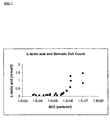
- Figure 1 illustrates quite clearly that the concentration in lactic acid is relatively constant until the somatic cell count reaches a level in the order of 800,000 to 1,000,000 cells per ml.
- somatic cell count reaches a level in the order of 800,000 to 1,000,000 cells per ml.
- sub-clinical mastitis can be present when somatic cell counts are above 1 ,000,000 cells per ml.
- the concentration of lactate can be a sensitive test to determine the presence of sub-clinical mastitis.
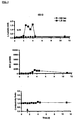
- Figures 2 and 3 results from two individual cows from a study of ten mid-lactation cows as described below.
- Somatic cell concentrations were determined by a cell counter (Fossomatic 450, Foss Electric, Hillerod, Denmark) and L-lactate was measured in deproteinised milk using a Boehringer analytical kit. The conductivity ratio was calculated from the conductivity of the infused quarter divided by the lowest conductivity of the non-infused quarters.
- Fig 2 shows typical results from an animal a showing clinical mastitis within 24h of pathogen being infused.
- SCC rose to >10 million/ml after 24h and this was accompanied by large changes in conductivity ratio.
- Milk lactate concentrations rose from below 0.1 mM to between 3.0 and 6.0mM, 24h post-infection in the infected quarters but remained unchanged in milk from the control quarters. All cows were treated with antibiotic after the 24h milking and SCC and lactate concentrations returned to normal within a further 10-11 days.
- a threshold of 0.5mM would have detected the presence of mastitis in the 6 cows showing clinical mastitis. In the remaining animals, changes in SCC and lactate were very small.
Landscapes
- Engineering & Computer Science (AREA)
- Food Science & Technology (AREA)
- Health & Medical Sciences (AREA)
- Life Sciences & Earth Sciences (AREA)
- Chemical & Material Sciences (AREA)
- Medicinal Chemistry (AREA)
- Physics & Mathematics (AREA)
- Analytical Chemistry (AREA)
- Biochemistry (AREA)
- General Health & Medical Sciences (AREA)
- General Physics & Mathematics (AREA)
- Immunology (AREA)
- Pathology (AREA)
- Investigating Or Analysing Biological Materials (AREA)
- Steroid Compounds (AREA)
Abstract
Description
characterised by the steps of
- Figure 1
- is a graph of the L-lactic acid concentration measured in milk in comparison with somatic cell counts for the same milk samples, and
- Figure 2
- is a comparison of lactic acid concentration with somatic cell count and conductivity ratio from a single cow, and
- Figure 3
- shows the same comparisons as in Figure 2, but for another cow.
Claims (15)
- A method for detecting mastitis in an animal,
characterised by the steps of(a) collecting milk from the animal, and(b) assaying the milk for lactate, and(c) comparing the lactate levels obtained with typical lactate levels found in uninfected milk. - A method as claimed in claim 1 wherein the animal is a cow.
- A method as claimed in any one of claims 1 to 2 wherein the lactate is L-lactate.
- A method as claimed in any one of claims 1 to 3 wherein the concentration of lactate between 0.2mM and 0.5mM is used as an indicator to further investigate the likely presence of mastitis.
- A method as claimed in any one of claims 1 to 4 wherein the concentration of lactate greater than 0.5mM is treated as an indicator of mastitis.
- A method as claimed in any one of claims 1 to 5 which is used in conjunction with an additional test for mastitis.
- A method as claimed in any one of claims 1 to 6 characterised by the further step of assaying the milk with an in-line lactate sensor in the milking machine.
- A method for assessing milk quality
characterised by the steps of(a) assaying the milk for lactate, and(b) comparing the lactate levels obtained with typical lactate levels found in uninfected milk. - A method as claimed in claim 8 wherein the animal is a cow.
- A method as claimed in either claim 8 or claim 9 wherein the lactate is L-lactate.
- A method as claimed in any one of claims 8 to 10 wherein the concentration of lactate between 0.2mM and 0.5mM is used as an indicator to further investigate the likely presence of mastitis.
- A method as claimed in any one of claims 8 to 11 wherein the concentration of lactate greater than 0.5mM is treated as an indicator of mastitis.
- A method as claimed in any one of claims 8 to 12 which is used in conjunction with an additional test for mastitis.
- A method as claimed in any one of claims 8 to 13 characterised by the further step of assaying the milk with an in-line lactate sensor in the milking machine.
- A method of collecting milk from a plurality of animals where the milk quality or mastitis has been assessed by a method as described in any one of the preceeding claims
characterised by the step of
keeping the mastitis or lower quality milk separate from other milk collected.
Applications Claiming Priority (3)
| Application Number | Priority Date | Filing Date | Title |
|---|---|---|---|
| NZ33608999 | 1999-06-09 | ||
| NZ33608999 | 1999-06-09 | ||
| PCT/NZ2000/000096 WO2000075654A2 (en) | 1999-06-09 | 2000-06-09 | Mastitis detection method |
Publications (2)
| Publication Number | Publication Date |
|---|---|
| EP1192460A2 EP1192460A2 (en) | 2002-04-03 |
| EP1192460B1 true EP1192460B1 (en) | 2003-10-08 |
Family
ID=19927313
Family Applications (1)
| Application Number | Title | Priority Date | Filing Date |
|---|---|---|---|
| EP00931774A Revoked EP1192460B1 (en) | 1999-06-09 | 2000-06-09 | Mastitis detection method |
Country Status (8)
| Country | Link |
|---|---|
| US (1) | US7033836B1 (en) |
| EP (1) | EP1192460B1 (en) |
| AT (1) | ATE251749T1 (en) |
| AU (1) | AU770458B2 (en) |
| CA (1) | CA2375446A1 (en) |
| DE (1) | DE60005832T2 (en) |
| DK (1) | DK1192460T3 (en) |
| WO (1) | WO2000075654A2 (en) |
Families Citing this family (2)
| Publication number | Priority date | Publication date | Assignee | Title |
|---|---|---|---|---|
| US7302349B2 (en) | 2002-08-16 | 2007-11-27 | Lattec I/S | System and a method for observing and predicting a physiological state of an animal |
| CN102576008A (en) * | 2009-06-09 | 2012-07-11 | 塔图大学 | Method for the detection of mastitis and milk quality, and mastitis sensor |
Family Cites Families (9)
| Publication number | Priority date | Publication date | Assignee | Title |
|---|---|---|---|---|
| SU1582389A1 (en) * | 1987-09-21 | 1996-07-20 | Краснодарская научно-исследовательская ветеринарная станция | Method of preparing agent for treatment of endometritis and mastitis in animals |
| US4830011A (en) | 1987-09-30 | 1989-05-16 | Lim Shun P | Catheter tip polarographic lactic acid and lactate sensor for extended use in vivo |
| NL9101636A (en) | 1991-09-27 | 1993-04-16 | Lely Nv C Van Der | METHOD FOR AUTOMATIC MILKING OF ANIMALS. |
| JP2939502B2 (en) * | 1990-08-06 | 1999-08-25 | 株式会社三和化学研究所 | Early methods of mastitis testing |
| JPH05317343A (en) * | 1992-05-15 | 1993-12-03 | Kubota Corp | Method and apparatus for diagnosing latent mastitis in dairy cows |
| NL9300997A (en) | 1993-06-10 | 1995-01-02 | Lely Nv C Van Der | A method for milking animals, as well as a device for applying this method. |
| NZ237540A (en) * | 1994-01-21 | 1994-05-26 | Immuno Chemical Products Ltd | Test igg2 levels in milk samples to detect the presence of mastitis |
| US5743209A (en) * | 1994-08-01 | 1998-04-28 | La Federation Francaise De Controle Laitier (F.F.C.L.) | System and method for monitoring and controlling milk production at dairy farms |
| ATE280492T1 (en) * | 2001-03-07 | 2004-11-15 | Lattec I S | ARRANGEMENT FOR OPTIMIZING THE PRODUCTION PERFORMANCE OF A DAIRY HERD |
-
2000
- 2000-06-09 AT AT00931774T patent/ATE251749T1/en not_active IP Right Cessation
- 2000-06-09 WO PCT/NZ2000/000096 patent/WO2000075654A2/en not_active Ceased
- 2000-06-09 CA CA002375446A patent/CA2375446A1/en not_active Abandoned
- 2000-06-09 DK DK00931774T patent/DK1192460T3/en active
- 2000-06-09 AU AU49604/00A patent/AU770458B2/en not_active Ceased
- 2000-06-09 US US09/979,981 patent/US7033836B1/en not_active Expired - Fee Related
- 2000-06-09 EP EP00931774A patent/EP1192460B1/en not_active Revoked
- 2000-06-09 DE DE60005832T patent/DE60005832T2/en not_active Revoked
Also Published As
| Publication number | Publication date |
|---|---|
| DE60005832D1 (en) | 2003-11-13 |
| WO2000075654A3 (en) | 2001-05-25 |
| DK1192460T3 (en) | 2003-11-03 |
| AU4960400A (en) | 2000-12-28 |
| EP1192460A2 (en) | 2002-04-03 |
| WO2000075654A2 (en) | 2000-12-14 |
| CA2375446A1 (en) | 2000-12-14 |
| ATE251749T1 (en) | 2003-10-15 |
| DE60005832T2 (en) | 2004-08-05 |
| AU770458B2 (en) | 2004-02-19 |
| US7033836B1 (en) | 2006-04-25 |
Similar Documents
| Publication | Publication Date | Title |
|---|---|---|
| Ruegg et al. | Milk quality and mastitis tests | |
| Kitchen et al. | Mastitis diagnostic tests to estimate mammary gland epithelial cell damage | |
| Nielen et al. | Electrical conductivity of milk: measurement, modifiers, and meta analysis of mastitis detection performance | |
| Norberg | Electrical conductivity of milk as a phenotypic and genetic indicator of bovine mastitis: A review | |
| Poutrel et al. | Cell content of goat milk: California mastitis test, coulter counter, and fossomatic for predicting half infection | |
| Sargeant et al. | Sensitivity and specificity of somatic cell count and California Mastitis Test for identifying intramammary infection in early lactation | |
| Fernando et al. | Comparison of electrical conductivity of milk with other indirect methods for detection of subclinical mastitis | |
| Sloth et al. | Potential for improving description of bovine udder health status by combined analysis of milk parameters | |
| Ying et al. | Relationship of somatic cell count, physical, chemical and enzymatic properties to the bacterial standard plate count in dairy goat milk | |
| Davis et al. | Milk L-lactate concentration is increased during mastitis | |
| Godden et al. | The effect of sampling time and sample handling on the detection of Staphylococcus aureus in milk from quarters with subclinical mastitis | |
| Kivaria et al. | Interpretation of California mastitis test scores using Staphylococcus aureus culture results for screening of subclinical mastitis in low yielding smallholder dairy cows in the Dar es Salaam region of Tanzania | |
| Perrin et al. | Relationships between California mastitis test (CMT) and somatic cell counts in dairy goats | |
| Sharma et al. | Quarter-wise prevalence of subclinical mastitis in crossbred cows. | |
| US20120115184A1 (en) | Method for the detection of mastitis and milk quality and mastitis sensor | |
| Kandeel et al. | Evaluation of 3 esterase tests for the diagnosis of subclinical mastitis at dry-off and freshening in dairy cattle | |
| Rees et al. | Udder firmness as a possible indicator for clinical mastitis | |
| Alkhouly et al. | Evaluation and comparison of four screening tests against milk culture for detection of subclinical mastitis in lactating cattle and buffalo in Egypt | |
| Dimitrov et al. | Diagnosis of subclinical mastitis in dairy goats | |
| US7033836B1 (en) | Mastitis detection method | |
| Peaker | The electrical conductivity of milk for the detection of subclinical mastitis in cows: comparison of various methods of handling conductivity data with the use of cell counts and bacteriological examination | |
| Petzer et al. | Value of tests for evaluating udder health in dairy goats: somatic cell counts, California Milk Cell Test and electrical conductivity | |
| Upadhyaya et al. | Diagnosis and threshold values of subclinical mastitis in goats | |
| Konkol et al. | Validation of a rapid cow-side test for the measurement of blood beta-hydroxybutyrate in fresh cows | |
| Hanuš et al. | Milk acetone determination by the photometrical method after microdiffusion and via FT infra-red spectroscopy. |
Legal Events
| Date | Code | Title | Description |
|---|---|---|---|
| PUAI | Public reference made under article 153(3) epc to a published international application that has entered the european phase |
Free format text: ORIGINAL CODE: 0009012 |
|
| 17P | Request for examination filed |
Effective date: 20011211 |
|
| AK | Designated contracting states |
Kind code of ref document: A2 Designated state(s): AT BE CH CY DE DK ES FI FR GB GR IE IT LI LU MC NL PT SE |
|
| AX | Request for extension of the european patent |
Free format text: AL;LT;LV;MK;RO;SI |
|
| 17Q | First examination report despatched |
Effective date: 20020913 |
|
| GRAH | Despatch of communication of intention to grant a patent |
Free format text: ORIGINAL CODE: EPIDOS IGRA |
|
| GRAS | Grant fee paid |
Free format text: ORIGINAL CODE: EPIDOSNIGR3 |
|
| GRAA | (expected) grant |
Free format text: ORIGINAL CODE: 0009210 |
|
| AK | Designated contracting states |
Kind code of ref document: B1 Designated state(s): AT BE CH CY DE DK ES FI FR GB GR IE IT LI LU MC NL PT SE |
|
| PG25 | Lapsed in a contracting state [announced via postgrant information from national office to epo] |
Ref country code: CH Free format text: LAPSE BECAUSE OF FAILURE TO SUBMIT A TRANSLATION OF THE DESCRIPTION OR TO PAY THE FEE WITHIN THE PRESCRIBED TIME-LIMIT Effective date: 20031008 Ref country code: FI Free format text: LAPSE BECAUSE OF FAILURE TO SUBMIT A TRANSLATION OF THE DESCRIPTION OR TO PAY THE FEE WITHIN THE PRESCRIBED TIME-LIMIT Effective date: 20031008 Ref country code: AT Free format text: LAPSE BECAUSE OF FAILURE TO SUBMIT A TRANSLATION OF THE DESCRIPTION OR TO PAY THE FEE WITHIN THE PRESCRIBED TIME-LIMIT Effective date: 20031008 Ref country code: CY Free format text: LAPSE BECAUSE OF FAILURE TO SUBMIT A TRANSLATION OF THE DESCRIPTION OR TO PAY THE FEE WITHIN THE PRESCRIBED TIME-LIMIT Effective date: 20031008 Ref country code: LI Free format text: LAPSE BECAUSE OF FAILURE TO SUBMIT A TRANSLATION OF THE DESCRIPTION OR TO PAY THE FEE WITHIN THE PRESCRIBED TIME-LIMIT Effective date: 20031008 Ref country code: BE Free format text: LAPSE BECAUSE OF FAILURE TO SUBMIT A TRANSLATION OF THE DESCRIPTION OR TO PAY THE FEE WITHIN THE PRESCRIBED TIME-LIMIT Effective date: 20031008 |
|
| REG | Reference to a national code |
Ref country code: GB Ref legal event code: FG4D |
|
| REG | Reference to a national code |
Ref country code: CH Ref legal event code: EP |
|
| REG | Reference to a national code |
Ref country code: DK Ref legal event code: T3 |
|
| REG | Reference to a national code |
Ref country code: IE Ref legal event code: FG4D |
|
| REF | Corresponds to: |
Ref document number: 60005832 Country of ref document: DE Date of ref document: 20031113 Kind code of ref document: P |
|
| REG | Reference to a national code |
Ref country code: SE Ref legal event code: TRGR |
|
| PG25 | Lapsed in a contracting state [announced via postgrant information from national office to epo] |
Ref country code: GR Free format text: LAPSE BECAUSE OF FAILURE TO SUBMIT A TRANSLATION OF THE DESCRIPTION OR TO PAY THE FEE WITHIN THE PRESCRIBED TIME-LIMIT Effective date: 20040108 |
|
| PG25 | Lapsed in a contracting state [announced via postgrant information from national office to epo] |
Ref country code: ES Free format text: LAPSE BECAUSE OF FAILURE TO SUBMIT A TRANSLATION OF THE DESCRIPTION OR TO PAY THE FEE WITHIN THE PRESCRIBED TIME-LIMIT Effective date: 20040119 |
|
| LTIE | Lt: invalidation of european patent or patent extension |
Effective date: 20031008 |
|
| REG | Reference to a national code |
Ref country code: CH Ref legal event code: PL |
|
| PG25 | Lapsed in a contracting state [announced via postgrant information from national office to epo] |
Ref country code: LU Free format text: LAPSE BECAUSE OF NON-PAYMENT OF DUE FEES Effective date: 20040609 |
|
| PG25 | Lapsed in a contracting state [announced via postgrant information from national office to epo] |
Ref country code: MC Free format text: LAPSE BECAUSE OF NON-PAYMENT OF DUE FEES Effective date: 20040630 |
|
| ET | Fr: translation filed | ||
| PLBI | Opposition filed |
Free format text: ORIGINAL CODE: 0009260 |
|
| PLAX | Notice of opposition and request to file observation + time limit sent |
Free format text: ORIGINAL CODE: EPIDOSNOBS2 |
|
| RAP2 | Party data changed (patent owner data changed or rights of a patent transferred) |
Owner name: SENSORTEC LIMITED |
|
| 26 | Opposition filed |
Opponent name: OCTROOIBUREAU VAN DER LELY N.V. Effective date: 20040708 |
|
| NLT2 | Nl: modifications (of names), taken from the european patent patent bulletin |
Owner name: SENSORTEC LIMITED |
|
| NLR1 | Nl: opposition has been filed with the epo |
Opponent name: OCTROOIBUREAU VAN DER LELY N.V. |
|
| PLAX | Notice of opposition and request to file observation + time limit sent |
Free format text: ORIGINAL CODE: EPIDOSNOBS2 |
|
| PLBB | Reply of patent proprietor to notice(s) of opposition received |
Free format text: ORIGINAL CODE: EPIDOSNOBS3 |
|
| RDAF | Communication despatched that patent is revoked |
Free format text: ORIGINAL CODE: EPIDOSNREV1 |
|
| PGFP | Annual fee paid to national office [announced via postgrant information from national office to epo] |
Ref country code: NL Payment date: 20060604 Year of fee payment: 7 |
|
| PGFP | Annual fee paid to national office [announced via postgrant information from national office to epo] |
Ref country code: GB Payment date: 20060607 Year of fee payment: 7 |
|
| PGFP | Annual fee paid to national office [announced via postgrant information from national office to epo] |
Ref country code: DE Payment date: 20060608 Year of fee payment: 7 Ref country code: FR Payment date: 20060608 Year of fee payment: 7 |
|
| PGFP | Annual fee paid to national office [announced via postgrant information from national office to epo] |
Ref country code: IE Payment date: 20060616 Year of fee payment: 7 |
|
| PGFP | Annual fee paid to national office [announced via postgrant information from national office to epo] |
Ref country code: DK Payment date: 20060621 Year of fee payment: 7 |
|
| PGFP | Annual fee paid to national office [announced via postgrant information from national office to epo] |
Ref country code: SE Payment date: 20060628 Year of fee payment: 7 |
|
| PGFP | Annual fee paid to national office [announced via postgrant information from national office to epo] |
Ref country code: IT Payment date: 20060630 Year of fee payment: 7 |
|
| RDAG | Patent revoked |
Free format text: ORIGINAL CODE: 0009271 |
|
| STAA | Information on the status of an ep patent application or granted ep patent |
Free format text: STATUS: PATENT REVOKED |
|
| 27W | Patent revoked |
Effective date: 20060404 |
|
| GBPR | Gb: patent revoked under art. 102 of the ep convention designating the uk as contracting state |
Free format text: 20060404 |
|
| NLR2 | Nl: decision of opposition |
Effective date: 20060404 |
|
| REG | Reference to a national code |
Ref country code: SE Ref legal event code: ECNC |
|
| PG25 | Lapsed in a contracting state [announced via postgrant information from national office to epo] |
Ref country code: PT Free format text: LAPSE BECAUSE OF NON-PAYMENT OF DUE FEES Effective date: 20040308 |