EP1192189B1 - Catalysts containing n-pyrrolyl substituted nitrogen donors - Google Patents
Catalysts containing n-pyrrolyl substituted nitrogen donors Download PDFInfo
- Publication number
- EP1192189B1 EP1192189B1 EP00908733A EP00908733A EP1192189B1 EP 1192189 B1 EP1192189 B1 EP 1192189B1 EP 00908733 A EP00908733 A EP 00908733A EP 00908733 A EP00908733 A EP 00908733A EP 1192189 B1 EP1192189 B1 EP 1192189B1
- Authority
- EP
- European Patent Office
- Prior art keywords
- catalyst
- substituted
- hydrocarbyl
- group
- ethylene
- Prior art date
- Legal status (The legal status is an assumption and is not a legal conclusion. Google has not performed a legal analysis and makes no representation as to the accuracy of the status listed.)
- Expired - Lifetime
Links
- 0 C*(C)C(C)=*[C@@]1C(c2ccc(C(*)([C@@](C)C3)C3=C)cc2)=CC=CC1c1ccc(C2(N)NC2)cc1 Chemical compound C*(C)C(C)=*[C@@]1C(c2ccc(C(*)([C@@](C)C3)C3=C)cc2)=CC=CC1c1ccc(C2(N)NC2)cc1 0.000 description 3
Classifications
-
- C—CHEMISTRY; METALLURGY
- C07—ORGANIC CHEMISTRY
- C07D—HETEROCYCLIC COMPOUNDS
- C07D207/00—Heterocyclic compounds containing five-membered rings not condensed with other rings, with one nitrogen atom as the only ring hetero atom
- C07D207/02—Heterocyclic compounds containing five-membered rings not condensed with other rings, with one nitrogen atom as the only ring hetero atom with only hydrogen or carbon atoms directly attached to the ring nitrogen atom
- C07D207/30—Heterocyclic compounds containing five-membered rings not condensed with other rings, with one nitrogen atom as the only ring hetero atom with only hydrogen or carbon atoms directly attached to the ring nitrogen atom having two double bonds between ring members or between ring members and non-ring members
- C07D207/32—Heterocyclic compounds containing five-membered rings not condensed with other rings, with one nitrogen atom as the only ring hetero atom with only hydrogen or carbon atoms directly attached to the ring nitrogen atom having two double bonds between ring members or between ring members and non-ring members with only hydrogen atoms, hydrocarbon or substituted hydrocarbon radicals, directly attached to ring carbon atoms
-
- C—CHEMISTRY; METALLURGY
- C07—ORGANIC CHEMISTRY
- C07C—ACYCLIC OR CARBOCYCLIC COMPOUNDS
- C07C2/00—Preparation of hydrocarbons from hydrocarbons containing a smaller number of carbon atoms
- C07C2/02—Preparation of hydrocarbons from hydrocarbons containing a smaller number of carbon atoms by addition between unsaturated hydrocarbons
- C07C2/04—Preparation of hydrocarbons from hydrocarbons containing a smaller number of carbon atoms by addition between unsaturated hydrocarbons by oligomerisation of well-defined unsaturated hydrocarbons without ring formation
- C07C2/06—Preparation of hydrocarbons from hydrocarbons containing a smaller number of carbon atoms by addition between unsaturated hydrocarbons by oligomerisation of well-defined unsaturated hydrocarbons without ring formation of alkenes, i.e. acyclic hydrocarbons having only one carbon-to-carbon double bond
- C07C2/08—Catalytic processes
- C07C2/26—Catalytic processes with hydrides or organic compounds
- C07C2/32—Catalytic processes with hydrides or organic compounds as complexes, e.g. acetyl-acetonates
-
- C—CHEMISTRY; METALLURGY
- C07—ORGANIC CHEMISTRY
- C07D—HETEROCYCLIC COMPOUNDS
- C07D207/00—Heterocyclic compounds containing five-membered rings not condensed with other rings, with one nitrogen atom as the only ring hetero atom
- C07D207/02—Heterocyclic compounds containing five-membered rings not condensed with other rings, with one nitrogen atom as the only ring hetero atom with only hydrogen or carbon atoms directly attached to the ring nitrogen atom
- C07D207/30—Heterocyclic compounds containing five-membered rings not condensed with other rings, with one nitrogen atom as the only ring hetero atom with only hydrogen or carbon atoms directly attached to the ring nitrogen atom having two double bonds between ring members or between ring members and non-ring members
- C07D207/34—Heterocyclic compounds containing five-membered rings not condensed with other rings, with one nitrogen atom as the only ring hetero atom with only hydrogen or carbon atoms directly attached to the ring nitrogen atom having two double bonds between ring members or between ring members and non-ring members with hetero atoms or with carbon atoms having three bonds to hetero atoms with at the most one bond to halogen, e.g. ester or nitrile radicals, directly attached to ring carbon atoms
-
- C—CHEMISTRY; METALLURGY
- C07—ORGANIC CHEMISTRY
- C07D—HETEROCYCLIC COMPOUNDS
- C07D207/00—Heterocyclic compounds containing five-membered rings not condensed with other rings, with one nitrogen atom as the only ring hetero atom
- C07D207/46—Heterocyclic compounds containing five-membered rings not condensed with other rings, with one nitrogen atom as the only ring hetero atom with hetero atoms directly attached to the ring nitrogen atom
- C07D207/50—Nitrogen atoms
-
- C—CHEMISTRY; METALLURGY
- C07—ORGANIC CHEMISTRY
- C07D—HETEROCYCLIC COMPOUNDS
- C07D295/00—Heterocyclic compounds containing polymethylene-imine rings with at least five ring members, 3-azabicyclo [3.2.2] nonane, piperazine, morpholine or thiomorpholine rings, having only hydrogen atoms directly attached to the ring carbon atoms
- C07D295/22—Heterocyclic compounds containing polymethylene-imine rings with at least five ring members, 3-azabicyclo [3.2.2] nonane, piperazine, morpholine or thiomorpholine rings, having only hydrogen atoms directly attached to the ring carbon atoms with hetero atoms directly attached to ring nitrogen atoms
- C07D295/28—Nitrogen atoms
- C07D295/30—Nitrogen atoms non-acylated
-
- C—CHEMISTRY; METALLURGY
- C07—ORGANIC CHEMISTRY
- C07D—HETEROCYCLIC COMPOUNDS
- C07D401/00—Heterocyclic compounds containing two or more hetero rings, having nitrogen atoms as the only ring hetero atoms, at least one ring being a six-membered ring with only one nitrogen atom
- C07D401/14—Heterocyclic compounds containing two or more hetero rings, having nitrogen atoms as the only ring hetero atoms, at least one ring being a six-membered ring with only one nitrogen atom containing three or more hetero rings
-
- C—CHEMISTRY; METALLURGY
- C07—ORGANIC CHEMISTRY
- C07D—HETEROCYCLIC COMPOUNDS
- C07D409/00—Heterocyclic compounds containing two or more hetero rings, at least one ring having sulfur atoms as the only ring hetero atoms
- C07D409/14—Heterocyclic compounds containing two or more hetero rings, at least one ring having sulfur atoms as the only ring hetero atoms containing three or more hetero rings
-
- C—CHEMISTRY; METALLURGY
- C07—ORGANIC CHEMISTRY
- C07F—ACYCLIC, CARBOCYCLIC OR HETEROCYCLIC COMPOUNDS CONTAINING ELEMENTS OTHER THAN CARBON, HYDROGEN, HALOGEN, OXYGEN, NITROGEN, SULFUR, SELENIUM OR TELLURIUM
- C07F15/00—Compounds containing elements of Groups 8, 9, 10 or 18 of the Periodic Table
- C07F15/0006—Compounds containing elements of Groups 8, 9, 10 or 18 of the Periodic Table compounds of the platinum group
- C07F15/0046—Ruthenium compounds
- C07F15/0053—Ruthenium compounds without a metal-carbon linkage
-
- C—CHEMISTRY; METALLURGY
- C07—ORGANIC CHEMISTRY
- C07F—ACYCLIC, CARBOCYCLIC OR HETEROCYCLIC COMPOUNDS CONTAINING ELEMENTS OTHER THAN CARBON, HYDROGEN, HALOGEN, OXYGEN, NITROGEN, SULFUR, SELENIUM OR TELLURIUM
- C07F15/00—Compounds containing elements of Groups 8, 9, 10 or 18 of the Periodic Table
- C07F15/02—Iron compounds
- C07F15/025—Iron compounds without a metal-carbon linkage
-
- C—CHEMISTRY; METALLURGY
- C07—ORGANIC CHEMISTRY
- C07F—ACYCLIC, CARBOCYCLIC OR HETEROCYCLIC COMPOUNDS CONTAINING ELEMENTS OTHER THAN CARBON, HYDROGEN, HALOGEN, OXYGEN, NITROGEN, SULFUR, SELENIUM OR TELLURIUM
- C07F15/00—Compounds containing elements of Groups 8, 9, 10 or 18 of the Periodic Table
- C07F15/04—Nickel compounds
- C07F15/045—Nickel compounds without a metal-carbon linkage
-
- C—CHEMISTRY; METALLURGY
- C07—ORGANIC CHEMISTRY
- C07F—ACYCLIC, CARBOCYCLIC OR HETEROCYCLIC COMPOUNDS CONTAINING ELEMENTS OTHER THAN CARBON, HYDROGEN, HALOGEN, OXYGEN, NITROGEN, SULFUR, SELENIUM OR TELLURIUM
- C07F15/00—Compounds containing elements of Groups 8, 9, 10 or 18 of the Periodic Table
- C07F15/06—Cobalt compounds
- C07F15/065—Cobalt compounds without a metal-carbon linkage
-
- C—CHEMISTRY; METALLURGY
- C07—ORGANIC CHEMISTRY
- C07F—ACYCLIC, CARBOCYCLIC OR HETEROCYCLIC COMPOUNDS CONTAINING ELEMENTS OTHER THAN CARBON, HYDROGEN, HALOGEN, OXYGEN, NITROGEN, SULFUR, SELENIUM OR TELLURIUM
- C07F7/00—Compounds containing elements of Groups 4 or 14 of the Periodic Table
- C07F7/02—Silicon compounds
- C07F7/08—Compounds having one or more C—Si linkages
- C07F7/0803—Compounds with Si-C or Si-Si linkages
- C07F7/081—Compounds with Si-C or Si-Si linkages comprising at least one atom selected from the elements N, O, halogen, S, Se or Te
- C07F7/0812—Compounds with Si-C or Si-Si linkages comprising at least one atom selected from the elements N, O, halogen, S, Se or Te comprising a heterocyclic ring
-
- C—CHEMISTRY; METALLURGY
- C07—ORGANIC CHEMISTRY
- C07F—ACYCLIC, CARBOCYCLIC OR HETEROCYCLIC COMPOUNDS CONTAINING ELEMENTS OTHER THAN CARBON, HYDROGEN, HALOGEN, OXYGEN, NITROGEN, SULFUR, SELENIUM OR TELLURIUM
- C07F9/00—Compounds containing elements of Groups 5 or 15 of the Periodic Table
- C07F9/02—Phosphorus compounds
- C07F9/547—Heterocyclic compounds, e.g. containing phosphorus as a ring hetero atom
- C07F9/553—Heterocyclic compounds, e.g. containing phosphorus as a ring hetero atom having one nitrogen atom as the only ring hetero atom
- C07F9/572—Five-membered rings
-
- C—CHEMISTRY; METALLURGY
- C07—ORGANIC CHEMISTRY
- C07F—ACYCLIC, CARBOCYCLIC OR HETEROCYCLIC COMPOUNDS CONTAINING ELEMENTS OTHER THAN CARBON, HYDROGEN, HALOGEN, OXYGEN, NITROGEN, SULFUR, SELENIUM OR TELLURIUM
- C07F9/00—Compounds containing elements of Groups 5 or 15 of the Periodic Table
- C07F9/02—Phosphorus compounds
- C07F9/547—Heterocyclic compounds, e.g. containing phosphorus as a ring hetero atom
- C07F9/553—Heterocyclic compounds, e.g. containing phosphorus as a ring hetero atom having one nitrogen atom as the only ring hetero atom
- C07F9/576—Six-membered rings
- C07F9/58—Pyridine rings
-
- C—CHEMISTRY; METALLURGY
- C08—ORGANIC MACROMOLECULAR COMPOUNDS; THEIR PREPARATION OR CHEMICAL WORKING-UP; COMPOSITIONS BASED THEREON
- C08F—MACROMOLECULAR COMPOUNDS OBTAINED BY REACTIONS ONLY INVOLVING CARBON-TO-CARBON UNSATURATED BONDS
- C08F10/00—Homopolymers and copolymers of unsaturated aliphatic hydrocarbons having only one carbon-to-carbon double bond
-
- C—CHEMISTRY; METALLURGY
- C07—ORGANIC CHEMISTRY
- C07C—ACYCLIC OR CARBOCYCLIC COMPOUNDS
- C07C2531/00—Catalysts comprising hydrides, coordination complexes or organic compounds
- C07C2531/16—Catalysts comprising hydrides, coordination complexes or organic compounds containing coordination complexes
- C07C2531/22—Organic complexes
-
- C—CHEMISTRY; METALLURGY
- C08—ORGANIC MACROMOLECULAR COMPOUNDS; THEIR PREPARATION OR CHEMICAL WORKING-UP; COMPOSITIONS BASED THEREON
- C08F—MACROMOLECULAR COMPOUNDS OBTAINED BY REACTIONS ONLY INVOLVING CARBON-TO-CARBON UNSATURATED BONDS
- C08F110/00—Homopolymers of unsaturated aliphatic hydrocarbons having only one carbon-to-carbon double bond
- C08F110/02—Ethene
-
- C—CHEMISTRY; METALLURGY
- C08—ORGANIC MACROMOLECULAR COMPOUNDS; THEIR PREPARATION OR CHEMICAL WORKING-UP; COMPOSITIONS BASED THEREON
- C08F—MACROMOLECULAR COMPOUNDS OBTAINED BY REACTIONS ONLY INVOLVING CARBON-TO-CARBON UNSATURATED BONDS
- C08F110/00—Homopolymers of unsaturated aliphatic hydrocarbons having only one carbon-to-carbon double bond
- C08F110/14—Monomers containing five or more carbon atoms
-
- C—CHEMISTRY; METALLURGY
- C08—ORGANIC MACROMOLECULAR COMPOUNDS; THEIR PREPARATION OR CHEMICAL WORKING-UP; COMPOSITIONS BASED THEREON
- C08F—MACROMOLECULAR COMPOUNDS OBTAINED BY REACTIONS ONLY INVOLVING CARBON-TO-CARBON UNSATURATED BONDS
- C08F210/00—Copolymers of unsaturated aliphatic hydrocarbons having only one carbon-to-carbon double bond
- C08F210/16—Copolymers of ethene with alpha-alkenes, e.g. EP rubbers
-
- C—CHEMISTRY; METALLURGY
- C08—ORGANIC MACROMOLECULAR COMPOUNDS; THEIR PREPARATION OR CHEMICAL WORKING-UP; COMPOSITIONS BASED THEREON
- C08F—MACROMOLECULAR COMPOUNDS OBTAINED BY REACTIONS ONLY INVOLVING CARBON-TO-CARBON UNSATURATED BONDS
- C08F2410/00—Features related to the catalyst preparation, the catalyst use or to the deactivation of the catalyst
- C08F2410/03—Multinuclear procatalyst, i.e. containing two or more metals, being different or not
-
- C—CHEMISTRY; METALLURGY
- C08—ORGANIC MACROMOLECULAR COMPOUNDS; THEIR PREPARATION OR CHEMICAL WORKING-UP; COMPOSITIONS BASED THEREON
- C08F—MACROMOLECULAR COMPOUNDS OBTAINED BY REACTIONS ONLY INVOLVING CARBON-TO-CARBON UNSATURATED BONDS
- C08F4/00—Polymerisation catalysts
- C08F4/42—Metals; Metal hydrides; Metallo-organic compounds; Use thereof as catalyst precursors
- C08F4/44—Metals; Metal hydrides; Metallo-organic compounds; Use thereof as catalyst precursors selected from light metals, zinc, cadmium, mercury, copper, silver, gold, boron, gallium, indium, thallium, rare earths or actinides
- C08F4/60—Metals; Metal hydrides; Metallo-organic compounds; Use thereof as catalyst precursors selected from light metals, zinc, cadmium, mercury, copper, silver, gold, boron, gallium, indium, thallium, rare earths or actinides together with refractory metals, iron group metals, platinum group metals, manganese, rhenium technetium or compounds thereof
- C08F4/62—Refractory metals or compounds thereof
- C08F4/64—Titanium, zirconium, hafnium or compounds thereof
- C08F4/659—Component covered by group C08F4/64 containing a transition metal-carbon bond
-
- C—CHEMISTRY; METALLURGY
- C08—ORGANIC MACROMOLECULAR COMPOUNDS; THEIR PREPARATION OR CHEMICAL WORKING-UP; COMPOSITIONS BASED THEREON
- C08F—MACROMOLECULAR COMPOUNDS OBTAINED BY REACTIONS ONLY INVOLVING CARBON-TO-CARBON UNSATURATED BONDS
- C08F4/00—Polymerisation catalysts
- C08F4/42—Metals; Metal hydrides; Metallo-organic compounds; Use thereof as catalyst precursors
- C08F4/44—Metals; Metal hydrides; Metallo-organic compounds; Use thereof as catalyst precursors selected from light metals, zinc, cadmium, mercury, copper, silver, gold, boron, gallium, indium, thallium, rare earths or actinides
- C08F4/60—Metals; Metal hydrides; Metallo-organic compounds; Use thereof as catalyst precursors selected from light metals, zinc, cadmium, mercury, copper, silver, gold, boron, gallium, indium, thallium, rare earths or actinides together with refractory metals, iron group metals, platinum group metals, manganese, rhenium technetium or compounds thereof
- C08F4/62—Refractory metals or compounds thereof
- C08F4/64—Titanium, zirconium, hafnium or compounds thereof
- C08F4/659—Component covered by group C08F4/64 containing a transition metal-carbon bond
- C08F4/65912—Component covered by group C08F4/64 containing a transition metal-carbon bond in combination with an organoaluminium compound
Definitions
- the present invention generally relates to transition metal catalyzed processes for the polymerization of olefins, and to catalyst compositions useful in such processes.
- ligands useful for constituting Group 8-10 metal complexes which exhibit improved stability under olefin polymerization conditions are described.
- Said metal complexes comprise a bidentate or variable denticity ligand comprising two nitrogen donor atoms substituted by aromatic or heteroaromatic rings, wherein the otho positions of said rings are substituted by groups other than H or alkyl and at least one of the ortho positions of at least one of said rings is substituted by an aryl or heteroaryl group.
- Olefin polymers are used in a wide variety of products, from sheathing for wire and cable to film. Olefin polymers are used, for instance, in injection or compression molding applications, in extruded films or sheeting, as extrusion coatings on paper, for example photographic paper and digital recording paper, and the like. Improvements in catalysts have made it possible to better control polymerization processes and, thus, influence the properties of the bulk material. Increasingly, efforts are being made to tune the physical properties of plastics for lightness, strength, resistance to corrosion, permeability, optical properties, and the like, for particular uses. Chain length, polymer branching and functionality have a significant impact on the physical properties of the polymer. Accordingly, novel catalysts are constantly being sought in attempts to obtain a catalytic process for polymerizing olefins which permits more efficient and better-controlled polymerization of olefins.
- polystyrene resins are prepared by a variety of polymerization techniques, including homogeneous liquid phase, gas phase, and slurry polymerization.
- Certain transition metal catalysts such as those based on titanium compounds (e.g. TiCl 3 or TiCl 4 ) in combination with organoaluminum cocatalysts, are used to make linear and linear low-density polyethylenes as well as poly- ⁇ -olefins such as polypropylene.
- TiCl 3 or TiCl 4 titanium compounds
- organoaluminum cocatalysts are used to make linear and linear low-density polyethylenes as well as poly- ⁇ -olefins such as polypropylene.
- Recent advances in Group 8-10 catalysts for the polymerization of olefins include the following.
- European Patent Application No. 381,495 describes the polymerization of olefins using palladium and nickel catalysts, which contain selected bidentate phosphorous containing ligands.
- U. Klabunde U. S. Patent Nos. 4,906,754, 4,716,205, 5,030,606, and 5,175,326, describes the conversion of ethylene to polyethylene using anionic phosphorous, oxygen donors ligated to Ni(II). The polymerization reactions were run between 25 and 100°C with modest yields, producing linear polyethylene having a weight-average molecular weight ranging between 8K and 350 K.
- Klabunde describes the preparation of copolymers of ethylene and functional group containing monomers.
- Chem . Soc ., 1995, 117, 6414 describe the polymerization of olefins such as ethylene, propylene, and 1-hexene using cationic ⁇ -diimine-based nickel and palladium complexes. These catalysts have been described to polymerize ethylene to high molecular weight branched polyethylene. In addition to polymerizing ethylene, the Pd complexes act as catalysts for the polymerization and copolymerization of olefins and methyl acrylate.
- WO 97/02298 discloses the polymerization of olefins using a variety of neutral N, O, P, or S donor ligands, in combination with a nickel(0) compound and an acid.
- Phillips, EP 884,331 discloses the use of nickel ⁇ -diimine catalysts for the polymerization of ethylene in their slurry loop process.
- Neutral nickel catalysts for the polymerization of olefins are described in WO 98/30610; WO 98/30609; WO 98/42665; and WO 98/42664.
- Fujita et al., EP 0 874 005 A1 have described olefin polymerization catalysts comprising N,O-donors of various transition metals, including a 2,4,6-triphenylaniline derivative.
- McClain et al, WO 98/03559 describe a variety of Ni and Pd olefin polymerization catalysts, including bidentate N,N-donor ligands derived from 2,6-dibromo- or 2,6-dichloro substituted anilines.
- WO 96/23010 includes a catalyst comprising a bidentate N,N-donor ligand derived from 2-phenylaniline.
- a common structural feature of these catalysts is that they contain a nitrogen donor substituted by an aromatic or heteroaromatic ring, wherein the substituents ortho to the point of attachment to the ligated nitrogen are alkyl groups, as exemplified by complex XXI.
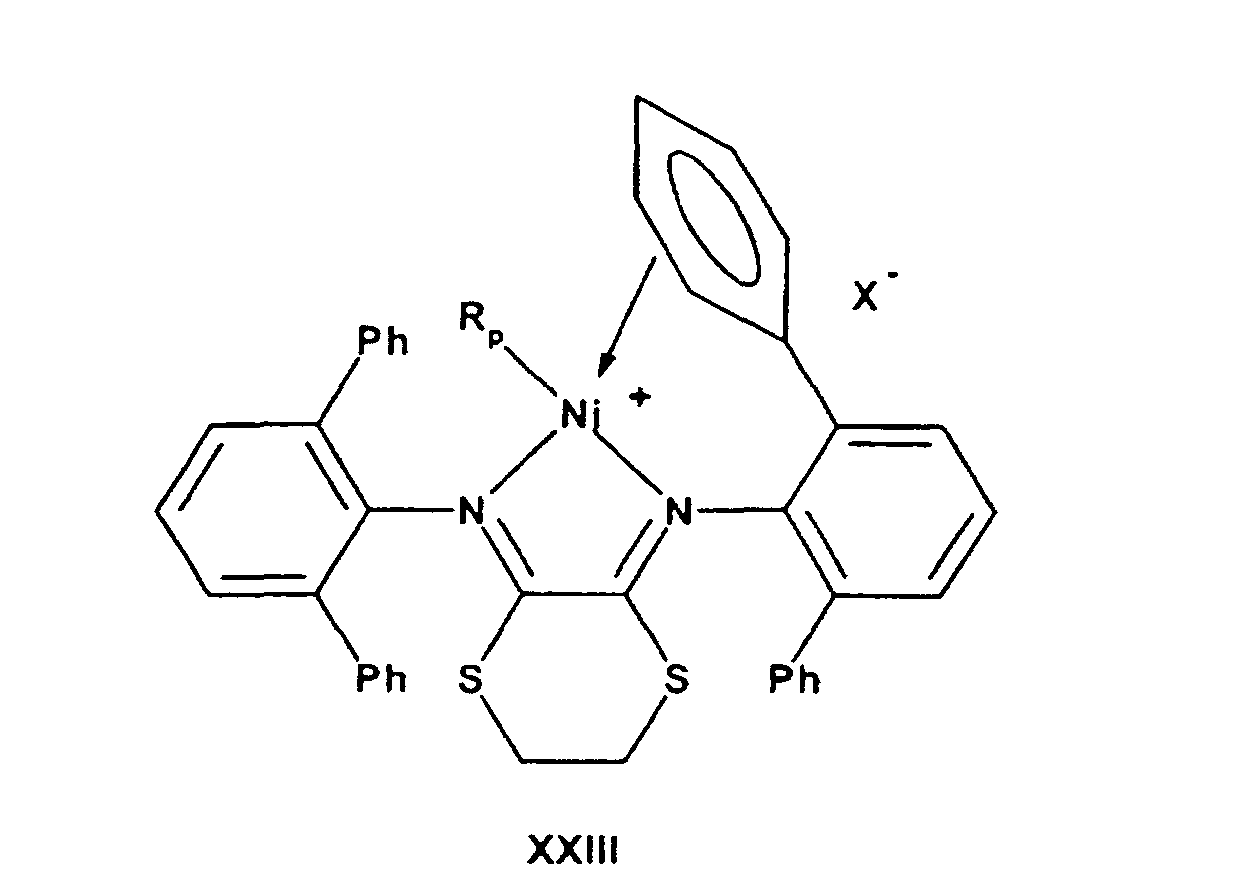
- the inventors attribute the improved stability to the reversible formation of agostic aryl intermediates in the catalytic chemistry (c.f. structure XXIII, wherein R p represents the growing polymer chain, X - is a weakly coordinating anion, and no specific bonding mode is implied for the interaction of the agostic phenyl group with the nickel center).
- the catalysis no longer involves a strictly bidentate ligand, but rather a variable denticity ligand, whereby the ability of the ligand to donate additional electron density (and possibly also accept ⁇ -electron density from the nickel) is believed to stabilize low coordinate intermediates (e.g.
- Ligands wherein some, but not all, of the ortho positions are substituted by bromo groups also give rise to catalysts which exhibit enhanced thermal stability and stability towards hydrogen.
- catalysts wherein the ortho positions are substituted by groups other than alkyl will exhibit enhanced thermal stability and stability towards hydrogen, provided that at least one of the ortho positions of one of said aromatic or heteroaromatic rings is an aryl or heteroaryl group.
- this invention relates to a process for the polymerization of olefins, comprising contacting a catalyst comprising a Group 8-10 transition metal complex with one or more olefins, wherein said metal complex comprises a bidentate or variable denticity ligand comprising two nitrogen donor atoms substituted by aromatic or heteroaromatic rings, and wherein the ortho positions of said rings are substituted by groups other than H or alkyl and at least one of the ortho positions of at least one of said rings is substituted by an aryl or heteroaryl group.
- said contacting step is carried out in the presence of an amount of hydrogen effective to achieve chain transfer.
- the ortho positions of the aromatic or heteroaromatic rings are substituted by aryl or heteroaryl groups.
- at least one of the ortho positions of at least one of said rings is substituted by a group other than aryl or heteroaryl.
- the process temperature is between 60 and 150 °C.
- the bidentate or variable denticity ligand is of the formula u1: wherein:
- the Group 8-10 transition metal is nickel and the bidentate or variable denticity ligand is selected from Set 1:
- the catalyst is attached to a solid support, with silica being an especially preferred solid support and reaction temperatures between 60 and 100 °C also being especially preferred in this embodiment.
- N, O, S, P, and Si stand for nitrogen, oxygen, sulfur, phosphorus, and silicon, respectively, while Me, Et, Pr, i Pr, Bu, t Bu and Ph stand for methyl, ethyl, propyl, iso -propyl, butyl, tert -butyl and phenyl, respectively.
- a "hydrocarbyl” group means a monovalent or divalent, linear, branched or cyclic group which contains only carbon and hydrogen atoms.
- monovalent hydrocarbyls include the following: C 1 -C 20 alkyl; C 1 -C 20 alkyl substituted with one or more groups selected from C 1 -C 20 alkyl, C 3 -C 8 cycloalkyl, and aryl; C 3 -C 8 cycloalkyl; C 3 -C 8 cycloalkyl substituted with one or more groups selected from C 1 -C 20 alkyl, C 3 -C 8 cycloalkyl, and aryl; C 6 -C 14 aryl; and C 6 -C 14 aryl substituted with one or more groups selected from C 1 -C 20 alkyl, C 3 -C 8 cycloalkyl, and aryl.
- divalent (bridging) hydrocarbyls include: -CH 2 -, -CH 2 CH 2
- aryl refers to an aromatic carbocyclic monoradical, which may be substituted or unsubstituted, wherein the substituents are halo, hydrocarbyl, substituted hydrocarbyl, heteroatom attached hydrocarbyl, heteroatom attached substituted hydrocarbyl, nitro, cyano, fluoroalkyl, sulfonyl, and the like.
- substituents are halo, hydrocarbyl, substituted hydrocarbyl, heteroatom attached hydrocarbyl, heteroatom attached substituted hydrocarbyl, nitro, cyano, fluoroalkyl, sulfonyl, and the like. Examples include: phenyl, naphthyl, anthracenyl, phenanthracenyl, 2,6-diphenylphenyl, 3,5-dimethylphenyl, 4-nitrophenyl, 3-nitrophenyl, 4-methoxyphenyl, 4-dimethylaminophenyl, and the like.
- heterocyclic ring refers to a carbocyclic ring wherein one or more of the carbon atoms has been replaced by an atom selected from the group consisting of O, N, S, P, Se, As, Si and B, and the like.
- a “heteroaromatic ring” refers to an aromatic heterocycle; examples include pyrrole, furan, thiophene, indene, imidazole, oxazole, isoxazole, carbazole, thiazole, pyrimidine, pyridine, pyridazine, and the like.
- heteroaryl refers to a heterocyclic monoradical which is aromatic; examples include 1-pyrrolyl, 2-pyrrolyl, 3-pyrrolyl, furyl, thienyl, indenyl, imidazolyl, oxazolyl, isoxazolyl, carbazolyl, thiazolyl, pyrimidinyl, pyridyl, pyridazinyl, and the like, and substituted derivatives thereof.
- sil refers to a SiR 3 group wherein Si is silicon and R is hydrocarbyl or substituted hydrocarbyl or silyl, as in Si(SiR 3 ) 3 .
- a “boryl” group refers to a BR 2 or B(OR) 2 group, wherein R is hydrocarbyl or substituted hydrocarbyl.
- heteroatom refers to an atom other than carbon or hydrogen.
- Preferred heteroatoms include oxygen, nitrogen, phosphorus, sulfur, selenium, arsenic, chlorine, bromine, silicon, and fluorine.
- a “substituted hydrocarbyl” refers to a monovalent, divalent, or trivalent hydrocarbyl substituted with one or more heteroatoms.
- monovalent substituted hydrocarbyls include: 2,6-dimethyl-4-methoxyphenyl, 2,6-diisopropyl-4-methoxyphenyl, 4-cyano-2,6-dimethylphenyl, 2,6-dimethyl-4-nitrophenyl, 2,6-difluorophenyl, 2,6-dibromophenyl, 2,6-dichlorophenyl, 4-methoxycarbonyl-2,6-dimethylphenyl, 2-tert-butyl-6-chlorophenyl, 2,6-dimethyl-4-phenylsulfonylphenyl, 2,6-dimethyl-4-trifluoromethylphenyl, 2,6-dimethyl-4-trimethylammoniumphenyl (associated with a weakly coordinated anion), 2,6-dimethyl
- divalent (bridging) substituted hydrocarbyls examples include: 4-methoxy-1,2-phenylene, 1-methoxymethyl-1,2-ethanediyl, 1,2-bis(benzyloxymethyl)-1,2-ethanediyl, and 1-(4-methoxyphenyl)-1,2-ethanediyl.
- a “heteroatom connected hydrocarbyl” refers to a group of the type E 10 (hydrocarbyl), E 20 H(hydrocarbyl), or E 20 (hydrocarbyl) 2 , where E 10 is an atom selected from Group 16 and E 20 is an atom selected from Group 15.
- a “heteroatom connected substituted hydrocarbyl” refers to a group of the type E 10 (substituted hydrocarbyl), E 20 H(substituted hydrocarbyl), or E 20 (substituted hydrocarbyl) 2 , where E 10 is an atom selected from Group 16 and E 20 is an atom selected from Group 15.
- fluoroalkyl refers to a C 1 -C 20 alkyl group substituted by one or more fluorine atoms.
- olefins include ethylene, propylene, butene, hexene, octene, and fluoroalkyl substituted olefins, but may also include, in the case of palladium and some of the more functional group tolerant nickel catalysts, norbornene, substituted norbomenes (e.g., norbomenes substituted at the 5-position with halide, siloxy, silane, halo carbon, ester, acetyl, alcohol, or amino groups), cyclopentene, ethyl undecenoate, acrylates, vinyl ethylene carbonate, 4-vinyl-2,2-dimethyl-1,3-dioxolane, and vinyl acetate.
- the catalysts can be inhibited by olefins which contain additional olefinic or acetylenic functionality. This is especially likely if the catalyst is prone to "chain-running" wherein the catalyst can migrate up and down the polymer chain between insertions, since this can lead to the formation of relatively unreactive ⁇ -allylic intermediates when the olefin monomer contains additional unsaturation.
- Such effects are best determined on a case-by-case basis, but may be predicted to some extent through knowledge of how much branching is observed with a given catalyst in ethylene homopolymerizations; those catalysts which tend to give relatively high levels of branching with ethylene will tend to exhibit lower rates when short chain diene co-monomers are used under the same conditions. Longer chain dienes tend to be less inhibitory than shorter chain dienes, when other factors are kept constant, since the catalyst has farther to migrate to form the ⁇ -allyl, and another insertion may intervene first.
- ⁇ -olefin as used herein is a 1-alkene with from 3 to 40 carbon atoms.
- a " ⁇ -allyl” group refers to a monoanionic group with three sp 2 carbon atoms bound to a metal center in a ⁇ 3 -fashion. Any of the three sp 2 carbon atoms may be substituted with a hydrocarbyl, substituted hydrocarbyl, heteroatom connected hydrocarbyl, heteroatom connected substituted hydrocarbyl, or O-silyl group.
- ⁇ -allyl groups examples include:
- ⁇ -benzyl group denotes an ⁇ -allyl group where two of the sp 2 carbon atoms are part of an aromatic ring.
- ⁇ -benzyl groups include:
- a “bridging group” refers to an atom or group which links two or more groups, which has an appropriate valency to satisfy its requirements as a bridging group, and which is compatible with the desired catalysis. Suitable examples include divalent or trivalent hydrocarbyl, substituted hydrocarbyl, heteroatom connected hydrocarbyl, heteroatom connected substituted hydrocarbyl, substituted silicon(IV), boron(III), N(III), P(III), and P(V), -C(O)-, -SO 2 -, -C(S)-, -B(OMe)-,-C(O)C(O)-, O, S, and Se.
- the groups which are said to be “linked by a bridging group” are directly bonded to one another, in which case the term “bridging group” is meant to refer to that bond.
- bridging group By “compatible with the desired catalysis,” we mean the bridging group either does not interfere with the desired catalysis, or acts to usefully modify the catalyst activity or selectivity.
- weakly coordinating anion is well known in the art per se and generally refers to a large bulky anion capable of delocalization of the negative charge of the anion.
- the weakly coordinating nature of such anions is known and described in the literature (S. Strauss et al., Chem . Rev., 1993, 93 , 927).
- Agostic is known to those skilled in the art, and is generally used to refer to a weak bonding interaction between a C-H bond and a coordinatively unsaturated transition metal. It is used herein to denote a weak bonding interaction between any or all of the atoms of the ortho-aryl or ortho-heteroaryl groups of the present invention, and a coordinatively unsaturated Fe, Co or Ni center to which said ligands are complexed.
- weak bonding interaction we mean a bond that is sufficiently weak that it is formed reversibly under polymerization reaction conditions, so that it does not, for example, preclude the binding and insertion of olefin monomer.
- ortho is used herein to denote the positions which are adjacent to the point of attachment of said aromatic or heteroaromatic ring to the ligated nitrogen(s).
- 6-member ring we mean the 2- and 6-positions.
- 5-membered ring we mean the 2- and 5-positions.
- 1-attached, fused ring aromatic or heteroaromatic rings we mean the first positions which can be substituted; for example, in the case of 1-naphthyl, these would be the 2- and 8-positions; in the case of 9-anthracenyl, these would be the 1- and 8-positions.
- variable denticity is used herein in the context of otherwise bidentate ligands to refer to the reversible formation of a third binding interaction between the ligand and the Fe, Co or Ni center to which it is complexed.
- acac refers to acetylacetonate.
- substituted acetylacetonates wherein one or more hydrogen in the parent structure has been replaced by a hydrocarbyl, substituted hydrocarbyl, or fluoroalkyl, may be used in place of the "acac".
- Hydrocarbyl substituted acetylacetonates may be preferred in some cases when it is important, for example, to improve the solubility of a (ligand)Ni(acac)BF 4 salt in mineral spirits; fluoroalkyl substituted acetylacetonates may be preferred when a more Lewis acidic metal acetylacetonate reagent is required to promote coordination of the ligands of the present invention to form the desired catalyst precursors.
- the catalysts of the present invention can be made sufficiently sterically hindered that chain transfer is slow with respect to chain propagation so that a chain of degree of polymerization (DP) of 10 or more results.
- DP degree of polymerization
- the degree of steric hindrance at the active catalyst site required to give slow chain transfer, and thus form polymer depends on a number of factors and is often best determined by experimentation. These factors include: the exact structure of the catalyst, the monomer or monomers being polymerized, whether the catalyst is in solution or attached to a solid support, and the temperature and pressure. Polymer is defined herein as corresponding to a degree of polymerization, DP, of 10 or more.
- a variety of protocols may be used to generate active polymerization catalysts comprising Group 8-10 complexes of bidentate N,N-donor ligands.
- Examples include (i) the reaction of a Group 8-10 metal dihalide complex of a bidentate N-donor ligand with an alkylaluminum reagent, (ii) the reaction of (bidentate N-donor ligand)Ni(acac)X salts with an alkylaluminum reagent, where X is a weakly coordinating anion, such as B(C 6 F 5 ) 4 , BF 4 , PF 6 , SbF 6 or OS(O) 2 CF 3 , (iii) the reaction of bis(1,5-cyclooctadiene)nickel(0) with a bidentate N,N-donor ligand in the presence of B(C 6 F 5 ) 3 .
- a variety of (ligand)M(Z 1a )(Z 1b ) complexes where "ligand” refers to an N,N-donor of the present invention, M is a Group 8-10 transition metal, and Z 1a and Z 1b are univalent groups, or may be taken together to form a divalent group, may be reacted with one or more compounds, collectively referred to as compound Y, which function as co-catalysts or activators, to generate an active catalyst of the form [(ligand) M(T 1a )(L)] + X - , where T 1a is a hydrogen atom or hydrocarbyl, L is an olefin or neutral donor group capable of being displaced by an olefin, M is a Group 8-10 transition metal, and X - is a weakly coordinating anion.
- suitable compound Y include: methylaluminoxane (hereinafter MAO) and other aluminum sesquioxides, R 3 Al, R 2 AlCl, and RAlCl 2 (wherein R is alkyl, and plural groups R may be the same or different).
- MAO methylaluminoxane
- R 3 Al aluminum, R 2 AlCl, and RAlCl 2 (wherein R is alkyl, and plural groups R may be the same or different).
- suitable compound Y include: MAO and other aluminum sesquioxides, R 3 Al, R 2 AlCl, RAlCl 2 (wherein R is alkyl, and plural groups R may be the same or different), B(C 6 F 5 ) 3 ; R 0 3 Sn[BF 4 ] (wherein R 0 is hydrocarbyl or substituted hydrocarbyl and plural groups R 0 may be the same or different), H + X - , wherein X - is a weakly coordinating anion, for example, tetrakis[3,5-bis(trifluoromethyl)phenyl]borate, and Lewis acidic or Bronsted acidic metal oxides, for example, montmorillonite clay.
- metal hydrocarbyls include: MAO, other aluminum sesquioxides, R 3 Al, R 2 AlCl, RAlCl 2 (wherein R is alkyl, and plural groups R may be the same or different), Grignard reagents, organolithium reagents, and diorganozinc reagents.
- Lewis acids examples include: MAO, other aluminum sesquioxides, R 3 Al, R 2 AlCl, RAlCl 2 (wherein R is alkyl, and plural groups R may be the same or different), B(C 6 F 5 ) 3 , R 0 3 Sn[BF 4 ] (wherein R 0 is hydrocarbyl or substituted hydrocarbyl and plural groups R 0 may be the same or different), and Lewis acidic metal oxides.
- alkylaluminum is used to refer to compounds containing at least one alkyl group bonded to Al(III), which are capable of reacting with a metal complex of the present invention to generate an active olefin polymerization catalyst. In general, this will involve exchanging one or more alkyl groups from the aluminum with a monoanionic atom or group on the metal complex pro-catalyst. In some cases, a hydride may be directly transferred from the ⁇ -carbon of the aluminum alkyl to said metal complex. Subsequent abstraction of a second monoanionic atom or group from the metal complex may also be required to generate a cationic active catalyst.
- the role of the alkylaluminum may simply be to exchange an alkyl or hydride from the aluminum with a monoanionic group, such as acetylacetonate, attached to the metal complex.
- the alkylaluminum reagent may, in some cases, simply act as a Lewis acid, to promote conversion of the ⁇ -allyl or ⁇ -benzyl to a ⁇ -allyl or ⁇ -benzyl bonding mode, thereby facilitating binding and insertion of the olefin monomer.
- the starting counteranion e.g. BF 4 -
- the alkylaluminum reagent may react with the alkylaluminum reagent to generate a new counteranion (or a mixture of several different counteranions) under olefin polymerization reaction conditions.
- suitable alkylaluminum reagents include: MAO, other aluminum sesquioxides, Me 3 Al, EtAlCl 2 , Et 2 AlCl, R 3 Al, R 2 AlCl, RAlCl 2 (wherein R is alkyl, and plural groups R may be the same or different), and the like.
- the active catalyst typically comprises the catalytically active metal, one or more ligands of the present invention, the growing polymer chain (or a metal hydride capable of initiating a new chain), and a site on the metal adjacent to the metal-alkyl bond of said chain where ethylene can coordinate, or at least closely approach, prior to insertion.
- active catalysts comprising the ligands of the present invention are formed as the reaction products of the catalyst activation reactions disclosed herein, regardless of the detailed structures of those active species.
- the catalysts of the present invention may be used in batch and continuous processes, in solution or slurry or gas phase processes.
- a solid support In some cases, it is advantageous to attach the catalyst to a solid support.
- useful solid supports include: inorganic oxides, such as talcs, silicas, titania, silica/chromia, silica/chromia/titania, silica/alumina, zirconia, aluminum phosphate gels, silanized silica, silica hydrogels, silica xerogels, silica aerogels, montmorillonite clay and silica co-gels, as well as organic support materials such as polystyrene and functionalized polystyrene. (See, for example, S.B. Roscoe et al., "Polyolefin Spheres from Metallocenes Supported on Non-Interacting Polystyrene," 1998, Science , 280, 270-273 (1998)).
- the catalysts of the present invention are attached to a solid support (by "attached to a solid support” is meant ion paired with a component on the surface, adsorbed to the surface or covalently attached to the surface) that has been pre-treated with a compound Y.
- a solid support by “attached to a solid support” is meant ion paired with a component on the surface, adsorbed to the surface or covalently attached to the surface
- the compound Y, and the solid support can be combined in any order and any number of compound(s) Y can be utilized.
- the supported catalyst thus formed may be treated with additional quantities of compound Y.
- the compounds of the present invention are attached to silica that has been pre-treated with an alkylaluminum compound Y, for example, MAO, Et 3 Al, i Bu 3 Al, Et 2 AlCl, or Me 3 Al.
- Such supported catalysts are prepared by contacting the transition metal compound, in a substantially inert solvent (by which is meant a solvent which is either unreactive under the conditions of catalyst preparation, or if reactive, acts to usefully modify the catalyst activity or selectivity) with MAO-treated silica for a sufficient period of time to generate the supported catalyst.
- substantially inert solvents include toluene, o-difluorobenzene, mineral spirits, hexane, CH 2 Cl 2 , and CHCl 3 .
- the catalysts of the present invention are activated in solution under an inert atmosphere, and then adsorbed onto a silica support which has been pre-treated with a silylating agent to replace surface silanols by trialkylsilyl groups.
- a silylating agent to replace surface silanols by trialkylsilyl groups.
- precurors and procedures may be used to generate the activated catalyst prior to said adsorption, including, for example, reaction of a (ligand)Ni(acac)B(C 6 F 5 ) 4 complex with Et 2 AlCl in a toluene/hexane mixture under nitrogen; where "ligand” refers to a compound of the present invention.
- the polymerizations may be conducted as solution polymerizations, as nonsolvent slurry type polymerizations, as slurry polymerizations using one or more of the olefins or other solvent as the polymerization medium, or in the gas phase.
- the catalyst could be supported using a suitable catalyst support and methods known in the art.
- Substantially inert solvents such as toluene, hydrocarbons, methylene chloride and the like, may be used.
- Propylene and 1-butene are excellent monomers for use in slurry-type copolymerizations and unused monomer can be flashed off and reused.
- Suitable polymerization temperatures are preferably from 20 °C to 160 °C, more preferably 60 °C to 100°C.
- the catalysts of the present invention may be used alone, or in combination with one or more other Group 3-10 olefin polymerization or oligomerization catalysts, in solution, slurry, or gas phase processes. Such mixed catalysts systems are sometimes useful for the production of bimodal or multimodal molecular weight or compositional distributions, which may facilitate polymer processing or final product properties.
- the polymer can be recovered from the reaction mixture by routine methods of isolation and/or purification.
- the polymers of the present invention are useful as components of thermoset materials, as elastomers, as packaging materials, films, compatibilizing agents for polyesters and polyolefins, as a component of tackifying compositions, and as a component of adhesive materials.
- High molecular weight resins are readily processed using conventional extrusion, injection molding, compression molding, and vacuum forming techniques well known in the art.
- Useful articles made from them include films, fibers, bottles and other containers, sheeting, molded objects and the like.
- Low molecular weight resins are useful, for example, as synthetic waxes and they may be used in various wax coatings or in emulsion form. They are also particularly useful in blends with ethylene/vinyl acetate or ethylene/methyl acrylate-type copolymers in paper coating or in adhesive applications.
- Typical additives used in olefin or vinyl polymers may be used in the new homopolymers and copolymers of this invention.
- Typical additives include pigments, colorants, titanium dioxide, carbon black, antioxidants, stabilizers, slip agents, flame retarding agents, and the like. These additives and their use in polymer systems are known per se in the art.
- the ligands of the present invention may be prepared by methods known to those skilled in the art, wherein a substituted 1-aminopyrrole is condensed with a dialdehyde or di-ketone to afford the desired ligands
- the molecular weight data presented in the following examples is determined at 135 °C in 1,2,4-trichlorobenzene using refractive index detection, calibrated using narrow molecular weight distribution poly(styrene) standards.
- a 250 mL round bottom Schlenk flask equipped with a magnetic stir bar and capped with a septum was evacuated and refilled with ethylene, then charged with 100 mL of dry, deoxygenated toluene and 4.0 mL of a MMAO in toluene (6.42% Al) and stirred under 1 atm ethylene at 0°C for 15 min.
- a 2 mL aliquot of a mixture of 3.5 mg of the nickel dibromide complex of a32 in 3.5 mL dry, deoxygenated dihloromethane was injected, and the mixture was stirred under 1 atm ethylene at 0°C. A white polyethylene precipitate was observed within minutes.
- a 600 mL Parr® autoclave was first heated to about 100°C under high vacuum to ensure the reactor was dry.
- the reactor was cooled and purged with argon. Under an argon atmosphere, the autoclave was charged with 150 mL of toluene.
- the reactor was pressurized to 1.38 x 10 6 Pa (200 psig) with ethylene and then relieved to ambient pressure (2x). 3 mL of MMAO solution were added.
- 2.0 mL of a stock solution (4.30 mg in 17.2 mL CH 2 Cl 2 ) of the nickel dibromide complex of a32 were injected.
- Ethane dithiol (264 ⁇ L, 3.15 mmol) was added via syringe to a suspension of NaH (75.6 mg, 60% in oil, 1.89 mmol) in THF (5 mL).
- the resulting suspensiuon was stirred under Ar at rt for 15 min, then treated with a solution of N 1 , N 2 -Bis-(4,4"-bis-tnfluoromethyl-[1,1';3',1"]terphenyl-2'-yl)-oxalodiimidoyl dichloride (401 mg, 0.471 mmol) in THF (5 mL).
- 2,3-bis-(2,6-diphenyl-phenylimino)-[1,4]dithiane V9 was prepared using similar reaction conditions as described in Example 233 and was purified via washing with heptane and hot ethanol to afford 2,3-bis-(2,6-diphenyl-phenylimino)-[1,4]dithiane V9: 1 H NMR (DMSO, 80 °C, chemical shifts in ppm relative to TMS): 2.21 (s, 4H), 7.21-7.39 (m, 26H).
- Ligands V1-V6, V8 and V12 were prepared using conditions similar to those described in Example 233.
- Example Ligand 1 H NMR Data a,b 20 V5 mixture of isomers, ⁇ 2.02 (s, 6H), 2.54-2.62 (m, 2H), 2.98-3.06 (m, 2H), 6.90-7.06 (m, 3H), 7.28-7.50 (m, 9H), 7.60-7.76 (m, 8H) 21 V6 ⁇ 2.02(m, 1H), 2.47-2.64(m, 1H), 2.72-3.08(m, 2H), 7.16-7.40(m, 8H), 7.4-7.54(m, 4H), 7.68-7.82(m, 2H) 22 V2 (CD 2 Cl 2 ) ⁇ 1.98(m,2H), 2.62(s,3H), 2.98(m, 2H), 7.11-7.21(m, 10H), 7.23-7.35(m, 12H), 7.40(m, 6H), 7.49(t, J
- Ligand V 1 (34.1 mg, 0.045 mmol), Ni(II) acetylacetonate (9.8 mg, 0.038 mmol) and triphenylcarbenium tetrakis(pentafluorophenyl)borate (34.8 mg, 0.038 mmol) were combined in a Schlenk Tube in an inert atmosphere dry box. The mixture was removed from the dry box and treated with CH 2 Cl 2 (7.0 mL) under an inert atmosphere to provide a dark red stock solution of the pro-catalyst.
- a Schlenk flask 200 mL, 500 mL or 1000 mL equipped with a magnetic stir bar and capped with a septum was evacuated and refilled with ethylene, then charged with dry, deoxygenated toluene (100 mL) and a 10 wt % solution of MAO in toluene (4.0 mL).
- the requisite volume of pro-catalyst solution (prepared from the indicated ligand as in example 242) was added to give the amount of Ni indicated in the table below.
- the mixture was stirred under 1 atm ethylene at the temperature indicated in the table below and a polyethylene precipitate was observed.
- Example Ligand Temp (C) ⁇ mol Ni Time min g PE M n Branches/ 1000 C's 28 V8 23 0.549 15.00 0.805 38,200 21.0 29 V1 23 0.551 6.00 0.795 782,700 4.7 30 V1 23 0.559 14.00 1.629 131,500 1.8 31 V1 23 0.547 b 6.00 0.540 145,300 2.9 32 V7 23 0.552 b 6.00 0.048 82,800 22.6 33 V1 23 0.276 c 24.00 0.539 89,000 3.0 34 V1 23 0.276 8.00 0.371 703,700 4.5 35 V1 23 0.276 c 24.00 0.934 87,800 2.7 36 V1 23 0.276 8.00 0.529 540,700 3.6 37 V1 23 0.276 c 15.00 0.527
- the oily solid was taken up in 5-ml of diethyl ether. Addition of 15-ml of hexane resulted in partial precipitation of the desired compound. The solvent was removed in vacuo giving a red powder. The red solid was washed with an Et 2 O/hexane solution. The wash was repeated and the resulting solid taken up in a 1:1 Et 2 O/CH 2 Cl 2 solution. Hexane was layered onto the red solution and the mixture cooled to -78 °C and left to sit overnight. Upon sitting red crystals formed and the supernate was removed via filter cannula. The resulting crystalline solid was dried under dynamic vacuum for several hours giving 374 mg of a red crystalline solid. 1 H NMR was consitent with the desired complex.
- a Parr® stirred autoclave (600-ml) was heated to 100°C under dynamic vacuum too completely dry the reactor.
- the reactor was cooled and charged with 150 ml of dry toluene and 1-ml of mMAO (Akzo Nobel).
- mMAO mMAO
- a septum-capped vial was charged with 3 mg of aal.
- the vial was removed from the box and 20-ml of CH 2 Cl 2 was added to the vial.
- the reactor was sealed and pressurized up to 1.03 x 10 6 Pa (150 psig) ethylene and heated to 60 °C.
- a 2-ml portion (0.3 mg, 2.1 x 10 -7 mol) of the solution of aal was removed from the vial and added to the autolclave via the high-pressure sample loop while pressurizing the autoclave to 1.38 x 10 6 Pa (200 psig). After 15 minutes of stirring at 1.38 x 10 6 Pa (200-psig) ethylene and 60 °C, the reaction was quenched upon addition of 2-ml of methanol at high pressure. The reactor was vented and the contents poured into a beaker containing a methanol acetone/mixture. The polymer was collected by suction filtration and dried in the vacuum oven overnight at ⁇ 100°C giving 8.9 grams of polyethylene (6.1 million catalyst turnovers per hour).
- a Parr® stirred autoclave (600-ml) was heated to 100°C under dynamic vacuum too completely dry the reactor.
- the reactor was cooled and charged with 150 ml of dry toluene and 1-ml of mMAO (Akzo Nobel).
- mMAO mMAO
- a septum-capped vial was charged with 3 mg of aal.
- the vial was removed from the box and 20-ml of CH 2 Cl 2 was added to the vial.
- the reactor was sealed and pressurized up to 1.03 x 10 6 Pa (150-psig) ethylene and heated to 100 °C.
- a Parr® stirred autoclave (600-ml) was heated to 100 °C under dynamic vacuum too completely dry the reactor.
- the reactor was cooled and charged with ⁇ 300 grams of NaCl and the supported procatalyst aal in an inert atmosphere glove box.
- the reactor was sealed removed from the glove box and placed under an argon atmosphere.
- the reactor was heated to 60 °C and trimethyl aluminum was added as a solution in toluene or hexane.
- the reactor is rapidly pressurized to 1.38 x 10 6 Pa (200-psig) ethylene and left to stir.
- the reactor was vented and the contents poured into a beaker.
- the polymer was isolated by blending the salt/polymer mixture in water.
- a Parr® stirred autoclave (600-ml) was heated to 100°C under dynamic vacuum too completely dry the reactor.
- the reactor was cooled and charged with 150 ml of dry toluene, 1-ml of mMAO (7.14 wt % Al; Akzo Nobel) and H 2 gas.
- mMAO 7.14 wt % Al; Akzo Nobel
- H 2 gas In an inert atmosphere glove box, a septum-capped vial was charged with 2.1 x 10 -6 mol of aa1 or z1.
- the vial was removed from the box and 20-ml of CH 2 Cl 2 was added to the vial.
- the reactor was sealed and pressurized up to 1.03 x 10 6 Pa (150-psig) ethylene and heated to 60 °C.
- a 2-ml portion (2.1 x 10 -7 mol of catalyst) of the solution of catalyst was removed from the vial and added to the autoclave via the high-pressure sample loop while pressurizing the autoclave to 1.38 x 10 6 Pa (200 psig). After 15 minutes of stirring at 1.38 x 10 6 Pa (200-psig) ethylene and 60 °C, the reaction was quenched upon addition of 2-ml of methanol at high pressure. The reactor was vented and the contents poured into a beaker containing a methanol acetone/mixture. The polymer was collected by suction filtration and dried in the vacuum oven overnight at ⁇ 100°C.
- a Schlenk flask 200 mL, 500 mL or 1000 mL equipped with a magnetic stir bar and capped with a septum was evacuated and refilled with ethylene, then charged with dry, deoxygenated toluene (100 mL) and a 10 wt % solution of MAO in toluene (4.0 mL).
- the requisite volume of pro-catalyst solution (prepared from the indicated ligand as in example 242) was added to give the amount ofNi indicated in the table below.
- the mixture was stirred under 1 atm ethylene at the temperature indicated in the table below and a polyethylene precipitate was observed.
- a sample loop was then used to inject 2.0 mL of a stock solution of pro-catalyst prepared from 9.375 mL dry, deoxygenated CH 2 Cl 2 and 0.625 mL of a stock solution prepared from ligand V1 (29.4 mg), Ni(acac) 2 (10.4 mg), Ph 3 CB(C 6 F 5 ) 4 (36.2 mg) and 5.0 mL of dry, deoxygenated CH 2 Cl 2 , and pressurized to about 1.38 x 10 6 Pa (200 psig) with ethylene.
- the mixture was stirred under ethylene at an average pressure of about 1.43 x 10 6 Pa (208 psig) and an average temperature of 57 °C for 80 min, after which the pressure was vented, the autoclave was opened, and the polymer treated with MeOH and 6 N aq HCl and isolated by filtration to obtain 60.3 g (2.1x10 6 mol C 2 H 4 /mol Ni) of white, partially crystalline polyethylene.
- Example 132 A procedure similar to that used in Example 132 was followed, except that the polymerization reaction temperature was 84 C, the pressure was 1.86 x 10 6 Pa (270 psig) ethylene and the reaction was quenched by sample loop injection of 2.0 mL MeOH at 7.1 min. This gave 20.0 g polyethylene from 1.0 ⁇ mol catalyst (700,000 mol C 2 H 4 /mol Ni), corresponding to a rate of 5.9x10 6 mol C 2 H 4 /mol Ni/h.
- Example 133 A procedure similar to that used in Example 133 was followed, except that the ligand was a54, the polymerization reaction temperature was 64 C, the pressure was 1.79 x 10⁶ Pa (260 psig) ethylene and the reaction was quenched by sample loop injection of 2.0 mL MeOH at 5.0 min. This gave 24.3 g polyethylene from 0.4 ⁇ mol catalyst (2.2x10 6 mol C 2 H 4 /mol Ni), corresponding to a rate of 2.6x10 7 mol C 2 H 4 /mol Ni/h.
- 1 H NMR 2 branches/1000 C; 100% terminal olefin (within experimental error).
- a catalyst delivery device was charged with the catalyst prepared in Example 135 (58.6 mg; 2.2 ⁇ mol Ni) and fixed to the head of a 1000-mL Parr® reactor. The device was placed under vacuum. The reactor was then charged with NaCl (325 g) that had been dried in vacuum at 120 °C for several hours, closed, evacuated and backfilled with nitrogen. The salt was subsequently treated with trimethylaluminum (10 mL; 2.0 M in toluene) and agitated at 60 °C for 30 min. The reactor was then pressurized with 200 psi ethylene and depressurized to atmospheric pressure four times. The catalyst was then introduced in the reactor with appropriate agitation. The reaction was allowed to proceed for 4 hours at 62 °C before the reactor was vented.
- a catalyst delivery device was charged with the catalyst prepared in Example 135 (47.7 mg; 1.8 ⁇ mol Ni) and fixed to the head of a 1000-mL Parr® reactor. The device was placed under vacuum. The reactor was then charged with NaCl (348 g) that had been dried in vacuum at 120 °C for several hours, closed and evacuated. The reactor was then pressurized with 200 psi ethylene and depressurized to atmospheric pressure three times. The salt was subsequently treated with trimethylaluminum (10 mL; 2.0 M in hexanes) and agitated at 60 °C for 30 min. The reactor was again pressurized with 200 psi ethylene and depressurized to atmospheric pressure three times.
- a 1,2-difluorobenzene solution (3.0 mL) containing 20.2 ⁇ mol of V1 , Ni(acac) 2 and Ph 3 CB(C 6 F 5 ) 4 was added dropwise to silica at 0 °C (2.0 g; Grace Davison, XPO-2402). The flask was then warmed up to room temperature and vacuum was applied for an hour to remove volatile. The flask was then cooled back to 0 °C with an ice-water bath and diethylaluminum chloride (2.7 mL; 1.0M in hexanes) was added dropwise with proper agitation. Volatiles were removed in vacuo at 0 °C for 90 min. The resulting solid was stored under nitrogen at -30°C.
- a catalyst delivery device was charged with the catalyst prepared in Example 138 (205 mg; 1.9 ⁇ mol Ni) and fixed to the head of a 1000-mL Parr® reactor. The device was placed under vacuum. The reactor was then charged with NaCl (329 g) that had been dried in vacuum at 120 °C for several hours, closed, evacuated and backfilled with nitrogen. The salt was subsequently treated with trimethylaluminum (10 mL; 2.0 M in toluene) and agitated at 60 °C for 30 min. The reactor was then pressurized with 200 psi ethylene and depressurized to atmospheric pressure four times. The catalyst was then introduced in the reactor with appropriate agitation. The reaction was allowed to proceed for 90 min at 63 °C before the reactor was vented.
- a catalyst delivery device was charged with the catalyst prepared in Example 140 (44.1 mg; 2.2 ⁇ mol Ni) and fixed to the head of a 1000-mL Parr® reactor. The device was placed under vacuum. The reactor was then charged with NaCl (328 g) that had been dried in vacuum at 120 °C for several hours, closed, evacuated and backfilled with nitrogen. The salt was subsequently treated with trimethylaluminum (10 mL; 2.0 M in hexane) and agitated at 60 °C for 30 min. The reactor was then pressurized with 200 psi ethylene and depressurized to atmospheric pressure three times. The catalyst was then introduced in the reactor with appropriate agitation. The reaction was allowed to proceed for 4 hours at 86 °C before the reactor was vented.
- a catalyst delivery device was charged with the catalyst prepared in Example 142 (94 mg; 4.7 ⁇ mol Ni) and fixed to the head of a 1000-mL Parr® reactor. The device was placed under vacuum. The reactor was then charged with NaCl (320 g) that had been dried in vacuum at 120 °C for several hours, closed, evacuated and backfilled with nitrogen three times. The salt was subsequently treated with trimethylaluminum (10 mL; 2.0 M in hexane) and agitated at 60 °C for 30 min. The reactor was then pressurized with 200 psi ethylene and depressurized to atmospheric pressure three times. The catalyst was then introduced in the reactor with appropriate agitation.
- the reaction was allowed to proceed for 3.5 hours at 58 °C before the temperature was increased to 80 °C.
- the reaction was allowed to proceed for a total of 5.5 hours.
- the polymer was isolated by washing the content of the reactor with water.
- a catalyst delivery device was charged with the catalyst prepared in Example 144 (54.4 mg; 2.8 ⁇ mol Ni) and fixed to the head of a 1000-mL Parr® reactor. The device was placed under vacuum. The reactor was then charged with NaCl (313 g) that had been dried in vacuum at 120 °C for several hours, closed and evacuated. The reactor was then evacuated and backfilled with nitrogen (1 atm) three times. The salt was subsequently treated with trimethylaluminum (10 mL; 2.0 M in hexanes) and agitated at 80 °C for 30 min. The reactor was again pressurized with 200 psi ethylene and depressurized to atmospheric pressure three times. Hydrogen (100 mL) was subsequently added to the reactor.
- the catalyst was then introduced in the reactor with appropriate agitation. The reaction was allowed to proceed for 4 hours at 83 °C before the reactor was vented.
- a catalyst delivery device was charged with the catalyst prepared in Example 146(44 mg; 2.2 ⁇ mol Ni) and fixed to the head of a 1000-mL Parr® reactor. The device was placed under vacuum. The reactor was then charged with NaCl (348 g) that had been dried in vacuum at 120 °C for several hours, closed, evacuated and backfilled with nitrogen three times. The salt was subsequently treated with trimethylaluminum (8 mL; 2.0 M in hexane) and agitated at 60 °C for 30 min. The reactor was then pressurized with ethylene (ca. 200 psi) and depressurized to atmospheric pressure four times. The catalyst was then introduced in the reactor with appropriate agitation. The reaction was allowed to proceed for 4 hours at 60 °C.
Landscapes
- Chemical & Material Sciences (AREA)
- Organic Chemistry (AREA)
- Health & Medical Sciences (AREA)
- Chemical Kinetics & Catalysis (AREA)
- Life Sciences & Earth Sciences (AREA)
- Biochemistry (AREA)
- General Health & Medical Sciences (AREA)
- Molecular Biology (AREA)
- Medicinal Chemistry (AREA)
- Polymers & Plastics (AREA)
- Transition And Organic Metals Composition Catalysts For Addition Polymerization (AREA)
- Pyrrole Compounds (AREA)
Abstract
Description
- The present invention generally relates to transition metal catalyzed processes for the polymerization of olefins, and to catalyst compositions useful in such processes. In paricular, ligands useful for constituting Group 8-10 metal complexes which exhibit improved stability under olefin polymerization conditions are described. Said metal complexes comprise a bidentate or variable denticity ligand comprising two nitrogen donor atoms substituted by aromatic or heteroaromatic rings, wherein the otho positions of said rings are substituted by groups other than H or alkyl and at least one of the ortho positions of at least one of said rings is substituted by an aryl or heteroaryl group.
- Olefin polymers are used in a wide variety of products, from sheathing for wire and cable to film. Olefin polymers are used, for instance, in injection or compression molding applications, in extruded films or sheeting, as extrusion coatings on paper, for example photographic paper and digital recording paper, and the like. Improvements in catalysts have made it possible to better control polymerization processes and, thus, influence the properties of the bulk material. Increasingly, efforts are being made to tune the physical properties of plastics for lightness, strength, resistance to corrosion, permeability, optical properties, and the like, for particular uses. Chain length, polymer branching and functionality have a significant impact on the physical properties of the polymer. Accordingly, novel catalysts are constantly being sought in attempts to obtain a catalytic process for polymerizing olefins which permits more efficient and better-controlled polymerization of olefins.
- Conventional polyolefins are prepared by a variety of polymerization techniques, including homogeneous liquid phase, gas phase, and slurry polymerization. Certain transition metal catalysts, such as those based on titanium compounds (e.g. TiCl3 or TiCl4) in combination with organoaluminum cocatalysts, are used to make linear and linear low-density polyethylenes as well as poly-α-olefins such as polypropylene. These so-called "Ziegler-Natta" catalysts are quite sensitive to oxygen and are ineffective for the copolymerization of nonpolar and polar monomers. Following the early discovery of Ziegler-Natta catalysts, there has been intense recent interest in the development and study of homogeneous early transition metal (Group 4-6) catalysts for the polymerization of olefins. These well-defined catalysts, which were first viewed as mechanistic models for heterogeneous Ziegler-Natta catalysts, are receiving increasing commercial attention. In fact, a growing understanding of the relationship between catalyst structure and polymer properties has led to significant advances in rational catalyst design. Recent advances in Group 4-6 single-site olefin polymerization catalysis include the following.
- The following documents describe the use of monocyclopentadienyl amido titanium complexes for the polymerization of olefins as described by J.M. Canich, EP 420,436 (1991) and Stevens et al., EP 416,815 (1991). Waymouth et al., Science, 1995, 267, 217, disclose the use of oscillating catalysts based on unbridged substituted indenyl complexes of zirconium. Mitsui Chemicals Inc. disclose the use of nitrogen/oxygen chelate ligands on Group 4-6 transition metals as catalysts for the polymerization of olefins, EP 874,005 (1998). McConville et al., J. Am. Chem. Soc., 1996, 118, 10008-10009, describe the living polymerization of olefins with chelating diamido complexes of Ti and Zr. Schrock et al., J. Am. Chem. Soc., 1997, 119, 3830, J. Am. Chem. Soc., 1999, 121, 5797, also describe catalysts comprising chelating diamido complexes of Ti and Zr. DSM (WO 94/14854 and EP 0 532 098 A1), BP (EP 0 641 804 A2 and EP 0 816 384 A2), Chevron (WO 94/11410), and Exxon (WO 94/01471) describe the use of Group 4-6 imido catalysts for the polymerization of olefins. Jordan et al., WO 98/40421, disclose the use of novel cationic Group 13 complexes incorporating bidentate ligands as olefin polymerization catalysts.
- Recent advances in Group 8-10 catalysts for the polymerization of olefins include the following.
- European Patent Application No. 381,495 describes the polymerization of olefins using palladium and nickel catalysts, which contain selected bidentate phosphorous containing ligands.
- U. Klabunde, U. S. Patent Nos. 4,906,754, 4,716,205, 5,030,606, and 5,175,326, describes the conversion of ethylene to polyethylene using anionic phosphorous, oxygen donors ligated to Ni(II). The polymerization reactions were run between 25 and 100°C with modest yields, producing linear polyethylene having a weight-average molecular weight ranging between 8K and 350 K. In addition, Klabunde describes the preparation of copolymers of ethylene and functional group containing monomers.
- M. Peuckert et al., Organomet. 1983, 2(5), 594, disclose the oligomerization of ethylene using phosphine/carboxylate donors ligated to Ni(II), which showed modest catalytic activity (0.14 to 1.83 TO/s). The oligomerizations were carried out at 60 to 95°C and 10 to 80 bar ethylene in toluene, to produce α-olefins.
- R. E. Murray, U.S. Patent Nos. 4,689,437 and 4,716,138, describes the oligomerization of ethylene using phosphine, sulfonate donors ligated to Ni(II). These complexes show catalyst activities approximately 15 times greater than those reported with phosphine, carboxylate analogs.
- W. Keim et al., Angew. Chem. Int. Ed. Eng., 1981, 20, 116, and V.M. Mohring et al., Angew. Chem. Int. Ed. Eng., 1985, 24, 1001, disclose the polymerization of ethylene and the oligomerization of α-olefins with aminobis(imino)phosphorane nickel catalysts.
- Wilke, Angew. Chem. Int. Ed. Engl., 1988, 27, 185, describes a nickel allyl phosphine complex for the polymerization of ethylene.
- K.A.O. Starzewski et al., Angew. Chem. Int. Ed. Engl., 1987, 26, 63, and U.S. Patent 4,691,036, describe a series of bis(ylide) nickel complexes, used to polymerize ethylene to provide high molecular weight linear polyethylene.
- L. K. Johnson et al., WO 96/23010; US 5,866,663; US 5,886,224; 5,891,963; 5,880,323; and 5,880,241; disclose the polymerization of olefins using cationic nickel, palladium, iron, and cobalt complexes containing diimine and bisoxazoline ligands. This document also describes the polymerization of ethylene, acyclic olefins, and/or selected cyclic olefins and optionally selected unsaturated acids or esters such as acrylic acid or alkyl acrylates to provide olefin homopolymers or copolymers. L. K. Johnson et al., J. Am. Chem. Soc., 1995, 117, 6414, describe the polymerization of olefins such as ethylene, propylene, and 1-hexene using cationic α-diimine-based nickel and palladium complexes. These catalysts have been described to polymerize ethylene to high molecular weight branched polyethylene. In addition to polymerizing ethylene, the Pd complexes act as catalysts for the polymerization and copolymerization of olefins and methyl acrylate.
- WO 97/02298 discloses the polymerization of olefins using a variety of neutral N, O, P, or S donor ligands, in combination with a nickel(0) compound and an acid.
- Eastman Chemical Company has recently described in a series of patent applications (WO 98/40374, WO 98/37110, WO 98/47933, and WO 98/40420) several new classes of Group 8-10 transition metal catalysts for the polymerization of olefins. Also described are several new polymer compositions derived from epoxybutene and derivatives thereof.
- Brown et al., WO 97/17380, WO 97/48777, WO 97/48739, and WO 97/48740, describe the use of Pd α-diimine catalysts for the polymerization of olefins including ethylene in the presence of air and water.
- Fink et al., U. S. Patent No. 4,724,273, describe the polymerization of α-olefins using aminobis(imino)phosphorane nickel catalysts and the compositions of the resulting poly(α-olefins).
- Recently, Vaughan et al., WO 97/48736, Denton et al., WO 97/48742, and Sugimura et al., WO 97/38024, describe the polymerization of ethylene using silica supported α-diimine nickel catalysts.
- Phillips, EP 884,331, discloses the use of nickel α-diimine catalysts for the polymerization of ethylene in their slurry loop process.
- Neutral nickel catalysts for the polymerization of olefins are described in WO 98/30610; WO 98/30609; WO 98/42665; and WO 98/42664.
- Highly active iron and cobalt catalysts ligated by pyridine bis(imines) for the polymerization and oligomerization of ethylene have been independently described by University of North Carolina-Chapel Hill (WO 99/02472), DuPont (WO 98/27124), BP Chemical and Imperial College (WO 99/12981).
- Also recently, Canich et al., WO 97/48735, and Mecking, DE 19707236 A1, describe the use of mixed α-diimine catalysts with group IV transition metal catalysts for the polymerization of olefins. Additional recent developments are described by Sugimura et al. in JP 96-84344 and JP 96-84343, by Yorisue et al. in JP 96-70332, by McLain et al. in WO 98/03559, by Weinberg et al. in WO 98/03521, by Wang et al. in WO 99/09078, by Coughlin in WO 99/10391, and by Matsunaga et al. in WO 97/48737.
- Fujita et al., EP 0 874 005 A1, have described olefin polymerization catalysts comprising N,O-donors of various transition metals, including a 2,4,6-triphenylaniline derivative. McClain et al, WO 98/03559, describe a variety of Ni and Pd olefin polymerization catalysts, including bidentate N,N-donor ligands derived from 2,6-dibromo- or 2,6-dichloro substituted anilines. WO 96/23010 includes a catalyst comprising a bidentate N,N-donor ligand derived from 2-phenylaniline.
- Notwithstanding the advances in polyolefin catalysis set forth in the Background of the Invention section, there remains a need for new catalysts which can not only produce novel polyolefin microstructures or incorporate functional co-monomers, but also possess sufficient thermal stability to be used in existing production reactors, and exhibit an appropriate response to hydrogen under such conditions, so as to allow for control of molecular weight without an unacceptable loss of catalyst productivity. This is particularly true in the case of nickel catalysts comprising bidentate N,N-donor ligands, which typically exhibit very short lifetimes (t½ ca. 1-10 min) at 80 °C, and are generally so severely inhibited by hydrogen that when enough hydrogen is added to bring the molecular weight down to that of a typical commercial linear low density polyethylene (LLDPE), the catalyst productivities at elevated temperature are so low as to be impractical. A common structural feature of these catalysts is that they contain a nitrogen donor substituted by an aromatic or heteroaromatic ring, wherein the substituents ortho to the point of attachment to the ligated nitrogen are alkyl groups, as exemplified by complex XXI.
- We have discovered that both the thermal stability and the catalyst productivity in the presence of hydrogen are dramatically improved, if the ortho substituents are aryl groups, as exemplified by complex XXII. Productivity improvements of about an order of magnitude, or more, are observed when the ortho-alkyl groups are replaced by ortho-aryl groups.
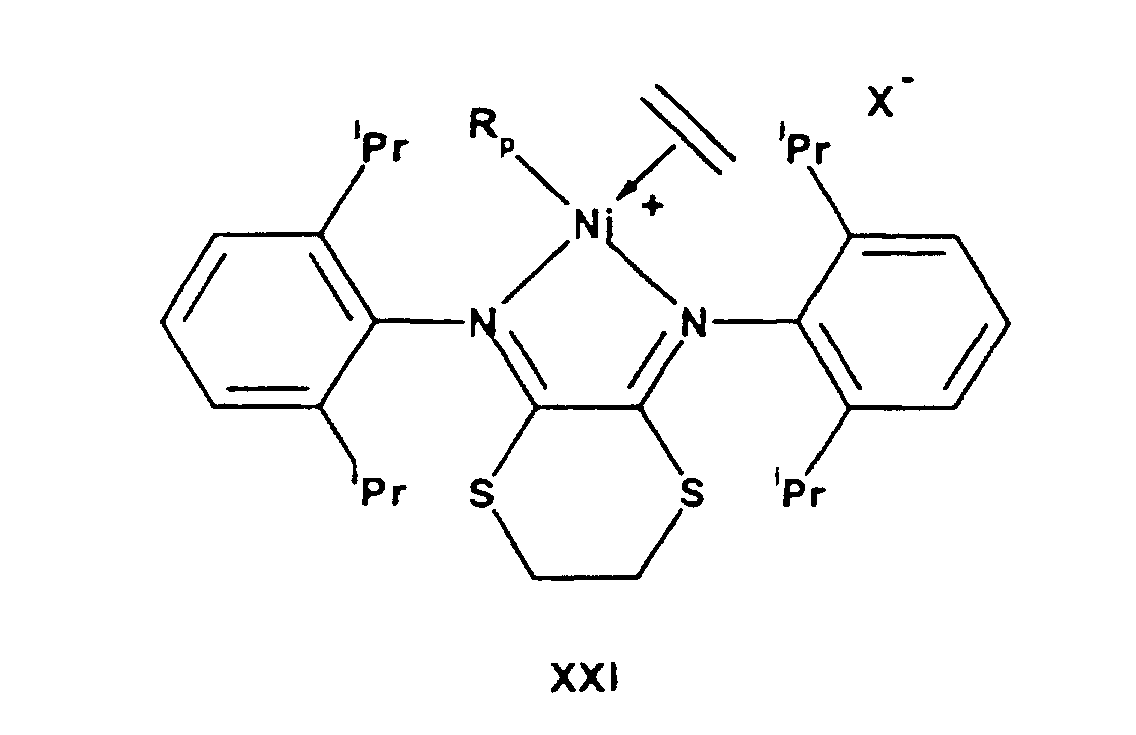

- Whereas the half-life for catalyst deactivation for complex XXI is less than about 1 minute at 80 °C, 1 atm ethylene, so that no activity was detected after 30 minutes, complex XXII still has detectable activity after 16 hours at 80 °C, 1 atm ethylene, implying that the half-life is greater than 30 minutes.
- Without wishing to be bound by theory, the inventors attribute the improved stability to the reversible formation of agostic aryl intermediates in the catalytic chemistry (c.f. structure XXIII, wherein Rp represents the growing polymer chain, X- is a weakly coordinating anion, and no specific bonding mode is implied for the interaction of the agostic phenyl group with the nickel center).As such, the catalysis no longer involves a strictly bidentate ligand, but rather a variable denticity ligand, whereby the ability of the ligand to donate additional electron density (and possibly also accept π-electron density from the nickel) is believed to stabilize low coordinate intermediates (e.g. three-coordinate cationic nickel hydride species) which otherwise would rapidly decompose to catalytically inactive species. When ortho-alkyl groups are present, it is believed that rapid cyclometallation occurs to give species which are either permanently deactivated, or which are so slowly reactivated as to render them much less attractive for commercial polyolefin production. Deactivation reactions of this general type have been discussed by Brookhart et al. (J. Am. Chem. Soc., 117, 6414, 1995).
- Ligands wherein some, but not all, of the ortho positions are substituted by bromo groups also give rise to catalysts which exhibit enhanced thermal stability and stability towards hydrogen. In contrast, when even one of four ortho substituents in a catalyst of this invention is alkyl, and the rest are aryl, poor thermal stabilities are observed (u2, R7a-c = Ph; R7d = Me or cyclopropyl; R2x,y =Me; R3a-d=H). Similarly, when all four of the ortho positions are bromo (u4, R 7a-d = Br; R 2x,y collectively OCH2CH 2O), poor thermal stability is also observed. Without wishing to be bound by theory, the inventors believe that catalysts wherein the ortho positions are substituted by groups other than alkyl will exhibit enhanced thermal stability and stability towards hydrogen, provided that at least one of the ortho positions of one of said aromatic or heteroaromatic rings is an aryl or heteroaryl group.
- Thus, in a first aspect, this invention relates to a process for the polymerization of olefins, comprising contacting a catalyst comprising a Group 8-10 transition metal complex with one or more olefins, wherein said metal complex comprises a bidentate or variable denticity ligand comprising two nitrogen donor atoms substituted by aromatic or heteroaromatic rings, and wherein the ortho positions of said rings are substituted by groups other than H or alkyl and at least one of the ortho positions of at least one of said rings is substituted by an aryl or heteroaryl group.
- In a first preferred embodiment, said contacting step is carried out in the presence of an amount of hydrogen effective to achieve chain transfer.
- In a second preferred embodiment, the ortho positions of the aromatic or heteroaromatic rings are substituted by aryl or heteroaryl groups. In a third preferred embodiment, at least one of the ortho positions of at least one of said rings is substituted by a group other than aryl or heteroaryl.
- In a fourth preferred embodiment, the process temperature is between 60 and 150 °C. In a fifth embodiment, the bidentate or variable denticity ligand is of the formula u1:wherein:

- R6a and R6b are each independently an aromatic or heteroaromatic ring wherein the ortho positions of said ring are substituted by groups other than H or alkyl; provided that at least one of the ortho positions of at least one of said aromatic or heteroaromatic rings is substituted by an aryl or heteroaryl group;
-
- In a sixth preferred embodiment, the Group 8-10 transition metal is nickel and the bidentate or variable denticity ligand is selected from Set 1:
-

 wherein:
- R7a-d are groups other than H or alkyl; provided that at least one of R7a-d is an aryl or heteroaryl group;
- R2x and R2y are each independently H, hydrocarbyl, substituted hydrocarbyl, heteroatom connected hydrocarbyl, or heteroatom connected substituted hydrocarbyl, and may be linked by a bridging group; and
- R3a-f are each independently H, hydrocarbyl, substituted hydrocarbyl, heteroatom connected hydrocarbyl, heteroatom connected substituted hydrocarbyl, fluoroalkyl, silyl, boryl, fluoro, chloro, bromo, cyano, or nitro; in addition, any two of R3a-f may be linked by a bridging group.
-
- In a seventh preferred embodiment, the catalyst is attached to a solid support, with silica being an especially preferred solid support and reaction temperatures between 60 and 100 °C also being especially preferred in this embodiment.
- In this disclosure, symbols ordinarily used to denote elements in the Periodic Table and commonly abbreviated groups, take their ordinary meaning, unless otherwise specified. Thus, N, O, S, P, and Si stand for nitrogen, oxygen, sulfur, phosphorus, and silicon, respectively, while Me, Et, Pr, iPr, Bu, tBu and Ph stand for methyl, ethyl, propyl, iso-propyl, butyl, tert-butyl and phenyl, respectively.
- A "hydrocarbyl" group means a monovalent or divalent, linear, branched or cyclic group which contains only carbon and hydrogen atoms. Examples of monovalent hydrocarbyls include the following: C1-C20 alkyl; C1-C20 alkyl substituted with one or more groups selected from C1-C20 alkyl, C3-C8 cycloalkyl, and aryl; C3-C8 cycloalkyl; C3-C8 cycloalkyl substituted with one or more groups selected from C1-C20 alkyl, C3-C8 cycloalkyl, and aryl; C6-C14 aryl; and C6-C14 aryl substituted with one or more groups selected from C1-C20 alkyl, C3-C8 cycloalkyl, and aryl. Examples of divalent (bridging) hydrocarbyls include: -CH2-, -CH2CH2-, -CH2CH2CH2-, and 1,2-phenylene.
- The term "aryl" refers to an aromatic carbocyclic monoradical, which may be substituted or unsubstituted, wherein the substituents are halo, hydrocarbyl, substituted hydrocarbyl, heteroatom attached hydrocarbyl, heteroatom attached substituted hydrocarbyl, nitro, cyano, fluoroalkyl, sulfonyl, and the like. Examples include: phenyl, naphthyl, anthracenyl, phenanthracenyl, 2,6-diphenylphenyl, 3,5-dimethylphenyl, 4-nitrophenyl, 3-nitrophenyl, 4-methoxyphenyl, 4-dimethylaminophenyl, and the like.
- A "heterocyclic ring" refers to a carbocyclic ring wherein one or more of the carbon atoms has been replaced by an atom selected from the group consisting of O, N, S, P, Se, As, Si and B, and the like.
- A "heteroaromatic ring" refers to an aromatic heterocycle; examples include pyrrole, furan, thiophene, indene, imidazole, oxazole, isoxazole, carbazole, thiazole, pyrimidine, pyridine, pyridazine, and the like.
- A "heteroaryl" refers to a heterocyclic monoradical which is aromatic; examples include 1-pyrrolyl, 2-pyrrolyl, 3-pyrrolyl, furyl, thienyl, indenyl, imidazolyl, oxazolyl, isoxazolyl, carbazolyl, thiazolyl, pyrimidinyl, pyridyl, pyridazinyl, and the like, and substituted derivatives thereof.
- A "silyl" group refers to a SiR3 group wherein Si is silicon and R is hydrocarbyl or substituted hydrocarbyl or silyl, as in Si(SiR3)3.
- A "boryl" group refers to a BR2 or B(OR)2 group, wherein R is hydrocarbyl or substituted hydrocarbyl.
- A "heteroatom" refers to an atom other than carbon or hydrogen. Preferred heteroatoms include oxygen, nitrogen, phosphorus, sulfur, selenium, arsenic, chlorine, bromine, silicon, and fluorine.
- A "substituted hydrocarbyl" refers to a monovalent, divalent, or trivalent hydrocarbyl substituted with one or more heteroatoms. Examples of monovalent substituted hydrocarbyls include: 2,6-dimethyl-4-methoxyphenyl, 2,6-diisopropyl-4-methoxyphenyl, 4-cyano-2,6-dimethylphenyl, 2,6-dimethyl-4-nitrophenyl, 2,6-difluorophenyl, 2,6-dibromophenyl, 2,6-dichlorophenyl, 4-methoxycarbonyl-2,6-dimethylphenyl, 2-tert-butyl-6-chlorophenyl, 2,6-dimethyl-4-phenylsulfonylphenyl, 2,6-dimethyl-4-trifluoromethylphenyl, 2,6-dimethyl-4-trimethylammoniumphenyl (associated with a weakly coordinated anion), 2,6-dimethyl-4-hydroxyphenyl, 9-hydroxyanthr-10-yl, 2-chloronapth-1-yl, 4-methoxyphenyl, 4-nitrophenyl, 9-nitroanthr-10-yl, -CH2OCH3, cyano, trifluoromethyl, and fluoroalkyl. Examples of divalent (bridging) substituted hydrocarbyls include: 4-methoxy-1,2-phenylene, 1-methoxymethyl-1,2-ethanediyl, 1,2-bis(benzyloxymethyl)-1,2-ethanediyl, and 1-(4-methoxyphenyl)-1,2-ethanediyl.
- A "heteroatom connected hydrocarbyl" refers to a group of the type E10(hydrocarbyl), E20H(hydrocarbyl), or E20(hydrocarbyl)2, where E10 is an atom selected from Group 16 and E20 is an atom selected from Group 15.
- A "heteroatom connected substituted hydrocarbyl" refers to a group of the type E10(substituted hydrocarbyl), E20H(substituted hydrocarbyl), or E20(substituted hydrocarbyl)2, where E10 is an atom selected from Group 16 and E20 is an atom selected from Group 15.
- The term "fluoroalkyl" as used herein refers to a C1-C20 alkyl group substituted by one or more fluorine atoms.
- An "olefin" refers to a compound of the formula R1aCH=CHR1b, where R1a and R1b may independently be H, hydrocarbyl, substituted hydrocarbyl, fluoroalkyl, silyl, O(hydrocarbyl), or O(substituted hydrocarbyl), and where R1a and R1b may be connected to form a cyclic olefin, provided that in all cases, the substituents R1a and R1b are compatible with the catalyst.
- In general, Lewis basic substituents on the olefin will tend to reduce the rate of catalysis in most cases; however, useful rates of homopolymerization or copolymerization can nonetheless be achieved with some of those olefins. Preferred olefins include ethylene, propylene, butene, hexene, octene, and fluoroalkyl substituted olefins, but may also include, in the case of palladium and some of the more functional group tolerant nickel catalysts, norbornene, substituted norbomenes (e.g., norbomenes substituted at the 5-position with halide, siloxy, silane, halo carbon, ester, acetyl, alcohol, or amino groups), cyclopentene, ethyl undecenoate, acrylates, vinyl ethylene carbonate, 4-vinyl-2,2-dimethyl-1,3-dioxolane, and vinyl acetate.
- In some cases, the catalysts can be inhibited by olefins which contain additional olefinic or acetylenic functionality. This is especially likely if the catalyst is prone to "chain-running" wherein the catalyst can migrate up and down the polymer chain between insertions, since this can lead to the formation of relatively unreactive π-allylic intermediates when the olefin monomer contains additional unsaturation. Such effects are best determined on a case-by-case basis, but may be predicted to some extent through knowledge of how much branching is observed with a given catalyst in ethylene homopolymerizations; those catalysts which tend to give relatively high levels of branching with ethylene will tend to exhibit lower rates when short chain diene co-monomers are used under the same conditions. Longer chain dienes tend to be less inhibitory than shorter chain dienes, when other factors are kept constant, since the catalyst has farther to migrate to form the π-allyl, and another insertion may intervene first.
- Similar considerations apply to unsaturated esters which are capable of inserting and chain-running to form relatively stable intramolecular chelate structures wherein the Lewis basic ester functionality occupies a coordination site on the catalyst. In such cases, short chain unsaturated esters, such as methyl acrylate, tend to be more inhibitory than long chain esters, such as ethyl undecenoate, if all other factors are kept constant.
- The term "α-olefin" as used herein is a 1-alkene with from 3 to 40 carbon atoms.
- A "π-allyl" group refers to a monoanionic group with three sp2 carbon atoms bound to a metal center in a η3-fashion. Any of the three sp2 carbon atoms may be substituted with a hydrocarbyl, substituted hydrocarbyl, heteroatom connected hydrocarbyl, heteroatom connected substituted hydrocarbyl, or O-silyl group.
-


- The term π-benzyl group denotes an π-allyl group where two of the sp2 carbon atoms are part of an aromatic ring. Examples of π-benzyl groups include:

- A "bridging group" refers to an atom or group which links two or more groups, which has an appropriate valency to satisfy its requirements as a bridging group, and which is compatible with the desired catalysis. Suitable examples include divalent or trivalent hydrocarbyl, substituted hydrocarbyl, heteroatom connected hydrocarbyl, heteroatom connected substituted hydrocarbyl, substituted silicon(IV), boron(III), N(III), P(III), and P(V), -C(O)-, -SO2-, -C(S)-, -B(OMe)-,-C(O)C(O)-, O, S, and Se. In some cases, the groups which are said to be "linked by a bridging group" are directly bonded to one another, in which case the term "bridging group" is meant to refer to that bond. By "compatible with the desired catalysis," we mean the bridging group either does not interfere with the desired catalysis, or acts to usefully modify the catalyst activity or selectivity.
- The term "weakly coordinating anion" is well known in the art per se and generally refers to a large bulky anion capable of delocalization of the negative charge of the anion. Suitable weakly coordinating anions, not all of which would be considered bulky, include, but are not limited to: PF6 -, BF4 -, SbF6 -, (Ph)4B- wherein Ph = phenyl, and Ar4B- wherein Ar4B- = tetrakis[3,5-bis(trifluoromethyl)phenyl]-borate. The weakly coordinating nature of such anions is known and described in the literature (S. Strauss et al., Chem. Rev., 1993, 93, 927).
- The term "agostic" is known to those skilled in the art, and is generally used to refer to a weak bonding interaction between a C-H bond and a coordinatively unsaturated transition metal. It is used herein to denote a weak bonding interaction between any or all of the atoms of the ortho-aryl or ortho-heteroaryl groups of the present invention, and a coordinatively unsaturated Fe, Co or Ni center to which said ligands are complexed. By "weak bonding interaction" we mean a bond that is sufficiently weak that it is formed reversibly under polymerization reaction conditions, so that it does not, for example, preclude the binding and insertion of olefin monomer.
- The term "ortho" is used herein to denote the positions which are adjacent to the point of attachment of said aromatic or heteroaromatic ring to the ligated nitrogen(s). In the case of a 1-attached, 6-member ring, we mean the 2- and 6-positions. In the case of a 1-attached, 5-membered ring, we mean the 2- and 5-positions. In the case of 1-attached, fused ring aromatic or heteroaromatic rings, we mean the first positions which can be substituted; for example, in the case of 1-naphthyl, these would be the 2- and 8-positions; in the case of 9-anthracenyl, these would be the 1- and 8-positions.
- The term "variable denticity" is used herein in the context of otherwise bidentate ligands to refer to the reversible formation of a third binding interaction between the ligand and the Fe, Co or Ni center to which it is complexed.
- The abbreviation "acac" refers to acetylacetonate. In general, substituted acetylacetonates, wherein one or more hydrogen in the parent structure has been replaced by a hydrocarbyl, substituted hydrocarbyl, or fluoroalkyl, may be used in place of the "acac". Hydrocarbyl substituted acetylacetonates may be preferred in some cases when it is important, for example, to improve the solubility of a (ligand)Ni(acac)BF4 salt in mineral spirits; fluoroalkyl substituted acetylacetonates may be preferred when a more Lewis acidic metal acetylacetonate reagent is required to promote coordination of the ligands of the present invention to form the desired catalyst precursors.
- In general, the catalysts of the present invention can be made sufficiently sterically hindered that chain transfer is slow with respect to chain propagation so that a chain of degree of polymerization (DP) of 10 or more results.
- The degree of steric hindrance at the active catalyst site required to give slow chain transfer, and thus form polymer, depends on a number of factors and is often best determined by experimentation. These factors include: the exact structure of the catalyst, the monomer or monomers being polymerized, whether the catalyst is in solution or attached to a solid support, and the temperature and pressure. Polymer is defined herein as corresponding to a degree of polymerization, DP, of 10 or more.
- A variety of protocols may be used to generate active polymerization catalysts comprising Group 8-10 complexes of bidentate N,N-donor ligands. Examples include (i) the reaction of a Group 8-10 metal dihalide complex of a bidentate N-donor ligand with an alkylaluminum reagent, (ii) the reaction of (bidentate N-donor ligand)Ni(acac)X salts with an alkylaluminum reagent, where X is a weakly coordinating anion, such as B(C6F5)4, BF4, PF6, SbF6 or OS(O)2CF3, (iii) the reaction of bis(1,5-cyclooctadiene)nickel(0) with a bidentate N,N-donor ligand in the presence of B(C6F5)3.
- More generally, a variety of (ligand)M(Z1a)(Z1b) complexes, where "ligand" refers to an N,N-donor of the present invention, M is a Group 8-10 transition metal, and Z1a and Z1b are univalent groups, or may be taken together to form a divalent group, may be reacted with one or more compounds, collectively referred to as compound Y, which function as co-catalysts or activators, to generate an active catalyst of the form [(ligand) M(T1a)(L)]+X-, where T1a is a hydrogen atom or hydrocarbyl, L is an olefin or neutral donor group capable of being displaced by an olefin, M is a Group 8-10 transition metal, and X- is a weakly coordinating anion. When Z1a and Z1b are both halide, examples of suitable compound Y include: methylaluminoxane (hereinafter MAO) and other aluminum sesquioxides, R3Al, R2AlCl, and RAlCl2 (wherein R is alkyl, and plural groups R may be the same or different). When Z1a and Z1b are both alkyl, examples of suitable compound Y include: MAO and other aluminum sesquioxides, R3Al, R2AlCl, RAlCl2 (wherein R is alkyl, and plural groups R may be the same or different), B(C6F5)3; R0 3Sn[BF4] (wherein R0 is hydrocarbyl or substituted hydrocarbyl and plural groups R0 may be the same or different), H+X-, wherein X- is a weakly coordinating anion, for example, tetrakis[3,5-bis(trifluoromethyl)phenyl]borate, and Lewis acidic or Bronsted acidic metal oxides, for example, montmorillonite clay. In some cases, for example, when Z1a and Z1b are both halide or carboxylate, sequential treatment with a metal hydrocarbyl, followed by reaction with a Lewis acid, may be required to generate an active catalyst. Suitable examples of metal hydrocarbyls include: MAO, other aluminum sesquioxides, R3Al, R2AlCl, RAlCl2 (wherein R is alkyl, and plural groups R may be the same or different), Grignard reagents, organolithium reagents, and diorganozinc reagents. Examples of suitable Lewis acids include: MAO, other aluminum sesquioxides, R3Al, R2AlCl, RAlCl2 (wherein R is alkyl, and plural groups R may be the same or different), B(C6F5)3, R0 3Sn[BF4] (wherein R0 is hydrocarbyl or substituted hydrocarbyl and plural groups R0 may be the same or different), and Lewis acidic metal oxides.
- The term "alkylaluminum" is used to refer to compounds containing at least one alkyl group bonded to Al(III), which are capable of reacting with a metal complex of the present invention to generate an active olefin polymerization catalyst. In general, this will involve exchanging one or more alkyl groups from the aluminum with a monoanionic atom or group on the metal complex pro-catalyst. In some cases, a hydride may be directly transferred from the β-carbon of the aluminum alkyl to said metal complex. Subsequent abstraction of a second monoanionic atom or group from the metal complex may also be required to generate a cationic active catalyst. When the pro-catalyst is already a cationic metal complex, the role of the alkylaluminum may simply be to exchange an alkyl or hydride from the aluminum with a monoanionic group, such as acetylacetonate, attached to the metal complex. In the case of a cationic π-allyl or π-benzyl pro-catalyst, the alkylaluminum reagent may, in some cases, simply act as a Lewis acid, to promote conversion of the π-allyl or π-benzyl to a σ-allyl or σ-benzyl bonding mode, thereby facilitating binding and insertion of the olefin monomer. When a cationic pro-catalyst is used with an alkylaluminum activator or co-catalyst, it should also be recognized that the starting counteranion (e.g. BF4 -) may react with the alkylaluminum reagent to generate a new counteranion (or a mixture of several different counteranions) under olefin polymerization reaction conditions. Examples of suitable alkylaluminum reagents include: MAO, other aluminum sesquioxides, Me3Al, EtAlCl2, Et2AlCl, R3Al, R2AlCl, RAlCl2 (wherein R is alkyl, and plural groups R may be the same or different), and the like.
- The foregoing discussion is intended to illustrate that there are frequently many ways to generate an active catalyst, and that in some cases the structure of the active species has not been fully elucidated. It is, however, an object of this disclosure to teach that there are a variety of methods wherein the ligands of the present invention can be reacted with a suitable metal precursor, and optionally a co-catalyst, to generate an active olefin polymerization catalyst. Without wishing to be bound by theory, the inventors also believe that the active catalyst typically comprises the catalytically active metal, one or more ligands of the present invention, the growing polymer chain (or a metal hydride capable of initiating a new chain), and a site on the metal adjacent to the metal-alkyl bond of said chain where ethylene can coordinate, or at least closely approach, prior to insertion. Where specific structures for active catalysts have been implied herein, it should be understood that an object of this invention is to teach and claim that active catalysts comprising the ligands of the present invention are formed as the reaction products of the catalyst activation reactions disclosed herein, regardless of the detailed structures of those active species.
- The catalysts of the present invention may be used in batch and continuous processes, in solution or slurry or gas phase processes.
- In some cases, it is advantageous to attach the catalyst to a solid support. Examples of useful solid supports include: inorganic oxides, such as talcs, silicas, titania, silica/chromia, silica/chromia/titania, silica/alumina, zirconia, aluminum phosphate gels, silanized silica, silica hydrogels, silica xerogels, silica aerogels, montmorillonite clay and silica co-gels, as well as organic support materials such as polystyrene and functionalized polystyrene. (See, for example, S.B. Roscoe et al., "Polyolefin Spheres from Metallocenes Supported on Non-Interacting Polystyrene," 1998, Science, 280, 270-273 (1998)).
- Thus, in a preferred embodiment, the catalysts of the present invention are attached to a solid support (by "attached to a solid support" is meant ion paired with a component on the surface, adsorbed to the surface or covalently attached to the surface) that has been pre-treated with a compound Y. More generally, the compound Y, and the solid support can be combined in any order and any number of compound(s) Y can be utilized. In addition, the supported catalyst thus formed may be treated with additional quantities of compound Y. In another preferred embodiment, the compounds of the present invention are attached to silica that has been pre-treated with an alkylaluminum compound Y, for example, MAO, Et3Al, iBu3Al, Et2AlCl, or Me3Al.
- Such supported catalysts are prepared by contacting the transition metal compound, in a substantially inert solvent (by which is meant a solvent which is either unreactive under the conditions of catalyst preparation, or if reactive, acts to usefully modify the catalyst activity or selectivity) with MAO-treated silica for a sufficient period of time to generate the supported catalyst. Examples of substantially inert solvents include toluene, o-difluorobenzene, mineral spirits, hexane, CH2Cl2, and CHCl3.
- In another preferred embodiment, the catalysts of the present invention are activated in solution under an inert atmosphere, and then adsorbed onto a silica support which has been pre-treated with a silylating agent to replace surface silanols by trialkylsilyl groups. Methods to pre-treat silicas in this way are known to those skilled in the art and may be achieved, for example, by heating the silica with hexamethyldisilazane and then removing the volatiles under vacuum. A variety of precurors and procedures may be used to generate the activated catalyst prior to said adsorption, including, for example, reaction of a (ligand)Ni(acac)B(C6F5)4 complex with Et2AlCl in a toluene/hexane mixture under nitrogen; where "ligand" refers to a compound of the present invention.
- The polymerizations may be conducted as solution polymerizations, as nonsolvent slurry type polymerizations, as slurry polymerizations using one or more of the olefins or other solvent as the polymerization medium, or in the gas phase. One of ordinary skill in the art, with the present disclosure, would understand that the catalyst could be supported using a suitable catalyst support and methods known in the art. Substantially inert solvents, such as toluene, hydrocarbons, methylene chloride and the like, may be used. Propylene and 1-butene are excellent monomers for use in slurry-type copolymerizations and unused monomer can be flashed off and reused.
- Temperature and olefin pressure have significant effects on polymer structure, composition, and molecular weight. Suitable polymerization temperatures are preferably from 20 °C to 160 °C, more preferably 60 °C to 100°C.
- The catalysts of the present invention may be used alone, or in combination with one or more other Group 3-10 olefin polymerization or oligomerization catalysts, in solution, slurry, or gas phase processes. Such mixed catalysts systems are sometimes useful for the production of bimodal or multimodal molecular weight or compositional distributions, which may facilitate polymer processing or final product properties.
- After the reaction has proceeded for a time sufficient to produce the desired polymers, the polymer can be recovered from the reaction mixture by routine methods of isolation and/or purification.
- In general, the polymers of the present invention are useful as components of thermoset materials, as elastomers, as packaging materials, films, compatibilizing agents for polyesters and polyolefins, as a component of tackifying compositions, and as a component of adhesive materials.
- High molecular weight resins are readily processed using conventional extrusion, injection molding, compression molding, and vacuum forming techniques well known in the art. Useful articles made from them include films, fibers, bottles and other containers, sheeting, molded objects and the like.
- Low molecular weight resins are useful, for example, as synthetic waxes and they may be used in various wax coatings or in emulsion form. They are also particularly useful in blends with ethylene/vinyl acetate or ethylene/methyl acrylate-type copolymers in paper coating or in adhesive applications.
- Although not required, typical additives used in olefin or vinyl polymers may be used in the new homopolymers and copolymers of this invention. Typical additives include pigments, colorants, titanium dioxide, carbon black, antioxidants, stabilizers, slip agents, flame retarding agents, and the like. These additives and their use in polymer systems are known per se in the art.
The ligands of the present invention may be prepared by methods known to those skilled in the art, wherein a substituted 1-aminopyrrole is condensed with a dialdehyde or di-ketone to afford the desired ligands - Other features of the invention will become apparent in the following description of working examples, which have been provided for illustration of the invention and are not intended to be limiting thereof.
- The molecular weight data presented in the following examples is determined at 135 °C in 1,2,4-trichlorobenzene using refractive index detection, calibrated using narrow molecular weight distribution poly(styrene) standards.
-

- A 50 mL round bottom flask was charged with 2,5-dimethyl-pyrrol-1-ylamine (400 mg), 2,3-butanedione (146 mg), ethanol (10 mL), and 1 drop of formic acid. The mixture was allowed to stand for 16 h at 22°C; upon subsequent agitation the product crystallized and was isolated by vacuum filtration, washed with cold ethanol and dried to obtain 100 mg of the desired product as bright yellow rhombic platelets. The combined filtrate and washings were concentrated and the residue subjected to flash chromatography (SiO2, 2.4 vol% Ethyl Acetate (EtOAc)/hexane) to obtain an additional 172 mg of product. 1H NMR (CDCl3, chemical shifts in ppm relative to tetramethyl silane (TMS)): 2.075 (12p, s); 0.211 (6p, s); 5.912 (4p, s). Field Desorption Mass Spectrometry: m/z 270.
- A 50 mL flame-dried Schlenk flask equipped with a magnetic stir bar and capped by a septum was charged with 92 mg of a32, and 85 mg of (1,2-dimethoxyethane)nickel(II) dibromide in the drybox, under nitrogen. On the Schlenk line, 6 mL dry, deoxygenated dichloromethane was added by syringe, and the mixture was stirred under nitrogen for 3.25 h at 23°C to afford a dark brown mixture. This mixture was diluted with 10 mL of dry, deoxygenated hexane and stirred for 15 min to precipitate the product, after which the supernatant was removed via a filter paper-tipped cannula. The brown powdery residue was dried in vacuo to obtain 73.5 mg (54%) of the nickel dibromide complex of a32.
- A 250 mL round bottom Schlenk flask equipped with a magnetic stir bar and capped with a septum was evacuated and refilled with ethylene, then charged with 100 mL of dry, deoxygenated toluene and 4.0 mL of a MMAO in toluene (6.42% Al) and stirred under 1 atm ethylene at 0°C for 15 min. A 2 mL aliquot of a mixture of 3.5 mg of the nickel dibromide complex of a32 in 3.5 mL dry, deoxygenated dihloromethane was injected, and the mixture was stirred under 1 atm ethylene at 0°C. A white polyethylene precipitate was observed within minutes. After 10 minutes, the mixture was quenched by the addition of acetone (50 mL), methanol (50 mL) and 6 N aqueous HCl (100 mL). The swollen polyethylene which separated was isolated by vacuum filtration and washed with water, methanol and acetone, then dried under reduced pressure (200 mm Hg) at 80°C for 16 h to obtain 3.95 g of a white polyethylene. 1H NMR: 3.7 branches/1000 carbon atoms; Mn = 8563. GPC: Mn = 9,190; Mw/Mn = 3.48.
- A 600 mL Parr® autoclave was first heated to about 100°C under high vacuum to ensure the reactor was dry. The reactor was cooled and purged with argon. Under an argon atmosphere, the autoclave was charged with 150 mL of toluene. The reactor was pressurized to 1.38 x 10⁶ Pa (200 psig) with ethylene and then relieved to ambient pressure (2x). 3 mL of MMAO solution were added. With stirring and with the ethylene pressure rising to 1.38 x 10⁶ Pa (200 psig), 2.0 mL of a stock solution (4.30 mg in 17.2 mL CH2Cl2) of the nickel dibromide complex of a32 were injected. The pressure was maintained at 1.38 x 10⁶ Pa (200 psig). The autoclave temperature was controlled at 30°C. After 10 minutes, the reaction was quenched by the addition of methanol and the pressure relieved. The swollen polyethylene which separated was stirred with a mixture of acetone and aqueous HCl. The polymer was isolated by filtration, washed with acetone and dried in vacuo (200 mm Hg) overnight to yield 8.3 g. GPC: Mn = 1370; Mw/Mn = 18.88.
-

- 6.2 mg of compound a17, 30 mg of tris(pentafluorophenyl)boron, and 1.9 mg of bis(1,5-cyclooctadiene)nickel(0) were weighed to 20 mL septum-capped vial under an Ar atmosphere. On the Schlenk line, the vial was provided an ethylene atmosphere. 10 mL of dry, deoxygenated toluene were added with rapid magnetic stirring at room temperature to give a brown mixture. After 15 minutes, the reaction was quenched by the addition of methanol. The polymer was collected by vacuum filtration, washed with methanol, and dried in vacuo (200 mm Hg) at 80°C overnight to yield 370 mg.
- To a 50 mL round-bottomed flask equipped with a Dean-Stark trap were added 20 mL of anhydrous toluene, 330 mg (0.99 mmol) of 1-amino-2,5-di(1-naphthyl)pyrrole, 37 µL (0.42 mmol) of 2,3 butanedione, and 2.0 mg of p-toluenesulfonic acid monohydrate. The resulting solution was stirred at room temperature for 30 min then heated to 60 °C. After 6 h, the solution was heated to reflux for 1 h, allowed to cool to room temperature, and concentrated in vacuo to an oil. Silica gel chromatography (10% ethyl acetate in hexane) of the oil provided 266 mg of a52. 1H NMR (CDCl3, 300 MHz) δ 0.93 (s, 6H), 6.49 (s, 4H), 7.09 (dd, J = 7.2, 1.2 Hz, 4H), 7.24 (m, 4H), 7.37 (m, 4H), 7.59 (m, 4H), 7.76 (d, J = 8.1 Hz, 4H), 7.82 (d, J = 8.0 Hz, 4H), 8.01 (d, J = 8.5 Hz, 4H).
-
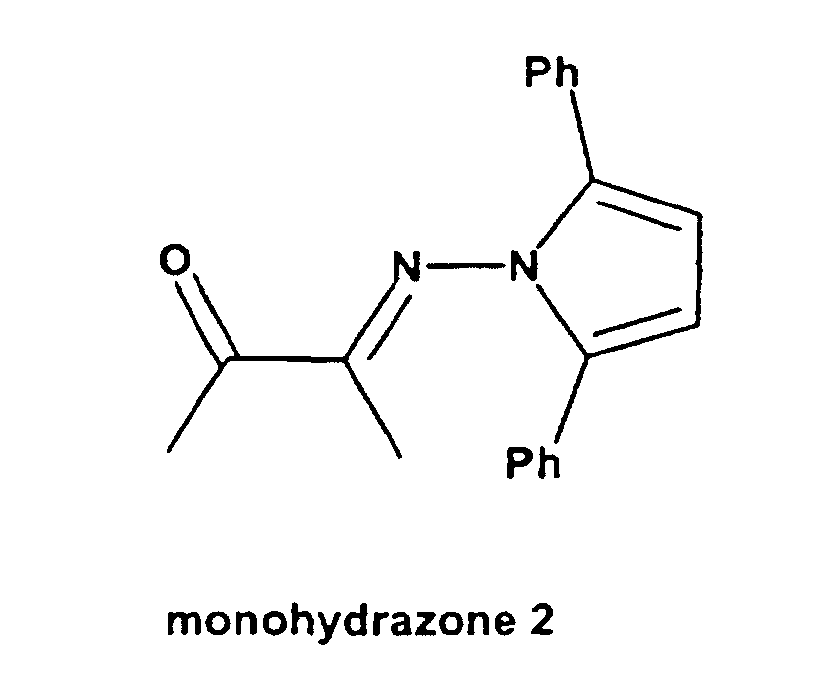
- To a 50 mL round-bottomed flask equipped with a Dean-Stark trap were added 10 mL of DMF, 5 mL of anhydrous toluene, 1.75 g (6.47 mmol) of 1-amino-2,5-diphenylpyrrole, 5.7 mL (64.7 mmol) of 2,3 butanedione, and 10.0 mg of p-toluenesulfonic acid monohydrate. The resulting solution was stirred at room temperature for 30 min then heated to 70 °C. After 12 h, the solution was heated to reflux and the excess diketone and toluene were removed by distillation. Toluene (15 mL) was added to the reaction vessel and removed by distillation. The solution was allowed to cool to room temperature and concentrated in vacuo to an oil. Silica gel chromatography (10% ethyl acetate in hexane) of the oil provided 1.94 g of monohydrazone 2. 1H NMR (CDCl3, 300 MHz) δ1.45 (s, 3H), 2.57 (s, 3H), 6.48 (s, 2H), 7.24 (m, 2H), 7.35 (m, 4H), 7.48 (m, 4H).
-
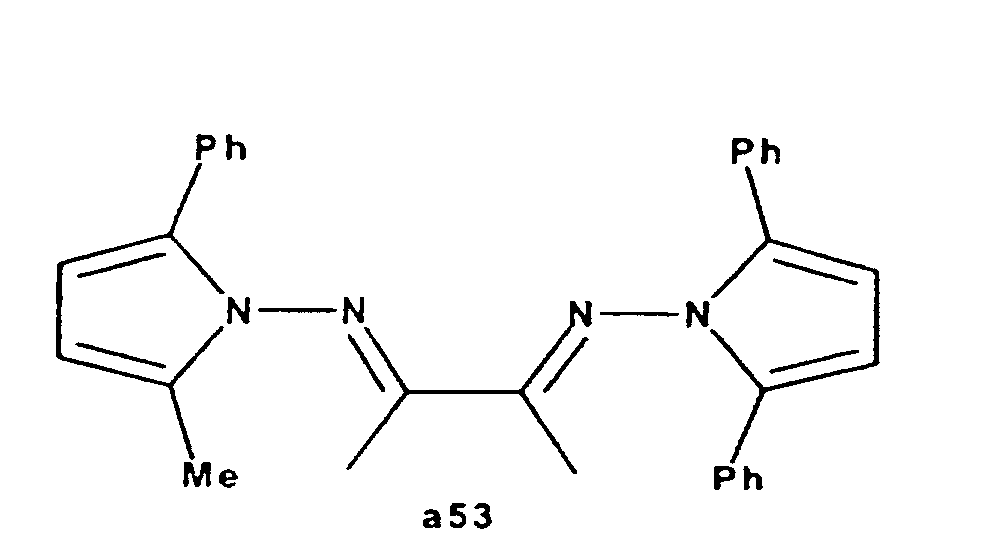
- To a 50 mL round-bottomed flask equipped with a Dean-Stark trap were added 15 mL of anhydrous toluene, 255 mg (0.84 mmol) of monohydrazone 2, 145 mg (0.84 mmol) of 1-amino-2-methyl-5-phenylpyrrole, and 5.0 mg of p-toluenesulfonic acid monohydrate. The resulting solution was heated to reflux and stirred. After 12 h, the solution was allowed to cool to room temperature and concentrated in vacuo to an oil. Silica gel chromatography (10% ethyl acetate in hexane) of the oil provided 208 mg of a53. 1H NMR (CDCl3, 300 MHz) δ 1.72 (s, 3H), 1.86 (s, 3H), 2.05 (s, 3 H), 6.01 (d, J = 3.7 Hz, 1H), 6.26 (d, J = 4.0 Hz, 1H), 6.47 (s, 2H), 7.26 (m, 12H),
-

- To a 50 mL round-bottomed flask equipped with a Dean-Stark trap were added 7 mL of DMF, 16 mL of anhydrous toluene, 1.25 g (4.62 mmol) of 1-amino-2,5-diphenylpyrrole, 203 µL (2.31 mmol) of 2,3 butanedione, and 2.0 mg of p-toluenesulfonic acid monohydrate. The resulting solution was heated to 70 °C and stirred. After 4 h, the solution was heated to reflux for 1 h. The solution was allowed to cool to room temperature and concentrated in vacuo to an oil. Silica gel chromatography (10% ethyl acetate in hexane) of the oil provided 804 mg of a54. 1H NMR (CDCl3, 300 MHz) δ1.76 (s, 6H), 6.49 (s, 4H), 7.30 (m, 12H), 7.40 (m, 8H).
- A suspension of ethyl potassium malonate (3.4 g, 20.0 mmol) in acetonitrile (30.6 mL) was treated with Et3N (3.11 mL, 22.3 mmol) and MgCl2 (2.38 g, 25.0 mmol). The resulting suspension was stirred at rt for 2.5 h, then treated with 1-naphthoylchloride (1.55 mL, 10.3 mmol) and stirred under Ar at rt overnight. The acetonitrile was removed in vacuo, toluene (14 mL) was added and the suspension was concentrated again. The residue was suspended in toluene (14 mL) and washed with 12% Aq. HCl (14.1 mL). The organic layer was removed, dried over Na2SO4, filtered and concentrated in vacuo. The residue was purified via flash chromatography (SiO2, 10% EtOAc/Heptane) to afford 3-Naphthalen-1-yl-3-oxo-propionic acid ethyl ester (1.65 g, 66%) as a 3.5: 1 mixture of keto/enol isomers: 11H NMR (CDCl3, chemical shifts in ppm relative to TMS): 1.21 (t, 3H, ketone isomer, J = 7.1 Hz), 1.36 (3h, enol isomer, J = 7.1 Hz), 4.11 (s, 2H, ketone isomer), 4.20 (q, 2H, ketone isomer, J = 7.4 Hz), 4.32 (q, 2H, enol isomer, J = 7.4 Hz), 5.50 (s, 1H, enol isomer), 7.46-7.68 (m, 3H), 7.88 (d, 1H, J = 8.1 Hz), 7.92 (d, 1H, J = 7.3 Hz), 8.03 (d, 1H, J = 8.1 Hz), 8.36 (d, 1H, enol isomer, J = 8.1 Hz), 8.76 (d, 1H, J = 8.1 Hz); Field Desorption Mass Spectrometry: m/z 242.
-

- A suspension of NaH (60% in mineral oil, 323 mg, 8.07 mmol) in toluene (20 mL) was treated with 3-Naphthalen-1-yl-3-oxo-propionic acid ethyl ester (1.63 g, 6.7 mmol). The resulting suspension was stirred at rt under Ar for 1 h, then treated with 2-bromocetophenone (1.61 g, 8.07 mmol). The suspension was immersed in a 70 °C oil bath and stirred under Ar for 4 h, cooled to rt, diluted with toluene and washed with H2O and brine. The organic layer was dried over Na2SO4, filtered and concentrated in vacuo. The residue was purified via flash chromatography (SiO2, 10-20% EtOAc/Heptane) to afford 2-(Naphthalene-1-carbonyl)-4-oxo-4-phenyl-butyric acid ethyl ester (1.2 g) contaminated with a small amount of unidentified aromatic impurity: 11H NMR (CDCl3, chemical shifts in ppm relative to TMS): 1.03 (t, 3H, J = 7.25Hz), 3.72 (dd, 1H, J = 18.8 Hz, J = 5.4 Hz), 3.96 (dd, 1H, J = 18.8 Hz, J = 8.05 Hz), 4.09 (m, 2H), 5.16 (m, 1H), 7.45-7.63 (m, 6H), 7.88 (d, 1H, J = 7.9 Hz), 8.0-8.07 (m, 3H), 8.24 (d, 1H, J = 7.2 Hz)), 8,48 (d, 1H, J = 8.7 Hz).
-
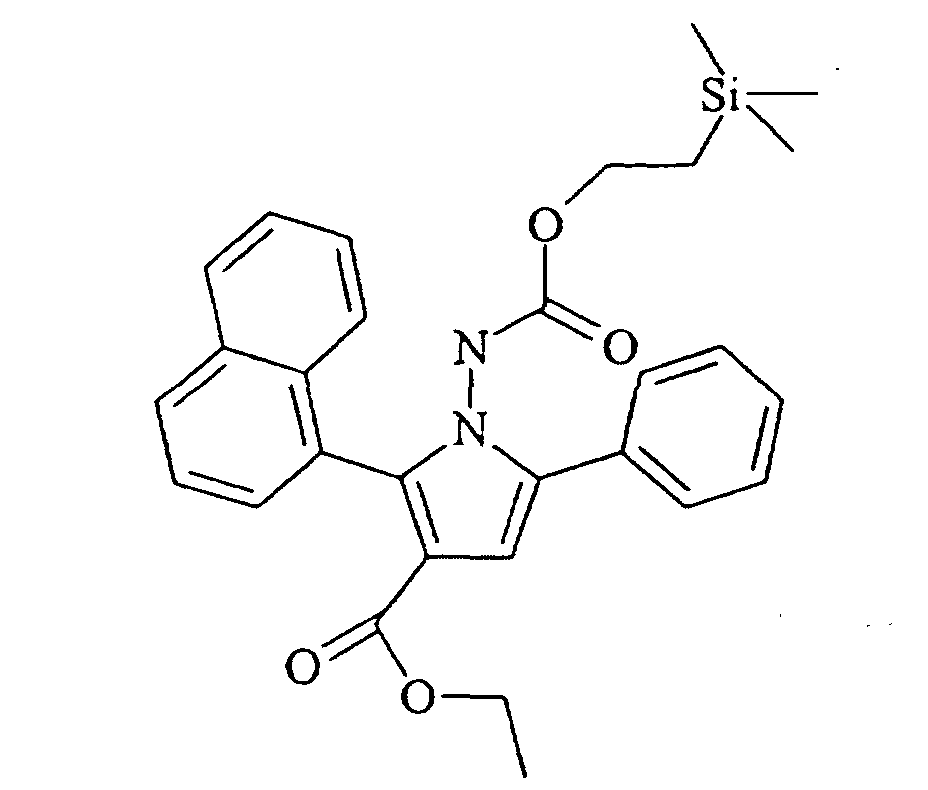
- A solution of 2-(Naphthalene-1-carbonyl)-4-oxo-4-phenyl-butyric acid ethyl ester (1 g, 2.77 mmol) in toluene (6.5 mL) was treated with Hydrazinecarboxylic acid 2-trimethylsilanyl-ethyl ester (599 mg, 3.34 mmol) and p-toluene sulfonic acid (33 mg). The resulting solution was heated to reflux, with the azeotropic removal of water (Dean Stark trap), under Ar for 6 h, cooled to rt and concentrated in vacuo to afford 2-Naphthalen-1-yl-5-phenyl-1-(2-trimethylsilanyl-ethoxycarbonylamino)-1H-pyrrole-3-carboxylic acid ethyl ester (1.33 g), which was not purified, but used immediately in the next reaction.
-

- 2-Naphthalen-1-yl-5-phenyl-1-(2-trimethylsilanyl-ethoxycarbonylamino)-1H-pyrrole-3 carboxylic acid ethyl ester (608 mg, 1.3 mmol) was treated with a solution of TBAF in THF (2.66 mL of a 1 M solution, 2.7 mmol). The resulting solution was stirred at rt under Ar overnight. The reaction was quenched with glacial acetic acid (145 µL, 2.5 mmol), and passed through a short plug of silica gel eluting with toluene. The filtrate was concentrated in vacuo to afford 1-Amino-2-naphthalen-1-yl-5-phenyl-1H-pyrrole-3-carboxylic acid ethyl ester (434 mg), which was not purified, but was used immediately for the next reaction.
-
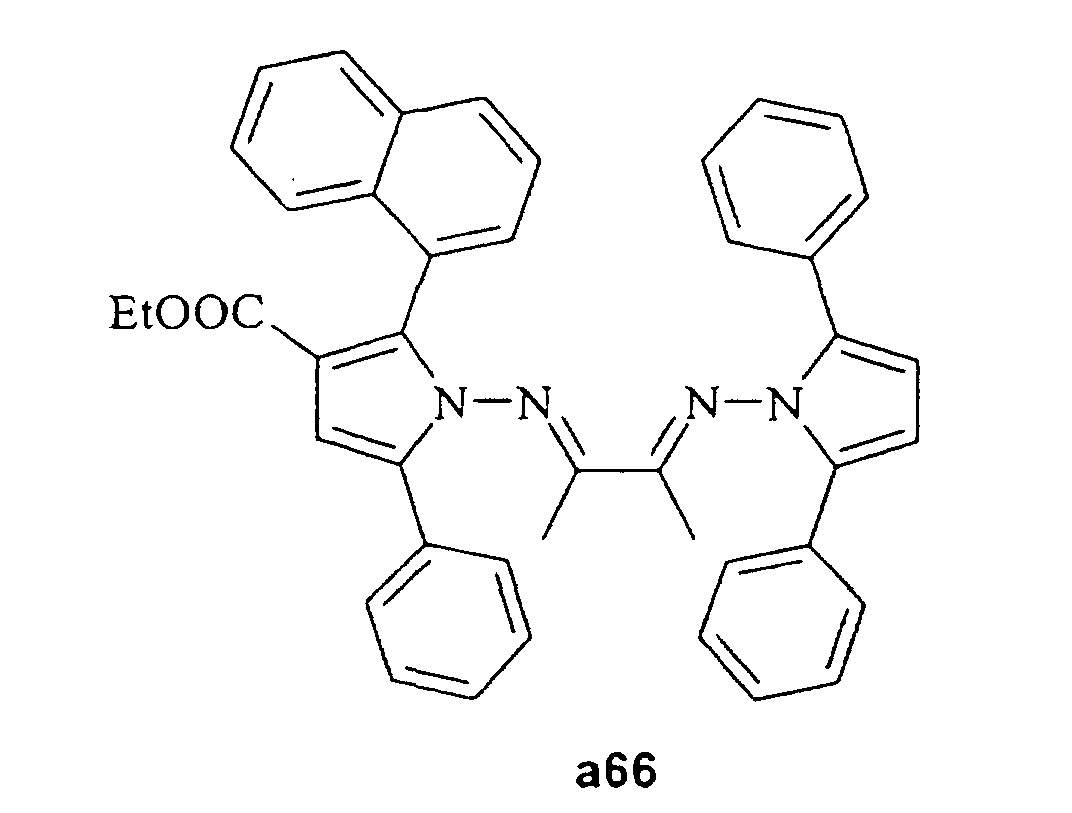
- A solution of 1-Amino-2-naphthalen-1-yl-5-phenyl-1H-pyrrole-3-carboxylic acid ethyl ester (434 mg, 1.22 mmol) in toluene (7.2 mL) was treated with 3-(2,5-Diphenyl-pyrrol-1-ylimino)-butan-2-one (308 mg, 1.02 mmol) and p-toluene sulfonic acid (8 mg). A Dean Stark trap was attached, and the resulting solution heated to reflux under Ar with the azeotropic removal of water for 18 h, then another portion of p-toluene sulfonic acid (8 mg) was added and the azeotropic removal of water was continued for an additional 75 min. The solution was cooled to rt and concentrated in vacuo. The residue was dissolved in THF/Acetic acid (10/1) and treated with PS-TsNHNH2 resin (Argonaut Technologies, 1.039g, 2.6 mmol). The suspension was stirred under Ar overnight, then filtered through a polyethylene frit, and concentrated in vacuo. The residue was purified by flash chromatography (SiO2, 50-100% CH2Cl2/heptane) to afford 1-[2-(2,5-Diphenyl-pyrrol-1-ylimino)-1-methyl-propylideneamino]-2-naphthalen-1-yl-5-phenyl-1H-pyrrole-3-carboxylic acid ethyl ester a66 (240 mg, 37%) : 11H NMR (DMSO, chemical shifts relative to TMS, 80 °C): 0.82 (t, 3H, J = 7.3 Hz), 1.08 (s, 3H), 1.74 (s, 3H), 3.91 (q, 2H, J = 6.9 Hz), 6.42 (s, 2H), 7.03 (s, 1H), 7.11 (d, 4H, J = 7.3 Hz), 7.18 (t, 4H, J = 7.3 Hz), 7.22-7.25 (m, 2H), 7.32-7.37 (m, 5H), 7.39-7.41 (m, 2H), 7.44-7.47 (m, 2H), 7.53 (d, 1H, J = 8.2 Hz), 7.93 (t, 2H, J = 8.7 Hz).
-
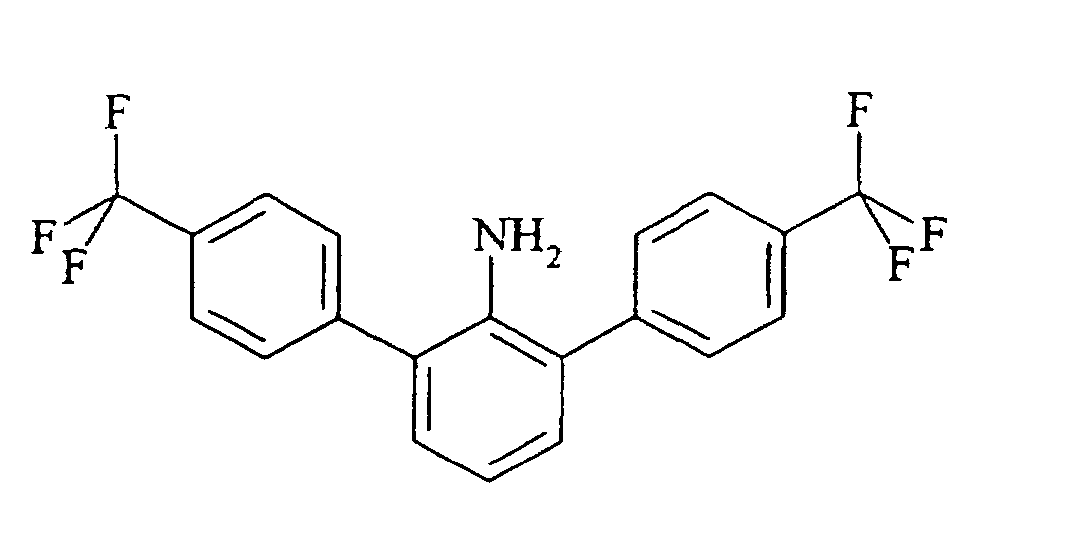
- A suspension of tetrakis(triphenylphosphine) palladium(0) (66 mg, 0.06 mmol) in toluene (8 mL) was treated with 2,6-dibromoaniline (500 mg, 2.0 mmol), aqueous Na2CO3 (2M, 3.98 mL), and 4-trifluoromethylphenyl boronic acid (831 mg, 4.4 mmol). The resulting suspension was immersed in a 110°C oil bath, and stirred under Ar for 22h. The suspension was cooled to rt, and extracted with ether. The organic layer was washed with brine, dried over Na2SO4 and concentrated in vacuo. The residue was purified by flash chromatography (SiO2, 2.5-5.0% EtOAc/Heptane) to afford 4,4"-Bis-trifluoromethyl-[1,1;3',1"]terphenyl-2'-ylamine (713 mg, 93%) : 1H NMR (CDCl3, chemical shifts in ppm relative to TMS): 6.93 (t, 1H, J = 7.3 Hz), 7.14 (d, 2H, J = 7.3 Hz), 7.64 (d, 4H, J = 8.0 Hz), 7.74 (d, 4H, J = 8.0 Hz).
-

- A solution of 4,4"-Bis-trifluoromethyl-[1,1';3',1"]terphenyl-2'-ylamine (700 mg, 1.84 mmol) in pyridine (5 mL) was treated with oxalyl chloride (73 µL, 0.837 mmol). The resulting suspension was stirred at rt overnight under Ar, then poured into H2O. The precipitate was filtered, washed with H2O and dried in vacuo. The resulting solid was crystallized from toluene/heptane, then recrystallized from toluene to afford N,N'-Bis-(4,4"-bis-trifluoromethyl-[1,1';3',1"]terphenyl-2'-yl)-oxalamide (430 mg).
-
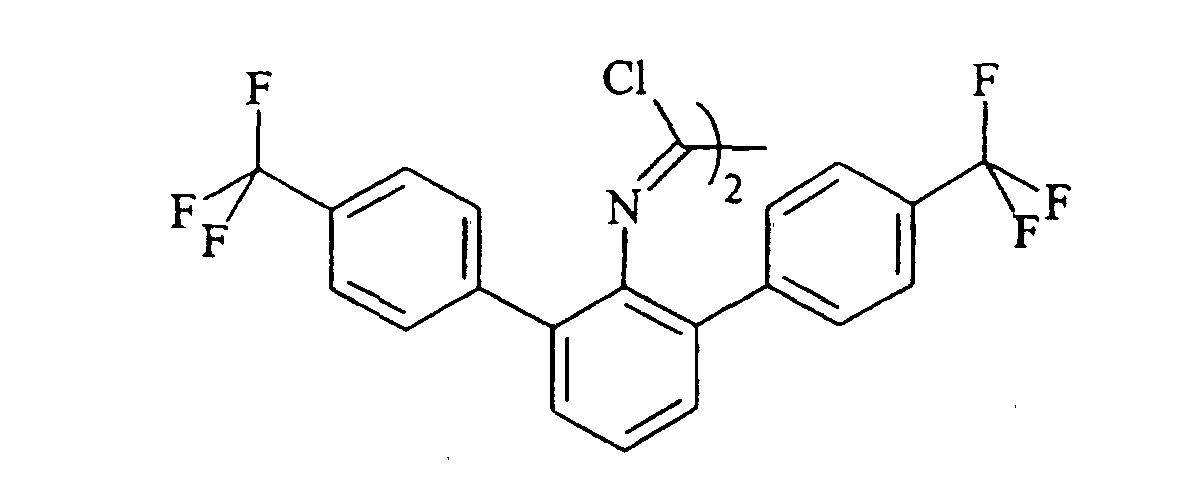
- A suspension of N,N'-Bis-(4,4"-bis-trifluoromethyl-[1,1';3',1"]terphenyl-2'-yl)-oxalamide (419 mg, 0.513 mmol) in toluene (4.1 mL) was treated with PCl5 (408 mg, 1.96 mmol) at rt. The resulting suspension was immersed in a 60 °C oil bath, and stirred under Ar for 6.5h, then heated to 80 °C for an additional 1 h. The yellow solution was cooled to rt, diluted with ether (5 mL) and washed with H2O (10 mL) and Aq. sat'd NaHCO3. The organic layer was dried over Na2SO4, filtered and concentrated in vacuo to afford N 1,N 2-Bis-(4,4"-bis-trifluoromethyl-[1,1';3',1"]terphenyl-2'-yl)-oxalodiimidoyl dichloride (401 mg, 92%) as a yellow solid: 7.33 (d, 4H, J = 8.4 Hz), 7.38 (m, 3H), 7.50 (d, 4H, J = 8.4 Hz); Field Desorption Mass Spectrometry: m/z 852.
-
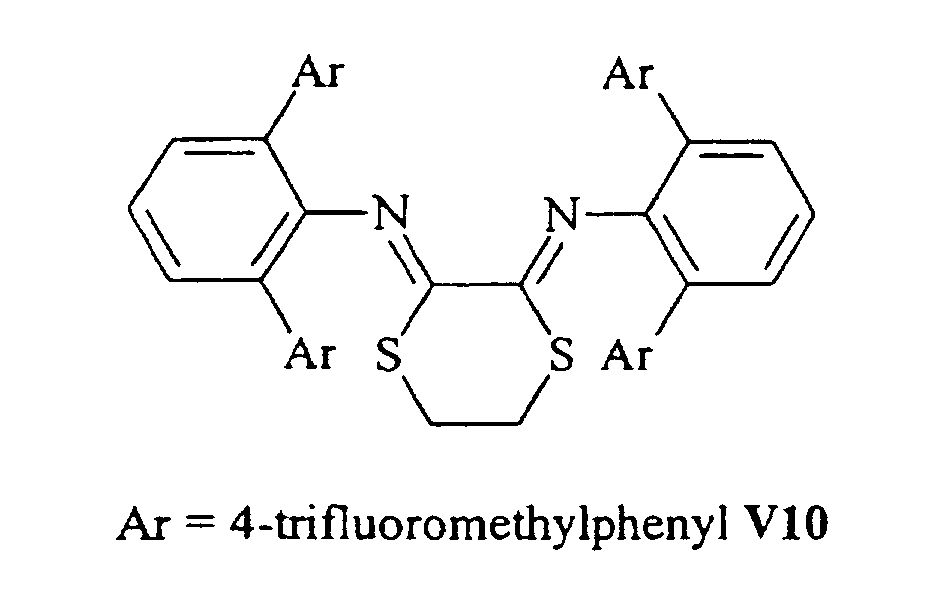
- Ethane dithiol (264 µL, 3.15 mmol) was added via syringe to a suspension of NaH (75.6 mg, 60% in oil, 1.89 mmol) in THF (5 mL). The resulting suspensiuon was stirred under Ar at rt for 15 min, then treated with a solution of N 1,N 2-Bis-(4,4"-bis-tnfluoromethyl-[1,1';3',1"]terphenyl-2'-yl)-oxalodiimidoyl dichloride (401 mg, 0.471 mmol) in THF (5 mL). The suspension was stirred overnight under Ar, then heated to 65°C until not bis-imidoyl chloride remained (45 min) as determined by TLC. The reaction was cooled to rt, quenched with H2O, and extracted with toluene. The organic layer was dried over Na2SO4, filtered and concentrated in vacuo. The residue was crystallized from heptane/CH2Cl2 to afford 2,3-bis-(2,6-bis-(4-trifluoromethylphenyl)-phenylimino)-[1,4]dithiane V10 (260 mg, 63%) as a yellow solid: 11H NMR (CDCl3, chemical shifts in ppm relative to TMS): 2.06 (bs, 4H), 7.32-7.42 (m, 8H), 7.49 (bs, 7H); Field Desorption Mass Spectrometry: m/z 875.
-
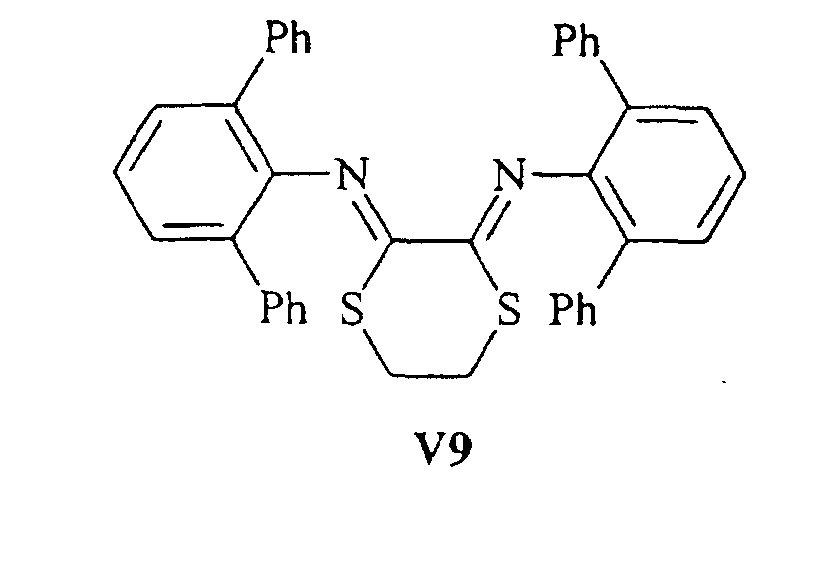
- 2,3-bis-(2,6-diphenyl-phenylimino)-[1,4]dithiane V9 was prepared using similar reaction conditions as described in Example 233 and was purified via washing with heptane and hot ethanol to afford 2,3-bis-(2,6-diphenyl-phenylimino)-[1,4]dithiane V9: 1H NMR (DMSO, 80 °C, chemical shifts in ppm relative to TMS): 2.21 (s, 4H), 7.21-7.39 (m, 26H).
-
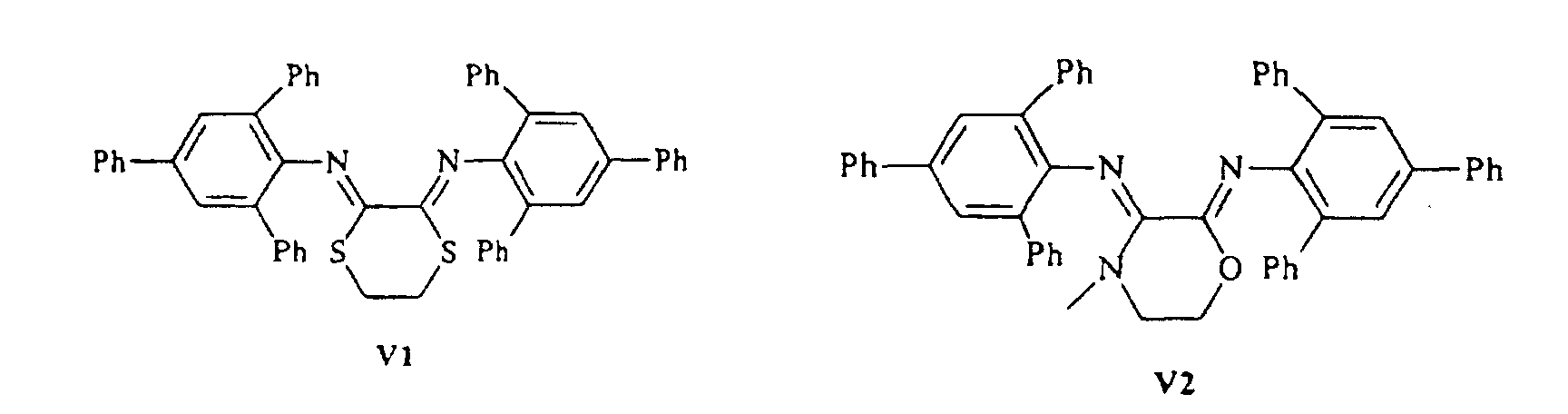
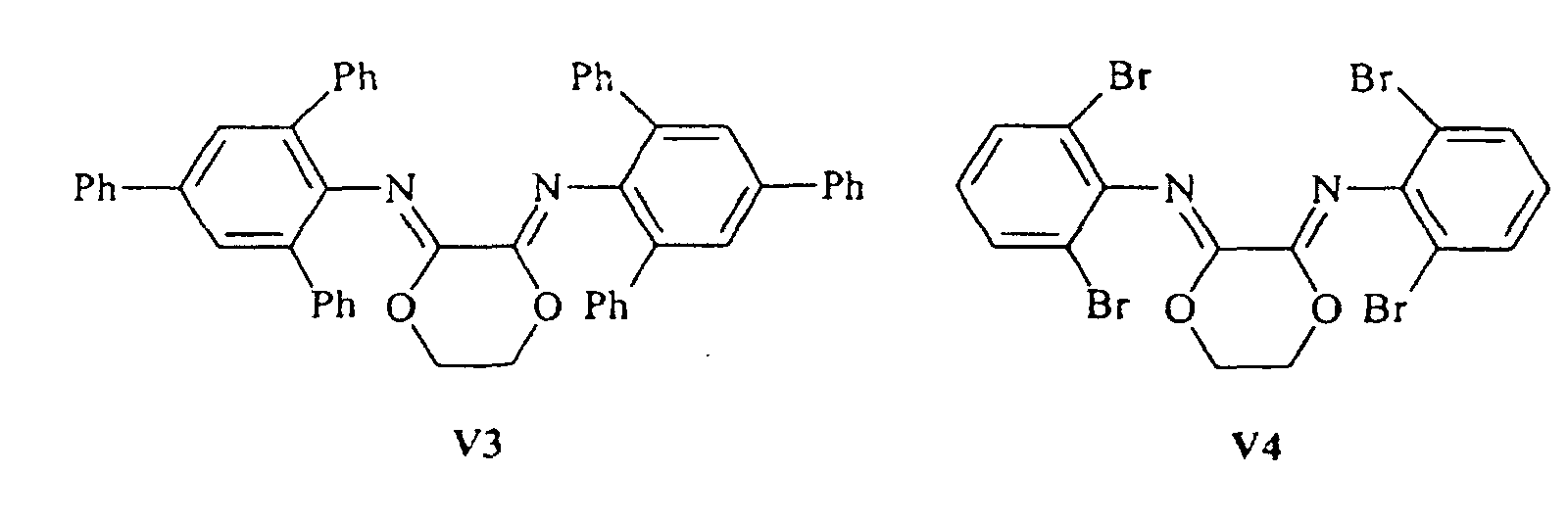


- Ligands V1-V6, V8 and V12 were prepared using conditions similar to those described in Example 233.
Example Ligand 1H NMR Data a,b 20 V5 mixture of isomers, δ 2.02 (s, 6H), 2.54-2.62 (m, 2H), 2.98-3.06 (m, 2H), 6.90-7.06 (m, 3H), 7.28-7.50 (m, 9H), 7.60-7.76 (m, 8H) 21 V6 δ2.02(m, 1H), 2.47-2.64(m, 1H), 2.72-3.08(m, 2H), 7.16-7.40(m, 8H), 7.4-7.54(m, 4H), 7.68-7.82(m, 2H) 22 V2 (CD 2Cl2 ) δ1.98(m,2H), 2.62(s,3H), 2.98(m, 2H), 7.11-7.21(m, 10H), 7.23-7.35(m, 12H), 7.40(m, 6H), 7.49(t, J=7.9 Hz, 3H), 7.6(d, J=7.9 Hz, 2H), 7.78(d, J=7.9 Hz, 2H) 23 V1 (CD2Cl2) δ2.16 (s, 4H), 7.25-7.41(m, 14H), 7.41-7.53(m, 12H), 7.63(s, 4H), 7.67-7.73(m, 4H) 24 V4 δ2.32(s, 6H), 3.40(s,4H), 7.40(s, 4H) 25 V3 (CD 2Cl2)δ2.30(s, 6H), 4.46(s,4H), 7.39(s, 4H) 26 V12 δ2.24(s, 3H), 2.25(s,3H), 2.35(s, 3H), 2.36(s, 3H), 3.36(s, 4H), 7.22(d, J=8.3 Hz, 2H), 7.68(d, J=8.3 Hz, 2H) aAll Spectra Recorded in CDCl3 , Unless Otherwise Indicated bAll Chemical Shifts are Reported in ppm Relative to TMS - (Ligands V4, V6, V8 and V12 are given as comparative Examples, not within the scope of the claims.)
- Ligand V 1 (34.1 mg, 0.045 mmol), Ni(II) acetylacetonate (9.8 mg, 0.038 mmol) and triphenylcarbenium tetrakis(pentafluorophenyl)borate (34.8 mg, 0.038 mmol) were combined in a Schlenk Tube in an inert atmosphere dry box. The mixture was removed from the dry box and treated with CH2Cl2 (7.0 mL) under an inert atmosphere to provide a dark red stock solution of the pro-catalyst.
- A Schlenk flask (200 mL, 500 mL or 1000 mL) equipped with a magnetic stir bar and capped with a septum was evacuated and refilled with ethylene, then charged with dry, deoxygenated toluene (100 mL) and a 10 wt % solution of MAO in toluene (4.0 mL). The requisite volume of pro-catalyst solution (prepared from the indicated ligand as in example 242) was added to give the amount of Ni indicated in the table below. The mixture was stirred under 1 atm ethylene at the temperature indicated in the table below and a polyethylene precipitate was observed. After the indicated reaction time, the mixture was quenched by the addition of acetone (50 mL), methanol (50 mL) and 6 N aqueous HCl (100 mL). The swollen polyethylene was isolated by vacuum filtration and washed with water, methanol and acetone, then dried under reduced pressure at 100°C for 16 h to obtain the amount of polyethylene indicated in the table below. (Examples involving ligands V8, V7, V4, V6, a67, V12, a53, and a59 are Comparative Examples, not within the scope of the claims)
Example Ligand Temp (C) µmol Ni Time min g PE Mn Branches/ 1000 C's 28 V8 23 0.549 15.00 0.805 38,200 21.0 29 V1 23 0.551 6.00 0.795 782,700 4.7 30 V1 23 0.559 14.00 1.629 131,500 1.8 31 V1 23 0.547b 6.00 0.540 145,300 2.9 32 V7 23 0.552b 6.00 0.048 82,800 22.6 33 V1 23 0.276c 24.00 0.539 89,000 3.0 34 V1 23 0.276 8.00 0.371 703,700 4.5 35 V1 23 0.276c 24.00 0.934 87,800 2.7 36 V1 23 0.276 8.00 0.529 540,700 3.6 37 V1 23 0.276c 15.00 0.527 88,500 3.2 38 V2 23 2.320 8.00 0.178 92,900 11.3 39 V3 23 1.04d 8.00 0.351 77,700 16.2 40 V3 23 1.040 8.00 0.776 46,700 19.9 41 V4 23 0.21c 13.66 0.620 207,000 11.3 42 V4 23 0.405 5.33 0.828 192,200 12.0 43 V4 23 0.405d 6.00 0.324 177,800 8.4 44 V6 23 0.418 56.75 0.611 97,200 55.4 45 V5 23 0.380 6.00 0.333 103700 22.8 46 V1 60 0.400 5.00 47 V1 60 0.400 30.00 0.219 48 V1 60 0.400 120.00 0.473 421600 49 V1 60 0.400 15.00 0.104 112200 14 50 V1 60 0.400 45.00 0.401 287500 14.7 51 a67 23 0.366 14.00 0.446 115400 3.9 52 a67 23 0.366 6.00 0.518 151100 3.6 53 V12 23 0.373 12.00 0.194 168800 12.5 54 V1 60 0.400, 960.00 4.447 18.5 55 a54 23 0.392 2.50 0.762 132300 3 56 a54 23 0.392b 70.00 0.207 112500 1.5 57 a54 23 0.392 8.00 0.596 157900 2 58 a54 60 0.392f,h 62.00 1.111 44600 20.2 59 a54 60 0.196t,h 62.00 0.711 82200 12.5 60 V1 60 0.400 35.00 1.18 61 a52 23 0.401 10.00 0.3 132900 2.3 62 a54 23 0.402 5.00 2.973 139900 3.5 63 a54 20 0.401, 20.00 0.426 58000 14.3 64 V1 23 0.384e 5.00 0.735 65 V1 80 0.384e 5.00 66 V1 60 0.399g 10.00 0.097 101000 15.1 67 V1 60 0.200g 10.00 0.037 62600 14.2 68 V 1 60 0.100g 26.00 0.026 63900 64.1 69 V1 80/0 0.399g 20.00 0.728 368200 2.3 70 V1 80/0/23 0.399g 15.00 0.94 516200 4.4 71 V1 80 0.399g 45.00 0.253 97800 19.8 72 a53 60/0/23 0.398g 48.00 0.198 73 V10 23 0.400e 15.00 0.447 513800 5.7 74 V10 23 0.400 8.00 0.284 398800 4.5 75 V10 23 0.400 8.00 0.337 195200 2.5 76 V10 23 0.400c 8.00 0.233 109300 2 77 V10 60 0.400g 55.00 0.433 204300 13.4 78 a59 23 0.400g 6.00 1.054 98300 79 a59 23 0.400d 6.00 0.768 77000 80 a59 60 0.400g 60.00 0.236 28800 81 V11 23 0.402 20.00 0.623 302500 82 V11 23 0.402 20.00 0.146 252200 83 a66 23 0.398g 9.00 0.706 60700 4.2 84 a66 23 0.398d 12.00 0.515 43600 3.1 85 a66 60 0.398g 60.00 86 a59 80/0/23 0.400g 15.00 87 V9 23 0.400g 8.00 0.899 5.8 88 a52 60 2.01g 950.00 10.289 44300 18 89 a52 60 2.01g 950.00 10.289 42900 11 90 a66 60 1.99g 315.00 1.518 91 a59 23 0.400 12.00 0.295 181100 92 a66 23 0.398b 24.00 0.973 121100 93 a59 23 0.400b 60.00 0.503 166900 94 a52 23 0.401b 14.00 0.47 84400 95 a59 23 0.400 60.00 0.239 129000 96 a52 23 0.401c 28.00 0.674 52700 97 a54 23 0.050 4.00 0.366 210200 98 a54 23 0.201i 4.00 0.542 529800 99 a54 23 0.020 8.00 0.222 335400 100 a54 23 0.020 16.00 0.391 214500 101 a54 23 0.020 32.00 0.718 102 a52 23 0.401 12.00 0.405 103 a52 23 0.401b 12.00 0.339 104 a52 23 0.401c 12.00 0.322 -

- 2,3-bis-(2,6-diphenyl-4-methyl-phenylimino)-[1,4]dithiane V11 was prepared using similar reaction conditions as described in Example 233; 1H NMR (CDCl3, chemical shifts in ppm relative to TMS): 2.36 (s, 4H), 2.41 (s, 6H), 7.16-7.23 (m, 24H).
-
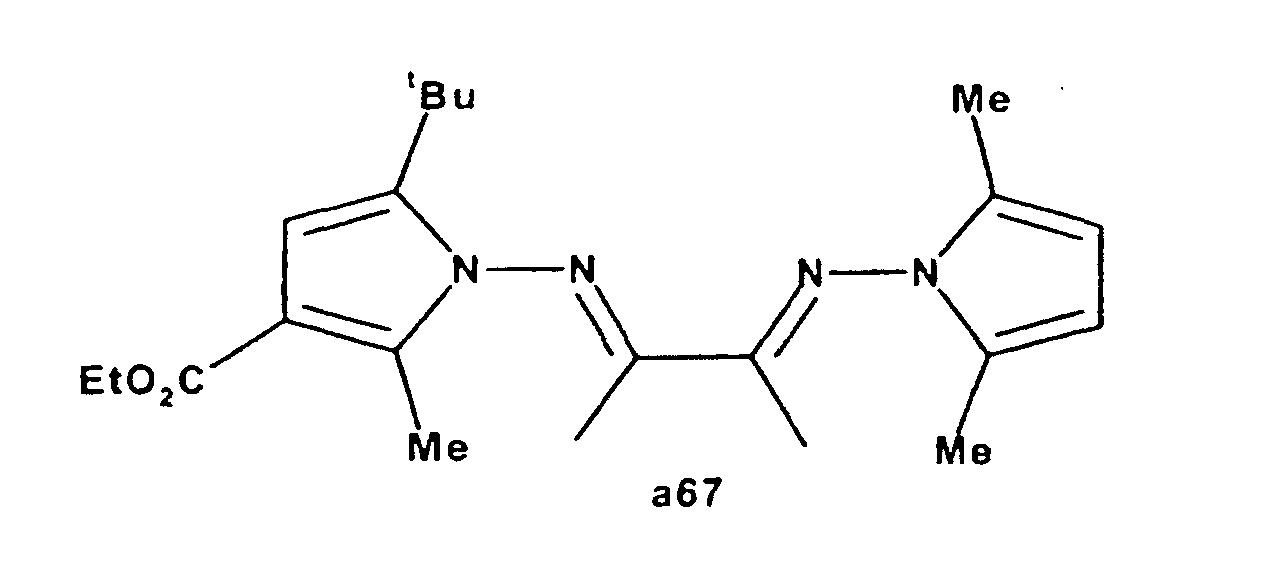
- 5-tert-Butyl-1-[2-(2,5-dimethyl-pyrrol-1-ylimino)-1-methyl-propylideneamino]-2-methyl-1H-pyrrole-3-carboxylic acid ethyl ester a67 was prepared using similar reaction conditions to those described in example 229; 1H NMR (CDCl3, chemical shifts in ppm relative to TMS): 1.28 (s, 9H), 1.37 (t, 3H, J= 6.9 Hz), 2.07 (s, 6H), 2.16 (s, 3H), 2.26 (s, 3H), 2.27 (s, 3H), 4.26-4.33 (m, two isomers, 2H), 5.93 (s, 2H), 6.44 (s, 3H).
-

- A flame dried Schlenk flask equipped with a rubber septum and a stir bar was charged with 128 mg (0.5 mmol) of nickel (II) acetylacetonate. Methylene chloride (10-ml) was added followed by the addition of a methylene chloride solution of 2,3-bis(2,6-diphenylimino)-[1,4]dithiane [300 mg (0.5 mmol) in 10-ml of CH2Cl2] resulting in a brown solution. After 2 minutes of stirring, a methylene chloride solution of Ph3CB(C6F5)4 was added giving a red solution. The mixture was allowed to stir for 1.5 hours. The slovent was removed in vacuo resulting in an oily solid. The oily solid was taken up in 5-ml of diethyl ether. Addition of 15-ml of hexane resulted in partial precipitation of the desired compound. The solvent was removed in vacuo giving a red powder. The red solid was washed with an Et2O/hexane solution. The wash was repeated and the resulting solid taken up in a 1:1 Et2O/CH2Cl2 solution. Hexane was layered onto the red solution and the mixture cooled to -78 °C and left to sit overnight. Upon sitting red crystals formed and the supernate was removed via filter cannula. The resulting crystalline solid was dried under dynamic vacuum for several hours giving 374 mg of a red crystalline solid. 1H NMR was consitent with the desired complex.
- A Parr® stirred autoclave (600-ml) was heated to 100°C under dynamic vacuum too completely dry the reactor. The reactor was cooled and charged with 150 ml of dry toluene and 1-ml of mMAO (Akzo Nobel). In an inert atmosphere glove box, a septum-capped vial was charged with 3 mg of aal. The vial was removed from the box and 20-ml of CH2Cl2 was added to the vial. The reactor was sealed and pressurized up to 1.03 x 10⁶ Pa (150 psig) ethylene and heated to 60 °C. A 2-ml portion (0.3 mg, 2.1 x 10⁻⁷ mol) of the solution of aal was removed from the vial and added to the autolclave via the high-pressure sample loop while pressurizing the autoclave to 1.38 x 10⁶ Pa (200 psig). After 15 minutes of stirring at 1.38 x 10⁶ Pa (200-psig) ethylene and 60 °C, the reaction was quenched upon addition of 2-ml of methanol at high pressure. The reactor was vented and the contents poured into a beaker containing a methanol acetone/mixture. The polymer was collected by suction filtration and dried in the vacuum oven overnight at ∼100°C giving 8.9 grams of polyethylene (6.1 million catalyst turnovers per hour).
- A Parr® stirred autoclave (600-ml) was heated to 100°C under dynamic vacuum too completely dry the reactor. The reactor was cooled and charged with 150 ml of dry toluene and 1-ml of mMAO (Akzo Nobel). In an inert atmosphere glove box, a septum-capped vial was charged with 3 mg of aal. The vial was removed from the box and 20-ml of CH2Cl2 was added to the vial. The reactor was sealed and pressurized up to 1.03 x 10⁶ Pa (150-psig) ethylene and heated to 100 °C. A 2-ml portion (0.3 mg, 2.1 x 10⁻⁷ mol) of the solution of aal was removed from the vial and added to the autolclave via the high-pressure sample loop while pressurizing the autoclave to 1.38 x 10⁶ Pa (200 psig). After 15 minutes of stirring at 1.38 x 10⁶ Pa (200-psig) ethylene and 100 °C, the reaction was quenched upon addition of 2-ml of methanol at high pressure. The reactor was vented and the contents poured into a beaker containing a methanol acetone/mixture. The polymer was collected by suction filtration and dried in the vacuum oven overnight at ∼100°C giving 2.4 grams of polyethylene 1.6 million catalyst. turnovers per hour). GPC analysis Mn = 309,000; PDI = 3.16. 1H NMR 13 branches/ 1000 carbons.
- A flame dried Schlenk flask equipped with a stir bar and a rubber septum was charged in an inert atmosphere glove box with 14.3 mg (9.94 x 10⁻⁷ mol) of aal and 1 gram of Grace Davison 2402 silica. The flask was removed from the glove box, attached to the vacuum/argon manifold, evacuated and refilled with argon. To the solid mixture was added 5-ml of 1,2-difluorobenzene. The resulting suspension was stirred for 45 minutes at 0 °C. The solvent was removed in vacuo giving 875 mg of the desired supported catalyst (catalyst loading 10µmol/gram of silica).
- A flame dried Schlenk flask equipped with a stir bar and a rubber septum was charged in an inert atmosphere glove box with 1 gram of Grace Davison 2402 silica. The flask was removed from the glove box, attached to the vacuum/argon manifold, evacuated and refilled with argon. To the solid was added 28.6 mg (20 µmol) of aal as a solution in CH2Cl2 (5-ml total). The resulting suspension was stirred for 30 minutes at room temperature. The solvent was removed in vacuo giving 889 mg of the desired supported catalyst (catalyst loading 20 µmol/gram of silica).
- A flame dried Schlenk flask equipped with a stir bar and a rubber septum was charged in an inert atmosphere glove box with 1 gram of Grace Davison 2402 silica. The flask was removed from the glove box, attached to the vacuum/argon manifold, evacuated and refilled with argon. To the solid was added 14.3 mg (10 µmol) of aal as a solution in CH2Cl2 (5-ml total). The resulting suspension was stirred for 30 minutes at room temperature. The solvent was removed in vacuo giving 905 mg of the desired supported catalyst (catalyst loading 10 µmol/gram of silica).
- A flame dried Schlenk flask equipped with a stir bar and a rubber septum was charged in an inert atmosphere glove box with 1 gram of Grace Davison 2402 silica. The flask was removed from the glove box, attached to the vacuum/argon manifold, evacuated and refilled with argon. To the solid was added 57.2 mg (40 µmol) of aal as a solution in CH2Cl2 (5-ml total). The resulting suspension was stirred for 30 minutes at room temperature. The solvent was removed in vacuo giving 911 mg of the desired supported catalyst (catalyst loading 40 µmol/gram of silica).
- A Parr® stirred autoclave (600-ml) was heated to 100 °C under dynamic vacuum too completely dry the reactor. The reactor was cooled and charged with ∼ 300 grams of NaCl and the supported procatalyst aal in an inert atmosphere glove box. The reactor was sealed removed from the glove box and placed under an argon atmosphere. The reactor was heated to 60 °C and trimethyl aluminum was added as a solution in toluene or hexane. The reactor is rapidly pressurized to 1.38 x 10⁶ Pa (200-psig) ethylene and left to stir. The reactor was vented and the contents poured into a beaker. The polymer was isolated by blending the salt/polymer mixture in water. The resulting polyethylene was collected dried in the vacuum oven overnight at ∼100°C.
Ex. Conc. µmol Ni/g silica TMA mmol Catalyst Charged (mg) Rxn time (min) Yield PE (g) TON mol C2H4/ mol Ni Productivity g PE/g supported catalyst Mw (x.10-3) 114 10 4 100 120 5.9 296K 83 1440 115 10 4 100 60 4.9 176K 49 1490 116 10 4 100 60 7.3 261K 72 1660 117 10 4 50 60 3.5 254K 70 - 118 40 8 50 60 17.2 307k 344 1800 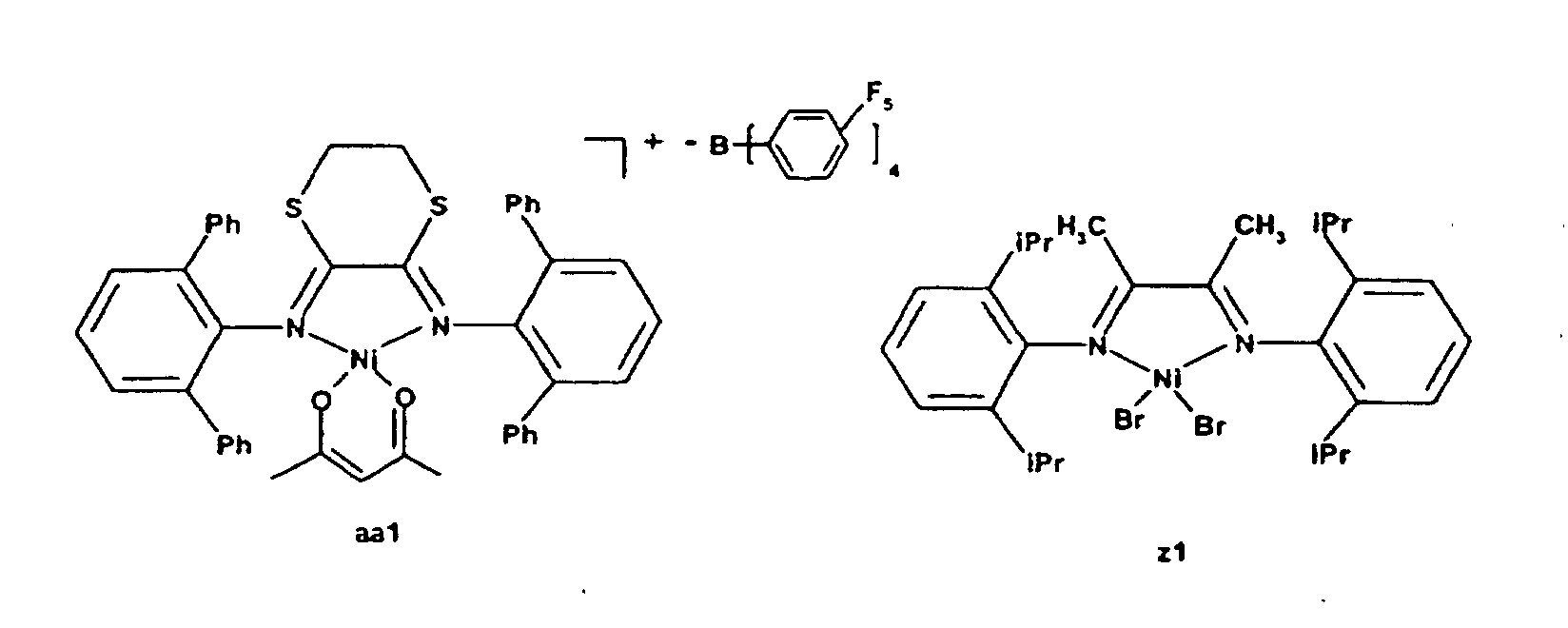
- A Parr® stirred autoclave (600-ml) was heated to 100°C under dynamic vacuum too completely dry the reactor. The reactor was cooled and charged with 150 ml of dry toluene, 1-ml of mMAO (7.14 wt % Al; Akzo Nobel) and H2 gas. In an inert atmosphere glove box, a septum-capped vial was charged with 2.1 x 10⁻⁶ mol of aa1 or z1. The vial was removed from the box and 20-ml of CH2Cl2 was added to the vial. The reactor was sealed and pressurized up to 1.03 x 10⁶ Pa (150-psig) ethylene and heated to 60 °C. A 2-ml portion (2.1 x 10⁻⁷ mol of catalyst) of the solution of catalyst was removed from the vial and added to the autoclave via the high-pressure sample loop while pressurizing the autoclave to 1.38 x 10⁶ Pa (200 psig). After 15 minutes of stirring at 1.38 x 10⁶ Pa (200-psig) ethylene and 60 °C, the reaction was quenched upon addition of 2-ml of methanol at high pressure. The reactor was vented and the contents poured into a beaker containing a methanol acetone/mixture. The polymer was collected by suction filtration and dried in the vacuum oven overnight at ∼100°C.
Ex. Catalyst H2 added (ml) Yield PE (g) TO mol C2H4/ mol Ni (x 10-3) TOF mol C2H4/ mol Ni h (x 10-3) Mn (x 10-3) 119 aa1 0 8.9 1500 6100 1100 120 aa1 25 6.6 1100 4500 1100 121 aa1 50 7.3 1200 4900 524 122 aa1 100 6.1 1000 4100 277 123 aa1 150 7.7 1300 4900 349 124 aa1 100 6.4 1100 4300 576 125 z1 0 2.2 93 371 314 126 z1 50 0.18 6 26 164 127 z1 150 0.18 6 26 41 - These data demonstrate that the catalysts of the present invention, especially those of the twenty-fourth and higher aspects, give rise to lower molecular weight polymer when the polymerization are conducted in the presence of hydrogen, while exhibiting dramatically less inhibition or deactivation than the α-diimine catalyst z1.
- A Schlenk flask (200 mL, 500 mL or 1000 mL) equipped with a magnetic stir bar and capped with a septum was evacuated and refilled with ethylene, then charged with dry, deoxygenated toluene (100 mL) and a 10 wt % solution of MAO in toluene (4.0 mL). The requisite volume of pro-catalyst solution (prepared from the indicated ligand as in example 242) was added to give the amount ofNi indicated in the table below. The mixture was stirred under 1 atm ethylene at the temperature indicated in the table below and a polyethylene precipitate was observed. After the indicated reaction time, the mixture was quenched by the addition of acetone (50 mL), methanol (50 mL) and 6 N aqueous HCl (100 mL). The swollen polyethylene was isolated by vacuum filtration and washed with water, methanol and acetone, then dried under reduced pressure at 100°C for 16 h to obtain the amount of polyethylene indicated in the table below.
Example Ligand Temp (C) mmol Ni Time min g PE Mn Branches / 1000 C's 128 V3 60 1.040 5.00 0.104 26,000 21.1 129 V4 60 0.405 25.00 none 130 V5 60 0.380 25.33 0.492 131 V5 23 0.380 6.00 0.175 - A 1 L Parr® autoclave, Model 4520, was dried by heating under vacuum to 180 C at 0.6 torr for 16 h, then cooled and refilled with dry nitrogen. The autoclave was charged with dry, deoxygenated toluene (450 mL) and 4.0 mL of a 10 wt% solution of MAO in toluene (Aldrich®), heated to 50 °C and pressurized to 5.5 x 10⁵ Pa (80 psig) with ethylene. A sample loop was then used to inject 2.0 mL of a stock solution of pro-catalyst prepared from 9.375 mL dry, deoxygenated CH2Cl2 and 0.625 mL of a stock solution prepared from ligand V1 (29.4 mg), Ni(acac)2 (10.4 mg), Ph3CB(C6F5)4 (36.2 mg) and 5.0 mL of dry, deoxygenated CH2Cl2, and pressurized to about 1.38 x 10⁶ Pa (200 psig) with ethylene. The mixture was stirred under ethylene at an average pressure of about 1.43 x 10⁶ Pa (208 psig) and an average temperature of 57 °C for 80 min, after which the pressure was vented, the autoclave was opened, and the polymer treated with MeOH and 6 N aq HCl and isolated by filtration to obtain 60.3 g (2.1x10⁶ mol C2H4/mol Ni) of white, partially crystalline polyethylene.
- A procedure similar to that used in Example 132 was followed, except that the polymerization reaction temperature was 84 C, the pressure was 1.86 x 10⁶ Pa (270 psig) ethylene and the reaction was quenched by sample loop injection of 2.0 mL MeOH at 7.1 min. This gave 20.0 g polyethylene from 1.0 µmol catalyst (700,000 mol C2H4/mol Ni), corresponding to a rate of 5.9x10⁶ mol C2H4/mol Ni/h. GPC: Mn = 779,000, Mw/Mn = 1.88.
- A procedure similar to that used in Example 133 was followed, except that the ligand was a54, the polymerization reaction temperature was 64 C, the pressure was 1.79 x 10⁶ Pa (260 psig) ethylene and the reaction was quenched by sample loop injection of 2.0 mL MeOH at 5.0 min. This gave 24.3 g polyethylene from 0.4 µmol catalyst (2.2x10⁶ mol C2H4/mol Ni), corresponding to a rate of 2.6x10⁷ mol C2H4/mol Ni/h. GPC: Mn = 73,000, Mw/Mn = 1.97. 1H NMR: 2 branches/1000 C; 100% terminal olefin (within experimental error).
- To a vial charged with V1 (37.8 mg; 50.0 µmol), Ni(acac)2 (12.8 mg; 49.9 µmol) and Ph3CB(C6F5)4 (46.5 mg; 50.4 µmol) was added 3.0 mL 1,2-difluorobenzene. The resulting solution was stirred overnight (ca. 18 hours). This solution was then added dropwise to silica at 0 °C (1.0 g; PQ Corporation, MS-3030 dried at 600 °C under 500 SCCM helium). The flask was then warmed up to room temperature and vacuum was applied for an hour to remove volatile. The flask was then cooled back to 0 °C with an ice-water bath and diethylaluminum chloride (2.7 mL; 1.0M in hexanes) was added dropwise with proper agitation. Volatiles were removed in vacuo at 0 °C for 90 min. The resulting brown solid was stored under nitrogen at -30 °C.
- A catalyst delivery device was charged with the catalyst prepared in Example 135 (58.6 mg; 2.2 µmol Ni) and fixed to the head of a 1000-mL Parr® reactor. The device was placed under vacuum. The reactor was then charged with NaCl (325 g) that had been dried in vacuum at 120 °C for several hours, closed, evacuated and backfilled with nitrogen. The salt was subsequently treated with trimethylaluminum (10 mL; 2.0 M in toluene) and agitated at 60 °C for 30 min. The reactor was then pressurized with 200 psi ethylene and depressurized to atmospheric pressure four times. The catalyst was then introduced in the reactor with appropriate agitation. The reaction was allowed to proceed for 4 hours at 62 °C before the reactor was vented. The polymer was isolated by washing the content of the reactor with water. The isolated polymer was further treated with 6 M HCl in methanol, rinsed with methanol and dried under vacuum to give 51.2 g (630 K TO, 875 g polymer/g silica; 1H NMR: Mn > 50K, 6 BP/1000C; Tm = 125 °C).
- A catalyst delivery device was charged with the catalyst prepared in Example 135 (47.7 mg; 1.8 µmol Ni) and fixed to the head of a 1000-mL Parr® reactor. The device was placed under vacuum. The reactor was then charged with NaCl (348 g) that had been dried in vacuum at 120 °C for several hours, closed and evacuated. The reactor was then pressurized with 200 psi ethylene and depressurized to atmospheric pressure three times. The salt was subsequently treated with trimethylaluminum (10 mL; 2.0 M in hexanes) and agitated at 60 °C for 30 min. The reactor was again pressurized with 200 psi ethylene and depressurized to atmospheric pressure three times. Hydrogen (150 mL) was subsequently added to the reactor. The catalyst was then introduced in the reactor with appropriate agitation. The reaction was allowed to proceed for 4 hours at 56 °C before the reactor was vented. The polymer was isolated by washing the content of the reactor with water. The isolated polymer was further treated with 6 M HCl in methanol, rinsed with methanol and dried under vacuum to give 3.41 g (67.7 K TO, 71 g polymer/g silica; GPC: Mn = 159K, Mw/Mn = 3.0; Tm = 123 °C).
- A 1,2-difluorobenzene solution (3.0 mL) containing 20.2 µmol of V1, Ni(acac)2 and Ph3CB(C6F5)4 was added dropwise to silica at 0 °C (2.0 g; Grace Davison, XPO-2402). The flask was then warmed up to room temperature and vacuum was applied for an hour to remove volatile. The flask was then cooled back to 0 °C with an ice-water bath and diethylaluminum chloride (2.7 mL; 1.0M in hexanes) was added dropwise with proper agitation. Volatiles were removed in vacuo at 0 °C for 90 min. The resulting solid was stored under nitrogen at -30°C.
- A catalyst delivery device was charged with the catalyst prepared in Example 138 (205 mg; 1.9 µmol Ni) and fixed to the head of a 1000-mL Parr® reactor. The device was placed under vacuum. The reactor was then charged with NaCl (329 g) that had been dried in vacuum at 120 °C for several hours, closed, evacuated and backfilled with nitrogen. The salt was subsequently treated with trimethylaluminum (10 mL; 2.0 M in toluene) and agitated at 60 °C for 30 min. The reactor was then pressurized with 200 psi ethylene and depressurized to atmospheric pressure four times. The catalyst was then introduced in the reactor with appropriate agitation. The reaction was allowed to proceed for 90 min at 63 °C before the reactor was vented. The polymer was isolated by washing the content of the reactor with water. The isolated polymer was further treated with 6 M HCl in methanol, rinsed with methanol and dried under vacuum to give 45.8 g (857 K TO, 224 g polymer/g silica; 1H NMR: Mn > 50K, 8 BP/1000C; Tm = 122 °C).
- To a vial charged with V1 (37.7 mg; 49.9 µmol), Ni(acac)2 (12.8 mg; 49.9 µmol) and Ph3CB(C6F5)4 (46.1 mg; 50.0 µmol) was added 3.0 mL 1,2-difluorobenzene. The resulting solution was stirred overnight (ca. 18 hours). This solution was then added dropwise to silica at 0 °C (1.02 g; PQ Corporation, MS-3030 dried at 600 °C under 500 SCCM helium). The flask was then warmed up to room temperature and vacuum was applied for 90 min to remove volatile. The resulting brick-red solid was stored under nitrogen at -30°C.
- A catalyst delivery device was charged with the catalyst prepared in Example 140 (44.1 mg; 2.2 µmol Ni) and fixed to the head of a 1000-mL Parr® reactor. The device was placed under vacuum. The reactor was then charged with NaCl (328 g) that had been dried in vacuum at 120 °C for several hours, closed, evacuated and backfilled with nitrogen. The salt was subsequently treated with trimethylaluminum (10 mL; 2.0 M in hexane) and agitated at 60 °C for 30 min. The reactor was then pressurized with 200 psi ethylene and depressurized to atmospheric pressure three times. The catalyst was then introduced in the reactor with appropriate agitation. The reaction was allowed to proceed for 4 hours at 86 °C before the reactor was vented. The polymer was isolated by washing the content of the reactor with water. The isolated polymer was further treated with 6 M HCl in methanol, rinsed with methanol and dried under vacuum to give 48.0 g (777 K TO, 1100 g polymer/g silica; GPC: Mn = 1,300,000, Mw/Mn = 2.0; Tm = 112 °C).
- To a vial charged with a54 (26.0 mg; 50.1 µmol), Ni(acac)2 (12.8 mg; 49.9 µmol) and Ph3CB(C6F5)4 (46.1 mg; 50.0 µmol) was added 3.0 mL 1,2-difluorobenzene. The resulting solution was stirred overnight (ca. 18 hours). This solution was then added dropwise to silica at 0 °C (992 mg; PQ Corporation, MS-3030 dried at 600 °C under 500 SCCM helium). The flask was then warmed up to room temperature and vacuum was applied for 90 min to remove volatile. The resulting brick-red solid was stored under nitrogen at -30 °C.
- A catalyst delivery device was charged with the catalyst prepared in Example 142 (94 mg; 4.7 µmol Ni) and fixed to the head of a 1000-mL Parr® reactor. The device was placed under vacuum. The reactor was then charged with NaCl (320 g) that had been dried in vacuum at 120 °C for several hours, closed, evacuated and backfilled with nitrogen three times. The salt was subsequently treated with trimethylaluminum (10 mL; 2.0 M in hexane) and agitated at 60 °C for 30 min. The reactor was then pressurized with 200 psi ethylene and depressurized to atmospheric pressure three times. The catalyst was then introduced in the reactor with appropriate agitation. The reaction was allowed to proceed for 3.5 hours at 58 °C before the temperature was increased to 80 °C. The reaction was allowed to proceed for a total of 5.5 hours. The polymer was isolated by washing the content of the reactor with water. The isolated polymer was further treated with 6 M HCl in methanol, rinsed with methanoi and dried under vacuum to give 2.52 g (18,700 TO, 27 g polymer/g silica; GPC: Mn = 45,500; Mw/Mn = 4.6; Tm = 118 °C).
- To a vial charged with V9 (30.1 mg; 49.9 µmol), Ni(acac)2 (13.1 mg; 50.1 µmol) and Ph3CB(C6F5)4 (46.2 mg; 50.1 µmol) was added 3.0 mL 1,2-difluorobenzene. The resulting solution was stirred overnight (ca. 18 hours). This solution was then added dropwise to silica at 0 °C (996 mg; PQ Corporation, MS-3030 dried at 600 °C under 500 SCCM helium). The flask was then warmed up to room temperature and vacuum was applied for 90 min to remove volatile. The resulting solid was stored under nitrogen at -30 °C.
- A catalyst delivery device was charged with the catalyst prepared in Example 144 (54.4 mg; 2.8 µmol Ni) and fixed to the head of a 1000-mL Parr® reactor. The device was placed under vacuum. The reactor was then charged with NaCl (313 g) that had been dried in vacuum at 120 °C for several hours, closed and evacuated. The reactor was then evacuated and backfilled with nitrogen (1 atm) three times. The salt was subsequently treated with trimethylaluminum (10 mL; 2.0 M in hexanes) and agitated at 80 °C for 30 min. The reactor was again pressurized with 200 psi ethylene and depressurized to atmospheric pressure three times. Hydrogen (100 mL) was subsequently added to the reactor. The catalyst was then introduced in the reactor with appropriate agitation. The reaction was allowed to proceed for 4 hours at 83 °C before the reactor was vented. The polymer was isolated by washing the content of the reactor with water. The isolated polymer was further treated with 6 M HCl in methanol, rinsed with methanol and dried under vacuum to give 7.61 g (98 K TO, 137 g polymer/g silica; 1H NMR: Mn > 75K, 12 BP/1000C; GPC: Mn = 52.5K, Mw/Mn = 3.3).
- To a vial charged with a54 (7.8 mg; 15 µmol), Ni(acac)2 (3.9 mg; 15 µmol) and Ph3CB(C6F5)4 (13.8 mg; 15.0 µmol) was added 0.5 mL 1,2-difluorobenzene. The resulting solution was stirred overnight (ca. 18 hours). This solution was then added dropwise to silica at 0 °C (229 mg; Grace Davison XPO-2402). The flask was then warmed up to room temperature and vacuum was applied for 90 min to remove volatile. The resulting brown solid was stored under nitrogen at -30°C.
- A catalyst delivery device was charged with the catalyst prepared in Example 146(44 mg; 2.2 µmol Ni) and fixed to the head of a 1000-mL Parr® reactor. The device was placed under vacuum. The reactor was then charged with NaCl (348 g) that had been dried in vacuum at 120 °C for several hours, closed, evacuated and backfilled with nitrogen three times. The salt was subsequently treated with trimethylaluminum (8 mL; 2.0 M in hexane) and agitated at 60 °C for 30 min. The reactor was then pressurized with ethylene (ca. 200 psi) and depressurized to atmospheric pressure four times. The catalyst was then introduced in the reactor with appropriate agitation. The reaction was allowed to proceed for 4 hours at 60 °C. The polymer was isolated by washing the content of the reactor with water. The isolated polymer was further treated with 6 M HCl in methanol, rinsed with methanol and dried under vacuum to give 15.7 g (254 K TO, 355 g polymer/g; GPC: Mn = 110,000, Mw/Mn = 4.2; 1H NMR: Mn > 75,000, 10 BP/1000C).
- While the invention has been described with reference to preferred embodiments and working examples, it is to be understood that variations and modifications may be resorted to as will be apparent to those skilled in the art. Such variations and modifications are to be considered within the purview and scope of the invention as defined by the claims appended hereto.
and R2x and R2y are each independently H, hydrocarbyl, substituted hydrocarbyl, heteroatom connected hydrocarbyl, or heteroatom connected substituted hydrocarbyl, and may be linked by a bridging group.
Claims (7)
- A process for the polymerization of olefins, comprising contacting a catalyst comprising a Group 8-10 transition metal complex with one or more olefins, wherein said metal complex comprises a bidentate or variable denticity ligand comprising two nitrogen donor atoms substituted by aromatic or heteroaromatic rings, and wherein the ortho positions of said rings are substituted by groups other than H or alkyl and at least one of the ortho positions of at least one of said rings is substituted by an aryl or heteroaryl group.
- The process according to claim 1, wherein said contacting step is carried out in the presence of an amount of hydrogen effective to achieve chain transfer.
- The process according to claim 1, wherein the ortho positions of said rings are substituted by aryl or heteroaryl groups.
- The process according to claim 3, wherein said contacting step is carried out at a temperature between 60 °C and 150 °C.
- The process according to claim 1 or 4, wherein the bidentate or variable denticity ligand is of formula u1;wherein:
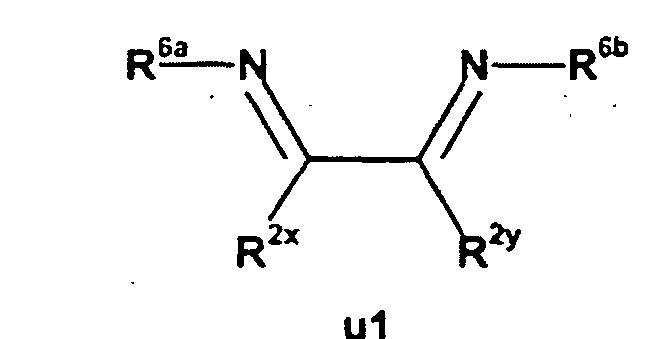 and R2x and R2y are each independently H, hydrocarbyl, substituted hydrocarbyl, heteroatom connected hydrocarbyl, or heteroatom connected substituted hydrocarbyl, and may be linked by a bridging group.R6a and R6b are each independently an aromatic or heteroaromatic ring wherein the ortho positions of said ring are substituted by groups other than H or alkyl and at least one of the ortho positions of at least one of said aromatic or heteroaromatic rings is substituted by an aryl or heteroaryl group;
 - The process according to claim 5, wherein the Group 8-10 transition metal is nickel and the bidentate or variable denticity ligand is selected from Set 1:wherein:Set 1
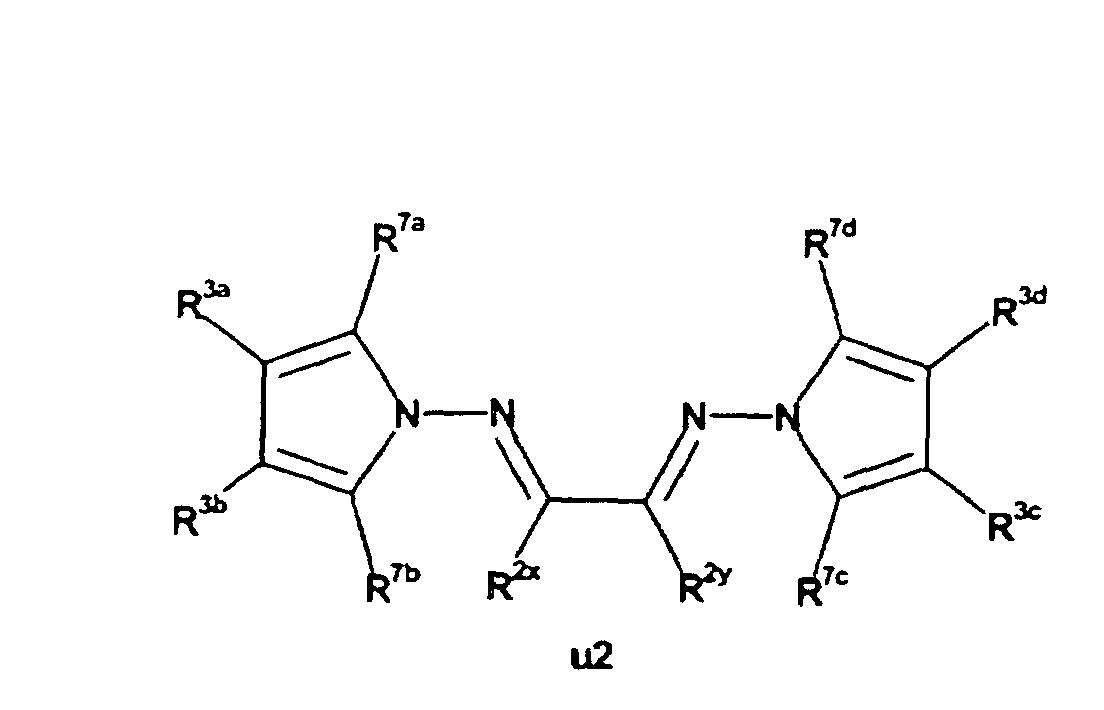
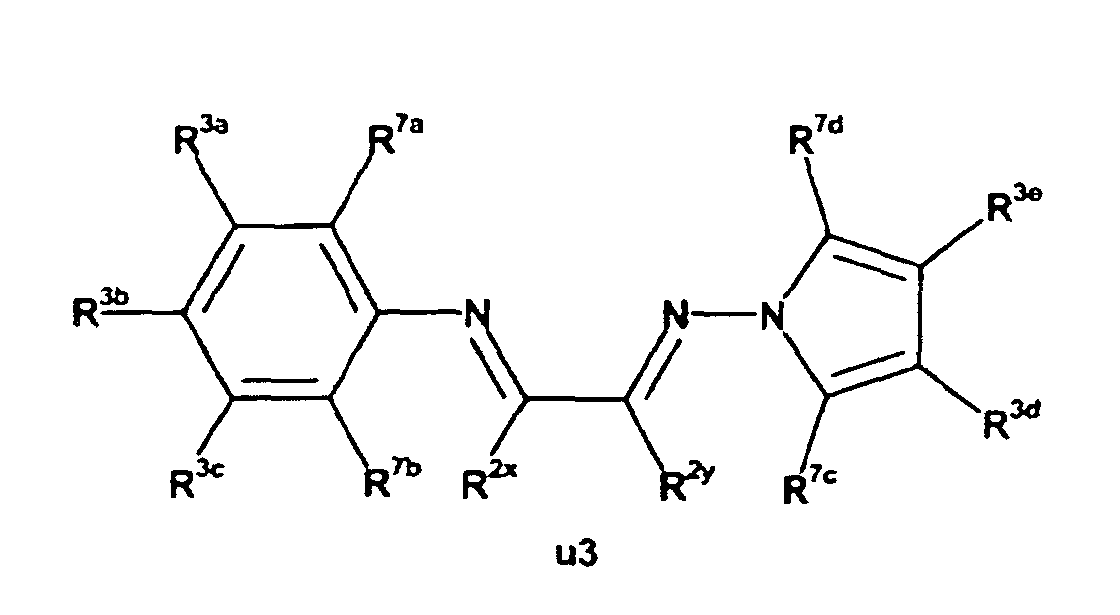
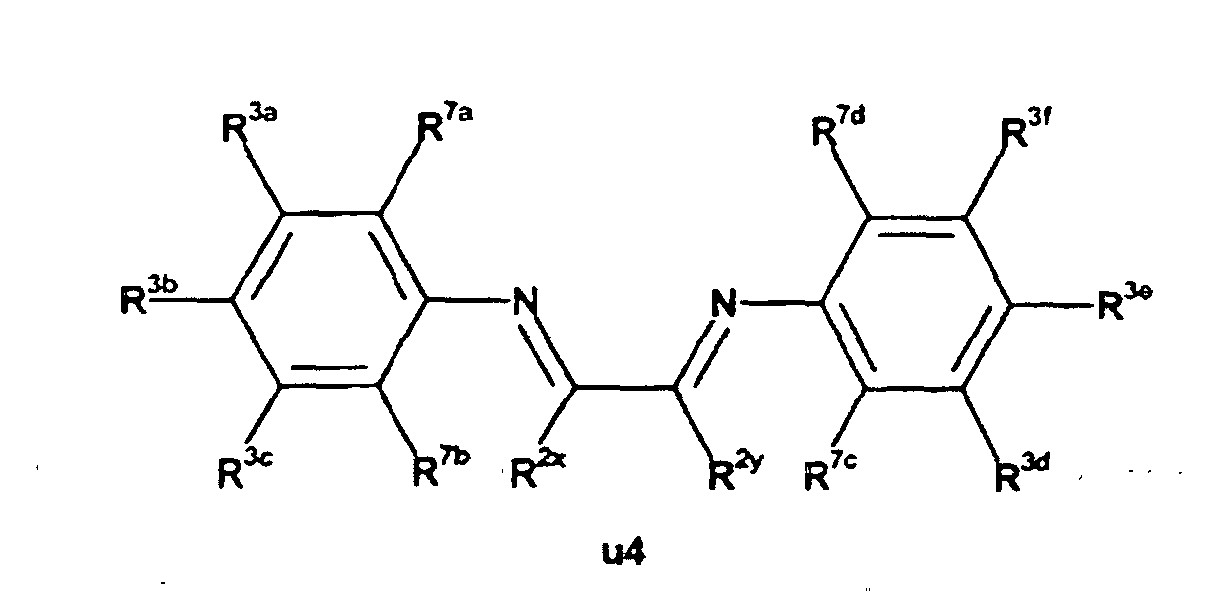 R7a-d are groups other than H or alkyl; provided that at least one of R7a-d is an aryl or heteroaryl group;R2x and R2y are each independently H, hydrocarbyl, substituted hydrocarbyl, heteroatom connected hydrocarbyl, or heteroatom connected substituted hydrocarbyl, and may be linked by a bridging group; andR3a-f are each independently H, hydrocarbyl, substituted hydrocarbyl, heteroatom connected hydrocarbyl, heteroatom connected substituted hydrocarbyl, fluoroalkyl, silyl, boryl, fluoro, chloro, bromo, cyano, or nitro; in addition, any two of R3a-f may be linked by a bridging group.
 - The process according to anyone of the preceding claims, wherein the catalyst composition is attached to a solid support.
Applications Claiming Priority (11)
| Application Number | Priority Date | Filing Date | Title |
|---|---|---|---|
| US12113599P | 1999-02-22 | 1999-02-22 | |
| US121135P | 1999-02-22 | ||
| US12338599P | 1999-03-08 | 1999-03-08 | |
| US12327699P | 1999-03-08 | 1999-03-08 | |
| US123385P | 1999-03-08 | ||
| US123276P | 1999-03-08 | ||
| US13050399P | 1999-04-23 | 1999-04-23 | |
| US130503P | 1999-04-23 | ||
| US14527799P | 1999-07-26 | 1999-07-26 | |
| US145277P | 1999-07-26 | ||
| PCT/US2000/004259 WO2000050470A2 (en) | 1999-02-22 | 2000-02-18 | Catalysts containing n-pyrrolyl substituted nitrogen donors |
Publications (2)
| Publication Number | Publication Date |
|---|---|
| EP1192189A2 EP1192189A2 (en) | 2002-04-03 |
| EP1192189B1 true EP1192189B1 (en) | 2004-09-29 |
Family
ID=27537594
Family Applications (1)
| Application Number | Title | Priority Date | Filing Date |
|---|---|---|---|
| EP00908733A Expired - Lifetime EP1192189B1 (en) | 1999-02-22 | 2000-02-18 | Catalysts containing n-pyrrolyl substituted nitrogen donors |
Country Status (7)
| Country | Link |
|---|---|
| US (4) | US6559091B1 (en) |
| EP (1) | EP1192189B1 (en) |
| JP (1) | JP2004506745A (en) |
| CN (1) | CN1347423A (en) |
| CA (1) | CA2363628A1 (en) |
| DE (1) | DE60014376T2 (en) |
| WO (1) | WO2000050470A2 (en) |
Families Citing this family (74)
| Publication number | Priority date | Publication date | Assignee | Title |
|---|---|---|---|---|
| WO2000050470A2 (en) | 1999-02-22 | 2000-08-31 | Eastman Chemical Company | Catalysts containing n-pyrrolyl substituted nitrogen donors |
| US6545108B1 (en) * | 1999-02-22 | 2003-04-08 | Eastman Chemical Company | Catalysts containing N-pyrrolyl substituted nitrogen donors |
| ATE236180T1 (en) | 1999-08-20 | 2003-04-15 | Basf Ag | BISIMIDINE COMPOUNDS AND THEIR TRANSITION METAL COMPLEXES AND THEIR USE AS CATALYSTS |
| US6710006B2 (en) | 2000-02-09 | 2004-03-23 | Shell Oil Company | Non-symmetrical ligands and catalyst systems thereof for ethylene oligomerization to linear alpha olefins |
| US6605677B2 (en) | 2000-02-18 | 2003-08-12 | Eastman Chemical Company | Olefin polymerization processes using supported catalysts |
| US7056996B2 (en) | 2000-02-18 | 2006-06-06 | E. I. Du Pont De Nemours And Company | Productivity catalysts and microstructure control |
| US6579823B2 (en) * | 2000-02-18 | 2003-06-17 | Eastman Chemical Company | Catalysts containing per-ortho aryl substituted aryl or heteroaryl substituted nitrogen donors |
| US6521724B2 (en) * | 2000-03-10 | 2003-02-18 | E. I. Du Pont De Nemours And Company | Polymerization process |
| US6501000B1 (en) * | 2000-04-04 | 2002-12-31 | Exxonmobil Research And Engineering Company | Late transition metal catalyst complexes and oligomers therefrom |
| AU2001275070B2 (en) | 2000-05-31 | 2005-11-10 | E.I. Du Pont De Nemours And Company | Catalysts for olefin polymerization |
| TW541318B (en) * | 2000-07-04 | 2003-07-11 | Mitsui Chemicals Inc | Process for producing polar olefin copolymer and polar olefin copolymer obtained thereby |
| DE10035700A1 (en) * | 2000-07-20 | 2002-01-31 | Basf Ag | Complex compounds and their use for the polymerization of olefins |
| DE10035654A1 (en) * | 2000-07-20 | 2002-01-31 | Basf Ag | Ligands, complexes and their use for the polymerization of olefins |
| US7037988B2 (en) | 2000-10-03 | 2006-05-02 | Shell Oil Company | Process for the co-oligomerisation of ethylene and alpha olefins |
| EP1334097A2 (en) * | 2000-11-06 | 2003-08-13 | Eastman Chemical Company | Process for the preparation of ligands for olefin polymerization catalysts |
| US6706891B2 (en) | 2000-11-06 | 2004-03-16 | Eastman Chemical Company | Process for the preparation of ligands for olefin polymerization catalysts |
| WO2002036642A2 (en) * | 2000-11-06 | 2002-05-10 | Eastman Chemical Company | Olefin polymerization processes using supported catalysts |
| WO2002038628A2 (en) | 2000-11-07 | 2002-05-16 | Symyx Technologies, Inc. | Substituted pyridyl amine ligands, complexes and catalysts therefrom; processes for producing polyolefins therewith |
| US7409685B2 (en) | 2002-04-12 | 2008-08-05 | Hewlett-Packard Development Company, L.P. | Initialization and update of software and/or firmware in electronic devices |
| US8479189B2 (en) | 2000-11-17 | 2013-07-02 | Hewlett-Packard Development Company, L.P. | Pattern detection preprocessor in an electronic device update generation system |
| US20040087436A1 (en) * | 2000-12-20 | 2004-05-06 | Gibson Vernon Charles | Novel polymerisation catalysts |
| GB0112023D0 (en) | 2001-05-17 | 2001-07-11 | Bp Chem Int Ltd | Polymerisation catalyst |
| EP1270603B1 (en) * | 2001-06-20 | 2014-04-09 | Mitsui Chemicals, Inc. | Olefin polymerization catalyst, process for polymerizing olefins |
| ATE344268T1 (en) * | 2001-08-01 | 2006-11-15 | Shell Int Research | LIGANDS AND CATALYST SYSTEMS CONTAINING THEM FOR THE PRODUCTION OF LINEAR ALPHA-OLEFINS FROM ETHYLENE |
| US7087686B2 (en) | 2001-08-06 | 2006-08-08 | Bp Chemicals Limited | Chain growth reaction process |
| US6809058B2 (en) * | 2001-08-28 | 2004-10-26 | Exxonmobil Research And Engineering Company | Multi-dentate late transition metal catalyst complexes and polymerization methods using those complexes |
| US7196148B2 (en) * | 2001-10-25 | 2007-03-27 | Exxon Mobil Chemical Patents Inc. | Cationic catalyst system |
| US6864205B2 (en) * | 2001-12-18 | 2005-03-08 | Univation Technologies, Llc | Heterocyclic-amide catalyst compositions for the polymerization of olefins |
| US7001863B2 (en) * | 2001-12-18 | 2006-02-21 | Univation Technologies, Llc | Monoamide based catalyst compositions for the polymerization of olefins |
| US7199255B2 (en) * | 2001-12-18 | 2007-04-03 | Univation Technologies, Llc | Imino-amide catalysts for olefin polymerization |
| EP1620447B1 (en) | 2002-05-30 | 2007-08-08 | Exxonmobil Chemical Patents Inc. | Soluble late transition metal catalysts for olefin oligomerizations iii |
| AU2003293320A1 (en) | 2002-09-25 | 2004-05-13 | Shell Internationale Research Maatschappij B.V. | Catalyst systems for ethylene oligomerisation to linear alpha olefins |
| DE10251513A1 (en) * | 2002-11-04 | 2004-05-19 | Basf Ag | Compounds with 5-membered heterocycle linked by amino- or phosphino-methyl to a benzene ring with an ortho-hydroxy, alkoxy, thiol or amino group, used as multidentate ligands in olefin polymerization catalysts |
| US7160834B2 (en) | 2003-03-18 | 2007-01-09 | Exxonmobil Chemical Patents Inc. | Soluble group-10 α-diimine catalyst precursors, catalysts and methods for dimerizing and oligomerizing olefins |
| GB0306418D0 (en) | 2003-03-20 | 2003-04-23 | Exxonmobil Chem Patents Inc | Catalyst composition |
| GB0312063D0 (en) | 2003-05-27 | 2003-07-02 | Exxonmobil Chem Patents Inc | Catalyst composition II |
| US20050014983A1 (en) * | 2003-07-07 | 2005-01-20 | De Boer Eric Johannes Maria | Process for producing linear alpha olefins |
| US8555273B1 (en) | 2003-09-17 | 2013-10-08 | Palm. Inc. | Network for updating electronic devices |
| US7022787B2 (en) | 2003-09-25 | 2006-04-04 | E. I. Du Pont De Nemours And Company | Olefin polymerization catalyst |
| EP1559728A1 (en) * | 2004-01-28 | 2005-08-03 | Total Petrochemicals Research Feluy | Grafting of transition metal complexes on supports |
| ATE388158T1 (en) | 2004-03-24 | 2008-03-15 | Shell Int Research | TRANSITION METAL COMPLEXES |
| US7904895B1 (en) | 2004-04-21 | 2011-03-08 | Hewlett-Packard Develpment Company, L.P. | Firmware update in electronic devices employing update agent in a flash memory card |
| CN1946716B (en) | 2004-04-27 | 2011-12-21 | 惠氏公司 | Cyanopyrrole-containing cyclic carbamate and thiocarbamate biaryls and methods for preparing the same |
| AR049631A1 (en) | 2004-04-27 | 2006-08-23 | Wyeth Corp | COUPLING PROCESS FOR THE GENERATION OF PIRROL REACTIVE DERIVATIVES -2- CARBONITRILE N- REPLACED WITH BORO CONTENT TO PRODUCE BIARILOS |
| WO2006010065A2 (en) | 2004-07-09 | 2006-01-26 | E.I. Dupont De Nemours And Company | Catalysts for olefin polymerization or oligomerization |
| AR049714A1 (en) | 2004-07-13 | 2006-08-30 | Shell Int Research | ALFA OLEFINAS LINEAR PREPARATION PROCESS |
| US8526940B1 (en) | 2004-08-17 | 2013-09-03 | Palm, Inc. | Centralized rules repository for smart phone customer care |
| US7449601B2 (en) | 2004-12-16 | 2008-11-11 | E. I. Du Pont De Nemours And Company | Catalysts useful for catalyzing the coupling of arylhalides with arylboronic acids |
| JP4676219B2 (en) * | 2005-02-25 | 2011-04-27 | 三井化学株式会社 | Olefin polymerization catalyst and olefin polymerization method |
| US7414006B2 (en) | 2005-03-09 | 2008-08-19 | Exxonmobil Chemical Patents Inc. | Methods for oligomerizing olefins |
| EP1856010B1 (en) * | 2005-03-09 | 2010-07-28 | ExxonMobil Chemical Patents Inc. | Methods for oligomerizing olefins |
| US7982085B2 (en) * | 2006-02-03 | 2011-07-19 | Exxonmobil Chemical Patents Inc. | In-line process for generating comonomer |
| US8076524B2 (en) * | 2006-02-03 | 2011-12-13 | Exxonmobil Chemical Patents Inc. | Process for generating alpha olefin comonomers |
| US8003839B2 (en) * | 2006-02-03 | 2011-08-23 | Exxonmobil Chemical Patents Inc. | Process for generating linear apha olefin comonomers |
| EP2025095A2 (en) | 2006-06-08 | 2009-02-18 | Hewlett-Packard Development Company, L.P. | Device management in a network |
| WO2008014454A2 (en) | 2006-07-27 | 2008-01-31 | Hewlett-Packard Development Company, L.P. | User experience and dependency management in a mobile device |
| BRPI0718849B1 (en) * | 2006-11-14 | 2018-11-27 | Univation Tech Llc | olefin polymerization method |
| EP2467406B1 (en) | 2009-08-17 | 2017-06-07 | E. I. du Pont de Nemours and Company | Improved olefin polymerization process |
| WO2011126784A1 (en) | 2010-03-29 | 2011-10-13 | E. I. Du Pont De Nemours And Company | Improved ethylene polymerization process and polyolefin |
| DE102011012515A1 (en) | 2011-02-25 | 2012-08-30 | Umicore Ag & Co. Kg | Metal complexes with N-amino-amidinate ligands |
| US9637567B2 (en) | 2011-05-13 | 2017-05-02 | Univation Technologies, Llc | Spray-dried catalyst compositions and polymerization processes employing the same |
| US9586872B2 (en) | 2011-12-30 | 2017-03-07 | Chevron Phillips Chemical Company Lp | Olefin oligomerization methods |
| FR3020286B1 (en) * | 2014-04-28 | 2017-12-08 | Ifp Energies Now | NOVEL NICKEL COMPLEXES AND THEIR USE IN A PROCESS OF OLEFIN PROCESSING |
| FR3020287B1 (en) * | 2014-04-28 | 2017-12-08 | Ifp Energies Now | NOVEL CYCLIC COMPLEXES BASED ON NICKEL AND THEIR USE IN PROCESS FOR PROCESSING OLEFINS |
| US10513473B2 (en) | 2015-09-18 | 2019-12-24 | Chevron Phillips Chemical Company Lp | Ethylene oligomerization/trimerization/tetramerization reactor |
| US10519077B2 (en) | 2015-09-18 | 2019-12-31 | Chevron Phillips Chemical Company Lp | Ethylene oligomerization/trimerization/tetramerization reactor |
| CN109963884B (en) * | 2016-09-30 | 2021-11-09 | 陶氏环球技术有限责任公司 | Doubly-linked phosphaguanidine group IV metal complexes and olefin polymerization catalysts therefrom |
| WO2018125826A1 (en) | 2016-12-29 | 2018-07-05 | Chevron Phillips Chemical Company Lp | Ethylene oligomerization processes |
| US20180186708A1 (en) | 2016-12-29 | 2018-07-05 | Chevron Phillips Chemical Company Lp | Ethylene Oligomerization Processes |
| US10604457B2 (en) | 2016-12-29 | 2020-03-31 | Chevron Phillips Chemical Company Lp | Ethylene oligomerization processes |
| US10407360B2 (en) | 2017-12-22 | 2019-09-10 | Chevron Phillips Chemical Company Lp | Ethylene oligomerization processes |
| CN111282596B (en) * | 2018-12-06 | 2022-08-05 | 万华化学集团股份有限公司 | Ethylene oligomerization high-selectivity catalyst system and application thereof |
| CN112916046B (en) * | 2019-12-05 | 2022-04-19 | 万华化学集团股份有限公司 | Three-way catalyst system and application thereof in ethylene oligomerization reaction |
| CN116253663B (en) * | 2023-03-16 | 2024-12-03 | 安徽大学 | Alpha-diimine ligands containing flexible cycloalkyl substituents, complexes based thereon and catalytic applications thereof |
Family Cites Families (96)
| Publication number | Priority date | Publication date | Assignee | Title |
|---|---|---|---|---|
| US4178280A (en) * | 1976-03-22 | 1979-12-11 | R. T. Vanderbilt Company, Inc. | Stabilized polyolefin composition |
| US4100132A (en) * | 1976-03-22 | 1978-07-11 | R. T. Vanderbilt Company, Inc. | Stabilized polyolefin composition |
| US5324800A (en) | 1983-06-06 | 1994-06-28 | Exxon Chemical Patents Inc. | Process and catalyst for polyolefin density and molecular weight control |
| US4564647A (en) | 1983-11-14 | 1986-01-14 | Idemitsu Kosan Company Limited | Process for the production of polyethylene compositions |
| US4724273A (en) | 1985-02-13 | 1988-02-09 | Studiengesellschaft Kohle Mbh | Process for preparing alpha-olefin polymers and oligomers |
| US4752597A (en) | 1985-12-12 | 1988-06-21 | Exxon Chemical Patents Inc. | New polymerization catalyst |
| US5055438A (en) | 1989-09-13 | 1991-10-08 | Exxon Chemical Patents, Inc. | Olefin polymerization catalysts |
| JP2775804B2 (en) | 1989-02-03 | 1998-07-16 | 東ソー株式会社 | Polyethylene manufacturing method |
| NZ235032A (en) | 1989-08-31 | 1993-04-28 | Dow Chemical Co | Constrained geometry complexes of titanium, zirconium or hafnium comprising a substituted cyclopentadiene ligand; use as olefin polymerisation catalyst component |
| US5227440A (en) | 1989-09-13 | 1993-07-13 | Exxon Chemical Patents Inc. | Mono-Cp heteroatom containing Group IVB transition metal complexes with MAO: supported catalysts for olefin polymerization |
| US5064802A (en) | 1989-09-14 | 1991-11-12 | The Dow Chemical Company | Metal complex compounds |
| FR2656314B1 (en) | 1989-12-22 | 1992-04-17 | Bp Chemicals Snc | ZIRCONIUM CATALYST SUPPORTED ON MAGNESIUM CHLORIDE, PROCESS FOR THE PREPARATION AND USE OF THE CATALYST IN OLEFIN POLYMERIZATION. |
| US5466766A (en) | 1991-05-09 | 1995-11-14 | Phillips Petroleum Company | Metallocenes and processes therefor and therewith |
| CA2068939C (en) | 1991-05-20 | 1996-04-09 | Takashi Ueda | Olefin polymerization catalyst and olefin polymerization |
| NL9101536A (en) | 1991-09-11 | 1993-04-01 | Dsm Nv | Catalyst and process for the preparation of an amorphous copolymer of ethylene. |
| DE69224600T2 (en) | 1991-11-12 | 1998-08-27 | Nippon Oil Co Ltd | Catalyst components for olefin polymerization |
| EP0578838A1 (en) | 1992-04-29 | 1994-01-19 | Hoechst Aktiengesellschaft | Olefin polymerization catalyst, process for its preparation, and its use |
| US5350723A (en) | 1992-05-15 | 1994-09-27 | The Dow Chemical Company | Process for preparation of monocyclopentadienyl metal complex compounds and method of use |
| WO1994001471A1 (en) | 1992-07-01 | 1994-01-20 | Exxon Chemical Patents Inc. | Transition metal olefin polymerization catalysts |
| JP3202349B2 (en) | 1992-09-22 | 2001-08-27 | 三菱化学株式会社 | Catalyst composition and olefin polymerization method using the same |
| US5320996A (en) | 1992-11-06 | 1994-06-14 | Chevron Research And Technology Company | Alpha-olefin polymerization catalysts comprising supported cyclopentadienyl group 6b metal oxo, thio, imido and phosphido compounds and process for polymerizing alpha-olefins |
| BE1006453A3 (en) | 1992-12-21 | 1994-08-30 | Dsm Nv | CATALYST AND PROCESS FOR A ZIEGLER polymerization. |
| US5332706A (en) | 1992-12-28 | 1994-07-26 | Mobil Oil Corporation | Process and a catalyst for preventing reactor fouling |
| EP0641804A3 (en) | 1993-08-25 | 1995-06-14 | Bp Chem Int Ltd | Olefin polymerisation catalysts. |
| AU686836B2 (en) | 1994-06-24 | 1998-02-12 | Exxon Chemical Patents Inc. | Polymerization catalyst systems, their production and use |
| US5468702A (en) | 1994-07-07 | 1995-11-21 | Exxon Chemical Patents Inc. | Method for making a catalyst system |
| US5880241A (en) | 1995-01-24 | 1999-03-09 | E. I. Du Pont De Nemours And Company | Olefin polymers |
| NZ303800A (en) | 1995-01-24 | 2000-05-26 | Univ North Carolina | Olefin polymers and block polymers, preparation, use, catalysts and catalyst intermediates |
| US5714556A (en) | 1995-06-30 | 1998-02-03 | E. I. Dupont De Nemours And Company | Olefin polymerization process |
| CA2236817A1 (en) | 1995-11-06 | 1997-05-15 | Minnesota Mining And Manufacturing Company | Polymerizable compositions comprising alpha-olefin hydrocarbon monomers and methods of use therefor |
| JPH09255712A (en) | 1996-03-26 | 1997-09-30 | Asahi Chem Ind Co Ltd | Olefin polymerization catalyst |
| JPH09272713A (en) | 1996-04-05 | 1997-10-21 | Mitsui Petrochem Ind Ltd | Olefin polymerization catalyst and olefin polymerization method |
| JPH09272709A (en) | 1996-04-05 | 1997-10-21 | Mitsui Petrochem Ind Ltd | Method for storing olefin polymerization catalyst |
| WO1997038024A1 (en) | 1996-04-09 | 1997-10-16 | Mitsui Chemicals, Inc. | Olefin polymerization catalyst, olefin polymerization method, olefin polymer compositions, and thermoformed articles |
| JP2000513398A (en) | 1996-06-17 | 2000-10-10 | エクソン・ケミカル・パテンツ・インク | Recent high-pressure polymerization methods with transition metal catalyst systems. |
| EP0907665B1 (en) | 1996-06-17 | 2003-01-22 | ExxonMobil Chemical Patents Inc. | Supported late transition metal catalyst systems |
| HU223533B1 (en) | 1996-06-17 | 2004-08-30 | Exxonmobil Chemical Patents Inc. | Mixed transition metal catalyst systems for olefin polymerization |
| KR20000016706A (en) | 1996-06-20 | 2000-03-25 | 스프레이그 로버트 월터 | Alpha-olefin adhesive compositions |
| WO1997048740A1 (en) | 1996-06-20 | 1997-12-24 | Minnesota Mining And Manufacturing Company | Polyolefin microspheres |
| US6368708B1 (en) | 1996-06-20 | 2002-04-09 | 3M Innovative Properties Company | Polyolefin microspheres |
| EP0906350B1 (en) | 1996-06-21 | 2002-11-27 | W.R. Grace & Co.-Conn. | Frangible spray dried agglomerated supports, method of making such supports, and olefin polymerization catalysts supported thereon |
| GB9613814D0 (en) | 1996-07-02 | 1996-09-04 | Bp Chem Int Ltd | Supported polymerisation catalysts |
| CA2259582A1 (en) | 1996-07-23 | 1998-01-29 | Stephan James Mclain | Polymerization processes for olefins |
| JPH11514012A (en) | 1996-07-23 | 1999-11-30 | サイミックス・テクノロジーズ | Combinatorial synthesis and analysis of organometallic compounds and catalysts |
| US5752597A (en) * | 1996-09-04 | 1998-05-19 | Brangle, Jr.; Edward J. | Carton for storage and display of an article |
| WO1998011144A1 (en) | 1996-09-12 | 1998-03-19 | Bp Chemicals Limited | Polymerisation catalyst |
| IL129929A0 (en) * | 1996-12-17 | 2000-02-29 | Du Pont | Polymerization of ethylene with specific iron or cobalt complexes novel pyridinebis (imines) and novel complexes of pyridinebis(imines) with iron and cobalt |
| AU5915198A (en) | 1997-01-14 | 1998-08-03 | E.I. Du Pont De Nemours And Company | Polymerization of ethylene |
| KR100517852B1 (en) | 1997-01-14 | 2005-09-30 | 이 아이 듀폰 디 네모아 앤드 캄파니 | Polymerization of Olefins |
| DE19707236A1 (en) | 1997-02-24 | 1998-08-27 | Targor Gmbh | Catalyst composition |
| US6090900A (en) | 1997-02-25 | 2000-07-18 | Eastman Chemical Company | Polymers containing functionalized olefin monomers |
| US6103658A (en) | 1997-03-10 | 2000-08-15 | Eastman Chemical Company | Olefin polymerization catalysts containing group 8-10 transition metals, processes employing such catalysts and polymers obtained therefrom |
| WO1998040374A2 (en) | 1997-03-10 | 1998-09-17 | Eastman Chemical Company | Olefin polymerization catalysts containing group 8-10 transition metals, bidentate ligands, processes employing such catalysts and polymers obtained therefrom |
| DE69816281T2 (en) | 1997-03-13 | 2004-02-12 | Eastman Chemical Co., Kingsport | CATALYST COMPOSITIONS FOR THE POLYMERIZATION OF OLEFINS |
| US6228794B1 (en) | 1997-03-14 | 2001-05-08 | University Of Iowa Research Foundation | Cationic group 13 complexes incorporating bidentate ligands as polymerization catalysts |
| CA2200373C (en) | 1997-03-19 | 2005-11-15 | Rupert Edward Von Haken Spence | Heteroligand |
| JP3844385B2 (en) | 1997-03-21 | 2006-11-08 | 三井化学株式会社 | Olefin polymerization catalyst and olefin polymerization method |
| US6573345B1 (en) | 1997-03-24 | 2003-06-03 | Cryovac, Inc. | Catalyst compositions and processes for olefin oligomerization and polymerization |
| US6410664B1 (en) | 1997-03-24 | 2002-06-25 | Cryovac, Inc. | Catalyst compositions and processes for olefin polymers and copolymers |
| DE69823988D1 (en) | 1997-04-18 | 2004-06-24 | Eastman Chem Co | GROUP 8-10 TRANSITION METAL CATALYST FOR THE POLYMERIZATION OF OLEFINS |
| AU7158598A (en) | 1997-04-22 | 1998-11-13 | E.I. Du Pont De Nemours And Company | Polymerization of olefins |
| TW420693B (en) * | 1997-04-25 | 2001-02-01 | Mitsui Chemicals Inc | Olefin polymerization catalysts, transition metal compounds, and <alpha>-olefin/conjugated diene copolymers |
| IL132586A0 (en) | 1997-06-09 | 2001-03-19 | Du Pont | Polymerization of olefins |
| AU6992498A (en) | 1997-06-12 | 1998-12-17 | Phillips Petroleum Company | Process for polymerizing ethylene and heterogenous catalyst system |
| EP0996649A1 (en) | 1997-07-08 | 2000-05-03 | BP Chemicals Limited | Supported polymerisation catalyst |
| US6103946A (en) | 1997-07-15 | 2000-08-15 | E. I. Du Pont De Nemours And Company | Manufacture of α-olefins |
| WO1999005189A1 (en) | 1997-07-23 | 1999-02-04 | E.I. Du Pont De Nemours And Company | Polymerization of olefins |
| US6265507B1 (en) | 1997-08-13 | 2001-07-24 | E. I. Du Pont De Nemours And Company | Copolymerization of fluorinated olefins |
| US6114483A (en) | 1997-08-27 | 2000-09-05 | E. I. Du Pont De Nemours And Company | Polymerization of olefins |
| PT1015501E (en) | 1997-09-05 | 2002-11-29 | Bp Chem Int Ltd | POLYMERIZATION CATALYSTS |
| US5955537A (en) * | 1998-02-13 | 1999-09-21 | The Goodyear Tire & Rubber Company | Continuous polymerization process |
| US6410660B1 (en) | 1998-03-27 | 2002-06-25 | E. I. Du Pont De Nemours And Company | Polymerization of olefins |
| AU4919499A (en) | 1998-07-17 | 2000-02-07 | Bp Chemicals Limited | Method for preparing an activator for the polymerisation of olefins |
| US6403738B1 (en) * | 1998-07-29 | 2002-06-11 | E. I. Du Pont De Nemours And Company | Polymerization of olefins |
| GB9902697D0 (en) | 1999-02-09 | 1999-03-31 | Bp Chem Int Ltd | Novel compounds |
| WO2000050470A2 (en) | 1999-02-22 | 2000-08-31 | Eastman Chemical Company | Catalysts containing n-pyrrolyl substituted nitrogen donors |
| US6197715B1 (en) * | 1999-03-23 | 2001-03-06 | Cryovac, Inc. | Supported catalysts and olefin polymerization processes utilizing same |
| GB9907154D0 (en) | 1999-03-29 | 1999-05-19 | Bp Chem Int Ltd | Polymerisation catalysts |
| DE19934464A1 (en) | 1999-07-27 | 2001-02-01 | Basf Ag | Process for (co) polymerizing olefins |
| WO2001007491A1 (en) | 1999-07-27 | 2001-02-01 | Basf Aktiengesellschaft | Method for preparing olefin (co)polymers |
| GB9918189D0 (en) | 1999-08-02 | 1999-10-06 | Bp Chem Int Ltd | Polymerisation process |
| ATE236180T1 (en) | 1999-08-20 | 2003-04-15 | Basf Ag | BISIMIDINE COMPOUNDS AND THEIR TRANSITION METAL COMPLEXES AND THEIR USE AS CATALYSTS |
| DE19944993A1 (en) | 1999-09-20 | 2001-03-22 | Basf Ag | Organometallic catalysts for the polymerization of unsaturated compounds |
| GB9923072D0 (en) | 1999-09-29 | 1999-12-01 | Bp Chem Int Ltd | Polymerisation catalyst |
| EP1099714A1 (en) | 1999-11-12 | 2001-05-16 | BP Chemicals Limited | Polymerisation catalyst |
| DE19954925C2 (en) | 1999-11-16 | 2001-10-04 | Bruker Medical Gmbh | Method for correcting higher-order field inhomogeneities in a magnetic resonance apparatus |
| DE19959251A1 (en) | 1999-12-09 | 2001-06-13 | Basf Ag | Polymerization-active transition metal complex compounds with a sterically demanding ligand system |
| ATE430753T1 (en) | 2000-01-18 | 2009-05-15 | Basell Polyolefine Gmbh | LIGAND FOR A METALLOCENE CATALYST FOR THE POLYMERIZATION OF PROPYLENE AND ITS PRODUCTION PROCESS |
| KR100854012B1 (en) | 2000-01-26 | 2008-08-26 | 미쓰이 가가쿠 가부시키가이샤 | Olefin Polymer |
| US20020065192A1 (en) | 2000-02-18 | 2002-05-30 | Mackenzie Peter Borden | Productivity catalysts and microstructure control |
| US6605677B2 (en) | 2000-02-18 | 2003-08-12 | Eastman Chemical Company | Olefin polymerization processes using supported catalysts |
| US6579823B2 (en) | 2000-02-18 | 2003-06-17 | Eastman Chemical Company | Catalysts containing per-ortho aryl substituted aryl or heteroaryl substituted nitrogen donors |
| US6521724B2 (en) | 2000-03-10 | 2003-02-18 | E. I. Du Pont De Nemours And Company | Polymerization process |
| AU2001275070B2 (en) | 2000-05-31 | 2005-11-10 | E.I. Du Pont De Nemours And Company | Catalysts for olefin polymerization |
| US6350837B1 (en) | 2000-06-09 | 2002-02-26 | Eastman Chemical Company | Copolymerization of norbornene and functional norbornene monomers |
| AU2003293320A1 (en) * | 2002-09-25 | 2004-05-13 | Shell Internationale Research Maatschappij B.V. | Catalyst systems for ethylene oligomerisation to linear alpha olefins |
-
2000
- 2000-02-18 WO PCT/US2000/004259 patent/WO2000050470A2/en not_active Ceased
- 2000-02-18 CN CN00806389A patent/CN1347423A/en active Pending
- 2000-02-18 DE DE60014376T patent/DE60014376T2/en not_active Expired - Lifetime
- 2000-02-18 CA CA002363628A patent/CA2363628A1/en not_active Abandoned
- 2000-02-18 JP JP2000601048A patent/JP2004506745A/en active Pending
- 2000-02-18 US US09/507,492 patent/US6559091B1/en not_active Expired - Lifetime
- 2000-02-18 EP EP00908733A patent/EP1192189B1/en not_active Expired - Lifetime
-
2003
- 2003-01-03 US US10/335,995 patent/US6825356B2/en not_active Expired - Fee Related
-
2004
- 2004-09-01 US US10/931,200 patent/US20050054856A1/en not_active Abandoned
-
2006
- 2006-03-21 US US11/387,137 patent/US7319084B2/en not_active Expired - Lifetime
Also Published As
| Publication number | Publication date |
|---|---|
| CN1347423A (en) | 2002-05-01 |
| EP1192189A2 (en) | 2002-04-03 |
| WO2000050470A3 (en) | 2002-01-03 |
| US20030195110A1 (en) | 2003-10-16 |
| DE60014376T2 (en) | 2005-02-24 |
| WO2000050470A2 (en) | 2000-08-31 |
| CA2363628A1 (en) | 2000-08-31 |
| US20060178490A1 (en) | 2006-08-10 |
| US7319084B2 (en) | 2008-01-15 |
| US6559091B1 (en) | 2003-05-06 |
| US20050054856A1 (en) | 2005-03-10 |
| DE60014376D1 (en) | 2004-11-04 |
| JP2004506745A (en) | 2004-03-04 |
| US6825356B2 (en) | 2004-11-30 |
Similar Documents
| Publication | Publication Date | Title |
|---|---|---|
| US6825356B2 (en) | Catalysts containing N-pyrrolyl substituted nitrogen donors | |
| US6545108B1 (en) | Catalysts containing N-pyrrolyl substituted nitrogen donors | |
| JP2004506745A5 (en) | ||
| US6281303B1 (en) | Olefin oligomerization and polymerization catalysts | |
| US6620896B1 (en) | Mixed olefin polymerization catalysts, processes employing such catalysts, and polymers obtained therefrom | |
| US6579823B2 (en) | Catalysts containing per-ortho aryl substituted aryl or heteroaryl substituted nitrogen donors | |
| JP2001524999A (en) | Group 8-10 transition metal olefin polymerization catalyst | |
| US6372682B2 (en) | Catalyst compositions for the polymerization of olefins | |
| US20020065192A1 (en) | Productivity catalysts and microstructure control | |
| US6605677B2 (en) | Olefin polymerization processes using supported catalysts | |
| US6656869B2 (en) | Group 8-10 transition metal olefin polymerization catalysts | |
| EP1351997A2 (en) | Improved productivity catalysts and microstructure control | |
| US7056996B2 (en) | Productivity catalysts and microstructure control | |
| US20040127658A1 (en) | Productivity catalysts and microstructure control | |
| EP1404723A2 (en) | Olefin polymerization processes using supported catalysts | |
| MXPA99008333A (en) | Olefin polymerization catalysts containing group 8-10 transition metals, bidentale ligantds, processes employing such catalysts and polymers obtained therefrom |
Legal Events
| Date | Code | Title | Description |
|---|---|---|---|
| PUAI | Public reference made under article 153(3) epc to a published international application that has entered the european phase |
Free format text: ORIGINAL CODE: 0009012 |
|
| 17P | Request for examination filed |
Effective date: 20010914 |
|
| AK | Designated contracting states |
Kind code of ref document: A2 Designated state(s): AT BE CH CY DE DK ES FI FR GB GR IE IT LI LU MC NL PT SE |
|
| 17Q | First examination report despatched |
Effective date: 20020425 |
|
| GRAP | Despatch of communication of intention to grant a patent |
Free format text: ORIGINAL CODE: EPIDOSNIGR1 |
|
| GRAS | Grant fee paid |
Free format text: ORIGINAL CODE: EPIDOSNIGR3 |
|
| GRAA | (expected) grant |
Free format text: ORIGINAL CODE: 0009210 |
|
| AK | Designated contracting states |
Kind code of ref document: B1 Designated state(s): DE FR GB NL |
|
| PG25 | Lapsed in a contracting state [announced via postgrant information from national office to epo] |
Ref country code: FR Free format text: LAPSE BECAUSE OF FAILURE TO SUBMIT A TRANSLATION OF THE DESCRIPTION OR TO PAY THE FEE WITHIN THE PRESCRIBED TIME-LIMIT Effective date: 20040929 Ref country code: NL Free format text: LAPSE BECAUSE OF FAILURE TO SUBMIT A TRANSLATION OF THE DESCRIPTION OR TO PAY THE FEE WITHIN THE PRESCRIBED TIME-LIMIT Effective date: 20040929 |
|
| REG | Reference to a national code |
Ref country code: GB Ref legal event code: FG4D |
|
| REG | Reference to a national code |
Ref country code: IE Ref legal event code: FG4D |
|
| REF | Corresponds to: |
Ref document number: 60014376 Country of ref document: DE Date of ref document: 20041104 Kind code of ref document: P |
|
| NLV1 | Nl: lapsed or annulled due to failure to fulfill the requirements of art. 29p and 29m of the patents act | ||
| PLBE | No opposition filed within time limit |
Free format text: ORIGINAL CODE: 0009261 |
|
| STAA | Information on the status of an ep patent application or granted ep patent |
Free format text: STATUS: NO OPPOSITION FILED WITHIN TIME LIMIT |
|
| 26N | No opposition filed |
Effective date: 20050630 |
|
| EN | Fr: translation not filed | ||
| REG | Reference to a national code |
Ref country code: GB Ref legal event code: 732E |
|
| PGFP | Annual fee paid to national office [announced via postgrant information from national office to epo] |
Ref country code: GB Payment date: 20190213 Year of fee payment: 20 Ref country code: DE Payment date: 20190205 Year of fee payment: 20 |
|
| REG | Reference to a national code |
Ref country code: DE Ref legal event code: R071 Ref document number: 60014376 Country of ref document: DE |
|
| REG | Reference to a national code |
Ref country code: GB Ref legal event code: PE20 Expiry date: 20200217 |
|
| PG25 | Lapsed in a contracting state [announced via postgrant information from national office to epo] |
Ref country code: GB Free format text: LAPSE BECAUSE OF EXPIRATION OF PROTECTION Effective date: 20200217 |