EP1191467A1 - Method of improving the effectiveness of an advertisement - Google Patents
Method of improving the effectiveness of an advertisement Download PDFInfo
- Publication number
- EP1191467A1 EP1191467A1 EP00203291A EP00203291A EP1191467A1 EP 1191467 A1 EP1191467 A1 EP 1191467A1 EP 00203291 A EP00203291 A EP 00203291A EP 00203291 A EP00203291 A EP 00203291A EP 1191467 A1 EP1191467 A1 EP 1191467A1
- Authority
- EP
- European Patent Office
- Prior art keywords
- person
- advertisement
- computer
- data
- locator
- Prior art date
- Legal status (The legal status is an assumption and is not a legal conclusion. Google has not performed a legal analysis and makes no representation as to the accuracy of the status listed.)
- Ceased
Links
Images


Classifications
-
- G—PHYSICS
- G06—COMPUTING OR CALCULATING; COUNTING
- G06Q—INFORMATION AND COMMUNICATION TECHNOLOGY [ICT] SPECIALLY ADAPTED FOR ADMINISTRATIVE, COMMERCIAL, FINANCIAL, MANAGERIAL OR SUPERVISORY PURPOSES; SYSTEMS OR METHODS SPECIALLY ADAPTED FOR ADMINISTRATIVE, COMMERCIAL, FINANCIAL, MANAGERIAL OR SUPERVISORY PURPOSES, NOT OTHERWISE PROVIDED FOR
- G06Q30/00—Commerce
- G06Q30/02—Marketing; Price estimation or determination; Fundraising
Definitions
- This invention relates to a method of improving the effectiveness of advertisement such as advertisements contained on a wall or floor in public places.
- the present invention relates to a method wherein the proximity of a person to an advertisement is determined and whereby the closeness of a person to a particular advertisement triggers a predetermined event.
- GB 2344009 describes an advertisement system in which a TV or radio receiver enables targeted advertising dependent on the geographic location of the TV or radio receiver.
- the receiver includes a unit that enables geographic determination of the receiver.
- GB 2344009 discloses as examples of such locator unit, a cellular phone, a long range radio navigation receiver or a Global Positioning Satellite (GPS) receiver.
- GPS Global Positioning Satellite
- JP 10254396 describes a system in which a portable phone is provided next to an advertisement enabling a customer to establish a communication with the advertiser.
- a portable phone is provided next to an advertisement enabling a customer to establish a communication with the advertiser.
- Such a system is cumbersome and expensive.
- Advertisements methods have further been developed by which advertisement is sent to a user's portable phone such as for example a GSM phone or a WAP phone.
- a user's portable phone such as for example a GSM phone or a WAP phone.
- the users subscribe or otherwise agree to receive advertisement on their portable phone in return of which they may receive free services or a discount on their phone bill.
- This system however has the disadvantage that the size of the display of the portable phone is limited thereby limiting the attractiveness of the advertisement.
- portable phones that are currently mostly used generally only allow character-based information thereby further limiting the ability to create complex and attractive advertisement.
- the computer that is coupled to the communication unit may be a conventional personal computer including a CPU, RAM memory and optionally a magnetic disk and/or a CD-ROM or DVD drive.
- the computer is conveniently coupled to the communication unit through a computer network, e.g. the internet.
- the computer will generally also include a network connection such a network card, e.g. an ethernet network card or a modem for dial-up networking.
- the electronically stored advertisement location data and electronically stored person identification data may be stored on any computer readable medium such as a magnetic disk, a CD-ROM or a DVD.
- the electronically stored advertisement location data will generally comprise the location of the advertisement together with a description of the content of the advertisement and/or the advertiser.
- 'advertisement' in connection with the present invention is meant information about a product or service that is being displayed and that is generally aimed at persuading customers to buy the particular product or service.
- the advertisement will generally be displayed in public places, for example on a bill board or as a graphic painted or adhered to a wall, floor or other supporting structure.
- the advertisement may for example also be displayed or projected on a wall or floor by a display or projector controlled by computer. Accordingly, such advertisement can be dynamically updated.
- the electronically stored person identification data comprises the identity or profile of a person and the locator ID data identifying the locator unit associated with the person.
- the person identification data will generally include at least data for contacting the person.
- the person identification data may contain a person's identity such as name, address, phone number, fax number and e-mail address.
- the person identification data would include a general profile together with data for contacting the person.
- the profile may include certain fields of interest of the person, credit card information or demographic information.
- the current position of a person is retrieved by a computer.
- the computer retrieves the locator unit ID data of the person from the electronically stored identification data associated with him.
- the computer uses the locator unit ID data to communicate with the locator unit of the person and to thereby receive the current location of the person.
- the locator unit could be a cellular phone which is in communication with a cellular mobile telephone network such as for example a GSM network. Since the GSM network offers the ability to locate the position of a cell phone, by passing the locator unit ID data, for example the phone number of the cell phone, to the GSM network, the position of the cell phone can be retrieved.
- the locator unit could comprise a Global Positioning Satellite(GPS) receiver through which the locator unit could retrieve its geographic position which can then be communicated wirelessly to the communication unit upon request and transferred to the computer.
- GPS Global Positioning Satellite
- the distance of the current position of the person to an advertisement stored in the advertisement location data would then be calculated by retrieving the location of the advertisement and having a computer calculate the distance.
- a suitably programmed computer determines that the person is close to an advertisement, i.e. the distance of his current position to that of an advertisement is not more than a proximity value, the computer carries out a set of instruction to electronically store log data comprising at least a reference to the electronically stored person identification data of the person and at least a reference to the advertisement to which that person is close and/or, a computer carries out a set of instructions comprising processing data stored in the person identification data associated with the person.
- the computer retrieving the person's position, the computer calculating the distance between an advertisement and a person's position and the computer carrying out the set of instructions comprising processing data stored in the person identification data associated with the person can be one and the same computer or can be different computers that may be part of a network.
- different steps of the method may be carried out by different computers that are for example connected with each other via the internet.
- the electronically stored person identification data and advertisement location data may be retrieved by different computers that are networked with the computer calculating the difference between a person's position and the location of an advertisement.
- the set of instructions carried out by a computer and comprising processing of data stored in the person identification data may cause interaction with the person that is found close to an advertisement.
- Interaction may for example include the person receiving an electronic message such as an e-mail on his computer, pre-recorded audio or video, a SMS message on his cellular phone, updating of an award account, receiving a voice message on his voice-mail system and receiving a coupon in his mail.
- the instructions may retrieve an e-mail address of the person from his person identification data and an electronic message may be sent to his e-mail address.
- Such e-mail message content may be dependent on the advertisement to which he has been found to be close, for example an electronic copy of the advertisement could be e-mailed or he could receive an electronic coupon for the product advertised.
- the method could be carried out again for locating another person or alternatively, the method could be carried out again for the same person to continue monitor whether he comes within a predefined proximity of an advertisement.
- the method could for example include a step of determining whether a particular person is likely to come within the predefined proximity of an advertisement based on the distance of his current position to that on an advertisement and his velocity of movement which can be determined by monitoring the person's position with time. If the person is likely to approach an advertisement, his position would be continued to monitor. If not an alternative person could be monitored.
- the advertisement By causing the interaction with the person, the advertisement will become more effective as the person passing the advertisement, through the interaction, will be made more aware of the advertisement whereas he previously would not have been.
- the method has further the advantage that conventional advertisement is being used without the space and other system limitations associated with other advertisement means. Further, the present method can be easily implemented at a fairly low cost without the need for special adapted equipment with the target audience of the advertisement.
- the invention in another aspect, relates to a computer readable medium comprising person identification data comprising data describing identity or profile of a person and locator ID data identifying a locator unit of which the geographic position can be retrieved through wireless communication and which locator unit is associated with said person.
- the person identification data is in a form suitable for use in the method of this invention.
- the computer readable medium is further loaded on a computer that is programmed to carry out at least part of the method or that is capable of communicating with at least one computer carrying out at least a part of the method.
- the computer readable medium can be a hard disk of a computer with the person identification data or a CD-ROM loaded in a CD-ROM drive of a computer and containing the person identification.
- This computer can be for example a computer that is programmed to carry out part of the method such as for example step of retrieving a person's geographic location or can be a computer that is in communication (e.g. through a computer network) with such a computer.
- the present invention also relates to a computer readable medium comprising advertisement location data comprising the geographic location of one or more advertisements in a form suitable for use in the method of the invention.
- the computer readable medium is further loaded on a computer that is programmed to carry out at least part of the method or that is capable of communicating with at least one computer carrying out at least a part of the method.
- the invention relates to a computer suitably programmed to
- the computer is further suitably programmed to cause, in the case that the calculated distance is not more than a proximity value, electronically storing of log data comprising person identification data of said person or a reference thereto and data representing information about the advertisement that is within a distance of the current position of said person not more than the proximity value or a reference to said data representing information about said advertisement. Additionally or alternatively, the computer is further suitably programmed to cause, in the case that the calculated distance is not more than a proximity value, processing of data stored in the person identification data associated with the person to cause an interaction with that person.
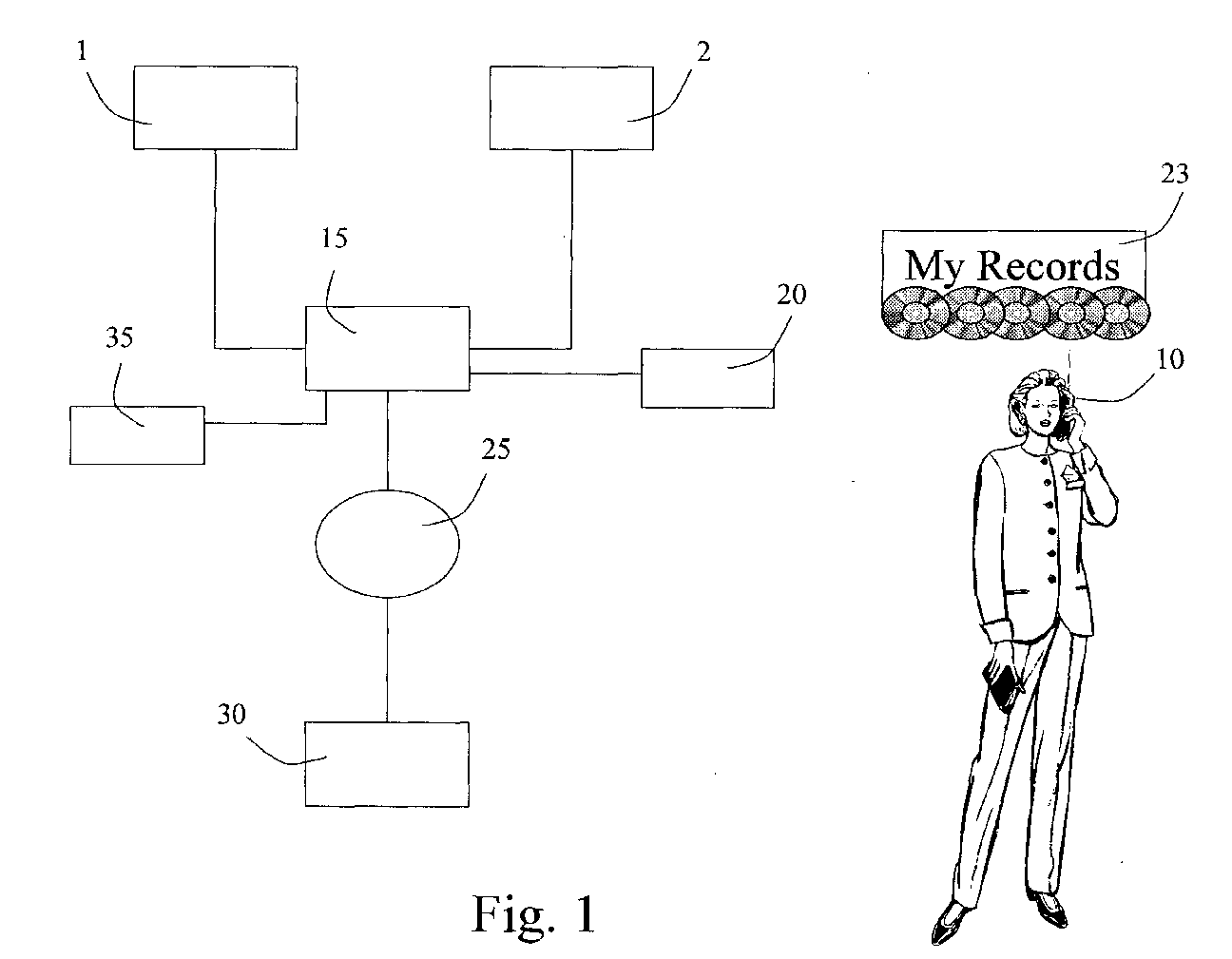
- Figures 1 and 2 show a schematic representation of two embodiments of this invention.
- Computer 15 retrieves the person identification data 2 of person 5 to determine the geographic location of person 5.
- the person identification data 2 is electronically stored, for example on a magnetic disk of a computer.
- the person identification data 2 could have been previously obtained from the person through a registration service of for example an advertiser. Conveniently, such registration service would be carried out through an electronic form that a person can fill out for example at a web site of the advertiser. If computer 15 is connected to the internet or otherwise with the advertiser, computer 15 could retrieve the person identification data 2 from the advertiser's computer.
- Computer 15 extracts the ID of cell phone 10 (for example the phone number) of person 5 from the person identification data 2 and instructs communication unit 20 to locate the cell phone 10 corresponding to the ID.
- Communication unit 20 determines the geographic location of cell phone 10 and therefore the location of person 5 and communicates that information to computer 15.
- Computer 15 retrieves the geographic location of advertisement 23 from the advertisement location data 1.
- Computer 15 calculates the distance between the geographic locations of the advertisement 23 and person 5 and compares the calculated distance with a proximity value. If computer 15 determines that the calculated distance is equal or less than the proximity value, computer 15 may store log data 35.
- Such log data may comprise the identification data of person 5, the time when person 5 is found close to the advertisement 23, the location of the advertisement and a description of the advertisement.
- Such log data can then be later processed by computer 15 or another computer to analyze which kind of persons have passed or seen the advertisement. For example, an advertiser might be interested in knowing whether the persons passing his advertisement have an interest in the type of product or services he is offering. In the example illustrated in figure 1, the advertiser, a records company, might be interested in the music style of the persons viewing his advertisement so as to tailor his advertisement to the audience that most frequently passes at the location of his advertisement.
- computer 15 retrieves information about the advertisement 23 from the advertisement location data or separately stored advertisement data. Based on such data, computer 15 may carry out a set of instructions causing communication unit 20 to send a SMS message to cell phone 10 of person 5.
- SMS message may contain information on new records that have been released or on a special promotion. If the person identification data includes information as to what type of music person 5 is interested in, the SMS message sent by computer 15 through communication unit 20 could be tailored to special promotion or new releases for the particular music style that person 5 has an interest for.
- computer 15 could call person 5 through communication unit 20 and play a particular record or fragment of a record, for example a new release, through the person's cell phone 10. Still further, computer 15 could carry out a set of instruction to send an e-mail through communication network 25, for example the internet, to computer 30 of person 5. For this purpose, computer 15 would retrieve the e-mail address of person 5 from his person identification data. The content of such e-mail would be compiled by computer 15 on the basis of for example information contained in the person identification data 2, the location of the advertisement contained in advertisement location data 1 and the nature of the particular advertisement. For example, in the present example, the e-mail may inform person 5 of new release for the music style he is interested in, together with some audio fragments thereof and/or an electronic coupon for discount when he buys the particular new release.
- FIG. 2 A further embodiment of the present invention is illustrated in figure 2.
- computer 15 retrieves person identification data 2 for person 5 and extracts therefrom the ID of cell phone 10 carried by person 5.
- Computer 15 instructs communication unit 20 to retrieve the geographic location 10 and communication unit 20 then communicates the geographic location to computer 15.
- Computer 15 retrieves advertisement location data 1 and thereby retrieves the geographic location of advertisement 40.
- Advertisement 40 comprises an advertisement for a particular brand of sport shoes.
- the advertisement consists of a fixed part displaying a graphic of the shoe with a brand name and some information on the advertiser. Such graphic may be for example a graphics film adhered to the wall.
- Advertisement 41 further includes a variable part 41 which is projected by projector 50 on the static part of the advertisement.
- Computer 51 controls projector 50 to display the variable information 41.
- Computer 51 is connected to computer 15 through a communication network 25 such as for example the internet.
- Computer 15 calculates the distance between the geographic location of the advertisement 40 and person 5 and if computer 15 determines that this distance is not more than a preset proximity value, computer 15 will carry out instructions to cause computer 51 to display variable information 41 depending on information stored in the person identification data associated with person 5.
- the person identification data in this example may include the favorite soccer team of person 5.
- Computer 15 would retrieve that information from the person identification data and instruct computer 51 to display for example the score of an ongoing game of the person's soccer team.
- Computer 51 could retrieve that information through the communication network 25 and program projector 50 to display the current score in variable information part 41.
Landscapes
- Business, Economics & Management (AREA)
- Strategic Management (AREA)
- Engineering & Computer Science (AREA)
- Accounting & Taxation (AREA)
- Development Economics (AREA)
- Finance (AREA)
- Economics (AREA)
- Game Theory and Decision Science (AREA)
- Entrepreneurship & Innovation (AREA)
- Marketing (AREA)
- Physics & Mathematics (AREA)
- General Business, Economics & Management (AREA)
- General Physics & Mathematics (AREA)
- Theoretical Computer Science (AREA)
- Management, Administration, Business Operations System, And Electronic Commerce (AREA)
- Information Transfer Between Computers (AREA)
Abstract
determining current position of a person by causing said computer to retrieve the locator unit ID data corresponding to the locator unit associated with said person from the electronically stored person identification data and causing said computer to pass said locator unit ID data to said communication unit thereby retrieving the geographic position of the corresponding locator unit from said communication unit.
Description
- This invention relates to a method of improving the effectiveness of advertisement such as advertisements contained on a wall or floor in public places. In particular, the present invention relates to a method wherein the proximity of a person to an advertisement is determined and whereby the closeness of a person to a particular advertisement triggers a predetermined event.
- With the development of new communication media, in particular electronic communication media such as internet and digital mobile phones, new methods of advertisements have been developed concurrently with the aim of increasing effectiveness of advertisement. For example, many websites on the internet contain advertisements which may be interactive and which may be tailored to a particular profile of a person viewing the site. However, it is believed that internet users pay only little attention to these advertisements. Moreover, software has been developed to disable these advertisement on a web page to improve the speed of downloading web pages for viewing.
- GB 2344009 describes an advertisement system in which a TV or radio receiver enables targeted advertising dependent on the geographic location of the TV or radio receiver. To achieve this, the receiver includes a unit that enables geographic determination of the receiver. GB 2344009 discloses as examples of such locator unit, a cellular phone, a long range radio navigation receiver or a Global Positioning Satellite (GPS) receiver. The disadvantage of this system however is that it requires an adapted TV or radio set and therefore likely replacement of a persons current TV or radio.
- JP 10254396 describes a system in which a portable phone is provided next to an advertisement enabling a customer to establish a communication with the advertiser. However, such a system is cumbersome and expensive.
- Advertisements methods have further been developed by which advertisement is sent to a user's portable phone such as for example a GSM phone or a WAP phone. In such a system the users subscribe or otherwise agree to receive advertisement on their portable phone in return of which they may receive free services or a discount on their phone bill. This system however has the disadvantage that the size of the display of the portable phone is limited thereby limiting the attractiveness of the advertisement. Furthermore, portable phones that are currently mostly used generally only allow character-based information thereby further limiting the ability to create complex and attractive advertisement.
- Conventional advertisement whereby complex and large graphics representing advertisement may be placed on a wall or floor has the disadvantage that such advertisement is passive and often goes unnoticed to persons passing the advertisement. Moreover, it is generally difficult or cumbersome for the advertiser to obtain information as to who may have viewed his advertisement. Such information may be useful to the advertiser to create effectiveness of his advertisement by placing it in areas where persons likely interested in his products are more likely to view his advertisement.
- It would thus be desirable to improve the advertisement methods. In particular, it would be desirable to more easily obtain information as to which persons view an advertisement and/or to interact with such persons. It is furthermore desirable that such improved advertisement method can be implemented in an easy and cost effective way.
- It has been found that the effectiveness of advertisement may be improved by providing a computer system that comprises:
- a locator unit of which the geographic position can be retrieved through wireless communication;
- electronically stored advertisement location data comprising the geographic location of one or more advertisements such as for example a graphic on a wall or floor;
- electronically stored person identification data;
- a computer coupled to a communication unit capable of wirelessly retrieving the geographic position of the locator unit.
- The computer that is coupled to the communication unit may be a conventional personal computer including a CPU, RAM memory and optionally a magnetic disk and/or a CD-ROM or DVD drive. The computer is conveniently coupled to the communication unit through a computer network, e.g. the internet. Accordingly, the computer will generally also include a network connection such a network card, e.g. an ethernet network card or a modem for dial-up networking.
- The electronically stored advertisement location data and electronically stored person identification data may be stored on any computer readable medium such as a magnetic disk, a CD-ROM or a DVD. The electronically stored advertisement location data will generally comprise the location of the advertisement together with a description of the content of the advertisement and/or the advertiser. By 'advertisement' in connection with the present invention is meant information about a product or service that is being displayed and that is generally aimed at persuading customers to buy the particular product or service. The advertisement will generally be displayed in public places, for example on a bill board or as a graphic painted or adhered to a wall, floor or other supporting structure. The advertisement may for example also be displayed or projected on a wall or floor by a display or projector controlled by computer. Accordingly, such advertisement can be dynamically updated.
- The electronically stored person identification data comprises the identity or profile of a person and the locator ID data identifying the locator unit associated with the person. The person identification data will generally include at least data for contacting the person. The person identification data may contain a person's identity such as name, address, phone number, fax number and e-mail address. Alternatively, if the person does not wish to have his full identity stored, the person identification data would include a general profile together with data for contacting the person. For example, the profile may include certain fields of interest of the person, credit card information or demographic information.
- In accordance with the method of the invention, the current position of a person is retrieved by a computer. To determine the current position, the computer retrieves the locator unit ID data of the person from the electronically stored identification data associated with him. The computer then uses the locator unit ID data to communicate with the locator unit of the person and to thereby receive the current location of the person. For example, the locator unit could be a cellular phone which is in communication with a cellular mobile telephone network such as for example a GSM network. Since the GSM network offers the ability to locate the position of a cell phone, by passing the locator unit ID data, for example the phone number of the cell phone, to the GSM network, the position of the cell phone can be retrieved. Alternatively, the locator unit could comprise a Global Positioning Satellite(GPS) receiver through which the locator unit could retrieve its geographic position which can then be communicated wirelessly to the communication unit upon request and transferred to the computer.
- The distance of the current position of the person to an advertisement stored in the advertisement location data would then be calculated by retrieving the location of the advertisement and having a computer calculate the distance. A suitably programmed computer then determines that the person is close to an advertisement, i.e. the distance of his current position to that of an advertisement is not more than a proximity value, the computer carries out a set of instruction to electronically store log data comprising at least a reference to the electronically stored person identification data of the person and at least a reference to the advertisement to which that person is close and/or, a computer carries out a set of instructions comprising processing data stored in the person identification data associated with the person.
- It should be noted here that for example the computer retrieving the person's position, the computer calculating the distance between an advertisement and a person's position and the computer carrying out the set of instructions comprising processing data stored in the person identification data associated with the person can be one and the same computer or can be different computers that may be part of a network. Thus, different steps of the method may be carried out by different computers that are for example connected with each other via the internet. Also, the electronically stored person identification data and advertisement location data may be retrieved by different computers that are networked with the computer calculating the difference between a person's position and the location of an advertisement.
- The set of instructions carried out by a computer and comprising processing of data stored in the person identification data may cause interaction with the person that is found close to an advertisement. By the term 'interaction' is meant that the person can note an effect that he was close to an advertisement. Interaction may for example include the person receiving an electronic message such as an e-mail on his computer, pre-recorded audio or video, a SMS message on his cellular phone, updating of an award account, receiving a voice message on his voice-mail system and receiving a coupon in his mail. For example, the instructions may retrieve an e-mail address of the person from his person identification data and an electronic message may be sent to his e-mail address. Such e-mail message content may be dependent on the advertisement to which he has been found to be close, for example an electronic copy of the advertisement could be e-mailed or he could receive an electronic coupon for the product advertised.
- If no advertisement is found close to the person's current location, the method could be carried out again for locating another person or alternatively, the method could be carried out again for the same person to continue monitor whether he comes within a predefined proximity of an advertisement. The method could for example include a step of determining whether a particular person is likely to come within the predefined proximity of an advertisement based on the distance of his current position to that on an advertisement and his velocity of movement which can be determined by monitoring the person's position with time. If the person is likely to approach an advertisement, his position would be continued to monitor. If not an alternative person could be monitored.
- By causing the interaction with the person, the advertisement will become more effective as the person passing the advertisement, through the interaction, will be made more aware of the advertisement whereas he previously would not have been. The method has further the advantage that conventional advertisement is being used without the space and other system limitations associated with other advertisement means. Further, the present method can be easily implemented at a fairly low cost without the need for special adapted equipment with the target audience of the advertisement.
- In another aspect, the invention relates to a computer readable medium comprising person identification data comprising data describing identity or profile of a person and locator ID data identifying a locator unit of which the geographic position can be retrieved through wireless communication and which locator unit is associated with said person. The person identification data is in a form suitable for use in the method of this invention. The computer readable medium is further loaded on a computer that is programmed to carry out at least part of the method or that is capable of communicating with at least one computer carrying out at least a part of the method. For example, the computer readable medium can be a hard disk of a computer with the person identification data or a CD-ROM loaded in a CD-ROM drive of a computer and containing the person identification. This computer can be for example a computer that is programmed to carry out part of the method such as for example step of retrieving a person's geographic location or can be a computer that is in communication (e.g. through a computer network) with such a computer.
- Similarly, the present invention also relates to a computer readable medium comprising advertisement location data comprising the geographic location of one or more advertisements in a form suitable for use in the method of the invention. The computer readable medium is further loaded on a computer that is programmed to carry out at least part of the method or that is capable of communicating with at least one computer carrying out at least a part of the method.
- In a further aspect, the invention relates to a computer suitably programmed to
- (i) obtain input data A comprising person identification data describing identity or profile of a person and locator ID data identifying a locator unit of which the geographic position can be retrieved through wireless communication;
- (ii) obtain input data B comprising advertisement location data comprising the geographic location of one or more advertisements;
- (iii) to cause retrieval of a person's current geographic position by passing locator ID data of the locator unit associated with that person to a communication unit capable of wirelessly retrieving the geographic position of said locator unit;
- (iv) to cause calculation of the distance between the person's current geographic position and the geographic location of the one or more advertisements;
- (v) to cause comparison of the calculated distance with a proximity value.
-
- The computer is further suitably programmed to cause, in the case that the calculated distance is not more than a proximity value, electronically storing of log data comprising person identification data of said person or a reference thereto and data representing information about the advertisement that is within a distance of the current position of said person not more than the proximity value or a reference to said data representing information about said advertisement. Additionally or alternatively, the computer is further suitably programmed to cause, in the case that the calculated distance is not more than a proximity value, processing of data stored in the person identification data associated with the person to cause an interaction with that person.
- Figures 1 and 2 show a schematic representation of two embodiments of this invention.
- Referring to figure 1, there is shown a first embodiment of this invention.
Computer 15 retrieves theperson identification data 2 ofperson 5 to determine the geographic location ofperson 5. Theperson identification data 2 is electronically stored, for example on a magnetic disk of a computer. Theperson identification data 2 could have been previously obtained from the person through a registration service of for example an advertiser. Conveniently, such registration service would be carried out through an electronic form that a person can fill out for example at a web site of the advertiser. Ifcomputer 15 is connected to the internet or otherwise with the advertiser,computer 15 could retrieve theperson identification data 2 from the advertiser's computer. -
Person 5 carries with him acell phone 10, the geographic location of which can be determined wirelessly bycommunication unit 20, for example a GSM network.Computer 15 extracts the ID of cell phone 10 (for example the phone number) ofperson 5 from theperson identification data 2 and instructscommunication unit 20 to locate thecell phone 10 corresponding to the ID.Communication unit 20 then determines the geographic location ofcell phone 10 and therefore the location ofperson 5 and communicates that information tocomputer 15.Computer 15 retrieves the geographic location ofadvertisement 23 from theadvertisement location data 1.Computer 15 then calculates the distance between the geographic locations of theadvertisement 23 andperson 5 and compares the calculated distance with a proximity value. Ifcomputer 15 determines that the calculated distance is equal or less than the proximity value,computer 15 may store logdata 35. Such log data may comprise the identification data ofperson 5, the time whenperson 5 is found close to theadvertisement 23, the location of the advertisement and a description of the advertisement. Such log data can then be later processed bycomputer 15 or another computer to analyze which kind of persons have passed or seen the advertisement. For example, an advertiser might be interested in knowing whether the persons passing his advertisement have an interest in the type of product or services he is offering. In the example illustrated in figure 1, the advertiser, a records company, might be interested in the music style of the persons viewing his advertisement so as to tailor his advertisement to the audience that most frequently passes at the location of his advertisement. - Alternatively or additionally,
computer 15 retrieves information about theadvertisement 23 from the advertisement location data or separately stored advertisement data. Based on such data,computer 15 may carry out a set of instructions causingcommunication unit 20 to send a SMS message tocell phone 10 ofperson 5. Such SMS message may contain information on new records that have been released or on a special promotion. If the person identification data includes information as to what type ofmusic person 5 is interested in, the SMS message sent bycomputer 15 throughcommunication unit 20 could be tailored to special promotion or new releases for the particular music style thatperson 5 has an interest for. - Instead of sending an SMS message,
computer 15 could callperson 5 throughcommunication unit 20 and play a particular record or fragment of a record, for example a new release, through the person'scell phone 10. Still further,computer 15 could carry out a set of instruction to send an e-mail throughcommunication network 25, for example the internet, tocomputer 30 ofperson 5. For this purpose,computer 15 would retrieve the e-mail address ofperson 5 from his person identification data. The content of such e-mail would be compiled bycomputer 15 on the basis of for example information contained in theperson identification data 2, the location of the advertisement contained inadvertisement location data 1 and the nature of the particular advertisement. For example, in the present example, the e-mail may informperson 5 of new release for the music style he is interested in, together with some audio fragments thereof and/or an electronic coupon for discount when he buys the particular new release. - A further embodiment of the present invention is illustrated in figure 2. As shown,
computer 15 retrievesperson identification data 2 forperson 5 and extracts therefrom the ID ofcell phone 10 carried byperson 5.Computer 15 instructscommunication unit 20 to retrieve thegeographic location 10 andcommunication unit 20 then communicates the geographic location tocomputer 15.Computer 15 retrievesadvertisement location data 1 and thereby retrieves the geographic location ofadvertisement 40.Advertisement 40 comprises an advertisement for a particular brand of sport shoes. The advertisement consists of a fixed part displaying a graphic of the shoe with a brand name and some information on the advertiser.
Such graphic may be for example a graphics film adhered to the wall.Advertisement 41 further includes avariable part 41 which is projected byprojector 50 on the static part of the advertisement.Computer 51controls projector 50 to display thevariable information 41.Computer 51 is connected tocomputer 15 through acommunication network 25 such as for example the internet. -
Computer 15 calculates the distance between the geographic location of theadvertisement 40 andperson 5 and ifcomputer 15 determines that this distance is not more than a preset proximity value,computer 15 will carry out instructions to causecomputer 51 to displayvariable information 41 depending on information stored in the person identification data associated withperson 5. For example, the person identification data in this example may include the favorite soccer team ofperson 5.Computer 15 would retrieve that information from the person identification data and instructcomputer 51 to display for example the score of an ongoing game of the person's soccer team.Computer 51 could retrieve that information through thecommunication network 25 andprogram projector 50 to display the current score invariable information part 41.
Claims (14)
- Method of improving the effectiveness of advertisement using a computer system comprising:said method comprising the steps of:a locator unit of which the geographic position can be retrieved through wireless communication;electronically stored advertisement location data comprising the geographic location of one or more advertisements;electronically stored person identification data comprising data describing identity or profile of a person and locator ID data identifying the locator unit associated with said person;a computer coupled to a communication unit capable of wirelessly retrieving the geographic position of said locator unit;a) determining current position of a person by causing said computer to retrieve the locator unit ID data corresponding to the locator unit associated with said person from the electronically stored person identification data and causing said computer to pass said locator unit ID data to said communication unit thereby retrieving the geographic position of the corresponding locator unit from said communication unit;b) retrieving the electronically stored advertisement location data and having a computer calculate the distance between said geographic locations of said advertisements and said current position of said person;c) having a computer compare the calculated distances to a proximity value andd) if a calculated distance is not more than the proximity value,e) electronically storing log data comprising the electronically stored person identification data of said person or a reference thereto and information about the advertisement that is within a distance of the current position of said person not more than the proximity value or a reference to said information about said advertisement and/or causing a computer to carry out a set of event instructions comprising processing data stored in the person identification data associated with said person to cause an interaction with said person.
- A method according to claim 1 wherein said set of event instructions further includes processing of data relating to the advertisement to which said person is within a distance of not more than said proximity value.
- A method according to claim 1 or 2 wherein said interaction with said person comprises sending an electronic message to said person and/or updating an award account of said person.
- A method according to claim 1 or 2 wherein said set of event instructions includes instructions retrieving a personal interest of said person from said person identification data and causing displaying of information relating to such personal interest on said advertisement to which said person is within a distance of not more than said proximity value.
- Method according to claim 1 wherein said locator unit is a cell phone and said communication unit is a GSM network.
- Method according to claim 1 wherein said locator unit comprises a GPS receiver.
- Method according to claim 1 wherein said electronically stored person identification data comprises an e-mail address of said person and wherein an e-mail message is sent to said person when said calculated distance between said current position of said person and the location of an advertisement electronically stored in said advertisement location data is not more than said proximity value, the content of said e-mail message being dependent on information relating to said advertisement.
- Method according to claim 1 wherein said electronically stored person identification data comprises a phone number of said person's cell phone and wherein an SMS message is sent to said person when said calculated distance between said current position of said person and the location of an advertisement electronically stored in said advertisement location data is not more than said proximity value.
- Method according to claim 1 wherein said electronically stored log data is further processed to analyze one or more common features in said person identification data of persons that have been within proximity value distance of an advertisement.
- Method according to claim 1 wherein if the distance of the current position of the person to the location of any advertisement is more than the proximity value, the position of the person is monitored with time by a computer periodically polling the geographic position of the locator unit associated with said person to determine his velocity and direction of movement and wherein a computer estimates the time needed for the distance of the person to an advertisement stored in the advertisement location data to become equal or less than the proximity value and if the estimated time is less than a preset time, continuing monitoring the position of said person until the distance of the position of the person to the location of an advertisement is not more than the proximity value and then carrying out step d) of the method.
- Computer readable medium comprising person identification data comprising data describing identity or profile of a person and locator ID data identifying a locator unit of which the geographic position can be retrieved through wireless communication and which locator unit is associated with said person, said person identification data being in a form suitable for use in a method of any of claims 1 to 10 and said computer readable medium being loaded on a computer programmed to carry out at least part of the method of any of claims 1 to 10 or being loaded on a computer that is capable of communicating with at least one computer carrying out at least a part of the method of any of claims 1 to 10.
- Computer readable medium comprising advertisement location data comprising the geographic location of one or more advertisements said advertisement location data being in a form suitable for use in a method of any of claims 1 to 10 and said computer readable medium being loaded on a computer programmed to carry out at least part of the method of any of claims 1 to 10 or being loaded on a computer that is capable of communicating with at least one computer carrying out at least a part of the method of any of claims 1 to 10.
- Computer suitably programmed toand said computer being suitably programmed to cause, in case said calculated distance is not more than said proximity value, (i) electronically storing of log data comprising person identification data of said person or a reference thereto and data representing information about the advertisement that is within a distance of the current position of said person not more than the proximity value or a reference to said data representing information about said advertisement, or (ii) processing data stored in the person identification data associated with said person to cause an interaction with said person.(i) obtain input data A comprising person identification data describing identity or profile of a person and locator ID data identifying a locator unit of which the geographic position can be retrieved through wireless communication;(ii) obtain input data B comprising advertisement location data comprising the geographic location of one or more advertisements;(iii) to cause retrieval of a person's current geographic position by passing locator ID data of the locator unit associated with said person to a communication unit capable of wirelessly retrieving the geographic position of said locator unit;(iv) to cause calculation of the distance between said person's current geographic position and the geographic location of said one or more advertisements;(v) to cause comparison of said calculated distance with a proximity value;
- A computer readable medium comprising a computer program comprising instructions to be carried out by a computer, said computer program when loaded on a computer causing said computer to be programmed as defined in claim 12.
Priority Applications (1)
| Application Number | Priority Date | Filing Date | Title |
|---|---|---|---|
| EP00203291A EP1191467A1 (en) | 2000-09-25 | 2000-09-25 | Method of improving the effectiveness of an advertisement |
Applications Claiming Priority (1)
| Application Number | Priority Date | Filing Date | Title |
|---|---|---|---|
| EP00203291A EP1191467A1 (en) | 2000-09-25 | 2000-09-25 | Method of improving the effectiveness of an advertisement |
Publications (1)
| Publication Number | Publication Date |
|---|---|
| EP1191467A1 true EP1191467A1 (en) | 2002-03-27 |
Family
ID=8172048
Family Applications (1)
| Application Number | Title | Priority Date | Filing Date |
|---|---|---|---|
| EP00203291A Ceased EP1191467A1 (en) | 2000-09-25 | 2000-09-25 | Method of improving the effectiveness of an advertisement |
Country Status (1)
| Country | Link |
|---|---|
| EP (1) | EP1191467A1 (en) |
Cited By (6)
| Publication number | Priority date | Publication date | Assignee | Title |
|---|---|---|---|---|
| FR2906626A1 (en) * | 2006-09-28 | 2008-04-04 | Christine Hedarchet | Information e.g. advertisement, display controlling system for e.g. plasma display screen, has controlling module for provoking display of information corresponding to characteristic of group chosen according to number of persons |
| WO2008037899A3 (en) * | 2006-09-28 | 2008-07-17 | Christine Hedarchet | System for managing information display by supports as a function of the distribution of the profiles of target persons presented in their vicinity |
| EP2515270A1 (en) * | 2011-04-20 | 2012-10-24 | Navteq North America, LLC | Method and system for providing location targeted advertisements |
| EP2518678A1 (en) * | 2011-04-29 | 2012-10-31 | Navteq North America, LLC | Method and system for providing location targeted advertisements |
| WO2013030019A1 (en) * | 2011-08-31 | 2013-03-07 | Navteq B.V. | Method and system for providing targeted advertisements |
| WO2016054300A1 (en) * | 2014-10-01 | 2016-04-07 | Microsoft Technology Licensing, Llc | Content presentation based on travel patterns |
Citations (6)
| Publication number | Priority date | Publication date | Assignee | Title |
|---|---|---|---|---|
| WO1997017774A1 (en) * | 1995-11-07 | 1997-05-15 | Seiko Communications Systems, Inc. | Selective advertisement presentation |
| WO1997017685A1 (en) * | 1995-11-09 | 1997-05-15 | Q Communications Pty Ltd | A method of triggering an event |
| JPH09244566A (en) * | 1996-03-11 | 1997-09-19 | Sanyo Electric Co Ltd | Moving body advertisement system |
| WO1999001018A2 (en) * | 1997-07-02 | 1999-01-14 | Telia Ab | Method and system for distributing and collecting information over the internet |
| US5948061A (en) * | 1996-10-29 | 1999-09-07 | Double Click, Inc. | Method of delivery, targeting, and measuring advertising over networks |
| WO1999050775A1 (en) * | 1998-03-31 | 1999-10-07 | Net Sanity, Inc. | Method for targeted advertising |
-
2000
- 2000-09-25 EP EP00203291A patent/EP1191467A1/en not_active Ceased
Patent Citations (6)
| Publication number | Priority date | Publication date | Assignee | Title |
|---|---|---|---|---|
| WO1997017774A1 (en) * | 1995-11-07 | 1997-05-15 | Seiko Communications Systems, Inc. | Selective advertisement presentation |
| WO1997017685A1 (en) * | 1995-11-09 | 1997-05-15 | Q Communications Pty Ltd | A method of triggering an event |
| JPH09244566A (en) * | 1996-03-11 | 1997-09-19 | Sanyo Electric Co Ltd | Moving body advertisement system |
| US5948061A (en) * | 1996-10-29 | 1999-09-07 | Double Click, Inc. | Method of delivery, targeting, and measuring advertising over networks |
| WO1999001018A2 (en) * | 1997-07-02 | 1999-01-14 | Telia Ab | Method and system for distributing and collecting information over the internet |
| WO1999050775A1 (en) * | 1998-03-31 | 1999-10-07 | Net Sanity, Inc. | Method for targeted advertising |
Non-Patent Citations (2)
| Title |
|---|
| IMIELINSKI T ET AL: "GPS-based geographic addressing, routing, and resource discovery", COMMUNICATIONS OF THE ACM, APRIL 1999, ACM, USA, vol. 42, no. 4, pages 86 - 92, XP002168771, ISSN: 0001-0782 * |
| PATENT ABSTRACTS OF JAPAN vol. 1998, no. 01 30 January 1998 (1998-01-30) * |
Cited By (9)
| Publication number | Priority date | Publication date | Assignee | Title |
|---|---|---|---|---|
| FR2906626A1 (en) * | 2006-09-28 | 2008-04-04 | Christine Hedarchet | Information e.g. advertisement, display controlling system for e.g. plasma display screen, has controlling module for provoking display of information corresponding to characteristic of group chosen according to number of persons |
| WO2008037899A3 (en) * | 2006-09-28 | 2008-07-17 | Christine Hedarchet | System for managing information display by supports as a function of the distribution of the profiles of target persons presented in their vicinity |
| EP2515270A1 (en) * | 2011-04-20 | 2012-10-24 | Navteq North America, LLC | Method and system for providing location targeted advertisements |
| EP2518678A1 (en) * | 2011-04-29 | 2012-10-31 | Navteq North America, LLC | Method and system for providing location targeted advertisements |
| US8335524B2 (en) | 2011-04-29 | 2012-12-18 | Navteq B.V. | Method and system for providing location targeted advertisements |
| WO2013030019A1 (en) * | 2011-08-31 | 2013-03-07 | Navteq B.V. | Method and system for providing targeted advertisements |
| WO2016054300A1 (en) * | 2014-10-01 | 2016-04-07 | Microsoft Technology Licensing, Llc | Content presentation based on travel patterns |
| CN106796698A (en) * | 2014-10-01 | 2017-05-31 | 微软技术许可有限责任公司 | Content based on travelling pattern is presented |
| US10768000B2 (en) | 2014-10-01 | 2020-09-08 | Microsoft Technology Licensing, Llc | Content presentation based on travel patterns |
Similar Documents
| Publication | Publication Date | Title |
|---|---|---|
| US6484148B1 (en) | Electronic advertising device and method of using the same | |
| JP5612122B2 (en) | Targeting applications with ads | |
| JP5080442B2 (en) | Time and location-based discreet advertising and informational messages | |
| US9596569B2 (en) | Method and apparatus for interactive mobile offer system using time location for out-of-home display screens | |
| JP5307159B2 (en) | Critical Mass Billboard | |
| JP5677854B2 (en) | A platform for persistent micro-targeting of promotions and mobile advertising | |
| US8843393B2 (en) | Method and system for improved mobile device advertisement | |
| JP3925029B2 (en) | Advertisement system and management system used for this advertisement system | |
| US20190257667A1 (en) | Advertising management in a wireless client-server navigation system | |
| US20090254824A1 (en) | Distribution Of Context Aware Content And Interactable Advertisements | |
| US20080077502A1 (en) | Electronic advertising device and method of using the same | |
| US9426772B2 (en) | Method and apparatus for interactive mobile offer system based on proximity of mobile device to media source | |
| US20100036717A1 (en) | Dynamic Information System | |
| US20020007314A1 (en) | System, server, device, method and program for displaying three-dimensional advertisement | |
| US20160285963A1 (en) | Information processing system, server system, information processing apparatus, storage medium having stored therein information processing program, and information processing method | |
| US20160283056A1 (en) | Information processing system, information processing apparatus, storage medium having stored therein information processing program, and information processing method | |
| JP2010146412A (en) | Device, method and program for selecting content | |
| WO2009030995A1 (en) | System and method for interactive marketing using networked devices | |
| JP2002027529A (en) | Portable information terminal device, base station device, information communication system, and recording medium | |
| JP4196402B2 (en) | Advertisement information processing apparatus and advertisement information processing method | |
| EP1191467A1 (en) | Method of improving the effectiveness of an advertisement | |
| WO2009005865A2 (en) | Distribution of context aware content and interactable advertisements | |
| JP2002215075A (en) | Advertisement delivery and display method and system | |
| JP2009163126A (en) | Advertisement determination program, advertisement display vehicle, and advertisement determination method | |
| US10074107B2 (en) | Methods and apparatus for targeting customers |
Legal Events
| Date | Code | Title | Description |
|---|---|---|---|
| PUAI | Public reference made under article 153(3) epc to a published international application that has entered the european phase |
Free format text: ORIGINAL CODE: 0009012 |
|
| AK | Designated contracting states |
Kind code of ref document: A1 Designated state(s): AT BE CH CY DE DK ES FI FR GB GR IE IT LI LU MC NL PT SE |
|
| AX | Request for extension of the european patent |
Free format text: AL;LT;LV;MK;RO;SI |
|
| 17P | Request for examination filed |
Effective date: 20020927 |
|
| AKX | Designation fees paid |
Free format text: AT BE CH CY DE DK ES FI FR GB GR IE IT LI LU MC NL PT SE |
|
| 17Q | First examination report despatched |
Effective date: 20041020 |
|
| STAA | Information on the status of an ep patent application or granted ep patent |
Free format text: STATUS: THE APPLICATION HAS BEEN REFUSED |
|
| 18R | Application refused |
Effective date: 20090305 |