EP1191319A2 - Accelerated leakage testing - Google Patents
Accelerated leakage testing Download PDFInfo
- Publication number
- EP1191319A2 EP1191319A2 EP01121631A EP01121631A EP1191319A2 EP 1191319 A2 EP1191319 A2 EP 1191319A2 EP 01121631 A EP01121631 A EP 01121631A EP 01121631 A EP01121631 A EP 01121631A EP 1191319 A2 EP1191319 A2 EP 1191319A2
- Authority
- EP
- European Patent Office
- Prior art keywords
- fluid
- container
- rate
- diffusion
- helium
- Prior art date
- Legal status (The legal status is an assumption and is not a legal conclusion. Google has not performed a legal analysis and makes no representation as to the accuracy of the status listed.)
- Withdrawn
Links
- 238000012360 testing method Methods 0.000 title claims abstract description 56
- 229910052734 helium Inorganic materials 0.000 claims abstract description 69
- SWQJXJOGLNCZEY-UHFFFAOYSA-N helium atom Chemical compound [He] SWQJXJOGLNCZEY-UHFFFAOYSA-N 0.000 claims abstract description 69
- 239000001307 helium Substances 0.000 claims abstract description 68
- 239000012530 fluid Substances 0.000 claims abstract description 51
- 238000009792 diffusion process Methods 0.000 claims abstract description 42
- 239000007789 gas Substances 0.000 claims description 32
- 238000000034 method Methods 0.000 claims description 21
- 238000012544 monitoring process Methods 0.000 claims description 5
- 239000000463 material Substances 0.000 claims description 4
- 238000012806 monitoring device Methods 0.000 claims description 4
- 238000013480 data collection Methods 0.000 claims description 3
- 238000007789 sealing Methods 0.000 claims description 2
- 230000014759 maintenance of location Effects 0.000 description 15
- IJGRMHOSHXDMSA-UHFFFAOYSA-N Atomic nitrogen Chemical compound N#N IJGRMHOSHXDMSA-UHFFFAOYSA-N 0.000 description 10
- QVGXLLKOCUKJST-UHFFFAOYSA-N atomic oxygen Chemical compound [O] QVGXLLKOCUKJST-UHFFFAOYSA-N 0.000 description 6
- 229910052760 oxygen Inorganic materials 0.000 description 6
- 239000001301 oxygen Substances 0.000 description 6
- CURLTUGMZLYLDI-UHFFFAOYSA-N Carbon dioxide Chemical compound O=C=O CURLTUGMZLYLDI-UHFFFAOYSA-N 0.000 description 5
- 238000004364 calculation method Methods 0.000 description 5
- 229920005549 butyl rubber Polymers 0.000 description 4
- 229910002092 carbon dioxide Inorganic materials 0.000 description 4
- 230000001419 dependent effect Effects 0.000 description 4
- 239000000203 mixture Substances 0.000 description 4
- 229910052757 nitrogen Inorganic materials 0.000 description 4
- 230000035699 permeability Effects 0.000 description 4
- 229910052782 aluminium Inorganic materials 0.000 description 3
- XAGFODPZIPBFFR-UHFFFAOYSA-N aluminium Chemical compound [Al] XAGFODPZIPBFFR-UHFFFAOYSA-N 0.000 description 3
- 150000001875 compounds Chemical class 0.000 description 3
- 238000010276 construction Methods 0.000 description 3
- 230000002596 correlated effect Effects 0.000 description 3
- 238000002474 experimental method Methods 0.000 description 3
- XKRFYHLGVUSROY-UHFFFAOYSA-N Argon Chemical compound [Ar] XKRFYHLGVUSROY-UHFFFAOYSA-N 0.000 description 2
- 239000011324 bead Substances 0.000 description 2
- 125000000484 butyl group Chemical group [H]C([*])([H])C([H])([H])C([H])([H])C([H])([H])[H] 0.000 description 2
- 239000002131 composite material Substances 0.000 description 2
- 229920001971 elastomer Polymers 0.000 description 2
- 238000012886 linear function Methods 0.000 description 2
- 229910052751 metal Inorganic materials 0.000 description 2
- 239000002184 metal Substances 0.000 description 2
- XLYOFNOQVPJJNP-UHFFFAOYSA-N water Chemical compound O XLYOFNOQVPJJNP-UHFFFAOYSA-N 0.000 description 2
- -1 H2O Chemical compound 0.000 description 1
- 230000001133 acceleration Effects 0.000 description 1
- 239000000956 alloy Substances 0.000 description 1
- 229910045601 alloy Inorganic materials 0.000 description 1
- 229910052786 argon Inorganic materials 0.000 description 1
- 239000001569 carbon dioxide Substances 0.000 description 1
- 238000006243 chemical reaction Methods 0.000 description 1
- 230000007423 decrease Effects 0.000 description 1
- 230000007547 defect Effects 0.000 description 1
- 238000001514 detection method Methods 0.000 description 1
- 238000011161 development Methods 0.000 description 1
- 238000011067 equilibration Methods 0.000 description 1
- 238000013213 extrapolation Methods 0.000 description 1
- 239000011261 inert gas Substances 0.000 description 1
- 238000013101 initial test Methods 0.000 description 1
- 229910052743 krypton Inorganic materials 0.000 description 1
- DNNSSWSSYDEUBZ-UHFFFAOYSA-N krypton atom Chemical compound [Kr] DNNSSWSSYDEUBZ-UHFFFAOYSA-N 0.000 description 1
- 238000009533 lab test Methods 0.000 description 1
- 238000012417 linear regression Methods 0.000 description 1
- 238000005259 measurement Methods 0.000 description 1
- 229910052754 neon Inorganic materials 0.000 description 1
- GKAOGPIIYCISHV-UHFFFAOYSA-N neon atom Chemical compound [Ne] GKAOGPIIYCISHV-UHFFFAOYSA-N 0.000 description 1
- 230000010399 physical interaction Effects 0.000 description 1
- 238000010926 purge Methods 0.000 description 1
- 238000003908 quality control method Methods 0.000 description 1
- 229910052704 radon Inorganic materials 0.000 description 1
- SYUHGPGVQRZVTB-UHFFFAOYSA-N radon atom Chemical compound [Rn] SYUHGPGVQRZVTB-UHFFFAOYSA-N 0.000 description 1
- 239000000523 sample Substances 0.000 description 1
- 230000006641 stabilisation Effects 0.000 description 1
- 238000011105 stabilization Methods 0.000 description 1
- 238000010998 test method Methods 0.000 description 1
- 238000012956 testing procedure Methods 0.000 description 1
- 238000012546 transfer Methods 0.000 description 1
- 230000001052 transient effect Effects 0.000 description 1
- 229910052724 xenon Inorganic materials 0.000 description 1
- FHNFHKCVQCLJFQ-UHFFFAOYSA-N xenon atom Chemical compound [Xe] FHNFHKCVQCLJFQ-UHFFFAOYSA-N 0.000 description 1
Images


Classifications
-
- G—PHYSICS
- G01—MEASURING; TESTING
- G01M—TESTING STATIC OR DYNAMIC BALANCE OF MACHINES OR STRUCTURES; TESTING OF STRUCTURES OR APPARATUS, NOT OTHERWISE PROVIDED FOR
- G01M3/00—Investigating fluid-tightness of structures
- G01M3/02—Investigating fluid-tightness of structures by using fluid or vacuum
- G01M3/04—Investigating fluid-tightness of structures by using fluid or vacuum by detecting the presence of fluid at the leakage point
- G01M3/20—Investigating fluid-tightness of structures by using fluid or vacuum by detecting the presence of fluid at the leakage point using special tracer materials, e.g. dye, fluorescent material, radioactive material
- G01M3/22—Investigating fluid-tightness of structures by using fluid or vacuum by detecting the presence of fluid at the leakage point using special tracer materials, e.g. dye, fluorescent material, radioactive material for pipes, cables or tubes; for pipe joints or seals; for valves; for welds; for containers, e.g. radiators
- G01M3/226—Investigating fluid-tightness of structures by using fluid or vacuum by detecting the presence of fluid at the leakage point using special tracer materials, e.g. dye, fluorescent material, radioactive material for pipes, cables or tubes; for pipe joints or seals; for valves; for welds; for containers, e.g. radiators for containers, e.g. radiators
- G01M3/227—Investigating fluid-tightness of structures by using fluid or vacuum by detecting the presence of fluid at the leakage point using special tracer materials, e.g. dye, fluorescent material, radioactive material for pipes, cables or tubes; for pipe joints or seals; for valves; for welds; for containers, e.g. radiators for containers, e.g. radiators for flexible or elastic containers
Definitions
- the present invention relates to a method and apparatus for testing fluid containing systems for leakage or diffusion
- AVS American Vacuum Society has outlined AVS standards in defining and testing of mass spectrometer leak detectors.
- a leak as "a hole, porosity, permeable element, or other structure in the wall of an enclosure capable of passing gas from one side of the wall to the other under the action of pressure or a concentration difference existing across the wall.”
- helium will leak 2.7 times faster than air in a molecular leak. It is interesting to note that the leak rate is dependent on molecular weight rather than molecular size, as helium, nitrogen, and oxygen have van der Waals radii of 1.33, 1.57, and 1.47 angstroms, respectively. Because helium is much lighter than either nitrogen or oxygen, the speed of the helium atom is much greater than the speed of the oxygen and nitrogen molecule in atmospheric conditions.
- a method of accelerating testing of a fluid containing system for leaks comprises the steps of (a) providing a sealable container having an internal volume and a shape approximating the volume and shape of a system to be tested for leaks, where the sealable container has a volume of 105% to 1600% of the total volume of the system, (b) filling the system with a known amount of a first fluid having a molecular size or weight less than the molecular size or weight of a second fluid which is normally contained within the system, or a viscosity less than the viscosity of the second fluid, (c) placing the system within the internal volume of the sealable container and sealing the container, (d) creating a pressure differential between the system and the internal volume of the sealable container, wherein fluid used to pressurize the container is different from the fluid used to pressurize the system, (e) monitoring the interior of the container for the presence of the first fluid.
- the method further comprises the steps of determining the rate of diffusion of the first fluid from the system to the internal volume of the container; and calculating the rate of diffusion of the second fluid from the container based on a factor (f) which describes the difference in diffusion rate of the two fluids in the system.
- the rate of diffusion is calculated using the formula wherein
- the system is a tire and the system fluid is air
- the method comprises the further steps of selecting the first fluid to be helium, and detecting and monitoring the presence of helium in the internal volume of the container using a mass spectrometer. The presence of the first fluid in the internal volume of the container is monitored and the rate of diffusion is calculated using a Fortran program.
- an apparatus for measuring the leakage rate of a system comprising a sealable container made of diffusion resistant material and comprising a size and shape suitable for enclosing the size and shape of a system to be tested, a monitoring device adapted to detect the presence and quantity of specific molecules associated with the container, and data collection means for collecting data and calculating the leakage rate of interest.
- the monitoring device is a mass spectrometer, and the data is collected using a personal computer.
- an experimental set-up was made to measure the helium leak rate in tires.
- the set-up consists of a helium sniffer (mass spectrometer) and an airtight metal (aluminum) vessel.
- a tire filled with helium can be placed into the vessel and the dilute helium concentration in the vessel can be measured as the tire off-gasses.
- the helium concentration build-up rate can then be calibrated against a measured air leak rate.
- the air leak rates of other tires of the same general construction can then be predicted using their measured helium leak rates.
- Air comprises approximately 78% nitrogen, 21% oxygen, 0.9% argon, and 0.03% carbon dioxide, and trace amounts of the inert gases neon, helium, krypton, xenon, and radon.
- Nitrogen (N 2 ) and oxygen (O 2 ) are relatively large and heavy molecules.
- the diffusion rate of a fluid, such as oxygen or nitrogen is dependent on the size of a molecule of the fluid, the weight of the molecule, and the physical interaction between the molecules, such as Van der Waals bonding, etc.
- air contains some water vapor, i.e. H 2 O, induced bonding between molecules of air is considered to be negligible, and accordingly, the diffusion rate of air molecules is substantially dependent on the size and weight of the molecules.
- the leakage rate can be primarily dependent on the weight of the molecule.
- the leakage of a gas from a tire can be much more complicated.
- the diffusion coefficient of the test gas in the material of the system primarily determines the amount of time it takes for the diffusion of gas to reach a steady state of diffusion. A gas that has a small diffusion coefficient in the material that makes up a system usually does not make a good test gas.
- the inventors realized that if a system that is designed to contain a specific gas under pressure is filled with a gas which has a high diffusion rate in the system, leakage or diffusion from the system should be accelerated at a rate proportional to the ratio of the diffusion rates of the system gas and the test gas, making detection easier.
- CO 2 has a high solubility and a high permeability in butyl rubber
- its diffusion coefficient is similar to air, and the time it takes to reach a steady diffusion rate should be similar to air, making it an unsuitable gas for accelerated testing of the diffusion rate of butyl rubber.
- Helium has a low solubility and a high diffusion rate in butyl rubber, and although the permeability of helium in butyl rubber is better than CO 2 by less than a factor of two, it has been found that helium is a suitable test gas, whereas parameters which would make CO 2 a suitable test gas are not as yet known.
- Uses of the invention may include checking air leaks in alloy rims, to check the valve stems and center pins of the valve stems in the rim, and as part of laboratory tests to determine the diffusion properties of compounds that may be used in composites that are used to retain fluids, such as tires and air springs, and as a means of testing the permeability of rubber compounds that are candidates for use in such products, and as a quality control tool for these and similar products and systems.
- Other uses of the invention will be apparent to those skilled in the art.
- the inventors proposed to fill a tire with a known amount of helium, in place of air, in order to accelerate the rate of leakage or diffusion from the tire, and to estimate the air retention properties of the tire.
- Pure helium, or a mixture of helium with other gases can be used. If a known amount of helium is mixed with air, for example, the rate of diffusion of the helium portion can be used to calculate the leakage or diffusion rate of the tire.
- Gas leakage out of a tire is much more complicated than leakage out of a simple rubber vessel, because a tire is a composite structure made of a number of parts, layers, and subassemblies which provide a number of gas leak routes. Mass transfer within a tire is almost certain to be anisotropic.
- air retention properties can be estimated in about two days when a tire is filled with helium, as opposed to the sixty or more days required to test air retention properties.
- an apparatus (10) has been developed as part of the present invention which is designed specifically for testing the air retention properties of tires.
- the apparatus (10) comprises a sealable container (12) which is designed to be substantially leak-proof for all components of air.
- container (12) is made of a metal, specifically aluminum.
- Apparatus (10) may be connected to an evacuating system (not shown) for reducing the pressure in container (12), or the container may be used at atmospheric pressure when testing tires.
- Container (12) has associated therewith a collector (14), which is connected to a sensor (16) (a helium sniffer).
- tire (18) is inflated with helium and sealed within container (12). As helium diffuses from tire (18) into container (12), the concentration of helium in container (12) increases, and that increase, and the rate of increase, can be detected by sensor (16), which in the illustrated embodiment is a mass spectrometer.
- any suitable fluid can be used in the test of the invention, as determined by the technician/engineer for a particular test.
- Helium is the preferred test gas.
- helium will leak from a tire at a certain factor f faster than air.
- the actual value of f will vary from tire to tire build. However, if f can be determined as a function of tire construction variables (such as liner composition, liner ending position, and liner gauge) then prediction of air loss rates is possible for each tire construction.
- container (12) Although it is important only that the pressure within container (12) is different from the pressure within tire (18), to determine a flow rate to or from tire (18), it is convenient to inflate tire (18) to its specified inflation pressure while maintaining container (12) at atmospheric pressure (101 kPa), i.e. 14.7 psig (pounds per square inch absolute). In the embodiment wherein container (12) is evacuated, for ease of calculation, it may be desirable to inflate tire (18) to 14.7 psi (101 kPa) less than its specified inflation pressure.
- 101 kPa atmospheric pressure
- 14.7 psig pounds per square inch absolute
- tire (18) should be mounted on a rim (19) that meets the specifications for a rim on which the tire will be mounted on a vehicle.
- VI the tire's internal volume
- the device illustrated in FIG. 2 is used whereby the volume of tire (18) is determined.
- the tire is maintained at 4 psi (28 kPa), and is joined through conduit (24) to a rigid container (22) having a known volume, and is charged with air at a known pressure.
- the tire is allowed to reach equilibrium with container 22, and the final air pressure in the tire (18) and container (22) are measured.
- the accurate volume of the tire is then determined by the formula wherein
- the mass spectrometer (16) i.e. the helium sniffer
- the helium sniffer was a Veeco Model MS40, which has the ability to detect 0.05 ppm (parts per million).
- concentrations of helium in the container during the test will be in the range of 5 to 2000 ppm.
- the mass spectrometer with a sniffer probe can be used to determine the concentration of helium in air.
- the normal background level of helium in air is about 5 PPM.
- the output of a commercially available sniffer is in the units of std cc/s.
- the normal background concentration in air produces a reading of about 1 to 2 x10 -6 std cc/s.
- the background concentration reading of He is used in the analysis.
- the maximum measurable concentration is about 3000 PPM.
- the inputs to the code are the measured helium build-up rate, the ambient helium reading, the absolute tire pressure, the internal and external tire volumes, the internal container volume, and the liner butyl content, gauge and ending position.
- This correlation makes possible calculation of the rate "f” at which helium leaks out of the tire faster than air.
- This correlation determines the rate "f” as a function of inner liner composition (%Butyl), inner-liner gauge, and inner-liner ending position (for instance, toe + 0.5"). Once “f” is determined, it can be used to predict the air leak rate from other tires given the inner-liner composition, gauge, and ending position.
- a Sun Microsystems workstation Ultra 60 was used to collect the data.
- the inventors carried out repeatability tests to determine the accuracy of the method, and quantified error rates on air loss and helium buildup rates.
- the inventors also checked the validity of the model by measuring helium leak or diffusion rates at different pressures.
- the inventors already knew that air retention tests typically required about 30 to 40 days to reach a substantially steady leak rate, and measured the initial helium leak rate for six (6) days and established that the time needed to reach a steady state was typically within two (2) days.
- the inventors correlated the predicted air rate loss based on the helium data with actual measurements of the air rate loss from the same tires.
- a tire filled with helium is placed in a sealed container, and the helium build-up rate in the container is measured.
- the measured helium build-up rate is then related to the air loss rate. The determination assumes:
- the predictions are shown in Fig. 3 as a function of the measured air leak rates.
- the 24 data points represent 19 different tires and 5 repeats. Of the 19 different tires, 18 were passenger and one was a convenient spare.
- a linear regression through the origin of the data was performed. Ideally, the fit would have a slope of 1.000. The actual slope of 0.95 was slightly less than the ideal. Also shown are the 95% confidence bands on the regression.
- the slope of the line was determined by forcing the best straight line of the data points to -0-.
- the statistical 95% limits on the slope were determined using the data points.
- General Motors guidelines, i.e., the GM percentage of leakage per month requirements were used to set the pass/fail limits.
- the 2.47% GM pass criteria on the measured leak rate axis was used as a starting point and a vertical line was drawn up to the lower bound, at which a horizontal line was drawn. Anything below this line should pass.
- a vertical line was drawn from 3.0% (GM fail criteria) on the measured leak rate axis up to the upper bound, at which a horizontal line was drawn. Anything above this line should fail.
- Both pass and fail are shown as bold dashed horizontal lines in Fig. 3. Tires with predicted air loss rates in between these two lines should be tested by conventional means.
- the estimated air leak or diffusion rate was determined by the calculation described above based on the helium leak or diffusion rate data obtained. This data was compared with actual data from air leak or diffusion tests. Prediction data correlated well with actual air retention data.
- the air retention rate can be predicted by using the measured helium leak rates and measured or known volumes.
- the non-dimensional time scale is given by where D is the effective diffusion coefficient (D He > D air ), and where I is the characteristic length scale.
- D the effective diffusion coefficient
- I the characteristic length scale.
- the helium concentration build-up rates can be correlated to the air pressure loss rates as described in the Detailed Description of the Invention above.
- the rate at which the helium builds up in the container will vary with tire size due to the tires occupying different volumes in the container.
- the helium leak rates were measured for two tires. Each tire was tested twice. As a preliminary measure, the beads, pressure transducer tubes, and value stems were checked for leakage. No excessive leaks were found and the small amount of leakage that was detected was on the order of that diffusing through the tire itself.
- VEECO MS40 Calibration of the VEECO MS40 is a major factor in accurately measuring helium build-up rates. Calibration checks should be performed often and recalibration should only be done when necessary as dictated by the VEECO manual.
- the gain factor G2 on the VEECO MS40 helium sniffer is important for defining test procedures and should be recorded during each test. It was noted that this value was very low during the first hour after turning on the machine. Values as low as 1.02 were encountered. After 1 hour the calibration constant G2 was typically in the 1.1 to 1.3 range. Therefore, calibration should only be done after a warm-up period of about one hour.
- the calibration of the helium leak detector be checked at least every few hours for these experiments.
- the VEECO MS40 was modified so that this could be done without disturbing an experiment in progress. It is further recommended that the VEECO MS40 warm-up for at least 1 hour before a calibration check, recalibration, or tuning is done.
Landscapes
- Physics & Mathematics (AREA)
- General Physics & Mathematics (AREA)
- Examining Or Testing Airtightness (AREA)
Abstract
Description
(b) filling the system with a known amount of a first fluid having a molecular size or weight less than the molecular size or weight of a second fluid which is normally contained within the system, or a viscosity less than the viscosity of the second fluid,
(c) placing the system within the internal volume of the sealable container and sealing the container, (d) creating a pressure differential between the system and the internal volume of the sealable container, wherein fluid used to pressurize the container is different from the fluid used to pressurize the system, (e) monitoring the interior of the container for the presence of the first fluid.

It was found that:
- The helium build-up rate in the sealed container was nearly linear, as predicted by theory. The build-up rates varied about 1% day-to-day for a given tire.
- The predicted air loss rates were within 10% of the measured air leak rates.
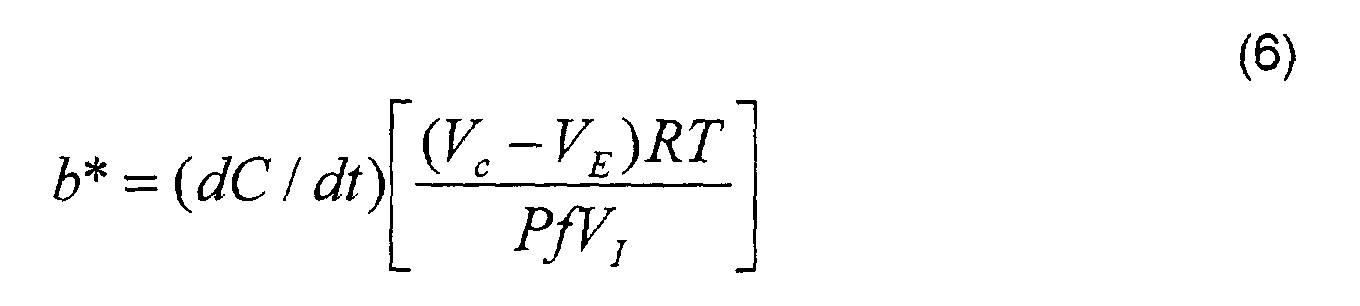

- the container volume Vc is constant
- the gas behaves ideally
- the helium concentration in the container is dilute
- isothermal conditions.

Claims (8)
- A method of accelerating testing of a fluid containing system for leaks, said method comprising the steps of(a) providing a sealable container (12) having an internal volume and a shape suitable for containing the volume and shape of a system to be tested for leaks, where said sealable container has a volume of 105% to 1.600% of the total volume of said system;(b) filling said system with a known amount of a first fluid having a molecular size or weight less than the molecular size or weight of a second fluid which is normally contained within said system, or a viscosity less than the viscosity of the second fluid;(c) placing said system within the internal volume of said sealable container (12) and sealing said container;(d) creating a pressure differential between said system and the internal volume of said sealable container, wherein fluid used to pressurize said container is different from the fluid used to pressurize said system;(e) monitoring the interior of said container for the presence of said first fluid.
- The method of claim 1 comprising the further steps of(f) determining the rate of diffusion of said first fluid from said system to the internal volume of said container (12); and(g) calculating the rate of diffusion of said second fluid from said container based on a factor f which describes the difference in diffusion rate of the two fluids in the system.
- The method of claim 2 wherein the fluid is a gas, and the rate of diffusion is calculated using the formulawherein
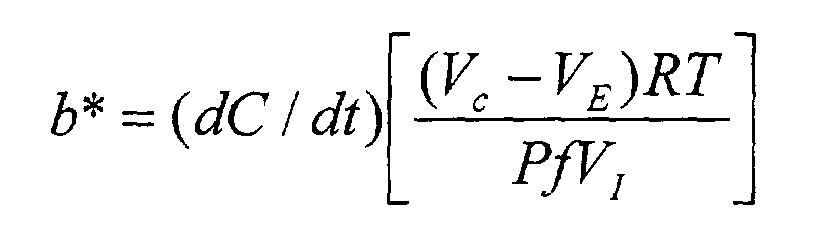 b* is the predicted rate of loss of said second fluid by said system;dC/dt is the test fluid concentration build-up rate in the containerVC is the volume of the container;VE is the exterior volume of the test system;R is the gas constant;T is temperature in Kelvin;P is absolute pressure of test fluid in the system;VI is the internal volume of the system; andf is the factor by which test fluid is leaking at a different rate than the system fluid.
 - The method of claim 1 wherein said system is a tire said system fluid is air, and said method comprises the further steps of(h) selecting said first fluid to be helium; and(i) detecting and monitoring the presence of helium in the internal volume of said container using a mass spectrometer.
- The method of claim 1 further comprising the further steps of monitoring the presence of said first fluid in the internal volume of said container and calculating the rate of diffusion using a Fortran program.
- An apparatus of measuring the leakage rate of a system comprising(a) a sealable container (12) made of a diffusion resistant material and comprising a size and shape suitable for enclosing the size and shape of a system to be tested;(b) a monitoring device adapted to detect the presence and quantity of specific molecules associated with said container; and(c) data collection means for collecting data and calculating the leakage rate of interest.
- The apparatus of claim 6 wherein the monitoring device is a mass spectrometer.
- The apparatus of claim 6 wherein the data collection means is a personal computer and the calculating means is a Fortran program.
Applications Claiming Priority (2)
| Application Number | Priority Date | Filing Date | Title |
|---|---|---|---|
| US668115 | 2000-09-22 | ||
| US09/668,115 US6393897B1 (en) | 2000-09-22 | 2000-09-22 | Accelerated leakage testing |
Publications (2)
| Publication Number | Publication Date |
|---|---|
| EP1191319A2 true EP1191319A2 (en) | 2002-03-27 |
| EP1191319A3 EP1191319A3 (en) | 2003-07-30 |
Family
ID=24681075
Family Applications (1)
| Application Number | Title | Priority Date | Filing Date |
|---|---|---|---|
| EP01121631A Withdrawn EP1191319A3 (en) | 2000-09-22 | 2001-09-12 | Accelerated leakage testing |
Country Status (2)
| Country | Link |
|---|---|
| US (1) | US6393897B1 (en) |
| EP (1) | EP1191319A3 (en) |
Cited By (1)
| Publication number | Priority date | Publication date | Assignee | Title |
|---|---|---|---|---|
| WO2017181392A1 (en) * | 2016-04-21 | 2017-10-26 | 深圳市樊溪电子有限公司 | Method for measuring diffusion coefficient of carbon dioxide in crude oil |
Families Citing this family (7)
| Publication number | Priority date | Publication date | Assignee | Title |
|---|---|---|---|---|
| US6718818B2 (en) * | 2002-07-19 | 2004-04-13 | The Goodyear Tire & Rubber Company | Method of sensing air leaks in tires and tire testing machines |
| US20060123844A1 (en) * | 2004-12-09 | 2006-06-15 | Patrick Le Bot | Integrated process for the separation of air and an integrated installation for the separation of air |
| US20060191325A1 (en) * | 2005-02-28 | 2006-08-31 | Forcecon Technology Co., Ltd. | Heat conductor with detection element and testing method thereof |
| US7707871B2 (en) * | 2007-09-24 | 2010-05-04 | Raytheon Company | Leak detection system with controlled differential pressure |
| CN107239831B (en) * | 2017-07-04 | 2020-10-13 | 中国计量大学 | Method, system and device for detecting whether tire leaks |
| US11847311B2 (en) * | 2019-05-22 | 2023-12-19 | Apple Inc. | Characterization of a venting state or other system parameter that affects the characterization of a force applied to a device |
| JP7523663B2 (en) * | 2021-03-03 | 2024-07-26 | Nok株式会社 | Seal part inspection method, inspection device, and inspection program |
Family Cites Families (12)
| Publication number | Priority date | Publication date | Assignee | Title |
|---|---|---|---|---|
| GB200300A (en) * | 1922-05-22 | 1923-07-12 | James Jenner | An improved device for spraying powder and the like |
| DE1916525B2 (en) * | 1969-03-31 | 1976-12-02 | Dunlop Ag, 6450 Hanau | DEVICE FOR MEASURING THE ROTATION ANGLE OF A ROTATING OBJECT |
| US3577769A (en) * | 1969-04-02 | 1971-05-04 | Gen Electric | Leak-detection system |
| US3721117A (en) * | 1971-08-18 | 1973-03-20 | Carlisle Corp | Method and apparatus for detecting leaks in pneumatic wheels |
| EP0165342A1 (en) * | 1984-05-23 | 1985-12-27 | VARIAN S.p.A. | Apparatus for detecting leaks in pressurized objects and containers |
| US4754638A (en) * | 1986-05-23 | 1988-07-05 | Antares Engineering, Inc. | Apparatus and method for leak testing automotive wheel rims |
| US4813268A (en) * | 1987-03-23 | 1989-03-21 | Superior Industries International, Inc. | Leakage detection apparatus for drum wheels and method therefore |
| US5010761A (en) * | 1990-03-01 | 1991-04-30 | Superior Industries International, Inc. | Automated leak detection apparatus and method therefor |
| US5345814A (en) * | 1990-12-28 | 1994-09-13 | Whirlpool Corporation | Method and apparatus for testing vacuum insulation panel quality |
| US5625141A (en) * | 1993-06-29 | 1997-04-29 | Varian Associates, Inc. | Sealed parts leak testing method and apparatus for helium spectrometer leak detection |
| DE19681664T1 (en) * | 1995-12-08 | 1998-12-03 | Hayes Wheel Int Inc | Device and method for leak testing of vehicle wheels |
| US6029716A (en) * | 1998-12-29 | 2000-02-29 | Mtd Products Inc | Tire inflater method and apparatus |
-
2000
- 2000-09-22 US US09/668,115 patent/US6393897B1/en not_active Expired - Fee Related
-
2001
- 2001-09-12 EP EP01121631A patent/EP1191319A3/en not_active Withdrawn
Cited By (1)
| Publication number | Priority date | Publication date | Assignee | Title |
|---|---|---|---|---|
| WO2017181392A1 (en) * | 2016-04-21 | 2017-10-26 | 深圳市樊溪电子有限公司 | Method for measuring diffusion coefficient of carbon dioxide in crude oil |
Also Published As
| Publication number | Publication date |
|---|---|
| EP1191319A3 (en) | 2003-07-30 |
| US6393897B1 (en) | 2002-05-28 |
Similar Documents
| Publication | Publication Date | Title |
|---|---|---|
| JP4262989B2 (en) | Method and apparatus for measuring transmittance of barrier layer | |
| US9274021B2 (en) | Leakage inspection apparatus and leakage inspection method | |
| US5386717A (en) | Gas leakage testing method | |
| JP6457813B2 (en) | Rapid detection of dimensionally stable / loose package leaks without the addition of a test gas | |
| US11105704B2 (en) | Method and apparatus for an integrity test of a flexible container with inspection fluid | |
| KR0171635B1 (en) | Gas leak inspection apparatus and method | |
| EP0632258B1 (en) | Apparatus for detection of leaks | |
| CN100510694C (en) | Determination of envelope volume and density of porous samples | |
| JP2004528563A (en) | How to measure gas accumulation rate | |
| JP6878425B2 (en) | Leak detection using oxygen | |
| CN105651464A (en) | Leakage detection sensitivity post-calibration method for large spacecraft leakage detection | |
| US6393897B1 (en) | Accelerated leakage testing | |
| US5309752A (en) | Leakage measurement into a gas-charged collapsible container | |
| JP4374241B2 (en) | System and method for measuring the sealability of an object | |
| CN104865024A (en) | Device and method for measuring airtightness of aluminium alloy hub or tire | |
| US6522980B1 (en) | Method and algorithm for predicting leak rates | |
| EP3985374B1 (en) | Non-destructive testing method for sealing degree of small cigarette box packaging | |
| US3939695A (en) | Apparatus for detecting leaks | |
| CN104764862B (en) | A kind of gas concentration on-the-spot test method | |
| Vinogradov et al. | How to choose a leak detection method | |
| CN116793914B (en) | Apparatus and Method for Measuring Rock Sample Skeleton Volume | |
| CN114636516B (en) | Positive sample calibration device and method for checking seal integrity of medicine packaging container | |
| Moyls | Whole bag method for determining oxygen transmission rate | |
| JPH06337232A (en) | Airtightness test device for semiconductor pressure sensor and test method therefor | |
| RU2077039C1 (en) | Method of test of air-tightness of multispace articles |
Legal Events
| Date | Code | Title | Description |
|---|---|---|---|
| PUAI | Public reference made under article 153(3) epc to a published international application that has entered the european phase |
Free format text: ORIGINAL CODE: 0009012 |
|
| AK | Designated contracting states |
Kind code of ref document: A2 Designated state(s): AT BE CH CY DE DK ES FI FR GB GR IE IT LI LU MC NL PT SE TR |
|
| AX | Request for extension of the european patent |
Free format text: AL;LT;LV;MK;RO;SI |
|
| PUAL | Search report despatched |
Free format text: ORIGINAL CODE: 0009013 |
|
| AK | Designated contracting states |
Designated state(s): AT BE CH CY DE DK ES FI FR GB GR IE IT LI LU MC NL PT SE TR |
|
| AX | Request for extension of the european patent |
Extension state: AL LT LV MK RO SI |
|
| AKX | Designation fees paid | ||
| REG | Reference to a national code |
Ref country code: DE Ref legal event code: 8566 |
|
| STAA | Information on the status of an ep patent application or granted ep patent |
Free format text: STATUS: THE APPLICATION IS DEEMED TO BE WITHDRAWN |
|
| 18D | Application deemed to be withdrawn |
Effective date: 20040131 |