EP1191021A1 - Dihydropyridine derivative - Google Patents
Dihydropyridine derivative Download PDFInfo
- Publication number
- EP1191021A1 EP1191021A1 EP00940810A EP00940810A EP1191021A1 EP 1191021 A1 EP1191021 A1 EP 1191021A1 EP 00940810 A EP00940810 A EP 00940810A EP 00940810 A EP00940810 A EP 00940810A EP 1191021 A1 EP1191021 A1 EP 1191021A1
- Authority
- EP
- European Patent Office
- Prior art keywords
- group
- lower alkyl
- mmol
- alkyl group
- dihydropyridine
- Prior art date
- Legal status (The legal status is an assumption and is not a legal conclusion. Google has not performed a legal analysis and makes no representation as to the accuracy of the status listed.)
- Withdrawn
Links
- 0 CC(C(C(OC=*F)=O)=CCCC**)=O Chemical compound CC(C(C(OC=*F)=O)=CCCC**)=O 0.000 description 1
Classifications
-
- C—CHEMISTRY; METALLURGY
- C07—ORGANIC CHEMISTRY
- C07D—HETEROCYCLIC COMPOUNDS
- C07D211/00—Heterocyclic compounds containing hydrogenated pyridine rings, not condensed with other rings
- C07D211/04—Heterocyclic compounds containing hydrogenated pyridine rings, not condensed with other rings with only hydrogen or carbon atoms directly attached to the ring nitrogen atom
- C07D211/80—Heterocyclic compounds containing hydrogenated pyridine rings, not condensed with other rings with only hydrogen or carbon atoms directly attached to the ring nitrogen atom having two double bonds between ring members or between ring members and non-ring members
- C07D211/84—Heterocyclic compounds containing hydrogenated pyridine rings, not condensed with other rings with only hydrogen or carbon atoms directly attached to the ring nitrogen atom having two double bonds between ring members or between ring members and non-ring members with hetero atoms or with carbon atoms having three bonds to hetero atoms, with at the most one bond to halogen directly attached to ring carbon atoms
- C07D211/90—Carbon atoms having three bonds to hetero atoms with at the most one bond to halogen
-
- A—HUMAN NECESSITIES
- A61—MEDICAL OR VETERINARY SCIENCE; HYGIENE
- A61P—SPECIFIC THERAPEUTIC ACTIVITY OF CHEMICAL COMPOUNDS OR MEDICINAL PREPARATIONS
- A61P1/00—Drugs for disorders of the alimentary tract or the digestive system
-
- A—HUMAN NECESSITIES
- A61—MEDICAL OR VETERINARY SCIENCE; HYGIENE
- A61P—SPECIFIC THERAPEUTIC ACTIVITY OF CHEMICAL COMPOUNDS OR MEDICINAL PREPARATIONS
- A61P11/00—Drugs for disorders of the respiratory system
- A61P11/06—Antiasthmatics
-
- A—HUMAN NECESSITIES
- A61—MEDICAL OR VETERINARY SCIENCE; HYGIENE
- A61P—SPECIFIC THERAPEUTIC ACTIVITY OF CHEMICAL COMPOUNDS OR MEDICINAL PREPARATIONS
- A61P25/00—Drugs for disorders of the nervous system
-
- A—HUMAN NECESSITIES
- A61—MEDICAL OR VETERINARY SCIENCE; HYGIENE
- A61P—SPECIFIC THERAPEUTIC ACTIVITY OF CHEMICAL COMPOUNDS OR MEDICINAL PREPARATIONS
- A61P25/00—Drugs for disorders of the nervous system
- A61P25/06—Antimigraine agents
-
- A—HUMAN NECESSITIES
- A61—MEDICAL OR VETERINARY SCIENCE; HYGIENE
- A61P—SPECIFIC THERAPEUTIC ACTIVITY OF CHEMICAL COMPOUNDS OR MEDICINAL PREPARATIONS
- A61P25/00—Drugs for disorders of the nervous system
- A61P25/14—Drugs for disorders of the nervous system for treating abnormal movements, e.g. chorea, dyskinesia
- A61P25/16—Anti-Parkinson drugs
-
- A—HUMAN NECESSITIES
- A61—MEDICAL OR VETERINARY SCIENCE; HYGIENE
- A61P—SPECIFIC THERAPEUTIC ACTIVITY OF CHEMICAL COMPOUNDS OR MEDICINAL PREPARATIONS
- A61P25/00—Drugs for disorders of the nervous system
- A61P25/28—Drugs for disorders of the nervous system for treating neurodegenerative disorders of the central nervous system, e.g. nootropic agents, cognition enhancers, drugs for treating Alzheimer's disease or other forms of dementia
-
- A—HUMAN NECESSITIES
- A61—MEDICAL OR VETERINARY SCIENCE; HYGIENE
- A61P—SPECIFIC THERAPEUTIC ACTIVITY OF CHEMICAL COMPOUNDS OR MEDICINAL PREPARATIONS
- A61P29/00—Non-central analgesic, antipyretic or antiinflammatory agents, e.g. antirheumatic agents; Non-steroidal antiinflammatory drugs [NSAID]
-
- A—HUMAN NECESSITIES
- A61—MEDICAL OR VETERINARY SCIENCE; HYGIENE
- A61P—SPECIFIC THERAPEUTIC ACTIVITY OF CHEMICAL COMPOUNDS OR MEDICINAL PREPARATIONS
- A61P43/00—Drugs for specific purposes, not provided for in groups A61P1/00-A61P41/00
-
- A—HUMAN NECESSITIES
- A61—MEDICAL OR VETERINARY SCIENCE; HYGIENE
- A61P—SPECIFIC THERAPEUTIC ACTIVITY OF CHEMICAL COMPOUNDS OR MEDICINAL PREPARATIONS
- A61P9/00—Drugs for disorders of the cardiovascular system
- A61P9/10—Drugs for disorders of the cardiovascular system for treating ischaemic or atherosclerotic diseases, e.g. antianginal drugs, coronary vasodilators, drugs for myocardial infarction, retinopathy, cerebrovascula insufficiency, renal arteriosclerosis
Definitions
- the present invention relates to new dihydropyridine derivatives and the use of the dihydropyridine derivatives as medicines.
- the activation of N-type calcium channel is concerned with various diseases, for example, acute stage of ischemic cerebrovascular disorders caused by cerebral infarction or intracerebral bleeding (including subarachnoidal hemorrhage); progressive neurodegenerative diseases such as Alzheimer's disease, AIDS related dementia and Parkinson's disease, dementia due to cerebrovascular disorder and ALS; neuropathy caused by head injury; various pains such as pain caused by spinal injury, diabetes or thromboangiitis obliterans, postoperative pain, migraine and visceral pain; various diseases associated with psychogenic stress such as bronchial asthma, unstable angina and irritable colitis; emotional disorder and withdrawal symptoms after addiction to drugs such as ethanol addiction withdrawal symptoms.
- the compounds of the present invention can inhibit the activation of the N-type calcium channel and, therefore usable as therapeutic agents for these diseases.
- Calcium channels are now classified into subtypes of L, N, P, Q, R and T. Each subtype of calcium channels is organ-specifically distributed. It is known that particularly N-type calcium channel is widely distributed in pars centralis, peripheral nerves and adrenomedullary cells and participates in neuronal cell death, regulation of blood catecholamine level and control of senses such as perception.
- omega conotoxin GVIA and omega conotoxin MVIIA which are peptides selectively inhibiting N-type calcium channel, inhibit the release of excitatory neurotransmitters in the sliced brain preparation. It is also confirmed in animal experiments that they inhibit the progress of neuronal necrosis associated with cerebrovascular disorders. It is generally considered that compounds having a N-type calcium channel blocking action are clinically effective in the treatment of acute stage of ischemic cerebrovascular disorders caused by cerebral infarction or intracerebral bleeding (including subarachnoidal hemorrhage); progressive neurodegenerative diseases such as Alzheimer's disease, AIDS related dementia and Parkinson's disease, dementia due to cerebrovascular disorder and ALS; and neuropathy caused by head injury.
- omega conotoxin MVIIA relieves a pain induced by formaldehyde, hot plate and peripheral neuropathy. Accordingly, omega conotoxin MVIIA is considered to be clinically effective against various pains such as pain caused by spinal injury, diabetes or thromboangiitis obliterans, postoperative pain, migraine and visceral pain.
- omega conotoxin GVIA inhibits the release of catecholamine from cultured sympathetic ganglion cells, catecholamine secretion from canine adrenal medulla and the contraction of the isolated blood vessel by electric stimulation of the perivascular nerve, it is considered that compounds having N-type calcium channel-blocking effects are clinically effective against various diseases related to psychogenic stress such as bronchial asthma, unstable angina and irritable colitis [Neuropharmacol., 32, 1141 (1993)].
- N-type calcium channels Some peptidergic and non-peptidergic compounds which selectively affect N-type calcium channels have been ever disclosed (see, for example, WO 9313128 and WO 9849144). However, none of them was actually used as a medicine. Some of the compounds which affect N-type calcium channels are also effective against various types of calcium channels of other than N-type [British Journal of Pharmacology, 122 (1) 37-42, 1997]. For example, compounds having an antagonistic effect on L-type calcium channels which are very closely related to hypotensive effect, could not be used for diseases for which N-type antagonists will be used (such as cerebral stroke, neuralgia, terminal cancer pain and pain of spinal injury). Under these circumstances, the development of a highly active antagonist selective toward N-type calcium channel has been eagerly demanded.
- the object of the present invention is to provide new compounds having a selective antagonistic effect on N-type calcium channels.
- Another object of the present invention is to provide antagonists to N-type calcium channels.
- Still another object of the present invention is to provide a therapeutic agent for any of acute stage of ischemic cerebrovascular disorders caused by cerebral infarction or intracerebral bleeding, Alzheimer's disease, AIDS related dementia, Parkinson's disease, progressive neurodegenerative diseases, neuropathy caused by head injury, pain caused by thromboangiitis obliterans, postoperative pain, migraine, visceral pain, bronchial asthma, unstable angina, irritable colitis and withdrawal symptoms after addiction to drugs.
- a further object of the present invention is to provide a pharmaceutical composition.
- the present invention provides dihydropyridine derivatives of the following general formula (1) and pharmaceutically acceptable salts thereof.
- A represents a group of the following general formula (2), or 1-naphthyl, 2-naphthyl, thiophene-3-yl, thiophene-2-yl, furan-3-yl, furan-2-yl, pyridine-4-yl, pyridine-3-yl, pyridine-2-yl, indole-2-yl or indole-3-yl group:
- R 1 , R 2 , R 3 , R 4 and R 5 may be the same or different from each other and each represent hydrogen atom, a halogen atom, hydroxyl group, carboxyl group, amino group, cyano group, nitro group, a lower alkyl group, a lower alkoxyl group, a lower alkenyl group, a lower alkynyl group, a lower alkylamino group, a lower alkyl
- the present invention also provides an N-type calcium channel antagonist containing a dihydropyridine derivative of above general formula (1) or a pharmaceutically acceptable salt thereof as an active ingredient.
- the present invention further provides a therapeutic agent containing the dihydropyridine derivative represented by the above general formula (1) or a pharmaceutically acceptable salt thereof as the active ingredient, for any of acute stage of ischemic cerebrovascular disorders caused by cerebral infarction or intracerebral bleeding, Alzheimer's disease, AIDS related dementia, Parkinson's disease, progressive neurodegenerative diseases, neuropathy caused by head injury, pain caused by thromboangiitis obliterans, postoperative pain, migraine, visceral pain, bronchial asthma, unstable angina, irritable colitis and withdrawal symptoms after addiction to drugs.
- ischemic cerebrovascular disorders caused by cerebral infarction or intracerebral bleeding
- Alzheimer's disease AIDS related dementia
- Parkinson's disease progressive neurodegenerative diseases
- neuropathy caused by head injury pain caused by thromboangiitis obliterans
- postoperative pain migraine
- visceral pain bronchial asthma
- unstable angina unstable angina
- irritable colitis withdrawal symptoms after addiction to drugs.
- the present invention also provides a pharmaceutical composition containing the dihydropyridine derivative represented by the above general formula (1) or a pharmaceutically acceptable salt thereof and a carrier and/or a diluent.
- lower herein indicates that the group has 1 to 7 carbon atoms, preferably 1 to 6 carbon atoms.
- Alkyl groups themselves and also alkyl groups in alkoxyl groups, alkenyl groups, alkylamino groups, alkylthio groups and alkanoyl groups may be either linear or branched. Examples of these alkyl groups are methyl group, ethyl group, propyl group, isopropyl group, butyl group, secondary and tertiary butyl groups, pentyl group and hexyl group. Among them, those having 1 to 3 carbon atoms are preferred.
- the lower cycloalkyl groups indicate 3 to 8-membered rings, preferably 5 to 7-membered rings.
- the lower cycloalkyl groups may contain a hetero atom.
- the hetero atom is nitrogen atom, it may have a substituent such as benzyl group.
- the aryl-lower alkyl groups include, for example, benzyl group.
- the aryl-lower alkyl groups contain a hetero atom, they include, for example, 2-benzyloxyethoxymethyl group, 2-phenylethoxymethyl group and benzyloxyethyl group.
- the aryl-lower alkoxyl groups include, for example, benzyloxy group.
- the heteroaryl-lower alkyl groups include, for example, pyridylmethyl group.
- hetero atoms in the chain hereof When they contain a hetero atom in the chain hereof, they include, for example, 2-(2-pyridyl)ethoxymethyl group, 2-(3-pyridyl) ethoxymethyl group and 2-(4-pyridyl)ethoxymethyl group.
- the lower alkyl groups substituted with a cyclic alkyl group include, for example, cyclohexylmethyl group.
- hetero atom in the ring include, for example, piperidinoethoxymethyl group, hexamethyleneiminoethoxymethyl group and cyclohexylethoxymethyl group.
- the halogen atoms include fluorine, chlorine, bromine and iodine atoms.
- the aryl groups are both substituted and unsubstituted aryl groups. They are preferably phenyl group and substituted phenyl group, and the substituents are particularly preferably halogens, alkyl groups and alkoxyl groups.
- the heteroaryl groups are substituted or unsubstituted heteroaryl groups such as, preferably, pyridyl group, furyl group, substituted pyridyl groups and substituted furyl groups. Halogens, alkyl groups and alkoxyl groups are particularly preferred as the substituents.
- 1-Naphthyl group, 2-naphthyl group, indole-2-yl group and indole-3-yl group represented by A in the above general formula (1) are either unsubstituted or substituted.
- the substituents are those listed above for R 1 to R 5 .
- Thiophene-3-yl group, thiophene-2-yl group, furan-3-yl group, furan-2-yl group, pyridine-4-yl group, pyridine-3-yl group and pyridine-2-yl group represented by A are also either unsubstituted or substituted. When two or more substituents are contained therein, they may form a ring together.
- the substituents are those described above with reference to 1-naphthyl group or the like.
- the rings formed by those groups include benzothiophene, benzofuran, etc.
- a in the general formula (1) is preferably that represented by the general formula (2) wherein R 1 , R 2 , R 3 , R 4 and R 5 each represent nitro group or cyano group, particularly R 1 , R 3 , R 4 and R 5 each represent hydrogen atom and R 2 represents a halogen atom or carboxyl group.
- the rings which can be formed by R 6 and R 7 together in the group of general formula (3) for B in general formula (1) include piperazine, piperidine, pyrrolidine, hexamethyleneimine, etc. Carbon atoms or nitrogen atom as the hetero atom in the formed ring may have carboxyl group, in which the hydroxyl group may be substituted with benzyl group, or benzyl group.
- hydrogen atom bonded to the nitrogen atom which is free from the amido bond of the ring may be replaced with benzyl group, tert-butoxycarbonyl group, phenyl group, pyridinyl group, diphenyl group or the like.
- B in the above general formula (1) is preferably carboxyl group, cyano group or a group of the above general formula (3).
- B is particularly preferably carboxyl group or a group represented by the general formula (3) wherein one of R 6 and R 7 is hydrogen atom and the other is a carboxy-lower alkyl group, hydroxy-lower alkyl group or aryl-lower alkyl group, or both R 6 and R 7 represent a lower alkyl group or R 6 and R 7 together form a ring.
- the lower alkyl groups, hydroxy-lower alkyl groups, carboxy-lower alkyl groups, halogeno-lower alkyl groups (such as trifluoromethyl group), amino-lower alkyl groups, azido-lower alkyl groups, aryl-lower alkyl groups, heteroaryl-lower alkyl groups, lower alkyl groups substituted with a cyclic alkyl group and carbamoyl-lower alkyl groups in C or E in the above general formula (1) may contain a hetero atom in their chains.
- the hetero atoms include, for example, oxygen, nitrogen and sulfur atoms.
- the groups containing such a hetero atom in the chain include, for example, 2-hydroxyethoxymethyl group, methoxymethyl group, dimethoxymethyl group, methoxyethyl group, aminoethoxymethyl group, azidoethoxymethyl group, methylthiomethyl group, 2-piperidinoethoxymethyl group, pyrrolidinylethoxymethyl group, morpholinylethoxymethyl group, pyridinylethoxymethyl group, piperidinylethoxymethyl group, which may be substituted with benzyloxycarbonyl group, azidoethoxymethyl group, aminoethoxymethyl group, carboxyethoxymethyl group, dimethyldioxolanylmethoxymethyl group, dimethyldioxolanylmethoxyethoxymethyl group and dihydroxypropoxymethyl group.
- C is preferably methyl group, ethyl group or 2-piperidinoethoxymethyl group.
- C is also preferably pyrrolidinylethoxymethyl group, morpholinylethoxymethyl group, pyridinylethoxymethyl group or trifluoromethyl group.
- E is preferably methyl group, ethyl group, dimethoxymethyl group, methoxymethyl group, 2-piperidinoethoxymethyl group, 2-hexamethyleneiminoethoxymethyl group, 2-hydroxyethoxymethyl group, 2-benzyloxyethoxymethyl group or 2-(2-pyridyl)ethoxymethyl group.
- E is also preferably pyrrolidinylethoxymethyl group, hexaoxymethyl group, pyridinylethoxymethyl group, morpholinylethoxymethyl group, piperidinylethoxymethyl group, which may be substituted with benzyloxycarbonyl group, azidoethoxymethyl group, aminoethoxymethyl group, carboxyethoxymethyl group, dimethyldioxolanylmethoxymethyl group, dimethyldioxolanylmethoxyethoxymethyl group, trifluoromethyl group or 2,3-dihydroxypropoxymethyl group.
- D in he above general formula (1) is preferably hydrogen atom or a hydroxy-lower alkyl group. Hydrogen atom is particularly preferred.
- One or two groups surrounding the condensed rings of the general formulae (5) to (8) represented by F in the above general formula (1) may be nitrogen atoms.
- the general formulae (4) to (8) represent unsubstituted or substituted groups. The substituents are those described above with reference to R 1 to R 5 .
- F is preferably a group of the above general formula (4) wherein G and H may be the same or different from each other and they each represent phenyl group, benzyl group, pyridine-4-yl group, pyridine-3-yl group, pyridine-2-yl group, pyridine-4-ylmethyl group, pyridine-3-ylmethyl group or pyridine-2-ylmethyl group, and I preferably represents hydrogen atom or hydroxyl group. It is particularly preferred that G and H each represent phenyl group and I represents hydrogen atom.
- the interatomic bond or -CH 2 - is preferred.
- the interatomic bond is particularly preferred.
- Y in the above general formula (1) represents an alkyl group having 1 to 7 carbon atoms, which may contain a hetero atom or cyclopropane ring in the chain, or an alkenyl group, which may contain a hetero atom or cyclopropane ring in the chain.
- the expression that the chain may contain cyclopropane indicates that cyclopropane ring may be formed at the bonding part between Y and F.
- Y is preferably an alkyl group having 2 to 4 carbon atoms, particularly an alkyl group having 2 or 3 carbon atoms.
- A represents a group of general formula (2)
- B represents carboxyl group, cyano group or a group of general formula (3)
- D represents hydrogen atom
- F represents a group of general formula (4) in which G and H each represent phenyl group
- X represents the interatomic bond
- Y represents an alkyl group having 2 or 3 carbon atoms. It is particularly preferred that B represents carboxyl group.
- A represents a group of general formula (2)
- B represents carboxyl group, cyano group or a group of general formula (3)
- D represents hydrogen atom
- C and E may be the same or different from each other, and they each represent a lower alkyl group, a lower alkyl group substituted with a cycloalkyl group which may contain a hetero atom in the ring, a hydroxy-lower alkyl group, an aryl-lower alkyl group or a heteroaryl-lower alkyl group
- F represents a group of general formula (4) in which G and H each represent phenyl group, X represents the interatomic bond and Y represents an alkyl group having 2 or 3 carbon atoms.
- A represents a group of general formula (2) wherein R 1 , R 3 , R 4 and R 5 each represent hydrogen atom and R 2 represents chlorine atom, bromine atom, iodine atom, nitro group or cyano group, B represents carboxyl group, cyano group or a group of general formula (3), C and E may be the same or different from each other, and they each represent methyl group, ethyl group, a lower alkyl group substituted with a cycloalkyl group which may contain a hetero atom in the ring, a hydroxy-lower alkyl group, an aryl-lower alkyl group or a heteroaryl-lower alkyl group, D represents hydrogen atom, F represents a group of general formula (4) in which G and H each represent phenyl group and I represents hydrogen atom, X represents the interatomic bond and Y represents an alkyl group having 2 or 3 carbon atoms. It is particularly preferred that B represents carboxy
- A represents a group of general formula (2) wherein R 1 , R 3 , R 4 and R 5 each represent hydrogen atom and R 2 represents chlorine atom, bromine atom, iodine atom or nitro group, B represents carboxyl group, cyano group or a group of general formula (3), C represents methyl group, ethyl group or 2-piperidinoethoxymethyl group, D represents hydrogen atom, E represents methyl group, ethyl group, dimethoxymethyl group, 2-piperidinoethoxymethyl group, 2-hexamethyleneiminoethoxymethyl group, methoxymethyl group, 2-benzyloxyethoxymethyl group, 2-(2-pyridyl)ethoxymethyl group or 2-hydroxyethoxymethyl group, F represents a group of general formula (4) in which G and H each represent phenyl group and I represents hydrogen atom, X represents the interatomic bond and Y represents an alkyl group having 2 or 3 carbon atoms. It is
- A represents a group of general formula (2)
- B represents carboxyl group, cyano group or a group of general formula (3)
- C represents hydrogen atom, a lower alkyl group, dimethoxymethyl group, cyano group, a hydroxy-lower alkyl group, a halogeno-lower alkyl group, an amino-lower alkyl group (in which the amino group may be substituted with one or two of a lower alkyl group, a lower cycloalkyl group, an aryl group or an aryl-lower alkyl group), an azido-lower alkyl group, an aryl group, a heteroaryl group, an aryl-lower alkyl group, a heteroaryl-lower alkyl group, a lower alkyl group substituted with a cyclic alkyl group (which may contain a hetero atom in the ring) or a carbamoyl-lower alkyl group (in which the
- dihydropyridine derivatives of general formula (1) and pharmaceutically acceptable salts thereof wherein A represents a group of general formula (2) wherein R 1 , R 3 , R 4 and R 5 each represent hydrogen atom and R 2 represents chlorine atom, bromine atom, iodine atom or nitro group, B represents carboxyl group or a group of general formula (3), C represents methyl group, ethyl group or 2-piperidinoethoxymethyl group, E represents methyl group, ethyl group, dimethoxymethyl group, 2-piperidinoethoxymethyl group, 2-hexamethyleneiminoethoxymethyl group, methoxymethyl group, 2-benzyloxyethoxymethyl group, 2-hydroxyethoxymethyl group or 2-(2-pyridyl)ethoxymethyl group, D represents hydrogen atom and X represents the interatomic bond.
- A represents a group of general formula (2) wherein R 1 , R 3 , R 4 and R 5 each represent hydrogen atom and R 2 represents chlorine atom, bromine
- Dihydropyridine derivatives (1) of the present invention can be produced by processes described below:
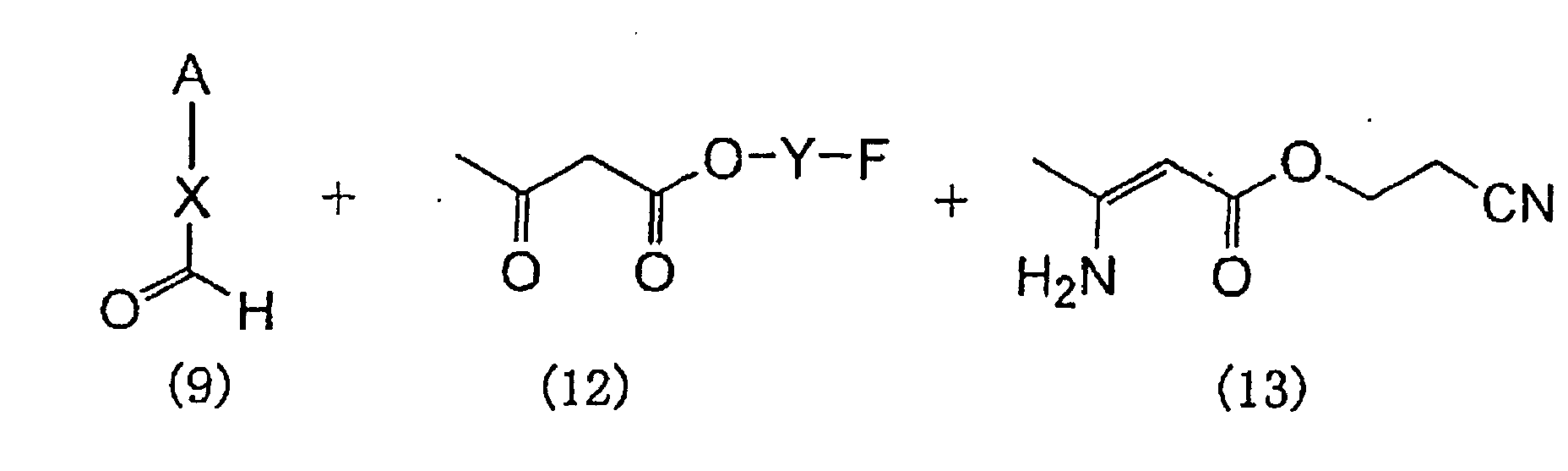
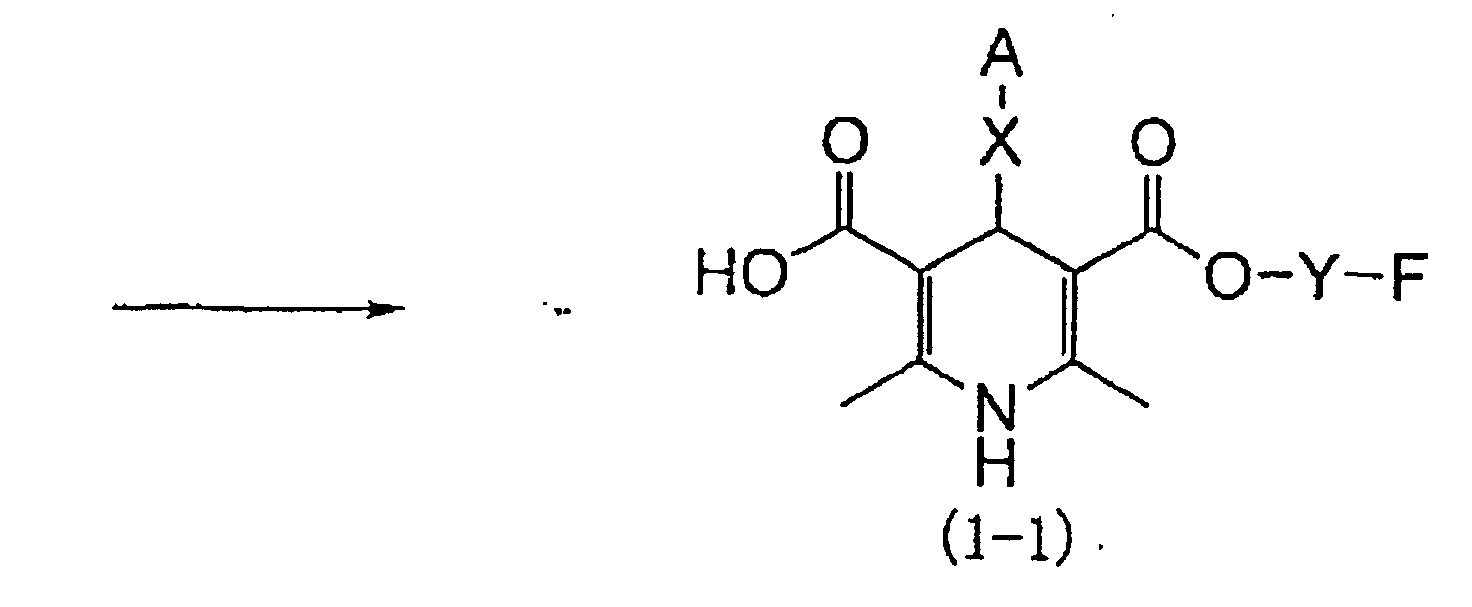
- dihydropyridine derivatives (1-1) wherein B represents carboxyl group, C and E each represent methyl group and D represents hydrogen atom can be produced by the following reaction scheme:
- a dihydropyridinedicarboxylic acid diester (14) can be obtained by reacting an aldehyde (9) with a 3-aminocrotonic acid ester (10) and 2-cyanoethyl acetoacetate, or by reacting an aldehyde (9) with an acetoacetate (12) and 2-cyanoethyl 3-aminocrotonate (13).
- a dihydropyridinedicarboxylic acid diester (14) can be also obtained by using benzyl acetoacetate in place of the compound (12), catalytically reducing the obtained dihydropyridinedicarboxylic acid diester and condensing the obtained product with a corresponding alcohol.
- the dihydropyridine derivatives (1-1) of the present invention can be produced by treating the obtained diester of dihydropyridinedicarboxylic acid (14) with a base such as sodium hydroxide.
- dihydropyridine derivatives (1-2) of the present invention can be produced by condensing the dihydropyridine derivative (1-1) synthesized by the above-described process with an amine (15).
- the amine (15) has a protecting group
- the dihydropyridine derivative (1-2) is subjected to, if necessary, a protecting group-removing reaction.
- R 6 and R 7 together form a ring containing nitrogen atom having a substituent, the obtained dihydropyridine derivative (1-2) is subjected to, if necessary, the protecting group-removing reaction.
- a dihydropyridine derivative (1-3) of the above formula wherein B represents carboxyl group, C represents methyl group, D represents hydrogen atom and E represents an alkoxymethyl group can be produced as follows:
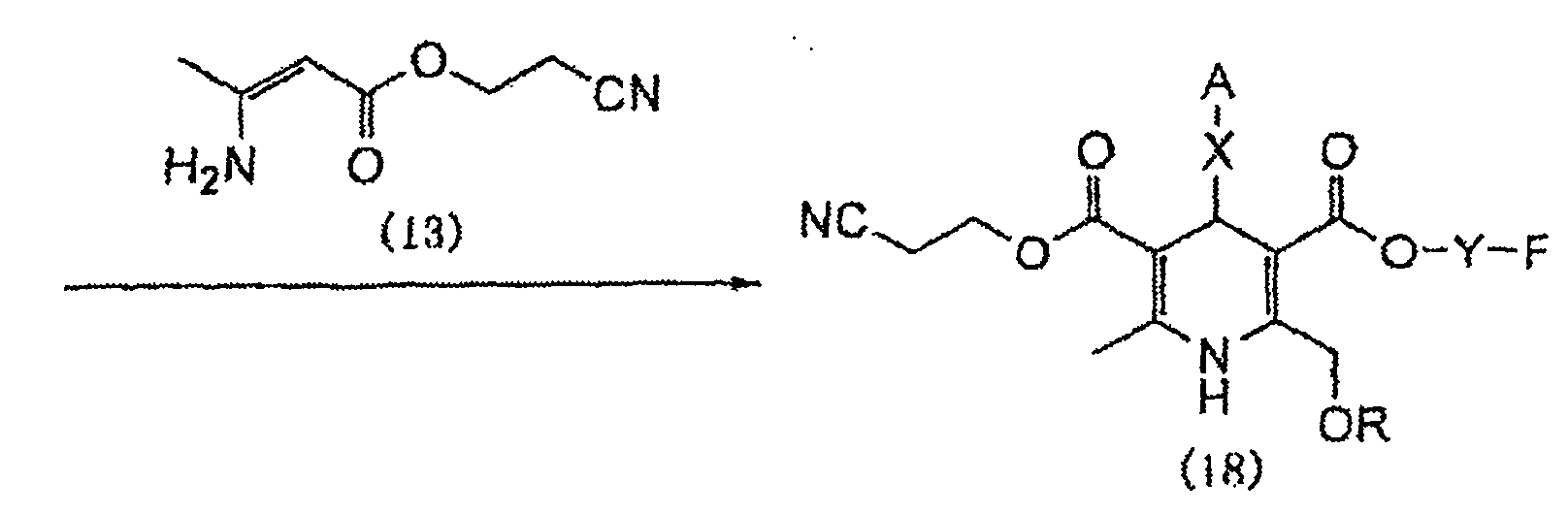
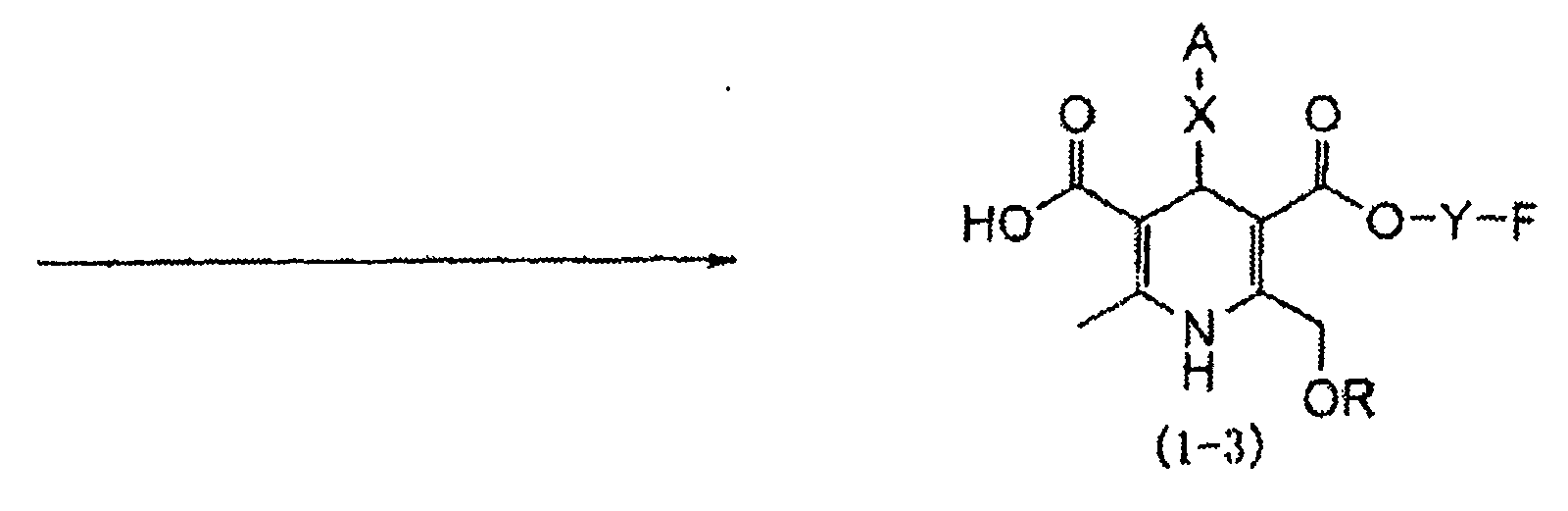
- a compound (16) is obtained by Knoevenagel reaction of an aldehyde (9) and a 2-cyanoethyl acetoacetate (11). Then the compound (16) is reacted with an ester of 3-amino-4-alkoxycrotonic acid (17) to obtain a dihydropyridine derivative (18). This product is treated with a base such as sodium hydroxide to obtain a dihydropyridine derivative (1-3) of the present invention.
- the dihydropyridine derivative (1-3) can be produced also by the following reaction scheme:
- a compound (20) is obtained by Knoevenagel reaction of an aldehyde (9) and a 4-alkoxy-3-oxobutanoic acid ester (19). Then the compound (20) is reacted with 2-cyanoethyl 3-aminocrotonate (13) to obtain a dihydropyridine derivative (18). This product is treated with a base such as sodium hydroxide to obtain a dihydropyridine derivative (1-3) of the present invention.
- the alkoxymethyl has a protecting group for an amine or an alcohol in the above-described two processes
- the protecting group is removed from compound (18) and then compound (1-3) is produced, or compound (1-3) is produced and then the protecting group is removed by the reaction.
- Compound (1-3) having an amine in the alkoxymethyl can be produced by reacting a derivative (18) wherein R represents a halogenated alkyl group with a corresponding amine.
- R represents a halogenated alkyl group
- a derivative (18) wherein R represents a halogenated alkyl group is reacted with sodium azide or the like to form an azide, which is then converted into compound (1-3) and this compound is catalytically reduced.
- a dihydropyridine derivative (1-4) of the above formula wherein B represents carboxyl group, C represents an alkoxymethyl group, D represents hydrogen atom and E represents methyl group can be produced as follows:
- a compound (22) is obtained by Knoevenagel reaction of an aldehyde (9) and a benzyl 4-alkoxy-3-oxobutanoate (21). Then the compound (22) is reacted with an ester of 3-aminocrotonic acid (10) to obtain a dihydropyridine derivative (23). This product is catalytically reduced to obtain a dihydropyridine derivative (1-4) of the present invention.
- the dihydropyridine derivative (1-4) of the present invention can also be produced as follows:
- a compound (24) is obtained by Knoevenagel reaction of an aldehyde (9) and an acetoacetic acid ester (12). Then the compound (24) is reacted with a benzyl 3-amino-4-alkoxycrotonate (25) to obtain a dihydropyridine derivative (23).
- This product is, for example, catalytically reduced to obtain a dihydropyridine derivative (1-4) of the present invention.
- the alkoxymethyl has a protecting group for an amine or an alcohol in the above-described two processes
- the protecting group is removed from compound (23) and then compound (1-4) is produced, or compound (1-4) is produced and then the protecting group is removed by the reaction.
- Compound (1-4) having an amine in the alkoxymethyl can be produced by reacting a derivative (23) wherein R represents a halogenated alkyl group with a corresponding amine.
- R represents a halogenated alkyl group
- a derivative (23) wherein R represents a halogenated alkyl group is reacted with sodium azide or the like to form an azide, which is then catalytically reduced to obtain compound (1-4).
- a dihydropyridine derivative (1-5) of the above formula wherein B represents cyano group, C and E each represent methyl group and D represents hydrogen atom can be produced as follows:
- a dihydropyridine derivative (24) is obtained by Knoevenagel reaction of an aldehyde (9) and an acetoacetic acid ester (12). Then the compound (24) is reacted with an aminocrotonitrile (26) to obtain a dihydropyridine derivative (1-5).
- the dihydropyridine derivative (1-5) can be produced also by reacting an aldehyde (9), an acetoacetic acid ester (12) and 3-aminocrotonitrile (26).
- a dihydropyridine derivative (1-6) of the above formula wherein B represents carboxyl group, C represents methyl group, D represents hydrogen atom and E represents trifluoromethyl group can be produced as follows:
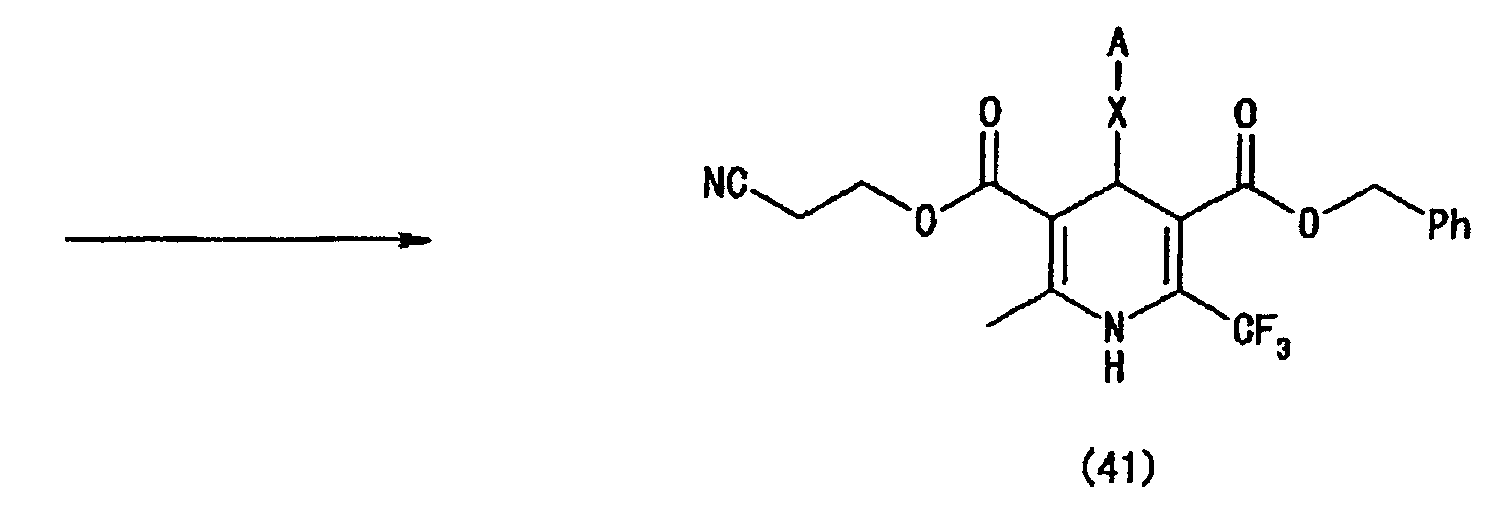
- a dihydropyridinedicarboxylic acid diester (41) can be obtained by reacting an aldehyde (9), 2-cyanoethyl 3-aminocrotonate (13) and benzyl 4,4,4-trifluoroacetoacetate (40).
- This product is catalytically reduced and then the reduction product is condensed with an alcohol (28) to obtain a dihydropyridine derivative (42).
- This product is treated with a base such as sodium hydroxide to obtain a dihydropyridine derivative (1-6) of the present invention.
- a dihydropyridine derivative (1-7) of the above formula wherein B represents carboxyl group, C represents trifluoromethyl group, D represents hydrogen atom and E represents methyl group can be produced as follows:
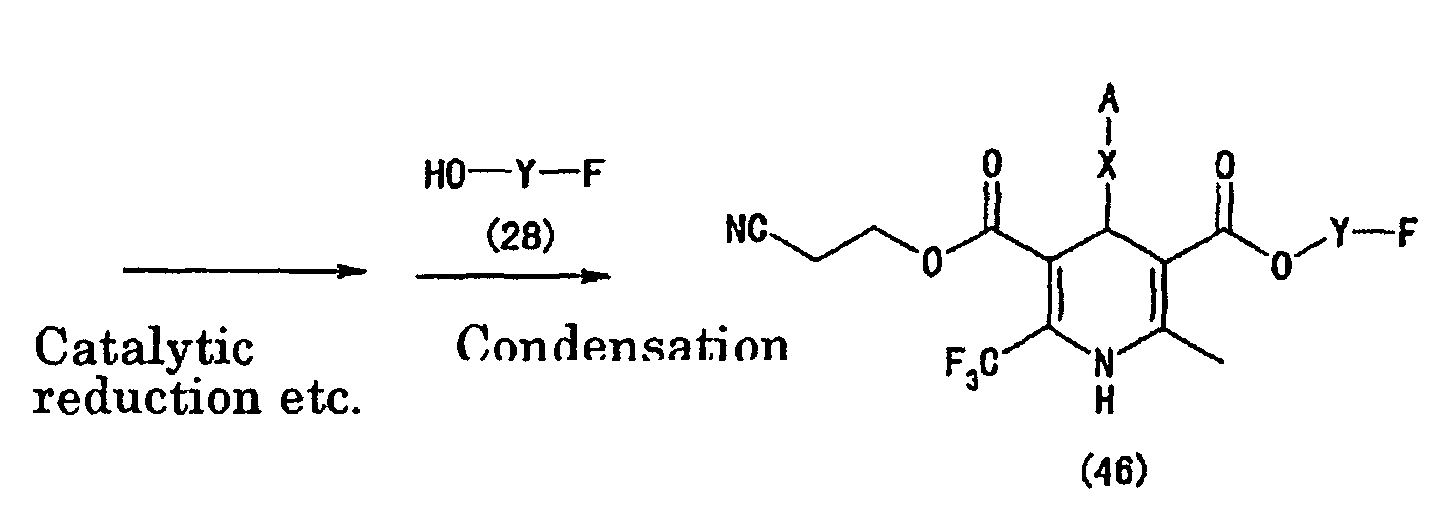
- a dihydropyridinedicarboxylic acid diester (45) can be obtained by reacting an aldehyde (9), benzyl 3-aminocrotonate (43) and 2-cyanoethyl 4,4,4-trifluoroacetoacetate (44).
- This product is, for example, catalytically reduced and then the reduction product is condensed with a corresponding alcohol (28) to obtain a dihydropyridine derivative (46).
- This product is treated with a base such as sodium hydroxide to obtain a dihydropyridine derivative (1-7) of the present invention.
- acetoacetic acid esters (12) used as the starting material can be produced according to, for example, the following process, if they are not well-known:
- methyl acetoacetate (27) and an alcohol (28) are heated and thereby transesterified to obtain the acetoacetic acid ester (12).
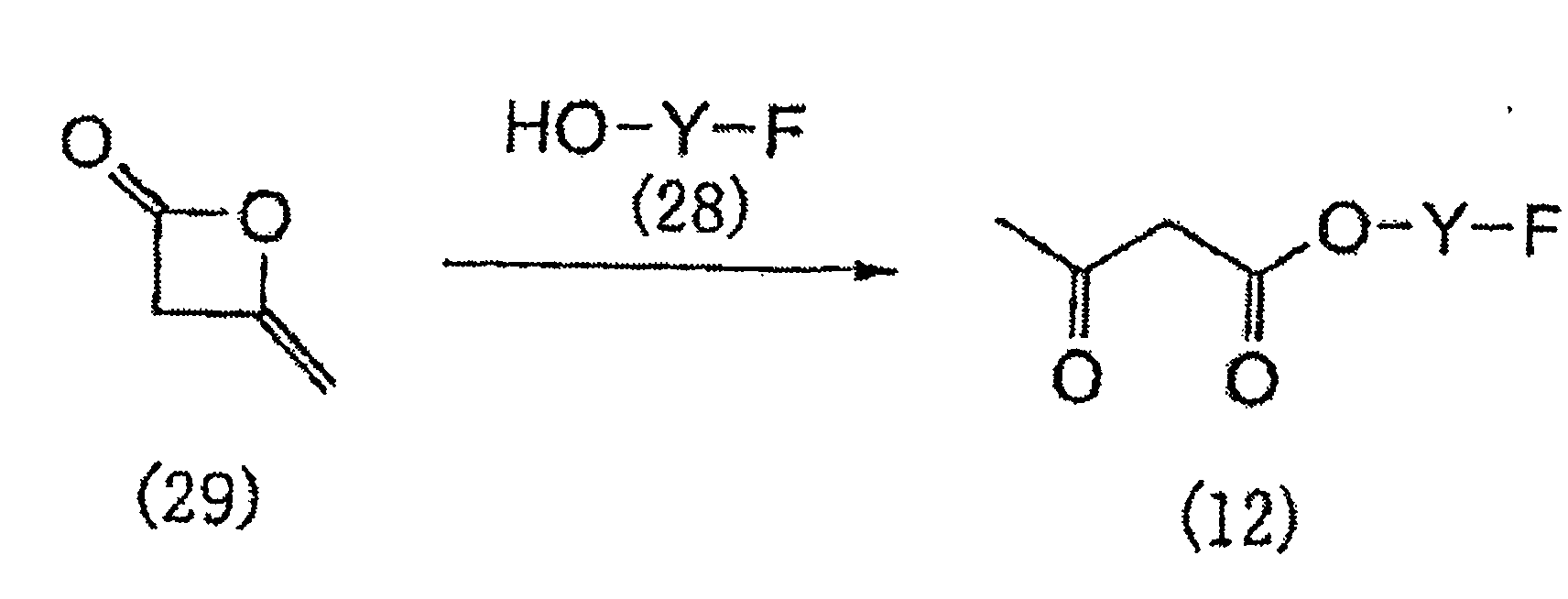
- an alcohol (28), a diketene (29) and a proper base are heated together to obtain an acetoacetic acid ester (12) as follows:
- the 3-aminocrotonic acid esters (30) used as the starting material can be produced according to, for example, the following process, if they are not well-known:
- an acetoacetic acid ester (12) is reacted with an amine or ammonium acetate to obtain the intended compound.
- the 4-alkoxy-3-oxobutanoic acid esters (19) used as the starting material can be produced according to, for example, the following process, if they are not well-known:
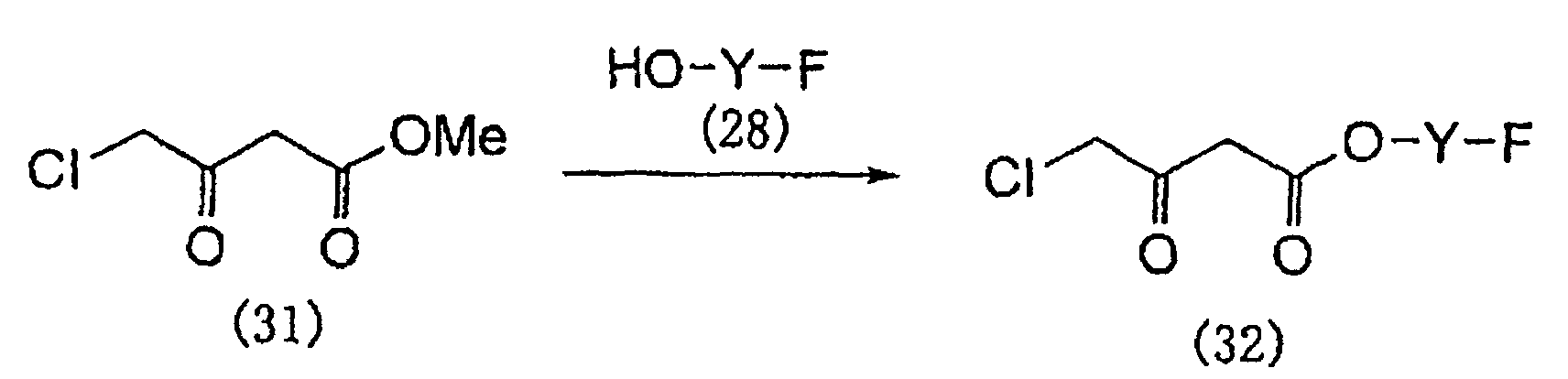
- a chloroacetoacetic acid ester (32) can be obtained by heating ethyl chloroacetoacetate (31) and an alcohol (28) together to conduct the transesterification.
- a 4-alkoxy-3-oxobutanoic acid ester (19) can be obtained by reacting the ester (32) with an alcohol (33) in the presence of sodium hydride.
- the 3-amino-4-alkoxycrotonic acid esters (34) used as the starting material can be produced according to, for example, the following process, if they are not well-known:
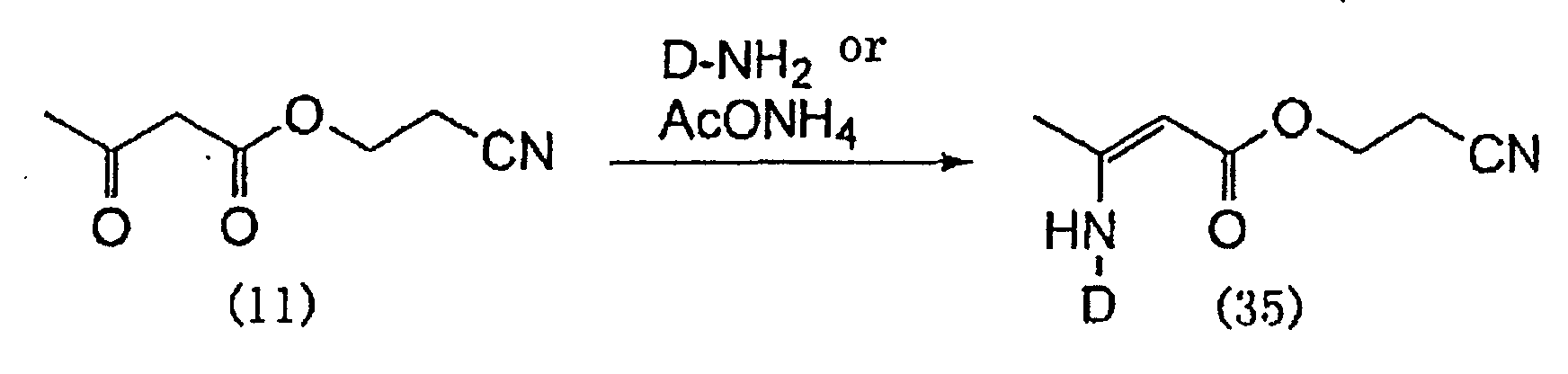
- the 2-cyanoethyl 3-aminocrotonates (35) used as the starting material can be produced according to, for example, the following process, if they are not well-known:
- 2-cyanoethyl acetoacetate (11) is reacted with an amine or ammonium acetate to obtain 2-cyanoethyl 3-aminocrotonate (35).
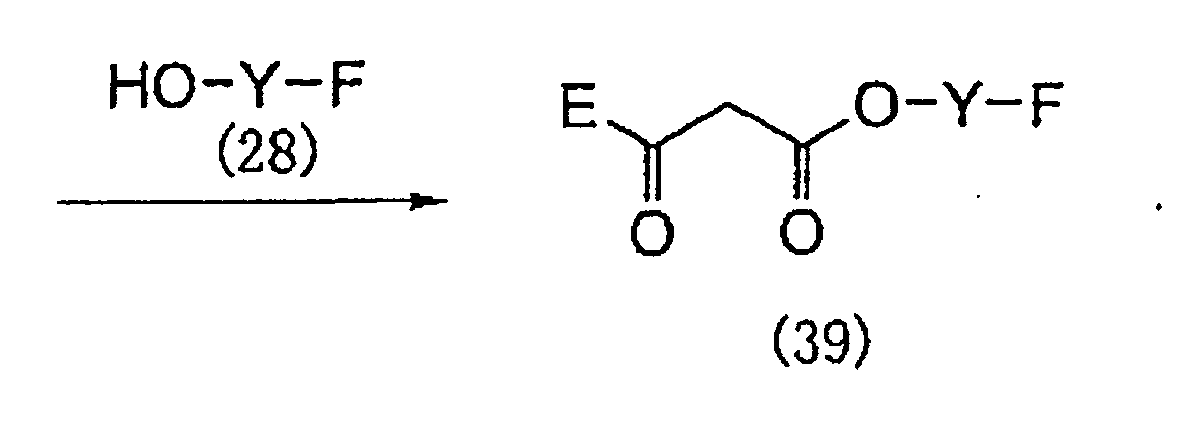
- acyl acetates (39) used as the starting material can be produced according to, for example, the following process, if they are not well-known:
- Optical isomers of 1,4-dihydropyridines represented by general formula (1) are possible because they contain an asymmetric carbon bond.
- the compounds of the present invention also include those optical isomers.
- the salts are pharmaceutically acceptable ones such as ammonium salts, salts thereof with alkali metals, e. g. sodium and potassium, salts thereof with alkaline earth metals, e. g. calcium and magnesium, salts thereof with aluminum and zinc, salts thereof with organic amines, e. g. morpholine and piperidine, and salts thereof with basic amino acids, e. g. arginine and lysine.
- the compounds of general formula (1) and salts thereof are administered as they are or in the form of various medicinal compositions to patients.
- the dosage forms of the medicinal compositions are, for example, tablets, powders, pills, granules, capsules, suppositories, solutions, sugar-coated tablets and depots. They can be prepared with ordinary preparation assistants by an ordinary method.
- the tablets are prepared by mixing the dihydropyridine derivative, the active ingredient of the present invention, with any of known adjuvants such as inert diluents, e. g. lactose, calcium carbonate and calcium phosphate; binders, e. g. acacia, corn starch and gelatin; extending agents, e. g. alginic acid, corn starch and pre-gelatinized starch; sweetening agents, e. g. sucrose, lactose and saccharin; corrigents, e. g. peppermint, and cherry; and lubricants, e. g. magnesium stearate, talc and carboxymethyl cellulose.
- adjuvants such as inert diluents, e. g. lactose, calcium carbonate and calcium phosphate
- binders e. g. acacia, corn starch and gelatin
- extending agents e. g. algin
- the N-type calcium channel inhibitor containing one of the compounds of above general formula (1) or one of salts thereof as active ingredient is usable as a therapeutic agent for various diseases, for example, acute stage of ischemic cerebrovascular disorders caused by cerebral infarction or intracerebral bleeding (including subarachnoidal hemorrhage); progressive neurodegenerative diseases such as Alzheimer's disease, AIDS related dementia and Parkinson's disease, dementia due to cerebrovascular disorder and ALS; neuropathy caused by head injury; various pains such as pain caused by spinal injury, diabetes or thromboangiitis obliterans, postoperative pain, migraine and visceral pain; various diseases associated with psychogenic stress such as bronchial asthma, unstable angina and irritable colitis; emotional disorder withdrawal symptoms after addiction to drugs such as ethanol addiction withdrawal symptoms.
- diseases for example, acute stage of ischemic cerebrovascular disorders caused by cerebral infarction or intracerebral bleeding (including subarachnoidal hemorrhage); progressive neurodegenerative diseases such as Alzheimer's disease, AIDS related dementia
- the dose of the compound of general formula (1) or salt thereof used for the above-described purpose varies depending on the intended therapeutic effect, administration method, period of the treatment, and age and body weight of the patient.
- the dose is usually 1 ⁇ g to 5 g a day for adults in the oral administration, and 0.01 ⁇ g to 1 g a day for adults in the parenteral administration.
- the title compound was obtained from 200 mg (0.745 mmol) of diphenylmethyl acetoacetate, 109 mg (0.745 mmol) of 3-chlorobenzaldehyde and 115 mg (0.745 mmol) of 2-cyanoethyl 3-aminocrotonate in the same manner as that of Example 1-1).
- the reaction mixture was diluted with dichloromethane and then washed with saturated aqueous sodium hydrogencarbonate solution.
- the organic layer was dried over anhydrous sodium sulfate and then concentrated under reduced pressure.
- the title compound was obtained from 310 mg (0.956 mmol) of 5,5-diphenyl-2-pentene-1-yl acetoacetate, 139 mg (0.956 mmol) of 3-chlorobenzaldehyde and 147 mg (0.956 mmol) of 2-cyanoethyl 3-aminocrotonate in the same manner as that of Example 1-1).
- the title compound was obtained from 180 mg (0.555 mmol) of (5,5-diphenyl-2-pentane-1-yl) acetoacetate, 80.8 mg (0.555 mmol) of 3-chlorobenzaldehyde and 85.5 mg (0.555 mmol) of 2-cyanoethyl 3-aminocrotonate in the same manner as that of Example 1-1).
- the purified product was crystallized in hexane / ethyl acetate (3 / 1), and the crystals were taken by the filtration, washed and dried under reduced pressure to obtain the title compound.
- the title compound was obtained from 304 mg (0.60 mmol) of mono(3,3-diphenylpropane-1-yl) 4-(3-chlorophenyl)-2,6-dimethyl-1,4-dihydropyridine-3,5-dicarboxylate and 196 mg (1.19 mmol) of glycine benzyl ester in the same manner as that of Example 15.
- the title compound was obtained from 301 mg (0.60 mmol) of mono(3,3-diphenylpropane-1-yl) 4-(3-chlorophenyl)-2,6-dimethyl-1,4-dihydropyridine-3,5-dicarboxylate and 120 mg (0.90 mmol) of cinnamylamine in the same manner as that of Example 15.
- Tetrahydrofuran was evaporated under reduced pressure, and the residue was acidified with 2 N hydrochloric acid. After the extraction with dichloromethane, the extract was washed with a saturated aqueous sodium hydrogencarbonate solution and saturated aqueous sodium chloride solution and then dried over sodium sulfate. Dichloromethane was evaporated under reduced pressure to obtain the title compound.
- the intended compound was obtained from 3-((2-benzhydryloxyethoxy)ethyl 5-(2-cyanoethyl) 4-(3-chlorophenyl)-2,6-dimethyl-1,4-dihydropyridine-3,5-dicarboxylate in the same manner as that of Example 50-2).
- the title compound was obtained from a compound obtained from 397 mg (3.00 mmol) of (3,3-dimethyl-2,4-dioxyanyl)-1-methanol and 750 mg (2.15 mmol) of 3,3-diphenyl-1-propyl 4-(2-chloroethoxy)acetoacetate according to Example 30 in the same manner as that of Example 1-1).
- the title compound was obtained from 304 mg (0.61 mmol) of mono(3,3-diphenylpropane-1-yl) 4-(3-chlorophenyl)-2,6-dimethyl-1,4-dihydropyridine-3,5-dicarboxylate and 0.18 ml (0.88 mmol) of 4-amino-1-benzylpiperidine in the same manner as that of Example 21.
- the activity of the dihydropyridine derivatives of the present invention to inhibit L-type calcium channel was determined by the following method in which the relaxation reaction on the KCl contraction of samples of thoracic aorta extracted from rats was employed.
- the slips of thoracic aorta extracted from a Sprague-Dawry rat was used.
- the blood vessels were cut to obtain ring-shaped samples having a width of about 3 mm.
- the endothelial cells of the blood vessel were mechanically removed.
- the samples were suspended in a strain gage in Tyrode's solution (158.3 mM of NaCl, 4.0 mM of KCl, 1.05 mM of MgCl 2 , 0.42 mM of NaH 2 PO 4 , 10 mM of NaHCO 3 , 2 mM of CaCl 2 and 5 mM of glucose) in which a gaseous mixture of O 2 (95 %) and CO 2 (5 %) was introduced.
- a static tension of 2 g was applied hereto.
- the tension of the blood vessel was amplified with transducer and a tension amplifier (EF-601G; Nihon Koden Corporation) and recorded with a multi-pen recorder (Rikadenki Kogyo Co., Ltd.). The experiments were conducted at 37°C.
- the nutrient solution in the sample tank was replaced with High K + Tyrode's solution (112.3 mM of NaCl, 50 mM of KCl, 1.05 mM of MgCl 2 , 0.42 mM of NaH 2 PO 4 , 10 mM of NaHCO 3 , 2 mM of CaCl 2 and 5 mM of glucose) to conduct the contraction reaction.
- High K + Tyrode's solution 112.3 mM of NaCl, 50 mM of KCl, 1.05 mM of MgCl 2 , 0.42 mM of NaH 2 PO 4 , 10 mM of NaHCO 3 , 2 mM of CaCl 2 and 5 mM of glucose
- test compound After attaining the maximum contraction reaction, the test compound was cumulatively added at intervals of 90 minutes to attain concentrations of 10 -7 , 10 -6 and 10 -5 M. The rate of the test compound to control the maximum contraction reaction was employed as the index of the inhibition activity on L-type calcium channel.
- Human neuroblastoma cells IMR-32 were obtained from ATCC (American Type Culture Collection). The medium used was a Phenol Red-free Eagle minimum essential medium (GIBCO) containing earle's salts supplement, 2 mM of L-glutamine (GIBCO), 1 mM of sodium pyruvate (pH 6.5) (GIBCO), antibiotic / antimicotic mixture (GIBCO) and 10 % fetal calf serum (Cell Culture Technologies).
- the medium for IMR-32 cells thus prepared was replaced with 1 ml of Phenol Red-free Eagle minimum essential medium (GIBCO) containing 1 ml of 10 ⁇ M fura-2/AM (Dojin Kagaku, Co.) and earle's salts supplement, and the incubation was conducted at 25°C for 1 hour.
- GEBCO Phenol Red-free Eagle minimum essential medium
- the medium was replaced with Phenol Red-free Eagle minimum essential medium (GIBCO) containing earle's salts supplement, from which fura-2/AM had been removed. After the incubation at 37°C for 1 hour, the medium was replaced with a recording medium (20 mM of HEPES-KOH, 115 mM of NaCl, 5.4 mM of KCl, 0.8 mM of MgCl 2 , 1.8 mM of CaCl 2 and 13.8 mM of D-glucose). Antagonistic activity on N-type calcium channel was determined and analyzed by using a fluorescence microscope (Nikon Corporation) and an image analysis device ARGUS 50 (Hamamatsu Photonics).
- a recording medium (20 mM of HEPES-KOH, 115 mM of NaCl, 5.4 mM of KCl, 0.8 mM of MgCl 2 , 1.8 mM of CaCl 2 and 13.8 mM of D-glucose) containing 1 ⁇ M of Nifedipine was given to the cells by reflux by a Y-tube method. Then a stimulating agent containing 60 mM of potassium chloride was rapidly given by the Y-tube method. Thereafter stimulating agents containing 60 mM of potassium chloride and 0.1, 1 or 10 ⁇ M of test compound were successively rapidly given by the Y-tube method to determine the antagonistic activity on the channel.
- a stimulating agent containing 60 mM of potassium chloride and 1 ⁇ M of omega conotoxin GVIA was rapidly given by the Y-tube method to realize a condition of 100 % inhibition of N-type calcium channel.
- Table 9 shows the results of the determination of the activity of inhibiting the N-type calcium channel (pIC50) and L-type calcium channel (IC50).
- L-type calcium channel antagonistic activity of the compounds was also examined to find that the activity of them was only weak. They were thus highly selective to N-type calcium channel.
- the new dihydropyridine derivatives of the present invention had selective N-type calcium channel antagonistic activity.
- the new dihydropyridine derivatives of the present invention are effective in the treatment of acute stage of ischemic cerebrovascular disorders caused by cerebral infarction or intracerebral bleeding (including subarachnoidal hemorrhage); progressive neurodegenerative diseases such as Alzheimer's disease, AIDS related dementia, Parkinson's disease, dementia due to cerebrovascular disorder and ALS; cerebral disorders caused by head injury; pains and cold flush caused by diabetes or thromboangiitis obliterans; various pains such as postoperative pain, migraine and visceral pain; various diseases associated with psychogenic stress such as bronchial asthma, unstable angina and irritable colitis; emotional disorder and withdrawal symptoms after addiction to drugs such as ethanol addiction withdrawal symptoms.
Landscapes
- Health & Medical Sciences (AREA)
- Chemical & Material Sciences (AREA)
- Organic Chemistry (AREA)
- Engineering & Computer Science (AREA)
- Bioinformatics & Cheminformatics (AREA)
- Life Sciences & Earth Sciences (AREA)
- Animal Behavior & Ethology (AREA)
- Veterinary Medicine (AREA)
- Chemical Kinetics & Catalysis (AREA)
- General Chemical & Material Sciences (AREA)
- Medicinal Chemistry (AREA)
- Nuclear Medicine, Radiotherapy & Molecular Imaging (AREA)
- Public Health (AREA)
- Pharmacology & Pharmacy (AREA)
- General Health & Medical Sciences (AREA)
- Biomedical Technology (AREA)
- Neurology (AREA)
- Neurosurgery (AREA)
- Pulmonology (AREA)
- Pain & Pain Management (AREA)
- Vascular Medicine (AREA)
- Urology & Nephrology (AREA)
- Heart & Thoracic Surgery (AREA)
- Psychology (AREA)
- Rheumatology (AREA)
- Hospice & Palliative Care (AREA)
- Psychiatry (AREA)
- Cardiology (AREA)
- Pharmaceuticals Containing Other Organic And Inorganic Compounds (AREA)
- Plural Heterocyclic Compounds (AREA)
Abstract
Description


B represents cyano group, nitro group, carboxyl group, acetyl group or a group of the following general formula (3):
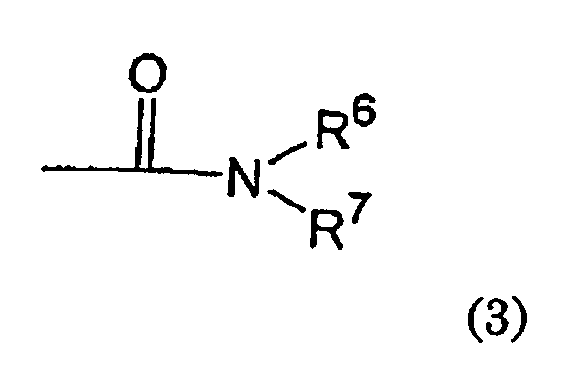
C and E may be the same or different from each other and each represent hydrogen atom, a lower alkyl group, dimethoxymethyl group, cyano group, a hydroxy-lower alkyl group, a carboxy-lower alkyl group, a halogeno-lower alkyl group, an amino-lower alkyl group, in which the amino group may be substituted with one or two of a lower alkyl group, a lower cycloalkyl group, an aryl group or an aryl-lower alkyl group, an azido-lower alkyl group, an aryl group, a heteroaryl group, an aryl-lower alkyl group, a heteroaryl-lower alkyl group, a lower alkyl group substituted with a cyclic alkyl group which may contain a hetero atom in the ring, or a carbamoyl-lower alkyl group, in which the carbamoyl group may be substituted with one or two of a lower alkyl group, a lower cycloalkyl group, an aryl group or an aryl-lower alkyl group,
D represents a hydrogen atom, a lower alkyl group, a hydroxy-lower alkyl group or an aryl-lower alkyl group,
F represents a group represented by any of the following general formulae (4) to (8):
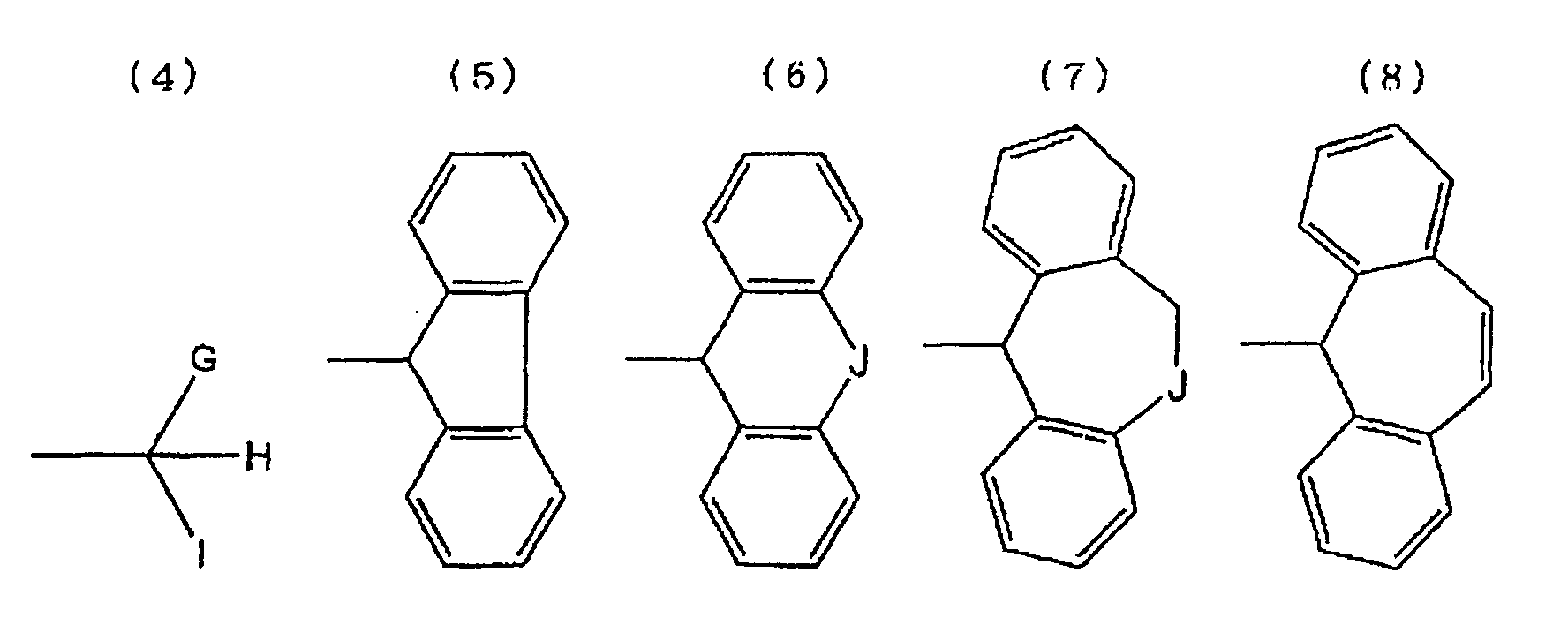
X represents an interatomic bond, -CH2-, -CH2CH2-, -CH=CH- or -C≡C-, and
Y represents an alkyl group having 1 to 7 carbon atoms, which may contain a hetero atom or cyclopropane ring in the chain, or an alkenyl group, which may contain a hetero atom or cyclopropane ring in the chain.














Yield: 814 mg (1.47 mmol) (58.3 %)
MS (ESI, m/z) 553 (M-H)-
1H-NMR (CDCl3) : 2.28-2.42 (2H, m), 2.35 (6H, s), 2.64 (2H, t), 3.91 (1H, t), 3.95-4.02 (2H, m), 4.22-4.39 (2H, m), 5.00 (1H, s), 5.73 (1H, s), 7.08-7.30 (14H, m)
Yield: 398 mg (0.79 mmol) (54.3 %)
MS (ESI, m/z) 500 (M-H)-
1H-NMR (DMSO-d6) : 2.24-2.34 (2H, m), 2.24 (3H, s), 2.29 (3H, s), 3.81 (2H, t), 3.87 (1H, t), 4.95 (1H, s), 7.09-7.33 (14H, m), 8.85 (1H, s)
Yield: 831 mg (2.94 mmol) (quantitative yield)
MS (ESI, m/z) 281 (M-H)-
1H-NMR (CDCl3): 2.04 (3H, s), 3.34 (2H, s), 4.38 (1H, t), 4.70 (2H, d), 7.18-7.38 (10H, m)
Yield: 614 mg (1.13 mmol) (90.1 %)
MS (ESI, m/z) 541 (M+H)+
1H-NMR (CDCl3): 2.12 (3H, s), 2.26 (3H, s), 2.54 (2H, t), 4.14-4.25 (2H, m), 4.32 (1H, t), 4.61 (2H, d), 4.78 (1H, s), 6.33 (1H, br), 6.89 (1H, d), 6.99-7.08 (3H, m), 7.16-7.31 (2H, m)
Yield: 113 mg (0.232 mmol) (33.0 %)
MS (ESI, m/z) 488 (M+H)+
1H-NMR (DMSO-d6): 2.03 (3H, s), 2.21 (3H, s), 4.31 (1H, t), 4.56 (2H, d), 4.74 (1H, s), 6.86 (1H, br), 6.97 (1H, s), 7.13 (2H, d), 7.18-7.38 (10H, m)
Yield: 12.24 g (50.5 mmol) (100 %)
1H-NMR (CDCl3) : 1.58 (2H, qui), 2.42 (2H, t), 3.65 (2H, t), 7.16-7.36 (6H, m), 7.42 (4H, d)
Yield: 3.49 g (15.4 mmol) (33.4 %)
1H-NMR (CDCl3): 1.18 (1H, s), 1.49-1.61 (2H, m), 2.06-2.18 (2H, m), 3.65 (2H, t), 3.91 (1H, t), 7.08-7.31 (10H, m)
Yield: 1.13 g (3.64 mmol) (99.7 %)
1H-NMR (CDCl3): 1.55-1.68 (2H, m), 2.06-2,17 (2H, m), 2.25 (3H, s), 3.43 (2H, s), 3.90 (1H, t), 4.15 (2H, t), 7.17-7.32 (10H, m)
Yield: 786 mg (1.38 mmol) (55.0 %)
MS (ESI, m/z) 567 (M-H)-
1H-NMR (CDCl3): 1.52-1.62 (2H, m), 1.96-2.04 (2H, m), 2.34 (3H, s), 2.35 (3H, s), 2.69 (2H, t), 3.86 (1H, t), 3.96-4.16 (2H, m), 4.94 (1H, s), 5.67 (1H, s), 7.03-7.31 (14H, m)
Yield: 252 mg (0.49 mmol) (45.2 %)
MS (ESI, m/z) 514 (M-H)-
1H-NMR (DMSO-d6) : 1.37-1.48 (2H, m), 1.89-2.01 (2H, m), 2.24 (3H, s), 2.26 (3H, s), 3.85-4.07 (3H, m), 4.89 (1H, s), 7.04-7.32 (14H, m), 8.82 (1H, s)
Yield: 770 mg (2.36 mmol) (70.4 %)
MS (ESI, m/z) 325 (M-H)-
1H-NMR (CDCl3) : 1.61-1.72 (2H, m), 2.18 (1H, s), 2.25 (3H, s), 2.32-2.40 (2H, m), 3.44 (2H, s), 4.16 (2H, t), 7.19-7.43 (10H, m)
Yield: 769 mg (1.31 mmol) (56.0 %)
MS (ESI, m/z) 583 (M-H)-
1H-NMR (CDCl3) : 1.58-1.69 (2H, m), 2.24-2.34 (2H, m), 2.35 (6H, s), 2.53-2.62 (2H, m), 4.05 (2H, t), 4.21 (2H, t), 4.99 (1H, s), 5.71 (1H, s), 7.05-7.08 (2H, m), 7.17-7.43 (12H, m)
Yield: 640 mg (1.20 mmol) (92.5 %)
MS (ESI, m/z) 530 (M-H)-
1H-NMR (DMSO-d6) : 1.42-1.56 (2H, m), 2.14-2.26 (2H, m), 2.24-2.34 (2H, m), 2.24 (3H, s), 2.26 (3H, s), 3.88-4.00 (2H, m), 4.90 (1H, s), 5.51 (1H, s), 7.16-7.43 (14H, m), 8.82 (1H, s)
Yield: 592 mg (1.05 mmol) (40.5 %)
MS (ESI, m/z) 564 (M-H)-
1H-NMR (CDCl3) : 2.24-2.41 (2H, m), 2.32 (3H, s), 2.34 (3H, s), 2.67 (2H, t), 3.82-4.34 (5H, m), 5.71 (1H, s), 5.76 (1H, s), 7.11-7.70 (14H, m)
Yield: 409 mg (0.80 mmol) (76.7 %)
MS (ESI, m/z) 511 (M-H)-
1H-NMR (DMSO-d6) : 2.19 (3H, s), 2.20-2.30 (2H, m), 2.26 (3H, s), 3.67-3.86 (3H, m), 5.59 (1H, s), 7.04-7.30 (10H, m), 7.37 (1H, t), 7.49 (1H, d), 7.63 (1H, t), 7.70 (1H, d), 8.84 (1H, s)
Yield: 920 mg (3.43 mmol) (quantitative)
1H-NMR (CDCl3): 2.22 (3H, s), 3.55 (2H, s), 6.93 (1H, s), 7.25-7.40 (10H, m)
Yield: 360 mg (0.68 mmol) (91.7 %)
MS (ESI, m/z) 525 (M-H)-
1H-NMR (CDCl3): 2.31 (3H, s), 2.34 (3H, s), 2.62 (2H, t), 4.26 (2H, t), 5.08 (1H, s), 6.00 (1H, s), 6.81 (1H, s), 6.97-7.00 (2H, m), 7.10-7.35 (12H, m)
Yield: 169 mg (0.36 mmol) (52.2 %)
MS (ESI, m/z) 472 (M-H)-
1H-NMR (DMSO-d6): 2.22 (3H, s), 2.30 (3H, s), 4.96 (1H, s), 6.72 (1H, s), 6.95-6.98 (2H, m), 7.15-7.34 (12H, m), 8.90 (1H, s)
Yield: 30 mg (0.051 mmol) (17.0 %)
MS (ESI, m/z) 583 (M+H)+
1H-NMR (CDCl3): 1.00 (2H, br), 1.25-1.50 (5H, m), 1.60-1.74 (6H, m), 2.12-2.20 (2H, m), 2.34 (3H, s), 3.14 (2H, br), 3.70-3.90 (3H, m), 4.92 (1H, s), 5.68 (1H, s), 6.96 (2H, d), 7.12-7.28 (12H, m)
Yield: 2.22 g (7.92 mmol) (79.2 %)
MS (ESI, m/z) 281 (M+H)+
1H-NMR (CDCl3): 1.24 (3H, t), 2.96 (2H, t), 4.05-4.18 (3H, m), 5.81 (1H, d), 6.87 (1H, dt), 7.16-7.29 (10H, m)
Yield: 1.42 g (5.96 mmol) (75.2 %)
1H-NMR (CDCl3): 2.82 (2H, t), 3.97-4.00 (3H, m), 5.60-5.65 (2H, m), 7.17-7.29 (10H, m)
Yield: 860 mg (2.67 mmol) (quantitative yield)
MS (ESI, m/z) 321 (M-H)-
1H-NMR (CDCl3): 2.22 (3H, s), 2.82 (2H, t), 3.40 (2H, s), 3.99 (1H, t), 4.49 (2H, d), 5.52-5.75 (2H, m), 7.16-7.28 (10H, m)
Yield: 440 mg (0.76 mmol) (79.2 %)
MS (ESI, m/z) 581 (M+H)+
1H-NMR (CDCl3): 2.25 (3H, s), 2.33 (3H, s), 2.59 (2H, t), 2.79 (2H, t), 3.98 (1H, t), 4.18-4.27 (2H, m), 4.38-4.42 (2H, m), 4.93 (1H, s), 5.48-5.65 (2H, m), 5.95 (1H, s), 7.10-7.26 (14H, m)
Yield: 244 mg (0.46 mmol) (60.1 %)
MS (ESI, m/z) 528 (M+H)+
1H-NMR (DMSO-d6): 2.18 (3H, s), 2.26 (3H, s), 2.49-2.51 (2H, m), 3.98 (1H, t), 4.32 (2H, br), 4.81 (1H, s), 5.53 (2H, br), 7.06-7.30 (14H, m), 8.80 (1H, s)
Yield: 320 mg (1.33 mmol) (quantitative yield)
1H-NMR (CDCl3): 1.26-1.38 (2H, m), 1.55-1.64 (2H, m), 2.00-2.11 (2H, m), 3.59 (2H, q), 3.85-3.92 (1H, m), 7.15-7.30 (10H, m)
Yield: 180 mg (0.56 mmol) (41.7 %)
MS (ESI, m/z) 323 (M-H)-
1H-NMR (CDCl3): 1.28-1.38 (2H, m), 1.63-1.73 (2H, m), 2.07 (2H, dd), 2.22 (3H, s), 3.40 (2H, s), 3.89 (1H, t), 4.10 (2H, t), 7.14-7.30 (10H, m)
Yield: 150 mg (0.26 mmol) (55.6 %)
MS (ESI, m/z) 583 (M+H)+
1H-NMR (CDCl3): 1.11-1.21 (2H, m), 1.50-1.62 (2H, m), 1.84 (3H, s), 1.93-1.98 (2H, m), 2.20 (3H, s), 2.65 (2H, t), 3.77 (1H, t), 3.89-3.99 (2H, m), 4.27 (2H, t), 4.84 (1H, s), 5.80 (1H, s), 7.02-7.20 (14H, m)
MS (ESI, m/z) 530 (M+H)+
1H-NMR (DMSO-d6): 1.05-1.20 (2H, m), 1.55 (2H, t), 1.98 (2H, q), 2.19 (3H, s),
2.25 (3H, s), 3.81-3.99 (3H, m), 4.83 (1H, s), 7.05-7.27 (14H, m), 8.78 (1H, s)
MS (ESI, m/z) 311 (M+H)+
1H-NMR (CDCl3) : 1.10 (3H, t), 2.32-2.45 (3H, m), 2.55 (1H, q), 3.40 (2H, s), 4.03-4.12 (3H, m), 7.16-7.31 (10H, m)
Yield: 249 mg (0.44 mmol) (45.2 %)
MS (ESI, m/z) 569 (M+H)+
1H-NMR (CDCl3) : 1.26 (3H, t), 2.32-2.44 (3H, m), 2.55 (1H, q), 3.40 (2H, s), 4.03-4.12 (3H, m), 7.16-7.31 (10H, m)
Yield: 96.6 mg (0.19 mmol) (67.9 %)
MS (ESI, m/z) 516 (M+H)+
1H-NMR (CDCl3) : 1.26 (3H, t), 2.17 (3H, s), 2.64-2.90 (4H, m), 3.91-4.00 (3H, m), 4.28-4.30 (4H, m), 5.00 (1H, s), 5.67 (1H, s), 7.05-7.26 (14H, m)
Yield: 8.57 g (25.9 mmol) (quantitative yield)
MS (ESI, m/z) 329 (M-H)-
1H-NMR (CDCl3): 2.30-2.46 (2H, m), 2.35 (2H, s), 3.59 (2H, s), 4.00-4.25 (3H, m), 7.15-7.31 (10H, m)
Yield: 420 mg (0.99 mmol) (54 %)
MS (ESI, m/z) 423 (M+H)+
1H-NMR (CDCl3): 0.94-1.78 (13H, m), 2.40 (2H, q), 3.49 (2H, s), 3.50 (2H, t), 4.05 (1H, t), 4.07 (2H, s), 4.10 (2H, t), 7.15-7.32 (10H, m)
Yield: 37.9 mg (0.056 mmol) (25.6 %)
MS (ESI, m/z) 681 (M+H)+
1H-NMR (CDCl3): 0.899-1.75 (13H, m), 2.33 (2H, q), 2.38 (3H, s), 2.64 (2H, t), 3.55-3.63 (2H, m), 3.91 (1H, t), 3.92-4.00 (2H, m), 4.21-4.35 (2H, m), 4.63 (1H, d), 4.70 (1H, d), 4.99 (1H, s), 7.08-7.30 (15H, m)
Yield: 20.8 mg (0.033 mmol) (93.5 %)
MS (ESI, m/z) 628 (M+H)+
1H-NMR (CDCl3): 0.870-1.76 (13H, m), 2.29-2.39 (2H, m), 2.37 (3H, s), 3.62 (2H, t), 3.89 (1H, t), 3.91-3.99 (2H, m), 4.64 (1H, d), 4.71 (1H, d), 5.02 (1H, s), 7.05-7.30 (15H, m)
Yield: 739 mg (1.74 mmol) (71.3 %)
MS (ESI, m/z) 424 (M+H)+
1H-NMR (CDCl3) : 1.38-1.64 (6H, m), 2.32-2.44 (6H, m), 2.55 (2H, t), 3.52 (2H, bs), 3.62 (2H, t), 4.06 (1H, t), 4.09 (2H, t), 4.13 (2H, bs), 715-7.27 (10H, m)
Yield: 20.4 mg (0.030 mmol) (8.6 %)
MS (ESI, m/z) 682 (M+H)+
1H-NMR (CDCl3) : 1.43-1.75 (6H, m), 2.34 (2H, q), 2.43 (3H, s), 2.50-2.65 (8H, m), 3.62-3.71 (2H, m), 3.86-4.01 (3H, m), 4.21-4.35 (2H, m), 4.65 (2H, d), 4.73 (2H, d), 4.99 (1H, s), 7.08-7.30 (14H, m), 8.12 (1H, bs)
Yield: 13.6 mg (0.022 mmol) (72.2 %)
MS (ESI, m/z) 629 (M+H)+
1H-NMR (CDCl3) : 1.42-1.70 (6H, m), 2.24-2.36 (2H, m), 2.31 (3H, s), 2.55-2.62 (6H, m), 3.61 (2H, t), 3.84-3.94 (3H, m), 4.55 (1H, d), 4.85 (1H, d), 5.09 (1H, s), 7.03-7.32 (14H, m), 7.57 (1H, bs)
Yield: 841 mg (1.49 mmol) (59.6 %)
MS (ESI, m/z) 564 (M-H)-
1H-NMR (CDCl3):2.30-2.40 (8H, m), 2.66 (2H, t), 3.90 (1H, t), 3.99 (2H, t), 4.12 (2H, q), 4.20-4.36 (2H, m), 5.11 (1H, s), 5.90 (1H, s), 7.11-7.30 (10H, m), 7.38 (1H, t), 7.66-7.72 (1H, m), 7.98-8.04 (1H, m), 8.13 (1H, t)
Yield: 493 mg (0.96 mmol) (65.4 %)
MS (ESI, m/z) 511 (M-H)-
1H-NMR (DMSO-d6) : 2.26 (3H, s), 2.30 (3H, s), 2.26-2.33 (2H, m), 3.75-3.90 (3H, m), 5.05 (1H, s), 7.10-7.29 (10H, m), 7.53-7.67 (2H, m), 8.01-8.08 (2H, m), 8.96 (1H, s)
Yield: 372 mg (1.13 mmol) (42.9 %)
MS (ESI, m/z) 327 (M+H)+
1H-NMR (CDCl3) :2.39 (2H, dt), 3.41 (3H, s), 3.48 (2H, s), 4.03-4.12 (5H, m), 7.15-7.32 (10H, m)
Yield: 24.9 mg (0.04 mmol) (6.7 %)
MS (ESI, m/z) 585 (M+H)+
1H-NMR (CDCl3) : 2.29-2.38 (5H, m), 2.62-2.71 (2H, m), 3.48 (3H, s), 3.88-3.99 (3H, m), 4.28 (2H, ddd), 4.60 (1H, d), 4.68 (1H, d), 4.99 (1H, s), 7.02-7.30 (14H, m)
Yield: 10.9 mg (0.02 mmol) (50.1 %)
MS (ESI, m/z) 530 (M-H)-
1H-NMR (CDCl3) : 2.33-2.38 (5H, m), 3.49 (3H, s), 3.87-3.96 (3H, m), 4.65 (1H, d), 4.66 (1H, d), 5.00 (1H, s), 7.08-7.28 (15H, m)
Yield: 259 mg (0.39 mmol) (76.5 %)
MS (ESI, m/z) 668 (M-H)-
1H-NMR (CDCl3): 1.40-1.48 (2H, m), 1.43 (9H, s), 1.73 (3H, s), 2.10-2.22 (2H, m), 2.38 (3H, s), 2.85-3.15 (4H, m), 3.62-3.92 (5H, m), 4.96 (1H, s), 5.24 (1H, s), 6.92 (2H, d), 7.08-7.29 (12H, m)
Yield: 428 mg (0.85 mmol) (41.3 %)
MS (ESI, m/z) 499 (M-H)-
1H-NMR (CDCl3) : 2.30 (3H, s), 2.31 (3H, s), 2.38 (2H, q), 3.95 (1H, t),
4.02 (2H, t), 4.76 (1H, s), 5.21 (2H, s), 5.58 (1H, s), 7.13-7.30 (14H, m)
Yield: 699 mg (1.68 mmol) (61.6 %)
MS (ESI, m/z) 418 (M+H)+
1H-NMR (CDCl3) : 2.34-2.45 (2H, m), 3.10 (2H, ddd), 3.42 (2H, s), 3.90 (1H, t), 4.00-4.12 (5H, m), 4.46 (1H, t), 711-7.26 (10H, m), 7.56-7.64 (2H, m), 8.51-8.54 (2H, m)
Yield: 650 mg (1.56 mmol) (99.8 %)
MS (ESI, m/z) 417 (M+H)+
1H-NMR (CDCl3) : 2.34-2.41 (2H, m), 3.11 (2H, ddd), 3.87 (1H, t), 3.99 (1H, t), 4.04-4.11 (3H, m), 4.46 (1H, t), 713-7.27 (10H, m), 7.59-7.64 (2H, m), 8.53-8.55 (2H, m)
Yield: 514 mg (0.78 mmol) (49.6 %)
MS(ESI, m/z) 676(M+H)+
1H-NMR (CDCl3) : 2.18 (3H, s), 2.32-2.39 (2H, m), 2.64 (2H, t), 3.85-4.10 (6H, m), 4.47 (2H, ddd), 5.30 (1H, s), 7.05-7.27 (15H, m), 7.59-7.64 (2H, m), 8.51-8.60 (2H, m)
Yield: 43.8 mg (0.070 mmol) (21 %)
MS (ESI, m/z) 623 (M+H)+
1H-NMR (CDCl3) : 2.27-2.33 (5H, m), 3.14 (2H, t), 3.88-3.99 (5H, m), 4.74 (2H, s), 5.00 (1H, s), 7.04-7.40 (15H, m), 7.63-7.65 (2H, m), 8.59-8.61 (2H, m)
Yield: 821 mg (1. 84 mmol) (78.3 %)
MS (ESI, m/z) 445 (M-H)-
1H-NMR (CDCl3):2.38 (2H, q), 3.51 (2H, s), 3.59-3.72 (4H, m), 4.04 (1H, t), 4.06-4.16 (2H, m), 4.18 (2H, s), 4.54 (2H, s), 7.14-7.37 (15H, m)
Yield: 1.79 g (6.44 mmol) (quantitative yield)
MS (ESI, m/z) 278 (M+H)+
1H-NMR (CDCl3) : 2.05 (3H, s), 2.63 (2H, t), 3.92 (2H, t), 7.00-7.88 (5H, m)
Yield: 189 mg (0.27 mmol) (14.7 %)
1H-NMR (CDCl3):2.64 (3H, s), 2.32 (2H, q), 2.63 (2H, t), 3.65-3.73 (4H, m),
3.91 (1H, t), 3.90-4.00 (2H, m), 4.24-4.32 (2H, m), 4.60 (2H, s), 4.71 (1H, d), 4.78 (1H, d), 4.98 (1H, s), 7.08-7.38 (19H, m), 7.64 (1H, bs)
Yield: 49.6 mg (0.076 mmol) (71.8 %)
MS (ESI, m/z) 650 (M-H)-
1H-NMR (CDCl3) : 2.16 (3H, s), 2.32 (2H, q), 3.66-3.73 (4H, m), 3.88 (1H, t), 3.90-3.98 (2H, m), 4.59 (2H, s), 4.72 (1H, d), 4.79 (1H, d), 5.00 (1H, s), 7.04-7.36 (19H, m), 7.64 (1H, bs)
Yield: 929 mg (2.12 mmol) (91.3 %)
MS (ESI, m/z) 438 (M+H)+
1H-NMR (CDCl3) : 1.54-1.78 (8H, m), 2.40 (2H, q), 2.68-2.76 (4H, m), 2.75 (2H, t), 3.52 (2H, bs) , 3.60 (2H, t), 4.05 (1H, t), 4.09 (2H, t), 4.13 (2H, s), 7.15-7.31 (10H, m)
Yield: 331 mg (0.48 mmol) (23.4 %)
MS (ESI, m/z) 696 (M+H)+
1H-NMR (CDCl3) : 1.50-1.75 (8H, m), 2.30-2.43 (2H, m), 2.40 (3H, s), 2.57-2.66 (4H, m), 2.70-2.85 (4H, m), 3.55-3.72 (2H, m), 3.85-4.00 (3H, m), 4.22-4.33 (2H, m), 4.68 (1H, d), 4.76 (1H, d), 4.99 (1H, s), 7.05-7.30 (14H, m), 8.08 (1H, s)
Yield: 9.3 mg (0.0145 mmol) (3.1 %)
MS (ESI, m/z) 643 (M+H)+
1H-NMR (CDCl3) : 1.56-1.71 (8H, m), 2.22-2.32 (2H, m), 2.29 (3H, s), 2.70-2.88 (6H, m), 3.65-3.74 (2H, m), 3.85-3.95 (3H, m), 4.60 (1H, d), 4.88 (1H, d), 5.09 (1H, s), 7.02-7.32 (14H, m), 7.53 (1H, bs)
Yield: 87.5 mg (0.142 mmol) (quantitative yield)
MS (ESI, m/z) 613 (M-H)-
1H-NMR (CDCl3):2.34 (2H, q), 2.38 (3H, s), 2.64 (2H, t), 3.66-3.71 (4H, m), 3.91-4.00 (3H, m), 4.23-4.35 (2H, m), 4.74 (1H, d), 4.81 (1H, d), 5.00 (1H, s), 7.08-7.30 (14H, m), 7.58 (1H, bs)
Yield: 50.4 mg (0.09 mmol) (64.1 %)
MS (ESI, m/z) 562 (M+H)+
1H-NMR (DMSO-d6) : 2.25-2.34 (2H, m), 2.29 (3H, s), 3.45-3.60 (4H, m), 3.80-3.89 (3H, m), 4.63 (1H, d), 4.69 (1H, d), 4.97 (1H, s), 7.09-7.34 (14H, m), 8.58 (1H, bs)
Yield: 257 mg (0.45 mmol) (74.9 %)
MS (ESI, m/z) 570 (M-H)-
1H-NMR (CDCl3) : 2.08 (6H, s), 2.23-2.39 (4H, m), 2.26 (3H, s), 2.30 (3H, s), 3.13-3.34 (2H, m), 3.90-4.03 (3H, m), 4.76 (1H, s), 5.44 (1H, s), 6.08 (1H, s), 7.10-7.32 (14H, m)
Yield: 560 mg (1.16 mmol) (63.0 %)
MS (ESI, m/z) 481 (M-H)-
1H-NMR (CDCl3): 2.09 (3H, s), 2.17-2.27 (2H, m), 2.39 (3H, s), 3.73 (1H, t), 3.91 (2H, t), 4.58 (1H, s), 5.77 (1H, s), 6.96-7.01 (2H, m), 7.11-7.30 (12H, m)
Yield: 6.56 g (20.5 mmol) (93.1 %)
MS (ESI, m/z) 320 (M+H)+
1H-NMR (CDCl3) : 1.43-1.46 (2H, m),1.68-1.73 (4H, m), 2.64-2.68 (2H, m), 2.74 (2H, t), 3.54-3.58 (2H, m), 3.72 (2H, dd), 4.15 (2H, s), 5.17 (2H, s), 7.31-7.37 (5H, m)
Yield: 435 mg (1.37 mmol) (87.3 %)
MS (ESI, m/z) 319 (M+H)+
1H-NMR (CDCl3) : 1.43-1.47 (2H, m),1.54- 1.61 (4H, m), 2.40-2.46 (4H, m), 2.52 (2H, t), 3.57 (2H, t), 4.08 (2H, s), 4.53 (1H, s), 5.12 (2H, s), 7.27-7.36 (5H, m)
Yield: 425 mg (0.59 mmol) (39 %)
MS (ESI, m/z) 719 (M+H)+
1H-NMR (CDCl3) : 1.41-1.51 (2H, m),1.57- 1.67 (4H, m), 2.29 (2H, dd), 2.42 (3H, s), 2.44- 2.54 (4H, m), 3.57-3.72 (2H, m), 3.85-3.97 (3H, m), 4.66 (2H, dd), 5.10 (2H, dd), 5.30 (1H, s), 7.04-7.27 (19H, m), 7.74 (1H, s)
Yield: 21.5 mg (0.034 mmol) (39 %)
MS (ESI, m/z) 629 (M+H)+
1H-NMR (CDCl3) : 1.48-1.57 (2H, m),1.60- 1.72 (4H, m), 2.28-2.63 (11H, m), 2.42, 3.66-3.75 (2H, m), 3.81-3.96 (3H, m), 4.53 (1H, d), 4.79 (1H, d), 5.05 (1H, s), 7.00-7.35 (15H, m)
Yield: 313 mg (0.48 mmol) (80.0 %)
MS (ESI, m/z) 647 (M-H)-
1H-NMR (CDCl3): 2.20-2.42 (2H, m), 2.26 (3H, s), 2.31 (3H, s), 3.90-4.08 (5H, m), 4.81 (1H, s), 5.15 (2H, s), 5.51 (1H, s), 5.87 (1H, t), 7.08-7.40 (19H, m)
Yield: 166 mg (0.27 mmol) (44.9 %)
MS (ESI, m/z) 615 (M-H)-
1H-NMR (CDCl3): 2.25 (3H, s), 2.31 (3H, s), 2.28-2.40 (2H, m), 3.90 (1H, t), 3.94-4.08 (4H, m), 4.80 (1H, s), 5.44 (1H, s), 5.49 (1H, s), 6.07 (1H, dt), 6.30 (1H, d), 7.06-7.32 (19H, m)
Yield: 1.14 g (3.74 mmol) (84.8 %)
MS (ESI, m/z) 306 (M+H)+
1H-NMR (CDCl3) : 1.90-1.92 (4H, m),2.89-2.92 (6H, m), 3.59 (2H, s), 3.76 (2H, t), 4.18 (2H, s), 5.17 (2H, s), 7.26-7.37 (5H, m)
Yield: 0.98 g (3.23 mmol) (86.2 %)
MS (ESI, m/z) 305 (M+H)+
1H-NMR (CDCl3) : 1.68-1.70 (2H, m), 2.53-2.57 (6H, m), 3.58 (2H, t), 4.54 (2H, s), 5.12 (2H, s), 7.26-7.38 (5H, m)
Yield: 484 mg (0.69 mmol) (37 %)
MS (ESI, m/z) 627 (M+H)+
1H-NMR (CDCl3) : 1.81-1.83 (4H, m), 2.38 (3H, s), 2.60- 2.62 (6H, m),
3.66 (2H, dt), 4.66-4.84 (4H, m), 5.00 (1H, d), 5.04(1H, s), 5.12(1H, d), 6.21 (1H, dt), 6.51(1H, d), 7.07-7.33 (14H, m), 8.11 (1H, s)
Yield: 64.9 mg (0.11 mmol) (15 %)
MS (ESI, m/z) 615 (M+H)+
1H-NMR (CDCl3) : 1.23-1.32 (4H, m),1.70- 2.02 (6H, m), 2.27-2.34 (2H, m), 2.49(3H, s), 3.60-4.00 (5H, m), 4.69 (1H, d), 4.78 (1H, d), 5.04 (1H, s), 7.01-7.25 (14H, m), 7.71(1H, s)
Yield: 171 mg (0.31 mmol) (93.9 %)
MS (ESI, m/z) 557 (M-H)-
1H-NMR (DMSO-d6) : 2.06 (3H, s), 2.21-2.30 (2H, m), 2.29 (3H, s), 3.60-3.69 (1H, m), 3.73-3.83 (4H, m), 4.87 (1H, s), 7.05-7.31 (14H, m), 7.86 (1H, t), 8.49 (1H, s)
Yield: 291 mg (0.44 mmol) (73.3 %)
MS (ESI, m/z) 658 (M-H)-
1H-NMR (CDCl3): 1.73 (3H, s), 2.00-3.25 (10H, m), 2.37 (3H, s), 3.34 (2H, d), 3.66 (1H, t), 3.73-3.88 (2H, m), 4.98 (1H, s), 5.18 (1H, s), 6.92 (2H, d), 7.09-7.33 (17H, m)
Yield: 38 mg (0.07 mmol) (28.0 %)
MS (ESI, m/z) 568 (M-H)-
1H-NMR (CDCl3): 1.74 (3H, s), 2.08-2.20 (2H, m), 2.37 (3H, s), 2.62-3.40 (6H, m), 3.63-3.70 (2H, m), 3.77-3.90 (3H, m), 4.96 (1H, s), 5.26 (1H, s), 6.93-7.28 (14H, m)
Yield: 813 mg (1.99 mmol) (84.3 %)
MS (ESI, m/z) 410 (M+H)+
1H-NMR (CDCl3) : 1.76-1.80 (4H, m), 2.40(2H,q), 2.52-2.60 (4H, m), 2.71 (2H, t), 3.50 (2H, bs), 3.64 (2H, t), 4.00-4.16(3H,m), 4.13 (2H, s), 715-7.31 (10H, m)
Yield: 52 mg (0.78 mmol) (22.6 %)
MS (ESI, m/z) 668 (M+H)+
1H-NMR (CDCl3) : 1.78-1.86(4H, m), 2.34 (2H, q), 2.38(3H, s), 2.60-2.64(4H, m), 3.59-3.76(2H, m), 3.91(1H, t), 3.89-4.02(2H, m), 4.21-4.35(2H, m),4.68(1H, d), 4.78(1H, d), 4.99(1H, s), 7/08-7.32(14H, m), 8.25 (1H, bs)
Yield: 40 mg (0.07 mmol) (68.9 %)
MS (ESI, m/z) 615 (M+H)+
1H-NMR (CDCl3) : 1.80-1.96(4H, m), 2.20-2.36(5H, m), 2.70-3.30(6H, m), 3.64-3.87(5H, m), 4.61 (1H, d), 4.88 (1H, d), 5.09 (1H, s), 7.04-7.36 (15H, m)
Yield: 351 mg (0.55 mmol) (91.7 %)
MS (ESI, m/z) 633 (M-H)-
1H-NMR (CDCl3) : 2.19 (3H, s), 2.28-2.36 (2H, m), 2.31 (3H, s), 3.40-3.46 (4H,m), 3.86-4.00 (3H, m), 4.40 (2H, s), 4.79 (1H, s), 5.46 (1H, s), 5.74 (1H, s), 7.05-7.35 (19H, m)
Yield: 0.57 g (1.77 mmol) (61.2 %)
MS (ESI, m/z) 322 (M+H)+
1H-NMR (CDCl3) : 2.60-2.76 (2H, m),3.56 (2H, s), 3.66 (2H, t), 3.76 (4H, t), 4.14 (2H, s), 5.17(2H, s), 7.26-7.47 (5H, m)
Yield: 0.42 g (1.31mmol) (73 %)
MS (ESI, m/z) 321 (M+H)+
1H-NMR (CDCl3) : 2.50 (4H, t), 2.57 (2H, t), 3.57 (2H, t), 3.71(4H, t), 4.07 (2H, s), 4.52 (1H, s), 5.12 (2H, s), 7.26-7.36 (5H, m)
Yield: 401 mg (0.56 mmol) (45 %)
MS (ESI, m/z) 721 (M+H)+
1H-NMR (CDCl3) : 2.28-2.30 (2H, m), 2.41 (3H, s), 2.51 (4H, t), 2.61 (4H, m), 3.62-3.75 (6H, m), 3.86-3.97 (3H, m), 4.70 (1H, d), 4.75(1H, d), 5.07 (1H, s), 5.11(2H, s), 7.04-7.29 (20H, m)
Yield: 98 mg (0.14 mmol) (57 %)
MS (ESI, m/z) 631 (M+H)+
1H-NMR (CDCl3) : 2.25-2.32 (2H, m), 2.42(3H, s), 2.48-2.65 (6H, m), 3.63-3.72 (6H, m), 3.86-3.95(3H, m), 4.62 (1H, d), 4.73 (1H, d), 5.01 (1H, s), 7.05-7.44 (15H, m)
Yield: 940 mg (2.3 mmol) (99 %)
MS (ESI, m/z) 418 (M+H)+
1H-NMR (CDCl3) : 2.34-2.43 (2H, m), 2.86-2.95 (2H, m), 3.42 (2H, s), 3.69 (2H, t), 4.00-4.16 (5H, m), 7.15-7.28 (10H, m), 7.58 (1H, m), 8.48 (3H, m)
Yield: 928 mg (2.2 mmol) (97 %)
MS (ESI, m/z) 417 (M+H)+
1H-NMR (CDCl3) : 2.34-2.41 (2H, m), 3.11 (2H, ddd), 3.87 (1H, t), 3.99 (1H, t), 4.04-4.11 (3H, m), 4.46 (1H, t), 713-7.27 (10H, m), 7.59-7.64 (2H, m), 8.53-8.55 (2H, m)
Yield: 413 mg (0.61 mmol) (61 %)
MS (ESI, m/z) 719 (M+H)+
1H-NMR (CDCl3) : 1.41-1.51 (2H, m),1.57- 1.67 (4H, m), 2.29 (2H, dd), 2.42 (3H, s), 2.44- 2.54 (4H, m), 3.57-3.72 (2H, m), 3.85-3.97 (3H, m), 4.66 (2H, dd), 5.10 (2H, dd), 5.30 (1H, s), 7.04-7.27 (19H, m), 7.74 (1H, s)
Yield: 60 mg (0.10 mmol) (42 %)
MS (ESI, m/z) 623 (M+H)+
1H-NMR (CDCl3) : 2.27-2.33 (5H, m), 3.14 (2H, t), 3.88-3.99 (5H, m), 4.74 (2H, s), 5.00 (1H, s), 7.04-7.40 (15H, m), 7.63-7.65 (2H, m), 8.59-8.61 (2H, m)
Yield: 50 mg (0.09 mmol) (20.9 %)
MS (ESI, m/z) 543 (M-H)-
1H-NMR (CDCl3): 2.24 (3H, s), 2.30-2.38 (2H, m), 2.31 (3H, s), 3.28-3.41 (2H, m), 3.54-3.64 (2H, m), 3.88-4.02 (3H, m), 4.78 (1H, s), 5.55 (1H, s), 5.78 (1H, t), 7.10-7.29 (14H, m)
Yield: 426 mg (0.63 mmol) (78.8 %)
MS (ESI, m/z) 674 (M+H)+
1H-NMR (CDCl3) : 1.50-3.40 (15H, m), 2.35 (3H, s), 3.44-3.98 (5H, m), 4.96 (1H, s), 5.24 (1H, s), 6.92-7.33 (19H, m)
Yield: 975 mg (2.3 mmol) (99 %)
MS (ESI, m/z) 418 (M+H)+
1H-NMR (CDCl3) : 2.34-2.45 (2H, m), 3.10 (2H, ddd), 3.42 (2H, s), 3.90 (1H, t), 4.00-4.12 (5H, m), 4.46 (1H, t), 711-7.26 (10H, m), 7.56-7.64 (2H, m), 8.51-8.54 (2H, m)
Yield: 922 mg (2.2 mmol) (94 %)
MS (ESI, m/z) 417 (M+H)+
1H-NMR (CDCl3) : 2.34-2.41 (2H, m), 3.11 (2H, ddd), 3.87 (1H, t), 3.99 (1H, t), 4.04-4.11 (3H, m), 4.46 (1H, t), 713-7.27 (10H, m), 7.59-7.64 (2H, m), 8.53-8.55 (2H, m)
Yield: 1.14 g (1.7 mmol) (77 %)
MS (ESI, m/z) 719 (M+H)+
1H-NMR (CDCl3) : 1.41-1.51 (2H, m),1.57- 1.67 (4H, m), 2.29 (2H, dd), 2.42 (3H, s), 2.44- 2.54 (4H, m), 3.57-3.72 (2H, m), 3.85-3.97 (3H, m), 4.66 (2H, dd), 5.10 (2H, dd), 5.30 (1H, s), 7.04-7.27 (19H, m), 7.74 (1H, s)
Yield: 44 mg (0.07 mmol) (34 %)
MS (ESI, m/z) 623 (M+H)+
1H-NMR (CDCl3) : 2.27-2.33 (5H, m), 3.14 (2H, t), 3.88-3.99 (5H, m), 4.74 (2H, s), 5.00 (1H, s), 7.04-7.40 (15H, m), 7.63-7.65 (2H, m), 8.59-8.61 (2H, m)
Yield: 689 g (2.2 mmol) (99 %)
MS (ESI, m/z) 320 (M+H)+
1H-NMR (CDCl3) : 1.43-1.46 (2H, m),1.68-1.73 (4H, m), 2.64-2.68 (2H, m), 2.74 (2H, t), 3.54-3.58 (2H, m), 3.72 (2H, dd), 4.15 (2H, s), 5.17 (2H, s), 7.31-7.37 (5H, m)
Yield: 594 mg (1.9 mmol) (86.5 %)
MS (ESI, m/z) 319 (M+H)+
1H-NMR (CDCl3) : 1.43-1.47 (2H, m),1.54- 1.61 (4H, m), 2.40-2.46 (4H, m), 2.52 (2H, t), 3.57 (2H, t), 4.08 (2H, s), 4.53 (1H, s), 5.12 (2H, s), 7.27-7.36 (5H, m)
Yield: 1.02 g (1.4 mmol) (75 %)
MS (ESI, m/z) 719 (M+H)+
1H-NMR (CDCl3) : 1.41-1.51 (2H, m),1.57- 1.67 (4H, m), 2.29 (2H, dd), 2.42 (3H, s), 2.44- 2.54 (4H, m), 3.57-3.72 (2H, m), 3.85-3.97 (3H, m), 4.66 (2H, dd), 5.10 (2H, dd), 5.30 (1H, s), 7.04-7.27 (19H, m), 7.74 (1H, s)
Yield: 12 mg (0.02 mmol) (10 %)
MS (ESI, m/z) 629 (M+H)+
1H-NMR (CDCl3) : 1.48-1.57 (2H, m),1.60- 1.72 (4H, m), 2.28-2.63 (11H, m), 2.42, 3.66-3.75 (2H, m), 3.81-3.96 (3H, m), 4.53 (1H, d), 4.79 (1H, d), 5.05 (1H, s), 7.00-7.35 (15H, m)
Yield: 56 mg (0.10 mmol) (21.8 %)
MS (ESI, m/z) 582 (M-H)-
1H-NMR (CDCl3): 1.78 (3H, s), 2.10-2.22 (2H, m), 2.37 (3H, s), 2.55-3.40 (10H, m), 3.71 (1H, t), 3.78-3.95 (2H, m), 4.96 (1H, s), 5.25 (1H, s), 6.95-7.28 (14H, m)
Yield: 45 mg (0.06 mmol) (10.5 %)
MS (ESI, m/z) 702 (M-H)-
1H-NMR (CDCl3): 1.20-2.00 (4H, m), 1.73 (3H, s), 2.08-2.18 (2H, m), 2.37 (3H, s), 2.60-3.40 (3H, m), 3.64 (1H, t), 3.74-3.86 (2H, m), 3.90-4.76 (2H, m), 4.97 (1H, s), 5.10 (2H, s), 5.20 (1H, s), 6.88-7.28 (19H, m)
Yield: 403 mg (0.62 mmol) (quantitative yield)
MS (ESI, m/z) 645 (M-H)-
1H-NMR (CDCl3): 1.78 (3H, s), 2.10-2.18 (2H, m), 2.39 (3H, s), 2.78-3.40 (4H, m), 3.66 (1H, t), 3.77-3.86 (2H, m), 4.99 (1H, s), 5.24 (1H, s), 6.79-7.30 (23H, m)
Yield: 1.44 g (5.17 mmol) (51.8 %)
MS (ESI, m/z) 279 (M+H)+
1H-NMR (CDCl3) : 1.25 (3H, t), 1.20-1.68 (10H, m), 2.28 (2H, t), 3.42-3.50 (2H, m), 4.12 (2H, q), 4.50 (2H, s), 7.24-7.38 (5H, m)
Yield: 1.75 g (4.50 mmol) (87.1 %)
Yield: 1.10 g (3.89 mmol) 99.4 %.
Yield: 470 mg (1.28 mmol) (68.1 %)
MS (ESI, m/z) 365 (M-H)-
1H-NMR (CDCl3): 1.19-1.36 (8H, m), 1.54-1.66 (2H, m), 1.88-2.08 (2H, m), 2.26 (3H, s), 3.43 (2H, s), 3.87 (1H, t), 4.10 (2H, t), 7.12-7.30 (10H, m)
Yield: 235 mg (0.38 mmol) (29.6 %)
MS (ESI, m/z) 623 (M-H)-
1H-NMR (CDCl3) : 1.12-1.62 (10H, m), 1.96-2.08 (2H, m), 2.34 (3H, s), 2.36 (3H, s), 2.61 (2H, t), 3.84-4.10 (3H, m), 4.18-4.32 (2H, m), 4.95 (1H, s), 5.66 (1H, s), 7.07-7.31 (14H, m)
Yield: 95 mg (0.17 mmol) (45.1 %)
MS (ESI, m/z) 570 (M-H)-
1H-NMR (DMSO-d6) : 1.05-1.28 (8H, m), 1.38-1.52 (2H, m), 1.93-2.04 (2H, m), 2.24 (3H, s), 2.26 (3H, s), 3.82-4.03 (3H, m), 4.85 (1H, s), 7.06-7.32 (14H, m), 8.80 (1H, s)
Yield: 309 mg (0.48 mmol) (80.0 %)
MS (ESI, m/z) 645 (M-H)-
1H-NMR (CDCl3): 1.77 (3H, s), 2.08-2.19 (2H, m), 2.40 (3H, s), 2.80-3.50 (8H, m), 3.66 (1H, t), 3.75-3.90 (2H, m), 4.99 (1H, s), 5.25 (1H, s), 6.54 (1H, d), 6.66 (1H, t), 6.92 (2H, d), 7.13-7.26 (12H, m), 7.47 (1H, t), 8.15 (1H, d)
Yield: 400 mg (0.54 mmol) (90.0 %)
MS (ESI, m/z) 735 (M-H)-
1H-NMR (CDCl3): 1.73 (3H, s), 2.08-2.20 (2H, m), 2.36 (3H, s), 2.42-3.20 (8H, m), 3.60-3.71 (1H, m), 3.73-3.87 (2H, m), 4.04 (1H, s), 4.97 (1H, s), 5.16 (1H, s), 6.92 (2H, d), 7.01-7.33 (22H, m)
Yield: 680 mg (1.2 mmol) (31 %)
MS (ESI, m/z) 558 (M+H)+
1H-NMR (CDCl3) : 1.24-2.11 (7H, m), 2.37-2.41 (2H, m), 3.50-3.55 (4H, m), 4.05-4.20 (9H, m), 5.15 (2H, s) 7.26-7.37 (15H, m)
Yield: 0.67 g (1.2 mmol) (99 %)
MS (ESI, m/z) 557 (M+H)+
1H-NMR (CDCl3) : 1.09-1.16 (3H, m), 1.68-1.70 (2H, m), 2.36-2.40 (2H, m), 2.43-2.81 (2H, m), 3.49 (2H, t), 4.00-4.19 (9H, m), 4.55 (1H, s), 5.12(2H, s) 7.14-7.37 (15H, m)
Yield: 723 mg (0.89 mmol) (74 %)
MS (ESI, m/z) 816 (M+H)+
1H-NMR (CDCl3) : 1.60-1.74 (5H, m), 2.32-2.35 (2H, m), 2.37 (3H, s), 2.42 (3H, s), 2.61-2.68 (2H, m), 2.70-2.89(2H, m) 3.51-3.96 (2H, m), 3.96-4.30 (9H, m), 4.66 (1H, s), 4.68 (1H, s), 4.99 (1H, s), 5.12(2H, s) 7.06-7.35 (20H, m)
Yield: 272 mg (0.35 mmol) (93 %)
MS (ESI, m/z) 761 (M-H)-
1H-NMR (CDCl3) : 1.66-1.77 (5H, m), 2.28-2.31 (2H, t), 2.32(3H, s), 2.74-2.76 (2H, m), 3.59 (2H, t), 3.87-4.16 (7H, m), 4.67(2H, d), 5.02(1H, s), 5.12(2H, s), 7.04-7.35 (15H, m)
Yield: 39 mg (0.06 mmol) (quantitative yield)
MS (ESI, m/z) 612 (M-H)-
1H-NMR (CDCl3): 1.40-2.05 (4H, m), 1.73 (3H, s), 2.10-2.20 (2H, m), 2.37 (3H, s), 2.60-3.35 (3H, m), 3.62-3.94 (3H, m), 3.94-4.40 (2H, m), 4.96 (1H, s), 5.23 (1H, s), 6.91-7.26 (14H, m)
Yield: 287 mg (0.49 mmol) (77.8 %)
MS (ESI, m/z) 585 (M+H)+
1H-NMR (CDCl3): 0.86-2.57 (20H, m), 3.18-3.74 (2H, m), 3.84-4.05 (3H, m), 4.90 (1H, d), 5.69 (1H, d), 7.01-7.27 (14H, m)
Yield: 53 mg (0.08 mmol) (31 %)
MS (ESI, m/z) 629 (M+H)+
1H-NMR (CDCl3) : 1.48-1.57 (2H, m),1.60- 1.72 (4H, m), 2.28-2.63 (11H, m), 2.42, 3.66-3.75 (2H, m), 3.81-3.96 (3H, m), 4.53 (1H, d), 4.79 (1H, d), 5.05 (1H, s), 7.00-7.35 (15H, m)
Yield: 2.24 g (6.0 mmol) (30 %)
MS (ESI, m/z) 373 (M+H)+
1H-NMR (CDCl3) : 2.31-2.44 (2H, m), 3.51 (2H, s), 3.63 (2H, s), 3.78 (2H, t), 4.03-4.13 (3H, m), 7.16-7.31 (10H, m)
Yield: 2.26 g (6.0 mmol) (99 %)
MS (ESI, m/z) 374 (M+H)+
1H-NMR (CDCl3) : 2.31-2.42 (2H, m), 3.66 (2H, t), 3.73 (2H, t), 3.99-4.13 (5H, m), 4.55 (1H, s), 7.14-7. 30 (10H, m)
Yield: 2.09g (3.28 mmol) (55 %)
MS (ESI, m/z) 633 (M+H)+
1H-NMR (CDCl3) : 2.30-2.37 (2H, m), 2.39 (3H, t), 2.65 (2H, t), 3.72-3.99 (7H, m), 4.78 (2H, dt), 4.79 (1H, d), 4.99 (1H, s), 7.08-7.36 (15H, m)
Yield: 596 g (0.94 mmol) (99 %)
MS (ESI, m/z) 640 (M+H)+
1H-NMR (CDCl3) : 2.30-2.35 (2H, m), 2.38 (3H, s), 2.64 (2H, t), 3.50 (2H, dt), 3.76 (2H, dt), 3.90-3.96 (3H, m), 4.29 (2H, dt), 4.75 (1H, d), 4.79(1H, d), 4.99(1H, s), 7.08-7.28 (14H, m), 8.01(1H, s)
Yield: 210 mg (0.37 mmol) (84 %)
MS (ESI, m/z) 585 (M+H)+
1H-NMR (CDCl3) : 2.22 (3H, s), 2.25-2.38 (2H, m), 3.42(2H, dt), 3.66-3.82 (5H, m), 4.67 (1H, d), 4.70(1H, d), 5.18 (1H, s), 7.19-7.27 (15H, m)
Yield: 138 mg (0.14 mmol) (72 %)
MS (ESI, m/z) 561 (M+H)+
1H-NMR (CDCl3) : 2.21-2.25 (5H, m),2.72 (2H, t), 3.43 (2H, t), 3.74-3.81 (3H, m), 4.63 (1H, d), 4.66 (1H, d), 5.22 (1H, s), 7.01-7.31 (14H, m), 7.95(1H, s)
Yield: 629 mg (1.11 mmol) (22.1 %)
MS (ESI, m/z) 563(M-H)-
1H-NMR (DMSO-d6) : 2.23-2.35 (2H, m), 2.28 (3H, s), 2.29 (3H, s), 2.73-2.90 (2H, m), 3.76-3.88 (3H, m), 4.18 (2H, t), 4.99 (1H, s), 7.09-7.28 (10H, m), 7.36 (1H, t), 7.46-7.50 (1H, m), 7.72-7.77 (1H, m), 7.86-7.88 (1H, m), 9.03 (1H, s)
Yield: 200.2 mg (0.39 mmol) (70.9 %)
MS (ESI, m/z) 510(M-H)-
1H-NMR (DMSO-d6) : 2.24 (3H, s), 2.24-2.35 (2H, m), 2.29 (3H, s), 3.76-3.85 (3H, m), 4.99 (1H, s), 7.07-7.28 (10H, m), 7.34-7.45 (2H, m), 7.73-7.76 (1H, m), 7.88 (1H, s), 8.85(1H, s)
Yield: 873 mg (3.82 mmol) (95.6 %)
1H-NMR (CDCl3) : 2.04 (1H, t), 3.54-3.64 (2H, m), 3.74-3.83 (2H, m), 5.41 (1H, s), 7.22-7.38 (10H, m)
MS (ESI, m/z) 569 (M-H)-
1H-NMR (CDCl3) : 2.33 (3H, s), 2.37 (3H, s), 2.48 (2H, t), 3.63 (2H, t), 4.14-4.28 (4H, m), 5.00 (1H, s), 5.39 (1H, s), 5.70 (1H, s), 7.01-7.37
Yield: 43 mg (0.08 mmol) (27.7 %) (2 steps)
MS (ESI, m/z) 516 (M-H)-
1H-NMR (DMSO-d6): 2.25 (3H, s), 2.28 (3H, s), 3.56 (2H, t), 4.08-4.19 (2H, m), 4.97 (1H, s), 5.47 (1H, s), 7.05-7.45 (14H, m), 8.86 (1H, s)
Yield: 344 mg (1.26 mmol) (84.2 %)
1H-NMR (CDCl3): 2.25 (1H, t), 3.59-3.67 (4H, m), 3.68-3.76 (4H, m), 5.41 (1H, s), 7.21-7.40 (10H, m)
MS (ESI, m/z) 613 (M-H)-
1H-NMR (CDCl3) : 2.30 (3H, s), 2.36 (3H, s), 2.54 (2H, t), 3.59-3.76 (6H, m),4.12-4.26 (4H, m), 4.98 (1H, s), 5.41 (1H, s), 5.68 (1H, s), 7.07-7.38 (14H, m)
Yield: 19 mg (0.03 mmol) (11.0 %) (2 steps)
MS (ESI, m/z) 560 (M-H)-
1H-NMR (DMSO-d6) : 2.25 (3H, s), 2.27 (3H, s), 3.44-3.54 (2H, m), 3.56-3.66 (4H, m),4.02-4.18 (2H, m), 4.88 (1H, s), 5.46 (1H, s), 7.05-7.38 (14H, m), 8.82 (1H, s)
Yield: 2.24 g (11.0 mmol) (quantitative yield)
1H-NMR (CDCl3): 2.89 (2H, t), 4.59 (2H, t), 7.67 (1H, t), 8.11-8.17 (1H, m), 8.30-8.35 (1H, m), 8.54-8.56 (1H, m), 10.09 (1H, s)
Yield: 2.58 g (5.61 mmol) (quantitative yield)
MS (ESI, m/z) 460 (M+H)+
Yield: 328 mg (0.44 mmol) (11.0 %)
MS (ESI, m/z) 736 (M-H)-
1H-NMR (CDCl3): 1.80 (3H, s), 2.12-2.22 (2H, m), 2.37 (3H, s), 2.62-3.90 (17H, m), 4.34-4.44 (2H, m), 4.96 (1H, s), 5.33 (1H, s), 6.94-7.98 (19H, m)
Yield: 28.1 mg (0.04 mmol) (9.1 %)
MS (ESI, m/z) 683 (M-H)-
1H-NMR (DMSO-d6) : 1.69 (3H, s), 2.07-2.18 (2H, m), 2.29 (3H, s), 2.43-3.82 (15H, m), 4.82 (1H, s), 6.91-7.83 (19H, m), 8.38 (1H,s)
Yield: 1.88 g (4.50 mmol) (35.3 %)
MS (ESI, m/z) 416 (M-H)-
1H-NMR (CDCl3): 2.31-2.43 (3H, m), 2.89 (2H, t), 3.42 (2H, s), 3.73 (2H, t), 4.00-4.10 (4H, m), 7.13-7.31 (12H, m), 8.49-8.51 (2H, m)
Yield: 1.87 g (2.76 mmol) (74.6 %)
MS (ESI, m/z) 674 (M-H)-
1H-NMR (CDCl3): 2.18 (3H, s), 2.29-2.34 (2H, m), 2.63 (2H, t), 2.96 (2H, t), 3.80-3.98 (5H, m), 4.24-4.30 (2H, m), 4.70 (2H, s), 4.96 (1H, s), 6.81 (1H, s), 7.07-7.26 (16H, m), 8.56-8.58 (2H, m)
Yield: 878.9 mg (1.41 mmol) (50.9 %)
MS (ESI, m/z) 621 (M-H)-
1H-NMR (CDCl3): 2.18 (3H, s), 2.28-2.35 (2H, m), 2.96 (2H, t), 3.78-3.98 (5H, m), 4.72 (2H, s), 5.00 (1H, s), 6.82 (1H, s), 7.04-7.27 (16H, m), 8.56-8.58 (2H, m)
Yield: 127 mg (0.186 mmol) (37.4 %)
1H-NMR (CDCl3) : 1.40 (3H, s), 1.43 (3H, s), 2.23-2.40 (5H, m), 2.63 (2H, t), 3.49-4.40 (10H, m), 4.75 (2H, q), 4.99 (1H, s), 7.08-7.40 (14H, m), 7.55 (1H, s)
Yield: 65 mg (0.103 mmol) (55.4 %)
MS (ESI, m/z) 630 (M-H)-
1H-NMR (CDCl3) : 1.39 (3H, s), 1.47 (3H, s), 2.29-2.40 (5H, m), 3.52-4.16 (7H, m), 4.34 (1H, m), 4.78 (2H, q), 5.01 (1H, s), 7.04-7.28 (14H, m), 7.51 (1H, d)
Yield: 111 mg (0.164 mmol) (25.8 %)
1H-NMR (CDCl3) : 1.36 (3H, s), 1.43 (3H, s), 2.33 (2H, q), 2.38 (3H, s), 2.64 (2H, t), 3.52-3.75 (8H, m), 3.88-4.10 (4H, m), 4.24-4.36 (3H, m), 4.74 (2H, q), 4.99 (1H, s), 7.07-7.30 (14H, m), 7.48 (1H, brs)
Yield: 48 mg (0.071 mmol) (43.4 %)
MS (ESI, m/z) 674(M-H)-
1H-NMR (CDCl3) : 1.35 (3H, s), 1.42 (3H, s), 2.32 (2H, q), 2.38 (3H, s), 3.51-3.78 (8H, m), 3.84-4.16 (4H, m), 4.31 (1H, m), 4.75 (2H, q), 5.02 (1H, s), 7.03-7.30 (14H, m), 7.49 (1H, s)
Yield: 3.75 g (7.52 mmol) (63.7 %)
1H-NMR (CDCl3) : 2.39 (3H, s), 5.02 (1H, s), 5.13 (2H, d-d), 6.20 (1H, bs), 7.06-7.38 (9H, m)
Yield: 1.08 g (26.4 mmol)
1H-NMR (CDCl3) : 2.44 (3H, s), 2.64 (2H, t), 4.29 (2H, m), 5.06 (1H, s), 6.38 (1H, bs), 7.18-7.25 (4H, m)
Yield: 240 mg (0.40 mmol) (80.0 %)
1H-NMR (CDCl3) : 2.33 (2H, q), 2.43 (3H, s), 2.63 (2H, t), 3.90 (1H, t), 4.06 (2H, t), 7.28 (2H, m), 5.03 (1H, s), 6.20 (1H, bs), 7.14-7.32 (14H, m)
Yield: 58 mg (0.10 mmol) (50.0 %)
MS (ESI, m/z) 554 (M-H)
1H-NMR (CDCl3) : 2.32(2H, q), 2.42(3H, s), 3.62(1H, t), 3.90(1H, t), 4.04(1H, t), 5.04(1H, s), 6.21(1H, s), 7.10-7.32(14H, m)
Yield: 50 mg (0.08 mmol) (21.5 %)
MS (ESI, m/z) 643 (M-H)-
1H-NMR (CDCl3) : 2.29-2.39 (2H, m), 2.38 (3H, s), 2.64 (2H, t), 3.54-3.82 (5H, m), 3.86-4.03 (3H, m), 4.21-4.36 (2H, m), 4.68-4.84 (2H, m), 4.99 (1H, s), 7.06-7.32 (14H, m), 7.61 (1H, s)
Yield: 28 mg (0.05 mmol) (60.3 %)
MS (ESI, m/z) 590 (M-H)-
1H-NMR (DMSO-d6):2.22-2.37 (5H, m), 3.34-3.72 (4H, m), 3.78-3.89 (3H, m), 4.58-4.74 (3H, m), 4.97 (1H, s), 5.10 (1H, t), 7.08-7.36 (14H, m), 8.61 (1H, s), 11.94 (1H, brd)
Yield: 954 mg (1.91 mmol) (41.5 %)
1H-NMR (CDCl3) : 2.44(3H, s), 2.66(2H, t), 4.32(2H, m), 5.04(1H, s), 6.29(1H, bs), 7.17-7.24(4H, m)
Yield: 778 mg (1.91 mmol) 100 %
1H-NMR (CDCl3) : 2.43(3H, s), 2.63(2H, t), 4.30(2H, m), 5.05(1H, s), 5.06(1H, d), 5.15(1H, d), 6.23(1H, bs), 7.10-7.39(9H, m)
Yield: 54.2 mg (0.089 mmol) 14.5 %
1H-NMR (CDCl3) : 2.31 (2H, q), 2.42 (3H, s), 2.61 (2H, m), 3.89 (1H, t), 4.02 (2H, m), 4.26 (2H, m), 5.02 (1H, s), 6.16 (1H, bs), 7.12-7.28 (14H, m)
Yield: 40.4 mg (0.072 mmol) (80.9 %)
MS (ESI, m/z) 554(M-H)
1H-NMR (CDCl3) : 2.34 (2H, q), 2.42( 3H,s), 3.88 (1H, t), 4.01 (2H, m), 5.09 (1H, s), 6.26 (1H, bs), 7.06-7.35 (14H, m)
Yield: 0.13 g (0.22 mmol (90.8 %)
MS (ESI, m/z) 613 (M-H)-
1H-NMR (CDCl3): 2.35 (2H, m), 2.37 (3H, s), 2.64 (2H, t), 3.44 (3H, s), 3.46 (3H, s), 3.92 (1H, t), 4.00 (2H, t), 4.27 (2H, m), 5.04 (1H, s), 6.03 (1H, s), 6.83 (1H, s), 7.26-7.37 (14H, m)
Yield: 0.10 g (0.22 mmol) (83.8 %)
MS (ESI, m/z) 560 (M-H)-
1H-NMR (CDCl3): 2.36 (2H, m), 2.37 (3H, s), 3.44 (3H, s), 3.46 (3H, s), 3.85 (1H, t), 3.99 (2H, t), 5.06 (1H, s), 6.05 (1H, s), 6.86 (1H, s), 7.05-7.35 (14H, m)
Yield: 403 mg (0.60 mmol) (98.4 %)
MS(ESI, m/z) 672(M-H)-
1H-NMR (CDCl3): 1.26-1.33 (2H, m), 1.70-1.90 (2H, m), 2.03-2.15 (2H, m) 2.18 (3H, s), 2.28-2.38 (2H, m), 2.30 (3H, s), 2.54-2.69 (2H, m), 3.43 (2H, s), 3.72-4.00 (4H, m), 4.74 (1H, s), 5.16 (1H, d), 5.43 (1H, s), 7.09-7.30 (19H, m)
Yield: 952 mg (2.40 mmol) (99 %)
MS (ESI, m/z) 395 (M-H)-
1H-NMR (CDCl3) : 0.90(3H, t), 1.27-1.32 (8H, m), 2.40 (2H, dt), 3.45-3.51 (4H, m), 4.01-4.14 (5H, m), 7.19-7.29 (10H, m)
Yield: 0.88 mg (2.24 mmol) (91 %)
MS (ESI, m/z) 396 (M+H)+
1H-NMR (CDCl3) : 0.89((3H, t), 1.20-1.30 (8H, m), 2.38 (2H, dt), 3.43 (2H, t), 3.93-4.13 (5H, m), 4.53 (1H, s), 7.16-7.27 (10H, m)
0.88 mg (2.24 mmol) of 3,3-diphenyl-1-propyl 3-amino-4-hexyloxycrotonate in the same manner as that of Example 14-2).
Yield: 402 mg (0.59 mmol) (25 %)
MS (ESI, m/z) 655 (M+H)+
1H-NMR (CDCl3) : 0.92(3H, t), 1.29-1.37 (6H, m), 1.66 (2H, m), 2.30-2.39 (5H, m), 2.65 (2H, t), 3.55 (2H, dt), 3.89-3.99 (3H, m), 4.29(2H, dt), 4.67 (1H, d), 4.69(1H, d), 5.00 (1H, s), 5.31 (1H, s), 7.08-7.30 (14H, m)
Yield: 43.3 mg (0.072 mmol) (42 %)
MS (ESI, m/z) 602 (M+H)+
1H-NMR (CDCl3) : 0.85(3H, t), 1.14-1.26 (6H, m), 1.52 (2H, t), 2.24-2.49 (5H, m), 3.44 (2H, t), 3.76(2H, t), 3.98(1H, m), 4.61(2H, s), 5.23 (1H, s), 7.03-7.30 (14H, m), 7.65 (1H, s)
Yield: 832 mg (1.3 mmol) (63 %)
MS (ESI, m/z) 665 (M+H)+
1H-NMR (CDCl3) : 0.89(3H, t), 1.22-1.28 (8H, m),2.30- 2.35 (2H, m), 2.39 (3H, s), 2.64 (2H, t), 3.55(2H, dt), 3.88-3.96 (3H, m), 4.26 (2H, t), 4.67(1H, d), 4.70 (1H, d), 5.08 (1H, s), 7.07-7.26 (10H, m), 7.35 (1H, t), 7.56(1H, d), 7.92(1H, d), 8.04(1H, s)
Yield: 311 mg (0.47 mmol) (78 %)
MS (ESI, m/z) 611 (M+H)+
1H-NMR (CDCl3) : 0.84(3H,t), 1.18-1.26 (6H, m), 1.52 (2H, t), 2.28-2.31 (5H, m), 3.79-4.04 (5H, m), 4.50 (1H, d), 4.66 (1H, d), 5.03(1H, s), 7.11-7.29 (11H, m), 7.68-7.83(3H, m), 8.42 (1H, s)
Yield: 1.36 g (3.66 mmol) (38.9 %)
MS (ESI, m/z) 369 (M-H)-
1H-NMR (CDCl3) : 1.79-1.92 (2H, m), 2.29-2.50 (2H, m), 3.46 (2H, s), 3.58-3.82 (4H, m), 4.01-4.20 (5H, m), 7.15-7.33 (10H, m)
Yield: 918 mg (2.39 mmol) (65.2 %)
MS (ESI, m/z) 383 (M-H)-
1H-NMR (CDCl3):2.36-2.46 (2H, m), 2.65 (2H, t), 3.48 (2H, s), 3.78 (2H, t), 4.01-4.14 (3H, m), 4.15 (2H, s), 7.16-7.33 (10H, m)
Yield: 195 mg (0.30 mmol) (12.7 %)
MS (ESI, m/z) 641 (M-H)-
1H-NMR (CDCl3) : 2.28-2.48 (7H, m), 2.62-2.78 (4H, m), 3.72-3.82 (1H, m), 3.87-3.92 (2H, m), 4.20-4.34 (2H, m), 4.76 (2H, d), 4.99 (1H, s), 7.06-7.32 (14H, m), 7.70 (1H, s)
Yield: 57 mg (0.10 mmol) (32.3 %)
MS (ESI, m/z) 588 (M-H)-
1H-NMR (DMSO-d6) : 2.25-2.36 (5H, m), 2.57 (2H, t), 3.64 (2H, t), 3.80-3.90 (3H, m), 4.65 (2H, d), 4.97 (1H, s), 7.09-7.35 (14H, m), 8.61 (1H, s)

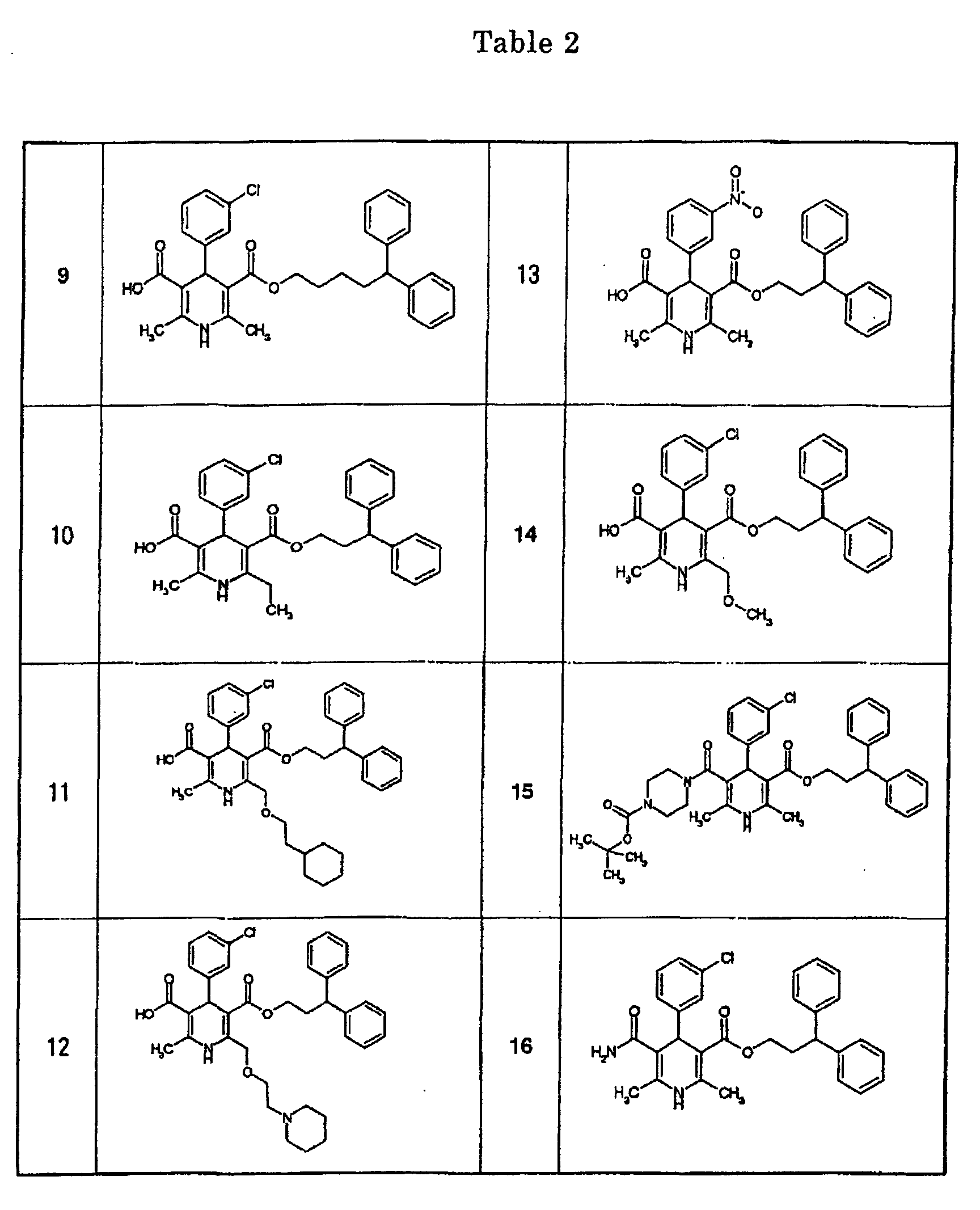


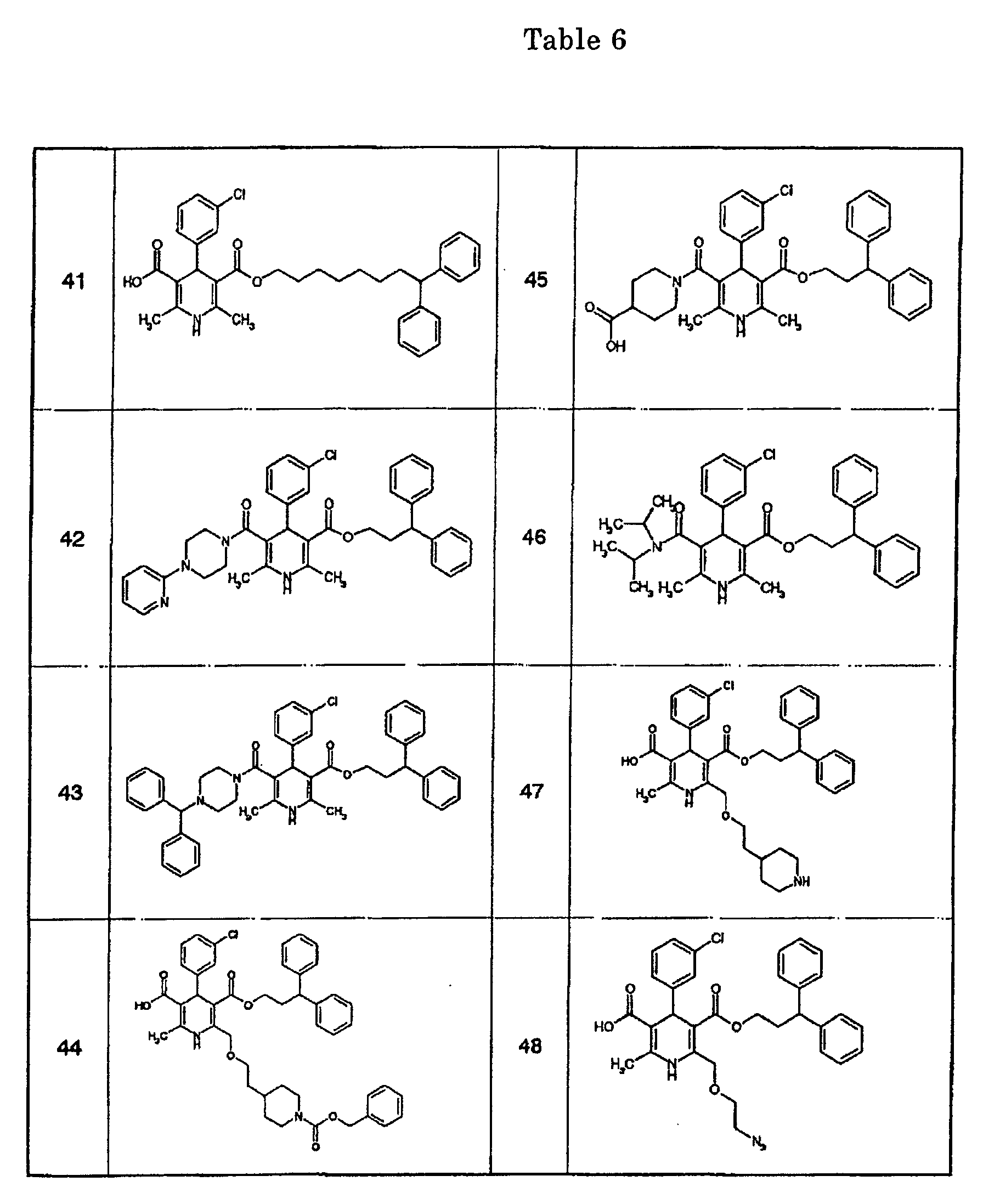
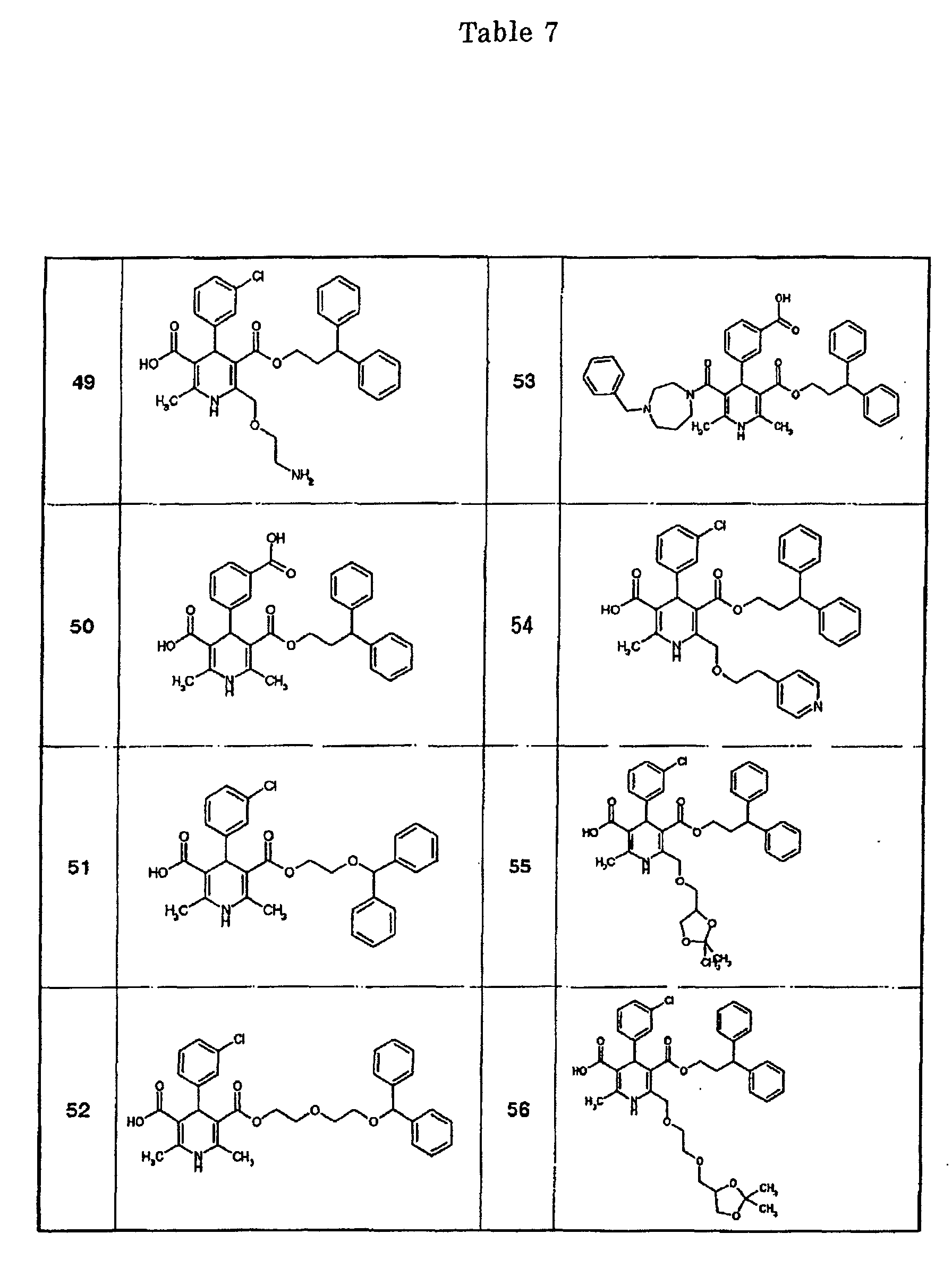

| Example | N-type inhibition pIC50 | L-type inhibition IC50 (µM) |
| 12 | 5.80 | 2.69 |
| 14 | 5.92 | 4.28 |
| 15 | 6.43 | 20.8 |
| 20 | 5.75 | 2.78 |
| 23 | 5.92 | 1.80 |
| Example | N-type inhibition pIC50 | L-type inhibition IC50 (µM) |
| 12 | 5.4 | 2.69 |
| 14 | 5.7 | 4.27 |
| 20 | 5.5 | 2.88 |
| 23 | 5.8 | 1.82 |
| 33 | 5.8 | 1.70 |
| 54 | 5.7 | 1.58 |
| 57 | 5.8 | 1.78 |
| 60 | 5.8 | 3.89 |
Claims (20)
- Dihydropyridine derivatives of the following general formula (1) and pharmaceutically acceptable salts thereof:wherein A represents a group of the following general formula (2), or 1-naphthyl, 2-naphthyl, thiophene-3-yl, thiophene-2-yl, furan-3-yl, furan-2-yl, pyridine-4-yl, pyridine-3-yl, pyridine-2-yl, indole-2-yl or indole-3-yl group:
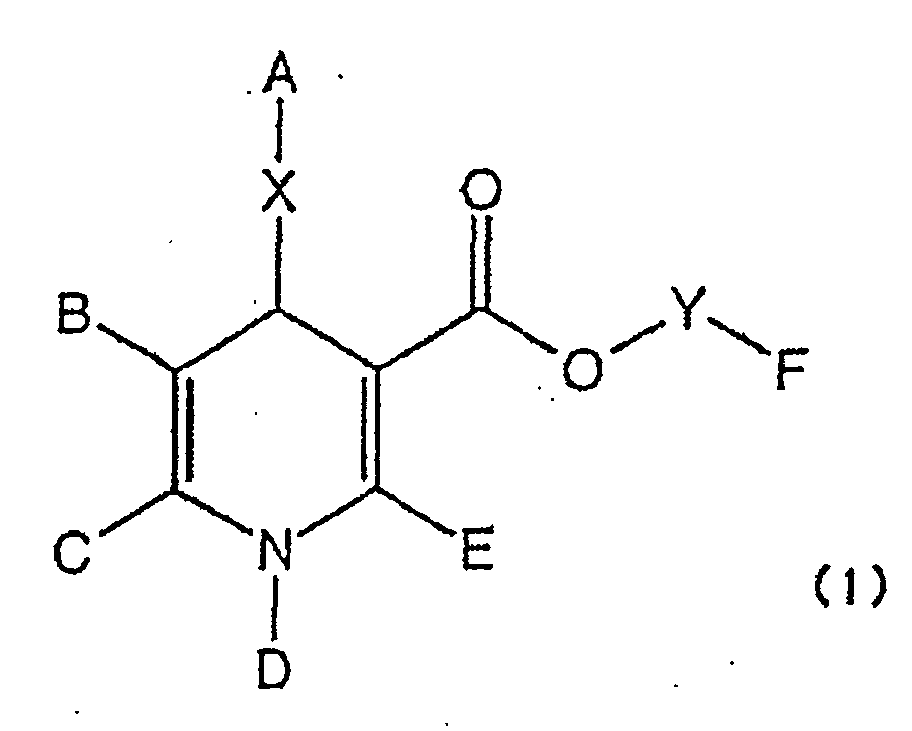 wherein R1, R2, R3, R4 and R5 may be the same or different from each other and each represent hydrogen atom, a halogen atom, hydroxyl group, carboxyl group, amino group, cyano group, nitro group, a lower alkyl group, a lower alkoxyl group, a lower alkenyl group, a lower alkynyl group, a lower alkylamino group, a lower alkylthio group, a lower alkanoyl group, a lower alkoxycarbonyl group, a hydroxy-lower alkyl group, a hydroxy-lower alkoxyl group, a hydroxy-lower alkenyl group, a halogeno-lower alkyl group, a halogeno-lower alkoxyl group, a halogeno-lower alkenyl group, an aryl group, an aryl-lower alkoxyl group or an aroyl group,
B represents cyano group, nitro group, carboxyl group, acetyl group or a group of the following general formula (3):wherein R6 and R7 may be the same or different from each other and each represent hydrogen atom, a lower alkyl group, an amino-lower alkyl group, an amino-lower alkyl group substituted with one or two lower alkyl groups, a carboxy-lower alkyl group, a hydroxy-lower alkyl group, a lower cycloalkyl group, an amino-lower alkenyl group, a carboxy-lower alkenyl group, a hydroxy-lower alkenyl group, an aryl group, a heteroaryl group, an aryl-lower alkyl group, a heteroaryl-lower alkyl group, a lower alkyl group substituted with a cyclic alkyl group which may have a hetero atom in the ring, an aryl-lower alkenyl group or an aryl-lower alkyloxycarbonyl-lower alkyl group, or R6 and R7 may together form a ring which may contain a hetero atom and when the hetero atom is nitrogen atom, it may have a substituent,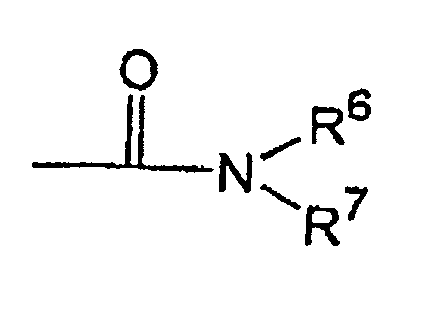
C and E may be the same or different from each other and each represent hydrogen atom, a lower alkyl group, dimethoxymethyl group, cyano group, a hydroxy-lower alkyl group, a carboxy-lower alkyl group, a halogeno-lower alkyl group, an amino-lower alkyl group, in which the amino group may be substituted with one or two of a lower alkyl group, a lower cycloalkyl group, an aryl group or an aryl-lower alkyl group, an azido-lower alkyl group, an aryl group, a heteroaryl group, an aryl-lower alkyl group, a heteroaryl-lower alkyl group, a lower alkyl group substituted with a cyclic alkyl group which may contain a hetero atom in the ring, or a carbamoyl-lower alkyl group, in which the carbamoyl group may be substituted with one or two of a lower alkyl group, a lower cycloalkyl group, an aryl group or an aryl-lower alkyl group,
D represents a hydrogen atom, a lower alkyl group, a hydroxy-lower alkyl group or an aryl-lower alkyl group,
F represents a group represented by any of the following general formulae (4) to (8):wherein G and H may be the same or different from each other and each represent phenyl group, benzyl group, 1-naphthyl group, 2-naphthyl group, thiophene-3-yl group, thiophene-2-yl group, furan-3-yl group, furan-2-yl group, pyridine-4-yl group, pyridine-3-yl group, pyridine-2-yl group, pyridine-4-ylmethyl group, pyridine-3-ylmethyl group or pyridine-2-ylmethyl group, I represents hydrogen atom or hydroxyl group, J represents -CH2-, -NH-, oxygen atom or sulfur atom, and one or two atoms surrounding condensed rings (5) to (8) may be nitrogen atoms,
X represents an interatomic bond, -CH2-, -CH2CH2-, -CH=CH- or -C≡C-, and
Y represents an alkyl group having 1 to 7 carbon atoms, which may contain a hetero atom or cyclopropane ring in the chain, or an alkenyl group, which may contain a hetero atom or cyclopropane ring in the chain. - The dihydropyridine derivatives and pharmaceutically acceptable salts thereof according to claim 1, wherein in general formula (1), B represents carboxyl group, cyano group or a group represented by general formula (3), D represents hydrogen atom, F represents a group of general formula (4) in which G and H each represent phenyl group, and Y represents an alkyl group having 2 or 3 carbon atoms.
- The dihydropyridine derivatives and pharmaceutically acceptable salts thereof according to claim 2, wherein A represents a group of general formula (2) and X represents an interatomic bond.
- The dihydropyridine derivatives and pharmaceutically acceptable salts thereof according to claim 3, wherein B represents carboxyl group or a group of general formula (3).
- The dihydropyridine derivatives and pharmaceutically acceptable salts thereof according to claim 3, wherein C and E may be the same or different from each other and each represent a lower alkyl group, a lower alkyl group substituted with a cyclic alkyl group, which may contain a hetero atom in the ring, a hydroxy-lower alkyl group, an aryl-lower alkyl group or a heteroaryl-lower alkyl group.
- The dihydropyridine derivatives and pharmaceutically acceptable salts thereof according to claim 5, wherein A represents a group of general formula (2) wherein R1, R3, R4 and R5 each represent hydrogen atom and R2 represents chlorine atom, bromine atom, iodine atom, nitro group or cyano group, C and E may be the same or different from each other, and they each represent methyl group, ethyl group, a lower alkyl group substituted with a cycloalkyl group which may contain a hetero atom in the ring, a hydroxy-lower alkyl group, an aryl-lower alkyl group or a heteroaryl-lower alkyl group, and F represents a group of general formula (4) in which I represents hydrogen atom.
- The dihydropyridine derivatives and pharmaceutically acceptable salts thereof according to claim 6, wherein B represents carboxyl group.
- The dihydropyridine derivatives and pharmaceutically acceptable salts thereof according to claim 6, wherein A represents a group of general formula (2) wherein R1, R3, R4 and R5 each represent hydrogen atom and R2 represents chlorine atom, bromine atom, iodine atom or nitro group, C represents methyl group, ethyl group or 2-piperidinoethoxymethyl group, E represents methyl group, ethyl group, dimethoxymethyl group, 2-piperidinoethoxymethyl group, 2-hexamethyleneiminoethoxymethyl group, methoxymethyl group, 2-benzyloxyethoxymethyl group, 2-(2-pyridyl)ethoxymethyl group or 2-hydroxyethoxymethyl group.
- The dihydropyridine derivatives and pharmaceutically acceptable salts thereof according to claim 8, wherein B represents carboxyl group.
- The dihydropyridine derivatives and pharmaceutically acceptable salts thereof according to claim 3, wherein C represents hydrogen atom, a lower alkyl group, dimethoxymethyl group, cyano group, a hydroxy-lower alkyl group, a halogeno-lower alkyl group, an amino-lower alkyl group (in which the amino group may be substituted with one or two of a lower alkyl group, a lower cycloalkyl group, an aryl group and an aryl-lower alkyl group), an azido-lower alkyl group, an aryl group, a heteroaryl group, an aryl-lower alkyl group, a heteroaryl-lower alkyl group, a lower alkyl group substituted with a cyclic alkyl group (which may contain a hetero atom in the ring) or a carbamoyl-lower alkyl group (in which the carbamoyl group may be substituted with one or two of a lower alkyl group, a lower cycloalkyl group, an aryl group and an aryl-lower alkyl group), E represents methyl group, ethyl group, a lower alkoxymethyl group, a hydroxy-lower alkoxymethyl group, an aryl-lower alkoxymethyl group, a heteroaryl-lower alkoxymethyl group, or a lower alkoxymethyl group substituted with a cycloalkyl group (which may contain a hetero atom in the ring).
- The dihydropyridine derivatives and pharmaceutically acceptable salts thereof according to claim 10 wherein B represents carboxyl group.
- The dihydropyridine derivatives and pharmaceutically acceptable salts thereof according to claim 1 wherein A represents a group of general formula (2), B represents carboxyl group, cyano group or a group of general formula (3), D represents hydrogen atom, C and E may be the same or different from each other, and they each represent a lower alkyl group, a lower alkyl group substituted with a cycloalkyl group, which may contain a hetero atom in the ring, an aryl-lower alkyl group, a heteroaryl-lower alkyl group or a hydroxy-lower alkyl group, and X represents an interatomic bond.
- The dihydropyridine derivatives and pharmaceutically acceptable salts thereof according to claim 12, wherein B represents carboxyl group.
- The dihydropyridine derivatives and pharmaceutically acceptable salts thereof according to claim 13 wherein A represents a group of general formula (2) wherein R1, R3, R4 and R5 each represent hydrogen atom and R2 represents chlorine atom, bromine atom, iodine atom or nitro group, C represents methyl group, ethyl group or 2-piperidinoethoxymethyl group, E represents a lower alkyl group, a lower alkyl group substituted with a cycloalkyl group which may contain a hetero atom in the ring, an aryl-lower alkyl group, a heteroaryl-lower alkyl group or a hydroxy-lower alkyl group.
- The dihydropyridine derivatives and pharmaceutically acceptable salts thereof according to claim 13 wherein A represents a group of general formula (2) wherein R1, R3, R4 and R5 each represent hydrogen atom and R2 represents chlorine atom, bromine atom, iodine atom or nitro group, C represents methyl group, ethyl group or 2-piperidinoethoxymethyl group, E represents methyl group, ethyl group, dimethoxymethyl group, 2-piperidinoethoxymethyl group, 2-hexamethyleneiminoethoxymethyl group, methoxymethyl group, 2-benzyloxyethoxymethyl group, 2-(2-pyridyl)ethoxymethyl group or 2-hydroxyethoxymethyl group.
- An N-type calcium channel antagonist comprising a dihydropyridine derivative or a pharmaceutically acceptable salt thereof according to any of claims 1 to 15 as an active ingredient.
- A therapeutic agent comprising the dihydropyridine derivative or a pharmaceutically acceptable salt thereof according to claim 1 or 2 as the active ingredient, for any of acute stage of ischemic cerebrovascular disorders caused by cerebral infarction or intracerebral bleeding, Alzheimer's disease, AIDS related dementia, Parkinson's disease, progressive neurodegenerative diseases, neuropathy caused by head injury, pain caused by thromboangiitis obliterans, postoperative pain, migraine, visceral pain, bronchial asthma, unstable angina, irritable colitis and withdrawal symptoms after addiction to drugs.
- A therapeutic agent comprising the dihydropyridine derivative or a pharmaceutically acceptable salt thereof according to any of claims 3 to 11 as the active ingredient, for any of acute stage of ischemic cerebrovascular disorders caused by cerebral infarction or intracerebral bleeding, Alzheimer's disease, AIDS related dementia, Parkinson's disease, progressive neurodegenerative diseases, neuropathy caused by head injury, pain caused by thromboangiitis obliterans, postoperative pain, migraine, visceral pain, bronchial asthma, unstable angina, irritable colitis and withdrawal symptoms after addiction to drugs.
- A therapeutic agent comprising the dihydropyridine derivative or a pharmaceutically acceptable salt thereof according to any of claims 12 to 15 as the active ingredient, for any of acute stage of ischemic cerebrovascular disorders caused by cerebral infarction or intracerebral bleeding, Alzheimer's disease, AIDS related dementia, Parkinson's disease, progressive neurodegenerative diseases, neuropathy caused by head injury, pain caused by thromboangiitis obliterans, postoperative pain, migraine, visceral pain, bronchial asthma, unstable angina, irritable colitis and withdrawal symptoms after addiction to drugs.
- A pharmaceutical composition comprising any of dihydropyridine compounds and pharmaceutically acceptable salts thereof according to any of claims 1 to 15 as an active ingredient.
Applications Claiming Priority (3)
| Application Number | Priority Date | Filing Date | Title |
|---|---|---|---|
| JP17749199 | 1999-06-23 | ||
| JP17749199 | 1999-06-23 | ||
| PCT/JP2000/004105 WO2000078719A1 (en) | 1999-06-23 | 2000-06-22 | Dihydropyridine derivative |
Publications (2)
| Publication Number | Publication Date |
|---|---|
| EP1191021A1 true EP1191021A1 (en) | 2002-03-27 |
| EP1191021A4 EP1191021A4 (en) | 2002-08-07 |
Family
ID=16031840
Family Applications (1)
| Application Number | Title | Priority Date | Filing Date |
|---|---|---|---|
| EP00940810A Withdrawn EP1191021A4 (en) | 1999-06-23 | 2000-06-22 | Dihydropyridine derivative |
Country Status (4)
| Country | Link |
|---|---|
| US (1) | US7247645B2 (en) |
| EP (1) | EP1191021A4 (en) |
| AU (1) | AU5568200A (en) |
| WO (1) | WO2000078719A1 (en) |
Cited By (3)
| Publication number | Priority date | Publication date | Assignee | Title |
|---|---|---|---|---|
| EP1123923A4 (en) * | 1998-10-23 | 2002-11-27 | Ajinomoto Kk | Dihydropyridine derivatives and drug compositions containing the same |
| WO2003101490A1 (en) * | 2002-05-31 | 2003-12-11 | Ajinomoto Co.,Inc. | Drug composition containing calcium channel antagonist |
| WO2006109164A3 (en) * | 2005-04-15 | 2007-03-29 | Res & Innovation Soc Coop A R | A method for preventing, delaying or reverting abnormal amyloid deposition |
Families Citing this family (4)
| Publication number | Priority date | Publication date | Assignee | Title |
|---|---|---|---|---|
| JP4623354B2 (en) * | 2000-09-14 | 2011-02-02 | 味の素株式会社 | Novel pyrimidine derivatives and novel pyridine derivatives |
| EP1858325A4 (en) * | 2005-01-07 | 2010-06-30 | Roskamp Res Llc | Compounds for inhibiting beta-amyloid production and methods of identifying the compounds |
| WO2022114187A1 (en) * | 2020-11-30 | 2022-06-02 | 国立大学法人九州大学 | Compound having inhibitory action against excessive mitochondrial divisions |
| WO2022173627A2 (en) * | 2021-02-02 | 2022-08-18 | Northwestern University | Ribosome-mediated polymerization of novel chemistries |
Family Cites Families (14)
| Publication number | Priority date | Publication date | Assignee | Title |
|---|---|---|---|---|
| JPS60233058A (en) | 1984-05-04 | 1985-11-19 | Fujirebio Inc | 1,4-dihydropyridine derivative |
| US4616002A (en) * | 1984-11-09 | 1986-10-07 | Ciba-Geigy Corporation | Dihydro pyridine compounds, compositions and use |
| DE3601397A1 (en) | 1986-01-18 | 1987-07-23 | Bayer Ag | SUBSTITUTED 1,4-DIHYDROPYRIDIN-3-CARBONIC ACID PIPERAZIDES, METHOD FOR THE PRODUCTION AND THEIR USE IN MEDICINAL PRODUCTS |
| DK0520200T3 (en) | 1991-06-24 | 1998-09-23 | Neurosearch As | Imadazole compounds, their preparation and use |
| EP0625162B1 (en) | 1991-12-30 | 1998-05-13 | Neurex Corporation | Methods of producing analgesia and enhancing opiate analgesia |
| US5767131A (en) * | 1993-04-05 | 1998-06-16 | Synaptic Pharmaceutical Corporation | Dihydropyridines and new uses thereof |
| IL109220A0 (en) | 1993-04-05 | 1994-07-31 | Synaptic Pharma Corp | Dihydropyridines and new uses thereof |
| DE4313691A1 (en) | 1993-04-27 | 1994-11-03 | Bayer Ag | 2,6-disubstituted 4-quinolyl-dihydropyridines |
| JP3251434B2 (en) | 1994-07-29 | 2002-01-28 | 日研化学株式会社 | 1,4-dihydropyridine derivative |
| DE4430094A1 (en) * | 1994-08-25 | 1996-02-29 | Bayer Ag | Use of 3,5-dicarboxylic acid ester-1,4-dihydropyridines as a drug |
| JP4332902B2 (en) * | 1997-04-25 | 2009-09-16 | 味の素株式会社 | New dihydropyridine derivatives |
| US6350762B1 (en) * | 1997-12-22 | 2002-02-26 | Ajinomoto Co., Inc. | Dihydropyridine derivative |
| AU1600599A (en) | 1998-02-27 | 1999-09-15 | Warner-Lambert Company | Heterocyclic substituted aniline calcium channel blockers |
| WO2000024716A1 (en) | 1998-10-23 | 2000-05-04 | Ajinomoto Co., Inc. | Dihydropyridine derivatives and drug compositions containing the same |
-
2000
- 2000-06-22 AU AU55682/00A patent/AU5568200A/en not_active Abandoned
- 2000-06-22 WO PCT/JP2000/004105 patent/WO2000078719A1/en not_active Ceased
- 2000-06-22 EP EP00940810A patent/EP1191021A4/en not_active Withdrawn
-
2001
- 2001-12-20 US US10/022,874 patent/US7247645B2/en not_active Expired - Fee Related
Cited By (3)
| Publication number | Priority date | Publication date | Assignee | Title |
|---|---|---|---|---|
| EP1123923A4 (en) * | 1998-10-23 | 2002-11-27 | Ajinomoto Kk | Dihydropyridine derivatives and drug compositions containing the same |
| WO2003101490A1 (en) * | 2002-05-31 | 2003-12-11 | Ajinomoto Co.,Inc. | Drug composition containing calcium channel antagonist |
| WO2006109164A3 (en) * | 2005-04-15 | 2007-03-29 | Res & Innovation Soc Coop A R | A method for preventing, delaying or reverting abnormal amyloid deposition |
Also Published As
| Publication number | Publication date |
|---|---|
| AU5568200A (en) | 2001-01-09 |
| US7247645B2 (en) | 2007-07-24 |
| EP1191021A4 (en) | 2002-08-07 |
| US20020147222A1 (en) | 2002-10-10 |
| WO2000078719A1 (en) | 2000-12-28 |
Similar Documents
| Publication | Publication Date | Title |
|---|---|---|
| RU1831476C (en) | Method of preparing dihydropyridine derivatives | |
| DE3208628A1 (en) | NEW COMPOUNDS, METHOD FOR THEIR PRODUCTION AND THEIR USE AS MEDICINAL PRODUCTS | |
| US7494989B2 (en) | Pyridine compounds useful as N-type calcium channel antagonists | |
| JP2010031029A (en) | Pharmaceutical composition containing gabapentin or pregabalin and n-type calcium channel antagonist | |
| JP2009167215A (en) | New diarylalkene derivative and new diarylalkane derivative | |
| EP0097821B1 (en) | Dihydropyridines with an antagonistic activity to calcium, process for their preparation, and pharmaceutical compositions containing them | |
| US5266570A (en) | Piperidine derivatives, compositions and use | |
| US6995179B2 (en) | Dihydropyridine derivative | |
| US6350762B1 (en) | Dihydropyridine derivative | |
| US6610717B2 (en) | Dihydropyridine derivatives | |
| US20020147222A1 (en) | Dihydropyridine derivatives | |
| US20020143023A1 (en) | Dihydropyrimidine compounds and compositions containing the same | |
| US20020002167A1 (en) | Dihydropyridine compounds and composition containing the same | |
| JPWO2000078719A1 (en) | Dihydropyridine derivatives | |
| US5158963A (en) | 1-4-dihydropyridine derivative, process for preparing the same and pharmaceutical composition containing the same | |
| JPWO1999032446A1 (en) | Novel dihydropyridine derivatives | |
| DD259189A5 (en) | PROCESS FOR THE PREPARATION OF NEW HYDROPYRIDINE DERIVATIVES | |
| JPWO2000078730A1 (en) | Novel dihydropyrimidine derivatives | |
| JPWO2000078720A1 (en) | Novel dihydropyridine derivatives |
Legal Events
| Date | Code | Title | Description |
|---|---|---|---|
| PUAI | Public reference made under article 153(3) epc to a published international application that has entered the european phase |
Free format text: ORIGINAL CODE: 0009012 |
|
| 17P | Request for examination filed |
Effective date: 20020104 |
|
| AK | Designated contracting states |
Kind code of ref document: A1 Designated state(s): AT BE CH CY DE DK ES FI FR GB GR IE IT LI LU MC NL PT SE |
|
| AX | Request for extension of the european patent |
Free format text: AL;LT;LV;MK;RO;SI |
|
| A4 | Supplementary search report drawn up and despatched |
Effective date: 20020620 |
|
| AK | Designated contracting states |
Kind code of ref document: A4 Designated state(s): AT BE CH CY DE DK ES FI FR GB GR IE IT LI LU MC NL PT SE |
|
| RIC1 | Information provided on ipc code assigned before grant |
Free format text: 7C 07D 211/90 A, 7C 07D 401/12 B, 7A 61K 31/4422 B, 7A 61K 31/4439 B, 7A 61K 31/444 B, 7A 61K 31/4427 B, 7A 61K 31/5377 B, 7A 61K 31/496 B, 7A 61K 31/551 B |
|
| 17Q | First examination report despatched |
Effective date: 20031106 |
|
| STAA | Information on the status of an ep patent application or granted ep patent |
Free format text: STATUS: THE APPLICATION IS DEEMED TO BE WITHDRAWN |
|
| 18D | Application deemed to be withdrawn |
Effective date: 20040317 |