EP1190952A2 - Can having can end wall provided with reclosing tab - Google Patents

Can having can end wall provided with reclosing tab Download PDF

Info

Publication number
EP1190952A2
EP1190952A2 EP01308082A EP01308082A EP1190952A2 EP 1190952 A2 EP1190952 A2 EP 1190952A2 EP 01308082 A EP01308082 A EP 01308082A EP 01308082 A EP01308082 A EP 01308082A EP 1190952 A2 EP1190952 A2 EP 1190952A2
Authority
EP
European Patent Office
Prior art keywords
tab
reclosing
end wall
opening
discharge opening
Prior art date
Legal status (The legal status is an assumption and is not a legal conclusion. Google has not performed a legal analysis and makes no representation as to the accuracy of the status listed.)
Withdrawn
Application number
EP01308082A
Other languages
German (de)
French (fr)
Other versions
EP1190952A3 (en
Inventor
Chil Surk Yoon
Jai-Jun Choung
Current Assignee (The listed assignees may be inaccurate. Google has not performed a legal analysis and makes no representation or warranty as to the accuracy of the list.)
EU Biotech Development Ltd
Original Assignee
EU Biotech Development Ltd
Priority date (The priority date is an assumption and is not a legal conclusion. Google has not performed a legal analysis and makes no representation as to the accuracy of the date listed.)
Filing date
Publication date
Priority claimed from KR1020000067226A external-priority patent/KR100329127B1/en
Application filed by EU Biotech Development Ltd filed Critical EU Biotech Development Ltd
Priority to EP01308082A priority Critical patent/EP1190952A3/en
Publication of EP1190952A2 publication Critical patent/EP1190952A2/en
Publication of EP1190952A3 publication Critical patent/EP1190952A3/en
Withdrawn legal-status Critical Current

Links

Images

Classifications

    • BPERFORMING OPERATIONS; TRANSPORTING
    • B65CONVEYING; PACKING; STORING; HANDLING THIN OR FILAMENTARY MATERIAL
    • B65DCONTAINERS FOR STORAGE OR TRANSPORT OF ARTICLES OR MATERIALS, e.g. BAGS, BARRELS, BOTTLES, BOXES, CANS, CARTONS, CRATES, DRUMS, JARS, TANKS, HOPPERS, FORWARDING CONTAINERS; ACCESSORIES, CLOSURES, OR FITTINGS THEREFOR; PACKAGING ELEMENTS; PACKAGES
    • B65D17/00Rigid or semi-rigid containers specially constructed to be opened by cutting or piercing, or by tearing of frangible members or portions
    • B65D17/28Rigid or semi-rigid containers specially constructed to be opened by cutting or piercing, or by tearing of frangible members or portions at lines or points of weakness
    • B65D17/401Rigid or semi-rigid containers specially constructed to be opened by cutting or piercing, or by tearing of frangible members or portions at lines or points of weakness characterised by having the line of weakness provided in an end wall
    • BPERFORMING OPERATIONS; TRANSPORTING
    • B65CONVEYING; PACKING; STORING; HANDLING THIN OR FILAMENTARY MATERIAL
    • B65DCONTAINERS FOR STORAGE OR TRANSPORT OF ARTICLES OR MATERIALS, e.g. BAGS, BARRELS, BOTTLES, BOXES, CANS, CARTONS, CRATES, DRUMS, JARS, TANKS, HOPPERS, FORWARDING CONTAINERS; ACCESSORIES, CLOSURES, OR FITTINGS THEREFOR; PACKAGING ELEMENTS; PACKAGES
    • B65D2517/00Containers specially constructed to be opened by cutting, piercing or tearing of wall portions, e.g. preserving cans or tins
    • B65D2517/0001Details
    • B65D2517/001Action for opening container
    • B65D2517/0011Action for opening container push-down tear panel
    • BPERFORMING OPERATIONS; TRANSPORTING
    • B65CONVEYING; PACKING; STORING; HANDLING THIN OR FILAMENTARY MATERIAL
    • B65DCONTAINERS FOR STORAGE OR TRANSPORT OF ARTICLES OR MATERIALS, e.g. BAGS, BARRELS, BOTTLES, BOXES, CANS, CARTONS, CRATES, DRUMS, JARS, TANKS, HOPPERS, FORWARDING CONTAINERS; ACCESSORIES, CLOSURES, OR FITTINGS THEREFOR; PACKAGING ELEMENTS; PACKAGES
    • B65D2517/00Containers specially constructed to be opened by cutting, piercing or tearing of wall portions, e.g. preserving cans or tins
    • B65D2517/0001Details
    • B65D2517/0031Reclosable openings
    • B65D2517/004Reclosable openings by means of an additional element
    • B65D2517/0041Reclosable openings by means of an additional element in the form of a cover

Definitions

  • a can having a can end wall, the can end wall including an opening panel portion which is delimited by a score line so as to define a discharge opening upon being depressed downwards, an opening tab, a reclosing tab and a rivet, wherein the reclosing tab has a substantially cylindrical configuration, being closed at an upper, in use, end thereof and open, or only closed by a temporary cover, at a lower, in use, end thereof, the can end wall having a cylindrical wall part projecting therefrom around the discharge opening and with which the reclosing tab may co-operatively engage in use to thereby close the discharge opening.
  • the opening tab and reclosing tab are oppositely arranged to each other and integrally connected with each other to define a tab section.
  • a tab section 200 and a rivet 300 are provided on the can end wall 100.
  • Three tab supporting projections 110, 120 and 120' are projectedly formed on an upper surface of the can end wall 100.
  • a rivet fitting hole 140 through which the rivet 300 is fitted, is defined in the can end wall 100.
  • an opening panel portion 150 is delimited by a score line on the can end wall 100. When the opening panel portion 150 is depressed downward, a discharge opening is defined and contents can be discharged out of the can.
  • the three tab supporting projections 110, 120 and 120' and the opening panel portion 150 are opposed to each other while being centered on the rivet fitting hole 140.
  • the three tab supporting projections 110, 120 and 120' are formed by pressing the can end wall 100 in a manner such that the tab supporting projections 110, 120 and 120' frusto-conically project from the upper surface of the can end wall 100.
  • One tab supporting projection 110 of the three tab supporting projections 110, 120 and 120' is formed higher than other two tab supporting projections 120 and 120', in a manner such that the one tab supporting projection 110 can support a reclosing tab 220 as will be described later, which constitute the tab section 200.
  • the opening panel portion 150 has substantially a circular plate-shaped configuration.
  • the tab section 200 comprises an opening tab 210 and the reclosing tab 220 which are oppositely arranged to each other and integrally connected with each other. While the opening tab 210 has the same structure as the conventional opening tab, the reclosing tab 220 has substantially a cylindrical configuration which is closed at an upper end thereof and opened at a lower end thereof. A cylindrical side wall of the reclosing tab 220 has a curved side wall portion 222 and a cut-out portion. The cut-out portion is formed in a rotating direction of the reclosing tab 220, and a remaining portion of the cylindrical side wall of the reclosing tab 220 defines the curved side wall portion 222 (see FIG. 6). As best shown in FIG.
  • the discharge opening of the can by grasping the rotation knob 221 of the reclosing tab 220 and rotating the tab section 200 by 180°, as the reclosing tab 220 is placed on the upper end of the cylindrical wall part 151 of the can end wall 100, the discharge opening can be effectively reclosed.
  • the three tab supporting projections 110, 120 and 120' and the rivet 300 cooperatively function as the leverage which holds the opening tab 210 in the raised location, and thereby, the reclosing tab 220 can be brought into close contact with the upper end of the cylindrical wall part 151.
  • an opened lower end of the reclosing tab 220 of the tab section 200 is closed by a vinyl sheet or an aluminum foil (not shown) in the course of manufacturing the reclosing tab 220, whereby the reclosing tab 220 can be used in a state wherein sanitization is ensured.
  • the vinyl sheet or the aluminum foil which is attached to the opened lower end of the reclosing tab 220 can be detached therefrom by the hand.
  • the can having the can end wall provided with the reclosing tab according to the present invention affords advantages in that, since the reclosing tab has a simple structure, the can is able to be manufactured in an easy manner and thereby economy is improved. Also, the can is manufactured in such a way as not to significantly change an existing manufacturing process. in particular, because the possibility of a fingernail of the user to be broken or damaged upon pulling upward a handle end of a tab section is eliminated and a discharge opening can be easily opened and reclosed, user convenience is ensured.
  • a configuration of the can end wall according to the present invention is not altered, and thereby, the effective use of shelf, storage and shipping space, that is, stackability and shippability of the can are not adversely influenced. Furthermore, the can end wall according to the present invention exhibits excellent sealing capability upon reclosing the discharge opening.
  • the reclosing tab does not raise a consumer sanitary question.

Landscapes

  • Engineering & Computer Science (AREA)
  • Mechanical Engineering (AREA)
  • Containers Opened By Tearing Frangible Portions (AREA)

Abstract

Disclosed is a can having a can end wall. The can end wall includes an opening panel portion which is delimited by a score line so as to define a discharge opening upon being depressed downward, an opening tab, a reclosing tab and a rivet. The reclosing tab has substantially a cylindrical configuration which is closed at an upper end thereof and opened at a lower end thereof. The opening tab and the reclosing tab are oppositely arranged to each other and integrally connected with each other to define a tab section. Three tab supporting projections are frusto-conically formed on an upper surface of the can end wall, and a cylindrical wall part is integrally formed with the can end wall in such a way as to be closed at an upper end thereof by the opening panel portion.

Description

BACKGROUND OF THE INVENTION Field of the Invention
The present invention relates to a beverage or beer can having a can end wall provided with a reclosing tab which enables remaining liquid contents to be effectively stored and thereby prevents liquid contents spillage from the can after the can made of aluminum or steel material is initially opened.
Description of the Related Art
Conventionally, a can for containing alcoholic liquors such as beer and a variety of beverages has been widely used throughout the world in view of its convenience upon use and storage. An amount of contents contained in the can generally varies depending upon a human race and a regional culture. In these days, a volume of a can has been gradually increased in obedience to a personal eating practice. However, because it is the norm that contents are drunk down not at one gulp but through several times, once the can is opened, there exists a need to temporarily store remaining liquid contents. Also, if a user moves while holding the can in his hand, the likelihood of liquid spillage from the can is increased.
Moreover, in the case that an opening tab is pulled upward to rupture an opening panel along a score line, since the opening tab is brought into nearly close contact with an upper surface of a can end wall of the can, a fingernail of the user is apt to be broken or damaged in the course of pulling upward the opening tab, whereby troublesomeness is caused in that the opening tab cannot be easily pulled upward.
To cope with these problems induced in a stay-on-tab (SOT) type can opening method which is generally employed among a diversity of can opening methods so far known in the art, a structure has been proposed in which an interval between an upper surface of a can end wall and a lower surface of an opening tab is increased from 0.82-1.05 mm to 1.52-1.95 mm so as to allow the opening tab to be pulled upward in an easy and safe manner. Korean Utility Model Application No. 96-29543 discloses a sanitary cup which is fitted on a beverage can in such a way as to enable a user to share contents with another person in a convenient manner.
Hereinafter, descriptions will be given for a multitude of inventions which are known in the art.
In Korean Utility Model Publication No. 92-1142, a covering piece which is made of synthetic resinous material, is attached to a lower surface of a handle end of an opening tab which handle end is opposed to a discharge opening of a beverage can. By rotating the opening tab through 180° about a rivet and pressing downward the handle end of the opening tab into the discharge opening, the discharge opening can be reclosed by the covering piece. Korean Utility Model Publication No. 92-1142 is similar to U.S. Patent No. 5,779,087 in that the discharge opening is reclosed by the covering piece. In Korean Utility Model Publication No. 92-1142, since an inner edge portion of a can end wall defining the discharge opening and an outer edge portion of the covering piece are rolled and pushed inward of the beverage can, when reopening the beverage can, the probability of a user's fingernail to be broken or damaged is increased. In Korean Utility Model Publication No. 2000-182058, a covering part is formed on an upper surface of a handle end of an opening tab which handle end is opposed to a discharge opening of a beverage can. By bending the handle end toward a lever end of the opening tab through approximately 180° with respect to a rivet and pressing downward the handle end of the opening tab, the discharge opening can be reclosed by the covering part. In Korean Utility Model Publication No. 2000-182058, a problem is caused in that the handle end of the opening tab cannot be fully bent through 180° toward the lever end.
In U.S. Patent No. 5,779,087, a reclosing tab which is made from an elastically deformable rigid plastic material and has a sufficient size capable of covering a discharge opening, is mounted to a lower surface of a metal opening tab, and a tab opening strip is projectedly connected to a top outward side of the reclosing tab. In U.S. Patent No. 5,779,087, when it is necessary to reclose a discharge opening defined in a can end wall, the reclosing tab is rotated approximately 180° about an attaching post/rivet. Then, by pushing downward the reclosing tab into the discharge opening, the discharge opening is reclosed. In U.S. Patent No. 5,779,087, since the reclosing tab made from the plastic material must be separated from the metal opening tab so as to enable a can to be recycled, bothersomeness is provoked from the standpoint of recyling of resources. Also, as described above, when the raclosing tab is pressed downward after being rotated by 180° so as to reclose the discharge opening, since an inner edge portion of a can end wall defining the discharge opening and an outer edge portion of the reclosing tab are rolled and pushed inward of the can, it is difficult to reopen the can.
While U.S. Patent No. 5,785,199 discloses an opening and closing protector which is made from a plastic material, a process for manufacturing the opening and closing protector is complicated, and a manufacturing cost is increased. In U.S. Patent No. 5,452,818, a cup is attached to a lower end surface of a can in a manner such that the cup is used to reclose a discharge opening, which deteriorates stackability and shippability of the can. In U.S. Patent No. 5,351,853, an L-shaped reclosing tab is separately manufactured in a manner such that the reclosing tab can be fitted below an opening tab, and in U.S. Patent No. 5,108,003, a reclosing tab is attached to a lower surface of a can bottom. The reclosing tabs described in U.S. Patent Nos. 5,351,853 and 5,108,003 are inconvenient to use. Further, in U.S. Patent Nos. 4,887,712, 4,842,159, 4,979,635 and
Figure 00050001
reclosing tabs are attached to can end walls along with opening tabs so that the reclosing tabs and opening tabs can be rotated in such a way as to reclose respective discharge openings. However, in these patents, since means for securely maintaining the reclosing tabs within the discharge openings defined in the can end walls are not provided, reliable sealing cannot be ensured.
As a consequence, all of the above-described can reclosing devices suffer from one or more of the following defects:
  • A great deal of effort and cost is required for manufacturing those can reclosing devices.
  • Significant retooling of existing equipment is required.
  • Reliable sealing of a discharge opening cannot be ensured, and those can reclosing devices are inconvenient to use.
  • Due to the fact that lower surfaces of reclosing tabs are exposed to the outside, those can reclosing devices raise a consumer sanitary question.
    • Since entire configurations of cans are changed, the effective use of shelf, storage and shipping space, that is, stackability and shippability of the cans is reduced.
SUMMARY OF THE INVENTION
Accordingly, the present invention has been made in an effort to solve the problems occurring in the related art, and an object of the present invention is to provide a can in which structures of a can end wall and a reclosing tab are modified into more convenient-to-use, safe and simpler ones, and sealing of a discharge opening defined in the can end wall and sanitization of the can are simultaneously ensured when the discharge opening is reclosed by virtue of the reclosing tab.
According to the present invention there is provided a can having a can end wall, the can end wall including an opening panel portion which is delimited by a score line so as to define a discharge opening upon being depressed downwards, an opening tab, a reclosing tab and a rivet, wherein the reclosing tab has a substantially cylindrical configuration, being closed at an upper, in use, end thereof and open, or only closed by a temporary cover, at a lower, in use, end thereof, the can end wall having a cylindrical wall part projecting therefrom around the discharge opening and with which the reclosing tab may co-operatively engage in use to thereby close the discharge opening.
Preferably the opening tab and reclosing tab are oppositely arranged to each other and integrally connected with each other to define a tab section.
Suitably a plurality of tab supporting projections are provided on an upper surface of the can end wall.
Preferably the reclosing tab (220) has on its cylindrical part (222) an annular flange (223) which co-operatively engages with an annular groove (152) in the substantially cylindrical wall part (151) of the can end wall (100).
Suitably the annular flange (223) has a cut-out portion (224) formed therein.
Further inventive features of the present invention are as set out in the claims hereinafter.
BRIEF DESCRIPTION OF THE DRAWINGS
The above objects, and other features and advantages of the present invention will become more apparent after a reading of the following detailed description when taken in conjunction with the drawings, in which:
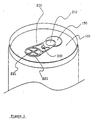
  • FIG. 1 is a partial perspective view illustrating an upper portion of a can having a can end wall provided with a reclosing tab in accordance with an embodiment of the present invention;
  • FIG. 2 is a partial exploded perspective view illustrating the upper portion of the can having the can end wall provided with the reclosing tab in accordance with the embodiment of the present invention;
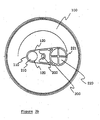
  • FIG. 3a is a plan view illustrating an initial status of a tab section, in the can having the can end wall provided with the reclosing tab in accordance with the embodiment of the present invention;
  • FIG. 3b is a plan view illustrating a state wnerein the tab section is rotated by 180° , in the can having the can end wall provided with the reclosing tab in accordance with the embodiment of the present invention;
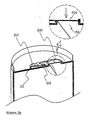
  • FIG. 4 is a partially enlarged and broken-away perspective view illustrating the initial status of the tab section, in the can having the can end wall provided with the reclosing tab in accordance with the embodiment of the present invention;
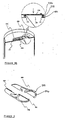
  • FIGs. 5a and 5b are each a partially enlarged and broken-away perspective view of a respective one of two variants of the preferred embodiment illustrating the state wherein an opening panel is ruptured along a score line to define a discharge opening and the discharge opening is reclosed by the reclosing tab, in the can having the can end wall provided with the reclosing tab in accordance with the embodiment of the present invention - in the Figure 5a variant the cylindrical parts of the tab and can endwall are straight sided, whereas in the Figure 5b variant they have an inter-engaging annular flange and groove, respectively.
  • FIG.6 is a bottom perspective view illustrating an appearance of the tab section, in the can having the can end wall provided with the reclosing tab in accordance with the embodiment of the present invention.
  • DETAILED DESCRIPTION OF PREFERRED EMBODIMENTS
    Reference will now be made in greater detail to a preferred embodiment of the invention, an example of which is illustrated in the accompanying drawings. Wherever possible the same reference numerals will be used throughout the drawings and the description to refer to the same or like parts.
    As shown in FIGs. 1 and 2, in a can having a can end wall provided with a reclosing tab, the can end wall 100 is coupled to an upper end of the can.
    In the can according to the present invention, a tab section 200 and a rivet 300 are provided on the can end wall 100. Three tab supporting projections 110, 120 and 120' are projectedly formed on an upper surface of the can end wall 100. A rivet fitting hole 140 through which the rivet 300 is fitted, is defined in the can end wall 100. Also, an opening panel portion 150 is delimited by a score line on the can end wall 100. When the opening panel portion 150 is depressed downward, a discharge opening is defined and contents can be discharged out of the can.
    As shown in FIG. 2, the three tab supporting projections 110, 120 and 120' and the opening panel portion 150 are opposed to each other while being centered on the rivet fitting hole 140. The three tab supporting projections 110, 120 and 120' are formed by pressing the can end wall 100 in a manner such that the tab supporting projections 110, 120 and 120' frusto-conically project from the upper surface of the can end wall 100. One tab supporting projection 110 of the three tab supporting projections 110, 120 and 120' is formed higher than other two tab supporting projections 120 and 120', in a manner such that the one tab supporting projection 110 can support a reclosing tab 220 as will be described later, which constitute the tab section 200. The opening panel portion 150 has substantially a circular plate-shaped configuration. A cylindrical wall part 151 is integrally formed with the can end wall 100 in a manner such that the cylindrical wall part 151 is closed at an upper end thereof by the opening panel portion 150. The cylindrical wall part 151 has substantially a ring-shaped cross-section (see FIGs. 4 and 5). Paper material such as tetrapack having predetermined thickness, shape and size, and silicon-coated aluminum or material such as aluminum or the like, from which the can is made, are attached to an upper surface of the reclosing tab 220. The one tab supporting projection 110 has a height of about 1.5-2 mm, and other two tab supporting projections 120 and 120' have a height of about 1-1.5 mm. That is to say, the one tab supporting projection 110 has a height which is different from that of other two tab supporting projections 120 and 120'.
    As can be readily seen from FIGs. 1 and 2, the tab section 200 comprises an opening tab 210 and the reclosing tab 220 which are oppositely arranged to each other and integrally connected with each other. While the opening tab 210 has the same structure as the conventional opening tab, the reclosing tab 220 has substantially a cylindrical configuration which is closed at an upper end thereof and opened at a lower end thereof. A cylindrical side wall of the reclosing tab 220 has a curved side wall portion 222 and a cut-out portion. The cut-out portion is formed in a rotating direction of the reclosing tab 220, and a remaining portion of the cylindrical side wall of the reclosing tab 220 defines the curved side wall portion 222 (see FIG. 6). As best shown in FIG. 5 by a partially enlarged and broken-away perspective view, when the tab section 200 is rotated by 180° to enable the reclosing tab 220 to reclose the discharge opening, the curved side wall portion 222 of the reclosing tab 220 is engaged with the cylindrical wall part 151 which is integrally formed with the can end wall 100, and thereby, effective sealing of the discharge opening is ensured. Further, as can be readily seen from FIG. 6, due to the fact that the cut-out portion is forired in the cylindrical side wall of the reclosing tab 220, when the reclosing tab 220 is rotated to reclose and reopen the discharge opening, the curved side wall portion 222 of the reclosing tab 220 can be casily engaged with and disengaged from the cylindrical wall part 151. An inner diameter of the cylindrical side wall of the reclosing tab 220 is determined to be slightly larger than that of the cylindrical wall part 151. A height of the cylindrical side wall of the reclosing tab 220 is established in a manner such that the rotating movement of the reclosing tab 220 for reclosing the discharge opening is not disturbed by the cylindrical wall part 151. A rotation knob 221 is projectedly formed on an upper surface of and adjacent to an edge of the reclosing tab 220, so that the tab section 200 is easily rotated while the rotation knob 221 is grasped by the hand. The rotation knob 221 has a height of about 1-2 mm.
    The tab section 200 constructed as mentioned above is assembled to the can end wall 100 by means of the rivet 300. In a state as shown in FIG. 1 wherein the discharge opening is not opened, the opening tab 210 of the tab section 200 is positioned above the opening panel portion 150 of the can end wall 100, and the reclosing tab 220 is positioned above the three tab supporting projections 110, 120 and 120' which are formed on the upper surface of the can end wall 100.
    In the can having the can end wall 100 and the tab section 200 which are assembled in this way, as a handle end of the tab section 200 is pulled upward, the opening panel portion 150 is ruptured along the score line to define the discharge opening, and by this, contents of the can is able to be drunk. When it is necessary to reclose the discharge opening, by grasping the rotation knob 221 and rotating the tab section 200 by 180° about the rivet 300 which serves as a rotation shaft, the discharge opening can be rcclosed by the reclosing tab 220. At this time, the three tab supporting projections 110, 120 and 120' having different heights function as a leverage which holds the opening tab 210 at a raised location. By this, because the reclosing tab 220 is brought into close contact with the upper end of the cylindrical wall part 151, the contents of the can are prevented from being leaking out. Since the cylindrical wall part 151 and the curved side wall portion 222 of the reclosing tab 220 arc engaged with each other around the discharge opening, the discharge opening can be easily reopened (see FIG. 5).
    Due to the fact that the cylindrical wall part 151 and the curved side wall portion 222 of the reclosing tab 220 have circular and curved configurations, respectively, when the discharge opening is reclosed by the reclosing tab 220 as shown in FIG. 5, perfect reclosing of the discharge opening is ensured. In addition, due to the fact that the cut-out portion of the cylindrical side wall of the reclosing tab 220 is formed in the rotating direction of the reclosing tab 220 and the remaining portion of the cylindrical side wall of the reclosing tab 220 defines the curved side wall portion 222 (see FIG. 6), the rotating movement of the reclosing tab 220 can be eased, and thereby the discharge opening can be easily reopened.
    In embodying the present invention, since the rotation knob 221 having a predetermined height and serving as a rotation facilitating projection is formed on the upper surface of the reclosing tab 220 of the tab section 200 which includes the reclosing tab 220 as well as the opening tab 210, the rotation of the tab section 200 can be further eased. The cylindrical wall part 151 is projected upward by about 1 mm from the upper surface of the can end wall 100.
    Upon actually using the can according to the present invention, as can be readily seen from FIGs. 4 and 5, as the handle end of the tab section 200, that is, the reclosing tab 220 is pulled upward, the opening tab 210 depresses the opening panel portion 150 which is delimited by the score line on the can end wall 100. By this, as the opening panel portion 150 is ruptured along the score line, the discharge opening is defined. At this time, as shown in FIG. 4, due to the presence of the three tab supporting projections 110, 120 and 120' which arc formed on the upper surface of the can end wall 100 below the reclosing tab 220, a sufficient spatial distance of no less than 2 mm is secured between the reclosing tab 220 and the upper surface of the can end wall 100. By this, when the can is opened, the probability of a user's fingernail to be broken or damaged can be avoided. Then, if it is necessary to reclose the discharge opening of the can, by grasping the rotation knob 221 of the reclosing tab 220 and rotating the tab section 200 by 180°, as the reclosing tab 220 is placed on the upper end of the cylindrical wall part 151 of the can end wall 100, the discharge opening can be effectively reclosed. At this time, the three tab supporting projections 110, 120 and 120' and the rivet 300 cooperatively function as the leverage which holds the opening tab 210 in the raised location, and thereby, the reclosing tab 220 can be brought into close contact with the upper end of the cylindrical wall part 151.
    According to the present invention, an opened lower end of the reclosing tab 220 of the tab section 200 is closed by a vinyl sheet or an aluminum foil (not shown) in the course of manufacturing the reclosing tab 220, whereby the reclosing tab 220 can be used in a state wherein sanitization is ensured.
    Before the reclosing tab 220 is rotated to reclose the discharge opening and thereby temporarily store the remaining contents of the can, the vinyl sheet or the aluminum foil which is attached to the opened lower end of the reclosing tab 220, can be detached therefrom by the hand.
    As a result, the can having the can end wall provided with the reclosing tab according to the present invention, constructed as mentioned above, affords advantages in that, since the reclosing tab has a simple structure, the can is able to be manufactured in an easy manner and thereby economy is improved. Also, the can is manufactured in such a way as not to significantly change an existing manufacturing process. in particular, because the possibility of a fingernail of the user to be broken or damaged upon pulling upward a handle end of a tab section is eliminated and a discharge opening can be easily opened and reclosed, user convenience is ensured. Further, other than a can end wall having a conventional reclosing tab, a configuration of the can end wall according to the present invention is not altered, and thereby, the effective use of shelf, storage and shipping space, that is, stackability and shippability of the can are not adversely influenced. Furthermore, the can end wall according to the present invention exhibits excellent sealing capability upon reclosing the discharge opening.
    Moreover, in the present invention, due to the fact that a vinyl sheet or an aluminum foil is attached to an opened lower end of the reclosing tab in the course of manufacturing the reclosing tab, the reclosing tab does not raise a consumer sanitary question.
    In the drawings and specification, there have been disclosed typical preferred embodiments of the invention and, although specific terms are employed, they are used in a generic and descriptive sense only and not for purposes of limitation, the scope of the invention being set forth in the following claims.

    Claims (11)

    1. A can having a can end wall, the can end wall including an opening panel portion which is delimited by a score line so as to define a discharge opening upon being depressed downwards, an opening tab, a reclosing tab and a rivet, wherein the reclosing tab has a substantially cylindrical configuration, being closed at an upper, in use, end thereof and open, or only closed by a temporary cover, at a lower, in use, end thereof, the can end wall having a cylindrical wall part projecting therefrom around the discharge opening and with which the reclosing tab may co-operatively engage in use to thereby close the discharge opening.
    2. A can as claimed in claim 1, wherein the opening tab and reclosing tab are oppositely arranged to each other and integrally connected with each other to define a tab section.
    3. A can as claimed in claim 1 or claim 2, wherein a plurality of tab supporting projections are provided on an upper surface of the can end wall.
    4. A can as claimed in claim 3, wherein the tab supporting projections are generally frusto-conical or hemispherical in shape.
    5. A can as claimed in any preceding claim, wherein a rotation knob is provided projecting from an upper surface of the tab section.
    6. A can as claimed in any preceding claim, wherein the lower end of the reclosing tab is closed by a temporary cover comprising a vinyl sheet or aluminium foil in the course of manufacturing the reclosing tab.
    7. A can as claimed in any preceding claim, wherein there are at least three tab supporting projections formed on the can end wall and at least one of the tab supporting projections is higher than others of the tab supporting projections.
    8. A can as claimed in any preceding claim, wherein the substantially cylindrical configuration of the reclosing tab comprises a cylindrical side wall having a curved side wall portion and a cut-out portion, the cut-out portion being formed on a side of the reclosing tab so that when the tab is rotated toward the discharge opening the reclosing tab may slot over the cylindrical side wall portion of the can end wall.
    9. A can as claimed in any preceding claim, wherein the reclosing tab (220) has on its cylindrical part (222) an annular flange (223) which co-operatively engages with an annular groove (152) in the substantially cylindrical wall part (151) of the can end wall (100).
    10. A can as claimed in claim 8 and claim 9 wherein the annular flange (223) has said cut-out portion (224) formed therein.
    11. A can having a can end wall provided with a reclosing tab substantially as hereinbefore described with reference to the accompanying drawings.
    EP01308082A 2000-09-25 2001-09-24 Can having can end wall provided with reclosing tab Withdrawn EP1190952A3 (en)

    Priority Applications (1)

    Application Number Priority Date Filing Date Title
    EP01308082A EP1190952A3 (en) 2000-09-25 2001-09-24 Can having can end wall provided with reclosing tab

    Applications Claiming Priority (5)

    Application Number Priority Date Filing Date Title
    KR2000056238 2000-09-25
    KR20000056238 2000-09-25
    KR1020000067226A KR100329127B1 (en) 2000-09-25 2000-11-13 Beverage can lid provided with reclousable tab
    KR2000067226 2000-11-13
    EP01308082A EP1190952A3 (en) 2000-09-25 2001-09-24 Can having can end wall provided with reclosing tab

    Publications (2)

    Publication Number Publication Date
    EP1190952A2 true EP1190952A2 (en) 2002-03-27
    EP1190952A3 EP1190952A3 (en) 2004-01-07

    Family

    ID=29740404

    Family Applications (1)

    Application Number Title Priority Date Filing Date
    EP01308082A Withdrawn EP1190952A3 (en) 2000-09-25 2001-09-24 Can having can end wall provided with reclosing tab

    Country Status (1)

    Country Link
    EP (1) EP1190952A3 (en)

    Cited By (4)

    * Cited by examiner, † Cited by third party
    Publication number Priority date Publication date Assignee Title
    WO2009103817A1 (en) 2008-02-21 2009-08-27 Christian Bratsch Cover of a container
    WO2010094793A2 (en) 2009-02-23 2010-08-26 Xolution Gmbh Lid of a container
    WO2010115911A1 (en) 2009-04-07 2010-10-14 Xolution Gmbh Reclosable closure of a liquid container
    WO2012031994A1 (en) 2010-09-07 2012-03-15 Xolution Gmbh A lid of a container

    Family Cites Families (4)

    * Cited by examiner, † Cited by third party
    Publication number Priority date Publication date Assignee Title
    US4685849A (en) * 1985-05-29 1987-08-11 Aluminum Company Of America Method for making an easy opening container end closure
    AU643342B2 (en) * 1990-10-31 1993-11-11 Arsenio Gutierrez Blanco Closure for beverage metal containers
    US5186348A (en) * 1991-04-24 1993-02-16 Can Do Associates Can end with lock open and lock closed tab operated by a pull ring
    GB2255081A (en) * 1991-04-25 1992-10-28 Umur Talip Erte Re-sealable portable containers

    Cited By (9)

    * Cited by examiner, † Cited by third party
    Publication number Priority date Publication date Assignee Title
    WO2009103817A1 (en) 2008-02-21 2009-08-27 Christian Bratsch Cover of a container
    US9272823B2 (en) 2008-02-21 2016-03-01 Xolution Gmbh Lid of a container
    WO2010094793A2 (en) 2009-02-23 2010-08-26 Xolution Gmbh Lid of a container
    AT507950B1 (en) * 2009-02-23 2011-07-15 Xolution Gmbh COVER OF A CONTAINER
    US9162796B2 (en) 2009-02-23 2015-10-20 Xolution Gmbh Lid of a container
    WO2010115911A1 (en) 2009-04-07 2010-10-14 Xolution Gmbh Reclosable closure of a liquid container
    US8720740B2 (en) 2009-04-07 2014-05-13 Xolution Gmbh Reclosable closure of a liquid container
    WO2012031994A1 (en) 2010-09-07 2012-03-15 Xolution Gmbh A lid of a container
    US10781012B2 (en) 2010-09-07 2020-09-22 Xolution Gmbh Lid of a container

    Also Published As

    Publication number Publication date
    EP1190952A3 (en) 2004-01-07

    Similar Documents

    Publication Publication Date Title
    US7484638B2 (en) Plastic drink-through cup lid with fold-back tab
    AU705829B2 (en) Raised pouring spout, recessed in an inverted position in a can lid
    US6290084B1 (en) Rotary protective cover attachment for beverage container
    US4262815A (en) Conical can end with a gate and opening tab at the cone apex
    US5273176A (en) Reclosable cover for a beverage can
    US5285919A (en) Beverage container with air access for direct drinking
    US5509568A (en) Drink-through lid for disposable cup
    US20240109685A1 (en) Can lid, can and method for manufacturing a can lid
    CN101910008B (en) Can end
    US8783495B2 (en) Can end
    US9181007B2 (en) Beverage can end with vent port
    US5346087A (en) Reinforced beverage can end with push down gate
    US20030218017A1 (en) Drink-through lid for a beverage container
    US20090039091A1 (en) Can End With Countersink
    US4982862A (en) Digitally openable, resealable container closure
    US4480763A (en) Beverage container opening means
    US6450359B1 (en) Sanitary beverage can lid
    US3949898A (en) Non-detachable easy open flap and tab assembly
    EP1190952A2 (en) Can having can end wall provided with reclosing tab
    US5148935A (en) Venting resealable container closure and associated closure container-combination
    US4265367A (en) Easy opening top closure member for a container
    WO1986006702A1 (en) Easy-open closure
    US20050051552A1 (en) Self-closing lid for beverage cups and the like
    GB2379917A (en) A Reclosable Tab for Beverage Cans
    WO2019162437A1 (en) Beverage can

    Legal Events

    Date Code Title Description
    PUAI Public reference made under article 153(3) epc to a published international application that has entered the european phase

    Free format text: ORIGINAL CODE: 0009012

    AK Designated contracting states

    Kind code of ref document: A2

    Designated state(s): AT BE CH CY DE DK ES FI FR GB GR IE IT LI LU MC NL PT SE TR

    AX Request for extension of the european patent

    Free format text: AL;LT;LV;MK;RO;SI

    PUAL Search report despatched

    Free format text: ORIGINAL CODE: 0009013

    RIC1 Information provided on ipc code assigned before grant

    Ipc: 7B 65D 17/16 B

    Ipc: 7B 65D 17/32 A

    AK Designated contracting states

    Kind code of ref document: A3

    Designated state(s): AT BE CH CY DE DK ES FI FR GB GR IE IT LI LU MC NL PT SE TR

    AX Request for extension of the european patent

    Extension state: AL LT LV MK RO SI

    STAA Information on the status of an ep patent application or granted ep patent

    Free format text: STATUS: THE APPLICATION IS DEEMED TO BE WITHDRAWN

    AKX Designation fees paid
    18D Application deemed to be withdrawn

    Effective date: 20040401

    REG Reference to a national code

    Ref country code: DE

    Ref legal event code: 8566