EP1190844A1 - Water-absorbing composite sheet - Google Patents
Water-absorbing composite sheet Download PDFInfo
- Publication number
- EP1190844A1 EP1190844A1 EP01921773A EP01921773A EP1190844A1 EP 1190844 A1 EP1190844 A1 EP 1190844A1 EP 01921773 A EP01921773 A EP 01921773A EP 01921773 A EP01921773 A EP 01921773A EP 1190844 A1 EP1190844 A1 EP 1190844A1
- Authority
- EP
- European Patent Office
- Prior art keywords
- water
- layer
- water absorbent
- penetrating holes
- absorbent
- Prior art date
- Legal status (The legal status is an assumption and is not a legal conclusion. Google has not performed a legal analysis and makes no representation as to the accuracy of the status listed.)
- Withdrawn
Links
- 239000002131 composite material Substances 0.000 title claims abstract description 27
- XLYOFNOQVPJJNP-UHFFFAOYSA-N water Substances O XLYOFNOQVPJJNP-UHFFFAOYSA-N 0.000 claims abstract description 271
- 230000002745 absorbent Effects 0.000 claims abstract description 92
- 239000002250 absorbent Substances 0.000 claims abstract description 92
- 230000000149 penetrating effect Effects 0.000 claims abstract description 47
- 230000003405 preventing effect Effects 0.000 claims abstract description 40
- 230000027455 binding Effects 0.000 claims description 15
- 238000009739 binding Methods 0.000 claims description 15
- 238000009958 sewing Methods 0.000 claims description 10
- 239000000463 material Substances 0.000 abstract description 12
- 238000010521 absorption reaction Methods 0.000 abstract description 4
- 239000010410 layer Substances 0.000 description 173
- 239000004744 fabric Substances 0.000 description 13
- 238000000034 method Methods 0.000 description 13
- 229920000139 polyethylene terephthalate Polymers 0.000 description 7
- 239000005020 polyethylene terephthalate Substances 0.000 description 7
- 230000000052 comparative effect Effects 0.000 description 6
- 229920000728 polyester Polymers 0.000 description 5
- 210000002700 urine Anatomy 0.000 description 5
- 239000012209 synthetic fiber Substances 0.000 description 4
- 229920002994 synthetic fiber Polymers 0.000 description 4
- 239000000835 fiber Substances 0.000 description 3
- 238000010030 laminating Methods 0.000 description 3
- 238000005406 washing Methods 0.000 description 3
- WFLOTYSKFUPZQB-UHFFFAOYSA-N 1,2-difluoroethene Chemical group FC=CF WFLOTYSKFUPZQB-UHFFFAOYSA-N 0.000 description 2
- 229920000742 Cotton Polymers 0.000 description 2
- 239000003795 chemical substances by application Substances 0.000 description 2
- 238000002485 combustion reaction Methods 0.000 description 2
- 238000009940 knitting Methods 0.000 description 2
- 230000000474 nursing effect Effects 0.000 description 2
- -1 polyethylene Polymers 0.000 description 2
- HGUFODBRKLSHSI-UHFFFAOYSA-N 2,3,7,8-tetrachloro-dibenzo-p-dioxin Chemical compound O1C2=CC(Cl)=C(Cl)C=C2OC2=C1C=C(Cl)C(Cl)=C2 HGUFODBRKLSHSI-UHFFFAOYSA-N 0.000 description 1
- ZAMOUSCENKQFHK-UHFFFAOYSA-N Chlorine atom Chemical compound [Cl] ZAMOUSCENKQFHK-UHFFFAOYSA-N 0.000 description 1
- JOYRKODLDBILNP-UHFFFAOYSA-N Ethyl urethane Chemical compound CCOC(N)=O JOYRKODLDBILNP-UHFFFAOYSA-N 0.000 description 1
- 206010016275 Fear Diseases 0.000 description 1
- YCKRFDGAMUMZLT-UHFFFAOYSA-N Fluorine atom Chemical compound [F] YCKRFDGAMUMZLT-UHFFFAOYSA-N 0.000 description 1
- 239000004698 Polyethylene Substances 0.000 description 1
- 206010040880 Skin irritation Diseases 0.000 description 1
- 210000001124 body fluid Anatomy 0.000 description 1
- 239000010839 body fluid Substances 0.000 description 1
- 229910052801 chlorine Inorganic materials 0.000 description 1
- 239000000460 chlorine Substances 0.000 description 1
- 239000000470 constituent Substances 0.000 description 1
- 238000010276 construction Methods 0.000 description 1
- 230000003247 decreasing effect Effects 0.000 description 1
- 230000008034 disappearance Effects 0.000 description 1
- 238000011156 evaluation Methods 0.000 description 1
- 229910052731 fluorine Inorganic materials 0.000 description 1
- 239000011737 fluorine Substances 0.000 description 1
- 230000002401 inhibitory effect Effects 0.000 description 1
- 238000004519 manufacturing process Methods 0.000 description 1
- 239000000203 mixture Substances 0.000 description 1
- 230000001473 noxious effect Effects 0.000 description 1
- 230000002093 peripheral effect Effects 0.000 description 1
- 229920000573 polyethylene Polymers 0.000 description 1
- 239000002861 polymer material Substances 0.000 description 1
- 229920006264 polyurethane film Polymers 0.000 description 1
- 230000001737 promoting effect Effects 0.000 description 1
- 230000002940 repellent Effects 0.000 description 1
- 239000005871 repellent Substances 0.000 description 1
- 239000011347 resin Substances 0.000 description 1
- 229920005989 resin Polymers 0.000 description 1
- 230000036556 skin irritation Effects 0.000 description 1
- 231100000475 skin irritation Toxicity 0.000 description 1
- 239000000126 substance Substances 0.000 description 1
- 239000002344 surface layer Substances 0.000 description 1
- 239000002699 waste material Substances 0.000 description 1
- 239000002759 woven fabric Substances 0.000 description 1
Images


Classifications
-
- A—HUMAN NECESSITIES
- A61—MEDICAL OR VETERINARY SCIENCE; HYGIENE
- A61F—FILTERS IMPLANTABLE INTO BLOOD VESSELS; PROSTHESES; DEVICES PROVIDING PATENCY TO, OR PREVENTING COLLAPSING OF, TUBULAR STRUCTURES OF THE BODY, e.g. STENTS; ORTHOPAEDIC, NURSING OR CONTRACEPTIVE DEVICES; FOMENTATION; TREATMENT OR PROTECTION OF EYES OR EARS; BANDAGES, DRESSINGS OR ABSORBENT PADS; FIRST-AID KITS
- A61F13/00—Bandages or dressings; Absorbent pads
- A61F13/15—Absorbent pads, e.g. sanitary towels, swabs or tampons for external or internal application to the body; Supporting or fastening means therefor; Tampon applicators
- A61F13/51—Absorbent pads, e.g. sanitary towels, swabs or tampons for external or internal application to the body; Supporting or fastening means therefor; Tampon applicators characterised by the outer layers of the pads
- A61F13/511—Topsheet, i.e. the permeable cover or layer facing the skin
- A61F13/512—Topsheet, i.e. the permeable cover or layer facing the skin characterised by its apertures, e.g. perforations
-
- A—HUMAN NECESSITIES
- A61—MEDICAL OR VETERINARY SCIENCE; HYGIENE
- A61F—FILTERS IMPLANTABLE INTO BLOOD VESSELS; PROSTHESES; DEVICES PROVIDING PATENCY TO, OR PREVENTING COLLAPSING OF, TUBULAR STRUCTURES OF THE BODY, e.g. STENTS; ORTHOPAEDIC, NURSING OR CONTRACEPTIVE DEVICES; FOMENTATION; TREATMENT OR PROTECTION OF EYES OR EARS; BANDAGES, DRESSINGS OR ABSORBENT PADS; FIRST-AID KITS
- A61F13/00—Bandages or dressings; Absorbent pads
- A61F13/15—Absorbent pads, e.g. sanitary towels, swabs or tampons for external or internal application to the body; Supporting or fastening means therefor; Tampon applicators
- A61F13/15203—Properties of the article, e.g. stiffness or absorbency
- A61F13/15268—Properties of the article, e.g. stiffness or absorbency reusable
-
- A—HUMAN NECESSITIES
- A61—MEDICAL OR VETERINARY SCIENCE; HYGIENE
- A61F—FILTERS IMPLANTABLE INTO BLOOD VESSELS; PROSTHESES; DEVICES PROVIDING PATENCY TO, OR PREVENTING COLLAPSING OF, TUBULAR STRUCTURES OF THE BODY, e.g. STENTS; ORTHOPAEDIC, NURSING OR CONTRACEPTIVE DEVICES; FOMENTATION; TREATMENT OR PROTECTION OF EYES OR EARS; BANDAGES, DRESSINGS OR ABSORBENT PADS; FIRST-AID KITS
- A61F13/00—Bandages or dressings; Absorbent pads
- A61F13/15—Absorbent pads, e.g. sanitary towels, swabs or tampons for external or internal application to the body; Supporting or fastening means therefor; Tampon applicators
- A61F13/53—Absorbent pads, e.g. sanitary towels, swabs or tampons for external or internal application to the body; Supporting or fastening means therefor; Tampon applicators characterised by the absorbing medium
- A61F13/534—Absorbent pads, e.g. sanitary towels, swabs or tampons for external or internal application to the body; Supporting or fastening means therefor; Tampon applicators characterised by the absorbing medium having an inhomogeneous composition through the thickness of the pad
- A61F13/537—Absorbent pads, e.g. sanitary towels, swabs or tampons for external or internal application to the body; Supporting or fastening means therefor; Tampon applicators characterised by the absorbing medium having an inhomogeneous composition through the thickness of the pad characterised by a layer facilitating or inhibiting flow in one direction or plane, e.g. a wicking layer
-
- A—HUMAN NECESSITIES
- A61—MEDICAL OR VETERINARY SCIENCE; HYGIENE
- A61F—FILTERS IMPLANTABLE INTO BLOOD VESSELS; PROSTHESES; DEVICES PROVIDING PATENCY TO, OR PREVENTING COLLAPSING OF, TUBULAR STRUCTURES OF THE BODY, e.g. STENTS; ORTHOPAEDIC, NURSING OR CONTRACEPTIVE DEVICES; FOMENTATION; TREATMENT OR PROTECTION OF EYES OR EARS; BANDAGES, DRESSINGS OR ABSORBENT PADS; FIRST-AID KITS
- A61F13/00—Bandages or dressings; Absorbent pads
- A61F13/15—Absorbent pads, e.g. sanitary towels, swabs or tampons for external or internal application to the body; Supporting or fastening means therefor; Tampon applicators
- A61F13/53—Absorbent pads, e.g. sanitary towels, swabs or tampons for external or internal application to the body; Supporting or fastening means therefor; Tampon applicators characterised by the absorbing medium
- A61F13/539—Absorbent pads, e.g. sanitary towels, swabs or tampons for external or internal application to the body; Supporting or fastening means therefor; Tampon applicators characterised by the absorbing medium characterised by the connection of the absorbent layers with each other or with the outer layers
-
- B—PERFORMING OPERATIONS; TRANSPORTING
- B32—LAYERED PRODUCTS
- B32B—LAYERED PRODUCTS, i.e. PRODUCTS BUILT-UP OF STRATA OF FLAT OR NON-FLAT, e.g. CELLULAR OR HONEYCOMB, FORM
- B32B5/00—Layered products characterised by the non- homogeneity or physical structure, i.e. comprising a fibrous, filamentary, particulate or foam layer; Layered products characterised by having a layer differing constitutionally or physically in different parts
- B32B5/22—Layered products characterised by the non- homogeneity or physical structure, i.e. comprising a fibrous, filamentary, particulate or foam layer; Layered products characterised by having a layer differing constitutionally or physically in different parts characterised by the presence of two or more layers which are next to each other and are fibrous, filamentary, formed of particles or foamed
- B32B5/24—Layered products characterised by the non- homogeneity or physical structure, i.e. comprising a fibrous, filamentary, particulate or foam layer; Layered products characterised by having a layer differing constitutionally or physically in different parts characterised by the presence of two or more layers which are next to each other and are fibrous, filamentary, formed of particles or foamed one layer being a fibrous or filamentary layer
-
- B—PERFORMING OPERATIONS; TRANSPORTING
- B32—LAYERED PRODUCTS
- B32B—LAYERED PRODUCTS, i.e. PRODUCTS BUILT-UP OF STRATA OF FLAT OR NON-FLAT, e.g. CELLULAR OR HONEYCOMB, FORM
- B32B7/00—Layered products characterised by the relation between layers; Layered products characterised by the relative orientation of features between layers, or by the relative values of a measurable parameter between layers, i.e. products comprising layers having different physical, chemical or physicochemical properties; Layered products characterised by the interconnection of layers
- B32B7/02—Physical, chemical or physicochemical properties
-
- B—PERFORMING OPERATIONS; TRANSPORTING
- B32—LAYERED PRODUCTS
- B32B—LAYERED PRODUCTS, i.e. PRODUCTS BUILT-UP OF STRATA OF FLAT OR NON-FLAT, e.g. CELLULAR OR HONEYCOMB, FORM
- B32B7/00—Layered products characterised by the relation between layers; Layered products characterised by the relative orientation of features between layers, or by the relative values of a measurable parameter between layers, i.e. products comprising layers having different physical, chemical or physicochemical properties; Layered products characterised by the interconnection of layers
- B32B7/04—Interconnection of layers
- B32B7/08—Interconnection of layers by mechanical means
- B32B7/09—Interconnection of layers by mechanical means by stitching, needling or sewing
-
- A—HUMAN NECESSITIES
- A61—MEDICAL OR VETERINARY SCIENCE; HYGIENE
- A61F—FILTERS IMPLANTABLE INTO BLOOD VESSELS; PROSTHESES; DEVICES PROVIDING PATENCY TO, OR PREVENTING COLLAPSING OF, TUBULAR STRUCTURES OF THE BODY, e.g. STENTS; ORTHOPAEDIC, NURSING OR CONTRACEPTIVE DEVICES; FOMENTATION; TREATMENT OR PROTECTION OF EYES OR EARS; BANDAGES, DRESSINGS OR ABSORBENT PADS; FIRST-AID KITS
- A61F13/00—Bandages or dressings; Absorbent pads
- A61F13/15—Absorbent pads, e.g. sanitary towels, swabs or tampons for external or internal application to the body; Supporting or fastening means therefor; Tampon applicators
- A61F13/51—Absorbent pads, e.g. sanitary towels, swabs or tampons for external or internal application to the body; Supporting or fastening means therefor; Tampon applicators characterised by the outer layers of the pads
- A61F13/511—Topsheet, i.e. the permeable cover or layer facing the skin
- A61F13/512—Topsheet, i.e. the permeable cover or layer facing the skin characterised by its apertures, e.g. perforations
- A61F2013/5127—Topsheet, i.e. the permeable cover or layer facing the skin characterised by its apertures, e.g. perforations characterized by the dimension of apertures
-
- A—HUMAN NECESSITIES
- A61—MEDICAL OR VETERINARY SCIENCE; HYGIENE
- A61F—FILTERS IMPLANTABLE INTO BLOOD VESSELS; PROSTHESES; DEVICES PROVIDING PATENCY TO, OR PREVENTING COLLAPSING OF, TUBULAR STRUCTURES OF THE BODY, e.g. STENTS; ORTHOPAEDIC, NURSING OR CONTRACEPTIVE DEVICES; FOMENTATION; TREATMENT OR PROTECTION OF EYES OR EARS; BANDAGES, DRESSINGS OR ABSORBENT PADS; FIRST-AID KITS
- A61F13/00—Bandages or dressings; Absorbent pads
- A61F13/15—Absorbent pads, e.g. sanitary towels, swabs or tampons for external or internal application to the body; Supporting or fastening means therefor; Tampon applicators
- A61F13/53—Absorbent pads, e.g. sanitary towels, swabs or tampons for external or internal application to the body; Supporting or fastening means therefor; Tampon applicators characterised by the absorbing medium
- A61F13/534—Absorbent pads, e.g. sanitary towels, swabs or tampons for external or internal application to the body; Supporting or fastening means therefor; Tampon applicators characterised by the absorbing medium having an inhomogeneous composition through the thickness of the pad
- A61F13/537—Absorbent pads, e.g. sanitary towels, swabs or tampons for external or internal application to the body; Supporting or fastening means therefor; Tampon applicators characterised by the absorbing medium having an inhomogeneous composition through the thickness of the pad characterised by a layer facilitating or inhibiting flow in one direction or plane, e.g. a wicking layer
- A61F2013/53765—Absorbent pads, e.g. sanitary towels, swabs or tampons for external or internal application to the body; Supporting or fastening means therefor; Tampon applicators characterised by the absorbing medium having an inhomogeneous composition through the thickness of the pad characterised by a layer facilitating or inhibiting flow in one direction or plane, e.g. a wicking layer characterized by its geometry
- A61F2013/53782—Absorbent pads, e.g. sanitary towels, swabs or tampons for external or internal application to the body; Supporting or fastening means therefor; Tampon applicators characterised by the absorbing medium having an inhomogeneous composition through the thickness of the pad characterised by a layer facilitating or inhibiting flow in one direction or plane, e.g. a wicking layer characterized by its geometry with holes
-
- A—HUMAN NECESSITIES
- A61—MEDICAL OR VETERINARY SCIENCE; HYGIENE
- A61F—FILTERS IMPLANTABLE INTO BLOOD VESSELS; PROSTHESES; DEVICES PROVIDING PATENCY TO, OR PREVENTING COLLAPSING OF, TUBULAR STRUCTURES OF THE BODY, e.g. STENTS; ORTHOPAEDIC, NURSING OR CONTRACEPTIVE DEVICES; FOMENTATION; TREATMENT OR PROTECTION OF EYES OR EARS; BANDAGES, DRESSINGS OR ABSORBENT PADS; FIRST-AID KITS
- A61F13/00—Bandages or dressings; Absorbent pads
- A61F13/15—Absorbent pads, e.g. sanitary towels, swabs or tampons for external or internal application to the body; Supporting or fastening means therefor; Tampon applicators
- A61F13/53—Absorbent pads, e.g. sanitary towels, swabs or tampons for external or internal application to the body; Supporting or fastening means therefor; Tampon applicators characterised by the absorbing medium
- A61F13/539—Absorbent pads, e.g. sanitary towels, swabs or tampons for external or internal application to the body; Supporting or fastening means therefor; Tampon applicators characterised by the absorbing medium characterised by the connection of the absorbent layers with each other or with the outer layers
- A61F2013/53966—Absorbent pads, e.g. sanitary towels, swabs or tampons for external or internal application to the body; Supporting or fastening means therefor; Tampon applicators characterised by the absorbing medium characterised by the connection of the absorbent layers with each other or with the outer layers by needling, sewing, blow-needling
-
- D—TEXTILES; PAPER
- D10—INDEXING SCHEME ASSOCIATED WITH SUBLASSES OF SECTION D, RELATING TO TEXTILES
- D10B—INDEXING SCHEME ASSOCIATED WITH SUBLASSES OF SECTION D, RELATING TO TEXTILES
- D10B2401/00—Physical properties
- D10B2401/02—Moisture-responsive characteristics
- D10B2401/022—Moisture-responsive characteristics hydrophylic
Definitions
- the present invention relates to a composite sheet having a four-layer structure comprising a water absorbent layer, a water-backflow preventing layer, a water holding layer and a water impermeable layer and relates to a composite water absorbent sheet suitable as diapers for infants or nursing care, urine pads and bed pads or urine absorbent sheets for pets.
- Sheets for absorbing excrements containing body fluids discharged from human bodies have hitherto been mostly the disposable type using a macromolecular water absorbent polymer material due to its convenience for use.
- the conventional products have been generally spread as paper diapers due to slight water-rewet and excellence in comfortableness and further lightweight and good handleability in spite of a large amount of water absorption.
- the paper diapers have many problems in aspects of environments, since there are problems about an increase in amount of refuse because of disposing the diapers after use thereof only once, and, because paper diapers absorbing water are hard to burn, fears of possibly remaining unburned in some incineration furnaces at low combustion temperatures and of promoting the production of noxious substances such as dioxin from chlorine-containing wastes in furnaces due to reduction of the combustion temperatures of the furnaces.
- the so-called reusable cloth diapers are generally woven fabrics using cotton materials, and, however, there are problems that the cloth diapers are cool and uncomfortable due to great water-rewet, in spite of good water absorbability.
- a water absorbent composite sheet which is a water absorbent sheet comprising (a) a water absorbent layer, (b) a water holding layer and (c) a water impermeable layer successively arranged from the skin side and characterized in that (d) a water-backflow preventing layer comprising a water impermeable sheet material having water penetrating holes is arranged between the layer (a) and the layer (b) and the total area ratio of the water penetrating holes accounts for 3% or above and below 40% of the whole area of the layer (d).
- At least one layer of the above layers (a) and (b) is preferably bound through the layer (d).
- the binding part of the layers (a) and (b) is more preferably bound through the water penetrating holes of the layer (d).
- the binding method is preferably one for binding using a sewing thread.
- the composite water absorbent sheet of the present invention has a structure wherein (a) a water absorbent layer 1, (d) a water-backflow preventing layer 4, (b) a water holding layer 2 and (c) a water impermeable layer 3 are successively arranged from the direction in which water is dropped.
- the surface preferably has unevennesses depending on a fabric structure. Specifically, the surface preferably has the unevennesses depending on a raising treatment, cut piles, loop piles, ridges and a mesh structure.
- the water absorbent layer (a) can be used as a material constituting the water absorbent layer (a).
- the surface dry touch is better with increasing mixture ratio of the synthetic fibers.
- the total fineness of yarns constituting the surface of the water absorbent layer (a) is preferably 222.2 dtex or below, and the single filament fineness is preferably 5.5 dtex or below in order to improve the skin touch and not to cause skin irritation.
- a fabric structure having sufficient water absorbent sites among fibers due to the capillarity is required for the structure of the water holding layer (b) in order to absorb and hold enough water, and a knitted structure is preferable.
- the water-holding capacity in the water holding layer (b) is preferably 100% or above based on the own weight of the water holding layer, more preferably 180% or above based on the own weight.
- the water holding layer (b) is not always one layer and may be composed of plural layers according to the required water-holding capacity.
- Optional synthetic fibers, natural fibers and a combination thereof can be used as a material of yarns used in the water holding layer (b).
- the water-holding capacity and water absorbability of the water holding layer (b) are preferably unlowered by repetition of washing. For example, the use of a hydrophilic processing agent as a finishing agent after washing is cited in the case where synthetic fibers are used.
- the water-backflow preventing layer (d) is arranged between the water absorbent layer (a) 1 and the water holding layer (b) 2 as illustrated in Figures 1, 2, 3 and 4.
- the water-backflow preventing layer (d) 4 is composed of a water impermeable sheet material having several columns of conduit holes 5 as shown in Fig. 5 and the total area ratio of the water penetrating holes accounts for 3% or above and below 40% of the whole area of the water-backflow preventing layer.
- the ratio is below 3%, the water dropped into the water absorbent layer (a) is hard to pass through the water penetrating holes of the water-backflow preventing layer to promote unpleasant touches such as a wet touch or a cool touch of the surface, though the water backflow from the water holding layer (a) to the water absorbent layer (a) on the surface is slight.
- the total area ratio of the water penetrating holes is 40% or above, the water backflow increases in quantity and an unpleasant touch causes a problem, though transferability of water from the water absorbent layer (a) to the water holding layer (b) is good.
- the size of the water penetrating holes is preferably below 5 mm, more preferably below 3 mm in the longitudinal (column) direction, as defined that the long side direction is a longitudinal direction when it is used for a diaper.
- the size in the (transverse) direction perpendicular to the columns is preferably 3 mm or above, more preferably 4 mm or above.
- the column interval X and row interval Y of the water penetrating holes shown in Fig. 5 will be detailed hereinafter.
- the column interval X is preferably 10 mm or above and 30 mm or below.
- the water absorption rate of the water absorbent layer (a) is sometimes lowered though the backflow preventing properties of water are improved.
- Y is preferably 3 mm or above and 10 mm or below because the backflow preventing properties of water are lowered.
- the size of the water penetrating holes is preferably below 5 mm in the longitudinal direction and is preferably 4 mm or above in the transverse direction as mentioned above
- the shape of the water penetrating holes may be an optional form including a square, a circle or a slit.
- An ellipse is most preferred by taking the durability of the shape of the water penetrating holes for a long period into consideration. This is because it is hard to cause stress concentration of external force and cracks due to the absence of corner parts as compared with the case of the water penetrating holes in a square form.
- At least one layer of the water absorbent layer (a) and the water holding layer (b) is preferably bound through the water-backflow preventing layer (d) in order to improve the transferability of water from the water absorbent layer (a) to the water holding layer (b). At least one layer of the water absorbent layer (a) and the water holding layer (b) may be more preferably bound through the water penetrating holes of the water-backflow preventing layer (d).
- the binding plays an important role in rapidly passing water dropped into the water absorbent layer (a) through the water penetrating holes of the water-backflow preventing layer (d) and in transferring the water to the water holding layer (b).
- the water absorbent layer (a) makes recessed parts at the binding points and initially the dropped water is concentrated there, and they assist the water in readily passing through the water penetrating holes of the water-backflow preventing layer (d). Further, the quick transference of the water is assisted by bringing the lower layer of the water absorbent layer (a) into close contact with the surface of the water holding layer (b).
- the most usual method is to bind with a sewing thread using a sewing machine.
- the method for binding may be to make the water absorbent layer (a) closely adhere and join to the water holding layer (b), is not always limited to binding with a sewing thread and may be any other optional bindings.
- water holding layer (b) bound to the water absorbent layer (a) is composed of plural layer structures, at least one layer thereof may be bound, and some layers in the plural layer structures or all the water holding layers may be bound.
- a linear shape is simplest in the shape of binding with the sewing thread, any shape such as a curved line, a lattice and a hexagonal form may be used.
- the water impermeable layer (c) and the water-backflow preventing layer (d) used in the present invention may be any combination insofar as the layers are composed of the following water impermeable sheet materials.
- the layers (c) and (d) may be a film hardly permeating water such as a polyurethane film, a polyethylene film or a fluorine-based film bonded to a woven or a knitted fabric by a laminating method or the like or may be the woven or knitted fabric coated with a resin such as the urethane.
- the water backflow preventing layer (d) may be a strongly water repellent fabric having durability in washing in addition to the laminated fabric or the coated fabric, or any material containing air layers such as a double raschel knitted fabric insofar as the material is a sheetlike material which does not readily transfer water in the water absorbent layer (a) to the water holding layer (c).
- the water absorbent layer (a) constituting the water absorbent composite sheet has a part in quickly absorbing water, rapidly transferring the water through the water penetrating holes of the water-backflow preventing layer (d) to the water holding layer (d) and thereby always retaining the surface layer in dry touch without holding excessive water inhibiting the comfortableness.
- the role of the water-backflow preventing layer (d) consists in assisting the excessive water in the water absorbent layer (a) quickly transferring to the water holding layer (b) and preventing the water stored in the water holding layer (b) from flowing back to the surface of the water absorbent layer (a).
- the binding of the water absorbent layer (a) through the layer (d) to the water holding layer (b), preferably the binding of the water absorbent layer (a) through the water penetrating holes of the layer (d) to the water holding layer (b), plays a role in assisting the excessive water in the water absorbent layer (a) in quickly transferring to the water holding layer (b).
- the water impermeable layer (c) acts so as not to leak the water contained in the water holding layer (b) to the outside of the water absorbent composite sheet.
- the present invention will be specifically detailed by citing Examples.
- the composite water absorbent sheet was evaluated according to the following methods:
- a water absorbent sheet (length 50 cm ⁇ width 25 cm), was dropped 150 cc of water from the side of the water absorbent layer (a) at a rate of 10 cc/sec. The water absorbent sheet was then allowed to stand for 30 seconds, and the part where the water was dropped, as the center, was pressurized at 98 Pa (100 g/cm 2 ). The surface was further brought into contact with a moisture detecting paper manufactured by Toyo Roshi Kaisha Ltd. at a pressure of 49 Pa (50 g/cm 2 ) to observe the backflow state of the water, and the palm of a hand was actually brought into contact to carry out organoleptic judgment of a wet touch due to backflow and sticking of the water on the following criteria:
- a water absorbent sheet (length 50 cm ⁇ width 25 cm), was dropped 150 cc of water from the side of the water absorbent layer (a) at a rate of 10 cc/sec.
- a value obtained by measuring the time (seconds) required for special reflection (specular reflection) due to water on the surface of the water absorbent layer from the completion of the dropping to the disappearance of the reflection was called the water absorbability.
- the water absorbability is better with a shorter value.
- PET 111.1 dtex/24 filament polyester
- M middle bars
- B back bar
- the surface of the water absorbent layer was subjected to raising so as to provide the total number of uneven parts of 11 to 12 based on 10 cm.
- the water-backflow preventing layer was obtained by boring water penetrating holes, as follows, in a sheet prepared by subjecting a 32G smooth knitted fabric using an 83.3 dtex/36 filament PET yarn to laminating processing with difluoroethylene.
- the size of the water penetrating holes was an elliptical shape having a length (minor axis) of 3 mm and a width (major axis) of 5 mm in the case where the direction of long sides was the length when the water-backflow preventing layer was used in a diaper.
- the interval in the longitudinal direction of the water penetrating holes, i.e. the column interval X was 20 mm and the interval in the transverse direction, i.e. the row interval Y was 5 mm.
- the open area ratio was 8.0%.
- the water holding layer was prepared by knitting a 20G ripple knitted fabric using 95% of a No. 40 count cotton single yarn and 5% of a highly shrinkable polyester yarn having a boil-off shrinkage percentage of 30% or above.
- the water impermeable layer was obtained by using a sheet prepared by laminating difluoroethylene onto a smooth fabric using an 83.3 dtex/36 filament polyester yarn in the same manner as in the water-backflow preventing layer (d).
- the periphery was sewed by a 2-needle overlock sewing machine, and stretchable peripheral tapes kept still in an extended state were then sewed onto both sides of the crotch part of the diaper by a 2-needle flat seamer sewing machine.
- the tension was released to thereby form a three-dimensional shape shown in Fig. 6 so that the whole diaper was brought into close contact with the crotch part of a human body.
- the water absorbent layer (a), the water holding layer (b), the water impermeable layer (c) and the water-backflow preventing layer (d) were used in the same manner as in Example 1, and the same procedures were carried out as in Example 1, except that a three ply No. 50 count polyester filament machine sewing thread was used in one layer of the water absorbent layer (a) and the water holding layer (c) and 5 columns were randomly sewed in the longitudinal direction of the diaper at a needle stitch number of 15 needles/3 cm. The seams were not passed through the water penetrating holes in the process.
- the water absorbent layer (a), the water holding layer (b), the water impermeable layer (c) and the water-backflow preventing layer (d) were used in the same manner as in Example 1, and the same procedures were carried out as in Example 1, except that the No. 50 count three ply polyester filament machine sewing thread was used in one layer of the water absorbent layer (a) and the water holding layer (b) and 5 columns were sewed in the longitudinal direction of the diaper at a needle stitch number of 15 needles/3 cm so that seams were passed through the water penetrating holes.
- At least one layer of the water absorbent layer (a) and the water holding layer (b) was bound through the water penetrating holes of the water-backflow preventing layer (d).
- Example 3 The same procedures were carried out as in Example 3, except that only the size of the water penetrating holes of the water-backflow preventing layer (d) was changed into a circular form having a diameter of 2 mm in Example 3.
- Example 3 The same procedures were carried out as in Example 3, except that only the size of the water penetrating holes of the water-backflow preventing layer (d) was changed into a circular form having a diameter of 1 mm in Example 3.
- the total area ratio of the water penetrating holes herein was 0.9%.
- the binding of the water absorbent layer (a) to the water holding layer (b) was performed in the same manner as in Example 3 and, however, the seams were not passed through the water penetrating holes because the seam pitch was 2 mm.
- Example 1 The same procedures were carried out as in Example 1, except that the water penetrating holes of the water-backflow preventing layer (d) were changed into a slit form having a width of 5 mm in Example 1.
- Table 1 shows results of performance evaluation of composite water absorbent sheets obtained in Examples 1, 2, 3 and 4 and Comparative Examples 1 and 2.
- Example 1 was in a nearly satisfactory state such that the size and column and row intervals of the water penetrating holes, i.e. the open area ratio was 8.0%, within the preferred range of the present invention, and the water absorbability was as good as 19 seconds, with slight water-rewet.
- Example 2 was in a nearly satisfactory state such that the water absorbability was as quick as 15 seconds, with slight water-rewet, because the water absorbent layer (a) was bound to the water holding layer (b).
- Example 3 was in an extremely comfortable state in dry touch such that the water absorbability was as quicker as 7 seconds, with hardly any water-rewet, because the water absorbent layer (b) was bound through the water penetrating holes to the water holding layer (b).
- Example 4 was in a nearly satisfactory state such that the water absorbability was as good as 12 seconds, with slight water-rewet, though the water absorbability was somewhat slower than that of Example 3 because the size of the water penetrating holes was decreased to a circular form having a diameter of 2 mm.
- Comparative Example 1 was in a state such that the water absorbability was as slow as 35 seconds, the water transferability from the water absorbent layer (a) to the water holding layer (b) was bad and the water-rewet preventing property was at a level providing an unpleasant touch, because the size of the water penetrating holes was 1 mm and the open area ratio was as low as 0.9%.
- Comparative Example 2 was in a state such that the water-rewet preventing property was deteriorated, though the rate at which the water in the water absorbent layer transferred to the water holding layer was 14 seconds within the tolerance, according to that the open area ratio was increased to 40.0% because the water penetrating holes were changed into slits having a width of 5 mm.
- water readily flowed back from wide openings when a pressure was applied and resulted in promotion of an unpleasant touch.
- the comfortableness to wear of Comparative Example 2 was deteriorated to an unpleasant level incomparable to Examples 1 to 4 of the present invention.
- a comfortable composite water absorbent sheet which is a water absorbent sheet comprising a water absorbent layer, a water holding layer and a water impermeable layer successively arranged from the skin side, wherein the composite water absorbent sheet has a sufficient amount of water absorption with slight water-rewet to the skin by arranging a water-backflow preventing layer comprising a water impermeable sheet material having water penetrating holes between the water absorbent layer and the water holding layer and providing the total area ratio of the water penetrating holes accounting for 3% or above and below 40% of the whole area of the water-backflow preventing layer.
- the water absorbent composite sheet is washable, repetitively usable and suitably usable as diapers for nursing care of infants and the aged, urine pads, sheets and further urine absorbent sheets for pets.
Landscapes
- Health & Medical Sciences (AREA)
- Engineering & Computer Science (AREA)
- Life Sciences & Earth Sciences (AREA)
- Biomedical Technology (AREA)
- Heart & Thoracic Surgery (AREA)
- Vascular Medicine (AREA)
- Epidemiology (AREA)
- Animal Behavior & Ethology (AREA)
- General Health & Medical Sciences (AREA)
- Public Health (AREA)
- Veterinary Medicine (AREA)
- Mechanical Engineering (AREA)
- Laminated Bodies (AREA)
- Absorbent Articles And Supports Therefor (AREA)
Abstract
A comfortable water absorbent composite sheet which is a water
absorbent sheet comprising a water absorbent layer, a water holding layer and
a water impermeable layer successively arranged from the skin side, wherein
the composite water absorbent sheet has a sufficient amount of water
absorption with slight water-rewet to the skin by arranging a water-backflow
preventing layer comprising a water impermeable sheet material having water
penetrating holes between the water absorbent layer and the water holding
layer and providing the total area ratio of the water penetrating holes
accounting for 3% or above and below 40% of the whole area of the water-backflow
preventing layer.
Description
- The present invention relates to a composite sheet having a four-layer structure comprising a water absorbent layer, a water-backflow preventing layer, a water holding layer and a water impermeable layer and relates to a composite water absorbent sheet suitable as diapers for infants or nursing care, urine pads and bed pads or urine absorbent sheets for pets.
- Sheets for absorbing excrements containing body fluids discharged from human bodies have hitherto been mostly the disposable type using a macromolecular water absorbent polymer material due to its convenience for use. The conventional products have been generally spread as paper diapers due to slight water-rewet and excellence in comfortableness and further lightweight and good handleability in spite of a large amount of water absorption. The paper diapers, however, have many problems in aspects of environments, since there are problems about an increase in amount of refuse because of disposing the diapers after use thereof only once, and, because paper diapers absorbing water are hard to burn, fears of possibly remaining unburned in some incineration furnaces at low combustion temperatures and of promoting the production of noxious substances such as dioxin from chlorine-containing wastes in furnaces due to reduction of the combustion temperatures of the furnaces.
- On the other hand, the so-called reusable cloth diapers are generally woven fabrics using cotton materials, and, however, there are problems that the cloth diapers are cool and uncomfortable due to great water-rewet, in spite of good water absorbability.
- It is an object of the present invention to provide a washable and reutilizable comfortable composite water absorbent sheet capable of eliminating the above problems possessed by the prior art and having slight water-rewet and a slight cool touch even in contact with skin after absorbing water.
- As a result of intensive studies made to achieve the above object, the present inventors have cleared up that a desired water absorbent composite sheet is obtained by arranging a water-backflow preventing layer between a water absorbent layer on the surface and a water holding layer. Thereby, the present invention has been completed.
- Namely, according to the present invention, there is provided a water absorbent composite sheet which is a water absorbent sheet comprising (a) a water absorbent layer, (b) a water holding layer and (c) a water impermeable layer successively arranged from the skin side and characterized in that (d) a water-backflow preventing layer comprising a water impermeable sheet material having water penetrating holes is arranged between the layer (a) and the layer (b) and the total area ratio of the water penetrating holes accounts for 3% or above and below 40% of the whole area of the layer (d).
- At least one layer of the above layers (a) and (b) is preferably bound through the layer (d). The binding part of the layers (a) and (b) is more preferably bound through the water penetrating holes of the layer (d). The binding method is preferably one for binding using a sewing thread.
-
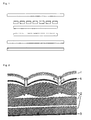
- Fig. 1 is a schematic drawing illustrating the structure of cross section in the central part of the composite water absorbent sheet of the present invention.
- Fig. 2 is a schematic drawing illustrating the cross-sectional view in the central part of the composite water absorbent sheet wherein the water absorbent layer is bound through water penetrating holes of a water-backflow preventing layer to a water holding layer, and Fig. 3 is a schematic drawing illustrating a cross-sectional structure thereof.
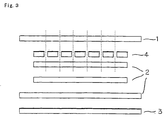
- Fig. 4 is an exploded view illustrating one example of the shape of the water absorbent layer, water-backflow preventing layer, water holding layer and water impermeable layer constituting the water absorbent composite sheet of the present invention.
- Fig. 5 is a plane view illustrating one example of a water impermeable sheet material constituting the composite water absorbent sheet of the present invention.
- Fig. 6 is a perspective view illustrating one example of a urine pad using the water absorbent composite sheet of the present invention.
-
- As illustrated in, for example, Fig. 1, the composite water absorbent sheet of the present invention has a structure wherein (a) a water
absorbent layer 1, (d) a water-backflow preventing layer 4, (b) awater holding layer 2 and (c) a waterimpermeable layer 3 are successively arranged from the direction in which water is dropped. - In the composite water absorbent sheet of the present invention, since it is necessary for the water absorbent layer (a) to absorb water once but to transfer water, without subsequently holding water, through water penetrating holes of the next water-backflow preventing layer (d) to the water holding layer (b) and to maintain the surface of the water absorbent layer (a) after absorbing water in dry touch as much as possible, the surface preferably has unevennesses depending on a fabric structure. Specifically, the surface preferably has the unevennesses depending on a raising treatment, cut piles, loop piles, ridges and a mesh structure.
- Furthermore, natural fibers, synthetic fibers and a combination thereof can be used as a material constituting the water absorbent layer (a). The surface dry touch is better with increasing mixture ratio of the synthetic fibers. On the other hand, the total fineness of yarns constituting the surface of the water absorbent layer (a) is preferably 222.2 dtex or below, and the single filament fineness is preferably 5.5 dtex or below in order to improve the skin touch and not to cause skin irritation.
- A fabric structure having sufficient water absorbent sites among fibers due to the capillarity is required for the structure of the water holding layer (b) in order to absorb and hold enough water, and a knitted structure is preferable.
- The water-holding capacity in the water holding layer (b) is preferably 100% or above based on the own weight of the water holding layer, more preferably 180% or above based on the own weight. The water holding layer (b) is not always one layer and may be composed of plural layers according to the required water-holding capacity. Optional synthetic fibers, natural fibers and a combination thereof can be used as a material of yarns used in the water holding layer (b). The water-holding capacity and water absorbability of the water holding layer (b) are preferably unlowered by repetition of washing. For example, the use of a hydrophilic processing agent as a finishing agent after washing is cited in the case where synthetic fibers are used.
- The water-backflow preventing layer (d) is arranged between the water absorbent layer (a) 1 and the water holding layer (b) 2 as illustrated in Figures 1, 2, 3 and 4.
- It is necessary that the water-backflow preventing layer (d) 4 is composed of a water impermeable sheet material having several columns of
conduit holes 5 as shown in Fig. 5 and the total area ratio of the water penetrating holes accounts for 3% or above and below 40% of the whole area of the water-backflow preventing layer. When the ratio is below 3%, the water dropped into the water absorbent layer (a) is hard to pass through the water penetrating holes of the water-backflow preventing layer to promote unpleasant touches such as a wet touch or a cool touch of the surface, though the water backflow from the water holding layer (a) to the water absorbent layer (a) on the surface is slight. Conversely, when the total area ratio of the water penetrating holes is 40% or above, the water backflow increases in quantity and an unpleasant touch causes a problem, though transferability of water from the water absorbent layer (a) to the water holding layer (b) is good. - The size of the water penetrating holes is preferably below 5 mm, more preferably below 3 mm in the longitudinal (column) direction, as defined that the long side direction is a longitudinal direction when it is used for a diaper. The size in the (transverse) direction perpendicular to the columns is preferably 3 mm or above, more preferably 4 mm or above. When the size in the longitudinal direction of the water penetrating holes becomes 5 mm or above, water collected in the water holding layer (b) in the lower layer sometimes passes through the water penetrating holes by slight pressurization and flows back to the water absorbent layer (a) to cause unpleasant touches such as a wet touch or a cool touch. On the other hand, when the size in the transverse direction of the water penetrating holes becomes below 3 mm, rapid transfer of water from the water absorbent layer (a) to the water holding layer (b) may be difficult. As a result, a large amount of water stays in the water absorbent layer (a) on the surface and once again causes unpleasant touches such as a wet touch or a cool touch.
- The column interval X and row interval Y of the water penetrating holes shown in Fig. 5 will be detailed hereinafter. Although the water transfer rate from the water absorbent layer (a) to the water holding layer (b) is improved with narrower column interval X of the water penetrating holes, the backflow of water from the water holding layer (b) is increased vice versa. The column interval X, therefore, is preferably 10 mm or above and 30 mm or below. When the column interval X exceeds 30 mm, the water absorption rate of the water absorbent layer (a) is sometimes lowered though the backflow preventing properties of water are improved.
- Although the water transfer rate is improved with narrower row interval Y of the water penetrating holes shown in Fig. 5, Y is preferably 3 mm or above and 10 mm or below because the backflow preventing properties of water are lowered.
- Further, although the size of the water penetrating holes is preferably below 5 mm in the longitudinal direction and is preferably 4 mm or above in the transverse direction as mentioned above, the shape of the water penetrating holes may be an optional form including a square, a circle or a slit. An ellipse, however, is most preferred by taking the durability of the shape of the water penetrating holes for a long period into consideration. This is because it is hard to cause stress concentration of external force and cracks due to the absence of corner parts as compared with the case of the water penetrating holes in a square form.
- At least one layer of the water absorbent layer (a) and the water holding layer (b) is preferably bound through the water-backflow preventing layer (d) in order to improve the transferability of water from the water absorbent layer (a) to the water holding layer (b). At least one layer of the water absorbent layer (a) and the water holding layer (b) may be more preferably bound through the water penetrating holes of the water-backflow preventing layer (d).
- As shown in Figs. 2 and 3, the binding plays an important role in rapidly passing water dropped into the water absorbent layer (a) through the water penetrating holes of the water-backflow preventing layer (d) and in transferring the water to the water holding layer (b). The water absorbent layer (a) makes recessed parts at the binding points and initially the dropped water is concentrated there, and they assist the water in readily passing through the water penetrating holes of the water-backflow preventing layer (d). Further, the quick transference of the water is assisted by bringing the lower layer of the water absorbent layer (a) into close contact with the surface of the water holding layer (b).
- The most usual method, as a specific method mentioned above for binding, is to bind with a sewing thread using a sewing machine. The method for binding, however, may be to make the water absorbent layer (a) closely adhere and join to the water holding layer (b), is not always limited to binding with a sewing thread and may be any other optional bindings.
- When the water holding layer (b) bound to the water absorbent layer (a) is composed of plural layer structures, at least one layer thereof may be bound, and some layers in the plural layer structures or all the water holding layers may be bound.
- Although a linear shape is simplest in the shape of binding with the sewing thread, any shape such as a curved line, a lattice and a hexagonal form may be used.
- The water impermeable layer (c) and the water-backflow preventing layer (d) used in the present invention may be any combination insofar as the layers are composed of the following water impermeable sheet materials.
- Namely, the layers (c) and (d) may be a film hardly permeating water such as a polyurethane film, a polyethylene film or a fluorine-based film bonded to a woven or a knitted fabric by a laminating method or the like or may be the woven or knitted fabric coated with a resin such as the urethane. The water backflow preventing layer (d), however, may be a strongly water repellent fabric having durability in washing in addition to the laminated fabric or the coated fabric, or any material containing air layers such as a double raschel knitted fabric insofar as the material is a sheetlike material which does not readily transfer water in the water absorbent layer (a) to the water holding layer (c).
- Actions of the respective constituent layers on comfortable functions of the composite water absorbent sheet of the present invention will be explained hereinafter.
- The water absorbent layer (a) constituting the water absorbent composite sheet has a part in quickly absorbing water, rapidly transferring the water through the water penetrating holes of the water-backflow preventing layer (d) to the water holding layer (d) and thereby always retaining the surface layer in dry touch without holding excessive water inhibiting the comfortableness.
- Moreover, as described above, the role of the water-backflow preventing layer (d) consists in assisting the excessive water in the water absorbent layer (a) quickly transferring to the water holding layer (b) and preventing the water stored in the water holding layer (b) from flowing back to the surface of the water absorbent layer (a).
- On the other hand, the binding of the water absorbent layer (a) through the layer (d) to the water holding layer (b), preferably the binding of the water absorbent layer (a) through the water penetrating holes of the layer (d) to the water holding layer (b), plays a role in assisting the excessive water in the water absorbent layer (a) in quickly transferring to the water holding layer (b).
- In addition, the water impermeable layer (c) acts so as not to leak the water contained in the water holding layer (b) to the outside of the water absorbent composite sheet.
- The present invention will be specifically detailed by citing Examples. The composite water absorbent sheet was evaluated according to the following methods:
- Onto a water absorbent sheet (length 50 cm × width 25 cm), was dropped 150 cc of water from the side of the water absorbent layer (a) at a rate of 10 cc/sec. The water absorbent sheet was then allowed to stand for 30 seconds, and the part where the water was dropped, as the center, was pressurized at 98 Pa (100 g/cm2). The surface was further brought into contact with a moisture detecting paper manufactured by Toyo Roshi Kaisha Ltd. at a pressure of 49 Pa (50 g/cm2) to observe the backflow state of the water, and the palm of a hand was actually brought into contact to carry out organoleptic judgment of a wet touch due to backflow and sticking of the water on the following criteria:
- o ○: an extremely comfortable state in a dry touch with almost no water-rewet
- ○ : a nearly satisfactory comfortable state with slight water-rewet
- Δ : a tolerable state with a slight unpleasant touch though with somewhat water-rewet and
- × : an uncomfortable state with water-rewet in an increased quantity and strong wet touch and cool touch.
-
- Onto a water absorbent sheet (length 50 cm × width 25 cm), was dropped 150 cc of water from the side of the water absorbent layer (a) at a rate of 10 cc/sec. A value obtained by measuring the time (seconds) required for special reflection (specular reflection) due to water on the surface of the water absorbent layer from the completion of the dropping to the disappearance of the reflection was called the water absorbability. The water absorbability is better with a shorter value.
- A tricot 4-bar knitting machine was used, and a 111.1 dtex/24 filament polyester (PET, hereinafter PET means polyethylene terephthalate) yarn was used in a front bar (F). A 166.7 dtex/48 filament PET textured yarn was used in one of middle bars (M) and a 55.5 dtex/24 filament PET yarn was used in the other. A 166.7 dtex/48 filament PET textured yarn was used in a back bar (B). Thereby, the water absorbent layer (a) of the water absorbent composite sheet of the present invention was knitted.
- The surface of the water absorbent layer was subjected to raising so as to provide the total number of uneven parts of 11 to 12 based on 10 cm.
- (d) The water-backflow preventing layer was obtained by boring water penetrating holes, as follows, in a sheet prepared by subjecting a 32G smooth knitted fabric using an 83.3 dtex/36 filament PET yarn to laminating processing with difluoroethylene. The size of the water penetrating holes was an elliptical shape having a length (minor axis) of 3 mm and a width (major axis) of 5 mm in the case where the direction of long sides was the length when the water-backflow preventing layer was used in a diaper. The interval in the longitudinal direction of the water penetrating holes, i.e. the column interval X was 20 mm and the interval in the transverse direction, i.e. the row interval Y was 5 mm. As a result, the open area ratio was 8.0%.
- (b) The water holding layer was prepared by knitting a 20G ripple knitted fabric using 95% of a No. 40 count cotton single yarn and 5% of a highly shrinkable polyester yarn having a boil-off shrinkage percentage of 30% or above.
- (c) The water impermeable layer was obtained by using a sheet prepared by laminating difluoroethylene onto a smooth fabric using an 83.3 dtex/36 filament polyester yarn in the same manner as in the water-backflow preventing layer (d).
- The above water absorbent layer (a), the water-backflow preventing layer (d), the water holding layer (b) and the water impermeable layer (c) were then sewed into the shape of a diaper as shown in Figs. 4 and 6.
- Specifically, the periphery was sewed by a 2-needle overlock sewing machine, and stretchable peripheral tapes kept still in an extended state were then sewed onto both sides of the crotch part of the diaper by a 2-needle flat seamer sewing machine. The tension was released to thereby form a three-dimensional shape shown in Fig. 6 so that the whole diaper was brought into close contact with the crotch part of a human body.
- The water absorbent layer (a), the water holding layer (b), the water impermeable layer (c) and the water-backflow preventing layer (d) were used in the same manner as in Example 1, and the same procedures were carried out as in Example 1, except that a three ply No. 50 count polyester filament machine sewing thread was used in one layer of the water absorbent layer (a) and the water holding layer (c) and 5 columns were randomly sewed in the longitudinal direction of the diaper at a needle stitch number of 15 needles/3 cm. The seams were not passed through the water penetrating holes in the process.
- The water absorbent layer (a), the water holding layer (b), the water impermeable layer (c) and the water-backflow preventing layer (d) were used in the same manner as in Example 1, and the same procedures were carried out as in Example 1, except that the No. 50 count three ply polyester filament machine sewing thread was used in one layer of the water absorbent layer (a) and the water holding layer (b) and 5 columns were sewed in the longitudinal direction of the diaper at a needle stitch number of 15 needles/3 cm so that seams were passed through the water penetrating holes.
- In the process, at least one layer of the water absorbent layer (a) and the water holding layer (b) was bound through the water penetrating holes of the water-backflow preventing layer (d).
- The same procedures were carried out as in Example 3, except that only the size of the water penetrating holes of the water-backflow preventing layer (d) was changed into a circular form having a diameter of 2 mm in Example 3.
- The same procedures were carried out as in Example 3, except that only the size of the water penetrating holes of the water-backflow preventing layer (d) was changed into a circular form having a diameter of 1 mm in Example 3. The total area ratio of the water penetrating holes herein was 0.9%.
- The binding of the water absorbent layer (a) to the water holding layer (b) was performed in the same manner as in Example 3 and, however, the seams were not passed through the water penetrating holes because the seam pitch was 2 mm.
- The same procedures were carried out as in Example 1, except that the water penetrating holes of the water-backflow preventing layer (d) were changed into a slit form having a width of 5 mm in Example 1.
- Table 1 shows results of performance evaluation of composite water absorbent sheets obtained in Examples 1, 2, 3 and 4 and Comparative Examples 1 and 2.
- Example 1 was in a nearly satisfactory state such that the size and column and row intervals of the water penetrating holes, i.e. the open area ratio was 8.0%, within the preferred range of the present invention, and the water absorbability was as good as 19 seconds, with slight water-rewet.
- Example 2 was in a nearly satisfactory state such that the water absorbability was as quick as 15 seconds, with slight water-rewet, because the water absorbent layer (a) was bound to the water holding layer (b).
- Example 3 was in an extremely comfortable state in dry touch such that the water absorbability was as quicker as 7 seconds, with hardly any water-rewet, because the water absorbent layer (b) was bound through the water penetrating holes to the water holding layer (b).
- Example 4 was in a nearly satisfactory state such that the water absorbability was as good as 12 seconds, with slight water-rewet, though the water absorbability was somewhat slower than that of Example 3 because the size of the water penetrating holes was decreased to a circular form having a diameter of 2 mm.
- Comparative Example 1, however, was in a state such that the water absorbability was as slow as 35 seconds, the water transferability from the water absorbent layer (a) to the water holding layer (b) was bad and the water-rewet preventing property was at a level providing an unpleasant touch, because the size of the water penetrating holes was 1 mm and the open area ratio was as low as 0.9%.
- Although the same layer construction as in Example 1 was used, Comparative Example 2 was in a state such that the water-rewet preventing property was deteriorated, though the rate at which the water in the water absorbent layer transferred to the water holding layer was 14 seconds within the tolerance, according to that the open area ratio was increased to 40.0% because the water penetrating holes were changed into slits having a width of 5 mm. In addition, water readily flowed back from wide openings when a pressure was applied and resulted in promotion of an unpleasant touch. As a result, the comfortableness to wear of Comparative Example 2 was deteriorated to an unpleasant level incomparable to Examples 1 to 4 of the present invention.


- As described in the present invention, there can be obtained a comfortable composite water absorbent sheet which is a water absorbent sheet comprising a water absorbent layer, a water holding layer and a water impermeable layer successively arranged from the skin side, wherein the composite water absorbent sheet has a sufficient amount of water absorption with slight water-rewet to the skin by arranging a water-backflow preventing layer comprising a water impermeable sheet material having water penetrating holes between the water absorbent layer and the water holding layer and providing the total area ratio of the water penetrating holes accounting for 3% or above and below 40% of the whole area of the water-backflow preventing layer. The water absorbent composite sheet is washable, repetitively usable and suitably usable as diapers for nursing care of infants and the aged, urine pads, sheets and further urine absorbent sheets for pets.
Claims (4)
- A water absorbent composite sheet which is a water absorbent sheet comprising (a) a water absorbent layer, (b) a water holding layer and (c) a water impermeable layer successively arranged from the skin side and characterized in that (d) a water-backflow preventing layer comprising a water impermeable sheet having water penetrating holes is arranged between the layer (a) and the layer (b) and the total area ratio of the water penetrating holes accounts for 3% or above and below 40% of the whole area of the layer (d).
- The water absorbent composite sheet according to claim 1, wherein at least one layer of the layer (a) and the layer (b) is bound through the layer (d).
- The water absorbent composite sheet according to claim 2, wherein at least one layer of the layer (a) and the layer (b) is bound through the water penetrating holes of the layer (d).
- The water absorbent sheet according to claim 2 or 3, wherein the binding of the layer (a) and the layer (b) is a binding with a sewing thread.
Applications Claiming Priority (3)
| Application Number | Priority Date | Filing Date | Title |
|---|---|---|---|
| JP2000113056 | 2000-04-14 | ||
| JP2000113056 | 2000-04-14 | ||
| PCT/JP2001/002576 WO2001078976A1 (en) | 2000-04-14 | 2001-03-28 | Water-absorbing composite sheet |
Publications (1)
| Publication Number | Publication Date |
|---|---|
| EP1190844A1 true EP1190844A1 (en) | 2002-03-27 |
Family
ID=18625098
Family Applications (1)
| Application Number | Title | Priority Date | Filing Date |
|---|---|---|---|
| EP01921773A Withdrawn EP1190844A1 (en) | 2000-04-14 | 2001-03-28 | Water-absorbing composite sheet |
Country Status (6)
| Country | Link |
|---|---|
| US (1) | US20020198508A1 (en) |
| EP (1) | EP1190844A1 (en) |
| KR (1) | KR20020026181A (en) |
| CN (1) | CN1366489A (en) |
| CA (1) | CA2376841A1 (en) |
| WO (1) | WO2001078976A1 (en) |
Families Citing this family (9)
| Publication number | Priority date | Publication date | Assignee | Title |
|---|---|---|---|---|
| CA2767724A1 (en) | 2009-07-23 | 2011-01-27 | Chromatin, Inc. | Sorghum centromere sequences and minichromosomes |
| JP5952663B2 (en) * | 2012-07-06 | 2016-07-13 | ユニ・チャーム株式会社 | Pet sheet and pet sheet packaging package |
| BR112015015386A2 (en) | 2012-12-28 | 2018-05-15 | Sca Hygiene Prod Ab | disposable absorbent article with a fluid flow control element |
| US9808382B2 (en) | 2012-12-28 | 2017-11-07 | Sca Hygiene Products Ab | Absorbent article having fluid flow control member |
| CN104305767A (en) * | 2014-10-10 | 2015-01-28 | 浙江芬力针织有限公司 | Water-absorbing damp-proof knitted fabric mattress |
| TWI639416B (en) * | 2015-12-07 | 2018-11-01 | 簡元正 | Sanitary cotton |
| US11304536B2 (en) * | 2016-07-28 | 2022-04-19 | Airweave Inc. | Bedding and bedding cover sheet |
| JP6726135B2 (en) * | 2017-06-15 | 2020-07-22 | ユニ・チャーム株式会社 | Absorbent sheet for pets |
| CN114699241B (en) * | 2022-04-01 | 2023-06-30 | 河南逸祥卫生科技有限公司 | High diffusion absorption infant diaper |
Family Cites Families (6)
| Publication number | Priority date | Publication date | Assignee | Title |
|---|---|---|---|---|
| JPH0199835A (en) * | 1987-10-14 | 1989-04-18 | Toray Ind Inc | Sanitary sheet |
| US5306267A (en) * | 1992-01-06 | 1994-04-26 | J & E Enterprise | Reusable, all-in-one, multi-layered diaper with wicking action, moisture retention, and methods for making and using same |
| JPH07148876A (en) * | 1993-11-26 | 1995-06-13 | Shinshiyou Kk | Laminated woven fabric |
| JPH11113945A (en) * | 1997-10-14 | 1999-04-27 | Hakuyo:Kk | Diaper made of cloth |
| JPH11113954A (en) * | 1997-10-17 | 1999-04-27 | Shiseido Co Ltd | Surface raw material or filtering material for absorbent article, and its manufacture |
| JP3074134U (en) * | 2000-06-16 | 2000-12-19 | ユアサ株式会社 | Diapers with integrated cover |
-
2001
- 2001-03-28 US US10/009,563 patent/US20020198508A1/en not_active Abandoned
- 2001-03-28 KR KR1020017015978A patent/KR20020026181A/en not_active Withdrawn
- 2001-03-28 WO PCT/JP2001/002576 patent/WO2001078976A1/en not_active Ceased
- 2001-03-28 EP EP01921773A patent/EP1190844A1/en not_active Withdrawn
- 2001-03-28 CN CN01800938A patent/CN1366489A/en active Pending
- 2001-03-28 CA CA002376841A patent/CA2376841A1/en not_active Abandoned
Non-Patent Citations (1)
| Title |
|---|
| See references of WO0178976A1 * |
Also Published As
| Publication number | Publication date |
|---|---|
| CA2376841A1 (en) | 2001-10-25 |
| CN1366489A (en) | 2002-08-28 |
| KR20020026181A (en) | 2002-04-06 |
| WO2001078976A1 (en) | 2001-10-25 |
| US20020198508A1 (en) | 2002-12-26 |
Similar Documents
| Publication | Publication Date | Title |
|---|---|---|
| KR101400703B1 (en) | Absorbent article and process for production thereof | |
| JP5054454B2 (en) | Absorbent articles | |
| JP5155411B2 (en) | Seams joining two or more web materials | |
| US8282617B2 (en) | Disposable diaper | |
| KR102486259B1 (en) | Improved acquisition distribution stack | |
| JP4829204B2 (en) | Pet excrement disposal tool | |
| KR20000069067A (en) | Multifunctional Absorbent Material and Products Made Therefrom | |
| JP2005534421A (en) | Multifunctional thin paper for absorbent articles | |
| IE44363B1 (en) | Management of incontinence | |
| KR20110139721A (en) | Absorbent article | |
| KR20010095119A (en) | Body fluid absorbable wearing article | |
| US20020198508A1 (en) | Water-absorbing composite sheet | |
| EP2901993B1 (en) | Undulated structure for an absorbent article | |
| MX2011004448A (en) | Absorbent garments with improved fit in the front leg area. | |
| JP4035470B2 (en) | Body fluid absorbent article | |
| EP1731124B1 (en) | Spread out-type paper diaper | |
| US20020032422A1 (en) | Washable absorption element suitable for reuse | |
| TWI849302B (en) | Absorbent articles | |
| JP2008284167A (en) | Absorbent articles | |
| JP5148200B2 (en) | Disposable diapers | |
| JP4417984B2 (en) | Disposable diapers | |
| JP2003205558A (en) | Quick-drying composite water-absorbent sheet and quick-drying diaper | |
| US20060142717A1 (en) | Absorbent bed pad | |
| JPWO2001078976A1 (en) | Composite water-absorbing sheet | |
| WO2026002360A1 (en) | Cover for absorbent article with fasteners |
Legal Events
| Date | Code | Title | Description |
|---|---|---|---|
| PUAI | Public reference made under article 153(3) epc to a published international application that has entered the european phase |
Free format text: ORIGINAL CODE: 0009012 |
|
| 17P | Request for examination filed |
Effective date: 20011129 |
|
| AK | Designated contracting states |
Kind code of ref document: A1 Designated state(s): AT BE CH CY DE DK ES FI FR GB GR IE IT LI LU MC NL PT SE TR |
|
| STAA | Information on the status of an ep patent application or granted ep patent |
Free format text: STATUS: THE APPLICATION IS DEEMED TO BE WITHDRAWN |
|
| 18D | Application deemed to be withdrawn |
Effective date: 20031001 |