EP1190644A1 - Cleaning device and container containing a single dosage of cleaning material - Google Patents
Cleaning device and container containing a single dosage of cleaning material Download PDFInfo
- Publication number
- EP1190644A1 EP1190644A1 EP00120523A EP00120523A EP1190644A1 EP 1190644 A1 EP1190644 A1 EP 1190644A1 EP 00120523 A EP00120523 A EP 00120523A EP 00120523 A EP00120523 A EP 00120523A EP 1190644 A1 EP1190644 A1 EP 1190644A1
- Authority
- EP
- European Patent Office
- Prior art keywords
- cleaning
- container
- single dosage
- cleaning device
- passage
- Prior art date
- Legal status (The legal status is an assumption and is not a legal conclusion. Google has not performed a legal analysis and makes no representation as to the accuracy of the status listed.)
- Withdrawn
Links
Images

Classifications
-
- A—HUMAN NECESSITIES
- A47—FURNITURE; DOMESTIC ARTICLES OR APPLIANCES; COFFEE MILLS; SPICE MILLS; SUCTION CLEANERS IN GENERAL
- A47K—SANITARY EQUIPMENT; ACCESSORIES THEREFOR, e.g. TOILET ACCESSORIES
- A47K11/00—Closets without flushing; Urinals without flushing; Chamber pots; Chairs with toilet conveniences or specially adapted for use with toilets
- A47K11/10—Hand tools for cleaning the toilet bowl, seat or cover, e.g. toilet brushes
-
- A—HUMAN NECESSITIES
- A46—BRUSHWARE
- A46B—BRUSHES
- A46B11/00—Brushes with reservoir or other means for applying substances, e.g. paints, pastes, water
- A46B11/0003—Brushes with reservoir or other means for applying substances, e.g. paints, pastes, water containing only one dose of substance, e.g. single-use toothbrushes
-
- A—HUMAN NECESSITIES
- A46—BRUSHWARE
- A46B—BRUSHES
- A46B11/00—Brushes with reservoir or other means for applying substances, e.g. paints, pastes, water
- A46B11/001—Brushes with reservoir or other means for applying substances, e.g. paints, pastes, water with integral reservoirs
- A46B11/002—Brushes with reservoir or other means for applying substances, e.g. paints, pastes, water with integral reservoirs pressurised at moment of use manually or by powered means
- A46B11/0055—Brushes with reservoir or other means for applying substances, e.g. paints, pastes, water with integral reservoirs pressurised at moment of use manually or by powered means with a reciprocating piston or plunger acting as the pressurising means
-
- A—HUMAN NECESSITIES
- A46—BRUSHWARE
- A46B—BRUSHES
- A46B2200/00—Brushes characterized by their functions, uses or applications
- A46B2200/30—Brushes for cleaning or polishing
- A46B2200/304—Lavatory brush, i.e. brushes for cleaning toilets
Definitions
- the present invention relates to a cleaning device according to claim 1, especially for cleaning containers with permanent water volume, as toilet bowls and the like.
- the invention further relates to a container containing a single dosage of cleaning material according to claim 11.
- toilet bowls are typically one of the most undesirable jobs for most persons. Nevertheless, toilet bowls must be kept clean in order to prevent sanitary problems, the potential for irritable smells, and the possibility of harmful bacteria buildup.
- bowl cleaning products are known. Such products typically fall within two categories, namely, cleaning by hand with a bowl cleaning device or with automatic "in tank” or “in bowl” cleaners.
- Automatic "in tank” or “in bowl” cleaners comprise cleaning material in the form of a slowly dissolving block or tablet or of a gel or liquid disposed under the rim of the toilet bowl or in the water container. These automatic cleaners dispense a dosage of cleaning material upon flushing of the toilet.
- they are generally not as effective as manual scrubbing. Therefore most consumers typically supplement such automatic cleaners with hand scrubbing and cleaning.
- Hand cleaning typically takes the form of a toilet cleaning brush or sponge.
- Most users apply a certain dosage of liquid cleaning material or cleaning powder, stored in a bottle or a container, to the surface of the toilet bowl. The right dosage has to be estimated by the user.
- Most people wanting a sufficient cleaning result tend to apply an overdose. This may cause foam development that can't be flushed in one go and more burden to the environment than necessary.
- most bottles respectively containers do not allow dosing the cleaning material exactly, as their openings are often wide, dispensing the cleaning material in one splash.
- Some products have angled nozzles to reach under the rim of the toilet but these till result in a lot of the cleaning liquid running into the bowl water and not remaining in the area needed to be cleaned.
- cleaning powder kept in bottles or other containers tends to agglomerate in the humid bathroom atmosphere when the bottle is not closed properly.
- most containers have a safety cap the material contained is a danger to children who manage to open it.
- An inventive cleaning device comprising a cleaning head, a handle adapted to receive at least one single dosage of cleaning material and delivering means operable, in use, to deliver a single dosage of cleaning material into the cleaning head and to release the cleaning material from the cleaning head has the advantage that a well defined dosage of cleaning material is delivered directly to the cleaning head and is thereby dispensed directly at the surface which is to be cleaned. Further, no manual contact with the cleaning head is necessary. This ensures that the highest concentration of active material, i.e. the cleaning formulation or composition, is within bristles, a sponge, closed-cell phenolic foam or other medium acting as use surface for cleaning or scrubbing, and the material is then distributed from there respectively by them.
- the active material is used more efficient than when poured directly onto the surface, from where it is at least partially dissolved and flushed without being used for cleaning.
- a well defined dosage of active material is applied to the surface, ensuring optimum cleaning action at minimum expenses and minimum release of substances burdening the environment.
- the dosage may be adjusted to the application, e.g. toilet bowl cleaning, by providing containers with a respective volume and/or concentration of active material.
- a further advantage is that the user does not need to handle the material itself.
- a single material dosage is preferably contained in a container or a tablet which is easy, safe and clean to handle. Even with liquid materials no spilling can occur as the active material is contained in a closed container and released from the cleaning head, without the user touching it directly.
- Another advantage is that with the cleaning formula coming from within the brush, it keeps the brush itself clean and prevents germ attraction.
- the inventive device is preferably used for, but not restricted to cleaning surfaces of containers with a permanent water volume.
- Cleaning material is preferably inserted in the form of a material tablet or contained in a cartridge-like container, whose walls consist of water soluble material, preferably Polyvinylalcohol (PVA), which is preferably low-temperature dissolving.
- PVA Polyvinylalcohol
- Water reaching the cleaning material contained in the device through openings in the cleaning head dissolves or disintegrates the active cleaning material and/or its container.
- a liquid, e.g. a solution, suspension or dispersion, containing cleaning material is then released through the same openings.
- the container walls dissolve completely during the time normally required for a cleaning action such that, after cleaning the surface, the device is ready for the next use without the need for rinsing or cleaning it.
- a material tablet the features of the cleaning composition are chosen such that the tablet is completely decomposed under the influence of water during the typical cleaning time, e.g. 30 seconds.
- the cleaning material itself is not necessarily water soluble, but can for example contain abrasives.
- the handle comprises an at least partially hollow shaft extending to the cleaning head and forming a passage for insertion and delivery of the single dosage of cleaning material.
- the handle further comprises a rod dimensioned to slide within the passage for pushing the single dosage of cleaning material into or next to the cleaning head.
- the single dosage of cleaning material can be inserted at or near the top end of the handle, respectively a portion of the device which is not in direct contact with the surface to clean, at a distance from the cleaning head.
- the insertion area is clean and dry, and the inserted active material is delivered into the cleaning head without the need for manual handling or touching the device near the cleaning head.
- the device further comprises a spring acting to push the rod to the bottom of the passage.
- the diameter of rod and passage are designed such that the passage fits tightly around the rod, while the rod is able to slide within the passage. Thereby water is prevented from entering an upper portion of the passage, thereby ensuring that the inside of the passage is dry, and a water soluble cartridge inserted into the passage does not get stuck in the passage.
- the rod can comprise a gasket to seal the passage respectively its upper part off from the wet inside of the cleaning head.
- the cleaning device comprises a cutting edge, e.g. a spike, located in the device, preferably at a bottom end of the passage.
- This edge facilitates cutting or piercing a cartridge-like container inserted into the device, wherein the container contains the single dosage of cleaning material as powder or liquid detergent. This has the advantage that the container is pierced when pushed into the device, immediately releasing the cleaning material.
- the inventive container or cartridge contains a single dosage of non-aqueous or anhydrous powder or liquid cleaning material and is made of a water soluble foil.
- the water soluble foil consists of a Polyvinylalcohol (PVA) which is preferably low-temperature dissolving.
- PVA films supplied by the following suppliers can be used: Aquafilm ltd. (AQUAFILM), Environmental Polymers ltd. (EP POLY), Cris Craft Inc. (MONO-SOLO®).
- the container preferably has a cylindrical shape, preferably with a circular cross section. Cartridges like this are easy to manufacture from a sheet material or a flexible tube.
- sachets are constructed from a tube that is sealed at the ends, e.g. twisted or heat sealed. This methods results in no flanges around the edge, i.e. the surface in contact with the tube is free of excess PVA.
- the diameter of the cartridge ranges from 10 to 40 mm, preferably around 25 to 35 mm.
- the length of the cartridge ranges from 30 to 80 mm, preferably around 45 to 55 mm.
- the cartridge has an internal volume of approximately 1.5 to 43 cm 3 , preferably around 18 to 20 cm 3 .
- the cartridge is a small pouch containing active material or has spherical shape, as known for single dosage soap containers.
- Fig. 1a-d show an inventive cleaning device 1 in a sectional view. Four steps of the insertion of a container 15 with cleaning material 17 into the device 1 are depicted.
- the inventive device 1 comprises a cleaning head 3 in the form of a brush with a plurality of bristles 9. It further comprises a handle 2 having a shaft 2' whose bottom end 2a comprises the bristles 9 and forms the cleaning head 3. The upper end 2b of the shaft 2' comprises a grip portion where the user can grip the handle 2 when cleaning.
- the shaft is a hollow tube forming a cylindrical passage 4.
- the bottom end 5 of the passage 4 is closed.
- a cutting edge 10 is located at the bottom end 5 for piercing a cartridge-like container 15 inserted into the passage 4 and pushed down to the bottom end 5.
- a cylindrical rod 6 fits tightly into the passage 4 and is able to slide up and down.
- a user can move the rod 6 by moving a slider 13 which is connected to the rod 6 and moves along an axial slit opening 14 in the shaft 2'.
- a preferably weak spring 8 contained at the upper end 2b of the shaft 2' is compressed when the slider 13 respectively the rod 6 is pulled upward, as shown in fig. 1b.
- the spring 14 helps to push the rod downward when moving the slider 13 downward and to keep the rod in the downward position, as shown in fig. 1a, 1c and 1d.
- Fig. 1a shows a cleaning device 1 without a container 15 with cleaning material 17 inserted, the rod 6 being in the downward position.
- an introduction opening 12 which can be additionally closed by a door.
- a container 15 with cleaning material 17 is inserted into the passage 4, as shown in fig. 1b.
- the cartridge 15 is then pushed down by the rod 6, as shown in fig. 1c.
- the cutting edge 10 here a spike
- the foil forming the container walls is pierced and the cleaning material 17, e.g. a powder
- the container itself is then dissolved by water entering the bottom end 5 of the passage 4 via the outlet openings 16.
- the empty cleaning device can then be reused for another cleaning action, i.e. inserting a new container, pushing it down, etc.
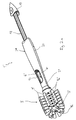
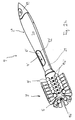
- Fig. 2a, b show a second inventive device 1' in two positions.
- the device 1' in a first "open” position for the insertion of a cartridge (not shown) is shown in fig. 2a; the device in a second "closed” position, e.g. for storing the device or for cleaning, is shown in fig. 2b.
- the inventive device 1' here for the use as toilet brush, comprises a handle 2'' and a cleaning head 3" connected to or being an integral part of the handle 2''.
- the cleaning head has a plurality of bristles 9' for scrubbing a toilet bowl and the like.
- the handle comprises a first member 19 and an elongate second member 20 which forms the major part of the handle.
- First and second member 19, 20 are movable with respect to each other by a bar 18 which is connected to the first member 19 an is able to slide within the second member 20 in its axial direction.
- the second member comprises an insertion opening 12' for the cleaning cartridge.
- the opening 12' is open when the two members 19, 20 are at maximum distance from each other, as shown in fig. 2a.
- the second member 20 and the cleaning head 3' are hollow, forming a passage 4' extending from the opening to the bottom 5' of the cleaning head 3' for the insertion and delivery of cleaning material.
- a cartridge In the "open" position as shown in fig. 2a a cartridge can be inserted into the opening. It is then pushed down to the bottom 5' of the passage 4' by moving the first member 19 towards the second member 20. Via the bar 18 a rod 6' which is connected to the bar or an integral part of the bar 18 is pushed into the passage, acting to push the cartridge down towards the cleaning head 3'. The rod 6' closes the opening 12' by fitting tightly into the passage 4'. In fig. 2b two members 19, 20 are snapped onto each other to facilitate handling the device.
- water enters the cleaning head 3' through openings 16' which are disposed between the bristles 9'. Water then dissolves or disintegrates the cartridge with active material or a solid tablet of cleaning material contained inside the head 3'. Liquid containing active material is then released via the same openings 16' directly to the place of application.
Landscapes
- Health & Medical Sciences (AREA)
- Public Health (AREA)
- Detergent Compositions (AREA)
- Bidet-Like Cleaning Device And Other Flush Toilet Accessories (AREA)
Abstract
The present invention relates to a cleaning device (1, 1')
especially for cleaning surfaces, as toilet bowls and the
like, having a cleaning head (3, 3') and a handle (2,
2''). The cleaning device further comprises delivering
means operable, in use, to deliver a single dosage of
cleaning material (17), preferably contained in a small
container, into or next to the cleaning head (3, 3') and
to release the cleaning material (17) from the cleaning
head (3, 3'). Thereby exactly the amount of cleaning
material needed for the cleaning action is dispensed and
distributed over the surface by the cleaning head, no
overdosing occurs.
Description
- The present invention relates to a cleaning device according to
claim 1, especially for cleaning containers with permanent water volume, as toilet bowls and the like. The invention further relates to a container containing a single dosage of cleaning material according to claim 11. - Cleaning a toilet bowl is typically one of the most undesirable jobs for most persons. Nevertheless, toilet bowls must be kept clean in order to prevent sanitary problems, the potential for irritable smells, and the possibility of harmful bacteria buildup.
- Various types of bowl cleaning products are known. Such products typically fall within two categories, namely, cleaning by hand with a bowl cleaning device or with automatic "in tank" or "in bowl" cleaners. Automatic "in tank" or "in bowl" cleaners comprise cleaning material in the form of a slowly dissolving block or tablet or of a gel or liquid disposed under the rim of the toilet bowl or in the water container. These automatic cleaners dispense a dosage of cleaning material upon flushing of the toilet. However they are generally not as effective as manual scrubbing. Therefore most consumers typically supplement such automatic cleaners with hand scrubbing and cleaning.
- Hand cleaning typically takes the form of a toilet cleaning brush or sponge. Most users apply a certain dosage of liquid cleaning material or cleaning powder, stored in a bottle or a container, to the surface of the toilet bowl. The right dosage has to be estimated by the user. Most people wanting a sufficient cleaning result tend to apply an overdose. This may cause foam development that can't be flushed in one go and more burden to the environment than necessary. Further, most bottles respectively containers do not allow dosing the cleaning material exactly, as their openings are often wide, dispensing the cleaning material in one splash. Some products have angled nozzles to reach under the rim of the toilet but these till result in a lot of the cleaning liquid running into the bowl water and not remaining in the area needed to be cleaned. Furthermore, cleaning powder kept in bottles or other containers tends to agglomerate in the humid bathroom atmosphere when the bottle is not closed properly. Further, though most containers have a safety cap the material contained is a danger to children who manage to open it.
- Furthermore, regular toilet brushes tend to get dirty and attract germs. Soil can be forced into the brush where it remains. This means that the user has to periodically clean or replace the brush.
- It is therefore an object of the invention to provide a cleaning device and a container for storing cleaning material, especially for cleaning toilet bowls and the like, which avoids the problems of the cleaning devices mentioned before and which especially facilitates dosing and safe storage of the cleaning material.
- This object is achieved by a cleaning device according to
claim 1 and a container containing a single dosage of cleaning material according to claim 11. The object is further achieved by the use of such a container or a material tablet to feed a single dosage of cleaning material to such a cleaning device. Beneficial embodiments of the invention are described in the dependent claims. - An inventive cleaning device comprising a cleaning head, a handle adapted to receive at least one single dosage of cleaning material and delivering means operable, in use, to deliver a single dosage of cleaning material into the cleaning head and to release the cleaning material from the cleaning head has the advantage that a well defined dosage of cleaning material is delivered directly to the cleaning head and is thereby dispensed directly at the surface which is to be cleaned. Further, no manual contact with the cleaning head is necessary. This ensures that the highest concentration of active material, i.e. the cleaning formulation or composition, is within bristles, a sponge, closed-cell phenolic foam or other medium acting as use surface for cleaning or scrubbing, and the material is then distributed from there respectively by them. Thereby the active material is used more efficient than when poured directly onto the surface, from where it is at least partially dissolved and flushed without being used for cleaning. Another advantage is that a well defined dosage of active material is applied to the surface, ensuring optimum cleaning action at minimum expenses and minimum release of substances burdening the environment. The dosage may be adjusted to the application, e.g. toilet bowl cleaning, by providing containers with a respective volume and/or concentration of active material. A further advantage is that the user does not need to handle the material itself. A single material dosage is preferably contained in a container or a tablet which is easy, safe and clean to handle. Even with liquid materials no spilling can occur as the active material is contained in a closed container and released from the cleaning head, without the user touching it directly. Another advantage is that with the cleaning formula coming from within the brush, it keeps the brush itself clean and prevents germ attraction.
- The inventive device is preferably used for, but not restricted to cleaning surfaces of containers with a permanent water volume. Cleaning material is preferably inserted in the form of a material tablet or contained in a cartridge-like container, whose walls consist of water soluble material, preferably Polyvinylalcohol (PVA), which is preferably low-temperature dissolving. Water reaching the cleaning material contained in the device through openings in the cleaning head dissolves or disintegrates the active cleaning material and/or its container. A liquid, e.g. a solution, suspension or dispersion, containing cleaning material is then released through the same openings. In case the cleaning material is contained in a container, the container walls dissolve completely during the time normally required for a cleaning action such that, after cleaning the surface, the device is ready for the next use without the need for rinsing or cleaning it. In case a material tablet is used the features of the cleaning composition are chosen such that the tablet is completely decomposed under the influence of water during the typical cleaning time, e.g. 30 seconds. The cleaning material itself is not necessarily water soluble, but can for example contain abrasives.
- In a preferred embodiment the handle comprises an at least partially hollow shaft extending to the cleaning head and forming a passage for insertion and delivery of the single dosage of cleaning material. Preferably, the handle further comprises a rod dimensioned to slide within the passage for pushing the single dosage of cleaning material into or next to the cleaning head. Thereby it is ensured that the single dosage of cleaning material can be inserted at or near the top end of the handle, respectively a portion of the device which is not in direct contact with the surface to clean, at a distance from the cleaning head. Thus the insertion area is clean and dry, and the inserted active material is delivered into the cleaning head without the need for manual handling or touching the device near the cleaning head. Preferably, the device further comprises a spring acting to push the rod to the bottom of the passage. The diameter of rod and passage are designed such that the passage fits tightly around the rod, while the rod is able to slide within the passage. Thereby water is prevented from entering an upper portion of the passage, thereby ensuring that the inside of the passage is dry, and a water soluble cartridge inserted into the passage does not get stuck in the passage. The rod can comprise a gasket to seal the passage respectively its upper part off from the wet inside of the cleaning head.
- In another preferred embodiment of the invention, the cleaning device comprises a cutting edge, e.g. a spike, located in the device, preferably at a bottom end of the passage. This edge facilitates cutting or piercing a cartridge-like container inserted into the device, wherein the container contains the single dosage of cleaning material as powder or liquid detergent. This has the advantage that the container is pierced when pushed into the device, immediately releasing the cleaning material.
- The inventive container or cartridge contains a single dosage of non-aqueous or anhydrous powder or liquid cleaning material and is made of a water soluble foil. Preferably, the water soluble foil consists of a Polyvinylalcohol (PVA) which is preferably low-temperature dissolving. PVA films supplied by the following suppliers can be used: Aquafilm ltd. (AQUAFILM), Environmental Polymers ltd. (EP POLY), Cris Craft Inc. (MONO-SOLO®). To fit into the inventive cleaning device with a passage having a circular cross section the container preferably has a cylindrical shape, preferably with a circular cross section. Cartridges like this are easy to manufacture from a sheet material or a flexible tube. Preferably sachets are constructed from a tube that is sealed at the ends, e.g. twisted or heat sealed. This methods results in no flanges around the edge, i.e. the surface in contact with the tube is free of excess PVA. The diameter of the cartridge ranges from 10 to 40 mm, preferably around 25 to 35 mm. The length of the cartridge ranges from 30 to 80 mm, preferably around 45 to 55 mm. The cartridge has an internal volume of approximately 1.5 to 43 cm3, preferably around 18 to 20 cm3. Alternatively, the cartridge is a small pouch containing active material or has spherical shape, as known for single dosage soap containers.
- Brief description of the drawings:
- Fig. 1a-d
- show a sectional view of an inventive cleaning device and steps of insertion of a container with cleaning material into the device;
- Fig. 2a
- shows a second inventive device in a first position for the insertion of a cartridge;
- Fig. 2b
- shows the second inventive device in a second position, e.g. for storing the device or for cleaning.
- Fig. 1a-d show an
inventive cleaning device 1 in a sectional view. Four steps of the insertion of acontainer 15 with cleaningmaterial 17 into thedevice 1 are depicted. - The
inventive device 1 comprises acleaning head 3 in the form of a brush with a plurality of bristles 9. It further comprises ahandle 2 having a shaft 2' whosebottom end 2a comprises the bristles 9 and forms the cleaninghead 3. The upper end 2b of the shaft 2' comprises a grip portion where the user can grip thehandle 2 when cleaning. - The shaft is a hollow tube forming a
cylindrical passage 4. Thebottom end 5 of thepassage 4 is closed. Acutting edge 10 is located at thebottom end 5 for piercing a cartridge-like container 15 inserted into thepassage 4 and pushed down to thebottom end 5. Acylindrical rod 6 fits tightly into thepassage 4 and is able to slide up and down. A user can move therod 6 by moving aslider 13 which is connected to therod 6 and moves along an axial slit opening 14 in the shaft 2'. A preferablyweak spring 8 contained at the upper end 2b of the shaft 2' is compressed when theslider 13 respectively therod 6 is pulled upward, as shown in fig. 1b. Thespring 14 helps to push the rod downward when moving theslider 13 downward and to keep the rod in the downward position, as shown in fig. 1a, 1c and 1d. - Fig. 1a shows a
cleaning device 1 without acontainer 15 with cleaningmaterial 17 inserted, therod 6 being in the downward position. When therod 6 is in the upper position access to thebottom end 5 of thepassage 4 can be gained via anintroduction opening 12, which can be additionally closed by a door. Through this introduction opening 12 acontainer 15 with cleaningmaterial 17 is inserted into thepassage 4, as shown in fig. 1b. Thecartridge 15 is then pushed down by therod 6, as shown in fig. 1c. As it contacts an is pressed against the cuttingedge 10, here a spike, the foil forming the container walls is pierced and the cleaningmaterial 17, e.g. a powder, is released viaoutlet openings 16 in the walls of thebottom portion 2a of the shaft, as shown in fig. 1d. The container itself is then dissolved by water entering thebottom end 5 of thepassage 4 via theoutlet openings 16. The empty cleaning device can then be reused for another cleaning action, i.e. inserting a new container, pushing it down, etc. - Fig. 2a, b show a second inventive device 1' in two positions. The device 1' in a first "open" position for the insertion of a cartridge (not shown) is shown in fig. 2a; the device in a second "closed" position, e.g. for storing the device or for cleaning, is shown in fig. 2b.
- The inventive device 1', here for the use as toilet brush, comprises a handle 2'' and a
cleaning head 3" connected to or being an integral part of the handle 2''. The cleaning head has a plurality of bristles 9' for scrubbing a toilet bowl and the like. The handle comprises afirst member 19 and an elongatesecond member 20 which forms the major part of the handle. First andsecond member bar 18 which is connected to thefirst member 19 an is able to slide within thesecond member 20 in its axial direction. - The second member comprises an insertion opening 12' for the cleaning cartridge. The opening 12' is open when the two
members region 21 extending from the opening 12' to the cleaning head 3' thesecond member 20 and the cleaning head 3' are hollow, forming a passage 4' extending from the opening to the bottom 5' of the cleaning head 3' for the insertion and delivery of cleaning material. - In the "open" position as shown in fig. 2a a cartridge can be inserted into the opening. It is then pushed down to the bottom 5' of the passage 4' by moving the
first member 19 towards thesecond member 20. Via the bar 18 a rod 6' which is connected to the bar or an integral part of thebar 18 is pushed into the passage, acting to push the cartridge down towards the cleaning head 3'. The rod 6' closes the opening 12' by fitting tightly into the passage 4'. In fig. 2b twomembers
Claims (15)
- A cleaning device (1, 1') especially for cleaning surfaces, as toilet bowls and the like, the device (1, 1') having a cleaning head (3, 3') and a handle (2, 2'') characterized in that the handle is adapted to receive at least one single dosage of cleaning material (17) and by delivering means operable, in use, to deliver a single dosage of cleaning material (17) into the cleaning head (3, 3') and to release the cleaning material (17) from the cleaning head (3, 3').
- Cleaning device (1, 1') according to claim 1, adapted to receive a single dosage of cleaning material enclosed in a container made of a water soluble material.
- Cleaning device (1, 1') according to claim 1 or 2, wherein the handle comprises a hollow shaft (2') extending to the cleaning head (3, 3') forming a passage (4, 4') for insertion and delivery of the single dosage of cleaning material (17).
- Cleaning device (1, 1') according to claim 3, wherein the handle further comprises a rod (6, 6') dimensioned to slide within the passage (4, 4') for pushing the single dosage of cleaning material (17) into or next to the cleaning head (3, 3').
- Cleaning device (1, 1') according to claim 4, further comprising a spring (8) acting to push the rod (6, 6') to the bottom (5, 5') of the passage.
- Cleaning device (1, 1') according to claim 4 or 5, wherein the length of the rod (6, 6') is about half the length of the shaft (2').
- Cleaning device (1, 1') according to one of the claims 3 to 6, further comprising a cutting edge (10) located at a bottom end (5, 5') of the passage (4, 4') for cutting or piercing a container (15) inserted into the passage (4, 4'), the container (15) containing the single dosage of cleaning material (17).
- Cleaning device (1, 1') according to one of the claims 3 to 7, wherein the shaft (2') comprises an insertion opening (12, 12') for feeding the single dosage of cleaning material (17) to the cleaning device (1, 1'), the insertion opening (12, 12') preferably being located at an upper end (2a) of the shaft (2') or half way between the upper end (2a) and a bottom end (2b) of the shaft (2').
- Cleaning device (1, 1') according to one of the preceding claims, wherein the cleaning head (3, 3') comprises at least one outlet opening (16, 16') through which cleaning material (17) can be released.
- Cleaning device (1, 1') according to one of the preceding claims, wherein the cleaning head (3, 3') comprises a plurality of bristles (9, 9') and a plurality of outlet openings (16, 16') between the bristles (9, 9').
- Container (15) containing a single dosage of cleaning material (17), wherein the container (15) is made of a water soluble foil and contains powder or liquid, non-aqueous material (17).
- Container (15) according to claim 11, wherein the water soluble foil consists of a preferably low-temperature dissolving Polyvinylalcohol (PVA).
- Container (15) according to claim 11 or 12, wherein the container (15) has a cylindrical shape, preferably with a circular cross section.
- Use of a container (15) according to one of the claims 11 to 13 to feed a single dosage of cleaning material (17) to a cleaning device (1, 1') according to one of the claims 1 to 10.
- Use of a tablet containing cleaning material (17) to feed a single dosage of cleaning material (17) to a cleaning device (1, 1') according to one of the claims 1 to 9.
Priority Applications (5)
| Application Number | Priority Date | Filing Date | Title |
|---|---|---|---|
| EP00120523A EP1190644A1 (en) | 2000-09-20 | 2000-09-20 | Cleaning device and container containing a single dosage of cleaning material |
| US10/380,505 US20050074275A1 (en) | 2000-09-20 | 2001-08-17 | Cleaning device and container containing a single dosage of cleaning material |
| PCT/EP2001/009489 WO2002026081A1 (en) | 2000-09-20 | 2001-08-17 | Cleaning device and container containing a single dosage of cleaning material |
| EP01974198A EP1318734A1 (en) | 2000-09-20 | 2001-08-17 | Cleaning device and container containing a single dosage of cleaning material |
| AU2001293779A AU2001293779A1 (en) | 2000-09-20 | 2001-08-17 | Cleaning device and container containing a single dosage of cleaning material |
Applications Claiming Priority (1)
| Application Number | Priority Date | Filing Date | Title |
|---|---|---|---|
| EP00120523A EP1190644A1 (en) | 2000-09-20 | 2000-09-20 | Cleaning device and container containing a single dosage of cleaning material |
Publications (1)
| Publication Number | Publication Date |
|---|---|
| EP1190644A1 true EP1190644A1 (en) | 2002-03-27 |
Family
ID=8169885
Family Applications (2)
| Application Number | Title | Priority Date | Filing Date |
|---|---|---|---|
| EP00120523A Withdrawn EP1190644A1 (en) | 2000-09-20 | 2000-09-20 | Cleaning device and container containing a single dosage of cleaning material |
| EP01974198A Withdrawn EP1318734A1 (en) | 2000-09-20 | 2001-08-17 | Cleaning device and container containing a single dosage of cleaning material |
Family Applications After (1)
| Application Number | Title | Priority Date | Filing Date |
|---|---|---|---|
| EP01974198A Withdrawn EP1318734A1 (en) | 2000-09-20 | 2001-08-17 | Cleaning device and container containing a single dosage of cleaning material |
Country Status (4)
| Country | Link |
|---|---|
| US (1) | US20050074275A1 (en) |
| EP (2) | EP1190644A1 (en) |
| AU (1) | AU2001293779A1 (en) |
| WO (1) | WO2002026081A1 (en) |
Cited By (5)
| Publication number | Priority date | Publication date | Assignee | Title |
|---|---|---|---|---|
| WO2003082048A1 (en) | 2002-04-03 | 2003-10-09 | Reckitt Benckiser (Uk) Limited | Cleaning apparatus and method for using the same |
| WO2005092146A1 (en) | 2004-03-23 | 2005-10-06 | Reckitt Benckiser Inc | Cleaning apparatus with interlock and lock-out feature |
| GB2471095A (en) * | 2009-06-16 | 2010-12-22 | Raymond Toh Lih | Toilet brush |
| ITRM20110090A1 (en) * | 2011-02-28 | 2012-08-29 | Enrico Faraglia | WATER CLEANING PUMP STORED IN THE SANITARY VASE WITH HYGIENIZER'S DESPENSER INSERTED IN THE HANDLE AND / OR CONTAINER OF THE CLEANING PART |
| EP3378368A1 (en) * | 2017-03-23 | 2018-09-26 | Klemens Hanses | Toilet brush |
Families Citing this family (11)
| Publication number | Priority date | Publication date | Assignee | Title |
|---|---|---|---|---|
| DE20301533U1 (en) | 2003-02-01 | 2003-04-17 | Jacobi, Isabelle, 45357 Essen | toilet brush |
| US7273326B2 (en) | 2004-08-04 | 2007-09-25 | Jones Garon G | Fluid container with integral brush |
| US8641311B2 (en) | 2010-10-11 | 2014-02-04 | The Procter & Gamble Company | Cleaning head for a target surface |
| US8763192B2 (en) | 2011-03-28 | 2014-07-01 | The Procter & Gamble Company | Starch head having a stiffening member |
| US8726444B2 (en) | 2011-03-28 | 2014-05-20 | The Procter & Gamble Company | Starch head for cleaning a target surface |
| US20120246854A1 (en) | 2011-03-28 | 2012-10-04 | Hirotaka Uchiyama | Water Disposable Head Comprising Plural Water Disposable Materials |
| US9968182B2 (en) * | 2016-02-04 | 2018-05-15 | Gregory R. Reichmuth | Cleaning device with fluid dispenser |
| CN108378534B (en) * | 2018-04-09 | 2020-07-24 | 嘉兴敏德汽车零部件有限公司 | Natural treasure bowl interior cleaning appliance |
| CN108741609A (en) * | 2018-06-11 | 2018-11-06 | 林展韬 | A kind of detergent of closet hair brush structure |
| WO2021113118A1 (en) | 2019-12-02 | 2021-06-10 | M&B IP Analysts, LLC | Toilet brush assembly |
| CN115413229A (en) * | 2020-04-21 | 2022-11-29 | 好景投资有限公司 | Toilet brush |
Citations (6)
| Publication number | Priority date | Publication date | Assignee | Title |
|---|---|---|---|---|
| GB687075A (en) * | 1949-04-28 | 1953-02-04 | George Franklyn Hicks | Improvements in detergent briquettes and in method of and apparatus for making same |
| DE7214661U (en) * | 1972-09-28 | Merk W | Brush, especially toilet brush | |
| DE2643827A1 (en) * | 1976-09-29 | 1978-03-30 | Hans E Herder | Tooth-brush with shaft filled with tooth-paste - discharged through holes in bristle head via sleeve with discharge piston |
| EP0005685A1 (en) * | 1978-05-12 | 1979-11-28 | Francesco Casati | Brush, particularly apt to clean W.C.vessels |
| US4692494A (en) * | 1980-12-15 | 1987-09-08 | Colgate-Palmolive Company | Water soluble films of polyvinyl alcohol and polyacrylic acid and packages comprising same |
| GB2290702A (en) * | 1994-06-22 | 1996-01-10 | Ian Wooldridge | Reservoir toothbrush |
Family Cites Families (5)
| Publication number | Priority date | Publication date | Assignee | Title |
|---|---|---|---|---|
| US1950767A (en) * | 1932-05-20 | 1934-03-13 | Abbott James Herman | Toothbrush |
| US2625302A (en) * | 1947-03-21 | 1953-01-13 | George R Mahoney | Fountain dispenser for paste or the like |
| US4253842A (en) * | 1974-05-15 | 1981-03-03 | Colgate-Palmolive Company | Detergent compositions and washing methods including and utilizing separate tablets of components |
| US4415288A (en) * | 1981-03-09 | 1983-11-15 | Whitman Medical Corporation | Liquid dispensing device with cartridge-rupturing member |
| DE4200964C1 (en) * | 1992-01-16 | 1993-08-12 | Hans-Joachim Dipl.-Phys. O-3700 Wernigerode De Ahrens |
-
2000
- 2000-09-20 EP EP00120523A patent/EP1190644A1/en not_active Withdrawn
-
2001
- 2001-08-17 EP EP01974198A patent/EP1318734A1/en not_active Withdrawn
- 2001-08-17 AU AU2001293779A patent/AU2001293779A1/en not_active Abandoned
- 2001-08-17 US US10/380,505 patent/US20050074275A1/en not_active Abandoned
- 2001-08-17 WO PCT/EP2001/009489 patent/WO2002026081A1/en not_active Ceased
Patent Citations (6)
| Publication number | Priority date | Publication date | Assignee | Title |
|---|---|---|---|---|
| DE7214661U (en) * | 1972-09-28 | Merk W | Brush, especially toilet brush | |
| GB687075A (en) * | 1949-04-28 | 1953-02-04 | George Franklyn Hicks | Improvements in detergent briquettes and in method of and apparatus for making same |
| DE2643827A1 (en) * | 1976-09-29 | 1978-03-30 | Hans E Herder | Tooth-brush with shaft filled with tooth-paste - discharged through holes in bristle head via sleeve with discharge piston |
| EP0005685A1 (en) * | 1978-05-12 | 1979-11-28 | Francesco Casati | Brush, particularly apt to clean W.C.vessels |
| US4692494A (en) * | 1980-12-15 | 1987-09-08 | Colgate-Palmolive Company | Water soluble films of polyvinyl alcohol and polyacrylic acid and packages comprising same |
| GB2290702A (en) * | 1994-06-22 | 1996-01-10 | Ian Wooldridge | Reservoir toothbrush |
Cited By (5)
| Publication number | Priority date | Publication date | Assignee | Title |
|---|---|---|---|---|
| WO2003082048A1 (en) | 2002-04-03 | 2003-10-09 | Reckitt Benckiser (Uk) Limited | Cleaning apparatus and method for using the same |
| WO2005092146A1 (en) | 2004-03-23 | 2005-10-06 | Reckitt Benckiser Inc | Cleaning apparatus with interlock and lock-out feature |
| GB2471095A (en) * | 2009-06-16 | 2010-12-22 | Raymond Toh Lih | Toilet brush |
| ITRM20110090A1 (en) * | 2011-02-28 | 2012-08-29 | Enrico Faraglia | WATER CLEANING PUMP STORED IN THE SANITARY VASE WITH HYGIENIZER'S DESPENSER INSERTED IN THE HANDLE AND / OR CONTAINER OF THE CLEANING PART |
| EP3378368A1 (en) * | 2017-03-23 | 2018-09-26 | Klemens Hanses | Toilet brush |
Also Published As
| Publication number | Publication date |
|---|---|
| WO2002026081A1 (en) | 2002-04-04 |
| AU2001293779A1 (en) | 2002-04-08 |
| EP1318734A1 (en) | 2003-06-18 |
| US20050074275A1 (en) | 2005-04-07 |
Similar Documents
| Publication | Publication Date | Title |
|---|---|---|
| US20050074275A1 (en) | Cleaning device and container containing a single dosage of cleaning material | |
| EP0538957B1 (en) | Cleansing and freshening unit for a toilet bowl | |
| EP1507934B1 (en) | Toilet rim mounted device for dispensing two liquids | |
| JP3961577B2 (en) | Device for storing liquids, especially dilutable concentrates, that can work with spray dispensers | |
| CN107072380B (en) | container and dispensing device | |
| US6676842B2 (en) | Method for preventing the clogging of a drainage system | |
| US20110088153A1 (en) | Non-contact spray toilet bowl cleaning device | |
| US12279723B2 (en) | Wipe dispenser and methods | |
| WO2011049616A1 (en) | Device for providing cleansing composition to the inner surface of a toilet bowl | |
| US7934271B2 (en) | Toilet bowl treating assembly | |
| WO2014039356A1 (en) | Dissolvable unit dose applicator for cleaning substances | |
| AU2009229377B2 (en) | Toilet tablet dispenser | |
| CA2481594C (en) | Packaging system for a disposable cleaning head | |
| EP3397817B1 (en) | In-the-bowl dispensing device | |
| GB2462647A (en) | Sterilisation Apparatus for an oral hygiene device such as a toothbrush | |
| EP1190643A1 (en) | Device for applying an active material to a surface and containing a single dosage of active material | |
| GB2349157A (en) | Apparatus for dosing an active agent into the flush water of a toilet | |
| EP2903752B1 (en) | Device for cleaning and/or desinfecting surfaces and corresponding method | |
| AU2021105754A4 (en) | Apparatus for automatically dispensing sanitizing liquid in the toilet flush tank to clean the toilet. | |
| US7832024B2 (en) | System for generating foam | |
| CN100370084C (en) | Dispensing device for dispensing active substance fluid into flushing fluid in a toilet bowl | |
| EP1338710A2 (en) | Disposable toilet cleaning device | |
| EP1039051A2 (en) | Refillable apparatus using flushing water and having flow and diffusion control features for deodorizing and/or cleansing and/or aromatizing a toilet basin and process for operation of same | |
| FR2827754A1 (en) | SUPPORT FOR A TOILET CLEANING TOOL | |
| WO2025095903A1 (en) | A refillable cleaning set |
Legal Events
| Date | Code | Title | Description |
|---|---|---|---|
| PUAI | Public reference made under article 153(3) epc to a published international application that has entered the european phase |
Free format text: ORIGINAL CODE: 0009012 |
|
| AK | Designated contracting states |
Kind code of ref document: A1 Designated state(s): AT BE CH CY DE DK ES FI FR GB GR IE IT LI LU MC NL PT SE |
|
| AX | Request for extension of the european patent |
Free format text: AL;LT;LV;MK;RO;SI |
|
| AKX | Designation fees paid | ||
| STAA | Information on the status of an ep patent application or granted ep patent |
Free format text: STATUS: THE APPLICATION IS DEEMED TO BE WITHDRAWN |
|
| 18D | Application deemed to be withdrawn |
Effective date: 20020928 |