EP1190373B1 - Verfahren zum adresslesen - Google Patents
Verfahren zum adresslesen Download PDFInfo
- Publication number
- EP1190373B1 EP1190373B1 EP00934872A EP00934872A EP1190373B1 EP 1190373 B1 EP1190373 B1 EP 1190373B1 EP 00934872 A EP00934872 A EP 00934872A EP 00934872 A EP00934872 A EP 00934872A EP 1190373 B1 EP1190373 B1 EP 1190373B1
- Authority
- EP
- European Patent Office
- Prior art keywords
- parameters
- learning
- parameter
- processing step
- performance
- Prior art date
- Legal status (The legal status is an assumption and is not a legal conclusion. Google has not performed a legal analysis and makes no representation as to the accuracy of the status listed.)
- Expired - Lifetime
Links
Images


Classifications
-
- G—PHYSICS
- G06—COMPUTING OR CALCULATING; COUNTING
- G06F—ELECTRIC DIGITAL DATA PROCESSING
- G06F18/00—Pattern recognition
- G06F18/20—Analysing
- G06F18/21—Design or setup of recognition systems or techniques; Extraction of features in feature space; Blind source separation
Definitions
- Address reading systems have the task of moving from postal to Items of text such as letters or parcels, especially from the area of the recipient address, to recognize the characters and numbers and from their quantity derive the distribution information.
- a number of Recognition methods used after scanning the Broadcast the resulting electronic image step analyze step by step and classify its components, and finally the information relevant for distribution to generate in electronic text form.
- the substeps are in detail layout analysis (shipment type recognition, determination of areas of interest / region of interest (ROI), segmentation the text image in lines, words and / or characters), Character classification or recognition of bound Handwriting, and final interpretation of the text components.
- each detection method is determined by parameters controlled. Many of these parameters can be preset mathematical optimization criteria during a learning phase the system is valued / learned / trained; she are referred to below as trainable parameters. For all other parameters, hereinafter called free parameters, such optimization criteria are missing. Both for the Estimate trainable parameters as well as for setting free parameters become so-called samples of sample programs needed. Each sample element is composed from a section of the program picture and the required correct solution (label, target result). There are samples for the entire address reading system, each consisting of a complete Put together the shipment picture and the distribution information. There are also random samples for the individual recognition processes (process-specific samples), each from the input image of the recognition process and its assemble the required output.
- process-specific samples each from the input image of the recognition process and its assemble the required output.
- Transferred to a recognition process within an address reading system would mean that for each evaluation of a parameter setting, the process would have to be trained completely in order to then be able to measure its performance on a test sample.
- the individual recognition methods in an address reading system are characterized by the fact that large learning samples are necessary for their training. The complex calculations during training often take several hours on modern workstations. The technique of using mathematical optimization methods described above is therefore only suitable to a very limited extent for optimizing free parameters of address reading methods, since it would take many months of computing time on average to achieve good results.
- the invention specified in claim 1 is therefore the object to create a method for address reading at which free parameter of address reading systems using familiar strategies are optimized automatically and at low cost become.
- Advantageous embodiments of the invention are shown in the subordinate claims.
- the method described here automates and systematizes the process of setting free parameters of address reading methods and thus enables better results than with conventional optimization methods. It makes intensive use of the fact that recognition processes in address reading systems can be broken down into several sub-steps. In general, the free parameters can also be assigned to individual substeps, so that structuring is carried out as follows: After each sub-step of the recognition process, the processed data is temporarily stored (for example the processed images of the sample and / or sets of trained parameters). The data is retained until it is overwritten when the substep is called up again.
- Costs are therefore assigned to the free parameters: on free parameter has low cost when changing its value requires only a small amount of computing time to do this Evaluate the recognition process for the new value; this means also that the sub-step (s) that are determined by the parameter is / are influenced, relatively far behind in the processing sequence the sub-steps stand / stand. Conversely, one free parameter high cost when evaluating his new Value requires a lot of computing time and the processing sequence of the partial steps from relatively far forward must become.
- the optimization process is as follows: At the beginning is at least a complete evaluation of the recognition process performed with freely selected parameters. This serves to initialize the buffered Data. From the set of free parameters expensive parameters are selected and their values are retained. All other free parameters are now based on a common one mathematical optimization method improved by - firstly - again and again taking their values into account evaluated parameter settings can be changed and - secondly - the recognition process with these changed values is trained and evaluated. The workout and the evaluation does not have to start from scratch, but the cached data is used. After a few times parameter settings were evaluated a new set of expensive parameters is chosen and held in their values; for example now released some of the previously recorded parameters and included in the optimization. Again for a while an optimization process to improve the parameter values used, then a new one is elected and so on. By doing this, you can at a certain time significantly more parameter settings are evaluated than it was possible according to the previous procedure.
- the cost can be expected from the earliest due to the expected computing time Processing step whose free parameters changed will be determined.
- the guarantee a systematic, clear evaluation Cost thresholds from the lowest parameter costs to the highest parameter costs and / or vice versa changed.
- the parameters of a processing step equal costs have, and / or at the same time only free parameters to vary the same cost.
- the achievements to be assessed can be both the achievements the relevant recognition process, e.g. ROI-finding, Handwriting recognition, as well as the performance of the entire reading system his.
- a component in an address reading system is a recognition process for handwritten words. His entry is a Word image and a list of legal words, for example City names or street names. The best-fitting is the output Assignment of the word image to one of the permitted words, i.e. a classification of the word expected.
- the handwriting reading system considered in this example is based on stochastic modeling using so-called Hidden Markov Models (HMMs).
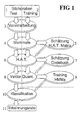
- HMMs Hidden Markov Models 1
- An image from a sample goes through at least the following steps: First the image of the handwritten word is pre-processed.
- the preprocessing 3 includes a standardization of the font with regard to position, size and inclination as well as the elimination of faults, for example underlining.
- a sequence of feature vectors 4 is then calculated from the preprocessed image, in that a feature window is passed step by step from left to right over the image.
- the dimension of the feature vectors is reduced by a main axis transformation HAT 6.
- the vectors are vector quantized 8, ie represented by a weighted sum of the normal distributions of the code book.
- FIG. 1 is the learning phase to the right of the dashed line, the to the left Test phase shown.
- the system for trains the recognition task.
- Large parameter sets are estimated from statistics of the learning sample, e.g. the Major axis transformation matrix 5, the code book 7 and the HMM model parameters 9 (see FIG. 1).
- the test phase it will trained system tested for its performance, i.e. it evaluates how good it is handwritten words can read. The evaluation is based on a test sample 1 of pictures of handwritten words and their Transliteration.
- Every image of the test sample is sent to the system submitted to classification 10.
- classification 10 Every image of the test sample is sent to the system submitted to classification 10.
- the result everyone Class 10 becomes with the transliteration of the image compared; it is decided for each picture whether it is was correctly or incorrectly classified (recognized).
- the proportion is correctly classified Word images determined (recognition rate 11, see FIG. 1); in order to you have a measure of the detection performance of the system.
- the handwriting recognition system consists of a number of Processing steps. Some only run in the learning phase of the system (estimates from statistics), others only in the test phase (classification and calculation of the detection rate); all others are transformations of the form of representation the word images, both from the learning and the test images be run through (preprocessing, feature extraction, Feature reduction, vector quantization).
- All processing steps contain a number of parameters, with which their mode of operation can be controlled. Also Processing steps of the learning phase, even large quantities to statistically estimate parameters, are in turn in their Effect of parameters influenced. For example the mean values and covariance matrices in the codebook estimate 7 a number of normal distribution densities statistically estimated; however, how large this number should be be specified.
- the correct setting of the free parameters is crucial Significance for the performance of the handwriting recognition system.
- the goal is to set values for the free parameters find where the handwriting recognition system is a good one Detection performance achieved.
- Optimization procedures There are a large number of mathematical ones Optimization procedures that are independent of the problem Find the optimal of an evaluation function. Your approach is, the evaluation function is repeated for different Evaluate input values and send them from the function values Derive new input values wisely. Examples of such Optimization methods are gradient descent, simplex methods, Simulated Annealing, Evolutionaries Algorithms.
- the evaluation function is the Detection rate on the test sample. To the evaluation function to evaluate for a specific parameter set must first completely the learning phase of the system and then the test phase will be carried out.
- Handwriting recognition system takes a single such evaluation up to 20 hours on a modern powerful Workstation computer because the individual processing steps are associated with extensive calculations.
- the free parameters are on the order of a hundred up to several thousand evaluations necessary to achieve a satisfactory To achieve result. This would be a single optimization run need several months to years of computing time, which is completely impractical in practice.
- the method described below reduces the computing time required considerably. It uses the structure of the handwriting recognition system in a suitable way to the computing times for individual evaluations.
- the processed data temporarily stored (e.g. the preprocessed Pictures or the esteemed codebook). The data remain until they are called again of the processing step are overwritten.
- the execution of the Processing steps are started at the point where the first time this parameter occurs; it doesn't have to be a complete one System learning and testing phase. If e.g. the number of code book classes is to be changed, so can apply to the already existing reduced feature vectors be resorted to. In this way, significant Save computing time.
- the costs C (P i ) of a parameter P i are now defined as an estimate of the computing time required for evaluating the system if only the value of this parameter has been changed.
- the precision of this estimate is of secondary importance; the decisive factor is the order of the parameters according to their costs, which can be derived from this.
- the preprocessing parameters are significant more expensive than the parameters of the HMM training.
- the parameters are grouped according to their cost.
- the free parameters each processing step is grouped together.
- the idea of the method described is to keep expensive parameter groups constant for a while and just optimize the cheap ones.
- Evolution strategies are a subclass of evolutionary ones Algorithms and orient themselves in their approach of natural evolution.
- the concept of evolution strategy is used here as in [I. Rechenberg, evolution strategies '94, Frommann-Holzboog, 1994].
- each parameter value assignment is unique Identification and interpreted as an individual's genetic mass (gene).
- a group of individuals is called a population.
- Began is with one or a few primordial individuals, e.g. fortuitously generated parameter value assignments.
- the primal individuals generate a population of successor individuals as parents (Recombination). Every new individual is created by mixing the genes (parameter value assignments) two parents (crossover) and by slight accidental Changes in the resulting gene (mutation).
- the Fitness of the new individuals determined i.e. their goodness will assessed on the basis of an evaluation of the system to be optimized with their parameter value assignment.
- the individuals with the highest level of fitness are selected (selection) to parents of a new generation, the rest die (survival of the fittest). This process of creating, evaluating and selecting individuals can be repeated any number of times become.
- the procedure based on a concrete example is as follows (see FIG. 2): 20 individuals (parameter value assignments) are generated completely randomly within their permissible value ranges. In the figure, each individual is identified by a rectangle that represents the vector of its parameter values. For each individual, the training phase and then the test phase of the handwriting recognition system are run through.
- the initial individuals are completely lined deposited, because for their evaluation completely training and Test phase must be run -initial evaluation-. After that, a recognition rate is determined for each individual. The two individuals with the highest recognition rate will be considered further -selection-, they are the parents for that Next Generation.
- the first step is the processing step of the classification improved.
- Free parameters of the classification are e.g. the width of the search beam and a rejection threshold.
- the two parents generate special by the following Crossover operation 20 successors: 14 successors inherit the Value assignment of all parameters not belonging to the classification from the top rated parent, 6 they inherit from the second top rated Parent. This is shown in FIG 2 by the broad Arrow marked.
- For each classification parameter is individual decided non-deterministically whether the successor has the parameter value from the first or second parent. there becomes the top rated parent with a probability chosen by 14/20, the second best rated parent with a probability of 6/20. This is shown in FIG. 2 indicated by the single thin arrows.
- the 20 successors will now undergo a mutation.
- the Values of the classification parameters are added individually each of the 20 successors easily happened to be within their allowed Value range changed.
- a random function uses a normal distribution, the mean of which is the current one Value of the parameter is.
- the 20 successors have to be evaluated.
- the 14 successors are evaluated, those of the best rated Parent the value assignment of all non-classification parameters have inherited. Only in the evaluation the first successor must all processing steps of the handwriting recognition system (training and Test phase); distinguish the other 13 only in the classification parameters, therefore must only the classification for each successor will be gone through. This is shown in FIG 2 by the areas with dashed lines of the parameter vectors (individuals). Subsequently the remaining 6 successors are evaluated; For it is the same as for the first 14.
- the 2 best of the 20 assessed individuals are now selected as parents of a new generation (selection). Through crossover and mutation, they in turn generate 20 successors that are evaluated, etc. For a certain number of generations only the classification parameters are optimized. Then their good values are "frozen" and the parameters of the previous processing step, namely the HMM training, are optimized.
- Free parameters of the HMM training are e.g. the number of model states for each letter that Type of context modeling and special process parameters.
- the two parents create 20 successors through crossover: 14 successors do not inherit the allocation of values to everyone HMM training related parameters from the top rated parent, 6 they inherit from the second highest rated parent. This is indicated in FIG 3 by the broad arrow.
- the values of the HMM training parameters be determined. For every HMM training parameter is decided individually, non-deterministically, whether the successor takes the parameter value from the first or from the second Parent receives.
- the 20 successors will undergo a mutation.
- the values The HMM training parameters are customized for each of the 20 successors easily by chance within their allowable Value range changed. A normal distribution becomes a random function used, the mean of which is the current value of the parameter.
- the 20 successors are evaluated.
- the 14 successors are evaluated, those of the best rated Parent the value assignment of all non-HMM training parameters have inherited. Only when evaluating the first Subsequently, all processing steps of the Handwriting recognition system (training and test phase) be run through; the remaining 13 differ only in the HMM training parameters. For these 13 each HMM training and classification will go through. This is shown in FIG 3 by the dashed areas of Parameter vectors (individuals) marked. Subsequently the remaining 6 successors are evaluated; this applies to them same as for the first 14.
- the number of generations for the optimization of each parameter group is selected depending on the number of parameters in this group and the progress of the optimization as a whole. At the beginning of the optimization, for example, a group with 3 parameters is optimized over 3 generations. After all groups have been optimized once and F k is reached again, it is optimized over 4 generations, next time 5 generations etc. A group with 4 parameters is optimized over 4 generations, then over 5 etc.
- the handwriting recognition system on a test sample used as an evaluation measure for parameter settings.
- the handwriting recognition system is just a recognition process of several within the address reading system does it moreover sense, also the reading performance of the entire address reading system to be used as an evaluation measure.
- the goal is parameter optimization the improvement of the entire address reading system. Therefore it makes sense to read the entire reading performance from time to time Determine address reading system and make decisions from it to derive the further procedure for the optimization, for example whether the desired reading performance has already been achieved was and can be canceled, or by choosing one new parameter group.
Landscapes
- Engineering & Computer Science (AREA)
- Data Mining & Analysis (AREA)
- Theoretical Computer Science (AREA)
- Computer Vision & Pattern Recognition (AREA)
- Bioinformatics & Computational Biology (AREA)
- Artificial Intelligence (AREA)
- Evolutionary Biology (AREA)
- Evolutionary Computation (AREA)
- Physics & Mathematics (AREA)
- General Engineering & Computer Science (AREA)
- General Physics & Mathematics (AREA)
- Life Sciences & Earth Sciences (AREA)
- Bioinformatics & Cheminformatics (AREA)
- Character Discrimination (AREA)
- Image Analysis (AREA)
- Sorting Of Articles (AREA)
- Feedback Control In General (AREA)
- Signal Processing For Digital Recording And Reproducing (AREA)
- Communication Control (AREA)
- Data Exchanges In Wide-Area Networks (AREA)
- Electrotherapy Devices (AREA)
- Debugging And Monitoring (AREA)
- Optical Recording Or Reproduction (AREA)
- Control Of Motors That Do Not Use Commutators (AREA)
Description
[D.E. Goldberg, Genetic Algorithms in Search, Optimization & Machine Learning, Addison-Wesley, 1989 ], [I. Rechenberg, Evolutionsstrategien '94, Frommann-Holzboog, 1994] beschrieben wird. Speziell evolutionäre / genetische Algorithmen werden dabei häufig angewandt. In dem Übersichtsartikel [Applying Genetic Algorithms on Pattern Recognition: An Analysis and Survey, Y.-K. Wang und K.-C. Fan, in Proceedings of the International Conference on Pattern Recognition, 1996], werden drei Typen von Problemen unterschieden: erstens die Optimierung der Auswahl von Merkmalen, zweitens die Optimierung der Klassifikationsfunktion und drittens die Optimierung des Klassifikatorlernens. Weitere Arbeiten zu genetischer Optimierung von Mustererkennungssystemen sind zu finden in der Sonderausgabe [Pattern Recognition Letters: Special Issue on Genetic Algorithms, Vol. 16, No. 8, August 1995]. Die Vorgehensweise dieser Veröffentlichungen läßt sich wie folgt zusammenfassen:
Die einzelnen Erkennungsverfahren in einem Adreßlesesystem zeichnen sich dadurch aus, daß zu ihrem Training große Lernstichproben nötig sind. Die aufwendigen Berechnungen beim Training dauern nicht selten etliche Stunden auf modernen Arbeitsplatzrechnern. Damit ist die oben beschriebene Technik des Einsatzes von mathematischen Optimierungsverfahren nur sehr bedingt zur Optimierung freier Parameter von Adreßleseverfahren geeignet, denn es wären im Mittel viele Monate an Rechenzeit nötig, um gute Ergebnisse zu erreichen.
Nach jedem Teilschritt des Erkennungsverfahrens werden die verarbeiteten Daten zwischengespeichert (z.B. die verarbeiteten Bilder der Stichprobe und/oder Sätze von trainierten Parametern). Die Daten bleiben so lange erhalten, bis sie bei einem erneuten Aufruf des Teilschritts überschrieben werden. Wenn nun nach einer bereits erfolgten Auswertung freie Parameter verändert werden sollen, so kann die Ausführung der Teilschritte an der Stelle begonnen werden, wo zum ersten Mal diese Parameter auftreten; es muß keine komplette Lern- und Testphase des Erkennungsverfahrens von Beginn an durchlaufen werden. Auf diese Weise lassen sich erhebliche Rechenzeitaufwände einsparen.
Dabei zeigen
- FIG 1
- ein Ablaufschema für das Lesen von handgeschriebenen Adressen
- FIG 2
- eine schematische Darstellung der evolutionären Optimierung der freien Parameter der Klassifikation eines Handschriftenlesers
- FIG 3
- eine schematische Darstellung der evolutionären Optimierung der freien Parameter für das HMM-Training eines Handschriftenlesers
Zuerst wird das Bild des handgeschriebenen Wortes vorverarbeitet. Zur Vorverarbeitung 3 gehört eine Normierung der Schrift in Bezug auf Lage, Größe und Neigung sowie eine Beseitigung von Störungen, beispielsweise Unterstreichungen. Anschließend wird aus dem vorverarbeiteten Bild eine Folge von Merkmalvektoren 4 berechnet, indem ein Merkmalfenster schrittweise von links nach rechts über das Bild geführt wird. Die Dimension der Merkmalvektoren wird durch eine Hauptachsentransformation H.A.T. 6 reduziert. Schließlich werden die Vektoren vektorquantisiert 8, d.h. durch eine gewichtete Summe der Normalverteilungen des Codebuchs repräsentiert.
normierte Höhe von Kleinbuchstabenbereich, Oberlängen- und Unterlängenbereich; spezielle Verfahrensparameter
Breite und Schrittweite des Merkmalfensters; Anzahl der Merkmale; Art der Merkmale
Anzahl der Normalverteilungsdichten; Art des Schätzverfahrens; spezielle Verfahrensparameter
Anzahl der Modellzustände für jeden Buchstaben; Art der Kontextmodellierung; spezielle Verfahrensparameter
Eine bestimmte Anzahl von Generationen lang werden nur die Klassifikations-Parameter optimiert. Dann werden ihre guten Werte "eingefroren", und es werden die Parameter des vorhergehenden Verarbeitungsschrittes, nämlich des HMM-Trainings, optimiert.
Nachdem alle Gruppen einmal optimiert wurden und wieder Fk erreicht ist, wird sie über 4 Generationen optimiert, beim nächsten Mal 5 Generationen usw. Eine Gruppe mit 4 Parametern wird über 4 Generationen optimiert, dann über 5 usw.
Claims (10)
- Verfahren zum Adreßlesen mit mindestens zwei durch Parameter gesteuerten Verarbeitungsschritten, das mittels Lernund Testphasen optimiert wird, wobei mit an sich bekannten Lernverfahren anhand einer Lernstichprobe Parameter automatisch adaptiert werden und die Leistung des Adreßlesens anhand einer Teststichprobe mit den Parametern aus der Lernphase ermittelt wird, wobei jeder Verarbeitungsschritt als Eingabe die Werte seiner Parameter und verarbeitete und gespeicherte Daten von vorangegangenen Verarbeitungsschritten erhält, mindestens ein Verarbeitungsschritt als notwendige Eingabe die Stichprobenelemente erhält und ein Verarbeitungsschritt das Leseergebnis als Leistung produziert, gekennzeichnet durch folgende Schritte:Sämtlichen freien Parametern, die in der Lernphase mit der Lernstichprobe nicht automatisch adaptierbar sind, werden Kosten zugeordnet;Festlegen einer Kostenschwelle;Ändern von mehreren unterhalb der Kostenschwelle liegenden freien Parametern nach einer an sich bekannten Optimierungsstrategie unter Berücksichtigung aller bereits ermittelten Leistungen von Parameterwertebelegungen;Abarbeiten der Lernphase anhand der Lernstichprobe, beginnend bei dem frühesten Verarbeitungsschritt, dessen freie Parameter geändert wurden;Abarbeiten der Testphase anhand der Teststichprobe beginnend bei dem frühesten Verarbeitungsschritt, dessen Parameter geändert wurden und Ermitteln der Leistung des Adreßlesens für die aktuellen Parameterwerte;Weiteres Ändern freier Parameter nach einer Optimierungsstrategie, die unterhalb der festgelegten Kostenschwelle liegen und anschließendes Abarbeiten der Lern- und Testphasen, bis eine festgelegte Leistung erreicht wird oder bis eine festgelegte Anzahl von Lern- und Testphasen abgearbeitet wird;Festlegen einer neuen Kostenschwelle und Ändern von einem oder mehreren unterhalb der Kostenschwelle liegenden freien Parametern nach einer Optimierungsstrategie und Abarbeiten der Lern- und Testphasen mit Ermittlung der Leistung solange, bis eine festgelegte Leistung oder bis eine festgelegte Anzahl von Lern- und Testphasen abgearbeitet wurde;Ändern der Kostenschwellen und Durchführen der vorhergehend beschriebenen Schritte solange, bis eine festgelegte Leistung des gesamten Adreßlesens erreicht wurde oder festgelegte Gesamtkosten überschritten wurden;Lesen von aktuellen Adressen mit den adaptierten Parametern.
- Verfahren nach Anspruch 1,
dadurch gekennzeichnet, daß die Kosten durch die erwartete Rechenzeit ab dem frühesten Verarbeitungsschritt, dessen freie Parameter geändert werden, bestimmt werden. - Verfahren nach Anspruch 1,
dadurch gekennzeichnet, daß die Adressen mittels Klassifikationsverfahren gelesen werden, deren Leistung die Erkennungsrate ist. - Verfahren nach Anspruch 1,
dadurch gekennzeichnet, daß die Kostenschwellen von den niedrigsten Parameterkosten zu höchsten Parameterkosten und/oder umgekehrt verändert werden. - Verfahren nach Anspruch 1,
dadurch gekennzeichnet, daß jeder freie Parameter genau einem Verarbeitungsschritt zugeordnet ist und die Parameter eines Verarbeitungsschrittes die gleichen Kosten besitzen. - Verfahren nach Anspruch 5,
dadurch gekennzeichnet, daß gleichzeitig nur freie Parameter mit gleichen Kosten variiert werden. - Verfahren nach Anspruch 1,
dadurch gekennzeichnet, daß die freien Parameter nach einer Evolutionsstrategie verändert werden. - Verfahren nach Anspruch 7,
dadurch gekennzeichnet, daß für einen Verarbeitungsschritt oder für das gesamte Leseverfahren mindestens zwei unterschiedliche Parameterwertebelegungen erzeugt werden, die als Eltern Nachkommen einer Generation erzeugen, von denen mindestens zwei Nachkommen mit den besten Leistungen ausgewählt werden, die wiederum als Eltern für eine neue Generation dienen, wobei alle Schritte der Lern- und Testphase nur für soviele Nachkommen durchlaufen werden müssen, wie zuvor als neue Eltern ausgewählt wurden, und wobei für die übrigen Nachkommen nur ab der betrachteten Verarbeitungsstufe Trainings- und Testphasen durchlaufen werden. - Verfahren nach einem der Ansprüche 1 bis 8,
dadurch gekennzeichnet, daß die bewerteten Leistungen bei Änderungen für eine bestimmte Kostenschwelle die Leistungen des betreffenden Erkennungsverfahrens sind. - Verfahren nach einem der Ansprüche 1 bis 9,
dadurch gekennzeichnet, daß die bewerteten Leistungen bei Änderungen für eine bestimmte Kostenschwelle die Leistungen des gesamten Adreßleseverfahrens sind.
Applications Claiming Priority (3)
| Application Number | Priority Date | Filing Date | Title |
|---|---|---|---|
| DE19921953 | 1999-05-12 | ||
| DE19921953 | 1999-05-12 | ||
| PCT/DE2000/001038 WO2000070549A1 (de) | 1999-05-12 | 2000-04-04 | Verfahren zum adresslesen |
Publications (2)
| Publication Number | Publication Date |
|---|---|
| EP1190373A1 EP1190373A1 (de) | 2002-03-27 |
| EP1190373B1 true EP1190373B1 (de) | 2002-12-04 |
Family
ID=7907868
Family Applications (1)
| Application Number | Title | Priority Date | Filing Date |
|---|---|---|---|
| EP00934872A Expired - Lifetime EP1190373B1 (de) | 1999-05-12 | 2000-04-04 | Verfahren zum adresslesen |
Country Status (10)
| Country | Link |
|---|---|
| US (1) | US6934405B1 (de) |
| EP (1) | EP1190373B1 (de) |
| JP (1) | JP3482191B2 (de) |
| AT (1) | ATE229201T1 (de) |
| AU (1) | AU755267B2 (de) |
| CA (1) | CA2373207A1 (de) |
| DE (1) | DE50000887D1 (de) |
| DK (1) | DK1190373T3 (de) |
| NZ (1) | NZ515488A (de) |
| WO (1) | WO2000070549A1 (de) |
Families Citing this family (12)
| Publication number | Priority date | Publication date | Assignee | Title |
|---|---|---|---|---|
| US7444309B2 (en) * | 2001-10-31 | 2008-10-28 | Icosystem Corporation | Method and system for implementing evolutionary algorithms |
| DE10245834A1 (de) | 2002-10-01 | 2004-04-15 | Siemens Ag | Verfahren zum Erzeugen von Lern- und/oder Teststichproben |
| EP1611546B1 (de) | 2003-04-04 | 2013-01-02 | Icosystem Corporation | Verfahren und systeme zur interaktiven evolutionären datenverarbeitung (iec) |
| WO2005013081A2 (en) * | 2003-08-01 | 2005-02-10 | Icosystem Corporation | Methods and systems for applying genetic operators to determine system conditions |
| US7356518B2 (en) * | 2003-08-27 | 2008-04-08 | Icosystem Corporation | Methods and systems for multi-participant interactive evolutionary computing |
| US7707220B2 (en) | 2004-07-06 | 2010-04-27 | Icosystem Corporation | Methods and apparatus for interactive searching techniques |
| FR2886433B1 (fr) * | 2005-05-30 | 2007-09-07 | Commissariat Energie Atomique | Methode de segmentation d'une sequence d'images tridimensionnelles, notamment en pharmaco-imagerie. |
| DE102005040662A1 (de) * | 2005-08-26 | 2007-03-01 | Siemens Ag | Verfahren zur Identifizierung von zu sortierenden Sendungen |
| WO2007035848A2 (en) | 2005-09-21 | 2007-03-29 | Icosystem Corporation | System and method for aiding product design and quantifying acceptance |
| US7792816B2 (en) * | 2007-02-01 | 2010-09-07 | Icosystem Corporation | Method and system for fast, generic, online and offline, multi-source text analysis and visualization |
| WO2019171416A1 (ja) | 2018-03-05 | 2019-09-12 | 日本電気株式会社 | 画像分類システム、画像分類方法および画像分類プログラム |
| CN118396000B (zh) * | 2024-06-28 | 2024-10-11 | 深圳市国芯物联科技有限公司 | 一种读写器rfid发射功率自适应控制方法 |
Family Cites Families (14)
| Publication number | Priority date | Publication date | Assignee | Title |
|---|---|---|---|---|
| FR2608295B1 (fr) * | 1986-12-12 | 1989-03-31 | France Etat | Procede et dispositif de reconnaissance de caracteres |
| US5056147A (en) * | 1989-05-16 | 1991-10-08 | Products From Ideas Ltd. | Recognition procedure and an apparatus for carrying out the recognition procedure |
| US5063521A (en) * | 1989-11-03 | 1991-11-05 | Motorola, Inc. | Neuram: neural network with ram |
| JP3037432B2 (ja) * | 1993-11-01 | 2000-04-24 | カドラックス・インク | 光波オーブンによる食物調理方法および調理装置 |
| US5774588A (en) | 1995-06-07 | 1998-06-30 | United Parcel Service Of America, Inc. | Method and system for comparing strings with entries of a lexicon |
| US5768421A (en) * | 1995-09-12 | 1998-06-16 | Gaffin; Arthur Zay | Visual imaging system and method |
| US6625317B1 (en) * | 1995-09-12 | 2003-09-23 | Art Gaffin | Visual imaging system and method |
| EP0850405A2 (de) * | 1995-09-19 | 1998-07-01 | Morphometrix Technologies Inc. | System zur multispektralen segmentierung mit hilfe eines neuronalen netzes |
| US6246794B1 (en) * | 1995-12-13 | 2001-06-12 | Hitachi, Ltd. | Method of reading characters and method of reading postal addresses |
| DE19612465C2 (de) * | 1996-03-28 | 1998-12-24 | Fraunhofer Ges Forschung | Automatisches Optimieren von Objekt-Erkennungssystemen |
| DE19623033C1 (de) * | 1996-06-08 | 1997-10-16 | Aeg Electrocom Gmbh | Verfahren und Anordnung zur Mustererkennung auf statistischer Basis |
| US5930392A (en) * | 1996-07-12 | 1999-07-27 | Lucent Technologies Inc. | Classification technique using random decision forests |
| US5940535A (en) | 1996-10-31 | 1999-08-17 | Industrial Technology Research Institute | Method and apparatus for designing a highly reliable pattern recognition system |
| JP3639126B2 (ja) * | 1998-01-22 | 2005-04-20 | 富士通株式会社 | 住所認識装置及び住所認識方法 |
-
2000
- 2000-04-04 EP EP00934872A patent/EP1190373B1/de not_active Expired - Lifetime
- 2000-04-04 US US09/959,921 patent/US6934405B1/en not_active Expired - Fee Related
- 2000-04-04 JP JP2000618921A patent/JP3482191B2/ja not_active Expired - Fee Related
- 2000-04-04 CA CA002373207A patent/CA2373207A1/en not_active Abandoned
- 2000-04-04 AT AT00934872T patent/ATE229201T1/de not_active IP Right Cessation
- 2000-04-04 DK DK00934872T patent/DK1190373T3/da active
- 2000-04-04 WO PCT/DE2000/001038 patent/WO2000070549A1/de not_active Ceased
- 2000-04-04 AU AU50585/00A patent/AU755267B2/en not_active Ceased
- 2000-04-04 DE DE50000887T patent/DE50000887D1/de not_active Expired - Fee Related
- 2000-04-04 NZ NZ515488A patent/NZ515488A/xx unknown
Also Published As
| Publication number | Publication date |
|---|---|
| CA2373207A1 (en) | 2000-11-23 |
| DK1190373T3 (da) | 2003-02-24 |
| WO2000070549A1 (de) | 2000-11-23 |
| US6934405B1 (en) | 2005-08-23 |
| AU755267B2 (en) | 2002-12-05 |
| JP3482191B2 (ja) | 2003-12-22 |
| DE50000887D1 (de) | 2003-01-16 |
| EP1190373A1 (de) | 2002-03-27 |
| JP2002544629A (ja) | 2002-12-24 |
| AU5058500A (en) | 2000-12-05 |
| NZ515488A (en) | 2002-09-27 |
| ATE229201T1 (de) | 2002-12-15 |
Similar Documents
| Publication | Publication Date | Title |
|---|---|---|
| DE60208223T2 (de) | Anordnung und verfahren zur gesichtserkennung unter verwendung von teilen des gelernten modells | |
| EP3785177B1 (de) | Verfahren und vorrichtung zum ermitteln einer netzkonfiguration eines neuronalen netzes | |
| DE69528023T2 (de) | Anlage und Verfahren zur automatischen Interpretation von Eingabeausdrucken mittels neuer a posteriori Washscheinlichkeitmasse und optimal trainierter Datenverarbeitungsnetzwerken | |
| EP0040796B1 (de) | Verfahren zum automatischen Klassifizieren von Bild- und Text- oder Graphikbereichen auf Druckvorlagen | |
| DE69325204T2 (de) | Verfahren und Vorrichtung zum Weiterentwickeln einer Anfangssammlung von Handschriftprototypen zu einer anwender-spezifischen Sammlung | |
| DE102018119682A1 (de) | Bildverarbeitungsvorrichtung, bildverarbeitungsverfahren und nicht-vorübergehendes computerlesbares speichermedium | |
| DE4403495A1 (de) | Mehrfachtestpostenbewertungssystem | |
| EP3941981B1 (de) | Verfahren zur generierung einer zusammensetzung für farben, lacke, druckfarben, anreibeharze, pigmentkonzentrate oder sonstige beschichtungsstoffe | |
| DE10134899A1 (de) | Themenbezogenes System und Verfahren zur Klassifizierung von Dokumentationseinheiten | |
| DE4403496A1 (de) | Berichtssystem für kategorisierten Testposten | |
| DE102019204139A1 (de) | Training für künstliche neuronale Netzwerke mit besserer Ausnutzung der Lern-Datensätze | |
| WO2019229151A2 (de) | Verfahren zum scannen von teilbereichen einer probe mittels eines rastermikroskops, computerprogrammprodukt, computerlesbares medium und system zum scannen von teilbereichen einer probe mittels eines rastermikroskops | |
| DE19705757A1 (de) | Verfahren und Gerät für das Design eines hoch-zuverlässigen Mustererkennungs-Systems | |
| WO2000070549A1 (de) | Verfahren zum adresslesen | |
| DE102019213061A1 (de) | Klassifizierung von KI-Modulen | |
| DE102012025349B4 (de) | Bestimmung eines Ähnlichkeitsmaßes und Verarbeitung von Dokumenten | |
| DE112022003696T5 (de) | Verfahren und systeme zur erzeugung von modellen für die bildanalyse pipeline prediction | |
| DE102022111622A1 (de) | Computerprogramm und Verfahren zur verbesserten Asbestanalytik mit künstlicher Intelligenz | |
| DE69734507T2 (de) | Verfahren zur optimierung eines erkennungswörterbuchs, so das ähnliche muster besser unterschieden werden können | |
| DE112023004968T5 (de) | Fossil-erkennungsmethode mit deep-learning-verfahren | |
| EP1159705B1 (de) | Verfahren zum lesen von dokumenteintragungen und adressen | |
| DE102022208384A1 (de) | Verfahren zum Ermitteln eines Qualitätszustands eines Prüfobjekts | |
| EP1170678B1 (de) | Verfahren und Vorrichtung zur automatischen Suche relevanter Bilddatensätze | |
| DE102020211475A1 (de) | Kaskadierte Cluster-Generator-Netze zum Erzeugen synthetischer Bilder | |
| DE102019134156A1 (de) | Trainieren eines neuronalen Multitask-Netzes |
Legal Events
| Date | Code | Title | Description |
|---|---|---|---|
| PUAI | Public reference made under article 153(3) epc to a published international application that has entered the european phase |
Free format text: ORIGINAL CODE: 0009012 |
|
| 17P | Request for examination filed |
Effective date: 20011013 |
|
| AK | Designated contracting states |
Kind code of ref document: A1 Designated state(s): AT BE CH CY DE DK ES FI FR GB GR IE IT LI LU MC NL PT SE |
|
| AX | Request for extension of the european patent |
Free format text: AL;LT;LV;MK;RO;SI |
|
| GRAG | Despatch of communication of intention to grant |
Free format text: ORIGINAL CODE: EPIDOS AGRA |
|
| GRAG | Despatch of communication of intention to grant |
Free format text: ORIGINAL CODE: EPIDOS AGRA |
|
| GRAH | Despatch of communication of intention to grant a patent |
Free format text: ORIGINAL CODE: EPIDOS IGRA |
|
| 17Q | First examination report despatched |
Effective date: 20020610 |
|
| GRAH | Despatch of communication of intention to grant a patent |
Free format text: ORIGINAL CODE: EPIDOS IGRA |
|
| GRAA | (expected) grant |
Free format text: ORIGINAL CODE: 0009210 |
|
| AK | Designated contracting states |
Kind code of ref document: B1 Designated state(s): AT BE CH CY DE DK ES FI FR GB GR IE IT LI LU MC NL PT SE |
|
| PG25 | Lapsed in a contracting state [announced via postgrant information from national office to epo] |
Ref country code: GR Free format text: LAPSE BECAUSE OF FAILURE TO SUBMIT A TRANSLATION OF THE DESCRIPTION OR TO PAY THE FEE WITHIN THE PRESCRIBED TIME-LIMIT Effective date: 20021204 Ref country code: FI Free format text: LAPSE BECAUSE OF FAILURE TO SUBMIT A TRANSLATION OF THE DESCRIPTION OR TO PAY THE FEE WITHIN THE PRESCRIBED TIME-LIMIT Effective date: 20021204 |
|
| REF | Corresponds to: |
Ref document number: 229201 Country of ref document: AT Date of ref document: 20021215 Kind code of ref document: T |
|
| REG | Reference to a national code |
Ref country code: GB Ref legal event code: FG4D Free format text: NOT ENGLISH |
|
| REG | Reference to a national code |
Ref country code: CH Ref legal event code: NV Representative=s name: SIEMENS SCHWEIZ AG Ref country code: CH Ref legal event code: EP |
|
| REG | Reference to a national code |
Ref country code: IE Ref legal event code: FG4D Free format text: GERMAN |
|
| REF | Corresponds to: |
Ref document number: 50000887 Country of ref document: DE Date of ref document: 20030116 |
|
| REG | Reference to a national code |
Ref country code: DK Ref legal event code: T3 |
|
| PG25 | Lapsed in a contracting state [announced via postgrant information from national office to epo] |
Ref country code: PT Free format text: LAPSE BECAUSE OF FAILURE TO SUBMIT A TRANSLATION OF THE DESCRIPTION OR TO PAY THE FEE WITHIN THE PRESCRIBED TIME-LIMIT Effective date: 20030305 |
|
| REG | Reference to a national code |
Ref country code: SE Ref legal event code: TRGR |
|
| GBT | Gb: translation of ep patent filed (gb section 77(6)(a)/1977) |
Effective date: 20030303 |
|
| PGFP | Annual fee paid to national office [announced via postgrant information from national office to epo] |
Ref country code: IE Payment date: 20030403 Year of fee payment: 4 |
|
| PG25 | Lapsed in a contracting state [announced via postgrant information from national office to epo] |
Ref country code: CY Free format text: LAPSE BECAUSE OF FAILURE TO SUBMIT A TRANSLATION OF THE DESCRIPTION OR TO PAY THE FEE WITHIN THE PRESCRIBED TIME-LIMIT Effective date: 20030404 Ref country code: AT Free format text: LAPSE BECAUSE OF NON-PAYMENT OF DUE FEES Effective date: 20030404 Ref country code: LU Free format text: LAPSE BECAUSE OF NON-PAYMENT OF DUE FEES Effective date: 20030404 |
|
| PGFP | Annual fee paid to national office [announced via postgrant information from national office to epo] |
Ref country code: DK Payment date: 20030410 Year of fee payment: 4 |
|
| PGFP | Annual fee paid to national office [announced via postgrant information from national office to epo] |
Ref country code: SE Payment date: 20030411 Year of fee payment: 4 |
|
| PG25 | Lapsed in a contracting state [announced via postgrant information from national office to epo] |
Ref country code: BE Free format text: LAPSE BECAUSE OF NON-PAYMENT OF DUE FEES Effective date: 20030430 Ref country code: MC Free format text: LAPSE BECAUSE OF NON-PAYMENT OF DUE FEES Effective date: 20030430 |
|
| LTIE | Lt: invalidation of european patent or patent extension |
Effective date: 20021204 |
|
| PG25 | Lapsed in a contracting state [announced via postgrant information from national office to epo] |
Ref country code: ES Free format text: LAPSE BECAUSE OF FAILURE TO SUBMIT A TRANSLATION OF THE DESCRIPTION OR TO PAY THE FEE WITHIN THE PRESCRIBED TIME-LIMIT Effective date: 20030627 |
|
| ET | Fr: translation filed | ||
| PLBE | No opposition filed within time limit |
Free format text: ORIGINAL CODE: 0009261 |
|
| STAA | Information on the status of an ep patent application or granted ep patent |
Free format text: STATUS: NO OPPOSITION FILED WITHIN TIME LIMIT |
|
| BERE | Be: lapsed |
Owner name: *SIEMENS A.G. Effective date: 20030430 |
|
| 26N | No opposition filed |
Effective date: 20030905 |
|
| PG25 | Lapsed in a contracting state [announced via postgrant information from national office to epo] |
Ref country code: IE Free format text: LAPSE BECAUSE OF NON-PAYMENT OF DUE FEES Effective date: 20040405 Ref country code: SE Free format text: LAPSE BECAUSE OF NON-PAYMENT OF DUE FEES Effective date: 20040405 |
|
| PG25 | Lapsed in a contracting state [announced via postgrant information from national office to epo] |
Ref country code: DK Free format text: LAPSE BECAUSE OF NON-PAYMENT OF DUE FEES Effective date: 20040430 Ref country code: CH Free format text: LAPSE BECAUSE OF NON-PAYMENT OF DUE FEES Effective date: 20040430 Ref country code: LI Free format text: LAPSE BECAUSE OF NON-PAYMENT OF DUE FEES Effective date: 20040430 |
|
| EUG | Se: european patent has lapsed | ||
| REG | Reference to a national code |
Ref country code: CH Ref legal event code: PL |
|
| REG | Reference to a national code |
Ref country code: IE Ref legal event code: MM4A |
|
| PGFP | Annual fee paid to national office [announced via postgrant information from national office to epo] |
Ref country code: GB Payment date: 20050407 Year of fee payment: 6 |
|
| PG25 | Lapsed in a contracting state [announced via postgrant information from national office to epo] |
Ref country code: GB Free format text: LAPSE BECAUSE OF NON-PAYMENT OF DUE FEES Effective date: 20060404 |
|
| GBPC | Gb: european patent ceased through non-payment of renewal fee |
Effective date: 20060404 |
|
| PGFP | Annual fee paid to national office [announced via postgrant information from national office to epo] |
Ref country code: NL Payment date: 20070413 Year of fee payment: 8 |
|
| PGFP | Annual fee paid to national office [announced via postgrant information from national office to epo] |
Ref country code: DE Payment date: 20070621 Year of fee payment: 8 |
|
| PGFP | Annual fee paid to national office [announced via postgrant information from national office to epo] |
Ref country code: IT Payment date: 20070607 Year of fee payment: 8 |
|
| PGFP | Annual fee paid to national office [announced via postgrant information from national office to epo] |
Ref country code: FR Payment date: 20070420 Year of fee payment: 8 |
|
| NLV4 | Nl: lapsed or anulled due to non-payment of the annual fee |
Effective date: 20081101 |
|
| PG25 | Lapsed in a contracting state [announced via postgrant information from national office to epo] |
Ref country code: NL Free format text: LAPSE BECAUSE OF NON-PAYMENT OF DUE FEES Effective date: 20081101 Ref country code: DE Free format text: LAPSE BECAUSE OF NON-PAYMENT OF DUE FEES Effective date: 20081101 |
|
| REG | Reference to a national code |
Ref country code: FR Ref legal event code: ST Effective date: 20081231 |
|
| PG25 | Lapsed in a contracting state [announced via postgrant information from national office to epo] |
Ref country code: FR Free format text: LAPSE BECAUSE OF NON-PAYMENT OF DUE FEES Effective date: 20080430 |
|
| PG25 | Lapsed in a contracting state [announced via postgrant information from national office to epo] |
Ref country code: IT Free format text: LAPSE BECAUSE OF NON-PAYMENT OF DUE FEES Effective date: 20080404 |