EP1189874B1 - Excitatory amino acid receptor modulators - Google Patents
Excitatory amino acid receptor modulators Download PDFInfo
- Publication number
- EP1189874B1 EP1189874B1 EP00938702A EP00938702A EP1189874B1 EP 1189874 B1 EP1189874 B1 EP 1189874B1 EP 00938702 A EP00938702 A EP 00938702A EP 00938702 A EP00938702 A EP 00938702A EP 1189874 B1 EP1189874 B1 EP 1189874B1
- Authority
- EP
- European Patent Office
- Prior art keywords
- compound
- formula
- mixture
- mmol
- solution
- Prior art date
- Legal status (The legal status is an assumption and is not a legal conclusion. Google has not performed a legal analysis and makes no representation as to the accuracy of the status listed.)
- Expired - Lifetime
Links
- 102000018899 Glutamate Receptors Human genes 0.000 title description 7
- 108010027915 Glutamate Receptors Proteins 0.000 title description 7
- 150000001875 compounds Chemical class 0.000 claims abstract description 150
- 150000003839 salts Chemical class 0.000 claims abstract description 28
- 150000002148 esters Chemical class 0.000 claims abstract description 26
- 210000003169 central nervous system Anatomy 0.000 claims abstract description 9
- 208000037265 diseases, disorders, signs and symptoms Diseases 0.000 claims abstract description 9
- 125000006374 C2-C10 alkenyl group Chemical group 0.000 claims abstract description 7
- 125000000304 alkynyl group Chemical group 0.000 claims abstract description 7
- 125000000217 alkyl group Chemical group 0.000 claims abstract description 6
- -1 prop-2-enyl Chemical group 0.000 claims description 46
- DHMQDGOQFOQNFH-UHFFFAOYSA-N Glycine Chemical compound NCC(O)=O DHMQDGOQFOQNFH-UHFFFAOYSA-N 0.000 claims description 36
- 125000001495 ethyl group Chemical group [H]C([H])([H])C([H])([H])* 0.000 claims description 28
- 125000004435 hydrogen atom Chemical group [H]* 0.000 claims description 17
- 125000002496 methyl group Chemical group [H]C([H])([H])* 0.000 claims description 16
- 239000001257 hydrogen Substances 0.000 claims description 13
- 229910052739 hydrogen Inorganic materials 0.000 claims description 13
- 125000006239 protecting group Chemical group 0.000 claims description 13
- 125000004178 (C1-C4) alkyl group Chemical group 0.000 claims description 12
- 125000006242 amine protecting group Chemical group 0.000 claims description 10
- UFHFLCQGNIYNRP-UHFFFAOYSA-N Hydrogen Chemical group [H][H] UFHFLCQGNIYNRP-UHFFFAOYSA-N 0.000 claims description 8
- 125000003178 carboxy group Chemical group [H]OC(*)=O 0.000 claims description 7
- 230000003301 hydrolyzing effect Effects 0.000 claims description 7
- 238000004519 manufacturing process Methods 0.000 claims description 7
- 125000001997 phenyl group Chemical group [H]C1=C([H])C([H])=C(*)C([H])=C1[H] 0.000 claims description 7
- 125000000391 vinyl group Chemical group [H]C([*])=C([H])[H] 0.000 claims description 7
- 229920002554 vinyl polymer Chemical group 0.000 claims description 7
- 125000000008 (C1-C10) alkyl group Chemical group 0.000 claims description 6
- 125000003342 alkenyl group Chemical group 0.000 claims description 6
- 239000003814 drug Substances 0.000 claims description 6
- 239000003085 diluting agent Substances 0.000 claims description 5
- 239000000546 pharmaceutical excipient Substances 0.000 claims description 5
- 125000001449 isopropyl group Chemical group [H]C([H])([H])C([H])(*)C([H])([H])[H] 0.000 claims description 4
- 125000001436 propyl group Chemical group [H]C([*])([H])C([H])([H])C([H])([H])[H] 0.000 claims description 4
- 125000000229 (C1-C4)alkoxy group Chemical group 0.000 claims description 3
- 239000003937 drug carrier Substances 0.000 claims description 3
- 239000008194 pharmaceutical composition Substances 0.000 claims description 3
- 125000002568 propynyl group Chemical group [*]C#CC([H])([H])[H] 0.000 claims description 3
- 125000001475 halogen functional group Chemical group 0.000 claims description 2
- 108010010914 Metabotropic glutamate receptors Proteins 0.000 abstract description 13
- 102000016193 Metabotropic glutamate receptors Human genes 0.000 abstract description 13
- 125000003903 2-propenyl group Chemical group [H]C([*])([H])C([H])=C([H])[H] 0.000 abstract description 3
- HEDRZPFGACZZDS-MICDWDOJSA-N Trichloro(2H)methane Chemical compound [2H]C(Cl)(Cl)Cl HEDRZPFGACZZDS-MICDWDOJSA-N 0.000 description 128
- 239000000203 mixture Substances 0.000 description 128
- XEKOWRVHYACXOJ-UHFFFAOYSA-N Ethyl acetate Chemical compound CCOC(C)=O XEKOWRVHYACXOJ-UHFFFAOYSA-N 0.000 description 104
- 239000000243 solution Substances 0.000 description 95
- OKKJLVBELUTLKV-UHFFFAOYSA-N Methanol Chemical compound OC OKKJLVBELUTLKV-UHFFFAOYSA-N 0.000 description 87
- YMWUJEATGCHHMB-UHFFFAOYSA-N Dichloromethane Chemical compound ClCCl YMWUJEATGCHHMB-UHFFFAOYSA-N 0.000 description 84
- RTZKZFJDLAIYFH-UHFFFAOYSA-N Diethyl ether Chemical compound CCOCC RTZKZFJDLAIYFH-UHFFFAOYSA-N 0.000 description 74
- VLKZOEOYAKHREP-UHFFFAOYSA-N n-Hexane Chemical compound CCCCCC VLKZOEOYAKHREP-UHFFFAOYSA-N 0.000 description 63
- LFQSCWFLJHTTHZ-UHFFFAOYSA-N Ethanol Chemical compound CCO LFQSCWFLJHTTHZ-UHFFFAOYSA-N 0.000 description 52
- 239000002904 solvent Substances 0.000 description 51
- WEVYAHXRMPXWCK-UHFFFAOYSA-N Acetonitrile Chemical group CC#N WEVYAHXRMPXWCK-UHFFFAOYSA-N 0.000 description 42
- 238000005160 1H NMR spectroscopy Methods 0.000 description 37
- 238000001644 13C nuclear magnetic resonance spectroscopy Methods 0.000 description 36
- WYURNTSHIVDZCO-UHFFFAOYSA-N Tetrahydrofuran Chemical compound C1CCOC1 WYURNTSHIVDZCO-UHFFFAOYSA-N 0.000 description 36
- ZMANZCXQSJIPKH-UHFFFAOYSA-N Triethylamine Chemical compound CCN(CC)CC ZMANZCXQSJIPKH-UHFFFAOYSA-N 0.000 description 35
- 238000004440 column chromatography Methods 0.000 description 33
- 239000010410 layer Substances 0.000 description 32
- XLYOFNOQVPJJNP-UHFFFAOYSA-N water Chemical group O XLYOFNOQVPJJNP-UHFFFAOYSA-N 0.000 description 32
- 238000006243 chemical reaction Methods 0.000 description 30
- 239000003480 eluent Substances 0.000 description 30
- VEXZGXHMUGYJMC-UHFFFAOYSA-N Hydrochloric acid Chemical compound Cl VEXZGXHMUGYJMC-UHFFFAOYSA-N 0.000 description 28
- HEMHJVSKTPXQMS-UHFFFAOYSA-M sodium hydroxide Inorganic materials [OH-].[Na+] HEMHJVSKTPXQMS-UHFFFAOYSA-M 0.000 description 28
- 239000012044 organic layer Substances 0.000 description 27
- PMZURENOXWZQFD-UHFFFAOYSA-L Sodium Sulfate Chemical compound [Na+].[Na+].[O-]S([O-])(=O)=O PMZURENOXWZQFD-UHFFFAOYSA-L 0.000 description 26
- 229910052938 sodium sulfate Inorganic materials 0.000 description 26
- WMFOQBRAJBCJND-UHFFFAOYSA-M lithium hydroxide Inorganic materials [Li+].[OH-] WMFOQBRAJBCJND-UHFFFAOYSA-M 0.000 description 25
- UIIMBOGNXHQVGW-UHFFFAOYSA-M Sodium bicarbonate Chemical compound [Na+].OC([O-])=O UIIMBOGNXHQVGW-UHFFFAOYSA-M 0.000 description 22
- YXFVVABEGXRONW-UHFFFAOYSA-N Toluene Chemical compound CC1=CC=CC=C1 YXFVVABEGXRONW-UHFFFAOYSA-N 0.000 description 21
- DFNYGALUNNFWKJ-UHFFFAOYSA-N aminoacetonitrile Chemical compound NCC#N DFNYGALUNNFWKJ-UHFFFAOYSA-N 0.000 description 21
- WDYVUKGVKRZQNM-UHFFFAOYSA-N 6-phosphonohexylphosphonic acid Chemical compound OP(O)(=O)CCCCCCP(O)(O)=O WDYVUKGVKRZQNM-UHFFFAOYSA-N 0.000 description 19
- PNEYBMLMFCGWSK-UHFFFAOYSA-N Alumina Chemical compound [O-2].[O-2].[O-2].[Al+3].[Al+3] PNEYBMLMFCGWSK-UHFFFAOYSA-N 0.000 description 19
- XLYOFNOQVPJJNP-ZSJDYOACSA-N heavy water Substances [2H]O[2H] XLYOFNOQVPJJNP-ZSJDYOACSA-N 0.000 description 19
- IXCSERBJSXMMFS-UHFFFAOYSA-N hydrogen chloride Substances Cl.Cl IXCSERBJSXMMFS-UHFFFAOYSA-N 0.000 description 19
- 229910000041 hydrogen chloride Inorganic materials 0.000 description 19
- 239000011541 reaction mixture Substances 0.000 description 19
- 239000007832 Na2SO4 Substances 0.000 description 18
- 229960004132 diethyl ether Drugs 0.000 description 18
- 239000004471 Glycine Substances 0.000 description 17
- 239000012299 nitrogen atmosphere Substances 0.000 description 17
- 239000000047 product Substances 0.000 description 17
- 239000000725 suspension Substances 0.000 description 16
- NLXLAEXVIDQMFP-UHFFFAOYSA-N Ammonia chloride Chemical compound [NH4+].[Cl-] NLXLAEXVIDQMFP-UHFFFAOYSA-N 0.000 description 14
- RYHBNJHYFVUHQT-UHFFFAOYSA-N 1,4-Dioxane Chemical compound C1COCCO1 RYHBNJHYFVUHQT-UHFFFAOYSA-N 0.000 description 13
- VYPSYNLAJGMNEJ-UHFFFAOYSA-N Silicium dioxide Chemical compound O=[Si]=O VYPSYNLAJGMNEJ-UHFFFAOYSA-N 0.000 description 13
- CSCPPACGZOOCGX-UHFFFAOYSA-N Acetone Chemical compound CC(C)=O CSCPPACGZOOCGX-UHFFFAOYSA-N 0.000 description 12
- KRKNYBCHXYNGOX-UHFFFAOYSA-N citric acid Chemical compound OC(=O)CC(O)(C(O)=O)CC(O)=O KRKNYBCHXYNGOX-UHFFFAOYSA-N 0.000 description 12
- 239000007787 solid Substances 0.000 description 12
- DYHSDKLCOJIUFX-UHFFFAOYSA-N tert-butoxycarbonyl anhydride Chemical compound CC(C)(C)OC(=O)OC(=O)OC(C)(C)C DYHSDKLCOJIUFX-UHFFFAOYSA-N 0.000 description 12
- ZMXDDKWLCZADIW-UHFFFAOYSA-N N,N-Dimethylformamide Chemical compound CN(C)C=O ZMXDDKWLCZADIW-UHFFFAOYSA-N 0.000 description 11
- 238000000746 purification Methods 0.000 description 11
- 229910000030 sodium bicarbonate Inorganic materials 0.000 description 11
- IJGRMHOSHXDMSA-UHFFFAOYSA-N Atomic nitrogen Chemical compound N#N IJGRMHOSHXDMSA-UHFFFAOYSA-N 0.000 description 10
- IAZDPXIOMUYVGZ-UHFFFAOYSA-N Dimethylsulphoxide Chemical compound CS(C)=O IAZDPXIOMUYVGZ-UHFFFAOYSA-N 0.000 description 10
- 239000002585 base Substances 0.000 description 10
- CTSLXHKWHWQRSH-UHFFFAOYSA-N oxalyl chloride Chemical compound ClC(=O)C(Cl)=O CTSLXHKWHWQRSH-UHFFFAOYSA-N 0.000 description 10
- KDLHZDBZIXYQEI-UHFFFAOYSA-N Palladium Chemical compound [Pd] KDLHZDBZIXYQEI-UHFFFAOYSA-N 0.000 description 9
- 239000002253 acid Substances 0.000 description 9
- 230000007062 hydrolysis Effects 0.000 description 9
- 238000006460 hydrolysis reaction Methods 0.000 description 9
- 102000005962 receptors Human genes 0.000 description 9
- 108020003175 receptors Proteins 0.000 description 9
- VHYFNPMBLIVWCW-UHFFFAOYSA-N 4-Dimethylaminopyridine Chemical compound CN(C)C1=CC=NC=C1 VHYFNPMBLIVWCW-UHFFFAOYSA-N 0.000 description 8
- HEDRZPFGACZZDS-UHFFFAOYSA-N Chloroform Chemical compound ClC(Cl)Cl HEDRZPFGACZZDS-UHFFFAOYSA-N 0.000 description 8
- WHUUTDBJXJRKMK-VKHMYHEASA-N L-glutamic acid Chemical compound OC(=O)[C@@H](N)CCC(O)=O WHUUTDBJXJRKMK-VKHMYHEASA-N 0.000 description 8
- 239000004480 active ingredient Substances 0.000 description 8
- HQKMJHAJHXVSDF-UHFFFAOYSA-L magnesium stearate Chemical compound [Mg+2].CCCCCCCCCCCCCCCCCC([O-])=O.CCCCCCCCCCCCCCCCCC([O-])=O HQKMJHAJHXVSDF-UHFFFAOYSA-L 0.000 description 8
- NNFCIKHAZHQZJG-UHFFFAOYSA-N potassium cyanide Chemical compound [K+].N#[C-] NNFCIKHAZHQZJG-UHFFFAOYSA-N 0.000 description 8
- 235000011152 sodium sulphate Nutrition 0.000 description 8
- MIOPJNTWMNEORI-GMSGAONNSA-N (S)-camphorsulfonic acid Chemical compound C1C[C@@]2(CS(O)(=O)=O)C(=O)C[C@@H]1C2(C)C MIOPJNTWMNEORI-GMSGAONNSA-N 0.000 description 7
- 229910052783 alkali metal Inorganic materials 0.000 description 7
- 150000008044 alkali metal hydroxides Chemical class 0.000 description 7
- 239000007864 aqueous solution Substances 0.000 description 7
- 208000035475 disorder Diseases 0.000 description 7
- 229930195712 glutamate Natural products 0.000 description 7
- 238000010992 reflux Methods 0.000 description 7
- 229920006395 saturated elastomer Polymers 0.000 description 7
- 239000011734 sodium Substances 0.000 description 7
- 238000003756 stirring Methods 0.000 description 7
- YLQBMQCUIZJEEH-UHFFFAOYSA-N tetrahydrofuran Natural products C=1C=COC=1 YLQBMQCUIZJEEH-UHFFFAOYSA-N 0.000 description 7
- OISVCGZHLKNMSJ-UHFFFAOYSA-N 2,6-dimethylpyridine Chemical compound CC1=CC=CC(C)=N1 OISVCGZHLKNMSJ-UHFFFAOYSA-N 0.000 description 6
- UHOVQNZJYSORNB-UHFFFAOYSA-N Benzene Chemical compound C1=CC=CC=C1 UHOVQNZJYSORNB-UHFFFAOYSA-N 0.000 description 6
- 0 CC(*)([C@]1*)[C@@]1C1(*C(C)(C)OC1)N Chemical compound CC(*)([C@]1*)[C@@]1C1(*C(C)(C)OC1)N 0.000 description 6
- JGFZNNIVVJXRND-UHFFFAOYSA-N N,N-Diisopropylethylamine (DIPEA) Chemical compound CCN(C(C)C)C(C)C JGFZNNIVVJXRND-UHFFFAOYSA-N 0.000 description 6
- LFTLOKWAGJYHHR-UHFFFAOYSA-N N-methylmorpholine N-oxide Chemical compound CN1(=O)CCOCC1 LFTLOKWAGJYHHR-UHFFFAOYSA-N 0.000 description 6
- OFBQJSOFQDEBGM-UHFFFAOYSA-N Pentane Chemical group CCCCC OFBQJSOFQDEBGM-UHFFFAOYSA-N 0.000 description 6
- KWYUFKZDYYNOTN-UHFFFAOYSA-M Potassium hydroxide Chemical compound [OH-].[K+] KWYUFKZDYYNOTN-UHFFFAOYSA-M 0.000 description 6
- 229920002472 Starch Polymers 0.000 description 6
- 125000005219 aminonitrile group Chemical group 0.000 description 6
- 235000019270 ammonium chloride Nutrition 0.000 description 6
- 239000000706 filtrate Substances 0.000 description 6
- RAXXELZNTBOGNW-UHFFFAOYSA-N imidazole Natural products C1=CNC=N1 RAXXELZNTBOGNW-UHFFFAOYSA-N 0.000 description 6
- 238000000034 method Methods 0.000 description 6
- 210000002569 neuron Anatomy 0.000 description 6
- 239000003921 oil Substances 0.000 description 6
- IUBQJLUDMLPAGT-UHFFFAOYSA-N potassium bis(trimethylsilyl)amide Chemical compound C[Si](C)(C)N([K])[Si](C)(C)C IUBQJLUDMLPAGT-UHFFFAOYSA-N 0.000 description 6
- 125000002924 primary amino group Chemical group [H]N([H])* 0.000 description 6
- 229910052708 sodium Inorganic materials 0.000 description 6
- 235000019698 starch Nutrition 0.000 description 6
- 238000011282 treatment Methods 0.000 description 6
- LEIMLDGFXIOXMT-UHFFFAOYSA-N trimethylsilyl cyanide Chemical compound C[Si](C)(C)C#N LEIMLDGFXIOXMT-UHFFFAOYSA-N 0.000 description 6
- DHMQDGOQFOQNFH-UHFFFAOYSA-M Aminoacetate Chemical compound NCC([O-])=O DHMQDGOQFOQNFH-UHFFFAOYSA-M 0.000 description 5
- YXHKONLOYHBTNS-UHFFFAOYSA-N Diazomethane Chemical compound C=[N+]=[N-] YXHKONLOYHBTNS-UHFFFAOYSA-N 0.000 description 5
- DGAQECJNVWCQMB-PUAWFVPOSA-M Ilexoside XXIX Chemical compound C[C@@H]1CC[C@@]2(CC[C@@]3(C(=CC[C@H]4[C@]3(CC[C@@H]5[C@@]4(CC[C@@H](C5(C)C)OS(=O)(=O)[O-])C)C)[C@@H]2[C@]1(C)O)C)C(=O)O[C@H]6[C@@H]([C@H]([C@@H]([C@H](O6)CO)O)O)O.[Na+] DGAQECJNVWCQMB-PUAWFVPOSA-M 0.000 description 5
- WHXSMMKQMYFTQS-UHFFFAOYSA-N Lithium Chemical compound [Li] WHXSMMKQMYFTQS-UHFFFAOYSA-N 0.000 description 5
- 208000012902 Nervous system disease Diseases 0.000 description 5
- 208000025966 Neurological disease Diseases 0.000 description 5
- 239000003054 catalyst Substances 0.000 description 5
- YMGUBTXCNDTFJI-UHFFFAOYSA-M cyclopropanecarboxylate Chemical compound [O-]C(=O)C1CC1 YMGUBTXCNDTFJI-UHFFFAOYSA-M 0.000 description 5
- 239000003257 excitatory amino acid Substances 0.000 description 5
- 230000002461 excitatory amino acid Effects 0.000 description 5
- 230000006870 function Effects 0.000 description 5
- 229910052757 nitrogen Inorganic materials 0.000 description 5
- 239000008107 starch Substances 0.000 description 5
- 125000001981 tert-butyldimethylsilyl group Chemical group [H]C([H])([H])[Si]([H])(C([H])([H])[H])[*]C(C([H])([H])[H])(C([H])([H])[H])C([H])([H])[H] 0.000 description 5
- FTVLMFQEYACZNP-UHFFFAOYSA-N trimethylsilyl trifluoromethanesulfonate Chemical compound C[Si](C)(C)OS(=O)(=O)C(F)(F)F FTVLMFQEYACZNP-UHFFFAOYSA-N 0.000 description 5
- HEWZVZIVELJPQZ-UHFFFAOYSA-N 2,2-dimethoxypropane Chemical compound COC(C)(C)OC HEWZVZIVELJPQZ-UHFFFAOYSA-N 0.000 description 4
- GQHTUMJGOHRCHB-UHFFFAOYSA-N 2,3,4,6,7,8,9,10-octahydropyrimido[1,2-a]azepine Chemical compound C1CCCCN2CCCN=C21 GQHTUMJGOHRCHB-UHFFFAOYSA-N 0.000 description 4
- HBAQYPYDRFILMT-UHFFFAOYSA-N 8-[3-(1-cyclopropylpyrazol-4-yl)-1H-pyrazolo[4,3-d]pyrimidin-5-yl]-3-methyl-3,8-diazabicyclo[3.2.1]octan-2-one Chemical class C1(CC1)N1N=CC(=C1)C1=NNC2=C1N=C(N=C2)N1C2C(N(CC1CC2)C)=O HBAQYPYDRFILMT-UHFFFAOYSA-N 0.000 description 4
- XKRFYHLGVUSROY-UHFFFAOYSA-N Argon Chemical compound [Ar] XKRFYHLGVUSROY-UHFFFAOYSA-N 0.000 description 4
- GOOHAUXETOMSMM-UHFFFAOYSA-N Propylene oxide Chemical compound CC1CO1 GOOHAUXETOMSMM-UHFFFAOYSA-N 0.000 description 4
- FAPWRFPIFSIZLT-UHFFFAOYSA-M Sodium chloride Chemical compound [Na+].[Cl-] FAPWRFPIFSIZLT-UHFFFAOYSA-M 0.000 description 4
- QAOWNCQODCNURD-UHFFFAOYSA-N Sulfuric acid Chemical compound OS(O)(=O)=O QAOWNCQODCNURD-UHFFFAOYSA-N 0.000 description 4
- 238000006859 Swern oxidation reaction Methods 0.000 description 4
- WETWJCDKMRHUPV-UHFFFAOYSA-N acetyl chloride Chemical compound CC(Cl)=O WETWJCDKMRHUPV-UHFFFAOYSA-N 0.000 description 4
- 239000012346 acetyl chloride Substances 0.000 description 4
- 239000000556 agonist Substances 0.000 description 4
- 125000001797 benzyl group Chemical group [H]C1=C([H])C([H])=C(C([H])=C1[H])C([H])([H])* 0.000 description 4
- 238000004587 chromatography analysis Methods 0.000 description 4
- GKIRPKYJQBWNGO-OCEACIFDSA-N clomifene Chemical compound C1=CC(OCCN(CC)CC)=CC=C1C(\C=1C=CC=CC=1)=C(\Cl)C1=CC=CC=C1 GKIRPKYJQBWNGO-OCEACIFDSA-N 0.000 description 4
- UEVVBRQLOCCKPF-UHFFFAOYSA-N ethyl 2-ethenyl-3-(hydroxymethyl)cyclopropane-1-carboxylate Chemical compound CCOC(=O)C1C(CO)C1C=C UEVVBRQLOCCKPF-UHFFFAOYSA-N 0.000 description 4
- QGULQDGJBYOYTB-UHFFFAOYSA-N ethyl 2-hydroxy-3-oxabicyclo[3.1.0]hexane-6-carboxylate Chemical compound C1OC(O)C2C(C(=O)OCC)C21 QGULQDGJBYOYTB-UHFFFAOYSA-N 0.000 description 4
- 238000009472 formulation Methods 0.000 description 4
- 235000019359 magnesium stearate Nutrition 0.000 description 4
- 239000002808 molecular sieve Substances 0.000 description 4
- 230000007935 neutral effect Effects 0.000 description 4
- 239000012074 organic phase Substances 0.000 description 4
- YJVFFLUZDVXJQI-UHFFFAOYSA-L palladium(ii) acetate Chemical compound [Pd+2].CC([O-])=O.CC([O-])=O YJVFFLUZDVXJQI-UHFFFAOYSA-L 0.000 description 4
- URGAHOPLAPQHLN-UHFFFAOYSA-N sodium aluminosilicate Chemical compound [Na+].[Al+3].[O-][Si]([O-])=O.[O-][Si]([O-])=O URGAHOPLAPQHLN-UHFFFAOYSA-N 0.000 description 4
- LPXPTNMVRIOKMN-UHFFFAOYSA-M sodium nitrite Chemical compound [Na+].[O-]N=O LPXPTNMVRIOKMN-UHFFFAOYSA-M 0.000 description 4
- BDHFUVZGWQCTTF-UHFFFAOYSA-N sulfonic acid Chemical compound OS(=O)=O BDHFUVZGWQCTTF-UHFFFAOYSA-N 0.000 description 4
- 239000003826 tablet Substances 0.000 description 4
- OSBSFAARYOCBHB-UHFFFAOYSA-N tetrapropylammonium Chemical compound CCC[N+](CCC)(CCC)CCC OSBSFAARYOCBHB-UHFFFAOYSA-N 0.000 description 4
- JOXIMZWYDAKGHI-UHFFFAOYSA-N toluene-4-sulfonic acid Chemical compound CC1=CC=C(S(O)(=O)=O)C=C1 JOXIMZWYDAKGHI-UHFFFAOYSA-N 0.000 description 4
- IJXJGQCXFSSHNL-QMMMGPOBSA-N (R)-(-)-2-Phenylglycinol Chemical compound OC[C@H](N)C1=CC=CC=C1 IJXJGQCXFSSHNL-QMMMGPOBSA-N 0.000 description 3
- XTHFKEDIFFGKHM-UHFFFAOYSA-N Dimethoxyethane Chemical compound COCCOC XTHFKEDIFFGKHM-UHFFFAOYSA-N 0.000 description 3
- 239000003810 Jones reagent Substances 0.000 description 3
- NMVWCJQCEKBAQD-NSCUHMNNSA-N [(E)-but-2-enyl] 2-diazoacetate Chemical compound C\C=C\COC(=O)C=[N+]=[N-] NMVWCJQCEKBAQD-NSCUHMNNSA-N 0.000 description 3
- DIHQENJQJILKQM-ONEGZZNKSA-N [(e)-but-2-enyl] 3-oxobutanoate Chemical compound C\C=C\COC(=O)CC(C)=O DIHQENJQJILKQM-ONEGZZNKSA-N 0.000 description 3
- ZALFMVYYPCKSHA-UHFFFAOYSA-N [K].C[Si](C)(C)[Si](C)(C)C Chemical compound [K].C[Si](C)(C)[Si](C)(C)C ZALFMVYYPCKSHA-UHFFFAOYSA-N 0.000 description 3
- 239000000730 antalgic agent Substances 0.000 description 3
- 230000001430 anti-depressive effect Effects 0.000 description 3
- 239000000935 antidepressant agent Substances 0.000 description 3
- 229940005513 antidepressants Drugs 0.000 description 3
- 239000003153 chemical reaction reagent Substances 0.000 description 3
- 125000001559 cyclopropyl group Chemical group [H]C1([H])C([H])([H])C1([H])* 0.000 description 3
- UAOMVDZJSHZZME-UHFFFAOYSA-N diisopropylamine Chemical compound CC(C)NC(C)C UAOMVDZJSHZZME-UHFFFAOYSA-N 0.000 description 3
- YJNKCMYOHXDRKJ-UHFFFAOYSA-N ethyl 2-(hydroxymethyl)-3-(2-phenylethyl)cyclopropane-1-carboxylate Chemical compound CCOC(=O)C1C(CO)C1CCC1=CC=CC=C1 YJNKCMYOHXDRKJ-UHFFFAOYSA-N 0.000 description 3
- WQWBVKZQMGFHLS-UHFFFAOYSA-N ethyl 2-ethenyl-3-formylcyclopropane-1-carboxylate Chemical compound CCOC(=O)C1C(C=C)C1C=O WQWBVKZQMGFHLS-UHFFFAOYSA-N 0.000 description 3
- UBWLMUJKKXAGIX-UHFFFAOYSA-N ethyl 2-ethyl-3-(hydroxymethyl)cyclopropane-1-carboxylate Chemical compound CCOC(=O)C1C(CC)C1CO UBWLMUJKKXAGIX-UHFFFAOYSA-N 0.000 description 3
- BJPHQDOXDRPZGP-UHFFFAOYSA-N ethyl 2-ethyl-3-formylcyclopropane-1-carboxylate Chemical compound CCOC(=O)C1C(CC)C1C=O BJPHQDOXDRPZGP-UHFFFAOYSA-N 0.000 description 3
- GMLYZGHBMAMICR-UHFFFAOYSA-N ethyl 2-formyl-3-(2-phenylethyl)cyclopropane-1-carboxylate Chemical compound O=CC1C(C(=O)OCC)C1CCC1=CC=CC=C1 GMLYZGHBMAMICR-UHFFFAOYSA-N 0.000 description 3
- 239000007903 gelatin capsule Substances 0.000 description 3
- 239000003823 glutamate receptor agonist Substances 0.000 description 3
- 239000004615 ingredient Substances 0.000 description 3
- 238000004255 ion exchange chromatography Methods 0.000 description 3
- 125000000555 isopropenyl group Chemical group [H]\C([H])=C(\*)C([H])([H])[H] 0.000 description 3
- ACKFDYCQCBEDNU-UHFFFAOYSA-J lead(2+);tetraacetate Chemical compound [Pb+2].CC([O-])=O.CC([O-])=O.CC([O-])=O.CC([O-])=O ACKFDYCQCBEDNU-UHFFFAOYSA-J 0.000 description 3
- 229910052744 lithium Inorganic materials 0.000 description 3
- LSEFCHWGJNHZNT-UHFFFAOYSA-M methyl(triphenyl)phosphanium;bromide Chemical compound [Br-].C=1C=CC=CC=1[P+](C=1C=CC=CC=1)(C)C1=CC=CC=C1 LSEFCHWGJNHZNT-UHFFFAOYSA-M 0.000 description 3
- 230000004770 neurodegeneration Effects 0.000 description 3
- 239000007800 oxidant agent Substances 0.000 description 3
- 230000037361 pathway Effects 0.000 description 3
- IFLWVSHRWAIVQF-KATARQTJSA-N pccg-4 Chemical compound OC(=O)[C@@H](N)[C@@H]1[C@@H](C(O)=O)[C@@H]1C1=CC=CC=C1 IFLWVSHRWAIVQF-KATARQTJSA-N 0.000 description 3
- 239000001267 polyvinylpyrrolidone Substances 0.000 description 3
- 235000013855 polyvinylpyrrolidone Nutrition 0.000 description 3
- 229920000036 polyvinylpyrrolidone Polymers 0.000 description 3
- 239000007858 starting material Substances 0.000 description 3
- 125000001424 substituent group Chemical group 0.000 description 3
- 239000000454 talc Substances 0.000 description 3
- 229910052623 talc Inorganic materials 0.000 description 3
- 235000012222 talc Nutrition 0.000 description 3
- 125000000999 tert-butyl group Chemical group [H]C([H])([H])C(*)(C([H])([H])[H])C([H])([H])[H] 0.000 description 3
- RIOQSEWOXXDEQQ-UHFFFAOYSA-N triphenylphosphine Substances C1=CC=CC=C1P(C=1C=CC=CC=1)C1=CC=CC=C1 RIOQSEWOXXDEQQ-UHFFFAOYSA-N 0.000 description 3
- ODZSNSOKRZBPDY-MROZADKFSA-N (1r,5s,6r)-6-methyl-3-oxabicyclo[3.1.0]hexan-2-one Chemical compound C1OC(=O)[C@@H]2[C@H](C)[C@@H]21 ODZSNSOKRZBPDY-MROZADKFSA-N 0.000 description 2
- 125000004169 (C1-C6) alkyl group Chemical group 0.000 description 2
- UUDAMDVQRQNNHZ-UHFFFAOYSA-N (S)-AMPA Chemical compound CC=1ONC(=O)C=1CC(N)C(O)=O UUDAMDVQRQNNHZ-UHFFFAOYSA-N 0.000 description 2
- OAMFERZVSCXNPO-UHFFFAOYSA-N 1-hydroxypyrrolidine-2,5-dione;2-[(2-methylpropan-2-yl)oxycarbonylamino]acetic acid Chemical compound ON1C(=O)CCC1=O.CC(C)(C)OC(=O)NCC(O)=O OAMFERZVSCXNPO-UHFFFAOYSA-N 0.000 description 2
- DXQCCQKRNWMECV-UHFFFAOYSA-N 2-(cyclopropylazaniumyl)acetate Chemical compound OC(=O)CNC1CC1 DXQCCQKRNWMECV-UHFFFAOYSA-N 0.000 description 2
- XWKFPIODWVPXLX-UHFFFAOYSA-N 2-methyl-5-methylpyridine Natural products CC1=CC=C(C)N=C1 XWKFPIODWVPXLX-UHFFFAOYSA-N 0.000 description 2
- 229960000549 4-dimethylaminophenol Drugs 0.000 description 2
- 125000004217 4-methoxybenzyl group Chemical group [H]C1=C([H])C(=C([H])C([H])=C1OC([H])([H])[H])C([H])([H])* 0.000 description 2
- ATRRKUHOCOJYRX-UHFFFAOYSA-N Ammonium bicarbonate Chemical compound [NH4+].OC([O-])=O ATRRKUHOCOJYRX-UHFFFAOYSA-N 0.000 description 2
- CPELXLSAUQHCOX-UHFFFAOYSA-M Bromide Chemical compound [Br-] CPELXLSAUQHCOX-UHFFFAOYSA-M 0.000 description 2
- QWOJMRHUQHTCJG-UHFFFAOYSA-N CC([CH2-])=O Chemical compound CC([CH2-])=O QWOJMRHUQHTCJG-UHFFFAOYSA-N 0.000 description 2
- RIVMLTLDOTYWBD-UHFFFAOYSA-N CCCC1C(C=O)C1C(=O)OCC Chemical compound CCCC1C(C=O)C1C(=O)OCC RIVMLTLDOTYWBD-UHFFFAOYSA-N 0.000 description 2
- LVZWSLJZHVFIQJ-UHFFFAOYSA-N Cyclopropane Chemical compound C1CC1 LVZWSLJZHVFIQJ-UHFFFAOYSA-N 0.000 description 2
- KFZMGEQAYNKOFK-UHFFFAOYSA-N Isopropanol Chemical compound CC(C)O KFZMGEQAYNKOFK-UHFFFAOYSA-N 0.000 description 2
- CSNNHWWHGAXBCP-UHFFFAOYSA-L Magnesium sulfate Chemical compound [Mg+2].[O-][S+2]([O-])([O-])[O-] CSNNHWWHGAXBCP-UHFFFAOYSA-L 0.000 description 2
- 241000124008 Mammalia Species 0.000 description 2
- 102100036837 Metabotropic glutamate receptor 2 Human genes 0.000 description 2
- 229920000168 Microcrystalline cellulose Polymers 0.000 description 2
- 101100189356 Mus musculus Papolb gene Proteins 0.000 description 2
- HOKKHZGPKSLGJE-GSVOUGTGSA-N N-Methyl-D-aspartic acid Chemical compound CN[C@@H](C(O)=O)CC(O)=O HOKKHZGPKSLGJE-GSVOUGTGSA-N 0.000 description 2
- VMHLLURERBWHNL-UHFFFAOYSA-M Sodium acetate Chemical compound [Na+].CC([O-])=O VMHLLURERBWHNL-UHFFFAOYSA-M 0.000 description 2
- 208000007271 Substance Withdrawal Syndrome Diseases 0.000 description 2
- DTQVDTLACAAQTR-UHFFFAOYSA-N Trifluoroacetic acid Chemical compound OC(=O)C(F)(F)F DTQVDTLACAAQTR-UHFFFAOYSA-N 0.000 description 2
- 230000001154 acute effect Effects 0.000 description 2
- 125000002252 acyl group Chemical group 0.000 description 2
- 150000001340 alkali metals Chemical class 0.000 description 2
- 229910052784 alkaline earth metal Inorganic materials 0.000 description 2
- 125000005157 alkyl carboxy group Chemical group 0.000 description 2
- 125000005907 alkyl ester group Chemical group 0.000 description 2
- VLSMHEGGTFMBBZ-UHFFFAOYSA-N alpha-Kainic acid Natural products CC(=C)C1CNC(C(O)=O)C1CC(O)=O VLSMHEGGTFMBBZ-UHFFFAOYSA-N 0.000 description 2
- 125000003277 amino group Chemical group 0.000 description 2
- 239000001099 ammonium carbonate Substances 0.000 description 2
- 235000012501 ammonium carbonate Nutrition 0.000 description 2
- 230000000202 analgesic effect Effects 0.000 description 2
- 230000001773 anti-convulsant effect Effects 0.000 description 2
- 230000000561 anti-psychotic effect Effects 0.000 description 2
- 239000001961 anticonvulsive agent Substances 0.000 description 2
- 239000002111 antiemetic agent Substances 0.000 description 2
- 229940125683 antiemetic agent Drugs 0.000 description 2
- 229960003965 antiepileptics Drugs 0.000 description 2
- 239000002249 anxiolytic agent Substances 0.000 description 2
- 230000000949 anxiolytic effect Effects 0.000 description 2
- 229910052786 argon Inorganic materials 0.000 description 2
- 239000012298 atmosphere Substances 0.000 description 2
- RQPZNWPYLFFXCP-UHFFFAOYSA-L barium dihydroxide Chemical compound [OH-].[OH-].[Ba+2] RQPZNWPYLFFXCP-UHFFFAOYSA-L 0.000 description 2
- 229910001863 barium hydroxide Inorganic materials 0.000 description 2
- 230000015572 biosynthetic process Effects 0.000 description 2
- 239000002775 capsule Substances 0.000 description 2
- 125000002843 carboxylic acid group Chemical group 0.000 description 2
- 238000009903 catalytic hydrogenation reaction Methods 0.000 description 2
- 239000001913 cellulose Substances 0.000 description 2
- 235000010980 cellulose Nutrition 0.000 description 2
- 229920002678 cellulose Polymers 0.000 description 2
- 230000001684 chronic effect Effects 0.000 description 2
- 238000011161 development Methods 0.000 description 2
- WASQWSOJHCZDFK-UHFFFAOYSA-N diketene Chemical compound C=C1CC(=O)O1 WASQWSOJHCZDFK-UHFFFAOYSA-N 0.000 description 2
- 239000002552 dosage form Substances 0.000 description 2
- JHYNXXDQQHTCHJ-UHFFFAOYSA-M ethyl(triphenyl)phosphanium;bromide Chemical compound [Br-].C=1C=CC=CC=1[P+](C=1C=CC=CC=1)(CC)C1=CC=CC=C1 JHYNXXDQQHTCHJ-UHFFFAOYSA-M 0.000 description 2
- 238000001704 evaporation Methods 0.000 description 2
- 230000008020 evaporation Effects 0.000 description 2
- 230000005284 excitation Effects 0.000 description 2
- 230000002964 excitative effect Effects 0.000 description 2
- 239000008187 granular material Substances 0.000 description 2
- 150000002374 hemiaminals Chemical class 0.000 description 2
- 238000005984 hydrogenation reaction Methods 0.000 description 2
- 239000002198 insoluble material Substances 0.000 description 2
- VLSMHEGGTFMBBZ-OOZYFLPDSA-N kainic acid Chemical compound CC(=C)[C@H]1CN[C@H](C(O)=O)[C@H]1CC(O)=O VLSMHEGGTFMBBZ-OOZYFLPDSA-N 0.000 description 2
- 229950006874 kainic acid Drugs 0.000 description 2
- 108010038421 metabotropic glutamate receptor 2 Proteins 0.000 description 2
- 229910052751 metal Inorganic materials 0.000 description 2
- 239000002184 metal Substances 0.000 description 2
- 235000019813 microcrystalline cellulose Nutrition 0.000 description 2
- 239000008108 microcrystalline cellulose Substances 0.000 description 2
- 229940016286 microcrystalline cellulose Drugs 0.000 description 2
- NTMHWRHEGDRTPD-UHFFFAOYSA-N n-(4-azidosulfonylphenyl)acetamide Chemical compound CC(=O)NC1=CC=C(S(=O)(=O)N=[N+]=[N-])C=C1 NTMHWRHEGDRTPD-UHFFFAOYSA-N 0.000 description 2
- 239000002858 neurotransmitter agent Substances 0.000 description 2
- VKCYHJWLYTUGCC-UHFFFAOYSA-N nonan-2-one Chemical compound CCCCCCCC(C)=O VKCYHJWLYTUGCC-UHFFFAOYSA-N 0.000 description 2
- NFHFRUOZVGFOOS-UHFFFAOYSA-N palladium;triphenylphosphane Chemical compound [Pd].C1=CC=CC=C1P(C=1C=CC=CC=1)C1=CC=CC=C1.C1=CC=CC=C1P(C=1C=CC=CC=1)C1=CC=CC=C1.C1=CC=CC=C1P(C=1C=CC=CC=1)C1=CC=CC=C1.C1=CC=CC=C1P(C=1C=CC=CC=1)C1=CC=CC=C1 NFHFRUOZVGFOOS-UHFFFAOYSA-N 0.000 description 2
- 150000003906 phosphoinositides Chemical class 0.000 description 2
- 230000035790 physiological processes and functions Effects 0.000 description 2
- 229920001467 poly(styrenesulfonates) Polymers 0.000 description 2
- 239000000843 powder Substances 0.000 description 2
- 230000008569 process Effects 0.000 description 2
- 238000001953 recrystallisation Methods 0.000 description 2
- 239000011347 resin Substances 0.000 description 2
- 229920005989 resin Polymers 0.000 description 2
- 230000002441 reversible effect Effects 0.000 description 2
- SYBXSZMNKDOUCA-UHFFFAOYSA-J rhodium(2+);tetraacetate Chemical compound [Rh+2].[Rh+2].CC([O-])=O.CC([O-])=O.CC([O-])=O.CC([O-])=O SYBXSZMNKDOUCA-UHFFFAOYSA-J 0.000 description 2
- 239000001632 sodium acetate Substances 0.000 description 2
- 235000017281 sodium acetate Nutrition 0.000 description 2
- 239000011780 sodium chloride Substances 0.000 description 2
- 230000000638 stimulation Effects 0.000 description 2
- 238000003786 synthesis reaction Methods 0.000 description 2
- 239000006188 syrup Substances 0.000 description 2
- 235000020357 syrup Nutrition 0.000 description 2
- PNJXYVJNOCLJLJ-MRVPVSSYSA-N tert-butyl (4s)-4-formyl-2,2-dimethyl-1,3-oxazolidine-3-carboxylate Chemical compound CC(C)(C)OC(=O)N1[C@H](C=O)COC1(C)C PNJXYVJNOCLJLJ-MRVPVSSYSA-N 0.000 description 2
- 125000005931 tert-butyloxycarbonyl group Chemical group [H]C([H])([H])C(OC(*)=O)(C([H])([H])[H])C([H])([H])[H] 0.000 description 2
- 230000001225 therapeutic effect Effects 0.000 description 2
- 238000002604 ultrasonography Methods 0.000 description 2
- SNICXCGAKADSCV-JTQLQIEISA-N (-)-Nicotine Chemical compound CN1CCC[C@H]1C1=CC=CN=C1 SNICXCGAKADSCV-JTQLQIEISA-N 0.000 description 1
- KIPYNMRUUNEIEA-AZGQCCRYSA-N (1s,2s,3s)-2-[(s)-amino(carboxy)methyl]-3-(methoxymethyl)cyclopropane-1-carboxylic acid Chemical compound COC[C@H]1[C@H]([C@H](N)C(O)=O)[C@@H]1C(O)=O KIPYNMRUUNEIEA-AZGQCCRYSA-N 0.000 description 1
- ODZSNSOKRZBPDY-WDCZJNDASA-N (1s,5r,6r)-6-methyl-3-oxabicyclo[3.1.0]hexan-2-one Chemical compound C1OC(=O)[C@H]2[C@H](C)[C@H]21 ODZSNSOKRZBPDY-WDCZJNDASA-N 0.000 description 1
- FITYIYXLWHLVSO-UHFFFAOYSA-N (2-ethyl-3-prop-1-enylcyclopropyl)methanol Chemical compound C(C)C1C(C1C=CC)CO FITYIYXLWHLVSO-UHFFFAOYSA-N 0.000 description 1
- LNAZSHAWQACDHT-XIYTZBAFSA-N (2r,3r,4s,5r,6s)-4,5-dimethoxy-2-(methoxymethyl)-3-[(2s,3r,4s,5r,6r)-3,4,5-trimethoxy-6-(methoxymethyl)oxan-2-yl]oxy-6-[(2r,3r,4s,5r,6r)-4,5,6-trimethoxy-2-(methoxymethyl)oxan-3-yl]oxyoxane Chemical compound CO[C@@H]1[C@@H](OC)[C@H](OC)[C@@H](COC)O[C@H]1O[C@H]1[C@H](OC)[C@@H](OC)[C@H](O[C@H]2[C@@H]([C@@H](OC)[C@H](OC)O[C@@H]2COC)OC)O[C@@H]1COC LNAZSHAWQACDHT-XIYTZBAFSA-N 0.000 description 1
- RZGWHFMRNRMJRF-YFKPBYRVSA-N (4r)-4-formyl-2,2-dimethyl-1,3-oxazolidine-3-carboxylic acid Chemical compound CC1(C)OC[C@H](C=O)N1C(O)=O RZGWHFMRNRMJRF-YFKPBYRVSA-N 0.000 description 1
- 125000004191 (C1-C6) alkoxy group Chemical group 0.000 description 1
- 125000006376 (C3-C10) cycloalkyl group Chemical group 0.000 description 1
- NWUYHJFMYQTDRP-UHFFFAOYSA-N 1,2-bis(ethenyl)benzene;1-ethenyl-2-ethylbenzene;styrene Chemical compound C=CC1=CC=CC=C1.CCC1=CC=CC=C1C=C.C=CC1=CC=CC=C1C=C NWUYHJFMYQTDRP-UHFFFAOYSA-N 0.000 description 1
- WCASXYBKJHWFMY-NSCUHMNNSA-N 2-Buten-1-ol Chemical compound C\C=C\CO WCASXYBKJHWFMY-NSCUHMNNSA-N 0.000 description 1
- XNWFRZJHXBZDAG-UHFFFAOYSA-N 2-METHOXYETHANOL Chemical compound COCCO XNWFRZJHXBZDAG-UHFFFAOYSA-N 0.000 description 1
- IFLWVSHRWAIVQF-UHFFFAOYSA-N 2-[amino(carboxy)methyl]-3-phenylcyclopropane-1-carboxylic acid Chemical compound OC(=O)C(N)C1C(C(O)=O)C1C1=CC=CC=C1 IFLWVSHRWAIVQF-UHFFFAOYSA-N 0.000 description 1
- 125000000094 2-phenylethyl group Chemical group [H]C1=C([H])C([H])=C(C([H])=C1[H])C([H])([H])C([H])([H])* 0.000 description 1
- 125000002774 3,4-dimethoxybenzyl group Chemical group [H]C1=C([H])C(=C([H])C(OC([H])([H])[H])=C1OC([H])([H])[H])C([H])([H])* 0.000 description 1
- GNFTZDOKVXKIBK-UHFFFAOYSA-N 3-(2-methoxyethoxy)benzohydrazide Chemical compound COCCOC1=CC=CC(C(=O)NN)=C1 GNFTZDOKVXKIBK-UHFFFAOYSA-N 0.000 description 1
- 125000004975 3-butenyl group Chemical group C(CC=C)* 0.000 description 1
- 125000000474 3-butynyl group Chemical group [H]C#CC([H])([H])C([H])([H])* 0.000 description 1
- BAKUAUDFCNFLBX-UHFFFAOYSA-N 4,7-dihydro-1,3-dioxepine Chemical compound C1OCC=CCO1 BAKUAUDFCNFLBX-UHFFFAOYSA-N 0.000 description 1
- QCQCHGYLTSGIGX-GHXANHINSA-N 4-[[(3ar,5ar,5br,7ar,9s,11ar,11br,13as)-5a,5b,8,8,11a-pentamethyl-3a-[(5-methylpyridine-3-carbonyl)amino]-2-oxo-1-propan-2-yl-4,5,6,7,7a,9,10,11,11b,12,13,13a-dodecahydro-3h-cyclopenta[a]chrysen-9-yl]oxy]-2,2-dimethyl-4-oxobutanoic acid Chemical compound N([C@@]12CC[C@@]3(C)[C@]4(C)CC[C@H]5C(C)(C)[C@@H](OC(=O)CC(C)(C)C(O)=O)CC[C@]5(C)[C@H]4CC[C@@H]3C1=C(C(C2)=O)C(C)C)C(=O)C1=CN=CC(C)=C1 QCQCHGYLTSGIGX-GHXANHINSA-N 0.000 description 1
- 208000030507 AIDS Diseases 0.000 description 1
- 241000220479 Acacia Species 0.000 description 1
- GUBGYTABKSRVRQ-XLOQQCSPSA-N Alpha-Lactose Chemical compound O[C@@H]1[C@@H](O)[C@@H](O)[C@@H](CO)O[C@H]1O[C@@H]1[C@@H](CO)O[C@H](O)[C@H](O)[C@H]1O GUBGYTABKSRVRQ-XLOQQCSPSA-N 0.000 description 1
- 208000024827 Alzheimer disease Diseases 0.000 description 1
- QGZKDVFQNNGYKY-UHFFFAOYSA-N Ammonia Chemical compound N QGZKDVFQNNGYKY-UHFFFAOYSA-N 0.000 description 1
- 208000019901 Anxiety disease Diseases 0.000 description 1
- 241000416162 Astragalus gummifer Species 0.000 description 1
- 201000006474 Brain Ischemia Diseases 0.000 description 1
- 206010048962 Brain oedema Diseases 0.000 description 1
- FGUUSXIOTUKUDN-IBGZPJMESA-N C1(=CC=CC=C1)N1C2=C(NC([C@H](C1)NC=1OC(=NN=1)C1=CC=CC=C1)=O)C=CC=C2 Chemical compound C1(=CC=CC=C1)N1C2=C(NC([C@H](C1)NC=1OC(=NN=1)C1=CC=CC=C1)=O)C=CC=C2 FGUUSXIOTUKUDN-IBGZPJMESA-N 0.000 description 1
- QYJYJGAHHVJVBQ-UHFFFAOYSA-N CC(C)(C)OC(=O)NCC(=O)CC([CH2-])=O Chemical compound CC(C)(C)OC(=O)NCC(=O)CC([CH2-])=O QYJYJGAHHVJVBQ-UHFFFAOYSA-N 0.000 description 1
- QURDBTJAAFMJAY-UHFFFAOYSA-N CCCC1C(CO)C1C(=O)OCC Chemical compound CCCC1C(CO)C1C(=O)OCC QURDBTJAAFMJAY-UHFFFAOYSA-N 0.000 description 1
- 108091005462 Cation channels Proteins 0.000 description 1
- 241000700199 Cavia porcellus Species 0.000 description 1
- 206010008120 Cerebral ischaemia Diseases 0.000 description 1
- 208000000094 Chronic Pain Diseases 0.000 description 1
- 206010010904 Convulsion Diseases 0.000 description 1
- FBPFZTCFMRRESA-FSIIMWSLSA-N D-Glucitol Natural products OC[C@H](O)[C@H](O)[C@@H](O)[C@H](O)CO FBPFZTCFMRRESA-FSIIMWSLSA-N 0.000 description 1
- FBPFZTCFMRRESA-KVTDHHQDSA-N D-Mannitol Chemical compound OC[C@@H](O)[C@@H](O)[C@H](O)[C@H](O)CO FBPFZTCFMRRESA-KVTDHHQDSA-N 0.000 description 1
- FBPFZTCFMRRESA-JGWLITMVSA-N D-glucitol Chemical compound OC[C@H](O)[C@@H](O)[C@H](O)[C@H](O)CO FBPFZTCFMRRESA-JGWLITMVSA-N 0.000 description 1
- 206010012289 Dementia Diseases 0.000 description 1
- 206010052804 Drug tolerance Diseases 0.000 description 1
- 108091006027 G proteins Proteins 0.000 description 1
- 102000030782 GTP binding Human genes 0.000 description 1
- 108091000058 GTP-Binding Proteins 0.000 description 1
- 108010010803 Gelatin Proteins 0.000 description 1
- WQZGKKKJIJFFOK-GASJEMHNSA-N Glucose Natural products OC[C@H]1OC(O)[C@H](O)[C@@H](O)[C@@H]1O WQZGKKKJIJFFOK-GASJEMHNSA-N 0.000 description 1
- 206010019196 Head injury Diseases 0.000 description 1
- 208000010496 Heart Arrest Diseases 0.000 description 1
- 208000023105 Huntington disease Diseases 0.000 description 1
- 108090000862 Ion Channels Proteins 0.000 description 1
- 102000004310 Ion Channels Human genes 0.000 description 1
- 229930195714 L-glutamate Natural products 0.000 description 1
- GZOVEPYOCJWRFC-UHFFFAOYSA-N L-trans-alpha-Amino-2-carboxycyclopropaneacetic acid Chemical compound OC(=O)C(N)C1CC1C(O)=O GZOVEPYOCJWRFC-UHFFFAOYSA-N 0.000 description 1
- GUBGYTABKSRVRQ-QKKXKWKRSA-N Lactose Natural products OC[C@H]1O[C@@H](O[C@H]2[C@H](O)[C@@H](O)C(O)O[C@@H]2CO)[C@H](O)[C@@H](O)[C@H]1O GUBGYTABKSRVRQ-QKKXKWKRSA-N 0.000 description 1
- 235000010643 Leucaena leucocephala Nutrition 0.000 description 1
- 229930195725 Mannitol Natural products 0.000 description 1
- 241001465754 Metazoa Species 0.000 description 1
- 208000019695 Migraine disease Diseases 0.000 description 1
- 206010027603 Migraine headaches Diseases 0.000 description 1
- 208000037212 Neonatal hypoxic and ischemic brain injury Diseases 0.000 description 1
- 208000002193 Pain Diseases 0.000 description 1
- 102000011420 Phospholipase D Human genes 0.000 description 1
- 108090000553 Phospholipase D Proteins 0.000 description 1
- ZLMJMSJWJFRBEC-UHFFFAOYSA-N Potassium Chemical compound [K] ZLMJMSJWJFRBEC-UHFFFAOYSA-N 0.000 description 1
- 208000028017 Psychotic disease Diseases 0.000 description 1
- 208000017442 Retinal disease Diseases 0.000 description 1
- 206010038923 Retinopathy Diseases 0.000 description 1
- 208000005392 Spasm Diseases 0.000 description 1
- 208000006011 Stroke Diseases 0.000 description 1
- CZMRCDWAGMRECN-UGDNZRGBSA-N Sucrose Chemical compound O[C@H]1[C@H](O)[C@@H](CO)O[C@@]1(CO)O[C@@H]1[C@H](O)[C@@H](O)[C@H](O)[C@@H](CO)O1 CZMRCDWAGMRECN-UGDNZRGBSA-N 0.000 description 1
- 229930006000 Sucrose Natural products 0.000 description 1
- 206010043118 Tardive Dyskinesia Diseases 0.000 description 1
- 229920001615 Tragacanth Polymers 0.000 description 1
- 102000014384 Type C Phospholipases Human genes 0.000 description 1
- 108010079194 Type C Phospholipases Proteins 0.000 description 1
- 206010046543 Urinary incontinence Diseases 0.000 description 1
- 206010047700 Vomiting Diseases 0.000 description 1
- QQIRAVWVGBTHMJ-UHFFFAOYSA-N [dimethyl-(trimethylsilylamino)silyl]methane;lithium Chemical compound [Li].C[Si](C)(C)N[Si](C)(C)C QQIRAVWVGBTHMJ-UHFFFAOYSA-N 0.000 description 1
- 125000002777 acetyl group Chemical group [H]C([H])([H])C(*)=O 0.000 description 1
- 230000002378 acidificating effect Effects 0.000 description 1
- 150000007513 acids Chemical class 0.000 description 1
- 230000004913 activation Effects 0.000 description 1
- 239000011149 active material Substances 0.000 description 1
- 239000000443 aerosol Substances 0.000 description 1
- 150000001298 alcohols Chemical class 0.000 description 1
- 150000001299 aldehydes Chemical class 0.000 description 1
- 235000010443 alginic acid Nutrition 0.000 description 1
- 229920000615 alginic acid Polymers 0.000 description 1
- 125000001931 aliphatic group Chemical group 0.000 description 1
- 229910001860 alkaline earth metal hydroxide Inorganic materials 0.000 description 1
- 150000001336 alkenes Chemical class 0.000 description 1
- 125000003545 alkoxy group Chemical group 0.000 description 1
- 150000001412 amines Chemical class 0.000 description 1
- 125000000539 amino acid group Chemical group 0.000 description 1
- 150000001413 amino acids Chemical group 0.000 description 1
- 206010002026 amyotrophic lateral sclerosis Diseases 0.000 description 1
- 239000005557 antagonist Substances 0.000 description 1
- 239000000164 antipsychotic agent Substances 0.000 description 1
- 230000036506 anxiety Effects 0.000 description 1
- 239000003125 aqueous solvent Substances 0.000 description 1
- 125000003118 aryl group Chemical group 0.000 description 1
- 238000010533 azeotropic distillation Methods 0.000 description 1
- 229940049706 benzodiazepine Drugs 0.000 description 1
- 150000001557 benzodiazepines Chemical class 0.000 description 1
- USFRYJRPHFMVBZ-UHFFFAOYSA-M benzyl(triphenyl)phosphanium;chloride Chemical compound [Cl-].C=1C=CC=CC=1[P+](C=1C=CC=CC=1)(C=1C=CC=CC=1)CC1=CC=CC=C1 USFRYJRPHFMVBZ-UHFFFAOYSA-M 0.000 description 1
- WQZGKKKJIJFFOK-VFUOTHLCSA-N beta-D-glucose Chemical compound OC[C@H]1O[C@@H](O)[C@H](O)[C@@H](O)[C@@H]1O WQZGKKKJIJFFOK-VFUOTHLCSA-N 0.000 description 1
- 230000033228 biological regulation Effects 0.000 description 1
- 230000005540 biological transmission Effects 0.000 description 1
- 210000004556 brain Anatomy 0.000 description 1
- 208000006752 brain edema Diseases 0.000 description 1
- 125000000484 butyl group Chemical group [H]C([*])([H])C([H])([H])C([H])([H])C([H])([H])[H] 0.000 description 1
- 230000003491 cAMP production Effects 0.000 description 1
- 239000001506 calcium phosphate Substances 0.000 description 1
- 229910000389 calcium phosphate Inorganic materials 0.000 description 1
- 235000011010 calcium phosphates Nutrition 0.000 description 1
- 239000000378 calcium silicate Substances 0.000 description 1
- 229910052918 calcium silicate Inorganic materials 0.000 description 1
- 229960003340 calcium silicate Drugs 0.000 description 1
- 235000012241 calcium silicate Nutrition 0.000 description 1
- OYACROKNLOSFPA-UHFFFAOYSA-N calcium;dioxido(oxo)silane Chemical compound [Ca+2].[O-][Si]([O-])=O OYACROKNLOSFPA-UHFFFAOYSA-N 0.000 description 1
- MIOPJNTWMNEORI-UHFFFAOYSA-N camphorsulfonic acid Chemical compound C1CC2(CS(O)(=O)=O)C(=O)CC1C2(C)C MIOPJNTWMNEORI-UHFFFAOYSA-N 0.000 description 1
- 229910052799 carbon Inorganic materials 0.000 description 1
- 125000004432 carbon atom Chemical group C* 0.000 description 1
- 150000001732 carboxylic acid derivatives Chemical class 0.000 description 1
- 150000001735 carboxylic acids Chemical class 0.000 description 1
- 230000000747 cardiac effect Effects 0.000 description 1
- 239000000969 carrier Substances 0.000 description 1
- UOCJDOLVGGIYIQ-PBFPGSCMSA-N cefatrizine Chemical group S([C@@H]1[C@@H](C(N1C=1C(O)=O)=O)NC(=O)[C@H](N)C=2C=CC(O)=CC=2)CC=1CSC=1C=NNN=1 UOCJDOLVGGIYIQ-PBFPGSCMSA-N 0.000 description 1
- 210000004027 cell Anatomy 0.000 description 1
- 230000005779 cell damage Effects 0.000 description 1
- 208000037887 cell injury Diseases 0.000 description 1
- 230000006727 cell loss Effects 0.000 description 1
- 210000000170 cell membrane Anatomy 0.000 description 1
- 230000002490 cerebral effect Effects 0.000 description 1
- 206010008118 cerebral infarction Diseases 0.000 description 1
- 238000012512 characterization method Methods 0.000 description 1
- 239000003795 chemical substances by application Substances 0.000 description 1
- 208000010877 cognitive disease Diseases 0.000 description 1
- 239000012230 colorless oil Substances 0.000 description 1
- 238000007796 conventional method Methods 0.000 description 1
- 230000036461 convulsion Effects 0.000 description 1
- 238000001816 cooling Methods 0.000 description 1
- 125000000000 cycloalkoxy group Chemical group 0.000 description 1
- 230000006378 damage Effects 0.000 description 1
- MATPZHBYOVDBLI-JJYYJPOSSA-N dcg-iv Chemical compound OC(=O)[C@@H](N)C1[C@@H](C(O)=O)[C@@H]1C(O)=O MATPZHBYOVDBLI-JJYYJPOSSA-N 0.000 description 1
- 230000007423 decrease Effects 0.000 description 1
- 230000006735 deficit Effects 0.000 description 1
- 230000003412 degenerative effect Effects 0.000 description 1
- 230000003111 delayed effect Effects 0.000 description 1
- 230000002999 depolarising effect Effects 0.000 description 1
- 239000008121 dextrose Substances 0.000 description 1
- XXTZHYXQVWRADW-UHFFFAOYSA-N diazomethanone Chemical compound [N]N=C=O XXTZHYXQVWRADW-UHFFFAOYSA-N 0.000 description 1
- WGLUMOCWFMKWIL-UHFFFAOYSA-N dichloromethane;methanol Chemical compound OC.ClCCl WGLUMOCWFMKWIL-UHFFFAOYSA-N 0.000 description 1
- 229940043279 diisopropylamine Drugs 0.000 description 1
- 150000002009 diols Chemical class 0.000 description 1
- ZZVUWRFHKOJYTH-UHFFFAOYSA-N diphenhydramine Chemical group C=1C=CC=CC=1C(OCCN(C)C)C1=CC=CC=C1 ZZVUWRFHKOJYTH-UHFFFAOYSA-N 0.000 description 1
- 229940079593 drug Drugs 0.000 description 1
- 230000004064 dysfunction Effects 0.000 description 1
- 230000002526 effect on cardiovascular system Effects 0.000 description 1
- 230000008030 elimination Effects 0.000 description 1
- 238000003379 elimination reaction Methods 0.000 description 1
- 239000003995 emulsifying agent Substances 0.000 description 1
- 230000001804 emulsifying effect Effects 0.000 description 1
- 239000000839 emulsion Substances 0.000 description 1
- 150000002170 ethers Chemical class 0.000 description 1
- 229940052303 ethers for general anesthesia Drugs 0.000 description 1
- DQYBDCGIPTYXML-UHFFFAOYSA-N ethoxyethane;hydrate Chemical compound O.CCOCC DQYBDCGIPTYXML-UHFFFAOYSA-N 0.000 description 1
- OSRNYIRFIRPOFX-UHFFFAOYSA-N ethyl 2,3-bis(hydroxymethyl)cyclopropane-1-carboxylate Chemical compound CCOC(=O)C1C(CO)C1CO OSRNYIRFIRPOFX-UHFFFAOYSA-N 0.000 description 1
- YVPJCJLMRRTDMQ-UHFFFAOYSA-N ethyl diazoacetate Chemical compound CCOC(=O)C=[N+]=[N-] YVPJCJLMRRTDMQ-UHFFFAOYSA-N 0.000 description 1
- 125000004494 ethyl ester group Chemical group 0.000 description 1
- 238000011156 evaluation Methods 0.000 description 1
- 230000003492 excitotoxic effect Effects 0.000 description 1
- 231100000063 excitotoxicity Toxicity 0.000 description 1
- 238000003818 flash chromatography Methods 0.000 description 1
- 239000000796 flavoring agent Substances 0.000 description 1
- 235000013355 food flavoring agent Nutrition 0.000 description 1
- 235000003599 food sweetener Nutrition 0.000 description 1
- WCASXYBKJHWFMY-UHFFFAOYSA-N gamma-methylallyl alcohol Natural products CC=CCO WCASXYBKJHWFMY-UHFFFAOYSA-N 0.000 description 1
- 239000008273 gelatin Substances 0.000 description 1
- 229920000159 gelatin Polymers 0.000 description 1
- 229940014259 gelatin Drugs 0.000 description 1
- 235000019322 gelatine Nutrition 0.000 description 1
- 235000011852 gelatine desserts Nutrition 0.000 description 1
- 150000002332 glycine derivatives Chemical class 0.000 description 1
- 150000002333 glycines Chemical class 0.000 description 1
- 229910052736 halogen Inorganic materials 0.000 description 1
- 150000002367 halogens Chemical class 0.000 description 1
- 238000010438 heat treatment Methods 0.000 description 1
- 125000002887 hydroxy group Chemical group [H]O* 0.000 description 1
- UWYVPFMHMJIBHE-OWOJBTEDSA-N hydroxymaleic acid group Chemical group O/C(/C(=O)O)=C/C(=O)O UWYVPFMHMJIBHE-OWOJBTEDSA-N 0.000 description 1
- 230000002218 hypoglycaemic effect Effects 0.000 description 1
- 238000001727 in vivo Methods 0.000 description 1
- 238000001802 infusion Methods 0.000 description 1
- 208000014674 injury Diseases 0.000 description 1
- 230000003993 interaction Effects 0.000 description 1
- 239000000543 intermediate Substances 0.000 description 1
- 238000007918 intramuscular administration Methods 0.000 description 1
- 238000001990 intravenous administration Methods 0.000 description 1
- 239000003456 ion exchange resin Substances 0.000 description 1
- 229920003303 ion-exchange polymer Polymers 0.000 description 1
- 230000001057 ionotropic effect Effects 0.000 description 1
- SUMDYPCJJOFFON-UHFFFAOYSA-N isethionic acid Chemical compound OCCS(O)(=O)=O SUMDYPCJJOFFON-UHFFFAOYSA-N 0.000 description 1
- 125000000959 isobutyl group Chemical group [H]C([H])([H])C([H])(C([H])([H])[H])C([H])([H])* 0.000 description 1
- 229960004592 isopropanol Drugs 0.000 description 1
- 239000008101 lactose Substances 0.000 description 1
- 239000003446 ligand Substances 0.000 description 1
- 239000007788 liquid Substances 0.000 description 1
- 239000011344 liquid material Substances 0.000 description 1
- 230000027928 long-term synaptic potentiation Effects 0.000 description 1
- 239000007937 lozenge Substances 0.000 description 1
- 239000000314 lubricant Substances 0.000 description 1
- 229910052943 magnesium sulfate Inorganic materials 0.000 description 1
- 239000000594 mannitol Substances 0.000 description 1
- 235000010355 mannitol Nutrition 0.000 description 1
- 230000007246 mechanism Effects 0.000 description 1
- 239000002609 medium Substances 0.000 description 1
- 239000003512 metabotropic receptor antagonist Substances 0.000 description 1
- 229910000000 metal hydroxide Inorganic materials 0.000 description 1
- 150000004692 metal hydroxides Chemical class 0.000 description 1
- 229920000609 methyl cellulose Polymers 0.000 description 1
- 239000001923 methylcellulose Substances 0.000 description 1
- 235000010981 methylcellulose Nutrition 0.000 description 1
- 239000002480 mineral oil Substances 0.000 description 1
- 235000010446 mineral oil Nutrition 0.000 description 1
- 150000007522 mineralic acids Chemical class 0.000 description 1
- 238000002156 mixing Methods 0.000 description 1
- 230000004048 modification Effects 0.000 description 1
- 238000012986 modification Methods 0.000 description 1
- 238000003541 multi-stage reaction Methods 0.000 description 1
- 125000004108 n-butyl group Chemical group [H]C([H])([H])C([H])([H])C([H])([H])C([H])([H])* 0.000 description 1
- 125000004123 n-propyl group Chemical group [H]C([H])([H])C([H])([H])C([H])([H])* 0.000 description 1
- KVBGVZZKJNLNJU-UHFFFAOYSA-N naphthalene-2-sulfonic acid Chemical compound C1=CC=CC2=CC(S(=O)(=O)O)=CC=C21 KVBGVZZKJNLNJU-UHFFFAOYSA-N 0.000 description 1
- 208000015122 neurodegenerative disease Diseases 0.000 description 1
- 230000000626 neurodegenerative effect Effects 0.000 description 1
- 230000003705 neurological process Effects 0.000 description 1
- 230000003961 neuronal insult Effects 0.000 description 1
- 229960002715 nicotine Drugs 0.000 description 1
- SNICXCGAKADSCV-UHFFFAOYSA-N nicotine Natural products CN1CCCC1C1=CC=CN=C1 SNICXCGAKADSCV-UHFFFAOYSA-N 0.000 description 1
- 231100000252 nontoxic Toxicity 0.000 description 1
- 230000003000 nontoxic effect Effects 0.000 description 1
- 239000002674 ointment Substances 0.000 description 1
- JRZJOMJEPLMPRA-UHFFFAOYSA-N olefin Natural products CCCCCCCC=C JRZJOMJEPLMPRA-UHFFFAOYSA-N 0.000 description 1
- 229940127240 opiate Drugs 0.000 description 1
- 150000007524 organic acids Chemical class 0.000 description 1
- 235000005985 organic acids Nutrition 0.000 description 1
- 125000006503 p-nitrobenzyl group Chemical group [H]C1=C([H])C(=C([H])C([H])=C1[N+]([O-])=O)C([H])([H])* 0.000 description 1
- 229910052763 palladium Inorganic materials 0.000 description 1
- LXNAVEXFUKBNMK-UHFFFAOYSA-N palladium(II) acetate Substances [Pd].CC(O)=O.CC(O)=O LXNAVEXFUKBNMK-UHFFFAOYSA-N 0.000 description 1
- 208000033300 perinatal asphyxia Diseases 0.000 description 1
- 239000008024 pharmaceutical diluent Substances 0.000 description 1
- 125000000286 phenylethyl group Chemical group [H]C1=C([H])C([H])=C(C([H])=C1[H])C([H])([H])C([H])([H])* 0.000 description 1
- 125000004344 phenylpropyl group Chemical group 0.000 description 1
- 235000011007 phosphoric acid Nutrition 0.000 description 1
- 150000003016 phosphoric acids Chemical class 0.000 description 1
- 239000006187 pill Substances 0.000 description 1
- 230000001242 postsynaptic effect Effects 0.000 description 1
- 229910052700 potassium Inorganic materials 0.000 description 1
- 239000011591 potassium Substances 0.000 description 1
- CHKVPAROMQMJNQ-UHFFFAOYSA-M potassium bisulfate Chemical compound [K+].OS([O-])(=O)=O CHKVPAROMQMJNQ-UHFFFAOYSA-M 0.000 description 1
- 229910000343 potassium bisulfate Inorganic materials 0.000 description 1
- 230000003389 potentiating effect Effects 0.000 description 1
- 239000002244 precipitate Substances 0.000 description 1
- 238000002360 preparation method Methods 0.000 description 1
- 239000003755 preservative agent Substances 0.000 description 1
- 230000003518 presynaptic effect Effects 0.000 description 1
- BDERNNFJNOPAEC-UHFFFAOYSA-N propan-1-ol Chemical compound CCCO BDERNNFJNOPAEC-UHFFFAOYSA-N 0.000 description 1
- 238000011321 prophylaxis Methods 0.000 description 1
- LZFIOSVZIQOVFW-UHFFFAOYSA-N propyl 2-hydroxybenzoate Chemical class CCCOC(=O)C1=CC=CC=C1O LZFIOSVZIQOVFW-UHFFFAOYSA-N 0.000 description 1
- 125000001453 quaternary ammonium group Chemical group 0.000 description 1
- 239000012429 reaction media Substances 0.000 description 1
- 238000011160 research Methods 0.000 description 1
- 230000029058 respiratory gaseous exchange Effects 0.000 description 1
- 239000011369 resultant mixture Substances 0.000 description 1
- 230000000717 retained effect Effects 0.000 description 1
- 238000012552 review Methods 0.000 description 1
- 201000000980 schizophrenia Diseases 0.000 description 1
- 239000012056 semi-solid material Substances 0.000 description 1
- 230000035945 sensitivity Effects 0.000 description 1
- 230000021317 sensory perception Effects 0.000 description 1
- 239000000741 silica gel Substances 0.000 description 1
- 229910002027 silica gel Inorganic materials 0.000 description 1
- 125000003808 silyl group Chemical group [H][Si]([H])([H])[*] 0.000 description 1
- MNWBNISUBARLIT-UHFFFAOYSA-N sodium cyanide Chemical compound [Na+].N#[C-] MNWBNISUBARLIT-UHFFFAOYSA-N 0.000 description 1
- 235000010288 sodium nitrite Nutrition 0.000 description 1
- 239000011343 solid material Substances 0.000 description 1
- 239000000600 sorbitol Substances 0.000 description 1
- 235000010356 sorbitol Nutrition 0.000 description 1
- 210000000278 spinal cord Anatomy 0.000 description 1
- 239000012058 sterile packaged powder Substances 0.000 description 1
- 238000007920 subcutaneous administration Methods 0.000 description 1
- 239000005720 sucrose Substances 0.000 description 1
- HSVFKFNNMLUVEY-UHFFFAOYSA-N sulfuryl diazide Chemical compound [N-]=[N+]=NS(=O)(=O)N=[N+]=[N-] HSVFKFNNMLUVEY-UHFFFAOYSA-N 0.000 description 1
- 235000011149 sulphuric acid Nutrition 0.000 description 1
- 239000000829 suppository Substances 0.000 description 1
- 238000001356 surgical procedure Methods 0.000 description 1
- 239000000375 suspending agent Substances 0.000 description 1
- 230000002459 sustained effect Effects 0.000 description 1
- 239000003765 sweetening agent Substances 0.000 description 1
- 230000000946 synaptic effect Effects 0.000 description 1
- 230000003956 synaptic plasticity Effects 0.000 description 1
- 230000005062 synaptic transmission Effects 0.000 description 1
- HPCPFFAFEZSLCK-DMEOUFDRSA-N tert-butyl (4s)-2,2-dimethyl-4-[(z)-prop-1-enyl]-1,3-oxazolidine-3-carboxylate Chemical compound C\C=C/[C@H]1COC(C)(C)N1C(=O)OC(C)(C)C HPCPFFAFEZSLCK-DMEOUFDRSA-N 0.000 description 1
- MIGNQRIEEYDJIR-TVRMLOFPSA-N tert-butyl n-[2-[(4s)-2,2-dimethyl-4-[(z)-prop-1-enyl]-1,3-oxazolidin-3-yl]-2-oxoethyl]carbamate Chemical compound C\C=C/[C@H]1COC(C)(C)N1C(=O)CNC(=O)OC(C)(C)C MIGNQRIEEYDJIR-TVRMLOFPSA-N 0.000 description 1
- ILMRJRBKQSSXGY-UHFFFAOYSA-N tert-butyl(dimethyl)silicon Chemical group C[Si](C)C(C)(C)C ILMRJRBKQSSXGY-UHFFFAOYSA-N 0.000 description 1
- BCNZYOJHNLTNEZ-UHFFFAOYSA-N tert-butyldimethylsilyl chloride Chemical compound CC(C)(C)[Si](C)(C)Cl BCNZYOJHNLTNEZ-UHFFFAOYSA-N 0.000 description 1
- 238000012360 testing method Methods 0.000 description 1
- 239000000196 tragacanth Substances 0.000 description 1
- 235000010487 tragacanth Nutrition 0.000 description 1
- 229940116362 tragacanth Drugs 0.000 description 1
- 230000018405 transmission of nerve impulse Effects 0.000 description 1
- 230000008733 trauma Effects 0.000 description 1
- JSQJUDVTRRCSRU-UHFFFAOYSA-N tributyl(chloro)silane Chemical compound CCCC[Si](Cl)(CCCC)CCCC JSQJUDVTRRCSRU-UHFFFAOYSA-N 0.000 description 1
- QORWJWZARLRLPR-UHFFFAOYSA-H tricalcium bis(phosphate) Chemical compound [Ca+2].[Ca+2].[Ca+2].[O-]P([O-])([O-])=O.[O-]P([O-])([O-])=O QORWJWZARLRLPR-UHFFFAOYSA-H 0.000 description 1
- 125000000026 trimethylsilyl group Chemical group [H]C([H])([H])[Si]([*])(C([H])([H])[H])C([H])([H])[H] 0.000 description 1
- 125000002221 trityl group Chemical group [H]C1=C([H])C([H])=C([H])C([H])=C1C([*])(C1=C(C(=C(C(=C1[H])[H])[H])[H])[H])C1=C([H])C([H])=C([H])C([H])=C1[H] 0.000 description 1
- 239000003981 vehicle Substances 0.000 description 1
- 238000005303 weighing Methods 0.000 description 1
- 239000000080 wetting agent Substances 0.000 description 1
Classifications
-
- C—CHEMISTRY; METALLURGY
- C07—ORGANIC CHEMISTRY
- C07C—ACYCLIC OR CARBOCYCLIC COMPOUNDS
- C07C229/00—Compounds containing amino and carboxyl groups bound to the same carbon skeleton
- C07C229/46—Compounds containing amino and carboxyl groups bound to the same carbon skeleton having amino or carboxyl groups bound to carbon atoms of rings other than six-membered aromatic rings of the same carbon skeleton
-
- C—CHEMISTRY; METALLURGY
- C07—ORGANIC CHEMISTRY
- C07B—GENERAL METHODS OF ORGANIC CHEMISTRY; APPARATUS THEREFOR
- C07B2200/00—Indexing scheme relating to specific properties of organic compounds
- C07B2200/07—Optical isomers
-
- C—CHEMISTRY; METALLURGY
- C07—ORGANIC CHEMISTRY
- C07C—ACYCLIC OR CARBOCYCLIC COMPOUNDS
- C07C2601/00—Systems containing only non-condensed rings
- C07C2601/02—Systems containing only non-condensed rings with a three-membered ring
Definitions
- EAA receptors excitatory amino acid receptors
- Excitatory amino acid receptors are classified into two general types. Receptors that are directly coupled to the opening of cation channels in the cell membrane of the neurons are termed "ionotropic". This type of receptor has been subdivided into at least three subtypes, which are defined by the depolarizing actions of the selective agonists N -methyl-D-aspartate (NMDA), alpha-amino-3-hydroxy-5-methylisoxazole-4-propionic acid (AMPA), and kainic acid (KA).
- NMDA N -methyl-D-aspartate
- AMPA alpha-amino-3-hydroxy-5-methylisoxazole-4-propionic acid
- KA kainic acid
- the second general type of receptor is the G-protein or second messenger-linked "metabotropic" excitatory amino acid receptor.
- This second type is coupled to multiple second messenger systems that lead to enhanced phosphoinositide hydrolysis, activation of phospholipase D or C, increases or decreases in c-AMP formation, and changes in ion channel function.
- Schoepp and Conn Trends in Pharmacol. Sci ., 14, 13 (1993). Both types of receptors appear not only to mediate normal synaptic transmission along excitatory pathways, but also participate in the modification of synaptic connections during development and throughout life. Schoepp, Bockaert, and Sladeczek, Trends in Pharmacol. Sci ., 11, 508 (1990); McDonald and Johnson, Brain Research Reviews, 15, 41 (1990).
- the metabotropic glutamate receptors are a highly heterogeneous family of glutamate receptors that are linked to multiple second-messenger pathways. These receptors function to modulate the presynaptic release of glutamate, and the postsynaptic sensitivity of the neuronal cell to glutamate excitation.
- Compounds which modulate the function of these receptors in particular agonists and antagonists of glutamate, are useful for the treatment of acute and chronic neurodegenerative conditions, and as antipsychotic, anticonvulsant, analgesic, anxiolytic, antidepressant, and anti-emetic agents.
- the paper also describes the synthesis of the sixteen possible stereoisomers of 2-(2'-carboxy-3'-phenylcyclopropyl)glycine and their evaluation as excitatory amino acid receptor ligands.
- the compound (2S, 1'S, 2'S, 3'R)-2-(2'-carboxy-3'-phenylcyclopropyl)glycine, also known as PCCG 4 is reported to be a metabotropic glutamate receptor antagonist.
- JP 06179643 discloses MCG and generically discloses (2S, 1'S, 2'R)-2-(2-carboxy-3-alkoxymethyl- and 3-aralkoxymethyl-cyclopropyl)glycines as glutamate receptor agonists.
- PCCG 4 discloses PCCG 4 and also generically discloses various 2-carboxy-3-arylcyclopropylglycines having affinity for metabotropic glutamate receptors.
- EP-A1-0870760 discloses that certain 3-substituted 2-carboxycyclopropyl glycine derivatives are modulators of metabotropic glutamate receptor function.
- the preferred compounds are said to be those in which the substituents at the 1 and 2 positions are in a trans relationship.
- One such compound is (2S, 1'S, 2'S, 3'S)-2'-carboxy-3'-methylcyclopropylglycine.
- the present invention provides a compound of the formula: in which R 1 is C 1-10 alkyl; C 2-10 alkenyl; C 2-10 alkynyl; phenyl-C 2-10 alkyl or phenyl-C 2-10 alkenyl; or a salt or ester thereof.
- Compounds of the invention have been found to be agonists of glutamate at metabotropic glutamate receptors and are therefore useful in the treatment of disorders of the central nervous system such as neurological diseases, for example neurodegenerative diseases, and as antipsychotic, anxiolytic, drug-withdrawal, antidepressant, anticonvulsant, analgesic and anti-emetic agents.
- the compounds of formula (I) contain at least four asymmetric carbon atoms, three being in the cyclopropane ring and one being at the ⁇ -carbon of the amino acid group. Accordingly, the compounds of the invention may exist in and be isolated in enantiomerically pure form, in racemic form, or in a diastereoisomeric mixture.
- amino acid moiety preferably has the natural amino configuration. Accordingly, preferred compounds according to the invention are those of the formula:-
- a C 1-10 alkyl group includes a C 1-4 alkyl group and can be straight or branched chain, such as, for example, methyl, ethyl, propyl, isopropyl, butyl and isobutyl, and is preferably methyl or ethyl.
- a C 2-10 alkenyl group includes, for example, vinyl, prop-2-enyl, but-3-enyl, pent-4-enyl and isopropenyl, and an alkenyl group can contain more than one double bond and, in addition, one or more triple bonds.
- a C 2-10 alkynyl group includes, for example, prop-2-ynyl, but-3-ynyl, pent-4-ynyl and oct-7-ynyl, and is preferably of the formula R''C ⁇ C-(CH 2 ) s -where R'' is hydrogen or C 1-4 alkyl and s is 0, 1 or 2.
- R 1 is C 1-10 alkyl; C 2-10 alkenyl or C 2-10 alkynyl.
- R 1 examples of particular values for R 1 are:-
- R 1 is selected from methyl, ethyl, propyl, isopropyl, vinyl, prop-2-enyl, isopropenyl and propynyl.
- R 1 is methyl or vinyl.
- Particularly preferred compounds are:
- the present invention includes salts of the formula (I) compounds. These salts can exist in conjunction with the acidic or basic portion of the molecule and can exist as acid addition, primary, secondary, tertiary, or quaternary ammonium, alkali metal, or alkaline earth metal salts.
- the acid addition salts are prepared by the reaction of an acid with a compound of formula (I).
- the alkali metal and alkaline earth metal salts are generally prepared by the reaction of the hydroxide form of the desired metal salt with a compound of formula (I).
- the salts of the compounds of formula I may be pharmaceutically-acceptable salts. However, other salts are included in the invention. They may-serve as intermediates in the purification of compounds or in the preparation of other, for example pharmaceutically-acceptable, acid addition salts, or are useful for identification, characterisation or purification.
- Acid addition salts are preferably the pharmaceutically acceptable, non-toxic addition salts with suitable acids, such as those with inorganic acids, for example hydrochloric, hydrobromic, nitric, sulphuric or phosphoric acids, or with organic acids, such as organic carboxylic acids, for example, glycollic, maleic, hydroxymaleic, fumaric, malic, tartaric, citric, salicyclic, o -acetoxybenzoic, or organic sulphonic, 2-hydroxyethane sulphonic, toluene-p-sulphonic, or naphthalene-2-sulphonic acid.
- suitable acids such as those with inorganic acids, for example hydrochloric, hydrobromic, nitric, sulphuric or phosphoric acids
- organic acids such as organic carboxylic acids, for example, glycollic, maleic, hydroxymaleic, fumaric, malic, tartaric, citric, salicyclic, o -acetoxybenzoic
- the present invention includes esters of the formula (I) compounds, such esters being for example aliphatic esters such as alkyl esters.
- the esters of the compounds of formula I may be pharmaceutically acceptable metabolically labile esters of compounds of formula I. These are ester derivatives of compounds of formula I that are hydrolyzed in vivo to afford said compound of formula I and a pharmaceutically acceptable alcohol.
- metabolically labile esters include esters formed with (1-6C) alkanols in which the alkanol moiety may be optionally substituted by a (1-8C) alkoxy group, for example methanol, ethanol, propanol and methoxyethanol.
- the most preferred esters are alkyl esters derived from C 1-4 alkanols, especially methyl and ethyl esters.
- the invention also comprises a process for preparing a compound according to formula (I), or a salt or ester thereof, which comprises:
- carboxy protecting groups include C 1 -C 6 alkyl groups such as methyl, ethyl, t -butyl and t -amyl; aryl(C 1 -C 4 )alkyl groups such as benzyl, 4-nitrobenzyl, 4-methoxybenzyl, 3,4-dimethoxybenzyl, 2,4-dimethoxybenzyl, 2,4,6-trimethoxybenzyl, 2,4,6-trimethylbenzyl, benzhydryl and trityl; silyl groups such as trimethylsilyl and t-butyldimethylsilyl; and allyl groups such as allyl and 1-(trimethylsilylmethyl)prop-1-en-3-yl.
- amine protecting groups include acyl groups, such as groups of formula R 10 CO in which R 10 represents C 1-6 alkyl, C 3-10 cycloalkyl, phenyl C 1-6 alkyl, phenyl, C 1-6 alkoxy, phenyl C 1-6 alkoxy, or a C 3-10 cycloalkoxy, wherein a phenyl group may be optionally substituted, for example by one or two of halogen, C 1 -C 4 alkyl and C 1 -C 4 alkoxy.
- Preferred amino protecting groups include t-butoxycarbonyl (Boc) and benzyl.
- R 2 , R 3 , R 5 and R 8 are hydrogen, methyl, ethyl, n-propyl, n-butyl, t-butyl, benzyl, 4-methoxybenzyl, phenylethyl and phenylpropyl.
- R 4 and R 9 examples include acetyl and tert -butoxycarbonyl.
- R 6 and R 7 are hydrogen and benzyl.
- the compounds of formula (II) may be deprotected by conventional methods.
- an alkyl carboxyl protecting group may be removed by hydrolysis.
- the hydrolysis may conveniently be performed by heating the compound of formula (II) in the presence of either a base, for example an alkali metal hydroxide such as lithium, sodium or potassium hydroxide, or an alkaline metal hydroxide, such as barium hydroxide or an acid such as hydrochloric acid.
- the hydrolysis is conveniently performed at a temperature in the range of from 20°C to 300°C.
- An aralkyl carboxyl protecting group may conveniently be removed by hydrogenation.
- the hydrogenation may be effected by reacting the compound of formula (II) with hydrogen in the presence of a Group VIII metal catalyst, for example a palladium catalyst such as palladium on charcoal.
- a Group VIII metal catalyst for example a palladium catalyst such as palladium on charcoal.
- Suitable solvents for the reaction include alcohols such as ethanol. The reaction is conveniently performed at a temperature in the range of from 0° C to 100° C.
- An acyl, amine protecting group is also conveniently removed by hydrolysis, for example as described for the removal of an alkyl carboxyl protecting group.
- a tert-butoxycarbonyl, amine protecting group may conveniently be removed in the presence of an acid, for example hydrochloric acid or trifluoroacetic acid.
- the hydrolysis is performed in the presence of a solvent such as water, ethyl acetate or dichloromethane and at a temperature in the range of from 20°C to 100°C.
- the compounds of formula III are conveniently hydrolyzed in the presence of a base, for example an alkali metal hydroxide such as lithium, sodium or potassium hydroxide, or an alkaline earth metal hydroxide such as barium hydroxide.
- a base for example an alkali metal hydroxide such as lithium, sodium or potassium hydroxide, or an alkaline earth metal hydroxide such as barium hydroxide.
- Suitable reaction media include water.
- the temperature is conveniently in the range of from 50°C to 150°C.
- the compounds of formula IV are conveniently hydrolyzed in the presence of an acid, such as hydrochloric acid or sulfuric acid, or a base, such as an alkali metal hydroxide, for example sodium hydroxide.
- the hydrolysis is conveniently performed in an aqueous solvent such as water, or in an alkanol such as methanol or ethanol, and at a temperature in the range of from 20°C to 200°C.
- Compounds of formula (II) may be prepared by a procedure analogous to that described in Ohfune Y., et al., J. Med. Chem., 1996, 39, 407-423. Thus they may be prepared by reacting a compound of formula with an oxidising agent.
- oxidising agents include Jones Reagent.
- Compounds of formula (V) may be prepared by reacting a compound of formula with a sulfonic acid, such as camphorsulfonic acid (CSA) and an alkanol, such as methanol.
- a sulfonic acid such as camphorsulfonic acid (CSA)
- CSA camphorsulfonic acid
- alkanol such as methanol
- Compounds of formula (VI) may be prepared by reacting a compound of formula with a strong base, such as potassium hexamethyldisilane.
- Compounds of formula (VII) may be prepared by reacting a compound of formula with acetone dimethyl ketal in the presence of a sulfonic acid, such as camphorsulfonic acid.
- Compounds of formula VIII may be prepared by selectively deprotecting a compound of formula in which R 11 represents a hydroxyl protecting group, such as a tert-butyldimethylsilyl (TBS) group.
- R 11 represents a hydroxyl protecting group, such as a tert-butyldimethylsilyl (TBS) group.
- TBS tert-butyldimethylsilyl
- a convenient reagent for removing a TBS group is camphorsulfonic acid in methanol.
- the compounds of formula (IX) may be prepared by reacting a compound of formula with a base, such as lithium hydroxide, for example in tetrahydrofuran, followed by introduction of the protecting group R 2 , for example by treatment with diazomethane (to afford a compound in which R 2 is methyl).
- a base such as lithium hydroxide, for example in tetrahydrofuran
- R 2 for example by treatment with diazomethane (to afford a compound in which R 2 is methyl).
- Compounds of formula (X) may be prepared by treating a compound of formula with an ion exchange resin, such as DOWEX 50Wx8, followed by introduction of the protecting groups R 4 and R 11 , for example by stepwise reaction with tributylsilyl chloride in the presence of imidazole, followed by Boc 2 O in the presence of triethylamine and 4-dimethylaminopyridine.
- an ion exchange resin such as DOWEX 50Wx8
- Compounds of formula (XI) may be prepared by reacting a compound of formula with palladium (II) acetate.
- Compounds of formula (XII) may be prepared by diazotizing a compound of formula for example by reaction with sodium nitrite.
- Compounds of formula (XIII) may be prepared by selectively deprotecting a compound of formula in which R 12 represents an amine protecting group, such as t-butoxycarbonyl.
- R 12 represents an amine protecting group, such as t-butoxycarbonyl.
- a t-butoxycarbonyl (Boc) group may conveniently be removed by treatment with trimethylsilyl trifluoromethanesulfonate (TMSOTf) and 2,6-lutidine.
- the compounds of formula (XIV) may be prepared by reacting a compound of formula with an N-protected glycinate, such as N -hydroxysuccinimide N -( tert -butoxycarbonyl)glycinate, followed by reaction with acetone dimethylketal in the presence of a sulfonic acid such as p-toluenesulfonic acid.
- an N-protected glycinate such as N -hydroxysuccinimide N -( tert -butoxycarbonyl)glycinate
- the compounds of formula (XV) may be prepared by reacting a compound of formula in which R 13 represents an amine protecting group, such as t-butoxycarbonyl, with a triphenylphosphine halide of formula Ph 3 P + CH 2 R 1 A - , in which A - represents a halide ion such as bromide, in the presence of a strong base, such as potassium hexamethyldisilane, followed by removal of the amine protecting group, and hydrolysis of the acetonide, for example by reaction with methanolic HCl.
- R 13 represents an amine protecting group, such as t-butoxycarbonyl
- a triphenylphosphine halide of formula Ph 3 P + CH 2 R 1 A - in which A - represents a halide ion such as bromide
- a strong base such as potassium hexamethyldisilane
- Compounds of formula (II) may also be prepared by reacting a compound of formula with a Wittig reagent.
- the compound of formula (XVII) may be reacted with an alkyl triphenylphosphonium bromide, such as methyl triphenylphosphonium bromide to afford a compound of formula (II) in which R 1 represents an alkenyl group, such as vinyl.
- the resultant product may then, if desired, be converted into another compound of formula (II), for example by catalytic hydrogenation to convert an alkenyl group to an alkyl group.
- the compounds of formula XVIII may be prepared either by hydrolysing a compound of formula XIX for example using HCl in aqueous ethanol, followed by protecting the amino group, for example by reaction with Boc 2 O in tetrahydrofuran or dioxane in the presence of NaHCO 3 , or by hydrolysing a compound of formula XX in the presence of a base, for example sodium hydroxide, in an aqueous solution at an elevated temperature, for example about 100°C, followed by protecting the carboxylic acid groups, for example using HCl in anhydrous ethanol, and protecting the amino group, for example by reaction with Boc 2 O in tetrahydrofuran or dioxane in the presence of NaHCO 3 .
- a base for example sodium hydroxide
- the compounds of formula XIX may be prepared by reacting a compound of formula XXI with ammonium chloride and potassium cyanide in the presence of aluminium oxide.
- a convenient solvent is acetonitrile.
- the compounds of formula XX may be prepared by hydrolysing a compound of formula XXI with an alkali metal hydroxide, for example using sodium hydroxide in aqueous ethanol, followed by treatment with an alkali metal cyanide, such as lithium, sodium or potassium cyanide, and ammonium carbonate in an aqueous alcohol, such as aqueous ethanol. Conveniently the reaction is performed at a temperature of from 35°C to 150°C.
- Compounds of formula XXI may be prepared by oxidising a compound of formula XXII for example by employing a Swern oxidation.
- Compounds of formula XXII may be prepared by reacting a compound of formula in which R 14 represents a hydrogen atom, a C 1-4 alkyl group or a phenyl group, with HCl or camphorsulphonic acid in an alkanol such as ethanol.
- Compounds of formula XXIII may be prepared by reacting a compound of formula with N 2 CHCO 2 R 2 in the presence of Rh 2 (OAc) 4 .
- a convenient solvent is pentane.
- the compounds of formula (III) may be prepared by reacting a compound of formula with an alkali metal cyanide, such as lithium, sodium or potassium cyanide, and ammonium carbonate in an aqueous alcohol, such as aqueous ethanol. Conveniently the reaction is performed at a temperature of from 35°C. to 150°C. If desired, the compounds of formula (III) may then be alkylated, for example using a compound of formula R 6 Cl or R 7 Cl. The alkylated compounds are readily separated into their diastereomers.
- an alkali metal cyanide such as lithium, sodium or potassium cyanide
- ammonium carbonate in an aqueous alcohol, such as aqueous ethanol. Conveniently the reaction is performed at a temperature of from 35°C. to 150°C.
- the compounds of formula (III) may then be alkylated, for example using a compound of formula R 6 Cl or R 7 Cl. The alkylated compounds are readily separated into their diastereomers.
- Compounds of formula (IV) may be prepared by reacting a compound of formula (XXV), in which R 8 is as defined for R 5 , with an alkali metal cyanide, such as lithium, sodium or potassium cyanide, and an ammonium halide, such as ammonium chloride. It has been found advantageous to perform the reaction in the presence of ultrasound. Thus, the ammonium halide and alkali metal cyanide are advantageously mixed with chromatography grade alumina in the presence of a suitable diluent, such as acetonitrile. The mixture is then irradiated with ultrasound, whereafter the compound of formula XXV is added, and the mixture is again irradiated.
- a suitable diluent such as acetonitrile
- the resultant mixture of diastereoisomeric aminonitriles may then be reacted with an acylating agent, such as acetyl chloride in the presence of a suitable base, for example an amine such as diisopropylamine, and in the presence of a suitable solvent such as dichloromethane, to afford a mixture of diastereomeric acylaminonitriles.
- an acylating agent such as acetyl chloride
- a suitable base for example an amine such as diisopropylamine
- a suitable solvent such as dichloromethane
- compounds of formula (IV) may be prepared by reacting a compound of formula (XXV) with a chiral 2-arylglycinol, such as (R)-2-phenylglycinol, followed by trimethylsilylcyanide.
- a compound of formula (XXV) with a chiral 2-arylglycinol, such as (R)-2-phenylglycinol, followed by trimethylsilylcyanide.
- the reaction is conveniently conducted in the presence of a solvent such as methanol.
- the product of the reaction is a mixture of diastereomers corresponding with formula (IV) in which R 9 represents a 1-aryl-2-hydroxyethyl group.
- the desired diastereomer may be isolated from the mixture, for example by chromatography, and then reacted with an oxidising agent such as lead tetraacetate to afford a compound of formula (IV).
- the compounds of formula (XXV) may be prepared by oxidising a compound of formula for example by a Swern oxidation, or by reaction with tetrapropylammonium perruthenate and N-methylmorpholine-N-oxide in the presence of a molecular sieve (4 ⁇ ).
- the compounds of formula (XXVI) may be prepared by reacting a compound of formula (XXI) with a Wittig reagent of formula Ph 3 P + CH 2 R 15 A - , in which A - represents a halide ion such as bromide and R 15 represents a hydrogen atom or an alkyl group, in the presence of a strong base, such as potassium hexamethyldisilane.
- a strong base such as potassium hexamethyldisilane.
- Convenient solvents include ethers, such as dioxan.
- the resultant alkenyl compound may be reduced to afford an alkyl compound, for example by catalytic hydrogenation using palladium on charcoal as catalyst.
- the compounds of formula (XXV) may alternatively be prepared by reacting a compound of formula (XXVII) with an alkali metal hydroxide, such as sodium hydroxide, in an aqueous alcohol solvent, such as aqueous methanol, followed by diazomethane.
- an alkali metal hydroxide such as sodium hydroxide
- an aqueous alcohol solvent such as aqueous methanol
- the compounds of formula XXVII may be prepared by reacting a compound of formula for example by a Swern oxidation, or by reaction with tetrapropylammonium perruthenate and N-methylmorpholine-N-oxide in the presence of a molecular sieve (4 ⁇ ).
- the compounds of formula (XXVIII) may be prepared by reacting a compound of formula with an alkali metal hydroxide, such as lithium hydroxide, to afford a compound of formula (XXVIII) in which R 5 represents hydrogen, followed by followed by introducing a protecting group R 5 , for example by reaction with diazomethane to produce a compound in which R 5 is methyl.
- an alkali metal hydroxide such as lithium hydroxide
- the compounds of formula (XXIX) may be prepared by reacting a compound of formula with dirhodium(II) tetrakis[methyl 2-pyrrolidone-5(R)-carboxylate].
- the compounds of formula (XXX) may be prepared by reacting a compound of formula with a sulfonyl azide such as p-acetamidobenzenesulfonyl azide in the presence of a base, such as triethylamine, followed by reaction with an aqueous alkali metal hydroxide, such as lithium hydroxide.
- a sulfonyl azide such as p-acetamidobenzenesulfonyl azide
- a base such as triethylamine
- the compounds of formula (XXXI) may be prepared by reacting a compound of formula with diketene in the presence of an alkali metal acetate, such as sodium acetate.
- the compounds of the invention are useful for the treatment of disorders of the central nervous system.
- the present invention provides for the use of a compound of formula I as defined hereinabove, or a pharmaceutically acceptable metabolically labile ester thereof, or a pharmaceutically acceptable salt thereof for the manufacture of a medicament for treating a patient suffering from or susceptible to a disorder of the central nervous system.
- the particular effective amount or dose of compound administered according to this invention will of course be determined by the particular circumstances surrounding the case, including the compound administered, the route of administration, the particular condition being treated, and similar considerations.
- the compounds can be administered by a variety of routes including oral, rectal, transdermal, subcutaneous, intravenous, intramuscular, or intranasal routes. Alternatively, the compound may be administered by continuous infusion.
- a typical daily dose will contain from about 0.01 mg/kg to about 100 mg/kg of the active compound of this invention.
- daily doses will be about 0.05 mg/kg to about 50 mg/kg, more preferably from about 0.1 mg/kg to about 25 mg/kg.
- the formula I compounds of the present invention are believed to have the ability to treat a variety of neurological disorders in patients associated with this condition, including acute neurological disorders such as cerebral deficits subsequent to cardiac bypass surgery and grafting, stroke, cerebral ischemia, spinal cord trauma, head trauma, perinatal hypoxia, cardiac arrest, and hypoglycemic neuronal damage.
- the formula I compounds are believed to have the ability to treat a variety of chronic neurological disorders, such as Alzheimer's disease, Huntington's Chorea, amyotrophic lateral sclerosis, AIDS-induced dementia, ocular damage and retinopathy, cognitive disorders, and idiopathic and drug-induced Parkinson's.
- the present invention also provides for the use of a compound of formula I or a pharmaceutically acceptable metabolically labile ester thereof, or a pharmaceutically acceptable salt thereof for the manufacture of a medicament for treating these disorders.
- the formula I compounds of the present invention are also believed to have the ability to treat a variety of other neurological disorders in patients that are associated with glutamate dysfunction, including muscular spasms, convulsions, migraine headaches, urinary incontinence, psychosis, (such as schizophrenia), drug tolerance and withdrawal (such as nicotine, opiates and benzodiazepines), anxiety and related disorders, emesis, brain edema, chronic pain, and tardive dyskinesia.
- the formula I compounds are also useful as antidepressant and analgesic agents. Therefore, the present invention also provides for the use of a compound of formula I, or a pharmaceutically acceptable metabolically labile ester thereof, or a pharmaceutically acceptable salt thereof for the manufacture of a medicament for treating these disorders.
- treating for purposes of the present invention, includes prophylaxis, amelioration or elimination of a named condition once the condition has been established.
- patient for purposes of the present invention is defined as any warm blooded animal such as, but not limited to, a mouse, guinea pig, dog, horse, or human. Preferably, the patient is human.
- the present invention provides a compound of formula I as defined hereinabove, or a pharmaceutically acceptable metabolically labile ester thereof, or a pharmaceutically acceptable salt thereof, for use as a pharmaceutical.
- the present invention provides the use of a compound of formula I as defined hereinabove, or a pharmaceutically acceptable metabolically labile ester thereof, or a pharmaceutically acceptable salt thereof, for the manufacture of a medicament for treating a disorder of the central nervous system.
- Example 1 of the present application was found to reverse [3H] LY341495 binding with a Ki of 100.2 nM at mGluR2.
- (2S, 1'S, 2'S, 3'S)-2'-carboxy-3'-methylcyclopropylglycine, disclosed in EP-A-0870760 was found to reverse [3H] LY341495 binding with a Ki of 2645 nM at mGluR2.
- LY341495 is described in Ornstein et al., J. Med. Chem., 1998, 41, 346-357 and J. Med. Chem., 1998, 41, 358 to 378).
- compositions of the present invention are preferably formulated prior to administration. Therefore, another aspect of the present invention is a pharmaceutical formulation comprising a compound of formula I, a pharmaceutically acceptable metabolically labile ester thereof, or a pharmaceutically acceptable salt thereof, and a pharmaceutically-acceptable carrier, diluent, or excipient.
- the present pharmaceutical formulations are prepared by known procedures using well-known and readily available ingredients.
- the active ingredient will usually be mixed with a carrier, or diluted by a carrier, or enclosed within a carrier, and may be in the form of a capsule, sachet, paper, or other container.
- the carrier When the carrier serves as a diluent, it may be a solid, semi-solid, or liquid material which acts as a vehicle, excipient, or medium for the active ingredient.
- the compositions can be in the form of tablets, pills, powders, lozenges, sachets, cachets, elixirs, suspensions, emulsions, solutions, syrups, aerosols, ointments containing, for example, up to 10% by weight of active compound, soft and hard gelatin capsules, suppositories, sterile injectable solutions, and sterile packaged powders.
- Suitable carriers, excipients, and diluents include lactose, dextrose, sucrose, sorbitol, mannitol, starches, gum, acacia, calcium phosphate, alginates, tragacanth, gelatin, calcium silicate, microcrystalline cellulose, polyvinylpyrrolidone, cellulose, water syrup, methyl cellulose, methyl and propyl hydroxybenzoates, talc, magnesium stearate, and mineral oil.
- the formulations can additionally include lubricating agents, wetting agents, emulsifying and suspending agents, preserving agents, sweetening agents, or flavoring agents.
- Compositions of the invention may be formulated so as to provide quick, sustained, or delayed release of the active ingredient after administration to the patient by employing procedures well known in the art.
- compositions are preferably formulated in a unit dosage form, each dosage containing from about 5 mg to about 500 mg, more preferably about 25 mg to about 300 mg of the active ingredient.
- unit dosage form refers to a physically discrete unit suitable as unitary dosages for human subjects and other mammals, each unit containing a predetermined quantity of active material calculated to produce the desired therapeutic effect, in association with a suitable pharmaceutical carrier, diluent, or excipient.
- suitable pharmaceutical carrier diluent, or excipient.
- Hard gelatin capsules are prepared using the following ingredients: Quantity (mg/capsule) Active Ingredient 250 Starch, dried 200 Magnesium stearate 10 Total 460 mg
- the above ingredients are mixed and filled into hard gelatin capsules in 460 mg quantities.
- Tablets each containing 60 mg of active ingredient are made as follows: Active Ingredient 60 mg Starch 45 mg Microcrystalline cellulose 35 mg Polyvinylpyrrolidone 4 mg Sodium carboxymethyl starch 4.5 mg Magnesium stearate 0.5 mg Talc 1 mg Total 150 mg
- the active ingredient, starch, and cellulose are passed through a No. 45 mesh U.S. sieve and mixed thoroughly.
- the solution of polyvinylpyrrolidone is mixed with the resultant powders which are then passed through a No. 14 mesh U.S. sieve.
- the granules so produced are dried at 50°C and passed through a No. 18 mesh U.S. sieve.
- the sodium carboxymethyl starch, magnesium stearate, and talc previously passed through a No. 60 mesh U.S. sieve, are then added to the granules which, after mixing, are compressed on a tablet machine to yield tablets each weighing 150 mg.
- step a) To a solution of the product of step a) (1.77 g, 4.48 mmol) in MeOH (10 mL) at 0oC was added 1N HCl/MeOH (30 mL) at 0oC. The reaction mixture was stirred at 0oC for 1 hour and at room temperature overnight. The solvent was removed in vacuo and residue taken into H 2 O (10 mL). This solution was adjusted to pH 7 by addition of 1N NaOH and then to pH 9 by Et 3 N. The solvent was removed in vacuo and residue was dissolved in MeOH (20 mL) and THF (30 mL) (additional Et 3 N was added until the solution became pH 9).
- N -hydroxysuccinimide N -( tert -butoxy-carbonyl)glycinate 2.2 g, 8.06 mmol
- the solvent was evaporated in vacuo and the oily residue was dissolved in AcOEt.
- the insoluble material was filtered off and filtrate concentrated in vacuo to give a residue which was subjected to column chromatography on silica gel (AcOEt).
- Boc-glycyl compound was dissolved in benzene (25 mL) and p-toluensulfonic acid (21 mg, 0.11 mmol) and 2,2-dimethoxypropane (1.9 mL, 15.4 mmol) were added. The mixture was stirred under reflux 24 hours. To this solution at room temperature, MeOH (5 mL) was added and mixture was stirred for 30 minutes. Then, NaHCO 3 (1-2 g) was added and, after stirring for 15 minutes, the insoluble material was filtered off.
- step b) To a solution of the product of step b) (2.7 g, 9.05 mmol) and 2,6-lutidine (3.27 mL, 28.06 mmol) in CH 2 Cl 2 (30 mL) at room temperature under nitrogen was added TMSOTf (3.44 mL, 19.0 mmol). The mixture was stirred for 15 minutes and then cooled to 0oC and quenched with saturated aqueous NH 4 Cl solution (15 mL). The mixture was extracted with Et 2 O, dried over Na 2 SO 4 and the solvent was then evaporated in vacuo.
- step d) To a solution of the product of step d) (480 mg, 1.35 mmol) in THF (13.5 mL), 1N LiOH (13.5 mL) was added. The mixture was vigorously stirred overnight and then adjusted to pH-3 by addition of 5% aqueous citric acid. The aqueous layer was extracted three times with AcOEt, and the combined organic layers were dried over Na 2 SO 4 , filtered and the solvent removed in vacuo . A solution of the residue in Et 2 O (25 mL) at 0oC was treated with a recently prepared CH 2 N 2 solution in Et 2 O (until the yellow color is retained) at 0oC.
- step f) To a solution of the product of step f) (300 mg, 0.96 mmol) in THF at -78oC under nitrogen atmosphere, 0.5M KHMDS solution in toluene (5.75 mL, 2.87 mmol) was added. The mixture was slowly allowed to react at room temperature (over a period of 4 hours) and then stirred at room temperature for 15 minutes. The reaction mixture was cooled again to -78oC and then quenched with a saturated NH 4 Cl aqueous solution. The aqueous layer was extracted twice with Et 2 O and AcOEt, and the combined organic layers were dried over Na 2 SO 4 and evaporated in vacuo.
- step g) A mixture of the product of step g) (250 mg, 0.8 mmol) and camphorsulfonic acid (9.2 mg, 0.04 mmol) in MeOH (40 mL) was stirred at room temperature overnight. The following day, additional camphorsulfonic acid (11.0 mg, 0.047 mmol) was added and the mixture was stirred for 48 hours. Then, NaHCO 3 (50 mg) was added and the mixture was filtered off. The filtered was evaporated in vacuo and the residue was purified by column chromatography (AcOEt/Hexane 1:1) to give the corresponding alcohol (200 mg, 91%).
- step c) A solution of the product of step c) (380 mg, 1.92 mmol) in ethanol saturated with hydrogen chloride (20 mL) and H 2 O (0.10 mL, 5.75 mmol) was stirred for one hour at 0oC and for 48 hours at room temperature. The following day, the solvent was removed in vacuo and the residue was dissolved in ethanol (25 mL). Then, the solution was neutralized with NaHCO 3 (solid), filtered through celite and concentrated to dryness. The resulting residue was taken into dioxane(20 mL), and a saturated aqueous solution of NaHCO 3 (5 mL) was added.
- the pH was then adjusted to 3-4 by addition of an aqueous solution of citric acid (10-25%), and the aqueous layer was extracted with ethyl acetate (6 X 250 mL).
- the combined organic phases were dried over sodium sulfate, filtered and the solvent removed under reduced pressure.
- the resulting carboxylic acid was taken into diethylether (150 mL) and cooled to 0oC, and a solution of diazomethane in diethylether was added in small portions until TLC showed no starting material remained.
- Diastereoisomer 1 (2RS, 1'SR, 2'SR, 3'RS)- N -acetyl-2-(2'-(ethoxycarbonyl)-3'-propylcyclopropyl)glycinonitrile
- 1 H-NMR 200MHz, CDCl 3 ): 0.8 (t, 3H), 1.2-1.6 (m, 9H), 1.8-2.0 (m, 1H), 2.1 (s,3H),4.1 (c, 2H), 4.5(dd,1H), 6.8(d,1H).
Landscapes
- Chemical & Material Sciences (AREA)
- Organic Chemistry (AREA)
- Organic Low-Molecular-Weight Compounds And Preparation Thereof (AREA)
- Acyclic And Carbocyclic Compounds In Medicinal Compositions (AREA)
- Pharmaceuticals Containing Other Organic And Inorganic Compounds (AREA)
Abstract
Description
- In the mammalian central nervous system (CNS), the transmission of nerve impulses is controlled by the interaction between a neurotransmitter, that is released by a sending neuron, and a surface receptor on a receiving neuron, which causes excitation of this receiving neuron. L-Glutamate, which is the most abundant neurotransmitter in the CNS, mediates the major excitatory pathway in mammals, and is referred to as an excitatory amino acid (EAA). The receptors that respond to glutamate are called excitatory amino acid receptors (EAA receptors). See Watkins & Evans, Ann. Rev. Pharmacol. Toxicol., 21, 165 (1981); Monaghan, Bridges, and Cotman, Ann. Rev. Pharmacol. Toxicol., 29, 365 (1989); Watkins, Krogsgaard-Larsen, and Honore, Trans. Pharm. Sci., 11, 25 (1990). The excitatory amino acids are of great physiological importance, playing a role in a variety of physiological processes, such as long-term potentiation (learning and memory), the development of synaptic plasticity, motor control, respiration, cardiovascular regulation, and sensory perception.
- Excitatory amino acid receptors are classified into two general types. Receptors that are directly coupled to the opening of cation channels in the cell membrane of the neurons are termed "ionotropic". This type of receptor has been subdivided into at least three subtypes, which are defined by the depolarizing actions of the selective agonists N-methyl-D-aspartate (NMDA), alpha-amino-3-hydroxy-5-methylisoxazole-4-propionic acid (AMPA), and kainic acid (KA). The second general type of receptor is the G-protein or second messenger-linked "metabotropic" excitatory amino acid receptor. This second type is coupled to multiple second messenger systems that lead to enhanced phosphoinositide hydrolysis, activation of phospholipase D or C, increases or decreases in c-AMP formation, and changes in ion channel function. Schoepp and Conn, Trends in Pharmacol. Sci., 14, 13 (1993). Both types of receptors appear not only to mediate normal synaptic transmission along excitatory pathways, but also participate in the modification of synaptic connections during development and throughout life. Schoepp, Bockaert, and Sladeczek, Trends in Pharmacol. Sci., 11, 508 (1990); McDonald and Johnson, Brain Research Reviews, 15, 41 (1990).
- The excessive or inappropriate stimulation of excitatory amino acid receptors leads to neuronal cell damage or loss by way of a mechanism known as excitotoxicity. This process has been suggested to mediate neuronal degeneration in a variety of conditions. The medical consequences of such neuronal degeneration makes the abatement of these degenerative neurological processes an important therapeutic goal.
- The metabotropic glutamate receptors are a highly heterogeneous family of glutamate receptors that are linked to multiple second-messenger pathways. These receptors function to modulate the presynaptic release of glutamate, and the postsynaptic sensitivity of the neuronal cell to glutamate excitation. Compounds which modulate the function of these receptors, in particular agonists and antagonists of glutamate, are useful for the treatment of acute and chronic neurodegenerative conditions, and as antipsychotic, anticonvulsant, analgesic, anxiolytic, antidepressant, and anti-emetic agents.
- Pellicciari et al., J. Med. Chem., 1996, 39, 2259-2269 refers to compounds known as metabotropic glutamate receptor agonists, in particular (2S, 1'S, 2'S)-2-(2-carboxycyclopropyl)glycine, also known as L-CCG-I; (2S, 1'S, 2'R, 3'R)-2-(2'-carboxy-3'-(methoxymethyl)cyclopropyl-glycine, also known as cis-MCG-I; (2S, 1'S, 2'R, 3'S)-2-(2'-carboxy-3'-(methoxymethyl)cyclopropylglycine, also known as trans-MCG-I; and (2S, 1'R, 2'R, 3'R)-2-(2',3'-dicarboxycyclopropyl)glycine, also known as DCG-IV. The paper also describes the synthesis of the sixteen possible stereoisomers of 2-(2'-carboxy-3'-phenylcyclopropyl)glycine and their evaluation as excitatory amino acid receptor ligands. The compound (2S, 1'S, 2'S, 3'R)-2-(2'-carboxy-3'-phenylcyclopropyl)glycine, also known as PCCG 4 is reported to be a metabotropic glutamate receptor antagonist.
- Japanese patent application publication number JP 06179643 discloses MCG and generically discloses (2S, 1'S, 2'R)-2-(2-carboxy-3-alkoxymethyl- and 3-aralkoxymethyl-cyclopropyl)glycines as glutamate receptor agonists.
- International patent application publication number WO 97/19049 discloses PCCG 4 and also generically discloses various 2-carboxy-3-arylcyclopropylglycines having affinity for metabotropic glutamate receptors.
- International patent application publication number WO 98/00391 discloses 2-carboxy-3,3-dihalocyclopropylglycines, including (2S, 1'S, 2'S)-2-(2-carboxy-3,3-difluoro)-cyclopropylglycine as metabotropic glutamate receptor agonists.
- European patent application, publication number EP-A1-0870760 discloses that certain 3-substituted 2-carboxycyclopropyl glycine derivatives are modulators of metabotropic glutamate receptor function. The preferred compounds are said to be those in which the substituents at the 1 and 2 positions are in a trans relationship. The examples illustrate such compounds in which the substituents at the 1 and 3 positions are also in a trans relationship. One such compound is (2S, 1'S, 2'S, 3'S)-2'-carboxy-3'-methylcyclopropylglycine.
- Surprisingly, novel 3-substituted 2-carboxycyclopropyl glycine derivatives having the substituents at the 1 and 2 positions in a trans relationship, and those at the 1 and 3 positions in a cis relationship, have now been found which are potent agonists of glutamate at metabotropic glutamate receptors.
- Accordingly, the present invention provides a compound of the formula:in which R1 is C1-10 alkyl; C2-10 alkenyl; C2-10 alkynyl; phenyl-C2-10 alkyl or phenyl-C2-10 alkenyl; or a salt or ester thereof.
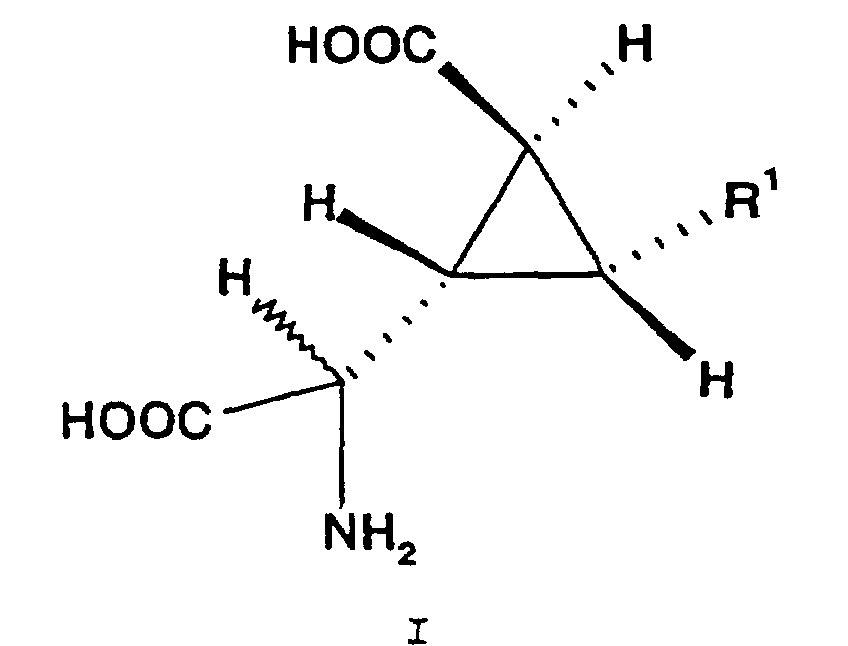
- Compounds of the invention have been found to be agonists of glutamate at metabotropic glutamate receptors and are therefore useful in the treatment of disorders of the central nervous system such as neurological diseases, for example neurodegenerative diseases, and as antipsychotic, anxiolytic, drug-withdrawal, antidepressant, anticonvulsant, analgesic and anti-emetic agents.
- It will be appreciated that the compounds of formula (I) contain at least four asymmetric carbon atoms, three being in the cyclopropane ring and one being at the α-carbon of the amino acid group. Accordingly, the compounds of the invention may exist in and be isolated in enantiomerically pure form, in racemic form, or in a diastereoisomeric mixture.
- The amino acid moiety preferably has the natural amino configuration. Accordingly, preferred compounds according to the invention are those of the formula:-
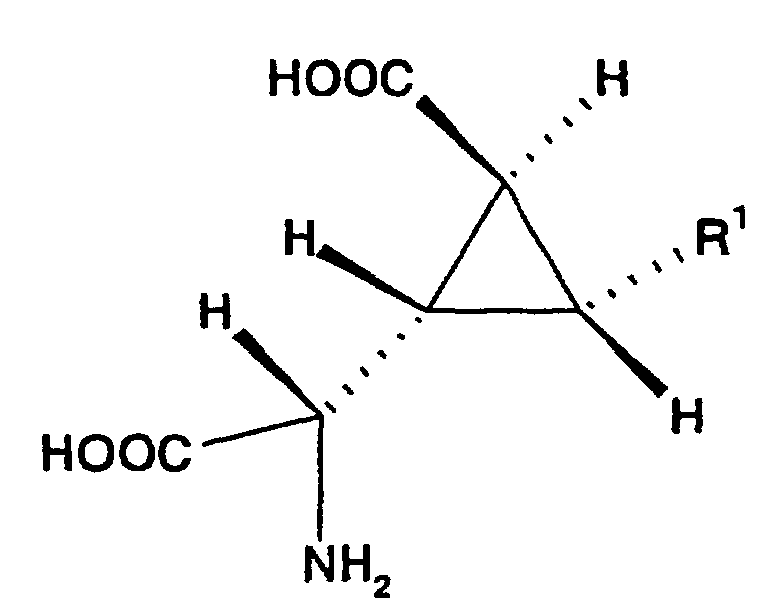
- In the above general formulae, a C1-10 alkyl group includes a C1-4 alkyl group and can be straight or branched chain, such as, for example, methyl, ethyl, propyl, isopropyl, butyl and isobutyl, and is preferably methyl or ethyl. A C2-10 alkenyl group includes, for example, vinyl, prop-2-enyl, but-3-enyl, pent-4-enyl and isopropenyl, and an alkenyl group can contain more than one double bond and, in addition, one or more triple bonds. A preferred alkenyl group is of the formula R'-CH=CH-(CH2)r- where R' is hydrogen or C1-4 alkyl and r is 0, 1 or 2. A C2-10 alkynyl group includes, for example, prop-2-ynyl, but-3-ynyl, pent-4-ynyl and oct-7-ynyl, and is preferably of the formula R''C≡C-(CH2)s -where R'' is hydrogen or C1-4 alkyl and s is 0, 1 or 2.
- Included within the group of compounds of formula I are those compounds in which R1 is C1-10 alkyl; C2-10 alkenyl or C2-10 alkynyl.
- Examples of particular values for R1 are:-
- for a C1-10 alkyl group: methyl, ethyl, propyl and isopropyl;
- for a C2-10 alkenyl group: vinyl; prop-2-enyl and isopropenyl;
- for a C2-10 alkynyl group: propynyl;
- for a phenyl-C2-10 alkyl group: 2-phenylethyl; and
- for a phenyl-C2-10 alkenyl group: 2-phenylvinyl.
-
- Preferably R1 is selected from methyl, ethyl, propyl, isopropyl, vinyl, prop-2-enyl, isopropenyl and propynyl.
- Especially preferred are compounds in which R1 is methyl or vinyl.
- Particularly preferred compounds are:
- (2S, 1'S, 2'S, 3'R)-2-(3'-methyl-2'-carboxycyclopropyl)-glycine;
- (2S, 1'S, 2'S, 3'R)-2-[3'-(2"-ethyl)-2'-carboxycyclopropyl]glycine;
- (2S, 1'S, 2'S, 3'R)-2-[3'-(3''-propyl)-2'-carboxycyclopropyl]glycine;
- (2S, 1'S, 2'S, 3'R)-2-(3'-vinyl-2'-carboxycyclopropyl)-glycine; and
- (2S, 1'S, 2'S, 3'R)-2-[3'-(2''-phenylethyl)-2'-carboxycyclopropyl]glycine; and pharmaceutically acceptable salts and esters thereof.
-
- The present invention includes salts of the formula (I) compounds. These salts can exist in conjunction with the acidic or basic portion of the molecule and can exist as acid addition, primary, secondary, tertiary, or quaternary ammonium, alkali metal, or alkaline earth metal salts. Generally, the acid addition salts are prepared by the reaction of an acid with a compound of formula (I). The alkali metal and alkaline earth metal salts are generally prepared by the reaction of the hydroxide form of the desired metal salt with a compound of formula (I).
- The salts of the compounds of formula I may be pharmaceutically-acceptable salts. However, other salts are included in the invention. They may-serve as intermediates in the purification of compounds or in the preparation of other, for example pharmaceutically-acceptable, acid addition salts, or are useful for identification, characterisation or purification.
- Acid addition salts are preferably the pharmaceutically acceptable, non-toxic addition salts with suitable acids, such as those with inorganic acids, for example hydrochloric, hydrobromic, nitric, sulphuric or phosphoric acids, or with organic acids, such as organic carboxylic acids, for example, glycollic, maleic, hydroxymaleic, fumaric, malic, tartaric, citric, salicyclic, o-acetoxybenzoic, or organic sulphonic, 2-hydroxyethane sulphonic, toluene-p-sulphonic, or naphthalene-2-sulphonic acid.
- The present invention includes esters of the formula (I) compounds, such esters being for example aliphatic esters such as alkyl esters.
- The esters of the compounds of formula I may be pharmaceutically acceptable metabolically labile esters of compounds of formula I. These are ester derivatives of compounds of formula I that are hydrolyzed in vivo to afford said compound of formula I and a pharmaceutically acceptable alcohol. Examples of metabolically labile esters include esters formed with (1-6C) alkanols in which the alkanol moiety may be optionally substituted by a (1-8C) alkoxy group, for example methanol, ethanol, propanol and methoxyethanol. The most preferred esters are alkyl esters derived from C1-4 alkanols, especially methyl and ethyl esters.
- The invention also comprises a process for preparing a compound according to formula (I), or a salt or ester thereof, which comprises:
- (a) deprotecting a compound of formula
in which R2 and R3 each independently represents hydrogen or a carboxyl protecting group, and R4 represents hydrogen or an amine protecting group;

- (b) hydrolysing a compound of formula
in which R5 represents a hydrogen atom or a carboxyl protecting group, R6 is a hydrogen atom and R7 represents a hydrogen atom, a C1-4 alkyl group, a phenyl C1-4 alkyl group in which the phenyl group is unsubstituted or substituted by halo, C1-4 alkyl or C1-4 alkoxy, or C3-4 alkenyl; or

- (c) hydrolysing a compound of formula
 in which R8 represents a hydrogen atom or a carboxy
protecting group, and R9 represents a hydrogen atom or an
amine protecting group;
in which R8 represents a hydrogen atom or a carboxy
protecting group, and R9 represents a hydrogen atom or an
amine protecting group; -
- The protection of carboxylic acid groups is described in McOmie, Protecting Groups in Organic Chemistry, Plenum Press, NY, 1973, and Greene and Wuts, Protecting Groups in Organic Synthesis, 2nd. Ed., John Wiley & Sons, NY, 1991. Examples of carboxy protecting groups include C1-C6 alkyl groups such as methyl, ethyl, t-butyl and t-amyl; aryl(C1-C4)alkyl groups such as benzyl, 4-nitrobenzyl, 4-methoxybenzyl, 3,4-dimethoxybenzyl, 2,4-dimethoxybenzyl, 2,4,6-trimethoxybenzyl, 2,4,6-trimethylbenzyl, benzhydryl and trityl; silyl groups such as trimethylsilyl and t-butyldimethylsilyl; and allyl groups such as allyl and 1-(trimethylsilylmethyl)prop-1-en-3-yl.
- Examples of amine protecting groups include acyl groups, such as groups of formula R10CO in which R10 represents C1-6 alkyl, C3-10 cycloalkyl, phenyl C1-6 alkyl, phenyl, C1-6 alkoxy, phenyl C1-6 alkoxy, or a C3-10 cycloalkoxy, wherein a phenyl group may be optionally substituted, for example by one or two of halogen, C1-C4 alkyl and C1-C4 alkoxy. Preferred amino protecting groups include t-butoxycarbonyl (Boc) and benzyl.
- Examples of particular values for R2, R3, R5 and R8 are hydrogen, methyl, ethyl, n-propyl, n-butyl, t-butyl, benzyl, 4-methoxybenzyl, phenylethyl and phenylpropyl.
- Examples of particular values for R4 and R9 include acetyl and tert-butoxycarbonyl.
- Examples of particular values for R6 and R7 are hydrogen and benzyl.
- The compounds of formula (II) may be deprotected by conventional methods. Thus, an alkyl carboxyl protecting group may be removed by hydrolysis. The hydrolysis may conveniently be performed by heating the compound of formula (II) in the presence of either a base, for example an alkali metal hydroxide such as lithium, sodium or potassium hydroxide, or an alkaline metal hydroxide, such as barium hydroxide or an acid such as hydrochloric acid. The hydrolysis is conveniently performed at a temperature in the range of from 20°C to 300°C. An aralkyl carboxyl protecting group may conveniently be removed by hydrogenation. The hydrogenation may be effected by reacting the compound of formula (II) with hydrogen in the presence of a Group VIII metal catalyst, for example a palladium catalyst such as palladium on charcoal. Suitable solvents for the reaction include alcohols such as ethanol. The reaction is conveniently performed at a temperature in the range of from 0° C to 100° C.
- An acyl, amine protecting group is also conveniently removed by hydrolysis, for example as described for the removal of an alkyl carboxyl protecting group. Thus, a tert-butoxycarbonyl, amine protecting group may conveniently be removed in the presence of an acid, for example hydrochloric acid or trifluoroacetic acid. The hydrolysis is performed in the presence of a solvent such as water, ethyl acetate or dichloromethane and at a temperature in the range of from 20°C to 100°C.
- The compounds of formula III are conveniently hydrolyzed in the presence of a base, for example an alkali metal hydroxide such as lithium, sodium or potassium hydroxide, or an alkaline earth metal hydroxide such as barium hydroxide. Suitable reaction media include water. The temperature is conveniently in the range of from 50°C to 150°C.
- The compounds of formula IV are conveniently hydrolyzed in the presence of an acid, such as hydrochloric acid or sulfuric acid, or a base, such as an alkali metal hydroxide, for example sodium hydroxide. The hydrolysis is conveniently performed in an aqueous solvent such as water, or in an alkanol such as methanol or ethanol, and at a temperature in the range of from 20°C to 200°C.
- Compounds of formula (II) may be prepared by a procedure analogous to that described in Ohfune Y., et al., J. Med. Chem., 1996, 39, 407-423. Thus they may be prepared by reacting a compound of formulawith an oxidising agent. Convenient oxidising agents include Jones Reagent.

- Compounds of formula (V) may be prepared by reacting a compound of formulawith a sulfonic acid, such as camphorsulfonic acid (CSA) and an alkanol, such as methanol.

- Compounds of formula (VI) may be prepared by reacting a compound of formulawith a strong base, such as potassium hexamethyldisilane.

- Compounds of formula (VII) may be prepared by reacting a compound of formulawith acetone dimethyl ketal in the presence of a sulfonic acid, such as camphorsulfonic acid.

- Compounds of formula VIII may be prepared by selectively deprotecting a compound of formulain which R11 represents a hydroxyl protecting group, such as a tert-butyldimethylsilyl (TBS) group. A convenient reagent for removing a TBS group is camphorsulfonic acid in methanol.

- The compounds of formula (IX) may be prepared by reacting a compound of formulawith a base, such as lithium hydroxide, for example in tetrahydrofuran, followed by introduction of the protecting group R2, for example by treatment with diazomethane (to afford a compound in which R2 is methyl).
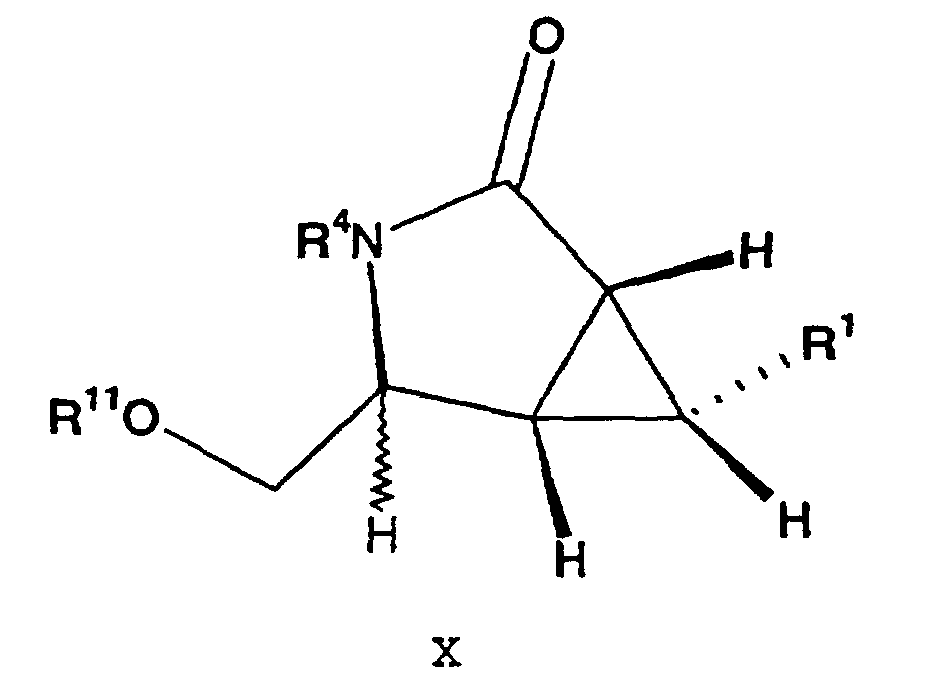
- Compounds of formula (X) may be prepared by treating a compound of formulawith an ion exchange resin, such as DOWEX 50Wx8, followed by introduction of the protecting groups R4 and R11, for example by stepwise reaction with tributylsilyl chloride in the presence of imidazole, followed by Boc2O in the presence of triethylamine and 4-dimethylaminopyridine.

- Compounds of formula (XI) may be prepared by reacting a compound of formulawith palladium (II) acetate.
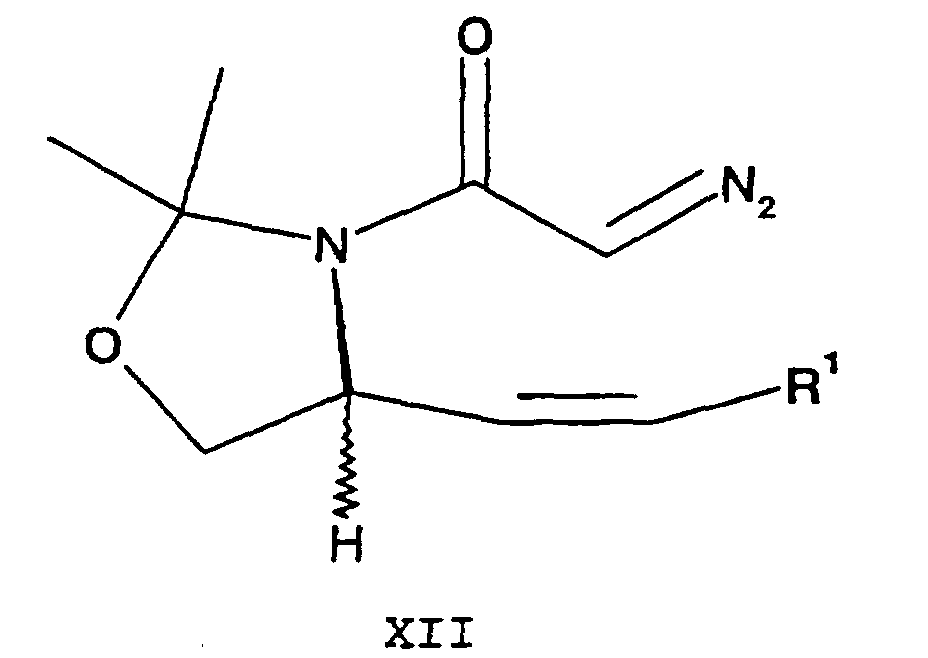
- Compounds of formula (XII) may be prepared by diazotizing a compound of formulafor example by reaction with sodium nitrite.

- Compounds of formula (XIII) may be prepared by selectively deprotecting a compound of formulain which R12 represents an amine protecting group, such as t-butoxycarbonyl. For example a t-butoxycarbonyl (Boc) group may conveniently be removed by treatment with trimethylsilyl trifluoromethanesulfonate (TMSOTf) and 2,6-lutidine.

- The compounds of formula (XIV) may be prepared by reacting a compound of formulawith an N-protected glycinate, such as N-hydroxysuccinimide N-(tert-butoxycarbonyl)glycinate, followed by reaction with acetone dimethylketal in the presence of a sulfonic acid such as p-toluenesulfonic acid.

- The compounds of formula (XV) may be prepared by reacting a compound of formulain which R13 represents an amine protecting group, such as t-butoxycarbonyl, with a triphenylphosphine halide of formula Ph3P+CH2R1 A-, in which A- represents a halide ion such as bromide, in the presence of a strong base, such as potassium hexamethyldisilane, followed by removal of the amine protecting group, and hydrolysis of the acetonide, for example by reaction with methanolic HCl.

- Compounds of formula (II) may also be prepared by reacting a compound of formulawith a Wittig reagent. For example, the compound of formula (XVII) may be reacted with an alkyl triphenylphosphonium bromide, such as methyl triphenylphosphonium bromide to afford a compound of formula (II) in which R1 represents an alkenyl group, such as vinyl. The resultant product may then, if desired, be converted into another compound of formula (II), for example by catalytic hydrogenation to convert an alkenyl group to an alkyl group.

- Compounds of formula (XVII) may be prepared by Swern oxidation of a compound of formula

- The compounds of formula XVIII may be prepared either by hydrolysing a compound of formula XIXfor example using HCl in aqueous ethanol, followed by protecting the amino group, for example by reaction with Boc2O in tetrahydrofuran or dioxane in the presence of NaHCO3,

or by hydrolysing a compound of formula XXin the presence of a base, for example sodium hydroxide, in an aqueous solution at an elevated temperature, for example about 100°C, followed by protecting the carboxylic acid groups, for example using HCl in anhydrous ethanol, and protecting the amino group, for example by reaction with Boc2O in tetrahydrofuran or dioxane in the presence of NaHCO3.
- The compounds of formula XIX may be prepared by reacting a compound of formula XXIwith ammonium chloride and potassium cyanide in the presence of aluminium oxide. A convenient solvent is acetonitrile.

- The compounds of formula XX may be prepared by hydrolysing a compound of formula XXI with an alkali metal hydroxide, for example using sodium hydroxide in aqueous ethanol, followed by treatment with an alkali metal cyanide, such as lithium, sodium or potassium cyanide, and ammonium carbonate in an aqueous alcohol, such as aqueous ethanol. Conveniently the reaction is performed at a temperature of from 35°C to 150°C.
- Compounds of formula XXI may be prepared by oxidising a compound of formula XXIIfor example by employing a Swern oxidation.
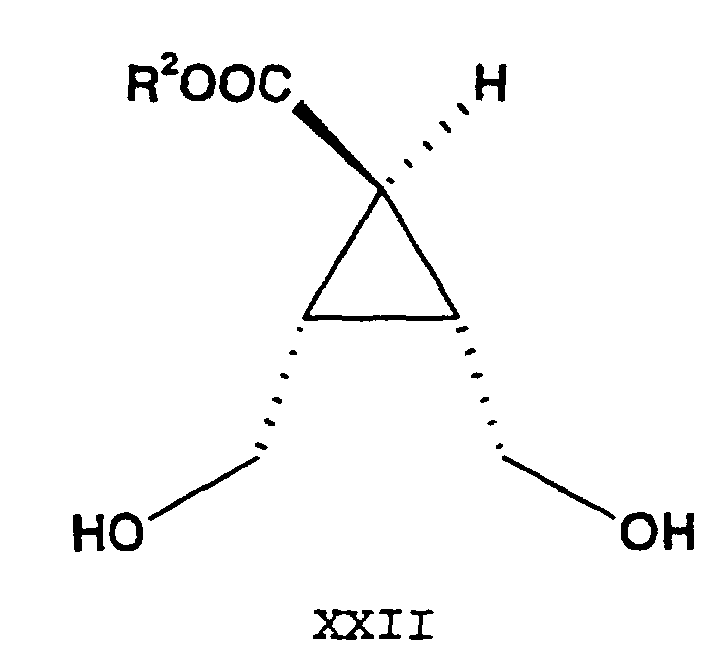
- Compounds of formula XXII may be prepared by reacting a compound of formulain which R14 represents a hydrogen atom, a C1-4 alkyl group or a phenyl group, with HCl or camphorsulphonic acid in an alkanol such as ethanol.

- Compounds of formula XXIII may be prepared by reacting a compound of formulawith N2CHCO2R2 in the presence of Rh2(OAc)4. A convenient solvent is pentane.

- The compounds of formula (III) may be prepared by reacting a compound of formulawith an alkali metal cyanide, such as lithium, sodium or potassium cyanide, and ammonium carbonate in an aqueous alcohol, such as aqueous ethanol. Conveniently the reaction is performed at a temperature of from 35°C. to 150°C. If desired, the compounds of formula (III) may then be alkylated, for example using a compound of formula R6Cl or R7Cl. The alkylated compounds are readily separated into their diastereomers.

- Compounds of formula (IV) may be prepared by reacting a compound of formula (XXV), in which R8 is as defined for R5, with an alkali metal cyanide, such as lithium, sodium or potassium cyanide, and an ammonium halide, such as ammonium chloride. It has been found advantageous to perform the reaction in the presence of ultrasound. Thus, the ammonium halide and alkali metal cyanide are advantageously mixed with chromatography grade alumina in the presence of a suitable diluent, such as acetonitrile. The mixture is then irradiated with ultrasound, whereafter the compound of formula XXV is added, and the mixture is again irradiated.
- The resultant mixture of diastereoisomeric aminonitriles may then be reacted with an acylating agent, such as acetyl chloride in the presence of a suitable base, for example an amine such as diisopropylamine, and in the presence of a suitable solvent such as dichloromethane, to afford a mixture of diastereomeric acylaminonitriles. The desired stereoisomer may conveniently be separated from this mixture, for example by chromatography.
- Alternatively, compounds of formula (IV) may be prepared by reacting a compound of formula (XXV) with a chiral 2-arylglycinol, such as (R)-2-phenylglycinol, followed by trimethylsilylcyanide. The reaction is conveniently conducted in the presence of a solvent such as methanol. The product of the reaction is a mixture of diastereomers corresponding with formula (IV) in which R9 represents a 1-aryl-2-hydroxyethyl group. The desired diastereomer may be isolated from the mixture, for example by chromatography, and then reacted with an oxidising agent such as lead tetraacetate to afford a compound of formula (IV).
- The compounds of formula (XXV) may be prepared by oxidising a compound of formulafor example by a Swern oxidation, or by reaction with tetrapropylammonium perruthenate and N-methylmorpholine-N-oxide in the presence of a molecular sieve (4Å).

- The compounds of formula (XXVI) may be prepared by reacting a compound of formula (XXI) with a Wittig reagent of formula Ph3P+CH2R15 A-, in which A- represents a halide ion such as bromide and R15 represents a hydrogen atom or an alkyl group, in the presence of a strong base, such as potassium hexamethyldisilane. Convenient solvents include ethers, such as dioxan. The resultant alkenyl compound may be reduced to afford an alkyl compound, for example by catalytic hydrogenation using palladium on charcoal as catalyst.
- The compounds of formula (XXV) may alternatively be prepared by reacting a compound of formula (XXVII)with an alkali metal hydroxide, such as sodium hydroxide, in an aqueous alcohol solvent, such as aqueous methanol, followed by diazomethane. The process affords a mixture of a compound of formula (XXVI) and a compound of formula (XXV), which may then be reacted with a chiral 2-arylglycinol and trimethylsilylcyanide as described hereinabove.
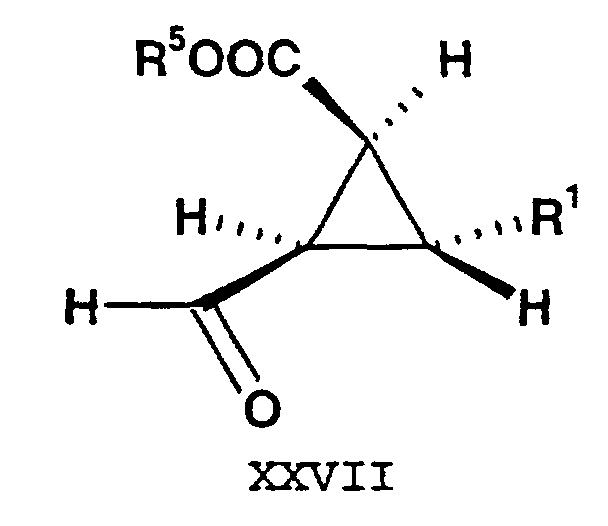
- The compounds of formula XXVII may be prepared by reacting a compound of formulafor example by a Swern oxidation, or by reaction with tetrapropylammonium perruthenate and N-methylmorpholine-N-oxide in the presence of a molecular sieve (4Å).
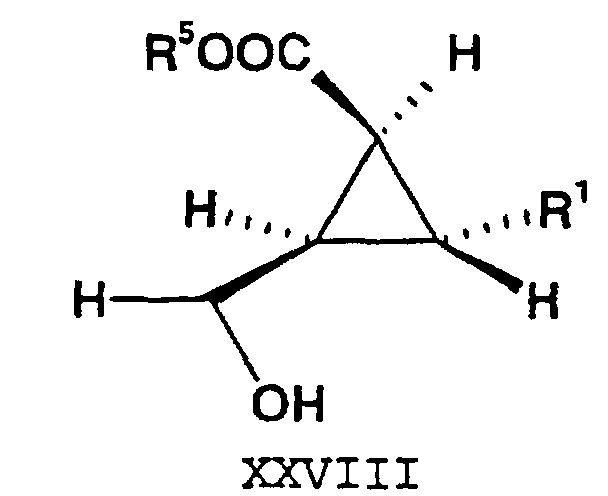
- The compounds of formula (XXVIII) may be prepared by reacting a compound of formulawith an alkali metal hydroxide, such as lithium hydroxide, to afford a compound of formula (XXVIII) in which R5 represents hydrogen, followed by followed by introducing a protecting group R5, for example by reaction with diazomethane to produce a compound in which R5 is methyl.

- The compounds of formula (XXIX) may be prepared by reacting a compound of formulawith dirhodium(II) tetrakis[methyl 2-pyrrolidone-5(R)-carboxylate].
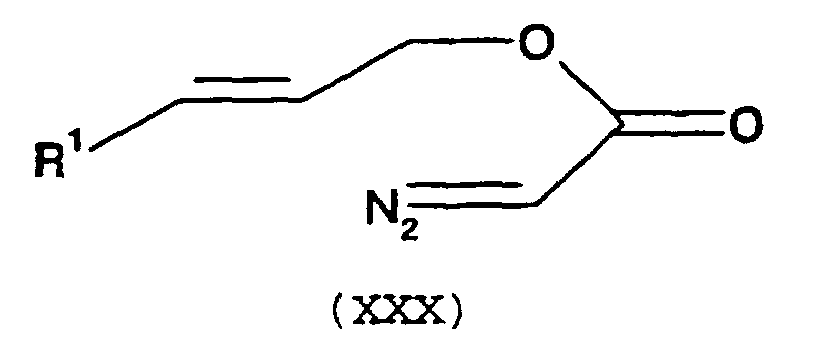
- The compounds of formula (XXX) may be prepared by reacting a compound of formulawith a sulfonyl azide such as p-acetamidobenzenesulfonyl azide in the presence of a base, such as triethylamine, followed by reaction with an aqueous alkali metal hydroxide, such as lithium hydroxide.
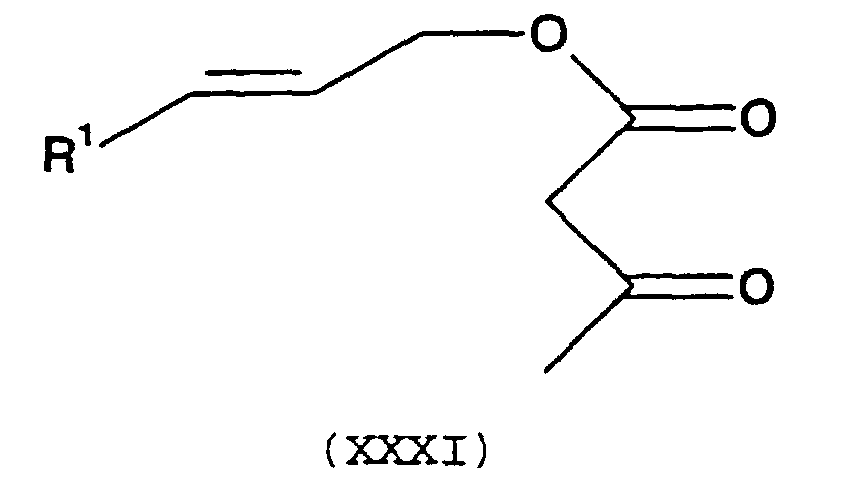
- The compounds of formula (XXXI) may be prepared by reacting a compound of formulawith diketene in the presence of an alkali metal acetate, such as sodium acetate.
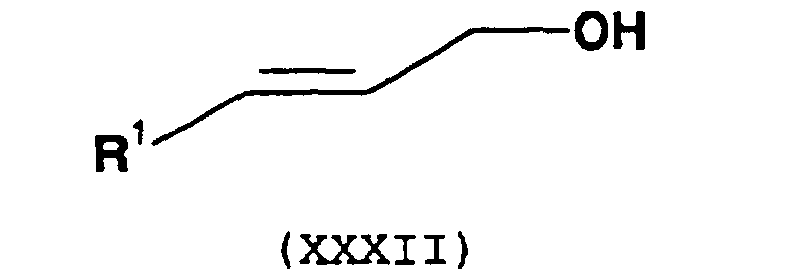
- As described hereinabove, the compounds of the invention are useful for the treatment of disorders of the central nervous system.
- According to another aspect therefore, the present invention provides for the use of a compound of formula I as defined hereinabove, or a pharmaceutically acceptable metabolically labile ester thereof, or a pharmaceutically acceptable salt thereof for the manufacture of a medicament for treating a patient suffering from or susceptible to a disorder of the central nervous system.
- The particular effective amount or dose of compound administered according to this invention will of course be determined by the particular circumstances surrounding the case, including the compound administered, the route of administration, the particular condition being treated, and similar considerations. The compounds can be administered by a variety of routes including oral, rectal, transdermal, subcutaneous, intravenous, intramuscular, or intranasal routes. Alternatively, the compound may be administered by continuous infusion. A typical daily dose will contain from about 0.01 mg/kg to about 100 mg/kg of the active compound of this invention. Preferably, daily doses will be about 0.05 mg/kg to about 50 mg/kg, more preferably from about 0.1 mg/kg to about 25 mg/kg.
- A variety of physiological functions have been shown to be subject to influence by excessive or inappropriate stimulation of excitatory amino acid transmission. The formula I compounds of the present invention are believed to have the ability to treat a variety of neurological disorders in patients associated with this condition, including acute neurological disorders such as cerebral deficits subsequent to cardiac bypass surgery and grafting, stroke, cerebral ischemia, spinal cord trauma, head trauma, perinatal hypoxia, cardiac arrest, and hypoglycemic neuronal damage. The formula I compounds are believed to have the ability to treat a variety of chronic neurological disorders, such as Alzheimer's disease, Huntington's Chorea, amyotrophic lateral sclerosis, AIDS-induced dementia, ocular damage and retinopathy, cognitive disorders, and idiopathic and drug-induced Parkinson's. The present invention also provides for the use of a compound of formula I or a pharmaceutically acceptable metabolically labile ester thereof, or a pharmaceutically acceptable salt thereof for the manufacture of a medicament for treating these disorders.
- The formula I compounds of the present invention are also believed to have the ability to treat a variety of other neurological disorders in patients that are associated with glutamate dysfunction, including muscular spasms, convulsions, migraine headaches, urinary incontinence, psychosis, (such as schizophrenia), drug tolerance and withdrawal (such as nicotine, opiates and benzodiazepines), anxiety and related disorders, emesis, brain edema, chronic pain, and tardive dyskinesia. The formula I compounds are also useful as antidepressant and analgesic agents. Therefore, the present invention also provides for the use of a compound of formula I, or a pharmaceutically acceptable metabolically labile ester thereof, or a pharmaceutically acceptable salt thereof for the manufacture of a medicament for treating these disorders.
- The term "treating" for purposes of the present invention, includes prophylaxis, amelioration or elimination of a named condition once the condition has been established.
- The term "patient" for purposes of the present invention is defined as any warm blooded animal such as, but not limited to, a mouse, guinea pig, dog, horse, or human. Preferably, the patient is human.
- According to another aspect, the present invention provides a compound of formula I as defined hereinabove, or a pharmaceutically acceptable metabolically labile ester thereof, or a pharmaceutically acceptable salt thereof, for use as a pharmaceutical.
- According to yet another aspect, the present invention provides the use of a compound of formula I as defined hereinabove, or a pharmaceutically acceptable metabolically labile ester thereof, or a pharmaceutically acceptable salt thereof, for the manufacture of a medicament for treating a disorder of the central nervous system.
- The ability of compounds to modulate metabotropic glutamate receptor function may be demonstrated by examining their ability to influence either cAMP production (mGluR 2, 3, 4, 6, 7 or 8) or phosphoinositide hydrolysis (mGluR 1 or 5) in cells expressing these individual human metabotropic glutamate receptor (mGluR) subtypes. (D. D. Schoepp, et al., Neuropharmacol., 1996, 35, 1661-1672 and 1997, 36, 1-11).
- In these tests the compound of Example 1 of the present application was found to reverse [3H] LY341495 binding with a Ki of 100.2 nM at mGluR2. In comparison, (2S, 1'S, 2'S, 3'S)-2'-carboxy-3'-methylcyclopropylglycine, disclosed in EP-A-0870760 was found to reverse [3H] LY341495 binding with a Ki of 2645 nM at mGluR2. (LY341495 is described in Ornstein et al., J. Med. Chem., 1998, 41, 346-357 and J. Med. Chem., 1998, 41, 358 to 378).
- The compounds of the present invention are preferably formulated prior to administration. Therefore, another aspect of the present invention is a pharmaceutical formulation comprising a compound of formula I, a pharmaceutically acceptable metabolically labile ester thereof, or a pharmaceutically acceptable salt thereof, and a pharmaceutically-acceptable carrier, diluent, or excipient. The present pharmaceutical formulations are prepared by known procedures using well-known and readily available ingredients. In making the compositions of the present invention, the active ingredient will usually be mixed with a carrier, or diluted by a carrier, or enclosed within a carrier, and may be in the form of a capsule, sachet, paper, or other container. When the carrier serves as a diluent, it may be a solid, semi-solid, or liquid material which acts as a vehicle, excipient, or medium for the active ingredient. The compositions can be in the form of tablets, pills, powders, lozenges, sachets, cachets, elixirs, suspensions, emulsions, solutions, syrups, aerosols, ointments containing, for example, up to 10% by weight of active compound, soft and hard gelatin capsules, suppositories, sterile injectable solutions, and sterile packaged powders.
- Some examples of suitable carriers, excipients, and diluents include lactose, dextrose, sucrose, sorbitol, mannitol, starches, gum, acacia, calcium phosphate, alginates, tragacanth, gelatin, calcium silicate, microcrystalline cellulose, polyvinylpyrrolidone, cellulose, water syrup, methyl cellulose, methyl and propyl hydroxybenzoates, talc, magnesium stearate, and mineral oil. The formulations can additionally include lubricating agents, wetting agents, emulsifying and suspending agents, preserving agents, sweetening agents, or flavoring agents. Compositions of the invention may be formulated so as to provide quick, sustained, or delayed release of the active ingredient after administration to the patient by employing procedures well known in the art.
- The compositions are preferably formulated in a unit dosage form, each dosage containing from about 5 mg to about 500 mg, more preferably about 25 mg to about 300 mg of the active ingredient. The term "unit dosage form" refers to a physically discrete unit suitable as unitary dosages for human subjects and other mammals, each unit containing a predetermined quantity of active material calculated to produce the desired therapeutic effect, in association with a suitable pharmaceutical carrier, diluent, or excipient. The following formulation examples are illustrative only and are not intended to limit the scope of the invention in any way.
-
Hard gelatin capsules are prepared using the following ingredients: Quantity (mg/capsule) Active Ingredient 250 Starch, dried 200 Magnesium stearate 10 Total 460 mg - The above ingredients are mixed and filled into hard gelatin capsules in 460 mg quantities.
-
Tablets each containing 60 mg of active ingredient are made as follows: Active Ingredient 60 mg Starch 45 mg Microcrystalline cellulose 35 mg Polyvinylpyrrolidone 4 mg Sodium carboxymethyl starch 4.5 mg Magnesium stearate 0.5 mg Talc 1 mg Total 150 mg - The active ingredient, starch, and cellulose are passed through a No. 45 mesh U.S. sieve and mixed thoroughly. The solution of polyvinylpyrrolidone is mixed with the resultant powders which are then passed through a No. 14 mesh U.S. sieve. The granules so produced are dried at 50°C and passed through a No. 18 mesh U.S. sieve. The sodium carboxymethyl starch, magnesium stearate, and talc, previously passed through a No. 60 mesh U.S. sieve, are then added to the granules which, after mixing, are compressed on a tablet machine to yield tablets each weighing 150 mg.
- The following Examples illustrate the invention. In the Examples, the term "Garner's aldehyde" signifies 1,1-dimethylethyl (S) or (R)-4-formyl-2,2-dimethyl-3-oxazolidine carboxylate, Ph3PEtBr signifies (ethyl)triphenylphosphonium bromide, KHDMS and LiHDMS signify potassium and lithium hexamethyldisilazane respectively, Et2O signifies diethylether, AcOEt signifies ethyl acetate, MeOH signifies methanol, Boc signifies t-butoxycarbonyl, Et3N signifies triethylamine, THF signifies tetrahydrofuran, TMSOTf signifies trimethylsilyl trifluoromethanesulfonate, Pd(OAc)2 signifies palladium acetate, NMO signifies N-methylmorpholine-N-oxide, TPAP signifies tetrapropylammonium perruthenate, TMSCN signifies trimethylsilylcyanide, Rh2(5R-MEPY)4 signifies dirhodium(II) tetrakis[methyl 2-pyrrolidone-5(R)-carboxylate], DMF signifies dimethylformamide, DMAP signifies 4-dimethylaminopyridine, Jones Reagent signifies a solution of 1.0g of Na2Cr2O7.2H2O and 1.34 g of sulfuric acid in H2O (total volume 5 ml), DBU signifies 1,8-diazabicyclo[5.4.0]undec-7-ene and DME signifies ethylene glycol dimethyl ether.
-

- To a suspension of Ph3PEtBr (4.86 g, 13.9 mmol) in anhydrous dioxane (100 mL) under nitrogen at room temperature, a 0.5M solution of KHMDS in toluene (22.3 mL, 11.7 mmol) was added. After stirring for one hour, the mixture was added dropwise via cannula to a solution of the Garner's aldehyde (2.0 g, 8.7 mmol) in anhydrous dioxane (40 mL) under nitrogen at room temperature. After the addition was completed, the reaction mixture was stirred for 30 min and then poured onto a (1:1) mixture H2O-Et2O (500 mL). The layers were then separated and the aqueous layer was extracted with Et2O (2X). The combined organic layers were dried (Na2SO4), filtered and evaporated to give a residue which was purified by chromatography using AcOEt/Hexane (1:10) as eluent to give 1.8 g (86% yield) of cis-olefin as the major isomer. 1H-NMR (300MHz, CDCl3): 1.44 (s, 9H), 1.52 (s, 3H), 1.60 (s, 3H), 1.70 (d, J=1.1 Hz, 3H), 3.65 (dd, J=3.3, 8.8 Hz, 1H), 4.06 (dd, J=6.0, 8.8 Hz, 1H), 4.72-4.62 (m, 1H) and 5.61-5.39 ppm (m, 2H).
- To a solution of the product of step a) (1.77 g, 4.48 mmol) in MeOH (10 mL) at 0ºC was added 1N HCl/MeOH (30 mL) at 0ºC. The reaction mixture was stirred at 0ºC for 1 hour and at room temperature overnight. The solvent was removed in vacuo and residue taken into H2O (10 mL). This solution was adjusted to pH 7 by addition of 1N NaOH and then to pH 9 by Et3N. The solvent was removed in vacuo and residue was dissolved in MeOH (20 mL) and THF (30 mL) (additional Et3N was added until the solution became pH 9). To this solution at 0ºC was added N-hydroxysuccinimide N-(tert-butoxy-carbonyl)glycinate (2.2 g, 8.06 mmol) and then warmed to room temperature. After the mixture was stirred for 1 hour, the solvent was evaporated in vacuo and the oily residue was dissolved in AcOEt. The insoluble material was filtered off and filtrate concentrated in vacuo to give a residue which was subjected to column chromatography on silica gel (AcOEt). The resulting Boc-glycyl compound was dissolved in benzene (25 mL) and p-toluensulfonic acid (21 mg, 0.11 mmol) and 2,2-dimethoxypropane (1.9 mL, 15.4 mmol) were added. The mixture was stirred under reflux 24 hours. To this solution at room temperature, MeOH (5 mL) was added and mixture was stirred for 30 minutes. Then, NaHCO3 (1-2 g) was added and, after stirring for 15 minutes, the insoluble material was filtered off. The filtrate was evaporated in vacuo and the residue purified by column chromatography (AcOEt/Hexane 1:5 and then 1:3) to give the Boc-glycyl acetonide (1.89 g, 86%). 1H-NMR (300MHz, CDCl3): 1.43 (s, 9H), 1.56 (s, 3H), 1.66 (s, 3H), 1.76 (dd, J=1.6, 7.2 Hz, 3H), 3.86-3.78 (m, 3H), 4.15 (dd, J=6.1, 8.8 Hz, 1H), 4.61-4.57 (m, 1H), 5.50-5.39 (m, 2H) and 5.74-5.63 ppm (m, 1H).
- To a solution of the product of step b) (2.7 g, 9.05 mmol) and 2,6-lutidine (3.27 mL, 28.06 mmol) in CH2Cl2 (30 mL) at room temperature under nitrogen was added TMSOTf (3.44 mL, 19.0 mmol). The mixture was stirred for 15 minutes and then cooled to 0ºC and quenched with saturated aqueous NH4Cl solution (15 mL). The mixture was extracted with Et2O, dried over Na2SO4 and the solvent was then evaporated in vacuo. The residue was taken into Et2O (75 ml) at room temperature and a NaNO2 (3.12 g, 45.25 mmol) solution in H2O (35 ml) was added with intensive stirring. To this suspension, a 5% solution of citric acid in H2O was added until the pH was adjusted to ~3. The mixture was vigorously stirred for 30 minutes at room temperature and then extracted three times with Et2O. The combined organic layers were washed with NaHCO3 and H2O, dried over Na2SO4 and solvent was removed in vacuo. The resulting diazo ketone, without further purification was dissolved in benzene (200 mL) and Pd(OAc)2 (100 mg, 0.45 mmol) was added. The mixture was heated at 70ºC for 30 minutes and then the solvent was evaporated in vacuo. The residue was purified by column chromatography using AcOEt/Hexane (1:2) as eluent to give the corresponding tricyclic compound (570 mg, 35%). [α]D= +57.0º (c=0.105, CHCl3).
1H-NMR (300MHz, CDCl3): 1.20 (d, J= 6.6 Hz, 1H), 1.39 (s, 3H), 1.52-1.40(m, 1H), 1.74 (s, 3H), 1.89 (dd, J=6.1, 8.2 Hz, 1H), 2.18-2.07 (m, 1H), 3.51 (dd, J=7.1, 9.9 Hz, 1H), 3.82-3.77 (m, 1H), 4.02 ppm (dd, J=5.5, 7.1 Hz, 1H).
13C-NMR (75MHz, CDCl3): 7.8, 17.3, 21.6, 23.8, 28.6, 28.9, 58.4, 67.9, 93.7 and 172.8 ppm. - A mixture of the product of step c) (440 mg, 2.42 mmol) and Dowex 50W x 8 resin (H+ form, 200 mg) in methanol (20 mL) was stirred overnight at room temperature. The resin was then filtered off, and the filtrate was concentrated in vacuo. To a solution of the residue and imidazole (660 mg, 9.68 mmol) in DMF (10 mL) was added a solution of tert-butyldimethylsilylchloride (1.10 g, 7.26 mmol) in DMF (5 mL). The reaction mixture was stirred overnight at room temperature and then poured onto cold water and extracted three times with Et2O. The combined organic layers were dried over Na2SO4 and solvent removed in vacuo (DMF was removed by azeotropic distillation with toluene). A solution of the resulting residue, Et3N (0.68 mL, 4.48 mmol), Boc2O (790 mg, 3.63 mmol) and DMAP (60 mg, 0.48 mmol) in THF (15 mL) was stirred overnight at room temperature and then poured onto water and extracted three times with AcOEt. The combined organic layers were washed successively with 5% aqueous citric acid and water and dried over Na2SO4. The solvent was removed in vacuo and the resulting residue was purified by column chromatography (AcOEt/Hexane 1:6 ) to give the bicyclic lactone (640 mg, 75%). 1H-NMR (300MHz, CDCl3): 0.04 (s, 3H), 0.05 (s, 3H), 0.87 (s, 9H), 1.05 (d, J= 6.6 Hz, 3H), 1.42-1.34(m, 1H), 1.49 (s, 9H), 1.87 (dd, J=6.6, 7.7 Hz, 1H), 2.05-1.99 (m, 1H), 3.91-3.76 ppm (m, 3H). 13C-NMR (75MHz, CDCl3): -5.5 (2C), 7.6, 16.0, 18.1, 19.5, 25.7 (3C), 25.8, 28.0 (3C), 56.7, 63.7, 82.6, 149.5 and 172.4 ppm.
- To a solution of the product of step d) (480 mg, 1.35 mmol) in THF (13.5 mL), 1N LiOH (13.5 mL) was added. The mixture was vigorously stirred overnight and then adjusted to pH-3 by addition of 5% aqueous citric acid. The aqueous layer was extracted three times with AcOEt, and the combined organic layers were dried over Na2SO4, filtered and the solvent removed in vacuo. A solution of the residue in Et2O (25 mL) at 0ºC was treated with a recently prepared CH2N2 solution in Et2O (until the yellow color is retained) at 0ºC. After 30 minutes, the solvent was removed and the residue was purified by column chromatography (AcOEt/Hexane 1:6 ) to give the corresponding cyclopropane (380 mg, 73%).
[α]D= -45.0º (c=0.132, CHCl3).
1H-NMR (300MHz, CDCl3): 0.04 (s, 3H), 0.05 (s, 3H), 0.89 (s, 9H), 1.26-1.18 (m, 1H), 1.31 (d, J= 6.6 Hz, 3H), 1.42 (s, 9H), 1.52-1.44 (m, 1H), 1.75-1.70 (m, 1H), 3.64 (s, 3H), 3.78-3.62 (m, 2H), 3.98-3.89 (m, 1H), 4.75 ppm (br s, 1H).
13C-NMR (75MHz, CDCl3): -5.5 (2C), 7.8, 18.3, 19.1, 20.2, 25.7, 25.8 (3C), 28.0 (3C), 47.4, 51.2, 65.1, 78.7, 154.8 and 171.8 ppm. - A mixture of cyclopropane (380 mg, 1.0 mmol) and camphorsulfonic acid (11.4 mg, 0.05 mmol) in MeOH (50 mL) was stirred at room temperature for 4 hours. The solvent was then removed in vacuo and the residue was taken into acetone. To this solution under nitrogen atmosphere 2,2-dimethoxypropane (1.2 mL, 9.8 mmol) was added, and the mixture was stirred for 2 hours at 60ºC. Then, the reaction mixture was cooled to room temperature and NaHCO3 (50 mg) was added. The mixture was then filtered the filtrate evaporated in vacuo. The residue was purified by column chromatography (AcOEt/Hexane 1:6) to give the corresponding acetonide (300 mg, 98%). [α]D= -38.0º (c=0.105, CHCl3).
1H-NMR (300MHz, CDCl3): 1.27 (br s, 2H), 1.45 (br s, 15H), 1.60 (s, 3H), 1.87-1.81 (m, 1H), 3.71 (s, 3H), 3.85 (dd, J=2.2, 8.8 Hz, 1H), 4.07 (dd, J=6.0, 8.8 Hz, 1H), 4.37 ppm (br s, 1H).
13C-NMR (75MHz, CDCl3): 7.9, 16.6, 21.1, 24.5, 27.8, 27.9, 28.3 (3C), 51.0, 51.9, 68.6, 79.5, 93.4, 151.8 and 171.9 ppm. - To a solution of the product of step f) (300 mg, 0.96 mmol) in THF at -78ºC under nitrogen atmosphere, 0.5M KHMDS solution in toluene (5.75 mL, 2.87 mmol) was added. The mixture was slowly allowed to react at room temperature (over a period of 4 hours) and then stirred at room temperature for 15 minutes. The reaction mixture was cooled again to -78ºC and then quenched with a saturated NH4Cl aqueous solution. The aqueous layer was extracted twice with Et2O and AcOEt, and the combined organic layers were dried over Na2SO4 and evaporated in vacuo. The resulting residue was purified by column chromatography (AcOEt/Hexane 1:6) to give the epimerized product (250 mg, 83%). [α]D= -25.4º (c=0.13, CHCl3).
1H-NMR (300MHz, CDCl3): 1.14 (d, J=6.1 Hz, 3H), 1.50 (br s, 15H), 1.75-1.57 (m, 3H), 3.66-3.57 (br s, 1H), 3.67 (s, 3H), 3.85 (d, J=8.2 Hz, 1H), 4.05-3.97 ppm (m, 1H).
13C-NMR (75MHz, CDCl3): 12.5, 19.8, 23.2, 27.0, 27.8, 28.3 (3C), 31.5, 51.4, 56.3, 68.6, 80.1, 94.0, 152.1 and 174.2 ppm. - A mixture of the product of step g) (250 mg, 0.8 mmol) and camphorsulfonic acid (9.2 mg, 0.04 mmol) in MeOH (40 mL) was stirred at room temperature overnight. The following day, additional camphorsulfonic acid (11.0 mg, 0.047 mmol) was added and the mixture was stirred for 48 hours. Then, NaHCO3 (50 mg) was added and the mixture was filtered off. The filtered was evaporated in vacuo and the residue was purified by column chromatography (AcOEt/Hexane 1:1) to give the corresponding alcohol (200 mg, 91%).
- To a solution of the product of step h) (200 mg, 0.73 mmol) in acetone (5 mL) at 0ºC, Jones Reagent (1.12 mL) previously cooled to 0ºC was added. The mixture was stirred for 2 hours and 3 hours at room temperature. Then, the reaction was quenched with iso-propanol (5 mL) and H2O (5 mL), stirred for 15 minutes and poured onto AcOEt (75 mL). The organic layer was washed several times with H2O, dried over Na2SO4. and evaporated in vacuo. The residue was dissolved in THF (5 mL) and 2.5N LiOH (10 mL) was added. The mixture was vigorously stirred overnight. The organic layer was separated and discarded and the aqueous layer washed with Et2O. After the aqueous solution was adjusted to pH∼1 by addition of 1N HCl at 0ºC, it was extracted four times with AcOEt, and the combined organic layers were dried over Na2SO4 and evaporated in vacuo. A solution of the residue in 1N HCl/AcOEt (5 mL) was stirred overnight. The solvent was removed in vacuo and the resulting solid washed with Et2O. The hydrochloride was dissolved in MeOH (3 mL) and propylene oxide (5 mL) was added. The mixture was stirred overnight and the resulting insoluble solid was filtered and washed with Et2O to give the title compound (75 mg, 60%). 1H-NMR (300MHz, D2O/KOD): 1.20-1.07 (m, 4H), 1.44-1.38(m, 2H), 2.90 ppm (d, J=2.2, 9.8 Hz, 1H).
- 13C-NMR (75MHz, D2O/KOD): 13.7, 21.9, 30.9, 32.8, 56.7, 183.4 and 184.5 ppm.
-

- To a solution of cis-4,7-dihydro-1,3-dioxepin (4.57 g, 45.6 mmol) in pentane (25 mL) under nitrogen at room temperature, Rh2(OAc)4 (220 mg, 0.5 mmol) was added. To the resulting suspension vigorously stirred, a solution of ethyl diazoacetate (10.5 mL, 100 mmol) in pentane (75 mL) was added dropwise at room temperature over a period of 3-4 hours. After the addition was completed, solvent was removed under vacuo and residue was chromatographed using a gradient of AcOEt/Hexane 1:10 to 1:5 as eluent. 6.75 g of an inseparable mixture of cyclopropanated product and EtO2CCH=CHCO2Et was obtained. A solution of this mixture in ethanol saturated with hydrogen chloride (250 mL) was stirred overnight at room temperature. The following day, solvent was removed under vacuo and residue taken into ethanol (100 mL). This solution was neutralized with NaHCO3 (solid), filtered and concentrated. The resulting residue was chromatographed using a gradient of AcOEt/Hexane 1:1 to 3:1 as eluent to give 4.3 g (56% yield) of diol. 1H-NMR (200MHz, CDCl3): 1.23 (t, J=7.1 Hz, 3H), 1.49 (t, J=3.5, 1H), 1.89-2.00 (m, 2H), 2.72 (br s, 2H), 3.31-3.42 (m, 2H),4.05-4.16 (m, 2H) and 4.10 ppm (c, J=7.1 Hz, 2H). 13C-NMR (50MHz, CDCl3): 14.0, 23.8, 27.1 (2C), 60.3 (2C), 60.8 and 172.8 ppm.
- To a solution of oxalyl chloride (0.38 mL, 4.48 mmol) in CH2Cl2 (20 mL) at -78ºC under nitrogen atmosphere, dimethylsulfoxide (0.66 mL, 9.33 mmol) was added and stirred for 20 minutes. To this mixture, a solution of the product of step a) (650 mg, 3.73 mL) in CH2Cl2 was added and reaction was stirred at the same temperature for 30 minutes. Then, triethylamine (2.6 mL, 18.65 mmol) was added and mixture allowed to react at room temperature. After 30 minutes, the reaction mixture was quenched with water, the layers were separated and the aqueous layer was extracted with CH2Cl2 (2X). The combined organic layers were dried (Na2SO4), filtered and evaporated to give a residue which was chromatographed using a gradient of AcOEt/Hexane 1:2 to 1:1 as eluent to give 470 mg (73% yield) of lactol. 1H-NMR (200MHz, CDCl3): 1.23 (t, J=7.1 Hz, 3H), 1.43 (t, J=3.3 Hz, 1H), 2.21-2.23 (m, 2H), 2.76 (d, J=3.0 Hz, 1H), 3.85 (d, J=8.7 Hz, 1H), 4.06 (d, J=8.7 Hz, 1H), 4.10 (c, J=7.1 Hz, 2H) and 5.32 (d, J=3.0 Hz, 1H). 13C-NMR (50MHz, CDCl3): 14.1, 22.1, 25.0, 31.2, 60.8, 67.3, 97.8 and 171.9 ppm.
- A suspension of ammonium chloride (2.42 g, 45.3 mmol) and neutral aluminium oxide (1.4 g) in acetonitrile (50 mL) was ultrasonicated for one hour. A solution of the product of step b) (780 mg, 4.53 mmol) in acetonitrile (20 mL) was then added and ultrasonicated for one hour. After potassium cyanide (3.54 g, 54.36 mmol) finely powdered was added, the mixture was allowed to react for 15 hours. Then, additional aluminium oxide (3.2 g) was added and the reaction mixture was ultrasonicated for 4 days. The mixture was then filtered through celite and the inorganics washed with acetonitrile to give 710 mg (78% yield) of the four possible aminonitriles as a yellow oil.
- A solution of the product of step c) (380 mg, 1.92 mmol) in ethanol saturated with hydrogen chloride (20 mL) and H2O (0.10 mL, 5.75 mmol) was stirred for one hour at 0ºC and for 48 hours at room temperature. The following day, the solvent was removed in vacuo and the residue was dissolved in ethanol (25 mL). Then, the solution was neutralized with NaHCO3 (solid), filtered through celite and concentrated to dryness. The resulting residue was taken into dioxane(20 mL), and a saturated aqueous solution of NaHCO3 (5 mL) was added. Then, a solution of di-tert-butyldicarbonate (500 mg, 2.3 mmol) in dioxane (5 mL) was added and mixture stirred overnight. The layers were then separated and the aqueous layer was extracted with ethyl acetate (AcOEt). The combined organic layers were dried (Na2SO4), filtered and concentrated to dryness. The residue was purified by column chromatography using AcOEt/Hexane 1:2 as eluent to give 400 mg of a 1:2 mixture of diastereoisomers (61% overall yield). The minor and desired isomer (lower Rf) was separated by column chromatography using AcOEt/Hexane 1:3 as eluent giving rise to ethyl (2SR, 1'SR, 2'RS, 3'RS)-N-(tert-butoxycarbonyl)-2-[2'-(ethoxycarbonyl)-3'-hydroxymethylcyclopropyl]glycinate as a mixture of enantiomers.
- A solution of the product of step b) (1.8 g, 10.45 mmol) in EtOH (65 mL) and NaOH(1N) (63 mL, 63.0 mmol) was stirred at 60ºC for 1 hour. The mixture was then cooled to 0ºC and the pH was adjusted to ~6 by addition of 1N KHSO4. To the resulting solution, (NH4)2CO3 (10.1 g, 104.5 mmol) and NaCN (1.02 g, 20.9 mmol) were added. The mixture was stirred under reflux overnight (16-17 hours) and then cooled to room temperature. The solution was then evaporated to dryness under vacuo to give a residue that was taken into MeOH and filtered off. The inorganics were washed with MeOH and the combined methanolic filtrates were concentrated in vacuo. The resulting residue was dissolved in 1N NaOH (200 mL) and the mixture was stirred under reflux for 48 hours and then cooled to 0ºC. The pH was then adjusted to 1-2 by addition of 1N HCl, and the solvent was removed under vacuo.
- The resulting residue was dissolved in a 1N HCl/ethanol solution (250 mL) and the mixture was stirred overnight at room temperature. The solvent was then removed under vacuo and the residue was taken into EtOH (200 mL). After the solvent was removed under vacuo, the residue was again taken into EtOH (200 mL) and the solution neutralized with NaHCO3 (solid), the inorganics filtered off and the filtrate concentrated to dryness. The residue was taken into dioxane (200 mL) at room temperature and a saturated aqueous solution of NaHCO3 (50 mL) was added. Then, a solution of di-tert-butyldicarbonate (2.75 g, 12.54 mmol) in dioxane (50 mL) was added dropwise and the mixture was vigorously stirred at room temperature overnight. The mixture was then diluted with AcOEt and the layers were separated. The aqueous layer was extracted with AcOEt (2X)and the combined organic layers were dried (Na2SO4), filtered and concentrated to dryness. The residue was purified by column chromatography using AcOEt/hexane (1:2) as eluent to give 2.15 g of a 2.3:1 mixture of diastereoisomers (60% overall yield). The major and desired isomer (lower Rf) was separated by column chromatography using Et2O/Hexane 1:1 as eluent giving rise to ethyl (2SR, 1'SR, 2'RS, 3'RS)-N-(tert-butoxycarbonyl)-2-[2'-(ethoxycarbonyl)-3'-hydroxymethylclopropyl]glycinate as a mixture of enantiomers.
1H-NMR (200MHz, CDCl3): 1.25 (t, J=7.1 Hz, 3H), 1.32 (t, J=7.1 Hz, 3H), 1.45 (s, 9H), 1.70-1.81 (m, 2H), 1.91-2.11 (m, 1H), 3.17 (dd, J=3.1, 10.1 Hz, 1H), 3.54-3.67 (m, 1H), 3.95-4.33 (m, 6H), and 5.20 (br d, J=7.3 Hz, 1H).
13C-NMR (50MHz, CDCl3): 14.0, 14.1, 22.5, 28.2 (3C), 28.9, 29.2, 52.3, 60.8, 61.0, 62.5, 80.4, 155.3, 171.8 and 172.4 ppm. - To a solution of oxalyl chloride (0.38 mL, 4.41 mmol) in CH2Cl2 (30 mL) at -78ºC under nitrogen atmosphere, a solution of dimethylsulfoxide (0.52 mL, 7.35 mmol) in CH2Cl2 (15 mL) was added and stirred for 10 minutes. To this mixture, a solution of a mixture of (2RS) and (2SR) ethyl (1'SR, 2'RS, 3'RS)-N-(tert-butoxycarbonyl)-2-[2'-(ethoxycarbonyl)-3'-hydroxymethylclopropyl]glycinate (1.01 g, 2.94 mmol) (the mixture of products of step d) in CH2Cl2 (5 mL) was added and reaction was stirred at the same temperature for 20 minutes. Then, triethylamine (2.05 mL, 14.7 mmol) was added and mixture allowed to react at room temperature. After 30 minutes, the reaction mixture was quenched with water, the layers were separated and the aqueous layer was extracted with CH2Cl2 (2X). The combined organic layers were dried (Na2SO4), filtered and evaporated to give a residue which was chromatographed using AcOEt/Hexane 1:3 as eluent to give 1.15 g of a mixture of hemiaminals that were used without further purification in the next step.
- To a suspension of methyltriphenylphosphonium bromide (2.34 g, 6.55 mmol) in THF (60 mL) at room temperature under nitrogen atmosphere a 0.5M solution of KHMDS in toluene (11.0 mL, 5.5 mmol) was added. After 30 minutes, the mixture was added via cannula to a solution of the mixture of hemiaminals (900 mg, 2.62 mmol) in THF (90 mL) under a nitrogen atmosphere and reaction was stirred for 2 hours. Then, the mixture was poured onto a mixture of Et2O and H2O and the layers were separated. The aqueous layer was extracted with Et2O (2X) and the combined organic layers were dried (Na2SO4), filtered and concentrated to dryness. The residue was purified by column chromatography using AcOEt/hexane (1:2) as eluent giving rise to the ethyl (2RS, 1'SR, 2'SR, 3'RS)-N-(tert-butoxycarbonyl)-2-[2'-(ethoxycarbonyl)-3'-vinylcyclopropyl]glycinate as a mixture of enantiomers.
1H-NMR (300MHz, CDCl3): 1.26 and 1.27 (2t, J=7.1 Hz, 6H), 1.43 (s, 9H), 1.85-1.77 (m, 1H), 1.99 (t, J=4.9 Hz, 1H), 2.26-2.18 (m, 1H), 3.93-3.87 (m, 1H), 4.32-4.09 (m, 4H), 5.02 (br d, J=7.7 Hz, 1H), 5.20 (d, J=10.4 Hz, 1H), 5.28 (d, J=16.4 Hz, 1H) and 5.70-5.59 ppm (m, 1H).
1C-NMR (75MHz, CDCl3): 14.1 (2C), 26.1, 28.1 (3C), 29.1, 29.2, 52.3, 60.8, 61.3, 80.0, 118.4, 132.4, 154.8, 171.7 and 172.0 ppm. - To a solution of the product of step e) (140 mg, 0.41 mmol) in THF (35 mL) was added 2.5N LiOH (6.6 mL, 16.4 mmol). The mixture was vigorously stirred overnight. The organic layer was separated and discarded and the aqueous layer was washed with Et2O. After the aqueous solution was adjusted to pH∼1 by addition of 1N HCl at 0ºC, it was extracted four times with AcOEt, and the combined organic layers were dried over Na2SO4 and evaporated in vacuo. A solution of the residue in 1N HCl in AcOEt (5 mL) was stirred overnight. The solvent was then removed in vacuo and the resulting solid was washed with Et2O. The hydrochloride was dissolved in MeOH (3 mL) and propylene oxide (10 mL) was added. The mixture was stirred overnight and the resulting insoluble solid was filtered and washed with Et2O to give the title compound (40 mg, 52%).
1H-NMR (200MHz, D2O): 1.65-1.77 (m, 1H), 1.95 (t, J=5.0 Hz, 1H), 2.06-2.17 (m, 1H), 3.20 (d, J=11.1 Hz, 1H), 5.20-5.05 (m, 2H) and 5.62-5.44 (m, 1H).
1C-NMR (50MHz, D2O): 27.1, 28.8, 29.6, 53.8, 120.5, 132.3, 174.2 and 177.2 ppm. - To a refluxing solution of crotyl alcohol (21.5 mL, 252 mmol) and sodium acetate (1.24 g, 15.12 mmol) in anhydrous tetrahydrofuran (70 mL) under nitrogen, a solution of diketene (21.34 mL, 277.1 mmol) in anhydrous tetrahydrofuran (30 mL) was added dropwise over a period of 1 hour. The reaction mixture was heated at reflux for an additional 30 min upon completion of the addition. Then, the reaction mixture was cooled to room temperature and diluted with diethyl ether (300 mL). The resulting solution was washed with a saturated aqueous sodium chloride solution (2 X 50 mL) and organic layer dried over sodium sulfate, filtered and the solvent removed under reduced pressure. The brown residue was purified by column chromatography using a mixture 5:1 of hexane and diethyl ether as eluent to afford 33.0 g (83% yield) of trans-2-buten-1-yl acetoacetate as a colorless liquid.
1H-NMR (200MHz, CDCl3): 1.72 (dd, J= 6.5 and 0.9 Hz, 3H), 2.27 (s, 3H), 3.46 (s, 2H), 4.56 (d, J= 6.5 Hz, 2H), 5.65-5.50 (m, 1H), 5.88-5.74 (m, 1H) ppm.
13C-NMR (50MHz, CDCl3): 16.9, 29.2, 49.2, 65.0, 124.2,
130.8, 166.3, and 199.7 ppm. - To a solution of trans-2-buten-1-yl acetoacetate (40.0 g, 256 mmol) and triethylamine (46.0 mL g, 330 mmol) in anhydrous acetonitrile (250 mL), a solution of p-acetamidobenzenesulfonyl azide (80.0 g, 333 mmol) in anhydrous acetonitrile (250 mL) was added dropwise over a period of 30 minutes. A white precipitate was observed after 15-20 minutes and additional acetonitrile (300 mL) was added to facilitate stirring. The resulting mixture was stirred at room temperature for one additional hour. Then, a solution of lithium hydroxide (35.5 g, 845 mmol) in water (300 mL) was added to the reaction mixture. After stirring for one hour, the resulting mixture was poured onto 2:1 diethylether:ethyl acetate (500 mL) and the layers were separated. The aqueous layer was extracted with 2:1 diethylether:ethyl acetate (500 mL) and the combined organic phases were washed with a saturated aqueous sodium chloride solution (200 mL). The resulting organic solution was dried over sodium sulfate, filtered and the solvent removed under reduced pressure. The residue was purified by column chromatography using a mixture 9:1 of hexane and ethyl
acetate as eluent to afford 32.2 g (90% yield) of trans-2-buten-1-yl diazoacetate as a yellow oil.
1H-NMR (200MHz, CDCl3): 1.72 (dd, J= 6.3 and 1.3 Hz, 3H), 4.58 (dt, J= 5.7 and 1.0 Hz, 2H), 5.09 (s, 1H), 5.66-5.50 (m, 1H), 5.89-5.72 (m, 1H) ppm.
13C-NMR (50MHz, CDCl3): 17.1, 45.5, 64.8, 124.8, 130.8, 166.1 ppm. - To a solution of Rh2(5R-MEPY)4 (63.5 mg, 0.082 mmol) in anhydrous dichloromethane (250 mL) heated at reflux, a solution of trans-2-buten-1-yl diazoacetate (5.0 g, 35.7 mmol) in anhydrous dichloromethane (500 mL) was added dropwise over a period of 30 hours. After the addition was complete, the mixture was allowed to react under reflux overnight and then cooled to room temperature. The solvent was removed under reduced pressure and the residue was purified by column chromatography using a gradient mixture of hexane and ethyl acetate from 5:1 to 2:1 as eluent. 3.1 g (77% yield) of (1R, 5S, 6R)-(-)-6-methyl-3-oxabicyclo[3.1.0]-hexan-2-one was obtained as a pale yellow oil with an enantiomeric excess of 64%.* (* Enantiomeric excess was determined by reported methods: J. Am. Chem. Soc. 1995, 117, 5763).
[α]D= -68.5º (c=1.0, CH2Cl2).
1H-NMR (200MHz, CDCl3): 1.16 (d, J= 4.8 Hz, 3H), 1.29-1.18 (m, 1H), 1.80-1.84 (m, 1H), 1.96-2.04 (m, 1H), 4.34-4.20 (m, 2H) ppm.
13C-NMR (50MHz, CDCl3): 14.9, 19.9, 24.0, 24.2, 68.6,
174.9 ppm. - To a solution of (1R, 5S, 6R)-(-)-6-methyl-3-oxabicyclo-[3.1.0]hexan-2-one (3.9 g, 34.7 mmol) in tetrahydrofuran (350 mL) at room temperature, a solution of lithium hydroxide (7.29 g, 174 mmol) in water (174 mL) was added. The mixture was stirred overnight at room temperature and the following day the organic phase was removed under vacuo. The resulting aqueous layer was washed with diethylether (2 X 50 mL) and then cooled to 0ºC. The pH was then adjusted to 2-3 by addition of 1N HCl, and the aqueous layer was extracted with ethyl acetate (6 X 200 mL). The combined organic phases were dried over sodium sulfate, filtered and the solvent removed under reduced pressure. The resulting (1S, 2R, 3R)-2-hydroxymethyl-3-methylcyclopropropane-1-carboxylic acid was taken into diethylether (150 mL) and cooled to 0ºC and a solution of diazomethane in diethylether was added in small portions until TLC showed no starting material remained. Solvent was removed under reduced pressure to afford the corresponding methyl (1S, 2R, 3R)-2-hydroxymethyl-3-methylcyclopropropane-1-carboxylate (5.0 g). This crude was used in the next step without further purification.
1H-NMR (200MHz, CDCl3): 1.16 (d, J= 6.5 Hz, 3H), 1.60-1.38 (m, 3H), 3.69 (s, 3H), 3.78 (dd, J= 7.5 and 12.0 Hz, 1H), 3.96 (dd, J= 5.5 and 12.0 Hz, 1H) ppm.
13C-NMR (50MHz, CDCl3): 16.8, 20.3, 24.7, 31.5, 50.9, 58.8, 172.8 ppm. - To a solution of unpurified methyl (1S, 2R, 3R)-2-hydroxymethyl-3-methylcyclopropropane-1-carboxylate (5.0 g, 34.7 mmol) in anhydrous dichloromethane (350 mL) at room temperature under nitrogen atmosphere, a molecular sieve (4Å) (3.5 g) was added. After stirring for 15 min, the mixture was cooled to 0ºC and a solution of N-methylmorpholine-N-oxide (6.1 g, 52.1 mmol) was added. After 10 min, tetrapropyl-ammonium perruthenate (490 mg, 1.39 mmol) was added in small portions and the mixture was allowed to react at room temperature. The following day, the solvent was removed under vacuo and the residue was taken into ethyl acetate (200 mL). The resulting suspension was filtered through a plug of celite and organic layer removed to dryness. After purification of the crude by column chromatography using as eluent a gradient of a mixture of ethyl acetate and hexane from 1:6 to 1:4, 3.2 g (66% yield) of methyl (1S, 2R, 3R)-2-formyl-3-methylcyclopropropane-1-carboxylate were obtained.
[α]D= +22.0º (c=0.75, CH2Cl2).
1H-NMR (200MHz, CDCl3): 1.23 (d, J= 6.1 Hz, 3H), 1.89-1.78 (m, 1H), 2.00 (dd, J= 6.1 and 8.7 Hz, 1H), 2.27 (sx, J= 6.1 Hz, 1H), 3.69 (s, 3H), 9.32 (d, J= 6.6 Hz, 1H) ppm.
13C-NMR (50MHz, CDCl3): 16.3, 22.3, 30.2, 38.4, 52.0, 170.8, 199.0 ppm. - A solution of sodium hydroxide (26.0 g, 650 mmol) in water (260 mL) was added to a solution of methyl (1S, 2R, 3R)-2-formyl-3-methylcyclopropropane-1-carboxylate (3.2 g, 22.5 mmol) in methanol (315 mL), and the mixture was stirred at room temperature for 3 days. Methanol was then removed under reduced pressure and the resulting aqueous layer was washed with diethylether (2 X 50 mL) and cooled to 0ºC. The pH was then adjusted to 3-4 by addition of an aqueous solution of citric acid (10-25%), and the aqueous layer was extracted with ethyl acetate (6 X 250 mL). The combined organic phases were dried over sodium sulfate, filtered and the solvent removed under reduced pressure. The resulting carboxylic acid was taken into diethylether (150 mL) and cooled to 0ºC, and a solution of diazomethane in diethylether was added in small portions until TLC showed no starting material remained. The solvent was removed under reduced pressure and the residue was purified by column chromatography using hexane and ethyl acetate 4:1 as eluent to afford 2.77 g (83% yield) of an inseparable 5:1 mixture of the corresponding methyl (1S, 2S, 3R)-2-formyl-3-methylcyclopropropane-1-carboxylate and starting material. This mixture was used in the next step without any other further purification.
1H-NMR (200MHz, CDCl3): 1.26 (d, J= 6.4 Hz, 3H), 2.06-1.97 (m, 1H), 2.31 (dd, J= 4.6 and 5.0 Hz, 1H), 2.53 (ddd, J= 9.4, 4.6 and 3.6 Hz, 1H), 3.69 (s, 3H), 9.60 (d, J= 3.7 Hz, 1H) ppm.
13C-NMR (50MHz, CDCl3): 11.0, 24.3, 27.6, 28.7, 52.2, 175.5, 198.0 ppm. - To a solution of a 5:1 mixture of methyl (1S, 2S, 3R)-2-formyl-3-methylcyclopropropane-1-carboxylate and methyl (1S, 2R, 3R)-2-formyl-3-methylcyclopropropane-1-carboxylate respectively (1.9 g, 13.3 mmol) in methanol (135 mL), (R)-(-)-2-phenylglycinol (2.0 g, 14.7 mmol) was added. The mixture was stirred at room temperature for two hours and then cooled to 0ºC. Trimethylsilylcyanide (3.56 mL, 26.7 mL) was added to the mixture and allowed to react at room temperature overnight. The following day the solvent was removed under reduced pressure and the residue was purified by column chromatography using a gradient of a mixture of ethyl acetate and hexane from 1:2 to 1:1 as eluent to afford 4.8 g (88% yield) of a mixture of aminonitriles. (2S, 1'S, 2'S, 3'R, 1''R)-N-[(2''-hydroxy-1''-phenyl)ethyl]2-(2'-methoxycarbonyl-3'-methylcyclopropyl) glycinonitrile was found to be the major diastereoisomer in the mixture and was purified and separated by column chromatography using hexane and acetone 7:2 as eluent.
[α]D= -60.5º (c=0.39, CH2Cl2).
1H-NMR (200MHz, CDCl3): 1.09 (d, J= 6.4 Hz, 3H), 1.35 (t, J= 4.7 Hz, 1H), 1.70-1.56 (m, 1H), 1.88 (dt, J= 4.4 and 9.4 Hz, 1H), 2.99 (br d, J= 9.1 Hz, 1H), 3.58 (dd, J= 9.3 and 10.8 Hz, 1H), 3.70 (s, 3H), 3.79 (dd, J= 4.0 and 10.8 Hz, 1H), 4.10 (dd, J= 4.0 and 9.3 Hz, 1H), 7.38-7.24 (m, 5H) ppm.
13C-NMR (50MHz, CDCl3): 12.5, 21.3, 27.5, 29.3, 46.9, 52.5, 63.3, 67.6, 119.3, 127.9 (2C), 128.8 (2C), 129.4, 138.4, 173.7 ppm. - Lead tetraacetate (5.16 g, 11.6 mmol) was added to a solution of (2S, 1'S, 2'S, 3'R, 1''R)-N-[(2''-hydroxy-1''-phenyl)ethyl]2-(2'-methoxycarbonyl-3'-methylcyclopropyl) glycinonitrile (2.8 g, 9.7 mmol) in a 1:1 mixture of methanol and dichloromethane (100 mL) at 0ºC. After 10 minutes, water (60 mL) was added and the mixture was filtered off through celite. The solvent was removed under reduced pressure and residue taken into 6N HCl (50 mL) and refluxed overnight. The following day, solvent was removed under vacuo to dryness to afford the corresponding hydrochloride salt of (2S, 1'S, 2'S, 3'R)-3'-methyl-2'-carboxycyclopropylglycine. After purification by ion exchange chromatography, 1.5 g (89% yield) of (2S, 1'S, 2'S, 3'R)-3'-methyl-2'-carboxycyclopropylglycine were obtained as a white solid
- To a suspension of benzyltriphenylphosphonium chloride (11.2g, 29.03 mmol) in THF (80 ml), KHMDS 0.5 M in toluene (48.76 mL, 24.38 mmol) was added. The resulting suspension was stirred vigorously at room temperature and under argon for 1 hour. Then it was added dropwise via cannula to a solution of ethyl (1RS, 5SR, 6RS)-2-hydroxy-3-oxabicyclo[3.1.0]-hexane-6-carboxylate (2g, 11,6 mmol) in THF (30 mL). The mixture was stirred 1 hour at room temperature, and then poured onto a mixture of ether-H2O 1:1. The organic layer was dried (MgSO4), filtrated and evaporated in vacuo. The residue was purified by column chromatography using AcOEt/hexane (1:2) as eluent to give 2.2 g (78% yield) of an inseparable mixture of ethyl (1SR, 2SR, 3RS) 2-hydroxymethyl-3-[(2'-Z and E-phenylvinyl) cyclopropanecarboxylate as a yellow oil that was used in the next step without further purification.
- To a solution of ethyl (1SR, 2SR, 3RS) 2-hydroxymethyl-3-[(2'-Z and E-phenylvinyl) cyclopropanecarboxylate (1.6 g, 6.8 mmol) in MeOH (50 mL), Pd (C) 5 % (0.32 g, 20 % of the olefin weight) was added. The mixture was hydrogenated with a balloon filled with hydrogen at room temperature overnight. Then, the mixture was filtrated through celite and the solvent evaporated in vacuo to give 1.39g (83% yield) of ethyl (1SR, 2SR, 3RS) 2-hydroxymethyl-3-(2'-phenylethyl)cyclopropanecarboxylate as colorless oil. The oil was used without purification.
1H-NMR (300 MHz, CDCl3): 1.24 (t, J=7.1 Hz, 3H), 1.53-1.60 (m, 1H), 1.69-1.81 (m, 4H), 2.74 (t, J=7.7 Hz, 2H), 3.47-3.54 (m, 1H), 3.58-3.65 (m, 1H), 4.09 (q, J=7.1 Hz, 2H) and 7.15-7.31 (m, 5H).
13C-NMR (75 MHz, CDCl3): 14.1, 24.9, 26.6, 27.8, 29.2, 35.7, 60.5, 60.6, 125.9, 128.3, 128.4, 141.4, and 173.6 ppm. - To a solution of ethyl (1SR, 2SR, 3RS) 2-hydroxymethyl-3-(2'-phenylethyl) cyclopropanecarboxylate (1.15g, 4.6 mmol) in CH2Cl2 (40 mL) at room temperature and under argon, a molecular sieve (4Å) (2.2g) was added. After stirring 5 minutes, NMO (0.54g, 4.6 mmol) and TPAP (0.03g, 0.09 mmol) were added and the mixture was stirred overnight. Then the reaction mixture was filtered through celite and the solvent was removed to dryness. After purification of the crude by column chromatography using AcOEt/Hexane 1:6 as eluent, 0.7 g (63% yield) of ethyl (1SR, 2SR, 3RS) 2-formyl-3-(2'-phenylethyl)cyclopropanecarboxylate was obtained as yellow oil.
1H-NMR (300 MHz, CDCl3): 1.25 (t, J=7.1 Hz, 3H), 1.73-1.82 (m, 1H), 1.93-1.98 (m, 2H), 2.27 (t, J=5.5 Hz, 1H), 2.45-2.51 (m, 1H), 2.58-2.74 (m, 2H), 4.11 (q, J=7.1 Hz, 2H), 7.12-7.29 (m, 5H) and 9.38 (d, J=3.3Hz, 1H).
13C-NMR (75 MHz, CDCl3): 14.1, 27.7, 27.7, 31.2, 35.3,
35.5, 61.0, 126.0, 128.3, 128.4, 140.4, 171.2 and 197.4 ppm. - To a solution of ethyl (1SR, 2SR, 3RS)-2-formyl-3-(2'-phenylethyl)cyclopropanecarboxylate (0.78 g, 3.2 mmol) in MeOH (50 mL), (R)-α-phenylglycinol (0.48g, 3.5 mmol) was added. The resulting solution was stirred at room temperature for 2 hours. After cooling to 0ºC, TMSCN (0.63 g, 6.4 mmol) was added, and the resulting mixture was stirred for 12 hours at room temperature. Evaporation of the solvent gave 1.2 g (96%) of a mixture of two diastereoisomers. The mixture was separated by column chromatography using Acetone/Hexane 2:7 as eluent to afford 0.28 g of pure isomer A, and 0.22 g of pure isomer B.
Isomer A: (2S, 1'S, 2'S, 3'R, 1''R)-N-[(2''-hydroxy-1''-phenyl)ethyl]-2-[2'-(ethoxycarbonyl)-3'-(2-phenylethyl)cyclopropyl]glycinonitrile.
1H-NMR (300 MHz, CDCl3): 1.20 (t, J= 7.1 Hz, 3H), 1.26 (t, J=4.9 Hz, 1H), 1.30-1.39 (m, 1H), 1.44-1.54 (m, 1H), 1.66-1.77 (m, 1H), 1.84 (t-d, J1=9.4 Hz, J2= 4.4 Hz, 1H), 2.37 (s-broad, 1H), 2.59-2.65 (m, 2H), 2.92 (d, J=9.4 Hz, 1H), 3.48 (t, J=10.4 Hz, 1H), 3.67 (d-d, J1=10.4 Hz, J2= 3.9 Hz, 1H), 3.98-4.09 (m, 3H) and 6.99 (d, J=6.6 Hz, 2H), 7.08-7.27 (m, 8H).
13C-NMR (75 MHz, CDCl3): 14.1, 26.1, 26.2, 28.6, 29.2, 35.4, 46.4, 60.9, 62.8, 67.1, 118.9, 126.0, 127.4, 128.2, 128.3, 128.3, 128.9, 137.8, 140.7, and 172.5ppm.
Isomer B: (2S, 1'R, 2'R, 3'S, 1''R)-N-[(2''-hydroxy-1''-phenyl)ethyl]-2-[2'-(ethoxycarbonyl)-3'-(2-phenylethyl)-cyclopropyl]glycinonitrile
1H-NMR (300 MHz, CDCl3): 1.24 (t, J=7.1 Hz, 3H) 1.26-1.32 (m, 2H), 1.54-1.64 (m, 1H), 1.74-1.84 (m, 1H), 1.91 (t-d, J1=9.4 Hz, J2= 4.4 Hz, 1H), 2.48 (s-broad, 1H), 2.65-2.82 (m, 2H), 2.88 (d, J=9.9 Hz, 1H), 3.61 (t, J=10.9 Hz, 1H), 3.77 (d-d, J1=10.9 Hz, J2= 3.9 Hz, 1H), 4.06 (t, J=4.9 Hz, 1H), 4.10 (q, J=7.1 Hz, 2H) and 7.09 (d, J= 6.6 Hz, 2H) 7.23-7.34 (m, 8H).
13C-NMR (75 MHz, CDCl3): 14.1, 25.0, 27.0, 28.5, 28.6, 35.2, 47.1, 60.9, 63.1, 67.0, 118.9, 126.0, 127.8, 128.2, 128.3, 128.4, 128.8, 137.6, 140.9 and 172.3 ppm - Lead(IV) acetate (0.34g, 0.76 mmol) was added to a cold (0ºC) stirred solution of (2S, 1'S, 2'S, 3'R, 1''R)-N-[(2''-hydroxy-1''-phenyl)ethyl]-2-[2'-(ethoxycarbonyl)-3'-(2-phenylethyl)cyclopropyl]glycinonitrile, (0.28 g, 0.69 mmol) in 6 mL of an anhydrous 1:1 CH2Cl2-MeOH mixture (0,12 M) and stirred for 10 minutes. Water was added (6 mL) and the resulting mixture filtered through celite. After evaporation of the solvent, the residue was refluxed in 6 N HCl (16 mL) for 18 hours. The reaction mixture was washed with CH2Cl2 and evaporated to dryness. The resulting residue was purified by ion exchange chromatography to afford (2S, 1'S, 2'S, 3'R)-2-[3'-(2''-phenylethyl)-2'-carboxycyclopropyl]-glycine as a white solid.
13C-NMR (50 MHz, D2O): 25.5, 26.1, 27.7, 28.8, 34.0, 54.1, 124.7, 127.3 (2C), 127.5 (2C), 141.1, 172.4, 179.6 ppm. -

- To a suspension of methyltriphenylphosphonium bromide (5.2 g, 14.5 mmol) in anhydrous dioxane (75 mL) at room temperature under a nitrogen atmosphere, a 0.5M solution of potassium bis(trimethylsilyl)amide in toluene (24.4 mL, 12.2 mmol) was added. After 1 hour, the mixture was added via cannula to a solution ethyl (1RS, 5SR, 6RS)-2-hydroxy-3-oxabicyclo[3.1.0]-hexane-6-carboxylate (1.0 g, 2.62 mmol) in anhydrous dioxane (25 mL) under a nitrogen atmosphere and the reaction mixture was stirred for 1 hour. Then, the mixture was poured onto a 2:1 mixture of diethyl ether and water (300 mL) and the layers were separated. The aqueous layer was extracted with diethyl ether (2 X 100 mL) and the combined organic layers were dried over sodium sulfate, filtered and concentrated to dryness. The residue was purified by column chromatography using ethyl acetate and hexane 1:2 as eluent to afford 840 mg (85% yield) of ethyl (1SR, 2SR, 3RS)-2-hydroxymethyl-3-vinylcyclopropane carboxylate.
1H-NMR (200MHz, CDCl3): 1.25 (t, J=7.1 Hz, 3H), 1.71 (t, J=4.7 Hz, 1H), 1.88-2.02 (m, 1H), 2.16-2.29 (m, 1H), 3.53-3.65 (m, 1H), 3.71-3.83 (m, 1H), 4.11 (c, J=7.1 Hz, 2H), 5.11-5.32 (m, 2H), 5.52-5.69 ppm (m, 1H). - To a solution of oxalyl chloride (0.30 mL, 3.5 mmol) in anhydrous dichloromethane (30 mL) at -78ºC under nitrogen atmosphere, dimethylsulfoxide (0.51 mL, 7.2 mmol) was added and stirred for 30 minutes. To this mixture, a solution of ethyl (1SR, 2SR, 3RS)-2-hydroxymethyl-3-vinylcyclopropane carboxylate (490 mg, 2.9 mmol) in anhydrous dichloromethane (20 mL) was added and reaction stirred at the same temperature for 45 minutes. Then, triethylamine (2.0 mL, 14.4 mmol) was added and mixture was allowed to react at room temperature. After 30 minutes, the reaction was quenched with water (30 mL), the layers were separated and the aqueous one was extracted with dichloromethane (2 X 30 mL). The combined organic layers were dried over sodium sulfate, filtered and evaporated. The resulting residue was purified by column chromatography using ethyl acetate and hexane 1:4 as eluent to afford 460 mg (95% yield) of ethyl (1SR, 2SR, 3RS)-2-formyl-3-vinylcyclopropane carboxylate.
1H-NMR (200MHz, CDCl3): 1.26 (t, J=7.1 Hz, 3H), 2.61-2.77 (m, 3H), 4.16 (c, J=7.1 Hz, 2H), 5.13-5.37 (m, 2H), 5.63-5.82 (m, 1H) and 9.56 ppm (d, J=4.0 Hz, 1H). - A suspension of ammonium chloride (1.94 g, 36.3 mmol) and neutral aluminium oxide (3.65 g)in anhydrous acetonitrile (18 mL) was ultrasonicated for one hour. A solution of ethyl (1SR, 2SR, 3RS)-2-formyl-3-vinylcyclopropane carboxylate (615 mg, 3.66 mmol) in anhydrous acetonitrile (18 mL) was added and ultrasonicated for one hour. Potassium cyanide (2.8 g, 44.0 mmol) finely powdered was then added, and the mixture was allowed to react for 17 hours. The mixture was filtered through celite and the solvent was evaporated. The resulting residue was purified by column chromatography using ethyl acetate and hexane 3:1 to give 780 mg (90% yield) of a racemic mixture of (2SR) and (2RS)-(1'SR, 2'SR, 3'RS)-2-[2'-(ethoxycarbonyl)-3'-vinylcyclopropyl]glycinonitrile. Both isomers were separated by column chromatography using ethyl acetate and hexane 3:2.
- To a solution of (2SR, 1'SR, 2'SR, 3'RS)-2-[2'-(ethoxycarbonyl)-3'-vinylcyclopropyl]glycinonitrile (190 mg, 0.96 mmol)in anhydrous dichloromethane (10 mL) at 0ºC under nitrogen atmosphere, N,N-diisopropylethylamine (0.21 mL, 1.20 mmol) was added and stirred for 15 minutes. Then, acetyl chloride (0.08 mL, 1.10 mmol) was added, and the reaction mixture was stirred a room temperature. After 3 hours, the reaction was quenched with water (5 mL), the layers were separated and the aqueous one was extracted with dichloromethane (2 X 10 mL). The combined organic layers were dried over sodium sulfate, filtered and evaporated to give a residue which was purified by column chromatography using ethyl acetate and hexane 1.5:1 as eluent to give 225 mg (90% yield) of (2SR, 1'SR, 2'SR, 3'RS)-N-acetyl-2-[2'-(ethoxycarbonyl)-3'-vinylcyclopropyl]glycinonitrile.
1H-NMR (200MHz, CDCl3): 1.24 (t, J= 7.1 Hz, 3H), 1.92-2.21 (m, 3H), 2.01 (s, 3H), 2.25-2.34 (m, 1H), 4.11 (dc, J= 1.8 and 7.1 Hz, 2H), 4.59 (dd, J= 8.2 and 10.3, 2H), 5.27-5.40 (m, 2H), 5.72 (ddd, J= 7.4, 10.3 and 17.0, 1H), 6.94 (d, J= 8.2 Hz, 1H).
13C-NMR (50 MHz, CDCl3): 171.5, 169.6, 130.5, 120.5, 117.3, 61.3, 39.2, 29.2, 28.6, 25.7, 22.7, 14.0. - A solution of (2SR, 1'SR, 2'SR, 3'RS)-N-acetyl-2-[2'-(ethoxycarbonyl)-3'-vinylcyclopropyl]glycinonitrile (200 mg, 0.84 mmol) in 1N HCl (6 mL) was refluxed for 21 hours and then the solvent was removed in vacuo. The residue was purified by ion exchange chromatography to afford 90 mg (60% yield) of (2SR, 1'SR, 2'SR, 3'RS)-2-(3'-vinyl-2'-carboxy cyclopropyl) glycine.
13C-NMR (50 MHz, D2O): 175.5, 173.4, 133.0, 119.7, 54.6, 31.6, 28.9, 25.7. -

- A suspension of a mixture of ethyl (1SR, 2SR, 3RS)-2-hydroxymethyl-3-vinylcyclopropane carboxylate (500 mg, 2.94 mmol) and 5% palladium on carbon (70 mg) in methanol (25 mL) was stirred under hydrogen atmosphere overnight. The catalyst was then filtered off through celite and the solvent was removed under vacuo. The residue was purified by column chromatography using ethyl acetate and hexane 1:2 as eluent to give 380 mg (80% yield) of ethyl (1SR, 2SR, 3RS)-3-ethyl-2-hydroxymethylcyclopropane carboxylate.
1H-NMR (300MHz, CDCl3): 1.07 (t, J=7.1 Hz, 3H) , 1.30 (t, J=7.1 Hz, 3H), 1.35 (t, J=4.4 Hz, 1H), 1.43-1.59 (m, 3H), 1.80-1.89 (m, 2H), 3.71 (d, J=7.1 Hz, 2H) and 4.15 ppm (c, J=7.1 Hz, 2H).
1C-NMR (75MHz, CDCl3): 13.9, 14.2, 20.7, 25.1, 28.8, 29.1, 60.5, 60.9 and 173.8 ppm. - To a solution of oxalyl chloride (0.21 mL, 2.4 mmol) in anhydrous dichloromethane (30 mL) at -78ºC under nitrogen atmosphere, dimethylsulfoxide (0.36 mL, 5.0 mmol) was added and stirred for 30 minutes. To this mixture, a solution of ethyl (1SR, 2SR, 3RS)-2-hydroxymethyl-3-ethylcyclopropane carboxylate (350 mg, 2.0 mmol) in anhydrous dichloromethane (20 mL) was added and reaction stirred at the same temperature for 45 minutes. Then, triethylamine (1.4 mL, 10.0 mmol) was added and the mixture was allowed to react at room temperature. After 30 minutes, the reaction was quenched with water (30 mL), the layers were separated and the aqueous one was extracted with dichloromethane (2 X 50 mL). The combined organic layers were dried over sodium anhydride, filtered and evaporated to dryness. The resulting residue was purified by column chromatography using ethyl acetate and hexane 1:4 as eluent to afford 310 mg (90% yield) of ethyl (1SR, 2SR, 3RS)-2-formyl-3-ethylcyclopropane carboxylate.
1H-NMR (300MHz, CDCl3): 0.98 (t, J=7.7 Hz, 3H), 1.27 (t, J=7.1 Hz, 3H), 1.43-1.58 (m, 1H), 1.62-1.74 (m, 1H), 1.92-2.02 (m, 1H), 2.33-2.37 (m, 1H), 2.49-2.55 (m, 1H), 4.15 (c, J=7.1 Hz, 2H) and 9.59 ppm (d, J=3.8 Hz, 1H). 1C-NMR (75MHz, CDCl3): 13.7, 14.0, 19.7, 28.0, 33.4, 35.6, 61.0, 171.2 and 197.7 ppm. - A suspension of ammonium chloride (5.53 g, 103.5 mmol) and neutral aluminium oxide (10.35 g) in anhydrous acetonitrile (70 mL) was ultrasonicated for one hour. A solution of ethyl (1SR, 2SR, 3RS)-2-formyl-3-ethylcyclopropane carboxylate (1.76 g, 10.3 mmol) in anhydrous acetonitrile (70 mL) was added and ultrasonicated for one hour. Potassium cyanide (8.10 g, 124.3 mmol) finely powdered was then added, and the mixture was allowed to react for 2 days. The mixture was filtered through celite and the solvent was evaporated. The resulting residue (1.92 g) was taken into anhydrous dichloromethane (100 mL) and mixture cooled to 0ºC. Then, N,N-diisopropylethylamine (2.23 mL, 12.7 mmol) was added to the mixture under nitrogen atmosphere, and stirred for 15 minutes. Then, acetyl chloride (0.84 mL, 11.8 mmol) was added, and the reaction mixture was stirred a room temperature. After 3 hours, the reaction was quenched with water (40 mL), the layers were separated and the aqueous one was extracted with dichloromethane (2 X 100 mL). The combined organic layers were dried over sodium sulfate, filtered and evaporated. The residue was purified by column chromatography using hexane and ethyl acetate 1:1 as eluent to give 1.73 g (70% yield) of a 1:1 mixture of the corresponding racemic acetylated aminonitriles. Both isomers were separated by recrystallization. Isomer A was precipitated by recrystallization in diethyl ether while isomer B remained in the solvent.
Isomer A: (2RS, 1'SR, 2'SR, 3'RS)-N-acetyl-2-[2'-(ethoxycarbonyl)-3'-ethylcyclopropyl]glycinonitrile
1H-NMR (300 MHz, CDCl3): 1.00 (t, J= 7.1 Hz, 3H), 1.29(t, J = 7.1 Hz, 3H), 1.37-1.59 (m, 4H), 1.91-1.99 (m, 1H), 2.06 (s, 3H), 4.15 (q, J = 7.1 Hz, 2H), 4.62 ((dd, J1= 10.4 Hz, J2= 8.3 Hz, 1H), 6.08 (dd, J1= 8.3 Hz, J2= 1.1 Hz, 1H).
13C-NMR (75 MHz, CDCl3): 13.6, 14.0, 20.3, 22.5, 25.1, 28.4, 29.6, 39.0, 61.3, 118.1, 169.3, 172.7 ppm
Isomer B: (2SR, 1'SR, 2'SR, 3'RS)-N-acetyl-2-[2'-(ethoxycarbonyl)-3'-ethylcyclopropyl]glycinonitrile
1H-NMR (300 MHz, CDCl3): 1.12 (t, J= 7.1 Hz, 3H), 1.27 (t, J = 7.1 Hz, 3H), 1.45-1.72 (m, 4H), 1.92-2.00 (m, 1H), 2.07 (s, 3H), 4.07-4.18 (m, 2H), 4.60 ((dd, J1= 10.4 Hz, J2= 8.3 Hz, 1H), 6.05 (d, J1= 7.6 Hz, 1H).
13C-NMR (75 MHz, CDCl3): 13.8, 14.1, 20.9, 22.8, 25.8, 28.6, 29.0, 38.9, 61.1, 117.7, 169.4, 172.5 ppm - A solution of (2SR, 1'SR, 2'SR, 3'RS)-N-acetyl-2-[2'-(ethoxycarbonyl)-3'-ethylcyclopropyl]glycinonitrile (300 mg, 1.3 mmol) in 6N HCl (13 mL) was refluxed overnight. The solvent was removed in vacuo, and residue was washed with diethyl ether and then taken into methanol (4 mL). To this solution, propylene oxide (9 mL) was added and mixture was stirred overnight. The resulting white solid was filtered, washed with diethyl ether and dried under vacuo to give 160 mg (65% yield) of (2SR, 1'SR, 2'SR, 3'RS)-2-(3'-ethyl-2'-carboxycyclopropyl) glycine.
1H-NMR (300 MHz, D2O): 0.83 (t, J= 7.1 Hz, 3H), 1.01-1.03 (m, 1H), 1.13-1.14 (m, 1H), 1.28-1.31 (m, 1H), 1.41-1.44 (m, 1H), 1.55-1.59 (m, 1H), 3.20 (d, J = 11.0 Hz, 1H) 13C-NMR (75 MHz, D2O): 15.6, 23.8, 29.9, 30.5, 31.9, 57.3, 176.4, 183.9 ppm. -

- To a suspension of ethyltriphenylphosphonium bromide (5.38 g, 14.5 mmol) in anhydrous dioxane (75 mL) at room temperature under a nitrogen atmosphere a 0.5M solution of KHMDS in toluene (24.4 mL, 12.2 mmol) was added. After 1 hour, the mixture was added via cannula to a solution of ethyl (1RS,5SR,6RS)-2-hydroxy-3-oxabicyclo[3.1.0]-hexane-6-carboxylate (1 g, 5.81 mmol) in dioxane (25 mL) under a nitrogen atmosphere and the reaction mixture was stirred for 1 hour. Then, the mixture was poured onto a mixture of Et2O and H2O and the layers were separated. The aqueous layer was extracted with Et2O (2X) and the combined organic layers were dried (Na2SO4), filtered and concentrated to dryness. The residue was purified by column chromatography using AcOEt/hexane (1:2) as eluent to give 748 mg (70% yield) of the ethyl (1SR,2SR,3RS)-2-hydroxymethyl-3-(1'-propenyl)cyclopropane-carboxylate as a mixture of enantiomers.
1H-NMR (200MHz, CDCl3): 1.25 (t, 3H), 1.5-1.7 (m, 4H), 1.9-2.0 (m, 1H), 2.3 (m, 1H), 3.6 (t,1H), 3.7 (s,1H), 4.1 (m,2H), 5.1 (m, 1H), 5.7 (m, 1H).
13C-NMR (50 MHz, CDCl3): 13.3,14.1, 18.0, 24.3, 25.8, 27.0, 28.7, 29.3, 29.4, 32.4, 60.7, 61.0, 61.2, 125.1, 125.4, 128.4, 129.0, 173.0. - A suspension of a mixture of ethyl (1SR, 2SR, 3RS)-2-hydroxymethyl-3-(1'-propenyl)cyclopropane carboxylate (680 mg, 3.69 mmol) and 10% palladium on carbon (88 mg) in MeOH (31 mL) was stirred under hydrogen atmosphere overnight. The catalyst was then filtered off through celite and the solvent was removed under vacuo. The residue was chromatographed using AcOEt/Hexane 1:2 as eluent to give 446 mg (65% yield) of the corresponding alcohol.
1H-NMR (200MHz, CDCl3): 0.89 (t,3H), 1.18-1.49 (m,11H), 3.64 (m, 2H), 4.06 (c, 2H).
13C-NMR (50 MHz, CDCl3): 13.7, 14.1, 22.7, 25.3, 26.9, 28.8, 29.3, 60.5, 60.8, 173.9. - To a solution of oxalyl chloride (0.5 mL, 5.76 mmol) in CH2Cl2 (71 mL) at -78ºC under a nitrogen atmosphere, dimethylsulfoxide (0.85 mL, 12.0 mmol) was added and stirred for 30 minutes. To this mixture, a solution of ethyl (1SR, 2SR, 3RS)-2-hydroxymethyl-3-propylcyclopropanecarboxylate (783 mg, 4.2 mmol) in CH2Cl2 (10 mL) was added and the reaction mixture was stirred at the same temperature for 45 minutes. Then, triethylamine (3.33 mL, 24 mmol) was added and mixture was allowed to react at room temperature. After 30 minutes, the reaction was quenched with water, the layers were separated and the aqueous one was extracted with CH2Cl2 (2X). The combined organic layers were dried (Na2SO4), filtered and evaporated to give a residue which was chromatographed using AcOEt/Hexane 3:7 as eluent to give 697 mg (90% yield) of aldehyde.
1H-NMR (200MHz, CDCl3): 0.93 (t,3H), 1.21-1.6 (m,7H), 1.97 (m, 1H), 2.32 (t, 1H), 2.48 (m,1H), 4.12 (c,2H), 9.55 (d, 1H).
13C-NMR (50 MHz, CDCl3): 13.5, 14.2, 22.7, 28.1, 28.3, 31.7, 35.6, 61.1, 171.4, 198.0. - A suspension of ammonium chloride (1.99 g,37.2 mmol) and neutral aluminium oxide (3.74 g) in acetonitrile (18 mL) was ultrasonicated for one hour. A solution of ethyl (1SR,2SR,3RS)-2-formyl-3-propylcyclopropane carboxylate (687 mg, 3.73 mmol) in acetonitrile (18 mL) was added and ultrasonicated for one hour. Potassium cyanide (2.87 g, 44.0 mmol) finely powdered was then added, and the mixture was allowed to react for 17 hours. The mixture was filtered through celite and the solvent was evaporated to give aminonitrile as a mixture of diasteroisomers.
- To a solution of the mixture of aminonitriles (757 mg, 3.6 mmol) in CH2Cl2 (33mL) at 0ºC under nitrogen atmosphere, N,N-diisopropylethylamine (0.75 mL) was added and stirred for 15 minutes. Then, acetyl chloride (0.31 mL) was added, and the reaction mixture was stirred a room temperature. After 3 hours, the reaction was quenched with water, the layers were separated and the aqueous one was extracted with CH2Cl2 (2X). The combined organic layers were dried (Na2SO4), filtered and evaporated to give a residue which was purified by flash chromatography using hexane and ethyl acetate 1:2 to afford 826 mg (88% yield) of a 1:1 racemic mixture of the corresponding acetylated glycinonitriles nitriles. Both diastereoisomers were separated by column chromatography using hexane and ethyl acetate 1:1.5. Diastereoisomer 1: (2RS, 1'SR, 2'SR, 3'RS)-N-acetyl-2-(2'-(ethoxycarbonyl)-3'-propylcyclopropyl)glycinonitrile 1H-NMR (200MHz, CDCl3): 0.8 (t, 3H), 1.2-1.6 (m, 9H), 1.8-2.0 (m, 1H), 2.1 (s,3H),4.1 (c, 2H), 4.5(dd,1H), 6.8(d,1H).
13C-NMR (50 MHz, CDCl3): 13.6, 14.1, 22.5, 22.6, 27.7, 28.1, 28.2, 28.7, 39.1, 61.3, 118.1, 169.1, 172.6.
Diastereoisomer 2: (2SR, 1'SR, 2'SR, 3'RS)-N-acetyl-2-(2'-(ethoxycarbonyl)-3'-propylcyclopropyl)glycinonitrile 1H-NMR (200MHz, CDCl3): 0.9 (t, 3H), 1.2-1.6 (m; 9H), 1.8-2.0 (m, 1H), 2.1 (s,3H),4.1 (c, 2H), 4.5(dd,1H),6.5(d,1H).
13C-NMR (50 MHz, CDCl3): 13.6, 14.1, 22.6, 22.7, 26.0, 27.1, 28.2, 29.3, 39.1, 61.1, 117.7, 169.4, 172.5. - A solution of (2SR,1'SR, 2'SR, 3'RS)-N-acetyl-(2-(2'-(ethoxycarbonyl)-3'-propylcyclopropyl)glycinonitrile (249 mg, 1.0 mmol) in 6N HCl (10 mL) was refluxed for 16 hours. The solvent was then removed in vacuo and the resulting solid was washed with diethyl ether. The hydrochloride was dissolved in methanol (3 mL) and propylene oxide (10 mL) was added. The mixture was stirred overnight and the resulting insoluble solid was filtered and washed with diethyl ether to give 185 mg (93% yield) of the title compound.
13C-NMR (50 MHz, D2O): 14.3, 23.5, 27.8, 30.0, 30.8, 32.5, 57.1, 182.9, 184.2.
followed when necessary by recovering a diastereomer or isomer of the compound, or
forming a salt or ester thereof.
Claims (10)
- A compound of the formula:in which R1 is C1-10 alkyl; C2-10 alkenyl; C2-10 alkynyl; phenyl-C2-10 alkyl or phenyl-C2-10 alkenyl; or a salt or ester thereof.
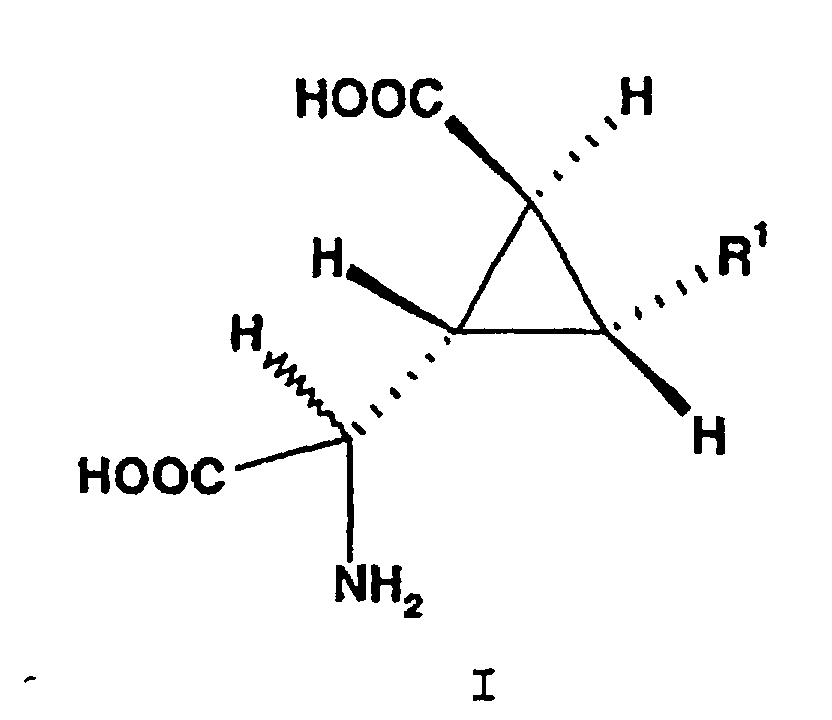
- A compound as claimed in Claim 1, which has the configuration

- A compound as claimed in Claim 1 or Claim 2, in which R1 is C1-10 alkyl; C2-10 alkenyl or C2-10 alkynyl.
- A compound as claimed in Claim 1 or Claim 2, in which R1 is selected from methyl, ethyl, propyl, isopropyl, vinyl, prop-2-enyl and propynyl.
- A compound as claimed in any one of Claims 1 to 4, in which R1 is methyl or vinyl.
- A compound as claimed in Claim 1 which is selected from:and pharmaceutically acceptable salts and esters thereof.(2S, 1'S, 2'S, 3'R)-2-(3'-methyl-2'-carboxycyclopropyl)-glycine;(2S, 1'S, 2'S, 3'R)-2-[3'-(2''-ethyl)-2'-carboxycyclopropyl]glycine;(2S, 1'S, 2'S, 3'R)-2-[3'-(3''-propyl)-2'-carboxycyclopropyl]glycine;(2S, 1'S, 2'S, 3'R)-2-(3'-vinyl-2'-carboxycyclopropyl)-glycine; and(2S, 1'S, 2'S, 3'R)-2-[3'-(2''-phenylethyl)-2'-carboxycyclopropyl]glycine;
- A pharmaceutical formulation comprising a compound of formula I as claimed in any one of Claims 1 to 6, or a pharmaceutically acceptable metabolically labile ester thereof, or a pharmaceutically acceptable salt thereof, together with a pharmaceutically acceptable carrier, diluent or excipient.
- A process for preparing a compound of formula I as claimed in any one of Claims 1 to 6, or a salt or ester thereof, which comprises:in which R8 represents a hydrogen atom or a carboxy protecting group, and R9 represents a hydrogen atom or an amine protecting group;(a) deprotecting a compound of formulain which R2 and R3 each independently represents hydrogen or a carboxyl protecting group, and R4 represents hydrogen or an amine protecting group;
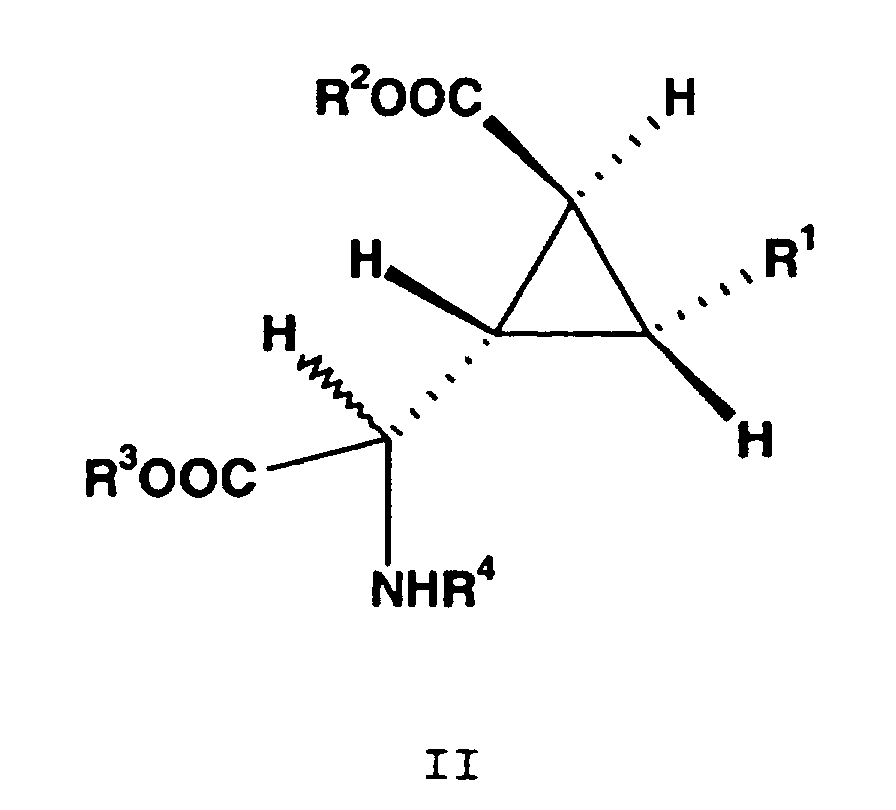 (b) hydrolysing a compound of formulain which R5 represents a hydrogen atom or a carboxyl protecting group, R6 is a hydrogen atom and R7 represents a hydrogen atom, a C1-4 alkyl group, a phenyl C1-4 alkyl group in which the phenyl group is unsubstituted or substituted by halo, C1-4 alkyl or C1-4 alkoxy, or C3-4 alkenyl; or
 (c) hydrolysing a compound of formula
followed when necessary by recovering a diastereomer or isomer of the compound, or
forming a salt or ester thereof. - A compound of formula I as claimed in any one of Claims 1 to 6, or a pharmaceutically acceptable metabolically labile ester thereof, or a pharmaceutically acceptable salt thereof, for use as a pharmaceutical.
- Use of a compound of formula I as claimed in any one of Claims 1 to 6, or a pharmaceutically acceptable metabolically labile ester thereof, or a pharmaceutically acceptable salt thereof, for the manufacture of a medicament for treating a disorder of the central nervous system.
Priority Applications (1)
| Application Number | Priority Date | Filing Date | Title |
|---|---|---|---|
| EP00938702A EP1189874B1 (en) | 1999-06-03 | 2000-05-26 | Excitatory amino acid receptor modulators |
Applications Claiming Priority (4)
| Application Number | Priority Date | Filing Date | Title |
|---|---|---|---|
| EP99500089 | 1999-06-03 | ||
| EP99500089 | 1999-06-03 | ||
| EP00938702A EP1189874B1 (en) | 1999-06-03 | 2000-05-26 | Excitatory amino acid receptor modulators |
| PCT/EP2000/004896 WO2000075102A1 (en) | 1999-06-03 | 2000-05-26 | Excitatory amino acid receptor modulators |
Publications (2)
| Publication Number | Publication Date |
|---|---|
| EP1189874A1 EP1189874A1 (en) | 2002-03-27 |
| EP1189874B1 true EP1189874B1 (en) | 2005-01-26 |
Family
ID=8242501
Family Applications (1)
| Application Number | Title | Priority Date | Filing Date |
|---|---|---|---|
| EP00938702A Expired - Lifetime EP1189874B1 (en) | 1999-06-03 | 2000-05-26 | Excitatory amino acid receptor modulators |
Country Status (7)
| Country | Link |
|---|---|
| US (1) | US6504052B1 (en) |
| EP (1) | EP1189874B1 (en) |
| AT (1) | ATE287871T1 (en) |
| AU (1) | AU5398300A (en) |
| DE (1) | DE60017737T2 (en) |
| ES (1) | ES2235894T3 (en) |
| WO (1) | WO2000075102A1 (en) |
Families Citing this family (5)
| Publication number | Priority date | Publication date | Assignee | Title |
|---|---|---|---|---|
| US7081481B2 (en) * | 2000-05-31 | 2006-07-25 | Eli Lilly And Company | Excitatory amino acid receptor modulators |
| US7125871B2 (en) * | 2000-05-31 | 2006-10-24 | Eli Lilly And Company | Excitatory amino acid receptor modulators |
| US9963485B2 (en) | 2012-10-16 | 2018-05-08 | Hong Kong Baptist University | Cycloheptapeptide agents for treatment of cancer and obesity diseases |
| US9499586B2 (en) * | 2012-10-16 | 2016-11-22 | Hong Kong Baptist University | Anticancer and anti-obesity cyclic peptide agents |
| WO2018068757A1 (en) * | 2016-10-14 | 2018-04-19 | Hong Kong Baptist University | Cycloheptapeptide agents for treatment of cancer and obesity diseases |
Family Cites Families (5)
| Publication number | Priority date | Publication date | Assignee | Title |
|---|---|---|---|---|
| JP3481975B2 (en) | 1992-09-08 | 2003-12-22 | サントリー株式会社 | (2S, 1'S, 2'R) -2- (2-carboxy-3-substituted oxymethylcyclopropyl) glycine and process for producing the same |
| JPH08301825A (en) | 1995-03-07 | 1996-11-19 | Suntory Ltd | 3'-substituted-(2-carboxycyclopropyl)glycine |
| IT1276153B1 (en) | 1995-11-17 | 1997-10-27 | Roberto Pellicciari | GLYCINE DERIVATIVES WITH ANTAGONIST ACTIVITY OF METABOTROPIC GLUTAMATE RECEPTORS |
| WO1998000391A1 (en) | 1996-06-28 | 1998-01-08 | Nippon Chemiphar Co., Ltd. | Cyclopropylglycine derivatives and metabolic-regulation type l-glutamate receptor agonist |
| ES2131463B1 (en) * | 1997-04-08 | 2000-03-01 | Lilly Sa | DERIVATIVES OF CYCLOPROPYLGLYCIN WITH PHARMACEUTICAL PROPERTIES. |
-
2000
- 2000-05-26 ES ES00938702T patent/ES2235894T3/en not_active Expired - Lifetime
- 2000-05-26 EP EP00938702A patent/EP1189874B1/en not_active Expired - Lifetime
- 2000-05-26 DE DE60017737T patent/DE60017737T2/en not_active Expired - Fee Related
- 2000-05-26 AT AT00938702T patent/ATE287871T1/en not_active IP Right Cessation
- 2000-05-26 WO PCT/EP2000/004896 patent/WO2000075102A1/en not_active Ceased
- 2000-05-26 AU AU53983/00A patent/AU5398300A/en not_active Abandoned
- 2000-05-26 US US09/979,437 patent/US6504052B1/en not_active Expired - Fee Related
Also Published As
| Publication number | Publication date |
|---|---|
| DE60017737D1 (en) | 2005-03-03 |
| EP1189874A1 (en) | 2002-03-27 |
| US6504052B1 (en) | 2003-01-07 |
| WO2000075102A1 (en) | 2000-12-14 |
| DE60017737T2 (en) | 2006-01-05 |
| AU5398300A (en) | 2000-12-28 |
| ATE287871T1 (en) | 2005-02-15 |
| ES2235894T3 (en) | 2005-07-16 |
Similar Documents
| Publication | Publication Date | Title |
|---|---|---|
| US6498180B1 (en) | Excitatory amino acid receptor modulators | |
| US20040102521A1 (en) | Excitatory amino acid receptor modulators | |
| EP0870760B1 (en) | Cyclopropyl glycine derivatives with pharmaceutical properties | |
| EP1226110B1 (en) | Bicyclic amino acids as pharmaceutical agents | |
| EP1000927B1 (en) | Excitatory amino acid receptor modulators | |
| EA001617B1 (en) | Excitatory amino acid derivatives | |
| US6504052B1 (en) | Excitatory amino acid receptor modulators | |
| DE60131733T2 (en) | PROCESS FOR PREPARING (2S, 3R, 4S) -4-HYDROXYISOLEUCINE AND ANALOGUE | |
| CA2338054A1 (en) | Bicyclohexane derivatives | |
| WO2001092213A2 (en) | Excitatory amino acid receptor modulators | |
| US7125871B2 (en) | Excitatory amino acid receptor modulators | |
| EP0826663B1 (en) | Alkynylamino acid derivatives and their use as pharmaceutical compounds | |
| WO2001092212A1 (en) | Excitatory amino acid receptor modulators | |
| US5990165A (en) | Pharmaceutical compounds | |
| JPH08301825A (en) | 3'-substituted-(2-carboxycyclopropyl)glycine | |
| MXPA99010380A (en) | Excitatory amino acid receptor modulators |
Legal Events
| Date | Code | Title | Description |
|---|---|---|---|
| PUAI | Public reference made under article 153(3) epc to a published international application that has entered the european phase |
Free format text: ORIGINAL CODE: 0009012 |
|
| 17P | Request for examination filed |
Effective date: 20020103 |
|
| AK | Designated contracting states |
Kind code of ref document: A1 Designated state(s): AT BE CH CY DE DK ES FI FR GB GR IE IT LI LU MC NL PT SE |
|
| AX | Request for extension of the european patent |
Free format text: AL;LT;LV;MK;RO;SI |
|
| 17Q | First examination report despatched |
Effective date: 20030328 |
|
| GRAP | Despatch of communication of intention to grant a patent |
Free format text: ORIGINAL CODE: EPIDOSNIGR1 |
|
| GRAS | Grant fee paid |
Free format text: ORIGINAL CODE: EPIDOSNIGR3 |
|
| GRAA | (expected) grant |
Free format text: ORIGINAL CODE: 0009210 |
|
| AK | Designated contracting states |
Kind code of ref document: B1 Designated state(s): AT BE CH CY DE DK ES FI FR GB GR IE IT LI LU MC NL PT SE |
|
| PG25 | Lapsed in a contracting state [announced via postgrant information from national office to epo] |
Ref country code: NL Free format text: LAPSE BECAUSE OF FAILURE TO SUBMIT A TRANSLATION OF THE DESCRIPTION OR TO PAY THE FEE WITHIN THE PRESCRIBED TIME-LIMIT Effective date: 20050126 Ref country code: LI Free format text: LAPSE BECAUSE OF FAILURE TO SUBMIT A TRANSLATION OF THE DESCRIPTION OR TO PAY THE FEE WITHIN THE PRESCRIBED TIME-LIMIT Effective date: 20050126 Ref country code: FI Free format text: LAPSE BECAUSE OF FAILURE TO SUBMIT A TRANSLATION OF THE DESCRIPTION OR TO PAY THE FEE WITHIN THE PRESCRIBED TIME-LIMIT Effective date: 20050126 Ref country code: CH Free format text: LAPSE BECAUSE OF FAILURE TO SUBMIT A TRANSLATION OF THE DESCRIPTION OR TO PAY THE FEE WITHIN THE PRESCRIBED TIME-LIMIT Effective date: 20050126 Ref country code: BE Free format text: LAPSE BECAUSE OF FAILURE TO SUBMIT A TRANSLATION OF THE DESCRIPTION OR TO PAY THE FEE WITHIN THE PRESCRIBED TIME-LIMIT Effective date: 20050126 Ref country code: AT Free format text: LAPSE BECAUSE OF FAILURE TO SUBMIT A TRANSLATION OF THE DESCRIPTION OR TO PAY THE FEE WITHIN THE PRESCRIBED TIME-LIMIT Effective date: 20050126 |
|
| REG | Reference to a national code |
Ref country code: IE Ref legal event code: FG4D Ref country code: GB Ref legal event code: FG4D |
|
| REG | Reference to a national code |
Ref country code: CH Ref legal event code: EP |
|
| REF | Corresponds to: |
Ref document number: 60017737 Country of ref document: DE Date of ref document: 20050303 Kind code of ref document: P |
|
| PGFP | Annual fee paid to national office [announced via postgrant information from national office to epo] |
Ref country code: ES Payment date: 20050407 Year of fee payment: 6 |
|
| PG25 | Lapsed in a contracting state [announced via postgrant information from national office to epo] |
Ref country code: SE Free format text: LAPSE BECAUSE OF FAILURE TO SUBMIT A TRANSLATION OF THE DESCRIPTION OR TO PAY THE FEE WITHIN THE PRESCRIBED TIME-LIMIT Effective date: 20050426 Ref country code: GR Free format text: LAPSE BECAUSE OF FAILURE TO SUBMIT A TRANSLATION OF THE DESCRIPTION OR TO PAY THE FEE WITHIN THE PRESCRIBED TIME-LIMIT Effective date: 20050426 Ref country code: DK Free format text: LAPSE BECAUSE OF FAILURE TO SUBMIT A TRANSLATION OF THE DESCRIPTION OR TO PAY THE FEE WITHIN THE PRESCRIBED TIME-LIMIT Effective date: 20050426 |
|
| PG25 | Lapsed in a contracting state [announced via postgrant information from national office to epo] |
Ref country code: LU Free format text: LAPSE BECAUSE OF NON-PAYMENT OF DUE FEES Effective date: 20050526 Ref country code: IE Free format text: LAPSE BECAUSE OF NON-PAYMENT OF DUE FEES Effective date: 20050526 Ref country code: GB Free format text: LAPSE BECAUSE OF NON-PAYMENT OF DUE FEES Effective date: 20050526 Ref country code: CY Free format text: LAPSE BECAUSE OF FAILURE TO SUBMIT A TRANSLATION OF THE DESCRIPTION OR TO PAY THE FEE WITHIN THE PRESCRIBED TIME-LIMIT Effective date: 20050526 |
|
| PG25 | Lapsed in a contracting state [announced via postgrant information from national office to epo] |
Ref country code: MC Free format text: LAPSE BECAUSE OF NON-PAYMENT OF DUE FEES Effective date: 20050531 |
|
| NLV1 | Nl: lapsed or annulled due to failure to fulfill the requirements of art. 29p and 29m of the patents act | ||
| REG | Reference to a national code |
Ref country code: ES Ref legal event code: FG2A Ref document number: 2235894 Country of ref document: ES Kind code of ref document: T3 |
|
| REG | Reference to a national code |
Ref country code: CH Ref legal event code: PL |
|
| PG25 | Lapsed in a contracting state [announced via postgrant information from national office to epo] |
Ref country code: DE Free format text: LAPSE BECAUSE OF NON-PAYMENT OF DUE FEES Effective date: 20051201 |
|
| PLBE | No opposition filed within time limit |
Free format text: ORIGINAL CODE: 0009261 |
|
| STAA | Information on the status of an ep patent application or granted ep patent |
Free format text: STATUS: NO OPPOSITION FILED WITHIN TIME LIMIT |
|
| ET | Fr: translation filed | ||
| 26N | No opposition filed |
Effective date: 20051027 |
|
| GBPC | Gb: european patent ceased through non-payment of renewal fee |
Effective date: 20050526 |
|
| REG | Reference to a national code |
Ref country code: IE Ref legal event code: MM4A |
|
| PG25 | Lapsed in a contracting state [announced via postgrant information from national office to epo] |
Ref country code: ES Free format text: LAPSE BECAUSE OF NON-PAYMENT OF DUE FEES Effective date: 20060527 |
|
| PGFP | Annual fee paid to national office [announced via postgrant information from national office to epo] |
Ref country code: IT Payment date: 20060531 Year of fee payment: 7 |
|
| REG | Reference to a national code |
Ref country code: ES Ref legal event code: FD2A Effective date: 20060527 |
|
| PG25 | Lapsed in a contracting state [announced via postgrant information from national office to epo] |
Ref country code: PT Free format text: LAPSE BECAUSE OF NON-PAYMENT OF DUE FEES Effective date: 20050626 |
|
| PG25 | Lapsed in a contracting state [announced via postgrant information from national office to epo] |
Ref country code: FR Free format text: LAPSE BECAUSE OF NON-PAYMENT OF DUE FEES Effective date: 20050531 |
|
| PG25 | Lapsed in a contracting state [announced via postgrant information from national office to epo] |
Ref country code: IT Free format text: LAPSE BECAUSE OF NON-PAYMENT OF DUE FEES Effective date: 20070526 |
|
| REG | Reference to a national code |
Ref country code: FR Ref legal event code: ST Effective date: 20111007 |