EP1189464A2 - Communication system and method for delivering control signalling and/or data messages - Google Patents
Communication system and method for delivering control signalling and/or data messages Download PDFInfo
- Publication number
- EP1189464A2 EP1189464A2 EP01121955A EP01121955A EP1189464A2 EP 1189464 A2 EP1189464 A2 EP 1189464A2 EP 01121955 A EP01121955 A EP 01121955A EP 01121955 A EP01121955 A EP 01121955A EP 1189464 A2 EP1189464 A2 EP 1189464A2
- Authority
- EP
- European Patent Office
- Prior art keywords
- control signalling
- communication system
- message
- accordance
- delivering
- Prior art date
- Legal status (The legal status is an assumption and is not a legal conclusion. Google has not performed a legal analysis and makes no representation as to the accuracy of the status listed.)
- Withdrawn
Links
Images




Classifications
-
- H—ELECTRICITY
- H04—ELECTRIC COMMUNICATION TECHNIQUE
- H04W—WIRELESS COMMUNICATION NETWORKS
- H04W4/00—Services specially adapted for wireless communication networks; Facilities therefor
- H04W4/20—Services signaling; Auxiliary data signalling, i.e. transmitting data via a non-traffic channel
-
- H—ELECTRICITY
- H04—ELECTRIC COMMUNICATION TECHNIQUE
- H04W—WIRELESS COMMUNICATION NETWORKS
- H04W4/00—Services specially adapted for wireless communication networks; Facilities therefor
- H04W4/12—Messaging; Mailboxes; Announcements
-
- H—ELECTRICITY
- H04—ELECTRIC COMMUNICATION TECHNIQUE
- H04W—WIRELESS COMMUNICATION NETWORKS
- H04W68/00—User notification, e.g. alerting and paging, for incoming communication, change of service or the like
-
- H—ELECTRICITY
- H04—ELECTRIC COMMUNICATION TECHNIQUE
- H04W—WIRELESS COMMUNICATION NETWORKS
- H04W68/00—User notification, e.g. alerting and paging, for incoming communication, change of service or the like
- H04W68/10—User notification, e.g. alerting and paging, for incoming communication, change of service or the like using simulcast notification
Definitions
- This invention relates to delivering control signalling messages in communications systems.
- the invention relates to the efficient delivery of control signalling messages, preferably short data messages, in point to multi-point or point-to-point wireless communications systems.
- Wireless communications systems typically provide for radio telecommunication links to be arranged between a plurality of base transceiver stations (BTSs) and a plurality of subscriber units, often termed mobile stations (MSs).
- BTSs base transceiver stations
- MSs mobile stations
- the term mobile station generally includes both hand-portable and vehicular mounted radio units.
- Wireless communications systems are distinguished over fixed communications systems, such as the public switched telephone networks (PSTN), principally in that mobile stations move between service providers (and/or different BTS) and in doing so encounter varying radio propagation environments.
- PSTN public switched telephone networks
- each BTS has associated with it a particular geographical coverage area (or cell).
- the coverage area defines a particular range that the BTS can maintain acceptable communications with MSs operating in its serving cell.
- these cells combine to produce an expanded system coverage area.
- cells are often grouped into location areas for the purposes of tracking a MS within the coverage area whilst minimising location-updating signalling.
- the communication link from a BTS to a MS is generally referred to as a down-link channel. Conversely, the communication link from a MS to a BTS is generally referred to as an up-link channel.
- Multiple access techniques permit simultaneous transmissions from several MS to a single BTS over a plurality of communications channels. Some channels are used for carrying traffic whilst other channels (which may be logical or dedicated channels) are used for transferring control information, such as call paging, between the base transceiver stations and subscriber units. Examples of multiple access techniques include: frequency division multiple access (FDMA), time division multiplexing/ multiple access (TDM, TDMA) and code division multiple access (CDMA).
- FDMA frequency division multiple access
- TDM time division multiplexing/ multiple access
- TDMA time division multiplexing/ multiple access
- CDMA code division multiple access
- mobile switching networks invoke services to a MS by locating the MS within the communication network.
- location determining is performed by a location management function, typically positioned in the infrastructure, distal from the wireless communications units.
- a dispatcher station is generally used to send short data messages to a MS or group of MSs.
- a dispatcher station may be any fixed network access point for data communication systems connected via wire-line to a dispatch application processor (DAP), or mobile and connected via the air interface.
- DAP dispatch application processor
- the dispatcher may also simply be a fixed host end-user application that uses the short data bearer services for initiated message transfer.
- GSM Global System for Mobile communications
- SMS Short Message Service
- PP Point-to-Point
- iDEN Motorola integrated digital enhanced network
- the data (status messages) to be transmitted to the MSs is of a minimal amount, and of a fixed data-transmission length, and so the data is sent to all cells in the location area for delivery.
- This system re-uses the paging mechanism by embedding the small data payload in the paging message. In essence, this is equivalent to flooding.
- the aforementioned approaches are used in accordance with the location management scheme of the network.
- US patent number US 5,896,376 titled “Optimal use of logical channels within a mobile telecommunications network” provides means of queuing data.
- US patent number US 5,729,544, titled “Method for transmitting data packets based on message type” provides a means of packet based transfer of data.
- the above US patents fail to provide a method and system for short data delivery, particularly for bandwidth-efficient and processing-efficient group short data delivery.
- network architectures that do offer group addressed short data services require their network to track the mobile subscribers to the individual cells. This technique requires substantial amounts of data to be communicated throughout the network, to track such mobile subscribers, and is therefore bandwidth and signalling hungry.
- a communication system "floods" all MSs with all short data messages. In such a case, there is no need to provide for additional paging procedures to identify selected recipients of the short data message(s), but there is, of course, excess and wasteful signalling and traffic transmission in the system.
- a base transceiver station adapted to operate in the communication system, as claimed in claim 1.
- a mobile or fixed dispatcher station adapted to operate in the communication system, as claimed in claim 1.
- a preferred embodiment of the present invention proposes that the most efficient means of group or individual signalling and/or data message delivery will be to adaptively switch between a delivery mechanism that pages the location areas for group members, and a mechanism that simply floods the location area with the short data message.
- control signalling that encompass data messages as known to those skilled in the art, particularly, if not explicitly referred to as such, short data messages.
- the method described here minimises the loading of the application processor, control channel loading, and frame relay network traffic. As a result, it provides a short data message delivery service with minimal additional impact on the network. Less network impact results in less customer cost by requiring a minimal amount of additional equipment and/or bandwidth for the system provider.
- this invention proposes to use either:
- the decision on which mechanism to use is based on several criteria, such as: short data message size, page message size, page response size and/or a statistical measure of the probability that cells are occupied by group members, and/or the current CPU loading of the network element responsible for delivery.
- This method is a unique variation of the location area location management scheme for this service.
- the preferred embodiment is described in relation to the TETRA standard, which does not define such network behavior.
- the preferred embodiment of the present invention offers a better network response time for a larger/high capacity subscriber base, as a result of more efficient message delivery.
- FIG. 1 shows, in outline, a trunked radio communications system 10 supporting a TErrestrial Trunked RAdio (TETRA) air-interface in accordance with a preferred embodiment of the invention.
- TETRA TErrestrial Trunked RAdio
- the TETRA air interface has been defined by the European Telecommunications Standards Institute (ETSI).
- ETSI European Telecommunications Standards Institute
- the air-interface protocol is administered from base sites that are geographically spaced apart - one base site supporting a cell (or, for example, sectors of a cell) as shown in FIG. 2).
- a plurality of subscriber units such as a mixture of MSs 12-16 and fixed terminals (not shown), communicate over the selected air-interface 18-20 with a plurality of base transceiver stations (BTS) 22-32.
- BTS base transceiver stations
- a limited number of MSs 12-16 and BTSs 22-32 are shown for clarity purposes only.
- the BTSs 22-32 may be connected to a conventional public-switched telephone network (PSTN) 34 through base station controllers (BSCs) 36-40 and mobile switching centres (MSCs) 42, 44.
- PSTN public-switched telephone network
- BSCs base station controllers
- MSCs mobile switching centres
- Each BTS 22-32 is principally designed to serve its primary cell, with each BTS 22-32 containing one or more transceivers.
- the BTSs 22-32 communicate 56-66 with the rest of the trunking system infrastructure via a frame relay interface 68.
- the iHLR function 70 communicates directly with the DAP.
- the iHLR function 70 is the database for all subscribers with respect to dispatch services.
- Each BSC 36-40 may control one or more BTSs 22-32, with BSCs 36-40 generally interconnected through MSCs 42, 44. Each BSC 36-40 is therefore able to communicate with one another, if desired, to pass system administration information therebetween, with BSCs 36-40 responsible for establishing and maintaining control channel and traffic channels to serviceable MSs 12-16 affiliated therewith. The interconnection of BSCs 36-40 therefore allows the trunked radio communication system to support handover of the MSs 12-16 between cells.
- Each MSC 42, 44 provides a gateway to the PSTN 34, with MSCs 42, 44 interconnected through an operations and management centre (OMC) 46 that administers general control of the trunked radio system 10, as will be understood by those skilled in the art.
- OMC operations and management centre
- the various system elements, such as BSCs 36-38 and OMC 46, will include control logic 48, 50, 52, with the various system elements usually having associated memory 54 (shown only in relation to BSC 38 for the sake of clarity).
- the memory typically stores historically compiled operational data as well as in-call data, system information and control algorithms.
- the MSs 12-16 and BTS 22-32 can obtain system specific information via the dispatch application processor (DAP) 72.
- the DAP 72 is the dispatch primary control network element, which, amongst other functions, manages the services, provisioning, location management and billing of dispatch-type services.
- the DAP 72 may be connected to a fixed host 74 that provides many application-specific functions to the trunking network.
- the fixed host in the context of the preferred embodiment of the present invention, is any TCP/IP based application that can send or receive short data messages, namely providing a fixed wire-line access point for group SDS messages.
- the fixed host 74 is connected to a short message service centre (SMSC) 78 via a transfer control protocol (TCP)/internet protocol (IP) interface.
- SMSC 78 is a standard piece of GSM equipment that is responsible for delivering point-to-point SDS messages within a cellular telecommunications environment. It is a database with SS7 protocol stacks layered upon it.
- the SMSC 78 is also connected to the PSTN 34, which is operably coupled to home location register (HLR) 80.
- HLR home location register
- a short message typically constitutes an indication of the calling or called party of the message, with a protocol identifier, message reference number, (optionally) a timestamp, control parameters for reporting, and the actual user data payload itself. It may also potentially contain a control parameter to indicate the coding of the user data payload. It is within the contemplation of the invention that such short data messages may originate from either an MS or a fixed host.
- a location area management scheme locates MSs within the system.
- short data messages are handled by the DAP 72 in a similar fashion to the handling of control traffic.
- the inventors of the present invention have recognised that DAP loading is proportional to the number of messages being processed by the DAP 72, and not a function of the short data payload size.
- a preferred embodiment of the invention has adapted the path from the SMSC 78 to the MSs 12-16 in the delivery of short data messages, with an adaptive decision algorithm performed in the DAP 72.
- the adaptive decision algorithm includes a determination on whether an addressed MS should or should not be paged before delivery of the short data message.
- an application processor in the DAP 72 will, upon receiving a group SDS submission message, perform the following actions:
- FIG. 2 a message overview chart is shown, highlighting the different message procedures associated with the two short data message delivery options, controlled by DAP 72 and offered in steps (ii) and (iii).
- FIG. 2 shows that in the "page and deliver" mechanism, the iHLR 70 receives a request from the application processor of the DAP 72, for location details of the MSs to be paged.
- the iHLR 70 provides the location information to the application processor, which sends the requisite page requests to the BTSs that correspond to the cells (sites/locations) indicated by the iHLR 70.
- the respective BTS(s) 22-32 page the MS(s) 12-16 and await a page acknowledgement, to indicate that the MS is awaiting its SDS message.
- the acknowledgement from the addressed MS is then relayed back to the application processor of the DAP 72 as a page response.
- the application processor of the DAP 72 delivers the SDS message to the respective MS 12-16 via its serving BTS 22-32.
- FIG. 2 also shows the SDS delivery mechanism for flooding all location areas with the short data message, if the application processor of the DAP 72 has determined that a paging method is not appropriate.
- the application processor of the DAP 72 requests details of the appropriate location areas for the intended recipients of the short data message.
- the iHLR 70 responds with details of these location areas.
- the application processor of the DAP 72 will then deliver the SDS message to the respective BTS 22-32, for final delivery to the location areas associated with the MSs 12-16 who are the intended recipients.
- An alternative embodiment of the present invention has adapted at least one of the BTS 22-32 to perform the adaptive decision algorithm in its respective application processor.
- the application processor is the central network element responsible for routing, provisioning and tracking MSs for this service.
- One benefit associated with implementing the adaptive decision algorithm in a BTS 22-32, as compared to the DAP 72, includes minimising DAP loading due to the DAP 72 handling fewer messages. Such a reduction in message handling is readily shown when comparing FIG. 2 to FIG. 3, where the page request, page response and SDS delivery between the DAP 72 and the BTS 22-32 is no longer required.
- FIG. 3 a message overview chart is shown, highlighting the different message procedures associated with the two short data message delivery options, controlled by at least one of the BTSs 22-32 and offered in steps (ii) and (iii).
- FIG. 3 shows that in the "page and deliver” mechanism, the DAP 72 delivers a message to the application processor of a BTS 22-32.
- the respective BTS(s) 22-32 decide locally, based on its/their own criteria, whether to page and deliver, or just deliver, the message to an addressed MS 12-16. If the decision is to page and deliver, the BTS 22-32 pages the MS(s) 12-16 and awaits a page acknowledgement, to indicate that the MS is awaiting its SDS message. Once a page response has been received, the application processor of the BTS 22-32 delivers the SDS message to the respective MS 12-16.
- FIG. 3 also shows the SDS delivery mechanism for flooding all location areas with the short data message, if the application processor of the BTS 22-32 has determined that a paging method is not appropriate. In this case, the application processor of the BTS(s) 22-32 will then deliver the SDS message directly to the MSs 12-16 who are the intended recipients within its serving location area.
- the BTS is able to adaptively choose to page, and is thereby in a better position to manage and distribute its own computational effort and message handling.
- the loading of the DAP 72 is proportional to the number of messages sent, regardless of their size. Therefore, it is preferable to always flood to all BTSs 22-32, and have the BTSs 22-32 decide whether to page or "flood" the site, as in this second embodiment described with reference to FIG. 3, if the BTS(s) 22-32 have this capability.
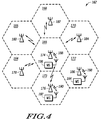
- FIG. 1 The general architecture of the preferred embodiment of the invention of FIG. 1 is described in further detail with reference to a honeycomb cell arrangement, as shown in FIG. 4.
- FIG. 4 shows a conventional cell plan 162 containing interconnected cell areas 164-173. Each cell area has a base station sub-system (BSS) 174-186 with MSs 192-196 respectively affiliated therewith. Communication links 188, 190 and 198 connect the base station sub-systems and mobile stations.
- BSS base station sub-system
- an MS is in communication with its nearest BTS (which together with the BSC forms the BSS); this is shown in relation to BSS 174 and mobile station 196 of cell 165.
- the BTS 174 selectively pages MS 196, in order to subsequently transmit an addressed SDS message.
- the DAP 72 delivers group short data messages to all sites in the dispatch location areas known to contain intended-recipient MSs 12-16.
- the DAP 72 would adaptively decide to page one or more particular cells based on a number of criteria such as data length or control channel loading.
- the SDS message may be broadcast in either one or more cells, as shown with regard to transmissions 190 and 198 respectively broadcast from BTSs 176 and 186 to, at least, MSs 192 and 194.
- FIG. 5 a process flow diagram for the preferred group data decision and delivery implementation is shown.
- the decision and delivery mechanism is described with respect to short data messages.
- control signalling is generically used throughout the remaining description to encompass at least general signalling traffic as well as data messages, including short data messages.
- the system starts from an idle mode as shown in step 250.
- the network may choose to automatically invoke the flooding delivery mechanism for certain types of short data, in determination step 254.
- the group data message is delivered, as shown in step 256, prior to the network returning to an idle mode of operation with regard to SDS messages as shown in step 258.
- step 254 If the application processor determines that automatic flooding is not to occur in step 254, a decision is made as to whether to page or not, as shown in step 260.
- the page-decision process is described later with reference to FIG. 7.
- step 260 a decision is made on whether to page, for example one or more MSs, as shown in step 262. If at this point, the application processor determines that it is not appropriate to page (the one or more MSs), then the group data message is delivered, as shown in step 264, prior to the network returning to an idle mode of operation with regard to group data messages, as shown in step 258.
- step 262 If a positive determination is made to page (the one or more MSs) in step 262, then the page process, as described with reference to FIG. 6 is initiated, at step 266, prior to the network returning to an idle mode of operation with regard to group data messages, as shown in step 258.
- the page (MS) process starts at step 266 and a group data page request is transmitted from the application processor, as shown in step 268. If the application processor is positioned in the DAP, the group data page request is transmitted to the one or more respective BTS(s). At this point a page-timer function is initiated, as in step 270.
- the application processor then waits for the group data page responses or page acknowledgements, as shown in step 272. If the application processor does not receive any page responses or page acknowledgements, then the page-timer function will extend beyond a pre-determined threshold limit, as in step 280. The page-timer is then reset, as shown in step 282. If the page timer is running in the BTS and it expires, it is assumed that the MS is not present and the SDS message is silently discarded. If the page timer is running in the DAP, subsequent page responses relating to the page are discarded and the DAP discards the group data message silently.
- step 274 If the application processor does receive a page response(s) or page acknowledgement(s) in step 274, then the application processor logs the cell (site) information, passing the information to the HLR or iHLR, as in step 276.
- the group short data message is then delivered, as shown in step 278.
- the group short data message is silently discarded and the application reverts to the waiting mode of step 272.
- the application processor will deliver the short data message.
- time limits can be set, dependent upon the importance/priority assigned to delivering individual or grouped group data message.
- the inventors of the present invention have recognised the benefits of weighing potential control channel capacity waste versus application processor CPU loading.
- the assumption made is that conserving control channel capacity shall be a higher priority than reducing application processor CPU loading.
- the algorithm may check multiple criteria in an attempt to send the message without paging, before a paging procedure is invoked.
- FIG. 7 outlines the page-decision process that may be initiated at step 260 in FIG. 5.
- the first issue raised by the application processor is to query the location register for the location area containing the group members (not shown). If the intended group members are not contained within its geographical (cell) service area, no paging mechanism of flooding needs to be initiated.
- the application processor assesses the short data message to ascertain whether a user data payload is below a "flooding threshold", F T , as shown in step 290. If the user data payload is below the flooding threshold then the application processor delivers the message to all sites within the identified location areas (dispatch location areas).
- F T min[X SLOT -X UD , (X P +X PR +X DH
- the group data to be delivered is small, no benefit is realised from performing paging of the location areas. It is within the contemplation of the invention that criteria other than slot size, data size, or short data message delivery header size may be used to assess a threshold level, and that a user-definable "transition region" may be used to define the valid range for the flooding threshold. Furthermore, the threshold level may be either pre-defined or dynamically adapted in response to at least one network operating condition.
- the threshold for initiating flooding is the smaller of the maximum user data size that will fit into a downlink slot over the air interface, or the point at which the number of bytes of paging traffic (for example paging traffic includes at least one of: page message size and page response size) on the infrastructure network is in the order of the length of the user data itself.
- the application processor computes a localisation fraction, as shown in step 292. If the localisation fraction, X L is less than say, 0.5 (or another operator configurable fraction), then the application processor delivers the message to all sites within the identified location areas.
- X L N known /N total
- a "middle region” may be used as a secondary criterion for flooding. If only a fraction of all possible sites or location areas within the network, or selected service area, contain group members, then there is a higher probability of group members being located in more sites within the location areas which are known to contain group members (group member density). In other words, the group members are likely to be "localised” to fewer sites, and the application processor should deliver to all sites within the selected location area(s) without paging.
- N mobiles distributed in R cells probability problem, as is well known to those skilled in the art.
- a numerical analysis may include considering all valid partitions of N and applying the following formula from Abramovitz and Stegun (see Handbook of Mathematical Functions, Dover Publications Inc., New York standard book number 486-61272-4, ninth edition Dec 1972) to each distribution of the valid partitions.
- the application processor calculates a level of central processing unit (CPU) loading, or some other measure of application processor loading.
- CPU central processing unit
- step 294 If this determination is above a pre-determined limit, as in step 294, then flooding all location areas is performed in order to minimise signalling degradation of other services. Such flooding is performed at the expense of control channel capacity and is done only if application processor loading is excessive. This is due to the application processor input/output (I/O) traffic being determined as the primary cause of CPU loading. If this determination is not above a pre-determined limit, as in step 294, then the MS(s) are paged, as shown in step 296.
- I/O application processor input/output
- the application processor loading may likely be proportional to control channel loading.
- this criterion should only be applied to prevent application processor failure or unsatisfactory response time degradation for other services.
- any communication system such as cellular and distributed wire-line communications and not solely a trunking system as described, may benefit from the inventive concepts described herein.
- the application processor can be positioned at any practicable location in the communication system architecture, such as a site controller, where the message delivery mechanism can be determined and, to some extent, controlled.
- a site controller where the message delivery mechanism can be determined and, to some extent, controlled.
- the location selection of the DAP or BTS being merely a preferred location for the embodiment described.
- the characteristic of the short data message is not limited to the preferred parameters of: short data message length, total number of sites required to transmit short data message, current application processor loading, at least one page requirement, dynamic group number assignment, dynamic group number assignment message length, number of location areas and number of sites per location area.
- control signalling i.e. provisioning, or over-the-air configuration information
- data messages i.e. data messages to an individual or, more importantly, a group of MSs for which it is desired that all group members' receive the same configuration information.
- control signalling messages could potentially vary in length.
- control signalling messages could include, for example, dynamic group number assignment that may have a variable message length depending on the amount of over-the-air programming information that is required/used.
- the inventors of the present invention have recognised the benefits of avoiding tracking the MSs to individual cells, when designing a short data delivery system, in order to ease the impact on system processing.
- a short data delivery system is expanded to include "group" short data messages, a more intelligent delivery system is required that can cope with group communication. Paging all of the system with such group communication is inefficient.
Landscapes
- Engineering & Computer Science (AREA)
- Computer Networks & Wireless Communication (AREA)
- Signal Processing (AREA)
- Mobile Radio Communication Systems (AREA)
Abstract
Description
The interconnection of BSCs 36-40 therefore allows the trunked radio communication system to support handover of the MSs 12-16 between cells.
- XSLOT
- is the slot size,
- XUD
- is the user data size,
- XP
- is the infrastructure network page message size to the base site controller,
- XPR
- is the page response size, and
- XDH
- is the short data message delivery header size.
- Ntotal
- is the total number of location areas (or total number of sites) in the selected service area, and
- Nknown
- is the number of location areas (or the total number of sites within these location areas) known to contain a group member.

Claims (19)
- A communication system (10, 162) for delivering control signalling messages, the communication system comprising a plurality of base transceiver stations (22-32) providing communication links to a plurality of mobile stations (12-16), the communications system (10, 162) having a processor (72) for receiving at least one control signalling message to be delivered to at least one addressed mobile station and characterised by the processor (72) determining a characteristic of the control signalling message to be delivered and selecting a delivery mechanism for forwarding the at least one control signalling message based on said characteristic.
- The communication system in accordance with claim 1, further characterised by the at least one control signalling message being at least one individually or group-addressed short data message for delivery to one or more mobile stations.
- The communication system in accordance with claim 1 or claim 2, further characterised by a location register (70, 80) operably coupled to the application processor to provide location information of intended recipients of the control signalling message to said application processor.
- The communication system in accordance with claim 1, claim 2 or claim 3, wherein the delivery mechanism for delivering the at least one control signalling message includes at least one of the following: page and deliver, or deliver said at least one control signalling message directly in a number of location areas.
- The communication system in accordance with claim 4, when dependent upon claim 3, wherein the deliver directly in a number of location areas mechanism is limited to selected location areas dependent upon location information provided by the location register (70, 80).
- The communication system in accordance with any one of the preceding claims, wherein the application processor is provided in at least one of the plurality of base transceiver stations (22-32).
- The communication system in accordance with any one of the preceding claims 1 to 5, wherein the communication system further comprises a dispatch application processor function operably coupled to at least one of said plurality of base transceiver stations (22-32), said application processor function including said application processor for delivering said control signalling messages via said at least one of the plurality of base transceiver stations (22-32).
- The communication system in accordance with claim 7, wherein the dispatch application processor (72) either:(i) pages cells within the location area prior to delivering the control signalling message to those cells where an addressed MS is located; or(ii) delivers the control signalling message to all cells in at least one location area and at least one respective base transceiver station (22-32) determines(a) whether to deliver the addressed control signalling message to at least one mobile station (12-16) without paging or(b) whether to page locally for said at least one mobile station (12-16) before delivering said control signalling message.
- The communication system in accordance with any one of the preceding claims, wherein the communication system operates a location area management function and is a wireless point-to-multipoint and/or wireless point-to-point communication system.
- The communication system in accordance with any one of the preceding claims, wherein the determined characteristic of the control signalling message is at least one of the following: short data message length, total number of sites required to transmit at least one control signalling message, current application processor loading, at least one page requirement, dynamic group number assignment, dynamic group number assignment message length, number of location areas and number of sites per location area.
- The communication system in accordance with claim 10, wherein the determination of a characteristic of the control signalling message includes determination of whether said characteristic exceeds a threshold level, and said delivery mechanism selected for forwarding the control signalling messages is selected in response to whether said characteristic exceeds said threshold level.
- The communication system in accordance with claim 11, wherein the threshold level is pre-defined, user-definable or dynamically adapted in response to at least one network operating condition.
- The communication system in accordance with any one of claim 11 or claim 12, wherein the threshold level is a function of at least one of: slot size, data size, short data message delivery header size.
- The communication system in accordance with any one of claims 10 to 12, wherein the at least one page requirement is a function of at least one of: page message size, page response size.
- A base transceiver station adapted to operate in the communication system of any one of claims 1 to 14.
- A mobile or fixed dispatcher station adapted to operate in the communication system of any one of claims 1 to 14.
- A method of delivering at least one control signalling message in a communication system (10, 162), where the communication system comprises a plurality of base transceiver stations (22-32) providing communication links to a plurality of mobile stations (12-16), the communication system (10, 162) having a processor (72), the method comprising a step of:receiving (252) at least one control signalling message to be forwarded to at least one addressed mobile station;
the method characterised by the steps of:determining, by the processor (72), a characteristic of the control signalling message to be delivered; andselecting (254) a delivery mechanism for delivering the control signalling message to at least one mobile station based on said characteristic. - The method of delivering at least one control signalling message in accordance with claim 17, the method further characterised by said at least one control signalling message being at least one individually or group-addressed short data message and said delivery mechanism for forwarding said at least one individually or group-addressed short data message includes at least one of the following steps:delivering said at least one individually or group-addressed short data message to a number of location areas; orpaging at least one mobile station; anddelivering said at least one individually or group-addressed short data message, in response to a page acknowledgement from the at least one mobile station.
- The method of delivering at least one control signalling message in accordance with claim 17 or 18, wherein the step of determining a characteristic of the control signalling message includes determining at least one of the following: short data message length, total number of sites required to transmit short data message, current application processor loading, at least one page requirement, dynamic group number assignment, dynamic group number assignment message length, number of location areas and number of sites per location area.
Applications Claiming Priority (2)
| Application Number | Priority Date | Filing Date | Title |
|---|---|---|---|
| GB0022816A GB2366949B (en) | 2000-09-15 | 2000-09-15 | Communication system and method for delivering control signalling and/or data messages |
| GB0022816 | 2000-09-15 |
Publications (2)
| Publication Number | Publication Date |
|---|---|
| EP1189464A2 true EP1189464A2 (en) | 2002-03-20 |
| EP1189464A3 EP1189464A3 (en) | 2003-12-10 |
Family
ID=9899630
Family Applications (1)
| Application Number | Title | Priority Date | Filing Date |
|---|---|---|---|
| EP01121955A Withdrawn EP1189464A3 (en) | 2000-09-15 | 2001-09-12 | Communication system and method for delivering control signalling and/or data messages |
Country Status (2)
| Country | Link |
|---|---|
| EP (1) | EP1189464A3 (en) |
| GB (1) | GB2366949B (en) |
Cited By (1)
| Publication number | Priority date | Publication date | Assignee | Title |
|---|---|---|---|---|
| WO2003026331A1 (en) * | 2001-09-14 | 2003-03-27 | First Hop Oy | Method and apparatus for processing messages |
Families Citing this family (2)
| Publication number | Priority date | Publication date | Assignee | Title |
|---|---|---|---|---|
| GB2401755B (en) * | 2002-02-18 | 2005-10-05 | Empower Interactive Group Ltd | Distributed message transmission system and method |
| CN109691062B (en) * | 2016-09-07 | 2022-11-22 | 三星电子株式会社 | Method for managing Short Data Service (SDS) in a mission critical Data (MC Data) communication system |
Family Cites Families (3)
| Publication number | Priority date | Publication date | Assignee | Title |
|---|---|---|---|---|
| US5392452A (en) * | 1992-11-27 | 1995-02-21 | Motorola, Inc. | Selective call signaling system with combined wide area paging and high data rate transmissions via radio telephone transceivers |
| US5822700A (en) * | 1996-04-18 | 1998-10-13 | Telefonaktiebolaget L M Ericsson | Flow control of short message service messages in a cellular telephone network |
| US6108325A (en) * | 1997-12-09 | 2000-08-22 | Nortel Networks Corporation | Optimized SMS delivery algorithm |
-
2000
- 2000-09-15 GB GB0022816A patent/GB2366949B/en not_active Expired - Fee Related
-
2001
- 2001-09-12 EP EP01121955A patent/EP1189464A3/en not_active Withdrawn
Cited By (1)
| Publication number | Priority date | Publication date | Assignee | Title |
|---|---|---|---|---|
| WO2003026331A1 (en) * | 2001-09-14 | 2003-03-27 | First Hop Oy | Method and apparatus for processing messages |
Also Published As
| Publication number | Publication date |
|---|---|
| GB2366949B (en) | 2003-03-12 |
| EP1189464A3 (en) | 2003-12-10 |
| GB2366949A (en) | 2002-03-20 |
| GB0022816D0 (en) | 2000-11-01 |
Similar Documents
| Publication | Publication Date | Title |
|---|---|---|
| KR100685163B1 (en) | Radio Bearer Optimization Method Using Adaptive Access Probability Factor | |
| FI109064B (en) | Method of initiating a short message transmission in a cellular radio network, cellular radio network and subscriber register in a cellular radio network | |
| EP1774701B1 (en) | Transmission of multimedia contents to a plurality of mobile users | |
| EP1484935B1 (en) | Radio area network control system and wide radio area network control system | |
| US7336661B2 (en) | Transmitting packet data | |
| EP1212916A1 (en) | Closed user group service in a mobile communication system | |
| KR100808425B1 (en) | Content distribution system, network, and channel switching control method | |
| EP2351439B1 (en) | Transmission apparatus | |
| US7715341B2 (en) | Optimized scheduling method for delay-sensitive traffic on high speed shared packet data channels | |
| EP1282324B1 (en) | A radio telecommunications system and method of operating the same with optimized AGPRS resources | |
| RU2304852C2 (en) | System and method for dynamic distribution and simultaneous operation of direct channel and direct additional channel in ev-dv network | |
| WO2005055631A1 (en) | Short message for voice group call service | |
| JP2002112327A (en) | Method for wireless transmission in a cellular mobile wireless communication network with a hierarchical wireless cell structure | |
| EP1189464A2 (en) | Communication system and method for delivering control signalling and/or data messages | |
| US7006471B1 (en) | Optimization of bearer traffic in radio networks | |
| EP1692907B1 (en) | Additional information for voice group call service | |
| EP2131601B1 (en) | A cell resource release judging method of the cellular trunking mobile communication system | |
| Steppler | Maximum number of users which can be served by TETRA systems | |
| Sachs et al. | Performance of shared and dedicated resources in WCDMA | |
| Paparayudu¹ | GENERAL PACKET RADIO SERVICE (GPRS): ARCHITECTURE, PROTOCOLS AND AIR INTERFACE |
Legal Events
| Date | Code | Title | Description |
|---|---|---|---|
| PUAI | Public reference made under article 153(3) epc to a published international application that has entered the european phase |
Free format text: ORIGINAL CODE: 0009012 |
|
| AK | Designated contracting states |
Kind code of ref document: A2 Designated state(s): AT BE CH CY DE DK ES FI FR GB GR IE IT LI LU MC NL PT SE TR |
|
| AX | Request for extension of the european patent |
Free format text: AL;LT;LV;MK;RO;SI |
|
| RIN1 | Information on inventor provided before grant (corrected) |
Inventor name: AITKENHEAD, GARY JOHN Inventor name: GERKIS, ANTHONY N. |
|
| PUAL | Search report despatched |
Free format text: ORIGINAL CODE: 0009013 |
|
| RIC1 | Information provided on ipc code assigned before grant |
Ipc: 7H 04Q 7/22 A |
|
| AK | Designated contracting states |
Kind code of ref document: A3 Designated state(s): AT BE CH CY DE DK ES FI FR GB GR IE IT LI LU MC NL PT SE TR |
|
| AX | Request for extension of the european patent |
Extension state: AL LT LV MK RO SI |
|
| 17P | Request for examination filed |
Effective date: 20040611 |
|
| AKX | Designation fees paid |
Designated state(s): AT BE CH CY DE DK ES FI FR GB GR IE IT LI LU MC NL PT SE TR |
|
| 17Q | First examination report despatched |
Effective date: 20040823 |
|
| STAA | Information on the status of an ep patent application or granted ep patent |
Free format text: STATUS: THE APPLICATION IS DEEMED TO BE WITHDRAWN |
|
| 18D | Application deemed to be withdrawn |
Effective date: 20051228 |