EP1189355A1 - Linearly approximated log map algorithm for turbo decoding - Google Patents
Linearly approximated log map algorithm for turbo decoding Download PDFInfo
- Publication number
- EP1189355A1 EP1189355A1 EP00116858A EP00116858A EP1189355A1 EP 1189355 A1 EP1189355 A1 EP 1189355A1 EP 00116858 A EP00116858 A EP 00116858A EP 00116858 A EP00116858 A EP 00116858A EP 1189355 A1 EP1189355 A1 EP 1189355A1
- Authority
- EP
- European Patent Office
- Prior art keywords
- max
- sign
- result
- equals
- calculating
- Prior art date
- Legal status (The legal status is an assumption and is not a legal conclusion. Google has not performed a legal analysis and makes no representation as to the accuracy of the status listed.)
- Granted
Links
Images


Classifications
-
- H—ELECTRICITY
- H03—ELECTRONIC CIRCUITRY
- H03M—CODING; DECODING; CODE CONVERSION IN GENERAL
- H03M13/00—Coding, decoding or code conversion, for error detection or error correction; Coding theory basic assumptions; Coding bounds; Error probability evaluation methods; Channel models; Simulation or testing of codes
- H03M13/37—Decoding methods or techniques, not specific to the particular type of coding provided for in groups H03M13/03 - H03M13/35
- H03M13/39—Sequence estimation, i.e. using statistical methods for the reconstruction of the original codes
- H03M13/3905—Maximum a posteriori probability [MAP] decoding or approximations thereof based on trellis or lattice decoding, e.g. forward-backward algorithm, log-MAP decoding, max-log-MAP decoding
- H03M13/3911—Correction factor, e.g. approximations of the exp(1+x) function
Definitions
- Alphas, betas and gammas are used to evaluate a probability factor that indicates which signal was transmitted. This probability factor is commonly known as lambda ( ⁇ ). A transition from a stage to an adjacent stage is represented by a single lambda.
- the invention provides an apparatus for implementing a linearly approximated Log MAP algorithm wherein the MAX*(a(n),b(n)) result equals MAX(a(n),b(n)) when
- the invention provides an apparatus for implementing a linearly approximated Log MAP algorithm wherein the MAX*(a(n), b(n))result equals a(n) when (a(n)-b(n)-DE) > 0 and (b(n)-a(n) -DE) ⁇ 0; wherein the MAX*(a(n), b(n)) result equals b(n) when (a(n)-b(n)-DE) ⁇ 0 and (b(n)-a(n) -DE) > 0; and wherein the MAX*(a(n), b(n)) result equals (a(n)+b(n)+DE)/2 when
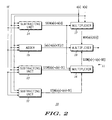
- FIG. 2 illustrating an apparatus 10 for implementing a linearly approximated Log MAP algorithm, according to a preferred embodiment of the invention.
- apparatus 20 comprises of first means 21 for calculating the following values: (a(n)+b(n)+DE)/2, the sign of (a(n)-b(n) -DE) and sign of (b(n)-a(n)-DE) and a second means 29 to determine which of the following elements to provide (a(n), b(n) or (a(n)+b(n)+DE)/2) as a result, according to said sign values.
- First means 21 comprising of first to second subtracting units 22-23, adder 24.
- First and second subtracting units 22 - 23 and adder 24 receive a(n), b(n) and DE.
- Adder 24 receives a(n), b(n) and DE and provides to second means 29 (a(n)+b(n)+DE)/2.
- the division by two is a shift of the bit position by one.
- First subtracting unit 22 generates sign(b(n)-a(n)-DE).
- Second subtracting unit 23 generates sign(a(n)-b(n)-DE). Both sign signals are provided to control inputs of second means 29.
- Second means 29 is conveniently a multiplexer that receives a(n), b(n) and (a(n)+b(n)+DE)/2 and selects which signal to provide according to said control signals.
- Step 31 is followed by step 32 of calculating (a(n)+b(n)+DE)/2 and determining at least one intermediate result reflecting at least one relationship between a(n), b(n) and DE.
Landscapes
- Physics & Mathematics (AREA)
- Probability & Statistics with Applications (AREA)
- Engineering & Computer Science (AREA)
- Theoretical Computer Science (AREA)
- Error Detection And Correction (AREA)
Abstract
Description
- Apparatus and method for implementing a linearly approximated Log MAP algorithm and especially an apparatus and method for implementing a linearly approximated Log MAP algorithm for turbo decoding and turbo equalization.
- Turbo Coding (i.e.- TC) is used for error control coding in digital communications and signal processing. The following references give some examples of various implementations of the TC: "Near Shannon limit error correcting coding and decoding: turbo-codes", by Berrou, Glavieux, Thitimajshima, IEEE International Conference of Communication. Geneva Switzerland, pp. 1064-1070, May 1993; "Implementation and Performance of a Turbo/MAP Decoder", Pietrobon, International Journal of Satellite Communication; "Turbo Coding", Heegard and Wicker, Kluwer Academic Publishers 1999.
- MAP algorithm and soft output Viterbi algorithm (SOVA) are Soft Input Soft Output (i.e.- SISO) decoding algorithms that have gained wide acceptance in the area of communications. Both algorithms are mentioned in U.S patent 5,933,462 of Viterbi et al.
- The TC has gained wide acceptance in the area of communications, such as in cellular networks, modems, and satellite communications. Some turbo encoders consists of two parallel-concatenated systematic convolutional encoders separated by a random interleaver. A turbo decoder has two soft-in soft-out (SISO) decoders. The output of the first SISO is coupled to the input of the second SISO via a first interleaver, while the output of the second SISO is coupled to an input of the first SISO via a feedback loop that includes a deinterleaver.
- A common SISO decoder uses either a maximum a posteriori (i.e.- MAP) decoding algorithm or a Log MAP decoding algorithm. The latter algorithm is analogues to the former algorithm but is performed in the logarithmic domain. Another common decoding algorithm is the max log MAP algorithm. The max log MAP is analogues to the log MAP but the implementation of the former involves an addition of correction factor. Briefly, the MAP finds the most likely information bit to have been transmitted in a coded sequence.
- The output signals of a convolutional encoder are transmitted via a channel and are received by a receiver that has a turbo decoder. The channel usually adds noise to the transmitted signal.
- During the decoding process a trellis of the possible states of the coding is defined. The trellis includes a plurality of nodes (states), organized in T stages, each stage has N=2sup(K-1) nodes, whereas T being the number of received samples taken into account for evaluating which bit was transmitted from a transmitter having the convolutional encoder and K is the constraint length of the code used for encoding. Each stage is comprised of states that represent a given time. Each state is characterized by a forward state metric, commonly referred to as alpha (α or a) and by a backward state metric, commonly referred to as beta (β or b). Each transition from a state to another state is characterized by a branch metric, commonly referred to as gamma (γ).
- Alphas, betas and gammas are used to evaluate a probability factor that indicates which signal was transmitted. This probability factor is commonly known as lambda (Λ). A transition from a stage to an adjacent stage is represented by a single lambda.
- A function MAX*(a(n),b(n)) is frequently used when alphas, betas and gammas are calculated. Conveniently, said calculation involves in a comparison of a(n) and b(n). Said elements a(n) and b(n) usually have real values. MAX*(a(n), b(n)) equals MAX(a(n), b(n)) + Log(1+EXP{-|a(n)-b(n)|}). The first portion of said equation is usually calculated. The calculation of the second portion is relatively complicated and time consuming. Usually an approximation of said second portion is calculated. Said approximation is either a linear approximation, a step approximation or a multi step approximation. A linear approximation method is described in "Linearity Approximated for Log-MAP Algorithms for Turbo Decoding", by Jung-Fu Cheng and Tony Ottoson. Said method suggests to approximate the second portion by a the following functions: MAX{0, (C-|a(n)-b(n)|/4} and by : MAX{0, (C-|a(n)-b(n)|/8}. Both estimations provide relatively poor performances when |a(n)-b(n)| is relatively small, and their implementation is relatively time consuming.
- There is a need for providing a fast and high performance apparatus and method for implementing a linearly approximated Log MAP algorithm.
- While the invention is pointed out with particularity in the appended claims, other features of the invention are disclosed by the following detailed description taken in conjunction with the accompanying drawings, in which:
- FIG. 1. is a schematic description of a portion of a MAX*(a(n),b(n)) function and a linear approximation of said function, according to a preferred embodiment of the invention;
- FIGS. 2-3 are schematic diagrams illustrating two apparatuses for implementing a linearly approximated Log MAP algorithm, according to a preferred embodiment of the invention; and
- FIG. 4 is a flow chart illustrating a method for implementing a linearly approximated Log MAP algorithm, according to a preferred embodiment of the invention.
-
- It should be noted that the particular terms and expressions employed and the particular structural and operational details disclosed in the detailed description and accompanying drawings are for illustrative purposes only and are not intended to in any way limit the scope of the invention as described in the appended claims.
- The invention provides a fast and high performance apparatus and method for implementing a linearly approximated Log MAP algorithm. Said approximation is a linear approximation having a slope of -0.5, said slope providing an improved approximation when a(n) is substantially equal to b(n). Conveniently, method is executed during a single clock cycle.
- The invention provides a fast and high performance apparatus and method for implementing a linearly approximated Log MAP algorithm.
- The invention provides a method for implementing a linearly approximated Log MAP algorithm, said implementation involves calculating MAX*(a(n),b(n)) function, said method comprising the steps of: (A) Receiving a(n), b(n) and DE; (B) Calculating (a(n)+b(n)+DE)/2 and generating at least one intermediate result, said at least one intermediate result reflecting at least one relationship between at least two elements out of a(n), b(n) and DE; and (C) Providing an MAX*(a(n),b(n)) result selected from a group comprising of a(n), b(n) or (a(n)+b(n)+DE)/2, said selection dependent upon the at least one intermediate result. Conveniently, the linearly approximated Log MAP algorithm is implemented in either an iterative decoding process or in an iterative equalization process.
- The invention provides a method for implementing a linearly approximated Log MAP algorithm wherein a first intermediate result indicates
whether an absolute value of a difference between a(n) and b(n) is greater than DE. A second intermediate result indicates whether
a(n) is greater than b(n). Conveniently, the at least one intermediate result
comprising of either a sign(a(n)-b(n)-DE) signal and a sign(b(n)-a(n)-DE) signal or of a sign(a(n)-b(n)) signal and a sign(|a(n)-b(n)|-DE) signal. - The invention provides a method for implementing a linearly approximated Log MAP algorithm wherein the MAX*(a(n),b(n)) result equals (I) MAX(a(n),b(n)) when |a(n)-b(n)| is not smaller than DE, and (II) (a(n)+b(n)+DE)/2 when |a(n)-b(n)| is smaller than DE. |a(n)-b(n)| is smaller than DE when (a(n)-b(n)-DE) < 0 and (-a(n)+b(n)-DE) < 0.
- The invention provides a method for implementing a linearly approximated Log MAP algorithm wherein the MAX*(a(n),b(n)) result equals (I) a(n) when (a(n)-b(n)-DE) > 0 and (b(n)-a(n) -DE) < 0; (II) b(n) when (a(n)-b(n)-DE) < 0 and (b(n)-a(n) -DE) > 0; and (III) (a(n)+b(n)+DE)/2 when |a(n)-b(n)| is smaller than DE.
- The invention provides a method for implementing a linearly approximated Log MAP algorithm wherein said method comprising of the steps of : (A) Receiving a(n), b(n) and DE; (B) Calculating (a(n)+b(n)+DE)/2, sign(a(n)-b(n), sign(a(n)-b(n)-DE) and sign (b(n) - a(n) - DE); (C) Calculating MAX(a(n),b(n)), sign(|a(n)-b(n)| -DE), said first calculation based upon a(n), b(n) and sign(a(n)-b(n)), said second calculation based upon sign(a(n)-b(n), sign(a(n)-b(n)-DE) and sign(b(n)-a(n)-DE); and (D) Providing an MAX*(a(n),b(n)) result selected from a group consisting of max(a(n), b(n)) and (a(n)+b(n)+DE)/2, dependent upon sign(|a (n)-b(n)|-DE).
- The invention provides a method for implementing a linearly approximated Log MAP algorithm wherein, said method comprising the steps of: (A) receiving a(n), b(n) and DE; (B) calculating (a(n)+b(n)+DE)/2, sign(a(n)-b(n)-DE) and sign(b(n)-a(n)-DE); and (C) providing an MAX*(a(n),b(n)) result selected from a group consisting of a(n), b(n) and (a(n)+b(n)+DE)/2, dependent upon sign(a(n)-b(n)-DE) and sign(b(n)-a(n)-DE).
- The invention provides an apparatus for implementing a linearly approximated Log MAP algorithm, said implementation involves calculating MAX*(a(n),b(n)) function, said apparatus comprising of: (A) Calculating means for receiving a(n), b(n) and DE; for calculating (a(n)+b(n)+DE)/2 and for generating at least one intermediate result, said at least one intermediate result reflecting at least one relationship between at least two elements out of a(n), b(n) and DE; and (B) Selecting means for providing an MAX*(a(n),b(n)) result selected from a group comprising of a(n), b(n) or (a(n)+b(n)+DE)/2, said selection dependent upon the at least one intermediate result. Conveniently, the linearly approximated Log MAP algorithm is implemented in an iterative decoding process or in an iterative equalization process.
- The invention provides an apparatus for implementing a linearly approximated Log MAP algorithm wherein a first intermediate result indicates
whether an absolute value of a difference between a(n) and b(n) is greater than DE and a second intermediate result indicates whether a(n) is greater than b(n). Conveniently, the at least one intermediate result comprising of a sign(a(n)-b(n)-DE) signal and a sign(b(n)-a(n)) signal. The at least one intermediate result comprising of a sign(a(n)-b(n)) signal and a sign(|a(n)-b(n)|-DE) signal. - The invention provides an apparatus for implementing a linearly approximated Log MAP algorithm that is adapted to calculate the MAX*(a(n),b(n)) function during a single clock cycle.
- The invention provides an apparatus for implementing a linearly approximated Log MAP algorithm wherein the MAX*(a(n),b(n)) result equals MAX(a(n),b(n)) when |a(n)-b(n)| is not smaller than DE, and equals (a(n)+b(n)+DE)/2 when |a(n)-b(n)| is smaller than DE.
- The invention provides an apparatus for implementing a linearly approximated Log MAP algorithm wherein the MAX*(a(n), b(n))result equals a(n) when (a(n)-b(n)-DE) > 0 and (b(n)-a(n) -DE) < 0; wherein the MAX*(a(n), b(n)) result equals b(n) when (a(n)-b(n)-DE) < 0 and (b(n)-a(n) -DE) > 0; and wherein the MAX*(a(n), b(n)) result equals (a(n)+b(n)+DE)/2 when |a(n)-b(n)| is smaller than DE.
- The invention provides an apparatus for implementing a linearly approximated Log MAP algorithm, the apparatus comprising of : (A) A first means for receiving a(n), b(n) and DE, calculating (a(n)+b(n)+DE)/2, sign(a(n)-b(n), sign(a(n)-b(n)-DE) and sign(b(n)-a(n)-DE); calculating MAX(a(n),b(n)), sign(|a(n)-b(n)|-DE), said first calculation based upon a(n), b(n) and sign(a(n)-b(n)), said second calculation based upon sign(a(n)-b(n), sign(a(n)-b(n)-DE) and sign(b(n)-a(n)-DE); and (B) a second means for providing an MAX*(a(n),b(n)) result selected from a group consisting of max(a(n), b(n)) and (a(n)+b(n)+DE)/2, dependent upon sign(|a(n)-b(n)|-DE). Conveniently, said apparatus is adapted to calculate MAX*(a(n),b(n)) function during three clock cycles. The MAX*(a(n),b(n)) result equals MAX(a(n),b(n)) when |a(n)-b(n)| is not smaller than DE, and equals (a(n)+b(n)+DE)/2 when |a(n)-b(n)| is smaller than DE.
- The invention provides an apparatus for implementing a linearly approximated Log MAP algorithm, the apparatus comprising : (A) First means for receiving a(n), b(n) and DE, calculating (a(n)+b(n)+DE)/2, sign(a(n)-b(n)-DE) and sign(b(n)-a(n)-DE); and (B) Second means for providing an MAX*(a(n),b(n)) result selected from a group consisting of a(n), b(n) and (a(n)+b(n)+DE)/2, dependent upon sign(a(n)-b(n)-DE) and sign(b(n)-a(n)-DE). Conveniently, the apparatus is adapted to calculate a MAX*(a(n), b(n)) function in two clock cycles. The MAX*(a(n), b(n))result equals a(n) when (a(n)-b(n)-DE) > 0 and (b(n)-a(n) -DE) < 0; wherein the MAX*(a(n), b(n)) result equals b(n) when (a(n)-b(n)-DE) < 0 and (b(n)-a(n) -DE) > 0; and wherein the MAX*(a(n), b(n)) result equals (a(n)+b(n)+DE)/2 when |a(n)-b(n)| is smaller than DE.
- For convenience of explanation, the following description relates to turbo decoding. The invention is not limited to said decoding method. For example said invention is also applied in various detection processes such as equalization processes.
- |a(n)-b(n)| is an absolute value of a difference between a(n) and b(n).
- EXP{-|a(n)-b(n)|) equals e by the power of -|a(n)-b(n)|.
-
- FIG. 1 is a graph illustrating a portion of a MAX*(a(n), b(n)) versus an absolute value of a difference between a(n) and b(n). Said graph further illustrates a linear approximation AP(n) of said portion. Said portion equals Log(1+EXP(-|a(n)-b(n)|)).
Curved line 4 illustrates portion Log(1+EXP{-|a(n)-b(n)|}), whileline 5 illustrates a linear approximation of said portion. The slope of said linear approximation substantially equals-0.5. AP(n) = MAX{0,(DE-(a(n)-b(n))/2)}. Preferably DE=2*LOG(2). - Said linear approximation provides superior performances when the difference between a(n) and b(n) is very small. Furthermore, such an approximation allows to speed the calculation of the MAX* function, as further illustrated in Figs. 2-3.
- Referring to Fig. 2 illustrating an
apparatus 10 for implementing a linearly approximated Log MAP algorithm, according to a preferred embodiment of the invention. -
Apparatus 10 implements the following equations : - [1] MAX*(a(n), b(n)) = MAX(a(n),b(n)) when |a(n)-b(n)| is not smaller than DE.
- [2]MAX*(a(n), b(n)) = (a(n)+b(n)+DE)/2 when |a(n)-b(n)|
is smaller than DE.
Apparatus 10 allows to calculate in parallel the following values: MAX(A(n), b(n)); (a(n)+b(n)+DE)/2 and the sign of (|a(n)-b(n)| -DE) and then to determine, according to said sign) which of the first two values to provide as a result of the calculation.Accordingly,apparatus 10 comprises of first means 11 for calculating the following values: MAX(A(n), b(n)); (a(n)+b(n)+DE)/2 and the sign of (|a(n)-b(n)| -DE) and of a second means 19 to determine which of the first two elements to provide as a result, according to said sign.First means 11 comprising of first to third subtracting units 12-14,adder 15 and twomultiplexers adder 15 receive a(n), b(n) and DE. Third subtractingunit 14 receives a(n) and b(n) and generates sign(a(n)-b(n)). Sign(a(n)-b(n)) is provided a a control signal to first andsecond multiplexers Second multiplexer 17 receives a(n) and b(n) and selects the greater element out of them, in response to sign(a(n)-b(n)). Therefore,second multiplexer 17 generates MAX(a(n), b(n)) and provide it tosecond means 19.Adder 15 receives a(n), b(n) and DE and provides to second means 19 (a(n)+b(n)+DE)/2. The division by two is a shift of the bit position by one. Second means receives a control signal sign(|a(n)-b(n)|-DE) and accordingly selects whether to provide MAX(a(n),b(n)) provided bysecond multiplexer 17 or (a(n)+b(n)+DE)/2, provided byfirst multiplexer 16. First subtractingunit 12 receives a(n), b(n) and DE and generates sign(b(n)-a(n)-DE). Second subtractingunit 13 receives a(n), b(n) and DE and generates sign(a(n)-b(n)-DE). Both sign signals are provided tofirst multiplexer 16, that selects the appropriate sign signal according to sign(a(n)-b(n)) provided by third subtracting unit 14.Conveniently,apparatus 10 performs said calculation in a single clock cycle.Referring to Fig. 3 illustrating anapparatus 20 for implementing a linearly approximated Log MAP algorithm, according to a preferred embodiment of theinvention.Apparatus 20 implements the following equations: - [3] MAX*(a(n), b(n)) = a(n) when (a(n)-b(n)-DE) > 0 and (b(n)-a(n) -DE) < 0.
- [4]MAX*(a(n), b(n)) = b(n) when (a(n)-b(n)-DE) < 0 and (b(n)-a(n) -DE) > 0.
- [5] MAX*(a(n), b(n)) = (a(n)+b(n)+DE)/2 when |a(n)-b(n)| is smaller than DE.
-
-
Apparatus 20 allows to calculate in parallel the following values: (a(n)+b(n)+DE)/2, the sign of (a(n)-b(n) -DE) and the sign of (b(n)-a(n)-DE) and to determine, according to said values which of following values to provide as a result of the calculation : a(n), b(n) and (a(n)+b(n)+DE)/2. - Accordingly,
apparatus 20 comprises of first means 21 for calculating the following values:
(a(n)+b(n)+DE)/2, the sign of (a(n)-b(n) -DE) and sign of (b(n)-a(n)-DE) and a second means 29 to determine which of the following elements to provide (a(n), b(n) or (a(n)+b(n)+DE)/2) as a result, according to said sign values. - First means 21 comprising of first to second subtracting units 22-23,
adder 24. First and second subtracting units 22 - 23 andadder 24 receive a(n), b(n) and DE.Adder 24 receives a(n), b(n) and DE and provides to second means 29 (a(n)+b(n)+DE)/2. The division by two is a shift of the bit position by one. First subtractingunit 22 generates sign(b(n)-a(n)-DE). Second subtractingunit 23 generates sign(a(n)-b(n)-DE). Both sign signals are provided to control inputs ofsecond means 29. Second means 29 is conveniently a multiplexer that receives a(n), b(n) and (a(n)+b(n)+DE)/2 and selects which signal to provide according to said control signals. - Conveniently,
apparatus 20 performs said calculation in a single clock cycle. - FIG. 4 is a flow chart illustrating a
method 30 for implementing a linearly approximated Log MAP algorithm. -
Method 30 starts atstep 31 of receiving a(n) and b(n). -
Step 31 is followed bystep 32 of calculating (a(n)+b(n)+DE)/2 and determining at least one intermediate result reflecting at least one relationship between a(n), b(n) and DE. -
Step 32 is followed bystep 33 of providing a one of the values of a(n), b(n) or (a(n) + b(n) + DE)/2, dependent upon the at least one intermediate result. - It should be noted that the particular terms and expressions employed and the particular structural and operational details disclosed in the detailed description and accompanying drawings are for illustrative purposes only and are not intended to in any way limit the scope of the invention as described in the appended claims.
- Thus, there has been described herein an embodiment including at least one preferred embodiment of an apparatus and method for implementing a fast Log-MAP (Maximum-a- Posteriori) algorithm for turbo decoding and turbo equalization.
- It will be apparent to those skilled in the art that the disclosed subject matter may be modified in numerous ways and may assume many embodiments other than the preferred form specifically set out and described above.
- Accordingly, the above disclosed subject matter is to be considered illustrative and not restrictive, and to the maximum extent allowed by law, it is intended by the appended claims to cover all such modifications and other embodiments which fall within the true spirit and scope of the present invention. The scope of the invention is to be determined by the broadest permissible interpretation of the following claims and their equivalents rather than the foregoing detailed description.
Claims (34)
- A method for implementing a linearly approximated Log MAP algorithm, said implementation involves calculating MAX*(a(n),b(n)) function, said method comprising the steps of:receiving a(n), b(n) and DE;calculating (a(n)+b(n)+DE)/2 and generating at least one intermediate result, said at least one intermediate result reflecting at least one relationship between at least two elements out of a(n), b(n) and DE; andproviding an MAX*(a(n),b(n)) result selected from a group comprising of a(n), b(n) or (a(n)+b(n)+DE)/2, said selection dependent upon the at least one intermediate result.
- The method of claim 1 wherein the linearly approximated Log MAP algorithm is implemented in a iterative decoding process.
- The method of claim 1 wherein the linearly approximated Log MAP algorithm is implemented in an iterative equalization process.
- The method of claim 1 wherein a first intermediate result indicates whether an absolute value of a difference between a(n) and b(n) is greater than DE.
- The method of claim 1 a second intermediate result indicates whether a(n) is greater than b(n).
- The method of claim 5 wherein a first intermediate result indicates whether an absolute value of a difference between a(n) and b(n) is greater than DE.
- The method of claim 1 wherein the at least one intermediate result comprising of a sign(a(n)-b(n)-DE) signal and a sign(b(n)-a(n)-DE) signal.
- The method of claim 1 wherein the at least one intermediate result comprising of a sign(a(n)-b(n)) signal and a sign(|a(n)-b(n)|-DE) signal.
- The method of claim 1 wherein said method is executed during 2 -3 clock cycles.
- The method of claim 1 wherein the MAX*(a(n),b(n)) result equals MAX(a(n),b(n)) when |a(n)-b(n)| is not smaller than DE, and equals (a(n)+b(n)+DE)/2 when |a(n)-b(n)| is smaller than DE.
- The method of claim 1 wherein the MAX*(a(n), b(n))result equals a(n) when (a(n)-b(n)-DE) > 0 and (b(n)-a(n) -DE) < 0; wherein the MAX*(a(n), b(n)) result equals b(n) when (a(n)-b(n)-DE) < 0 and (b(n)-a(n) -DE) > 0; and
wherein the MAX*(a(n), b(n)) result equals (a(n)+b(n)+DE)/2 when (a(n)-b(n)-DE) < 0 and (b(n)-a(n)-DE) < 0. - A method for implementing a linearly approximated Log MAP algorithm, said implementation involves calculating MAX*(a(n),b(n)) function, said method comprising the steps of:receiving a(n), b(n) and DE;calculating (a(n)+b(n)+DE)/2, sign(a(n)-b(n)), sign(a(n)-b(n)-DE) and sign(b(n)-a(n)-DE);calculating MAX(a(n),b(n)), sign(|a(n)-b(n)|-DE), said first calculation based upon a(n), b(n) and sign(a(n)-b(n)), said second calculation based upon sign(a(n)-b(n), sign(a(n)-b(n)-DE) and sign(b(n)-a(n)-DE); andproviding an MAX*(a(n),b(n)) result selected from a group consisting of max(a(n), b(n)) and (a(n)+b(n)+DE)/2, dependent upon sign(|a(n)-b(n)|-DE).
- The method of claim 12 wherein said method is executed during a single clock cycle.
- The method of claim 2 wherein the MAX*(a(n),b(n)) result equals MAX(a(n),b(n)) when |a(n)-b(n)| is not smaller than DE, and equals (a(n)+b(n)+DE)/2 when |a(n)-b(n)| is smaller than DE.
- A method for implementing a linearly approximated Log MAP algorithm, said implementation involves calculating MAX*(a(n),b(n)) function, said method comprising the steps of:receiving a(n), b(n) and DE;calculating (a(n)+b(n)+DE)/2, sign(a(n)-b(n)-DE) and sign(b(n)-a(n)-DE); andproviding an MAX*(a(n),b(n)) result selected from a group consisting of a(n), b(n) and (a(n)+b(n)+DE)/2, dependent upon sign(a(n)-b(n)-DE) and"sign(b(n)-a(n)-DE).
- The method of claim 15 wherein said method is executed during two clock cycles.
- The method of claim 15 wherein the MAX*(a(n), b(n))result equals a(n) when (a(n)-b(n)-DE) > 0 and (b(n)-a(n) -DE) < 0; wherein the MAX*(a(n), b(n)) result equals b(n) when (a(n)-b(n)-DE) < 0 and (b(n)-a(n) -DE) > 0; and
wherein the MAX*(a(n), b(n)) result equals (a(n)+b(n)+DE)/2 when (a(n)-b(n)-DE) < 0 and (b(n)-a(n)-DE) < 0. - An apparatus for implementing a linearly approximated Log MAP algorithm, said implementation involves calculating MAX*(a(n),b(n)) function, said apparatus comprising the steps of:calculating means for receiving a(n), b(n) and DE;for calculating
(a(n)+b(n)+DE)/2 and for generating at least one intermediate result, said at least one intermediate result reflecting at least one relationship between at least two elements out of a(n), b(n) and DE; and
selecting means for providing an MAX*(a(n),b(n)) result selected from a group comprising of a(n), b(n) or (a(n)+b(n)+DE)/2, said selection dependent upon the at least one intermediate result. - The apparatus of claim 18 wherein the linearly approximated Log MAP algorithm is implemented in a iterative decoding process.
- The apparatus of claim 18 wherein the linearly approximated Log MAP algorithm is implemented in an iterative equalization process.
- The apparatus of claim 18 wherein a first intermediate result indicates whether an absolute value of a difference between a(n) and b(n) is greater than DE.
- The apparatus of claim 18 a second intermediate result indicates whether a(n) is greater than b(n).
- The apparatus of claim 22 wherein a first intermediate result indicates whether an absolute value of a difference between a(n) and b(n) is greater than DE.
- The apparatus of claim 18 wherein the at least one intermediate result comprising of a sign(a(n)-b(n)-DE) signal and a sign(b(n)-a(n)) signal.
- The apparatus of claim 18 wherein the at least one intermediate result comprising of a sign(a(n)-b(n)) signal and a sign(|a(n)-b(n)|-DE) signal.
- The apparatus of claim 18 wherein said apparatus calculates the MAX*(a(n),b(n)) function during a single clock cycle.
- The apparatus of claim 18 wherein the MAX*(a(n),b(n)) result equals MAX(a(n),b(n)) when |a(n)-b(n)| is not smaller than DE, and equals (a(n)+b(n)+DE)/2 when |a(n)-b(n)| is smaller than DE.
- The apparatus of claim 18 wherein the MAX*(a(n), b(n))result equals a(n) when (a(n)-b(n)-DE) > 0 and (b(n)-a(n) -DE) < 0; wherein the MAX*(a(n), b(n)) result equals b(n) when (a(n)-b(n)-DE) < 0 and (b(n)-a(n) -DE) > 0; and
wherein the MAX*(a(n), b(n)) result equals (a(n)+b(n)+DE)/2 when (a(n)-b(n)-DE) < 0 and (b(n)-a(n)-DE) < 0. - An apparatus for implementing a linearly approximated Log MAP algorithm, said implementation involves calculating MAX*(a(n),b(n)) function, said apparatus comprising of :a first means for receiving a(n), b(n) and DE,calculating
(a(n)+b(n)+DE)/2, sign(a(n)-b(n)), sign(a(n)-b(n)-DE) and sign(b(n)-a(n)-DE); calculating MAX(a(n),b(n)), sign(|a(n)-b(n)|-DE), said first calculation based upon a(n), b(n) and sign(a(n)-b(n)), said second calculation based upon sign(a(n)-b(n)), sign(a(n)-b(n)-DE) and sign(b(n)-a(n)-DE); anda second means for providing an MAX*(a(n),b(n)) result selected from a group consisting of max(a(n), b(n)) and (a(n)+b(n)+DE)/2, dependent upon sign(|a(n)-b(n)|-DE). - The apparatus of claim 29 wherein said apparatus is adapted to calculate MAX*(a(n),b(n)) function during three clock cycles.
- The apparatus of claim 29 wherein the MAX*(a(n),b(n)) result equals MAX(a(n),b(n)) when |a(n)-b(n)| is not smaller than DE, and equals (a(n)+b(n)+DE)/2 when |a(n)-b(n)| is smaller than DE.
- An apparatus for implementing a linearly approximated Log MAP algorithm, said implementation involves calculating MAX*(a(n),b(n)) function, said apparatus comprising :a first means for receiving a(n), b(n) and DE,calculating
(a(n)+b(n)+DE)/2, sign(a(n)-b(n)-DE) and sign(b(n)-a(n)-DE); anda second means for providing an MAX*(a(n),b(n)) result selected from a group consisting of a(n), b(n) and (a(n)+b(n)+DE)/2, dependent upon sign(a(n)-b(n)-DE) and sign(b(n)-a(n)-DE). - The apparatus of claim 31 wherein the apparatus is adapted to calculate a MAX*(a(n), b(n)) function in two clock cycles.
- The apparatus of claim 31 wherein the MAX*(a(n), b(n))result equals a(n) when (a(n)-b(n)-DE) > 0 and (b(n)-a(n) -DE) < 0; wherein the MAX*(a(n), b(n)) result equals b(n) when (a(n)-b(n)-DE) < 0 and (b(n)-a(n) -DE) > 0; and
wherein the MAX*(a(n), b(n)) result equals (a(n)+b(n)+DE)/2 when (a(n)-b(n)-DE) < 0 and (b(n)-a(n)-DE) < 0.
Priority Applications (3)
| Application Number | Priority Date | Filing Date | Title |
|---|---|---|---|
| EP00116858A EP1189355B1 (en) | 2000-08-04 | 2000-08-04 | Linearly approximated log map algorithm for turbo decoding |
| DE60006108T DE60006108T2 (en) | 2000-08-04 | 2000-08-04 | Linear approximation of the LOG-MAP algorithm for turbo decoding |
| US09/923,007 US6757701B2 (en) | 2000-08-04 | 2001-08-03 | Apparatus and method for implementing a linearly approximated log map algorithm |
Applications Claiming Priority (1)
| Application Number | Priority Date | Filing Date | Title |
|---|---|---|---|
| EP00116858A EP1189355B1 (en) | 2000-08-04 | 2000-08-04 | Linearly approximated log map algorithm for turbo decoding |
Publications (2)
| Publication Number | Publication Date |
|---|---|
| EP1189355A1 true EP1189355A1 (en) | 2002-03-20 |
| EP1189355B1 EP1189355B1 (en) | 2003-10-22 |
Family
ID=8169448
Family Applications (1)
| Application Number | Title | Priority Date | Filing Date |
|---|---|---|---|
| EP00116858A Expired - Lifetime EP1189355B1 (en) | 2000-08-04 | 2000-08-04 | Linearly approximated log map algorithm for turbo decoding |
Country Status (3)
| Country | Link |
|---|---|
| US (1) | US6757701B2 (en) |
| EP (1) | EP1189355B1 (en) |
| DE (1) | DE60006108T2 (en) |
Cited By (1)
| Publication number | Priority date | Publication date | Assignee | Title |
|---|---|---|---|---|
| WO2004059516A3 (en) * | 2002-12-31 | 2005-07-28 | Motorola Inc | Apparatus and method of calculating a logarithm of a sum of exponentials |
Families Citing this family (5)
| Publication number | Priority date | Publication date | Assignee | Title |
|---|---|---|---|---|
| US7383485B2 (en) * | 2000-09-12 | 2008-06-03 | Broadcom Corporation | Fast min*- or max*-circuit in LDPC (low density parity check) decoder |
| US7120213B2 (en) * | 2000-10-27 | 2006-10-10 | Texas Instruments Incorporated | Using SISO decoder feedback to produce symbol probabilities for use in wireless communications that utilize single encoder turbo coding and transmit diversity |
| JP4269520B2 (en) * | 2001-01-23 | 2009-05-27 | 株式会社デンソー | Approximation calculation device and MAP decoding device |
| SG110006A1 (en) * | 2002-12-05 | 2005-04-28 | Oki Techno Ct Singapore Pte | A method of calculating internal signals for use in a map algorithm |
| GB2408901B (en) | 2003-12-05 | 2006-07-12 | Motorola Inc | A decoder for a wireless communication device |
Citations (1)
| Publication number | Priority date | Publication date | Assignee | Title |
|---|---|---|---|---|
| US5933462A (en) * | 1996-11-06 | 1999-08-03 | Qualcomm Incorporated | Soft decision output decoder for decoding convolutionally encoded codewords |
Family Cites Families (5)
| Publication number | Priority date | Publication date | Assignee | Title |
|---|---|---|---|---|
| US4748577A (en) * | 1982-02-02 | 1988-05-31 | Motorola, Inc. | Logarithmic data compression |
| KR0174498B1 (en) * | 1995-10-13 | 1999-04-01 | 김광호 | Approximation Method and Circuit of Log |
| US5951629A (en) * | 1997-09-15 | 1999-09-14 | Motorola, Inc. | Method and apparatus for log conversion with scaling |
| US5935200A (en) * | 1997-11-21 | 1999-08-10 | Unisys Corporation | Exponential functional relationship generator method and system for implementation in digital logic |
| US6993098B2 (en) * | 2001-07-12 | 2006-01-31 | Koninklijke Philips Electronics N.V. | Method and apparatus for efficient calculating distance metric |
-
2000
- 2000-08-04 DE DE60006108T patent/DE60006108T2/en not_active Expired - Fee Related
- 2000-08-04 EP EP00116858A patent/EP1189355B1/en not_active Expired - Lifetime
-
2001
- 2001-08-03 US US09/923,007 patent/US6757701B2/en not_active Expired - Lifetime
Patent Citations (1)
| Publication number | Priority date | Publication date | Assignee | Title |
|---|---|---|---|---|
| US5933462A (en) * | 1996-11-06 | 1999-08-03 | Qualcomm Incorporated | Soft decision output decoder for decoding convolutionally encoded codewords |
Non-Patent Citations (3)
| Title |
|---|
| "SIMPLIFIED LOG-MAP ALGORITHM", RESEARCH DISCLOSURE,INDUSTRIAL OPPORTUNITIES LTD. HAVANT,GB, no. 421, May 1999 (1999-05-01), pages 612, XP000888685, ISSN: 0374-4353 * |
| ROBERTSON P ET AL: "A COMPARISON OF OPTIMAL AND SUB-OPTIMAL MAP DECODING ALGORITHMS OPERATING IN THE LOG DOMAIN", PROCEEDINGS OF THE CONFERENCE ON COMMUNICATIONS (ICC),US,NEW YORK, IEEE, 18 June 1995 (1995-06-18), pages 1009 - 1013, XP000533149, ISBN: 0-7803-2487-0 * |
| YUNG-FU CHEG, TONY OTTOSSON: "Linearly Approximated Log-MAP Algorithms for Turbo Decoding", 51ST IEEE VEHICULAR TECHNOLOGY CONFERENCE PROCEEDINGS, vol. 3, 15 May 2000 (2000-05-15) - 18 May 2000 (2000-05-18), Tokyo, pages 2252 - 2256, XP002156559 * |
Cited By (2)
| Publication number | Priority date | Publication date | Assignee | Title |
|---|---|---|---|---|
| WO2004059516A3 (en) * | 2002-12-31 | 2005-07-28 | Motorola Inc | Apparatus and method of calculating a logarithm of a sum of exponentials |
| EP1465079A3 (en) * | 2002-12-31 | 2005-08-03 | Motorola Inc. | Apparatus and method of calculating a logarithm of a sum of exponentials |
Also Published As
| Publication number | Publication date |
|---|---|
| US6757701B2 (en) | 2004-06-29 |
| EP1189355B1 (en) | 2003-10-22 |
| DE60006108T2 (en) | 2004-05-19 |
| US20020018533A1 (en) | 2002-02-14 |
| DE60006108D1 (en) | 2003-11-27 |
Similar Documents
| Publication | Publication Date | Title |
|---|---|---|
| US6510536B1 (en) | Reduced-complexity max-log-APP decoders and related turbo decoders | |
| JP3354554B2 (en) | Channel decoder and channel decoding method | |
| US6829313B1 (en) | Sliding window turbo decoder | |
| US7168030B2 (en) | Turbo code decoder with parity information update | |
| US6665357B1 (en) | Soft-output turbo code decoder and optimized decoding method | |
| Robertson | Improving decoder and code structure of parallel concatenated recursive systematic (turbo) codes | |
| US8321744B2 (en) | Channel adaptive iterative turbo decoder system and method | |
| EP1130789A2 (en) | Soft-decision decoding of convolutionally encoded codeword | |
| US6452979B1 (en) | Soft output decoder for convolutional codes | |
| US6487694B1 (en) | Method and apparatus for turbo-code decoding a convolution encoded data frame using symbol-by-symbol traceback and HR-SOVA | |
| CN1188951C (en) | Scaled-feedback turbo decoder | |
| US6807239B2 (en) | Soft-in soft-out decoder used for an iterative error correction decoder | |
| JP2004343716A (en) | Method for blind detection of transmission format of convolutionally encoded signal and decoder | |
| EP1189355B1 (en) | Linearly approximated log map algorithm for turbo decoding | |
| EP1128560B1 (en) | Apparatus and method for performing SISO decoding | |
| EP1446888B1 (en) | Non linear scaling of reliability values in a turbo decoder system | |
| WO2000041314A1 (en) | Quantization method for iterative decoder in communication system | |
| GB2365291A (en) | Soft output decoder for convolutional codes using a sliding window technique which involves a learning period, stored backward recursion and forward recursion | |
| US7634703B2 (en) | Linear approximation of the max* operation for log-map decoding | |
| EP1178613A1 (en) | Apparatus and method for determining an abort criterion in an iterative detection process | |
| Gracie et al. | Performance of a low-complexity turbo decoder and its implementation on a low-cost, 16-bit fixed-point DSP | |
| EP1587218B1 (en) | Data receiving method and apparatus | |
| EP1094612A1 (en) | SOVA Turbo decoder with decreased normalisation complexity | |
| US20050172203A1 (en) | Decoder and method for performing decoding operation using map algorithm in mobile communication system | |
| Fang et al. | Multi-order soft output Viterbi algorithm (SOVA) decoder fix point performance simulation |
Legal Events
| Date | Code | Title | Description |
|---|---|---|---|
| PUAI | Public reference made under article 153(3) epc to a published international application that has entered the european phase |
Free format text: ORIGINAL CODE: 0009012 |
|
| AK | Designated contracting states |
Kind code of ref document: A1 Designated state(s): AT BE CH CY DE DK ES FI FR GB GR IE IT LI LU MC NL PT SE Kind code of ref document: A1 Designated state(s): DE FR GB |
|
| AX | Request for extension of the european patent |
Free format text: AL;LT;LV;MK;RO;SI |
|
| 17P | Request for examination filed |
Effective date: 20020920 |
|
| AKX | Designation fees paid |
Free format text: DE FR GB |
|
| 17Q | First examination report despatched |
Effective date: 20021121 |
|
| GRAH | Despatch of communication of intention to grant a patent |
Free format text: ORIGINAL CODE: EPIDOS IGRA |
|
| GRAS | Grant fee paid |
Free format text: ORIGINAL CODE: EPIDOSNIGR3 |
|
| GRAA | (expected) grant |
Free format text: ORIGINAL CODE: 0009210 |
|
| AK | Designated contracting states |
Kind code of ref document: B1 Designated state(s): DE FR GB |
|
| REG | Reference to a national code |
Ref country code: GB Ref legal event code: FG4D |
|
| REG | Reference to a national code |
Ref country code: IE Ref legal event code: FG4D |
|
| REF | Corresponds to: |
Ref document number: 60006108 Country of ref document: DE Date of ref document: 20031127 Kind code of ref document: P |
|
| ET | Fr: translation filed | ||
| PLBE | No opposition filed within time limit |
Free format text: ORIGINAL CODE: 0009261 |
|
| STAA | Information on the status of an ep patent application or granted ep patent |
Free format text: STATUS: NO OPPOSITION FILED WITHIN TIME LIMIT |
|
| 26N | No opposition filed |
Effective date: 20040723 |
|
| REG | Reference to a national code |
Ref country code: GB Ref legal event code: 732E |
|
| REG | Reference to a national code |
Ref country code: IE Ref legal event code: MM4A |
|
| PGFP | Annual fee paid to national office [announced via postgrant information from national office to epo] |
Ref country code: GB Payment date: 20060706 Year of fee payment: 7 |
|
| PGFP | Annual fee paid to national office [announced via postgrant information from national office to epo] |
Ref country code: FR Payment date: 20060803 Year of fee payment: 7 |
|
| PGFP | Annual fee paid to national office [announced via postgrant information from national office to epo] |
Ref country code: DE Payment date: 20060831 Year of fee payment: 7 |
|
| REG | Reference to a national code |
Ref country code: FR Ref legal event code: TP |
|
| GBPC | Gb: european patent ceased through non-payment of renewal fee |
Effective date: 20070804 |
|
| REG | Reference to a national code |
Ref country code: FR Ref legal event code: ST Effective date: 20080430 |
|
| PG25 | Lapsed in a contracting state [announced via postgrant information from national office to epo] |
Ref country code: DE Free format text: LAPSE BECAUSE OF NON-PAYMENT OF DUE FEES Effective date: 20080301 |
|
| PG25 | Lapsed in a contracting state [announced via postgrant information from national office to epo] |
Ref country code: FR Free format text: LAPSE BECAUSE OF NON-PAYMENT OF DUE FEES Effective date: 20070831 |
|
| PG25 | Lapsed in a contracting state [announced via postgrant information from national office to epo] |
Ref country code: GB Free format text: LAPSE BECAUSE OF NON-PAYMENT OF DUE FEES Effective date: 20070804 |