EP1189328A2 - Space photovoltaic power generation system, power satellite, and electric power producing ground station - Google Patents
Space photovoltaic power generation system, power satellite, and electric power producing ground station Download PDFInfo
- Publication number
- EP1189328A2 EP1189328A2 EP01120034A EP01120034A EP1189328A2 EP 1189328 A2 EP1189328 A2 EP 1189328A2 EP 01120034 A EP01120034 A EP 01120034A EP 01120034 A EP01120034 A EP 01120034A EP 1189328 A2 EP1189328 A2 EP 1189328A2
- Authority
- EP
- European Patent Office
- Prior art keywords
- power
- microwave
- incoherent
- electric power
- space
- Prior art date
- Legal status (The legal status is an assumption and is not a legal conclusion. Google has not performed a legal analysis and makes no representation as to the accuracy of the status listed.)
- Granted
Links
Images


Classifications
-
- B—PERFORMING OPERATIONS; TRANSPORTING
- B64—AIRCRAFT; AVIATION; COSMONAUTICS
- B64G—COSMONAUTICS; VEHICLES OR EQUIPMENT THEREFOR
- B64G1/00—Cosmonautic vehicles
- B64G1/10—Artificial satellites; Systems of such satellites; Interplanetary vehicles
- B64G1/1085—Swarms and constellations
-
- B—PERFORMING OPERATIONS; TRANSPORTING
- B64—AIRCRAFT; AVIATION; COSMONAUTICS
- B64G—COSMONAUTICS; VEHICLES OR EQUIPMENT THEREFOR
- B64G1/00—Cosmonautic vehicles
- B64G1/22—Parts of, or equipment specially adapted for fitting in or to, cosmonautic vehicles
- B64G1/42—Arrangements or adaptations of power supply systems
- B64G1/428—Power distribution and management
- B64G1/4282—Power distribution and management for transmitting power to earth or other spacecraft
-
- B—PERFORMING OPERATIONS; TRANSPORTING
- B64—AIRCRAFT; AVIATION; COSMONAUTICS
- B64G—COSMONAUTICS; VEHICLES OR EQUIPMENT THEREFOR
- B64G1/00—Cosmonautic vehicles
- B64G1/22—Parts of, or equipment specially adapted for fitting in or to, cosmonautic vehicles
- B64G1/42—Arrangements or adaptations of power supply systems
- B64G1/44—Arrangements or adaptations of power supply systems using radiation, e.g. deployable solar arrays
- B64G1/443—Photovoltaic cell arrays
-
- H—ELECTRICITY
- H02—GENERATION; CONVERSION OR DISTRIBUTION OF ELECTRIC POWER
- H02J—ELECTRIC POWER NETWORKS; CIRCUIT ARRANGEMENTS OR SYSTEMS FOR SUPPLYING OR DISTRIBUTING ELECTRIC POWER; SYSTEMS FOR STORING ELECTRIC ENERGY
- H02J50/00—Circuit arrangements or systems for wireless supply or distribution of electric power
- H02J50/20—Circuit arrangements or systems for wireless supply or distribution of electric power using microwaves or radio frequency waves
-
- H—ELECTRICITY
- H02—GENERATION; CONVERSION OR DISTRIBUTION OF ELECTRIC POWER
- H02J—ELECTRIC POWER NETWORKS; CIRCUIT ARRANGEMENTS OR SYSTEMS FOR SUPPLYING OR DISTRIBUTING ELECTRIC POWER; SYSTEMS FOR STORING ELECTRIC ENERGY
- H02J50/00—Circuit arrangements or systems for wireless supply or distribution of electric power
- H02J50/40—Circuit arrangements or systems for wireless supply or distribution of electric power using two or more transmitting or receiving devices
-
- Y—GENERAL TAGGING OF NEW TECHNOLOGICAL DEVELOPMENTS; GENERAL TAGGING OF CROSS-SECTIONAL TECHNOLOGIES SPANNING OVER SEVERAL SECTIONS OF THE IPC; TECHNICAL SUBJECTS COVERED BY FORMER USPC CROSS-REFERENCE ART COLLECTIONS [XRACs] AND DIGESTS
- Y02—TECHNOLOGIES OR APPLICATIONS FOR MITIGATION OR ADAPTATION AGAINST CLIMATE CHANGE
- Y02E—REDUCTION OF GREENHOUSE GAS [GHG] EMISSIONS, RELATED TO ENERGY GENERATION, TRANSMISSION OR DISTRIBUTION
- Y02E10/00—Energy generation through renewable energy sources
- Y02E10/50—Photovoltaic [PV] energy
Definitions
- the present invention relates to a space photovoltaic power generation system for receiving sunlight in space so as to generate electric power, for transmitting the electric power to an electric power base via space by converting the electric power to a microwave, and for storing the electric power in the electric power base so as to allow the use of the electric power, and a power satellite and an electric power base for use with the system.
- a solar cell is known as a small-size power generation system which utilizes sunlight.
- a photovoltaic power generation panel or the like which can be set up on a building, is known as a power generation system intended for the home which utilizes sunlight.
- Such a photovoltaic power generation system built on the earth is not necessarily efficient fundamentally because of the attenuation of sunlight in the earth's atmosphere and the alternation between shade and light caused by the alternation between day and night.
- a solar panel which can be installed in a satellite, is known as a photovoltaic power generation device intended for space. Satellites can thus achieve missions by privately generating necessary electric power for observation and communications, etc. by using a solar panel.
- specific equipment connected to the solar cell by cable is adapted to use the energy generated by the solar cell.
- a space photovoltaic power generation system including a plurality of power satellites arranged in space, each of which can focus sunlight to a number of solar panels, photoelectric-convert the incident sunlight so as to generate electric power, and then generate a microwave based on the generated energy and transmit the microwave to an electric power base built on the earth.
- the electric power base built on the earth includes a receiving antenna for receiving incident microwaves. The electric power base converts the received microwaves into DC signals and then combine them into DC electric power.
- a problem is, however, that as the number of power satellites is increased to improve the power generation capability of the space photovoltaic power generation system, the area of the array antenna defined as the group of transmission antennas is increased and the beam width of the microwave transmitted via the array antenna is therefore narrowed greatly, and this results in an increase in the per-unit-area electric power received on the earth.
- the present invention is proposed to solve the above-mentioned problem. It is therefore an object of the present invention to provide a space photovoltaic power generation system capable of reducing the power density of electric power transmitted from a group of power satellites each for generating electric power from sunlight received to an electric power base on the earth and hence a loss in the total amount of energy transmitted to the electric power base on the earth, and a power satellite and an electric power base for use with the system.
- a space photovoltaic power generation system comprising: a plurality of power satellites each for generating electrical energy from sunlight in space, for generating an incoherent microwave from the generated electrical energy, and for transmitting the incoherent microwave; and an electric power base located at a remote site for receiving a plurality of incoherent microwaves transmitted from the plurality of power satellites, and for generating electric power from the plurality of incoherent microwaves received.
- each of the plurality of power satellites includes a condensing and power generating unit for focusing sunlight in space and for converting the focused sunlight into electrical energy, and a transmission unit for generating a microwave based on the electrical energy from the condensing and power generating unit, for modulating the microwave so as to generate an incoherent microwave, and for transmitting the incoherent microwave to space.
- Each of the plurality of power satellites can include a plurality of condensing and power generating units each for focusing sunlight in space and for converting the focused sunlight into electrical energy, and a plurality of transmission units each for generating a microwave based on the electrical energy from the plurality of condensing and power generating units, for modulating the microwave so as to generate an incoherent microwave, and for transmitting the incoherent microwave to space.
- the electric power base includes a receiving unit for receiving the plurality of incoherent microwaves transmitted from the plurality of power satellites, a microwave-to-DC conversion unit for converting the plurality of incoherent microwaves received by the receiving unit into DC electric power, and a transmission unit for transmitting the DC electric power obtained by the microwave-to-DC conversion unit.
- a power satellite comprising: a condensing and power generating unit for focusing sunlight in space and for converting the focused sunlight into electrical energy; and a transmission unit for generating a microwave based on the electrical energy from the condensing and power generating unit, for modulating the microwave so as to generate an incoherent microwave, and for transmitting the incoherent microwave to space.
- the power satellite can include a plurality of condensing and power generating units each for focusing sunlight in space and for converting the focused sunlight into electrical energy, and a plurality of transmission units each for generating a microwave based on the electrical energy from the plurality of condensing and power generating units, for modulating the microwave so as to generate an incoherent microwave, and for transmitting the incoherent microwave to space.
- a plurality of condensing and power generating units each for focusing sunlight in space and for converting the focused sunlight into electrical energy
- a plurality of transmission units each for generating a microwave based on the electrical energy from the plurality of condensing and power generating units, for modulating the microwave so as to generate an incoherent microwave, and for transmitting the incoherent microwave to space.
- an electric power base comprising: a receiving unit for receiving a plurality of incoherent microwaves transmitted from a plurality of power satellites; a microwave-to-DC conversion unit for converting the plurality of incoherent microwaves received by the receiving unit into DC electric power; and a transmission unit for transmitting the DC electric power obtained by the microwave-to-DC conversion unit.
- Fig. 1 is a schematic diagram showing a transmit-receive relationship between a power transmission antenna of each of a plurality of power satellites and a receiving antenna of the electric power base, in the space photovoltaic power generation system according to the embodiment.
- Fig. 2 is a block diagram showing the structure of each of the plurality of power satellites and the structure of the control satellite, in the space photovoltaic power generation system according to the embodiment.
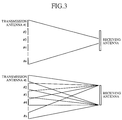
- FIG. 3 is a diagram showing a basic principle underlying combining of incoherent microwaves by the space photovoltaic power generation system according to the embodiment.
- Fig. 4 is a block diagram showing the structure of an example of the power transmission antenna of each of the plurality of power satellites included in the space photovoltaic power generation system according to the embodiment.
- reference numeral 1 denotes a power satellite for generating electrical energy from sunlight received in space, for generating a microwave from the electrical energy, and for transmitting the microwave.
- the space photovoltaic power generation system is provided with a plurality of power satellites #1 to #n.
- Reference numeral 2 denotes a receiving antenna disposed in an electric power base, for receiving a plurality of microwaves transmitted from the plurality of power satellites 1.
- Each of the plurality of power satellites 1 further converts electrical energy, into which sunlight has been photoelectric-converted, into a microwave, and transmits the microwave to the receiving antenna 2 of the electric power base.
- Each of the plurality of power satellites 1. controls the microwave so that it is incoherent.
- the electric power base can generate electric power that is n times as large as the electric power transmitted by each of the plurality of power satellites 1 regardless of the difference among the distances R, R',..., and R'' between each of the plurality of power satellites 1 and the electric power base.
- the beam width of the microwave transmitted from each of the plurality of power satellites 1 can be prevented from reducing and the energy density (energy per unit area) can be therefore reduced.
- each of the plurality of power satellites 1 transmits the microwave to the electric power base without any control of the microwave, the microwaves from the plurality of power satellites 1 interfere with one another and the electric power generated by the electric power base is therefore reduced.
- the electric power base can generate electric power that is n times as large as the electric power transmitted by each of the plurality of power satellites 1, the beam width of the microwave from each of the plurality of power satellites 1 is reduced and the energy density is therefore increased.
- the electric power base can be placed on the earth.
- the electric power base can be placed in such a location in space as a location of the surface of the moon, a space plant facility, or the like.
- the electric power base is located on the earth, it is necessary to reduce the energy density of microwaves transmitted from the plurality of power satellites from the viewpoint of the flora and fauna environment and electric wave trouble.
- the receiving antenna 2 may have an area ranging from several tens of square kilometers to several hundreds of square kilometers.
- such a huge antenna can be formed by arranging a number of antennas each having a specific size in the form of an array, for example.
- the electric power base can have a function of combining either the plurality of microwaves received via the plurality of antennas or a number of microwaves from a number of antenna groups in addition to a function of converting the composite microwave into a low-frequency wave.
- Each of the plurality of power satellites 1 is provided with a condensing unit 4 for focusing sunlight rays in space to an area, the condensing unit 4 being constructed of a catoptric system, a dioptric system, or the like.
- Each of the plurality of power satellites 1 further includes a photoelectric conversion unit 5 for receiving the sunlight focused by the condensing unit 4 and for converting the focused sunlight into electrical energy, a transmission unit 6 for converting the electrical energy generated by the photoelectric conversion unit 5 into a microwave, and a transmission antenna 7 for sending out the microwave to space.
- the transmission unit 6 is provided with a receiving antenna 8 for receiving a control signal from the control satellite 3, an amplifier 9 for amplifying a reference signal fo included in the control signal, a phase shifter 10 for phase-shifting the microwave according to an amount of phase adjustment included in the control signal, an incoherent modulator 11 for incoherent-modulating the microwave output from the phase shifter 12 by using a modulation technique, such as a spread-spectrum modulation, so as to output an incoherent microwave, and a high power amplifier 12 for amplifying the incoherent microwave from the incoherent modulator 11 with high power so as to output a microwave having power corresponding to the electrical energy generated by the photoelectric conversion unit 5.
- a receiving antenna 8 for receiving a control signal from the control satellite 3
- an amplifier 9 for amplifying a reference signal fo included in the control signal
- a phase shifter 10 for phase-shifting the microwave according to an amount of phase adjustment included in the control signal
- an incoherent modulator 11 for incoherent-
- the transmission unit 6 further includes a demodulation unit (DEM) 13 for demodulating the control signal from the control satellite 3, and a functional unit 14 for generating and providing an instruction to the phase shifter 10 based on the amount of phase adjustment included in the control signal.
- Each of the plurality of power satellites 1 further includes a corner reflector 15 disposed to enable the control satellite 3 to measure the location of each of the plurality of power satellites 1.
- the corner reflector 15 only has to reflect either light or electromagnetic waves including light.
- the control satellite 3 is provided with an oscillator 16 for generating the reference signal fo, a mixer 17 for mixing a signal modulated according to the amount of phase adjustment calculated for each of the plurality of power satellites into the reference signal so as to generate the control signal, an amplifier 18 for amplifying the control signal to transmit the control signal to each of the plurality of power satellites 1, and a transmission antenna 19.
- the control satellite 3 is further provided with a location measurement unit 20 for measuring the location of each of the plurality of power satellites 1.
- a laser measurement unit can be used as the location measurement unit 20, and a measurement unit using an electromagnetic wave can be alternatively used.
- the control satellite 3 further includes a phase adjustment amount calculation unit 21 for calculating the amount of phase adjustment for each of the plurality of power satellites 1 based on a principle underlying the calculation of the phase adjustment amount, and a modulator 22 for modulating a signal according to the amount of phase adjustment calculated by the phase adjustment amount calculation unit 21.
- Each of the plurality of power satellites 1 focuses sunlight to the photoelectric conversion unit 5 by means of the condensing unit 4. This is because the energy density of the sunlight which the photoelectric conversion unit 5 constructed of a number of solar cells receives can be increased by focusing the sunlight to the photoelectric conversion unit 5.
- the condensing unit 4 can consist of a reflector or the like having a diameter of up to several tens of meters.
- the photoelectric conversion unit 5 can be so constructed as to receive sunlight directly, instead of the provision of the condensing unit 4.
- the photoelectric conversion unit 5 can consist of a plurality of solar panels arranged, and receive sunlight focused by the condensing unit 4 or directly receive sunlight and then photoelectric-convert the received sunlight into electrical energy.
- the electrical energy generated by the photoelectric conversion unit 5 is then input to the high power amplifier 12 within the transmission unit 6. Since the output of a solar cell is a DC component in general, the output is therefore changed in voltage and stabilized properly and is then input to the high power amplifier.
- the transmission unit 6 generates a microwave from the reference signal f0 included in the control signal which the transmission unit 6 has received from the control satellite 3 by way of the receiving antenna 8.
- the purpose of receiving the reference signal f0 from the control satellite 3 is to make the respective reference signals in the plurality of power satellites 1 in phase with one another.
- the reference signal is then amplified by the amplifier 9 and is phase-shifted by the phase shifter 10.
- the incoherent modulator 11 incoherent-modulates the microwave output from the phase shifter 10 by using a modulation technique, such as a spread-spectrum modulation, so as to output an incoherent microwave.
- the spread-spectrum modulation is a modulation technique that reduces the strength of the output microwave and spreads a band of transmitted frequencies over a broad band, thereby preventing the interference between the output microwave and other microwaves. Fundamentally, the total energy of the output microwave is the same as that not-yet-spread-spectrum-modulated.
- the high power amplifier 12 then amplifies the incoherent microwave from the incoherent modulator 11 with high power so as to output a microwave having power corresponding to the electrical energy generated by the photoelectric conversion unit 5. This microwave is sent out to space by way of the transmission antenna 7.
- the phase shifter 10 is instructed by the functional unit 14 to phase-shift the microwave from the amplifier 9 based on the amount of phase adjustment included in the control signal from the control satellite 3.
- the control signal from the control satellite 3 includes a signal which has been modulated according to the amount of phase adjustment calculated for each of the plurality of power satellites 1.
- the demodulation unit 13 demodulates the control signal.
- the functional unit 14 generates bit information to be set to the phase shifter 10 based on the demodulated amount of phase adjustment.
- the control satellite 3 sends light or the like aiming at the corner reflector 15 located on each of the plurality of power satellites 1 to measure the location of each of the plurality of power satellites 1 by means of the location measurement unit 20.
- the phase adjustment amount calculation unit 21 then calculates the amount of phase adjustment for each of the plurality of power satellites 1 from data on the measured location of each of the plurality of power satellites according to the principle underlying the phase adjustment amount calculation.
- the modulator 22 modulates a signal according to the amount of phase adjustment calculated for each of the plurality of power satellites 1.
- the oscillator 16 generates a reference signal fo to be used by each of the plurality of power satellites, and the mixer 17 mixes the signal modulated according to the amount of phase adjustment into the reference signal fo so as to generate a control signal.
- the amplifier 18 amplifies the control signal to transmit it to each of the plurality of power satellites 1, and then transmits the amplified control signal to each of the plurality of power satellites 1 by way of the transmission antenna 19.
- the control satellite 3 further includes a communications antenna (not shown in Fig. 2) for catching a beacon signal from the electric power base in order to define a virtual plane S used for the calculation of the phase adjustment amount.
- Each of the plurality of power satellites generates and transmits a microwave to the electric power base after making the generated microwave incoherent, as mentioned above. Combining of the plurality of incoherent microwaves at the electric power base will be explained with reference to Fig. 3.
- the plurality of transmission antennas of the plurality of power satellites can be assumed to be a single phased array antenna having a large aperture, and therefore, a microwave having a narrow beam width and hence a high energy density can be transmitted to the receiving antenna of the electric power base.
- the incoherent microwave which is transmitted from each of the plurality of power satellites 1, does not interfere with any other microwave transmitted from any other one of the plurality of power satellites 1, and the receiving antenna of the electric power base thus receives a low-energy-density microwave having energy equal to the sum of the energies of the plurality of microwaves transmitted from the plurality of power satellites, as shown in the lower part of Fig. 3. Since each of the plurality of microwaves transmitted from the plurality of power satellites has a low energy density, but has a broad band, the sum of the energies of the plurality of microwaves is equal to that in the case as shown in the upper part of Fig. 3.
- the electric power generation capability can be improved regardless of a limit on the photoelectric conversion capability of each of the plurality of power satellites 1, a limit on the high power amplification capability of each of the plurality of power satellites 1, and a limit on the power transmission capability.
- each of the plurality of power satellites 1 can include a plurality of condensing and power generating units 23 each for focusing sunlight and for generating electric power from the focused sunlight, and a plurality of transmission antennas 24 each for transmitting an incoherent microwave to space.
- Each of the plurality of power satellites 1 further includes a plurality of transmission units (not shown) each for generating and then incoherent-modulating a microwave based on part of the electric power from the plurality of condensing and power generating units 23 so as to generate the incoherent microwave to be transmitted to a corresponding one of the plurality of transmission antennas 24.
- Each of the plurality of condensing and power generating units 23 corresponds to the condensing unit 4 and the photoelectric conversion unit 5.
- the space photovoltaic power generation system can thus transmit incoherent microwaves by way of the plurality of transmission antennas of the plurality of power satellites 1 to the electric power base, thus reducing the energy density of a composite microwave transmitted to the electric power base on the earth.
- the electric power transmission can thus be carried out with attention to the flora and fauna environment and electric wave trouble.
Landscapes
- Engineering & Computer Science (AREA)
- Remote Sensing (AREA)
- Aviation & Aerospace Engineering (AREA)
- Power Engineering (AREA)
- Computer Networks & Wireless Communication (AREA)
- Life Sciences & Earth Sciences (AREA)
- Sustainable Development (AREA)
- Physics & Mathematics (AREA)
- Astronomy & Astrophysics (AREA)
- General Physics & Mathematics (AREA)
- Photovoltaic Devices (AREA)
- Variable-Direction Aerials And Aerial Arrays (AREA)
Abstract
Description
- The present invention relates to a space photovoltaic power generation system for receiving sunlight in space so as to generate electric power, for transmitting the electric power to an electric power base via space by converting the electric power to a microwave, and for storing the electric power in the electric power base so as to allow the use of the electric power, and a power satellite and an electric power base for use with the system.
- A solar cell is known as a small-size power generation system which utilizes sunlight. Furthermore, a photovoltaic power generation panel or the like, which can be set up on a building, is known as a power generation system intended for the home which utilizes sunlight. Such a photovoltaic power generation system built on the earth is not necessarily efficient fundamentally because of the attenuation of sunlight in the earth's atmosphere and the alternation between shade and light caused by the alternation between day and night. A solar panel, which can be installed in a satellite, is known as a photovoltaic power generation device intended for space. Satellites can thus achieve missions by privately generating necessary electric power for observation and communications, etc. by using a solar panel. In either of the prior art power generation systems, specific equipment connected to the solar cell by cable is adapted to use the energy generated by the solar cell.
- On the other hand, as the communication technology progresses according to results of recent space development works and the construction technology to construct a large-scale space structure progresses, research and development of a system that receives sunlight in space, generates electric power, and transmits the generated energy to a specific place such as a specific location on the earth or in space has been actively conducted. There can be provided an example of such a space photovoltaic power generation system including a plurality of power satellites arranged in space, each of which can focus sunlight to a number of solar panels, photoelectric-convert the incident sunlight so as to generate electric power, and then generate a microwave based on the generated energy and transmit the microwave to an electric power base built on the earth. The electric power base built on the earth includes a receiving antenna for receiving incident microwaves. The electric power base converts the received microwaves into DC signals and then combine them into DC electric power.
- To improve the power generation capability of the prior art space photovoltaic power generation system constructed as above, a large number of power satellites each for transmitting a microwave towards the ground by a transmission antenna thereof should be arranged in space. A problem is, however, that the microwaves transmitted, via the transmission antennas of the plurality of power satellites, from the plurality of power satellites interfere with one another. It can be assumed that the group of transmission antennas is a single huge phased array antenna for transmitting microwaves. A problem is, however, that as the number of power satellites is increased to improve the power generation capability of the space photovoltaic power generation system, the area of the array antenna defined as the group of transmission antennas is increased and the beam width of the microwave transmitted via the array antenna is therefore narrowed greatly, and this results in an increase in the per-unit-area electric power received on the earth.
- The present invention is proposed to solve the above-mentioned problem. It is therefore an object of the present invention to provide a space photovoltaic power generation system capable of reducing the power density of electric power transmitted from a group of power satellites each for generating electric power from sunlight received to an electric power base on the earth and hence a loss in the total amount of energy transmitted to the electric power base on the earth, and a power satellite and an electric power base for use with the system.
- In accordance with an aspect of the present invention, there is provided a space photovoltaic power generation system comprising: a plurality of power satellites each for generating electrical energy from sunlight in space, for generating an incoherent microwave from the generated electrical energy, and for transmitting the incoherent microwave; and an electric power base located at a remote site for receiving a plurality of incoherent microwaves transmitted from the plurality of power satellites, and for generating electric power from the plurality of incoherent microwaves received.
- In accordance with a preferred embodiment of the present invention, each of the plurality of power satellites includes a condensing and power generating unit for focusing sunlight in space and for converting the focused sunlight into electrical energy, and a transmission unit for generating a microwave based on the electrical energy from the condensing and power generating unit, for modulating the microwave so as to generate an incoherent microwave, and for transmitting the incoherent microwave to space. Each of the plurality of power satellites can include a plurality of condensing and power generating units each for focusing sunlight in space and for converting the focused sunlight into electrical energy, and a plurality of transmission units each for generating a microwave based on the electrical energy from the plurality of condensing and power generating units, for modulating the microwave so as to generate an incoherent microwave, and for transmitting the incoherent microwave to space.
- In accordance with another preferred embodiment of the present invention, the electric power base includes a receiving unit for receiving the plurality of incoherent microwaves transmitted from the plurality of power satellites, a microwave-to-DC conversion unit for converting the plurality of incoherent microwaves received by the receiving unit into DC electric power, and a transmission unit for transmitting the DC electric power obtained by the microwave-to-DC conversion unit.
- In accordance with another aspect of the present invention, there is provided a power satellite comprising: a condensing and power generating unit for focusing sunlight in space and for converting the focused sunlight into electrical energy; and a transmission unit for generating a microwave based on the electrical energy from the condensing and power generating unit, for modulating the microwave so as to generate an incoherent microwave, and for transmitting the incoherent microwave to space. Preferably, the power satellite can include a plurality of condensing and power generating units each for focusing sunlight in space and for converting the focused sunlight into electrical energy, and a plurality of transmission units each for generating a microwave based on the electrical energy from the plurality of condensing and power generating units, for modulating the microwave so as to generate an incoherent microwave, and for transmitting the incoherent microwave to space.
- In accordance with a further aspect of the present invention, there is provided an electric power base comprising: a receiving unit for receiving a plurality of incoherent microwaves transmitted from a plurality of power satellites; a microwave-to-DC conversion unit for converting the plurality of incoherent microwaves received by the receiving unit into DC electric power; and a transmission unit for transmitting the DC electric power obtained by the microwave-to-DC conversion unit.
- Further objects and advantages of the present invention will be apparent from the following description of the preferred embodiments of the invention as illustrated in the accompanying drawings.
-
- Fig. 1 is a schematic diagram showing a transmit-receive relationship between a power transmission antenna of each of a plurality of power satellites and a receiving antenna of an electric power base, in a space photovoltaic power generation system according to an embodiment of the present invention;
- Fig. 2 is a block diagram showing the structure of each of the plurality of power satellites and the structure of a control satellite, in the space photovoltaic power generation system according to the embodiment of the present invention;
- Fig. 3 is a diagram showing a basic principle underlying combining of incoherent microwaves by the space photovoltaic power generation system according to the embodiment of the present invention; and
- Fig. 4 is a block diagram showing the structure of an example of the power transmission antenna of each of the plurality of power satellites included in the space photovoltaic power generation system according to the embodiment of the present invention.
-
- A description will be made as to a space photovoltaic power generation system according to an embodiment of the present invention, a power satellite, a control satellite, and an electric power base for use with the system, with reference to Figs. 1 to 4. Fig. 1 is a schematic diagram showing a transmit-receive relationship between a power transmission antenna of each of a plurality of power satellites and a receiving antenna of the electric power base, in the space photovoltaic power generation system according to the embodiment. Fig. 2 is a block diagram showing the structure of each of the plurality of power satellites and the structure of the control satellite, in the space photovoltaic power generation system according to the embodiment. Fig. 3 is a diagram showing a basic principle underlying combining of incoherent microwaves by the space photovoltaic power generation system according to the embodiment. Fig. 4 is a block diagram showing the structure of an example of the power transmission antenna of each of the plurality of power satellites included in the space photovoltaic power generation system according to the embodiment.
- In Fig. 1,
reference numeral 1 denotes a power satellite for generating electrical energy from sunlight received in space, for generating a microwave from the electrical energy, and for transmitting the microwave. As shown in the figure, the space photovoltaic power generation system is provided with a plurality ofpower satellites # 1 to #n.Reference numeral 2 denotes a receiving antenna disposed in an electric power base, for receiving a plurality of microwaves transmitted from the plurality ofpower satellites 1. - Each of the plurality of
power satellites 1 further converts electrical energy, into which sunlight has been photoelectric-converted, into a microwave, and transmits the microwave to thereceiving antenna 2 of the electric power base. Each of the plurality ofpower satellites 1. controls the microwave so that it is incoherent. As a result, the electric power base can generate electric power that is n times as large as the electric power transmitted by each of the plurality ofpower satellites 1 regardless of the difference among the distances R, R',..., and R'' between each of the plurality ofpower satellites 1 and the electric power base. In addition, the beam width of the microwave transmitted from each of the plurality ofpower satellites 1 can be prevented from reducing and the energy density (energy per unit area) can be therefore reduced. - If each of the plurality of
power satellites 1 transmits the microwave to the electric power base without any control of the microwave, the microwaves from the plurality ofpower satellites 1 interfere with one another and the electric power generated by the electric power base is therefore reduced. In contrast, when each of the plurality ofpower satellites 1 transmits the microwave to the electric power base while making the microwave coherent, although the electric power base can generate electric power that is n times as large as the electric power transmitted by each of the plurality ofpower satellites 1, the beam width of the microwave from each of the plurality ofpower satellites 1 is reduced and the energy density is therefore increased. - The electric power base can be placed on the earth. As an alternative, the electric power base can be placed in such a location in space as a location of the surface of the moon, a space plant facility, or the like. When the electric power base is located on the earth, it is necessary to reduce the energy density of microwaves transmitted from the plurality of power satellites from the viewpoint of the flora and fauna environment and electric wave trouble. To this end, it is desirable to transmit microwaves after making the microwaves transmitted from the plurality of power satellites incoherent, as mentioned above. In addition, to reduce the energy density of the received microwaves, the receiving
antenna 2 may have an area ranging from several tens of square kilometers to several hundreds of square kilometers. In general, such a huge antenna can be formed by arranging a number of antennas each having a specific size in the form of an array, for example. In this case, the electric power base can have a function of combining either the plurality of microwaves received via the plurality of antennas or a number of microwaves from a number of antenna groups in addition to a function of converting the composite microwave into a low-frequency wave. - Next, the structure of each of the plurality of
power satellites 1 and the structure of thecontrol satellite 3 will be explained with reference to Fig. 2. Each of the plurality ofpower satellites 1 is provided with acondensing unit 4 for focusing sunlight rays in space to an area, thecondensing unit 4 being constructed of a catoptric system, a dioptric system, or the like. Each of the plurality ofpower satellites 1 further includes aphotoelectric conversion unit 5 for receiving the sunlight focused by thecondensing unit 4 and for converting the focused sunlight into electrical energy, atransmission unit 6 for converting the electrical energy generated by thephotoelectric conversion unit 5 into a microwave, and atransmission antenna 7 for sending out the microwave to space. Thetransmission unit 6 is provided with a receivingantenna 8 for receiving a control signal from thecontrol satellite 3, anamplifier 9 for amplifying a reference signal fo included in the control signal, aphase shifter 10 for phase-shifting the microwave according to an amount of phase adjustment included in the control signal, anincoherent modulator 11 for incoherent-modulating the microwave output from thephase shifter 12 by using a modulation technique, such as a spread-spectrum modulation, so as to output an incoherent microwave, and ahigh power amplifier 12 for amplifying the incoherent microwave from theincoherent modulator 11 with high power so as to output a microwave having power corresponding to the electrical energy generated by thephotoelectric conversion unit 5. Thetransmission unit 6 further includes a demodulation unit (DEM) 13 for demodulating the control signal from thecontrol satellite 3, and afunctional unit 14 for generating and providing an instruction to thephase shifter 10 based on the amount of phase adjustment included in the control signal. Each of the plurality ofpower satellites 1 further includes acorner reflector 15 disposed to enable thecontrol satellite 3 to measure the location of each of the plurality ofpower satellites 1. Thecorner reflector 15 only has to reflect either light or electromagnetic waves including light. Thecontrol satellite 3 is provided with anoscillator 16 for generating the reference signal fo, amixer 17 for mixing a signal modulated according to the amount of phase adjustment calculated for each of the plurality of power satellites into the reference signal so as to generate the control signal, anamplifier 18 for amplifying the control signal to transmit the control signal to each of the plurality ofpower satellites 1, and atransmission antenna 19. Thecontrol satellite 3 is further provided with alocation measurement unit 20 for measuring the location of each of the plurality ofpower satellites 1. A laser measurement unit can be used as thelocation measurement unit 20, and a measurement unit using an electromagnetic wave can be alternatively used. Thecontrol satellite 3 further includes a phase adjustmentamount calculation unit 21 for calculating the amount of phase adjustment for each of the plurality ofpower satellites 1 based on a principle underlying the calculation of the phase adjustment amount, and amodulator 22 for modulating a signal according to the amount of phase adjustment calculated by the phase adjustmentamount calculation unit 21. - Next, conversion of sunlight into a microwave and transmission of the microwave in each of the plurality of
power satellites 1 will be explained. Each of the plurality ofpower satellites 1 focuses sunlight to thephotoelectric conversion unit 5 by means of the condensingunit 4. This is because the energy density of the sunlight which thephotoelectric conversion unit 5 constructed of a number of solar cells receives can be increased by focusing the sunlight to thephotoelectric conversion unit 5. The condensingunit 4 can consist of a reflector or the like having a diameter of up to several tens of meters. As an alternative, thephotoelectric conversion unit 5 can be so constructed as to receive sunlight directly, instead of the provision of the condensingunit 4. Thephotoelectric conversion unit 5 can consist of a plurality of solar panels arranged, and receive sunlight focused by the condensingunit 4 or directly receive sunlight and then photoelectric-convert the received sunlight into electrical energy. The electrical energy generated by thephotoelectric conversion unit 5 is then input to thehigh power amplifier 12 within thetransmission unit 6. Since the output of a solar cell is a DC component in general, the output is therefore changed in voltage and stabilized properly and is then input to the high power amplifier. Thetransmission unit 6 generates a microwave from the reference signal f0 included in the control signal which thetransmission unit 6 has received from thecontrol satellite 3 by way of the receivingantenna 8. The purpose of receiving the reference signal f0 from thecontrol satellite 3 is to make the respective reference signals in the plurality ofpower satellites 1 in phase with one another. The reference signal is then amplified by theamplifier 9 and is phase-shifted by thephase shifter 10. Theincoherent modulator 11 incoherent-modulates the microwave output from thephase shifter 10 by using a modulation technique, such as a spread-spectrum modulation, so as to output an incoherent microwave. The spread-spectrum modulation is a modulation technique that reduces the strength of the output microwave and spreads a band of transmitted frequencies over a broad band, thereby preventing the interference between the output microwave and other microwaves. Fundamentally, the total energy of the output microwave is the same as that not-yet-spread-spectrum-modulated. - The
high power amplifier 12 then amplifies the incoherent microwave from theincoherent modulator 11 with high power so as to output a microwave having power corresponding to the electrical energy generated by thephotoelectric conversion unit 5. This microwave is sent out to space by way of thetransmission antenna 7. Thephase shifter 10 is instructed by thefunctional unit 14 to phase-shift the microwave from theamplifier 9 based on the amount of phase adjustment included in the control signal from thecontrol satellite 3. The control signal from thecontrol satellite 3 includes a signal which has been modulated according to the amount of phase adjustment calculated for each of the plurality ofpower satellites 1. Thedemodulation unit 13 demodulates the control signal. Thefunctional unit 14 generates bit information to be set to thephase shifter 10 based on the demodulated amount of phase adjustment. - Next, the control of each of the plurality of power satellites by the
control satellite 3 will be explained. Thecontrol satellite 3 sends light or the like aiming at thecorner reflector 15 located on each of the plurality ofpower satellites 1 to measure the location of each of the plurality ofpower satellites 1 by means of thelocation measurement unit 20. The phase adjustmentamount calculation unit 21 then calculates the amount of phase adjustment for each of the plurality ofpower satellites 1 from data on the measured location of each of the plurality of power satellites according to the principle underlying the phase adjustment amount calculation. Themodulator 22 modulates a signal according to the amount of phase adjustment calculated for each of the plurality ofpower satellites 1. Theoscillator 16 generates a reference signal fo to be used by each of the plurality of power satellites, and themixer 17 mixes the signal modulated according to the amount of phase adjustment into the reference signal fo so as to generate a control signal. Theamplifier 18 amplifies the control signal to transmit it to each of the plurality ofpower satellites 1, and then transmits the amplified control signal to each of the plurality ofpower satellites 1 by way of thetransmission antenna 19. Thecontrol satellite 3 further includes a communications antenna (not shown in Fig. 2) for catching a beacon signal from the electric power base in order to define a virtual plane S used for the calculation of the phase adjustment amount. - Each of the plurality of power satellites generates and transmits a microwave to the electric power base after making the generated microwave incoherent, as mentioned above. Combining of the plurality of incoherent microwaves at the electric power base will be explained with reference to Fig. 3. In the case where each of the plurality of power satellites generates and transmits a microwave to the electric power base after making the generated microwave coherent, as shown in the upper part of Fig. 3, the plurality of transmission antennas of the plurality of power satellites can be assumed to be a single phased array antenna having a large aperture, and therefore, a microwave having a narrow beam width and hence a high energy density can be transmitted to the receiving antenna of the electric power base. It is, however, undesirable to transmit such a high-energy-density microwave to the ground from the viewpoint of the flora and fauna environment and electric wave trouble. In contrast, in accordance with the present invention, the incoherent microwave, which is transmitted from each of the plurality of
power satellites 1, does not interfere with any other microwave transmitted from any other one of the plurality ofpower satellites 1, and the receiving antenna of the electric power base thus receives a low-energy-density microwave having energy equal to the sum of the energies of the plurality of microwaves transmitted from the plurality of power satellites, as shown in the lower part of Fig. 3. Since each of the plurality of microwaves transmitted from the plurality of power satellites has a low energy density, but has a broad band, the sum of the energies of the plurality of microwaves is equal to that in the case as shown in the upper part of Fig. 3. - By adding one or
more power satellites 1 constructed as above and applying the control signal from thecontrol satellite 3 constructed as above to the added one or more power satellites, all of the generated microwaves including the microwaves from the added one or more power satellites can be made to be in phase with one another. Therefore, the electric power generation capability can be improved regardless of a limit on the photoelectric conversion capability of each of the plurality ofpower satellites 1, a limit on the high power amplification capability of each of the plurality ofpower satellites 1, and a limit on the power transmission capability. - As shown in Fig. 4, each of the plurality of
power satellites 1 can include a plurality of condensing andpower generating units 23 each for focusing sunlight and for generating electric power from the focused sunlight, and a plurality oftransmission antennas 24 each for transmitting an incoherent microwave to space. Each of the plurality ofpower satellites 1 further includes a plurality of transmission units (not shown) each for generating and then incoherent-modulating a microwave based on part of the electric power from the plurality of condensing andpower generating units 23 so as to generate the incoherent microwave to be transmitted to a corresponding one of the plurality oftransmission antennas 24. Each of the plurality of condensing andpower generating units 23 corresponds to thecondensing unit 4 and thephotoelectric conversion unit 5. - In accordance with the embodiment of the present invention, the space photovoltaic power generation system can thus transmit incoherent microwaves by way of the plurality of transmission antennas of the plurality of
power satellites 1 to the electric power base, thus reducing the energy density of a composite microwave transmitted to the electric power base on the earth. The electric power transmission can thus be carried out with attention to the flora and fauna environment and electric wave trouble. - Many widely different embodiments of the present invention may be constructed without departing from the spirit and scope of the present invention. It should be understood that the present invention is not limited to the specific embodiments described in the specification.
Claims (7)
- A space photovoltaic power generation system,
characterized in that the system comprises:a plurality of power satellites (1) each for generating electrical energy from sunlight in space, for generating an incoherent microwave from the generated electric energy, and for transmitting the incoherent microwave; andan electric power base (2) located at a remote site for receiving a plurality of incoherent microwaves transmitted from the plurality of power satellites (1), and for generating electric power from the plurality of incoherent microwaves received. - The system according to claim 1,
characterized in that each of the plurality of power satellites (1) includes a condensing and power generating means (4, 5) for focusing sunlight in space and for converting the focused sunlight into electrical energy, and transmission means (6) for generating a microwave based on the electric energy from the condensing and power generating means (4, 5), for modulating the microwave so as to generate an incoherent microwave, and for transmitting the incoherent microwave to space. - The system according to claim 2,
characterized in that the condensing and power generating means (4, 5) include a plurality of condensing and power generating units (23) each for focusing sunlight in space and for converting the focused sunlight into electric energy, and the transmission means (6) include a plurality of transmission units (24) each for generating a microwave based on the electric energy from the condensing and power generating means (4, 5), for modulating the microwave so as to generate an incoherent microwave, and for transmitting the incoherent microwave to space. - The system according to any one of claims 1 to 3,
characterized in that the electric power base (2) includes receiving means (4) for receiving the plurality of incoherent microwaves transmitted from the plurality of power satellites (1), microwave-to-DC conversion means (5) for converting the plurality of incoherent microwaves received by the receiving means (4) into DC electric power, and transmission means (6) for transmitting the DC electric power obtained by the microwave-to-DC conversion means (5). - A power satellite
characterized in that the power satellite comprises:condensing and power generating means (4, 5) for focusing sunlight in space and for converting the focused sunlight into electric energy; andtransmission means (6) for generating a microwave based on the electric energy from the condensing and power generating means (4, 5), for modulating the microwave so as to generate an incoherent microwave, and for transmitting the incoherent microwave to space. - The power satellite according to claim 5,
characterized in that the condensing and power generating means (4, 5) include a plurality of condensing and power generating units (23) each for focusing sunlight in space and for converting the focused sunlight into electrical energy, and the transmission means (6) include a plurality of transmission units (24) each for generating a microwave based on the electric energy from the condensing and power generating means (4, 5), for modulating the microwave so as to generate an incoherent microwave, and for transmitting the incoherent microwave to space. - An electric power base,
characterized in that the electric power base comprises:receiving means (4) for receiving a plurality of incoherent microwaves transmitted from a plurality of power satellites (1);microwave-to-DC conversion means (5) for converting the plurality of incoherent microwaves received by the receiving means (4) into DC electric power; andtransmission means (6) for transmitting the DC electric power obtained by the microwave-to-DC conversion means (5).
Applications Claiming Priority (2)
| Application Number | Priority Date | Filing Date | Title |
|---|---|---|---|
| JP2000279785A JP3613158B2 (en) | 2000-09-14 | 2000-09-14 | Space solar power generation method, system thereof, power generation satellite and power base |
| JP2000279785 | 2000-09-14 |
Publications (3)
| Publication Number | Publication Date |
|---|---|
| EP1189328A2 true EP1189328A2 (en) | 2002-03-20 |
| EP1189328A3 EP1189328A3 (en) | 2003-05-21 |
| EP1189328B1 EP1189328B1 (en) | 2005-12-28 |
Family
ID=18764739
Family Applications (1)
| Application Number | Title | Priority Date | Filing Date |
|---|---|---|---|
| EP01120034A Expired - Lifetime EP1189328B1 (en) | 2000-09-14 | 2001-08-20 | Space photovoltaic power generation system |
Country Status (4)
| Country | Link |
|---|---|
| US (1) | US6495751B2 (en) |
| EP (1) | EP1189328B1 (en) |
| JP (1) | JP3613158B2 (en) |
| DE (1) | DE60116205T2 (en) |
Families Citing this family (24)
| Publication number | Priority date | Publication date | Assignee | Title |
|---|---|---|---|---|
| JP3627104B2 (en) * | 2001-11-29 | 2005-03-09 | 三菱電機株式会社 | Power generation satellite and transmitting antenna device |
| JP3584925B2 (en) * | 2001-11-29 | 2004-11-04 | 三菱電機株式会社 | Space solar power system |
| JPWO2004025805A1 (en) * | 2002-09-12 | 2006-01-12 | 三菱電機株式会社 | Power receiving device, display device, power supply system, display system, and power receiving method |
| US7077361B1 (en) * | 2005-01-31 | 2006-07-18 | Mario Rabinowitz | Micro-optics concentrator for solar power satellites |
| JP4715874B2 (en) * | 2008-06-20 | 2011-07-06 | 三菱電機株式会社 | Wireless power transmission system, power transmission device, and rectenna base station |
| US20100289342A1 (en) * | 2009-05-12 | 2010-11-18 | William Eugene Maness | Space-Based Power Systems And Methods |
| JP5578885B2 (en) * | 2010-02-26 | 2014-08-27 | 三菱重工業株式会社 | Phased array antenna and control method thereof |
| US10148131B2 (en) * | 2011-05-27 | 2018-12-04 | uBeam Inc. | Power density control for wireless power transfer |
| US20120299540A1 (en) | 2011-05-27 | 2012-11-29 | uBeam Inc. | Sender communications for wireless power transfer |
| US9819399B2 (en) | 2011-05-27 | 2017-11-14 | uBeam Inc. | Beam interaction control for wireless power transfer |
| US9831920B2 (en) | 2011-05-27 | 2017-11-28 | uBeam Inc. | Motion prediction for wireless power transfer |
| WO2015179213A2 (en) | 2014-05-14 | 2015-11-26 | California Institute Of Technology | Large-scale space-based solar power station: multi-scale modular space power |
| WO2015179214A2 (en) * | 2014-05-14 | 2015-11-26 | California Institute Of Technology | Large-scale space-based solar power station: power transmission using steerable beams |
| US12021162B2 (en) | 2014-06-02 | 2024-06-25 | California Institute Of Technology | Ultralight photovoltaic power generation tiles |
| US11362228B2 (en) | 2014-06-02 | 2022-06-14 | California Institute Of Technology | Large-scale space-based solar power station: efficient power generation tiles |
| WO2016014869A2 (en) * | 2014-07-23 | 2016-01-28 | David Hyland | System and method for collection and distribution of space-based solar power |
| JP6554686B2 (en) * | 2015-04-14 | 2019-08-07 | 国立大学法人京都大学 | Phased array antenna design method, phased array antenna and power transmission system |
| EP3325347B1 (en) | 2015-07-22 | 2021-06-16 | California Institute of Technology | Large-area structures for compact packaging |
| US10992253B2 (en) | 2015-08-10 | 2021-04-27 | California Institute Of Technology | Compactable power generation arrays |
| WO2017027617A1 (en) | 2015-08-10 | 2017-02-16 | California Institute Of Technology | Systems and methods for performing shape estimation using sun sensors in large-scale space-based solar power stations |
| US10790776B2 (en) * | 2016-02-01 | 2020-09-29 | The Boeing Company | System and method for controlling the power ratio of a solar concentrator array |
| US11418064B1 (en) * | 2017-05-12 | 2022-08-16 | Redwire Space, Inc. | System and method for providing disjointed space-based power beaming |
| US11634240B2 (en) | 2018-07-17 | 2023-04-25 | California Institute Of Technology | Coilable thin-walled longerons and coilable structures implementing longerons and methods for their manufacture and coiling |
| US11772826B2 (en) | 2018-10-31 | 2023-10-03 | California Institute Of Technology | Actively controlled spacecraft deployment mechanism |
Family Cites Families (4)
| Publication number | Priority date | Publication date | Assignee | Title |
|---|---|---|---|---|
| US3781647A (en) * | 1971-07-26 | 1973-12-25 | Little Inc A | Method and apparatus for converting solar radiation to electrical power |
| US5223781A (en) * | 1983-07-13 | 1993-06-29 | Criswell David R | Power collection and transmission system and method |
| US5885367A (en) * | 1997-03-07 | 1999-03-23 | The United States Of America As Represented By The Secretary Of The Navy | Retractable thin film solar concentrator for spacecraft |
| JP3613142B2 (en) * | 2000-04-24 | 2005-01-26 | 三菱電機株式会社 | Space solar power generation method, system thereof, power generation satellite, control satellite, and power base |
-
2000
- 2000-09-14 JP JP2000279785A patent/JP3613158B2/en not_active Expired - Fee Related
-
2001
- 2001-06-04 US US09/871,895 patent/US6495751B2/en not_active Expired - Fee Related
- 2001-08-20 EP EP01120034A patent/EP1189328B1/en not_active Expired - Lifetime
- 2001-08-20 DE DE60116205T patent/DE60116205T2/en not_active Expired - Fee Related
Non-Patent Citations (1)
| Title |
|---|
| None |
Also Published As
| Publication number | Publication date |
|---|---|
| JP3613158B2 (en) | 2005-01-26 |
| US20020029796A1 (en) | 2002-03-14 |
| EP1189328A3 (en) | 2003-05-21 |
| JP2002095189A (en) | 2002-03-29 |
| US6495751B2 (en) | 2002-12-17 |
| DE60116205D1 (en) | 2006-02-02 |
| EP1189328B1 (en) | 2005-12-28 |
| DE60116205T2 (en) | 2006-08-10 |
Similar Documents
| Publication | Publication Date | Title |
|---|---|---|
| EP1189328B1 (en) | Space photovoltaic power generation system | |
| US6528719B2 (en) | Space photovoltaic power generation method and system | |
| US6492586B2 (en) | Space photovoltaic power generation system, power satellite, and control satellite | |
| JP3627104B2 (en) | Power generation satellite and transmitting antenna device | |
| AU718279B2 (en) | Optical satellite feeder links | |
| Pierce et al. | Introduction to communication science and systems | |
| CN106911381A (en) | Laser link communication measurement hybrid system | |
| JP2006034044A (en) | Wireless power transmission device | |
| Jones et al. | Design of a Beyond-Line-of-Sight Microwave Propagation Study Across the Gulf of Mexico | |
| Haifeng et al. | Design and experimental verification of integrated laser communication terminal in space-ground integrated information network | |
| Whitmer et al. | Ultra-wide bandwidth laser communications: Part I—System considerations for a satellite link | |
| Komerath et al. | Retail beamed power using millimeter waves: survey | |
| CN109672471B (en) | Space-based information distribution system and distribution method | |
| Komerath et al. | The 3rd The Case for Millimeter Wave Power Beaming | |
| Rodenbeck et al. | Microwave wireless power transmission with retrodirective beam steering | |
| Rachiraju et al. | Evaluation of Wireless Solar Power Transmission Through Satellite (SPS) | |
| EP1115232A2 (en) | Method and apparatus for monopulse operation of an array antenna | |
| USHASREE | SATELLITE TRACKING SYSTEM | |
| Nomura et al. | Usuda deep space station with 64-meter-diameter antenna | |
| Dietz et al. | Satellite power system: Concept development and evaluation program. Volume 3: Power transmission and reception. Technical summary and assessment | |
| General et al. | Mobile Telecommunication Health-Effect Research Outcomes and Sources of Funding | |
| Bunton et al. | Concept Extension & Responses to EMT/ISAC | |
| Göschel | Direct television via satellite | |
| Thompson | The effects of a satellite power system on ground-based astronomy | |
| Mohanavelu et al. | Basic Considerations in the Planning of a Broadcasting Satellite System |
Legal Events
| Date | Code | Title | Description |
|---|---|---|---|
| PUAI | Public reference made under article 153(3) epc to a published international application that has entered the european phase |
Free format text: ORIGINAL CODE: 0009012 |
|
| AK | Designated contracting states |
Kind code of ref document: A2 Designated state(s): AT BE CH CY DE DK ES FI FR GB GR IE IT LI LU MC NL PT SE TR |
|
| AX | Request for extension of the european patent |
Free format text: AL;LT;LV;MK;RO;SI |
|
| PUAL | Search report despatched |
Free format text: ORIGINAL CODE: 0009013 |
|
| AK | Designated contracting states |
Designated state(s): AT BE CH CY DE DK ES FI FR GB GR IE IT LI LU MC NL PT SE TR |
|
| AX | Request for extension of the european patent |
Extension state: AL LT LV MK RO SI |
|
| RIC1 | Information provided on ipc code assigned before grant |
Ipc: 7H 02J 17/00 A Ipc: 7B 64G 1/10 B Ipc: 7B 64G 1/42 B Ipc: 7B 64G 1/44 B |
|
| 17P | Request for examination filed |
Effective date: 20030724 |
|
| 17Q | First examination report despatched |
Effective date: 20031120 |
|
| AKX | Designation fees paid |
Designated state(s): DE FR GB |
|
| GRAP | Despatch of communication of intention to grant a patent |
Free format text: ORIGINAL CODE: EPIDOSNIGR1 |
|
| RTI1 | Title (correction) |
Free format text: SPACE PHOTOVOLTAIC POWER GENERATION SYSTEM |
|
| GRAS | Grant fee paid |
Free format text: ORIGINAL CODE: EPIDOSNIGR3 |
|
| GRAA | (expected) grant |
Free format text: ORIGINAL CODE: 0009210 |
|
| AK | Designated contracting states |
Kind code of ref document: B1 Designated state(s): DE FR GB |
|
| REG | Reference to a national code |
Ref country code: GB Ref legal event code: FG4D |
|
| REF | Corresponds to: |
Ref document number: 60116205 Country of ref document: DE Date of ref document: 20060202 Kind code of ref document: P |
|
| RAP2 | Party data changed (patent owner data changed or rights of a patent transferred) |
Owner name: MITSUBISHI DENKI KABUSHIKI KAISHA |
|
| REG | Reference to a national code |
Ref country code: GB Ref legal event code: 727 |
|
| ET | Fr: translation filed | ||
| PGFP | Annual fee paid to national office [announced via postgrant information from national office to epo] |
Ref country code: GB Payment date: 20060830 Year of fee payment: 6 |
|
| REG | Reference to a national code |
Ref country code: GB Ref legal event code: 727A |
|
| PLBE | No opposition filed within time limit |
Free format text: ORIGINAL CODE: 0009261 |
|
| STAA | Information on the status of an ep patent application or granted ep patent |
Free format text: STATUS: NO OPPOSITION FILED WITHIN TIME LIMIT |
|
| 26N | No opposition filed |
Effective date: 20060929 |
|
| REG | Reference to a national code |
Ref country code: GB Ref legal event code: 727B |
|
| PG25 | Lapsed in a contracting state [announced via postgrant information from national office to epo] |
Ref country code: DE Free format text: LAPSE BECAUSE OF NON-PAYMENT OF DUE FEES Effective date: 20070301 |
|
| GBPC | Gb: european patent ceased through non-payment of renewal fee |
Effective date: 20070820 |
|
| REG | Reference to a national code |
Ref country code: FR Ref legal event code: ST Effective date: 20080430 |
|
| PG25 | Lapsed in a contracting state [announced via postgrant information from national office to epo] |
Ref country code: FR Free format text: LAPSE BECAUSE OF NON-PAYMENT OF DUE FEES Effective date: 20070831 |
|
| PG25 | Lapsed in a contracting state [announced via postgrant information from national office to epo] |
Ref country code: GB Free format text: LAPSE BECAUSE OF NON-PAYMENT OF DUE FEES Effective date: 20070820 |
|
| PG25 | Lapsed in a contracting state [announced via postgrant information from national office to epo] |
Ref country code: FR Free format text: LAPSE BECAUSE OF NON-PAYMENT OF DUE FEES Effective date: 20060831 |