EP1189324A2 - World wide web enabled and digital rating plug for electronic trip unit in circuit breakers - Google Patents
World wide web enabled and digital rating plug for electronic trip unit in circuit breakers Download PDFInfo
- Publication number
- EP1189324A2 EP1189324A2 EP01307735A EP01307735A EP1189324A2 EP 1189324 A2 EP1189324 A2 EP 1189324A2 EP 01307735 A EP01307735 A EP 01307735A EP 01307735 A EP01307735 A EP 01307735A EP 1189324 A2 EP1189324 A2 EP 1189324A2
- Authority
- EP
- European Patent Office
- Prior art keywords
- rating
- circuit breaker
- current
- plug
- trip unit
- Prior art date
- Legal status (The legal status is an assumption and is not a legal conclusion. Google has not performed a legal analysis and makes no representation as to the accuracy of the status listed.)
- Withdrawn
Links
Images




Classifications
-
- H—ELECTRICITY
- H02—GENERATION; CONVERSION OR DISTRIBUTION OF ELECTRIC POWER
- H02H—EMERGENCY PROTECTIVE CIRCUIT ARRANGEMENTS
- H02H3/00—Emergency protective circuit arrangements for automatic disconnection directly responsive to an undesired change from normal electric working condition with or without subsequent reconnection ; integrated protection
- H02H3/006—Calibration or setting of parameters
-
- H—ELECTRICITY
- H01—ELECTRIC ELEMENTS
- H01H—ELECTRIC SWITCHES; RELAYS; SELECTORS; EMERGENCY PROTECTIVE DEVICES
- H01H9/00—Details of switching devices, not covered by groups H01H1/00 - H01H7/00
- H01H9/18—Distinguishing marks on switches, e.g. for indicating switch location in the dark; Adaptation of switches to receive distinguishing marks
- H01H2009/188—Distinguishing marks on switches, e.g. for indicating switch location in the dark; Adaptation of switches to receive distinguishing marks with indication of rating
-
- H—ELECTRICITY
- H01—ELECTRIC ELEMENTS
- H01H—ELECTRIC SWITCHES; RELAYS; SELECTORS; EMERGENCY PROTECTIVE DEVICES
- H01H71/00—Details of the protective switches or relays covered by groups H01H73/00 - H01H83/00
- H01H71/74—Means for adjusting the conditions under which the device will function to provide protection
- H01H71/7409—Interchangeable elements
-
- H—ELECTRICITY
- H02—GENERATION; CONVERSION OR DISTRIBUTION OF ELECTRIC POWER
- H02H—EMERGENCY PROTECTIVE CIRCUIT ARRANGEMENTS
- H02H1/00—Details of emergency protective circuit arrangements
- H02H1/0061—Details of emergency protective circuit arrangements concerning transmission of signals
Definitions
- This invention relates generally to rating plugs for electronic trip units in circuit breakers, and more particularly, this invention relates to a world wide web enabled rating plug for modifying the rating plug via the world wide web and a digital rating plug that has a programmable memory for storing scaling and optioning data.
- Circuit breakers are widely used to protect electrical lines and equipment.
- the circuit breaker monitors current through an electrical conductor and trips to interrupt the current if certain criteria are met.
- One such criterion is the maximum continuous current permitted in the protected circuit.
- the maximum continuous current the circuit breaker is designed to carry is known as the frame rating.
- the breaker can be used to protect circuits in which the maximum continuous current is less than the circuit breaker frame rating, in which case the circuit breaker is configured to trip if the current exceeds the maximum continuous current established for the particular circuit in which it is used. This is known as the circuit breaker current rating.
- the circuit breaker current rating can be less than but cannot exceed the frame rating.
- An electronic trip unit is a device that is used in conjunction with an electro-mechanical circuit breaker to control the current verses time trip response.
- the time versus current trip characteristics are, in part, a function of the maximum continuous current permitted by the circuit breaker. This maximum continuous current is also called the current rating of the circuit breaker. As long as the current remains below this maximum continuous current rating, the breaker will remain closed. Momentary low magnitude excursions above the rated current are tolerated; however, persistent overcurrents result in tripping of the breaker.
- the time delay and generation of the trip signal is an inverse function of the magnitude of the current. For very large magnitude overcurrents, such as would be produced by a fault, the microcomputer is programmed to generate a trip signal instantaneously.
- the circuit breaker current rating is set by a rating resistor (a "burden resistor") which is selected to generate a preset voltage when a current proportional to the maximum continuous current permitted in the protected circuit passes through the rating resistor.
- a rating resistor a "burden resistor”
- the rating resistor in order to provide for adjustment of the current rating so that the circuit breaker can be used to protect circuits with different maximum continuous currents, it is known to incorporate the rating resistor in a replaceable rating plug which may be selectively inserted into the breaker.
- Field replaceable rating plugs are known. These plugs are field installable and may be mechanical for use with thermal-magnetic trip units or may use a combination of analog circuit scaling and digital techniques to change the ETU response. It is typical for these plugs to provide mechanical rejection of plugs that are not suited to certain ranges or frame sizes.
- Electronic trip circuit interrupters are designed to interrupt overcurrent conditions over a wide range of ampere ratings.
- the current through the protected electric power circuit is continuously sensed by means of current transformers and a voltage signal is supplied to the signal processor within the ETU circuit by means of so-called “burden resistors", such as rating resistors in a rating plug.
- the size of the burden resistor accordingly sets the ampere rating of the corresponding circuit interrupter.
- a common electronic circuit interrupter could therefore operate over a wide range of ampere ratings by merely changing the value of the burden resistor within the electronic trip circuit. It is important to prevent an electronic circuit interrupter from being inserted within an electrical distribution circuit for which the circuit interrupter is over-rated.
- resistors for analog circuit scaling and digital techniques that indicate to a microprocessor that there is a resistor in the scaling circuit of a specific value. Then the microprocessor can recalibrate its response based upon this resistor value. Errors, however, are commonplace with analog methods that use resistors.
- U.S. Pat. No. 4,958,252 to Murphy discloses a removable rating plug having memory.
- the memory is used to store service data of the circuit breaker for determining its mechanical wear and electrical damage.
- the rating plug For reading the number of operations of the operating mechanism and the trip history of the circuit breaker, or for changing information in the rating plug, the rating plug must be removed from the circuit breaker and plugged into a programmer device. Not only does this interrupt service of the circuit breaker, but it also necessitates the services of a skilled on-site technician.
- a system for changing the rating plug information of a circuit breaker comprising a circuit breaker having an electronic trip unit, a microcomputer in the electronic trip unit, and a rating plug having a non-volative memory storing current rating and frame rating of the circuit breaker, a first internet connection for connecting the circuit breaker to the world wide web, a vendor sub-system, and, a second internet connection for connecting the vendor sub-system to the world wide web, wherein the vendor sub-system and the microcomputer are communicable via the first and second internet connections for altering current rating of the circuit breaker by sending new data from the vendor sub-system to the microcomputer and then to the non-volative memory.
- a plug-in digital rating plug for an electronic trip unit of a circuit breaker
- the rating plug comprising a housing, a connector for connecting the rating plug to the electronic trip unit, and, a non-volatile memory storing current rating of the circuit breaker, wherein the rating plug sends only digital information to the electronic trip unit.
- the circuit breaker 10 shown in Fig. 1 contains an electronic trip unit 27.
- the circuit breaker consists of an electrically insulated case 11 to which a cover 12 of similar insulative material is attached.
- An external handle 14 allows the circuit breaker to be turned ON and OFF independent of the electronic trip unit 27 contained within the cover.
- Electrical connection with the interior current-carrying components is made by load terminal straps 15 extending from one side of the case 11 and then through the line terminal straps 13 (not shown) extending from the opposite side thereof.
- a pair of accessory doors 18, 16 allow for the provision of field installable accessories.
- a rating plug 7 extends within the rating plug receptacle 8 within the circuit breaker accessory cover 20 and connects with the circuit breaker trip unit 27 to set the circuit breaker ampere rating.
- Fig. 2 shows a portion of an exemplary operating mechanism for separating the circuit breaker movable and fixed contacts 17.
- An exemplary rating plug 7 is shown for connecting with a circuit breaker trip unit 27.
- a drive shaft or trip bar 23 connects with the opening link 80 by means of the crank 82.
- a contact carrier drive linkage 84 hereinafter "linkage” connects with the crank 82 by means of a pivot pin 86 with the movable contact arm 88 via the pivot pin 90.
- the contacts 17 and other current-carrying components are contained within the circuit breaker base 11 and are insulated from the operating mechanism components within the top cover 15. Electrical isolation between the operating mechanism 25 and the movable contact arm 88 is assured by the arrangement of the components, not shown, contained within the linkage 84.
- Other types of operating mechanisms are also within the scope of this invention, including, but not limited to, rotary contact arrangements.
- the circuit breaker 10 includes line terminals 13 for connection to a three-phase (phases A, B, and C) source of ac power (not shown) and corresponding load terminals 15.
- the circuit breaker 10 also includes a set of contacts 17 for each phase A, B, and C connected to the line terminals by leads 19 and connected to the load terminals by the conductors 21.
- the contacts 17 are operated by a trip bar 23 which in turn is operated by a trip mechanism 25.
- the trip mechanism is controlled by a microcomputer based trip unit 27.
- the microcomputer based trip unit 27 monitors the phase currents through the current monitors 29, and is programmed to implement predetermined time versus current tripping characteristics which result in actuation of the trip mechanism 25 which opens the contacts 17.
- a microswitch 49 having an actuation arm 51 which is operated by a cam 53 on the trip bar 23 of the circuit breaker 10, may send signals to the microcomputer based trip unit 27 for counting the number of mechanical operations of the operating mechanism, which is proportional to the wear exerted on the circuit breaker 10.
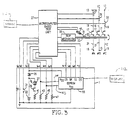
- the rating plug 7 may have pins which connect the rating plug 7 with the microcomputer based trip unit 27.
- the pin 61 may be a common ground.
- Pin 62 may connect a removable jumper 31 which if present may indicate that the circuit breaker is connected in a 60 Hz installation, for example, and if absent, identifies a 50 Hz installation, for example.
- the removable rating plug 7 may also be provided with a battery 33 protected with a blocking diode 35 which is connected with the microcomputer based trip unit 27 through pin 63. This battery 33 may provide power to LED indicators (not shown) controlled by the microcomputer based trip unit 27 when the circuit breaker 10 is tripped.
- This battery 33 may further be necessary in an installation where the circuit breaker 10 is powered by the protected circuit, and thus, where power is lost when the circuit breaker 10 is tripped.
- An LED 37 in the rating plug 7 may provide an indication of the condition of the battery 33 when the test button 39 is depressed.
- a resistor 41 limits the current through the LED 37. Pins 62 and 63 and their associated elements are optionally provided.
- the rating plug 7 may also include three precision resistors 43, 45, 47, which are connected to the common ground and through pins 64, 65, 66, respectively, to the microcomputer based trip unit 27.
- the resistor 43 provides a reference for the microcomputer for the frame rating of the circuit breaker.
- the resistor 45 establishes the current rating of the circuit breaker by providing a reference to the microcomputer for the maximum continuous current. The value of this resistor is selectable to set the desired current rating.
- the resistor 47 is a calibration resistor for the microcomputer based trip unit 27.
- a non-volatile memory 55 such as an erasable electrically programmable read only memory (EEPROM), is provided in the rating plug 7.
- the EEPROM 55 is powered through the input V DD and is connected to the common ground through input V SS .
- the EEPROM 55 may also have a chip select input CS, a serial clock input SK, a data in terminal Dl through which the EEPROM receives data from the microcomputer, and a data output terminal, DO through which data in the EEPROM is read by the microcomputer.
- the CS, SK, Dl, and DO terminals are connected to the microcomputer through pins 67, 68, 69, and 70, respectively, of the rating plug 7.
- EEPROM 55 Further transmitted to the EEPROM 55 is information regarding the resistors 43 and 45 through leads 100 and 102. That is, the frame rating of the circuit breaker and current rating of the circuit breaker is made available to the EEPROM 55 for reasons which will be further described below.
- pins 64, 65 could connect the microcomputer 27 directly to EEPROM 55, with current rating and frame rating information stored in the EEPROM 55 at the time of delivery to the customer. This embodiment would eliminate the need for resistors within the rating plug 7.
- the World Wide Web may be used to modify rating plug 7 on microcomputer based trip unit or ETU 27.
- the WWW 110 can be used in the present invention to communicate information to the customer's ETU 27 and that information will properly modify the response curve of the ETU 27 according to the customer's wishes.
- the method provides a technique that detects errors and upon the detection of these errors causes the ETU 27 to revert to a safe mode of operation.
- the ETU 27 may reject the attempted rating plug change and shall preferably revert to a safe mode of operation.
- the ETU 27 shall preferably further have a method of indicating its new and/or old rating to the customer.
- the ETU 27 of the present invention may be designed to either connect directly to the WWW 110 or it may be connected to another network 114 that is then connected to the WWW 110.
- the ETU firmware shall have a session with the vendor system 116 to communicate the new rating plug information. During this communication there is preferably an interchange of data that will cause the ETU 27 to reject improper rating plug information.
- the recently communicated rating plug information is preferably verified for validity and determined whether or not it comes from a certified vendor.
- a certified vendor Such a method may be similar to but not limited to digital keys for vendor verification.
- the communication is preferably a two-way interchange and coupled to billing systems 118 at the vendor site.
- the ETU 27 of the present invention preferably may have circuitry that provides the rating plug scaling information to be stored in some type of non-volatile memory, similar to and communicable with the EEPROM 55 within the rating plug 7. Because this information is critical to the operation of the ETU 27, the integrity of this data at power up and during the operation of the ETU is preferably ensured.
- this process may constitute a sale.
- the customer benefits from this process because he may receive the rating plug function change without the time delay associated with the typical order and delivery process for hard goods.
- a key benefit to the seller is that there are no hard goods exchanged. Only electronic information is exchanged which may constitute the sale.
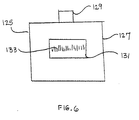
- a plug-in device 125 such as a rating plug, that has scaling and optioning data programmed into a non-volatile memory 126 is used.
- the ETU 27 preferably uses a microprocessor for control. The microprocessor will read the digital data from the plug-in memory 126 and use this to mathematically alter its trip response curve.
- the all-digital rating plug 125 is a small circuit in a plastic shell 127 that requires only a programmable non-volatile memory 126, a connector 129, which may hold the pins for installation in the ETU 27, and a label 131. There is no need for resistors on this plug 125 that could be used to scale voltages.
- the rating plug memory 126 is programmed at the factory where it is assembled and then identified with a label 131 containing indicia such as a bar code 133 and/or other alphanumeric identifying indicia.
- the rating plug 125 is preferably field installable.
- the microprocessor in the ETU 27 Upon power up, the microprocessor in the ETU 27 will read the scaling information from the non-volatile programmable memory 126 and use this data to scale its current versus time response curves. This method requires specific analysis to predict the errors that occur from the finite amount of numeric resolution of the analog to digital converter and register based arithmetic.
- the all digital rating plug 125 can be used in the system for changing rating plug information of a circuit breaker and a method of remotely altering rating plug information as described in connection with Fig. 4.
Landscapes
- Breakers (AREA)
- Emergency Protection Circuit Devices (AREA)
Abstract
Description
Claims (10)
- A circuit breaker (10) for an electrical circuit comprising:an operating mechanism (25) for interrupting current in the electrical circuit when operated;an electronic trip unit (27) including a microcomputer which monitors the current in the electrical circuit and generates a trip by automatically operating the operating mechanism (25) to interrupt the current in the electrical current when the current exceeds a selectable value; and,a rating plug (7,125) having means establishing the selectable value of the current at which the electronic trip unit (27) trips the operating mechanism (25), and a non-volatile memory (55, 126), the rating plug (7, 125) further having means for storing frame rating and current rating of the circuit breaker (10) in the non-volatile memory (55, 126).
- The circuit breaker (10) of claim 1 further including a first resistor (43) for providing the microcomputer with the frame rating and a second resistor (45) for providing the microcomputer with the current rating, wherein the means for storing the frame rating and the current rating of the circuit breaker (10) includes leads (100, 102) connecting the first and second resistors (43, 45) to the non-volative memory (55).
- The circuit breaker (10) of claim 1 further comprising an internet connection extending from the microcomputer, wherein the current rating of the circuit breaker (10) may be changed via the internet connection.
- A system for changing the rating plug (7, 125) information of a circuit breaker (10), the system comprising:wherein the vendor sub-system (116) and the microcomputer are communicable via the first and second internet connections for altering current rating of the circuit breaker (10) by sending new data from the vendor sub-system (116) to the microcomputer and then to the non-volative memory (55,126).a circuit breaker (10) having an electronic trip unit (27), a microcomputer in the electronic trip unit (27), and a rating plug (7, 125) having a non-volative memory (55, 126) storing current rating and frame rating of the circuit breaker (10);a first internet connection for connecting the circuit breaker (10) to the world wide web (110);a vendor sub-system (116); and,a second internet connection for connecting the vendor sub-system (116) to the world wide web (110);
- The system of claim 4 further comprising a display (112) on the circuit breaker (10) for displaying current rating information.
- The system of claim 4 further comprising a billing system (118) communicable with the vendor system (116) for tracking changes made by the vending system (118).
- A method of remotely altering rating plug information of a rating plug (7, 125) connected to an electronic trip unit (27) of a circuit breaker (10), the method comprising:providing a rating plug (7, 125) with a non-volatile memory (55, 126);directing a frame rating of the circuit breaker (10) and a first current rating of the circuit breaker (10) to the non-volatile memory (7, 125);initiating a current rating change from a vendor system (116);sending a second current rating from the vendor system (116) to the world wide web (110);delivering the second current rating from the world wide web (110) to the microcomputer;storing the second current rating in the non-volative memory (55, 126); and,replacing the first current rating with the second current rating.
- The method of claim 7, subsequent delivering the second current rating from the world wide web (110) to the microcomputer, further comprising comparing the second current rating to the frame rating and rejecting the second current rating if the second current rating exceeds the frame rating.
- A plug-in digital rating plug (125) for an electronic trip unit (27) of a circuit breaker (10), the rating plug (125) comprising:wherein information regarding current rating is sent by the rating plug (125) to the electronic trip unit (27) in digital format only.a housing (127);a connector (129) for connecting the rating plug (125) to the electronic trip unit (27); and,a non-volatile memory (126) storing current rating of the circuit breaker,
- A circuit breaker (10) for an electrical circuit comprising:wherein the current rating of the circuit breaker (10) is determined exclusively by the non-volatile memory (126) of the rating plug (125).an electronic trip unit (27) including a microcomputer;a removable digital rating plug (125) having a non-volative memory (126) storing current rating of the circuit breaker (10);a connector (129) for connecting the rating plug (125) to the electronic trip unit (27);a connection lead extending within the connector (129) directly connecting the electronic trip unit (27) with the non-volatile memory (126);
Applications Claiming Priority (3)
| Application Number | Priority Date | Filing Date | Title |
|---|---|---|---|
| US09/660,876 US6836396B1 (en) | 2000-09-13 | 2000-09-13 | World wide web enabled and digital rating plug |
| FR6600876 | 2000-09-13 | ||
| US660876 | 2000-09-13 |
Publications (2)
| Publication Number | Publication Date |
|---|---|
| EP1189324A2 true EP1189324A2 (en) | 2002-03-20 |
| EP1189324A3 EP1189324A3 (en) | 2005-06-22 |
Family
ID=24651323
Family Applications (1)
| Application Number | Title | Priority Date | Filing Date |
|---|---|---|---|
| EP01307735A Withdrawn EP1189324A3 (en) | 2000-09-13 | 2001-09-11 | World wide web enabled and digital rating plug for electronic trip unit in circuit breakers |
Country Status (5)
| Country | Link |
|---|---|
| US (1) | US6836396B1 (en) |
| EP (1) | EP1189324A3 (en) |
| JP (1) | JP5042421B2 (en) |
| CN (1) | CN1295730C (en) |
| MX (1) | MXPA01009147A (en) |
Cited By (8)
| Publication number | Priority date | Publication date | Assignee | Title |
|---|---|---|---|---|
| EP1420496A1 (en) * | 2002-11-15 | 2004-05-19 | Abb Research Ltd. | Protection device and method for installing a protection function in a such device |
| EP1420495A1 (en) * | 2002-11-15 | 2004-05-19 | Abb Research Ltd. | Installation of one protection function in an protection apparatus of a power distribution network |
| WO2008082862A1 (en) * | 2006-12-29 | 2008-07-10 | General Electric Company | Circuit breaker electronic trip unit personality module |
| EP1939913A3 (en) * | 2006-12-29 | 2009-04-29 | General Electric Company | Circuit breaker trip unit rating selection plug |
| EP2068337A1 (en) * | 2007-12-04 | 2009-06-10 | General Electric Company | Circuit breaker electronic trip unit personality module |
| US8116054B2 (en) | 2006-12-29 | 2012-02-14 | General Electric Company | Universal rating plug for electronic trip unit |
| US8139336B2 (en) * | 2008-12-24 | 2012-03-20 | General Electric Company | Field configurable rating plug using communication and control signal |
| FR2989823A1 (en) * | 2012-04-23 | 2013-10-25 | Nexans | Circuit breaker for connecting subscriber to electrical energy distribution network, has releasing unit delivering electronic trigger control current in dependence of selectable parameters for manually operating breaker |
Families Citing this family (17)
| Publication number | Priority date | Publication date | Assignee | Title |
|---|---|---|---|---|
| US6678135B2 (en) * | 2001-09-12 | 2004-01-13 | General Electric Company | Module plug for an electronic trip unit |
| DE102005015498A1 (en) * | 2005-03-31 | 2006-10-05 | Siemens Ag | Method for storing individual data of a low-voltage circuit breaker |
| US7859811B2 (en) * | 2007-09-19 | 2010-12-28 | General Electric Company | Modular communication plug-in module for an electronic trip unit |
| US8228653B2 (en) * | 2007-12-06 | 2012-07-24 | General Electric Company | Circuit breakers with automatic breaker rating |
| EP2109129B1 (en) * | 2008-04-11 | 2016-03-30 | ABB Technology AG | Medium voltage circuit breaker with integrated electronic protection unit |
| US8023238B2 (en) * | 2008-04-15 | 2011-09-20 | General Electric Company | Universal trip unit |
| US7948343B2 (en) * | 2008-06-30 | 2011-05-24 | Eaton Corporation | Settings emulator for a circuit interrupter trip unit and system including the same |
| KR101703631B1 (en) * | 2009-10-12 | 2017-02-08 | 에스프린팅솔루션 주식회사 | Power transmitting unit and image forming apparatus applying the same |
| US8593133B2 (en) * | 2010-12-29 | 2013-11-26 | General Electric Company | Current measuring systems and methods of assembling the same |
| SG188693A1 (en) * | 2011-09-29 | 2013-04-30 | Schneider Electric South East Asia Hq Pte Ltd | Method and device for counting energisation events |
| US8973124B2 (en) | 2012-04-30 | 2015-03-03 | General Electric Company | Systems and methods for secure operation of an industrial controller |
| US20160033553A1 (en) * | 2014-08-01 | 2016-02-04 | Rick Varone | Intelligent electrical circuit digital amperage display interface |
| DE102015210479B4 (en) * | 2015-06-09 | 2022-06-23 | Siemens Ag | Circuit breaker for an electrical circuit |
| US10153118B2 (en) | 2015-08-24 | 2018-12-11 | Eaton Intelligent Power Limited | Frame module, circuit breaker including the same and associated method |
| CN108352278B (en) * | 2015-11-06 | 2020-02-28 | 万高电机及控制装置自动化有限公司 | Circuit Breakers with Pluggable Trip Modules |
| CN105679570B (en) * | 2016-02-26 | 2018-06-15 | 电卫士智能电器(北京)有限公司 | Circuit breakers monitoring device, breaker and breaker monitoring method |
| JP7779784B2 (en) * | 2022-03-29 | 2025-12-03 | パナソニックホールディングス株式会社 | Breaking systems and distribution boards |
Family Cites Families (37)
| Publication number | Priority date | Publication date | Assignee | Title |
|---|---|---|---|---|
| US3710302A (en) | 1971-05-24 | 1973-01-09 | Westinghouse Electric Corp | Bus duct with hinged cover for plug-in region |
| US4066960A (en) | 1976-12-29 | 1978-01-03 | General Electric Company | Electronic kilowatt-hour-meter with error correction |
| US4371908A (en) | 1979-09-17 | 1983-02-01 | Tokyo Shibaura Denki Kabushiki Kaisha | Digital protective relaying systems |
| US4351013A (en) * | 1980-04-15 | 1982-09-21 | Westinghouse Electric Corp. | Circuit interrupter with multiple display and parameter entry means |
| US4720802A (en) | 1983-07-26 | 1988-01-19 | Lear Siegler | Noise compensation arrangement |
| US4783748A (en) | 1983-12-09 | 1988-11-08 | Quadlogic Controls Corporation | Method and apparatus for remote measurement |
| US4672501A (en) | 1984-06-29 | 1987-06-09 | General Electric Company | Circuit breaker and protective relay unit |
| US4649455A (en) | 1986-04-28 | 1987-03-10 | General Electric Company | Rating plug for molded case circuit breaker |
| US4675641A (en) | 1986-06-20 | 1987-06-23 | General Electric Company | Rating plug for molded case circuit breakers |
| US4809125A (en) * | 1987-02-20 | 1989-02-28 | Westinghouse Electric Corp. | Circuit interrupter apparatus with a style saving rating plug |
| US4728914A (en) * | 1987-05-04 | 1988-03-01 | General Electric Company | Rating plug enclosure for molded case circuit breakers |
| US4870531A (en) * | 1988-08-15 | 1989-09-26 | General Electric Company | Circuit breaker with removable display and keypad |
| US5027091A (en) | 1989-02-15 | 1991-06-25 | General Electric Company | Molded case circuit interrupter rating plug keying and interlock arrangement |
| US5136457A (en) | 1989-08-31 | 1992-08-04 | Square D Company | Processor controlled circuit breaker trip system having an intelligent rating plug |
| US4958252A (en) * | 1990-01-16 | 1990-09-18 | Westinghouse Electric Corp. | Circuit breaker with rating plug having memory |
| JPH05109355A (en) * | 1991-10-16 | 1993-04-30 | Toshiba Corp | Rated current switching plug for circuit breaker |
| US5463749A (en) | 1993-01-13 | 1995-10-31 | Dsp Semiconductors Ltd | Simplified cyclical buffer |
| US5619014A (en) | 1993-03-25 | 1997-04-08 | Siemens Energy & Automation, Inc. | Busway busbar with plug-in tab |
| US5392016A (en) | 1993-11-08 | 1995-02-21 | General Electric Company | Molded case circuit breaker mechanical rating plug |
| US5424701A (en) | 1994-02-25 | 1995-06-13 | General Electric | Operating mechanism for high ampere-rated circuit breakers |
| USD365329S (en) | 1994-06-27 | 1995-12-19 | General Electric Company | Compact electronic trip unit |
| US5561610A (en) | 1994-06-30 | 1996-10-01 | Caterpillar Inc. | Method and apparatus for indicating a fault condition |
| SE506145C2 (en) | 1995-03-20 | 1997-11-17 | Bjoern Stefan Christian Blixt | Method for converting a grayscale image into a black and white image divided into pixels |
| US5657193A (en) * | 1996-01-26 | 1997-08-12 | General Electric Company | Electronic control module for motor controller units |
| US5682888A (en) | 1996-06-13 | 1997-11-04 | Neoprobe Corporation | Apparatus and system for detecting and locating photon emissions with remote switch control |
| JPH1094159A (en) * | 1996-09-18 | 1998-04-10 | Hitachi Ltd | Circuit breaker |
| US5877925A (en) | 1996-12-17 | 1999-03-02 | General Electric Company | Ground fault-rating plug for molded case circuit breakers |
| US5797483A (en) | 1997-02-06 | 1998-08-25 | General Electric Company | Operating mechanism linkage assembly for high ampere-rated circuit breakers |
| DE19722898A1 (en) * | 1997-05-29 | 1998-12-10 | Siemens Ag | Remote monitoring of an electronic overcurrent release |
| US5943201A (en) * | 1997-08-04 | 1999-08-24 | Eaton Corporation | Method and apparatus for setting trip profiles in electrical switches using a portable unit with a non-volatile memory |
| US6182022B1 (en) | 1998-01-26 | 2001-01-30 | Hewlett-Packard Company | Automated adaptive baselining and thresholding method and system |
| US6292717B1 (en) * | 1998-03-19 | 2001-09-18 | Siemens Energy & Automation, Inc. | Energy information device and graphical display for a circuit breaker |
| US20010000355A1 (en) * | 1998-12-28 | 2001-04-19 | Esteban Santos | Electronic trip unit having software download capabilities |
| US6466023B2 (en) * | 1998-12-28 | 2002-10-15 | General Electric Company | Method of determining contact wear in a trip unit |
| US6111486A (en) * | 1999-04-08 | 2000-08-29 | Eaton Corporation | Trip unit settings lock out assembly |
| US6560084B1 (en) * | 1999-11-05 | 2003-05-06 | Siemens Energy & Automation, Inc. | Circuit breaker having programmable amplifier |
| US6433982B1 (en) * | 2000-08-03 | 2002-08-13 | General Electric Company | Connection verifying trip unit |
-
2000
- 2000-09-13 US US09/660,876 patent/US6836396B1/en not_active Expired - Lifetime
-
2001
- 2001-09-11 EP EP01307735A patent/EP1189324A3/en not_active Withdrawn
- 2001-09-11 MX MXPA01009147A patent/MXPA01009147A/en active IP Right Grant
- 2001-09-12 JP JP2001275857A patent/JP5042421B2/en not_active Expired - Fee Related
- 2001-09-13 CN CNB011330120A patent/CN1295730C/en not_active Expired - Fee Related
Cited By (13)
| Publication number | Priority date | Publication date | Assignee | Title |
|---|---|---|---|---|
| CN100423394C (en) * | 2002-11-15 | 2008-10-01 | Abb研究有限公司 | Method for setting protection function in protection equipment of distribution network and protection equipment |
| EP1420495A1 (en) * | 2002-11-15 | 2004-05-19 | Abb Research Ltd. | Installation of one protection function in an protection apparatus of a power distribution network |
| US7103453B2 (en) | 2002-11-15 | 2006-09-05 | Abb Research Ltd | Installation of a protective function in a protective device for an electrical power distribution network |
| US7319922B2 (en) | 2002-11-15 | 2008-01-15 | Abb Research Ltd | Protective device and method for installation of a protective function in a protective device |
| CN100423395C (en) * | 2002-11-15 | 2008-10-01 | Abb研究有限公司 | Protection device and method of installing a protection function in the protection device |
| EP1420496A1 (en) * | 2002-11-15 | 2004-05-19 | Abb Research Ltd. | Protection device and method for installing a protection function in a such device |
| WO2008082862A1 (en) * | 2006-12-29 | 2008-07-10 | General Electric Company | Circuit breaker electronic trip unit personality module |
| EP1939913A3 (en) * | 2006-12-29 | 2009-04-29 | General Electric Company | Circuit breaker trip unit rating selection plug |
| US7936547B2 (en) | 2006-12-29 | 2011-05-03 | General Electric Company | Circuit breaker electronic trip unit personality module |
| US8116054B2 (en) | 2006-12-29 | 2012-02-14 | General Electric Company | Universal rating plug for electronic trip unit |
| EP2068337A1 (en) * | 2007-12-04 | 2009-06-10 | General Electric Company | Circuit breaker electronic trip unit personality module |
| US8139336B2 (en) * | 2008-12-24 | 2012-03-20 | General Electric Company | Field configurable rating plug using communication and control signal |
| FR2989823A1 (en) * | 2012-04-23 | 2013-10-25 | Nexans | Circuit breaker for connecting subscriber to electrical energy distribution network, has releasing unit delivering electronic trigger control current in dependence of selectable parameters for manually operating breaker |
Also Published As
| Publication number | Publication date |
|---|---|
| JP5042421B2 (en) | 2012-10-03 |
| MXPA01009147A (en) | 2003-08-20 |
| CN1344000A (en) | 2002-04-10 |
| CN1295730C (en) | 2007-01-17 |
| JP2002237247A (en) | 2002-08-23 |
| US6836396B1 (en) | 2004-12-28 |
| EP1189324A3 (en) | 2005-06-22 |
Similar Documents
| Publication | Publication Date | Title |
|---|---|---|
| US6836396B1 (en) | World wide web enabled and digital rating plug | |
| EP0441472B1 (en) | Circuit breaker with rating plug having memory | |
| US6678135B2 (en) | Module plug for an electronic trip unit | |
| US6788508B2 (en) | Compact low AMP electronic circuit breaker or residential load center | |
| AU729161B2 (en) | A circuit breaker with a circuit breaker unit and processing, calibration and communication modules | |
| US6788512B2 (en) | Electronic trip unit capable of analog and digital setting of circuit breaker setpoints | |
| CA1321821C (en) | Circuit breaker with removable display and keypad | |
| US5136457A (en) | Processor controlled circuit breaker trip system having an intelligent rating plug | |
| AU759152B2 (en) | Accessory network for an electronic trip unit | |
| AU759071B2 (en) | Electrical switching device or trip unit acquiring predetermined settings from another electrical switching device or trip unit | |
| US7974064B2 (en) | Protective relay and human-machine interface therefor | |
| US6804101B2 (en) | Digital rating plug for electronic trip unit in circuit breakers | |
| US5657193A (en) | Electronic control module for motor controller units | |
| EP2220666B1 (en) | Trip unit and electrical switching apparatus including a movable indicator to indicate selection of an arc reduction maintenance system current condition | |
| WO1995032513A1 (en) | Bell alarm and lock-out for high ampere-rated circuit breakers | |
| EP1098415B1 (en) | A circuit breaker system with ASM instantaneous overcurrent indication | |
| US6310753B1 (en) | Low impedance magnetic latch tripping scheme | |
| US7092228B1 (en) | Low-voltage power breaker with a rating plug | |
| CN106030948B (en) | Circuit protection device and method of setting its tripping parameters | |
| JPH07211217A (en) | Electronic overcurrent trip device for circuit breakers |
Legal Events
| Date | Code | Title | Description |
|---|---|---|---|
| PUAI | Public reference made under article 153(3) epc to a published international application that has entered the european phase |
Free format text: ORIGINAL CODE: 0009012 |
|
| AK | Designated contracting states |
Kind code of ref document: A2 Designated state(s): AT BE CH CY DE DK ES FI FR GB GR IE IT LI LU MC NL PT SE TR |
|
| AX | Request for extension of the european patent |
Free format text: AL;LT;LV;MK;RO;SI |
|
| PUAL | Search report despatched |
Free format text: ORIGINAL CODE: 0009013 |
|
| AK | Designated contracting states |
Kind code of ref document: A3 Designated state(s): AT BE CH CY DE DK ES FI FR GB GR IE IT LI LU MC NL PT SE TR |
|
| AX | Request for extension of the european patent |
Extension state: AL LT LV MK RO SI |
|
| 17P | Request for examination filed |
Effective date: 20051222 |
|
| AKX | Designation fees paid |
Designated state(s): DE |
|
| 17Q | First examination report despatched |
Effective date: 20120411 |
|
| STAA | Information on the status of an ep patent application or granted ep patent |
Free format text: STATUS: THE APPLICATION IS DEEMED TO BE WITHDRAWN |
|
| 18D | Application deemed to be withdrawn |
Effective date: 20121023 |