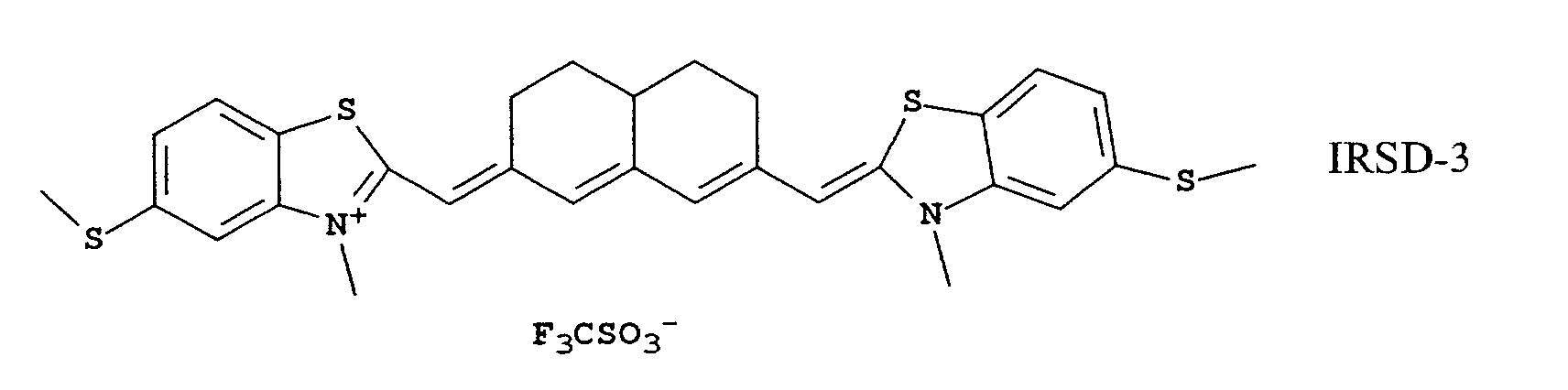
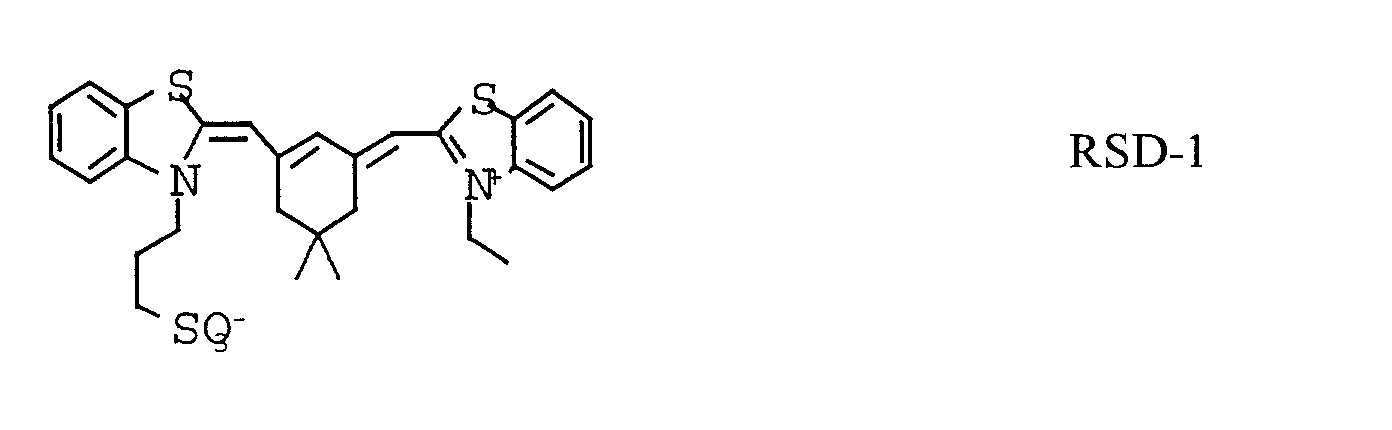
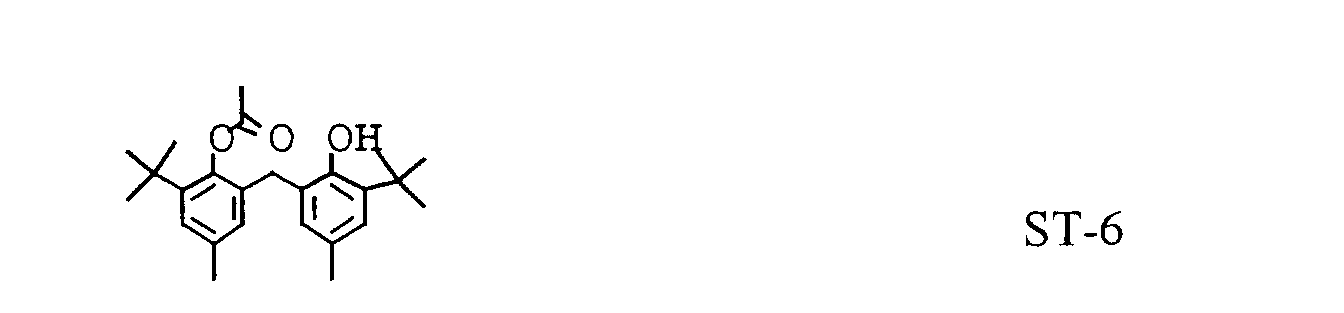
FIELD OF THE INVENTION
This invention relates to an improved reflective silver halide
photographic element for silver halide imaging systems. More specifically, it
relates to such a reflective element comprising at least four separately sensitized
light-sensitive silver halide emulsion layers containing, in addition to the three
conventional cyan, magenta, and yellow dye-forming layers, a fourth image dye-forming
layer comprising a coupler wherein the dye formed by that coupler has a
CIELAB hab hue angle in the range of from not less than 355° to not more than
75°, and/or a fifth image dye-forming layer comprising a coupler wherein the dye
formed by that coupler has a hue angle in the range of from not less than 225° to
not more than 310°, which increases the gamut of colors possible.
BACKGROUND OF THE INVENTION
Color gamut is an important feature of color printing and imaging
systems. It is a measure of the range of colors that can be produced using a given
combination of colorants. It is desirable for the color gamut to be as large as
possible. The color gamut of the imaging system is controlled primarily by the
absorption characteristics of the set of colorants used to produce the image. Silver
halide imaging systems typically employ three colorants, typically including cyan,
magenta, and yellow in the conventional subtractive imaging system.
The ability to produce an image containing any particular color is
limited by the color gamut of the system and materials used to produce the image.
Thus, the range of colors available for image reproduction is limited by the color
gamut that the system and materials can produce.
Color gamut is often thought to be maximized by the use of so-called
"block dyes". In The Reproduction of Colour 4th ed., R.W.G. Hunt, pp
135-144, it has been suggested that the optimum gamut could be obtained with a
subtractive three-color system using three theoretical block dyes where the blocks
are separated at approximately 490 nm and 580 nm. This proposal is interesting
but cannot be implemented for various reasons. In particular, there are no real
organic based couplers which produce dyes corresponding to the proposed block
dyes.
Variations in the block dye concept are advanced by Clarkson,
M.E. and Vickerstaff, T. in "Brightness and Hue of Present-Day Dyes in Relation
to Colour Photography," Photo. J. 88b, 26 (1948). Three example spectral shapes
are given by Clarkson and Vickerstaff: Block, Trapezoidal, and Triangular. The
authors conclude, contrary to the teachings of Hunt, that trapezoidal absorption
spectra may be preferred to a vertical sided block dye. Again, dyes having these
trapezoidal spectra shapes are theoretical and are not available in practice.
Both commercially available dyes and theoretical dyes were
investigated in "The Color Gamut Obtainable by the Combination of Subtractive
Color Dyes. Optimum Absorption Bands as Defined by Nonlinear Optimization
Technique," J. Imaging Science, 30, 9-12. The author, N. Ohta, deals with the
subject of real colorants and notes that the existing curve for a typical cyan dye,
as shown in the publication, is the optimum absorption curve for cyan dyes from
a gamut standpoint.
Bourdelais et al in U.S. Patent 6,030,756 discusses imaging layers
containing silver halide and dye forming couplers applied to both sides of a
translucent base for a display material. While the display material in U.S.
6,030,756 provides an excellent image that can be displayed without the need for
a backlight source, the image is only capable of reproducing 56% of Pantone
color space.
McInerney et al in U. S. Patents 5,679,139; 5,679,140; 5,679,141;
and 5,679,142 teach the shape of preferred subtractive dye absorption shapes for
use in four color, C,M,Y,K based ink-jet prints.
McInerney et al in EP 0 825 488 teaches the shape of preferred
subtractive cyan dye absorption shape for use in silver halide based color prints.
Kitchin et al in U. S. Patent 4,705,745 teaches the preparation of a
photographic element for preparing half-tone color proofs comprising four
separate imaging layers capable of producing cyan, magenta, yellow, and black
images.
Powers et al in U. S. Patent 4,816,378, teaches an imaging process
for the preparation of color half-tone images that contain cyan, magenta, yellow,
and black images. The use of the black dye does little to improve the gamut of
color reproduction.
Haraga et al in EP 0 915 374 A1 teaches a method for improving
image clarity by mixing 'invisible' information in the original scene with a color
print and reproducing it as an infrared dye, magenta dye, or as a mixture of cyan
magenta and yellow dyes to achieve improved color tone and realism. The
addition of the resulting infrared, magenta, or black dye does little to improve the
gamut.
In spite of the foregoing teachings relative to color gamut, the
coupler sets which have been employed in silver halide color imaging have not
provided the range of gamut desired for modem digital imaging; especially for
so-called 'spot colors', or 'HiFi colors'.
It is, therefore, a problem to be solved by providing a coupler set
which provides an increase in color gamut compared to coupler sets comprised of
cyan, magenta, and yellow dye forming couplers by further incorporating red dye
and blue dye forming couplers.
It has been proposed in U.S. 5,866,282 (Bourdelais et al) to utilize
a composite support material with laminated biaxially oriented polyolefin sheets
as a photographic imaging material. In U.S. 5,866,282, biaxially oriented
polyolefin sheets are extrusion laminated to cellulose paper to create a support for
silver halide imaging layers. The biaxially oriented sheets described in U.S.
5,866,282 have a microvoided layer in combination with coextruded layers that
contain white pigments such as TiO2 above and below the microvoided layer. In
the composite imaging support structure described in U.S. 5,866,282 the cyan,
magenta, and yellow silver halide imaging layers are applied to one side of the
white, reflecting side of the base.
It has been proposed in U.S. 4,355,099 to apply photosensitive
layers on one side of a thin transparent support, expose through the thin
transparent support and post image process adhere the imaging layers to a white
reflective support to create a reflective image. While the imaging layers are
protected, they are only applied to one side of the thin transparent support.
Further, because no antihalation layer is utilized with the light sensitive silver
halide imaging layers, problems such as unwanted scattering and printing platen
reflection would reduce the quality of the image.
PROBLEM TO BE SOLVED BY THE INVENTION
There is a need for a reflective imaging material that provides an
expanded color gamut while maintaining processing efficiency.
SUMMARY OF THE INVENTION
It is an object of the invention to provide improved imaging layers.
It is another object to provide imaging material that has an
expanded color gamut.
It is a further object to maintain processing efficiency.
It is another object to provide a reflective image.
These and other objects of the invention are accomplished by a
method of forming an image comprising providing an imaging element
comprising a transparent polymer sheet, and at least one photo sensitive dye
forming coupler containing layer is on each side of said sheet, wherein there are at
least four separate photo sensitive layers and the photo sensitive layers comprise
at least four dye forming couplers that form at least four spectrally distinct colors,
image wise exposing said imaging element by actinic radiation, developing an
image, and applying a white reflective sheet to one side of the developed imaging
element.
ADVANTAGEOUS EFFECT OF THE INVENTION
The invention provides a reflective imaging material with an
improved color gamut while maintaining typical the 45 second color development
cycle time.
BRIEF DESCRIPTION OF THE DRAWINGS
Figs. 1-3 are cross-sectional views of photographic reflective
imaging material with expanded color gamut.
DETAILED DESCRIPTION OF THE INVENTION
The invention has numerous advantages over prior practices in the
art. The photographic element of the invention employs subtractive, additive, or a
combination of subtractive and additive color imaging. In such imaging, a
viewable digital print color image is formed by generating a combination of cyan,
magenta, yellow, red, and blue or black colorants in proportion to the amounts of
exposure of up to six different digitally controlled light sources respectively. The
object is to provide a reproduction that is pleasing to the observer, but also has the
improved capability to specifically reproduce the so-called 'spot colors', Pantone®
colors or Hi-Fi colors. Color in the reproduced image is composed of one or a
combination of the cyan, magenta, yellow, red, blue, and black image colorants.
The relationship of the original color to the reproduced color is a combination of
many factors. It is, however, limited by the color gamut achievable by the
multitude of combinations of cyan, magenta, yellow, red, blue and black colorants
used to generate the final image.
In addition to the individual colorant characteristics, it is necessary
to have cyan, magenta, yellow, red, and blue colorants that have preferred
absorption maxima relative to one another and that have absorption band shapes
which function together to provide an optimum overall color gamut. The imaging
element of the invention can be processed in 45 seconds, as the additional dyes
and couplers required to expand the color gamut are applied to the back side of
the transparent polymer sheet, as an additional fourth or fifth layer applied to one
side of the support is difficult to process in 45 seconds as the development
chemistry does not have enough time to develop the bottommost layers.
Further, the reflective imaging member is more curl resistant
compared to prior art reflective silver halide image materials, as the light sensitive
silver halide imaging layers dispersed in gelatin are applied to both sides of the
transparent support. The ultraviolet and oxygen sensitive dyes can also be
protected by the transparent polymer sheet, thus extending the life of the image.
These and other advantages will be apparent from the detailed description below.
Illustrated in Fig. 1 is a cross section of the reflective imaging
element with expanded color gamut. Cyan dye formed image layer 2, magenta
dye formed image layer 4, and yellow dye formed image layer 6 are located on
top of transparent polymer support 8. On the back side of transparent polymer
support 8 is located the red dye formed imaging layer 10. The image element 16
comprising layers attached to transparent support 8 are adhesively adhered to
white reflective base 14 with pressure sensitive adhesive layer 12.
Illustrated in Fig. 2 is a cross section of the reflective imaging
element 33 with expanded color gamut. Cyan dye formed image layer 20,
magenta dye formed image layer 22, and yellow dye formed image layer 24 are
located on top of transparent polymer support 26. On the back side of transparent
support 26 is located the blue dye formed imaging layer 28. The image carrying
element 34 comprising image layers attached to transparent support 34 is
adhesively adhered to white reflective base 32 with pressure sensitive adhesive
layer 30 to form element 3.
Illustrated in Fig. 3 is a cross section of the reflective imaging
element with expanded color gamut. Cyan dye formed image layer 40, magenta
dye formed image layer 42, and yellow dye formed image layer 44 are located on
top of transparent support 46. On the back side of transparent support 46 is
located the red dye formed imaging layer 48 and the blue dye formed image layer
50. The image element 56 comprising image layers attached to transparent
support 56 is adhesively adhered to white reflective base 54 with pressure
sensitive adhesive layer 52 to form element 58.
For the imaging elements of the invention, an imaging element
comprises a transparent polymer sheet, and at least one photosensitive dye
forming coupler containing layer is on each side of said sheet, wherein there are at
least four separate photosensitive layers and the photosensitive layers comprise at
least four dye forming couplers that form at least four spectrally distinct colors is
preferred. By applying at least one of the photosensitive dye forming couplers
containing layers on the opposite side of the transparent support, during the
processing step of image creation, the additional layer of the invention is in
contact with the development chemistry, thereby allowing for 45 second
development time.
The imaging element wherein said at least four spectrally distinct
colors comprise magenta, yellow, cyan, red and black, wherein said red has a
CIELAB hue angle, hab, from not less than 355 to not more than 75 degrees is
preferred. The possible combinations of cyan, magenta and yellow colorants limit
the color saturation and color gamut of red, green and blue colors that a
subtractive color photographic system can reproduce. We have found that the
color gamut of a photographic system can be expanded by the use of additional
colorants. Red in combination with magenta, yellow, cyan and black is preferred
because red as defined as CIELAB hue angle, hab, from not less than 355 to not
more than 75 degrees, improves color reproduction possible working in silver
halide color space. The red improves a color deficiency in the current silver
halide color space, thus allowing an improved color gamut, especially red. The
black also provides additional density that is difficult to obtain using balanced
amounts of yellow, magenta, and cyan providing a deeper, more saturated black.
An improved black is more perceptually preferred compared to blacks created
using balanced amounts of magenta, cyan, and yellow.
The imaging element wherein at least four spectrally distinct colors
comprise magenta, yellow, cyan, blue and black, wherein said preferred blue has a
CIELAB hue angle, hab, from 225 to 310 degrees. The possible combinations of
cyan, magenta and yellow colorants limit the color saturation and color gamut of
red, green, and blue colors that a subtractive color photographic system can
reproduce. We have found that the color gamut of a photographic system can be
expanded by the use of additional colorants. Blue, in combination with magenta,
yellow, cyan, and black is preferred because blue as defined as CIELAB hue
angle, hab, from 225 to 310 degrees improves color reproduction possible working
in silver halide color space. The blue improves a color deficiency in the current
silver halide color space, thus allowing an improved color gamut, especially in the
blue. The black also provides additional density that is difficult to obtain using
balanced amounts of yellow, magenta, and cyan providing a deeper, more
saturated black. An improved black is more perceptually preferred compared to
blacks created using balanced amounts of magenta, cyan, and yellow.
The imaging element wherein at least four spectrally distinct colors
comprise magenta, yellow, cyan and red, wherein said preferred red has a
CIELAB hue angle, hab, from not less than 355 to not more than 75 degrees. The
possible combinations of cyan, magenta, and yellow colorants limit the color
saturation and color gamut of red, green, and blue colors that a subtractive color
photographic system can reproduce. We have found that the color gamut of a
photographic system can be expanded by the use of additional colorants. Red, in
combination with magenta, yellow, and cyan is preferred because red as defined
as CIELAB hue angle, hab, from not less than 355 to not more than 75 degrees,
improves color reproduction possible working in silver halide color space. The
red improves a color deficiency in the current silver halide color space, thus
allowing an improved color gamut, especially in the red.
One preferred imaging element has at least four spectrally distinct
colors comprise magenta, yellow, cyan, and blue wherein the blue has a CIELAB
hue angle, hab, from 225 to 310 degrees. The possible combinations of cyan,
magenta, and yellow colorants limit the color saturation and color gamut of red,
green, and blue colors that a subtractive color photographic system can reproduce.
We have found that the color gamut of a photographic system can be expanded by
the use of additional colorants. Blue, in combination with magenta, yellow, and
cyan is preferred because blue as defined as CIELAB hue angle, hab, from 225 to
310 degrees improves color reproduction possible working in silver halide color
space. The blue improves a color deficiency in the current silver halide color
space, thus allowing an improved color gamut, especially in the blue.
In one preferred imaging element of the invention the spectrally
distinct colors comprise magenta, yellow, cyan, red, and blue wherein said blue
has a CIELAB hue angle, hab, from 225 to 310 degrees and wherein said red has a
CIELAB hue angle, hab, from not less than 355 to not more than 75 degrees. The
possible combinations of cyan, magenta, and yellow colorants limit the color
saturation and color gamut of red, green, and blue colors that a subtractive color
photographic system can reproduce. We have found that the color gamut of a
photographic system can be expanded by the use of additional colorants. Blue
and red in combination with magenta, yellow, and cyan is preferred because blue
and red improves color reproduction possible working in silver halide color space.
The blue and red improves a color deficiency in the current silver halide color
space, thus allowing an improved color gamut of the image.
In another preferred imaging element of the invention the
spectrally distinct colors comprise magenta, yellow, cyan, red, black, and blue,
wherein said blue has a CIELAB hue angle, hab, from 225 to 310 degrees and
wherein said red has a CIELAB hue angle, hab, from not less than 355 to not more
than 75 degrees. The possible combinations of cyan, magenta, and yellow
colorants limit the color saturation and color gamut of red, green, and blue colors
that a subtractive color photographic system can reproduce. We have found that
the color gamut of a photographic system can be expanded by the use of
additional colorants. Blue, black, and red in combination with magenta, yellow,
and cyan is preferred because blue and red improves color reproduction possible
working in silver halide color space. The blue, black and red improves a color
deficiency in the current silver halide color space, thus allowing an improved
color gamut of the image. Further, by combining red, blue and black, the image
not only has improved color gamut, but also the black provides additional density
that is difficult to obtain using equal yellow, magenta and cyan providing a
deeper, more saturated black. An improved black is more perceptually preferred
compared to blacks created using equal amounts of magenta, cyan, and yellow.
The transparent polymer sheet of the invention preferably has an
optical transmission greater than 90%, as the light sensitive silver halide imaging
layers applied to both sides of the transparent polymer sheet are exposed
simultaneously. Additionally, a transparent polymer base is preferred, as the
images formed on the bottom side can be viewed through the polymer base. The
term as used herein, "transparent" means the ability to pass radiation without
significant deviation or absorption. For this invention, "transparent" material is
defined as a material that has a spectral transmission greater than 90%. For a
photographic element, spectral transmission is the ratio of the transmitted power
to the incident power and is expressed as a percentage as follows; TRGB=10-D *100
where D is the average of the red, green and blue Status A transmission density
response measured by an X-Rite model 310 (or comparable) photographic
transmission densitometer.
A biaxially oriented transparent polymer sheet is preferred as
biaxial orientation of a polymer increases the toughness and the ability to carry
the light sensitive silver halide imaging layers though manufacturing and the
imaging development process. Biaxially oriented polymer bases are conveniently
manufactured by coextrusion of the base, which may contain several layers,
followed by biaxial orientation. Such biaxially oriented bases are disclosed in, for
example, U.S. Patent Nos. 4,764,425 and 5,866,282.
Suitable classes of thermoplastic polymers for the biaxially
oriented transparent polymer sheet include polyolefins, polyesters, polyamides,
polycarbonates, cellulosic esters, polystyrene, polyvinyl resins, polysulfonamides,
polyethers, polyimides, polyvinylidene fluoride, polyurethanes,
polyphenylenesulfides, polytetrafluoroethylene, polyacetals, polysulfonates,
polyester ionomers, and polyolefin ionomers. Copolymers and/or mixtures of
these polymers can be used.
Polyolefins, particularly polypropylene, polyethylene,
polymethylpentene, and mixtures thereof are preferred for the transparent polymer
sheet. Polyolefin copolymers, including copolymers of propylene and ethylene
such as hexene, butene and octene are also preferred. Polypropylenes are most
preferred polyolefin polymers because they are low in cost and have good
strength and surface properties and are transparent after orientation.
Preferred polyesters for the transparent polymer sheet include those
produced from aromatic, aliphatic or cycloaliphatic dicarboxylic acids of 4-20
carbon atoms and aliphatic or alicyclic glycols having from 2-24 carbon atoms.
Examples of suitable dicarboxylic acids include terephthalic, isophthalic, phthalic,
naphthalene dicarboxylic acid, succinic, glutaric, adipic, azelaic, sebacic, fumaric,
maleic, itaconic, 1,4-cyclohexanedicarboxylic, sodiosulfoisophthalic and mixtures
thereof. Examples of suitable glycols include ethylene glycol, propylene glycol,
butanediol, pentanediol, hexanediol, 1,4-cyclohexanedimethanol, diethylene
glycol, other polyethylene glycols and mixtures thereof. Such polyesters are well
known in the art and may be produced by well-known techniques, e.g., those
described in U.S. Patent Nos. 2,465,319 and 2,901,466. Preferred continuous
matrix polyesters are those having repeat units from terephthalic acid or
naphthalene dicarboxylic acid and at least one glycol selected from ethylene
glycol, 1,4-butanediol and 1,4-cyclohexanedimethanol. Poly(ethylene
terephthalate), which may be modified by small amounts of other monomers, is
especially preferred. Other suitable polyesters include liquid crystal copolyesters
formed by the inclusion of suitable amount of a co-acid component such as
stilbene dicarboxylic acid. Examples of such liquid crystal copolyesters are those
disclosed in U.S. Patent Nos. 4,420,607; 4,459,402; and 4,468,510.
Polyester is the most preferred polymer for use as a transparent
polymer sheet because the polyester polymer is high in strength and is transparent
after orientation. Further, polyester polymer has been found to have sufficient
modulus to provide a photographic member that is low in curl and highly tear
resistant providing an image that can withstand the rigors of consumer handling.
Finally, polyester polymer has been shown to reduce the flow of oxygen and
nitrogen which have been shown to catalyze the fading of color couplers.
Useful polyamides include for the transparent polymer sheet nylon
6, nylon 66, and mixtures thereof. Copolymers of polyamides are also suitable
continuous phase polymers. An example of a useful polycarbonate is bisphenol-A
polycarbonate. Cellulosic esters suitable for use as the continuous phase polymer
of the composite sheets include cellulose nitrate, cellulose triacetate, cellulose
diacetate, cellulose acetate propionate, cellulose acetate butyrate, and mixtures or
copolymers thereof. Useful polyvinyl resins include polyvinyl chloride,
poly(vinyl acetal), and mixtures thereof. Copolymers of vinyl resins can also be
utilized.
The transparent polymer sheet preferably is provided with an
integral emulsion adhesion layer to avoid the need for expensive primer and sub
coatings known in the art to improve gelatin adhesion to polymer sheets. An
example of a suitable integral emulsion adhesion layer is described in U.S.
5,866,282 (Bourdelais et al). The most preferred integral emulsion adhesion layer
is a layer of polyethylene that is CDT treated prior to the coating of light sensitive
silver halide imaging layers.
The polymer base is preferably supplied with a variety of coatings
referred to hereon as shield layers, that will protect the polymer base from
scratching, fingerprinting, and static. Suitable coatings include, but are not
limited to, urethane polymer, silicates and waxes. The surface of the polymer
base preferably is rough to create a stand-off between oils present in fingerprints
and the polymer base. The preferred roughness average is between 0.20 and 3.0
micrometers. Below 0.18 micrometers, little improvement in fingerprint
resistance is observed. Above 4.0 micrometers, the rough side of the polymer
base beings to emboss the light sensitive silver halide layers when the light
sensitive silver halide coated polymer base is wound in a roll.
The developed silver halide image layers preferably contain an
environmental protection layer or EPL to protect the delicate silver halide formed
image from handling damage and damage caused from exposure to liquids.
Examples of liquids that can damage the silver halide formed image include
water, coffee, soda, and the like. Preferred EPLs include UV curable polymers,
latex, acrylic, and laminated polymer sheets. Because the EPL layer is critical to
conveyance and forming in automated packaging equipment, the EPL layer may
require modification. Packaging products commonly use a variety of lubricants to
provide abrasion resistance and slip characteristics. Lubricants used in substrates,
printing inks, and coatings include natural waxes, synthetic waxes, fatty acid
amides, polytetrafluroroethylene (PTFE), as well as silicone-based compounds.
Natural waxes include vegetable waxes such as carnuba, candelilla,
and ouricury. Carnuba, for example, has a molecular weight range of 340-820
with a melting point range of 80-86 ° C. It has a specific gravity similar to water.
Animal and insect waxes include beeswax, shellac, and lanolin. Natural mineral
waxes include montan and ozokerite. Natural petroleum waxes include paraffin
and microcrystalline waxes. Montan is very similar to carnuba wax and has
similar molecular weight and melting point characteristics.
Fatty acid amides include euricimide, stearamides, and other
primary amides. Fatty acid amides behave like waxes. They have similar
molecular weight ranges (275-350) and melting point ranges (68-108 ° C).
Synthetic waxes used in packaging include Fisher-Tropsch waxes,
PE and PP waxes, and PTFE. PE waxes are used extensively in inks and
coatings. They improve abrasion resistance and easily disperse in most common
solvents. PTFE waxes used in the ink and coating industries are chemically
related to Teflon but have lower molecular weight (10,000-100,000). These
waxes have melting points above 300 ° C and specific gravity greater than 2.
Because they have much higher specific gravity than other waxes, they can be
more difficult to handle in low-viscosity systems, such as water-based inks and
coatings.
PTFE waxes can be produced in particle sizes ranging from
submicrometers to 20 µm. These particles are extremely hard, and the PTFE has
lower surface tension than any of the comparable hydrocarbon-based waxes. Use
of PTFE is very effective in reducing COF in printing inks and coatings. Since
PTFEs do not dissolve or "bloom to the surface," they are effective in providing
lower COF at press. PTFE is chemically inert. It is thermally and oxidatively
stable to temperature of 320 ° C. It is UV-resistant and nonflammable, and it can
be used as a release additive.
Silicon-based products are used extensively in inks and coatings to
provide slip, abrasion, and mar resistance, as well as release characteristics.
Although silicon-based products are used for many of the same purposes as waxes
and PTFEs, they are different in performance. Silanes are used when clarity is a
priority.
Particle size is a critical parameter for optimum performance of
wax. The particle size best suited for given applications should be similar to the
thickness of that application of the applied ink film. Lithography applies a very
thin ink film in the range of 2-3 µm. Wax particles that are much higher than 5
µm will have difficulty passing through the nip, which may have a gap of only 6
µm. If larger particles are used, "piling" can occur. At the same time, if a coating
is applied by rotogravure, the coating process can tolerate much higher particle
size wax constituents. In general, for an ink film in the range of 3 µm, a particle
size range of 4-6 µm offers the best compromise of rub resistance and
performance.
Since the transparent polymer sheet is coated with silver halide
imaging layers that are oxygen and moisture sensitive, the transparent sheet of the
invention preferably contains oxygen and moisture barrier properties to improve,
for example, gelatin hardening which depends the moisture gradient between the
machine dryer and the gelatin imaging layers. The preferred water transmission
rate of the transparent polymer sheet is between 5 and 500 grams/m2/day utilizing
test method ASTM F1249. Below 1 gram/m2/day, expensive auxiliary coatings
are required to reduce water transmission. Above 600 grams/m2/day, little
improvement in gelatin hardening has been observed. The preferred oxygen
transmission rate of the transparent polymer sheet is between 2 and 120 cc/m2/day
utilizing test method D3985. Below 1 cc/m2/day, expensive coatings are required
to reduce the oxygen transmission rate. Above 150 cc/m2/day, little improvement
in dye fade, which is known in the art to be accelerated in the presence of oxygen,
has been observed.
Another unique feature of this invention is the addition of an
antihalation layer to the imaging layers. The antihalation layer prevents unwanted
secondary exposure of the silver crystals in the imaging layer as light is absorbed
in the antihalation layer during exposure. The prevention of secondary exposure
of the light sensitive silver crystals will significantly increase the sharpness of the
image and preserve the inherent dye hue of the couplers utilized in the invention
without the use of TiO2 which is commonly used in prior art reflective
photographic print materials.
Surprisingly, it has also been found that polymer chemistry can be
added to the biaxially oriented polymer sheet to provide ultraviolet protection to
the color couplers used in the developed image layer. Traditionally, this
protection for prior art materials has been provided in the gelatin overcoat layer.
The incorporation of the ultraviolet protection materials in the biaxially oriented
polymer sheet of this invention provides better ultraviolet protection to the
imaging couplers and is lower in cost, as less ultraviolet filter materials are
required in the biaxially oriented sheet than in a gelatin overcoat.
By printing and developing the images on the oriented polymer
base, folding the imaged polymer base around a planar partitioning member and
then adhering the imaged polymer base to the planar partitioning member, this
invention avoids many of the problems associated with coating the light sensitive
emulsions onto a photographic base containing cellulose paper. Problems that are
avoided by applying the light sensitive silver halide layers to the oriented polymer
include paper dusting during slitting and punching, edge penetration of processing
chemicals into the exposed paper along the slit edge, and unwanted secondary
reflection caused by the paper base. Further, for prior art photographic reflective
print materials, great care must be taken to ensure that the paper base does not
chemically sensitize the light sensitive image layers prior to processing. By
joining the imaging layers with a reflective planar partitioning member after
processing, the criticalities of the chemical sensitization of the base have been
removed. Joining of the imaging layers of this invention with a reflective planar
partitioning member after processing would allow many different types of planar
partitioning members to be utilized, offering the consumer a wide range of
options such as paper, polymer base, or fabric base that at present are not widely
available. The technique is good for producing album pages when a suitable
reflective planar practitioning member of album size is utilized.
Since the polymer base onto which the light sensitive silver halide
layers are applied typically is thin, a white reflective sheet is required to provide
stiffness to the image and provide reflective properties for viewing in ambient
lighting conditions. A white reflective sheet that has a stiffness of at least 100
millinewtons is preferred as image stiffness less than 80 millinewtons has been
shown to be perceived as low in quality as the consumer associates high quality
with a stiff image. Stiffness between 100 millinewtons and 450 millinewtons is
most preferred, as stiffness greater than 500 millinewtons is too stiff and
encumbers viewing and storage of images by consumers especially in
photographic albums and frames.
A white reflective sheet that has an L* greater than 92.0 is
preferred, as white reflective sheets with L* less than 91.0 are not bright enough
for a high quality reflective image. A white reflective sheet is preferred, as the
white content or density minimum areas in an image are created by the whiteness
of the base because silver halide imaging systems cannot as of yet create the color
"white".
A white reflective sheet that has an opacity of at least 88 is
preferred because two-sided images with a white reflective sheet with an opacity
of less than 85 will create image interference, as the images are viewed when back
lighting is present as is the case when images are viewed in front of a sunlit
window. A spectral transmission of the white reflective sheet of less than 15% is
preferred, as spectral transmission above 20% would result in a loss in image
quality as ambient light would show the back logo as images are viewed by
consumers.
The white reflective sheet preferably comprises cellulose paper.
Cellulose paper is preferred as cellulose paper is low in cost compared to polymer
alternatives. Further, cellulose paper is light in weight and has acceptable opacity
as the air voids in a cellulose paper sheet provide opacity without the expensive
need for white pigments such as TiO2 and calcium carbonate. Examples of
suitable cellulose papers for a white reflective sheet are those disclosed in U.S.
Patent Nos. 5,244,861; 5,866,282; 5,290,672; and 5,466,519.
Another preferred white reflective sheet comprises a polymer. A
polymer white reflective sheet is typically smooth resulting in a high quality
glossy image. Further, addenda may be added to the polymer white reflective
sheet to improve the sharpness and whiteness of the image and the opacity of the
photographic member. Addenda such as white pigments to improve the density
minimum areas of the image, optical brightener to prove a blue tint to the density
minimum areas and blue tint to off set the native yellowness of the gelatin utilized
in the silver halide imaging members. Examples of suitable polymers for a white
reflective sheet are those disclosed in U.S. Patent Nos. 4,912,333; 4,994,312;
5,055,371; and 4,187,133. Voided polyester white reflective sheets are preferred,
as white pigment content in polyester can approach 70% by weight of polymer
producing a exceptionally white density minimum area. Voided polyolefin sheets
are preferred, as they tend to be low in cost and high in mechanical modulus
which results in a stiff photograph.
The white reflective sheet preferably comprises a composite
structure that includes both a cellulose paper and polymer coatings and/or sheets
applied to the surface of the cellulose paper. A composite structure consisting of
a cellulose paper base and a polymer for the white reflective sheet allows for a
low cost, high quality, white reflective sheet as this combination allows for the
use of low cost of cellulose paper to be used in combination with the desirable
performance characteristics of a polymer coating or sheet. Examples of suitable
cellulose paper, polymer combinations for a white reflective sheet are those
disclosed in U.S. Patent Nos. 5,866,282; 5,874,205; 5,888,681; and 5,466,519.
Additionally, a two-sided image with expanded color gamut can be
created by exposing and developing an image on a polymer base. After
development a 180 degree fold is created at every other developed image. After
the 180 degree fold, the white reflective sheet is inserted between the folded
images and adhered on both sides to the imaging layers. The fold may be created
by techniques known in the packaging art to create folds in polymer materials.
Another preferred method for the folding of the developed photographic image is
around the white reflective sheet. The developed image on the polymer base is
folded around one edge of the white reflective sheet and subsequently adhered to
the white reflective sheet.
To adhere the transparent sheet with the developed image layers to
the white reflective sheet, a bonding layer is required. The bonding layer must
provide excellent adhesion between the imaging layers and the white reflective
sheet for the useful life of the image. The preferred method of adhering the
imaging layers and white reflective sheet is by use of an adhesive. The adhesive
preferably is coated or applied to the white reflective sheet. The adhesive
preferably is a pressure sensitive adhesive or heat activated adhesive. During the
bonding process, the imaging layers is adhered to the white reflective sheet by use
of a nip roller or a heated nip roll in the case of a heat activated adhesive. A
preferred pressure sensitive adhesive is an acrylic based adhesive. Acrylic
adhesives have been shown to provide an excellent bond between gelatin
developed imaging layers and biaxially oriented polymer base sheets.
The preferred thickness of the adhesive layer is between 2 and 40
micrometers. Below 1 micrometer, uniformity of the adhesive is difficult to
maintain leading to undesirable coating skips. Above 45 micrometers, little
improvement in adhesion and coating quality is observed and, therefore, increased
adhesive is not cost justified. An important property of the adhesion layer
between the developed silver halide imaging layers and the white reflective sheet
is the optical transmission of the adhesive layer. A laminated adhesive layer with
an optical transmission greater than 90% is preferred, as the adhesive should not
interfere with the quality of the image.
The CIELAB metrics, a*, b*, and L*, when specified in
combination, describe the color of an object, (under fixed viewing conditions,
etc). The measurement of a*, b*, and L* are well documented and now represent
an international standard of color measurement. (The well-known CIE system of
color measurement was established by the International Commission on
Illumination in 1931 and was further revised in 1971. For a more complete
description of color measurement, refer to "Principles of Color Technology, 2nd
Edition by F. Billmeyer, Jr. and M. Saltzman, published by J. Wiley and Sons,
1981).
L* is a measure of how light or dark a color is. L* = 100 is white. L* = 0
is black. The value of L* is a function of the Tristimulus value Y, thus
L* = 116(Y/Yn)1/3 - 16
Simply stated, a* is a measure of how green or magenta the color
is (since they are color opposites), and b* is a measure of how blue or yellow a
color is. From a mathematical perspective, a* and b* are determined as follows:
a* = 500{(X/Xn)1/3 - (Y/Yn)1/3}
b* = 200{(Y/Yn)1/3 - (Z/Zn)1/3}
where X, Y, and Z are the Tristimulus values obtained from the combination of
the visible reflectance spectrum of the object, the illuminant source (i.e. 5000°K),
and the standard observer function.
The a* and b* functions determined above may also be used to
better define the color of an object. By calculating the arctangent of the ratio of
b*/a*, the hue-angle of the specific color can be stated in degrees.
hab = arctan(b*/a*)
The nomenclature convention for this definition differs from that of the
geographic compass heading where 0° or 360° represents north and the angle
increases in a clockwise direction. As defined in colorimetric usage, the 0° hue
angle is the geographic equivalent of 90° or east, and hue angle increases in a
counterclockwise direction. A hue-angle of 0° is broadly defined as magenta. It's
complement, 180°, as green. The hue-angle compass between 0° and 360° then
includes and describes the hue of all colors. Hue angle does not define lightness
or darkness, which is defined by L*; nor color saturation, C* which is defined as
C* = (a*2 +b*2)½
While it may be convenient to refer to a color as a specific color,
for example, 'red', in reality, the perception of 'red' may encompass a range of
hue-angles. This is also true for any other color. In color photographic systems,
it is convenient to form cyan, magenta and yellow dyes as the primary subtractive
dye set. Subsequently, to reproduce, for example, 'red', various combinations of
yellow and magenta dyes are formed and the combination of these colorants is
perceived by the viewer as 'red'. Similarly, to form 'blue', combinations of
magenta and cyan dyes are formed, and to form 'green', combinations of cyan and
yellow dyes are formed.
For example, a 'red' color formed by combining magenta and
yellow dyes is limited to the color saturation C*, of the combination of magenta
and yellow. As the relative ratios of the two dyes is varied, the hue angle of the
combination changes in proportion. As the amounts of the two dyes change, the
color saturation, C*, and the lightness L* change. The color saturation, also
referred to as color purity is limited by the inherent spectral characteristics of the
combinant dyes. The color saturation is a function of the shape of the adsorption
band of each dye, the λ-max of each dye, the bandwidth of each dye and other
system related factors such as the image viewing conditions, the color and
lightness, L*, of the reflective support and many related other factors.
The possible combinations of cyan, magenta and yellow colorants
then limit the color saturation and color gamut of red, green, and blue colors that
a subtractive color photographic system can reproduce.
We have found that the color gamut of a photographic system can
be expanded by the use of additional colorants. Preferred additional colorants are
dyes that appear red, blue or black in color. The red or blue dyes are formed from
couplers that have a chemical composition that produces dyes that appear blue or
red. Dyes formed by red dye forming couplers have adsorption maxima between
that of the magenta and yellow dyes; typically around 500 nm. Dyes formed by
blue dye forming couplers have adsorption maxima between that of the magenta
and cyan dyes; typically around 600 nm.
Surprisingly, the addition of a green colorant does not significantly
increase the color gamut beyond the addition of the red, blue and black colorants.
In some C,M,Y printing systems, such as ink-jet or lithographic
printing, a 4th colorant, K, is added. The 4th colorant is black and, therefore, by
definition, cannot change the color or hue-angle of a color to which it has been
added. The addition of black to a color has two effects: The first to darken the
color, thus reducing its L* value and the second to desaturate the color (lower C*)
which gives the impression that it is less pure.
The addition of K as a colorant has a small positive effect on the
available color gamut as it makes dark colors (low L*) more easily achieved.
As used herein, the color gamut of a colorant set is the sum total of
the nine slices of color space represented as the sum of a* x b* areas of 9-L*
slices (L*=10, 20, 30, 40, 50, 60, 70, 80, and 90) for the dye set being tested.
Color gamut may be obtained through measurement and estimation from a large
sample of color patches (very tedious and time-consuming) or, as herein,
calculated from the measured and blue absorption characteristics of the individual
colorants using the techniques described in J. Photographic Science, 38, 163
(1990).
The absorption characteristics of a given colorant will vary to some
extent with a change in colorant amount (transferred and blue density). This is
due to factors such as a measurement flare, colorant-colorant interactions,
colorant-receiver interactions, colorant concentration effects, and the presence of
color impurities in the media. However, by using characteristic vector analysis
(sometimes refereed to as principal component analysis or eigen-vector analysis),
one can determine a characteristic absorption curve that is representative of the
absorption characteristics of the colorant over the complete wavelength and
density ranges of interest. The characteristic vector for each colorant is, thus, a
two-dimensional array of optical transmission density and wavelength. This
technique is described by Albert J. Sant in Photographic Science and Engineering,
5(3), May-June 1961 and by J.L. Simonds in the Journal of the Optical Society of
America, 53(8), 968-974 (1963).
The characteristic vector for each colorant is a two-dimensional
array of optical transmission density and wavelength normalized to a peak height
of 1.0. The characteristic vector is obtained by first measuring the reflection
spectra of test images comprising patches of varying densities of the colorant,
including fully exposed development yielding a Dmax and no exposure (Dmin).
The spectral reflection density of the Dmin is then subtracted from the spectral
reflection density of each color patch. The resulting Dmin subtracted reflection
densities are then converted to transmission density by passing the density data
through the Dr/Dt curve as defined by Clapper and Williams, J. Opt. Soc. Am.,
43, 595 (1953). Characteristic vector analysis is then used to find one
transmission density curve for each colorant which, when scaled in transmission
density space, converted to reflection density, and added to the Dmin of the
reflection element, gives a best fit to the measured and blue spectral reflectance
data. This characteristic vector is used herein to both specify the spectral
absorption characteristics of the colorant and to calculate the color gamut of each
imaging system employing the colorant.
Imaging couplers are nominally termed yellow, magenta and cyan
if the spectra of their dyes generally absorb in the ranges of 400-500 nm, 500-600
nm, and 600 -700 nm, respectively. The image dye-forming couplers in a given
color record, typically comprised of one or more light sensitive silver halide
emulsion layers, produce image dyes of similar spectral absorption (e.g λmax +
20nm). Image dye-forming couplers are sufficient in type and coverage,
considering all of the layers of a given color record, to provide a Dmax of at least
1.0. They may thereby be distinguished from functional PUG (photographically
useful group) releasing couplers as known in the art, which form a very small
portion of the resulting image dye. Thus, after coupling with oxidized developer,
the image dye-forming couplers form a predominant portion of the image dye of a
particular color record at maximum density. An imaging layer or layer(s) is a
layer that is sensitized to light of a particular color range, suitably at least 30 nm
apart from such layers sensitized to other color ranges. The absorption curve
shape of a colorant is a function of many factors and is not merely a result of the
selection of a particular colorant compound. The couplers conventionally
employed in silver halide photography form dyes that include yellow (hab = 80-100°);
cyan (hab = 200-220°); magenta (hab = 320-350°). Further, the spectral
curve may represent the composite absorbance of two or more compounds. For
example, if one particular compound provides the desired spectral curve, the
addition of further compounds of the same color may provide a composite curve,
which remains within the desired range. Thus, when two or more dyes of a
particular color are employed, the spectral curve for the "magenta", "yellow",
"blue", "red", or "cyan" colorant, for purposes of this invention, means the
composite curve obtained from these two or more colorants.
Besides the chemical constitution of the dyes, the spectral curve of
a given dye can be affected by other system components (solvents, surfactants,
etc.). These parameters are selected to provide the desired spectral curve.
As noted above, the red dye forming coupler forms a dye that has a
hue-angle, hab, of not less than 355 ° and not more than 75°, and the blue coupler
forms a dye that has a hue-angle from 225 to 310°. The dyes are formed upon
reaction of the coupler with a suitable developing agent such as a p-phenylenediamine
color developing agent. Suitably, the agent is CD-3 as
disclosed for use in the RA-4 process of Eastman Kodak Company as described in
the British Journal of Photography Annual of 1988, pp 198-199 and described in
detail below.
The hue angle of the red dye is from not less than 355° to not more
than 75 °, suitably from 5-75 °, and preferably from 15-75 °, and in this coupler
combination, desirably from 25-45°.
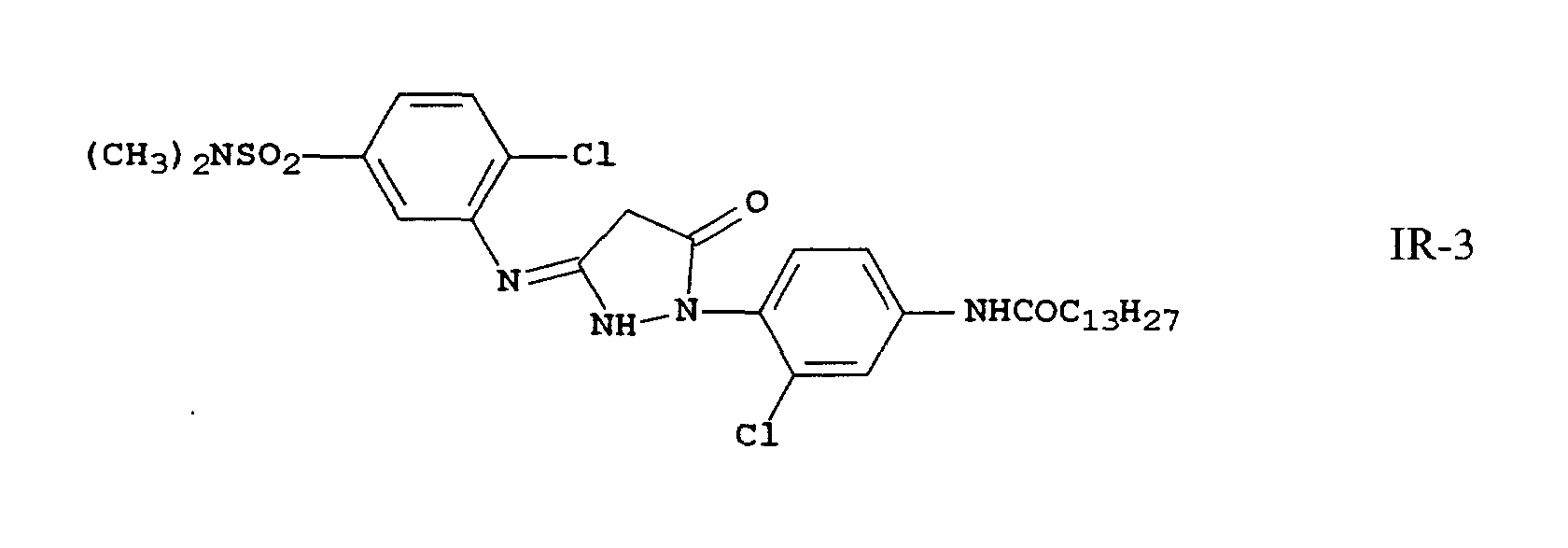
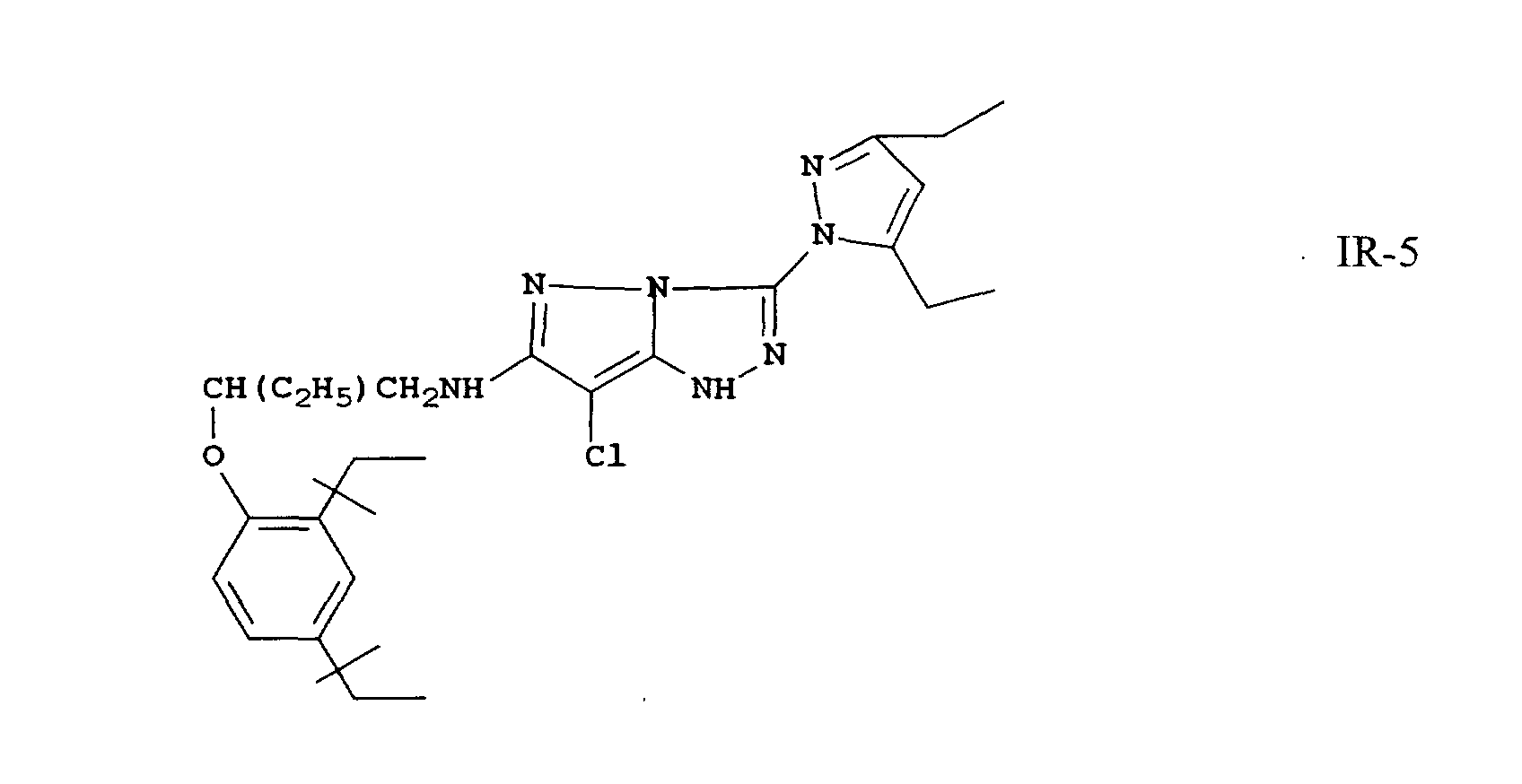
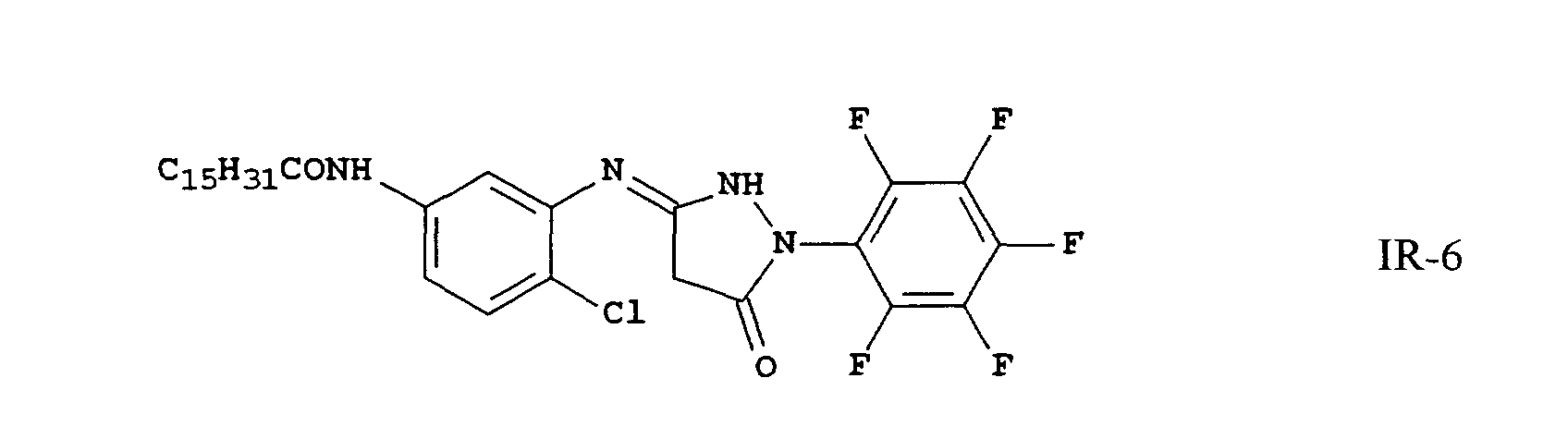
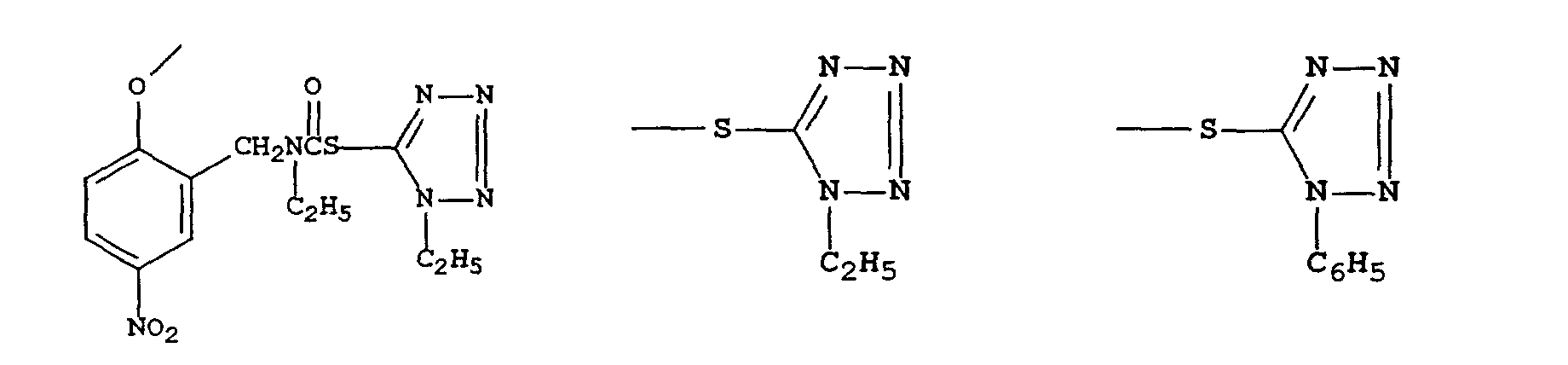
Examples of'red' dyes useful in the invention are:
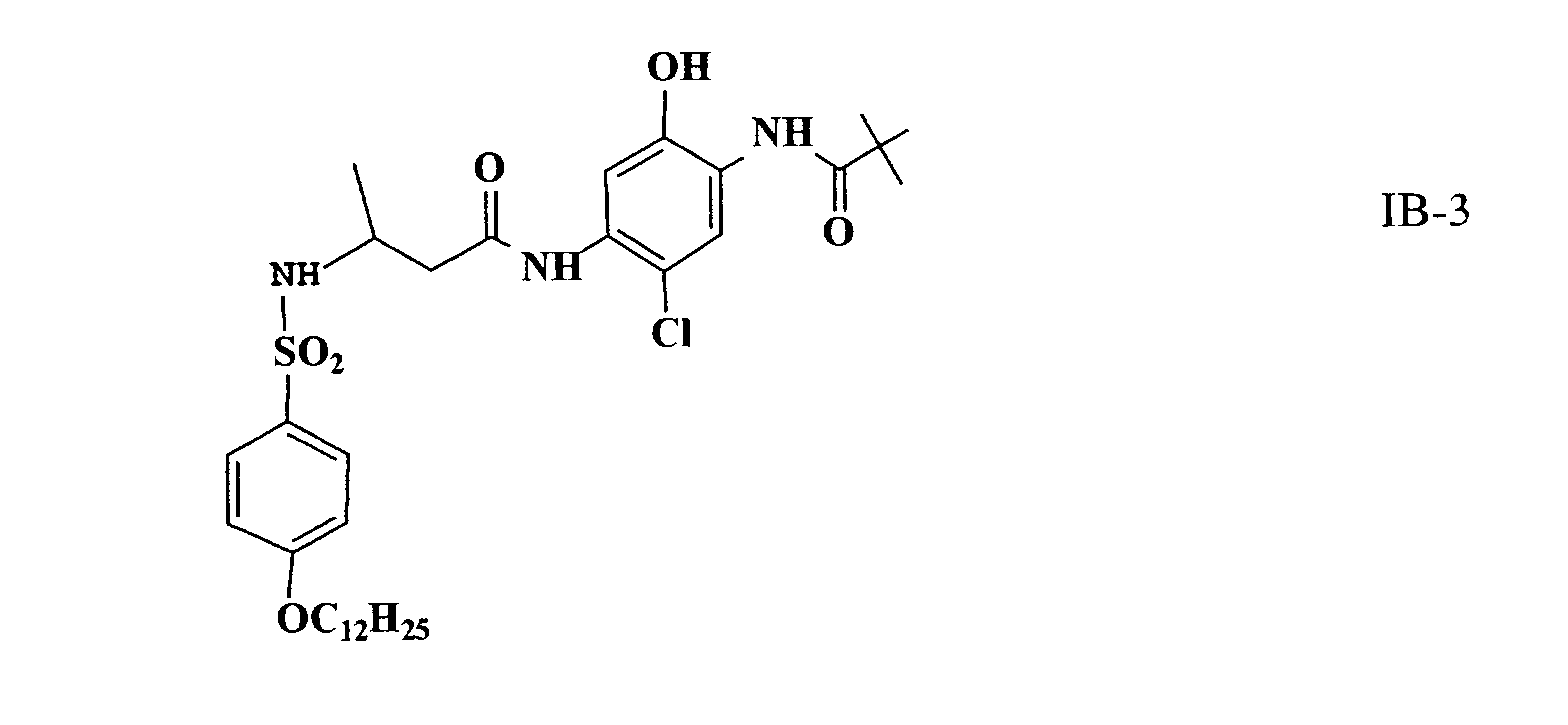
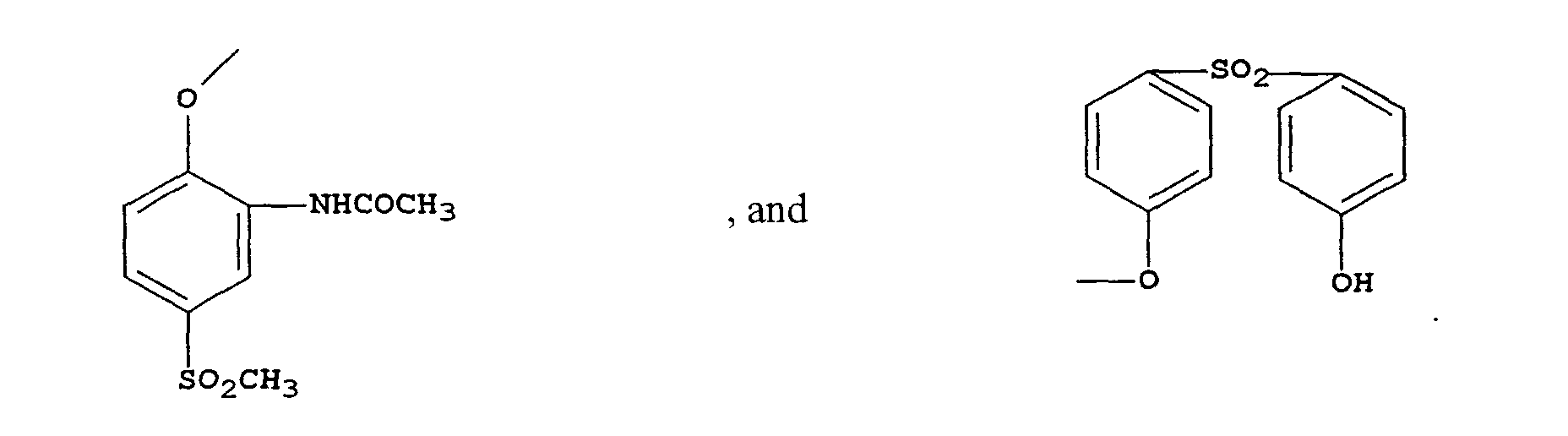
The hue angle of the blue dye is from 225 to 310°, suitably from
228-305°, and preferably from 230-290°. Examples of blue dyes useful in the
invention are:
Since the effect of the red and blue dye-forming couplers of the invention is
optical rather than chemical, the invention is not limited to a particular compound
or class of compounds. Further, more than one coupler of a particular color may
be employed in combination which together produce a composite density curve
which may satisfy the requirements of the invention.
Black image dye forming couplers are well known in the art.
Black dyes are those which lack any specific recognizable color and appear as
various shades of gray. They are generally formed from m- or p-aminophenols
(U.S. Pat. No. 3,622,629); hydroxypyrazoles (U.S. Pat. No. 2,333,106); or
resorcinols (U.S. Pat. Nos. 4,126,461 and 5,821,039. The dye is formed upon
reaction with a suitable developing agent such as a p-phenylenediamine color-developing
agent. Suitably the agent is CD-3, 4-amino-3-methyl-N-ethyl-N-(2-methanesulfonamido-ethyl)aniline
sesquisulfate hydrate, as disclosed for use in
the RA-4 process of Eastman Kodak Company as described in the British Journal
of Photography Annual of 1988, pp. 198-199.
Examples of resorcinol based black dye forming couplers
particularly useful in the invention are in issued patents: Suitable black dye
forming couplers are disclosed in U.S. Patent 4,126,461 at columns 6-14. The
black dye forming couplers in U.S. Patent 5,821,039 at columns 3-5 compounds
also are suitable.
It is also possible to have a black dye forming layer that consists of
a mixture of cyan, magenta and yellow dyes. Preferred combinations of dye
mixtures are given in U. S. Patents 5,362,616; 5,364,747; and 5,939,247. The
emulsions associated with a black dye forming layer can be singly, ortho- or pan-spectrally
sensitized.
Cyan Image Couplers
The cyan coupler forms a dye that generally absorbs in the range
between 600 nm and 700 nm. The dye is formed upon reaction with a suitable
developing agent such as a
p-phenylenediamine color-developing agent. Suitably
the agent is CD-3, 4-amino-3-methyl-N-ethyl-N-(2-methanesulfonamido-ethyl)aniline
sesquisulfate hydrate, as disclosed for use in the RA-4 process of
Eastman Kodak Company as described in the British Journal of Photography
Annual of 1988, pp. 198-199.
wherein
Coupler (I) is a 2,5-diacylaminophenol cyan coupler in which the
5-acylamino moiety is an amide of a carboxylic acid which is substituted in the
alpha position by a particular sulfone (-SO2-) group. The sulfone moiety is an
arylsulfone. In addition, the 2-acylamino moiety must be an amide (-NHCO-) of
a carboxylic acid, and cannot be a ureido (-NHCONH-) group. The result of this
unique combination of sulfone-containing amide group at the 5-position and
amide group at the 2-position is a class of cyan dye-forming couplers which form
H-aggregated image dyes having very sharp-cutting dye hues on the short
wavelength side of the absorption curves and absorption maxima (λmax)
generally in the range of 620-645 nanometers, which is ideally suited for
producing excellent color reproduction and high color saturation in color
photographic papers.
Referring to formula (I), R1 represents hydrogen or an alkyl group
including linear or branched cyclic or acyclic alkyl group of 1 to 10 carbon atoms,
suitably a methyl, ethyl, n-propyl, isopropyl or butyl group, and most suitably an
ethyl group.
R2 represents an aryl group or an alkyl group such as a perfluoroalkyl
group. Such alkyl groups typically have 1 to 20 carbon atoms, usually 1 to 4
carbon atoms, and include groups such as methyl, propyl, and dodecyl; a
perfluoroalkyl group having 1 to 20 carbon atoms, typically 3 to 8 carbon atoms,
such as trifluoromethyl or perfluorotetradecyl, heptafluoropropyl or
heptadecylfluorooctyl; a substituted or unsubstituted aryl group typically having 6
to 30 carbon atoms, which may be substituted by, for example, 1 to 4 halogen
atoms, a cyano group, a carbonyl group, a carbonamido group, a sulfonamido
group, a carboxy group, a sulfo group, an alkyl group, an aryl group, an alkoxy
group, an aryloxy group, an alkylthio group, an arylthio group, an alkylsulfonyl
group or an arylsulfonyl group. Suitably, R2 represents a heptafluoropropyl
group, a 4-chlorophenyl group, a 3,4-dichlorophenyl group, a 4-cyanophenyl
group, a 3-chloro-4-cyanophenyl group, a pentafluorophenyl group, a 4-carbonamidophenyl
group, a 4-sulfonamidophenyl group, or an
alkylsulfonylphenyl group.
Examples of a suitable X substituent is one located at a position of
the phenyl ring meta or para to the sulfonyl group and is independently selected
from the group consisting of alkyl, alkenyl, alkoxy, aryloxy, acyloxy, acylamino,
sulfonyloxy, sulfamoylamino, sulfonamido, ureido, oxycarbonyl,
oxycarbonylamino, and carbamoyl groups
In formula (I), each X is preferably located at the meta or para
position of the phenyl ring, and each independently represents a linear or
branched, saturated or unsaturated alkyl or alkenyl group such as methyl, t-butyl,
dodecyl, pentadecyl or octadecyl; an alkoxy group such as methoxy, t-butoxy or
tetradecyloxy; an aryloxy group such as phenoxy, 4-t-butylphenoxy or 4-dodecylphenoxy;
an alkyl or aryl acyloxy group such as acetoxy or
dodecanoyloxy; an alkyl or aryl acylamino group such as acetamido, benzamido,
or hexadecanamido; an alkyl or aryl sulfonyloxy group such as
methylsulfonyloxy, dodecylsulfonyloxy, or 4-methylphenylsulfonyloxy; an alkyl
or aryl sulfamoylamino group such as N-butylsulfamoylamino, or N-4-t-butylphenylsulfamoylamino;
an alkyl or aryl sulfonamido group such as
methanesulfonamido, 4-chlorophenylsulfonamido or hexadecanesulfonamido; a
ureido group such as methylureido or phenylureido; an alkoxycarbonyl or
aryloxycarbonylamino group such as methoxycarbonylamino or
phenoxycarbonylamo; a carbamoyl group such as N-butylcarbamoyl or N-methyl-N-dodecylcarbamoyl;
or a perfluoroalkyl group such as trifluoromethyl or
heptafluoropropyl. Suitably X represents the above groups having 1 to 30 carbon
atoms, more preferably 8 to 20 linear carbon atoms. Most typically, X represents
a linear alkyl or alkoxy group of 12 to 18 carbon atoms such as dodecyl,
dodecyloxy, pentadecyl, or octadecyl.
"n" represents 1, 2, or 3; if n is 2 or 3, then the substituents X may be the
same or different.
Z represents a hydrogen atom or a group which can be split off by the
reaction of the coupler with an oxidized color developing agent, known in the
photographic art as a "coupling-off group". The presence or absence of such
groups determines the chemical equivalency of the coupler, i.e., whether it is a 2-equivalent
or 4-equivalent coupler, and its particular identity can modify the
reactivity of the coupler. Such groups can advantageously affect the layer in
which the coupler is coated, or other layers in the photographic recording
material, by performing, after release from the coupler, functions such as dye
formation, dye hue adjustment, development acceleration or inhibition, bleach
acceleration or inhibition, electron transfer facilitation, color correction, and the
like.
Representative classes of such coupling-off groups include, for
example, halogen, alkoxy, aryloxy, heterocyclyloxy, sulfonyloxy, acyloxy, acyl,
heterocyclyl, sulfonamido, heterocyclylthio, benzothiazolyl, phosophonyloxy,
alkylthio, arylthio, and arylazo. These coupling-off groups are described in the
art, for example, in U.S. Patent Nos. 2,455,169; 3,227,551; 3,432,521; 3,467,563;
3,617,291; 3,880,661; 4,052,212; and 4,134,766; and in U.K. Patent Nos. and
published applications 1,466,728; 1,531,927; 1,533,039; 2,066,755A, and
2,017,704A. Halogen, alkoxy and aryloxy groups are most suitable.
Examples of specific coupling-off groups are -Cl, -F, -Br, -SCN,-OCH
3,
-OC
6H
5, -OCH
2C(=O)NHCH
2CH
2OH, -OCH
2C(O)NHCH
2CH
2OCH
3,
-OCH
2C(O)NHCH
2CH
2OC(=O)OCH
3, -P(=O)(OC
2H
5)
2, -SCH
2CH
2COOH,
Typically, the coupling-off group is a chlorine atom.
It is essential that the substituent groups of the coupler be selected
so as to adequately ballast the coupler and the resulting dye in the organic solvent
in which the coupler is dispersed. The ballasting may be accomplished by
providing hydrophobic substituent groups in one or more of the substituent
groups. Generally a ballast group is an organic radical of such size and
configuration as to confer on the coupler molecule sufficient bulk and aqueous
insolubility as to render the coupler substantially nondiffusible from the layer in
which it is coated in a photographic element. Thus the combination of substituent
groups in formula (I) are suitably chosen to meet these criteria. To be effective,
the ballast must contain at least 8 carbon atoms and typically contains 10 to 30
carbon atoms. Suitable ballasting may also be accomplished by providing a
plurality of groups which in combination meet these criteria. In the preferred
embodiments of the invention R1 in formula (I) is a small alkyl group. Therefore,
in these embodiments the ballast would be primarily located as part of groups R2,
X, and Z. Furthermore, even if the coupling-off group Z contains a ballast it is
often necessary to ballast the other substituents as well, since Z is eliminated from
the molecule upon coupling; thus, the ballast is most advantageously provided as
part of groups R2 and X.
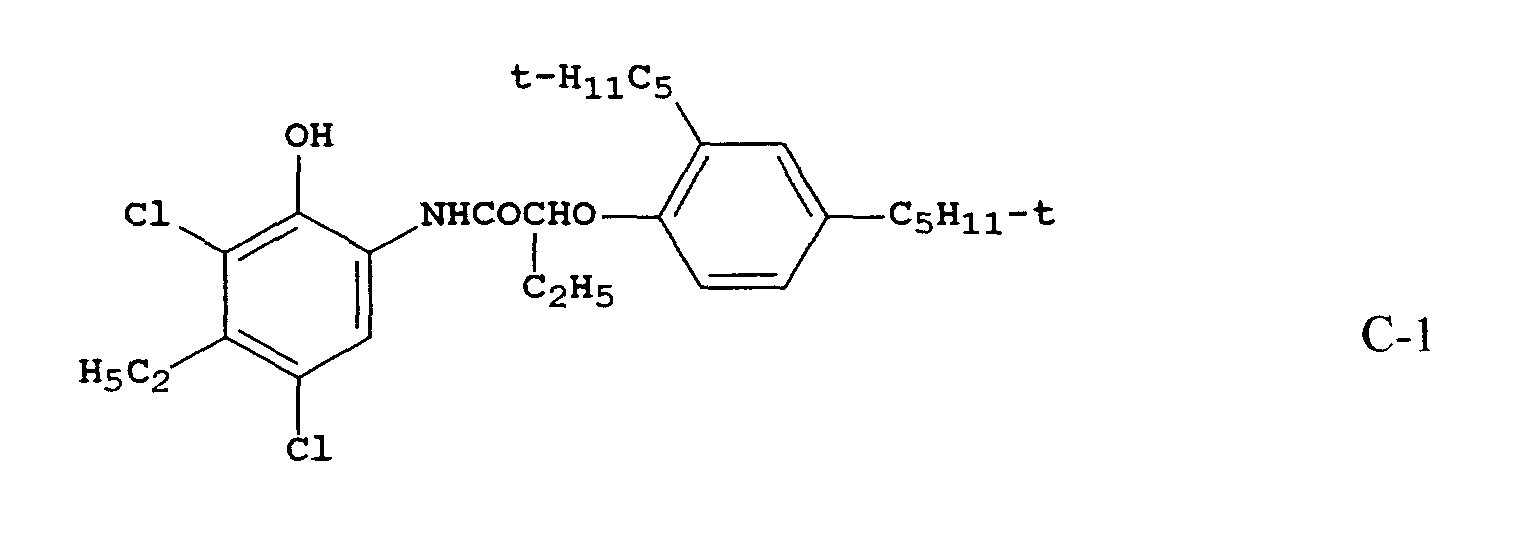
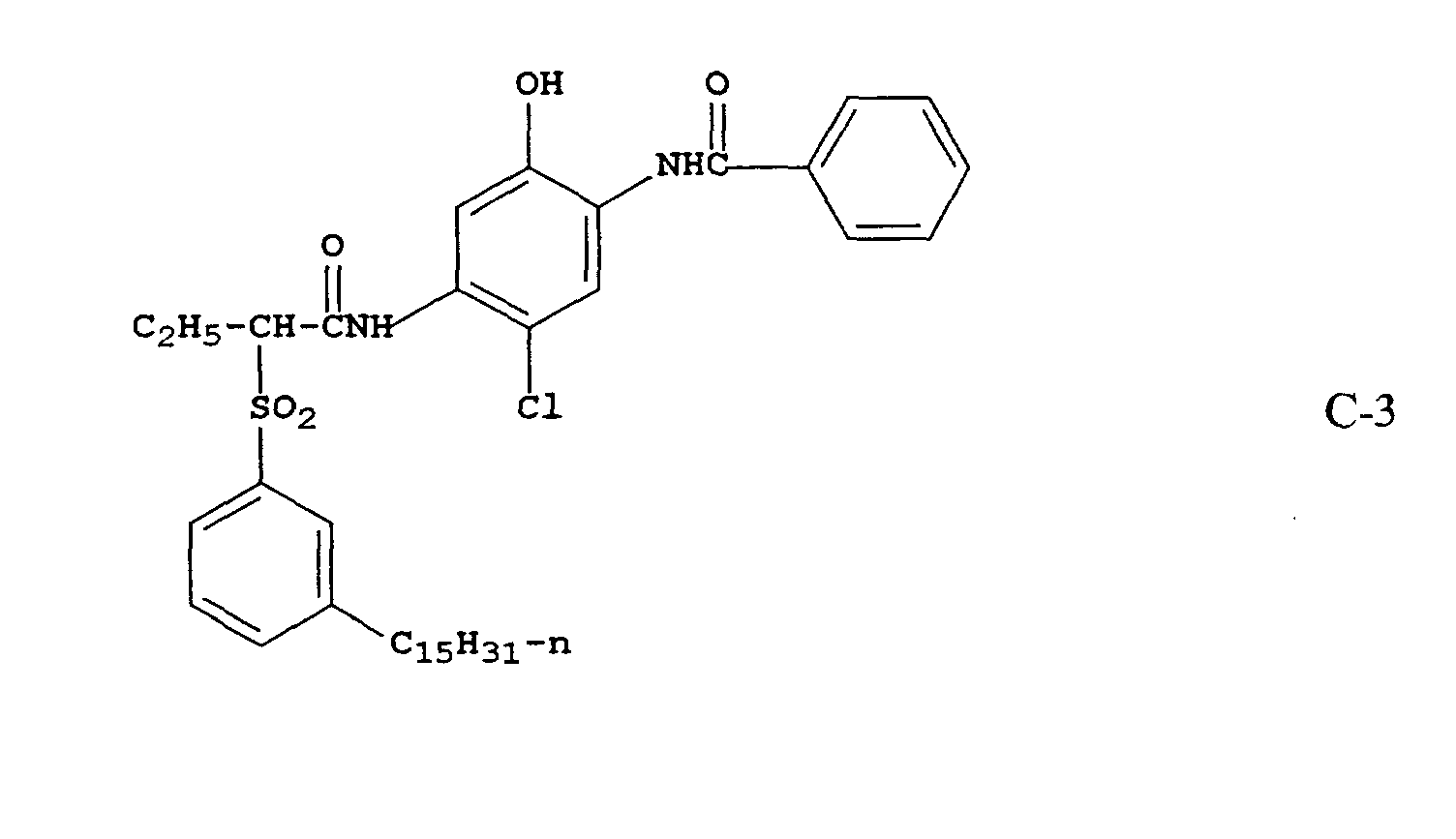
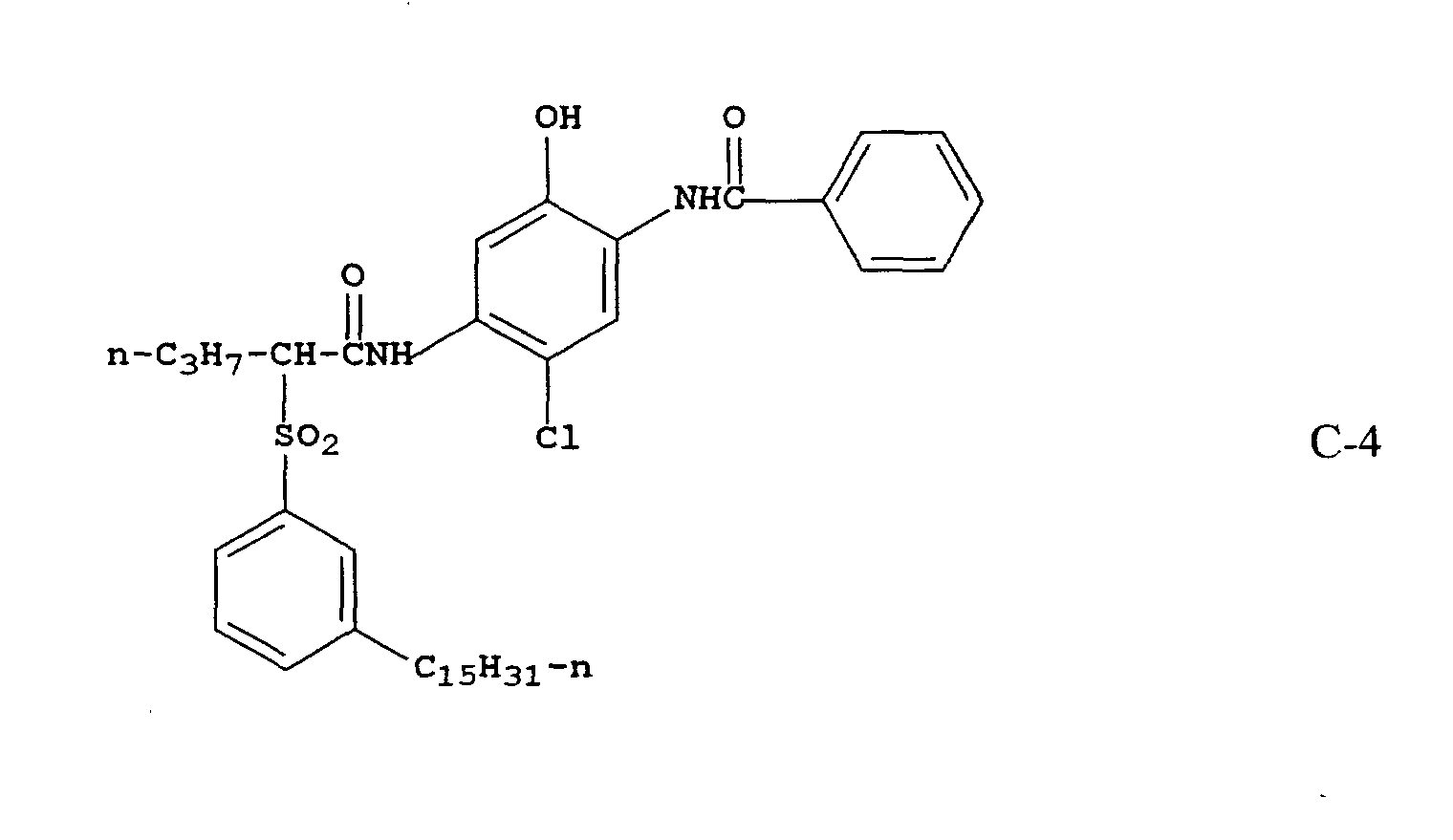
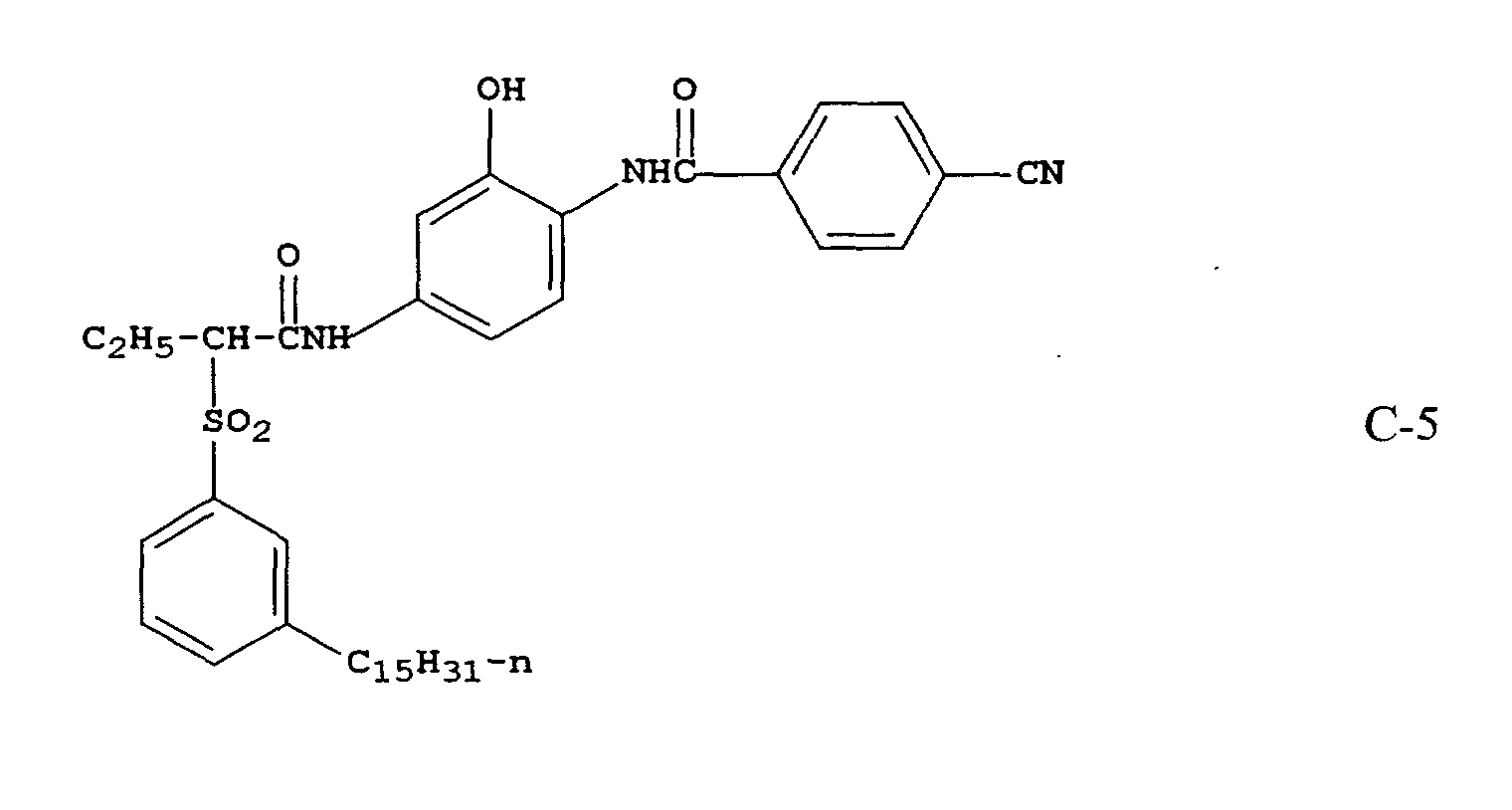
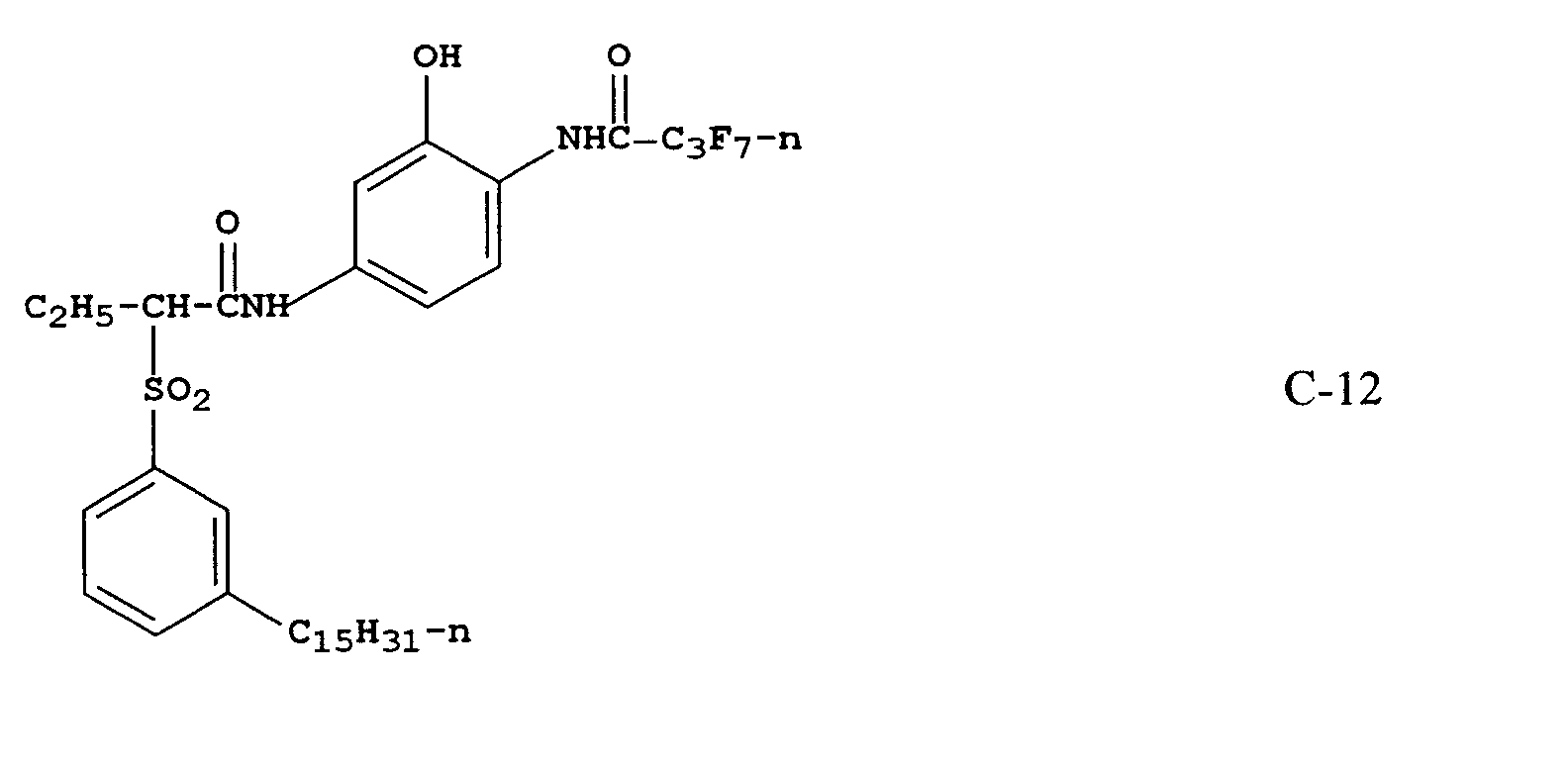
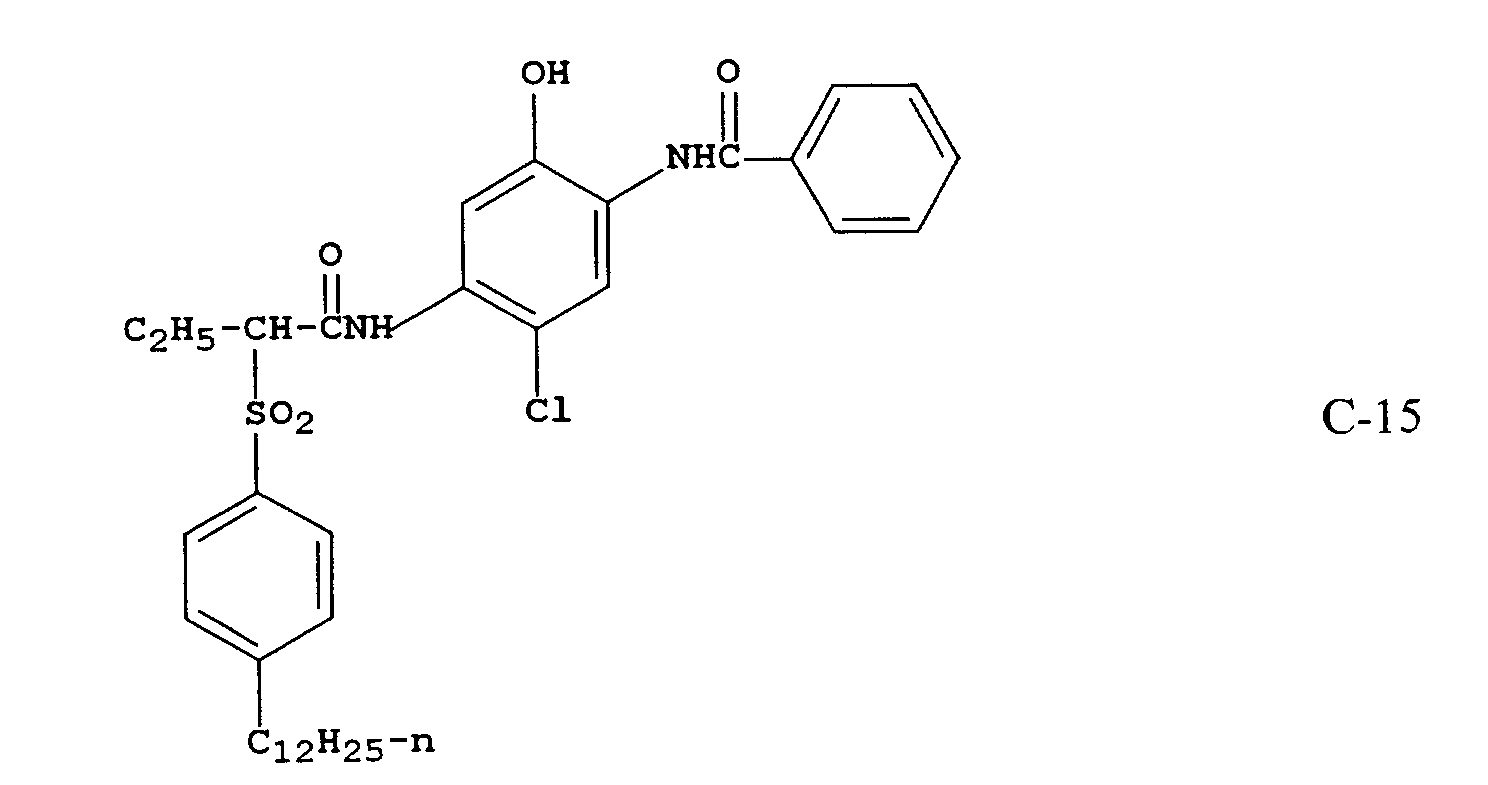
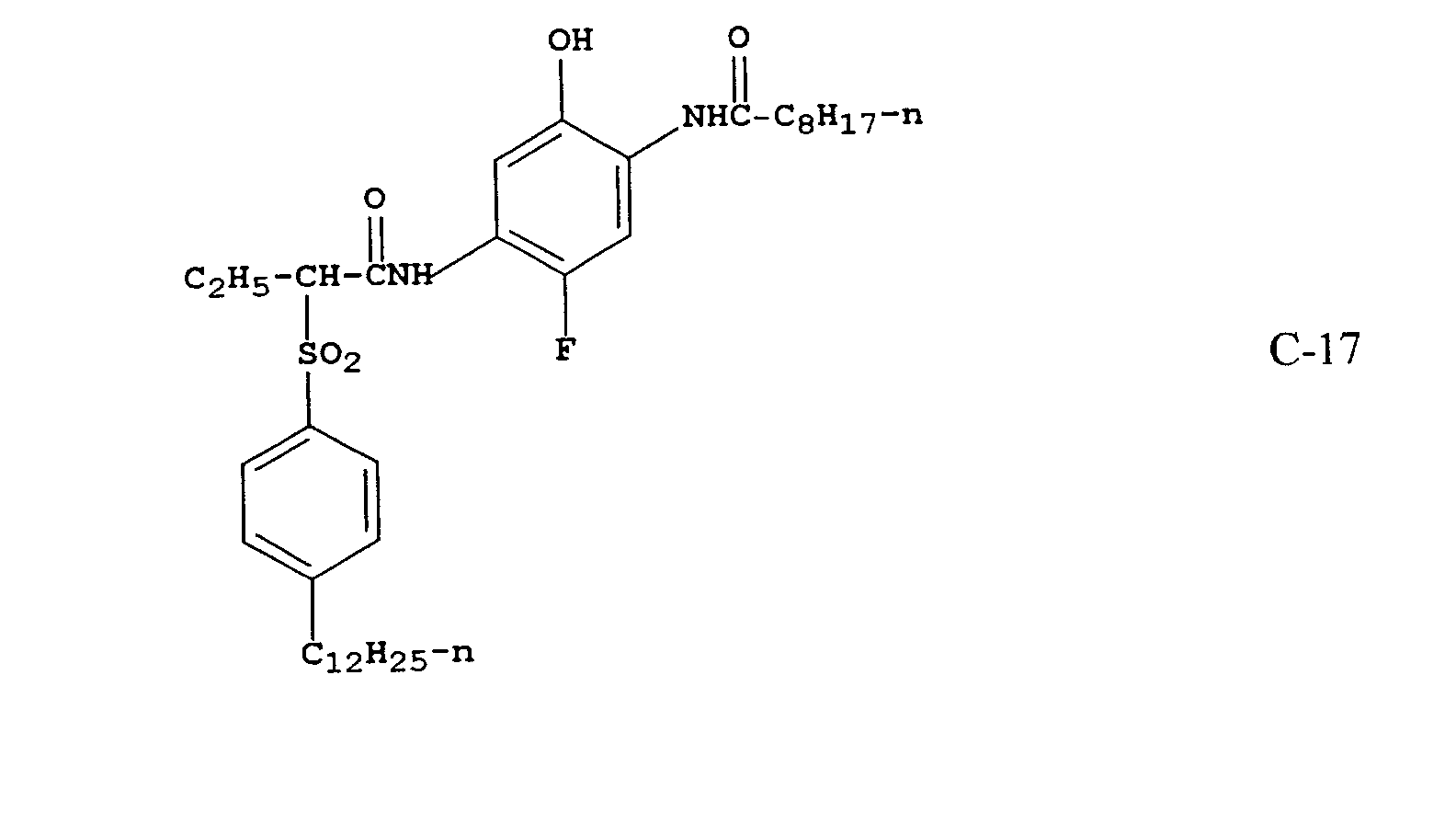
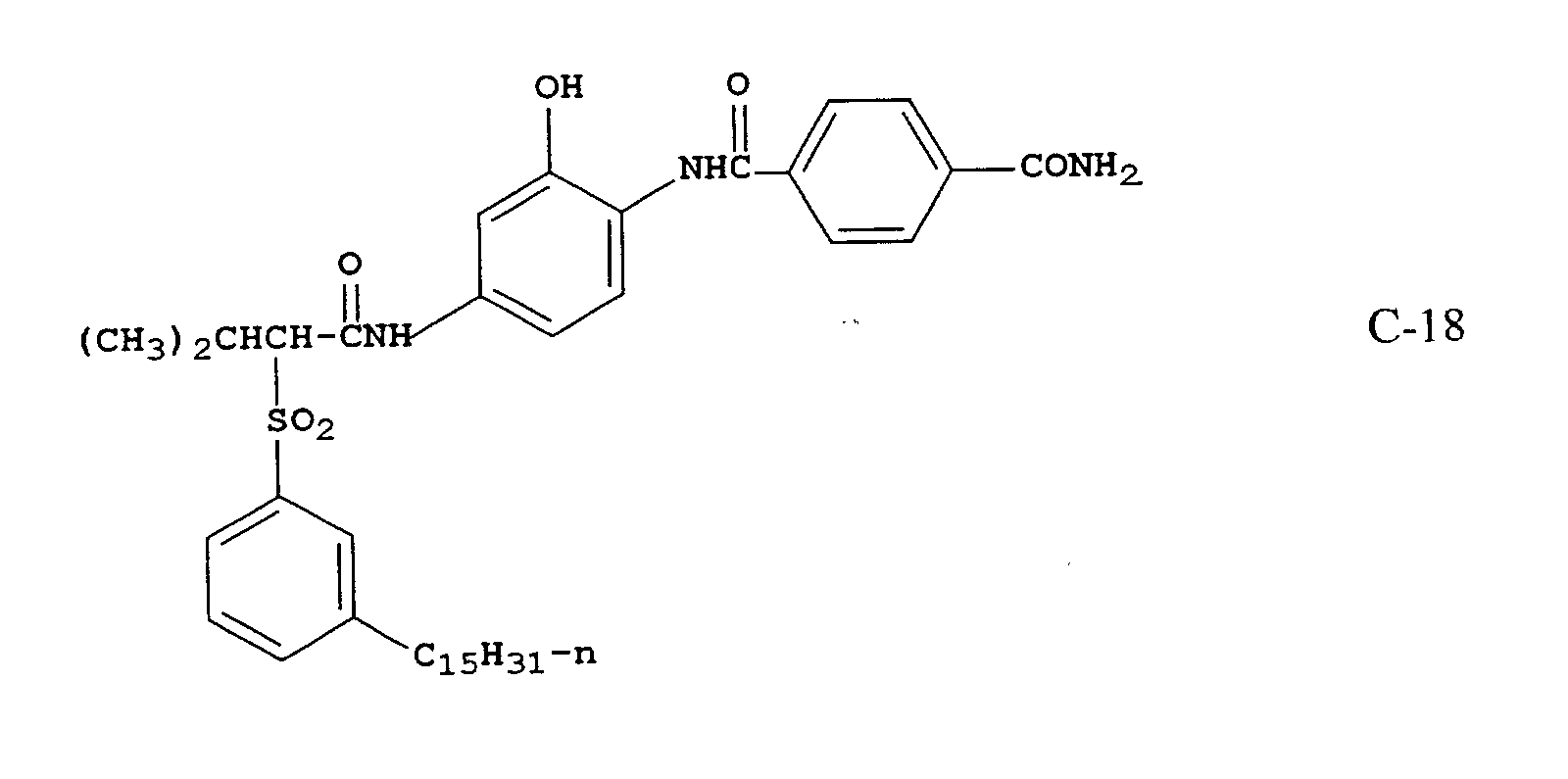
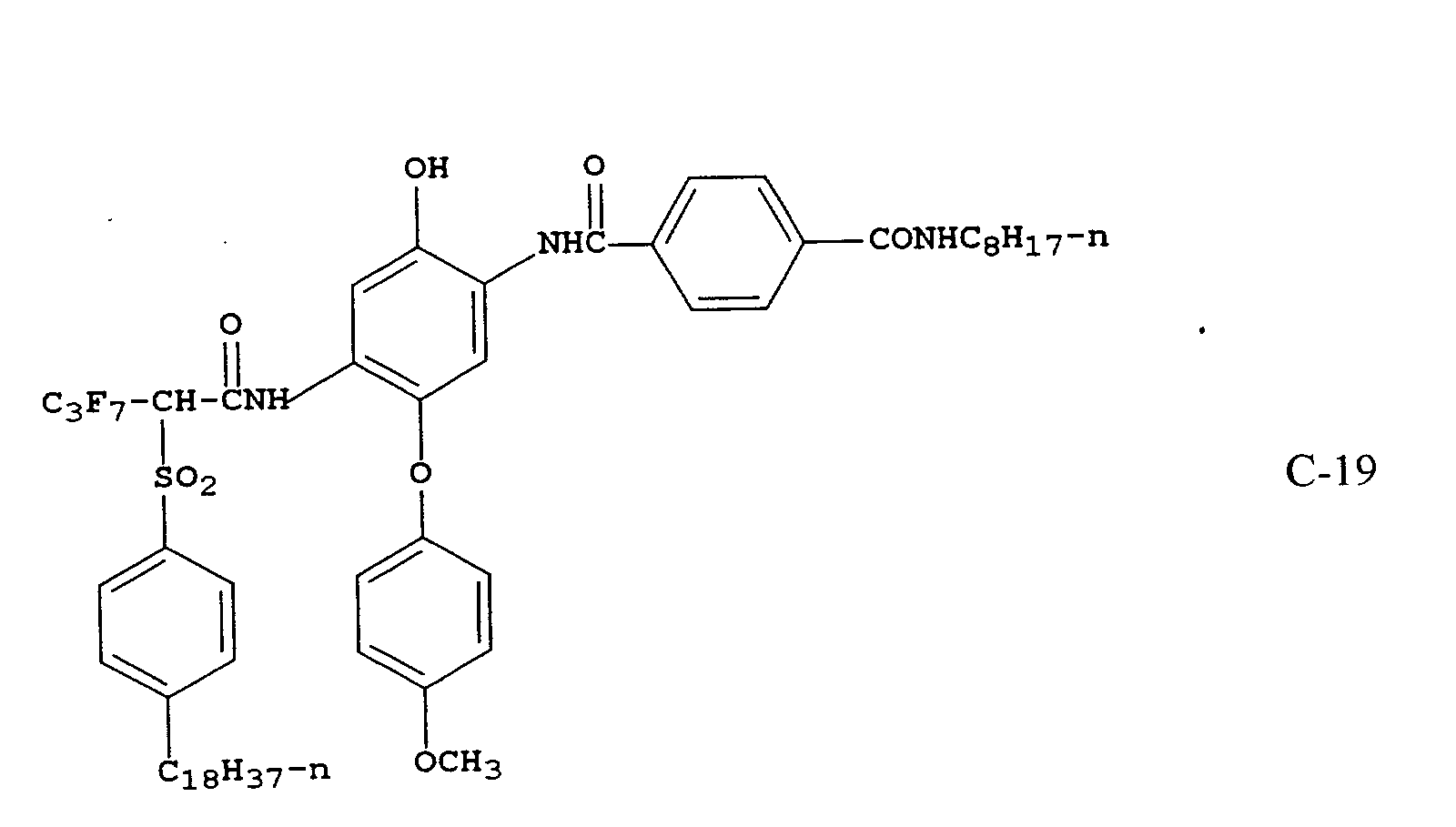
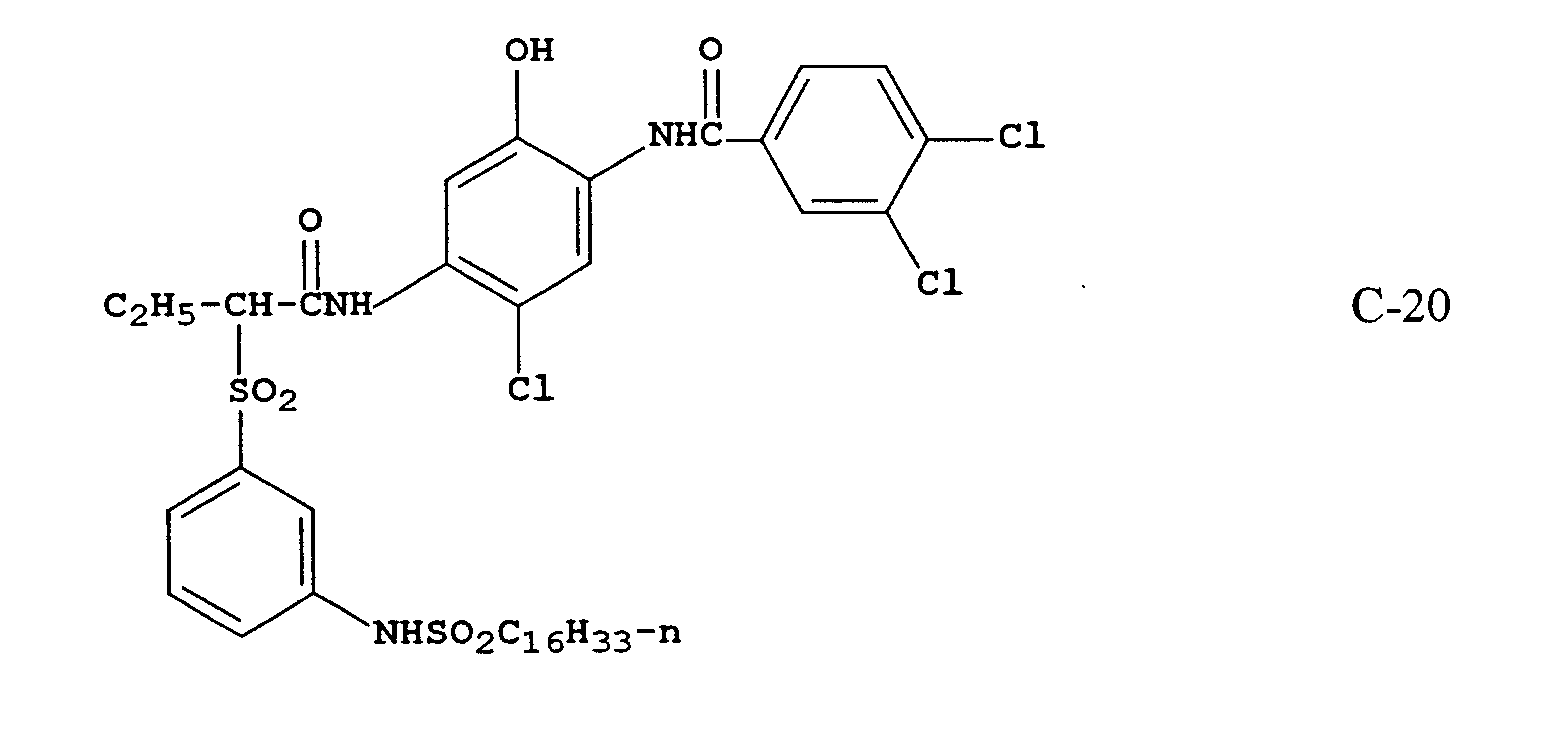
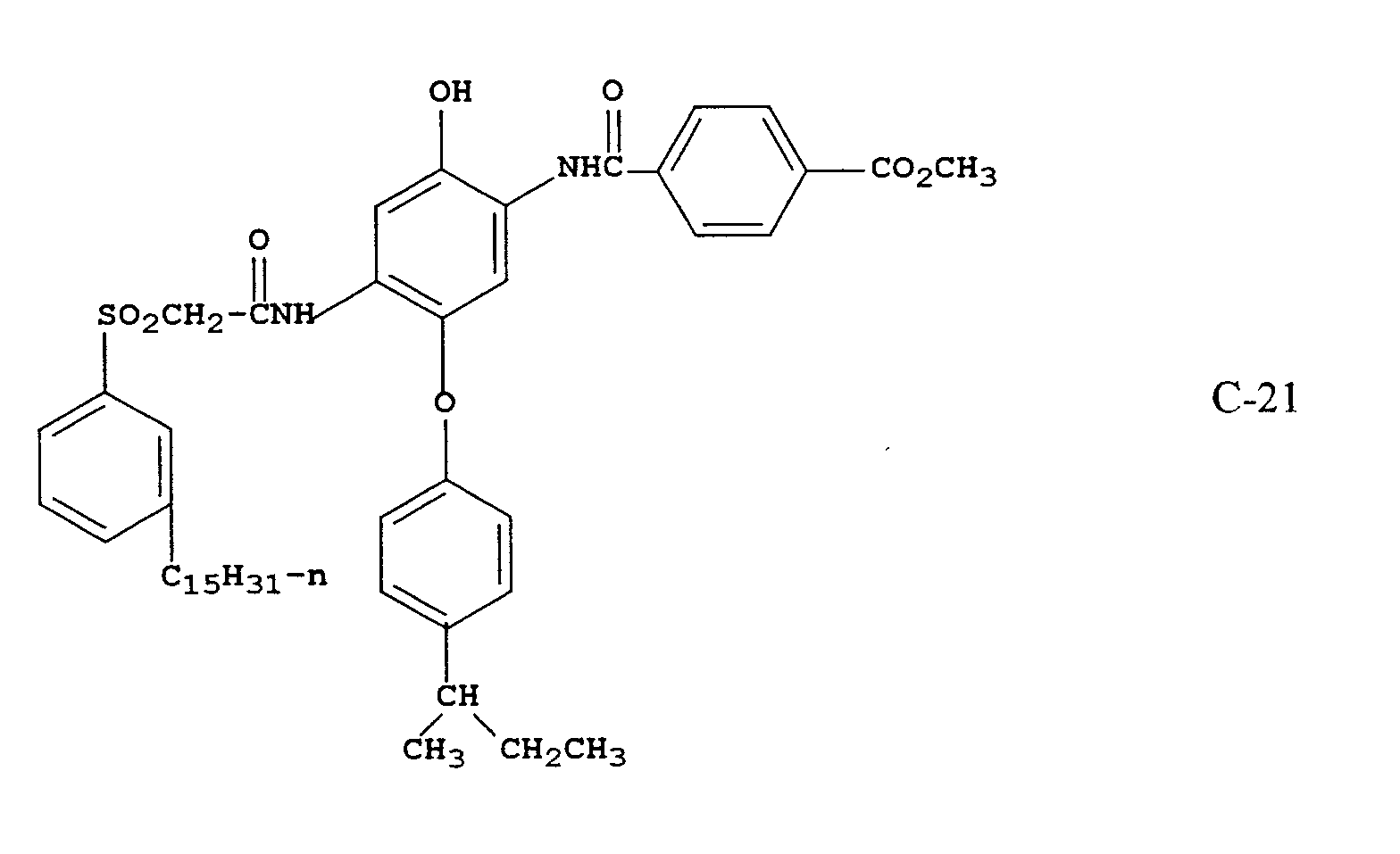
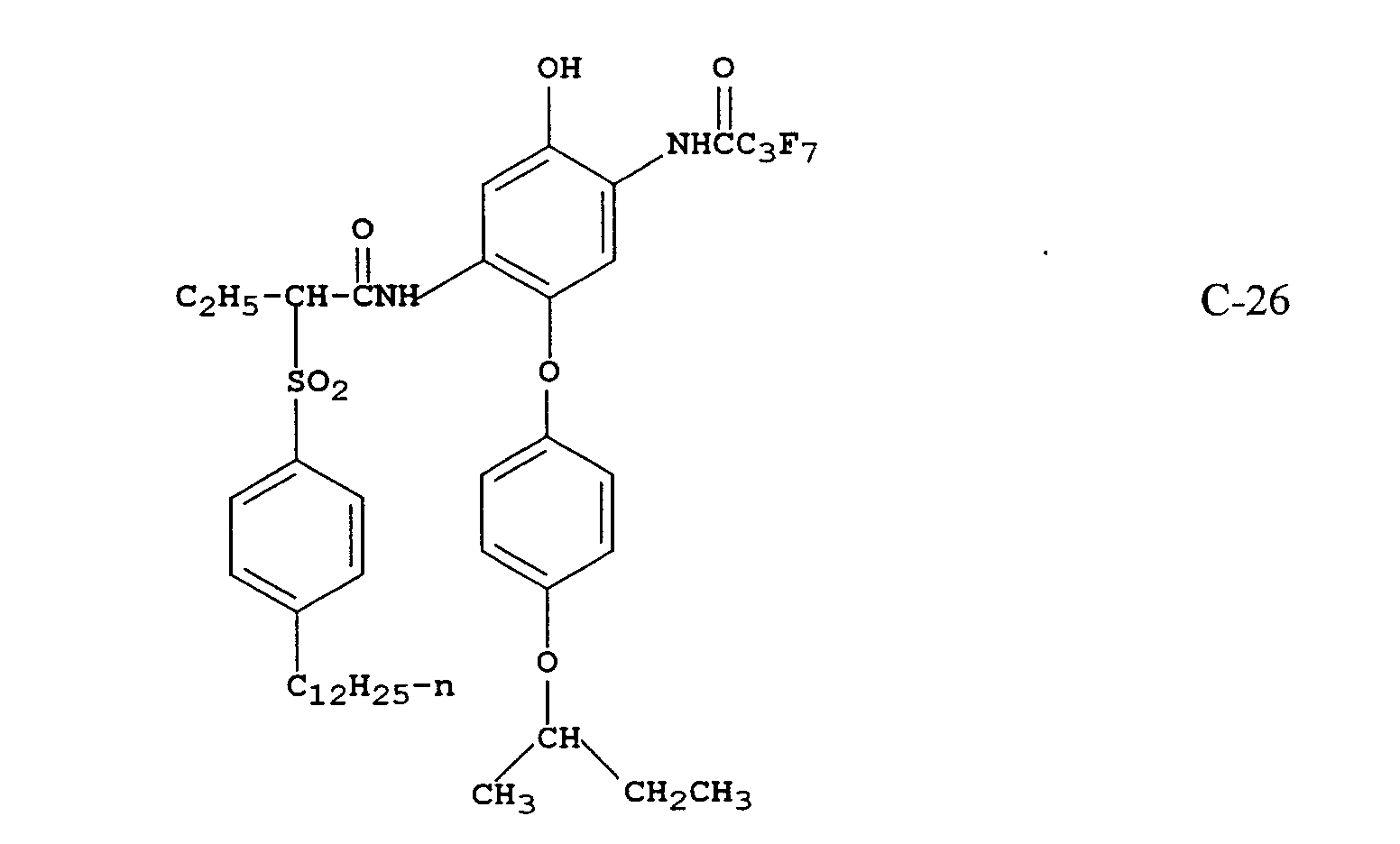
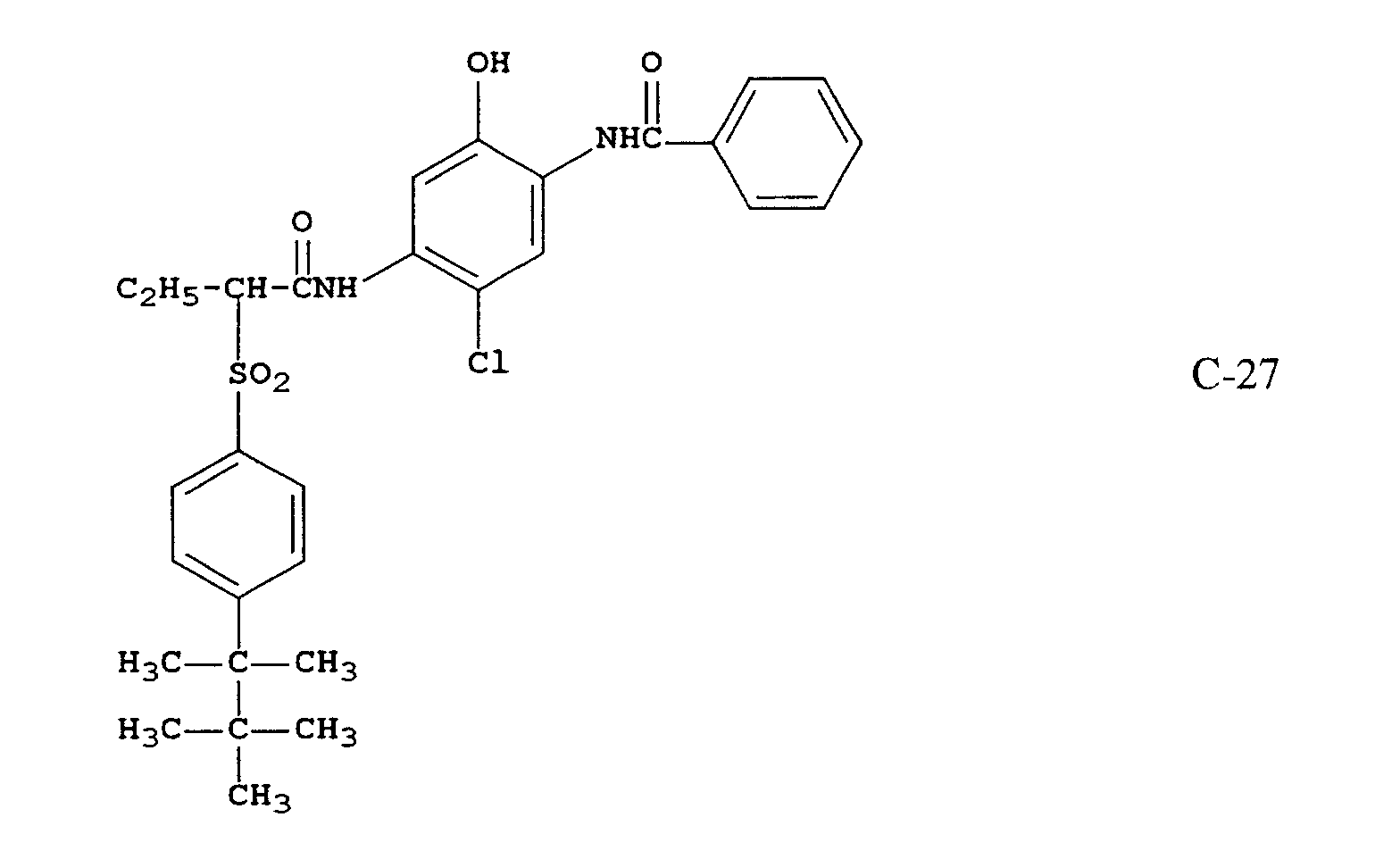
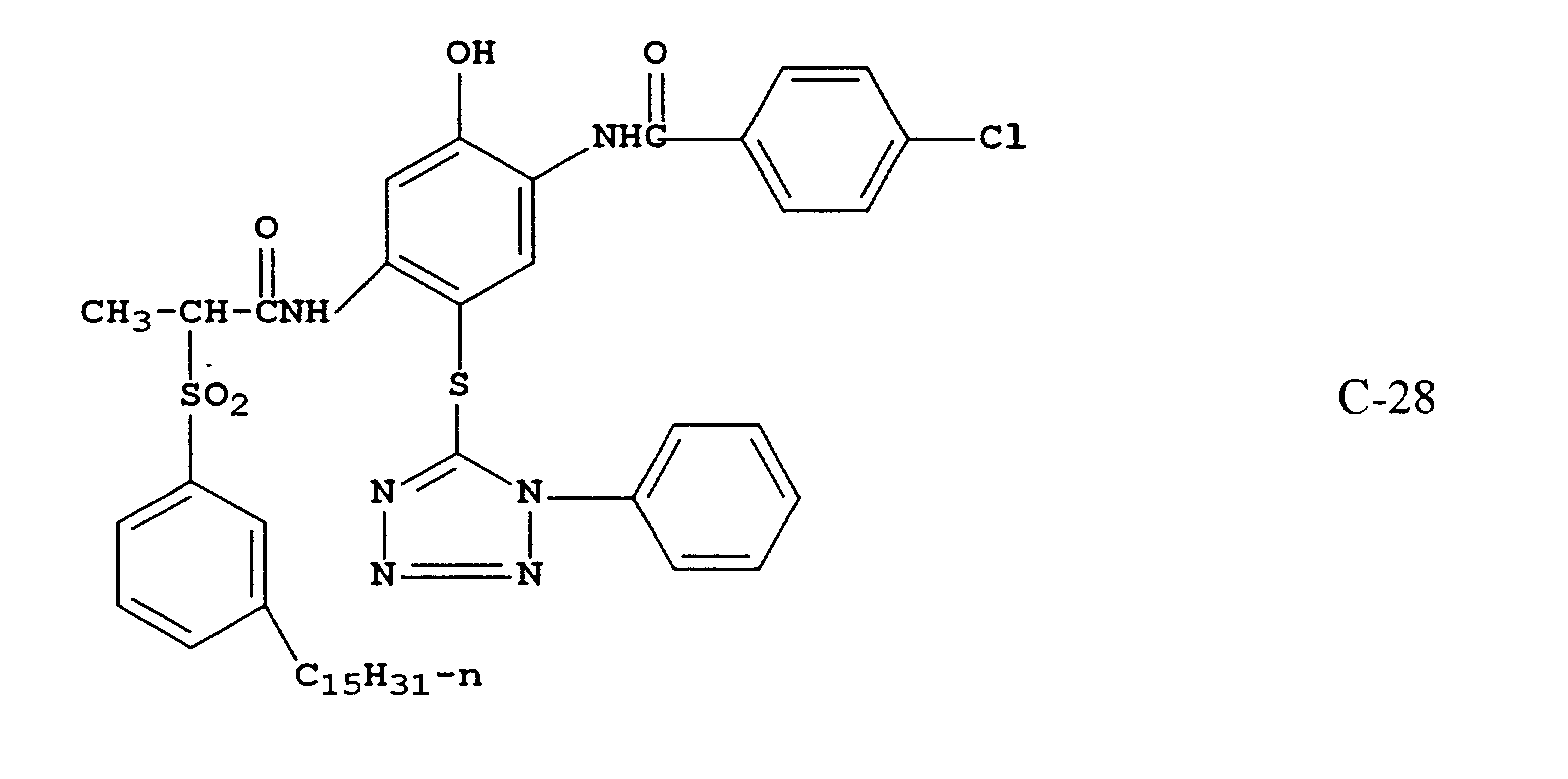
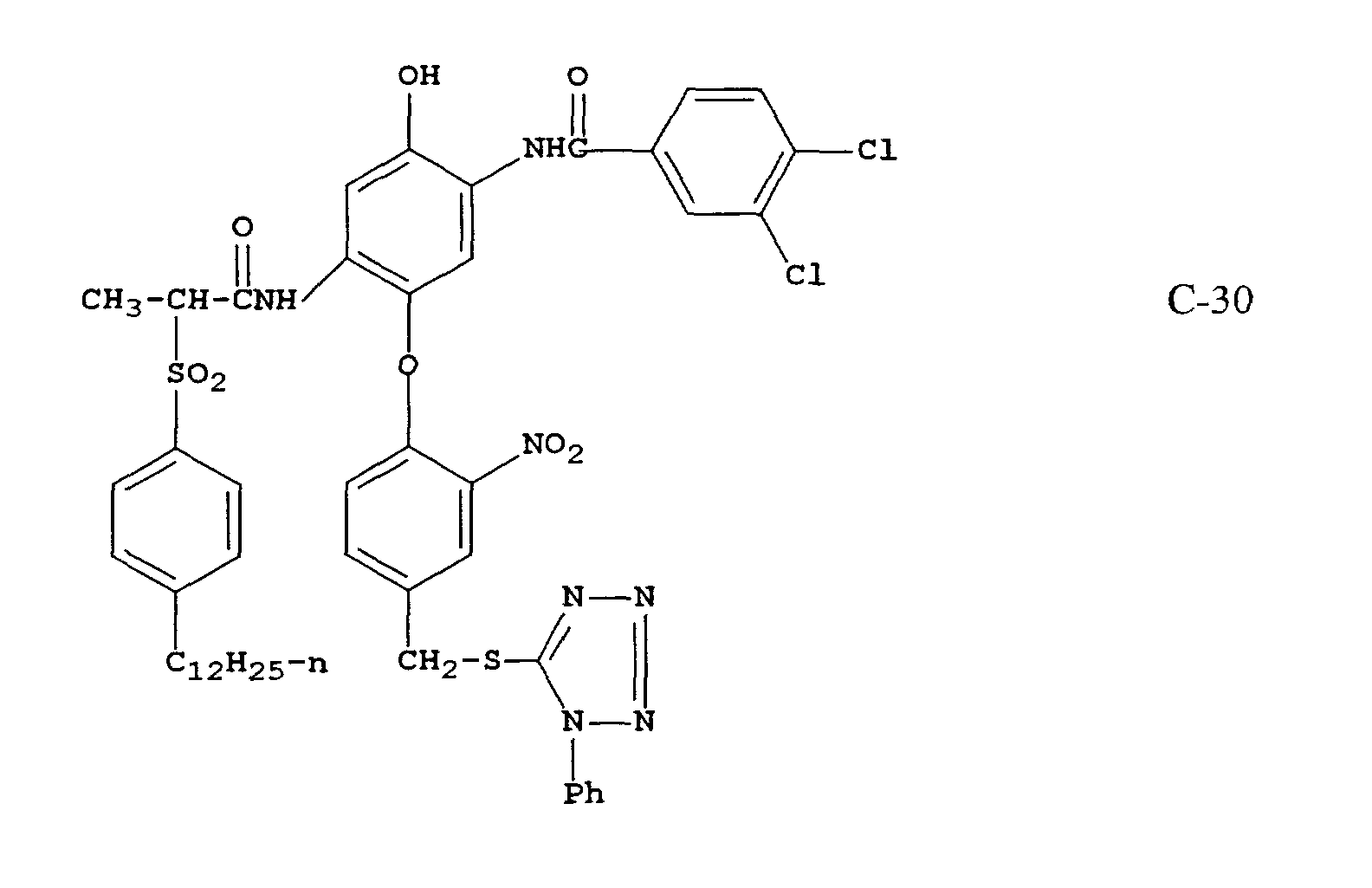
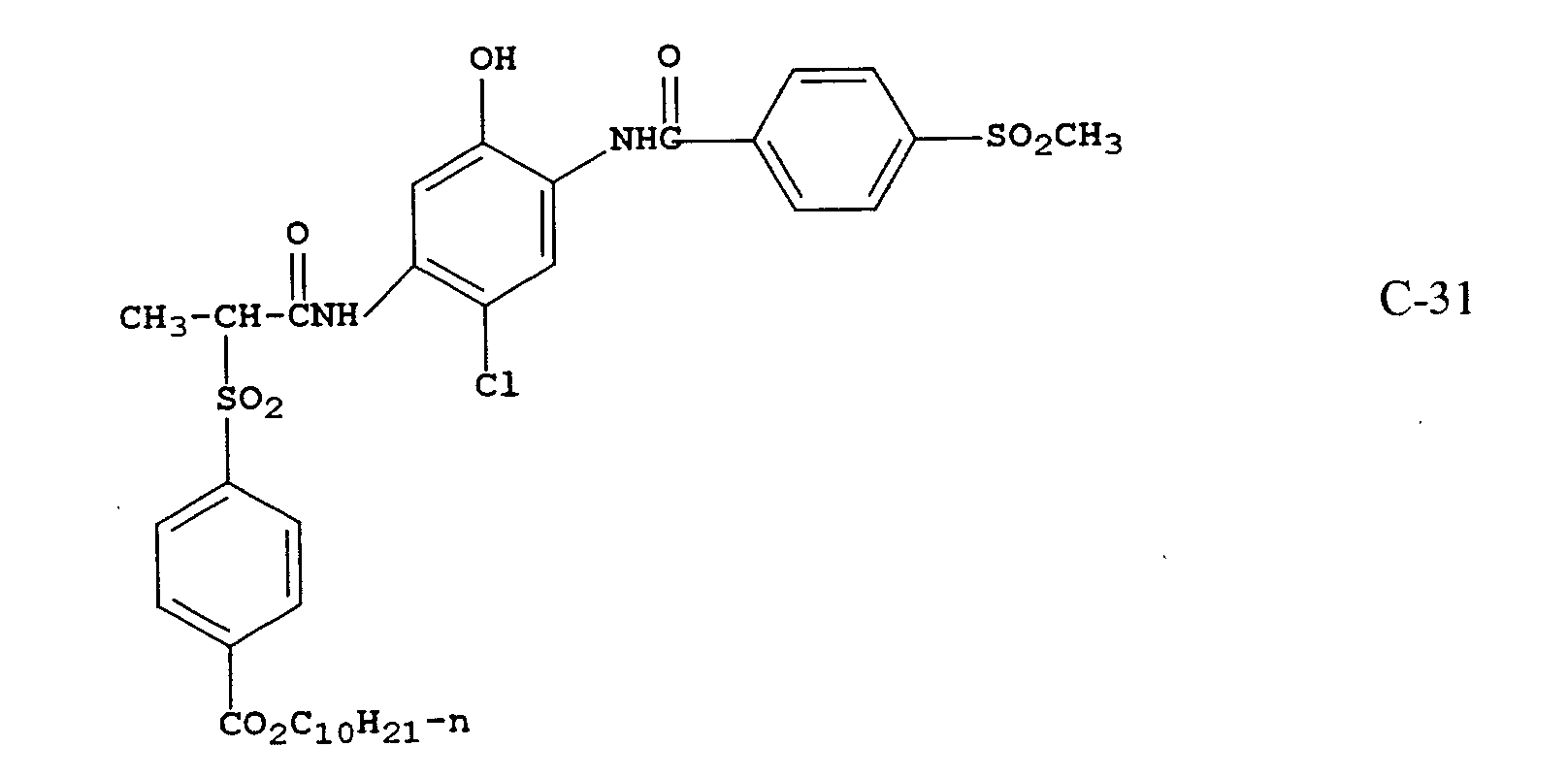
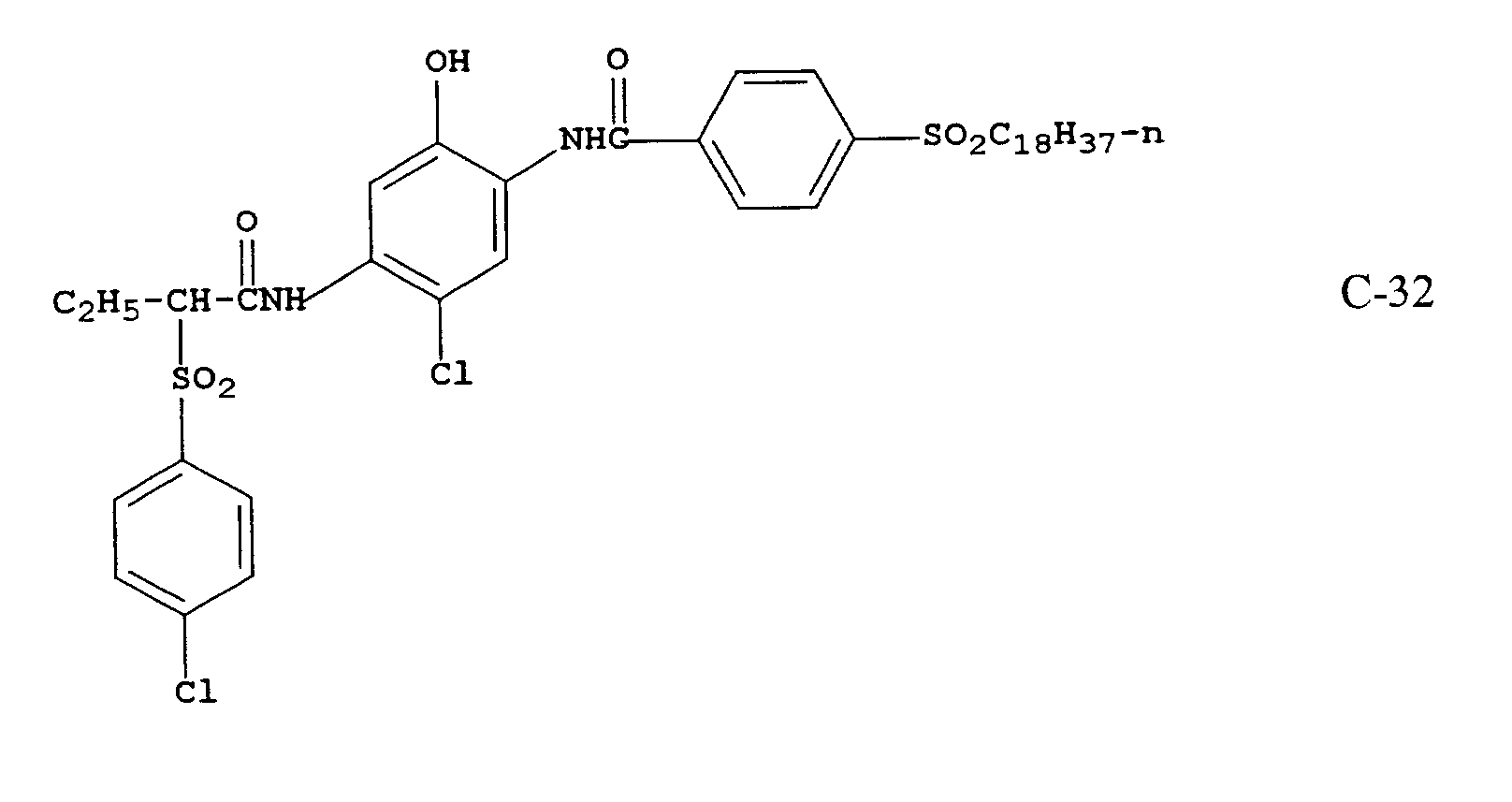
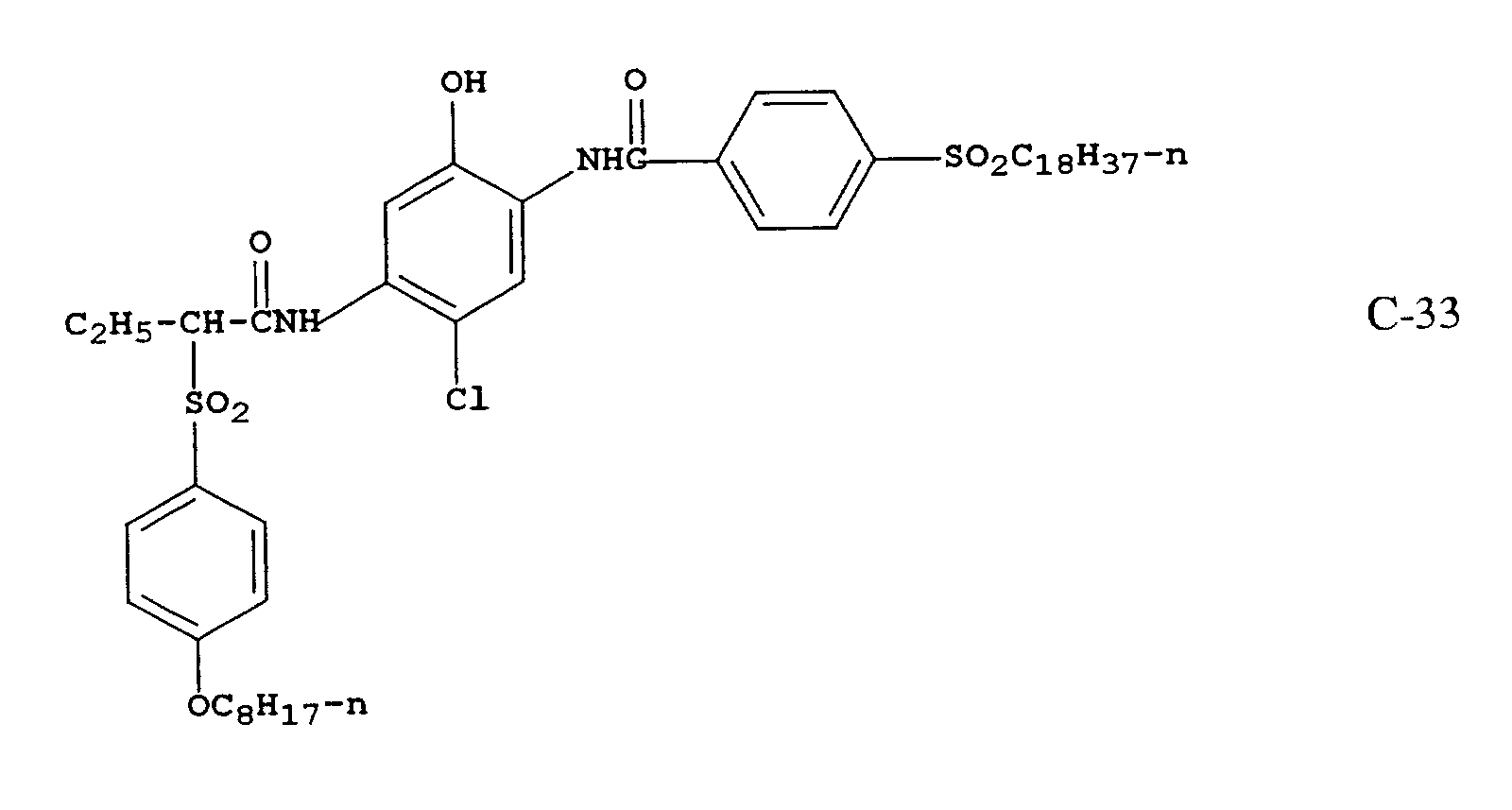
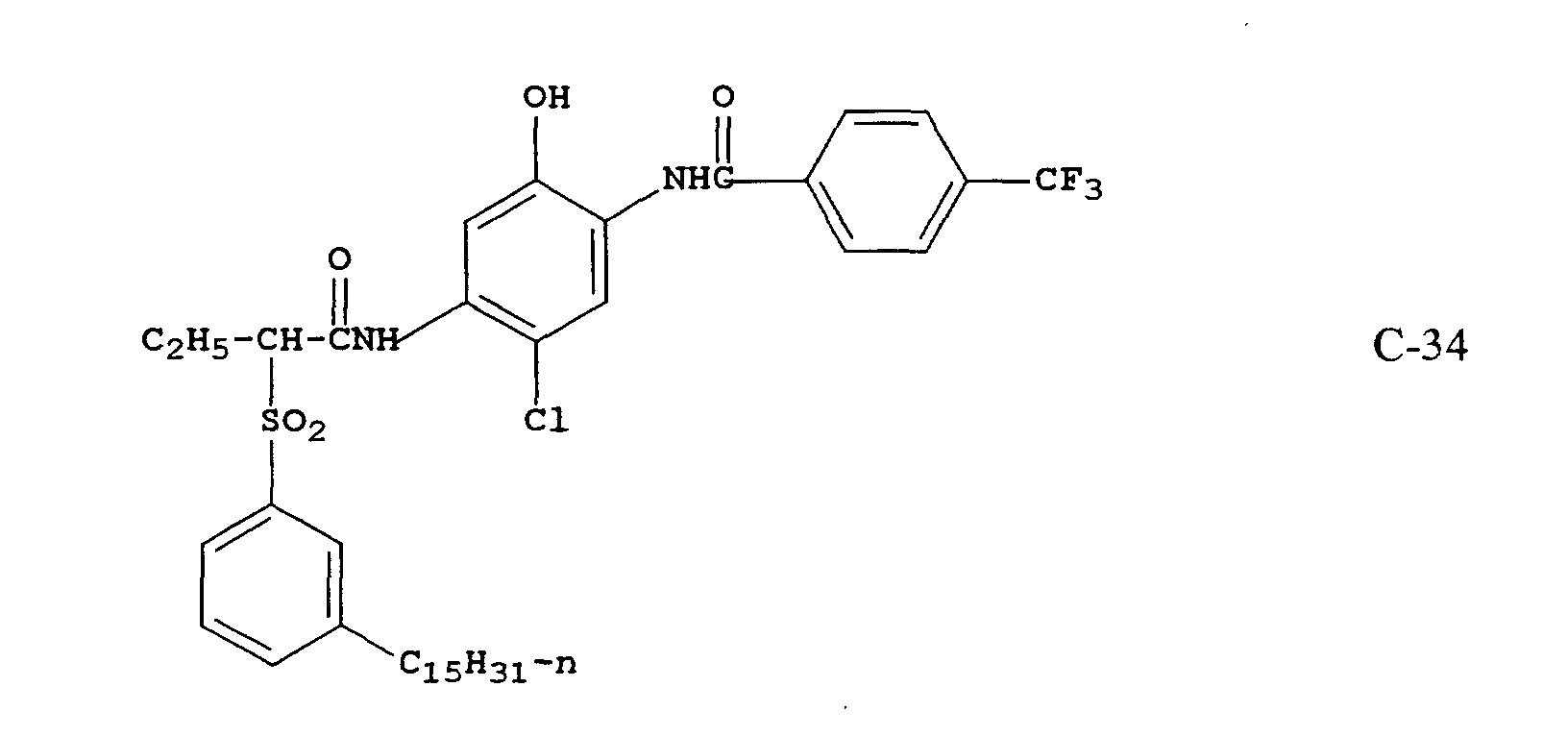
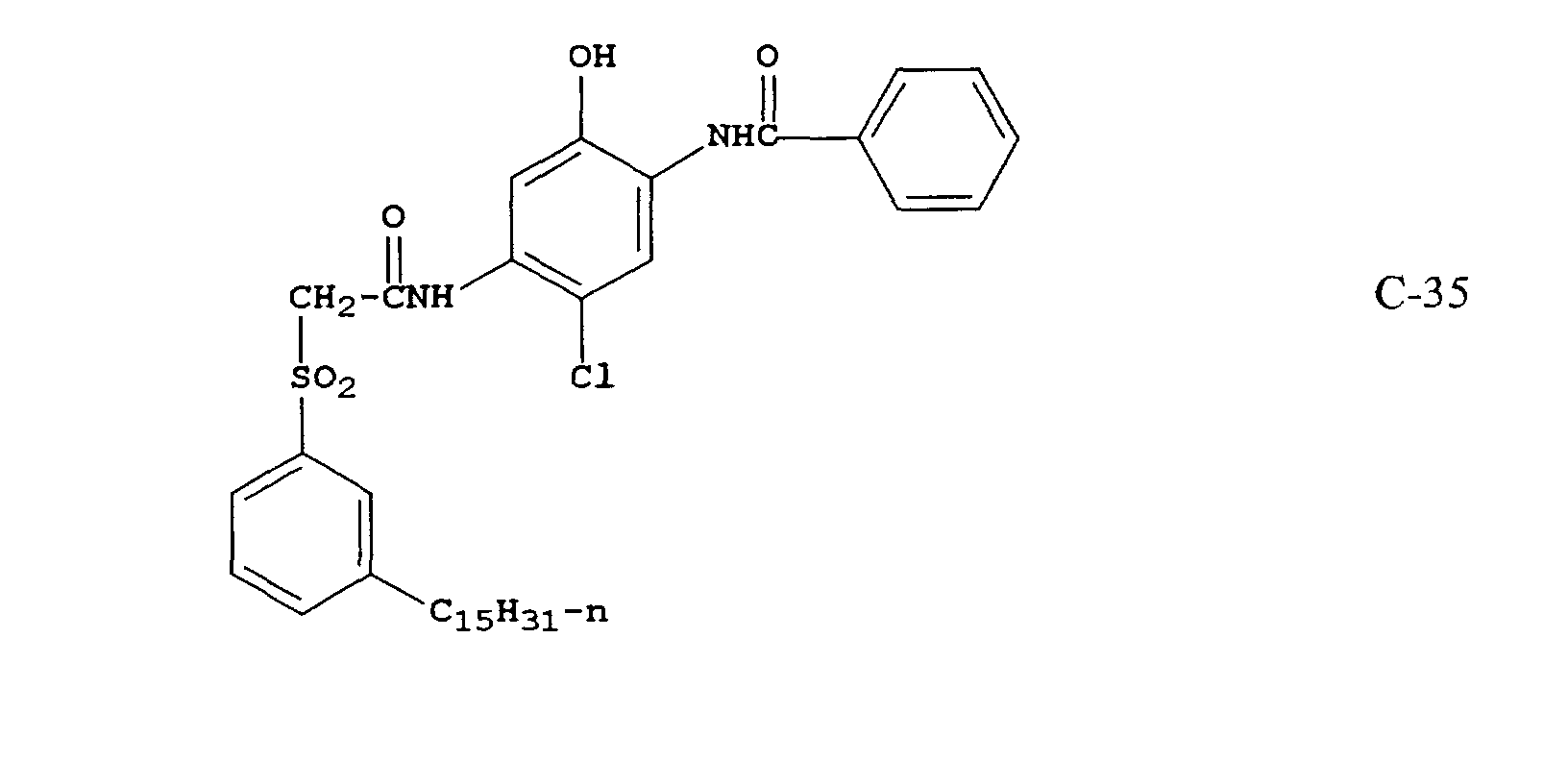
The following examples illustrate cyan couplers useful in the
invention. It is not to be construed that the present invention is limited to these
examples.
The magenta image coupler utilized in the invention may be any
magenta imaging coupler known in the art. Suitable is a pyrazole of the following
structure:
wherein R
a and R
b independently represent H or a substituent; X is hydrogen or a
coupling-off group; and Z
a, Z
b, and Z
c are independently a substituted methine
group, =N―, =C―, or ―NH―, provided that one of either the Z
a―Z
b bond or
the Z
b―Z
c bond is a double bond and the other is a single bond, and when the
Z
b―Z
c bond is a carbon-carbon double bond, it may form part of an aromatic
ring, and at least one of Z
a, Z
b, and Z
c represents a methine group connected to the
group R
b.
Preferred magenta couplers are 1H-pyrazolo [5,1-c]-1,2,4-triazole
and 1H-pyrazolo [1,5-b]-1,2,4-triazole. Examples of 1H-pyrazolo [5,1-c]-1,2,4-triazole
couplers are described in U.K. Patent Nos. 1,247,493; 1,252,418;
1,398,979; U.S. Patent Nos. 4,443,536; 4,514,490; 4,540,654; 4,590,153;
4,665,015; 4,822,730; 4,945,034; 5,017,465; and 5,023,170. Examples of 1H-pyrazolo
[1,5-b]-1,2,4-triazoles can be found in European Patent applications
176,804; 177,765; U.S Patent Nos. 4,659,652; 5,066,575; and 5,250,400.
In particular, pyrazoloazole magenta couplers of general structures
PZ-1 and PZ-2 are suitable:
wherein R
a, R
b, and X are as defined for formula (II).
Particularly preferred are the two-equivalent versions of magenta
couplers PZ-1 and PZ-2 wherein X is not hydrogen. This is the case because of
the advantageous drop in silver required to reach the desired density in the print
element.
Other examples of suitable magenta couplers are those based on
pyrazolones as described hereinafter.
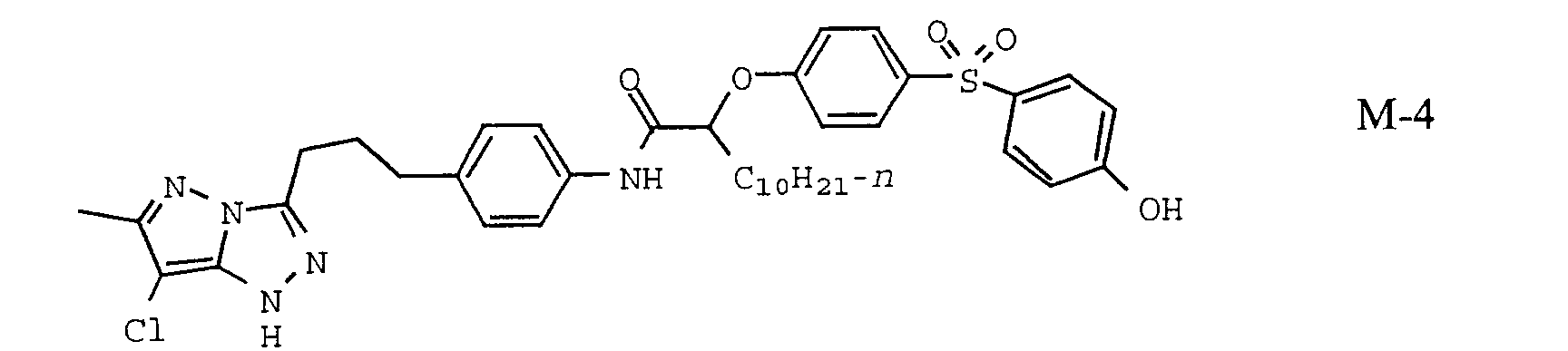
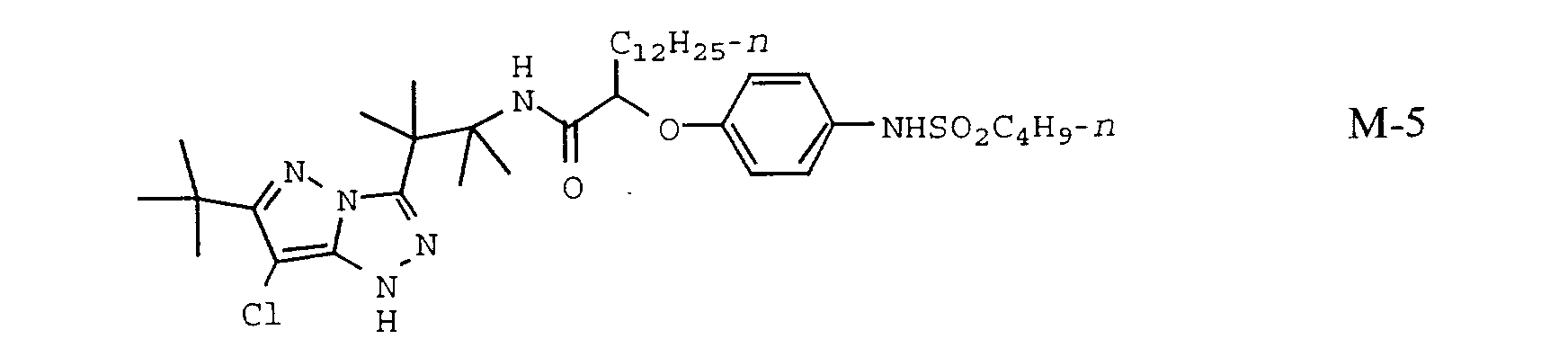
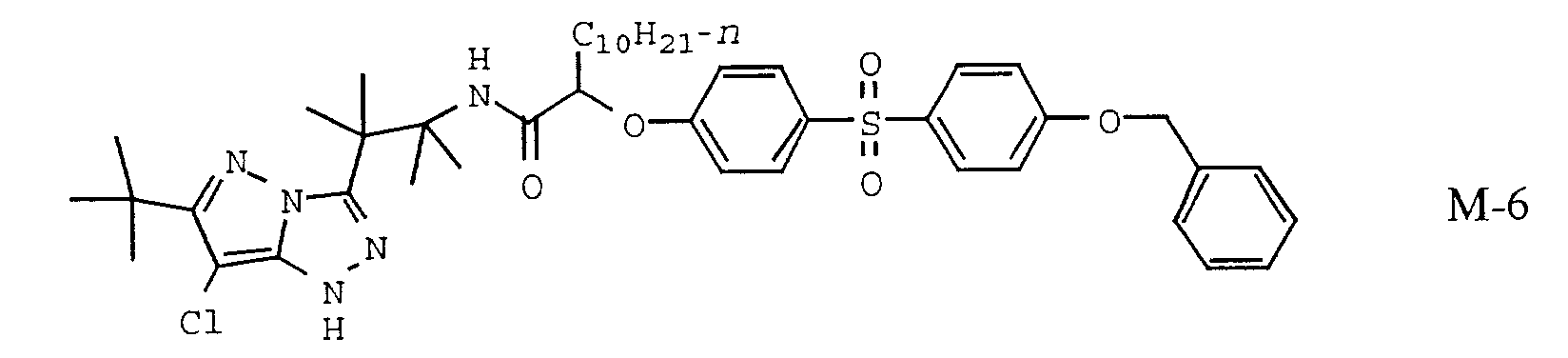
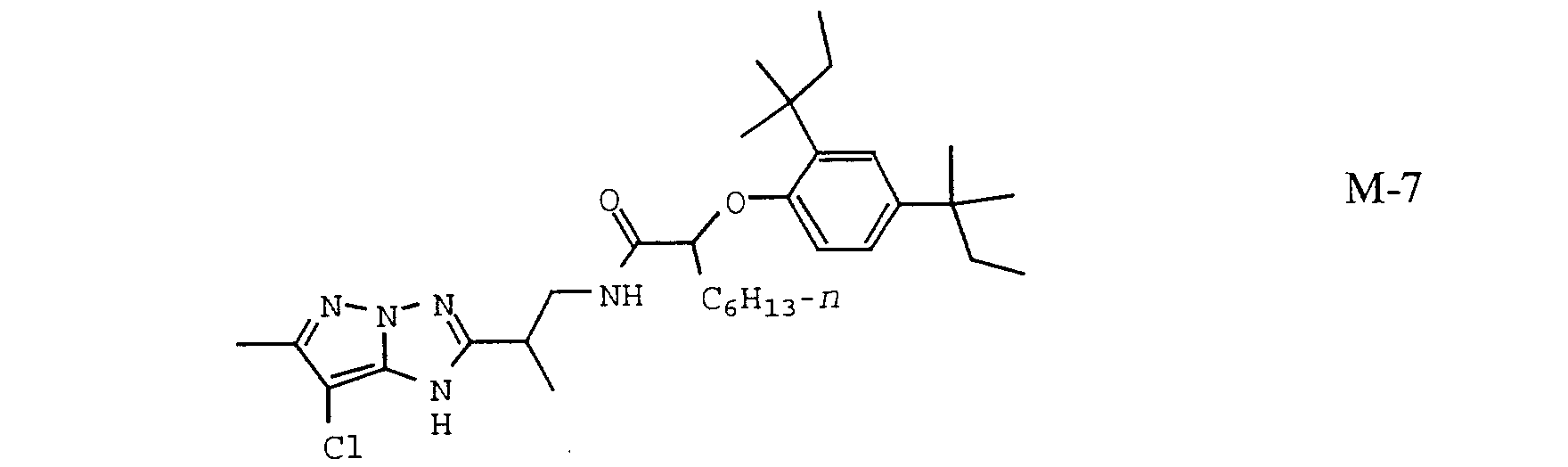
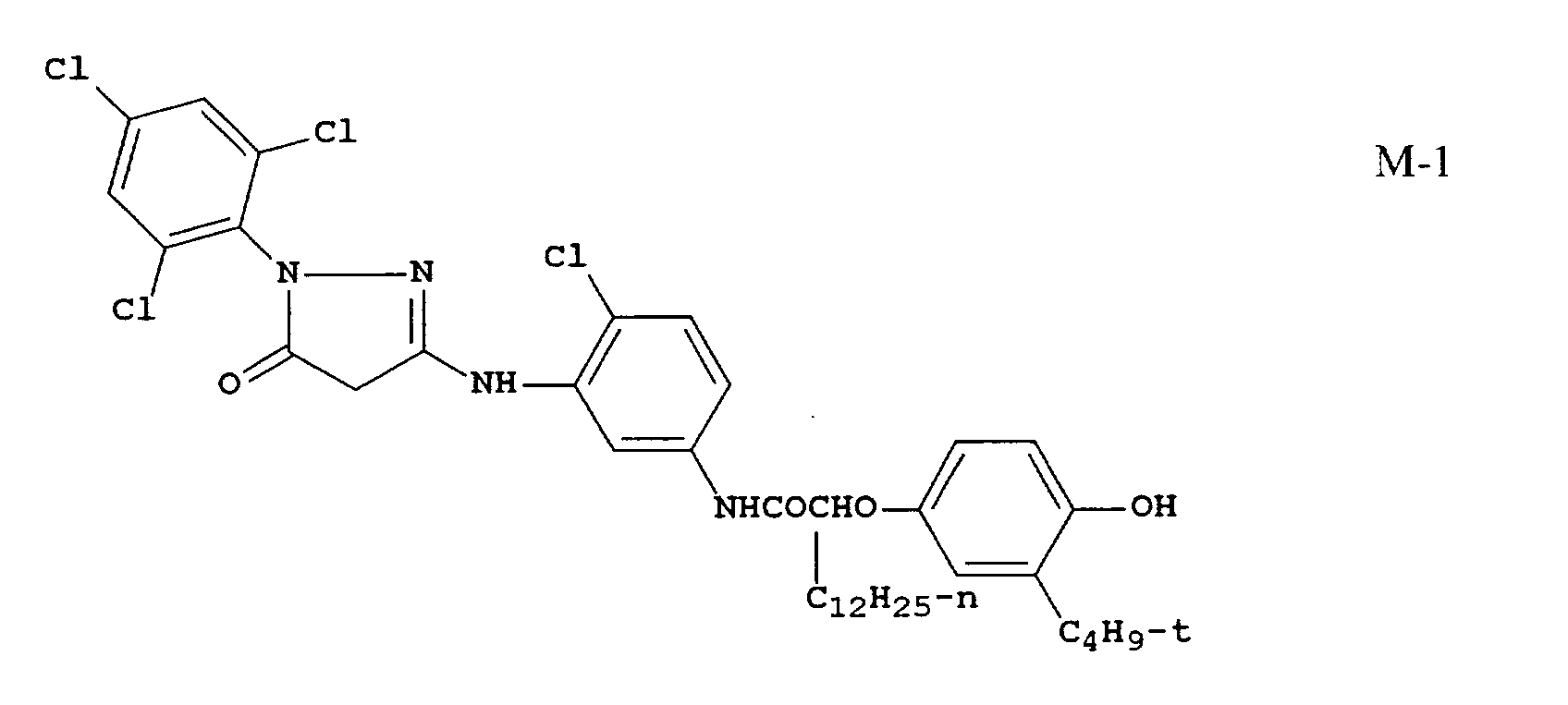
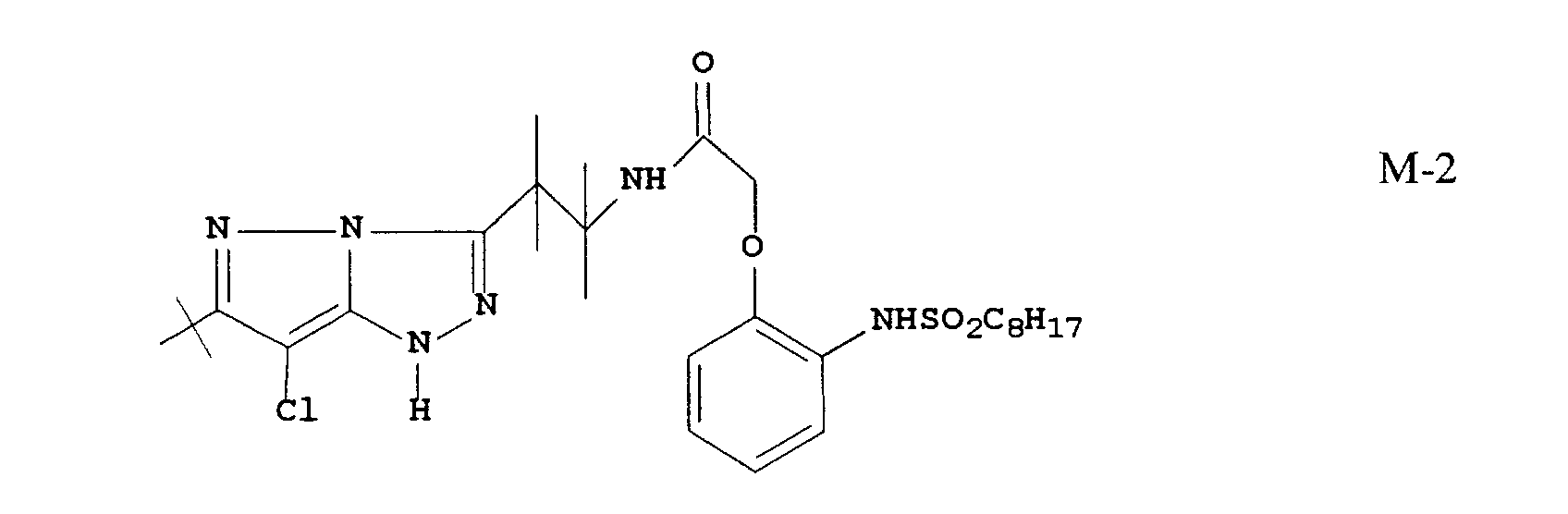
Typical magenta couplers that may be used in the inventive
photographic element are shown below.
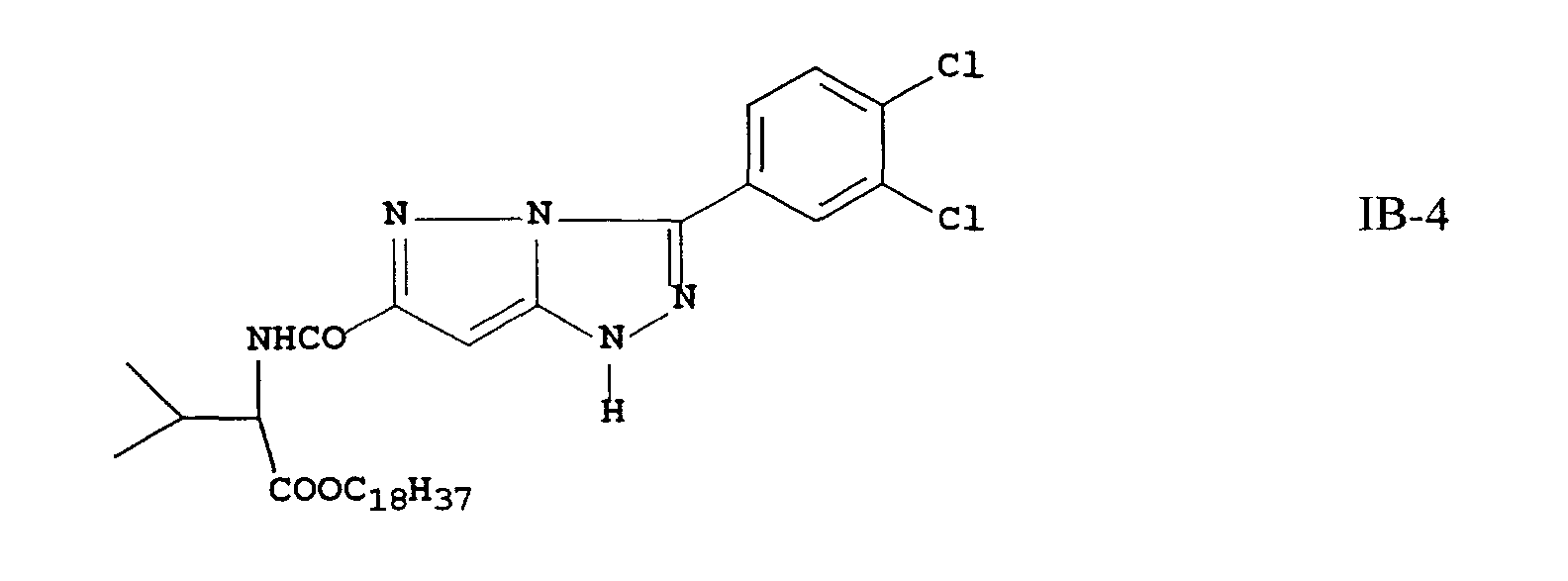
The coupler identified as M-2 is useful because of its narrow
absorption band.
Yellow Image Couplers
Couplers that form yellow dyes upon reaction with oxidized color
developing agent and which are useful in elements of the invention are described
in such representative patents and publications as: U.S. Patent Nos. 2,875,057;
2,407,210; 3,265,506; 2,298,443; 3,048,194; 3,447,928 and "Farbkuppler - Eine
Literature Ubersicht," published in Agfa Mitteilungen, Band III, pp. 112-126
(1961). Such couplers are typically open chain ketomethylene compounds. Also
preferred are yellow couplers such as described in, for example, European Patent
Application Nos. 482,552; 510,535; 524,540; 543,367; and U.S. Patent No.
5,238,803.
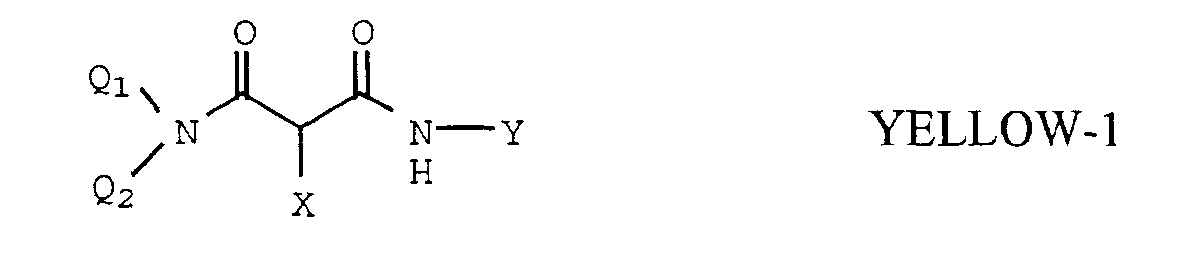
Typical preferred yellow couplers are represented by the following
formulas:
wherein R
1, R
2, R
3, R
4, Q
1 and Q
2 each represents a substituent; X is hydrogen
or a coupling-off group; Y represents an aryl group or a heterocyclic group; Q
3
represents an organic residue required to form a nitrogen-containing heterocyclic
group together with the >N―; and Q
4 represents nonmetallic atoms necessary to
from a 3- to 5-membered hydrocarbon ring or a 3- to 5-membered heterocyclic
ring which contains at least one hetero atom selected from N, O, S, and P in the
ring. Particularly preferred is when Q
1 and Q
2 each represents an alkyl group, an
aryl group, or a heterocyclic group, and R
2 represents an aryl or tertiary alkyl
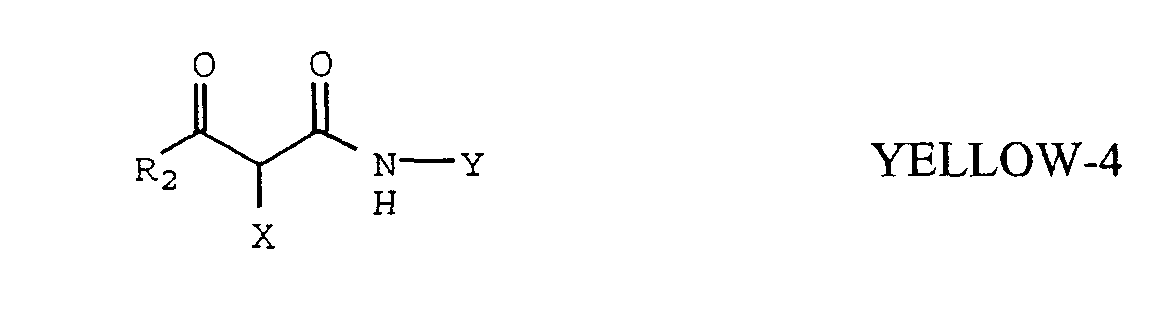
group. Preferred yellow couplers for use in elements of the invention are
represented by YELLOW-4, wherein R
2 represents a tertiary alkyl group, Y
represents an aryl group, and X represents an aryloxy or N-heterocyclic coupling-off
group.
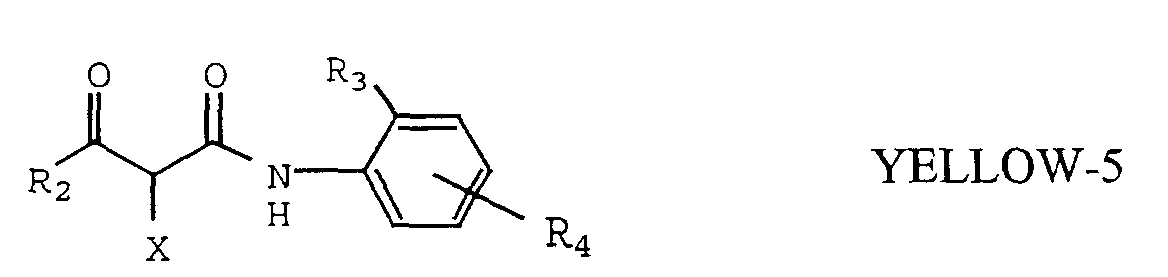
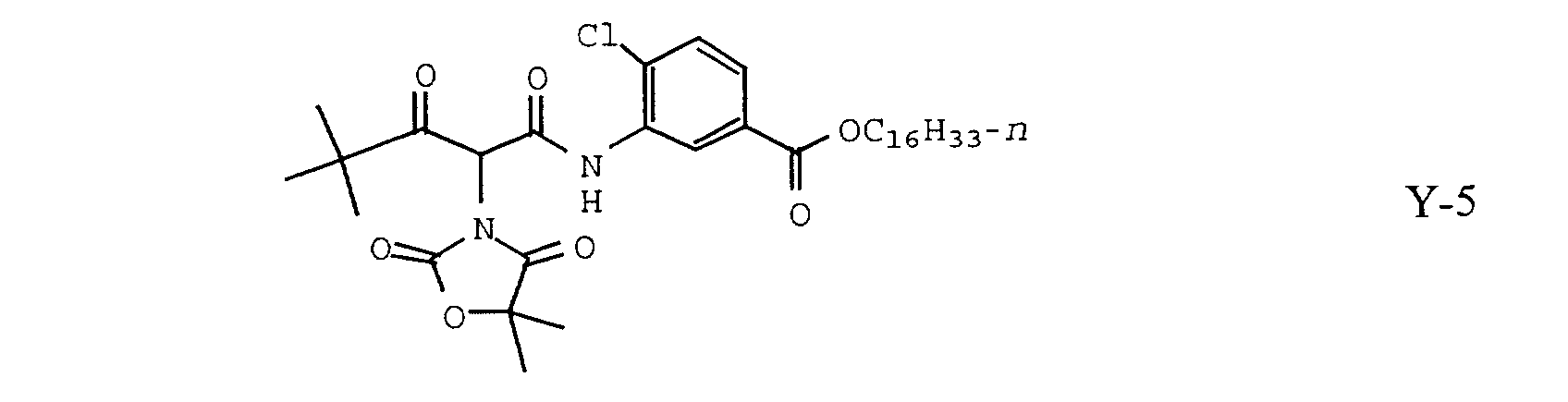
The most preferred yellow couplers are represented by YELLOW-5,
wherein R2 represents a tertiary alkyl group, R3 represents a halogen or an
alkoxy substituent, R4 represents a substituent, and X represents a N-heterocyclic
coupling-off group because of their good development and desirable color.
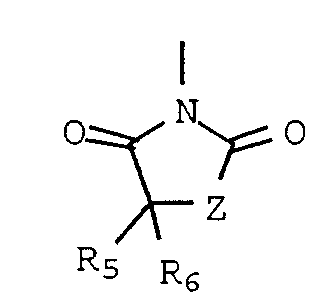
Even more preferred are yellow couplers are represented by
YELLOW-5, wherein R
2, R
3 and R
4 are as defined above, and X is represented
by the following formula:
wherein Z is oxygen of nitrogen and R
5 and R
6 are substituents. Most preferred
are yellow couplers wherein Z is oxygen and R
5 and R
6 are alkyl groups.
Representative substituents on such groups include alkyl, aryl,
alkoxy, aryloxy, alkylthio, hydroxy, halogen, alkoxycarbonyl, aryloxcarbonyl,
carboxy, acyl, acyloxy, amino, anilino, carbonamido (also known as acylamino),
carbamoyl, alkylsulfonyl, arylsulfonyl, sulfonamido, and sulfamoyl groups
wherein the substituents typically contain 1 to 40 carbon atoms. Such substituents
can also be further substituted. Alternatively, the molecule can be made immobile
by attachment to polymeric backbone.
Examples of the yellow couplers suitable for use in the invention
are the acylacetanilide couplers, such as those having formula III:
wherein Z represents hydrogen or a coupling-off group bonded to the
coupling site in each of the above formulae. In the above formulae, when R
1a,
R
1b, R
1d, or R
1f contains a ballast or anti-diffusing group, it is selected so that
the total number of carbon atoms is at least 8 and preferably at least 10.
R1a represents an aliphatic (including alicyclic) hydrocarbon group, and
R1b represents an aryl group.
The aliphatic- or alicyclic hydrocarbon group represented by R1a
typically has at most 22 carbon atoms, may be substituted or unsubstituted, and
aliphatic hydrocarbon may be straight or branched. Preferred examples of the
substituent for these groups represented by R1a are an alkoxy group, an aryloxy
group, an amino group, an acylamino group, and a halogen atom. These
substituents may be further substituted with at least one of these substituents
repeatedly. Useful examples of the groups as R1a include an isopropyl group, an
isobutyl group, a tert-butyl group, an isoamyl group, a tert-amyl group, a 1,1-dimethyl-butyl
group, a 1,1-dimethylhexyl group, a 1,1-diethylhexyl group, a
dodecyl group, a hexadecyl group, an octadecyl group, a cyclohexyl group, a 2-methoxyisopropyl
group, a 2-phenoxyisopropyl group, a 2-p-tert-butylphenoxyisopropyl
group, an a-aminoisopropyl group, an a-(diethylamino)isopropyl
group, an a-(succinimido)isopropyl group, an a-(phthalimido)isopropyl
group, an a-(benzenesulfonamido)isopropyl group, and the like.
As an aryl group, (especially a phenyl group), R1b may be
substituted. The aryl group (e.g., a phenyl group) may be substituted with
substituent groups typically having not more than 32 carbon atoms such as an
alkyl group, an alkenyl group, an alkoxy group, an alkoxycarbonyl group, an
alkoxycarbonylamino group, an aliphatic- or alicyclic-amido group, an
alkylsulfamoyl group, an alkylsulfonamido group, an alkylureido group, an
aralkyl group and an alkyl-substituted succinimido group. This phenyl group in
the aralkyl group may be further substituted with groups such as an aryloxy
group, an aryloxycarbonyl group, an arylcarbamoyl group, an arylamido group,
an arylsulfamoyl group, an arylsulfonamido group, and an arylureido group.
The phenyl group represented by R1b may be substituted with an
amino group which may be further substituted with a lower alkyl group having
from 1 to 6 carbon atoms, a hydroxyl group, -COOM and―SO2M (M = H, an
alkali metal atom, NH4), a nitro group, a cyano group, a thiocyano group, or a
halogen atom.
In a preferred embodiment, the phenyl group represented by R1b is
a phenyl group having in the position ortho to the anilide nitrogen a halogen such
as fluorine, chlorine or an alkoxy group such as methoxy, ethoxy, propoxy,
butoxy. Alkoxy groups of less than 8 carbon atoms are preferred.
R1b may represent substituents resulting from condensation of a
phenyl group with other rings, such as a naphthyl group, a quinolyl group, an
isoquinolyl group, a chromanyl group, a coumaranyl group, and a
tetrahydronaphthyl group. These substituents may be further substituted
repeatedly with at least one of above-described substituents for the phenyl group.
R1d and R1f represent a hydrogen atom, or a substituent group (as
defined hereafter in the passage directed to substituents).
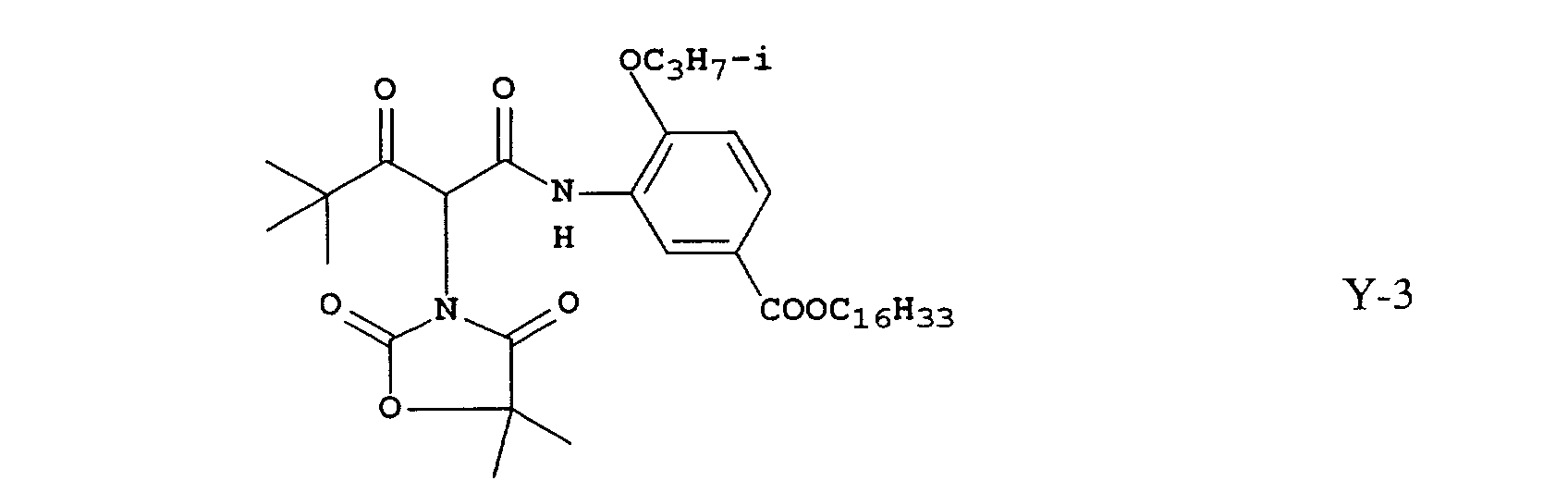
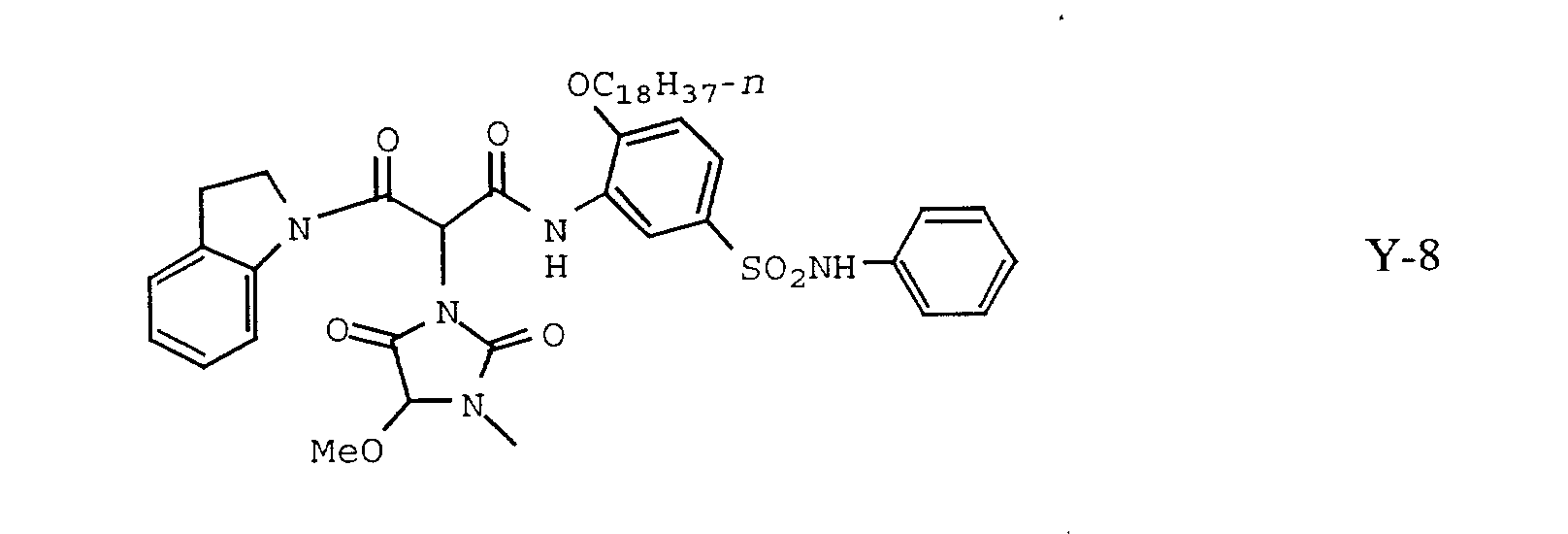
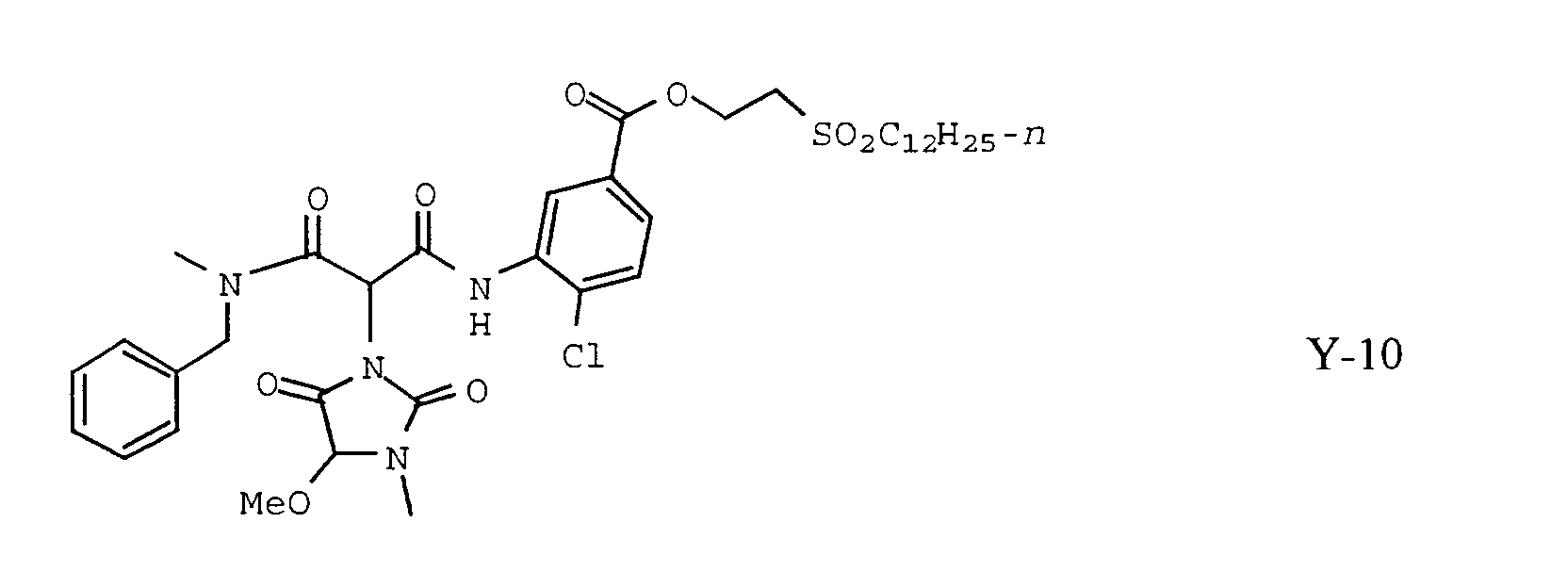
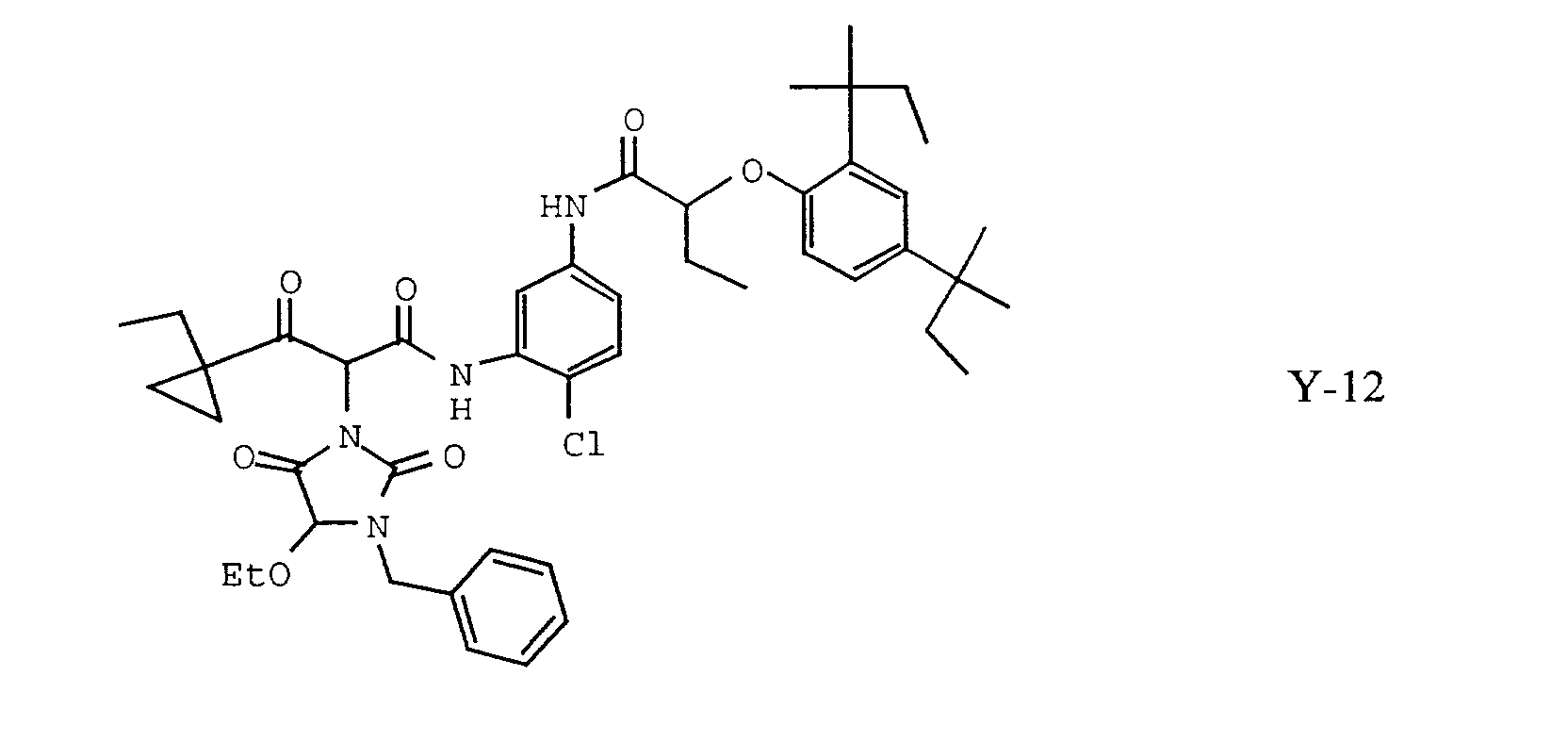
Representative examples of yellow couplers useful in the present
invention are as follows:
Throughout this specification, unless otherwise specifically stated,
substituent groups which may be substituted on molecules herein include any
groups, whether substituted or unsubstituted, which do not destroy properties
necessary for photographic utility. When the term "group" is applied to the
identification of a substituent containing a substitutable hydrogen, it is intended to
encompass not only the substituent's unsubstituted form, but also its form further
substituted with any group or groups as herein mentioned. Suitably, the group
may be halogen or may be bonded to the remainder of the molecule by an atom of
carbon, silicon, oxygen, nitrogen, phosphorous, or sulfur. The substituent may
be, for example, halogen, such as chlorine, bromine or fluorine; nitro; hydroxyl;
cyano; carboxyl; or groups which may be further substituted, such as alkyl,
including straight or branched chain alkyl, such as methyl, trifluoromethyl, ethyl,
t-butyl, 3-(2,4-di-t-pentylphenoxy) propyl, and tetradecyl; alkenyl, such as
ethylene, 2-butene; alkoxy, such as methoxy, ethoxy, propoxy, butoxy, 2-methoxyethoxy,
sec-butoxy, hexyloxy, 2-ethylhexyloxy, tetradecyloxy, 2-(2,4-di-t-pentylphenoxy)ethoxy,
and 2-dodecyloxyethoxy; aryl such as phenyl, 4-t-butylphenyl,
2,4,6-trimethylphenyl, naphthyl; aryloxy, such as phenoxy, 2-methylphenoxy,
alpha- or beta-naphthyloxy, and 4-tolyloxy; carbonamido, such
as acetamido, benzamido, butyramido, tetradecanamido, alpha-(2,4-di-t-pentylphenoxy)acetamido,
alpha-(2,4-di-t-pentylphenoxy)butyramido, alpha-(3-pentadecylphenoxy)-hexanamido,
alpha-(4-hydroxy-3-t-butylphenoxy)-tetradecanamido,
2-oxo-pyrrolidin-1-yl, 2-oxo-5-tetradecylpyrrolin-1-yl, N-methyltetradecanamido,
N-succinimido, N-phthalimido, 2,5-dioxo-1-oxazolidinyl,
3-dodecyl-2,5-dioxo-1-imidazolyl, and N-acetyl-N-dodecylamino,
ethoxycarbonylamino, phenoxycarbonylamino, benzyloxycarbonylamino,
hexadecyloxycarbonylamino, 2,4-di-t-butylphenoxycarbonylamino,
phenylcarbonylamino, 2,5-(di-t-pentylphenyl)carbonylamino, p-dodecylphenylcarbonylamino,
p-toluylcarbonylamino, N-methylureido, N,N-dimethylureido,
N-methyl-N-dodecylureido, N-hexadecylureido, N,N-dioctadecylureido,
N,N-dioctyl-N'-ethylureido, N-phenylureido, N,N-diphenylureido,
N-phenyl-N-p-toluylureido, N-(m-hexadecylphenyl)ureido, N,N-(2,5-di-t-pentylphenyl)-N'-ethylureido,
and t-butylcarbonamido; sulfonamido,
such as methylsulfonamido, benzenesulfonamido, p-toluylsulfonamido, p-dodecylbenzenesulfonamido,
N-methyltetradecylsulfonamido, N,N-dipropylsulfamoylamino,
and hexadecylsulfonamido; sulfamoyl, such as N-methylsulfamoyl,
N-ethylsulfamoyl, N,N-dipropylsulfamoyl, N-hexadecylsulfamoyl,
N,N-dimethylsulfamoyl; N-[3-(dodecyloxy)propyl]sulfamoyl,
N-[4-(2,4-di-t-pentylphenoxy)butyl]sulfamoyl, N-methyl-N-tetradecylsulfamoyl,
and N-dodecylsulfamoyl; carbamoyl, such as N-methylcarbamoyl,
N,N-dibutylcarbamoyl, N-octadecylcarbamoyl, N-[4-(2,4-di-t-pentylphenoxy)butyl]carbamoyl,
N-methyl-N-tetradecylcarbamoyl, and N,N-dioctylcarbamoyl;
acyl, such as acetyl, (2,4-di-t-amylphenoxy)acetyl,
phenoxycarbonyl, p-dodecyloxyphenoxycarbonyl methoxycarbonyl,
butoxycarbonyl, tetradecyloxycarbonyl, ethoxycarbonyl, benzyloxycarbonyl, 3-pentadecyloxycarbonyl,
and dodecyloxycarbonyl; sulfonyl, such as
methoxysulfonyl, octyloxysulfonyl, tetradecyloxysulfonyl, 2-ethylhexyloxysulfonyl,
phenoxysulfonyl, 2,4-di-t-pentylphenoxysulfonyl,
methylsulfonyl, octylsulfonyl, 2-ethylhexylsulfonyl, dodecylsulfonyl,
hexadecylsulfonyl, phenylsulfonyl, 4-nonylphenylsulfonyl, and p-toluylsulfonyl;
sulfonyloxy, such as dodecylsulfonyloxy, and hexadecylsulfonyloxy; sulfinyl,
such as methylsulfinyl, octylsulfinyl, 2-ethylhexylsulfinyl, dodecylsulfinyl,
hexadecylsulfinyl, phenylsulfinyl, 4-nonylphenylsulfinyl, and p-toluylsulfinyl;
thio, such as ethylthio, octylthio, benzylthio, tetradecylthio, 2-(2,4-di-t-pentylphenoxy)ethylthio,
phenylthio, 2-butoxy-5-t-octylphenylthio, and p-tolylthio;
acyloxy, such as acetyloxy, benzoyloxy, octadecanoyloxy, p-dodecylamidobenzoyloxy,
N-phenylcarbamoyloxy, N-ethylcarbamoyloxy, and
cyclohexylcarbonyloxy; amine, such as phenylanilino, 2-chloroanilino,
diethylamine, dodecylamine; imino, such as 1 (N-phenylimido)ethyl, N-succinimido
or 3-benzylhydantoinyl; phosphate, such as dimethylphosphate and
ethylbutylphosphate; phosphite, such as diethyl and dihexylphosphite; a
heterocyclic group, a heterocyclic oxy group or a heterocyclic thio group, each of
which may be substituted and which contain a 3- to 7-membered heterocyclic ring
composed of carbon atoms and at least one hetero atom selected from the group
consisting of oxygen, nitrogen and sulfur, such as 2-furyl, 2-thienyl, 2-benzimidazolyloxy
or 2-benzothiazolyl; quaternary ammonium, such as
triethylammonium; and silyloxy, such as trimethylsilyloxy.
If desired, the substituents may themselves be further substituted
one or more times with the described substituent groups. The particular
substituents used may be selected by those skilled in the art to attain the desired
photographic properties for a specific application and can include, for example,
hydrophobic groups, solubilizing groups, blocking groups, releasing or releasable
groups, etc. Generally, the above groups and substituents thereof may include
those having up to 48 carbon atoms, typically 1 to 36 carbon atoms and usually
less than 24 carbon atoms, but greater numbers are possible depending on the
particular substituents selected.
The materials of the invention can be used in any of the ways and
in any of the combinations known in the art. Typically, the invention materials
are incorporated in a silver halide emulsion and the emulsion coated as a layer on
a support to form part of a photographic element. Alternatively, unless provided
otherwise, they can be incorporated at a location adjacent to the silver halide
emulsion layer where, during development, they will be in reactive association
with development products such as oxidized color developing agent. Thus, as
used herein, the term "associated" signifies that the compound is in the silver
halide emulsion layer or in an adjacent location where, during processing, it is
capable of reacting with silver halide development products.
Representative substituents on ballast groups include alkyl, aryl,
alkoxy, aryloxy, alkylthio, hydroxy, halogen, alkoxycarbonyl, aryloxcarbonyl,
carboxy, acyl, acyloxy, amino, anilino, carbonamido, carbamoyl, alkylsulfonyl,
arylsulfonyl, sulfonamido, and sulfamoyl groups wherein the substituents
typically contain 1 to 42 carbon atoms. Such substituents can also be further
substituted.
The color photographic elements of the invention are multicolor
elements. Multicolor elements contain image dye-forming units sensitive to each
of the three primary regions of the spectrum. Each unit can comprise a single
emulsion layer or multiple emulsion layers sensitive to a given region of the
spectrum. The layers of the element, including the layers of the image-forming
units, can be arranged in various orders as known in the art.
If desired, the photographic element can be used in conjunction
with an applied magnetic layer as described in Research Disclosure, November
1992, Item 34390 published by Kenneth Mason Publications, Ltd., Dudley
Annex, 12a North Street, Emsworth, Hampshire PO10 7DQ, ENGLAND, and as
described in Hatsumi Kyoukai Koukai Gihou No. 94-6023, published March 15,
1994, available from the Japanese Patent Office. When it is desired to employ the
inventive materials in a small format film, Research Disclosure, June 1994, Item
36230, provides suitable embodiments.
In the following discussion of suitable materials for use in the
emulsions and elements of this invention, reference will be made to Research
Disclosure, September 1994, Item 36544, available as described above, which
will be identified hereafter by the term "Research Disclosure". Sections hereafter
referred to are Sections of the Research Disclosure.
Except as provided, the silver halide emulsion containing elements
employed in this invention can be either negative-working or positive-working as
indicated by the type of processing instructions (i.e., color negative, reversal, or
direct positive processing) provided with the element. Suitable emulsions and
their preparation, as well as methods of chemical and spectral sensitization, are
described in Sections I-V. Various additives such as UV dyes, brighteners,
antifoggants, stabilizers, light absorbing and scattering materials, and physical
property modifying addenda such as hardeners, coating aids, plasticizers,
lubricants and matting agents are described, for example, in Sections II and
VI-VIII. Color materials are described in Sections X-XIII. Scan facilitating is
described in Section XIV. Supports, exposure, development systems, and
processing methods and agents are described in Sections XV to XX. Certain
desirable photographic elements and processing steps, particularly those useful in
conjunction with color reflective prints, are described in Research Disclosure,
Item 37038, February 1995.
Couplers that form magenta dyes upon reaction with oxidized color
developing agent are described in such representative patents and publications as:
U.S. Patent Nos. 2,311,082; 2,343,703; 2,369,489; 2,600,788; 2,908,573;
3,062,653; 3,152,896; 3,519,429; 3,758,309; 4,540,654; and "Farbkuppler-eine
Literature Ubersicht," published in Agfa Mitteilungen, Band III, pp. 126-156
(1961). Preferably such couplers are pyrazolones, pyrazolotriazoles, or
pyrazolobenzimidazoles that form magenta dyes upon reaction with oxidized
color developing agents.
Couplers that form yellow dyes upon reaction with oxidized color
developing agent are described in such representative patents and publications as:
U.S. Patent Nos. 2,298,443; 2,407,210; 2,875,057; 3,048,194; 3,265,506;
3,447,928; 4,022,620; 4,443,536; and "Farbkuppler-eine Literature Ubersicht,"
published in Agfa Mitteilungen, Band III, pp. 112-126 (1961). Such couplers are
typically open chain ketomethylene compounds.
Couplers that form colorless products upon reaction with oxidized
color developing agent are described in such representative patents as U.K. Patent
No. 861,138 and U.S. Patent Nos. 3,632,345, 3,928,041; 3,958,993; and
3,961,959. Typically such couplers are cyclic carbonyl containing compounds
that form colorless products on reaction with an oxidized color developing agent.
Couplers that form black dyes upon reaction with oxidized color
developing agent are described in such representative patents as U.S. Patent Nos.
1,939,231; 2,181,944; 2,333,106; and 4,126,461; German OLS No. 2,644,194 and
German OLS No. 2,650,764. Typically, such couplers are resorcinols or m-aminophenols
that form black or neutral products on reaction with oxidized color
developing agent.
In addition to the foregoing, so-called "universal" or "washout"
couplers may be employed. These couplers do not contribute to image dye-formation.
Thus, for example, a naphthol having an unsubstituted carbamoyl or
one substituted with a low molecular weight substituent at the 2- or 3- position
may be employed. Couplers of this type are described, for example, in U.S.
Patent Nos. 5,026,628; 5,151,343; and 5,234,800.
It may be useful to use a combination of couplers any of which
may contain known ballasts or coupling-off groups such as those described in
U.S. Patent Nos. 4,301,235; 4,853,319; and 4,351,897. The coupler may contain
solubilizing groups such as described in U.S. Patent 4,482,629.
The invention materials may be used in association with materials
that accelerate or otherwise modify the processing steps, e.g., of bleaching or
fixing to improve the quality of the image. Bleach accelerator releasing couplers
such as those described in EP 0 193,389; EP 0 301,477; and U.S. Patent Nos.
4,163,669; 4,865,956; and 4,923,784 may be useful. Also contemplated is use of
the compositions in association with nucleating agents, development accelerators
or their precursors (UK Patent Nos. 2,097,140 and 2,131,188); electron transfer
agents (U.S. Patent Nos. 4,859,578 and 4,912,025); antifogging and anticolor-mixing
agents such as derivatives of hydroquinones, aminophenols, amines, gallic
acid; catechol; ascorbic acid; hydrazides; sulfonamidophenols; and non color-forming
couplers.
The invention materials may also be used in combination with
filter dye layers comprising colloidal silver sol or yellow, 'blue', cyan, and/or
magenta filter dyes, either as oil-in-water dispersions, latex dispersions or as solid
particle dispersions. Additionally, they may be used with "smearing" couplers
(e.g. as described in U.S. 4,366,237; EP 96,570; U.S. 4,420,556; and U.S.
4,543,323.) Also, the compositions may be blocked or coated in protected form
as described, for example, in Japanese Application 61/258,249 or U.S. 5,019,492.
The invention materials may further be used in combination with
image-modifying compounds such as "Developer Inhibitor-Releasing" compounds
(DIR's). DIR's useful in conjunction with the compositions of the invention are
known in the art and examples are described in U.S. Patent Nos. 3,137,578;
3,148,022; 3,148,062; 3,227,554; 3,384,657; 3,379,529; 3,615,506; 3,617,291;
3,620,746; 3,701,783; 3,733,201; 4,049,455; 4,095,984; 4,126,459; 4,149,886;
4,150,228; 4,211,562; 4,248,962; 4,259,437; 4,362,878; 4,409,323; 4,477,563;
4,782,012; 4,962,018; 4,500,634; 4,579,816; 4,607,004; 4,618,571; 4,678,739;
4,746,600; 4,746,601; 4,791,049; 4,857,447; 4,865,959; 4,880,342; 4,886,736;
4,937,179; 4,946,767; 4,948,716; 4,952,485; 4,956,269; 4,959,299; 4,966,835;
4,985,336 as well as in patent publications GB 1,560,240; GB 2,007,662; GB
2,032,914; GB 2,099,167; DE 2,842,063, DE 2,937,127; DE 3,636,824; DE
3,644,416 as well as the following European Patent Publications: 272,573;
335,319; 336,411; 346, 899; 362, 870; 365,252; 365,346; 373,382; 376,212;
377,463; 378,236; 384,670; 396,486; 401,612; and 401,613.
Such compounds are also disclosed in "Developer-Inhibitor-Releasing
(DIR) Couplers for Color Photography," C.R. Barr, J.R. Thirtle and
P.W. Vittum in Photographic Science and Engineering, Vol. 13, p. 174 (1969).
Generally, the developer inhibitor-releasing (DIR) couplers include a coupler
moiety and an inhibitor coupling-off moiety (IN). The inhibitor-releasing
couplers may be of the time-delayed type (DIAR couplers) which also include a
timing moiety or chemical switch which produces a delayed release of inhibitor.
Examples of typical inhibitor moieties are: oxazoles, thiazoles, diazoles,
triazoles, oxadiazoles, thiadiazoles, oxathiazoles, thiatriazoles, benzotriazoles,
tetrazoles, benzimidazoles, indazoles, isoindazoles, mercaptotetrazoles,
selenotetrazoles, mercaptobenzothiazoles, selenobenzothiazoles,
mercaptobenzoxazoles, selenobenzoxazoles, mercaptobenzimidazoles,
selenobenzimidazoles, benzodiazoles, mercaptooxazoles, mercaptothiadiazoles,
mercaptothiazoles, mercaptotriazoles, mercaptooxadiazoles, mercaptodiazoles,
mercaptooxathiazoles, telleurotetrazoles or benzisodiazoles. In a preferred
embodiment, the inhibitor moiety or group is selected from the following
formulas:
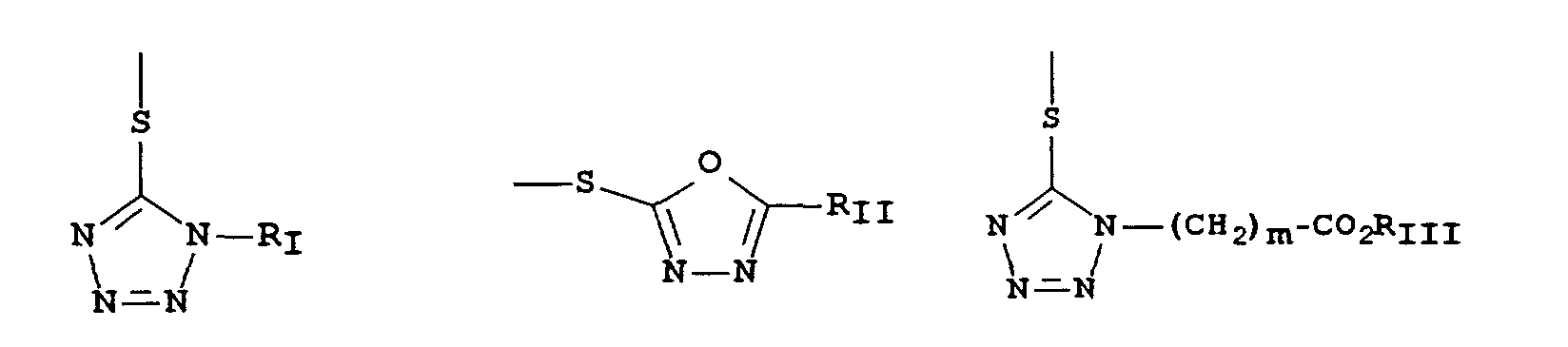

wherein R
I is selected from the group consisting of straight and branched alkyls
of from 1 to about 8 carbon atoms, benzyl, phenyl, and alkoxy groups and such
groups containing none, one or more than one such substituent; R
II is selected
from R
I and -SR
I; R
III is a straight or branched alkyl group of from 1 to about 5
carbon atoms and m is from 1 to 3; and R
IV is selected from the group consisting
of hydrogen, halogens and alkoxy, phenyl and carbonamido groups, -COOR
V and
-NHCOOR
V wherein R
V is selected from substituted and unsubstituted alkyl and
aryl groups.
It is contemplated that the concepts of the present invention may be
employed to obtain reflection color prints as described in Research Disclosure,
November 1979, Item 18716, available from Kenneth Mason Publications, Ltd,
Dudley Annex, 12a North Street, Emsworth, Hampshire PO101 7DQ, England.
Materials of the invention may be coated on pH adjusted support as described in
U.S. 4,917,994; on a support with reduced oxygen permeability (EP 553,339);
with epoxy solvents (EP 164,961); with nickel complex stabilizers (U.S. Patent
Nos. 4,346,165; 4,540,653 and 4,906,559, for example); with ballasted chelating
agents such as those in U.S. 4,994,359 to reduce sensitivity to polyvalent cations
such as calcium; and with stain reducing compounds such as described in U.S.
5,068,171. Other compounds useful in combination with the invention are
disclosed in Japanese Published Applications described in Derwent Abstracts
having accession numbers as follows: 90-072,629, 90-072,630; 90-072,631; 90-072,632;
90-072,633; 90-072,634; 90-077,822; 90-078,229; 90-078,230; 90-079,336;
90-079,337; 90-079,338; 90-079,690; 90-079,691; 90-080,487; 90-080,488;
90-080,489; 90-080,490; 90-080,491; 90-080,492; 90-080,494; 90-085,928;
90-086,669; 90-086,670; 90-087,360; 90-087,361; 90-087,362; 90-087,363;
90-087,364; 90-088,097; 90-093,662; 90-093,663; 90-093,664; 90-093,665;
90-093,666; 90-093,668; 90-094,055; 90-094,056; 90-103,409; 83-62,586;
83-09,959.
The emulsions can be spectrally sensitized with any of the dyes
known to the photographic art, such as the polymethine dye class, which includes
the cyanines, merocyanines, complex cyanines and merocyanines, oxonols,
hemioxonols, styryls, merostyryls and streptocyanines. In particular, it would be
advantageous to use the low staining sensitizing dyes disclosed in U.S. Patent
Nos. 5,292,634 and 5,316,904 in conjunction with elements of the invention.
In addition, emulsions can be sensitized with mixtures of two or
more sensitizing dyes which form mixed dye aggregates on the surface of the
emulsion grain. The use of mixed dye aggregates enables adjustment of the
spectral sensitivity of the emulsion to any wavelength between the extremes of the
wavelengths of peak sensitivities (λ-max) of the two or more dyes. This practice
is especially valuable if the two or more sensitizing dyes absorb in similar
portions of the spectrum (i.e., blue, or green or red and not green plus red or blue
plus red or green plus blue). Since the function of the spectral sensitizing dye is
to modulate the information recorded in the negative which is recorded as an
image dye, positioning the peak spectral sensitivity at or near the λ-max of the
image dye in the color negative produces the optimum preferred response.
In addition, emulsions of this invention may contain a mixture of
spectral sensitizing dyes which are substantially different in their light absorptive
properties. For example, Hahm in U.S. 4,902,609 describes a method for
broadening the effective exposure latitude of a color negative paper by adding a
smaller amount of green spectral sensitizing dye to a silver halide emulsion
having predominately a red spectral sensitivity. Thus, when the red sensitized
emulsion is exposed to green light, it has little, if any, response. However, when
it is exposed to larger amounts of green light, a proportionate amount of cyan
image dye will be formed in addition to the magenta image dye, causing it to
appear to have additional contrast and hence a broader exposure latitude.
Waki et al in U.S. 5,084,374 describes a silver halide color
photographic material in which the red spectrally sensitized layer and the green
spectrally sensitized layers are both sensitized to blue light. Like Hahm, the
second sensitizer is added in a smaller amount to the primary sensitizer. When
these imaging layers are given a large enough exposure of the blue light exposure,
they produce yellow image dye to complement the primary exposure. This
process of adding a second spectral sensitizing dye of different primary absorption
is called false-sensitization.
Any silver halide combination can be used, such as silver chloride,
silver chlorobromide, silver chlorobromoiodide, silver bromide, silver
bromoiodide, or silver chloroiodide. Due to the need for rapid processing of the
color paper, silver chloride emulsions are preferred. In some instances, silver
chloride emulsions containing small amounts of bromide, or iodide, or bromide
and iodide are preferred, generally less than 2.0 mole percent of bromide less than
1.0 mole percent of iodide. Bromide or iodide addition when forming the
emulsion may come from a soluble halide source such as potassium iodide or
sodium bromide or an organic bromide or iodide or an inorganic insoluble halide
such as silver bromide or silver iodide.
The shape of the silver halide emulsion grain can be cubic, pseudo-cubic,
octahedral, tetradecahedral or tabular. It is preferred that the 3-dimensional
grains be monodisperse and that the grain size coefficient of variation of the 3-dimensional
grains is less than 35% or, most preferably less than 25%. The
emulsions may be precipitated in any suitable environment such as a ripening
environment, or a reducing environment. Specific references relating to the
preparation of emulsions of differing halide ratios and morphologies are Evans
U.S. Patent 3,618,622; Atwell U.S. Patent 4,269,927; Wey U.S. Patent 4,414,306;
Maskasky U.S. Patent 4,400,463; Maskasky U.S. Patent 4,713,323; Tufano et al
U.S. Patent 4,804,621; Takada et al U.S. Patent 4,738,398; Nishikawa et al U.S.
Patent 4,952,491; Ishiguro et al U.S. Patent 4,493,508; Hasebe et al U.S. Patent
4,820,624; Maskasky U.S. Patent 5,264,337; and Brust et al EP 534,395.
The combination of similarly spectrally sensitized emulsions can
be in one or more layers, but the combination of emulsions having the same
spectral sensitivity should be such that the resultant D vs. log-E curve and its
corresponding instantaneous contrast curve should be such that the instantaneous
contrast of the combination of similarly spectrally sensitized emulsions generally
increases as a function of exposure.
Emulsion precipitation is conducted in the presence of silver ions,
halide ions and in an aqueous dispersing medium including, at least during grain
growth, a peptizer. Grain structure and properties can be selected by control of
precipitation temperatures, pH and the relative proportions of silver and halide
ions in the dispersing medium. To avoid fog, precipitation is customarily
conducted on the halide side of the equivalence point (the point at which silver
and halide ion activities are equal). Manipulations of these basic parameters are
illustrated by the citations including emulsion precipitation descriptions and are
further illustrated by Matsuzaka et al U.S. Patent 4,497,895, Yagi et al U.S. Patent
4,728,603, Sugimoto U.S. Patent 4,755,456, Kishita et al U.S. Patent 4,847,190,
Joly et al U.S. Patent 5,017,468, Wu U.S. Patent 5,166,045, Shibayama et al EPO
0 328 042, and Kawai EPO 0 531 799.
Reducing agents present in the dispersing medium during
precipitation can be employed to increase the sensitivity of the grains, as
illustrated by Takada et al U.S. Patent 5,061,614, Takada U.S. Patent 5,079,138
and EPO 0 434 012, Inoue U.S. Patent 5,185,241, Yamashita et al EPO 0 369
491, Ohashi et al EPO 0 371 338, Katsumi EPO 435 270 and 0 435 355 and
Shibayama EPO 0 438 791. Chemically sensitized core grains can serve as hosts
for the precipitation of shells, as illustrated by Porter et al U.S. Patents 3,206,313
and 3,327,322, Evans U.S. Patent 3,761,276, Atwell et al U.S. Patent 4,035,185
and Evans et al U.S. Patent 4,504,570.
Dopants (any grain occlusions other than silver and halide ions)
can be employed to modify grain structure and properties. Periods 3-7 ions,
including Group VIII metal ions (Fe, Co, Ni and platinum metals (pm) Ru, Rh,
Pd, Re, Os, Ir and Pt), Mg, Al, Ca, Sc, Ti, V, Cr, Mn, Cu Zn, Ga, As, Se, Sr, Y,
Mo, Zr, Nb, Cd, In, Sn, Sb, Ba, La, W, Au, Hg, Tl, Pb, Bi, Ce and U can be
introduced during precipitation. The dopants can be employed (a) to increase the
sensitivity of either (a1) direct positive or (a2) negative working emulsions, (b) to
reduce (b1) high or (b2) low intensity reciprocity failure, (c) to (c1) increase, (c2)
decrease or (c3) reduce the variation of contrast, (d) to reduce pressure sensitivity,
(e) to decrease dye desensitization, (f) to increase stability, (g) to reduce minimum
density, (h) to increase maximum density, (i) to improve room light handling and
(j) to enhance latent image formation in response to shorter wavelength (e.g., X-ray
or gamma radiation) exposures. For some uses any polyvalent metal ion
(pvmi) is effective. The selection of the host grain and the dopant, including its
concentration and, for some uses, its location within the host grain and/or its
valence can be varied to achieve aim photographic properties, as illustrated by B.
H. Carroll, "Iridium Sensitization: A Literature Review", Photographic Science
and Engineering, Vol. 24, No. 6 Nov./Dec. 1980, pp. 265-267 (pm, Ir, a, b and
d); Hochstetter U.S. Patent 1,951,933 (Cu); De Witt U.S. Patent 2,628,167 (Tl, a,
c); Mueller et al U.S. Patent 2,950,972 (Cd, j); Spence et al U.S. Patent 3,687,676
and Gilman et al U.S. Patent 3,761,267 (Pb, Sb, Bi, As, Au, Os, Ir, a); Ohkubu et
al U.S. Patent 3,890,154 (VIII, a); Iwaosa et al U.S. Patent 3,901,711 (Cd, Zn,
Co, Ni, Tl, U, Th, Ir, Sr, Pb, b1); Habu et al U.S. Patent 4,173,483 (VIII, b1);
Atwell U.S. Patent 4,269,927 (Cd, Pb, Cu, Zn, a2); Weyde U.S. Patent 4,413,055
(Cu, Co, Ce, a2); Akimura et al U.S. Patent 4,452,882 (Rh, i); Menjo et al U.S.
Patent 4,477,561 (pm, f); Habu et al U.S. Patent 4,581,327 (Rh, c1, f); Kobuta et
al U.S. Patent 4,643,965 (VIII, Cd, Pb, f, c2); Yamashita et al U.S. Patent
4,806,462 (pvmi, a2, g); Grzeskowiak et al U.S. Patent 4,4,828,962 (Ru+Ir, b1);
Janusonis U.S. Patent 4,835,093 (Re, a1); Leubner et al U.S. Patent 4,902,611
(Ir+4); Inoue et al U.S. Patent 4,981,780 (Mn, Cu, Zn, Cd, Pb, Bi, In, Tl, Zr, La,
Cr, Re, VIII, c1, g, h); Kim U.S. Patent 4,997,751 (Ir, b2); Kuno U.S. Patent
5,057,402 (Fe, b, f); Maekawa et al U.S. Patent 5,134,060 (Ir, b, c3); Kawai et al
U.S. Patent 5,164,292 (Ir+Se, b); Asami U.S. Patents 5,166,044 and 5,204,234
(Fe+Ir, a2 b, c1, c3); Wu U.S. Patent 5,166,045 (Se, a2); Yoshida et al U.S.
Patent 5,229,263 (Ir+Fe/Re/Ru/Os, a2, b1); Marchetti et al U.S. Patents 5,264,336
and 5,268,264 (Fe, g); Komarita et al EPO 0 244 184 (Ir, Cd, Pb, Cu, Zn, Rh, Pd,
Pt, Tl, Fe, d); Miyoshi et al EPO 0 488 737 and 0 488 601
(Ir+VIII/Sc/Ti/V/Cr/Mn/Y/Zr/Nb/Mo/La/Ta/W/Re, a2, b, g); Ihama et al EPO
0 368 304 (Pd, a2, g); Tashiro EPO 0 405 938 (Ir, a2, b); Murakami et al EPO
0 509 674 (VIII, Cr, Zn, Mo, Cd, W, Re, Au, a2, b, g) and Budz WO 93/02390
(Au, g); Ohkubo et al U.S. Patent 3,672,901 (Fe, a2, ol); Yamasue et al U.S.
Patent 3,901,713 (Ir + Rh, f); and Miyoshi et al EPO 0 488 737.
When dopant metals are present during precipitation in the form of
coordination complexes, particularly tetra- and hexa-coordination complexes,
both the metal ion and the coordination ligands can be occluded within the grains.
Coordination ligands, such as halo, aquo, cyano, cyanate, fulminate, thiocyanate,
selenocyanate, nitrosyl, thionitrosyl, oxo, carbonyl and ethylenediamine
tetraacetic acid (EDTA) ligands have been disclosed and, in some instances,
observed to modify emulsion properties, as illustrated by Grzeskowiak U.S.
Patent 4,847,191, McDugle et al U.S. Patents 4,933,272, 4,981,781, and
5,037,732; Marchetti et al U.S. Patent 4,937,180; Keevert et al U.S. Patent
4,945,035, Hayashi U.S. Patent 5,112,732, Murakami et al EPO 0 509 674, Ohya
et al EPO 0 513 738, Janusonis WO 91/10166, Beavers WO 92/16876, Pietsch et
al German DD 298,320, and Olm et al U.S. Patent 5,360,712.
Oligomeric coordination complexes can also be employed to
modify grain properties, as illustrated by Evans et al U.S. Patent 5,024,931.
Dopants can be added in conjunction with addenda, antifoggants,
dye, and stabilizers either during precipitation of the grains or post precipitation,
possibly with halide ion addition. These methods may result in dopant deposits
near or in a slightly subsurface fashion, possibly with modified emulsion effects,
as illustrated by Ihama et al U.S. Patent 4,693,965 (Ir, a2); Shiba et al U.S. Patent
3,790,390 (Group VIII, a2, b1); Habu et al U.S. Patent 4,147,542 (Group VIII,
a2, b1); Hasebe et al EPO 0 273 430 (Ir, Rh, Pt); Ohshima et al EPO 0 312 999
(Ir, f); and Ogawa U.S. Statutory Invention Registration H760 (Ir, Au, Hg, Tl,
Cu, Pb, Pt, Pd, Rh, b, f).
Desensitizing or contrast increasing ions or complexes are typically
dopants which function to trap photogenerated holes or electrons by introducing
additional energy levels deep within the bandgap of the host material. Examples
include, but are not limited to, simple salts and complexes of Groups 8-10
transition metals (e.g., rhodium, iridium, cobalt, ruthenium, and osmium), and
transition metal complexes containing nitrosyl or thionitrosyl ligands as described
by McDugle et al U.S. Patent 4,933,272. Specific examples include K3RhCl6,
(NH4)2Rh(Cl5)H2O, K2IrCl6, K3IrCl6, K2IrBr6, K2IrBr6, K2RuCl6,
K2Ru(NO)Br5, K2Ru(NS)Br5, K2OsCl6, Cs2Os(NO)Cl5, and K2Os(NS)Cl5.
Amine, oxalate, and organic ligand complexes of these or other metals as
disclosed in Olm et al U.S. Patent 5,360,712 are also specifically contemplated.
Shallow electron trapping ions or complexes are dopants which
introduce additional net positive charge on a lattice site of the host grain, and
which also fail to introduce an additional empty or partially occupied energy level
deep within the bandgap of the host grain. For the case of a six coordinate
transition metal dopant complex, substitution into the host grain involves
omission from the crystal structure of a silver ion and six adjacent halide ions
(collectively referred to as the seven vacancy ions). The seven vacancy ions
exhibit a net charge of -5. A six coordinate dopant complex with a net charge
more positive than -5 will introduce a net positive charge onto the local lattice site
and can function as a shallow electron trap. The presence of additional positive
charge acts as a scattering center through the Coulomb force, thereby altering the
kinetics of latent image formation.
Based on electronic structure, common shallow electron trapping
ions or complexes can be classified as metal ions or complexes which have (i) a
filled valence shell or (ii) a low spin, half-filled d shell with no low-lying empty
or partially filled orbitals based on the ligand or the metal due to a large crystal
field energy provided by the ligands. Classic examples of class (i) type dopants
are divalent metal complex of Group II, e.g., Mg(2+), Pb(2+), Cd(2+), Zn(2+),
Hg(2+), and Tl(3+). Some type (ii) dopants include Group VIII complex with
strong crystal field ligands such as cyanide and thiocyanate. Examples include,
but are not limited to, iron complexes illustrated by Ohkubo U.S. Patent
3,672,901; and rhenium, ruthenium, and osmium complexes disclosed by Keevert
U.S. Patent 4,945,035; and iridium and platinum complexes disclosed by
Ohshima et al U.S. Patent 5,252,456. Preferred complexes are ammonium and
alkali metal salts of low valent cyanide complexes such as K4Fe(CN)6,
K4Ru(CN)6, K4Os(CN)6, K2Pt(CN)4, and K3Ir(CN)6. Higher oxidation state
complexes of this type, such as K3Fe(CN)6 and K3Ru(CN)6, can also possess
shallow electron trapping characteristics, particularly when any partially filled
electronic states which might reside within the bandgap of the host grain exhibit
limited interaction with photocharge carriers.
Emulsion addenda that absorb to grain surfaces, such as
antifoggants, stabilizers and dyes can also be added to the emulsions during
precipitation. Precipitation in the presence of spectral sensitizing dyes is
illustrated by Locker U.S. Patent 4,183,756, Locker et al U.S. Patent 4,225,666,
Ihama et al U.S. Patents 4,683,193 and 4,828,972, Takagi et al U.S. Patent
4,912,017, Ishiguro et al U.S. Patent 4,983,508, Nakayama et al U.S. Patent
4,996,140, Steiger U.S. Patent 5,077,190, Brugger et al U.S. Patent 5,141,845,
Metoki et al U.S. Patent 5,153,116, Asami et al EPO 0 287 100 and Tadaaki et al
EPO 0 301 508. Non-dye addenda are illustrated by Klotzer et al U.S. Patent
4,705,747, Ogi et al U.S. Patent 4,868,102, Ohya et al U.S. Patent 5,015,563,
Bahnmuller et al U.S. Patent 5,045,444, Maeka et al U.S. Patent 5,070,008, and
Vandenabeele et al EPO 0 392 092.
Chemical sensitization of the materials in this invention is
accomplished by any of a variety of known chemical sensitizers. The emulsions
described herein may or may not have other addenda such as sensitizing dyes,
supersensitizers, emulsion ripeners, gelatin or halide conversion restrainers
present before, during or after the addition of chemical sensitization.
The use of sulfur, sulfur plus gold or gold only sensitizations are
very effective sensitizers. Typical gold sensitizers are chloroaurates, aurous
dithiosulfate, aqueous colloidal gold sulfide or gold (aurous bis(1,4,5-trimethyl-1,2,4-triazolium-3-thiolate)
tetrafluoroborate. Sulfur sensitizers may include
thiosulfate, thiocyanate or N, N'-carbobothioyl-bis(N-methylglycine).
The addition of one or more antifoggants as stain reducing agents
is also common in silver halide systems. Tetrazaindenes, such as 4-hydroxy-6-methyl-(1,3,3a,7)-tetrazaindene,
are commonly used as stabilizers. Also useful
are mercaptotetrazoles such as 1-phenyl-5-mercaptotetrazole or acetamido-1-phenyl-5-mercaptotetrazole.
Arylthiosulfinates, such as tolyl-thiosulfonate or
arylsufinates such as tolylthiosulfinate or esters thereof are also useful.
Useful in this invention are tabular grain silver halide emulsions.
Specifically contemplated tabular grain emulsions are those in which greater than
50 percent of the total projected area of the emulsion grains are accounted for by
tabular grains having a thickness of less than 0.3 µm (0.5 µm for blue sensitive
emulsion) and an average tabularity (T) of greater than 25 (preferably greater than
100), where the term "tabularity" is employed in its art recognized usage as
T = ECD/t2
where
The average useful ECD of photographic emulsions can range up
to about 10 µm, although in practice emulsion ECD's seldom exceed about 4 µm.
Since both photographic speed and granularity increase with increasing ECD's, it
is generally preferred to employ the smallest tabular grain ECD's compatible with
achieving aim speed requirements.
Emulsion tabularity increases markedly with reductions in tabular
grain thickness. It is generally preferred that aim tabular grain projected areas be
satisfied by thin (t < 0.2 µm) tabular grains. To achieve the lowest levels of
granularity it is preferred that aim tabular grain projected areas be satisfied with
ultrathin (t < 0.06 µm) tabular grains. Tabular grain thicknesses typically range
down to about 0.02 µm. However, still lower tabular grain thicknesses are
contemplated. For example, Daubendiek et al U.S. Patent 4,672,027 reports a 3
mole percent iodide tabular grain silver bromoiodide emulsion having a grain
thickness of 0.017 µm. Ultrathin tabular grain high chloride emulsions are
disclosed by Maskasky U.S. 5,217,858.
As noted above tabular grains of less than the specified thickness
account for at least 50 percent of the total grain projected area of the emulsion.
To maximize the advantages of high tabularity, it is generally preferred that
tabular grains satisfying the stated thickness criterion account for the highest
conveniently attainable percentage of the total grain projected area of the
emulsion. For example, in preferred emulsions, tabular grains satisfying the
stated thickness criteria above account for at least 70 percent of the total grain
projected area. In the highest performance tabular grain emulsions, tabular grains
satisfying the thickness criteria above account for at least 90 percent of total grain
projected area.
The emulsions can be surface-sensitive emulsions, i.e., emulsions
that form latent images primarily on the surfaces of the silver halide grains, or the
emulsions can form internal latent images predominantly in the interior of the
silver halide grains. The emulsions can be negative-working emulsions, such as
surface-sensitive emulsions or unfogged internal latent image-forming emulsions,
or direct-positive emulsions of the unfogged, internal latent image-forming type,
which are positive-working when development is conducted with uniform light
exposure or in the presence of a nucleating agent.
Photographic elements can be exposed to actinic radiation,
typically in the visible region of the spectrum, to form a latent image and can then
be processed to form a visible dye image. Processing to form a visible dye image
includes the step of contacting the element with a color developing agent to
reduce developable silver halide and oxidize the color developing agent.
Oxidized color developing agent in turn reacts with the coupler to yield a dye.
To prevent halation during exposure, an antihalation layer needs to
be provided between the bottom most light sensitive layer on either side of the
transparent support. The antihalation layer acts as a photon trap, absorbing
photons of light, which was not part of the latent image formation process after
exposure. This layer prevents light from being scattered throughout the
photographic element, where it could potentially expose silver halide grains not
inline with the exposing beam of incident exposure light. Eliminating the light
that is not part of the latent image forming process eliminates halation and
increases image sharpness. This is especially important when a scanning exposing
device is employed on integral lenticular materials, since the lines of image
information are very narrow, typically 5 µ to 10 µ in diameter. If the consecutive
adjacent lines of image information differ significantly in intensity and which
subsequently result in significantly different amount of image density, if the
element is un-sharp, the lines will broaden unnecessarily and merge in such a way
that the distinct separate images will appear undistinguished from each other.
Thus an image scene which is predominantly "dark" which is arranged adjacent to
an image scene which is predominately "light" will visually blur together in the
eyes of the observer and reduce the apparent quality of the image.
Antihalation layers are common in most color negative films such
as Kodak Advantix™ film and also are found in some color print films such as
Kodak Vision Color Print Film™ or Kodak Duraclear RA Display Material™.
Antihalation materials are incorporated to absorb light not absorbed as part of the
imaging process. This material is typically 'gray' in color and absorbs light of all
color. A variety of materials have been suggested to fill this requirement. Finely
dispersed carbon black is used in some products and is known in the trade as
'rem-jet'. It must be removed prior to the chemical development step via a pre-bath
and as such must be coated on the side of the support opposite the imaging
layers as it cannot be solubilized during the processing cycles. Finely divided
elemental silver is also widely used in many color negative films. This material is
known as 'gray gel' and is easily removed in the chemical development process
during the bleaching and fixing steps. In some products, mixtures of water
soluble cyan, magenta, and yellow dyes are coated in a separate layer (usually on
the side of the support opposite the emulsion layers). If these water soluble dyes
are coated on the same side of the support as the emulsions, they diffuse into the
emulsion layers after the coating operation and retard the photographic speed of
the photographic element. Since these dye are aqueous soluble, they are
conveniently removed during processing via diffusion or reaction with alkali or
sulfite in the color developer.
To overcome this tendency, solid particle dispersions of these dyes
have been developed. The dyes in these formulations are insoluble under all but
alkaline conditions so that they remain in the layer in which they are coated, but
can be removed by hydrolysis or ionization during the chemical development step
of the photographic process.
With negative-working silver halide, the processing step described
above provides a negative image. The described elements can be processed in the
known Kodak RA-4 color process as described the British Journal of Photography
Annual of 1988, pp. 198-199. To provide a positive (or reversal) image, the color
development step can be preceded by development with a non-chromogenic
developing agent to develop exposed silver halide, but not form dye, and followed
by uniformly fogging the element to render unexposed silver halide developable.
Such reversal emulsions are typically sold with instructions to process using a
color reversal process such as E-6. Alternatively, a direct positive emulsion can
be employed to obtain a positive image.
Preferred color developing agents are p-phenylenediamines such
as:
Development is usually followed by the conventional steps of
bleaching, fixing, or bleach-fixing, to remove silver or silver halide, washing, and
drying.
A direct-view photographic element is defined as one which yields
a color image that is designed to be viewed directly (1) by reflected light, such as
a photographic paper print, (2) by transmitted light, such as a display
transparency, or (3) by projection, such as a color slide or a motion picture print.
These direct-view elements may be exposed and processed in a variety of ways.
For example, paper prints, display transparencies, and motion picture prints are
typically produced by optically printing an image from a color negative onto the
direct-viewing element and processing though an appropriate negative-working
photographic process to give a positive color image. Color slides may be
produced in a similar manner but are more typically produced by exposing the
film directly in a camera and processing through a reversal color process or a
direct positive process to give a positive color image. The image may also be
produced by alternative processes such as digital printing.
Each of these types of photographic elements has its own particular
requirements for dye hue, but in general, they all require cyan dyes that whose
absorption bands are less deeply absorbing (that is, shifted away from the red end
of the spectrum) than color negative films. This is because dyes in direct viewing
elements are selected to have the best appearance when viewed by human eyes,
whereas the dyes in color negative materials designed for optical printing are
designed to best match the spectral sensitivities of the print materials.
Photographic Examples 1 to 7:
Dispersions of example couplers were emulsified by methods well
known to the art, and were coated on the face side of a doubly extruded
polyethylene coated color paper support or transparent polymeric support as
appropriate for the example, using conventional coating techniques. The gelatin
layers were hardened with bis (vinylsulfonyl methyl) ether at 2.4 % of the total
gelatin. The preparation and composition of the individual layers and their
components is given as follows:
Dispersion Formulations:
Dispersions such as CD were formulated as follows:
The oil phase of the dispersion formula is composed of a mixture of:
| Coupler C-1 | 100.0 g |
| Di-n-butyl phthalate | 100.0 g |
| Tinuvin 328™ | 64.3 g |
| 2-(2-butoxyethoxy)ethylacetate | 8.2 g |
The aqueous phase of the dispersion is composed of a mixture of:
| Gelatin | 120.0 g |
| Alkanol XC™ surfactant | 12.0 g |
| Water | 1574.0 g |
Dispersions such as MD were formulated as follows:
The oil phase of the dispersion formula is composed of a mixture of:
| Coupler M-2 | 100.0 g |
| Oleyl alcohol | 105.0 g |
| Di-n-undecyl phthalate | 54.0 g |
| 2-(2-butoxyethoxy)ethylacetate | 10.0 g |
| ST-21 | 19.3 g |
| ST-22 | 131.8 g |
Dispersions such as YD were formulated as follows:
The oil phase of the dispersion formula is composed of a mixture of:
| Coupler Y-5 | 100.0 g |
| Tri-butyl-citrate | 52.6 g |
| 2-(2-butoxyethoxy)ethylacetate | 4.0 g |
| ST-23 | 29.2 g |
Dispersions such as KD-1 were formulated as follows:
The oil phase of the dispersion formula is composed of a mixture of:
| Coupler C-1 | 50.0 g |
| Coupler M-1 | 37.1 g |
| Coupler Y-13 | 65.6 g |
| Di-n-butyl phthalate | 62.6 g |
| 2-(2-butoxyethoxy)ethylacetate | 78.5 g |
Dispersions such as KD-2 were formulated as follows:
The oil phase of the dispersion formula is composed of a mixture of:
| Coupler K-73 | 100.0 g |
| N,N-di-butyl lauramide | 200.0 g |
Dispersing Procedure:
1) The materials used in the oil phase are combined and heated to
125°C with stirring until dissolution occurs.
2) The hot oil phase is quickly added to the aqueous phase which
has been pre-heated to 70°C.
3) The mixture is then passed through a colloid mix, collected,
then chilled until the dispersion is set.
Emulsion formulations:
Silver chloride emulsions were chemically and spectrally sensitized as is
described below.
Blue Sensitive Emulsion (BEM-1, prepared as described in U.S.
5,252,451, column 8, lines 55-68): A high chloride silver halide emulsion was
precipitated by adding approximately equimolar silver nitrate and sodium chloride
solutions into a well-stirred reactor containing gelatin peptizer and thioether
ripener. Cs2Os(NO)Cl5 (136 µg/Ag-M) and K2IrCl5(5-methylthiazole) (72µg/Ag-M),
dopants were added during the silver halide grain formation for most of the
precipitation. At 90% of the grain volume, precipitation was halted and a quantity
of potassium iodide was added, equivalent to 0.2 M% of the total amount of
silver. After addition, the precipitation was completed with the addition of
additional silver nitrate and sodium chloride and subsequently followed by a
shelling without dopant. The resultant emulsion contained cubic shaped grains of
0.60 µm in edge length. This emulsion was optimally sensitized by the addition
of a colloidal suspension of aurous sulfide (18.4 mg/Ag-M) and heat ramped up to
60°C during which time blue sensitizing dye BSD-4 , (388 mg/Ag-M), 1-(3-acetamidophenyl)-5-mercaptotetrazole
(93 mg/Ag-M) and potassium bromide
(0.5 M%) were added. In addition, iridium dopant K2IrCl6 (7.4 µg/Ag-M) was
added during the sensitization process.
Blue Sensitive Emulsion (BEM-2, prepared as described in U.S.
5,252,451, column 8, lines 55-68): A high chloride silver halide emulsion was
precipitated by adding approximately equimolar silver nitrate and sodium chloride
solutions into a well-stirred reactor containing gelatin peptizer and thioether
ripener. Cs2Os(NO)Cl5 (136 µg/Ag-M) and K2IrCl5(5-methylthiazole) (72
µg/Ag-M), dopants were added during the silver halide grain formation for most
of the precipitation. At 90% of the grain volume, precipitation was halted and a
quantity of potassium iodide was added, equivalent to 0.2 M% of the total amount
of silver. After addition, the precipitation was completed with the addition of
additional silver nitrate and sodium chloride and subsequently followed by a
shelling without dopant. The resultant emulsion contained cubic shaped grains of
0.60 µm in edge length. This emulsion was optimally sensitized by the addition
of a colloidal suspension of aurous sulfide (18.4 mg/Ag-M) and heat ramped up to
60°C during which time blue sensitizing dye BSD-2, (414 mg/Ag-M), 1-(3-acetamidophenyl)-5-mercaptotetrazole
(93 mg/Ag-M) and potassium bromide
(0.5 M%) were added. In addition, iridium dopant K2IrCl6 (7.4 µg/Ag-M) was
added during the sensitization process.
Green Sensitive Emulsion (GEM-1): A high chloride silver halide
emulsion was precipitated by adding approximately equimolar silver nitrate and
sodium chloride solutions into a well-stirred reactor containing gelatin peptizer
and thioether ripener. Cs2Os(NO)Cl5 (1.36 µg/Ag-M) dopant and K2IrCl5(5-methylthiazole
) (0.54 mg/Ag-M) dopant was added during the silver halide grain
formation for most of the precipitation, followed by a shelling without dopant.
The resultant emulsion contained cubic shaped grains of 0.30 µm in edge length.
This emulsion was optimally sensitized by addition of a colloidal suspension of
aurous sulfide (12.3 mg/Ag-M), heat digestion, followed by the addition of silver
bromide (0.8 M%), green sensitizing dye, GSD-1 (427 mg/Ag-M), and 1-(3-acetamidophenyl)-5-mercaptotetrazole
(96 mg/Ag-M).
Red Sensitive Emulsion (REM-1): A high chloride silver halide
emulsion was precipitated by adding approximately equimolar silver nitrate and
sodium chloride solutions into a well-stirred reactor containing gelatin peptizer
and thioether ripener. The resultant emulsion contained cubic shaped grains of
0.40 µm in edge length. In addition, ruthenium hexacyanide dopant (at 16.5
mg/Ag-M) and K2IrCl5(5-methylthiazole) dopant (at 0.99 mg/Ag-M) was added
during the precipitation process. This emulsion was optimally sensitized by the
addition of a colloidal suspension of aurous sulfide (60 mg/Ag-M) followed by a
heat ramp to 65°C for 45 minutes, and further additions of 1-(3-acetamidophenyl)-5-mercaptotetrazole
(295 mg/Ag-M), iridium dopant, K2IrCl6 (149µg/Ag-M),
potassium bromide, (0.5 Ag-M%), and red sensitizing dye RSD-1 (7.1 mg/Ag-M).
Red Sensitive Emulsion (Red EM-2): A high chloride silver halide
emulsion was precipitated by adding approximately equimolar silver nitrate and
sodium chloride solutions into a well-stirred reactor containing gelatin peptizer
and thioether ripener. The resultant emulsion contained cubic shaped grains of
0.40 µm in edge length. In addition, ruthenium hexacyanide dopant (at 16.5
mg/Ag-M) and K2IrCl5(5-methylthiazole) dopant (0.99 mg/Ag-M) was added
during the precipitation process. This emulsion was optimally sensitized by the
addition of a colloidal suspension of aurous sulfide (60 mg/Ag-M) followed by a
heat ramp to 65°C for 45 minutes, and further additions of 1-(3-acetamidophenyl)-5-mercaptotetrazole
(295 mg/Ag-M), iridium dopant K2IrCl6 (149µg/Ag-M),
potassium bromide (0.5 Ag-M%), and sensitizing dye GSD-2 (8.9 mg/Ag-M).
Infrared Sensitive Emulsion (FSEM-1): A high chloride silver
halide emulsion was precipitated by adding approximately equimolar silver nitrate
and sodium chloride solutions into a well-stirred reactor containing gelatin
peptizer and thioether ripener. The resultant emulsion contained cubic shaped
grains of 0.40 µm in edge length. In addition, ruthenium hexacyanide dopant (at
16.5 mg/Ag-M) and K2IrCl5(5-methylthiazole) dopant (at 0.99 mg/Ag-M) was
added during the precipitation process. This emulsion was optimally sensitized by
the addition of a colloidal suspension of aurous sulfide (60. mg/Ag-M) followed
by a heat ramp to 65°C for 45 minutes, followed by further additions of
antifoggant, 1-(3-acetamidophenyl)-5-mercaptotetrazole (295. mg/Ag-M), iridium
dopant (K2IrCl6 at 149.µg/Ag-M), potassium bromide (0.5 Ag-M%), DYE-5 (300
mg/Ag-M), infrared sensitizing dye IRSD-1 (33.0 mg/Ag-M) and finally, after the
emulsion was cooled to 40°C, DYE-4 (10.76 mg/M2).
Infrared Sensitive Emulsion (FSEM-2): A high chloride silver
halide emulsion was precipitated by adding approximately equimolar silver nitrate
and sodium chloride solutions into a well-stirred reactor containing gelatin
peptizer and thioether ripener. The resultant emulsion contained cubic shaped
grains of 0.40 µm in edge length. In addition, ruthenium hexacyanide dopant (at
16.5 mg/Ag-M) and K2IrCl5(5-methylthiazole) dopant (at 0.99 mg/Ag-M) was
added during the precipitation process. This emulsion was optimally sensitized by
the addition of a colloidal suspension of aurous sulfide (60. mg/Ag-M) followed
by a heat ramp to 65°C for 45 minutes, followed by further additions of
antifoggant, 1-(3-acetamidophenyl)-5-mercaptotetrazole (295. mg/Ag-M), iridium
dopant K2IrCl6 (149. µg/Ag-M), potassium bromide (0.5 Ag-M%), DYE-5 (300
mg/Ag-M), infrared sensitizing dye IRSD-2 (33.0 mg/Ag-M) and finally, after the
emulsion was cooled to 40°C, DYE-4 (10.76 mg/M2).
Infrared Sensitive Emulsion (FSEM-3): A high chloride silver
halide emulsion was precipitated by adding approximately equimolar silver nitrate
and sodium chloride solutions into a well-stirred reactor containing gelatin
peptizer and thioether ripener. The resultant emulsion contained cubic shaped
grains of 0.40 µm in edge length. In addition, ruthenium hexacyanide dopant
(16.5 mg/Ag-M) and K2IrCl5(5-methylthiazole) dopant (0.99 mg/Ag-M) was
added during the precipitation process. This emulsion was optimally sensitized by
the addition of a colloidal suspension of aurous sulfide (60. mg/Ag-M) followed
by a heat ramp to 65°C for 45 minutes, followed by further additions of
antifoggant, 1-(3-acetamidophenyl)-5-mercaptotetrazole (295. mg/Ag-M), iridium
dopant K2IrCl6 (149. µg/Ag-M), potassium bromide (0.5 Ag-M%), DYE-5 (300
mg/Ag-M), infrared sensitizing dye IRSD-3 (33.0 mg/Ag-M) and finally, after the
emulsion was cooled to 40°C, DYE-4 (10.76 mg/M2).
Infrared Sensitive Emulsion (FSEM-4): A high chloride silver
halide emulsion was precipitated by adding approximately equimolar silver nitrate
and sodium chloride solutions into a well-stirred reactor containing gelatin
peptizer and thioether ripener. The resultant emulsion contained cubic shaped
grains of 0.40 µm in edge length. In addition, ruthenium hexacyanide dopant (at
16.5 mg/Ag-M) and K2IrCl5(5-methylthiazole) dopant (0.99 mg/Ag-M) was added
during the precipitation process. This emulsion was optimally sensitized by the
addition of a colloidal suspension of aurous sulfide (60. mg/Ag-M) followed by a
heat ramp to 65°C for 45 minutes, followed by further additions of antifoggant, 1-(3-acetamidophenyl)-5-mercaptotetrazole
(295. mg/Ag-M), iridium dopant
K2IrCl6 (149. µg/Ag-M), potassium bromide (0.5 Ag-M%), DYE-5 (300 mg/Ag-M),
infrared sensitizing dye IRSD-4 (33.0 mg/Ag-M) and finally, after the
emulsion was cooled to 40°C, DYE-4 (10.76 mg/M2).
After the coatings were prepared, they were exposed via a digital
printer whose output devices were co-optimized to align with the spectral
sensitivities of the elements described below. After exposing, the elements were
processed in the standard Kodak Ektacolor™ RA4 Color Paper development
process which is described below:
| Kodak Ektacolor™ RA-4 Color Developer |
| Chemical | Grams/Liter |
| Triethanol amine | 12.41 |
| Phorwite REU™ | 2.30 |
| Lithium polystyrene sulfonate (30%) | 0.30 |
| N,N-diethylhydroxylamine (85%) | 5.40 |
| Lithium sulfate | 2.70 |
| Kodak color developer CD-3 | 5.00 |
| DEQUEST 2010™ (60%) | 1.16 |
| Potassium carbonate | 21.16 |
| Potassium bicarbonate | 2.79 |
| Potassium chloride | 1.60 |
| Potassium bromide | 0.007 |
| Water | to make 1 liter |
| pH @ 26.7°C is 10.04 +/- 0.05 |
| Kodak Ektacolor™ RA-4 Bleach-Fix |
| Chemical | Grams/Liter |
| Ammonium thiosulfate (56.5%) | 127.40 |
| Sodium metabisulfite | 10.00 |
| Glacial acetic acid | 10.20 |
| Ammonium ferric EDTA (44%) | 110.40 |
| Water | to make 1 liter |
| pH@26.7°C is 5.5 +/- 0.10 |
| Kodak Ektacolor™ RA-4 Color Paper Process |
| Process Step | Time (seconds) |
| Color Development | 45 or 81 |
| Bleach-fix | 45 or 81 |
| Wash | 90 or 162 |
| Dry |
Processing the exposed paper samples is performed with
the developer and bleach-fix temperatures adjusted to 35°C. Washing is
performed with tap water at 32.2°C.
The following table gives the spectral sensitivities obtained with
the combinations of spectral sensitizing dyes and emulsions provided above.
| Spectral Sensitivities of the Photographic Element |
| Color Record | Emulsion | Sensitizing Dye | Peak Spectral Sensitivity |
| Blue | BEM-2 | BSD-4 | 473 nm |
| Green | GEM-1 | GSD-1 | 550 nm |
| Red | REM-1 | RSD-1 | 695 nm |
| 4th Sensitive | BEM-1 | BSD-2 | 425 nm |
| 5th Sensitive | REM-2 | GSD-2 | 625 nm |
| 6th Sensitive | FSEM-1 to 4 | IRSD-1 to 4 | 750 to 800 nm |
The following table describes the combinations of layers,
emulsions and coupler dispersions that make up the control or reference 3-color
element and the inventive 4-color duplitized elements. The first column of the
table provides a reference code for an element combination. The second and third
columns describe the layer orders of each of the different spectrally sensitized
color records. The second column, titled 'Face Side', gives the colorant layer
order starting with the layer furthest from the support. The third column, titled
'Reverse Side', describes the colorant used on the reverse side of the support,
opposite the other color records. The fourth to the seventh columns describe the
combination of emulsion and dispersion used in each layer and which were
described in detail above.
The first two rows of the table provide the general compositions of
two reference multilayer elements that are not duplitized. Reference element -1
shows the conventional and historic layer orders for conventional color papers.
Reference element -2 provides an alternate combination of emulsions and
dispersions. This combination of emulsions and dispersions results in an element
that is false sensitized, in that the colorant produced by the layer is not
complementary to the wavelength of light used to expose the layer. A design such
as this requires that the element be printed using a digital exposing device due to
the nature of color negative films.
| General Composition of the Reference and 4 Colorant Elements |
| Reference and 4-Color Examples | Sensitized Layers | Identification of Emulsion and Coupler Dispersions |
| | Face Side | Reverse Side | CE/CD | ME/MD | YE/YD | KE/KD |
| Reference-1 | CMY | none | REM-1/CD | GEM-1/MD | BEM-1/YD | |
| Reference-2 | CMY | none | GEM-1/CD | BEM-1/MD | REM-1/YD | |
| 1-31-1 | CMY | K | REM-1/CD | GEM-1/MD | BEM-1/YD | FSEM-1/KD-1 |
| 2-31-2 | CYK | M | REM-1/CD | GEM-1/MD | BEM-1/YD | FSEM-2/KD-1 |
| 3-31-3 | MYK | C | REM-1/CD | GEM-1/MD | BEM-1/YD | FSEM-3/KD-1 |
| 4-31-4 | CMK | Y | REM-1/CD | GEM-1/MD | BEM-1/YD | FSEM-4/KD-1 |
| 5-22-1 | CK | MY | REM-1/CD | GEM-1/MD | BEM-1/YD | REM-2/KD-2 |
| 6-22-2 | CY | MK | REM-1/CD | GEM-1/MD | BEM-1/YD | BEM-2/KD-2 |
| 7-22-3 | CM | YK | REM-1/CD | GEM-1/MD | BEM-1/YD | BEM-2/KD-2 |
The tables below contain the detailed composition of selected elements.
The specific combination of the other examples cited can be ascertained from the
table above and the element below.
| Reference Multilayer Element -1 |
| Layer/Function | Material | Coverage g/m2 |
| Protective | Gelatin | 0.645 |
| Overcoat | Dow Corning DC200™ | 0.0202 |
| | Ludox AM™ | 0.1614 |
| | Di-t-octyl hydroquinone | 0.013 |
| | Di-n-butyl phthalate | 0.039 |
| | Alkanol XC™ | 0.009 |
| | FT-248 | 0.004 |
| UV-Light | Gelatin | 0.624 |
| Absorber-2 | Tinuvin 328™ | 0.156 |
| | Tinuvin 326™ | 0.027 |
| | Di-t-octyl hydroquinone | 0.0485 |
| | Cyclohexane-dimethanol-bis-2-ethylhexanoic acid | 0.18 |
| | Di-n-butyl phthalate | 0.18 |
| Red Light | Gelatin | 1.356 |
| Sensitive | Red Sensitive Silver REM-1 | 0.194 |
| | Coupler C-1 or | 0.381 |
| Layer C | C-2 | 0.237 |
| | Di-n-butyl phthalate | 0.381 |
| | Tinuvin 328™ | 0.245 |
| | 2-(2-butoxyethoxy)ethyl acetate | 0.0312 |
| | Di-t-octyl hydroquinone | 0.0035 |
| | Dye-3 | 0.0665 |
| UV-Light | Gelatin | 0.624 |
| Absorber-1 | Tinuvin 328™ | 0.156 |
| | Tinuvin 326™ | 0.027 |
| | Di-t-octyl hydroquinone | 0.0485 |
| | Cyclohexane-dimethanol-bis-2-ethylhexanoic acid | 0.18 |
| | Di-n-butyl phthalate | 0.18 |
| Green Light | Gelatin | 1.421 |
| Sensitive | Green Sensitive Silver GEM-1 | 0.0785 |
| | Coupler M-2 | 0.237 |
| Layer M | Oleyl alcohol | 0.0846 |
| | Di-undecyl phthalate | 0.0362 |
| | ST-21 | 0.064 |
| | ST-22 | 0.604 |
| | 1-Phenyl-5-mercaptotetrazole | 0.0001 |
| | Dye-2 | 0.0602 |
| Interlayer | Gelatin | 0.753 |
| | Di-t-octyl hydroquinone | 0.108 |
| | Di-n-butyl phthalate | 0.308 |
| | Di-sodium 4,5 Di-hydroxy-m-benzenedisulfonate | 0.0129 |
| | SF-1 (Alkanol XC™) | 0.0495 |
| | Irganox 1076™ | 0.0323 |
| Blue Light | Gelatin | 1.312 |
| Sensitive | Blue Sensitive Silver BEM-1 | 0.227 |
| | Coupler Y-3 or | 0.414 |
| Layer Y | Y5 | 0.414 |
| | ST-23 | 0.186 |
| | Tri-butyl citrate | 0.0001 |
| | 1-Phenyl-5-mercaptotetrazole | 0.009 |
| | Dye-1 |
| Support | Resin Coated Color Paper Support or Transparent Polymeric Support |
| Inventive Multilayer Element 1-31-1 |
| Layer/Function | Material | Coverage g/m2 |
| Protective | Gelatin | 0.645 |
| Overcoat | Dow Coming DC200™ | 0.0202 |
| | Ludox AM™ | 0.1614 |
| | Di-t-octyl hydroquinone | 0.013 |
| | Di-n-butyl phthalate | 0.039 |
| | Alkanol XC™ | 0.009 |
| | FT-248 | 0.004 |
| UV-Light | Gelatin | 0.624 |
| Absorber-2 | Tinuvin 328™ | 0.156 |
| | Tinuvin 326™ | 0.027 |
| | Di-t-octyl hydroquinone | 0.0485 |
| | Cyclohexane-dimethanol-bis-2-ethylhexanoic acid | 0.18 |
| | Di-n-butyl phthalate | 0.18 |
| Layer C | Gelatin | 1.356 |
| | Red Sensitive Silver REM-1 | 0.194 |
| Red Light | Coupler C-1 or | 0.381 |
| Sensitive | C-2 | 0.237 |
| | Di-n-butyl phthalate | 0.381 |
| | Tinuvin 328™ | 0.245 |
| | 2-(2-butoxyethoxy)ethyl acetate | 0.0312 |
| | Di-t-octyl hydroquinone | 0.0035 |
| | Dye-3 | 0.0665 |
| UV-Light | Gelatin | 0.624 |
| Absorber-1 | Tinuvin 328™ | 0.156 |
| | Tinuvin 326™ | 0.027 |
| | Di-t-octyl hydroquinone | 0.0485 |
| | Cyclohexane-dimethanol-bis-2-ethylhexanoic acid | 0.18 |
| | Di-n-butyl phthalate | 0.18 |
| Green Light | Gelatin | 1.421 |
| Sensitive | Green Sensitive Silver GEM-1 | 0.0785 |
| | Coupler M-2 | 0.237 |
| Layer M | Oleyl alcohol | 0.0846 |
| | Di-undecyl phthalate | 0.0362 |
| | ST-21 | 0.064 |
| | ST-22 | 0.604 |
| | 1-Phenyl-5-mercaptotetrazole | 0.0001 |
| | Dye-2 | 0.0602 |
| Interlayer | Gelatin | 0.753 |
| | Di-t-octyl hydroquinone | 0.108 |
| | Di-n-butyl phthalate | 0.308 |
| | Di-sodium 4,5 Di-hydroxy-m-benzenedisulfonate | 0.0129 |
| | SF-1 (Alkanol XC™) | 0.0495 |
| | Irganox 1076™ | 0.0323 |
| Blue Light | Gelatin | 1.312 |
| Sensitive | Blue Sensitive Silver BEM-1 | 0.227 |
| | Coupler Y-3 or | 0.414 |
| Layer Y | Y5 | 0.414 |
| | ST-23 | 0.186 |
| | Tri-butyl citrate | 0.0001 |
| | 1-Phenyl-5-mercaptotetrazole | 0.009 |
| | Dye-1 |
| Support | 2 to 7 mil Transparent Polymeric Support with Sub-coat on both sides |
| IR Light Sensitive | Gelatin | 1.076 |
| Layer | Infrared Sensitive Silver FSEM-1 | 0.560 |
| | Coupler K73 | 0.270 |
| Layer K | N,N-diethyl lauramide | 0.54 |
| | 2-(2-butoxyethoxy)ethyl acetate | 0.0129 |
| Antihalation | Gelatin | 1.29 |
| Layer | Silver | 0.151 |
| | Versa TL-502™ | 0.0311 |
| | Di-t-octyl hydroquinone | 0.118 |
| | Di-n-butyl phthalate | 0.359 |
| Protective | Gelatin | 0.645 |
| Overcoat | Dow Corning DC200™ | 0.0202 |
| | Ludox AM™ | 0.1614 |
| | Di-t-octyl hydroquinone | 0.013 |
| | Di-n-butyl phthalate | 0.039 |
| | Alkanol XC™ | 0.009 |
| | FT-248 | 0.004 |
| Inventive Multilayer Element 7-22-3 |
| Layer/Function | Material | Coverage g/m2 |
| Protective Overcoat | Gelatin | 0.645 |
| | Dow Corning DC200™ | 0.0202 |
| | Ludox AM™ | 0.1614 |
| | Di-t-octyl hydroquinone | 0.013 |
| | Di-n-butyl phthalate | 0.039 |
| | Alkanol XC™ | 0.009 |
| | FT-248 | 0.004 |
| UV-Light | Gelatin | 0.624 |
| Absorber-2 | Tinuvin 328™ | 0.156 |
| | Tinuvin 326™ | 0.027 |
| | Di-t-octyl hydroquinone | 0.0485 |
| | Cyclohexane-dimethanol-bis-2-ethylhexanoic acid | 0.18 |
| | Di-n-butyl phthalate | 0.18 |
| Layer C | Gelatin | 1.356 |
| | Red Sensitive Silver REM-1 | 0.194 |
| Red Light Sensitive | Coupler C-1 or | 0.381 |
| | C-2 | 0.237 |
| | Di-n-butyl phthalate | 0.381 |
| | Tinuvin 328™ | 0.245 |
| | 2-(2-butoxyethoxy)ethyl acetate | 0.0312 |
| | Di-t-octyl hydroquinone | 0.0035 |
| | Dye-3 | 0.0665 |
| UV-Light | Gelatin | 0.624 |
| Absorber-1 | Tinuvin 328™ | 0.156 |
| | Tinuvin 326™ | 0.027 |
| | Di-t-octyl hydroquinone | 0.0485 |
| | Cyclohexane-dimethanol-bis-2-ethylhexanoic acid | 0.18 |
| | Di-n-butyl phthalate |
| | | 0.18 |
| Green Light | Gelatin | 1.421 |
| Sensitive | Green Sensitive Silver GEM-1 | 0.0785 |
| | Coupler M-2 | 0.237 |
| Layer M | Oleyl alcohol | 0.0846 |
| | Di-undecyl phthalate | 0.0362 |
| | ST-21 | 0.064 |
| | ST-22 | 0.604 |
| | 1-Phenyl-5-mercaptotetrazole | 0.0001 |
| | Dye-2 | 0.0602 |
| Support | 2 to 9 mil thick Transparent Polymeric Support with Sub-coat on both sides |
| Blue Light | Gelatin | 1.312 |
| Sensitive | Blue Sensitive Silver BEM-1 | 0.227 |
| | Coupler Y-3 or | 0.414 |
| Layer Y | Y5 | 0.414 |
| | ST-23 | 0.186 |
| | Tri-butyl citrate | 0.0001 |
| | 1-Phenyl-5-mercaptotetrazole | 0.009 |
| | Dye-1 |
| Interlayer | Gelatin | 0.753 |
| | Di-t-octyl hydroquinone | 0.108 |
| | Di-n-butyl phthalate | 0.308 |
| | Di-sodium 4,5 Di-hydroxy-m-benzenedisulfonate | 0.0129 |
| | Alkanol XC™ | 0.0495 |
| | Irganox 1076™ | 0.0323 |
| Blue Light | Gelatin | 1.076 |
| Sensitive Layer | Blue Sensitive Silver BEM-2 | 0.350 |
| | Coupler C-1 | 0.19 |
| Layer K | Coupler M-1 | 0.14 |
| | Coupler Y-13 | 0.25 |
| | Di-n-butyl phthalate | 0.240 |
| Antihalation Layer | Gelatin | 1.29 |
| | Silver | 0.151 |
| | Versa TL-502™ | 0.0311 |
| | Di-t-octyl hydroquinone | 0.118 |
| | Di-n-butyl phthalate | 0.359 |
| Protective Overcoat | Gelatin | 0.645 |
| | Dow Corning DC200™ | 0.0202 |
| | Ludox AM™ | 0.1614 |
| | Di-t-octyl hydroquinone | 0.013 |
| | Di-n-butyl phthalate | 0.039 |
| | Alkanol XC™ | 0.009 |
| | FT-248 | 0.004 |
The following table describes the combinations of layers,
emulsions, and coupler dispersions that make up the inventive 5-color duplitized
elements. The interpretation of the table is similar to that given in the examples
above.
| 5 Colorant-Duplitized Photographic Elements |
| 5-Color Examples | Sensitized Layers | Identification of Emulsion and Coupler Dispersions |
| | Face Side | Reverse Side | CE/CD | ME/MD | YE/YD | KE/KD | XE/XD |
| 8-41-1 | CMYK | X | REM-1/CD | GEM-1/MD | BEM-1/YD | FSEM-1/KD-1 | BEM-2/XD |
| 9-41-2 | CMYX | K | REM-1/CD | GEM-1/MD | BEM-1/YD | FSEM-2/KD-2 | REM-2/XD |
| 10-41-3 | CMXK | Y | REM-1/CD | GEM-1/MD | BEM-1/YD | FSEM-3/KD-1 | FSEM-1/XD |
| 11-41-4 | CYXK | M | REM-1/CD | GEM-1/MD | BEM-1/YD | BEM-2/KD-1 | FSEM-1/XD |
| 12-41-5 | MYXK | C | REM-1/CD | GEM-1/MD | BEM-1/YD | REM-2/KD-1 | FSEM-1/XD |
| 13-32-1 | CMY | XK | REM-1/CD | GEM-1/MD | BEM-1/YD | FSEM-1/KD-2 | BEM-2/XD |
| 14-32-2 | CMX | YK | REM-1/CD | GEM-1/MD | BEM-1/YD | FSEM-2/KD-2 | REM-2/XD |
| 15-32-3 | CMK | XY | REM-1/CD | GEM-1/M1) | BEM-1/YD | FSEM-3/KD-1 | BEM-2/XD |
| 16-32-4 | CYK | MX | REM-1/CD | GEM-1/MD | BEM-1/YD | FSEM-4/KD-1 | REM-2/XD |
| 17-32-5 | CYX | MK | REM-1/CD | GEM-1/MD | BEM-1/YD | BEM-2/KD-2 | FSEM-1/XD |
| 18-32-6 | CXK | MY | REM-1/CD | GEM-1/MD | BEM-1/YD | REM-2/KD-1 | FSEM-1/XD |
| 19-32-7 | YXK | CM | REM-1/CD | GEM-1/MD | BEM-1/YD | FSEM-1/KD-1 | REM-2/XD |
| 20-32-8 | MYX | CK | REM-1/CD | GEM-1/MD | BEM-1/YD | FSEM-2/KD-2 | BEM-2/XD |
| 21-32-9 | MYK | CX | REM-1/CD | GEM-1/MD | BEM-1/YD | FSEM-3/KD-1 | BEM-2/XD |
| 22-32-10 | MKX | CY | REM-1/CD | GEM-1/MD | BEM-1/YD | FSEM-4/KD-1 | REM-2/XD |
| Inventive Multilayer Element 8-41-1 |
| Layer/Function | Material | Coverage g/m2 |
| Protective Overcoat | Gelatin | 0.645 |
| | Dow Coming DC200™ | 0.0202 |
| | Ludox AM™ | 0.1614 |
| | Di-t-octyl hydroquinone | 0.013 |
| | Di-n-butyl phthalate | 0.039 |
| | Alkanol XC™ | 0.009 |
| | FT-248 | 0.004 |
| UV-Light | Gelatin | 0.624 |
| Absorber-2 | Tinuvin 328™ | 0.156 |
| | Tinuvin 326™ | 0.027 |
| | Di-t-octyl hydroquinone | 0.0485 |
| | Cyclohexane-dimethanol-bis-2-ethylhexanoic acid | 0.18 |
| | Di-n-butyl phthalate | 0.18 |
| Layer C | Gelatin | 1.356 |
| Red Light Sensitive | Red Sensitive Silver REM-1 | 0.194 |
| | Coupler C-1 or | 0.381 |
| | C-2 | 0.237 |
| | Di-n-butyl phthalate | 0.381 |
| | Tinuvin 328™ | 0.245 |
| | 2-(2-butoxyethoxy)ethyl acetate | 0.0312 |
| | Di-t-octyl hydroquinone | 0.0035 |
| | Dye-3 | 0.0665 |
| UV-Light | Gelatin | 0.624 |
| Absorber-1 | Tinuvin 328™ | 0.156 |
| | Tinuvin 326™ | 0.027 |
| | Di-t-octyl hydroquinone | 0.0485 |
| | Cyclohexane-dimethanol-bis-2-ethylhexanoic acid | 0.18 |
| | Di-n-butyl phthalate | 0.18 |
| Green Light | Gelatin | 1.421 |
| Sensitive | Green Sensitive Silver GEM-1 | 0.0785 |
| | Coupler M-2 | 0.237 |
| Layer M | Oleyl alcohol | 0.0846 |
| | Di-undecyl phthalate | 0.0362 |
| | ST-21 | 0.064 |
| | ST-22 | 0.604 |
| | 1-Phenyl-5-mercaptotetrazole | 0.0001 |
| | Dye-2 | 0.0602 |
| Interlayer | Gelatin | 0.753 |
| | Di-t-octyl hydroquinone | 0.108 |
| | Di-n-butyl phthalate | 0.308 |
| | Di-sodium 4,5 Di-hydroxy-m-benzenedisulfonate | 0.0129 |
| | Alkanol XC™ | 0.0495 |
| | Irganox 1076™ | 0.0323 |
| Blue Light | Gelatin | 1.312 |
| Sensitive | Blue Sensitive Silver BEM-1 | 0.227 |
| | Coupler Y-3 or | 0.414 |
| Layer Y | Y5 | 0.414 |
| | ST-23 | 0.186 |
| | Tri-butyl citrate | 0.0001 |
| | 1-Phenyl-5-mercaptotetrazole | 0.009 |
| | Dye-1 |
| Interlayer | Gelatin | 0.753 |
| | Di-t-octyl hydroquinone | 0.108 |
| | Di-n-butyl phthalate | 0.308 |
| | Di-sodium 4,5 Di-hydroxy-m-benzenedisulfonate | 0.0129 |
| | Alkanol XC™ | 0.0495 |
| | Irganox 1076™ | 0.0323 |
| IR Light Sensitive | Gelatin | 1.076 |
| Layer | Infrared Sensitive Silver FSEM-1 | 0.560 |
| | Coupler K73 | 0.270 |
| Layer K | N,N-diethyl lauramide | 0.54 |
| | 2-(2-butoxyethoxy)ethyl acetate | 0.0129 |
| Support | 2 to 9 mil thick Transparent Polymeric Support with Sub-coat on both sides |
| Layer X | Gelatin | 1.356 |
| | Blue Sensitive Silver BEM-2 | 0.194 |
| 5th Light Sensitive | Coupler IB-1 | 0.381 |
| Layer | Di-n-butyl phthalate | 0.381 |
| | Tinuvin 328™ | 0.245 |
| | 2-(2-butoxyethoxy)ethyl acetate | 0.0312 |
| | Di-t-octyl hydroquinone | 0.0035 |
| | Dye-3 | 0.0665 |
| Antihalation Layer | Gelatin | 1.29 |
| | Silver | 0.151 |
| | Versa TL-502™ | 0.0311 |
| | Di-t-octyl hydroquinone | 0.118 |
| | Di-n-butyl phthalate | 0.359 |
| Protective Overcoat | Gelatin | 0.645 |
| | Dow Coming DC200™ | 0.0202 |
| | Ludox AM™ | 0.1614 |
| | Di-t-octyl hydroquinone | 0.013 |
| | Di-n-butyl phthalate | 0.039 |
| | Alkanol XC™ | 0.009 |
| | FT-248 | 0.004 |
| Inventive Multilayer Element 14-32-2 |
| Layer/Function | Material | Coverage g/m2 |
| Protective Overcoat | Gelatin | 0.645 |
| | Dow Corning DC200™ | 0.0202 |
| | Ludox AM™ | 0.1614 |
| | Di-t-octyl hydroquinone | 0.013 |
| | Di-n-butyl phthalate | 0.039 |
| | Alkanol XC™ | 0.009 |
| | FT-248 | 0.004 |
| UV-Light | Gelatin | 0.624 |
| Absorber-2 | Tinuvin 328™ | 0.156 |
| | Tinuvin 326™ | 0.027 |
| | Di-t-octyl hydroquinone | 0.0485 |
| | Cyclohexane-dimethanol-bis-2-ethylhexanoic acid | 0.18 |
| | Di-n-butyl phthalate | 0.18 |
| Layer C | Gelatin | 1.356 |
| Red Light Sensitive | Red Sensitive Silver REM-1 | 0.194 |
| | Coupler C-1 or | 0.381 |
| | C-2 | 0.237 |
| | Di-n-butyl phthalate | 0.381 |
| | Tinuvin 328™ | 0.245 |
| | 2-(2-butoxyethoxy)ethyl acetate | 0.0312 |
| | Di-t-octyl hydroquinone | 0.0035 |
| | Dye-3 | 0.0665 |
| UV-Light | Gelatin | 0.624 |
| Absorber-1 | Tinuvin 328™ | 0.156 |
| | Tinuvin 326™ | 0.027 |
| | Di-t-octyl hydroquinone | 0.0485 |
| | Cyclohexane-dimethanol-bis-2-ethylhexanoic acid | 0.18 |
| | Di-n-butyl phthalate | 0.18 |
| Green Light | Gelatin | 1.421 |
| Sensitive | Green Sensitive Silver GEM-1 | 0.0785 |
| | Coupler M-2 | 0.237 |
| Layer M | Oleyl alcohol | 0.0846 |
| | Di-undecyl phthalate | 0.0362 |
| | ST-21 | 0.064 |
| | ST-22 | 0.604 |
| | 1-Phenyl-5-mercaptotetrazole | 0.0001 |
| | Dye-2 | 0.0602 |
| Interlayer | Gelatin | 0.753 |
| | Di-t-octyl hydroquinone | 0.108 |
| | Di-n-butyl phthalate | 0.308 |
| | Di-sodium 4,5 Di-hydroxy-m-benzenedisulfonate | 0.0129 |
| | Alkanol XC™ | 0.0495 |
| | Irganox 1076™ | 0.0323 |
| Layer X | Gelatin | 1.421 |
| | Red Sensitive Silver REM-2 | 0.0785 |
| 5th Light Sensitive | Coupler IR-7 | 0.237 |
| Layer | Oleyl alcohol | 0.0846 |
| | Di-undecyl phthalate | 0.0362 |
| | ST-21 | 0.064 |
| | ST-22 | 0.604 |
| | 1 -Phenyl-5-mercaptotetrazole | 0.0001 |
| | Dye-2 | 0.0602 |
| Support | 2 to 9 mil thick Transparent Polymeric Support with Sub-coat on both sides |
| Blue Light | Gelatin | 1.312 |
| Sensitive | Blue Sensitive Silver BEM-1 | 0.227 |
| | Coupler Y-3 or | 0.414 |
| Layer Y | Y5 | 0.414 |
| | ST-23 | 0.186 |
| | Tri-butyl citrate | 0.0001 |
| | 1-Phenyl-5-mercaptotetrazole | 0.009 |
| | Dye-1 |
| Interlayer | Gelatin | 0.753 |
| | Di-t-octyl hydroquinone | 0.108 |
| | Di-n-butyl phthalate | 0.308 |
| | Di-sodium 4,5 Di-hydroxy-m-benzenedisulfonate | 0.0129 |
| | Alkanol XC™ | 0.0495 |
| | Irganox 1076™ | 0.0323 |
| Infrared Light | Gelatin | 1.076 |
| Sensitive Layer | Infrared Sensitive Silver FSEM-2 | 0.350 |
| | Coupler C-1 | 0.19 |
| Layer K | Coupler M-1 | 0.14 |
| | Coupler Y-13 | 0.25 |
| | Di-n-butyl phthalate | 0.240 |
| Antihalation Layer | Gelatin | 1.29 |
| | Silver | 0.151 |
| | Versa TL-502™ | 0.0311 |
| | Di-t-octyl hydroquinone | 0.118 |
| | Di-n-butyl phthalate | 0.359 |
| | 1,4-Cyclohexylenedimethylene bis(2-ethylhexanoate) | 0.0717 |
| Protective Overcoat | Gelatin | 0.645 |
| | Dow Corning DC200™ | 0.0202 |
| | Ludox AM™ | 0.1614 |
| | Di-t-octyl hydroquinone | 0.013 |
| | Di-n-butyl phthalate | 0.039 |
| | Alkanol XC™ | 0.009 |
| | FT-248 | 0.004 |
The following table describes the combinations of layers, emulsions, and
coupler dispersions that make up the inventive 6-color duplitized elements. The
interpretation of the table is similar to that given in the examples above.
| 6 Colorant Duplitized Photographic Elements |
| 6-Color Examples | Sensitized Layers | Identification of Emulsion and Coupler Dispersions |
| | Face Side | Reverse Side | CE/CD | ME/MD | YE/YD | KE/KD | XE/XD | ZE/ZD |
| 23-51-1 | CMYKX | Z | REM-1/ CD | GEM-1/ MD | BEM-1/ YD | REM-2/ KD-1 | BEM-2/ XD | FSEM-1/ ZD |
| 24-51-2 | CMYKZ | X | REM-1/ CD | GEM-1/ MD | BEM-1/ YD | REM-2/ KD-1 | BEM-2/ XD | FSEM-4/ ZD |
| 25-51-3 | CMYXZ | K | REM-1/ CD | GEM-1/ MD | BEM-1/ YD | BEM-2/ KD-2 | REM-2/ XD | FSEM-2/ ZD |
| 26-51-4 | CMKXZ | Y | REM-1/ CD | GEM-1/ MD | BEM-1/ YD | REM-2/ KD-1 | BEM-2/ XD | FSEM-3/ ZD |
| 27-51-5 | CYKXZ | M | REM-1/ CD | GEM-1/ MD | BEM-1/ YD | REM-2/ KD-1 | BEM-2/ XD | FSEM-4/ ZD |
| 28-51-6 | MYXK | C | REM-1/ CD | GEM-1/ MD | BEM-1/ YD | REM-2/ KD-1 | BEM-2/ XD | FSEM-2/ ZD |
| 29-42-1 | CMYK | XZ | REM-1/ CD | GEM-1/ MD | BEM-1/ YD | REM-2/ KD-1 | BEM-2/ XD | FSEM-3/ ZD |
| 30-42-2 | CMYX | KZ | REM-1/ CD | GEM-1/ MD | BEM-1/ YD | BEM-2/ KD-2 | REM-2/ XD | FSEM-4/ ZD |
| 31-42-3 | CMKZ | YZ | REM-1/ CD | GEM-1/ MD | BEM-1/ YD | REM-2/ KD-1 | BEM-2/ XD | FSEM-1/ ZD |
| 32-42-4 | CYKX | MZ | REM-1/ CD | GEM-1/ MD | BEM-1/ YD | REM-2/ KD-1 | BEM-2/ XD | FSEM-2/ ZD |
| 33-42-5 | MYKX | CZ | REM-1/ CD | GEM-1/ MD | BEM-1/ YD | REM-2/ KD-1 | BEM-2/ XD | FSEM-3/ ZD |
| 34-42-6 | CMYZ | KX | REM-1/ CD | GEM-1/ MD | BEM-1/ YD | BEM-2/ KD-2 | REM-2/ XD | FSEM-4/ ZD |
| 35-42-7 | CMKZ | YX | REM-1/ CD | GEM-1/ MD | BEM-1/ YD | REM-2/ KD-1 | BEM-2/ XD | FSEM-3/ ZD |
| 36-42-8 | CYKZ | MX | REM-1/ CD | GEM-1/ MD | BEM-1/ YD | REM-2/ KD-1 | BEM-2/ XD | FSEM-2/ ZD |
| 37-42-9 | MYKZ | CX | REM-1/ CD | GEM-1/ MD | BEM-1/ YD | REM-2/ KD-1 | BEM-2/ XD | FSEM-1/ ZD |
| 38-42-10 | CMXZ | YK | REM-1/ CD | GEM-1/ MD | BEM-1/ YD | BEM-2/ KD-2 | REM-2/ XD | FSEM-2 ZD |
| 39-42-11 | CYXZ | MK | REM-1/ CD | GEM-1/ MD | BEM-1/ YD | BEM-2/ KD-2 | REM-2/ XD | FSEM-4/ ZD |
| 40-42-12 | MYXZ | CK | REM-1/ CD | GEM-1/ MD | BEM-1/ YD | BEM-2/ KD-2 | REM-2/ XD | FSEM-1/ ZD |
| 41-42-13 | CKXY | MY | REM-1/ CD | GEM-1/ MD | BEM-1/ YD | REM-2/ KD-1 | BEM-2/ XD | FSEM-1/ ZD |
| 42-42-14 | MKXY | CY | REM-1/ CD | GEM-1/ MD | BEM-1/ YD | REM-2/ KD-1 | BEM-2/ XD | FSEM-4/ ZD |
| 43-42-15 | YKXZ | CM | REM-1/ CD | GEM-1/ MD | BEM-1/ YD | REM-2/ KD-1 | BEM-2/ XD | FSEM-3/ ZD |
| 44-33-1 | CMY | KXZ | REM-1/ CD | GEM-1/ MD | BEM-1/ YD | BEM-2/ KD-2 | REM-2/ XD | FSEM-2/ ZD |
| 45-33-2 | CMK | YXZ | REM-1/ CD | GEM-1/ MD | BEM-1/ YD | REM-2/ KD-1 | BEM-2/ XD | FSEM-1/ ZD |
| 46-33-3 | CYK | MXZ | REM-1/ CD | GEM-1/ MD | BEM-1/ YD | REM-2/ KD-1 | BEM-2/ XD | FSEM-4/ ZD |
| 47-33-4 | MYK | CXZ | REM-1/ CD | GEM-1/ MD | BEM-1/ YD | REM-2/ KD-1 | BEM-2/ XD | FSEM-4/ ZD |
| 48-33-5 | CMX | KYZ | REM-1/ CD | GEM-1/ MD | BEM-1/ YD | REM-2/ KD-1 | BEM-2/ XD | FSEM-4/ ZD |
| 49-33-6 | CKX | MYZ | REM-1/ CD | GEM-1/ MD | BEM-1/ YD | REM-2/ KD-1 | BEM-2/ XD | FSEM-4/ ZD |
| 50-33-7 | MKX | CYZ | REM-1/ CD | GEM-1/ MD | BEM-1/ YD | REM-2/ KD-1 | BEM-2/ XD | FSEM-3/ ZD |
| 51-33-8 | CYX | KMZ | REM-1/ CD | GEM-1/ MD | BEM-1/ YD | REM-2/ KD-1 | BEM-2/ XD | FSEM-3/ ZD |
| 52-33-9 | YKX | CMZ | REM-1/ CD | GEM-1/ MD | BEM-1/ YD | REM-2/ KD-1 | BEM-2/ XD | FSEM-3/ ZD |
| 53-33-10 | CMX | KCZ | REM-1/ CD | GEM-1/ MD | BEM-1/ YD | REM-2/ KD-1 | BEM-2/ XD | FSEM-4/ ZD |
| Inventive Multilayer Element 25-51-3 |
| Layer/Function | Material | Coverage g/m2 |
| Protective Overcoat | Gelatin | 0.645 |
| | Dow Coming DC200™ | 0.0202 |
| | Ludox AM™ | 0.1614 |
| | Di-t-octyl hydroquinone | 0.013 |
| | Di-n-butyl phthalate | 0.039 |
| | Alkanol XC™ | 0.009 |
| | FT-248 | 0.004 |
| UV-Light | Gelatin | 0.624 |
| Absorber-2 | Tinuvin 328™ | 0.156 |
| | Tinuvin 326™ | 0.027 |
| | Di-t-octyl hydroquinone | 0.0485 |
| | Cyclohexane-dimethanol-bis-2-ethylhexanoic acid | 0.18 |
| | Di-n-butyl phthalate | 0.18 |
| Layer C | Gelatin | 1.356 |
| Red Light Sensitive | Red Sensitive Silver REM-1 | 0.194 |
| | Coupler C-1 or | 0.381 |
| | C-2 | 0.237 |
| | Di-n-butyl phthalate | 0.381 |
| | Tinuvin 328™ | 0.245 |
| | 2-(2-butoxyethoxy)ethyl acetate | 0.0312 |
| | Di-t-octyl hydroquinone | 0.0035 |
| | Dye-3 | 0.0665 |
| UV-Light | Gelatin | 0.624 |
| Absorber-1 | Tinuvin 328™ | 0.156 |
| | Tinuvin 326™ | 0.027 |
| | Di-t-octyl hydroquinone | 0.0485 |
| | Cyclohexane-dimethanol-bis-2-ethylhexanoic acid | 0.18 |
| | Di-n-butyl phthalate | 0.18 |
| Green Light | Gelatin | 1.421 |
| Sensitive | Green Sensitive Silver GEM-1 | 0.0785 |
| | Coupler M-2 | 0.237 |
| Layer M | Oleyl alcohol | 0.0846 |
| | Di-undecyl phthalate | 0.0362 |
| | ST-21 | 0.064 |
| | ST-22 | 0.604 |
| | 1-Phenyl-5-mercaptotetrazole | 0.0001 |
| | Dye-2 | 0.0602 |
| Interlayer | Gelatin | 0.753 |
| | Di-t-octyl hydroquinone | 0.108 |
| | Di-n-butyl phthalate | 0.308 |
| | Di-sodium 4,5 Di-hydroxy-m-benzenedisulfonate | 0.0129 |
| | Alkanol XC™ | 0.0495 |
| | Irganox 1076™ | 0.0323 |
| Blue Light | Gelatin | 1.312 |
| Sensitive | Blue Sensitive Silver BEM-1 | 0.227 |
| | Coupler Y-3 or | 0.414 |
| Layer Y | Y5 | 0.414 |
| | ST-23 | 0.186 |
| | Tri-butyl citrate | 0.0001 |
| | 1-Phenyl-5-mercaptotetrazole | 0.009 |
| | Dye-1 |
| Interlayer | Gelatin | 0.753 |
| | Di-t-octyl hydroquinone | 0.108 |
| | Di-n-butyl phthalate | 0.308 |
| | Di-sodium 4,5 Di-hydroxy-m-benzenedisulfonate | 0.0129 |
| | Alkanol XC™ | 0.0495 |
| | Irganox 1076™ | 0.0323 |
| Layer X | Gelatin | 1.421 |
| | Red Sensitive Silver REM-2 | 0.0785 |
| 4th Light Sensitive | Coupler IR-7 | 0.237 |
| Layer | Oleyl alcohol | 0.0846 |
| | Di-undecyl phthalate | 0.0362 |
| | ST-21 | 0.064 |
| | ST-22 | 0.604 |
| | 1-Phenyl-5-mercaptotetrazole | 0.0001 |
| | Dye-2 | 0.0602 |
| Interlayer | Gelatin | 0.753 |
| | Di-t-octyl hydroquinone | 0.108 |
| | Di-n-butyl phthalate | 0.308 |
| | Di-sodium 4,5 Di-hydroxy-m-benzenedisulfonate | 0.0129 |
| | Alkanol XC™ | 0.0495 |
| | Irganox 1076™ | 0.0323 |
| Layer Z | Gelatin | 1.356 |
| | Infrared Sensitive Silver FSEM-2 | 0.194 |
| 5th Light Sensitive | Coupler IB-1 | 0.381 |
| Layer | Di-n-butyl phthalate | 0.381 |
| | Tinuvin 328™ | 0.245 |
| | 2-(2-butoxyethoxy)ethyl acetate | 0.0312 |
| | Di-t-octyl hydroquinone | 0.0035 |
| | Dye-3 | 0.0665 |
| Support | 2 to 9 mil thick Transparent Polymeric Support with Sub-coat on both sides |
| Blue Light | Gelatin | 1.076 |
| Sensitive Layer | Blue Sensitive Silver BEM-2 | 0.350 |
| | Coupler C-1 | 0.19 |
| Layer K | Coupler M-1 | 0.14 |
| | Coupler Y-13 | 0.25 |
| | Di-n-butyl phthalate | 0.240 |
| Antihalation Layer | Gelatin | 1.29 |
| | Silver | 0.151 |
| | Versa TL-502™ | 0.0311 |
| | Di-t-octyl hydroquinone | 0.118 |
| | Di-n-butyl phthalate | 0.359 |
| | 1,4-Cyclohexylenedimethylene bis(2-ethylhexanoate) | 0.0717 |
| Protective Overcoat | Gelatin | 0.645 |
| | Dow Corning DC200™ | 0.0202 |
| | Ludox AM™ | 0.1614 |
| | Di-t-octyl hydroquinone | 0.013 |
| | Di-n-butyl phthalate | 0.039 |
| | Alkanol XC™ | 0.009 |
| | FT-248 | 0.004 |
| Inventive Multilayer Element 38-42-10 |
| Layer/Function | Material | Coverage g/m2 |
| Protective Overcoat | Gelatin | 0.645 |
| | Dow Coming DC200™ | 0.0202 |
| | Ludox AM™ | 0.1614 |
| | Di-t-octyl hydroquinone | 0.013 |
| | Di-n-butyl phthalate | 0.039 |
| | Alkanol XC™ | 0.009 |
| | FT-248 | 0.004 |
| UV-Light | Gelatin | 0.624 |
| Absorber-2 | Tinuvin 328™ | 0.156 |
| | Tinuvin 326™ | 0.027 |
| | Di-t-octyl hydroquinone | 0.0485 |
| | Cyclohexane-dimethanol-bis-2-ethylhexanoic acid | 0.18 |
| | Di-n-butyl phthalate | 0.18 |
| Layer C | Gelatin | 1.356 |
| | Red Sensitive Silver REM-1 | 0.194 |
| Red Light Sensitive | Coupler C-1 or | 0.381 |
| | C-2 | 0.237 |
| | Di-n-butyl phthalate | 0.381 |
| | Tinuvin 328™ | 0.245 |
| | 2-(2-butoxyethoxy)ethyl acetate | 0.0312 |
| | Di-t-octyl hydroquinone | 0.0035 |
| | Dye-3 | 0.0665 |
| UV-Light | Gelatin | 0.624 |
| Absorber-1 | Tinuvin 328™ | 0.156 |
| | Tinuvin 326™ | 0.027 |
| | Di-t-octyl hydroquinone | 0.0485 |
| | Cyclohexane-dimethanol-bis-2-ethylhexanoic acid | 0.18 |
| | Di-n-butyl phthalate | 0.18 |
| Green Light | Gelatin | 1.421 |
| Sensitive | Green Sensitive Silver GEM-1 | 0.0785 |
| | Coupler M-2 | 0.237 |
| Layer M | Oleyl alcohol | 0.0846 |
| | Di-undecyl phthalate | 0.0362 |
| | ST-21 | 0.064 |
| | ST-22 | 0.604 |
| | 1-Phenyl-5-mercaptotetrazole | 0.0001 |
| | Dye-2 | 0.0602 |
| Interlayer | Gelatin | 0.753 |
| | Di-t-octyl hydroquinone | 0.108 |
| | Di-n-butyl phthalate | 0.308 |
| | Di-sodium 4,5 Di-hydroxy-m-benzenedisulfonate | 0.0129 |
| | Alkanol XC™ | 0.0495 |
| | Irganox 1076™ | 0.0323 |
| Layer X | Gelatin | 1.421 |
| | Red Sensitive Silver REM-2 | 0.0785 |
| 3rd Light Sensitive | Coupler IR-7 | 0.237 |
| Layer | Oleyl alcohol | 0.0846 |
| | Di-undecyl phthalate | 0.0362 |
| | ST-21 | 0.064 |
| | ST-22 | 0.604 |
| | 1-Phenyl-5-mercaptotetrazole | 0.0001 |
| | Dye-2 | 0.0602 |
| Interlayer | Gelatin | 0.753 |
| | Di-t-octyl hydroquinone | 0.108 |
| | Di-n-butyl phthalate | 0.308 |
| | Di-sodium 4,5 Di-hydroxy-m-benzenedisulfonate | 0.0129 |
| | Alkanol XC™ | 0.0495 |
| | Irganox 1076™ | 0.0323 |
| Layer Z | Gelatin | 1.356 |
| | Infrared Sensitive Silver FSEM-2 | 0.194 |
| 4th Light Sensitive | Coupler IB-1 | 0.381 |
| Layer | Di-n-butyl phthalate | 0.381 |
| | Tinuvin 328™ | 0.245 |
| | 2-(2-butoxyethoxy)ethyl acetate | 0.0312 |
| | Di-t-octyl hydroquinone | 0.0035 |
| | Dye-3 | 0.0665 |
| Support | 2 to 9 mil thick Transparent Polymeric Support with Sub-coat on both sides |
| Blue Light | Gelatin | 1.312 |
| Sensitive | Blue Sensitive Silver BEM-1 | 0.227 |
| | Coupler Y-3 or | 0.414 |
| Layer Y | Y5 | 0.414 |
| | ST-23 | 0.186 |
| | Tri-butyl citrate | 0.0001 |
| | 1-Phenyl-5-mercaptotetrazole | 0.009 |
| | Dye-1 |
| Interlayer | Gelatin | 0.753 |
| | Di-t-octyl hydroquinone | 0.108 |
| | Di-n-butyl phthalate | 0.308 |
| | Di-sodium 4,5 Di-hydroxy-m-benzenedisulfonate | 0.0129 |
| | Alkanol XC™ | 0.0495 |
| | Irganox 1076™ | 0.0323 |
| Blue Light | Gelatin | 1.076 |
| Sensitive Layer | Blue Sensitive Silver BEM-2 | 0.350 |
| | Coupler C-1 | 0.19 |
| Layer K | Coupler M-1 | 0.14 |
| | Coupler Y-13 | 0.25 |
| | Di-n-butyl phthalate | 0.240 |
| Antihalation Layer | Gelatin | 1.29 |
| | Silver | 0.151 |
| | Versa TL-502™ | 0.0311 |
| | Di-t-octyl hydroquinone | 0.118 |
| | Di-n-butyl phthalate | 0.359 |
| | 1,4-Cyclohexylenedimethylene bis(2-ethylhexanoate) | 0.0717 |
| Protective Overcoat | Gelatin | 0.645 |
| | Dow Coming DC200™ | 0.0202 |
| | Ludox AM™ | 0.1614 |
| | Di-t-octyl hydroquinone | 0.013 |
| | Di-n-butyl phthalate | 0.039 |
| | Alkanol XC™ | 0.009 |
| | FT-248 | 0.004 |
| Inventive Multilayer Element 44-33-1 |
| Layer/Function | Material | Coverage g/m2 |
| Protective Overcoat | Gelatin | 0.645 |
| | Dow Corning DC200™ | 0.0202 |
| | Ludox AM™ | 0.1614 |
| | Di-t-octyl hydroquinone | 0.013 |
| | Di-n-butyl phthalate | 0.039 |
| | Alkanol XC™ XC™ | 0.009 |
| | FT-248 | 0.004 |
| UV-Light | Gelatin | 0.624 |
| Absorber-2 | Tinuvin 328™ | 0.156 |
| | Tinuvin 326™ | 0.027 |
| | Di-t-octyl hydroquinone | 0.0485 |
| | Cyclohexane-dimethanol-bis-2-ethylhexanoic acid | 0.18 |
| | Di-n-butyl phthalate | 0.18 |
| Layer C | Gelatin | 1.356 |
| Red Light Sensitive | Red Sensitive Silver REM-1 | 0.194 |
| | Coupler C-1 or | 0.381 |
| | C-2 | 0.237 |
| | Di-n-butyl phthalate | 0.381 |
| | Tinuvin 328™ | 0.245 |
| | 2-(2-butoxyethoxy)ethyl acetate | 0.0312 |
| | Di-t-octyl hydroquinone | 0.0035 |
| | Dye-3 | 0.0665 |
| UV-Light | Gelatin | 0.624 |
| Absorber-1 | Tinuvin 328™ | 0.156 |
| | Tinuvin 326™ | 0.027 |
| | Di-t-octyl hydroquinone | 0.0485 |
| | Cyclohexane-dimethanol-bis-2-ethylhexanoic acid | 0.18 |
| | Di-n-butyl phthalate | 0.18 |
| Green Light | Gelatin | 1.421 |
| Sensitive | Green Sensitive Silver GEM-1 | 0.0785 |
| | Coupler M-2 | 0.237 |
| Layer M | Oleyl alcohol | 0.0846 |
| | Di-undecyl phthalate | 0.0362 |
| | ST-21 | 0.064 |
| | ST-22 | 0.604 |
| | 1-Phenyl-5-mercaptotetrazole | 0.0001 |
| | Dye-2 | 0.0602 |
| Interlayer | Gelatin | 0.753 |
| | Di-t-octyl hydroquinone | 0.108 |
| | Di-n-butyl phthalate | 0.308 |
| | Di-sodium4,5 Di-hydroxy-m-benzenedisulfonate | 0.0129 |
| | Alkanol XC™ | 0.0495 |
| | Irganox 1076™ | 0.0323 |
| Blue Light | Gelatin | 1.312 |
| Sensitive | Blue Sensitive Silver BEM-1 | 0.227 |
| | Coupler Y-3 or | 0.414 |
| Layer Y | Y5 | 0.414 |
| | ST-23 | 0.186 |
| | Tri-butyl citrate | 0.0001 |
| | 1-Phenyl-5-mercaptotetrazole | 0.009 |
| | Dye-1 |
| Support | 2 to 9 mil thick Transparent Polymeric Support with Sub-coat on both sides |
| Blue Light | Gelatin | 1.076 |
| Sensitive Layer | Blue Sensitive Silver BEM-2 | 0.350 |
| | Coupler C-1 | 0.19 |
| Layer K | Coupler M-1 | 0.14 |
| | Coupler Y-13 | 0.25 |
| | Di-n-butyl phthalate | 0.240 |
| Interlayer | Gelatin | 0.753 |
| | Di-t-octyl hydroquinone | 0.108 |
| | Di-n-butyl phthalate | 0.308 |
| | Di-sodium 4,5 Di-hydroxy-m-benzenedisulfonate | 0.0129 |
| | Alkanol XC™ | 0.0495 |
| | Irganox 1076™ | 0.0323 |
| Layer X | Gelatin | 1.421 |
| | Red Sensitive Silver REM-2 | 0.0785 |
| 4th Light Sensitive | Coupler IR-7 | 0.237 |
| Layer | Oleyl alcohol | 0.0846 |
| | Di-undecyl phthalate | 0.0362 |
| | ST-21 | 0.064 |
| | ST-22 | 0.604 |
| | 1-Phenyl-5-mercaptotetrazole | 0.0001 |
| | Dye-2 | 0.0602 |
| Interlayer | Gelatin | 0.753 |
| | Di-t-octyl hydroquinone | 0.108 |
| | Di-n-butyl phthalate | 0.308 |
| | Di-sodium 4,5 Di-hydroxy-m-benzenedisulfonate | 0.0129 |
| | Alkanol XC™ | 0.0495 |
| | Irganox 1076™ | 0.0323 |
| Layer Z | Gelatin | 1.356 |
| | Infrared Sensitive Silver FSEM-2 | 0.194 |
| 5th Light Sensitive | Coupler IB-1 | 0.381 |
| Layer | Di-n-butyl phthalate | 0.381 |
| | Tinuvin 328™ | 0.245 |
| | 2-(2-butoxyethoxy)ethyl acetate | 0.0312 |
| | Di-t-octyl hydroquinone | 0.0035 |
| | Dye-3 | 0.0665 |
| Antihalation Layer | Gelatin | 1.29 |
| | Silver | 0.151 |
| | Versa TL-502™ | 0.0311 |
| | Di-t-octyl hydroquinone | 0.118 |
| | Di-n-butyl phthalate | 0.359 |
| | 1,4-Cyclohexylenedimethylene bis(2-ethylhexanoate) | 0.0717 |
| Protective Overcoat | Gelatin | 0.645 |
| | Dow Corning DC200™ | 0.0202 |
| | Ludox AM™ | 0.1614 |
| | Di-t-octyl hydroquinone | 0.013 |
| | Di-n-butyl phthalate | 0.039 |
| | Alkanol XC™ | 0.009 |
| | FT-248 | 0.004 |
The invention has been described in detail with particular reference
to certain preferred embodiments thereof, but it will be understood that variations
and modifications can be effected within the spirit and scope of the invention.