EP1188749A1 - Process for the preparation of intermediate compounds of drugs - Google Patents
Process for the preparation of intermediate compounds of drugs Download PDFInfo
- Publication number
- EP1188749A1 EP1188749A1 EP00940778A EP00940778A EP1188749A1 EP 1188749 A1 EP1188749 A1 EP 1188749A1 EP 00940778 A EP00940778 A EP 00940778A EP 00940778 A EP00940778 A EP 00940778A EP 1188749 A1 EP1188749 A1 EP 1188749A1
- Authority
- EP
- European Patent Office
- Prior art keywords
- formula
- methyl
- aza
- oxobicyclo
- chloro
- Prior art date
- Legal status (The legal status is an assumption and is not a legal conclusion. Google has not performed a legal analysis and makes no representation as to the accuracy of the status listed.)
- Withdrawn
Links
- 150000001875 compounds Chemical class 0.000 title claims abstract description 71
- 238000000034 method Methods 0.000 title claims description 32
- 238000002360 preparation method Methods 0.000 title claims description 26
- 239000003814 drug Substances 0.000 title description 5
- 229940079593 drug Drugs 0.000 title 1
- IMNFDUFMRHMDMM-UHFFFAOYSA-N N-Heptane Chemical compound CCCCCCC IMNFDUFMRHMDMM-UHFFFAOYSA-N 0.000 claims abstract description 58
- 238000006243 chemical reaction Methods 0.000 claims abstract description 48
- 150000003839 salts Chemical class 0.000 claims abstract 2
- HCHKCACWOHOZIP-UHFFFAOYSA-N Zinc Chemical compound [Zn] HCHKCACWOHOZIP-UHFFFAOYSA-N 0.000 claims description 12
- AFVFQIVMOAPDHO-UHFFFAOYSA-N Methanesulfonic acid Chemical compound CS(O)(=O)=O AFVFQIVMOAPDHO-UHFFFAOYSA-N 0.000 claims description 6
- 238000002425 crystallisation Methods 0.000 claims description 6
- 230000008025 crystallization Effects 0.000 claims description 6
- 238000010511 deprotection reaction Methods 0.000 claims description 6
- YNJBWRMUSHSURL-UHFFFAOYSA-N trichloroacetic acid Chemical class OC(=O)C(Cl)(Cl)Cl YNJBWRMUSHSURL-UHFFFAOYSA-N 0.000 claims description 6
- 239000011701 zinc Substances 0.000 claims description 6
- 229910052725 zinc Inorganic materials 0.000 claims description 6
- 238000006298 dechlorination reaction Methods 0.000 claims description 5
- 150000002611 lead compounds Chemical class 0.000 claims description 5
- 238000000926 separation method Methods 0.000 claims description 4
- 150000001412 amines Chemical class 0.000 claims description 3
- 229940098779 methanesulfonic acid Drugs 0.000 claims description 3
- 238000010956 selective crystallization Methods 0.000 claims description 2
- 238000004519 manufacturing process Methods 0.000 abstract 1
- XEKOWRVHYACXOJ-UHFFFAOYSA-N Ethyl acetate Chemical compound CCOC(C)=O XEKOWRVHYACXOJ-UHFFFAOYSA-N 0.000 description 54
- YXFVVABEGXRONW-UHFFFAOYSA-N Toluene Chemical compound CC1=CC=CC=C1 YXFVVABEGXRONW-UHFFFAOYSA-N 0.000 description 54
- OKKJLVBELUTLKV-UHFFFAOYSA-N Methanol Chemical compound OC OKKJLVBELUTLKV-UHFFFAOYSA-N 0.000 description 30
- 239000000203 mixture Substances 0.000 description 29
- 239000000243 solution Substances 0.000 description 20
- XLYOFNOQVPJJNP-UHFFFAOYSA-N water Substances O XLYOFNOQVPJJNP-UHFFFAOYSA-N 0.000 description 19
- VLKZOEOYAKHREP-UHFFFAOYSA-N n-Hexane Chemical compound CCCCCC VLKZOEOYAKHREP-UHFFFAOYSA-N 0.000 description 17
- LFQSCWFLJHTTHZ-UHFFFAOYSA-N Ethanol Chemical compound CCO LFQSCWFLJHTTHZ-UHFFFAOYSA-N 0.000 description 15
- 239000007864 aqueous solution Substances 0.000 description 14
- HEDRZPFGACZZDS-UHFFFAOYSA-N Chloroform Chemical compound ClC(Cl)Cl HEDRZPFGACZZDS-UHFFFAOYSA-N 0.000 description 12
- FAPWRFPIFSIZLT-UHFFFAOYSA-M Sodium chloride Chemical compound [Na+].[Cl-] FAPWRFPIFSIZLT-UHFFFAOYSA-M 0.000 description 12
- HEMHJVSKTPXQMS-UHFFFAOYSA-M Sodium hydroxide Chemical compound [OH-].[Na+] HEMHJVSKTPXQMS-UHFFFAOYSA-M 0.000 description 12
- HEDRZPFGACZZDS-MICDWDOJSA-N Trichloro(2H)methane Chemical compound [2H]C(Cl)(Cl)Cl HEDRZPFGACZZDS-MICDWDOJSA-N 0.000 description 12
- 238000000746 purification Methods 0.000 description 12
- VEXZGXHMUGYJMC-UHFFFAOYSA-N Hydrochloric acid Chemical compound Cl VEXZGXHMUGYJMC-UHFFFAOYSA-N 0.000 description 11
- 239000013078 crystal Substances 0.000 description 10
- 238000004809 thin layer chromatography Methods 0.000 description 10
- 239000006227 byproduct Substances 0.000 description 9
- 229960001701 chloroform Drugs 0.000 description 9
- 238000004440 column chromatography Methods 0.000 description 9
- 125000000217 alkyl group Chemical group 0.000 description 8
- 239000010410 layer Substances 0.000 description 8
- BZLVMXJERCGZMT-UHFFFAOYSA-N Methyl tert-butyl ether Chemical compound COC(C)(C)C BZLVMXJERCGZMT-UHFFFAOYSA-N 0.000 description 7
- 229920006395 saturated elastomer Polymers 0.000 description 7
- QTBSBXVTEAMEQO-UHFFFAOYSA-N Acetic acid Chemical compound CC(O)=O QTBSBXVTEAMEQO-UHFFFAOYSA-N 0.000 description 6
- KWYUFKZDYYNOTN-UHFFFAOYSA-M Potassium hydroxide Chemical compound [OH-].[K+] KWYUFKZDYYNOTN-UHFFFAOYSA-M 0.000 description 6
- UIIMBOGNXHQVGW-UHFFFAOYSA-M Sodium bicarbonate Chemical compound [Na+].OC([O-])=O UIIMBOGNXHQVGW-UHFFFAOYSA-M 0.000 description 6
- RDOXTESZEPMUJZ-UHFFFAOYSA-N anisole Chemical compound COC1=CC=CC=C1 RDOXTESZEPMUJZ-UHFFFAOYSA-N 0.000 description 6
- 239000012044 organic layer Substances 0.000 description 6
- 239000011780 sodium chloride Substances 0.000 description 6
- RTZKZFJDLAIYFH-UHFFFAOYSA-N Diethyl ether Chemical compound CCOCC RTZKZFJDLAIYFH-UHFFFAOYSA-N 0.000 description 5
- 239000003153 chemical reaction reagent Substances 0.000 description 5
- IEJIGPNLZYLLBP-UHFFFAOYSA-N dimethyl carbonate Chemical compound COC(=O)OC IEJIGPNLZYLLBP-UHFFFAOYSA-N 0.000 description 5
- 239000003960 organic solvent Substances 0.000 description 5
- 239000011541 reaction mixture Substances 0.000 description 5
- 230000009257 reactivity Effects 0.000 description 5
- 238000010992 reflux Methods 0.000 description 5
- 239000002904 solvent Substances 0.000 description 5
- 125000001424 substituent group Chemical group 0.000 description 5
- XKRFYHLGVUSROY-UHFFFAOYSA-N Argon Chemical compound [Ar] XKRFYHLGVUSROY-UHFFFAOYSA-N 0.000 description 4
- PIICEJLVQHRZGT-UHFFFAOYSA-N Ethylenediamine Chemical compound NCCN PIICEJLVQHRZGT-UHFFFAOYSA-N 0.000 description 4
- CSNNHWWHGAXBCP-UHFFFAOYSA-L Magnesium sulfate Chemical compound [Mg+2].[O-][S+2]([O-])([O-])[O-] CSNNHWWHGAXBCP-UHFFFAOYSA-L 0.000 description 4
- QAOWNCQODCNURD-UHFFFAOYSA-N Sulfuric acid Chemical compound OS(O)(=O)=O QAOWNCQODCNURD-UHFFFAOYSA-N 0.000 description 4
- 239000012141 concentrate Substances 0.000 description 4
- 238000001816 cooling Methods 0.000 description 4
- 239000000706 filtrate Substances 0.000 description 4
- 125000004435 hydrogen atom Chemical group [H]* 0.000 description 4
- 239000012535 impurity Substances 0.000 description 4
- -1 p-methoxybenzyl group Chemical group 0.000 description 4
- IDPURXSQCKYKIJ-UHFFFAOYSA-N 1-(4-methoxyphenyl)methanamine Chemical compound COC1=CC=C(CN)C=C1 IDPURXSQCKYKIJ-UHFFFAOYSA-N 0.000 description 3
- LYCAIKOWRPUZTN-UHFFFAOYSA-N Ethylene glycol Chemical compound OCCO LYCAIKOWRPUZTN-UHFFFAOYSA-N 0.000 description 3
- WMFOQBRAJBCJND-UHFFFAOYSA-M Lithium hydroxide Chemical compound [Li+].[OH-] WMFOQBRAJBCJND-UHFFFAOYSA-M 0.000 description 3
- ZMANZCXQSJIPKH-UHFFFAOYSA-N Triethylamine Chemical compound CCN(CC)CC ZMANZCXQSJIPKH-UHFFFAOYSA-N 0.000 description 3
- 239000000654 additive Substances 0.000 description 3
- 239000003795 chemical substances by application Substances 0.000 description 3
- SJMLNDPIJZBEKY-UHFFFAOYSA-N ethyl 2,2,2-trichloroacetate Chemical compound CCOC(=O)C(Cl)(Cl)Cl SJMLNDPIJZBEKY-UHFFFAOYSA-N 0.000 description 3
- 238000000605 extraction Methods 0.000 description 3
- 238000001914 filtration Methods 0.000 description 3
- 238000004128 high performance liquid chromatography Methods 0.000 description 3
- UZKWTJUDCOPSNM-UHFFFAOYSA-N methoxybenzene Substances CCCCOC=C UZKWTJUDCOPSNM-UHFFFAOYSA-N 0.000 description 3
- 229910000030 sodium bicarbonate Inorganic materials 0.000 description 3
- 235000017557 sodium bicarbonate Nutrition 0.000 description 3
- 238000003756 stirring Methods 0.000 description 3
- SYTBZMRGLBWNTM-SNVBAGLBSA-N (R)-flurbiprofen Chemical compound FC1=CC([C@H](C(O)=O)C)=CC=C1C1=CC=CC=C1 SYTBZMRGLBWNTM-SNVBAGLBSA-N 0.000 description 2
- OZAIFHULBGXAKX-UHFFFAOYSA-N 2-(2-cyanopropan-2-yldiazenyl)-2-methylpropanenitrile Chemical compound N#CC(C)(C)N=NC(C)(C)C#N OZAIFHULBGXAKX-UHFFFAOYSA-N 0.000 description 2
- QTBSBXVTEAMEQO-UHFFFAOYSA-M Acetate Chemical compound CC([O-])=O QTBSBXVTEAMEQO-UHFFFAOYSA-M 0.000 description 2
- USFZMSVCRYTOJT-UHFFFAOYSA-N Ammonium acetate Chemical compound N.CC(O)=O USFZMSVCRYTOJT-UHFFFAOYSA-N 0.000 description 2
- KZMGYPLQYOPHEL-UHFFFAOYSA-N Boron trifluoride etherate Chemical compound FB(F)F.CCOCC KZMGYPLQYOPHEL-UHFFFAOYSA-N 0.000 description 2
- NLZUEZXRPGMBCV-UHFFFAOYSA-N Butylhydroxytoluene Chemical compound CC1=CC(C(C)(C)C)=C(O)C(C(C)(C)C)=C1 NLZUEZXRPGMBCV-UHFFFAOYSA-N 0.000 description 2
- IIXLSTZXSGPUNC-WNODYZQGSA-N C[C@@H](CC(N[C@@H]12)=O)[C@H]1C2Cl Chemical compound C[C@@H](CC(N[C@@H]12)=O)[C@H]1C2Cl IIXLSTZXSGPUNC-WNODYZQGSA-N 0.000 description 2
- RPNUMPOLZDHAAY-UHFFFAOYSA-N Diethylenetriamine Chemical compound NCCNCCN RPNUMPOLZDHAAY-UHFFFAOYSA-N 0.000 description 2
- IAZDPXIOMUYVGZ-WFGJKAKNSA-N Dimethyl sulfoxide Chemical compound [2H]C([2H])([2H])S(=O)C([2H])([2H])[2H] IAZDPXIOMUYVGZ-WFGJKAKNSA-N 0.000 description 2
- IAZDPXIOMUYVGZ-UHFFFAOYSA-N Dimethylsulphoxide Chemical compound CS(C)=O IAZDPXIOMUYVGZ-UHFFFAOYSA-N 0.000 description 2
- KFZMGEQAYNKOFK-UHFFFAOYSA-N Isopropanol Chemical compound CC(C)O KFZMGEQAYNKOFK-UHFFFAOYSA-N 0.000 description 2
- LRHPLDYGYMQRHN-UHFFFAOYSA-N N-Butanol Chemical compound CCCCO LRHPLDYGYMQRHN-UHFFFAOYSA-N 0.000 description 2
- NBIIXXVUZAFLBC-UHFFFAOYSA-N Phosphoric acid Chemical compound OP(O)(O)=O NBIIXXVUZAFLBC-UHFFFAOYSA-N 0.000 description 2
- VYPSYNLAJGMNEJ-UHFFFAOYSA-N Silicium dioxide Chemical compound O=[Si]=O VYPSYNLAJGMNEJ-UHFFFAOYSA-N 0.000 description 2
- CDBYLPFSWZWCQE-UHFFFAOYSA-L Sodium Carbonate Chemical compound [Na+].[Na+].[O-]C([O-])=O CDBYLPFSWZWCQE-UHFFFAOYSA-L 0.000 description 2
- WQDUMFSSJAZKTM-UHFFFAOYSA-N Sodium methoxide Chemical compound [Na+].[O-]C WQDUMFSSJAZKTM-UHFFFAOYSA-N 0.000 description 2
- WYURNTSHIVDZCO-UHFFFAOYSA-N Tetrahydrofuran Chemical compound C1CCOC1 WYURNTSHIVDZCO-UHFFFAOYSA-N 0.000 description 2
- DTQVDTLACAAQTR-UHFFFAOYSA-N Trifluoroacetic acid Chemical compound OC(=O)C(F)(F)F DTQVDTLACAAQTR-UHFFFAOYSA-N 0.000 description 2
- 230000000996 additive effect Effects 0.000 description 2
- 229910052786 argon Inorganic materials 0.000 description 2
- 125000002837 carbocyclic group Chemical group 0.000 description 2
- 229910052799 carbon Inorganic materials 0.000 description 2
- 125000004432 carbon atom Chemical group C* 0.000 description 2
- 229910052801 chlorine Inorganic materials 0.000 description 2
- 125000001309 chloro group Chemical group Cl* 0.000 description 2
- 238000007796 conventional method Methods 0.000 description 2
- 230000000694 effects Effects 0.000 description 2
- 239000008187 granular material Substances 0.000 description 2
- 125000005843 halogen group Chemical group 0.000 description 2
- XLYOFNOQVPJJNP-UHFFFAOYSA-M hydroxide Chemical compound [OH-] XLYOFNOQVPJJNP-UHFFFAOYSA-M 0.000 description 2
- 238000011835 investigation Methods 0.000 description 2
- GQPZIAXJWPLEEX-ZCFIWIBFSA-N methyl (3r)-5-hydroxy-3-methylpentanoate Chemical compound COC(=O)C[C@H](C)CCO GQPZIAXJWPLEEX-ZCFIWIBFSA-N 0.000 description 2
- VHFUHRXYRYWELT-UHFFFAOYSA-N methyl 2,2,2-trichloroacetate Chemical compound COC(=O)C(Cl)(Cl)Cl VHFUHRXYRYWELT-UHFFFAOYSA-N 0.000 description 2
- 125000003386 piperidinyl group Chemical group 0.000 description 2
- BWHMMNNQKKPAPP-UHFFFAOYSA-L potassium carbonate Chemical compound [K+].[K+].[O-]C([O-])=O BWHMMNNQKKPAPP-UHFFFAOYSA-L 0.000 description 2
- 239000000047 product Substances 0.000 description 2
- 239000008213 purified water Substances 0.000 description 2
- 230000035484 reaction time Effects 0.000 description 2
- 239000000741 silica gel Substances 0.000 description 2
- 229910002027 silica gel Inorganic materials 0.000 description 2
- QDRKDTQENPPHOJ-UHFFFAOYSA-N sodium ethoxide Chemical compound [Na+].CC[O-] QDRKDTQENPPHOJ-UHFFFAOYSA-N 0.000 description 2
- MFRIHAYPQRLWNB-UHFFFAOYSA-N sodium tert-butoxide Chemical compound [Na+].CC(C)(C)[O-] MFRIHAYPQRLWNB-UHFFFAOYSA-N 0.000 description 2
- 239000007858 starting material Substances 0.000 description 2
- 238000005406 washing Methods 0.000 description 2
- LLWYVILSVGHVMI-LLVKDONJSA-N (3r)-5-hydroxy-n-[(4-methoxyphenyl)methyl]-3-methylpentanamide Chemical compound COC1=CC=C(CNC(=O)C[C@H](C)CCO)C=C1 LLWYVILSVGHVMI-LLVKDONJSA-N 0.000 description 1
- QYNKKZWMZYQLBA-VUUHIHSGSA-N (4r)-6-hydroxy-1-[(4-methoxyphenyl)methyl]-4-methylpiperidin-2-one Chemical compound C1=CC(OC)=CC=C1CN1C(=O)C[C@H](C)CC1O QYNKKZWMZYQLBA-VUUHIHSGSA-N 0.000 description 1
- 125000004011 3 membered carbocyclic group Chemical group 0.000 description 1
- 125000001845 4 membered carbocyclic group Chemical group 0.000 description 1
- VTCHZFWYUPZZKL-UHFFFAOYSA-N 4-azaniumylcyclopent-2-ene-1-carboxylate Chemical compound NC1CC(C(O)=O)C=C1 VTCHZFWYUPZZKL-UHFFFAOYSA-N 0.000 description 1
- HBAQYPYDRFILMT-UHFFFAOYSA-N 8-[3-(1-cyclopropylpyrazol-4-yl)-1H-pyrazolo[4,3-d]pyrimidin-5-yl]-3-methyl-3,8-diazabicyclo[3.2.1]octan-2-one Chemical class C1(CC1)N1N=CC(=C1)C1=NNC2=C1N=C(N=C2)N1C2C(N(CC1CC2)C)=O HBAQYPYDRFILMT-UHFFFAOYSA-N 0.000 description 1
- 239000005695 Ammonium acetate Substances 0.000 description 1
- BWEFNFZSJFYSAP-LLVKDONJSA-N C[C@@H](C1)C=CN(Cc(cc2)ccc2OC)C1=O Chemical compound C[C@@H](C1)C=CN(Cc(cc2)ccc2OC)C1=O BWEFNFZSJFYSAP-LLVKDONJSA-N 0.000 description 1
- ODVLVQKGWLDCNO-FZZIBODNSA-N C[C@@H](CC(N(Cc(cc1)ccc1OC)[C@@H]12)=O)[C@H]1C2(Cl)Cl Chemical compound C[C@@H](CC(N(Cc(cc1)ccc1OC)[C@@H]12)=O)[C@H]1C2(Cl)Cl ODVLVQKGWLDCNO-FZZIBODNSA-N 0.000 description 1
- 0 C[C@@](C1)[C@](C2*)[C@@]2N(Cc(cc2)ccc2OC)C1=O Chemical compound C[C@@](C1)[C@](C2*)[C@@]2N(Cc(cc2)ccc2OC)C1=O 0.000 description 1
- UGECAPNTQWMIAL-UGSJSWHKSA-N C[C@H]([C@@H]1[C@@H](C)C2)[C@H]1NC2=O Chemical compound C[C@H]([C@@H]1[C@@H](C)C2)[C@H]1NC2=O UGECAPNTQWMIAL-UGSJSWHKSA-N 0.000 description 1
- BVKZGUZCCUSVTD-UHFFFAOYSA-L Carbonate Chemical compound [O-]C([O-])=O BVKZGUZCCUSVTD-UHFFFAOYSA-L 0.000 description 1
- OIFBSDVPJOWBCH-UHFFFAOYSA-N Diethyl carbonate Chemical compound CCOC(=O)OCC OIFBSDVPJOWBCH-UHFFFAOYSA-N 0.000 description 1
- XTHFKEDIFFGKHM-UHFFFAOYSA-N Dimethoxyethane Chemical compound COCCOC XTHFKEDIFFGKHM-UHFFFAOYSA-N 0.000 description 1
- UIIMBOGNXHQVGW-DEQYMQKBSA-M Sodium bicarbonate-14C Chemical compound [Na+].O[14C]([O-])=O UIIMBOGNXHQVGW-DEQYMQKBSA-M 0.000 description 1
- ATJFFYVFTNAWJD-UHFFFAOYSA-N Tin Chemical compound [Sn] ATJFFYVFTNAWJD-UHFFFAOYSA-N 0.000 description 1
- 239000002253 acid Substances 0.000 description 1
- 229910052783 alkali metal Inorganic materials 0.000 description 1
- 150000001340 alkali metals Chemical class 0.000 description 1
- 229910052784 alkaline earth metal Inorganic materials 0.000 description 1
- 150000001342 alkaline earth metals Chemical class 0.000 description 1
- 239000012670 alkaline solution Substances 0.000 description 1
- 125000003342 alkenyl group Chemical group 0.000 description 1
- 229910000147 aluminium phosphate Inorganic materials 0.000 description 1
- 229940043376 ammonium acetate Drugs 0.000 description 1
- 235000019257 ammonium acetate Nutrition 0.000 description 1
- 125000004429 atom Chemical group 0.000 description 1
- 239000002585 base Substances 0.000 description 1
- 230000009286 beneficial effect Effects 0.000 description 1
- 230000015572 biosynthetic process Effects 0.000 description 1
- 238000009835 boiling Methods 0.000 description 1
- AXCZMVOFGPJBDE-UHFFFAOYSA-L calcium dihydroxide Chemical compound [OH-].[OH-].[Ca+2] AXCZMVOFGPJBDE-UHFFFAOYSA-L 0.000 description 1
- 239000000920 calcium hydroxide Substances 0.000 description 1
- 229910001861 calcium hydroxide Inorganic materials 0.000 description 1
- 239000007795 chemical reaction product Substances 0.000 description 1
- 238000013375 chromatographic separation Methods 0.000 description 1
- 239000012043 crude product Substances 0.000 description 1
- 238000004821 distillation Methods 0.000 description 1
- 150000002170 ethers Chemical class 0.000 description 1
- MVEAAGBEUOMFRX-UHFFFAOYSA-N ethyl acetate;hydrochloride Chemical compound Cl.CCOC(C)=O MVEAAGBEUOMFRX-UHFFFAOYSA-N 0.000 description 1
- 229940093476 ethylene glycol Drugs 0.000 description 1
- 238000010438 heat treatment Methods 0.000 description 1
- 229910052739 hydrogen Inorganic materials 0.000 description 1
- 239000005457 ice water Substances 0.000 description 1
- 239000011261 inert gas Substances 0.000 description 1
- 239000007788 liquid Substances 0.000 description 1
- VTHJTEIRLNZDEV-UHFFFAOYSA-L magnesium dihydroxide Chemical compound [OH-].[OH-].[Mg+2] VTHJTEIRLNZDEV-UHFFFAOYSA-L 0.000 description 1
- 239000000347 magnesium hydroxide Substances 0.000 description 1
- 229910001862 magnesium hydroxide Inorganic materials 0.000 description 1
- HCWCAKKEBCNQJP-UHFFFAOYSA-N magnesium orthosilicate Chemical compound [Mg+2].[Mg+2].[O-][Si]([O-])([O-])[O-] HCWCAKKEBCNQJP-UHFFFAOYSA-N 0.000 description 1
- 239000000391 magnesium silicate Substances 0.000 description 1
- 229910052919 magnesium silicate Inorganic materials 0.000 description 1
- 235000019792 magnesium silicate Nutrition 0.000 description 1
- 238000005259 measurement Methods 0.000 description 1
- GCVFCUPRTZORNH-UHFFFAOYSA-N n,n-dimethyl-3-[4-(1,10-phenanthrolin-4-yl)butoxy]aniline;2-pyridin-2-ylpyridine;ruthenium Chemical compound [Ru].N1=CC=CC=C1C1=CC=CC=N1.N1=CC=CC=C1C1=CC=CC=N1.CN(C)C1=CC=CC(OCCCCC=2C3=C(C4=NC=CC=C4C=C3)N=CC=2)=C1 GCVFCUPRTZORNH-UHFFFAOYSA-N 0.000 description 1
- DOIRQSBPFJWKBE-UHFFFAOYSA-N phthalic acid di-n-butyl ester Natural products CCCCOC(=O)C1=CC=CC=C1C(=O)OCCCC DOIRQSBPFJWKBE-UHFFFAOYSA-N 0.000 description 1
- 231100000614 poison Toxicity 0.000 description 1
- 230000007096 poisonous effect Effects 0.000 description 1
- 229910000027 potassium carbonate Inorganic materials 0.000 description 1
- RPDAUEIUDPHABB-UHFFFAOYSA-N potassium ethoxide Chemical compound [K+].CC[O-] RPDAUEIUDPHABB-UHFFFAOYSA-N 0.000 description 1
- BDAWXSQJJCIFIK-UHFFFAOYSA-N potassium methoxide Chemical compound [K+].[O-]C BDAWXSQJJCIFIK-UHFFFAOYSA-N 0.000 description 1
- LPNYRYFBWFDTMA-UHFFFAOYSA-N potassium tert-butoxide Chemical compound [K+].CC(C)(C)[O-] LPNYRYFBWFDTMA-UHFFFAOYSA-N 0.000 description 1
- 239000002244 precipitate Substances 0.000 description 1
- 239000002994 raw material Substances 0.000 description 1
- 238000001953 recrystallisation Methods 0.000 description 1
- 238000007363 ring formation reaction Methods 0.000 description 1
- 239000002002 slurry Substances 0.000 description 1
- 229910000029 sodium carbonate Inorganic materials 0.000 description 1
- UDYFLDICVHJSOY-UHFFFAOYSA-N sulfur trioxide-pyridine complex Substances O=S(=O)=O.C1=CC=NC=C1 UDYFLDICVHJSOY-UHFFFAOYSA-N 0.000 description 1
- 239000000725 suspension Substances 0.000 description 1
- 238000003786 synthesis reaction Methods 0.000 description 1
- YLQBMQCUIZJEEH-UHFFFAOYSA-N tetrahydrofuran Natural products C=1C=COC=1 YLQBMQCUIZJEEH-UHFFFAOYSA-N 0.000 description 1
- HNKJADCVZUBCPG-UHFFFAOYSA-N thioanisole Chemical compound CSC1=CC=CC=C1 HNKJADCVZUBCPG-UHFFFAOYSA-N 0.000 description 1
- DBGVGMSCBYYSLD-UHFFFAOYSA-N tributylstannane Chemical compound CCCC[SnH](CCCC)CCCC DBGVGMSCBYYSLD-UHFFFAOYSA-N 0.000 description 1
- NFHRNKANAAGQOH-UHFFFAOYSA-N triphenylstannane Chemical compound C1=CC=CC=C1[SnH](C=1C=CC=CC=1)C1=CC=CC=C1 NFHRNKANAAGQOH-UHFFFAOYSA-N 0.000 description 1
Classifications
-
- C—CHEMISTRY; METALLURGY
- C07—ORGANIC CHEMISTRY
- C07D—HETEROCYCLIC COMPOUNDS
- C07D221/00—Heterocyclic compounds containing six-membered rings having one nitrogen atom as the only ring hetero atom, not provided for by groups C07D211/00 - C07D219/00
- C07D221/02—Heterocyclic compounds containing six-membered rings having one nitrogen atom as the only ring hetero atom, not provided for by groups C07D211/00 - C07D219/00 condensed with carbocyclic rings or ring systems
- C07D221/04—Ortho- or peri-condensed ring systems
-
- C—CHEMISTRY; METALLURGY
- C07—ORGANIC CHEMISTRY
- C07D—HETEROCYCLIC COMPOUNDS
- C07D211/00—Heterocyclic compounds containing hydrogenated pyridine rings, not condensed with other rings
- C07D211/04—Heterocyclic compounds containing hydrogenated pyridine rings, not condensed with other rings with only hydrogen or carbon atoms directly attached to the ring nitrogen atom
- C07D211/68—Heterocyclic compounds containing hydrogenated pyridine rings, not condensed with other rings with only hydrogen or carbon atoms directly attached to the ring nitrogen atom having one double bond between ring members or between a ring member and a non-ring member
- C07D211/72—Heterocyclic compounds containing hydrogenated pyridine rings, not condensed with other rings with only hydrogen or carbon atoms directly attached to the ring nitrogen atom having one double bond between ring members or between a ring member and a non-ring member with hetero atoms or with carbon atoms having three bonds to hetero atoms, with at the most one bond to halogen, directly attached to ring carbon atoms
- C07D211/74—Oxygen atoms
- C07D211/76—Oxygen atoms attached in position 2 or 6
Definitions
- This invention relates to the process for the preparation of intermediate compounds useful as pharmaceuticals represented by formula (X): and novel intermediate compound.
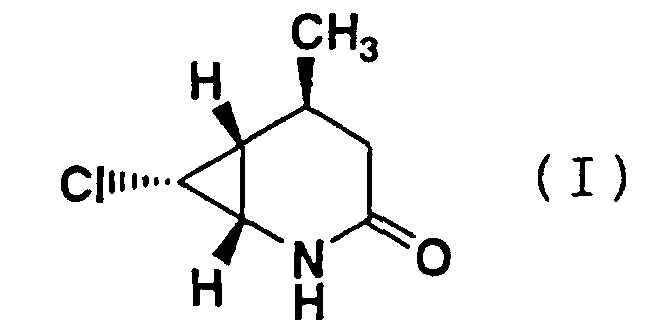
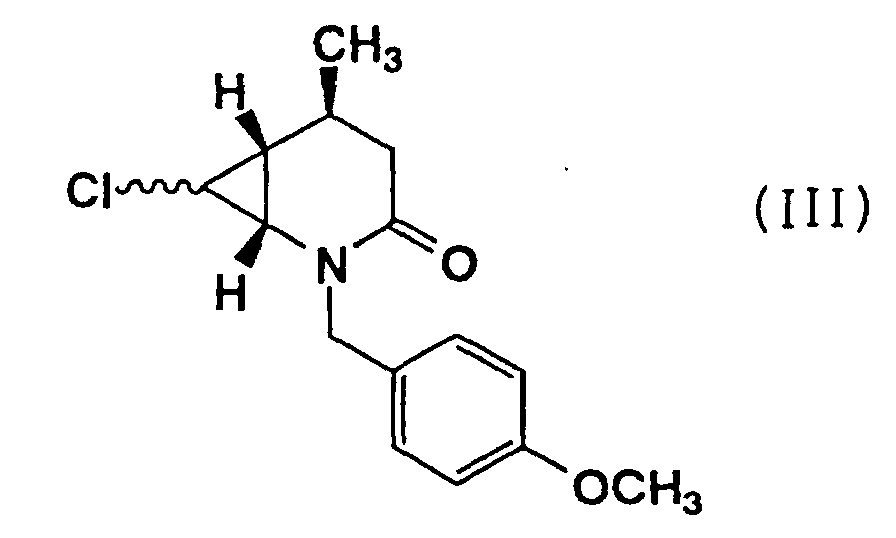
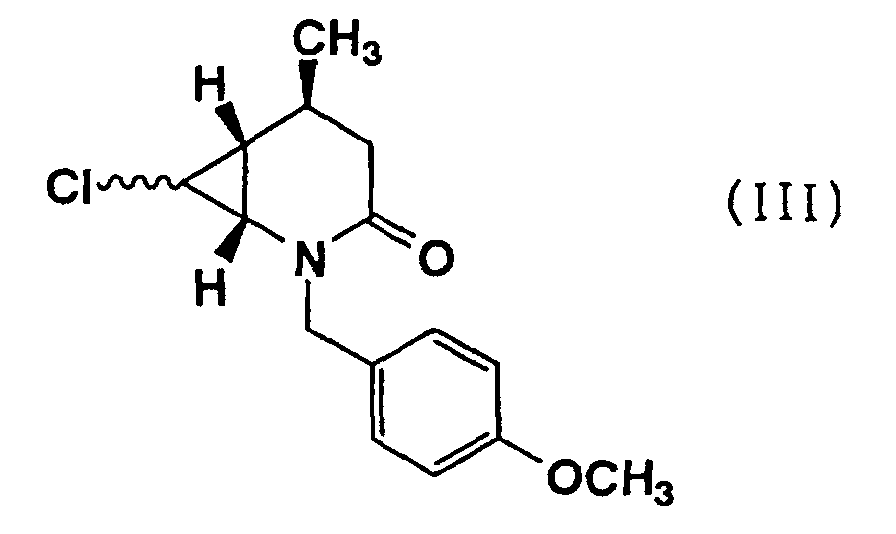
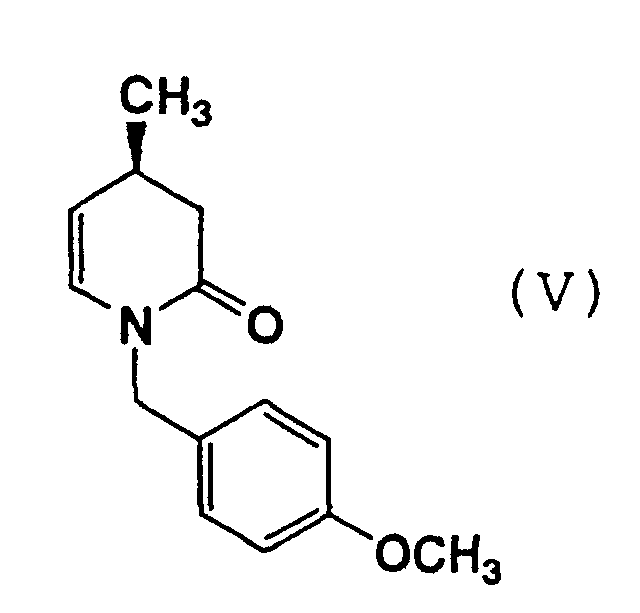
- the invention relates to the process for the preparation of the intermediate compound of pharmaceuticals represented by formula (I), (1S, 5S, 6R, 7R)-2-aza-7-chloro-5-methyl-3-oxobicyclo[4.1.0]heptane, by preparing compound (II) from (45)-1-(4-methoxybenzyl)-4-methyl-5,6-dehydro-2-piperidone represented by following formula (V) via compounds represented by formula (IV), (III) and (II), then by selective crystallizing the compound (II), and the novel compound which is the intermediate of the above-mentioned process for the preparation represented by formula (III).
- the step (a) is dangerous reaction because of difficulty to control reaction temperature. Moreover, tarry by-product, which is insoluble in water or most of organic solvent, is formed in the step (a). The by-product can not be removed by simple method like extraction, etc., so purification using column chromatography is necessary. Washing of the reaction vessel to which the by-product adhered is very difficult and troublesome.
- step (b) though expensive boron trifluoride diethyl etherate is used, it is fuming reagent and difficult to treat. Also, heating is necessary in this reaction, but it takes long reaction time because low boiling point of ether prevents to rise the reaction temperature. This problem becomes serious as it tries to synthesize the compound voluminously.
- anisole is used for trapping eliminated p-methoxybenzyl group. And this reaction takes long reaction time, and it has low yield and low reactivity with by-product. Moreover, the removing process of anisole trapping p-methoxybenzyl group is troublesome; for example, purification using column chromatography is necessary. Although BHT (2,6-di-t-butyl-4-methylphenol) is known as the reagent improved in reactivity, which can be replaced with anisole, it also needs purification by column chromatography. (4) It is described that the step (b) can be carried out with thioanisole or trifluoroacetic acid. But these reactions are low yield and form many by-products.
- step (c) and (d), using tributyltin hydride or triphenyltin hydride are a chain reaction where radicals react successively, which are generated by 2,2'-azobisisobutyronitrile, and therefore control of both rate of the reaction and generation of heat are difficult, and heat might go beyond control. Moreover, it is necessary to remove poisonous tin in the reaction system completely. Separation and purification using column chromatography are necessary to obtain the compound having desired stereo configuration.
- the invention relates to the process for the preparation of (1S, 5S, 6R, 7R)-2-aza-7-chloro-5-methyl-3-oxobicyclo[4.1.0]heptane represented by formula (I): by preparing compound represented by formula (II): from (4S)-1-(4-Methoxybenzyl)-4-methyl-5,6-dehydro-2-piperidone represented by formula (V) through the novel intermediate compound represented by formula (III): and selectively crystallizing the compound (II) and separating, and the novel intermediate compound of the process represented by formula (III).
- the compound represented by formula (III): is included in the range of the formula (A-2) in the above-mentioned specification, but there is no concrete description in the above-mentioned specification. That is, the compound represented by formula (III) is the novel compound in the course of the investigations to search effective process for the preparation of the compound represented by formula (I).
- reaction scheme 1 The process for the preparation of the present invention is shown in reaction scheme 1.
- the step (I) is ring formation reaction and may be carried out, for example, in the presence of base (e.g., sodium methoxide, sodium ethoxide, sodium t-butoxide, potassium methoxide, potassium ethoxide or potassium t-butoxide), by using trichloroacetic acid derivatives (e.g., trichloroacetic acid, methyl trichloroacetate or ethyl trichloroacetate), in an organic solvent (e.g., toluene, ether series (e.g., dimethyl carbonate, diethyl carbonate, dimethoxyethane, tetrahydrofuran or diethyl ether) or a mixture thereof) at a temperature of from 0 to 40 °C.
- base e.g., sodium methoxide, sodium ethoxide, sodium t-butoxide, potassium methoxide, potassium ethoxide or potassium t-butoxide
- the step (ii) is dechlorination reaction and may be carried out, for example, by using zinc (e.g., zinc dust, zinc foil or zinc granule) and amine (e.g., ethylenediamine or diethylenetriamine), in a water-soluble organic solvent (e.g., methanol, ethanol, isopropanol, butanol or ethyleneglycol) or mixture of water at a temperature of from 0 degree to reflux temperature.
- This reaction may be preferably carried out in the presence of a divalent lead compound (e.g., lead (II) acetate).
- the step (iii) is deprotection reaction and may be carried out, for example, by using an acid (e.g., methanesulfonic acid or sulfuric acid) in an organic solvent (e.g., toluene or hexane) at a temperature of from 90 °C to reflux temperature.
- an acid e.g., methanesulfonic acid or sulfuric acid
- an organic solvent e.g., toluene or hexane
- the step (iv) is selective crystallization and separation by filtration.
- hydroxide of alkali metal e.g., sodium hydroxide, potassium hydroxide or lithium hydroxide
- hydroxide of alkaline earth metal e.g., magnesium hydroxide or calcium hydroxide
- carbonate e.g., sodium bicarbonate, sodium carbonate or potassium carbonate
- the appeared crystal is collected by suction and washed with water.
- the raw material compound represented by formula (V) is known, and may be prepared by the methods of the following reaction scheme 2 (tokukaihei 11-209345).
- the other starting materials and each agent in the present invention are known per se , or may be prepared by conventional method.
- (1S, 5S, 6R, 7R)-2-aza-7-chloro-5-methyl-3-oxobicyclo[4.1.0]heptane represented by formula (I): is selectively manufactured by easy operations; it is excellent in safety, reactivity, ease in operations and cost, etc.
- the step (i) is the reaction, which described in EP870763, and when the operation is carried out according to the specification, the reaction isdangerous because of difficulty of thermally control. Moreover, tarry by-product is formed in the reaction, so purification using column chromatography is necessary to remove it. The reaction is also troublesome in after-treatment.
- trichloroacetic acid derivative e.g., trichloroacetic acid, methyl trichloroacetate or ethyl trichloroacetate
- tarry by-product is not generated, complicated removing operation is unnecessary, and the yield is improved from 60 % (EP870763, Example 1) to 73 %.
- the step (ii) is the reaction that the compound represented by formula (III) can be obtained effectively by safe method without an over-evolution of heat using inexpensive agent. And impurity can be removed by easy operation like filtration and extraction.
- additive e.g., acetic acid, hydrochloric acid, sulfuric acid, potassium hydroxide or sodium hydroxide
- addition of amine e.g., ethylenediamine or diethylenetriamine
- zinc e.g., zinc dust, zinc foil or zinc granule
- amine e.g., ethylenediamine or diethylenetriamine
- divalent lead compound e.g., lead (II) acetate
- the preferable ratio of additive lead compound against the compound represented by formula (IV) is 0.2 mol% ⁇ 20 mol%.
- the step (iii) can be carried out using inexpensive reagent in a short time, without expensive reagent, which has problem that it prevents on increase in reaction temperature.
- column chromatography is unnecessary and the by-product can be removed by extraction with an organic solvent.
- step (iv) gives (7R)-chloro form compound selectively, having desired stereo configuration, as crystal by adding alkaline solution and by easy operation like crystallization and filtration, without purification by column chromatography.
- reaction products may be purified by conventional techniques. For example, purification may be carried out by distillation at atmospheric or reduced pressure, high performance liquid chromatography, thin layer chromatography or column chromatography using silica gel or magnesium silicate, by washing or recrystallization, etc. Purification may be carried out after each reaction, or after a series of reactions.
- the symbol indicates that the substituent attached thereto is in front of the sheet ( ⁇ -position), unless otherwise specified, the symbol indicates that the substituent attached thereto is behind the sheet ( ⁇ -position), unless otherwise specified, the symbol indicates that the substituent attached thereto is ⁇ -position or ⁇ -position, or the mixture of the compounds that the substituent attached thereto is ⁇ -position and ⁇ position, the symbol indicates the mixture of the compounds that the substituent attached thereto is ⁇ -position and ⁇ -position.
- isomers are included in the present invention.
- Isomers generated by the existence of asymmetric carbon atom(s) e.g., R, S isomers, ⁇ , ⁇ isomers, enantiomers, diastereomers
- optically active isomers having optically rotatory power D, L, d, I isomers
- This invention offers the process for the preparation of the compound represented by formula (I), (1S, 5S, 6R, 7R)-2-aza-7-chloro-5-methyl-3-oxobicyclo[4.1.0]heptane, by preparing compound (II) from (4S)-1-(4-methoxybenzyl)-4-methyl-5,6-dehydro-2-piperidone represented by the formula (V) via compounds represented by formula (IV), (III) and (II), then by selective crystallizing the compound (II), and the novel compound, intermediate of the process for the preparation represented by the formula (III).
- the process for the preparation in the present invention is the excellent one without the problems of prior art in safety, reactivity, ease in operations and cost, etc.
- the solvents in the parentheses show the developing or eluting solvents and the ratios of the solvents used are by volume in chromatographic separations or TLC.
- the solvents in the parentheses in NMR show the solvents used in measurement.
- the crystalline was collected by suction, washed with ice-cooled toluene with stirring, and then washed with ice-cooled toluene (600 ml, twice) and n-hexane (400 ml) (second crop). The first crop and second one were combined and dried under reduced pressure to give the title compound (1071.1 g; 35.2 %) having the following physical data.
- the impurity was filtered off and washed with methanol (74 ml). The filtrate was concentrated under reduced pressure. To the concentrate was added t-butyl methyl ether (220 ml) and water (220 ml) and then extracted. The aqueous layer was extracted with t-butyl methyl ether (220 ml). The organic layers were combined, washed with 1M hydrochloric acid (37 ml, twice), water (74 ml) and a saturated aqueous solution of sodium chloride (74 ml), successively, and concentrated under reduced pressure. The residue was azeotroped with toluene (74 ml) twice to give the title compound (32.7 g; 99.6 %) having the following physical data.
- Example 2(1) The compound prepared in Example 2(1) (4930 g) was dissolved in the mixture of methanesulfonic acid (16913 g) and toluene (14.9 L) and the mixture was refluxed for 2 hours.
- the reaction mixture was cooled to room temperature, diluted with cooled water (ca. 5 °C; 19.8 L), added n-hexane (29.8 L) and removed impurity.
- the aqueous layer was washed with n-hexane (29.8 L) and toluene (14.9 L).
- To the aqueous layer was added dropwise 4 mol/L aqueous solution of sodium hydroxide (44.3 L) under ice-cooling, then crystalline was appeared.
- Example 3 The compound prepared in Example 3 (1400 g) was dissolved in dimethyl carbonate (35 L) under an atmosphere of argon. To a solution was added Meerwein reagent (trimethyloxonium tetrafluoroborate) (2594 g) and the mixture was stirred at room temperature for 3 hours under an atmosphere of argon. To a reaction solution were added t-butyl methyl ether (35 L) and an aqueous solution of sodium bicarbonate (35 L) and the mixture was stirred. The two layers were separated and the aqueous layer was extracted with ethyl acetate.
- Meerwein reagent trimethyloxonium tetrafluoroborate
- Example 4 To the compound prepared in Example 4 were added ethanol (8.8 L) and ammonium acetate (2029 g) and the mixture was refluxed for 1.5 hours. The reaction solution was cooled to 5 °C, added ethyl acetate (35 L) and stirred for 10 minutes. Precipitate was filtered off and washed with ethyl acetate (8.8 L). The filtrate was concentrated under reduced pressure and the residue was dissolved in ethanol (8.8 L). The solution was cooled to 5 °C, added 4N hydrogen chloride in ethyl acetate (8.8 L) and ethyl acetate, successively, and stirred at 5 °C for 30 minutes.
- Appeared crystal was collected by suction, washed with ethyl acetate (8.8 L) twice and dried under reduced pressure at 25 °C overnight to give the title crude compound (1197 g; 70 %).
- To the crude product (983 g) were added ethanol (13 L) and ethyl acetate (2 L), the mixture was heated to the internal temperature 60-70 °C to dissolve.
- the solution was filtered and washed with ethanol (1 L).
- the filtrate was keptstanding to cool and then stirred for 30 minutes under cooling with ice.
- the solution was filtered and the obtained crystal was washed with ethyl acetate / ethanol (2 L / 1 L).
Landscapes
- Chemical & Material Sciences (AREA)
- Organic Chemistry (AREA)
- Organic Low-Molecular-Weight Compounds And Preparation Thereof (AREA)
- Hydrogenated Pyridines (AREA)
- Nitrogen Condensed Heterocyclic Rings (AREA)
- Nitrogen And Oxygen Or Sulfur-Condensed Heterocyclic Ring Systems (AREA)
Abstract
The present invention relates to a process for preparing selectively compound
(I), (1S, 5S, 6R, 7R)-2-aza-7-chloro-5-methyl-3-oxobicyclo[4.1.0]heptane, by preparing
compound (II) from compound (V) through compound (III) via a series of reactions, and
by crystallizing the obtained compound (II); and the novel intermediate compound
represented by the structural formula (III) and hydrate salts thereof.
Description
This invention relates to the process for the preparation of intermediate
compounds useful as pharmaceuticals represented by formula (X):
 and novel intermediate compound.
More specifically, the invention relates to the process for the preparation of the
intermediate compound of pharmaceuticals represented by formula (I), (1S, 5S, 6R,
7R)-2-aza-7-chloro-5-methyl-3-oxobicyclo[4.1.0]heptane, by preparing compound (II)
from (45)-1-(4-methoxybenzyl)-4-methyl-5,6-dehydro-2-piperidone represented by
following formula (V) via compounds represented by formula (IV), (III) and (II), then by
selective crystallizing the compound (II), and the novel compound which is the
intermediate of the above-mentioned process for the preparation represented by
formula (III).
It is disclosed in EP870763 that the compounds useful as pharmaceuticals
represented by formula (A):
 wherein -R1A- represents a 3- or 4-membered carbocyclic ring together with carbon atom
or atoms to which it is bonded, the carbocyclic ring being condensed side d or e of the
piperidine ring or bonded to the 4-position of the piperidine ring through a spiro-union,
R2A represents a C1∼6 alkyl group, R3A represents a C1∼6 alkyl group, a C2∼6 alkenyl
group or halogen atom, R4A represents a hydrogen atom, an amino-C1∼4 alkyl or a
carbocyclic ring-C1∼4 alkyl group which may be substituted with an amino-C1∼4 alkyl
group, iA represents 0 or an integer of 1 to 3, nA represents 0 or an integer of 1 to 3, and
the plural R2As or R3As are the same or different
wherein -R1A- represents a 3- or 4-membered carbocyclic ring together with carbon atom
or atoms to which it is bonded, the carbocyclic ring being condensed side d or e of the
piperidine ring or bonded to the 4-position of the piperidine ring through a spiro-union,
R2A represents a C1∼6 alkyl group, R3A represents a C1∼6 alkyl group, a C2∼6 alkenyl
group or halogen atom, R4A represents a hydrogen atom, an amino-C1∼4 alkyl or a
carbocyclic ring-C1∼4 alkyl group which may be substituted with an amino-C1∼4 alkyl
group, iA represents 0 or an integer of 1 to 3, nA represents 0 or an integer of 1 to 3, and
the plural R2As or R3As are the same or different
and the process for preparation thereof.
and the process for preparation thereof.
In the above-mentioned specification, it is disclosed that the process for the
preparation of compounds represented by formula (A-1):
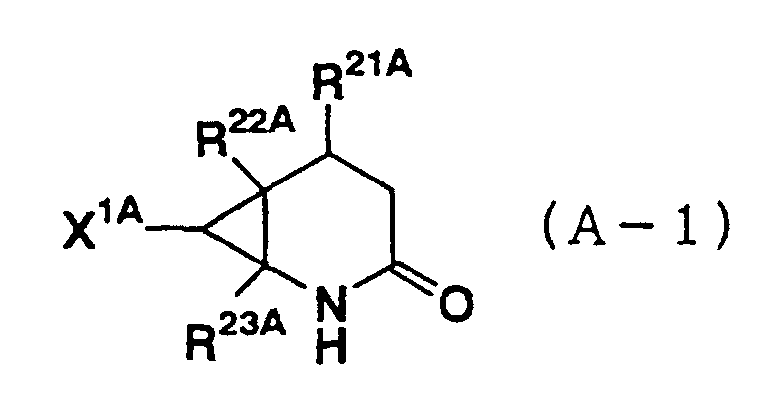 wherein R21A represents a hydrogen atom or C1∼6 alkyl group, R22A represents a
hydrogen atom or C1∼6 alkyl group, R23A represents a hydrogen atom or C1∼6 alkyl, X1A
represents a halogen atom
wherein R21A represents a hydrogen atom or C1∼6 alkyl group, R22A represents a
hydrogen atom or C1∼6 alkyl group, R23A represents a hydrogen atom or C1∼6 alkyl, X1A
represents a halogen atom
and compounds represented by formula (A-2): wherein all symbols are the same meaning as hereinbefore defined
as intermediate of compounds represented by formula (A).
wherein all symbols are the same meaning as hereinbefore defined
as intermediate of compounds represented by formula (A).
and compounds represented by formula (A-2):
Its process for the preparation is shown in reaction schemes (A) and (B).


In the above-mentioned specification, it is disclosed that the process for the
preparation of the compound represented by formula
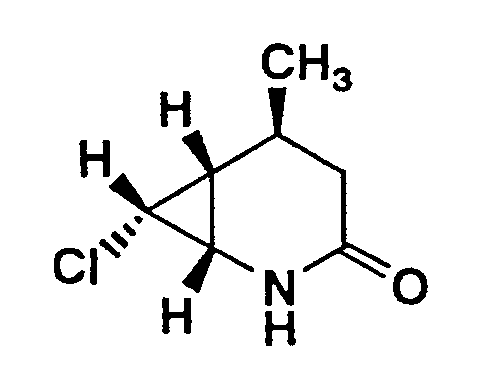 as a concrete example of the formula (A-1) in Reference example 7.
On the other hand, the concrete example of the compound represented by the
formula (A-2) is not disclosed in the above-mentioned specification.
In addition, reactions described in above-mentioned reaction schemes (A), (B)
and Reference example 7 in above-mentioned specification have some problems in
safety, reactivity, ease in operations and cost, etc.
More specifically, (1) The step (a) is dangerous reaction because of difficulty to
control reaction temperature. Moreover, tarry by-product, which is insoluble in water or
most of organic solvent, is formed in the step (a). The by-product can not be removed
by simple method like extraction, etc., so purification using column chromatography is
necessary. Washing of the reaction vessel to which the by-product adhered is very
difficult and troublesome.
(2) In the step (b), though expensive boron trifluoride diethyl etherate is used, it is fuming reagent and difficult to treat. Also, heating is necessary in this reaction, but it takes long reaction time because low boiling point of ether prevents to rise the reaction temperature. This problem becomes serious as it tries to synthesize the compound voluminously.
(3) In the step (b), anisole is used for trapping eliminated p-methoxybenzyl group. And this reaction takes long reaction time, and it has low yield and low reactivity with by-product. Moreover, the removing process of anisole trapping p-methoxybenzyl group is troublesome; for example, purification using column chromatography is necessary. Although BHT (2,6-di-t-butyl-4-methylphenol) is known as the reagent improved in reactivity, which can be replaced with anisole, it also needs purification by column chromatography.
(4) It is described that the step (b) can be carried out with thioanisole or trifluoroacetic acid. But these reactions are low yield and form many by-products.
(5) The step (c) and (d), using tributyltin hydride or triphenyltin hydride, are a chain reaction where radicals react successively, which are generated by 2,2'-azobisisobutyronitrile, and therefore control of both rate of the reaction and generation of heat are difficult, and heat might go beyond control. Moreover, it is necessary to remove poisonous tin in the reaction system completely. Separation and purification using column chromatography are necessary to obtain the compound having desired stereo configuration.
(2) In the step (b), though expensive boron trifluoride diethyl etherate is used, it is fuming reagent and difficult to treat. Also, heating is necessary in this reaction, but it takes long reaction time because low boiling point of ether prevents to rise the reaction temperature. This problem becomes serious as it tries to synthesize the compound voluminously.
(3) In the step (b), anisole is used for trapping eliminated p-methoxybenzyl group. And this reaction takes long reaction time, and it has low yield and low reactivity with by-product. Moreover, the removing process of anisole trapping p-methoxybenzyl group is troublesome; for example, purification using column chromatography is necessary. Although BHT (2,6-di-t-butyl-4-methylphenol) is known as the reagent improved in reactivity, which can be replaced with anisole, it also needs purification by column chromatography.
(4) It is described that the step (b) can be carried out with thioanisole or trifluoroacetic acid. But these reactions are low yield and form many by-products.
(5) The step (c) and (d), using tributyltin hydride or triphenyltin hydride, are a chain reaction where radicals react successively, which are generated by 2,2'-azobisisobutyronitrile, and therefore control of both rate of the reaction and generation of heat are difficult, and heat might go beyond control. Moreover, it is necessary to remove poisonous tin in the reaction system completely. Separation and purification using column chromatography are necessary to obtain the compound having desired stereo configuration.
A variety of investigations have been carried out to synthesis the compound
promising as pharmaceuticals represented by the formula (X).

As a result, the present inventors have found the simple and easy process for
the preparation of the intermediate compound represented by formula (I) and the novel
intermediate compound represented by formula (III).
That is, the invention relates to the process for the preparation of (1S, 5S, 6R,
7R)-2-aza-7-chloro-5-methyl-3-oxobicyclo[4.1.0]heptane represented by formula (I):
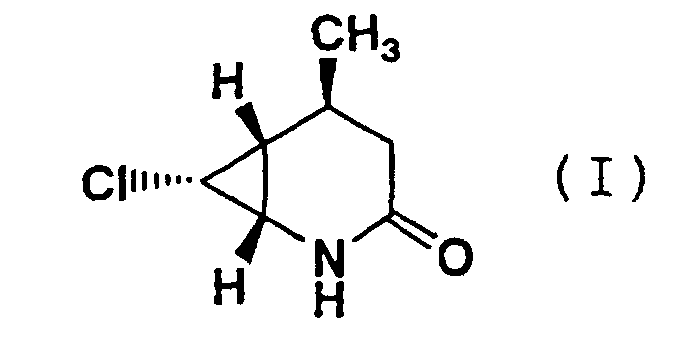 by preparing compound represented by formula (II):
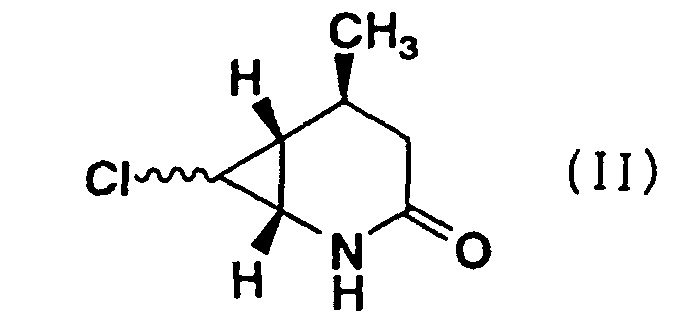 from (4S)-1-(4-Methoxybenzyl)-4-methyl-5,6-dehydro-2-piperidone represented by
formula (V) through the novel intermediate compound represented by formula (III):
from (4S)-1-(4-Methoxybenzyl)-4-methyl-5,6-dehydro-2-piperidone represented by
formula (V) through the novel intermediate compound represented by formula (III):
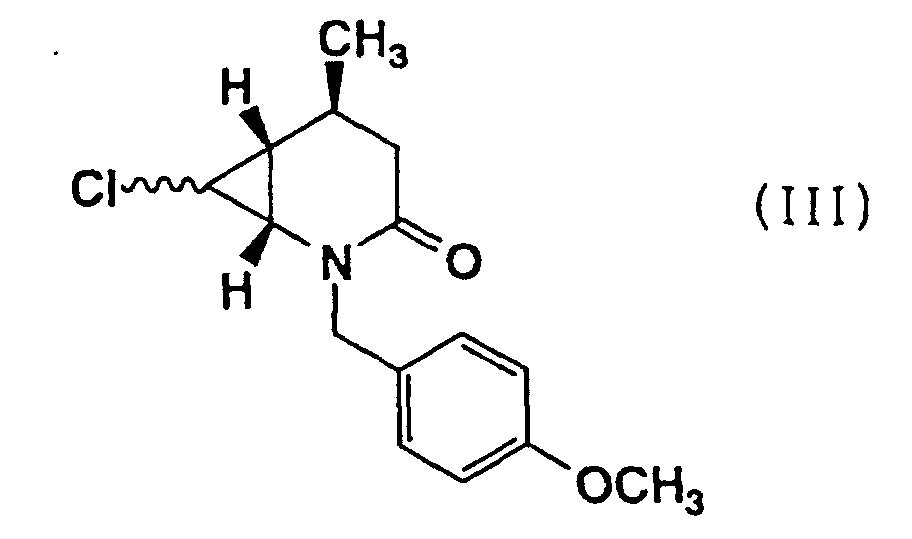 and selectively crystallizing the compound (II) and separating, and the novel intermediate
compound of the process represented by formula (III).
and selectively crystallizing the compound (II) and separating, and the novel intermediate
compound of the process represented by formula (III).
The compound represented by formula (III):
 is included in the range of the formula (A-2) in the above-mentioned specification, but
there is no concrete description in the above-mentioned specification. That is, the
compound represented by formula (III) is the novel compound in the course of the
investigations to search effective process for the preparation of the compound
represented by formula (I).
is included in the range of the formula (A-2) in the above-mentioned specification, but
there is no concrete description in the above-mentioned specification. That is, the
compound represented by formula (III) is the novel compound in the course of the
investigations to search effective process for the preparation of the compound
represented by formula (I).
The process for the preparation of the present invention is shown in reaction
scheme 1.

The step (I) is ring formation reaction and may be carried out, for example, in
the presence of base (e.g., sodium methoxide, sodium ethoxide, sodium t-butoxide,
potassium methoxide, potassium ethoxide or potassium t-butoxide), by using
trichloroacetic acid derivatives (e.g., trichloroacetic acid, methyl trichloroacetate or ethyl
trichloroacetate), in an organic solvent (e.g., toluene, ether series (e.g., dimethyl
carbonate, diethyl carbonate, dimethoxyethane, tetrahydrofuran or diethyl ether) or a
mixture thereof) at a temperature of from 0 to 40 °C.
The step (ii) is dechlorination reaction and may be carried out, for example, by
using zinc (e.g., zinc dust, zinc foil or zinc granule) and amine (e.g., ethylenediamine or
diethylenetriamine), in a water-soluble organic solvent (e.g., methanol, ethanol,
isopropanol, butanol or ethyleneglycol) or mixture of water at a temperature of from 0
degree to reflux temperature. This reaction may be preferably carried out in the
presence of a divalent lead compound (e.g., lead (II) acetate).
The step (iii) is deprotection reaction and may be carried out, for example, by
using an acid (e.g., methanesulfonic acid or sulfuric acid) in an organic solvent (e.g.,
toluene or hexane) at a temperature of from 90 °C to reflux temperature.
The step (iv) is selective crystallization and separation by filtration. For
example, it is carried out by adding hydroxide of alkali metal (e.g., sodium hydroxide,
potassium hydroxide or lithium hydroxide), hydroxide of alkaline earth metal (e.g.,
magnesium hydroxide or calcium hydroxide) or carbonate (e.g., sodium bicarbonate,
sodium carbonate or potassium carbonate) or an aqueous solution thereof or a mixture
thereof to the mixture at a temperature of from -20 to 40 °C, and then, the appeared
crystal is collected by suction and washed with water.
The each steps hereinbefore described may be preferably carried out in an
atmosphere of inert gas.
By the processes of (i)∼(iv), the desired compound can be obtained as crystal.
The raw material compound represented by formula (V) is known, and may be
prepared by the methods of the following reaction scheme 2 (tokukaihei 11-209345).

In the reaction scheme 2, the compound using as starting material is known
(tokukaihei 11-209345, Example 1).
The other starting materials and each agent in the present invention are known
per se, or may be prepared by conventional method.
According to the process for the preparation of the present invention, (1S, 5S,
6R, 7R)-2-aza-7-chloro-5-methyl-3-oxobicyclo[4.1.0]heptane represented by formula (I):
 is selectively manufactured by easy operations; it is excellent in safety, reactivity, ease in
operations and cost, etc.
is selectively manufactured by easy operations; it is excellent in safety, reactivity, ease in
operations and cost, etc.
The feature of the process for the preparation of the present invention is
mentioned concretely on the basis of the reaction scheme 1 hereinbefore described.
The step (i) is the reaction, which described in EP870763, and when the
operation is carried out according to the specification, the reaction isdangerous because
of difficulty of thermally control. Moreover, tarry by-product is formed in the reaction, so
purification using column chromatography is necessary to remove it. The reaction is
also troublesome in after-treatment.
However, the present inventors have found that the use of trichloroacetic acid
derivative (e.g., trichloroacetic acid, methyl trichloroacetate or ethyl trichloroacetate)
which defers from the agents described in EP870763, can be accomplished easy control
of temperature and safe reaction. Moreover, because tarry by-product is not generated,
complicated removing operation is unnecessary, and the yield is improved from 60 %
(EP870763, Example 1) to 73 %.
The step (ii) is the reaction that the compound represented by formula (III) can
be obtained effectively by safe method without an over-evolution of heat using
inexpensive agent. And impurity can be removed by easy operation like filtration and
extraction.
As regard this step, it is known that additive (e.g., acetic acid, hydrochloric acid,
sulfuric acid, potassium hydroxide or sodium hydroxide) was added to zinc in the reaction.
But these additives have no effect to give chloro-form having desired stereoconfiguration
(R-form) in the present invention with high ratio.
On the other hand, addition of amine (e.g., ethylenediamine or
diethylenetriamine) to zinc (e.g., zinc dust, zinc foil or zinc granule) gives improvement
on stereoselectivity of reduction against chlorine atom, so the chloro-form having desired
stereo configuration (R-form) can be obtained with high ratio. In the reaction system,
addition of divalent lead compound (e.g., lead (II) acetate) is preferable. By adding the
divalent lead compound, the effect of stereoselectivity on reduction against chlorine atom
is stabilized and improved. The preferable ratio of additive lead compound against the
compound represented by formula (IV) is 0.2 mol%∼20 mol%.
These beneficial facts to obtain the desired compound are found for the first
time by the inventors in the present invention.
The step (iii) can be carried out using inexpensive reagent in a short time,
without expensive reagent, which has problem that it prevents on increase in reaction
temperature. On removing operation of the by-product derived from eliminated p-methoxybenzyl
group, column chromatography is unnecessary and the by-product can
be removed by extraction with an organic solvent.
The step (iv) gives (7R)-chloro form compound selectively, having desired
stereo configuration, as crystal by adding alkaline solution and by easy operation like
crystallization and filtration, without purification by column chromatography.
This step that provides the desired (7R)-chloro form compound by
crystallization from the mixture of stereoisomers without purification by column
chromatography is found for the first time by the inventors in the present invention.
In each reaction described in the present specification, reaction products may
be purified by conventional techniques. For example, purification may be carried out by
distillation at atmospheric or reduced pressure, high performance liquid chromatography,
thin layer chromatography or column chromatography using silica gel or magnesium
silicate, by washing or recrystallization, etc. Purification may be carried out after each
reaction, or after a series of reactions.
The compound represented by formula (III) of the present invention in the
present specification may be converted into the corresponding hydrate by conventional
means.
In the present invention, as may be easily understood by those skilled in the art,
the symbol  indicates that the substituent attached thereto is in front of the sheet (β
-position), unless otherwise specified, the symbol
indicates that the substituent attached thereto is in front of the sheet (β
-position), unless otherwise specified, the symbol  indicates that the substituent
attached thereto is behind the sheet (α-position), unless otherwise specified, the symbol
indicates that the substituent
attached thereto is behind the sheet (α-position), unless otherwise specified, the symbol
 indicates that the substituent attached thereto is β-position or α-position, or the
mixture of the compounds that the substituent attached thereto is β-position and αposition,
the symbol
indicates that the substituent attached thereto is β-position or α-position, or the
mixture of the compounds that the substituent attached thereto is β-position and αposition,
the symbol  indicates the mixture of the compounds that the substituent
attached thereto is β-position and α-position.
indicates the mixture of the compounds that the substituent
attached thereto is β-position and α-position.
Unless othewise specified, all isomers are included in the present invention.
For example, Isomers generated by the existence of asymmetric carbon atom(s) (e.g., R,
S isomers, α, β isomers, enantiomers, diastereomers), optically active isomers having
optically rotatory power (D, L, d, I isomers) are all included in the present invention.
This invention offers the process for the preparation of the compound
represented by formula (I), (1S, 5S, 6R, 7R)-2-aza-7-chloro-5-methyl-3-oxobicyclo[4.1.0]heptane,
by preparing compound (II) from (4S)-1-(4-methoxybenzyl)-4-methyl-5,6-dehydro-2-piperidone
represented by the formula (V) via compounds
represented by formula (IV), (III) and (II), then by selective crystallizing the compound
(II), and the novel compound, intermediate of the process for the preparation
represented by the formula (III).
The process for the preparation in the present invention is the excellent one
without the problems of prior art in safety, reactivity, ease in operations and cost, etc.
The following reference examples and examples illustrate the present invention,
but do not limit the present invention.
The solvents in the parentheses show the developing or eluting solvents and
the ratios of the solvents used are by volume in chromatographic separations or TLC.
The solvents in the parentheses in NMR show the solvents used in
measurement.
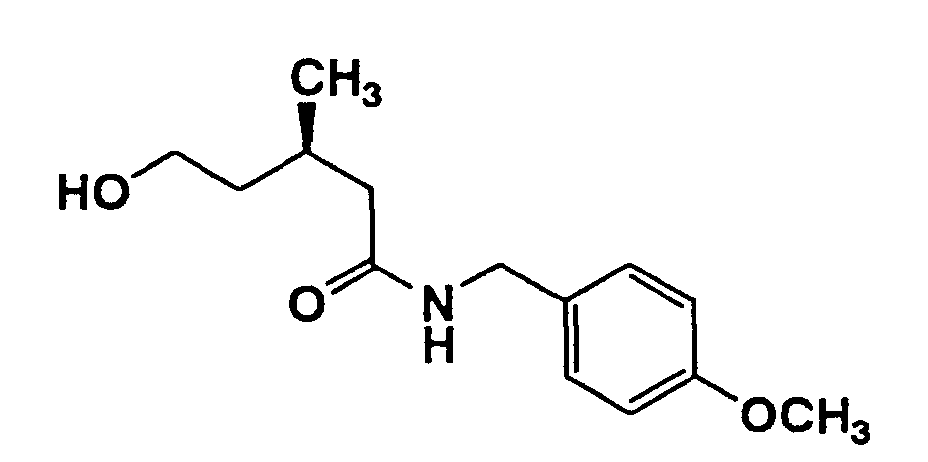
To a mixture of methyl (3R)-5-hydroxy-3-methylpentanoate (1780 g) and
toluene (25 L) in reaction vessel was added 4-methoxybenzylamine (1800 ml) with
stirring and the mixture was refluxed for 1.5 hours (the temperature of the reaction
mixture at the beginning of reflux is ca. 110°C and its temperature after 1.5 hours is ca.
105 °C). Toluene (12.5 L) was removed from the mixture and the residue was refluxed
for additional 1.5 hours. To the mixture was added 4-methoxybenzylamine (125 ml) and
the mixture was refluxed for ca. 1 hour. After the reaction was completed, toluene was
removed under reduced pressure. The residue was diluted with ethyl acetate (25 L) and
washed with 1N hydrochloric acid (5 L, twice) and a saturated aqueous solution of
sodium chloride (4 L). The aqueous solution were combined and extracted with ethyl
acetate (4 L, 3 times). The organic layers were combined, dried over anhydrous
magnesium sulfate and filtered. The solution was concentrated under reduced pressure
to give the title compound (3.11 kg; 100% up) having the following physical data. The
obtained crude crystal was used to next reaction without further purification.
TLC: Rf 0.40 (n-Hexane:Ethyl acetate=1:1);
Mass: (APCl, Pos., 40V) 252 (M+H)+, 136, 121;
NMR (CDCl3): δ 7.24-7.14 (2H, m), 6.90-6.82 (2H, m), 6.03 (1H, br), 4.36 (2H, d, J = 5.6 Hz), 3.79 (3H, s), 3.72-3.59 (2H, m), 2.99 (1H, br), 2.29-2.01 (3H, m), 1.59-1.46 (2H, m), 0.97 (3H, d, J = 6.6 Hz).
TLC: Rf 0.40 (n-Hexane:Ethyl acetate=1:1);
Mass: (APCl, Pos., 40V) 252 (M+H)+, 136, 121;
NMR (CDCl3): δ 7.24-7.14 (2H, m), 6.90-6.82 (2H, m), 6.03 (1H, br), 4.36 (2H, d, J = 5.6 Hz), 3.79 (3H, s), 3.72-3.59 (2H, m), 2.99 (1H, br), 2.29-2.01 (3H, m), 1.59-1.46 (2H, m), 0.97 (3H, d, J = 6.6 Hz).

To a mixture of the compound prepared in Reference example 1 (3.07 kg) and
dimethyl sulfoxide (16.3 L) was added triethylamine (8.5 L) with stirring and the mixture
was cooled to below 20 °C. To the mixture was added slowly sulfur trioxide-pyridine
complex (5.83 kg) keeping the temperature below 40 °C. The mixture was stirred at
room temperature for 30 minutes. The reaction mixture was poured into ice-water (130
L), added ethyl acetate (30 L) and stirred for 3 minutes. After separation, aqueous layer
was extracted with ethyl acetate (30 L, 3 times). The organic layer was washed with 2N
hydrochloric acid (24 L, twice), water (24 L), a saturated aqueous solution of sodium
bicarbonate (24 L), and a saturated aqueous solution of sodium chloride (24 L),
successively, dried over anhydrous magnesium sulfate (1 kg), filtered and concentrated
under reduced pressure. Crystal was collected by suction from slurry concentrate and
washed with ice-cooled toluene (first crop). The mother liquid was concentrated under
reduced pressure, and allowed to stand under ice-cooling to give crystalline. After
crystallization, to the mixture was added ice-cooled toluene (300 ml) and the mixturewas
stirred. The crystalline was collected by suction, washed with ice-cooled toluene with
stirring, and then washed with ice-cooled toluene (600 ml, twice) and n-hexane (400 ml)
(second crop). The first crop and second one were combined and dried under reduced
pressure to give the title compound (1071.1 g; 35.2 %) having the following physical data.
TLC: Rf 0.64 (Ethyl acetate);
Mass: (APCl, Pos., 20V) : 250 (M+H)+;
NMR (CDCl3): δ 7.26-7.18 (2H, m), 6.89-6.80 (2H, m), 5.02-4.90 (2H, m), 4.32 (1H, d, J = 14.6 Hz), 3.79 (3H, s), 2.71-2.54 (2H, m), 2.44-2-20 (1H, m), 2.09-1.86 (2H, m), 1.47 (1H, ddd, J = 3.6, 12.8, 13.6 Hz), 1.01 (3H, d, J = 6.6 Hz).
TLC: Rf 0.64 (Ethyl acetate);
Mass: (APCl, Pos., 20V) : 250 (M+H)+;
NMR (CDCl3): δ 7.26-7.18 (2H, m), 6.89-6.80 (2H, m), 5.02-4.90 (2H, m), 4.32 (1H, d, J = 14.6 Hz), 3.79 (3H, s), 2.71-2.54 (2H, m), 2.44-2-20 (1H, m), 2.09-1.86 (2H, m), 1.47 (1H, ddd, J = 3.6, 12.8, 13.6 Hz), 1.01 (3H, d, J = 6.6 Hz).

A suspension of the compound prepared in Reference example 2 (7300 g) in
toluene (73 L) was refluxed for 1 hour. Toluene (ca. 37 L) was removed from the
reaction mixture. Then toluene (37 L) was added to the mixture and removed toluene
(ca.37 L) again. This operation was repeated once more. The content of water in the
concentrate was less than 0.1%, so the reaction mixture was concentrated under
reduced pressure to give the title compound. The title compound was used to next
reaction without further purification.

A mixture of the compound prepared in Reference example 2 (25 g), dimethyl
carbonate (250 ml) and phosphoric acid (393 mg) was refluxed for ca. 1 hour. The
reaction solution was concentrated under reduced pressure to give the title compound.
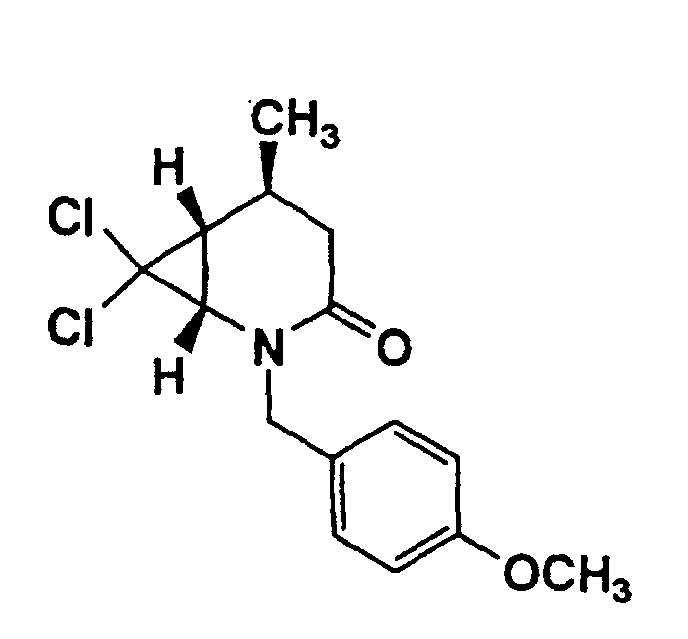
To the compound prepared in Reference example 3(1) was added dimethyl
carbonate (30 L) and then the mixture was concentrated. The operation wasrepeated
twice. To the residue was added dimethyl carbonate (60 L). The reaction solution was
cooled with water to below ca. 25 °C and then added sodium ethoxide (9962 g). The
reaction solution was cooled with water, added dropwise ethyl trichloroacetate (16820 g;
corresponding to ca 12.1 L) with keeping the temperature 20∼25 °C under cooling with
water and stirred for ca. 1 hour. The reaction solution was added water (59 L) and
extracted with t-butyl methyl ether (59 L). The aqueous layer was extracted with t-butyl
methyl ether (29 L). The organic layers were combined and washed with 1N aqueous
solution of sodium hydroxide (29 L), water (29 L) and a saturated aqueous solution of
sodium chloride (59 L), successively, and then concentrated under reduced pressure.
The residue was purified by column chromatography on silica gel toluene:ethyl
acetate=10:1). The obtained fraction was concentrated under reduced pressure and
the residue was azeotroped with methanol (15 L) twice to give the title compound (6738
g; 73 %) having the following physical data.
TLC: Rf 0.43 (n-Hexane:Ethyl acetate=2:1);
Mass: (APCI, Pos., 40V) : 314 (M+H, 35Cl)+, 121;
NMR (CDCl3): δ 7.33-7.22 (2H,m), 6.93 - 6.85 (2H, m), 5.44 (1H, d, J = 14.2 Hz), 3.81 (1H, d, J = 14.2 Hz), 3,81 (3H, s), 2.95 (1H,d,J = 9.8 Hz), 2.39 - 2.02 (3H, m), 1.76 (1H, dd,J = 5.4, 10.0 Hz), 1.25 (3H, d,J = 6.2 Hz).
TLC: Rf 0.43 (n-Hexane:Ethyl acetate=2:1);
Mass: (APCI, Pos., 40V) : 314 (M+H, 35Cl)+, 121;
NMR (CDCl3): δ 7.33-7.22 (2H,m), 6.93 - 6.85 (2H, m), 5.44 (1H, d, J = 14.2 Hz), 3.81 (1H, d, J = 14.2 Hz), 3,81 (3H, s), 2.95 (1H,d,J = 9.8 Hz), 2.39 - 2.02 (3H, m), 1.76 (1H, dd,J = 5.4, 10.0 Hz), 1.25 (3H, d,J = 6.2 Hz).
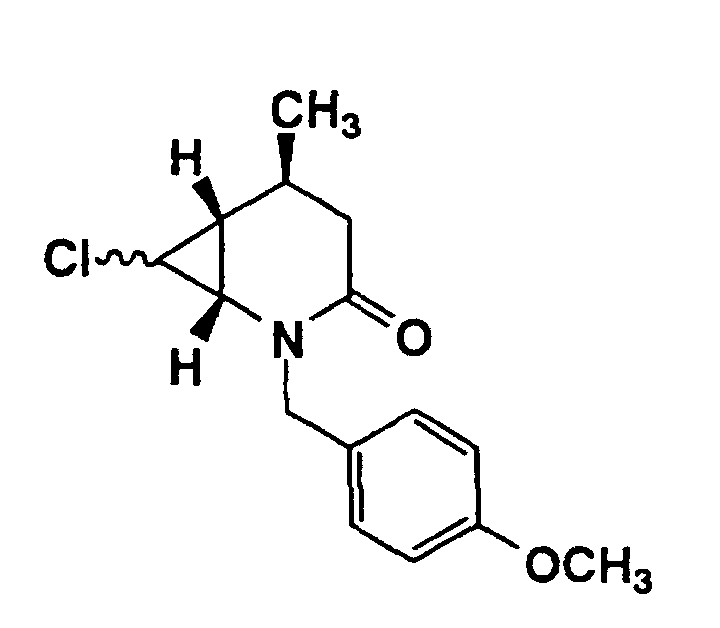
To a solution of the compound prepared in Example 1 (2936 g) in methanol
(11.8 L) was added purified water (2.95 L). To the solution was added zinc dust (94.6%,
Wako)(1223 g) and ethylenediamine (5620 g) and the mixture was stirred at reflux
temperature for 3 hours. The end point of the reaction was confirmed by HPLC analysis
(ratio of the product was (7R)-chloro form:(7S)-chloro form=78.9%:15.7%≒ 5:1). The
reaction solution was cooled to room temperature, added methanol (5.9 L) and stirred for
5 minutes. Moreover, this operation hereinbefore described was repeated once more
using the compound prepared in Example 1 (2936 g), then the obtained solution was
combined with previous one. The combined solution was filtered. The impurity was
filtered off and washed with methanol (11.7 L). The filtrate was concentrated under
reduced pressure. To the concentrate was added t-butyl methyl ether (35 L) and water
(35 L) and then extracted. The aqueous layer was extracted with t-butyl methyl ether
(35 L). The organic layers were combined, washed with 1M hydrochloric acid (5.9 L,
twice), water (11.7 L) and a saturated aqueous solution of sodium chloride (11.7 L),
successively, and concentrated under reduced pressure. The residue was azeotroped
with toluene (11.7 L) twice to give the title compound (4338 g; 83 %) having the following
physical data.
TLC: Rf 0.40 (n-Hexane: Ethyl acetate=2:1);
NMR (CDCl3): δ 7.30-7.20 (m, 2H), 6.90-6.80 (m, 2H), 5.50 (d, J = 14 Hz) and 4.75 (d, J = 14 Hz, 1H), 4.42 (d, J = 14 Hz) and 3.62 (d, J = 14 Hz, 1H), 3.80 (s, 3H), 3.25 (dd, J = 5.3, 3.5 Hz) and 2.65 (dd, J = 2.0, 3.6 Hz, 1H), 2.65 (dd, J = 6.8, 3,5 Hz) and 2.72 (dd, J = 7.2, 2.0 Hz, 1H), 2.40-2.10 (m, 3H), 1.45-1.10 (m, 1H), 1.20 (d, J = 4.5 Hz, 3H).
physical data.
TLC: Rf 0.40 (n-Hexane: Ethyl acetate=2:1);
NMR (CDCl3): δ 7.30-7.20 (m, 2H), 6.90-6.80 (m, 2H), 5.50 (d, J = 14 Hz) and 4.75 (d, J = 14 Hz, 1H), 4.42 (d, J = 14 Hz) and 3.62 (d, J = 14 Hz, 1H), 3.80 (s, 3H), 3.25 (dd, J = 5.3, 3.5 Hz) and 2.65 (dd, J = 2.0, 3.6 Hz, 1H), 2.65 (dd, J = 6.8, 3,5 Hz) and 2.72 (dd, J = 7.2, 2.0 Hz, 1H), 2.40-2.10 (m, 3H), 1.45-1.10 (m, 1H), 1.20 (d, J = 4.5 Hz, 3H).

To a solution of the compound prepared in Example 1 (36.9 g) in methanol (148
ml) was added purified water (37 ml). To the solution were added zinc dust (min. 95%,
Merck)(15.4 g), lead (II) acetate trihydrate (891 mg) and ethylenediamine (70.6 g) and
the mixture was stirred at reflux temperature for 3 hours. The end point of the reaction
was confirmed by HPLC analysis (ratio of the product was (7R)-chloro form:(7S)-chloro
form=72.1%:18.8%≒ 3.8:1). The reaction solution was cooled to room temperature,
added methanol (74 ml) and stirred for 5 minutes. The solution was filtered. The
impurity was filtered off and washed with methanol (74 ml). The filtrate was
concentrated under reduced pressure. To the concentrate was added t-butyl methyl
ether (220 ml) and water (220 ml) and then extracted. The aqueous layer was extracted
with t-butyl methyl ether (220 ml). The organic layers were combined, washed with 1M
hydrochloric acid (37 ml, twice), water (74 ml) and a saturated aqueous solution of
sodium chloride (74 ml), successively, and concentrated under reduced pressure. The
residue was azeotroped with toluene (74 ml) twice to give the title compound (32.7 g;
99.6 %) having the following physical data.
TLC: Rf 0.40 (n-Hexane:Ethyl acetate=2:1);
NMR (CDCl3): δ 7.30-7.20 (m, 2H), 6.90-6.80 (m, 2H), 5.50 (d, J = 14 Hz) and 4.75 (d, J = 14Hz, 1H), 4.42 (d, J = 14 Hz) and 3.62 (d, J = 14 Hz, 1H), 3.80 (s, 3H), 3.25 (dd, J = 5.3, 3.5 Hz) and 2.65 (dd, J = 2.0, 3.6 Hz, 1H), 2.65 (dd, J = 6.8, 3.5 Hz) and 2.72 (dd, J = 7.2, 2.0 Hz, 1H), 2.40-2.10 (m, 3H), 1.45-1.10 (m, 1H), 1.20 (d, J = 4.5 Hz, 3H).
TLC: Rf 0.40 (n-Hexane:Ethyl acetate=2:1);
NMR (CDCl3): δ 7.30-7.20 (m, 2H), 6.90-6.80 (m, 2H), 5.50 (d, J = 14 Hz) and 4.75 (d, J = 14Hz, 1H), 4.42 (d, J = 14 Hz) and 3.62 (d, J = 14 Hz, 1H), 3.80 (s, 3H), 3.25 (dd, J = 5.3, 3.5 Hz) and 2.65 (dd, J = 2.0, 3.6 Hz, 1H), 2.65 (dd, J = 6.8, 3.5 Hz) and 2.72 (dd, J = 7.2, 2.0 Hz, 1H), 2.40-2.10 (m, 3H), 1.45-1.10 (m, 1H), 1.20 (d, J = 4.5 Hz, 3H).

The compound prepared in Example 2(1) (4930 g) was dissolved in the mixture
of methanesulfonic acid (16913 g) and toluene (14.9 L) and the mixture was refluxed for
2 hours. The reaction mixture was cooled to room temperature, diluted with cooled
water (ca. 5 °C; 19.8 L), added n-hexane (29.8 L) and removed impurity. The aqueous
layer was washed with n-hexane (29.8 L) and toluene (14.9 L). To the aqueous layer
was added dropwise 4 mol/L aqueous solution of sodium hydroxide (44.3 L) under ice-cooling,
then crystalline was appeared. The temperature of aqueous solution was
cooled below 25 °C, the crystal was collected by suction and washed with water (19.8 L).
The obtained crystal was dried under reduced pressure overnight at 30 °C to give the
title compound (1547 g; 55 %) having the following physical data
TLC: Rf 0.39 (Ethyl acetate);
MASS (APCI, Pos., 40V): 160 (M+H, 35Cl)+, 124, 122;
NMR (CDCl3): δ 6.17 (1 H, br), 3.27 (1 H, dd, J = 5.2, 7.8 Hz), 2.87 (1 H, ddd, J = 1.2, 5.2, 9.2 Hz), 2.30-2.04 (3H, m), 1.37-1.22 (1H, m), 1.24 (3H, d, J = 6.0 Hz).
TLC: Rf 0.39 (Ethyl acetate);
MASS (APCI, Pos., 40V): 160 (M+H, 35Cl)+, 124, 122;
NMR (CDCl3): δ 6.17 (1 H, br), 3.27 (1 H, dd, J = 5.2, 7.8 Hz), 2.87 (1 H, ddd, J = 1.2, 5.2, 9.2 Hz), 2.30-2.04 (3H, m), 1.37-1.22 (1H, m), 1.24 (3H, d, J = 6.0 Hz).

The compound prepared in Example 3 (1400 g) was dissolved in dimethyl
carbonate (35 L) under an atmosphere of argon. To a solution was added Meerwein
reagent (trimethyloxonium tetrafluoroborate) (2594 g) and the mixture was stirred at
room temperature for 3 hours under an atmosphere of argon. To a reaction solution
were added t-butyl methyl ether (35 L) and an aqueous solution of sodium bicarbonate
(35 L) and the mixture was stirred. The two layers were separated and the aqueous
layer was extracted with ethyl acetate. The combined organic layer was washed with an
aqueous solution of sodium bicarbonate (17.5 L) and a saturated aqueous solution of
sodium chloride (17.5 L), successively, dried over anhydrous magnesium sulfate (1700 g)
and concentrated under reduced pressure. To the residue was added ethanol (4.4 L)
and the mixture was concentrated under reduced pressure to give the title compound.
The compound was used to next reaction without further purification.

To the compound prepared in Example 4 were added ethanol (8.8 L) and
ammonium acetate (2029 g) and the mixture was refluxed for 1.5 hours. The reaction
solution was cooled to 5 °C, added ethyl acetate (35 L) and stirred for 10 minutes.
Precipitate was filtered off and washed with ethyl acetate (8.8 L). The filtrate was
concentrated under reduced pressure and the residue was dissolved in ethanol (8.8 L).
The solution was cooled to 5 °C, added 4N hydrogen chloride in ethyl acetate (8.8 L) and
ethyl acetate, successively, and stirred at 5 °C for 30 minutes. Appeared crystal was
collected by suction, washed with ethyl acetate (8.8 L) twice and dried under reduced
pressure at 25 °C overnight to give the title crude compound (1197 g; 70 %). To the
crude product (983 g) were added ethanol (13 L) and ethyl acetate (2 L), the mixture was
heated to the internal temperature 60-70 °C to dissolve. The solution was filtered and
washed with ethanol (1 L). The filtrate was keptstanding to cool and then stirred for 30
minutes under cooling with ice. The solution was filtered and the obtained crystal was
washed with ethyl acetate / ethanol (2 L / 1 L). The crystal was dried under reduced
pressure to give the title compound (737 g; 75 %) having the following physical data.
TLC: Rf 0.33 (Chloroform : Methanol : Acetic acid = 10 : 1: 1);
NMR (DMSO-d6): δ 9.80-9.65 (1H, br), 9.30-9.10 (1H, br), 8.80-8.60 (1H, br), 3.64 (1H, dd, J = 7.7, 5.5 Hz), 3.04 (1H, dd, J = 8.9, 5.5 Hz), 2.41 (2H, d, J = 8.2 Hz), 1.90-1.70 (1H, m), 1.55-1.40 (1H, m), 1.21 (3H, d, J = 6.8 Hz);
specific rotation: [α]D +81.4 degrees (c = 0.160, Methanol).
TLC: Rf 0.33 (Chloroform : Methanol : Acetic acid = 10 : 1: 1);
NMR (DMSO-d6): δ 9.80-9.65 (1H, br), 9.30-9.10 (1H, br), 8.80-8.60 (1H, br), 3.64 (1H, dd, J = 7.7, 5.5 Hz), 3.04 (1H, dd, J = 8.9, 5.5 Hz), 2.41 (2H, d, J = 8.2 Hz), 1.90-1.70 (1H, m), 1.55-1.40 (1H, m), 1.21 (3H, d, J = 6.8 Hz);
specific rotation: [α]D +81.4 degrees (c = 0.160, Methanol).
Claims (10)
- A process for the preparation of (1S, 5S, 6R, 7R)-2-aza-7-chloro-5-methyl-3-oxobicyclo[4.1.0]heptane represented by formula (I):comprising subjecting (1S, 5S, 6R)-2-aza-7-chlora-5-methyl-3-oxobicyclo[4.1.0]heptane represented by formula (II):
 to selective crystallization and separation.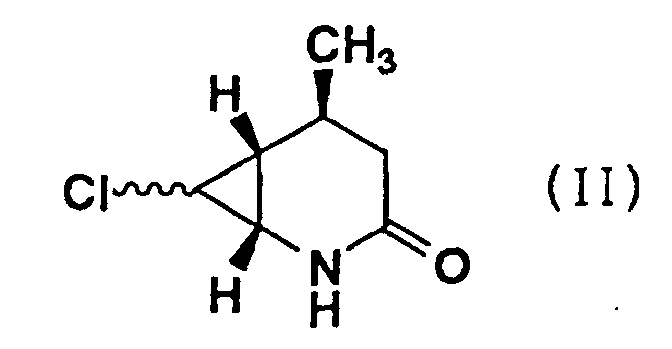
- A process for the preparation of (1S, 5S, 6R, 7R)-2-aza-7-chloro-5-methyl-3-oxobicyclo[4.1.0]heptane represented by formula (I) according to claim 1, comprising subjecting (1S, 5S, 6R)-2-aza-7-chloro-2-(4-methoxybenzyl)-5-methyl-3-oxobicyclo[4.1.0]heptane represented by formula (III):to deprotection reaction, and subjecting the resulting (1S, 5S, 6R)-2-aza-7-chloro-5-methyl-3-oxobicyclo[4.1.0]heptane represented by formula (II):
 to crystallization.
- A process for the preparation of (1S, 5S, 6R, 7R)-2-aza-7-chloro-5-methyl-3-oxobicyclo[4.1.0]heptane represented by formula (I) according to claim 1 or 2, comprising subjecting (1S, 5S, 6R)-2-aza-7,7-dichloro-2-(4-methoxybenzyl)-5-methyl-3-oxobicyclo[4.1.0]heptane represented by formula (IV):to dechlorination, subjecting the resulting (1S, 5S, 6R)-2-aza-7-chloro-2-(4-methoxybenzyl)-5-methyl-3-oxobicyclo[4.1.0]heptane represented by formula (III):
 to deprotection reaction, and subjecting the resulting (1S, 5S, 6R)-2-aza-7-chloro-5-methyl-3-oxobicyclo[4.1.0]heptane represented by formula (II):
 to crystallization.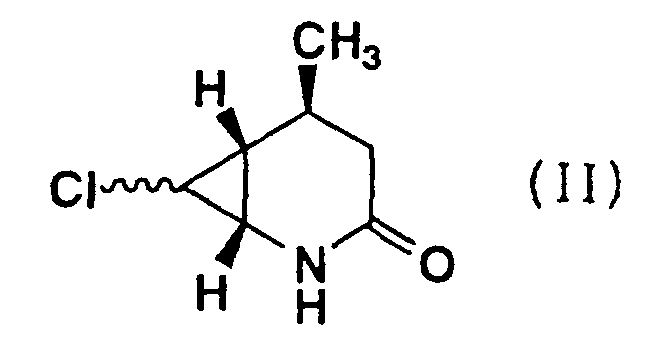
- A process for the preparation of (1S, 5S, 6R, 7R)-2-aza-7-chloro-5-methyl-3-oxobicyclo[4.1.0]heptane represented by formula (I) according to claim 1∼3, comprising subjecting (4S)-1-(4-methoxybenzyl)-4-methyl-5,6-dehydro-2-piperidone represented by formula (V):to the reaction with trichloroacetic acid derivatives in the presence of base, subjecting the resulting (1S, 5S, 6R)-2-aza-7,7-dichloro-2-(4-methoxybenzyl)-5-methyl-3-oxobicyclo[4.1,0]heptane represented by formula (IV):
 to dechlorination, subjecting the resulting (1S, 5S, 6R)-2-aza-7-chloro-2-(4-methoxybenzyl)-5-methyl-3-oxobicyclo[4.1.0]heptane represented by formula (III):
 to deprotection reaction, and subjecting the resulting (1S, 5S, 6R)-2-aza-7-chloro-5-methyl-3-oxobicyclo[4.1.0]heptane represented by formula (II):
 to crystallization.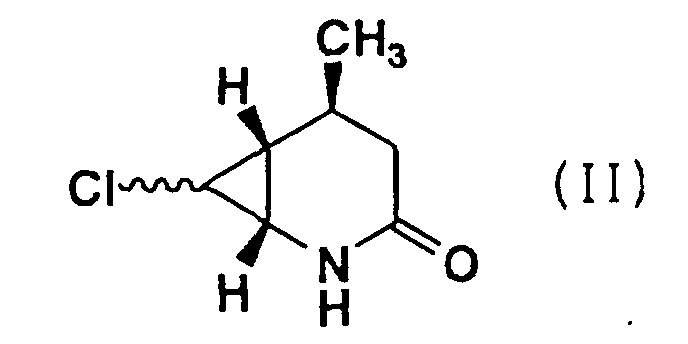
- A process for the preparation of (1S, 5S, 6R)-2-aza-7-chloro-5-methyl-3-oxobicyclo[4.1.0]heptane represented by formula (II):comprising subjecting (1S, 5S, 6R)-2-aza-7-chloro-2-(4-methoxybenzyl)-5-methyl-3-oxobicyclo[4.1.0]heptane represented by formula (III):
 to deprotection reaction.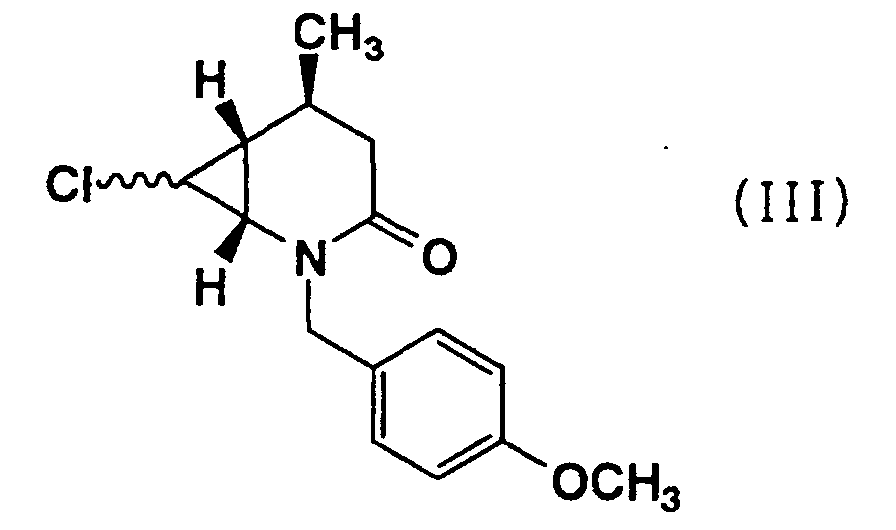
- A process for the preparation of (1S, 5S, 6R)-2-aza-7-chloro-5-methyl-3-oxobicyclo[4.1.0]heptane represented by formula (II) according to claim 5, wherein methanesulfonic acid is used in deprotection reaction.
- A process for the preparation of (1S, 5S, 6R)-2-aza-7-chloro-2-(4-methoxybenzyl)-5-methyl-3-oxobicyclo[4.1.0]heptane represented by formula (III):comprising subjecting (1S, 5S, 6R)-2-aza-7,7-dichloro-2-(4-methoxybenzyl)-5-methyl-3-oxobicyclo[4.1.0]heptane represented by formula (IV):
 to dechlorination.
- A process for the preparation of (1S, 5S, 6R)-2-aza-7-chloro-2-(4-methoxybenzyl)-5-methyl-3-oxobicyclo[4.1.0]heptane represented by formula (III) according to claim 7, wherein zinc, amine and, if necessary, divalent lead compound are used in dechlorination.
- A process for the preparation of (1S, 5S, 6R)-2-aza-7,7-dichloro-2-(4-methoxybenzyl)-5-methyl-3-oxobicyclo[4.1.0]heptane represented by formula (IV):comprising subjecting (4S)-1-(4-methoxybenzyl)-4-methyl-5,6-dehydro-2-piperidone represented by formula (V):
 to the reaction with trichloroacetic acid derivatives in the presence of base.
- A compound represented by formula (III):or a hydrate salt thereof.

Applications Claiming Priority (3)
| Application Number | Priority Date | Filing Date | Title |
|---|---|---|---|
| JP17480299 | 1999-06-22 | ||
| JP17480299 | 1999-06-22 | ||
| PCT/JP2000/004052 WO2000078722A1 (en) | 1999-06-22 | 2000-06-21 | Process for the preparation of intermediate compounds of drugs |
Publications (1)
| Publication Number | Publication Date |
|---|---|
| EP1188749A1 true EP1188749A1 (en) | 2002-03-20 |
Family
ID=15984928
Family Applications (1)
| Application Number | Title | Priority Date | Filing Date |
|---|---|---|---|
| EP00940778A Withdrawn EP1188749A1 (en) | 1999-06-22 | 2000-06-21 | Process for the preparation of intermediate compounds of drugs |
Country Status (12)
| Country | Link |
|---|---|
| EP (1) | EP1188749A1 (en) |
| KR (1) | KR20020010931A (en) |
| CN (1) | CN1370150A (en) |
| AU (1) | AU5566700A (en) |
| BR (1) | BR0011780A (en) |
| CA (1) | CA2375289A1 (en) |
| HU (1) | HUP0202073A3 (en) |
| MX (1) | MXPA01013261A (en) |
| NO (1) | NO20016281L (en) |
| NZ (1) | NZ516143A (en) |
| WO (1) | WO2000078722A1 (en) |
| ZA (1) | ZA200110275B (en) |
Family Cites Families (1)
| Publication number | Priority date | Publication date | Assignee | Title |
|---|---|---|---|---|
| US6110930A (en) * | 1997-04-10 | 2000-08-29 | Ono Pharmaceutical Co., Ltd. | Condensed piperidine compound |
-
2000
- 2000-06-21 AU AU55667/00A patent/AU5566700A/en not_active Abandoned
- 2000-06-21 CA CA002375289A patent/CA2375289A1/en not_active Abandoned
- 2000-06-21 BR BR0011780-3A patent/BR0011780A/en not_active IP Right Cessation
- 2000-06-21 CN CN00811811A patent/CN1370150A/en active Pending
- 2000-06-21 HU HU0202073A patent/HUP0202073A3/en unknown
- 2000-06-21 EP EP00940778A patent/EP1188749A1/en not_active Withdrawn
- 2000-06-21 NZ NZ516143A patent/NZ516143A/en unknown
- 2000-06-21 WO PCT/JP2000/004052 patent/WO2000078722A1/en not_active Ceased
- 2000-06-21 MX MXPA01013261A patent/MXPA01013261A/en unknown
- 2000-06-21 KR KR1020017016349A patent/KR20020010931A/en not_active Withdrawn
-
2001
- 2001-12-13 ZA ZA200110275A patent/ZA200110275B/en unknown
- 2001-12-20 NO NO20016281A patent/NO20016281L/en not_active Application Discontinuation
Non-Patent Citations (1)
| Title |
|---|
| See references of WO0078722A1 * |
Also Published As
| Publication number | Publication date |
|---|---|
| NO20016281L (en) | 2002-02-22 |
| NZ516143A (en) | 2003-07-25 |
| CN1370150A (en) | 2002-09-18 |
| ZA200110275B (en) | 2003-05-28 |
| CA2375289A1 (en) | 2000-12-28 |
| NO20016281D0 (en) | 2001-12-20 |
| HUP0202073A2 (en) | 2002-10-28 |
| KR20020010931A (en) | 2002-02-06 |
| BR0011780A (en) | 2002-05-21 |
| WO2000078722A1 (en) | 2000-12-28 |
| HUP0202073A3 (en) | 2003-05-28 |
| MXPA01013261A (en) | 2002-08-12 |
| AU5566700A (en) | 2001-01-09 |
Similar Documents
| Publication | Publication Date | Title |
|---|---|---|
| CN110590635A (en) | Preparation method of levetiracetam and intermediate thereof | |
| EP1081133B1 (en) | Method for producing N-carbamate-protected beta-aminoepoxide and beta-aminoalcohol | |
| AU2023206696A1 (en) | Method for preparing pyrrole compound and intermediate thereof | |
| AU2002353102B2 (en) | A process for producing phenserine and its analog | |
| WO2017199264A1 (en) | Novel process for the preparation of belinostat | |
| AU7445500A (en) | Process for the preparation of a piperazine derivative | |
| EP0431521B1 (en) | Aminobutanol derivative and process for the preparation of 3-pyrrolidinol from the same | |
| WO2016115962A1 (en) | Preparation method for nebivolol intermediate and preparation method for nebivolol | |
| JP2000351776A (en) | Method for producing optically active homocysteine thiolactone salt and intermediates thereof | |
| EP1060159B1 (en) | Synthesis of chiral beta-amino acids | |
| US7122696B2 (en) | Processes for preparation of N-protected-β-amino alcohols and N-protected-β-amino epoxides | |
| NZ516143A (en) | Process for the preparation of intermediate compounds of pharmaceuticals | |
| US6806384B2 (en) | Production method of β-amino-α-hydroxycarboxylic acid | |
| EP0236754B1 (en) | Novel process for preparing 4-acetyl isoquinolinone compounds | |
| CA2369678A1 (en) | Process for producing optically active amino acid derivatives | |
| EP0104721B1 (en) | Process for the preparation of 2-chlorosulfonyl-4-(n-substituted sulfamyl)-chlorobenzene compounds | |
| JPWO2000078722A1 (en) | Manufacturing method of pharmaceutical intermediate compound | |
| US6166222A (en) | Method for producing chiral 3,4-dehydroprolines | |
| EP0236383A1 (en) | Method for preparing 6beta-halopenicillanic acids and salts thereof. | |
| CN118005549A (en) | Method for purifying (2S) -1- (t-butoxycarbonyl) -4- (methoxymethyl) -pyrrolidine-2-carboxylic acid | |
| Rozwadowska | Synthesis of (2S, 3S)-3-amino-2-phenylthietane | |
| KR100297802B1 (en) | Method for preparing 2- (3-trifluoromethyl) anilinonicotinic acid 2- (N-morpholine) ethyl. | |
| CN117700344A (en) | Preparation method of levetiracetam | |
| NO176141B (en) | Process for Preparation of 1 - ((2S) -3-Mercapto-methyl-1-oxopropyl) -L-proline | |
| US6906039B2 (en) | Process for preparation of erythromycin compounds |
Legal Events
| Date | Code | Title | Description |
|---|---|---|---|
| PUAI | Public reference made under article 153(3) epc to a published international application that has entered the european phase |
Free format text: ORIGINAL CODE: 0009012 |
|
| 17P | Request for examination filed |
Effective date: 20011212 |
|
| AK | Designated contracting states |
Kind code of ref document: A1 Designated state(s): AT BE CH CY DE DK ES FI FR GB GR IE IT LI LU MC NL PT SE |
|
| AX | Request for extension of the european patent |
Free format text: AL;LT;LV;MK;RO;SI |
|
| RIC1 | Information provided on ipc code assigned before grant |
Free format text: 7C 07D 221/04 A, 7C 07B 63/00 B |
|
| STAA | Information on the status of an ep patent application or granted ep patent |
Free format text: STATUS: THE APPLICATION HAS BEEN WITHDRAWN |
|
| 18W | Application withdrawn |
Effective date: 20030206 |