EP1187833B1 - Method of producing thiamethoxam - Google Patents
Method of producing thiamethoxam Download PDFInfo
- Publication number
- EP1187833B1 EP1187833B1 EP00942115A EP00942115A EP1187833B1 EP 1187833 B1 EP1187833 B1 EP 1187833B1 EP 00942115 A EP00942115 A EP 00942115A EP 00942115 A EP00942115 A EP 00942115A EP 1187833 B1 EP1187833 B1 EP 1187833B1
- Authority
- EP
- European Patent Office
- Prior art keywords
- formula
- phase transfer
- transfer catalyst
- compound
- solvent
- Prior art date
- Legal status (The legal status is an assumption and is not a legal conclusion. Google has not performed a legal analysis and makes no representation as to the accuracy of the status listed.)
- Expired - Lifetime
Links
- 0 *Cc([s]1)cnc1Cl Chemical compound *Cc([s]1)cnc1Cl 0.000 description 1
Classifications
-
- C—CHEMISTRY; METALLURGY
- C07—ORGANIC CHEMISTRY
- C07D—HETEROCYCLIC COMPOUNDS
- C07D213/00—Heterocyclic compounds containing six-membered rings, not condensed with other rings, with one nitrogen atom as the only ring hetero atom and three or more double bonds between ring members or between ring members and non-ring members
- C07D213/02—Heterocyclic compounds containing six-membered rings, not condensed with other rings, with one nitrogen atom as the only ring hetero atom and three or more double bonds between ring members or between ring members and non-ring members having three double bonds between ring members or between ring members and non-ring members
- C07D213/04—Heterocyclic compounds containing six-membered rings, not condensed with other rings, with one nitrogen atom as the only ring hetero atom and three or more double bonds between ring members or between ring members and non-ring members having three double bonds between ring members or between ring members and non-ring members having no bond between the ring nitrogen atom and a non-ring member or having only hydrogen or carbon atoms directly attached to the ring nitrogen atom
- C07D213/24—Heterocyclic compounds containing six-membered rings, not condensed with other rings, with one nitrogen atom as the only ring hetero atom and three or more double bonds between ring members or between ring members and non-ring members having three double bonds between ring members or between ring members and non-ring members having no bond between the ring nitrogen atom and a non-ring member or having only hydrogen or carbon atoms directly attached to the ring nitrogen atom with substituted hydrocarbon radicals attached to ring carbon atoms
- C07D213/36—Radicals substituted by singly-bound nitrogen atoms
- C07D213/40—Acylated substituent nitrogen atom
-
- C—CHEMISTRY; METALLURGY
- C07—ORGANIC CHEMISTRY
- C07C—ACYCLIC OR CARBOCYCLIC COMPOUNDS
- C07C257/00—Compounds containing carboxyl groups, the doubly-bound oxygen atom of a carboxyl group being replaced by a doubly-bound nitrogen atom, this nitrogen atom not being further bound to an oxygen atom, e.g. imino-ethers, amidines
- C07C257/10—Compounds containing carboxyl groups, the doubly-bound oxygen atom of a carboxyl group being replaced by a doubly-bound nitrogen atom, this nitrogen atom not being further bound to an oxygen atom, e.g. imino-ethers, amidines with replacement of the other oxygen atom of the carboxyl group by nitrogen atoms, e.g. amidines
- C07C257/22—Compounds containing carboxyl groups, the doubly-bound oxygen atom of a carboxyl group being replaced by a doubly-bound nitrogen atom, this nitrogen atom not being further bound to an oxygen atom, e.g. imino-ethers, amidines with replacement of the other oxygen atom of the carboxyl group by nitrogen atoms, e.g. amidines having nitrogen atoms of amidino groups further bound to nitrogen atoms, e.g. hydrazidines
-
- C—CHEMISTRY; METALLURGY
- C07—ORGANIC CHEMISTRY
- C07C—ACYCLIC OR CARBOCYCLIC COMPOUNDS
- C07C261/00—Derivatives of cyanic acid
-
- C—CHEMISTRY; METALLURGY
- C07—ORGANIC CHEMISTRY
- C07C—ACYCLIC OR CARBOCYCLIC COMPOUNDS
- C07C277/00—Preparation of guanidine or its derivatives, i.e. compounds containing the group, the singly-bound nitrogen atoms not being part of nitro or nitroso groups
- C07C277/08—Preparation of guanidine or its derivatives, i.e. compounds containing the group, the singly-bound nitrogen atoms not being part of nitro or nitroso groups of substituted guanidines
-
- C—CHEMISTRY; METALLURGY
- C07—ORGANIC CHEMISTRY
- C07D—HETEROCYCLIC COMPOUNDS
- C07D213/00—Heterocyclic compounds containing six-membered rings, not condensed with other rings, with one nitrogen atom as the only ring hetero atom and three or more double bonds between ring members or between ring members and non-ring members
- C07D213/02—Heterocyclic compounds containing six-membered rings, not condensed with other rings, with one nitrogen atom as the only ring hetero atom and three or more double bonds between ring members or between ring members and non-ring members having three double bonds between ring members or between ring members and non-ring members
- C07D213/04—Heterocyclic compounds containing six-membered rings, not condensed with other rings, with one nitrogen atom as the only ring hetero atom and three or more double bonds between ring members or between ring members and non-ring members having three double bonds between ring members or between ring members and non-ring members having no bond between the ring nitrogen atom and a non-ring member or having only hydrogen or carbon atoms directly attached to the ring nitrogen atom
- C07D213/24—Heterocyclic compounds containing six-membered rings, not condensed with other rings, with one nitrogen atom as the only ring hetero atom and three or more double bonds between ring members or between ring members and non-ring members having three double bonds between ring members or between ring members and non-ring members having no bond between the ring nitrogen atom and a non-ring member or having only hydrogen or carbon atoms directly attached to the ring nitrogen atom with substituted hydrocarbon radicals attached to ring carbon atoms
- C07D213/36—Radicals substituted by singly-bound nitrogen atoms
- C07D213/38—Radicals substituted by singly-bound nitrogen atoms having only hydrogen or hydrocarbon radicals attached to the substituent nitrogen atom
-
- C—CHEMISTRY; METALLURGY
- C07—ORGANIC CHEMISTRY
- C07D—HETEROCYCLIC COMPOUNDS
- C07D277/00—Heterocyclic compounds containing 1,3-thiazole or hydrogenated 1,3-thiazole rings
- C07D277/02—Heterocyclic compounds containing 1,3-thiazole or hydrogenated 1,3-thiazole rings not condensed with other rings
- C07D277/20—Heterocyclic compounds containing 1,3-thiazole or hydrogenated 1,3-thiazole rings not condensed with other rings having two or three double bonds between ring members or between ring members and non-ring members
- C07D277/22—Heterocyclic compounds containing 1,3-thiazole or hydrogenated 1,3-thiazole rings not condensed with other rings having two or three double bonds between ring members or between ring members and non-ring members with only hydrogen atoms, hydrocarbon or substituted hydrocarbon radicals, directly attached to ring carbon atoms
- C07D277/28—Radicals substituted by nitrogen atoms
-
- C—CHEMISTRY; METALLURGY
- C07—ORGANIC CHEMISTRY
- C07D—HETEROCYCLIC COMPOUNDS
- C07D307/00—Heterocyclic compounds containing five-membered rings having one oxygen atom as the only ring hetero atom
- C07D307/02—Heterocyclic compounds containing five-membered rings having one oxygen atom as the only ring hetero atom not condensed with other rings
- C07D307/04—Heterocyclic compounds containing five-membered rings having one oxygen atom as the only ring hetero atom not condensed with other rings having no double bonds between ring members or between ring members and non-ring members
- C07D307/10—Heterocyclic compounds containing five-membered rings having one oxygen atom as the only ring hetero atom not condensed with other rings having no double bonds between ring members or between ring members and non-ring members with substituted hydrocarbon radicals attached to ring carbon atoms
- C07D307/14—Radicals substituted by nitrogen atoms not forming part of a nitro radical
-
- C—CHEMISTRY; METALLURGY
- C07—ORGANIC CHEMISTRY
- C07D—HETEROCYCLIC COMPOUNDS
- C07D401/00—Heterocyclic compounds containing two or more hetero rings, having nitrogen atoms as the only ring hetero atoms, at least one ring being a six-membered ring with only one nitrogen atom
- C07D401/02—Heterocyclic compounds containing two or more hetero rings, having nitrogen atoms as the only ring hetero atoms, at least one ring being a six-membered ring with only one nitrogen atom containing two hetero rings
- C07D401/06—Heterocyclic compounds containing two or more hetero rings, having nitrogen atoms as the only ring hetero atoms, at least one ring being a six-membered ring with only one nitrogen atom containing two hetero rings linked by a carbon chain containing only aliphatic carbon atoms
-
- C—CHEMISTRY; METALLURGY
- C07—ORGANIC CHEMISTRY
- C07D—HETEROCYCLIC COMPOUNDS
- C07D417/00—Heterocyclic compounds containing two or more hetero rings, at least one ring having nitrogen and sulfur atoms as the only ring hetero atoms, not provided for by group C07D415/00
- C07D417/02—Heterocyclic compounds containing two or more hetero rings, at least one ring having nitrogen and sulfur atoms as the only ring hetero atoms, not provided for by group C07D415/00 containing two hetero rings
- C07D417/06—Heterocyclic compounds containing two or more hetero rings, at least one ring having nitrogen and sulfur atoms as the only ring hetero atoms, not provided for by group C07D415/00 containing two hetero rings linked by a carbon chain containing only aliphatic carbon atoms
Definitions
- the present invention relates to a novel type of method of producing 3-(2-chloro-1,3-thiazol-5-ylmethyl)-5-methyl-1,3,5-oxadiazinan-4-yledene(nitro)amine (thiamethoxam). It is known that in order to produce substituted nitroguanidines, nitroenamines or cyano-enamines, a further substituent may be introduced (e.g. by alkylation) into those compounds that may already be substituted once to several times (see e.g. EP patent application 0.375.907).
- JP 07 224062-A describes a process for preparing thiamethoxam from 5-methyl-4-nitroiminotetrahydro-1,3,5-oxadiazine and 2-chloro-5-chloromethylthiazole using a phase transfer catalyst. The reaction is carried out in methylene chloride with the addition of aqueous sodium hydroxide solution.
- the invention relates to a process for the preparation of the compound of the formula (thiamethoxam, known from EP-A-580533) which process comprises reacting the compound of formula with a compound of the formula wherein Q is chlorine , in the presence of a solvent or diluent, a phase transfer catalyst and a base, the solvent or diluent being an ester of carbonic acid, the phase transfer catalyst being a quaternary ammonium salt and the base being a carbonate.
- Thiamethoxam may be present as salts. Having at least one basic centre it may form e.g. acid addition salts. These are formed for example with strong inorganic acids, such as mineral acids, e.g. sulphuric acid, a phosphoric acid or a hydrohalic acid, with strong organic carboxylic acids, such as C 1 -C 4 alkanecarboxylic acids substituted where appropriate for example by halogen, e.g. acetic acid, such as optionally unsaturated dicarboxylic acids, e.g. oxalic, malonic, maleic, fumaric or phthalic acid, such as hydrocarboxylic acids, e.g.
- strong inorganic acids such as mineral acids, e.g. sulphuric acid, a phosphoric acid or a hydrohalic acid
- strong organic carboxylic acids such as C 1 -C 4 alkanecarboxylic acids substituted where appropriate for example by halogen, e.g.
- thiamethoxam with at least one acid group can form salts with bases.
- Suitable salts with bases are for example metal salts, such as alkali or alkaline earth metal salts, e.g. sodium, potassium or magnesium salts, or salts with ammonia or an organic amine, such as morpholine, piperidine, pyrrolidine, a mono-, di- or tri-lower alkylamine, e.g. ethyl-, diethyl-, triethyl- or dimethylpropylamine, or a mono-, di- or trihydroxy-loweralkylamine, e.g. mono-, di- or triethanolamine.
- metal salts such as alkali or alkaline earth metal salts, e.g. sodium, potassium or magnesium salts
- salts with ammonia or an organic amine such as morpholine, piperidine, pyrrolidine, a mono-, di- or tri-lower alkylamine, e
- Corresponding internal salts where appropriate may also be formed.
- Preferred compounds within the scope of this invention are agrochemically advantageous salts.
- the free compound, thiamethoxam is understood where appropriate to include also by analogy the corresponding salts, and the salts are understood to include also the free compound thiamethoxam.
- the free form is preferred.
- phase transfer catalyst is a quaternary ammonium salt as listed in the paper "Phase Transfer Catalysts” by the company Fluka, Buchs, Switzerland, 1986 edition, pages 7 to 25.
- the quaternary ammonium salts named therein are thus included by reference in the present invention.
- Especially preferred quaternary ammonium salts are for example benzyltrimethyl ammonium chloride, benzyltriethyl ammonium chloride, benzyltributyl ammonium chloride, benzyltriethyl ammonium bromide, benzyltrimethyl ammonium methoxide, benzyltrimethyl ammonium hydroxide (triton B), glycidyl trimethyl ammonium chloride, hexadecyl-trimethyl ammonium chloride, hexadecyl-trimethyl ammonium bromide, hexadecyl-pyridinium bromide, hexadecyl-pyridinium chloride, 2-hydroxyethyl-trimethylammonium chloride, 2-hydroxyethyl-trimethylammonium hydroxide, phenyltrimethylammonium chloride, phenyltrimethyl ammonium hydroxide, tetrabutyl ammonium chloride
- the solvent or diluent for carrying out the process according to the invention is an ester of carbonic acid.
- Particularly preferred solvents are dimethyl carbonate and diethyl carbonate, in particular dimethyl carbonate.
- An especially preferred combination is dimethyl carbonate as the solvent with tetramethyl-ammonium hydroxide as the phase transfer catalyst.
- the base is a carbonate. Potassium carbonate is preferred.
- the amount of base employed is preferably one to two moles per mole of the compound of the formula:
- reaction is dependent on the boiling point of the solvent employed.
- An advantageous temperature range lies between ca. 40°C and ca. 100°C, preferably between ca. 60°C and ca. 70°C.
- a reaction time of ca. 0.1 to ca. 24 hours is preferred, especially ca. 3 to ca. 5 hours.
- phase transfer catalyst permits the use of a solvent, in which only small amounts of undesired isomers are obtained and which may be readily regenerated.
- reaction mixture is held for 5 to 6 hours whilst stirring vigorously, until more than 99% of the 2-chloro-5-chloromethylthiazole has reacted (LC control).
- the reaction mixture is subsequently cooled to 45-50°C and mixed with 600 g of water.
- the reaction mixture is adjusted to pH 6.5 with ca. 260 g of 32% hydrochloric acid and is then heated to 60 to 65°C until everything dissolves.
- the solution is left to stand until phase separation takes place, and the organic phase is separated.
- the aqueous phase is re-extracted at 50°C with 300 g dimethyl carbonate.
- the organic phase from re-extraction is combined with the organic phase from the reaction mixture.
- the combined organic phases are concentrated under vacuum (350-400 mbar) at 60 to 65°C to a final weight of 600 g (480 ml).
- the mixture is slowly cooled to 0-5°c and held for 1 hour. Then the resulting suspension is filtered.
- the filter cake is washed with 300g of dimethyl carbonate of 5-10°C in two portions and then with 300 ml of water in two portions, and the moist product is dried in a vacuum at 70°C.
- the title product may be obtained in a purity of 99.5% by recrystallisation from dimethyl carbonate.
- An alternative preparation method comprises adding together the potassium carbonate, 3-methyl-4-nitroimino-perhydro-1,3,5-oxadiazine and the tetramethylammonium hydroxide pentahydrate in 1100 g of dimethyl carbonate, and measuring in the 2-chloro-5-chloromethylthiazole over 60 minutes at 65°C. The subsequent reaction and working up are then carried out as above.
Landscapes
- Chemical & Material Sciences (AREA)
- Organic Chemistry (AREA)
- Organic Low-Molecular-Weight Compounds And Preparation Thereof (AREA)
- Low-Molecular Organic Synthesis Reactions Using Catalysts (AREA)
- Thiazole And Isothizaole Compounds (AREA)
- Pyridine Compounds (AREA)
- Catalysts (AREA)
- Plural Heterocyclic Compounds (AREA)
- Furan Compounds (AREA)
Abstract
Description
- The present invention relates to a novel type of method of producing 3-(2-chloro-1,3-thiazol-5-ylmethyl)-5-methyl-1,3,5-oxadiazinan-4-yledene(nitro)amine (thiamethoxam). It is known that in order to produce substituted nitroguanidines, nitroenamines or cyano-enamines, a further substituent may be introduced (e.g. by alkylation) into those compounds that may already be substituted once to several times (see e.g. EP patent application 0.375.907). Owing to the presence of several hydrogen atoms in the educts used as the starting material in these reactions, the previously proposed substitution reactions of this kind are often non-selective and lead to undesired substitution products. The aforementioned EP patent applications describe by way of example the production of 1,3-disubstituted 2-nitroguandines by reacting monosubstituted nitroisothioureas with primary amines whilst cleaving mercaptan. However, these nitroisothiourea compounds, containing alkylthio leaving groups, which are proposed as starting compounds in the known processes, can only be obtained with difficulty. In EP-A-0-483,062, a process for the production of related compounds by hydrolysis of hexahydrotriazines is also described. JP 07 224062-A describes a process for preparing thiamethoxam from 5-methyl-4-nitroiminotetrahydro-1,3,5-oxadiazine and 2-chloro-5-chloromethylthiazole using a phase transfer catalyst. The reaction is carried out in methylene chloride with the addition of aqueous sodium hydroxide solution.
- It has now been shown that the above-described methods of producing thiamethoxam do not satisfy the requirements demanded of a chemical production process, such as availability, toxicity, stability in storage and purity of the starting materials and excipients, reaction time, energy consumption and volumes yielded by the process, quantity and recovery of the accruing by-products and waste products, as well as purity and yield of the end product. There is therefore a need to provide an improved method of producing this compound.
Accordingly, it is the aim of the present invention to provide an improved method of producing thiamethoxam from readily obtainable starting compounds, which allows specific substitution without obtaining major amounts of undesired by-products. Accordingly, the invention relates to a process for the preparation of the compound of the formula
which process comprises reacting the compound of formula

- Thiamethoxam may be present as salts. Having at least one basic centre it may form e.g. acid addition salts. These are formed for example with strong inorganic acids, such as mineral acids, e.g. sulphuric acid, a phosphoric acid or a hydrohalic acid, with strong organic carboxylic acids, such as C1-C4 alkanecarboxylic acids substituted where appropriate for example by halogen, e.g. acetic acid, such as optionally unsaturated dicarboxylic acids, e.g. oxalic, malonic, maleic, fumaric or phthalic acid, such as hydrocarboxylic acids, e.g. ascorbic, lactic, malic, tartaric or citric acid, or benzoic acid, or with organic sulphonic acids, such as C1-C4 alkanesulphonic or anylsulphonic acids substituted where appropriate for example by halogen, e.g. methanesulphonic or p-toluenesulphonic acid. Salts of thiamethoxam with acids of the said kind are preferably obtained when working up the reaction mixtures.
- In a broader sense, thiamethoxam with at least one acid group can form salts with bases. Suitable salts with bases are for example metal salts, such as alkali or alkaline earth metal salts, e.g. sodium, potassium or magnesium salts, or salts with ammonia or an organic amine, such as morpholine, piperidine, pyrrolidine, a mono-, di- or tri-lower alkylamine, e.g. ethyl-, diethyl-, triethyl- or dimethylpropylamine, or a mono-, di- or trihydroxy-loweralkylamine, e.g. mono-, di- or triethanolamine. Corresponding internal salts where appropriate may also be formed. Preferred compounds within the scope of this invention are agrochemically advantageous salts. Hereinbefore and hereinafter, the free compound, thiamethoxam, is understood where appropriate to include also by analogy the corresponding salts, and the salts are understood to include also the free compound thiamethoxam. The same applies to E/Z isomers and tautomers of thiamethoxam and salts thereof. The free form is preferred.
- The phase transfer catalyst is a quaternary ammonium salt as listed in the paper "Phase Transfer Catalysts" by the company Fluka, Buchs, Switzerland, 1986 edition, pages 7 to 25. The quaternary ammonium salts named therein are thus included by reference in the present invention.
- Especially preferred quaternary ammonium salts are for example benzyltrimethyl ammonium chloride, benzyltriethyl ammonium chloride, benzyltributyl ammonium chloride, benzyltriethyl ammonium bromide, benzyltrimethyl ammonium methoxide, benzyltrimethyl ammonium hydroxide (triton B), glycidyl trimethyl ammonium chloride, hexadecyl-trimethyl ammonium chloride, hexadecyl-trimethyl ammonium bromide, hexadecyl-pyridinium bromide, hexadecyl-pyridinium chloride, 2-hydroxyethyl-trimethylammonium chloride, 2-hydroxyethyl-trimethylammonium hydroxide, phenyltrimethylammonium chloride, phenyltrimethyl ammonium hydroxide, tetrabutyl ammonium chloride, tetrabutyl ammonium bromide, tetrabutyl ammonium hydroxide, tetrabutyl ammonium tetrafluoroborate, tetrabutyl ammonium nitrate, tetradecyl ammonium chloride, tetradodecyl-ammonium acetate, tetraethyl ammonium chloride, tetraethyl ammonium hydroxide, tetradodecylammonium nitrate, tetradodecyl ammonium toluene sulphonate, tetrahexyl ammonium chloride, tetrahexylammonium bromide, tetramethyl ammonium chloride, tetramethyl-ammonium bromide, tetramethyl ammonium hydroxide, tetramethyl ammonium iodide, tetramethyl ammonium toluene sulphonate, tetraoctyl ammonium chloride, tetrapropyl ammonium chloride, tetrapropyl ammonium bromide, tributylmethyl ammonium chloride and tributylheptyl ammonium bromide, most preferably quaternary ammonium hydroxides, particularly tetramethyl ammonium hydroxide in the form of the pentahydrate.
- The solvent or diluent for carrying out the process according to the invention is an ester of carbonic acid.
- Particularly preferred solvents are dimethyl carbonate and diethyl carbonate, in particular dimethyl carbonate.
- An especially preferred combination is dimethyl carbonate as the solvent with tetramethyl-ammonium hydroxide as the phase transfer catalyst.
- The base is a carbonate. Potassium carbonate is preferred. The amount of base employed is preferably one to two moles per mole of the compound of the formula:

- The reaction is dependent on the boiling point of the solvent employed. An advantageous temperature range lies between ca. 40°C and ca. 100°C, preferably between ca. 60°C and ca. 70°C.
- A reaction time of ca. 0.1 to ca. 24 hours is preferred, especially ca. 3 to ca. 5 hours.
- It has now surprisingly been found that the process according to the invention is able to satisfy to a large extent the requirements listed initially, especially those relating to purity of the produced material.
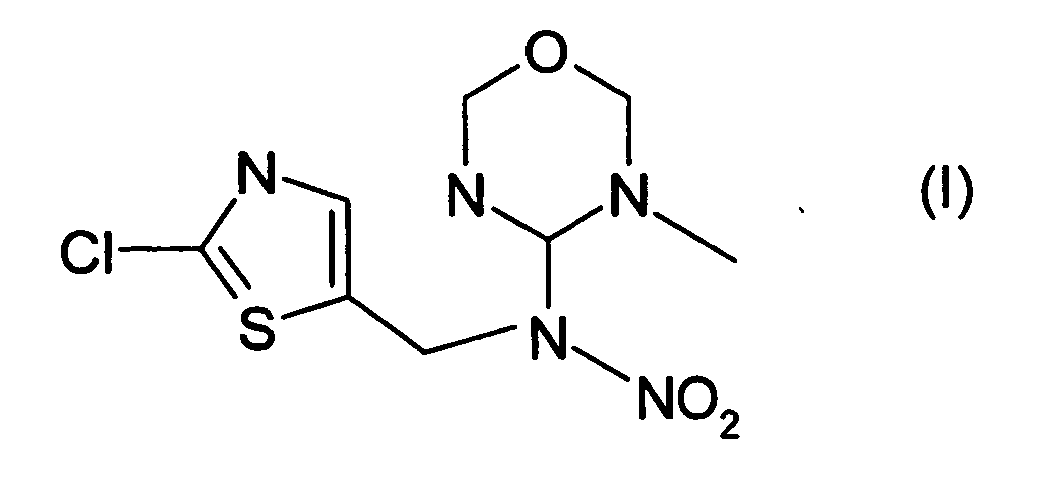
- In particular, it has been shown that, when carrying out the process according to the invention, the formation of undesired isomers can be suppressed. It has been shown that the substitution can also take place on the nitrogen which bears the nitro group:
- The employment of a phase transfer catalyst permits the use of a solvent, in which only small amounts of undesired isomers are obtained and which may be readily regenerated.
-

- 184 g of 100% 3-methyl-4-nitroimino-perhydro-1,3,5-oxadiazine in 400 g of dimethyl carbonate are placed in a sulphonation flask, and 168 g of 100% 2-chloro-5-chloromethylthiazole (1.0 moles) are added as a melt. This mixture is heated to 65°C. A mixture consisting of 350 g of dimethyl carbonate, 4 g of tetramethylammonium hydroxide pentahydrate and 242 g of potassium carbonate powder is measured in whilst stirring over 60 minutes at 62 to 68°C.
- The reaction mixture is held for 5 to 6 hours whilst stirring vigorously, until more than 99% of the 2-chloro-5-chloromethylthiazole has reacted (LC control).
- The reaction mixture is subsequently cooled to 45-50°C and mixed with 600 g of water. The reaction mixture is adjusted to pH 6.5 with ca. 260 g of 32% hydrochloric acid and is then heated to 60 to 65°C until everything dissolves. The solution is left to stand until phase separation takes place, and the organic phase is separated. The aqueous phase is re-extracted at 50°C with 300 g dimethyl carbonate.
- The organic phase from re-extraction is combined with the organic phase from the reaction mixture. The combined organic phases are concentrated under vacuum (350-400 mbar) at 60 to 65°C to a final weight of 600 g (480 ml). The mixture is slowly cooled to 0-5°c and held for 1 hour. Then the resulting suspension is filtered.
- The filter cake is washed with 300g of dimethyl carbonate of 5-10°C in two portions and then with 300 ml of water in two portions, and the moist product is dried in a vacuum at 70°C.
- Yield 218-220 g of title product in a purity of 98 to 99% (74% of theory based on 100% 2-chloro-5-chloromethylthiazole). The above-mentioned isomer of formula (I) is not found.
- The title product may be obtained in a purity of 99.5% by recrystallisation from dimethyl carbonate.
- An alternative preparation method comprises adding together the potassium carbonate, 3-methyl-4-nitroimino-perhydro-1,3,5-oxadiazine and the tetramethylammonium hydroxide pentahydrate in 1100 g of dimethyl carbonate, and measuring in the 2-chloro-5-chloromethylthiazole over 60 minutes at 65°C. The subsequent reaction and working up are then carried out as above.
Claims (7)
- A process for the preparation of the compound of the formula


- A process according to claim 1 wherein the phase transfer catalyst is a quaternary ammonium hydroxide.
- A process according to claim 2 wherein the phase transfer catalyst is tetramethyl ammonium hydroxide in the form of the pentahydrate.
- A process according to any one of the preceding claims wherein the solvent or diluent is dimethyl carbonate or diethyl carbonate.
- A process according to claim 4 wherein the solvent or diluent employed is dimethyl carbonate.
- A process according to claim 1 wherein the solvent or diluent is dimethyl carbonate and the phase transfer catalyst is tetramethyl ammonium hydroxide.
- A process according to claim any one of the preceding claims wherein the base is potassium carbonate.
Applications Claiming Priority (3)
| Application Number | Priority Date | Filing Date | Title |
|---|---|---|---|
| CH117199 | 1999-06-23 | ||
| CH117199 | 1999-06-23 | ||
| PCT/EP2000/005762 WO2001000623A1 (en) | 1999-06-23 | 2000-06-21 | Method of producing nitroguanidine- and nitroenamine derivatives |
Publications (2)
| Publication Number | Publication Date |
|---|---|
| EP1187833A1 EP1187833A1 (en) | 2002-03-20 |
| EP1187833B1 true EP1187833B1 (en) | 2007-06-06 |
Family
ID=4204160
Family Applications (1)
| Application Number | Title | Priority Date | Filing Date |
|---|---|---|---|
| EP00942115A Expired - Lifetime EP1187833B1 (en) | 1999-06-23 | 2000-06-21 | Method of producing thiamethoxam |
Country Status (24)
| Country | Link |
|---|---|
| EP (1) | EP1187833B1 (en) |
| JP (1) | JP4588951B2 (en) |
| KR (1) | KR100644739B1 (en) |
| CN (1) | CN1247572C (en) |
| AR (1) | AR024423A1 (en) |
| AT (1) | ATE364042T1 (en) |
| AU (1) | AU773966B2 (en) |
| BR (1) | BR0011839B1 (en) |
| CA (1) | CA2369404C (en) |
| CY (1) | CY1106743T1 (en) |
| CZ (1) | CZ300093B6 (en) |
| DE (1) | DE60035109T2 (en) |
| DK (1) | DK1187833T3 (en) |
| ES (1) | ES2284506T3 (en) |
| HU (1) | HU228645B1 (en) |
| IL (1) | IL146580A0 (en) |
| MX (1) | MXPA01012639A (en) |
| PL (1) | PL202732B1 (en) |
| PT (1) | PT1187833E (en) |
| RU (1) | RU2258704C2 (en) |
| TW (1) | TWI254713B (en) |
| UA (1) | UA73306C2 (en) |
| WO (1) | WO2001000623A1 (en) |
| ZA (1) | ZA200110388B (en) |
Cited By (1)
| Publication number | Priority date | Publication date | Assignee | Title |
|---|---|---|---|---|
| WO2015180585A1 (en) * | 2014-05-28 | 2015-12-03 | Rotam Agrochem International Company Limited | Method of producing thiamethoxam |
Families Citing this family (13)
| Publication number | Priority date | Publication date | Assignee | Title |
|---|---|---|---|---|
| MX2007007919A (en) | 2004-12-31 | 2008-01-22 | Reddy Us Therapeutics Inc | Novel benzylamine derivatives as cetp inhibitors. |
| US8604055B2 (en) | 2004-12-31 | 2013-12-10 | Dr. Reddy's Laboratories Ltd. | Substituted benzylamino quinolines as cholesterol ester-transfer protein inhibitors |
| DE102008052795B4 (en) | 2008-10-22 | 2012-01-26 | Balchem Corp. | Process for the preparation of fatty acid esters of mono- or polyhydric alcohols using special hydroxy-functional quaternary ammonium compounds as catalysts |
| JP5964965B2 (en) | 2011-08-18 | 2016-08-03 | ドクター レディズ ラボラトリーズ リミテッド | Substituted heterocyclic amine compounds as cholesteryl ester transfer protein (CETP) inhibitors |
| IN2014CN02290A (en) | 2011-09-27 | 2015-06-19 | Reddys Lab Ltd Dr | |
| CN102372702A (en) * | 2011-11-17 | 2012-03-14 | 安徽省化工研究院 | Preparation method for thiamethoxam |
| CN103787922B (en) * | 2014-03-04 | 2016-06-01 | 新昌县鸿吉电子科技有限公司 | A kind of Industrial Catalysis method of synthesizing nitryl substitution compound |
| CN103880832B (en) * | 2014-04-04 | 2016-06-15 | 连云港市金囤农化有限公司 | A kind of preparation method of Diacloden |
| GB2564284A (en) * | 2014-05-28 | 2019-01-09 | Rotam Agrochem Int Co Ltd | Thiamethoxam and uses thereof |
| GB2514927B (en) * | 2014-05-28 | 2019-04-17 | Rotam Agrochem Int Co Ltd | Thiamethoxam and uses thereof |
| CN107400123A (en) * | 2017-08-28 | 2017-11-28 | 江苏绿叶农化有限公司 | A kind of production method of Diacloden |
| EP3480196A1 (en) | 2017-11-02 | 2019-05-08 | Jiangsu Rotam Chemistry Co., Ltd | Process for the preparation of thiamethoxam |
| AR124935A1 (en) | 2021-03-01 | 2023-05-24 | Syngenta Crop Protection Ag | PESTICIDE FORMULATIONS |
Family Cites Families (5)
| Publication number | Priority date | Publication date | Assignee | Title |
|---|---|---|---|---|
| ATE67493T1 (en) * | 1985-02-04 | 1991-10-15 | Bayer Agrochem Kk | HETEROCYCLIC COMPOUNDS. |
| JP2822050B2 (en) * | 1989-02-04 | 1998-11-05 | 日本バイエルアグロケム株式会社 | Method for producing 2-nitroimino imidazolidines |
| TW240163B (en) * | 1992-07-22 | 1995-02-11 | Syngenta Participations Ag | Oxadiazine derivatives |
| JP3159859B2 (en) * | 1994-02-09 | 2001-04-23 | 日本バイエルアグロケム株式会社 | Insecticidal nitro compounds |
| DE19904310A1 (en) * | 1999-01-28 | 2000-08-03 | Bayer Ag | Process for the preparation of heterocyclic compounds |
-
2000
- 2000-06-21 ES ES00942115T patent/ES2284506T3/en not_active Expired - Lifetime
- 2000-06-21 HU HU0202050A patent/HU228645B1/en unknown
- 2000-06-21 CA CA2369404A patent/CA2369404C/en not_active Expired - Fee Related
- 2000-06-21 CN CNB008093296A patent/CN1247572C/en not_active Expired - Lifetime
- 2000-06-21 AR ARP000103082A patent/AR024423A1/en not_active Application Discontinuation
- 2000-06-21 BR BRPI0011839-7A patent/BR0011839B1/en not_active IP Right Cessation
- 2000-06-21 JP JP2001507031A patent/JP4588951B2/en not_active Expired - Lifetime
- 2000-06-21 EP EP00942115A patent/EP1187833B1/en not_active Expired - Lifetime
- 2000-06-21 DE DE60035109T patent/DE60035109T2/en not_active Expired - Lifetime
- 2000-06-21 AU AU56847/00A patent/AU773966B2/en not_active Ceased
- 2000-06-21 KR KR1020017016368A patent/KR100644739B1/en not_active Expired - Fee Related
- 2000-06-21 WO PCT/EP2000/005762 patent/WO2001000623A1/en not_active Ceased
- 2000-06-21 IL IL14658000A patent/IL146580A0/en active IP Right Grant
- 2000-06-21 MX MXPA01012639A patent/MXPA01012639A/en active IP Right Grant
- 2000-06-21 PL PL352401A patent/PL202732B1/en unknown
- 2000-06-21 RU RU2002100907/04A patent/RU2258704C2/en active
- 2000-06-21 PT PT00942115T patent/PT1187833E/en unknown
- 2000-06-21 DK DK00942115T patent/DK1187833T3/en active
- 2000-06-21 TW TW089112156A patent/TWI254713B/en not_active IP Right Cessation
- 2000-06-21 UA UA2002010571A patent/UA73306C2/en unknown
- 2000-06-21 AT AT00942115T patent/ATE364042T1/en active
- 2000-06-21 CZ CZ20014524A patent/CZ300093B6/en not_active IP Right Cessation
-
2001
- 2001-12-19 ZA ZA200110388A patent/ZA200110388B/en unknown
-
2007
- 2007-07-19 CY CY20071100961T patent/CY1106743T1/en unknown
Non-Patent Citations (1)
| Title |
|---|
| None * |
Cited By (1)
| Publication number | Priority date | Publication date | Assignee | Title |
|---|---|---|---|---|
| WO2015180585A1 (en) * | 2014-05-28 | 2015-12-03 | Rotam Agrochem International Company Limited | Method of producing thiamethoxam |
Also Published As
Similar Documents
| Publication | Publication Date | Title |
|---|---|---|
| WO2010070371A1 (en) | Process for the preparation of piperazine derivatives | |
| KR100644739B1 (en) | Process for preparing nitroguanidine and nitroenamine derivatives | |
| JPH04270257A (en) | N-alkylation of ureas | |
| KR101050018B1 (en) | Improved method for producing nitroguanidine derivative | |
| SU677657A3 (en) | Method of producing n-formylated compounds | |
| CN1251574A (en) | Process for preparing O-(3-amino-2-hydroxy-propyl)-hydroxymic acid halides | |
| US6211379B1 (en) | Process for preparing heterocyclic compounds | |
| KR100740983B1 (en) | Method for preparing heterocyclic compound | |
| US6747146B2 (en) | Method of producing nitroguanidine- and nitroenamine derivatives | |
| KR860001568B1 (en) | Process for the preparation of phenylenedi amine by selectively sulfonating | |
| US7102010B2 (en) | Process for producing 5-substituted oxazole compounds and 5-substituted imidazole compounds | |
| US6355800B1 (en) | Process for producing aminopiperazine derivatives | |
| JP2007502847A (en) | Thiazolidinedione derivative and method for producing the compound | |
| JPH04346969A (en) | Method for preparing sulfate betaine amino acid derivative | |
| CA3214107A1 (en) | New process for the synthesis of 5-{5-chloro-2-[(3s)-3- [(morpholin-4-yl)methyl]-3,4-dihydroisoquinoline-2(1h)- carbonyl]phenyl}-1,2-dimethyl-1h-pyrrole-3-carboxylic acid derivatives and its application for the production of pharmaceutical compounds | |
| HK1026200A (en) | Process for preparing o-(3-amino-2-hydroxy-propyl)-hydroxymic acid halides | |
| PL51001B1 (en) | ||
| MXPA99009046A (en) | Process for preparing o-(3-amino-2-hydroxy-propyl)-hydroxymic acid halides |
Legal Events
| Date | Code | Title | Description |
|---|---|---|---|
| PUAI | Public reference made under article 153(3) epc to a published international application that has entered the european phase |
Free format text: ORIGINAL CODE: 0009012 |
|
| 17P | Request for examination filed |
Effective date: 20011121 |
|
| AK | Designated contracting states |
Kind code of ref document: A1 Designated state(s): AT BE CH CY DE DK ES FI FR GB GR IE IT LI LU MC NL PT SE |
|
| AX | Request for extension of the european patent |
Free format text: AL;LT;LV;MK;RO;SI |
|
| 17Q | First examination report despatched |
Effective date: 20020503 |
|
| 17Q | First examination report despatched |
Effective date: 20020503 |
|
| GRAP | Despatch of communication of intention to grant a patent |
Free format text: ORIGINAL CODE: EPIDOSNIGR1 |
|
| RTI1 | Title (correction) |
Free format text: METHOD OF PRODUCING THIAMETHOXAM |
|
| GRAS | Grant fee paid |
Free format text: ORIGINAL CODE: EPIDOSNIGR3 |
|
| GRAA | (expected) grant |
Free format text: ORIGINAL CODE: 0009210 |
|
| AK | Designated contracting states |
Kind code of ref document: B1 Designated state(s): AT BE CH CY DE DK ES FI FR GB GR IE IT LI LU MC NL PT SE |
|
| REG | Reference to a national code |
Ref country code: GB Ref legal event code: FG4D |
|
| REG | Reference to a national code |
Ref country code: CH Ref legal event code: EP |
|
| REG | Reference to a national code |
Ref country code: IE Ref legal event code: FG4D |
|
| REF | Corresponds to: |
Ref document number: 60035109 Country of ref document: DE Date of ref document: 20070719 Kind code of ref document: P |
|
| REG | Reference to a national code |
Ref country code: GR Ref legal event code: EP Ref document number: 20070402363 Country of ref document: GR |
|
| REG | Reference to a national code |
Ref country code: PT Ref legal event code: SC4A Free format text: AVAILABILITY OF NATIONAL TRANSLATION Effective date: 20070824 |
|
| REG | Reference to a national code |
Ref country code: SE Ref legal event code: TRGR |
|
| REG | Reference to a national code |
Ref country code: DK Ref legal event code: T3 |
|
| ET | Fr: translation filed | ||
| REG | Reference to a national code |
Ref country code: ES Ref legal event code: FG2A Ref document number: 2284506 Country of ref document: ES Kind code of ref document: T3 |
|
| PG25 | Lapsed in a contracting state [announced via postgrant information from national office to epo] |
Ref country code: MC Free format text: LAPSE BECAUSE OF NON-PAYMENT OF DUE FEES Effective date: 20070630 |
|
| PLBE | No opposition filed within time limit |
Free format text: ORIGINAL CODE: 0009261 |
|
| STAA | Information on the status of an ep patent application or granted ep patent |
Free format text: STATUS: NO OPPOSITION FILED WITHIN TIME LIMIT |
|
| 26N | No opposition filed |
Effective date: 20080307 |
|
| PGFP | Annual fee paid to national office [announced via postgrant information from national office to epo] |
Ref country code: LU Payment date: 20130625 Year of fee payment: 14 |
|
| PGFP | Annual fee paid to national office [announced via postgrant information from national office to epo] |
Ref country code: CY Payment date: 20130530 Year of fee payment: 14 |
|
| PG25 | Lapsed in a contracting state [announced via postgrant information from national office to epo] |
Ref country code: LU Free format text: LAPSE BECAUSE OF NON-PAYMENT OF DUE FEES Effective date: 20140621 |
|
| PG25 | Lapsed in a contracting state [announced via postgrant information from national office to epo] |
Ref country code: CY Free format text: LAPSE BECAUSE OF NON-PAYMENT OF DUE FEES Effective date: 20140621 |
|
| REG | Reference to a national code |
Ref country code: FR Ref legal event code: PLFP Year of fee payment: 17 |
|
| PGFP | Annual fee paid to national office [announced via postgrant information from national office to epo] |
Ref country code: GR Payment date: 20160527 Year of fee payment: 17 Ref country code: ES Payment date: 20160606 Year of fee payment: 17 Ref country code: IE Payment date: 20160526 Year of fee payment: 17 Ref country code: FI Payment date: 20160606 Year of fee payment: 17 |
|
| PGFP | Annual fee paid to national office [announced via postgrant information from national office to epo] |
Ref country code: BE Payment date: 20160614 Year of fee payment: 17 Ref country code: SE Payment date: 20160607 Year of fee payment: 17 Ref country code: PT Payment date: 20160530 Year of fee payment: 17 Ref country code: NL Payment date: 20160607 Year of fee payment: 17 Ref country code: IT Payment date: 20160610 Year of fee payment: 17 |
|
| REG | Reference to a national code |
Ref country code: FR Ref legal event code: PLFP Year of fee payment: 18 |
|
| REG | Reference to a national code |
Ref country code: SE Ref legal event code: EUG |
|
| PG25 | Lapsed in a contracting state [announced via postgrant information from national office to epo] |
Ref country code: FI Free format text: LAPSE BECAUSE OF NON-PAYMENT OF DUE FEES Effective date: 20170621 |
|
| REG | Reference to a national code |
Ref country code: NL Ref legal event code: MM Effective date: 20170701 |
|
| PG25 | Lapsed in a contracting state [announced via postgrant information from national office to epo] |
Ref country code: SE Free format text: LAPSE BECAUSE OF NON-PAYMENT OF DUE FEES Effective date: 20170622 Ref country code: PT Free format text: LAPSE BECAUSE OF NON-PAYMENT OF DUE FEES Effective date: 20171221 |
|
| REG | Reference to a national code |
Ref country code: IE Ref legal event code: MM4A |
|
| PG25 | Lapsed in a contracting state [announced via postgrant information from national office to epo] |
Ref country code: NL Free format text: LAPSE BECAUSE OF NON-PAYMENT OF DUE FEES Effective date: 20170701 |
|
| PG25 | Lapsed in a contracting state [announced via postgrant information from national office to epo] |
Ref country code: IE Free format text: LAPSE BECAUSE OF NON-PAYMENT OF DUE FEES Effective date: 20170621 |
|
| REG | Reference to a national code |
Ref country code: FR Ref legal event code: PLFP Year of fee payment: 19 |
|
| PG25 | Lapsed in a contracting state [announced via postgrant information from national office to epo] |
Ref country code: GR Free format text: LAPSE BECAUSE OF NON-PAYMENT OF DUE FEES Effective date: 20180111 Ref country code: IT Free format text: LAPSE BECAUSE OF NON-PAYMENT OF DUE FEES Effective date: 20170621 |
|
| REG | Reference to a national code |
Ref country code: BE Ref legal event code: MM Effective date: 20170630 |
|
| PG25 | Lapsed in a contracting state [announced via postgrant information from national office to epo] |
Ref country code: BE Free format text: LAPSE BECAUSE OF NON-PAYMENT OF DUE FEES Effective date: 20170630 |
|
| REG | Reference to a national code |
Ref country code: ES Ref legal event code: FD2A Effective date: 20181106 |
|
| PG25 | Lapsed in a contracting state [announced via postgrant information from national office to epo] |
Ref country code: ES Free format text: LAPSE BECAUSE OF NON-PAYMENT OF DUE FEES Effective date: 20170622 |
|
| PGFP | Annual fee paid to national office [announced via postgrant information from national office to epo] |
Ref country code: DE Payment date: 20190515 Year of fee payment: 20 Ref country code: DK Payment date: 20190528 Year of fee payment: 20 |
|
| PGFP | Annual fee paid to national office [announced via postgrant information from national office to epo] |
Ref country code: FR Payment date: 20190522 Year of fee payment: 20 |
|
| PGFP | Annual fee paid to national office [announced via postgrant information from national office to epo] |
Ref country code: CH Payment date: 20190531 Year of fee payment: 20 |
|
| PGFP | Annual fee paid to national office [announced via postgrant information from national office to epo] |
Ref country code: GB Payment date: 20190524 Year of fee payment: 20 Ref country code: AT Payment date: 20190524 Year of fee payment: 20 |
|
| REG | Reference to a national code |
Ref country code: DE Ref legal event code: R071 Ref document number: 60035109 Country of ref document: DE |
|
| REG | Reference to a national code |
Ref country code: DK Ref legal event code: EUP Expiry date: 20200621 |
|
| REG | Reference to a national code |
Ref country code: CH Ref legal event code: PL |
|
| REG | Reference to a national code |
Ref country code: GB Ref legal event code: PE20 Expiry date: 20200620 |
|
| REG | Reference to a national code |
Ref country code: AT Ref legal event code: MK07 Ref document number: 364042 Country of ref document: AT Kind code of ref document: T Effective date: 20200621 |
|
| PG25 | Lapsed in a contracting state [announced via postgrant information from national office to epo] |
Ref country code: GB Free format text: LAPSE BECAUSE OF EXPIRATION OF PROTECTION Effective date: 20200620 |