EP1187097A2 - Accumulating transformations for hierarchical linear regression HMM adaptation - Google Patents
Accumulating transformations for hierarchical linear regression HMM adaptation Download PDFInfo
- Publication number
- EP1187097A2 EP1187097A2 EP01000337A EP01000337A EP1187097A2 EP 1187097 A2 EP1187097 A2 EP 1187097A2 EP 01000337 A EP01000337 A EP 01000337A EP 01000337 A EP01000337 A EP 01000337A EP 1187097 A2 EP1187097 A2 EP 1187097A2
- Authority
- EP
- European Patent Office
- Prior art keywords
- transformations
- models
- transformation
- hmm
- node
- Prior art date
- Legal status (The legal status is an assumption and is not a legal conclusion. Google has not performed a legal analysis and makes no representation as to the accuracy of the status listed.)
- Granted
Links
Images


Classifications
-
- G—PHYSICS
- G10—MUSICAL INSTRUMENTS; ACOUSTICS
- G10L—SPEECH ANALYSIS TECHNIQUES OR SPEECH SYNTHESIS; SPEECH RECOGNITION; SPEECH OR VOICE PROCESSING TECHNIQUES; SPEECH OR AUDIO CODING OR DECODING
- G10L15/00—Speech recognition
- G10L15/06—Creation of reference templates; Training of speech recognition systems, e.g. adaptation to the characteristics of the speaker's voice
- G10L15/065—Adaptation
- G10L15/07—Adaptation to the speaker
-
- G—PHYSICS
- G10—MUSICAL INSTRUMENTS; ACOUSTICS
- G10L—SPEECH ANALYSIS TECHNIQUES OR SPEECH SYNTHESIS; SPEECH RECOGNITION; SPEECH OR VOICE PROCESSING TECHNIQUES; SPEECH OR AUDIO CODING OR DECODING
- G10L15/00—Speech recognition
- G10L15/08—Speech classification or search
- G10L15/14—Speech classification or search using statistical models, e.g. Hidden Markov Models [HMMs]
- G10L15/142—Hidden Markov Models [HMMs]
- G10L15/144—Training of HMMs
Definitions
- This invention relates generally to speech recognition and more particularly to adaptive speech recognition with hierarchical linear HMM adaptation.
- HLR Hierarchical Linear Regression
- MLLR Hidden Markov Models
- Hierarchical Linear Regression (e.g. MLLR or Maximum Likelihood Linear Regression) is an interactive process that transforms an initial Hidden Markov Model (HMM) models step-by-step into a target model.
- HMM Hidden Markov Model
- M M alignments of transformed HMM against speech data and each alignment results are used to produce new transformations through N EM re-estimations.
- M x N steps are required.
- a new method which builds the models at m-th step directly from models at the initial step, is provided to minimize the storage and calculation.
- the method therefore merges the M x N transformations into a single transformation.
- the merge guarantees the exactness of the transformations and make it possible for recognizers on mobile devices to have adaptation capability.
- the goal of the method to be described is to provide a single set of transformations which combines all M x N set of transformations, so that a target model at any iteration can be calculated directly from initial model and the single set of transformations.
- Figure 3 illustrates the goal.
- the method builds the models at the m-th step directly from models at the initial step by successive applications of transformations as illustrated in Figures 3 and 5.
- the algorithms for providing this are derived herein in the following.
- Leaf nodes ⁇ ⁇ ⁇ of the tree correspond to a class.
- a class can be either a HMM, a cluster of distributions, a state PDF, etc., depending on the adaptation scheme.
- a leaf node ⁇ ⁇ ⁇ is assigned the number m( ⁇ i) of acoustic vectors associated to the node at iteration .i.
- Figure 4 shows part of a tree with leaves corresponding to phone HMM.
- each node At each iteration of parameter estimation, to each node is associated a number ⁇ ( ⁇ , i ) recording the total number of input vectors under the node.
- a node is called reliable if ⁇ ( ⁇ , i )>P where P is a constant, fixed for each alignment.
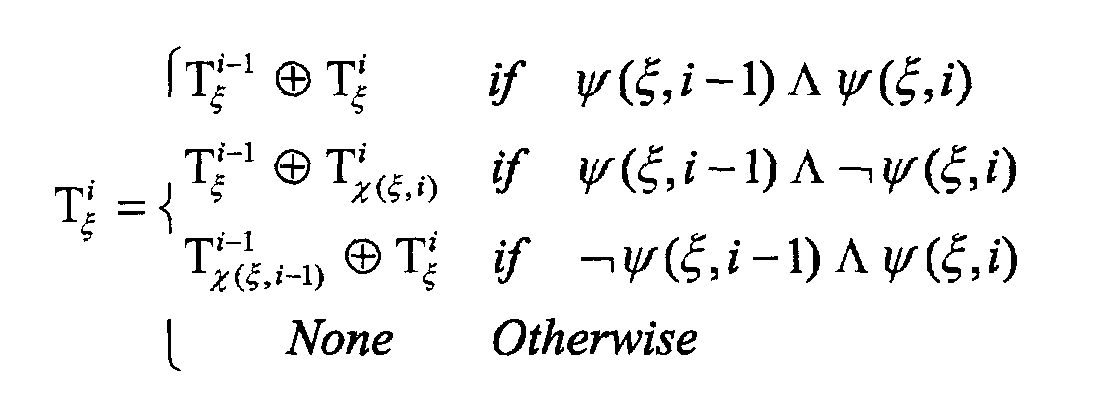
- the function ⁇ : ⁇ N ⁇ [ False , True ] such that ⁇ ( ⁇ , i ) indicates if a node is reliable at the i-th iteration.
- ⁇ is a function of i. Only reliable nodes are assigned a transformation T i / ⁇ .
- Each leaf node e.g. each HMM, has its transformation located on the first reliable node given by recursively tracing back to the roots.
- the alignment may be changed, which results in a change in the reliable node information. Therefore the association between nodes and transformations cannot be assumed fixed from i - 1 to i-th alignment. For instance, the number of transformations at i is different from that at i - 1, for two reasons:
- FIG. 6 there is illustrated a system according to one embodiment of the present invention wherein the input speech is compared to models at recognizer 60 wherein the models 61 are HMM models that have had HLR HMM adaptation or training using only a single set of transformation parameters wherein for transformation accumulations between EM estimations equation 4 is used and for transformation accumulation between alignment iterations is according to equation 10.
Landscapes
- Engineering & Computer Science (AREA)
- Artificial Intelligence (AREA)
- Computational Linguistics (AREA)
- Health & Medical Sciences (AREA)
- Audiology, Speech & Language Pathology (AREA)
- Human Computer Interaction (AREA)
- Physics & Mathematics (AREA)
- Acoustics & Sound (AREA)
- Multimedia (AREA)
- Image Analysis (AREA)
- Complex Calculations (AREA)
- Information Retrieval, Db Structures And Fs Structures Therefor (AREA)
Abstract
Description

- Transformation accumulation between EM estimations.
- Transformation accumulation between alignment iterations.
- The set of transformations that maps the initial models through n - 1 EM re-estimations (global at n - 1).
- The set of transformations that maps the models at n - 1-th iteration to the models at the iteration n (local at n).


- The set of transformations that maps the initial models through i - 1 alignments (global at i - 1).
- The set of transformations that maps the models at i - 1-th alignment to the models at the alignment i (local at i).
- The value of P in Eq-2 may be different. Typically, P is decreased to increase the number of transformations as i increases.
- Even if P is kept constant a cross alignment, as the acoustic model parameters are changed at each alignment, ρ(ξ,i) may change as function of i, so will ψ(ξ,i).
Claims (4)
- A method of hierarchical linear regression adaptation of HMM models comprising the steps of:providing HMM models for adaptation to a new acoustic environment andobtaining adapted new models directly from the initial HMM models using a single set of transformations.
- The method of Claim 1 wherein said obtaining step comprises:
performing transformation accumulation between EM estimations and transformation accumulation between alignment iterations. - A recognizer comprising:
adapted HMM models obtained directly from initial HMM models using a single set of transforms. - The recognizer of Claim 3, wherein said HMM models are obtained by performing transformation accumulation between EM estimations and transformation accumulation between alignment iterations.
Applications Claiming Priority (4)
| Application Number | Priority Date | Filing Date | Title |
|---|---|---|---|
| US887394 | 1986-07-21 | ||
| US22259600P | 2000-08-02 | 2000-08-02 | |
| US222596P | 2000-08-02 | ||
| US09/887,394 US7089183B2 (en) | 2000-08-02 | 2001-06-22 | Accumulating transformations for hierarchical linear regression HMM adaptation |
Publications (3)
| Publication Number | Publication Date |
|---|---|
| EP1187097A2 true EP1187097A2 (en) | 2002-03-13 |
| EP1187097A3 EP1187097A3 (en) | 2003-08-13 |
| EP1187097B1 EP1187097B1 (en) | 2007-06-06 |
Family
ID=26916971
Family Applications (1)
| Application Number | Title | Priority Date | Filing Date |
|---|---|---|---|
| EP01000337A Expired - Lifetime EP1187097B1 (en) | 2000-08-02 | 2001-08-02 | Accumulating transformations for hierarchical linear regression HMM adaptation |
Country Status (3)
| Country | Link |
|---|---|
| US (1) | US7089183B2 (en) |
| EP (1) | EP1187097B1 (en) |
| DE (1) | DE60128762T2 (en) |
Cited By (1)
| Publication number | Priority date | Publication date | Assignee | Title |
|---|---|---|---|---|
| US7320090B2 (en) | 2004-06-09 | 2008-01-15 | International Business Machines Corporation | Methods, systems, and media for generating a regression suite database |
Families Citing this family (9)
| Publication number | Priority date | Publication date | Assignee | Title |
|---|---|---|---|---|
| JP4033299B2 (en) * | 2003-03-12 | 2008-01-16 | 株式会社エヌ・ティ・ティ・ドコモ | Noise model noise adaptation system, noise adaptation method, and speech recognition noise adaptation program |
| US7467086B2 (en) * | 2004-12-16 | 2008-12-16 | Sony Corporation | Methodology for generating enhanced demiphone acoustic models for speech recognition |
| WO2007130026A1 (en) * | 2006-05-01 | 2007-11-15 | Nippon Telegraph And Telephone Corporation | Method and apparatus for speech dereverberation based on probabilistic models of source and room acoustics |
| US20090177520A1 (en) * | 2007-12-31 | 2009-07-09 | Arash Bateni | Techniques for casual demand forecasting |
| US20110153386A1 (en) * | 2009-12-22 | 2011-06-23 | Edward Kim | System and method for de-seasonalizing product demand based on multiple regression techniques |
| US9798653B1 (en) * | 2010-05-05 | 2017-10-24 | Nuance Communications, Inc. | Methods, apparatus and data structure for cross-language speech adaptation |
| US10204621B2 (en) * | 2016-09-07 | 2019-02-12 | International Business Machines Corporation | Adjusting a deep neural network acoustic model |
| US10204620B2 (en) * | 2016-09-07 | 2019-02-12 | International Business Machines Corporation | Adjusting a deep neural network acoustic model |
| US10885899B2 (en) * | 2018-10-09 | 2021-01-05 | Motorola Mobility Llc | Retraining voice model for trigger phrase using training data collected during usage |
Family Cites Families (5)
| Publication number | Priority date | Publication date | Assignee | Title |
|---|---|---|---|---|
| US6003002A (en) * | 1997-01-02 | 1999-12-14 | Texas Instruments Incorporated | Method and system of adapting speech recognition models to speaker environment |
| US5930753A (en) * | 1997-03-20 | 1999-07-27 | At&T Corp | Combining frequency warping and spectral shaping in HMM based speech recognition |
| US6151573A (en) | 1997-09-17 | 2000-11-21 | Texas Instruments Incorporated | Source normalization training for HMM modeling of speech |
| JP3156668B2 (en) * | 1998-06-19 | 2001-04-16 | 日本電気株式会社 | Voice recognition device |
| EP1008983B1 (en) | 1998-12-01 | 2004-09-15 | Sony International (Europe) GmbH | Maximum likelihood linear regression (MLLR) speaker adaptation using dynamic weighting |
-
2001
- 2001-06-22 US US09/887,394 patent/US7089183B2/en not_active Expired - Lifetime
- 2001-08-02 DE DE60128762T patent/DE60128762T2/en not_active Expired - Lifetime
- 2001-08-02 EP EP01000337A patent/EP1187097B1/en not_active Expired - Lifetime
Cited By (1)
| Publication number | Priority date | Publication date | Assignee | Title |
|---|---|---|---|---|
| US7320090B2 (en) | 2004-06-09 | 2008-01-15 | International Business Machines Corporation | Methods, systems, and media for generating a regression suite database |
Also Published As
| Publication number | Publication date |
|---|---|
| DE60128762D1 (en) | 2007-07-19 |
| EP1187097A3 (en) | 2003-08-13 |
| US7089183B2 (en) | 2006-08-08 |
| US20020035473A1 (en) | 2002-03-21 |
| EP1187097B1 (en) | 2007-06-06 |
| DE60128762T2 (en) | 2008-02-07 |
Similar Documents
| Publication | Publication Date | Title |
|---|---|---|
| Digalakis et al. | Genones: Generalized mixture tying in continuous hidden Markov model-based speech recognizers | |
| KR100324988B1 (en) | Signal analyzer | |
| JP2795058B2 (en) | Time series signal processing device | |
| US9824683B2 (en) | Data augmentation method based on stochastic feature mapping for automatic speech recognition | |
| US7813926B2 (en) | Training system for a speech recognition application | |
| JP5423670B2 (en) | Acoustic model learning device and speech recognition device | |
| Sadhu et al. | Continual Learning in Automatic Speech Recognition. | |
| JPWO2008126627A1 (en) | Speech classification device, speech classification method, and speech classification program | |
| Ahadi et al. | Combined Bayesian and predictive techniques for rapid speaker adaptation of continuous density hidden Markov models | |
| JPH02238496A (en) | Voice recognizing device | |
| EP1187097B1 (en) | Accumulating transformations for hierarchical linear regression HMM adaptation | |
| EP0725383B1 (en) | Pattern adaptation system using tree scheme | |
| Mirsamadi et al. | A study on deep neural network acoustic model adaptation for robust far-field speech recognition | |
| US6131089A (en) | Pattern classifier with training system and methods of operation therefor | |
| US7505950B2 (en) | Soft alignment based on a probability of time alignment | |
| US20030040906A1 (en) | Method and apparatus for improved probabilistic recognition | |
| JP2000122689A (en) | Speaker adaptation device and speech recognition device | |
| Huo et al. | Robust speech recognition based on adaptive classification and decision strategies | |
| JP2003091296A (en) | Transform accumulation method and apparatus for hierarchical linear regression HMM adaptation | |
| Hirota et al. | Experimental evaluation of structure of garbage model generated from in-vocabulary words | |
| JP2705537B2 (en) | Speaker learning device | |
| JP3003355B2 (en) | Standard pattern making device | |
| JP2836968B2 (en) | Signal analyzer | |
| Çetin et al. | The 2001 gmtk-based spine asr system | |
| Lee | Adaptive compensation for robust speech recognition |
Legal Events
| Date | Code | Title | Description |
|---|---|---|---|
| PUAI | Public reference made under article 153(3) epc to a published international application that has entered the european phase |
Free format text: ORIGINAL CODE: 0009012 |
|
| AK | Designated contracting states |
Kind code of ref document: A2 Designated state(s): AT BE CH CY DE DK ES FI FR GB GR IE IT LI LU MC NL PT SE TR |
|
| AX | Request for extension of the european patent |
Free format text: AL;LT;LV;MK;RO;SI |
|
| PUAL | Search report despatched |
Free format text: ORIGINAL CODE: 0009013 |
|
| AK | Designated contracting states |
Designated state(s): AT BE CH CY DE DK ES FI FR GB GR IE IT LI LU MC NL PT SE TR |
|
| AX | Request for extension of the european patent |
Extension state: AL LT LV MK RO SI |
|
| 17P | Request for examination filed |
Effective date: 20040213 |
|
| AKX | Designation fees paid |
Designated state(s): DE FR GB |
|
| 17Q | First examination report despatched |
Effective date: 20050415 |
|
| GRAP | Despatch of communication of intention to grant a patent |
Free format text: ORIGINAL CODE: EPIDOSNIGR1 |
|
| GRAS | Grant fee paid |
Free format text: ORIGINAL CODE: EPIDOSNIGR3 |
|
| GRAA | (expected) grant |
Free format text: ORIGINAL CODE: 0009210 |
|
| AK | Designated contracting states |
Kind code of ref document: B1 Designated state(s): DE FR GB |
|
| REG | Reference to a national code |
Ref country code: GB Ref legal event code: FG4D |
|
| REF | Corresponds to: |
Ref document number: 60128762 Country of ref document: DE Date of ref document: 20070719 Kind code of ref document: P |
|
| ET | Fr: translation filed | ||
| PLBE | No opposition filed within time limit |
Free format text: ORIGINAL CODE: 0009261 |
|
| STAA | Information on the status of an ep patent application or granted ep patent |
Free format text: STATUS: NO OPPOSITION FILED WITHIN TIME LIMIT |
|
| 26N | No opposition filed |
Effective date: 20080307 |
|
| REG | Reference to a national code |
Ref country code: FR Ref legal event code: PLFP Year of fee payment: 16 |
|
| PGFP | Annual fee paid to national office [announced via postgrant information from national office to epo] |
Ref country code: DE Payment date: 20160831 Year of fee payment: 16 Ref country code: GB Payment date: 20160725 Year of fee payment: 16 |
|
| PGFP | Annual fee paid to national office [announced via postgrant information from national office to epo] |
Ref country code: FR Payment date: 20160719 Year of fee payment: 16 |
|
| REG | Reference to a national code |
Ref country code: DE Ref legal event code: R119 Ref document number: 60128762 Country of ref document: DE |
|
| GBPC | Gb: european patent ceased through non-payment of renewal fee |
Effective date: 20170802 |
|
| REG | Reference to a national code |
Ref country code: FR Ref legal event code: ST Effective date: 20180430 |
|
| PG25 | Lapsed in a contracting state [announced via postgrant information from national office to epo] |
Ref country code: GB Free format text: LAPSE BECAUSE OF NON-PAYMENT OF DUE FEES Effective date: 20170802 Ref country code: DE Free format text: LAPSE BECAUSE OF NON-PAYMENT OF DUE FEES Effective date: 20180301 |
|
| PG25 | Lapsed in a contracting state [announced via postgrant information from national office to epo] |
Ref country code: FR Free format text: LAPSE BECAUSE OF NON-PAYMENT OF DUE FEES Effective date: 20170831 |