EP1187053A2 - A method and a program for comparative, automatic classification of tumours based on chromosomal abberation patterns - Google Patents
A method and a program for comparative, automatic classification of tumours based on chromosomal abberation patterns Download PDFInfo
- Publication number
- EP1187053A2 EP1187053A2 EP01120774A EP01120774A EP1187053A2 EP 1187053 A2 EP1187053 A2 EP 1187053A2 EP 01120774 A EP01120774 A EP 01120774A EP 01120774 A EP01120774 A EP 01120774A EP 1187053 A2 EP1187053 A2 EP 1187053A2
- Authority
- EP
- European Patent Office
- Prior art keywords
- tumour
- data
- rules
- tumours
- types
- Prior art date
- Legal status (The legal status is an assumption and is not a legal conclusion. Google has not performed a legal analysis and makes no representation as to the accuracy of the status listed.)
- Withdrawn
Links
Images



Classifications
-
- G—PHYSICS
- G16—INFORMATION AND COMMUNICATION TECHNOLOGY [ICT] SPECIALLY ADAPTED FOR SPECIFIC APPLICATION FIELDS
- G16B—BIOINFORMATICS, i.e. INFORMATION AND COMMUNICATION TECHNOLOGY [ICT] SPECIALLY ADAPTED FOR GENETIC OR PROTEIN-RELATED DATA PROCESSING IN COMPUTATIONAL MOLECULAR BIOLOGY
- G16B40/00—ICT specially adapted for biostatistics; ICT specially adapted for bioinformatics-related machine learning or data mining, e.g. knowledge discovery or pattern finding
-
- G—PHYSICS
- G16—INFORMATION AND COMMUNICATION TECHNOLOGY [ICT] SPECIALLY ADAPTED FOR SPECIFIC APPLICATION FIELDS
- G16B—BIOINFORMATICS, i.e. INFORMATION AND COMMUNICATION TECHNOLOGY [ICT] SPECIALLY ADAPTED FOR GENETIC OR PROTEIN-RELATED DATA PROCESSING IN COMPUTATIONAL MOLECULAR BIOLOGY
- G16B40/00—ICT specially adapted for biostatistics; ICT specially adapted for bioinformatics-related machine learning or data mining, e.g. knowledge discovery or pattern finding
- G16B40/20—Supervised data analysis
Definitions
- the present invention relates to a method and a program for the comparative, automatic classification of tumours based on chromosomal aberration patterns.
- tumour-specific chromosomal aberration patterns have been obtained by examining a considerable number of tumours of the same type using the comparative genomic hybridisation technique (CGH technique).
- CGH technique comparative genomic hybridisation technique
- Aberration patterns found in a considerable number of patients were termed typical of the examined tumour entity.
- Automated methods have not yet been used.
- the present invention describes a system permitting a fully automatic classification of tumours on the basis of chromosomal aberration patterns.
- a system permitting a fully automatic classification of tumours on the basis of chromosomal aberration patterns For this purpose, preferably proprietarily developed or adapted data mining methods in the field of artificial intelligence (Al) and machine learning are applied.
- the basic data are e.g. a data base system that has been developed by Applicants and comprises both its own and literature data based on comparative genomic hybridisation (CGH).
- CGH comparative genomic hybridisation
- the rules consist of a hierarchic sequence of chromosomal aberrations or null-aberrations which correlate with a specific tumour type with high probability.
- the general validity of the rules for tumour data that are not comprised in the data base was proven by cross-validation tests.
- the fundamentally innovative approach of the invention lies in the comparative examination of aberration patterns of different tumour types which allows for a simultaneous and differential derivation of typical aberration models for each individual tumour type.
- the present invention follows the approach of calculating a (generally (non-linear) directed acyclic) tree of chromosomal regions with respect to which all tumours examined may best be differentiated. Such trees are then very suitable for classifying so far unknown tumours as regards their aberration pattern with high accuracy into a respective tumour type.
- tumour type designates a tumour entity that has been typed pathologically. Reference is made in this respect to the international standard according to THK (tumour histology key).
- the chromosomal regions are considered to be attributes that can assume four different values ( deleted, enhanced, amplified and normal ).
- the attribute (chromosomal region) which is best in classifying the entire data set is determined.
- the entropy rate is minimized or information acquisition rate is maximized.
- the attribute that best subdivides the subset of data allocated to the respective branch of the tree with respect to the examined tumour types is determined for each of the generated sub-trees. This method is iterated until one sub-tree merely comprises one type of tumour.
- the leaves of the tree comprise the respective tumour type as a value (cf. Fig. 1).
- a multitude of rules which correspond to the paths in the tree (cf. Fig. 2), may be derived for each tumour type. Only rules that satisfy a quality criterion (cf. Table 2) are selected from this multitude of rules. This criterion primarily depends on how many of the examined tumours are unambiguously mapped by this rule. In order to test the rules thus obtained or their classification quality, a cross-validation step was carried out. In each of four test series, an accidental subset of the universal set of all tumours was selected which was used for generating the rules. The remaining cases were classified automatically with respect to the rules obtained.
- the method was exemplarily used in a feasibility study for classifying 325 haematological neoplasms (cf. Table 1). The results reproduced most of the aberration patterns known for haematological neoplasms.
- the present invention can potentially be used in different areas.
- the method can directly be used for
Landscapes
- Engineering & Computer Science (AREA)
- Physics & Mathematics (AREA)
- Health & Medical Sciences (AREA)
- Life Sciences & Earth Sciences (AREA)
- Medical Informatics (AREA)
- Data Mining & Analysis (AREA)
- Bioethics (AREA)
- Biotechnology (AREA)
- Computer Vision & Pattern Recognition (AREA)
- Databases & Information Systems (AREA)
- Epidemiology (AREA)
- Evolutionary Computation (AREA)
- Artificial Intelligence (AREA)
- Public Health (AREA)
- Software Systems (AREA)
- Bioinformatics & Cheminformatics (AREA)
- Bioinformatics & Computational Biology (AREA)
- Biophysics (AREA)
- Evolutionary Biology (AREA)
- General Health & Medical Sciences (AREA)
- Spectroscopy & Molecular Physics (AREA)
- Theoretical Computer Science (AREA)
- Information Retrieval, Db Structures And Fs Structures Therefor (AREA)
- Silicon Compounds (AREA)
- Saccharide Compounds (AREA)
- Management, Administration, Business Operations System, And Electronic Commerce (AREA)
- Measuring Or Testing Involving Enzymes Or Micro-Organisms (AREA)
Abstract
Description
- The present invention relates to a method and a program for the comparative, automatic classification of tumours based on chromosomal aberration patterns.
- So far, tumour-specific chromosomal aberration patterns have been obtained by examining a considerable number of tumours of the same type using the comparative genomic hybridisation technique (CGH technique). Aberration patterns found in a considerable number of patients were termed typical of the examined tumour entity. In these comparative studies, merely tumours of one type or only a few types have been examined so far on account of the complexity of the aberration patterns. Automated methods have not yet been used.
- Schäffer et al. (Desper et al. 1999, Simon et al. 2000) describe an approach to the automated classification of tumours on the basis of chromosomal break positions or chromosomal numeric aberrations (CNA). They have devised a tree model for renal tumours that shows a branching tree of break positions (or CNA) as well as a distance tree between the break positions (or CNA). The tree model is based on aberration occurrences as well as on a statistic correlation between certain chromosomal aberrations. This approach is limited by the merely descriptive nature of the derived models which does not permit a differential classification of different tumours as regards their aberration patterns.
- Desper R., Jiang F., Kallioniemi O.-P., Moch H., Papadimitriou C.H. and Schäffer A. (1999) Inferring tree models for oncogenesis from comparative genome hybridization data, J. Comp. Biol. 6, 37-51.
- Simon R., Desper R., Papadimitriou C.H., Peng A., Alberts D.S., Taetle R., Trent J.M. and Schäffer A. (2000) Chromosome Abnormalities in Ovarian Adenocarcinoma: III. Using breakpoint data to infer and test mathematical models for Oncogenesis, Genes, Chrom. Canc. 28: 106-120.
- It is the object of the present invention to provide an improved method and program for the comparative, automatic classification of tumours based on chromosomal aberration patterns. This object is achieved by the subject-matter of the claims.
- It is a long-term object to improve the classification and diagnosis of tumours by correlating chromosomal aberration patterns, histopathological and clinical parameters. The present invention describes a system permitting a fully automatic classification of tumours on the basis of chromosomal aberration patterns. For this purpose, preferably proprietarily developed or adapted data mining methods in the field of artificial intelligence (Al) and machine learning are applied. The basic data are e.g. a data base system that has been developed by Applicants and comprises both its own and literature data based on comparative genomic hybridisation (CGH). The data base fully automatically generates for each tumour type a set of rules with which all cases are very reliably mapped on to the respective tumour type. The rules consist of a hierarchic sequence of chromosomal aberrations or null-aberrations which correlate with a specific tumour type with high probability. The general validity of the rules for tumour data that are not comprised in the data base was proven by cross-validation tests.
- The fundamentally innovative approach of the invention lies in the comparative examination of aberration patterns of different tumour types which allows for a simultaneous and differential derivation of typical aberration models for each individual tumour type. In contrast to previous approaches, not only aberrant chromosomal regions are used but also regions that are merely aberrant in a subgroup of the examined tumours and are therefore probably suitable for differentiating individual tumours. Preferably, the present invention follows the approach of calculating a (generally (non-linear) directed acyclic) tree of chromosomal regions with respect to which all tumours examined may best be differentiated. Such trees are then very suitable for classifying so far unknown tumours as regards their aberration pattern with high accuracy into a respective tumour type.
- The term tumour type designates a tumour entity that has been typed pathologically. Reference is made in this respect to the international standard according to THK (tumour histology key).
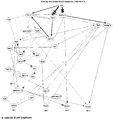
- In the field of Al or machine learning, there are several possibilities of calculating such hierarchic tree models. A preferred method consists in the decision tree model. The iterative method for calculating the decision tree can be illustrated as follows: The chromosomal regions are considered to be attributes that can assume four different values (deleted, enhanced, amplified and normal). First, the attribute (chromosomal region) which is best in classifying the entire data set is determined. Mathematically, the entropy rate is minimized or information acquisition rate is maximized. In the next iteration step, the attribute that best subdivides the subset of data allocated to the respective branch of the tree with respect to the examined tumour types is determined for each of the generated sub-trees. This method is iterated until one sub-tree merely comprises one type of tumour. The leaves of the tree comprise the respective tumour type as a value (cf. Fig. 1).
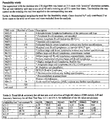
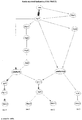
- On the basis of the decision tree a multitude of rules, which correspond to the paths in the tree (cf. Fig. 2), may be derived for each tumour type. Only rules that satisfy a quality criterion (cf. Table 2) are selected from this multitude of rules. This criterion primarily depends on how many of the examined tumours are unambiguously mapped by this rule. In order to test the rules thus obtained or their classification quality, a cross-validation step was carried out. In each of four test series, an accidental subset of the universal set of all tumours was selected which was used for generating the rules. The remaining cases were classified automatically with respect to the rules obtained. Again, only those rules were selected that reached in a cross-validation step an objectively high classification quality in a data set which was not used in the learning process (cf. Table 2). The classification quality was mathematically determined by the so-called lift value. The lift value does not only depend on the classification accuracy but also on the relative occurrences of the tumour type in all tumours and the number of correct classifications for this tumour type. The rules which satisfy both quality criteria are shown in form of a hierarchic tree for each tumour type (cf. Fig. 3).
- The method was exemplarily used in a feasibility study for classifying 325 haematological neoplasms (cf. Table 1). The results reproduced most of the aberration patterns known for haematological neoplasms.
- Moreover, a considerable number of so far unknown aberration patterns for different types of leukaemia were detected. The results are exemplarily described in the Figures.
- The present invention can potentially be used in different areas. In particular, the method can directly be used for
- calculating differential aberration models for tumours;
- automatically classifying tumours with respect to their chromosomal aberration pattern;
- fully automatically identifying chromosomal regions which comprise with high probability genes that are essential for the aetiology and/or pathogenesis of the respective tumour type.
- Indirectly, if these methods widely correlate with clinical parameters, they should be capable of achieving an improved stratification of patients with respect to their aberration patterns.
Claims (22)
- A method for automatically classifying tumours comprising the steps of:a) providing a data base comprising tumour data on different types of tumours; andb) automatically generating rules by means of which the tumour data can be assigned to a plurality of tumour types.
- The method according to claim 1, wherein steps a) and b) are followed by an automatic classification of the tumour data into tumour types in accordance with the rules.
- The method according to claim 1 or 2, wherein the tumour data in the data base in step a) comprise data based on a comparative genomic hybridisation (CGH).
- The method according to any of the preceding claims, wherein the rules in step b) comprise a sequence of chromosomal aberrations and/or null-aberrations correlated to one or more tumour types with a probability that is to be determined.
- The method according to any of the preceding claims, wherein aberrant chromosomal regions and/or regions that are highly probable to be aberrant in a subgroup of a tumour type are used for generating the rules in step b).
- The method according to any of claims 2 to 5, wherein the classification is carried out by means of a decision tree model.
- The method according to claim 6, wherein moreover chromosomal regions are considered to be attributes that can assume four different values (deleted, enhanced, amplified and normal).
- The method according to claim 7, wherein first the most suitable attribute for subdividing a whole data set is determined.
- The method according to claim 8, wherein the best possible subdivision concerning an attribute is determined by minimizing the entropy rate or maximizing the information acquisition rate.
- The method according to claim 8 or 9, wherein in a subsequent step that attribute is determined for each of the generated sub-trees which best subdivides the subset of data that are assigned to the respective branch of the tree with respect to the tumour types.
- The method according to claim 8, wherein the steps are iterated until one sub-tree comprises only tumours of one type or a further subdivision with respect to the number of cases detected in this sub-tree does not seem sensible any more.
- The method according to claim 11, wherein rules corresponding to the paths in the tree are derived for each tumour type on the basis of the decision tree.
- The method according to claim 12, wherein for each tumour type a multitude of rules are derived that satisfy a quality criterion which depends on the number of tumours that are unambiguously mapped by the rules.
- The method according to claim 11, wherein the classification quality of the rules obtained are tested by cross-validation.
- The method according to claim 12, wherein the classification quality is mathematically calculated by the lift value which depends on the classification accuracy and the relative occurrence of a tumour type in all tumour types and the number of correct classifications made for said tumour type.
- A computer program comprising a program code unit for carrying out a method according to any of the preceding claims if the computer program is carried out on a computer.
- A computer program product comprising a program code unit that is stored on a computer-readable data carrier in order to carry out a method according to any of claims 1 to 15 if the program product is carried out on a computer.
- A data processing system, in particular for carrying out a method according to any of claims 1 to 15, comprising:a) a data base with tumour data of different tumour types; andb) means for automatically generating rules by means of which tumour data can be assigned to a plurality of tumour types.
- The data processing system according to claim 18 further comprising a means for automatically classifying the tumour data into tumour types according to the rules.
- The data processing system according to claim 18 or 19, wherein the tumour data in the data base comprise data that are based on a comparative genomic hybridization.
- The data processing system according to any of claims 18 to 20, wherein the rules generated by the means for generating rules comprise a sequence of chromosomal aberrations and/or null-aberrations which are correlated to one or more tumour types at a probability that is to be determined.
- The data processing system according to any of claims 18 to 21, wherein during the generation of the rules the means for generating rules uses aberrant chromosomal regions and/or regions that are merely aberrant in a sub-group of a tumour type.
Priority Applications (1)
| Application Number | Priority Date | Filing Date | Title |
|---|---|---|---|
| EP01120774A EP1187053A3 (en) | 2000-09-08 | 2001-09-07 | A method and a program for comparative, automatic classification of tumours based on chromosomal abberation patterns |
Applications Claiming Priority (5)
| Application Number | Priority Date | Filing Date | Title |
|---|---|---|---|
| EP00119364 | 2000-09-08 | ||
| EP00119364 | 2000-09-08 | ||
| EP00119384 | 2000-09-11 | ||
| EP00119384 | 2000-09-11 | ||
| EP01120774A EP1187053A3 (en) | 2000-09-08 | 2001-09-07 | A method and a program for comparative, automatic classification of tumours based on chromosomal abberation patterns |
Publications (2)
| Publication Number | Publication Date |
|---|---|
| EP1187053A2 true EP1187053A2 (en) | 2002-03-13 |
| EP1187053A3 EP1187053A3 (en) | 2003-02-05 |
Family
ID=27223115
Family Applications (1)
| Application Number | Title | Priority Date | Filing Date |
|---|---|---|---|
| EP01120774A Withdrawn EP1187053A3 (en) | 2000-09-08 | 2001-09-07 | A method and a program for comparative, automatic classification of tumours based on chromosomal abberation patterns |
Country Status (1)
| Country | Link |
|---|---|
| EP (1) | EP1187053A3 (en) |
-
2001
- 2001-09-07 EP EP01120774A patent/EP1187053A3/en not_active Withdrawn
Non-Patent Citations (4)
| Title |
|---|
| DECAESTECKER CHRISTINE ET AL: "Improving morphology-based malignancy grading schemes in astrocytic tumors by means of computer-assisted techniques." January 1998 (1998-01) , BRAIN PATHOLOGY, VOL. 8, NR. 1, PAGE(S) 29-38 XP008011023 ISSN: 1015-6305 * abstract * * page 30, right-hand column, line 14-32 * * page 31, right-hand column, line 48 - page 32, left-hand column, line 18 * * page 33, right-hand column, line 15 - page 34, right-hand column, line 46 * * figures 1,3,5 * * |
| DESPER R ET AL: "INFERRING TREE MODELS FOR ONCOGENESIS FROM COMPARATIVE GENOME HYBRIDIZATION DATA" , JOURNAL OF COMPUTATIONAL BIOLOGY, MARY ANN LIEBERT INC, US, VOL. 6, NR. 1, PAGE(S) 37-51 XP008009500 ISSN: 1066-5277 * abstract * * page 38 - page 39 * * page 47, line 36-39 * * page 49, line 5-40 * * |
| GOLDSCHMIDT DENIS ET AL: "The contribution of image cytometry and artificial intelligence-related methods of numerical data analysis for adipose tumor histopathologic classification." 1996 , LABORATORY INVESTIGATION, VOL. 75, NR. 3, PAGE(S) 295-306 XP008011150 ISSN: 0023-6837 * |
| SETIONO R: "Generating concise and accurate classification rules for breast cancer diagnosis" , ARTIFICIAL INTELLIGENCE IN MEDICINE, MARCH 2000, ELSEVIER, NETHERLANDS, VOL. 18, NR. 3, PAGE(S) 205 - 219 XP002223596 ISSN: 0933-3657 * abstract * * page 206, line 18 - page 207, line 30 * * page 211, line 29 - page 218, line 45 * * |
Also Published As
| Publication number | Publication date |
|---|---|
| EP1187053A3 (en) | 2003-02-05 |
Similar Documents
| Publication | Publication Date | Title |
|---|---|---|
| Li et al. | Simple rules underlying gene expression profiles of more than six subtypes of acute lymphoblastic leukemia (ALL) patients | |
| Aguirre-Gutiérrez et al. | Fit-for-purpose: species distribution model performance depends on evaluation criteria–Dutch hoverflies as a case study | |
| US20180046755A1 (en) | Analyzing high dimensional single cell data using the t-distributed stochastic neighbor embedding algorithm | |
| Torres et al. | Random Forest identification of the thin disc, thick disc, and halo Gaia-DR2 white dwarf population | |
| Höglund et al. | Coping with complexity: multivariate analysis of tumor karyotypes | |
| EP1422661B1 (en) | Method and device for the analysis of array images | |
| US20050276457A1 (en) | Histological assessment | |
| US5897627A (en) | Method of determining statistically meaningful rules | |
| US6868342B2 (en) | Method and display for multivariate classification | |
| Bäuerle et al. | Classifier‐guided visual correction of noisy labels for image classification tasks | |
| Xiong et al. | Analysis of breast cancer using data mining & statistical techniques | |
| CN104862217A (en) | Bacterial drug resistance quick projection system and method | |
| JP2022046265A (en) | Bacterial species identification support method, multi-colony learning model generation method, bacterial species identification support device and computer program | |
| Bartels et al. | Objective cell image analysis | |
| Mazumdar et al. | Probabilistic selection approaches in decomposition-based evolutionary algorithms for offline data-driven multiobjective optimization | |
| Bull et al. | Extended correlation functions for spatial analysis of multiplex imaging data | |
| US20040179012A1 (en) | Method and apparatus for displaying information | |
| Nie et al. | Dissecting mitogenomic conflict to illuminate angiosperm deep phylogeny: Sequence and architectural evidence | |
| US20020155457A1 (en) | Method and a program for the comparative, automatic classification of tumours based on chromosomal aberration patterns | |
| CN119645883B (en) | Stateful protocol fuzzy test method and system based on response information | |
| CN115081014A (en) | Target detection label automatic labeling method based on federal learning | |
| de Oliveira Torres et al. | Texture analysis of lung nodules in computerized tomography images using functional diversity | |
| KR102593981B1 (en) | method for processing missing value in network log data and analyzing root cause of communication defect thereby | |
| CN117978517A (en) | An intelligent identification method of network attack situation based on power monitoring system | |
| Krachunov et al. | Machine learning models in error and variant detection in high-variation high-throughput sequencing datasets |
Legal Events
| Date | Code | Title | Description |
|---|---|---|---|
| PUAI | Public reference made under article 153(3) epc to a published international application that has entered the european phase |
Free format text: ORIGINAL CODE: 0009012 |
|
| AK | Designated contracting states |
Kind code of ref document: A2 Designated state(s): AT BE CH CY DE DK ES FI FR GB GR IE IT LI LU MC NL PT SE TR |
|
| AX | Request for extension of the european patent |
Free format text: AL;LT;LV;MK;RO;SI |
|
| PUAL | Search report despatched |
Free format text: ORIGINAL CODE: 0009013 |
|
| AK | Designated contracting states |
Designated state(s): AT BE CH CY DE DK ES FI FR GB GR IE IT LI LU MC NL PT SE TR |
|
| AX | Request for extension of the european patent |
Extension state: AL LT LV MK RO SI |
|
| 17P | Request for examination filed |
Effective date: 20030721 |
|
| AKX | Designation fees paid |
Designated state(s): AT BE CH CY DE DK ES FI FR GB GR IE IT LI LU MC NL PT SE TR |
|
| 17Q | First examination report despatched |
Effective date: 20050209 |
|
| STAA | Information on the status of an ep patent application or granted ep patent |
Free format text: STATUS: THE APPLICATION IS DEEMED TO BE WITHDRAWN |
|
| 18D | Application deemed to be withdrawn |
Effective date: 20050621 |