EP1186607A1 - Optically active pyrrolopyridazine compounds - Google Patents
Optically active pyrrolopyridazine compounds Download PDFInfo
- Publication number
- EP1186607A1 EP1186607A1 EP00939072A EP00939072A EP1186607A1 EP 1186607 A1 EP1186607 A1 EP 1186607A1 EP 00939072 A EP00939072 A EP 00939072A EP 00939072 A EP00939072 A EP 00939072A EP 1186607 A1 EP1186607 A1 EP 1186607A1
- Authority
- EP
- European Patent Office
- Prior art keywords
- optically active
- pharmaceutically acceptable
- acceptable salt
- alkyl
- group
- Prior art date
- Legal status (The legal status is an assumption and is not a legal conclusion. Google has not performed a legal analysis and makes no representation as to the accuracy of the status listed.)
- Granted
Links
- 0 CC(*)CCC[n]1c2c(*)nncc2c(*)c1* Chemical compound CC(*)CCC[n]1c2c(*)nncc2c(*)c1* 0.000 description 1
Classifications
-
- C—CHEMISTRY; METALLURGY
- C07—ORGANIC CHEMISTRY
- C07D—HETEROCYCLIC COMPOUNDS
- C07D487/00—Heterocyclic compounds containing nitrogen atoms as the only ring hetero atoms in the condensed system, not provided for by groups C07D451/00 - C07D477/00
- C07D487/02—Heterocyclic compounds containing nitrogen atoms as the only ring hetero atoms in the condensed system, not provided for by groups C07D451/00 - C07D477/00 in which the condensed system contains two hetero rings
- C07D487/04—Ortho-condensed systems
-
- A—HUMAN NECESSITIES
- A61—MEDICAL OR VETERINARY SCIENCE; HYGIENE
- A61P—SPECIFIC THERAPEUTIC ACTIVITY OF CHEMICAL COMPOUNDS OR MEDICINAL PREPARATIONS
- A61P1/00—Drugs for disorders of the alimentary tract or the digestive system
- A61P1/04—Drugs for disorders of the alimentary tract or the digestive system for ulcers, gastritis or reflux esophagitis, e.g. antacids, inhibitors of acid secretion, mucosal protectants
-
- A—HUMAN NECESSITIES
- A61—MEDICAL OR VETERINARY SCIENCE; HYGIENE
- A61P—SPECIFIC THERAPEUTIC ACTIVITY OF CHEMICAL COMPOUNDS OR MEDICINAL PREPARATIONS
- A61P31/00—Antiinfectives, i.e. antibiotics, antiseptics, chemotherapeutics
-
- A—HUMAN NECESSITIES
- A61—MEDICAL OR VETERINARY SCIENCE; HYGIENE
- A61P—SPECIFIC THERAPEUTIC ACTIVITY OF CHEMICAL COMPOUNDS OR MEDICINAL PREPARATIONS
- A61P31/00—Antiinfectives, i.e. antibiotics, antiseptics, chemotherapeutics
- A61P31/04—Antibacterial agents
-
- C—CHEMISTRY; METALLURGY
- C07—ORGANIC CHEMISTRY
- C07D—HETEROCYCLIC COMPOUNDS
- C07D207/00—Heterocyclic compounds containing five-membered rings not condensed with other rings, with one nitrogen atom as the only ring hetero atom
- C07D207/02—Heterocyclic compounds containing five-membered rings not condensed with other rings, with one nitrogen atom as the only ring hetero atom with only hydrogen or carbon atoms directly attached to the ring nitrogen atom
- C07D207/30—Heterocyclic compounds containing five-membered rings not condensed with other rings, with one nitrogen atom as the only ring hetero atom with only hydrogen or carbon atoms directly attached to the ring nitrogen atom having two double bonds between ring members or between ring members and non-ring members
- C07D207/34—Heterocyclic compounds containing five-membered rings not condensed with other rings, with one nitrogen atom as the only ring hetero atom with only hydrogen or carbon atoms directly attached to the ring nitrogen atom having two double bonds between ring members or between ring members and non-ring members with hetero atoms or with carbon atoms having three bonds to hetero atoms with at the most one bond to halogen, e.g. ester or nitrile radicals, directly attached to ring carbon atoms
Definitions
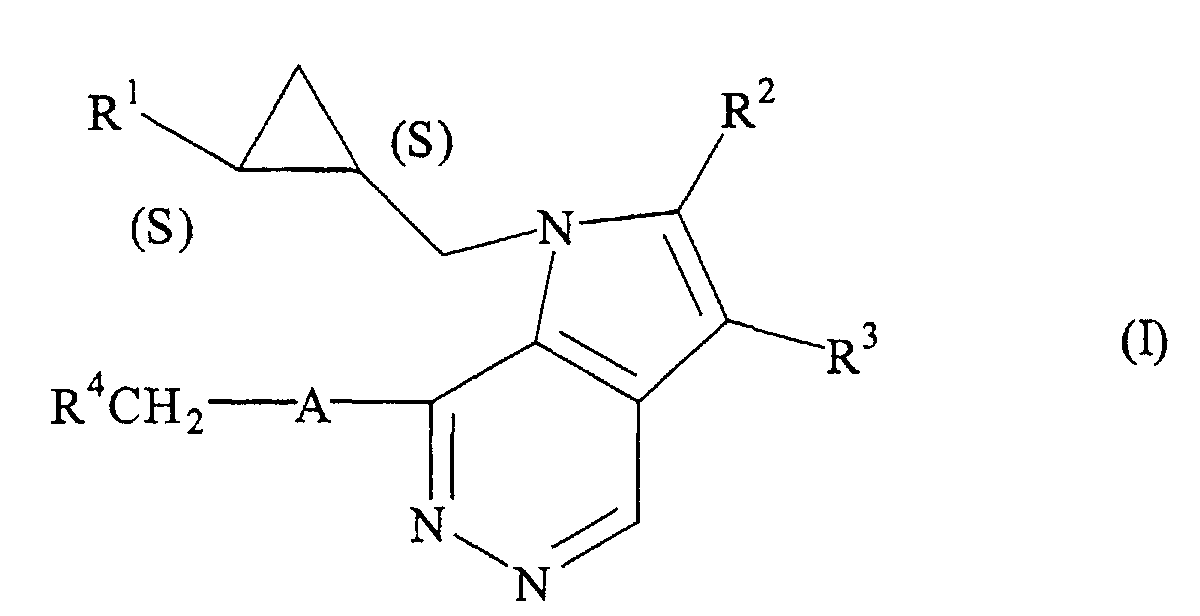
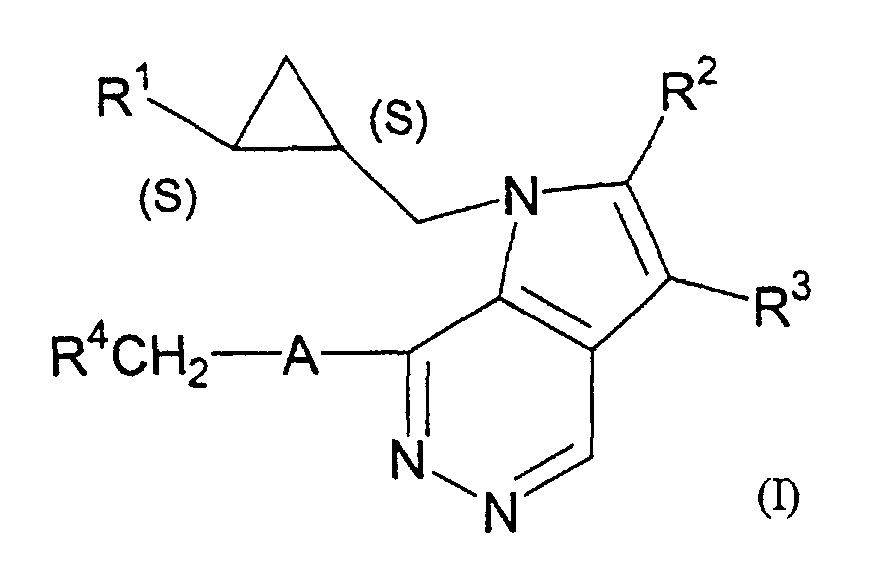
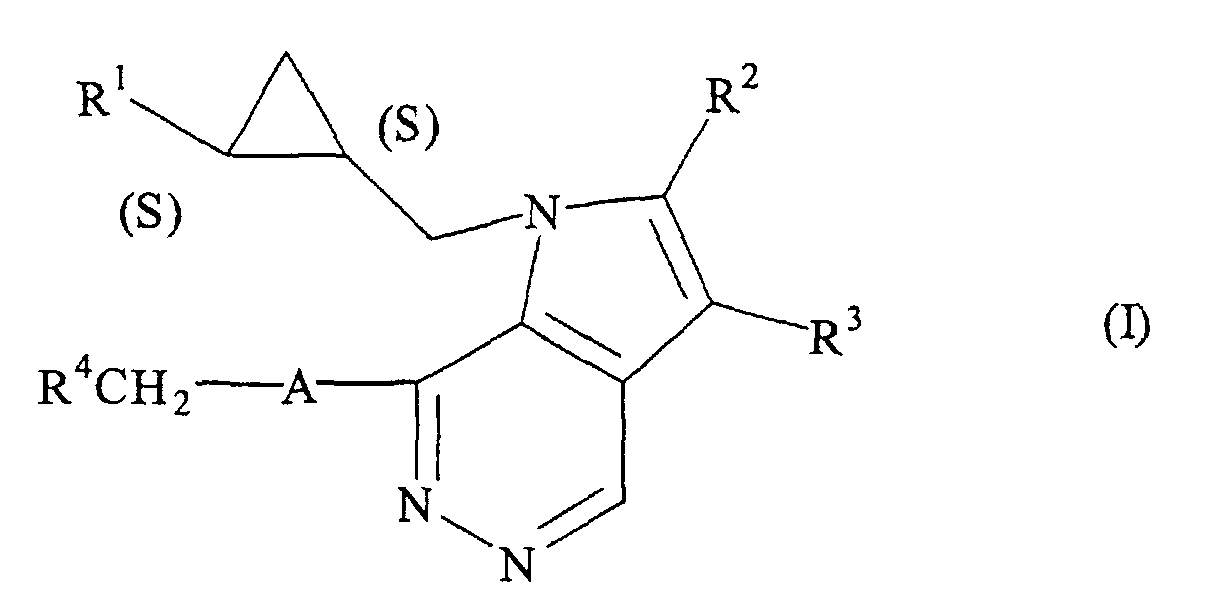
- This invention relates to optically active pyrrolopyridazine derivatives of formula (I) or pharmaceutically acceptable salts thereof.
- This invention further relates to pharmaceutical compositions comprising an optically active pyrrolopyridazine derivative of formula (I) or a pharmaceutically acceptable salt thereof (preferably compositions for prevention or treatment of ulcerative disease) as an active ingredient.
- this invention relates to the use of an optically active pyrrolopyridazine derivative of formula (1) or a pharmaceutically acceptable salt thereof in the preparation of a pharmaceutical composition (preferably a composition for the prevention or treatment of ulcerative disease).
- this invention relates to a method for the prevention or treatment of disease (preferably ulcerative disease), which method comprises administering a pharmaceutically effective amount of an optically active pyrrolopyridazine derivative of formula (I) or a pharmaceutically acceptable salt thereof to a warm-blooded animal (preferably a human) in need of such treatment.
- disease preferably ulcerative disease
- a pharmaceutically effective amount of an optically active pyrrolopyridazine derivative of formula (I) or a pharmaceutically acceptable salt thereof to a warm-blooded animal (preferably a human) in need of such treatment.
- this invention relates to a process for the preparation of optically active pyrrolopyridazine derivatives of formula (I) and pharmaceutically acceptable salts thereof.
- Gastric acid secretion is an aggressive factor and suppression of gastric acid secretion is useful in the prevention and treatment of the disease.
- Anticholinergic drugs, histamine H2 receptor antagonists such as cimetidine and proton-pump inhibitors such as omeprazole have been clinically used as a gastric acid secretory inhibitor. Although these drugs are excellent therapeutic agents for ulcerative disease, the disease may recur after cessation of the therapy. It has been recently reported that Helicobacter pylori relates to recurrence of the ulcerative disease. Actually there have been some attempts to use a gastric acid secretory inhibitor in combination with an antibacterial agent for treatment of the disease.
- Some pyrrolopyridazine derivatives that have gastric acid secretory inhibition activity and protect gastric mucous membranes have been described in WO 91/17164, WO 92/06979 and WO 93/08190.
- Japanese Patent Application Publication Hei 7-247285 the activity against Helicobacter pylori of some pyrrolopyridazine derivatives has also been described.
- the inventors have continued an investigation on the pharmacological activities of pyrrolopyridazine derivatives in order to discover compounds that exhibit potent gastric acid secretory inhibition activity, protect gastric mucous membranes and have excellent antibacterial activity against Helicobacter pylori for a long time. It was proved that some optically active pyrrolopyridazine derivatives substituted with a trans-alkylcyclopropylmethyl group have such activities and are superior to the corresponding racemate as a medicament.
- This invention relates to optically active pyrrolopyridazine derivatives of formula (I) or pharmaceutically acceptable salts thereof.
- This invention further relates to pharmaceutical compositions comprising an optically active pyrrolopyridazine derivative of formula (I) or a pharmaceutically acceptable salt thereof (preferably compositions for prevention or treatment of ulcerative disease) as an active ingredient.
- this invention relates to the use of an optically active pyrrolopyridazine derivative of formula (I) or a pharmaceutically acceptable salt thereof in the preparation of a pharmaceutical composition (preferably a composition for the prevention or treatment of ulcerative disease).
- this invention relates to a method for the prevention or treatment of disease (preferably ulcerative disease), which method comprises administering a pharmaceutically effective amount of an optically active pyrrolopyridazine derivative of formula (I) or a pharmaceutically acceptable salt thereof to a warm-blooded animal (preferably a human) in need of such treatment.
- disease preferably ulcerative disease
- a pharmaceutically effective amount of an optically active pyrrolopyridazine derivative of formula (I) or a pharmaceutically acceptable salt thereof to a warm-blooded animal (preferably a human) in need of such treatment.
- this invention relates to a process for the preparation of optically active pyrrolopyridazine derivatives of formula (I) and pharmaceutically acceptable salts thereof.
- An optically active pyrrolopyridazine derivative of the present invention has the following formula: wherein:
- the C 1 -C 6 alkyl moiety of the alkyl group in the definitions of R 1 , R 2 , R 3 and R 4 and of the halogeno C 1 -C 6 alkyl, C 1 -C 6 alkoxy and halogeno C 1 -C 6 alkoxy group included in the definition of R 4 is, for example, a methyl, ethyl, propyl, isopropyl, butyl, isobutyl, s-butyl, t-butyl, pentyl or hexyl group; is preferably a C 1 -C 4 alkyl group; more preferably a methyl or ethyl group and most preferably methyl.
- the halogen atom included in the definition of R 4 is, for example, a fluorine, chlorine, bromine or iodine atom; preferably a fluorine, chlorine or bromine atom and more preferably a fluorine or chlorine atom.
- the C 6 -C 10 aryl group in the definition of R 4 is, for example, a phenyl or naphthyl group; preferably a phenyl group.
- the number of substituents on the aryl group is from 1 to 5; 1 to 3 is preferable, 1 or 2 is more preferable and 1 is the most preferable.
- the C 6 -C 10 aryl group is optionally substituted with one or more substituents selected from the group consisting of C 1 -C 6 alkyl, halogeno C 1 -C 6 alkyl, C 1 -C 6 alkoxy, halogeno C 1 -C 6 alkoxy and halogen is preferably, for example, a phenyl, methylphenyl, (trifluoromethyl)phenyl, methoxyphenyl, (trifluoromethoxy)phenyl, (difluoromethoxy)phenyl, fluorophenyl, chlorophenyl, bromophenyl, difluorophenyl, chlorofluorophenyl, dichlorophenyl, trifluorophenyl, trichlorophenyl, naphthyl, methylnaphthyl, methoxynaphthyl, fluoronaphthyl, chloronaphthyl or bromona
- A is preferably an oxygen or sulfur atom, more preferably an oxygen atom.
- the pharmaceutically acceptable salt of the compound of formula (I) is an acid addition salt, for example, a hydrohalogenic acid salt such as hydrofluoride, hydrochloride, hydrobromide and hydroiodide; a nitrate; a perchlorate; a sulfate; a phosphate; a carbonate; a C 1 -C 6 alkylsulfonate which is optionally substituted with fluorine atom(s), such as methanesulfonate, trifluoromethanesulfonate, ethanesulfonate, pentafluoroethanesulfonate, propanesulfonate, butanesulfonate, pentanesulfonate and hexanesulfonate; a C 6 -C 10 arylsulfonate such as benzenesulfonate and p-toluenesulfonate; a carboxylate, such as acetate, propionat
- the compound of formula (I) of the present invention or a salt thereof can exist as a hydrate form and the scope of the present invention encompasses the hydrate form.
- Preferred compounds of formula (I) of the present invention include:
- the preferred compounds in Table 1 are those of exemplification compound number 1, 2, 4, 5, 7, 9, 10, 11, 13, 17, 18, 19, 21, 22, 23, 24, 25, 28, 29, 30, 31, 32, 34, 37 and 38;
- the pyrrolopyridazine derivatives of formula (I) can be prepared by the method illustrated in the following reaction scheme.
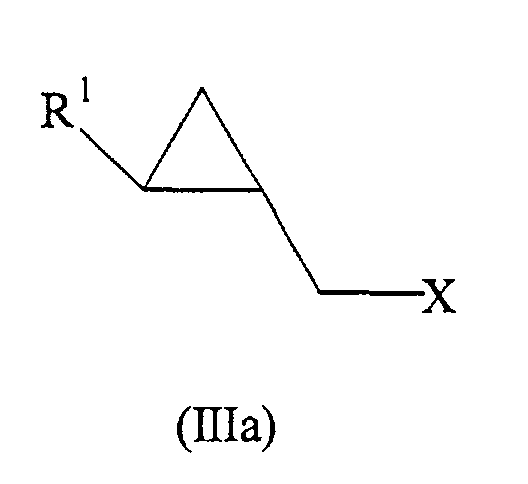
- R 1 , R 2 , R 3 , R 4 and A are as defined above, R 5 is a C 1 -C 6 alkyl group, R 6 is a hydrogen atom or a formyl group, X is a halogen atom (preferably a chlorine, bromine or iodine atom) or a C 1 -C 6 alkanesulfonyloxy or C 6 -C 10 arylsulfonyloxy group such as methanesulfonyloxy, ethanesulfonyloxy, butanesulfonyloxy, benzenesulfonyloxy, toluenesulfonyloxy and naphthalenesulfonyloxy (preferably a methanesulfonyloxy, ethanesulfonyloxy, benzenesulfonyloxy or p-toluenesulfony
- Step 1 in which a compound of formula (IV) is prepared, is accomplished by reaction of a compound of formula (II) with a compound of formula (III) in an inert solvent in the presence of a base.
- R 6 is a hydrogen atom, this is followed by formylation of the reaction product.
- the base used in the reaction of the compound of formula (II) with the compound of formula (III) is, for example, an alkali metal hydride such as lithium hydride, sodium hydride or potassium hydride; an alkali metal amide such as lithium amide, sodium amide or potassium amide; an alkali metal carbonate such as lithium carbonate, sodium carbonate or potassium carbonate; an alkali metal alkoxide such as lithium methoxide, sodium methoxide, sodium ethoxide or potassium tert-butoxide; an organic amine derivative such as triethylamine, tributylamine, diisopropylethylamine, N-ethylmorpholine, pyridine, picoline, 4-(N,N-dimethylamino)pyridine, quinoline, N,N-dimethylaniline, N,N-diethylaniline, 1,5-diazabicyclo[4.3.0]non-5-ene (DBN); 1,4-diaza
- the inert solvent in step 1 is not limited provided that it has no adverse effect on the reaction and can dissolve the starting materials to a certain extent.
- a solvent is, for example, an aliphatic hydrocarbon such as hexane, heptane, ligroin or petroleum ether; an aromatic hydrocarbon such as benzene, toluene or xylene; a halogeno-hydrocarbon such as methylene chloride, chloroform, carbon tetrachloride, dichloroethane, chlorobenzene or dichlorobenzene; an ether such as diethyl ether, diisopropyl ether, tetrahydrofuran, dioxane, dimethoxyethane or diethylene glycol dimethyl ether; a ketone such as acetone, methyl ethyl ketone, methyl isobutyl ketone, isophorone or cyclohexanone; an amide such as formamide,
- the reaction temperature of step 1 is usually in the range of from 0°C to 250°C (preferably from room temperature to 150°C).
- the reaction time of step 1 depends on the reaction temperature and the like and is in the range of from 1 minute to 50 hours (preferably from 10 minutes to 30 hours).
- a quaternary ammonium salt such as benzyltrimethylammonium chloride, tetrabutylammonium chloride or tetrabutylammonium bromide or a crown ether such as 18-crown-6 or dibenzo-18-crown-6 may be added to the reaction mixture in order to effectively carry out the reaction.
- the Vilsmeier reagent is known in the chemistry arts and is, for example, a combination of a halogenating reagent and dimethylformamide such as phosphorus oxychloride-dimethylformamide, phosphorus oxybromide-dimethylformamide or oxalyl chloride-dimethylformamide, and is preferably phosphorous oxychloride-dimethylformamide.
- the inert solvent in the Vilsmeier reaction is not limited provided that it has no adverse effect on the reaction and can dissolve the starting materials to a certain extent.
- a solvent is, for example, an aromatic hydrocarbon such as benzene, toluene or xylene; a halogeno-hydrocarbon such as methylene chloride, chloroform, carbon tetrachloride, dichloroethane, chlorobenzene or dichlorobenzene; an ether such as diethyl ether, diisopropyl ether, tetrahydrofuran, dioxane, dimethoxyethane and diethylene glycol dimethyl ether; or an amide such as dimethylformamide, and is preferably a halogeno-hydrocarbon (especially methylene chloride, chloroform or dichloroethane).
- the reaction temperature for the Vilsmeier reaction is usually in the range of from-20°C to 150°C (preferably from 0°C to 100°C).
- the reaction time depends on the reaction temperature and the like and is in the range of from 15 minutes to 12 hours (preferably from 30 minutes to 5 hours).
- Step 2 in which a compound of formula (V) is prepared, is accomplished by a reaction of a compound of formula (IV) with hydrazine or a hydrate thereof in an inert solvent.
- the inert solvent used in step 2 is not limited provided that it has no adverse effect on the reaction and can dissolve the starting materials to a certain extent.
- a solvent is, for example, an ether such as diethyl ether, diisopropyl ether, tetrahydrofuran, dioxane, dimethoxyethane or diethylene glycol dimethyl ether; an alcohol such as methanol, ethanol, propanol or isopropanol; an aromatic hydrocarbon such as benzene, toluene or xylene; a carboxylic acid such as acetic acid or propionic acid; an amide such as formamide, dimethylformamide, dimethylacetamide, N-methyl-2-pyrrolidone or hexamethylphosphorictriamide; an amine such as triethylamine or pyridine; water; or mixtures thereof, and is preferably an alcohol (especially ethanol) or a carboxylic acid (especially acetic acid).
- the reaction temperature of step 2 is usually in the range of from -50°C to 150°C (preferably from -10°C to 120°C).
- the reaction time of step 2 depends on the reaction temperature and the like and is in the range of from 10 minutes to 12 hours (preferably from 30 minutes to 5 hours).
- Step 3 in which a compound of formula (VI) is prepared, is accomplished by reaction of a compound of formula (V) with a halogenating reagent in the presence or absence of an inert solvent.
- the halogenating reagent in this step is, for example, phosphorus oxychloride, phosphorus oxybromide, thionyl chloride, thionyl bromide, oxalyl chloride, phosphorus pentachloride or phosphorus pentabromide, preferably phosphorus oxychloride or thionyl chloride.
- a large excess of the halogenating reagent can be used as a solvent in this step.
- the inert solvent in step 3 is not limited provided that it has no adverse effect on the reaction and can dissolve the starting materials to a certain extent.
- a solvent is, for example, an aromatic hydrocarbon such as benzene, toluene or xylene; a halogeno-hydrocarbon such as methylene chloride, chloroform, carbon tetrachloride, dichloroethane, chlorobenzene or dichlorobenzene; an ether such as diethyl ether, diisopropyl ether, tetrahydrofuran, dioxane, dimethoxyethane or diethylene glycol dimethyl ether; an amide such as dimethylformamide, dimethylacetamide or N-methyl-2-pyrrolidone; or a sulfoxide such as dimethylsulfoxide; and is preferably a halogeno-hydrocarbon (especially methylene chloride or dichloroethane).
- the reaction temperature of step 3 is usually in the range of from 0°C to 150°C (preferably from room temperature to 120°C).
- the reaction time of step 3 depends on the reaction temperature and the like and is in the range of from 30 minutes to 12 hours (preferably from 1 hour to 6 hours).
- An organic amine derivative such as triethylamine, tributylamine, diisopropylethylamine, N-ethylmorpholine, pyridine, picoline or 4-(N,N-dimethylamino)pyridine may be added to the reaction mixture in order to effectively carry out the reaction.
- Step 4 in which a desired compound of formula (I) of the present invention is prepared, is accomplished by reaction of a compound of formula (VI) with a compound of formula (VII) in the presence of a base in an inert solvent in a similar procedure to that described in step 1.
- Each desired product of steps 1, 2, 3, and 4 may be isolated by conventional procedures from the reaction mixture. For example, it may be obtained 1) by filtration of the reaction mixture when insoluble material exists in the reaction mixture, followed by evaporation of the solvent of the filtrate; or by 1) concentration of the reaction mixture, 2) partition of the residue between water and an appropriate organic solvent immiscible with water, 3) drying the extract over anhydrous magnesium sulfate and the like, followed by 4) concentration of the extract.
- the desired compound is, if necessary, further purified by conventional procedures such as recrystallization, column chromatography and the like.
- the desired optically active compound (1S and 2S configuration) can also be prepared by optical resolution of the racemic product (the racemic form of the compound of any one of formulae (I), (IV), (V) or (VI)), which is obtained by the same procedure using the racemic compound of formula (IIIa) (a mixture of 1S,2S and 1R,2R configuration) in step 1 instead of the optically active compound of formula (III).
- a method of optical resolution can be appropriately selected from conventional procedures, for example, column chromatography for optical resolution, preferential crystallization, or resolution of diastereomeric salts.
- the compound of formula (I) can be converted into its pharmaceutically acceptable salt by treatment with an acid.
- an acid for example, it can be obtained by reaction of the compound of formula (I) with an acid in an inert solvent (a preferred solvent is an ether such as ether, tetrahydrofuran or dioxane; an alcohol such as methanol, ethanol or propanol; or a halogeno-hydrocarbon such as methylene chloride or chloroform) for from 5 minutes to 1 hour, followed by concentration.
- an inert solvent is an ether such as ether, tetrahydrofuran or dioxane; an alcohol such as methanol, ethanol or propanol; or a halogeno-hydrocarbon such as methylene chloride or chloroform
- the compounds of formula (I) of this invention exhibit potent gastric acid secretion inhibition activity, protective activity of gastric mucous membranes and potent antibacterial activity against Helicobacter pylori and excellent properties as a medicament.
- the compounds of formula (I) are useful as a medicament, especially a useful prophylactic or therapeutic (preferably therapeutic) agent for ulcerative diseases such as peptic ulcer, acute or chronic gastric ulcer, gastritis, reflux esophagitis, gastroesophageal reflux disorder, dyspepsia, gastric hyperacidity or Zollinger-Ellison syndrome, and as a prophylactic or therapeutic (preferably therapeutic) agent for bacterial infections arising from Helicobacter pylori.
- a compound of formula (I) or a pharmaceutically acceptable salt thereof can be administered alone or can be presented as part of a pharmaceutical formulation.
- the pharmaceutical formulation is prepared by blending the active ingredient with appropriate pharmaceutically acceptable excipients, diluents and the like, followed by formulation in the form of tablets, capsules, granules, powders or syrups and the like for oral administration or in the form of injections and the like for parenteral administration (preferably oral administration).
- Such pharmaceutical formulations is carried out according to general techniques known to those skilled in the art, using additives such as an excipient, a binder, a disintegrant, a lubricant, a stabilizer, a corrigent, a diluent and a solvent for injections.
- additives such as an excipient, a binder, a disintegrant, a lubricant, a stabilizer, a corrigent, a diluent and a solvent for injections.
- the excipient is, for example, a sugar derivative such as lactose, sucrose, glucose, mannitol or sorbitol; a starch derivative such as corn starch, potato starch, ⁇ -starch, dextrin or carboxymethyl starch; a cellulose derivative such as crystalline cellulose, low-substituted hydroxypropyl cellulose, hydroxypropylmethyl cellulose, carboxymethyl cellulose, calcium carboxymethyl cellulose or internally bridged sodium carboxymethyl cellulose; gum arabic; dextran; pullulan; a silicate derivative such as light silicic acid anhydride, synthetic aluminium silicate or magnesium aluminate meta-silicate; a phosphate derivative such as calcium phosphate; a carbonate derivative such as calcium carbonate; or a sulfate derivative such as calcium sulfate; and the like.
- a sugar derivative such as lactose, sucrose, glucose, mannitol or sorbitol
- the binder is, for example, one of the excipients described above; gelatin; polyvinylpyrrolidone; macrogol and the like.
- the disintegrant is, for example, one of the excipients described above, a chemically modified starch or cellulose derivative such as sodium croscarmellose, sodium carboxymethyl starch or bridged polyvinylpyrrolidone; and the like.
- the lubricant is, for example, talc; stearic acid; a metal salt of stearic acid such as calcium stearate or magnesium stearate; colloidal silica; a wax such as bee gum and spermaceti; boric acid; glycol; a carboxylic acid such as fumaric acid or adipic acid; a sodium carboxylate such as sodium benzoate; a sulfate such as sodium sulfate; leucine; a laurylsulfate such as sodium laurylsulfate and magnesium laurylsulfate; a silicic acid derivative such as silicic acid anhydride or silicic acid hydrate; one of the starch derivatives described above in relation to the excipients; and the like.
- the stabilizer is, for example, a p-hydroxybenzoate derivative such as methylparaben and propylparaben; an alcohol such as chlorobutanol, benzyl alcohol or phenylethyl alcohol; benzalkonium chloride; a phenol derivative such as phenol or cresol; thimerosal; dehydroacetic acid; sorbic acid; and the like.
- a p-hydroxybenzoate derivative such as methylparaben and propylparaben
- an alcohol such as chlorobutanol, benzyl alcohol or phenylethyl alcohol
- benzalkonium chloride a phenol derivative such as phenol or cresol
- thimerosal dehydroacetic acid
- sorbic acid and the like.
- the corrigent is, for example, a sweetening, souring or flavoring agent, which are conventionally used; and the like.
- the solvent for injection is, for example, water, ethanol, glycerin and the like.
- Suitable dosage levels will depend on the condition of disease, the age of the patient and the like, but typically suitable dosage levels for an active ingredient of the present invention are from 1 mg (preferably 5 mg) to 1000 mg (preferably 500 mg) for oral administration and from 0.1 mg (preferably 1 mg) to 500 mg (preferably 300 mg) for intravenous administration per unit dose, per day, for an adult human, respectively.
- the dosages described above are preferably administered from one time to six times throughout the day, depending on the condition of disease.
- Phosphorus oxychloride (55 ml, 590 mmol) was added to 2,3-dimethyl-1-[(1S,2S)-2-methylcyclopropylmethyl]-6,7-dihydropyrrolo[2,3-d]pyridazin-7-one (6.95 g,30.1 mmol) and the mixture was stirred at 90°C for 3.5 hours. After this time the reaction mixture was cooled to room temperature and poured dropwise into iced water. The aqueous solution was neutralized with 5N aqueous sodium hydroxide solution and extracted with methylene chloride. The extract was washed with water, dried over anhydrous magnesium sulfate and then concentrated in vacuo.
- reaction mixture was poured into iced water and extracted with ethyl acetate.
- the extract was washed with saturated aqueous sodium chloride solution, dried over anhydrous magnesium sulfate and then concentrated in vacuo. Hexane was added to the residue, and the precipitate was collected by filtration and then recrystallized from a mixture of ethyl acetate and hexane to afford the title compound (2.25 g, 66.4%) as pale brown crystals.
- CHIRALCEL OJ 50 ⁇ x 500mm, a product of Daicel Chemical Industries, Ltd.
- Phosphorous oxychloride (2.15 g, 14 mmol) was added to a solution of dimethylformamide (1.10 g, 15 mmol) in toluene (2 ml) and the mixture was stirred at room temperature for 30 minutes. To this mixture was added a solution of methyl 4,5-dimethyl-1-[(1S,2S)-2-methylcyclopropylmethyl]pyrrole-2-carboxylate (2.21 g,10 mmol) in toluene (6 ml) and the mixture was then heated at 80°C for 10 hours. After this time, the reaction mixture was poured into water and neutralized with saturated aqueous sodium hydrogencarbonate solution.
- the mixture was incubated with 200 times/min of agitation at 37°C for 45 minutes.
- the enzymatic reaction was started by adding 0.25 ml of a 8 mM solution of disodium adenosine triphosphate. After this enzymatic reaction was continued for 20 minutes, 1 ml of a 10% trichloroacetic acid - activated charcoal (100 mg) solution was added to terminate the reaction.
- the reaction mixture was centrifuged (at 4°C and 3000 rpm) for 15 minutes.
- Inorganic phosphoric acid formed by the hydrolysis of adenosine triphosphate in the supernatant was subjected to colorimetry by the method of Yoda, et al. [Biochem. Biophys, Res.
- the amount of inorganic phosphoric acid in a reaction mixture free from potassium chloride was also measured. By subtracting this amount from the amount of inorganic phosphoric acid in the presence of potassium chloride, proton-potassium-adenosine triphosphatase activity was determined. An inhibition ratio (%) was determined from the active value of the control and the active value of the test compound at each concentration, whereby a 50% inhibitory concentration (IC 50 ⁇ g/ml) against proton-potassium-adenosine triphosphatase was determined. As a result, the compound of Example 1 had a 50% inhibitory concentration (IC 50 ) not greater than 0.1 ⁇ g/ml, exhibiting excellent activity.
- the antibacterial activity of the invention compound was evaluated by using Helicobacter pylori strains 9470, 9472 and 9474 and determining MIC (Minimum Inhibitory Concentration) of the invention compound against Helicobacter pylori .
- Helicobacter pylori was cultured by plating for 4 days.
- a medium was prepared by dissolving Brain Heart Infusion Agar (product of Difco Laboratories) in a prescribed amount of distilled water, sterilizing in an autoclave, adding equine blood (product of Nippon Seibutsu Zairyo) to give its concentration of 7% and then solidifying the mixture.
- Hcobacter pylori which had been cultured at 37°C for 4 days was suspended in physiological saline to give its viable count of about 10 8 CFU/ml.
- the suspension was then diluted to 100 times and a portion (about 10 ⁇ l) of the diluted suspension was inoculated in a medium for measuring MIC.
- the medium employed for measuring MIC has the same composition as the preculture medium.
- a compound of this invention was dissolved in dimethyl sulfoxide (DMSO) and two-fold serial dilutions were made with sterilized water. After mixing the solution and the medium in a ratio of 1:99, a solidified product in the Petri dish was employed as an MIC measuring medium.
- DMSO dimethyl sulfoxide
- each group consisting of 3 to 5 rats were fasted overnight, they were subjected to midline abdominal incision and their pylorus was ligated under anesthesia with ether.
- the stomach and duodenum were returned to their original positions in the body, followed by closing at the abdominal incision part.
- a predetermined amount of a test compound was suspended in an aqueous solution containing 0.5% of sodium carboxymethylcellulose and 0.4% of Tween 80 (Polysorbate 80).
- the resulting suspension was orally administered to the rats.
- an aqueous suspension (suspending solvent) containing 0.5% of sodium carboxymethylcellulose and 0.4% of Tween 80 (Polysorbate 80) was orally administered to other rats.
- the rats Four hours after administration of the test compound or suspending solvent, the rats were sacrificed by inhalation of CO 2 gas. They were subjected to abdominal incision to remove their stomach. The content of the stomach was collected in a glass-made graduated centrifuge tube. After centrifugation, the amount (ml) of the supernatant and the amount (ml) of the precipitate were measured. The precipitate of the amount exceeding 0.5 ml was regarded as coprophage and removed from the data. The supernatant (100 ⁇ l) was poured into a test tube. Distilled water (4 ml) was added to the solution, and the solution was titrated to pH 7.0 with 0.01 N sodium hydroxide.
- a 50% inhibitory dose (ID 50 mg/kg) was determined from a dose-inhibition ratio curve on which an inhibition ratio at each dose (0.3 mg/kg, 1 mg/kg, 3 mg/kg and 10 mg/kg) versus logarithmic dose was drawn in accordance with the least squares. The results are shown in Table 2. Inhibitory effects on gastric acid secretion Test compound 50% inhibitory dose (ID 50 , mg/kg) against gastric acid secretion Compound of Example 1 0.52 Compound A 1.64
- Compound A A 1:1 mixture of Compound of Example 1 and its antipode (racemate: Compound of Example 57 of Japanese Patent Application Laid-Open No. 7-247285)
- a tablet is prepared using the ingredients above.
- the components are biended and compressed by a tablet machine to form a tablet weighing 200 mg.
- the tablet may be coated if necessary, for example, to form a sugar-coated tablet.
Landscapes
- Chemical & Material Sciences (AREA)
- Organic Chemistry (AREA)
- Health & Medical Sciences (AREA)
- Life Sciences & Earth Sciences (AREA)
- Public Health (AREA)
- General Chemical & Material Sciences (AREA)
- Medicinal Chemistry (AREA)
- Nuclear Medicine, Radiotherapy & Molecular Imaging (AREA)
- Chemical Kinetics & Catalysis (AREA)
- Pharmacology & Pharmacy (AREA)
- Veterinary Medicine (AREA)
- Animal Behavior & Ethology (AREA)
- General Health & Medical Sciences (AREA)
- Oncology (AREA)
- Communicable Diseases (AREA)
- Engineering & Computer Science (AREA)
- Bioinformatics & Cheminformatics (AREA)
- Pharmaceuticals Containing Other Organic And Inorganic Compounds (AREA)
- Nitrogen Condensed Heterocyclic Rings (AREA)
- Plural Heterocyclic Compounds (AREA)
- Organic Low-Molecular-Weight Compounds And Preparation Thereof (AREA)
- Low-Molecular Organic Synthesis Reactions Using Catalysts (AREA)
- Pyrrole Compounds (AREA)
Abstract
Description


| Exemplification Compound number. | A | R4 |
| 1 | O | Ph |
| 2 | O | 2-FPh |
| 3 | O | 3-FPh |
| 4 | O | 4-FPh |
| 5 | O | 2,4-diFPh |
| 6 | O | 2,6-diFPh |
| 7 | O | 2,4,6-triFPh |
| 8 | O | 2-CIPh |
| 9 | O | 4-CIPh |
| 10 | O | 2,4-diCIPh |
| 11 | O | 2,4,6-triCIPh |
| 12 | O | 4-MePh |
| 13 | O | 4-CF3Ph |
| 14 | O | 4-OMePh |
| 15 | O | 4-OCHF2Ph |
| 16 | O | 2-CI-6-FPh |
| 17 | O | 2-CI-4-FPh |
| 18 | O | 4-CI-2-FPh |
| 19 | S | Ph |
| 20 | S | 2-FPh |
| 21 | S | 4-FPh |
| 22 | S | 2,4-diFPh |
| 23 | S | 2,4,6-triFPh |
| 24 | S | 4-CIPh |
| 25 | S | 2,4-diCIPh |
| 26 | S | 2,4,6-triCIPh |
| 27 | S | 4-CF3Ph |
| 28 | S | 2-CI-4-FPh |
| 29 | S | 4-CI-2-FPh |
| 30 | NH | Ph |
| 31 | NH | 4-FPh |
| 32 | NH | 2,4-diFPh |
| 33 | NH | 2,4,6-triFPh |
| 34 | NH | 4-CIPh |
| 35 | NH | 2,4-diCIPh |
| 36 | NH | 4-CF3Ph |
| 37 | NH | 2-CI-4-FPh |
| 38 | NH | 4-CI-2-FPh |
| 39 | O | 4-OCF3Ph |
| 40 | O | 3-CIPh |
| 41 | O | 4-BrPh |
| 42 | O | 2,6-diCIPh |
| 43 | S | 4-OCF3Ph |
| 44 | S | 4-OCHF2Ph |
| 45 | S | 3-FPh |
| 46 | S | 2-CIPh |
| 47 | S | 4-BrPh |
| 48 | S | 2,6-diFPh |
| 49 | S | 2,6-diCIPh |
| 50 | NH | 4-OCF3Ph |
| 51 | NH | 2-FPh |
| 52 | NH | 2-CIPh |
| 53 | NH | 2,6-diFPh |
| 54 | NH | 2,6-diCIPh |
| 55 | NH | 2,4,6-triCIPh |


Mass spectrum (Cl, m/z) : 250 (M++1)
NMR spectrum (CDCl3, δ ppm) : 0.25 (dt; J=8Hz, 5Hz,1H), 0.48 (dt; J=8Hz, 5Hz,1H), 0.71-0.80 (m,1H), 0.82-0.89 (m,1H), 1.00 (d; J=6Hz, 3H), 2.20 (s,3H), 2.26 (s,3H), 3.89 (s,3H), 4.25 (d;J=7Hz, 2H), 10.43 (s,1H).
Optical rotation : [α]D 20=+17.6° (c=1.02, EtOH).
Mass spectrum (Cl, m/z): 232 (M++1)
NMR spectrum (CDCl3, δ ppm) : 0.22 (dt; J=8Hz,5Hz,1H), 0.64 (dt, J=8Hz, 5Hz,1H), 0.86-0.95 (m, 2H), 0.98 (d; J=5Hz, 3H), 2.21 (s,3H), 2.35 (s,3H), 4.44 (d; J=7Hz, 2H), 8.05 (s,1H), 9.97 (S,1H).
Optical rotation : [α]D 20=+11.2° (c=0.50, EtOH).
Mass spectrum (Cl, m/z) : 250 (M++1)
NMR spectrum (CDCl3, δ ppm) : 0.29 (dt; J=8Hz, 5Hz,1H), 0.54 (dt; J=8Hz, 5Hz,1H), 0.73-1.02 (m, 5H), 2.30 (s, 3H), 2.43 (s, 3H), 4.44 (d; J=6Hz, 2H), 9.15 (S,1H).
Optical rotation : [α]D 20=+12.3° (c=1.01, EtOH).
Mp:114-115°C
Mass spectrum (Cl, m/z) : 340 (M++1)
NMR spectrum (CDCl3, δ ppm) : 0.14 (dt; J=8Hz, 5Hz,1H), 0.39 (dt; J=8Hz, 5Hz,1H), 0.59-0.65 (m,1H), 0.76-0.85 (m,1H), 0.89 (d; J=6Hz,3H), 2.26 (s,3H), 2.36 (s,3H), 4.13 (dd;J=15Hz, 7Hz,1H), 4.27 (dd; J=15Hz, 6Hz,1H), 5.63 (d; J=12Hz,1H), 5.68 (d; J=12Hz,1H), 7.05-7.12 (m,2H), 7.47-7.52 (m,2H), 8.96 (s,1H).
Optical rotation : [α]D 20+17.9° (c=0.50, EtOH).
Mass spectrum (Cl, m/z): 222 (M++1)
NMR spectrum (CDCl3, δ ppm) : 0.20 (dt; J=8Hz, 5Hz,1H), 0.48 (dt; J=8Hz, 5Hz,1H), 0.67-0.93 (m,2H), 0.98 (d; J=6Hz, 3H), 2.01 (s, 3H), 2.18 (s, 3H), 3.76 (s,3H), 4.21 (d; J=7Hz, 2H), 6.76 (s,1H).
Mass spectrum (Cl, m/z): 222 (M++1)
NMR spectrum (CDCl3, δ ppm) : 0.20 (dt; J=8Hz, 5Hz, 1H), 0.48 (dt; J=8Hz, 5Hz,1H), 0.66-0.80 (m,1H), 0.82-0.91 (m,1H), 0.98 (d; J=6Hz, 3H), 2.01 (s,3H), 2.18 (s,3H), 3.76 (s,3H), 4.21 (d;J=7Hz, 2H), 6.76 (S,1H).
Optical rotation : [α]D 20=+17.60° (c=1.00, EtOH). [(R,R) form] compound:
Mass spectrum (Cl, m/z) : 222 (M++1)
NMR spectrum (CDCl3, δ ppm) : 0.20 (dt; J=8Hz, 5Hz,1H), 0.48 (dt; J=8Hz, 5Hz,1H), 0.66-0.80 (m,1H), 0.82-0.91 (m,1H), 0.98 (d;J =6Hz, 3H), 2.01 (s, 3H), 2.18 (s, 3H), 3.77 (s, 3H), 4.21 (d; J=7Hz, 2H), 6.76 (s, 1H).
Optical rotation : [α]D 20=-17.0° (C=1.01, EtOH).
Mp: 120-122°C
Mass spectrum (Cl, m/z): 340 (M++1)
NMR spectrum (CDCl3, δ ppm): 0.14 (dt; J=8Hz, 5Hz,1H), 0.39 (dt; J=8Hz, 5Hz,1H), 0.59-0.65 (m,1H), 0.76-0.85 (m,1H), 0.89 (d; J=6Hz, 3H), 2.26 (s, 3H), 2.36 (s, 3H), 4.13 (dd; J=15Hz, 7Hz,1H), 4.27 (dd; J=15Hz, 6Hz,1H), 5.63 (d; J=12Hz,1H), 5.68 (d; J=12Hz,1H), 7.05-7.12 (m, 2H), 7.47-7.52 (m, 2H), 8.96 (S,1H).
[(S,S) form] compound:
Mp:114-115°C
Mass spectrum (Cl, m/z): 340 (M++1)
NMR spectrum (CDCl3, δ ppm) : 0.14 (dt; J=8Hz, 5Hz,1H), 0.39 (dt; J=8Hz, 5Hz,1H), 0.59-0.65 (m,1H), 0.76-0.85 (m,1H), 0.89 (d; J=6Hz, 3H), 2.26 (s, 3H), 2.36 (s, 3H), 4.13 (dd; J=15Hz, 7Hz, 1H), 4.27 (dd; J=15Hz, 6Hz,1H), 5.63 (d; J=12Hz,1H), 5.68 (d; J=12.2Hz,1H), 7.05-7.12 (m,2H), 7.47-7.52 (m,2H), 8.96 (S,1H).
Optical rotation : [α] D 20=+19.0° (c=0.99, MeOH). [(R,R) form] compound:
Mp:114-115°C
Mass spectrum (Cl, m/z): 340 (M++1)
NMR spectrum (CDCl3, δ ppm) : 0.15 (dt; J=8Hz, 5Hz,1H), 0.39 (dt; J=8Hz, 5Hz,1H), 0.58-0.66 (m,1H), 0.78-0.85 (m,1H), 0.89 (d; J=6Hz, 3H), 2.26 (s, 3H), 2.37 (s, 3H), 4.13 (dd; J=15Hz, 7Hz,1H), 4.27 (dd; J=15Hz, 6Hz,1H), 5.63 (d; J=12Hz,1H), 5.68 (d; J=12Hz,1H), 7.06-7.11 (m, 2H),7.49-7.52 (m, 2H), 8.97 (s,1H).
Optical rotation : [α]D 20=-18.8° (c=0.98, MeOH).
| Inhibitory effects on gastric acid secretion | |
| Test compound | 50% inhibitory dose (ID50, mg/kg) against gastric acid secretion |
| Compound of Example 1 | 0.52 |
| Compound A | 1.64 |
| Tablets | |
| The compound of Example 1 | 30.0 mg |
| Lactose | 144.0 mg |
| Corn starch | 25.0 mg |
| Magnesium stearate | 1.0 mg |
| 200.0 mg |
Claims (21)
- An optically active pyrrolopyridazine derivative of formula (I) or a pharmaceutically acceptable salt thereof:wherein:
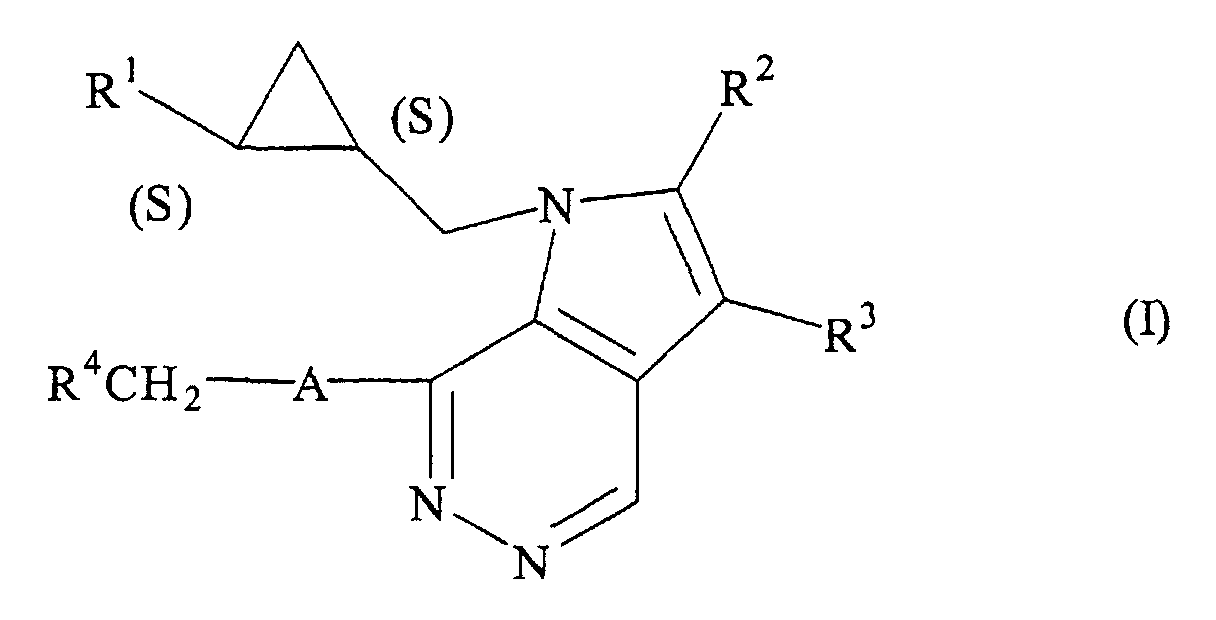 R1 is Ci-C6 alkyl;R2 and R3 are each independently C1-C6 alkyl;R4 is C6-C10 aryl which is optionally substituted with one or more substituents selected from the group consisting of C1-C6 alkyl, halogeno C1-C6 alkyi, C1-C6 alkoxy, halogeno C1-C6 alkoxy and halogen; andA is imino, oxygen or sulfur.
 - An optically active pyrrolopyridazine derivative or a pharmaceutically acceptable salt thereof according to claim 1 wherein R1 is C1-C4 alkyl.
- An optically active pyrrolopyridazine derivative or a pharmaceutically acceptable salt thereof according to claim 1 wherein R1 is methyl.
- An optically active pyrrolopyridazine derivative or a pharmaceutically acceptable salt thereof according to any one of claims 1 to 3 wherein R2 and R3 are each independently C1-C4 alkyl.
- An optically active pyrrolopyridazine derivative or a pharmaceutically acceptable salt thereof according to any one of claims 1 to 3 wherein R2 and R3 are each methyl.
- An optically active pyrrolopyridazine derivative or a pharmaceutically acceptable salt thereof according to any one of claims 1 to 5 wherein R4 is phenyl which is substituted with 1 to 3 substituents selected from the group consisting of C1-C4 alkyl, halogeno C1-C4 alkyl, C1-C4 alkoxy, halogeno C1-C4 alkoxy, fluoro, chloro and bromo.
- An optically active pyrrolopyridazine derivative or a pharmaceutically acceptable salt thereof according to any one of claims 1 to 5 wherein R4 is phenyl which is substituted with 1 to 3 substituents selected from the group consisting of methyl, trifluoromethyl, methoxy, trifluoromethoxy, difluoromethoxy, fluoro, chloro and bromo.
- An optically active pyrrolopyridazine derivative or a pharmaceutically acceptable salt thereof according to any one of claims 1 to 5 wherein R4 is phenyl which is substituted with 1 or 2 substituents selected from the group consisting of fluoro and chloro at position(s) selected. from the group consisting of the 2-, 4- and 6-positions of the phenyl group.
- An optically active pyrrolopyridazine derivative or a pharmaceutically acceptable salt thereof according to any one of claims 1 to 5 wherein R4 is phenyl which is substituted with 1 or 2 substituents selected from the group consisting of fluoro and chloro at the 4-position or at the 2- and 4-positions of the phenyl.
- An optically active pyrrolopyridazine derivative or a pharmaceutically acceptable salt thereof according to any one of claims 1 to 9 wherein A is oxygen or sulfur.
- An optically active pyrrolopyridazine derivative or a pharmaceutically acceptable salt thereof according to any one of claims 1 to 9 wherein A is oxygen.
- An optically active pyrrolopyridazine derivative or a pharmaceutically acceptable salt thereof selected from the group consisting of:7-(4-fluorobenzyloxy)-2,3-dimethyl-1-[(1 S,2S)-2-methylcyclopropylmethyl]pyrrolo[2,3-d]pyridazine;7-(2,4-difluorobenzyloxy)-2,3-dimethyl-1-[(1 S,2S)-2-methylcyclopropylmethyl]pyrrolo[2,3-dlpyridazine; and7-(4-chlorobenzyloxy)-2,3-dimethyl-1-[(1 S,2S)-2-methylcyclopropylmethyl]pyrrolo[2,3-d]pyridazine.
- A pharmaceutical composition containing as active ingredient an optically active pyrrolopyridazine derivative or a pharmaceutically acceptable salt thereof according to any one of claims 1 to 12.
- A pharmaceutical composition according to claim 13 that is useful for treating or preventing ulcerative disease.
- The use of an optically active pyrrolopyridazine derivative or a pharmaceutically acceptable salt thereof according to any one of claims 1 to 12 in the preparation of a pharmaceutical composition.
- The use according to claim 15 wherein the pharmaceutical composition is for treating or preventing ulcerative disease.
- A method for treating or preventing disease which comprises administering to a warm-blooded animal in need of such treatment or prevention an amount of an optically active pyrrolopyridazine derivative or a pharmaceutically acceptable salt thereof according to any one of claims 1 to 12 which is effective in treating or preventing disease.
- A method according to claim 17 wherein the disease is ulcerative disease.
- A method according to claim 17 to 18 wherein the warm-blooded animal is a human.
- A process for synthesizing an optically active pyrrolopyridazine derivative of the formula (I) or a pharmaceutically acceptable salt thereof:(wherein R1, R2, R3, R4 and A are as defined below),

which comprises reacting an optically active halogenopyrrolopyridazine derivative of the formula (VI):(wherein R1 is Ci-C6 alkyi; R2 and R3 are each independently C1-C6 alkyl; and Y is halogen)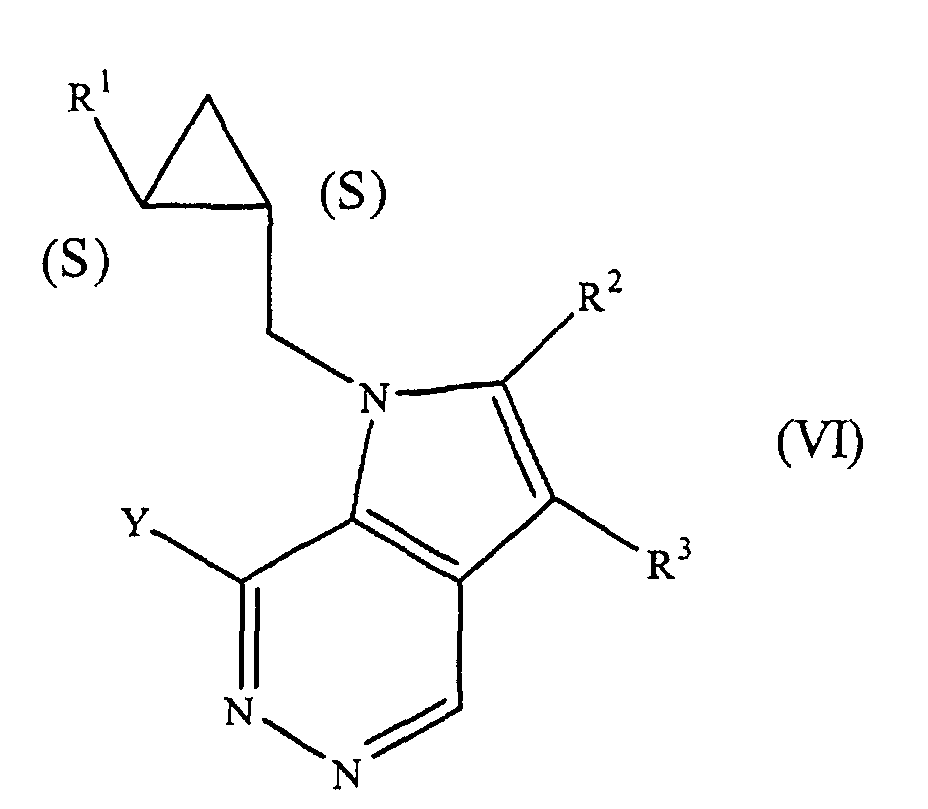
with a compound of the formula (VII): - A process for synthesizing an optically active pyrrolopyridazine derivative of the formula (I) or a pharmaceutically acceptable salt thereof:(wherein R1, R2, R3, R4 and A are as defined below),
which comprises reacting a racemic halogenopyrrolopyridazine derivative of the formula (VI a):(wherein R1 is C1-C6 alkyl; R2 and R3 are each independently C1-C6 alkyl; and Y is halogen)
with a compound of the formula (VII):
Applications Claiming Priority (3)
| Application Number | Priority Date | Filing Date | Title |
|---|---|---|---|
| JP16767999 | 1999-06-15 | ||
| JP16767999 | 1999-06-15 | ||
| PCT/JP2000/003895 WO2000077003A1 (en) | 1999-06-15 | 2000-06-15 | Optically active pyrrolopyridazine compounds |
Publications (3)
| Publication Number | Publication Date |
|---|---|
| EP1186607A1 true EP1186607A1 (en) | 2002-03-13 |
| EP1186607A4 EP1186607A4 (en) | 2002-07-03 |
| EP1186607B1 EP1186607B1 (en) | 2003-05-21 |
Family
ID=15854223
Family Applications (1)
| Application Number | Title | Priority Date | Filing Date |
|---|---|---|---|
| EP00939072A Expired - Lifetime EP1186607B1 (en) | 1999-06-15 | 2000-06-15 | Optically active pyrrolopyridazine compounds |
Country Status (25)
| Country | Link |
|---|---|
| US (1) | US6670360B2 (en) |
| EP (1) | EP1186607B1 (en) |
| KR (1) | KR100583663B1 (en) |
| CN (1) | CN1170829C (en) |
| AT (1) | ATE240957T1 (en) |
| AU (1) | AU757611B2 (en) |
| BR (1) | BR0011666A (en) |
| CA (1) | CA2375848A1 (en) |
| CZ (1) | CZ290935B6 (en) |
| DE (1) | DE60002860T2 (en) |
| DK (1) | DK1186607T3 (en) |
| ES (1) | ES2198319T3 (en) |
| HK (1) | HK1044341B (en) |
| HU (1) | HUP0201434A3 (en) |
| IL (2) | IL147088A0 (en) |
| MX (1) | MXPA01013011A (en) |
| NO (1) | NO20016099L (en) |
| NZ (1) | NZ516194A (en) |
| PL (1) | PL356479A1 (en) |
| PT (1) | PT1186607E (en) |
| RU (1) | RU2222541C2 (en) |
| TR (1) | TR200103685T2 (en) |
| TW (1) | TWI287014B (en) |
| WO (1) | WO2000077003A1 (en) |
| ZA (1) | ZA200110279B (en) |
Cited By (2)
| Publication number | Priority date | Publication date | Assignee | Title |
|---|---|---|---|---|
| US6734181B2 (en) | 2000-02-10 | 2004-05-11 | Sankyo Company, Limited | Pyrrolopyridazine compounds |
| EP1784403A4 (en) * | 2004-09-03 | 2009-11-11 | Yuhan Corp | PYRROLO [3,2-B] PYRIDINE DERIVATIVES AND PROCESSES FOR THEIR PREPARATION |
Families Citing this family (6)
| Publication number | Priority date | Publication date | Assignee | Title |
|---|---|---|---|---|
| AU2003266621A1 (en) * | 2002-09-25 | 2004-04-19 | Sankyo Company, Limited | Medicinal composition for treatment for or prevention of visceral pain |
| AU2003266622A1 (en) * | 2002-09-25 | 2004-04-19 | Sankyo Company, Limited | Medicinal composition for inhibiting increase in blood gastrin concentration |
| WO2005041961A1 (en) | 2003-11-03 | 2005-05-12 | Astrazeneca Ab | Imidazo [1,2-a] pyridine derivatives for the treatment of silent gastro-esophageal reflux |
| CN101003537A (en) * | 2006-01-17 | 2007-07-25 | 上海恒瑞医药有限公司 | Derivative in pyrrolopyridazine category, preparation method, and application |
| US8648080B2 (en) | 2009-07-09 | 2014-02-11 | Raqualia Pharma Inc. | Acid pump antagonist for the treatment of diseases involved in abnormal gastrointestinal motility |
| CN105367550A (en) * | 2014-08-11 | 2016-03-02 | 江苏柯菲平医药股份有限公司 | Tetrahydrocyclopenta[c]pyrrole derivative, preparation method and medical applications thereof |
Family Cites Families (4)
| Publication number | Priority date | Publication date | Assignee | Title |
|---|---|---|---|---|
| AU7754691A (en) | 1990-04-27 | 1991-11-27 | Byk Gulden Lomberg Chemische Fabrik Gmbh | Novel pyridazines |
| WO1992006979A1 (en) | 1990-10-15 | 1992-04-30 | Byk Gulden Lomberg Chemische Fabrik Gmbh | New diazines |
| WO1993008190A1 (en) | 1991-10-25 | 1993-04-29 | Byk Gulden Lomberg Chemische Fabrik Gmbh | Pyrrolo-pyridazines with gastro-intestinal protective action |
| DE69529056T2 (en) | 1994-01-19 | 2003-11-13 | Sankyo Co., Ltd. | Pyrrolopyridazine DERIVATIVES |
-
2000
- 2000-06-13 TW TW089111505A patent/TWI287014B/en not_active IP Right Cessation
- 2000-06-15 DE DE60002860T patent/DE60002860T2/en not_active Expired - Fee Related
- 2000-06-15 AU AU54269/00A patent/AU757611B2/en not_active Ceased
- 2000-06-15 PT PT00939072T patent/PT1186607E/en unknown
- 2000-06-15 DK DK00939072T patent/DK1186607T3/en active
- 2000-06-15 KR KR1020017016061A patent/KR100583663B1/en not_active Expired - Fee Related
- 2000-06-15 EP EP00939072A patent/EP1186607B1/en not_active Expired - Lifetime
- 2000-06-15 TR TR2001/03685T patent/TR200103685T2/en unknown
- 2000-06-15 HK HK02105957.8A patent/HK1044341B/en not_active IP Right Cessation
- 2000-06-15 CA CA002375848A patent/CA2375848A1/en not_active Abandoned
- 2000-06-15 WO PCT/JP2000/003895 patent/WO2000077003A1/en not_active Ceased
- 2000-06-15 RU RU2001134010/04A patent/RU2222541C2/en not_active IP Right Cessation
- 2000-06-15 NZ NZ516194A patent/NZ516194A/en unknown
- 2000-06-15 PL PL00356479A patent/PL356479A1/en not_active Application Discontinuation
- 2000-06-15 CZ CZ20014505A patent/CZ290935B6/en not_active IP Right Cessation
- 2000-06-15 CN CNB008115990A patent/CN1170829C/en not_active Expired - Fee Related
- 2000-06-15 BR BR0011666-1A patent/BR0011666A/en not_active IP Right Cessation
- 2000-06-15 AT AT00939072T patent/ATE240957T1/en not_active IP Right Cessation
- 2000-06-15 IL IL14708800A patent/IL147088A0/en not_active IP Right Cessation
- 2000-06-15 ES ES00939072T patent/ES2198319T3/en not_active Expired - Lifetime
- 2000-06-15 HU HU0201434A patent/HUP0201434A3/en unknown
- 2000-06-15 MX MXPA01013011A patent/MXPA01013011A/en active IP Right Grant
-
2001
- 2001-12-12 US US10/021,214 patent/US6670360B2/en not_active Expired - Fee Related
- 2001-12-13 IL IL147088A patent/IL147088A/en unknown
- 2001-12-13 ZA ZA200110279A patent/ZA200110279B/en unknown
- 2001-12-14 NO NO20016099A patent/NO20016099L/en not_active Application Discontinuation
Cited By (3)
| Publication number | Priority date | Publication date | Assignee | Title |
|---|---|---|---|---|
| US6734181B2 (en) | 2000-02-10 | 2004-05-11 | Sankyo Company, Limited | Pyrrolopyridazine compounds |
| EP1784403A4 (en) * | 2004-09-03 | 2009-11-11 | Yuhan Corp | PYRROLO [3,2-B] PYRIDINE DERIVATIVES AND PROCESSES FOR THEIR PREPARATION |
| US7642269B2 (en) | 2004-09-03 | 2010-01-05 | Yuhan Corporation | Pyrrolo[3,2-B]pyridine derivatives and processes for the preparation thereof |
Also Published As
Similar Documents
| Publication | Publication Date | Title |
|---|---|---|
| RU2136682C1 (en) | Imidazopyridines, method of their synthesis, pharmaceutical composition on said and method of pharmaceutical composition preparing | |
| WO2017038838A1 (en) | NOVEL PYRAZOLO[3,4-d]PYRIMIDINE COMPOUND OR SALT THEREOF | |
| JP2000119271A (en) | 1H-imidazopyridine derivative | |
| EP1186607B1 (en) | Optically active pyrrolopyridazine compounds | |
| EP1254907B1 (en) | Pyrrolopyridazine compound | |
| JP3354132B2 (en) | Optically active pyrrolopyridazine compounds | |
| JP3387066B2 (en) | Anti-ulcer agent containing pyrrolopyridazine compound | |
| JP2003119140A (en) | Pharmaceuticals containing pyrrolopyridazine compounds | |
| JP2001294587A (en) | Pyrrolopyridazine compounds | |
| KR101137168B1 (en) | Pyrrolo[2,3-d]pyridazine derivatives and processes for the preparation thereof |
Legal Events
| Date | Code | Title | Description |
|---|---|---|---|
| EUG | Se: european patent has lapsed | ||
| PUAI | Public reference made under article 153(3) epc to a published international application that has entered the european phase |
Free format text: ORIGINAL CODE: 0009012 |
|
| 17P | Request for examination filed |
Effective date: 20011212 |
|
| AK | Designated contracting states |
Kind code of ref document: A1 Designated state(s): AT BE CH CY DE DK ES FI FR GB GR IE IT LI LU MC NL PT SE |
|
| A4 | Supplementary search report drawn up and despatched |
Effective date: 20020517 |
|
| AK | Designated contracting states |
Kind code of ref document: A4 Designated state(s): AT BE CH CY DE DK ES FI FR GB GR IE IT LI LU MC NL PT SE |
|
| RIC1 | Information provided on ipc code assigned before grant |
Free format text: 7C 07D 487/04 A, 7A 61K 31/5025 B, 7A 61P 31/04 B, 7A 61P 1/04 B, 7A 61K 31/50 B |
|
| GRAH | Despatch of communication of intention to grant a patent |
Free format text: ORIGINAL CODE: EPIDOS IGRA |
|
| GRAH | Despatch of communication of intention to grant a patent |
Free format text: ORIGINAL CODE: EPIDOS IGRA |
|
| GRAA | (expected) grant |
Free format text: ORIGINAL CODE: 0009210 |
|
| AK | Designated contracting states |
Designated state(s): AT BE CH CY DE DK ES FI FR GB GR IE IT LI LU MC NL PT SE |
|
| REG | Reference to a national code |
Ref country code: GB Ref legal event code: FG4D |
|
| REG | Reference to a national code |
Ref country code: CH Ref legal event code: EP |
|
| REG | Reference to a national code |
Ref country code: CH Ref legal event code: NV Representative=s name: A. BRAUN, BRAUN, HERITIER, ESCHMANN AG PATENTANWAE |
|
| REG | Reference to a national code |
Ref country code: IE Ref legal event code: FG4D |
|
| REF | Corresponds to: |
Ref document number: 60002860 Country of ref document: DE Date of ref document: 20030626 Kind code of ref document: P |
|
| REG | Reference to a national code |
Ref country code: GR Ref legal event code: EP Ref document number: 20030402076 Country of ref document: GR |
|
| REG | Reference to a national code |
Ref country code: DK Ref legal event code: T3 |
|
| REG | Reference to a national code |
Ref country code: SE Ref legal event code: TRGR |
|
| REG | Reference to a national code |
Ref country code: ES Ref legal event code: FG2A Ref document number: 2198319 Country of ref document: ES Kind code of ref document: T3 |
|
| ET | Fr: translation filed | ||
| PLBE | No opposition filed within time limit |
Free format text: ORIGINAL CODE: 0009261 |
|
| STAA | Information on the status of an ep patent application or granted ep patent |
Free format text: STATUS: NO OPPOSITION FILED WITHIN TIME LIMIT |
|
| 26N | No opposition filed |
Effective date: 20040224 |
|
| PGFP | Annual fee paid to national office [announced via postgrant information from national office to epo] |
Ref country code: GR Payment date: 20060511 Year of fee payment: 7 |
|
| PGFP | Annual fee paid to national office [announced via postgrant information from national office to epo] |
Ref country code: CY Payment date: 20060519 Year of fee payment: 7 |
|
| PGFP | Annual fee paid to national office [announced via postgrant information from national office to epo] |
Ref country code: MC Payment date: 20060526 Year of fee payment: 7 |
|
| PGFP | Annual fee paid to national office [announced via postgrant information from national office to epo] |
Ref country code: NL Payment date: 20060604 Year of fee payment: 7 |
|
| PGFP | Annual fee paid to national office [announced via postgrant information from national office to epo] |
Ref country code: SE Payment date: 20060607 Year of fee payment: 7 |
|
| PGFP | Annual fee paid to national office [announced via postgrant information from national office to epo] |
Ref country code: AT Payment date: 20060613 Year of fee payment: 7 |
|
| PGFP | Annual fee paid to national office [announced via postgrant information from national office to epo] |
Ref country code: CH Payment date: 20060614 Year of fee payment: 7 Ref country code: PT Payment date: 20060614 Year of fee payment: 7 |
|
| PGFP | Annual fee paid to national office [announced via postgrant information from national office to epo] |
Ref country code: IE Payment date: 20060616 Year of fee payment: 7 |
|
| PGFP | Annual fee paid to national office [announced via postgrant information from national office to epo] |
Ref country code: DK Payment date: 20060621 Year of fee payment: 7 |
|
| PGFP | Annual fee paid to national office [announced via postgrant information from national office to epo] |
Ref country code: LU Payment date: 20060628 Year of fee payment: 7 |
|
| PGFP | Annual fee paid to national office [announced via postgrant information from national office to epo] |
Ref country code: BE Payment date: 20060818 Year of fee payment: 7 |
|
| PGFP | Annual fee paid to national office [announced via postgrant information from national office to epo] |
Ref country code: DE Payment date: 20070607 Year of fee payment: 8 |
|
| PGFP | Annual fee paid to national office [announced via postgrant information from national office to epo] |
Ref country code: ES Payment date: 20070717 Year of fee payment: 8 |
|
| PGFP | Annual fee paid to national office [announced via postgrant information from national office to epo] |
Ref country code: GB Payment date: 20070613 Year of fee payment: 8 |
|
| BERE | Be: lapsed |
Owner name: *UBE INDUSTRIES LTD Effective date: 20070630 Owner name: *SANKYO CY LTD Effective date: 20070630 |
|
| REG | Reference to a national code |
Ref country code: PT Ref legal event code: MM4A Free format text: LAPSE DUE TO NON-PAYMENT OF FEES Effective date: 20071217 |
|
| PGFP | Annual fee paid to national office [announced via postgrant information from national office to epo] |
Ref country code: IT Payment date: 20070614 Year of fee payment: 8 |
|
| PG25 | Lapsed in a contracting state [announced via postgrant information from national office to epo] |
Ref country code: MC Free format text: LAPSE BECAUSE OF NON-PAYMENT OF DUE FEES Effective date: 20070630 Ref country code: PT Free format text: LAPSE BECAUSE OF NON-PAYMENT OF DUE FEES Effective date: 20071217 Ref country code: FI Free format text: LAPSE BECAUSE OF NON-PAYMENT OF DUE FEES Effective date: 20070615 |
|
| REG | Reference to a national code |
Ref country code: CH Ref legal event code: PL |
|
| REG | Reference to a national code |
Ref country code: DK Ref legal event code: EBP |
|
| EUG | Se: european patent has lapsed | ||
| PG25 | Lapsed in a contracting state [announced via postgrant information from national office to epo] |
Ref country code: AT Free format text: LAPSE BECAUSE OF NON-PAYMENT OF DUE FEES Effective date: 20070615 |
|
| NLV4 | Nl: lapsed or anulled due to non-payment of the annual fee |
Effective date: 20080101 |
|
| REG | Reference to a national code |
Ref country code: IE Ref legal event code: MM4A |
|
| PG25 | Lapsed in a contracting state [announced via postgrant information from national office to epo] |
Ref country code: BE Free format text: LAPSE BECAUSE OF NON-PAYMENT OF DUE FEES Effective date: 20070630 |
|
| PG25 | Lapsed in a contracting state [announced via postgrant information from national office to epo] |
Ref country code: CH Free format text: LAPSE BECAUSE OF NON-PAYMENT OF DUE FEES Effective date: 20070630 Ref country code: LI Free format text: LAPSE BECAUSE OF NON-PAYMENT OF DUE FEES Effective date: 20070630 Ref country code: NL Free format text: LAPSE BECAUSE OF NON-PAYMENT OF DUE FEES Effective date: 20080101 |
|
| PGFP | Annual fee paid to national office [announced via postgrant information from national office to epo] |
Ref country code: FR Payment date: 20070608 Year of fee payment: 8 |
|
| PG25 | Lapsed in a contracting state [announced via postgrant information from national office to epo] |
Ref country code: IE Free format text: LAPSE BECAUSE OF NON-PAYMENT OF DUE FEES Effective date: 20070615 Ref country code: CY Free format text: LAPSE BECAUSE OF NON-PAYMENT OF DUE FEES Effective date: 20070615 |
|
| PG25 | Lapsed in a contracting state [announced via postgrant information from national office to epo] |
Ref country code: SE Free format text: LAPSE BECAUSE OF NON-PAYMENT OF DUE FEES Effective date: 20070616 |
|
| PGFP | Annual fee paid to national office [announced via postgrant information from national office to epo] |
Ref country code: FI Payment date: 20060614 Year of fee payment: 7 |
|
| PG25 | Lapsed in a contracting state [announced via postgrant information from national office to epo] |
Ref country code: DK Free format text: LAPSE BECAUSE OF NON-PAYMENT OF DUE FEES Effective date: 20070702 |
|
| PG25 | Lapsed in a contracting state [announced via postgrant information from national office to epo] |
Ref country code: GR Free format text: LAPSE BECAUSE OF NON-PAYMENT OF DUE FEES Effective date: 20080104 |
|
| GBPC | Gb: european patent ceased through non-payment of renewal fee |
Effective date: 20080615 |
|
| REG | Reference to a national code |
Ref country code: FR Ref legal event code: ST Effective date: 20090228 |
|
| PG25 | Lapsed in a contracting state [announced via postgrant information from national office to epo] |
Ref country code: DE Free format text: LAPSE BECAUSE OF NON-PAYMENT OF DUE FEES Effective date: 20090101 |
|
| PG25 | Lapsed in a contracting state [announced via postgrant information from national office to epo] |
Ref country code: GB Free format text: LAPSE BECAUSE OF NON-PAYMENT OF DUE FEES Effective date: 20080615 |
|
| REG | Reference to a national code |
Ref country code: ES Ref legal event code: FD2A Effective date: 20080616 |
|
| PG25 | Lapsed in a contracting state [announced via postgrant information from national office to epo] |
Ref country code: IT Free format text: LAPSE BECAUSE OF NON-PAYMENT OF DUE FEES Effective date: 20080615 Ref country code: FR Free format text: LAPSE BECAUSE OF NON-PAYMENT OF DUE FEES Effective date: 20080630 Ref country code: LU Free format text: LAPSE BECAUSE OF NON-PAYMENT OF DUE FEES Effective date: 20070615 |
|
| PG25 | Lapsed in a contracting state [announced via postgrant information from national office to epo] |
Ref country code: ES Free format text: LAPSE BECAUSE OF NON-PAYMENT OF DUE FEES Effective date: 20080616 |