EP1186601B1 - Novel isoquinoline derivatives or salts thereof - Google Patents
Novel isoquinoline derivatives or salts thereof Download PDFInfo
- Publication number
- EP1186601B1 EP1186601B1 EP00931652A EP00931652A EP1186601B1 EP 1186601 B1 EP1186601 B1 EP 1186601B1 EP 00931652 A EP00931652 A EP 00931652A EP 00931652 A EP00931652 A EP 00931652A EP 1186601 B1 EP1186601 B1 EP 1186601B1
- Authority
- EP
- European Patent Office
- Prior art keywords
- alkyl
- dimethoxy
- tetrahydroisoquinoline
- carbonyl
- piperidino
- Prior art date
- Legal status (The legal status is an assumption and is not a legal conclusion. Google has not performed a legal analysis and makes no representation as to the accuracy of the status listed.)
- Expired - Lifetime
Links
- 150000003839 salts Chemical class 0.000 title claims description 17
- 125000002183 isoquinolinyl group Chemical class C1(=NC=CC2=CC=CC=C12)* 0.000 title claims description 10
- 230000000694 effects Effects 0.000 claims description 46
- 230000000747 cardiac effect Effects 0.000 claims description 38
- -1 C1 - C6 alkyl Chemical group 0.000 claims description 36
- 239000003814 drug Substances 0.000 claims description 20
- 238000002360 preparation method Methods 0.000 claims description 18
- 125000004169 (C1-C6) alkyl group Chemical group 0.000 claims description 14
- 230000002401 inhibitory effect Effects 0.000 claims description 13
- 125000005842 heteroatom Chemical group 0.000 claims description 10
- QVGXLLKOCUKJST-UHFFFAOYSA-N atomic oxygen Chemical compound [O] QVGXLLKOCUKJST-UHFFFAOYSA-N 0.000 claims description 9
- 239000001301 oxygen Substances 0.000 claims description 9
- 229910052760 oxygen Inorganic materials 0.000 claims description 9
- IJGRMHOSHXDMSA-UHFFFAOYSA-N Atomic nitrogen Chemical compound N#N IJGRMHOSHXDMSA-UHFFFAOYSA-N 0.000 claims description 6
- 125000005843 halogen group Chemical group 0.000 claims description 5
- 125000004435 hydrogen atom Chemical group [H]* 0.000 claims description 5
- 125000001424 substituent group Chemical group 0.000 claims description 5
- NINIDFKCEFEMDL-UHFFFAOYSA-N Sulfur Chemical compound [S] NINIDFKCEFEMDL-UHFFFAOYSA-N 0.000 claims description 4
- 229920006395 saturated elastomer Chemical group 0.000 claims description 4
- 229910052717 sulfur Inorganic materials 0.000 claims description 4
- 239000011593 sulfur Substances 0.000 claims description 4
- 125000003161 (C1-C6) alkylene group Chemical group 0.000 claims description 3
- 125000000882 C2-C6 alkenyl group Chemical group 0.000 claims description 3
- 125000003601 C2-C6 alkynyl group Chemical group 0.000 claims description 3
- 125000005915 C6-C14 aryl group Chemical group 0.000 claims description 3
- 125000000753 cycloalkyl group Chemical group 0.000 claims description 3
- 150000002576 ketones Chemical class 0.000 claims description 3
- 125000002950 monocyclic group Chemical group 0.000 claims description 3
- 229910052757 nitrogen Inorganic materials 0.000 claims description 3
- 239000008194 pharmaceutical composition Substances 0.000 claims description 3
- 239000004615 ingredient Substances 0.000 claims description 2
- NCFNAFHOHZSSKJ-UHFFFAOYSA-N n-(1,3-benzodioxol-5-yl)-3-[3-(6,7-dimethoxy-3,4-dihydro-1h-isoquinoline-2-carbonyl)piperidin-1-yl]propanamide Chemical compound C1=C2OCOC2=CC(NC(=O)CCN2CCCC(C2)C(=O)N2CCC=3C=C(C(=CC=3C2)OC)OC)=C1 NCFNAFHOHZSSKJ-UHFFFAOYSA-N 0.000 claims 1
- SLGRDMPMTKXDDH-UHFFFAOYSA-N n-[2-[3-(6,7-dimethoxy-3,4-dihydro-1h-isoquinoline-2-carbonyl)piperidin-1-yl]ethyl]-1,3-benzodioxole-5-carboxamide Chemical compound C1=C2OCOC2=CC(C(=O)NCCN2CCCC(C2)C(=O)N2CCC=3C=C(C(=CC=3C2)OC)OC)=C1 SLGRDMPMTKXDDH-UHFFFAOYSA-N 0.000 claims 1
- LWKMVAVRICSHRZ-UHFFFAOYSA-N n-[2-[3-(6,7-dimethoxy-3,4-dihydro-1h-isoquinoline-2-carbonyl)piperidin-1-yl]ethyl]-3,4-difluorobenzamide Chemical compound C1C=2C=C(OC)C(OC)=CC=2CCN1C(=O)C(C1)CCCN1CCNC(=O)C1=CC=C(F)C(F)=C1 LWKMVAVRICSHRZ-UHFFFAOYSA-N 0.000 claims 1
- LLSFXARASVKGQY-UHFFFAOYSA-N n-[2-[3-(6,7-dimethoxy-3,4-dihydro-1h-isoquinoline-2-carbonyl)piperidin-1-yl]ethyl]-3-methoxybenzamide Chemical compound COC1=CC=CC(C(=O)NCCN2CC(CCC2)C(=O)N2CC3=CC(OC)=C(OC)C=C3CC2)=C1 LLSFXARASVKGQY-UHFFFAOYSA-N 0.000 claims 1
- MWLKUSHZNSYRKK-UHFFFAOYSA-N n-[2-[3-(6,7-dimethoxy-3,4-dihydro-1h-isoquinoline-2-carbonyl)piperidin-1-yl]ethyl]-4-fluorobenzamide Chemical compound C1C=2C=C(OC)C(OC)=CC=2CCN1C(=O)C(C1)CCCN1CCNC(=O)C1=CC=C(F)C=C1 MWLKUSHZNSYRKK-UHFFFAOYSA-N 0.000 claims 1
- FBWQPXYSOZMDDJ-UHFFFAOYSA-N n-[2-[3-(6,7-dimethoxy-3,4-dihydro-1h-isoquinoline-2-carbonyl)piperidin-1-yl]ethyl]-4-methoxy-3-methylbenzamide Chemical compound C1=C(C)C(OC)=CC=C1C(=O)NCCN1CC(C(=O)N2CC3=CC(OC)=C(OC)C=C3CC2)CCC1 FBWQPXYSOZMDDJ-UHFFFAOYSA-N 0.000 claims 1
- 150000001875 compounds Chemical class 0.000 description 69
- 239000000243 solution Substances 0.000 description 47
- OKKJLVBELUTLKV-UHFFFAOYSA-N Methanol Chemical compound OC OKKJLVBELUTLKV-UHFFFAOYSA-N 0.000 description 24
- HEDRZPFGACZZDS-UHFFFAOYSA-N Chloroform Chemical compound ClC(Cl)Cl HEDRZPFGACZZDS-UHFFFAOYSA-N 0.000 description 22
- LFQSCWFLJHTTHZ-UHFFFAOYSA-N Ethanol Chemical compound CCO LFQSCWFLJHTTHZ-UHFFFAOYSA-N 0.000 description 21
- XEKOWRVHYACXOJ-UHFFFAOYSA-N Ethyl acetate Chemical compound CCOC(C)=O XEKOWRVHYACXOJ-UHFFFAOYSA-N 0.000 description 18
- HEMHJVSKTPXQMS-UHFFFAOYSA-M Sodium hydroxide Chemical compound [OH-].[Na+] HEMHJVSKTPXQMS-UHFFFAOYSA-M 0.000 description 18
- 230000002159 abnormal effect Effects 0.000 description 18
- 238000000034 method Methods 0.000 description 15
- 239000000126 substance Substances 0.000 description 15
- WYURNTSHIVDZCO-UHFFFAOYSA-N Tetrahydrofuran Chemical compound C1CCOC1 WYURNTSHIVDZCO-UHFFFAOYSA-N 0.000 description 14
- 239000013078 crystal Substances 0.000 description 14
- 238000012360 testing method Methods 0.000 description 14
- 206010010904 Convulsion Diseases 0.000 description 12
- VEXZGXHMUGYJMC-UHFFFAOYSA-N Hydrochloric acid Chemical compound Cl VEXZGXHMUGYJMC-UHFFFAOYSA-N 0.000 description 12
- MUBZPKHOEPUJKR-UHFFFAOYSA-N Oxalic acid Chemical compound OC(=O)C(O)=O MUBZPKHOEPUJKR-UHFFFAOYSA-N 0.000 description 12
- 230000036461 convulsion Effects 0.000 description 12
- 229940079593 drug Drugs 0.000 description 11
- 239000000203 mixture Substances 0.000 description 11
- YXFVVABEGXRONW-UHFFFAOYSA-N Toluene Chemical compound CC1=CC=CC=C1 YXFVVABEGXRONW-UHFFFAOYSA-N 0.000 description 9
- ZMANZCXQSJIPKH-UHFFFAOYSA-N Triethylamine Chemical compound CCN(CC)CC ZMANZCXQSJIPKH-UHFFFAOYSA-N 0.000 description 9
- 238000006243 chemical reaction Methods 0.000 description 9
- 239000003795 chemical substances by application Substances 0.000 description 9
- 235000019441 ethanol Nutrition 0.000 description 9
- ZMXDDKWLCZADIW-UHFFFAOYSA-N N,N-Dimethylformamide Chemical compound CN(C)C=O ZMXDDKWLCZADIW-UHFFFAOYSA-N 0.000 description 8
- 210000004027 cell Anatomy 0.000 description 8
- 208000024891 symptom Diseases 0.000 description 8
- CURLTUGMZLYLDI-UHFFFAOYSA-N Carbon dioxide Chemical compound O=C=O CURLTUGMZLYLDI-UHFFFAOYSA-N 0.000 description 7
- CSNNHWWHGAXBCP-UHFFFAOYSA-L Magnesium sulfate Chemical compound [Mg+2].[O-][S+2]([O-])([O-])[O-] CSNNHWWHGAXBCP-UHFFFAOYSA-L 0.000 description 7
- 206010003119 arrhythmia Diseases 0.000 description 7
- 230000006793 arrhythmia Effects 0.000 description 7
- 239000012044 organic layer Substances 0.000 description 7
- YLQBMQCUIZJEEH-UHFFFAOYSA-N tetrahydrofuran Natural products C=1C=COC=1 YLQBMQCUIZJEEH-UHFFFAOYSA-N 0.000 description 7
- WEVYAHXRMPXWCK-UHFFFAOYSA-N Acetonitrile Chemical compound CC#N WEVYAHXRMPXWCK-UHFFFAOYSA-N 0.000 description 6
- VZCYOOQTPOCHFL-OWOJBTEDSA-N Fumaric acid Chemical compound OC(=O)\C=C\C(O)=O VZCYOOQTPOCHFL-OWOJBTEDSA-N 0.000 description 6
- 206010019280 Heart failures Diseases 0.000 description 6
- 239000002253 acid Substances 0.000 description 6
- 239000002274 desiccant Substances 0.000 description 6
- 239000000706 filtrate Substances 0.000 description 6
- 239000003112 inhibitor Substances 0.000 description 6
- 210000004165 myocardium Anatomy 0.000 description 6
- 239000002904 solvent Substances 0.000 description 6
- 229940124597 therapeutic agent Drugs 0.000 description 6
- 206010061216 Infarction Diseases 0.000 description 5
- 238000005804 alkylation reaction Methods 0.000 description 5
- 238000007112 amidation reaction Methods 0.000 description 5
- 230000002102 hyperpolarization Effects 0.000 description 5
- 230000007574 infarction Effects 0.000 description 5
- 238000002347 injection Methods 0.000 description 5
- 239000007924 injection Substances 0.000 description 5
- 125000006239 protecting group Chemical group 0.000 description 5
- 238000010898 silica gel chromatography Methods 0.000 description 5
- XLYOFNOQVPJJNP-UHFFFAOYSA-N water Chemical compound O XLYOFNOQVPJJNP-UHFFFAOYSA-N 0.000 description 5
- HMPQNKHUCZOORN-UHFFFAOYSA-N (6,7-dimethoxy-3,4-dihydro-1h-isoquinolin-2-yl)-piperidin-3-ylmethanone Chemical compound C1C=2C=C(OC)C(OC)=CC=2CCN1C(=O)C1CCCNC1 HMPQNKHUCZOORN-UHFFFAOYSA-N 0.000 description 4
- ZBWOUDOOWWJLOI-UHFFFAOYSA-N (6,7-dimethoxy-3,4-dihydro-1h-isoquinolin-2-yl)-piperidin-3-ylmethanone;hydrochloride Chemical compound Cl.C1C=2C=C(OC)C(OC)=CC=2CCN1C(=O)C1CCCNC1 ZBWOUDOOWWJLOI-UHFFFAOYSA-N 0.000 description 4
- ASOKPJOREAFHNY-UHFFFAOYSA-N 1-Hydroxybenzotriazole Chemical compound C1=CC=C2N(O)N=NC2=C1 ASOKPJOREAFHNY-UHFFFAOYSA-N 0.000 description 4
- 206010002383 Angina Pectoris Diseases 0.000 description 4
- HKCSXQKLCTURHR-UHFFFAOYSA-N [3-(2-aminoethyl)piperidin-1-yl]-(6,7-dimethoxy-3,4-dihydro-1h-isoquinolin-2-yl)methanone Chemical compound C1C=2C=C(OC)C(OC)=CC=2CCN1C(=O)N1CCCC(CCN)C1 HKCSXQKLCTURHR-UHFFFAOYSA-N 0.000 description 4
- 230000003205 diastolic effect Effects 0.000 description 4
- 201000010099 disease Diseases 0.000 description 4
- 208000037265 diseases, disorders, signs and symptoms Diseases 0.000 description 4
- 230000006870 function Effects 0.000 description 4
- 239000007789 gas Substances 0.000 description 4
- 239000003701 inert diluent Substances 0.000 description 4
- 230000028161 membrane depolarization Effects 0.000 description 4
- BDAGIHXWWSANSR-UHFFFAOYSA-N methanoic acid Natural products OC=O BDAGIHXWWSANSR-UHFFFAOYSA-N 0.000 description 4
- 230000003287 optical effect Effects 0.000 description 4
- BWHMMNNQKKPAPP-UHFFFAOYSA-L potassium carbonate Chemical compound [K+].[K+].[O-]C([O-])=O BWHMMNNQKKPAPP-UHFFFAOYSA-L 0.000 description 4
- 210000001013 sinoatrial node Anatomy 0.000 description 4
- 238000003756 stirring Methods 0.000 description 4
- 239000000725 suspension Substances 0.000 description 4
- VZCYOOQTPOCHFL-UHFFFAOYSA-N trans-butenedioic acid Natural products OC(=O)C=CC(O)=O VZCYOOQTPOCHFL-UHFFFAOYSA-N 0.000 description 4
- OEWDSMNBHDNSTP-UHFFFAOYSA-N 2-(3,4-dimethoxyphenyl)-2-methylpropanenitrile Chemical compound COC1=CC=C(C(C)(C)C#N)C=C1OC OEWDSMNBHDNSTP-UHFFFAOYSA-N 0.000 description 3
- FPQQSJJWHUJYPU-UHFFFAOYSA-N 3-(dimethylamino)propyliminomethylidene-ethylazanium;chloride Chemical compound Cl.CCN=C=NCCCN(C)C FPQQSJJWHUJYPU-UHFFFAOYSA-N 0.000 description 3
- KEDQCFRVSHYKLR-UHFFFAOYSA-N 3-[3-[2-(3,4-dimethoxyphenyl)ethyl-methylamino]propyl]-7,8-dimethoxy-2,5-dihydro-1H-3-benzazepin-4-one Chemical compound C1=C(OC)C(OC)=CC=C1CCN(C)CCCN1C(=O)CC2=CC(OC)=C(OC)C=C2CC1 KEDQCFRVSHYKLR-UHFFFAOYSA-N 0.000 description 3
- QTBSBXVTEAMEQO-UHFFFAOYSA-N Acetic acid Chemical compound CC(O)=O QTBSBXVTEAMEQO-UHFFFAOYSA-N 0.000 description 3
- CSCPPACGZOOCGX-UHFFFAOYSA-N Acetone Chemical compound CC(C)=O CSCPPACGZOOCGX-UHFFFAOYSA-N 0.000 description 3
- NLXLAEXVIDQMFP-UHFFFAOYSA-N Ammonium chloride Substances [NH4+].[Cl-] NLXLAEXVIDQMFP-UHFFFAOYSA-N 0.000 description 3
- 206010003830 Automatism Diseases 0.000 description 3
- UHOVQNZJYSORNB-UHFFFAOYSA-N Benzene Chemical compound C1=CC=CC=C1 UHOVQNZJYSORNB-UHFFFAOYSA-N 0.000 description 3
- 108091006146 Channels Proteins 0.000 description 3
- YMWUJEATGCHHMB-UHFFFAOYSA-N Dichloromethane Chemical compound ClCCl YMWUJEATGCHHMB-UHFFFAOYSA-N 0.000 description 3
- LYCAIKOWRPUZTN-UHFFFAOYSA-N Ethylene glycol Chemical compound OCCO LYCAIKOWRPUZTN-UHFFFAOYSA-N 0.000 description 3
- WHUUTDBJXJRKMK-UHFFFAOYSA-N Glutamic acid Natural products OC(=O)C(N)CCC(O)=O WHUUTDBJXJRKMK-UHFFFAOYSA-N 0.000 description 3
- WHUUTDBJXJRKMK-VKHMYHEASA-N L-glutamic acid Chemical compound OC(=O)[C@@H](N)CCC(O)=O WHUUTDBJXJRKMK-VKHMYHEASA-N 0.000 description 3
- GUBGYTABKSRVRQ-QKKXKWKRSA-N Lactose Natural products OC[C@H]1O[C@@H](O[C@H]2[C@H](O)[C@@H](O)C(O)O[C@@H]2CO)[C@H](O)[C@@H](O)[C@H]1O GUBGYTABKSRVRQ-QKKXKWKRSA-N 0.000 description 3
- OFOBLEOULBTSOW-UHFFFAOYSA-N Malonic acid Chemical compound OC(=O)CC(O)=O OFOBLEOULBTSOW-UHFFFAOYSA-N 0.000 description 3
- KWYUFKZDYYNOTN-UHFFFAOYSA-M Potassium hydroxide Chemical compound [OH-].[K+] KWYUFKZDYYNOTN-UHFFFAOYSA-M 0.000 description 3
- DNIAPMSPPWPWGF-UHFFFAOYSA-N Propylene glycol Chemical compound CC(O)CO DNIAPMSPPWPWGF-UHFFFAOYSA-N 0.000 description 3
- 241000700159 Rattus Species 0.000 description 3
- 230000001133 acceleration Effects 0.000 description 3
- 230000009471 action Effects 0.000 description 3
- 239000000654 additive Substances 0.000 description 3
- 102000012740 beta Adrenergic Receptors Human genes 0.000 description 3
- 108010079452 beta Adrenergic Receptors Proteins 0.000 description 3
- 230000015572 biosynthetic process Effects 0.000 description 3
- 230000037396 body weight Effects 0.000 description 3
- 239000011575 calcium Substances 0.000 description 3
- 125000004432 carbon atom Chemical group C* 0.000 description 3
- 239000001569 carbon dioxide Substances 0.000 description 3
- 229910002092 carbon dioxide Inorganic materials 0.000 description 3
- 150000001732 carboxylic acid derivatives Chemical class 0.000 description 3
- 210000004413 cardiac myocyte Anatomy 0.000 description 3
- KRKNYBCHXYNGOX-UHFFFAOYSA-N citric acid Chemical compound OC(=O)CC(O)(C(O)=O)CC(O)=O KRKNYBCHXYNGOX-UHFFFAOYSA-N 0.000 description 3
- 238000001816 cooling Methods 0.000 description 3
- 238000001640 fractional crystallisation Methods 0.000 description 3
- 239000001530 fumaric acid Substances 0.000 description 3
- 235000013922 glutamic acid Nutrition 0.000 description 3
- 239000004220 glutamic acid Substances 0.000 description 3
- 230000001939 inductive effect Effects 0.000 description 3
- 230000005764 inhibitory process Effects 0.000 description 3
- 239000008101 lactose Substances 0.000 description 3
- VLKZOEOYAKHREP-UHFFFAOYSA-N n-Hexane Chemical compound CCCCCC VLKZOEOYAKHREP-UHFFFAOYSA-N 0.000 description 3
- 235000006408 oxalic acid Nutrition 0.000 description 3
- 230000000144 pharmacologic effect Effects 0.000 description 3
- 230000002265 prevention Effects 0.000 description 3
- 230000003449 preventive effect Effects 0.000 description 3
- 238000005932 reductive alkylation reaction Methods 0.000 description 3
- 239000008247 solid mixture Substances 0.000 description 3
- 239000011975 tartaric acid Substances 0.000 description 3
- 238000002560 therapeutic procedure Methods 0.000 description 3
- 230000001960 triggered effect Effects 0.000 description 3
- 229950003419 zatebradine Drugs 0.000 description 3
- CYRFLEMTQNARBO-UHFFFAOYSA-N 2-(3,4-dimethoxyphenyl)-2-methylpropan-1-amine Chemical compound COC1=CC=C(C(C)(C)CN)C=C1OC CYRFLEMTQNARBO-UHFFFAOYSA-N 0.000 description 2
- ASLSUMISAQDOOB-UHFFFAOYSA-N 2-(3,4-dimethoxyphenyl)acetonitrile Chemical compound COC1=CC=C(CC#N)C=C1OC ASLSUMISAQDOOB-UHFFFAOYSA-N 0.000 description 2
- XOIADIJFZNDODN-UHFFFAOYSA-N 2-[2-[1-(6,7-dimethoxy-3,4-dihydro-1h-isoquinoline-2-carbonyl)piperidin-3-yl]ethyl]isoindole-1,3-dione Chemical compound O=C1C2=CC=CC=C2C(=O)N1CCC(C1)CCCN1C(=O)N1CCC(C=C(C(=C2)OC)OC)=C2C1 XOIADIJFZNDODN-UHFFFAOYSA-N 0.000 description 2
- XHQZJYCNDZAGLW-UHFFFAOYSA-N 3-methoxybenzoic acid Chemical compound COC1=CC=CC(C(O)=O)=C1 XHQZJYCNDZAGLW-UHFFFAOYSA-N 0.000 description 2
- OSWFIVFLDKOXQC-UHFFFAOYSA-N 4-(3-methoxyphenyl)aniline Chemical compound COC1=CC=CC(C=2C=CC(N)=CC=2)=C1 OSWFIVFLDKOXQC-UHFFFAOYSA-N 0.000 description 2
- 0 CC1(**N(CCC2)CC2N2C(*)(*)c3cc(C)c(*)cc3CC2)CCCCCC1 Chemical compound CC1(**N(CCC2)CC2N2C(*)(*)c3cc(C)c(*)cc3CC2)CCCCCC1 0.000 description 2
- 229940127291 Calcium channel antagonist Drugs 0.000 description 2
- 241000700198 Cavia Species 0.000 description 2
- QOSSAOTZNIDXMA-UHFFFAOYSA-N Dicylcohexylcarbodiimide Chemical compound C1CCCCC1N=C=NC1CCCCC1 QOSSAOTZNIDXMA-UHFFFAOYSA-N 0.000 description 2
- 208000010496 Heart Arrest Diseases 0.000 description 2
- 229920002153 Hydroxypropyl cellulose Polymers 0.000 description 2
- 206010020772 Hypertension Diseases 0.000 description 2
- CKLJMWTZIZZHCS-REOHCLBHSA-N L-aspartic acid Chemical compound OC(=O)[C@@H](N)CC(O)=O CKLJMWTZIZZHCS-REOHCLBHSA-N 0.000 description 2
- AFVFQIVMOAPDHO-UHFFFAOYSA-N Methanesulfonic acid Chemical compound CS(O)(=O)=O AFVFQIVMOAPDHO-UHFFFAOYSA-N 0.000 description 2
- BAVYZALUXZFZLV-UHFFFAOYSA-N Methylamine Chemical compound NC BAVYZALUXZFZLV-UHFFFAOYSA-N 0.000 description 2
- 238000006845 Michael addition reaction Methods 0.000 description 2
- 239000004909 Moisturizer Substances 0.000 description 2
- 238000005481 NMR spectroscopy Methods 0.000 description 2
- UFWIBTONFRDIAS-UHFFFAOYSA-N Naphthalene Chemical compound C1=CC=CC2=CC=CC=C21 UFWIBTONFRDIAS-UHFFFAOYSA-N 0.000 description 2
- NBIIXXVUZAFLBC-UHFFFAOYSA-N Phosphoric acid Chemical compound OP(O)(O)=O NBIIXXVUZAFLBC-UHFFFAOYSA-N 0.000 description 2
- KEAYESYHFKHZAL-UHFFFAOYSA-N Sodium Chemical compound [Na] KEAYESYHFKHZAL-UHFFFAOYSA-N 0.000 description 2
- QAOWNCQODCNURD-UHFFFAOYSA-N Sulfuric acid Chemical compound OS(O)(=O)=O QAOWNCQODCNURD-UHFFFAOYSA-N 0.000 description 2
- 239000004480 active ingredient Substances 0.000 description 2
- 150000001298 alcohols Chemical class 0.000 description 2
- 150000001408 amides Chemical group 0.000 description 2
- 125000003277 amino group Chemical group 0.000 description 2
- 230000002421 anti-septic effect Effects 0.000 description 2
- 229940064004 antiseptic throat preparations Drugs 0.000 description 2
- 239000007864 aqueous solution Substances 0.000 description 2
- 239000007900 aqueous suspension Substances 0.000 description 2
- 125000003118 aryl group Chemical group 0.000 description 2
- 235000003704 aspartic acid Nutrition 0.000 description 2
- OQFSQFPPLPISGP-UHFFFAOYSA-N beta-carboxyaspartic acid Natural products OC(=O)C(N)C(C(O)=O)C(O)=O OQFSQFPPLPISGP-UHFFFAOYSA-N 0.000 description 2
- UORVGPXVDQYIDP-UHFFFAOYSA-N borane Chemical compound B UORVGPXVDQYIDP-UHFFFAOYSA-N 0.000 description 2
- 239000000480 calcium channel blocker Substances 0.000 description 2
- PFKFTWBEEFSNDU-UHFFFAOYSA-N carbonyldiimidazole Chemical compound C1=CN=CN1C(=O)N1C=CN=C1 PFKFTWBEEFSNDU-UHFFFAOYSA-N 0.000 description 2
- 150000001768 cations Chemical class 0.000 description 2
- XBDQKXXYIPTUBI-UHFFFAOYSA-N dimethylselenoniopropionate Natural products CCC(O)=O XBDQKXXYIPTUBI-UHFFFAOYSA-N 0.000 description 2
- 239000000839 emulsion Substances 0.000 description 2
- 238000011156 evaluation Methods 0.000 description 2
- 230000005284 excitation Effects 0.000 description 2
- 238000001914 filtration Methods 0.000 description 2
- 235000019253 formic acid Nutrition 0.000 description 2
- 238000010438 heat treatment Methods 0.000 description 2
- 125000001072 heteroaryl group Chemical group 0.000 description 2
- NPZTUJOABDZTLV-UHFFFAOYSA-N hydroxybenzotriazole Substances O=C1C=CC=C2NNN=C12 NPZTUJOABDZTLV-UHFFFAOYSA-N 0.000 description 2
- 239000001863 hydroxypropyl cellulose Substances 0.000 description 2
- 235000010977 hydroxypropyl cellulose Nutrition 0.000 description 2
- INQOMBQAUSQDDS-UHFFFAOYSA-N iodomethane Chemical compound IC INQOMBQAUSQDDS-UHFFFAOYSA-N 0.000 description 2
- 150000002500 ions Chemical class 0.000 description 2
- 125000003253 isopropoxy group Chemical group [H]C([H])([H])C([H])(O*)C([H])([H])[H] 0.000 description 2
- JVTAAEKCZFNVCJ-UHFFFAOYSA-N lactic acid Chemical compound CC(O)C(O)=O JVTAAEKCZFNVCJ-UHFFFAOYSA-N 0.000 description 2
- 239000007788 liquid Substances 0.000 description 2
- LXKNAUOWEJWGTE-UHFFFAOYSA-N m-methoxyphenylacetonitrile Natural products COC1=CC=CC(CC#N)=C1 LXKNAUOWEJWGTE-UHFFFAOYSA-N 0.000 description 2
- HQKMJHAJHXVSDF-UHFFFAOYSA-L magnesium stearate Chemical compound [Mg+2].CCCCCCCCCCCCCCCCCC([O-])=O.CCCCCCCCCCCCCCCCCC([O-])=O HQKMJHAJHXVSDF-UHFFFAOYSA-L 0.000 description 2
- 239000012528 membrane Substances 0.000 description 2
- 125000000956 methoxy group Chemical group [H]C([H])([H])O* 0.000 description 2
- 125000002496 methyl group Chemical group [H]C([H])([H])* 0.000 description 2
- 230000001333 moisturizer Effects 0.000 description 2
- NCFNAFHOHZSSKJ-IBGZPJMESA-N n-(1,3-benzodioxol-5-yl)-3-[(3s)-3-(6,7-dimethoxy-3,4-dihydro-1h-isoquinoline-2-carbonyl)piperidin-1-yl]propanamide Chemical compound C1=C2OCOC2=CC(NC(=O)CCN2CCC[C@@H](C2)C(=O)N2CCC=3C=C(C(=CC=3C2)OC)OC)=C1 NCFNAFHOHZSSKJ-IBGZPJMESA-N 0.000 description 2
- 239000012457 nonaqueous media Substances 0.000 description 2
- 150000007524 organic acids Chemical class 0.000 description 2
- 230000036284 oxygen consumption Effects 0.000 description 2
- 238000007911 parenteral administration Methods 0.000 description 2
- 239000006187 pill Substances 0.000 description 2
- VDVJGIYXDVPQLP-UHFFFAOYSA-N piperonylic acid Chemical compound OC(=O)C1=CC=C2OCOC2=C1 VDVJGIYXDVPQLP-UHFFFAOYSA-N 0.000 description 2
- 229910000027 potassium carbonate Inorganic materials 0.000 description 2
- 239000000651 prodrug Substances 0.000 description 2
- 229940002612 prodrug Drugs 0.000 description 2
- 239000000018 receptor agonist Substances 0.000 description 2
- 229940044601 receptor agonist Drugs 0.000 description 2
- 238000000926 separation method Methods 0.000 description 2
- 239000012312 sodium hydride Substances 0.000 description 2
- 229910000104 sodium hydride Inorganic materials 0.000 description 2
- 239000012321 sodium triacetoxyborohydride Substances 0.000 description 2
- 239000007787 solid Substances 0.000 description 2
- 230000007928 solubilization Effects 0.000 description 2
- 238000005063 solubilization Methods 0.000 description 2
- 239000012453 solvate Substances 0.000 description 2
- 230000002269 spontaneous effect Effects 0.000 description 2
- 239000003381 stabilizer Substances 0.000 description 2
- 239000007858 starting material Substances 0.000 description 2
- 230000000638 stimulation Effects 0.000 description 2
- 230000001629 suppression Effects 0.000 description 2
- LPTNUCSJSXOWRA-UHFFFAOYSA-N tert-butyl 3-(6,7-dimethoxy-3,4-dihydro-1h-isoquinoline-2-carbonyl)piperidine-1-carboxylate Chemical compound C1C=2C=C(OC)C(OC)=CC=2CCN1C(=O)C1CCCN(C(=O)OC(C)(C)C)C1 LPTNUCSJSXOWRA-UHFFFAOYSA-N 0.000 description 2
- 238000010998 test method Methods 0.000 description 2
- 208000029257 vision disease Diseases 0.000 description 2
- 230000000007 visual effect Effects 0.000 description 2
- QBYIENPQHBMVBV-HFEGYEGKSA-N (2R)-2-hydroxy-2-phenylacetic acid Chemical class O[C@@H](C(O)=O)c1ccccc1.O[C@@H](C(O)=O)c1ccccc1 QBYIENPQHBMVBV-HFEGYEGKSA-N 0.000 description 1
- HMPQNKHUCZOORN-CYBMUJFWSA-N (6,7-dimethoxy-3,4-dihydro-1h-isoquinolin-2-yl)-[(3r)-piperidin-3-yl]methanone Chemical compound C1C=2C=C(OC)C(OC)=CC=2CCN1C(=O)[C@@H]1CCCNC1 HMPQNKHUCZOORN-CYBMUJFWSA-N 0.000 description 1
- HMPQNKHUCZOORN-ZDUSSCGKSA-N (6,7-dimethoxy-3,4-dihydro-1h-isoquinolin-2-yl)-[(3s)-piperidin-3-yl]methanone Chemical compound C1C=2C=C(OC)C(OC)=CC=2CCN1C(=O)[C@H]1CCCNC1 HMPQNKHUCZOORN-ZDUSSCGKSA-N 0.000 description 1
- 125000004178 (C1-C4) alkyl group Chemical group 0.000 description 1
- 125000006570 (C5-C6) heteroaryl group Chemical group 0.000 description 1
- MIOPJNTWMNEORI-GMSGAONNSA-N (S)-camphorsulfonic acid Chemical class C1C[C@@]2(CS(O)(=O)=O)C(=O)C[C@@H]1C2(C)C MIOPJNTWMNEORI-GMSGAONNSA-N 0.000 description 1
- BJEPYKJPYRNKOW-REOHCLBHSA-N (S)-malic acid Chemical compound OC(=O)[C@@H](O)CC(O)=O BJEPYKJPYRNKOW-REOHCLBHSA-N 0.000 description 1
- SCYULBFZEHDVBN-UHFFFAOYSA-N 1,1-Dichloroethane Chemical compound CC(Cl)Cl SCYULBFZEHDVBN-UHFFFAOYSA-N 0.000 description 1
- XGNXYCFREOZBOL-UHFFFAOYSA-N 1,3-benzodioxol-5-amine Chemical compound NC1=CC=C2OCOC2=C1 XGNXYCFREOZBOL-UHFFFAOYSA-N 0.000 description 1
- RYHBNJHYFVUHQT-UHFFFAOYSA-N 1,4-Dioxane Chemical compound C1COCCO1 RYHBNJHYFVUHQT-UHFFFAOYSA-N 0.000 description 1
- NXILIHONWRXHFA-UHFFFAOYSA-N 1-[(2-methylpropan-2-yl)oxycarbonyl]piperidine-3-carboxylic acid Chemical compound CC(C)(C)OC(=O)N1CCCC(C(O)=O)C1 NXILIHONWRXHFA-UHFFFAOYSA-N 0.000 description 1
- CHZXTOCAICMPQR-UHFFFAOYSA-N 2-(2-bromoethyl)isoindole-1,3-dione Chemical compound C1=CC=C2C(=O)N(CCBr)C(=O)C2=C1 CHZXTOCAICMPQR-UHFFFAOYSA-N 0.000 description 1
- SMZOUWXMTYCWNB-UHFFFAOYSA-N 2-(2-methoxy-5-methylphenyl)ethanamine Chemical compound COC1=CC=C(C)C=C1CCN SMZOUWXMTYCWNB-UHFFFAOYSA-N 0.000 description 1
- ZWEHNKRNPOVVGH-UHFFFAOYSA-N 2-Butanone Chemical compound CCC(C)=O ZWEHNKRNPOVVGH-UHFFFAOYSA-N 0.000 description 1
- NIXOWILDQLNWCW-UHFFFAOYSA-N 2-Propenoic acid Natural products OC(=O)C=C NIXOWILDQLNWCW-UHFFFAOYSA-N 0.000 description 1
- NGNBDVOYPDDBFK-UHFFFAOYSA-N 2-[2,4-di(pentan-2-yl)phenoxy]acetyl chloride Chemical compound CCCC(C)C1=CC=C(OCC(Cl)=O)C(C(C)CCC)=C1 NGNBDVOYPDDBFK-UHFFFAOYSA-N 0.000 description 1
- JITYCRYXIKJRBA-UHFFFAOYSA-N 2-piperidin-3-yl-3,4-dihydro-1h-isoquinoline Chemical class C1CCNCC1N1CC2=CC=CC=C2CC1 JITYCRYXIKJRBA-UHFFFAOYSA-N 0.000 description 1
- LGDHZCLREKIGKJ-UHFFFAOYSA-N 3,4-dimethoxyaniline Chemical compound COC1=CC=C(N)C=C1OC LGDHZCLREKIGKJ-UHFFFAOYSA-N 0.000 description 1
- DAUAQNGYDSHRET-UHFFFAOYSA-N 3,4-dimethoxybenzoic acid Chemical compound COC1=CC=C(C(O)=O)C=C1OC DAUAQNGYDSHRET-UHFFFAOYSA-N 0.000 description 1
- ZLJXFTORRXCWAT-UHFFFAOYSA-N 3-[3-(6,7-dimethoxy-3,4-dihydro-1h-isoquinoline-2-carbonyl)piperidin-1-yl]-n-(3,4-dimethoxyphenyl)propanamide;hydrochloride Chemical compound Cl.C1=C(OC)C(OC)=CC=C1NC(=O)CCN1CC(C(=O)N2CC3=CC(OC)=C(OC)C=C3CC2)CCC1 ZLJXFTORRXCWAT-UHFFFAOYSA-N 0.000 description 1
- TYELULZQMSWJDA-UHFFFAOYSA-N 3-[3-(6,7-dimethoxy-3,4-dihydro-1h-isoquinoline-2-carbonyl)piperidin-1-yl]-n-(3,5-dimethoxyphenyl)propanamide Chemical compound COC1=CC(OC)=CC(NC(=O)CCN2CC(CCC2)C(=O)N2CC3=CC(OC)=C(OC)C=C3CC2)=C1 TYELULZQMSWJDA-UHFFFAOYSA-N 0.000 description 1
- ARAJBSYWRFOFCD-UHFFFAOYSA-N 3-[3-(6,7-dimethoxy-3,4-dihydro-1h-isoquinoline-2-carbonyl)piperidin-1-yl]-n-(4-methoxyphenyl)propanamide;hydrochloride Chemical compound Cl.C1=CC(OC)=CC=C1NC(=O)CCN1CC(C(=O)N2CC3=CC(OC)=C(OC)C=C3CC2)CCC1 ARAJBSYWRFOFCD-UHFFFAOYSA-N 0.000 description 1
- BMYNFMYTOJXKLE-UHFFFAOYSA-N 3-azaniumyl-2-hydroxypropanoate Chemical compound NCC(O)C(O)=O BMYNFMYTOJXKLE-UHFFFAOYSA-N 0.000 description 1
- BTJIUGUIPKRLHP-UHFFFAOYSA-N 4-nitrophenol Chemical compound OC1=CC=C([N+]([O-])=O)C=C1 BTJIUGUIPKRLHP-UHFFFAOYSA-N 0.000 description 1
- LZKVGJJZJQGYSV-UHFFFAOYSA-N 6,7-dimethoxy-4,4-dimethyl-2,3-dihydro-1h-isoquinoline Chemical compound C1NCC(C)(C)C2=C1C=C(OC)C(OC)=C2 LZKVGJJZJQGYSV-UHFFFAOYSA-N 0.000 description 1
- 244000215068 Acacia senegal Species 0.000 description 1
- 229920001817 Agar Polymers 0.000 description 1
- GUBGYTABKSRVRQ-XLOQQCSPSA-N Alpha-Lactose Chemical compound O[C@@H]1[C@@H](O)[C@@H](O)[C@@H](CO)O[C@H]1O[C@@H]1[C@@H](CO)O[C@H](O)[C@H](O)[C@H]1O GUBGYTABKSRVRQ-XLOQQCSPSA-N 0.000 description 1
- VHUUQVKOLVNVRT-UHFFFAOYSA-N Ammonium hydroxide Chemical compound [NH4+].[OH-] VHUUQVKOLVNVRT-UHFFFAOYSA-N 0.000 description 1
- 206010002091 Anaesthesia Diseases 0.000 description 1
- 206010003211 Arteriosclerosis coronary artery Diseases 0.000 description 1
- 201000001320 Atherosclerosis Diseases 0.000 description 1
- CPELXLSAUQHCOX-UHFFFAOYSA-M Bromide Chemical compound [Br-] CPELXLSAUQHCOX-UHFFFAOYSA-M 0.000 description 1
- OYPRJOBELJOOCE-UHFFFAOYSA-N Calcium Chemical compound [Ca] OYPRJOBELJOOCE-UHFFFAOYSA-N 0.000 description 1
- OKTJSMMVPCPJKN-UHFFFAOYSA-N Carbon Chemical group [C] OKTJSMMVPCPJKN-UHFFFAOYSA-N 0.000 description 1
- PTHCMJGKKRQCBF-UHFFFAOYSA-N Cellulose, microcrystalline Chemical compound OC1C(O)C(OC)OC(CO)C1OC1C(O)C(O)C(OC)C(CO)O1 PTHCMJGKKRQCBF-UHFFFAOYSA-N 0.000 description 1
- 102000029816 Collagenase Human genes 0.000 description 1
- 108060005980 Collagenase Proteins 0.000 description 1
- FBPFZTCFMRRESA-KVTDHHQDSA-N D-Mannitol Chemical compound OC[C@@H](O)[C@@H](O)[C@H](O)[C@H](O)CO FBPFZTCFMRRESA-KVTDHHQDSA-N 0.000 description 1
- FEWJPZIEWOKRBE-LWMBPPNESA-L D-tartrate(2-) Chemical compound [O-]C(=O)[C@@H](O)[C@H](O)C([O-])=O FEWJPZIEWOKRBE-LWMBPPNESA-L 0.000 description 1
- FEWJPZIEWOKRBE-JCYAYHJZSA-N Dextrotartaric acid Chemical compound OC(=O)[C@H](O)[C@@H](O)C(O)=O FEWJPZIEWOKRBE-JCYAYHJZSA-N 0.000 description 1
- 108010010803 Gelatin Proteins 0.000 description 1
- WQZGKKKJIJFFOK-GASJEMHNSA-N Glucose Natural products OC[C@H]1OC(O)[C@H](O)[C@@H](O)[C@@H]1O WQZGKKKJIJFFOK-GASJEMHNSA-N 0.000 description 1
- AEMRFAOFKBGASW-UHFFFAOYSA-M Glycolate Chemical compound OCC([O-])=O AEMRFAOFKBGASW-UHFFFAOYSA-M 0.000 description 1
- 229920000084 Gum arabic Polymers 0.000 description 1
- CEIXWJHURKEBMQ-UHFFFAOYSA-N Heliamine Chemical compound C1CNCC2=C1C=C(OC)C(OC)=C2 CEIXWJHURKEBMQ-UHFFFAOYSA-N 0.000 description 1
- 108090000862 Ion Channels Proteins 0.000 description 1
- 102000004310 Ion Channels Human genes 0.000 description 1
- 239000012448 Lithium borohydride Substances 0.000 description 1
- 229930195725 Mannitol Natural products 0.000 description 1
- 241001465754 Metazoa Species 0.000 description 1
- 229920000168 Microcrystalline cellulose Polymers 0.000 description 1
- 102000014415 Muscarinic acetylcholine receptor Human genes 0.000 description 1
- 108050003473 Muscarinic acetylcholine receptor Proteins 0.000 description 1
- NQTADLQHYWFPDB-UHFFFAOYSA-N N-Hydroxysuccinimide Chemical compound ON1C(=O)CCC1=O NQTADLQHYWFPDB-UHFFFAOYSA-N 0.000 description 1
- 102000004108 Neurotransmitter Receptors Human genes 0.000 description 1
- 108090000590 Neurotransmitter Receptors Proteins 0.000 description 1
- GRYLNZFGIOXLOG-UHFFFAOYSA-N Nitric acid Chemical compound O[N+]([O-])=O GRYLNZFGIOXLOG-UHFFFAOYSA-N 0.000 description 1
- 229930040373 Paraformaldehyde Natural products 0.000 description 1
- 239000002202 Polyethylene glycol Substances 0.000 description 1
- NPYPAHLBTDXSSS-UHFFFAOYSA-N Potassium ion Chemical compound [K+] NPYPAHLBTDXSSS-UHFFFAOYSA-N 0.000 description 1
- 239000007868 Raney catalyst Substances 0.000 description 1
- NPXOKRUENSOPAO-UHFFFAOYSA-N Raney nickel Chemical compound [Al].[Ni] NPXOKRUENSOPAO-UHFFFAOYSA-N 0.000 description 1
- 229910000564 Raney nickel Inorganic materials 0.000 description 1
- 239000002262 Schiff base Substances 0.000 description 1
- 150000004753 Schiff bases Chemical class 0.000 description 1
- FKNQFGJONOIPTF-UHFFFAOYSA-N Sodium cation Chemical compound [Na+] FKNQFGJONOIPTF-UHFFFAOYSA-N 0.000 description 1
- FAPWRFPIFSIZLT-UHFFFAOYSA-M Sodium chloride Chemical class [Na+].[Cl-] FAPWRFPIFSIZLT-UHFFFAOYSA-M 0.000 description 1
- 229920002472 Starch Polymers 0.000 description 1
- KDYFGRWQOYBRFD-UHFFFAOYSA-N Succinic acid Natural products OC(=O)CCC(O)=O KDYFGRWQOYBRFD-UHFFFAOYSA-N 0.000 description 1
- 229930006000 Sucrose Natural products 0.000 description 1
- CZMRCDWAGMRECN-UGDNZRGBSA-N Sucrose Chemical compound O[C@H]1[C@H](O)[C@@H](CO)O[C@@]1(CO)O[C@@H]1[C@H](O)[C@@H](O)[C@H](O)[C@@H](CO)O1 CZMRCDWAGMRECN-UGDNZRGBSA-N 0.000 description 1
- 206010042600 Supraventricular arrhythmias Diseases 0.000 description 1
- FEWJPZIEWOKRBE-UHFFFAOYSA-N Tartaric acid Natural products [H+].[H+].[O-]C(=O)C(O)C(O)C([O-])=O FEWJPZIEWOKRBE-UHFFFAOYSA-N 0.000 description 1
- 244000299461 Theobroma cacao Species 0.000 description 1
- 235000005764 Theobroma cacao ssp. cacao Nutrition 0.000 description 1
- 235000005767 Theobroma cacao ssp. sphaerocarpum Nutrition 0.000 description 1
- GPVDHNVGGIAOQT-UHFFFAOYSA-N Veratric acid Natural products COC1=CC=C(C(O)=O)C(OC)=C1 GPVDHNVGGIAOQT-UHFFFAOYSA-N 0.000 description 1
- 239000000205 acacia gum Substances 0.000 description 1
- 235000010489 acacia gum Nutrition 0.000 description 1
- 235000011054 acetic acid Nutrition 0.000 description 1
- YJPDMNWQTBYEFN-UHFFFAOYSA-N acetic acid;n-methyl-n-(2-oxoethyl)-1,3-benzodioxole-5-carboxamide Chemical compound CC(O)=O.O=CCN(C)C(=O)C1=CC=C2OCOC2=C1 YJPDMNWQTBYEFN-UHFFFAOYSA-N 0.000 description 1
- HFBMWMNUJJDEQZ-UHFFFAOYSA-N acryloyl chloride Chemical compound ClC(=O)C=C HFBMWMNUJJDEQZ-UHFFFAOYSA-N 0.000 description 1
- 230000036982 action potential Effects 0.000 description 1
- 238000005917 acylation reaction Methods 0.000 description 1
- 230000000996 additive effect Effects 0.000 description 1
- 239000000674 adrenergic antagonist Substances 0.000 description 1
- 239000008272 agar Substances 0.000 description 1
- 235000010419 agar Nutrition 0.000 description 1
- HSFWRNGVRCDJHI-UHFFFAOYSA-N alpha-acetylene Natural products C#C HSFWRNGVRCDJHI-UHFFFAOYSA-N 0.000 description 1
- BJEPYKJPYRNKOW-UHFFFAOYSA-N alpha-hydroxysuccinic acid Natural products OC(=O)C(O)CC(O)=O BJEPYKJPYRNKOW-UHFFFAOYSA-N 0.000 description 1
- 229910000147 aluminium phosphate Inorganic materials 0.000 description 1
- 235000019270 ammonium chloride Nutrition 0.000 description 1
- 235000011114 ammonium hydroxide Nutrition 0.000 description 1
- 230000037005 anaesthesia Effects 0.000 description 1
- 230000000844 anti-bacterial effect Effects 0.000 description 1
- 239000012300 argon atmosphere Substances 0.000 description 1
- 230000001746 atrial effect Effects 0.000 description 1
- 210000001992 atrioventricular node Anatomy 0.000 description 1
- 239000012752 auxiliary agent Substances 0.000 description 1
- 150000001540 azides Chemical class 0.000 description 1
- 239000003899 bactericide agent Substances 0.000 description 1
- 230000006399 behavior Effects 0.000 description 1
- 125000003785 benzimidazolyl group Chemical group N1=C(NC2=C1C=CC=C2)* 0.000 description 1
- 125000005874 benzothiadiazolyl group Chemical group 0.000 description 1
- 125000001164 benzothiazolyl group Chemical group S1C(=NC2=C1C=CC=C2)* 0.000 description 1
- 125000004622 benzoxazinyl group Chemical group O1NC(=CC2=C1C=CC=C2)* 0.000 description 1
- NDKBVBUGCNGSJJ-UHFFFAOYSA-M benzyltrimethylammonium hydroxide Chemical compound [OH-].C[N+](C)(C)CC1=CC=CC=C1 NDKBVBUGCNGSJJ-UHFFFAOYSA-M 0.000 description 1
- WQZGKKKJIJFFOK-VFUOTHLCSA-N beta-D-glucose Chemical compound OC[C@H]1O[C@@H](O)[C@H](O)[C@@H](O)[C@@H]1O WQZGKKKJIJFFOK-VFUOTHLCSA-N 0.000 description 1
- 150000001576 beta-amino acids Chemical class 0.000 description 1
- SIPUZPBQZHNSDW-UHFFFAOYSA-N bis(2-methylpropyl)aluminum Chemical compound CC(C)C[Al]CC(C)C SIPUZPBQZHNSDW-UHFFFAOYSA-N 0.000 description 1
- 230000000740 bleeding effect Effects 0.000 description 1
- 239000008280 blood Substances 0.000 description 1
- 210000004369 blood Anatomy 0.000 description 1
- 229910000085 borane Inorganic materials 0.000 description 1
- 229910052794 bromium Inorganic materials 0.000 description 1
- 210000004375 bundle of his Anatomy 0.000 description 1
- KDYFGRWQOYBRFD-NUQCWPJISA-N butanedioic acid Chemical compound O[14C](=O)CC[14C](O)=O KDYFGRWQOYBRFD-NUQCWPJISA-N 0.000 description 1
- 235000014121 butter Nutrition 0.000 description 1
- 235000001046 cacaotero Nutrition 0.000 description 1
- 229910052791 calcium Inorganic materials 0.000 description 1
- 239000002775 capsule Substances 0.000 description 1
- 150000001721 carbon Chemical group 0.000 description 1
- 229910052799 carbon Inorganic materials 0.000 description 1
- 125000002915 carbonyl group Chemical group [*:2]C([*:1])=O 0.000 description 1
- 125000003178 carboxy group Chemical group [H]OC(*)=O 0.000 description 1
- 210000001715 carotid artery Anatomy 0.000 description 1
- 238000009903 catalytic hydrogenation reaction Methods 0.000 description 1
- 239000001913 cellulose Substances 0.000 description 1
- 229920002678 cellulose Polymers 0.000 description 1
- 235000010980 cellulose Nutrition 0.000 description 1
- 239000007795 chemical reaction product Substances 0.000 description 1
- 239000003638 chemical reducing agent Substances 0.000 description 1
- 229910052801 chlorine Inorganic materials 0.000 description 1
- 238000004587 chromatography analysis Methods 0.000 description 1
- 235000015165 citric acid Nutrition 0.000 description 1
- 229960002424 collagenase Drugs 0.000 description 1
- 238000013329 compounding Methods 0.000 description 1
- 230000006835 compression Effects 0.000 description 1
- 238000007906 compression Methods 0.000 description 1
- 230000008602 contraction Effects 0.000 description 1
- 230000001276 controlling effect Effects 0.000 description 1
- 238000007796 conventional method Methods 0.000 description 1
- 208000029078 coronary artery disease Diseases 0.000 description 1
- 208000026758 coronary atherosclerosis Diseases 0.000 description 1
- 238000002425 crystallisation Methods 0.000 description 1
- 230000008025 crystallization Effects 0.000 description 1
- 125000004122 cyclic group Chemical group 0.000 description 1
- 238000010511 deprotection reaction Methods 0.000 description 1
- 238000013461 design Methods 0.000 description 1
- 239000002270 dispersing agent Substances 0.000 description 1
- 239000012153 distilled water Substances 0.000 description 1
- 239000003937 drug carrier Substances 0.000 description 1
- 239000003995 emulsifying agent Substances 0.000 description 1
- 230000002255 enzymatic effect Effects 0.000 description 1
- 150000002148 esters Chemical class 0.000 description 1
- CCIVGXIOQKPBKL-UHFFFAOYSA-M ethanesulfonate Chemical compound CCS([O-])(=O)=O CCIVGXIOQKPBKL-UHFFFAOYSA-M 0.000 description 1
- LJQKCYFTNDAAPC-UHFFFAOYSA-N ethanol;ethyl acetate Chemical compound CCO.CCOC(C)=O LJQKCYFTNDAAPC-UHFFFAOYSA-N 0.000 description 1
- 125000001301 ethoxy group Chemical group [H]C([H])([H])C([H])([H])O* 0.000 description 1
- UZZKILBVJDSMPF-UHFFFAOYSA-N ethyl 2-[1,3-benzodioxole-5-carbonyl(methyl)amino]acetate Chemical compound CCOC(=O)CN(C)C(=O)C1=CC=C2OCOC2=C1 UZZKILBVJDSMPF-UHFFFAOYSA-N 0.000 description 1
- XBPOBCXHALHJFP-UHFFFAOYSA-N ethyl 4-bromobutanoate Chemical compound CCOC(=O)CCCBr XBPOBCXHALHJFP-UHFFFAOYSA-N 0.000 description 1
- PQJJJMRNHATNKG-UHFFFAOYSA-N ethyl bromoacetate Chemical compound CCOC(=O)CBr PQJJJMRNHATNKG-UHFFFAOYSA-N 0.000 description 1
- 125000001495 ethyl group Chemical group [H]C([H])([H])C([H])([H])* 0.000 description 1
- 125000002534 ethynyl group Chemical group [H]C#C* 0.000 description 1
- 238000001704 evaporation Methods 0.000 description 1
- 230000008020 evaporation Effects 0.000 description 1
- 238000000605 extraction Methods 0.000 description 1
- 239000000796 flavoring agent Substances 0.000 description 1
- 235000019634 flavors Nutrition 0.000 description 1
- 229910052731 fluorine Inorganic materials 0.000 description 1
- 235000003599 food sweetener Nutrition 0.000 description 1
- 239000003205 fragrance Substances 0.000 description 1
- 125000002541 furyl group Chemical group 0.000 description 1
- 239000008273 gelatin Substances 0.000 description 1
- 229920000159 gelatin Polymers 0.000 description 1
- 235000019322 gelatine Nutrition 0.000 description 1
- 235000011852 gelatine desserts Nutrition 0.000 description 1
- 239000008103 glucose Substances 0.000 description 1
- 235000001727 glucose Nutrition 0.000 description 1
- 239000008187 granular material Substances 0.000 description 1
- 150000004820 halides Chemical class 0.000 description 1
- 208000019622 heart disease Diseases 0.000 description 1
- 230000004217 heart function Effects 0.000 description 1
- 230000000004 hemodynamic effect Effects 0.000 description 1
- XMBWDFGMSWQBCA-UHFFFAOYSA-N hydrogen iodide Chemical compound I XMBWDFGMSWQBCA-UHFFFAOYSA-N 0.000 description 1
- 238000005984 hydrogenation reaction Methods 0.000 description 1
- 229940071870 hydroiodic acid Drugs 0.000 description 1
- 229920003132 hydroxypropyl methylcellulose phthalate Polymers 0.000 description 1
- 229940031704 hydroxypropyl methylcellulose phthalate Drugs 0.000 description 1
- 230000001077 hypotensive effect Effects 0.000 description 1
- 238000001727 in vivo Methods 0.000 description 1
- 125000001041 indolyl group Chemical group 0.000 description 1
- 229910052500 inorganic mineral Inorganic materials 0.000 description 1
- 210000000936 intestine Anatomy 0.000 description 1
- 238000001990 intravenous administration Methods 0.000 description 1
- 238000010253 intravenous injection Methods 0.000 description 1
- 238000011835 investigation Methods 0.000 description 1
- 229910052740 iodine Inorganic materials 0.000 description 1
- 208000023589 ischemic disease Diseases 0.000 description 1
- 230000000302 ischemic effect Effects 0.000 description 1
- 238000002955 isolation Methods 0.000 description 1
- 125000001449 isopropyl group Chemical group [H]C([H])([H])C([H])(*)C([H])([H])[H] 0.000 description 1
- 125000001786 isothiazolyl group Chemical group 0.000 description 1
- 125000000842 isoxazolyl group Chemical group 0.000 description 1
- 239000004310 lactic acid Substances 0.000 description 1
- 235000014655 lactic acid Nutrition 0.000 description 1
- 239000000314 lubricant Substances 0.000 description 1
- 235000019359 magnesium stearate Nutrition 0.000 description 1
- VZCYOOQTPOCHFL-UPHRSURJSA-N maleic acid Chemical compound OC(=O)\C=C/C(O)=O VZCYOOQTPOCHFL-UPHRSURJSA-N 0.000 description 1
- 239000011976 maleic acid Substances 0.000 description 1
- 239000001630 malic acid Substances 0.000 description 1
- 235000011090 malic acid Nutrition 0.000 description 1
- 239000000594 mannitol Substances 0.000 description 1
- 235000010355 mannitol Nutrition 0.000 description 1
- 238000005259 measurement Methods 0.000 description 1
- 230000008018 melting Effects 0.000 description 1
- 238000002844 melting Methods 0.000 description 1
- 229910052987 metal hydride Inorganic materials 0.000 description 1
- 150000004681 metal hydrides Chemical class 0.000 description 1
- 229940098779 methanesulfonic acid Drugs 0.000 description 1
- 239000008108 microcrystalline cellulose Substances 0.000 description 1
- 235000019813 microcrystalline cellulose Nutrition 0.000 description 1
- 229940016286 microcrystalline cellulose Drugs 0.000 description 1
- 235000010755 mineral Nutrition 0.000 description 1
- 239000011707 mineral Substances 0.000 description 1
- 239000011259 mixed solution Substances 0.000 description 1
- 239000012046 mixed solvent Substances 0.000 description 1
- 210000003205 muscle Anatomy 0.000 description 1
- 210000000663 muscle cell Anatomy 0.000 description 1
- 208000031225 myocardial ischemia Diseases 0.000 description 1
- PVADXRVCCBCYQM-UHFFFAOYSA-N n-(1,3-benzodioxol-5-yl)-2-[3-(6,7-dimethoxy-3,4-dihydro-1h-isoquinoline-2-carbonyl)piperidin-1-yl]acetamide;oxalic acid Chemical compound OC(=O)C(O)=O.C1=C2OCOC2=CC(NC(=O)CN2CCCC(C2)C(=O)N2CCC=3C=C(C(=CC=3C2)OC)OC)=C1 PVADXRVCCBCYQM-UHFFFAOYSA-N 0.000 description 1
- KCUOFXZNHXMBRA-AOSJBURYSA-N n-(1,3-benzodioxol-5-yl)-3-[(3r)-3-(6,7-dimethoxy-3,4-dihydro-1h-isoquinoline-2-carbonyl)piperidin-1-yl]propanamide;(2r,3r)-2,3-dihydroxybutanedioic acid Chemical compound OC(=O)[C@H](O)[C@@H](O)C(O)=O.C1=C2OCOC2=CC(NC(=O)CCN2CCC[C@H](C2)C(=O)N2CCC=3C=C(C(=CC=3C2)OC)OC)=C1 KCUOFXZNHXMBRA-AOSJBURYSA-N 0.000 description 1
- ZGBAALUINIAPRK-UTOQZODRSA-N n-(1,3-benzodioxol-5-yl)-3-[(3s)-3-(6,7-dimethoxy-3,4-dihydro-1h-isoquinoline-2-carbonyl)piperidin-1-yl]propanamide;(e)-but-2-enedioic acid Chemical compound OC(=O)\C=C\C(O)=O.C1=C2OCOC2=CC(NC(=O)CCN2CCC[C@@H](C2)C(=O)N2CCC=3C=C(C(=CC=3C2)OC)OC)=C1 ZGBAALUINIAPRK-UTOQZODRSA-N 0.000 description 1
- BSKCPVUZTGEMMW-UHFFFAOYSA-N n-(1,3-benzodioxol-5-yl)-3-[3-(6,7-dimethoxy-3,4-dihydro-1h-isoquinoline-2-carbonyl)piperidin-1-yl]propanamide;hydrochloride Chemical compound Cl.C1=C2OCOC2=CC(NC(=O)CCN2CCCC(C2)C(=O)N2CCC=3C=C(C(=CC=3C2)OC)OC)=C1 BSKCPVUZTGEMMW-UHFFFAOYSA-N 0.000 description 1
- JDCQYBJHZFZWRT-UHFFFAOYSA-N n-[2-[3-(6,7-dimethoxy-3,4-dihydro-1h-isoquinoline-2-carbonyl)piperidin-1-yl]ethyl]-1,3-benzodioxole-5-carboxamide;hydrochloride Chemical compound Cl.C1=C2OCOC2=CC(C(=O)NCCN2CCCC(C2)C(=O)N2CCC=3C=C(C(=CC=3C2)OC)OC)=C1 JDCQYBJHZFZWRT-UHFFFAOYSA-N 0.000 description 1
- MZWAGKUOGXYJBO-UHFFFAOYSA-N n-[2-[3-(6,7-dimethoxy-3,4-dihydro-1h-isoquinoline-2-carbonyl)piperidin-1-yl]ethyl]-3,4-dimethoxybenzamide;hydrochloride Chemical compound Cl.C1=C(OC)C(OC)=CC=C1C(=O)NCCN1CC(C(=O)N2CC3=CC(OC)=C(OC)C=C3CC2)CCC1 MZWAGKUOGXYJBO-UHFFFAOYSA-N 0.000 description 1
- ICUKDEZHHRZDPN-UHFFFAOYSA-N n-[2-[3-(6,7-dimethoxy-3,4-dihydro-1h-isoquinoline-2-carbonyl)piperidin-1-yl]ethyl]-3-methoxybenzamide;oxalic acid Chemical compound OC(=O)C(O)=O.COC1=CC=CC(C(=O)NCCN2CC(CCC2)C(=O)N2CC3=CC(OC)=C(OC)C=C3CC2)=C1 ICUKDEZHHRZDPN-UHFFFAOYSA-N 0.000 description 1
- WTMKYAPAYKZADT-UHFFFAOYSA-N n-[2-[3-(6,7-dimethoxy-3,4-dihydro-1h-isoquinoline-2-carbonyl)piperidin-1-yl]ethyl]-n-methyl-1,3-benzodioxole-5-carboxamide;oxalic acid Chemical compound OC(=O)C(O)=O.C1=C2OCOC2=CC(C(=O)N(C)CCN2CCCC(C2)C(=O)N2CCC=3C=C(C(=CC=3C2)OC)OC)=C1 WTMKYAPAYKZADT-UHFFFAOYSA-N 0.000 description 1
- DAXQFUBTNIABOM-UHFFFAOYSA-N n-methyl-n-(2-oxoethyl)-1,3-benzodioxole-5-carboxamide Chemical compound O=CCN(C)C(=O)C1=CC=C2OCOC2=C1 DAXQFUBTNIABOM-UHFFFAOYSA-N 0.000 description 1
- 230000003472 neutralizing effect Effects 0.000 description 1
- 229910017604 nitric acid Inorganic materials 0.000 description 1
- 125000004433 nitrogen atom Chemical group N* 0.000 description 1
- 231100000252 nontoxic Toxicity 0.000 description 1
- 230000003000 nontoxic effect Effects 0.000 description 1
- 239000004006 olive oil Substances 0.000 description 1
- 235000008390 olive oil Nutrition 0.000 description 1
- 125000002971 oxazolyl group Chemical group 0.000 description 1
- 229920002866 paraformaldehyde Polymers 0.000 description 1
- 239000001814 pectin Substances 0.000 description 1
- 229920001277 pectin Polymers 0.000 description 1
- 235000010987 pectin Nutrition 0.000 description 1
- 230000010412 perfusion Effects 0.000 description 1
- 239000012466 permeate Substances 0.000 description 1
- 239000000825 pharmaceutical preparation Substances 0.000 description 1
- 125000001997 phenyl group Chemical group [H]C1=C([H])C([H])=C(*)C([H])=C1[H] 0.000 description 1
- 239000002504 physiological saline solution Substances 0.000 description 1
- OXNIZHLAWKMVMX-UHFFFAOYSA-N picric acid Chemical compound OC1=C([N+]([O-])=O)C=C([N+]([O-])=O)C=C1[N+]([O-])=O OXNIZHLAWKMVMX-UHFFFAOYSA-N 0.000 description 1
- 125000004193 piperazinyl group Chemical group 0.000 description 1
- 125000000587 piperidin-1-yl group Chemical group [H]C1([H])N(*)C([H])([H])C([H])([H])C([H])([H])C1([H])[H] 0.000 description 1
- 125000005936 piperidyl group Chemical group 0.000 description 1
- 229920001223 polyethylene glycol Polymers 0.000 description 1
- 239000001267 polyvinylpyrrolidone Substances 0.000 description 1
- 229920000036 polyvinylpyrrolidone Polymers 0.000 description 1
- 235000013855 polyvinylpyrrolidone Nutrition 0.000 description 1
- 229910001414 potassium ion Inorganic materials 0.000 description 1
- 239000000843 powder Substances 0.000 description 1
- 235000019260 propionic acid Nutrition 0.000 description 1
- 125000001436 propyl group Chemical group [H]C([*])([H])C([H])([H])C([H])([H])[H] 0.000 description 1
- 238000000746 purification Methods 0.000 description 1
- 239000008213 purified water Substances 0.000 description 1
- 239000003379 purinergic P1 receptor agonist Substances 0.000 description 1
- 210000003742 purkinje fiber Anatomy 0.000 description 1
- 125000005412 pyrazyl group Chemical group 0.000 description 1
- 125000004076 pyridyl group Chemical group 0.000 description 1
- 125000000714 pyrimidinyl group Chemical group 0.000 description 1
- IUVKMZGDUIUOCP-BTNSXGMBSA-N quinbolone Chemical compound O([C@H]1CC[C@H]2[C@H]3[C@@H]([C@]4(C=CC(=O)C=C4CC3)C)CC[C@@]21C)C1=CCCC1 IUVKMZGDUIUOCP-BTNSXGMBSA-N 0.000 description 1
- 238000011084 recovery Methods 0.000 description 1
- 238000001953 recrystallisation Methods 0.000 description 1
- 230000009467 reduction Effects 0.000 description 1
- 238000006722 reduction reaction Methods 0.000 description 1
- 230000002829 reductive effect Effects 0.000 description 1
- 238000010992 reflux Methods 0.000 description 1
- 230000001105 regulatory effect Effects 0.000 description 1
- 210000005245 right atrium Anatomy 0.000 description 1
- 238000007363 ring formation reaction Methods 0.000 description 1
- 239000008159 sesame oil Substances 0.000 description 1
- 235000011803 sesame oil Nutrition 0.000 description 1
- 239000011734 sodium Substances 0.000 description 1
- 239000012279 sodium borohydride Substances 0.000 description 1
- 229910000033 sodium borohydride Inorganic materials 0.000 description 1
- BEOOHQFXGBMRKU-UHFFFAOYSA-N sodium cyanoborohydride Chemical compound [Na+].[B-]C#N BEOOHQFXGBMRKU-UHFFFAOYSA-N 0.000 description 1
- 229910001415 sodium ion Inorganic materials 0.000 description 1
- 230000009154 spontaneous behavior Effects 0.000 description 1
- 230000006641 stabilisation Effects 0.000 description 1
- 238000011105 stabilization Methods 0.000 description 1
- 229910001220 stainless steel Inorganic materials 0.000 description 1
- 239000010935 stainless steel Substances 0.000 description 1
- 239000008107 starch Substances 0.000 description 1
- 235000019698 starch Nutrition 0.000 description 1
- 210000002784 stomach Anatomy 0.000 description 1
- 238000006467 substitution reaction Methods 0.000 description 1
- 239000005720 sucrose Substances 0.000 description 1
- 239000000829 suppository Substances 0.000 description 1
- 239000000375 suspending agent Substances 0.000 description 1
- 239000003765 sweetening agent Substances 0.000 description 1
- 239000006188 syrup Substances 0.000 description 1
- 235000020357 syrup Nutrition 0.000 description 1
- 239000003826 tablet Substances 0.000 description 1
- 235000002906 tartaric acid Nutrition 0.000 description 1
- 150000003892 tartrate salts Chemical class 0.000 description 1
- 125000001113 thiadiazolyl group Chemical group 0.000 description 1
- 125000000335 thiazolyl group Chemical group 0.000 description 1
- 125000001544 thienyl group Chemical group 0.000 description 1
- 125000002023 trifluoromethyl group Chemical group FC(F)(F)* 0.000 description 1
- 230000002792 vascular Effects 0.000 description 1
- 230000000304 vasodilatating effect Effects 0.000 description 1
- 235000015112 vegetable and seed oil Nutrition 0.000 description 1
- 239000008158 vegetable oil Substances 0.000 description 1
- 210000003462 vein Anatomy 0.000 description 1
- 230000002861 ventricular Effects 0.000 description 1
- 125000000391 vinyl group Chemical group [H]C([*])=C([H])[H] 0.000 description 1
- 229920002554 vinyl polymer Polymers 0.000 description 1
- 235000020138 yakult Nutrition 0.000 description 1
Classifications
-
- C—CHEMISTRY; METALLURGY
- C07—ORGANIC CHEMISTRY
- C07D—HETEROCYCLIC COMPOUNDS
- C07D401/00—Heterocyclic compounds containing two or more hetero rings, having nitrogen atoms as the only ring hetero atoms, at least one ring being a six-membered ring with only one nitrogen atom
- C07D401/02—Heterocyclic compounds containing two or more hetero rings, having nitrogen atoms as the only ring hetero atoms, at least one ring being a six-membered ring with only one nitrogen atom containing two hetero rings
- C07D401/06—Heterocyclic compounds containing two or more hetero rings, having nitrogen atoms as the only ring hetero atoms, at least one ring being a six-membered ring with only one nitrogen atom containing two hetero rings linked by a carbon chain containing only aliphatic carbon atoms
-
- A—HUMAN NECESSITIES
- A61—MEDICAL OR VETERINARY SCIENCE; HYGIENE
- A61K—PREPARATIONS FOR MEDICAL, DENTAL OR TOILETRY PURPOSES
- A61K31/00—Medicinal preparations containing organic active ingredients
- A61K31/33—Heterocyclic compounds
- A61K31/395—Heterocyclic compounds having nitrogen as a ring hetero atom, e.g. guanethidine or rifamycins
- A61K31/435—Heterocyclic compounds having nitrogen as a ring hetero atom, e.g. guanethidine or rifamycins having six-membered rings with one nitrogen as the only ring hetero atom
- A61K31/47—Quinolines; Isoquinolines
- A61K31/472—Non-condensed isoquinolines, e.g. papaverine
- A61K31/4725—Non-condensed isoquinolines, e.g. papaverine containing further heterocyclic rings
-
- A—HUMAN NECESSITIES
- A61—MEDICAL OR VETERINARY SCIENCE; HYGIENE
- A61P—SPECIFIC THERAPEUTIC ACTIVITY OF CHEMICAL COMPOUNDS OR MEDICINAL PREPARATIONS
- A61P25/00—Drugs for disorders of the nervous system
-
- A—HUMAN NECESSITIES
- A61—MEDICAL OR VETERINARY SCIENCE; HYGIENE
- A61P—SPECIFIC THERAPEUTIC ACTIVITY OF CHEMICAL COMPOUNDS OR MEDICINAL PREPARATIONS
- A61P9/00—Drugs for disorders of the cardiovascular system
- A61P9/10—Drugs for disorders of the cardiovascular system for treating ischaemic or atherosclerotic diseases, e.g. antianginal drugs, coronary vasodilators, drugs for myocardial infarction, retinopathy, cerebrovascula insufficiency, renal arteriosclerosis
-
- C—CHEMISTRY; METALLURGY
- C07—ORGANIC CHEMISTRY
- C07D—HETEROCYCLIC COMPOUNDS
- C07D405/00—Heterocyclic compounds containing both one or more hetero rings having oxygen atoms as the only ring hetero atoms, and one or more rings having nitrogen as the only ring hetero atom
- C07D405/14—Heterocyclic compounds containing both one or more hetero rings having oxygen atoms as the only ring hetero atoms, and one or more rings having nitrogen as the only ring hetero atom containing three or more hetero rings
Definitions
- the present invention relates to drugs, particularly to novel isoquinoline derivatives or salts having a I f current inhibitory effect without serious side effects such as convulsion and also to drugs, particularly cardiac rate lowering agents containing these compounds as the active ingredient.
- drugs having a cardiac rate lowering effect there have been known neurotransmitter receptors and drugs acting on ion channels, and representative examples of the former are adenosine receptor agonists, M 2 muscarinic receptor agonists and ⁇ -adrenergic receptor antagonists, while those of the latter are calcium channel blockers.
- Such drugs which lower the cardiac rate have been confirmed to be useful as preventive and therapeutic agents for various clinical symptoms caused by imbalance between supply and demand of oxygen in cardiac muscles, for example, ischemic heart diseases such as angina and cardiac infarction and circulatory diseases such as arrhythmia and cardiac insufficiency.
- these drugs have not only a cardiac rate lowering effect but also an excessive suppressing effect to atrioventricular conduction and systolic function or a hypotensive effect. In some cases, they may express an action which results in a complete cardiac arrest and, therefore, their use especially to patients whose cardiac function lowers has been concerned about.
- the I f current is a current which contributes in the formation of diastolic depolarization of the cells having a pacemaker effect and carries out cardiac rate adjustment.
- the I f current inhibitors are expected to be able to be preventive and therapeutic agents for ischemic diseases (such as angina and cardiac infarction) and circulatory diseases (such as arrhythmia and cardiac insufficiency) with little side effects. They are also useful to suppress an excessively increased cardiac rate so as to control the cardiac rate to a predetermined state in operations under anesthesia, etc.
- an ionic current having a similar property to the I f current (having no selectivity in permeation to cations, being activated by hyperpolarization and being activated by stimulation with a ⁇ receptor) is present not only in the cells having a pacemaker effect but also in inherent cardiac muscle cells usually having no pacemaker effect such as atrial muscle and ventricular muscle cells (Hangang Yu, Circ . Res ., 72 :232-236, 1993).
- isoquinoline derivatives represented by the following general formula (I) inhibit the I f current and have a cardiac rate lowering effect in the heart and confirmed that the derivatives are not accompanied by serious side effects such as convulsion, leading to completion of the present invention.
- the present invention relates to an isoquinoline derivative represented by the following general formula (I) or a salt thereof and also to drugs, particularly a I f current inhibitor or, more particularly, a cardiac rate lowering agent, a therapeutic agent for cardiac insufficiency and a therapeutic agent for arrhythmia, containing the derivative or its salt as an effective ingredient.
- drugs particularly a I f current inhibitor or, more particularly, a cardiac rate lowering agent, a therapeutic agent for cardiac insufficiency and a therapeutic agent for arrhythmia, containing the derivative or its salt as an effective ingredient.
- the compounds of the present invention have a characteristic feature that an amide moiety is always available in the structural formula and have an excellent profile that they exhibit a strong I f current inhibitory effect without side effects such as convulsion.
- C 1 -C 6 means a linear or branched carbon chain having 1 to 6 carbon atoms unless otherwise mentioned.
- C 1 -C 6 alkyl preferred one is a C 1 -C 4 alkyl having 1 to 4 carbon atoms, and more preferably, methyl, ethyl, propyl or isopropyl.
- C 1 -C 6 alkylene the preferred one is methylene, ethylene, propylene or methylmethylene. In the formula, is preferably Among them, six-membered ones are particularly preferred.
- the ring D is a monocyclic or fused C 6 -C 14 aryl group or a saturated or unsaturated cyclo alkyl group or a hetero ring which contains 1 to 4 hetero atoms selected from oxygen, sulfur and nitrogen.
- the "aryl group” may include a dihydro group, a tetrahydro group, a hexahydrogroup, etc. where hydrogen atoms are added to arbitrary carbon atoms of the aryl. More preferably, it is phenyl or naphthalene.
- hetero ring means a hetero aryl or a saturated hetero ring containing 1 to 4 hetero atoms comprising oxygen, sulfur or nitrogen atoms.
- hetero aryl examples include a 5- or 6-membered monocyclic hetero aryl (furyl, thienyl, thiazolyl, isothiazolyl, oxazolyl, isoxazolyl, thiadiazolyl, pyridyl, pyrimidinyl, pyrazyl) and a bicyclic hetero aryl where two 5- or 6-membered hetero aryls are fused (naphthylidinyl, benzylfuranyl, indolyl, benzimidazolyl, benzothiadiazolyl, benzoxazinyl, benzothiazolyl, pyridoindolyl) although not limited those examples.
- the saturated hetero ring 5- to 7-membered rings are preferred, and piperidyl and piperaz
- the "optional substituent” is selected from halogen atoms (F, Cl, Br, I), C 1 -C 6 alkyl, C 2 -C 6 alkenyl (e.g. vinyl), C 2 -C 6 alkynyl (e.g. ethynyl), -OH, -SH, halogeno C 1 -C 6 alkyl (e.g.
- the compound (I) of the present invention has at least one asymmetric carbon atom and, because of that, there are optical isomers such as (R)-compounds, (S)-compounds, racemates, diastereomers. In addition, there is a geometrical isomer or a tautomer depending upon the type of the substituent.
- the present invention includes all of those separated isomers or a mixture thereof.
- the compound (I) of the present invention may form a salt with an acid.
- Such salt are acid addition salts with a mineral acid such as hydrochloric acid, hydrobromic acid, hydroiodic acid, sulfuric acid, nitric acid and phosphoric acid and with an organic acid such as formic acid, acetic acid, propionic acid, oxalic acid, malonic acid, succinic acid, fumaric acid, maleic acid, lactic acid, malic acid, citric acid, tartaric acid, carbonic acid, picric acid, methanesulfonic acid, ethanesulfonic acid and glutamic acid.
- the present invention further includes a hydrate, a solvate with ethanol, etc. and a polymorph of the compound (I) of the present invention.
- the compound of the present invention still further includes all of the so-called prodrugs which are metabolized in vivo and converted to a compound having the above-mentioned general formula (I) or a salt thereof.
- a group which forms the prodrug of the compound of the present invention the groups which are described in Prog. Med., 5 :2157-2161(1985) and the groups which are described on pages 163-198, Vol. 7 "Molecular Design” in " Iyakuhin no Kaihatsu ", published by Hirokawa Shoten in 1990 may be exemplified.
- the compound (I) of the present invention may be prepared by utilizing various preparation methods. As hereunder, representative preparation methods will be illustrated.
- R 1 , R 2 , R 3 , R 4 , R 5 , m, n, q and ring D have the meanings as defined already.
- This preparation method is a method where an amino compound (II) is subjected to an amidation reaction using acrylic acid to give a compound (III), which is then subjected to a Michael addition reaction to a cyclic amino compound (IV) to give a compound (I) of the present invention.
- amidation reaction it is possible to use acid halides such as acid chloride and acid bromide, acid azides, activated esters with N-hydroxybenzotriazole (HOBT), p-nitrophenol and N-hydroxysuccinimide, etc., dicyclohexylcarbodiimide (DCC), carbodiimidazole (CDI) and other condensing agent.
- the Michael addition reaction may be carried out, for example, with ice-cooling, at room temperature or under the condition with heating in a solvent such as toluene, benzene, tetrahydrofuran, dichloroethane, alcohols or dioxane. It is also possible to add an additive such as triethylamine, Triton B, potassium hydroxide, etc.
- R 1 , R 2 , R 3 , R 4 , R 5 , A, m, n, q and ring D have the meanings as defined already;
- X is a leaving group; and
- Y is a protective group.
- This preparation method is a method where a cyclic amino compound (IV) is subjected to a conventional alkylation reaction using a compound (V), followed by deprotecting the protective group of the carboxylic acid to give a compound (VI), which is then conducted with an amino compound (II) by a conventional amidation reaction, or the cyclic amino compound (IV) is alkylated with a separately synthesized compound (VII).
- R 1 , R 2 , R 3 , R 4 , R 5 , A, m, n, q, ring D and X have the meanings as defined already; and P is a protective group.
- This preparation method is a method where a cyclic amino compound (IV) is subjected to a conventional alkylation reaction using a compound (VIII), the protective group of the amino group is deprotected to give a compound (IX), which is then conducted with a carboxylic acid (X) or a derivative thereof, or a method where the cyclic amino compound (IV) is alkylated with a separately synthesized compound (XI).
- R 1 , R 2 , R 3 , R 4 , R 5 , A, P, m, n, q, ring D and X have the meanings as defined already.
- This preparation method is a method where a cyclic amino compound (IV) is subjected to a conventional reductive alkylation reaction using a compound (XII), followed by deprotecting the protective group of the amino group to give a compound (XIII), which is then conducted with a carboxylic acid (X) or a derivative thereof by a conventional amidation reaction, or a method where the cyclic amino compound (IV) is subjected to a conventional reductive alkylation reaction using a separately synthesized compound (XIV).
- the reductive alkylation reaction is a method where the cyclic amino compound (IV) is reacted with the compound (XII) or the compound (XIV), and the resulting Schiff base is reduced after being isolated or without being isolated.
- the reduction may be carried out by reaction upon addition of a reducing agent such as a metal hydride complex (sodium borohydride, lithium borohydride, sodium cyanoborohydride, sodium triacetoxyborohydride) or borane, or by hydrogenation.
- a metal hydride complex sodium borohydride, lithium borohydride, sodium cyanoborohydride, sodium triacetoxyborohydride
- borane a metal hydride complex
- hydrogenation such as sodium borohydride, lithium borohydride, sodium cyanoborohydride, sodium triacetoxyborohydride
- the reaction product prepared by each of the above-mentioned preparation methods is isolated and purified as a liberated compound or a salt, or various solvates such as a hydrate thereof.
- the salt can be prepared by a usual salt-preparation treatment.
- the separation and purification are carried out by applying a usual chemical operation such as extraction, concentration, evaporation, crystallization, filtration, recrystallization and various chromatographic means.
- optical isomers can be separated by customary methods utilizing physico-chemical differences among the isomers, and optical isomers can be separated by a usual racemic resolution such as fractional crystallization or chromatography.
- the optical isomer can also be synthesized from an appropriate optically active starting material.
- fractional crystallization using an optically active organic acid such as tartaric acid derivatives, mandelic acid derivatives and camphorsulfonic acid derivatives may be appropriately carried out.
- optically active organic acid such as tartaric acid derivatives, mandelic acid derivatives and camphorsulfonic acid derivatives
- solvent those with which optical resolution is efficiently carried out are appropriately selected.
- the compounds of the present invention have an effect of inhibiting the I f current and exhibit a strong and specific activity of selectively lowering the cardiac rate and reducing the oxygen consumption of cardiac muscle, whereby they are useful as preventive and therapeutic agents for ischemic cardiac diseases such as angina and cardiac infarction and for circulatory diseases such as congestive cardiac insufficiency and arrhythmia.
- the compounds of the present invention are particularly highly useful for prevention and therapy of various clinical symptoms caused by the imbalance between supply and consumption of cardiac muscle oxygen such as pectoral angina, cardiac infarction and arrhythmia accompanied therewith and for prevention and therapy of arrhythmia, particularly supraventricular arrhythmia.
- the compounds of the present invention are expected to have an effect of reducing the complications of atherosclerosis, particularly coronary atherosclerosis, by restricting the vascular hemodynamics compression. Further, the compounds of the present invention suppress an excessively increased cardiac rate and are a drug useful in controlling the cardiac rate to a constant state during the general surgical operation.
- the compounds of the present invention directly act on the I f current in the above-mentioned cardiac rate lowering effect, it has been confirmed that they have no suppressive effect on atrioventricular conduction and systolic function and have a high selectivity to a cardiac rate lowering effect to visual hindrance.
- the ion current contributing in the formation of action potential in heart it has been known that the current which permeates Na channel, K channel and Ca channel is present besides the I f current.
- the compounds of the present invention do not show a significant inhibitory effect to the above-mentioned ion current existing in heart other than the I f current at a dose by which the I f current is inhibited, it is also expected that the compounds have less side effects caused by inhibition of the current other than the I f current. Further, the compounds of the present invention are not accompanied by serious side effects such as convulsion. Accordingly, the compounds of the present invention are useful for prevention and therapy of the above-mentioned various diseases as a cardiac rate lowering agent having less side effects. The compounds of the present invention are furthermore useful as a suppressor for ectopic automatism acceleration or triggered activity caused by the I f current in some symptoms such as cardiac infarction and hypertension.
- the compounds of the present invention lower the cardiac rate by inhibiting the I f current, they are also useful as therapeutic agents for cardiac insufficiency and for arrhythmia.
- the cut-out sinoatrial node was subjected to an enzymatic treatment at 37°C for about 30 minutes in a Ca 2+ -free Tyrode's solution containing collagenase (1.5 mg/ml) (manufactured by Yakult Honsha Co., Ltd.). Thereafter, it was allowed to stand at 4°C for 1 hour or more in a K + rich solution (KB recovery solution).
- the sinoatrial node site after the treatment was minced with an injection needle and subjected to pipetting to give isolated cardiac muscle cells.
- the resulting isolated cardiac muscle was scattered in a chamber for exclusive use, and a patch clamp method (a whole cell mode) was applied to the spindle-shaped cells carrying out a spontaneous contraction.
- the holding potential was made -40 mV and, a hyperpolarization pulse (for 1 second) was successively applied from this potential to -10, -20, -30, across and -80 mV, to induce the I f current.
- the I f current at the hyperpolarization pulse of -80 mV was biggest, and therefore, with regard to the evaluation of the pharmacological effect, an effect of the test compound to the I f current induced by the pulse of -80 mV was evaluated.
- the IC 50 value of the compounds of the Examples of the present invention was 10 -8 M to 10 -5 M.
- a right atrium sample was prepared in a Tyrode's solution which was fully aerated with 95% oxygen and 5% carbon dioxide gas. The sample was applied to a hook made of stainless steel and suspended at a load tension of 1.0 g in a Magnus tube filled with a Tyrode's solution which was well aerated with 95% oxygen and 5% carbon dioxide gas, whereby the spontaneously pulsing cardiac rate was recorded.
- the test compound was cumulatively added into a Magnus tube every 30 to 45 minutes and a concentration vs. effect curve was determined from the data after 30 minutes from the administration of the substance, whereby the effect was judged.
- the cardiac rate lowering effect was compared in terms of the concentration (EC 30 ) of the substance which lowered the spontaneous cardiac rate to an extent of 30% from the data before the administration. The result was that the compounds of the present invention showed a strong cardiac rate lowering effect.
- Table A The result of the tests is shown in Table A.
- Example 2 Compound of the Present Invention Cardiac Rate Lowering Effect (EC 30 ⁇ M) Example 2 0.30 Example 4 0.57 Example 5 0.38 Example 6 0.32 Example 9 0.27 Example 10 0.27 Example 12 0.27 Example 14 0.47 Example 26 0.24 Example 27 0.41 Example 29 0.29 Example 37 0.30 Example 38 0.29 Example 40 0.33 Example 49 0.29 Example 50 0.31
- test compound Male rats of a Wister strain having a body weight of 250 to 350 g under awaking were fixed in a cage, and the test compound was administered from a tail vein. The test compound was administered at a dose of either 20 mg/kg (i.v.) or 40 mg/kg (i.v.) once for each rat. After administration of the test compound, behavior of the animal was observed for about 1 hour without restraint. The influence of the test compound on the spontaneous behavior of the rat was evaluated by the fact whether or not the convulsion was noted within the observed period.
- a pharmaceutical composition containing one, two or more of the compounds of the present invention or salts thereof are prepared using a usual pharmaceutically acceptable carrier.
- Administration of the pharmaceutical composition in the present invention may be any route of oral administration and parenteral administration such as by means of injection agents, suppositories, percutaneous agents, inhalation agents or vesicoclysis.
- the dose may be appropriately decided for each case taking into consideration symptom, age and sex of the subject, etc. and, in the case of oral administration, it is usually about 0.1 mg/kg to 100 mg/kg per day for an adult.
- the administration is effected at once or by dividing into 2 to 4 times a day.
- an intravenous injection which is carried out depending upon the symptom, it is usually about 0.01 mg/kg to 10 mg/kg per day for an adult.
- the administration is effected at once or by dividing into one to several times a day.
- solid or liquid nontoxic substances for drugs may be exemplified.
- a solid composition for oral administration there are used tablets, pills, capsules, diluted powder, granules, etc.
- one or more active ingredients are mixed with at least one inert diluent such as lactose, mannitol, glucose, hydroxypropyl cellulose, microcrystalline cellulose, starch, polyvinylpyrrolidone, agar, pectin or magnesium metasilicate aluminate.
- the composition may contain additives other than the inert diluent, for example, lubricants such as magnesium stearate, disintegrating agents such as calcium cellulose glycolate, stabilizers such as lactose and solubilization aids such as glutamic acid or aspartic acid according to a conventional method.
- lubricants such as magnesium stearate
- disintegrating agents such as calcium cellulose glycolate
- stabilizers such as lactose
- solubilization aids such as glutamic acid or aspartic acid according to a conventional method.
- tablets or pills may be coated with sugar coats such as sucrose, gelatin, hydroxypropyl cellulose or hydroxypropylmethyl cellulose phthalate or with films which are soluble in stomach or in intestine.
- the liquid composition for oral administration includes a pharmaceutically acceptable emulsion, solution, suspension, syrup, elixir or the like, or a commonly used inert diluent such as purified water or ethanol.
- the composition may further contain auxiliary agents such as moisturizers and suspending agents, sweeteners, flavors, fragrances or antiseptics.
- the injection solution for a parenteral administration includes aseptic aqueous or non-aqueous solutions, suspensions and emulsions.
- the aqueous solutions and suspensions contain, for example, distilled water for injection and physiological saline.
- the non-aqueous solutions and suspensions are ethylene glycol, propylene glycol, polyethylene glycol, vegetable oils such as cacao butter, olive oil and sesame oil, alcohols such as ethanol, gum arabic and Polysolvate 80 (trade name).
- Such composition may further contain additives such as isotonizing agents, antiseptics, moisturizers, emulsifiers, dispersing agents, stabilizers (such as lactose), and solubilization aids (such as glutamic acid or aspartic acid).
- They may be asepticized, for example, by filtration through a bacteria-keeping filter, by compounding with a bactericide, or by irradiation. They may also be used in such a manner that an aseptic solid composition is prepared, and then, before use, the composition is dissolved in an aseptic water or in an aseptic solvent for injection.
- a conventional acylation reaction was carried out using a tetrahydrofuran solution (30 ml) of 4.6 g of 3,4-dimethoxyaniline , 5.0 ml of triethylamine and 2.68 ml of acryloyl chloride to give 5.22 g of 3,4-dimethoxyacrylanilide as white crystals.
- a conventional amidation reaction was carried out using a dichloromethane solution (40 ml) of 2.53 g of ( ⁇ )-6,7-dimethoxy-1,2,3,4-tetrahydroisoquinoline , 3.0 g of N-(tert-butyloxycarbonyl)nipecotic acid, 3.0 g of 1-ethyl-3-[3-(dimethylamino)propyl]carbodiimide hydrochloride and 0.89 g of 1-hydroxybenztriazole to give 3.77 g of ( ⁇ )-6,7-dimethoxy-2- ⁇ [1-(tert-butyloxycarbonyl)-3-piperidyl]-carbonyl ⁇ -1,2,3,4-tetrahydroisoquinoline.
- a conventional alkylation reaction was carried out using a dimethylformamide solution (10 ml) of 1.77 g of 2-(3,4-dimethoxyphenyl)acetonitrile , 1.00 g of sodium hydride and 4.26 g of methyl iodide to give 1.78 g of 2-(3,4-dimethoxyphenyl)-2-methylpropionitrile.
- a conventional catalytic hydrogenation reaction was carried out using an ethanolic solution (30 ml) of 1.75 g of 2-(3,4-dimethoxyphenyl)-2-methylpropionitrile, 3.0 ml of an aqueous 28% ammonia solution and 4.3 g of Raney nickel to give 1.59 g of 2-(3,4-dimethoxyphenyl)-2-methylpropylamine.
- a conventional alkylation reaction was carried out using a solution (10 ml) of 1.77 g of 2-(3,4-dimethoxyphenyl)acetonitrile in dimethylformamide, 1.00 g of sodium hydride and 4.26 g of methyl iodide to give 1.78 g of 2-(3,4-dimethoxyphenyl)-2-methylpropionitrile.
- a toluene suspension (3 ml) of 0.268 g of ( ⁇ )-6,7-dimethoxy-2-[(3-piperidyl)carbonyl]-1,2,3,4-tetrahydroisoquinoline and 0.166 g of 3,4-dimethylacrylanilide was stirred overnight under heating to reflux.
- the reaction solution was evaporated off in vacuo, and a 1N aqueous sodium hydroxide solution was added to the residue to make it basic, followed by extracting with chloroform.
- the organic layer was dried over anhydrous magnesium sulfate.
- reaction solution was cooled to room temperature, the solvent was evaporated off in vacuo, and the residue was extracted with chloroform.
- the organic layer was washed with a saturated sodium chloride solution and dried over anhydrous magnesium sulfate.
- reaction solution was evaporated off in vacuo, a 1N aqueous sodium hydroxide solution was added to the residue to make it basic, followed by extracting with chloroform.
- the organic layer was dried over anhydrous magnesium sulfate.
- reaction solution was evaporated off in vacuo, and a 1N aqueous sodium hydroxide solution was added to the residue to make it basic, followed by extracting with chloroform.
- the organic layer was dried over anhydrous magnesium sulfate.
- Example 12 to 25 were synthesized in a similar manner as in Example 1 (see Table 2 shown later).
- Example 26 to 51 The compounds of Examples 26 to 51 were synthesized in a similar manner as in Example 9 (see Table 2 shown later).
- Table 1 shows chemical structural formula and physico-chemical properties of the Referential Examples
- Table 2 shows chemical structural formula and physico-chemical properties of the Examples.
- the compounds whose chemical structural formula are described in Table 3 can be easily prepared in substantially the same manner as described in the above Examples or Preparation Methods, or by applying some modified methods obvious to the persons skilled in the art thereto.
- Rf. Referential Example; Structure: structure; Data: data; Ex.: Examples; Salt: salt; m.p.: melting point; NMR: nuclear magnetic resonance (TMS being used as an internal standard); [ ⁇ ] D : angle of rotation; OMe: methoxy; OEt: ethoxy; OiPr: isopropoxy; Me: methyl; L-TA: (L)-tartaric acid; D-TA: (D)-tartaric acid; and Fu: fumaric acid.
Landscapes
- Chemical & Material Sciences (AREA)
- Organic Chemistry (AREA)
- Health & Medical Sciences (AREA)
- Veterinary Medicine (AREA)
- Bioinformatics & Cheminformatics (AREA)
- Engineering & Computer Science (AREA)
- Public Health (AREA)
- General Health & Medical Sciences (AREA)
- Animal Behavior & Ethology (AREA)
- Life Sciences & Earth Sciences (AREA)
- Medicinal Chemistry (AREA)
- Pharmacology & Pharmacy (AREA)
- General Chemical & Material Sciences (AREA)
- Chemical Kinetics & Catalysis (AREA)
- Nuclear Medicine, Radiotherapy & Molecular Imaging (AREA)
- Biomedical Technology (AREA)
- Urology & Nephrology (AREA)
- Heart & Thoracic Surgery (AREA)
- Cardiology (AREA)
- Vascular Medicine (AREA)
- Neurology (AREA)
- Neurosurgery (AREA)
- Epidemiology (AREA)
- Pharmaceuticals Containing Other Organic And Inorganic Compounds (AREA)
- Other In-Based Heterocyclic Compounds (AREA)
- Plural Heterocyclic Compounds (AREA)
Abstract
Description
- The present invention relates to drugs, particularly to novel isoquinoline derivatives or salts having a If current inhibitory effect without serious side effects such as convulsion and also to drugs, particularly cardiac rate lowering agents containing these compounds as the active ingredient.
- With regard to drugs having a cardiac rate lowering effect, there have been known neurotransmitter receptors and drugs acting on ion channels, and representative examples of the former are adenosine receptor agonists, M2 muscarinic receptor agonists and β-adrenergic receptor antagonists, while those of the latter are calcium channel blockers. Such drugs which lower the cardiac rate have been confirmed to be useful as preventive and therapeutic agents for various clinical symptoms caused by imbalance between supply and demand of oxygen in cardiac muscles, for example, ischemic heart diseases such as angina and cardiac infarction and circulatory diseases such as arrhythmia and cardiac insufficiency. However, these drugs have not only a cardiac rate lowering effect but also an excessive suppressing effect to atrioventricular conduction and systolic function or a hypotensive effect. In some cases, they may express an action which results in a complete cardiac arrest and, therefore, their use especially to patients whose cardiac function lowers has been worried about.
- On the other hand, it has been known that electrical excitation spontaneously takes place in sinoatrial node having a physiological cardiac pacemaker action, atrioventricular node constituting conduction system and cells such as His bundle and Purkinje fiber. In the cells having a cardiac pacemaker action, there has been confirmed the presence of an ionic current having no selectivity in permeation to cations such as sodium ion and potassium ion, being activated by hyperpolarization of membrane potential and being activated by stimulation with a β receptor, which is named a If current (Difrancesco, D., et al., J. Physiol., 377:61-88, 1986; Irisawa, H., et al., Physiol. Rev., 73:197-227, 1993; and Difracesco, D., Annu. Rev. Physiol.,55:455-472, 1993). It is believed that, in heart, the If current is a current which contributes in the formation of diastolic depolarization of the cells having a pacemaker effect and carries out cardiac rate adjustment.
- Accordingly, there has been expected an effect of lowering the cardiac rate by inhibiting the If current regulating the inclination of the diastolic depolarization. In fact, pharmaceuticals of a new type which express the cardiac rate lowering effect by inhibiting the If current have been reported recently. Such If current inhibitors are able to selectively lower the cardiac rate without excessive suppression of atrioventricular conduction and systolic function and also able to reduce the oxygen consumption of cardiac muscle. Accordingly, the current If inhibitors are discriminated from the activity of the conventional various receptor agonists and calcium channel blockers due to the absence of an excessive suppressive effect to atrioventricular conduction and systolic function or of a cardiac arrest effect. Therefore, the If current inhibitors are expected to be able to be preventive and therapeutic agents for ischemic diseases (such as angina and cardiac infarction) and circulatory diseases (such as arrhythmia and cardiac insufficiency) with little side effects. They are also useful to suppress an excessively increased cardiac rate so as to control the cardiac rate to a predetermined state in operations under anesthesia, etc.
- It has been further reported that an ionic current having a similar property to the If current (having no selectivity in permeation to cations, being activated by hyperpolarization and being activated by stimulation with a β receptor) is present not only in the cells having a pacemaker effect but also in inherent cardiac muscle cells usually having no pacemaker effect such as atrial muscle and ventricular muscle cells (Hangang Yu, Circ. Res., 72:232-236, 1993). In some types of symptoms of cardiac insufficiency, hypertension or the like, electrical excitation is spontaneously resulted even in the intrinsic cardiac muscle cells and, when effect potential is recorded from those cells, there is observed diastolic depolarization where membrane potential is gradually depolarized during the electrical diastole after the effect potential is repolarized. In such symptom, an increase in the If current is confirmed, and it is presumed that the If current contributes in the formation of this diastolic depolarization causing acceleration of ectopic automatism or triggered activity (Elizabetta, C., et al., Circulation, 94:1674-1681, 1996; and Elizabetta, C., et al., Circulation, 95:568-571, 1997). Accordingly, it has been believed that the If current inhibitors are useful for the suppression of the acceleration of ectopic automatism or triggered activity in those symptoms.
- It has been known that the effect of zatebradine which is known as a compound having a cardiac rate lowering effect is based on the If current inhibitory effect. However, it has been reported that zatebradine expresses a cardiac rate lowering effect and a visual disorder (William H. Frishman, J. Am. Coll. Cardiol., 26:305-312, 1995; and Stephen P. Glasser, et al., The American Journal of Cardiology, 79:1401-1405, 1997). It has been known that another current (Ih current) having a similar property to the If current is present in visual cells (Shaul Hestrin, J. Physiol., 390:319-333, 1987). But, since zatebradine inhibits the Ih current together with the If current, such visual disorder is presumed to be expressed thereby. In the study of the If current inhibitors, separation from the Ih current inhibitory effect is one of the propositions.
- With regard to the compound having an anti-tachycardiac effect or a vasodilating effect, β-amino acid amide derivatives represented by the following general formula have been reported (Japanese Patent Laid-Open No. 138172/1990). However, there is no description for the If current inhibitory effect.(As to the symbols in the formula, refer to the above-mentioned patent.)
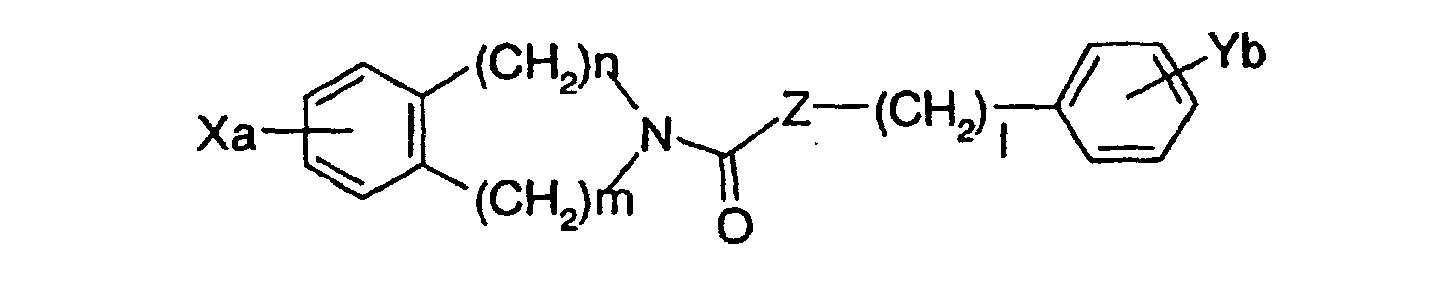
- In addition, the present inventors have reported that 2-(3-piperidyl)-1,2,3,4-tetrahydroisoquinoline derivatives represented by the following general formula as the compounds having a cardiac rate lowering effect (WO 98/13364).(As to the symbols in the formula, refer to the above-mentioned patent.)
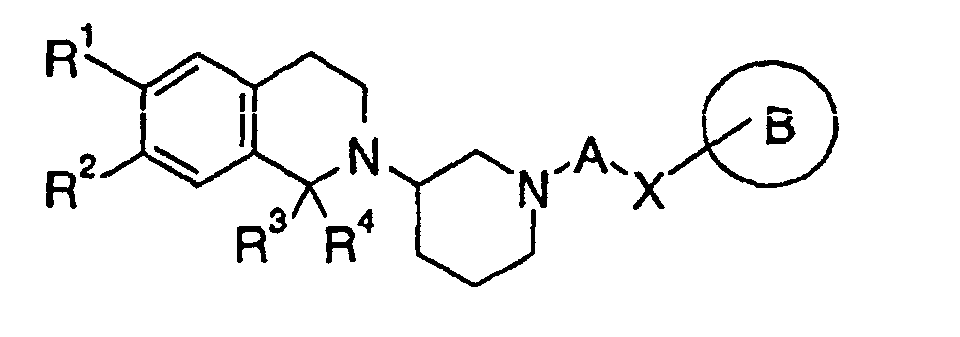
- The present inventors have carried out intensive investigations for the drugs which inhibit the If current. As a result, it has been found that isoquinoline derivatives represented by the following general formula (I) inhibit the If current and have a cardiac rate lowering effect in the heart and confirmed that the derivatives are not accompanied by serious side effects such as convulsion, leading to completion of the present invention.
- Specifically, the present invention relates to an isoquinoline derivative represented by the following general formula (I) or a salt thereof and also to drugs, particularly a If current inhibitor or, more particularly, a cardiac rate lowering agent, a therapeutic agent for cardiac insufficiency and a therapeutic agent for arrhythmia, containing the derivative or its salt as an effective ingredient.(The symbols in the above formula have the following meanings:
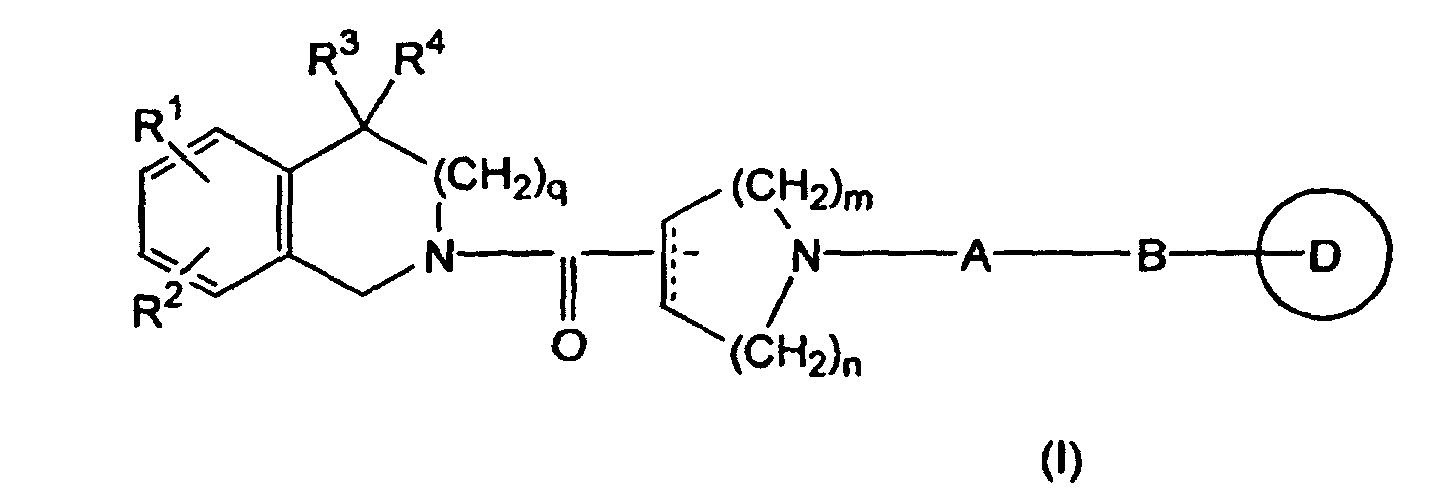
- A: C1 - C6 alkylene;
- B: -C(=O)-NR5- or -NR5-C(=O)-;
- R1 and R2: hydrogen atom, C1 - C6 alkyl or -O-C1 - C6 alkyl, which may be the same or different;
- R3, R4 and R5: hydrogen atom or C1 - C6 alkyl, which may be the same or different;
- ring D: monocyclic or fused C6 - C14 aryl group or saturated or unsaturated cyclo alkyl group or hetero ring which contains 1 to 4 hetero atoms selected from oxygen, sulfur and nitrogen and wherein both of them may optionally include 1 to 5 substituents selected from halogen atoms, C1 - C6 alkyl, C2 - C6 alkenyl, C2 - C6 alkynyl, -OH, -SH, halogeno C1 - C6 alkyl, -O-halogeno C1 - C6 alkyl, -O-C1 - C6 alkyl, -S-C1 - C6 alkyl, -CO-O-C1 - C6 alkyl, -O-C2 - C6 alkenyl-CO-O-C1 - C6 alkyl, - COOH, -SO2-C1 - C6 alkyl, -SO-C1 - C6 alkyl, -CO-C1 -C6 alkyl, -CO-NH2, -CO-NH-C1 - C6 alkyl, -CO-N(C1 - C6 alkyl)2, -NO2, -CN, -NH2, -NH-C1-C6 alkyl, -N(C1 - C6 alkyl)2, -O-C1 - C6 alkylene-O-, -NH-CO-C1 - C6 alkyl and ketone (=O);
- m: 1, 2 or 3;
- n: 0 or 1; and
- q: 1 or 2.)
-
- The compounds of the present invention have a characteristic feature that an amide moiety is always available in the structural formula and have an excellent profile that they exhibit a strong If current inhibitory effect without side effects such as convulsion.
- As hereunder, the compound (I) of the present invention will be illustrated in detail.
- In the definition for the general formula of the present invention, the term "C1-C6" means a linear or branched carbon chain having 1 to 6 carbon atoms unless otherwise mentioned.
- As to the "C1-C6 alkyl", preferred one is a C1-C4 alkyl having 1 to 4 carbon atoms, and more preferably, methyl, ethyl, propyl or isopropyl. As to the "C1-C6 alkylene", the preferred one is methylene, ethylene, propylene or methylmethylene.
In the formula,is preferably Among them, six-membered ones are particularly preferred.
- The ring D is a monocyclic or fused C6-C14 aryl group or a saturated or unsaturated cyclo alkyl group or a hetero ring which contains 1 to 4 hetero atoms selected from oxygen, sulfur and nitrogen.
- The "aryl group" may include a dihydro group, a tetrahydro group, a hexahydrogroup, etc. where hydrogen atoms are added to arbitrary carbon atoms of the aryl. More preferably, it is phenyl or naphthalene.
- The "hetero ring" means a hetero aryl or a saturated hetero ring containing 1 to 4 hetero atoms comprising oxygen, sulfur or nitrogen atoms. Examples of the hetero aryl are a 5- or 6-membered monocyclic hetero aryl (furyl, thienyl, thiazolyl, isothiazolyl, oxazolyl, isoxazolyl, thiadiazolyl, pyridyl, pyrimidinyl, pyrazyl) and a bicyclic hetero aryl where two 5- or 6-membered hetero aryls are fused (naphthylidinyl, benzylfuranyl, indolyl, benzimidazolyl, benzothiadiazolyl, benzoxazinyl, benzothiazolyl, pyridoindolyl) although not limited those examples. As to the saturated hetero ring, 5- to 7-membered rings are preferred, and piperidyl and piperazinyl are particularly preferred.
- The "optional substituent" is selected from halogen atoms (F, Cl, Br, I), C1-C6 alkyl, C2-C6 alkenyl (e.g. vinyl), C2-C6 alkynyl (e.g. ethynyl), -OH, -SH, halogeno C1-C6 alkyl (e.g. trifluoromethyl), -O-halogeno C1-C6 alkyl, -O-C1-C6 alkyl, -S-C1-C6 alkyl, -CO-O-C1-C6 alkyl, -O-C2-C6 alkenyl-CO-O-C1-C6 alkyl, -COOH, -SO2-C1-C6 alkyl, -SO-C1-C6 alkyl, -CO-C1-C6 alkyl, -CO-NH2, -CO-NH-C1-C6 alkyl, -CO-N(C1-C6 alkyl)2, -NO2, -CN, -NH2, -NH-C1-C6 alkyl, -N(C1-C6 alkyl)2, -O-C1-C6 alkylene-O-, -NH-CO-C1-C6 alkyl and ketone (=O). The substitution may be done with 1 to 5, and preferably, 1 to 3 substituents.
- The compound (I) of the present invention has at least one asymmetric carbon atom and, because of that, there are optical isomers such as (R)-compounds, (S)-compounds, racemates, diastereomers. In addition, there is a geometrical isomer or a tautomer depending upon the type of the substituent. The present invention includes all of those separated isomers or a mixture thereof.
- The compound (I) of the present invention may form a salt with an acid. Examples of such salt are acid addition salts with a mineral acid such as hydrochloric acid, hydrobromic acid, hydroiodic acid, sulfuric acid, nitric acid and phosphoric acid and with an organic acid such as formic acid, acetic acid, propionic acid, oxalic acid, malonic acid, succinic acid, fumaric acid, maleic acid, lactic acid, malic acid, citric acid, tartaric acid, carbonic acid, picric acid, methanesulfonic acid, ethanesulfonic acid and glutamic acid. The present invention further includes a hydrate, a solvate with ethanol, etc. and a polymorph of the compound (I) of the present invention.
- The compound of the present invention still further includes all of the so-called prodrugs which are metabolized in vivo and converted to a compound having the above-mentioned general formula (I) or a salt thereof. With regard to a group which forms the prodrug of the compound of the present invention, the groups which are described in Prog. Med., 5:2157-2161(1985) and the groups which are described on pages 163-198, Vol. 7 "Molecular Design" in "Iyakuhin no Kaihatsu", published by Hirokawa Shoten in 1990 may be exemplified.
- The compound (I) of the present invention may be prepared by utilizing various preparation methods. As hereunder, representative preparation methods will be illustrated.
- (In the formulae, R1, R2, R3, R4, R5, m, n, q and ring D have the meanings as defined already.)

- This preparation method is a method where an amino compound (II) is subjected to an amidation reaction using acrylic acid to give a compound (III), which is then subjected to a Michael addition reaction to a cyclic amino compound (IV) to give a compound (I) of the present invention.
- In the amidation reaction, it is possible to use acid halides such as acid chloride and acid bromide, acid azides, activated esters with N-hydroxybenzotriazole (HOBT), p-nitrophenol and N-hydroxysuccinimide, etc., dicyclohexylcarbodiimide (DCC), carbodiimidazole (CDI) and other condensing agent. The Michael addition reaction may be carried out, for example, with ice-cooling, at room temperature or under the condition with heating in a solvent such as toluene, benzene, tetrahydrofuran, dichloroethane, alcohols or dioxane. It is also possible to add an additive such as triethylamine, Triton B, potassium hydroxide, etc.
- (In the formulae, R1, R2, R3, R4, R5, A, m, n, q and ring D have the meanings as defined already; X is a leaving group; and Y is a protective group.)

- This preparation method is a method where a cyclic amino compound (IV) is subjected to a conventional alkylation reaction using a compound (V), followed by deprotecting the protective group of the carboxylic acid to give a compound (VI), which is then conducted with an amino compound (II) by a conventional amidation reaction, or the cyclic amino compound (IV) is alkylated with a separately synthesized compound (VII).
- (In the formulae, R1, R2, R3, R4, R5, A, m, n, q, ring D and X have the meanings as defined already; and P is a protective group.)

- This preparation method is a method where a cyclic amino compound (IV) is subjected to a conventional alkylation reaction using a compound (VIII), the protective group of the amino group is deprotected to give a compound (IX), which is then conducted with a carboxylic acid (X) or a derivative thereof, or a method where the cyclic amino compound (IV) is alkylated with a separately synthesized compound (XI).
- (In the formulae, R1, R2, R3, R4, R5, A, P, m, n, q, ring D and X have the meanings as defined already.)
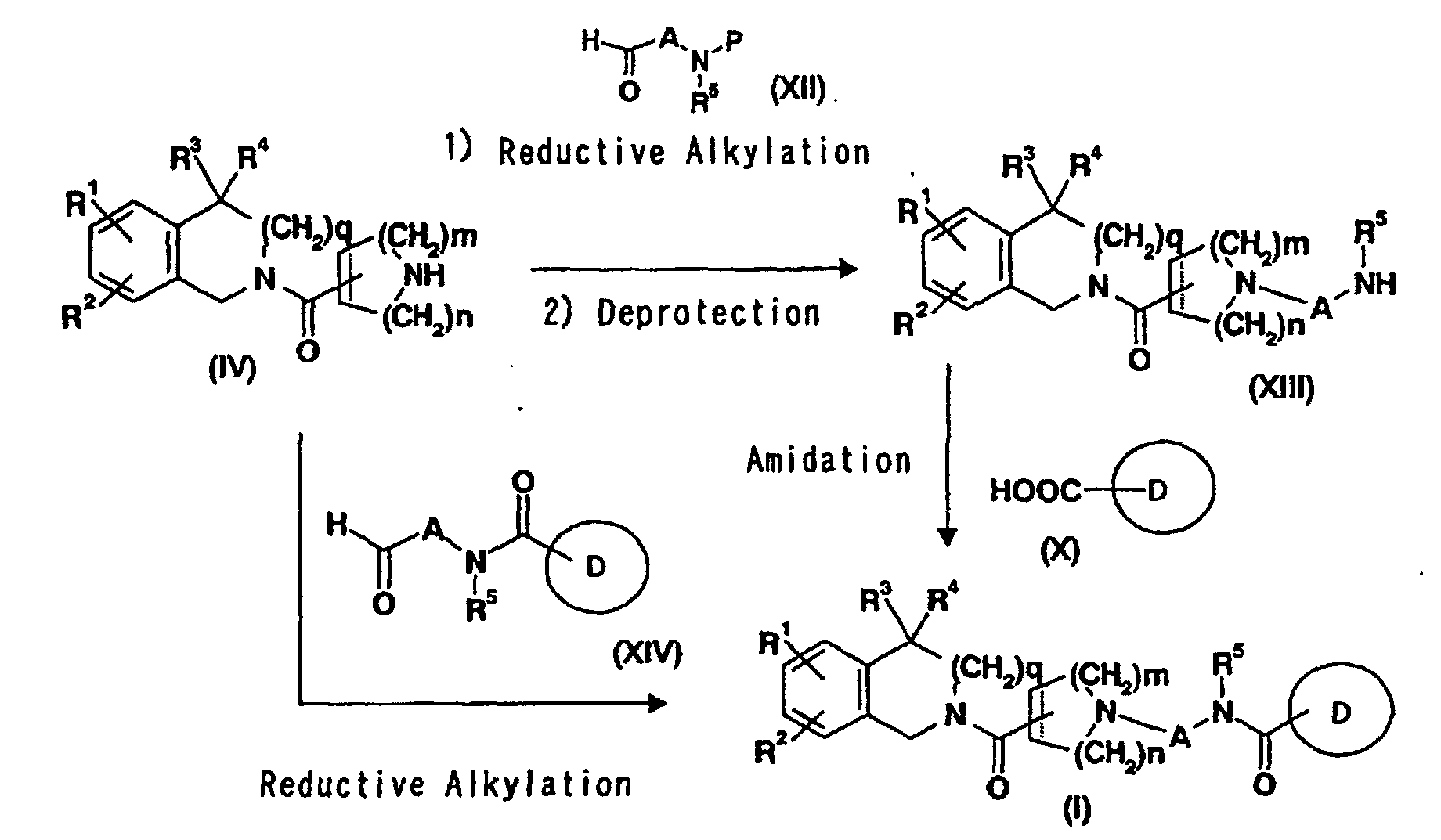
- This preparation method is a method where a cyclic amino compound (IV) is subjected to a conventional reductive alkylation reaction using a compound (XII), followed by deprotecting the protective group of the amino group to give a compound (XIII), which is then conducted with a carboxylic acid (X) or a derivative thereof by a conventional amidation reaction, or a method where the cyclic amino compound (IV) is subjected to a conventional reductive alkylation reaction using a separately synthesized compound (XIV). The reductive alkylation reaction is a method where the cyclic amino compound (IV) is reacted with the compound (XII) or the compound (XIV), and the resulting Schiff base is reduced after being isolated or without being isolated. The reduction may be carried out by reaction upon addition of a reducing agent such as a metal hydride complex (sodium borohydride, lithium borohydride, sodium cyanoborohydride, sodium triacetoxyborohydride) or borane, or by hydrogenation.
- The reaction product prepared by each of the above-mentioned preparation methods is isolated and purified as a liberated compound or a salt, or various solvates such as a hydrate thereof. The salt can be prepared by a usual salt-preparation treatment.
- The separation and purification are carried out by applying a usual chemical operation such as extraction, concentration, evaporation, crystallization, filtration, recrystallization and various chromatographic means.
- Various isomers can be separated by customary methods utilizing physico-chemical differences among the isomers, and optical isomers can be separated by a usual racemic resolution such as fractional crystallization or chromatography. The optical isomer can also be synthesized from an appropriate optically active starting material.
- With regard to the fractional crystallization, fractional crystallization using an optically active organic acid such as tartaric acid derivatives, mandelic acid derivatives and camphorsulfonic acid derivatives may be appropriately carried out. As the solvent, those with which optical resolution is efficiently carried out are appropriately selected.
- The compounds of the present invention have an effect of inhibiting the If current and exhibit a strong and specific activity of selectively lowering the cardiac rate and reducing the oxygen consumption of cardiac muscle, whereby they are useful as preventive and therapeutic agents for ischemic cardiac diseases such as angina and cardiac infarction and for circulatory diseases such as congestive cardiac insufficiency and arrhythmia.
- The compounds of the present invention are particularly highly useful for prevention and therapy of various clinical symptoms caused by the imbalance between supply and consumption of cardiac muscle oxygen such as pectoral angina, cardiac infarction and arrhythmia accompanied therewith and for prevention and therapy of arrhythmia, particularly supraventricular arrhythmia.
- In addition, the compounds of the present invention are expected to have an effect of reducing the complications of atherosclerosis, particularly coronary atherosclerosis, by restricting the vascular hemodynamics compression. Further, the compounds of the present invention suppress an excessively increased cardiac rate and are a drug useful in controlling the cardiac rate to a constant state during the general surgical operation.
- Since the compounds of the present invention directly act on the If current in the above-mentioned cardiac rate lowering effect, it has been confirmed that they have no suppressive effect on atrioventricular conduction and systolic function and have a high selectivity to a cardiac rate lowering effect to visual hindrance. With regard to the ion current contributing in the formation of action potential in heart, it has been known that the current which permeates Na channel, K channel and Ca channel is present besides the If current. However, since the compounds of the present invention do not show a significant inhibitory effect to the above-mentioned ion current existing in heart other than the If current at a dose by which the If current is inhibited, it is also expected that the compounds have less side effects caused by inhibition of the current other than the If current. Further, the compounds of the present invention are not accompanied by serious side effects such as convulsion. Accordingly, the compounds of the present invention are useful for prevention and therapy of the above-mentioned various diseases as a cardiac rate lowering agent having less side effects. The compounds of the present invention are furthermore useful as a suppressor for ectopic automatism acceleration or triggered activity caused by the If current in some symptoms such as cardiac infarction and hypertension.
- Since the compounds of the present invention lower the cardiac rate by inhibiting the If current, they are also useful as therapeutic agents for cardiac insufficiency and for arrhythmia.
- Pharmacological effects of the compounds of the present invention were confirmed according to the following test methods.
- Test on inhibition of If current was carried out by a method according to Robert, E., et al., Br. J. Pharmacol., 110:343-349, 1993.
- Male guinea pigs of a Hartley strain having a body weight of about 200 to 400 g were fainted away by knocking the head, and then a heart was quickly excised under bleeding by cutting the carotid artery. The heart was transferred to a Tyrode's solution which was fully aerated with a mixed gas of 95% oxygen and 5% carbon dioxide gas and a sinoatrial node (pacemaker) site (about 3 × 5 mm) was cut out. The cut-out sinoatrial node was subjected to an enzymatic treatment at 37°C for about 30 minutes in a Ca2+-free Tyrode's solution containing collagenase (1.5 mg/ml) (manufactured by Yakult Honsha Co., Ltd.). Thereafter, it was allowed to stand at 4°C for 1 hour or more in a K+ rich solution (KB recovery solution). The sinoatrial node site after the treatment was minced with an injection needle and subjected to pipetting to give isolated cardiac muscle cells.
- The resulting isolated cardiac muscle was scattered in a chamber for exclusive use, and a patch clamp method (a whole cell mode) was applied to the spindle-shaped cells carrying out a spontaneous contraction. The holding potential was made -40 mV and, a hyperpolarization pulse (for 1 second) was successively applied from this potential to -10, -20, -30, ..... and -80 mV, to induce the If current. The If current at the hyperpolarization pulse of -80 mV was biggest, and therefore, with regard to the evaluation of the pharmacological effect, an effect of the test compound to the If current induced by the pulse of -80 mV was evaluated.
- An extracellular solution(Tyrode's solution) containing the test compound was started to be perfused and, with intervals of 5 seconds each, the If current was induced by a hyperpolarization pulse of -80 mV and was recorded until about 100th pulse (for about 8 minutes). An effect of the drug was confirmed to become in a saturated state at 90 pulses or more. With regard to the If current inhibitory effect of the test compound, each of the If currents obtained before the perfusion and after the 90th pulse was measured, and the comparison was made in terms of the concentration (IC50) of the substance inhibiting the If current to an extent of 50%.
- The result was that the IC50 value of the compounds of the Examples of the present invention was 10-8 M to 10-5 M.
- The test on cardiac rate lowering effect was carried out by a method according to Walter, K., et al. Eur. J. Pharmacol., 104(1-2):9-18, 1984.
- Male guinea pigs of a Hartley strain having a body weight of about 250 to 400 g were fainted away by knocking the head and killed by draining out the blood, and the heart was excised. A right atrium sample was prepared in a Tyrode's solution which was fully aerated with 95% oxygen and 5% carbon dioxide gas. The sample was applied to a hook made of stainless steel and suspended at a load tension of 1.0 g in a Magnus tube filled with a Tyrode's solution which was well aerated with 95% oxygen and 5% carbon dioxide gas, whereby the spontaneously pulsing cardiac rate was recorded. After suspending, the sample was allowed to stand for a stabilization period of 1 hour or more, the test compound was cumulatively added into a Magnus tube every 30 to 45 minutes and a concentration vs. effect curve was determined from the data after 30 minutes from the administration of the substance, whereby the effect was judged. The cardiac rate lowering effect was compared in terms of the concentration (EC30) of the substance which lowered the spontaneous cardiac rate to an extent of 30% from the data before the administration. The result was that the compounds of the present invention showed a strong cardiac rate lowering effect. The result of the tests is shown in Table A.
Compound of the Present Invention Cardiac Rate Lowering Effect (EC30 µM) Example 2 0.30 Example 4 0.57 Example 5 0.38 Example 6 0.32 Example 9 0.27 Example 10 0.27 Example 12 0.27 Example 14 0.47 Example 26 0.24 Example 27 0.41 Example 29 0.29 Example 37 0.30 Example 38 0.29 Example 40 0.33 Example 49 0.29 Example 50 0.31 - Male rats of a Wister strain having a body weight of 250 to 350 g under awaking were fixed in a cage, and the test compound was administered from a tail vein. The test compound was administered at a dose of either 20 mg/kg (i.v.) or 40 mg/kg (i.v.) once for each rat. After administration of the test compound, behavior of the animal was observed for about 1 hour without restraint. The influence of the test compound on the spontaneous behavior of the rat was evaluated by the fact whether or not the convulsion was noted within the observed period.
- The result was that there were compounds showing no convulsion-inducing effect even by an intravenous administration of 40 mg/kg while the compound of Example 8 of Japanese Patent Laid-Open No. 138172/1990 and the compounds of Examples 24 and 33 of WO 98/13364 cited in the Background of the Invention showed a convulsion-inducing effect at a dose of 20 mg/kg which was one half of the above (Table B).
Compounds of the Examples of the Present Invention and Control Compounds Dose General Findings Example 2 40 mg/kg No abnormal finding Example 4 40 mg/kg No abnormal finding Example 5 40 mg/kg No abnormal finding Example 6 40 mg/kg No abnormal finding Example 9 40 mg/kg No abnormal finding Example 10 40 mg/kg No abnormal finding Example 14 40 mg/kg No abnormal finding Example 26 40 mg/kg No abnormal finding Example 27 40 mg/kg No abnormal finding Example 28 40 mg/kg No abnormal finding Example 29 40 mg/kg No abnormal finding Example 30 40 mg/kg No abnormal finding Example 37 40 mg/kg No abnormal finding Example 38 40 mg/kg No abnormal finding Example 40 40 mg/kg No abnormal finding Example 47 40 mg/kg No abnormal finding Example 49 40 mg/kg No abnormal finding Example 50 40 mg/kg No abnormal finding Example 8 of JP Laid-Open 138172/1990
(Control Compound)20 mg/kg Convulsion Example 24 of WO 98/13364
(Control Compound)20 mg/kg Convulsion Example 33 of WO 98/13364
(Control Compound)20 mg/kg Convulsion - From the above result, it is now apparent that, when an amide moiety which is a structural characteristic of the compounds of the present invention is introduced, the compounds of the present invention do not show an convulsion-inducing effect but effectively inhibit the If current showing a cardiac rate lowering effect.
- A pharmaceutical composition containing one, two or more of the compounds of the present invention or salts thereof are prepared using a usual pharmaceutically acceptable carrier.
- Administration of the pharmaceutical composition in the present invention may be any route of oral administration and parenteral administration such as by means of injection agents, suppositories, percutaneous agents, inhalation agents or vesicoclysis.
- The dose may be appropriately decided for each case taking into consideration symptom, age and sex of the subject, etc. and, in the case of oral administration, it is usually about 0.1 mg/kg to 100 mg/kg per day for an adult. The administration is effected at once or by dividing into 2 to 4 times a day. In the case of an intravenous injection which is carried out depending upon the symptom, it is usually about 0.01 mg/kg to 10 mg/kg per day for an adult. The administration is effected at once or by dividing into one to several times a day.
- With regard to a carrier for the pharmaceutical preparation, solid or liquid nontoxic substances for drugs may be exemplified.
- With regard to a solid composition for oral administration according to the present invention, there are used tablets, pills, capsules, diluted powder, granules, etc. In such solid compositions, one or more active ingredients are mixed with at least one inert diluent such as lactose, mannitol, glucose, hydroxypropyl cellulose, microcrystalline cellulose, starch, polyvinylpyrrolidone, agar, pectin or magnesium metasilicate aluminate. The composition may contain additives other than the inert diluent, for example, lubricants such as magnesium stearate, disintegrating agents such as calcium cellulose glycolate, stabilizers such as lactose and solubilization aids such as glutamic acid or aspartic acid according to a conventional method. If necessary, tablets or pills may be coated with sugar coats such as sucrose, gelatin, hydroxypropyl cellulose or hydroxypropylmethyl cellulose phthalate or with films which are soluble in stomach or in intestine.
- The liquid composition for oral administration includes a pharmaceutically acceptable emulsion, solution, suspension, syrup, elixir or the like, or a commonly used inert diluent such as purified water or ethanol. Besides the inert diluent, the composition may further contain auxiliary agents such as moisturizers and suspending agents, sweeteners, flavors, fragrances or antiseptics.
- The injection solution for a parenteral administration includes aseptic aqueous or non-aqueous solutions, suspensions and emulsions. The aqueous solutions and suspensions contain, for example, distilled water for injection and physiological saline. Examples of the non-aqueous solutions and suspensions are ethylene glycol, propylene glycol, polyethylene glycol, vegetable oils such as cacao butter, olive oil and sesame oil, alcohols such as ethanol, gum arabic and Polysolvate 80 (trade name). Such composition may further contain additives such as isotonizing agents, antiseptics, moisturizers, emulsifiers, dispersing agents, stabilizers (such as lactose), and solubilization aids (such as glutamic acid or aspartic acid). They may be asepticized, for example, by filtration through a bacteria-keeping filter, by compounding with a bactericide, or by irradiation. They may also be used in such a manner that an aseptic solid composition is prepared, and then, before use, the composition is dissolved in an aseptic water or in an aseptic solvent for injection.
- Hereunder, the desired compounds of the present invention and the preparation methods thereof will be further illustrated by way of the Examples although the present invention is never limited by those Examples. Incidentally, methods for the preparation of the starting compounds for the compounds of the present invention will be mentioned in the Referential Examples.
- A conventional acylation reaction was carried out using a tetrahydrofuran solution (30 ml) of 4.6 g of 3,4-dimethoxyaniline , 5.0 ml of triethylamine and 2.68 ml of acryloyl chloride to give 5.22 g of 3,4-dimethoxyacrylanilide as white crystals.
- The compounds of Referential Examples 1-1 to 1-9 were synthesized by the same manner as in Referential Example 1 (see Table 1 shown later).
- A conventional amidation reaction was carried out using a dichloromethane solution (40 ml) of 2.53 g of (±)-6,7-dimethoxy-1,2,3,4-tetrahydroisoquinoline , 3.0 g of N-(tert-butyloxycarbonyl)nipecotic acid, 3.0 g of 1-ethyl-3-[3-(dimethylamino)propyl]carbodiimide hydrochloride and 0.89 g of 1-hydroxybenztriazole to give 3.77 g of (±)-6,7-dimethoxy-2-{[1-(tert-butyloxycarbonyl)-3-piperidyl]-carbonyl}-1,2,3,4-tetrahydroisoquinoline. Deprotection of 3.77 g of (±)-6,7-dimethoxy-2-{[1-(tert-butyloxycarbonyl)-3-piperidyl]carbonyl}-1,2,3,4-tetrahydroisoquinoline was further carried out using 10 ml of an ethyl acetate solution containing 4N hydrochloric acid to give 2.30 g of (±)-6,7-dimethoxy-2-[(3-piperidyl)carbonyl]-1,2,3,4-tetrahydroisoquinoline hydrochloride as colorless crystals.
- The compounds of Referential Examples 2-1 to 2-11 were synthesized by the same manner as in Referential Example 2 (see Table 1 shown later).
- (±)-6,7-Dimethoxy-2-[(3-piperidyl)carbonyl]-1,2,3,4-tetrahydroisoqinoline hydrochloride (3.19 g) was desalted by a customary method, and a conventional alkylation reaction was carried out using an acetonitrile solution (30 ml) of the residue, 2.85 g of N-(2-bromoethyl)phthalimide and 1.55 g of potassium carbonate to give 3.83 g of (±)-6,7-dimethoxy-2-{[3-(2-phthalimidoethyl)piperidyl]carbonyl}-1,2,3,4-tetrahydroisoquinoline. Then, 3.83 g of (±)-6,7-dimethoxy-2-{[3-(2-phthalimidoethyl)piperidyl]carbonyl}-1,2,3,4-tetrahydroisoquinoline was deprotected by a customary method using 45 ml of a methanolic solution containing 40% of methylamine to give 2.67 g of (±)-2-{[3-(2-aminoethyl)piperidyl]carbonyl}-6,7-dimethoxy-1,2,3,4-tetrahydroisoquinoline as a yellow foamy substance.
- The compounds of Referential Examples 3-1 to 3-4 were synthesized by the same manner as in Referential Example 3 (see Table 1 shown later).
- A conventional alkylation reaction was carried out using a dimethylformamide solution (10 ml) of 1.77 g of 2-(3,4-dimethoxyphenyl)acetonitrile , 1.00 g of sodium hydride and 4.26 g of methyl iodide to give 1.78 g of 2-(3,4-dimethoxyphenyl)-2-methylpropionitrile. A conventional catalytic hydrogenation reaction was carried out using an ethanolic solution (30 ml) of 1.75 g of 2-(3,4-dimethoxyphenyl)-2-methylpropionitrile, 3.0 ml of an aqueous 28% ammonia solution and 4.3 g of Raney nickel to give 1.59 g of 2-(3,4-dimethoxyphenyl)-2-methylpropylamine. Then, a conventional cyclization reaction was carried out using a formic acid solution (8 ml) of 1.58 g of 2-(3,4-dimethoxyphenyl)-2-methylpropylamine and 0.252 g of paraformaldehyde to give 1.34 g of 6,7-dimethoxy-4,4-dimethyl-1,2,3,4-tetrahydroisoquinoline as a pale yellow oily substance. A conventional alkylation reaction was carried out using a solution (10 ml) of 1.77 g of 2-(3,4-dimethoxyphenyl)acetonitrile in dimethylformamide, 1.00 g of sodium hydride and 4.26 g of methyl iodide to give 1.78 g of 2-(3,4-dimethoxyphenyl)-2-methylpropionitrile.
- A toluene suspension (3 ml) of 0.268 g of (±)-6,7-dimethoxy-2-[(3-piperidyl)carbonyl]-1,2,3,4-tetrahydroisoquinoline and 0.166 g of 3,4-dimethylacrylanilide was stirred overnight under heating to reflux. The reaction solution was evaporated off in vacuo, and a 1N aqueous sodium hydroxide solution was added to the residue to make it basic, followed by extracting with chloroform. The organic layer was dried over anhydrous magnesium sulfate. The drying agent was filtered off, the filtrate was concentrated in vacuo, and the residue was purified by silica gel column chromatography (chloroform : methanol = 100 : 4). To a ethyl acetate solution (8 ml) of the resulting oily substance was added an ethyl acetate solution (0.227 ml) containing 4N hydrochloric acid, and the solvent was evaporated off in vacuo. The residue was crystallized from ethyl acetate-ethanol to give 0.337 g of (±)-3-[3-(6,7-dimethoxy-1,2,3,4-tetrahydroisoquinoline-2-carbonyl)piperidino]-N-(3,4-dimethoxyphenyl)propanamide hydrochloride as colorless crystals.
- Using 3.35 g of (±)-6,7-dimethoxy-2-[(3-piperidyl)-carbonyl]-1,2,3,4-tetrahydroisoquinoline and 1.91 g of 3,4-methylenedioxyacrylanilide, the same operation as in Example 1 was carried out to give 4.95 g of (±)-3-[3-(6,7-dimethoxy-1,2,3,4-tetrahydroisoquinoline-2-carbonyl)-piperidino]-N-(3,4-methylenedioxyphenyl)propanamide hydrochloride as colorless crystals.
- Using 0.264 g of (±)-6,7-dimethoxy-2-[(3-piperidyl)-carbonyl]-1,2,3,4-tetrahydroisoquinoline and 0.150 g of 3,5-dimethoxyacrylanilide, the same operation as in Example 1 was carried out to give 0.243 g of (±)-3-[3-(6,7-dimethoxy-1,2,3,4-tetrahydroisoquinoline-2-carbonyl)-piperidino]-N-(3,5-dimethoxyphenyl)propanamide 1/2 oxalate as colorless crystals.
- Using 0.270 g of (±)-6,7-dimethoxy-2-[(3-piperidyl)-carbonyl]-1,2,3,4-tetrahydroisoquinoline and 0.132 g of 4-methoxyacrylanilide, the same operation as in Example 1 was carried out to give 0.281 g of (±)-3-[3-(6,7-dimethoxy-1,2,3,4-tetrahydroisoquinoline-2-carbonyl)piperidino]-N-(4-methoxyphenyl)propanamide hydrochloride as colorless crystals.
- Using 7.80 g of (R)-6,7-dimethoxy-2-[(3-piperidyl)-carbonyl]-1,2,3,4-tetrahydroisoquinoline and 3.66 g of 3,4-methylenedioxyacrylanilide, the same operation as in Example 1 was carried out to give 11.2 g of (-)-3-[(R)-3-(6,7-dimethoxy-1,2,3,4-tetrahydroisoquinoline-2-carbonyl)-piperidino]-N-(3,4-methylenedioxyphenyl)propanamide L-tartrate as colorless crystals.
- Using 10.9 g of (S)-6,7-dimethoxy-2-[(3-piperidyl)-carbonyl]-1,2,3,4-tetrahydroisoquinoline and 5.24 g of 3,4-methylenedioxyacrylanilide, the same operation as in Example 1 was carried out to give 15.6 g of (+)-3-[(S)-3-(6,7-dimethoxy-1,2,3,4-tetrahydroisoquinoline-2-carbonyl)-piperidino]-N-(3,4-methylenedioxyphenyl)propanamide D-tartrate as colorless crystals.
- To 0.65 g of (±)-6,7-dimethoxy-2-[(3-piperidyl)-carbonyl]-1,2,3,4-tetrahydroisoquinoline hydrochloride was added a 1N aqueous sodium hydroxide solution to make it basic, followed by extracting with chloroform. The organic layer was dried over anhydrous magnesium sulfate, the solvent was evaporated off in vacuo, and the residue was dissolved in acetonitrile (20 ml). To this were added 0.32 ml of ethyl 4-bromobutyrate and 0.32 g of potassium carbonate, followed by stirring at 80°C for 8 hours. The reaction solution was cooled to room temperature, the solvent was evaporated off in vacuo, and the residue was extracted with chloroform. The organic layer was washed with a saturated sodium chloride solution and dried over anhydrous magnesium sulfate. The drying agent was filtered off, the filtrate was concentrated in vacuo, and the residue was purified by silica gel column chromatography (chloroform : methanol = 97 :3). 3.7 ml of a 1N aqueous sodium hydroxide solution was added to a ethanol solution (7 ml) of the resulting oily substance (0.78 g) , and the mixture was stirred at room temperature for 3 hours. After neutralizing with 1N hydrochloric acid, the reaction solution was evaporated off in vacuo, and the residue was subjected to azeotropy with toluene twice. To a mixed solution of the residue and 0.24 g of 3,4-methylenedioxyaniline in tetrahydrofuran (8 ml) and DMF (8 ml) were added 0.37 g of 1-ethyl-3-[3-(dimethylamino)propyl]carbodiimide hydrochloride and 0.12 g of 1-hydroxybenztriazole, followed by stirring overnight at room temperature. The reaction solution was evaporated off in vacuo, a 1N aqueous sodium hydroxide solution was added to the residue to make it basic, followed by extracting with chloroform. The organic layer was dried over anhydrous magnesium sulfate. The drying agent was filtered off, the filtrate was concentrated in vacuo, and the residue was purified by silica gel column chromatography (chloroform : methanol = 93 : 7). To a solution of the residue in methanol was added 0.12 g of oxalic acid to give an oxalate, which was then crystallized from a mixed solvent of ethyl acetate and methanol to give 0.50 g of (±)-4-[3-(6,7-dimethoxy-1,2,3,4-tetrahydroisoquinoline-2-carbonoyl)piperidino]-N-(3,4-methylenedioxyphenyl)butanamide oxalate as colorless crystals.
- Using 0.69 g of (±)-2-[(3-piperidyl)carbonyl]-6,7-dimethoxy-1,2,3,4-tetrahydroisoquinoline hydrochloride and 0.27 ml of ethyl bromoacetate, the same operation as in Example 7 was carried out to give 0.04 g of (±)-2-[3-(6,7-dimethoxy-1,2,3,4-tetrahydroisoquinoline-2-carbonyl)-piperidino]-N-(3,4-methylenedioxyphenyl)ethanamide oxalate as colorless crystals.
- To a solution of 0.410 g of (±)-2-{[3-(2-aminoethyl)piperidyl]carbonyl}-6,7-dimethoxy-1,2,3,4-tetrahydroisoquinoline in tetrahydrofuran (10 ml) were added 0.220 g of piperonylic acid, 0.300 g of 1-ethyl-3-[3-(dimethylamino)propyl]carbodiimide hydrochloride and 0.090 g of 1-hydroxybenztriazole, followed by stirring overnight at room temperature. The reaction solution was evaporated off in vacuo, and a 1N aqueous sodium hydroxide solution was added to the residue to make it basic, followed by extracting with chloroform. The organic layer was dried over anhydrous magnesium sulfate. The drying agent was filtered off, the filtrate was concentrated in vacuo, and the residue was purified by silica gel column chromatography (chloroform : methanol = 50 : 1). Then, 0.40 ml of an ethyl acetate solution containing 4N hydrochloric acid was added to a solution of the residue in ethanol to give a hydrochloride. This was crystallized from acetone to give 0.240 g of (±)-N-{2-[3-(6,7-dimethoxy-1,2,3,4-tetrahydroisoquinoline-2-carbonyl)-piperidino]ethyl}-3,4-methylenedioxybenzamide hydrochloride as colorless crystals.
- Using 0.500 g of (±)-2-{[3-(2-aminoethyl)-piperidyl]carbonyl}-6,7-dimethoxy-1,2,3,4-tetrahydroisoquinoline and 0.330 g of 3-methoxybenzoic acid, the same operation as in Example 9 was carried out to give 0.437 g of (±)-N-{2-[3-(6,7-dimethoxy-1,2,3,4-tetrahydroisoquinoline-2-carbonyl)-piperidino]ethyl}-3-methoxybenzamide oxalate as colorless crystals.
- Using 0.720 g of (±)-2-{[3-(2-aminoethyl)-piperidyl]carbonyl}-6,7-dimethoxy-1,2,3,4-tetrahydroisoquinoline and 0.380 g of 3,4-dimethoxybenzoic acid, the same operation as in Example 9 was carried out to give 0.520 g of (±)-N-{2-[3-(6,7-dimethoxy-1,2,3,4-tetrahydroisoquinoline-2-carbonyl)-piperidino]ethyl)-3,4-dimethoxybenzamide hydrochloride as colorless crystals.
- The compounds of Examples 12 to 25 were synthesized in a similar manner as in Example 1 (see Table 2 shown later).
- The compounds of Examples 26 to 51 were synthesized in a similar manner as in Example 9 (see Table 2 shown later).
- To a tetrahydrofuran solution (10 ml)of 0.32 g of N-(3,4-methylenedioxybenzoyl)-N-methylglycine ethyl ester were added dropwise 2.8 ml of diisobutyl aluminum hydride (0.95M hexane solution) at -78°C, and the mixture was stirred in an argon atmosphere at -78°C for 2 hours. A 1N aqueous ammonium chloride solution (3 ml) was added to the reaction solution, and after returning the temperature to room temperature, the mixture was extracted with ethyl acetate. The organic layer was dried over anhydrous magnesium sulfate. The drying agent was filtered off, and the filtrate was concentrated in vacuo to give crude N-(3,4-methylenedioxybenzoyl)-N-methylglycinal. Triethylamine (0.14 ml) was added to a suspension of 0.34 g of (±)-2-[(3-piperidyl)carbonyl]-6,7-dimethoxy-1,2,3,4-tetrahydroisoquinoline hydrochloride in tetrahydrofuran (5 ml) with ice cooling, and the mixture was stirred for 10 minutes with ice cooling. To the reaction solution were successively added a tetrahydrofuran solution (5 ml)of the crude N-(3,4-methylenedioxybenzoyl)-N-methylglycinal acetic acid (0.057 ml) and sodium triacetoxyborohydride (0.25 g), followed by stirring overnight at room temperature. A 1N aqueous sodium hydroxide solution was added to the reaction solution to make it basic, followed by extracting with chloroform. The organic layer was dried over anhydrous magnesium sulfate. The drying agent was filtered off, the filtrate was concentrated in vacuo, and the residue was purified by silica gel column chromatography (chloroform : methanol = 24 : 1). Then, 0.028 g of oxalic acid was added to a solution of the residue in methanol to give an oxalate. Thus, 0.075 g of (±)-N-{2-[3-(6,7-dimethoxy-1,2,3,4-tetrahydroisoquinoline-2-carbonyl)piperidino]ethyl}-N-methyl-(3,4-methylenedioxy)benzamide oxalate was obtained as a pale yellow amorphous solid.
- To a ethanol solution of 9.32 g of (+)-3-[(S)-3-(6,7-dimethoxy-1,2,3,4-tetrahydroisoquinoline-2-carbonyl)-piperidino]-N-(3,4-methylenedioxyphenyl)propanamide was added 2.07 g of fumaric acid, and the mixture was evaporated in vacuo. Thus, 9.38 g of (+)-3-[(S)-3-(6,7-dimethoxy-1,2,3,4-tetrahydroisoquinoline-2-carbonyl)-piperidino]-N-(3,4-methylenedioxyphenyl)propanamide fumarate was obtained as colorless crystals from ethanol/2-butanone.
- Table 1 shows chemical structural formula and physico-chemical properties of the Referential Examples, and Table 2 shows chemical structural formula and physico-chemical properties of the Examples. The compounds whose chemical structural formula are described in Table 3 can be easily prepared in substantially the same manner as described in the above Examples or Preparation Methods, or by applying some modified methods obvious to the persons skilled in the art thereto.
- Symbols in the Tables have the following meanings. Rf.: Referential Example; Structure: structure; Data: data; Ex.: Examples; Salt: salt; m.p.: melting point; NMR: nuclear magnetic resonance (TMS being used as an internal standard); [α]D: angle of rotation; OMe: methoxy; OEt: ethoxy; OiPr: isopropoxy; Me: methyl; L-TA: (L)-tartaric acid; D-TA: (D)-tartaric acid; and Fu: fumaric acid.


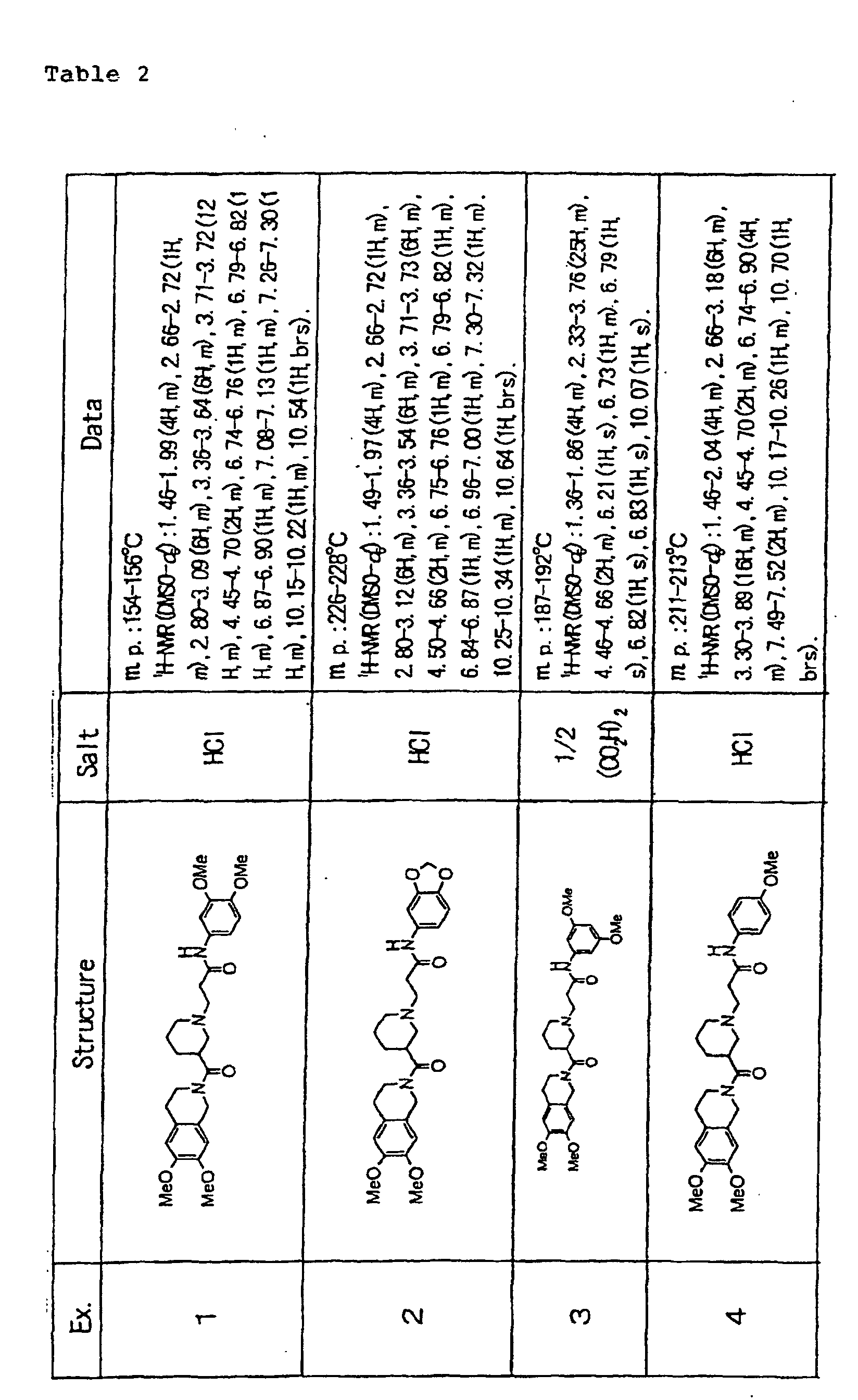


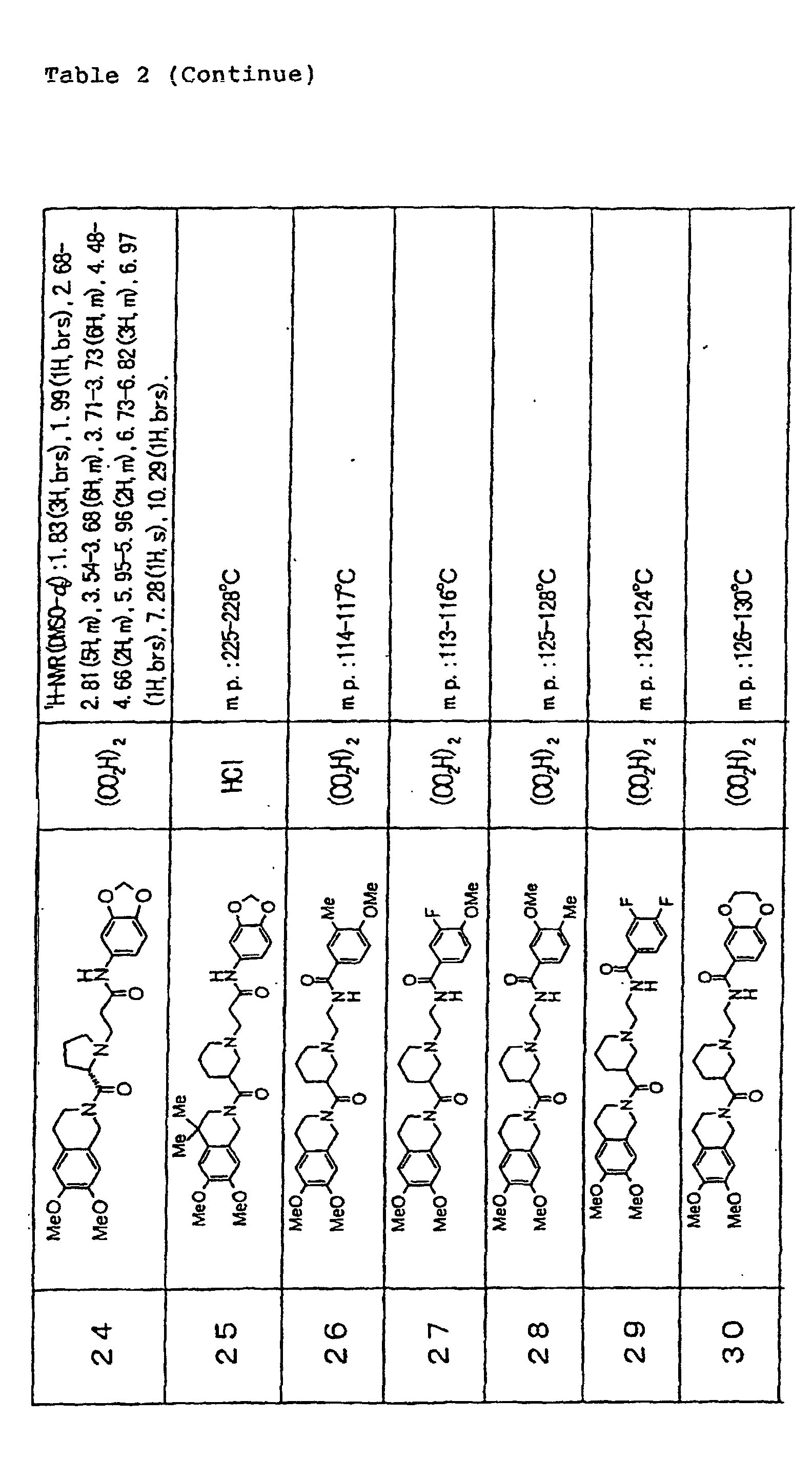
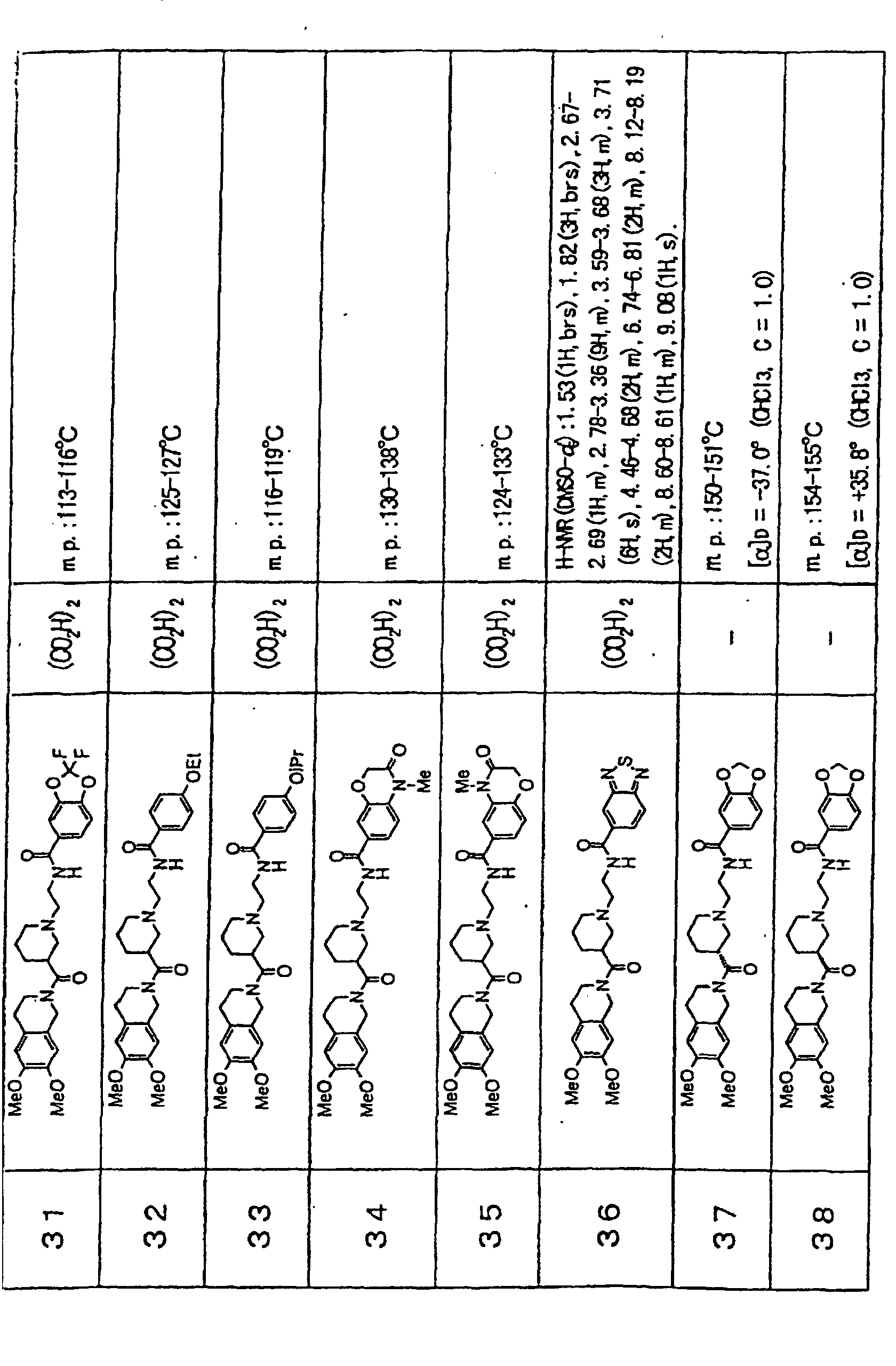

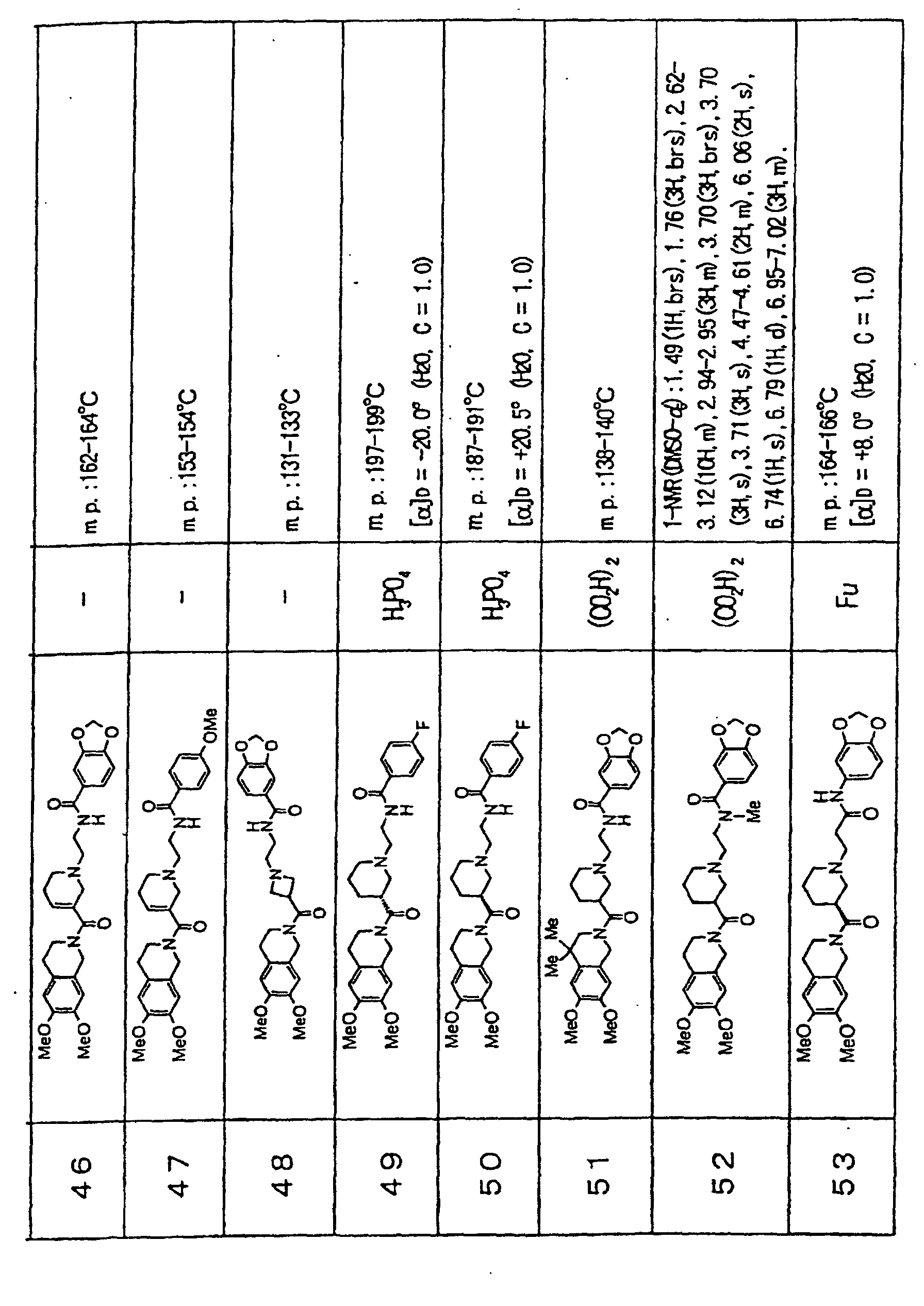
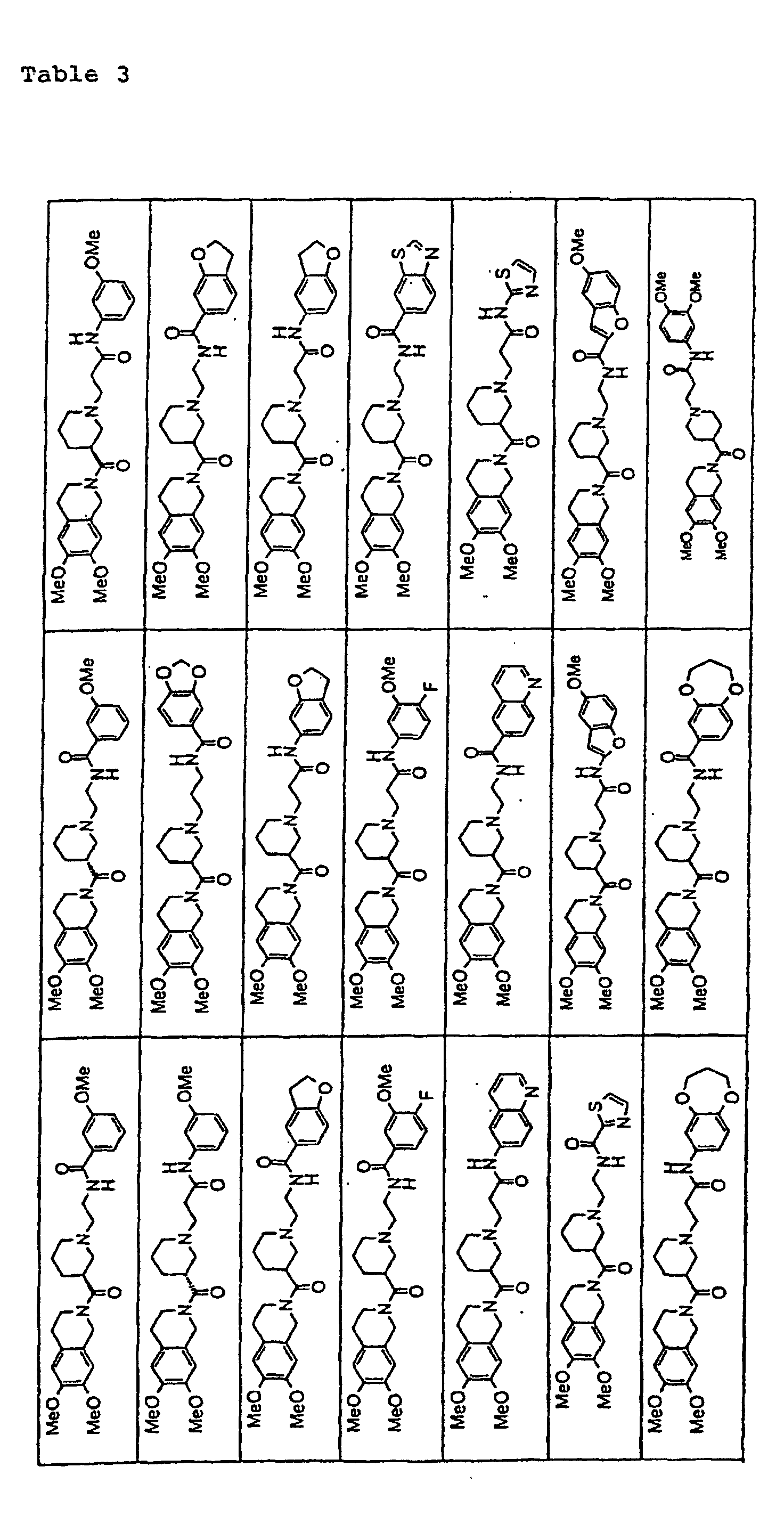

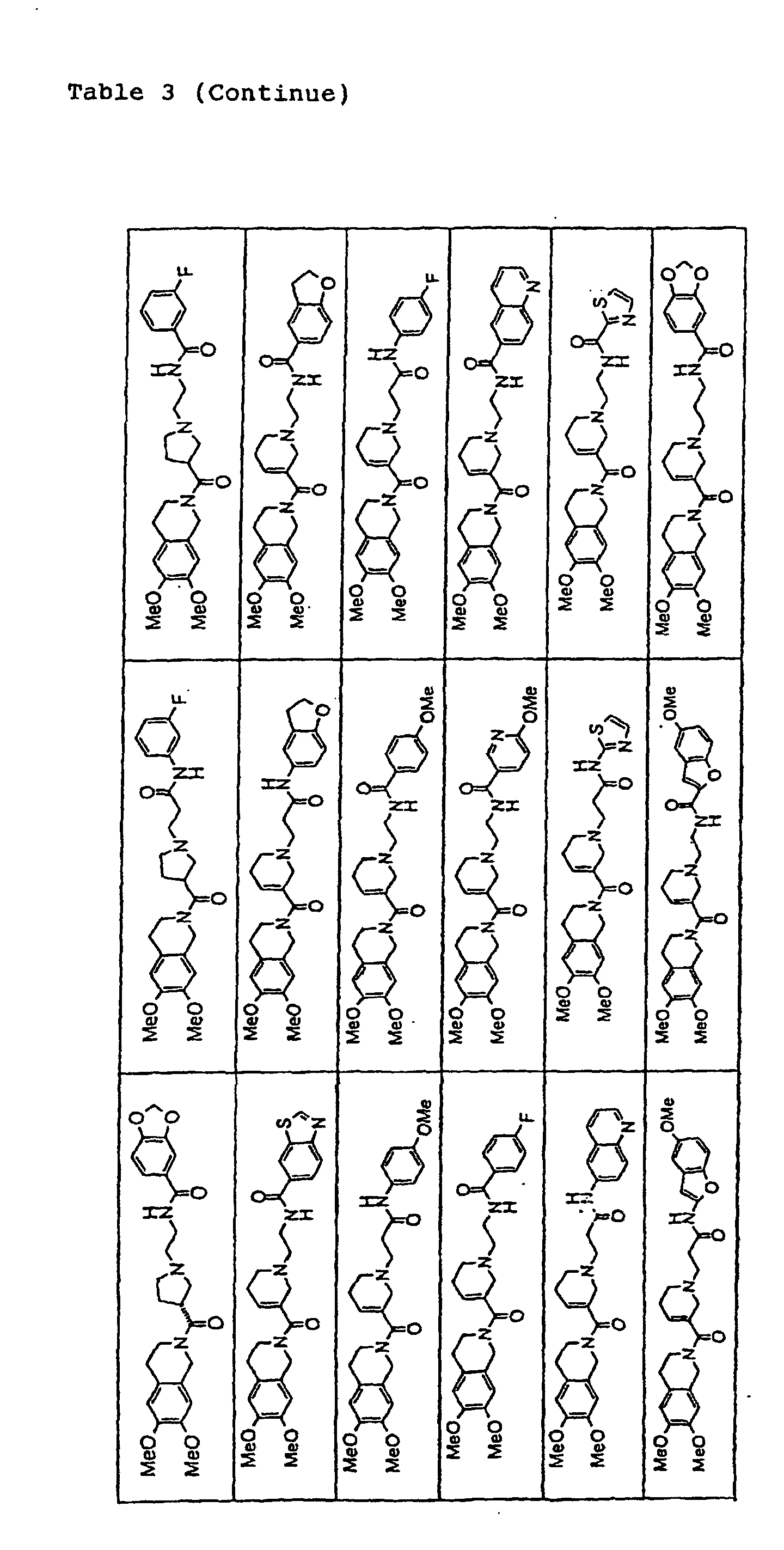
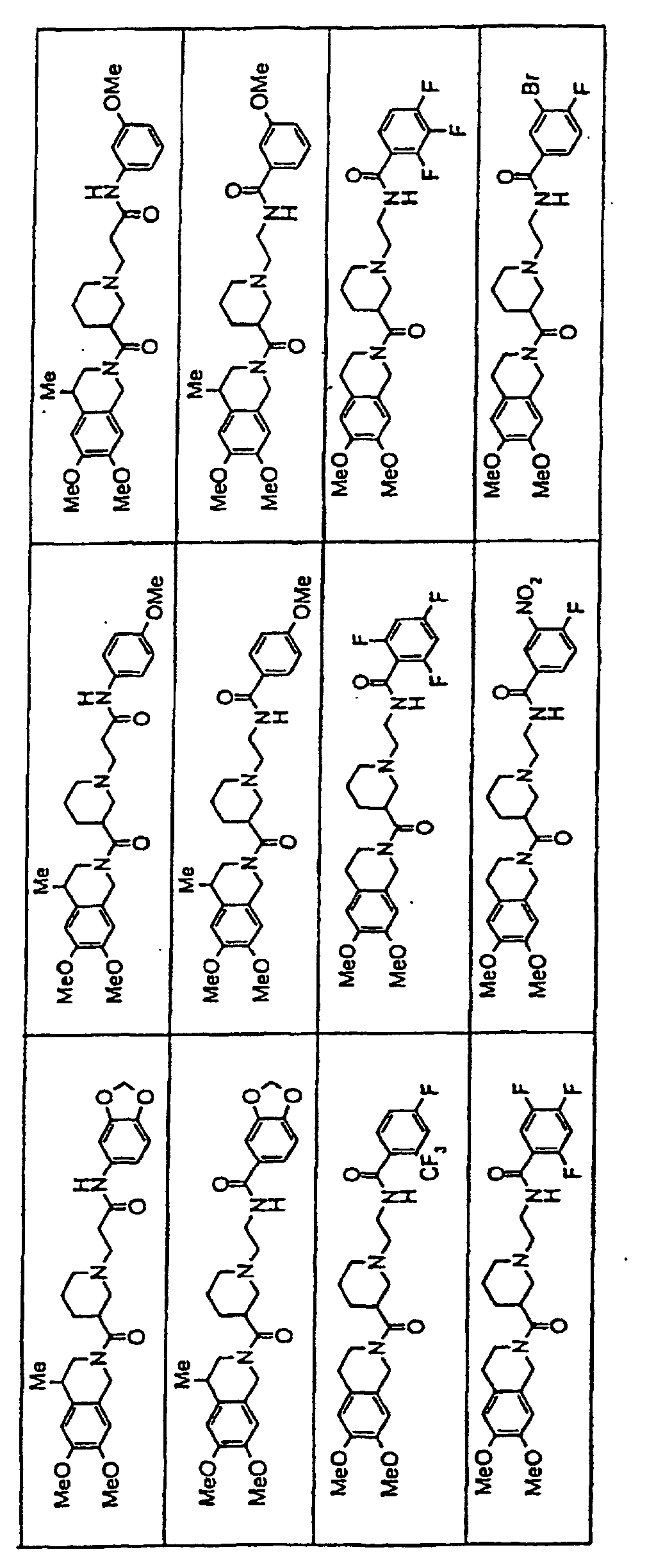
Claims (6)
- An isoquinoline derivative represented by the following general formula (I) or a salt thereof:(in the formula, the symbols have the following meanings:
 A: C1 - C6 alkylene;B: -C(=O)-NR5- or -NR5-C(=O)-;R1 and R2: hydrogen atom, C1 - C6 alkyl or -O-C1 - C6 alkyl, which may be the same or different;R3, R4 and R5: hydrogen atom or C1 - C6 alkyl, which may be the same or different;ring D: monocyclic or fused C6 - C14 aryl group or saturated or unsaturated cyclo alkyl group or hetero ring which contains 1 to 4 hetero atoms selected from oxygen, sulfur and nitrogen and wherein both of them may optionally include 1 to 5 substituents selected from halogen atoms, C1 - C6 alkyl, C2 - C6 alkenyl, C2 - C6 alkynyl, -OH, -SH, halogeno C1 - C6 alkyl, -O-halogeno C1 - C6 alkyl, -O-C1 - C6 alkyl, -S-C1 - C6 alkyl, -CO-O-C1 - C6 alkyl, -O-C2 - C6 alkenyl-CO-O-C1 - C6 alkyl, - COOH, -SO2-C1 - C6 alkyl, -SO-C1 - C6 alkyl, -CO-C1 -C6 alkyl, -CO-NH2, -CO-NH-C1 - C6 alkyl, -CO-N(C1 - C6 alkyl)2, -NO2, -CN, -NH2, -NH-C1-C6 alkyl, -N(C1 - C6 alkyl)2, -O-C1 - C6 alkylene-O-, -NH-CO-C1 - C6 alkyl and ketone (=O); m: 1, 2 or 3;n: 0 or 1; andq: 1 or 2.)
 - An isoquinoline derivative as claimed in Claim 1, which is represented by the following general formula (I') or a salt thereof:wherein A, B, R1, R2, R3, R4, R5 and D are as defined in Claim 1.
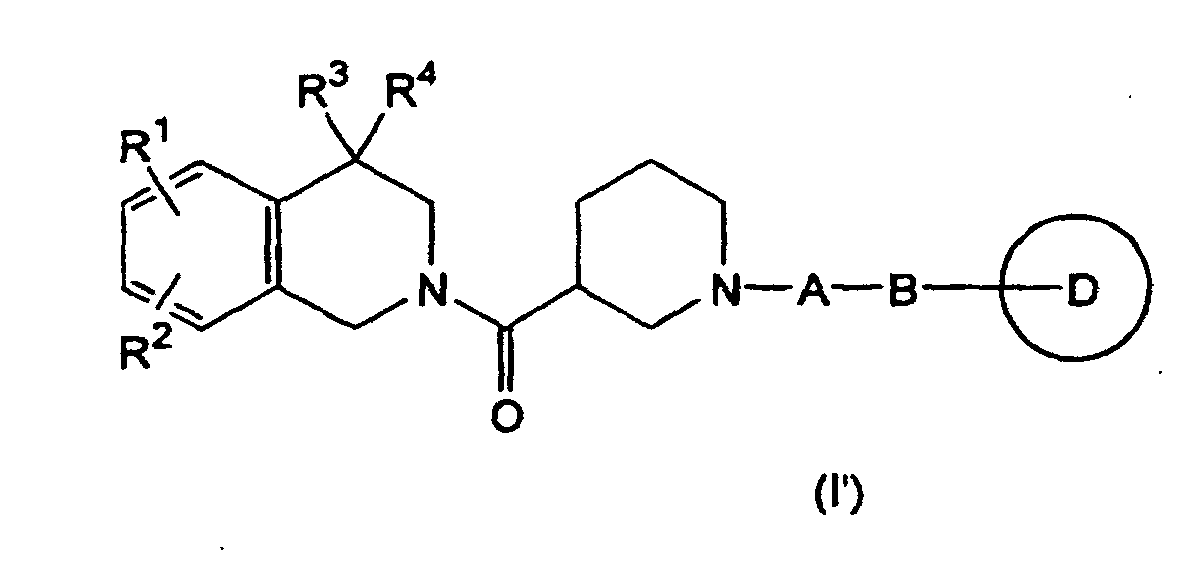
- An isoquinoline derivative as claimed in Claim 1, wherein the derivative is represented by
N-{2-[3-(6,7-Dimethoxy-1,2,3,4-tetrahydroisoquinoline-2-carbonyl)piperidino]ethyl}-4-fluorobenzamide; N-{2-[3-(6,7-dimethoxy-1,2,3,4-tetrahydroisoquinoline-2-carbonyl)piperidino]ethyl}-3,4-methylenedioxybenzamide; 3-[3-(6,7-dimethoxy-1,2,3,4-tetrahydroisoquinoline-2-carbonyl)piperidino]-N-(3,4-methylenedioxyphenyl)propanamide; N-{2-[3-(6,7-dimethoxy-1,2,3,4-tetrahydroisoquinoline-2-carbonyl)piperidino]ethyl}-4-methoxy-3-methylbenzamide; N-{2-[3-(6,7-dimethoxy-1,2,3,4-tetrahydroisoquinoline-2-carbonyl)piperidino]ethyl}-3-methoxybenzamide; N-{2-[3-(6,7-dimethoxy-1,2,3,4-tetrahydroisoquinoline-2-carbonyl)piperidino]ethyl}-3,4-difluorobenzamide, or salts thereof. - A pharmaceutical composition containing the isoquinoline derivative or salt thereof according to any of the Claims 1 to 3 as an effective ingredient.
- The use of an isoquinoline derivative as defined in any of the Claims 1 to 3 for the preparation of a medicament having a If current inhibitory effect.
- The use of an isoquinoline derivative as defined in any of the Claims 1 to 3 for the preparation of a medicament having a cardiac rate lowering effect.
Applications Claiming Priority (3)
| Application Number | Priority Date | Filing Date | Title |
|---|---|---|---|
| JP15621799 | 1999-06-03 | ||
| JP15621799 | 1999-06-03 | ||
| PCT/JP2000/003564 WO2000075133A1 (en) | 1999-06-03 | 2000-06-01 | Novel isoquinoline derivatives or salts thereof |
Publications (3)
| Publication Number | Publication Date |
|---|---|
| EP1186601A1 EP1186601A1 (en) | 2002-03-13 |
| EP1186601A4 EP1186601A4 (en) | 2002-10-30 |
| EP1186601B1 true EP1186601B1 (en) | 2004-03-24 |
Family
ID=15622928
Family Applications (1)
| Application Number | Title | Priority Date | Filing Date |
|---|---|---|---|
| EP00931652A Expired - Lifetime EP1186601B1 (en) | 1999-06-03 | 2000-06-01 | Novel isoquinoline derivatives or salts thereof |
Country Status (14)
| Country | Link |
|---|---|
| US (1) | US6573279B1 (en) |
| EP (1) | EP1186601B1 (en) |
| JP (1) | JP3741042B2 (en) |
| KR (1) | KR100664893B1 (en) |
| CN (1) | CN1136215C (en) |
| AT (1) | ATE262518T1 (en) |
| AU (1) | AU4952800A (en) |
| CA (1) | CA2373880C (en) |
| DE (1) | DE60009287T2 (en) |
| DK (1) | DK1186601T3 (en) |
| ES (1) | ES2214276T3 (en) |
| MX (1) | MXPA01012392A (en) |
| PT (1) | PT1186601E (en) |
| WO (1) | WO2000075133A1 (en) |
Cited By (1)
| Publication number | Priority date | Publication date | Assignee | Title |
|---|---|---|---|---|
| US8569282B2 (en) | 2007-12-11 | 2013-10-29 | Cytopathfinder, Inc. | Carboxamide compounds and their use |
Families Citing this family (9)
| Publication number | Priority date | Publication date | Assignee | Title |
|---|---|---|---|---|
| ES2211846T3 (en) * | 2002-07-25 | 2004-07-16 | BOEHRINGER INGELHEIM PHARMA GMBH & CO.KG | USE OF CILOBRADINE OR ITS PHARMACEUTICALLY ACCEPTABLE SALTS FOR THE TREATMENT OR PREVENTION OF CARDIAC INSUFFICIENCY. |
| US20040138306A1 (en) * | 2002-07-25 | 2004-07-15 | Boehringer Ingelheim Pharma Gmbh & Co. Kg | Use of a specific cyclic amine derivative or the pharmaceutically acceptable salts thereof for the treatment or prevention of heart failure |
| JPWO2004058710A1 (en) | 2002-12-25 | 2006-04-27 | アステラス製薬株式会社 | Novel benzamide derivative and process for producing the same |
| KR20060029209A (en) * | 2003-04-02 | 2006-04-05 | 아스텔라스세이야쿠 가부시키가이샤 | Novel Determination of Fluorobenzamide Derivatives |
| US20090247572A1 (en) * | 2005-08-23 | 2009-10-01 | Koichi Wada | Agent for treating atrial fibrillation |
| CL2007002958A1 (en) * | 2006-10-12 | 2008-05-09 | Epix Delaware Inc | COMPOUNDS DERIVED FROM HETEROARIL-CARBOXAMIDA, ANTAGONISTS OF THE CHEMIOQUINE RECEPTOR; PHARMACEUTICAL COMPOSITION; AND USE FOR THE TREATMENT OR PREVENTION OF SUCH DISEASES AS REJECTION OF ORGAN TRANSPLANTS, Rheumatoid Arthritis, LUPUS, ENTR |
| PL2149560T3 (en) * | 2007-05-22 | 2015-10-30 | Astellas Pharma Inc | 1-substituted tetrahydroisoquinoline compound |
| US20100331298A1 (en) * | 2007-12-10 | 2010-12-30 | Cytopathfinder, Inc. | Carboxamide Compounds and Their Use |
| AR089646A1 (en) | 2011-08-12 | 2014-09-10 | Boehringer Ingelheim Vetmed | FUNNY CURRENT INHIBITORS (IF) TO USE IN A METHOD OF TREATMENT AND PREVENTION OF HEART FAILURE IN FELINOS |
Family Cites Families (3)
| Publication number | Priority date | Publication date | Assignee | Title |
|---|---|---|---|---|
| US4059583A (en) * | 1975-11-13 | 1977-11-22 | Mcneil Laboratories, Incorporated | Substituted indoles |
| JPH02138172A (en) * | 1988-11-19 | 1990-05-28 | Mitsubishi Kasei Corp | β-Amino acid amide derivative |
| AU4319797A (en) * | 1996-09-25 | 1998-04-17 | Yamanouchi Pharmaceutical Co., Ltd. | 2-(3-piperidyl)-1,2,3,4-tetrahydroisoquinoline derivatives or medicinal compositions thereof |
-
2000
- 2000-06-01 EP EP00931652A patent/EP1186601B1/en not_active Expired - Lifetime
- 2000-06-01 AT AT00931652T patent/ATE262518T1/en active
- 2000-06-01 MX MXPA01012392A patent/MXPA01012392A/en active IP Right Grant
- 2000-06-01 CA CA002373880A patent/CA2373880C/en not_active Expired - Fee Related
- 2000-06-01 US US09/980,402 patent/US6573279B1/en not_active Expired - Fee Related
- 2000-06-01 DK DK00931652T patent/DK1186601T3/en active
- 2000-06-01 ES ES00931652T patent/ES2214276T3/en not_active Expired - Lifetime
- 2000-06-01 KR KR1020017015403A patent/KR100664893B1/en not_active Expired - Fee Related
- 2000-06-01 JP JP2001502416A patent/JP3741042B2/en not_active Expired - Fee Related
- 2000-06-01 DE DE60009287T patent/DE60009287T2/en not_active Expired - Lifetime
- 2000-06-01 AU AU49528/00A patent/AU4952800A/en not_active Abandoned
- 2000-06-01 CN CNB008082707A patent/CN1136215C/en not_active Expired - Fee Related
- 2000-06-01 PT PT00931652T patent/PT1186601E/en unknown
- 2000-06-01 WO PCT/JP2000/003564 patent/WO2000075133A1/en not_active Ceased
Cited By (1)
| Publication number | Priority date | Publication date | Assignee | Title |
|---|---|---|---|---|
| US8569282B2 (en) | 2007-12-11 | 2013-10-29 | Cytopathfinder, Inc. | Carboxamide compounds and their use |
Also Published As
| Publication number | Publication date |
|---|---|
| EP1186601A1 (en) | 2002-03-13 |
| CN1136215C (en) | 2004-01-28 |
| AU4952800A (en) | 2000-12-28 |
| DE60009287D1 (en) | 2004-04-29 |
| DK1186601T3 (en) | 2004-06-01 |
| ATE262518T1 (en) | 2004-04-15 |
| WO2000075133A1 (en) | 2000-12-14 |
| EP1186601A4 (en) | 2002-10-30 |
| US6573279B1 (en) | 2003-06-03 |
| ES2214276T3 (en) | 2004-09-16 |
| CA2373880C (en) | 2009-04-07 |
| MXPA01012392A (en) | 2002-07-30 |
| KR20020005765A (en) | 2002-01-17 |
| DE60009287T2 (en) | 2005-02-17 |
| CN1379773A (en) | 2002-11-13 |
| CA2373880A1 (en) | 2000-12-14 |
| JP3741042B2 (en) | 2006-02-01 |
| KR100664893B1 (en) | 2007-01-09 |
| PT1186601E (en) | 2004-06-30 |
Similar Documents
| Publication | Publication Date | Title |
|---|---|---|
| JP3834663B2 (en) | Isoquinoline derivatives and pharmaceuticals | |
| US6696468B2 (en) | (s)-4-amino-5-chloro-2-methoxy-n-[1-[1-(2-tetrahydrofuryl-carbonyl)-4-piperidinylmethyl]-4-piperidinyl]benzamide, process for the preparation thereof, pharmaceutical composition containing the same, and intermediate therefor | |
| RU2296751C2 (en) | Derivatives of bipiperidine and pharmaceutical composition based on thereof | |
| EP0277794B1 (en) | N-heterocyclic-N-(4-piperidyl) amides | |
| KR20020024300A (en) | Selective iGluR5 Receptor Antagonists for The Treatment of Migraine | |
| PT95198A (en) | PROCESS FOR THE PREPARATION OF REPLACED N-BENZYLPIPERIDINE AMIDES | |
| CA2373880C (en) | Isoquinoline derivatives or salts thereof | |
| JPWO2000075133A1 (en) | Novel isoquinoline derivatives or salts thereof | |
| EA011635B1 (en) | New heterocyclic carboxylic acid amide derivatives | |
| DK172787B1 (en) | 4-Phenyl-4- (N-phenylamido) -piperidine derivatives, optically active isomers and pharmaceutically acceptable acid addition salts thereof | |
| PT855397E (en) | (R) -5-BROMO-N- (1-ETHYL-4-METHYL-HEXA-1H-1,4-DIAZEPIN-6-YL) -2-METHOXY-6-METHYLAMINO-3-PYRIDINOCARBOXAMIDE PROCESS FOR THE THEIR PREPARATION AND PHARMACEUTICAL COMPOSITION CONTAINING THE COMPOUND | |
| KR101586507B1 (en) | Amide derivative and pharmaceutical composition containing the same | |
| EP1256575B1 (en) | Phenoxyalkylamine derivatives useful as opioid delta receptor agonists | |
| KR100699512B1 (en) | Aminoalkyl substituted (benzodioxane, benzofuran or benzopyran) derivatives | |
| JP2004277319A (en) | 1- (4-piperidinylmethyl) piperidinylamide derivative and pharmaceutical composition containing the same | |
| EA004648B1 (en) | Pyrrolidinyl, piperidinyl or homopiperidinyl substituted derivatives, process for preparing thereof, use thereof in medicine, pharmaceutical composition containing them and method for its preparation | |
| JP2000302778A (en) | Isoquinolinone derivative or its salt | |
| WO1998013364A1 (en) | 2-(3-piperidyl)-1,2,3,4-tetrahydroisoquinoline derivatives or medicinal compositions thereof | |
| JPH11269172A (en) | 2-(1-piperidiylalkanoly)-1,2,3,4-tetrahydroisoquinoline derivative or its salt | |
| JPH11189593A (en) | 2-(piperidylalkylcarbonyl)-1,2,3,4-tetrahydroisoquinoline derivative or its salt | |
| WO2023133457A1 (en) | Novel kalirin inhibitors for regulation of synaptic plasticity and neuropathic pain treatment | |
| JPWO1998013364A1 (en) | 2-(3-piperidyl)-1,2,3,4-tetrahydroisoquinoline derivative or pharmaceutical composition thereof | |
| RU2154634C2 (en) | Derivatives of phenyloxoalkyl-(4-piperidinyl)-benzoate, methods of their synthesis, pharmaceutical composition based on thereof and method of its preparing and intermediate compound | |
| JP2000080081A (en) | 1-[(1-Substituted-4-piperidinyl) methyl] -4-piperidine derivatives and pharmaceutical compositions containing the same | |
| HK1060118B (en) | (s)-4-amino-5-chloro-2-methoxy-n-[1-[1-(2-tetrahydrofuryl-carbonyl)-4-piperidinylmethyl]-4-piperidinyl]benzamide for treating gastrointestinal motility disorders |
Legal Events
| Date | Code | Title | Description |
|---|---|---|---|
| PUAI | Public reference made under article 153(3) epc to a published international application that has entered the european phase |
Free format text: ORIGINAL CODE: 0009012 |
|
| 17P | Request for examination filed |
Effective date: 20011203 |
|
| AK | Designated contracting states |
Kind code of ref document: A1 Designated state(s): AT BE CH CY DE DK ES FI FR GB GR IE IT LI LU MC NL PT SE |
|
| AX | Request for extension of the european patent |
Free format text: AL;LT;LV;MK;RO;SI |
|
| A4 | Supplementary search report drawn up and despatched |
Effective date: 20020913 |
|
| AK | Designated contracting states |
Kind code of ref document: A4 Designated state(s): AT BE CH CY DE DK ES FI FR GB GR IE IT LI LU MC NL PT SE |
|
| RIC1 | Information provided on ipc code assigned before grant |
Free format text: 7C 07D 401/06 A, 7C 07D 401/14 B, 7C 07D 405/14 B, 7C 07D 413/14 B, 7C 07D 417/14 B, 7A 61K 31/4725 B, 7A 61K 31/538 B, 7A 61P 9/10 B, 7C 07D 401/12 B, 7A 61K 31/47 B |
|
| 17Q | First examination report despatched |
Effective date: 20030114 |
|
| GRAP | Despatch of communication of intention to grant a patent |
Free format text: ORIGINAL CODE: EPIDOSNIGR1 |
|
| GRAS | Grant fee paid |
Free format text: ORIGINAL CODE: EPIDOSNIGR3 |
|
| GRAA | (expected) grant |
Free format text: ORIGINAL CODE: 0009210 |
|
| AK | Designated contracting states |
Kind code of ref document: B1 Designated state(s): AT BE CH CY DE DK ES FI FR GB GR IE IT LI LU MC NL PT SE |
|
| REG | Reference to a national code |
Ref country code: GB Ref legal event code: FG4D |
|
| REG | Reference to a national code |
Ref country code: CH Ref legal event code: EP |
|
| REG | Reference to a national code |
Ref country code: SE Ref legal event code: TRGR |
|
| REG | Reference to a national code |
Ref country code: IE Ref legal event code: FG4D |
|
| REG | Reference to a national code |
Ref country code: GR Ref legal event code: EP Ref document number: 20040401018 Country of ref document: GR |
|
| REF | Corresponds to: |
Ref document number: 60009287 Country of ref document: DE Date of ref document: 20040429 Kind code of ref document: P |
|
| REG | Reference to a national code |
Ref country code: DK Ref legal event code: T3 |
|
| PG25 | Lapsed in a contracting state [announced via postgrant information from national office to epo] |
Ref country code: MC Free format text: LAPSE BECAUSE OF NON-PAYMENT OF DUE FEES Effective date: 20040630 |
|
| REG | Reference to a national code |
Ref country code: PT Ref legal event code: SC4A Free format text: AVAILABILITY OF NATIONAL TRANSLATION Effective date: 20040427 Ref country code: CH Ref legal event code: NV Representative=s name: NOVAGRAAF INTERNATIONAL SA |
|
| REG | Reference to a national code |
Ref country code: ES Ref legal event code: FG2A Ref document number: 2214276 Country of ref document: ES Kind code of ref document: T3 |
|
| LTIE | Lt: invalidation of european patent or patent extension |
Effective date: 20040324 |
|
| ET | Fr: translation filed | ||
| PLBE | No opposition filed within time limit |
Free format text: ORIGINAL CODE: 0009261 |
|
| STAA | Information on the status of an ep patent application or granted ep patent |
Free format text: STATUS: NO OPPOSITION FILED WITHIN TIME LIMIT |
|
| 26N | No opposition filed |
Effective date: 20041228 |
|
| NLT1 | Nl: modifications of names registered in virtue of documents presented to the patent office pursuant to art. 16 a, paragraph 1 |
Owner name: ASTELLAS PHARMA INC. |
|
| REG | Reference to a national code |
Ref country code: CH Ref legal event code: PFA Owner name: ASTELLAS PHARMA INC. Free format text: YAMANOUCHI PHARMACEUTICAL CO. LTD.#NO. 3-11 NIHONBASHI-HONCHO, 2-CHOME CHUO-KU#TOKYO 103-8411 (JP) -TRANSFER TO- ASTELLAS PHARMA INC.#3-11, NIHONBASHI-HONCHO 2-CHOME, CHUO-KU#TOKYO 103-8411 (JP) |
|
| REG | Reference to a national code |
Ref country code: PT Ref legal event code: PC4A Owner name: ASTELLAS PHARMA INC., JP Effective date: 20060412 |
|
| REG | Reference to a national code |
Ref country code: FR Ref legal event code: CD |
|
| REG | Reference to a national code |
Ref country code: CH Ref legal event code: PFA Owner name: ASTELLAS PHARMA INC. Free format text: ASTELLAS PHARMA INC.#3-11, NIHONBASHI-HONCHO 2-CHOME, CHUO-KU#TOKYO 103-8411 (JP) -TRANSFER TO- ASTELLAS PHARMA INC.#3-11, NIHONBASHI-HONCHO 2-CHOME, CHUO-KU#TOKYO 103-8411 (JP) |
|
| PGFP | Annual fee paid to national office [announced via postgrant information from national office to epo] |
Ref country code: ES Payment date: 20120621 Year of fee payment: 13 |
|
| PGFP | Annual fee paid to national office [announced via postgrant information from national office to epo] |
Ref country code: AT Payment date: 20120529 Year of fee payment: 13 |
|
| PGFP | Annual fee paid to national office [announced via postgrant information from national office to epo] |
Ref country code: CH Payment date: 20130612 Year of fee payment: 14 Ref country code: SE Payment date: 20130612 Year of fee payment: 14 Ref country code: LU Payment date: 20130612 Year of fee payment: 14 Ref country code: IE Payment date: 20130618 Year of fee payment: 14 Ref country code: DE Payment date: 20130529 Year of fee payment: 14 Ref country code: GB Payment date: 20130529 Year of fee payment: 14 Ref country code: DK Payment date: 20130611 Year of fee payment: 14 |
|
| PGFP | Annual fee paid to national office [announced via postgrant information from national office to epo] |
Ref country code: FR Payment date: 20130624 Year of fee payment: 14 Ref country code: IT Payment date: 20130620 Year of fee payment: 14 Ref country code: NL Payment date: 20130615 Year of fee payment: 14 Ref country code: FI Payment date: 20130611 Year of fee payment: 14 Ref country code: GR Payment date: 20130520 Year of fee payment: 14 Ref country code: PT Payment date: 20130603 Year of fee payment: 14 |
|
| PGFP | Annual fee paid to national office [announced via postgrant information from national office to epo] |
Ref country code: BE Payment date: 20130614 Year of fee payment: 14 |
|
| PGFP | Annual fee paid to national office [announced via postgrant information from national office to epo] |
Ref country code: CY Payment date: 20130529 Year of fee payment: 14 |
|
| REG | Reference to a national code |
Ref country code: PT Ref legal event code: MM4A Free format text: LAPSE DUE TO NON-PAYMENT OF FEES Effective date: 20141202 |
|
| REG | Reference to a national code |
Ref country code: DE Ref legal event code: R119 Ref document number: 60009287 Country of ref document: DE |
|
| REG | Reference to a national code |
Ref country code: DK Ref legal event code: EBP Effective date: 20140630 |
|
| REG | Reference to a national code |
Ref country code: NL Ref legal event code: V1 Effective date: 20150101 |
|
| PG25 | Lapsed in a contracting state [announced via postgrant information from national office to epo] |
Ref country code: FI Free format text: LAPSE BECAUSE OF NON-PAYMENT OF DUE FEES Effective date: 20140601 Ref country code: PT Free format text: LAPSE BECAUSE OF NON-PAYMENT OF DUE FEES Effective date: 20141202 Ref country code: SE Free format text: LAPSE BECAUSE OF NON-PAYMENT OF DUE FEES Effective date: 20140602 Ref country code: LU Free format text: LAPSE BECAUSE OF NON-PAYMENT OF DUE FEES Effective date: 20140601 |
|
| REG | Reference to a national code |
Ref country code: CH Ref legal event code: PL |
|
| REG | Reference to a national code |
Ref country code: SE Ref legal event code: EUG |
|
| REG | Reference to a national code |
Ref country code: AT Ref legal event code: MM01 Ref document number: 262518 Country of ref document: AT Kind code of ref document: T Effective date: 20140601 |
|
| GBPC | Gb: european patent ceased through non-payment of renewal fee |
Effective date: 20140601 |
|
| PG25 | Lapsed in a contracting state [announced via postgrant information from national office to epo] |
Ref country code: CY Free format text: LAPSE BECAUSE OF NON-PAYMENT OF DUE FEES Effective date: 20140601 |
|
| REG | Reference to a national code |
Ref country code: GR Ref legal event code: ML Ref document number: 20040401018 Country of ref document: GR Effective date: 20150105 |
|
| REG | Reference to a national code |
Ref country code: IE Ref legal event code: MM4A |
|
| REG | Reference to a national code |
Ref country code: FR Ref legal event code: ST Effective date: 20150227 |
|
| PG25 | Lapsed in a contracting state [announced via postgrant information from national office to epo] |
Ref country code: NL Free format text: LAPSE BECAUSE OF NON-PAYMENT OF DUE FEES Effective date: 20150101 |
|
| REG | Reference to a national code |
Ref country code: DE Ref legal event code: R119 Ref document number: 60009287 Country of ref document: DE Effective date: 20150101 |
|
| PG25 | Lapsed in a contracting state [announced via postgrant information from national office to epo] |
Ref country code: IT Free format text: LAPSE BECAUSE OF NON-PAYMENT OF DUE FEES Effective date: 20140601 Ref country code: CH Free format text: LAPSE BECAUSE OF NON-PAYMENT OF DUE FEES Effective date: 20140630 Ref country code: IE Free format text: LAPSE BECAUSE OF NON-PAYMENT OF DUE FEES Effective date: 20140601 Ref country code: LI Free format text: LAPSE BECAUSE OF NON-PAYMENT OF DUE FEES Effective date: 20140630 Ref country code: DE Free format text: LAPSE BECAUSE OF NON-PAYMENT OF DUE FEES Effective date: 20150101 |
|
| PG25 | Lapsed in a contracting state [announced via postgrant information from national office to epo] |
Ref country code: GB Free format text: LAPSE BECAUSE OF NON-PAYMENT OF DUE FEES Effective date: 20140601 Ref country code: FR Free format text: LAPSE BECAUSE OF NON-PAYMENT OF DUE FEES Effective date: 20140630 Ref country code: GR Free format text: LAPSE BECAUSE OF NON-PAYMENT OF DUE FEES Effective date: 20150105 Ref country code: AT Free format text: LAPSE BECAUSE OF NON-PAYMENT OF DUE FEES Effective date: 20140601 |
|
| REG | Reference to a national code |
Ref country code: ES Ref legal event code: FD2A Effective date: 20150727 |
|
| PG25 | Lapsed in a contracting state [announced via postgrant information from national office to epo] |
Ref country code: DK Free format text: LAPSE BECAUSE OF NON-PAYMENT OF DUE FEES Effective date: 20140630 |
|
| PG25 | Lapsed in a contracting state [announced via postgrant information from national office to epo] |
Ref country code: ES Free format text: LAPSE BECAUSE OF NON-PAYMENT OF DUE FEES Effective date: 20140602 |
|
| PG25 | Lapsed in a contracting state [announced via postgrant information from national office to epo] |
Ref country code: BE Free format text: LAPSE BECAUSE OF NON-PAYMENT OF DUE FEES Effective date: 20140630 |