EP1186588A1 - 6-hydroxy-2-naphthylcarbinol and process for the preparation thereof - Google Patents
6-hydroxy-2-naphthylcarbinol and process for the preparation thereof Download PDFInfo
- Publication number
- EP1186588A1 EP1186588A1 EP00929861A EP00929861A EP1186588A1 EP 1186588 A1 EP1186588 A1 EP 1186588A1 EP 00929861 A EP00929861 A EP 00929861A EP 00929861 A EP00929861 A EP 00929861A EP 1186588 A1 EP1186588 A1 EP 1186588A1
- Authority
- EP
- European Patent Office
- Prior art keywords
- hydroxy
- group
- naphthylcarbinol
- thiazolidinedione
- naphthaldehyde
- Prior art date
- Legal status (The legal status is an assumption and is not a legal conclusion. Google has not performed a legal analysis and makes no representation as to the accuracy of the status listed.)
- Withdrawn
Links
- KROVHQCEBMIYGB-UHFFFAOYSA-N 6-(hydroxymethyl)naphthalen-2-ol Chemical compound C1=C(O)C=CC2=CC(CO)=CC=C21 KROVHQCEBMIYGB-UHFFFAOYSA-N 0.000 title claims abstract description 78
- 238000000034 method Methods 0.000 title claims abstract description 70
- 238000002360 preparation method Methods 0.000 title claims abstract description 23
- PRYNJOJHKYNLIS-UHFFFAOYSA-N 6-hydroxynaphthalene-2-carbaldehyde Chemical compound C1=C(C=O)C=CC2=CC(O)=CC=C21 PRYNJOJHKYNLIS-UHFFFAOYSA-N 0.000 claims abstract description 72
- KAUQJMHLAFIZDU-UHFFFAOYSA-N 6-Hydroxy-2-naphthoic acid Chemical compound C1=C(O)C=CC2=CC(C(=O)O)=CC=C21 KAUQJMHLAFIZDU-UHFFFAOYSA-N 0.000 claims abstract description 36
- UORVGPXVDQYIDP-UHFFFAOYSA-N borane Chemical compound B UORVGPXVDQYIDP-UHFFFAOYSA-N 0.000 claims description 77
- 150000001875 compounds Chemical class 0.000 claims description 63
- -1 metal complex compound Chemical class 0.000 claims description 59
- 125000000217 alkyl group Chemical group 0.000 claims description 41
- 229910000085 borane Inorganic materials 0.000 claims description 40
- 125000004432 carbon atom Chemical group C* 0.000 claims description 28
- NUJOXMJBOLGQSY-UHFFFAOYSA-N manganese dioxide Chemical compound O=[Mn]=O NUJOXMJBOLGQSY-UHFFFAOYSA-N 0.000 claims description 26
- 125000005842 heteroatom Chemical group 0.000 claims description 24
- 125000003118 aryl group Chemical group 0.000 claims description 23
- OQKNWSRRDIDCLI-UHFFFAOYSA-N 5-[(6-hydroxynaphthalen-2-yl)methyl]-1,3-thiazolidine-2,4-dione Chemical compound C1=CC2=CC(O)=CC=C2C=C1CC1SC(=O)NC1=O OQKNWSRRDIDCLI-UHFFFAOYSA-N 0.000 claims description 20
- BTBUEUYNUDRHOZ-UHFFFAOYSA-N Borate Chemical compound [O-]B([O-])[O-] BTBUEUYNUDRHOZ-UHFFFAOYSA-N 0.000 claims description 17
- ZOBPZXTWZATXDG-UHFFFAOYSA-N 1,3-thiazolidine-2,4-dione Chemical compound O=C1CSC(=O)N1 ZOBPZXTWZATXDG-UHFFFAOYSA-N 0.000 claims description 16
- MWSRLOOOXGXSRO-UHFFFAOYSA-N 5-[(6-hydroxynaphthalen-2-yl)methylidene]-1,3-thiazolidine-2,4-dione Chemical compound C1=CC2=CC(O)=CC=C2C=C1C=C1SC(=O)NC1=O MWSRLOOOXGXSRO-UHFFFAOYSA-N 0.000 claims description 16
- 125000002887 hydroxy group Chemical group [H]O* 0.000 claims description 16
- 125000004435 hydrogen atom Chemical group [H]* 0.000 claims description 13
- 229910052757 nitrogen Inorganic materials 0.000 claims description 13
- 230000001590 oxidative effect Effects 0.000 claims description 13
- 125000003710 aryl alkyl group Chemical group 0.000 claims description 12
- 230000033116 oxidation-reduction process Effects 0.000 claims description 12
- 125000001424 substituent group Chemical group 0.000 claims description 12
- AVXURJPOCDRRFD-UHFFFAOYSA-N Hydroxylamine Chemical class ON AVXURJPOCDRRFD-UHFFFAOYSA-N 0.000 claims description 11
- 239000003054 catalyst Substances 0.000 claims description 11
- 125000005843 halogen group Chemical group 0.000 claims description 11
- XEEYBQQBJWHFJM-UHFFFAOYSA-N Iron Chemical compound [Fe] XEEYBQQBJWHFJM-UHFFFAOYSA-N 0.000 claims description 10
- QVGXLLKOCUKJST-UHFFFAOYSA-N atomic oxygen Chemical compound [O] QVGXLLKOCUKJST-UHFFFAOYSA-N 0.000 claims description 9
- 239000001301 oxygen Substances 0.000 claims description 9
- 229910052760 oxygen Inorganic materials 0.000 claims description 9
- QYTDEUPAUMOIOP-UHFFFAOYSA-N TEMPO Chemical group CC1(C)CCCC(C)(C)N1[O] QYTDEUPAUMOIOP-UHFFFAOYSA-N 0.000 claims description 8
- GOPYZMJAIPBUGX-UHFFFAOYSA-N [O-2].[O-2].[Mn+4] Chemical class [O-2].[O-2].[Mn+4] GOPYZMJAIPBUGX-UHFFFAOYSA-N 0.000 claims description 8
- 125000002947 alkylene group Chemical group 0.000 claims description 8
- 229910052799 carbon Inorganic materials 0.000 claims description 8
- 150000002736 metal compounds Chemical class 0.000 claims description 8
- WRECIMRULFAWHA-UHFFFAOYSA-N trimethyl borate Chemical group COB(OC)OC WRECIMRULFAWHA-UHFFFAOYSA-N 0.000 claims description 8
- 125000004433 nitrogen atom Chemical group N* 0.000 claims description 7
- 230000003647 oxidation Effects 0.000 claims description 7
- 238000007254 oxidation reaction Methods 0.000 claims description 7
- 125000003545 alkoxy group Chemical group 0.000 claims description 6
- 230000009467 reduction Effects 0.000 claims description 6
- UZFMOKQJFYMBGY-UHFFFAOYSA-N 4-hydroxy-TEMPO Chemical group CC1(C)CC(O)CC(C)(C)N1[O] UZFMOKQJFYMBGY-UHFFFAOYSA-N 0.000 claims description 5
- 125000004423 acyloxy group Chemical group 0.000 claims description 5
- 125000004453 alkoxycarbonyl group Chemical group 0.000 claims description 5
- 125000005278 alkyl sulfonyloxy group Chemical group 0.000 claims description 5
- 125000005279 aryl sulfonyloxy group Chemical group 0.000 claims description 5
- 230000018044 dehydration Effects 0.000 claims description 5
- 238000006297 dehydration reaction Methods 0.000 claims description 5
- 229910052742 iron Inorganic materials 0.000 claims description 5
- AJSTXXYNEIHPMD-UHFFFAOYSA-N triethyl borate Chemical compound CCOB(OCC)OCC AJSTXXYNEIHPMD-UHFFFAOYSA-N 0.000 claims description 5
- ZOXJGFHDIHLPTG-UHFFFAOYSA-N Boron Chemical group [B] ZOXJGFHDIHLPTG-UHFFFAOYSA-N 0.000 claims description 4
- RYGMFSIKBFXOCR-UHFFFAOYSA-N Copper Chemical group [Cu] RYGMFSIKBFXOCR-UHFFFAOYSA-N 0.000 claims description 4
- 125000005529 alkyleneoxy group Chemical group 0.000 claims description 4
- AZDRQVAHHNSJOQ-UHFFFAOYSA-N alumane Chemical compound [AlH3] AZDRQVAHHNSJOQ-UHFFFAOYSA-N 0.000 claims description 4
- 229910052796 boron Inorganic materials 0.000 claims description 4
- 125000003917 carbamoyl group Chemical group [H]N([H])C(*)=O 0.000 claims description 4
- 229910052802 copper Inorganic materials 0.000 claims description 4
- 239000010949 copper Substances 0.000 claims description 4
- 125000004093 cyano group Chemical group *C#N 0.000 claims description 4
- 229910052751 metal Inorganic materials 0.000 claims description 3
- 239000002184 metal Substances 0.000 claims description 3
- 238000009833 condensation Methods 0.000 claims description 2
- 230000005494 condensation Effects 0.000 claims description 2
- 125000000547 substituted alkyl group Chemical group 0.000 claims description 2
- WYURNTSHIVDZCO-UHFFFAOYSA-N Tetrahydrofuran Chemical compound C1CCOC1 WYURNTSHIVDZCO-UHFFFAOYSA-N 0.000 description 110
- 238000006243 chemical reaction Methods 0.000 description 77
- XEKOWRVHYACXOJ-UHFFFAOYSA-N Ethyl acetate Chemical compound CCOC(C)=O XEKOWRVHYACXOJ-UHFFFAOYSA-N 0.000 description 69
- ZMXDDKWLCZADIW-UHFFFAOYSA-N N,N-Dimethylformamide Chemical compound CN(C)C=O ZMXDDKWLCZADIW-UHFFFAOYSA-N 0.000 description 61
- YLQBMQCUIZJEEH-UHFFFAOYSA-N tetrahydrofuran Natural products C=1C=COC=1 YLQBMQCUIZJEEH-UHFFFAOYSA-N 0.000 description 55
- 239000011541 reaction mixture Substances 0.000 description 47
- 239000013078 crystal Substances 0.000 description 43
- 239000000243 solution Substances 0.000 description 38
- 239000000203 mixture Substances 0.000 description 34
- 239000002904 solvent Substances 0.000 description 30
- IAZDPXIOMUYVGZ-WFGJKAKNSA-N Dimethyl sulfoxide Chemical compound [2H]C([2H])([2H])S(=O)C([2H])([2H])[2H] IAZDPXIOMUYVGZ-WFGJKAKNSA-N 0.000 description 26
- XLYOFNOQVPJJNP-UHFFFAOYSA-N water Substances O XLYOFNOQVPJJNP-UHFFFAOYSA-N 0.000 description 24
- 238000001914 filtration Methods 0.000 description 23
- 238000004519 manufacturing process Methods 0.000 description 21
- 238000001816 cooling Methods 0.000 description 20
- 239000007789 gas Substances 0.000 description 19
- OKKJLVBELUTLKV-UHFFFAOYSA-N Methanol Chemical compound OC OKKJLVBELUTLKV-UHFFFAOYSA-N 0.000 description 18
- 238000004811 liquid chromatography Methods 0.000 description 18
- 239000000047 product Substances 0.000 description 18
- RTZKZFJDLAIYFH-UHFFFAOYSA-N Diethyl ether Chemical compound CCOCC RTZKZFJDLAIYFH-UHFFFAOYSA-N 0.000 description 17
- LFQSCWFLJHTTHZ-UHFFFAOYSA-N Ethanol Chemical compound CCO LFQSCWFLJHTTHZ-UHFFFAOYSA-N 0.000 description 17
- 239000006227 byproduct Substances 0.000 description 17
- CSNNHWWHGAXBCP-UHFFFAOYSA-L Magnesium sulfate Chemical compound [Mg+2].[O-][S+2]([O-])([O-])[O-] CSNNHWWHGAXBCP-UHFFFAOYSA-L 0.000 description 16
- HEDRZPFGACZZDS-MICDWDOJSA-N Trichloro(2H)methane Chemical compound [2H]C(Cl)(Cl)Cl HEDRZPFGACZZDS-MICDWDOJSA-N 0.000 description 16
- 230000005587 bubbling Effects 0.000 description 16
- VEXZGXHMUGYJMC-UHFFFAOYSA-N Hydrochloric acid Chemical compound Cl VEXZGXHMUGYJMC-UHFFFAOYSA-N 0.000 description 15
- IMNFDUFMRHMDMM-UHFFFAOYSA-N N-Heptane Chemical compound CCCCCCC IMNFDUFMRHMDMM-UHFFFAOYSA-N 0.000 description 15
- YXFVVABEGXRONW-UHFFFAOYSA-N Toluene Chemical compound CC1=CC=CC=C1 YXFVVABEGXRONW-UHFFFAOYSA-N 0.000 description 15
- 229920006395 saturated elastomer Polymers 0.000 description 15
- UIIMBOGNXHQVGW-UHFFFAOYSA-M Sodium bicarbonate Chemical compound [Na+].OC([O-])=O UIIMBOGNXHQVGW-UHFFFAOYSA-M 0.000 description 14
- IJGRMHOSHXDMSA-UHFFFAOYSA-N Atomic nitrogen Chemical compound N#N IJGRMHOSHXDMSA-UHFFFAOYSA-N 0.000 description 13
- HEMHJVSKTPXQMS-UHFFFAOYSA-M Sodium hydroxide Chemical compound [OH-].[Na+] HEMHJVSKTPXQMS-UHFFFAOYSA-M 0.000 description 12
- 239000002994 raw material Substances 0.000 description 12
- 239000007787 solid Substances 0.000 description 12
- GSNUFIFRDBKVIE-UHFFFAOYSA-N DMF Natural products CC1=CC=C(C)O1 GSNUFIFRDBKVIE-UHFFFAOYSA-N 0.000 description 11
- KDLHZDBZIXYQEI-UHFFFAOYSA-N Palladium Chemical compound [Pd] KDLHZDBZIXYQEI-UHFFFAOYSA-N 0.000 description 11
- IAZDPXIOMUYVGZ-UHFFFAOYSA-N Dimethylsulphoxide Chemical compound CS(C)=O IAZDPXIOMUYVGZ-UHFFFAOYSA-N 0.000 description 10
- 238000002844 melting Methods 0.000 description 10
- 230000008018 melting Effects 0.000 description 10
- 239000012299 nitrogen atmosphere Substances 0.000 description 10
- CSCPPACGZOOCGX-UHFFFAOYSA-N Acetone Chemical compound CC(C)=O CSCPPACGZOOCGX-UHFFFAOYSA-N 0.000 description 9
- UHOVQNZJYSORNB-UHFFFAOYSA-N Benzene Chemical compound C1=CC=CC=C1 UHOVQNZJYSORNB-UHFFFAOYSA-N 0.000 description 9
- UFHFLCQGNIYNRP-UHFFFAOYSA-N Hydrogen Chemical compound [H][H] UFHFLCQGNIYNRP-UHFFFAOYSA-N 0.000 description 9
- KFZMGEQAYNKOFK-UHFFFAOYSA-N Isopropanol Chemical compound CC(C)O KFZMGEQAYNKOFK-UHFFFAOYSA-N 0.000 description 9
- GEHJYWRUCIMESM-UHFFFAOYSA-L sodium sulfite Chemical class [Na+].[Na+].[O-]S([O-])=O GEHJYWRUCIMESM-UHFFFAOYSA-L 0.000 description 9
- NLXLAEXVIDQMFP-UHFFFAOYSA-N Ammonia chloride Chemical compound [NH4+].[Cl-] NLXLAEXVIDQMFP-UHFFFAOYSA-N 0.000 description 8
- 239000012043 crude product Substances 0.000 description 8
- 239000001257 hydrogen Substances 0.000 description 8
- 229910052739 hydrogen Inorganic materials 0.000 description 8
- 229910052943 magnesium sulfate Inorganic materials 0.000 description 8
- 235000019341 magnesium sulphate Nutrition 0.000 description 8
- 238000005481 NMR spectroscopy Methods 0.000 description 7
- 239000012298 atmosphere Substances 0.000 description 7
- 238000010813 internal standard method Methods 0.000 description 7
- 125000002496 methyl group Chemical group [H]C([H])([H])* 0.000 description 7
- BDERNNFJNOPAEC-UHFFFAOYSA-N propan-1-ol Chemical compound CCCO BDERNNFJNOPAEC-UHFFFAOYSA-N 0.000 description 7
- 235000017557 sodium bicarbonate Nutrition 0.000 description 7
- 229910000030 sodium bicarbonate Inorganic materials 0.000 description 7
- HPALAKNZSZLMCH-UHFFFAOYSA-M sodium;chloride;hydrate Chemical class O.[Na+].[Cl-] HPALAKNZSZLMCH-UHFFFAOYSA-M 0.000 description 7
- 238000003756 stirring Methods 0.000 description 7
- ZWEHNKRNPOVVGH-UHFFFAOYSA-N 2-Butanone Chemical compound CCC(C)=O ZWEHNKRNPOVVGH-UHFFFAOYSA-N 0.000 description 6
- UVGMWNDTKVCUTP-UHFFFAOYSA-N 6-(hydroxymethyl)-1-[(6-hydroxynaphthalen-2-yl)methyl]naphthalen-2-ol Chemical compound C1=C(O)C=CC2=CC(CC=3C4=CC=C(C=C4C=CC=3O)CO)=CC=C21 UVGMWNDTKVCUTP-UHFFFAOYSA-N 0.000 description 6
- QTBSBXVTEAMEQO-UHFFFAOYSA-N Acetic acid Chemical compound CC(O)=O QTBSBXVTEAMEQO-UHFFFAOYSA-N 0.000 description 6
- QMMFVYPAHWMCMS-UHFFFAOYSA-N Dimethyl sulfide Chemical compound CSC QMMFVYPAHWMCMS-UHFFFAOYSA-N 0.000 description 6
- NQRYJNQNLNOLGT-UHFFFAOYSA-N Piperidine Chemical compound C1CCNCC1 NQRYJNQNLNOLGT-UHFFFAOYSA-N 0.000 description 6
- RWRDLPDLKQPQOW-UHFFFAOYSA-N Pyrrolidine Chemical compound C1CCNC1 RWRDLPDLKQPQOW-UHFFFAOYSA-N 0.000 description 6
- 150000001408 amides Chemical class 0.000 description 6
- 239000002585 base Substances 0.000 description 6
- MVPPADPHJFYWMZ-UHFFFAOYSA-N chlorobenzene Chemical compound ClC1=CC=CC=C1 MVPPADPHJFYWMZ-UHFFFAOYSA-N 0.000 description 6
- 125000004122 cyclic group Chemical group 0.000 description 6
- VAYGXNSJCAHWJZ-UHFFFAOYSA-N dimethyl sulfate Chemical compound COS(=O)(=O)OC VAYGXNSJCAHWJZ-UHFFFAOYSA-N 0.000 description 6
- 239000008240 homogeneous mixture Substances 0.000 description 6
- VLKZOEOYAKHREP-UHFFFAOYSA-N n-Hexane Chemical compound CCCCCC VLKZOEOYAKHREP-UHFFFAOYSA-N 0.000 description 6
- 230000035484 reaction time Effects 0.000 description 6
- 239000012279 sodium borohydride Substances 0.000 description 6
- 229910000033 sodium borohydride Inorganic materials 0.000 description 6
- RYHBNJHYFVUHQT-UHFFFAOYSA-N 1,4-Dioxane Chemical compound C1COCCO1 RYHBNJHYFVUHQT-UHFFFAOYSA-N 0.000 description 5
- MWRXXLNBAMOYFX-UHFFFAOYSA-N 6-hydroxy-1-(6-hydroxynaphthalene-2-carbonyl)naphthalene-2-carboxylic acid Chemical compound C1=C(O)C=CC2=CC(C(=O)C3=C4C=CC(O)=CC4=CC=C3C(=O)O)=CC=C21 MWRXXLNBAMOYFX-UHFFFAOYSA-N 0.000 description 5
- MYMOFIZGZYHOMD-UHFFFAOYSA-N Dioxygen Chemical compound O=O MYMOFIZGZYHOMD-UHFFFAOYSA-N 0.000 description 5
- SECXISVLQFMRJM-UHFFFAOYSA-N N-Methylpyrrolidone Chemical compound CN1CCCC1=O SECXISVLQFMRJM-UHFFFAOYSA-N 0.000 description 5
- KEAYESYHFKHZAL-UHFFFAOYSA-N Sodium Chemical compound [Na] KEAYESYHFKHZAL-UHFFFAOYSA-N 0.000 description 5
- 125000001797 benzyl group Chemical group [H]C1=C([H])C([H])=C(C([H])=C1[H])C([H])([H])* 0.000 description 5
- 229910001882 dioxygen Inorganic materials 0.000 description 5
- 150000002170 ethers Chemical class 0.000 description 5
- 239000000706 filtrate Substances 0.000 description 5
- 150000002576 ketones Chemical class 0.000 description 5
- 239000012044 organic layer Substances 0.000 description 5
- 229910052763 palladium Inorganic materials 0.000 description 5
- 239000012312 sodium hydride Substances 0.000 description 5
- 229910000104 sodium hydride Inorganic materials 0.000 description 5
- 238000001644 13C nuclear magnetic resonance spectroscopy Methods 0.000 description 4
- 238000005160 1H NMR spectroscopy Methods 0.000 description 4
- XNWFRZJHXBZDAG-UHFFFAOYSA-N 2-METHOXYETHANOL Chemical compound COCCO XNWFRZJHXBZDAG-UHFFFAOYSA-N 0.000 description 4
- YEJRWHAVMIAJKC-UHFFFAOYSA-N 4-Butyrolactone Chemical compound O=C1CCCO1 YEJRWHAVMIAJKC-UHFFFAOYSA-N 0.000 description 4
- HCFAJYNVAYBARA-UHFFFAOYSA-N 4-heptanone Chemical compound CCCC(=O)CCC HCFAJYNVAYBARA-UHFFFAOYSA-N 0.000 description 4
- XWAVMAGEDNCGMV-UHFFFAOYSA-N 5-[6-[(2-fluorophenyl)methoxy]naphthalen-2-yl]-3-methyl-1,3-thiazolidine-2,4-dione Chemical compound O=C1N(C)C(=O)SC1C1=CC=C(C=C(OCC=2C(=CC=CC=2)F)C=C2)C2=C1 XWAVMAGEDNCGMV-UHFFFAOYSA-N 0.000 description 4
- TYYDSPUPOZVDRB-UHFFFAOYSA-N 6-[(6-hydroxynaphthalen-2-yl)oxymethyl]naphthalen-2-ol Chemical compound C1=C(O)C=CC2=CC(OCC3=CC4=CC=C(C=C4C=C3)O)=CC=C21 TYYDSPUPOZVDRB-UHFFFAOYSA-N 0.000 description 4
- XKRFYHLGVUSROY-UHFFFAOYSA-N Argon Chemical compound [Ar] XKRFYHLGVUSROY-UHFFFAOYSA-N 0.000 description 4
- CDBYLPFSWZWCQE-UHFFFAOYSA-L Sodium Carbonate Chemical compound [Na+].[Na+].[O-]C([O-])=O CDBYLPFSWZWCQE-UHFFFAOYSA-L 0.000 description 4
- 229940123464 Thiazolidinedione Drugs 0.000 description 4
- 235000019270 ammonium chloride Nutrition 0.000 description 4
- WTEOIRVLGSZEPR-UHFFFAOYSA-N boron trifluoride Chemical compound FB(F)F WTEOIRVLGSZEPR-UHFFFAOYSA-N 0.000 description 4
- 150000001721 carbon Chemical group 0.000 description 4
- 238000004440 column chromatography Methods 0.000 description 4
- 239000003814 drug Substances 0.000 description 4
- 230000000694 effects Effects 0.000 description 4
- 125000001495 ethyl group Chemical group [H]C([H])([H])C([H])([H])* 0.000 description 4
- 239000010410 layer Substances 0.000 description 4
- 125000004430 oxygen atom Chemical group O* 0.000 description 4
- NXJCBFBQEVOTOW-UHFFFAOYSA-L palladium(2+);dihydroxide Chemical compound O[Pd]O NXJCBFBQEVOTOW-UHFFFAOYSA-L 0.000 description 4
- XNLICIUVMPYHGG-UHFFFAOYSA-N pentan-2-one Chemical compound CCCC(C)=O XNLICIUVMPYHGG-UHFFFAOYSA-N 0.000 description 4
- FDPIMTJIUBPUKL-UHFFFAOYSA-N pentan-3-one Chemical compound CCC(=O)CC FDPIMTJIUBPUKL-UHFFFAOYSA-N 0.000 description 4
- 125000001997 phenyl group Chemical group [H]C1=C([H])C([H])=C(*)C([H])=C1[H] 0.000 description 4
- BWHMMNNQKKPAPP-UHFFFAOYSA-L potassium carbonate Chemical compound [K+].[K+].[O-]C([O-])=O BWHMMNNQKKPAPP-UHFFFAOYSA-L 0.000 description 4
- 238000006722 reduction reaction Methods 0.000 description 4
- 235000010265 sodium sulphite Nutrition 0.000 description 4
- 125000003944 tolyl group Chemical group 0.000 description 4
- RIOQSEWOXXDEQQ-UHFFFAOYSA-N triphenylphosphine Chemical compound C1=CC=CC=C1P(C=1C=CC=CC=1)C1=CC=CC=C1 RIOQSEWOXXDEQQ-UHFFFAOYSA-N 0.000 description 4
- PECKLIXQHBFLKD-UHFFFAOYSA-N 4-amino-5h-1,3-thiazol-2-one Chemical compound NC1=NC(=O)SC1 PECKLIXQHBFLKD-UHFFFAOYSA-N 0.000 description 3
- OKTJSMMVPCPJKN-UHFFFAOYSA-N Carbon Chemical compound [C] OKTJSMMVPCPJKN-UHFFFAOYSA-N 0.000 description 3
- CURLTUGMZLYLDI-UHFFFAOYSA-N Carbon dioxide Chemical compound O=C=O CURLTUGMZLYLDI-UHFFFAOYSA-N 0.000 description 3
- VMQMZMRVKUZKQL-UHFFFAOYSA-N Cu+ Chemical compound [Cu+] VMQMZMRVKUZKQL-UHFFFAOYSA-N 0.000 description 3
- YMWUJEATGCHHMB-UHFFFAOYSA-N Dichloromethane Chemical compound ClCCl YMWUJEATGCHHMB-UHFFFAOYSA-N 0.000 description 3
- LYCAIKOWRPUZTN-UHFFFAOYSA-N Ethylene glycol Chemical compound OCCO LYCAIKOWRPUZTN-UHFFFAOYSA-N 0.000 description 3
- SJRJJKPEHAURKC-UHFFFAOYSA-N N-Methylmorpholine Chemical compound CN1CCOCC1 SJRJJKPEHAURKC-UHFFFAOYSA-N 0.000 description 3
- MUBZPKHOEPUJKR-UHFFFAOYSA-N Oxalic acid Chemical compound OC(=O)C(O)=O MUBZPKHOEPUJKR-UHFFFAOYSA-N 0.000 description 3
- KWYUFKZDYYNOTN-UHFFFAOYSA-M Potassium hydroxide Chemical compound [OH-].[K+] KWYUFKZDYYNOTN-UHFFFAOYSA-M 0.000 description 3
- DNIAPMSPPWPWGF-UHFFFAOYSA-N Propylene glycol Chemical compound CC(O)CO DNIAPMSPPWPWGF-UHFFFAOYSA-N 0.000 description 3
- ZMANZCXQSJIPKH-UHFFFAOYSA-N Triethylamine Chemical compound CCN(CC)CC ZMANZCXQSJIPKH-UHFFFAOYSA-N 0.000 description 3
- 239000003795 chemical substances by application Substances 0.000 description 3
- 238000002425 crystallisation Methods 0.000 description 3
- 230000008025 crystallization Effects 0.000 description 3
- 238000000605 extraction Methods 0.000 description 3
- 229930195733 hydrocarbon Natural products 0.000 description 3
- 150000002430 hydrocarbons Chemical class 0.000 description 3
- 125000001449 isopropyl group Chemical group [H]C([H])([H])C([H])(*)C([H])([H])[H] 0.000 description 3
- 125000004108 n-butyl group Chemical group [H]C([H])([H])C([H])([H])C([H])([H])C([H])([H])* 0.000 description 3
- 125000001624 naphthyl group Chemical group 0.000 description 3
- BASFCYQUMIYNBI-UHFFFAOYSA-N platinum Chemical compound [Pt] BASFCYQUMIYNBI-UHFFFAOYSA-N 0.000 description 3
- NLKNQRATVPKPDG-UHFFFAOYSA-M potassium iodide Chemical compound [K+].[I-] NLKNQRATVPKPDG-UHFFFAOYSA-M 0.000 description 3
- 125000006239 protecting group Chemical group 0.000 description 3
- FVAUCKIRQBBSSJ-UHFFFAOYSA-M sodium iodide Chemical compound [Na+].[I-] FVAUCKIRQBBSSJ-UHFFFAOYSA-M 0.000 description 3
- 229910052717 sulfur Inorganic materials 0.000 description 3
- 125000004434 sulfur atom Chemical group 0.000 description 3
- AVQQQNCBBIEMEU-UHFFFAOYSA-N 1,1,3,3-tetramethylurea Chemical compound CN(C)C(=O)N(C)C AVQQQNCBBIEMEU-UHFFFAOYSA-N 0.000 description 2
- CYSGHNMQYZDMIA-UHFFFAOYSA-N 1,3-Dimethyl-2-imidazolidinon Chemical compound CN1CCN(C)C1=O CYSGHNMQYZDMIA-UHFFFAOYSA-N 0.000 description 2
- MOBRMRJUKNQBMY-UHFFFAOYSA-N 1-(chloromethyl)-2-fluorobenzene Chemical compound FC1=CC=CC=C1CCl MOBRMRJUKNQBMY-UHFFFAOYSA-N 0.000 description 2
- XKGYFYNLSLYSMQ-UHFFFAOYSA-N 1-(hydroxymethyl)naphthalen-2-ol Chemical compound C1=CC=C2C(CO)=C(O)C=CC2=C1 XKGYFYNLSLYSMQ-UHFFFAOYSA-N 0.000 description 2
- 125000003006 2-dimethylaminoethyl group Chemical group [H]C([H])([H])N(C([H])([H])[H])C([H])([H])C([H])([H])* 0.000 description 2
- 125000004200 2-methoxyethyl group Chemical group [H]C([H])([H])OC([H])([H])C([H])([H])* 0.000 description 2
- SVTBMSDMJJWYQN-UHFFFAOYSA-N 2-methylpentane-2,4-diol Chemical compound CC(O)CC(C)(C)O SVTBMSDMJJWYQN-UHFFFAOYSA-N 0.000 description 2
- JWAZRIHNYRIHIV-UHFFFAOYSA-N 2-naphthol Chemical compound C1=CC=CC2=CC(O)=CC=C21 JWAZRIHNYRIHIV-UHFFFAOYSA-N 0.000 description 2
- 125000004352 2-phenylcyclohexyl group Chemical group [H]C1=C([H])C([H])=C(C([H])=C1[H])C1([H])C([H])([H])C([H])([H])C([H])([H])C([H])([H])C1([H])* 0.000 description 2
- IGFMMCLVOAHQLY-UHFFFAOYSA-N 3-methyl-5-[6-[(2,4,6-trifluorophenyl)methoxy]naphthalen-2-yl]-1,3-thiazolidine-2,4-dione Chemical compound O=C1N(C)C(=O)SC1C1=CC=C(C=C(OCC=2C(=CC(F)=CC=2F)F)C=C2)C2=C1 IGFMMCLVOAHQLY-UHFFFAOYSA-N 0.000 description 2
- MJCILIJBVYUMCJ-UHFFFAOYSA-N 5-[6-[(2,4-dichlorophenyl)methoxy]naphthalen-2-yl]-3-methyl-1,3-thiazolidine-2,4-dione Chemical compound O=C1N(C)C(=O)SC1C1=CC=C(C=C(OCC=2C(=CC(Cl)=CC=2)Cl)C=C2)C2=C1 MJCILIJBVYUMCJ-UHFFFAOYSA-N 0.000 description 2
- WVOXXVIDXMYYFO-UHFFFAOYSA-N 5-[6-[(2,6-dichlorophenyl)methoxy]naphthalen-2-yl]-3-methyl-1,3-thiazolidine-2,4-dione Chemical compound O=C1N(C)C(=O)SC1C1=CC=C(C=C(OCC=2C(=CC=CC=2Cl)Cl)C=C2)C2=C1 WVOXXVIDXMYYFO-UHFFFAOYSA-N 0.000 description 2
- SHIFCIKCBNZTOW-UHFFFAOYSA-N 5-[6-[(2,6-difluorophenyl)methoxy]naphthalen-2-yl]-3-methyl-1,3-thiazolidine-2,4-dione Chemical compound O=C1N(C)C(=O)SC1C1=CC=C(C=C(OCC=2C(=CC=CC=2F)F)C=C2)C2=C1 SHIFCIKCBNZTOW-UHFFFAOYSA-N 0.000 description 2
- FEJUGLKDZJDVFY-UHFFFAOYSA-N 9-borabicyclo(3.3.1)nonane Chemical compound C1CCC2CCCC1B2 FEJUGLKDZJDVFY-UHFFFAOYSA-N 0.000 description 2
- HGINCPLSRVDWNT-UHFFFAOYSA-N Acrolein Chemical compound C=CC=O HGINCPLSRVDWNT-UHFFFAOYSA-N 0.000 description 2
- 229910015900 BF3 Inorganic materials 0.000 description 2
- 0 CC(CCC1)CC1C(CC1)CC(C)C(C2C(C3)C3*(C)CC2)C1C1CCC(C)CCCC1 Chemical compound CC(CCC1)CC1C(CC1)CC(C)C(C2C(C3)C3*(C)CC2)C1C1CCC(C)CCCC1 0.000 description 2
- OYPRJOBELJOOCE-UHFFFAOYSA-N Calcium Chemical compound [Ca] OYPRJOBELJOOCE-UHFFFAOYSA-N 0.000 description 2
- HEDRZPFGACZZDS-UHFFFAOYSA-N Chloroform Chemical compound ClC(Cl)Cl HEDRZPFGACZZDS-UHFFFAOYSA-N 0.000 description 2
- 239000005749 Copper compound Substances 0.000 description 2
- 229910021591 Copper(I) chloride Inorganic materials 0.000 description 2
- 208000031226 Hyperlipidaemia Diseases 0.000 description 2
- 229910021577 Iron(II) chloride Inorganic materials 0.000 description 2
- 239000002841 Lewis acid Substances 0.000 description 2
- 239000012448 Lithium borohydride Substances 0.000 description 2
- NTIZESTWPVYFNL-UHFFFAOYSA-N Methyl isobutyl ketone Chemical compound CC(C)CC(C)=O NTIZESTWPVYFNL-UHFFFAOYSA-N 0.000 description 2
- UIHCLUNTQKBZGK-UHFFFAOYSA-N Methyl isobutyl ketone Natural products CCC(C)C(C)=O UIHCLUNTQKBZGK-UHFFFAOYSA-N 0.000 description 2
- FXHOOIRPVKKKFG-UHFFFAOYSA-N N,N-Dimethylacetamide Chemical compound CN(C)C(C)=O FXHOOIRPVKKKFG-UHFFFAOYSA-N 0.000 description 2
- LRHPLDYGYMQRHN-UHFFFAOYSA-N N-Butanol Chemical compound CCCCO LRHPLDYGYMQRHN-UHFFFAOYSA-N 0.000 description 2
- PCLIMKBDDGJMGD-UHFFFAOYSA-N N-bromosuccinimide Chemical compound BrN1C(=O)CCC1=O PCLIMKBDDGJMGD-UHFFFAOYSA-N 0.000 description 2
- PXHVJJICTQNCMI-UHFFFAOYSA-N Nickel Chemical compound [Ni] PXHVJJICTQNCMI-UHFFFAOYSA-N 0.000 description 2
- GRYLNZFGIOXLOG-UHFFFAOYSA-N Nitric acid Chemical compound O[N+]([O-])=O GRYLNZFGIOXLOG-UHFFFAOYSA-N 0.000 description 2
- XBDQKXXYIPTUBI-UHFFFAOYSA-M Propionate Chemical compound CCC([O-])=O XBDQKXXYIPTUBI-UHFFFAOYSA-M 0.000 description 2
- JUJWROOIHBZHMG-UHFFFAOYSA-N Pyridine Chemical compound C1=CC=NC=C1 JUJWROOIHBZHMG-UHFFFAOYSA-N 0.000 description 2
- HCHKCACWOHOZIP-UHFFFAOYSA-N Zinc Chemical compound [Zn] HCHKCACWOHOZIP-UHFFFAOYSA-N 0.000 description 2
- 230000001133 acceleration Effects 0.000 description 2
- KXKVLQRXCPHEJC-UHFFFAOYSA-N acetic acid trimethyl ester Natural products COC(C)=O KXKVLQRXCPHEJC-UHFFFAOYSA-N 0.000 description 2
- 125000003668 acetyloxy group Chemical group [H]C([H])([H])C(=O)O[*] 0.000 description 2
- 239000002253 acid Substances 0.000 description 2
- 239000003905 agrochemical Substances 0.000 description 2
- 150000001298 alcohols Chemical class 0.000 description 2
- 150000001338 aliphatic hydrocarbons Chemical class 0.000 description 2
- 229910052783 alkali metal Inorganic materials 0.000 description 2
- VSCWAEJMTAWNJL-UHFFFAOYSA-K aluminium trichloride Chemical compound Cl[Al](Cl)Cl VSCWAEJMTAWNJL-UHFFFAOYSA-K 0.000 description 2
- 229910052786 argon Inorganic materials 0.000 description 2
- 150000004945 aromatic hydrocarbons Chemical class 0.000 description 2
- 125000001231 benzoyloxy group Chemical group C(C1=CC=CC=C1)(=O)O* 0.000 description 2
- 230000015572 biosynthetic process Effects 0.000 description 2
- SIPUZPBQZHNSDW-UHFFFAOYSA-N bis(2-methylpropyl)aluminum Chemical compound CC(C)C[Al]CC(C)C SIPUZPBQZHNSDW-UHFFFAOYSA-N 0.000 description 2
- 239000008280 blood Substances 0.000 description 2
- 210000004369 blood Anatomy 0.000 description 2
- 150000001642 boronic acid derivatives Chemical class 0.000 description 2
- ODWXUNBKCRECNW-UHFFFAOYSA-M bromocopper(1+) Chemical compound Br[Cu+] ODWXUNBKCRECNW-UHFFFAOYSA-M 0.000 description 2
- 229930188620 butyrolactone Natural products 0.000 description 2
- 239000011575 calcium Substances 0.000 description 2
- 229910052791 calcium Inorganic materials 0.000 description 2
- 239000003638 chemical reducing agent Substances 0.000 description 2
- 125000000068 chlorophenyl group Chemical group 0.000 description 2
- 150000001880 copper compounds Chemical class 0.000 description 2
- OXBLHERUFWYNTN-UHFFFAOYSA-M copper(I) chloride Chemical compound [Cu]Cl OXBLHERUFWYNTN-UHFFFAOYSA-M 0.000 description 2
- ORTQZVOHEJQUHG-UHFFFAOYSA-L copper(II) chloride Chemical compound Cl[Cu]Cl ORTQZVOHEJQUHG-UHFFFAOYSA-L 0.000 description 2
- HGCIXCUEYOPUTN-UHFFFAOYSA-N cyclohexene Chemical compound C1CCC=CC1 HGCIXCUEYOPUTN-UHFFFAOYSA-N 0.000 description 2
- 125000000113 cyclohexyl group Chemical group [H]C1([H])C([H])([H])C([H])([H])C([H])(*)C([H])([H])C1([H])[H] 0.000 description 2
- 206010012601 diabetes mellitus Diseases 0.000 description 2
- JKWMSGQKBLHBQQ-UHFFFAOYSA-N diboron trioxide Chemical compound O=BOB=O JKWMSGQKBLHBQQ-UHFFFAOYSA-N 0.000 description 2
- GGSUCNLOZRCGPQ-UHFFFAOYSA-N diethylaniline Chemical compound CCN(CC)C1=CC=CC=C1 GGSUCNLOZRCGPQ-UHFFFAOYSA-N 0.000 description 2
- 150000002148 esters Chemical class 0.000 description 2
- 125000001301 ethoxy group Chemical group [H]C([H])([H])C([H])([H])O* 0.000 description 2
- 125000003754 ethoxycarbonyl group Chemical group C(=O)(OCC)* 0.000 description 2
- 125000000816 ethylene group Chemical group [H]C([H])([*:1])C([H])([H])[*:2] 0.000 description 2
- 125000002485 formyl group Chemical group [H]C(*)=O 0.000 description 2
- 239000011521 glass Substances 0.000 description 2
- 238000010438 heat treatment Methods 0.000 description 2
- AMWRITDGCCNYAT-UHFFFAOYSA-L hydroxy(oxo)manganese;manganese Chemical compound [Mn].O[Mn]=O.O[Mn]=O AMWRITDGCCNYAT-UHFFFAOYSA-L 0.000 description 2
- 230000000055 hyoplipidemic effect Effects 0.000 description 2
- WQYVRQLZKVEZGA-UHFFFAOYSA-N hypochlorite Chemical compound Cl[O-] WQYVRQLZKVEZGA-UHFFFAOYSA-N 0.000 description 2
- 230000002218 hypoglycaemic effect Effects 0.000 description 2
- 239000011261 inert gas Substances 0.000 description 2
- 150000002506 iron compounds Chemical class 0.000 description 2
- RBTARNINKXHZNM-UHFFFAOYSA-K iron trichloride Chemical compound Cl[Fe](Cl)Cl RBTARNINKXHZNM-UHFFFAOYSA-K 0.000 description 2
- 125000003253 isopropoxy group Chemical group [H]C([H])([H])C([H])(O*)C([H])([H])[H] 0.000 description 2
- 150000007517 lewis acids Chemical class 0.000 description 2
- 150000002632 lipids Chemical class 0.000 description 2
- 229940099596 manganese sulfate Drugs 0.000 description 2
- 239000011702 manganese sulphate Substances 0.000 description 2
- 235000007079 manganese sulphate Nutrition 0.000 description 2
- SQQMAOCOWKFBNP-UHFFFAOYSA-L manganese(II) sulfate Chemical compound [Mn+2].[O-]S([O-])(=O)=O SQQMAOCOWKFBNP-UHFFFAOYSA-L 0.000 description 2
- 125000000956 methoxy group Chemical group [H]C([H])([H])O* 0.000 description 2
- 125000001160 methoxycarbonyl group Chemical group [H]C([H])([H])OC(*)=O 0.000 description 2
- 239000011259 mixed solution Substances 0.000 description 2
- 229910017604 nitric acid Inorganic materials 0.000 description 2
- LQNUZADURLCDLV-UHFFFAOYSA-N nitrobenzene Chemical compound [O-][N+](=O)C1=CC=CC=C1 LQNUZADURLCDLV-UHFFFAOYSA-N 0.000 description 2
- 125000004043 oxo group Chemical group O=* 0.000 description 2
- ISWSIDIOOBJBQZ-UHFFFAOYSA-N phenol group Chemical group C1(=CC=CC=C1)O ISWSIDIOOBJBQZ-UHFFFAOYSA-N 0.000 description 2
- SCVFZCLFOSHCOH-UHFFFAOYSA-M potassium acetate Chemical compound [K+].CC([O-])=O SCVFZCLFOSHCOH-UHFFFAOYSA-M 0.000 description 2
- 229910000027 potassium carbonate Inorganic materials 0.000 description 2
- NTTOTNSKUYCDAV-UHFFFAOYSA-N potassium hydride Chemical compound [KH] NTTOTNSKUYCDAV-UHFFFAOYSA-N 0.000 description 2
- 229910000105 potassium hydride Inorganic materials 0.000 description 2
- 230000000069 prophylactic effect Effects 0.000 description 2
- 150000003254 radicals Chemical class 0.000 description 2
- 238000010992 reflux Methods 0.000 description 2
- 229910000029 sodium carbonate Inorganic materials 0.000 description 2
- DZXBHDRHRFLQCJ-UHFFFAOYSA-M sodium;methyl sulfate Chemical compound [Na+].COS([O-])(=O)=O DZXBHDRHRFLQCJ-UHFFFAOYSA-M 0.000 description 2
- 239000000758 substrate Substances 0.000 description 2
- QAOWNCQODCNURD-UHFFFAOYSA-L sulfate group Chemical group S(=O)(=O)([O-])[O-] QAOWNCQODCNURD-UHFFFAOYSA-L 0.000 description 2
- 239000006228 supernatant Substances 0.000 description 2
- 239000000725 suspension Substances 0.000 description 2
- 238000003786 synthesis reaction Methods 0.000 description 2
- VZGDMQKNWNREIO-UHFFFAOYSA-N tetrachloromethane Chemical compound ClC(Cl)(Cl)Cl VZGDMQKNWNREIO-UHFFFAOYSA-N 0.000 description 2
- 230000001225 therapeutic effect Effects 0.000 description 2
- UMGDCJDMYOKAJW-UHFFFAOYSA-N thiourea Chemical compound NC(N)=S UMGDCJDMYOKAJW-UHFFFAOYSA-N 0.000 description 2
- 229940121343 tricaprilin Drugs 0.000 description 2
- VLPFTAMPNXLGLX-UHFFFAOYSA-N trioctanoin Chemical compound CCCCCCCC(=O)OCC(OC(=O)CCCCCCC)COC(=O)CCCCCCC VLPFTAMPNXLGLX-UHFFFAOYSA-N 0.000 description 2
- 229910052725 zinc Inorganic materials 0.000 description 2
- 239000011701 zinc Substances 0.000 description 2
- WSLDOOZREJYCGB-UHFFFAOYSA-N 1,2-Dichloroethane Chemical compound ClCCCl WSLDOOZREJYCGB-UHFFFAOYSA-N 0.000 description 1
- WNXJIVFYUVYPPR-UHFFFAOYSA-N 1,3-dioxolane Chemical compound C1COCO1 WNXJIVFYUVYPPR-UHFFFAOYSA-N 0.000 description 1
- OCJBOOLMMGQPQU-UHFFFAOYSA-N 1,4-dichlorobenzene Chemical compound ClC1=CC=C(Cl)C=C1 OCJBOOLMMGQPQU-UHFFFAOYSA-N 0.000 description 1
- JBYHSSAVUBIJMK-UHFFFAOYSA-N 1,4-oxathiane Chemical compound C1CSCCO1 JBYHSSAVUBIJMK-UHFFFAOYSA-N 0.000 description 1
- OCIQOBBYJWEKSA-UHFFFAOYSA-N 1-$l^{1}-oxidanyl-2,2,6,6-tetramethylpiperidine-4-carbonitrile Chemical group CC1(C)CC(C#N)CC(C)(C)N1[O] OCIQOBBYJWEKSA-UHFFFAOYSA-N 0.000 description 1
- IWRHUCBSLVVLJD-UHFFFAOYSA-N 1-(6-hydroxynaphthalen-2-yl)ethanone Chemical compound C1=C(O)C=CC2=CC(C(=O)C)=CC=C21 IWRHUCBSLVVLJD-UHFFFAOYSA-N 0.000 description 1
- AVFZOVWCLRSYKC-UHFFFAOYSA-N 1-methylpyrrolidine Chemical compound CN1CCCC1 AVFZOVWCLRSYKC-UHFFFAOYSA-N 0.000 description 1
- RUFPHBVGCFYCNW-UHFFFAOYSA-N 1-naphthylamine Chemical compound C1=CC=C2C(N)=CC=CC2=C1 RUFPHBVGCFYCNW-UHFFFAOYSA-N 0.000 description 1
- 125000004206 2,2,2-trifluoroethyl group Chemical group [H]C([H])(*)C(F)(F)F 0.000 description 1
- IRSVDHPYXFLLDS-UHFFFAOYSA-N 2,4-dichloro-1-(chloromethyl)benzene Chemical compound ClCC1=CC=C(Cl)C=C1Cl IRSVDHPYXFLLDS-UHFFFAOYSA-N 0.000 description 1
- CAFYPUKGWOCLGD-UHFFFAOYSA-N 2,5,7,10,11,14-hexaoxa-1,6-diborabicyclo[4.4.4]tetradecane Chemical compound O1CCOB2OCCOB1OCCO2 CAFYPUKGWOCLGD-UHFFFAOYSA-N 0.000 description 1
- QZSJRHRKENEGHO-UHFFFAOYSA-N 2,6,7-trioxa-1-borabicyclo[2.2.1]heptane Chemical compound O1CC2COB1O2 QZSJRHRKENEGHO-UHFFFAOYSA-N 0.000 description 1
- SPPLWANVCVTGEQ-UHFFFAOYSA-N 2-(bromomethyl)-1,3,5-trifluorobenzene Chemical compound FC1=CC(F)=C(CBr)C(F)=C1 SPPLWANVCVTGEQ-UHFFFAOYSA-N 0.000 description 1
- PDFGFQUSSYSWNI-UHFFFAOYSA-N 2-(bromomethyl)-1,3-dichlorobenzene Chemical compound ClC1=CC=CC(Cl)=C1CBr PDFGFQUSSYSWNI-UHFFFAOYSA-N 0.000 description 1
- LSXJPJGBWSZHTM-UHFFFAOYSA-N 2-(bromomethyl)-1,3-difluorobenzene Chemical compound FC1=CC=CC(F)=C1CBr LSXJPJGBWSZHTM-UHFFFAOYSA-N 0.000 description 1
- HJVAFZMYQQSPHF-UHFFFAOYSA-N 2-[bis(2-hydroxyethyl)amino]ethanol;boric acid Chemical compound OB(O)O.OCCN(CCO)CCO HJVAFZMYQQSPHF-UHFFFAOYSA-N 0.000 description 1
- 125000000022 2-aminoethyl group Chemical group [H]C([*])([H])C([H])([H])N([H])[H] 0.000 description 1
- QYEORKBTSMBOOE-UHFFFAOYSA-N 2-butoxy-4,4,6-trimethyl-1,3,2-dioxaborinane Chemical compound CCCCOB1OC(C)CC(C)(C)O1 QYEORKBTSMBOOE-UHFFFAOYSA-N 0.000 description 1
- PKGNVLWOUCTWLQ-UHFFFAOYSA-N 2-ethoxy-1,3,2-benzodioxaborole Chemical compound C1=CC=C2OB(OCC)OC2=C1 PKGNVLWOUCTWLQ-UHFFFAOYSA-N 0.000 description 1
- NTCCNERMXRIPTR-UHFFFAOYSA-N 2-hydroxy-1-naphthaldehyde Chemical compound C1=CC=CC2=C(C=O)C(O)=CC=C21 NTCCNERMXRIPTR-UHFFFAOYSA-N 0.000 description 1
- SXAYSBNMMPGRGY-UHFFFAOYSA-N 2-methoxy-1,3,2-benzodioxaborole Chemical compound C1=CC=C2OB(OC)OC2=C1 SXAYSBNMMPGRGY-UHFFFAOYSA-N 0.000 description 1
- WDIOROBGFYUQFO-UHFFFAOYSA-N 2-methoxy-1,3,2-dioxaborolane Chemical compound COB1OCCO1 WDIOROBGFYUQFO-UHFFFAOYSA-N 0.000 description 1
- SGGMLERLRPXXDU-UHFFFAOYSA-N 2-phenoxy-1,3,2-benzodioxaborole Chemical compound O1C2=CC=CC=C2OB1OC1=CC=CC=C1 SGGMLERLRPXXDU-UHFFFAOYSA-N 0.000 description 1
- MRWWWZLJWNIEEJ-UHFFFAOYSA-N 4,4,5,5-tetramethyl-2-propan-2-yloxy-1,3,2-dioxaborolane Chemical compound CC(C)OB1OC(C)(C)C(C)(C)O1 MRWWWZLJWNIEEJ-UHFFFAOYSA-N 0.000 description 1
- ARSUQHZDPBOKDP-UHFFFAOYSA-N 4,4,6-trimethyl-1,3,2-dioxaborinane Chemical compound CC1CC(C)(C)OBO1 ARSUQHZDPBOKDP-UHFFFAOYSA-N 0.000 description 1
- MJEDTBDGYVATPI-UHFFFAOYSA-N 4-hydroxy-TEMPO benzoate Chemical group C1C(C)(C)N([O])C(C)(C)CC1OC(=O)C1=CC=CC=C1 MJEDTBDGYVATPI-UHFFFAOYSA-N 0.000 description 1
- SFXHWRCRQNGVLJ-UHFFFAOYSA-N 4-methoxy-TEMPO Chemical group COC1CC(C)(C)N([O])C(C)(C)C1 SFXHWRCRQNGVLJ-UHFFFAOYSA-N 0.000 description 1
- WSGDRFHJFJRSFY-UHFFFAOYSA-N 4-oxo-TEMPO Chemical group CC1(C)CC(=O)CC(C)(C)N1[O] WSGDRFHJFJRSFY-UHFFFAOYSA-N 0.000 description 1
- FHQRDEDZJIFJAL-UHFFFAOYSA-N 4-phenylmorpholine Chemical compound C1COCCN1C1=CC=CC=C1 FHQRDEDZJIFJAL-UHFFFAOYSA-N 0.000 description 1
- WKTNIBWKHNIPQR-UHFFFAOYSA-N 6-hydroxynaphthalene-2-carbonitrile Chemical compound C1=C(C#N)C=CC2=CC(O)=CC=C21 WKTNIBWKHNIPQR-UHFFFAOYSA-N 0.000 description 1
- ZCYVEMRRCGMTRW-UHFFFAOYSA-N 7553-56-2 Chemical group [I] ZCYVEMRRCGMTRW-UHFFFAOYSA-N 0.000 description 1
- 238000006237 Beckmann rearrangement reaction Methods 0.000 description 1
- ROFVEXUMMXZLPA-UHFFFAOYSA-N Bipyridyl Chemical compound N1=CC=CC=C1C1=CC=CC=N1 ROFVEXUMMXZLPA-UHFFFAOYSA-N 0.000 description 1
- WKBOTKDWSSQWDR-UHFFFAOYSA-N Bromine atom Chemical group [Br] WKBOTKDWSSQWDR-UHFFFAOYSA-N 0.000 description 1
- QYOUEYXPOYMCDV-UHFFFAOYSA-N C(C)O[AlH]OCC.[Li] Chemical compound C(C)O[AlH]OCC.[Li] QYOUEYXPOYMCDV-UHFFFAOYSA-N 0.000 description 1
- 239000004215 Carbon black (E152) Substances 0.000 description 1
- JJLJMEJHUUYSSY-UHFFFAOYSA-L Copper hydroxide Chemical compound [OH-].[OH-].[Cu+2] JJLJMEJHUUYSSY-UHFFFAOYSA-L 0.000 description 1
- 239000005750 Copper hydroxide Substances 0.000 description 1
- 229910021589 Copper(I) bromide Inorganic materials 0.000 description 1
- 238000005698 Diels-Alder reaction Methods 0.000 description 1
- CWYNVVGOOAEACU-UHFFFAOYSA-N Fe2+ Chemical compound [Fe+2] CWYNVVGOOAEACU-UHFFFAOYSA-N 0.000 description 1
- KRHYYFGTRYWZRS-UHFFFAOYSA-M Fluoride anion Chemical compound [F-] KRHYYFGTRYWZRS-UHFFFAOYSA-M 0.000 description 1
- 229910021578 Iron(III) chloride Inorganic materials 0.000 description 1
- 238000007065 Kolbe-Schmitt synthesis reaction Methods 0.000 description 1
- 229920000106 Liquid crystal polymer Polymers 0.000 description 1
- 239000004977 Liquid-crystal polymers (LCPs) Substances 0.000 description 1
- FYYHWMGAXLPEAU-UHFFFAOYSA-N Magnesium Chemical compound [Mg] FYYHWMGAXLPEAU-UHFFFAOYSA-N 0.000 description 1
- WAEMQWOKJMHJLA-UHFFFAOYSA-N Manganese(2+) Chemical class [Mn+2] WAEMQWOKJMHJLA-UHFFFAOYSA-N 0.000 description 1
- 238000006458 Meerwein arylation reaction Methods 0.000 description 1
- 241001416168 Mephitis Species 0.000 description 1
- BZLVMXJERCGZMT-UHFFFAOYSA-N Methyl tert-butyl ether Chemical compound COC(C)(C)C BZLVMXJERCGZMT-UHFFFAOYSA-N 0.000 description 1
- ZOKXTWBITQBERF-UHFFFAOYSA-N Molybdenum Chemical compound [Mo] ZOKXTWBITQBERF-UHFFFAOYSA-N 0.000 description 1
- JLTDJTHDQAWBAV-UHFFFAOYSA-N N,N-dimethylaniline Chemical compound CN(C)C1=CC=CC=C1 JLTDJTHDQAWBAV-UHFFFAOYSA-N 0.000 description 1
- AHVYPIQETPWLSZ-UHFFFAOYSA-N N-methyl-pyrrolidine Natural products CN1CC=CC1 AHVYPIQETPWLSZ-UHFFFAOYSA-N 0.000 description 1
- IOVCWXUNBOPUCH-UHFFFAOYSA-N Nitrous acid Chemical compound ON=O IOVCWXUNBOPUCH-UHFFFAOYSA-N 0.000 description 1
- CTQNGGLPUBDAKN-UHFFFAOYSA-N O-Xylene Chemical compound CC1=CC=CC=C1C CTQNGGLPUBDAKN-UHFFFAOYSA-N 0.000 description 1
- ZLMJMSJWJFRBEC-UHFFFAOYSA-N Potassium Chemical compound [K] ZLMJMSJWJFRBEC-UHFFFAOYSA-N 0.000 description 1
- KJTLSVCANCCWHF-UHFFFAOYSA-N Ruthenium Chemical compound [Ru] KJTLSVCANCCWHF-UHFFFAOYSA-N 0.000 description 1
- 239000012327 Ruthenium complex Substances 0.000 description 1
- 229910006069 SO3H Inorganic materials 0.000 description 1
- VYPSYNLAJGMNEJ-UHFFFAOYSA-N Silicium dioxide Chemical compound O=[Si]=O VYPSYNLAJGMNEJ-UHFFFAOYSA-N 0.000 description 1
- VMHLLURERBWHNL-UHFFFAOYSA-M Sodium acetate Chemical compound [Na+].CC([O-])=O VMHLLURERBWHNL-UHFFFAOYSA-M 0.000 description 1
- ATJFFYVFTNAWJD-UHFFFAOYSA-N Tin Chemical compound [Sn] ATJFFYVFTNAWJD-UHFFFAOYSA-N 0.000 description 1
- RTAQQCXQSZGOHL-UHFFFAOYSA-N Titanium Chemical compound [Ti] RTAQQCXQSZGOHL-UHFFFAOYSA-N 0.000 description 1
- XSQUKJJJFZCRTK-UHFFFAOYSA-N Urea Natural products NC(N)=O XSQUKJJJFZCRTK-UHFFFAOYSA-N 0.000 description 1
- QCWXUUIWCKQGHC-UHFFFAOYSA-N Zirconium Chemical compound [Zr] QCWXUUIWCKQGHC-UHFFFAOYSA-N 0.000 description 1
- RAOSIAYCXKBGFE-UHFFFAOYSA-K [Cu+3].[O-]P([O-])([O-])=O Chemical compound [Cu+3].[O-]P([O-])([O-])=O RAOSIAYCXKBGFE-UHFFFAOYSA-K 0.000 description 1
- JEDZLBFUGJTJGQ-UHFFFAOYSA-N [Na].COCCO[AlH]OCCOC Chemical compound [Na].COCCO[AlH]OCCOC JEDZLBFUGJTJGQ-UHFFFAOYSA-N 0.000 description 1
- 125000000738 acetamido group Chemical group [H]C([H])([H])C(=O)N([H])[*] 0.000 description 1
- 230000002378 acidificating effect Effects 0.000 description 1
- 125000004442 acylamino group Chemical group 0.000 description 1
- 239000003570 air Substances 0.000 description 1
- 230000001476 alcoholic effect Effects 0.000 description 1
- 150000001299 aldehydes Chemical class 0.000 description 1
- 125000003282 alkyl amino group Chemical group 0.000 description 1
- 230000029936 alkylation Effects 0.000 description 1
- 238000005804 alkylation reaction Methods 0.000 description 1
- 230000004075 alteration Effects 0.000 description 1
- CECABOMBVQNBEC-UHFFFAOYSA-K aluminium iodide Chemical compound I[Al](I)I CECABOMBVQNBEC-UHFFFAOYSA-K 0.000 description 1
- 150000001412 amines Chemical class 0.000 description 1
- 125000004202 aminomethyl group Chemical group [H]N([H])C([H])([H])* 0.000 description 1
- 229910052787 antimony Inorganic materials 0.000 description 1
- WATWJIUSRGPENY-UHFFFAOYSA-N antimony atom Chemical compound [Sb] WATWJIUSRGPENY-UHFFFAOYSA-N 0.000 description 1
- 238000006254 arylation reaction Methods 0.000 description 1
- 239000012752 auxiliary agent Substances 0.000 description 1
- 229910052788 barium Inorganic materials 0.000 description 1
- DSAJWYNOEDNPEQ-UHFFFAOYSA-N barium atom Chemical compound [Ba] DSAJWYNOEDNPEQ-UHFFFAOYSA-N 0.000 description 1
- 125000000043 benzamido group Chemical group [H]N([*])C(=O)C1=C([H])C([H])=C([H])C([H])=C1[H] 0.000 description 1
- 229910052790 beryllium Inorganic materials 0.000 description 1
- ATBAMAFKBVZNFJ-UHFFFAOYSA-N beryllium atom Chemical compound [Be] ATBAMAFKBVZNFJ-UHFFFAOYSA-N 0.000 description 1
- 229910052797 bismuth Inorganic materials 0.000 description 1
- JCXGWMGPZLAOME-UHFFFAOYSA-N bismuth atom Chemical compound [Bi] JCXGWMGPZLAOME-UHFFFAOYSA-N 0.000 description 1
- KGBXLFKZBHKPEV-UHFFFAOYSA-N boric acid Chemical compound OB(O)O KGBXLFKZBHKPEV-UHFFFAOYSA-N 0.000 description 1
- 239000004327 boric acid Substances 0.000 description 1
- 150000001639 boron compounds Chemical class 0.000 description 1
- WIWCHDLHKAJWGP-UHFFFAOYSA-N boronooxyboronic acid 2-methylpentane-2,4-diol Chemical compound B(O)(O)OB(O)O.CC(C)(CC(C)O)O WIWCHDLHKAJWGP-UHFFFAOYSA-N 0.000 description 1
- CDQSJQSWAWPGKG-UHFFFAOYSA-N butane-1,1-diol Chemical compound CCCC(O)O CDQSJQSWAWPGKG-UHFFFAOYSA-N 0.000 description 1
- 125000000484 butyl group Chemical group [H]C([*])([H])C([H])([H])C([H])([H])C([H])([H])[H] 0.000 description 1
- 235000013877 carbamide Nutrition 0.000 description 1
- 239000001569 carbon dioxide Substances 0.000 description 1
- 229910002092 carbon dioxide Inorganic materials 0.000 description 1
- 125000003178 carboxy group Chemical group [H]OC(*)=O 0.000 description 1
- 238000009903 catalytic hydrogenation reaction Methods 0.000 description 1
- ZDQWVKDDJDIVAL-UHFFFAOYSA-N catecholborane Chemical compound C1=CC=C2O[B]OC2=C1 ZDQWVKDDJDIVAL-UHFFFAOYSA-N 0.000 description 1
- 239000003153 chemical reaction reagent Substances 0.000 description 1
- 239000007810 chemical reaction solvent Substances 0.000 description 1
- 229910052801 chlorine Inorganic materials 0.000 description 1
- 125000001309 chloro group Chemical group Cl* 0.000 description 1
- 229910017052 cobalt Inorganic materials 0.000 description 1
- 239000010941 cobalt Substances 0.000 description 1
- GUTLYIVDDKVIGB-UHFFFAOYSA-N cobalt atom Chemical compound [Co] GUTLYIVDDKVIGB-UHFFFAOYSA-N 0.000 description 1
- 238000006482 condensation reaction Methods 0.000 description 1
- 229910001956 copper hydroxide Inorganic materials 0.000 description 1
- 229910000365 copper sulfate Inorganic materials 0.000 description 1
- XTVVROIMIGLXTD-UHFFFAOYSA-N copper(II) nitrate Chemical compound [Cu+2].[O-][N+]([O-])=O.[O-][N+]([O-])=O XTVVROIMIGLXTD-UHFFFAOYSA-N 0.000 description 1
- ARUVKPQLZAKDPS-UHFFFAOYSA-L copper(II) sulfate Chemical compound [Cu+2].[O-][S+2]([O-])([O-])[O-] ARUVKPQLZAKDPS-UHFFFAOYSA-L 0.000 description 1
- NKNDPYCGAZPOFS-UHFFFAOYSA-M copper(i) bromide Chemical compound Br[Cu] NKNDPYCGAZPOFS-UHFFFAOYSA-M 0.000 description 1
- DOBRDRYODQBAMW-UHFFFAOYSA-N copper(i) cyanide Chemical compound [Cu+].N#[C-] DOBRDRYODQBAMW-UHFFFAOYSA-N 0.000 description 1
- OPQARKPSCNTWTJ-UHFFFAOYSA-L copper(ii) acetate Chemical compound [Cu+2].CC([O-])=O.CC([O-])=O OPQARKPSCNTWTJ-UHFFFAOYSA-L 0.000 description 1
- YRNNKGFMTBWUGL-UHFFFAOYSA-L copper(ii) perchlorate Chemical compound [Cu+2].[O-]Cl(=O)(=O)=O.[O-]Cl(=O)(=O)=O YRNNKGFMTBWUGL-UHFFFAOYSA-L 0.000 description 1
- GBRBMTNGQBKBQE-UHFFFAOYSA-L copper;diiodide Chemical compound I[Cu]I GBRBMTNGQBKBQE-UHFFFAOYSA-L 0.000 description 1
- 238000000354 decomposition reaction Methods 0.000 description 1
- 125000002704 decyl group Chemical group [H]C([H])([H])C([H])([H])C([H])([H])C([H])([H])C([H])([H])C([H])([H])C([H])([H])C([H])([H])C([H])([H])C([H])([H])* 0.000 description 1
- 238000007269 dehydrobromination reaction Methods 0.000 description 1
- 230000008021 deposition Effects 0.000 description 1
- 238000010511 deprotection reaction Methods 0.000 description 1
- 239000012954 diazonium Substances 0.000 description 1
- 150000001989 diazonium salts Chemical class 0.000 description 1
- KRLAUZFLYKEWMF-UHFFFAOYSA-N dibutyl (2,6-ditert-butylphenyl) borate Chemical compound CCCCOB(OCCCC)OC1=C(C(C)(C)C)C=CC=C1C(C)(C)C KRLAUZFLYKEWMF-UHFFFAOYSA-N 0.000 description 1
- 125000003963 dichloro group Chemical group Cl* 0.000 description 1
- 229940117389 dichlorobenzene Drugs 0.000 description 1
- WIWBLJMBLGWSIN-UHFFFAOYSA-L dichlorotris(triphenylphosphine)ruthenium(ii) Chemical compound [Cl-].[Cl-].[Ru+2].C1=CC=CC=C1P(C=1C=CC=CC=1)C1=CC=CC=C1.C1=CC=CC=C1P(C=1C=CC=CC=1)C1=CC=CC=C1.C1=CC=CC=C1P(C=1C=CC=CC=1)C1=CC=CC=C1 WIWBLJMBLGWSIN-UHFFFAOYSA-L 0.000 description 1
- AVPJLIXBXNQRPA-UHFFFAOYSA-N diethyl methyl borate Chemical compound CCOB(OC)OCC AVPJLIXBXNQRPA-UHFFFAOYSA-N 0.000 description 1
- 239000000539 dimer Substances 0.000 description 1
- NKDDWNXOKDWJAK-UHFFFAOYSA-N dimethoxymethane Chemical compound COCOC NKDDWNXOKDWJAK-UHFFFAOYSA-N 0.000 description 1
- GXXDTVOALKSIJA-UHFFFAOYSA-N dimethyl phenyl borate Chemical compound COB(OC)OC1=CC=CC=C1 GXXDTVOALKSIJA-UHFFFAOYSA-N 0.000 description 1
- 229910001873 dinitrogen Inorganic materials 0.000 description 1
- 150000002009 diols Chemical class 0.000 description 1
- HXJFQNUWPUICNY-UHFFFAOYSA-N disiamylborane Chemical compound CC(C)C(C)BC(C)C(C)C HXJFQNUWPUICNY-UHFFFAOYSA-N 0.000 description 1
- 238000004821 distillation Methods 0.000 description 1
- 229940079593 drug Drugs 0.000 description 1
- 238000005868 electrolysis reaction Methods 0.000 description 1
- 238000000921 elemental analysis Methods 0.000 description 1
- 239000004210 ether based solvent Substances 0.000 description 1
- BQXWYPNPICLINV-UHFFFAOYSA-N ethyl dimethyl borate Chemical compound CCOB(OC)OC BQXWYPNPICLINV-UHFFFAOYSA-N 0.000 description 1
- 125000000031 ethylamino group Chemical group [H]C([H])([H])C([H])([H])N([H])[*] 0.000 description 1
- 229910052731 fluorine Inorganic materials 0.000 description 1
- 125000001153 fluoro group Chemical group F* 0.000 description 1
- 125000000524 functional group Chemical group 0.000 description 1
- 229910052735 hafnium Inorganic materials 0.000 description 1
- VBJZVLUMGGDVMO-UHFFFAOYSA-N hafnium atom Chemical compound [Hf] VBJZVLUMGGDVMO-UHFFFAOYSA-N 0.000 description 1
- 230000002140 halogenating effect Effects 0.000 description 1
- 125000004051 hexyl group Chemical group [H]C([H])([H])C([H])([H])C([H])([H])C([H])([H])C([H])([H])C([H])([H])* 0.000 description 1
- 229940051250 hexylene glycol Drugs 0.000 description 1
- 238000005984 hydrogenation reaction Methods 0.000 description 1
- 230000007062 hydrolysis Effects 0.000 description 1
- 238000006460 hydrolysis reaction Methods 0.000 description 1
- 230000003301 hydrolyzing effect Effects 0.000 description 1
- 125000004029 hydroxymethyl group Chemical group [H]OC([H])([H])* 0.000 description 1
- 238000011065 in-situ storage Methods 0.000 description 1
- 150000007529 inorganic bases Chemical class 0.000 description 1
- 229910052500 inorganic mineral Inorganic materials 0.000 description 1
- 229910052740 iodine Inorganic materials 0.000 description 1
- FBAFATDZDUQKNH-UHFFFAOYSA-M iron chloride Chemical compound [Cl-].[Fe] FBAFATDZDUQKNH-UHFFFAOYSA-M 0.000 description 1
- NMCUIPGRVMDVDB-UHFFFAOYSA-L iron dichloride Chemical compound Cl[Fe]Cl NMCUIPGRVMDVDB-UHFFFAOYSA-L 0.000 description 1
- 235000014413 iron hydroxide Nutrition 0.000 description 1
- 229910000398 iron phosphate Inorganic materials 0.000 description 1
- 229910000358 iron sulfate Inorganic materials 0.000 description 1
- BAUYGSIQEAFULO-UHFFFAOYSA-L iron(2+) sulfate (anhydrous) Chemical compound [Fe+2].[O-]S([O-])(=O)=O BAUYGSIQEAFULO-UHFFFAOYSA-L 0.000 description 1
- MVFCKEFYUDZOCX-UHFFFAOYSA-N iron(2+);dinitrate Chemical compound [Fe+2].[O-][N+]([O-])=O.[O-][N+]([O-])=O MVFCKEFYUDZOCX-UHFFFAOYSA-N 0.000 description 1
- WBJZTOZJJYAKHQ-UHFFFAOYSA-K iron(3+) phosphate Chemical compound [Fe+3].[O-]P([O-])([O-])=O WBJZTOZJJYAKHQ-UHFFFAOYSA-K 0.000 description 1
- PVFSDGKDKFSOTB-UHFFFAOYSA-K iron(3+);triacetate Chemical compound [Fe+3].CC([O-])=O.CC([O-])=O.CC([O-])=O PVFSDGKDKFSOTB-UHFFFAOYSA-K 0.000 description 1
- GYCHYNMREWYSKH-UHFFFAOYSA-L iron(ii) bromide Chemical compound [Fe+2].[Br-].[Br-] GYCHYNMREWYSKH-UHFFFAOYSA-L 0.000 description 1
- NCNCGGDMXMBVIA-UHFFFAOYSA-L iron(ii) hydroxide Chemical compound [OH-].[OH-].[Fe+2] NCNCGGDMXMBVIA-UHFFFAOYSA-L 0.000 description 1
- BQZGVMWPHXIKEQ-UHFFFAOYSA-L iron(ii) iodide Chemical compound [Fe+2].[I-].[I-] BQZGVMWPHXIKEQ-UHFFFAOYSA-L 0.000 description 1
- 125000000959 isobutyl group Chemical group [H]C([H])([H])C([H])(C([H])([H])[H])C([H])([H])* 0.000 description 1
- 239000012280 lithium aluminium hydride Substances 0.000 description 1
- 239000011777 magnesium Substances 0.000 description 1
- 229910052749 magnesium Inorganic materials 0.000 description 1
- MIVBAHRSNUNMPP-UHFFFAOYSA-N manganese(2+);dinitrate Chemical compound [Mn+2].[O-][N+]([O-])=O.[O-][N+]([O-])=O MIVBAHRSNUNMPP-UHFFFAOYSA-N 0.000 description 1
- WPBNNNQJVZRUHP-UHFFFAOYSA-L manganese(2+);methyl n-[[2-(methoxycarbonylcarbamothioylamino)phenyl]carbamothioyl]carbamate;n-[2-(sulfidocarbothioylamino)ethyl]carbamodithioate Chemical compound [Mn+2].[S-]C(=S)NCCNC([S-])=S.COC(=O)NC(=S)NC1=CC=CC=C1NC(=S)NC(=O)OC WPBNNNQJVZRUHP-UHFFFAOYSA-L 0.000 description 1
- 125000004184 methoxymethyl group Chemical group [H]C([H])([H])OC([H])([H])* 0.000 description 1
- JZMJDSHXVKJFKW-UHFFFAOYSA-N methyl sulfate Chemical class COS(O)(=O)=O JZMJDSHXVKJFKW-UHFFFAOYSA-N 0.000 description 1
- 125000000250 methylamino group Chemical group [H]N(*)C([H])([H])[H] 0.000 description 1
- 125000001570 methylene group Chemical group [H]C([H])([*:1])[*:2] 0.000 description 1
- 235000010755 mineral Nutrition 0.000 description 1
- 239000011707 mineral Substances 0.000 description 1
- 238000002156 mixing Methods 0.000 description 1
- 230000004048 modification Effects 0.000 description 1
- 238000012986 modification Methods 0.000 description 1
- 229910052750 molybdenum Inorganic materials 0.000 description 1
- 239000011733 molybdenum Substances 0.000 description 1
- NYGGAFJPZFOXAN-UHFFFAOYSA-N n,n-dimethyl-2-[(4-methyl-1,3,2-dioxaborinan-2-yl)oxy]ethanamine Chemical compound CC1CCOB(OCCN(C)C)O1 NYGGAFJPZFOXAN-UHFFFAOYSA-N 0.000 description 1
- ODXGUKYYNHKQBC-UHFFFAOYSA-N n-(pyrrolidin-3-ylmethyl)cyclopropanamine Chemical compound C1CNCC1CNC1CC1 ODXGUKYYNHKQBC-UHFFFAOYSA-N 0.000 description 1
- 125000004123 n-propyl group Chemical group [H]C([H])([H])C([H])([H])C([H])([H])* 0.000 description 1
- OVAZZMXASSWARN-UHFFFAOYSA-N naphthalen-1-ylmethanediol Chemical compound C1=CC=C2C(C(O)O)=CC=CC2=C1 OVAZZMXASSWARN-UHFFFAOYSA-N 0.000 description 1
- PKWDZWYVIHVNKS-UHFFFAOYSA-N netoglitazone Chemical compound FC1=CC=CC=C1COC1=CC=C(C=C(CC2C(NC(=O)S2)=O)C=C2)C2=C1 PKWDZWYVIHVNKS-UHFFFAOYSA-N 0.000 description 1
- 230000007935 neutral effect Effects 0.000 description 1
- 229910052759 nickel Inorganic materials 0.000 description 1
- 125000002347 octyl group Chemical group [H]C([*])([H])C([H])([H])C([H])([H])C([H])([H])C([H])([H])C([H])([H])C([H])([H])C([H])([H])[H] 0.000 description 1
- 229910052762 osmium Inorganic materials 0.000 description 1
- SYQBFIAQOQZEGI-UHFFFAOYSA-N osmium atom Chemical compound [Os] SYQBFIAQOQZEGI-UHFFFAOYSA-N 0.000 description 1
- 235000006408 oxalic acid Nutrition 0.000 description 1
- 239000007800 oxidant agent Substances 0.000 description 1
- MUMZUERVLWJKNR-UHFFFAOYSA-N oxoplatinum Chemical compound [Pt]=O MUMZUERVLWJKNR-UHFFFAOYSA-N 0.000 description 1
- 125000000913 palmityl group Chemical group [H]C([*])([H])C([H])([H])C([H])([H])C([H])([H])C([H])([H])C([H])([H])C([H])([H])C([H])([H])C([H])([H])C([H])([H])C([H])([H])C([H])([H])C([H])([H])C([H])([H])C([H])([H])C([H])([H])[H] 0.000 description 1
- 125000001147 pentyl group Chemical group C(CCCC)* 0.000 description 1
- 239000002304 perfume Substances 0.000 description 1
- 150000002978 peroxides Chemical class 0.000 description 1
- 229910052697 platinum Inorganic materials 0.000 description 1
- 229910003446 platinum oxide Inorganic materials 0.000 description 1
- 239000011591 potassium Substances 0.000 description 1
- 229910052700 potassium Inorganic materials 0.000 description 1
- 235000011056 potassium acetate Nutrition 0.000 description 1
- XAEFZNCEHLXOMS-UHFFFAOYSA-M potassium benzoate Chemical compound [K+].[O-]C(=O)C1=CC=CC=C1 XAEFZNCEHLXOMS-UHFFFAOYSA-M 0.000 description 1
- 239000012286 potassium permanganate Substances 0.000 description 1
- 125000001436 propyl group Chemical group [H]C([*])([H])C([H])([H])C([H])([H])[H] 0.000 description 1
- UMJSCPRVCHMLSP-UHFFFAOYSA-N pyridine Natural products COC1=CC=CN=C1 UMJSCPRVCHMLSP-UHFFFAOYSA-N 0.000 description 1
- 238000000197 pyrolysis Methods 0.000 description 1
- 239000011347 resin Substances 0.000 description 1
- 229920005989 resin Polymers 0.000 description 1
- 229910052703 rhodium Inorganic materials 0.000 description 1
- 239000010948 rhodium Substances 0.000 description 1
- MHOVAHRLVXNVSD-UHFFFAOYSA-N rhodium atom Chemical compound [Rh] MHOVAHRLVXNVSD-UHFFFAOYSA-N 0.000 description 1
- 229910052707 ruthenium Inorganic materials 0.000 description 1
- 150000003839 salts Chemical class 0.000 description 1
- 239000011734 sodium Substances 0.000 description 1
- 229910052708 sodium Inorganic materials 0.000 description 1
- 239000001632 sodium acetate Substances 0.000 description 1
- 235000017281 sodium acetate Nutrition 0.000 description 1
- 239000012419 sodium bis(2-methoxyethoxy)aluminum hydride Substances 0.000 description 1
- 235000009518 sodium iodide Nutrition 0.000 description 1
- 238000004611 spectroscopical analysis Methods 0.000 description 1
- 229920002994 synthetic fiber Polymers 0.000 description 1
- 125000000999 tert-butyl group Chemical group [H]C([H])([H])C(*)(C([H])([H])[H])C([H])([H])[H] 0.000 description 1
- 238000001149 thermolysis Methods 0.000 description 1
- 229910052718 tin Inorganic materials 0.000 description 1
- 239000011135 tin Substances 0.000 description 1
- 229910052719 titanium Inorganic materials 0.000 description 1
- 239000010936 titanium Substances 0.000 description 1
- 229910052723 transition metal Inorganic materials 0.000 description 1
- 150000003624 transition metals Chemical class 0.000 description 1
- IJJNTMLAAKKCML-UHFFFAOYSA-N tribenzyl borate Chemical compound C=1C=CC=CC=1COB(OCC=1C=CC=CC=1)OCC1=CC=CC=C1 IJJNTMLAAKKCML-UHFFFAOYSA-N 0.000 description 1
- LGQXXHMEBUOXRP-UHFFFAOYSA-N tributyl borate Chemical compound CCCCOB(OCCCC)OCCCC LGQXXHMEBUOXRP-UHFFFAOYSA-N 0.000 description 1
- BOOITXALNJLNMB-UHFFFAOYSA-N tricyclohexyl borate Chemical compound C1CCCCC1OB(OC1CCCCC1)OC1CCCCC1 BOOITXALNJLNMB-UHFFFAOYSA-N 0.000 description 1
- WZGVRXXJKGXOBR-UHFFFAOYSA-N trihexadecyl borate Chemical compound CCCCCCCCCCCCCCCCOB(OCCCCCCCCCCCCCCCC)OCCCCCCCCCCCCCCCC WZGVRXXJKGXOBR-UHFFFAOYSA-N 0.000 description 1
- KDQYHGMMZKMQAA-UHFFFAOYSA-N trihexyl borate Chemical compound CCCCCCOB(OCCCCCC)OCCCCCC KDQYHGMMZKMQAA-UHFFFAOYSA-N 0.000 description 1
- 239000013638 trimer Substances 0.000 description 1
- GZKLCETYSGSMRA-UHFFFAOYSA-N trioctadecyl borate Chemical compound CCCCCCCCCCCCCCCCCCOB(OCCCCCCCCCCCCCCCCCC)OCCCCCCCCCCCCCCCCCC GZKLCETYSGSMRA-UHFFFAOYSA-N 0.000 description 1
- CNZRYPUWXCLTAW-UHFFFAOYSA-N trioctan-2-yl borate Chemical compound CCCCCCC(C)OB(OC(C)CCCCCC)OC(C)CCCCCC CNZRYPUWXCLTAW-UHFFFAOYSA-N 0.000 description 1
- DTBRTYHFHGNZFX-UHFFFAOYSA-N trioctyl borate Chemical compound CCCCCCCCOB(OCCCCCCCC)OCCCCCCCC DTBRTYHFHGNZFX-UHFFFAOYSA-N 0.000 description 1
- JLPJTCGUKOBWRJ-UHFFFAOYSA-N tripentyl borate Chemical compound CCCCCOB(OCCCCC)OCCCCC JLPJTCGUKOBWRJ-UHFFFAOYSA-N 0.000 description 1
- MDCWDBMBZLORER-UHFFFAOYSA-N triphenyl borate Chemical compound C=1C=CC=CC=1OB(OC=1C=CC=CC=1)OC1=CC=CC=C1 MDCWDBMBZLORER-UHFFFAOYSA-N 0.000 description 1
- NHDIQVFFNDKAQU-UHFFFAOYSA-N tripropan-2-yl borate Chemical compound CC(C)OB(OC(C)C)OC(C)C NHDIQVFFNDKAQU-UHFFFAOYSA-N 0.000 description 1
- LTEHWCSSIHAVOQ-UHFFFAOYSA-N tripropyl borate Chemical compound CCCOB(OCCC)OCCC LTEHWCSSIHAVOQ-UHFFFAOYSA-N 0.000 description 1
- DIEXQJFSUBBIRP-UHFFFAOYSA-N tris(2,2,2-trifluoroethyl) borate Chemical compound FC(F)(F)COB(OCC(F)(F)F)OCC(F)(F)F DIEXQJFSUBBIRP-UHFFFAOYSA-N 0.000 description 1
- JMRUPZNDIIEPEJ-UHFFFAOYSA-N tris(2,4-dimethylpentan-3-yl) borate Chemical compound CC(C)C(C(C)C)OB(OC(C(C)C)C(C)C)OC(C(C)C)C(C)C JMRUPZNDIIEPEJ-UHFFFAOYSA-N 0.000 description 1
- CAITWKMIMWHCLL-UHFFFAOYSA-N tris(2,6-dimethylheptan-4-yl) borate Chemical compound CC(C)CC(CC(C)C)OB(OC(CC(C)C)CC(C)C)OC(CC(C)C)CC(C)C CAITWKMIMWHCLL-UHFFFAOYSA-N 0.000 description 1
- SFCBPVBDIBWEJM-UHFFFAOYSA-N tris(2-cyclohexylcyclohexyl) borate Chemical compound C1CCCCC1C1C(OB(OC2C(CCCC2)C2CCCCC2)OC2C(CCCC2)C2CCCCC2)CCCC1 SFCBPVBDIBWEJM-UHFFFAOYSA-N 0.000 description 1
- DLVYHYUFIXLWKV-UHFFFAOYSA-N tris(2-ethylhexyl) borate Chemical compound CCCCC(CC)COB(OCC(CC)CCCC)OCC(CC)CCCC DLVYHYUFIXLWKV-UHFFFAOYSA-N 0.000 description 1
- RTMBXAOPKJNOGZ-UHFFFAOYSA-N tris(2-methylphenyl) borate Chemical compound CC1=CC=CC=C1OB(OC=1C(=CC=CC=1)C)OC1=CC=CC=C1C RTMBXAOPKJNOGZ-UHFFFAOYSA-N 0.000 description 1
- ZQWBWZGRIPQYQV-UHFFFAOYSA-N tris(3,3,5-trimethylhexyl) borate Chemical compound CC(C)CC(C)(C)CCOB(OCCC(C)(C)CC(C)C)OCCC(C)(C)CC(C)C ZQWBWZGRIPQYQV-UHFFFAOYSA-N 0.000 description 1
- JOAZIIBFQMIXJM-UHFFFAOYSA-N tris(4-chlorophenyl) borate Chemical compound C1=CC(Cl)=CC=C1OB(OC=1C=CC(Cl)=CC=1)OC1=CC=C(Cl)C=C1 JOAZIIBFQMIXJM-UHFFFAOYSA-N 0.000 description 1
- WAXLMVCEFHKADZ-UHFFFAOYSA-N tris-decyl borate Chemical compound CCCCCCCCCCOB(OCCCCCCCCCC)OCCCCCCCCCC WAXLMVCEFHKADZ-UHFFFAOYSA-N 0.000 description 1
- ZMCWFMOZBTXGKI-UHFFFAOYSA-N tritert-butyl borate Chemical compound CC(C)(C)OB(OC(C)(C)C)OC(C)(C)C ZMCWFMOZBTXGKI-UHFFFAOYSA-N 0.000 description 1
- WFKWXMTUELFFGS-UHFFFAOYSA-N tungsten Chemical compound [W] WFKWXMTUELFFGS-UHFFFAOYSA-N 0.000 description 1
- 229910052721 tungsten Inorganic materials 0.000 description 1
- 239000010937 tungsten Substances 0.000 description 1
- 150000003672 ureas Chemical class 0.000 description 1
- 229910052720 vanadium Inorganic materials 0.000 description 1
- GPPXJZIENCGNKB-UHFFFAOYSA-N vanadium Chemical compound [V]#[V] GPPXJZIENCGNKB-UHFFFAOYSA-N 0.000 description 1
- 239000008096 xylene Substances 0.000 description 1
- 229910052726 zirconium Inorganic materials 0.000 description 1
Classifications
-
- C—CHEMISTRY; METALLURGY
- C07—ORGANIC CHEMISTRY
- C07C—ACYCLIC OR CARBOCYCLIC COMPOUNDS
- C07C47/00—Compounds having —CHO groups
- C07C47/52—Compounds having —CHO groups bound to carbon atoms of six—membered aromatic rings
- C07C47/54—Benzaldehyde
-
- C—CHEMISTRY; METALLURGY
- C07—ORGANIC CHEMISTRY
- C07D—HETEROCYCLIC COMPOUNDS
- C07D277/00—Heterocyclic compounds containing 1,3-thiazole or hydrogenated 1,3-thiazole rings
- C07D277/02—Heterocyclic compounds containing 1,3-thiazole or hydrogenated 1,3-thiazole rings not condensed with other rings
- C07D277/20—Heterocyclic compounds containing 1,3-thiazole or hydrogenated 1,3-thiazole rings not condensed with other rings having two or three double bonds between ring members or between ring members and non-ring members
- C07D277/32—Heterocyclic compounds containing 1,3-thiazole or hydrogenated 1,3-thiazole rings not condensed with other rings having two or three double bonds between ring members or between ring members and non-ring members with hetero atoms or with carbon atoms having three bonds to hetero atoms with at the most one bond to halogen, e.g. ester or nitrile radicals, directly attached to ring carbon atoms
- C07D277/34—Oxygen atoms
-
- C—CHEMISTRY; METALLURGY
- C07—ORGANIC CHEMISTRY
- C07C—ACYCLIC OR CARBOCYCLIC COMPOUNDS
- C07C39/00—Compounds having at least one hydroxy or O-metal group bound to a carbon atom of a six-membered aromatic ring
- C07C39/12—Compounds having at least one hydroxy or O-metal group bound to a carbon atom of a six-membered aromatic ring polycyclic with no unsaturation outside the aromatic rings
- C07C39/14—Compounds having at least one hydroxy or O-metal group bound to a carbon atom of a six-membered aromatic ring polycyclic with no unsaturation outside the aromatic rings with at least one hydroxy group on a condensed ring system containing two rings
-
- C—CHEMISTRY; METALLURGY
- C07—ORGANIC CHEMISTRY
- C07C—ACYCLIC OR CARBOCYCLIC COMPOUNDS
- C07C45/00—Preparation of compounds having >C = O groups bound only to carbon or hydrogen atoms; Preparation of chelates of such compounds
- C07C45/27—Preparation of compounds having >C = O groups bound only to carbon or hydrogen atoms; Preparation of chelates of such compounds by oxidation
- C07C45/29—Preparation of compounds having >C = O groups bound only to carbon or hydrogen atoms; Preparation of chelates of such compounds by oxidation of hydroxy groups
- C07C45/298—Preparation of compounds having >C = O groups bound only to carbon or hydrogen atoms; Preparation of chelates of such compounds by oxidation of hydroxy groups with manganese derivatives
-
- C—CHEMISTRY; METALLURGY
- C07—ORGANIC CHEMISTRY
- C07C—ACYCLIC OR CARBOCYCLIC COMPOUNDS
- C07C45/00—Preparation of compounds having >C = O groups bound only to carbon or hydrogen atoms; Preparation of chelates of such compounds
- C07C45/27—Preparation of compounds having >C = O groups bound only to carbon or hydrogen atoms; Preparation of chelates of such compounds by oxidation
- C07C45/32—Preparation of compounds having >C = O groups bound only to carbon or hydrogen atoms; Preparation of chelates of such compounds by oxidation with molecular oxygen
- C07C45/37—Preparation of compounds having >C = O groups bound only to carbon or hydrogen atoms; Preparation of chelates of such compounds by oxidation with molecular oxygen of >C—O—functional groups to >C=O groups
- C07C45/38—Preparation of compounds having >C = O groups bound only to carbon or hydrogen atoms; Preparation of chelates of such compounds by oxidation with molecular oxygen of >C—O—functional groups to >C=O groups being a primary hydroxyl group
-
- C—CHEMISTRY; METALLURGY
- C07—ORGANIC CHEMISTRY
- C07C—ACYCLIC OR CARBOCYCLIC COMPOUNDS
- C07C45/00—Preparation of compounds having >C = O groups bound only to carbon or hydrogen atoms; Preparation of chelates of such compounds
- C07C45/78—Separation; Purification; Stabilisation; Use of additives
- C07C45/81—Separation; Purification; Stabilisation; Use of additives by change in the physical state, e.g. crystallisation
-
- C—CHEMISTRY; METALLURGY
- C07—ORGANIC CHEMISTRY
- C07C—ACYCLIC OR CARBOCYCLIC COMPOUNDS
- C07C47/00—Compounds having —CHO groups
- C07C47/52—Compounds having —CHO groups bound to carbon atoms of six—membered aromatic rings
- C07C47/56—Compounds having —CHO groups bound to carbon atoms of six—membered aromatic rings containing hydroxy groups
- C07C47/57—Compounds having —CHO groups bound to carbon atoms of six—membered aromatic rings containing hydroxy groups polycyclic
Definitions
- the present invention relates to a hydroxynaphthylcarbinol, in particular, 6-hydroxy-2-naphthylcarbinol (this compound is also referred to as 6-hydroxy-2-naphthalenemethanol”), which is useful as a synthetic intermediate for preparation of pharmaceuticals, agricultural chemicals and the like.
- Japanese Patent No. 2845743 and Japanese Patent Unexamined Publication (Kokai) No. 10-139768 disclose 5-(6-substituted benzyloxy-2-naphthyl]-methyl-2,4-thiazolidinediones represented by the following general formula (X): wherein Z represents a halogen atom and n represents an integer of 1-5. These compounds are known to have hypoglycemic as well as hypolipidemic action of blood lipids, and knows to be useful as medicaments for prophylactic and/or therapeutic treatment of diabetes mellitus and hyperlipidemia.
- 6-Hydroxy-2-naphthaldehyde is usually produced by the methods mentioned below.
- reported methods include a method of dealkylating 6-alkoxy-2-naphthaldehyde in the presence of a Lewis acid such as aluminum chloride and potassium iodide as an auxiliary agent (Japanese Patent Unexamined Publication No. 9-255613) or in a chlorinated solvent (Japanese Patent Unexamined Publication No. 9-255612), a method of dealkylating said compound by using aluminum iodide as a Lewis acid (Japanese Patent Unexamined Publication No.
- One of the methods comprises the steps of introducing a substituent to 6-acetyl-2-naphthol at its hydroxyl group, converting the resulting product into naphthylamine through the Beckmann rearrangement and further into a diazonium salt, preparing a halo ester by the Meerwein arylation, and then reacting the resulting product with thiourea to produce iminothiazolidinone, and further hydrolyzing the iminothiazolidinone under an acidic condition to produce a naphthylmethylthiazolidinedione derivative.
- This preparation method contains multiple steps, and has drawbacks such as heavy exothermic heat and generation of a huge volume of nitrogen gas in the Meewein arylation and mephitis due to the use of acrylic ester. Furthermore, if the substituent of the hydroxyl group on the naphthalene ring is benzyl group, the benzyl group may be eliminated depending on the kind of a substituent on the benzyl group in the hydrolysis from the iminothiazolidinone to the thiazolidinedione under an acid condition.
- Another preparation method comprises the steps of introducing a substituent into the hydroxyl group of 6-hydroxy-2-naphthaldehyde and then reducing the formyl group into hydroxyl group, and the converting the resulting product to a naphthylmethyl halide by using a halogenating agent and reacting the naphthylmethyl halide with dianion of thiazolidinedione at a low temperature to produce naphthylmethylthiazolidinedione.
- the naphthylmethyl halide produced as an intermediate is unstable and the alkylation of thiazolidinedione with the dianion is only conducted at a low temperature. Therefore, this method also has problems for the production in an industrial scale.
- Still another production method comprises the steps of protecting the hydroxyl group of 6-hydroxy-2-naphthaldehyde with a protective group and condensing the resulting product with thiazolidinedione by dehydration, and then reducing the produced double bond into a single bond by a catalytic hydrogenation, followed by eliminating the protective group and introducing a substituent site-specifically to the phenolic hydroxyl group.
- this production method contains the steps of protection and deprotection of the phenolic hydroxyl group, and therefore is not a reasonable production method.
- An object of the present invention is to provide a synthetic intermediate that enables efficient preparation of 6-hydroxy-2-naphthaldehyde, which is useful as a raw material for the manufacture of pharmaceutical compounds, agrichemical compounds and the like.
- Another object of the present invention is to provide a method for producing the aforementioned synthetic intermediate and a method for efficiently preparing 6-hydroxy-2-naphthaldehyde by using the aforementioned method.
- the inventors of the present invention conducted various studies to achieve the aforementioned objects. As a result, they found that 6-hydroxy-2-naphthylcarbinol represented by the following formula (I) was useful as a synthetic intermediate for the preparation of 6-hydroxy-2-naphthaldehyde.
- the present invention was achieved on the basis of the above finding.
- the present invention thus provides 6-hydroxy-2-naphthylcarbinol represented by following formula (I): This compound is useful as a synthetic intermediate for the preparation of 6-hydroxy-2-naphthaldehyde.
- the present invention also provides 6-hydroxy-2-naphthylcarbinol represented by the aforementioned formula (I) used as a synthetic intermediate for the preparation of 6-hydroxy-2-naphthaldehyde.
- the method in which the reduction is performed by using a borane is provided in which the reduction is performed by using a borane in the presence of a borate represented by the following general formula (III): (in the formula, R 1 , R 2 and R 3 independently represent an alkyl group, an aralkyl group, a hetero atom-containing alkyl group, or an aryl group); the following general formula (IV): (in the formula, R 4 represents an alkyl group, an aralkyl group, a hetero atom-containing alkyl group, or an aryl group, and R' represents an alkylene group which may be substituted); the following general formula (V): (in the formula, R 5 and R 6 independently represent an alkyl group, an aralkyl group, a hetero atom-containing alkyl group, or an aryl group); or the following general formula (VI): (in the formula, R 7
- the borate is trimethyl borate or triethyl borate.
- the method is provided in which the reduction reaction is performed by using an aluminum hydride complex compound.
- a method for producing 6-hydroxy-2-naphthaldehyde which comprises the step of oxidizing 6-hydroxy-2-naphthylcarbinol represented by the formula (I).
- a reducing product of 6-hydroxy-2-naphthalenecarboxylic acid represented by the formula (II) can be used as the 6-hydroxy-2-naphthylcarbinol.
- the method is provided in which the oxidation is performed in the presence of manganese dioxide, preferably activated manganese dioxide.
- the nitroxide is preferably 2,2,6,6-tetramethylpiperidine-1-oxyl or 4-hydroxy-2,2,6,6-tetramethylpiperidine-1-oxyl, and a metal component of the metal compound having oxidation-reduction ability or the metal complex compound having oxidation-reduction ability is preferably copper or iron.
- the present invention further provides a method for producing a compound represented by the following general formula (X): (in the formula, Z represents a halogen atom, and n represents an integer of 1 to 5), which comprises the steps of:
- the method is provided wherein 6-hydroxy-2-naphthaldehyde and 2,4-thiazolidinedione are subjected to dehydration condensation in the presence of a base to obtain 5-(6-hydroxy-2-naphthyl)methylene-2,4-thiazolidinedione.
- 6-Hydroxy-2-naphthylcarbinol of the present invention represented by the formula (I) is a novel compound.
- the methods of the present invention include:
- 6-Hydroxy-2-naphthalenecarboxylic acid of the formula (II) used as the raw material is obtained by, for example, carboxylating potassium salt of ⁇ -naphthol through a reaction with carbon dioxide at a high temperature under positive pressure (Kolbe-Schmitt's reaction) and isomerizing the carboxylated product.
- This compound is also readily obtainable since the compound is commercially produced as a synthetic raw material for liquid crystal polymers.
- 6-hydroxy-2-naphthalenecarboxylic acid 6-hydroxy-2-naphthylcarbinol of the formula (I) can be obtained.
- the reducing agent is not particularly limited so long as the agent can reduce carboxyl group into an alcohol and is inert to naphthalene ring.
- examples include boranes, aluminum hydride complex compounds and the like.
- borane examples include diborane, borane/tetrahydrofuran complex, borane/dimethyl sulfide complex, borane/1,4-oxathiane complex, borane/dimethylaniline complex, borane/diethylaniline complex, borane/4-phenylmorpholine complex, catecholborane, texylborane, disiamylborane, alkylboranes such as 9-borabicyclo[3.3.1]nonane and the like.
- borane/tetrahydrofuran complex borane/dimethyl sulfide complex and borane/diethylaniline complex are preferred, and borane/tetrahydrofuran complex is particularly preferred.
- borane/tetrahydrofuran complex is particularly preferred.
- the boranes commercially available products, per se, can be used, or they may be generated in a system by using a borohydride compound and then used.
- the borane/tetrahydrofuran complex can be easily prepared by reacting a borohydride compound with dimethyl sulfate or boron trifluoride in tetrahydrofuran (THF) as a solvent.
- borohydride compound sodium borohydride, lithium borohydride, calcium borohydride, zinc borohydride, magnesium borohydride, potassium borohydride, beryllium borohydride, barium borohydride and the like may be used.
- Sodium borohydride, lithium borohydride, calcium borohydride and the like are preferred mainly from an economical standpoint.
- the borane can be used generally about 1 to 8 mole, preferably about 1.3 to 4 mole based on 6-hydroxy-2-naphthalenecarboxylic acid. If the borane is used in an amount less than equimolar amount, the reaction of 6-hydroxy-2-naphthalenecarboxylic acid is incomplete, and an amount over 8 mole is not preferred mainly from an economical standpoint.
- the aluminum hydride complex compound examples include lithium aluminum hydride, lithium diethoxyaluminum hydride, lithium tri-tert-butoxyaluminum hydride, diisobutylaluminum hydride, sodium bis(2-methoxyethoxy)aluminum hydride and the like.
- the type of the borate used in combination is not particularly limited, the compounds represented by the following general formula (III), (IV), (V) or (VI) are preferably used.
- the alkyl group may be linear, branched, cyclic, or a combination thereof, having 1 to 20 carbon atoms, preferably 1 to 16 carbon atoms, and may be substituted.
- examples include methyl group, ethyl group, 2,2,2-trifluoroethyl group, propyl group, butyl group, hexyl group, octyl group, decyl group, hexadecyl group, cyclohexyl group, 2-cyclohexylhexyl group and the like.
- the aralkyl group has 7 to 20, preferably 7 to 16 carbon atoms, and the aryl moiety may be substituted. More specifically, examples include benzyl group, 2-phenylcyclohexyl group and the like.
- the hetero atom-containing alkyl group has 1 to 20 carbon atoms, preferably 1 to 16 carbon atoms, and contains one or more hetero atoms such as oxygen atom, nitrogen atom, and sulfur atom. More specifically, examples include 2-methoxyethyl group, 2-dimethylaminoethyl group and the like.
- the aryl group has 6 to 20, preferably 6-16 carbon atoms and may be substituted. More specifically, examples include phenyl group, tolyl group, 2,6-di-t-butylphenyl group, chlorophenyl group and the like.
- formula (III) Specific examples of the compound represented by the aforementioned general . formula (III) include trimethyl borate, triethyl borate, tris(2,2,2-trifluoroethyl) borate, tripropyl borate, triisopropyl borate, tributyl borate, tri-t-butyl borate, tri-n-amyl borate, trihexyl borate, tricyclohexyl borate, tris(1-isopropyl-2-methylpropyl) borate, tris(3,3,5-trimethylhexyl) borate, tris(1-isobutyl-3-methylbutyl) borate, tris(decyl) borate, tri-n-hexadecyl borate, tri-n-octadecyl borate, tri-n-octyl borate, tri-2-octyl borate, tri-DL-menthyl borate, tri-2-phenylcycl
- R 4 represents an alkyl group, an aralkyl group, a hetero atom-containing alkyl group or an aryl group, and R' represents an alkylene group which may be substituted
- the alkyl group having 1 to 16, preferably 1 to 12 carbon atoms, may be linear, branched, cyclic, or a combination thereof. More specifically, examples include methyl group, isopropyl group, n-butyl group and the like.
- the aralkyl group has 7 to 20, preferably 7 to 16 carbon atoms, and the aryl moiety may be substituted. More specifically, examples include benzyl group, 2-phenylcyclohexyl group and the like.
- the hetero atom-containing alkyl group has 1 to 16, preferably 1 to 12 carbon atoms, and the hetero atom may preferably be one or more of hetero atoms selected from the group consisting of oxygen atom, nitrogen atom, and boron atom. Specific examples include dimethylaminoethyl group, 2,4-dimethyl-4-(4,4,6-trimethyl-1,3,2-dioxaborinano)pentyl group and the like.
- the aryl group has 6 to 20, preferably 6 to 16 carbon atoms and may be substituted. More specifically, examples include phenyl group, tolyl group, 2,6-di-t-butylphenyl group, chlorophenyl group and the like.
- the alkylene group has 2 to 16, preferably 2 to 12 carbon atoms and may be substituted. Specific examples thereof include ethylene group, 1,1,2,2-tetraethylene group, 1-methyltrimethylene group, l,1,3-trimethyltrimethylene group and the like.
- Specific examples of the compound represented by the aforementioned general formula (IV) include 2-(2-dimethylaminoethoxy)-4-methyl-1,3,2-dioxaborinane, 2,2'-(2-methyl-2,4-pentanediyldioxy)bis(4,4,6-trimethyl-1,3,2-dioxaborinane, 2-butoxy-4,4,6-trimethyl-1,3,2-dioxaborinane, 2-methoxy-1,3,2-dioxaborolane, 2-isopropoxy-4,4,5,5-tetramethyl-1,3,2-dioxaborolane and the like.
- R 5 and R 6 independently represent an alkyl group, an aralkyl group, a hetero atom-containing alkyl group, or an aryl group
- the alkyl group having 1 to 16, preferably 1 to 12 carbon atoms, may be linear, branched, cyclic, or a combination thereof. Specific examples thereof include methyl group, ethyl group and the like.
- the aralkyl group has 7 to 16, preferably 7 to 12 carbon atoms, and the aryl moiety may be substituted.
- the hetero atom-containing alkyl group has 1 to 16, preferably 1 to 12 carbon atoms, and contains one or more hetero atoms such as oxygen atom, nitrogen atom and sulfur atom. More specifically, examples include 2-methoxyethyl group, 2-dimethylaminoethyl group and the like.
- the aryl group has 6 to 20, preferably 6 to 16 carbon atoms and may be substituted. More specifically, examples include phenyl group, tolyl group and the like.
- R 7 , R 8 and R 9 independently represent an alkylene group which may be substituted or an alkyleneoxy group which may be substituted
- R 10 represents a hydrogen atom or an alkyl group
- X represents a carbon atom, a nitrogen atom or a boron atom
- a, b, c and d each independently represent 0 or 1
- the alkylene group which may be substituted has 1 to 16, preferably 1 to 12 carbon atoms, and specific examples thereof include methylene group, ethylene group and the like.
- the alkyleneoxy group which may be substituted has 1 to 16, preferably 1 to 12 carbon atoms, and specific examples thereof include ethyleneoxy group, 1,3,3-trimethyl-trimethyleneoxy group and the like.
- the alkyl group having 1 to 16, preferably 1 to 12 carbon atoms, may be linear, branched, cyclic, or a combination thereof. More specifically, examples include methyl group, ethyl group, isopropyl group, n-butyl group and the like.
- borates such as triethanolamine borate, 2-methyl-2,4-pentanediol diborate, 1-bora-2,6,7-trioxabicyclo[2.2.1]heptane and 1,6-dibora-2,5,7,10,11,14-hexaoxabicyclo[4.4.4]tetradecane.
- Two or more kinds of these borate may be used in combination.
- trimethyl borate triethyl borate and the like are preferred mainly from an economical standpoint.
- borates Commercially available products, per se, can be used as the aforementioned borates, or they can be easily prepared by reacting, with an alcohol, a trihalogenated boron compound disclosed in Lappert, M.F., Chem. Review, 56, 959 (1956), diboron trioxide, boric acid, sodium pyroboric acid ester, or borane together with a borohydride compound as raw materials.
- an alcohol any alcohols can be used without limitations by their alcoholic order, hydric valence and absence or presence of a substituent. Methanol, ethanol and the like are preferred mainly from an economical viewpoint.
- the borate is used generally in 0.01 to 20 mole, preferably 0.05 to 10 mole based on 6-hydroxy-2-naphthalenecarboxylic acid.
- Examples of the method for addition of the borate include a method of adding the borate to a solution of 6-hydroxy-2-naphthalenecarboxylic acid dissolved in a suitable solvent and adding dropwise the prepared mixed solution to a solution of, for example, borane/tetrahydrofuran complex in tetrahydrofuran; a method of adding the borate to a solution of borane/tetrahydrofuran complex in tetrahydrofuran and mixing the mixture, and then adding dropwise a solution of 6-hydroxy-2-naphthalenecarboxylic acid dissolved in a solvent to the mixed solution and the like.
- the former method is preferred because it provides 6-hydroxy-2-naphthylcarbinol with a higher purity.
- a borane and 6-hydroxy-2-naphthalenecarboxylic acid are generally reacted in the presence of a solvent and a borate.
- the type of the solvent is not particularly limited so long as the solvent is inert in the reaction. Examples include ether solvents such as diethyl ether, tetrahydrofuran, dioxane, digrim, trigrim, t-butyl methyl ether and 1,3-dioxolane; hydrocarbon solvents such as benzene, toluene and xylene; halogenated solvents such as chlorobenzene, 1,2-dichloroethane, chloroform and carbon tetrachloride and the like.
- the solvent is used in 1 to 50 times, preferably 2 to 20 times weight amount based on 6-hydroxy-2-naphthalenecarboxylic acid.
- the reaction temperature is usually -30 to 150°C, preferably -20 to 100°C.
- the reaction time may vary depending on the types of the borane and the borate to be used, amounts thereof and the like, it is usually about 0.5 to 10 hours.
- the reaction can be usually performed by adding 6-hydroxy-2-naphthalenecarboxylic acid raw material or its mixture with a solvent (a raw material solution) to a borane preparation solution.
- a solvent a raw material solution
- the solvent of the raw material solution may be different from that used for the preparation of borane solution.
- Examples of the solvents for the preparation of borane and the raw material solution include those solvents mentioned above.
- a solution of borane preparation, per se, in which a borohydride compound and dimethyl sulfate or boron trifluoride are reacted may be used.
- the solution may also be used after a monomethyl sulfate salt or a tetrafluoroborate salt deposited in the system is removed by filtration.
- the 6-hydroxy-2-naphthalenecarbinol produced by the method described above can be separated by an ordinarily used method such as crystallization, extraction, distillation and column chromatography.
- An oxidizing agent used in the reaction is not particularly limited so long as the agent enables satisfactory production of 6-hydroxy-2-naphthaldehyde.
- manganese dioxide may preferably used.
- Manganese dioxide can easily be produced by electrolysis of manganese sulfate solution, heating of manganese oxide in an oxygen flow, thermolysis of manganese nitrate and the like. Mass-produced commercial products for use in dry cells, per se, may be used, and activated manganese dioxide can also be used.
- any method may be suitably selected from ordinarily used methods, which are known per se, and used depending on a type of a substrate, reaction temperature, a solvent or reaction time, for example, 1) the method of preparation from potassium permanganate, manganese sulfate and sodium hydroxide, 2) the method of pyrolysis of a manganese(II) salt of oxalic acid or carbonic acid at 250°C, 3) the method of treatment of manganese dioxide with nitric acid, 4) the method of dehydration of manganese dioxide by azeotropy with a solvent and the like.
- Commercially available activated manganese dioxide may also be used.
- Manganese dioxide is used in an amount of usually 0.1 to 50 moles, preferably 1 to 30 moles, more preferably 2 to 30 moles, per mole of 6-hydroxy-2-naphthylcarbinol.
- a solvent that does not react with 6-hydroxy-2-naphthylcarbinol and manganese dioxide can also be used.
- specific example thereof include hydrocarbons such as hexane, benzene and toluene; monoalcohols such as methanol, ethanol, propanol and butanol; diols such as ethylene glycol, propylene glycol, butanediol and hexylene glycol; ethers such as diethyl ether, tetrahydrofuran and dioxane; ketones such as acetone, methyl ethyl ketone, diethyl ketone, methyl propyl ketone, dipropyl ketone and methyl isobutyl ketone; esters such as methyl acetate, ethyl acetate, butyrolactone and tricaprilin; amides such as dimethylformamide, dimethylacetamide and methylpyrrolidin
- hydrocarbons, ketones, ethers and amides are preferred, and ketones and amides are more preferred from viewpoints of a reaction acceleration effect and an effect of suppressing by products.
- An amount of the solvent to be used is not particularly limited, and the solvent may be used in an amount that allows sufficient advance of the reaction.
- the reaction may usually be conducted at a temperature equal to or higher than room temperature to accelerate a reaction rate.
- the reaction temperature is usually in the range of -10 to 200°C, preferably in the range of 0 to 100°C.
- the reaction may be conducted under air, or may be conducted under an atmosphere of inert gas such as nitrogen and argon.
- the reaction time may vary depending on the reaction temperature, and is usually in the range of 0.1 to 200 hours, preferably in the range of 0.5 to 80 hours.
- the 6-hydroxy-2-naphthaldehyde produced by the method described above can be isolated by ordinarily used methods such as crystallization, extraction and column chromatography.
- a method for oxidizing 6-hydroxy-2-naphthylcarbinol of the formula (I) to produce 6-hydroxy-2-naphthaldehyde a method is provided in which the oxidation is performed with oxygen by using a catalyst system containing a nitroxide together with a metal compound having oxidation-reduction ability or a metal complex compound having oxidation-reduction ability.
- stable free radical nitroxide As the nitroxide, a stable free radical nitroxide is preferred.
- stable free radical nitroxide used herein means that the nitroxide can be prepared by an ordinary chemical reaction and can be statically detected by an usual spectroscopic method. In general, such a stable free radical nitroxide has a half-life of at least one year.
- the stable free radical nitroxide is produced by oxidation of a cyclic secondary amine that does not contain hydrogen in a substituent on a carbon atom adjacent to N or an equivalent hydroxylamine by using a peroxide or the like.
- stable free radical nitroxide examples include, for example, compounds represented by the following general formula (VII) and (VIII).
- the alkyl group having 1 to 15, preferably 1 to 8 carbon atoms, may be linear, branched, cyclic, or a combination thereof.
- methyl group examples include methyl group, ethyl group, n-propyl group, i-propyl group, n-butyl group, i-butyl group, t-butyl group, cyclohexyl group and the like, and methyl group is preferred among them.
- the aryl group has 6 to 20, preferably 6 to 12 carbon atoms and may be substituted. Specific examples thereof include phenyl group, tolyl group, naphthyl group and the like.
- the hetero atom-substituted alkyl group means an alkyl group having 1 to 20 carbon atoms, preferably 1 to 12 carbon atoms, and substituted with one or more functional groups containing one or more of oxygen atom, nitrogen atom, sulfur atom and the like. Specific examples thereof include, for example, hydroxymethyl group, hydroxyethyl group, methoxymethyl group, methoxyethyl group, aminomethyl group, aminoethyl group and the like.
- hetero atom-containing substituent examples include hydroxyl group; an alkoxycarbonyl group such as methoxycarbonyl group and ethoxycarbonyl group; carbamoyl group; cyano group; oxo group; an alkoxy group such as methoxy group, ethoxy group, isopropoxy group and t-butoxy group; an acyloxy group such as acetoxy group and benzoyloxy group; an alkylamino group such as methylamino group and ethylamino group; an acylamino groups such as acetylamino group and benzoylamino group; sulfate group (-O-SO 3 H); group of -N + Me 3 Cl - and the like.
- R 15 and R 16 it is preferred that the both of R 15 and R 16 are hydrogen atoms, one of R 15 and R 16 is a hydrogen atom and the other represents hydroxyl group, an alkoxy group, or a sulfate group, or R 15 and R 16 bind to each other to form oxo group. Among them, it is more preferred that the both of R 15 and R 16 are hydrogen atoms, or one of R 15 and R 16 is a hydrogen atom and the other represents hydroxyl group.
- the alkyl group has the same meaning as that defined in the aforementioned general formula (VII).
- the alkoxycarbonyl group has 2 to 16, preferably 2 to 10 carbon atoms, and specific examples thereof include methoxycarbonyl group, ethoxycarbonyl group and the like.
- the alkoxy group preferably has 1 to 10 carbon atoms, and examples thereof include methoxy group, ethoxy group, isopropoxy group and the like.
- the acyloxy group preferably has 1 to 10 carbon atoms, and specific examples thereof include acetoxy group, benzoyloxy group and the like.
- Examples of the compound of the aforementioned general formula (VIII) include, for example, 2,2,5,5-tetramethylpyrrolidine-1-oxyl, 3-methyl-2,2,5,5-tetramethylpyrrolidine-1-oxyl, 3-methoxycarbonyl-2,2,5,5-tetramethylpyrrolidine-1-oxyl, 3-cyano-2,2,5,5-tetramethylpyrrolidine-1-oxyl, 3-carbamoyl-2,2,5,5-tetramethylpyrrolidine-1-oxyl, 3-methoxy-2,2,5,5-tetramethylpyrrolidine-1-oxyl, 3-ethoxy-2,2,5,5-tetramethylpyrrolidine-1-oxyl, 3-isopropoxy-2,2,5,5-tetramethylpyrrolidine-1-oxyl, 3-t-butoxy-2,2,5,5-tetramethylpyrrolidine-1-oxyl, 3-acetoxy-2,2,5,5-tetramethylpyrrolidine-1-oxyl, 3-benzoyloxy-2,2,5,5-te
- stable nitroxy radicals can be used such as those described in, for example, 1) de Nooy, A.E.J., Besemer, A.C., and van Bekkum, H., Synthesis, 1153 (1996), 2) Keana, J.F.W., Chem. Review, 78, 37 (1978), 3) Rozantsev, E.G., "Free Nitroxyl Radicals", Plenum Press: New York-London, 1970, 4) Rozantsev, E.G., Sholle, V.D., Synthesis, 190 (1971) and the like.
- These radicals include cyclic and bicyclic nitroxy radicals and polymer-like radicals in which multiple nitroxy radicals are linked together.
- the aforementioned nitroxides can be used alone or in combination.
- a cyclic secondary amine that does not contain hydrogen in a substituent on a carbon atom adjacent to N or a hydroxylamine can be oxidized in situ, or a stable free radical nitroxide may be oxidized with a hypochlorite or the like and used as an oxammonium salt.
- the amount of the stable free radical nitroxide is 0.001 to 2 molar equivalences, preferably 0.01 to 0.5 molar equivalences based on the hydroxynaphthalenemethanol as a raw material.
- Examples of a metal of the metal compound having oxidation-reduction ability and the metal complex compound having oxidation-reduction ability include, for example, copper, iron, antimony, bismuth, tin, zinc, nickel, palladium, platinum, cobalt, ruthenium, osmium, manganese, molybdenum, tungsten, vanadium, titanium, zirconium, hafnium and the like. Among them, copper and iron are preferred.
- Example of copper compounds and copper complex compounds include, for example, copper compounds such as copper(I) or (II) fluoride, copper chloride, copper bromide, copper iodide, copper nitrate, copper cyanide, Li 2 CuCl 3 , copper perchlorate, copper hydroxide, copper sulfate, copper phosphate, copper acetate, copper tetrafluoroborate and Li 2 CuCl 4 , and copper complex compounds such as tetrakis(acetonitrile)copper(I) hexafluorophosphate, methyl-bis(triphenylphosphene)copper(I), methyl(2,2'-bipyridine)copper(I) and tetrachlorotetrakis(triphenylphosphine)tetracopper(I), and among them, copper chloride and copper bromide are preferred.
- copper compounds such as copper(I) or (II) fluoride, copper chloride, copper bromide
- iron compounds and the iron complex compounds include, for example, iron compounds such as iron(II) or iron(III) chloride, iron bromide, iron iodide, iron hydroxide, iron sulfate, iron acetate, iron nitrate, and iron phosphate, and iron complex compounds such as dichloro(triphenylphosphine)iron, and among them, iron chloride is preferred.
- An amount of the aforementioned metal compound or the metal complex compound according to the present invention may be 0.001 to 2 molar equivalents, preferably 0.01 to 0.5 molar equivalents based on the 6-hydroxy-2-naphthylcarbinol.
- oxygen gas diluted with inert gas such as nitrogen and argon, air or the like can be used.
- inert gas such as nitrogen and argon, air or the like
- the reaction may be performed under an atmosphere of an oxygen-containing gas such as air, or an oxygen-containing gas may be bubbled into the reaction system using a pump or the like.
- a solvent can be used which does not react with 6-hydroxy-2-naphthylcarbinol as the raw material and 6-hydroxy-2-naphthaldehyde as the target product, and is not oxidized under the reaction condition.
- solvents include aliphatic hydrocarbons such as hexane and cyelohexane; aromatic hydrocarbons such as benzene, toluene, chlorobenzene, dichlorobenzene and nitrobenzene; ethers such as ethyl ether, tetrahydrofuran and dioxane; ketones such as acetone, methyl ethyl ketone, diethyl ketone, methyl propyl ketone, dipropyl ketone and methyl isobutyl ketone; esters such as methyl acetate, ethyl acetate, butyrolactone and tricaprilin; amides such as dimethylformamide, dimethylacetamide and methylpyrrolidinone; ureas such as dimethylimidazolidinone and tetramethylurea and the like.
- aliphatic hydrocarbons such as hexane and cyelohe
- aliphatic and aromatic hydrocarbons, ketones, ethers and amides are preferred, and amides are more preferred from view points of a reaction acceleration effect and an effect of suppressing byproducts.
- These solvents may be used in combination, and an amount thereof is not particularly limited.
- the reaction is usually performed by charging 6-hydroxy-2-naphthylcarbinol as the raw material and the catalyst, and a solvent, if necessary, into a reaction vessel, and bubbling air in the mixture with stirring.
- the reaction temperature is usually in the range of -10 to 200°C, preferably in the range of 0 to 100°C. In order to increase the reaction rate, the reaction is usually performed at a temperature not lower than room temperature.
- the reaction time depends on the type of a catalyst, a solvent and reaction temperature, it is usually in the range of 0.1 to 200 hours, preferably in the range of 0.5 to 80 hours.
- the reaction pressure may usually be ordinary pressure. If desired, the reaction can be performed under positive or reduced pressure.
- 6-hydroxy-2-naphthaldehyde produced by the aforementioned method can be isolated by known methods such as a crystallization, extraction and column chromatography.
- Y represents a halogen atom, an alkylsulfonyloxy group, or an arylsulfonyloxy group
- Z represents a halogen atom
- n represents an integer of 1 to 5.
- 6-Hydroxy-2-naphthaldehyde without protection of its hydroxyl group can be used for the reaction with 2,4-thiazolidinedione.
- dehydration condensation reaction of 6-hydroxy-2-naphthaldehyde and 2,4-thiazolidinedione is carried out in the presence of a base to produce 5-(6-hydroxy-2-naphthyl)methylene-2,4-thiazolidinedione.
- an inorganic base for example, an amine such as triethylamine, pyridine, piperidine, pyrrolidine, N-methylpyrrolidine and N-methylmorpholine, sodium hydroxide, potassium hydroxide, sodium carbonate, potassium carbonate, sodium acetate, potassium acetate and the like may be used, and piperidine and pyrrolidine are preferred among them.
- an amine such as triethylamine, pyridine, piperidine, pyrrolidine, N-methylpyrrolidine and N-methylmorpholine
- sodium hydroxide, potassium hydroxide, sodium carbonate, potassium carbonate, sodium acetate, potassium acetate and the like may be used, and piperidine and pyrrolidine are preferred among them.
- a solvent is not essential, for example, an alcohol such as methanol, ethanol, 1-propanol, 2-propanol and 2-methoxy ethanol, dimethyl sulfoxide (DMSO), N,N-dimethylformamide (DMF) and the like may be used as the solvent, and 2-methoxyethanol, 2-propanol, DMF and DMSO are preferred among them. These solvents may be used as a mixture.
- An amount of the 2,4-thiazolidinedione may be 0.8 to 10 mole, preferably 1.0 to 2.0 mole based on the 6-hydroxy-2-naphthaldehyde.
- the reaction temperature is 20 to 150°C, preferably 50 to 120°C.
- the reaction time may vary depending on the reaction conditions, it is usually 1 hour or more, preferably 1 to 10 hours.
- the reaction of reducing the 5-(6-hydroxy-2-naphthyl)methylene-2,4-thiazolidinedione to produce the 5-(6-hydroxy-2-naphthyl)methyl-2,4-thiazolidinedione is performed, for example, under a hydrogen atmosphere or in the presence of cyclohexene.
- hydrogen gas pressure is from ordinary pressure to 20 Mpa, preferably 0.2 to 8 Mpa.
- the catalyst is not particularly limited, and an ordinarily used hydrogenation catalyst can be used.
- transition metal catalysts such as those comprising palladium hydroxide, palladium/carbon, palladium/black, platinum oxide and platinum/carbon and rhodium may be used.
- the amount thereof is 0.01 to 1 mole, preferably 0.1 to 0.3 mole based on the 5-(6-hydroxy-2-naphthyl)methylene-2,4-thiazolidinedione.
- the reaction solvent for example, alcohols such as methanol, ethanol, 1-propanol, 2-propanol and 2-methoxyethanol; ethers such as dioxane, dimethoxymethane and tetrahydrofuran (THF); ethyl acetate; acetic acid; dimethylformamide; N-methylpyrolidone and the like may be used.
- the reaction temperature is usually in the range of 0 to 150°C, preferably in the range of 50 to 100°C.
- the halogen atom mentioned in the aforementioned general formula (IX) may be a fluorine atom, chlorine atom, bromine atom, iodine atom or the like.
- the alkylsulfonyloxy group contains an alkyl group that has 1 to 10 carbon atoms and may be substituted, and specific examples thereof include methylsulfonyloxy group and the like.
- the arylsulfonyloxy group contains an aryl group that has 6 to 12 carbon atoms and may be substituted, and specific examples thereof include phenylsulfonyloxy group, p-tolylsulfonyloxy group and the like.
- an amount of the compound of the general formula (IX) may be 0.8 to 3 mole, preferably 1.0 to 1.5 mole based on the 5-(6-hydroxy-2-naphthyl)methyl-2,4-thiazolidinedione.
- the reaction is preferably performed in the presence of a base.
- a base for example, sodium hydride, potassium hydride, sodium carbonate, potassium carbonate or the like is used as the base, and sodium hydride and potassium hydride are preferred among them.
- the base is used in an amount of 0.5 to 5 mole, preferably 1.0 to 3.0 mole based on the 5-(6-hydroxy-2-naphthyl)methyl-2,4-thiazolidinedione in terms of molar amount.
- the solvent for example, THF, dioxane, diethyl ether, DMF, DMSO, N-methylpyrolidone or the like may be used, and DMF, DMSO and N-methylpyrolidone are preferred among them. These solvents may be used as a mixture.
- the reaction temperature is usually in the range of 0 to 100°C, preferably in the range of 10 to 40°C. Although the reaction time may vary depending on the reaction conditions, it is usually 1 hour or more, preferably 3 to 10 hours.
- the resulting borane/tetrahydrofuran complex solution in tetrahydrofuran was maintained at around 0°C, and the supernatant was filtered through a glass filter under a nitrogen atmosphere to separate sodium monomethylsulfate salt generated in the system.
- the layer of the salt was further washed with 40 mL of anhydrous tetrahydrofuran, combined with about 1 M purified borane/tetrahydrofuran complex solution in tetrahydrofuran and then transferred to another 500-mL four-neck flask.
- the composition of the resulting white crystals was analyzed by liquid chromatography using the internal standard method. As a result, it was found that the conversion of the 6-hydroxy-2-naphthalenecarboxylic acid was 99.93% and the purity of the 6-hydroxy-2-naphthylcarbinol was 99.21% (48.57 mmol, yield: 97.1%). It was also found that there were 0.37% of 6-hydroxy-2-naphthaldehyde as a by-product and 0.35% in total of other by-products. Physicochemical properties of this 6-hydroxy-2-naphthylcarbinol are shown below.
- the composition of the resulting white crystals was analyzed by liquid chromatography using the internal standard method. As a result, it was found that the conversion of the 6-hydroxy-2-naphthalenecarboxylic acid was 99.99% and the purity of the 6-hydroxy-2-naphthylcarbinol was 99.42% (64.75 mmol, yield: 96.9%).
- the composition of the resulting white crystals was analyzed by liquid chromatography using the internal standard method. As a result, it was found that the conversion of the 6-hydroxy-2-naphthalenecarboxylic acid was 99.92% and the purity of the 6-hydroxy-2-naphthylcarbinol was 99.18% (65.21 mmol, yield: 97.4%).
- the composition of the resulting white crystals was analyzed by liquid chromatography using the internal standard method. As a result, it was found that the conversion of the 6-hydroxy-2-naphthalenecarboxylic acid was 99.95% and the purity of the 6-hydroxy-2-naphthylcarbinol was 99.26% (64.47 mmol, yield: 96.6%). It was also found that there were 0.28% of 6-hydroxy-2-naphthaldehyde, 0.05% of 1-[(6-hydroxy(2-naphthyl))methyl]-6-(hydroxymethyl)naphthalen-2-ol as by-products and 0.36% in total of other by-products.
- reaction mixture was added dropwise with a solution of 12.59 g (66.90 mmol) of 6-hydroxy-2-naphthalenecarboxylic acid and 6.96 g of trimethyl borate in anhydrous tetrahydrofuran (70 mL) at room temperature over 35 minutes by using a dropping funnel.
- This reaction mixture was stirred at the same temperature for 2 hours.
- the reaction mixture was cooled, added with 200 mL of water with ice cooling and vigorously stirred at room temperature for 30 minutes. After the tetrahydrofuran was evaporated under reduced pressure, white crystals were deposited. The resulting white crystals were washed with water (200 mL) by filtration and dried under reduced pressure at 80°C for 8 hours to obtain 11.31 g of 6-hydroxy-2-naphthylcarbinol as white crystals.
- the composition of the resulting white crystals was analyzed by liquid chromatography using the internal standard method. As a result, it was found that the conversion of the 6-hydroxy-2-naphthalenecarboxylic acid was 99.95% and the purity of the 6-hydroxy-2-naphthylcarbinol was 99.30% (64.93 mmol, yield: 97.1%).
- the composition of the resulting white solid was analyzed by liquid chromatography using the internal standard method. As a result, it was found that the conversion of the 6-hydroxy-2-naphthalenecarboxylic acid was 99.44% and the purity of the 6-hydroxy-2-naphthylcarbinol was 87.60%.
- reaction mixture was added with a solution of 9.73 g (51.71 mmol) of 6-hydroxy-2-naphthalenecarboxylic acid in anhydrous tetrahydrofuran (50mL) at room temperature over 25 minutes by using a dropping funnel.
- the reaction mixture solidified during the addition.
- This reaction mixture was stirred at the same temperature for 7 hours.
- the reaction mixture was cooled, added with 150 mL of water with ice cooling and vigorously stirred at room temperature for 30 minutes.
- the resulting reaction mixture was analyzed by liquid chromatography using the internal standard method. As a result, it was found that the conversion of the 6-hydroxy-2-naphthalenecarboxylic acid was 68.53% and the yield of the 6-hydroxy-2-naphthylcarbinol was 26.8%.
- the generated borane/tetrahydrofuran complex was maintained at 20°C, and the supernatant was filtered through a glass filter under a nitrogen atmosphere to separate sodium monomethylsulfate salt generated in the system and then transferred to another 500-mL four-neck flask.
- a solution of 12.6 g (0.067 mol) of 6-hydroxy-2-naphthalenecarboxylic acid in anhydrous tetrahydrofuran (80 mL) was added dropwise to the resulting borane/tetrahydrofuran complex solution at 0°C over 40 minutes by using a dropping funnel. This reaction mixture was stirred at the same temperature for 15 minutes until generation of hydrogen was completed and then further stirred for 4 hours under a reflux condition.
- a stirring bar 1.5 g (8.61 mmol) of 6-hydroxy-2-naphthylcarbinol and 60 mL of N,N-dimethylformamide were introduced into a 200-mL flask to form homogenous mixture. This mixture was added with 15 g (147 mmol) of commercially available activated manganese dioxide (Aldrich, purity: 85%) and vigorously stirred for 12 hours, while the mixture was maintained at 20°C. The reaction mixture was analyzed by using liquid chromatography. As a result, it was found that the conversion of 6-hydroxy-2-naphthylcarbinol was 100% and the yield of 6-hydroxy-2-naphthaldehyde was 94%.
- a stirring bar 0.35 g (2.01 mmol) of 6-hydroxy-2-naphthylcarbinol and 15 mL of N,N-dimethylformamide were introduced into a 100-mL flask to form homogenous mixture.
- This mixture was added with 1.8 g (17.6 mmol) of commercially available activated manganese dioxide (Aldrich, purity: 85%) and vigorously stirred for 9 hours, while the mixture was maintained at 20°C.
- the reaction mixture was analyzed by using liquid chromatography. As a result, it was found that the conversion of the 6-hydroxy-2-naphthylcarbinol was 98.3% and the yield of the 6-hydroxy-2-naphthaldehyde was 93%.
- a stirring bar 0.35 g (2.01 mmol) of 6-hydroxy-2-naphthylcarbinol and 30 mL of acetone were introduced into a 100 mL flask to form homogenous mixture.
- This mixture was added with 3.5 g (34.22 mmol) of commercially available activated manganese dioxide (Aldrich, purity: 85%) and vigorously stirred for 12 hours, while the mixture was maintained at 20°C.
- the reaction mixture was analyzed by using liquid chromatography. As a result, it was found that the conversion of the 6-hydroxy-2-naphthylcarbinol was 96.5% and the yield of the 6-hydroxy-2-naphthaldehyde was 91%.
- a stirring bar 0.35 g (2.01 mmol) of 6-hydroxy-2-naphthylcarbinol and 20 mL of N,N-dimethylformamide were introduced into a 100 mL flask to form homogenous mixture.
- This mixture was added with 3.5 g (36.94 mmol) of electrolytic manganese dioxide (FMH, Tosoh, purity: 91.77%) and vigorously stirred for 16 hours, while the mixture was maintained at 20°C.
- the reaction mixture was analyzed by using liquid chromatography. As a result, it was found that the conversion of the 6-hydroxy-2-naphthylcarbinol was 92.3% and the yield of the 6-hydroxy-2-naphthaldehyde was 87%.
- a stirring bar 0.35 g (2.01 mmol) of 6-hydroxy-2-naphthylcarbinol and 20 mL of N,N-dimethylformamide were introduced into a 100-mL flask to form homogenous mixture.
- This mixture was added with 3.5 g (37.1 mmol) of electrolytic manganese dioxide (HMH, Tosoh, purity: 92.15%) and vigorously stirred for 32 hours, while the mixture was maintained at 20°C.
- the reaction mixture was analyzed by using liquid chromatography. As a result, it was found that the conversion of the 6-hydroxy-2-naphthylcarbinol was 94.5% and the yield of the 6-hydroxy-2-naphthaldehyde was 89%.
- a stirring bar 0.35 g (2.01 mmol) of 6-hydroxy-2-naphthylcarbinol and 20 mL of N,N-dimethylformamide were introduced into a 100 mL flask to form homogenous mixture.
- This mixture was added with 3.5 g (37.11 mmol) of electrolytic manganese dioxide (HH, Tosoh, purity: 92.18%) and vigorously stirred for 32 hours, while the mixture was maintained at 20°C.
- the reaction mixture was analyzed by using liquid chromatography. As a result, it was found that the conversion of the 6-hydroxy-2-naphthylcarbinol was 89.2% and the yield of the 6-hydroxy-2-naphthaldehyde was 84%.
- the reaction mixture was analyzed by liquid chromatography. As a result, it was found that the conversion of the 6-hydroxy-2-naphthylcarbinol was 92.6% and the yield of the 6-hydroxy-2-naphthaldehyde was 86.2%. Subsequently, the reaction mixture was cooled, slowly added dropwise with 10% aqueous hydrochloric acid (10 mL) with ice cooling and further added with water (60 mL). The resulting crystals were extracted with ethyl acetate (200 mL).
- the organic layer was washed twice with saturated aqueous sodium hydrogencarbonate (60 mL), twice with saturated aqueous sodium sulfite (60 mL) and twice with saturated brine (60 mL) and then dried over magnesium sulfate.
- the extract was concentrated to about 50 mL by using an evaporator and added with n-heptane (50 mL).
- the deposited crystals were taken by filtration and dried to obtain 7.93 g (46.06 mmol, yield: 78.6%, purity: 98.8%) of 6-hydroxy-2-naphthaldehyde as white crystals.
- 6-Hydroxy-2-naphthaldehyde (1.0 g, 5.81 mmol) was dissolved in methoxyethanol (5 mL), and the solution was added with 2,4-thiazolidinedione (1.02 g, 8.71 mmol) and piperidine (0.17 mL, 1.74 mmol) and then stirred at 95°C for 5.5 hours. The reaction mixture was cooled to room temperature and then added with 33% aqueous acetic acid (16 mL).
- 6-hydroxy-2-naphthylcarbinol useful as synthetic materials for perfumes, resins, agricultural chemicals, drugs and the like and 6-hydroxy-2-naphthaldehyde can efficiently be produced on an industrial scale.
- 5-[6- ⁇ 2-fluorobenzyloxy ⁇ -2-naphthyl]-methyl-2,4-thiazolidinedione can be industrially manufactured, which has hypoglycemic action as well as hypolipidemic action of blood lipids and is useful as medicaments for prophylactic and/or therapeutic treatment of diabetes mellitus and hyperlipidemia.
Landscapes
- Chemical & Material Sciences (AREA)
- Organic Chemistry (AREA)
- Crystallography & Structural Chemistry (AREA)
- Organic Low-Molecular-Weight Compounds And Preparation Thereof (AREA)
Abstract
Description
- The present invention relates to a hydroxynaphthylcarbinol, in particular, 6-hydroxy-2-naphthylcarbinol (this compound is also referred to as 6-hydroxy-2-naphthalenemethanol"), which is useful as a synthetic intermediate for preparation of pharmaceuticals, agricultural chemicals and the like.
- Japanese Patent No. 2845743 and Japanese Patent Unexamined Publication (Kokai) No. 10-139768 disclose 5-(6-substituted benzyloxy-2-naphthyl]-methyl-2,4-thiazolidinediones represented by the following general formula (X):wherein Z represents a halogen atom and n represents an integer of 1-5. These compounds are known to have hypoglycemic as well as hypolipidemic action of blood lipids, and knows to be useful as medicaments for prophylactic and/or therapeutic treatment of diabetes mellitus and hyperlipidemia.
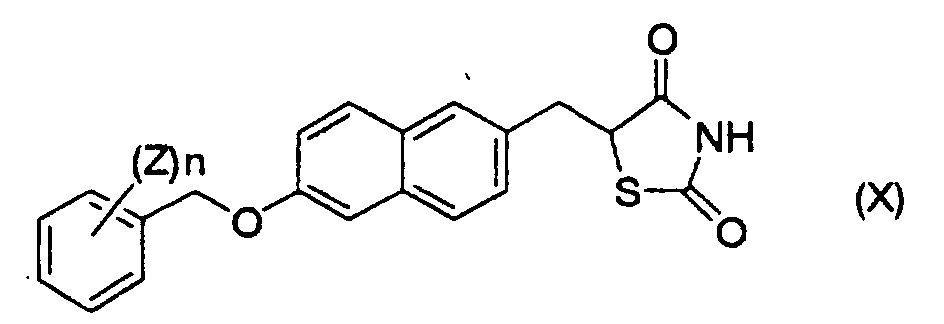
- The aforementioned publications discloses that 6-hydroxy-2-naphthaldehyde represented by the following formula was reacted with 2,4-thiazolidinedione, and the resulting product was reduced and then reacted with a compound represented by the general following formula (IX) to produce the target compounds. However, the publications fail to specifically disclose the method for preparation of 6-hydroxy-2-naphthaldehyde.
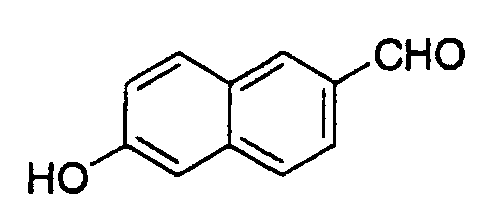
- 6-Hydroxy-2-naphthaldehyde is usually produced by the methods mentioned below. For example, reported methods include a method of dealkylating 6-alkoxy-2-naphthaldehyde in the presence of a Lewis acid such as aluminum chloride and potassium iodide as an auxiliary agent (Japanese Patent Unexamined Publication No. 9-255613) or in a chlorinated solvent (Japanese Patent Unexamined Publication No. 9-255612), a method of dealkylating said compound by using aluminum iodide as a Lewis acid (Japanese Patent Unexamined Publication No. 9-59202), a method of reducing 6-hydroxy-2-naphthonitrile by using diisobutyl aluminum hydride (Japanese Patent Unexamined Publication No. 10-147568), a method comprising the steps of brominating 3,4-dimethylphenyl benzoic acid ester by using N-bromosuccinimide, then converting the resulting product into a diene compound by dehydrobromination using sodium iodide, and then subjecting the resulting product to Diels-Alder reaction using acrolein to produce the target compound (J. Org. Chem., USSR., 17, 303 (1981)) and the like. However, in these methods, multiple steps and expensive regents are required for preparation of the raw materials to be used, and no satisfactory yield can be achieved since the target compound is a substrate having highly reactive formyl group. Therefore, they are not suitable as industrial applicable preparations.
- There have also been proposed methods comprising oxidizing an alcohol in the presence of a stable nitroxy radical and nitrosodisulfonic acid alkali metal salt (U.S. Patent No. 5,155,280) or nitrous acid, nitric acid or an-alkali metal salt thereof (U.S. Patent No. 5,155,278) and in the presence of oxygen and water to produce a corresponding aldehyde. However, when a reaction for conversion of hydroxynaphthalenemethanol to hydroxynaphthaldehyde is carried out according to these methods, target compounds are obtained in a low yield.
- Methods for producing naphthylmethylthiazolidinedione derivatives are disclosed in Japanese Patent Unexamined Publication No. 6-247945 (Japanese Patent No. 2845743). One of the methods comprises the steps of introducing a substituent to 6-acetyl-2-naphthol at its hydroxyl group, converting the resulting product into naphthylamine through the Beckmann rearrangement and further into a diazonium salt, preparing a halo ester by the Meerwein arylation, and then reacting the resulting product with thiourea to produce iminothiazolidinone, and further hydrolyzing the iminothiazolidinone under an acidic condition to produce a naphthylmethylthiazolidinedione derivative. This preparation method contains multiple steps, and has drawbacks such as heavy exothermic heat and generation of a huge volume of nitrogen gas in the Meewein arylation and mephitis due to the use of acrylic ester. Furthermore, if the substituent of the hydroxyl group on the naphthalene ring is benzyl group, the benzyl group may be eliminated depending on the kind of a substituent on the benzyl group in the hydrolysis from the iminothiazolidinone to the thiazolidinedione under an acid condition.
- Another preparation method is disclosed which comprises the steps of introducing a substituent into the hydroxyl group of 6-hydroxy-2-naphthaldehyde and then reducing the formyl group into hydroxyl group, and the converting the resulting product to a naphthylmethyl halide by using a halogenating agent and reacting the naphthylmethyl halide with dianion of thiazolidinedione at a low temperature to produce naphthylmethylthiazolidinedione. In the preparation method, the naphthylmethyl halide produced as an intermediate is unstable and the alkylation of thiazolidinedione with the dianion is only conducted at a low temperature. Therefore, this method also has problems for the production in an industrial scale.
- Still another production method is disclosed which comprises the steps of protecting the hydroxyl group of 6-hydroxy-2-naphthaldehyde with a protective group and condensing the resulting product with thiazolidinedione by dehydration, and then reducing the produced double bond into a single bond by a catalytic hydrogenation, followed by eliminating the protective group and introducing a substituent site-specifically to the phenolic hydroxyl group. However, this production method contains the steps of protection and deprotection of the phenolic hydroxyl group, and therefore is not a reasonable production method.
- An object of the present invention is to provide a synthetic intermediate that enables efficient preparation of 6-hydroxy-2-naphthaldehyde, which is useful as a raw material for the manufacture of pharmaceutical compounds, agrichemical compounds and the like.
- Another object of the present invention is to provide a method for producing the aforementioned synthetic intermediate and a method for efficiently preparing 6-hydroxy-2-naphthaldehyde by using the aforementioned method.
- The inventors of the present invention conducted various studies to achieve the aforementioned objects. As a result, they found that 6-hydroxy-2-naphthylcarbinol represented by the following formula (I) was useful as a synthetic intermediate for the preparation of 6-hydroxy-2-naphthaldehyde. The present invention was achieved on the basis of the above finding.
- The present invention thus provides 6-hydroxy-2-naphthylcarbinol represented by following formula (I):This compound is useful as a synthetic intermediate for the preparation of 6-hydroxy-2-naphthaldehyde. The present invention also provides 6-hydroxy-2-naphthylcarbinol represented by the aforementioned formula (I) used as a synthetic intermediate for the preparation of 6-hydroxy-2-naphthaldehyde.

- From another aspect, provided is a method for preparing 6-hydroxy-2-naphthylcarbinol represented by the aforementioned formula (I), which comprises the step of reducing 6-hydroxy-2-naphthalenecarboxylic acid represented by following formula (II):
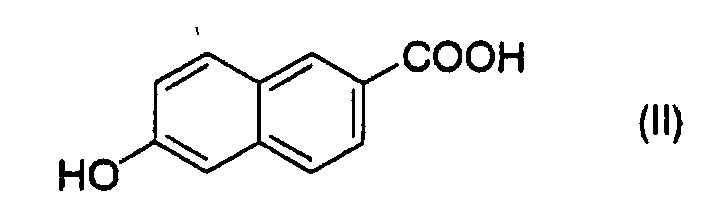
- As a preferred embodiment of the aforementioned method, provided is the method in which the reduction is performed by using a borane, and as a more preferred embodiment, the method is provided in which the reduction is performed by using a borane in the presence of a borate represented by the following general formula (III):(in the formula, R1, R2 and R3 independently represent an alkyl group, an aralkyl group, a hetero atom-containing alkyl group, or an aryl group); the following general formula (IV):
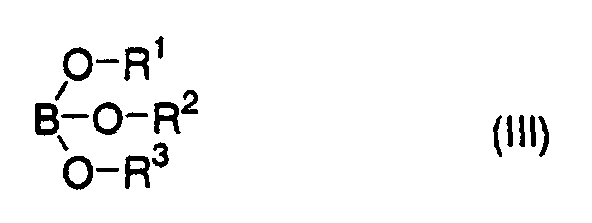 (in the formula, R4 represents an alkyl group, an aralkyl group, a hetero atom-containing alkyl group, or an aryl group, and R' represents an alkylene group which may be substituted); the following general formula (V):
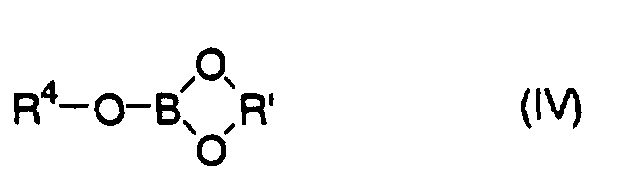 (in the formula, R5 and R6 independently represent an alkyl group, an aralkyl group, a hetero atom-containing alkyl group, or an aryl group); or the following general formula (VI):
 (in the formula, R7, R8 and R9 independently represent an alkylene group which may be substituted or an alkyleneoxy group which may be substituted, R10 represents a hydrogen atom or an alkyl group, X represents a carbon atom, a nitrogen atom, or a boron atom, and a, b, c and d each independently represent 0 or 1). According to a further preferred embodiment of the aforementioned method, the borate is trimethyl borate or triethyl borate. According to another preferred embodiment of the aforementioned method, the method is provided in which the reduction reaction is performed by using an aluminum hydride complex compound.
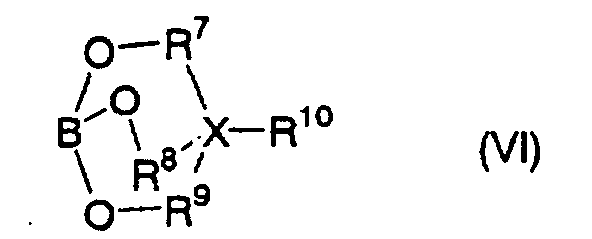
- From still another aspect of the present invention, provided is a method for producing 6-hydroxy-2-naphthaldehyde, which comprises the step of oxidizing 6-hydroxy-2-naphthylcarbinol represented by the formula (I). According to a preferred embodiment of the aforementioned method, a reducing product of 6-hydroxy-2-naphthalenecarboxylic acid represented by the formula (II) can be used as the 6-hydroxy-2-naphthylcarbinol.
- According to a preferred embodiment of the aforementioned method, the method is provided in which the oxidation is performed in the presence of manganese dioxide, preferably activated manganese dioxide. According to another preferred embodiment, provided is the method in which the oxidation is performed by using oxygen in the presence of a catalyst system containing a nitroxide represented by the following general formula (VII):(in the formula, R11, R12, R13 and R14 independently represent an alkyl group, an aryl group, or a hetero-atom substituted alkyl group, and R15 and R16 independently represent a hydrogen atom, an alkyl group, an aryl group, or a hetero atom-containing substituent; or the following general formula (VIII):
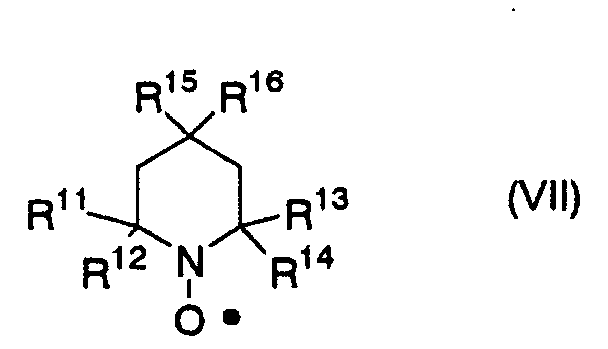 (in the formula, R17 represents a hydrogen atom, a hydroxyl group, an alkyl group, an alkoxycarbonyl group, a cyano group, a carbamoyl group, an alkoxy group, or an acyloxy group) together with a metal compound having oxidation-reduction ability or a metal complex compound having oxidation-reduction ability. The nitroxide is preferably 2,2,6,6-tetramethylpiperidine-1-oxyl or 4-hydroxy-2,2,6,6-tetramethylpiperidine-1-oxyl, and a metal component of the metal compound having oxidation-reduction ability or the metal complex compound having oxidation-reduction ability is preferably copper or iron.
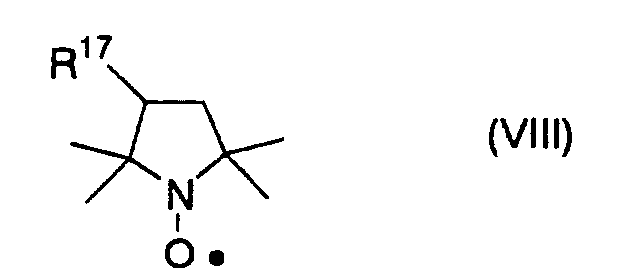
- The present invention further provides a method for producing a compound represented by the following general formula (X):(in the formula, Z represents a halogen atom, and n represents an integer of 1 to 5), which comprises the steps of:
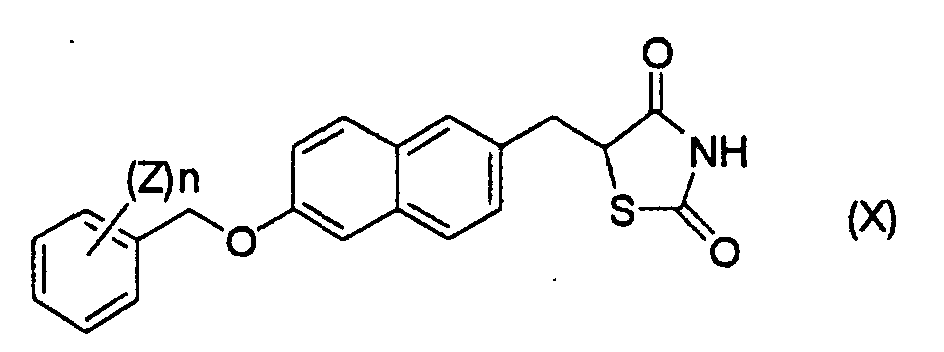
- (1) reacting 6-hydroxy-2-naphthaldehyde obtained by oxidizing 6-hydroxy-2-naphthylcarbinol represented by the formula (I) with 2,4-thiazolidinedione in the absence of a protective group for the hydroxyl group of the 6-hydroxy-2-naphthaldehyde to produce 5-(6-hydroxy-2-naphthyl)methylene-2,4-thiazolidinedione;
- (2) reducing the 5-(6-hydroxy-2-naphthyl)methylene-2,4-thiazolidinedione obtained in the above step (1) to produce 5-(6-hydroxy-2-naphthyl)methyl-2,4-thiazolidinedione; and
- (3) reacting the 5-(6-hydroxy-2-naphthyl)methyl-2,4-thiazolidinedione obtained in the
above step (2) with a compound represented by the following general formula (IX):
(in the formula, Y represents a halogen atom, an alkylsulfonyloxy group, or an arylsulfonyloxy group, and Z and n have the same meanings as those defined above).
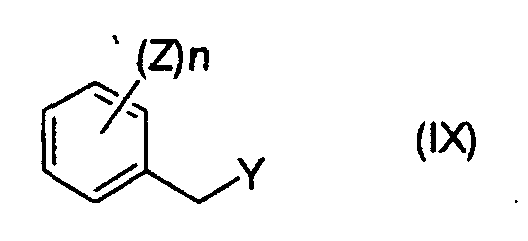
-
- According to a preferred embodiment of the above method, the method is provided wherein 6-hydroxy-2-naphthaldehyde and 2,4-thiazolidinedione are subjected to dehydration condensation in the presence of a base to obtain 5-(6-hydroxy-2-naphthyl)methylene-2,4-thiazolidinedione.
- 6-Hydroxy-2-naphthylcarbinol of the present invention represented by the formula (I) is a novel compound.
- The methods of the present invention include:
- (A) the method for producing 6-hydroxy-2-naphthylcarbinol represented by the aforementioned formula (I), which comprises the step of reducing 6-hydroxy-2-naphthalenecarboxylic acid represented by the aforementioned formula (II);
- (B) the method for producing 6-hydroxy-2-naphthaldehyde, which comprises the step of oxidizing a compound represented by the aforementioned formula (I);
- (C) the method for producing 6-hydroxy-2-naphthaldehyde, which comprises the step of oxidizing 6-hydroxy-2-naphthylcarbinol represented by the aforementioned formula (I) which is obtained by reducing the 6-hydroxy-2-naphthalenecarboxylic acid represented by the aforementioned formula (II);
- (D) the method for producing a compound represented by the aforementioned
general formula (X), which comprises the steps of:
- (1) oxidizing 6-hydroxy-2-naphthylcarbinol represented by the aforementioned formula (I) to produce 6-hydroxy-2-naphthaldehyde;
- (2) reacting the 6-hydroxy-2-naphthaldehyde obtained in the aforementioned step (1) with 2,4-thiazolidinedione;
- (3) reducing the compound obtained in the aforementioned step (2); and
- (4) reacting the compound obtained in the aforementioned step (3) with a compound represented by the aforementioned general formula (IX); and
- (E) the method for producing a compound represented by the aforementioned
general formula (X), which comprises the steps of:
- (5) reducing 6-hydroxy-2-naphthalenecarboxylic acid represented by the aforementioned formula (II) to produce 6-hydroxy-2-naphthylcarbinol represented by the aforementioned formula (I);
- (6) oxidizing the 6-hydroxy-2-naphthylcarbinol represented by the aforementioned formula (I) obtained in the aforementioned step (5) to produce 6-hydroxy-2-naphthaldehyde;
- (7) reacting the 6-hydroxy-2-naphthaldehyde obtained in the aforementioned step (6) with 2,4-thiazolidinedione;
- (8) reducing the compound obtained in the aforementioned step (7); and
- (9) reacting the compound obtained in the aforementioned step (8) with a compound represented by the aforementioned general formula (IX).
-
- The method for producing 6-hydroxy-2-naphthylcarbinol represented by the formula (I) from 6-hydroxy-2-naphthalenecarboxylic acid represented by the formula (II), the method for producing 6-hydroxy-2-naphthaldehyde from 6-hydroxy-2-naphthylcarbinol represented by the formula (I), and the method for producing a compound represented by the general formula (X) from 6-hydroxy-2-naphthaldehyde will be explained below. However, the methods of the present invention are not limited to the specific preparation methods mentioned below. Further, it should be understood that reaction conditions and reagents can be suitably chosen by those skilled in the art, and suitable alterations and modifications can be made to the methods described below.
- The method for producing the novel compound represented by the aforementioned formula (I) of the present invention, 6-hydroxy-2-naphthylcarbinol; will be explained.
- 6-Hydroxy-2-naphthalenecarboxylic acid of the formula (II) used as the raw material is obtained by, for example, carboxylating potassium salt of β-naphthol through a reaction with carbon dioxide at a high temperature under positive pressure (Kolbe-Schmitt's reaction) and isomerizing the carboxylated product. This compound is also readily obtainable since the compound is commercially produced as a synthetic raw material for liquid crystal polymers. By reducing this 6-hydroxy-2-naphthalenecarboxylic acid, 6-hydroxy-2-naphthylcarbinol of the formula (I) can be obtained.
- The reducing agent is not particularly limited so long as the agent can reduce carboxyl group into an alcohol and is inert to naphthalene ring. For example, examples include boranes, aluminum hydride complex compounds and the like.
- Specific examples of the borane include diborane, borane/tetrahydrofuran complex, borane/dimethyl sulfide complex, borane/1,4-oxathiane complex, borane/dimethylaniline complex, borane/diethylaniline complex, borane/4-phenylmorpholine complex, catecholborane, texylborane, disiamylborane, alkylboranes such as 9-borabicyclo[3.3.1]nonane and the like. Among them, borane/tetrahydrofuran complex, borane/dimethyl sulfide complex and borane/diethylaniline complex are preferred, and borane/tetrahydrofuran complex is particularly preferred. These boranes may be used in combination.
- As the boranes, commercially available products, per se, can be used, or they may be generated in a system by using a borohydride compound and then used. For example, the borane/tetrahydrofuran complex can be easily prepared by reacting a borohydride compound with dimethyl sulfate or boron trifluoride in tetrahydrofuran (THF) as a solvent.
- As the borohydride compound, sodium borohydride, lithium borohydride, calcium borohydride, zinc borohydride, magnesium borohydride, potassium borohydride, beryllium borohydride, barium borohydride and the like may be used. Sodium borohydride, lithium borohydride, calcium borohydride and the like are preferred mainly from an economical standpoint.
- The borane can be used generally about 1 to 8 mole, preferably about 1.3 to 4 mole based on 6-hydroxy-2-naphthalenecarboxylic acid. If the borane is used in an amount less than equimolar amount, the reaction of 6-hydroxy-2-naphthalenecarboxylic acid is incomplete, and an amount over 8 mole is not preferred mainly from an economical standpoint.
- Specific examples of the aluminum hydride complex compound include lithium aluminum hydride, lithium diethoxyaluminum hydride, lithium tri-tert-butoxyaluminum hydride, diisobutylaluminum hydride, sodium bis(2-methoxyethoxy)aluminum hydride and the like.
- When a borate coexists in the reduction of 6-hydroxy-2-naphthalenecarboxylic acid of the formula (II) with a borane, by-products such as a dimer and a trimer can be reduced.
- Although the type of the borate used in combination is not particularly limited, the compounds represented by the following general formula (III), (IV), (V) or (VI) are preferably used.
- In the following general formula (III):(wherein, R1, R2 and R3 independently represent an alkyl group, an aralkyl group, a hetero atom-containing alkyl group, or an aryl group), the alkyl group may be linear, branched, cyclic, or a combination thereof, having 1 to 20 carbon atoms, preferably 1 to 16 carbon atoms, and may be substituted. More specifically, examples include methyl group, ethyl group, 2,2,2-trifluoroethyl group, propyl group, butyl group, hexyl group, octyl group, decyl group, hexadecyl group, cyclohexyl group, 2-cyclohexylhexyl group and the like.

- The aralkyl group has 7 to 20, preferably 7 to 16 carbon atoms, and the aryl moiety may be substituted. More specifically, examples include benzyl group, 2-phenylcyclohexyl group and the like.
- The hetero atom-containing alkyl group has 1 to 20 carbon atoms, preferably 1 to 16 carbon atoms, and contains one or more hetero atoms such as oxygen atom, nitrogen atom, and sulfur atom. More specifically, examples include 2-methoxyethyl group, 2-dimethylaminoethyl group and the like.
- The aryl group has 6 to 20, preferably 6-16 carbon atoms and may be substituted. More specifically, examples include phenyl group, tolyl group, 2,6-di-t-butylphenyl group, chlorophenyl group and the like.
- Specific examples of the compound represented by the aforementioned general . formula (III) include trimethyl borate, triethyl borate, tris(2,2,2-trifluoroethyl) borate, tripropyl borate, triisopropyl borate, tributyl borate, tri-t-butyl borate, tri-n-amyl borate, trihexyl borate, tricyclohexyl borate, tris(1-isopropyl-2-methylpropyl) borate, tris(3,3,5-trimethylhexyl) borate, tris(1-isobutyl-3-methylbutyl) borate, tris(decyl) borate, tri-n-hexadecyl borate, tri-n-octadecyl borate, tri-n-octyl borate, tri-2-octyl borate, tri-DL-menthyl borate, tri-2-phenylcyclohexyl borate, triamylmethyl borate, 2,6-di-t-butylphenyl dibutyl borate, tris(2-ethylhexyl) borate, tris(2-cyclohexylcyclohexyl) borate, tribenzyl borate, dimethyl monoethyl borate, dimethyl monophenyl borate, monomethyl diethyl borate, triphenyl borate, tris(4-chlorophenyl) borate, tris(2-methylphenyl) borate and the like.
- In the following general formula (IV):(wherein, R4 represents an alkyl group, an aralkyl group, a hetero atom-containing alkyl group or an aryl group, and R' represents an alkylene group which may be substituted), the alkyl group, having 1 to 16, preferably 1 to 12 carbon atoms, may be linear, branched, cyclic, or a combination thereof. More specifically, examples include methyl group, isopropyl group, n-butyl group and the like.
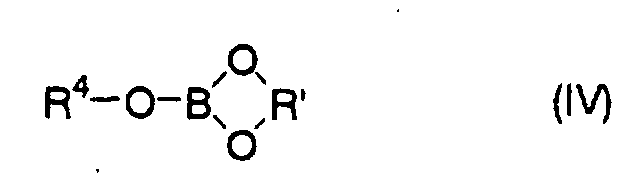
- The aralkyl group has 7 to 20, preferably 7 to 16 carbon atoms, and the aryl moiety may be substituted. More specifically, examples include benzyl group, 2-phenylcyclohexyl group and the like.
- The hetero atom-containing alkyl group has 1 to 16, preferably 1 to 12 carbon atoms, and the hetero atom may preferably be one or more of hetero atoms selected from the group consisting of oxygen atom, nitrogen atom, and boron atom. Specific examples include dimethylaminoethyl group, 2,4-dimethyl-4-(4,4,6-trimethyl-1,3,2-dioxaborinano)pentyl group and the like.
- The aryl group has 6 to 20, preferably 6 to 16 carbon atoms and may be substituted. More specifically, examples include phenyl group, tolyl group, 2,6-di-t-butylphenyl group, chlorophenyl group and the like.
- The alkylene group has 2 to 16, preferably 2 to 12 carbon atoms and may be substituted. Specific examples thereof include ethylene group, 1,1,2,2-tetraethylene group, 1-methyltrimethylene group, l,1,3-trimethyltrimethylene group and the like.
- Specific examples of the compound represented by the aforementioned general formula (IV) include 2-(2-dimethylaminoethoxy)-4-methyl-1,3,2-dioxaborinane, 2,2'-(2-methyl-2,4-pentanediyldioxy)bis(4,4,6-trimethyl-1,3,2-dioxaborinane, 2-butoxy-4,4,6-trimethyl-1,3,2-dioxaborinane, 2-methoxy-1,3,2-dioxaborolane, 2-isopropoxy-4,4,5,5-tetramethyl-1,3,2-dioxaborolane and the like.
- In the following general formula (V):(wherein, R5 and R6 independently represent an alkyl group, an aralkyl group, a hetero atom-containing alkyl group, or an aryl group), the alkyl group, having 1 to 16, preferably 1 to 12 carbon atoms, may be linear, branched, cyclic, or a combination thereof. Specific examples thereof include methyl group, ethyl group and the like.
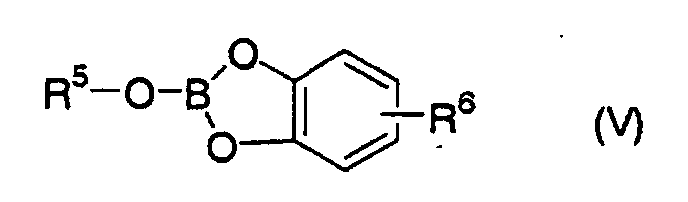
- The aralkyl group has 7 to 16, preferably 7 to 12 carbon atoms, and the aryl moiety may be substituted.
- The hetero atom-containing alkyl group has 1 to 16, preferably 1 to 12 carbon atoms, and contains one or more hetero atoms such as oxygen atom, nitrogen atom and sulfur atom. More specifically, examples include 2-methoxyethyl group, 2-dimethylaminoethyl group and the like.
- The aryl group has 6 to 20, preferably 6 to 16 carbon atoms and may be substituted. More specifically, examples include phenyl group, tolyl group and the like.
- Specific examples of the compound represented by the aforementioned general formula (V) include 2-methoxybenzo[d]-1,3,2-dioxaborolane, 2-ethoxybenzo[d]-1,3,2-dioxaborolane, 2-phenoxybenzo[d]-1,3,2-dioxaborolane and the like.
- In the following general formula (VI):(wherein, R7, R8 and R9 independently represent an alkylene group which may be substituted or an alkyleneoxy group which may be substituted, R10 represents a hydrogen atom or an alkyl group, X represents a carbon atom, a nitrogen atom or a boron atom, and a, b, c and d each independently represent 0 or 1), the alkylene group which may be substituted has 1 to 16, preferably 1 to 12 carbon atoms, and specific examples thereof include methylene group, ethylene group and the like.
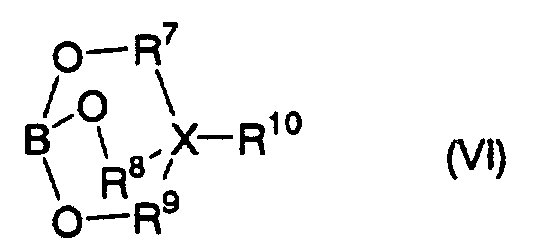
- The alkyleneoxy group which may be substituted has 1 to 16, preferably 1 to 12 carbon atoms, and specific examples thereof include ethyleneoxy group, 1,3,3-trimethyl-trimethyleneoxy group and the like.
- The alkyl group, having 1 to 16, preferably 1 to 12 carbon atoms, may be linear, branched, cyclic, or a combination thereof. More specifically, examples include methyl group, ethyl group, isopropyl group, n-butyl group and the like.
- Specific examples of the compound represented by the aforementioned general formula (VI) include borates such as triethanolamine borate, 2-methyl-2,4-pentanediol diborate, 1-bora-2,6,7-trioxabicyclo[2.2.1]heptane and 1,6-dibora-2,5,7,10,11,14-hexaoxabicyclo[4.4.4]tetradecane.
- Two or more kinds of these borate may be used in combination.
- Among the compounds represented by these general formulas (III) to (VI), trimethyl borate, triethyl borate and the like are preferred mainly from an economical standpoint.
- Commercially available products, per se, can be used as the aforementioned borates, or they can be easily prepared by reacting, with an alcohol, a trihalogenated boron compound disclosed in Lappert, M.F., Chem. Review, 56, 959 (1956), diboron trioxide, boric acid, sodium pyroboric acid ester, or borane together with a borohydride compound as raw materials. As the alcohol, any alcohols can be used without limitations by their alcoholic order, hydric valence and absence or presence of a substituent. Methanol, ethanol and the like are preferred mainly from an economical viewpoint.
- The borate is used generally in 0.01 to 20 mole, preferably 0.05 to 10 mole based on 6-hydroxy-2-naphthalenecarboxylic acid.
- Examples of the method for addition of the borate include a method of adding the borate to a solution of 6-hydroxy-2-naphthalenecarboxylic acid dissolved in a suitable solvent and adding dropwise the prepared mixed solution to a solution of, for example, borane/tetrahydrofuran complex in tetrahydrofuran; a method of adding the borate to a solution of borane/tetrahydrofuran complex in tetrahydrofuran and mixing the mixture, and then adding dropwise a solution of 6-hydroxy-2-naphthalenecarboxylic acid dissolved in a solvent to the mixed solution and the like. The former method is preferred because it provides 6-hydroxy-2-naphthylcarbinol with a higher purity.
- For the aforementioned reaction, a borane and 6-hydroxy-2-naphthalenecarboxylic acid are generally reacted in the presence of a solvent and a borate. The type of the solvent is not particularly limited so long as the solvent is inert in the reaction. Examples include ether solvents such as diethyl ether, tetrahydrofuran, dioxane, digrim, trigrim, t-butyl methyl ether and 1,3-dioxolane; hydrocarbon solvents such as benzene, toluene and xylene; halogenated solvents such as chlorobenzene, 1,2-dichloroethane, chloroform and carbon tetrachloride and the like. The solvent is used in 1 to 50 times, preferably 2 to 20 times weight amount based on 6-hydroxy-2-naphthalenecarboxylic acid.
- The reaction temperature is usually -30 to 150°C, preferably -20 to 100°C. Although the reaction time may vary depending on the types of the borane and the borate to be used, amounts thereof and the like, it is usually about 0.5 to 10 hours.
- When the borane is prepared beforehand and used for the reaction, the reaction can be usually performed by adding 6-hydroxy-2-naphthalenecarboxylic acid raw material or its mixture with a solvent (a raw material solution) to a borane preparation solution. The solvent of the raw material solution may be different from that used for the preparation of borane solution. Examples of the solvents for the preparation of borane and the raw material solution include those solvents mentioned above.
- A solution of borane preparation, per se, in which a borohydride compound and dimethyl sulfate or boron trifluoride are reacted may be used. The solution may also be used after a monomethyl sulfate salt or a tetrafluoroborate salt deposited in the system is removed by filtration.
- After the reducing agent remaining in the reaction mixture is inactivated by addition of a mineral acid such as hydrochloric acid, water or methanol or the like and the reaction mixture was neutralized with sodium hydroxide or the like, the 6-hydroxy-2-naphthalenecarbinol produced by the method described above can be separated by an ordinarily used method such as crystallization, extraction, distillation and column chromatography.
- The method for oxidizing 6-hydroxy-2-naphthylcarbinol of the formula (I) to produce 6-hydroxy-2-naphthaldehyde will be explained.
- An oxidizing agent used in the reaction is not particularly limited so long as the agent enables satisfactory production of 6-hydroxy-2-naphthaldehyde. For example, manganese dioxide may preferably used. Manganese dioxide can easily be produced by electrolysis of manganese sulfate solution, heating of manganese oxide in an oxygen flow, thermolysis of manganese nitrate and the like. Mass-produced commercial products for use in dry cells, per se, may be used, and activated manganese dioxide can also be used. As the method for producing activated manganese dioxide, any method may be suitably selected from ordinarily used methods, which are known per se, and used depending on a type of a substrate, reaction temperature, a solvent or reaction time, for example, 1) the method of preparation from potassium permanganate, manganese sulfate and sodium hydroxide, 2) the method of pyrolysis of a manganese(II) salt of oxalic acid or carbonic acid at 250°C, 3) the method of treatment of manganese dioxide with nitric acid, 4) the method of dehydration of manganese dioxide by azeotropy with a solvent and the like. Commercially available activated manganese dioxide may also be used.
- Manganese dioxide is used in an amount of usually 0.1 to 50 moles, preferably 1 to 30 moles, more preferably 2 to 30 moles, per mole of 6-hydroxy-2-naphthylcarbinol.
- If necessary, a solvent that does not react with 6-hydroxy-2-naphthylcarbinol and manganese dioxide can also be used. Specific example thereof include hydrocarbons such as hexane, benzene and toluene; monoalcohols such as methanol, ethanol, propanol and butanol; diols such as ethylene glycol, propylene glycol, butanediol and hexylene glycol; ethers such as diethyl ether, tetrahydrofuran and dioxane; ketones such as acetone, methyl ethyl ketone, diethyl ketone, methyl propyl ketone, dipropyl ketone and methyl isobutyl ketone; esters such as methyl acetate, ethyl acetate, butyrolactone and tricaprilin; amides such as dimethylformamide, dimethylacetamide and methylpyrrolidinone; dimethylimidazolidinone, tetramethylurea and the like. Among them, hydrocarbons, ketones, ethers and amides are preferred, and ketones and amides are more preferred from viewpoints of a reaction acceleration effect and an effect of suppressing by products. An amount of the solvent to be used is not particularly limited, and the solvent may be used in an amount that allows sufficient advance of the reaction.
- Although the reaction sufficiently proceeds even at a temperature below room temperature, the reaction may usually be conducted at a temperature equal to or higher than room temperature to accelerate a reaction rate. The reaction temperature is usually in the range of -10 to 200°C, preferably in the range of 0 to 100°C. The reaction may be conducted under air, or may be conducted under an atmosphere of inert gas such as nitrogen and argon. The reaction time may vary depending on the reaction temperature, and is usually in the range of 0.1 to 200 hours, preferably in the range of 0.5 to 80 hours. After manganese dioxide remaining in the reaction mixture is removed by filtration, the 6-hydroxy-2-naphthaldehyde produced by the method described above can be isolated by ordinarily used methods such as crystallization, extraction and column chromatography.
- Further, as an alternative method for oxidizing 6-hydroxy-2-naphthylcarbinol of the formula (I) to produce 6-hydroxy-2-naphthaldehyde, a method is provided in which the oxidation is performed with oxygen by using a catalyst system containing a nitroxide together with a metal compound having oxidation-reduction ability or a metal complex compound having oxidation-reduction ability.
- As the nitroxide, a stable free radical nitroxide is preferred. The term "stable free radical nitroxide" used herein means that the nitroxide can be prepared by an ordinary chemical reaction and can be statically detected by an usual spectroscopic method. In general, such a stable free radical nitroxide has a half-life of at least one year.
- The stable free radical nitroxide is produced by oxidation of a cyclic secondary amine that does not contain hydrogen in a substituent on a carbon atom adjacent to N or an equivalent hydroxylamine by using a peroxide or the like.
- Examples of the stable free radical nitroxide include, for example, compounds represented by the following general formula (VII) and (VIII).
- In the compounds represented by the following general formula (VII):(wherein, R11, R12, R13 and R14 independently represent an alkyl group, an aryl group or a hetero atom-substituted alkyl group, and R15 and R16 independently represent a hydrogen atom, an alkyl group, an aryl group, or a hetero atom-containing substituent), the alkyl group, having 1 to 15, preferably 1 to 8 carbon atoms, may be linear, branched, cyclic, or a combination thereof. Specific examples include methyl group, ethyl group, n-propyl group, i-propyl group, n-butyl group, i-butyl group, t-butyl group, cyclohexyl group and the like, and methyl group is preferred among them.
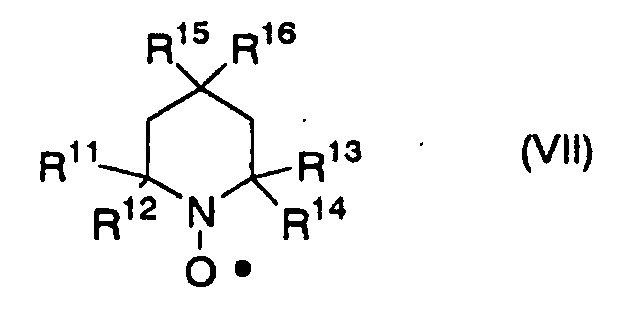
- The aryl group has 6 to 20, preferably 6 to 12 carbon atoms and may be substituted. Specific examples thereof include phenyl group, tolyl group, naphthyl group and the like.
- The hetero atom-substituted alkyl group means an alkyl group having 1 to 20 carbon atoms, preferably 1 to 12 carbon atoms, and substituted with one or more functional groups containing one or more of oxygen atom, nitrogen atom, sulfur atom and the like. Specific examples thereof include, for example, hydroxymethyl group, hydroxyethyl group, methoxymethyl group, methoxyethyl group, aminomethyl group, aminoethyl group and the like.
- Specific examples of the hetero atom-containing substituent include hydroxyl group; an alkoxycarbonyl group such as methoxycarbonyl group and ethoxycarbonyl group; carbamoyl group; cyano group; oxo group; an alkoxy group such as methoxy group, ethoxy group, isopropoxy group and t-butoxy group; an acyloxy group such as acetoxy group and benzoyloxy group; an alkylamino group such as methylamino group and ethylamino group; an acylamino groups such as acetylamino group and benzoylamino group; sulfate group (-O-SO3H); group of -N+Me3Cl- and the like.
- As for R15 and R16, it is preferred that the both of R15 and R16 are hydrogen atoms, one of R15 and R16 is a hydrogen atom and the other represents hydroxyl group, an alkoxy group, or a sulfate group, or R15 and R16 bind to each other to form oxo group. Among them, it is more preferred that the both of R15 and R16 are hydrogen atoms, or one of R15 and R16 is a hydrogen atom and the other represents hydroxyl group.
- Specific examples of the compound represented by the aforementioned general formula (VII) include: 2,2,6,6-tetramethylpiperidine-1-oxyl, 4-hydroxy-2,2,6,6-tetramethylpiperidine-1-oxyl, 4-methoxy-2,2,6,6-tetramethylpiperidine-1-oxyl, 4-ethoxy-2,2,6,6-tetramethylpiperidine-1-oxyl, 4-isopropoxy-2,2,6,6-tetramethylpiperidine-1-oxyl, 4-t-butoxy-2,2,6,6-tetramethylpiperidine-1-oxyl, 4-acetoxy-2,2,6,6-tetramethylpiperidine-1-oxyl, 4-benzoyloxy-2,2,6,6-tetramethylpiperidine-1-oxyl, 4-cyano-2,2,6,6-tetramethylpiperidine-1-oxyl, 4-ethoxycarbonyl-2,2,6,6-tetramethylpiperidine-1-oxyl, 4-ethylamino-2,2,6,6-tetramethylpiperidine-1-oxyl, 4-carbamoyl-2,2,6,6-tetramethylpiperidine-1-oxyl, 4-benzoylamino-2,2,6,6-tetramethylpiperidine-1-oxyl, 4-oxo-2,2,6,6-tetramethylpiperidine-1-oxyl, 2,2,6,6-tetramethylpiperidine-1-oxyl-4-sulfate, 4-ethoxycarbonyl-2,2,6,6-tetramethylpiperidine-1-oxyl, 4-methyl-2,2,6,6-tetramethylpiperidine-1-oxyl, 4-ethyl-2,2,6,6-tetramethylpiperidine-1-oxyl and the like.
- In the compound represented by the following general formula (VIII):(wherein, R17 represents a hydrogen atom, an alkyl group, an alkoxycarbonyl group, a cyano group, a carbamoyl group, an alkoxy group or an acyloxy group), the alkyl group has the same meaning as that defined in the aforementioned general formula (VII). The alkoxycarbonyl group has 2 to 16, preferably 2 to 10 carbon atoms, and specific examples thereof include methoxycarbonyl group, ethoxycarbonyl group and the like.
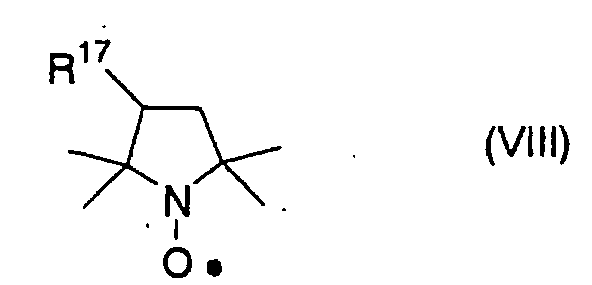
- The alkoxy group preferably has 1 to 10 carbon atoms, and examples thereof include methoxy group, ethoxy group, isopropoxy group and the like.
- The acyloxy group preferably has 1 to 10 carbon atoms, and specific examples thereof include acetoxy group, benzoyloxy group and the like.
- Examples of the compound of the aforementioned general formula (VIII) include, for example, 2,2,5,5-tetramethylpyrrolidine-1-oxyl, 3-methyl-2,2,5,5-tetramethylpyrrolidine-1-oxyl, 3-methoxycarbonyl-2,2,5,5-tetramethylpyrrolidine-1-oxyl, 3-cyano-2,2,5,5-tetramethylpyrrolidine-1-oxyl, 3-carbamoyl-2,2,5,5-tetramethylpyrrolidine-1-oxyl, 3-methoxy-2,2,5,5-tetramethylpyrrolidine-1-oxyl, 3-ethoxy-2,2,5,5-tetramethylpyrrolidine-1-oxyl, 3-isopropoxy-2,2,5,5-tetramethylpyrrolidine-1-oxyl, 3-t-butoxy-2,2,5,5-tetramethylpyrrolidine-1-oxyl, 3-acetoxy-2,2,5,5-tetramethylpyrrolidine-1-oxyl, 3-benzoyloxy-2,2,5,5-tetramethylpyrrolidine-1-oxyl and the like.
- Among the compounds represented by the aforementioned general formula (VII) or (VIII), 2,2,6,6-tetramethylpiperidine-1-oxyl and 4-hydroxy-2,2,6,6-tetramethylpiperidine-1-oxyl can be easily obtained as industrial products and preferred.
- Besides the compounds represented by the aforementioned general formula (VII) or (VIII), stable nitroxy radicals can be used such as those described in, for example, 1) de Nooy, A.E.J., Besemer, A.C., and van Bekkum, H., Synthesis, 1153 (1996), 2) Keana, J.F.W., Chem. Review, 78, 37 (1978), 3) Rozantsev, E.G., "Free Nitroxyl Radicals", Plenum Press: New York-London, 1970, 4) Rozantsev, E.G., Sholle, V.D., Synthesis, 190 (1971) and the like. These radicals include cyclic and bicyclic nitroxy radicals and polymer-like radicals in which multiple nitroxy radicals are linked together. The aforementioned nitroxides can be used alone or in combination.
- Further, a cyclic secondary amine that does not contain hydrogen in a substituent on a carbon atom adjacent to N or a hydroxylamine can be oxidized in situ, or a stable free radical nitroxide may be oxidized with a hypochlorite or the like and used as an oxammonium salt.
- In the present invention, the amount of the stable free radical nitroxide is 0.001 to 2 molar equivalences, preferably 0.01 to 0.5 molar equivalences based on the hydroxynaphthalenemethanol as a raw material.
- Examples of a metal of the metal compound having oxidation-reduction ability and the metal complex compound having oxidation-reduction ability include, for example, copper, iron, antimony, bismuth, tin, zinc, nickel, palladium, platinum, cobalt, ruthenium, osmium, manganese, molybdenum, tungsten, vanadium, titanium, zirconium, hafnium and the like. Among them, copper and iron are preferred.
- Example of copper compounds and copper complex compounds include, for example, copper compounds such as copper(I) or (II) fluoride, copper chloride, copper bromide, copper iodide, copper nitrate, copper cyanide, Li2CuCl3, copper perchlorate, copper hydroxide, copper sulfate, copper phosphate, copper acetate, copper tetrafluoroborate and Li2CuCl4, and copper complex compounds such as tetrakis(acetonitrile)copper(I) hexafluorophosphate, methyl-bis(triphenylphosphene)copper(I), methyl(2,2'-bipyridine)copper(I) and tetrachlorotetrakis(triphenylphosphine)tetracopper(I), and among them, copper chloride and copper bromide are preferred.
- Examples of the iron compounds and the iron complex compounds include, for example, iron compounds such as iron(II) or iron(III) chloride, iron bromide, iron iodide, iron hydroxide, iron sulfate, iron acetate, iron nitrate, and iron phosphate, and iron complex compounds such as dichloro(triphenylphosphine)iron, and among them, iron chloride is preferred.
- An amount of the aforementioned metal compound or the metal complex compound according to the present invention may be 0.001 to 2 molar equivalents, preferably 0.01 to 0.5 molar equivalents based on the 6-hydroxy-2-naphthylcarbinol.
- Further, as the oxygen used in the present invention, oxygen gas diluted with inert gas such as nitrogen and argon, air or the like can be used. For introduction of the oxygen into the reaction system, in general, the reaction may be performed under an atmosphere of an oxygen-containing gas such as air, or an oxygen-containing gas may be bubbled into the reaction system using a pump or the like.
- In the reaction of the present invention, if required, a solvent can be used which does not react with 6-hydroxy-2-naphthylcarbinol as the raw material and 6-hydroxy-2-naphthaldehyde as the target product, and is not oxidized under the reaction condition.
- Specific examples of such solvents include aliphatic hydrocarbons such as hexane and cyelohexane; aromatic hydrocarbons such as benzene, toluene, chlorobenzene, dichlorobenzene and nitrobenzene; ethers such as ethyl ether, tetrahydrofuran and dioxane; ketones such as acetone, methyl ethyl ketone, diethyl ketone, methyl propyl ketone, dipropyl ketone and methyl isobutyl ketone; esters such as methyl acetate, ethyl acetate, butyrolactone and tricaprilin; amides such as dimethylformamide, dimethylacetamide and methylpyrrolidinone; ureas such as dimethylimidazolidinone and tetramethylurea and the like. Among them, aliphatic and aromatic hydrocarbons, ketones, ethers and amides are preferred, and amides are more preferred from view points of a reaction acceleration effect and an effect of suppressing byproducts. These solvents may be used in combination, and an amount thereof is not particularly limited.
- The reaction is usually performed by charging 6-hydroxy-2-naphthylcarbinol as the raw material and the catalyst, and a solvent, if necessary, into a reaction vessel, and bubbling air in the mixture with stirring. The reaction temperature is usually in the range of -10 to 200°C, preferably in the range of 0 to 100°C. In order to increase the reaction rate, the reaction is usually performed at a temperature not lower than room temperature. Although the reaction time depends on the type of a catalyst, a solvent and reaction temperature, it is usually in the range of 0.1 to 200 hours, preferably in the range of 0.5 to 80 hours. The reaction pressure may usually be ordinary pressure. If desired, the reaction can be performed under positive or reduced pressure.
- After the remaining free radical nitroxide and metal compound are removed, 6-hydroxy-2-naphthaldehyde produced by the aforementioned method can be isolated by known methods such as a crystallization, extraction and column chromatography.
- The method for producing 5-[6-substituted benzyloxy-2-naphthyl]-methyl-2,4-thiazolidinedione represented by the general formula (X) from 6-hydroxy-2-naphthaldehyde will be explained with reference to the following Reaction Formula A.
- (In the formula, Y represents a halogen atom, an alkylsulfonyloxy group, or an arylsulfonyloxy group, Z represents a halogen atom and n represents an integer of 1 to 5.)
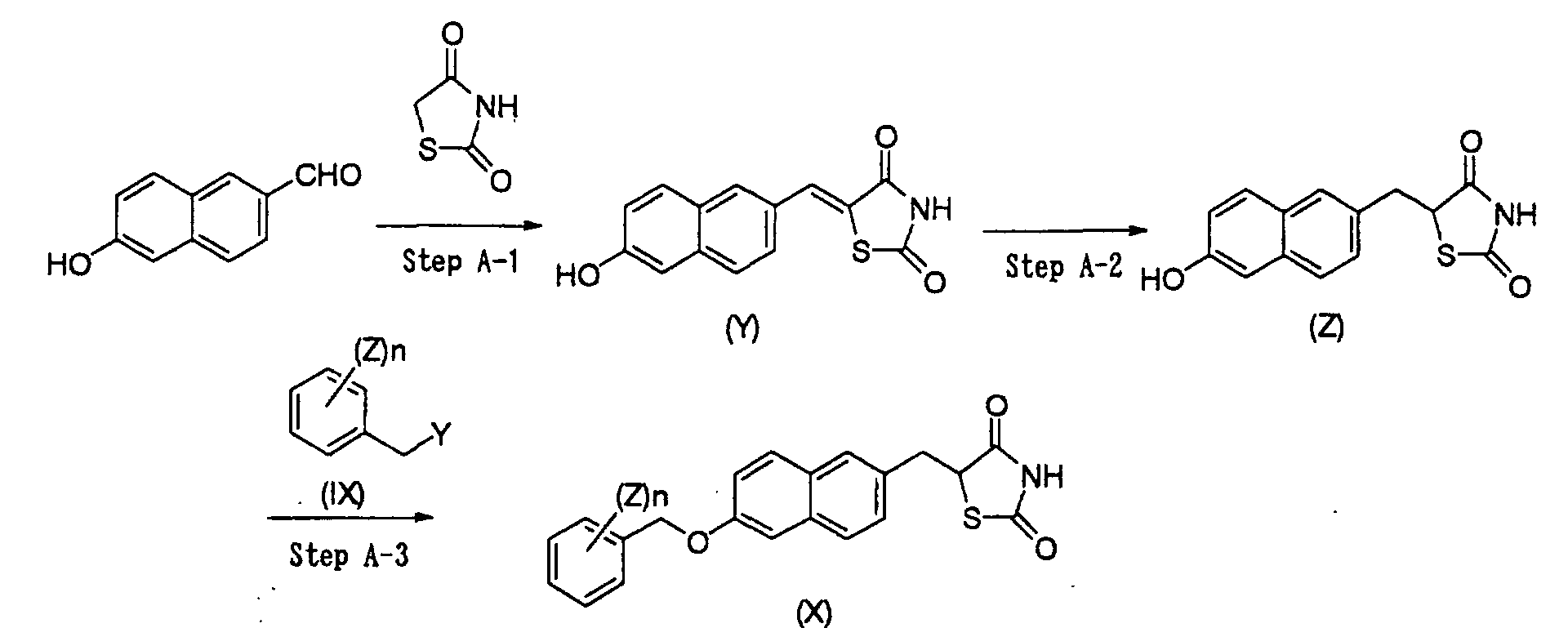
- 6-Hydroxy-2-naphthaldehyde without protection of its hydroxyl group can be used for the reaction with 2,4-thiazolidinedione. For example, dehydration condensation reaction of 6-hydroxy-2-naphthaldehyde and 2,4-thiazolidinedione is carried out in the presence of a base to produce 5-(6-hydroxy-2-naphthyl)methylene-2,4-thiazolidinedione. As the base, an inorganic base, for example, an amine such as triethylamine, pyridine, piperidine, pyrrolidine, N-methylpyrrolidine and N-methylmorpholine, sodium hydroxide, potassium hydroxide, sodium carbonate, potassium carbonate, sodium acetate, potassium acetate and the like may be used, and piperidine and pyrrolidine are preferred among them. Although a solvent is not essential, for example, an alcohol such as methanol, ethanol, 1-propanol, 2-propanol and 2-methoxy ethanol, dimethyl sulfoxide (DMSO), N,N-dimethylformamide (DMF) and the like may be used as the solvent, and 2-methoxyethanol, 2-propanol, DMF and DMSO are preferred among them. These solvents may be used as a mixture. An amount of the 2,4-thiazolidinedione may be 0.8 to 10 mole, preferably 1.0 to 2.0 mole based on the 6-hydroxy-2-naphthaldehyde. The reaction temperature is 20 to 150°C, preferably 50 to 120°C. Although the reaction time may vary depending on the reaction conditions, it is usually 1 hour or more, preferably 1 to 10 hours.
- The reaction of reducing the 5-(6-hydroxy-2-naphthyl)methylene-2,4-thiazolidinedione to produce the 5-(6-hydroxy-2-naphthyl)methyl-2,4-thiazolidinedione is performed, for example, under a hydrogen atmosphere or in the presence of cyclohexene. When the reaction is performed under a hydrogen atmosphere, hydrogen gas pressure is from ordinary pressure to 20 Mpa, preferably 0.2 to 8 Mpa. The catalyst is not particularly limited, and an ordinarily used hydrogenation catalyst can be used. For example, transition metal catalysts such as those comprising palladium hydroxide, palladium/carbon, palladium/black, platinum oxide and platinum/carbon and rhodium may be used. The amount thereof is 0.01 to 1 mole, preferably 0.1 to 0.3 mole based on the 5-(6-hydroxy-2-naphthyl)methylene-2,4-thiazolidinedione. As the reaction solvent, for example, alcohols such as methanol, ethanol, 1-propanol, 2-propanol and 2-methoxyethanol; ethers such as dioxane, dimethoxymethane and tetrahydrofuran (THF); ethyl acetate; acetic acid; dimethylformamide; N-methylpyrolidone and the like may be used. The reaction temperature is usually in the range of 0 to 150°C, preferably in the range of 50 to 100°C.
- The 5-(6-hydroxy-2-naphthyl)methyl-2,4-thiazolidinedione and a compound of the following general formula (IX):(wherein, Y, Z and n have the same meanings as defined above) can be reacted to produce 5-[6-substituted benzyloxy-2-naphthyl]-methyl-2,4-thiazolidinedione of the general formula (X).

- The halogen atom mentioned in the aforementioned general formula (IX) may be a fluorine atom, chlorine atom, bromine atom, iodine atom or the like.
- The alkylsulfonyloxy group contains an alkyl group that has 1 to 10 carbon atoms and may be substituted, and specific examples thereof include methylsulfonyloxy group and the like.
- The arylsulfonyloxy group contains an aryl group that has 6 to 12 carbon atoms and may be substituted, and specific examples thereof include phenylsulfonyloxy group, p-tolylsulfonyloxy group and the like.
- In this reaction, an amount of the compound of the general formula (IX) may be 0.8 to 3 mole, preferably 1.0 to 1.5 mole based on the 5-(6-hydroxy-2-naphthyl)methyl-2,4-thiazolidinedione. The reaction is preferably performed in the presence of a base. For example, sodium hydride, potassium hydride, sodium carbonate, potassium carbonate or the like is used as the base, and sodium hydride and potassium hydride are preferred among them. The base is used in an amount of 0.5 to 5 mole, preferably 1.0 to 3.0 mole based on the 5-(6-hydroxy-2-naphthyl)methyl-2,4-thiazolidinedione in terms of molar amount. As the solvent, for example, THF, dioxane, diethyl ether, DMF, DMSO, N-methylpyrolidone or the like may be used, and DMF, DMSO and N-methylpyrolidone are preferred among them. These solvents may be used as a mixture. The reaction temperature is usually in the range of 0 to 100°C, preferably in the range of 10 to 40°C. Although the reaction time may vary depending on the reaction conditions, it is usually 1 hour or more, preferably 3 to 10 hours.
- The present invention will be explained more specifically with reference to the following examples. However, the scope of the present invention is not limited to these examples.
- Under a nitrogen atmosphere, 3.87 g (100 mmol) of sodium borohydride (purity: 98%) and 60 mL of anhydrous tetrahydrofuran were introduced into a 300-mL four-neck flask equipped with a dropping funnel, a gas inlet pipe, a condenser, and a thermometer and stirred. The mixture was added dropwise with 12.65 g (100 mmol) of dimethyl sulfate at 0°C over 5 minutes and stirred for 2 hours with ice cooling and further stirred at room temperature for 3 hours and the stop of gas generation was observed. The resulting borane/tetrahydrofuran complex solution in tetrahydrofuran was maintained at around 0°C, and the supernatant was filtered through a glass filter under a nitrogen atmosphere to separate sodium monomethylsulfate salt generated in the system. The layer of the salt was further washed with 40 mL of anhydrous tetrahydrofuran, combined with about 1 M purified borane/tetrahydrofuran complex solution in tetrahydrofuran and then transferred to another 500-mL four-neck flask. A solution of 9.41 g (50 mmol) of 6-hydroxy-2-naphthalenecarboxylic acid and 20.13 g of trimethyl borate in anhydrous tetrahydrofuran (50 mL) was added dropwise to the prepared borane/tetrahydrofuran complex solution at room temperature over 25 minutes by using a dropping funnel. This reaction mixture was stirred at the same temperature for 3 hours. After the reaction was completed, the reaction mixture was cooled, added with 100 mL of water with ice cooling and vigorously stirred at room temperature for 30 minutes. After the tetrahydrofuran was evaporated under reduced pressure, white crystals were deposited. The resulting white crystals were washed with water (200 mL) by filtration and dried under reduced pressure at 80°C for 8 hours to obtain 8.46 g of 6-hydroxy-2-naphthylcarbinol as white crystals.
- The composition of the resulting white crystals was analyzed by liquid chromatography using the internal standard method. As a result, it was found that the conversion of the 6-hydroxy-2-naphthalenecarboxylic acid was 99.93% and the purity of the 6-hydroxy-2-naphthylcarbinol was 99.21% (48.57 mmol, yield: 97.1%). It was also found that there were 0.37% of 6-hydroxy-2-naphthaldehyde as a by-product and 0.35% in total of other by-products. Physicochemical properties of this 6-hydroxy-2-naphthylcarbinol are shown below.
Melting point: 181-183°CElemental analysis: as C11H10O2 (174.20) Calcd C, 75.84; H, 5.79 Found C, 75.89; H, 5.83
IR (KBr): 3417, 3183, 2864, 1607, 1214, 1171, 1009, 999, 903, 871 cm-1
1H-NMR (300 MHz, CDCl3 + DMSO-d6, δ ppm): 9.08 (1H, brs), 7.70-7.58 (3H, m), 7.40 (1H, d), 7.10 (2H, q), 4.72 (2H, s), 2.91-(1H, brs)
13C-NMR (300 MHz, CDCl3 + DMSO-d6, δ ppm): 63.28, 108.10, 117.79, 124.11, 124.92, 125.23, 127.03, 128.20, 133.15, 135.57, 154.23 - Under a nitrogen atmosphere, 100 mL of about 1 M borane/tetrahydrofuran complex solution in tetrahydrofuran obtained by the same procedure as in Example 1 was introduced into a 500 mL four-neck flask equipped with a dropping funnel, a gas inlet pipe, a condenser, and a thermometer and added dropwise with a solution of 12.58 g (66.85 mmol) of 6-hydroxy-2-naphthalenecarboxylic acid and 6.95 g of trimethyl borate in anhydrous tetrahydrofuran (70 mL) at room temperature over 30 minutes by using a dropping funnel. This reaction mixture was stirred at the same temperature for 3 hours. After the reaction was completed, the reaction mixture was cooled, added with 150 mL of water with ice cooling and vigorously stirred at room temperature for 30 minutes. After the tetrahydrofuran was evaporated under reduced pressure, white crystals were deposited. The resulting white crystals were washed with water (200 mL) by filtration and dried under reduced pressure at 80°C for 8 hours to obtain 11.28 g of 6-hydroxy-2-naphthylcarbinol as white crystals.
- The composition of the resulting white crystals was analyzed by liquid chromatography using the internal standard method. As a result, it was found that the conversion of the 6-hydroxy-2-naphthalenecarboxylic acid was 99.99% and the purity of the 6-hydroxy-2-naphthylcarbinol was 99.42% (64.75 mmol, yield: 96.9%). It was also found that there were 0.08% of 6-hydroxy-2-naphthaldehyde, 0.07% of 1-[(6-hydroxy(2-naphthyl))methyl]-6-(hydroxymethyl)naphthalen-2-ol, 0.10% of 6-[(6-hydroxy-2-naphthyloxy)methyl]naphthalen-2-ol, 0.05% of (6-hydroxy-2-naphthyl)carbonyl-6-hydroxynaphthalene-2-carboxylate as by products and 0.27% in total of other by products.
- Under a nitrogen atmosphere, 100 mL of about 1 M borane/tetrahydrofuran complex solution in tetrahydrofuran obtained by the same procedure as in Example 1 was introduced into a 500-mL four-neck flask equipped with a dropping funnel, a gas inlet pipe, a condenser, and a thermometer and added dropwise with a solution of 12.60 g (66.96 mmol) of 6-hydroxy-2-naphthalenecarboxylic acid and 19.27 g triethyl borate in anhydrous tetrahydrofuran (70 mL) at room temperature over 35 minutes by using a dropping funnel. This reaction mixture was stirred at the same temperature for 5 hours. After the reaction was completed, the reaction mixture was cooled, added with 200 mL of water with ice cooling and vigorously stirred at room temperature for 30 minutes. After the tetrahydrofuran was evaporated under reduced pressure, white crystals were deposited. The resulting white crystals were washed with water (250 mL) by filtration and dried under reduced pressure at 80°C for 8 hours to obtain 11.36 g of 6-hydroxy-2-naphthylcarbinol as white crystals.
- The composition of the resulting white crystals was analyzed by liquid chromatography using the internal standard method. As a result, it was found that the conversion of the 6-hydroxy-2-naphthalenecarboxylic acid was 99.92% and the purity of the 6-hydroxy-2-naphthylcarbinol was 99.18% (65.21 mmol, yield: 97.4%). It was also found that there were 0.31% of 6-hydroxy-2-naphthaldehyde, 0.06% of 1-[(6-hydroxy(2-naphthyl))methyl]-6-(hydroxymethyl)naphthalen-2-ol, 0.05% of (6-hydroxy-2-naphthyl)carbonyl-6-hydroxynaphthalene-2-carboxylate as by products and 0.32% in total of other by products.
- Under a nitrogen atmosphere, 100 mL of about 1 M borane/tetrahydrofuran complex solution in tetrahydrofuran obtained by the same procedure as in Example 1 and 13.86 g trimethyl borate were introduced into a 500 mL four-neck flask equipped with a dropping funnel, a gas inlet pipe, a condenser and a thermometer, and added dropwise with a solution of 12.56 g (66.74 mmol) of 6-hydroxy-2-naphthalenecarboxylic acid in anhydrous tetrahydrofuran (70 mL) at room temperature over 40 minutes by using a dropping funnel. This reaction mixture was stirred at the same temperature for 4 hours. After the reaction was completed, the reaction mixture was cooled, added with 150 mL of water with ice cooling and vigorously stirred at room temperature for 30 minutes. After the tetrahydrofuran was evaporated under reduced pressure, white crystals were deposited. The resulting white crystals were washed with water (200 mL) by filtration and dried under reduced pressure at 80°C for 8 hours to obtain 11.23 g of 6-hydroxy-2-naphthylcarbinol as white crystals.
- The composition of the resulting white crystals was analyzed by liquid chromatography using the internal standard method. As a result, it was found that the conversion of the 6-hydroxy-2-naphthalenecarboxylic acid was 99.95% and the purity of the 6-hydroxy-2-naphthylcarbinol was 99.26% (64.47 mmol, yield: 96.6%). It was also found that there were 0.28% of 6-hydroxy-2-naphthaldehyde, 0.05% of 1-[(6-hydroxy(2-naphthyl))methyl]-6-(hydroxymethyl)naphthalen-2-ol as by-products and 0.36% in total of other by-products.
- Under a nitrogen atmosphere, 3.91 g (101 mmol) of sodium borohydride (purity: 98%) and 60 mL of anhydrous tetrahydrofuran were introduced into a 500 mL four-neck flask equipped with a dropping funnel, a gas inlet pipe, a condenser and a thermometer and then stirred. The mixture was added dropwise with 13.17 g (104 mmol) of dimethyl sulfate at 0°C over 5 minutes and stirred for 2 hours with ice cooling. The mixture was further added with 40 mL of anhydrous tetrahydrofuran and stirred at room temperature for 3 hours, and the stop of gas generation was observed. Subsequently, the reaction mixture was added dropwise with a solution of 12.59 g (66.90 mmol) of 6-hydroxy-2-naphthalenecarboxylic acid and 6.96 g of trimethyl borate in anhydrous tetrahydrofuran (70 mL) at room temperature over 35 minutes by using a dropping funnel. This reaction mixture was stirred at the same temperature for 2 hours. After the reaction was completed, the reaction mixture was cooled, added with 200 mL of water with ice cooling and vigorously stirred at room temperature for 30 minutes. After the tetrahydrofuran was evaporated under reduced pressure, white crystals were deposited. The resulting white crystals were washed with water (200 mL) by filtration and dried under reduced pressure at 80°C for 8 hours to obtain 11.31 g of 6-hydroxy-2-naphthylcarbinol as white crystals.
- The composition of the resulting white crystals was analyzed by liquid chromatography using the internal standard method. As a result, it was found that the conversion of the 6-hydroxy-2-naphthalenecarboxylic acid was 99.95% and the purity of the 6-hydroxy-2-naphthylcarbinol was 99.30% (64.93 mmol, yield: 97.1%). It was also found that there were 0.10% of 6-hydroxy-2-naphthaldehyde, 0.04% of 1-[(6-hydroxy(2-naphthyl))methyl]-6-(hydroxymethyl)naphthalen-2-ol, 0.12% of 6-[(6-hydroxy-2-naphthyloxy)methyl]naphthalen-2-ol, 0.07% of (6-hydroxy-2-naphthyl)carbonyl-6-hydroxynaphthalene-2-carboxylate as by-products and 0.32% in total of other by products.
- Under a nitrogen atmosphere, 200 mL of about 1 M borane/tetrahydrofuran complex solution in tetrahydrofuran obtained by the same procedure as in Example 1 was introduced into a 500 mL four-neck flask equipped with a dropping funnel, a gas inlet pipe, a condenser and a thermometer, and then added dropwise with a solution of 18.82 g (100.0 mmol) of 6-hydroxy-2-naphthalenecarboxylic acid in anhydrous tetrahydrofuran (120 mL) at room temperature over 1 hour by using a dropping funnel. This reaction mixture was stirred at the same temperature for 7 hours. After the reaction was completed, the reaction mixture was cooled, added with 200 mL of water with ice cooling and vigorously stirred at room temperature for 30 minutes. After the tetrahydrofuran was evaporated under reduced pressure, white crystals were deposited. The resulting white solid was washed with water (300 mL) by filtration and dried under reduced pressure to obtain 16.73 g of white solid.
- The composition of the resulting white solid was analyzed by liquid chromatography using the internal standard method. As a result, it was found that the conversion of the 6-hydroxy-2-naphthalenecarboxylic acid was 99.44% and the purity of the 6-hydroxy-2-naphthylcarbinol was 87.60%. It was also found that there were 0.14% of 6-hydroxy-2-naphthaldehyde, 3.59% of 1-[(6-hydroxy(2-naphthyl))methyl]-6-(hydroxymethyl)naphthalen-2-ol, 3.29% of 6-[(6-hydroxy-2-naphthyloxy)methyl]naphthalen-2-ol, 1.24% of (6-hydroxy-2-naphthyl)carbonyl-6-hydroxynaphthalene-2-carboxylate as by-products and 3.58% in total of other by products.
- Under a nitrogen atmosphere, 3.90 g (101 mmol) of sodium borohydride (purity: 98%) and 60 mL of anhydrous tetrahydrofuran were introduced into a 300-mL four-neck flask equipped with a dropping funnel, a gas inlet pipe, a condenser and a thermometer and stirred. The mixture was added dropwise with 13.21 g (105 mmol) of dimethyl sulfate at 0°C over 5 minutes and stirred for 2 hours with ice cooling. The mixture was further added with 40 mL of anhydrous tetrahydrofuran and stirred at room temperature for 3 hours, and the stop of gas generation was observed. Subsequently, the reaction mixture was added with a solution of 9.73 g (51.71 mmol) of 6-hydroxy-2-naphthalenecarboxylic acid in anhydrous tetrahydrofuran (50mL) at room temperature over 25 minutes by using a dropping funnel. The reaction mixture solidified during the addition. This reaction mixture was stirred at the same temperature for 7 hours. After the reaction was completed, the reaction mixture was cooled, added with 150 mL of water with ice cooling and vigorously stirred at room temperature for 30 minutes.
- The resulting reaction mixture was analyzed by liquid chromatography using the internal standard method. As a result, it was found that the conversion of the 6-hydroxy-2-naphthalenecarboxylic acid was 68.53% and the yield of the 6-hydroxy-2-naphthylcarbinol was 26.8%. It was also found that there were 0.36% of 6-hydroxy-2-naphthaldehyde, 8.21% of 1-[(6-hydroxy(2-naphthyl))methyl]-6-(hydroxymethyl)naphthalen-2-ol, 6.18% of 6-[(6-hydroxy-2-naphthyloxy)methyl]naphthalen-2-ol, 5.66% of (6-hydroxy-2-naphthyl)carbonyl-6-hydroxynaphthalene-2-carboxylate as by products and a large number of other by products.
- Under a nitrogen atmosphere, 5.49 g (0.134 mol) of sodium borohydride (purity: 92%) and 100 mL of anhydrous tetrahydrofuran were introduced into a 300-mL four-neck flask equipped with a dropping funnel, a gas inlet pipe and a thermometer and stirred. The mixture was added dropwise with 17.35 g (0.135 mol) of dimethyl sulfate at 20°C over 30 minutes and further stirred for 3 hours, and the stop of gas generation was observed. The generated borane/tetrahydrofuran complex was maintained at 20°C, and the supernatant was filtered through a glass filter under a nitrogen atmosphere to separate sodium monomethylsulfate salt generated in the system and then transferred to another 500-mL four-neck flask. A solution of 12.6 g (0.067 mol) of 6-hydroxy-2-naphthalenecarboxylic acid in anhydrous tetrahydrofuran (80 mL) was added dropwise to the resulting borane/tetrahydrofuran complex solution at 0°C over 40 minutes by using a dropping funnel. This reaction mixture was stirred at the same temperature for 15 minutes until generation of hydrogen was completed and then further stirred for 4 hours under a reflux condition. After the reaction was completed, the reaction mixture was cooled, added with 80 mL of water with ice cooling and vigorously stirred at room temperature for 30 minutes. After the tetrahydrofuran was evaporated under reduced pressure, the residue was extracted twice with 500 mL of diethyl ether. The resulting organic layer was washed with 150 mL of saturated aqueous sodium hydrogencarbonate and then with 150 mL of saturated brine and dried over magnesium sulfate. The diethyl ether was removed under reduced pressure to obtain 11.45 g (purity: 91.2%, yield: 89.5%) of 6-hydroxy-2-naphthylcarbinol as white solid. Physicochemical properties of this 6-hydroxy-2-naphthylcarbinol are shown below.
IR (KBr): 3417, 3183, 2864, 1607, 1214, 1171, 1009, 999, 903, 871 cm-1
1H-NMR (300 MHz, CDCl3 + DMSO-d6, δ ppm): 9.08 (1H, brs), 7.70-7.58 (3H, m), 7.40 (1H, d), 7.10 (2H, q), 4.72 (2H, s), 2.91 (1H, brs)
13C-NMR (300 MHz, CDCl3 + DMSO-d6, δ ppm): 63.28, 108.10, 117.79, 124.11, 124.92, 125.23, 127.03, 128.20, 133.15, 135.57, 154.23 - A stirring bar, 1.5 g (8.61 mmol) of 6-hydroxy-2-naphthylcarbinol and 60 mL of N,N-dimethylformamide were introduced into a 200-mL flask to form homogenous mixture. This mixture was added with 15 g (147 mmol) of commercially available activated manganese dioxide (Aldrich, purity: 85%) and vigorously stirred for 12 hours, while the mixture was maintained at 20°C. The reaction mixture was analyzed by using liquid chromatography. As a result, it was found that the conversion of 6-hydroxy-2-naphthylcarbinol was 100% and the yield of 6-hydroxy-2-naphthaldehyde was 94%. Subsequently, the manganese dioxide was removed from the reaction mixture by filtration using Celite under reduced pressure and washed with 60 mL of ethyl acetate. The filtrate and the wash were combined and the solvent was removed under reduced pressure to obtain orange color solid. The resulting solid was dissolved in 100 mL of 0.1 N aqueous sodium hydroxide. After the remaining insoluble solids were removed by filtration, the solution was washed twice with 100 mL of dichloromethane. The aqueous layer was neutralized (pH = 6) by addition of diluted aqueous hydrochloric acid. The generated white solids were taken by filtration and further washed with water until the filtrate became neutral. Then, the solid was dried under reduced pressure at 80°C for 12 hours to obtain 0.83 g (4.82 mmol, yield: 56%) of 6-hydroxy-2-naphthaldehyde. Physicochemical properties of this 6-hydroxy-2-naphthaldehyde are shown below.
Melting point: 182-183°C
1H-NMR (300 MHz, CDCl3, δ ppm): 10.09 (1H, s), 8.27 (1H, s), 7.93 (2H, dd), 7.76 (1H, d), 7.22-7.18 (2H, m), 5.48 (1H, s)
13C-NMR (300 MHz, CDCl3 + DMSO-d6, δ ppm): 107.81, 118.28, 121.15, 125.24, 125.44, 129.80, 129.86, 133.16, 136.70, 157.07, 190.23 - A stirring bar, 0.35 g (2.01 mmol) of 6-hydroxy-2-naphthylcarbinol and 15 mL of N,N-dimethylformamide were introduced into a 100-mL flask to form homogenous mixture. This mixture was added with 1.8 g (17.6 mmol) of commercially available activated manganese dioxide (Aldrich, purity: 85%) and vigorously stirred for 9 hours, while the mixture was maintained at 20°C. The reaction mixture was analyzed by using liquid chromatography. As a result, it was found that the conversion of the 6-hydroxy-2-naphthylcarbinol was 98.3% and the yield of the 6-hydroxy-2-naphthaldehyde was 93%.
- A stirring bar, 0.35 g (2.01 mmol) of 6-hydroxy-2-naphthylcarbinol and 30 mL of acetone were introduced into a 100 mL flask to form homogenous mixture. This mixture was added with 3.5 g (34.22 mmol) of commercially available activated manganese dioxide (Aldrich, purity: 85%) and vigorously stirred for 12 hours, while the mixture was maintained at 20°C. The reaction mixture was analyzed by using liquid chromatography. As a result, it was found that the conversion of the 6-hydroxy-2-naphthylcarbinol was 96.5% and the yield of the 6-hydroxy-2-naphthaldehyde was 91%.
- A stirring bar, 0.35 g (2.01 mmol) of 6-hydroxy-2-naphthylcarbinol and 20 mL of N,N-dimethylformamide were introduced into a 100 mL flask to form homogenous mixture. This mixture was added with 3.5 g (36.94 mmol) of electrolytic manganese dioxide (FMH, Tosoh, purity: 91.77%) and vigorously stirred for 16 hours, while the mixture was maintained at 20°C. The reaction mixture was analyzed by using liquid chromatography. As a result, it was found that the conversion of the 6-hydroxy-2-naphthylcarbinol was 92.3% and the yield of the 6-hydroxy-2-naphthaldehyde was 87%.
- A stirring bar, 0.35 g (2.01 mmol) of 6-hydroxy-2-naphthylcarbinol and 20 mL of N,N-dimethylformamide were introduced into a 100-mL flask to form homogenous mixture. This mixture was added with 3.5 g (37.1 mmol) of electrolytic manganese dioxide (HMH, Tosoh, purity: 92.15%) and vigorously stirred for 32 hours, while the mixture was maintained at 20°C. The reaction mixture was analyzed by using liquid chromatography. As a result, it was found that the conversion of the 6-hydroxy-2-naphthylcarbinol was 94.5% and the yield of the 6-hydroxy-2-naphthaldehyde was 89%.
- A stirring bar, 0.35 g (2.01 mmol) of 6-hydroxy-2-naphthylcarbinol and 20 mL of N,N-dimethylformamide were introduced into a 100 mL flask to form homogenous mixture. This mixture was added with 3.5 g (37.11 mmol) of electrolytic manganese dioxide (HH, Tosoh, purity: 92.18%) and vigorously stirred for 32 hours, while the mixture was maintained at 20°C. The reaction mixture was analyzed by using liquid chromatography. As a result, it was found that the conversion of the 6-hydroxy-2-naphthylcarbinol was 89.2% and the yield of the 6-hydroxy-2-naphthaldehyde was 84%.
- 2.56 g (25.86 mmol) of copper (I) chloride, 4.04 g (25.86 mmol) of 2,2,6,6-tetramethylpiperidine-1-oxyl, 90.1 g (0.517 mol) of 6-hydroxy-2-naphthylcarbinol and 0.6 L of N,N-dimethylformamide were introduced into a 1-L four-neck flask equipped with a stirrer, a gas bubbling pipe, a thermometer and a condenser, and then stirred at room temperature by air bubbling at a rate of 200 to 210 mL/min. After air bubbling for 9 hours, the reaction mixture was analyzed by liquid chromatography. As a result, it was found that the conversion of the 6-hydroxy-2-naphthylcarbinol was 99.6% and the yield of the 6-hydroxy-2-naphthaldehyde was 91.3%. Subsequently, the reaction mixture was cooled, slowly added dropwise with 10% aqueous hydrochloric acid (50 mL) with ice cooling and further added with water (1.8 L). The resulting crystals were separated at room temperature by filtration. These crystals were dissolved in ethyl acetate (2 L) and the resulting solution was washed twice with saturated aqueous sodium hydrogencarbonate (0.5 L), twice with aqueous saturated sodium sulfite (0.5 L) and twice with saturated brine (0.5 L) and then dried over magnesium sulfate. The ethyl acetate was removed under reduced pressure and the residue was dried under reduced pressure at 60°C for 8 hours to obtain 74.6 g (0.433 mol, yield: 83.8%, purity: 99.8%) of 6-hydroxy-2-naphthaldehyde as white yellow crystals.
Physicochemical properties of this 6-hydroxy-2-naphthaldehyde are shown below.
Melting point: 182-183°C
1H-NMR (300 MHz, CDCl3, δ ppm): 10.09 (1H, s), 8.27 (1H, s), 7.93 (2H, dd), 7.76 (1H, d), 7.22-7.18 (2H, m), 5.48 (1H, s)
13C-NMR (300 MHz, CDCl3 + DMSO-d6, δ ppm): 107.81, 118.28, 121.15, 125.24, 125.44, 129.80, 129.86, 133.16, 136.70, 157.07, 190.23 - 7.46 g (52.0 mmol) of copper (I) bromide, 4.04 g (25.86 mmol) of 2,2,6,6-tetramethylpiperidine-1-oxyl, 90.5 g (0.52 mol) of 6-hydroxy-2-naphthylcarbinol and 0.6 L of N,N-dimethylformamide were introduced into a 1-L four-neck flask equipped with a stirrer, a gas bubbling pipe, a thermometer and a condenser, and then stirred by bubbling with an oxygen gas diluted with an approximately equivalent volume of nitrogen at a rate of 100 to 110 mL/min with ice cooling. After the bubbling for 6 hours with ice cooling, the reaction mixture was analyzed by liquid chromatography. As a result, it was found that the conversion of the 6-hydroxy-2-naphthylcarbinol was 99.8% and the yield of the 6-hydroxy-2-naphthaldehyde was 92.3%. Subsequently, the reaction mixture was cooled, slowly added dropwise with 10% aqueous hydrochloric acid (50 mL) with ice cooling and further added with water (1.8 L). The resulting crystals were separated at room temperature by filtration. These crystals were dissolved in ethyl acetate (2 L), and the resulting solution was washed twice with saturated aqueous sodium hydrogencarbonate (0.5 L), twice with saturated aqueous sodium sulfite (0.5 L) and twice with saturated brine (0.5 L) and then dried over magnesium sulfate. The ethyl acetate was removed under reduced pressure and the residue was dried under reduced pressure at 60°C for 8 hours to obtain 70.5 g (0.409 mol, yield: 78.7%, purity: 99.6%) of 6-hydroxy-2-naphthaldehyde as white yellow crystals.
- 2.56 g (25.86 mmol) of copper (I) chloride, 4.46 g (25.89 mmol) of 4-hydroxy-2,2,6,6-tetramethylpiperidine-1-oxyl, 90.1 g (0.517 mol) of 6-hydroxy-2-naphthylcarbinol and 0.6 L of N,N-dimethylformamide were introduced into a 1-L four-neck flask equipped with a stirrer, a gas bubbling pipe, a thermometer and a condenser, and then stirred at room temperature by bubbling with an oxygen gas diluted with an approximately equivalent volume of nitrogen at a rate of 100 to 110 mL/min. After bubbling for 10 hours, the reaction mixture was analyzed by liquid chromatography.
As a result, it was found that the conversion of the 6-hydroxy-2-naphthylcarbinol was 99.5% and the yield of the 6-hydroxy-2-naphthaldehyde was 90.1%. Subsequently, the reaction mixture was cooled, slowly added dropwise with 10% aqueous hydrochloric acid (50 mL) with ice cooling and further added with water (1.8 L). The resulting crystals were separated at room temperature by filtration. These crystals were dissolved in ethyl acetate (2 L) and the resulting solution was washed twice with saturated aqueous sodium hydrogencarbonate (0.5 L), twice with saturated aqueous sodium sulfite (0.5 L) and twice with saturated brine (0.5 L) and then dried over magnesium sulfate. The ethyl acetate was removed under reduced pressure and the residue was dried under reduced pressure at 60°C for 8 hours to obtain 72.8 g (0.423 mol, yield: 81.8%, purity: 99.7%) of 6-hydroxy-2-naphthaldehyde as white yellow crystals. - In an amount of 3.81 g (30.05 mmol) of iron (II) chloride, 4.46 g (25.86 mmol) of 2,2,6,6-tetramethylpiperidine-1-oxyl, 90.1 g (0.517 mol) of 6-hydroxy-2-naphthylcarbinol and 0.6 L of N,N-dimethylformamide were introduced into a 1-L four-neck flask equipped with a stirrer, a gas bubbling pipe, a thermometer and a condenser, and then stirred at room temperature by bubbling with an oxygen gas diluted with an approximately equivalent amount of nitrogen at a rate of 100 to 110 mL/min. After bubbling for 10 hours, the reaction mixture was analyzed by liquid chromatography.
As a result, it was found that the conversion of the 6-hydroxy-2-naphthylcarbinol was 99.2% and the yield of the 6-hydroxy-2-naphthaldehyde was 88.5%. Subsequently, the reaction mixture was cooled, slowly added dropwise with 10% aqueous hydrochloric acid (50 mL) with ice cooling and further added with water (1.8 L). The produced crystals were separated at room temperature by filtration. These crystals were dissolved in ethyl acetate (2 L) and the resulting solution was washed twice with saturated aqueous sodium hydrogencarbonate (0.5 L), twice with saturated aqueous sodium sulfite (0.5 L) and twice with saturated brine (0.5 L) and then dried over magnesium sulfate. The ethyl acetate was removed under reduced pressure and the residue was dried under reduced pressure at 60°C for 8 hours to obtain 71.2 g (0.414 mol, yield: 80.0%, purity: 99.5%) of 6-hydroxy-2-naphthaldehyde as white yellow crystals. - In an amount of 1.13 g (1.18 mmol) of dichlorotris(triphenylphosphine)ruthenium complex, 0.46 g (2.94 mmol) of 2,2,6,6-tetramethylpiperidine-1-oxyl, 10.2 g (58.6 mmol) of 6-hydroxy-2-naphthylcarbinol and 100 mL of chlorobenzene were introduced into a 300-mL four-neck flask equipped with a stirrer, a gas bubbling pipe, a thermometer and a condenser and stirred by bubbling with an oxygen gas diluted with an approximately equivalent volume of nitrogen at a rate of 50 to 60 mL/min while the reaction temperature was maintained at 100°C. After bubbling for 8 hours, the reaction mixture was analyzed by liquid chromatography. As a result, it was found that the conversion of the 6-hydroxy-2-naphthylcarbinol was 92.6% and the yield of the 6-hydroxy-2-naphthaldehyde was 86.2%. Subsequently, the reaction mixture was cooled, slowly added dropwise with 10% aqueous hydrochloric acid (10 mL) with ice cooling and further added with water (60 mL). The resulting crystals were extracted with ethyl acetate (200 mL). The organic layer was washed twice with saturated aqueous sodium hydrogencarbonate (60 mL), twice with saturated aqueous sodium sulfite (60 mL) and twice with saturated brine (60 mL) and then dried over magnesium sulfate. The extract was concentrated to about 50 mL by using an evaporator and added with n-heptane (50 mL). The deposited crystals were taken by filtration and dried to obtain 7.93 g (46.06 mmol, yield: 78.6%, purity: 98.8%) of 6-hydroxy-2-naphthaldehyde as white crystals.
- 6-Hydroxy-2-naphthaldehyde (1.0 g, 5.81 mmol) was dissolved in methoxyethanol (5 mL), and the solution was added with 2,4-thiazolidinedione (1.02 g, 8.71 mmol) and piperidine (0.17 mL, 1.74 mmol) and then stirred at 95°C for 5.5 hours. The reaction mixture was cooled to room temperature and then added with 33% aqueous acetic acid (16 mL). The deposited solid was collected by filtration, washed with methanol (10 mL) and dried under reduced pressure at 25°C to obtain 5-(6-hydroxy-2-naphthyl)methylene-2,4-thiazolidinedione (Compound (Y), 1.42 g, yield: 90%). Physicochemical properties of this 5-(6-hydroxy-2-naphthyl)methylene-2,4-thiazolidinedione are shown below.
NMR (DMSO-d6), δ: 7.1-7.2 (m, 2H), 7.54 (dd, 1H, J=1.7, 8.8Hz), 7.79 (d, 1H, J=8.8Hz), 7.8-8.0 (m, 2H), 8.03 (s, 1H), 10.2 (s, 1H), 12.6 (s, 1H)
IR (KBr): 3396, 3140, 1730, 1587, 1325, 1186, 1020, 866 cm-1
Melting point: > 200°C (decomposition) -
- (A) In an autoclave, the 5-(6-hydroxy-2-naphthyl)methylene-2,4-thiazolidinedione (200
mg, 0.74 mmol) obtained above was dissolved in ethyl acetate (6 mL), added with
palladium hydroxide (carrying 20% of carbon, 200 mg) and stirred at 100°C for 5 hours
under a hydrogen atmosphere pressurized to 6.0 kg/cm2. After the reaction mixture
was cooled to room temperature and the palladium catalyst was removed by filtration,
the filtrate was concentrated under reduced pressure to obtain a crude product. The
product was added with ethyl acetate (1.6 mL) to once form a uniform solution, and the
solution was added with heptane (2 mL) to allow deposition of crystals. The crystals
were washed by suspension under reflux by heating. The crystals were cooled to room
temperature and taken by filtration under reduced pressure to obtain 5-(6-hydroxy-2-naphthyl)methyl-2,4-thiazolidinedione
(163 mg, yield: 81%). Physicochemical
properties of the resulting 5-(6-hydroxy-2-naphthyl)methyl-2,4-thiazolidinedione are
shown below.
NMR (DMSO-d6) δ : 3.20 (dd, 1H, J=9.3, 14.3Hz), 3.48 (dd, 1H, J=4.3, 14.0Hz), 4.97 (dd, 1H, J=4.3, 9.3Hz), 7.06 (d, 1H, J=8.4Hz), 7.08 (s, 1H), 7.27 (d, 1H, J=8.5Hz), 7.60 (s, 1H), 7.62 (d, 1H, J=9.0Hz), 7.69 (d, 1H, J=9.0Hz), 9.71 (s, 1H), 12.0 (s, 1H)
IR (KBr): 3418, 3155, 3055, 1925, 1747, 1631, 1392, 1329, 1207, 866 cm-1
Melting point: 231-233°C - (B) In an autoclave, the 5-(6-hydroxy-2-naphthyl)methylene-2,4-thiazolidinedione (400 mg, 1.48 mmol) obtained above was dissolved in ethyl acetate (12 mL), and the solution was added with palladium hydroxide (moisture content: 50%, carrying 20% of carbon, 81 mg) and stirred at 100°C for 6 hours under a hydrogen atmosphere pressurized to 50 kg/cm2. The reaction mixture was cooled to room temperature, added with THF (4 mL) and the palladium catalyst was removed by filtration. Then, the filtrate was concentrated under reduced pressure to obtain a crude product. The product was purified in the same manner as in (A) to obtain 5-(6-hydroxy-2-naphthyl)methyl-2,4-thiazolidinedione (386 mg, yield: 96%).
- (C) In an autoclave, the 5-(6-hydroxy-2-naphthyl)methylene-2,4-thiazolidinedione (150 g, 0.56 mmol) obtained above was dissolved in ethyl acetate (4.5 L), added with palladium hydroxide (moisture content: 50%, carrying 20% of carbon, 61 g) and stirred at 100°C for 9 hours under hydrogen atmosphere pressurized to 72-74 kg/cm2. The reaction mixture was cooled to room temperature and added with THF (1.5 L), and the palladium catalyst was removed by filtration. Then, the filtrate was concentrated under reduced pressure to obtain a crude product. The product was purified in the same manner as in (A) to obtain 5-(6-hydroxy-2-naphthyl)methyl-2,4-thiazolidinedione (128 g, yield: 85%).
-
-
- (A) A mixture of sodium hydride (content: 60%, 1.74 g, 45.7 mmol) and DMF (206 mL)
was added with the 5-(6-hydroxy-2-naphthyl)methyl-2,4-thiazolidinedione (5.00 g, 18.3
mmol) obtained above and dissolved in DMF (44 mL) with ice cooling and stirred at 10
to 15°C for 1.5 hours. Then, the mixture was added with 2-fluorobenzyl chloride (2.6
mL, 22.2 mmol) and stirred at 10 to 15°C for 1.5 hours and at 20 to 25°C for further 4
hours. The reaction mixture was added with saturated aqueous ammonium chloride
(3.3 mL) to stop the reaction and further added with heptane (64 mL). The oil was
washed and separated, and the DMF layer was added to saturated aqueous ammonium
chloride (760 mL). The deposited solid was separated by filtration and dissolved in
ethyl acetate (100 mL). The organic layer was washed with water, dried over
magnesium sulfate and concentrated under reduced pressure to obtain an oily crude
product. The crude product was dissolved in ethyl acetate (20 mL) and added with
heptane (40 mL) to deposit crystals. Further, the crystals were recrystallized from
toluene (24 mL) to obtain 5-[6-{2-fluorobenzyloxy}-2-naphthyl]-methyl-2,4-thiazolidinedione
(4.30 g, yield: 62%). Physicochemical properties of the resulting
5-[6-{2-fluorobenzyloxy}-2-naphthyl]-methyl-2,4-thiazolidinedione are shown below.
NMR (DMSO-d6) δ:3.23 (dd, 1H, J=9.5, 14.0Hz), 3.51 (dd, 1H, J=4.3, 14.0Hz), 4.99 (dd, 1H, J=4.3, 9.5Hz), 5.24 (s, 2H), 7.20-7.30 (m, 4H), 7.38 (t, 1H, J=8.8Hz), 7.45 (s, 1H), 7.61 (t, 1H, J=7.5Hz), 7.70 (s, 1H), 7.76 (d, 1H, J=5.8Hz), 7.79 (d, 1H, J=6.0Hz), 12.03 (s, 1H)
IR (KBr): 3254, 3055, 1759, 1674, 1607, 1493, 1393, 1325, 1269, 1231cm-1
Melting point: 150-151°C - (B) A suspension of sodium hydride (content: about 60%, 7.47 g) in DMF (500 mL) was added with the 5-(6-hydroxy-2-naphthyl)methyl-2,4-thiazolidinedione (25.00 g, 88.3 mmol) obtained above and dissolved in DMF (44 mL) and stirred at about 25°C for 2.5 hours. Then, the mixture was cooled to 15°C, added with 2-fluorobenzyl chloride (12.6 mL, 106.0 mmol) and stirred at 15°C for 6 hours. The reaction mixture was added with saturated aqueous ammonium chloride (16.5 mL) to stop the reaction and further added with heptane (320 mL). The oil was washed and separated, and the DMF layer was added to saturated aqueous ammonium chloride (2.3 L). The deposited solid was separated by filtration and dissolved in ethyl acetate (100 mL). Then, the organic layer was washed with water and concentrated under reduced pressure to obtain an oily crude product. The crude product was dissolved in ethyl acetate (100 mL) and added with heptane (200 mL) to deposit crystals. Further, the crystals were recrystallized from toluene (110 mL) to obtain 5-[6-{2-fluorobenzyloxy}-2-naphthyl]methyl-2,4-thiazolidinedione (20.0 g, yield: 59%).
- (C) Under ice cooling, a solution of the 5-(6-hydroxy-2-naphthyl)methyl-2,4-thiazolidinedione
(157 mg, 0.57 mmol) obtained above in DMF (6 mL) was added with
sodium hydride (content: 60%, 48 mg, 12 mmol) and stirred at 10 to 15°C for 1.5 hours.
Then, the mixture was added with 2,4,6-trifluorobenzyl bromide (149 mg, 0.66 mmol)
and stirred at 20-25°C for 3 hours. The reaction mixture was neutralized by addition
of diluted hydrochloric acid and added with ethyl acetate (30 mL) to extract the
mixture. The organic layer was washed with saturated aqueous sodium
hydrogencarbonate and saturated brine, dried over magnesium sulfate and
concentrated under reduced pressure to obtain a crude product. The product was
purified by column chromatography (ethyl acetate/heptane = 30%) (and recrystallized)
to obtain 5-[6-{2,4,6-trifluorobenzyloxy}-2-naphthyl]-methyl-2,4-thiazolidinedione (97
mg, yield: 39%). Physicochemical properties of the resulting 5-[6-{2,4,6-trifluorobenzyloxy}-2-naphthyl]-methyl-2,4-thiazolidinedione
are shown below.
NMR (DMSO-d6) δ: 3.25 (dd, 1H, J=9.0, 13.9Hz), 3.53 (dd, 1H, J=4.1, 13.9Hz), 4.99 (dd, 1H, J=4.1, 9.0Hz), 5.19 (s, 2H), 7.16-7.48 (m, 5H), 7.70-7.81 (m, 3H), 12.03 (s, 1H) IR (KBr): 3425, 3252, 1687, 1666, 1331, 1263, 1122, 927, 844, 771 cm-1
Melting point: 166-167°C - (D) 5-[6-{2,6-Difluorobenzyloxy}-2-naphthyl]-methyl-2,4-thiazolidinedione (366 mg,
yield: 58%) was obtained from 5-(6 hydroxy-2-naphthyl)methyl-2,4-thiazolidinedione.
(432 mg, 1.58 mmol) and 2,6-difluorobenzyl bromide (360 mg, 1.74 mmol) in the same
manner as in the above (B). Physicochemical properties of this 5-[6-{2,6-difluorobenzyloxy}-2-naphthyl]-methyl-2,4-thiazolidinedione
are shown below.
NMR (DMSO-d6) δ: 3.24 (dd, 1H, J=9.3, 14.1Hz), 3.52 (dd, 1H, J=4.2, 14.1Hz), 4,98 (dd, 1H, J=4.2, 9.0Hz), 5.22 (s, 2H), 7.17 (dd, 1H, J=3.6, 9.3Hz), 7.20 (d, 1H, J=8.1Hz), 7.38 (d, 1H, J=8.4Hz), 7.4-7.6 (m, 2H), 7.69 (s, 1H), 7.78 (m, 2H), 12.03 (brs, 1H)
IR (KBr): 3177, 3056, 2359, 1705, 1471, 1233, 1057, 926 cm-1
Melting point: 160-161°C - (E) 5-[6-{2,6-Dichlorobenzyloxy}-2-naphthyl]-methyl-2,4-thiazolidinedione (102 mg,
yield 21%) was obtained from 5-(6-hydroxy-2-naphthyl)methyl-2,4-thiazolidinedione
(306 mg, 1.12 mmol) and 2,6-dichlorobenzyl bromide (540 mg, 2.24 mmol) in the same
manner as in the above (B). Physicochemical properties of this 5-[6-{2,6-dichlorobenzyloxy}-2-naphthyl]-methyl-2,4-thiazolidinedione
are shown below.
NMR (DMSO-d6) δ: 3.25 (dd, 1H, J=9.3, 14.1Hz), 3.53 (dd, 1H, J=4.2, 14.1Hz), 4.99 (dd, 1H, J=4.2, 9.3Hz), 5.34 (s, 2H), 7.18 (dd, 1H, J=2.4, 9.0Hz), 7.39 (dd, 1H, J=1.5, 8.4Hz), 7.4-7.6 (m, 4H), 7.69(s, 1H), 7.79 (d, 2H, J=9.0Hz), 12,03 (brs, 1H)
IR (KBr): 3277, 3057, 2359, 1682, 1437, 1225, 1163, 1013 cm-1
Melting point: 165-168°C - (F) 5-[6-{2,4-Dichlorobenzyloxy}-2-naphthyl]-methyl-2,4-thiazolidinedione (195 mg,
yield: 36%) was obtained from 5-(6-hydroxy-2-naphthyl)methyl-2,4-thiazolidinedione
(342 mg, 1.25 mmol) and 2,4-dichlorobenzyl chloride (732 mg, 3.75 mmol) in the same
manner as in the above (B). Physicochemical properties of this 5-[6-{2,4-dichlorobenzyloxy}-2-naphthyl]-methyl-2,4-thiazolidinedione
are shown below.
NMR (DMSO-d6) δ: 3.23 (dd, 1H, J=9.6, 14.4Hz), 3.52 (dd, 1H, J=4.2, 14.4Hz), 4.98 (dd, 1H, J=4.2, 9.3Hz), 5.25 (s, 2H), 7.25 (d, 1H, J=8.9Hz), 7.3-7.4 (m, 2H), 7.50 (dd, 2H, J=1.9, 8.4Hz), 7.58 (d, 1H, J=1.7Hz), 7.6-7.7 (m, 2H), 7.80 (t, 2H, J=7.5Hz), 12.10 (brs, 1H)
IR (KBr): 3464, 3055, 1701, 1606, 1244, 1041, 752 cm-1
Melting point: 147-149°C -
- According to the present invention, 6-hydroxy-2-naphthylcarbinol useful as synthetic materials for perfumes, resins, agricultural chemicals, drugs and the like and 6-hydroxy-2-naphthaldehyde can efficiently be produced on an industrial scale. Further, by using the compounds, 5-[6-{2-fluorobenzyloxy}-2-naphthyl]-methyl-2,4-thiazolidinedione can be industrially manufactured, which has hypoglycemic action as well as hypolipidemic action of blood lipids and is useful as medicaments for prophylactic and/or therapeutic treatment of diabetes mellitus and hyperlipidemia.
Claims (17)
- 6-Hydroxy-2-naphthylcarbinol.
- 6-Hydroxy-2-naphthylcarbinol for use as a synthetic intermediate for preparation of 6-hydroxy-2-naphthaldehyde.
- 6-Hydroxy-2-naphthylcarbinol for use a synthetic intermediate for preparation of a compound represented by the following general formula (X):wherein Z represents a halogen atom and n represents an integer of 1 to 5.
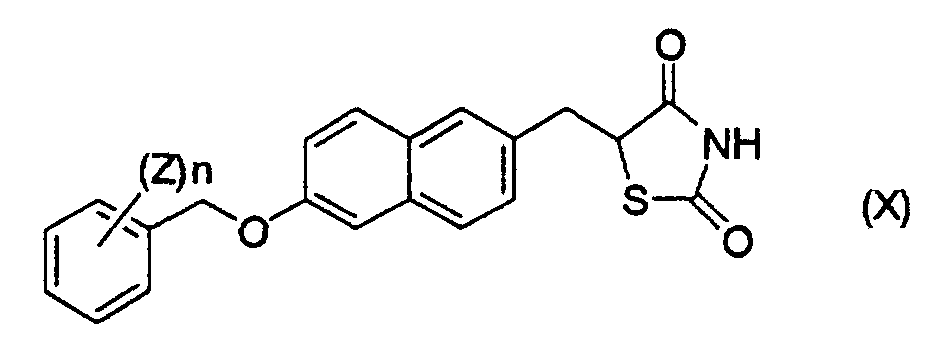
- A method for preparing 6-hydroxy-2-naphthylcarbinol, which comprises the step of reducing 6-hydroxy-2-naphthalenecarboxylic acid.
- The method according to claim 4, wherein the reduction is performed by using a borane.
- The method according to claim 5, wherein the reduction is performed in the presence of a borate represented by the following general formula (III):wherein R1, R2 and R3 independently represent an alkyl group, an aralkyl group, a hetero atom-containing alkyl group, or an aryl group; a borate represented by the following general formula (IV):
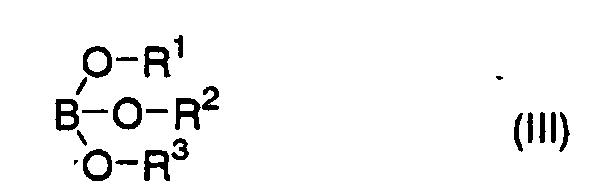 wherein R4 represents an alkyl group, an aralkyl group, a hetero atom-containing alkyl group, or an aryl group, and R' represents an alkylene group which may be substituted; a borate represented by the following general formula (V):
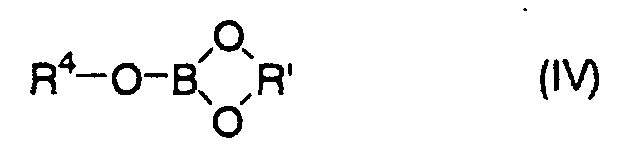 wherein R5 and R6 each independently represent an alkyl group, an aralkyl group, a hetero atom-containing alkyl group, or an aryl group; or a borate represented by the following general formula (VI):
 wherein R7, R8 and R9 independently represent an alkylene group which may be substituted or an alkyleneoxy group which may be substituted, R10 represents a hydrogen atom or an alkyl group, X represents a carbon atom, a nitrogen atom, or a boron atom, and a, b, c and d independently represent 0 or 1.

- The method according to claim 6, wherein the borate is trimethyl borate or triethyl borate.
- The method according to claim 4, wherein the reduction is performed by using an aluminum hydride complex compound.
- A method for preparing 6-hydroxy-2-naphthaldehyde, which comprises the step of oxidizing 6-hydroxy-2-naphthylcarbinol.
- A method for preparing 6-hydroxy-2-naphthaldehyde, which comprises the steps of:(1) reducing 6-hydroxy-2-naphthalenecarboxylic acid to produce 6-hydroxy-2-naphthylcarbinol; and(2) oxidizing the 6-hydroxy-2-naphthylcarbinol obtained in the above step (1).
- The method according to claim 9 or claim 10, wherein the oxidation is performed in the presence of manganese dioxide.
- The method according to claim 11, wherein the oxidation is performed in the presence of activated manganese dioxide.
- The method according to claim 9 or 10, wherein the oxidation is performed by using oxygen in the presence of a catalyst system containing a nitroxide represented by the following general formula (VII):wherein R11, R12, R13 and R14 independently represent an alkyl group, an aryl group, or a hetero-atom substituted alkyl group, and R15 and R16 independently represent a hydrogen atom, an alkyl group, an aryl group, or a hetero atom containing substituent; or a nitroxide represented by the following general formula (VIII):
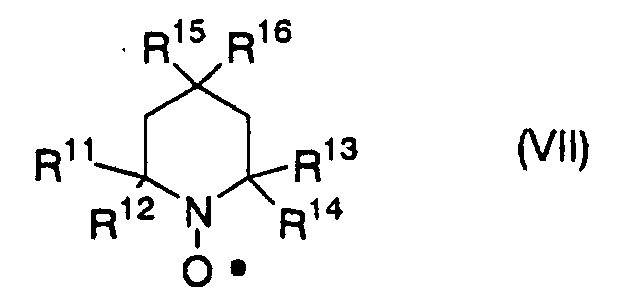 wherein R17 represents a hydrogen atom, a hydroxyl group, an alkyl group, an alkoxycarbonyl group, a cyano group, a carbamoyl group, an alkoxy group, or an acyloxy group together with a metal compound having oxidation-reduction ability or a metal complex compound having oxidation-reduction ability.
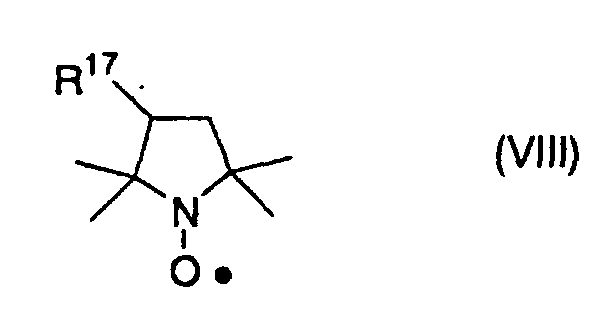
- The method according to claim 13, wherein the nitroxide is 2,2,6,6-tetramethylpiperidine-1-oxyl or 4-hydroxy-2,2,6,6-tetramethylpiperidine-1-oxyl, and a metal of the metal compound having oxidation-reduction ability or the metal complex compound having oxidation-reduction ability is copper or iron.
- A method for preparing a compound represented by the following general formula (X):wherein Z represents a halogen atom, and n represents an integer of 1 to 5 which comprises the steps of:
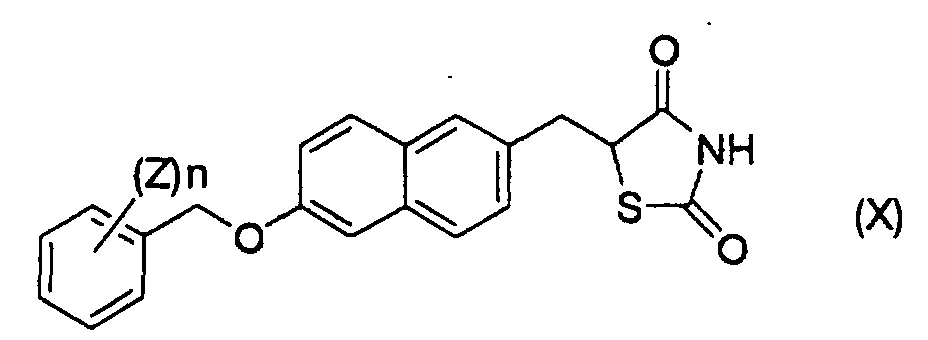 wherein Y represents a halogen atom, an alkylsulfonyloxy group, or an arylsulfonyloxy group, and Z and n have the same meanings as those defined above.(1) oxidizing 6-hydroxy-2-naphthylcarbinol to produce 6-hydroxy-2-naphthaldehyde;(2) reacting the 6-hydroxy-2-naphthaldehyde obtained in the above step (1) with 2,4-thiazolidinedione without protection of the hydroxyl group of the 6-hydroxy-2-naphthaldehyde to produce 5-(6-hydroxy-2-naphthyl)methylene-2,4-thiazolidinedione;(3) reducing the 5-(6-hydroxy-2-naphthyl)methylene-2,4-thiazolidinedione obtained in the above step (2) to produce 5-(6-hydroxy-2-naphthyl)methyl-2,4-thiazolidinedione; and(4) reacting the 5-(6-hydroxy-2-naphthyl)methyl-2,4-thiazolidinedione obtained in the above step (3) with a compound represented by the following general formula (IX):

- A method for preparing a compound represented by the following general formula (X):wherein Z represents a halogen atom, and n represents an integer of 1 to 5, which comprises the steps of:
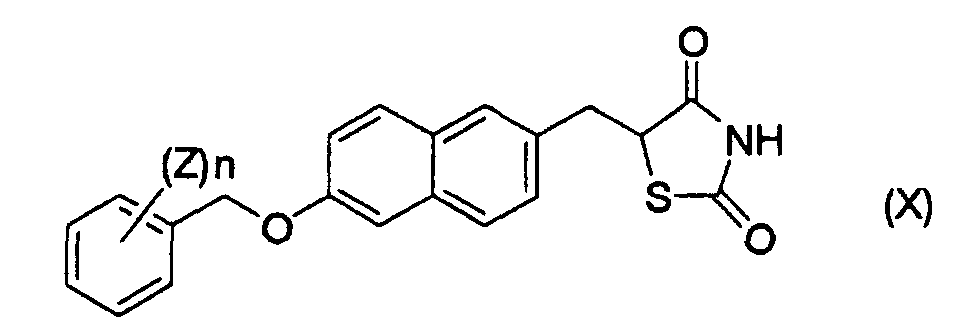 wherein Y represents a halogen atom, an alkylsulfonyloxy group, or an arylsulfonyloxy group, and Z and n have the same meanings as those defined above.(1) reducing 6-hydroxy-2-naphthalenecarboxylic acid to produce 6-hydroxy-2-naphthylcarbinol;(2) oxidizing the 6-hydroxy-2-naphthylcarbinol obtained in the above step (1) to produce 6-hydroxy-2-naphthaldehyde;(3) reacting the 6-hydroxy-2-naphthaldehyde obtained in the above step (2) with 2,4-thiazolidinedione without protection of the hydroxyl group of the 6-hydroxy-2-naphthaldehyde to produce 5-(6-hydroxy-2-naphthyl)methylene-2,4-thiazolidinedione;(4) reducing the 5-(6-hydroxy-2-naphthyl)methylene-2,4-thiazolidinedione obtained in the above step (3) to produce 5-(6-hydroxy-2-naphthyl)methyl-2,4-thiazolidinedione; and(5) reacting the 5-(6-hydroxy-2-naphthyl)methyl-2,4-thiazolidinedione obtained in the above step (4) with a compound represented by the following general formula (IX):

- The method according to claim 15 or claim 16, wherein 6-hydroxy-2-naphthaldehyde and 2,4-thiazolidinedione are subjected to dehydration condensation in the presence of a base to obtain 5-(6-hydroxy-2-naphthyl)methylene-2,4-thiazolidinedione.
Applications Claiming Priority (7)
| Application Number | Priority Date | Filing Date | Title |
|---|---|---|---|
| JP11146438A JP2000336054A (en) | 1999-05-26 | 1999-05-26 | Method for producing hydroxynaphthaldehyde |
| JP14643799 | 1999-05-26 | ||
| JP14643899 | 1999-05-26 | ||
| JP14643799 | 1999-05-26 | ||
| JP27609199 | 1999-09-29 | ||
| JP27609199A JP2001097914A (en) | 1999-09-29 | 1999-09-29 | Method for producing hydroxynaphthaldehyde |
| PCT/JP2000/003343 WO2000073252A1 (en) | 1999-05-26 | 2000-05-25 | 6-hydroxy-2-naphthylcarbinol and process for the preparation thereof |
Publications (2)
| Publication Number | Publication Date |
|---|---|
| EP1186588A1 true EP1186588A1 (en) | 2002-03-13 |
| EP1186588A4 EP1186588A4 (en) | 2003-01-22 |
Family
ID=27319183
Family Applications (1)
| Application Number | Title | Priority Date | Filing Date |
|---|---|---|---|
| EP00929861A Withdrawn EP1186588A4 (en) | 1999-05-26 | 2000-05-25 | 6-HYDROXY-2-NYPHTYLCARBINOL AND PROCESS FOR PRODUCING THE SAME |
Country Status (6)
| Country | Link |
|---|---|
| EP (1) | EP1186588A4 (en) |
| KR (1) | KR20020016804A (en) |
| CN (1) | CN1361759A (en) |
| AU (1) | AU4781000A (en) |
| CA (1) | CA2375019A1 (en) |
| WO (1) | WO2000073252A1 (en) |
Families Citing this family (2)
| Publication number | Priority date | Publication date | Assignee | Title |
|---|---|---|---|---|
| KR20110068979A (en) * | 2008-10-10 | 2011-06-22 | 가부시끼가이샤 도꾸야마 | Method for producing a carbonyloxy compound |
| CN112979444A (en) * | 2021-03-01 | 2021-06-18 | 黑龙江省科学院石油化学研究院 | Refining method and rectifying device of 2-hydroxy-1-naphthaldehyde |
Family Cites Families (4)
| Publication number | Priority date | Publication date | Assignee | Title |
|---|---|---|---|---|
| JPH08176139A (en) * | 1994-12-20 | 1996-07-09 | Tokuyama Corp | Chromene compound |
| CN1047387C (en) * | 1995-05-09 | 1999-12-15 | 中国科学院上海有机化学研究所 | Hapten compound, synthesis method and use thereof |
| JP4023697B2 (en) * | 1996-11-14 | 2007-12-19 | 三菱化学株式会社 | Method for producing naphthalene derivative |
| PT1285651E (en) * | 2000-04-28 | 2010-10-21 | Takeda Pharmaceutical | Melanin concentrating hormone antagonists |
-
2000
- 2000-05-25 AU AU47810/00A patent/AU4781000A/en not_active Abandoned
- 2000-05-25 CA CA002375019A patent/CA2375019A1/en not_active Abandoned
- 2000-05-25 EP EP00929861A patent/EP1186588A4/en not_active Withdrawn
- 2000-05-25 KR KR1020017015150A patent/KR20020016804A/en not_active Withdrawn
- 2000-05-25 WO PCT/JP2000/003343 patent/WO2000073252A1/en not_active Ceased
- 2000-05-25 CN CN00810681A patent/CN1361759A/en active Pending
Non-Patent Citations (2)
| Title |
|---|
| DATABASE CA [Online] CHEMICAL ABSTRACTS SERVICE, COLUMBUS, OHIO, US; ISHIHARA, YUJI ET AL: "Preparation of 2-(aminomethyl or heterocyclylmethyl)-6-aminoquinoline and -naphthalene derivatives as melanin concentrating hormone antagonists" retrieved from STN Database accession no. 135:357943 XP002218419 & WO 2001 082925 A (TAKEDA CHEMICAL INDUSTRIES, LTD., JAPAN) 8 November 2001 (2001-11-08) * |
| See also references of WO0073252A1 * |
Also Published As
| Publication number | Publication date |
|---|---|
| EP1186588A4 (en) | 2003-01-22 |
| CN1361759A (en) | 2002-07-31 |
| CA2375019A1 (en) | 2000-12-07 |
| AU4781000A (en) | 2000-12-18 |
| WO2000073252A1 (en) | 2000-12-07 |
| KR20020016804A (en) | 2002-03-06 |
Similar Documents
| Publication | Publication Date | Title |
|---|---|---|
| Bandini et al. | The first catalytic enantioselective Nozaki–Hiyama reaction | |
| Simpson et al. | New solid phase Knoevenagel catalyst | |
| EP2481742B1 (en) | Preparation method of aromatic boronate compounds | |
| CN109942433B (en) | A kind of chemical synthesis method of 3', 4', 5'-trifluoro-2-aminobiphenyl | |
| AU2003252241B2 (en) | Process for producing 5-(2'-pyridyl)-2-pyridone derivative | |
| CN114835645A (en) | Preparation method of 6-chloro-2-methyl-2H-indazole-5-amine | |
| CN106674264A (en) | Synthetic method for (2,2,2-trifluoroethoxyl) phenylboronic acid compounds | |
| CA2375019A1 (en) | 6-hydroxy-2-naphthylcarbinol and method for preparing the same | |
| CN104496899B (en) | The synthetic method of the intermediate of Menglusitena | |
| CN103265428B (en) | Method for preparing 4-[(3-halogenate-4-oxo) butyl] benzoic acid | |
| EP2415740B1 (en) | Method for producing high-purity terminal olefin compound | |
| Salman et al. | Regioselective Suzuki–Miyaura reactions of the bis (triflate) of 1, 2, 3, 4-tetrahydro-9, 10-dihydroxyanthracen-1-one | |
| Halterman et al. | Chromium-catalyzed pinacol coupling of benzaldehyde in water | |
| Hanamoto et al. | Fluoride ion-assisted cross-coupling reactions of (α-fluorovinyl) diphenylmethylsilane with aryl iodides catalyzed by Pd (0)/Cu (I) systems | |
| US8846961B2 (en) | Synthesis of peretinoin | |
| JP2010132593A (en) | Method for producing 4-alkylresorcinol | |
| NO20025652L (en) | Process for the preparation of trifluoroethoxy-substituted benzoic acids | |
| JPH07300440A (en) | Production of hetero-substituted acetal | |
| ITMI992127A1 (en) | PROCESS FOR THE PREPARATION OF AN ARY-PYRIDIN COMPOUND | |
| EP2226310B1 (en) | Process for producing 2-(1-hydroxyalkyl)cycloalkanone | |
| CN113372317B (en) | An industrial production method of tetrahydro-2H-pyran-3-one | |
| WO2000076976A1 (en) | Process for the production of 2-pyridylpyridine derivatives | |
| JP4230172B2 (en) | Process for producing benzothiophenes | |
| CN104163808B (en) | A kind of preparation method of 2-((4R, 6S)-6-substituent methyl-2-substituting group-1,3-dioxane-4-base) acetic ester | |
| AU2024364337A1 (en) | Processes for the preparation of substituted phenylacetonitriles and substituted phenylacetic acids |
Legal Events
| Date | Code | Title | Description |
|---|---|---|---|
| PUAI | Public reference made under article 153(3) epc to a published international application that has entered the european phase |
Free format text: ORIGINAL CODE: 0009012 |
|
| 17P | Request for examination filed |
Effective date: 20011130 |
|
| AK | Designated contracting states |
Kind code of ref document: A1 Designated state(s): CH DE FR GB IT LI NL Kind code of ref document: A1 Designated state(s): AT BE CH CY DE DK ES FI FR GB GR IE IT LI LU MC NL PT SE |
|
| AX | Request for extension of the european patent |
Free format text: AL;LT;LV;MK;RO;SI |
|
| RIC1 | Information provided on ipc code assigned before grant |
Free format text: 7C 07C 39/14 A, 7C 07C 29/147 B, 7C 07C 47/57 B, 7C 07C 45/29 B, 7C 07C 45/38 B, 7C 07C 45/81 B |
|
| A4 | Supplementary search report drawn up and despatched |
Effective date: 20021205 |
|
| AK | Designated contracting states |
Kind code of ref document: A4 Designated state(s): CH DE FR GB IT LI NL |
|
| 17Q | First examination report despatched |
Effective date: 20030401 |
|
| STAA | Information on the status of an ep patent application or granted ep patent |
Free format text: STATUS: THE APPLICATION IS DEEMED TO BE WITHDRAWN |
|
| 18D | Application deemed to be withdrawn |
Effective date: 20030812 |
|
| RBV | Designated contracting states (corrected) |
Designated state(s): CH DE FR GB IT LI NL |