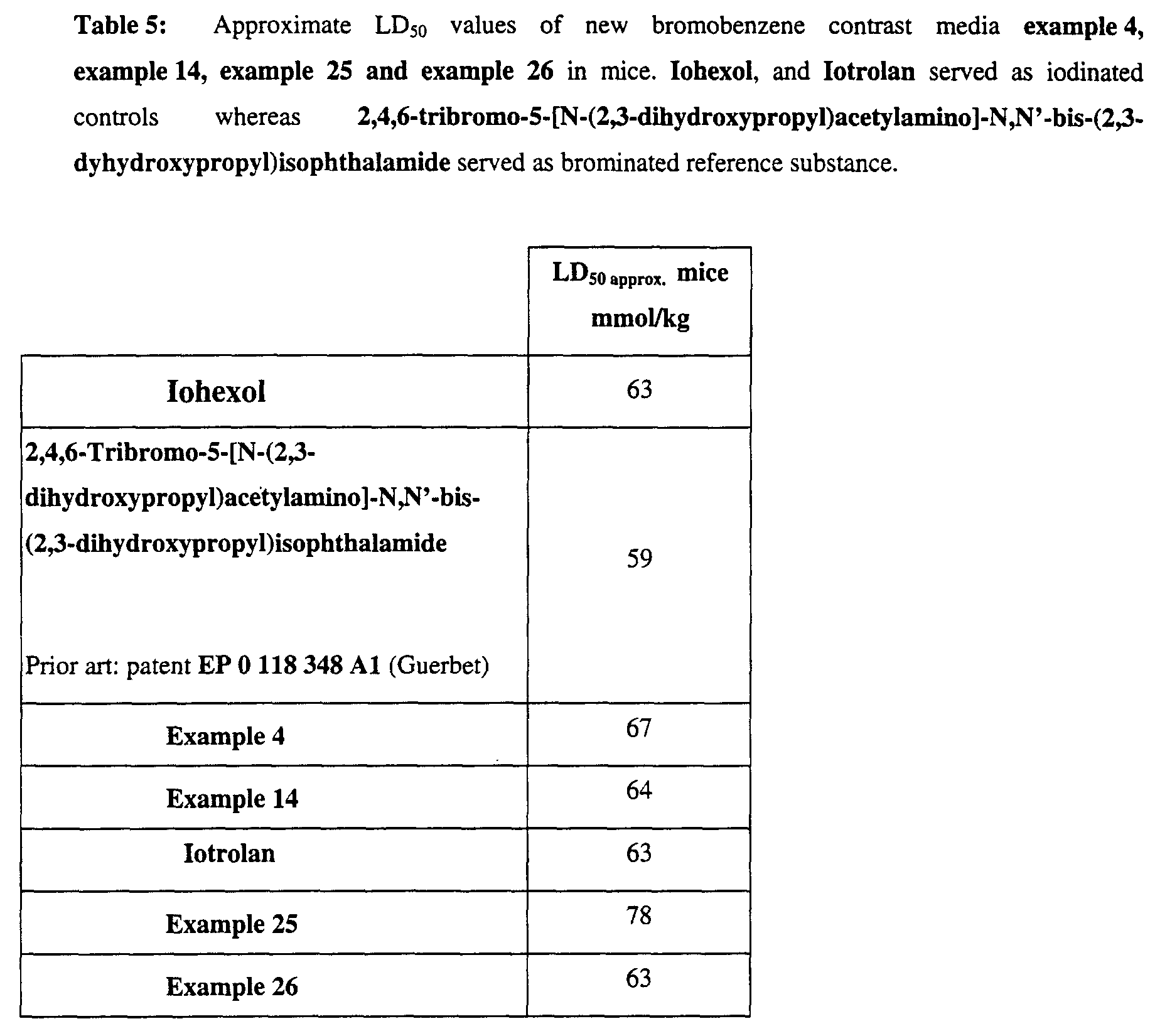
-
The invention regards new brominated compounds with favorable physico-chemical
properties, good tolerance profile, stability and suitable pharmacokinetic profile as
contrast media for X-ray mammography, their pharmaceutical formulations and
radiological application. The described new bromine contrast media will increase the
sensitivity and specificity of X-ray mammography especially in problematic cases. The
new contrast media have a higher X-ray absorption than iodine in the energy range used
by mammography, a high hydrophilicity, lower toxicity and better tolerance profile than
corresponding iodinated compounds.
Introduction
-
Mammography is today the most effective single imaging modality for the
detection of breast cancer. In mammography breast tissue is exposed to X-ray radiation
of low energies between 20 and 30 kV, where contrast between glandular tissue, fat,
water and microcalcifications yields highest values at an acceptable radiation dose.
Mammographic images have a very high spatial resolution of about 200 µm, necessary
for the detection of microcalcifications as an important sign for early breast cancer.
During the past decades mammography has evolved to an optimized procedure with
wide distribution of high quality standards. Because of the good diagnostic-value to cost
relation mammography is applied in screening programs for breast cancer. Sensitivity
and specificity are strongly age dependent and decreasing when younger women were
examined. A problem which is associated to the higher density of glandular tissue in
younger woman. Recently the increasing occurrence of dense breasts in older women
was associated to the more widespread application of hormone replacement therapy. It
was estimated that problematic cases contribute to 30% of evaluated patients in
mammography. Additionally 60 to 80% of biopsies directed by mammography are
benign. This means a very high rate of unnecessary interventions, scar formation and
frightened patients.
-
Dedicated contrast media for mammography may be used to improve the
sensitivity and specificity of this widely distributed and accepted technique for breast
imaging especially in problematic mammographic cases in the future. The pattern of
contrast media enhancement would serve as a physiological parameter added to the
morphological image indicative for tumor angiogenesis and grade of malignancies
(Jules K.A.: Tumor angiogenesis and its relation to contrast enhancement on computer
tomography: a review. European Journal of Radiology 30, 198-205, 1990).
-
In MRI the non-specific hydrophilic low molecular contrast agent Gd-DTPA
(Magnevist® ) has been proven to be very helpful and valuable in the detection and
characterization of breast lesion (Heywang S.H., Hahn D., Schmidt H., Eiermann W.
Bassermann R., Lissner J.: MR imaging of the breast using Gd-DTPA. J Comp Assist
Tomogr 10, 199-204, 1986) Also in CT-imaging iodinated contrast media were used
with high sensitivity and specificity (Teifke A., Schweden F., Cagil H., Kauczor H.U.,
Mohr W. Thelen M.: Spiral-Computer Tomographie der Mamma. Fortschr Röntgenstr
161, 495-500, 1994). Despite their excellent clinical results both techniques are not
widely accepted because of high costs and time consuming procedure in MRI and
application of a relative high radiation dose to the patient with CT. In projection
imaging of the breast contrast media were applied in DSA-systems for the detection of
breast lesions in the past (Fuchs H.D., Stigl R.: Diagnose und Differentioaldiagnose des
Mammakarzinoms mittels intravenöser DSA. Fortschr Röntgenstr 142 (3), 314-320,
1985) These applications were not followed in the past despite good imaging results but
because lack of spatial resolution and poor contrast sensitivity. In the galactography
procedure contrast media were directly injected in the ductal ducts for the detection and
characterization of lesions. In contrast intravenous injection of contrast media are by far
less invasive.
-
Usually mammography is performed at energies lower than 30 kV, this means
values lower than the k-edge for iodine (33 keV). In this energy range atoms like
bromine, gadolinium, tungsten and bismuth have higher absorption than iodine. This
was pointed out by Speck (EP 0 885 616 A1). Surprisingly conventional film based
mammography and the newly developed digital mammography have the sensitivity to
detect contrast material down to concentrations of 0.5 mg I/ml or molar concentration of
other elements equivalent to this concentration (see example 27a). These values are
indicating contrast sensitivity of mammography in the same range as reported for CT.
-
In earlier patent applications (FR 2736051-A1, EP 073715 A1, EP 074307 A1,
EP 074 309 A1, EP 0 118 348 A1, FR 2541272-A1) described substances containing
bromine, are claimed only for the application in conventional X-ray techniques not for
X-ray mammography.
-
We have been able to demonstrate the usefulness and advantages of newly
synthesized benzoic acid derivatives, containing bromine for X-ray mammography.
-
Moreover, because the lower atomic diameter of bromine, a brominated
chemical structure presents higher hydrophilicity, better tolerance profile, lower
toxicity, a better stability and lower production costs than the corresponding iodinated
compounds.
-
According to this invention we have demonstrated new chemical structures of
benzene derivatives containing bromine which fulfil the requirements for the application
as contrast media for mammography: maximum opacification, chemical stability, higher
hydrophilicity, lower viscosity, better tolerance, minimal osmotic effects (mainly in the
case of dimeric compounds), and a favorable pharmacokinetic profile.
-
In further accordance with the present invention, radiological composition may be
prepared containing one of the aforementioned compounds of the invention as an X-ray
contrast agent together with a pharmaceutically acceptable radiological vehicle.
Pharmaceutically acceptable vehicles include those that are suitable for injection such as
aqueous buffer solutions; e.g. tris-(hydroxymethyl)aminomethane and its salts ,
phosphate, citrate, bicarbonate, etc., sterile water for injection, physiological saline and
balanced ionic solutions containing chloride and/or bicarbonate salts of normal blood
plasma cations such as Ca, Na, K and Mg. The vehicles may contain a chelating
amount, e.g., a small amount of ethylenediamine tetraacetic acid, the calcium disodium
salt, or other pharmaceutically acceptable chelating agent.
-
The concentration of the contrast agent varies with the field of use. For mammography
purposes the concentration of bromine is generally 10-400 mg/mL and the dose 20 to
500 mL.
-
According to the previous experiments, the invention relates to X-ray contrast
agents, more particularly, to novel brominated X-ray contrast agents.
-
This invention refers to the monomeric ionic derivatives of 3,5-diamino-2,4,6-tribromobenzoic
acid, having the following structure:
in which:
R is -COCH
2OH, -COCH
2OCH
3, -SO
2CH
2Br or - COCH
3 -
Preferred compounds of formula I are those in which
R is -COCH2OH, -COCH2OCH3 or -SO2CH2Br
(Examples 1, 2 and 3, respectively)
-
The present invention is also directed to new monomeric nonionic derivatives of
tribromoisophthalamide, having the following structure:
in which the substituents R
1, R
2, R
3, R
4, R
5, and R
6 are given in table 1
| Compounds of formula II |
| R1 | R2 | R3 | R4 | R5 | R6 |
| H | COCH2OH | CH3 | CH2CHOHCH2OH | H | CH2CHOHCH2OH |
| H | COCH2OH | H | CH2CHOHCH2OH | H | CH2CHOHCH2OH |
| H | COCH2OH | H | CH2CHOHCH2OH | H | CH2CH2OH |
| CH3 | COCH2OH | H | CH2CHOHCH2OH | H | CH2CHOHCH2OH |
| CH2CH2OH | COCH2OH | H | CH2CHOHCH2OH | H | CH2CHOHCH2OH |
| CH2CHOHCH2OH | COCH2OH | H | CH2CHOHCH2OH | H | CH2CHOHCH2OH |
| H | SO2CH2Br | CH3 | CH2CHOHCH2OH | H | CH2CHOHCH2OH |
| H | COCH2OH | CH3 | CH2CHOHCH2OH | H | H |
| H | COCH2OH | H | CH(CH2OH)CHOHCH2OH | H | H |
| H | COCH2OH | CH2CH2OH | CH2CH2OH | CH2CH2OH | CH2CH2OH |
| CH2CH2OH | COCH2OH | H | CH(CH2OH)CHOHCH2OH | H | H |
| H | COCH2OH | CH3 | CH2CHOHCH2OH | CH3 | CH2CHOHCH2OH |
| H | COCH2OCH3 | CH3 | CH2CHOHCH2OH | CH3 | CH2CHOHCH2OH |
| H | COCH2OH | H | CH2CHOHCH2OH | H | CH(CH2OH)2 |
| CH2CH2OH | COCH3 | H | CH(CH2OH)2 | H | H |
| CH2CH2OH | COCH3 | H | CH(CH2OH)CHOHCH2OH | H | H |
-
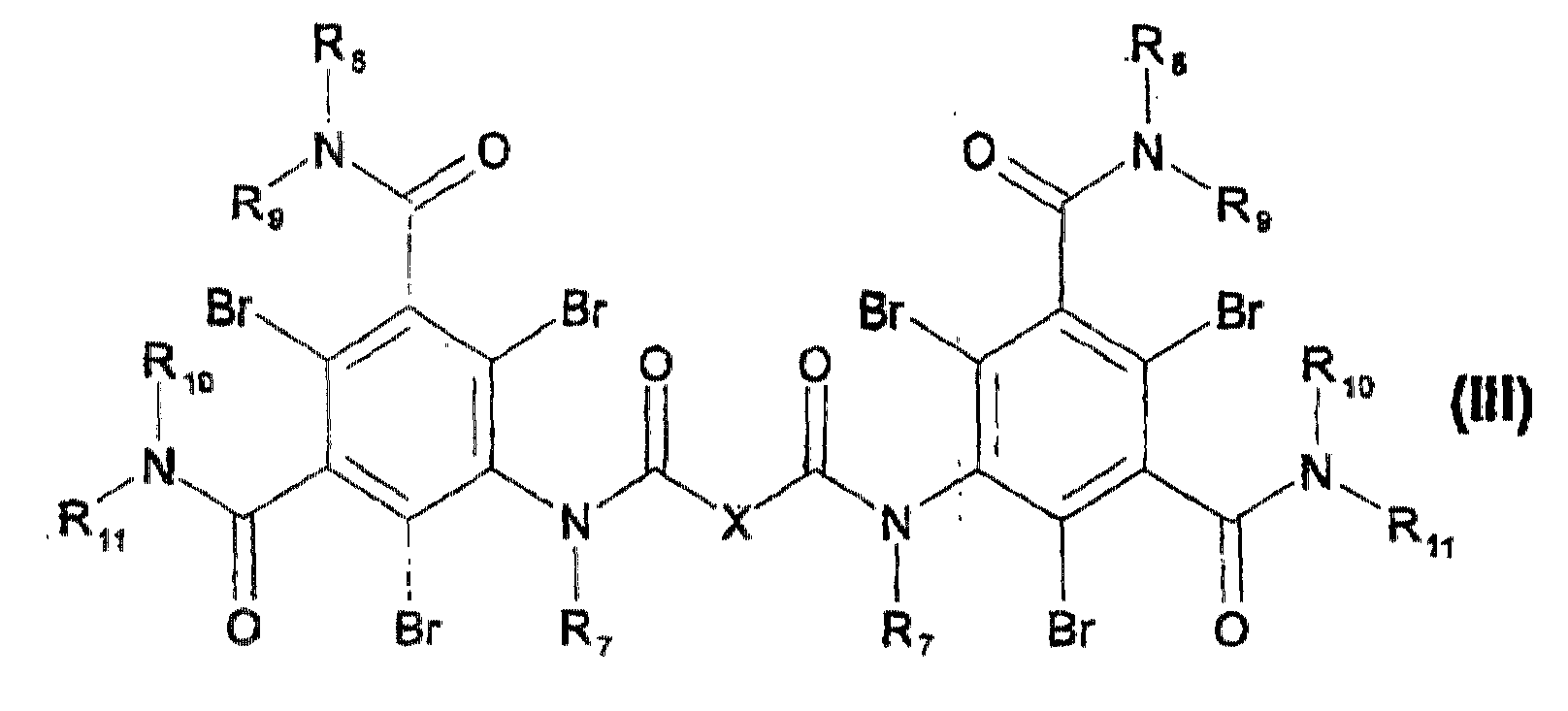
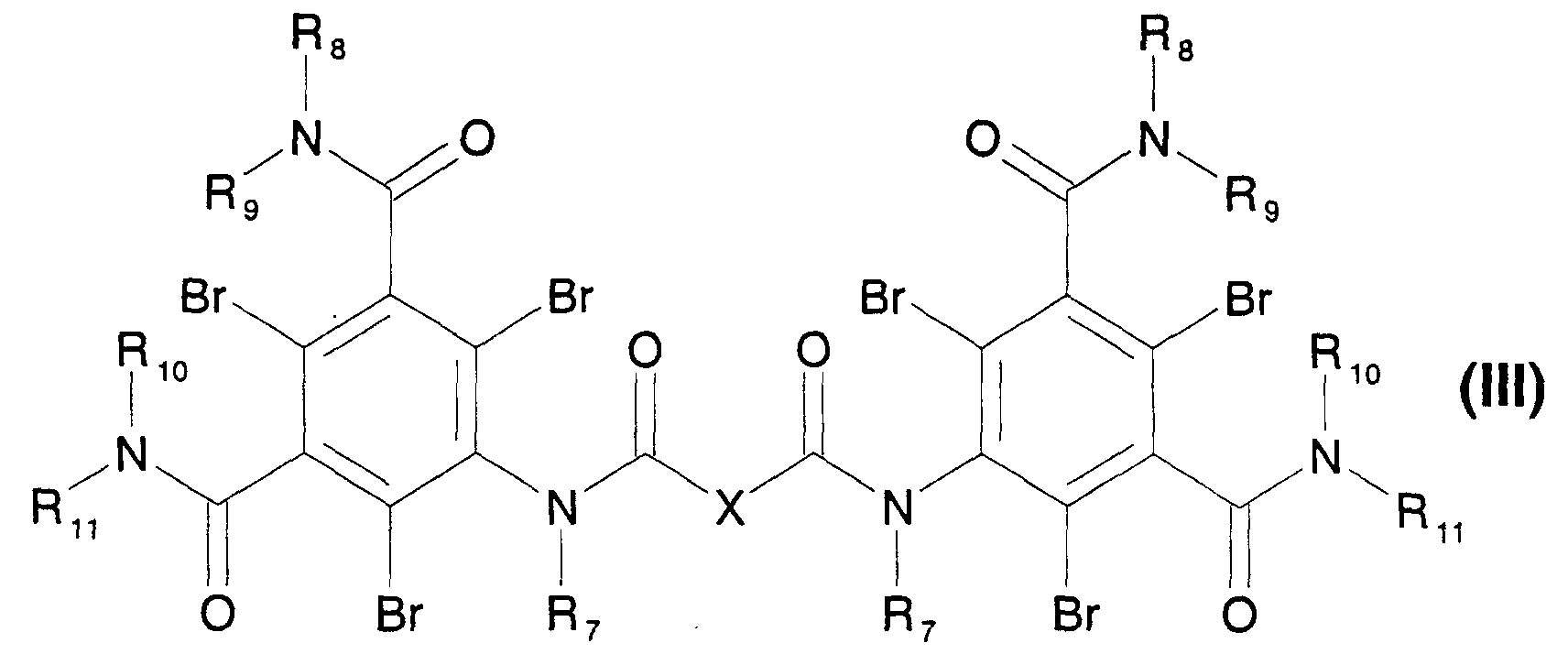
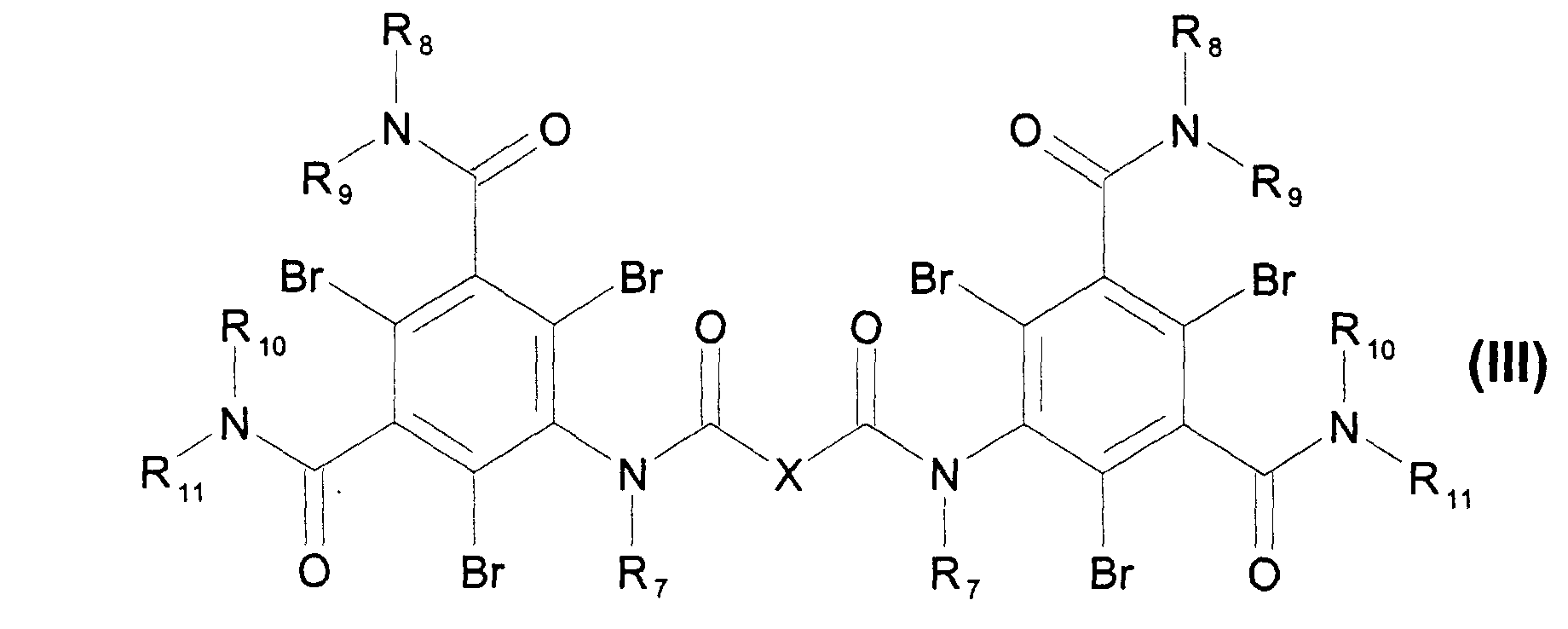
The present invention is further directed to new symmetrical dimeric nonionic
derivatives of tribromoisophthalamide connected at the 5-N position by means of a
diamide, having the general formula III:
wherein
- R7
- is hydrogen, straight-chain or branched C1-C4-alkyl or mono-or polyhydroxyalkyl,
- R8
- is hydrogen, straight-chain or branched C1-C4-alkyl or mono-or polyhydroxyalkyl,
- R9
- is mono-or polyhydroxyalkyl,
- R10
- is hydrogen, straight-chain or branched C1-C4-alkyl or mono-or polyhydroxyalkyl,
- R11
- is hydrogen, straight-chain or branched C1-C4-alkyl or mono-or polyhydroxyalkyl,
- X
- is straight-chain or branched C1-C4-alkyl or C1-C4-alkoxy-C1-C4-alkyl
-
The present invention is further directed to new monomeric derivatives of 2.4.6-Tribromobenzene-1.3.5-tricarboxylic
acid (Tribromo-trimesic acid), having the
structure IV
wherein
- R12
- is hydrogen, straight-chain or branched C1-C4-alkyl or mono-or polyhydroxy-C1-C4-alkyl,
- R13
- is straight-chain or branched C1-C4-alkyl or mono-or polyhydroxy-C1- C4-alkyl,
-
All lower alkyl residues defined above contain 1-4 carbon atoms. Preferred examples
are methyl, ethyl and propyl. Methyl is most preferred. They may be straight-chain or
branched.
The alkyl residue in the mono-or polyhydroxyalkyl residues can be straight-chain or
branched. Preferably suitable are alkyl residues of 2-5, preferably 2-3 carbon atoms.
The hydroxy groups in the alkyl residue can be present as primary and/or secondary
and/or tertiary hydroxy groups. The alkyl groups can contain 1-5, preferably 1-3
hydroxy groups. Examples include tris (hydroxy methyl) methyl, hydroxyethyl,
especially 1,3- and 2,3-dihydroxypropyl, 2,3-dihydroxy 1-hydroxymethylpropyl and
1,3,4-trihydroxy-threo-but-2-yl.
The present invention comprises monionic X-ray contrast media which are
distinguished by a high chemical stability, especially also under the conditions of heat
sterilisation.
Examples
-
The following examples should illustrate the invention without limitation on
presented examples.
Example 1
Synthesis of 2,4,6-tribromo-3,5-dihydroxyacetylaminobenzoic acid
a) 3,5-Diamino-2,4,6-tribromobenzoic acid
-
To a suspension of 3,5-diaminobenzoic acid (30.2 g, 0.2 moles) in water (1.2
L) was added sufficient concentrated hydrochloric acid to complete solution
(approximately pH=1). Bromine (33.8 mL, 0.65 moles) was added over one hour
and the mixture reaction stirred at room temperature for two hours.
-
The pH was adjusted to approximately 6 with 50% sodium hydroxide (115
ml) and the reaction mixture treated with sodium hydrosulfite (7 g) to decolour
the resulting solution.
-
Sufficient concentrated hydrochloric acid was added to adjust pH to 1 and the
precipitate was filtered, washed with water and dried in vacuo to obtain the
product, 3,5-diamino-2,4,6-tribromobenzoic acid (58.2 g, 75.6 %). The product
was used in the next step without further purification.
- 1H-NMR (200 MHz, DMSO-d6):
- δ= 4.9 (broad signal, 4H, exchangeable
with D2O, NH), 12.15 (broad signal, 1H, exchangeable with
D2O, COOH).
- 13C-NMR (200 MHz, DMSO-d6):
- δ= 168.2 (CO), 144.6, 139.4, 103.1 (C-Br),
102.2 (C-Br).
b) 3, 5-Diacetoxyacetylamino-2,4,6-tribromobenzoic acid
-
To an ice-cold solution of 3,5-diamino-2,4,6-tribromobenzoic acid (example
1a) (45 g, 0.115 moles) in DMA (135 mL) was added distilled acetoxyacetyl
chloride (78.5 g, 0.575 moles) over a thirty-minute period. The mixture was
removed from the ice bath and stirred at room temperature for 16 hours.
-
The product was isolated by pouring the reaction mixture into ice water (1.5
L). The precipitate was filtered, washed with water and dried in vacuo to yield
3,5-diacetoxyacetylamino-2, 4, 6-tribromobenzoic acid (62.3 g, 92.0 %). The
product was used in the next step without further purification.
- 1H-NMR (200 MHz, DMSO-d6):
- δ= 12.2 (broad signal, 1H,
exchangeable with D2O, CO2H), 9.9 (2s, 2H, exchangeable with
D2O, NH), 4.61 (s, 4H, COCH 2OAc), 2.2 (s, 6H, COCH 3).
- 13C-NMR (200 MHz, DMSO-d6):
- δ= 169.2 (CO), 168.4 (CO), 168.2
(CO), 139.4, 135.3, 113.5 (C-Br), 108.3(C-Br), 62.1 (CH2), 20.5
(CH3).
c) 2,4,6-Tribromo-3,5-dihydroxyacetylaminobenzoic acid
-
To a suspension of 3,5-diacetoxyacetylamino-2,4,6-tribromobenzoic acid
(example 1b) (60 g, 0.101 moles) was added sufficient 20% sodium hydroxide to
adjust the pH at 11. The solution was stirred two hours at room temperature and
then acidified to pH 1 with concentrated hydrochloric acid to precipitate 2,4,6-tribromo-3,5-dihydroxyacetylaminobenzoic
acid . The precipitate was filtered off
and washed with water.
-
The collected precipitate was redissolved in water (600 mL) plus sufficient 20
% sodium hydroxide to complete solution. The pH was adjusted to approximately
5 with acetic acid and the solution was treated with decolorizing charcoal (6 g) 1
hour at room temperature. The charcoal was filtered off and the solution was
slowly added to a hot (70°C), stirred solution of hydrochloric acid (27 mL
concentrated acid diluted with 54 mL water). The mixture was chilled and the
product collected, washed and dried in vacuo at 60°C. This treatment was repeated
once.
-
The product was further purified by once precipitating the acid from a
solution of the sodium salt in water to yield 2,4,6-tribromo-3,5-dihydroxyacetylaminobenzoic
acid (42 g, 82.3 %).
- 1H-NMR (200 MHz, DMSO-d6):
- δ = 11.3 (broad signal, 1H,
exchangeable with D2O, CO2H and OH), 9.8 (2s, 2H,
exchangeable with D2O, NH), 4.01 (s, 4H, COCH 2).
- 13C-NMR (200 MHz, DMSO-d6):
- δ = 168.9 (CO), 168.2 (CO), 137.8,
134.2, 113.3 (C-Br), 107.9 (C-Br), 61.6 (CH2).
Example 2
Synthesis of 2,4,6-tribromo-3,5-dimethoxyacetylaminobenzoic acid
-
A solution of 3,5-diamino-2,4,6-tribromobenzoic acid (example 1a) (75 g,
0.192 moles) in DMA (150 mL) was cooled to 5° C: Methoxyacetylchloride
(104.1 g, 0.96 moles) was added slowly keeping the temperature at 5-10°C. When
the addition was complete, the reaction mixture was allowed to warm to room
temperature and was stirred for 24 hours.
-
The reaction mixture was poured into an ice water slurry (1.6 L) with
vigorous stirring. The precipitate was filtered off and washed with water.
-
The collected precipitate was suspended in water (750 mL) and sufficient
20% sodium hydroxide added to complete solution. The pH was adjusted to
approximately 5 with acetic acid and the solution was treated with decolourising
charcoal (7.5 g) 1 hour at room temperature. The charcoal was filtered off and the
solution was slowly added to a hot (70°C), stirred solution of hydrochloric acid
(37 mL concentrated acid diluted with 74 mL water). The mixture was chilled and
the product collected, washed and dried in vacuo at 60°C. This treatment was
repeated once.
-
The product was further purified by once precipitating the acid from a
solution of the sodium salt in water to yield 2,4,6-tribromo-3,5-dimethoxyacetylbenzoic
acid (83.5 g, 81.6 %).
- 1H-NMR (200 MHz, DMSO-d6):
- δ= 12.8 (broad signal, 1H,
exchangeable with D2O, CO2H), 9.8 (2s, 2H, exchangeable with
D2O, NH), 4.2 (s, 4H, CH 2), 3.5 (s, 6H, CH3).
- 13C-NMR (200 MHz, DMSO-d6):
- δ= 169.2 (CO), 168.1 (CO), 138.0,
133.6, 112.8 (C-Br), 106.9 (C-Br), 71.1 (CH2), 59.3 (CH3).
Example 3
Synthesis of 2,4,6-tribromo-3,5-dibromomethanesulfonylamino benzoic acid
-
To a solution of 3,5-diamino-2,4,6-tribromobenzoic acid (example 1a) (55 g,
0.14 moles) in DMA (165 mL) was added distilled bromomethylsulfonyl bromide
(166.48 g, 0.70 moles) (J. Am. Chem. Soc. 1986, 108(15), 4568-80) and the
reaction mixture was heated at 60 °C for 16 hours.
-
The solid product was isolated by pouring the reaction mixture into ice water
(1.5 L). The precipitate was filtered, washed with water and dried.
-
The collected precipitate was suspended in water (550 mL) and sufficient
20% sodium hydroxide added to complete solution. The pH was adjusted to
approximately 5 with acetic acid and the solution was treated with decolorizing
charcoal (5.5 g) 1 hour at room temperature. The charcoal was filtered off and the
solution was slowly added to a hot (70°C), stirred solution of hydrochloric acid (
25 mL concentrated acid diluted with 50 mL water). The mixture was chilled and
the product collected, washed and dried in vacuo at 60°C. This treatment was
repeated once.
-
The product was further purified by once precipitating the acid from a
solution of the sodium salt in water to yield 2,4,6-tribromo-3,5-dibromomethylsulfonylaminobenzoic
acid (76 g, 76.6 %).
- 1H-NMR (200 MHz, DMSO-d6):
- δ= 14.8 (broad signal, 1H,
exchangeable with D2O, CO2H), 9.9 (2s, 2H, exchangeable with
D2O, NH), 5.3 (s, 4H, CH 2).
- 13C-NMR (200 MHz, DMSO-d6):
- δ= 168.1 (CO), 144.4, 137.64, 108.08
(C-Br), 106.6 (C-Br), 47.3 (CH2).
Example 4
Synthesis of 2,4,6-tribromo-5-hydroxyacetylamino-N,N'-bis-(2,3-dihydroxypropyl)-N-methylisophthalamide
a) 5-Nitro-N-(2,3-dihydroxypropyl)isophthalic acid monoamide
-
To a solution of 5-nitroisophthalic acid monomethyl ester (22.5 g, 0.1 moles)
in methanol (100 mL), triethylamine (10.1 g, 0.1 moles) and 3-amino-1,2-propanediol
(10.02 g, 0.11 moles) were added with stirring and heated at solvent
reflux for three hours. The solution was evaporated to dryness under reduced
pressure. The residue was treated with cold water, filtered, and washed with cold
water. The white solid was dried in vacuo to obtain 5-nitro-N-(2,3-dihydroxypropyl)isophthalic
acid monoamide (26.9 g, 95%). The product was
used in the next step without purification.
- 1H-NMR (200MHz, DMSO-d6):
- δ= 3.20-3.40 (m, 4H, two methylene
units), 4.73 (m, 3H, 2OH and CH)), 6.92 (bs, 1H, NH), 8.68 (s,
1H aromatic), 8.87 (s, 1H aromatic), 9.02 (s, 1H aromatic), and
9.08 (m, 1H, NH).
- 13C-NMR (200MHz, DMSO-d6):
- δ=43.50 (NH-CH2), 64.15 (CH2OH),
70.55 (CH), 126.13/133.01/134.04 (aromatic CH), 136.54 (C-COOH),136.60
(C-CONH), 148.18 (C-NO2), 164.20 (CO in
CONH), and 165.40 (CO in COOH).
b) 5-Amino-N-(2,3-dihydroxypropyl)isophthalic acid monoamide
-
To a suspension of 5-nitro-N-(2,3-dihydroxypropyl)isophthalic acid
monoamide (25 g, 0.09 moles) (example 4a) in water (100 mL) at 50°C., 25%
ammonium hydroxide (5.5 mL) was added dropwise (the pH increased from 1.69
to 3.55). The mixture was diluted with water (100 mL) and hydrogenated with 1.5
g of palladium over charcoal at 70°C for three hours. The reaction medium was
cooled at room temperature and filtered off. Hydrochloric acid was added
(pH=2.5) and the solution was evaporated to dryness under reduced pressure. The
residue was treated with methanol (60 mL), filtered off, and dried at 50°C in
vacuo to obtain 5-amino-N-(2,3-dihydroxypropyl)isophthalic acid monoamide
(20.8 g, 93%).
- 1H-NMR (200MHz, DMSO-d6):
- δ=3.20-3.50 (m, 4H, two methylene
units), 3.34 (m, 2H, two hydroxyl groups), 3.65(m, 1H, CH),
6.68 (bs, 2H, NH2), 7.75 (m/m, 2H aromatic), 8.20 (s, 1H
aromatic), and 8.75 (m, 1H, NH).
- 13C-NMR (200MHz, DMSO-d6):
- δ=43.53 (NH-CH2), 64.18 (CH2-OH),
70.53 (CH), 126.25 (aromatic C4), 126.36 (aromatic C6), 126.96
(aromatic C2), 132.85 (C-COOH), 134.16 (C-CONH), 136.85
(C-NO2), 165.66 (CO in CONH), and 166.42 (CO in COOH).
c) 5-Amino-2,4,6-tribromo-N-(2,3-dihydroxypropyl)isophthalic acid
monoamide
-
To a solution of 5-amino-N-(2,3-dihydroxypropyl)isophthalic acid
monoamide (25g, 0.1 moles) (example 4b) in water (1L), bromine (16.7 mL,
0.325 moles) was added dropwise with stirring at room temperature in the course
of half hour.
-
The solution was stirred an additional hour and pH adjusted to 9 with 20%
aqueous sodium hydroxide. The pH was decreased to 3.8 with sodium
hydrosulphite. This operation was repeated until clear reaction medium. It was
evaporated to dryness under reduced pressure. The residue was treated with
methanol (100 mL) and filtered. The filtrate was evaporated to dryness under
reduced pressure. The residue was treated with isopropanol (100 mL) and filtered.
The solid was dried in vacuo at room temperature to obtain 5-amino-2,4,6-tribromo-N-(2,3-dihydroxypropyl)isophthalic
acid monoamide (47 g, 96%).
- 1H-NMR (200MHz, DMSO-d6):
- δ=3.00-3.50 (m, 4H, two methylene
units), 3.65 (m, 1H, CH), 4.60 (m, 2H, NH2) 4.80 (m, 2H, two
hydroxyl groups), and 8.38 ppm (m, 1H, NH).
- 13C-NMR (200MHz, DMSO-d6):
- δ=42.39 (NH-CH2), 63.83 (CH2OH),
70.28 (CH), 100.58/101/05/103.58 (C-Br), 139.82 (C-COOH),
142.04 (C-CONH), 147.63 (C-NH2), 166.58 (CO in CONH),
and 168.13 (CO in COOH).
d) 5-Amino-2,4,6-tribromo-N-(2,3-diacetoxypropyl)isophthalic acid
monoamide
-
To a solution of 5-amino-2,4,6-tribromo-N-(2,3-dihydroxypropyl)isophthalic
acid monoamide (23.1 g, 0.047 moles) (example 4c) in ethyl acetate (100 mL),
dimethylaminopyridine (567 mg) was added with stirring. The mixture was heated
at solvent reflux for ten minutes. Then acetic anhydride (18.2 mL) was added. The
heating was continued for four hours. The reaction process was followed by TLC
(toluene/ethyl acetate/methanol/dioxane/acetic acid 3:3:1.8:1.4:1). Ethanol (12
mL) was added and the reflux was continued for half hour. The solvent was
removed by evaporation to dryness under reduced pressure. The residue was
dissolved in methanol (100 mL) and precipitated over ethyl ether (1.5 L). A
brown solid was filtered, and dried in vacuo to obtain 5-amino-2,4,6-tribromo-N-(2,3-diacetoxypropyl)isophthalic
acid monoamide (24.7 g 91%). This product was
purified by PLC (Preparative Liquid Chromatography) (eluent: water).
- 1H-NMR (200MHz, DMSO-d6):
- δ=2.00 (s, 3H, methyl group), 2.01 (s,
3H, methyl group), 3.35/3.45 (m/m, 2H, CH2-N), 4.15/4.25 (m/m,
2H, CH2-O), 5.05 (m, 1H, CH), 5.34 (m, 2H, NH2), and 8.70 (m,
1H, NH).
- 13C-NMR (200MHz, DMSO-d6):
- δ=20.88 (CH3), 21.27 (CH3), 38.83
(NH-CH2), 63.32 (CH2OH), 70.06 (CH), 100.66/101.23/103.99
(C-Br), 139.69 (aromatic C1), 142.42 (aromatic C3), 147.73
(aromatic C5), 167.15 (CO in CONH), 168.56 (COOH),
170.45/170.74 (CO in COCH3).
e) 5-Amino-2,4,6-tribromo-3-[N-(2,3-diacetoxypropyl)
carbamoyl]benzoyl chloride
-
To a solution of 5-amino-2,4,6-tribromo-N-(2,3-diacetoxypropyl)isophthalic
acid monoamide (28.7 g, 0.05 moles) (example 4d) in ethyl acetate (270 mL),
thionyl chloride (15 mL) was added with stirring. The mixture was heated at
solvent reflux for six hours. The excess of thionyl chloride was removed by
distillation. Then the solvent was evaporated to dryness under reduced pressure.
The residue was partitioned in water (290 mL) and chloroform (290 mL). The
aqueous phase was extracted with chloroform (1x60mL) and the combined
organic extracts were washed with 5% aqueous sodium bicarbonate (1x250mL)
and brine (1x250mL). The organic solution was dried over magnesium sulfate
overnight. The magnesium sulfate was removed by filtration and the solvent was
evaporated to dryness under reduced pressure. The residue was dried in vacuo to
obtain 5-amino-2,4,6-tribromo-3-[N-(2,3-diacetoxypropyl)carbamoyl]benzoyl
chloride (27:1 g, 92%).
- 1H-NMR (200MHz, DMSO-d6):
- δ=2.08 (s, 6H, two methyl groups),
3.55/3.75 (m/m, 2H, CH2N), 4.25/4.35 (m/m, 2H, CH2-O), 5.05
(bs, 2H, NH2), 5.23 (m, 1H, CH), and 6.54 (m, 1H, NH).
- 13C-NMR (200MHz, DMSO-d6):
- δ=20.66 (CH3), 20.98 (CH3), 39.78
(CH2-N), 62.83 (CH2-O), 70.03 (CH), 99.80/102.88/107/20 (C-Br),
139, 85 (aromatic C6), 140.73 (aromatic C4), 142.71
(aromatic C2), 165.54 (CO in CONH), 166.25 (CO in COCl),
and 170.38/170.74 (CO in COCH3).
f) 5-Acetoxyacetylamino-2,4,6-tribromo-3-[N-(2,3-diacetoxypropyl)carbamoyl]
benzoyl chloride
-
To a solution of 5-amino-2,4,6-tribromo-3-[N-(2,3-diacetoxypropyl)carbamoyl]benzoyl
chloride (20.6 g, 0.035 moles) (example 4e)
in dry DMA (125 mL) at 0-5°C, acetoxyacetyl chloride (14.21 g, 0.104 moles) in
dry DMA (18 mL) was added dropwise. The reaction medium was stirred at room
temperature overnight. The reaction was added over ethyl acetate (208 mL) and
water (382 mL). The aqueous layer was extracted with ethyl acetate (2x10⁵ mL),
the combined organic extracts were washed with 5% aqueous sodium bicarbonate
(2x10⁵ mL), brine (4x10⁵ mL) and dried over magnesium sulfate overnight. After
filtration, the solvent was removed by evaporation to dryness under reduced
pressure. The residue was treated with chloroform (25 mL). A white solid was
filtered and dried in vacuo to obtain 5-acetoxyacetylamino-2,4,6-tribromo-3-[N-(2,3-diacetoxypropyl)carbamoyl]benzoyl
chloride (19.5 g, 81%). The product was
used in the next step without purification.
- 1H-NMR (200MHz, DMSO-d6):
- δ=2.01 (s, 6H, two methyl groups), 2.13
(s, 3H, methyl group), 3.60 (m, 2H, CH2-N), 4.10 (m, 2H, CH2-O),
4.71 (s, 2H, OCH2CO), 5.10 (m, 1H, CH), 9.10 (m, 1H, NH), and
10.30 ppm (m,1H, NH).
- 13C-NMR (200MHz, DMSO-d6):
- δ= 20.54/20.91 (methyl groups), 39.78
(CH2-N), 61.87 (CH2-O), 62.84 (CH), 69.58 (O-CH2-CO),
113.19/119.29/122.34 (C-Br), 135.85/139.77/141.19 (aromatic
C), 164.52 (CO in CON), 165.12 (CO in COCl), 166.12 (CO in
CH2CONH), and 169.72/169.84/170.15 (COCH3).
g) 5-Acetoxyacetylamino-2,4,6-tribromo-N-(2,3-dihydroxypropyl)-N-methyl-N'-(2,3-diacetoxypropyl)isophthalamide
-
To a solution of 5-acetoxyacetylamino-2,4,6-tribromo-3-[N-(2,3-diacetoxypropyl)carbamoyl]benzoyl
chloride (19.54 g, 0.028 moles) (example 4f)
in acetone (265 mL), Na2CO3.10H2O (8.87 g, 0.031 moles) and 3-methylamino-1,2-propanediol
(3.26 g, 0.031 moles) were added. The mixture was heated at
reflux for four hours. The reaction medium was cooled at room temperature and
filtered. The filtrate was evaporated to dryness under reduced pressure to obtain 5-acetoxyacetylamino-2,4,6-tribromo-N,N'-bis-(2,3-diacetoxypropyl)-N-methylisophthalamide
(21 g , 98%). This product was used in next step without
purification.
- 1H-NMR (200MHz, DMSO-d6):
- δ = 2.00 (s, 6H, two methyl groups),
2.11 (s, 3H, one methyl group), 3.10-4.30 (m, 9H, four methylene
groups and CH), 2.80/3.05 (s/s 3H, CH3-N), 4.60 (m, 1H, OH),
4.70 (s, 2H, O-CH2-CO), 4.80 (m, 1H, OH), 5.10 (m, 1H, CH),
9.10, (m, 1H, NH), and 10.20 ppm (m, 1H, NH).
- 13C-NMR (200MHz, DMSO-d6):
- δ = 20.67 (CH3), 20.74 (CH3), 21.12
(CH3), 37.17 (CH3-N), 39.68 (CH2N), 50.29 (CH2 in
CH2NCH3), 62.06 (CH2 in CH2OAc), 63.11 (CH2OH), 64.18
(CH-OAc and CH-OH), 69.93 (CH2 in O-CH2CO),
122.01/122.25/122.30 (C-Br), 135.94/140.32/141.44 (aromatic
C), 165.55 (CO in CONH), 165.87 (CO in CH2CONH), 166.12
(CO in CON), and 170.15/170.27/170.58 (CO in acetyl groups).
h) 2,4,6-Tribromo-5-hydroxyacetylamino-N,N'-bis-(2,3-dihydroxypropyl)-N-methylisophthalamide
-
To a solution of 5-acetoxyacetylamino-N,N'-bis-(2,3-diacetoxypropyl)-2,4,6-tribromo-N-methyl-isophthalamide
(22.6 g, 0.030 moles) (example 4g) in
methanol/water 1:1 (210 mL) at 50°C, a solution of 20% NaOH was added until
stable pH=11. The temperature was kept for an additional hour and cooled at
room temperature. The reaction medium was neutralized with hydrochloric
acid/water 1:1. The solvents were evaporated to dryness under reduced pressure.
The residue was purified by PLC (eluent: 5% methanol) to obtain 2,4,6-tribromo-5-hydroxyacetylamino-N,N'-bis(2,3-dihydroxypropyl)-N-methylisophthalamide
(14 g, 74%).
- 1H-NMR (200MHz, DMSO-d6):
- δ=2.80-3.80 (m, 9H, four methylene
groups and CH), 2.86/3.05 (s/s, 3H, CH3-N), 4.00 (s, 2H,
OCH2-CO), 4.60 (m, 2H, two hydroxyl groups), 4.70 (m, 1H,
CH), 4.80 (m, 2H, two hydroxyl groups), 5.79 (m, 1H, OH),
8.75 (m, 1H, NH), and 9.83 (m, 1H, NH).
- 13C-NMR (200MHz, DMSO-d6):
- δ=33.80 (CH3), 42.70 (CH2 in NH-CH2-),
50.48 (CH2 in MeN-CH2-), 61.80 (O-CH2-CO), 64.10
(CH2OH), 64.40 (CH2OH), 70.17 (CH), 70.35 (CH),
115.82/121.86/122.57 (C-Br), 136.84/140.21/141.85 (aromatic
C), 165.66 (CO in Ar-CONH), 166.33 (CO in CONH-Ar), and
171.53 (CO in CON).
Example 5
Synthesis of 2,4,6-tribromo-5-hydroxyacetylamino-N,N'-bis-(2,3-dihydroxypropyl)isophthalamide
a) 5-Amino-2,4,6-tribromoisophthalic acid
-
To a suspension of 5-aminoisophthalic acid (36.2 g, 0.2 mol) in water (1200
mL) was added sufficient concentrated hydrochloric acid to complete solution
(approximately pH=1). Bromine (33.8 ml, 0.65 moles) was added dropwise over
one hour and the reaction medium stirred at room temperature for two hours. The
pH was adjusted to approximately 6 with 50% aqueous sodium hydroxide (100
mL) and then treated with sodium hydrosulfite (6.9 g) to decolour the resulting
solution. Sufficient hydrochloric acid was added to adjust pH to 1 and the
precipitate was filtered, washed with water, and dried in vacuo to obtain 5-amino-2,4,6-tribromoisophthalic
acid (80 g, 96%). The product was used in the next step
without purification.
- 13C-NMR (200MHz, DMSO-d6):
- δ= 113.90/117.01 (C-Br), 138.56 (C-COOH),
147.34 (C-NH2), 170.32 (CO in COOH).
b) 5-Amino-2,4,6-tribromoisophthaloyl dichloride
-
To a suspension of of 5-amino-2,4,6-tribromoisophthalic acid (41.8 g, 0.1
moles) (example 5a) in ethyl acetate (350 mL), thionyl chloride (30 mL) was
added with stirring. The mixture was heated at solvent reflux for four hours. Then
the reaction medium was cooled at room temperature and the solvent was
concentrated until 120 mL. The product, 5-amino-2,4,6-tribromoisophthaloyl
dichloride, was filtered, washed with cold ethyl acetate, and dried in vacuo (39 g,
86%). The product was used in the next step without purification.
- 13C-NMR (200MHz, DMSO-d6):
- δ= 116.46 (C2-Br), 121.93 (C4/C6-Br),
141.28 (C-COCl), 148.5 (C-NH2), and 166.73 (CO in COCl).
c) 5-Acetoxyacetylamino-2,4,6-tribromoisophthaloyl dichloride
-
A solution of 5-amino-2,4,6-tribromoisophthaloyl dichloride (45.5 g, 0.1
moles) (example 5b) in dry DMA (300 mL) was cooled at 0-5°C. To this solution,
acetoxyacetyl chloride (41 g, 0.3 moles) in dry DMA (40 mL) was added with
stirring in the course of 30 minutes. Then the temperature was allowed to rise to
room temperature and the stirring was continued overnight. The reaction was
added over ethyl acetate (400 mL) and water (500 mL). The aqueous layer was
extracted with ethyl acetate (2x200 mL), the combined organic extracts were
washed with 5% sodium bicarbonate (2x10⁵mL), brine (4x10⁵ mL) and dried
over magnesium sulfate overnight. After filtration, the solvent was removed by
evaporation to dryness under reduced pressure. The crude was treated with ethyl
ether (100 mL), filtered, and dried in vacuo to obtain 5-acetoxyacetylamino-2,4,6-tribromoisophthaloyl
dichloride (45 g, 81%). The product was used in the next
step without further purification.
- 1H-NMR (200MHz, DMSO-d6):
- δ= 2.12 (s, 3H, CH3), 4.70 (s, 2H, CH2),
and 10.35 (m, 1H, NH).
- 13C-NMR (200MHz, DMSO-d6):
- δ= 20.59 (CH3), 61.94 (CH2),
113.53/113.60/121.30 (C-Br), 135.98 (C-NH), 139.98 (C-COCl),
165.97 (COCl), 166.05 (CONH), and 169.84 (COCH3).
d) 5-Acetoxyacetylamino-2,4,6-tribromo-N,N'-bis-(2,3-dihydroxypropyl)isophthalamide
-
To a solution of 5-acetoxyacetylamino-2,4,6-tribromoisophthaloyl dichloride
(27.7 g, 0.05 moles) (example 5c) in acetone (400 mL), sodium carbonate
decahydrate (31.5 g, 0.11 moles) and 3-amino-1,2-propanediol (10.0 g, 0.11
moles) in acetone acetone (10 mL) were added. The mixture was heated at solvent
reflux for three hours (the process was followed by TLC: acetone/n-hexane 3:2).
The reaction medium was filtered and the solvent was removed by evaporation to
dryness under reduced pressure. The crude, 5-acetoxyacetylamino-2,4,6-tribromo-N,N'-bis-(2,3-dihydroxypropyl)
isophthalamide, (30 g, 90%), was used in the next
step without purification.
- 1H-NMR (200MHz, DMSO-d6):
- δ= 2.20 (s, 3H, CH3), 3.29/3.53 (m/m,
4H, 2N-CH2), 3.38 (m, 4H, 2CH2-O), 3.85 (m, 2H, 2CH), 4.72
(s, 2H, O-CH2-CO), 8.90 (m, 2H, 2NH), and 10.10 (m, 1H, NH).
- 13C-NMR (200MHz, DMSO-d6):
- δ= 20.56 (CH3), 41.98/45.05 (N-CH2),
64.04 (CH2-O), 66.54 (CH), 70.50 (O-CH2-CO),
120.40/121.05/12141 (C-Br), 127.41 (C-NH), 136.89/137.12 (C-CONH),
163.40 (CO in CONH), 166.36 (CO in CONH), 168.52
(CO in CH2-CO), and 169.20 (CO in CH3-CO).
e) 2,4,6-Tribromo-5-hydroxyacetylamino-N,N'-bis-(2,3-dihydroxypropyl)isophthalamide
-
To a solution of 5-acetoxyacetylamino-2,4,6-tribromo-N,N'-bis-(2,3-dihydroxypropyl)
isophthalamide (30.0 g, 0.045 moles) (example 5d) in
methanol/water 1:1 (220 mL) at 50°C, a solution of 20% NaOH was added until
stable pH=11. The temperature was kept for an additional hour and cooled at
room temperature. The reaction medium was neutralized with hydrochloric
acid/water 1:1. The solvents were evaporated to dryness under reduced pressure.
The residue was purified by PLC (eluent: 5% methanol) to obtain 2,4,6-tribromo-5-hydroxyacetylamino-N,N'-bis-(2,3-dihydroxypropyl)isophthalamide
(21 g,
75%).
- 1H-NMR (200MHz, DMSO-d6):
- δ= 3.10-3.65 (m, 10H, 4CH2/2CH), 3.70
(m, 1H, CH), 4.02 (s, 2H; O-CH2-CO), 4.50 (m, 2H, 2OH), 4.75
(m, 2H, 2OH), 5.80 (m, 1H, OH), 8.60 (m, 2H, 2NH), and 9.85
(m, 1H, NH).
- 13C-NMR (200MHz, DMSO-d6):
- δ= 42.55/42.66 (2CH2-NH), 61.61 (O-CH2-CO),
63.96/64.07 (2CH2OH), 70.23/70.36 (2CH), 116.26
(C2-Br), 122.46 (C4/C6-Br), 136.29 (C-NH), 141.24 (2C-CO),
165.62 (CO in CONH), 171.37 (CO in CH2-CO).
-
The compound 5e can be obtained from 5-nitroisophthalic acid dimethyl ester
(examples 5f-5j).
f) 5-Nitro-N,N'-bis-(2,3-dihydroxypropyl)isophthalamide
-
To a solution of 5-nitroisophthalic acid dimethyl ester (23.92 g, 0.1 moles) in
methanol (100 mL), 3-amino-1,2-propanediol (16.52 g, 0.22 moles) was added
with stirring and heated at solvent reflux for four hours. The solution was
evaporated to dryness under reduced pressure. The crude was crystallized in
methanol/ethyl ether, filtered off, and dried in vacuo to obtain 5-nitro-N,N'-bis-(2,3-dihydroxypropyl)isophthalamide
(30.3 g, 85%).
- 1H-NMR (200MHz, DMSO-d6):
- δ= 3.07-3.55 (m, 5H, CH2-N, CH2-O,
CH), 4.55 (m, 2H, 2OH), 7.00 (m, 2H, 2NH), 8.05 (s, 1H,
aromatic CH), and 8.71 (s, 2H, two aromatic CH).
- 13C-NMR (200MHz, DMSO-d6):
- δ= 43.51 (CH2-N), 66.85 (CH2-O),
71.09 (CH), 115.27 (two aromatic CH), 131.93 (aromatic CH),
135.30 (C-CONH), 149.02 (C-NO2), and 163.21 (CO).
g) 5-Amino-N,N'-bis-(2,3-dihydroxypropyl)isophthalamide
-
A suspension of 5-nitro-N,N'-bis-(2,3-dihydroxypropyl)isophthalamide (35.7
g, 0.1 moles) (example 5f) in water (250 mL) was hydrogenated with 1.8 g of
palladium over charcoal at 70°C for three hours. The reaction medium was cooled
to room temperature and filtered. The solution was evaporated to dryness under
reduced pressure. The residue was treated with methanol (60 mL), filtered, and
dried at 50°C in vacuo to obtain 5-amino-N,N'-bis-(2,3-dihydroxypropyl)isophthalamide
(30.7 g, 94%).
- 1H-NMR (200MHz, DMSO-d6):
- δ= 2.70-3.55 (m, 10H, 2CH2-N, 2CH2-O,
and 2CH), 4.57/4.68 (m/m, 4H, 4OH), 6.95 (m, 2H, 2NH),
7.25 (s, 2H, 2 aromatic CH), 7.43 (s, 1H, aromatic CH).
- 13C-NMR (200MHz, DMSO-d6):
- δ= 43.24 (NH-CH2), 66.18 (CH2-OH),
69.99 (CH), 120.49 (aromatic CH), 121.36 (aromatic CH),
133.46 (C-CONH), 148.25 (C-NH2), 165.96 (CO in CONH).
h) 5-Amino-2,4,6-tribromo-N,N'-bis-(2,3-dihydroxypropyl)-isophthalamide
-
To a suspension of 5-amino-N,N'-bis-(2,3-dihydroxypropyl)isophthalamide
(16.37 g, 0.05 moles) (example 5g) in water (150 mL), concentrated hydrochloric
acid was added until total dissolution (pH=1.5). This mixture was brominated by
adding dropwise bromine (8.5 mL, 26.4 g, 0.165 moles) with stirring at room
temperature in the course of 20 minutes. The solution was stirred an additional
hour and treated with sodium hydrosulfite until colorless reaction medium. It was
evaporated to dryness under reduced pressure. The residue was treated with
methanol (60 mL), filtered, and the filtrate evaporated to dryness under reduced
pressure, and dried in vacuo to obtain 5-amino-2,4,6-tribromo-N,N'-bis-(2,3-dihydroxypropyl)isophthalamide
(23 g, 82%).
- 1H-NMR (200MHz, DMSO-d6):
- δ= 3.29/3.40/3.53 (m/m/m, 8H, 2CH2-N
and 2CH2-O), 3.95 (m, 2H, 2CH), 4.65 (m, 4H, 4OH), 5.70 (bs,
2H, NH2), and 7.95 (m, 2H, 2NH).
- 13C-NMR (200MHz, DMSO-d6):
- δ= 43.29 (CH2-N), 66.29 (CH2-O),
70.93 (CH), 115.98/120.75 (C-Br), 136.23/136.83/138.27
(aromatic C), and 165.93/166.01 (CO in CONH).
i) 5-Amino-2,4,6-tribromo-N,N'-bis-(2,3-diacetoxypropyl)-isophthalamide
-
To a solution of 5-amino-2,4,6-tribromo-N,N'-bis-(2,3-dihydroxypropyl)isophthalamide
(28.2 g, 0.05 moles) (example 5h) in ethyl
acetate (150 mL), dimethylaminopyridine (603 mg) was added with stirring. The
mixture was heated at solvent reflux for ten minutes. Then acetic anhydride (19.5
mL) was added. The heating was continued for four hours. The reaction process
was followed by TLC (toluene/ethyl acetate/methanol/dioxane/acetic acid
3:3:1.8:1.4:1). Ethanol (13 mL) was added and the reflux was continued for half
hour. The solvent was removed by evaporation to dryness under reduced pressure.
The residue was purified by precipitation in methanol/ethyl ether (100 mL/1.5 L).
A brown solid was filtered, and dried in vacuo to obtain 5-amino-2,4,6-tribromo-N,N'-bis-(2,3-diacetoxypropyl)isophthalamide
(31.1 g, 85%).
- 1H-NMR (200MHz, DMSO-d6):
- δ=2.06 (s, 6H, two methyl groups), 2.13
(s, 6H, two methyl groups), 3.43/3.68 (m/m, 4H, 2CH2-N),
4.27/4.45 (m/m, 2H, 2CH2-O), 5.05 (m, 2H, 2CH), 5.29 (m, 2H,
NH2), and 8.58 (m, 2H, 2NH).
- 13C-NMR (200MHz, DMSO-d6):
- δ=20.50 (CH3), 24.10 (CH3), 40.95
(NH-CH2), 62.38 (CH2OH), 69.26 (CH), 113.96/117.23/117.99
(C-Br), 136.69/136.92/138.73 (aromatic C), 162.0/162.715 (CO
in CONH), 171.41/171.93 (CO in COCH3).
j) 5-Acetoxyacetylmino-2,4,6-tribromo-N,N'-bis-(2,3-diacetoxypropyl)isophthalamide
-
To a solution of 5-amino-2,4,6-tribromo-N,N'-bis-(2,3-diacetoxypropyl)-isophthalamide
(25.6 g, 0.035 moles) (example 5i) in dry DMA (125 mL) at 0-5°C,
acetoxyacetyl chloride (14.21 g, 0.104 moles) in dry DMA (18 mL) was
added dropwise. The reaction medium was stirred at room temperature overnight.
The reaction was added over ethyl acetate (208 mL) and water (382 mL). The
aqueous layer was extracted with ethyl acetate (2x10⁵ mL), the combined organic
extracts were washed with brine (4x10⁵ mL) and dried over magnesium sulfate
overnight. After filtration, the solvent was removed by evaporation to dryness
under reduced pressure. The residue was treated with chloroform (25 mL). A
white solid was filtered and dried in vacuo to obtain 5-acetoxyacetylmino-2,4,6-tribromo-N,N'-bis-(2,3-diacetoxypropyl)isophthalamide
(23.3 g, 80%). The
product was used in the next step without purification.
- 1H-NMR (200MHz, DMSO-d6):
- δ=2.06 (s, 3H, methyl group), 2.13 (s,
3H, methyl group), 2.18 (s, 3H, methyl group), 3.50-3.60 (m,
4H, 2CH2-N), 4.00-4.10 (m, 4H, 2CH2-O), 4.71 (s, 2H,
OCH2CO), 5.09 (m, 1H, CH), 8.90 (m, 1H, NH), and 9.95
(m,1H, NH).
- 13C-NMR (200MHz, DMSO-d6):
- δ= 20.50 (CH3), 20.61 (CH3), 24.10
(CH3), 39.28 (CH2-N), 62.38 (C-CH2-O), 63.05 (CH), 70.08 (O-CH2-CO),
117.42/118.03/120.14 (C-Br), 130.25/135.12/135.50
(aromatic C), 165.12/165.81 (CO in CONH), 167.18 (CO in
CONHAr), and 169.20/170.35/172.00 (CO in COCH3).
-
The hydrolysis of compound 5j yields a compound with identical spectroscopic
characteristics than the compound 5e.
Example 6
Synthesis of 2,4,6-tribromo-5-hydroxyacetylamino-N-(2,3-dihydroxypropyl)-N'-(2-hydroxyethyl)isophthalamide
a) 5-Acetoxyacetylamino-2,4,6-tribromo-N-(2,3-diacetoxypropyl)-N-(2-hydroxyethyl)isophthalamide
-
To a solution of 5-acetoxyacetylamino-2,4,6-tribromo-3-[N-(2,3-diacetoxypropyl)carbamoyl]benzoyl
chloride (27.7 g, 0.04 moles) (example 4f) in
acetone (380 mL), Na2CO3.10H2O (12.6 g, 0.044 moles) and 2-aminoethanol (2.7
g, 0.044 moles) were added. The mixture was heated at reflux for four hours. The
reaction medium was cooled at room temperature and filtered off. The filtrate was
evaporated to dryness under reduced pressure to obtain 5-acetoxyacetylamino-2,4,6-tribromo-N-(2,3-diacetoxypropyl)-N-(2-hydroxyethyl)isophthalamide
(25.8
g, 90%). This compound was used in next step without further purification.
- 1H-NMR (200MHz, DMSO-d6):
- δ = 2.06 (s, 3H, CH3), 2.13 (s, 3H,
CH3), 2.18 (s, 3H, CH3), 3.20-4.30 (m, 8H, 4CH2), 4.60 (m, 1H,
OH), 4.70 (s, 2H, O-CH2-CO), 5.10 (m, 1H, CH), 9.10 (m, 1H,
NH), and 10.20 (m, 1H, NH).
- 13C-NMR (200MHz, DMSO-d6):
- δ= 20.50 (CH3), 20.56 (CH3), 24.10
(CH3), 39.25 (CH2 in N-CH2-CH2), 42.58 (CH2 in N-CH2-CH),
61.68 (CH2OH), 62.50 (CH2OH), 68.43 (CH), 70.01 (O-CH2-CO),
120.90/121.20/122.17 (C-Br), 127.94 (C-NH), 135.77
(aromatic C3), 137.27 (aromatic C1), 162.05 (CO in CONH),
166.59 (CO in CONH), 168.62 (CO in CH2CONH), 169.30 (CO
in CH3COCH2), 170.42 (CO in acetyl group), and 172.00 (CO in
acetyl group).
b) 2,4,6-Tribromo-5-hydroxyacetylamino-N-(2,3-dihydroxypropyl)-N'-(2-hydroxyethyl)isophthalamide
-
To a solution of 5-acetoxyacetylamino-2,4,6-tribromo-N-(2,3-diacetoxypropyl)-N-(2-hydroxyethyl)isophthalamide
(21.5 g, 0.030 moles)
(example 6a) in methanol/water 1:1 (210 mL) at 50°C, a solution of 20% NaOH
was added until stable pH=11. The temperature was kept for an additional hour
and cooled at room temperature. The reaction medium was neutralized with
hydrochloric acid/water 1:1. The solvents were evaporated to dryness under
reduced pressure. The residue was purified by PLC (eluent: 5% methanol) to
obtain 2,4,6-tribromo-5-hydroxyacetylamino-N-(2,3-dihydroxypropyl)-N'-(2-hydroxyethyl)isophthalamide
(13 g, 73%).
- 1H-NMR (200MHz, DMSO-d6):
- δ= 3.10-3.65 (m, 9H, 2CH2-N/CH/2CH2-O),
4.01 (s, 2H, O-CH2-CO), 4.55 (m, 1H, OH),
4.70 (m, 2H, 2OH), 5.65 (m, 1H, OH), 8.70 (m, 2H, 2NH), and
9.85 (m, 1H, NH).
- 13C-NMR (200MHz, DMSO-d6):
- δ= 41.90 (CH2 in N-CH2-CH2), 42.60
(N-CH2-CH), 59.54 (CH2OH), 61.66 (CH2OH), 64.00 (CH2OH),
70.29 (CH), 116.27/122.48/122.52 (C-Br), 136.33 (C-NH),
141.26 (aromatic C3), 141.71 (aromatic C1), 165.57 (CO in
CONH), 165.71 (CO in CONH), and 171.48 (CO in HO-CH2-CO).
Example 7
Synthesis of 2,4,6-tribromo-5-[N-methyl-hydroxyacetylamino]-N,N'-bis-(2,3-dihydroxypropyl)isophthalamide
a) 2,4,6-tribromo-5-[N-methyl-acetoxyacetylamino]-N,N'-bis-(2,3-diacetoxypropyl)isophthalamide
-
To a solution of 5-acetoxyacetylamino-2,4,6-tribromo-N,N'-bis-(2,3-diacetoxypropyl)isophthalamide
(25 g, 0.03 moles) (example 5j) in acetone (300
mL), sodium carbonate (6.4 g, 0.06 moles), and dimethyl sulfate (7.6 g, 0.06
moles) were added with stirring. The mixture was heated at 50°C for three hours.
The sodium carbonate was filtered off and the solvent was removed by
evaporation to dryness under reduced pressure. The crude residue was partitioned
between water (200 mL) and dichloromethane (200 mL). The aqueous phase was
extracted with dichloromethane (2x50 mL) and the combined organic extracts
were washed with 5% sodium carbonate (1x100 mL) and brine (1x100 mL). The
organic solution was dried over magnesium sulfate overnight. After filtration, the
solvent was removed by evaporation to dryness under reduced pressure to obtain
2,4,6-tribromo-5-[N-methyl-acetoxyacetylamino]-N,N'-bis-(2,3-diacetoxypropyl)isophthalamide
(20.1 g, 79%). The product was used in the next step
without further purification.
- 1H-NMR (200MHz, DMSO-d6):
- δ= 2.06 (s, 6H, 2CH3), 2.10 (s, 6H,
2CH3), 2.20 (s, 3H, CH3), 3.00/3.20 (s/s, 3H, CH3-N), 3.40/3.65
(m/m, 4H, 2CH2-N), 4.35/4.55 (m/m, 4H, 2CH2-O), 4.65 (s, 2H,
O-CH2-CO), 5.10 (m, 2H, 2CH), and 8.32 (m, 2H, 2NH).
- 13C-NMR (200MHz, DMSO-d6):
- δ = 20.56 (CH3), 20.65 (CH3), 24.10
(CH3), 40.00 (CH2-N), 42.23 (CH3-N), 42.68 (CH2-N), 62.39
(CH2-O), 68.51 (CH), 73.19 (O-CH2-CO), 123.74/130.15 (C-Br),
140.22 (aromatic C3), 140.81 (aromatic C1), 146.14 (C-N),
162.05 (CO in CONH), 163.21 (CO in CONH), 165.93 (CO in
CON), 169.20 (CO in COCH3), 170.35 (CO in COCH3), and
172.10 (CO in COCH3).
b) 2,4,6-tribromo-5-[N-methyl-hydroxyacetylamino]-N,N'-bis-(2,3-dihydroxypropyl)isophthalamide
-
To a solution of 2,4,6-tribromo-5-[N-methyl-acetoxyacetylamino]- N,N'-bis-(2,3-diacetoxy-propyl)isophthalamide
(16.9 g, 0.02 moles ) (example 7a) in
methanol/water 1:1 (200 mL) at 50°C, a solution of 20% NaOH was added until
stable pH=11. The temperature was kept for an additional hour and cooled at
room temperature. The reaction medium was neutralized with hydrochloric
acid/water 1:1. The solvents were evaporated to dryness under reduced pressure.
The residue was purified by PLC (eluent: 5% methanol) to obtain 2,4,6-tribromo-5-[N-methyl-hydroxyacetylamino]-N,N'-bis-(2,3-dihydroxypropyl)
isophthalamide (10 g, 79%).
- 1H-NMR (200MHz, DMSO-d6):
- δ = 3.00/3.34 (s/s, 3H, CH3-N),
3.20/3.52 (m/m, 4H, 2CH2-N), 3.40 (m, 4H, 2CH2-O), 4.09 (s,
2H, O-CH2-CO), 4.89 (m, 2H, 2CH), 4.90-5-10 (m, 5H, 5OH),
and 8.40 (m, 2H, 2NH).
- 13C-NMR (200MHz, DMSO-d6):
- δ = 40.91 (CH3), 41.98 (CH2-N), 44.82
(CH2-N), 62.00 (O-CH2-CO), 66.32 (CH2-O), 71.23 (CH),
122.21/129.22/129.81 (C-Br), 139.51 (aromatic C1/C3), 144.97
(C-N), 163.40 (CO in CONH), 166.36 (CO in CONH), and
169.93 (CO in CH3CO).
Example 8
Synthesis of 2,4,6-tribromo-5-[N-(2-hydroxyethyl)hydroxyacetylamino]-N,N'-bis-(2,3-dihydroxypropyl)
isophthalamide
a) 2,4,6-Tribromo-5-[N-(2-hydroxyethyl)acetoxyacetylamino]-N,N'-bis-(2,3-diacetoxypropyl)isophthalamide
-
To a solution of 5-acetoxyacetylamino-2,4,6-tribromo-N,N'-bis-(2,3-diacetoxypropyl)isophthalamide
(25 g, 0.03 moles) (example 5j) in acetone (300
mL), sodium carbonate (5.3 g, 0.05 moles), and 2-chloroethanol (4.02 g, 0.05
moles) were added with stirring. The mixture was heated at 50°C for five hours.
The sodium carbonate was filtered off and the solvent was removed by
evaporation to dryness under reduced pressure. The crude residue was partitioned
between water (250 mL) and dichloromethane (250 mL). The aqueous phase was
extracted with dichloromethane (2x60 mL) and the combined organic extracts
were washed with 5% aqueous sodium carbonate (1x150 mL) and brine (1x150
mL). The organic solution was dried over magnesium sulfate overnight. After
filtration, the solvent was removed by evaporation to dryness under reduced
pressure to obtain 2,4,6-tribromo-5-[N-(2-hydroxyethyl)acetoxyacetylamino]-N,N'-bis-(2,3-diacetoxypropyl)isophthalamide
(20.1 g, 79%). The product was
used in the next step without further purification.
- 1H-NMR (200MHz, DMSO-d6):
- δ= 2.10 (s, 6H, 2CH3), 2.17 (s, 6H,
2CH3), 2.21 (s, 3H, CH3), 3.43/3.69 (m/m, 8H, CH2OH,
2CH2NH, CH2N), 4.60 (m, 4H, CH2OCO), 4.70 (s, 2H, O-CH2-CO),
5.03 (m, 2H, 2CH), 8.19 (m, 2H, 2NH).
- 13C-NMR (200MHz, DMSO-d6):
- δ= 20.23 (CH3), 20.53 (CH3), 24.01
(CH3), 39.68 (CH2-NH), 40.27 (CH2-NH), 47.80 (CH2-N), 58.30
(CH2OH), 62.24 (CH2-OCO), 68.37 (CH), 71.29 (O-CH2-CO),
123.96/129.18 (C-Br), 140.21 (C-CONH), 145.53 (C-CON),
164.33/164.86 (CO), 169.10/169.35/171.19 (CO in COCH3).
b) 2,4,6-Tribromo-5-[N-(2-hydroxyethyl)hydroxyacetylamino]-N,N'-bis-(2,3-dihydroxypropyl)isophthalamide
-
To a solution of 2,4,6-tribromo-5-[N-(2-hydroxyethyl)acetoxyacetylamino]-N,N'-bis-(2,3-diacetoxypropyl)isophthalamide
(example 8a) (17.5 g, 0.02 moles )
in methanol/water 1:1 (200 mL) at 50°C, a solution of 20% NaOH was added until
stable pH=11. The temperature was kept for an additional hour and cooled at
room temperature. The reaction medium was neutralized with hydrochloric
acid/water 1:1. The solvents were evaporated to dryness under reduced pressure.
The residue was purified by PLC (eluent: 5% methanol) to obtain 5-[N-(hydroxyacetyl)-N-(2-hydroxyethyl)amino]-2,4,6-tribromo-N,N'-bis-(2,3-dihydroxy-propyl)isophthalamide
(11.3 g, 85%).
- 1H-NMR (200MHz, DMSO-d6):
- δ= 3.20-3.75 (m, 12 H, 3CH 2-N/3CH 2-O),
4.09 (s, 2H, O-CH 2-CO), 4.65/4.80 (m/m, 4H, 40H), 4.60
(m, 2H, 2CH), 5.53 (m, 2H, 2OH), 8.63 (m, 2H, 2NH).
- 13C-NMR (200MHz, DMSO-d6):
- δ= 42.03 (CH2-NH), 42.51 (CH2-NH),
45.23 (CH2-N), 58.30 (CH2-OH), 61.21 (O-CH2-CO), 66.54
(CH2-OH), 71.04 (CH), 122.45/128.07/128.32 (C-Br),
139.02/139.43 (C-CONH), 145.17 (C-N), 164.81/165.03 (CO in
CONH), 172.49 (CO in CON).
Example 9
Synthesis of 2,4,6-tribromo-5-[N-(2,3-dihydroxypropyl)
hydroxyacetylamino]-N,N'-bis-(2,3-dihydroxypropyl)isophthalamide
a) 2,4,6-Tribromo-5-[N-(2,3-dihydroxypropyl)acetoxyacetylamino]-N,N'-bis-(2,3-diacetoxypropyl)isophthalamide
-
To a solution of 5-acetoxyacetylamino-2,4,6-tribromo-N,N'-bis-(2,3-diacetoxypropyl)isophthalamide
(25 g, 0.03 moles) (example 5j) in acetone (300
mL), sodium carbonate (6.36 g, 0.06 moles), and 2-chloroethanol (6.63 g, 0.06
moles) were added with stirring. The mixture was heated at 50°C for five hours.
The sodium carbonate was filtered off and the solvent was removed by
evaporation to dryness under reduced pressure. The crude residue was partitioned
between water (250 mL) and dichloromethane (250 mL). The aqueous phase was
extracted with dichloromethane (2x60 mL) and the combined organic extracts
were washed with 5% sodium carbonate (1x150 mL) and brine (1x150 mL). The
organic solution was dried over magnesium sulfate overnight. After filtration, the
solvent was removed by evaporation to dryness under reduced pressure to obtain
2,4,6-tribromo-5-[N-(2,3-dihydroxypropyl)acetoxyacetylamino]-N,N'-bis-(2,3-diacetoxypropyl)isophthalamide
(22.3 g, 82%). The product was used in the next
step without posterior purification.
- 1H-NMR (200MHz, DMSO-d6):
- δ= 2.06 (s, 6H, 2CH3), 2.13 (s, 6H,
2CH3), 2.18 (s, 3H, CH3), 3.44/3.68/3.82 (m/m/m, 8H, CH2OH,
2CH2NH, CH2N), 4.50 (m, 4H, CH2OCO), 4.71 (s, 2H, O-CH2-CO),
5.10 (m, 2H, 2CH), 7.79 (m, 2H, 2NH).
- 13C-NMR (200MHz,DMSO-d6):
- δ= 20.50 (CH3), 20.64 (CH3), 23.01
(CH3), 40.21 (CH2-NH), 41.93 (CH2-NH), 47.80 21 (CH2-N),
61.24 (CH2-OCO), 66.03 (CH2-OH), 68.21 (CH),70.82 (CH),
74.09 (O-CH2-CO), 123.81/129.91 (C-Br), 140.21/140.53 (C-CONH),
145.09 (C-CON), 162.33/164.86/165.03 (CO),
169.20/170.35/172.00 (CO in COCH3).
b) 2,4,6-Tribromo-5-[N-(2,3-dihydroxypropyl)hydroxyacetylamino]-N,N'-bis-(2,3-dihydroxypropyl)isophthalamide
-
To a solution of 2,4,6-tribromo-5-[N-(2,3-dihydroxypropyl)-acetoxyacetylamino]-N,N'-bis-(2,3-diacetoxypropyl)-isophthalamide
(example
9a) (18.13 g, 0.02 moles ) in methanol/water 1:1 (200 mL) at 50°C, a solution of
20% NaOH was added until stable pH=11. The temperature was kept for an
additional hour and cooled at room temperature. The reaction medium was
neutralized with hydrochloric acid/water 1:1. The solvents were evaporated to
dryness under reduced pressure. The residue was purified by PLC (eluent: 5%
methanol) to obtain 2,4,6-tribromo-5-[N-(2,3-dihydroxypropyl)-hydroxyacetylamino]-N,N'-bis-(2,3-dihydroxypropyl)isophthalamide
(11.8 g,
85%).
- 1H-NMR (200MHz, DMSO-d6):
- δ= 3.20-3.60 (m, 12 H, 3CH 2-N/3CH 2-O),
4.11 (s, 2H, O-CH 2-CO), 4.65/4.80 (m/m, 4H, 4OH),
4.70/4.75 (m/m, 3H, 3CH), 5.53 (m, 3H 3OH), 8.82 (m, 2H,
2NH).
- 13C-NMR (200MHz, DMSO-d6):
- δ= 41.98/42.09 (CH2-NH), 45.37 (CH2-N),
61.85 (O-CH2-CO), 66.54/66.88 (CH2-OH), 70.84/71.04
(CH), 122.22/129.20/129.78 (C-Br), 139.29/140.05 (C-CONH),
144.74 (C-N), 163.40/163.99 (CO in CONH), 172.26 (CO in
CON).
Example 10
Synthesis of 2,4,6-tribromo-5-bromomethanesulfonylamino-N,N'-bis-(2,3-dihydroxypropyl)-N-methylisophthalamide
a) 2,4,6-tribromo-5-bromomethanesulfonylamino-3-[N-(2,3-diacetoxypropyl)carbamoyl]benzoyl
chloride
-
To a solution of 5-amino-2,4,6-tribromo-3-[N-(2,3-diacetoxypropyl)carbamoyl]benzoyl
chloride (17.8 g, 0.03 moles) (example 4e)
in dry DMA (100 mL) at 0-5°C, bromomethanesulfonyl bromide (21.4 g, 0.09
moles) in dry DMA (15 mL) was added dropwise. The reaction medium was
stirred at room temperature overnight. The reaction was added over ethyl acetate
(200 mL) and water (350 mL). The aqueous layer was-extracted with ethyl acetate
(2x90 mL), the combined organic extracts were washed with brine (4x90 mL) and
dried over magnesium sulfate overnight. After filtration, the solvent was removed
by evaporation to dryness under reduced pressure. The crude was purified by flash
chromatography (ethyl acetate) to obtain 2,4,6-tribromo-5-bromomethanesulfonylamino-3-[N-(2,3-diacetoxypropyl)carbamoyl]benzoyl
chloride (15.7 g, 70%).
- 1H-NMR (200MHz, DMSO-d6):
- δ= 2.16 (s, 3H, CH3), 2.21 (s, 3H, CH3),
3.43/3.70 (m/m, 2H, CH2-N), 4.30/4.50 (m/m, 2H, CH2-O), 4.75
(s, 2H, CH2-SO2), 5.40 (m, 1H, CH), 7.20 (m, 1H, NH), and
7.43 (m, 1H, NH in SO2NH).
- 13C-NMR (200MHz, DMSO-d6):
- δ= 20.50 (CH3), 24.10 (CH3), 39.68
(CH2-N), 48.52 (CH2-SO2), 62.63 (CH2-O), 69.04 (CH),
120.01/123.19/123.47 (C-Br), 133.56 (C-NH), 138.93 (C-COCl),
143.67 (C-CONH), 165.22 (CO in CONH), 166.73 (CO
in COCI), 170.35 (CO in COCH3), and 172.00 (CO in COCH3).
b) 2,4,6-Tribromo-5-bromomethanesulfonylamino-N-(2,3-dihydroxypropyl)-N-methyl-N'-(2,3-diacetoxypropyl)
isophthalamide
-
To a solution of 2,4,6-tribromo-5-bromomethanesulfonylamino-3-[N-(2,3-diacetoxypropyl)carbamoyl]benzoyl
chloride (22.51 g, 0.03 moles) (example
10a) in acetone (250 mL), Na2CO3.10H2O (9.45 g, 0.033 moles) and 3-methylamino-1,2-propanediol
(3.47 g, 0.033 moles) were added. The mixture was
heated at reflux for four hours. The reaction medium was cooled at room
temperature and filtered. The filtrate was evaporated to dryness under reduced
pressure and dried in vacuo to obtain 2,4,6-tribromo-5-bromomethanesulfonylamino-N-(2,3-dihydroxypropyl)-N-methyl-N'-(2,3-diacetoxypropyl)-isophthalamide
(23.3 g, 95%). This compound was used in next step without
purification.
- 1H-NMR (200MHz, DMSO-d6):
- δ= 2.06 (CH3), 2.17 (CH3), 2.83/3.07
(s/s, 3H, CH3-N), 3.40/3.70/3.85 (m/m/m, 6H, 2CH2-N and
CH2-O), 4.40/4.55 (m/m, 2H, CH2-OAc), 4.77 (s, 2H, CH2-SO2),
5.30-5.40 (m, 2H, 2CH), 6.70 (m, 1H, NH), 7.78 (m, 1H,
NH), and 7.52 (m, 1H, NH-SO2).
- 13C-NMR (200MHz, DMSO-d6):
- δ= 20.81 (CH3), 23.97 (CH3),
33.99/37.10 (CH3-N), 39.68 (CH2-N), 51.53 (CH2-NMe), 62.38
(CH2-O), 67.05 (CH2-O), 68.37 (CH), 69.39 (CH),
118.33/121.51/122.31 (C-Br), 128.44 (C-NH), 138.54 (C-CONH),
138.62 (C-CON), 165.00 (CO in CONH), 169.53 (CO
in CON), 170.35 (CO in COCH3), and 172.01 (CO in COCH3).
c) 2,4,6-Tribromo-5-bromomethanesulfonylamino-N,N'-bis-(2.3-dihydroxypropyl)-N-methylisophthalamide
-
To a solution of 2,4,6-tribromo-5-bromomethanesulfonylamino-N-(2,3-dihydroxypropyl)-N-methyl-N'-(2,3-diacetoxypropyl)isophthalamide
(20.48 g,
0.025 moles) (example 10b) in methanol/water 1:1 (200 mL) at 50°C, a solution
of 20% NaOH was added until stable pH=11. The temperature was kept for an
additional hour and cooled at room temperature. The reaction medium was
neutralised with hydrochloric acid/water 1:1. The solvents were evaporated to
dryness under reduced pressure. The residue was purified by PLC (eluent: 5%
methanol) to obtain 2,4,6-tribromo-5-bromomethanesulfonylamino-N,N'-bis(2,3-dihydroxypropyl)-N-methylisophthalamide
(14 g, 74%).
- 1H-NMR (200MHz, DMSO-d6):
- δ= 2.90/3.10 (s/s, 3H, CH3-N),
3.25/3.53/ 3.40/3.80 (m/m/m/m, 8H, 2CH2-N and 2CH2-O), 4.80
(s, 2H, CH2-SO2), 4.90/4.97 (m/m, 2H, 2CH), 7.85 (m, 1H, NH),
and 7.80 (m, 1H, NH-SO2).
- 13C-NMR (200MHz, DMSO-d6):
- δ= 34.22/36.97 (CH3-N), 41.98 (CH2-N),
48.73 (CH2-SO2), 50.83/53.50 (CH2-NMe), 64.28 (CH2-O),
64.83 (CH2-O), 69.93 (CH), 70.21 (CH), 117.13/121.74/122.08
(C-Br), 132.24 (C-NH), 139.83 (aromatic C3), 140.22 aromatic
C1), 165.84 (CO in CON), and 170.20 (CO in CONH).
Example 11
Synthesis of 2,4,6-tribromo-5-hydroxyacetylamino-N-(2,3-dihydroxypropyl)-N-methylisophthalamide
a) 5-Nitroisophthalamic acid
-
5-Nitroisophthalic acid monomethyl ester (20 g, 0.09 moles) was added
portionwise to a mechanical stirred ammonium hydroxide solution (100 mL), in
five minutes keeping the temperature below 25°C. After 15-30 minutes the clear
solution began to precipitate and 1-1.5 hours later a very thick mixture which
blocks the stirrer was formed. This mixture was allowed to stand for additional
two hours to complete the reaction. The thick mixture was diluted with water (60
mL). Then concentrated hydrochloric acid was added to keep the pH<1. The
temperature raised spontaneously to 85-90°C and this temperature was maintained
by heating (almost all the solid was dissolved). The reaction was cooled at 65°C
and the pH adjusted to 2 with 25% ammonium hydroxide solution. When the
temperature was below 25°C, the crystallised solid was filtered off, washed with
water until negative chloride test, and dried overnight at 70°C. to obtain 5-nitroisophthalamic
acid (17 g, 90%). This compound was used in next step
without further purification.
- 1H-NMR (200MHz, DMSO-d6):
- δ= 6.25 (bs, 2H, NH2), 7.72/8.63/8.86
(aromatic CH).
- 13C-NMR (200MHz, DMSO-d6):
- δ= 110.27/129.36/136.41 (CH), 134.10
(C-COOH), 135.51 (C-CONH2), 149.83 (C-NO2), 164.97 (CO
in CONH2), and 165.96 (CO in COOH).
b) 5-Aminoisophthalamic acid
-
To a suspension of 5-nitroisophthalamic acid (18.9 g, 0.09 moles) (example
11a) in water (90 mL) at 50°C., 25% aqueous ammonium hydroxide (5.5 mL)
was added dropwise (the pH increased from 1.53 to 3.35). The mixture was
diluted with water (90 mL) and hydrogenated with 1.5 g of palladium over
charcoal at 70°C for three hours. The reaction medium was cooled to room
temperature and filtered off. Hydrochloric acid was added (pH=2.5) and the
solution was evaporated to dryness under reduced pressure. The residue was
treated with methanol (50 mL), filtered, and dried at 50°C in vacuo to obtain 5-aminoisophthalamic
acid (14.8 g, 91%). This compound was used in next step
without further purification.
- 1H-NMR (200MHz, DMSO-d6):
- δ= 4.90(m, 2H, NH2), 6.10 (bs, 2H,
NH2 in CONH2), 7.18/7.82/8.09 (s/s/s, aromatic CH).
- 13C-NMR (200MHz, DMSO-d6):
- δ=119.33/120.81/125.93 (aromatic
CH), 130.28 (C-COOH), 134.14 (C-CONH2), 147.03 (C-NH2),),
166.70 (CO in CONH2), and 167.79 (CO in COOH).
c) 5-Amino-2,4,6-tribromoisophthalamic acid
-
To a solution of 5-aminoisophthalamic acid (18 g, 0.1 moles) (example 11b)
in water (900 mL), bromine (16.7 mL, 0.325 moles) was added dropwise with
stirring at room temperature in the course of half hour.
-
The solution was stirred an additional hour and adjusted to pH=9 with sodium
hydroxide. The pH was decreased to 4.2 with sodium hydrosulphite. This
operation was repeated until clear reaction medium. It was evaporated to dryness
under reduced pressure. The residue was treated with methanol (90 mL) and
filtered. The filtrate was evaporated to dryness under reduced pressure. The
residue was treated with isopropanol (90 mL) and filtered. The solid was dried in
vacuo at room temperature to obtain. 5-amino-2,4,6-tribromoisophthalamic acid
(37.9 g, 91%). This compound was used in next step without further purification.
- 13C-NMR (200MHz, DMSO-d6):
- δ = 115.68/117/05/117.98 (C-Br),
134.82 (C-COOH), 140.24 (C-CONH2), 142.13 (C-NH2),
167.58 (CO in CONH2), and 168.93 (CO in COOH).
d) 5-Amino-2,4,6-tribromo-3-carbamoylbenzoyl chloride
-
To a suspension of 5-amino-2,4,6-tribromoisophthalamic acid (20.84 g, 0.05
moles) (example 11c) in ethyl acetate (230 mL), thionyl chloride (15 mL) was
added with stirring. The mixture was heated at solvent reflux for six hours. The
excess of thionyl chloride was removed by distillation. Then the solvent was
evaporated to dryness under reduced pressure. The residue was partitioned
between water (250 mL) and chloroform (250 mL). The aqueous phase was
extracted with chloroform (1x50mL) and the combined organic extracts were
washed with 5% aqueous sodium bicarbonate (1x200mL) and brine (1x200mL).
The organic solution was dried over magnesium sulfate overnight. The
magnesium sulfate was removed by filtration and the solvent was evaporated to
dryness under reduced pressure. The residue was dried in vacuo to obtain 5-amino-2,4,6-tribromo-3-carbamoylbenzoyl
chloride (19.4 g, 89%). This
compound was used in next step without purification.
- 13C-NMR (200MHz, DMSO-d6):
- δ= 117.53/120.39/120/70 (C-Br),
136.95 (C-COCl)), 141.65 (C-CONH2), 144.05 (C-NH2), 166.70
(CO in CONH2), 167.13 (CO in COCl).
e) 5-Acetoxyacetylamino-2,4,6-tribromo-3-carbamoylbenzoyl
chloride
-
To a solution of 5-amino-2,4,6-tribromo-3-carbamoylbenzoyl chloride (21.76
g, 0.05 moles) (example 11d) in dry DMA (130 mL) at 0-5°C, acetoxyacetyl
chloride (20.48 g, 0.15 moles) in dry DMA (25 mL) was added dropwise. The
reaction medium was stirred at room temperature overnight. The reaction was
added over ethyl acetate (250 mL) and water (400 mL). The aqueous layer was
extracted with ethyl acetate (2x130 mL), the combined organic extracts were
washed with brine (4x130 mL) and dried over magnesium sulfate overnight. After
filtration, the solvent was removed by evaporation to dryness under reduced
pressure, and dried in vacuo to obtain 5-acetoxyacetylamino-2,4,6-tribromo-3-carbamoylbenzoyl
chloride (24.3 g, 91%). The product was used in the next step
without purification.
- 1H-NMR (200MHz, DMSO-d6):
- δ= 2.18 (s, 3H, CH3), 4.69 (s, 2H, O-CH2-CO),
6.32 (bs, 2H, NH2), and 7.43 (m, 2H, NH2).
- 13C-NMR (200MHz, DMSO-d6):
- δ= 20.53 (CH3), 70.48 (CH2 in O-CH2-CO),
122.29/122.89/123.34 (C-Br), 132.65 (C-NH), 137.81 (C-COCl),
141.93 (C-CONH2), 166.73 (CO in COCl), 167.95 (CO
in CONH2), 169.06 (CO in CONH), and 170.08 (CO in
COCH3).
f) 5-Acetoxyacetylamino-2,4,6-tribromo-N-(2,3-dihydroxypropyl)-N-methylisophthalamide
-
To a solution of 5-acetoxyacetylamino-2,4,6-tribromo-3-carbamoylbenzoyl
chloride (16.06 g, 0.03 moles) (example 11e) in acetone (250 mL),
Na2CO3.10H2O (9.44 g, 0.033 moles) and 3-methylamino-1,2-propanediol (3.47
g, 0.033 moles) were added. The mixture was heated at reflux for four hours. The
reaction medium was cooled at room temperature and filtered. The filtrate was
evaporated to dryness under reduced pressure and dried in vacuo to obtain 5-acetoxyacetylamino-2,4,6-tribromo-N-(2,3-dihydroxypropyl)-N-methylisophthalamide
(17.6 g , 97%) The product was used in next step without
purification.
- 1H-NMR (200MHz, DMSO-d6):
- δ= 2.21 (s, 3H, one methyl group),
2.85/3.10 (s/s 3H, CH3-N), 3.40-4.80 (m/m, 5H, two methylene
groups and CH), 4.55 (s, 2H, O-CH2-CO), 4.60 (m, 1H, OH), ,
4.80 (m, 1H, OH), 9.70, (m, 1H, NH), and 10.20 (m, 1H, NH2).
- 13C-NMR (200MHz, DMSO-d6):
- δ= 20.57 (CH3), 34.49/37.17 (CH3-N),
52.01/54.20 (CH2 in CH2NCH3), 67.34 (CH2 in CH2OH), 69.90
(CH), 71.33 (O-CH2CO), 120.62/121.48/122.09 (C-Br),
127.39/136.71/137.21 (aromatic C), 167.13 (CO in CONH2),
168.49 (CO in CONH), 169.20 (CO in COCH3), and 170.08
(CO in CONH).
g) 2,4,6-Tribromo-5-hydroxyacetylamino-N-(2,3-dihydroxypropyl)-N-methylisophthalamide
-
To a solution of 5-acetoxyacetylamino-2,4,6-tribromo-N-(2,3-dihydroxypropyl)-N-methylisophthalamide
(18.12 g, 0.030 moles) (example 11f)
in methanol/water 1:1 (210 mL) at 50°C, a solution of 20% NaOH was added until
stable pH=11. The temperature was kept for an additional hour and cooled at
room temperature. The reaction medium was neutralized with hydrochloric
acid/water 1:1. The solvents were evaporated to dryness under reduced pressure.
The residue was purified by PLC (eluent: 5% methanol) to obtain 2,4,6-tribromo-5-hydroxyacetylamino-N-(2,3-dihydroxypropyl)-N-methylisophthalamide
(12.3 g,
73%). This compound was used in next step without purification.
- 1H-NMR (200MHz, DMSO-d6):
- δ= 2.15 (s, 3H, CH3), 3.00/3.30 (s/s, 3H,
CH3-N), 3.40/3.80 (s/s, 5H, CH2N/CH2O/CH), 4.03 (s, 2H, O-CH2-CO),
6.52 (m, 1H, NH), and 7.50 (bs, 2H, NH2).
- 13C-NMR (200MHz, DMSO-d6):
- δ= 34.50/37.07 (CH3N), 52.01 (MeN-CH2-),
61.53 (O-CH2-CO), 65.10 (CH2OH), 70.17 (CH),
120.62/121.29/121.57 (C-Br), 136.60/140.01/141.18 (aromatic
C), 166.66 (CO in Ar-CONH), 167.90 (CO in CONH-Ar), and
171.53 (CO in CON).
Example 12
Synthesis of 2,4,6-tribromo-5-hydroxyacetylamino-N-(1-hydroxymethyl-2,3-dihydroxypropyl)isophthalamide
a) 5-Acetoxyacetylamino-2,4,6-tribromo-N-(7-hydroxy-4,4-dimethyl-3,5-dioxepinyl)isophthalamide
-
To a solution of 5-acetoxyacetylamino-2,4,6-tribromo-3-carbamoylbenzoyl
chloride (16.06 g, 0.03 moles) (example 11e) in acetone (250 mL)
Na2CO3.10H2O (9.44 g, 0.033 moles) and 6-amino-5-hydroxy-2,2-dimethyl-1,3-dioxepine
(5.32 g, 0.033 moles) were added. The mixture was heated at reflux
for four hours. The reaction medium was cooled at room temperature and
filtered. The filtrate was evaporated to dryness under reduced pressure and dried
in vacuo to obtain 5-acetoxyacetylamino-2,4,6-tribromo-N-(7-hydroxy-4,4-dimethyl-3,5-dioxepinyl)isophthalamide
(21.1 g , 97%) The product was used in
next step without purification.
- 1H-NMR (200MHz, DMSO-d6):
- δ= 1.21/1.31 (s/s, 6H, two methyl
groups), 2.18 (s, 3H, CH 3-CO), 3.20-3.60 (m, 4H, 2CH 2O), 3.80
(m, 1H, CH-N), 4.15 (m, 1H, CH-OH), 4.50 (s, 2H, O-CH2-CO),
4.60 (m, 1H, OH), 7.80/8.30 (s/s, 2H, CONH 2), 9.10 (m, 1H,
NH), 9.70 (m, 1H, NH).
- 13C-NMR (200MHz, DMSO-d6):
- δ= 20.57 (CH3), 23.02 (CH3), 25.02
(CH3), 53.21 (CH-N), 66.52/66.81 (CH2-O), 70.19 (CH-O),
75.48 (O-CH2-CO), 101.02 (C), 120.10/120.98/122.76 (C-Br),
127.95 (aromatic C-N), 135.05 (aromatic C-CONH), 137.31
(aromatic C-CONH2), 166.32/167.13/168.47/169.20 (CO).
b) 2,4,6-Tribromo-5-hydroxyacetylamino-N-(1-hydroxymethyl-2,3-dihydroxypropyl)isophthalamide
-
To a solution of 5-acetoxyacetylamino-2,4,6-tribromo-N-(7-hydroxy-4,4-dimethyl-3,5-dioxepinyl)isophthalamide
(23.1 g, 0.035 moles) (example 12a) in
methanol/water 1:1 (300 mL) at 50°, a solution of 20% NaOH was added until
stable pH=11. The temperature was kept for an additional hour and cooled at
room temperature. The reaction medium was acidulated (pH=3) with
hydrochloric acid 1:1 and stirred at room temperature for an hour. Then, the
reaction medium was neutralized with 5% NaOH. The solvents were evaporated
to dryness under reduced pressure. The residue was purified by PLC (eluent 5%
methanol) to obtain 2,4,6-tribromo-5-hydroxyacetylamino-N-(1-hydroxymethyl-2,3-dihydroxypropyl)isophthalamide.
- 1H-NMR (200MHz, DMSO-d6):
- δ= 3.20-3-85 (m, 5H, 2CH2-O, CH-N),
4.05 (m, 1H, CH-O), 410 (s, 2H, O-CH 2-CO), 4.60-4.70 (m, 4H,
4OH), 7.88/8.32 (s/s, 2H, CONH 2), 9.04 (m, 1H, NH), 9.30 (m,
1H, NH).
- 13C-NMR (200MHz, DMSO-d6):
- δ= 50.77 (CH-N), 61.08 (CH2OH),
62.05 (O-CH2-CO), 64.39 (CH2OH), 70.52 (CH-OH),
120.08/121.52/124.87 (aromatic C-Br), 129.97 (aromatic C-N),
135.08 (aromatic C-CONH), 138.34 (aromatic C-CONH2),
166.22/167.13/168.98 (CO groups).
Example 13
Synthesis of 2,4,6-tribromo-5-hydroxyacetylamino-N,N,N', N'-tetrakis-(2-hydroxyethyl)isophthalamide
-
To a solution of 5-acetoxyacetylamino-2,4,6-tribromoisophthaloyl dichloride
(19.4 g, 0.035 moles) (example 5c) in acetone (300 mL), sodium carbonate
decahydrate (22.03 g, 0.077 moles) and bis-(2-hydroxyethyl)amine (8.09 g,
0.077 moles) in acetone acetone (10 mL) were added. The mixture was heated at
solvent reflux for three hours (the process was followed by TLC: acetone/n-hexane
3:2). The reaction medium was filtered and the solvent was removed by
evaporation to dryness under reduced pressure. The crude, 5-acetoxyacetylamino-2,4,6-tribromo-N,N,N',N'-tetrakis-(2-hydroxyethyl)isophthalamide,
(19.75 g, 89%), was dissolved in methanol/water
1:1 (200 mL) at 50°C. A solution of 20% NaOH was added until stable pH = 11.
The temperature was kept for an additional hour and cooled at room
temperature. The reaction medium was neutralized with hydrochloric acid/water
1:1. The solvents were evaporated to dryness under reduced pressure. The
residue was purified by PLC (eluent: 8% methanol) to obtain 5-hydroxyacetylamino-2,4,6-tribromo-N,N,N',N'-tetrakis-(2-hydroxyethyl)isophthalamide
(17 g, global yield=75%).
- 1H-NMR (200MHz, DMSO-d6):
- δ= 3.31 (m, 4H, 2CH2-N), 3.75 (m, 12H,
4CH2-OH/2CH2-N), 4.08 (s, 2H, O-CH2-CO), 4.51 (bs, 4H,
4OH), 4.65 (bs, 1H, OH), 10.07 (m, 1H, NH).
- 13C-NMR (200MHz, DMSO-d6):
- δ= 49.51/55.68 (CH2-N), 59.70
(CH2OH), 118.96/120.53/120.91 (C-Br), 127.64 (C-NH),
133.82/134.12 (C-CON), 170.21 (CO), 170.45 (CO).
Example 14
Synthesis of 2,4,6-tribromo-5-[N-(2-hydroxyethyl)hydroxyacetylamino]-N-(1-hydroxymethyl-2,3-dihydroxypropyl)isophthalamide
-
To a solution of 5-acetoxyacetylamino-2,4,6-tribromo-N-(7-hydroxy-4,4-dimethyl-3,5-dioxepinyl)isophthalamide
(example 12a) (20 g, 0.03 moles) in
methanol (150 mL), calcium chloride (3.36 g, 0.03 moles), NaOH (1.80 g, 0.045
moles), and 2-chloroethanol (3.64 g, 0.045 moles) were added. The reaction
medium was heated at solvent reflux for four hours. Then, the reaction medium
was cooled at room temperature and filtered. The filtrate was evaporated to
dryness under reduced pressure and dried in vacuo to obtain 5-[N-(2-hydroxyethyl)acetoxyacetylamino-2,4,6-tribromo-N-(7-hydroxy-4,4-dimethyl-3,5-dioxepinyl)isophthalamide
(19 g).
-
This crude was dissolved in methanol/water 1:1 (250 mL) and heated at
50°, then a solution of 20% NaOH was added until stable pH=11. The
temperature was kept for an additional hour and cooled at room temperature.
The reaction medium was acidulated (pH=3) with hydrochloric acid 1:1 and
stirred at room temperature for an hour. Then, the reaction medium was
neutralized with 5% NaOH. The solvents were evaporated to dryness under
reduced pressure. The residue was purified by PLC (eluent 5% methanol) to
obtain 2,4,6-tribromo-5-[N-(2-hydroxyethyl)hydroxyacetylamino]-N-(1-hydroxymethyl-2,3-dihydroxypropyl)isophthalamide
(11.7 g, 62%).
- 1H-NMR (200 MHz, DMSO-d6):
- δ= 3.33-3-90 (m, 9H, 3CH2-O, CH2-N
CH-N), 4.00 (m, 1H, CH-O), 4.08 (s, 2H, O-CH 2-CO), 4.53-4.68
(m, 5H, 5OH), 7.91/8.42 (s/s, 2H, CONH 2), 8.99 (m, 1H,
NH), 9.20 (m, 1H, NH).
- 13C-NMR (200 MHz, DMSO-d6):
- δ= 50.64 (CH2-N), 58.30 (CH2-O),
60.84 (CH2-O), 61.10 (O-CH2-CO), 64.30 (CH2-O), 70.52 (CH-O),
122.12/127.58/128.25 (aromatic C-BR), 138.40 (aromatic C-CONH),
139.43 (aromatic C-CONH2), 145.73 (aromatic C-N),
166.22/167.13/170.98 (CO groups).
Example 15
Synthesis of 2,4,6-tribromo-5-hydroxyacetylamino-N',N'-bis-(2,3-dihydroxypropyl)-N,
N'-dimethylisophthalamide
-
To a cooled (0-5°C) mixture of 5-acetoxyacetylamino-2,4,6-tribromoisophthaloyl
dichloride (example 5c) (72 g, 0.129 moles) and sodium
carbonate decahydrate (81.5 g, 0.285 moles) in acetone (720 mL) was added
dropwise a solution of 3-methylamino-1,2-propanediol (29.2 g, 0.285 moles) in
acetone (60 mL) over 35-minute period. When the addition was complete the
reaction mixture was boiled for 4 hours.
-
The mineral salts were removed by filtration. The acetone was evaporated
under reduced pressure, the residue dissolved in methanol (144 mL) and
precipitated by adding into 2-propanol (1152 mL). The resulting precipitate was
collected by filtration, washed and dried in vacuo.
-
The collected precipitate was redissolved in 1:1 water/methanol (420 mL) and
the pH adjusted to approximately 11 with 5 % sodium hydroxide. The solution
was heated at 40 °C for two hours and then chilled and neutralized (pH 5-6) with
concentrated hydrochloric acid.
-
The resulting solution was concentrated to dryness and the residue
redissolved in methanol to remove mineral salts by filtration. The methanol was
evaporated yielding crude 2,4,6-tribromo-5-hydroxyacetylamino-N', N'-bis-(2,3-dihydroxypropyl)-N,
N'-dimethylisophthalamide (72.3 g).
-
The crude product was purified by reverse-phase preparative liquid
chromatography. After evaporation and drying in vacuo, 67.1 g of compound
were obtained in an overall (reaction-purification) yield of 80.0 %.
- 1H-NMR (200 MHz, DMSO-d6):
- δ= 9.81 (broadened signal, 1H,
exchangeable with D2O, NH-Ph), 5.86 (broadened signal,
exchangeable with D2O, 1H, OH), 4.85 (broadened signal,
exchangeable with D2O, 2H, 2OH), 4.65 (broadened signal,
exchangeable with D2O, 2H, 2OH), 4.03 (s, 2H, HOCH 2CO),
3.84 (m, 2H), 3.65 (m, 4H), 3.40-3.20 (m, 4H), 3.15 and 2.85
(2s, 6H, N-CH 3).
- 13C-NMR (200 MHz, DMSO-d6):
- δ= 171.3 (CO), 165.8 (CO), 165.9
(CO), 140.4/140.1 (C-CON), 137.2 (C-NH), 122.6/121.7/115.0
(C-Br), 69.9 (CH), 64.1 (CH2), 61.5 (CH2), 50.3 (CH2), 37.2 (N-CH3).
Example 16
Synthesis of 2,4,6-tribromo-5-methoxyacetylamino-N,N'-bis-(2,3-dihydroxypropyl)-N,
N'-dimethylisophthalamide
a) 2,4,6-tribromo-5-methoxyacetylaminoisophthaloyl dichloride
-
To a solution of 5-amino-2,4,6-tribromoisophthaloyl dichloride (63 g, 0.138
moles) (example 5b) in dry DMA (380 mL) at 0-5°C, methoxyacetyl chloride
(44.9 g, 0.414 moles) in dry DMA (45 mL) was added dropwise. The reaction
mixture was stirred at room temperature overnight.
-
The reaction was added over ethyl acetate (400 mL) and water (400 mL).
The ethyl acetate layer was separated, washed with 5 % NaHCO3 solution (3 x
350 mL), water (350 mL), dried over Na2SO4 and evaporated under pressure to
give 2,4,6-tribromo-5-methoxyacetylisophthaloyl dichloride (68.9 g, 94.8 %).
This product was used as such in the next step.
- 1H-NMR (200 MHz, DMSO-d6):
- δ= 10.3 (2s, 1H, exchangeable with
D2O, NH-Ph), 4.01 (s, 2H, MeOCH 2), 3.46 (s, 3H, CH3O).
- 13C-NMR (200 MHz, DMSO-d6):
- δ= 169.2 (CO), 166.7 (CO) 141.2,
135.9, 123.9 (C-Br), 121.2 (C-Br), 74.2 (MeOCH2), 59.3 (CH3),
49.0 (CH2).
b) 2,4,6-tribromo-5-methoxyacetylamino-N, N'-bis-(2,3-dihydroxypropyl)-N,
N'-dimethylisophthalamide
-
To a cooled (0-5°C) mixture of 2,4,6-tribromo-5-methoxyacetylisophthaloyl
dichloride (example 16a) (65 g, 0.123 moles) and sodium carbonate decahydrate
(77.6 g, 0.271 moles) in acetone (650 mL) was added dropwise a solution of 3-methylamino-1,2-propanediol
(28.5 g, 0.271 moles) in acetone (60 mL) over 35-minute
period. When the addition was complete the reaction mixture was boiled
for 4 hours.
-
The mineral salts were removed by filtration. The acetone was evaporated
under reduced pressure and the residue dissolved in methanol (130 mL) and
precipitated by adding into 2-propanol (1040 mL). The resulting precipitate was
collected by filtration, washed and dried in vacuo.
-
The crude product was purified by reverse-phase preparative liquid
chromatography. After evaporation and drying in vacuo, 69.8 g of 2,4,6-tribromo-5-methoxyacetylamino-N,N'-bis-(2,3-dihydroxypropyl)-N,N'-dimethylisophthalamide
were obtained in an overall (reaction-purification) yield of 85.5 %.
- 1H-NMR (200 MHz, DMSO-d6):
- δ= 10.3 (broadened signal, 1H,
exchangeable with D2O, NH-Ph), 5.2-4.2 (broadened signal,
exchangeable with D2O, 4H, OH), 4.01 (s, 2H, MeOCH 2), 3.91-3.21
(m, 10H), 3.46 (s, 3H, CH3O), 3.15 and 2.84 (2s, 6H, N-CH 3)
- 13C-NMR (200 MHz, DMSO-d6):
- δ= 169.4 (CO), 169.2 (CO) 135.7,
125.7, 120.8 (C-Br), 120.5 (C-Br), 74.1 (MeOCH2), 69.4 (CH),
64.05 (CH2), 59.3 (CH3), 49.0 (CH2), 34.1 and 28.8 (N-CH3)
Example 17
Synthesis of 2,4,6-tribromo-5-hydroxyacetylamino-N-(2,3-dihydroxypropyl)-N'-(1,3-dihydroxy-2-propyl)isophthalamide
-
To a solution of 5-acetoxyacetylamino-2,4,6-tribromo-3-[N-(2,3-diacetoxypropyl)carbamoyl]benzoyl
chloride (25 g, 0.036 moles) (example 4f) in
acetone (270 mL), Na2CO3.10H2O (11.44 g, 0.040 moles) and 2-amino-1,3-propanediol
(4.20 g, 0.040 moles) were added. The mixture was heated at reflux
for four hours. The reaction medium was cooled at room temperature and
evaporated to dryness under reduced pressure. The residue was treated with
methanol (50 ml) and filtrated. The alcoholic solution was evaporated to dryness
under reduced pressure (30 g).
To a solution of the last crude in methanol/water 1:1 (250 mL) at 50°C, a solution
of 20% NaOH was added until stable pH=11. The temperature was kept for an
additional hour and cooled at room temperature. The reaction medium was
neutralized with hydrochloric acid/water 1:1. The solvents were evaporated to
dryness under reduced pressure. The residue was purified by PLC (eluent: 5%
methanol) to obtain 2,4,6-tribromo-5-hydroxyacetylamino-N-(2,3-dihydroxypropyl)-N'-(1,3-dihydroxy-2-propyl)isophthalamide(20
g, 75%).
- 1H-NMR (200 MHz, DMSO-d6):
- δ=3.00-3.90 (m, 10H, four methylene
groups and two CH groups), 4.00 (s, 2H, OCH2-CO), 4.60 (m,
2H, two hydroxyl groups), 4.80 (m, 2H, two hydroxyl groups),
5.81 (m, 1H, OH), 8.80 (m, 2H, 2NH), and 9.80 (m, 1H, NH).
- 13C-NMR (200 MHz, DMSO-d6):
- δ= 41.90 (CH2 in NH-CH2-), 52.38
(CH in CH(CH2)CH2-), 61.62 (CH2OH), 63.40/63.90 (CH2OH),
64.10 (O-CH2-CO), 70.17 (CH), 115.82/120.81/122.43 (C-Br),
136.94/140.31/141.95 (aromatic C), 165.86/166.07 (CO in Ar-CONH),
166.71 (CO in CONH-Ar).
Example 18
Synthesis of 2,4,6-tribromo-5-[N-(2-hydroxyethyl)acetylamino]-N-(1,3-dihydroxy-2-propyl)isophthalamide
a) 5-Acetylamino-2,4,6-tribromo-3-carbamoylbenzoyl chloride
-
To a solution of 5-amino-2,4,6-tribromo-3-carbamoylbenzoyl chloride (50.5
g, 0.116 moles) (example 11d ) in dry DMA (260 mL) at 0-5°C, acetyl chloride
(24.7 ml, 0.348 moles) in dry DMA (25 mL) was added dropwise. The reaction
medium was stirred at room temperature overnight. The reaction was added over
ethyl acetate (500 mL) and water (400 mL). The aqueous layer was extracted with
ethyl acetate (250 mL), the combined organic extracts were washed with brine
(3x250 mL) and dried over magnesium sulfate overnight. After filtration, the
solvent was removed by evaporation to dryness under reduced pressure, and dried
in vacuo to obtain 5-acetylamino-2,4,6-tribromo-3-carbamoylbenzoyl chloride (52
g, 94 %). The product was used in the next step without further purification.
- 1H-NMR (200 MHz, DMSO-d6):
- δ= 9.9 (2s, 1H, exchangeable with D2O,
CONH-Ph), 7.91 and 7.80 (2s, 2H, exchangeable with D2O,
CONH2), 2.20 (s, 3H, COCH3).
- 13C-NMR (200 MHz, DMSO-d6):
- δ= 167.2 (CO), 167.3 (CO), 166.7
(CO), 141.2, 136.7, 131.9, 122.5 (C-Br), 122.3 (C-Br), 122.2 (C-Br),
24.1 (CH3).
b) 5-Acetylamino-2,4,6-tribromo-N-(1,3-dihydroxy-2-propyl)isophthalamide
-
To a solution of 5-acetylamino-2,4,6-tribromo-3-carbamoylbenzoyl chloride
(45 g, 0.094 moles) (example 18a) in acetone (450 mL), Na2CO3.10H2O (32.3 g,
0.113 moles) and 2-amino-1,3-propanediol (10.3 g, 0.113 moles) were added. The
mixture was heated at reflux for four hours. The reaction medium was cooled at
room temperature and filtered. The filtrate was evaporated to dryness under
reduced pressure and dried in vacuo to obtain 5-acetylamino-2,4,6-tribromo-N-(1,3-dihydroxy-2-propyl)isophthalamide
(46 g , 92 %) The product was used in
next step without further purification.
- 1H-NMR (200 MHz, DMSO-d6):
- δ= 9.9 (2s, 1H, exchangeable with D2O,
CONH-Ph), 8.1 (broad signal, 1H, exchangeable with D2O, Ph-CONH),
7.9 and 7.8 (2s, 2H, exchangeable with D2O, CONH2),
5.5-5.1 (2m, 2H, exchangeable with D2O exchangeable with
D2O, OH), 4.8 (m, 1H, CH), 3.68-3.51 (m, 4H, CH 2OH), 2.15
(s, 3H, COCH 3).
- 13C-NMR (200 MHz, DMSO-d6):
- δ= 167.2 (CO), 167.1 (CO), 163.7
(CO), 136.8, 134.4, 127.5, 121.0 (C-Br), 120.1 (C-Br), 119.1 (C-Br),
63.5 (CH2), 55.3 (CH), 24.1 (CH3).
c) 5-Acetylamino-2,4,6-tribromo-N-(1,3-diacetoxy-2-propyl)isophthalamide
-
To a solution of 5-acetylamino-2,4,6-tribromo-N-(1,3-dihydroxy-2-propyl)isophthalamide
(45 g, 0.084 moles) (example 18b) in ethyl acetate (400
mL), dimethylaminopyridine (513 mg) was added with stirring. The mixture was
heated at solvent reflux for ten minutes. Then acetic anhydride (31.7 mL) was
added. The heating was continued for four hours. Ethanol (20 mL) was added and
the reflux continued for half hour. The solvent was removed by evaporation to
dryness under reduced pressure. The residue was purified by precipitation in
methanol/ethyl ether. The resulting solid was filtered, and dried in vacuo to obtain
5-acetylamino-2,4,6-tribromo-N-(1,3-diacetoxy-2-propyl)isophthalamide (50.6 g,
98 %). The product was used in next step without further purification.
- 1H-NMR (200 MHz, DMSO-d6):
- δ= 10.21 (2s, 1H, exchangeable with
D2O, CONH-Ph), 8.1 (broad signal, 1H, exchangeable with
D2O, Ph-CONH), 8.2 and 7.9 (2s, 2H, exchangeable with D2O,
CONH2), 4.4 (m, 1H, CH), 4.07-3.90 (m, 4H, CH2OAc), 2.20 (s,
3H, COCH 3), 2.06 and 2.03 (2s, 6H, COCH 3).
- 13C-NMR (200 MHz, DMSO-d6):
- δ= 170.8 (CO), 167.5 (CO), 167.3
(CO), 163.7 (CO), 136.7, 135.1, 127.5, 121.1 (C-Br), 120.3 (C-Br),
119.8 (C-Br), 63.9 (CH2), 54.3 (CH), 24.2 (CH3), 20.7
(CH3), 20.5 (CH3).
d) 2,4,6-Tribromo-5-[N-(2-hydroxyethyl)acetylamino]-N-(1,3-dihydroxy-2-propyl)isophthalamide
-
To a suspension of 5-acetylamino-2,4,6-tribromo-N-(1,3-diacetoxy-2-propyl)isophthalamide
(example 18c) (50g, 0.094 moles) and anhydrous
potassium carbonate (19.8 g , 0.187 moles) in methanol (350 mL) 2-chloroethanol
(13.4 mL, 0.187 moles) was added all at once and the mixture was stirred and kept
at 40°C for 4 hours and then left at room temperature overnight.
-
The mineral salts were removed by filtration. The methanol was evaporated
under reduce pressure and to the resulting residue dichloromethane (400 mL) and
water (400 mL) were added. The dichloromethane layer was separated, washed
with 5 % NaHCO3 solution (3 x 200 mL), water (200 mL), dried over Na2SO4 and
evaporated under reduce pressure.
-
The resulting residue (53.2 g) was dissolved in 1:1 water/methanol (320 mL)
and the pH adjusted to approximately 11 with 5 % sodium hydroxide. The
solution was heated at 40°C for two hours and then chilled and neutralized (pH 5-6)
with concentrated hydrochloric acid.
-
The resulting solution was concentrated to dryness, the residue redissolved in
methanol and mineral salts removed by filtration. The methanol was evaporated
yielding crude 2,4,6-tribromo-5-[N-(2-hydroxyethyl)acetylamino]-N-(1,3-dihydroxy-2-propyl)isophthalamide
(48.6 g).
-
The crude product was purified by reverse-phase preparative liquid
chromatography. After evaporation and drying in vacuo, 41.3 g of 2,4,6-tribromo-5-[N-(2-hydroxyethyl)acetylamino]-N-(1,3-dihydroxy-2-propyl)isophthalamide
were obtained in an overall (reaction-purification) yield of 76.3 %.
- 1H-NMR (200 Mz, DMSO-d6):
- δ= 8.2 (broad signal, 1H, exchangeable
with D2O, Ph-CONH), 8.2 and 7.9 (2s, 2H, exchangeable with
D2O, CONH2), 5.5-4.8 (3m, 3H, OH), 4.05 (m, 1H, CH), 3.7-3.5
(m, 8H), 2.15 (s, 3H, COCH 3).
- 13C-NMR (200 Mz, DMSO-d6):
- δ= 168.1 (CO), 167.7 (CO), 162.3 (CO),
145.7, 139.7, 137.1, 127.8 (C-Br), 126.8 (C-Br), 121.8 (C.Br),
63.5 (CH2), 63.4 (CH2), 58.2 (CH2), 55.3 (CH), 47.7 (CH2), 22.4
(CH3)
Example 19
Synthesis of 2,4,6-tribromo-5-[N-(2-hydroxyethyl)acetylamino]-N-(1-hydroxymethyl-2,3-dihydroxypropyl)isophthalamide
a) 5-Acetylamino-2,4,6-tribromo-N-(7-hydroxy-4,4-dimethyl-3,5-dioxepinyl)isophthalamide
-
To a solution of 5-acetylamino-2,4,6-tribromo-3-carbamoylbenzoyl chloride
(51 g, 0.117 moles) (example 18a) in acetone (500 mL), Na2CO3.10H2O (40 g,
0.14 moles) and 6-amino-5-hydroxy-2,2-dimethyl-1,3-dioxepine (22.6 g, 0.14
moles) were added. The mixture was heated at reflux for four hours. The reaction
medium was cooled at room temperature and filtered. The filtrate was evaporated
to dryness under reduced pressure and dried in vacuo to obtain 5-acetylamino-2,4,6-tribromo-N-(7-hydroxy-4,4-dimethyl-3,5-dioxepinyl)isophthalamide
(57.7 g
, 82 %) The product was used in next step without further purification.
- 1H-NMR (200 MHz, DMSO-d6):
- δ= 9.8 (2s, 1H, exchangeable with D2O,
CONH-Ph), 8.1 (broad signal, 1H, exchangeable with D2O, Ph-CONH),
8.0 and 7.9 (2s, 2H, exchangeable with D2O, CONH2),
4.9 (d, 1H, exchangeable with D2O exchangeable with D2O,
OH), 4.2-3.2 (m, 6H), 2.20 (s, 3H, COCH 3), 1.2 (s, 6H, CH 3).
- 13C-NMR (200 MHz, DMSO-d6):
- δ= 167.3 (CO), 167.1 (CO), 165.8
(CO), 136.6, 135.4, 127.3, 121.0 (C-Br), 120.3 (C-Br), 120.1 (C-Br),
100.64 (C), 70.2 (CH), 62.4 (CH2), 59.2 (CH2), 54.8 (CH),
24.6 (CH3), 24.4 (CH3), 24.1 (COCH3).
b) 2,4,6-Tribromo-5-[N-(2-hydroxyethyl)acetylamino]-N-(1-hydroxymethyl-2,3-dihydroxypropyl)isophthalamide
-
To a suspension of 5-acetylamino-2,4,6-tribromo-N-(7-hydroxy-4,4-dimethyl-3,5-dioxepinyl)isophthalamide
(example 19a) (55 g, 0.091 moles) and
anhydrous potassium carbonate (19.3 g , 0.182 moles) in methanol (400 mL) 2-chloroethanol
(12.2 mL, 0.182 moles) was added all at once and the mixture was
stirred and kept at 40°C for 4 hours and then left at room temperature overnight.
-
The mineral salts were removed by filtration. The methanol was evaporated
under reduce pressure and to the resulting residue dichloromethane (400 mL) and
water (400 mL) were added. The dichloromethane layer was separated, washed
with 5 % NaHCO3 solution (3 x 200 mL), water (200 mL), dried over Na2SO4 and
evaporated under reduce pressure.
-
The resulting residue (54.8 g) was dissolved in 1:1 water/methanol (320 mL)
and the pH adjusted to approximately 1 with 35 % hydrochloric acid The solution
was stirred at room temperature for two hours and then neutralized (pH 5-6) with
20% sodium hydroxide.
-
The resulting solution was concentrated to dryness, the residue redissolved in
methanol and mineral salts removed by filtration. The methanol was evaporated
yielding crude 2,4,6-tribromo-5-[N-(2-hydroxyethyl)acetylamino]-N-(1-hydroxymethyl-2,3-dihydroxypropyl)isophthalamide
(47.5 g).
-
The crude product was purified by reverse-phase preparative liquid
chromatography. After evaporation and drying in vacuo, 41.3 g of 2,4,6-tribromo-5-[N-(2-hydroxyethyl)acetylamino)-N-(1-hydroxymethyl-2,3-dihydroxypropyl)isophthalamide
were obtained in an overall (reaction-purification)
yield of 75 %.
- 1H-NMR (200 Mz, DMSO-d6):
- δ= 8.2 (broad signal, 1H, exchangeable
with D2O, Ph-CONH), 8.1 and 7.9 (2s, 2H, exchangeable with
D2O, CONH2), 5.3-4.9 (4m, 4H, OH), 4.2-3.2 (m, 10H), 2.15 (s,
3H, COCH 3).
- 13C-NMR (200 Mz, DMSO-d6):
- δ= 168.1 (CO), 167.7 (CO), 162.3 (CO),
145.7, 139.7, 138.3, 127.8 (C-Br), 127.1 (C-Br), 122.1 (C-Br),
70.5 (CH), 64.4 (CH2), 60.8 (CH2), 58.3 (CH2), 53.7 (CH), 47.6
(CH2), 22.4 (COCH3).
Example 20
Synthesis of N,N'-bis-[2,4,6-tribromo-3-[N-(2,3-dihydroxypropyl)-N-methylcarbamoyl]-5-[N-(2,3-dihydroxypropyl)carbamoyl]phenyl]diglycolamide
a) N,N'-bis-[2,4,6-tribromo-3-chlorocarbonyl-5-[N-(2,3diacetoxypropyl)carbamoyl]phenyl]diglycolamide
-
To a stirred and heated (reflux) solution of 5-amino-2,4,6-tribromo-3-[N-(2,3-diacetoxypropyl)carbamoyl]benzoyl
chloride (example 4e) (42 g, 0.07 moles) in
dioxane was added distilled diglycolyl chloride (6.6 g, 0.0389 moles) over a
twenty-minute period. When the addition is complete, the reaction mixture was
left under reflux for two hours.
-
The reaction mixture was chilled and the resulting precipitate filtered off,
washed with dioxane and dried to obtain N,N'-bis-[2,4,6-tribromo-3-chlorocarbonyl-5-[N-(2,3-diacetoxypropyl)carbamoyl]phenyl]diglycolamide
(36.3
g, 80.6 %). The product was used in the next step without further purification.
- 1H-NMR (200 MHz, DMSO-d6):
- δ= 9.9 (2s, 2H, exchangeable with D2O,
NH-Ph), 8.6 (broad signal, 2H, exchangeable with D2O, 2H,
CO-NH), 5.20 (m, 2H, CH), 4.13 (m, 4H, CH 2), 3.99 (s, 4H,
COCH 2OCH 2CO) 3.50 (m, 4H, CH 2), 2.18 (s, 6H, COCH 3),
2.05 (s, 6H, COCH 3).
- 13C-NMR (200 MHz, DMSO-d6):
- δ= 173.7 (CO), 172.0 (CO), 170.3
(CO), 166.7 (CO), 165.0 (CO), 141.2, 136.5, 131.6, 122.9 (C-Br),
122.8 (C-Br), 122.5 (C-Br), 68.3 (CH), 62.4 (CH2), 61.9
(CH2), 39.7 (CH2), 24.1 (CH3), 20.5 (CH3).
b) N,N'-bis-[2,4,6-tribromo-3-[N-(2,3-dihydroxypropyl)-N-methylcarbamoyl]-5-[N-(2,3-dihydroxypropyl)carbamoyl]-phenyl]diglycolamide,
-
Into a cooled (0-5°C) mixture of N,N'-bis-[2,4,6-tribromo-3-chlorocarbonyl-5-[N-(2,3-diacetoxypropyl)carbamoyl]phenyl]diglycolamide
(example 20a) (82
g, 0.064 moles) and sodium carbonate decahydrate (54.9 g, 0.192 moles) in
DMF (246 mL) was added dropwise a solution of 3-methylamino-1,2-propanediol
(16.8 g, 0.16 moles) in DMF (42 mL) over 25-minute period. When
the addition was complete the reaction mixture was allowed to warm to room
temperature and stirred for 24 hours.
-
The mineral salts were removed by filtration. The DMF was evaporated under
reduced pressure and the residue dissolved in methanol (120 mL) and
precipitated by adding into 2-propanol (960 mL). The resulting precipitate was
collected by filtration, washed and dried in vacuo.
-
The collected precipitate was redissolved in 1:1 water/methanol (320 mL) and
the pH adjusted to approximately 11 with 5 % sodium hydroxide. The solution
was heated at 40 °C for two hours and then chilled and neutralized (pH 5-6) with
concentrated hydrochloric acid.
-
The resulting solution was concentrated to dryness and the residue
redissolved in methanol to remove mineral salts by filtration. The methanol was
evaporated yielding crude N,N'-bis-[2,4,6-tribromo-3-[N-(2,3-dihydroxypropyl)-N-methylcarbamoyl]-5-[N-(2,3-dihydroxypropyl)carbamoyl]phenyl]diglycolamide
(73 g).
-
The crude product was purified by reverse-phase preparative liquid
chromatography. After evaporation and drying in vacuo, 65 g of N,N'-bis-[2,4,6-tribromo-3-[N-(2,3-dihydroxypropyl)-N-methylcarbamoyl]-5-[N-(2,3-dihydroxypropyl)carbamoyl]phenyl]diglycolamide
were obtained in an overall
(reaction-purification) yield of 81.0 %.
- 1H-NMR (200 MHz, DMSO-d6):
- δ= 9.9 (2s, 2H, exchangeable with D2O,
NH-Ph), 8.7 (broad signal, 2H, exchangeable with D2O, 2H,
CO-NH), 5.41 (m, 2H, OH), 5.18 (m, 2H, OH), 4.51 (m, 2H,
OH), 4.47 (m, 2H, OH), 3.94 (s, 4H, COCH 2OCH 2CO), 3.85-3.21
(m, 20H), 3.21 and 2.85 (2s, 6H, CH 3).
- 13C-NMR (200 MHz, DMSO-d6):
- δ= 1169.4(CO), 166.5(CO),
166.3(CO), 136.0, 135.8, 122.0, 120.8(C-Br), 120.7(C-Br),
120.4(C-Br), 71.0 (CH), 69.4 (CH), 67.0 (CH2), 66.5 (CH2),
63.4 (CH2), 49.0 (CH2), 41.9 (CH2), 31.2 and 27.8(CH3).
Example 21
Synthesis of N,N'-bis-[2,4,6-tribromo-3-[N-(2,3-dihydroxypropyl)-N-methylcarbamoyl]-5-[N-(2,3-dihydroxypropyl)carbamoyl]phenyl]malonamide
a) N,N'-bis-[2,4,6-tribromo-3-chlorocarbonyl-5-[N-(2,3-diacetoxypropyl)carbamoyl]phenyl]malonamide
-
To a stirred and refluxed solution of 5-amino-2,4,6-tribromo-3-[N-(2,3-diacetoxypropyl)carbamoyl]benzoyl
chloride (example 4e) (58 g, 0.0977 moles)
in dioxane was added distilled malonyl chloride (7.5 g, 0.053 moles) over a thirty-minute
period. When the addition is complete, the reaction mixture was left under
reflux for two hours.
-
The reaction mixture was chilled and the resulting precipitate filtered off,
washed with dioxane and dried to obtain N,N'-bis-[2,4,6-tribromo-3-chlorocarbonyl-5-[N-(2,3-diacetoxypropyl)carbamoyl]phenyl]malonamide
(56 g,
91.3 %). The product was used in the next step without further purification.
- 1H-NMR (200 MHz, DMSO-d6):
- δ= 9.8 (2s, 2H, exchangeable with D2O,
NH-Ph), 8.5 (broad signal, 2H, exchangeable with D2O, 2H,
CO-NH), 5.30 (m, 2H, CH), 4.21 (m, 4H, CH 2), 3.65 (m, 4H,
CH 2), 3.57 (s, 2H, COCH 2CO), 2.13 (s, 6H, COCH 3), 2.05 (s,
6H, COCH 3).
- 13C-NMR (200 MHz, DMSO-d6):
- δ= 173.7 (CO), 172.0 (CO), 170.3
(CO), 166.7 (CO), 165.0 (CO), 141.2, 136.5, 131.6, 122.9 (C-Br),
122.8 (C-Br), 122.5 (C-Br), 68.3 (CH), 62.4 (CH2), 45.9
(CH2, 39.7 (CH2), 24.1 (CH3), 20.5 (CH3).
b) N,N'-bis-[2,4,6-tribromo-3-[N-(2,3-dihydroxypropyl)-N-methylcarbamoyl]-5-[N-(2,3-dihydroxypropyl)carbamoyl]phenyl]malonamide
-
Into a cooled (0-5°C) mixture of N,N'-bis-[2,4,6-tribromo-3-chlorocarbonyl-5-[N-(2,3-diacetoxypropyl)carbamoyl]phenyl]malonamide
(example 21a) (55 g,
0.044 moles) and sodium carbonate decahydrate (37.7 g, 0.132moles) in DMF
(165 mL) was added dropwise a solution of 3-methylamino-1,2-propanediol (11.5
g, 0.11 moles) in DMF (28 mL) over 20-minute period. When the addition was
complete the reaction mixture was allowed to reach room temperature and stirred
for 24 hours.
-
The mineral salts were removed by filtration. The DMF was evaporated under
reduced pressure and the residue dissolved in methanol (110 mL) and precipitated
by adding into 2-propanol (880 mL). The resulting precipitate was collected by
filtration, washed and dried in vacuo.
-
The collected precipitate was redissolved in 1:1 water/methanol (220 mL) and
the pH adjusted to approximately 11 with 5 % sodium hydroxide. The solution
was heated at 40 °C for two hours and then chilled and neutralized (pH 5-6) with
concentrated hydrochloric acid.
The resulting solution was concentrated to dryness and the residue redissolved in
methanol to remove mineral salts by filtration. The methanol was evaporated
yielding crude N,N'-bis-[2,4,6-tribromo-3-[N-(2,3-dihydroxypropyl)-N-methylcarbamoyl]-5-[N-(2,3-dihydroxypropyl)carbamoyl]phenyl]malonamide
(49
g).
-
The crude product was purified by reverse-phase preparative liquid
chromatography. After evaporation and drying in vacuo, 45 g of N,N'-bis-[2,4,6-tribromo-3-[N-(2,3-dihydroxypropyl)-N-methylcarbamoyl]-5-[N-(2,3-dihydroxypropyl)carbamoyl]phenyl]malonamide
were obtained in an overall
(reaction-purification) yield of 83.6 %.
- 1H-NMR (200 MHz, DMSO-d6):
- δ= 9.4 (2s, 2H, exchangeable with D2O,
NH-Ph), 8.51 (broad signal, 2H, exchangeable with D2O, 2H,
CO-NH), 5.34 (m, 2H, OH), 5.12 (m, 2H, OH), 4.51 (m, 2H,
OH), 4.47 (m, 2H, OH), 3.85-3.02 (m, 20H), 3.51 (s, 2H,
COCH 2CO), 3.18 and 2.68 (2s, 6H, CH 3).
- 13C-NMR (200 MHz, DMSO-d6):
- δ= 173.7 (CO), 169.8 (CO), 167.1
(CO), 136.0, 135.9, 126.4, 120.9 (C-Br), 120.8 (C-Br), 120.4 (C-Br),
71.4 (CH), 68.6 (CH), 67.5 (CH2), 64.8 (CH2), 49.2 (CH2),
45.9 (CH2), 41.8 (CH2), 32.9 and 29.2 (CONCH3).
Example 22
Synthesis of N,N'-bis-[2,4,6-tribromo-3-[N-(2,3-dihydroxypropyl)-N-methylcarbamoyl]-5-[N-(2,3-dihydroxypropyl)carbamoyl]phenyl]-N,N'-dimethylmalonamide
a) N,N'-bis-[2,4,6-tribromo-3-[N-(2,3-diacetoxypropyl)-N-methylcarbamoyl]-5-[N-(2,3-diacetoxypropyl)carbamoyl]phenyl]malonamide
-
Into a cooled (0-5°C) mixture of N,N'-bis-[2,4,6-tribromo-3-chlorocarbonyl-5-[N-(2,3-diacetoxypropyl)carbamoyl]phenyl]malonamide
(example 21a) (68 g,
0.054 moles) and sodium carbonate decahydrate (46.3 g, 0.162 moles) in DMF
(204 mL) was added dropwise a solution of 3-methylamino-1,2-propanediol (14.2
g, 0.135 moles) in DMF (37 mL) over 25-minute period. When the addition was
complete, the reaction mixture was allowed to reach room temperature and stirred
for 24 hours.
-
The mineral salts were removed by filtration. The DMF was evaporated under
reduced pressure and the residue dissolved in methanol (136 mL) and precipitated
by pouring into 2-propanol (1.1 L), The resulting precipitate was collected by
filtration, washed and dried in vacuo.
-
The collected precipitate was dissolved in DMA (136 mL) and 4-dimethylaminopyridina
(0.33 g, 0.027 moles) added. An ice bath was applied, and
acetic anhydride (30.2 mL, 0.32 moles) was added at such a rate as to maintain the
temperature below 10°C. The ice bath was removed and the solution was stirred at
45°C for 16 hours.
After this period, water (500 mL) was added to the mixture reaction and stirred
for 30 minutes. The mixture was extracted with dichloromethane (300 mL). The
dichloromethane layer was separated, washed with 5 % NaHCO3 solution (3 x
200 mL), water (200 mL), dried over Na2SO4 and evaporated under pressure to
give N,N'-bis-[2,4,6-tribromo-3-[N-(2,3-diacetoxypropyl)-N-methylcarbamoyl]-5-[N-(2,3-(diacetoxypropyl)carbamoyl]phenyl]malonamide
(71.3 g, 84.6 %). This
product was used as such in the next step.
- 1H-NMR (200 MHz, DMSO-d6):
- δ= 10.1 (2s, 2H, exchangeable with
D2O, NH-Ph), 8.65 (broad signal, 2H, exchangeable with D2O,
2H, CO-NH), 5.45 (m, 2H, CH), 5.21 (m, 2H, CH), 4.58 (m,
4H), 4.31 (m, 4H), 3.91 (m, 2H), 3.65-3.4 (m, 6H), 3.48 (s, 2H,
COCH 2CO), 3.02 and 2.75 (2s, 6H, CONHCH 3), 2.13 (s, 12H,
COCH3), 2.06 (s, 12H, COCH3).
- 13C-NMR (200 MHz, DMSO-d6):
- δ= 173.8 (CO), 172.1 (CO), 170.1
(CO), 168.0 (CO), 165. 1 (CO), 136.2, 136.0, 126.4, 121.9 (C-Br),
121.7 (C-Br), 121.6 (C-Br), 68.3 (CH), 66.7 (CH), 62.9
(CH2), 62.4 (CH2), 46.5 (CH2), 45.9 (CH2), 39.7 (CH2), 33.5 and
28.1 (NHCH3), 24.1 (CH3), 20.5 (CH3).
b) N,N'-bis-[2,4,6-tribromo-3-[N-(2,3-diacetoxypropyl)-N-methylcarbamoyl]-5-[N-(2,3-diacetoxypropyl)carbamoyl]phenyl]-N,N'-dimethylmalonamide
-
A suspension of N,N'-bis-[2,4,6-tribromo-3-[N-(2,3-diacetoxypropyl)-N-methylcarbamoyl]-5-[N-(2,3-(diacetoxypropyl)carbamoyl]phenyl]malonamide
(example 22a) (70 g, 0.045 moles) and anhydrous potassium carbonate (18.6 g ,
0.135 moles) in acetone (490 mL) was cooled in an ice bath. Dimethyl sulfate
(17.2 mL, 0.18 moles) was then added over fifteen-minute period. After which
time the ice bath was removed and the reaction allowed to proceed overnight to
room temperature.
-
The mineral salts were removed by filtration. The acetone was evaporated
under reduce pressure and the residue dissolved in dichloromethane (400 mL) and
water (400 ml) The dichloromethane layer was separated, washed with 5 %
NaHCO3 solution (3 x 200 mL), water (200 mL), dried over Na2SO4 and
evaporated under pressure to give N,N'-bis-[2,4,6-tribromo-3-[N-(2,3-diacetoxypropyl)-N-methylcarbamoyl]-5-[N-(2,3-(diacetoxypropyl)carbamoyl]phenyl]-N,N'-dimethylmalonamide
(62.7 g, 87.6 %).
This product was used as such in the next step.
- 1H-NMR (200 MHz, DMSO-d6):
- δ= 8.64 (broad signal, 2H,
exchangeable with D2O, 2H, CO-NH), 5.40 (m, 2H, CH), 5.24
(m, 2H, CH), 4.65 (m, 4H), 4.35 (m, 4H) 3.96 (m, 2H), 3.65 (m,
2H), 3.56 (m, 2H), 3.48 (s, 2H, COCH 2CO), 3.41 (m, 2H), 3.35
and 3.15 (2s, 6H, Ph-NCH 3), 3.02 and 2.75 (2s, 6H,
CONHCH 3), 2.13 (s, 12H, COCH3), 2.06 (s,12H, COCH3).
- 13C-NMR (200 MHz, DMSO-d6):
- δ= 170.0 (CO), 170.35 (CO), 169.5
(CO), 165.0 (CO), 145.2, 139.6, 139.4, 129.7 (C-Br)), 129.6 (C-Br),
123.8 (C-Br), 68.3 (CH), 66.7 (CH), 62.8 (CH2), 62.4
(CH2), 46.5 (CH2), 41.5 (CH2), 38.6 and 36.3 (Ph-NHCH3), 35.6
and 33.2 (COHN-CH3), 24.1 (COCH3), 20.5 (COCH3).
c) N,N'-bis-[2,4,6-tribromo-3-[N-(2,3-dihydroxypropyl)-N-methylcarbamoyl]-5-[N-(2,3-dihydroxypropyl)carbamoyl]phenyl]-N,N
'-dimethylmalonamide
-
N,N'-bis-[2,4,6-tribromo-3-[N-(2,3-diacetoxypropyl)-N-methylcarbamoyl]-5-[N-(2,3-(diacetoxypropyl)carbamoyl]phenyl]-N,N'-dimethylmalonamide
(example 22b) (55 g, 0.035 moles) was dissolved in 1:1 water/methanol (220 mL)
and the pH adjusted to approximately 11 with 5 % sodium hydroxide. The
solution was heated at 40 °C for two hours and then chilled and neutralised (pH 5-6)
with concentrated hydrochloric acid.
-
The resulting solution was concentrated to dryness and the residue
redissolved in methanol to remove mineral salts by filtration. The methanol was
evaporated yielding crude N,N'-bis-[2,4,6-tribromo-3-[N-(2,3-dihydroxypropyl)-N-methylcarbamoyl]-5-[N-(2,3-(dihydroxypropyl)carbamoyl]phenyl]-N,N'-dimethylmalonamide
(38 g).
-
The crude product was purified by reverse-phase preparative liquid
chromatography. After evaporation and drying in vacuo, 34.6 g of N,N'-bis-[2,4,6-tribromo-3-[N-(2,3-dihydroxypropyl)-N-methylcarbamoyl]-5-[N-(2,3-(dihydroxypropyl)carbamoyl]phenyl]-N,N'-dimethylmalonamide
were obtained
in an overall (reaction-purification) yield of 79.0 %.
- 1H-NMR (200 MHz, DMSO-d6):
- δ= 8.7 (broad signal, 2H, exchangeable
with D2O, 2H, CO-NH), 5.84 (m, 2H, OH), 5.72 (m, 2H, OH),
4.71 (m, 2H, OH), 4.68 (m, 2H, OH) 3.9-3.2 (m, 20H), 3.48 (s,
2H, COCH 2CO), 3.38 and 3.0 (2s, 6H, Ph-NCH 3), 3.08 and 2.62
(2s, 6H, CONHCH 3).
- 13C-NMR (200 MHz, DMSO-d6):
- δ= 169.5 (CO), 169.4 (CO), 166.3
(CO), 145.2, 139.4, 139.3, 128.9 (C-Br), 128.8 (C-Br), 122.3 (C-Br),
71.0 (CH), 69.4 (CH), 67.0 (CH2), 66.5 (CH2), 49.0 (CH2),
41.9 (CH2), 41.5 (CH2), 37.7 and 35.9 (PhNCH3), 34.9 and 31.2
(CONCH3).
Example 23
Synthesis of N,N'-bis-[2,4,6-tribromo-3-[N-(2,3-dihydroxypropyl)-N-methylcarbamoyl]-5-[N-(2,3-dihydroxypropyl)carbamoyl]phenyl]-N,N'-bis-(2-hydroxyethyl)diglycolamide
a) N,N'-bis-[2,4,6-tribromo-3-[N-(2,3-diacetoxypropyl)-N-methylcarbamoyl]-5-[N-(2,3-diacetoxypropyl)carbamoyl]phenyl]diglycolamide
-
Into a cooled (0-5°C) mixture of N,N'-bis-[2,4,6-tribromo-3-chlorocarbonyl-5-[N-(2,3-diacetoxypropyl)carbamoyl]phenyl]diglycolamide
(example 20a) (80
g, 0.062 moles) and sodium carbonate decahydrate (53.02 g, 0.186 moles) in
DMF (240 mL) was added dropwise a solution of 3-methylamino-1,2-propanediol
(16.3 g, 0.155 moles) in DMF (40 mL) over 25-minute period. When the addition
was complete, the reaction mixture was allowed to warm to room temperature and
stirred for 24 hours.
-
The mineral salts were removed by filtration. The DMF was evaporated under
reduced pressure and the residue dissolved in methanol (160 mL) and precipitated
by adding into 2-propanol (1.5 L). The resulting precipitate was collected by
filtration, washed and dried in vacuo.
-
The collected precipitate was dissolved in DMA (180 mL) and 4-dimethylaminopyridina
(0.38 g, 0.0031moles) added. An ice bath was applied,
and acetic anhydride (35.1 mL, 0.372moles) was added at such a rate as to
maintain the temperature below 10°C. The ice bath was removed and the solution
was stirred at 45°C for 16 hours.
-
After this period, water (600 mL) was added to the mixture reaction and
stirred for 30 minutes. The mixture was extracted with dichloromethane (400
mL). The dichloromethane layer was separated, washed with 5 % NaHCO3
solution (3 x 250 mL), water (250 mL), dried over Na2SO4 and evaporated under
pressure to give N,N'-bis-[2,4,6-tribromo-3-[N-(2,3-diacetoxypropyl)-N-methylcarbamoyl]-5-[N-(2,3-(diacetoxypropyl)carbamoyl]phenyl]diglycolamide
(95.2 g, 96.5 %). This product was used as such in the next step.
- 1H-NMR (200 MHz, DMSO-d6):
- δ= 9.97 (2s, 2H, exchangeable with
D2O, NH-Ph), 8.70 (broad signal, 2H, exchangeable with D2O,
2H, CO-NH), 5.41 (m, 2H, CH), 5.31 (m, 2H, CH), 4.57 (m,
4H), 4.37 (m, 4H), 3.99-3.4 (m, 8H), 3.94 (s, 4H,
COCH 2OCH 2CO), 3.08 and 2.80 (2s, 6H, CONHCH 3), 2.21,
2.18, 2.10, 2.06 (4s, 24H, COCH3).
- 13C-NMR (200 MHz, DMSO-d6):
- δ= 172.0 (CO), 170.35 (CO), 168.0
(CO) 166.5 (CO), 165.0 (CO), 136.2, 136.0, 126.0, 121.9 (C-Br)),
121.5 (C-Br), 126.0 (C-Br), 72.8 (CH2), 68.3 (CH), 66.5
(CH), 62.9 (CH2), 62.4 (CH2), 46.6 (CH2), 39.7 (CH2), 32.1 and
29.7 (COHN-CH3), 24.2, 23.8, 21.5, 20.4 (COCH3).
b) N,N'-bis-[2,4,6-tribromo-3-[N-(2,3-diacetoxypropyl)-N-methylcarbamoyl]-5-[N-(2,3-diacetoxypropyl)carbamoyl]phenyl]-N,N'-bis-(2-hydroxyethyl)diglycolamide
-
To a suspension of N,N'-bis-[2,4,6-tribromo-3-[N-(2,3-diacetoxypropyl)-N-methylcarbamoyl]-5-[N-(2,3-(diacetoxypropyl)carbamoyl]phenyl]dimalonamide
(example 23a) (90g, 0.056moles) and anhydrous potassium carbonate (32.5 g ,
0.23 moles) in methanol (360 mL) 2-chloroethanol (15 mL, 0.224 moles) was
added all at once and the mixture was stirred and kept at 40°C for 4 hours and then
left at room temperature overnight.
-
The mineral salts were removed by filtration. The methanol was evaporated
under reduce pressure and to the resulting residue dichloromethane (400 mL) and
water (400 mL) were added. The dichloromethane layer was separated, washed
with 5 % NaHCO3 solution (3 x 200 mL), water (200 mL), dried over Na2SO4 and
evaporated under pressure to give N,N'-bis-[2,4,6-tribromo-3-[N-(2,3-diacetoxypropyl)-N-methylcarbamoyl]-5-[N-(2,3-diacetoxypropyl)carbamoyl]phenyl]-N,N'-bis-(2-hydroxyethyl)diglycolamide
(81.2 g, 86.4 %). This product was used as such in the next step.
- 1H-NMR (200 MHz, DMSO-d6):
- δ= 8.75 (broad signal, 2H,
exchangeable with D2O, 2H, CO-NH), 5.38 (m, 2H, CH), 5.14
(m, 2H, CH), 4.57 (m, 4H), 4.37 (m, 4H), 4.01 (s, 4H,
COCH 2OCH 2CO), 3.99-3.4 (m, 16H), 3.08 and 2.80 (2s, 6H,
CONHCH 3), 2.21, 2.18, 2.10, 2.06 (4s, 24H, COCH3).
- 13C-NMR (200 MHz, DMSO-d6):
- δ= 172.0 (CO), 171.1 (CO), 168.8
(CO) 164.1 (CO), 163.1 (CO), 144.2, 139.0, 138.9, 128.4 (C-Br)),
128.3 (C-Br), 124.0 (C-Br), 71.8 (CH2), 68.1 (CH), 66.7
(CH), 62.5 (CH2), 62.3 (CH2), 58.3 (CH2), 51.4 (CH2), 46.7 (CH2), 39.3 (CH2), 31.5 and 28.6 (COHN-CH3), 24.1, 23.6, 21.3, 20.6 (COCH3).
c) N,N'-bis-[2,4,6-tribromo-3-[N-(2,3-dihydroxypropyl)-N-methylcarbamoyl]-5-[N-(2,3-dihydroxypropyl)carbamoyl]phenyl]-N,N'-bis-(2-hydroxyethyl)diglycolamide
-
N,N'-bis-[2,4,6-tribromo-3-[N-(2,3-diacetoxypropyl)-N-methylcarbamoyl]-5-[N-(2,3-diacetoxypropyl)carbamoyl]phenyl]-N,N'-bis-(2-hydroxyethyl)diglycolamide
(example 23b) (80 g, 0.0476 moles) was dissolved
in 1:1 water/methanol (320 mL) and the pH adjusted to approximately 11 with 5
% sodium hydroxide. The solution was heated at 40 °C for two hours and then
chilled and neutralised (pH 5-6) with concentrated hydrochloric acid.
-
The resulting solution was concentrated to dryness, the residue redissolved in
methanol and mineral salts removed by filtration. The methanol was evaporated
yielding crude N,N'-bis-[2,4,6-tribromo-3-[N-(2,3-dihydroxypropyl)-N-methylcarbamoyl]-5-[N-(2,3-dihydroxypropyl)carbamoyl]phenyl]-N,N'-bis-(2-hydroxyethyl)diglycolamide
(59.2 g).
-
The crude product was purified by reverse-phase preparative liquid
chromatography. After evaporation and drying in vacuo, 51.3 g of N,N'-bis-[2,4,6-tribromo-3-[N-(2,3-dihydroxypropyl)-N-methylcarbamoyl]-5-[N-(2,3-dihydroxypropyl)carbamoyl]phenyl]-N,N'-bis-(2-hydroxyethyl)diglycolamide
were obtained in an overall (reaction-purification) yield of 79.8 %.
- 1H-NMR (200 MHz, DMSO-d6):
- δ= 8.7 (broad signal, 2H, exchangeable
with D2O, 2H, CO-NH), 5.84-4.68 (10H, exchangeable with
D2O, OH) 4.15 (s, 4H, COCH 2OCH 2CO), 3.89-3.22 (m, 28H),
3.18 and 2.71 (2s, 6H, CONHCH 3).
- 13C-NMR (200 MHz, DMSO-d6):
- δ= 168.8 (CO) 164.1 (CO), 163.1
(CO), 144.2, 139.0, 138.9, 128.4 (C-Br), 128.3 (C-Br), 124.0 (C-Br),
73.7 (CH2), 71.0 (CH), 69.4 (CH), 67.0 (CH2), 66.5 (CH2),
58.2 (CH2), 51.4 (CH2), 49.01 (CH2), 41.9 (CH2), 31.9 and 26.3
(COHN-CH3).
Example 24
Synthesis of N,N'-bis-[2,4,6-tribromo-3-[N-(2,3-dihydroxypropyl)-N-methylcarbamoyl]-5-[N-(2,3-dihydroxypropyl)carbamoyl]phenyl]-N,N'-bis-(2,3-dihydroxypropyl)diglycolamide
a) N,N'-bis-[2,4,6-tribromo-3-[N-(2,3-diacetoxypropyl)-N-methylcarbamoyl]-5-[N-(2,3-diacetoxypropyl)carbamoyl]phenyl]-N,N'-bis-(2,3-dihydroxypropyl)diglycolamide
-
To a suspension of N,N'-bis-[2,4,6-tribromo-3-[N-(2,3-diacetoxypropyl)-N-methylcarbamoyl]-5-[N-(2,3-(diacetoxypropyl)carbamoyl]phenyl]diglycolamide
(example 23a) (85 g, 0.0534 moles) and anhydrous potassium carbonate (30.9 g,
0.224 moles) in methanol (340 mL) 3-chloro-1,2-propanediol (23.5 g, 0.213
moles) was added all at once and the mixture was stirred and kept at 40°C for 4
hours and then left at room temperature overnight.
-
The mineral salts were removed by filtration. The methanol was evaporated
under reduce pressure and the residue dissolved in dichloromethane (500 mL) and
water (500 mL) The dichloromethane layer was separated, washed with 5 %
NaHCO3 solution (3 x 250 mL), water (250 mL), dried over Na2SO4 and
evaporated under pressure to give N,N'-bis-[2,4,6-tribromo-3-[N-(2,3-diacetoxypropyl)-N-methylcarbamoyl]-5-[N-(2,3-diacetoxypropyl)carbamoyl]phenyl]-N,N'-bis-(2,3-dihydroxypropyl)diglycolamide
(86.5 g, 93.2 %). This product was used as such
in the next step.
- 1H-NMR (200 MHz, DMSO-d6):
- δ= 8.55 (broad signal, 2H,
exchangeable with D2O, 2H, CO-NH), 5.8-4.7 (4m, 4H,
exchangeable with D2O, OH), 5.38 (m, 2H, CH), 5.14 (m, 2H,
CH), 4.68-4,23 (m, 10H), 4.31 (s, 4H, COCH 2OCH 2CO), 3.90-3.4
(m, 16H), 3.08 and 2.80 (2s, 6H, CONHCH 3), 2.21, 2.18,
2.10, 2.06 (4s, 24H, COCH3).
- 13C-NMR (200 MHz, DMSO-d6):
- δ= 172.0 (CO), 170.3 (CO), 168.0
(CO) 165.0 (CO), 162.9 (CO), 143.7, 139.3, 139.1, 129.5 (C-Br),
129.4 (C-Br), 123.7 (C-Br), 75.7 (CH2), 70.8 (CH), 68.3
(CH), 66.8 (CH), 66.7 (CH2), 62.8 (CH2), 62.3 (CH2), 49.9
(CH2), 46.5 (CH2), 39.6 (CH2), 31.3 and 24.6 (COHN-CH3),
23.9, 23.1, 21.1, 20.2 (COCH3).
b) N,N'-bis-[2,4,6-tribromo-3-[N-(2,3-dihydroxypropyl)-N-methylcarbamoyl]-5-[N-(2,3-dihydroxypropyl)carbamoyl]phenyl]-N,N'-bis-(2,3-dihydroxypropyl)diglycolamide
-
N,N'-bis-[2,4,6-tribromo-3-[N-(2,3-diacetoxypropyl)-N-methylcarbamoyl]-5-[N-(2,3-diacetoxypropyl)carbamoyl]phenyl]-N,N'-bis-(2,3-dihydroxypropyl)diglycolamide
(example 24a) (90 g, 0..0517moles) was
dissolved in 1:1 water/methanol (360 mL) and the pH adjusted to approximately
11 with 5 % sodium hydroxide. The solution was heated at 40 °C for two hours
and then chilled and neutralized (pH 5-6) with concentrated hydrochloric acid.
-
The resulting solution was concentrated to dryness and the residue
redissolved in methanol to remove mineral salts by filtration. The methanol was
evaporated yielding crude N,N'-bis-[2,4,6-tribromo-3-[N-(2,3-dihydroxypropyl)-N-methylcarbamoyl]-5-[N-(2,3-dihydroxypropyl)carbamoyl]phenyl]-N,N'-bis-(2,3-dihydroxypropyl)diglycolamide
(68.2 g).
-
The crude product was purified by reverse-phase preparative liquid
chromatography. After evaporation and drying in vacuo, 61.2 g of N,N'-bis-[2,4,6-tribromo-3-[N-(2,3-dihydroxypropyl)-N-methylcarbamoyl]-5-[N-(2,3-dihydroxypropyl)carbamoyl]phenyl]-N,N'-bis-(2,3-dihydroxypropyl)diglycolamide
were obtained in an overall (reaction-purification)
yield of 84.4 %.
- 1H-NMR (200 MHz, DMSO-d6):
- δ= 8.80 (broad signal, 2H,
exchangeable with D2O, CO-NH), 5.6-4.4 (12H, exchangeable
with D2O, OH) 4.31 (s, 4H, COCH 2OCH 2CO), 3.98-3.32 (m,
30H), 3.21 and 2.62 (2s, 6H, CONHCH 3).
- 13C-NMR (200 MHz, DMSO-d6):
- δ= 169.4 (CO) 166.3 (CO), 162.9
(CO), 143.7, 139.2, 139.0, 128.8 (C-Br), 128.7 (C-Br), 122.2 (C-Br),
75.7 (CH2), 71.0 (CH), 70.8 (CH), 69.3 (CH), 67.3 (CH2),
66.8 (CH2), 66.5 (CH2), 49.9 (CH2), 49.0 (CH2), 41.8 (CH2),
31.9 and 26.3 (COHN-CH3).
Example 25
Synthesis of N,N'-bis-[2,4,6-tribromo-5-carbamoyl-3-[N-(2,3-dihydroxypropyl)carbamoyl]phenyl]-N,N'-bis-(2,3-dihydroxypropyl)-malonamide
a) N,N'-bis-(2,4,6-tribromo-5-carbamoyl-3-chlorocarbonylphenyl)malonamide
-
To a stirred and refluxed solution of 5-amino-2,4,6-tribromo-3-carbamoylbenzoyl
chloride (example 11d) (43.5 g, 0.1 moles) in dioxane was
added distilled malonyl chloride (7.75 g, 0.055 moles) over a thirty-minute
period. When the addition is complete, the reaction mixture was left under reflux
for two hours.
-
The reaction mixture was chilled and the resulting precipitate filtered off,
washed with dioxane and dried to obtain N,N'-bis-(2,4,6-tribromo-5-carbamoyl-3-chlorocarbonylphenyl)malonamide
(42.7 g, 91 %). The product was used in
the next step without further purification.
- 1H-NMR (200 MHz, DMSO-d6):
- δ= 10.3 (2s, 2H, exchangeable with
D2O, NH-Ph), 8.2 and 7.9 (2s, 4H, exchangeable with D2O,
CONH2), 3.46 (s, 2H, COCH2CO).
- 13C-NMR (200 MHz, DMSO-d6):
- δ= 173.7 (CO), 167.1 (CO),
166.7(CO), 141.2, 136.8, 131.9, 122.6 (C-Br), 122.3 (C-Br),
122.2 (C-Br), 45.9 (CH2).
b) N,N'-bis-[2,4,6-tribromo-5-carbamoyl-3-[N-(2,3-diacetoxypropyl)carbamoyl]phenyl]malonamide
-
Into a cooled (0-5°C) mixture of N,N'-bis-(2,4,6-tribromo-5-carbamoyl-3-chlorocarbonylphenyl)malonamide
(example 25a) (50.7 g, 0.054 moles) and
sodium carbonate decahydrate (46.3 g, 0.162 moles) in DMF (204 mL) was
added dropwise a solution of 3-amino-1,2-propanediol (12.3 g, 0.135 moles) in
DMF (37 mL) over 25-minute period. When the addition was complete, the
reaction mixture was allowed to reach room temperature and stirred for 24
hours.
-
The mineral salts were removed by filtration. The DMF was evaporated under
reduced pressure and the residue dissolved in methanol (136 mL) and
precipitated by pouring into 2-propanol (1.1 L), The resulting precipitate was
collected by filtration, washed and dried in vacuo.
-
The collected precipitate was dissolved in DMA (136 mL) and 4-dimethylaminopyridina
(0.33 g, 0.027 moles) added. An ice bath was applied,
and acetic anhydride (30.2 mL, 0.32 moles) was added at such a rate as to
maintain the temperature below 10°C. The ice bath was removed and the
solution was stirred at 45°C for 16 hours.
-
After this period, water (500 mL) was added to the mixture reaction and stirred
for 30 minutes. The mixture was extracted with dichloromethane (300 mL). The
dichloromethane layer was separated, washed with 5 % NaHCO3 solution
(3x200 mL), water (200 mL), dried over Na2SO4 and evaporated under pressure
to give N,N'-bis-[2,4,6-tribromo-5-carbamoyl-3-[N-(2,3-diacetoxypropyl)carbamoyl]phenyl]malonamide
(52.5 g, 80 %). This product
was used as such in the next step.
- 1H-NMR (200 MHz, DMSO-d6):
- δ= 9.8 (2s, 2H, exchangeable with D2O,
NH-Ph), 8.8 (broad signal, 2H, exchangeable with D2O,
CONH2), 8.3 and 7.9 (2s, 4H, exchangeable with D2O, CONH2),
5.22 (m, 2H), 4.58 (m, 2H), 4.37 (m, 2H), 3.65-3.47 (m, 4H),
3.48 (s, 2H, COCH2CO), 2.13 and 20.6 (2s, 12H, CH3).
- 13C-NMR (200 MHz, DMSO-d6):
- δ= 173.7(CO), 172.0 (CO), 170.3
(CO), 167.1 (CO), 165.0 (CO), 136.7, 136.4, 127.1, 121.6 (C-Br),
121.3 (C-Br), 121.0 (C-Br), 68.3 (CH), 62.2 (CH2), 45.9
(CH2), 41.2 (CH2), 24.1 (CH3), 20.5 (CH3).
c) N,N'-bis-[2,4,6-tribromo-5-carbamoyl-3-[N-(2,3-dihydroxypropyl)carbamoyl]phenyl]-N,N'-bis-(2,3-dihydroxypropyl)malonamide
-
To a suspension of N,N'-bis-[2,4,6-tribromo-5-carbamoyl-3-[N-(2,3-diacetoxypropyl)carbamoyl]phenyl]malonamide
(example 25b) (36.5 g,
0.03 moles) and anhydrous potassium carbonate (17 g, 0.123 moles) in
methanol (340 mL) 3-chloro-1,2-propanediol (13.6 g, 0.123 moles) was
added all at once and the mixture was stirred and kept at 40°C for 4 hours
and then left at room temperature overnight.
The mineral salts were removed by filtration. The methanol was evaporated
under reduce pressure and the residue dissolved in dichloromethane (500
mL) and water (500 mL) The dichloromethane layer was separated, washed
with 5 % NaHCO3 solution (3x250 mL), water (250 mL), dried over Na2SO4
and evaporated under pressure to give N,N'-bis-[2,4,6-tribromo-5-carbamoyl-3-[N-(2,3-diacetoxypropyl)carbamoyl]phenyl]-N,N'-bis-(2,3-dihydroxypropyl)malonamide
(37.6 g).
-
This residue was dissolved methanol/water 1:1 (150 mL) and the pH
adjusted to approximately 11 with 5% NaOH. The solution was heated at
50°C for 2 h and then chilled and neutralized (pH=6.5) with hydrochloric
acid 1:1. The resulting solution was evaporated to dryness and the residue
redissolved in methanol to remove mineral salts by filtration. The methanol
was evaporated to dryness under reduced pressure. The residue was purified
by PLC (eluent: 5% methanol) to obtain N,N'-bis-[2,4,6-tribromo-5-carbamoyl-3-[N-(2,3-dihydroxypropyl)carbamoyl]phenyl]-N,N'-bis-(2,3-dihydroxypropyl)malonamide
(25.1 g, 70%).
- 1H-NMR (200 MHz, DMSO-d6):
- δ= 8.7 (broad signal, 2H, exchangeable
with D2O, CONH2), 8.2 and 7.8 (2s, 4H, exchangeable with
D2O, CONH2), 5.68-4.82 (4m, 8H, OH), 4.92 (m, 2H), 3.97-3.2
(m, 16H), 3.47 (s, 2H, COCH2CO).
- 13C-NMR (200 MHz, DMSO-d6):
- δ= 169.2 (CO), 167.2 (CO), 166.3
(CO), 144.8, 139.7, 139.6, 128.9 (C-Br), 128.8 (C-Br), 122.4 (C-Br),
71.4 (CH), 70.8 (CH), 66.8 (CH2), 66.5 (CH2), 48.8 (CH2),
42.5 (CH2), 41.9 (CH2).
Example 26
Synthesis of N,N'-bis-[2,4,6-tribromo-3,5-bis-[N-(1-hydroxymethyl-2,3-dihydroxypropyl)carbamoyl]phenyl]-N,N'-dimethylmalonamide
a) N,N'-bis-(2,4,6-tribromo-3,5-dichlorocarbonylphenyl)malonamide
-
To a stirred and refluxed solution of 5-amino-2,4,6-tribromoisophthaloyl
dichloride (example 5b) (45.5 g, 0.1 moles) in dioxane was added distilled
malonyl chloride (7.75 g, 0.055 moles) over a thirty-minute period. When the
addition is complete, the reaction mixture was left under reflux for two hours.
-
The reaction mixture was chilled and the resulting precipitate filtered off,
washed with dioxane and dried to obtain N,N'-bis-(2,4,6-tribromo-3,5-dichlorocarbonylphenyl)malonamide
(43.5 g, 89 %). The product was used in
the next step without further purification.
- 1H-NMR (200 MHz, DMSO-d6):
- δ = 3.45 (s, 2H, CO-CH 2-CO), 10.2 (m,
2H, exchangeable with D2O, NH-Ph).
- 13C-NMR (200 MHz, DMSO-d6):
- δ = 45.62 (CH2), 121.28/123.19/127.14
(C-Br), 137.32(aromatic C-N), 141.24 (aromatic C-COCl), 166.71
(CO in COCI group), 173.74 (CO in CONH group).
b) N,N'-bis-[2,4,6-tribromo-3,5-bis-[N-(7-hydroxy-4,4-dimethyl-3,5-dioxepinyl)carbamoyl]phenyl]malonamide
-
To a solution of N,N'-bis-(2,4,6-tribromo-3,5-dichlorocarbonylphenyl)-malonamide
(27.4 g, 0.028 moles) (example 26a) in DMF (265 mL),
Na2CO3.10H2O (35.2 g, 0.123 moles) and 7-amino-5-hydroxy-2,2-dimethyl-1,3-dioxepine
(19.8 g, 0.123 moles) were added. The mixture was heated at reflux
for four hours. The reaction medium was cooled at room temperature and
filtered. The filtrate was evaporated to dryness under reduced pressure to obtain
N,N'-bis-[2,4,6-tribromo-3,5-bis-[N-(7-hydroxy-4,4-dimethyl-3,5-dioxepinyl)carbamoyl]phenyl]malonamide
(37.2 g , 90%). This product was
used in next step without purification.
- 1H-NMR (200 MHz, DMSO-d6):
- δ = 1.21 (s, 24H, 8CH3), 3.48 (s, 2H, CO-CH2-CO),
3.25-4.25 (m, 24H, 8CH2, 8CH), 4.83 (d, 4H,
exchangeable with D2O, 4OH), 8.64 (bs, 4H, exchangeable with D2O,
4CONH), 9.91 (s, 2H, exchangeable with D2O, NH-Ph).
- 13C-NMR (200 MHz, DMSO-d6):
- δ = 24.20/24.49 (CH3), 45.55 (CO-CH2-CO),
53.21 (CH-N), 66.17/66.52 (CH2-O), 70.19 (CH-O), 100.92 (C),
119.4/120.3 (C-Br), 127.22/135.32 (aromatic C), 166.34 (Ph-CONH),
173.45 (CONH-Ph).
c) N,N'-bis-[2,4,6-tribromo-3,5-bis-[N-(1-hydroxymethyl-2,3-dihydroxypropyl)carbamoyl]phenyl]-N,N'-dimethylmalonamide
-
A suspension of N,N'-bis-[2,4,6-tribromo-3,5-bis-[N-(7-hydroxy-4,4-dimethyl-3,5-dioxepinyl)carbamoyl]phenyl]malonamide
(37 g, 0.025 moles)
(example 26b) and anhydrous potassium carbonate (10.37 g, 0.075 moles) in
acetone (490 mL) was cooled in an ice bath. Dimethyl sulfate (9.5 mL, 0.1 moles)
was then added over fifteen-minute period. After which time the ice bath was
removed and the reaction allowed to proceed overnight to room temperature.
-
The mineral salts were removed by filtration. The acetone was evaporated
under reduce pressure and the residue dissolved in dichloromethane (400 mL) and
water (400 ml) The dichloromethane layer was separated, washed with 5 %
NaHCO3 solution (3x200 mL), water (200 mL), dried over Na2SO4 and
evaporated under reduced pressure to give a crude of N,N'-bis-[2,4,6-tribromo-3,5-bis-[N-(7-hydroxy-4,4-dimethyl-3,5-dioxepinyl)carbamoyl]phenyl]-N,N'-dimethylmalonamide
(35 g).
-
This residue was dissolved in methanol/water 1:1 (200 mL) and the pH adjusted
to approximately 11 with 5 % sodium hydroxide. The solution was heated at 50 °C
for two hours and then the reaction medium was acidulated (pH=3) with
hydrochloric acid 1:1 and stirred at room temperature for an hour. Then, the
reaction medium was neutralized with 5% NaOH. The solvents were evaporated
to dryness under reduced pressure. The residue was purified by PLC (eluent 5%
methanol) to obtain N,N'-bis-[2,4,6-tribromo-3,5-bis-[N-(1-hydroxymethyl-2,3-dihydroxypropyl)carbamoyl]phenyl]-N,N'-dimethylmalonamide
(23.2 g, 69%).
- 1H-NMR (200 MHz, DMSO-d6):
- δ=3.01/3.41 (s/s, 6H, 2CH3-N), 3.48 (s,
CO-CH2-CO), 3.25-3.85 (m, 24H, 8CH2, 8CH), 4.52-5.83 (m/m/m,
12H, 12OH), 8.76 (bs, 4H, exchangeable with D2O, CONH).
- 13C-NMR (200 MHz, DMSO-d6):
- δ= 35.8/37.7 (CH3-N), 41.5 (CO-CH2-CO),
50.77 (CH-N), 60.84/64.39 (CH2OH), 70.52 (CH-O),
121.35/128.32 (C-Br), 138.73/145.92 (aromatic C), 166.47 (Ph-CONH),
169.51 (CONH-Ph).
Example 27
a) Synthesis of 2,4,6-tribromobenzene-1,3,5-tricarboxylic acid-tris-(2,3-dihydroxypropyl-N-methyl)triamide
-
50 g tribromo-trimesic acid trichloride (EP 0 073 715, page 43) are dissolved
in 100 mL dimethylacetamide at 50° C. Then a solution of 60g of N-methylamino-2,3-propanediol
in 120 mL dimethylacetamide is added drowise
within 20 minutes so that an internal temperature of 60° C is not exceeded.
Subsequently, the mixture is stirred for 4 hours at 50° C after standing overnight
hydrochloric acid is added to neutralize the solution. After concentration under
vacuum at 50° C, the residue is dissolved in 100 mL of water and treated first
with 1000 mL of a cation exchange resin and then the filtrate is treated with
1000 mL of a anion exchange resin. The colorless salt-free filtrate is then
concentrated under vacuum to dryness and the residue is dried at 50° C to obtain
a white powder (56 g, 80%); mp=148-150° C, Br: 33.85%.
- 1H-NMR (200 MHz, DMSO-d6):
- δ = 2.86/3.08 (s,s, 9H, CH2 and CH
groups), 4.60/4.80 (m,m, 6H, 60H).
- 13C-NMR (200 MHz, DMSO-d6):
- δ = 33.95 (CH3), 49.23 (CH2-N), 61.81
(CH2-O), 70.18 (CH), 117.33/121.85/122.94 (C-Br),
135.28/140.13/140.91 (aromatic C), 166.13 (CO)
-
Correspondingly there are obtained
b) 2,4,6-tribromobenzene-1,3,5-tricarboxylicacid-tris-(1,3-dihydroxypropyl)triamide
-
Br: 35.99%
- 1H-NMR (200 MHz, DMSO-d6):
- δ = 3.51/3.71 (m,m, 12H, 6CH2), 3.98 (m,
3H, 3CH), 4.65 (m, 6H, 6OH).
- 13C-NMR (200 MHz, DMSO-d6):
- δ = 52.36 (CH), 63.56 (CH2), 128.56 (C-Br),
131.57 (aromatic C), 167.14 (CO).
c) 2,4,6-tribromobenzene-1,3,5-tricarboxylicacid-tris-(2-hydroxyethyl)triamide
-
Br: 41.61%
- 1H-NMR (200 MHz, DMSO-d6):
- δ = 3.63 (m, 6H, 3CH2-N), 3.79 (m, 6H,
3CH2-O), 4.46 (m, 3H, 3OH).
- 13C-NMR (200 MHz, DMSO-d6):
- δ = 42.95 (CH2-N), 61.62 (CH2-O), 129.54
(C-Br), 132.28 (aromatic C), 167.17 (CO).
d) 2,4,6-tribromobenzene-1,3,5-tricarboxylic acid-tris-(2-hydroxyethyl-N-methyl)triamide
-
Br: 38.78%
- 1H-NMR (200 MHz, DMSO-d6):
- δ = 3.00 (s, 9H, 3CH3), 3.44 (m, 6H, 3CH2-N),
3.75 (m, 6H, 3CH2-O), 4.28 (m, 3H, 3OH).
- 13C-NMR (200 MHz, DMSO-d6):
- δ = 34.23 (CH3), 51.40 (CH2-N), 57.68
(CH2-O), 125.43 (C-Br), 131.44 (aromatic C), 169.47 (CO).
Example 27a
Phantom studies with conventional mammography
-
Iodine and bromine containing contrast media solutions 5-[N-(2,3-dihydroxypropyl)acetylamino]-2,4,6-triiodo-N,N'-bis-(2,3-dihydroxypropyl)isoph-thalamide
(Iohexol) and example 4, with concentrations of 10.51, 5.254, 2.627 and
1.313 mmol/L equivalent in moles to 4, 2,1 and 0.5 mg I/mL Iohexol were prepared in
1% agar. The agar pieces were prepared in cell-culture well-plates having a diameter of
24 mm and a final height of 10 mm. After formation of solid agar the agar discs were
placed in a water phantom containing 5 cm height of water. Additionally a control agar
disc prepared with physiological saline instead of CM volume was added. The whole
phantom was imaged with a commercial available mammograph at various energies of
30 kV, 25 and 20 kV and 140 mAs. After exposure the mammographic films were
developed according to standard quality guidelines. Later the films were digitized and
signal intensities of the agar discs and surrounding water background were measured
with a imaging analyzing software.
Results
-
Iodine agar pieces could be detected down to concentration of 1 mg I/mL
whereas bromine containing example 4 showed higher absorption over the whole
concentration range and was detectable down to concentrations of 1.31 mmol/L moles
equivalent to 0.5 mg I/mL of Iohexol.
-
At equimolar concentrations example 4 was about 50% more effective than
iodine carrying Iohexol. This relation is also observed at energies of 25 and 20 kV
indicating superior absorption characteristics of bromine over iodine in the entire energy
range covered by mammography. Figure 1 shows a mammographic image at 30 kV and
140 mAs of a water phantom with contrast media containing agar discs. Left line
10 mm agar slices of Iohexol. Right line with 10 mm agar slices spiked with example 4
Both contrast media have equimolar concentrations reaching from the top to the bottom
from 10.51, 5.25, 2.63 and 1.313 mmol/L, equivalent to molar concentrations of 4, 2, 1,
and 0.5 mg I/mL of Iohexol. Control agar slices with NaCl were not visible.
-
Figure 2 shows X-ray absorption of iodine and bromine containing contrast
media
Iohexol and
example 4 at 30, 25 and 20 kV energies commonly used in
mammography, showing an absorption of 50 % higher of bromine at equimolar
concentrations when compared to iodine at the entire range of energies used by
mammography.
Example 28
-
Physicochemical properties of new bromine containing contrast media
example 4, example 14, example 25 and example 26 were determined and compared
to the corresponding iodinated compounds Iohexol and N,N'-bis-[2,4,6-triiodo-3,5-bis-[N-(1-hydroxymethyl-2,3-dihydroxypropyl)carbamoyl]phenyl]-N,N'-dimethylmalonamide
(Iotrolan) and to the brominated compound 2,4,6-tribromo-5-[N-(2,3-dihydroxypropyl)acetylamino]-N,N'-bis-(2,3-dyhydroxypropyl)isophthalamide,.
For this purpose contrast media formulation with a molar concentration of 0.788
mmol/L for monomeric compounds and of 0.394 mmol/L for dimeric compounds,
equivalent to a iodine concentration of 300 mgI/mL or 189 mgBr/mL were prepared at
neutral pH. After heat sterilization under standard conditions for 20 min at 120°C
changes in pH and free bromine and iodine was measured. The osmolality was
measured at 37°C using a Knauer vapor pressure osmometer. Viscosity of contrast
media formulations was determined using a Schott capillary viscosimeter which was
standardized with water.
-
All bromine containing contrast media were stable during heat sterilization and
showed no increase in free bromine and deviations from pH according to the guidelines
and stability data were comparable to the iodinated reference compounds. The
osmolality of brominated compounds is slightly higher, as a physicochemical
consequence of the smaller atom size of bromine, the viscosity is slightly lower than the
iodinated reference substance showing good physicochemical properties useful for the
in-vivo administration, and higher molar percentage of bromine (table 3).
Results
-
| Physicochemical data of CM containing iodine vs. contrast media with bromine. |
| |
Osmolality
a) monomer, 0.788 mol/L, 37°C
b) dimer,
0.394 mol/L, 37° C mOsm/kg water |
Viscosity (37°C) mPa·s
|
Aqueous solubility mgBr/mL
|
|
Iohexola
|
690 |
6.1 |
|
2,4,6-Tribromo-5-[N-(2,3- dihydroxypropyl)acetylamino]-N,N'-bis- (2,3-dyhydroxypropyl)isophthalamidea
|
908 |
4.6 |
> 300 |
| Prior art: patent EP 0 118 348 A1 (Guerbet) |
|
Example 4
a
|
818 |
3.5 |
>400 |
|
Example 14
a
|
500 |
3.4 |
>400 |
|
Iotrolan
b
|
320 |
8.5 |
>400 |
|
Example 25
b
|
320 |
5.5 |
400 |
|
Example 26
b
|
370 |
6.3 |
400 |
Example 29
-
Influence of bromine containing contrast media example 4, example 14,
example 25 and example 26 on erythrocyte morphology was compared to the iodinated
compounds Iohexol, Iopromide and Iotrolan in rat blood. Six parts by volume was
mixed with one part by volume of each test substance. The mixtures were examined
with and optical microscope immediately, 1 hour and 2 hours after incubation in terms
of a damage index of blood cells.
Results
-
The bromine contrast media
example 4, example 14, example 25 and example 26
showed substantially less influence on erythrocyte morphology than the iodinated
reference substances. The damage index for the new synthesized brominated
compounds two hours after incubation was improved for the new compounds compared
to the iodinated CM (Table 4).
| Influence of example 4, example 14, example 25 and example 26 on erythrocyte morphology after 2 h incubation period. Iodinated compounds Iohexol and Iotrolan served as references. |
| | Iohexol | Ex. 4 | Ex. 14 | Iotrolan | Ex. 25 | Ex. 26 | Saline |
| Erythrocyte | 1.31 | 0.82 | 0.88 | 0.69 | 0.45 | 0.51 | 0.30 |
| morphology | ± 0.18 | ± 0.14 | ± 0.16 | ± 0.18 | ± 0.11 | ± 0.13 | ± 0.12 |
| Damage index 2 h |
Example 30
-
In order to estimate the acute tolerance of tribromobenzene contrast media the
approximate LD50 of example 4, example 14, example 25 and example 26 was tested
after single intravenous injection in mice. Iodinated compounds Iohexol and Iotrolan
as well as the bromine compound 2,4,6-tribromo-5-[N-(2,3-dihydroxypropyl)acetylamino]-N,N'-bis-(2,3-dyhydroxypropyl)isophthalamide
and
served as references. The contrast media were injected at a concentration of 189 mg
Br/mL or 300 mg I/mL respectively, which are equimolar concentrations of 0.788
mol/L for monomeric, and 0.394 mol/L for dimeric contrast media into a tail vein of
male Sprague-Dawley mice weighing 18-22 g. The behavior of the animals and the
lethality was monitored for 7 days post injection.
Results
-
Intravenous injections proved
2,4,6-tribromo-5-[N-(2,3-dihydroxypropyl)acetylamino]-N,N'-bis-(2,3-dihydroxypropyl)isophthalamide
and
with an LD
50 approx. of 59 mmol/kg, to be well tolerated in rats with similar results
found for Iohexol. Iotrolan showed with 63 mmol/kg an expected increases in
tolerability compared to monomeric iodinated contrast media. In the case for the new
synthesized brominated contrast media
example 4, example 14, example 25 and
example 26 surprisingly an notable increase of the tolerability in the range of 13 - 23 %
with respect to the iodinated and brominated reference compounds was observed (Table
5).
-
The tolerability of new synthesized bromine compounds example 4, example
14, example 25 and example 26 proved to be surprisingly higher than iodinated and
brominated reference compounds
Example 31
-
The pharmacokinetic profile of example 4 was examined after intravenous
administration of 3H-labelled example 4 to male Sprague-Dawley rats. For this purpose
example 4 was labeled with tritium of a chemical concentration of 300 mg / mL and a
radioactive concentration of 2.75 MBq/mL. After intravenous injection in the right
jugular vein via a catheter at a dose of 600 mg EXAMPLE 4/kg blood samples of 400 µl
were collected in plastic tubes at 0.083, 0.25, 0.5, 1, 2, 4, 6, 8 and 24 hours after
administration. Plasma samples were obtained after blood sample centrifugation at 250
g for 10 min. After injection, the rats were transferred in metabolic cages allowing the
collection of urine and faeces at different intervals. Aliquots of 100 µl of samples with
blood or urine were added to 10 ml of scintillation cocktail and the radioactivity was
measured by means of a Tricor-2500 TR automatic scintillation spectrometer. Faeces
samples were freeze-dried for two days. They were milled and aliquots of 50 or 100 mg
were taken, moistened with 1 mL water and digested with Soluene-350® and 1 mL of
isopropyl alcohol at 50 °C for 24 hours. Digested faeces samples were bleached and
radioactivity was measured as mentioned above. Plasma levels of example 4 and mean
cumulative urinary and faecal excretion data were fitted to a two-compartment model.
Curve fit and evaluation of kinetic parameters was performed on the TOP-Fit v 2.0β
program.
Results
-
Plasma levels of
example 4 are shown in figure 3. Analysis of the data showed a
good fit to a bicompartment model with a t
½ α of 11.4 min and a t
½ β = 31.2 min and a
distribution volume V
c of = 0.26 L/kg. The elimination characteristics are summarized
in figure 4 showing a rapid cumulative urinary excretion reaching 62.8% of injected
dose at 24 h p.i. and a cumulative faecal excretion reaching 5.39% of injected dose at 24
h.
-
Analysis of bile fluid collected via a catheter in the bile duct and HPLC-analysis
showed no metabolisation of example 4 by the animal. The compound example 4 was
eliminated via the renal pathway with 63.7 % I.D. in the urine detected at 24 h p.i.. In
faeces only minor amounts of 5.1 % I.D. were measured 24 h p.i. In summary
example 4 exhibits a pharmacokinetic profile of a hydrophilic low molecular weight
non-ionic radiographic contrast agent.
Radiological compositions.
-
In further accordance with the present invention, radiological composition
may be prepared containing one of the aforementioned compounds of the
invention as an X-ray contrast agent together with a pharmaceutically acceptable
radiological vehicle.
-
Pharmaceutically acceptable vehicles include those that are suitable for
injection such as aqueous buffer solutions; e.g. tris-(hydroxymethyl)aminomethane
and its salts , phosphate, citrate, bicarbonate, etc.,
sterile water for injection, physiological saline and balanced ionic solutions
containing chloride and/or bicarbonate salts of normal blood plasma cations such
as Ca, Na, K and Mg.
-
The vehicles may contain a chelating amount, e.g., a small amount of
ethylenediamine tetraacetic acid, the calcium disodium salt, or other
pharmaceutically acceptable chelating agent.
-
The concentration of the contrast agent varies with the field of use. For
mammography purposes the concentration of bromine is generally 10-400 mg/mL
and the dose 20 to 500 mL.
-
As a non-limitative example below is given an example of a preparation of a
Radiological composition
-
2,4,6-Tribromo-5-hydroxyacetylamino-N,N'-bis-(2,3-dihydroxypropyl)-N-methylisophthalamide,
example 4, of the present invention, trometamol (TRIS)
and the edetate (CaNa2EDTA) are dissolved in water for injection (approximately
900 ml). The pH is adjusted to 7.3 with diluted HCl and water for injection is
added to make the volume of solution up to 1000 mL.
-
The solution is then membrane filtered and dispensed in bottles or injection
vials. The dispensed products are autoclaved for 20 minutes at 120 °C.
Radiological composition
-
600 g 2.4.6-Tribromobenzene-1.3.5-tricarboxylic acid-tris (bis-2-hydroxyethyl)triamide
(example 27 e of the present invention), and 100 mg Calcium
disodium edetate are dissolved in water for injection (approximately 900 ml). The
solution is neutralized (pH 7) by adding 1,23 g sodium bicarbonate. The volume is
replenished to 1000 ml by addition of water for injection, and the thus obtained
solution is then heat-sterilized.