EP1185504B1 - Stabilization of n-nitrosohydroxylamines by use of absorptive material - Google Patents
Stabilization of n-nitrosohydroxylamines by use of absorptive material Download PDFInfo
- Publication number
- EP1185504B1 EP1185504B1 EP00941344A EP00941344A EP1185504B1 EP 1185504 B1 EP1185504 B1 EP 1185504B1 EP 00941344 A EP00941344 A EP 00941344A EP 00941344 A EP00941344 A EP 00941344A EP 1185504 B1 EP1185504 B1 EP 1185504B1
- Authority
- EP
- European Patent Office
- Prior art keywords
- nitrosohydroxylamine
- stabilized
- group
- stabilizing agent
- metals
- Prior art date
- Legal status (The legal status is an assumption and is not a legal conclusion. Google has not performed a legal analysis and makes no representation as to the accuracy of the status listed.)
- Expired - Lifetime
Links
- 0 *N1O[C@]2NC2*=N1 Chemical compound *N1O[C@]2NC2*=N1 0.000 description 1
Classifications
-
- C—CHEMISTRY; METALLURGY
- C08—ORGANIC MACROMOLECULAR COMPOUNDS; THEIR PREPARATION OR CHEMICAL WORKING-UP; COMPOSITIONS BASED THEREON
- C08F—MACROMOLECULAR COMPOUNDS OBTAINED BY REACTIONS ONLY INVOLVING CARBON-TO-CARBON UNSATURATED BONDS
- C08F2/00—Processes of polymerisation
- C08F2/38—Polymerisation using regulators, e.g. chain terminating agents, e.g. telomerisation
- C08F2/40—Polymerisation using regulators, e.g. chain terminating agents, e.g. telomerisation using retarding agents
-
- C—CHEMISTRY; METALLURGY
- C07—ORGANIC CHEMISTRY
- C07C—ACYCLIC OR CARBOCYCLIC COMPOUNDS
- C07C243/00—Compounds containing chains of nitrogen atoms singly-bound to each other, e.g. hydrazines, triazanes
- C07C243/04—N-nitroso compounds
Definitions
- the present invention relates to N-nitrosohydroxylamine compounds useful as polymerization inhibitors, and more particularly, to stabilized N-nitrosohydroxylamine compounds.
- N-nitroso-N-hydroxylamine salts such as N-nitroso-N-phenylhydroxylamine aluminum complexes (also referred to generally as NPAL) are used as polymerization inhibitors or stabilizers in a variety of polymerization systems.
- NPAL can be used as a stabilizer in free radical polymerization systems (such as used to polymerize olefins, unsaturated polyesters, styrene and acrylates).
- NPAL acts to prevent premature polymerization and the attendant problems of increased viscosity/gelling, loss of reactivity of the monomer/oligomer, etc.
- NPAL and similar compounds can also be used in other types of polymerizations systems, such as those initiated by exposure to radiation (such as UV curable systems), thermally initiated polymerization systems, and others.
- NPAL N-nitrosohydroxylamine
- problems associated with the use of NPAL Specifically NPAL and other N-nitrosohydroxylamine compounds are unstable and undergo degradation, as manifested by discoloration and formation of a precipitate in some instances.
- the precipitate which is formed is insoluble in all polymerization systems causing turbid mixtures.
- the degradation can result in a loss of effectiveness of NPAL as a polymerization inhibitor.
- customers are reluctant to use the product once it darkens, and the product cannot be readily used in color sensitive applications.
- Prior attempts to stabilize NPAL include storing the product in a dark (amber) container under an inert atmosphere (nitrogen blanket).
- NPAL is shipped and stored under cold conditions, generally being refrigerated until used. This, however, can be costly.
- U.S. Patent No. 4.898.976 to Varwig describes the degradation of such compounds, and in particular cupferron (the ammonium salt of N-nitrosophenylhydroxylamine) as a result of the instability of solutions thereof in the presence of air.
- cupferron the ammonium salt of N-nitrosophenylhydroxylamine
- the '976 patent reports the use of an ethanolamine salt of N-nitrosophenylhydroxylamine.
- the present invention provides stabilized N-nitrosohydroxylamine compounds exhibiting desirable properties, such as minimal or no change in color and/or toluene insolubles content after being stored.
- Exemplary N-nitrosohydroxy lamine compounds which can be stabilized in accordance with the invention include metallic complexes or metal salts of N-nitrosohydroxylamines.
- metal salts and “metallic complexes” are synonymous and include all salts and complexes.
- Particularly preferred stabilized compounds include metal salts of N-nitrosohydroxylamines, such as N-nitroso-N-phenylhydroxylamine aluminum complex.
- the N-nitrosohydroxylamine compound is placed in the presence of at least one stabilizing agent comprising a substance capable of adsorbing and/or absorbing moisture and/or other vapors.
- at least one stabilizing agent comprising a substance capable of adsorbing and/or absorbing moisture and/or other vapors.
- NPAL can form a dimer on reaction with water (composed of four N-nitrosohydroxylamine ligands, two aluminum atoms and two hydroxy ligands), also referred to as an aluminohydride complex, which is insoluble, rendering NPAL unfit for its intended use over time.
- the formation of this dimer releases free N-nitrosohydroxylamine molecules which, in turn, rapidly decompose producing the darkening of the product.
- the stabilizing agents While not wishing to be bound by any theory or explanation of the invention, it is also currently suspected that the stabilizing agents also function by absorbing and/or adsorbing other vapors such as nitrogen oxides which may be present.
- Exemplary stabilizing agents include molecular sieves. activated carbon. hygroscopic sulfate salts, silica and mixtures thereof. Currently preferred stabilizing agents include molecular sieves, activated carbon and mixtures thereof.
- the invention also provides packages or containers of stabilized N-nitrosohydroxylamine compounds in which the stabilizing agent has been placed.
- the stabilizing agent is placed in the container of N-nitrosohydroxylamine in a smaller, separate container, which is porous to the passage of moisture in the container environment.
- the desiccated containers can be readily shipped and stored without requiring refrigeration over extended periods of time.
- N-nitrosohydroxylamine compounds which can be stabilized in accordance with the present invention include any of the types of N-nitrosohydroxylamine metal complexes thereof as known in the art.
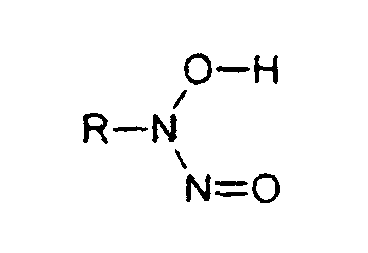
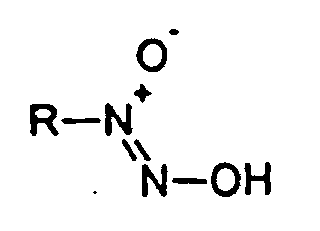
- N-nitrosohydroxylamines can be generally represented by the formula which may be in equilibrium with the tautomeric amine oxide form: wherein each R is independently selected from the group consisting of alkyl, substituted alkyl, aryl and substituted aryl.
- alkyl means straight or branched chain hydrocarbon, typically having 1 to 20 carbon or cyclic hydrocarbon typically having 3 to 20 carbon atoms. Cyclic hydrocarbon includes one or more cyclic hydrocarbon rings. “Substituted alkyl” is alkyl having one or more substituents. "Aryl” means one or more aromatic rings, each of 5 or 6 carbon atoms. Multiple aryl rings may be fused, as in naphthyl or unfused, as in biphenyl. "Substituted aryl” is aryl having one or more substituents.
- Suitable substituents or radicals include, but are not limited to, halo, -OH, -CN, C1-C10 alkyl, C2-C10 alkenyl, C2-C10 alkynyl, C1-C10 alkoxy, C7-C12 aralkyl, C7-C12 alkaryl, C3-C10 cycloalkyl and C3-C10 cycloalkenyl.
- R is aryl, and more preferably phenyl or naphthyl.
- N-nitrosohydroxylamine compounds include without limitation N-nitrosophenylhydroxylamine, N-nitroso-1-napthylhydroxylamine, and the like and mixtures thereof.
- Other specific compounds include N-nitroso-p-chloro-phenylhydroxylamine or the bromo compound.
- salts of the above N-nitrosohydroxylamines which may be used include metal salts.
- Exemplary metal salts include without limitation alkali metal salts, such as potassium or sodium salts; alkali earth metal salts, such as magnesium and calcium salts; Group IIIA salts, such as aluminum salts; Group IVA salts such as tin salts; Group IB salts, such as copper salts; Group VIII salts such as iron, cobalt, and nickel salts; Group IVB salts, such as titanium salts; Group VB salts, such as vanadium salts; Group VIB salts, such as molybdenum salts; Group VIIB salts, such as manganese salts; and mixtures thereof.
- An exemplary salt is N-nitroso-N-phenylhydroxylamine aluminum complex.
- N-nitrosohydroxylamines and salts thereof can be prepared using processes known in the art and/or are commercially available.
- Metal salts of N-nitrosohydroxylamine can be readily prepared through ion-exchange of N-nitrosohydroxylamine or salt thereof with the intended metal.
- NPAL can be prepared by reacting an aluminum salt, such as aluminum sulfate, with N-nitroso-N-phenylhydroxylamine ammonium salt, although other salts, such as halides, phosphates, nitrates, carbonates, and organic acid salts of the metal can also be used.
- stabilized N-nitrosohydroxylamines refers to N-nitrosohydroxylamines which exhibit essentially no or minimal color change when stored at a temperature of 60°C for 90 days. Color change can be determined by measuring the increase in Gardner color of a 5% solution of the sample in toluene.
- the color for stabilized NPAL typically ranges from 1.0 to 4.0 and preferably the color determined using the Gardner Index scale is no greater than about 2.5.
- Unstabilized NPAL held for 90 days at 60°C in a sealed container typically shows an increase in Gardner color of 13 to 15 scale units.
- the stability of the N-nitrosohydroxylamines can also be determined by measuring toluene insolubles after being stored at a temperature of 60°C for 90 days.
- Unstabilized NPAL typically produces 40% to 60% of its original weight in toluene insolubles; whereas, stabilized NPAL typically produces no toluene insolubles.
- the stabilized N-nitrosohydroxylamines of the invention have essentially or substantially no toluene insolubles after being stored at a temperature of 60° for 90 days.
- the N-nitrosohydroxylamines are stabilized in accordance with the present invention using an agent capable of stabilizing the N-nitrosohydroxylamine salt, i.e., an agent suitable for preventing or minimizing color change and/or the formation of insolubles as described above.
- the stabilizing agents can also be defined as agents which are capable of adsorbing, absorbing or otherwise binding water in the atmosphere.
- the stabilizing agents may be capable of absorbing, adsorbing or otherwise binding other vapors. This in turn can protect the N-nitrosohydroxylamine compound, for example, from reacting with water to form the dimer.
- the stabilizing agents may be hygroscopic substances (or desiccants), which are capable of adsorbing moisture or water vapor from the air.
- Exemplary stabilizing agents in accordance with the invention include without limitation molecular sieves, activated carbon, sulfate salts, silica, as well as mixtures thereof.
- any of the types of substances known in the art which are capable of adsorbing and/or absorbing moisture and/or other vapors from the atmosphere in an amount sufficient to stabilize the N-nitrosohydroxylamine salts can be used in accordance with the invention.
- Activated carbon is well known and can be generally described as an amorphous form of carbon characterized by high adsorptivity for many gases, vapors, and colloidal solids.
- the carbon can be obtained by the destructive distillation of wood, nut shells, animal bones or other carbonaceous material.
- the carbon is then activated by heating (for example to a temperature of 800 to 900°C), with steam or carbon dioxide, which results in a porous internal structure.
- Molecular sieves are also well known and can be generally described as a microporous structure comprising either crystalline aluminosilicates, chemically similar to clays and feldspars and belonging to a class of materials known as zeolites, or crystalline aluminophosphates derived for example from mixtures containing an organic amine or quaternary ammonium salts. Pore sizes can vary and typically range from 5 to 10 ⁇ , although sizes outside of this range can also be useful. These materials can undergo dehydration with little or no change in the crystalline structure and the dehydrated crystals are interlaced with regularly spaced channels of molecular dimensions, which can comprise almost 50% of the total volume of the crystals.
- Representative sulfate salts include without limitations sulfate salts selected from the group consisting of calcium sulfate, magnesium sulfate, aluminum sulfate, sodium sulfate, and mixtures thereof.
- the N-nitrosohydroxylamine compound is packaged in the presence of the stabilizer to minimize and/or prevent substantial degradation of the N-nitrosohydroxylamine compound prior to use, i.e., to maintain a dry atmosphere in the N-nitrosohydroxylamine environment (container).
- the stabilizing agent is packaged with the N-nitrosohydroxylamine so that the stabilizing agent can be readily removed from the N-nitrosohydroxylamine.
- the stabilizing agent can itself be packaged in material having a sufficient porosity to allow the passage of atmospheric water but not the stabilizing agent itself, and the package placed in the environment of the N-nitrosohydroxylamine compound so that the stabilizing agent can act to bind water in this environment. Thereafter, the stabilizing agent can be readily removed and the N-nitrosohydroxylamine compound used as desired.
- the resultant package or container of N-nitrosohydroxylamine compound and stabilizing agent can be prepared, shipped and stored for extended periods of time (up to at least three months at ambient temperatures).
- the invention provides economies of manufacture and use of the product because the N-nitrosohydroxylamine does not have to be refrigerated during shipping and storage.
- the shelf life of the product can be extended and less waste can be observed because loss of product resulting from degradation is minimized or eliminated.
- the amount of stabilizing agent used in accordance with the invention can vary, depending upon a variety of factors, such as the nature of the N-nitrosohydroxylamine compound, the stabilizing agent, the water or moisture content of the environment of the N-nitrosohydroxylamine compound, temperature, length of storage, and the like.
- the stabilizing agent can be present in amounts ranging from about 0.1 to about 25% by weight, preferably from 0.5 to 5 % by weight, based on the weight of the N-nitrosohydroxylamine.
- the stabilized N-nitrosohydroxylamine salts are useful as polymerization inhibitors in a variety of polymerization systems, including without limitation free radical, radiation and thermally initiated polymerization systems.
- the stabilized N-nitrosohydroxylamine metal salts can be present in the polymerizable composition in conventional polymerization inhibiting amounts as known in the art.
- typically polymerization systems include one or more ethylenically unsaturated compounds, including monomers, oligomers, and resins.
- Exemplary polymerizable compounds include without limitation monomers and oligomers derived from acrylic and methacrylic acid; unsaturated polyester resins; unsaturated polyurethane resins and unsaturated epoxy resins; The polymerizable compounds are used in amounts known in the art, and are optionally dispersed or dissolved in a suitable solvent that is copolymerizable therewith.
- the polymerization systems also typically include one or more polymerization initiators.
- polymerization initiators include, for example, free radical polymerization initiators such as hydrogen peroxide, the ketone peroxides, diacyl peroxides, the peresters, the perketals, and dialkyl peroxides; radiation polymerization initiators such as benzophenone, thioxanthone and derivatives thereof; and thermal polymerization initiators such as AIBN.
- free radical polymerization initiators such as hydrogen peroxide, the ketone peroxides, diacyl peroxides, the peresters, the perketals, and dialkyl peroxides
- radiation polymerization initiators such as benzophenone, thioxanthone and derivatives thereof
- thermal polymerization initiators such as AIBN.
- the initiators are also used in amounts known in the art.
- Unsaturated polyester resins are known in the art, and may be obtained by reaction of approximately equivalent amounts of a polyvalent alcohol such as ethylene glycol, diethylene glycol, triethylene glycol, trimethylene glycol, propylene glycol, pentaerythritol, and other diols or polyols with an unsaturated dibasic carboxylic acid or carboxylic anhydride such as maleic acid, maleic anhydride, fumaric acid, itaconic acid, or citraconic acid.
- a polyvalent alcohol such as ethylene glycol, diethylene glycol, triethylene glycol, trimethylene glycol, propylene glycol, pentaerythritol, and other diols or polyols
- an unsaturated dibasic carboxylic acid or carboxylic anhydride such as maleic acid, maleic anhydride, fumaric acid, itaconic acid, or citraconic acid.
- unsaturated dibasic carboxylic acids or anhydrides are often used in combination with aromatic and/or saturated aliphatic dicarboxylic acids or the anhydrides derived therefrom, such as phthalic acid, phthalic anhydride, isophthalic acid, tetrachlorophthalic acid, malonic acid, adipic acid, sebacic acid and tartaric acid.
- Unsaturated polyesters containing vinyl groups or vinylidene groups may be obtained by polycondensation of alpha,beta-unsaturated monocarboxylic acids such as acrylic or methacrylic acid, with mono-, di- or polyhydric alcohols.
- Exemplary alcohols include methanol, ethanol, isopropanol, cyclohexanol, phenol, ethylene glycol, propylene glycol, 2,2-bis(4-hydroxyphenyl)propane, 2,2-bis(4-hydroxycyclohexyl)propane, 2,2-bis(4-beta-hydroxyethyloxy-phenyl)propane, pentaerythritol and dimers thereof, trimethol propane and a glycerol, and the complex diols or polyols.
- Unsaturated polyesters containing vinyl groups or vinylidene groups also may be obtained by reacting alpha,beta-unsaturated monocarboxylic acids with compounds containing epoxy groups, such as bisphenol A bis(glycidyl ether).
- polyurethane resins are also known in the art and may be obtained by reaction of a polyisocyanate, such as toluene diisocyanate, diphenylmethane diisocyanate and hexamethylene diisocyanate, with an appropriate compound containing at least two active hydrogen atoms, such as a polyol or a polyamine.
- a polyisocyanate such as toluene diisocyanate, diphenylmethane diisocyanate and hexamethylene diisocyanate
- an appropriate compound containing at least two active hydrogen atoms such as a polyol or a polyamine.
- Exemplary polyols include ethylene glycol, diethylene glycol, triethylene glycol, trimethylene glycol, propylene glycol, pentaerythritol, and other diols or polyols.
- Urethane polymers may be used in the form of homopolymers or, more preferably, with various other monomers which
- urethane polymers can be prepared by reacting any of a variety of acrylic comonomers, such as acrylic and methacrylic acids, and their amides, esters, salts and corresponding nitriles, with the polyurethane resin.
- acrylic comonomers such as acrylic and methacrylic acids, and their amides, esters, salts and corresponding nitriles
- Particularly suitable comonomers for such polymers are methyl methacrylate, ethyl acrylate and acrylonitrile.
- Unsaturated epoxy resins known in the art include those obtained by reaction of an epoxide group (resulting from the union of an oxygen atom with two other atoms, usually carbon), such as epichlorohydrin, oxidized polyolefins, for example ethylene oxide, with an aliphatic or aromatic alcohol such as bisphenol A, glycerol, etc.
- the epoxy resins may be used in the form of homopolymers or copolymers with various other comonomers which can be reacted therewith, including various acrylic monomers, such as acrylic and methacrylic acids, and their amides, esters, salts and corresponding nitriles.
- Exemplary monomers and oligomers derived from acrylic and methacrylic acid include acrylic and methacrylic acids, and their amides, esters, salts and corresponding nitrites. Examples include, but are not limited to, methyl acrylate, ethyl acrylate, n- or tert-butylacrylate, isooctyl acrylate, methyl methacrylate, ethylmethacrylate, 2-ethylhexyl methacrylate, butylacrylate, isobutyl methacrylate, the corresponding acrylates, i.e., hydroxy ethylacrylate, hydroxy propylacrylate, hydroxy ethylhexyl methacrylate, glycol acrylates, i.e., ethylene glycol dimethacrylate, hexamethylene glycol dimethacrylate, the allyl acrylates, i.e., allyl methacrylate, diallyl meth
- ethylenically unsaturated or vinyl monomers such as vinyl acetate, vinyl and vinylidene halides and amides, i.e., methacrylamide, acrylamide, diacetone acrylamide, vinyl and vinylidene esters, vinyl and vinylidene ethers, vinyl and vinylidene ketones, olefins, and in particular conjugated diolefins such as butadiene, isoprene, piperylene and 2,3-dimethyl butadiene, vinyl aromatics, i.e., styrene, alkyl styrenes, halostyrenes, alkoxystyrenes, divinyl benzenes and vinyl toluene are also included.
- Prepolymers include acrylated epoxides, polyesters and polyurethanes, as described above, and are typically combined with a suitable monomer for viscosity control.
- the polymerizable compositions may also contain other conventional agents, such as polymerization inhibitors, fillers, ultraviolet absorbers, organic peroxides, dyes and pigments.
- the polymerizable compositions can be applied or deposited on a surface of a substrate using conventional techniques and apparatus.
- the substrate to be coated can be, for example, metal, wood, mineral, glass, paper, plastic, fabric and ceramic.
- the composition can be applied as a substantially continuous film. Alternatively, the composition can be applied in a discontinuous pattern.
- the thickness of the deposited composition can vary, depending upon the desired thickness of the resultant cured product. Polymerization can be initiated as known in the art, for example, by exposure to radiation (ultraviolet, electron beam) or heat.
- a 1.50 gram weighed sample of NPAL stabilized by storage in the presence of a stabilizing agent as noted in the table below is placed in a 125 mL Erlenmeyer flask. and 28.5 grams of toluene is added. The flask is stoppered and swirled until the solid NPAL dissolves to produce a 5% solution. The solution appears light yellow and clear which indicates no insolubles are present. An aliquot of the solution is placed into a 10mm sample cell of a calibrated Hunter Lab Color Quest II instrument and a measurement taken resulting in a Gardner color of 2.2. Alternatively, a less precise measurement of Gardner color can be done by visual comparison of the sample in a 10mm tube against a standard set of Gardner color 10 mm tubes. Using this method a Gardner color of 2 is obtained.
Landscapes
- Chemical & Material Sciences (AREA)
- Organic Chemistry (AREA)
- Health & Medical Sciences (AREA)
- Chemical Kinetics & Catalysis (AREA)
- Medicinal Chemistry (AREA)
- Polymers & Plastics (AREA)
- Organic Low-Molecular-Weight Compounds And Preparation Thereof (AREA)
Description

| 90 Day Storage Results of Stabilized vs. Unstabilized NPAL | |||
| NPAL Sample Description | Appearance of 5 wt% solution | Toluene Insolubles as % ofNPAL wt. | Gardner Color of 5% toluene sol'n. |
| Initial sample before storage | Clear, light yellow | 0 | 2.2 |
| Stored at 60°C for 90 days in closed vial w/o stabilizer | Cloudy, dark brown | 60% | 15.4 |
| Stored at 60°C for 90 days in closed vial with 20wt% molecular sieves | Clear, light yellow | 0 | 2.2 |
| Stored at 60°C for 90 days in closed vial with 5wt% molecular sieves | Clear, light yellow | 0 | 2.0 |
| Stored at 60°C for 90 days in closed vial with 1 wt% molecular sieves | Clear, light yellow | 0 | 2.4 |
| Stored at 60°C for 90 days in closed vial with 20wt% powdered carbon | Clear, light yellow | 0 | 2.0 |
| Stored at 60°C for 90 days in closed vial with 20wt% granular carbon | Clear, light yellow | 0 | 2.1 |
Claims (15)
- A stabilized N-nitrosohydroxylamine comprising at least one N-nitrosohydroxylamine in the presence of at least one stabilizing agent capable of binding vapors, and wherein said stabilized N-nitrosohydroxylamine exhibits a Gardner Index color of no greater than 4 after being stored at a temperature of 60°C for 90 days.
- The stabilized N-nitrosohydroxylamine of Claim 1, wherein said stabilizing agent comprising a hygroscopic substance capable of adsorbing moisture.
- The stabilized N-nitrosohydroxylamine of any of Claims 1 to 2, wherein said stabilized N-nitrosohydroxylamine exhibits a Gardner Index color of no greater than 2.5 after being stored at a temperature of 60°C for 90 days.
- The stabilized N-nitrosohydroxylamine of any of Claim 1 to 3, wherein said stabilized N-nitrosohydroxylamine has essentially no toluene insolubles after being stored at a temperature of 60° for 90 days.
- The stabilized N-nitrosohydroxylamine of any of Claims 1 to 4, wherein said N-nitrosohydroxylamine comprises a metallic complex of N-nitrosohydroxylamines.
- The stabilized N-nitrosohydroxylamine of Claim 5, wherein said N-nitrosohydroxylamine comprises at least one metal salt of N-nitrosohydroxylamine of the formulawherein:
 each R is independently selected from the group consisting of alkyl, substituted alkyl, aryl and substituted aryl;M is a metal; anda is 1 to 4.
 - The stabilized N-nitrosohydroxylamine of Claim 6, wherein M is a metal selected from the group consisting of alkali metal, alkali earth metals, Group IIIA metals, Group IVA metals, Group IB metals, Group VIII metals, Group IVB metals, Group VB metals, Group VIB metals, and Group VIIB metals.
- The stabilized N-nitrosohydroxylamine of Claim 7, wherein M is aluminum and R is aryl or substituted aryl.
- The stabilized N-nitrosohydroxylamine of any of Claims 1 to 8, wherein said stabilizing agent comprises at least one agent selected from the group consisting of molecular sieves, activated carbon, sulfate salts, silica and mixtures thereof.
- The stabilized N-nitrosohydroxylamine of Claim 9, wherein said stabilizing agent comprises a molecular sieve.
- The stabilized N-nitrosohydroxylamine of any of Claims 1 to 10, wherein said stabilizing agent is present in an amount ranging from 0.1% to 25% by weight based on the weight of said N-nitrosohydroxylamine.
- The stabilized N-nitrosohydroxylamine of Claim 11, wherein said stabilizing agent is present in an amount ranging from 0.5% to 5% by weight based on the weight of said N-nitrosohydroxylamine
- A container of stabilized N-nitrosohydroxylamine, comprising at least one N-nitrosohydroxylamine and at least one stabilizing agent capable of binding vapors as recited in any of Claims 1 to 12 placed in a container.
- The container of Claim 13, further comprising a separate porous container therein in which said at least one stabilizing agent is placed.
- A process for stabilizing N-nitrosohydroxylamine, comprising placing N-nitrosohydroxylamine in the presence of at least one stabilizing agent capable of binding vapors, as recited in any of Claims 1-12.
Applications Claiming Priority (3)
| Application Number | Priority Date | Filing Date | Title |
|---|---|---|---|
| US338786 | 1999-06-23 | ||
| US09/338,786 US6018078A (en) | 1999-06-23 | 1999-06-23 | Stabilized N-nitrosohydroxylamines |
| PCT/US2000/016058 WO2000078711A1 (en) | 1999-06-23 | 2000-06-12 | Stabilization of n-nitrosohydroxylamines by use of absorptive material |
Publications (2)
| Publication Number | Publication Date |
|---|---|
| EP1185504A1 EP1185504A1 (en) | 2002-03-13 |
| EP1185504B1 true EP1185504B1 (en) | 2005-05-18 |
Family
ID=23326165
Family Applications (1)
| Application Number | Title | Priority Date | Filing Date |
|---|---|---|---|
| EP00941344A Expired - Lifetime EP1185504B1 (en) | 1999-06-23 | 2000-06-12 | Stabilization of n-nitrosohydroxylamines by use of absorptive material |
Country Status (9)
| Country | Link |
|---|---|
| US (1) | US6018078A (en) |
| EP (1) | EP1185504B1 (en) |
| JP (1) | JP4870298B2 (en) |
| CN (1) | CN1241905C (en) |
| AU (1) | AU5605900A (en) |
| CA (1) | CA2375324C (en) |
| DE (1) | DE60020229T2 (en) |
| ES (1) | ES2241618T3 (en) |
| WO (1) | WO2000078711A1 (en) |
Families Citing this family (7)
| Publication number | Priority date | Publication date | Assignee | Title |
|---|---|---|---|---|
| US6350520B1 (en) | 1998-08-26 | 2002-02-26 | Reticle, Inc. | Consolidated amorphous carbon materials, their manufacture and use |
| JP2006290764A (en) * | 2005-04-07 | 2006-10-26 | Teruo Kutsuma | N-nitroso-n-phenylhydroxylamine aluminum salt crystal and method for producing the same |
| US20070066842A1 (en) * | 2005-09-19 | 2007-03-22 | Albemarle Corporation | Polymerization Inhibitor Compositions, Their Preparation, and Their Use |
| WO2008060844A1 (en) * | 2006-11-09 | 2008-05-22 | Albemarle Corporation | Polymerization inhibitor compositions, their preparation, and their use |
| CN102399310B (en) * | 2010-09-09 | 2013-07-24 | 通用电气公司 | Composition and method used for inhibiting premature polymerization |
| WO2014099236A1 (en) | 2012-12-18 | 2014-06-26 | Rohm And Haas Company | Method for reliable inhibitor delivery |
| JP2014218462A (en) * | 2013-05-08 | 2014-11-20 | 株式会社片山化学工業研究所 | Composition for inhibiting polymerization of vinyl aromatic monomer |
Family Cites Families (10)
| Publication number | Priority date | Publication date | Assignee | Title |
|---|---|---|---|---|
| US3426063A (en) * | 1964-09-10 | 1969-02-04 | Copolymer Rubber & Chem Corp | Inhibiting thermal polymerization and the growth of popcorn polymer |
| DE2420874C2 (en) * | 1974-04-30 | 1983-04-21 | Basf Ag, 6700 Ludwigshafen | Process for the preparation of the aluminum salts of N-nitroso-N-alkyl-hydroxylamines |
| US4638079A (en) * | 1985-01-17 | 1987-01-20 | Mallinckrodt, Inc. | Inhibiting polymerization of ethylenically unsaturated monomers |
| US4772740A (en) * | 1985-03-05 | 1988-09-20 | Mallinckrodt, Inc. | Ethanolamine salt of N-Nitrosophenylhydroxylamine and inhibiting polymerization therewith |
| US4898976A (en) * | 1985-03-05 | 1990-02-06 | Mallinckrodt, Inc. | Method of making the ethanolamine salt of N-nitrosophenylhydroxylamine |
| US4692544A (en) * | 1985-08-23 | 1987-09-08 | Sandoz Ltd. | Inhibiting polymerization of ethylenically unsaturated monomers |
| US5034156A (en) * | 1988-04-18 | 1991-07-23 | Mallinckrodt Specialty Chemicals Company | Method for inhibiting the polymerization of acrylic acid |
| JP2722100B2 (en) * | 1989-01-17 | 1998-03-04 | サン・アロー化学株式会社 | Method for producing scale adhesion inhibitor |
| US5262569A (en) * | 1991-07-17 | 1993-11-16 | Rohm And Haas Company | Salts of N-nitrosophenylhydroxylamine |
| GB2306169B (en) * | 1995-10-13 | 2000-01-12 | Eastman Kodak Co | Zeolite molecular sieves for packaging structures |
-
1999
- 1999-06-23 US US09/338,786 patent/US6018078A/en not_active Expired - Lifetime
-
2000
- 2000-06-12 DE DE60020229T patent/DE60020229T2/en not_active Expired - Lifetime
- 2000-06-12 CN CN00809275.3A patent/CN1241905C/en not_active Expired - Fee Related
- 2000-06-12 EP EP00941344A patent/EP1185504B1/en not_active Expired - Lifetime
- 2000-06-12 JP JP2001504880A patent/JP4870298B2/en not_active Expired - Fee Related
- 2000-06-12 CA CA002375324A patent/CA2375324C/en not_active Expired - Lifetime
- 2000-06-12 AU AU56059/00A patent/AU5605900A/en not_active Abandoned
- 2000-06-12 WO PCT/US2000/016058 patent/WO2000078711A1/en not_active Ceased
- 2000-06-12 ES ES00941344T patent/ES2241618T3/en not_active Expired - Lifetime
Also Published As
| Publication number | Publication date |
|---|---|
| CN1241905C (en) | 2006-02-15 |
| US6018078A (en) | 2000-01-25 |
| CA2375324A1 (en) | 2000-12-28 |
| WO2000078711A1 (en) | 2000-12-28 |
| AU5605900A (en) | 2001-01-09 |
| CA2375324C (en) | 2008-01-29 |
| CN1356978A (en) | 2002-07-03 |
| EP1185504A1 (en) | 2002-03-13 |
| DE60020229T2 (en) | 2006-01-26 |
| ES2241618T3 (en) | 2005-11-01 |
| JP4870298B2 (en) | 2012-02-08 |
| DE60020229D1 (en) | 2005-06-23 |
| JP2003502402A (en) | 2003-01-21 |
Similar Documents
| Publication | Publication Date | Title |
|---|---|---|
| US6139770A (en) | Photoinitiators and oxygen scavenging compositions | |
| US6018078A (en) | Stabilized N-nitrosohydroxylamines | |
| US2629649A (en) | Vapor-phase corrosion inhibitor | |
| GB2492284A (en) | Cyclodextrin compositions, articles and methods | |
| EP0943674B1 (en) | Oxygen absorbent composition | |
| US20100056739A1 (en) | Transportation of a Monomer Composition in a Transport Means or Pipe | |
| JPS6057442B2 (en) | Photopolymerizable composition | |
| US4080275A (en) | Photopolymerizable benzoyl benzoate compositions | |
| US3696050A (en) | Polymerization inhibitors for vinyl monomers and unsaturated polyesters | |
| US3003991A (en) | Composition comprising an unsaturated polyester, a substance containing at least one ch2=c< group, a vanadium compound and benzene phosphinic acid, and method of curing same | |
| US6040488A (en) | Stabilization of vinylidene chloride | |
| JP2023053289A5 (en) | ||
| EP1441003A1 (en) | Unsaturated polyester resin compositions with improved processing and storage stability | |
| US4389285A (en) | Process inhibitor for readily polymerizable ethylenically unsaturated aromatic compounds | |
| JPS60202834A (en) | Polymerization inhibiting composition for vinylaromatic monomer and polymerization inhibition | |
| JPH06509367A (en) | Compositions containing olefinically unsaturated compounds and hydrazones | |
| JPH05509354A (en) | Prohibition of popcorn polymer formation by esters of inorganic acids | |
| US4211722A (en) | Formaldehyde stabilization of acrylonitrile against color | |
| JPS5941971B2 (en) | Method for inhibiting polymerization of aromatic vinyl compounds | |
| JPS59164735A (en) | 2,3-dichlorobutadiene-1,3 composition having improved storage stability | |
| NZ512080A (en) | Photoinitiators and oxygen scavenging compositions | |
| JPH072077B2 (en) | Packaging material for keeping freshness | |
| WO2000014175A1 (en) | Chemical compositions | |
| WO2004076545A1 (en) | Absorbent material for use in humid conditions | |
| SE202424C1 (en) |
Legal Events
| Date | Code | Title | Description |
|---|---|---|---|
| PUAI | Public reference made under article 153(3) epc to a published international application that has entered the european phase |
Free format text: ORIGINAL CODE: 0009012 |
|
| 17P | Request for examination filed |
Effective date: 20011214 |
|
| AK | Designated contracting states |
Kind code of ref document: A1 Designated state(s): AT BE CH CY DE DK ES FI FR GB GR IE IT LI LU MC NL PT SE |
|
| AX | Request for extension of the european patent |
Free format text: AL;LT;LV;MK;RO;SI |
|
| 17Q | First examination report despatched |
Effective date: 20030409 |
|
| RBV | Designated contracting states (corrected) |
Designated state(s): DE ES FR GB IT |
|
| GRAP | Despatch of communication of intention to grant a patent |
Free format text: ORIGINAL CODE: EPIDOSNIGR1 |
|
| GRAS | Grant fee paid |
Free format text: ORIGINAL CODE: EPIDOSNIGR3 |
|
| GRAA | (expected) grant |
Free format text: ORIGINAL CODE: 0009210 |
|
| AK | Designated contracting states |
Kind code of ref document: B1 Designated state(s): DE ES FR GB IT |
|
| REG | Reference to a national code |
Ref country code: GB Ref legal event code: FG4D |
|
| REG | Reference to a national code |
Ref country code: IE Ref legal event code: FG4D |
|
| REF | Corresponds to: |
Ref document number: 60020229 Country of ref document: DE Date of ref document: 20050623 Kind code of ref document: P |
|
| REG | Reference to a national code |
Ref country code: ES Ref legal event code: FG2A Ref document number: 2241618 Country of ref document: ES Kind code of ref document: T3 |
|
| ET | Fr: translation filed | ||
| PLBE | No opposition filed within time limit |
Free format text: ORIGINAL CODE: 0009261 |
|
| STAA | Information on the status of an ep patent application or granted ep patent |
Free format text: STATUS: NO OPPOSITION FILED WITHIN TIME LIMIT |
|
| 26N | No opposition filed |
Effective date: 20060221 |
|
| GBPC | Gb: european patent ceased through non-payment of renewal fee |
Effective date: 20090612 |
|
| REG | Reference to a national code |
Ref country code: FR Ref legal event code: ST Effective date: 20100226 |
|
| REG | Reference to a national code |
Ref country code: GB Ref legal event code: S28 Free format text: APPLICATION FILED |
|
| PG25 | Lapsed in a contracting state [announced via postgrant information from national office to epo] |
Ref country code: FR Free format text: LAPSE BECAUSE OF NON-PAYMENT OF DUE FEES Effective date: 20090630 |
|
| REG | Reference to a national code |
Ref country code: FR Ref legal event code: RN |
|
| PG25 | Lapsed in a contracting state [announced via postgrant information from national office to epo] |
Ref country code: GB Free format text: LAPSE BECAUSE OF NON-PAYMENT OF DUE FEES Effective date: 20090612 |
|
| PG25 | Lapsed in a contracting state [announced via postgrant information from national office to epo] |
Ref country code: DE Free format text: LAPSE BECAUSE OF NON-PAYMENT OF DUE FEES Effective date: 20100101 |
|
| REG | Reference to a national code |
Ref country code: FR Ref legal event code: FC |
|
| PGRI | Patent reinstated in contracting state [announced from national office to epo] |
Ref country code: DE Effective date: 20100504 Ref country code: FR Effective date: 20100621 |
|
| REG | Reference to a national code |
Ref country code: GB Ref legal event code: S28 Free format text: RESTORATION ALLOWED Effective date: 20100708 |
|
| PGFP | Annual fee paid to national office [announced via postgrant information from national office to epo] |
Ref country code: IT Payment date: 20140625 Year of fee payment: 15 |
|
| PG25 | Lapsed in a contracting state [announced via postgrant information from national office to epo] |
Ref country code: IT Free format text: LAPSE BECAUSE OF NON-PAYMENT OF DUE FEES Effective date: 20150612 |
|
| REG | Reference to a national code |
Ref country code: FR Ref legal event code: PLFP Year of fee payment: 17 |
|
| REG | Reference to a national code |
Ref country code: FR Ref legal event code: PLFP Year of fee payment: 18 |
|
| REG | Reference to a national code |
Ref country code: FR Ref legal event code: PLFP Year of fee payment: 19 |
|
| PGFP | Annual fee paid to national office [announced via postgrant information from national office to epo] |
Ref country code: FR Payment date: 20180626 Year of fee payment: 19 |
|
| PGFP | Annual fee paid to national office [announced via postgrant information from national office to epo] |
Ref country code: ES Payment date: 20180702 Year of fee payment: 19 Ref country code: GB Payment date: 20180627 Year of fee payment: 19 Ref country code: DE Payment date: 20180627 Year of fee payment: 19 |
|
| REG | Reference to a national code |
Ref country code: DE Ref legal event code: R119 Ref document number: 60020229 Country of ref document: DE |
|
| GBPC | Gb: european patent ceased through non-payment of renewal fee |
Effective date: 20190612 |
|
| PG25 | Lapsed in a contracting state [announced via postgrant information from national office to epo] |
Ref country code: GB Free format text: LAPSE BECAUSE OF NON-PAYMENT OF DUE FEES Effective date: 20190612 |
|
| PG25 | Lapsed in a contracting state [announced via postgrant information from national office to epo] |
Ref country code: DE Free format text: LAPSE BECAUSE OF NON-PAYMENT OF DUE FEES Effective date: 20200101 Ref country code: FR Free format text: LAPSE BECAUSE OF NON-PAYMENT OF DUE FEES Effective date: 20190630 |
|
| REG | Reference to a national code |
Ref country code: ES Ref legal event code: FD2A Effective date: 20201028 |
|
| PG25 | Lapsed in a contracting state [announced via postgrant information from national office to epo] |
Ref country code: ES Free format text: LAPSE BECAUSE OF NON-PAYMENT OF DUE FEES Effective date: 20190613 |