EP1185130A2 - A medium access control (MAC) protocol with seamless polling/contention modes - Google Patents
A medium access control (MAC) protocol with seamless polling/contention modes Download PDFInfo
- Publication number
- EP1185130A2 EP1185130A2 EP01307017A EP01307017A EP1185130A2 EP 1185130 A2 EP1185130 A2 EP 1185130A2 EP 01307017 A EP01307017 A EP 01307017A EP 01307017 A EP01307017 A EP 01307017A EP 1185130 A2 EP1185130 A2 EP 1185130A2
- Authority
- EP
- European Patent Office
- Prior art keywords
- users
- subgroup
- contention
- user
- subgroups
- Prior art date
- Legal status (The legal status is an assumption and is not a legal conclusion. Google has not performed a legal analysis and makes no representation as to the accuracy of the status listed.)
- Withdrawn
Links
Images

Classifications
-
- H—ELECTRICITY
- H04—ELECTRIC COMMUNICATION TECHNIQUE
- H04W—WIRELESS COMMUNICATION NETWORKS
- H04W74/00—Wireless channel access
- H04W74/02—Hybrid access
-
- H—ELECTRICITY
- H04—ELECTRIC COMMUNICATION TECHNIQUE
- H04Q—SELECTING
- H04Q11/00—Selecting arrangements for multiplex systems
- H04Q11/04—Selecting arrangements for multiplex systems for time-division multiplexing
- H04Q11/0421—Circuit arrangements therefor
-
- H—ELECTRICITY
- H04—ELECTRIC COMMUNICATION TECHNIQUE
- H04Q—SELECTING
- H04Q11/00—Selecting arrangements for multiplex systems
- H04Q11/04—Selecting arrangements for multiplex systems for time-division multiplexing
- H04Q11/0428—Integrated services digital network, i.e. systems for transmission of different types of digitised signals, e.g. speech, data, telecentral, television signals
- H04Q11/0478—Provisions for broadband connections
-
- H—ELECTRICITY
- H04—ELECTRIC COMMUNICATION TECHNIQUE
- H04L—TRANSMISSION OF DIGITAL INFORMATION, e.g. TELEGRAPHIC COMMUNICATION
- H04L12/00—Data switching networks
- H04L12/54—Store-and-forward switching systems
- H04L12/56—Packet switching systems
- H04L12/5601—Transfer mode dependent, e.g. ATM
- H04L2012/5603—Access techniques
- H04L2012/5604—Medium of transmission, e.g. fibre, cable, radio
- H04L2012/5607—Radio
-
- H—ELECTRICITY
- H04—ELECTRIC COMMUNICATION TECHNIQUE
- H04L—TRANSMISSION OF DIGITAL INFORMATION, e.g. TELEGRAPHIC COMMUNICATION
- H04L12/00—Data switching networks
- H04L12/54—Store-and-forward switching systems
- H04L12/56—Packet switching systems
- H04L12/5601—Transfer mode dependent, e.g. ATM
- H04L2012/5603—Access techniques
- H04L2012/5609—Topology
- H04L2012/561—Star, e.g. cross-connect, concentrator, subscriber group equipment, remote electronics
-
- H—ELECTRICITY
- H04—ELECTRIC COMMUNICATION TECHNIQUE
- H04L—TRANSMISSION OF DIGITAL INFORMATION, e.g. TELEGRAPHIC COMMUNICATION
- H04L12/00—Data switching networks
- H04L12/54—Store-and-forward switching systems
- H04L12/56—Packet switching systems
- H04L12/5601—Transfer mode dependent, e.g. ATM
- H04L2012/5678—Traffic aspects, e.g. arbitration, load balancing, smoothing, buffer management
- H04L2012/5679—Arbitration or scheduling
-
- H—ELECTRICITY
- H04—ELECTRIC COMMUNICATION TECHNIQUE
- H04W—WIRELESS COMMUNICATION NETWORKS
- H04W74/00—Wireless channel access
- H04W74/04—Scheduled access
- H04W74/06—Scheduled access using polling
-
- H—ELECTRICITY
- H04—ELECTRIC COMMUNICATION TECHNIQUE
- H04W—WIRELESS COMMUNICATION NETWORKS
- H04W8/00—Network data management
Definitions
- This invention relates to the field of high speed wireless networks. More particularly, this invention relates to the field of implementing a Medium Access Control (MAC) to coordinate transmission from End User Nodes (EUNs) to a transmission Hub to achieve high performance in an asynchronous transfer mode (ATM) cell.
- MAC Medium Access Control
- EUNs End User Nodes
- ATM asynchronous transfer mode
- the general structure of a high speed wireless network utilizes a central Hub and a number of End User Nodes (EUNs).
- the basic operating unit of the system is a cell, where the Hub is located at the center of the cell and the EUNs are distributed within the coverage range of the Hub.
- the communication channel is a broadcasting channel. In other words, any signal sent by the Hub is received by every EUN in the system.
- each EUN transmission is a unicast heard only by the Hub.
- the EUNs are not configured to receive transmissions from other EUNs.
- the upstream communication channel is shared by many EUNs using one of two types of access systems.
- a first access system is known as a time division multiple access (TDMA) based system is one in which all the EUNs transmit using the same frequency, but avoid colliding by transmitting at different times.
- a second access system is called a frequency division multiple access (FDMA) system is one in which each EUN has a separate frequency assignment to avoid collision when coordinating transmission.
- TDMA time division multiple access
- FDMA frequency division multiple access
- the downstream signal is transmitted at a different carrier frequency than the upstream signal.
- both channels have the same bandwidth.
- the Hub executes a one time ranging operation. Ranging determines the distance between each EUN and the Hub. An EUN which is far from the Hub must transmit faster than an EUN which is near to the Hub. After the ranging is complete, the EUNs are accordingly aligned by the Hub in time slots from the frame of reference of the Hub.
- the Hub may utilize one of two main coordinating modes.
- a contention mode is utilized to coordinate transmission when there is a relatively small number of EUNs in the system trying to capture the upstream bandwidth.
- a request and grant, or piggybacking mode is used.
- the Hub broadcasts which EUNs are eligible to contend for a particular time slot. Each contending EUN will then answer the broadcast if that particular EUN wishes to transmit. This mode is particularly useful when there is a relatively small amount of EUNs in the system, or when idle EUNs require a route to request grants quickly.
- the request and grant, or piggybacking mode functions oppositely of the contention mode.
- each individual EUN that wishes to transmit will unicast a request for a time slot from the Hub.
- the Hub will then broadcast a time slot grant signal to every EUN.
- each individual EUN will receive the signal and will recognize whether it, or another EUN is receiving a time slot grant.
- These grants will assign EUNs to time slots based on bandwidth availability. This mode is most effective when there are a large number of EUNs transmitting continuously.
- a MAC In the case of a TDMA system, because all of the upstream EUN transmissions are sharing a frequency bandwidth, a MAC is needed to coordinate or assign time slots so that transmission in the upstream direction is not garbled. In other words, a MAC is needed to ensure that two EUNs are not transmitting at the same time.
- the present invention is a method of coordinating slotted multiple access in a wireless network channel shared by a plurality of users.
- the present invention utilizes a polling mode, a contention mode and a seamless transition between the polling and contention modes to coordinate user transmission.
- the present invention performs these operations by assigning each of the plurality of users an address from a pool which contains 2 k addresses.
- the address pool is then split into 2 x subgroups and only users belonging to a specific subgroup at any transmission opportunity are allowed to transmit.
- x could be any number from 0 to k.
- the seamless transition between the two modes occurs by changing the X parameter.
- the basis for transmission of broadband information in this type of high speed wireless network is asynchronous transfer mode (ATM).
- ATM Cube may be considered in terms of a traditional stack configuration as depicted in Figure 1. More specifically, the Hub receives ATM cells from a back-haul network and delivers them in a special format to the EUNs.
- an EUN receives ATM cells from its subscribers or converts legacy interfaces to ATM and delivers these ATM cells in a special format to the Hub.
- the Hub recovers the ATM cells from the upstream signals and delivers them to the back-haul network.
- any ATM system may be considered in terms of the traditional layered protocol stack (Fig. 1).
- the ATM Layer(10) is responsible for delivery of data across multiple physical connections.
- the ATM Adaption Layers (AALs)(12) and applications operate above the ATM Layer(10) Below the Network Layer, the ATM specification refers to a Physical Layer(PHY)(18).
- An ATM's PHY(18) consists of the Transmission Convergence (TC) Sub-Layer(14) and the Physical Medium (PM).
- TC Transmission Convergence
- PM Physical Medium
- the TC is the Data Link Layer (DLL)(16) and the PHY(18) combined.
- the DLL(16) is typically broken down into two sub-layers, a Logical Link Control (LLC), which interfaces to the network, and a MAC which interfaces to the PHY(18).
- LLC Logical Link Control
- an ATM system is also divided into vertical planes, which provide similar services in all protocol layers. These planes are the control, user, and management planes.
- the User Plane(22) is responsible for carrying data, including control and management information, across those connections and for performing functions such as flow control.
- the Control Plane(20) is responsible for performing call control and connection control functions.
- the Management Plane(24) is responsible for resource allocation, error and fault reporting, operation and maintenance (OAM) information flows, and any parameters associated with a given layer.
- OAM operation and maintenance
- an overall Layer Management(26) spans all layers and is responsible for the coordination of the entire system.
- the preferred embodiment of the present method starts by assigning each user a distinct address from an address pool consisting of 2 k addresses, where 2 k is the maximal number of users within one channel.
- a centralized controller allows only the users belonging to a specific subgroup to transmit.
- X could be any number ranging from 0 to K depending on the current system loading.
- each subgroup contains only one user. By definition, this becomes a polling mode.
- X is between 0 and K, each subgroup with active users is polled one at a time, and contention could occur within each subgroup.
- This embodiment can seemlessly shift from the polling mode to the contention mode by changing the parameter X.
- the preferred embodiment of the present method assigns each physical EUN a unique 6-byte physical identification that is used during sign-on. Thereafter, it is assigned a logical EUN_ID from 1 to 254 (i.e. 0000_0001 to 1111_1110).
- the EUN_ID is changeable on the fly and a physical EUN may be assigned multiple EUN_IDs in order to allow it to have more than 256 Virtual Circuits (VCs).
- the link address is a 16 bit number, broken down into an 8 bit EUN_ID, with an 8 bit sub-address. These bits can be used to specify a null, unicast or multicast/broadcast addresses.
- multicast addressing is used for sending control messages and to assign contention slots.
- the multicast addresses use an EUN_ID of 255 (1111_1111).
- This form of addressing uses the 8 bit sub-addresses to specify a group of EUNs. As shown in Figure 2, a group may consist of all EUNs down to a specific EUN.
- the upstream air interface of the preferred embodiment uses TDMA. Individual upstream slots are assigned to a specific VC in a specific EUN. Contention timeslots are assigned to a group of BUNs, using the multicast addressing mode. Since there is no retry mechanism, only cell requests may be transmitted in contention slots.
- Each request includes of an 8 bit link layer connection (VCI) address (i.e. a link address without the EUN_ID, which would be the same as that in the Link Address field), and an 8 bit length field, indicating the number of cells which are currently queued at the EUN. Because the actual length is transmitted, the effects of a lost or duplicated request are minimized.
- VCI link layer connection
- the preferred embodiment of the invention also provides a contention mechanism to allow the EUN to notify the Hub of pending traffic. It is anticipated that the majority of the requests will be carried in normal MAC cells (piggybacking), but the contention mechanism provides a route for idle EUNs to request grants quickly. An upstream contention slot will be announced to all EUNs via a grant from the Hub using the multicast addressing mode, which indicates the group of EUNs that may contend.
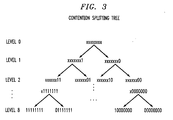
- the preferred embodiment of the present invention is depicted in Figure 3 and is configured to resolve any collisions in a contention slot.
- a splitting tree algorithm is used in the collision avoidance.
- the Hub may start the contention process at the root of the splitting tree (level 0) by sending a multicasting grant downstream.
- the multicasting grant allows all EUNs to send requests in the indicated contention slot. If a collision occurs in the allocated time slot, the Hub shall split the original group into two groups (level 1). Any convenient division may be used, for example one group could be for odd-numbered EUNs and another group for even-numbered EUNs.
- the Hub will then divide the tree into one-half again, for example for the odd-numbered group, one half the group could have all numbers with an odd in the least significant bit and the odd in the next least significant bit.
- the Hub assigns a future contention slot to each group.
- the splitting process ends when no collision is detected, or only two EUNs remain in the group. If two EUNs contend, they are polled individually. Once a single EUN is determined, an "end of contention cycle" signal is then transmitted.
- the Hub is configured to detect an amount of received power.
- the amount of received power is indicative, but not determinative of the number EUNs involved in a collision.
- the Hub can selectively choose to begin splitting the tree at any level. Under certain circumstances this can reduce the amount of time necessary to identify a particular contending EUN.
- the preferred embodiment of the present invention follows a protocol in which an EUN may chooses to send or not to send requests in contention time slots addressed to that EUN.
- An EUN must not send any cell in contention time slots where the EUN is not addressed.
- the Hub may start the splitting tree contention process at any level.
- the Hub must split a grant into two whenever there is a collision in the corresponding allocated contention time slot.
- the Hub must stop splitting a grant whenever there is no collision in the corresponding allocated contention time slot.
- MAC continuously selecting cells to transmit in the downstream direction and assign upstream slots to specific VCs at specific EUNs.
- the downstream direction is straightforward, being very similar to existing wireline ATM systems.
- WFQ Weighted Fair Queue
- CBR Constant Bit Rate
- Allocating the upstream bandwidth in the preferred embodiment is significantly more complicated.
- Each EUN sends requests to the Hub for specific VCs, which are carried with other upstream cells or vial the contention mechanism.
- the Hub takes these requests and converts them into pseudo cells, which are input to an ATM scheduler.
- the Hub also predicts the arrival of CBR traffic, and generates pseudo cells for them automatically.
- the Hub examines the virtual cell selected by the scheduler and grants an assignment to the corresponding VC at the appropriate EUN. Normally, requests are carried with other traffic in the request fields of upstream MAC cells.
- a contention mechanism is provided to significantly reduce latency when an otherwise idle EUN receives cells to transmit upstream.
- the sign-on procedure of the preferred embodiment is used by an EUN to establish initial ranging and power adjustments and establish a MAC level connection with the Hub and is a variation of the standard ranging process as described in [Survey of Ranging and Calibration Algorithms, KA].
- the DLL performs authentication of the newly connected EUN and VCs.
- a standard sign-off procedure is provided to allow the Hub or a local operator to gracefully terminate an EUN's connection.
- a mechanism for detecting connection loss due to extreme RF conditions and algorithms to automatically reestablish the connection are provided.
Landscapes
- Engineering & Computer Science (AREA)
- Computer Networks & Wireless Communication (AREA)
- Signal Processing (AREA)
- Mobile Radio Communication Systems (AREA)
- Small-Scale Networks (AREA)
Abstract
Description
Claims (9)
- A method of coordinating slotted multiple access in a wireless network channel shared by a plurality of users, comprising the steps ofutilizing a polling mode, utilizing a contention mode, and utilizing a seamless transition between the polling and contention modes to coordinate user transmission.
- The method of claim 1 further comprising:assigning each of a plurality of users a distinct address from an address pool containing 2k addresses, where 2k is the maximum number of users within one channel,dynamically splitting the address pool into 2x subgroups where x ≥ 0, andtransmitting only the users belonging to a specific subgroup at any transmission opportunity.
- The method of claim 2 wherein:the contention mode occurs when x = 0 and only one subgroup exists allowing every user to transmit,the polling mode occurs when x = k and there are 2k subgroups containing only one user, andthe seamless transition between the polling mode and the contention mode occurs by changing a value of x.
- The method of claim 1 wherein:when a collision occurs between two users, the subgroup x is split into two subgroups (x = x + 1), both subgroups containing half the number of users in the parent group,when another collision between two user signals occurs, the subgroup spits again, andwhen collisions no longer occur in any subgroup, a multiple access cycle ends and a new cycle begins.
- An apparatus for coordinating slotted multiple access in a wireless network channel shared by a plurality of users, comprising:A. means for implementing a polling mode to facilitate user transmission when there is one user in every subgroup;B. means for implementing a contention mode to facilitate user transmission when there are no subgroups; andC. means for providing a seamless transition between the polling and contention modes to coordinate user transmission.
- The apparatus of claim 5 further comprising:an ATM cube for operating a high speed wireless network consisting essentially of a plurality of horizontal and vertical management layers;a hub for transmitting and receiving wireless network signals such that the hub may receive requests and assign portions of communication bandwidth; anda plurality of end user nodes for transmitting and receiving wireless network signals such that a plurality of users may request or be granted a portion of the communication bandwidth.
- The apparatus of claim 5 or 6 including:means for assigning each of a plurality of users a distinct address from an address pool containing 2k addresses, where 2k is the maximum number of users within one channel,dynamically splitting the address pool into 2x subgroups where x ≥ 0, andtransmitting only the users belonging to a specific subgroup at any transmission opportunity.
- The apparatus of claim 7 wherein:the contention mode occurs when x = 0 and only one subgroup exists allowing every user to transmit,polling mode occurs when x = k and there are 2k subgroups containing only one user, andthe seamless transition between the polling mode and the contention mode occurs by changing a value of x.
- The apparatus of claim 5 or 6 wherein:when a collision occurs between two users, the subgroup x is split into two subgroups (x = x + 1), both subgroups containing half the number of users in the parent group,when another collision between two user signals occurs, the subgroup splits again, andwhen collisions no longer occur in any subgroup, a multiple access cycle ends and a new cycle begins.
Applications Claiming Priority (2)
| Application Number | Priority Date | Filing Date | Title |
|---|---|---|---|
| US649474 | 2000-08-28 | ||
| US09/649,474 US7024469B1 (en) | 2000-08-28 | 2000-08-28 | Medium access control (MAC) protocol with seamless polling/contention modes |
Publications (2)
| Publication Number | Publication Date |
|---|---|
| EP1185130A2 true EP1185130A2 (en) | 2002-03-06 |
| EP1185130A3 EP1185130A3 (en) | 2005-11-02 |
Family
ID=24604946
Family Applications (1)
| Application Number | Title | Priority Date | Filing Date |
|---|---|---|---|
| EP01307017A Withdrawn EP1185130A3 (en) | 2000-08-28 | 2001-08-17 | A medium access control (MAC) protocol with seamless polling/contention modes |
Country Status (4)
| Country | Link |
|---|---|
| US (1) | US7024469B1 (en) |
| EP (1) | EP1185130A3 (en) |
| JP (1) | JP3877987B2 (en) |
| CA (1) | CA2352970C (en) |
Cited By (1)
| Publication number | Priority date | Publication date | Assignee | Title |
|---|---|---|---|---|
| EP1388972A1 (en) * | 2002-08-07 | 2004-02-11 | Huawei Technologies Co., Ltd. | Multi-layer multicast user management method |
Families Citing this family (8)
| Publication number | Priority date | Publication date | Assignee | Title |
|---|---|---|---|---|
| US7173921B1 (en) * | 2000-10-11 | 2007-02-06 | Aperto Networks, Inc. | Protocol for allocating upstream slots over a link in a point-to-multipoint communication system |
| EP2018004B1 (en) * | 2001-11-09 | 2019-03-06 | Panasonic Intellectual Property Corporation of America | Ensuring medium access in a wireless network |
| US20030236891A1 (en) * | 2002-06-04 | 2003-12-25 | Glass Michael S. | Wireless asynchronous response system |
| CN101494581B (en) * | 2008-01-22 | 2012-07-18 | 中兴通讯股份有限公司 | Method for implementing user port double layer intercommunication in network processor |
| JP6056607B2 (en) * | 2013-03-28 | 2017-01-11 | 富士通株式会社 | Information processing system and control method of information processing system |
| EP4266632B1 (en) * | 2013-09-13 | 2025-11-05 | Huawei Technologies Co., Ltd. | Data transmission method and apparatus |
| US10008105B2 (en) * | 2015-09-30 | 2018-06-26 | Tyco Fire & Security Gmbh | System and method for charging supplemental power units for alarm notification devices |
| CN111245974B (en) * | 2020-02-10 | 2022-09-30 | 深信服科技股份有限公司 | Address allocation method, device, equipment and storage medium |
Family Cites Families (32)
| Publication number | Priority date | Publication date | Assignee | Title |
|---|---|---|---|---|
| US4071908A (en) * | 1977-03-17 | 1978-01-31 | Bell Telephone Laboratories, Incorporated | Adaptive polling technique |
| US4556960A (en) * | 1982-12-13 | 1985-12-03 | Sperry Corporation | Address sequencer for overwrite avoidance |
| US4667193A (en) * | 1983-12-13 | 1987-05-19 | Honeywell, Inc. | Addressing system for simultaneously polling plural remote stations |
| WO1991016775A1 (en) * | 1990-04-25 | 1991-10-31 | Telxon Corporation | Communication system with adaptive media access control |
| US5499243A (en) | 1993-01-22 | 1996-03-12 | Hall; Dennis R. | Method and apparatus for coordinating transfer of information between a base station and a plurality of radios |
| US5384777A (en) | 1993-04-19 | 1995-01-24 | International Business Machines Corporation | Adaptive medium access control scheme for wireless LAN |
| GB9408042D0 (en) | 1994-04-22 | 1994-06-15 | Hewlett Packard Co | Device for managing voice data |
| US5677909A (en) * | 1994-05-11 | 1997-10-14 | Spectrix Corporation | Apparatus for exchanging data between a central station and a plurality of wireless remote stations on a time divided commnication channel |
| US5615212A (en) * | 1995-09-11 | 1997-03-25 | Motorola Inc. | Method, device and router for providing a contention-based reservation mechanism within a mini-slotted dynamic entry polling slot supporting multiple service classes |
| TW317058B (en) | 1996-04-23 | 1997-10-01 | Ibm | Data communication system for a wireless access to an atm network |
| US5787080A (en) * | 1996-06-03 | 1998-07-28 | Philips Electronics North America Corporation | Method and apparatus for reservation-based wireless-ATM local area network |
| US5892769A (en) * | 1996-08-28 | 1999-04-06 | Motorola Inc. | Method and system for prioritized multiple access using contention signatures for contention-based reservation |
| US6198728B1 (en) * | 1996-12-19 | 2001-03-06 | Phillips Electronics North America Corp. | Medium access control (MAC) protocol for wireless ATM |
| GB9700930D0 (en) * | 1997-01-17 | 1997-03-05 | Northern Telecom Ltd | Distribution network |
| EP0856979A3 (en) | 1997-02-03 | 2002-01-23 | Siemens Information and Communication Networks, Inc. | Apparatus and method for detecting information from a voice message |
| US6275497B1 (en) * | 1997-02-10 | 2001-08-14 | Hybrid Networks, Inc. | Method and apparatus for controlling communication channels using contention and polling schemes |
| GB2324676B (en) * | 1997-04-23 | 2001-10-17 | Fujitsu Ltd | Interfacing to SAR devices in ATM switching apparatus |
| US6114968A (en) * | 1997-06-27 | 2000-09-05 | Motorola Inc. | Hybrid contention/polling access method |
| US5982742A (en) * | 1997-12-05 | 1999-11-09 | Telecom Technology Centre Company Limited | Multiple access simplex mode communication systems and methods therefor |
| EP1592186B1 (en) * | 1998-02-19 | 2011-10-12 | Micron Technology, Inc. | Method and device for establishing wireless communications |
| EP2306662B1 (en) | 1998-10-05 | 2014-08-27 | Sony Deutschland Gmbh | Random access channel prioritization scheme |
| DE69834639T2 (en) | 1998-10-05 | 2006-12-14 | Sony Deutschland Gmbh | Automatic determination of the point for random access channel splitting method |
| US6366761B1 (en) | 1998-10-06 | 2002-04-02 | Teledesic Llc | Priority-based bandwidth allocation and bandwidth-on-demand in a low-earth-orbit satellite data communication network |
| US6747959B1 (en) * | 1998-10-07 | 2004-06-08 | At&T Corp. | Voice data integrated mulitaccess by self-reservation and blocked binary tree resolution |
| US6470013B1 (en) * | 1998-10-13 | 2002-10-22 | Cisco Technology, Inc. | Use of enhanced ethernet link—loop packets to automate configuration of intelligent linecards attached to a router |
| US6181687B1 (en) * | 1998-10-22 | 2001-01-30 | International Business Machines Corporation | System and a method for continuously adjustable, splitting group, multi-contention resolution in multi-access computer communication systems |
| KR100298356B1 (en) * | 1998-11-13 | 2001-11-22 | 윤종용 | ATM 2 processing apparatus and method of ATM network |
| US6381228B1 (en) | 1999-01-15 | 2002-04-30 | Trw Inc. | Onboard control of demand assigned multiple access protocol for satellite ATM networks |
| US6925068B1 (en) | 1999-05-21 | 2005-08-02 | Wi-Lan, Inc. | Method and apparatus for allocating bandwidth in a wireless communication system |
| CA2384129C (en) | 1999-09-01 | 2006-06-13 | Motorola Inc. | Method and device for bandwidth allocation in multiple access protocols with contention-based reservation |
| TW453075B (en) * | 2000-02-24 | 2001-09-01 | Nat Science Council | Optimized method for contention region allocation to control multiple-point to single-point access to network medium |
| US6353617B1 (en) | 2000-04-11 | 2002-03-05 | Motorola, Inc. | Method for accessing a communication medium |
-
2000
- 2000-08-28 US US09/649,474 patent/US7024469B1/en not_active Expired - Lifetime
-
2001
- 2001-07-12 CA CA002352970A patent/CA2352970C/en not_active Expired - Fee Related
- 2001-08-17 EP EP01307017A patent/EP1185130A3/en not_active Withdrawn
- 2001-08-28 JP JP2001257107A patent/JP3877987B2/en not_active Expired - Fee Related
Cited By (2)
| Publication number | Priority date | Publication date | Assignee | Title |
|---|---|---|---|---|
| EP1388972A1 (en) * | 2002-08-07 | 2004-02-11 | Huawei Technologies Co., Ltd. | Multi-layer multicast user management method |
| US7548966B2 (en) | 2002-08-07 | 2009-06-16 | Huawei Technologies Co., Ltd. | Multi-layer user management method for multicasting proxy |
Also Published As
| Publication number | Publication date |
|---|---|
| EP1185130A3 (en) | 2005-11-02 |
| JP3877987B2 (en) | 2007-02-07 |
| CA2352970A1 (en) | 2002-02-28 |
| CA2352970C (en) | 2007-06-05 |
| JP2002118578A (en) | 2002-04-19 |
| US7024469B1 (en) | 2006-04-04 |
Similar Documents
| Publication | Publication Date | Title |
|---|---|---|
| US5956338A (en) | Protocol for broadband data communication over a shared medium | |
| US5751708A (en) | Access method for broadband and narrowband networks | |
| US6108306A (en) | Apparatus and method in a network switch for dynamically allocating bandwidth in ethernet workgroup switches | |
| US6697650B2 (en) | Data transmission system for reducing terminal power consumption in a wireless network | |
| KR100647745B1 (en) | Method and apparatus for bandwidth allocation | |
| US5734833A (en) | Shared communications channel with enhanced reservation and collision resolution protocols allows any subset of stations to transmit data after collision occured in contention slot | |
| US5471474A (en) | Communications highway network system | |
| EP1303162A2 (en) | Apparatus and method for dynamic bandwidth allocation with minimum bandwidth guarantee | |
| CN101977385A (en) | DSAM (Dynamic Slot-time Allocation Method) of scale-extensible single-jump ad hoc network supporting QoS (Quality of Service) | |
| JP2000151675A (en) | Method for allocating an upstream time slot to a network terminal, and a network terminal and a medium access control device for performing the method | |
| JPH11510004A (en) | Point-to-multipoint transmission using subqueues | |
| JP2000232402A (en) | Request allocation multiplex access system/method for satellite atm network | |
| US7024469B1 (en) | Medium access control (MAC) protocol with seamless polling/contention modes | |
| US20060062236A1 (en) | Method and apparatus for efficient bandwidth utilization for subscriber unit initialization and synchronization in a time-synchronized communication system | |
| JPWO1999014905A1 (en) | Packet transmission method, packet transmission device, radio frame transmission method, mobile communication method, mobile communication system, and switching center | |
| US6009468A (en) | Employing feedback data and congestion ranking to minimize contention delay in a multi-slot Mac protocol | |
| US7170904B1 (en) | Adaptive cell scheduling algorithm for wireless asynchronous transfer mode (ATM) systems | |
| WO1998027755A1 (en) | System, device, and method for aggregating users in a shared-medium network | |
| JPH1065708A (en) | Asynchronous transfer mode computer network system | |
| JPH11510009A (en) | Assignable and dynamic switch flow control | |
| KR100243392B1 (en) | Method for controlling rau information of communication system | |
| Xu et al. | A multiple access protocol for ad-hoc wireless ATM multihop networks | |
| KR0157248B1 (en) | Media access control method using distributed cycle reset protocol | |
| Örs et al. | An adaptive random-reservation MAC protocol to guarantee QoS for ATM over satellite | |
| WO2000059260A1 (en) | Data communications method and data signal |
Legal Events
| Date | Code | Title | Description |
|---|---|---|---|
| PUAI | Public reference made under article 153(3) epc to a published international application that has entered the european phase |
Free format text: ORIGINAL CODE: 0009012 |
|
| AK | Designated contracting states |
Kind code of ref document: A2 Designated state(s): AT BE CH CY DE DK ES FI FR GB GR IE IT LI LU MC NL PT SE TR |
|
| AX | Request for extension of the european patent |
Free format text: AL;LT;LV;MK;RO;SI |
|
| PUAL | Search report despatched |
Free format text: ORIGINAL CODE: 0009013 |
|
| AK | Designated contracting states |
Kind code of ref document: A3 Designated state(s): AT BE CH CY DE DK ES FI FR GB GR IE IT LI LU MC NL PT SE TR |
|
| AX | Request for extension of the european patent |
Extension state: AL LT LV MK RO SI |
|
| RIC1 | Information provided on ipc code assigned before grant |
Ipc: 7H 04L 12/56 B Ipc: 7H 04Q 11/04 A |
|
| 17P | Request for examination filed |
Effective date: 20060328 |
|
| AKX | Designation fees paid |
Designated state(s): DE FI FR GB SE |
|
| 17Q | First examination report despatched |
Effective date: 20060424 |
|
| APBK | Appeal reference recorded |
Free format text: ORIGINAL CODE: EPIDOSNREFNE |
|
| APBN | Date of receipt of notice of appeal recorded |
Free format text: ORIGINAL CODE: EPIDOSNNOA2E |
|
| APBR | Date of receipt of statement of grounds of appeal recorded |
Free format text: ORIGINAL CODE: EPIDOSNNOA3E |
|
| APAF | Appeal reference modified |
Free format text: ORIGINAL CODE: EPIDOSCREFNE |
|
| RAP1 | Party data changed (applicant data changed or rights of an application transferred) |
Owner name: AVAYA INC. |
|
| APBT | Appeal procedure closed |
Free format text: ORIGINAL CODE: EPIDOSNNOA9E |
|
| 18D | Application deemed to be withdrawn |
Effective date: 20100302 |