The present invention relates to methods for detection or measurement of an analyte in a
sample by a binding assay comprising at least one hapten/anti-hapten or hapten-like
binding pair. More specifically, the invention is directed to processes and test kits
comprising the hapten or hapten-like molecule of such binding pair in free form.
Binding assays nowadays are widely used in research settings as well as in clinical diagnostic
environments. The use of binding assays dates back about 30 years (Engvall E. and
Perlmann P. (1971), Immunochemistry 8, 871; van Weemen, B.K. and Schuures A.H.W.M.
(1971), FEBS letters 15, 232). Since then enormous progress has been made and methods
for carrying out specific binding assays as well as practical applications thereof have become
general knowledge to the skilled artisan. Methods and procedures summarized in related
text books are herewith included by reference and only few examples shall be specifically
mentioned: "Practice and theory of enzyme immunoassays" by P. Tijssen (1992) Elsevier
Science Publishers B.V.; and various editions of "Methods in Enzymology", Colowick S.P.,
Caplan N.O., Eds., Academic Press, dealing with immunological detection methods.
Binding assays are usually classified according to the mode of detection used, i.e., as
enzyme immunoassays, radio immunoassays, fluorescence polarization immunoassays,
chemiluminescence immunoassays, turbidimetric assays, etc.. On the other hand binding
assays may be grouped according to the assay procedures used. Well known examples of
such procedures are competitive assay formats, sandwich-type assay formats as well as
assays based on precipitation or agglutination principles.
Most binding assays require that at least one member of a specific binding pair is either
directly or indirectly coated or attached to a carrier. In many cases such carrier is a solid
phase material, e.g., like a microtiter plate, a latex or glass particle, or a test strip to mention
only the most prominent ones. It is a well known phenomenon that different bio-molecules
may exhibit quite different physico-chemical properties. Such different properties may
result in quite different requirements for attachment or coating of such molecules to a
carrier material.
With tremendous advantage hapten or hapten-like binding pairs have been used in order to
indirectly bind members of a specific binding pair to carrier. The best known examples of a
hapten-like, non-immunological, binding pair is the biotin/avidin or biotin/streptavidinsystem.
Properties and advantages of biotin-(strept)avidin-systems are e.g. described or
disclosed in U.S. Patent No. 4,298,685 (Parikh, et al.); Green, Methods in Enzymology
(1990) 184:51-67; Green et al., Biochem. J. (1971) 125:781-791; Weber et al., Science (1989)
243:85-88; Morgan et al., Polym. Sci., Part A: Polm. Chem. (1994) 32:1331; Akiyama,
Protein Expression Purif. (1992) 3:427; Nutikka Clin. Biochem. (1991) 24:469-473.
US 6,096,508 relates to problems encountered due to background signals caused by non-specific
binding in nucleic acid hybridization-based assays using nylon membranes which
rely on the biotin-avidin/streptavidin interaction for detection. Reduction of back-ground
signal is observed in a heterogeneous assay set-up, which includes one or several washing
steps. Free biotin is added to one or several washing buffers.
A full range of products, as commercialized by Roche Diagnostics GmbH under the brand
names Enzymun® and ELECSYS® , is based on the tremendous advantages brought about
by the streptavidin/ biotin system.
Amongst other criteria assay sensitivity and assay precision are very important quality
criteria for binding assays.
It was the task of the present invention to investigate whether it is possible to improve assay
methods which are based on the use of a hapten or hapten-like binding pair in terms of
sensitivity and/or precision in order to provide improved assay methods and test kits.
It has surprisingly been found that it is possible to improve methods for detection or
measurement of an analyte in a sample which are based on a specific binding assay
comprising at least one hapten/anti-hapten or hapten-like binding pair, by addition to or
presence of the hapten or hapten-like molecule in its free form in at least one incubation
step.
Summary of the invention:
The invention is based on the positive and surprising effects caused by the addition to or
presence of free hapten or hapten-like molecules in a binding assay making use of such
hapten or hapten-like binding pair.
It specifically has been found and demonstrated, that addition to or presence of free hapten
or hapten-like molecule in at least one reaction mixture or incubation step results in an
improved method for detection or measurement of an analyte. The improved methods
yield assays which show a better sensitivity and/or assay precision.
In a preferred embodiments the present invention relates to the advantageous use of free
hapten or hapten-like molecules in improved assay procedures.
Test kits to perform an assay based on the use of hapten/anti-hapten or hapten-like binding
pairs for detection or measurement of an analyte in a sample which comprise at least one
reagent containing said hapten or hapten-like molecule in free form are also disclosed and
represent a further embodiment of the present invention.
Detailed description of the invention:
In a first embodiment the present invention relates to a method for detection or
measurement of an analyte in a sample by a specific binding assay comprising at least one
hapten/anti-hapten or hapten-like binding pair, characterized in that, in at least one
incubation step said hapten or said hapten-like molecule in free form is present.
Whereas some analytes, e.g., enzymes with specific activity may be detected or measured
directly, for example with clinical/chemical procedures, many, many other analytes are
detected or measured in methods employing a binding partner for such analyte. Analyte in
the sense of the present invention may be any molecule which is capable of binding to a
specific binding partner, e.g., an antibody, a nucleic acid, a lectin, a receptor, etc.. In certain
cases, in assays designed to measure such analytes, it may be preferable to use analyte
analogues, which can mimic properties of the analyte investigated, e.g., a small peptidic
sequence, representing a single epitope of a larger molecule. Such epitopes in
immunological terms may represent haptens. In order to make a clear distinction, it has to
be understood that such analyte-related haptens, which directly participate in binding of an
analyte specific binding partner, are not within the scope of the present invention.
Preferred analytes according to the present invention comprise peptides, proteins, modified
proteins, polysaccharides, nucleic acids, hormones, as well as small molecules like drugs,
metabolites, and the like. Representative analytes, include but are not limited to alkaloids
such as morphine, codeine, heroin, dextromethorphan, their derivatives and metabolites;
cocaine alkaloids, which include cocaine and benzyl ecgonine, their derivatives and
metabolites; drugs derived from marijuana, which includes cannabinol and
tetrahydrocannabinol; aminoglycosides, such as gentamycin, kanamicin, tobramycin,
amikacin, and so forth.
Such binding assays preferably are designed to specifically detect one or few analyte
molecules under investigation.
Binding assays usually are based on at least one binding pair, comprising the analyte, or an
analogue thereof, and a binding partner for said analyte. Theoretical and practical members
of such binding pairs are well known to the skilled artisan, most prominent being the use of
nucleic acid binding pairs, as well as binding pairs like sugar/lectin, hapten/antibody or
antigen/antibody.
Binding assays based on the use of antibodies are broadly used and represent a preferred
embodiment of the present invention. Binding assays based on used immunological
reagents usually are classified according to the mode of detection or according to the assay
procedure used. A further distinction is made depending on whether washing steps are
included into the procedure (so-called heterogeneous assays) or whether reaction and
detection is performed without washing step (so-called homogeneous assays). All the
essential terms, procedures and devices are known to the skilled artisan from text books in
the field, e.g., Tijssen, supra, and "Methods in Enzymology", supra, are herewith included
by reference.
Haptens are small molecules which themselves are not immunogenic. However, when
conjugated to appropriate carrier molecules, such conjugates may be used to render them
immunogenic and to thus generate an appropriate immune response. Polyclonal as well as
monoclonal antibodies against haptens of various kinds are well known in the art. Well
known haptens are for example fluoresceine di-nitro-phenyl-phosphate (DNP), steroidal
hormones, many low molecular weight drugs, digoxin and digoxigenin.
The term hapten-like molecules is used to describe small molecules which are part of a
non-immunological binding pair. Well known examples of such binding pairs are amongst
others the prosthetic groups of enzymes and the enzyme, substrate derivatives and
corresponding enzymes, biotin/avidin, or biotin/streptavidin. Preferably such hapten-like
molecules are characterized by a molecular weight of less than 10 kD, more preferred less
than 5 kD, more preferred less than 2 kD and most preferred less than 1 kD. Binding pairs
comprising a hapten or hapten-like molecule and exhibiting rather high affinity are
preferred. Preferably such affinity is at least 10 -9 M/l, more preferred 10 -10 M/l, most
preferred 10 -11 M/l or higher.
The hapten or hapten-like molecule in the sense of the present invention are not related to
the analyte under investigation. Rather, they are used to indirectly mediate the binding
between at least one analyte specific component of the binding assay (e.g. an antibody
binding to an analyte, or an analyte binding to a receptor, e.g. an antibody) and a more
generally applicable assay component. Such more generally applicable assay components
comprise e.g. a labeled detection reagent (e.g. labeled anti-hapten antibodies), or a solid
phase or carrier material coated with a binding partner for said hapten or hapten-like
molecule.
Many assay set-ups are known from the art wherein at least one analyte specific component
is coupled or linked to a hapten or a hapten-like molecule, e.g. biotinylated or
digoxigenylated antibodies, etc. In a more generic manner the term haptenylated analyte
specific component is used to indicate that a hapten or a hapten-like molecule is covalent
linked to an analyte specific component.
A binding pair based on a hapten or a hapten-like molecule may be used for various
purposes when carrying out a specific binding assay relying on a method based on such a
binding pair. Preferably hapten or hapten-like binding pairs are used to attach a detectable
label to one of the components of such a binding assay, e.g., to the analyte or to an
antibody thereto. Most preferably a hapten or hapten-like binding pair is used to indirectly
attach at least one of the components of the binding assay onto a solid phase or carrier,
comprising a binding partner for said hapten or hapten-like molecule. Solid phase
materials comprise, amongst others, the surfaces of microtiter plates, tubes, or beads of
various polymeric nature, like for example glass, latex or plastic materials, membranes as
used in dry chemistry devices, e.g., for preparing test strips. Carrier materials comprise
amongst others polymeric bio-molecules for example carbohydrates, (synthetic)
polypeptides, nucleic acids and nucleic acid derivatives.
In order to carry out a binding assay - this is true also for assays comprising a hapten/anti-hapten
or hapten-like binding pair - it is necessary to mix sample and reagent(s), resulting
in one or several reaction mixtures. The sample containing the analyte and the reagents
used to carry out the binding assay are incubated sequentially or simultaneously. It has now
been found to be advantageous if free hapten or free hapten-like molecule is present in at
least one incubation step in an assay comprising the respective binding pair, i. e. the
haptenylated analyte specific component and a binding partner for said hapten or said
hapten-like molecule.
Free hapten or free hapten-like molecule shall be understood to comprise the hapten or
hapten-like molecule itself as well as derivates (e. g.) conjugates, or analogues thereof,
which may be used essentially analogous to the free molecules. Analogues are molecules of
comparable molecular weight exhibiting essentially the same binding properties as the
corresponding free hapten or hapten-like molecule and comprising minor modifications
not significantly influencing the binding to their respective binding partner. In a preferred
embodiment the non-derivatized hapten or hapten-like molecule is used.
Preferred derivatives and preferred analogues comprise the binding domain of the hapten
or hapten-like molecule but may be modified as desired at those parts of the molecule not
involved into the binding to the respective and appropriate analogue binding partner.
Appropriate derivatives can be easily identified by their ability to improve an immunoassay
as described in the present invention. In case biotin is used as the hapten-like molecule a
preferred analogues of biotin are biocytin and biotin-methyl ester, the most preferred
analogue of biotin is biocytin. It is preferred to use an analogue of a hapten or a of a
hapten-like molecule in a method according to the present invention.
The free or free hapten-like molecule may be added as a separate component to the
reaction mixture or may be present in one of the reagent combinations used to carry out
the assay. It is preferred to carry out the assay in such ways that free hapten or free hapten-like
molecule is added to or present in the reaction mixture before the haptenylated analyte
specific component is present and the incubation step is performed. The at least one
incubation step therefore is characterized by the simultaneous presence of a haptenylated
analyte specific component, a binding partner for the hapten or hapten-like molecule
comprised therein, and the free hapten or hapten-like molecule. Incubation steps usually
last from a few minutes up to a few hours.
It has been demonstrated that digoxin or digoxigenin may be used with great advantages as
a general means for binding and/or detection of other bio-molecules (US-5,344,757). Other
bio-molecules, for example antibodies, antigens or nucleic acids, are conjugated
(haptenylated) with digoxin or digoxigenin and antibodies to digoxin or digoxigenin are
used to indirectly bind the haptenylated molecule to a carrier or solid phase or to detect
such a haptenylated component. In a preferred embodiment according to the present
invention the hapten/anti-hapten system comprises digoxin or digoxigenin and anti-digoxin
or anti-digoxigenin antibodies, respectively.
The best known examples of hapten-like non-immunological binding pairs are the
biotin/avidin or the biotin/streptavidin system. Reference to some basic literature is given
above, the procedures described in U.S. Patent No. 4,298,685 (Parikh, et al.); Green,
Methods in Enzymology (1990) 184:51-67; Green et al., Biochem. J. (1971) 125:781-791;
Weber et al., Science (1989)243:85-88; Morgan et al., Polym. Sci., Part A: Polm. Chem.
(1994) 32:1331; Akiyama, Protein Expression Purif. (1992) 3:427; Nutikka Clin. Biochem.
(1991) 24:469-473., herewith included by reference. In a preferred embodiment of the
present invention the hapten-like binding pair comprises biotin and avidin or/and
streptavidin. Preferably the avidin or streptavidin component is bound to a carrier or solid
phase material and used to indirectly bind a biotinylated component of the binding assay
carried out.
In a further embodiment the invention is used in a method to improve the sensitivity of a
specific binding assay used in the detection or measurement of an analyte in a sample
comprising at least one hapten/anti-hapten or hapten-like binding pair, characterized in
that, in at least one incubation step said hapten or said hapten-like molecule in free form is
present.
Sensitivity as used here relates to the minimal amount of analyte which can be detected in
the assay procedure applied. The less analyte required the more sensitive the assay. Assay
sensitivity in general is correlated to the dynamic range of an assay. Such comparisons from
assay to assay preferably are performed using only one modification to the assay per
experiment and leaving all other components and procedures essentially unchanged. This
way, essentially comparable assays are performed and relevant results are obtained. As
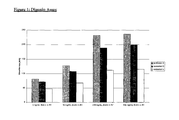
demonstrated in Figure 1, the addition of free biotin in an assay for digoxin as described in
detail in Example 1, clearly improves the sensitivity of this assay, although all other
components and procedures are kept constant.
It has been found that improvements in sensitivity are more pronounced when using rather
small analytes. It is preferred to use the inventive methods and procedures aiming at
improved sensitivity with analytes of less than 10 kD molecular weight, more preferred 5
kD and most preferred less than 2 kD molecular weight. Such analytes especially comprise
digoxin, digoxigenin, small molecular weight drugs, steroidal hormones and drugs of
abuse.
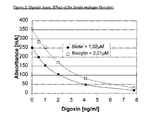
The agglutination reaction, i.e., the assay sensitivity preferably is further modulated and
optimized by use of an analogue of a hapten or a hapten-like molecule, e.g. by use of
biocytin if the analyte specific component is biotinylated. Such improvements are
demonstrated in Example 2 and shown in Figure 2.
In a further embodiment the invention as disclosed is used in a method to improve the
precision of a specific binding assay used in the detection or measurement of an analyte in a
sample comprising at least one hapten/anti-hapten or hapten-like binding pair,
characterized in that, in at least one incubation step said hapten or said hapten-like
molecule in free form is present.
Precision is used to refer to the calculated result with standard deviation. The lower the
standard deviation or co-efficient of variation (CV) the better the assay precision. As shown
in Figure 3, the use of free hapten or free hapten-like molecule according to a method of
the present invention, as described in Example 3 has led to an improved assay precision.
Heterogeneous immunoassays incorporate washing steps, such washing steps having the
great advantage that unbound and/or potential interfering substances may be washed
efficiently off. This probably is the major reason, why heterogeneous assays in many cases
can be designed to be more sensitive as compared to homogeneous assays. It has now
surprisingly been found that it is possible to significantly improve homogeneous
immunoassays by applying a method as disclosed.
Therefore, in a preferred embodiment the present invention relates to a method for
detection or measurement of an analyte in a sample by a homogeneous immunoassay
comprising at least one hapten/anti-hapten or hapten-like binding pair, characterized in
that, in at least one incubation step said hapten or said hapten-like molecule in free form is
present. Typical examples of homogeneous immunoassays making use of coated (latex)
particles are summarized in Figure 4 to further illustrate some preferred assay principles.
Homogeneous immunoassays according to the present invention are preferably based on
the principles of agglutination. Such assays preferably are set up to detect or measure an
analyte either due to increased or due to decreased agglutination. Such agglutination
usually is measured by turbidimetric devices. Preferably particles are used and included in
such assay methods, because particle based assays have been found to be more sensitive.
Most preferably latex particles are used. In a preferred embodiment according to the
present invention the assay method is of the homogeneous type and further characterized
in that coated latex particles are used in said method.
Latex particles to be used in the above described homogeneous immunoassays may e.g., be
coated with antibodies to a hapten, e.g. antibodies, against digoxin or digoxigenin or they
may be coated with avidin or streptavidin. Most preferably the coating with avidin or
streptavidin is performed according to procedures as described in US 5,268,306. It
represents a preferred embodiment of the present invention to use free biotin or analogues
thereof in a homogeneous assay procedure based on use of latex particles coated with
streptavidin.
As discussed above, the skilled artisan based on the state of the art knowledge and
procedures will have no problems requiring own inventive efforts or undue burden to him,
to set up a binding assay employing a hapten or hapten-like binding pair. The following
discussion is meant to further illustrate the invention but not to limit it to specific examples
given.
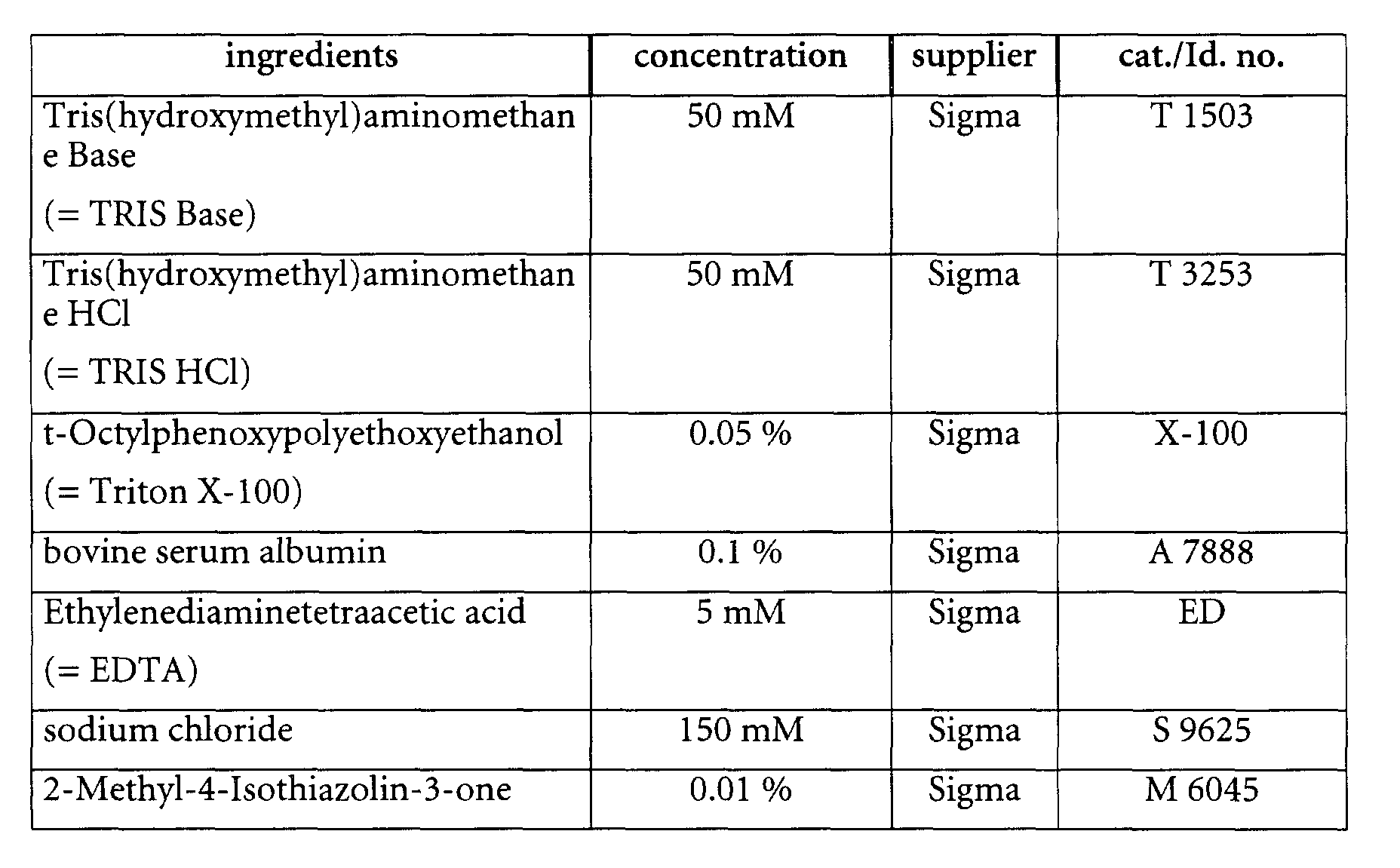
In case of homogeneous assays it is preferred to reduce the number of reagents required as
much as possible. For most analytes, e.g. as detected on the Roche/Hitachi analyzer series it
has been possible to reduce and limit the number of reagents to two. Reagent R1 may for
example comprise a buffer salt, sodium chloride, bovine serum albumin, a preservative, a
detergent, the biotinylated component and an optimized amount of free biotin. Reagent R2
in most cases is designed to comprise a buffer salt, bovine serum albumin, a preservative
and the streptavidin-latex with an optimized binding capacity for biotin. The amount of
free biotin added is optimized with respect to the binding capacity of the streptavidin latex
in R2 and concentration of the biotinylated component in R1. Such optimization is
performed according to routine procedures known in the art.
Various buffers and additives may be used for Reagent 1 and Reagent 2 to achieve the
desired pH and the stability of the reagents. Illustrative buffers include 2-(N-Morpholino)ethanesulfonic
acid, N-(2-Hydroxyethyl)piperazine-N'-(2-ethanesulfonic
acid), (Piperazine-N,N'-bis[2-ethanesulfonic acid / 1,4-Piperazinediethanesulfonic acid)
and Tris(hydroxymethyl)aminomethane. In an individual assay one or another buffer may
be preferred. The same is true for special additives like sodium chloride, bovine serum
albumin, detergents like Triton X-100 and preservatives like NaN3. Moderate temperatures
usually are employed for carrying out a homogeneous assay. Incubation temperatures will
normally range from 5 to 35°C, more usually from 20 to 25°C. The concentration of analyte
to be assayed will generally vary from 10-5 to 10-13 M, more usually from 10-7 to 10-11 M.
Assay requirements depend e.g. on whether the assay shall be qualitative, semi-quantitative
or quantitative, and the mode of detection (turbidimetric or nephelometric) used.
The sensitivity required is usually defined to match the concentrations of analyte routinely
found or expected in the samples to be analyzed. Assays shall be sensitive enough to ensure
that a biologically and/or diagnostically significant variation in analyte concentration
results in a significant and measurable signal difference according to the procedure used.
The final concentration of free hapten or hapten-like molecule will vary very much
depending on the kind of binding assay used. Especially the concentration in relation to the
haptenylated compound as used in the assay has to be determined carefully. Amounts or
concentrations of free hapten or hapten-like molecule are preferred which lead to assay
improvements in term of sensitivity and/or precision. In case of homogeneous assays
wherein the haptenylated compound is used in a concentration of about 0.6 - 285 nM it is
preferred to use 20 - 210 nM of free biotin in reagent R1 and a streptavidin load of 280-420
nM on the surface of the latex microparticles in reagent R2.
According to the present invention use of free hapten or of free hapten-like molecules in an
improved homogeneous assay method for detection or measurement of an analyte in a
sample said detection or measurement being based on a binding assay comprising said
hapten or hapten-like molecule as part of a specific binding pair also represents a preferred
embodiment.
Whereas the presence of free hapten or hapten-like molecule may be advantageous in
various steps of carrying out the inventive procedure it is preferred that said free hapten or
hapten-like molecule is present in the reaction mixture before the haptenylated assay
component is added to said reaction mixture.
It is standard practice to provide test kits to customers, comprising most if not all reagents
necessary to carry out a method of detection or measurement of an analyte. It is of great
advantage to include into such a test kit an additional bottle comprising free hapten or free
hapten-like analogue. It is also possible to include such free hapten or hapten-like molecule
in at least one of the other reagent bottles, e.g. the ones comprising at least one of the assay
components, preferably the haptenylated component, required to detect or measure an
analyte. Further preferred is therefore a test kit to perform an assay for detection or
measurement of an analyte in a sample making use of a hapten/anti-hapten or hapten-like
binding pair comprising at least one reagent containing said hapten or hapten-like
molecule in free form.
The following examples, references, sequence listing and figures are provided to aid the
understanding of the present invention, the true scope of which is set forth in the appended
claims. It is understood that modifications can be made in the procedures set forth without
departing from the spirit of the invention.
Description of the Figures
- Figure 1
-
Measuring range of different digoxin assays
Signals generated dependent on the concentration of biotin in the digoxin assay reagent are
given. It is obvious that the measuring range correlated to the signal generated increases, if
free biotin is added to reagent R1.
- Figure 2
- Modulation of specific agglutination by the biotin analogue biocytin.
The agglutination reaction is further modulated and improved by the use of biocytin. The
concentrations of biotin and biocytin have been titrated to give optimal agglutination
signals. Biocytin clearly generates higher signals and a better differentiation of samples.
- Figure 3
- Precision of different HbA1c assays
This figure shows the HbA1c assay precision [in % CV; CV = coefficient of variation] in
presence and absence of free biotin in reagent R1.
- Figure 4
- Overview of preferred assay formats
Figure 1 gives a summary of the preferred assay formats of the present invention. The
symbols <...> are used to indicate that an antibody directed against the antigen in brackets
is used. Abbreviations are as follows:
- SA =
- streptavidin
- IgG =
- immunoglobulin of the γ-type
- Fab and Fab' =
- represents fragments of immunoglobulin as obtained by enzymatic
cleavage according to state of the art procedures.
Example 1: Assay for Digoxin
Materials and Equipment
Reagent R1
7.02 g of Tris(hydroxymethyl)aminomethane HCl dissolved in 1.0 L of water combined
with 0.67 g Tris(hydroxymethyl)aminomethane Base gives at 25°C a pH of 7.2
Hapten-biotin conjugates have been synthesized according to Huber, et al., U.S. Patent No.
5,219,764.
Reagent R2
|
ingredients
|
concentration
|
supplier
|
cat./Id. no.
|
| N-(2-Hydroxyethyl)piperazine-N'-(2-ethanesulfonic acid) |
50 mM |
Sigma |
H 7523 |
| (= HEPES) |
| t-Octylphenoxypolyethoxyethanol |
0.01 % |
Sigma |
X-100 |
| (= Triton X-100) |
| bovine serum albumin |
1 % |
Sigma |
A 7888 |
| 2-Methyl-4-Isothiazolin-3-one |
0.01 % |
Sigma |
M 6045 |
| anti-Digoxin antibody (monoclonal antibody) |
0.2 nM |
Roche |
2157861990 |
| streptavidin-latex (127 nm particles, carboxylate-modified) |
0.05 % [s/v] |
Seradyn |
lot 640CJ |
HEPES (pKa = 7.5 at 25°C) buffer, 0.05 M, pH 7.5:
11.9 g of N-(2-Hydroxyethyl)piperazine-N'-(2-ethanesulfonic acid) dissolved in 1.0 L of
water
All assay measurements have been done on a Hitachi 917 Automatic Analyzer, Part No.
714-0016, Serial No. 1004-8, from Hitachi, Ltd. Tokyo, Japan, according to the following
assay protocol:
| step | pipetting of | volume [µL] | Hitachi measuring points at 546 nm |
| 1 | R1 | 150 | 1 - 17 |
| | Sample | 20 |
| 2 | R2 | 150 | 18-33 |
The sample material is human serum or human plasma (e.g. heparin-, EDTA-, citrateplasma).
Results as obtained with calibrators containing 0, 1.0 and 4.1 ng/mL digoxin, respectively,
are given in Figure 1.
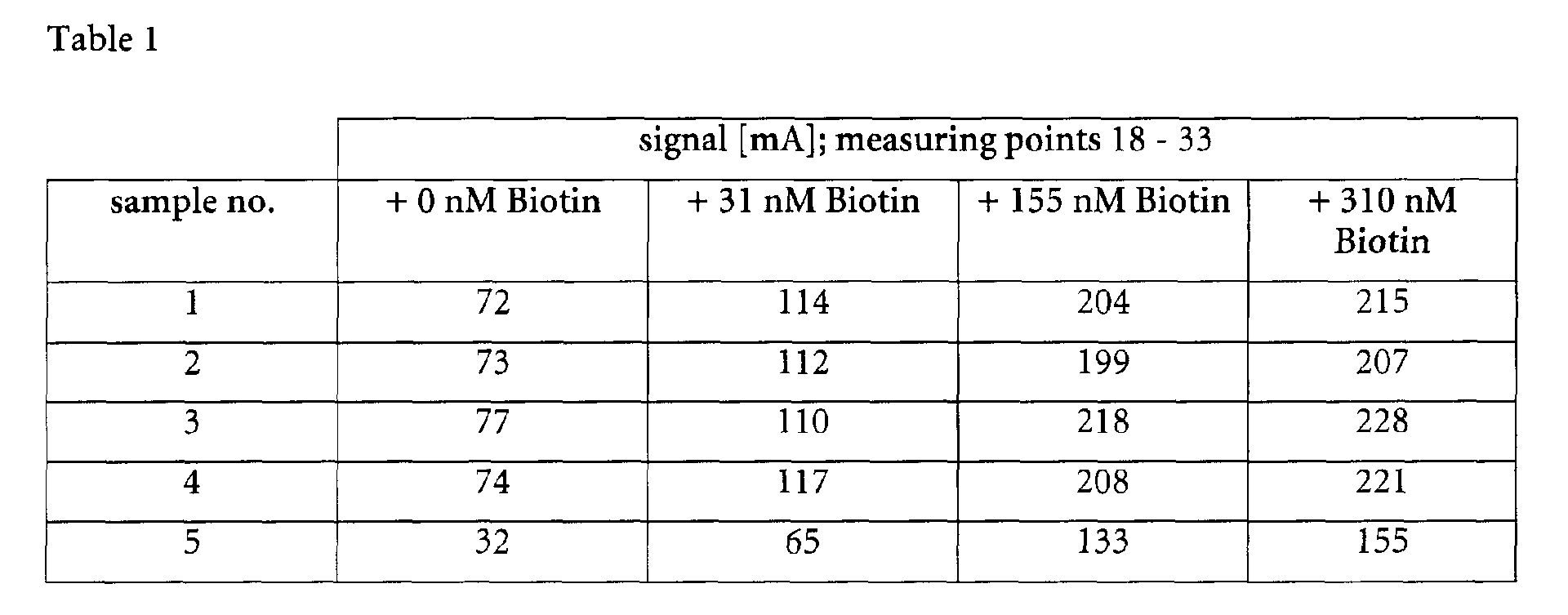
The results of a typical experiment with clinical samples were as follows (Table 1):
It is obvious that addition of free biotin leads to a pronounced increase in signal (absorbance
measured as mA).
Example 2: Assay for Digoxin: Effect of the biotin analogue biocytin
Materials and Equipment
Reagent R1
| ingredients |
concentration |
supplier |
cat./Id. no. |
| 2-(n-Morpholino)-ethansulfonic acid (= MES) |
50 mM |
Sigma |
M-2933 |
| sodium chloride |
150 mM |
Sigma |
S-9625 |
| polyoxyethylenesorbitan (Tween-20) |
0.4 % |
Sigma |
P-7949 |
| bovine serum albumin |
0.1 % |
Sigma |
A-7888 |
| dextran sulfate |
2.0 % |
Sigma |
D-6001 |
| 2-Methyl-4-Isothiazolin-3-one |
0.01 % |
Sigma |
M-6045 |
| 2-Chlor-acetamid |
0.25 % |
Fluka |
22788 |
| biotinylated Digoxin |
19.4 nM |
Roche |
BMO22.250123 |
| d-biotin |
0.41 - 1.23 µM |
Sigma |
B-4501 |
| respectively |
| biocytin |
0.81 - 2.42 µM |
Sigma |
B-1758 |
| MES buffer, 0.05 M, pH 7.0 (adjusted with NaOH) |
Hapten-biotin conjugates have been synthesized according to U.S. Patent No. 5,219,764
(Huber et al.)
Reagent R2
| ingredients |
concentration |
supplier |
cat./Id. no. |
| N-(2-Hydroxyethyl)piperazine-N'-(2-ethansulfonic acid (= HEPES) |
5 mM |
Sigma |
H-7523 |
| bovine serum albumin |
1.0 % |
Sigma |
A-7888 |
| 2-Methyl-4-Isothiazolin-3-one |
0.01 % |
Sigma |
M-6045 |
| 2-Chlor-acetamid |
0.25 % |
Fluka |
22788 |
| anti-digoxin antibody (monoclonal) |
0.67 nM |
Roche |
2157861990 |
| streptavidin-latex (214 nm) |
0.06 % [s/v] |
Poly-Micro-spheres |
custom synthesis |
All assay measurements have been done on a Hitachi 717 automatic analyzer, part No 717-0016,
serial No. 6100-05, from Hitachi, Ltd. Tokyo, Japan, according to the following assay
protocol:
| Step | Pipetting of | Volume [µl] | Hitachi meassuring points at 700 nm |
| 1 | R1 | 105 | 1 - 23 |
| | Sample | 14 |
| 2 | R2 | 105 | 24-50 |
The sample material is human serum or human plasma (e.g. heparin-, EDTA-, citrate-plasma).
The biotin and biocytin concentrations added to buffer R1 were titrated within the given
range in order to determine the concentration for optimal assay performance. For biotin
this concentration was 1.02 µM (= 250 ng/ml) while with biocytin 2.01 µM (750 ng/ml)
gave optimal agglutination signals. The results of a typical experiment with an optimized
biotin or biocytin concentration are given in table 2 and figure 2.
| | Signal [mA]; measuring points 28 - 50 |
| Sample No | + 1.02 µM biotin | + 2.01 µM biocytin |
| 1 | 251 | 357 |
| 2 | 200 | 285 |
| 3 | 154 | 255 |
| 4 | 105 | 169 |
| 5 | 49 | 83 |
| 6 | 16 | 29 |
|
ingredients
|
concentration
|
supplier
|
cat./Id. no.
|
| 2-(n-Morpholino)-ethansulfonic acid (= MES) |
25 mM |
Roche |
223794 |
| pH 6.2 |
| Tris(hydroxymethyl)aminomethane HCl |
17 mM |
Roche |
708968 |
| (= TRIS HCl) |
| Thesit |
0.5 % |
Roche |
1718894 |
| bovine serum albumin |
0.1 % |
Roche |
1726544 |
| Ethylenediaminetetraacetic acid |
5 mM |
Roche |
808245 |
| (= EDTA) |
| 2-Methyl-4-Isothiazolin-3-one |
0.01 % |
Roche |
1085905 |
| d-Biotin |
50 ng/mL |
Sigma |
B 4501 |
| biotinylated Hemoglobin A1c |
0.1 µg/mL |
Roche |
BMO 22.620269 |
| Hapten-biotin conjugates have been synthesized according to U.S. Patent No. 5,219,764 (Huber, et al.). |
Reagent R2
|
ingredients
|
concentration
|
supplier
|
cat./Id. no.
|
| N-(2-Hydroxyethyl)piperazine-N'-(2-ethanesulfonic acid) (= HEPES) |
5 mM |
Roche |
737151 |
| bovine serum albumin |
1 % |
Roche |
1726544 |
| 2-Methyl-4-Isothiazolin-3-one |
0.01 % |
Roche |
1085905 |
| anti-Hemoglobin A1c antibody (polyclonal antibody) |
40 µg/mL |
Roche |
1520458001 |
| streptavidin-latex (127 nm particles, carboxylate-modified) |
0.2%[s/v] |
Seradyn |
lot 640CJ |
All assay measurements have been done on a Hitachi 717 Automatic Analyzer, Part No.
717-0016, Serial No. 6100-05, from Hitachi, Ltd. Tokyo, Japan, according to the following
assay protocol:
| step | pipetting of | volume [µL] | Hitachi measuring points at 546 nm |
| 1 | R1 | 200 | 1 - 27 |
| | Sample | 2 |
| 2 | R2 | 50 | 28 - 50 |
The hemolyzed human blood samples were prepared according to Karl J. et al.:
Development and Standardization of a New Immunoturbidimetric HbA1c Assay. Klin Lab
39, 991-996 (1993).
The results of a first typical experiment conducted according to this Example are shown in
Figure 3, the results of a second typical experiment were as follows (Table 3):
| sample no. | R1 minus biotin: CV [%]; n = 21 | R1 plus biotin: CV [%]; n = 21 |
| Control N | 6.0 | 3.8 |
| Control P | 5.1 | 3.7 |
| Normal serum 1 | 5.7 | 3.4 |
| Normal serum 2 | 4.5 | 3.0 |
| Normal serum 3 | 5.0 | 3.1 |
| Positive sample 1 | 7.8 | 3.9 |
| Positive sample 2 | 6.0 | 4.2 |
| Positive sample 3 | 5.3 | 4.3 |
It is obvious that the presence of biotin in the above method leads to improved assay
precision as is obvious from the reduced CV values found.
List of References
Engvall, E. and Perlman, P., Immunochemistry 8 (1971) 871-4
Green, N. M., Methods Enzymol 184 (1990) 51-67
Green, N. M., et al., Biochem J 125 (1971) 781-91
Weber, P. C., et al., Science 243 (1989) 85-8
Akiyama, N., et al., Protein Expr Purif 3 (1992) 427-33
Nutikka, A., et al., Clin Biochem 24 (1991) 469-73
Morgan, H., et al. Polymerization of avidin and streptavidin with aromatic bisbiotin ligands
in "Polym. Sci., Part A: Polm. Chem." (1994) 1331-1340, Univ. Wales,
Bangor/Gwynedd, LL57 1, UK, Inst. Mol. Biomol. Electron.
van Weemen, B. K. and Schuurs, A. H. W. M., FEBS Letters 15 (1971) 232-236
Karl, J., et al., Klinisches Labor 39 (1993) 991-996
US 4,298,685
US 6,096,508
US 5,344,757
US 5,268,306