EP1184496A2 - Method and apparatus for opening continuous filaments - Google Patents
Method and apparatus for opening continuous filaments Download PDFInfo
- Publication number
- EP1184496A2 EP1184496A2 EP01307303A EP01307303A EP1184496A2 EP 1184496 A2 EP1184496 A2 EP 1184496A2 EP 01307303 A EP01307303 A EP 01307303A EP 01307303 A EP01307303 A EP 01307303A EP 1184496 A2 EP1184496 A2 EP 1184496A2
- Authority
- EP
- European Patent Office
- Prior art keywords
- tow
- continuous filaments
- rolls
- sliding body
- transporting
- Prior art date
- Legal status (The legal status is an assumption and is not a legal conclusion. Google has not performed a legal analysis and makes no representation as to the accuracy of the status listed.)
- Granted
Links
Images



Classifications
-
- D—TEXTILES; PAPER
- D01—NATURAL OR MAN-MADE THREADS OR FIBRES; SPINNING
- D01G—PRELIMINARY TREATMENT OF FIBRES, e.g. FOR SPINNING
- D01G9/00—Opening or cleaning fibres, e.g. scutching cotton
-
- D—TEXTILES; PAPER
- D02—YARNS; MECHANICAL FINISHING OF YARNS OR ROPES; WARPING OR BEAMING
- D02J—FINISHING OR DRESSING OF FILAMENTS, YARNS, THREADS, CORDS, ROPES OR THE LIKE
- D02J1/00—Modifying the structure or properties resulting from a particular structure; Modifying, retaining, or restoring the physical form or cross-sectional shape, e.g. by use of dies or squeeze rollers
- D02J1/18—Separating or spreading
Definitions
- the present invention relates generally to a method and an apparatus for opening crimped TOW to prepare opened continuous filaments, to be used as a surface layer of an absorbent article, such as sanitary napkin, or for other application.
- conjugated synthetic fibers of core-sheath structure such as those of PE/PP, PE/PET or the like are used.
- conjugated synthetic fibers continuous filaments may be used.
- the continuous filaments are supplied to a manufacturing process of absorbent article or so forth in a form of TOW, in which filaments are bundled to firmly contact with each other and are crimped.
- opening process is preformed to separate the continuous filaments from each other in the width direction of the TOW and to increase apparent width.
- the continuous filaments thus separated in the width direction in the opening process to have a uniform bulkiness, are used for production of the surface layer of the absorbent article or the like.
- the TOW is supplied to a transporting roll group which is constructed such that downstream side roll has higher peripheral speed than that of upstream side roll for applying tension force to the TOW between the rolls. Then, the TOW is transferred to a transporting roll group which is constructed such that downstream side roll has lower peripheral speed than that of the upstream side roll for releasing the tension force.
- Application of tension force and release of tension force are effected, respectively at least one time.
- the tension force is applied to the continuous filaments forming the TOW for stretching crimp, and then, the filaments are elastically contracted to restore crimp. By stretching crimp and restoring crimp, the continuous filaments are given dispersing force in the width direction of the TOW.
- opening condition of the TOW depends on the peripheral speeds of the rolls, nip pressure of the rolls, materials of the roll surfaces and the like.
- opening condition depends on nip pressure of the roll, material of the surface of the roll, size of each groove and the like.
- the present invention has been worked out in view of the problem set forth above. Therefore, it is an object of the present invention to provide a method and an apparatus for opening continuous filaments, which can uniformly open crimped TOW and can easily vary opening condition even when material or kind of TOW is varied.
- an opening method of continuous filaments comprising the steps of:
- the opening method of the invention by pushing the sliding body (for example, of a plate shape) against the TOW to make the TOW slidingly contact with the sliding body, a shifting force in the transporting direction of the TOW can be effectively applied to the continuous filaments in the thickness direction of the TOW, to thereby open the TOW.
- a shifting force in the transporting direction of the TOW can be effectively applied to the continuous filaments in the thickness direction of the TOW, to thereby open the TOW.
- a plurality of sliding bodies are provided in the resistance-applying step, and that each side of the TOW is slidingly contacted by at least one of the sliding bodies.
- each sliding body is adjustable of a tilt angle relative to a line perpendicular to transporting path of the TOW and a penetration amount into the transporting path of the TOW.
- the adjusting operation may be performed manually, but it is preferred that the opening method further comprises a step of detecting a width of spread continuous filaments after slidingly contacting with the sliding bodies, and a step of automatically adjusting the tilt angle and the penetration amount of the sliding bodies on the basis of the detected value.
- Peripheral speeds of rolls located at upstream side and downstream side of the sliding body may be the same. But, it is preferred that among rolls located at upstream side and downstream side of the sliding body, the peripheral speed of the roll located at downstream side is set higher than that of the roll located at upstream side for applying tension force on the TOW between the rolls.
- an opening apparatus of continuous filaments comprising:
- This opening apparatus may be constructed such that at least one sliding body is provided on one side of the TOW and at least one sliding body is provided on the other side of the TOW.
- the opening apparatus further comprises:
- the rolls located at upstream side and downstream side of the sliding body may be driven to rotate at the same peripheral speed. But; it is preferred that among rolls located at upstream side and downstream side of the sliding body and driven to rotate, the peripheral speed of the roll located at downstream side is set higher than that of the roll located at upstream side.
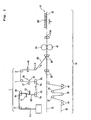
- Fig. 1 is an explanatory illustration for showing a method and an apparatus for manufacturing a surface layer of an absorbent article including opening method and opening apparatus according to one embodiment of the present invention
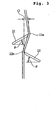
- Fig. 2 is an enlarged perspective view of the opening method and opening apparatus of Fig. 1.
- TOW 2A in which continuous filaments are bundled and crimped, is supplied and opened to be uniform in width direction.
- Continuous filaments forming TOW 2A may be conjugated synthetic fibers of core-sheath structure, such as those of PE/PET, PE/PP or the like, side-by-side type conjugated fibers, such as those of PE/PET, PE/PP or the like, or mono-fibers, such as those of PE, PP, PET or the like.
- Crimping is performed by means of a crimper upon manufacturing of filaments and number of crimp is increased by pre-heating calender or hot air process.
- crimping condition of the TOW is that number of crimp per 1 inch of one continuous filament is in a range of 5 to 40 or in a range of 15 to 30, and after opening, crimp modulus of elasticity of one continuous filament is greater than or equal to 70%.
- Number of crimp is based on JIS L-1015 and crimp modulus of elasticity is based on JIS L-1074. In case of the filament of a fineness less than 5.5 dtex, an initial load of 0.49 mN is applied in pulling direction, and in case of the filament of a fineness greater than or equal to 5.5 dtex, an initial load of 0.98 mN is applied in pulling direction.
- Number of crimp referred to is number of threads (peaks) per 1 inch (25 mm) when the initial load is applied.
- the crimp modulus of elasticity is expressed by: ⁇ (b - c)/(b - a) ⁇ x 100 (%) wherein a is a length of filament when the initial load is applied, b is a length when the crimp is stretched by applying a tension force of 4.9 mN per 1.1 dtex for 30 seconds, and c is a length as applied the initial load again after 2 minutes from releasing of the tension force.
- the continuous filaments are preferably treated to be hydrophilic with a hydrophilic agent being applied to their surfaces or kneaded in the resin. It is also preferred that the continuous filaments contain inorganic filler for whitening, such as titanium oxide or the like, in the content of 0.5 to 10% by weight. By whitening process, the continuous filaments may easily hide menstrual blood or the like absorbed in an absorbent layer of an absorbent article from external view.
- the individual continuous filaments may have a circular or modified cross-section.
- TOW 2A is transported toward right in the drawing by means of a transporting roll group composed of rolls 3, 4a, 4b, 5a, 5b, 6a, 6b, 7, 8 and 9.
- a transporting roll group composed of rolls 3, 4a, 4b, 5a, 5b, 6a, 6b, 7, 8 and 9.
- sliding plates 11 and 12 as sliding bodies are provided between the paired rolls 4a and 4b and the paired rolls 5a and 5b.
- the sliding plates 11 and 12 are placed in opposition relative to the TOW 2A and with offset in transporting direction of the TOW.
- the front edges 11a and 12a of respective sliding plates 11 and 12 extend in straight in width direction of the TOW.
- the front edges 11a and 12a are chamfered to have a wedge-shaped section, but may be otherwise chamfered to have a curved section or the like. Of course, it is possible not to chamfer the front edges 11a and 12a.
- the front edges 11a and 12a so extend as to permit sliding of the entire
- front edges 11a and 12a extend in a curved (arcuate) shape or in a corrugated shape.
- curved (arcuate) shape the center portion of respective front edges 11a and 12a is recessed away from the TOW 2A.
- corrugated shape convex shape projecting toward the TOW 2A and concave shape recessed away from the TOW 2A are repeated in the width direction of the TOW.
- the front edge 11a of the sliding plate 11 and the front edge 12a of the sliding plate 12 are preferably located to penetrate into a transporting path of the TOW 2A.
- the transporting path of the TOW 2A is meant to indicate a path extending in straight between the paired rolls 4a and 4b and the paired rolls 5a and 5b.
- the transporting path extends vertically.
- tilt angle ⁇ for the sliding plates 11 and 12 relative to a line perpendicular to transporting path of the TOW 2A (horizontal line in the shown case).
- the tilt angle ⁇ is preferably set to orient the front edges 11a and 12a upwardly.
- the other side of the TOW 2A receives the resistance from the sliding plate 12. Accordingly, a shifting force in the transporting direction is also applied to individual continuous filaments stacked in thickness direction of the TOW 2A, for further opening.
- the TOW 2A is further spread to have a width W.
- TOW opened to have the width W is indicated at 2B.
- the TOW indicated at 2B is referred to as fibrous layer 2B.
- the sliding plates 11 and 12 In order to make opening by means of the sliding plates 11 and 12 effective, it is preferred to apply a tension to the continuous filaments between the paired rolls 4a and 4b and the paired rolls 5a and 5b.
- the peripheral speeds of the paired rolls 4a and 4b and the peripheral speeds of the paired rolls 5a and 5b may be the same. However, for appropriately applying tension, it is preferred to make the peripheral speeds of the paired rolls 5a and 5b higher than the peripheral speeds of the paired rolls 4a and 4b.
- the sliding plates 11 and 12 are so mounted on a not shown supporting member so to permit adjustment of individual penetration amounts of the sliding plates 11 and 12 into the transporting path of the TOW 2A (i.e., the overlapping amount O of the sliding plates 11 and 12) and also permit adjustment of individual tilt angles ⁇ of the sliding plates 11 and 12.
- the opening method and opening apparatus using the sliding plates 11 and 12 it becomes possible to adapt to variation of material and fineness of continuous filament, basis weight of the TOW 2A and so forth only by adjusting the penetration amounts (overlapping amount O) and/or the tilt angles ⁇ of the sliding plates 11 and 12. By effecting adjustment from time to time, moreover, quality of the opened fibrous layer 2B can be made stable.
- adjusting operation can be performed manually, it is also possible to automatically adjust the penetration amounts and the tilt angles ⁇ of the sliding plates 11 and 12 as in the embodiment shown in Figs. 1 and 2.
- detecting means 15 for detecting the width W of the fibrous layer 2B of the opened continuous filaments is provided between the paired rolls 6a and 6b and the roll 7.
- the detecting means 15 includes a pair of CCD cameras 16 for confronting two side edges of the fibrous layer 2B and a background plate 17 located at opposite side of the cameras 16 relative to the fibrous layer 2B for confronting the fibrous layer 2B. Since the continuous filaments are white or semi-transparent, the background plate 17 may be provided a color of good contrast in color to the continuous filaments, such as black, dark green and so forth.
- An image picked up by the camera 16 is processed by an image processing portion 21 to detect two side edges of the fibrous layer 2B as boundary lines.
- the position information of the boundary lines detected by the image processing portion 21 is applied to a control portion 22 which takes CPU as primary component.
- the control portion 22 the position information of the boundary lines are compared with a preliminarily set threshold value and a correction value is calculated.
- adjusting means (adjusting actuators) 24a and 24b which can adjust a moving amount in horizontal direction and the tilt angles ⁇ of the sliding plates 11 and 12, are provided.
- the adjusting means 24a and 24b have stepping motors for varying penetration amounts of the sliding plates 11 and 12 into the transporting path of the TOW 2A and stepping motors for varying the tilt angles ⁇ of the sliding plates 11 and 12.
- the correction value calculated by the control portion 22 is applied to a driver 23 which controls the adjusting means 24a and 24b.
- the driver 23 operates the adjusting means 24a and 24b on the basis of the correction value.
- the optimal width of the fibrous layer 2B after opening are preliminarily predicted depending upon material and fineness of the continuous filaments and basis weight of the supplied TOW 2A, and information relating to the predicted optimal width is input to the control portion 22. On the basis of the input value, the threshold value is determined.
- the width W of the fibrous layer 2B after opening is smaller than the predicted optimal width, adjustment by the adjusting means 24a and 24b is performed to make the overlapping amount O and/or the tilt angles ⁇ greater.
- the width W of the fibrous layer 2B after opening is greater than the predicted optimal width, adjustment by the adjusting means 24a and 24b is performed to make the overlapping amount O and/or the title angles ⁇ smaller.
- optimal opening can be performed constantly and whereby quality of fibrous layer 2B opened becomes stable. Also, when the TOW 2A is varied in material, basis weight or the like, the overlapping amount O and the tilt angles of the sliding plates 11 and 12 can be automatically adapted by only varying setting value input to the control portion 22.
- a production process 30 of a surface layer of an absorbent article is continuously arranged following to the opening process 1.
- a liquid permeable, heat-fusible base 31 is transported through transporting rolls 32, 33 and 34.
- the base 31 may be a point bonded non-woven fabric, a through-air bonded non-woven fabric, a spun bonded non-woven fabric, an air-laid non-woven fabric, a span laced non-woven fabric or the like.
- core-sheath type or side-by-side type conjugated fibers treated to be hydrophilic such as those of PE/PP, PE/PET or PP/PP.
- the base 31 it is also possible to use a film formed of thermoplastic synthetic resin, a laminate sheet of a film and a non-woven fabric, or the like. Furthermore, a foam film formed with a large number of holes by applying vacuum pressure to molten/semi-molten resin on a screen drum, or a film formed with holes by elongation strain by hot needles may also be used.
- the non-woven fabric When used as the base 31, it is preferably corrugated to have wrinkles repeated along transporting direction.
- the corrugated non-woven fabric can be easily contracted in the transporting direction (Y direction).
- each elastic member 35 is supplied through another path other than the path of the base 31.
- Each elastic member 35 may be made of synthetic rubber or natural rubber and takes form in string or strip.
- preferred contractive tension of one elastic member 35 is in a range of 1.86 to 7.64 mN.
- the elastic members 35 are transported by the transporting rolls 36, 37, 38, 39 and 41.
- the peripheral speed of the transporting roll 37 is higher than that of the paired transporting rolls 36.
- the peripheral speed of the transporting roll 38 is higher than that of the transporting roll 37.
- the peripheral speed of the transporting roll 39 is higher than that of the transporting roll 38.
- the peripheral speed of the paired transporting rolls 41 is higher than that of the transporting roll 39.
- the elastic members 35 are given a tensile strain in range of 5 to 50%.
- the elastic members 35 are fixed to the base 31 in a condition where the foregoing tensile strain is applied.
- the individual elastic member 35 in the form of string or strip are spaced apart from each other in a direction perpendicular to the transporting direction by a constant interval to extend in parallel, and are fixed to the base 31 by a hot melt adhesive or the like.
- the fibrous layer 2B opened in the opening process 1 is widened (spread in the width direction) by a widening guide 42 to have a uniform bulkiness. Subsequently, by the paired transporting rolls 33, the fibrous layer 2B thus opened and widened is supplied to the surface of the base 31 having the elastic members 35 fixed on the back face thereof.
- the fixing method is heat seal or sonic seal.
- Fig. 7 is a plan view of the surface layer 50
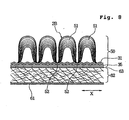
- Fig. 8 is a section of an absorbent article employing the surface layer 50.
- the fixing lines 52 formed by the welding rolls 44 and 45 are formed at a constant pitch in the Y direction. More specifically, the fixing lines 52 are arranged in staggered manner between rows adjacent in the X direction. Therefore, as a result of contraction of the base 31 in the Y direction by elastic contracting force of the elastic members 35, the loop portions 51 are formed respectively between adjacent fixing lines 52 to have relatively large bulkiness. Furthermore, the loop portions 51 can behave independently of each other.
- Fig. 6 shows a sanitary napkin 60 as one example of the absorbent article.
- the sanitary napkin 60 has a structure, in which a liquid absorbing layer 62 is laid on a liquid impermeable backing sheet 61 and a liquid permeable surface sheet 63 is laid over the liquid absorbing layer 62.
- the surface layer 50 formed through the manufacturing process set forth above is located at the center region or the entire region of a liquid receiving surface of the sanitary napkin 60, for example.
- the surface sheet 63 and the base 31 are partially fixed by a hot melt adhesive.
- the loop portions 51 are formed between respectively adjacent fixing lines 52.
- the continuous filaments of the fibrous layer 2B forming the loop portions 51 have freedom in the X direction and Y direction and have restoring ability against pressure in compression direction. Accordingly, the surface layer 50 may flexibly conform to the skin of a wearer to reduce irritative feeling on the skin.
- menstrual blood or the like applied to the loop portions 51 flows along the continuous filaments of the loop portions 51 to reach the base 31 to be absorbed in the liquid absorbing layer 62 through the base 31 and the surface sheet 63.
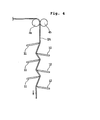
- FIGS. 4 and 5 are explanatory illustrations showing other embodiments of the present invention.
- a plurality of sliding plates 11 and a plurality of sliding plates 12 are provided.
- opening of the TOW 2A can be performed more effectively.
- the fibrous layer 2B opened by the sliding plates 11 and 12 is transported by transporting rolls 71, 72, 73, 74, 75, peripheral speeds of which are higher at downstream side roll than the upstream side roll to apply a tension force on the fibrous layer 2B. Subsequently, the tension force is released by transporting rolls 76 and 77, peripheral speeds of which are lower at the down stream side roll than the upstream roll.
- the fibrous layer 2B opened by the sliding plates 11 and 12 is further processed by applying and releasing tension force, to further progress opening.
- elastically contractive base 31 may be employed without using the elastic member 35, or in the alternative, heat shrinking material may be used for the base 31.
- the base 31 is contracted by heat shrink for forming the loop portions 51.
- the TOW of the continuous filaments can be effectively opened and quality of the fibrous layer after opening becomes stable. Also, it becomes possible to easily adapt for variation of basis weight of the TOW or variation of material or fineness of the continuous filaments.
- the absorbent article such as sanitary napkin
- various way has been taken, and the absorbent article may be formed in various structure and configuration.
- the absorbent articles and manufacturing process have been disclosed in commonly owned co-pending U. S. Patent Application entitled “ABSORBENT ARTICLE EMPLOYING SURFACE LAYER WITH CONTINUOUS FILAMENT AND MANUFACTURING PROCESS THEREOF” (claiming priority based on Japanese Patent Application No. 2000-265467) and also in commonly owned co-pending U. S. Patent Application entitled “ABSORBENT ARTICLE HAVING FIBROUS LAYER ON SURFACE” (claiming priority based on Japanese Patent Application No. 2000-265476).
- the disclosure of the above-identified commonly owned co-pending U. S. Patent Applications are herein incorporated by reference.
Landscapes
- Engineering & Computer Science (AREA)
- Textile Engineering (AREA)
- Yarns And Mechanical Finishing Of Yarns Or Ropes (AREA)
- Absorbent Articles And Supports Therefor (AREA)
- Nonwoven Fabrics (AREA)
- Spinning Methods And Devices For Manufacturing Artificial Fibers (AREA)
Abstract
Description
Claims (11)
- An opening method of continuous filaments, comprising the steps of:transporting crimped TOW by means of a plurality of rolls; andapplying a resistance on at least one side of said TOW by slidingly contacting at least one sliding body onto said TOW at between rolls, whereby continuous filaments stacked in a thickness direction of said TOW are caused to sift in a transporting direction of said TOW to open said TOW and to spread said continuous filaments in a width direction of said TOW.
- The opening method of continuous filaments as set forth in claim 1, wherein a plurality of sliding bodies are provided in said resistance-applying step, and wherein each side of said TOW is slidingly contacted by at least one of said sliding bodies.
- The opening method of continuous filaments as set forth in claim 2, wherein each sliding body is adjustable of a tilt angle relative to a line perpendicular to transporting path of said TOW and a penetration amount into the transporting path of said TOW.
- The opening method of continuous filaments as set forth in claim 3, which further comprises a step of detecting a width of spread continuous filaments after slidingly contacting with said sliding bodies, and a step of automatically adjusting said tilt angle and said penetration amount of said sliding bodies on the basis of the detected value.
- The opening method of continuous filaments as set forth in claim 1, wherein peripheral speeds of rolls located at upstream side and downstream side of said sliding body are the same.
- The opening method of continuous filaments as set forth in claim 1, wherein, among rolls located at upstream side and downstream side of said sliding body, the peripheral speed of the roll located at downstream side is set higher than that of the roll located at upstream side for applying tension force on said TOW between the rolls.
- An opening apparatus of continuous filaments, comprising:a transporting roll group for transporting crimped TOW of continuous filaments; andat least one sliding body arranged between rolls of said transporting roll group for slidingly contacting with said TOW to be transported.
- The opening apparatus of continuous filaments as set forth in claim 7, wherein at least one sliding body is provided on one side of said TOW and at least one sliding body is provided on the other side of said TOW.
- The opening apparatus of continuous filaments as set forth in claim 7, which further comprises:detecting means for detecting a width of spread continuous filaments after slidingly contacting with said sliding body;adjusting means for adjusting a tilt angle of said sliding body relative to a line perpendicular to transporting path of said TOW and a penetration amount of said sliding body into the transporting path of said TOW; andcontrol means for controlling said adjusting means for varying said tilt angle and said penetration amount of said sliding body on the basis of the detected value by said detecting means.
- The opening apparatus of continuous filaments as set forth in claim 7, wherein said rolls located at upstream side and downstream side of said sliding body are driven to rotate at the same peripheral speed.
- The opening apparatus for continuous filaments as set forth in claim 7, wherein, among rolls located at upstream side and downstream side of said sliding body and driven to rotate, the peripheral speed of the roll located at downstream side is set higher than that of the roll located at upstream side.
Applications Claiming Priority (2)
| Application Number | Priority Date | Filing Date | Title |
|---|---|---|---|
| JP2000265458 | 2000-09-01 | ||
| JP2000265458A JP3678637B2 (en) | 2000-09-01 | 2000-09-01 | Method and apparatus for opening continuous filament |
Publications (3)
| Publication Number | Publication Date |
|---|---|
| EP1184496A2 true EP1184496A2 (en) | 2002-03-06 |
| EP1184496A3 EP1184496A3 (en) | 2003-10-15 |
| EP1184496B1 EP1184496B1 (en) | 2010-09-08 |
Family
ID=18752719
Family Applications (1)
| Application Number | Title | Priority Date | Filing Date |
|---|---|---|---|
| EP01307303A Expired - Lifetime EP1184496B1 (en) | 2000-09-01 | 2001-08-29 | Method and apparatus for opening continuous filaments |
Country Status (11)
| Country | Link |
|---|---|
| US (1) | US7003856B2 (en) |
| EP (1) | EP1184496B1 (en) |
| JP (1) | JP3678637B2 (en) |
| KR (1) | KR100769863B1 (en) |
| CN (1) | CN1261629C (en) |
| AT (1) | ATE480654T1 (en) |
| BR (1) | BR0103802B1 (en) |
| CA (1) | CA2355510C (en) |
| DE (1) | DE60143007D1 (en) |
| SG (1) | SG107565A1 (en) |
| TW (1) | TW553750B (en) |
Cited By (4)
| Publication number | Priority date | Publication date | Assignee | Title |
|---|---|---|---|---|
| CN100344443C (en) * | 2002-04-23 | 2007-10-24 | 东丽株式会社 | Prepreg, process for producing the same, and molded article |
| EP2049715A4 (en) * | 2006-08-11 | 2010-06-02 | Es Fibervisions Co Ltd | BEAM OF FIBERS AND CANVAS |
| CN102080304A (en) * | 2009-11-27 | 2011-06-01 | 卡尔.迈耶.马里莫纺织机械制造有限责任公司 | Method and device for generating UD layer |
| EP3425092A1 (en) * | 2017-07-06 | 2019-01-09 | KARL MEYER Technische Textilien GmbH | Method and device for spreading a fibre bundle |
Families Citing this family (67)
| Publication number | Priority date | Publication date | Assignee | Title |
|---|---|---|---|---|
| ES2225307T3 (en) * | 2000-04-18 | 2005-03-16 | Vliesstoff-Technologie In 3. Dimension Kg | NON-WOVEN TEXTILE STRUCTURE THAT INCLUDES SETS OF STABILIZED FILAMENTS. |
| WO2004113600A1 (en) * | 2003-06-18 | 2004-12-29 | Denki Kagaku Kogyo Kabushiki Kaisha | Drawing method and apparatus |
| CN101818397B (en) * | 2003-07-08 | 2011-10-12 | 福井县 | Method of producing a spread multi-filament bundle and an apparatus used in the same |
| JP4365249B2 (en) * | 2004-03-31 | 2009-11-18 | 宇部日東化成株式会社 | Woven fabric and its woven fabric processed products |
| FR2870436B1 (en) * | 2004-05-21 | 2006-07-14 | Aplix Sa | FILAMENT WITH INDIVIDUAL FILAMENTS ANCHORS |
| JP4564870B2 (en) * | 2005-03-23 | 2010-10-20 | 大王製紙株式会社 | Tow opening equipment |
| JP2006311315A (en) * | 2005-04-28 | 2006-11-09 | Fujitsu Ltd | Pronunciation unit |
| JP4724587B2 (en) * | 2006-03-31 | 2011-07-13 | 大王製紙株式会社 | Absorbent articles |
| WO2007049725A1 (en) * | 2005-10-26 | 2007-05-03 | Daio Paper Corporation | Absorbable article |
| US10617273B2 (en) | 2006-08-07 | 2020-04-14 | The Procter & Gamble Company | Floor cleaning article having strips and an absorbent core |
| US9833118B2 (en) | 2006-08-07 | 2017-12-05 | The Procter & Gamble Company | Floor cleaning article having strips with differential bond pattern |
| US8415651B2 (en) * | 2008-06-12 | 2013-04-09 | Macronix International Co., Ltd. | Phase change memory cell having top and bottom sidewall contacts |
| JP5396855B2 (en) | 2008-12-26 | 2014-01-22 | Esファイバービジョンズ株式会社 | Fiber bundle |
| CA2798216C (en) * | 2010-05-11 | 2017-10-31 | Cytec Technology Corp. | Apparatus and methods for spreading fiber bundles for the continuous production of prepreg |
| US8623248B2 (en) | 2011-11-16 | 2014-01-07 | Celanese Acetate Llc | Methods for producing nonwoven materials from continuous tow bands |
| WO2014104325A1 (en) | 2012-12-29 | 2014-07-03 | ユニ・チャーム株式会社 | Method for producing cleaning member, and system for producing cleaning member |
| JP6047400B2 (en) | 2012-12-29 | 2016-12-21 | ユニ・チャーム株式会社 | Method and apparatus for manufacturing a cleaning member |
| US20140187406A1 (en) | 2012-12-29 | 2014-07-03 | Unicharm Corporation | Method of producing cleaning member |
| US20140182767A1 (en) | 2012-12-29 | 2014-07-03 | Unicharm Corporation | Method of producing cleaning member |
| JP6080550B2 (en) | 2012-12-29 | 2017-02-15 | ユニ・チャーム株式会社 | Fusing device for sealing a belt-like sheet |
| JP6073128B2 (en) | 2012-12-29 | 2017-02-01 | ユニ・チャーム株式会社 | Cutting device and method for manufacturing cleaning member using cutting device |
| JP6057707B2 (en) | 2012-12-29 | 2017-01-11 | ユニ・チャーム株式会社 | Manufacturing method of opened fiber bundle, manufacturing method of cleaning member, fiber bundle opening device, and cleaning member manufacturing system |
| JP6037828B2 (en) | 2012-12-29 | 2016-12-07 | ユニ・チャーム株式会社 | Manufacturing method of opened fiber bundle, manufacturing method of cleaning member, fiber bundle opening device, and cleaning member manufacturing system |
| JP6047401B2 (en) | 2012-12-29 | 2016-12-21 | ユニ・チャーム株式会社 | Manufacturing method of opened fiber bundle, manufacturing method of cleaning member, fiber bundle opening device, and cleaning member manufacturing system |
| JP6141023B2 (en) | 2013-01-10 | 2017-06-07 | ユニ・チャーム株式会社 | Manufacturing method of web member including tow |
| JP6103945B2 (en) | 2013-01-10 | 2017-03-29 | ユニ・チャーム株式会社 | Stacking apparatus and method for manufacturing web member |
| US9533822B2 (en) | 2013-02-08 | 2017-01-03 | The Procter & Gamble Company | Kit for fluffing a cleaning implement |
| US9849638B2 (en) | 2013-02-08 | 2017-12-26 | The Procter & Gamble Company | Process and apparatus for fluffing a cleaning implement |
| CN103290604A (en) * | 2013-05-10 | 2013-09-11 | 上海八达纺织印染服装有限公司 | Device and method for processing polyester peach-skin-like fabric |
| DE102013218102A1 (en) * | 2013-09-10 | 2015-03-12 | Thermoplast Composite Gmbh | Device for the twist-free width change of a sliver passing through the device as well as a system comprising a plurality of such devices |
| US10676311B2 (en) * | 2014-12-26 | 2020-06-09 | Toray Industries, Inc. | Method of manufacturing and manufacturing device for partial split-fiber fiber bundle and partial split-fiber fiber bundle |
| JP2018510030A (en) | 2015-04-02 | 2018-04-12 | ザ プロクター アンド ギャンブル カンパニー | Floor cleaning articles having strips with differential joint patterns |
| CN107427179B (en) | 2015-04-02 | 2020-12-15 | 宝洁公司 | Floor cleaning article with strip and absorbent core |
| EP3078316B1 (en) | 2015-04-09 | 2019-11-20 | The Procter and Gamble Company | Cleaning article having discrete seal bonds |
| US11229343B2 (en) | 2015-06-30 | 2022-01-25 | The Procter & Gamble Company | Cleaning article having multi-layer gather strip element |
| ES2887828T3 (en) * | 2015-07-07 | 2021-12-28 | Mitsubishi Chem Corp | Method for the production of fiber reinforced resin molding material |
| CN111674060A (en) * | 2015-12-25 | 2020-09-18 | 三菱化学株式会社 | Fiber separation method of carbon fiber bundle |
| CN106738447B (en) * | 2016-12-14 | 2018-10-09 | 江苏大学 | A kind of continuous carbon fibre enhances thermoplastic resin-based prepreg preparation facilities and method |
| CN106915013A (en) * | 2017-03-16 | 2017-07-04 | 湖州艾历克工业材料有限公司 | A kind of mould for producing continuous fiber reinforced thermoplastic plastic |
| US10694915B2 (en) | 2017-04-06 | 2020-06-30 | The Procter & Gamble Company | Sheet with tow fiber and movable strips |
| EP3453305B1 (en) | 2017-09-11 | 2022-11-02 | The Procter & Gamble Company | Method of making a tufted laminated cleaning article |
| US11045061B2 (en) | 2017-09-11 | 2021-06-29 | The Procter & Gamble Company | Method of making a tufted laminated cleaning article |
| US11950737B2 (en) | 2017-09-11 | 2024-04-09 | The Procter & Gamble Company | Cleaning article with irregularly spaced tow tufts |
| US10730081B2 (en) | 2017-09-11 | 2020-08-04 | The Procter & Gamble Company | Method of making a cleaning article having cutouts |
| US11253128B2 (en) | 2017-09-11 | 2022-02-22 | The Procter & Gamble Company | Cleaning article with differential pitch tow tufts |
| US10653286B2 (en) | 2017-10-06 | 2020-05-19 | The Procter & Gamble Company | Cleaning article with preferential coating |
| US10722091B2 (en) | 2017-10-06 | 2020-07-28 | The Procter & Gamble Company | Cleaning article with preferentially coated tow fibers |
| US12082760B2 (en) | 2018-04-03 | 2024-09-10 | The Procter & Gamble Company | Cleaning article with irregularly spaced tow tufts |
| US11375867B2 (en) | 2018-04-03 | 2022-07-05 | The Procter & Gamble Company | Cleaning article with differential sized tow tufts |
| US11903542B2 (en) | 2018-04-03 | 2024-02-20 | The Procter & Gamble Company | Cleaning article with double bonded tow tufts |
| CN108823687B (en) * | 2018-07-13 | 2020-04-21 | 中国纺织科学研究院有限公司 | Opening method of multi-hydrogen-bonded fiber tow |
| CN109516300A (en) * | 2018-09-21 | 2019-03-26 | 航宸石家庄新材料科技有限公司 | A kind of method and apparatus using image control carbon fibre tow broadening width |
| JP2023518022A (en) | 2020-04-10 | 2023-04-27 | ザ プロクター アンド ギャンブル カンパニー | Fluid solid composition for use in shaving |
| WO2021216288A1 (en) | 2020-04-10 | 2021-10-28 | The Procter & Gamble Company | Cleaning implement with a rheological solid composition |
| US12138333B2 (en) | 2020-04-10 | 2024-11-12 | The Procter & Gamble Company | Rheological solid composition for use in personal care compositions |
| WO2021207442A1 (en) | 2020-04-10 | 2021-10-14 | The Procter & Gamble Company | Rheological solid oral composition |
| WO2021207438A1 (en) | 2020-04-10 | 2021-10-14 | The Procter & Gamble Company | Oral care product comprising a rheological solid composition |
| WO2021207439A1 (en) | 2020-04-10 | 2021-10-14 | The Procter & Gamble Company | Rheological solid composition |
| US12122979B2 (en) | 2020-04-10 | 2024-10-22 | The Procter & Gamble Company | Cleaning article with preferential rheological solid composition |
| EP4133047B1 (en) | 2020-04-10 | 2026-02-11 | The Procter & Gamble Company | Cleaning article with preferential rheological solid composition |
| WO2022082192A1 (en) | 2020-10-16 | 2022-04-21 | The Procter & Gamble Company | Cleaning article with preferential coating |
| US11833237B2 (en) | 2021-03-09 | 2023-12-05 | The Procter & Gamble Company | Method for enhancing scalp active deposition |
| CN113057440B (en) * | 2021-03-17 | 2023-08-01 | 安徽三和刷业股份有限公司 | Integrated production equipment for bristles |
| CN114653860A (en) * | 2022-02-08 | 2022-06-24 | 昆明鼎承科技有限公司 | Wire material arranging device |
| EP4349233B1 (en) * | 2022-10-06 | 2025-08-13 | The Procter & Gamble Company | Process for packaging a cleaning wipe |
| EP4349230A1 (en) | 2022-10-06 | 2024-04-10 | The Procter & Gamble Company | Cleaning wipe |
| CN121896767A (en) * | 2026-03-20 | 2026-04-21 | 吴江万工机电设备有限公司 | Equal-path space displacement conversion carbon fiber tow width expanding device |
Family Cites Families (27)
| Publication number | Priority date | Publication date | Assignee | Title |
|---|---|---|---|---|
| DE586060C (en) * | 1931-11-10 | 1933-10-16 | Peter Wilhelm Cuesters | Device for making the hard and stiff sized warp supple in the sizing machine |
| NL51632C (en) * | 1938-02-17 | |||
| US2811770A (en) * | 1953-12-08 | 1957-11-05 | Du Pont | Preparation of tow from filaments of acrylonitrile polymers |
| US2790208A (en) * | 1954-03-15 | 1957-04-30 | Eastman Kodak Co | Method and means for opening crimped continuous filament tow |
| US2801455A (en) * | 1954-03-24 | 1957-08-06 | Ind Rayon Corp | Method and apparatus for the separation of a running strand comprised of a plurality of low twist yarns |
| US3345697A (en) | 1964-07-27 | 1967-10-10 | Eastman Kodak Co | Apparatus for banding filamentary tow |
| US3438104A (en) * | 1966-02-25 | 1969-04-15 | Phillips Petroleum Co | Filament crimping method |
| US3465399A (en) * | 1967-07-03 | 1969-09-09 | Kimberly Clark Co | Derigestering apparatus for crimped multifilament tow |
| US3501811A (en) * | 1967-07-03 | 1970-03-24 | Celanese Corp | Continuous filament webs |
| DE1921182A1 (en) * | 1969-04-25 | 1970-11-12 | Hoechst Ag | Thermoplastic yarn manufacture |
| JPS5015884B1 (en) | 1969-05-15 | 1975-06-09 | ||
| US3865565A (en) * | 1970-02-16 | 1975-02-11 | Owens Corning Fiberglass Corp | Method and apparatus for gathering filaments into strands |
| JPS4882122A (en) | 1972-02-10 | 1973-11-02 | ||
| US3739564A (en) * | 1972-04-24 | 1973-06-19 | Deering Milliken Res Corp | Yarn guide |
| JPS5826167B2 (en) * | 1973-05-28 | 1983-06-01 | 株式会社東芝 | Silicon carbide manufacturing method |
| JPS5518245B2 (en) * | 1973-06-13 | 1980-05-17 | ||
| JPS5943121A (en) | 1982-08-30 | 1984-03-10 | Teijin Ltd | Preparation of synthetic fiber for blow molding |
| US4509452A (en) * | 1982-10-29 | 1985-04-09 | R. J. Reynolds Tobacco Company | Application of liquid additives to cigarette filter tow |
| JPS62199820A (en) | 1986-02-22 | 1987-09-03 | Nippon Ester Co Ltd | Production of opened synthetic fiber cotton |
| US5000807A (en) * | 1987-03-03 | 1991-03-19 | Concordia Mfg. Co., Inc. | Apparatus and method for commingling continuous multifilament yarns |
| US5042122A (en) * | 1990-02-26 | 1991-08-27 | Board Of Trustees Operating Michigan State University | Method and system for spreading a tow of fibers |
| DE4010831A1 (en) * | 1990-04-04 | 1991-10-10 | Hoechst Ag | METHOD AND DEVICE FOR GUIDING A FIBER CABLE |
| US5146651A (en) * | 1990-12-21 | 1992-09-15 | E. I. Du Pont De Nemours And Company | Process and apparatus for tow cross-section measurement and control |
| DE4221163A1 (en) | 1992-06-27 | 1993-01-21 | Thueringisches Inst Textil | Continuous yarn mixing - uses spreading-out action on bands of yarns to be mixed and brought together as mixed yarn |
| US6049956A (en) * | 1999-06-18 | 2000-04-18 | Adherent Technologies, Inc. | Method and apparatus for spreading fiber bundles |
| ATE272479T1 (en) * | 2000-01-12 | 2004-08-15 | Toray Industries | PRODUCTION APPARATUS AND METHOD FOR OPENED FIBER BUNDLE AND PREPREG PRODUCTION METHOD |
| FR2821628B1 (en) * | 2001-03-02 | 2003-05-16 | Messier Bugatti | AUTOMATED MANAGEMENT SYSTEM FOR THE SPREADING OF A TEXTILE TABLECLOTH |
-
2000
- 2000-09-01 JP JP2000265458A patent/JP3678637B2/en not_active Expired - Lifetime
-
2001
- 2001-08-17 SG SG200104982A patent/SG107565A1/en unknown
- 2001-08-21 CA CA002355510A patent/CA2355510C/en not_active Expired - Lifetime
- 2001-08-23 US US09/935,407 patent/US7003856B2/en not_active Expired - Fee Related
- 2001-08-27 TW TW090121025A patent/TW553750B/en active
- 2001-08-29 DE DE60143007T patent/DE60143007D1/en not_active Expired - Lifetime
- 2001-08-29 EP EP01307303A patent/EP1184496B1/en not_active Expired - Lifetime
- 2001-08-29 AT AT01307303T patent/ATE480654T1/en not_active IP Right Cessation
- 2001-08-30 BR BRPI0103802-8A patent/BR0103802B1/en not_active IP Right Cessation
- 2001-08-31 CN CNB011303530A patent/CN1261629C/en not_active Expired - Fee Related
- 2001-08-31 KR KR1020010053351A patent/KR100769863B1/en not_active Expired - Fee Related
Cited By (8)
| Publication number | Priority date | Publication date | Assignee | Title |
|---|---|---|---|---|
| CN100344443C (en) * | 2002-04-23 | 2007-10-24 | 东丽株式会社 | Prepreg, process for producing the same, and molded article |
| US7344667B2 (en) | 2002-04-23 | 2008-03-18 | Toray Industries, Inc. | Prepreg, production process thereof, and molded article |
| EP2049715A4 (en) * | 2006-08-11 | 2010-06-02 | Es Fibervisions Co Ltd | BEAM OF FIBERS AND CANVAS |
| US9410273B2 (en) | 2006-08-11 | 2016-08-09 | Es Fibervisions Co. | Fiber bundle and web |
| CN102080304A (en) * | 2009-11-27 | 2011-06-01 | 卡尔.迈耶.马里莫纺织机械制造有限责任公司 | Method and device for generating UD layer |
| CN102080304B (en) * | 2009-11-27 | 2013-02-06 | 卡尔.迈耶.马里莫纺织机械制造有限责任公司 | Method and device for creating a UD layer |
| EP3425092A1 (en) * | 2017-07-06 | 2019-01-09 | KARL MEYER Technische Textilien GmbH | Method and device for spreading a fibre bundle |
| US10876224B2 (en) | 2017-07-06 | 2020-12-29 | Karl Mayer Technische Textilien Gmbh | Device and method for spreading a fiber bundle |
Also Published As
| Publication number | Publication date |
|---|---|
| DE60143007D1 (en) | 2010-10-21 |
| US20020026699A1 (en) | 2002-03-07 |
| CA2355510A1 (en) | 2002-03-01 |
| KR100769863B1 (en) | 2007-10-25 |
| TW553750B (en) | 2003-09-21 |
| JP2002069781A (en) | 2002-03-08 |
| JP3678637B2 (en) | 2005-08-03 |
| EP1184496B1 (en) | 2010-09-08 |
| BR0103802B1 (en) | 2012-01-24 |
| EP1184496A3 (en) | 2003-10-15 |
| US7003856B2 (en) | 2006-02-28 |
| KR20020082392A (en) | 2002-10-31 |
| CA2355510C (en) | 2006-08-01 |
| CN1350082A (en) | 2002-05-22 |
| ATE480654T1 (en) | 2010-09-15 |
| SG107565A1 (en) | 2004-12-29 |
| CN1261629C (en) | 2006-06-28 |
| BR0103802A (en) | 2002-06-11 |
Similar Documents
| Publication | Publication Date | Title |
|---|---|---|
| US7003856B2 (en) | Method and apparatus for opening continuous filaments | |
| US6803334B2 (en) | Absorbent article having fibrous layer on surface | |
| CA2355752C (en) | Absorbent article employing surface layer with continuous filament and manufacturing process thereof | |
| EP1184018B1 (en) | Topsheet comprising continuous filaments for absorbent articles | |
| DE69706973T2 (en) | TIED POLYOLEFIN FABRIC | |
| US6344102B1 (en) | Embossing method for producing a structured voluminous nonwoven | |
| SE449377B (en) | PROCEDURE FOR THE PREPARATION OF AN AUTOGENTALLY BONDED FIBER FLOOR | |
| EP0921941A1 (en) | Cross-directionally stretchable elastomeric fabric laminated by thermal spot bonding | |
| CZ20022503A3 (en) | Heat welding process and apparatus for welding fibrous belts | |
| KR20010066894A (en) | Method of manufacturing a elastic flexible composite sheet | |
| JP4744920B2 (en) | Fiber sheet processing method | |
| US6613260B2 (en) | Process for making elastically stretchable composite sheet | |
| WO2000063478A1 (en) | A stretch recoverable nonwoven fabric and a process for making | |
| EP0379764A1 (en) | Method and apparatus for making cross-laminated non-woven fabrics | |
| MXPA99009709A (en) | Method for making a stable web having enhanced extensibility in multiple directions | |
| JPH0519362U (en) | Sliver width control device |
Legal Events
| Date | Code | Title | Description |
|---|---|---|---|
| PUAI | Public reference made under article 153(3) epc to a published international application that has entered the european phase |
Free format text: ORIGINAL CODE: 0009012 |
|
| AK | Designated contracting states |
Kind code of ref document: A2 Designated state(s): AT BE CH CY DE DK ES FI FR GB GR IE IT LI LU MC NL PT SE TR |
|
| AX | Request for extension of the european patent |
Free format text: AL;LT;LV;MK;RO;SI |
|
| PUAL | Search report despatched |
Free format text: ORIGINAL CODE: 0009013 |
|
| AK | Designated contracting states |
Kind code of ref document: A3 Designated state(s): AT BE CH CY DE DK ES FI FR GB GR IE IT LI LU MC NL PT SE TR |
|
| AX | Request for extension of the european patent |
Extension state: AL LT LV MK RO SI |
|
| 17P | Request for examination filed |
Effective date: 20040131 |
|
| RAP1 | Party data changed (applicant data changed or rights of an application transferred) |
Owner name: UNI-CHARM CORPORATION |
|
| AKX | Designation fees paid |
Designated state(s): AT BE CH CY DE DK ES FI FR GB GR IE IT LI LU MC NL PT SE TR |
|
| 17Q | First examination report despatched |
Effective date: 20070717 |
|
| GRAP | Despatch of communication of intention to grant a patent |
Free format text: ORIGINAL CODE: EPIDOSNIGR1 |
|
| GRAS | Grant fee paid |
Free format text: ORIGINAL CODE: EPIDOSNIGR3 |
|
| GRAA | (expected) grant |
Free format text: ORIGINAL CODE: 0009210 |
|
| AK | Designated contracting states |
Kind code of ref document: B1 Designated state(s): AT BE CH CY DE DK ES FI FR GB GR IE IT LI LU MC NL PT SE TR |
|
| REG | Reference to a national code |
Ref country code: GB Ref legal event code: FG4D |
|
| REG | Reference to a national code |
Ref country code: CH Ref legal event code: EP |
|
| REG | Reference to a national code |
Ref country code: IE Ref legal event code: FG4D |
|
| REF | Corresponds to: |
Ref document number: 60143007 Country of ref document: DE Date of ref document: 20101021 Kind code of ref document: P |
|
| REG | Reference to a national code |
Ref country code: NL Ref legal event code: VDEP Effective date: 20100908 |
|
| PG25 | Lapsed in a contracting state [announced via postgrant information from national office to epo] |
Ref country code: AT Free format text: LAPSE BECAUSE OF FAILURE TO SUBMIT A TRANSLATION OF THE DESCRIPTION OR TO PAY THE FEE WITHIN THE PRESCRIBED TIME-LIMIT Effective date: 20100908 Ref country code: FI Free format text: LAPSE BECAUSE OF FAILURE TO SUBMIT A TRANSLATION OF THE DESCRIPTION OR TO PAY THE FEE WITHIN THE PRESCRIBED TIME-LIMIT Effective date: 20100908 |
|
| PG25 | Lapsed in a contracting state [announced via postgrant information from national office to epo] |
Ref country code: CY Free format text: LAPSE BECAUSE OF FAILURE TO SUBMIT A TRANSLATION OF THE DESCRIPTION OR TO PAY THE FEE WITHIN THE PRESCRIBED TIME-LIMIT Effective date: 20100908 |
|
| PG25 | Lapsed in a contracting state [announced via postgrant information from national office to epo] |
Ref country code: GR Free format text: LAPSE BECAUSE OF FAILURE TO SUBMIT A TRANSLATION OF THE DESCRIPTION OR TO PAY THE FEE WITHIN THE PRESCRIBED TIME-LIMIT Effective date: 20101209 Ref country code: SE Free format text: LAPSE BECAUSE OF FAILURE TO SUBMIT A TRANSLATION OF THE DESCRIPTION OR TO PAY THE FEE WITHIN THE PRESCRIBED TIME-LIMIT Effective date: 20100908 Ref country code: NL Free format text: LAPSE BECAUSE OF FAILURE TO SUBMIT A TRANSLATION OF THE DESCRIPTION OR TO PAY THE FEE WITHIN THE PRESCRIBED TIME-LIMIT Effective date: 20100908 |
|
| PG25 | Lapsed in a contracting state [announced via postgrant information from national office to epo] |
Ref country code: IT Free format text: LAPSE BECAUSE OF FAILURE TO SUBMIT A TRANSLATION OF THE DESCRIPTION OR TO PAY THE FEE WITHIN THE PRESCRIBED TIME-LIMIT Effective date: 20100908 Ref country code: PT Free format text: LAPSE BECAUSE OF FAILURE TO SUBMIT A TRANSLATION OF THE DESCRIPTION OR TO PAY THE FEE WITHIN THE PRESCRIBED TIME-LIMIT Effective date: 20110110 |
|
| PG25 | Lapsed in a contracting state [announced via postgrant information from national office to epo] |
Ref country code: BE Free format text: LAPSE BECAUSE OF FAILURE TO SUBMIT A TRANSLATION OF THE DESCRIPTION OR TO PAY THE FEE WITHIN THE PRESCRIBED TIME-LIMIT Effective date: 20100908 Ref country code: ES Free format text: LAPSE BECAUSE OF FAILURE TO SUBMIT A TRANSLATION OF THE DESCRIPTION OR TO PAY THE FEE WITHIN THE PRESCRIBED TIME-LIMIT Effective date: 20101219 |
|
| PLBE | No opposition filed within time limit |
Free format text: ORIGINAL CODE: 0009261 |
|
| STAA | Information on the status of an ep patent application or granted ep patent |
Free format text: STATUS: NO OPPOSITION FILED WITHIN TIME LIMIT |
|
| 26N | No opposition filed |
Effective date: 20110609 |
|
| PG25 | Lapsed in a contracting state [announced via postgrant information from national office to epo] |
Ref country code: DK Free format text: LAPSE BECAUSE OF FAILURE TO SUBMIT A TRANSLATION OF THE DESCRIPTION OR TO PAY THE FEE WITHIN THE PRESCRIBED TIME-LIMIT Effective date: 20100908 |
|
| REG | Reference to a national code |
Ref country code: DE Ref legal event code: R097 Ref document number: 60143007 Country of ref document: DE Effective date: 20110609 |
|
| PG25 | Lapsed in a contracting state [announced via postgrant information from national office to epo] |
Ref country code: MC Free format text: LAPSE BECAUSE OF NON-PAYMENT OF DUE FEES Effective date: 20110831 |
|
| REG | Reference to a national code |
Ref country code: CH Ref legal event code: PL |
|
| GBPC | Gb: european patent ceased through non-payment of renewal fee |
Effective date: 20110829 |
|
| PG25 | Lapsed in a contracting state [announced via postgrant information from national office to epo] |
Ref country code: LI Free format text: LAPSE BECAUSE OF NON-PAYMENT OF DUE FEES Effective date: 20110831 Ref country code: CH Free format text: LAPSE BECAUSE OF NON-PAYMENT OF DUE FEES Effective date: 20110831 |
|
| REG | Reference to a national code |
Ref country code: FR Ref legal event code: ST Effective date: 20120430 |
|
| REG | Reference to a national code |
Ref country code: IE Ref legal event code: MM4A |
|
| PG25 | Lapsed in a contracting state [announced via postgrant information from national office to epo] |
Ref country code: IE Free format text: LAPSE BECAUSE OF NON-PAYMENT OF DUE FEES Effective date: 20110829 |
|
| PG25 | Lapsed in a contracting state [announced via postgrant information from national office to epo] |
Ref country code: GB Free format text: LAPSE BECAUSE OF NON-PAYMENT OF DUE FEES Effective date: 20110829 Ref country code: FR Free format text: LAPSE BECAUSE OF NON-PAYMENT OF DUE FEES Effective date: 20110831 |
|
| PG25 | Lapsed in a contracting state [announced via postgrant information from national office to epo] |
Ref country code: LU Free format text: LAPSE BECAUSE OF NON-PAYMENT OF DUE FEES Effective date: 20110829 |
|
| PG25 | Lapsed in a contracting state [announced via postgrant information from national office to epo] |
Ref country code: TR Free format text: LAPSE BECAUSE OF FAILURE TO SUBMIT A TRANSLATION OF THE DESCRIPTION OR TO PAY THE FEE WITHIN THE PRESCRIBED TIME-LIMIT Effective date: 20100908 |
|
| REG | Reference to a national code |
Ref country code: DE Ref legal event code: R082 Ref document number: 60143007 Country of ref document: DE Representative=s name: SCHMITT-NILSON SCHRAUD WAIBEL WOHLFROM PATENTA, DE |
|
| PGFP | Annual fee paid to national office [announced via postgrant information from national office to epo] |
Ref country code: DE Payment date: 20201027 Year of fee payment: 20 |
|
| REG | Reference to a national code |
Ref country code: DE Ref legal event code: R071 Ref document number: 60143007 Country of ref document: DE |