FIELD OF THE INVENTION
The present invention relates to an improved oral composition of a drug
which by itself is not readily absorbed in the digestive tract, said composition
comprising the drug and a verapamil derivative which does not cause any adverse
side effects.
BACKGROUND OF THE INVENTION
Drugs which are not readily absorbed in the digestive tract include many
anti-cancer agents, e.g., actinomycin D, doxorubicin, daunomycin, vincristine,
vinblastine, colchicine, paclitaxel, docetaxel, etoposide and hydroxyrubicin;
immunosuppressive agents, e.g., cyclosporin A and FK-506; and hypotensive
agents, e.g., verapamil and nicardipine. These drugs, which are generally
administered by injection, are not effective when orally administered due to the
inhibitive action of p-glycoprotein present in the intestinal wall(Wacher, V. J. et
al., Advanced Drug Delivery Reviews, 20, p99-112(1996); and Sparreboom, A.
et al., Proc. Natl. Acad. Sci., 94, p2031-2035(1997)).
Paclitaxel, a representative of such drugs, is absorbed only to the extent
of 1 % or less when orally administered. Because it is sparingly soluble in
water, a typical injection formulation thereof is prepared by employing a
1:1(v/v) mixture of ethanol and Cremophor® EL. However, such an injection
formulation must be administered over a long period of time, often with other
medication, so as to avoid possible adverse hypersensitive allergic reactions
caused by Cremophor® EL.
Accordingly, there have been numerous efforts to develop oral
formulation of the above-mentioned drugs by incorporating therein an inhibitor
of p-glycoprotein.
For instance, International Patent Publication No.
WO98-53811(1998.12.03) discloses a method for enhancing bioavailability of
paclitaxel in an oral formulation by co-administering cyclosporin A, a strong
immunosuppressive agent. Further, International Patent Publication No.
WO97-27855(1998.12.03) teaches a method of using an oral composition of
paclitaxel containing cinchonine, another p-glycoprotein inhibitor. However,
these methods have the problem of serious adverse effects caused by
cyclosporin A and cinchonine.
Accordingly, there exists a demand for an improved oral preparation of
paclitaxel or other hardly absorbable drug which is free from above-mentioned
problems. The present inventors have endeavored to develop such an oral
composition having enhanced drug bioavailability and have found that the
absorption of paclitaxel and other drugs in the digestive tract can be greatly
facilitated when a verapamil derivative, which by itself has no pharmaceutical
activity and causes no adverse side effects, is administered therewith.
SUMMARY OF THE INVENTION
It is, therefore, an object of the present invention to provide an improved
oral composition of a drug which is not readily absorbed in the digestive tract.
BRIEF DESCRIPTION OF THE DRAWINGS
The above and other objects and features of the present invention will
become apparent from the following description of the invention, when taken in
conjunction with the accompanying drawings, Figs. 1 and 2, which respectively
show the bioavailabilities of the inventive oral preparations and control
preparations.
DETAILED DESCRIPTION OF THE INVENTION
In accordance with one aspect of the present invention, there is provided an
oral composition comprising a drug which by itself is not readily absorbed in
the digestive tract and a compound of formula (I):
wherein,
The inventive oral composition makes it possible to raise the in vivo
bioavailability of a hardly absorbable drug to a high level without adverse side
effects. The inventive composition may further comprise pharmaceutically
acceptable carriers for maintaining the drug absorption at a constant rate,
examples of said carriers including a co-surfactant, a surfactant and an oil.
The components of the inventive composition are described in detail as
follows.
(1) Pharmacologically active ingredient (drug)
The pharmacologically active ingredient of the inventive composition is
any one of those drugs which are not readily absorbed in the digestive tract due
to the inhibitive action of p-glycoprotein. Exemplary drugs include anti-cancer
agents, e.g., actinomycin D, doxorubicin, daunomycin, vincristine, vinblastine,
colchicine, paclitaxel, docetaxel, etoposide and hydroxyrubicin;
immunosuppressive agents, e.g., cyclosporin A and FK-506 (Tacrolimus,
Fujisawa LTD.); and hypotensive agents, e.g., verapamil and nicardipine.
(2) Compound of formula (I)
Unlike the conventional p-glycoprotein inhibitors, e.g., cyclosporin A,
cinchonine and verapamil, the compound of formula (I) by itself has no
pharmacological activity, and consequently causes no side effects, while
enhancing the bioavailability of a hardly absorbable drug by inhibiting
p-glycoprotein present in the intestinal wall. The compound of formula (I) is
disclosed in Korean Patent Publication No. 1999-0030722(1999.5.6) as an agent
for negating cancer cell's resistance toward various anti-cancer agents.
Preferred compounds of formula (I) are those wherein X is CN or
COOR10(wherein R10 is C1-2 alkyl); k, 1, m and n are each independently an integer
of 1 to 3; R1 is methyl; and R2, R3, R4, R5, R6, R7, R8 and R9 are each
independently H or methoxy.
In particular, 1-(3-{[2-(3,4-dimethoxyphenyl)ethyl]methylamino}
propyl)-4,5-dimethoxyindane-1-carbonitrile, 1-(3-{[2-(3,4-dimethoxyphenyl)
ethyl]methylamino}propyl)-4,5-dimethoxyindane-1-carboxylic methyl ester,
1-(3-{[2-(3,4-dimethoxyphenyl)ethyl]methylamino}propyl)-5,6-dimethoxy-1,2
,3,4-tetrahydronaphthalene-1-carbonitrile, and 1-(3-{[2-(2,3,4-trimethoxyphenyl)ethyl]methylamino}propyl)-5,6-dimethoxy-1,2,3,4-tetrahydro
naphthalene-1-carbonitrile exhibit superior effects when administered with
paclitaxel or cyclosporin A.
The compound of formula (I) may be used in an amount ranging from 0.1
to 50 parts by weight, preferably, 0.5 to 20 parts by weight based on 1 part by
weight of the pharmacologically active ingredient.
The inventive oral composition comprising a drug and the compound of
formula (I) greatly enhances the bioavailability of the drug regardless how the
composition is prepared. However, it is preferred to prepare the composition in
the form of an emulsion or micro-emulsion by employing a solvent capable of
dissolving the drug and the compound of formula (I). The resulting preparation
exhibits a relatively constant absorption rate, when administered to various
individuals. For the preparation of such an emulsion or micro-emulsion the
following components may be further employed.
(3) Co-surfactant
Any of the conventional pharmaceutically acceptable amphiphilic(both
hydrophilic and hydrophobic) solvents may be employed as a co-surfactant for
the inventive composition, so long as it is capable of dissolving both the drug and
the compound of formula (I), and forming an emulsion. Thus, the co-surfactant
solubilizes the active ingredient, forms a uniform emulsion or micro-emulsion
thereof, and keeps the emulsion stable during storage.
Suitable co-surfactants that may be used in the present invention include
ethanol, propylene glycol(1,2-dihydroxypropane), polyethylene glycol, e.g.,
having a molecular weight of 200 to 600, propylene carbonate(4-methyl-2-oxo-1,3-dioxolane),
transcutol(diethyleneglycol monoethyl ether),
glycofurol(tetrahydrofurfuryl alcohol polyethylene glycol ether), dimethyl
isosorbide(1,4:3,6-dianhydro-2,5-dimethyl-D-glucitol) or a mixture thereof,
wherein ethanol and dimethyl isosorbide is preferred.
(4) Surfactant
The surfactant of the inventive composition promotes the formation of a
stable emulsion of an oil containing the active ingredients and the co-surfactant in
an aqueous medium. Various surfactants inclusive of pharmaceutically acceptable
anionic, cationic, non-ionic and amphiphilic surfactants may be used in the
present invention.
Representative examples of the surfactant include:
The surfactant may be selected depending on the kind of the oil component
used. Among the above-mentioned surfactants, polyoxyethylene glycolated
natural or hydrogenated vegetable oils and polyoxyethylene-sorbitan-fatty acid
esters are preferably used in the present invention.
(5) Oil
The oil component used in the present invention should be compatible with
the co-surfactant and surfactant and capable of forming a stable emulsion in an
aqueous medium. It may be one of the pharmaceutically acceptable oils capable
of dissolving the drug and the compound of formula (I).
Representative examples of the oil include:
Among the above-mentioned oils, tocopherols such as dl-α -tocopheryl
acetate are preferably employed together with other oils listed above, if necessary.
In accordance with the present invention, the weight ratio of the drug : the
compound of formula (I) : co-surfactant : surfactant : oil is in the range of 1 :
0.1∼50 : 1∼100 : 5∼100 : 1∼100, preferably, 1 : 0.5∼20: 2∼50 : 5∼80 : 2∼50.
In addition, the inventive composition may comprise pharmaceutically
acceptable additives for an oral administration, e.g., aromatics, anti-oxidants and
preservatives.
The inventive composition may be prepared by mixing and dissolving said
components uniformly, and forming a micro-emulsion having a particle size of
less than 1 µm in an aqueous medium.
The pharmaceutical composition of the present invention may be
formulated into various pharmaceutical preparations, e.g., tablet, pill, powder,
hard or soft capsule, granule, coated and liquid preparations, in accordance with
any of the conventional procedures. For instance, a powder may be prepared by
mixing a drug, a compound of formula (I), lactose and a conventional inert
excipient and processing the mixture into a powder; a capsule, by adding suitable
additives, e.g., a disintegrating agent and a lubricant to the powder and filling the
resulting mixture into a hard or soft gelatin capsule; a tablet, by adding a suitable
additives to the powder and tableting the resulting mixture. However, it is more
preferable to formulate the inventive composition into preparations wherein the
drug exists in a dissolved state, e.g., solution, emulsion and micro-emulsion
preparations which provide a constant absorption rate. A micro-emulsion may be
prepared by mixing the above-mentioned components (1) to (5) and stirring the
mixture into a uniform emulsion. The resulting solution is then emulsified in an
aqueous medium to obtain a micro-emulsion containing minute emulsified
particles having a diameter of less than 1 µm. The micro-emulsion may be
formulated into a capsule by filling it into a hard or soft gelatin capsule in
accordance with a conventional procedure.
As described above, the inventive composition gives a remarkably high in
vivo bioavailability of hardly absorbable drugs while showing little adverse effect.
The following Examples are intended to further illustrate the present
invention without limiting its scope.
Further, percentages given below for solid in solid mixture, liquid in liquid,
and solid in liquid are on a wt/wt, vol/vol and wt/vol basis, respectively, unless
specifically indicated otherwise.
Example 1: Preparation of Soft Capsule
A soft capsule was prepared using the following ingredients, wherein the
compound of formula (I) is 1-(3-{[2-(3,4-dimethoxyphenyl)ethyl]
methylamino}propyl)-4,5-dimethoxyindane- 1-carbonitrile:
| | Quantity(mg/capsule) |
| Paclitaxel | 10 |
| Dimethyl isosorbide | 400 |
| Cremophor® EL | 230 |
| Tween® 80 | 270 |
| D1-α -tocopheryl acetate | 250 |
| Erythorbic acid | 2 |
| Compound of formula (I) | 12 |
Paclitaxel, 1-(3-{[2-(3,4-dimethoxyphenyl)ethyl]methylamino}propyl)-4,5-dimethoxyindane-1-carbonitrile
and dimethyl isosorbide, a co-surfactant,
were mixed and dissolved uniformly, and other ingredients were added thereto
and dissolved. Then, the resulting solution was filled into a soft gelatin capsule
in accordance with the capsule preparation method described in Korea
pharmacopoeia to obtain a soft gelatin capsule preparation.
Example 2: Preparation of Soft Capsule
A soft capsule was prepared by the procedure of Example 1 except that
1-(3-{[2-(3,4-dimethoxyphenyl)ethyl]methylamino}propyl)-4,5-dimethoxyindane
-1-carboxylic methyl ester was employed as the compound of formula (I).
Example 3: Preparation of Soft Capsule
A soft capsule was prepared by the procedure of Example 1 except that
1-(3-{[2-(3,4-dimethoxyphenyl)ethyl]methylamino}propyl)-5,6-dimethoxy-1,2,3,4-tetrahydronaphthalene-1-carbonitrile
was employed as the
compound of formula (I).
Example 4: Preparation of Soft Capsule
A soft capsule was prepared by the procedure of Example 1 except that
1-(3-{ [2-(2,3,4-trimethoxyphenyl)ethyl]methylamino}propyl)-5,6-dimethoxy-1,2,3,4-tetrahydronaphthalene-1-carbonitrile
was employed as the compound
of formula (I).
Example 5: Preparation of Soft Capsule
A soft capsule was prepared using the following ingredients by the
procedure of Example 1, wherein the compound of formula (I) is 1-(3-{[2-(3,4-dimethoxyphenyl)ethyl]methylamino
}propyl)-4,5-dimethoxyindane-1-carbonitrile:
| | Quantity(mg/capsule) |
| Paclitaxel | 20 |
| Dimethyl isosorbide | 400 |
| Tween® 80 | 400 |
| Dl-α-tocopheryl acetate | 250 |
| Erythorbic acid | 2 |
| Compound of formula (I) | 20 |
A soft capsule was prepared using the following ingredients by the
procedure of Example 1 wherein the compound of formula (I) is 1-(3-{[2-(3,4-dimethoxyphenyl)ethyl]methylamino}propyl)-4,5-dimethoxyindane-1-carbonitrile:
| | Quantity(mg/capsule) |
| Paclitaxel | 30 |
| Dimethyl isosorbide | 400 |
| Ethanol | 130 |
| Tween® 80 | 430 |
| D1-α -tocopheryl acetate | 200 |
| Erythorbic acid | 2 |
| Compound of formula (I) | 20 |
A soft capsule was prepared using the following ingredients by the
procedure of Example 1 wherein the compound of formula (I) is
1-(3-{[2-(3,4-dimethoxyphenyl)ethyl]methylamino}propyl)-4,5-dimethoxyind
ane-1-carbonitrile:
| | Quantity(mg/capsule) |
| Paclitaxel | 20 |
| Diethyleneglycol monoethylether | 365 |
| (Transcutol® ) |
| Cremophor® EL | 180 |
| PEG6000-hydroxystearate | 300 |
| (Solutol® HS15) |
| Medium chain triglyceride | 235 |
| (Miglyol® 812) |
| Tween® 80 | 85 |
| Erythorbic acid | 2 |
| Compound of formula (I) | 20 |
A soft capsule was prepared using the following ingredients by the
procedure of Example 1 wherein the compound of formula (I) is 1-(3-{[2-(3,4-dimethoxyphenyl)ethyl]methylamino}propyl)-4,5-dimethoxyindane-1-carbonitrile:
| | Quantity(mg/capsule) |
| Cyclosporin A | 100 |
| Dimethyl isosorbide | 340 |
| HCO® -50 | 220 |
| Tween® 20 | 300 |
| Ethyl linoleate | 140 |
| Glyceryl monooleate | 120 |
| Compound of formula (I) | 50 |
A tablet was prepared using the following ingredients, wherein compound
of formula (I) is 1-(3-{[2-(3,4-dimethoxyphenyl)ethyl]methylamino}propyl)-4,5-dimethoxyindane-1-carbonitrile:
| | Quantity(mg/capsule) |
| Paclitaxel | 30 |
| Lactose | 120 |
| Cremophor® EL | 10 |
| Microcrystalline cellulose | 70 |
| Sodium glycolate starch | 30 |
| Magnesium stearate | 2 |
| Compound of formula (I) | 30 |
Paclitaxel, 1-(3-{[2-(3,4-dimethoxyphenyl)ethyl]methylamino}propyl)-4,5-dimethoxyindane-1-carbonitrile,
lactose and Cremophor EL were mixed
uniformly and other ingredients were added thereto to obtain a mixture, which
was then processed into a tablet having a degree of hardness of 5 by a method for
preparing a tablet described in Korea Pharmacopoeia.
Test Example 1: In Vivo Absorption Test of Paclitaxel
In order to investigate the bioavailability of paclitaxel contained in the
inventive preparations, in vivo absorption tests were carried out as follows for the
soft capsules of Examples 1 to 4 and, as a control, a soft capsule prepared by
employing the ingredients of Example 1 except for the compound of formula (I).
Twenty-five 14- to 15-week-old male Sprague-Dawley rats each weighing
about 300 g were fasted for over 48 hours while they were allowed free access to
water, and then divided into five groups each containing 5 rats.
The five groups of rats were orally administered with the inventive
preparations of Examples 1 to 4 and the control preparation-(A), respectively, in
a dose of 20 mg paclitaxel/kg body weight of the rat. Blood samples were taken
directly from the hearts of the rats before and 2, 4, 6, 8 and 24 hours after the
administration.
The blood samples were centrifuged at 12,000 rpm to obtain serum
samples therefrom. To 200 µℓ each of the serum samples was added 400 µℓ
of acetonitrile as an internal standard and the mixture was shaken to obtain an
extract. The extract was centrifuged at 1,000 rpm for 5 min. to obtain a
supernatant. 50 µℓ of the supernatant was subjected to semi-micro HPLC
under the following conditions:
- semi-micro HPLC system: Shiseido SI-1
- analysis column: Capcell Pak C18 UG120(5 µm, 1.5 x 250 mm)
- pre-column: Capcell Pak MF Ph-1(4.6 x 10 mm)
- concentration column: Capcell Pak C18 UG120(5 µm, 2.0 x 35mm)
- mobile phase for pre-column: 20 % acetonitrile
- mobile phase for analysis column: 55 % acetonitrile
- injection volume: 80 µℓ
- flow rate: 100 µℓ/min.
- detector: 227 nm
The time-dependent changes in blood paclitaxel concentrations of the rats
are shown in Table 1 and Fig. 1:
The results in Table 1 and Fig. 1 show that the bioavailabilities of
paclitaxel observed for the inventive preparations are much higher as compared
to the control preparation-(A) which does not contain the compound of formula
(I).
Test Example 2: In Vivo Distribution Test of Paclitaxel
In order to investigate the distribution of paclitaxel contained in the
inventive preparation in the animal tissues, the drug concentrations in various rat
tissues at 2.5 hours after the oral administration of the preparation were examined
using the soft capsule of Example 1. As a control, a soft capsule was prepared by
employing the ingredients of Example 1 except for the compound of formula (I).
Ten 14- to 15-week-old male Sprague-Dawley rats each weighing about
300 g were fasted for over 48 hours while they were allowed free access to water,
and then divided into two groups each containing 5 rats.
The two groups of rats were orally administered with the inventive
preparation of Example 1 and the control preparation, respectively, in a dose of
20 mg paclitaxel/kg body weight of the rat. 2.5 hours after the administration,
blood samples were taken directly from the hearts of the rats and tissue samples
were taken from the liver, lung, kidney and brain.
Blood paclitaxel concentration was measured by the procedure of Example
1. 1 g each of the tissue samples was washed with physiological saline and 2 mℓ
of 0.5 M KH
2PO
4 solution(pH 4.5) was added thereto. The mixture was
homogenized by centrifuging at 10,000 rpm for 10 min. and extracted three times
with 5 mℓ of acetonitrile. The extracts were combined and centrifuged to obtain
an organic phase. The organic phase was concentrated by evaporation under a
nitrogen atmosphere at 30°C. The resulting concentrate was dissolved in 500 µℓ
of 50 % acetonitrile and analyzed by the semi-micro HPLC of Test Example 1.
The result is shown in Table 2.
The result in Table 2 shows that the concentrations of paclitaxel in the
blood, liver, lung and kidney observed at 2.5 hours after administering the
inventive preparations are higher by a factor of more than 10 than those
observed for the control.
Test Example 3: In Vivo Absorption Test of Cyclosporin A
In order to investigate the bioavailability of cyclosporin A containd in
the inventive preparation, in vivo absorption tests were carried out as follows
for the soft capsule of Example 8 and, as a control, a soft capsule prepared by
employing the ingredients of Example 8 except for the compound of formula
(I).
Ten 14- to 15-week-old male Sprague-Dawley rats each weighing about
280 g were fasted for over 24 hours while they were allowed free access to
water, and then divided into two groups each containing 5 rats.
The two groups of rats were orally administered with the inventive
preparation of Example 8 and the control preparation-(B), respectively in a
dose of 15 mg cyclosporin A/kg body weight of the rat. Blood samples were
taken directly from the femoral vein before and 1, 2, 3, 4, 5.5, 8, 24, 48 hours
after the administration.
To 10 ml capacity glass tube containing 1.0 ml each of the blood
samples from the rats, 50µl of an internal standard solution (Cyclosporin D,
1000ng) and 500µl of a saturated sodium chloride solution were added and
mixed for 2 minutes. The mixture was extracted with 2.0 ml of diethylether for
2 minutes and centrifuged at 3000 rpm for 10 minutes. The 1.5 ml of aliquot of
the clear supernatant was washed with 3 ml of n-hexane and eluted with 3 ml
of methanol through a solid-phase silicagel column (Bakerbond, 3 ml, J. T.
Baker, USA) as an extraction column. Before use, the column was washed with
3 ml of dichloromethane followed by 3 ml of n-hexane. The eluent was
evaporated to dryness under nitrogen stream and the residue was reconstituted
with 200 µl of mobile phase, of which 100 µl was subjected to HPLC under the
following conditions:
- HPLC system: Hitachi D7000 series
- analysis column: µ-Bondapak® C18 column (3.9 × 300 mm ID,
10µm, Waters, USA)
- mobile phase: acetonitrile:methanol:water = 55:15:35 (v/v)
- detector: UV 210 nm
- flow rate: 1.0 ml/min
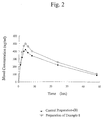
The time-dependent changes in blood cyclosporin A concentrations of
the rats are shown in Table 3 and Fig. 2:
The results in Table 3 and Fig. 2 show that bioavailability of cyclosporin A
observed for the inventive preparation is higher as compared to the control
preparation-(B) which does not contain the compound of formula (I).
These results demonstrate that the inventive preparation is very useful for
enhancing the bioavailability of a hardly absorbable drug with little adverse
effect.
While the invention has been described with respect to the above specific
embodiments, it should be recognized that various modifications and changes
may be made to the invention by those skilled in the art which also fall within the
scope of the invention as defined by the appended claims.



 X is CN, COOH, COOR10(wherein R10 is C1-2 alkyl), SO2Ph or SPh;k, l, m and n are each independently an integer of 0 to 4;R1 is H or C1-3 alkyl; andR2, R3, R4, R5, R6, R7, R8 and R9 are each independently H, OH or C1-3 alkoxy.