EP1184005A2 - Unitary metal injection molded orthodontic bracket - Google Patents
Unitary metal injection molded orthodontic bracket Download PDFInfo
- Publication number
- EP1184005A2 EP1184005A2 EP01307037A EP01307037A EP1184005A2 EP 1184005 A2 EP1184005 A2 EP 1184005A2 EP 01307037 A EP01307037 A EP 01307037A EP 01307037 A EP01307037 A EP 01307037A EP 1184005 A2 EP1184005 A2 EP 1184005A2
- Authority
- EP
- European Patent Office
- Prior art keywords
- orthodontic bracket
- archwire
- bracket
- ligature
- tiewings
- Prior art date
- Legal status (The legal status is an assumption and is not a legal conclusion. Google has not performed a legal analysis and makes no representation as to the accuracy of the status listed.)
- Withdrawn
Links
- 238000002347 injection Methods 0.000 title description 2
- 239000007924 injection Substances 0.000 title description 2
- 229910052751 metal Inorganic materials 0.000 title description 2
- 239000002184 metal Substances 0.000 title description 2
- 229910001092 metal group alloy Inorganic materials 0.000 claims description 5
- WAIPAZQMEIHHTJ-UHFFFAOYSA-N [Cr].[Co] Chemical class [Cr].[Co] WAIPAZQMEIHHTJ-UHFFFAOYSA-N 0.000 claims description 3
- 239000010935 stainless steel Substances 0.000 description 5
- 229910001220 stainless steel Inorganic materials 0.000 description 5
- 229910045601 alloy Inorganic materials 0.000 description 1
- 239000000956 alloy Substances 0.000 description 1
- 238000005266 casting Methods 0.000 description 1
- 239000011888 foil Substances 0.000 description 1
- 238000003754 machining Methods 0.000 description 1
- 230000014759 maintenance of location Effects 0.000 description 1
- 238000000034 method Methods 0.000 description 1
- 238000012986 modification Methods 0.000 description 1
- 230000004048 modification Effects 0.000 description 1
- 238000000465 moulding Methods 0.000 description 1
Images





Classifications
-
- A—HUMAN NECESSITIES
- A61—MEDICAL OR VETERINARY SCIENCE; HYGIENE
- A61C—DENTISTRY; APPARATUS OR METHODS FOR ORAL OR DENTAL HYGIENE
- A61C7/00—Orthodontics, i.e. obtaining or maintaining the desired position of teeth, e.g. by straightening, evening, regulating, separating, or by correcting malocclusions
- A61C7/12—Brackets; Arch wires; Combinations thereof; Accessories therefor
- A61C7/14—Brackets; Fixing brackets to teeth
Definitions
- This invention relates generally to orthodontic appliances, and more particularly concerns an orthodontic bracket allowing ligature ties to be placed on the orthodontic bracket so as to control the friction between an archwire and the bracket.
- Orthodontic appliances such as brackets, buccal tubes and the like, are typically applied to teeth by adhering the appliances to the surface of the teeth to orient the teeth by the application of forces on the teeth by such orthodontic appliances.
- Such appliances typically include archwire portions for receiving an archwire and ligature elastic bands to provide corrective forces to straighten and reposition the teeth.
- the orthodontic appliances include a base portion adapted to conform to the shape of the teeth to which they are applied, and elastic or wire ligature ties are used to hold the archwire in the archwire slot during initial and intermediate stages of treatment.
- tooth movement and straightening can be slowed by friction caused by such elastic or wire ligature ties, increasing the duration of orthodontic treatment.
- One known orthodontic bracket provides a base, a pair of opposing tie wings including a gingivally extending tie wing and an occlusally extending tie wing, an archwire slot defined in a vertical element between the pair of opposing tie wings, and a hook having a ball portion adapted to be oriented to extend toward the gingival side.
- a horizontal element is connected to the vertical element and includes opposing first and second ends extending away from the vertical element defining a pair of spaced-apart wire engaging points engageable with the arch wire for enabling rotational control of the bracket during use.
- the ends of the horizontal member also define horizontally extending wings for engaging stretched elastomeric modules to enhance rotational control.
- the slot in the vertical element has its lower surface vertically spaced from the horizontal element to limit contact between the arch wire and the horizontal element.
- Another known type of orthodontic appliance provides for a bracket having one or two pairs of opposing gingival/occlusal tie-wings projecting on either side of an archwire slot, with gingival/occlusal hooks.
- the bracket includes four shoulders on the free ends of the bracket, with two shoulders being located on opposite sides of the archwire slot with respect to each other on the mesial end of the appliance, and the other two shoulders being located on opposite sides of the archwire slot with respect to each other on the distal end of the appliance.
- Each shoulder is adapted to support a ligature spaced apart from the archwire in the archwire slot to permit the appliance to move relative to the archwire during orthodontic treatment.
- Another type of orthodontic appliance provides for a bracket having a pair of opposing T-shaped tie wings, with an archwire slot between the tie wings. Notches are provided on each of the mesial and distal sides of a center leg of each of the T-shaped tie wings for receiving a ligating device. A T-shaped hook may also be provided as an extension to the center leg of one of the T-shaped wings, to facilitate retention of a traction device.
- the tie wings include ligating support notches having a sloped portion extending toward the slot extending from the gingival or occlusal periphery of the tie wing, and having a curvilinear, concave configuration to reduce frictional engagement between an archwire positioned in the slot and a ligating device positioned across the archwire slot.
- the archwire slot may also include convex sidewall and/or floor portions to reduce frictional engagement between the archwire and bracket.
- an orthodontic appliance that also allows full contact of the ligature ties and archwire when desired, such as in the finishing stages of treatment. It would also be desirable to provide the orthodontic appliance with additional features to assist the doctor in orienting the orthodontic appliance to its optimal position, and to allow the ligature to be placed spaced apart from or next to the archwire depending on the friction desired.
- the present invention meets these and other needs.
- the present invention provides for an orthodontic bracket that permits a ligature tie to be placed on the orthodontic bracket spaced apart from an archwire for the bracket to allow the archwire to slide freely with respect to the orthodontic bracket with minimal friction, and that permits a ligature tie to be placed on the orthodontic bracket with full contact between the ligature tie and archwire, as desired.
- the orthodontic bracket also includes features to assist an orthodontist in orienting the orthodontic appliance to an optimal position, and to allow the orthodontist the options of placing the ligature tie in different positions depending on the desired degree of friction between the ligature tie and the archwire.
- the present invention accordingly provides for an orthodontic bracket having a body comprising a plurality of tiewings, and a plurality of posts extending in the mesial/distal direction.
- the plurality of tiewings are located on the occlusal side of the orthodontic bracket, and in one presently preferred aspect, may also include a center post between the tiewings, for placement reference and ligation of the orthodontic bracket.
- a hook may be provided on the gingival side of the orthodontic bracket for anchorage and ligating of the orthodontic bracket.
- tiewings may be provided on the occlusal and gingival side of the orthodontic bracket.
- the plurality of posts extending in the mesial/distal direction may be provided on the gingival side, or on the occlusal and gingival sides of the orthodontic bracket, to assist in bracket placement and to direct an elastomeric or wire ligature over or under an archwire occupying the archwire slot during treatment, as desired.
- the bracket is preferably comprised of cobalt chromium alloy, or may alternatively be comprised of another suitable biocompatible alloy.
- the bonding base of the orthodontic bracket may be formed to have a molded recessed number for identification of the tooth location for the orthodontic bracket.
- a biocompatible wire clip ligature, or a biocompatible cap ligature may be provided to fit over the orthodontic bracket to serve as a ligature to retain an archwire in the archwire slot of the orthodontic bracket.
- Tooth movement and straightening can be slowed by friction caused by elastic or wire ligature ties on orthodontic brackets, so that it is desirable for such ligature ties to be spaced apart from an archwire particularly during initial and intermediate stages of treatment when the most significant amount of movement and straightening of teeth typically occurs.
- a number of orthodontic appliances have been constructed to accomplish this, but it can also be desirable for the orthodontic appliance to allow full contact of the ligature ties and archwire, such as may be desirable in the finishing stages of treatment.
- the invention is embodied in an orthodontic bracket that permits a ligature tie to be placed on the orthodontic bracket spaced apart from an archwire for the bracket to allow the archwire to slide freely with respect to the orthodontic bracket with minimal friction, and that permits a ligature tie to be placed on the orthodontic bracket with full contact between the ligature tie and archwire, as desired.
- the present invention provides for an orthodontic bracket 20 for straightening teeth that includes a body 22 having a bonding base 24 adapted for adhering the bracket to a tooth surface 26.
- the bonding base is currently preferably formed to have a bottom rectangular grid 28 formed by cross-members intersecting at right angles, thereby forming a plurality of rectangular pockets 30, as is described in copending Serial No. 09/033,370 filed March 2, 1998, the disclosure of which is incorporated by reference herein in its entirety.
- the body also is preferably formed to include an archwire slot 32 adapted for receiving an archwire, and a plurality of tiewings 34, and a plurality of posts 36 extending in the mesial/distal direction.
- a pair of tiewings 38, 40 are formed on the occlusal side of the body of the bracket, with a center post 42 formed on the body between the two tiewings, for placement reference and ligation of the orthodontic bracket.
- a hook 44 is also preferably formed on the gingival side of the body of the bracket, for anchorage and ligating the orthodontic bracket.
- the hook comprises a central post 46 extending gingivally from the body of the bracket, with a slightly elongated, rounded or generally egg-shaped knob 48 with flattened ends 50, although the knob may have other similar suitable shapes. Referring to Figs.
- a pair of posts 52 also are provided on the gingival side of the body of the bracket, extending in the mesial/distal direction of the orthodontic bracket, to assist the orthodontist in bracket placement, and to allow the orthodontist to direct an elastomeric or wire ligature such as a stainless steel ligature over or under the archwire occupying the archwire slot during treatment, as is desired.
- an elastomeric or wire ligature such as a stainless steel ligature over or under the archwire occupying the archwire slot during treatment, as is desired.
- an orthodontic bracket 60 for straightening teeth that includes a body 62 having a bonding base 64 adapted for adhering the bracket to a tooth surface 66.
- the bonding base is currently preferably formed to have a bottom rectangular grid 68 formed by cross-members intersecting at right angles, thereby forming a plurality of rectangular pockets 70, as described above.
- the body also is preferably formed to include an archwire slot 72 adapted for receiving an archwire, and a plurality of tiewings 74, and a plurality of posts 76 extending in the mesial/distal direction.
- the second embodiment is similar to that of the first embodiment, in that it provides for a pair of tiewings 78, 80 formed on the occlusal side of the body of the bracket, but in this embodiment no center post is formed between the pair of tiewings.
- a hook 84 is also formed on the gingival side of the body of the bracket, for anchorage and ligating the orthodontic bracket, and the hook comprises a central post 86 extending gingivally from the body of the bracket, with a slightly elongated, rounded or generally egg-shaped knob 88 with flattened ends 90, as described above.
- a pair of posts 92 are provided on the gingival side of the body of the bracket, extending in the mesial/distal direction of the orthodontic bracket.
- the present invention provides for an orthodontic bracket 100 for straightening teeth.
- the orthodontic bracket includes a body 102 having a bonding base 104 adapted for adhering the bracket to a tooth surface 106.
- the bonding base is currently preferably formed to have a bottom rectangular grid 108 formed by cross-members intersecting at right angles, thereby forming a plurality of rectangular pockets 110, as described above.
- the body also is also preferably formed to include an archwire slot 112 adapted for receiving an archwire, and a plurality of tiewings 114, and a plurality of posts 116 extending in the mesial/distal direction.
- a tiewing 118 is formed on the occlusal side of the body of the bracket, and an opposing tiewing 120 is formed on the gingival side of the body of the bracket, although alternatively additional pairs of opposing tiewings may also be formed on the occlusal and gingival sides of the bracket.
- a pair of posts 122 are provided on the gingival side of the body of the bracket, extending in the mesial/distal direction of the orthodontic bracket
- an opposing pair of posts 124 are provided on the occlusal side of the body of the bracket, extending in the mesial/distal direction of the orthodontic bracket.
- the bonding base 24 of the orthodontic bracket 20 may also advantageously be formed to have a surface defining a molded recessed number 130 within the rectangular grid 28.
- the molded recessed number can be utilized to identify the preferred location of the tooth upon which the orthodontic bracket is to be placed, as well as the preferred orientation of the orthodontic bracket.
- a biocompatible wire clip 140 formed preferably of a biocompatible metal alloy, such as stainless steel for example, can be placed over the orthodontic bracket to serve as a ligature to retain an archwire in the slot 32.
- the biocompatible wire clip has a middle portion 142 that can be looped around the center post 42 of the orthodontic bracket, and coiled ends 144 that can be placed over the posts 36 extending in the mesial/distal direction.
- the middle portion 142 may be adapted to fit over the tiewings 34 of the orthodoontic bracket.
- a biocompatible cap ligature 150 preferably formed of a biocompatible metal alloy, such as stainless steel for example, may also be placed over the orthodontic bracket to serve as a ligature to retain and archwire in the slot 32.
- the biocompatible cap ligature includes a first cup-shaped end portion 152 adapted to fit over the tiewings 34 of the orthodontic bracket 20, and a second cup-shaped end portion 154 adapted to fit over the posts 36 extending in the mesial/distal direction.
- a biocompatible cap ligature 160 may also be placed over the orthodontic bracket to serve as a ligature to retain an archwire in the slot 32.
- the biocompatible cap ligature includes a first cup-shaped portion 162 adapted to fit over the center post 42 of the orthodontic bracket, and a second cup-shaped portion 164 adapted to fit over the posts 36 extending in the mesial/distal direction.
- the biocompatible cap ligature can be fitted over the orthodontic bracket by placing the second cup-shaped portion over the posts 36 first, and rotating the cap ligature to fit the first cup-shaped portion over the center post 42 between the tiewings.
- the body of the bracket is comprised of cobalt chromium alloy, although the bracket may alternatively be formed from any other suitable biocompatible metal alloy, such as stainless steel, for example.
- the body is preferably a unitary body, and is preferably a unitary metal injection molded body, although the body may also be formed by other suitable techniques such as casting or machining.
- the body may also be formed as a two piece bracket, with a foil mesh pad bonded to the bonding base for adhering the base to a tooth surface.
- the arrangements of tiewings and mesially/distally extending posts provide for an orthodontic appliance that also allows for the positioning of ligature ties to be spaced apart from the archwire slot of the bracket to reduce frictional engagement between the archwire and the bracket, or to be placed adjacent to the archwire slot of the bracket, for providing full contact of the ligature ties and archwire when desired.
- the foregoing embodiments of the orthodontic bracket additionally provide for multiple features that can assist the orthodontist in orienting the orthodontic appliance to its optimal position.
Landscapes
- Health & Medical Sciences (AREA)
- Oral & Maxillofacial Surgery (AREA)
- Dentistry (AREA)
- Epidemiology (AREA)
- Life Sciences & Earth Sciences (AREA)
- Animal Behavior & Ethology (AREA)
- General Health & Medical Sciences (AREA)
- Public Health (AREA)
- Veterinary Medicine (AREA)
- Dental Tools And Instruments Or Auxiliary Dental Instruments (AREA)
Abstract
Description
- This invention relates generally to orthodontic appliances, and more particularly concerns an orthodontic bracket allowing ligature ties to be placed on the orthodontic bracket so as to control the friction between an archwire and the bracket.
- Orthodontic appliances, such as brackets, buccal tubes and the like, are typically applied to teeth by adhering the appliances to the surface of the teeth to orient the teeth by the application of forces on the teeth by such orthodontic appliances. Such appliances typically include archwire portions for receiving an archwire and ligature elastic bands to provide corrective forces to straighten and reposition the teeth. The orthodontic appliances include a base portion adapted to conform to the shape of the teeth to which they are applied, and elastic or wire ligature ties are used to hold the archwire in the archwire slot during initial and intermediate stages of treatment. However, tooth movement and straightening can be slowed by friction caused by such elastic or wire ligature ties, increasing the duration of orthodontic treatment. It is thus desirable for such ligature ties to remain above the archwire particularly during such initial and intermediate stages of treatment when the most significant amount of movement and straightening of teeth typically occurs, in order to allow the archwire to slide freely with minimal friction when such movement is necessary to facilitate tooth movement and straightening.
- One known orthodontic bracket provides a base, a pair of opposing tie wings including a gingivally extending tie wing and an occlusally extending tie wing, an archwire slot defined in a vertical element between the pair of opposing tie wings, and a hook having a ball portion adapted to be oriented to extend toward the gingival side. A horizontal element is connected to the vertical element and includes opposing first and second ends extending away from the vertical element defining a pair of spaced-apart wire engaging points engageable with the arch wire for enabling rotational control of the bracket during use. The ends of the horizontal member also define horizontally extending wings for engaging stretched elastomeric modules to enhance rotational control. The slot in the vertical element has its lower surface vertically spaced from the horizontal element to limit contact between the arch wire and the horizontal element.
- Another known type of orthodontic appliance provides for a bracket having one or two pairs of opposing gingival/occlusal tie-wings projecting on either side of an archwire slot, with gingival/occlusal hooks. The bracket includes four shoulders on the free ends of the bracket, with two shoulders being located on opposite sides of the archwire slot with respect to each other on the mesial end of the appliance, and the other two shoulders being located on opposite sides of the archwire slot with respect to each other on the distal end of the appliance. Each shoulder is adapted to support a ligature spaced apart from the archwire in the archwire slot to permit the appliance to move relative to the archwire during orthodontic treatment.
- Another type of orthodontic appliance provides for a bracket having a pair of opposing T-shaped tie wings, with an archwire slot between the tie wings. Notches are provided on each of the mesial and distal sides of a center leg of each of the T-shaped tie wings for receiving a ligating device. A T-shaped hook may also be provided as an extension to the center leg of one of the T-shaped wings, to facilitate retention of a traction device. The tie wings include ligating support notches having a sloped portion extending toward the slot extending from the gingival or occlusal periphery of the tie wing, and having a curvilinear, concave configuration to reduce frictional engagement between an archwire positioned in the slot and a ligating device positioned across the archwire slot. The archwire slot may also include convex sidewall and/or floor portions to reduce frictional engagement between the archwire and bracket. However, it would be desirable to provide an orthodontic appliance that also allows full contact of the ligature ties and archwire when desired, such as in the finishing stages of treatment. It would also be desirable to provide the orthodontic appliance with additional features to assist the doctor in orienting the orthodontic appliance to its optimal position, and to allow the ligature to be placed spaced apart from or next to the archwire depending on the friction desired. The present invention meets these and other needs.
- Briefly, and in general terms, the present invention provides for an orthodontic bracket that permits a ligature tie to be placed on the orthodontic bracket spaced apart from an archwire for the bracket to allow the archwire to slide freely with respect to the orthodontic bracket with minimal friction, and that permits a ligature tie to be placed on the orthodontic bracket with full contact between the ligature tie and archwire, as desired. The orthodontic bracket also includes features to assist an orthodontist in orienting the orthodontic appliance to an optimal position, and to allow the orthodontist the options of placing the ligature tie in different positions depending on the desired degree of friction between the ligature tie and the archwire.
- The present invention accordingly provides for an orthodontic bracket having a body comprising a plurality of tiewings, and a plurality of posts extending in the mesial/distal direction. In a presently preferred embodiment, the plurality of tiewings are located on the occlusal side of the orthodontic bracket, and in one presently preferred aspect, may also include a center post between the tiewings, for placement reference and ligation of the orthodontic bracket. In a presently preferred aspect, a hook may be provided on the gingival side of the orthodontic bracket for anchorage and ligating of the orthodontic bracket. In another presently preferred embodiment, tiewings may be provided on the occlusal and gingival side of the orthodontic bracket. The plurality of posts extending in the mesial/distal direction may be provided on the gingival side, or on the occlusal and gingival sides of the orthodontic bracket, to assist in bracket placement and to direct an elastomeric or wire ligature over or under an archwire occupying the archwire slot during treatment, as desired. The bracket is preferably comprised of cobalt chromium alloy, or may alternatively be comprised of another suitable biocompatible alloy.
- In another presently preferred aspect of the invention the bonding base of the orthodontic bracket may be formed to have a molded recessed number for identification of the tooth location for the orthodontic bracket. In another presently preferred aspect, a biocompatible wire clip ligature, or a biocompatible cap ligature, may be provided to fit over the orthodontic bracket to serve as a ligature to retain an archwire in the archwire slot of the orthodontic bracket.
- These and other aspects and advantages of the invention will become apparent from the following detailed description and the accompanying drawings, which illustrate by way of example the features of the invention.
-
- Figure 1 is a perspective view of a first embodiment of the orthodontic bracket according to the invention illustrating the mounting of the orthodontic bracket on a tooth;
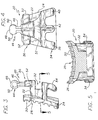
- Fig. 2 is an enlarged perspective view of the orthodontic bracket of Fig. 1;
- Fig. 3 is a front elevational view of the orthodontic bracket of Fig. 1;
- Fig. 4 is a plan view of the orthodontic bracket of Fig. 1;
- Fig. 5 is a sectional view of the orthodontic bracket taken along line 5-5 of Fig. 3;
- Fig. 6 is a perspective view of a second embodiment of the orthodontic bracket according to the invention illustrating the mounting of the orthodontic bracket on a tooth;
- Fig. 7 is an enlarged perspective view ofthe orthodontic bracket of Fig. 6;
- Fig. 8 is a front elevational view of the orthodontic bracket of Fig. 6;
- Fig. 9 is a plan view of the orthodontic bracket of Fig. 6;
- Fig. 10 is a sectional view of the orthodontic bracket taken along line 10-10 of Fig. 8;
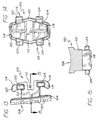
- Fig. 11 is a perspective view of a third embodiment of the orthodontic bracket according to the invention illustrating the mounting of the orthodontic bracket on a tooth;
- Fig. 12 is an enlarged perspective view of the orthodontic bracket of Fig. 11;
- Fig. 13 is a front elevational view of the orthodontic bracket of Fig. 11;
- Fig. 14 is a plan view of the orthodontic bracket of Fig. 11;
- Fig. 15 is a sectional view of the orthodontic bracket taken along line 15-15 of Fig. 13;
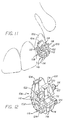
- Fig. 16 is a bottom perspective view of an orthodontic bracket according to the invention illustrating the molding of a recessed number on the grid of the bonding base;
- Fig. 17 is a bottom plan view of the base pattern of the orthodontic bracket of Fig. 16;
- Fig. 18 is a perspective view of the first embodiment of the orthodontic bracket of the invention illustrating the addition of a biocompatible wire clip ligature for the orthodontic bracket;
- Fig. 19 is a perspective view of the first embodiment of the orthodontic bracket of the invention illustrating the addition of a biocompatible cap ligature for the orthodontic bracket;
- Fig. 20 is a perspective view of the first embodiment ofthe orthodontic bracket ofthe invention illustrating an alternate form ofthe biocompatible cap ligature for the orthodontic bracket; and
- Fig. 21 is a perspective view similar to that of Fig. 20 illustrating the rotation of the biocompatible cap ligature onto or off of the orthodontic bracket.
-
- Tooth movement and straightening can be slowed by friction caused by elastic or wire ligature ties on orthodontic brackets, so that it is desirable for such ligature ties to be spaced apart from an archwire particularly during initial and intermediate stages of treatment when the most significant amount of movement and straightening of teeth typically occurs. A number of orthodontic appliances have been constructed to accomplish this, but it can also be desirable for the orthodontic appliance to allow full contact of the ligature ties and archwire, such as may be desirable in the finishing stages of treatment.
- As is illustrated in the drawings, the invention is embodied in an orthodontic bracket that permits a ligature tie to be placed on the orthodontic bracket spaced apart from an archwire for the bracket to allow the archwire to slide freely with respect to the orthodontic bracket with minimal friction, and that permits a ligature tie to be placed on the orthodontic bracket with full contact between the ligature tie and archwire, as desired. With reference to Figs. 1-5, in a first presently preferred embodiment, the present invention provides for an
orthodontic bracket 20 for straightening teeth that includes abody 22 having abonding base 24 adapted for adhering the bracket to atooth surface 26. The bonding base is currently preferably formed to have a bottomrectangular grid 28 formed by cross-members intersecting at right angles, thereby forming a plurality ofrectangular pockets 30, as is described in copending Serial No. 09/033,370 filed March 2, 1998, the disclosure of which is incorporated by reference herein in its entirety. The body also is preferably formed to include anarchwire slot 32 adapted for receiving an archwire, and a plurality oftiewings 34, and a plurality ofposts 36 extending in the mesial/distal direction. - Referring to Figs. 1, 2 and 4, in a presently preferred aspect of this embodiment, a pair of
tiewings center post 42 formed on the body between the two tiewings, for placement reference and ligation of the orthodontic bracket. Ahook 44 is also preferably formed on the gingival side of the body of the bracket, for anchorage and ligating the orthodontic bracket. In a presently preferred aspect, the hook comprises acentral post 46 extending gingivally from the body of the bracket, with a slightly elongated, rounded or generally egg-shapedknob 48 with flattened ends 50, although the knob may have other similar suitable shapes. Referring to Figs. 1-4, a pair ofposts 52 also are provided on the gingival side of the body of the bracket, extending in the mesial/distal direction of the orthodontic bracket, to assist the orthodontist in bracket placement, and to allow the orthodontist to direct an elastomeric or wire ligature such as a stainless steel ligature over or under the archwire occupying the archwire slot during treatment, as is desired. - With reference to Figs. 6-10, in a second presently preferred embodiment, the present invention provides for an
orthodontic bracket 60 for straightening teeth that includes abody 62 having abonding base 64 adapted for adhering the bracket to atooth surface 66. The bonding base is currently preferably formed to have a bottomrectangular grid 68 formed by cross-members intersecting at right angles, thereby forming a plurality ofrectangular pockets 70, as described above. The body also is preferably formed to include anarchwire slot 72 adapted for receiving an archwire, and a plurality oftiewings 74, and a plurality ofposts 76 extending in the mesial/distal direction. - Referring to Figs. 6, 7 and 9, the second embodiment is similar to that of the first embodiment, in that it provides for a pair of
tiewings hook 84 is also formed on the gingival side of the body of the bracket, for anchorage and ligating the orthodontic bracket, and the hook comprises acentral post 86 extending gingivally from the body of the bracket, with a slightly elongated, rounded or generally egg-shapedknob 88 with flattened ends 90, as described above. As is best seen in Figs. 6-9, a pair ofposts 92 are provided on the gingival side of the body of the bracket, extending in the mesial/distal direction of the orthodontic bracket. - With reference to Figs. 11-15, in a third presently preferred embodiment, the present invention provides for an
orthodontic bracket 100 for straightening teeth. The orthodontic bracket includes abody 102 having abonding base 104 adapted for adhering the bracket to atooth surface 106. The bonding base is currently preferably formed to have a bottomrectangular grid 108 formed by cross-members intersecting at right angles, thereby forming a plurality ofrectangular pockets 110, as described above. The body also is also preferably formed to include anarchwire slot 112 adapted for receiving an archwire, and a plurality oftiewings 114, and a plurality ofposts 116 extending in the mesial/distal direction. - Referring to Figs. 11, 12 and 14, a
tiewing 118 is formed on the occlusal side of the body of the bracket, and an opposingtiewing 120 is formed on the gingival side of the body of the bracket, although alternatively additional pairs of opposing tiewings may also be formed on the occlusal and gingival sides of the bracket. As is best seen in Figs. 6-9, a pair ofposts 122 are provided on the gingival side of the body of the bracket, extending in the mesial/distal direction of the orthodontic bracket, and an opposing pair ofposts 124 are provided on the occlusal side of the body of the bracket, extending in the mesial/distal direction of the orthodontic bracket. - As is illustrated in Figs. 16 and 17, another presently preferred aspect of the orthodontic bracket of the invention will be described with regard to the first embodiment of the orthodontic bracket of the invention shown in Figs. 1 - 5, although this aspect of the invention can apply equally to the other embodiments of the orthodontic bracket of the invention, and other orthodontic brackets as well. The
bonding base 24 of theorthodontic bracket 20 may also advantageously be formed to have a surface defining a molded recessednumber 130 within therectangular grid 28. The molded recessed number can be utilized to identify the preferred location of the tooth upon which the orthodontic bracket is to be placed, as well as the preferred orientation of the orthodontic bracket. - In another presently preferred aspect of the orthodontic bracket of the invention, as is illustrated in Fig. 18, a
biocompatible wire clip 140, formed preferably of a biocompatible metal alloy, such as stainless steel for example, can be placed over the orthodontic bracket to serve as a ligature to retain an archwire in theslot 32. The biocompatible wire clip has amiddle portion 142 that can be looped around thecenter post 42 of the orthodontic bracket, and coiled ends 144 that can be placed over theposts 36 extending in the mesial/distal direction. Alternatively, themiddle portion 142 may be adapted to fit over thetiewings 34 of the orthodoontic bracket. - As is shown in Fig. 19, in another presently preferred embodiment, a
biocompatible cap ligature 150, preferably formed of a biocompatible metal alloy, such as stainless steel for example, may also be placed over the orthodontic bracket to serve as a ligature to retain and archwire in theslot 32. The biocompatible cap ligature includes a first cup-shapedend portion 152 adapted to fit over thetiewings 34 of theorthodontic bracket 20, and a second cup-shapedend portion 154 adapted to fit over theposts 36 extending in the mesial/distal direction. - Referring to Figs. 20 and 21, in an alternate embodiment, a
biocompatible cap ligature 160, preferably formed ofabiocompatible metal alloy such as stainless steel for example, may also be placed over the orthodontic bracket to serve as a ligature to retain an archwire in theslot 32. In this alternate embodiment, the biocompatible cap ligature includes a first cup-shapedportion 162 adapted to fit over thecenter post 42 of the orthodontic bracket, and a second cup-shapedportion 164 adapted to fit over theposts 36 extending in the mesial/distal direction. As can be seen in Fig. 21, the biocompatible cap ligature can be fitted over the orthodontic bracket by placing the second cup-shaped portion over theposts 36 first, and rotating the cap ligature to fit the first cup-shaped portion over thecenter post 42 between the tiewings. - In a presently preferred aspect of each of the foregoing embodiments, the body of the bracket is comprised of cobalt chromium alloy, although the bracket may alternatively be formed from any other suitable biocompatible metal alloy, such as stainless steel, for example. In each of the foregoing embodiments, the body is preferably a unitary body, and is preferably a unitary metal injection molded body, although the body may also be formed by other suitable techniques such as casting or machining. The body may also be formed as a two piece bracket, with a foil mesh pad bonded to the bonding base for adhering the base to a tooth surface.
- It can readily be seen that in the foregoing embodiments, the arrangements of tiewings and mesially/distally extending posts provide for an orthodontic appliance that also allows for the positioning of ligature ties to be spaced apart from the archwire slot of the bracket to reduce frictional engagement between the archwire and the bracket, or to be placed adjacent to the archwire slot of the bracket, for providing full contact of the ligature ties and archwire when desired. The foregoing embodiments of the orthodontic bracket additionally provide for multiple features that can assist the orthodontist in orienting the orthodontic appliance to its optimal position.
- It will be apparent from the foregoing that while particular forms of the invention have been illustrated and described, various modifications can be made without departing from the spirit and scope of the invention. Accordingly, it is not intended that the invention be limited, except as by the appended claims.
Claims (13)
- An orthodontic bracket for straightening teeth, comprising:a body having an occlusal side and a gingival side;a bonding base formed in said body adapted to adhere to a tooth surface;a surface of said body defining an archwire slot adapted for receiving an archwire;a plurality of tiewings formed on said body; anda plurality of posts formed on said body extending in a mesial/distal direction, whereby a ligature tie can be placed on the orthodontic bracket spaced apart from the archwire slot of the bracket to reduce frictional engagement between the archwire and the orthodontic bracket, or can be placed adjacent to the archwire slot of the bracket, for providing full contact of the ligature tie and archwire to increase frictional engagement between the archwire and the orthodontic bracket.
- The orthodontic bracket of Claim 1, wherein said plurality of tiewings comprises a pair of tiewings formed on the occlusal side of the body, and further comprising a center post formed on said body between said pair of said tiewings.
- The orthodontic bracket of Claim 2, further comprising a hook formed on the gingival side of the body.
- The orthodontic bracket of Claim 1, wherein said plurality of tiewings comprises a plurality of tiewings formed on the occlusal and gingival sides of the body.
- The orthodontic bracket of Claim 1, wherein said plurality of posts are formed on the gingival side of the body.
- The orthodontic bracket of Claim 1, wherein said plurality of posts' are formed on the occlusal and gingival sides of the body.
- The orthodontic bracket of Claim 1, wherein said body is formed of a biocompatible metal alloy.
- The orthodontic bracket of Claim 1, wherein said body is formed of cobalt chromium alloy.
- The orthodontic bracket of Claim 2, further comprising a biocompatible wire coil ligature having coiled ends and a middle portion, said coiled ends adapted to fit over said plurality of posts formed on said body extending in a mesial/distal direction, and said middle portion adapted to fit over said center post.
- The orthodontic bracket of Claim 1, further comprising a biocompatible cap ligature having a first cup-shaped end portion and a second cup-shaped end portion, said first cup-shaped end portion adapted to fit over said plurality of tiewings, and said second cup-shaped end portion adapted to fit over said plurality of posts formed on said body extending in a mesial/distal direction.
- The orthodontic bracket of Claim 2, further comprising a biocompatible cap ligature having a first cup-shaped end portion and a second cup-shaped end portion, said first cup-shaped end portion adapted to fit over said center post, and said second cup-shaped end portion adapted to fit over said plurality of posts formed on said body extending in a mesial/distal direction.
- The orthodontic bracket of Claim 1, wherein said bonding base has a surface defining a molded recessed number for identification of a location of a tooth upon which the orthodontic bracket is to be mounted.
- An orthodontic bracket for straightening teeth, comprising:a body having an occlusal side and a gingival side;a bonding base formed in said body adapted to adhere to a tooth surface;a surface of said body defining an archwire slot adapted for receiving an archwire;a plurality of tiewings formed on the occlusal side of said body; anda plurality of posts formed on the gingival side of said body extending in a mesial/distal direction adapted to direct a ligature over or under the archwire in the archwire slot, whereby a ligature tie can be placed on the orthodontic bracket spaced apart from the archwire slot of the bracket to reduce frictional engagement between the archwire and the orthodontic bracket, or can be placed adjacent to the archwire slot of the bracket, for providing full contact of the ligature tie and archwire to increase frictional engagement between the archwire and the orthodontic bracket.
Applications Claiming Priority (2)
| Application Number | Priority Date | Filing Date | Title |
|---|---|---|---|
| US652397 | 2000-08-31 | ||
| US09/652,397 US6394798B1 (en) | 2000-08-31 | 2000-08-31 | Unitary metal injection molded orthodontic bracket |
Publications (2)
| Publication Number | Publication Date |
|---|---|
| EP1184005A2 true EP1184005A2 (en) | 2002-03-06 |
| EP1184005A3 EP1184005A3 (en) | 2003-03-26 |
Family
ID=24616681
Family Applications (1)
| Application Number | Title | Priority Date | Filing Date |
|---|---|---|---|
| EP01307037A Withdrawn EP1184005A3 (en) | 2000-08-31 | 2001-08-17 | Unitary metal injection molded orthodontic bracket |
Country Status (3)
| Country | Link |
|---|---|
| US (1) | US6394798B1 (en) |
| EP (1) | EP1184005A3 (en) |
| AU (1) | AU779573B2 (en) |
Cited By (4)
| Publication number | Priority date | Publication date | Assignee | Title |
|---|---|---|---|---|
| EP1795147A1 (en) * | 2005-12-09 | 2007-06-13 | Bernard Contencin | Orthodontic arch for performing a dento-facial orthodontic treatment. |
| EP1884216A1 (en) * | 2006-08-02 | 2008-02-06 | Dentaurum J.P. Winkelstroeter Kg | Orthopaedic jaw element |
| EP1723926A3 (en) * | 2005-05-20 | 2009-01-14 | Ormco Corporation | Orthodontic brackets and appliances and methods of making orthodontic brackets |
| WO2009068145A3 (en) * | 2007-11-27 | 2009-08-06 | Norbert Abels | Orthodontic bracket including mechanism for reducing slot width for early torque control |
Families Citing this family (38)
| Publication number | Priority date | Publication date | Assignee | Title |
|---|---|---|---|---|
| US7959437B2 (en) * | 2002-10-29 | 2011-06-14 | Rmo, Inc. | Orthodontic appliance with encoded information formed in the base |
| US20110287378A1 (en) | 2002-10-29 | 2011-11-24 | Rmo, Inc. | Orthodontic appliance with encoded information formed in the base |
| US6846178B2 (en) * | 2002-10-29 | 2005-01-25 | Rmo, Inc. | Orthodontic bracket base apparatus and method of manufacture |
| US7695277B1 (en) | 2004-10-28 | 2010-04-13 | Rmo, Inc. | Orthodontic bracket with frangible cover mechanism |
| US7140876B2 (en) * | 2003-10-31 | 2006-11-28 | 3M Innovative Properties Company | Orthodontic appliance with latch for retaining an archwire |
| ITRM20040140A1 (en) * | 2004-03-19 | 2004-06-19 | Sia Stampaggio Iniezione Metal | PERFECTED ORTHODONTIC DEVICE, IN PARTICULAR ORTHODONTIC ATTACHMENT. |
| US7094052B2 (en) * | 2004-04-30 | 2006-08-22 | Norbert Abels | Orthodontic brackets with temporarily visible marking features |
| US7252505B2 (en) * | 2004-07-28 | 2007-08-07 | 3M Innovative Properties Company | Self-ligating orthodontic appliance with post for connection to a latch |
| US7913002B2 (en) * | 2004-08-20 | 2011-03-22 | Advantest Corporation | Test apparatus, configuration method, and device interface |
| US7134872B2 (en) * | 2004-09-02 | 2006-11-14 | Norbert Abels | Colored orthodontic brackets |
| US20070264606A1 (en) * | 2006-04-26 | 2007-11-15 | Rmo, Inc. | Orthodontic bracket with removable slot cover |
| US7585171B2 (en) * | 2006-05-04 | 2009-09-08 | World Class Technology Corporation | Orthodontic bracket with rotary ligating cover |
| US7780443B2 (en) * | 2006-05-04 | 2010-08-24 | World Class Technology Corporation | Self-ligating bracket with rotary cover |
| US7611352B2 (en) * | 2006-08-31 | 2009-11-03 | Ultradent Products, Inc. | Lifestyle bracket system having interchangeable ligation covers |
| WO2008031060A2 (en) | 2006-09-07 | 2008-03-13 | Rmo, Inc. | Reduced-friction buccal tube and method of use |
| US8979528B2 (en) | 2006-09-07 | 2015-03-17 | Rmo, Inc. | Customized orthodontic appliance method and system |
| US9554875B2 (en) | 2006-09-07 | 2017-01-31 | Rmo, Inc. | Method for producing a customized orthodontic appliance |
| RU2011109216A (en) * | 2008-08-13 | 2012-09-20 | Ормко Корпорейшн (Us) | AESTHETIC ORTHODONTIC BRACKET AND METHOD OF ITS MANUFACTURE |
| AU2009238317B2 (en) | 2008-11-14 | 2011-10-06 | Ormco Corporation | Surface treated polycrystalline ceramic orthodontic bracket and method of making same |
| WO2010107567A1 (en) | 2009-03-16 | 2010-09-23 | Rmo, Inc. | Orthodontic bracket having an archwire channel and archwire retaining mechanism |
| US11219507B2 (en) | 2009-03-16 | 2022-01-11 | Orthoamerica Holdings, Llc | Customized orthodontic appliance and method |
| US9345558B2 (en) | 2010-09-03 | 2016-05-24 | Ormco Corporation | Self-ligating orthodontic bracket and method of making same |
| CN101947138B (en) * | 2010-09-10 | 2012-08-29 | 广州瑞通生物科技有限公司 | General lingual bracket system |
| USD660435S1 (en) | 2011-05-13 | 2012-05-22 | Rmo, Inc. | Orthodontic bracket |
| USD660436S1 (en) | 2011-05-13 | 2012-05-22 | Rmo, Inc. | Orthodontic bracket |
| USD660968S1 (en) | 2011-05-13 | 2012-05-29 | Rmo, Inc. | Orthodontic bracket |
| USD847349S1 (en) | 2011-09-22 | 2019-04-30 | Rmo, Inc. | Orthodontic lock with flange |
| USD726318S1 (en) | 2013-01-17 | 2015-04-07 | Rmo, Inc. | Dental instrument for a self-ligating orthodontic clip |
| CA2955936C (en) | 2013-09-20 | 2017-09-12 | Brandon OWEN | Bracket system |
| USD721811S1 (en) | 2013-10-29 | 2015-01-27 | Rmo, Inc. | Orthodontic bracket |
| US10117728B2 (en) | 2014-10-30 | 2018-11-06 | Oralect Licensing, Ltd. | Method and apparatus for treating orthodontitis |
| US10085824B2 (en) | 2015-10-30 | 2018-10-02 | Ortho Organizers, Inc. | Self ligating orthodontic bracket |
| US10575928B2 (en) | 2017-09-21 | 2020-03-03 | Brandon Owen | Orthodontic bracket retention anchor |
| US11331165B2 (en) | 2018-03-27 | 2022-05-17 | Klowen Braces, Inc. | Orthodontic treatment system |
| US20200146780A1 (en) * | 2018-11-12 | 2020-05-14 | Yi-Wen Chen | Dental traction device |
| US11583378B2 (en) * | 2020-09-03 | 2023-02-21 | Braces On Demand, Inc. | Systems and methods for marking orthodontic devices |
| CN114699192A (en) * | 2022-03-30 | 2022-07-05 | 祝东波 | Orthodontic bracket for tooth correction |
| CN223516467U (en) * | 2024-08-13 | 2025-11-07 | 伍鹏 | An elastic ligation band arch support device |
Citations (1)
| Publication number | Priority date | Publication date | Assignee | Title |
|---|---|---|---|---|
| US6053729A (en) | 1998-03-02 | 2000-04-25 | Ortho Corporation | Unitary substantially nickel free alloy injection molded orthodontic bracket |
Family Cites Families (14)
| Publication number | Priority date | Publication date | Assignee | Title |
|---|---|---|---|---|
| JPS56112238A (en) * | 1980-02-08 | 1981-09-04 | Kinya Fujita | Dental orthodontic apparatus |
| US4582487A (en) * | 1984-03-29 | 1986-04-15 | Thomas D. Creekmore | Lingual orthodontic appliance system for edgewise therapy |
| US5161969A (en) * | 1986-09-29 | 1992-11-10 | Minnesota Mining And Manufacturing Company | Orthodontic bracket |
| JPH0681622B2 (en) | 1989-06-20 | 1994-10-19 | トミー株式会社 | Orthodontic bracket |
| US5160261A (en) | 1991-05-20 | 1992-11-03 | Rmo, Inc. | Orthodontic bracket and method |
| US5456599A (en) | 1992-03-17 | 1995-10-10 | Hamilton Ortho Inc. | Orthodontic arch wires and brackets |
| US5302116A (en) | 1992-03-20 | 1994-04-12 | Viazis Anthony D | Orthodontic bracket |
| US5232361A (en) * | 1992-04-06 | 1993-08-03 | Sachdeva Rohit C L | Orthodontic bracket |
| US5252066A (en) * | 1992-08-28 | 1993-10-12 | Johnson & Johnson Consumer Products, Inc. | Orthodontic bracket formed from porcelain fused to metallic material |
| USD367116S (en) | 1993-10-12 | 1996-02-13 | Viazis Anthony D | Orthodontic bracket |
| US5395237A (en) * | 1994-01-06 | 1995-03-07 | Minnesota Mining And Manufacturing Company | Orthodontic bracket with integral ball hook and method of making |
| JP3364728B2 (en) * | 1994-04-13 | 2003-01-08 | トミー株式会社 | Orthodontic bracket |
| US5616026A (en) * | 1995-06-07 | 1997-04-01 | Rmo, Inc. | Orthondontic appliance and method of making the same |
| US5885074A (en) * | 1997-10-27 | 1999-03-23 | Hanson; Eric H. | Ligatures for orthodontic appliances and orthodontic brackets incorporating such ligatures |
-
2000
- 2000-08-31 US US09/652,397 patent/US6394798B1/en not_active Expired - Lifetime
-
2001
- 2001-08-17 EP EP01307037A patent/EP1184005A3/en not_active Withdrawn
- 2001-08-24 AU AU65441/01A patent/AU779573B2/en not_active Expired
Patent Citations (1)
| Publication number | Priority date | Publication date | Assignee | Title |
|---|---|---|---|---|
| US6053729A (en) | 1998-03-02 | 2000-04-25 | Ortho Corporation | Unitary substantially nickel free alloy injection molded orthodontic bracket |
Cited By (5)
| Publication number | Priority date | Publication date | Assignee | Title |
|---|---|---|---|---|
| EP1723926A3 (en) * | 2005-05-20 | 2009-01-14 | Ormco Corporation | Orthodontic brackets and appliances and methods of making orthodontic brackets |
| EP1795147A1 (en) * | 2005-12-09 | 2007-06-13 | Bernard Contencin | Orthodontic arch for performing a dento-facial orthodontic treatment. |
| EP1884216A1 (en) * | 2006-08-02 | 2008-02-06 | Dentaurum J.P. Winkelstroeter Kg | Orthopaedic jaw element |
| WO2009068145A3 (en) * | 2007-11-27 | 2009-08-06 | Norbert Abels | Orthodontic bracket including mechanism for reducing slot width for early torque control |
| US7857618B2 (en) | 2007-11-27 | 2010-12-28 | Ultradent Products, Inc. | Orthodontic bracket including mechanism for reducing slot width for early torque control |
Also Published As
| Publication number | Publication date |
|---|---|
| US6394798B1 (en) | 2002-05-28 |
| AU6544101A (en) | 2002-03-07 |
| AU779573B2 (en) | 2005-01-27 |
| EP1184005A3 (en) | 2003-03-26 |
Similar Documents
| Publication | Publication Date | Title |
|---|---|---|
| US6394798B1 (en) | Unitary metal injection molded orthodontic bracket | |
| US4299568A (en) | Orthodontic appliance | |
| US4582487A (en) | Lingual orthodontic appliance system for edgewise therapy | |
| US4880380A (en) | Orthodonture appliance which may be manually installed and removed by the patient | |
| US5125831A (en) | Orthodontic bracket with bi-directional hook | |
| US5306142A (en) | Crimpable orthodontic hook | |
| US5474444A (en) | Multiwire arch system | |
| US4664626A (en) | System for automatically preventing overtipping and/or overuprighting in the begg technique | |
| US4531911A (en) | Combination single/twin edgewise orthodontic bracket | |
| US4529382A (en) | Lingual orthodontic appliance system for edgewise therapy | |
| US5064370A (en) | Molar distalizing appliance | |
| US5160261A (en) | Orthodontic bracket and method | |
| US5030089A (en) | Orthodontic appliance with hook | |
| US6733285B2 (en) | Orthodontic appliance with lingual retaining groove | |
| US4669980A (en) | Orthodontic appliance | |
| US20100129765A1 (en) | Orthodontic apparatus and orthodontic member | |
| US20080070183A1 (en) | Molar appliance for an orthodontic brace | |
| US20180042700A1 (en) | Orthodontic bracket and method of correcting malpositioned teeth | |
| EP0397533B1 (en) | Orthodontic appliance with hook | |
| US11246683B1 (en) | Orthodontic band attachment device | |
| GB2173404A (en) | Orthodontic appliance | |
| US4416627A (en) | Orthodontic appliance | |
| US5078597A (en) | Lingual attachment | |
| US6135767A (en) | Spring loop retainer and method of making same | |
| US5302116A (en) | Orthodontic bracket |
Legal Events
| Date | Code | Title | Description |
|---|---|---|---|
| PUAI | Public reference made under article 153(3) epc to a published international application that has entered the european phase |
Free format text: ORIGINAL CODE: 0009012 |
|
| AK | Designated contracting states |
Kind code of ref document: A2 Designated state(s): AT BE CH CY DE DK ES FI FR GB GR IE IT LI LU MC NL PT SE TR |
|
| AX | Request for extension of the european patent |
Free format text: AL;LT;LV;MK;RO;SI |
|
| PUAL | Search report despatched |
Free format text: ORIGINAL CODE: 0009013 |
|
| AK | Designated contracting states |
Kind code of ref document: A3 Designated state(s): AT BE CH CY DE DK ES FI FR GB GR IE IT LI LU MC NL PT SE TR Designated state(s): AT BE CH CY DE DK ES FI FR GB GR IE IT LI LU MC NL PT SE TR |
|
| AX | Request for extension of the european patent |
Extension state: AL LT LV MK RO SI |
|
| 17P | Request for examination filed |
Effective date: 20030602 |
|
| AKX | Designation fees paid |
Designated state(s): AT BE CH CY DE DK ES FI FR GB GR IE IT LI LU MC NL PT SE TR |
|
| AXX | Extension fees paid |
Extension state: SI Payment date: 20030602 Extension state: RO Payment date: 20030602 Extension state: MK Payment date: 20030602 Extension state: LV Payment date: 20030602 Extension state: LT Payment date: 20030602 Extension state: AL Payment date: 20030602 |
|
| 17Q | First examination report despatched |
Effective date: 20050411 |
|
| GRAP | Despatch of communication of intention to grant a patent |
Free format text: ORIGINAL CODE: EPIDOSNIGR1 |
|
| STAA | Information on the status of an ep patent application or granted ep patent |
Free format text: STATUS: THE APPLICATION IS DEEMED TO BE WITHDRAWN |
|
| 18D | Application deemed to be withdrawn |
Effective date: 20060301 |