EP1183994A1 - Method for determining basal metabolism - Google Patents
Method for determining basal metabolism Download PDFInfo
- Publication number
- EP1183994A1 EP1183994A1 EP01119658A EP01119658A EP1183994A1 EP 1183994 A1 EP1183994 A1 EP 1183994A1 EP 01119658 A EP01119658 A EP 01119658A EP 01119658 A EP01119658 A EP 01119658A EP 1183994 A1 EP1183994 A1 EP 1183994A1
- Authority
- EP
- European Patent Office
- Prior art keywords
- basal metabolism
- fat
- free mass
- ffm
- age
- Prior art date
- Legal status (The legal status is an assumption and is not a legal conclusion. Google has not performed a legal analysis and makes no representation as to the accuracy of the status listed.)
- Granted
Links
Images


Classifications
-
- A—HUMAN NECESSITIES
- A61—MEDICAL OR VETERINARY SCIENCE; HYGIENE
- A61B—DIAGNOSIS; SURGERY; IDENTIFICATION
- A61B10/00—Instruments for taking body samples for diagnostic purposes; Other methods or instruments for diagnosis, e.g. for vaccination diagnosis, sex determination or ovulation-period determination; Throat striking implements
-
- A—HUMAN NECESSITIES
- A61—MEDICAL OR VETERINARY SCIENCE; HYGIENE
- A61B—DIAGNOSIS; SURGERY; IDENTIFICATION
- A61B5/00—Measuring for diagnostic purposes; Identification of persons
- A61B5/48—Other medical applications
- A61B5/4869—Determining body composition
- A61B5/4872—Body fat
-
- A—HUMAN NECESSITIES
- A61—MEDICAL OR VETERINARY SCIENCE; HYGIENE
- A61B—DIAGNOSIS; SURGERY; IDENTIFICATION
- A61B5/00—Measuring for diagnostic purposes; Identification of persons
- A61B5/05—Detecting, measuring or recording for diagnosis by means of electric currents or magnetic fields; Measuring using microwaves or radio waves
- A61B5/053—Measuring electrical impedance or conductance of a portion of the body
- A61B5/0537—Measuring body composition by impedance, e.g. tissue hydration or fat content
Definitions
- the present invention relates to determining basal metabolism of a patient, and more particularly, to a method for determining basal metabolism using fat-free mass.
- a statistically standard basal metabolism value is used in most cases to determine basal metabolism.
- the statistically standard basal metabolism value is obtained, for example in Japan, by multiplying a reference value of basal metabolism on the basis of gender and age according to Health Service Bureau of Ministry of Health and Welfare by body weight. This standard value is used despite the importance of a relationship between adiposis and basal metabolism.
- Basal metabolism is considered to be directly proportional to fat-free mass rather than to actual body weight.
- the basal metabolism determined using the above-mentioned method is suitable for a human having a standard body build and a standard body composition, because body composition is a strong effective factor.
- a calculated value of basal metabolism tends to be higher than an observed value of basal metabolism in a pycnic type (i.e., a human with a high fat rate) who has a heavy body weight and a large amount of fat.
- a calculated value of basal metabolism tends to be lower than an observed value of basal metabolism in a slim and muscular man (i.e., a human with a low fat rate). Therefore, the above-mentioned method for calculating basal metabolism is not preferable from the viewpoint of guidance for adiposis.
- BMR basal metabolism (kcal/day)
- FFM fat-free mass (kg)
- a and B are constants.
- the relationship between the basal metabolism and the fat-free mass is shown in Fig. 2.
- This formula produces a correlation coefficient of 0.824, which shows the formula closely correlates with observed results.
- the basal metabolism obtained with the above mentioned formula is adapted to adults but not to children in a growth period.
- the calculated value with the formula tends to be lower than an observed value in a person having a low fat-free mass, especially in young slim females according to the measured results by the present inventors. Accordingly, a need exists for an improved apparatus for calculating basal metabolism that provides a calculated value that more accurately correlates with the observed value of basal metabolism so that guidance can be effectively provided as to diet and exercise for a pycnic type person and also to children.
- inventions which provide a method for determining basal metabolism.
- the method includes obtaining an age of a subject; determining fat-free mass of the subject; and calculating the basal metabolism of the subject using the determined fat-free mass and a reciprocal of the age.
- the present invention improves the accuracy of an arithmetic method used to determine basal metabolism.
- the method includes obtaining an age and a body weight of a subject; determining fat-free mass of the subject; and determining basal metabolism of the subject using the determined fat-free mass, the body weight, and a reciprocal of the age.
- a correlation coefficient between the basal metabolism obtained using the above mentioned formula and the observed basal metabolism is 0.870.
- the observed value was obtained by analysis of expired gas.
- the difference between an observed value and a calculated value against fat-free mass is half of the conventional data.
- a calculated value of basal metabolism tends to be lower than an observed value in humans with extremely low fat-free mass.
- a correlation coefficient between the basal metabolism obtained using the above mentioned formula and the observed basal metabolism is 0.88.
- the observed value was obtained by analysis of expired gas.
- the difference between an observed value and a calculated value against fat-free mass is almost identical.
- the inventors of the present invention recognize that the calculated value of basal metabolism tends to be lower than an observed value thereof in humans with low fat-free mass, especially in young slim female and in children.
- the inventors of the present invention have found that a reciprocal of an age and body weight in addition to fat-free mass is preferably utilized to calculate basal metabolism.
- a correlation coefficient between the basal metabolism obtained using the above mentioned formula and the observed basal metabolism is 0.879.
- the observed value was obtained by analysis of expired gas.
- the difference between an observed value and a calculated value against fat-free mass is half of the data shown in Fig. 6.
- a calculated value of basal metabolism tends to be lower than an observed value thereof in human with extremely low fat-free mass.
- a correlation coefficient between the basal metabolism obtained using the above mentioned formula and the observed basal metabolism is 0.88.
- the observed value was obtained by analysis of expired gas.
- the difference between an observed value and a calculated value against fat-free mass is substantially identical with the data shown in Fig. 8.
- values for fat-free mass, age, and body weight are required to calculate the basal metabolism.
- the basal metabolism can therefore be determined, for example, by changing a control program of a commercially available body fat measuring apparatus attached with weighing machine or an body fat measuring apparatus in which a value of body weight is manually inputted.
- Any method of determining fat-free mass is acceptable for use with the invention, for example, a bioimpedance analysis method (BIA method), a DEXA method, a method using a caliper, and the like may be employed.
Landscapes
- Health & Medical Sciences (AREA)
- Life Sciences & Earth Sciences (AREA)
- Public Health (AREA)
- Molecular Biology (AREA)
- Veterinary Medicine (AREA)
- General Health & Medical Sciences (AREA)
- Pathology (AREA)
- Engineering & Computer Science (AREA)
- Biomedical Technology (AREA)
- Heart & Thoracic Surgery (AREA)
- Medical Informatics (AREA)
- Animal Behavior & Ethology (AREA)
- Surgery (AREA)
- Physics & Mathematics (AREA)
- Biophysics (AREA)
- Nuclear Medicine, Radiotherapy & Molecular Imaging (AREA)
- Radiology & Medical Imaging (AREA)
- Measurement And Recording Of Electrical Phenomena And Electrical Characteristics Of The Living Body (AREA)
- Medical Treatment And Welfare Office Work (AREA)
- Investigating Or Analysing Biological Materials (AREA)
- Measurement Of The Respiration, Hearing Ability, Form, And Blood Characteristics Of Living Organisms (AREA)
Abstract
Description
- The present invention relates to determining basal metabolism of a patient, and more particularly, to a method for determining basal metabolism using fat-free mass.
- Expensive and extensive apparatus are usually necessary to determine accurate basal metabolism of a subject. Additionally, many loads and measuring conditions are required, and a subject has to keep at rest for a long time with wearing a facemask and a mouthpiece. In addition, only a specialist can handle the measuring apparatus and evaluate the measured results. As such, the general public can hardly perform their own tests to obtain an accurate measure of their own basal metabolism.
- For these reasons, a statistically standard basal metabolism value is used in most cases to determine basal metabolism. The statistically standard basal metabolism value is obtained, for example in Japan, by multiplying a reference value of basal metabolism on the basis of gender and age according to Health Service Bureau of Ministry of Health and Welfare by body weight. This standard value is used despite the importance of a relationship between adiposis and basal metabolism.
- Basal metabolism, however, is considered to be directly proportional to fat-free mass rather than to actual body weight. As shown in Fig. 1, the basal metabolism determined using the above-mentioned method is suitable for a human having a standard body build and a standard body composition, because body composition is a strong effective factor. However, a calculated value of basal metabolism tends to be higher than an observed value of basal metabolism in a pycnic type (i.e., a human with a high fat rate) who has a heavy body weight and a large amount of fat. Also, a calculated value of basal metabolism tends to be lower than an observed value of basal metabolism in a slim and muscular man (i.e., a human with a low fat rate). Therefore, the above-mentioned method for calculating basal metabolism is not preferable from the viewpoint of guidance for adiposis.
- Since basal metabolism has a close relation to the fat-free mass, a formula represented as follows is employed in a foreign nutrition science academy.
- BMR is basal metabolism (kcal/day), FFM is fat-free mass (kg), and A and B are constants. The relationship between the basal metabolism and the fat-free mass is shown in Fig. 2. This formula produces a correlation coefficient of 0.824, which shows the formula closely correlates with observed results. However, the basal metabolism obtained with the above mentioned formula is adapted to adults but not to children in a growth period. In addition, the calculated value with the formula tends to be lower than an observed value in a person having a low fat-free mass, especially in young slim females according to the measured results by the present inventors. Accordingly, a need exists for an improved apparatus for calculating basal metabolism that provides a calculated value that more accurately correlates with the observed value of basal metabolism so that guidance can be effectively provided as to diet and exercise for a pycnic type person and also to children.
- These and other needs are met by embodiments of the present invention which provide a method for determining basal metabolism. The method includes obtaining an age of a subject; determining fat-free mass of the subject; and calculating the basal metabolism of the subject using the determined fat-free mass and a reciprocal of the age. By adding the reciprocal of an age as a factor in determining basal metabolism, in addition to fat-free mass, the present invention improves the accuracy of an arithmetic method used to determine basal metabolism.
- In an aspect of the present invention, basal metabolism can be determined using the formula represented by BMR = A × FFM + B × (1/age) + C, in which BMR is basal metabolism (kcal/day), FFM is fat-free mass (kg), and A, B, and C are constants.
- In accordance with another aspect of the present invention, the method can determine basal metabolism using the formula represented by BMR = A × FFM2 + B × FFM + C × (1/age) + D, in which BMR is basal metabolism (kcal/day), FFM is fat-free mass (kg), and A, B, C, and D are constants.
- In an additional embodiment, the method includes obtaining an age and a body weight of a subject; determining fat-free mass of the subject; and determining basal metabolism of the subject using the determined fat-free mass, the body weight, and a reciprocal of the age. By adding both age and weight as factors in determining basal metabolism, in addition to fat-free mass, the present invention improves the accuracy of an arithmetic method used to determine basal metabolism.
- In an aspect of the invention, the basal metabolism can be determined using the formula represented by BMR = A × FFM + B × (1/age) + C × body weight + D, in which BMR is basal metabolism (kcal/day), FFM is fat-free mass (kg), and A, B, C, and D are constants.
- In another aspect of the invention, the basal metabolism is calculated with a formula represented by BMR = A × FFM2 + B × FFM + C × (1/age) + D × body weight + E, in which BMR is basal metabolism (kcal/day), FFM is fat-free mass(kg), and A, B, C, D, and E are constants.
- Additional advantages of the present invention will become readily apparent to those skilled in this art from the following detailed description, wherein only the preferred embodiment of the present invention is shown and described, simply by way of illustration of the best mode contemplated for carrying out the present invention. As will be realized, the present invention is capable of other and different embodiments, and its several details are capable of modifications in various obvious respects, all without departing from the invention. Accordingly, the drawings and description are to be regarded as illustrative in nature, and not as restrictive.
- Reference is made to the attached drawings, wherein elements having the same reference numeral designations represent like elements throughout, and wherein:
- Fig. 1 is a graph showing a relationship between difference between an observed value of basal metabolism and a calculated value of basal metabolism and a fat rate.
- Fig. 2 is a graph showing a relationship between fat-free mass and basal metabolism.
- Fig. 3 is a graph showing a relationship between an age and a reference value of basal metabolism.
- Fig. 4 is a graph showing a relationship between basal metabolism per body weight and an age.
- Fig. 5 is a graph showing a relationship between a calculated value of basal metabolism and an observed value of basal metabolism.
- Fig. 6 is a graph showing a relationship between difference between an observed value of basal metabolism and a calculated value of basal metabolism and fat-free mass.
- Fig. 7 is a graph showing a relationship between a calculated value of basal metabolism and an observed value of basal metabolism.
- Fig. 8 is a graph showing a relationship between difference between an observed value of basal metabolism and a calculated value of basal metabolism and fat-free mass.
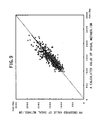
- Fig. 9 is a graph showing a relationship between a calculated value of basal metabolism and an observed value of basal metabolism.
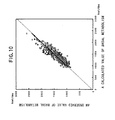
- Fig. 10 is a graph showing a relationship between a calculated value of basal metabolism and an observed value of basal metabolism.
-
- An embodiment of the present invention will be described with reference to the figures. As shown in Fig. 3, the inventors of the present invention have reviewed the values of basal metabolism provided by the Health Service Bureau of Ministry of Health and Welfare and have determined that these values are inversely proportional to age of the subject. In addition, as illustrated in Fig. 4, the inventors of the present invention have independently observed that basal metabolism per body weight is inversely proportional to an age. Furthermore, the inventors have of the present invention have found that a reciprocal of an age in addition to fat-free mass is preferably utilized when calculating basal metabolism. Accordingly, the inventors have found that the basal metabolism can be calculated using the formula represented by BMR = A × FFM + B × (1/age) + C, in which BMR is basal metabolism (kcal/day), FFM is fat-free mass (kg), and A, B, and C are constants. It should be understood, however, that the formula is not limited to using metric measuring system values and can use any type of measuring system values.
- As shown in Fig. 5, a correlation coefficient between the basal metabolism obtained using the above mentioned formula and the observed basal metabolism is 0.870. The observed value was obtained by analysis of expired gas. As shown in Fig. 6, the difference between an observed value and a calculated value against fat-free mass is half of the conventional data.
- As shown in Fig. 2, a calculated value of basal metabolism tends to be lower than an observed value in humans with extremely low fat-free mass. The inventors of the present invention have found that a reciprocal of an age and squared thereof in addition to fat-free mass is preferably utilized when calculating basal metabolism. Accordingly, the inventors have found that the basal metabolism can be calculated using the formula represented by BMR = A × FFM2 + B × FFM + C × (1/age) + D, in which BMR is basal metabolism (kcal/day), FFM is fat-free mass (kg), and A, B, C, and D are constants. It should be understood, however, that the formula is not limited to using metric measuring system values and can use any type of measuring system values.
- As shown in Fig. 7, a correlation coefficient between the basal metabolism obtained using the above mentioned formula and the observed basal metabolism is 0.88. The observed value was obtained by analysis of expired gas. As shown in Fig. 8, the difference between an observed value and a calculated value against fat-free mass is almost identical.
- The inventors of the present invention recognize that the calculated value of basal metabolism tends to be lower than an observed value thereof in humans with low fat-free mass, especially in young slim female and in children. As such, the inventors of the present invention have found that a reciprocal of an age and body weight in addition to fat-free mass is preferably utilized to calculate basal metabolism. Accordingly, the inventors have found that the basal metabolism can be calculated using the formula represented by BMR = A × FFM + B × (1/age) + C × body weight + D, in which BMR is basal metabolism (kcal/day), FFM is fat-free mass (kg), and A, B, C, and D are constants. It should be understood, however, that the formula is not limited to using metric measuring system values and can use any type of measuring system values.
- As shown in Fig. 9, a correlation coefficient between the basal metabolism obtained using the above mentioned formula and the observed basal metabolism is 0.879. The observed value was obtained by analysis of expired gas. The difference between an observed value and a calculated value against fat-free mass is half of the data shown in Fig. 6.
- As shown in Fig. 2, a calculated value of basal metabolism tends to be lower than an observed value thereof in human with extremely low fat-free mass. The inventors of the present invention have found that a reciprocal of an age and squared thereof in addition to fat-free mass should be paid is preferably utilized to calculate basal metabolism. Accordingly, the inventors have found that the basal metabolism can be calculated using the formula represented by BMR = A × FFM2 + B × FFM + C × (1/age) + D × body weight + E, in which BMR is basal metabolism (kcal/day), FFM is fat-free mass (kg), and A, B, C, D, and E are constants. It should be understood, however, that the formula is not limited to using metric measuring system values and can use any type of measuring system values.
- As shown in Fig. 10, a correlation coefficient between the basal metabolism obtained using the above mentioned formula and the observed basal metabolism is 0.88. The observed value was obtained by analysis of expired gas. The difference between an observed value and a calculated value against fat-free mass is substantially identical with the data shown in Fig. 8.
- According to the above-described embodiment of the invention, values for fat-free mass, age, and body weight are required to calculate the basal metabolism. The basal metabolism can therefore be determined, for example, by changing a control program of a commercially available body fat measuring apparatus attached with weighing machine or an body fat measuring apparatus in which a value of body weight is manually inputted. Any method of determining fat-free mass is acceptable for use with the invention, for example, a bioimpedance analysis method (BIA method), a DEXA method, a method using a caliper, and the like may be employed.
- The present invention can be practiced by employing conventional methodology and equipment. Accordingly, the details of such equipment and methodology are not set forth herein in detail. In the previous descriptions, numerous specific details are set forth in order to provide a thorough understanding of the present invention. However, it should be recognized that the present invention can be practiced without resorting to the details specifically set forth. In other instances, well known processing structures or methods have not been described in detail, in order not to unnecessarily obscure the present invention.
- Only the preferred embodiment of the present invention and but a few examples of its versatility are shown and described in the present disclosure. It is to be understood that the present invention is capable of use in various other combinations and environments and is capable of changes or modifications within the scope of the inventive concept as expressed herein.
Claims (6)
- An arithmetic method for determining basal metabolism, comprising the steps of:obtaining an age of a subject;determining fat-free mass of the subject; anddetermining basal metabolism of the subject using the determined fat-free mass and a reciprocal of the age.
- The invention according to claim 1, wherein the basal metabolism is calculated using a formula represented by BMR = A × FFM + B × (1/age) + C, wherein BMR is basal metabolism, FFM is fat-free mass, and A, B, and C are constants.
- The invention according to claim 1, wherein the basal metabolism is calculated using a formula represented by BMR = A × FFM2 + B × FFM + C × (1/age) + D, wherein BMR is basal metabolism, FFM is fat-free mass, and A, B, C, and D are constants.
- An arithmetic method for determining basal metabolism, comprising the steps of:obtaining an age and a body weight of a subject;determining fat-free mass of the subject; anddetermining basal metabolism of the subject using the determined fat-free mass, the body weight, and a reciprocal of the age.
- The invention according to claim 4, wherein the basal metabolism is calculated using a formula represented by BMR = A × FFM + B × (1/age) + C × body weight + D, wherein BMR is basal metabolism, FFM is fat-free mass , and A, B, C, and D are constants.
- The invention according to claim 4, wherein the basal metabolism is calculated using a formula represented by BMR = A × FFM2 + B × FFM + C × (1/age) + D × body weight + E wherein BMR is basal metabolism, FFM is fat-free mass, and A, B, C, D, and E are constants.
Applications Claiming Priority (2)
| Application Number | Priority Date | Filing Date | Title |
|---|---|---|---|
| US22876700P | 2000-08-30 | 2000-08-30 | |
| US228767P | 2000-08-30 |
Publications (2)
| Publication Number | Publication Date |
|---|---|
| EP1183994A1 true EP1183994A1 (en) | 2002-03-06 |
| EP1183994B1 EP1183994B1 (en) | 2009-01-07 |
Family
ID=22858506
Family Applications (1)
| Application Number | Title | Priority Date | Filing Date |
|---|---|---|---|
| EP01119658A Expired - Lifetime EP1183994B1 (en) | 2000-08-30 | 2001-08-21 | Method for determining basal metabolism |
Country Status (6)
| Country | Link |
|---|---|
| US (1) | US6480736B1 (en) |
| EP (1) | EP1183994B1 (en) |
| JP (2) | JP2002112982A (en) |
| KR (1) | KR20020018108A (en) |
| CN (1) | CN1781445A (en) |
| DE (1) | DE60137288D1 (en) |
Cited By (1)
| Publication number | Priority date | Publication date | Assignee | Title |
|---|---|---|---|---|
| US7147603B2 (en) | 2001-07-19 | 2006-12-12 | Tanita Corporation | Apparatus for measurement of living body |
Families Citing this family (12)
| Publication number | Priority date | Publication date | Assignee | Title |
|---|---|---|---|---|
| JP2004008659A (en) * | 2002-06-11 | 2004-01-15 | Tanita Corp | Biological measurement device |
| US20070027401A1 (en) * | 2003-08-28 | 2007-02-01 | Tanita Corporation | Body composition analyzer |
| JP4667938B2 (en) * | 2005-01-21 | 2011-04-13 | 株式会社タニタ | Basal metabolism measuring device |
| JP4589776B2 (en) | 2005-03-28 | 2010-12-01 | 株式会社タニタ | Biometric system for pregnant women |
| JP2006288678A (en) * | 2005-04-11 | 2006-10-26 | Tanita Corp | Basal metabolism measuring device |
| US7751907B2 (en) * | 2007-05-24 | 2010-07-06 | Smiths Medical Asd, Inc. | Expert system for insulin pump therapy |
| US8013745B2 (en) | 2007-06-15 | 2011-09-06 | University Of Tennessee Research Foundation | Passive microwave assessment of human body core to surface temperature gradients and basal metabolic rate |
| JP4694555B2 (en) * | 2007-11-30 | 2011-06-08 | 株式会社タニタ | Exercise energy estimation device |
| US9202111B2 (en) | 2011-01-09 | 2015-12-01 | Fitbit, Inc. | Fitness monitoring device with user engagement metric functionality |
| US8475367B1 (en) | 2011-01-09 | 2013-07-02 | Fitbit, Inc. | Biometric monitoring device having a body weight sensor, and methods of operating same |
| JP6467819B2 (en) * | 2014-08-27 | 2019-02-13 | セイコーエプソン株式会社 | Activity state information calculation system |
| CN109846033A (en) * | 2019-01-17 | 2019-06-07 | 广州秋草堂健康科技有限公司 | Standard Metabolism method of weight-reducing |
Citations (1)
| Publication number | Priority date | Publication date | Assignee | Title |
|---|---|---|---|---|
| JP2000060818A (en) * | 1998-08-17 | 2000-02-29 | Ya Man Ltd | Calory calculator |
Family Cites Families (4)
| Publication number | Priority date | Publication date | Assignee | Title |
|---|---|---|---|---|
| US5415176A (en) * | 1991-11-29 | 1995-05-16 | Tanita Corporation | Apparatus for measuring body fat |
| US5579782A (en) * | 1993-08-12 | 1996-12-03 | Omron Corporation | Device to provide data as a guide to health management |
| JP3628509B2 (en) * | 1998-01-28 | 2005-03-16 | 株式会社タニタ | SW terminal combined LCD drive device and body fat measuring device provided with SW terminal combined LCD drive device |
| KR100333166B1 (en) * | 1999-07-29 | 2002-04-18 | 차기철 | Useful Apparatus and Method for Analyzing Body Composition Based on Bioelectrical Impedance |
-
2001
- 2001-08-02 US US09/920,298 patent/US6480736B1/en not_active Expired - Lifetime
- 2001-08-21 DE DE60137288T patent/DE60137288D1/en not_active Expired - Lifetime
- 2001-08-21 EP EP01119658A patent/EP1183994B1/en not_active Expired - Lifetime
- 2001-08-24 JP JP2001254008A patent/JP2002112982A/en active Pending
- 2001-08-29 KR KR1020010052458A patent/KR20020018108A/en not_active Ceased
- 2001-08-30 CN CNA2005101135558A patent/CN1781445A/en active Pending
-
2005
- 2005-12-14 JP JP2005360029A patent/JP2006130324A/en active Pending
Patent Citations (1)
| Publication number | Priority date | Publication date | Assignee | Title |
|---|---|---|---|---|
| JP2000060818A (en) * | 1998-08-17 | 2000-02-29 | Ya Man Ltd | Calory calculator |
Non-Patent Citations (1)
| Title |
|---|
| TVERSKAYA ET AL: "Comparison of several equations and derivation of a new equation for calculating basal metabolic rate in obese children", JOURNAL OF THE AMERICAN COLLEGE OF NUTRITION, vol. 14, no. 4, August 1998 (1998-08-01), pages 333 - 336, XP001034857 * |
Cited By (2)
| Publication number | Priority date | Publication date | Assignee | Title |
|---|---|---|---|---|
| US7147603B2 (en) | 2001-07-19 | 2006-12-12 | Tanita Corporation | Apparatus for measurement of living body |
| US8135457B2 (en) | 2001-07-19 | 2012-03-13 | Tanita Corporation | Apparatus for measurement of living body |
Also Published As
| Publication number | Publication date |
|---|---|
| JP2006130324A (en) | 2006-05-25 |
| CN1781445A (en) | 2006-06-07 |
| DE60137288D1 (en) | 2009-02-26 |
| EP1183994B1 (en) | 2009-01-07 |
| US6480736B1 (en) | 2002-11-12 |
| KR20020018108A (en) | 2002-03-07 |
| JP2002112982A (en) | 2002-04-16 |
Similar Documents
| Publication | Publication Date | Title |
|---|---|---|
| US6480736B1 (en) | Method for determining basal metabolism | |
| US5435315A (en) | Physical fitness evalution system | |
| Ginde et al. | Air displacement plethysmography: validation in overweight and obese subjects | |
| Tyrrell et al. | Foot-to-foot bioelectrical impedance analysis: a valuable tool for the measurement of body composition in children | |
| US6280396B1 (en) | Apparatus and method for measuring body composition | |
| KR100444135B1 (en) | Apparatus for measuring distribution of body fat | |
| López-Taylor et al. | Accuracy of anthropometric equations for estimating body fat in professional male soccer players compared with DXA | |
| JPWO2002051309A1 (en) | Visceral fat meter with step count function | |
| Tran et al. | Predicting body composition of men from girth measurements | |
| MXPA04002038A (en) | Non-invasive device and method for the diagnosis of pulmonary vascular occlusions. | |
| US6477409B2 (en) | Apparatus for measuring basal metabolism | |
| EP1277434B1 (en) | Method and system for estimating visceral fat area | |
| Jensen et al. | A maximal rowing ergometer protocol to predict maximal oxygen uptake | |
| Esco et al. | Agreement of BMI-based equations and DXA in determining body-fat percentage in adults with Down syndrome | |
| CN107205672B (en) | Apparatus and method for evaluating respiratory data of a monitored subject | |
| JPH0852119A (en) | Calorie consumption | |
| JP2002172099A5 (en) | ||
| Housh et al. | Validity of anthropometric estimations of body composition in high school wrestlers | |
| Vehrs et al. | Reliability and concurrent validity of Futrex and bioelectrical impedance | |
| Francis | Body-composition assessment using underwater weighing techniques | |
| Shephard et al. | Body composition of older female subjects: new approaches and their limitations | |
| EP1568319A2 (en) | Method and system for estimating visceral fat area | |
| JP2009261435A (en) | Body fat measuring device | |
| Housh et al. | Relationships of age and muscle mass to peak torque in high school wrestlers | |
| Perlmutter et al. | Measurement accuracy as a measure of image quality in compressed MR chest scans |
Legal Events
| Date | Code | Title | Description |
|---|---|---|---|
| PUAI | Public reference made under article 153(3) epc to a published international application that has entered the european phase |
Free format text: ORIGINAL CODE: 0009012 |
|
| 17P | Request for examination filed |
Effective date: 20010913 |
|
| AK | Designated contracting states |
Kind code of ref document: A1 Designated state(s): DE FR GB Kind code of ref document: A1 Designated state(s): AT BE CH CY DE DK ES FI FR GB GR IE IT LI LU MC NL PT SE TR |
|
| AX | Request for extension of the european patent |
Free format text: AL;LT;LV;MK;RO;SI |
|
| AKX | Designation fees paid |
Free format text: DE FR GB |
|
| 17Q | First examination report despatched |
Effective date: 20060823 |
|
| RIC1 | Information provided on ipc code assigned before grant |
Ipc: A61B 5/053 20060101AFI20080806BHEP |
|
| GRAP | Despatch of communication of intention to grant a patent |
Free format text: ORIGINAL CODE: EPIDOSNIGR1 |
|
| RAP1 | Party data changed (applicant data changed or rights of an application transferred) |
Owner name: TANITA CORPORATION |
|
| GRAS | Grant fee paid |
Free format text: ORIGINAL CODE: EPIDOSNIGR3 |
|
| GRAA | (expected) grant |
Free format text: ORIGINAL CODE: 0009210 |
|
| AK | Designated contracting states |
Kind code of ref document: B1 Designated state(s): DE FR GB |
|
| REG | Reference to a national code |
Ref country code: GB Ref legal event code: FG4D |
|
| REF | Corresponds to: |
Ref document number: 60137288 Country of ref document: DE Date of ref document: 20090226 Kind code of ref document: P |
|
| PLBE | No opposition filed within time limit |
Free format text: ORIGINAL CODE: 0009261 |
|
| STAA | Information on the status of an ep patent application or granted ep patent |
Free format text: STATUS: NO OPPOSITION FILED WITHIN TIME LIMIT |
|
| 26N | No opposition filed |
Effective date: 20091008 |
|
| PGFP | Annual fee paid to national office [announced via postgrant information from national office to epo] |
Ref country code: FR Payment date: 20140808 Year of fee payment: 14 Ref country code: GB Payment date: 20140820 Year of fee payment: 14 |
|
| GBPC | Gb: european patent ceased through non-payment of renewal fee |
Effective date: 20150821 |
|
| REG | Reference to a national code |
Ref country code: FR Ref legal event code: ST Effective date: 20160429 |
|
| PG25 | Lapsed in a contracting state [announced via postgrant information from national office to epo] |
Ref country code: GB Free format text: LAPSE BECAUSE OF NON-PAYMENT OF DUE FEES Effective date: 20150821 |
|
| PG25 | Lapsed in a contracting state [announced via postgrant information from national office to epo] |
Ref country code: FR Free format text: LAPSE BECAUSE OF NON-PAYMENT OF DUE FEES Effective date: 20150831 |
|
| PGFP | Annual fee paid to national office [announced via postgrant information from national office to epo] |
Ref country code: DE Payment date: 20170815 Year of fee payment: 17 |
|
| REG | Reference to a national code |
Ref country code: DE Ref legal event code: R119 Ref document number: 60137288 Country of ref document: DE |
|
| PG25 | Lapsed in a contracting state [announced via postgrant information from national office to epo] |
Ref country code: DE Free format text: LAPSE BECAUSE OF NON-PAYMENT OF DUE FEES Effective date: 20190301 |