EP1183871B1 - A method and apparatus for streaming scalable video - Google Patents
A method and apparatus for streaming scalable video Download PDFInfo
- Publication number
- EP1183871B1 EP1183871B1 EP01915281.8A EP01915281A EP1183871B1 EP 1183871 B1 EP1183871 B1 EP 1183871B1 EP 01915281 A EP01915281 A EP 01915281A EP 1183871 B1 EP1183871 B1 EP 1183871B1
- Authority
- EP
- European Patent Office
- Prior art keywords
- enhancement layer
- data
- frame
- frames
- window
- Prior art date
- Legal status (The legal status is an assumption and is not a legal conclusion. Google has not performed a legal analysis and makes no representation as to the accuracy of the status listed.)
- Expired - Lifetime
Links
- 238000000034 method Methods 0.000 title claims description 53
- 230000006870 function Effects 0.000 description 11
- 230000005540 biological transmission Effects 0.000 description 6
- 238000004891 communication Methods 0.000 description 6
- 238000010586 diagram Methods 0.000 description 5
- 230000001186 cumulative effect Effects 0.000 description 3
- 230000003111 delayed effect Effects 0.000 description 3
- 238000009825 accumulation Methods 0.000 description 2
- 238000004364 calculation method Methods 0.000 description 1
- 238000012986 modification Methods 0.000 description 1
- 230000004048 modification Effects 0.000 description 1
- 238000005192 partition Methods 0.000 description 1
Images


Classifications
-
- H—ELECTRICITY
- H04—ELECTRIC COMMUNICATION TECHNIQUE
- H04N—PICTORIAL COMMUNICATION, e.g. TELEVISION
- H04N21/00—Selective content distribution, e.g. interactive television or video on demand [VOD]
- H04N21/20—Servers specifically adapted for the distribution of content, e.g. VOD servers; Operations thereof
- H04N21/25—Management operations performed by the server for facilitating the content distribution or administrating data related to end-users or client devices, e.g. end-user or client device authentication, learning user preferences for recommending movies
- H04N21/266—Channel or content management, e.g. generation and management of keys and entitlement messages in a conditional access system, merging a VOD unicast channel into a multicast channel
- H04N21/2662—Controlling the complexity of the video stream, e.g. by scaling the resolution or bitrate of the video stream based on the client capabilities
-
- H—ELECTRICITY
- H04—ELECTRIC COMMUNICATION TECHNIQUE
- H04N—PICTORIAL COMMUNICATION, e.g. TELEVISION
- H04N19/00—Methods or arrangements for coding, decoding, compressing or decompressing digital video signals
- H04N19/30—Methods or arrangements for coding, decoding, compressing or decompressing digital video signals using hierarchical techniques, e.g. scalability
- H04N19/34—Scalability techniques involving progressive bit-plane based encoding of the enhancement layer, e.g. fine granular scalability [FGS]
-
- H—ELECTRICITY
- H04—ELECTRIC COMMUNICATION TECHNIQUE
- H04N—PICTORIAL COMMUNICATION, e.g. TELEVISION
- H04N21/00—Selective content distribution, e.g. interactive television or video on demand [VOD]
- H04N21/20—Servers specifically adapted for the distribution of content, e.g. VOD servers; Operations thereof
- H04N21/23—Processing of content or additional data; Elementary server operations; Server middleware
- H04N21/234—Processing of video elementary streams, e.g. splicing of video streams or manipulating encoded video stream scene graphs
- H04N21/2343—Processing of video elementary streams, e.g. splicing of video streams or manipulating encoded video stream scene graphs involving reformatting operations of video signals for distribution or compliance with end-user requests or end-user device requirements
- H04N21/234327—Processing of video elementary streams, e.g. splicing of video streams or manipulating encoded video stream scene graphs involving reformatting operations of video signals for distribution or compliance with end-user requests or end-user device requirements by decomposing into layers, e.g. base layer and one or more enhancement layers
-
- H—ELECTRICITY
- H04—ELECTRIC COMMUNICATION TECHNIQUE
- H04N—PICTORIAL COMMUNICATION, e.g. TELEVISION
- H04N21/00—Selective content distribution, e.g. interactive television or video on demand [VOD]
- H04N21/20—Servers specifically adapted for the distribution of content, e.g. VOD servers; Operations thereof
- H04N21/23—Processing of content or additional data; Elementary server operations; Server middleware
- H04N21/238—Interfacing the downstream path of the transmission network, e.g. adapting the transmission rate of a video stream to network bandwidth; Processing of multiplex streams
-
- H—ELECTRICITY
- H04—ELECTRIC COMMUNICATION TECHNIQUE
- H04N—PICTORIAL COMMUNICATION, e.g. TELEVISION
- H04N21/00—Selective content distribution, e.g. interactive television or video on demand [VOD]
- H04N21/20—Servers specifically adapted for the distribution of content, e.g. VOD servers; Operations thereof
- H04N21/23—Processing of content or additional data; Elementary server operations; Server middleware
- H04N21/24—Monitoring of processes or resources, e.g. monitoring of server load, available bandwidth, upstream requests
- H04N21/2404—Monitoring of server processing errors or hardware failure
-
- H—ELECTRICITY
- H04—ELECTRIC COMMUNICATION TECHNIQUE
- H04N—PICTORIAL COMMUNICATION, e.g. TELEVISION
- H04N21/00—Selective content distribution, e.g. interactive television or video on demand [VOD]
- H04N21/20—Servers specifically adapted for the distribution of content, e.g. VOD servers; Operations thereof
- H04N21/25—Management operations performed by the server for facilitating the content distribution or administrating data related to end-users or client devices, e.g. end-user or client device authentication, learning user preferences for recommending movies
- H04N21/262—Content or additional data distribution scheduling, e.g. sending additional data at off-peak times, updating software modules, calculating the carousel transmission frequency, delaying a video stream transmission, generating play-lists
- H04N21/26208—Content or additional data distribution scheduling, e.g. sending additional data at off-peak times, updating software modules, calculating the carousel transmission frequency, delaying a video stream transmission, generating play-lists the scheduling operation being performed under constraints
- H04N21/26216—Content or additional data distribution scheduling, e.g. sending additional data at off-peak times, updating software modules, calculating the carousel transmission frequency, delaying a video stream transmission, generating play-lists the scheduling operation being performed under constraints involving the channel capacity, e.g. network bandwidth
Definitions
- the present invention relates generally to video data transmission, and more particularly to a method and apparatus for streaming scalable video over networks having a variable bandwidth.
- Scalable video coding refers to coding techniques that are capable of providing different levels or amounts, of data per frame of video.
- video coding standards as MPEG-2 and MPEG-4 (i.e. "Motion Picture Expert Groups" coding).
- MPEG-2 and MPEG-4 i.e. "Motion Picture Expert Groups" coding.
- frames of video data are encoded and divided into a base layer and an enhancement layer.
- the base layer includes a minimum amount of data required to decode the coded video data.
- the enhancement layer includes additional data that enhances (i.e. improves the quality of) the base layer when decoded.
- all frames of the base layer are transmitted to a receiving device.
- the enhancement layer frames are only transmitted if the receiving device has sufficient processing power to handle the additional frames and/or the medium over which the frames are transmitted has a sufficient bandwidth.
- Fine-granular scalability codes the same image (e.g., a frame of video) using progressively more data each time coding takes place.
- FGS Fine-granular scalability
- a system is disclosed for video coding that has the property of fine-granular scalability, in which a base-layer of video is coded at a fixed rate, and a residual or enhancement-layer is coded to cover a wide range of rates.
- aspects of the invention provide a method and apparatus for streaming scalable video including base layer and enhancement layer data as set forth in claims 1 and 8, respectively.
- Another aspect of the invention provides a memory medium including program code stored thereon, which when executed on a processor, performs the method of claim 1.
- Embodiments of the invention are directed to streaming scalable frame-based data over a variable-bandwidth network such as a packet-based one.
- a variable-bandwidth network such as a packet-based one.
- the number of bits (for FGS) or sub-layers (for discrete multi-layer scalability) is chosen to be transmitted for each enhancement layer frame.
- these bits or sub-layers are also partitioned over multiple packets if being sent over a packet-based network.
- a windowing function is used to smooth the variation in the number of bits or sub-layers transmitted for each frame in situations where the network bandwidth is varying.
- An embodiment of the invention includes a method for streaming scalable video including base layer data and enhancement layer data.
- the method includes transmitting the base layer data for a given interval. Determining if a loss of bandwidth has occurred in the given interval. Selecting a predetermined number of frames to distribute the loss of bandwidth over. Calculating a reduced amount of enhancement layer data to transmit in the predetermined number of frames. Transmitting the reduced amount of enhancement layer data in the given interval.
- the embodiment can also include determining if the predetermined number of frames has expired. Determining if any leftover enhancement layer data exists. Selecting a second predetermined number of frames to distribute the leftover enhancement layer data over. Calculating a second reduced amount of enhancement layer data to transmit in the second predetermined number of frames. Transmitting the second reduced amount of enhancement layer data in a second given interval.
- the present invention is directed to transmitting scalable frame-based data over a variable-bandwidth network such as a packet-based one.
- the video data Before being transmitted, the video data first must be compressed and coded into base-layer and enhancement-layer frames.
- the base layer can be coded according to such known standards as JPEG, MPEG-1, MPEG-2, MPEG-4, etc.
- the enhancement layer can be coded with any of the known scalability structures. However, for the following discussion, it is assumed that the "fine-granular scalability" structure is being used.
- the base-layer frames After the video data is encoded, the base-layer frames have an average bandwidth of R b bits/sec, and the enhancement-layer frames are coded at an average rate of R e bits/sec. In the overall system, all base-layer bits for a given frame must be transmitted so that the frame can be reconstructed at the decoder.
- the enhancement-layer frames have the characteristic of "fine granularity," meaning that any portion or all of the data for each frame may be transmitted. The quality of a decoded frame increases as more enhancement-layer bits are transmitted. It is assumed that the average total network bandwidth exceeds the base-layer bandwidth ( R tot > R b ) so that there is room to transmit the enhancement layer.
- R tot * T bits may be transmitted every clock period.
- R tot - R b the bandwidth available to transmit the enhancement-layer data is not constant due to network loss, noise, and bandwidth variations.
- the average number of base-layer bits transmitted during each interval is R b * T.
- the enhancement-layer was coded at rate R e bits/sec.
- the initial rate available to transmit the enhancement layer is R tot - R b bits/sec, which may be less than R e since the enhancement-layer has the attribute of fine granularity.
- F ⁇ R tot ⁇ R b / v bits if R tot ⁇ R b ⁇ R e R e / v bits if R tot ⁇ R b > R e .
- the bandwidth available for the enhancement layer is not constant.
- the bandwidth available for the enhancement layer is not constant.
- the system needs to re-transmit older base-layer bits, this retransmission will use up some (or all) of the bit allocation for the given interval.
- the method used to transmit the enhancement layer must satisfy two requirements:
- a method for streaming scalable video according to the present invention is shown in Figure 3 .
- the number of bits (for FGS) or sub-layers (for discrete multi-layer scalability) are chosen to be transmitted for each enhancement layer frame.
- a windowing function is used to smooth the variation in the number of bits or sub-layers transmitted for each frame.
- step S2 the base layer data (BL i ) for the current time interval (i) is transmitted.
- the time interval t i could be less than the time period of one video frame. In this case, a frame would be transmitted in a number of intervals (i, i + 1, i + 2, etc.)
- step S4 other non-Enhancement Layer (EL) data is also transmitted.
- the other non-EL data can be, for example, re-transmitted base-layer data from a previous interval, as previously described.
- step S6 it is determined if there is any loss (s i ) of bandwidth for the current interval (i).
- the loss (s i ) could be caused by the transmission of other non-EL data in step S4. If there was no non-EL data to transmit, the loss could also be due to a loss in network bandwidth. This loss in bandwidth can be due to packet loss, noise, and bandwidth variations. Further, the loss (s i ) also could have been caused by the combination of the above-described situations.
- this loss in bandwidth (s i ) is undesirable since it can reduce the initial rate available ( R tot - R b bits/s) to transmit the enhancement layer data for the current interval (i). If there is no loss (s i ), the method will advance and transmit the EL data for that interval in step S12. On the other hand, if there is loss (s i ) in step S6, the method will then go to step S8.
- a window (W) will be determined, which represents the number of frames that that the loss (s i ) will be distributed over.
- the window (W) can be a predetermined number that is selected based on such considerations as frame rate, image quality etc.
- step S10 the EL frame size is reduced for the number of frames specified by the window (W).
- the reduction of the EL frame size S10 will be performed according to a windowing function f ( B ( t ), W(t), t).
- equation (2) is only one example of a windowing function according to the present invention. According to the present invention, other windowing functions are contemplated such as a step function, exponential function and functions that depend on the base layer or enhancement layer frame type, e.g. I, P or B frame.
- step S 12 the EL data for the current interval (i) is transmitted. It there was no loss (s i ) in step S6 and if the current frame is not in a window (W) due to earlier losses, the full amount of EL data for the interval (i) will be transmitted. If there was loss (s i ), then the amount of EL data transmitted for the interval (i) in step S 12 will be reduced according to step S10.
- step S 14 it is determined if any space is left in the current interval (i) to transmit additional data. If there is, the method will loop back to step S 12 and transmit EL data for the next frame. Thus, the method will stay in this loop until the current interval (i) has no more space left to transmit data. When there is no space left, the method will then advance to step S16.
- step S16 it is determined if any EL data frames are left. If there are none left, this means the video sequence has expired and the method will exit in step S18. If there are EL frames left, the method will loop back to step S2 and transmit the data for the next interval. The method will stay in this loop until the video sequence has expired. It should be noted that in subsequent intervals, if there is no further lose of bandwidth (s i ) in the window (W), the amount of data transmitted in step S12 will be according to the initial reduction of frame size in step S10.
- Figure 4 One embodiment of a more detailed implementation for the method of streaming scalable video according to the present invention is shown in Figure 4 .
- the "FGS scalability" structure is used.
- this embodiment it also being assumed that the data will be transmitted over a packet network such as the internet. Therefore, this embodiment also partitions the data being transmitted over multiple packets.
- step S24 the above parameters are initialized.
- step S26 the base layer data (BL i ) for the current interval (i) is transmitted.
- step S28 other non-Enhancement layer (EL) data is also transmitted. As previously described, this transmission could cause the loss ( s i ).
- the parameters B and E are also set as follows:
- step S30 the window (W) is set, which represents the number of frames that that the loss (s i ) is distributed over.
- W min (W max , M - m ).
- step S34 it is determined if there is any space left in the current interval (i) to transmit data by calculating the total (cumulative) number of EL bits (from one or more frames) that should be transmitted by the end of this interval.
- step 36 it is determined if the window (W) ⁇ 0 . Initially, this would not be true since none of the EL data has been transmitted yet. Thus, if (W) ⁇ O , the method advances to step S38. On the other hand, if (W) is not ⁇ 0 , the method advances to step S40.
- step S40 it is determined if the current frame of EL data has been completely transmitted. This step can be accomplished by seeing if ( buf _ cur > buf_end ). Since buf _ cur is a pointer that points to the beginning portion of the current EL frame to be transmitted and buf _ end points to the virtual end of the current EL frame, buf _ cur > buf _ end indicates that no more data from the current frame will be transmitted.
- step S44 the EL data is transmitted. In this step, either some or all of the EL bits for a current frame is transmitted. According to this embodiment, step S44 is performed in three sub-steps.
- nbits_to_send buf_end ⁇ buf_cur + 1
- step S44 sets the a number of parameters as follows:
- step S44 will be completed and the method will loop back to Step S34.
- step S34 the method will again determine if there is space left in the current interval (i). If there is enough space, the method will advance through steps as shown until EL data from the next frame will be transmitted in step S44. The method will stay in this loop until there is no space left in the current interval or until there are no EL frames left.
- the method will determine if the window (W) ⁇ 0 in step S36. If this is true, then the method will advance to reset the window (W) and shrink the current EL frame size in step s38, as follows:
- Steps 36 and 38 address the situation where the window (W) of frames has expired and there is still additional EL data bits to be transmitted.
- step S38 resets the window (W) and shrinks the current EL frame again in order to account for these additional bits.
- Such a situation can arise when the parameter "B" cannot be evenly divided by "W”. Further, this can occur when the data packets transmitted in step S44 have to contain an integral number of bytes as opposed to bits. Thus, a situation could arise where after the window (W) expires there are data bytes left over.
- the formula to compute the window (W) in step S36 can be different than the formula used in step S30.
- step S44 adjustments can be made if the network layer added overhead to the packets transmitted. This could be handled in step S44 by adjusting the calculations of parameters "A" and "E” by the amount of overhead added. Also, a network might require that the packets being transmitted contain an integral number of bytes (as opposed to bits). This also could be handled by modifying step S44 so that nbits_sent is always a multiple of eight bits.
- the entire frame could be discarded. This could be handled by skipping the frame and subtracting the additional amount skipped from the parameter "B".
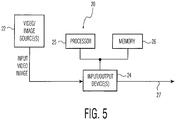
- a video/image processing apparatus 20 in which the present invention may be implemented is shown in Figure 5 .
- the system 20 may represent a television transmitter, a satellite transmitter, a cable head end, a network node, a network server, a wireless network node, a wireless base station a desktop, laptop or palmtop computer, a video/image storage device such as a video cassette recorder (VCR), a digital video recorder (DVR), etc., as well as portions or combinations of these and other devices.
- VCR video cassette recorder
- DVR digital video recorder
- the apparatus 20 includes one or more input/output devices 24, a processor 25 and a memory 26.
- video/image source(s) 22 may represent, e.g., a television receiver, a VCR or other video/image storage device.
- the source(s) 22 may alternatively represent one or more network connections for receiving video/images from a server or servers over, e.g., a global computer communications network such as the Internet, a wide area network, a metropolitan area network, a local area network, a terrestrial broadcast system, a cable network, a satellite network, a wireless network, or a telephone network, as well as portions or combinations of these and other types of networks.
- a communication medium 27 is also connected to the one or more input/output devices 24.
- the communication medium 27 may represent, e.g., a global computer communications network such as the Internet, a wide area network, a metropolitan area network, a local area network, a terrestrial broadcast system, a cable network, a satellite network, a wireless network, or a telephone network, as well as portions or combinations of these and other types of networks.
- Input video/images from the source(s) 22 is processed in accordance with one or more software programs stored in memory 26 and executed by processor 25 in order to generate output video data to be transmitted over the communication medium 27.
- These software programs would include encoders capable of encoding live video in a scalable manner. The live video could also be encoded and then stored in the memory 26.
- the video data may also be received pre-encoded so that it can be transmitted or stored in the memory 26, a tape or a disk to be transmitted at a later time.
- the processor 25 would not have to be used to encode the input video/images. This is because the pre-encoded video data could be read from the memory 26, tape, disk or received via the video/image source(s) 22.
- the previously described method for streaming scalable video in the form of a computer readable code would also be stored in the memory 26 or read/downloaded from a memory medium such as a CD-ROM or floppy disk. Further, the processor 25 would also execute this code to stream scalable video data over the communication medium 27, according to the present invention.
Landscapes
- Engineering & Computer Science (AREA)
- Multimedia (AREA)
- Signal Processing (AREA)
- Databases & Information Systems (AREA)
- Computer Networks & Wireless Communication (AREA)
- Compression Or Coding Systems Of Tv Signals (AREA)
- Data Exchanges In Wide-Area Networks (AREA)
- Two-Way Televisions, Distribution Of Moving Picture Or The Like (AREA)
Description
- The present invention relates generally to video data transmission, and more particularly to a method and apparatus for streaming scalable video over networks having a variable bandwidth.
- Scalable video coding refers to coding techniques that are capable of providing different levels or amounts, of data per frame of video. Currently, such techniques are used by such video coding standards as MPEG-2 and MPEG-4 (i.e. "Motion Picture Expert Groups" coding). In the scalable coding techniques employed by these standards, frames of video data are encoded and divided into a base layer and an enhancement layer.
- Typically, the base layer includes a minimum amount of data required to decode the coded video data. The enhancement layer, on the other hand, includes additional data that enhances (i.e. improves the quality of) the base layer when decoded. During operation, all frames of the base layer are transmitted to a receiving device. However, the enhancement layer frames are only transmitted if the receiving device has sufficient processing power to handle the additional frames and/or the medium over which the frames are transmitted has a sufficient bandwidth.
- One known scalable video technique is fine-granular scalability. Fine-granular scalability (FGS) codes the same image (e.g., a frame of video) using progressively more data each time coding takes place. For example, in patent
US6292512 B1 entitled "Scalable Video Coding System," to the same assignee as herein, a system is disclosed for video coding that has the property of fine-granular scalability, in which a base-layer of video is coded at a fixed rate, and a residual or enhancement-layer is coded to cover a wide range of rates. - H. Radha et al., "Scalable internet video using MPEG-4", Signal Processing: Image Communications, Elsevier Science Publishers, vol. 15, no. 1-2, September 1999, pages 95 to 126, discloses a real-time streaming system using an Integrated Transmission Decoder buffer re-transmission algorithm for alleviating buffer underflow and overflow events. This system is suitable for non-delay sensitive video applications and uses a compressed video frame structure based on prediction-based base-layer and fine-granular scalability enhancement layer.
- W. Feng et al., "A Priority-Based Technique for the Best-Effort Delivery of Stored Video", Proceedings of the SPIE - International Society for Optical Engineering, 25 January 1999, pages 286 to 300, discloses a priority queuing scheme for an MPEG video streaming system in which I, P, and/or B frames are prioritised into a layered hierarchical queuing structure. The highest priority queue contains high priority I frames and the lower priority queues contain lower priority P and/or B frames. The I frames are all transmitted first, then the lower priority queues in the order of their priority begin transmitting their P and/or B frames in the remaining bandwidth, which are arbitrarily dropped when a loss of bandwidth occurs.
- Presently, the ISO MPEG-4 committee is researching methods for fine-granular coding. Thus, a need exists to come up with a practical method for streaming the enhancement layer. In another patent
US6412013 B1 "System for Controlling Data Output to a Network", also to the same assignee as herein, a method for streaming data over a packet-based network was disclosed. However, this method was only used in order to stream base-layer video over the Internet. - Aspects of the invention provide a method and apparatus for streaming scalable video including base layer and enhancement layer data as set forth in
claims 1 and 8, respectively. Another aspect of the invention provides a memory medium including program code stored thereon, which when executed on a processor, performs the method ofclaim 1. - Embodiments of the invention are directed to streaming scalable frame-based data over a variable-bandwidth network such as a packet-based one. In other words, the number of bits (for FGS) or sub-layers (for discrete multi-layer scalability) is chosen to be transmitted for each enhancement layer frame. Further, these bits or sub-layers are also partitioned over multiple packets if being sent over a packet-based network. Further, a windowing function is used to smooth the variation in the number of bits or sub-layers transmitted for each frame in situations where the network bandwidth is varying.
- An embodiment of the invention includes a method for streaming scalable video including base layer data and enhancement layer data. The method includes transmitting the base layer data for a given interval. Determining if a loss of bandwidth has occurred in the given interval. Selecting a predetermined number of frames to distribute the loss of bandwidth over. Calculating a reduced amount of enhancement layer data to transmit in the predetermined number of frames. Transmitting the reduced amount of enhancement layer data in the given interval.
- The embodiment can also include determining if the predetermined number of frames has expired. Determining if any leftover enhancement layer data exists. Selecting a second predetermined number of frames to distribute the leftover enhancement layer data over. Calculating a second reduced amount of enhancement layer data to transmit in the second predetermined number of frames. Transmitting the second reduced amount of enhancement layer data in a second given interval.
- Referring now to the drawings where like reference numbers represent corresponding parts throughout:
-
Figure 1 is a timing diagram showing delayed enhancement layer transmission due to unavailable bandwidth; -
Figure 2 is a timing diagram showing a wide variation in enhancement layer quality due to unavailable bandwidth; -
Figure 3 is a flow diagram of the method according the present invention; -
Figure 4 is a flow diagram showing one embodiment of a detailed implementation of the method according to the present invention; and -
Figure 5 is a block diagram of one embodiment of an apparatus according to the present invention. - The present invention is directed to transmitting scalable frame-based data over a variable-bandwidth network such as a packet-based one. Before being transmitted, the video data first must be compressed and coded into base-layer and enhancement-layer frames. For this, any of the known coding schemes can be used. For example, the base layer can be coded according to such known standards as JPEG, MPEG-1, MPEG-2, MPEG-4, etc. Further, the enhancement layer can be coded with any of the known scalability structures. However, for the following discussion, it is assumed that the "fine-granular scalability" structure is being used.
- After the video data is encoded, the base-layer frames have an average bandwidth of Rb bits/sec, and the enhancement-layer frames are coded at an average rate of Re bits/sec. In the overall system, all base-layer bits for a given frame must be transmitted so that the frame can be reconstructed at the decoder. The enhancement-layer frames have the characteristic of "fine granularity," meaning that any portion or all of the data for each frame may be transmitted. The quality of a decoded frame increases as more enhancement-layer bits are transmitted. It is assumed that the average total network bandwidth exceeds the base-layer bandwidth (Rtot > Rb ) so that there is room to transmit the enhancement layer.
- Given an average total network bandwidth (Rtot > Rb ), and given a system clock operating with period T, Rtot *T bits may be transmitted every clock period. In a noiseless theoretical system, there is enough room to transmit (Rtot - Rb )*T enhancement-layer bits during each clock period. In practice, however, the bandwidth available to transmit the enhancement-layer data is not constant due to network loss, noise, and bandwidth variations.
- Further, the system clock operates with a period of T seconds, so in the description that follows, an interval counter i will be used such that time t = i*T. Thus, the average number of base-layer bits transmitted during each interval is Rb *T. The enhancement-layer was coded at rate Re bits/sec. Thus, the initial rate available to transmit the enhancement layer is Rtot - Rb bits/sec, which may be less than Re since the enhancement-layer has the attribute of fine granularity. Given a frame-rate of ν frames/second, it can be planned on ideally transmitting F bits from
each enhancement-layer frame, where:
- In practice, the bandwidth available for the enhancement layer is not constant. During an interval, after transmitting Rb *T bits, there is only enough space for sending (Rtot - Rb )*T - si bits, where si is the number of bits that were used for other purposes or made unavailable during that time interval. For example, if after transmitting base-layer bits, the system needs to re-transmit older base-layer bits, this retransmission will use up some (or all) of the bit allocation for the given interval.
- If si = 0 for all i, F bits can be transmitted from each enhancement frame, so nothing special needs to be done. If si > 0, we have a problem that is illustrated in
Figure 1 . - As can be seen from
Figure 1 , between time intervals 5-8, some bandwidth is not available for transmission of the entire enhancement layer. If it is ensured that all F bits of the corresponding enhancement-layer frame are transmitted, the next frame is delayed from being transmitted. Every interval in which si > 0 causes the delay to accumulate. Given that an infinite buffer at the decoder is undesirable, the base layer and enhancement layer frames eventually will be so far out of synchronization that the system will either fail or completely ignore the delayed enhancement layer data. - In order to prevent this accumulation of delay, si bits could be simply dropped from the frame being transmitted during interval i, as shown in
Figure 2 . However, as can be seen, fromFigure 2 , the problem with this method is that the number of bits dropped from successive enhancement-layer frames could vary widely and quickly. This could cause the decoded sequence to flicker unacceptably, or the viewer will see rapid and distracting changes in video quality. - In view of the above-described two problems, the method used to transmit the enhancement layer must satisfy two requirements:
- Bits must be dropped from the enhancement layer to prevent the unbounded accumulation of delay; and
- The bits that are dropped must be distributed over several frames to prevent rapid variations in video quality.
- In order to accomplish the above requirements, B(t) bits can be distributed over the next W(t) frames using a windowing function f(B(t), W(t), t). As later described, the removal of B bits can be distributed evenly over the next W frames, where:

- A method for streaming scalable video according to the present invention is shown in
Figure 3 . In this method, the number of bits (for FGS) or sub-layers (for discrete multi-layer scalability) are chosen to be transmitted for each enhancement layer frame. Further, a windowing function is used to smooth the variation in the number of bits or sub-layers transmitted for each frame. - In step S2, the base layer data (BLi) for the current time interval (i) is transmitted. As previously described, a system clock operates with a period of T seconds and an interval counter i will be used such that time t = i*T. Further, it should be noted that the time interval ti could be less than the time period of one video frame. In this case, a frame would be transmitted in a number of intervals (i, i + 1, i + 2, etc.)
- In step S4, other non-Enhancement Layer (EL) data is also transmitted. The other non-EL data can be, for example, re-transmitted base-layer data from a previous interval, as previously described.
- In step S6, it is determined if there is any loss (si) of bandwidth for the current interval (i). The loss (si) could be caused by the transmission of other non-EL data in step S4. If there was no non-EL data to transmit, the loss could also be due to a loss in network bandwidth. This loss in bandwidth can be due to packet loss, noise, and bandwidth variations. Further, the loss (si) also could have been caused by the combination of the above-described situations.
- As previously described, this loss in bandwidth (si) is undesirable since it can reduce the initial rate available (Rtot - Rb bits/s) to transmit the enhancement layer data for the current interval (i). If there is no loss (si), the method will advance and transmit the EL data for that interval in step S12. On the other hand, if there is loss (si) in step S6, the method will then go to step S8.
- In step S8, a window (W) will be determined, which represents the number of frames that that the loss (si) will be distributed over. The window (W) can be a predetermined number that is selected based on such considerations as frame rate, image quality etc.
- In step S10, the EL frame size is reduced for the number of frames specified by the window (W). The reduction of the EL frame size S10 will be performed according to a windowing function f(B(t), W(t), t). For example, in equation 2, the windowing function is B/W, where B = si for this example. Thus, if si = 50 bits and W = 10 frames, the EL frame size would have to be reduced by 5 bits for the window (W) of ten frames.
- It should be noted that equation (2) is only one example of a windowing function according to the present invention. According to the present invention, other windowing functions are contemplated such as a step function, exponential function and functions that depend on the base layer or enhancement layer frame type, e.g. I, P or B frame.
- In
step S 12, the EL data for the current interval (i) is transmitted. It there was no loss (si) in step S6 and if the current frame is not in a window (W) due to earlier losses, the full amount of EL data for the interval (i) will be transmitted. If there was loss (si), then the amount of EL data transmitted for the interval (i) in step S 12 will be reduced according to step S10. - In
step S 14, it is determined if any space is left in the current interval (i) to transmit additional data. If there is, the method will loop back to stepS 12 and transmit EL data for the next frame. Thus, the method will stay in this loop until the current interval (i) has no more space left to transmit data. When there is no space left, the method will then advance to step S16. - In step S16, it is determined if any EL data frames are left. If there are none left, this means the video sequence has expired and the method will exit in step S18. If there are EL frames left, the method will loop back to step S2 and transmit the data for the next interval. The method will stay in this loop until the video sequence has expired. It should be noted that in subsequent intervals, if there is no further lose of bandwidth (si) in the window (W), the amount of data transmitted in step S12 will be according to the initial reduction of frame size in step S10.
- However, if there is further bandwidth lose (si) in subsequent intervals, the window will be determined again in step S8 and the EL frame size will again be reduced in step S10. In regard to the previous example of Equation (2), if there is further loss (si) in a second interval (i+1) of 35 bits. The window (W) would again be set to 10 and B = 45 + si. Therefore, the initial EL frame size would have to be reduced by 80 / 10 = 8 in step S10 for that subsequent interval.
- One embodiment of a more detailed implementation for the method of streaming scalable video according to the present invention is shown in
Figure 4 . In describing the embodiment ofFigure 4 , it is being assumed that the "FGS scalability" structure is used. However, it is well within the skill in the art to implement this embodiment using other scalability structures. Further, in this embodiment, it also being assumed that the data will be transmitted over a packet network such as the internet. Therefore, this embodiment also partitions the data being transmitted over multiple packets. - The following is a definition of parameters that are used in the following description of this embodiment:
- i
- Iteration index for each time interval of T seconds.
- si
- Number of bits that were made unavailable for EL transmission during interval i.
- B
- Total number of bits that still must be dropped from the EL.
- buf_cur
- Bit offset into the EL frame that will be transmitted next.
- buf_end
- Bit offset indicating the virtual end of the current EL frame.
- M
- Total number of EL frames in the sequence (may be ignored if we have a live or infinite sequence).
- m
- Pointer to an EL frame, where m = {0, 1,... M-1}.
- W
- Number of frames (Window) over which B bits will be dropped, where 0 < W < Wmax.
- Rtot
- Average bandwidth (bits/sec) of the entire data stream or available network.
- Rb
- Average bandwidth (bits/sec) of the base-layer stream.
- A
- Number of bits of EL data that we have room to transmit during the current interval.
- E
- Cumulative total number of bits (all bits, not necessarily EL bits) that have been transmitted in the bandwidth allocated for the EL.
- P
- Maximum packet size (bits) for the network.
- drop_rest
- Flag that is set when the remaining bits of the current EL frame will not be sent.
- Still Referring to
Figure 4 , in step S24, the above parameters are initialized. The following is one example of how these parameters could be initialized: - Set F as described in Equation (1).
- M = total number of EL frames for this sequence if the video is not live.
- P = max packet size
- m = 0 (point to first EL frame)
- i = 1 (first iteration)
- B = 0 (no bits to drop yet)
- Buf_cur = 0 (point to start of current frame)
- Buf_end = F - 1
- Wmax = 10 (or some other value depending on frame rate, image quality, etc.)
- E = 0
- drop_rest = FALSE
- W = 0
- In step S26, the base layer data (BLi) for the current interval (i) is transmitted. As previously described, a system clock operates with a period of T seconds and an interval counter i will be used such that time t = i*T. Further, in step S28, other non-Enhancement layer (EL) data is also transmitted. As previously described, this transmission could cause the loss (si ). Further, during this step the parameters B and E are also set as follows:
- B = B + si , (which represents the total number of bits that are needed to drop from the EL);
- E = E + si, (which accounts for the si bits that were transmitted in the space allocated for the EL).
- In step S30, the window (W) is set, which represents the number of frames that that the loss (si) is distributed over. In this step, if (si > 0) or (B > 0 and W ≤ 0), then W = min(Wmax , M - m).
- In step S32, the current EL frame size is reduced. This is accomplished by calculating a new value for the "buf_end" parameter. Since the parameter "buf_end" is a pointer that points to the virtual end of an EL frame, reducing its value will reduce the size of the current EL frame. The new value for "buf_end" will be calculated according to the following windowing function:

- In step S34, it is determined if there is any space left in the current interval (i) to transmit data by calculating the total (cumulative) number of EL bits (from one or more frames) that should be transmitted by the end of this interval. In this step, the parameter "A" will be calculated as follows:

- If (A ≤ 0), this means that there is no space in the current interval to transmit the EL data. Thus, the current interval will be incremented to i = i + 1 and the method will loop back to step S26 to transmit the BL data for the next interval. If (A > 0), then there is space in the current interval and the method will advance to step S36.
- In step 36, it is determined if the window (W) ≤ 0. Initially, this would not be true since none of the EL data has been transmitted yet. Thus, if (W) ≤ O, the method advances to step S38. On the other hand, if (W) is not ≤ 0, the method advances to step S40.
- In step S40, it is determined if the current frame of EL data has been completely transmitted. This step can be accomplished by seeing if (buf_cur > buf_end). Since buf_cur is a pointer that points to the beginning portion of the current EL frame to be transmitted and buf_end points to the virtual end of the current EL frame, buf_cur > buf_end indicates that no more data from the current frame will be transmitted.
- If (buf_cur > buf_end), then m = m + 1 (advance to the next enhancement frame) and drop_rest = FALSE. Further, the method then loops back to step S34. However, it should be noted that initially the condition of (buf_cur > buf_end) would not be true since none of the frames of EL data have been transmitted yet. If this condition is not true, the method then advances to step S42.
- In step S42, it is determined if any frames of EL data are left to be transmitted. If there are no frames left, this means the video sequence has expired. Thus, if (m == M), then there are no more EL frames left and the method exits in step S46. If this condition is false, the method then advances to step S44.
- In step S44, the EL data is transmitted. In this step, either some or all of the EL bits for a current frame is transmitted. According to this embodiment, step S44 is performed in three sub-steps.
- In the first sub-step, the number of bits to be transmitted (nbits_to_send) from the current EL frame must be determined as follows:

- In the second sub-step, it is determined if the current interval (i) has enough space to transmit all the bits as follows:
         If (nbits_to_send < A) then:
         nbits_sent = min(P, nbits_to_send), (divides the bits into packets).
         Transmit nbits_sent bits beginning at buf_cur bits into EL frame m.
         If(nbits_sent == nbits_to_send) then: (Done transmitting current frame)
                B = B - (F - buf_end - 1), (Reduce B by the number of bits that was
                                      dropped from this frame)
                W = W - 1 (shrink window by one frame)
                m = m + 1 (point to next frame)
                drop_rest = TRUE
        If (nbits_to_send >A) then: (There is not enough space in the current in the
        current interval to transmit nbits_to_send)
        nbits_sent = min(P, A)
        Transmit nbits_sent bits beginning at buf_cur bits into EL frame m.
- A = A - nbits_sent (reduce remaining bit allocation for the current interval)
- buf_cur = buf_cur + nbits_sent (point to next portion of the EL frame to be transmitted)
- E = E + nbits_sent (add to the cumulative total the number of bits just transmitted).
- If (W ≤ 0) then: If (B > 0) then: W = min(Wmax , M - m) else W = 0
-

Claims (9)
- A method for streaming scalable video including a plurality of base layer and enhancement layer frames, each base layer frame having a corresponding enhancement layer frame, the base layer frames comprising base layer data and the enhancement layer frames comprising enhancement layer data having a scalable data structure, the method comprising the steps of:transmitting (S2) at least a portion of the base layer data for at least one base layer frame in a given time interval; anddetermining (S6) if a loss of bandwidth for enhancement layer data has occurred in the given time interval;characterized in that the method further comprises the steps of:selecting (S8) a window comprising a multiplicity of enhancement layer frames, including the current enhancement layer frame, over which the loss of bandwidth is to be distributed;calculating (S10) a reduced amount of enhancement layer data to transmit for each frame in the window of enhancement layer frames; andtransmitting (S12) at least a portion of the reduced amount of enhancement layer data in the given time interval.
- The method according to claim 1, further comprising:transmitting (S4) non-enhancement layer data during the given time interval.
- The method according to claims 1 or 2, wherein the calculating step (S10) is performed so that the loss of bandwidth is distributed evenly over the window of enhancement layer frames.
- The method according to any preceding claim, further comprising the steps of:determining (S14) if there is still space in the given time interval; andtransmitting (S12) at least a portion of the reduced amount of enhancement layer data for a previous or subsequent given time interval in the given time interval.
- The method according to any preceding claim, further comprising the steps of:determining (S36) if the window of enhancement layer frames has expired;- determining (S42) if any left-over enhancement layer data exists;selecting (S38) a second window of enhancement layer frames to distribute the left-over enhancement layer data;calculating (S38) a second reduced amount of enhancement layer data to transmit for each frame in the second window of enhancement layer frames; andtransmitting (S44) the at least a portion of the second reduced amount of enhancement layer data in a second given time interval.
- The method according to claim 1, wherein the enhancement layer data has a fine grain scalability structure.
- A memory medium including program code stored thereon, which when executed by a processor, performs the method of any of claims 1 to 6.
- An apparatus for streaming scalable video including a plurality of base layer frames and enhancement layer frames, each base layer frame having a corresponding enhancement layer frame, the base layer frames comprising base layer data and the enhancement layer frames comprising enhancement layer data having a scalable data structure, the apparatus comprising:means for transmitting at least a portion of the base layer data for at least one base layer frame in a given time interval; andmeans for determining if a loss of bandwidth for enhancement layer data has occurred in the given time interval;characterized in that the apparatus further comprises:means for selecting a window of a multiplicity of enhancement layer frames, including the current enhancement layer frame, over which the loss of bandwidth is to be distributed;means for calculating a reduced amount of enhancement layer data to transmit for each frame in the window of enhancement layer frames; andmeans for transmitting at least a portion of the reduced amount of enhancement layer data in the given interval.
- The apparatus according to claim 8, wherein the means for calculating comprise means for distributing the loss of bandwidth evenly over the window of enhancement layer frames.
Applications Claiming Priority (3)
| Application Number | Priority Date | Filing Date | Title |
|---|---|---|---|
| US516035 | 1974-10-18 | ||
| US09/516,035 US7095782B1 (en) | 2000-03-01 | 2000-03-01 | Method and apparatus for streaming scalable video |
| PCT/EP2001/001876 WO2001065855A2 (en) | 2000-03-01 | 2001-02-20 | A method and apparatus for streaming scalable video |
Publications (2)
| Publication Number | Publication Date |
|---|---|
| EP1183871A2 EP1183871A2 (en) | 2002-03-06 |
| EP1183871B1 true EP1183871B1 (en) | 2017-01-11 |
Family
ID=24053849
Family Applications (1)
| Application Number | Title | Priority Date | Filing Date |
|---|---|---|---|
| EP01915281.8A Expired - Lifetime EP1183871B1 (en) | 2000-03-01 | 2001-02-20 | A method and apparatus for streaming scalable video |
Country Status (6)
| Country | Link |
|---|---|
| US (1) | US7095782B1 (en) |
| EP (1) | EP1183871B1 (en) |
| JP (1) | JP2003525547A (en) |
| CN (1) | CN1196339C (en) |
| TW (1) | TW520606B (en) |
| WO (1) | WO2001065855A2 (en) |
Families Citing this family (67)
| Publication number | Priority date | Publication date | Assignee | Title |
|---|---|---|---|---|
| US7463683B2 (en) * | 2000-10-11 | 2008-12-09 | Koninklijke Philips Electronics N.V. | Method and apparatus for decoding spatially scaled fine granular encoded video signals |
| US7958532B2 (en) * | 2001-06-18 | 2011-06-07 | At&T Intellectual Property Ii, L.P. | Method of transmitting layered video-coded information |
| US7483487B2 (en) * | 2002-04-11 | 2009-01-27 | Microsoft Corporation | Streaming methods and systems |
| WO2003104935A2 (en) * | 2002-06-11 | 2003-12-18 | Thomson Licensing S.A. | Multimedia server with simple adaptation to dynamic network loss conditions |
| KR100486713B1 (en) * | 2002-09-17 | 2005-05-03 | 삼성전자주식회사 | Apparatus and method for streaming multimedia data |
| KR100917464B1 (en) * | 2003-03-07 | 2009-09-14 | 삼성전자주식회사 | Encoding method, apparatus, decoding method and apparatus for digital data using band extension technique |
| EP1478197B1 (en) * | 2003-05-12 | 2006-03-08 | Matsushita Electric Industrial Co., Ltd. | Method and apparatus for transmitting layers for scalable data services |
| DE60304078T2 (en) * | 2003-05-12 | 2006-08-17 | Matsushita Electric Industrial Co., Ltd., Kadoma | Method and device for performing inter-frequency measurements |
| DE10353793B4 (en) * | 2003-11-13 | 2012-12-06 | Deutsche Telekom Ag | Method for improving the reproduction quality in the case of packet-oriented transmission of audio / video data |
| DE102004059993B4 (en) * | 2004-10-15 | 2006-08-31 | Fraunhofer-Gesellschaft zur Förderung der angewandten Forschung e.V. | Apparatus and method for generating a coded video sequence using interlayer motion data prediction, and computer program and computer readable medium |
| KR100679022B1 (en) * | 2004-10-18 | 2007-02-05 | 삼성전자주식회사 | Video coding and decoding method using inter-layer filtering, video encoder and decoder |
| US8081755B2 (en) * | 2005-05-20 | 2011-12-20 | Microsoft Corporation | JPEG2000 syntax-compliant encryption with full scalability |
| US7953224B2 (en) * | 2005-05-20 | 2011-05-31 | Microsoft Corporation | MPEG-4 encryption enabling transcoding without decryption |
| KR100772868B1 (en) * | 2005-11-29 | 2007-11-02 | 삼성전자주식회사 | Scalable video coding based on multiple layers and apparatus thereof |
| US20070150138A1 (en) | 2005-12-08 | 2007-06-28 | James Plante | Memory management in event recording systems |
| US10878646B2 (en) | 2005-12-08 | 2020-12-29 | Smartdrive Systems, Inc. | Vehicle event recorder systems |
| US9201842B2 (en) | 2006-03-16 | 2015-12-01 | Smartdrive Systems, Inc. | Vehicle event recorder systems and networks having integrated cellular wireless communications systems |
| US8996240B2 (en) | 2006-03-16 | 2015-03-31 | Smartdrive Systems, Inc. | Vehicle event recorders with integrated web server |
| FR2903556B1 (en) * | 2006-07-04 | 2008-10-03 | Canon Kk | METHODS AND DEVICES FOR ENCODING AND DECODING IMAGES, A TELECOMMUNICATIONS SYSTEM COMPRISING SUCH DEVICES AND COMPUTER PROGRAMS USING SUCH METHODS |
| US8649933B2 (en) | 2006-11-07 | 2014-02-11 | Smartdrive Systems Inc. | Power management systems for automotive video event recorders |
| US8989959B2 (en) | 2006-11-07 | 2015-03-24 | Smartdrive Systems, Inc. | Vehicle operator performance history recording, scoring and reporting systems |
| US8868288B2 (en) | 2006-11-09 | 2014-10-21 | Smartdrive Systems, Inc. | Vehicle exception event management systems |
| US8243789B2 (en) * | 2007-01-25 | 2012-08-14 | Sharp Laboratories Of America, Inc. | Methods and systems for rate-adaptive transmission of video |
| US8630512B2 (en) * | 2007-01-25 | 2014-01-14 | Skyfire Labs, Inc. | Dynamic client-server video tiling streaming |
| US8239092B2 (en) | 2007-05-08 | 2012-08-07 | Smartdrive Systems Inc. | Distributed vehicle event recorder systems having a portable memory data transfer system |
| CN100575313C (en) * | 2007-07-05 | 2009-12-30 | 济南圣泉集团股份有限公司 | A kind of method utilizing formaldehyde waste water to carry out fermentation to produce organic fertilizer |
| FR2923124A1 (en) * | 2007-10-26 | 2009-05-01 | Canon Kk | METHOD AND DEVICE FOR DETERMINING THE VALUE OF A TIME LIMIT TO BE APPLIED BETWEEN THE SENDING OF A FIRST DATA SET AND THE SENDING OF A SECOND SET OF DATA |
| CN101159686B (en) * | 2007-11-01 | 2010-04-14 | 北京航空航天大学 | A Zero-Latency FGS Bandwidth Allocation Method Based on Sliding Window |
| EP2058968A1 (en) * | 2007-11-07 | 2009-05-13 | Thomson Licensing | Method and apparatus for FEC encoding and decoding |
| FR2928807B1 (en) * | 2008-03-11 | 2017-04-07 | Canon Kk | METHOD FOR TRANSMITTING A COMMUNICATION NETWORK OF A PRE-ENCODE VIDEO SIGNAL |
| US20100161716A1 (en) * | 2008-12-22 | 2010-06-24 | General Instrument Corporation | Method and apparatus for streaming multiple scalable coded video content to client devices at different encoding rates |
| US9485299B2 (en) * | 2009-03-09 | 2016-11-01 | Arris Canada, Inc. | Progressive download gateway |
| US9197677B2 (en) * | 2009-03-09 | 2015-11-24 | Arris Canada, Inc. | Multi-tiered scalable media streaming systems and methods |
| US12542927B2 (en) * | 2009-06-07 | 2026-02-03 | Lg Electronics Inc. | Method and apparatus for decoding a video signal |
| US8566393B2 (en) | 2009-08-10 | 2013-10-22 | Seawell Networks Inc. | Methods and systems for scalable video chunking |
| CN103210642B (en) * | 2010-10-06 | 2017-03-29 | 数码士有限公司 | Occur during expression switching, to transmit the method for the scalable HTTP streams for reproducing naturally during HTTP streamings |
| US9848217B2 (en) * | 2012-01-20 | 2017-12-19 | Korea Electronics Technology Institute | Method for transmitting and receiving program configuration information for scalable ultra high definition video service in hybrid transmission environment, and method and apparatus for effectively transmitting scalar layer information |
| US9728228B2 (en) | 2012-08-10 | 2017-08-08 | Smartdrive Systems, Inc. | Vehicle event playback apparatus and methods |
| US20140098880A1 (en) * | 2012-10-05 | 2014-04-10 | Qualcomm Incorporated | Prediction mode information upsampling for scalable video coding |
| US9532057B2 (en) * | 2012-12-28 | 2016-12-27 | Qualcomm Incorporated | Inter-layer prediction using sample-adaptive adjustments for bit depth scalable video coding |
| US9501878B2 (en) | 2013-10-16 | 2016-11-22 | Smartdrive Systems, Inc. | Vehicle event playback apparatus and methods |
| US9610955B2 (en) | 2013-11-11 | 2017-04-04 | Smartdrive Systems, Inc. | Vehicle fuel consumption monitor and feedback systems |
| US8892310B1 (en) | 2014-02-21 | 2014-11-18 | Smartdrive Systems, Inc. | System and method to detect execution of driving maneuvers |
| HUE055488T2 (en) * | 2014-08-07 | 2021-11-29 | Sony Group Corp | Transmitter, transmission procedure and receiver |
| US20160080826A1 (en) * | 2014-09-16 | 2016-03-17 | Qualcomm Incorporated | Systems, methods and apparatus for broadcasting pay-per-view video over enhanced multimedia broadcast multicast service |
| US9663127B2 (en) | 2014-10-28 | 2017-05-30 | Smartdrive Systems, Inc. | Rail vehicle event detection and recording system |
| US11069257B2 (en) | 2014-11-13 | 2021-07-20 | Smartdrive Systems, Inc. | System and method for detecting a vehicle event and generating review criteria |
| US9679420B2 (en) | 2015-04-01 | 2017-06-13 | Smartdrive Systems, Inc. | Vehicle event recording system and method |
| US10750217B2 (en) * | 2016-03-21 | 2020-08-18 | Lg Electronics Inc. | Broadcast signal transmitting/receiving device and method |
| FR3070566B1 (en) * | 2017-08-30 | 2020-09-04 | Sagemcom Broadband Sas | PROCESS FOR RECOVERING A TARGET FILE OF AN OPERATING SOFTWARE AND DEVICE FOR USE |
| US11606528B2 (en) * | 2018-01-03 | 2023-03-14 | Saturn Licensing Llc | Advanced television systems committee (ATSC) 3.0 latency-free display of content attribute |
| GB2618714B (en) * | 2019-03-20 | 2024-03-13 | V Nova Int Ltd | Low complexity enhancement video coding |
| EP3962082A4 (en) * | 2019-06-12 | 2022-10-05 | Sony Group Corporation | IMAGE PROCESSING DEVICE AND METHOD |
| CN112543322B (en) * | 2019-09-20 | 2022-04-15 | 杭州海康威视数字技术股份有限公司 | Decoding and encoding method, device and equipment |
| WO2021054805A1 (en) * | 2019-09-20 | 2021-03-25 | 한국전자통신연구원 | Image encoding/decoding method and device, and recording medium storing bitstream |
| CN112106362A (en) * | 2019-09-30 | 2020-12-18 | 深圳市大疆创新科技有限公司 | Image processing method and device for movable platform, movable platform and medium |
| EP4059221A4 (en) * | 2019-11-15 | 2023-09-13 | HFI Innovation Inc. | METHOD AND DEVICE FOR SIGNALING A HORIZONTAL ROUND MOTION COMPENSATION IN A VR360 VIDEO CODING |
| US12022126B2 (en) | 2019-11-22 | 2024-06-25 | Sharp Kabushiki Kaisha | Systems and methods for signaling tiles and slices in video coding |
| US12250383B2 (en) * | 2020-05-19 | 2025-03-11 | Google Llc | Dynamic parameter selection for quality-normalized video transcoding |
| GB2598701B (en) * | 2020-05-25 | 2023-01-25 | V Nova Int Ltd | Wireless data communication system and method |
| CN115462078B (en) * | 2020-05-26 | 2025-09-05 | 华为技术有限公司 | Video transmission method, device and system |
| CN116746150A (en) | 2020-12-28 | 2023-09-12 | 抖音视界有限公司 | Signaling notification relying on random access point sample entries |
| CN113709510A (en) * | 2021-08-06 | 2021-11-26 | 联想(北京)有限公司 | High-speed data real-time transmission method and device, equipment and storage medium |
| US12273523B2 (en) * | 2022-06-15 | 2025-04-08 | Tencent America LLC | Systems and methods for joint signaling of transform coefficient signs |
| KR20240028174A (en) * | 2022-08-24 | 2024-03-05 | 삼성전자주식회사 | Electronic apparatus and controlling method thereof |
| CN119817095A (en) * | 2022-09-13 | 2025-04-11 | Oppo广东移动通信有限公司 | A coding and decoding method, device, encoder, decoder and storage medium |
| US12373990B2 (en) * | 2022-10-11 | 2025-07-29 | Tencent America LLC | Method and apparatus for UV attributes coding for symmetry mesh |
Family Cites Families (7)
| Publication number | Priority date | Publication date | Assignee | Title |
|---|---|---|---|---|
| US5555244A (en) * | 1994-05-19 | 1996-09-10 | Integrated Network Corporation | Scalable multimedia network |
| US5742892A (en) * | 1995-04-18 | 1998-04-21 | Sun Microsystems, Inc. | Decoder for a software-implemented end-to-end scalable video delivery system |
| US5828788A (en) * | 1995-06-29 | 1998-10-27 | Thomson Multimedia, S.A. | System for processing data in variable segments and with variable data resolution |
| US6075768A (en) * | 1995-11-09 | 2000-06-13 | At&T Corporation | Fair bandwidth sharing for video traffic sources using distributed feedback control |
| US6269078B1 (en) * | 1997-04-04 | 2001-07-31 | T. V. Lakshman | Method and apparatus for supporting compressed video with explicit rate congestion control |
| US6292512B1 (en) * | 1998-07-06 | 2001-09-18 | U.S. Philips Corporation | Scalable video coding system |
| US6275531B1 (en) * | 1998-07-23 | 2001-08-14 | Optivision, Inc. | Scalable video coding method and apparatus |
-
2000
- 2000-03-01 US US09/516,035 patent/US7095782B1/en not_active Expired - Lifetime
-
2001
- 2001-02-20 JP JP2001563538A patent/JP2003525547A/en active Pending
- 2001-02-20 CN CN01801124.1A patent/CN1196339C/en not_active Expired - Fee Related
- 2001-02-20 WO PCT/EP2001/001876 patent/WO2001065855A2/en not_active Ceased
- 2001-02-20 EP EP01915281.8A patent/EP1183871B1/en not_active Expired - Lifetime
- 2001-03-08 TW TW090105407A patent/TW520606B/en not_active IP Right Cessation
Non-Patent Citations (1)
| Title |
|---|
| FENG W ET AL: "A Priority-Based Technique for the Best-Effort Delivery of Stored Video", OPTOMECHATRONIC MICRO/NANO DEVICES AND COMPONENTS III : 8 - 10 OCTOBER 2007, LAUSANNE, SWITZERLAND; [PROCEEDINGS OF SPIE , ISSN 0277-786X], SPIE, BELLINGHAM, WASH, 25 January 1999 (1999-01-25), pages 286 - 300, XP002302919, ISBN: 978-1-62841-730-2 * |
Also Published As
| Publication number | Publication date |
|---|---|
| WO2001065855A2 (en) | 2001-09-07 |
| TW520606B (en) | 2003-02-11 |
| WO2001065855A3 (en) | 2001-12-27 |
| JP2003525547A (en) | 2003-08-26 |
| CN1196339C (en) | 2005-04-06 |
| EP1183871A2 (en) | 2002-03-06 |
| CN1381139A (en) | 2002-11-20 |
| US7095782B1 (en) | 2006-08-22 |
Similar Documents
| Publication | Publication Date | Title |
|---|---|---|
| US7095782B1 (en) | Method and apparatus for streaming scalable video | |
| EP1149498B1 (en) | Method for detecting and preventing bandwidth overflow in a statistical multiplexer | |
| US9544602B2 (en) | Wireless video transmission system | |
| Tan et al. | Real-time Internet video using error resilient scalable compression and TCP-friendly transport protocol | |
| Vandalore et al. | A survey of application layer techniques for adaptive streaming of multimedia | |
| Kanakia et al. | An adaptive congestion control scheme for real-time packet video transport | |
| US8356327B2 (en) | Wireless video transmission system | |
| US6327421B1 (en) | Multiple speed fast forward/rewind compressed video delivery system | |
| US7274740B2 (en) | Wireless video transmission system | |
| US7797723B2 (en) | Packet scheduling for video transmission with sender queue control | |
| US7668170B2 (en) | Adaptive packet transmission with explicit deadline adjustment | |
| De Cuetos et al. | Adaptive rate control for streaming stored fine-grained scalable video | |
| US6381254B1 (en) | Moving image encoding device/method, moving image multiplexing device/method, and image transmission device | |
| US20050071876A1 (en) | Wireless video transmission system | |
| US20030233464A1 (en) | Priority progress streaming for quality-adaptive transmission of data | |
| US7652993B2 (en) | Multi-stream pro-active rate adaptation for robust video transmission | |
| JP2006506926A (en) | Video transmission method | |
| EP1088454A1 (en) | Video encoder and encoding method with buffer control | |
| KR20040104063A (en) | Packet scheduling method for streaming multimedia | |
| US7343433B2 (en) | Method and apparatus for controlling amount of buffer data in a receiver of a data communication system, and method and apparatus for playing streaming data with adaptive clock synchronization unit | |
| US6412013B1 (en) | System for controlling data output to a network | |
| Hadar et al. | PCRTT enhancement for off-line video smoothing | |
| CN102369732B (en) | video streaming | |
| Batra et al. | Effective algorithms for video transmission over wireless channels | |
| Jiang et al. | A packet selection algorithm for adaptive transmission of smoothed video over a wireless channel |
Legal Events
| Date | Code | Title | Description |
|---|---|---|---|
| PUAI | Public reference made under article 153(3) epc to a published international application that has entered the european phase |
Free format text: ORIGINAL CODE: 0009012 |
|
| AK | Designated contracting states |
Kind code of ref document: A2 Designated state(s): AT BE CH CY DE DK ES FI FR GB GR IE IT LI LU MC NL PT SE TR |
|
| AX | Request for extension of the european patent |
Free format text: AL;LT;LV;MK;RO;SI |
|
| 17P | Request for examination filed |
Effective date: 20020627 |
|
| 17Q | First examination report despatched |
Effective date: 20060810 |
|
| RAP1 | Party data changed (applicant data changed or rights of an application transferred) |
Owner name: IPG ELECTRONICS 503 LIMITED |
|
| RAP1 | Party data changed (applicant data changed or rights of an application transferred) |
Owner name: FUNAI ELECTRIC CO., LTD. |
|
| REG | Reference to a national code |
Ref country code: DE Ref legal event code: R079 Ref document number: 60150279 Country of ref document: DE Free format text: PREVIOUS MAIN CLASS: H04N0007240000 Ipc: H04N0021234300 |
|
| GRAP | Despatch of communication of intention to grant a patent |
Free format text: ORIGINAL CODE: EPIDOSNIGR1 |
|
| RIC1 | Information provided on ipc code assigned before grant |
Ipc: H04N 21/2343 20110101AFI20160822BHEP Ipc: H04N 21/24 20110101ALI20160822BHEP Ipc: H04N 21/238 20110101ALI20160822BHEP Ipc: H04N 21/262 20110101ALI20160822BHEP Ipc: H04N 21/2662 20110101ALI20160822BHEP |
|
| INTG | Intention to grant announced |
Effective date: 20160920 |
|
| GRAS | Grant fee paid |
Free format text: ORIGINAL CODE: EPIDOSNIGR3 |
|
| GRAA | (expected) grant |
Free format text: ORIGINAL CODE: 0009210 |
|
| AK | Designated contracting states |
Kind code of ref document: B1 Designated state(s): AT BE CH CY DE DK ES FI FR GB GR IE IT LI LU MC NL PT SE TR |
|
| REG | Reference to a national code |
Ref country code: GB Ref legal event code: FG4D |
|
| REG | Reference to a national code |
Ref country code: CH Ref legal event code: EP |
|
| REG | Reference to a national code |
Ref country code: AT Ref legal event code: REF Ref document number: 862238 Country of ref document: AT Kind code of ref document: T Effective date: 20170115 |
|
| REG | Reference to a national code |
Ref country code: IE Ref legal event code: FG4D |
|
| REG | Reference to a national code |
Ref country code: DE Ref legal event code: R096 Ref document number: 60150279 Country of ref document: DE |
|
| REG | Reference to a national code |
Ref country code: NL Ref legal event code: MP Effective date: 20170111 |
|
| PG25 | Lapsed in a contracting state [announced via postgrant information from national office to epo] |
Ref country code: BE Free format text: LAPSE BECAUSE OF NON-PAYMENT OF DUE FEES Effective date: 20170228 |
|
| REG | Reference to a national code |
Ref country code: AT Ref legal event code: MK05 Ref document number: 862238 Country of ref document: AT Kind code of ref document: T Effective date: 20170111 |
|
| PG25 | Lapsed in a contracting state [announced via postgrant information from national office to epo] |
Ref country code: NL Free format text: LAPSE BECAUSE OF FAILURE TO SUBMIT A TRANSLATION OF THE DESCRIPTION OR TO PAY THE FEE WITHIN THE PRESCRIBED TIME-LIMIT Effective date: 20170111 |
|
| PG25 | Lapsed in a contracting state [announced via postgrant information from national office to epo] |
Ref country code: GR Free format text: LAPSE BECAUSE OF FAILURE TO SUBMIT A TRANSLATION OF THE DESCRIPTION OR TO PAY THE FEE WITHIN THE PRESCRIBED TIME-LIMIT Effective date: 20170412 Ref country code: FI Free format text: LAPSE BECAUSE OF FAILURE TO SUBMIT A TRANSLATION OF THE DESCRIPTION OR TO PAY THE FEE WITHIN THE PRESCRIBED TIME-LIMIT Effective date: 20170111 |
|
| PG25 | Lapsed in a contracting state [announced via postgrant information from national office to epo] |
Ref country code: ES Free format text: LAPSE BECAUSE OF FAILURE TO SUBMIT A TRANSLATION OF THE DESCRIPTION OR TO PAY THE FEE WITHIN THE PRESCRIBED TIME-LIMIT Effective date: 20170111 Ref country code: SE Free format text: LAPSE BECAUSE OF FAILURE TO SUBMIT A TRANSLATION OF THE DESCRIPTION OR TO PAY THE FEE WITHIN THE PRESCRIBED TIME-LIMIT Effective date: 20170111 Ref country code: AT Free format text: LAPSE BECAUSE OF FAILURE TO SUBMIT A TRANSLATION OF THE DESCRIPTION OR TO PAY THE FEE WITHIN THE PRESCRIBED TIME-LIMIT Effective date: 20170111 Ref country code: PT Free format text: LAPSE BECAUSE OF FAILURE TO SUBMIT A TRANSLATION OF THE DESCRIPTION OR TO PAY THE FEE WITHIN THE PRESCRIBED TIME-LIMIT Effective date: 20170511 |
|
| REG | Reference to a national code |
Ref country code: CH Ref legal event code: PL |
|
| REG | Reference to a national code |
Ref country code: DE Ref legal event code: R097 Ref document number: 60150279 Country of ref document: DE |
|
| PG25 | Lapsed in a contracting state [announced via postgrant information from national office to epo] |
Ref country code: CH Free format text: LAPSE BECAUSE OF NON-PAYMENT OF DUE FEES Effective date: 20170228 Ref country code: IT Free format text: LAPSE BECAUSE OF FAILURE TO SUBMIT A TRANSLATION OF THE DESCRIPTION OR TO PAY THE FEE WITHIN THE PRESCRIBED TIME-LIMIT Effective date: 20170111 Ref country code: LI Free format text: LAPSE BECAUSE OF NON-PAYMENT OF DUE FEES Effective date: 20170228 |
|
| PLBE | No opposition filed within time limit |
Free format text: ORIGINAL CODE: 0009261 |
|
| STAA | Information on the status of an ep patent application or granted ep patent |
Free format text: STATUS: NO OPPOSITION FILED WITHIN TIME LIMIT |
|
| REG | Reference to a national code |
Ref country code: IE Ref legal event code: MM4A |
|
| PG25 | Lapsed in a contracting state [announced via postgrant information from national office to epo] |
Ref country code: DK Free format text: LAPSE BECAUSE OF FAILURE TO SUBMIT A TRANSLATION OF THE DESCRIPTION OR TO PAY THE FEE WITHIN THE PRESCRIBED TIME-LIMIT Effective date: 20170111 Ref country code: MC Free format text: LAPSE BECAUSE OF FAILURE TO SUBMIT A TRANSLATION OF THE DESCRIPTION OR TO PAY THE FEE WITHIN THE PRESCRIBED TIME-LIMIT Effective date: 20170111 |
|
| REG | Reference to a national code |
Ref country code: FR Ref legal event code: ST Effective date: 20171031 |
|
| 26N | No opposition filed |
Effective date: 20171012 |
|
| GBPC | Gb: european patent ceased through non-payment of renewal fee |
Effective date: 20170411 |
|
| PG25 | Lapsed in a contracting state [announced via postgrant information from national office to epo] |
Ref country code: LU Free format text: LAPSE BECAUSE OF NON-PAYMENT OF DUE FEES Effective date: 20170220 |
|
| PG25 | Lapsed in a contracting state [announced via postgrant information from national office to epo] |
Ref country code: FR Free format text: LAPSE BECAUSE OF NON-PAYMENT OF DUE FEES Effective date: 20170313 |
|
| REG | Reference to a national code |
Ref country code: BE Ref legal event code: MM Effective date: 20170228 |
|
| PG25 | Lapsed in a contracting state [announced via postgrant information from national office to epo] |
Ref country code: GB Free format text: LAPSE BECAUSE OF NON-PAYMENT OF DUE FEES Effective date: 20170411 Ref country code: IE Free format text: LAPSE BECAUSE OF NON-PAYMENT OF DUE FEES Effective date: 20170220 |
|
| PGFP | Annual fee paid to national office [announced via postgrant information from national office to epo] |
Ref country code: DE Payment date: 20180206 Year of fee payment: 18 |
|
| REG | Reference to a national code |
Ref country code: DE Ref legal event code: R119 Ref document number: 60150279 Country of ref document: DE |
|
| PG25 | Lapsed in a contracting state [announced via postgrant information from national office to epo] |
Ref country code: CY Free format text: LAPSE BECAUSE OF NON-PAYMENT OF DUE FEES Effective date: 20170111 |
|
| PG25 | Lapsed in a contracting state [announced via postgrant information from national office to epo] |
Ref country code: DE Free format text: LAPSE BECAUSE OF NON-PAYMENT OF DUE FEES Effective date: 20190903 |
|
| PG25 | Lapsed in a contracting state [announced via postgrant information from national office to epo] |
Ref country code: TR Free format text: LAPSE BECAUSE OF FAILURE TO SUBMIT A TRANSLATION OF THE DESCRIPTION OR TO PAY THE FEE WITHIN THE PRESCRIBED TIME-LIMIT Effective date: 20170111 |