EP1182889A2 - Multiplexer, multimedia communication apparatus and time stamp generation method - Google Patents
Multiplexer, multimedia communication apparatus and time stamp generation method Download PDFInfo
- Publication number
- EP1182889A2 EP1182889A2 EP01114888A EP01114888A EP1182889A2 EP 1182889 A2 EP1182889 A2 EP 1182889A2 EP 01114888 A EP01114888 A EP 01114888A EP 01114888 A EP01114888 A EP 01114888A EP 1182889 A2 EP1182889 A2 EP 1182889A2
- Authority
- EP
- European Patent Office
- Prior art keywords
- time stamp
- encoded
- frame
- streams
- detecting
- Prior art date
- Legal status (The legal status is an assumption and is not a legal conclusion. Google has not performed a legal analysis and makes no representation as to the accuracy of the status listed.)
- Withdrawn
Links
Images



Classifications
-
- H—ELECTRICITY
- H04—ELECTRIC COMMUNICATION TECHNIQUE
- H04N—PICTORIAL COMMUNICATION, e.g. TELEVISION
- H04N21/00—Selective content distribution, e.g. interactive television or video on demand [VOD]
- H04N21/40—Client devices specifically adapted for the reception of or interaction with content, e.g. set-top-box [STB]; Operations thereof
- H04N21/43—Processing of content or additional data, e.g. demultiplexing additional data from a digital video stream; Elementary client operations, e.g. monitoring of home network or synchronising decoder's clock; Client middleware
- H04N21/435—Processing of additional data, e.g. decrypting of additional data, reconstructing software from modules extracted from the transport stream
-
- H—ELECTRICITY
- H04—ELECTRIC COMMUNICATION TECHNIQUE
- H04N—PICTORIAL COMMUNICATION, e.g. TELEVISION
- H04N21/00—Selective content distribution, e.g. interactive television or video on demand [VOD]
- H04N21/20—Servers specifically adapted for the distribution of content, e.g. VOD servers; Operations thereof
- H04N21/23—Processing of content or additional data; Elementary server operations; Server middleware
- H04N21/235—Processing of additional data, e.g. scrambling of additional data or processing content descriptors
-
- H—ELECTRICITY
- H04—ELECTRIC COMMUNICATION TECHNIQUE
- H04N—PICTORIAL COMMUNICATION, e.g. TELEVISION
- H04N21/00—Selective content distribution, e.g. interactive television or video on demand [VOD]
- H04N21/20—Servers specifically adapted for the distribution of content, e.g. VOD servers; Operations thereof
- H04N21/23—Processing of content or additional data; Elementary server operations; Server middleware
- H04N21/236—Assembling of a multiplex stream, e.g. transport stream, by combining a video stream with other content or additional data, e.g. inserting a URL [Uniform Resource Locator] into a video stream, multiplexing software data into a video stream; Remultiplexing of multiplex streams; Insertion of stuffing bits into the multiplex stream, e.g. to obtain a constant bit-rate; Assembling of a packetised elementary stream
- H04N21/23608—Remultiplexing multiplex streams, e.g. involving modifying time stamps or remapping the packet identifiers
-
- H—ELECTRICITY
- H04—ELECTRIC COMMUNICATION TECHNIQUE
- H04N—PICTORIAL COMMUNICATION, e.g. TELEVISION
- H04N21/00—Selective content distribution, e.g. interactive television or video on demand [VOD]
- H04N21/40—Client devices specifically adapted for the reception of or interaction with content, e.g. set-top-box [STB]; Operations thereof
- H04N21/43—Processing of content or additional data, e.g. demultiplexing additional data from a digital video stream; Elementary client operations, e.g. monitoring of home network or synchronising decoder's clock; Client middleware
- H04N21/4302—Content synchronisation processes, e.g. decoder synchronisation
- H04N21/4307—Synchronising the rendering of multiple content streams or additional data on devices, e.g. synchronisation of audio on a mobile phone with the video output on the TV screen
- H04N21/43072—Synchronising the rendering of multiple content streams or additional data on devices, e.g. synchronisation of audio on a mobile phone with the video output on the TV screen of multiple content streams on the same device
-
- H—ELECTRICITY
- H04—ELECTRIC COMMUNICATION TECHNIQUE
- H04N—PICTORIAL COMMUNICATION, e.g. TELEVISION
- H04N21/00—Selective content distribution, e.g. interactive television or video on demand [VOD]
- H04N21/40—Client devices specifically adapted for the reception of or interaction with content, e.g. set-top-box [STB]; Operations thereof
- H04N21/43—Processing of content or additional data, e.g. demultiplexing additional data from a digital video stream; Elementary client operations, e.g. monitoring of home network or synchronising decoder's clock; Client middleware
- H04N21/434—Disassembling of a multiplex stream, e.g. demultiplexing audio and video streams, extraction of additional data from a video stream; Remultiplexing of multiplex streams; Extraction or processing of SI; Disassembling of packetised elementary stream
- H04N21/4344—Remultiplexing of multiplex streams, e.g. by modifying time stamps or remapping the packet identifiers
-
- H—ELECTRICITY
- H04—ELECTRIC COMMUNICATION TECHNIQUE
- H04N—PICTORIAL COMMUNICATION, e.g. TELEVISION
- H04N21/00—Selective content distribution, e.g. interactive television or video on demand [VOD]
- H04N21/40—Client devices specifically adapted for the reception of or interaction with content, e.g. set-top-box [STB]; Operations thereof
- H04N21/43—Processing of content or additional data, e.g. demultiplexing additional data from a digital video stream; Elementary client operations, e.g. monitoring of home network or synchronising decoder's clock; Client middleware
- H04N21/434—Disassembling of a multiplex stream, e.g. demultiplexing audio and video streams, extraction of additional data from a video stream; Remultiplexing of multiplex streams; Extraction or processing of SI; Disassembling of packetised elementary stream
- H04N21/4345—Extraction or processing of SI, e.g. extracting service information from an MPEG stream
-
- H—ELECTRICITY
- H04—ELECTRIC COMMUNICATION TECHNIQUE
- H04N—PICTORIAL COMMUNICATION, e.g. TELEVISION
- H04N21/00—Selective content distribution, e.g. interactive television or video on demand [VOD]
- H04N21/80—Generation or processing of content or additional data by content creator independently of the distribution process; Content per se
- H04N21/85—Assembly of content; Generation of multimedia applications
- H04N21/854—Content authoring
- H04N21/8547—Content authoring involving timestamps for synchronizing content
Definitions
- the present invention relates to a multiplexer provided with a function for multiplexing a plurality of kinds of media information, a multimedia communication apparatus provided with this multiplexer, and a time stamp generation method used in the multiplexer.
- an MPEG Motion Picture Experts Group
- a communication apparatus on the sending side encodes a plurality of items of the media information such as video data, audio data or the like while maintaining respective linkages to generate encoded elementary streams.
- these encoded elementary streams are converted into packets which are referred to as PES (Packetized Elementary Streams).
- PES Packetized Elementary Streams
- Each PES is a packet having a variable length and comprises a PES header and a PES payload.
- the PES header includes a packet start code, a packet length, a flag, control information, PES header length, and conditional coding information.
- the conditional coding information includes a presentation time stamp (PTS).
- the PTS is time information required for the device on the receiving side for displaying and outputting a plurality of items of media information such as the video data or audio data while maintaining a time linkage.
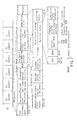
- each of the above PES is divided into a fixed length as shown in FIG. 6. Then, this divided PES is subsequently inserted into each of the TS packets of a transport stream (TS).
- the TS packet is a packet having a fixed length, and comprises 4-byte TS header, an adaptation field, or a payload or both.
- a control signal is inserted which is required for the transmission and staffing of information such as PCR (Program Clock Reference) or the like.
- a synchronous byte, a transport error indicator, a payload unit start indicator, transport priority information, packet identification information (PID: Packet Identification), transport scramble control information, an adaptation field control flag, and a cyclic counter are inserted in order.
- the adaptation field control flag represents the presence or absence of the adaptation field or the payload.
- the PID is a number for identifying the PES, and is represented by 13 bits.
- One PES is divided and inserted into the payload of a plurality of TS packet having the same PID to be transmitted.
- the transport scramble control information represents the presence or absence of the scrambling with respect to the TS payload.
- the communication apparatus on the receiving side separates a TS packet into which the video PES and audio PES constituting a program which the user desires to watch and listen to are inserted from the transport stream transmitted from the communication apparatus on the receiving side. Then, the video PES and audio PES of this separated TS packet are respectively decoded with a decoder, and this decoded video data and audio data are reproduced by taking time correspondence therebetween. The time correspondence between this video data and audio data is taken on the basis of the PTS inserted into the PES header.
- the frame skip refers to a phenomenon in which the encoding with respect to several frames is omitted.
- This frame skip is generated, for example, in the case where a target bit rate cannot be obtained due to an increase in code quantity generated in encoding. In the absence of the skip frame, there is a case in which a remarkable lowering of the allocated code quantity is caused.
- the encode scheme regulated with MPEG-4 Visual is an ultra-low bit rate encode scheme, so that the irregular frame skip is likely to be generated.
- the conventional multimedia communication apparatus presupposed on MPEG-2 system does not have a constitution in which the frame skip is considered.
- a correct time stamp cannot be added. Consequently, in the communication apparatus on the receiving side, video data cannot be reproduced by allowing the video data to take time correspondence to the other media information such as audio data or the like.
- An object of the present invention is to enable the generation of a time stamp in consideration of this frame skip even in the case where a frame skip is generated with the encode processing. Then, an object of the present invention is to provide a multiplexer which enables reproduction of a plurality of items of media information by taking time correspondence at all times, a multimedia communication apparatus provided with this multiplexer and a time stamp generation method.
- the present invention is constituted in such a manner that a plurality of encoded data streams are packetized respectively, a time stamp is inserted which is required for the reproduction of the encoded data streams into these packets, and the number of skipped frames is detected from the encoded information data stream in the multiplexer for multiplexing the packets. Then, on the basis of the detected number of this detected skipped frame, a time stamp is generated which is to be inserted into the packet of the encoded data streams.
- the encoded data streams are input, the number of skipped frames is detected from these data streams so that the time stamp is generated on the basis of the number of detected skipped frames. Therefore, it is possible to insert the time stamp in consideration of the frame skip into the header and transmit the same.
- the time stamp in consideration of the frame skip into the header and transmit the same.
- MPEG-4 Visual or ITU-T H.263 even in the case where a encode scheme is adopted in which there is a possibility that an irregular frame skip is generated in the video frame, it becomes possible, in the communication apparatus on the receiving side, to reproduce video data by taking time correspondence with other media information such as audio, data or the like. That is, even in the case where the frame skip is generated in the encode processing, a plurality of items of media information can be synchronously reproduced.
- the detection processing of the number of skipped frames is conducted on the basis of the time difference between a current frame of the encoded data stream and the past frames prior to the current frame. Specifically, on the basis of the time difference is detected on the basis of a first local time stamp which is added to the current frame of the encoded data stream and a second local time stamp which is added to the past frame prior to the current frame, so that the number of skipped frames is detected on the basis of the detected time difference.
- the number of frame skips which are actually generated can be accurately detected.
- MPEG-4 an encode scheme in which a frame skip is likely to be generated.
- encoded data is allowed to be sent in the multiplexed stream form of MPEG-2. Then, a first embodiment of the present invention will be explained by taking an example of a case in which a video data and an audio data encoded with MPEG-4 is multiplexed with the multiplexed stream form regulated with MPEG-2 to be transmitted.
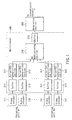
- FIG. 1 is a block diagram showing a structure of a multiplexer and a peripheral circuit according to the first embodiment of the present invention.
- a plurality of encoding units #1 to #n corresponding to the number of programs to be transmitted are provided.
- These coding units #1 to #n comprise video encoders 111 to 1n1 and audio encoders 112 to 1n2 respectively.
- the video encoders 111 to 1n1 correspond to MPEG-4 Visuals respectively.
- the audio encoders 112 to 1n2 also correspond to MPEG-4 Audios respectively.
- each of the coding units #1 to #n are not limited to the video encoders and audio encoders.
- the units may include data encoders for encoding document data or the like of personal computers or the like.
- a multiplexer 500 and a modulation section 400 are provided for multiplexing and transmitting an MPEG-2 transport stream.
- the modulation section 400 conducts modulation processing for transmitting a transport stream (TS) output from the multiplexer 500 to a transmission channel.
- TS transport stream
- the multiplexer 500 is provided with a plurality of buffers 211 to 2n1, and 212 to 2n2. These buffers 211 to 2n1, and 212 to 2n2 correspond to the encoders 111 to 1n1 and 112 to 1n2 one to one, respectively.
- the buffers 211 to 2n1 and 212 to 2n2 temporarily store elementary video streams (encoded video data) output from the video encoders 111 to 1n1 or elementary audio streams (encoded audio data) output from the audio encoders 112 to 1n2.
- the streams stored in the buffers 211 to 2n1 and 212 to 2n2 are input to the parse-PES generation sections 611 to 6n1, and 612 to 6n2 respectively.
- the parse-PES generation sections 611 to 6n1, and 612 to 6n2 conduct processing for analyzing the structure of the input elementary stream and processing for converting the elementary stream to the PES. Then, the PES obtained in each of the parse-PES generation sections 611 to 6n1 and 612 to 6n2 is supplied to the transport stream multiplexing section (TS multiplexing section) 310 respectively.
- TS multiplexing section transport stream multiplexing section
- the TS multiplexing section 310 partitions each of the PES supplied from each of the parse-PES generation sections 611 to 6n1 and 612 to 6n2 by a predetermined length as shown in FIG. 6. By subsequently inserting the partitioned PES into the TS packets, the PES are multiplexed on the transport stream (TS). Furthermore, into the header of each of the TS packets, as shown in FIG. 7, a synchronous byte, a transport error indicator, a payload unit start indicator, transport priority information, packet identification information (PID: Packet Identification), transport scramble control information, an adaptation field control flag, and a cyclic counter are inserted in order. Into the PID, a number is inserted which is defined in correspondence to each of the programs #1 to #n.
- the transport stream output from the TS multiplexing section 310 is input to the modulation section 400 via a buffer 320.
- the modulation section 400 converts the input transport streams into a signal form required for transmitting the streams on the transmission channel to transmit the transmission signal generated with the conversion to the transmission channel.
- a radio transmission channel and a wire transmission channel are available.
- FIG. 2 is a block diagram showing a structure of the demultiplexer and a peripheral circuit.
- a transmission signal which arrives via the transmission channel from the multimedia communication device on the sending side is input to a demodulation section 600.
- the demodulation section 600 demodulates the transmitted signal to the transport stream. This demodulated transport stream is input to the demultiplexer.
- a demultiplexer 700 has a buffer 710. Then, the transport streams demodulated with the buffer 710 are stored in the buffer 710.
- a TS separation section 740 conducts the following processing in accordance with the program designation information given from a separation control section 760.
- the video decoder 811 and the audio decoder 812 read the TS packets from the buffers 751 and 752 respectively, and the video PES and the audio PES inserted into the payload of this TS packet are decoded into the elementary video streams and elementary audio streams. Then, these streams are supplied to a display and a speaker not shown after taking a mutual time correspondence in accordance with the PTS included in the PES header of the above video PES and the audio PES.
- the video data and the audio data are encoded respectively with the video encoders 111 to 1n1 and audio encoders 112 to 1n2 for every program, so that elementary video streams and elementary audio streams are provided.
- these elementary video streams and elementary audio streams are input to the parse-PES generation section 611 to 6n1, 612 to 6n2 via buffers 211 to 2n1, and 212 to 2n2.
- the elementary audio streams input to the parse-PES generation sections 612 to 6n2 do not generally generate frame skips.
- the reproduction time of the audio frames is determined with the number of samples and the sampling frequency.
- the calculation equation of the n-th frame in the audio data can be represented in the following manner.
- PTS (n-th frame) PTS initial value + 90000 ⁇ n ⁇ (number of sample frames/sampling frequency)
- the parse-PES generation sections 611 to 6n1 conduct a stream analysis with respect to the input elementary video streams so that information on frame skips is extracted. Then, on the basis of information on the extracted frame skips, the PTS is calculated. Furthermore, the parse-PES generation sections 611 to 6n1 extract information on the frame skips and, at the same time, cuts out frames into which the PTS is to be inserted. Then, the PTS which is determined from the calculation is inserted into the PES header of the frames that are cut out.
- the MPEG-4 Visual does not have information which directly represents the frame skips. Therefore, it is necessary to calculate the number of frames which are skipped. For this calculation, the local time stamp which is incorporated in the MPEG-4 Visual itself is used.
- the local time stamp refers to time which is given from the video encoder to each frame when the original video data is input to the video encoder.
- the local time stamp is generated on the basis of time of a clock incorporated in the video encoder.
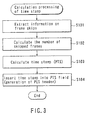
- the parse-PES generation sections 611 to 6n1 conduct the constitution analysis of streams with respect to the input elementary video streams to extract the local time stamp as information on the frame skip (step S101).
- the local time stamp shows the frame input time of the original video data in the video encoders 111 to 1n1 as described above. Consequently, in the MPEG-4 Visual, each time of the n-th frame and the n+1-th frame are calculated respectively in the following manner.
- n-th frame time initial time + n ⁇ (1001/30000)
- n+1-th frame time initial time+(n+1) ⁇ (1001/30000)
- the parse-PES generation sections 611 to 6n1 calculate the PTS corresponding to the current frame in consideration of the number of skipped frames which are calculated (step S103).
- the PTS is calculated from the following mathematical expression.
- the parse-PES generation sections 611 to 6n1 insert the above PTS into the PES header (step S104).
- the PES header including a correct PTS in consideration of the frame skip is generated.
- the PES output from the parse-PES generation sections 611 to 6n1, and 612 to 6n2 in this manner is next input to the TS multiplexing section 310.
- the video PES and the audio PES of a plurality of programs are divided by a fixed length respectively to be subsequently inserted into the TS packet so that the video PES and the audio PES are multiplexed into transport streams (TS).
- TS transport streams
- the video PES and the audio PES are sent to the modulation section 400 via the buffer 320 to be sent to the transmission channel.
- the transmission signal is demodulated with the demodulation section 600 to be transport streams and the transport streams are stored in the buffer 710.
- the TS packet into which the PID is inserted is selectively separated and extracted from the receiving transport streams.
- Each of the separated TS packets is supplied to the video decoder 811 and the audio decoder 812 via buffers 751 and 752.
- the video decoder 811 and the audio decoder 812 respectively reproduce video data and audio data by referring to the PTS stored in the buffers 751 and 752.
- the number of frame skips generated in MPEG-4 encode processing namely the number of skipped frames is calculated from a difference between the n+1-th frame time and the n-th frame time. Then, in consideration of the calculated number of skipped frames, the value of the PTS is allowed to coincide with the input time of the original video data before encoding. Consequently, at the multimedia communication apparatus on the receiving side, the video data can be constantly reproduced by taking time correspondence with other media information such as audio data or the like. Thus, high quality multimedia information communication can be achieved.
- a second embodiment of the present invention uses a mobile communication terminal provided with a video and voice communication function as a multimedia communication apparatus and is provided with a time stamp generation function described in the first embodiment on the multiplexer of this mobile communication terminal.
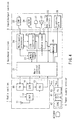
- FIG. 4 is a block diagram showing a structure of a mobile communication terminal according to a second embodiment of a multimedia communication apparatus of the present invention.
- This mobile communication terminal comprises a radio section 1, a baseband section 2, an input/output section 3 and a power supply section 4.
- a radio signal which arrives from the base station (not shown) via a radio channel is input to a receiving circuit (RX) 13 via a duplexer (DUP) after being received by an antenna 11.
- the receiving circuit 13 is provided with a low noise amplifier, a frequency converter, and a demodulator.
- the intermediate frequency signal is downconverted to an intermediate frequency signal or the base band signal by the frequency converter. This frequency is downconverted by mixing the radio signal with an oscillation signal of the receiving station generated from a frequency synthesizer (SYN) 14.
- SYN frequency synthesizer
- An output signal of the frequency converter is digitally demodulated with the demodulator.
- the demodulation scheme for example, a demodulation scheme corresponding to the QPSK (Quadrature Phase Shift Keying) and a reverse spectrum diffusion scheme are used.
- the frequency of the receiving station oscillation signal generated from the frequency synthesizer 14 is instructed from a main control section 21 provided on the base band section 2.
- the demodulation signal output from the demodulation section is input to the base band section 2.
- the base band section 2 comprises the main control section 21, a multiplexer/demultiplexer (MUX/DEMUX) 22, an audio encoder/decoder (hereinafter referred to as an audio codec) 23, a multimedia processor 24 an LCD controller 25 and a memory 26.
- MUX/DEMUX multiplexer/demultiplexer
- an audio encoder/decoder hereinafter referred to as an audio codec
- multimedia processor 24 an LCD controller 25 and a memory 26.
- the main control section 21 judges whether or not the input demodulation signal is a control information or transport stream (TS) obtained by multiplexing the multimedia information. Then, when the demodulation signal is the TS, the signal is input to the multiplexer/demultiplexer 22.
- the multiplexer/demultiplexer 22 separates the input TS into the video PES and the audio PES. Then, the video PES is input to the video decoder in the multimedia processor 24, and the audio PES is input to the audio decoder in the audio codec 23 respectively.
- the video decoder reproduces video data by demodulating the input video PES, and this video data is supplied to the LCD controller 25.
- the LCD controller 25 supplies and displays the supplied video data to the LCD 34 of the input/output section 3.
- the audio decoder demodulates the input audio PES, reproduces the audio data, and supplies and outputs this audio data to the speaker 32 of the input/output section 3.
- the video data and the audio data stored in the memory 26 are reproduced and output, these items of data are input to the audio codec 23 and the multimedia processor 24 respectively.
- the audio data is decoded with the audio decoder in the audio codec 23, and is then output from the speaker 32.
- the video data is supplied to the LCD 34 via the LCD controller 25 and is displayed.
- the LCD 34 also displays various information representing the operation state of the terminal, output from the main control section 21.
- various information representing the operation state of the terminal For example, a phone book, strength of radio waves, remaining battery life, etc.
- a speech signal of a user output from the microphone 31 of the input/output section 3 is input to the audio codec 23 of the base band section 2.
- the audio codec 23 encodes the speech signal with an audio encoder. Then, this encoded audio data is input to the multiplexer/demultiplexer 22.
- the video data output from a camera (CAM) 33 is input to the multimedia processor 24 of the base band section 2.
- the multimedia processor 24 encodes the input video data in accordance with the encode scheme regulated to MPEG-4, and the encoded video data is input to the multiplexer/demultiplexer 22.
- the multiplexer/demultiplexer 22 multiplexes the encoded video data and the encoded audio data in accordance with a predetermined format regulated with MPEG-2 to generate transmission transport streams (TS).
- This multiplexed transmission TS is input to a transmission circuit (TX) 15 of the radio section 1 from the main control section 21.
- the transmission circuit 15 is provided with a modulator, a frequency converter and a transmission power amplifier. After the above transmission TS is digitally modulated with the modulator, the TS is up converted to the radio signal with the frequency converter. This upconversion is conducted by mixing the above transmission TS with the transmission station oscillation signal generated from the frequency synthesizer 14. As a modulation scheme, there are available the QPSK, and a spectrum diffusion scheme using the diffusion code. Then, after this generated transmission radio signal is amplified to a predetermined transmission level by the transmission power amplifier, the signal is sent to the antenna 11 via the duplexer 12, so that the signal is sent from this antenna 11 to a station not shown.
- the power supply section 4 is provided with a battery 41 such as a lithium battery or the like, a charging circuit 42 for charging on the basis of a commercial power supply output (for example, AC100V) and a voltage generation circuit (PS) 43.
- the voltage generation circuit 43 comprises, for example, a DC/AC converter, and generates a predetermined power supply voltage Vcc on the basis of the output voltage of the battery 41.
- the input/output section 3 is provided with, for example, a lighting unit 36 which is referred to as a back light or an illumination.
- This lighting unit 36 illuminates the LCD 34 and the key input section 35 when the keys are being used, or communication is being made.
- a vibrator 6 is used as means of notifying of an incoming call, and operates in accordance with the drive control signal from the main control section 2.
- the above multiplexer/demultiplexer 22 is constituted in the following manner.
- the multiplexer is provided with a multiplexing processing function corresponding to a set of encoding units #1. That is, the multiplexer is provided with buffers 211 and 212, parse-PES generation sections 611 and 612, a TS multiplexing section 310 and a buffer 320 for each circuit constituting the multiplexer shown in FIG. 1.
- Buffers 211 and 212 temporarily store encoded video data output from the video encoder in the multimedia processor 24, and encoded audio data output from the audio encoder in the audio codec 23 respectively.
- the parse-PES generation section 611 conducts analysis processing of streams in the beginning with respect to the input encoded video data, so that data on the frame skip is extracted. Then, the PTS is calculated on the basis of this extracted data on the frame skip. In this PTS calculation, the number of skipped frames is calculated by using the local time stamp of MPEG-4 Visual. Next, the time difference between frames is calculated on the basis of the number of skipped frames which has been calculated. The calculation of the PTS is conducted by determining the PTS on the basis of this time difference.
- parse-PES generation sections 611 and 612 cut out frames into which the PTS is to be inserted at the same time with the calculation processing of the PTS. Then, the PTS which is determined in the above calculation is inserted into the PES header of this cut out frames.
- the PES output from the parse-PES generation sections 611 and 612 is input to the TS multiplexing section 310.
- the video PES and the audio PES of a plurality of programs are respectively divided into a fixed length to be subsequently inserted into the TS packets, so that the video PEA and the audio PES are multiplexed into transport streams (TS).
- the transport streams are sent to the main control section 21 via the buffer 320, and are supplied from the main control section 21 to the radio section 1 to be sent from the radio section 21 to a radio transmission channel.
- the demultiplexer comprises the buffer 710, the TS separation section 740, the separation control section 760, and buffers 751 and 752 as shown in FIG. 2.
- the transport streams output from the main control section 21 are temporarily stored in the buffer 710.
- the PID of the PMT on which the control information of the designated program is described is detected from this PAT.
- the PMT is extracted on the basis of his PID, and the PID of the video streams and the PID of the audio streams are respectively detected from the description of the PMT.
- the TS packet into which this PID is inserted is selectively extracted and separated from the received transport streams.
- These separated TS packets are input to the video decoder in the multimedia processor 24 and the audio decoder in the audio codec 23 via the buffers 751 and 752, respectively.
- the video decoder and the audio decoder conduct decode processing of the video data and the audio data by referring to the PTS stored in the buffers 751 and 752.
- the multiplexer/demultiplexer 22 detects the number of skipped frames between frames. Then, the PTS is calculated on the basis of the number of these skipped frames.
- the PTS of the video PES can be set to a correct value which corresponds to the input time of the original video data frame. Consequently, at the mobile communication terminal on the receiving side, the video data can be constantly reproduced at all times by referring to a time reference of the audio data. Consequently, high quality video and voice communication can be conducted.
- An optional function of outputting elementary video streams including information representing the number of skipped frames, is made available for the video encoder. Then, at the multiplexer, information is extracted which represents the number of skipped frames from the elementary video streams output from the video encoder so that the number of skipped frames is recognized on the basis of this information, to calculate the PTS.
- the structure of the first and the second embodiments can be applied to a software encoding system for conducting encode processing and multiplex processing with software. Then, it is possible to record on a computer readable recording medium a computer program in which the encode processing and multiplexing processing described in the first embodiment and the second embodiment are described so that the program is introduced to the computer and conducted through a recording medium or a communication medium. By doing so, the same effects as the first and second embodiments can be obtained.
- the parse-PES generation section determines whether or not the encode scheme which is being used is likely to generate the frame skip prior to the calculation processing of the PTS including the detection of the number of skipped frames. Then, only in the case where the encode scheme is used in which the frame skips are likely to be generated, the calculation processing of the PTS value including the detection of the number of skipped frames is conducted.
- the detection processing of the number of skipped frames can be omitted.
- the burden of the processing of the parse-PES generation section is alleviated so that the power consumption can be decreased.
- each of the above embodiments includes various inventions.
- Various inventions can be extracted with an appropriate combination of a plurality of constituent requirements which are to be disclosed. For example, even when several constituent requirements are eliminated from all the constituent requirements shown in each embodiment, objects described in the section on objects the invention is to solve can be solved. When the effect is obtained which is described in the section on the effect of the invention, the structure from which the constituent requirements are eliminated can be extracted as the invention.
Landscapes
- Engineering & Computer Science (AREA)
- Multimedia (AREA)
- Signal Processing (AREA)
- Computer Security & Cryptography (AREA)
- Compression Or Coding Systems Of Tv Signals (AREA)
- Two-Way Televisions, Distribution Of Moving Picture Or The Like (AREA)
- Time-Division Multiplex Systems (AREA)
- Synchronisation In Digital Transmission Systems (AREA)
Abstract
Description
Claims (15)
- A multiplexer (500) for packetizing a plurality of encoded data streams, the multiplexer characterized by comprising: means for inserting a time stamp required for the reproduction of the encoded data streams into these packets; means for multiplexing (500) said packets;means (611 to 6n1) for detecting the number of skipped frames from the encoded data stream; andmeans (611 to 6n1) for generating a time stamp which is to be inserted into the packets of the encoded data stream on the basis of the detected number of skipped frames.
- The multiplexer (500) according to claim 1, characterized in that the number of skipped frames is detected on the basis of the time difference between a current frame of the encoded data stream and a past frames prior to the current frame.
- The multiplexer (500) according to claim 2, characterized in that said means for detecting detects a first local time stamp added to the current frame of the encoded data stream and a second local time stamp added to the past frame prior to the current frame.
- The multiplexer (500) according to claim 1, characterized in that said means (611 to 6n1) for detecting further includes means for determining whether or not the encoded data stream includes frame skips; and the number of skipped frame are detected only in the case where said means (611 to 6n1) for determining determines that the data streams include frame skips.
- A multiplexer (500) characterized by comprising: means for packetizing video stream encoded by the encode scheme regulated with MPEG-4 and encoded media stream having time correlation with the video stream, means for inserting a time stamp required for the reproduction of the encoded video stream into these packets; means for multiplexing said packets;means (611 to 6n1) for detecting the number of skipped frames from the encoded video stream; andmeans (611 to 6n1) for generating a time stamp which is to be inserted into the packet of the video stream on the basis of the detected number of skipped frames.
- A multimedia communication apparatus characterized by comprising:means (111, 112) for individually encoding a plurality of media streams having time correlation to output encoded media streams respectively;means (611, 612) for packetizing respectively said encoded media streams;means (611) for detecting the number of skipped frames from the encoded media streams;means (611) for generating a time stamp on the basis of the number of detected skipped frames;means (611) for inserting the time stamp into a packet header of the encoded media streams;means (310) for multiplexing packets of said encoded media streams so as to output transmission streams; andmeans (400) for transmitting the transmission streams to a transmission channel.
- The multimedia communication apparatus according to claim 6, characterized in that said means (611) for detecting detects the number of skipped frames on the basis of the time difference between a current frame of the encoded media streams and the past frames prior to the current frame.
- The multimedia communication apparatus according to claim 7, characterized in that said means (611) for detecting detects the time difference on the basis of a first local time stamp added to the current frame of the encoded media streams and a second local time stamp added to the past frame prior to the current frame.
- The multimedia communication apparatus according to claim 6, characterized in that said means (611) for detecting further comprises means (611) for determining whether or not the encoded media stream include a frame skip and the number of skipped frames is detected only in the case where the means (611) for determining determines that the frame skip is included.
- A multimedia communication apparatus characterized by comprising:first encode means (111) for encoding video stream in accordance with an encode scheme regulated with an MPEG-4 to output an encoded video stream;second encode means (112) for other media stream having time correlation with video stream to output an encoded media stream;packetizing means (611, 612) for packetizing respectively the encoded video stream and the encoded media stream output from said first and second encode means (111, 112);detecting means (611) for detecting the number of skipped frames from the encoded video stream output from said first encode means (111);first time stamp generation means (611) for generating a first time stamp on the basis of the number of skipped frames detected by said detecting means (611) and inserting the first time stamp into a packet header of the encoded video stream;second time stamp generation means (612) for generating a second time stamp from the encoded media stream output from the second encode means (112) and inserting the second time stamp into the packet header of the encoded media stream;multiplexing means (310) for outputting transmission streams by multiplexing packets of the encoded video stream and encoded media stream generated by said packetizing means (611, 612).
- A method of generating a time stamp which is applied to a multiplexer (500), the method comprising the steps of: packetizing a plurality of encoded data streams, inserting a time stamp required for the reproduction of the encoded data streams into the packets; multiplexing the packets,detecting the number of skipped frames from the encoded data streams (S101, S102); andproviding a time stamp which is to be inserted into the packets of the encoded data streams on the basis of the number of skipped frames which have been detected (S103, S104).
- The method for generating a time stamp according to claim 11, characterized in that the step of detecting the number of skipped frame includes the steps of:determining a time difference between a current frame of the encoded information data streams and a past frame prior to the current frame (S101); anddetecting the number of skipped frames on the basis of the determined time difference (S102).
- The method for generating a time stamp according to claim 12, characterized in that the step of determining a time difference in the step of detecting the number of skipped frame determines the time difference on the basis of a first local time stamp added to the current frame of the encoded data streams, and a second local time stamp added to the past frame prior to the current frame.
- The method for generating a time stamp according to claim 11, characterized in that the step of detecting the number of skipped frame further includes the steps of:determining whether or not the encoded data streams include frame skips (S101); anddetecting the number of skipped frame only in the case where determination is made that the frame skips are included (S102).
- A method for generating a time stamp which is applied to a multiplexer, the method comprising the steps of: packetizing video stream encoded with an encode scheme regulated with MPEG-4 and encoded media stream having time correlation with the video stream, inserting a time stamp required for the reproduction of the encoded video stream into the packets; multiplexing the packets;detecting the number of skipped frames from the encoded video stream (S101, S102); andproviding a time stamp for inserting packets of the video stream on the basis of the number of skipped frames which have been detected (S103, S104).
Applications Claiming Priority (2)
| Application Number | Priority Date | Filing Date | Title |
|---|---|---|---|
| JP2000200128 | 2000-06-30 | ||
| JP2000200128A JP4481444B2 (en) | 2000-06-30 | 2000-06-30 | Image encoding device |
Publications (2)
| Publication Number | Publication Date |
|---|---|
| EP1182889A2 true EP1182889A2 (en) | 2002-02-27 |
| EP1182889A3 EP1182889A3 (en) | 2004-06-23 |
Family
ID=18698039
Family Applications (1)
| Application Number | Title | Priority Date | Filing Date |
|---|---|---|---|
| EP20010114888 Withdrawn EP1182889A3 (en) | 2000-06-30 | 2001-06-29 | Multiplexer, multimedia communication apparatus and time stamp generation method |
Country Status (3)
| Country | Link |
|---|---|
| US (2) | US6987767B2 (en) |
| EP (1) | EP1182889A3 (en) |
| JP (1) | JP4481444B2 (en) |
Cited By (2)
| Publication number | Priority date | Publication date | Assignee | Title |
|---|---|---|---|---|
| EP1439703A3 (en) * | 2003-01-17 | 2007-09-05 | Broadcom Corporation | Transmission and reception of video using compressed differential time stamps |
| US7876380B2 (en) | 2002-01-22 | 2011-01-25 | Broadcom Corporation | System and method of transmission and reception of progressive content with isolated fields for conversion to interlaced display |
Families Citing this family (66)
| Publication number | Priority date | Publication date | Assignee | Title |
|---|---|---|---|---|
| US7076255B2 (en) * | 2000-04-05 | 2006-07-11 | Microsoft Corporation | Context-aware and location-aware cellular phones and methods |
| US7213048B1 (en) * | 2000-04-05 | 2007-05-01 | Microsoft Corporation | Context aware computing devices and methods |
| US6944679B2 (en) * | 2000-12-22 | 2005-09-13 | Microsoft Corp. | Context-aware systems and methods, location-aware systems and methods, context-aware vehicles and methods of operating the same, and location-aware vehicles and methods of operating the same |
| US7072908B2 (en) * | 2001-03-26 | 2006-07-04 | Microsoft Corporation | Methods and systems for synchronizing visualizations with audio streams |
| JP2006502679A (en) * | 2002-10-02 | 2006-01-19 | コーニンクレッカ フィリップス エレクトロニクス エヌ ヴィ | Low latency radio / baseband interface protocol |
| US7489362B2 (en) | 2003-03-04 | 2009-02-10 | Broadcom Corporation | Television functionality on a chip |
| US7561597B2 (en) * | 2003-08-14 | 2009-07-14 | Broadcom Corporation | System and method for data packet substitution |
| US7907638B2 (en) * | 2003-06-19 | 2011-03-15 | Sony Ericsson Mobile Communications, Ab | Media stream mixing |
| US11106424B2 (en) | 2003-07-28 | 2021-08-31 | Sonos, Inc. | Synchronizing operations among a plurality of independently clocked digital data processing devices |
| US8086752B2 (en) | 2006-11-22 | 2011-12-27 | Sonos, Inc. | Systems and methods for synchronizing operations among a plurality of independently clocked digital data processing devices that independently source digital data |
| US8234395B2 (en) | 2003-07-28 | 2012-07-31 | Sonos, Inc. | System and method for synchronizing operations among a plurality of independently clocked digital data processing devices |
| US11650784B2 (en) | 2003-07-28 | 2023-05-16 | Sonos, Inc. | Adjusting volume levels |
| US8290603B1 (en) | 2004-06-05 | 2012-10-16 | Sonos, Inc. | User interfaces for controlling and manipulating groupings in a multi-zone media system |
| US11106425B2 (en) | 2003-07-28 | 2021-08-31 | Sonos, Inc. | Synchronizing operations among a plurality of independently clocked digital data processing devices |
| US11294618B2 (en) | 2003-07-28 | 2022-04-05 | Sonos, Inc. | Media player system |
| US10613817B2 (en) | 2003-07-28 | 2020-04-07 | Sonos, Inc. | Method and apparatus for displaying a list of tracks scheduled for playback by a synchrony group |
| US8020023B2 (en) | 2003-07-28 | 2011-09-13 | Sonos, Inc. | Systems and methods for synchronizing operations among a plurality of independently clocked digital data processing devices without a voltage controlled crystal oscillator |
| US9977561B2 (en) | 2004-04-01 | 2018-05-22 | Sonos, Inc. | Systems, methods, apparatus, and articles of manufacture to provide guest access |
| US7970060B2 (en) * | 2004-04-15 | 2011-06-28 | Panasonic Corporation | Contents generator and method |
| US8024055B1 (en) | 2004-05-15 | 2011-09-20 | Sonos, Inc. | Method and system for controlling amplifiers |
| US8326951B1 (en) | 2004-06-05 | 2012-12-04 | Sonos, Inc. | Establishing a secure wireless network with minimum human intervention |
| US8868698B2 (en) | 2004-06-05 | 2014-10-21 | Sonos, Inc. | Establishing a secure wireless network with minimum human intervention |
| GB2421141A (en) * | 2004-12-08 | 2006-06-14 | Zarlink Semiconductor Ltd | Adaptive clock recovery scheme |
| US7742687B2 (en) * | 2005-03-22 | 2010-06-22 | Mediatek Inc. | Digital television recorders and stream format conversion and methods thereof |
| US8098657B2 (en) * | 2005-05-31 | 2012-01-17 | Broadcom Corporation | System and method for providing data commonality in a programmable transport demultiplexer engine |
| KR100740210B1 (en) * | 2005-10-21 | 2007-07-18 | 삼성전자주식회사 | Dual transmission stream generating device and method thereof |
| US8135046B2 (en) | 2005-11-11 | 2012-03-13 | Broadcom Corporation | Method and apparatus for demultiplexing, merging, and duplicating packetized elementary stream/program stream/elementary stream data |
| EP1811767A1 (en) * | 2006-01-19 | 2007-07-25 | Motorola, Inc. | Enhanced digital video broadcast idle mode in wireless communication networks |
| US20070248318A1 (en) * | 2006-03-31 | 2007-10-25 | Rodgers Stephane W | System and method for flexible mapping of AV vs record channels in a programmable transport demultiplexer/PVR engine |
| JP2008017351A (en) * | 2006-07-07 | 2008-01-24 | Toshiba Corp | Packet stream receiver |
| US8788080B1 (en) | 2006-09-12 | 2014-07-22 | Sonos, Inc. | Multi-channel pairing in a media system |
| US8483853B1 (en) | 2006-09-12 | 2013-07-09 | Sonos, Inc. | Controlling and manipulating groupings in a multi-zone media system |
| US12167216B2 (en) | 2006-09-12 | 2024-12-10 | Sonos, Inc. | Playback device pairing |
| US9202509B2 (en) | 2006-09-12 | 2015-12-01 | Sonos, Inc. | Controlling and grouping in a multi-zone media system |
| KR101226178B1 (en) * | 2007-03-27 | 2013-01-24 | 삼성전자주식회사 | Method and apparatus for displaying video data |
| US20090257455A1 (en) * | 2008-04-15 | 2009-10-15 | Tellabs Operations, Inc. | Method and apparatus for synchronizing timing of signal packets |
| JP5493471B2 (en) * | 2009-05-27 | 2014-05-14 | ソニー株式会社 | Information processing apparatus and method |
| RU2541128C2 (en) * | 2009-07-10 | 2015-02-10 | Панасоник Корпорэйшн | Recording medium, playback device and integrated circuit |
| US8270807B2 (en) * | 2009-07-13 | 2012-09-18 | Panasonic Corporation | Recording medium, playback device, and integrated circuit |
| WO2011068807A1 (en) * | 2009-12-01 | 2011-06-09 | Divx, Llc | System and method for determining bit stream compatibility |
| US9338523B2 (en) * | 2009-12-21 | 2016-05-10 | Echostar Technologies L.L.C. | Audio splitting with codec-enforced frame sizes |
| EP2343845A3 (en) * | 2009-12-31 | 2011-10-19 | Thomson Licensing | Precise compensation of video propagation duration |
| US11429343B2 (en) | 2011-01-25 | 2022-08-30 | Sonos, Inc. | Stereo playback configuration and control |
| US11265652B2 (en) | 2011-01-25 | 2022-03-01 | Sonos, Inc. | Playback device pairing |
| US8938312B2 (en) | 2011-04-18 | 2015-01-20 | Sonos, Inc. | Smart line-in processing |
| US8942255B2 (en) | 2011-05-11 | 2015-01-27 | Comcast Cable Communications, Llc | Managing data |
| US9042556B2 (en) | 2011-07-19 | 2015-05-26 | Sonos, Inc | Shaping sound responsive to speaker orientation |
| US9344292B2 (en) | 2011-12-30 | 2016-05-17 | Sonos, Inc. | Systems and methods for player setup room names |
| US9729115B2 (en) | 2012-04-27 | 2017-08-08 | Sonos, Inc. | Intelligently increasing the sound level of player |
| US9008330B2 (en) | 2012-09-28 | 2015-04-14 | Sonos, Inc. | Crossover frequency adjustments for audio speakers |
| US9244516B2 (en) | 2013-09-30 | 2016-01-26 | Sonos, Inc. | Media playback system using standby mode in a mesh network |
| US9594246B2 (en) | 2014-01-21 | 2017-03-14 | Osterhout Group, Inc. | See-through computer display systems |
| US9846308B2 (en) | 2014-01-24 | 2017-12-19 | Osterhout Group, Inc. | Haptic systems for head-worn computers |
| US9942622B2 (en) * | 2014-01-24 | 2018-04-10 | Hiperwall, Inc. | Methods and systems for synchronizing media stream presentations |
| US9226087B2 (en) | 2014-02-06 | 2015-12-29 | Sonos, Inc. | Audio output balancing during synchronized playback |
| US9226073B2 (en) | 2014-02-06 | 2015-12-29 | Sonos, Inc. | Audio output balancing during synchronized playback |
| US9838571B2 (en) | 2015-04-10 | 2017-12-05 | Gvbb Holdings S.A.R.L. | Precision timing for broadcast network |
| US10248376B2 (en) | 2015-06-11 | 2019-04-02 | Sonos, Inc. | Multiple groupings in a playback system |
| US9473758B1 (en) * | 2015-12-06 | 2016-10-18 | Sliver VR Technologies, Inc. | Methods and systems for game video recording and virtual reality replay |
| US10303422B1 (en) | 2016-01-05 | 2019-05-28 | Sonos, Inc. | Multiple-device setup |
| US10712997B2 (en) | 2016-10-17 | 2020-07-14 | Sonos, Inc. | Room association based on name |
| US11122320B2 (en) | 2017-10-17 | 2021-09-14 | DISH Technologies L.L.C. | Methods and systems for adaptive content delivery |
| US11005644B2 (en) | 2019-06-11 | 2021-05-11 | Arista Networks, Inc. | Time stamp generation |
| JP7213771B2 (en) | 2019-07-22 | 2023-01-27 | 株式会社ディーアンドエムホールディングス | Wireless Audio Systems, Wireless Speakers, and How to Join Wireless Speaker Groups |
| EP4672764A3 (en) | 2020-09-25 | 2026-01-21 | Sonos, Inc. | Intelligent setup for playback devices |
| KR20230137661A (en) * | 2022-03-22 | 2023-10-05 | 에스케이텔레콤 주식회사 | Method And Apparatus for Synchronization Between Video frame And Audio frame |
Family Cites Families (7)
| Publication number | Priority date | Publication date | Assignee | Title |
|---|---|---|---|---|
| US5467139A (en) * | 1993-09-30 | 1995-11-14 | Thomson Consumer Electronics, Inc. | Muting apparatus for a compressed audio/video signal receiver |
| US5867230A (en) * | 1996-09-06 | 1999-02-02 | Motorola Inc. | System, device, and method for streaming a multimedia file encoded at a variable bitrate |
| IL120612A (en) * | 1997-04-06 | 1999-12-31 | Optibase Ltd | Method for compressing an audio-visual signal |
| US6034731A (en) * | 1997-08-13 | 2000-03-07 | Sarnoff Corporation | MPEG frame processing method and apparatus |
| US6081299A (en) * | 1998-02-20 | 2000-06-27 | International Business Machines Corporation | Methods and systems for encoding real time multimedia data |
| DE69943190D1 (en) * | 1998-03-02 | 2011-03-31 | Panasonic Corp | Method and device for the remote charging of a desired part of a continuous medium with increased accuracy |
| EP1058997A1 (en) * | 1999-01-06 | 2000-12-13 | Koninklijke Philips Electronics N.V. | System for the presentation of delayed multimedia signals packets |
-
2000
- 2000-06-30 JP JP2000200128A patent/JP4481444B2/en not_active Expired - Fee Related
-
2001
- 2001-06-28 US US09/892,502 patent/US6987767B2/en not_active Expired - Fee Related
- 2001-06-29 EP EP20010114888 patent/EP1182889A3/en not_active Withdrawn
-
2005
- 2005-09-06 US US11/218,422 patent/US7742481B2/en not_active Expired - Fee Related
Cited By (5)
| Publication number | Priority date | Publication date | Assignee | Title |
|---|---|---|---|---|
| US7876380B2 (en) | 2002-01-22 | 2011-01-25 | Broadcom Corporation | System and method of transmission and reception of progressive content with isolated fields for conversion to interlaced display |
| US8009231B2 (en) | 2002-01-22 | 2011-08-30 | Broadcom Corporation | System and method of transmission and reception of progressive content with isolated fields for conversion to interlaced display |
| US9497452B2 (en) | 2002-01-22 | 2016-11-15 | Broadcom Corporation | System and method of transmission and reception of video using compressed differential time stamps |
| EP1439703A3 (en) * | 2003-01-17 | 2007-09-05 | Broadcom Corporation | Transmission and reception of video using compressed differential time stamps |
| EP1439702A3 (en) * | 2003-01-17 | 2007-09-05 | Broadcom Corporation | Method for transmission and reception of video using compressed differential time stamps |
Also Published As
| Publication number | Publication date |
|---|---|
| JP4481444B2 (en) | 2010-06-16 |
| US7742481B2 (en) | 2010-06-22 |
| JP2002016918A (en) | 2002-01-18 |
| US6987767B2 (en) | 2006-01-17 |
| US20020001309A1 (en) | 2002-01-03 |
| EP1182889A3 (en) | 2004-06-23 |
| US20050286431A1 (en) | 2005-12-29 |
Similar Documents
| Publication | Publication Date | Title |
|---|---|---|
| US6987767B2 (en) | Multiplexer, multimedia communication apparatus and time stamp generation method | |
| JP4423263B2 (en) | Transmission method and apparatus for portable terminal | |
| JP4612171B2 (en) | Video decoding / playback module, playback time management program, and multimedia information receiving apparatus | |
| US6862045B2 (en) | Moving image decoding and reproducing apparatus, moving image decoding and reproducing method, time control method, computer program product for decoding and reproducing moving image and multimedia information receiving apparatus | |
| WO2005043784A1 (en) | Device and method for receiving broadcast wave in which a plurality of services are multiplexed | |
| US20080279272A1 (en) | Contents reproducing apparatus | |
| EP1487212A1 (en) | Video information delivery apparatus and reception apparatus | |
| CN102630382B (en) | Digital broadcast reception device, and channel changing method | |
| US20070003217A1 (en) | Broadcast transmitter, broadcast receiver, method of transmitting broadcast signal, and method of performing reservation-recording of broadcast signal | |
| US7434248B2 (en) | Broadcast system and apparatus, sync information replacing apparatus and method, program, and recording medium recording the program | |
| US8736771B2 (en) | Display apparatus, communication apparatus, displaying method and program recording medium | |
| JP5032179B2 (en) | Stream reproducing apparatus and media data decoding method | |
| US20080317434A1 (en) | Information recording/reproducing apparatus | |
| JP4682159B2 (en) | Stream playback device | |
| JP2001111610A (en) | Receiving device of information data transmission system | |
| KR20100106688A (en) | Device and method for synchronizing signal in mobile broadcasting receiver | |
| US20070116041A1 (en) | Digital broadcast receiver | |
| EP1758400A2 (en) | Mobile communication terminal and method for reproducing digital broadcasting | |
| JP2004040531A (en) | Base station control station and mobile station | |
| KR20080058993A (en) | Display device and method of digital broadcast receiver | |
| JPH11340935A (en) | Data multiplexing apparatus and method | |
| KR20080058991A (en) | Method and device for playing digital broadcasting in mobile terminal | |
| JP2004153698A (en) | Data receiving device | |
| JP2008042278A (en) | Display device and display method | |
| JP2017118327A (en) | Transmission device, receiving device, transmission method and receiving method |
Legal Events
| Date | Code | Title | Description |
|---|---|---|---|
| PUAI | Public reference made under article 153(3) epc to a published international application that has entered the european phase |
Free format text: ORIGINAL CODE: 0009012 |
|
| 17P | Request for examination filed |
Effective date: 20010629 |
|
| AK | Designated contracting states |
Kind code of ref document: A2 Designated state(s): AT BE CH CY DE DK ES FI FR GB GR IE IT LI LU MC NL PT SE TR |
|
| AX | Request for extension of the european patent |
Free format text: AL;LT;LV;MK;RO;SI |
|
| PUAL | Search report despatched |
Free format text: ORIGINAL CODE: 0009013 |
|
| AK | Designated contracting states |
Kind code of ref document: A3 Designated state(s): AT BE CH CY DE DK ES FI FR GB GR IE IT LI LU MC NL PT SE TR |
|
| AX | Request for extension of the european patent |
Extension state: AL LT LV MK RO SI |
|
| AKX | Designation fees paid |
Designated state(s): DE FR GB |
|
| 17Q | First examination report despatched |
Effective date: 20111219 |
|
| STAA | Information on the status of an ep patent application or granted ep patent |
Free format text: STATUS: THE APPLICATION IS DEEMED TO BE WITHDRAWN |
|
| 18D | Application deemed to be withdrawn |
Effective date: 20120501 |