EP1182832A2 - Method of operating a mobile telecommunications network - Google Patents
Method of operating a mobile telecommunications network Download PDFInfo
- Publication number
- EP1182832A2 EP1182832A2 EP01304257A EP01304257A EP1182832A2 EP 1182832 A2 EP1182832 A2 EP 1182832A2 EP 01304257 A EP01304257 A EP 01304257A EP 01304257 A EP01304257 A EP 01304257A EP 1182832 A2 EP1182832 A2 EP 1182832A2
- Authority
- EP
- European Patent Office
- Prior art keywords
- address
- mobile
- care
- header
- home agent
- Prior art date
- Legal status (The legal status is an assumption and is not a legal conclusion. Google has not performed a legal analysis and makes no representation as to the accuracy of the status listed.)
- Granted
Links
Images


Classifications
-
- H—ELECTRICITY
- H04—ELECTRIC COMMUNICATION TECHNIQUE
- H04W—WIRELESS COMMUNICATION NETWORKS
- H04W8/00—Network data management
- H04W8/02—Processing of mobility data, e.g. registration information at HLR [Home Location Register] or VLR [Visitor Location Register]; Transfer of mobility data, e.g. between HLR, VLR or external networks
-
- H—ELECTRICITY
- H04—ELECTRIC COMMUNICATION TECHNIQUE
- H04L—TRANSMISSION OF DIGITAL INFORMATION, e.g. TELEGRAPHIC COMMUNICATION
- H04L69/00—Network arrangements, protocols or services independent of the application payload and not provided for in the other groups of this subclass
- H04L69/16—Implementation or adaptation of Internet protocol [IP], of transmission control protocol [TCP] or of user datagram protocol [UDP]
- H04L69/161—Implementation details of TCP/IP or UDP/IP stack architecture; Specification of modified or new header fields
-
- H—ELECTRICITY
- H04—ELECTRIC COMMUNICATION TECHNIQUE
- H04L—TRANSMISSION OF DIGITAL INFORMATION, e.g. TELEGRAPHIC COMMUNICATION
- H04L63/00—Network architectures or network communication protocols for network security
- H04L63/02—Network architectures or network communication protocols for network security for separating internal from external traffic, e.g. firewalls
- H04L63/0281—Proxies
-
- H—ELECTRICITY
- H04—ELECTRIC COMMUNICATION TECHNIQUE
- H04L—TRANSMISSION OF DIGITAL INFORMATION, e.g. TELEGRAPHIC COMMUNICATION
- H04L69/00—Network arrangements, protocols or services independent of the application payload and not provided for in the other groups of this subclass
- H04L69/22—Parsing or analysis of headers
-
- H—ELECTRICITY
- H04—ELECTRIC COMMUNICATION TECHNIQUE
- H04W—WIRELESS COMMUNICATION NETWORKS
- H04W28/00—Network traffic management; Network resource management
- H04W28/02—Traffic management, e.g. flow control or congestion control
- H04W28/06—Optimizing the usage of the radio link, e.g. header compression, information sizing, discarding information
-
- H—ELECTRICITY
- H04—ELECTRIC COMMUNICATION TECHNIQUE
- H04W—WIRELESS COMMUNICATION NETWORKS
- H04W80/00—Wireless network protocols or protocol adaptations to wireless operation
- H04W80/04—Network layer protocols, e.g. mobile IP [Internet Protocol]
Definitions
- This invention relates to an improved method of operating a mobile telecommunications network, especially a method of addressing packets destined for a mobile terminal in a foreign network.
- a Home Agent In the home network, a Home Agent (HA) is set up which maintains the location information of the mobile by use of Binding Updates, i.e., registration of information sent to the HA by the mobile node.
- Binding Updates i.e., registration of information sent to the HA by the mobile node.
- Mobile IP has two working modes. The first is illustrated in Figure 1; a mobile terminal is currently attached as Mobile Node (MN) 14 in a network different from its home network.
- MN 14 is communicating with a Correspondent Node (CN) 12.
- CN Correspondent Node
- a Home Agent 16 is set up in the home network by the CN 12
- a Foreign Agent (FA) 18 is set up in the foreign network.
- the FA 18 allocates a unique IP address for the visiting mobile, a Care of Address (COA) and this address is sent to the HA 16 in a Binding Update.
- COA Care of Address
- Packets for the mobile are encapsulated by the HA 16 and tunnelled along tunnel 20 to the FA 18 for transmission to MN 14.
- an extra IP header is added to each packet, including the COA of the MN 14. This is known as FA-COA working mode.
- the MN 14 In the second working mode (not illustrated) there is no FA, the MN 14 is allocated a unique COA and encapsulated packets are tunnelled by HA 16 directly to MN 14; this is known as Colocated Care of Address mode of working (CO-COA).
- CO-COA Colocated Care of Address mode of working
- the encapsulation In both FA-COA and CO-COA modes of working, the encapsulation generates extra headers, and possibly only small payloads can be used, which results in inefficient transmission and inefficient use of expensive system and network resources, such as radio links. Further, encapsulation hides the flow identification, and the differentiation of classes of services is thus also disabled, so that Quality of Service (QoS) provision mechanisms, such as RSVP (Resource reSerVation Protocol) Int Serve, must be changed.
- QoS Quality of Service
- Non Encapsulation Mobile IP Non Encapsulation Mobile IP
- the current COA of the mobile node is used as the destination address, and the original source address, i.e. the CN address, is maintained.
- the original source address i.e. the CN address
- this deletes a header of length at least 20 bytes and introduces a header of only 2 bytes; for CO-COA mode of working no header is introduced.
- any firewall or egress filtering in the home network may reject such packets, because they have a source address different from the home network address.
- a method of operating a third generation mobile telecommunications system in which packets are addressed to a mobile node which is currently associated with a foreign network and is communicating with a correspondent node comprising the steps of:-
- the home agent will change the packet header.
- a mobile terminal MN 28 has a FA 30.
- CN 24 has a HA 26; the figure illustrates FA COA mode.
- the mode is CO-COA, therefore there is no FA and packets pass directly to MN 28.
- figures 2a and 2b do not have a tunnel from HA 26 towards either FA 30 or MN 28. This is because in the inventive arrangement the packets are not encapsulated and therefore no tunnel is needed.
- a suitable name and acronym for the inventive technique is Non-Encapsulation Mobile Internet Protocol, NEMIP.
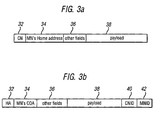
- a packet 30 conventionally addressed to a mobile in a foreign network has as source address 32 the IP address of CN 24; and as destination address 34 the home address of MN 28.
- Figure 3a also illustrates payload 38 and other fields 36.
- the source address 32 is the address of HA 26 and the destination address 34 is the COA of MN 28.
- the header contains two new fields, 40, 42, containing respectively identifiers (ID) for CN 24 and MN 28.
- the re-addressed packet is received by the FA 30 and the MN ID 42 is used by the FA to distinguish the different mobile nodes which are simultaneously using that FA, and the packet is routed to MN 28.
- the CNID 40 is used by the FA or the MN to recover the original source address, i.e. the address of the CN 24; the FA 30 or the MN 28 then re-calculates the checksum of the packet, and delivers it to an application.
- this unique identifier is allocated by HA 26 as soon as a packet addressed to the address of mobile is detected.
- the HA 26 adds an entry to an address mapping table of CNIDs and CNs, which is maintained by HA 26. Then the HA 26 sends the CNID plus the IP address of the correspondent CN to FA 30 (FA COA mode) or to MN 28 (CO-COA mode); either a registration reply message, or a separate CNID notification message can be used.
- the HA looks up the CNID and CN address mapping table to find the CNID corresponding to the source address on the packet; the HA then replaces the original source address with the HA address, and the destination address with the COA of MN 28.
- the HA 26 adds a CNID field 40 and an MN ID field 42, adjusts the packet checksum, and dispatches the packet.
- the CNID-to-CN table is looked up and the source address of the HA 26 is replaced by the real address of CN 24, and the destination address is replaced with the home address of the mobile.
- the MNID-to-MN table is looked up, as explained above. The checksum is adjusted and the packet is delivered to the MN 28 (for FA COA mode) or the an application (for CO-COA mode).
- the CNID and MNID formats can be very short and simple, so that the additional fields do not substantially increase the header length.
- the method of packet heading according to the invention for a mobile in a foreign network retains the advantage of shorter headers, and higher payloads, in common with the invention set out in the copending patent application no. 99301437.2r referred to above. Since the HA address is used as the source address, the problems during egress filtering caused by using a source address different from the home network address can be avoided. Since the destination address is changed back before a packet is delivered, an application to which the packet is delivered does not need to be reconfigured, so irritating stops and re-starts of the application are avoided.
- a further advantage is that only the source and destination addresses of the header are changed; all other information is unchanged, including information identifying the traffic flows from the HA 26 to the current COA of MN 28. It is therefore possible to adopt a standard QoS arrangement, such as RSVP, without modification to provide QoS services to the mobile.
- the CN 24 and HA 26 are associated with home network 50, and the MN 28 and FA 30 are associated with a foreign network 52.
- the RSVP session is set up as two parts, shown as Section 1 and Section 2 on the Figure; Section 1 operates between the CN 24 and the HA 26, and Section 2 operates between the HA 26 and MN 28.
- Section 1 is set up as a normal RSVP session in a non-mobile environment, with a path message sent from CN 24 to HA 26; the difference in the inventive arrangement is that the return RESV message from the HA 26 to CN 24 is not initiated until Section 2 has been completed.
- Section 2 covers the MN 28, and is dynamically adapted as the mobile moves from one network to another.
- HA 26 When HA 26 receives the PATH message from the CN 28, with the source and destination address being the CN 24 and the home address of MN 28, the HA 26 intercepts the packet and modifies or regenerates a PATH message via an RSVP proxy server by re-addressing the packet as described above.
- the packet passes through a number of nodes or network routers, and two routers, 54, 56, are illustrated.
- the PATH message is an end-to-end message.
- the proxy server can be attached to HA 26 or it can be a separate entity.
- a foreign proxy server or its equivalent in the MN 28 or FA 30, depending on the working mode prepares a RESV message with the COA address of MN 28 as the source address and the HA's destination address; the message contains flow identification information such as protocol ID as well as source/destination port numbers, and is dispatched.
- the RESV message is routed hop-by-hop through the same servers 54, 56 as the PATH message, but in the reverse direction; the source and destination addresses for each hop are changed appropriately by the routers 54, 56.
- the RESV message When the RESV message is received by HA 26, or an equivalent such as a home network proxy server, the RESV message is modified or re-generated with the home address of MN 28 as source address and the CN 24 as destination address; i.e. Section 2 is completed.
- the RESV message of Section 1 is now sent in conventional manner.
- a RESV confirmation message can, if requested, be sent to confirm the whole RSVP session.
Landscapes
- Engineering & Computer Science (AREA)
- Computer Networks & Wireless Communication (AREA)
- Signal Processing (AREA)
- Databases & Information Systems (AREA)
- Computer Security & Cryptography (AREA)
- Mobile Radio Communication Systems (AREA)
- Data Exchanges In Wide-Area Networks (AREA)
- Small-Scale Networks (AREA)
Abstract
Description
- changing the packet header so that the source address is the home agent address, the destination address is the Care of Address and the header further includes a correspondent node identifier code and a mobile node identifier code.
Claims (8)
- A method of operating a third generation mobile telecommunications system, in which packets are addressed to a mobile node (28) which is currently associated with a foreign network and is communicating with a correspondent node (24), comprising the steps ofsetting up a home agent (26) in the correspondent node (24) and allocating a Care of Address for the mobile node (22);characterized by the further steps of:--changing the packet header so that the source address is the home agent address, the destination address is the Care of Address, and the header further includes a correspondent node identifier code (40) and a mobile node identifier code (42).
- A method according to Claim 1 in which the Care of Address is the address of the mobile node (28).
- A method according to Claim 1 in which the Care of Address is the address of a foreign agent (30) in the foreign network.
- A method according to any preceding claim in which the packet header is changed by the home agent (26).
- A method according to claim 4 comprising the further steps of the home agent (26) retaining a record of correspondent node (24) and correspondent node identifier codes (40), and the home agent sending a copy of said record to the destination address in the Care of Address at which said information is also stored.
- A method according to Claim 5 in which when a packet arrives at the destination address in the Care of Address, the destination checks the stored information and replaces the correspondent node identifier code (40) in the header with the correspondent node home address.
- A method according to any preceding claim comprising the further steps of the home agent (26) retaining a record of the mobile node (24) and mobile node identifier code (42) and sending a copy of said record to the Care of Address at which said information is also stored.
- A method according to Claim 7 in which, when the packets arrive at the Care of Address, the foreign agent (30) checks the stored information and replaces the mobile node identifier code in the header with the mobile node home address.
Applications Claiming Priority (2)
| Application Number | Priority Date | Filing Date | Title |
|---|---|---|---|
| GB0020580 | 2000-08-21 | ||
| GB0020580A GB2366480A (en) | 2000-08-21 | 2000-08-21 | Method of operating a third generation mobile communication system |
Publications (3)
| Publication Number | Publication Date |
|---|---|
| EP1182832A2 true EP1182832A2 (en) | 2002-02-27 |
| EP1182832A3 EP1182832A3 (en) | 2003-07-23 |
| EP1182832B1 EP1182832B1 (en) | 2006-02-15 |
Family
ID=9898016
Family Applications (1)
| Application Number | Title | Priority Date | Filing Date |
|---|---|---|---|
| EP01304257A Expired - Lifetime EP1182832B1 (en) | 2000-08-21 | 2001-05-14 | Method of operating a mobile telecommunications network |
Country Status (6)
| Country | Link |
|---|---|
| US (1) | US7136362B2 (en) |
| EP (1) | EP1182832B1 (en) |
| JP (1) | JP4732634B2 (en) |
| CA (1) | CA2351047A1 (en) |
| DE (1) | DE60117229T2 (en) |
| GB (1) | GB2366480A (en) |
Cited By (13)
| Publication number | Priority date | Publication date | Assignee | Title |
|---|---|---|---|---|
| EP1401173A1 (en) * | 2002-09-20 | 2004-03-24 | NTT DoCoMo, Inc. | Mobile communication system using source routers, destination routers and a location server, corresponding routers and method |
| WO2004045159A3 (en) * | 2002-11-11 | 2004-09-16 | Orange Sa | Filtering data packets at a network gateway working as a service-based policy (sblp) enforcement point |
| GB2400274A (en) * | 2003-04-05 | 2004-10-06 | Hewlett Packard Development Co | Apparatus and related methods for establishing a network connection |
| GB2410865A (en) * | 2004-02-06 | 2005-08-10 | Orange Personal Comm Serv Ltd | Telecommunications |
| WO2005088934A1 (en) * | 2004-03-04 | 2005-09-22 | Koninklijke Philips Electronics N.V. | Method and system for ip mobility |
| EP1182824A3 (en) * | 2000-08-21 | 2005-11-09 | Lucent Technologies Inc. | Providing quality of service in a mobile telecommunications network |
| WO2006099803A1 (en) * | 2005-03-22 | 2006-09-28 | Huawei Technologies Co., Ltd. | An implementing method for traversing the firewall by the mobile ipv6 massage and the firewall |
| EP2081344A1 (en) * | 2002-10-11 | 2009-07-22 | Spyder Navigations LLC | Transport efficiency optimization for mobile IPv6 |
| CN101222767B (en) * | 2008-01-23 | 2011-01-05 | 中兴通讯股份有限公司 | Method and system for implementing flow-based quality of service for mobile IP services |
| CN101541077B (en) * | 2002-04-18 | 2012-09-05 | 松下电器产业株式会社 | Mobile node and mobile communication method |
| EP1999673A4 (en) * | 2006-03-08 | 2013-07-10 | Riverbed Technology Inc | Address manipulation to provide for the use of network tools even when transaction acceleration is in use over a network |
| US8891443B2 (en) | 2006-01-26 | 2014-11-18 | Huawei Technologies Co., Ltd. | Method and system for implementing data routing of roaming user |
| EP3926932A1 (en) * | 2020-06-16 | 2021-12-22 | T-Mobile USA, Inc. | Duplex load balancing for massive iot applications |
Families Citing this family (16)
| Publication number | Priority date | Publication date | Assignee | Title |
|---|---|---|---|---|
| GB2366482A (en) * | 2000-08-21 | 2002-03-06 | Lucent Technologies Inc | Method of operating third generation communication systems |
| FI114190B (en) * | 2002-01-11 | 2004-08-31 | Radionet Oy | Procedure for supporting mobility in a wireless network |
| WO2003067439A1 (en) * | 2002-02-04 | 2003-08-14 | Flarion Technologies, Inc. | A method for extending mobile ip and aaa to enable integrated support for local access and roaming access connectivity |
| US8649352B2 (en) * | 2002-02-04 | 2014-02-11 | Qualcomm Incorporated | Packet forwarding methods for use in handoffs |
| US7564824B2 (en) * | 2002-02-04 | 2009-07-21 | Qualcomm Incorporated | Methods and apparatus for aggregating MIP and AAA messages |
| US20030193952A1 (en) * | 2002-02-04 | 2003-10-16 | O'neill Alan | Mobile node handoff methods and apparatus |
| US7756073B2 (en) * | 2002-09-20 | 2010-07-13 | Franck Le | Method for updating a routing entry |
| GB2393608A (en) * | 2002-09-24 | 2004-03-31 | Orange Personal Comm Serv Ltd | Selecting an appropriate PDP context at a GPRS gateway support node for transferring a data packet from a mobile node to a correspondent node |
| US7804826B1 (en) | 2002-11-15 | 2010-09-28 | Nortel Networks Limited | Mobile IP over VPN communication protocol |
| JP2004242019A (en) * | 2003-02-05 | 2004-08-26 | Ntt Docomo Inc | Mobile communication control system, network management server, mobile node, access node and anchor node |
| US8160079B1 (en) * | 2003-03-10 | 2012-04-17 | Avaya Inc. | Local communication agent |
| US7328256B2 (en) * | 2003-06-02 | 2008-02-05 | Apple Inc. | Method and apparatus for distributing computer files across a network to multiple clients |
| CN1878126A (en) * | 2005-06-07 | 2006-12-13 | 华为技术有限公司 | Method for realizing signalling proxy in communication network |
| JP4371316B2 (en) | 2005-11-17 | 2009-11-25 | 富士通株式会社 | Information communication program, information communication apparatus, and information communication method |
| CN101262416B (en) * | 2007-03-06 | 2012-04-25 | 华为技术有限公司 | Method, system and device for hiding user location in communication system |
| JP5326977B2 (en) * | 2009-10-01 | 2013-10-30 | 日本電気株式会社 | Change notification method, change notification device and program |
Family Cites Families (12)
| Publication number | Priority date | Publication date | Assignee | Title |
|---|---|---|---|---|
| JP3339514B2 (en) * | 1993-07-06 | 2002-10-28 | 松下電器産業株式会社 | Mobility management device, packet relay device, and mobile communication system |
| GB2341059A (en) * | 1998-08-28 | 2000-03-01 | Nokia Oy Ab | Internet protocol flow detection |
| US6496505B2 (en) * | 1998-12-11 | 2002-12-17 | Lucent Technologies Inc. | Packet tunneling optimization to wireless devices accessing packet-based wired networks |
| WO2000041418A1 (en) * | 1999-01-08 | 2000-07-13 | Motorola Inc. | Routing data in an ip-based communication system |
| US6501746B1 (en) * | 1999-01-08 | 2002-12-31 | Cisco Technology, Inc. | Mobile IP dynamic home address resolution |
| US6578085B1 (en) * | 1999-01-27 | 2003-06-10 | Nortel Networks Limited | System and method for route optimization in a wireless internet protocol network |
| DE69925453T2 (en) * | 1999-02-26 | 2006-05-11 | Lucent Technologies Inc. | Mobile IP without encapsulation |
| US6915325B1 (en) * | 2000-03-13 | 2005-07-05 | Nortel Networks Ltd | Method and program code for communicating with a mobile node through tunnels |
| US6751477B1 (en) * | 2000-05-17 | 2004-06-15 | Telefonaktiebolaget Lm Ericsson (Publ) | Systems and methods for dynamically optimizing the fidelity of a speech signal received from a wireless telephony device and transmitted through a packet-switched network |
| US6574214B1 (en) * | 2000-05-25 | 2003-06-03 | Nortel Networks Limited | Reduced overhead tunneling techniques in a communications network having mobile foreign agents |
| US6765892B1 (en) * | 2000-06-26 | 2004-07-20 | Cisco Technology, Inc. | Optimizing IP multicast data transmission in a mobile IP environment |
| GB2366481A (en) * | 2000-08-21 | 2002-03-06 | Lucent Technologies Inc | Method of providing quality of service in mobile telecommunication networks |
-
2000
- 2000-08-21 GB GB0020580A patent/GB2366480A/en not_active Withdrawn
-
2001
- 2001-05-14 EP EP01304257A patent/EP1182832B1/en not_active Expired - Lifetime
- 2001-05-14 DE DE60117229T patent/DE60117229T2/en not_active Expired - Lifetime
- 2001-06-19 CA CA002351047A patent/CA2351047A1/en not_active Abandoned
- 2001-07-30 US US09/918,174 patent/US7136362B2/en not_active Expired - Lifetime
- 2001-08-21 JP JP2001250219A patent/JP4732634B2/en not_active Expired - Fee Related
Cited By (22)
| Publication number | Priority date | Publication date | Assignee | Title |
|---|---|---|---|---|
| EP1182824A3 (en) * | 2000-08-21 | 2005-11-09 | Lucent Technologies Inc. | Providing quality of service in a mobile telecommunications network |
| CN101541077B (en) * | 2002-04-18 | 2012-09-05 | 松下电器产业株式会社 | Mobile node and mobile communication method |
| US7466674B2 (en) | 2002-09-20 | 2008-12-16 | Ntt Docomo, Inc. | Mobile communication control system, mobile communication control method, router, server and data structure |
| EP1401173A1 (en) * | 2002-09-20 | 2004-03-24 | NTT DoCoMo, Inc. | Mobile communication system using source routers, destination routers and a location server, corresponding routers and method |
| US7966018B2 (en) | 2002-10-11 | 2011-06-21 | Spyder Navigations L.L.C. | Transport efficiency optimization for mobile IPV6 |
| EP2081344A1 (en) * | 2002-10-11 | 2009-07-22 | Spyder Navigations LLC | Transport efficiency optimization for mobile IPv6 |
| US7554949B2 (en) | 2002-11-11 | 2009-06-30 | Orange S.A. | Filtering data packets at a network gateway working as a service-based policy (sblp) enforcement point |
| EP1860834A1 (en) | 2002-11-11 | 2007-11-28 | Orange SA | Filtering data packets at a network gateway working as a service-based local policy (sblp) enforcement point |
| WO2004045159A3 (en) * | 2002-11-11 | 2004-09-16 | Orange Sa | Filtering data packets at a network gateway working as a service-based policy (sblp) enforcement point |
| GB2400274A (en) * | 2003-04-05 | 2004-10-06 | Hewlett Packard Development Co | Apparatus and related methods for establishing a network connection |
| GB2400274B (en) * | 2003-04-05 | 2006-11-29 | Hewlett Packard Development Co | Apparatus and related methods for establishing a network connection |
| EP1741219B1 (en) * | 2004-02-06 | 2017-04-19 | 3G Licensing S.A. | Mobile home agent in a foreign network |
| GB2410865A (en) * | 2004-02-06 | 2005-08-10 | Orange Personal Comm Serv Ltd | Telecommunications |
| WO2005088934A1 (en) * | 2004-03-04 | 2005-09-22 | Koninklijke Philips Electronics N.V. | Method and system for ip mobility |
| WO2006099803A1 (en) * | 2005-03-22 | 2006-09-28 | Huawei Technologies Co., Ltd. | An implementing method for traversing the firewall by the mobile ipv6 massage and the firewall |
| US8891443B2 (en) | 2006-01-26 | 2014-11-18 | Huawei Technologies Co., Ltd. | Method and system for implementing data routing of roaming user |
| US9763077B2 (en) | 2006-01-26 | 2017-09-12 | Huawei Technologies Co., Ltd. | Method and system for implementing data routing of roaming user |
| EP1999673A4 (en) * | 2006-03-08 | 2013-07-10 | Riverbed Technology Inc | Address manipulation to provide for the use of network tools even when transaction acceleration is in use over a network |
| US9332091B2 (en) | 2006-03-08 | 2016-05-03 | Riverbed Technology, Inc. | Address manipulation to provide for the use of network tools even when transaction acceleration is in use over a network |
| CN101222767B (en) * | 2008-01-23 | 2011-01-05 | 中兴通讯股份有限公司 | Method and system for implementing flow-based quality of service for mobile IP services |
| EP3926932A1 (en) * | 2020-06-16 | 2021-12-22 | T-Mobile USA, Inc. | Duplex load balancing for massive iot applications |
| US11425043B2 (en) | 2020-06-16 | 2022-08-23 | T-Mobile Usa, Inc. | Duplex load balancing for massive IoT applications |
Also Published As
| Publication number | Publication date |
|---|---|
| GB0020580D0 (en) | 2000-10-11 |
| DE60117229T2 (en) | 2006-08-24 |
| US20020021688A1 (en) | 2002-02-21 |
| CA2351047A1 (en) | 2002-02-21 |
| JP4732634B2 (en) | 2011-07-27 |
| JP2002118596A (en) | 2002-04-19 |
| US7136362B2 (en) | 2006-11-14 |
| DE60117229D1 (en) | 2006-04-20 |
| EP1182832A3 (en) | 2003-07-23 |
| GB2366480A (en) | 2002-03-06 |
| EP1182832B1 (en) | 2006-02-15 |
Similar Documents
| Publication | Publication Date | Title |
|---|---|---|
| US7136362B2 (en) | Method of operating a mobile telecommunications network | |
| EP1182844B1 (en) | Improved method of operating a mobile telecommunications network to provide route optimisation and quality of service | |
| US6829483B2 (en) | Method of providing quality of service in a mobile telecommunications network | |
| JP3545986B2 (en) | Method for directing internet protocol IP packets to mobile node and mobile IP environment | |
| FI109950B (en) | Address Acquisition | |
| AU742430B2 (en) | GPRS-subscriber selection of multiple internet service providers | |
| AU2003231839B2 (en) | Flow-based selective reverse tunneling in wireless local area network (WLAN) -cellular systems | |
| CN102612020B (en) | Mobile agent control entity and system and method for forwarding data packets | |
| US7324529B2 (en) | Method of transmitting IP packets via a cellular radio communication system, and the cellular system equipment for implementing this method | |
| US7995523B2 (en) | Method and apparatus for data transfer in a packet-switched network | |
| EP2464066B1 (en) | Communication method for a mobile terminal | |
| JP2010045779A (en) | Telecommunication | |
| EP1051010B1 (en) | Mobile IP supporting quality of service for foreign network with foreign agent and plurality of mobile nodes | |
| EP1705866A1 (en) | Flow-based selective reverse tunneling in wireless local area network (WLAN)-cellular systems |
Legal Events
| Date | Code | Title | Description |
|---|---|---|---|
| PUAI | Public reference made under article 153(3) epc to a published international application that has entered the european phase |
Free format text: ORIGINAL CODE: 0009012 |
|
| AK | Designated contracting states |
Kind code of ref document: A2 Designated state(s): AT BE CH CY DE DK ES FI FR GB GR IE IT LI LU MC NL PT SE TR |
|
| AX | Request for extension of the european patent |
Free format text: AL;LT;LV;MK;RO;SI |
|
| PUAL | Search report despatched |
Free format text: ORIGINAL CODE: 0009013 |
|
| AK | Designated contracting states |
Designated state(s): AT BE CH CY DE DK ES FI FR GB GR IE IT LI LU MC NL PT SE TR |
|
| AX | Request for extension of the european patent |
Extension state: AL LT LV MK RO SI |
|
| 17P | Request for examination filed |
Effective date: 20040117 |
|
| AKX | Designation fees paid |
Designated state(s): DE FR GB |
|
| GRAP | Despatch of communication of intention to grant a patent |
Free format text: ORIGINAL CODE: EPIDOSNIGR1 |
|
| GRAS | Grant fee paid |
Free format text: ORIGINAL CODE: EPIDOSNIGR3 |
|
| GRAA | (expected) grant |
Free format text: ORIGINAL CODE: 0009210 |
|
| AK | Designated contracting states |
Kind code of ref document: B1 Designated state(s): DE FR GB |
|
| REG | Reference to a national code |
Ref country code: GB Ref legal event code: FG4D |
|
| REF | Corresponds to: |
Ref document number: 60117229 Country of ref document: DE Date of ref document: 20060420 Kind code of ref document: P |
|
| ET | Fr: translation filed | ||
| PLBE | No opposition filed within time limit |
Free format text: ORIGINAL CODE: 0009261 |
|
| 26N | No opposition filed |
Effective date: 20061116 |
|
| REG | Reference to a national code |
Ref country code: GB Ref legal event code: 732E Free format text: REGISTERED BETWEEN 20131031 AND 20131106 |
|
| REG | Reference to a national code |
Ref country code: FR Ref legal event code: CD Owner name: ALCATEL-LUCENT USA INC. Effective date: 20131122 |
|
| REG | Reference to a national code |
Ref country code: FR Ref legal event code: GC Effective date: 20140410 |
|
| REG | Reference to a national code |
Ref country code: FR Ref legal event code: RG Effective date: 20141015 |
|
| REG | Reference to a national code |
Ref country code: FR Ref legal event code: PLFP Year of fee payment: 15 |
|
| REG | Reference to a national code |
Ref country code: FR Ref legal event code: PLFP Year of fee payment: 16 |
|
| REG | Reference to a national code |
Ref country code: FR Ref legal event code: PLFP Year of fee payment: 17 |
|
| REG | Reference to a national code |
Ref country code: FR Ref legal event code: PLFP Year of fee payment: 18 |
|
| PGFP | Annual fee paid to national office [announced via postgrant information from national office to epo] |
Ref country code: DE Payment date: 20190430 Year of fee payment: 19 |
|
| PGFP | Annual fee paid to national office [announced via postgrant information from national office to epo] |
Ref country code: FR Payment date: 20190410 Year of fee payment: 19 |
|
| PGFP | Annual fee paid to national office [announced via postgrant information from national office to epo] |
Ref country code: GB Payment date: 20190508 Year of fee payment: 19 |
|
| REG | Reference to a national code |
Ref country code: DE Ref legal event code: R119 Ref document number: 60117229 Country of ref document: DE |
|
| GBPC | Gb: european patent ceased through non-payment of renewal fee |
Effective date: 20200514 |
|
| PG25 | Lapsed in a contracting state [announced via postgrant information from national office to epo] |
Ref country code: GB Free format text: LAPSE BECAUSE OF NON-PAYMENT OF DUE FEES Effective date: 20200514 Ref country code: FR Free format text: LAPSE BECAUSE OF NON-PAYMENT OF DUE FEES Effective date: 20200531 |
|
| PG25 | Lapsed in a contracting state [announced via postgrant information from national office to epo] |
Ref country code: DE Free format text: LAPSE BECAUSE OF NON-PAYMENT OF DUE FEES Effective date: 20201201 |