EP1182584A2 - Method and apparatus for video skimming - Google Patents
Method and apparatus for video skimming Download PDFInfo
- Publication number
- EP1182584A2 EP1182584A2 EP01119953A EP01119953A EP1182584A2 EP 1182584 A2 EP1182584 A2 EP 1182584A2 EP 01119953 A EP01119953 A EP 01119953A EP 01119953 A EP01119953 A EP 01119953A EP 1182584 A2 EP1182584 A2 EP 1182584A2
- Authority
- EP
- European Patent Office
- Prior art keywords
- shot
- video
- information
- skimming
- shots
- Prior art date
- Legal status (The legal status is an assumption and is not a legal conclusion. Google has not performed a legal analysis and makes no representation as to the accuracy of the status listed.)
- Ceased
Links
Images



Classifications
-
- G—PHYSICS
- G11—INFORMATION STORAGE
- G11B—INFORMATION STORAGE BASED ON RELATIVE MOVEMENT BETWEEN RECORD CARRIER AND TRANSDUCER
- G11B27/00—Editing; Indexing; Addressing; Timing or synchronising; Monitoring; Measuring tape travel
- G11B27/005—Reproducing at a different information rate from the information rate of recording
-
- G—PHYSICS
- G06—COMPUTING OR CALCULATING; COUNTING
- G06F—ELECTRIC DIGITAL DATA PROCESSING
- G06F16/00—Information retrieval; Database structures therefor; File system structures therefor
- G06F16/70—Information retrieval; Database structures therefor; File system structures therefor of video data
- G06F16/73—Querying
- G06F16/738—Presentation of query results
- G06F16/739—Presentation of query results in form of a video summary, e.g. the video summary being a video sequence, a composite still image or having synthesized frames
-
- G—PHYSICS
- G06—COMPUTING OR CALCULATING; COUNTING
- G06F—ELECTRIC DIGITAL DATA PROCESSING
- G06F16/00—Information retrieval; Database structures therefor; File system structures therefor
- G06F16/70—Information retrieval; Database structures therefor; File system structures therefor of video data
- G06F16/78—Retrieval characterised by using metadata, e.g. metadata not derived from the content or metadata generated manually
- G06F16/783—Retrieval characterised by using metadata, e.g. metadata not derived from the content or metadata generated manually using metadata automatically derived from the content
- G06F16/7834—Retrieval characterised by using metadata, e.g. metadata not derived from the content or metadata generated manually using metadata automatically derived from the content using audio features
-
- G—PHYSICS
- G06—COMPUTING OR CALCULATING; COUNTING
- G06F—ELECTRIC DIGITAL DATA PROCESSING
- G06F16/00—Information retrieval; Database structures therefor; File system structures therefor
- G06F16/70—Information retrieval; Database structures therefor; File system structures therefor of video data
- G06F16/78—Retrieval characterised by using metadata, e.g. metadata not derived from the content or metadata generated manually
- G06F16/783—Retrieval characterised by using metadata, e.g. metadata not derived from the content or metadata generated manually using metadata automatically derived from the content
- G06F16/7847—Retrieval characterised by using metadata, e.g. metadata not derived from the content or metadata generated manually using metadata automatically derived from the content using low-level visual features of the video content
- G06F16/786—Retrieval characterised by using metadata, e.g. metadata not derived from the content or metadata generated manually using metadata automatically derived from the content using low-level visual features of the video content using motion, e.g. object motion or camera motion
-
- G—PHYSICS
- G11—INFORMATION STORAGE
- G11B—INFORMATION STORAGE BASED ON RELATIVE MOVEMENT BETWEEN RECORD CARRIER AND TRANSDUCER
- G11B27/00—Editing; Indexing; Addressing; Timing or synchronising; Monitoring; Measuring tape travel
- G11B27/02—Editing, e.g. varying the order of information signals recorded on, or reproduced from, record carriers
- G11B27/031—Electronic editing of digitised analogue information signals, e.g. audio or video signals
- G11B27/034—Electronic editing of digitised analogue information signals, e.g. audio or video signals on discs
-
- G—PHYSICS
- G11—INFORMATION STORAGE
- G11B—INFORMATION STORAGE BASED ON RELATIVE MOVEMENT BETWEEN RECORD CARRIER AND TRANSDUCER
- G11B27/00—Editing; Indexing; Addressing; Timing or synchronising; Monitoring; Measuring tape travel
- G11B27/10—Indexing; Addressing; Timing or synchronising; Measuring tape travel
- G11B27/11—Indexing; Addressing; Timing or synchronising; Measuring tape travel by using information not detectable on the record carrier
-
- G—PHYSICS
- G11—INFORMATION STORAGE
- G11B—INFORMATION STORAGE BASED ON RELATIVE MOVEMENT BETWEEN RECORD CARRIER AND TRANSDUCER
- G11B27/00—Editing; Indexing; Addressing; Timing or synchronising; Monitoring; Measuring tape travel
- G11B27/10—Indexing; Addressing; Timing or synchronising; Measuring tape travel
- G11B27/19—Indexing; Addressing; Timing or synchronising; Measuring tape travel by using information detectable on the record carrier
- G11B27/28—Indexing; Addressing; Timing or synchronising; Measuring tape travel by using information detectable on the record carrier by using information signals recorded by the same method as the main recording
Definitions
- the present invention relates to a system for searching and browsing multimedia, and more particularly, to a video skimming system which is capable of briefly understanding the full content of video and rapidly moving to a desired portion based on a meaningful story structure according to the progress of the content of the video among structural information of the video content.
- a certain user may wish to view only sports-related news, or another user may wish to view securities-related news.
- a certain user may request for viewing only scenes in which a particular person appears in a show program. In order to receive such various kinds of user requests, various studies are being made.
- a user may request to grasp the full video contents within a limited time. Such a request is accepted by "Highlights”.
- highlights can be understood as a newly configured content of important scenes from a video content. These includes, for example, “Sports Highlights”, “Preview of Movie”, “Headline News” and the like.
- it is very difficult to automate the extraction of highlights from a video content. Thus, in most cases, this extraction is dependent upon a manual work.
- an automation system is needed in order to allow a user to understand the outline of the content within a short time.
- a key frame is used for use in moving to a desired position in a video content.
- a video summary using the key frame a user can move to a desired person rapidly.
- a large number of key frames are needed in order to easily search for a desired portion by using the key frame, but it is difficult to display a large number of key frames in a restricted display space.
- the user is requested to perform many selection works.
- it is difficult to understand the full content of video by the method using a key frame.
- a fast reproduction method generally used in a digital video a method for increasing a number of frames decoded per unit time and displaying parts thereof, or a method for decoding and displaying frames while skipping a certain portion is used.
- the method for increasing the number of frames decoded per unit time it is disadvantageous in that the maximum speed is affected by the performance of a terminal device.
- the method for decoding and displaying frames while skipping a certain portion is used in general.
- the fast wind/fast rewind technique in the digital video is the most reasonable one of existing techniques for complying with the request of the user wanting to understand the full content within a restricted time or wanting to move to a desired portion.
- predetermined intervals of time are used in skipping a certain portion, and thus there is a disadvantage that the user misses the scene of a desired portion or a less important portion is reproduced relatively often.
- a video skimming method includes the steps of: recognizing an individual shot section, a physical editing unit, as structural information for a video stream by shot segmentation; selecting a particular portion in the recognized individual shot section as reproduction video information reflecting the content of the corresponding shot; and continuously reproducing the video information selected for the individual shot.
- the video skimming method further includes the shot selection step of determining shots to be reproduced and shots to be skipped after recognizing the individual shot section.
- the structural information on the video stream are scene information, i.e., a logical story unit, and shot information, i.e., a physical editing unit displayed together with temporal technical information (starting position and duration or starting position and end position), which further including technical information on shot properties.
- scene information i.e., a logical story unit
- shot information i.e., a physical editing unit displayed together with temporal technical information (starting position and duration or starting position and end position), which further including technical information on shot properties.
- the effect of repetitively reproducing shots having similar properties is minimized by determining to skip parts of the shots having similar properties and to use only the remaining shots for skimming.
- shots to be used for skimming are selected by giving a higher weight value for selection to shots located at the latter half of a scene.
- reproduction portion (segment) representative of each shot the front portion, rear portion and center portion of the corresponding shot or the front portion and rear portion thereof are used at the same time.
- the length of the reproduction portion (segment) representative of each shot is identical.
- the length of the segment selected as the reproduction portion in each shot is larger than the length of the corresponding shot, the length of the reproduction portion in the individual shot is reduced to below the length of the corresponding shot.
- the length of the reproduction portion (segment) representative of each shot is reduced if there is a high similarity, or the reproduction length is increased if there is a low similarity.
- the image/motion/audio similarities in the shot representative of the scene mean the similarity in frames, motion vectors and audio data with different time positions.
- the reproduction speed of segments to be reproduced in each shot is controlled variably.
- the reproduction section is reproduced at a high speed by increasing a number of frames to be decoded per unit time and then making the reproduction speed higher than a normal speed, or by skipping a few frames in the middle without decoding all frames in the reproduction section.
- decoding frames are I frames which can obtain frame data by decoding only the corresponding frame without decoding other frames.
- a video skimming apparatus includes: a user interface unit for inputting a user command for video skimming in order to search and browse digital video data as multimedia data; a control unit for skimming the corresponding video file based on structural information for video content according to the user command inputted from the user interface unit; a video information file for providing the structural information for the video content to the control unit as index information for the digital video data and the corresponding video; and a display unit for reproducing the video skimmed by the control unit.
- the structural information for the video content includes shots representative of the corresponding scene, a logical story unit, that are based on scene information and are reproduced from shot information, a physical editing unit which is an element of the scene.
- the structural information for the video content further includes segments to be reproduced in the shot representative of the corresponding scene.
- the user interface unit includes a unit for designating a summary level as a degree of video skimming or a unit for designating the speed of a reproduction section in video skimming in order to select the summary level or reproduction speed of video in video skimming.
- control unit reads video index information related on shot segmentation information and shot clustering information from the index file according to a skimming condition by using a user input or basic settings, calculates segments to be reproduced conforming to the video skimming condition, reproduces the corresponding segments from the related media file continuously, and outputs the same to the display unit.
- the most basic techniques for non-linear video browsing and searching are the shot segmentation technique and the shot clustering technique. These two techniques are the most essential ones for analyzing video. Therefore, many studies have been concentrated on shot segmentation up to now, and the study of the shot clustering technique is being started.
- the shot segmentation can be automated, and most algorithms can be implemented with a high accuracy of more than 90%.
- the shot clustering also can be automated with accuracy of high level by applying the technique conforming to the genre of a program by detecting a characteristic event or using general characteristics of shots.
- a video contents is logically segmented into a several number of story units.
- Such a unit of a story structure is generally referred to as an event or scene, which including a gunfight scene, an interactive scene, etc.
- Such a scene is constructed a sequence of sub-scenes or shots.
- a shot denotes a sequence of video frames obtained from one camera without interruption, which is the most basic unit in video analysis or construction.
- a video is constructed of a sequence of many shots.
- Shot segmentation denotes a method for segmenting video into individual shots.
- Shot clustering denotes a process for detecting a logical story structure of a video content by reconstructing shots in logical scene units based on each of the individual shots and the characteristics thereof.
- Figure 1 is a view illustrating a shot segmentation process and a shot clustering process.
- most shot segmentation algorithms are based on the feature that image/motion/audio similarity is present in the same shots and the image/motion/audio dissimilarity is found between two different shots, and most shot clustering algorithms are based on the feature that shots having similar characteristics are detected again within a predetermined time.
- video highlights are a method for selecting meaningful segments in the progress of the content of a video stream and continuously reproducing these segments.
- a skimming method for reproducing only a certain portion of each of shots existing in every video and reproducing the remaining portion at a length smaller than that of the original stream by skipping.
- Such a skimming method is advantageous in that a complete automation system can be constructed since the shot segmentation technique can be automated, and in that the problem of reproducing an unimportant scene at a large length or missing an important scene generated in the fast wind/fast rewind for general digital video can be reduced.
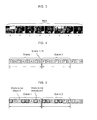
- Figure 2 is a view of a summary of a video skimming method using shot segmentation information.
- a portion shown in gray in Figure 2 indicates a portion to be reproduced in the skimming method using shot segmentation information, and the remaining portion indicates a portion to be skipped.
- scene information which is a logical story structure existing in video content, is not used, and therefore repetitive shots continue to be played in a particular event section such as an interactive scene.
- Figure 3 is a view illustrating an array structure of shots in a long interactive scene.
- the shots each are represented as English capital letters (A, B, C, D) based on shot properties detected by the shot segmentation process.
- the interactive scene represented in Figure 3 is a scene in which character 1 and character 2 are viewed in close-up in turns, which being constructed of many shots.
- the above-mentioned disadvantage is overcome by performing video skimming in consideration of shot information as well as scene information as structural information of a video content.
- a skimming method and apparatus for picking out shots to be reproduced and shots to be skipped from shots of each scene existing in every video, reproducing only a certain portion (segment) from segment information constituting the shot to be reproduced and reproducing the remaining portion at a length smaller than that of the original video stream by skipping.
- Figure 4 is a view illustrating a process of detecting a story unit for a general video content.
- Each shot is represented as an English capital letter based on shot properties detected by the shot segmentation process like Figure 3.
- a feature pattern of shots such as A, B, A, B, ... is shown.
- Figure 4 shows the process of determining the corresponding section as one scene if shots having similar properties are detected within a predetermined period of time.
- scene 1 consists of shots having a feature value of A, B, C. Shots having a feature value of A, B, C do not exist for a predetermined time since shot1-B3, and thus a scene is detected by detecting the finish point of time of shot1-B3 to be the finish point of time of scene 1.
- scene 2 consists of shots having a feature value of F, H, E. The feature values F, H, E of the shots do not exist for a predetermined time since the last shot of this scene, and thus the finish point of time of scene 2 can be detected.
- the present invention implements video skimming by using scene and shot information which are structural information for video content, and considers how to select a shot to be reproduced from shots of a scene, how to select a portion to be reproduced and a portion to be skipped from the shot selected as the shot to be reproduced, how to select a reproduction length of the portion to be reproduced and how to reproduce in a reproduction section.
- Figure 5 is a view illustrating a summary of the video skimming method of the present invention.
- Figure 5 is an example of reproducing only a remarkable scene only once among similar shots so that repetitive shots among shots of scene 1 cannot be reproduced.
- the shot selection for determining shots to be reproduced and shots to be skipped among shots of each scene exiting in a video stream will be achieved as follows.
- the outline of the content of the scene can be delivered by selecting the representative shot and using the same in skimming without any particular weight conditions.
- the story structure such as general dramas and movies
- much more information is expressed in the latter half of one scene.
- the introduction part is usually less important than the conclusion part. Therefore, in the step of selecting shots to be reproduced in skimming when similar shots appear many times in the scene, much more information can be provided to a user by selecting shots in the latter half of the scene as shots to be reproduced.
- Figure 6 illustrates a method (a of Figure 6) for selecting shots to be reproduced in the former half of a scene and a method (b of figure 6) for selecting shots to be reproduced in the latter half of the scene.
- Both a and b of Figure 6 are examples of selecting only one shot for skimming if similar shots exist in one scene.
- shots appearing at the very beginning are selected as shots to be reproduced among shots having shot properties of A, B, C.
- shots appearing at the very last are selected as shots to be reproduced among shots having shot properties of A, B, C.
- the method of b of Figure 6 shows a higher user's satisfaction than the method of a of Figure 6.
- the summary of the video content can be provided by continuously reproducing the shots selected above.
- the video skimming method of playing the full shot provides a summary of a very low level in general.
- a user can understand the content of the full shot by viewing only parts of the shot.
- the front portion, rear portion or center portion of the shot can be selected unconditionally.
- Figure 7 is a view illustrating a portion to be skipped and a portion to be reproduced in the method for video skimming using the front, rear and center portions or the front/rear portions of a shot at the same time.
- the front portion of the shot may be important according to the genre of video, for example, educational broadcasting mainly for solving questions.
- the position to be reproduced in the shot can be selected differently according to the characteristics of the content of video, and skimming can be implemented by using the front portion, the center portion and the rear portion in combination with one another in the same shot.
- the method for selecting a reproduction length in each shot can be divided into the method for selecting segments of the same length as a portion to be reproduced for every selected shots and the method for selecting a different reproduction length for each shot by using a shot property.
- the above-used shot property is based on the average image/motion/audio similarities in one shot. That is, it can be judged that the larger the image/motion/audio similarities in one shot are, the more monotonous the scene is. IN such a scene, skipping is performed more often. On the contrary, it can be judged that the smaller the image/motion/audio similarities in the shot are, the more complicated the content of the scene is. In such a scene, the length of a unit segment to be reproduced can be adjusted dynamically by using the method for performing skipping less often.
- This method is a method for skipping a portion with much information less often and skipping a portion with a little information more often without depending upon the time length of the shot.
- video skimming with a user's comprehensibility of a high level can be provided as compared to the method for reproducing segments of the same length for every selected shots.
- Figure 8 is a view illustrating an example of a method for selecting a length to be reproduced and skipped based on image/motion/audio similarities in a shot.
- a horizontal axis indicates time and a longitudinal axis indicates an accumulated value of image/motion/audio dissimilarities in the shot.
- These dissimilarity data are data representing shot properties extractable from a shot segmentation algorithm in general.
- the difference in a color histogram variance between adjacent frames or between frames at predetermined intervals can be taken.
- the skimming method of the present invention in the case that the length of a unit section becomes larger than that of the corresponding shot, exceptionally, the full corresponding shot may be selected as a reproduction section or parts thereof may be selected as a reproduction section in consideration of the length of the corresponding shot.
- the video skimming method according to the present invention can be adapted to a backward direction as well as a forward direction.
- the method for reproducing segments selected as reproduction sections in each shot can be divided into two.
- a first method is one for reproducing each segment, which is the same as a normal reproducing method.
- a second method is one for decoding parts of frames in a reproduction section and reproducing the same in the section by using skipping.
- the method for decoding parts of frames in a reproduction section and reproducing the same in the section by using skipping is a method for implementing quick skimming.
- frames to be displayed can be designated as frames at predetermined intervals of time.
- I frames having no interframe independency can be designated.
- Figure 9 is a view illustrating an example of a quick skimming method using skipping in a reproduction section.
- Figure 10 is a view illustrating a summary of the video skimming method using structural information of video content according to the present invention.
- the system When video skimming is requested, the system loads an index file storing structural information of video content including shot and scene information on the video content.
- the system determines what shots to reproduce for each scene and what shots to skip (in the shot selection step), and determines segments to be reproduced and segments to be skipped for each scene selected for video skimming (in the segment designation step). Through the two determination steps, segments to be reproduced are continuously outputted to a reproducing apparatus.
- Figure 10 is a view illustrating shots to be reproduced by the shot selection step shown in gray, in which only parts (segments) of a selected shot can be reproduced and the remaining portion can be skipped.
- Figure 11 is a view illustrating a skimming apparatus for video skimming according to one embodiment of the present invention.
- the video skimming apparatus of the present invention includes a user interface unit 101 for inputting a user command such as a degree of video skimming and a speed to be used in skimming, a master control unit 102 for skimming a corresponding video file based on indexing information on shots and scenes according to the user command inputted into the user interface unit 101, a media file 103 for providing digital video stream information to the master control unit 102, an index file 104 for providing the indexing information on shots and scenes as structural information corresponding to the media file, and a display device unit 105 for reproducing the video skimmed by the master control unit 102.
- a user interface unit 101 for inputting a user command such as a degree of video skimming and a speed to be used in skimming
- a master control unit 102 for skimming a corresponding video file based on indexing information on shots and scenes according to the user command inputted into the user interface unit 101
- a media file 103 for providing digital video stream information to the master control unit
- the index file 104 can be included in the medial file 103.
- the display device unit 105 is an output device for displaying a video stream including a monitor, a speaker, etc.
- the user interface unit 101 is an inputting means for receiving an input of a user including a keyboard, a mouse, a remote control, buttons, etc.
- the media file 103 is a file storing video (audio) data
- the index file 104 is a file storing index information on video containing shot clustering information and shot segmentation information.
- the user requests for video skimming by using the user interface unit 101.
- a summary level (degree of skimming) can be designated and also a speed to be used in skimming can be designated. That is, the user designates how many minutes it takes to compress the full video for viewing by using the user interface unit 101.
- the master control unit 102 determines what portion of what shot will be reproduced for skimming based on the medial file 103 and the subsequent information of the index file 102 according to the input of the user and determines at what speed each segment will be reproduced. By completing this process, the master control unit 102 can provides a video skimming function to the user by decoding the media file 103 and displaying the corresponding frames on the display device unit 105.
- the present invention has disclosed a video skimming method for simultaneously complying with a user request for understanding the full content and moving to a desired position within a restricted time under a digital video environment.
- the possibility of reproducing a less important portion relatively often or missing an actually desired scene is minimized and the possibility of repetitively reproducing an interactive scene or a particular scene in turns is minimized, which are the problems that can occur to the existing video skimming method.
- the video skimming method of the present invention is a method for minimizing the necessity of a user input according to a user request for moving to a desired position.
- the user can understand the full content within a short time, cannot miss an important portion in understanding the full content, and can skip a boring portion easily.
- the user can use the video skimming method of the present invention when he or she wants to move to a desired position.
- This method is advantageous in that it requires less user input requests as compared to the method using key frames.
- the present invention can be employed, for instance, for use in reproducing video highlights, and can be utilized as a function of rapidly searching a desired scene while minimizing a user input request if it is used together with a high speed reproducing method in reproducing reproduction sections of each shot.
Landscapes
- Engineering & Computer Science (AREA)
- Multimedia (AREA)
- Theoretical Computer Science (AREA)
- Library & Information Science (AREA)
- General Engineering & Computer Science (AREA)
- Physics & Mathematics (AREA)
- Databases & Information Systems (AREA)
- General Physics & Mathematics (AREA)
- Data Mining & Analysis (AREA)
- Computational Linguistics (AREA)
- Television Signal Processing For Recording (AREA)
- Two-Way Televisions, Distribution Of Moving Picture Or The Like (AREA)
- Indexing, Searching, Synchronizing, And The Amount Of Synchronization Travel Of Record Carriers (AREA)
Abstract
Description
Claims (21)
- A video skimming method, comprising the steps of:recognizing an individual shot section, a physical editing unit, as structural information for a video stream by shot segmentation;selecting a particular portion in the recognized individual shot section as reproduction video information reflecting the content of the corresponding shot; andcontinuously reproducing the video information selected for the individual shot.
- The method of claim 1, wherein the video skimming method further includes the shot selection step of determining shots to be reproduced and shots to be skipped after recognizing the individual shot section.
- The method of claim 1, wherein the structural information on the video stream are scene information, i.e., a logical story unit, and shot information, i.e., a physical editing unit displayed together with temporal technical information (starting position and duration or starting position and end position), which further including technical information on shot properties.
- The method of claim 2, wherein, in the shot selection step, the effect of repetitively reproducing shots having similar properties is minimized by determining to skip parts of the shots having similar properties and to use only the remaining shots for skimming.
- The method of claim 4, wherein, in selecting shots to be reproduced from the similar shots, shots to be used for skimming are selected by giving a higher weight value for selection to shots located at the latter half of a scene.
- The method of claim 1, wherein, as a reproduction portion (segment) representative of each shot, the front portion, rear portion and center portion of the corresponding shot or the front portion and rear portion thereof are used at the same time.
- The method of claim 1, wherein the length of the reproduction portion (segment) representative of each shot is identical.
- The method of claim 7, wherein, if the length of the segment selected as the reproduction portion in each shot is larger than the length of the corresponding shot, the length of the reproduction portion in the individual shot is reduced to below the length of the corresponding shot.
- The method of claim 1, wherein, based on the average value of the image/motion/audio similarities in the individual shot, the length of the reproduction portion (segment) representative of each shot is reduced if there is a high similarity, or the reproduction length is increased if there is a low similarity.
- The method of claim 8, wherein the image/motion/audio similarities in the shot representative of the scene mean the similarity in frames, motion vectors and audio data with different time positions.
- The method of claim 9, wherein if the length of the segment selected as the reproduction portion in each shot is larger than the length of the corresponding shot, the length of the reproduction portion in the individual shot is reduced to below the length of the corresponding shot.
- The method of claim 1, wherein the reproduction speed of segments to be reproduced in each shot is controlled variably.
- The method of claim 12, wherein the reproduction section is reproduced at a high speed by increasing a number of frames to be decoded per unit time and then making the reproduction speed higher than a normal speed.
- The method of claim 13, wherein the reproduction section is reproduced at a high speed by skipping a few frames in the middle without decoding all frames in the reproduction section.
- The method of claim 14, wherein, when the high speed skimming method using skipping is adapted to a video stream using a coding scheme utilizing interframe compression such as MPEG, decoding frames are I frames which can obtain frame data by decoding only the corresponding frame without decoding other frames.
- A video skimming apparatus, comprising:a user interface unit for inputting a user command for video skimming in order to search and browse digital video data as multimedia data;a control unit for skimming the corresponding video file based on structural information for video content according to the user command inputted from the user interface unit;a video information file for providing the structural information for the video content to the control unit as index information for the digital video data and the corresponding video; anda display unit for reproducing the video skimmed by the control unit.
- The apparatus of claim 16, wherein the structural information for the video content includes shots representative of the corresponding scene, a logical story unit, that are based on scene information and are reproduced from shot information, a physical editing unit which is an element of the scene.
- The apparatus of claim 17, wherein the structural information for the video content further includes segments to be reproduced in the shot representative of the corresponding scene.
- The apparatus of claim 16, wherein, the user interface unit comprises a unit for designating a summary level as a degree of video skimming or a unit for designating the speed of a reproduction section in video skimming in order to select the summary level or reproduction speed of video in video skimming.
- The apparatus of claim 16, wherein the control unit reads video index information related on shot segmentation information and shot clustering information from the index file according to a skimming condition by using a user input or basic settings, calculates segments to be reproduced conforming to the video skimming condition, reproduces the corresponding segments from the related media file continuously, and outputs the same to the display unit.
- A video skimming apparatus, comprising:a storage unit for storing digital video data, scene information which is logical story unit of a video content and shot information which is a physical editing unit of a video content;a detection unit for detecting shot information representative of a particular scene based on the scene information corresponding to the video data for video skimming;a selection unit for selecting segments to be reproduced and segments to be skipped in the detected shot; anda reproduction unit for continuously reading the selected segments to be reproduced from the storage unit and reproducing the same.
Applications Claiming Priority (4)
| Application Number | Priority Date | Filing Date | Title |
|---|---|---|---|
| KR10-2000-0048036A KR100370249B1 (en) | 2000-08-19 | 2000-08-19 | A system for video skimming using shot segmentation information |
| KR2000048036 | 2000-08-19 | ||
| KR2000055886 | 2000-09-22 | ||
| KR1020000055886A KR20020023063A (en) | 2000-09-22 | 2000-09-22 | A method and apparatus for video skimming using structural information of video contents |
Publications (2)
| Publication Number | Publication Date |
|---|---|
| EP1182584A2 true EP1182584A2 (en) | 2002-02-27 |
| EP1182584A3 EP1182584A3 (en) | 2005-12-28 |
Family
ID=26638320
Family Applications (1)
| Application Number | Title | Priority Date | Filing Date |
|---|---|---|---|
| EP01119953A Ceased EP1182584A3 (en) | 2000-08-19 | 2001-08-17 | Method and apparatus for video skimming |
Country Status (3)
| Country | Link |
|---|---|
| US (1) | US6964021B2 (en) |
| EP (1) | EP1182584A3 (en) |
| JP (1) | JP3667262B2 (en) |
Cited By (17)
| Publication number | Priority date | Publication date | Assignee | Title |
|---|---|---|---|---|
| EP1480220A1 (en) * | 2003-05-23 | 2004-11-24 | LG Electronics Inc. | Apparatus and method for reproducing video contents |
| WO2005001836A3 (en) * | 2003-06-30 | 2005-04-07 | Koninkl Philips Electronics Nv | Clip based trick modes |
| EP1531474A1 (en) * | 2003-11-14 | 2005-05-18 | Sony International (Europe) GmbH | Video signal playback apparatus and method |
| EP1626408A1 (en) * | 2004-08-13 | 2006-02-15 | Sony Corporation | Apparatus, method, and computer program for processing information |
| EP1748438A1 (en) * | 2005-07-27 | 2007-01-31 | Samsung Electronics Co., Ltd. | Video apparatus and control method |
| WO2007013025A3 (en) * | 2005-07-27 | 2007-04-19 | Koninkl Philips Electronics Nv | Method and apparatus for providing instant-review of multimedia material |
| WO2007055445A1 (en) * | 2005-11-11 | 2007-05-18 | Daegu Gyeongbuk Institute Of Science And Technology | A pre-viewing method of multiple movies or movie-clips in multimedia apparatus |
| EP1806919A1 (en) * | 2006-01-05 | 2007-07-11 | Alcatel Lucent | Media delivery system with content-based trick play mode |
| WO2007097218A1 (en) * | 2006-02-23 | 2007-08-30 | Mitsubishi Electric Corporation | Method and system for playing back video at speeds adapted to content of video |
| EP1770707A3 (en) * | 2005-09-28 | 2008-03-05 | Pantech Co., Ltd. | System for playing digest of moving image and mobile communication terminal having the same |
| EP1990803A1 (en) * | 2007-05-07 | 2008-11-12 | Samsung Electronics Co., Ltd. | Method of high speed video playback and video playback apparatus using the same |
| CN100518281C (en) * | 2002-12-27 | 2009-07-22 | Lg电子有限公司 | Method and apparatus for dynamic search of video contents |
| AU2006252142B2 (en) * | 2006-12-20 | 2009-11-26 | Canon Kabushiki Kaisha | Video rate determination |
| US8209623B2 (en) | 2003-12-05 | 2012-06-26 | Sony Deutschland Gmbh | Visualization and control techniques for multimedia digital content |
| CN103001925A (en) * | 2011-09-08 | 2013-03-27 | 百度在线网络技术(北京)有限公司 | Method and equipment for confirming playing skipping information of multimedia data on basis of statistics |
| CN107547922A (en) * | 2016-10-28 | 2018-01-05 | 腾讯科技(深圳)有限公司 | Information processing method, apparatus and system |
| EP3920542A4 (en) * | 2019-02-22 | 2022-10-26 | Arashi Vision Inc. | AUTOMATIC VIDEO EDITING PROCESS AND PORTABLE TERMINAL |
Families Citing this family (58)
| Publication number | Priority date | Publication date | Assignee | Title |
|---|---|---|---|---|
| US7253919B2 (en) | 2000-11-30 | 2007-08-07 | Ricoh Co., Ltd. | Printer with embedded retrieval and publishing interface |
| US6965645B2 (en) * | 2001-09-25 | 2005-11-15 | Microsoft Corporation | Content-based characterization of video frame sequences |
| US7415670B2 (en) * | 2001-11-19 | 2008-08-19 | Ricoh Co., Ltd. | Printer with audio/video localization |
| US7747655B2 (en) | 2001-11-19 | 2010-06-29 | Ricoh Co. Ltd. | Printable representations for time-based media |
| US7861169B2 (en) | 2001-11-19 | 2010-12-28 | Ricoh Co. Ltd. | Multimedia print driver dialog interfaces |
| US7424129B2 (en) * | 2001-11-19 | 2008-09-09 | Ricoh Company, Ltd | Printing system with embedded audio/video content recognition and processing |
| US20040130635A1 (en) * | 2002-10-09 | 2004-07-08 | Canon Kabushiki Kaisha | Image processing apparatus and image processing method |
| US6963378B2 (en) * | 2002-11-01 | 2005-11-08 | Motorola, Inc. | Method and apparatus for reduction of visual content |
| KR100555427B1 (en) * | 2002-12-24 | 2006-02-24 | 엘지전자 주식회사 | Video playback device and intelligent skip method |
| KR100708337B1 (en) * | 2003-06-27 | 2007-04-17 | 주식회사 케이티 | Apparatus and method for automatic video summarization using fuzzy based OSC-SM |
| US7275159B2 (en) * | 2003-08-11 | 2007-09-25 | Ricoh Company, Ltd. | Multimedia output device having embedded encryption functionality |
| KR100991619B1 (en) * | 2003-09-17 | 2010-11-04 | 엘지전자 주식회사 | Broadcast service method and system for content based trick play |
| US20050071746A1 (en) * | 2003-09-25 | 2005-03-31 | Hart Peter E. | Networked printer with hardware and software interfaces for peripheral devices |
| US7573593B2 (en) | 2003-09-25 | 2009-08-11 | Ricoh Company, Ltd. | Printer with hardware and software interfaces for media devices |
| US7570380B2 (en) | 2003-09-25 | 2009-08-04 | Ricoh Company, Ltd. | Printer user interface |
| US8077341B2 (en) * | 2003-09-25 | 2011-12-13 | Ricoh Co., Ltd. | Printer with audio or video receiver, recorder, and real-time content-based processing logic |
| US7508535B2 (en) * | 2003-09-25 | 2009-03-24 | Ricoh Co., Ltd. | Stand alone multimedia printer with user interface for allocating processing |
| US7528977B2 (en) * | 2003-09-25 | 2009-05-05 | Ricoh Co., Ltd. | Printer with hardware and software interfaces for peripheral devices |
| US7511846B2 (en) * | 2003-09-25 | 2009-03-31 | Ricoh Co., Ltd. | Printer having embedded functionality for printing time-based media |
| US7864352B2 (en) | 2003-09-25 | 2011-01-04 | Ricoh Co. Ltd. | Printer with multimedia server |
| US7505163B2 (en) | 2003-09-25 | 2009-03-17 | Ricoh Co., Ltd. | User interface for networked printer |
| JP2005108230A (en) * | 2003-09-25 | 2005-04-21 | Ricoh Co Ltd | Audio / video content recognition / processing function built-in printing system |
| US7528976B2 (en) * | 2003-09-25 | 2009-05-05 | Ricoh Co., Ltd. | Stand alone printer with hardware/software interfaces for sharing multimedia processing |
| US7440126B2 (en) * | 2003-09-25 | 2008-10-21 | Ricoh Co., Ltd | Printer with document-triggered processing |
| US7603615B2 (en) * | 2004-03-30 | 2009-10-13 | Ricoh Co., Ltd. | Multimedia projector-printer |
| US8274666B2 (en) | 2004-03-30 | 2012-09-25 | Ricoh Co., Ltd. | Projector/printer for displaying or printing of documents |
| JP5155665B2 (en) * | 2004-12-17 | 2013-03-06 | トムソン ライセンシング | Time difference reproduction apparatus and method for multimedia data |
| US7551312B1 (en) | 2005-03-17 | 2009-06-23 | Ricoh Co., Ltd. | Annotable document printer |
| US7526725B2 (en) * | 2005-04-08 | 2009-04-28 | Mitsubishi Electric Research Laboratories, Inc. | Context aware video conversion method and playback system |
| US20070033632A1 (en) * | 2005-07-19 | 2007-02-08 | March Networks Corporation | Temporal data previewing system |
| BRPI0614680A2 (en) * | 2005-08-10 | 2011-04-12 | Thomson Licensing | system and method for reviewing content of a digital film |
| US20070101264A1 (en) * | 2005-11-01 | 2007-05-03 | Microsoft Corporation | Position-and length-sensitive video timeline behavior |
| KR101187787B1 (en) * | 2006-02-18 | 2012-10-05 | 삼성전자주식회사 | Method and apparatus for searching moving picture using key frame |
| WO2007127695A2 (en) | 2006-04-25 | 2007-11-08 | Elmo Weber Frank | Prefernce based automatic media summarization |
| US8358381B1 (en) | 2007-04-10 | 2013-01-22 | Nvidia Corporation | Real-time video segmentation on a GPU for scene and take indexing |
| US8345769B1 (en) * | 2007-04-10 | 2013-01-01 | Nvidia Corporation | Real-time video segmentation on a GPU for scene and take indexing |
| US20080269924A1 (en) * | 2007-04-30 | 2008-10-30 | Huang Chen-Hsiu | Method of summarizing sports video and apparatus thereof |
| JP2009044423A (en) * | 2007-08-08 | 2009-02-26 | Univ Of Electro-Communications | Scene detection system and scene detecting method |
| JP4656199B2 (en) * | 2008-07-22 | 2011-03-23 | カシオ計算機株式会社 | Image processing apparatus, thumbnail movie creation method, and thumbnail movie creation program |
| US8209609B2 (en) * | 2008-12-23 | 2012-06-26 | Intel Corporation | Audio-visual search and browse interface (AVSBI) |
| US8620077B1 (en) * | 2009-01-26 | 2013-12-31 | Google Inc. | Spatio-temporal segmentation for video |
| AU2010270876A1 (en) * | 2009-06-24 | 2011-12-08 | Vidyo, Inc. | System and method for an active video electronic programming guide |
| US9171578B2 (en) | 2010-08-06 | 2015-10-27 | Futurewei Technologies, Inc. | Video skimming methods and systems |
| CN103210651B (en) | 2010-11-15 | 2016-11-09 | 华为技术有限公司 | Method and system for video summary |
| WO2012136880A1 (en) * | 2011-04-06 | 2012-10-11 | Nokia Corporation | Method, apparatus and computer program product for managing media content |
| US9414038B2 (en) | 2012-10-16 | 2016-08-09 | Amanjyot Singh JOHAR | Creating time lapse video in real-time |
| JP2014106637A (en) * | 2012-11-26 | 2014-06-09 | Sony Corp | Information processor, method and program |
| CN103377294B (en) * | 2013-07-07 | 2016-07-13 | 浙江大学 | A kind of video frequency abstract method for extracting content analyzed based on COLOR COMPOSITION THROUGH DISTRIBUTION |
| US9508390B2 (en) * | 2013-07-12 | 2016-11-29 | Apple Inc. | Trick play in digital video streaming |
| US10664687B2 (en) | 2014-06-12 | 2020-05-26 | Microsoft Technology Licensing, Llc | Rule-based video importance analysis |
| US9521470B2 (en) * | 2014-06-13 | 2016-12-13 | Hulu, LLC | Video delivery system configured to seek in a video using different modes |
| EP3151243B1 (en) * | 2015-09-29 | 2021-11-24 | Nokia Technologies Oy | Accessing a video segment |
| US10284774B2 (en) * | 2015-12-25 | 2019-05-07 | Olympus Corporation | Information terminal apparatus, image pickup apparatus, image-information processing system, and image-information processing method for controlling time-lapse imaging |
| KR20170098079A (en) * | 2016-02-19 | 2017-08-29 | 삼성전자주식회사 | Electronic device method for video recording in electronic device |
| US11917206B2 (en) | 2021-12-17 | 2024-02-27 | Lenovo (Singapore) Pte. Ltd. | Video codec aware radio access network configuration and unequal error protection coding |
| US12363316B2 (en) | 2021-12-17 | 2025-07-15 | Lenovo (Singapore) Pte. Ltd. | Video codec importance indication and radio access network awareness configuration |
| US11824653B2 (en) | 2021-12-17 | 2023-11-21 | Lenovo (Singapore) Pte. Ltd. | Radio access network configuration for video approximate semantic communications |
| CN117201716B (en) * | 2022-06-01 | 2025-10-24 | 北京字跳网络技术有限公司 | Method, device, equipment and medium for adjusting speed of multimedia clips |
Family Cites Families (7)
| Publication number | Priority date | Publication date | Assignee | Title |
|---|---|---|---|---|
| US5521841A (en) * | 1994-03-31 | 1996-05-28 | Siemens Corporate Research, Inc. | Browsing contents of a given video sequence |
| US5664227A (en) * | 1994-10-14 | 1997-09-02 | Carnegie Mellon University | System and method for skimming digital audio/video data |
| US6188396B1 (en) * | 1996-03-29 | 2001-02-13 | International Business Machines Corp. | Synchronizing multimedia parts with reference to absolute time, relative time, and event time |
| US5956026A (en) * | 1997-12-19 | 1999-09-21 | Sharp Laboratories Of America, Inc. | Method for hierarchical summarization and browsing of digital video |
| US6331859B1 (en) * | 1999-04-06 | 2001-12-18 | Sharp Laboratories Of America, Inc. | Video skimming system utilizing the vector rank filter |
| US6549643B1 (en) * | 1999-11-30 | 2003-04-15 | Siemens Corporate Research, Inc. | System and method for selecting key-frames of video data |
| US6642940B1 (en) * | 2000-03-03 | 2003-11-04 | Massachusetts Institute Of Technology | Management of properties for hyperlinked video |
-
2001
- 2001-08-17 JP JP2001247788A patent/JP3667262B2/en not_active Expired - Fee Related
- 2001-08-17 EP EP01119953A patent/EP1182584A3/en not_active Ceased
- 2001-08-17 US US09/932,713 patent/US6964021B2/en not_active Expired - Fee Related
Cited By (27)
| Publication number | Priority date | Publication date | Assignee | Title |
|---|---|---|---|---|
| CN100518281C (en) * | 2002-12-27 | 2009-07-22 | Lg电子有限公司 | Method and apparatus for dynamic search of video contents |
| US7962014B2 (en) | 2003-05-23 | 2011-06-14 | Lg Electronics Inc. | Apparatus and method for reproducing video contents |
| EP1480220A1 (en) * | 2003-05-23 | 2004-11-24 | LG Electronics Inc. | Apparatus and method for reproducing video contents |
| WO2005001836A3 (en) * | 2003-06-30 | 2005-04-07 | Koninkl Philips Electronics Nv | Clip based trick modes |
| US9177602B2 (en) | 2003-06-30 | 2015-11-03 | Nxp, B.V. | Clip based trick modes |
| US7929844B2 (en) | 2003-11-14 | 2011-04-19 | Sony Deutschland Gmbh | Video signal playback apparatus and method |
| EP1531474A1 (en) * | 2003-11-14 | 2005-05-18 | Sony International (Europe) GmbH | Video signal playback apparatus and method |
| US8209623B2 (en) | 2003-12-05 | 2012-06-26 | Sony Deutschland Gmbh | Visualization and control techniques for multimedia digital content |
| EP1626408A1 (en) * | 2004-08-13 | 2006-02-15 | Sony Corporation | Apparatus, method, and computer program for processing information |
| US7623756B2 (en) | 2004-08-13 | 2009-11-24 | Sony Corporation | Apparatus, method, and computer program for processing information |
| EP1748438A1 (en) * | 2005-07-27 | 2007-01-31 | Samsung Electronics Co., Ltd. | Video apparatus and control method |
| WO2007013025A3 (en) * | 2005-07-27 | 2007-04-19 | Koninkl Philips Electronics Nv | Method and apparatus for providing instant-review of multimedia material |
| EP1770707A3 (en) * | 2005-09-28 | 2008-03-05 | Pantech Co., Ltd. | System for playing digest of moving image and mobile communication terminal having the same |
| US7787745B2 (en) | 2005-09-28 | 2010-08-31 | Pantech Co., Ltd. | System for playing digest of moving image and mobile communication terminal having the same |
| WO2007055445A1 (en) * | 2005-11-11 | 2007-05-18 | Daegu Gyeongbuk Institute Of Science And Technology | A pre-viewing method of multiple movies or movie-clips in multimedia apparatus |
| WO2007076975A1 (en) * | 2006-01-05 | 2007-07-12 | Alcatel Lucent | Media delivery system with content-based trick play mode |
| EP1806919A1 (en) * | 2006-01-05 | 2007-07-11 | Alcatel Lucent | Media delivery system with content-based trick play mode |
| WO2007097218A1 (en) * | 2006-02-23 | 2007-08-30 | Mitsubishi Electric Corporation | Method and system for playing back video at speeds adapted to content of video |
| US7796860B2 (en) | 2006-02-23 | 2010-09-14 | Mitsubishi Electric Research Laboratories, Inc. | Method and system for playing back videos at speeds adapted to content |
| AU2006252142B2 (en) * | 2006-12-20 | 2009-11-26 | Canon Kabushiki Kaisha | Video rate determination |
| EP1990803A1 (en) * | 2007-05-07 | 2008-11-12 | Samsung Electronics Co., Ltd. | Method of high speed video playback and video playback apparatus using the same |
| CN103001925B (en) * | 2011-09-08 | 2018-05-08 | 百度在线网络技术(北京)有限公司 | The method and apparatus that the broadcasting jump information of multi-medium data is determined based on statistics |
| CN103001925A (en) * | 2011-09-08 | 2013-03-27 | 百度在线网络技术(北京)有限公司 | Method and equipment for confirming playing skipping information of multimedia data on basis of statistics |
| CN107547922A (en) * | 2016-10-28 | 2018-01-05 | 腾讯科技(深圳)有限公司 | Information processing method, apparatus and system |
| CN107547922B (en) * | 2016-10-28 | 2019-12-17 | 腾讯科技(深圳)有限公司 | Information processing method, device, system and computer readable storage medium |
| EP3920542A4 (en) * | 2019-02-22 | 2022-10-26 | Arashi Vision Inc. | AUTOMATIC VIDEO EDITING PROCESS AND PORTABLE TERMINAL |
| US11955143B2 (en) | 2019-02-22 | 2024-04-09 | Arashi Vision Inc. | Automatic video editing method and portable terminal |
Also Published As
| Publication number | Publication date |
|---|---|
| JP3667262B2 (en) | 2005-07-06 |
| US20020051010A1 (en) | 2002-05-02 |
| JP2002125174A (en) | 2002-04-26 |
| US6964021B2 (en) | 2005-11-08 |
| EP1182584A3 (en) | 2005-12-28 |
Similar Documents
| Publication | Publication Date | Title |
|---|---|---|
| EP1182584A2 (en) | Method and apparatus for video skimming | |
| KR100411437B1 (en) | Intelligent news video browsing system | |
| US7362949B2 (en) | Intelligent video system | |
| JP5552769B2 (en) | Image editing apparatus, image editing method and program | |
| CN100367794C (en) | Metadata editing apparatus | |
| US7362950B2 (en) | Method and apparatus for controlling reproduction of video contents | |
| US7487524B2 (en) | Method and apparatus for presenting content of images | |
| US20080044085A1 (en) | Method and apparatus for playing back video, and computer program product | |
| JP4778231B2 (en) | System and method for indexing video sequences | |
| US20080138034A1 (en) | Player for movie contents | |
| US20030122861A1 (en) | Method, interface and apparatus for video browsing | |
| US20020051081A1 (en) | Special reproduction control information describing method, special reproduction control information creating apparatus and method therefor, and video reproduction apparatus and method therefor | |
| KR20040077708A (en) | A method and apparatus for multimodal story segmentation for linking multimedia content | |
| JP2009508379A (en) | Video navigation method and apparatus | |
| JP2002112186A (en) | Electronic program guide receiver | |
| JPH0993588A (en) | Moving image processing method | |
| JP2000350156A (en) | Moving image information storage method and recording medium storing the same | |
| US7929844B2 (en) | Video signal playback apparatus and method | |
| US20100209072A1 (en) | Method for creating a new summary of an audiovisual document that already includes a summary and reports and a receiver that can implement said method | |
| JP3728775B2 (en) | Method and apparatus for detecting feature scene of moving image | |
| KR20040058511A (en) | Dynamic video searching system | |
| CN101132528B (en) | Metadata reproduction apparatus, metadata delivery apparatus, metadata search apparatus, metadata re-generation condition setting apparatus | |
| JPH11220689A (en) | Video software processor and medium for storing its program | |
| US8103149B2 (en) | Playback system, apparatus, and method, information processing apparatus and method, and program therefor | |
| US20050028213A1 (en) | System and method for user-friendly fast forward and backward preview of video |
Legal Events
| Date | Code | Title | Description |
|---|---|---|---|
| PUAI | Public reference made under article 153(3) epc to a published international application that has entered the european phase |
Free format text: ORIGINAL CODE: 0009012 |
|
| AK | Designated contracting states |
Kind code of ref document: A2 Designated state(s): AT BE CH CY DE DK ES FI FR GB GR IE IT LI LU MC NL PT SE TR |
|
| AX | Request for extension of the european patent |
Free format text: AL;LT;LV;MK;RO;SI |
|
| PUAL | Search report despatched |
Free format text: ORIGINAL CODE: 0009013 |
|
| AK | Designated contracting states |
Kind code of ref document: A3 Designated state(s): AT BE CH CY DE DK ES FI FR GB GR IE IT LI LU MC NL PT SE TR |
|
| AX | Request for extension of the european patent |
Extension state: AL LT LV MK RO SI |
|
| 17P | Request for examination filed |
Effective date: 20060530 |
|
| AKX | Designation fees paid |
Designated state(s): DE FR GB NL |
|
| 17Q | First examination report despatched |
Effective date: 20060904 |
|
| STAA | Information on the status of an ep patent application or granted ep patent |
Free format text: STATUS: THE APPLICATION HAS BEEN REFUSED |
|
| 18R | Application refused |
Effective date: 20111108 |