EP1182496A2 - Impact resistant photographic element - Google Patents
Impact resistant photographic element Download PDFInfo
- Publication number
- EP1182496A2 EP1182496A2 EP01203045A EP01203045A EP1182496A2 EP 1182496 A2 EP1182496 A2 EP 1182496A2 EP 01203045 A EP01203045 A EP 01203045A EP 01203045 A EP01203045 A EP 01203045A EP 1182496 A2 EP1182496 A2 EP 1182496A2
- Authority
- EP
- European Patent Office
- Prior art keywords
- sheet
- biaxially oriented
- photographic element
- layer
- photographic
- Prior art date
- Legal status (The legal status is an assumption and is not a legal conclusion. Google has not performed a legal analysis and makes no representation as to the accuracy of the status listed.)
- Withdrawn
Links
- -1 silver halide Chemical class 0.000 claims abstract description 71
- 239000000463 material Substances 0.000 claims abstract description 58
- 229910052709 silver Inorganic materials 0.000 claims abstract description 32
- 239000004332 silver Substances 0.000 claims abstract description 32
- 229920000642 polymer Polymers 0.000 claims abstract description 30
- 230000006835 compression Effects 0.000 claims abstract description 5
- 238000007906 compression Methods 0.000 claims abstract description 5
- 229920000098 polyolefin Polymers 0.000 claims description 19
- 229920003023 plastic Polymers 0.000 claims description 5
- 239000004033 plastic Substances 0.000 claims description 5
- 239000005977 Ethylene Substances 0.000 claims description 4
- VGGSQFUCUMXWEO-UHFFFAOYSA-N Ethene Chemical compound C=C VGGSQFUCUMXWEO-UHFFFAOYSA-N 0.000 claims description 3
- 229920002678 cellulose Polymers 0.000 claims description 3
- 239000001913 cellulose Substances 0.000 claims description 3
- 229920001179 medium density polyethylene Polymers 0.000 claims description 3
- 239000004701 medium-density polyethylene Substances 0.000 claims description 3
- 239000011358 absorbing material Substances 0.000 claims 3
- 239000010410 layer Substances 0.000 description 95
- 239000000839 emulsion Substances 0.000 description 48
- 239000002585 base Substances 0.000 description 33
- 239000000123 paper Substances 0.000 description 33
- 238000000034 method Methods 0.000 description 30
- 230000008569 process Effects 0.000 description 22
- 239000011159 matrix material Substances 0.000 description 20
- 239000002131 composite material Substances 0.000 description 18
- 239000000203 mixture Substances 0.000 description 16
- 239000004743 Polypropylene Substances 0.000 description 14
- 206010070834 Sensitisation Diseases 0.000 description 14
- 229920001155 polypropylene Polymers 0.000 description 14
- 230000008313 sensitization Effects 0.000 description 14
- 238000003384 imaging method Methods 0.000 description 13
- VAYOSLLFUXYJDT-RDTXWAMCSA-N Lysergic acid diethylamide Chemical compound C1=CC(C=2[C@H](N(C)C[C@@H](C=2)C(=O)N(CC)CC)C2)=C3C2=CNC3=C1 VAYOSLLFUXYJDT-RDTXWAMCSA-N 0.000 description 12
- 239000000975 dye Substances 0.000 description 12
- 239000003795 chemical substances by application Substances 0.000 description 11
- 229920000728 polyester Polymers 0.000 description 11
- 239000000126 substance Substances 0.000 description 11
- LYCAIKOWRPUZTN-UHFFFAOYSA-N Ethylene glycol Chemical compound OCCO LYCAIKOWRPUZTN-UHFFFAOYSA-N 0.000 description 10
- 238000000576 coating method Methods 0.000 description 10
- 239000002245 particle Substances 0.000 description 10
- 230000009467 reduction Effects 0.000 description 10
- 238000001125 extrusion Methods 0.000 description 9
- 239000007787 solid Substances 0.000 description 9
- 239000004698 Polyethylene Substances 0.000 description 8
- 229920000573 polyethylene Polymers 0.000 description 8
- 230000003595 spectral effect Effects 0.000 description 8
- 230000005855 radiation Effects 0.000 description 7
- MYRTYDVEIRVNKP-UHFFFAOYSA-N 1,2-Divinylbenzene Chemical compound C=CC1=CC=CC=C1C=C MYRTYDVEIRVNKP-UHFFFAOYSA-N 0.000 description 6
- VTYYLEPIZMXCLO-UHFFFAOYSA-L Calcium carbonate Chemical compound [Ca+2].[O-]C([O-])=O VTYYLEPIZMXCLO-UHFFFAOYSA-L 0.000 description 6
- BQCADISMDOOEFD-UHFFFAOYSA-N Silver Chemical compound [Ag] BQCADISMDOOEFD-UHFFFAOYSA-N 0.000 description 6
- 229910021607 Silver chloride Inorganic materials 0.000 description 6
- GWEVSGVZZGPLCZ-UHFFFAOYSA-N Titan oxide Chemical compound O=[Ti]=O GWEVSGVZZGPLCZ-UHFFFAOYSA-N 0.000 description 6
- TZCXTZWJZNENPQ-UHFFFAOYSA-L barium sulfate Chemical compound [Ba+2].[O-]S([O-])(=O)=O TZCXTZWJZNENPQ-UHFFFAOYSA-L 0.000 description 6
- 239000011248 coating agent Substances 0.000 description 6
- 238000010438 heat treatment Methods 0.000 description 6
- HKZLPVFGJNLROG-UHFFFAOYSA-M silver monochloride Chemical compound [Cl-].[Ag+] HKZLPVFGJNLROG-UHFFFAOYSA-M 0.000 description 6
- VYPSYNLAJGMNEJ-UHFFFAOYSA-N Silicium dioxide Chemical compound O=[Si]=O VYPSYNLAJGMNEJ-UHFFFAOYSA-N 0.000 description 5
- 229920001577 copolymer Polymers 0.000 description 5
- 238000011161 development Methods 0.000 description 5
- 230000000694 effects Effects 0.000 description 5
- 238000004519 manufacturing process Methods 0.000 description 5
- 238000001556 precipitation Methods 0.000 description 5
- 238000011160 research Methods 0.000 description 5
- 238000001228 spectrum Methods 0.000 description 5
- NIXOWILDQLNWCW-UHFFFAOYSA-N 2-Propenoic acid Natural products OC(=O)C=C NIXOWILDQLNWCW-UHFFFAOYSA-N 0.000 description 4
- 239000004793 Polystyrene Substances 0.000 description 4
- KKEYFWRCBNTPAC-UHFFFAOYSA-N Terephthalic acid Chemical compound OC(=O)C1=CC=C(C(O)=O)C=C1 KKEYFWRCBNTPAC-UHFFFAOYSA-N 0.000 description 4
- 239000000853 adhesive Substances 0.000 description 4
- 230000001070 adhesive effect Effects 0.000 description 4
- 125000004432 carbon atom Chemical group C* 0.000 description 4
- 229920006037 cross link polymer Polymers 0.000 description 4
- 230000006378 damage Effects 0.000 description 4
- 239000007789 gas Substances 0.000 description 4
- 239000000178 monomer Substances 0.000 description 4
- 229920002223 polystyrene Polymers 0.000 description 4
- 238000012545 processing Methods 0.000 description 4
- 238000010791 quenching Methods 0.000 description 4
- 230000000171 quenching effect Effects 0.000 description 4
- 230000035945 sensitivity Effects 0.000 description 4
- 229920003043 Cellulose fiber Polymers 0.000 description 3
- 239000004952 Polyamide Substances 0.000 description 3
- DNIAPMSPPWPWGF-UHFFFAOYSA-N Propylene glycol Chemical compound CC(O)CO DNIAPMSPPWPWGF-UHFFFAOYSA-N 0.000 description 3
- 239000011324 bead Substances 0.000 description 3
- 229910000019 calcium carbonate Inorganic materials 0.000 description 3
- 239000004927 clay Substances 0.000 description 3
- 229910052570 clay Inorganic materials 0.000 description 3
- 239000008119 colloidal silica Substances 0.000 description 3
- 150000001875 compounds Chemical class 0.000 description 3
- 230000007547 defect Effects 0.000 description 3
- 238000001514 detection method Methods 0.000 description 3
- MTHSVFCYNBDYFN-UHFFFAOYSA-N diethylene glycol Chemical compound OCCOCCO MTHSVFCYNBDYFN-UHFFFAOYSA-N 0.000 description 3
- 238000009826 distribution Methods 0.000 description 3
- 150000002148 esters Chemical class 0.000 description 3
- 239000001257 hydrogen Substances 0.000 description 3
- 229910052739 hydrogen Inorganic materials 0.000 description 3
- 230000006872 improvement Effects 0.000 description 3
- 229910052741 iridium Inorganic materials 0.000 description 3
- GKOZUEZYRPOHIO-UHFFFAOYSA-N iridium atom Chemical compound [Ir] GKOZUEZYRPOHIO-UHFFFAOYSA-N 0.000 description 3
- 230000001788 irregular Effects 0.000 description 3
- 238000010030 laminating Methods 0.000 description 3
- 238000003475 lamination Methods 0.000 description 3
- 239000007788 liquid Substances 0.000 description 3
- 229910052751 metal Inorganic materials 0.000 description 3
- 239000002184 metal Substances 0.000 description 3
- 229920002647 polyamide Polymers 0.000 description 3
- 239000004417 polycarbonate Substances 0.000 description 3
- 229920000515 polycarbonate Polymers 0.000 description 3
- 229920000139 polyethylene terephthalate Polymers 0.000 description 3
- 239000005020 polyethylene terephthalate Substances 0.000 description 3
- 239000011116 polymethylpentene Substances 0.000 description 3
- 229920000306 polymethylpentene Polymers 0.000 description 3
- 229920000915 polyvinyl chloride Polymers 0.000 description 3
- 238000007639 printing Methods 0.000 description 3
- 239000011241 protective layer Substances 0.000 description 3
- 230000001235 sensitizing effect Effects 0.000 description 3
- 239000000758 substrate Substances 0.000 description 3
- 239000002344 surface layer Substances 0.000 description 3
- 239000011800 void material Substances 0.000 description 3
- VXNZUUAINFGPBY-UHFFFAOYSA-N 1-Butene Chemical compound CCC=C VXNZUUAINFGPBY-UHFFFAOYSA-N 0.000 description 2
- LIKMAJRDDDTEIG-UHFFFAOYSA-N 1-hexene Chemical compound CCCCC=C LIKMAJRDDDTEIG-UHFFFAOYSA-N 0.000 description 2
- KWKAKUADMBZCLK-UHFFFAOYSA-N 1-octene Chemical compound CCCCCCC=C KWKAKUADMBZCLK-UHFFFAOYSA-N 0.000 description 2
- SMZOUWXMTYCWNB-UHFFFAOYSA-N 2-(2-methoxy-5-methylphenyl)ethanamine Chemical compound COC1=CC=C(C)C=C1CCN SMZOUWXMTYCWNB-UHFFFAOYSA-N 0.000 description 2
- OEPOKWHJYJXUGD-UHFFFAOYSA-N 2-(3-phenylmethoxyphenyl)-1,3-thiazole-4-carbaldehyde Chemical compound O=CC1=CSC(C=2C=C(OCC=3C=CC=CC=3)C=CC=2)=N1 OEPOKWHJYJXUGD-UHFFFAOYSA-N 0.000 description 2
- XFCMNSHQOZQILR-UHFFFAOYSA-N 2-[2-(2-methylprop-2-enoyloxy)ethoxy]ethyl 2-methylprop-2-enoate Chemical compound CC(=C)C(=O)OCCOCCOC(=O)C(C)=C XFCMNSHQOZQILR-UHFFFAOYSA-N 0.000 description 2
- NLHHRLWOUZZQLW-UHFFFAOYSA-N Acrylonitrile Chemical compound C=CC#N NLHHRLWOUZZQLW-UHFFFAOYSA-N 0.000 description 2
- QGZKDVFQNNGYKY-UHFFFAOYSA-N Ammonia Chemical compound N QGZKDVFQNNGYKY-UHFFFAOYSA-N 0.000 description 2
- IJGRMHOSHXDMSA-UHFFFAOYSA-N Atomic nitrogen Chemical compound N#N IJGRMHOSHXDMSA-UHFFFAOYSA-N 0.000 description 2
- CURLTUGMZLYLDI-UHFFFAOYSA-N Carbon dioxide Chemical compound O=C=O CURLTUGMZLYLDI-UHFFFAOYSA-N 0.000 description 2
- 229920002284 Cellulose triacetate Polymers 0.000 description 2
- 229910000968 Chilled casting Inorganic materials 0.000 description 2
- 229920001634 Copolyester Polymers 0.000 description 2
- 229920002261 Corn starch Polymers 0.000 description 2
- VZCYOOQTPOCHFL-OWOJBTEDSA-N Fumaric acid Chemical compound OC(=O)\C=C\C(O)=O VZCYOOQTPOCHFL-OWOJBTEDSA-N 0.000 description 2
- 108010010803 Gelatin Proteins 0.000 description 2
- OAKJQQAXSVQMHS-UHFFFAOYSA-N Hydrazine Chemical compound NN OAKJQQAXSVQMHS-UHFFFAOYSA-N 0.000 description 2
- XEEYBQQBJWHFJM-UHFFFAOYSA-N Iron Chemical compound [Fe] XEEYBQQBJWHFJM-UHFFFAOYSA-N 0.000 description 2
- BAPJBEWLBFYGME-UHFFFAOYSA-N Methyl acrylate Chemical compound COC(=O)C=C BAPJBEWLBFYGME-UHFFFAOYSA-N 0.000 description 2
- 229920001328 Polyvinylidene chloride Polymers 0.000 description 2
- 229920002472 Starch Polymers 0.000 description 2
- PPBRXRYQALVLMV-UHFFFAOYSA-N Styrene Chemical compound C=CC1=CC=CC=C1 PPBRXRYQALVLMV-UHFFFAOYSA-N 0.000 description 2
- LSNNMFCWUKXFEE-UHFFFAOYSA-N Sulfurous acid Chemical compound OS(O)=O LSNNMFCWUKXFEE-UHFFFAOYSA-N 0.000 description 2
- BZHJMEDXRYGGRV-UHFFFAOYSA-N Vinyl chloride Chemical compound ClC=C BZHJMEDXRYGGRV-UHFFFAOYSA-N 0.000 description 2
- NNLVGZFZQQXQNW-ADJNRHBOSA-N [(2r,3r,4s,5r,6s)-4,5-diacetyloxy-3-[(2s,3r,4s,5r,6r)-3,4,5-triacetyloxy-6-(acetyloxymethyl)oxan-2-yl]oxy-6-[(2r,3r,4s,5r,6s)-4,5,6-triacetyloxy-2-(acetyloxymethyl)oxan-3-yl]oxyoxan-2-yl]methyl acetate Chemical compound O([C@@H]1O[C@@H]([C@H]([C@H](OC(C)=O)[C@H]1OC(C)=O)O[C@H]1[C@@H]([C@@H](OC(C)=O)[C@H](OC(C)=O)[C@@H](COC(C)=O)O1)OC(C)=O)COC(=O)C)[C@@H]1[C@@H](COC(C)=O)O[C@@H](OC(C)=O)[C@H](OC(C)=O)[C@H]1OC(C)=O NNLVGZFZQQXQNW-ADJNRHBOSA-N 0.000 description 2
- YIMQCDZDWXUDCA-UHFFFAOYSA-N [4-(hydroxymethyl)cyclohexyl]methanol Chemical compound OCC1CCC(CO)CC1 YIMQCDZDWXUDCA-UHFFFAOYSA-N 0.000 description 2
- SJOOOZPMQAWAOP-UHFFFAOYSA-N [Ag].BrCl Chemical compound [Ag].BrCl SJOOOZPMQAWAOP-UHFFFAOYSA-N 0.000 description 2
- XCFIVNQHHFZRNR-UHFFFAOYSA-N [Ag].Cl[IH]Br Chemical compound [Ag].Cl[IH]Br XCFIVNQHHFZRNR-UHFFFAOYSA-N 0.000 description 2
- HOLVRJRSWZOAJU-UHFFFAOYSA-N [Ag].ICl Chemical compound [Ag].ICl HOLVRJRSWZOAJU-UHFFFAOYSA-N 0.000 description 2
- 239000002253 acid Substances 0.000 description 2
- 239000000654 additive Substances 0.000 description 2
- 239000012790 adhesive layer Substances 0.000 description 2
- 125000001931 aliphatic group Chemical group 0.000 description 2
- ZOJBYZNEUISWFT-UHFFFAOYSA-N allyl isothiocyanate Chemical compound C=CCN=C=S ZOJBYZNEUISWFT-UHFFFAOYSA-N 0.000 description 2
- PNEYBMLMFCGWSK-UHFFFAOYSA-N aluminium oxide Inorganic materials [O-2].[O-2].[O-2].[Al+3].[Al+3] PNEYBMLMFCGWSK-UHFFFAOYSA-N 0.000 description 2
- 239000002216 antistatic agent Substances 0.000 description 2
- 230000004888 barrier function Effects 0.000 description 2
- 230000008901 benefit Effects 0.000 description 2
- 239000011230 binding agent Substances 0.000 description 2
- 230000005540 biological transmission Effects 0.000 description 2
- WERYXYBDKMZEQL-UHFFFAOYSA-N butane-1,4-diol Chemical compound OCCCCO WERYXYBDKMZEQL-UHFFFAOYSA-N 0.000 description 2
- IAQRGUVFOMOMEM-UHFFFAOYSA-N butene Natural products CC=CC IAQRGUVFOMOMEM-UHFFFAOYSA-N 0.000 description 2
- 238000005266 casting Methods 0.000 description 2
- 230000008859 change Effects 0.000 description 2
- 238000012993 chemical processing Methods 0.000 description 2
- 239000003086 colorant Substances 0.000 description 2
- 239000012792 core layer Substances 0.000 description 2
- 239000008120 corn starch Substances 0.000 description 2
- 229940099112 cornstarch Drugs 0.000 description 2
- 238000003851 corona treatment Methods 0.000 description 2
- 239000003431 cross linking reagent Substances 0.000 description 2
- 239000013078 crystal Substances 0.000 description 2
- 150000001991 dicarboxylic acids Chemical class 0.000 description 2
- 239000004744 fabric Substances 0.000 description 2
- 239000008273 gelatin Substances 0.000 description 2
- 229920000159 gelatin Polymers 0.000 description 2
- 235000019322 gelatine Nutrition 0.000 description 2
- 235000011852 gelatine desserts Nutrition 0.000 description 2
- 230000009477 glass transition Effects 0.000 description 2
- 239000011121 hardwood Substances 0.000 description 2
- 238000009998 heat setting Methods 0.000 description 2
- 125000004435 hydrogen atom Chemical group [H]* 0.000 description 2
- WGCNASOHLSPBMP-UHFFFAOYSA-N hydroxyacetaldehyde Natural products OCC=O WGCNASOHLSPBMP-UHFFFAOYSA-N 0.000 description 2
- 239000000976 ink Substances 0.000 description 2
- 229920000554 ionomer Polymers 0.000 description 2
- 239000004973 liquid crystal related substance Substances 0.000 description 2
- 239000003607 modifier Substances 0.000 description 2
- KYTZHLUVELPASH-UHFFFAOYSA-N naphthalene-1,2-dicarboxylic acid Chemical compound C1=CC=CC2=C(C(O)=O)C(C(=O)O)=CC=C21 KYTZHLUVELPASH-UHFFFAOYSA-N 0.000 description 2
- 239000005026 oriented polypropylene Substances 0.000 description 2
- 230000000704 physical effect Effects 0.000 description 2
- 238000009832 plasma treatment Methods 0.000 description 2
- BASFCYQUMIYNBI-UHFFFAOYSA-N platinum Chemical compound [Pt] BASFCYQUMIYNBI-UHFFFAOYSA-N 0.000 description 2
- 229920000768 polyamine Polymers 0.000 description 2
- 229920001748 polybutylene Polymers 0.000 description 2
- 229920005606 polypropylene copolymer Polymers 0.000 description 2
- 239000005033 polyvinylidene chloride Substances 0.000 description 2
- 238000002360 preparation method Methods 0.000 description 2
- 230000000452 restraining effect Effects 0.000 description 2
- SQGYOTSLMSWVJD-UHFFFAOYSA-N silver(1+) nitrate Chemical compound [Ag+].[O-]N(=O)=O SQGYOTSLMSWVJD-UHFFFAOYSA-N 0.000 description 2
- 238000007711 solidification Methods 0.000 description 2
- 230000008023 solidification Effects 0.000 description 2
- 239000003381 stabilizer Substances 0.000 description 2
- 239000008107 starch Substances 0.000 description 2
- 235000019698 starch Nutrition 0.000 description 2
- 239000000725 suspension Substances 0.000 description 2
- 238000010557 suspension polymerization reaction Methods 0.000 description 2
- 229920001169 thermoplastic Polymers 0.000 description 2
- 239000004408 titanium dioxide Substances 0.000 description 2
- VZCYOOQTPOCHFL-UHFFFAOYSA-N trans-butenedioic acid Natural products OC(=O)C=CC(O)=O VZCYOOQTPOCHFL-UHFFFAOYSA-N 0.000 description 2
- 125000000391 vinyl group Chemical group [H]C([*])=C([H])[H] 0.000 description 2
- 229920002554 vinyl polymer Polymers 0.000 description 2
- XLYOFNOQVPJJNP-UHFFFAOYSA-N water Chemical compound O XLYOFNOQVPJJNP-UHFFFAOYSA-N 0.000 description 2
- 239000012463 white pigment Substances 0.000 description 2
- TXUICONDJPYNPY-UHFFFAOYSA-N (1,10,13-trimethyl-3-oxo-4,5,6,7,8,9,11,12,14,15,16,17-dodecahydrocyclopenta[a]phenanthren-17-yl) heptanoate Chemical compound C1CC2CC(=O)C=C(C)C2(C)C2C1C1CCC(OC(=O)CCCCCC)C1(C)CC2 TXUICONDJPYNPY-UHFFFAOYSA-N 0.000 description 1
- WRIDQFICGBMAFQ-UHFFFAOYSA-N (E)-8-Octadecenoic acid Natural products CCCCCCCCCC=CCCCCCCC(O)=O WRIDQFICGBMAFQ-UHFFFAOYSA-N 0.000 description 1
- PXGZQGDTEZPERC-UHFFFAOYSA-N 1,4-cyclohexanedicarboxylic acid Chemical compound OC(=O)C1CCC(C(O)=O)CC1 PXGZQGDTEZPERC-UHFFFAOYSA-N 0.000 description 1
- SLBOQBILGNEPEB-UHFFFAOYSA-N 1-chloroprop-2-enylbenzene Chemical compound C=CC(Cl)C1=CC=CC=C1 SLBOQBILGNEPEB-UHFFFAOYSA-N 0.000 description 1
- JAHNSTQSQJOJLO-UHFFFAOYSA-N 2-(3-fluorophenyl)-1h-imidazole Chemical compound FC1=CC=CC(C=2NC=CN=2)=C1 JAHNSTQSQJOJLO-UHFFFAOYSA-N 0.000 description 1
- XHZPRMZZQOIPDS-UHFFFAOYSA-N 2-Methyl-2-[(1-oxo-2-propenyl)amino]-1-propanesulfonic acid Chemical compound OS(=O)(=O)CC(C)(C)NC(=O)C=C XHZPRMZZQOIPDS-UHFFFAOYSA-N 0.000 description 1
- XUDBVJCTLZTSDC-UHFFFAOYSA-N 2-ethenylbenzoic acid Chemical compound OC(=O)C1=CC=CC=C1C=C XUDBVJCTLZTSDC-UHFFFAOYSA-N 0.000 description 1
- KGIGUEBEKRSTEW-UHFFFAOYSA-N 2-vinylpyridine Chemical compound C=CC1=CC=CC=N1 KGIGUEBEKRSTEW-UHFFFAOYSA-N 0.000 description 1
- LQJBNNIYVWPHFW-UHFFFAOYSA-N 20:1omega9c fatty acid Natural products CCCCCCCCCCC=CCCCCCCCC(O)=O LQJBNNIYVWPHFW-UHFFFAOYSA-N 0.000 description 1
- OONPLQJHBJXVBP-UHFFFAOYSA-N 3-(2-phenylethenyl)phthalic acid Chemical compound OC(=O)C1=CC=CC(C=CC=2C=CC=CC=2)=C1C(O)=O OONPLQJHBJXVBP-UHFFFAOYSA-N 0.000 description 1
- RYYXDZDBXNUPOG-UHFFFAOYSA-N 4,5,6,7-tetrahydro-1,3-benzothiazole-2,6-diamine;dihydrochloride Chemical compound Cl.Cl.C1C(N)CCC2=C1SC(N)=N2 RYYXDZDBXNUPOG-UHFFFAOYSA-N 0.000 description 1
- DBCAQXHNJOFNGC-UHFFFAOYSA-N 4-bromo-1,1,1-trifluorobutane Chemical compound FC(F)(F)CCCBr DBCAQXHNJOFNGC-UHFFFAOYSA-N 0.000 description 1
- QSBYPNXLFMSGKH-UHFFFAOYSA-N 9-Heptadecensaeure Natural products CCCCCCCC=CCCCCCCCC(O)=O QSBYPNXLFMSGKH-UHFFFAOYSA-N 0.000 description 1
- HRPVXLWXLXDGHG-UHFFFAOYSA-N Acrylamide Chemical compound NC(=O)C=C HRPVXLWXLXDGHG-UHFFFAOYSA-N 0.000 description 1
- 239000004156 Azodicarbonamide Substances 0.000 description 1
- 239000004604 Blowing Agent Substances 0.000 description 1
- 229920008347 Cellulose acetate propionate Polymers 0.000 description 1
- 229920001747 Cellulose diacetate Polymers 0.000 description 1
- VEXZGXHMUGYJMC-UHFFFAOYSA-M Chloride anion Chemical compound [Cl-] VEXZGXHMUGYJMC-UHFFFAOYSA-M 0.000 description 1
- 239000004641 Diallyl-phthalate Substances 0.000 description 1
- UFHFLCQGNIYNRP-UHFFFAOYSA-N Hydrogen Chemical compound [H][H] UFHFLCQGNIYNRP-UHFFFAOYSA-N 0.000 description 1
- CERQOIWHTDAKMF-UHFFFAOYSA-M Methacrylate Chemical compound CC(=C)C([O-])=O CERQOIWHTDAKMF-UHFFFAOYSA-M 0.000 description 1
- CERQOIWHTDAKMF-UHFFFAOYSA-N Methacrylic acid Chemical compound CC(=C)C(O)=O CERQOIWHTDAKMF-UHFFFAOYSA-N 0.000 description 1
- VVQNEPGJFQJSBK-UHFFFAOYSA-N Methyl methacrylate Chemical compound COC(=O)C(C)=C VVQNEPGJFQJSBK-UHFFFAOYSA-N 0.000 description 1
- 239000000020 Nitrocellulose Substances 0.000 description 1
- 239000004677 Nylon Substances 0.000 description 1
- 229920002292 Nylon 6 Polymers 0.000 description 1
- 229920002302 Nylon 6,6 Polymers 0.000 description 1
- 239000005642 Oleic acid Substances 0.000 description 1
- ZQPPMHVWECSIRJ-UHFFFAOYSA-N Oleic acid Natural products CCCCCCCCC=CCCCCCCCC(O)=O ZQPPMHVWECSIRJ-UHFFFAOYSA-N 0.000 description 1
- 239000002033 PVDF binder Substances 0.000 description 1
- 229920001153 Polydicyclopentadiene Polymers 0.000 description 1
- 239000004642 Polyimide Substances 0.000 description 1
- 239000004734 Polyphenylene sulfide Substances 0.000 description 1
- 239000004372 Polyvinyl alcohol Substances 0.000 description 1
- OFOBLEOULBTSOW-UHFFFAOYSA-N Propanedioic acid Natural products OC(=O)CC(O)=O OFOBLEOULBTSOW-UHFFFAOYSA-N 0.000 description 1
- FOIXSVOLVBLSDH-UHFFFAOYSA-N Silver ion Chemical compound [Ag+] FOIXSVOLVBLSDH-UHFFFAOYSA-N 0.000 description 1
- NINIDFKCEFEMDL-UHFFFAOYSA-N Sulfur Chemical compound [S] NINIDFKCEFEMDL-UHFFFAOYSA-N 0.000 description 1
- 229910021626 Tin(II) chloride Inorganic materials 0.000 description 1
- XTXRWKRVRITETP-UHFFFAOYSA-N Vinyl acetate Chemical compound CC(=O)OC=C XTXRWKRVRITETP-UHFFFAOYSA-N 0.000 description 1
- 229910021536 Zeolite Inorganic materials 0.000 description 1
- FJWGYAHXMCUOOM-QHOUIDNNSA-N [(2s,3r,4s,5r,6r)-2-[(2r,3r,4s,5r,6s)-4,5-dinitrooxy-2-(nitrooxymethyl)-6-[(2r,3r,4s,5r,6s)-4,5,6-trinitrooxy-2-(nitrooxymethyl)oxan-3-yl]oxyoxan-3-yl]oxy-3,5-dinitrooxy-6-(nitrooxymethyl)oxan-4-yl] nitrate Chemical compound O([C@@H]1O[C@@H]([C@H]([C@H](O[N+]([O-])=O)[C@H]1O[N+]([O-])=O)O[C@H]1[C@@H]([C@@H](O[N+]([O-])=O)[C@H](O[N+]([O-])=O)[C@@H](CO[N+]([O-])=O)O1)O[N+]([O-])=O)CO[N+](=O)[O-])[C@@H]1[C@@H](CO[N+]([O-])=O)O[C@@H](O[N+]([O-])=O)[C@H](O[N+]([O-])=O)[C@H]1O[N+]([O-])=O FJWGYAHXMCUOOM-QHOUIDNNSA-N 0.000 description 1
- DHKHKXVYLBGOIT-UHFFFAOYSA-N acetaldehyde Diethyl Acetal Natural products CCOC(C)OCC DHKHKXVYLBGOIT-UHFFFAOYSA-N 0.000 description 1
- 238000007754 air knife coating Methods 0.000 description 1
- 239000000783 alginic acid Substances 0.000 description 1
- 229920000615 alginic acid Polymers 0.000 description 1
- 235000010443 alginic acid Nutrition 0.000 description 1
- 229960001126 alginic acid Drugs 0.000 description 1
- 150000004781 alginic acids Chemical class 0.000 description 1
- 239000003513 alkali Substances 0.000 description 1
- 235000016720 allyl isothiocyanate Nutrition 0.000 description 1
- HTKFORQRBXIQHD-UHFFFAOYSA-N allylthiourea Chemical compound NC(=S)NCC=C HTKFORQRBXIQHD-UHFFFAOYSA-N 0.000 description 1
- 229960001748 allylthiourea Drugs 0.000 description 1
- 230000004075 alteration Effects 0.000 description 1
- 229910021529 ammonia Inorganic materials 0.000 description 1
- 125000000129 anionic group Chemical group 0.000 description 1
- 238000000149 argon plasma sintering Methods 0.000 description 1
- 125000003118 aryl group Chemical group 0.000 description 1
- 125000003289 ascorbyl group Chemical class [H]O[C@@]([H])(C([H])([H])O*)[C@@]1([H])OC(=O)C(O*)=C1O* 0.000 description 1
- XOZUGNYVDXMRKW-AATRIKPKSA-N azodicarbonamide Chemical compound NC(=O)\N=N\C(N)=O XOZUGNYVDXMRKW-AATRIKPKSA-N 0.000 description 1
- 235000019399 azodicarbonamide Nutrition 0.000 description 1
- 150000001555 benzenes Chemical class 0.000 description 1
- 229920006378 biaxially oriented polypropylene Polymers 0.000 description 1
- 239000011127 biaxially oriented polypropylene Substances 0.000 description 1
- 230000015572 biosynthetic process Effects 0.000 description 1
- ZPOLOEWJWXZUSP-AATRIKPKSA-N bis(prop-2-enyl) (e)-but-2-enedioate Chemical compound C=CCOC(=O)\C=C\C(=O)OCC=C ZPOLOEWJWXZUSP-AATRIKPKSA-N 0.000 description 1
- QUDWYFHPNIMBFC-UHFFFAOYSA-N bis(prop-2-enyl) benzene-1,2-dicarboxylate Chemical compound C=CCOC(=O)C1=CC=CC=C1C(=O)OCC=C QUDWYFHPNIMBFC-UHFFFAOYSA-N 0.000 description 1
- 229920000402 bisphenol A polycarbonate polymer Polymers 0.000 description 1
- 210000000988 bone and bone Anatomy 0.000 description 1
- RJTANRZEWTUVMA-UHFFFAOYSA-N boron;n-methylmethanamine Chemical compound [B].CNC RJTANRZEWTUVMA-UHFFFAOYSA-N 0.000 description 1
- INLLPKCGLOXCIV-UHFFFAOYSA-N bromoethene Chemical compound BrC=C INLLPKCGLOXCIV-UHFFFAOYSA-N 0.000 description 1
- CDQSJQSWAWPGKG-UHFFFAOYSA-N butane-1,1-diol Chemical compound CCCC(O)O CDQSJQSWAWPGKG-UHFFFAOYSA-N 0.000 description 1
- CQEYYJKEWSMYFG-UHFFFAOYSA-N butyl acrylate Chemical compound CCCCOC(=O)C=C CQEYYJKEWSMYFG-UHFFFAOYSA-N 0.000 description 1
- QXJJQWWVWRCVQT-UHFFFAOYSA-K calcium;sodium;phosphate Chemical compound [Na+].[Ca+2].[O-]P([O-])([O-])=O QXJJQWWVWRCVQT-UHFFFAOYSA-K 0.000 description 1
- 238000003490 calendering Methods 0.000 description 1
- 239000001569 carbon dioxide Substances 0.000 description 1
- 229910002092 carbon dioxide Inorganic materials 0.000 description 1
- 125000002091 cationic group Chemical group 0.000 description 1
- 229920006217 cellulose acetate butyrate Polymers 0.000 description 1
- 239000000919 ceramic Substances 0.000 description 1
- 239000007795 chemical reaction product Substances 0.000 description 1
- 239000003638 chemical reducing agent Substances 0.000 description 1
- HNEGQIOMVPPMNR-IHWYPQMZSA-N citraconic acid Chemical compound OC(=O)C(/C)=C\C(O)=O HNEGQIOMVPPMNR-IHWYPQMZSA-N 0.000 description 1
- 229940018557 citraconic acid Drugs 0.000 description 1
- 238000004581 coalescence Methods 0.000 description 1
- 230000001427 coherent effect Effects 0.000 description 1
- 239000000084 colloidal system Substances 0.000 description 1
- 238000002425 crystallisation Methods 0.000 description 1
- 230000008025 crystallization Effects 0.000 description 1
- 238000007766 curtain coating Methods 0.000 description 1
- 230000001419 dependent effect Effects 0.000 description 1
- 238000000586 desensitisation Methods 0.000 description 1
- HNPSIPDUKPIQMN-UHFFFAOYSA-N dioxosilane;oxo(oxoalumanyloxy)alumane Chemical compound O=[Si]=O.O=[Al]O[Al]=O HNPSIPDUKPIQMN-UHFFFAOYSA-N 0.000 description 1
- 238000003618 dip coating Methods 0.000 description 1
- 238000002845 discoloration Methods 0.000 description 1
- 239000002019 doping agent Substances 0.000 description 1
- 230000005670 electromagnetic radiation Effects 0.000 description 1
- 238000010894 electron beam technology Methods 0.000 description 1
- 238000005516 engineering process Methods 0.000 description 1
- STVZJERGLQHEKB-UHFFFAOYSA-N ethylene glycol dimethacrylate Substances CC(=C)C(=O)OCCOC(=O)C(C)=C STVZJERGLQHEKB-UHFFFAOYSA-N 0.000 description 1
- 238000007765 extrusion coating Methods 0.000 description 1
- 125000002485 formyl group Chemical group [H]C(*)=O 0.000 description 1
- 239000001530 fumaric acid Substances 0.000 description 1
- 239000011521 glass Substances 0.000 description 1
- 150000002334 glycols Chemical class 0.000 description 1
- PCHJSUWPFVWCPO-UHFFFAOYSA-N gold Chemical compound [Au] PCHJSUWPFVWCPO-UHFFFAOYSA-N 0.000 description 1
- 229910052737 gold Inorganic materials 0.000 description 1
- 239000010931 gold Substances 0.000 description 1
- 230000005484 gravity Effects 0.000 description 1
- 150000004820 halides Chemical class 0.000 description 1
- 230000009931 harmful effect Effects 0.000 description 1
- ACCCMOQWYVYDOT-UHFFFAOYSA-N hexane-1,1-diol Chemical compound CCCCCC(O)O ACCCMOQWYVYDOT-UHFFFAOYSA-N 0.000 description 1
- XLYOFNOQVPJJNP-UHFFFAOYSA-M hydroxide Chemical compound [OH-] XLYOFNOQVPJJNP-UHFFFAOYSA-M 0.000 description 1
- 238000010348 incorporation Methods 0.000 description 1
- 238000002329 infrared spectrum Methods 0.000 description 1
- 239000010954 inorganic particle Substances 0.000 description 1
- 239000011229 interlayer Substances 0.000 description 1
- 150000002503 iridium Chemical class 0.000 description 1
- 229910052742 iron Inorganic materials 0.000 description 1
- QXJSBBXBKPUZAA-UHFFFAOYSA-N isooleic acid Natural products CCCCCCCC=CCCCCCCCCC(O)=O QXJSBBXBKPUZAA-UHFFFAOYSA-N 0.000 description 1
- 239000002655 kraft paper Substances 0.000 description 1
- 239000004816 latex Substances 0.000 description 1
- 229920000126 latex Polymers 0.000 description 1
- 238000011068 loading method Methods 0.000 description 1
- 239000000314 lubricant Substances 0.000 description 1
- 239000006249 magnetic particle Substances 0.000 description 1
- VZCYOOQTPOCHFL-UPHRSURJSA-N maleic acid Chemical compound OC(=O)\C=C/C(O)=O VZCYOOQTPOCHFL-UPHRSURJSA-N 0.000 description 1
- 239000011976 maleic acid Substances 0.000 description 1
- 239000006224 matting agent Substances 0.000 description 1
- 238000005259 measurement Methods 0.000 description 1
- 239000000155 melt Substances 0.000 description 1
- 238000002844 melting Methods 0.000 description 1
- 230000008018 melting Effects 0.000 description 1
- 150000002736 metal compounds Chemical class 0.000 description 1
- 229910044991 metal oxide Inorganic materials 0.000 description 1
- 150000004706 metal oxides Chemical class 0.000 description 1
- 150000002739 metals Chemical class 0.000 description 1
- WCYWZMWISLQXQU-UHFFFAOYSA-N methyl Chemical compound [CH3] WCYWZMWISLQXQU-UHFFFAOYSA-N 0.000 description 1
- 125000002496 methyl group Chemical group [H]C([H])([H])* 0.000 description 1
- LVHBHZANLOWSRM-UHFFFAOYSA-N methylenebutanedioic acid Natural products OC(=O)CC(=C)C(O)=O LVHBHZANLOWSRM-UHFFFAOYSA-N 0.000 description 1
- SNVLJLYUUXKWOJ-UHFFFAOYSA-N methylidenecarbene Chemical compound C=[C] SNVLJLYUUXKWOJ-UHFFFAOYSA-N 0.000 description 1
- 238000002156 mixing Methods 0.000 description 1
- 238000012986 modification Methods 0.000 description 1
- 230000004048 modification Effects 0.000 description 1
- 239000002808 molecular sieve Substances 0.000 description 1
- AJDUTMFFZHIJEM-UHFFFAOYSA-N n-(9,10-dioxoanthracen-1-yl)-4-[4-[[4-[4-[(9,10-dioxoanthracen-1-yl)carbamoyl]phenyl]phenyl]diazenyl]phenyl]benzamide Chemical compound O=C1C2=CC=CC=C2C(=O)C2=C1C=CC=C2NC(=O)C(C=C1)=CC=C1C(C=C1)=CC=C1N=NC(C=C1)=CC=C1C(C=C1)=CC=C1C(=O)NC1=CC=CC2=C1C(=O)C1=CC=CC=C1C2=O AJDUTMFFZHIJEM-UHFFFAOYSA-N 0.000 description 1
- 229920001220 nitrocellulos Polymers 0.000 description 1
- 229910052757 nitrogen Inorganic materials 0.000 description 1
- 229910000510 noble metal Inorganic materials 0.000 description 1
- BDJRBEYXGGNYIS-UHFFFAOYSA-N nonanedioic acid Chemical compound OC(=O)CCCCCCCC(O)=O BDJRBEYXGGNYIS-UHFFFAOYSA-N 0.000 description 1
- 229920001778 nylon Polymers 0.000 description 1
- ZQPPMHVWECSIRJ-KTKRTIGZSA-N oleic acid Chemical compound CCCCCCCC\C=C/CCCCCCCC(O)=O ZQPPMHVWECSIRJ-KTKRTIGZSA-N 0.000 description 1
- 230000003287 optical effect Effects 0.000 description 1
- 229910052762 osmium Inorganic materials 0.000 description 1
- SYQBFIAQOQZEGI-UHFFFAOYSA-N osmium atom Chemical compound [Os] SYQBFIAQOQZEGI-UHFFFAOYSA-N 0.000 description 1
- TWNQGVIAIRXVLR-UHFFFAOYSA-N oxo(oxoalumanyloxy)alumane Chemical compound O=[Al]O[Al]=O TWNQGVIAIRXVLR-UHFFFAOYSA-N 0.000 description 1
- 238000004806 packaging method and process Methods 0.000 description 1
- UWJJYHHHVWZFEP-UHFFFAOYSA-N pentane-1,1-diol Chemical compound CCCCC(O)O UWJJYHHHVWZFEP-UHFFFAOYSA-N 0.000 description 1
- 230000035699 permeability Effects 0.000 description 1
- 239000000049 pigment Substances 0.000 description 1
- 229910052697 platinum Inorganic materials 0.000 description 1
- 229920000233 poly(alkylene oxides) Polymers 0.000 description 1
- 229920003229 poly(methyl methacrylate) Polymers 0.000 description 1
- 229920002401 polyacrylamide Polymers 0.000 description 1
- 229920001707 polybutylene terephthalate Polymers 0.000 description 1
- 229920001225 polyester resin Polymers 0.000 description 1
- 239000004645 polyester resin Substances 0.000 description 1
- 229920000570 polyether Polymers 0.000 description 1
- 229920001223 polyethylene glycol Polymers 0.000 description 1
- 229920013716 polyethylene resin Polymers 0.000 description 1
- 239000004848 polyfunctional curative Substances 0.000 description 1
- 229920001721 polyimide Polymers 0.000 description 1
- 229920005594 polymer fiber Polymers 0.000 description 1
- 239000004926 polymethyl methacrylate Substances 0.000 description 1
- 229920005672 polyolefin resin Polymers 0.000 description 1
- 229920006324 polyoxymethylene Polymers 0.000 description 1
- 229920000069 polyphenylene sulfide Polymers 0.000 description 1
- 239000004810 polytetrafluoroethylene Substances 0.000 description 1
- 229920001343 polytetrafluoroethylene Polymers 0.000 description 1
- 229920002635 polyurethane Polymers 0.000 description 1
- 239000004814 polyurethane Substances 0.000 description 1
- 229920002451 polyvinyl alcohol Polymers 0.000 description 1
- 239000004800 polyvinyl chloride Substances 0.000 description 1
- 229920002981 polyvinylidene fluoride Polymers 0.000 description 1
- 229920000036 polyvinylpyrrolidone Polymers 0.000 description 1
- 239000001267 polyvinylpyrrolidone Substances 0.000 description 1
- 235000013855 polyvinylpyrrolidone Nutrition 0.000 description 1
- 230000001376 precipitating effect Effects 0.000 description 1
- 238000003825 pressing Methods 0.000 description 1
- 239000000047 product Substances 0.000 description 1
- HJWLCRVIBGQPNF-UHFFFAOYSA-N prop-2-enylbenzene Chemical compound C=CCC1=CC=CC=C1 HJWLCRVIBGQPNF-UHFFFAOYSA-N 0.000 description 1
- 238000007670 refining Methods 0.000 description 1
- 238000009877 rendering Methods 0.000 description 1
- 229920005989 resin Polymers 0.000 description 1
- 239000011347 resin Substances 0.000 description 1
- 238000012552 review Methods 0.000 description 1
- 229910052703 rhodium Inorganic materials 0.000 description 1
- 239000010948 rhodium Substances 0.000 description 1
- MHOVAHRLVXNVSD-UHFFFAOYSA-N rhodium atom Chemical compound [Rh] MHOVAHRLVXNVSD-UHFFFAOYSA-N 0.000 description 1
- 230000005070 ripening Effects 0.000 description 1
- 150000003839 salts Chemical class 0.000 description 1
- 238000012216 screening Methods 0.000 description 1
- 150000003346 selenoethers Chemical class 0.000 description 1
- 239000000377 silicon dioxide Substances 0.000 description 1
- ADZWSOLPGZMUMY-UHFFFAOYSA-M silver bromide Chemical compound [Ag]Br ADZWSOLPGZMUMY-UHFFFAOYSA-M 0.000 description 1
- ZUNKMNLKJXRCDM-UHFFFAOYSA-N silver bromoiodide Chemical compound [Ag].IBr ZUNKMNLKJXRCDM-UHFFFAOYSA-N 0.000 description 1
- 229910001961 silver nitrate Inorganic materials 0.000 description 1
- 239000012748 slip agent Substances 0.000 description 1
- URGAHOPLAPQHLN-UHFFFAOYSA-N sodium aluminosilicate Chemical compound [Na+].[Al+3].[O-][Si]([O-])=O.[O-][Si]([O-])=O URGAHOPLAPQHLN-UHFFFAOYSA-N 0.000 description 1
- AKHNMLFCWUSKQB-UHFFFAOYSA-L sodium thiosulfate Chemical compound [Na+].[Na+].[O-]S([O-])(=O)=S AKHNMLFCWUSKQB-UHFFFAOYSA-L 0.000 description 1
- 235000019345 sodium thiosulphate Nutrition 0.000 description 1
- 239000011122 softwood Substances 0.000 description 1
- 239000012798 spherical particle Substances 0.000 description 1
- 235000011150 stannous chloride Nutrition 0.000 description 1
- 239000001119 stannous chloride Substances 0.000 description 1
- 238000003860 storage Methods 0.000 description 1
- 229910052717 sulfur Inorganic materials 0.000 description 1
- 239000011593 sulfur Substances 0.000 description 1
- 230000003746 surface roughness Effects 0.000 description 1
- 239000000454 talc Substances 0.000 description 1
- 229910052623 talc Inorganic materials 0.000 description 1
- 230000002123 temporal effect Effects 0.000 description 1
- UISARWKNNNHPGI-UHFFFAOYSA-N terodiline Chemical compound C=1C=CC=CC=1C(CC(C)NC(C)(C)C)C1=CC=CC=C1 UISARWKNNNHPGI-UHFFFAOYSA-N 0.000 description 1
- 238000012360 testing method Methods 0.000 description 1
- 150000003568 thioethers Chemical class 0.000 description 1
- 150000003585 thioureas Chemical class 0.000 description 1
- 150000003606 tin compounds Chemical class 0.000 description 1
- XOLBLPGZBRYERU-UHFFFAOYSA-N tin dioxide Chemical compound O=[Sn]=O XOLBLPGZBRYERU-UHFFFAOYSA-N 0.000 description 1
- 229910001887 tin oxide Inorganic materials 0.000 description 1
- 231100000331 toxic Toxicity 0.000 description 1
- 230000002588 toxic effect Effects 0.000 description 1
- 238000012546 transfer Methods 0.000 description 1
- 229920001567 vinyl ester resin Polymers 0.000 description 1
- 238000001429 visible spectrum Methods 0.000 description 1
- 239000001043 yellow dye Substances 0.000 description 1
- 239000010457 zeolite Substances 0.000 description 1
Classifications
-
- G—PHYSICS
- G03—PHOTOGRAPHY; CINEMATOGRAPHY; ANALOGOUS TECHNIQUES USING WAVES OTHER THAN OPTICAL WAVES; ELECTROGRAPHY; HOLOGRAPHY
- G03C—PHOTOSENSITIVE MATERIALS FOR PHOTOGRAPHIC PURPOSES; PHOTOGRAPHIC PROCESSES, e.g. CINE, X-RAY, COLOUR, STEREO-PHOTOGRAPHIC PROCESSES; AUXILIARY PROCESSES IN PHOTOGRAPHY
- G03C1/00—Photosensitive materials
- G03C1/76—Photosensitive materials characterised by the base or auxiliary layers
- G03C1/775—Photosensitive materials characterised by the base or auxiliary layers the base being of paper
- G03C1/79—Macromolecular coatings or impregnations therefor, e.g. varnishes
Definitions
- This invention relates to photographic materials. In the preferred form it relates to base materials for photographic prints.
- a photographic element comprising at least one layer of photosensitive silver halide, a base material wherein said base material comprises at least one bottom sheet of biaxially oriented polymer sheet and deformable tie layer material, wherein said deformable tie layer material yield stress of between 6 and 10 MPa in compression which is less than 10% the yield stress of any of the other layers in the element.
- the invention provides photographic base materials that have resistance to compressive load after exposure which results in fewer image defects in the print after development.
- the invention has numerous advantages over prior practices in the art.
- the invention provides photographic elements that have less image side surface deformation caused by backside high pressure printing head compression during photofinishing of said elements.
- the flat surface will, therefore, present a pleasing image in the product without undesirable surface streaks. It will also help to reduce image discoloration caused by damage to pressure sensitive silver halide grains which results in undesirable image errors.
- top means the side or towards the side of an imaging member bearing the imaging layers.
- bottom means the side or towards the side of the imaging member opposite from the side bearing the imaging layers or developed image.
- thin layer refers to a layer of material that is used to adhere biaxially oriented sheets to a base such as paper, polyester, fabric, or other suitable material for the viewing of images.
- the photographic element that provides improved resistance to high pressure forces on the backside comprises at least one silver halide and dye forming coupler containing imaging layer and a cushioning layer below at least one side imaging layer having a deformable tie layer material, wherein said deformable material having a yield stress in compression less than 10% of any of the other layers in the element.
- the deformable material suitably has a plastic deformation stress of between 6 and 10 MPa.
- the other image base materials have a plastic deformation of between about 60 and 100 MPa.
- the most preferred deformable material has plastic deformation stress of 8 MPa and comprises a medium density polyethylene (density 0.926) at least 20 ⁇ m thick.
- Medium density polyethylene is hereby defined as having a density range, before extrusion, of 0.926 to 0.940.
- Other polyolefin layers having a plastic deformation stress below 10 MPa are also suitable. These may include polyethylene, polypropylene, ethylene-vinyl acetate, polybutylene, polymethylpentene, and polydicyclopentadiene.
- the cushioned layer allows the backside compressive forces to be applied to a deformable layer that, once deformed, reduces the pressure on the silver grains and significantly reducing the deformation of the emulsion and any deformable tie layers on the emulsion side, thereby preventing surface imperfections. It is important that the cushioning layer undergoes an inelastic deformation and does not rebound or recover from the applied load.
- deformable layer is below the oriented voided polyolefin sheet and under the photographic emulsion and as far as possible from the emulsion. This location is preferred because the deformable layer is most effective when it is located near the applied pressure. In this situation the force being applied to the emulsion can be more effectively dissipated. It is also possible to either add a second cushioning layer to the bottom side of a photographic element or to use the backside location as the sole cushion layer. Additional improvements may be realized with additional layers on the same side or in combination on the top and bottom sides of the base substrate.
- the photographic element containing a biaxially oriented voided polyolefin sheet is normally adhered to a paper base by a lamination process.
- the preferred embodiment of this invention uses a melt extrudable polyolefin polymer to adhere the sheet to the paper base. Melt extrudable polyolefin polymers are used because of their relative low cost, stability, chemical inertness, and general ease of handling.
- a polyester base substrate in place of paper.
- a laminated cushion layer is critical because the polyester base has little or no compressibility in the thickness direction, and there is a greater need to have a force reducing layer to minimize pressure induced imperfections.
- the sensitivity of a photographic emulsion layer containing silver halide may be impacted by a variety of parameters such as silver grain size, the ratio of silver grains to binder, as well as the addition of chemical addenda.
- a deformable layer may also be formed by chemical or physical blowing agents.
- Typical materials comprise one or more from the list of azodicarbonamide, zeolite or molecular sieves, gases such as nitrogen, carbon dioxide or liquids that turn to gas at atmospheric pressure.
- any suitable biaxially oriented polyolefin sheet may be used for the sheet on the top side of the laminated base used in the invention.
- Microvoided composite biaxially oriented sheets are preferred and are conveniently manufactured by coextrusion of the core and surface layers, followed by biaxially orientation, whereby voids are formed around void-initiating material contained in the core layer.
- Such composite sheets may be formed as in U.S. Patent Nos. 4,377,616; 4,758,462; and 4,632,869.
- the core of the preferred composite sheet should be from 15 to 95% of the total thickness of the sheet, preferably from 30 to 85% of the total thickness.
- the nonvoided skin(s) should thus be from 5 to 85% of the sheet, preferably from 15 to 70% of the thickness.
- the total thickness of the composite sheet can range from 12 to 100 ⁇ m, preferably from 20 to 70 ⁇ m. Below 20 ⁇ m, the microvoided sheets may not be thick enough to minimize any inherent non-planarity in the support and would be more difficult to manufacture. At thickness higher than 70 ⁇ m, little improvement in either surface smoothness or mechanical properties are seen, and so there is little justification for the further increase in cost for extra materials.
- the biaxially oriented sheets of the invention preferably have a water vapor permeability that is less than 0.85 x 10 -5 g/mm 2 /day. This allows faster emulsion hardening, as the laminated support of this invention greatly slows the rate of water vapor transmission from the emulsion layers during coating of the emulsions on the support. The transmission rate is measured by ASTM F1249.
- void is used herein to mean devoid of added solid and liquid matter, although it is likely the "voids” contain gas.
- the void-initiating particles which remain in the finished packaging sheet core should be from 0.1 to 10 ⁇ m in diameter, preferably round in shape, to produce voids of the desired shape and size.
- the size of the void is also dependent on the degree of orientation in the machine and transverse directions.
- the void would assume a shape which is defined by two opposed and edge contacting concave disks. In other words, the voids tend to have a lens-like or biconvex shape.
- the voids are oriented so that the two major dimensions are aligned with the machine and transverse directions of the sheet.
- the Z-direction axis is a minor dimension and is roughly the size of the cross diameter of the voiding particle.
- the voids generally tend to be closed cells, and thus there is virtually no path open from one side of the voided-core to the other side through which gas or liquid can traverse.
- the void-initiating material may be selected from a variety of materials, and should be present in an amount of about 5 to 50% by weight based on the weight of the core matrix polymer.
- the void-initiating material comprises a polymeric material.
- a polymeric material it may be a polymer that can be melt-mixed with the polymer from which the core matrix is made and be able to form dispersed spherical particles as the suspension is cooled down. Examples of this would include nylon dispersed in polypropylene, polybutylene terephthalate in polypropylene, or polypropylene dispersed in polyethylene terephthalate.
- Examples of typical monomers for making the crosslinked polymer include styrene, butyl acrylate, acrylamide, acrylonitrile, methyl methacrylate, ethylene glycol dimethacrylate, vinyl pyridine, vinyl acetate, methyl acrylate, vinylbenzyl chloride, vinylidene chloride, acrylic acid, divinylbenzene, acrylamidomethyl-propane sulfonic acid, vinyl toluene, etc.
- the cross-linked polymer is polystyrene or poly(methyl methacrylate). Most preferably, it is polystyrene and the cross-linking agent is divinylbenzene.
- Processes well known in the art yield non-uniformly sized particles, characterized by broad particle size distributions.
- the resulting beads can be classified by screening the beads spanning the range of the original distribution of sizes.
- Other processes such as suspension polymerization, limited coalescence, directly yield very uniformly sized particles.
- the void-initiating materials may be coated with agents to facilitate voiding.
- Suitable agents or lubricants include colloidal silica, colloidal alumina, and metal oxides such as tin oxide and aluminum oxide.
- the preferred agents are colloidal silica and alumina, most preferably, silica.
- the cross-linked polymer having a coating of an agent may be prepared by procedures well known in the art. For example, conventional suspension polymerization processes wherein the agent is added to the suspension is preferred. As the agent, colloidal silica is preferred.
- the void-initiating particles can also be inorganic spheres, including solid or hollow glass spheres, metal or ceramic beads or inorganic particles such as clay, talc, barium sulfate, calcium carbonate.
- the important thing is that the material does not chemically react with the core matrix polymer to cause one or more of the following problems: (a) alteration of the crystallization kinetics of the matrix polymer, making it difficult to orient, (b) destruction of the core matrix polymer, (c) destruction of the void-initiating particles, (d) adhesion of the void-initiating particles to the matrix polymer, or (e) generation of undesirable reaction products, such as toxic or high color moieties.
- the void-initiating material should not be photographically active or degrade the performance of the photographic element in which the biaxially oriented polyolefin sheet is utilized.
- thermoplastic polymers for the biaxially oriented sheet and the core matrix-polymer of the preferred composite sheet comprise polyolefins.
- Suitable polyolefins include polypropylene, polyethylene, polymethylpentene, polystyrene, polybutylene, and mixtures thereof.
- Polyolefin copolymers including copolymers of propylene and ethylene such as hexene, butene, and octene are also useful.
- Polypropylene is preferred, as it is low in cost and has desirable strength properties.
- the nonvoided skin layers of the composite sheet can be made of the same polymeric materials as listed above for the core matrix.
- the composite sheet can be made with skin(s) of the same polymeric material as the core matrix, or it can be made with skin(s) of different polymeric composition than the core matrix.
- an auxiliary layer can be used to promote adhesion of the skin layer to the core.
- Addenda may be added to the core matrix and/or to the skins to improve the whiteness of these sheets. This would include any process which is known in the art including adding a white pigment, such as titanium dioxide, barium sulfate, clay, or calcium carbonate. This would also include adding fluorescing agents which absorb energy in the UV region and emit light largely in the blue region, or other additives which would improve the physical properties of the sheet or the manufacturability of the sheet. For photographic use, a white base with a slight bluish tint is preferred.
- the coextrusion, quenching, orienting, and heat setting of these composite sheets may be effected by any process which is known in the art for producing oriented sheet, such as by a flat sheet process or a bubble or tubular process.
- the flat sheet process involves extruding the blend through a slit die and rapidly quenching the extruded web upon a chilled casting drum so that the core matrix polymer component of the sheet and the skin components(s) are quenched below their glass solidification temperature.
- the quenched sheet is then biaxially oriented by stretching in mutually perpendicular directions at a temperature above the glass transition temperature, below the melting temperature of the matrix polymers.
- the sheet may be stretched in one direction and then in a second direction or may be simultaneously stretched in both directions. After the sheet has been stretched, it is heat set by heating to a temperature sufficient to crystallize or anneal the polymers while restraining to some degree the sheet against retraction in both directions of stretching.
- the composite sheet while described as having preferably at least three layers of a microvoided core and a skin layer on each side, may also be provided with additional layers that may serve to change the properties of the biaxially oriented sheet. A different effect may be achieved by additional layers. Such layers might contain tints, antistatic materials, or different void-making materials to produce sheets of unique properties.
- Biaxially oriented sheets could be formed with surface layers that would provide an improved adhesion, or look to the support and photographic element.
- the biaxially oriented extrusion could be carried out with as many as 10 or more layers if desired to achieve some particular desired property.
- These composite sheets may be coated or treated after the coextrusion and orienting process or between casting and full orientation with any number of coatings which may be used to improve the properties of the sheets including printability, to provide a vapor barrier, to make them heat sealable, or to improve the adhesion to the support or to the photo sensitive layers.
- coatings which may be used to improve the properties of the sheets including printability, to provide a vapor barrier, to make them heat sealable, or to improve the adhesion to the support or to the photo sensitive layers.
- acrylic coatings for printability coating polyvinylidene chloride for heat seal properties.
- Further examples include flame, plasma or corona discharge treatment to improve printability or adhesion.
- the tensile strength of the sheet is increased and makes it more manufacturable. It allows the sheets to be made at wider widths and higher draw ratios than when sheets are made with all layers voided. Coextruding the layers further simplifies the manufacturing process.
- the sheet on the side of the base paper opposite to the emulsion layers may be any suitable sheet.
- the sheet may or may not be microvoided. It may have the same composition as the sheet on the top side of the paper backing material.
- Biaxially oriented sheets are conveniently manufactured by coextrusion of the sheet, which may contain several layers, followed by biaxial orientation. Such biaxially oriented sheets are disclosed in, for example, U.S. Patent No. 4,764,425.
- the preferred biaxially oriented sheet is a biaxially oriented polyolefin sheet, most preferably a sheet of polyethylene or polypropylene.
- the thickness of the biaxially oriented sheet should be from 10 to 150 ⁇ m. Below 15 ⁇ m, the sheets may not be thick enough to minimize any inherent non-planarity in the support and would be more difficult to manufacture. At thicknesses higher than 70 ⁇ m, little improvement in either surface smoothness or mechanical properties are seen, and so there is little justification for the further increase in cost for extra materials.
- thermoplastic polymers for the biaxially oriented sheet include polyolefins, polyesters, polyamides, polycarbonates, cellulosic esters, polystyrene, polyvinyl resins, polysulfonamides, polyethers, polyimides, polyvinylidene fluoride, polyurethanes, polyphenylenesulfides, polytetrafluoroethylene, polyacetals, polysulfonates, polyester ionomers, and polyolefin ionomers. Copolymers and/or mixtures of these polymers can be used.
- Suitable polyolefins include polypropylene, polyethylene, polymethylpentene, and mixtures thereof.
- Polyolefin copolymers including copolymers of propylene and ethylene such as hexene, butene and octene are also useful.
- Polypropylenes are preferred because they are low in cost and have good strength and surface properties.
- Suitable polyesters include those produced from aromatic, aliphatic or cycloaliphatic dicarboxylic acids of 4-20 carbon atoms and aliphatic or alicyclic glycols having from 2-24 carbon atoms.
- suitable dicarboxylic acids include terephthalic, isophthalic, phthalic, naphthalene dicarboxylic acid, succinic, glutaric, adipic, azelaic, sebacic, fumaric, maleic, itaconic, 1,4-cyclohexanedicarboxylic, sodiosulfoisophthalic and mixtures thereof.
- glycols examples include ethylene glycol, propylene glycol, butanediol, pentanediol, hexanediol, 1,4-cyclohexanedimethanol, diethylene glycol, other polyethylene glycols and mixtures thereof.
- polyesters are well known in the art and may be produced by well-known techniques, e.g., those described in U.S. Pat. Nos. 2,465,319 and U.S. 2,901,466.
- Preferred continuous matrix polyesters are those having repeat units from terephthalic acid or naphthalene dicarboxylic acid and at least one glycol selected from ethylene glycol, 1,4-butanediol and 1,4-cyclohexanedimethanol.
- Other suitable polyesters include liquid crystal copolyesters formed by the inclusion of suitable amount of a co-acid component such as stilbene dicarboxylic acid. Examples of such liquid crystal copolyesters are those disclosed in U.S. Patent Nos. 4,420,607; 4,459,402; and 4,468,510.
- Useful polyamides include nylon 6, nylon 66, and mixtures thereof. Copolymers of polyamides are also suitable continuous phase polymers.
- An example of a useful polycarbonate is bisphenol-A polycarbonate.
- Cellulosic esters suitable for use as the continuous phase polymer of the composite sheets include cellulose nitrate, cellulose triacetate, cellulose diacetate, cellulose acetate propionate, cellulose acetate butyrate, and mixtures or copolymers thereof.
- Useful polyvinyl resins include polyvinyl chloride, poly(vinyl acetal), and mixtures thereof. Copolymers of vinyl resins can also be utilized.
- the biaxially oriented sheet on the backside of the laminated base can be made with layers of the same polymeric material, or it can be made with layers of different polymeric composition.
- an auxiliary layer can be used to promote adhesion of multiple layers.
- Addenda may be added to the biaxially oriented backside sheet to improve the whiteness of these sheets. This would include any process which is known in the art including adding a white pigment, such as titanium dioxide, barium sulfate, clay, or calcium carbonate. This would also include adding fluorescing agents which absorb energy in the UV region and emit light largely in the blue region, or other additives which would improve the physical properties of the sheet or the manufacturability of the sheet.
- a white pigment such as titanium dioxide, barium sulfate, clay, or calcium carbonate.
- fluorescing agents which absorb energy in the UV region and emit light largely in the blue region, or other additives which would improve the physical properties of the sheet or the manufacturability of the sheet.
- the coextrusion, quenching, orienting, and heat setting of these biaxially oriented sheets may be effected by any process which is known in the art for producing oriented sheet, such as by a flat sheet process or a bubble or tubular process.
- the flat sheet process involves extruding or coextruding the blend through a slit die and rapidly quenching the extruded or coextruded web upon a chilled casting drum so that the polymer component(s) of the sheet are quenched below their solidification temperature.
- the quenched sheet is then biaxially oriented by stretching in mutually perpendicular directions at a temperature above the glass transition temperature of the polymer(s).
- the sheet may be stretched in one direction and then in a second direction or may be simultaneously stretched in both directions. After the sheet has been stretched, it is heat set by heating to a temperature sufficient to crystallize the polymers while restraining to some degree the sheet against retraction in both directions of stretching.
- the biaxially oriented sheet on the backside of the laminated base may also be provided with additional layers that may serve to change the properties of the biaxially oriented sheet. A different effect may be achieved by additional layers. Such layers might contain tints, antistatic materials, or slip agents to produce sheets of unique properties.
- Biaxially oriented sheets could be formed with surface layers that would provide an improved adhesion, or look to the support and photographic element.
- the biaxially oriented extrusion could be carried out with as many as 10 layers if desired to achieve some particular desired property.
- These biaxially oriented sheets may be coated or treated after the coextrusion and orienting process or between casting and full orientation with any number of coatings which may be used to improve the properties of the sheets including printability, to provide a vapor barrier, to make them heat sealable, or to improve the adhesion to the support or to the photo sensitive layers.
- coatings which may be used to improve the properties of the sheets including printability, to provide a vapor barrier, to make them heat sealable, or to improve the adhesion to the support or to the photo sensitive layers.
- acrylic coatings for printability coating polyvinylidene chloride for heat seal properties.
- Further examples include flame, plasma or corona discharge treatment to improve printability or adhesion.
- the support to which the microvoided composite sheets and biaxially oriented sheets are laminated for the laminated support of the photosensitive silver halide layer may be a polymeric, a synthetic paper, cloth, woven polymer fibers, or a cellulose fiber paper support, or laminates thereof.
- the base also may be a microvoided polyethylene terephthalate such as disclosed in U.S. Patent Nos. 4,912,333; 4,994,312; and 5,055,371.
- the preferred support is a photographic grade cellulose fiber paper.
- a cellulose fiber paper support it is preferable to extrusion laminate the microvoided composite sheets to the base paper using a polyolefin resin.
- Extrusion laminating is carried out by bringing together the biaxially oriented sheets of the invention and the base paper with application of an adhesive between them followed by their being pressed in a nip such as between two rollers.
- the adhesive may be applied to either the biaxially oriented sheets or the base paper prior to their being brought into the nip.
- the adhesive is applied into the nip simultaneously with the biaxially oriented sheets and the base paper.
- the adhesive may be any suitable material that does not have a harmful effect upon the photographic element.
- a preferred material is polyethylene that is melted at the time it is placed into the nip between the paper and the biaxially oriented sheet.
- the surface roughness of this invention can also be accomplished by laminating a biaxially oriented sheet to a paper base that has the desired roughness.
- the roughness of the paper base can be accomplished by any method known in the art such as a heated impression nip or a press felt combined with a roller nip in which the rough surface is part of the press nip.
- the preferred roughness of the base paper is from 35 ⁇ m to 150 ⁇ m. This preferred range is larger than roughness range for the imaging support because of the loss of roughness that occurs in melt extrusion lamination.
- relatively thick paper supports e.g., at least 120 mm thick, preferably from 120 to 250 mm thick
- relatively thin microvoided composite sheets e.g., less than 50 mm thick, preferably from 20 to 50 mm thick, more preferably from 30 to 50 mm thick.
- the phrase "photographic element” is a material that utilizes photosensitive silver halide in the formation of images.
- the image layer that is coated on the imaging element may be any material that is known in the art such as gelatin, pigmented latex, polyvinyl alcohol, polycarbonate, polyvinyl pyrrolidone, starch, and methacrylate.
- the photographic elements can be single color elements or multicolor elements. Multicolor elements contain image dye-forming units sensitive to each of the three primary regions of the spectrum. Each unit can comprise a single emulsion layer or multiple emulsion layers sensitive to a given region of the spectrum.
- the layers of the element can be arranged in various orders as known in the art.
- the emulsions sensitive to each of the three primary regions of the spectrum can be disposed as a single segmented layer.
- the photographic emulsions useful for this invention are generally prepared by precipitating silver halide crystals in a colloidal matrix by methods conventional in the art.
- the colloid is typically a hydrophilic film forming agent such as gelatin, alginic acid, or derivatives thereof.
- the crystals formed in the precipitation step are washed and then chemically and spectrally sensitized by adding spectral sensitizing dyes and chemical sensitizers, and by providing a heating step during which the emulsion temperature is raised, typically from 40°C to 70°C, and maintained for a period of time.
- the precipitation and spectral and chemical sensitization methods utilized in preparing the emulsions employed in the invention can be those methods known in the art.
- Chemical sensitization of the emulsion typically employs sensitizers such as: sulfur-containing compounds, e.g., allyl isothiocyanate, sodium thiosulfate and allyl thiourea; reducing agents, e.g., polyamines and stannous salts; noble metal compounds, e.g., gold, platinum; and polymeric agents, e.g., polyalkylene oxides.
- sensitizers such as: sulfur-containing compounds, e.g., allyl isothiocyanate, sodium thiosulfate and allyl thiourea; reducing agents, e.g., polyamines and stannous salts; noble metal compounds, e.g., gold, platinum; and polymeric agents, e.g., polyalkylene oxides.
- heat treatment is employed to complete chemical sensitization.
- Spectral sensitization is effected with a combination of dyes, which are designed for the wavelength range of interest within
- the emulsion is coated on a support.
- Various coating techniques include dip coating, air knife coating, curtain coating and extrusion coating.
- the silver halide emulsions utilized in this invention may be comprised of any halide distribution. Thus, they may be comprised of silver chloride, silver chloroiodide, silver bromide, silver bromochloride, silver chlorobromide, silver iodochloride, silver iodobromide, silver bromoiodochloride, silver chloroiodobromide, silver iodobromochloride, and silver iodochlorobromide emulsions. It is preferred, however, that the emulsions be predominantly silver chloride emulsions. By predominantly silver chloride, it is meant that the grains of the emulsion are greater than about 50 mole percent silver chloride. Preferably, they are greater than about 90 mole percent silver chloride; and optimally greater than about 95 mole percent silver chloride.
- the silver halide emulsions can contain grains of any size and morphology.
- the grains may take the form of cubes, octahedrons, cubo-octahedrons, or any of the other naturally occurring morphologies of cubic lattice type silver halide grains.
- the grains may be irregular such as spherical grains or tabular grains. Grains having a tabular or cubic morphology are preferred.
- the photographic elements of the invention may utilize emulsions as described in The Theory of the Photographic Process, Fourth Edition, T.H. James, Macmillan Publishing Company, Inc., 1977, pages 151-152.
- Reduction sensitization has been known to improve the photographic sensitivity of silver halide emulsions. While reduction sensitized silver halide emulsions generally exhibit good photographic speed, they often suffer from undesirable fog and poor storage stability.
- Reduction sensitization can be performed intentionally by adding reduction sensitizers, chemicals which reduce silver ions to form metallic silver atoms, or by providing a reducing environment such as high pH (excess hydroxide ion) and/or low pAg (excess silver ion).
- a silver halide emulsion unintentional reduction sensitization can occur when, for example, silver nitrate or alkali solutions are added rapidly or with poor mixing to form emulsion grains.
- ripeners such as thioethers, selenoethers, thioureas, or ammonia tends to facilitate reduction sensitization.
- reduction sensitizers and environments which may be used during precipitation or spectral/chemical sensitization to reduction sensitize an emulsion include ascorbic acid derivatives; tin compounds; polyamine compounds; and thiourea dioxide-based compounds described in U.S. Patents 2,487,850; 2,512,925; and British Patent 789,823.
- Specific examples of reduction sensitizers or conditions, such as dimethylamineborane, stannous chloride, hydrazine, high pH (pH 8-11) and low pAg (pAg 1-7) ripening are discussed by S. Collier in Photographic Science and Engineering, 23, 113 (1979).
- EP 0 348 934 A1 (Yamashita), EP 0 369 491 (Yamashita), EP 0 371 388 (Ohashi), EP 0 396 424 A1 (Takada), EP 0 404 142 A1 (Yamada), and EP 0 435 355 A1 (Makino).
- the photographic elements of this invention may use emulsions doped with Group VIII metals such as iridium, rhodium, osmium, and iron as described in Research Disclosure, September 1996, Item 38957, Section I, published by Kenneth Mason Publications, Ltd., Dudley Annex, 12a North Street, Emsworth, Hampshire PO10 7DQ, ENGLAND. Additionally, a general summary of the use of iridium in the sensitization of silver halide emulsions is contained in Carroll, "Iridium Sensitization: A Literature Review," Photographic Science and Engineering, Vol. 24, No. 6, 1980.
- a method of manufacturing a silver halide emulsion by chemically sensitizing the emulsion in the presence of an iridium salt and a photographic spectral sensitizing dye is described in U.S. Patent 4,693,965.
- emulsions show an increased fresh fog and a lower contrast sensitometric curve when processed in the color reversal E-6 process as described in The British Journal of Photography Annual, 1982, pages 201-203.
- a typical multicolor photographic element of the invention comprises the invention laminated support bearing a cyan dye image-forming unit comprising at least one red-sensitive silver halide emulsion layer having associated therewith at least one cyan dye-forming coupler; a magenta image-forming unit comprising at least one green-sensitive silver halide emulsion layer having associated therewith at least one magenta dye-forming coupler; and a yellow dye image-forming unit comprising at least one blue-sensitive silver halide emulsion layer having associated therewith at least one yellow dye-forming coupler.
- the element may contain additional layers, such as filter layers, interlayers, overcoat layers, subbing layers, and the like.
- the support of the invention may also be utilized for black and white photographic print elements.
- the photographic elements may also contain a transparent magnetic recording layer such as a layer containing magnetic particles on the underside of a transparent support, as in U.S. Patents 4,279,945 and 4,302,523.
- a transparent magnetic recording layer such as a layer containing magnetic particles on the underside of a transparent support, as in U.S. Patents 4,279,945 and 4,302,523.
- the element will have a total thickness (excluding the support) of from about 5 to about 30 ⁇ m.
- the photographic elements can be exposed with various forms of energy which encompass the ultraviolet, visible, and infrared regions of the electromagnetic spectrum as well as with electron beam, beta radiation, gamma radiation, x-ray, alpha particle, neutron radiation, and other forms of corpuscular and wave-like radiant energy in either noncoherent (random phase) forms or coherent (in phase) forms, as produced by lasers.
- the photographic elements can include features found in conventional radiographic elements.
- the photographic elements are preferably exposed to actinic radiation, typically in the visible region of the spectrum, to form a latent image, and then processed to form a visible image, preferably by other than heat treatment. Processing is preferably carried out in the known RA-4TM (Eastman Kodak Company) Process or other processing systems suitable for developing high chloride emulsions.
- the laminated substrate of the invention may have copy restriction features incorporated such as disclosed in U.S. Patents 5,752,152 and 5,919,730. These applications disclose rendering a document copy restrictive by embedding into the document a pattern of invisible microdots. These microdots are, however, detectable by the electro-optical scanning device of a digital document copier. The pattern of microdots may be incorporated throughout the document. Such documents may also have colored edges or an invisible microdot pattern on the back side to enable users or machines to read and identify the media.
- the media may take the form of sheets that are capable of bearing an image. Typical of such materials are photographic paper and film materials composed of polyethylene resin coated paper, polyester, (poly)ethylene naphthalate, and cellulose triacetate based materials.
- the microdots can take any regular or irregular shape with a size smaller than the maximum size at which individual microdots are perceived sufficiently to decrease the usefulness of the image, and the minimum level is defined by the detection level of the scanning device.
- the microdots may be distributed in a regular or irregular array with center-to-center spacing controlled to avoid increases in document density.
- the microdots can be of any hue, brightness, and saturation that does not lead to sufficient detection by casual observation, but preferably of a hue least resolvable by the human eye, yet suitable to conform to the sensitivities of the document scanning device for optimal detection.
- the information-bearing document is comprised of a support, an image-forming layer coated on the support and pattern of microdots positioned between the support and the image-forming layer to provide a copy restrictive medium. Incorporation of the microdot pattern into the document medium can be achieved by various printing technologies either before or after production of the original document.
- the microdots can be composed of any colored substance, although depending on the nature of the document, the colorants may be translucent, transparent, or opaque. It is preferred to locate the microdot pattern on the support layer prior to application of the protective layer, unless the protective layer contains light scattering pigments. Then the microdots should be located above such layers and preferably coated with a protective layer.
- the microdots can be composed of colorants chosen from image dyes and filter dyes known in the photographic art and dispersed in a binder or carrier used for printing inks or light-sensitive media.
- the creation of the microdot pattern as a latent image is possible through appropriate temporal, spatial, and spectral exposure of the photosensitive materials to visible or non-visible wavelengths of electromagnetic radiation.
- the latent image microdot pattern can be rendered detectable by employing standard photographic chemical processing.
- the microdots are particularly useful for both color and black-and-white image-forming photographic media.
- Such photographic media will contain at least one silver halide radiation sensitive layer, although typically such photographic media contain at least three silver halide radiation sensitive layers. It is also possible that such media contain more than one layer sensitive to the same region of radiation.
- the arrangement of the layers may take any of the forms known to one skilled in the art, as discussed in Research Disclosure 37038 of February 1995.
- a photographic paper support was produced by refining a pulp furnish of 50% bleached hardwood kraft, 25% bleached hardwood sulfite, and 25% bleached softwood sulfite through a double disk refiner, then a Jordan conical refiner to a Canadian Standard Freeness of 200 cc. To the resulting pulp furnish was added 0.2% alkyl ketene dimer, 1.0% cationic cornstarch, 0.5% polyamide-epichlorohydrin, 0.26 anionic polyacrylamide, and 5.0% TiO2 on a dry weight basis. An about 46.5 lbs. per 1000 sq. ft.
- (ksf) bone dry weight base paper was made on a fourdrinier paper machine, wet pressed to a solid of 42%, and dried to a moisture of 10% using steam-heated dryers achieving a Sheffield Porosity of 160 Sheffield Units and an apparent density 0.70 g/cc.
- the paper base was then surface sized using a vertical size press with a 10% hydroxyethylated cornstarch solution to achieve a loading of 3.3 wt. % starch.
- the surface sized support was calendered to an apparent density of 1.04 gm/cc.
- the following laminated photographic bases were prepared by extrusion laminating a biaxially oriented sheets with voids to the emulsion side of the photographic grade cellulose paper base and one biaxially oriented sheets to the back side of the photographic grade cellulose paper base:
- a composite top sheet consisting of 5 layers identified as L1, L2, L3, L4, and L5.
- L1 is the thin colored layer on the outside of the package to which the photosensitive silver halide layer was attached.
- L6 was the extrusion coated adhesive layer used to laminate the top sheet to the paper support.
- L8 was the extrusion coated adhesive layer used to laminate the bottom sheet to the paper support.
- the top sheet was coextruded and biaxially oriented by MOBIL Chemical Co. similar to the process used to make commercially available OPPalyte 350TW.
- Table 1 shows the layer structure for this example.
- Table 2 lists the further characteristics of the samples.
- Commercial paper base 142 L8 Deforming tie layer variable
- the L3 layer is microvoided and further described in Table 3 where the refractive index and geometrical thickness is shown for measurements made along a single slice through the L3 layer; they do not imply continuous layers, a slice along another location would yield different but approximately the same thickness.
- the areas with a refractive index of 1 are voids that are filled with air, and the remaining layers are polypropylene.
- Samples for the example were obtained by changing L6 and L8 tie layer caliper as shown in Table 4. Samples 1-6 are controls, and Sample 7 is an invention sample. Sample L6 caliper, ⁇ m L8 caliper, ⁇ m Surface deformation observed 1 11.4 11.4 yes 2 6.9 11.4 yes 3 18.3 11.4 yes 4 11.4 15.1 yes 5 11.4 19.0 yes 6 6.9 18.3 yes 7 11.4 21.5 No
- the testing for sensitivity to pressures simulating a dot matrix printer or other high pressure printers was accomplished by the use of a knurled wheel pressing on the backside of the samples.
- the wheel was a metal knurling device number KPS-240-90 40 tpi purchased from the Formroll Company.
- the wheel had triangular sharp 90 degree angle teeth spaced 0.635 mm apart and a tooth depth of 0.635 mm.
- the teeth were 10 mm wide.
- the wheel was applied to the sample backside with a force of 473 newton through an air cylinder.
- the samples were mechanically transported under the knurling wheel and against a hard surface at a speed of 0.5 m/sec.
- the samples were visually inspected and the surface was also measured by topographical tracing equipment to determine if any undesirable surface deformation was present.
Landscapes
- Physics & Mathematics (AREA)
- Spectroscopy & Molecular Physics (AREA)
- Chemical & Material Sciences (AREA)
- Engineering & Computer Science (AREA)
- Materials Engineering (AREA)
- General Physics & Mathematics (AREA)
- Laminated Bodies (AREA)
Abstract
Description


| Reference | Section | Subject Matter |
| 1 | I, II | Grain composition, |
| 2 | I, II, IX, X, XI, | morphology and preparation. |
| XII, XIV, XV | Emulsion preparation | |
| I, II, III, IX | including hardeners, coating | |
| 3 | A & B | aids, addenda, etc. |
| 1 | III, IV | Chemical sensitization and |
| 2 | III, IV | spectral sensitization/ |
| 3 | IV, V | desensitization |
| 1 | V | UV dyes, optical brighteners, |
| 2 | V | luminescent dyes |
| 3 | VI | |
| 1 | VI | |
| 2 | VI | Antifoggants and stabilizers |
| 3 | VII | |
| 1 | VIII | Absorbing and scattering |
| 2 | VIII, XIII, XVI | materials; Antistatic layers; |
| 3 | VIII, IX C & D | matting agents |
| 1 | VII | Image-couplers and image- |
| 2 | VII | modifying couplers; Dye |
| 3 | X | stabilizers and hue modifiers |
| 1 | XVII | |
| 2 | XVII | Supports |
| 3 | XV | |
| 3 | XI | Specific layer arrangements |
| 3 | XII, XIII | Negative working emulsions; |
| Direct positive emulsions | ||
| 2 | XVIII | Exposure |
| 3 | XVI | |
| 1 | XIX, XX | Chemical processing; |
| 2 | XIX, XX, XXII | Developing agents |
| 3 | XVIII, XIX, XX | |
| 3 | XIV | Scanning and digital |
| processing procedures |
Table 1 shows the layer structure for this example.
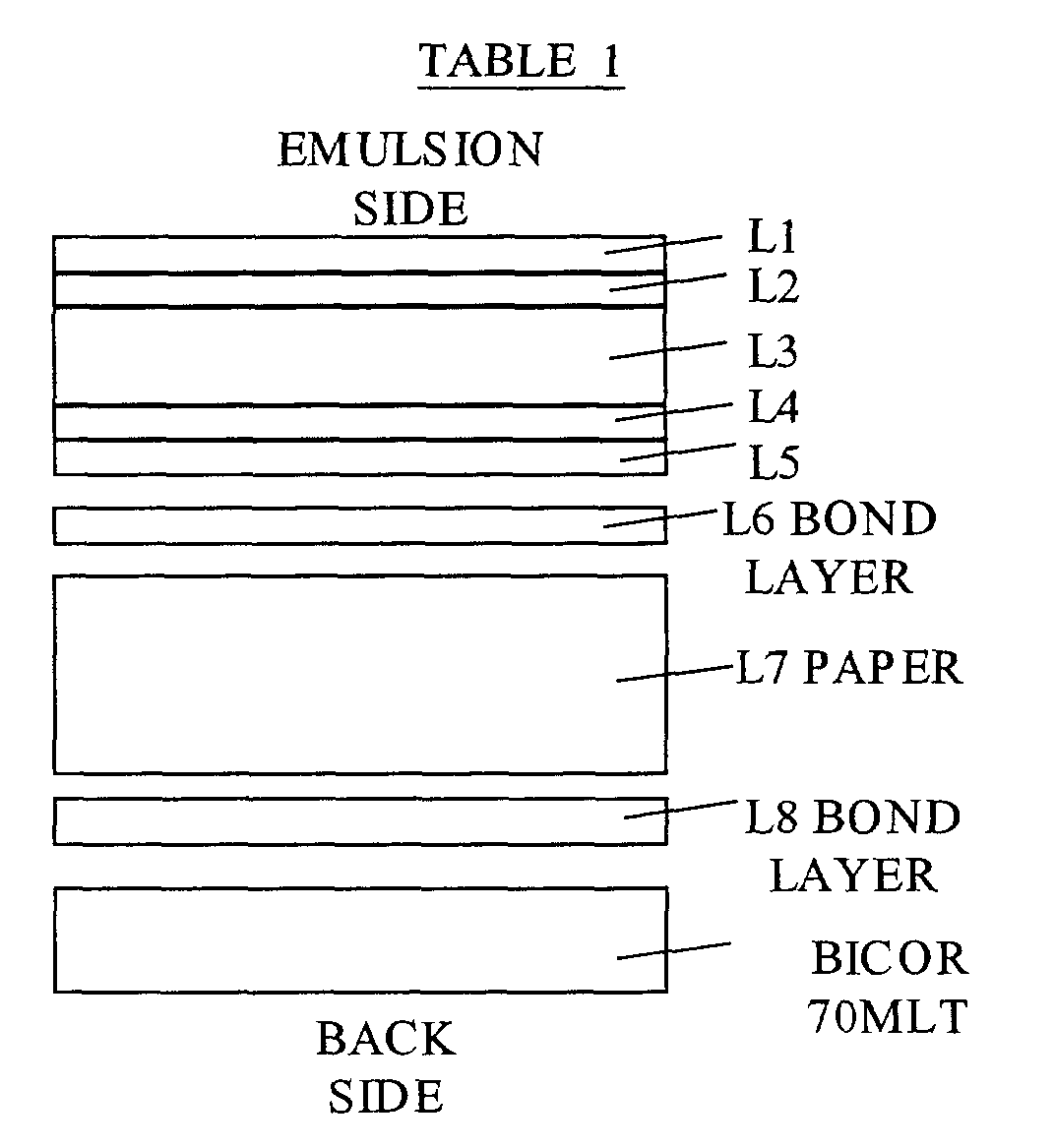
| Layer | Material | Thickness, µm |
| L1 | LD Polyethylene | 1.5 |
| L2 | Polypropylene+ 18% TIO2 by wt | 4.32 |
| L3 | Voided Polypropylene | 24.9 |
| L4 | Polypropylene | 4.32 |
| L5 | Polypropylene | 0.762 |
| L6 | LD Polyethylene tie layer | variable |
| L7 | Commercial paper base | 142 |
| L8 | Deforming tie layer | variable |
| Sublayer of L3 | Refractive Index | Thickness, µm |
| 1 | 1.49 | 2.54 |
| 2 | 1 | 1.527 |
| 3 | 1.49 | 2.79 |
| 4 | 1 | 1.016 |
| 5 | 1.49 | 1.778 |
| 6 | 1 | 1.016 |
| 7 | 1.49 | 2.286 |
| 8 | 1 | 1.016 |
| 9 | 1.49 | 2.032 |
| 10 | 1 | 0.762 |
| 11 | 1.49 | 2.032 |
| 12 | 1 | 1.016 |
| 13 | 1.49 | 1.778 |
| 14 | 1 | 1.016 |
| 15 | 1.49 | 2.286 |
| Sample | L6 caliper, µm | L8 caliper, µm | Surface deformation observed |
| 1 | 11.4 | 11.4 | yes |
| 2 | 6.9 | 11.4 | yes |
| 3 | 18.3 | 11.4 | yes |
| 4 | 11.4 | 15.1 | yes |
| 5 | 11.4 | 19.0 | yes |
| 6 | 6.9 | 18.3 | yes |
| 7 | 11.4 | 21.5 | No |
Claims (11)
- A photographic element comprising at least one layer of photosensitive silver halide, a base material wherein said base material comprises at least one bottom sheet of biaxially oriented polymer sheet and deformable tie layer material, wherein said deformable tie layer material yield stress of between 6 and 10 MPa in compression which is less than 10% the yield stress of any of the other layers in the element.
- The photographic element of Claim 1 wherein deformable material has plastic deformation stress of 8 MPa and comprises a medium density ethylene at least 20 µm thick.
- The photographic element of Claim 1 wherein said deformable material comprises medium density polyethylene.
- The photographic element of Claim 1 further comprising an upper sheet of biaxially oriented polymer sheet and a sheet of cellulose paper between said upper sheet and said energy absorbing material.
- The photographic element of Claim 4 wherein said energy absorbing material binds said bottom biaxially oriented polymer sheet to said paper.
- The photographic element of Claim 5 wherein said bottom biaxially oriented polymer sheet comprises biaxially oriented polyolefin sheet.
- The photographic element of Claim 5 wherein said base is a polyolefin sheet comprising voids.
- The photographic element base of Claim 4 further comprising a biaxially oriented polyolefin sheet.
- The photographic element of Claim 1 wherein said energy absorbing material adhesively joins said bottom biaxially oriented polymer sheet to a paper.
- The photographic element of Claim 9 wherein there is a nonvoided polymer layer of said bottom sheet adjacent said cushioning layer.
- The photographic element of Claim 1 wherein said base comprises an upper biaxially oriented polyolefin sheet having at least one voided layer.
Applications Claiming Priority (2)
| Application Number | Priority Date | Filing Date | Title |
|---|---|---|---|
| US643399 | 1996-05-06 | ||
| US09/643,399 US6348304B1 (en) | 2000-08-22 | 2000-08-22 | Impact resistant photographic element |
Publications (2)
| Publication Number | Publication Date |
|---|---|
| EP1182496A2 true EP1182496A2 (en) | 2002-02-27 |
| EP1182496A3 EP1182496A3 (en) | 2003-01-15 |
Family
ID=24580647
Family Applications (1)
| Application Number | Title | Priority Date | Filing Date |
|---|---|---|---|
| EP01203045A Withdrawn EP1182496A3 (en) | 2000-08-22 | 2001-08-09 | Impact resistant photographic element |
Country Status (2)
| Country | Link |
|---|---|
| US (1) | US6348304B1 (en) |
| EP (1) | EP1182496A3 (en) |
Families Citing this family (2)
| Publication number | Priority date | Publication date | Assignee | Title |
|---|---|---|---|---|
| US6656671B1 (en) * | 1998-11-20 | 2003-12-02 | Eastman Kodak Company | Photographic element with voided cushioning layer |
| CN113053677B (en) * | 2019-12-26 | 2023-12-01 | 佳能株式会社 | Power supply unit and radiation imaging apparatus including the same |
Family Cites Families (6)
| Publication number | Priority date | Publication date | Assignee | Title |
|---|---|---|---|---|
| US5244861A (en) | 1992-01-17 | 1993-09-14 | Eastman Kodak Company | Receiving element for use in thermal dye transfer |
| US5888683A (en) | 1997-05-23 | 1999-03-30 | Eastman Kodak Company | Roughness elimination by control of strength of polymer sheet in relation to base paper |
| US5935690A (en) | 1997-05-23 | 1999-08-10 | Eastman Kodak Company | Sheets having a microvoided layer of strength sufficient to prevent bend cracking in an imaging member |
| US6001547A (en) * | 1997-12-24 | 1999-12-14 | Eastman Kodak Company | Imaging element with thin biaxially oriented color layer |
| US5888714A (en) | 1997-12-24 | 1999-03-30 | Eastman Kodak Company | Adhesives such as metallocene catalyzed ethylene plastomers for bonding biaxially oriented polyolefin sheets to paper |
| US6030742A (en) | 1998-11-23 | 2000-02-29 | Eastman Kodak Company | Superior photographic elements including biaxially oriented polyolefin sheets |
-
2000
- 2000-08-22 US US09/643,399 patent/US6348304B1/en not_active Expired - Fee Related
-
2001
- 2001-08-09 EP EP01203045A patent/EP1182496A3/en not_active Withdrawn
Also Published As
| Publication number | Publication date |
|---|---|
| EP1182496A3 (en) | 2003-01-15 |
| US6348304B1 (en) | 2002-02-19 |
Similar Documents
| Publication | Publication Date | Title |
|---|---|---|
| US5888643A (en) | Controlling bending stiffness in photographic paper | |
| US5968695A (en) | Roughness elimination by control of strength of polymer sheet in relation to base paper | |
| US5888714A (en) | Adhesives such as metallocene catalyzed ethylene plastomers for bonding biaxially oriented polyolefin sheets to paper | |
| US6007665A (en) | Photographic element with indicia on oriented polymer back sheet | |
| US5866282A (en) | Composite photographic material with laminated biaxially oriented polyolefin sheets | |
| US5888681A (en) | Photographic element with microvoided sheet of opalescent appearance | |
| US5853965A (en) | Photographic element with bonding layer on oriented sheet | |
| US5935690A (en) | Sheets having a microvoided layer of strength sufficient to prevent bend cracking in an imaging member | |
| US5902720A (en) | Photographic element that resists curl using oriented sheets | |
| EP1003075B1 (en) | Strippable repositionable back sheet for photographic element | |
| US6087079A (en) | High speed lamination of paper and biaxially oriented sheet | |
| EP1003072B1 (en) | Photographic element with a cushioning layer | |
| US6022677A (en) | Imaging element with biaxially oriented backside with improved surface | |
| US5994045A (en) | Composite photographic material with laminated biaxially oriented polyolefin sheets with controlled water vapor transmission rate | |
| US6153351A (en) | Imaging element with thin biaxially oriented color layer | |
| US6132942A (en) | Imaging base with backside roughness at two frequencies | |
| US6114078A (en) | Imaging element with biaxially oriented face side with non glossy surface | |
| US5955239A (en) | Strippable biaxially oriented base for imaging element | |
| US6127106A (en) | Photographic element with invisible indicia on oriented polymer back sheet | |
| US6291150B1 (en) | Reflective photographic material with foil layer | |
| US6114102A (en) | Imaging substrate with oxygen barrier layer | |
| US5968722A (en) | Biaxially oriented sheet photographic film for better photofinishing | |
| US6348304B1 (en) | Impact resistant photographic element |
Legal Events
| Date | Code | Title | Description |
|---|---|---|---|
| PUAI | Public reference made under article 153(3) epc to a published international application that has entered the european phase |
Free format text: ORIGINAL CODE: 0009012 |
|
| AK | Designated contracting states |
Kind code of ref document: A2 Designated state(s): AT BE CH CY DE DK ES FI FR GB GR IE IT LI LU MC NL PT SE TR |
|
| AX | Request for extension of the european patent |
Free format text: AL;LT;LV;MK;RO;SI |
|
| PUAL | Search report despatched |
Free format text: ORIGINAL CODE: 0009013 |
|
| AK | Designated contracting states |
Kind code of ref document: A3 Designated state(s): AT BE CH CY DE DK ES FI FR GB GR IE IT LI LU MC NL PT SE TR |
|
| AX | Request for extension of the european patent |
Free format text: AL;LT;LV;MK;RO;SI |
|
| 17P | Request for examination filed |
Effective date: 20030623 |
|
| AKX | Designation fees paid |
Designated state(s): GB |
|
| REG | Reference to a national code |
Ref country code: DE Ref legal event code: 8566 |
|
| 17Q | First examination report despatched |
Effective date: 20050506 |
|
| STAA | Information on the status of an ep patent application or granted ep patent |
Free format text: STATUS: THE APPLICATION IS DEEMED TO BE WITHDRAWN |
|
| 18D | Application deemed to be withdrawn |
Effective date: 20050917 |