EP1180952B1 - Toothbrush - Google Patents
Toothbrush Download PDFInfo
- Publication number
- EP1180952B1 EP1180952B1 EP00941971A EP00941971A EP1180952B1 EP 1180952 B1 EP1180952 B1 EP 1180952B1 EP 00941971 A EP00941971 A EP 00941971A EP 00941971 A EP00941971 A EP 00941971A EP 1180952 B1 EP1180952 B1 EP 1180952B1
- Authority
- EP
- European Patent Office
- Prior art keywords
- toothbrush
- hard plastic
- plastic material
- longitudinally
- members
- Prior art date
- Legal status (The legal status is an assumption and is not a legal conclusion. Google has not performed a legal analysis and makes no representation as to the accuracy of the status listed.)
- Expired - Lifetime
Links
- 239000004033 plastic Substances 0.000 claims abstract description 76
- 229920003023 plastic Polymers 0.000 claims abstract description 76
- 239000000463 material Substances 0.000 claims abstract description 66
- 239000013536 elastomeric material Substances 0.000 claims abstract description 26
- 239000002131 composite material Substances 0.000 claims abstract description 11
- 230000001154 acute effect Effects 0.000 claims description 10
- 238000005452 bending Methods 0.000 claims description 7
- 229920001971 elastomer Polymers 0.000 description 31
- 239000000806 elastomer Substances 0.000 description 31
- 239000012530 fluid Substances 0.000 description 8
- 238000010276 construction Methods 0.000 description 7
- 238000001746 injection moulding Methods 0.000 description 5
- 238000000034 method Methods 0.000 description 5
- 238000000465 moulding Methods 0.000 description 5
- 229910000831 Steel Inorganic materials 0.000 description 2
- 230000001680 brushing effect Effects 0.000 description 2
- 238000003780 insertion Methods 0.000 description 2
- 230000037431 insertion Effects 0.000 description 2
- 238000004519 manufacturing process Methods 0.000 description 2
- 239000010959 steel Substances 0.000 description 2
- 241000764773 Inna Species 0.000 description 1
- -1 Polypropylene Polymers 0.000 description 1
- 239000004743 Polypropylene Substances 0.000 description 1
- 230000015572 biosynthetic process Effects 0.000 description 1
- 238000002347 injection Methods 0.000 description 1
- 239000007924 injection Substances 0.000 description 1
- 239000002184 metal Substances 0.000 description 1
- 229920001155 polypropylene Polymers 0.000 description 1
- 230000002062 proliferating effect Effects 0.000 description 1
Images


Classifications
-
- A—HUMAN NECESSITIES
- A46—BRUSHWARE
- A46B—BRUSHES
- A46B5/00—Brush bodies; Handles integral with brushware
- A46B5/002—Brush bodies; Handles integral with brushware having articulations, joints or flexible portions
- A46B5/0054—Brush bodies; Handles integral with brushware having articulations, joints or flexible portions designed to allow relative positioning of the head to body
- A46B5/0062—Brush bodies; Handles integral with brushware having articulations, joints or flexible portions designed to allow relative positioning of the head to body being flexible or resilient during use
- A46B5/007—Inserts made of different material, e.g. springs, plates
-
- A—HUMAN NECESSITIES
- A46—BRUSHWARE
- A46B—BRUSHES
- A46B5/00—Brush bodies; Handles integral with brushware
- A46B5/002—Brush bodies; Handles integral with brushware having articulations, joints or flexible portions
- A46B5/0054—Brush bodies; Handles integral with brushware having articulations, joints or flexible portions designed to allow relative positioning of the head to body
- A46B5/0062—Brush bodies; Handles integral with brushware having articulations, joints or flexible portions designed to allow relative positioning of the head to body being flexible or resilient during use
Definitions
- This invention relates to toothbrushes, in particular to toothbrushes having a feature in their structure to modify flexibility.
- Toothbrushes which have a feature in their structure to modify their flexibility during use.
- EP 0 033 641A discloses a toothbrush having a series of 'S' bends in its handle
- DE 39 234 95A discloses a toothbrush having cut-outs in its handle which contain a flexible elastomer. Such features are included in a toothbrush to absorb excessive brushing forces.
- WO 93/15627 discloses a toothbrush according to the preamble of claim 1.
- a toothbrush having a head and a handle being made of a hard plastic material and being disposed along a longitudinal axis, the head having bristles extending therefrom in a bristle direction which is generally perpendicular to the longitudinal direction, the toothbrush having a width direction generally perpendicular to both the longitudinal axis direction and the bristle direction, the toothbrush having a resiliently flexible composite region between its head and handle characterised in that the composite region comprises one or more members which have a generally triangular shape in section when cut in a plane parallel to the longitudinal direction and perpendicular to the width direction, each of the triangular shapes having an apex which points in a direction either generally in the bristle direction or generally at a direction 180° to the bristle direction, the at least one triangular sectioned member comprising either at least one triangular sectioned member made of a resilient elastomeric material different to the hard plastic material of the toothbrush head and handle situated longitudinally between two adjacent regions of a hard plastic material,
- the one or more member is/are made of elastomeric material and is constructed such that as a bending force is applied to the toothbrush head the adjacent hard plastic material bears upon an elastomeric member to apply compressive pressure to the member.
- the one or more member is/are made of hard plastic material and is constructed such that as a bending force is applied to the toothbrush head the hard plastic material bears upon an adjacent region of elastomeric material to apply compressive pressure to the region of elastomeric material.
- triangular sectioned member for example two or three such triangular sectioned members, being sequentially longitudinally disposed in the toothbrush, and the respective directions in which the apexes of longitudinally adjacent members point are 180° apart, i.e. so that with any two longitudinally adjacent members the apex of one will point generally in the bristle direction and the apex of the adjacent neighbouring member will point generally in the opposite direction.
- the apex of two of the members may point in the bristle direction and the apex of the member in between the two may point in the 180° opposite direction, or the apex of the central member may point in the bristle direction and the apex of the members on longitudinally either side may point in the 180° opposite direction.
- the term "generally triangular” includes triangles of all types, e.g. isosceles triangles, equilateral triangles.
- the term also includes triangles with one or more rounded apexes or curved sides.
- the term also includes three-sided shapes with concave or convex curved sides, ogival shapes or pointed arch shapes.
- the term also includes semi-circular or semi-elliptical shapes.
- the term also includes polygonal shapes with more than three sides but which are generally triangular, for example hexagons having alternating relatively long and relatively short sides, and quadrilaterals having a relatively long base and a relatively short side opposite the base, with the other two sides tapering toward the short side to thereby define an apex angle, e.g. an acute apex angle between them.
- the generally triangular sectioned member(s) is/are generally prismatic in shape, having generally parallel edges which extend generally in the width direction of the toothbrush.
- the generally triangular sectioned member(s) extend(s) substantially or entirely through the entire thickness dimension of the toothbrush, i.e. the dimension through the toothbrush which is generally perpendicular to both the longitudinal axis and the width direction, so that the apex of the triangular shape is exposed on a first surface of the toothbrush and/or the opposite base of the triangular shape is exposed on the opposite surface of the toothbrush distanced from the first surface by the thickness dimension.
- At least one generally triangular sectioned member extends across the whole width of the toothbrush. so that for example a generally triangular shaped end surface of a prismatic member is exposed on each widthways separated side of the toothbrush.
- the first embodiment i.e. with one or more elastomeric triangular sectioned member
- the adjacent regions of a hard plastic material have a surface which is inclined at a non-perpendicular angle to the longitudinal direction, so that the surfaces of the adjacent regions of plastic material define an acute angle between them, being the apex angle of the triangular sectioned member.
- the plastic material of the inclined surfaces bears upon an elastomeric member to apply compressive pressure to the member.
- Longitudinally adjacent pairs of the hard plastic material parts may be integrally linked by one or more thin integral bridge of the plastic material, being thin enough to be flexible.
- the plastic parts may comprise two or more such planar parts inclined toward each other to define an apex angle, e.g. an acute angle between them, and linked together adjacent to an apex of the triangular member to form a "V" shaped fold with the fold axis aligned transverse to the longitudinal direction.
- a plurality of such parts may be integrally formed linked together to form a zig-zag, or "Z", folded region.
- the second embodiment i.e. with one or more hard plastic triangular sectioned member
- the adjacent regions of elastomeric material preferably have a surface which is inclined at a non-perpendicular angle to the longitudinal direction, so that the surfaces of the adjacent regions of elastomeric material define an acute angle between them, being the apex angle of the triangular sectioned member.
- the plastic material of the triangular sectioned hard plastic members bears upon an elastomeric member between them to apply compressive pressure to the member.
- Longitudinally adjacent pairs of the hard plastic triangular sectioned members of this second embodiment, and adjacent hard plastic material parts of the toothbrush, may also be linked by one or more thin flexible structure of the hard plastic material, for example one or more of said structure(s) being in the form of a thin integrally moulded bridge bridging longitudinally adjacent pairs of the members.
- One or more of the hard plastic triangular sectioned members of this second embodiment members may also be longitudinally penetrated by a longitudinally extending "core" of an elastomeric material which may itself integrally link the elastomeric pads.
- the parts of the core between the members and/or between the member(s) and a longitudinally adjacent part of the toothbrush structure may comprise the pads.
- the toothbrush of the invention comprises a hard plastic "skeleton" having one or more cavity in its structure which correspond to the position of the elastomer parts of the toothbrush, and the elastomer part(s) occupies the one or more cavity.
- a "skeleton” may be integrally made of the hard plastic material, in which the one or more cavity is/are integrally bridged by one or more thin flexible structure(s) of the hard plastic material to which the elastomer material is moulded.
- the general idea of making two component toothbrushes using a first component hard plastic skeleton having one or more cavity therein about which are subsequently moulded one or more second component elastomer parts is well known in the art, for example from WO 94/05183 and others.
- the hard plastic parts of the toothbrush may be made of any hard plastic material as is presently used in the manufacture of toothbrushes, e.g. as disclosed in EP 0 033 641A or WO 99/17915. Polypropylene materials are often used.
- the elastomer material may be any elastomer material or any elastomer material which is presently used in the manufacture of toothbrushes e.g. as disclosed in WO 99/17915, WO 92/17092 or WO 92/17093. Many such two component toothbrushes are known and there is a prolific choice of suitable hard plastics and elastomeric materials.
- the composite region may be located in any desired location in the toothbrush.
- the member(s) may be located in the grip handle part of the toothbrush; and/or between the grip handle part and the head of the toothbrush for example between the grip handle and the thinner "neck” that usually lies between the handle and the head of a toothbrush, or in such a neck, and/or between the part of the head immediately adjacent to such a neck and the neck itself.
- the apex of the triangular shape may point in the bristle direction or in the opposite direction.
- each triangular sectioned member may have the same or different dimensions or be made of the same or a different material, particularly in the first embodiment, with elastomeric members so that each member may have the same or different flexibility e.g. compressibility or stretchability, characteristics.
- the toothbrush of the invention may also include other known features of toothbrushes, for example the elastomer grip pads disclosed in EP 0 033 641A or the flexible head construction disclosed in WO 97/07707, WO 98/37788 or WO 92/17093. or the flexible link between the head and handle disclosed in WO 92/17092 or WO 97/24949 or EP 0 613 636A.
- the bristles of the toothbrush of this invention may be entirely conventional, for example made of known materials and may be fixed into the head by known techniques such as the widely used small metal "anchors", or fused and welded into the plastic material of the head via known “anchorless” bristling processes.
- the toothbrush of the invention is preferably made using an injection moulding process in which a hard plastic "skeleton" having one or more cavity corresponding to the position of the elastomer part(s) of the toothbrush, is first made in a first moulding operation using a first mould cavity, and the elastomeric part(s) is/are then made in this second moulding operation by positioning the skeleton in a second mould having one or more cavities corresponding to the elastomer member(s) and a fluid elastomer is then injected into the aperture(s) in the skeleton to thereby form the elastomeric part(s) of the toothbrush.
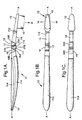
- a toothbrush (overall 11) is shown in a side view in Fig. 1A, in plan view in Fig. 1B, and in underside view in Fig. 1C.
- the toothbrush 11 comprises a head 12, and a handle 13 disposed along the longitudinal axis A---A, with a neck region 14 between the head 12 and handle 13, and being integrally made of hard plastic material.
- Bristles 15 (shown schematically) extend from the head 12 in a general bristle direction B---B.
- the toothbrush 11 has a width direction W---W generally perpendicular to both A---A and B---B.
- the toothbrush 11 includes three members 16, 17, 18 made of an elastomer material, being sequentially longitudinally disposed along the toothbrush 11, and located between the handle 13 and neck 14.
- Each of the members 16, 17, 18 is of a generally triangular prism shape, with generally triangular shape ends 19, exposed on opposite widthways separated sides of the toothbrush 11.
- the triangular shape of the sections of the members 16, 17, 18 have slightly curved sides and rounded apexes.
- Each of the members 16, 17, 18 extends entirely across the width of toothbrush 11, and entirely through the thickness of toothbrush 11, so that in each member 16, 17, 18 an apex e.g. 16A is exposed on one surface of the toothbrush 11 and an opposite base e.g. 16B is exposed on the opposite surface of the toothbrush 11 separated by the thickness dimension i.e. in the direction B---B.
- each pair of the longitudinally adjacent members 16, 17, 18 is a thin, substantially planar. region 110, 111 of the hard plastic material of the head 12 and handle 13 inclined at a non-perpendicular angle to the longitudinal direction, so that the surfaces of the adjacent regions of plastic material 110, 111 define an acute angle between them.
- each of the members 16, 17, 18 is substantially an equilateral triangle, but the exposed base 16B, 17B, 18B is slightly convex curved. Longitudinally adjacent sides of the triangles 16, 17, 18 are substantially parallel with the hard plastic region 110, 111 between.
- elastomer member 112 Located between the base of the head 12, i.e. the part of the head 12 immediately adjacent to neck 14 is another elastomer member 112, again in the form of a generally triangular sectioned prism, this time being an isosceles triangle with its apex 112A facing in the bristle direction B---B and its short, slightly curved base 112B facing in the 180° direction, and its triangular ends 113 exposed on either side of the toothbrush 11.
- the handle 13 of the toothbrush 11 is also provided with elastomer grip pads 114.
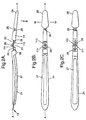
- Fig. 2 shows a toothbrush "skeleton" 21 overall being only the hard plastic parts of the toothbrush of Fig. 1.
- the places to be occupied by the elastomer members 16, 17, 18 and 112 are represented by cavities 22, 23, 24, 25 into which a fluid elastomeric material (not shown) can be injected.
- the cavities 22, 23, 24, 25 are longitudinally bounded by adjacent regions of a hard plastic material which have a surface which is inclined at a non-perpendicular angle to the longitudinal direction, so that the surfaces of the adjacent regions of plastic material define an acute angle between them, being the apex angle of the triangular sectioned member 16, 17, 18, 112 located between pairs of such surfaces.
- the cavities 22, 23, 24, 25 are bridged by thin plastic bridge structures 26 integrally of the hard plastic material, around which the elastomeric material 16, 17, 18 and 112 is moulded and bonds under the conditions of the injection moulding of the elastomer (suitable moulding conditions to achieve such a bond are known in the art).
- the structures 26 therefore penetrate longitudinally right through the members 16, 17, 18.
- the structures 26 may or may not contribute resilience or stiffness to the composite of elastomer and hard plastic so formed.
- the skeleton also has cavities 27 corresponding to the position of the grip pads 114. Although shown as small cylindrical rods the structures 26 may have any desired cross section e.g. being elongate in a particular direction so as to modify the flexibility about a particular bend axis.
- the head part 28 of the skeleton 21 also includes holes (not shown) for the subsequent insertion of bristles 15.
- the skeleton 21 is made integrally by providing a cavity of a corresponding shape in a steel mould (not shown) and injecting fluid plastic material into the cavity.
- the skeleton 21 is then removed from the dis-assembled mould and inserted into a second mould (not shown) which has cavities corresponding to the shape and position of the members 16, 17, 18, 112 and the pads 114.
- Fluid elastomer material is then injected into the cavities of the second mould so as to form the elastomer parts 16, 17, 18, 112 and 114.
- Such a process is known in the art, e.g. in WO 94/05183.
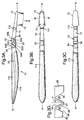
- FIG. 3 shows a toothbrush 31 similar in concept to that of Fig. 1, having three elastomer members 32, 33, 34 with their apexes 32A, 33A and 34A pointing in a corresponding direction to those of members 16, 17, 18 of Fig. 1.
- the skeleton 35 of the toothbrush includes an integral region of zigzag folded thin leaves 36 shown in more detail in Fig. 3D.
- Each of the leaves 36 is substantially planar with its plane at an angle ⁇ less than 90° to the longitudinal axis, so as to form an acute angle between longitudinally adjacent leaves 36.
- the leaves 36 are sufficiently thin that they are resiliently flexible. This construction is shown more clearly in Fig. 3D, where the folded region of the hard plastic skeleton is shown without the elastomer material in place.
- a "V" shaped fold is shown, with its fold axis aligned parallel to the width direction W-W, i.e. perpendicular to the plane of the paper of Fig.
- each elastomeric member 32, 33, 34 is located between longitudinally adjacent regions of hard plastic material having a surface which is inclined at a non-perpendicular angle to the longitudinal direction, so that the surfaces of the adjacent regions of plastic material define an acute angle between them, being the apex angle of the triangular sectioned member.
- the surfaces 38 of the skeleton 35 are at the longitudinal ends of the composite region are also inclined at a non-perpendicular angle to the longitudinal direction. Spaces 39 are thereby defined for the subsequent formation therein of the elastomeric members 32, 33, 34 in an injection moulding stage.
- Elastomeric members 32, 33, 34 are formed in the angles between adjacent leaves 36, being consequently substantially triangular in section when cut by the plane parallel to the longitudinal axis A---A and the bristle direction B---B.
- the shapes of the sections of the members 32, 33, 34 are quadrilaterals, having opposite facing substantially parallel relatively short and relatively long sides comprising the apex 32A, 33A, 34A and the base 32B, 33B, 34B respectively of a generally triangular shape, and sloping sides which converge from the base toward the apex.
- Apexes 32A, 33A, 34A is defined by the junction between adjacent leaves 36, and an opposite base 32B, 33B, 34B is exposed at the surface of the toothbrush 31.
- the toothbrush 31 is made by a process similar to that of toothbrush 11 above, i.e. a "skeleton" 35 made of the hard plastic material of the head 12 and handle 13 is made by injection moulding, and including integrally the region of leaves 36.
- the skeleton 35 is then placed in a second injection mould having cavities corresponding to the position and dimensions of the members 32, 33, 34 to be formed. These members 32, 33, 34 are then made by injecting fluid elastomer material into these cavities of the mould.
- each of the toothbrushes 11, 31 works in the same way. Pressure applied to the head 12 by using it to brush the teeth transmits a bending force to the region of the toothbrush 11, 31 where the members 16, 17, 18, 32, 33, 34 are.
- the thin leaves 26, 36 easily bend, causing compressive force to be applied to the members 16, 17, 18, 32, 33, 34.
- These elastomeric members 16, 17, 18, 32, 33, 34 consequently absorb excessive brushing pressure.
- a toothbrush (overall 41) is shown in a side view in Fig. 4A, in plan view in Fig. 4B, in underside view in Fig. 4C, and inna cross section at D ⁇ D in Fig. 4D.
- the toothbrush 41 comprises a head 42, and a handle 43 disposed along the longitudinal axis A---A, with a neck region 44 between the head 42 and handle 43, and being integrally made of hard plastic material.
- Bristles 45 (shown schematically) extend from the head 42 in a general bristle direction B---B.
- the toothbrush 41 has a width direction W---W generally perpendicular to both A---A and B---B.
- the toothbrush 41 includes three members 46, 47, 48 made of the same hard plastic material as the head 42 and handle 43, being sequentially longitudinally disposed along the toothbrush 41, and located between the handle 43 and neck 44.
- Each of the members 46, 47, 48 is of a generally triangular prism shape, with generally triangular shape ends 49, exposed on opposite widthways separated sides of the toothbrush 41.
- the triangular shape of the sections of the members 46, 47, 48 have slightly curved sides and rounded apexes.
- Each of the members 46, 47, 48 extends entirely across the width of toothbrush 41, and entirely through the thickness of toothbrush 41, so that in each member 46, 47, 48 an apex e.g. 46A is exposed on one surface of the toothbrush 41 and an opposite base e.g. 46B is exposed on the opposite surface of the toothbrush 41 separated by the thickness dimension i.e. in the direction B---B.
- each of the members 46, 47, 48 an apex 46A, 47A, 48A points either in the bristle direction B---B or in the 180° opposite direction relative to the bristle direction B---B.
- each pair of the longitudinally adjacent members 46, 47, 48 is a thin pad, e.g. a layer 410 made of an elastomeric material.
- a thin pad e.g. a layer 411 made of an elastomeric material.
- each of the members 46, 47, 48 is substantially an equilateral triangle, but the exposed base 46B, 47B, 48B is slightly convex curved. Longitudinally adjacent sides of the triangles 46, 47, 48 are substantially parallel with the elastomeric pads 410 between.
- a hard plastic member 412 Located between the base of the head 42, i.e. the part of the head 42 immediately adjacent to neck 44 is another hard plastic member 412, again in the form of a generally triangular sectioned prism, this time being an isosceles triangle with its apex 412A facing in the bristle direction B---B and its short, slightly curved base 412B facing in the 480° direction, and its triangular ends 413 exposed on either side of the toothbrush 41.
- a thin pad e.g. a layer 414 made of an elastomeric material.
- the handle 43 of the toothbrush 41 is also provided with elastomer grip pads 415.
- each of the members 46, 47, 48 Extending longitudinally through each of the members 46, 47, 48 is a longitudinally extending "core" 416 of an elastomeric material (shown dotted in Fig. 4 because internal and obscured).
- Fig. 4D shows an enlarged cross section about line D ⁇ D of Fig. 4 through exemplary member 48, showing the internal construction with the elastomer core 416.
- the core 416 may be of any convenient cross section, e.g. oval, rectangular etc.
- FIG. 5 this shows a toothbrush "skeleton" 51 overall being only the hard plastic parts of a toothbrush. This is shown in a side view in Fig. 5A, in plan view in Fig. 5B, and in underside view in Fig. 5C.
- the places to be occupied by elastomer pads are represented by cavities 52, 53, 54, 55, 56, 57 into which a fluid elastomeric material (not shown) can be injected.
- the cavities 52, 53, 54, 55, 56, 57 are bridged by thin plastic bridge structures 58 integrally of the hard plastic material, around which elastomeric material of-pads to be formed is moulded and bonds under the conditions of the injection moulding of the elastomer (suitable moulding conditions to achieve such a bond are known in the art).
- the structures 58 are embedded in the elastomeric material during the moulding operation and penetrate longitudinally right through the elastomeric pads (not shown).
- the structures 58 may or may not contribute resilience or stiffness to the composite of elastomer and hard plastic so formed. Between longitudinally adjacent pairs of the cavities 52, 53, 54, 55, 56, 57 are located triangular sectioned members 59 of hard plastic material.
- the skeleton 51 also has spaces 510, 511 corresponding to the position of the grip pads (not shown). Although shown as small cylindrical rods the structures 58 may have any desired cross section e.g. being elongate in a particular direction so as to modify the flexibility about a particular bend axis.
- the head part 512 of the skeleton 51 also includes holes 513 for the subsequent insertion of bristles (not shown).
- the skeleton 51 is made integrally by providing a cavity of a corresponding shape in a steel mould (not shown) and injecting fluid plastic material into the cavity.
- the skeleton 51 is then removed from the dis-assembled mould and inserted into a second mould (not shown) which has cavities corresponding to the shape and position of the elastomer pads .
- Fluid elastomer material is then injected into the cavities of the second mould so as to form the elastomer pads in the cavities 52, 53, 54, 55, 56, 57.
- a process is known in the art, e.g. in WO 94/05183.
Landscapes
- Brushes (AREA)
Abstract
Description
Longitudinally between each
Claims (11)
- A toothbrush having a head (12) and a handle (13) being made of a hard plastic material and being disposed along a longitudinal axis, the head (12) having bristles (14) extending therefrom in a bristle direction which is generally perpendicular to the longitudinal direction, the toothbrush having a width direction generally perpendicular to both the longitudinal axis direction and the bristle direction, the toothbrush having a resiliently flexible composite region between its head (12) and handle (13) characterised in that:the flexible region comprises one or more members (16,17,18,46,47,48) which have a generally triangular shape in section when cut in a plane parallel to the longitudinal direction and perpendicular to the width direction, each of the triangular shapes (16,17,18,46,47,48) having an apex which points in a direction either generally in the bristle direction or generally at a direction 180° to the bristle direction, the composite region comprising either at least one triangular sectioned member (16,17,18,32,33,34) made of a resilient elastomeric material different to the hard plastic material of the toothbrush head (12) and handle (13) situated longitudinally between two adjacent regions (110,111) of a hard plastic material, or at least one triangular sectioned member (46,47,48) made of a hard plastic material situated longitudinally between two adjacent regions (410) of elastomeric material different to the hard plastic material of the toothbrush head (12) and handle (13).
- A toothbrush according to claim 1 characterised in that the one or more member (16,17,18,32,33,34) is/are made of elastomeric material and is constructed such that as a bending force is applied to the toothbrush head (12) the adjacent hard plastic material (110,111) bears upon an elastomeric member (16,17,18,32,33,34) to apply compressive pressure to the member (16,17,18,32,33,34).
- A toothbrush according to claim 1 characterised in that the one or more member (46,47,48) is/are made of hard plastic material and is constructed such that as a bending force is applied to the toothbrush head (12) the hard plastic material (46,47,48) bears upon an adjacent region of elastomeric material (410) to apply compressive pressure to the region of elastomeric material (410).
- A toothbrush according to claim 1 or 2 characterised in that there is more than one triangular sectioned member (16,17,18,32,33,34), being sequentially longitudinally disposed in the toothbrush, and the respective directions in which the apexes of longitudinally adjacent members (16,17,18,32,33,34) point are 180° apart.
- A toothbrush according to claim 1 or 3 characterised in that there is more than one triangular sectioned member (46,47,48), being sequentially longitudinally disposed in the toothbrush, and the respective directions in which the apexes of longitudinally adjacent members (46,47,48) point are 180° apart.
- A toothbrush according to any one of claims 1, 2 or 4 characterised in that there are at least two of the elastomeric members (16,17,18,32,33,34) with a region of the hard plastic material (110,111,32,33,34) longitudinally between each pair of them, having a surface which is inclined at a non-perpendicular angle to the longitudinal direction, so that the surfaces of the adjacent regions of plastic material (110,111) define an acute angle between them, being the apex angle of the triangular sectioned member.
- A toothbrush according to claim 6 characterised in that at least one longitudinally adjacent pair of the hard plastic material parts (110,111) are integrally linked by at least one thin integral bridge of the plastic material, being thin enough to be flexible.
- A toothbrush according to claim 7 characterised in that the plastic parts (36) comprise two or more planar parts inclined toward each other to define an acute angle between them, and linked together adjacent to an apex of the triangular member to form a "V" shaped fold with the fold axis aligned transverse to the longitudinal direction.
- A toothbrush according to any one of claims 1, 3 or 5 characterised in that there are at least two of the hard plastic material members (46,47,48) with a region of the elastomeric material (410) longitudinally between each pair of them.
- A toothbrush according to claim 9 characterised in that at least one pair of longitudinally adjacent pairs of the hard plastic triangular sectioned members (46,47,48) are linked by one or more thin flexible structure (58) of the hard plastic material in the form of a thin integrally moulded bridge bridging pairs of the members.
- A toothbrush according to any one of claims 1,3, 5, 9 or 10 characterised in that one or more of the hard plastic triangular sectioned members (46,47,48) are longitudinally penetrated by a longitudinally extending core (416) of an elastomeric material.
Applications Claiming Priority (5)
| Application Number | Priority Date | Filing Date | Title |
|---|---|---|---|
| GBGB9912044.6A GB9912044D0 (en) | 1999-05-24 | 1999-05-24 | Toothbrush |
| GB9912050 | 1999-05-24 | ||
| GB9912044 | 1999-05-24 | ||
| GBGB9912050.3A GB9912050D0 (en) | 1999-05-24 | 1999-05-24 | Toothbrush |
| PCT/EP2000/004619 WO2000070997A1 (en) | 1999-05-24 | 2000-05-18 | Toothbrush |
Publications (2)
| Publication Number | Publication Date |
|---|---|
| EP1180952A1 EP1180952A1 (en) | 2002-02-27 |
| EP1180952B1 true EP1180952B1 (en) | 2004-07-28 |
Family
ID=26315585
Family Applications (1)
| Application Number | Title | Priority Date | Filing Date |
|---|---|---|---|
| EP00941971A Expired - Lifetime EP1180952B1 (en) | 1999-05-24 | 2000-05-18 | Toothbrush |
Country Status (8)
| Country | Link |
|---|---|
| US (1) | US6668416B1 (en) |
| EP (1) | EP1180952B1 (en) |
| JP (1) | JP2003500091A (en) |
| AT (1) | ATE271805T1 (en) |
| AU (1) | AU5675200A (en) |
| DE (1) | DE60012510T2 (en) |
| ES (1) | ES2225164T3 (en) |
| WO (1) | WO2000070997A1 (en) |
Families Citing this family (35)
| Publication number | Priority date | Publication date | Assignee | Title |
|---|---|---|---|---|
| GB0123939D0 (en) * | 2001-10-05 | 2001-11-28 | Glaxosmithkline Consumer Healt | Toothbrush |
| US7934284B2 (en) | 2003-02-11 | 2011-05-03 | Braun Gmbh | Toothbrushes |
| JP3886050B2 (en) * | 2003-05-20 | 2007-02-28 | 株式会社 Ufcサプライ | Interdental brush and manufacturing method thereof |
| GB2412856A (en) * | 2004-04-08 | 2005-10-12 | Reckitt Benckiser | Depilatory scraper and method having head with undersurface and fin(s) projecting there from. |
| US7334286B2 (en) * | 2004-08-18 | 2008-02-26 | Loops, Llc | Toothbrush and methods of making and using same |
| US8448285B2 (en) * | 2004-08-18 | 2013-05-28 | Loops, Llc | Toothbrush and methods of making and using same |
| DE202004018427U1 (en) * | 2004-11-26 | 2006-04-06 | Johnki, Bernd J., Dr.med.dent. | Toothbrush for use when cleaning the teeth of handicapped people has curved section which links handle with head, so that it is below handle |
| ITMI20061617A1 (en) | 2006-08-10 | 2008-02-11 | Ponzini Spa | DEBI BRUSH WITH TORSION OSCILLATING HEAD |
| US12064028B2 (en) | 2006-11-27 | 2024-08-20 | Loops, Llc | Method of making composite head safety toothbrush |
| US11013311B2 (en) | 2006-11-27 | 2021-05-25 | Loops, Llc | Composite toothbrush having safety features and methods of making same |
| US10334940B2 (en) | 2006-11-27 | 2019-07-02 | Loops Llc | Composite head toothbrush having safety features |
| RU2428907C2 (en) | 2007-02-02 | 2011-09-20 | Дзе Жиллетт Компани | Accessories for oral hygiene, having flexible elements, and methods of their manufacturing |
| WO2011047489A1 (en) | 2009-10-19 | 2011-04-28 | Terxo Ag | Toothbrush |
| USD675830S1 (en) | 2009-12-18 | 2013-02-12 | Colgate-Palmolive Company | Toothbrush |
| USD654270S1 (en) | 2009-12-18 | 2012-02-21 | Colgate-Palmolive Company | Toothbrush handle |
| USD654695S1 (en) | 2009-12-18 | 2012-02-28 | Colgate-Palmolive Company | Toothbrush |
| USD654696S1 (en) | 2009-12-18 | 2012-02-28 | Colgate-Palmolive Company | Toothbrush handle with tissue cleaner |
| USD632484S1 (en) | 2009-12-18 | 2011-02-15 | Eduardo Jimenez | Toothbrush handle with tissue cleaner |
| US9718594B2 (en) * | 2012-02-10 | 2017-08-01 | The Gillette Company Llc | Oral care instrument and package therefore |
| EP2827737B1 (en) * | 2012-03-22 | 2016-06-22 | Colgate-Palmolive Company | Oral care implement having flexible handle |
| EP2807946B1 (en) * | 2013-05-29 | 2019-01-23 | The Gillette Company LLC | Manual toothbrush concept being combined from three parts |
| JPWO2015137487A1 (en) * | 2014-03-14 | 2017-04-06 | ライオン株式会社 | Toothbrush handle body, toothbrush, and method for manufacturing toothbrush handle body |
| JP6591988B2 (en) * | 2014-09-01 | 2019-10-16 | ライオン株式会社 | toothbrush |
| KR101486003B1 (en) * | 2014-10-10 | 2015-01-26 | 이희돈 | Toothbrush |
| US9802347B2 (en) | 2015-02-02 | 2017-10-31 | Colgate-Palmolive Company | Method of forming an oral care implement |
| JP6024057B2 (en) * | 2015-02-18 | 2016-11-09 | 株式会社ライフ・トゥ | toothbrush |
| TWD176249S (en) * | 2015-03-27 | 2016-06-11 | 美國棕欖公司 | Oral care implement |
| USD762987S1 (en) * | 2015-06-30 | 2016-08-09 | Deotech Korea Co., Ltd. | Toothbrush |
| USD776937S1 (en) * | 2015-07-23 | 2017-01-24 | Colgate-Palmolive Company | Oral care implement |
| CN107920654A (en) | 2015-07-23 | 2018-04-17 | 高露洁-棕榄公司 | Oral care implement |
| USD777446S1 (en) * | 2015-07-23 | 2017-01-31 | Colgate-Palmolive Company | Oral care implement handle |
| USD778062S1 (en) * | 2015-08-06 | 2017-02-07 | The Gillette Company Llc | Toothbrush |
| CN108024619B (en) * | 2015-09-25 | 2022-05-13 | 狮王株式会社 | Tooth brush |
| JP7370179B2 (en) * | 2019-06-28 | 2023-10-27 | ライオン株式会社 | toothbrush |
| WO2023068831A1 (en) * | 2021-10-20 | 2023-04-27 | 주식회사 아이투씨브릿지 | Brushing guide elastic toothbrush and elastic restoration mechanism |
Family Cites Families (14)
| Publication number | Priority date | Publication date | Assignee | Title |
|---|---|---|---|---|
| US4278091A (en) | 1980-02-01 | 1981-07-14 | Howmedica, Inc. | Soft tissue retainer for use with bone implants, especially bone staples |
| DE8814824U1 (en) | 1988-11-29 | 1989-06-29 | Blendax GmbH, 6500 Mainz | Toothbrush with a deflection part having a deflection profile |
| DE3923495C1 (en) | 1989-07-15 | 1991-01-24 | M + C Schiffer Gmbh, 5466 Neustadt, De | |
| GB9106511D0 (en) | 1991-03-27 | 1991-05-15 | Lingner & Fischer Gmbh | Novel article |
| DE69230340T2 (en) | 1991-03-27 | 2000-03-30 | Smithkline Beecham Consumer Healthcare Gmbh | Toothbrush with springy connection zone between brush head and handle |
| GB9517450D0 (en) | 1995-08-25 | 1995-10-25 | Lingner & Fischer Gmbh | Toothbrush |
| GB9203250D0 (en) | 1992-02-15 | 1992-04-01 | Lingner & Fischer Gmbh | Novel article |
| DE4222931C1 (en) * | 1992-07-11 | 1993-12-09 | Henkel Kgaa | toothbrush |
| DE4229152A1 (en) | 1992-09-01 | 1994-03-03 | Jordan As Oslo | Toothbrush and manufacturing process for toothbrushes |
| GB9505914D0 (en) * | 1995-03-23 | 1995-05-10 | Lingner & Fischer Gmbh | Toothbrush |
| US5765254A (en) * | 1995-11-29 | 1998-06-16 | Radius Inc. | Toothbrush with flexible neck |
| US5630244A (en) * | 1996-01-02 | 1997-05-20 | Chang; Ching-Min | Elastic toothbrush |
| DK0969750T3 (en) | 1997-02-24 | 2003-05-05 | Smithkline Beecham Consumer | Toothbrush |
| WO1999017915A1 (en) | 1997-10-06 | 1999-04-15 | Colgate-Palmolive Company | Multi-component injection molded toothbrush and manufacture thereof |
-
2000
- 2000-05-18 US US09/979,260 patent/US6668416B1/en not_active Expired - Fee Related
- 2000-05-18 WO PCT/EP2000/004619 patent/WO2000070997A1/en not_active Ceased
- 2000-05-18 ES ES00941971T patent/ES2225164T3/en not_active Expired - Lifetime
- 2000-05-18 JP JP2000619316A patent/JP2003500091A/en not_active Withdrawn
- 2000-05-18 AT AT00941971T patent/ATE271805T1/en not_active IP Right Cessation
- 2000-05-18 AU AU56752/00A patent/AU5675200A/en not_active Abandoned
- 2000-05-18 DE DE60012510T patent/DE60012510T2/en not_active Expired - Fee Related
- 2000-05-18 EP EP00941971A patent/EP1180952B1/en not_active Expired - Lifetime
Also Published As
| Publication number | Publication date |
|---|---|
| JP2003500091A (en) | 2003-01-07 |
| AU5675200A (en) | 2000-12-12 |
| WO2000070997A1 (en) | 2000-11-30 |
| EP1180952A1 (en) | 2002-02-27 |
| DE60012510D1 (en) | 2004-09-02 |
| ATE271805T1 (en) | 2004-08-15 |
| US6668416B1 (en) | 2003-12-30 |
| ES2225164T3 (en) | 2005-03-16 |
| DE60012510T2 (en) | 2005-08-04 |
Similar Documents
| Publication | Publication Date | Title |
|---|---|---|
| US6668416B1 (en) | Toothbrush | |
| EP0845956B2 (en) | Toothbrush | |
| EP2098134B1 (en) | Toothbrush | |
| US6442786B2 (en) | Toothbrush comprising a resilient flex region | |
| KR100386214B1 (en) | Toothbrush with segmented head | |
| US6708364B1 (en) | Flexible brush head for a toothbrush | |
| NZ271670A (en) | Toothbrush bristle arrangement; rectangular, circular, 'c' or 'u' shaped tufts | |
| CN1207654A (en) | Toothbrush | |
| AU722959B3 (en) | Toothbrush | |
| AU726803B3 (en) | Toothbrush | |
| AU743341B2 (en) | Toothbrush | |
| AU738305B2 (en) | Toothbrush | |
| AU2002342793B2 (en) | Toothbrush | |
| HK1132155B (en) | Toothbrush | |
| AU2002342793A1 (en) | Toothbrush | |
| HK1006268B (en) | Bristle arrangement for a toothbrush |
Legal Events
| Date | Code | Title | Description |
|---|---|---|---|
| PUAI | Public reference made under article 153(3) epc to a published international application that has entered the european phase |
Free format text: ORIGINAL CODE: 0009012 |
|
| 17P | Request for examination filed |
Effective date: 20011204 |
|
| AK | Designated contracting states |
Kind code of ref document: A1 Designated state(s): AT BE CH CY DE DK ES FI FR GB GR IE IT LI LU MC NL PT SE |
|
| AX | Request for extension of the european patent |
Free format text: AL;LT;LV;MK;RO;SI |
|
| RAP1 | Party data changed (applicant data changed or rights of an application transferred) |
Owner name: GLAXOSMITHKLINE CONSUMER HEALTHCARE GMBH & CO KG |
|
| GRAP | Despatch of communication of intention to grant a patent |
Free format text: ORIGINAL CODE: EPIDOSNIGR1 |
|
| GRAS | Grant fee paid |
Free format text: ORIGINAL CODE: EPIDOSNIGR3 |
|
| GRAA | (expected) grant |
Free format text: ORIGINAL CODE: 0009210 |
|
| RAP1 | Party data changed (applicant data changed or rights of an application transferred) |
Owner name: GLAXOSMITHKLINE CONSUMER HEALTHCARE GMBH & CO. |
|
| AK | Designated contracting states |
Kind code of ref document: B1 Designated state(s): AT BE CH CY DE DK ES FI FR GB GR IE IT LI LU MC NL PT SE |
|
| PG25 | Lapsed in a contracting state [announced via postgrant information from national office to epo] |
Ref country code: FI Free format text: LAPSE BECAUSE OF FAILURE TO SUBMIT A TRANSLATION OF THE DESCRIPTION OR TO PAY THE FEE WITHIN THE PRESCRIBED TIME-LIMIT Effective date: 20040728 Ref country code: AT Free format text: LAPSE BECAUSE OF FAILURE TO SUBMIT A TRANSLATION OF THE DESCRIPTION OR TO PAY THE FEE WITHIN THE PRESCRIBED TIME-LIMIT Effective date: 20040728 |
|
| REG | Reference to a national code |
Ref country code: GB Ref legal event code: FG4D |
|
| REG | Reference to a national code |
Ref country code: CH Ref legal event code: EP |
|
| REG | Reference to a national code |
Ref country code: IE Ref legal event code: FG4D |
|
| REF | Corresponds to: |
Ref document number: 60012510 Country of ref document: DE Date of ref document: 20040902 Kind code of ref document: P |
|
| REG | Reference to a national code |
Ref country code: CH Ref legal event code: NV Representative=s name: ISLER & PEDRAZZINI AG |
|
| PG25 | Lapsed in a contracting state [announced via postgrant information from national office to epo] |
Ref country code: GR Free format text: LAPSE BECAUSE OF FAILURE TO SUBMIT A TRANSLATION OF THE DESCRIPTION OR TO PAY THE FEE WITHIN THE PRESCRIBED TIME-LIMIT Effective date: 20041028 Ref country code: DK Free format text: LAPSE BECAUSE OF FAILURE TO SUBMIT A TRANSLATION OF THE DESCRIPTION OR TO PAY THE FEE WITHIN THE PRESCRIBED TIME-LIMIT Effective date: 20041028 |
|
| REG | Reference to a national code |
Ref country code: SE Ref legal event code: TRGR |
|
| LTIE | Lt: invalidation of european patent or patent extension |
Effective date: 20040728 |
|
| REG | Reference to a national code |
Ref country code: ES Ref legal event code: FG2A Ref document number: 2225164 Country of ref document: ES Kind code of ref document: T3 |
|
| ET | Fr: translation filed | ||
| PG25 | Lapsed in a contracting state [announced via postgrant information from national office to epo] |
Ref country code: CY Free format text: LAPSE BECAUSE OF FAILURE TO SUBMIT A TRANSLATION OF THE DESCRIPTION OR TO PAY THE FEE WITHIN THE PRESCRIBED TIME-LIMIT Effective date: 20050518 Ref country code: IE Free format text: LAPSE BECAUSE OF NON-PAYMENT OF DUE FEES Effective date: 20050518 Ref country code: LU Free format text: LAPSE BECAUSE OF NON-PAYMENT OF DUE FEES Effective date: 20050518 |
|
| PG25 | Lapsed in a contracting state [announced via postgrant information from national office to epo] |
Ref country code: MC Free format text: LAPSE BECAUSE OF NON-PAYMENT OF DUE FEES Effective date: 20050531 |
|
| PLBE | No opposition filed within time limit |
Free format text: ORIGINAL CODE: 0009261 |
|
| STAA | Information on the status of an ep patent application or granted ep patent |
Free format text: STATUS: NO OPPOSITION FILED WITHIN TIME LIMIT |
|
| 26N | No opposition filed |
Effective date: 20050429 |
|
| REG | Reference to a national code |
Ref country code: IE Ref legal event code: MM4A |
|
| REG | Reference to a national code |
Ref country code: CH Ref legal event code: PCAR Free format text: ISLER & PEDRAZZINI AG;POSTFACH 1772;8027 ZUERICH (CH) |
|
| PG25 | Lapsed in a contracting state [announced via postgrant information from national office to epo] |
Ref country code: PT Free format text: LAPSE BECAUSE OF NON-PAYMENT OF DUE FEES Effective date: 20041228 |
|
| PGFP | Annual fee paid to national office [announced via postgrant information from national office to epo] |
Ref country code: CH Payment date: 20080425 Year of fee payment: 9 Ref country code: DE Payment date: 20080530 Year of fee payment: 9 Ref country code: ES Payment date: 20080528 Year of fee payment: 9 |
|
| PGFP | Annual fee paid to national office [announced via postgrant information from national office to epo] |
Ref country code: IT Payment date: 20080523 Year of fee payment: 9 Ref country code: BE Payment date: 20080606 Year of fee payment: 9 |
|
| PGFP | Annual fee paid to national office [announced via postgrant information from national office to epo] |
Ref country code: NL Payment date: 20080410 Year of fee payment: 9 Ref country code: SE Payment date: 20080505 Year of fee payment: 9 |
|
| PGFP | Annual fee paid to national office [announced via postgrant information from national office to epo] |
Ref country code: GB Payment date: 20080407 Year of fee payment: 9 |
|
| BERE | Be: lapsed |
Owner name: *GLAXOSMITHKLINE CONSUMER HEALTHCARE G.M.B.H. & CO Effective date: 20090531 |
|
| REG | Reference to a national code |
Ref country code: CH Ref legal event code: PL |
|
| GBPC | Gb: european patent ceased through non-payment of renewal fee |
Effective date: 20090518 |
|
| PG25 | Lapsed in a contracting state [announced via postgrant information from national office to epo] |
Ref country code: CH Free format text: LAPSE BECAUSE OF NON-PAYMENT OF DUE FEES Effective date: 20090531 Ref country code: LI Free format text: LAPSE BECAUSE OF NON-PAYMENT OF DUE FEES Effective date: 20090531 |
|
| NLV4 | Nl: lapsed or anulled due to non-payment of the annual fee |
Effective date: 20091201 |
|
| PG25 | Lapsed in a contracting state [announced via postgrant information from national office to epo] |
Ref country code: NL Free format text: LAPSE BECAUSE OF NON-PAYMENT OF DUE FEES Effective date: 20091201 |
|
| REG | Reference to a national code |
Ref country code: FR Ref legal event code: ST Effective date: 20100129 |
|
| PG25 | Lapsed in a contracting state [announced via postgrant information from national office to epo] |
Ref country code: FR Free format text: LAPSE BECAUSE OF NON-PAYMENT OF DUE FEES Effective date: 20090602 |
|
| PGFP | Annual fee paid to national office [announced via postgrant information from national office to epo] |
Ref country code: FR Payment date: 20080424 Year of fee payment: 9 |
|
| PG25 | Lapsed in a contracting state [announced via postgrant information from national office to epo] |
Ref country code: GB Free format text: LAPSE BECAUSE OF NON-PAYMENT OF DUE FEES Effective date: 20090518 |
|
| PG25 | Lapsed in a contracting state [announced via postgrant information from national office to epo] |
Ref country code: DE Free format text: LAPSE BECAUSE OF NON-PAYMENT OF DUE FEES Effective date: 20091201 Ref country code: BE Free format text: LAPSE BECAUSE OF NON-PAYMENT OF DUE FEES Effective date: 20090531 |
|
| REG | Reference to a national code |
Ref country code: ES Ref legal event code: FD2A Effective date: 20090519 |
|
| PG25 | Lapsed in a contracting state [announced via postgrant information from national office to epo] |
Ref country code: ES Free format text: LAPSE BECAUSE OF NON-PAYMENT OF DUE FEES Effective date: 20090519 |
|
| PG25 | Lapsed in a contracting state [announced via postgrant information from national office to epo] |
Ref country code: IT Free format text: LAPSE BECAUSE OF NON-PAYMENT OF DUE FEES Effective date: 20090518 |
|
| PG25 | Lapsed in a contracting state [announced via postgrant information from national office to epo] |
Ref country code: SE Free format text: LAPSE BECAUSE OF NON-PAYMENT OF DUE FEES Effective date: 20090519 |