EP1180903A1 - Display change between mobile terminal display and external device display - Google Patents
Display change between mobile terminal display and external device display Download PDFInfo
- Publication number
- EP1180903A1 EP1180903A1 EP01660146A EP01660146A EP1180903A1 EP 1180903 A1 EP1180903 A1 EP 1180903A1 EP 01660146 A EP01660146 A EP 01660146A EP 01660146 A EP01660146 A EP 01660146A EP 1180903 A1 EP1180903 A1 EP 1180903A1
- Authority
- EP
- European Patent Office
- Prior art keywords
- display device
- display
- data
- image
- link
- Prior art date
- Legal status (The legal status is an assumption and is not a legal conclusion. Google has not performed a legal analysis and makes no representation as to the accuracy of the status listed.)
- Granted
Links
Images



Classifications
-
- H—ELECTRICITY
- H04—ELECTRIC COMMUNICATION TECHNIQUE
- H04W—WIRELESS COMMUNICATION NETWORKS
- H04W88/00—Devices specially adapted for wireless communication networks, e.g. terminals, base stations or access point devices
- H04W88/02—Terminal devices
-
- G—PHYSICS
- G06—COMPUTING OR CALCULATING; COUNTING
- G06F—ELECTRIC DIGITAL DATA PROCESSING
- G06F3/00—Input arrangements for transferring data to be processed into a form capable of being handled by the computer; Output arrangements for transferring data from processing unit to output unit, e.g. interface arrangements
- G06F3/14—Digital output to display device ; Cooperation and interconnection of the display device with other functional units
- G06F3/1423—Digital output to display device ; Cooperation and interconnection of the display device with other functional units controlling a plurality of local displays, e.g. CRT and flat panel display
-
- H—ELECTRICITY
- H04—ELECTRIC COMMUNICATION TECHNIQUE
- H04M—TELEPHONIC COMMUNICATION
- H04M1/00—Substation equipment, e.g. for use by subscribers
- H04M1/72—Mobile telephones; Cordless telephones, i.e. devices for establishing wireless links to base stations without route selection
- H04M1/724—User interfaces specially adapted for cordless or mobile telephones
- H04M1/72403—User interfaces specially adapted for cordless or mobile telephones with means for local support of applications that increase the functionality
- H04M1/72409—User interfaces specially adapted for cordless or mobile telephones with means for local support of applications that increase the functionality by interfacing with external accessories
- H04M1/72412—User interfaces specially adapted for cordless or mobile telephones with means for local support of applications that increase the functionality by interfacing with external accessories using two-way short-range wireless interfaces
-
- G—PHYSICS
- G09—EDUCATION; CRYPTOGRAPHY; DISPLAY; ADVERTISING; SEALS
- G09G—ARRANGEMENTS OR CIRCUITS FOR CONTROL OF INDICATING DEVICES USING STATIC MEANS TO PRESENT VARIABLE INFORMATION
- G09G2340/00—Aspects of display data processing
- G09G2340/14—Solving problems related to the presentation of information to be displayed
- G09G2340/145—Solving problems related to the presentation of information to be displayed related to small screens
-
- H—ELECTRICITY
- H04—ELECTRIC COMMUNICATION TECHNIQUE
- H04M—TELEPHONIC COMMUNICATION
- H04M2250/00—Details of telephonic subscriber devices
- H04M2250/02—Details of telephonic subscriber devices including a Bluetooth® interface
-
- H—ELECTRICITY
- H04—ELECTRIC COMMUNICATION TECHNIQUE
- H04M—TELEPHONIC COMMUNICATION
- H04M2250/00—Details of telephonic subscriber devices
- H04M2250/16—Details of telephonic subscriber devices including more than one display unit
Definitions
- This invention relates to the field of showing images on different display devices, and particularly to display devices which have different capabilities for viewing the content.
- Messages may be transmitted over a wireless communications network to a mobile terminal, such as mobile phone, together with, or independently of an audio signal.
- the message may contain various types of content to serve various functions, that are already publicly available or are becoming available shortly.
- the content may consist of still pictures or video.
- a mobile terminal display may be provided to view an incoming video signal, but because of the above mentioned facts, users would not enjoy watching multiformatted images or video on such a display. This problem with a small display is especially problematic for visually impaired people.
- a television receiver display or a computer monitor are examples of this kind of display having better display capabilities. Being able to display video sent over a mobile terminal on a larger display device, like a television display, would also allow a service provider to provide additional optional services to provide a user with added value, and avoid unnecessarily draining of the mobile terminal's battery by displaying the video on a separate display device that has a separate power source.
- Bluetooth Short Range RF technology
- ISM Industrial, Scientific, Medical
- PCT Application No. WO 0018025 such a Bluetooth link between a Bluetooth enabled mobile terminal and a Bluetooth enabled data terminal, such as a PC, is disclosed.
- the mobile device such as a mobile phone, laptop computer, or personal digital assistant (PDA)
- PDA personal digital assistant
- the mobile terminal receives image data from a base station in a wireless communications network or from another device utilizing any transmission method, including, but not limited to GSM, EDGE, WCDMA, DAB, DVB or Bluetooth link.
- image is used interchangeably with the term "video” and includes a single image, picture, or graphic, a stream or plurality of still pictures, or graphics, or a conventional video.
- the system in this invention consists of a first display device and a second display device having a communication link between them.
- the communication link is arranged between said display devices by a short range RF communication link.
- the image on the first display is viewed as taking into consideration the capabilities of the first display device, and the image on the second display device is viewed as taking into consideration the different display capabilities of the second display device.
- This can be done by splitting the received payload at the first display device into a plurality of data packets with a specific splitting application and identifying the packets to first display device part(s) and second display device part(s), which takes into consideration the display capabilities of the first and second display devices.
- the first display device also has means for establishing a first wireless communication link with a communications network and means for establishing a second wireless communication link with a second display device. After splitting the payload into a plurality of data packets, the first display device forwards at least one of the data packets to the second display device having different display capabilities.
- the image data received by the mobile terminal comprises data to be ultimately reassembled into an image to be displayed on a display either on the mobile device, on an another display device, or on both of these devices.
- the image data is retransmitted using a short range RF link, such as Bluetooth link, to an external display device for improved viewing quality.
- the improved viewing quality also enables a service provider to provide more advanced and better quality services to customers, such as images and/or video movies with higher quality resolution than could be effectively displayed on an ordinary display of a mobile phone.
- the image data received by the mobile terminal is included within the first packet or a plurality of packets of a type appropriate to the wireless transmission method used.
- the packets received by the mobile terminal may contain data that may be used exclusively at the mobile terminal, such as voice data, control data, image data, or data for a displayable menu for the mobile terminal.
- the mobile terminal may have an application that splits the data packets received by the mobile device and forwards part of the data to the mobile terminal's own display and another part of the data for transmission with a short range RF link in an appropriate format to the external display device.
- the short range RF data packets are reassembled into an image or video, as originally sent, for viewing on the external display device.
- the present invention may be implemented in conjunction with a wireless communications network using any wireless transmission methods, such as known methods like GSM (Global System for Mobile Communications), EDGE (Enhanced Data Rates for GSM Evolution), WCDMA (Wideband Code Division Multiple Access), DAB (Digital Audio Broadcasting) or DVB (Digital video broadcasting) ; although technologies with faster data transmission rates, like EDGE, WCDMA or DVB are preferred over GSM and DAB technologies.
- GSM Global System for Mobile Communications
- EDGE Enhanced Data Rates for GSM Evolution
- WCDMA Wideband Code Division Multiple Access
- DAB Digital Audio Broadcasting
- DVB Digital video broadcasting
- a conventional wireless connection has a wireless link 12 between the base station 10 of a service provider 13 and the mobile terminal 20 to exchange the conventional radio frequency (RF) signals that pass between the base station 10 of a service provider 13 and the mobile terminal 20. Signals may be received by and transmitted to base station 10 from the mobile terminal 20.
- a protocol stack 15 specific to the transmission method used at the base station 10 handles the transmission and a similar protocol stack 25 at a mobile terminal 20 handles the received signal as shown in FIG. 1(b).
- a wireless short range RF link 22, e.g., a Bluetcoth link, is also established between the mobile terminal and external display device, like a television receiver 30 or a computer monitor. This requires that the mobile terminal can establish this short range RF link.
- the Bluetooth link can be established with a Bluetooth chip manufactured according to the Bluetooth Specification Version 1.0B and standards (available on the internet at the "bluetooth.net" Web site).
- a Bluetooth chip is connected to the printed circuit board of the mobile terminal 20.
- the external display must also be outfitted with a Bluetooth chip, which may be installed on the printed circuit board of the external display device (television receiver 30 in this example), or may be otherwise connected to the display device, such as with an external device plugged in to the display device (not shown in FIG. 1(a)).
- the Bluetooth link 22 does not require the mobile terminal 20 and the TV 30 to be within direct line-of-sight with each other, but the devices must be inside the transmission/reception range of the Bluetooth chips for the signal from the mobile terminal 20 to be received in the TV 30.
- the operating range of Bluetooth using normal 0dBm transmission power is approximately 10 meters, which presents no problem for mobile terminal users who wish to view video on a television display and be able to control the video content with the terminal because users rarely watch television at distances farther than 10 meters.
- the Bluetooth standard presently supports an asynchronous data channel, as many as three synchronous voice channels, or a channel, which simultaneously supports asynchronous data and asynchronous voice.
- a multilayer Bluetooth protocol stack 65, 66 Associated with each of the Bluetooth chips at the mobile terminal 20 and the television receiver 30 is a multilayer Bluetooth protocol stack 65, 66, respectively, used for setting up and maintaining a Bluetooth link 22 between these Bluetooth-enabled devices.
- a conventional communication link 12 may be set up initially as an audio only call with the allowance for subsequent requests for video or link 12 may be initially set up to transmit audio and/or video.
- the base station 10 At the setup of service for mobile terminal 20, at a call setup, or at some other time, the base station 10 must be informed whether or not the mobile terminal 20 has a video capability or can transmit the video to a nearby Bluetooth enabled display device for viewing, and if so, the level of graphics that is enabled, such as whether high quality graphics can be received and viewed.
- a user may request that a radio signal containing video content be transmitted from the communications network via a base station 10 to mobile terminal 20. Alternatively, the base station 10 may simply begin transmitting a video signal when it has a video to send.
- the discussion herein focuses on sending a combined audio and video signal, it should be understood that the invention is equally applicable to the transmission and handling of a video only signal or an audio only signal. It should be further understood that, rather than being transmitted from a base station, the signal may be transmitted to a mobile terminal from a short range RF-enabled device over a short range RF or other wireless link.
- the mobile terminal 20 To handle a video feed that has a packet size larger than a single data frame, the mobile terminal 20 must receive a data stream from the service provider in a format wherein the video can be split into several data frames.
- basic information/control data may be sent by the service provider in a first data frame and the high quality graphics signal is split up, and transmitted thereafter as additional data frames.
- FIG. 2 shows a simplified picture of a mobile terminal 20 illustrating necessary components to perform the procedures of this invention.
- the mobile terminal 20 there is a network transceiver 206, to receive transmissions from and to transmit requests to the wireless communications network, a short range transceiver 204 to enable communication with nearby devices, a CPU 208 unit for controlling and executing all necessary procedures, a memory unit 210, a storage unit 212, a display 202 for displaying the images, and an antenna 216.
- the terminal In the case of DVB or DAB, the terminal must also have a DVB or DAB receiver (not shown) .
- a software-based splitting application 218, which enables the handling and splitting of the different data frames.
- FIG 3. shows a flow chart illustrating the method for handling the video data to be sent from the service provider 13 to the external display device 30 via mobile terminal 20.
- the service provider 13 transmits data frames as packets to mobile terminal 20 over the wireless communications network which are received by mobile terminal 20.
- a packet containing video information may have a data frame structure that can be split into a mobile terminal part 54 and external display device part 56.
- Two possible basic data frame structures are data frame structure 50 shown in FIG. 4(a) and data frame structure 52 shown in FIG. 4(b).
- Mobile terminal part 54 may include any voice data to be heard over or otherwise used by the mobile terminal 20 as well as images, call feature or other data to be used by the mobile terminal such as textual information, caller-ID, e-mail, and the like, to be displayed on a display of the mobile terminal 20.
- External display device part 56 is the part to be forwarded to the external display device 30 and generally follows the mobile terminal part 54 within the signal sent by a base station 10 to allow the mobile terminal part 54 to be split off first and used by the mobile terminal 20.
- the external display device part 56 generally includes a video portion of the signal and may include an audio portion to be played with the video on the external display device.
- a header part 58 precedes mobile terminal part 54.
- a separate header part 60 also precedes the external display device part 56.
- the precise length of the mobile terminal part 54 and the external display device part 56 will depend on the currently utilized transmission method, i.e. GSM, EDGE, WCDMA, DAB, DVB, Bluetooth or some other method.
- the external display device part 56 is transmitted from the mobile terminal to the external display device, such as a TV 30, over wireless short range RF link 22, such as Bluetooth link. It should be noted that the various parts of the data frame structures 50, 52 shown in Figs. 4(a) and 4(b) are not necessarily drawn to scale.
- the short range RF link 22 is specified as a Bluetooth link and thereby the protocol stack considered in this invention is a Bluetooth protocol stack.
- the features of that particular Bluetooth protocol stack are shown in FIG. 5, and the various layers of the protocol stack (65, 66 in FIG. 1) at mobile terminal 20 and at external display device 30 are discussed in the Bluetooth Specification v.1.0B.
- the lowest layer is the radio layer 70, which provides an interface between the host devices and the Bluetooth chip.
- the baseband layer 72 which specifies the procedures to support the exchange of real-time voice and data information streams and networking between Bluetooth devices.
- the Link Manager 74 which is used for link set-up, security and control.
- the Logical Link Control and Adaptation Protocol (L2CAP) layer 76 supports higher-level protocol multiplexing, packet segmentation and reassembly, and conveying the quality of service information.
- An Applications layer 90 is the highest layer in the Bluetooth protocol. Data 78 passes between the L2CAP layer 76 and the Applications layer 90 via one or more of the following interfaces: TCP/IP 80, HID (human interface device/host interface device) 82, or RFCOMM 84 (discussed at Part F1 of the Bluetooth Specification).
- a control sequence 86 passes between the Link Manager 74 and Applications layer 90 to set up the Asynchronous Connection Link (ACL) between Bluetooth devices and provides a pathway for the Applications layer 90 to send control information, such as to notify Link Manager 74 that a packet was lost.
- An audio component 88 of the multilayer protocol stack 65 handles any audio to be transmitted to the external display device.
- the mobile terminal's splitting application 218 (shown in FIG. 1(b)) is used to split the mobile terminal part 54 from the external display device part 56 at the Applications layer 90.
- data can be processed and delivered through the RFCOMM protocol or another layer in the protocol stack.
- the splitting application 218 takes a data frame from a data stack (not shown) at mobile terminal 20 received from base network 10 over communications link 12 and determines where the external display device part 56 is located within the data frame structure by knowing the fixed length of the mobile terminal part 54. If data frame structure 52 is used, the separate header part 60 indicates the location of the external display device part 56.
- the received signal is buffered at the mobile terminal 20 in a buffer (not shown) .
- the external display device part 56 is further processed by the Bluetooth protocol stack 65 at the mobile terminal 20 where one or more external display device parts are reassembled into one or more Bluetooth compliant packets formed in accordance with the Baseband Specification within the Bluetooth Specification, the number of such packets depending on the amount of data to be sent.
- each Bluetooth packet 95 comprises an access code 96 specific to a master's address in the connection mode and identifying each packet in one piconet, a header 97 containing link control information, and a payload 98, which comprises one or more external display device parts 56 or a portion of an external display device part, the organization of the data into Bluetooth packets depending on the size of external display device part 56 and the size of the payload 98.
- These packets 95 are placed into a data stack within the Bluetooth chip and are then ready to be transmitted to external display device 30.
- the various parts of Bluetooth Packet 95 shown in Fig. 6 are not necessarily drawn to scale.
- a wireless link 22 to send data between mobile terminal and external display device 30 is established using the Bluetooth protocols.
- the mobile terminal must be set up as the "master” to control the communication with the external display device 30 which is a “slave”.
- the master and slave communicate over shared channel and form a "piconet".
- the channel is -defined in the Bluetooth Specification as a pseudo-random hopping sequence through the defined RF channels that is unique to the piconet.
- the mobile terminal 20 becomes the master automatically when video service is ordered with the mobile terminal 20 and the connection to external display device 30 is initiated.
- the external display device 30 is set up as the master, for any reason, the master and slave must exchange roles, with the slave becoming the master and vice versa, i.e. a master-slave switch is performed in accordance with the Bluetooth Specification.
- the connection is initialized by mobile terminal 20 which serves as a master. If an external display device 30 has been previously identified with a specific device address to the master (mobile terminal), which is the case when the same master-slave relationship was previously set up, the master usually transmits a "Page Scan" command to page the known Bluetooth unit within the external display device 30.
- the mobile terminal 20 broadcasts an "Inquiry” message to determine what other Bluetooth units are within the coverage area wherein two Bluetooth units can exchange messages with acceptable quality and performance.
- the Bluetooth units that capture the broadcast "Inquiry” messages will send a response to the mobile terminal 20 providing information about the responding Bluetooth unit and its host device, which would include any Bluetooth-enabled external display device in the coverage area.
- a "Connection" state is established in which the mobile phone 20 is the master and the external display device 30 is the slave, thereby preventing the external display device from receiving data from multiple Bluetooth devices at the same time, which could cause problems with the display on the device.
- the Bluetooth-compliant packets formed at the mobile terminal 20 are sent to the external display device 30 (step 102).
- the packets are buffered at buffer (not shown) having a sufficient memory for the data stream (step 104), and the packets are stripped of the access code 96 and header parts 97 (step 106) and the payloads 95 of the various packets are then reassembled by the Bluetooth protocol stack 66 at the external display device 30 into a data stream to be played, whether as video only or with audio available (step 108).
- the buffer is necessary both to compensate for variations in the transmission speed of the packets and to capture multiple packets before reassembly into a video signal to be displayed.
- the television receiver has a memory (which is becoming common to enable closed captioning of broadcasts and other text-based services), it is also possible to utilize the memory of the television receiver for buffering purposes.
- the video delivered to the external display device 30 (in this particular case the television) may be delivered at a much faster rate than the rate at which it can be delivered to a conventional, slow mobile terminal display.
- the packets are sent to the external display device 30 at step 102 in one of various ways, such as the methods defined in the Bluetooth Specification.
- each packet is broadcast a predefined number of times, such as five times. For example, a first packet is broadcast five times, then a second packet is broadcast five times, etc. This increases substantially the chance that a packet will be received without error and offers the advantage that the slave, external display device 30 need not send any acknowledgements to mobile terminal 20.
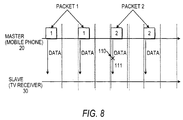
- An example of the "broadcasting with repetition” scheme is shown in FIG. 8 where each packet is broadcast two times. Data is sent via packet 1 from mobile phone 20 to television receiver 30 twice. Both times it is received correctly. Next, packet 2 is sent twice. As illustrated, the first time packet 2 is sent it is not received properly, for whatever reason, as represented by an "x" 110 over arrow 111.
- packet 1 is sent and no further packets are sent until the television receiver sends an acknowledgement (ACK) to the mobile phone 20 that the packet was received.
- ACK acknowledgement
- an ARQ Automatic Repeat Queuing protocol
- Certain time slots/intervals are designated as times when the master may transmit a packet and the following time slot is designated as a slave-to-master slot when the slave answers.
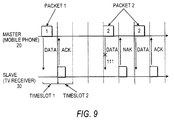
- FIG. 9 shows packet 1 being transmitted by mobile phone 20 during first time slot and an ACK signal is returned by television receiver 30 during the next time slot. Packet 2 is subsequently transmitted during another time slot but is not properly received.
- a NAK (No Acknowledgement) signal- is sent back by television receiver 30 during the next time slot and mobile phone 20 then resends packet 2 until proper receipt is acknowledged with an ACK signal.
- the Connection state may be terminated and both the master and slave devices return to the Standby mode. In this mode, the Active Member Address of the slave is released, enabling the slave to connect with another Bluetooth device.
- the invention may also be implemented in conjunction wich the Wireless Application Protocol (WAP) such that the data that passes to the external display device is ordered and controlled via WAP.
- WAP Wireless Application Protocol
- the convergence of WAP and Bluetooth technologies is defined in the Bluetooth Specification.
- WAP provides Internet and advanced telephone services to mobile terminals and allows among other things a mobile terminal user to interact with the user's service provider.
- WAP also permits the download of menus from the network to mobile terminal 20 offering various selections that a user can make.
- WAP permits a mobile terminal user to order data to be sent to an external display 30 device from a menu of one or more choices that appears on a display on the mobile terminal.
- the ordered data, as well as related data for controlling the data for the external display device 30, is then sent from the service provider 13 via network and its base station 10 to the mobile terminal 20.
- WAP further controls the delivery of the ordered data to external display device 30.
- the data that will be sent to the external display device 30 is extracted before the WAP menu or any other application is displayed on the display of the mobile terminal 20.
- the extracted data is then streamed through the mobile terminal 20 and transmitted to the external display device 30.
- the menus and related data viewed on the display of mobile terminal 20 may also be sent to the external display device 30 so that the menu can be displayed and better viewed thereon, the selection may be made on the external display device 30 and then transmitted back to the mobile terminal 20.
- a user can send a request to a service provider 13 for a weather report for Helsinki city.
- the user receives a data stream from the service provider 13 via communications network to his/her mobile terminal 20, that may consist of basic information about the current weather in Helsinki and a live or satellite picture of Helsinki, a weather map, or a detailed graphical illustration of the weather forecast for Helsinki city.
- the basic information can be displayed on the display of the mobile 30 terminal 20 and pictorial data may be forwarded to the external display device, such as a television receiver, for better viewing.
- the display of the television receiver can be controlled pixel-wise, i.e. the display can be divided into different portions, which can each be separately controlled. This allows advertising to be added to the transmission and displayed on one or more portions of the display. For example, when the user wants to see a picture of the weather in Helsinki city, the transmission includes a banner that advertises British Airways. An advertisement on a particular portion of the display may remain displayed until other data to be displayed in that location is received.
Landscapes
- Engineering & Computer Science (AREA)
- Computer Networks & Wireless Communication (AREA)
- Theoretical Computer Science (AREA)
- Human Computer Interaction (AREA)
- Signal Processing (AREA)
- General Engineering & Computer Science (AREA)
- General Physics & Mathematics (AREA)
- Physics & Mathematics (AREA)
- Mobile Radio Communication Systems (AREA)
- Telephone Function (AREA)
- Power Sources (AREA)
- Measuring Pulse, Heart Rate, Blood Pressure Or Blood Flow (AREA)
- User Interface Of Digital Computer (AREA)
- Two-Way Televisions, Distribution Of Moving Picture Or The Like (AREA)
- Information Transfer Between Computers (AREA)
Abstract
Description
- This invention relates to the field of showing images on different display devices, and particularly to display devices which have different capabilities for viewing the content.
- Messages may be transmitted over a wireless communications network to a mobile terminal, such as mobile phone, together with, or independently of an audio signal. The message may contain various types of content to serve various functions, that are already publicly available or are becoming available shortly. The content may consist of still pictures or video. These messages may be automatically sent to a recipient or there may be services which respond to a recipient's request for a specific service.
- The display capabilities of currently available mobile terminals are limited because of the size and weight requirements on these compact devices. A mobile terminal display may be provided to view an incoming video signal, but because of the above mentioned facts, users would not enjoy watching multiformatted images or video on such a display. This problem with a small display is especially problematic for visually impaired people.
- It is therefore desirable to find a way to view the content received with a mobile terminal on a separate display that has better display capabilities. A television receiver display or a computer monitor are examples of this kind of display having better display capabilities. Being able to display video sent over a mobile terminal on a larger display device, like a television display, would also allow a service provider to provide additional optional services to provide a user with added value, and avoid unnecessarily draining of the mobile terminal's battery by displaying the video on a separate display device that has a separate power source.
- Recently, low power RF systems have been proposed for providing communications between a plurality of transceivers through a short range communications link. One such short range RF technology is currently under development and is referred to as "Bluetooth". This system will be commercially available in the near future and it operates in the open spectrum around 2.45 GHz. This unlicensed radio band, called Industrial, Scientific, Medical (ISM) band is globally available. The operating range of this RF system is approximately 10 meters for a normal power mode and has proven to be economically efficient. It is planned that a Bluetooth chip having these characteristics will be inserted in all kinds of electrical devices for enabling communication between separate devices. In PCT Application No. WO 0018025, such a Bluetooth link between a Bluetooth enabled mobile terminal and a Bluetooth enabled data terminal, such as a PC, is disclosed.
- It would be particularly advantageous to enable the user to view the content, such as a video clip on a larger display, while the user is actually holding the mobile terminal, and allow the user to select what is viewed using the mobile terminal, or to otherwise use the mobile device while viewing the video clip. This would be best implemented using a wireless link between the mobile terminal and the external display device. United States Patent No. 5,880,732 presents a method and apparatus enabling one specific type of usage of a remote display device connected to a mobile telephone. However, the invention offers only a partial solution to the problem, because the system allows only the textual message appearing on the telephone display to be viewed on the remote display. The system does not take into consideration the different displaying capabilities of the devices such as that the remote display may be capable of displaying images that the mobile telephone cannot, which makes the system inadequate for effective use.
- It is therefore an object of this invention to present a system and method for wirelessly linking display devices having different display capabilities to provide better display quality to a user of a mobile terminal with an economic and efficient short range RF link.
- This invention concentrates on providing better display quality to a user of a mobile device. The mobile device, such as a mobile phone, laptop computer, or personal digital assistant (PDA), may be provided with a Bluetooth chip conforming to the Bluetooth standards described in Bluetooth specification v.1.0B, and another display device, like a television apparatus in the vicinity of the mobile device, is likewise provided with a similar Bluetooth chip, thereby enabling a short range RF communications link between the two devices. The mobile terminal receives image data from a base station in a wireless communications network or from another device utilizing any transmission method, including, but not limited to GSM, EDGE, WCDMA, DAB, DVB or Bluetooth link. As used herein, the term "image" is used interchangeably with the term "video" and includes a single image, picture, or graphic, a stream or plurality of still pictures, or graphics, or a conventional video.
- The system in this invention consists of a first display device and a second display device having a communication link between them. The communication link is arranged between said display devices by a short range RF communication link. The image on the first display is viewed as taking into consideration the capabilities of the first display device, and the image on the second display device is viewed as taking into consideration the different display capabilities of the second display device. This can be done by splitting the received payload at the first display device into a plurality of data packets with a specific splitting application and identifying the packets to first display device part(s) and second display device part(s), which takes into consideration the display capabilities of the first and second display devices.
- The first display device also has means for establishing a first wireless communication link with a communications network and means for establishing a second wireless communication link with a second display device. After splitting the payload into a plurality of data packets, the first display device forwards at least one of the data packets to the second display device having different display capabilities.
- The image data received by the mobile terminal comprises data to be ultimately reassembled into an image to be displayed on a display either on the mobile device, on an another display device, or on both of these devices. Because the mobile device may or may not have a display, and at best, will have a relatively small display on which it is difficult to view the image, the image data is retransmitted using a short range RF link, such as Bluetooth link, to an external display device for improved viewing quality. The improved viewing quality also enables a service provider to provide more advanced and better quality services to customers, such as images and/or video movies with higher quality resolution than could be effectively displayed on an ordinary display of a mobile phone.
- The image data received by the mobile terminal is included within the first packet or a plurality of packets of a type appropriate to the wireless transmission method used. In addition to the data to be forwarded to the external display device, the packets received by the mobile terminal may contain data that may be used exclusively at the mobile terminal, such as voice data, control data, image data, or data for a displayable menu for the mobile terminal. The mobile terminal may have an application that splits the data packets received by the mobile device and forwards part of the data to the mobile terminal's own display and another part of the data for transmission with a short range RF link in an appropriate format to the external display device. At the external device, the short range RF data packets are reassembled into an image or video, as originally sent, for viewing on the external display device.
- Other objects and features of the present invention will become apparent from the following detailed description considered in conjunction with the accompanying drawings. It is to be understood, however, that drawings are designed solely for purposes of illustration and not as a definition of the limits of the invention, for which reference should be made to the appended claims. It should be further understood that the drawings are not necessarily drawn to scale and that, unless otherwise indicated, they are merely intended to conceptually illustrate the structures and procedures described herein.
- In the drawings wherein like reference numerals denote similar elements throughout the several views:
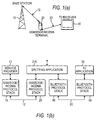
- FIG. 1(a) is a schematic representation of a base station, mobile phone and an external display device;
- FIG. 1(b) is a block diagram of the basic protocol path from base station to television receiver, that may be used in practicing the present invention;
- FIG. 2 is a simplified picture illustrating the structure of the mobile terminal in the view of this invention;
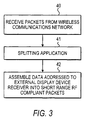
- FIG. 3 is a flow chart of the method for handling the video data to be retransmitted to the external display device at the wireless device;
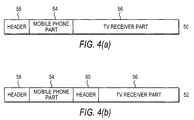
- FIG. 4(a) is a plan view of a first possible data frame structure for transmitting a combined audio and video signal;
- FIG. 4(b) is a plan view of a second possible data frame structure for transmitting a combined audio and video signal;
- FIG. 5 is a schematic representation of the Bluetooth protocol stack;
- FIG. 6 is a plan view of the standard Bluetooth packet format;
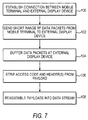
- FIG. 7 is a flow chart of the method of transmitting video data from the wireless device to the external display device;
- FIG. 8 is a diagrammatical view of a method for broadcasting the video packets from the mobile device to the external display device; and
- FIG. 9 is a diagrammatical view of a method for transmitting the video packets from the mobile device to the external display device using a specific polling scheme.
-
- The present invention may be implemented in conjunction with a wireless communications network using any wireless transmission methods, such as known methods like GSM (Global System for Mobile Communications), EDGE (Enhanced Data Rates for GSM Evolution), WCDMA (Wideband Code Division Multiple Access), DAB (Digital Audio Broadcasting) or DVB (Digital video broadcasting) ; although technologies with faster data transmission rates, like EDGE, WCDMA or DVB are preferred over GSM and DAB technologies.
- In FIG. 1(a) is shown the basics of this invention. A conventional wireless connection has a
wireless link 12 between thebase station 10 of aservice provider 13 and themobile terminal 20 to exchange the conventional radio frequency (RF) signals that pass between thebase station 10 of aservice provider 13 and themobile terminal 20. Signals may be received by and transmitted tobase station 10 from themobile terminal 20. Aprotocol stack 15 specific to the transmission method used at thebase station 10 handles the transmission and asimilar protocol stack 25 at amobile terminal 20 handles the received signal as shown in FIG. 1(b). A wireless shortrange RF link 22, e.g., a Bluetcoth link, is also established between the mobile terminal and external display device, like atelevision receiver 30 or a computer monitor. This requires that the mobile terminal can establish this short range RF link. The Bluetooth link can be established with a Bluetooth chip manufactured according to the Bluetooth Specification Version 1.0B and standards (available on the internet at the "bluetooth.net" Web site). - In one implementation, a Bluetooth chip is connected to the printed circuit board of the
mobile terminal 20. The external display must also be outfitted with a Bluetooth chip, which may be installed on the printed circuit board of the external display device (television receiver 30 in this example), or may be otherwise connected to the display device, such as with an external device plugged in to the display device (not shown in FIG. 1(a)). - The Bluetooth link 22 does not require the
mobile terminal 20 and theTV 30 to be within direct line-of-sight with each other, but the devices must be inside the transmission/reception range of the Bluetooth chips for the signal from themobile terminal 20 to be received in theTV 30. As earlier stated, the operating range of Bluetooth using normal 0dBm transmission power is approximately 10 meters, which presents no problem for mobile terminal users who wish to view video on a television display and be able to control the video content with the terminal because users rarely watch television at distances farther than 10 meters. The Bluetooth standard presently supports an asynchronous data channel, as many as three synchronous voice channels, or a channel, which simultaneously supports asynchronous data and asynchronous voice. Associated with each of the Bluetooth chips at themobile terminal 20 and thetelevision receiver 30 is a multilayerBluetooth protocol stack Bluetooth link 22 between these Bluetooth-enabled devices. - Where video capabilities are provided, a
conventional communication link 12 may be set up initially as an audio only call with the allowance for subsequent requests for video or link 12 may be initially set up to transmit audio and/or video. At the setup of service formobile terminal 20, at a call setup, or at some other time, thebase station 10 must be informed whether or not themobile terminal 20 has a video capability or can transmit the video to a nearby Bluetooth enabled display device for viewing, and if so, the level of graphics that is enabled, such as whether high quality graphics can be received and viewed. A user may request that a radio signal containing video content be transmitted from the communications network via abase station 10 tomobile terminal 20. Alternatively, thebase station 10 may simply begin transmitting a video signal when it has a video to send. - Although the discussion herein focuses on sending a combined audio and video signal, it should be understood that the invention is equally applicable to the transmission and handling of a video only signal or an audio only signal. It should be further understood that, rather than being transmitted from a base station, the signal may be transmitted to a mobile terminal from a short range RF-enabled device over a short range RF or other wireless link.
- To handle a video feed that has a packet size larger than a single data frame, the
mobile terminal 20 must receive a data stream from the service provider in a format wherein the video can be split into several data frames. Thus, basic information/control data may be sent by the service provider in a first data frame and the high quality graphics signal is split up, and transmitted thereafter as additional data frames. - FIG. 2 shows a simplified picture of a
mobile terminal 20 illustrating necessary components to perform the procedures of this invention. In themobile terminal 20 there is anetwork transceiver 206, to receive transmissions from and to transmit requests to the wireless communications network, ashort range transceiver 204 to enable communication with nearby devices, aCPU 208 unit for controlling and executing all necessary procedures, amemory unit 210, astorage unit 212, adisplay 202 for displaying the images, and anantenna 216. In the case of DVB or DAB, the terminal must also have a DVB or DAB receiver (not shown) . Also, inside or outside the CPU unit is a software-basedsplitting application 218, which enables the handling and splitting of the different data frames. - FIG 3. shows a flow chart illustrating the method for handling the video data to be sent from the
service provider 13 to theexternal display device 30 viamobile terminal 20. Atstep 40, theservice provider 13 transmits data frames as packets tomobile terminal 20 over the wireless communications network which are received bymobile terminal 20. Where both audio and video are sent simultaneously via the packets, a packet containing video information may have a data frame structure that can be split into a mobileterminal part 54 and externaldisplay device part 56. Two possible basic data frame structures aredata frame structure 50 shown in FIG. 4(a) anddata frame structure 52 shown in FIG. 4(b). Mobileterminal part 54 may include any voice data to be heard over or otherwise used by themobile terminal 20 as well as images, call feature or other data to be used by the mobile terminal such as textual information, caller-ID, e-mail, and the like, to be displayed on a display of themobile terminal 20. Externaldisplay device part 56 is the part to be forwarded to theexternal display device 30 and generally follows the mobileterminal part 54 within the signal sent by abase station 10 to allow the mobileterminal part 54 to be split off first and used by themobile terminal 20. The externaldisplay device part 56 generally includes a video portion of the signal and may include an audio portion to be played with the video on the external display device. Indata frame structures 50, 52 aheader part 58 precedes mobileterminal part 54. Indata frame structure 52, aseparate header part 60 also precedes the externaldisplay device part 56. The precise length of the mobileterminal part 54 and the externaldisplay device part 56 will depend on the currently utilized transmission method, i.e. GSM, EDGE, WCDMA, DAB, DVB, Bluetooth or some other method. The externaldisplay device part 56 is transmitted from the mobile terminal to the external display device, such as aTV 30, over wireless shortrange RF link 22, such as Bluetooth link. It should be noted that the various parts of thedata frame structures - In one preferred embodiment of this invention the short
range RF link 22 is specified as a Bluetooth link and thereby the protocol stack considered in this invention is a Bluetooth protocol stack. The features of that particular Bluetooth protocol stack are shown in FIG. 5, and the various layers of the protocol stack (65, 66 in FIG. 1) atmobile terminal 20 and atexternal display device 30 are discussed in the Bluetooth Specification v.1.0B. The lowest layer is theradio layer 70, which provides an interface between the host devices and the Bluetooth chip. Above the radio layer is thebaseband layer 72 which specifies the procedures to support the exchange of real-time voice and data information streams and networking between Bluetooth devices. Above thebaseband layer 72 is theLink Manager 74 which is used for link set-up, security and control. The Logical Link Control and Adaptation Protocol (L2CAP)layer 76 supports higher-level protocol multiplexing, packet segmentation and reassembly, and conveying the quality of service information. AnApplications layer 90 is the highest layer in the Bluetooth protocol.Data 78 passes between theL2CAP layer 76 and theApplications layer 90 via one or more of the following interfaces: TCP/IP 80, HID (human interface device/host interface device) 82, or RFCOMM 84 (discussed at Part F1 of the Bluetooth Specification). Acontrol sequence 86 passes between theLink Manager 74 andApplications layer 90 to set up the Asynchronous Connection Link (ACL) between Bluetooth devices and provides a pathway for theApplications layer 90 to send control information, such as to notifyLink Manager 74 that a packet was lost. Anaudio component 88 of themultilayer protocol stack 65 handles any audio to be transmitted to the external display device. - Returning to the method of FIG. 3, at
step 41, the mobile terminal's splitting application 218 (shown in FIG. 1(b)) is used to split the mobileterminal part 54 from the externaldisplay device part 56 at theApplications layer 90. (As an alternative to implementing thesplitting application 218 at theApplications layer 90, data can be processed and delivered through the RFCOMM protocol or another layer in the protocol stack.) Thesplitting application 218 takes a data frame from a data stack (not shown) at mobile terminal 20 received frombase network 10 over communications link 12 and determines where the externaldisplay device part 56 is located within the data frame structure by knowing the fixed length of the mobileterminal part 54. Ifdata frame structure 52 is used, theseparate header part 60 indicates the location of the externaldisplay device part 56. To provide time for thesplitting application 218 to handle the incoming data from the network, the received signal is buffered at themobile terminal 20 in a buffer (not shown) . Once the data is split, atstep 42, the externaldisplay device part 56 is further processed by theBluetooth protocol stack 65 at themobile terminal 20 where one or more external display device parts are reassembled into one or more Bluetooth compliant packets formed in accordance with the Baseband Specification within the Bluetooth Specification, the number of such packets depending on the amount of data to be sent. - Referring to FIG. 6, each
Bluetooth packet 95 comprises anaccess code 96 specific to a master's address in the connection mode and identifying each packet in one piconet, aheader 97 containing link control information, and apayload 98, which comprises one or more externaldisplay device parts 56 or a portion of an external display device part, the organization of the data into Bluetooth packets depending on the size of externaldisplay device part 56 and the size of thepayload 98. Thesepackets 95 are placed into a data stack within the Bluetooth chip and are then ready to be transmitted toexternal display device 30. The various parts ofBluetooth Packet 95 shown in Fig. 6 are not necessarily drawn to scale. - A
wireless link 22 to send data between mobile terminal andexternal display device 30 is established using the Bluetooth protocols. The mobile terminal must be set up as the "master" to control the communication with theexternal display device 30 which is a "slave". The master and slave communicate over shared channel and form a "piconet". The channel is -defined in the Bluetooth Specification as a pseudo-random hopping sequence through the defined RF channels that is unique to the piconet. - Generally, the
mobile terminal 20 becomes the master automatically when video service is ordered with themobile terminal 20 and the connection toexternal display device 30 is initiated. However, if theexternal display device 30 is set up as the master, for any reason, the master and slave must exchange roles, with the slave becoming the master and vice versa, i.e. a master-slave switch is performed in accordance with the Bluetooth Specification. - Referring now to the flow chart of FIG. 7, at
step 100, the connection is initialized bymobile terminal 20 which serves as a master. If anexternal display device 30 has been previously identified with a specific device address to the master (mobile terminal), which is the case when the same master-slave relationship was previously set up, the master usually transmits a "Page Scan" command to page the known Bluetooth unit within theexternal display device 30. (If the master-slave relationship was previously established and was maintained in "park" mode, there is no need to set up a new connection; a command must only be sent to exit "park" mode to restart the communication.) If no suchexternal display device 30 has been previously identified tomobile terminal 20 as a master, themobile terminal 20 broadcasts an "Inquiry" message to determine what other Bluetooth units are within the coverage area wherein two Bluetooth units can exchange messages with acceptable quality and performance. The Bluetooth units that capture the broadcast "Inquiry" messages will send a response to themobile terminal 20 providing information about the responding Bluetooth unit and its host device, which would include any Bluetooth-enabled external display device in the coverage area. After locating the external display device, a "Connection" state is established in which themobile phone 20 is the master and theexternal display device 30 is the slave, thereby preventing the external display device from receiving data from multiple Bluetooth devices at the same time, which could cause problems with the display on the device. - During the Connection state, the Bluetooth-compliant packets formed at the
mobile terminal 20 are sent to the external display device 30 (step 102). Upon receipt atexternal display device 30, the packets are buffered at buffer (not shown) having a sufficient memory for the data stream (step 104), and the packets are stripped of theaccess code 96 and header parts 97 (step 106) and thepayloads 95 of the various packets are then reassembled by theBluetooth protocol stack 66 at theexternal display device 30 into a data stream to be played, whether as video only or with audio available (step 108). The buffer is necessary both to compensate for variations in the transmission speed of the packets and to capture multiple packets before reassembly into a video signal to be displayed. If the television receiver has a memory (which is becoming common to enable closed captioning of broadcasts and other text-based services), it is also possible to utilize the memory of the television receiver for buffering purposes. The video delivered to the external display device 30 (in this particular case the television) may be delivered at a much faster rate than the rate at which it can be delivered to a conventional, slow mobile terminal display. - The packets are sent to the
external display device 30 atstep 102 in one of various ways, such as the methods defined in the Bluetooth Specification. According to one "broadcasting with repetition" scheme, each packet is broadcast a predefined number of times, such as five times. For example, a first packet is broadcast five times, then a second packet is broadcast five times, etc. This increases substantially the chance that a packet will be received without error and offers the advantage that the slave,external display device 30 need not send any acknowledgements tomobile terminal 20. An example of the "broadcasting with repetition" scheme is shown in FIG. 8 where each packet is broadcast two times. Data is sent viapacket 1 frommobile phone 20 totelevision receiver 30 twice. Both times it is received correctly. Next,packet 2 is sent twice. As illustrated, thefirst time packet 2 is sent it is not received properly, for whatever reason, as represented by an "x" 110 overarrow 111. - According to a second, more reliable scheme for sending packets to the
television receiver 30, shown in FIG. 9,packet 1 is sent and no further packets are sent until the television receiver sends an acknowledgement (ACK) to themobile phone 20 that the packet was received. In this "polling" scheme, an ARQ (Automatic Repeat Queuing) protocol may be used. Certain time slots/intervals are designated as times when the master may transmit a packet and the following time slot is designated as a slave-to-master slot when the slave answers. Thus, FIG. 9 showspacket 1 being transmitted bymobile phone 20 during first time slot and an ACK signal is returned bytelevision receiver 30 during the next time slot.Packet 2 is subsequently transmitted during another time slot but is not properly received. Thus, a NAK (No Acknowledgement) signal- is sent back bytelevision receiver 30 during the next time slot andmobile phone 20 then resendspacket 2 until proper receipt is acknowledged with an ACK signal. After all packets are sent, the Connection state may be terminated and both the master and slave devices return to the Standby mode. In this mode, the Active Member Address of the slave is released, enabling the slave to connect with another Bluetooth device. - The invention may also be implemented in conjunction wich the Wireless Application Protocol (WAP) such that the data that passes to the external display device is ordered and controlled via WAP. The convergence of WAP and Bluetooth technologies is defined in the Bluetooth Specification. WAP provides Internet and advanced telephone services to mobile terminals and allows among other things a mobile terminal user to interact with the user's service provider. WAP also permits the download of menus from the network to
mobile terminal 20 offering various selections that a user can make. WAP permits a mobile terminal user to order data to be sent to anexternal display 30 device from a menu of one or more choices that appears on a display on the mobile terminal. The ordered data, as well as related data for controlling the data for theexternal display device 30, is then sent from theservice provider 13 via network and itsbase station 10 to themobile terminal 20. WAP further controls the delivery of the ordered data toexternal display device 30. The data that will be sent to theexternal display device 30 is extracted before the WAP menu or any other application is displayed on the display of themobile terminal 20. The extracted data is then streamed through themobile terminal 20 and transmitted to theexternal display device 30. The menus and related data viewed on the display of mobile terminal 20 may also be sent to theexternal display device 30 so that the menu can be displayed and better viewed thereon, the selection may be made on theexternal display device 30 and then transmitted back to themobile terminal 20. - Rather than sending video data over the same channel as other data used exclusively by the
mobile terminal 20, it is possible in WCDMA and similar wireless technologies where there are multiple channels per user to send the data bound for the external display device over a "dedicated" channel to transmit this data via mobile terminal and over the short range RF link to external display device. - Because of the improved display quality, many new mobile communications services are possible. For example, using mobile terminal and a WAP menu, a user can send a request to a
service provider 13 for a weather report for Helsinki city. After sending the request, the user receives a data stream from theservice provider 13 via communications network to his/hermobile terminal 20, that may consist of basic information about the current weather in Helsinki and a live or satellite picture of Helsinki, a weather map, or a detailed graphical illustration of the weather forecast for Helsinki city. The basic information can be displayed on the display of the mobile 30terminal 20 and pictorial data may be forwarded to the external display device, such as a television receiver, for better viewing. - It should also be understood that, when a television receiver is used as an
external display device 30 and the display is controlled with a Bluetooth data stream, the display of the television receiver can be controlled pixel-wise, i.e. the display can be divided into different portions, which can each be separately controlled. This allows advertising to be added to the transmission and displayed on one or more portions of the display. For example, when the user wants to see a picture of the weather in Helsinki city, the transmission includes a banner that advertises British Airways. An advertisement on a particular portion of the display may remain displayed until other data to be displayed in that location is received. - Thus, while there have shown and described and pointed out fundamental novel features of the invention as applied to a preferred embodiment thereof, it will be understood that various omissions and substitutions and changes in the form and details of the devices illustrated, and in their operation, may be made by those skilled in the art without departing from the spirit of the invention. For example, it is expressly intended that all combinations of those elements and/or method steps which perform substantially the same function in substantially the same way to achieve the same results are within the scope of this invention. Moreover, it should be recognized that structures and/or elements and/or method steps shown and/or described in connection with any disclosed form or embodiment of the invention may be -incorporated an any other disclosed or described or suggested form or embodiment as a general matter of design choice.
Claims (34)
- A system having a plurality of display devices having different display capabilities, the system comprising;a first display device having a first display and a first display capability for displaying an image of a predetermined content;a second display device having a second display and a second display capability for displaying a substantially different image of the predetermined content;a communication link between said first display device and said second display device, the link including means for transmitting the predetermined content of the image to be displayed on the second display of said second display device, and;means for altering the image between the first display of said first display device and the second display of said second display device.
- The system of claim 1, wherein the communication link between said first display device and said second display device is a wireless short range communication link.
- The system of claim 2, wherein said first display device has means for initiating the short range communication link to said second display device for transmitting the image.
- The system of claim 2, wherein said second display device has means for receiving the content transmitted from said first display device via the short range communication link.
- The system of claim 2, wherein the short range communication link is a Bluetooth link.
- The system of claim 2, wherein the short range communication comprises a Bluetooth chip attached to said first display device.
- The system of claim 2, wherein the short range communication link comprises a Bluetooth chip attached to said second display device.
- The system of claim 1, wherein said second display device further comprises means for informing said first display device of the second display capability.
- The system of claim 1, further comprising a communications network, a second communications link between the communications network and said first display device, and means for transferring the image data from the communications network to said first display device over the second communications link before the image data is transmitted to said second display device.
- The system of claim 9, wherein the communications network is a wireless communications network.
- The system of claim 9, wherein the means for transferring the image data comprises means for simultaneously transferring additional data to said first display device with the image data for use at said first display device.
- The system of claim 9, wherein the means for transferring the image data comprises means for transferring the image data in a packet along with additional data for use at said first display device, and wherein said first display device further comprises means for splitting the packet so the additional data may be used at said first display device, and the image data may be transmitted to said second display device.
- The system of claim 1, wherein the predetermined content of the image contains data which is responsive to said first display device and to said second display device and the respective display device selects the appropriate data for viewing the image respectively.
- The system of claim 13, wherein the data which is responsive to said first display device is viewed on the first display of said first display device and the data which is responsive to said second display device is forwarded to said second display device.
- The system of claim 1, wherein said second display device further comprises a memory for buffering the incoming image.
- The system of claim 1, wherein said first display device is a mobile terminal.
- The system of claim 1, wherein said second display device is a television receiver.
- The system of claim 1, further comprising means for controlling the second display device pixel-by-pixel.
- The system of claim 1, wherein the first display capability is different from the second display capability such that the image displayed on the first display device is substantially different from the image displayed on the second display device.
- A system having a plurality of display devices of different displaying capabilities, said system comprising:wherein said first display device comprisesa communications network for transmitting a predetermined content;a first display device having a first display capability;a second display device having a second display capability differing from the first display capability;means for establishing a first communication link with said communications network,means for interactively communicating with said communications network,means for establishing a second communication link with said second display device,means for displaying an image on the display of said first display device taking into consideration the display capabilities of said first display device, andmeans for forwarding at least a portion of the predetermined content to said second display device for displaying a substantially different image taking into consideration the display capabilities of said second display device.
- The system of claim 20, wherein the first communications link utilizes a wireless transformation method comprising one of GSM, EDGE WCDMA, DVB, DAB and a Bluetooth link.
- The system of claim 21, wherein the wireless communications network comprises one of a mobile network and the Internet.
- The system of claim 20, wherein the second communication link is a Bluetooth link.
- The system of claim 20, wherein said first display device and wherein the first communications link utilizes a wireless transmission method compliant with the Wireless Application Protocol (WAP) standard.
- The system of claim 20, wherein said first display device further comprises a memory for storing at least a part of the incoming signal.
- The system of claim 20, wherein the incoming signal comprises:a first display device image content part for use at said first display device; anda second display device part to be forwarded to said second display device.
- The system of claim 20, wherein the portion of the predetermined content to be forwarded to said second display device comprises:an access code specific to said first display device address in the communication link and identifying each data packet;a header comprising communication link control information; anda payload comprising the data of the image to be displayed at said second display device.
- A method of displaying a first part of a plurality of images on a first display device and a second part of the plurality of images on a second display device comprising the steps of:receiving a predetermined content from a communications network at said first display device, wherein the predetermined content includes a plurality of data packets, each comprising display capability specific information;assembling at least a portion of the data packets into a format that can be forwarded to said second display device;transmitting the assembled data packets from said first display device to said second display device via a short range communication link;reassembling the data packets received at said second display device into a format that can be viewed on a display of the second display device;displaying images on the display of said first display device using the first display capability specific information, anddisplaying substantially different images on the display of said second display device using the second display capability specific information.
- The method of claim 28, further comprising transmitting the predetermined content over the communications network using a wireless transmission method comprising one of GSM, EDGE, WCDMA, DVB, DAB and a Bluetooth link.
- The method of claim 28, wherein the communications network comprises one of a mobile network and the Internet.
- The method of claim 28, wherein said first display device and the communications network are compliant with the Wireless Application Protocol (WAP) standard.
- The method of claim 28, wherein the short range communication link is a Bluetooth link.
- The method of claim 28, wherein said first display device is a mobile terminal.
- The method of claim 28, wherein said second display device is a television receiver.
Priority Applications (1)
| Application Number | Priority Date | Filing Date | Title |
|---|---|---|---|
| EP05102985.8A EP1553794B1 (en) | 2000-08-15 | 2001-08-09 | Display Change Between Mobile Terminal Display and External Device Display |
Applications Claiming Priority (2)
| Application Number | Priority Date | Filing Date | Title |
|---|---|---|---|
| US639196 | 2000-08-15 | ||
| US09/639,196 US7580005B1 (en) | 2000-08-15 | 2000-08-15 | Display change between mobile terminal display and external device display |
Related Child Applications (1)
| Application Number | Title | Priority Date | Filing Date |
|---|---|---|---|
| EP05102985.8A Division EP1553794B1 (en) | 2000-08-15 | 2001-08-09 | Display Change Between Mobile Terminal Display and External Device Display |
Publications (2)
| Publication Number | Publication Date |
|---|---|
| EP1180903A1 true EP1180903A1 (en) | 2002-02-20 |
| EP1180903B1 EP1180903B1 (en) | 2005-10-19 |
Family
ID=24563115
Family Applications (2)
| Application Number | Title | Priority Date | Filing Date |
|---|---|---|---|
| EP05102985.8A Expired - Lifetime EP1553794B1 (en) | 2000-08-15 | 2001-08-09 | Display Change Between Mobile Terminal Display and External Device Display |
| EP01660146A Expired - Lifetime EP1180903B1 (en) | 2000-08-15 | 2001-08-09 | Display change between mobile terminal display and external device display |
Family Applications Before (1)
| Application Number | Title | Priority Date | Filing Date |
|---|---|---|---|
| EP05102985.8A Expired - Lifetime EP1553794B1 (en) | 2000-08-15 | 2001-08-09 | Display Change Between Mobile Terminal Display and External Device Display |
Country Status (5)
| Country | Link |
|---|---|
| US (1) | US7580005B1 (en) |
| EP (2) | EP1553794B1 (en) |
| AT (1) | ATE307468T1 (en) |
| DE (1) | DE60114103T2 (en) |
| ES (1) | ES2250335T3 (en) |
Cited By (30)
| Publication number | Priority date | Publication date | Assignee | Title |
|---|---|---|---|---|
| EP1307062A1 (en) * | 2001-10-24 | 2003-05-02 | Nokia Corporation | User interface for transmitting video data from a mobile device to an external display |
| GB2382003A (en) * | 2001-09-13 | 2003-05-14 | Nec Corp | Displaying data displayed on a display unit on one mobile communication terminal on a display unit of another via a radio terminal interface like Bluetooth |
| WO2003077550A1 (en) * | 2002-03-12 | 2003-09-18 | Nokia Corporation | A system and method for transferring a mms between message communication unit and digital tv |
| WO2004077829A1 (en) * | 2003-02-27 | 2004-09-10 | Fidrix Ab | Video conference system for mobile communication |
| WO2004105322A1 (en) * | 2003-05-21 | 2004-12-02 | Elcoteq Network Oyj | A communication network terminal, a terminal accessory device and an assembly containing the terminal and the accessory device |
| EP1372333A3 (en) * | 2002-06-13 | 2005-01-26 | Nokia Corporation | Picture transfer between mobile terminal and digital broadcast receiver |
| EP1544734A1 (en) * | 2003-12-17 | 2005-06-22 | Siemens Aktiengesellschaft | A method for performing a task on a mobile terminal, and a mobile terminal |
| WO2005104586A1 (en) * | 2004-04-20 | 2005-11-03 | Nokia Corporation | Exchanging multimedia data via a communications device |
| EP1672940A1 (en) * | 2004-12-20 | 2006-06-21 | Sony Ericsson Mobile Communications AB | System and method for sharing media data |
| EP1710973A1 (en) * | 2005-04-06 | 2006-10-11 | Alcatel | Specific stream redirection of a multimedia telecommunication |
| ES2259902A1 (en) * | 2004-12-29 | 2006-10-16 | Retevision Movil, S.A. | Method for displaying short messages on the television or on a personal computer. (Machine-translation by Google Translate, not legally binding) |
| WO2006126044A3 (en) * | 2005-05-24 | 2007-01-25 | Nokia Corp | Improved mobile communication terminal and mobile communication system, and methods therefore |
| US7177597B2 (en) | 2003-12-22 | 2007-02-13 | Nokia Corporation | System and method for assigning contact information to an external device for communication purposes using a mobile device |
| EP1557054A4 (en) * | 2002-10-28 | 2007-03-21 | Nokia Corp | GRAPHICAL INDICATION OF THE PRESENCE OF A DEVICE LOCATED NEARBY |
| WO2007060097A1 (en) * | 2005-11-23 | 2007-05-31 | Sony Ericcson Mobile Communications Ab | Workstation enabler apparatus |
| US7512401B2 (en) | 2005-04-04 | 2009-03-31 | Nokia Corporation | Method and system for updating capabilities of a device |
| EP1723485A4 (en) * | 2003-11-20 | 2009-04-08 | Texas Instruments Inc | Home picture/video display system with ultra wide-band technology |
| JP2009545230A (en) * | 2006-07-27 | 2009-12-17 | マイクロソフト コーポレーション | Providing input and output for mobile devices |
| WO2010001371A1 (en) * | 2008-06-30 | 2010-01-07 | France Telecom | Document management system |
| EP1919110A3 (en) * | 2006-09-29 | 2011-01-26 | Samsung Electronics Co., Ltd. | Method and system for displaying digital broadcast data |
| US8209736B2 (en) | 2006-08-23 | 2012-06-26 | Mediatek Inc. | Systems and methods for managing television (TV) signals |
| TWI384871B (en) * | 2006-08-23 | 2013-02-01 | Mediatek Inc | Methods and systems for digital television signals management |
| US8448212B2 (en) | 2005-12-02 | 2013-05-21 | Nokia Corporation | Combined receiver for DVB-H and DVB-T transmission |
| US8578429B2 (en) | 2004-02-21 | 2013-11-05 | Samsung Electronics Co., Ltd. | Device and method for outputting data of a wireless terminal to an external device |
| EP1972895A3 (en) * | 2007-03-22 | 2014-05-07 | NEC Corporation | Service provision system and rendering execution method |
| US8812688B2 (en) | 2010-09-28 | 2014-08-19 | Nokia Corporation | Method and apparatus for providing shared connectivity |
| EP2497329A4 (en) * | 2009-11-06 | 2014-08-20 | Blackberry Ltd | Device, system and method for selecting, sharing and displaying electronic content |
| US9011519B2 (en) | 2008-02-21 | 2015-04-21 | Edoardo Camenzind | Implantable medical device including a protection/retaining layer for an active ingredient or drug, in particular a water-soluble one |
| CN104866265A (en) * | 2015-04-29 | 2015-08-26 | 努比亚技术有限公司 | Multi-media file display method and device |
| US11153472B2 (en) | 2005-10-17 | 2021-10-19 | Cutting Edge Vision, LLC | Automatic upload of pictures from a camera |
Families Citing this family (46)
| Publication number | Priority date | Publication date | Assignee | Title |
|---|---|---|---|---|
| US9622058B1 (en) * | 2000-06-02 | 2017-04-11 | Timothy G. Newman | Apparatus, system, methods and network for communicating information associated with digital images |
| US10915296B2 (en) | 2000-11-01 | 2021-02-09 | Flexiworld Technologies, Inc. | Information apparatus that includes a touch sensitive screen interface for managing or replying to e-mails |
| US11467856B2 (en) | 2002-12-12 | 2022-10-11 | Flexiworld Technologies, Inc. | Portable USB device for internet access service |
| US11204729B2 (en) | 2000-11-01 | 2021-12-21 | Flexiworld Technologies, Inc. | Internet based digital content services for pervasively providing protected digital content to smart devices based on having subscribed to the digital content service |
| US7953818B2 (en) | 2000-11-20 | 2011-05-31 | Flexiworld Technologies, Inc. | Output device and system for rendering digital content |
| US20020097417A1 (en) * | 2001-01-19 | 2002-07-25 | Chang William Ho | System for universal data output |
| KR100407966B1 (en) * | 2001-08-24 | 2003-12-01 | 엘지전자 주식회사 | System and Method for Controlling Cellular Phone with TV |
| US7299304B2 (en) * | 2001-11-20 | 2007-11-20 | Intel Corporation | Method and architecture to support interaction between a host computer and remote devices |
| US7499030B2 (en) * | 2001-11-30 | 2009-03-03 | Texas Instruments Incorporated | Graphics initialization for wireless display devices |
| US7908401B2 (en) | 2002-12-12 | 2011-03-15 | Flexiworld Technology, Inc. | Method and device for wireless communication between computing devices |
| WO2004093149A2 (en) | 2003-04-11 | 2004-10-28 | Flexiworld Technologies, Inc. | Autorun for integrated circuit memory component |
| US20050125554A1 (en) * | 2003-12-03 | 2005-06-09 | International Business Machines Corporation | Method and apparatus for adaptive two-dimension inter-packet header compression |
| US7899492B2 (en) | 2004-07-16 | 2011-03-01 | Sellerbid, Inc. | Methods, systems and apparatus for displaying the multimedia information from wireless communication networks |
| US7957733B2 (en) | 2004-07-16 | 2011-06-07 | Sellerbid, Inc. | Method and apparatus for multimedia communications with different user terminals |
| US7603131B2 (en) | 2005-08-12 | 2009-10-13 | Sellerbid, Inc. | System and method for providing locally applicable internet content with secure action requests and item condition alerts |
| US20150319486A1 (en) * | 2004-07-16 | 2015-11-05 | Virginia Innovation Sciences, Inc. | Method and apparatus for cross-layer optimization in multimedia communications with different user terminals |
| US20140071818A1 (en) | 2004-07-16 | 2014-03-13 | Virginia Innovation Sciences, Inc. | Method and system for efficient communication |
| US7344084B2 (en) * | 2005-09-19 | 2008-03-18 | Sony Corporation | Portable video programs |
| WO2007034457A1 (en) * | 2005-09-23 | 2007-03-29 | Koninklijke Philips Electronics, N.V. | Presentation on a stationary device of information transmitted from a portable device |
| KR100663519B1 (en) * | 2005-11-14 | 2007-01-02 | 삼성전자주식회사 | Mobile communication terminal that can perform other functions while outputting digital multimedia broadcasting to external AV device |
| US8260933B2 (en) * | 2006-02-15 | 2012-09-04 | Samsung Electronics Co., Ltd. | Multimedia content redirection method |
| KR100744380B1 (en) * | 2006-04-17 | 2007-07-30 | 삼성전자주식회사 | Display control device and method in a mobile terminal equipped with a function to output an image to an external display device |
| US8135342B1 (en) | 2006-09-15 | 2012-03-13 | Harold Michael D | System, method and apparatus for using a wireless cell phone device to create a desktop computer and media center |
| US7970436B1 (en) | 2006-09-22 | 2011-06-28 | Sprint Communications Company L.P. | Wireless interface extension for mobile devices |
| US20080109867A1 (en) * | 2006-11-07 | 2008-05-08 | Microsoft Corporation | Service and policies for coordinating behaviors and connectivity of a mesh of heterogeneous devices |
| US20090097431A1 (en) * | 2007-10-11 | 2009-04-16 | Profit Metalltd. | Automatic weather information downloading and displaying system |
| US8621505B2 (en) * | 2008-03-31 | 2013-12-31 | At&T Intellectual Property I, L.P. | Method and system for closed caption processing |
| US10504124B2 (en) * | 2008-04-21 | 2019-12-10 | Verizon Patent And Licensing Inc. | Aggregation and use of information relating to a users context for personalized advertisements |
| US20090318077A1 (en) * | 2008-06-18 | 2009-12-24 | Microsoft Corporation | Television Audio via Phone |
| US8370880B2 (en) * | 2008-06-21 | 2013-02-05 | Microsoft Corporation | Telephone control service |
| JP4894826B2 (en) * | 2008-07-14 | 2012-03-14 | ソニー株式会社 | COMMUNICATION DEVICE, COMMUNICATION SYSTEM, NOTIFICATION METHOD, AND PROGRAM |
| US9241062B2 (en) * | 2009-05-20 | 2016-01-19 | Citrix Systems, Inc. | Methods and systems for using external display devices with a mobile computing device |
| CN101674364B (en) * | 2009-09-28 | 2011-11-09 | 华为终端有限公司 | Wireless screen splicing display method, mobile communication terminal and device |
| US8879989B2 (en) * | 2010-03-03 | 2014-11-04 | VIZIO Inc. | System, method and apparatus for displaying caller-identification |
| KR20120001336A (en) * | 2010-06-29 | 2012-01-04 | 삼성전자주식회사 | Content conversion method and apparatus |
| WO2012046891A1 (en) | 2010-10-06 | 2012-04-12 | 엘지전자 주식회사 | Mobile terminal, display device, and method for controlling same |
| DE102010049734A1 (en) * | 2010-10-31 | 2012-05-03 | Lorenz Weiler | Method for providing uninterrupted full-screen view of media files, particularly Internet videos in hypertext beds, involves executing background program on multimedia computer by computer network, particularly Internet |
| US8856355B2 (en) | 2011-05-09 | 2014-10-07 | Samsung Electronics Co., Ltd. | Systems and methods for facilitating communication between mobile devices and display devices |
| US20130246946A1 (en) * | 2012-03-14 | 2013-09-19 | Qualcomm Incorporated | Sharing user information through secondary displays |
| US20140082208A1 (en) * | 2012-09-19 | 2014-03-20 | Nokia Corporation | Method and apparatus for multi-user content rendering |
| KR102097640B1 (en) * | 2013-03-08 | 2020-04-06 | 엘지전자 주식회사 | Mobile terminal and control method thereof |
| US9721284B1 (en) | 2013-03-08 | 2017-08-01 | Aftershock Services, Inc. | System and method for facilitating a game through a primary client device and in-game content purchases through a mobile device |
| US9330531B1 (en) | 2013-03-14 | 2016-05-03 | Kabam, Inc. | System and method for displaying a game using a primary display and communicating alliance information among alliance members using a secondary display |
| US9539497B1 (en) | 2013-05-07 | 2017-01-10 | Kabam, Inc. | Display of a game through a primary and mobile display with individualized audio through the mobile device |
| KR101879966B1 (en) * | 2014-03-10 | 2018-07-18 | 엘지전자 주식회사 | Broadcast reception device and operating method thereof, and companion device interoperating with the broadcast reception device and operating method thereof |
| CN112492121B (en) * | 2020-12-09 | 2023-02-28 | 华东计算技术研究所(中国电子科技集团公司第三十二研究所) | Image capture/network transmission and explicit verification platform implementation method and system |
Citations (2)
| Publication number | Priority date | Publication date | Assignee | Title |
|---|---|---|---|---|
| DE19719908A1 (en) * | 1997-05-13 | 1998-11-19 | Siemens Ag | Cellular device |
| GB2348083A (en) * | 1999-03-18 | 2000-09-20 | Nokia Mobile Phones Ltd | Radio handset for browsing the Internet |
Family Cites Families (28)
| Publication number | Priority date | Publication date | Assignee | Title |
|---|---|---|---|---|
| JPH03151731A (en) | 1989-11-09 | 1991-06-27 | Pioneer Electron Corp | Paging receiver and paging reception system |
| WO1992003816A1 (en) * | 1990-08-16 | 1992-03-05 | General Parametrics Corp. | A display control device incorporating an auxiliary display |
| US5734413A (en) * | 1991-11-20 | 1998-03-31 | Thomson Multimedia S.A. | Transaction based interactive television system |
| JP3002348B2 (en) * | 1992-11-30 | 2000-01-24 | シャープ株式会社 | Image communication system |
| US6122526A (en) * | 1997-04-24 | 2000-09-19 | Eastman Kodak Company | Cellular telephone and electronic camera system with programmable transmission capability |
| US5666159A (en) * | 1995-04-24 | 1997-09-09 | Eastman Kodak Company | Electronic camera system with programmable transmission capability |
| US6580422B1 (en) * | 1995-04-27 | 2003-06-17 | Hewlett-Packard Development Company, L.P. | Remote computer display using graphics primitives sent over a wireless link |
| US6064420A (en) * | 1995-06-15 | 2000-05-16 | Intel Corporation | Simulating two way connectivity for one way data streams for multiple parties |
| US5831664A (en) * | 1995-12-15 | 1998-11-03 | Mediaone Group, Inc. | Method and system for synchronizing data between at least one mobile interface device and an interactive terminal |
| US6029508A (en) * | 1996-03-25 | 2000-02-29 | Snap-On Technologies, Inc. | Remote portable display unit with wireless transceiver and engine analyzing system incorporating same |
| US5850340A (en) | 1996-04-05 | 1998-12-15 | York; Matthew | Integrated remote controlled computer and television system |
| US6084584A (en) * | 1996-10-01 | 2000-07-04 | Diamond Multimedia Systems, Inc. | Computer system supporting portable interactive graphics display tablet and communications systems |
| JP2001511958A (en) | 1996-10-08 | 2001-08-14 | アレン チャン | Remote control with display to notify by voice |
| US6002450A (en) | 1997-03-24 | 1999-12-14 | Evolve Products, Inc. | Two-way remote control with advertising display |
| US5880732A (en) * | 1997-04-29 | 1999-03-09 | Telefonaktiebolaget L M Ericsson Publ. | Apparatus enabling usage of external display monitor with a mobile telephone |
| US6611358B1 (en) * | 1997-06-17 | 2003-08-26 | Lucent Technologies Inc. | Document transcoding system and method for mobile stations and wireless infrastructure employing the same |
| US6097441A (en) | 1997-12-31 | 2000-08-01 | Eremote, Inc. | System for dual-display interaction with integrated television and internet content |
| US6104334A (en) | 1997-12-31 | 2000-08-15 | Eremote, Inc. | Portable internet-enabled controller and information browser for consumer devices |
| US6496122B2 (en) * | 1998-06-26 | 2002-12-17 | Sharp Laboratories Of America, Inc. | Image display and remote control system capable of displaying two distinct images |
| US6357042B2 (en) * | 1998-09-16 | 2002-03-12 | Anand Srinivasan | Method and apparatus for multiplexing separately-authored metadata for insertion into a video data stream |
| GB2341753A (en) | 1998-09-17 | 2000-03-22 | Nokia Mobile Phones Ltd | RF interface for portable communication terminal |
| JP3397163B2 (en) * | 1999-03-25 | 2003-04-14 | ソニー株式会社 | mobile phone |
| US6792148B1 (en) * | 1999-10-18 | 2004-09-14 | Telefonaktiebolaget Lm Ericsson (Publ) | Method and apparatus for providing a camera accessory with compression |
| US6968365B2 (en) * | 1999-12-01 | 2005-11-22 | Telefonaktiebolaget L M Ericsson (Publ) | Device and a method for operating an electronic utility device from a portable telecommunication apparatus |
| US6287200B1 (en) * | 1999-12-15 | 2001-09-11 | Nokia Corporation | Relative positioning and virtual objects for mobile devices |
| US6297737B1 (en) * | 2000-04-03 | 2001-10-02 | Ericsson Inc | Object locating system |
| US6765557B1 (en) * | 2000-04-10 | 2004-07-20 | Interlink Electronics, Inc. | Remote control having touch pad to screen mapping |
| US6453160B1 (en) * | 2000-07-31 | 2002-09-17 | Motorola, Inc. | Exploiting a broadcast system to enhance a wireless gaming experience using position holders to replace data |
-
2000
- 2000-08-15 US US09/639,196 patent/US7580005B1/en not_active Expired - Fee Related
-
2001
- 2001-08-09 DE DE60114103T patent/DE60114103T2/en not_active Expired - Lifetime
- 2001-08-09 AT AT01660146T patent/ATE307468T1/en not_active IP Right Cessation
- 2001-08-09 ES ES01660146T patent/ES2250335T3/en not_active Expired - Lifetime
- 2001-08-09 EP EP05102985.8A patent/EP1553794B1/en not_active Expired - Lifetime
- 2001-08-09 EP EP01660146A patent/EP1180903B1/en not_active Expired - Lifetime
Patent Citations (2)
| Publication number | Priority date | Publication date | Assignee | Title |
|---|---|---|---|---|
| DE19719908A1 (en) * | 1997-05-13 | 1998-11-19 | Siemens Ag | Cellular device |
| GB2348083A (en) * | 1999-03-18 | 2000-09-20 | Nokia Mobile Phones Ltd | Radio handset for browsing the Internet |
Cited By (46)
| Publication number | Priority date | Publication date | Assignee | Title |
|---|---|---|---|---|
| US7039444B2 (en) | 2001-09-13 | 2006-05-02 | Nec Corporation | Mobile communication system, method for making data common and program therefor |
| GB2382003A (en) * | 2001-09-13 | 2003-05-14 | Nec Corp | Displaying data displayed on a display unit on one mobile communication terminal on a display unit of another via a radio terminal interface like Bluetooth |
| GB2382003B (en) * | 2001-09-13 | 2005-09-14 | Nec Corp | Mobile communication system, method and related computer program product |
| EP1307062A1 (en) * | 2001-10-24 | 2003-05-02 | Nokia Corporation | User interface for transmitting video data from a mobile device to an external display |
| WO2003077550A1 (en) * | 2002-03-12 | 2003-09-18 | Nokia Corporation | A system and method for transferring a mms between message communication unit and digital tv |
| EP1372333A3 (en) * | 2002-06-13 | 2005-01-26 | Nokia Corporation | Picture transfer between mobile terminal and digital broadcast receiver |
| EP1557054A4 (en) * | 2002-10-28 | 2007-03-21 | Nokia Corp | GRAPHICAL INDICATION OF THE PRESENCE OF A DEVICE LOCATED NEARBY |
| US7336925B2 (en) | 2002-10-28 | 2008-02-26 | Nokia Corporation | Graphical indication of a proximately located device |
| WO2004077829A1 (en) * | 2003-02-27 | 2004-09-10 | Fidrix Ab | Video conference system for mobile communication |
| WO2004105322A1 (en) * | 2003-05-21 | 2004-12-02 | Elcoteq Network Oyj | A communication network terminal, a terminal accessory device and an assembly containing the terminal and the accessory device |
| EP1723485A4 (en) * | 2003-11-20 | 2009-04-08 | Texas Instruments Inc | Home picture/video display system with ultra wide-band technology |
| EP1544734A1 (en) * | 2003-12-17 | 2005-06-22 | Siemens Aktiengesellschaft | A method for performing a task on a mobile terminal, and a mobile terminal |
| US7177597B2 (en) | 2003-12-22 | 2007-02-13 | Nokia Corporation | System and method for assigning contact information to an external device for communication purposes using a mobile device |
| US10313730B2 (en) | 2004-02-21 | 2019-06-04 | Samsung Electronics Co., Ltd. | Device and method for outputting data of a wireless terminal to an external device |
| US8881206B2 (en) | 2004-02-21 | 2014-11-04 | Samsung Electronics Co., Ltd. | Device and method for outputting data of a wireless terminal to an external device |
| US8881207B2 (en) | 2004-02-21 | 2014-11-04 | Samsung Electronics Co., Ltd. | Device and method for outputting data of a wireless terminal to an external device |
| US20150058886A1 (en) * | 2004-02-21 | 2015-02-26 | Samsung Electronics Co.,Ltd. | Device and method for outputting data of a wireless terminal to an external device |
| US20150271542A1 (en) * | 2004-02-21 | 2015-09-24 | Samsung Electronics Co., Ltd. | Device and method for outputting data of a wireless terminal to an external device |
| US8578429B2 (en) | 2004-02-21 | 2013-11-05 | Samsung Electronics Co., Ltd. | Device and method for outputting data of a wireless terminal to an external device |
| WO2005104586A1 (en) * | 2004-04-20 | 2005-11-03 | Nokia Corporation | Exchanging multimedia data via a communications device |
| WO2006067059A1 (en) * | 2004-12-20 | 2006-06-29 | Sony Ericsson Mobile Communications Ab | System and method for sharing media data |
| EP1672940A1 (en) * | 2004-12-20 | 2006-06-21 | Sony Ericsson Mobile Communications AB | System and method for sharing media data |
| ES2259902B1 (en) * | 2004-12-29 | 2007-09-16 | France Telecom España, S.A. | METHOD FOR DISPLAYING SHORT MESSAGES ON THE TELEVISION OR ON A PERSONAL COMPUTER. |
| ES2259902A1 (en) * | 2004-12-29 | 2006-10-16 | Retevision Movil, S.A. | Method for displaying short messages on the television or on a personal computer. (Machine-translation by Google Translate, not legally binding) |
| US7512401B2 (en) | 2005-04-04 | 2009-03-31 | Nokia Corporation | Method and system for updating capabilities of a device |
| EP1710973A1 (en) * | 2005-04-06 | 2006-10-11 | Alcatel | Specific stream redirection of a multimedia telecommunication |
| WO2006105817A1 (en) * | 2005-04-06 | 2006-10-12 | Alcatel Lucent | Specific stream redirection of a multimedia telecommunication |
| WO2006126044A3 (en) * | 2005-05-24 | 2007-01-25 | Nokia Corp | Improved mobile communication terminal and mobile communication system, and methods therefore |
| US11818458B2 (en) | 2005-10-17 | 2023-11-14 | Cutting Edge Vision, LLC | Camera touchpad |
| US11153472B2 (en) | 2005-10-17 | 2021-10-19 | Cutting Edge Vision, LLC | Automatic upload of pictures from a camera |
| WO2007060097A1 (en) * | 2005-11-23 | 2007-05-31 | Sony Ericcson Mobile Communications Ab | Workstation enabler apparatus |
| US8448212B2 (en) | 2005-12-02 | 2013-05-21 | Nokia Corporation | Combined receiver for DVB-H and DVB-T transmission |
| JP2009545230A (en) * | 2006-07-27 | 2009-12-17 | マイクロソフト コーポレーション | Providing input and output for mobile devices |
| TWI384871B (en) * | 2006-08-23 | 2013-02-01 | Mediatek Inc | Methods and systems for digital television signals management |
| US8209736B2 (en) | 2006-08-23 | 2012-06-26 | Mediatek Inc. | Systems and methods for managing television (TV) signals |
| US8898700B2 (en) | 2006-09-29 | 2014-11-25 | Samsung Electronics Co., Ltd | Method and system for displaying digital broadcast data |
| EP1919110A3 (en) * | 2006-09-29 | 2011-01-26 | Samsung Electronics Co., Ltd. | Method and system for displaying digital broadcast data |
| EP1972895A3 (en) * | 2007-03-22 | 2014-05-07 | NEC Corporation | Service provision system and rendering execution method |
| US9011519B2 (en) | 2008-02-21 | 2015-04-21 | Edoardo Camenzind | Implantable medical device including a protection/retaining layer for an active ingredient or drug, in particular a water-soluble one |
| WO2010001371A1 (en) * | 2008-06-30 | 2010-01-07 | France Telecom | Document management system |
| US8824965B2 (en) | 2009-11-06 | 2014-09-02 | Blackberry Limited | Device, system and method for selecting, sharing and displaying electronic content |
| EP2497330A4 (en) * | 2009-11-06 | 2014-08-20 | Blackberry Ltd | Device, system an d method for selecting, sharing and displaying electronic content |
| EP2497329A4 (en) * | 2009-11-06 | 2014-08-20 | Blackberry Ltd | Device, system and method for selecting, sharing and displaying electronic content |
| EP2497282A4 (en) * | 2009-11-06 | 2014-11-26 | Blackberry Ltd | Device, system and method for selecting, sharing and displaying electronic content |
| US8812688B2 (en) | 2010-09-28 | 2014-08-19 | Nokia Corporation | Method and apparatus for providing shared connectivity |
| CN104866265A (en) * | 2015-04-29 | 2015-08-26 | 努比亚技术有限公司 | Multi-media file display method and device |
Also Published As
| Publication number | Publication date |
|---|---|
| ATE307468T1 (en) | 2005-11-15 |
| EP1553794B1 (en) | 2018-11-07 |
| DE60114103T2 (en) | 2006-05-18 |
| DE60114103D1 (en) | 2005-11-24 |
| ES2250335T3 (en) | 2006-04-16 |
| EP1553794A1 (en) | 2005-07-13 |
| EP1180903B1 (en) | 2005-10-19 |
| US7580005B1 (en) | 2009-08-25 |
Similar Documents
| Publication | Publication Date | Title |
|---|---|---|
| US7580005B1 (en) | Display change between mobile terminal display and external device display | |
| US6341133B1 (en) | Information providing apparatus and portable communication terminal | |
| US8086220B2 (en) | Wireless communication device having short-distance wireless communications | |
| EP1161105B1 (en) | System and method for providing multimedia service using a mobile communication terminal | |
| US7526314B2 (en) | Remote data storage and retrieval for portable electronics | |
| JP4005363B2 (en) | System and method for providing internet broadcasting data based on hierarchical structure | |
| US8160622B2 (en) | Receiving and sending method of mobile TV phone and mobile TV phone terminal | |
| CA2377616C (en) | A method and apparatus for routing data in a communication device | |
| EP1148681B1 (en) | Method for transferring resource information | |
| WO2004032507A1 (en) | Media communications method and apparatus | |
| JP2004518345A (en) | Mobile communication system, method and device | |
| JP2010045839A (en) | Video display system and video display device | |
| EP2056206A1 (en) | Relay device and relay method | |
| EP1605362B1 (en) | Transmitter apparatus and transmitting method | |
| US20060172755A1 (en) | System and method for push-to-talk image communications in a mobile communication terminal | |
| EP1643711B1 (en) | Transmission of multimedia messages to a TV screen | |
| EP1601155A2 (en) | Method for processing VOD data in mobile station | |
| CN114630300A (en) | Method and communication device for transmitting data | |
| KR100466830B1 (en) | Contents conversion method for terminal dependent messaging service on wireless internet | |
| US8890918B2 (en) | Mobile terminal for selectively storing video call data and video call data storing method therefor | |
| US7529235B2 (en) | Internet based time distributed message network system and personal mobile access device | |
| CN118413580A (en) | Communication method, device and system | |
| KR100777821B1 (en) | System and method for providing digital multimedia broadcasting application to mobile communication terminal using application control descriptor | |
| KR20060077414A (en) | Apparatus and method for providing picture message using short message service of mobile communication system | |
| KR20070069569A (en) | Apparatus, Method and System for Retransmission of Multimedia Data |
Legal Events
| Date | Code | Title | Description |
|---|---|---|---|
| PUAI | Public reference made under article 153(3) epc to a published international application that has entered the european phase |
Free format text: ORIGINAL CODE: 0009012 |
|
| AK | Designated contracting states |
Kind code of ref document: A1 Designated state(s): AT BE CH CY DE DK ES FI FR GB GR IE IT LI LU MC NL PT SE TR |
|
| AX | Request for extension of the european patent |
Free format text: AL;LT;LV;MK;RO;SI |
|
| 17P | Request for examination filed |
Effective date: 20020612 |
|
| AKX | Designation fees paid |
Free format text: AT BE CH CY DE DK ES FI FR GB GR IE IT LI LU MC NL PT SE TR |
|
| 17Q | First examination report despatched |
Effective date: 20021105 |
|
| GRAP | Despatch of communication of intention to grant a patent |
Free format text: ORIGINAL CODE: EPIDOSNIGR1 |
|
| GRAS | Grant fee paid |
Free format text: ORIGINAL CODE: EPIDOSNIGR3 |
|
| GRAA | (expected) grant |
Free format text: ORIGINAL CODE: 0009210 |
|
| AK | Designated contracting states |
Kind code of ref document: B1 Designated state(s): AT BE CH CY DE DK ES FI FR GB GR IE IT LI LU MC NL PT SE TR |
|
| PG25 | Lapsed in a contracting state [announced via postgrant information from national office to epo] |
Ref country code: CH Free format text: LAPSE BECAUSE OF FAILURE TO SUBMIT A TRANSLATION OF THE DESCRIPTION OR TO PAY THE FEE WITHIN THE PRESCRIBED TIME-LIMIT Effective date: 20051019 Ref country code: LI Free format text: LAPSE BECAUSE OF FAILURE TO SUBMIT A TRANSLATION OF THE DESCRIPTION OR TO PAY THE FEE WITHIN THE PRESCRIBED TIME-LIMIT Effective date: 20051019 Ref country code: BE Free format text: LAPSE BECAUSE OF FAILURE TO SUBMIT A TRANSLATION OF THE DESCRIPTION OR TO PAY THE FEE WITHIN THE PRESCRIBED TIME-LIMIT Effective date: 20051019 Ref country code: AT Free format text: LAPSE BECAUSE OF FAILURE TO SUBMIT A TRANSLATION OF THE DESCRIPTION OR TO PAY THE FEE WITHIN THE PRESCRIBED TIME-LIMIT Effective date: 20051019 |
|
| REG | Reference to a national code |
Ref country code: GB Ref legal event code: FG4D |
|
| REG | Reference to a national code |
Ref country code: CH Ref legal event code: EP |
|
| REG | Reference to a national code |
Ref country code: IE Ref legal event code: FG4D |
|
| REF | Corresponds to: |
Ref document number: 60114103 Country of ref document: DE Date of ref document: 20051124 Kind code of ref document: P |
|
| PG25 | Lapsed in a contracting state [announced via postgrant information from national office to epo] |
Ref country code: GR Free format text: LAPSE BECAUSE OF FAILURE TO SUBMIT A TRANSLATION OF THE DESCRIPTION OR TO PAY THE FEE WITHIN THE PRESCRIBED TIME-LIMIT Effective date: 20060119 Ref country code: DK Free format text: LAPSE BECAUSE OF FAILURE TO SUBMIT A TRANSLATION OF THE DESCRIPTION OR TO PAY THE FEE WITHIN THE PRESCRIBED TIME-LIMIT Effective date: 20060119 |
|
| REG | Reference to a national code |
Ref country code: SE Ref legal event code: TRGR |
|
| PG25 | Lapsed in a contracting state [announced via postgrant information from national office to epo] |
Ref country code: PT Free format text: LAPSE BECAUSE OF FAILURE TO SUBMIT A TRANSLATION OF THE DESCRIPTION OR TO PAY THE FEE WITHIN THE PRESCRIBED TIME-LIMIT Effective date: 20060320 |
|
| REG | Reference to a national code |
Ref country code: ES Ref legal event code: FG2A Ref document number: 2250335 Country of ref document: ES Kind code of ref document: T3 |
|
| REG | Reference to a national code |
Ref country code: CH Ref legal event code: PL |
|
| ET | Fr: translation filed | ||
| PG25 | Lapsed in a contracting state [announced via postgrant information from national office to epo] |
Ref country code: IE Free format text: LAPSE BECAUSE OF NON-PAYMENT OF DUE FEES Effective date: 20060809 |
|
| PLBE | No opposition filed within time limit |
Free format text: ORIGINAL CODE: 0009261 |
|
| STAA | Information on the status of an ep patent application or granted ep patent |
Free format text: STATUS: NO OPPOSITION FILED WITHIN TIME LIMIT |
|
| PG25 | Lapsed in a contracting state [announced via postgrant information from national office to epo] |
Ref country code: MC Free format text: LAPSE BECAUSE OF NON-PAYMENT OF DUE FEES Effective date: 20060831 |
|
| 26N | No opposition filed |
Effective date: 20060720 |
|
| REG | Reference to a national code |
Ref country code: IE Ref legal event code: MM4A |
|
| PG25 | Lapsed in a contracting state [announced via postgrant information from national office to epo] |
Ref country code: TR Free format text: LAPSE BECAUSE OF FAILURE TO SUBMIT A TRANSLATION OF THE DESCRIPTION OR TO PAY THE FEE WITHIN THE PRESCRIBED TIME-LIMIT Effective date: 20051019 Ref country code: LU Free format text: LAPSE BECAUSE OF NON-PAYMENT OF DUE FEES Effective date: 20060809 |
|
| PG25 | Lapsed in a contracting state [announced via postgrant information from national office to epo] |
Ref country code: CY Free format text: LAPSE BECAUSE OF FAILURE TO SUBMIT A TRANSLATION OF THE DESCRIPTION OR TO PAY THE FEE WITHIN THE PRESCRIBED TIME-LIMIT Effective date: 20051019 |
|
| REG | Reference to a national code |
Ref country code: GB Ref legal event code: 732E Free format text: REGISTERED BETWEEN 20150910 AND 20150916 |
|
| REG | Reference to a national code |
Ref country code: DE Ref legal event code: R082 Ref document number: 60114103 Country of ref document: DE Representative=s name: COHAUSZ & FLORACK PATENT- UND RECHTSANWAELTE P, DE Ref country code: DE Ref legal event code: R081 Ref document number: 60114103 Country of ref document: DE Owner name: NOKIA TECHNOLOGIES OY, FI Free format text: FORMER OWNER: NOKIA CORP., 02610 ESPOO, FI |
|
| REG | Reference to a national code |
Ref country code: ES Ref legal event code: PC2A Owner name: NOKIA TECHNOLOGIES OY Effective date: 20151124 |
|
| REG | Reference to a national code |
Ref country code: NL Ref legal event code: PD Owner name: NOKIA TECHNOLOGIES OY; FI Free format text: DETAILS ASSIGNMENT: VERANDERING VAN EIGENAAR(S), OVERDRACHT; FORMER OWNER NAME: NOKIA CORPORATION Effective date: 20151111 |
|
| REG | Reference to a national code |
Ref country code: FR Ref legal event code: PLFP Year of fee payment: 16 |
|
| REG | Reference to a national code |
Ref country code: FR Ref legal event code: TP Owner name: NOKIA TECHNOLOGIES OY, FI Effective date: 20170109 |
|
| REG | Reference to a national code |
Ref country code: FR Ref legal event code: PLFP Year of fee payment: 17 |
|
| REG | Reference to a national code |
Ref country code: FR Ref legal event code: PLFP Year of fee payment: 18 |
|
| PGFP | Annual fee paid to national office [announced via postgrant information from national office to epo] |
Ref country code: ES Payment date: 20180903 Year of fee payment: 18 Ref country code: NL Payment date: 20180815 Year of fee payment: 18 Ref country code: DE Payment date: 20180724 Year of fee payment: 18 Ref country code: IT Payment date: 20180823 Year of fee payment: 18 Ref country code: FR Payment date: 20180712 Year of fee payment: 18 |
|
| PGFP | Annual fee paid to national office [announced via postgrant information from national office to epo] |
Ref country code: SE Payment date: 20180810 Year of fee payment: 18 Ref country code: GB Payment date: 20180808 Year of fee payment: 18 Ref country code: FI Payment date: 20180809 Year of fee payment: 18 |
|
| REG | Reference to a national code |
Ref country code: DE Ref legal event code: R119 Ref document number: 60114103 Country of ref document: DE |
|
| REG | Reference to a national code |
Ref country code: FI Ref legal event code: MAE |
|
| REG | Reference to a national code |
Ref country code: NL Ref legal event code: MM Effective date: 20190901 |
|
| REG | Reference to a national code |
Ref country code: SE Ref legal event code: EUG |
|
| GBPC | Gb: european patent ceased through non-payment of renewal fee |
Effective date: 20190809 |
|
| PG25 | Lapsed in a contracting state [announced via postgrant information from national office to epo] |
Ref country code: FI Free format text: LAPSE BECAUSE OF NON-PAYMENT OF DUE FEES Effective date: 20190809 Ref country code: SE Free format text: LAPSE BECAUSE OF NON-PAYMENT OF DUE FEES Effective date: 20190810 |
|
| PG25 | Lapsed in a contracting state [announced via postgrant information from national office to epo] |
Ref country code: NL Free format text: LAPSE BECAUSE OF NON-PAYMENT OF DUE FEES Effective date: 20190901 Ref country code: DE Free format text: LAPSE BECAUSE OF NON-PAYMENT OF DUE FEES Effective date: 20200303 Ref country code: FR Free format text: LAPSE BECAUSE OF NON-PAYMENT OF DUE FEES Effective date: 20190831 |
|
| PG25 | Lapsed in a contracting state [announced via postgrant information from national office to epo] |
Ref country code: IT Free format text: LAPSE BECAUSE OF NON-PAYMENT OF DUE FEES Effective date: 20190809 Ref country code: GB Free format text: LAPSE BECAUSE OF NON-PAYMENT OF DUE FEES Effective date: 20190809 |
|
| REG | Reference to a national code |
Ref country code: ES Ref legal event code: FD2A Effective date: 20210105 |
|
| PG25 | Lapsed in a contracting state [announced via postgrant information from national office to epo] |
Ref country code: ES Free format text: LAPSE BECAUSE OF NON-PAYMENT OF DUE FEES Effective date: 20190810 |