FIELD OF THE INVENTION
This invention relates to photographic silver halide print media
and, in particular, to coupler co-dispersions for chromogenic black and white print
media developed in standard rapid color process chemistry.
BACKGROUND OF THE INVENTION
Chromogenic black and white print media are formulated with one
or more light sensitive silver halide layers, typically on reflective support. Each
light sensitive layer develops to a neutral dye hue when processed in standard RA
color development chemistry. This is accomplished by co-dispersing cyan,
magenta, and yellow dye-forming couplers in such a manner that the mixture of
dyes formed during development combine to give the desired neutral. Other hues
of commercial interest may be achieved by changing the relative proportions of
the couplers in the co-dispersion.
Current commercial chromogenic print media employ magenta
couplers derived from pyrazolones of general formula MAGENTA-I, in
particular, four equivalent analogues in which X=H. Chromogenic print media
formulated with couplers of general formula MAGENTA-I are unstable to heat or
light, causing areas of minimum density, Dmin, to darken with time by formation
of a red-yellow stain.
wherein R
c is a substituent (preferably an aryl group); R
d is a substituent
(preferably an anilino, carbonamido, ureido, carbamoyl, alkoxy, aryloxycarbonyl,
alkoxycarbonyl, or
N-heterocyclic group); X is hydrogen or a coupling-off group.
Although the prior art discloses other magenta dye-forming
couplers possessing improved thermal stability for chromogenic black and white
media, these have not been commercially useful because of their low relative
reactivities when co-dispersed with typical cyan and yellow dye-forming couplers.
Thus, U.S. Patent 5,362,616 of J. L. Edwards, P. T. Hahm, M. J. Bogdanowicz,
J. L. LaBarca describe the combination of ortho-aryloxy aniline derived yellow
couplers in combination with pyrazolotriazoles for chromogenic black and white
media. European Application 0 600 377 A1 of J. L. Edwards describes the use of
yellow couplers derived from ortho-methoxy anilines. U.S. 5,728,511 of
T. Hirosawa, K. Katsube, J Komiyama, Y. Hayafuchi, and T. Nakamura discloses
the use of pyrazolotriazole magenta couplers in combination with yellow couplers
derived from ortho-chloro anilines. U.S. 5,939,247 of T. Hirosawa, K. Katsube,
T. Nakamura, Y. Hayafuchi, K. Arasawa, J Komiyama, and T. Fujita also
discloses pyrazolotriazoles in combination with yellow couplers derived from
ortho-chloro anilines. U.S. 5,491,053 of G. N. Barber, P. R. Greco, M. J.
Bogdanowicz, and E. L. Kelly teaches the combinations of pyrazolones with ortho
chloro anilines for chromogenic black and white media.
In particular, magenta dye-forming couplers derived from
pyrazoletriazoles of general formula MAGENTA-2,
wherein R
a and R
b independently represents H or a substituent; X is
hydrogen or a coupling-off group; and Z
a, Z
b, and Z
c are independently a
substituted methine group, =N―, =C―, or -NH-, provided that one of either
the Z
a―Z
b bond or the Z
b―Z
c bond is a double bond and the other is a single
bond, and when the Z
b―Z
c bond is a carbon-carbon double bond, it may form
part of an aromatic ring, and at least one of Z
a, Z
b, and Z
c represents a methine
group connected to the group R
b.
The Magenta-2 couplers are disadvantaged in present hromogenic
black and white print media because the dye curves they produce are poorly
matched in either speed, contrast, or Dmax relative to the dye curves formed by
common yellow and cyan dye-forming couplers previously disclosed in the trade.
When the differences in speed, contrast, and Dmax are large enough, non-neutral
color shifts may be observed. Balancing coupler proportions to produce neutral
highlights in prints causes non-neutral color bias in the shadow details. Similarly,
balancing coupler proportions to achieve neutrality in the shadow details may
cause a color bias in the highlights. The color bias increases as the differences in
speed, Dmax, and contrast increase between the dye curves. It is, therefore,
desirable for the speed, contrast, and Dmax of the dye curves to match as closely
as possible.
Another problem in current chromogenic black and white media
relates to the generally poorer light stability of magenta dyes formed from
couplers of general formula MAGENTA-1.
PROBLEM TO BE SOLVED BY THE INVENTION
There is a need for more stable chromogenic black and white
images.
SUMMARY OF THE INVENTION
It is an object of the invention to provide improved thermal
stability in chromogenic black and white print media.
It is another object to provide improved image stability of
chromogenic black and white print media to light.
It is another object to provide improved co-dispersions of cyan,
magenta, and yellow dye-forming couplers for chromogenic black and white print
media.
It is another object of the invention to provide a chromogenic black
and white print media that reproduces color lightness L* as previously disclosed
in U.S. 5,362,616; that is, colors are printed as neutrals with similar lightness.
These and other objects of the invention are accomplished by the
photographic element for forming neutral images comprising a cyan dye-forming
coupler, a magenta dye-forming coupler of formula MAGENTA-2,
wherein R
a and R
b independently represents H or a substituent; X is
hydrogen or a coupling-off group; and Z
a, Z
b, and Z
c are independently a
substituted methine group, =N―, =C―, or ―NH―, provided that one of either
the Z
a―Z
b bond or the Z
b―Z
c bond is a double bond and the other is a single
bond, and when the Z
b―Z
c bond is a carbon-carbon double bond, it may form
part of an aromatic ring, and at least one of Z
a, Z
b, and Z
c represents a methine
group connected to the group R
b.
and yellow dye-forming coupler of formula YELLOW-II,
wherein:
ADVANTAGEOUS EFFECT OF THE INVENTION
The invention provides a chromogenic black and white reflective
photographic paper material that, when developed in standard RA color
development chemistry, produces images having improved thermal and light
stability.
DETAILED DESCRIPTION OF THE INVENTION
The invention has numerous advantages over prior chromogenic
black and white media. The invention photographic element forms an excellent
neutral image over a wide range of exposure times for conventional and digital
exposure devices. The image formed by the invention media exhibits much
improved thermal and light stability, maintaining white Dmins after extended
incubation to heat or light. The invention media also preserves color lightness
reproduction previously described in U.S. 5,362,616 which enhances perceived
image quality. The preferred structure of the invention media has a single
imaging layer that provides for improved sharpness and developability. yellow
dye-forming couplers that are more suitably matched in reactivity to couplers of
general formula MAGENTA-2 in co-dispersions for chromogenic black and white
print media. These and other advantages will be apparent from the detailed
description below.
A chromogenic black and white photographic imaging element has
at least one imaging layer comprising a light sensitive silver halide emulsion, a
cyan dye-forming coupler, a magenta dye-forming coupler, and a yellow dye-forming
coupler, and produces when developed a monochrome image, typically
neutral. Imaging layers are layers that contain sensitized silver halide and dye-forming
coupler.
The red, green, and blue light absorbing (RGB) components of the
neutral can be plotted as individual photographic curves (Status A density vs.
relative log exposure) according to standard trade practices. Each curve is
referred to in the current invention as either the red, green, or blue "dye curve".
The red dye curve results primarily from the formation of cyan dye, the green dye
curve primarily from the formation of magenta dye, and the blue dye curve
primarily from the formation of yellow dye. The speed of each dye curve is the
relative log exposure required to produce a Status A density of 0.8. Status A is
the standard density unit used in the trade for reflection media. The preferred red,
green, and blue dye curves overlap or nearly overlap (have similar speed and
contrast) up to a density of approximately 1.2, and have maximum densities
(Dmax) within 0.5 Status A density units of each other.
In a single imaging layer, the speed of each dye curve depends in
part on the relative reactivity of the co-dispersed couplers. The more reactive a
coupler is relative to the other couplers in the co-dispersion, the greater the speed
of its corresponding dye curve. When coupler reactivities are not matched, the
dye curves do not align properly to form a good neutral hue from toe to shoulder.
Under these conditions, the proper curve overlap in the toe region becomes
possible only by allowing the maximum density region of the dye curves to
diverge. This causes a non-neutral color bias in the density region where the
curves diverge.
The terms as used herein, "top", "upper", "emulsion side", "imaging
side" and "face" mean the side or towards the side of an imaging member bearing
the imaging layers or developed image. The terms "bottom", "lower side", and
"back" mean the side or towards the side of the imaging member opposite from
the side bearing the imaging layers or developed image. The term substrate as
used herein refers to a support or base material that is the primary part of an
imaging element such as paper, polyester, vinyl, synthetic paper, fabric, or other
suitable material for the viewing of images. As used herein, the phrase
"photographic element" is a material that utilizes photosensitive silver halide in
the formation of images. The photographic elements are chromogenic black and
white elements. Chromogenic black and white elements contain image dye-forming
units sensitive to each of the three primary regions of the spectrum. Each
unit can comprise a single emulsion layer or multiple emulsion layers sensitive to
a given region of the spectrum. The layers of the element, including the layers of
the image-forming units, can be arranged in various orders as known in the art. In
an alternative format, the emulsions sensitive to each of the three primary regions
of the spectrum can be disposed as a single segmented layer. The emulsions are
sensitized with a single color sensitizing and are substantially free of sensitizing
dye of another color.
The photographic emulsions useful for this invention are generally
prepared by precipitating silver halide crystals in a colloidal matrix by methods
conventional in the art. The colloid is typically a hydrophilic film-forming agent
such as gelatin, alginic acid, or derivatives thereof.
The crystals formed in the precipitation step are washed and then
chemically and spectrally sensitized by adding spectral sensitizing dyes and
chemical sensitizers, and by providing a heating step during which the emulsion
temperature is raised, typically from 40°C to 70°C, and maintained for a period of
time. The precipitation and spectral and chemical sensitization methods utilized
in preparing the emulsions employed in the invention can be those methods
known in the art.
The reflective support of the present invention preferably includes
a resin layer with a stabilizing amount of hindered amine extruded on the top side
of the imaging layer substrate. Hindered amine light stabilizers (HALS) originate
from 2,2,6,6-tertramethylpiperidine. The hindered amine should be added to the
polymer layer at about 0.01- 5% by weight of said resin layer in order to provide
resistance to polymer degradation upon exposure to UV light. The preferred
amount is at about 0.05-3% by weight. This provides excellent polymer stability
and resistance to cracking and yellowing while keeping the expense of the
hindered amine to a minimum. Examples of suitable hindered amines with
molecular weights of less than 2300 are Bis(2,2,6,6-letramethyl-4-piperidinyl)sebacate;
Bis(1,2,2,6,6-pentamethyl-4-piperidinyl)sebacate;
Bis(1,2,2,6,6-pentamethyl-4-piperidinyl)2-n-butyl-(3,5-di-tert-butyl-hydroxybenzyl)malonate;
8-Acetly-3-dodecyl-7,7,9,9-tetramethly-1.3,8-triazaspirol(4,5)decane-2,4-dione;
Tetra(2,2,6,6-tetramethyl-4-piperidinyl)1,2,3,4-butanetetracarboxylate;
1-(-2-[3,5-di-tert-butyl-4-hydroxyphenyl-propionyloxyl]ethyl)-4-(3,5-di-tert-butyl-4-hydroxyphenylpropionyloxy)-2,2,6,6-tetramethylpiperidine;
1,1'-(1,2-ethenadiyl)bis(3,3,5,5-tetramethyl-2-piperazinone);
The preferred hindered amine
is 1,3,5-triazine-2,4,6-triamine,N,N"'-[1,2-ethanediylbis[[[4,6-bis(butyl(1,2,2,6,6-pentamethyl-4-piperidinyl)amino]-1,3,5-triazine-2-yl]imino]-3,1
propanediyl]]-bis[N',N"-dibutyl-N',N"-bis(1,2,2,6,6-pentamethyl-4-piperidinyl)
which will be referred to as Compound A. Compound A is preferred
because when mixtures of polymers and Compound A are extruded onto imaging
paper the polymer to paper adhesion is excellent and the long term stability of the
imaging system against cracking and yellowing is improved.
Suitable polymers for the resin layer include polyethylene,
polypropylene, polymethylpentene, polystyrene, polybutylene, and mixtures
thereof. Polyolefin copolymers, including copolymers of polyethylene, propylene
and ethylene such as hexene, butene, and octene are also useful. Polyethylene is
most preferred, as it is low in cost and has desirable coating properties. As
polyethylene, usable are high-density polyethylene, low-density polyethylene,
linear low density polyethylene, and polyethylene blends. Other suitable
polymers include polyesters produced from aromatic, aliphatic or cycloaliphatic
dicarboxylic acids of 4-20 carbon atoms and aliphatic or alicyclic glycols having
from 2-24 carbon atoms. Examples of suitable dicarboxylic acids include
terephthalic, isophthalic, phthalic, naphthalene dicarboxylic acid, succinic,
glutaric, adipic, azelaic, sebacic, fumaric, maleic, itaconic, 1,4-cyclohexanedicarboxylic,
sodiosulfoisophthalic and mixtures thereof. Examples
of suitable glycols include ethylene glycol, propylene glycol, butanediol,
pentanediol, hexanediol, 1,4-cyclohexanedimethanol, diethylene glycol, other
polyethylene glycols and mixtures thereof. Other polymers are matrix polyesters
having repeat units from terephthalic acid or naphthalene dicarboxylic acid and at
least one glycol selected from ethylene glycol, 1,4-butanediol and 1,4-cyclohexanedimethanol
such as poly(ethylene terephthalate), which may be
modified by small amounts of other monomers. Other suitable polyesters include
liquid crystal copolyesters formed by the inclusion of suitable amount of a co-acid
component such as stilbene dicarboxylic acid. Examples of such liquid crystal
copolyesters are those disclosed in U.S. Patent Nos. 4,420,607; 4,459,402; and
4,468,510. Useful polyamides include nylon 6, nylon 66, and mixtures thereof.
Copolymers of polyamides are also suitable continuous phase polymers. An
example of a useful polycarbonate is bisphenol-A polycarbonate. Cellulosic
esters suitable for use as the continuous phase polymer of the composite sheets
include cellulose nitrate, cellulose triacetate, cellulose diacetate, cellulose acetate
propionate, cellulose acetate butyrate, and mixtures or copolymers thereof.
Useful polyvinyl resins include polyvinyl chloride, poly(vinyl acetal), and
mixtures thereof. Copolymers of vinyl resins can also be utilized.
Any suitable white pigment may be incorporated in the polyolefin
layer, such as, for example, zinc oxide, zinc sulfide, zirconium dioxide, white
lead, lead sulfate, lead chloride, lead aluminate, lead phthalate, antimony trioxide,
white bismuth, tin oxide, white manganese, white tungsten, and combinations
thereof. The preferred pigment is titanium dioxide because of its high refractive
index, which gives excellent optical properties at a reasonable cost. The pigment
is used in any form that is conveniently dispersed within the polyolefin. The
preferred pigment is anatase titanium dioxide. The most preferred pigment is
rutile titanium dioxide because it has the highest refractive index at the lowest
cost. The average pigment diameter of the rutile TiO2 is most preferably in the
range of 0.1 to 0.26 µm. The pigments that are greater than 0.26 µm are too
yellow for an imaging element application and the pigments that are less than 0.1
µm are not sufficiently opaque when dispersed in polymers. Preferably, the white
pigment should be employed in the range of from about 10 to about 50 percent by
weight, based on the total weight of the polyolefin coating. Below 10 percent
TiO2, the imaging system will not be sufficiently opaque and will have inferior
optical properties. Above 50 percent TiO2, the polymer blend is not
manufacturable. The surface of the TiO2 can be treated with an inorganic
compounds such as aluminum hydroxide, alumina with a fluoride compound or
fluoride ions, silica with a fluoride compound or fluoride ion, silicon hydroxide,
silicon dioxide, boron oxide, boria-modified silica (as described in US Patent
4,781,761), phosphates, zinc oxide, ZrO2, etc. and with organic treatments such as
polyhydric alcohol, polyhydric amine, metal soap, alkyl titanate, polysiloxanes,
silanes, etc. The organic and inorganic TiO2 treatments can be used alone or in
any combination. The amount of the surface treating agents is preferably in the
range of 0.2 to 2.0% for the inorganic treatment and 0.1 to 1% for the organic
treatment, relative to the weight of the titanium dioxide. At these levels of
treatment the TiO2 disperses well in the polymer and does not interfere with the
manufacture of the imaging support.
The polymer, hindered amine light stabilizer, and the TiO2 are
mixed with each other in the presence of a dispersing agent. Examples of
dispersing agents are metal salts of higher fatty acids such as sodium palmitate,
sodium stearate, calcium palmitate, sodium laurate, calcium stearate, aluminum
stearate, magnesium stearate, zirconium octylate, zinc stearate, etc, higher fatty
acids, higher fatty amide, and higher fatty acids. The preferred dispersing agent is
sodium stearate and the most preferred dispersing agent is zinc stearate. Both of
these dispersing agents give superior whiteness to the resin-coated layer.
For photographic use, a white base with a slight bluish tint is
preferred. The layers of the waterproof resin coating preferably contain colorants
such as a bluing agent and magenta or red pigment. Applicable bluing agents
include commonly know ultramarine blue, cobalt blue, oxide cobalt phosphate,
quinacridone pigments, and a mixture thereof. Applicable red or magenta
colorants are quinacridones and ultramarines.
The resin may also include a fluorescing agent, which absorb
energy in the UV region and emit light largely in the blue region. Any of the
optical brighteners referred to in U.S. Patent 3,260,715 or a combination thereof
would be beneficial.
The resin may also contain an antioxidant(s) such as hindered
phenol primary antioxidants used alone or in combination with secondary
antioxidants. Examples of hindered phenol primary antioxidants include
pentaerythrityl tetrakis [3-(3,5-di-tert-butyl-4-hydroxyphenyl)proprionate] (such
as Irganox 1010), octadecyl 3-(3,5-di-tert-butyl-4-hydroxyphenyl)proprionate
(such as Irganox 1076 which will be referred to as compound B),
benzenepropanoic acid 3,5-bis(1,1-dimethyl)-4-hydroxy-2[3-[3,5-bis(1,1-dimethylethyl)-4-hydroxyphenyl)-1-oxopropyl)hydrazide
(such as Irganox
MD1024), 2,2'-thiodiethylenebis[3-(3,5-di-tert-butyl-4-hydroxyphenyl)proprionate]
(such as Irganox 1035), 1,3,5-trimethyl-2,4,6-tri(3,5-di-tert-butyl-4-hydroxybenzyl)benzene
(such as Irganox 1330), but are not limited
to these examples. Secondary antioxidants include organic alkyl and aryl
phosphites including examples such as triphenylphosphite (such as Irgastab TPP),
tri(n-propylphenyl-phophite) (such as Irgastab SN-55), 2,4-bis(1,1-dimethylphenyl)
phosphite (such as Irgafos 168).
The hindered amine light stabilizer, TiO2, colorants, slip agents,
optical brightener, and antioxidant are incorporated either together or separately
with the polymer using a continuous or Banburry mixer. A concentrate of the
additives in the form of a pellet is typically made. The concentration of the rutile
pigment can be from 20% to 80% by weight of the master batch. The master
batch is then adequately diluted for use with the resin.
The support to which the waterproof resin layer is laminated may
be a polymeric, a synthetic paper, cloth, woven polymer fibers, or a cellulose fiber
paper support, or laminates thereof. The base also may be a microvoided
polyethylene terephthalate such as disclosed in U.S. Patent Nos. 4,912,333;
4,994,312; and 5,055,371. The preferred support is a photographic grade
cellulose fiber paper.
To form the water-proof resin coating according to the present
invention, the pellet containing the pigment and other additives is subjected to
hot-melt coating onto a running support of paper or synthetic paper. If desired,
the pellet is diluted with a polymer prior to hot melt coating. For a single layer
coating the resin layer may be formed by lamination. The die is not limited to
any specific type and may be any one of the common dies such as a T-slot or coat
hanger die. An exit orifice temperature in heat melt extrusion of the water-proof
resin ranges from 500-660°F. Further, before coating the support with resin, the
support may be treated with an activating treatment such as corona discharge,
flame, ozone, plasma, or glow discharge.
The thickness of the resin layer which is applied to a base paper of
the reflective support used in the present invention at a side for imaging is
preferably in the range of 5 to 100 µm and most preferably in the range of 10 to
50 µm.
The thickness of the resin layer applied to abase paper on the side
opposite the imaging element is preferably in a range from 5 to 100 µm and more
preferably from 10 to 50 µm.
The surface of the waterproof resin coating at the imaging side
may be a glossy, fine, silk, grain, or matte surface. On the surface of the water-proof
coating on the backside which is not coated with an imaging element may
also be glossy, fine, silk, or matte surface. The preferred water-proof surface for
the backside away from the imaging element is matte.
This invention is directed to a silver halide photographic element
capable of excellent performance when exposed by either a conventional optical
printing method or an electronic printing method. An electronic printing method
comprises subjecting a radiation sensitive silver halide emulsion layer of a
recording element to actinic radiation of at least 10-4 ergs/cm2 for up to 100 microseconds
duration in a pixel-by-pixel mode wherein the silver halide emulsion
layer is comprised of silver halide grains as described above. A conventional
optical printing method comprises subjecting a radiation sensitive silver halide
emulsion layer of a recording element to actinic radiation of at least 10-4 ergs/cm2
for 10-3 to 300 seconds in an imagewise mode wherein the silver halide emulsion
layer is comprised of silver halide grains as described above.
This invention in a preferred embodiment utilizes a radiation-sensitive
emulsion comprised of silver halide grains (a) containing greater than 50
mole percent chloride, based on silver, (b) having greater than 50 percent of their
surface area provided by {100} crystal faces, and (c) having a central portion
accounting for from 95 to 99 percent of total silver and containing two dopants
selected to satisfy each of the following class requirements: (i) a hexacoordination
metal complex which satisfies the formula:
(I)
[ML6]n
wherein n is zero, -1, -2, -3 or -4; M is a filled frontier orbital polyvalent metal
ion, other than iridium; and L6 represents bridging ligands which can be
independently selected, provided that least four of the ligands are anionic ligands,
and at least one of the ligands is a cyano ligand or a ligand more electronegative
than a cyano ligand; and (ii) an iridium coordination complex containing a
thiazole or substituted thiazole ligand.
This invention is directed towards a photographic recording
element comprising a support and at least one light sensitive silver halide
emulsion layer comprising silver halide grains as described above.
The combination of dopants (i) and (ii) provides greater reduction
in reciprocity law failure than can be achieved with either dopant alone. Further,
the combination of dopants (i) and (ii) achieve reductions in reciprocity law
failure beyond the simple additive sum achieved when employing either dopant
class by itself. The combination of dopants (i) and (ii) provides greater reduction
in reciprocity law failure, particularly for high intensity and short duration
exposures. The combination of dopants (i) and (ii) further achieves high intensity
reciprocity with iridium at relatively low levels, and both high and low intensity
reciprocity improvements even while using conventional gelatino-peptizer (e.g.,
other than low methionine gelatino-peptizer).
The emulsions and elements of the invention are well suited for
conventional optical printing as well as electronic printing method which
comprises subjecting the one or more radiation sensitive silver halide emulsion
layer(s) to actinic radiation of at least 10-4 ergs/cm2 for up to 100 µ seconds
duration in a pixel-by-pixel mode.
It has previously been disclosed that significantly improved
reciprocity performance can be obtained for silver halide grains (a) containing
greater than 50 mole percent chloride, based on silver, and (b) having greater than
50 percent of their surface area provided by {100} crystal faces by employing a
hexacoordination complex dopant of class (i) in combination with an iridium
complex dopant comprising a thiazole or substituted thiazole ligand. The
reciprocity improvement is obtained for silver halide grains employing
conventional gelatino-peptizer, unlike the contrast improvement described for the
combination of dopants set forth in U.S. Patents 5,783,373 and 5,783,378, which
requires the use of low methionine gelatino-peptizers as discussed therein, and
which states it is preferable to limit the concentration of any gelatino-peptizer
with a methionine level of greater than 30 micromoles per gram to a concentration
of less than 1 percent of the total peptizer employed. Accordingly, it is
specifically contemplated to use significant levels (i.e., greater than 1 weight
percent of total peptizer) of conventional gelatin (e.g., gelatin having at least 30
micromoles of methionine per gram) as a gelatino-peptizer for the silver halide
grains of the emulsions of the invention, preferrably gelatino-peptizer which
comprises at least 50 weight percent of gelatin containing at least 30 micromoles
of methionine per gram.
The emulsions satisfying the current invention can contain class (i)
hexacoordination complex dopants satisfying the formula:
(I)
[ML6]n
wherein
Illustrations of specifically contemplated class (i) hexacoordination
complexes for inclusion in the high chloride grains are provided by Olm et al U.S.
Patent 5,503,970 and Daubendiek et al U.S. Patents 5,494,789 and 5,503,971, and
Keevert et al U.S. Patent 4,945,035, as well as Murakami et al Japanese Patent
Application Hei-2[1990]-249588, and Research Disclosure Item 36736. Useful
neutral and anionic organic ligands for class (ii) dopant hexacoordination
complexes are disclosed by Olm et al U.S. Patent 5,360,712 and Kuromoto et al
U.S. Patent 5,462,849.
Class (i) dopant is preferably introduced into the high chloride
grains after at least 50 (most preferably 75 and optimally 80) percent of the silver
has been precipitated, but before precipitation of the central portion of the grains
has been completed. Preferably class (i) dopant is introduced before 98 (most
preferably 95 and optimally 90) percent of the silver has been precipitated. Stated
in terms of the fully precipitated grain structure, class (i) dopant is preferably
present in an interior shell region that surrounds at least 50 (most preferably 75
and optimally 80) percent of the silver and, with the more centrally located silver,
accounts the entire central portion (99 percent of the silver), most preferably
accounts for 95 percent, and optimally accounts for 90 percent of the silver halide
forming the high chloride grains. The class (i) dopant can be distributed
throughout the interior shell region delimited above or can be added as one or
more bands within the interior shell region.
Class (i) dopant can be employed in any conventional useful
concentration. A preferred concentration range is from 10-8 to 10-3 mole per silver
mole, most preferably from 10-6 to 5 X 10⁻⁴ mole per silver mole.
The following are specific illustrations of class (i) dopants:
(i-1) [Fe(CN)6]-4
(i-2) [Ru(CN)6]-4
(i-3) [Os(CN)6]-4
(i-4) [Rh(CN)6]-3
(i-5) [Co(CN)6]-3
(i-6) [Fe(pyrazine)(CN)5]-4
(i-7) [RuCl(CN)5]-4
(i-8) [OsBr(CN)5]-4
(i-9) [RhF(CN)5]-3
(i-10) [In(NCS)6]-3
(i-11) [FeCO(CN)5]-3
(i-12) [RuF2(CN)4]-4
(i-13) [OsCl2(CN)4]-4
(i-14) [RhI2(CN)4]-3
(i-15) [Ga(NCS)6]-3
(i-16) [Ru(CN)5(OCN)]-4
(i-17) [Ru(CN)5(N3)]-4
(i-18) [Os(CN)5(SCN)]-4
(i-19) [Rh(CN)5(SeCN)]-3
(i-20) [Os(CN)Cl5]-4
(i-21) [Fe(CN)3Cl3]-3
(i-22) [Ru(CO)2(CN)4]-1
When the class (i) dopants have a net negative charge, it is
appreciated that they are associated with a counter ion when added to the reaction
vessel during precipitation. The counter ion is of little importance, since it is
ionically dissociated from the dopant in solution and is not incorporated within
the grain. Common counter ions known to be fully compatible with silver
chloride precipitation, such as ammonium and alkali metal ions, are contemplated.
It is noted that the same comments apply to class (ii) dopants, otherwise described
below.
The class (ii) dopant is an iridium coordination complex containing
at least one thiazole or substituted thiazole ligand. Careful scientific
investigations have revealed Group VIII hexahalo coordination complexes to
create deep electron traps, as illustrated R. S. Eachus, R. E. Graves and M. T.
Olm J. Chem. Phys., Vol. 69, pp. 4580-7 (1978) and Physica Status Solidi A, Vol.
57, 429-37 (1980) and R. S. Eachus and M. T. Olm Annu. Rep. Prog. Chem. Sect.
C. Phys. Chem., Vol. 83, 3, pp. 3-48 (1986). The class (ii) dopants employed in
the practice of this invention are believed to create such deep electron traps. The
thiazole ligands may be substituted with any photographically acceptable
substituent which does not prevent incorporation of the dopant into the silver
halide grain. Exemplary substituents include lower alkyl (e.g., alkyl groups
containing 1-4 carbon atoms), and specifically methyl. A specific example of a
substituted thiazole ligand which may be used in accordance with the invention is
5-methylthiazole. The class (ii) dopant preferably is an iridium coordination
complex having ligands each of which are more electropositive than a cyano
ligand. In a specifically preferred form the remaining non-thiazole or non-substituted-thiazole
ligands of the coordination complexes forming class (ii)
dopants are halide ligands.
It is specifically contemplated to select class (ii) dopants from
among the coordination complexes containing organic ligands disclosed by Olm
et al U.S. Patents 5,360,712 and 5,457,021 and Kuromoto et al U.S. Patent
5,462,849.
In a preferred form it is contemplated to employ as a class (ii)
dopant a hexacoordination complex satisfying the formula:
(II)
[IrL1 6]n'
wherein
Class (ii) dopant is preferably introduced into the high chloride
grains after at least 50 (most preferably 85 and optimally 90) percent of the silver
has been precipitated, but before precipitation of the central portion of the grains
has been completed. Preferably class (ii) dopant is introduced before 99 (most
preferably 97 and optimally 95) percent of the silver has been precipitated. Stated
in terms of the fully precipitated grain structure, class (ii) dopant is preferably
present in an interior shell region that surrounds at least 50 (most preferably 85
and optimally 90) percent of the silver and, with the more centrally located silver,
accounts the entire central portion (99 percent of the silver), most preferably
accounts for 97 percent, and optimally accounts for 95 percent of the silver halide
forming the high chloride grains. The class (ii) dopant can be distributed
throughout the interior shell region delimited above or can be added as one or
more bands within the interior shell region.
Class (ii) dopant can be employed in any conventional useful
concentration. A preferred concentration range is from 10-9 to 10-4 mole per silver
mole. Iridium is most preferably employed in a concentration range of from 10-8
to 10-5 mole per silver mole.
Specific illustrations of class (ii) dopants are the following:
(ii-1) [IrCl5(thiazole)]-2
(ii-2) [IrCl4(thiazole)2]-1
(ii-3) [IrBr5(thiazole)]-2
(ii-4) [IrBr4(thiazole)2]-1
(ii-5) [IrCl5(5-methylthiazole)]-2
(ii-6) [IrCl4(5-methylthiazole)2]-1
(ii-7) [IrBr5(5-methylthiazole)]-2
(ii-8) [IrBr4(5-methylthiazole)2]-1
Emulsions demonstrating the advantages of the invention can be
realized by modifying the precipitation of conventional high chloride silver halide
grains having predominantly (>50%) {100} crystal faces by employing a
combination of class (i) and (ii) dopants as described above.
The silver halide grains precipitated contain greater than 50 mole
percent chloride, based on silver. Preferably the grains contain at least 70 mole
percent chloride and, optimally at least 90 mole percent chloride, based on silver.
Iodide can be present in the grains up to its solubility limit, which is in silver
iodochloride grains, under typical conditions of precipitation, about 11 mole
percent, based on silver. It is preferred for most photographic applications to
limit iodide to less than 5 mole percent iodide, most preferably less than 2 mole
percent iodide, based on silver.
Silver bromide and silver chloride are miscible in all proportions.
Hence, any portion, up to 50 mole percent, of the total halide not accounted for
chloride and iodide, can be bromide. For the current invention, use of bromide is
typically limited to less than 10 mole percent based on silver and iodide is limited
to less than 1 mole percent based on silver.
In a widely used form high chloride grains are precipitated to form
cubic grains--that is, grains having {100} major faces and edges of equal length.
In practice ripening effects usually round the edges and corners of the grains to
some extent. However, except under extreme ripening conditions substantially
more than 50 percent of total grain surface area is accounted for by {100} crystal
faces.
High chloride tetradecahedral grains are a common variant of cubic
grains. These grains contain 6 {100} crystal faces and 8 {111} crystal faces.
Tetradecahedral grains are within the contemplation of this invention to the extent
that greater than 50 percent of total surface area is accounted for by {100} crystal
faces.
Although it is common practice to avoid or minimize the
incorporation of iodide into high chloride grains employed in color paper, it is has
been recently observed that silver iodochloride grains with {100} crystal faces
and, in some instances, one or more {111} faces offer exceptional levels of
photographic speed. In the these emulsions iodide is incorporated in overall
concentrations of from 0.05 to 3.0 mole percent, based on silver, with the grains
having a surface shell of greater than 50 Å that is substantially free of iodide and a
interior shell having a maximum iodide concentration that surrounds a core
accounting for at least 50 percent of total silver. Such grain structures are
illustrated by Chen et al EPO 0 718 679.
In another improved form the high chloride grains can take the
form of tabular grains having {100} major faces. Preferred high chloride {100}
tabular grain emulsions are those in which the tabular grains account for at least
70 (most preferably at least 90) percent of total grain projected area. Preferred
high chloride {100} tabular grain emulsions have average aspect ratios of at least
5 (most preferably at least >8). Tabular grains typically have thicknesses of less
than 0.3 µm, preferably less than 0.2 µm, and optimally less than 0.07 µm. High
chloride {100} tabular grain emulsions and their preparation are disclosed by
Maskasky U.S. Patents 5,264,337 and 5,292,632, House et al U.S. Patent
5,320,938, Brust et al U.S. Patent 5,314,798, and Chang et al U.S. Patent
5,413,904.
Once high chloride grains having predominantly {100} crystal
faces have been precipitated with a combination of class (i) and class (ii) dopants
described above, chemical and spectral sensitization, followed by the addition of
conventional addenda to adapt the emulsion for the imaging application of choice
can take any convenient conventional form. These conventional features are
illustrated by
Research Disclosure, Item 38957, cited above, particularly:
Some additional silver halide, typically less than 1 percent, based
on total silver, can be introduced to facilitate chemical sensitization. It is also
recognized that silver halide can be epitaxially deposited at selected sites on a host
grain to increase its sensitivity. For example, high chloride {100} tabular grains
with corner epitaxy are illustrated by Maskasky U.S. Patent 5,275,930. For the
purpose of providing a clear demarcation, the term "silver halide grain" is herein
employed to include the silver necessary to form the grain up to the point that the
final {100} crystal faces of the grain are formed. Silver halide later deposited that
does not overlie the {100} crystal faces previously formed accounting for at least
50 percent of the grain surface area is excluded in determining total silver forming
the silver halide grains. Thus, the silver forming selected site epitaxy is not part
of the silver halide grains while silver halide that deposits and provides the final
{100} crystal faces of the grains is included in the total silver forming the grains,
even when it differs significantly in composition from the previously precipitated
silver halide.
The emulsions can be spectrally sensitized with any of the dyes
known to the photographic art, such as the polymethine dye class, which includes
the cyanines, merocyanines, complex cyanines and merocyanines, oxonols,
hemioxonols, styryls, merostyryls and streptocyanines. In particular, it would be
advantageous to select from among the low staining sensitizing dyes disclosed in
US patents 5,292,634; 5,316,904; 5,418,126 and 5,492,802. Use of low staining
sensitizing dyes in a photographic element processed in a developer solution with
little or no optical brightening agent (for instance, stilbene compounds such as
Blankophor REU™) is specifically contemplated. Further, these low staining
dyes can be used in combination with other dyes known to the art (Research
Disclosure, September 1996, Item 38957, Section V).
Useful sensitizing dyes include, but are not limited to, the following.
Emulsions can be spectrally sensitized with mixtures of two or
more sensitizing dyes which form mixed dye aggregates on the surface of the
emulsion grain. The use of mixed dye aggregates enables adjustment of the
spectral sensitivity of the emulsion to any wavelength between the extremes of the
wavelengths of peak sensitivities (λ-max) of the two or more dyes. This practice
is especially valuable if the two or more sensitizing dyes absorb in similar
portions of the spectrum (i.e., blue, or green or red and not green plus red or blue
plus red or green plus blue). Since the function of the spectral sensitizing dye is
to modulate the information recorded in the negative which is recorded as an
image dye, positioning the peak spectral sensitivity at or near the (λ-max) of the
image dye in the color negative produces the optimum preferred response. In
addition, the combination of similarly spectrally sensitized emulsions can be in
one or more layers.
In the simplest contemplated form, a recording element
contemplated for use in electronic printing can consist of a single emulsion layer
satisfying the emulsion description provided above coated on a conventional
photographic support, such as those described in Research Disclosure, Item
38957, cited above, XVI. Supports. In one preferred form the support is a white
reflective support, such as photographic paper support or a film support that
contains or bears a coating of a reflective pigment. To permit a print image to be
viewed using an illuminant placed behind the support, it is preferred to employ a
white translucent support.
Image dye-forming couplers are included in the element such as
couplers that form cyan dyes upon reaction with oxidized color developing agents
which are described in such representative patents and publications as: U.S.
Patent Nos. 2,367,531; 2,423,730; 2,474,293; 2,772,162; 2,895,826; 3,002,836;
3,034,892; 3,041,236; 4,883,746 and "Farbkuppler - Eine Literature Ubersicht,"
published in Agfa Mitteilungen, Band III, pp. 156-175 (1961). Preferably such
couplers are phenols and naphthols that form cyan dyes on reaction with oxidized
color developing agent. Others include the cyan couplers described in, for
instance, European Patent Application Nos. 491,197; 544,322; 556,700; 556,777;
565,096; 570,006; and 574,948.
Typical cyan couplers in the prior art are represented by the
following formulas:
wherein R
1, R
5 and R
8 each represents a hydrogen or a substituent; R
2 represents
a substituent; R
3, R
4 and R
7 each represents an electron attractive group having a
Hammett's substituent constant σ
para of 0.2 or more and the sum of the σ
para
values of R
3 and R
4 is 0.65 or more; R
6 represents an electron attractive group
having a Hammett's substituent constant σ
para of 0.35 or more; X represents a
hydrogen or a coupling-off group; Z
1 represents nonmetallic atoms necessary for
forming a nitrogen-containing, six-membered, heterocyclic ring which has at least
one dissociative group; Z
2 represents ―C(R
7)= and―N=; and Z
3 and Z
4 each
represents ―C(R
8)= and ―N=.
The preferred cyan dye-forming couplers useful in the invention
have the formula CYAN-5, a 2,5-diamido phenolic cyan coupler:
wherein
In a further most preferred embodiment, the cyan coupler has the
formula CYAN-5A:
wherein R
11 and R
12 are independently selected from unsubstituted or substituted
alkyl, aryl, amino, alkoxy, and heterocyclyl groups, and Z is as hereinbefore
defined. R
13 and R
14 in CYAN-5A are independently hydrogen or an
unsubstituted or substituted alkyl group. Typically, R
11 is an alkyl, amino, phenyl
or aryl group. R
12 is desirably an alkyl or aryl group or a 5-10 membered
heterocyclic ring which contains one or more heteroatoms selected from nitrogen,
oxygen and sulfur, which ring group is unsubstituted or substituted.
It is preferred that the coupler of CYAN-5A is a 2,5-diamido
phenol in which the 5-amido moiety is substituted in the alpha position by a
particular sulfone (-SO2-) group, such as, for example, described in U.S. Patent
No. 5,686,235. The sulfone moiety is an unsubstituted or substituted alkylsulfone
or a heterocyclyl sulfone or it is an arylsulfone, which is preferably substituted, in
particular in the meta and/or para position.
Referring to formula CYAN-5A, R13 and R14 are independently
hydrogen or an unsubstituted or substituted alkyl group, preferably having from 1
to 24 carbon atoms and, in particular, 1 to 10 carbon atoms, suitably a methyl,
ethyl, n-propyl, isopropyl, butyl or decyl group or an alkyl group substituted with
one or more fluoro, chloro or bromo atoms, such as a trifluoromethyl group.
Suitably, at least one of R13 and R14 is a hydrogen atom. If only one of R13 and
R14 is a hydrogen atom, then the other is preferably an alkyl group having 1 to 4
carbon atoms, more preferably one to three carbon atoms, and desirably two
carbon atoms.
As used herein and throughout the specification unless where
specifically stated otherwise, the term "alkyl" refers to an unsaturated or saturated
straight or branched chain alkyl group, including alkenyl, and includes aralkyl and
cyclic alkyl groups, including cycloalkenyl, having 3-8 carbon atoms and the term
"aryl" includes specifically fused aryl.
In formula CYAN-5A, R11 is suitably an unsubstituted or
substituted amino, alkyl or aryl group or a 5- to 10-membered heterocyclic ring
which contains one or more heteroatoms selected from nitrogen, oxygen and
sulfur, which ring is unsubstituted or substituted, but is more suitably an
unsubstituted or substituted phenyl group.
Examples of suitable substituent groups for this aryl or
heterocyclic ring include cyano, chloro, fluoro, bromo, iodo, alkyl- or arylcarbonyl,
alkyl- or aryl-oxycarbonyl, carbonamido, alkyl- or aryl-carbonamido,
alkyl- or aryl-sulfonyl, alkyl- or aryl-sulfonyloxy, alkyl- or aryl-oxysulfonyl,
alkyl- or aryl-sulfoxide, alkyl- or aryl-sulfamoyl, alkyl- or aryl-sulfonamido, aryl,
alkyl, alkoxy, aryloxy, nitro, alkyl- or aryl-ureido and alkyl- or aryl-carbamoyl
groups, any of which may be further substituted. Preferred groups are halogen,
cyano, alkoxycarbonyl, alkylsulfamoyl, alkyl-sulfonamido, alkylsulfonyl,
carbamoyl, alkylcarbamoyl or alkylcarbonamido. Suitably, R11 is a 4-chlorophenyl,
3,4-di-chlorophenyl, 3,4-difluorophenyl, 4-cyanophenyl, 3-chloro-4-cyanophenyl,
pentafluorophenyl, or a 3- or 4-sulfonamidophenyl group.
In formula CYAN-5A, when R13 is alkyl, it may be unsubstituted
or substituted with a substituent such as halogen or alkoxy. When R13 is aryl or a
heterocycle, it may be substituted.
In formula CYAN-5A, when R13 is a phenyl group, it may be
substituted in the meta and/or para positions with one to three substituents
independently selected from the group consisting of halogen, and unsubstituted or
substituted alkyl, alkoxy, aryloxy, acyloxy, acylamino, alkyl- or aryl-sulfonyloxy,
alkyl- or aryl-sulfamoyl, alkyl- or aryl-sulfamoylamino, alkyl- or arylsulfonamido,
alkyl- or aryl-ureido, alkyl- or aryl-oxycarbonyl, alkyl- or aryl-oxycarbonylamino
and alkyl- or aryl-carbamoyl groups.
In particular each substituent may be an alkyl group such as
methyl, t-butyl, heptyl, dodecyl, pentadecyl, octadecyl or 1,1,2,2-tetramethylpropyl;
an alkoxy group such as methoxy, t-butoxy, octyloxy,
dodecyloxy, tetradecyloxy, hexadecyloxy or octadecyloxy; an aryloxy group such
as phenoxy, 4-t-butylphenoxy or 4-dodecyl-phenoxy; an alkyl- or aryl-acyloxy
group such as acetoxy or dodecanoyloxy; an alkyl- or aryl-acylamino group such
as acetamido, hexadecanamido or benzamido; an alkyl- or aryl-sulfonyloxy group
such as methyl-sulfonyloxy, dodecylsulfonyloxy or 4-methylphenyl-sulfonyloxy,
an alkyl- or aryl-sulfamoyl-group such as N-butylsulfamoyl or N-4-t-butylphenylsulfamoyl;
an alkyl- or aryl-sulfamoylamino group such as N-butylsulfamoylamino
or N-4-t-butylphenylsulfamoyl-amino; an alkyl- or arylsulfonamido
group such as methane-sulfonamido, hexadecanesulfonamido or 4-chlorophenyl-sulfonamido;
an alkyl- or aryl-ureido group such as methylureido or
phenylureido; an alkoxy- or aryloxy-carbonyl such as methoxycarbonyl or
phenoxycarbonyl; an alkoxy- or aryloxy-carbonylamino group such as methoxycarbonylamino
or phenoxycarbonylamino; an alkyl- or aryl-carbamoyl group such
as N-butylcarbamoyl or N-methyl-N-dodecylcarbamoyl; or a perfluoroalkyl group
such as trifluoromethyl or heptafluoropropyl.
Suitably the above substituent groups have 1 to 30 carbon atoms,
more preferably 8 to 20 aliphatic carbon atoms. A desirable substituent is an
alkyl group of 12 to 18 aliphatic carbon atoms such as dodecyl, pentadecyl or
octadecyl or an alkoxy group with 8 to 18 aliphatic carbon atoms such as
dodecyloxy and hexadecyloxy or a halogen such as a meta or para chloro group,
carboxy or sulfonamido. Any such groups may contain interrupting heteroatoms
such as oxygen to form e.g. polyalkylene oxides.
In formula CYAN-5 or CYAN-5A, Z is preferably a group which
can be split off by the reaction of the coupler with an oxidized color developing
agent, known in the photographic art as a 'coupling-off group' and may be
hydrogen but is preferably chloro, fluoro, substituted aryloxy or
mercaptotetrazole, and most preferably chloro.
The presence or absence of such groups determines the chemical
equivalency of the coupler, i.e., whether it is a 2-equivalent (Z not hydrogen) or
4-equivalent (Z = hydrogen) coupler, and its particular identity can modify the
reactivity of the coupler. Representative classes of such coupling-off groups
include, for example, halogen, alkoxy, aryloxy, heterocyclyloxy, sulfonyloxy,
acyloxy, acyl, heterocyclylsulfonamido, heterocyclylthio, benzothiazolyl,
phosophonyloxy, alkylthio, arylthio, and arylazo. These coupling-off groups are
described in the art, for example, in U.S. Patent Nos. 2,455,169; 3,227,551;
3,432,521; 3,467,563; 3,617,291; 3,880,661; 4,052,212; and 4,134,766; and in
U.K. Patent Nos. and published applications 1,466,728; 1,531,927; 1,533,039;
2,066,755A, and 2,017,704A. Halogen, alkoxy, and aryloxy groups are most
suitable.
Examples of specific coupling-off groups are -Cl, -F, -Br, -SCN,-OCH
3,
-OC
6H
5, -OCH
2C(=O)NHCH
2CH
2OH, -OCH
2C(O)NHCH
2CH
2OCH
3,
-OCH
2C(O)NHCH
2CH
2OC(=O)OCH
3, -P(=O)(OC
2H
5)
2, -SCH
2CH
2COOH,
Typically, the coupling-off group is a chlorine atom or p-methoxyphenoxy
group.
It is essential that the substituent groups be selected so as to
adequately ballast the coupler and the resulting dye in the organic solvent in
which the coupler is dispersed. The ballasting may be accomplished by providing
hydrophobic substituent groups in one or more of the substituent groups.
Generally a ballast group is an organic radical of such size and configuration as to
confer on the coupler molecule sufficient bulk and aqueous insolubility as to
render the coupler substantially nondiffusible from the layer in which it is coated
in a photographic element. Thus, the combination of substituent are suitably
chosen to meet these criteria. To be effective, the ballast will usually contain at
least 8 carbon atoms and typically contains 10 to 30 carbon atoms. Suitable
ballasting may also be accomplished by providing a plurality of groups which in
combination meet these criteria. In the preferred embodiments of the invention
R1 in formula CYAN-5A is a small alkyl group or hydrogen. Therefore, in these
embodiments the ballast would be primarily located as part of the other groups.
Furthermore, even if the coupling-off group Z contains a ballast it is often
necessary to ballast the other substituents as well, since Z is eliminated from the
molecule upon coupling; thus, the ballast is most advantageously provided as part
of groups other than Z.
The following examples illustrate the preferred cyan couplers of
the invention. It is not to be construed that the present invention is limited to
these examples.
Particularly preferred cyan dye-forming couplers are IC-6, IC-27,
and IC-28.
Couplers that form magenta dyes upon reaction with oxidized color
developing agent are described in such representative patents and publications as:
U.S. Patent Nos. 2,311,082; 2,343,703; 2,369,489; 2,600,788; 2,908,573;
3,062,653; 3,152,896; 3,519,429; 3,758,309; and "Farbkuppler-eine Literature
Ubersicht," published in Agfa Mitteilungen, Band III, pp. 126-156 (1961).
Preferably such couplers are pyrazolotriazoles, or pyrazolobenzimidazoles that
form magenta dyes upon reaction with oxidized color developing agents.
Especially preferred couplers are 1H-pyrazolo [5,1-c]-1,2,4-triazole and 1H-pyrazolo
[1,5-b]-1,2,4-triazole. Examples of 1H-pyrazolo [5,1-c]-1,2,4-triazole
couplers are described in U.K. Patent Nos. 1,247,493; 1,252,418; 1,398,979; U.S.
Patent Nos. 4,443,536; 4,514,490; 4,540,654; 4,590,153; 4,665,015; 4,822,730;
4,945,034; 5,017,465; and 5,023,170. Examples of 1H-pyrazolo [1,5-b]-1,2,4-triazoles
can be found in European Patent applications 176,804; 177,765; U.S
Patent Nos. 4,659,652; 5,066,575; and 5,250,400.
Typical pyrazolone couplers used in the comparison examples of
the current invention and the preferred pyrazolotriazole couplers of the invention
are represented by the formulas MAGENTA-1 and MAGENTA-2 respectively:
wherein R
a and R
b independently represents H or a substituent; R
c is a substituent
(preferably an aryl group); R
d is a substituent (preferably an anilino,
carbonamido, ureido, carbamoyl, alkoxy, aryloxycarbonyl, alkoxycarbonyl, or
N-heterocyclic
group); X is hydrogen or a coupling-off group; and Z
a, Z
b, and Z
c
are independently a substituted methine group, =N―, =C-, or -NH-,
provided that one of either the Z
a―Z
b bond or the Z
b―Z
c bond is a double bond
and the other is a single bond, and when the Z
b―Z
c bond is a carbon-carbon
double bond, it may form part of an aromatic ring, and at least one of Z
a, Z
b, and
Z
c represents a methine group connected to the group R
b.
The preferred magenta dye-forming couplers of the invention are
of general formula MAGENTA-2. The MAGENTA-1 couplers are used in prior
chromogenic print materials. Specific examples of MAGENTA-2 couplers are:
Couplers that form yellow dyes upon reaction with oxidized color
developing agent are described in such representative patents and publications as:
U.S. Patent Nos. 2,298,443; 2,407,210; 2,875,057; 3,048,194; 3,265,506;
3,447,928; 3,960,570; 4,022,620; 4,443,536; 4,910,126; and 5,340,703 and
"Farbkuppler-eine Literature Ubersicht," published in Agfa Mitteilungen, Band
III, pp. 112-126 (1961). Such couplers are typically open chain ketomethylene
compounds. Other yellow couplers such as described in, for example, European
Patent Application Nos. 482,552; 510,535; 524,540; 543,367; and U.S. Patent No.
5,238,803.
The preferred yellow dye-forming couplers of formula
YELLOW-II are an essential component in the invention, in particular with the
cyan dye-forming couplers of general formula CYAN-5 or CYAN-5A and
magenta dye-forming couplers of general formula MAGENTA-2 described above.
In formula YELLOW-II, R
5-R
10 are substituents. R
5 is either an alkoxy
group with more than one carbon atom, aryloxy group, anilino group, arylthio
group, alkylthio group, or dialkylamino group. R5 groups are linked to the
anilide phenyl ring by oxygen, sulfur or nitrogen. Suitable examples or R
5
include phenoxy, isopropoxy, and dodecyloxy.
R
8, R
9, and R
10 are each independently selected from the group hydrogen, alkyl,
aryl, or alkoxy groups. Suitable examples of R
8, R
9, and R
10 include methyl,
ethyl, benzyl, and ethoxy.
The preferred YELLOW-II couplers are those where
Yellow dye-forming couplers illustrating the couplers used in the
comparative examples in the invention include:
The following examples are the preferred yellow dye-forming
couplers of the invention:
Unless otherwise specifically stated, substituent groups on
molecules herein include any groups, whether substituted or unsubstituted, which
do not destroy properties necessary for photographic utility. When the term
"group" is applied to the identification of a substituent containing a substitutable
hydrogen, it is intended to encompass not only the substituent's unsubstituted
form, but also its form further substituted with any group or groups as herein
mentioned. Suitably, the group may be halogen or may be bonded to the
remainder of the molecule by an atom of carbon, silicon, oxygen, nitrogen,
phosphorous, or sulfur. The substituent may be, for example, halogen, such as
chlorine, bromine or fluorine; nitro; hydroxyl; cyano; carboxyl; or groups which
may be further substituted, such as alkyl, including straight or branched chain
alkyl, such as methyl, trifluoromethyl, ethyl, t-butyl, 3-(2,4-di-t-pentylphenoxy)
propyl, and tetradecyl; alkenyl, such as ethylene, 2-butene; alkoxy, such as
methoxy, ethoxy, propoxy, butoxy, 2-methoxyethoxy, sec-butoxy, hexyloxy, 2-ethylhexyloxy,
tetradecyloxy, 2-(2,4-di-t-pentylphenoxy)ethoxy, and 2-dodecyloxyethoxy;
aryl such as phenyl, 4-t-butylphenyl, 2,4,6-trimethylphenyl,
naphthyl; aryloxy, such as phenoxy, 2-methylphenoxy, alpha- or betanaphthyloxy,
and 4-tolyloxy; carbonamido, such as acetamido, benzamido,
butyramido, tetradecanamido, alpha-(2,4-di-t-pentyl-phenoxy)acetamido, alpha-(2,4-di-t-pentylphenoxy)butyramido,
alpha-(3-pentadecylphenoxy)-hexanamido,
alpha-(4-hydroxy-3-t-butylphenoxy)-tetradecanamido, 2-oxo-pyrrolidin-1-yl, 2-oxo-5-tetradecylpyrrolin-1-yl,
N-methyltetradecanamido, N-succinimido, N-phthalimido,
2,5-dioxo-1-oxazolidinyl, 3-dodecyl-2,5-dioxo-1-imidazolyl, and N-acetyl-N-dodecylamino,
ethoxycarbonylamino, phenoxycarbonylamino,
benzyloxycarbonylamino, hexadecyloxycarbonylamino, 2,4-di-t-butylphenoxycarbonylamino,
phenylcarbonylamino, 2,5-(di-t-pentylphenyl)carbonylamino,
p-dodecyl-phenylcarbonylamino, p-toluylcarbonylamino,
N-methylureido, N,N-dimethylureido, N-methyl-N-dodecylureido,
N-hexadecylureido, N,N-dioctadecylureido, N,N-dioctyl-N'-ethylureido,
N-phenylureido, N,N-diphenylureido, N-phenyl-N-p-toluylureido, N-(m-hexadecylphenyl)ureido,
N,N-(2,5-di-t-pentylphenyl)-N'-ethylureido, and t-butylcarbonamido;
sulfonamido, such as methylsulfonamido,
benzenesulfonamido, p-toluylsulfonamido, p-dodecylbenzenesulfonamido, N-methyltetradecylsulfonamido,
N,N-dipropyl-sulfamoylamino, and
hexadecylsulfonamido; sulfamoyl, such as N-methylsulfamoyl, N-ethylsulfamoyl,
N,N-dipropylsulfamoyl, N-hexadecylsulfamoyl, N,N-dimethylsulfamoyl; N-[3-(dodecyloxy)propyl]sulfamoyl,
N-[4-(2,4-di-t-pentylphenoxy)butyl]sulfamoyl, N-methyl-N-tetradecylsulfamoyl,
and N-dodecylsulfamoyl; carbamoyl, such as N-methylcarbamoyl,
N,N-dibutylcarbamoyl, N-octadecylcarbamoyl, N-[4-(2,4-di-t-pentylphenoxy)butyl]carbamoyl,
N-methyl-N-tetradecylcarbamoyl, and N,N-dioctylcarbamoyl;
acyl, such as acetyl, (2,4-di-t-amylphenoxy)acetyl,
phenoxycarbonyl, p-dodecyloxyphenoxycarbonyl, methoxycarbonyl,
butoxycarbonyl, tetradecyloxycarbonyl, ethoxycarbonyl, benzyloxycarbonyl, 3-pentadecyloxycarbonyl,
and dodecyloxycarbonyl; sulfonyl, such as
methoxysulfonyl, octyloxysulfonyl, tetradecyloxysulfonyl, 2-ethylhexyloxysulfonyl,
phenoxysulfonyl, 2,4-di-t-pentylphenoxysulfonyl,
methylsulfonyl, octylsulfonyl, 2-ethylhexylsulfonyl, dodecylsulfonyl,
hexadecylsulfonyl, phenylsulfonyl, 4-nonylphenylsulfonyl, and p-toluylsulfonyl;
sulfonyloxy, such as dodecylsulfonyloxy, and hexadecylsulfonyloxy; sulfinyl,
such as methylsulfinyl, octylsulfinyl, 2-ethylhexylsulfinyl, dodecylsulfinyl,
hexadecylsulfinyl, phenylsulfinyl, 4-nonylphenylsulfinyl, and p-toluylsulfinyl;
thio, such as ethylthio, octylthio, benzylthio, tetradecylthio, 2-(2,4-di-t-pentylphenoxy)ethylthio,
phenylthio, 2-butoxy-5-t-octylphenylthio, and p-tolylthio;
acyloxy, such as acetyloxy, benzoyloxy, octadecanoyloxy, p-dodecylamidobenzoyloxy,
N-phenylcarbamoyloxy, N-ethylcarbamoyloxy, and
cyclohexylcarbonyloxy; amino, such as phenylanilino, 2-chloroanilino,
diethylamino, dodecylamino; imino, such as 1 (N-phenylimido)ethyl, N-succinimido
or 3-benzylhydantoinyl; phosphate, such as dimethylphosphate and
ethylbutylphosphate; phosphite, such as diethyl and dihexylphosphite; a
heterocyclic group, a heterocyclic oxy group or a heterocyclic thio group, each of
which may be substituted and which contain a 3 to 7 membered heterocyclic ring
composed of carbon atoms and at least one hetero atom selected from the group
consisting of oxygen, nitrogen and sulfur, such as 2-furyl, 2-thienyl, 2-benzimidazolyloxy
or 2-benzothiazolyl; quaternary ammonium, such as
triethylammonium; and silyloxy, such as trimethylsilyloxy.
If desired, the substituents may themselves be further substituted
one or more times with the described substituent groups. The particular
substituents used may be selected by those skilled in the art to attain the desired
photographic properties for a specific application and can include, for example,
hydrophobic groups, solubilizing groups, blocking groups, releasing or releasable
groups, etc. Generally, the above groups and substituents thereof may include
those having up to 48 carbon atoms, typically 1 to 36 carbon atoms and usually
less than 24 carbon atoms, but greater numbers are possible depending on the
particular substituents selected.
Representative substituents on ballast groups include alkyl, aryl,
alkoxy, aryloxy, alkylthio, hydroxy, halogen, alkoxycarbonyl, aryloxcarbonyl,
carboxy, acyl, acyloxy, amino, anilino, carbonamido, carbamoyl, alkylsulfonyl,
arylsulfonyl, sulfonamido, and sulfamoyl groups wherein the substituents
typically contain 1 to 42 carbon atoms. Such substituents can also be further
substituted.
Stabilizers and scavengers that can be used in these photographic
elements, but are not limited to, the following:
| Tritolyl phosphate |
S-1 |
| Dibutyl phthalate |
S-2 |
| Diundecyl phthalate |
S-3 |
| N,N-Diethyldodecanamide |
S-4 |
| N,N-Dibutyldodecanamide |
S-5 |
| Tris(2-ethylhexyl)phosphate |
S-6 |
| Acetyl tributyl citrate |
S-7 |
| 2,4-Di-tert-pentylphenol |
S-8 |
| 2-(2-Butoxyethoxy)ethyl acetate |
S-9 |
| 1,4-Cyclohexyldimethylene bis(2-ethylhexanoate) |
S-10 |
| Di-butylsebacate |
S-11 |
| Oleyl Alcohol |
S-12 |
| Tributylcitrate |
S-13 |
The dispersions used in photographic elements may also include
ultraviolet (UV) stabilizers and so-called liquid UV stabilizers such as described
in U.S. Patent Nos. 4,992,358; 4,975,360; and 4,587,346. Examples of UV
stabilizers are shown below.
The aqueous phase may include surfactants. Surfactant may be
cationic, anionic, zwitterionic or non-ionic. Useful surfactants include, but are
not limited to, the following:
Further, it is contemplated to stabilize photographic dispersions
prone to particle growth through the use of hydrophobic, photographically inert
compounds such as disclosed by Zengerle et al U.S. Patent 5,468,604.
The photographic elements may also contain filter dye layers
comprising colloidal silver sol or yellow, cyan, and/or magenta filter dyes, either
as oil-in-water dispersions, latex dispersions, or as solid particle dispersions.
Useful examples of absorbing materials are discussed in Research Disclosure,
September 1996, Item 38957, Section VIII.
The photographic elements may also contain light absorbing
materials that can increase sharpness and be used to control speed and minimum
density. Examples of useful absorber dyes are described in U.S. Patent Nos.
4,877,721; 5,001,043; 5,153,108; and 5,035,985. Solid particle dispersion dyes
are described in U.S. Patent Nos. 4,803,150; 4,855,221; 4,857,446; 4,900,652;
4,900,653; 4,940,654; 4,948,717; 4,948,718; 4,950,586; 4,988,611; 4,994,356;
5,098,820; 5,213,956; 5,260,179; and 5,266,454. Useful dyes include, but are not
limited to, the following:
The invention employs recording elements which are constructed
to contain at least one silver halide emulsion layer unit. A preferred multilayer
format for a recording element used in the invention is represented by Structure I,

wherein the red-, green-, and blue-sensitized image layer is situated nearest the
support; next in order is the UV light absorbing interlayer followed by an
overcoat. Silver halide emulsions satisfying the grain and gelatino-peptizer
requirements described are present in one or a combinations. Other useful
multilayer formats include elements in which the red-, green-, and blue-sensitive
silver halide emulsions occupy separate layers. Each structure in accordance with
the invention preferably would contain at least one silver halide emulsion
comprised of high chloride grains having at least 50 percent of their surface area
bounded by {100} crystal faces and containing dopants from classes (i) and (ii),
as described above. Preferably each of the emulsion layer units contains emulsion
satisfying these criteria.
The recording elements comprising the radiation sensitive high
chloride emulsion layers according to this invention can be conventionally
optically printed, or can be image-wise exposed in a pixel-by-pixel mode using
suitable high energy radiation sources typically employed in electronic printing
methods. Suitable actinic forms of energy encompass the ultraviolet, visible and
infrared regions of the electromagnetic spectrum as well as electron-beam
radiation and is conveniently supplied by beams from one or more light emitting
diodes or lasers, including gaseous or solid state lasers. Exposures can be
monochromatic, orthochromatic or panchromatic. For example, exposures can be
provided by laser or light emitting diode beams of appropriate spectral radiation,
for example, infrared, red, green or blue wavelengths, to which such element is
sensitive. Multicolor elements can be employed which produce cyan, magenta
and yellow dyes as a function of exposure in separate portions of the
electromagnetic spectrum, including at least two portions of the infrared region,
as disclosed in the previously mentioned U.S. Patent No. 4,619,892. Suitable
exposures include those up to 2000 nm, preferably up to 1500 nm. Suitable light
emitting diodes and commercially available laser sources are known and
commercially available. Imagewise exposures at ambient, elevated or reduced
temperatures and/or pressures can be employed within the useful response range
of the recording element determined by conventional sensitometric techniques, as
illustrated by T.H. James, The Theory of the Photographic Process, 4th Ed.,
Macmillan, 1977, Chapters 4, 6, 17, 18, and 23.
In high silver chloride emulsions, it has been observed that anionic
[MXxYyLz] hexacoordination complexes, where M is a group 8 or 9 metal
(preferably iron, ruthenium or iridium), X is halide or pseudohalide (preferably
Cl, Br or CN) x is 3 to 5, Y is H2O, y is 0 or 1, L is a C-C, H-C or C-N-H organic
ligand, and Z is 1 or 2, are surprisingly effective in reducing high intensity
reciprocity failure (HIRE), low intensity reciprocity failure (LIRF) and thermal
sensitivity variance and in in improving latent image keeping (LIK). As herein
employed HIRF is a measure of the variance of photographic properties for equal
exposures, but with exposure times ranging from 10-1 to 10-6 second. LIRF is a
measure of the variance of photographic properties for equal exposures, but with
exposure times ranging from 10-1 to 100 seconds. Although these advantages can
be generally compatible with face centered cubic lattice grain structures, the most
striking improvements have been observed in high (>50 mole %, preferably >90
mole %) chloride emulsions. Preferred C-C, H-C or C-N-H organic ligands are
aromatic heterocycles of the type described in U.S. Pat. No. 5,462,849. The most
effective C-C, H-C or C-N-H organic ligands are azoles and azines, either
unsustituted or containing alkyl, alkoxy or halide substituents, where the alkyl
moieties contain from 1 to 8 carbon atoms. Particularly preferred azoles and
azines include thiazoles, thiazolines and pyrazines.
The quantity or level of high energy actinic radiation provided to
the recording medium by the exposure source is generally at least 10-4 ergs/cm2,
typically in the range of about 10-4 ergs/cm2 to 10-3 ergs/cm2 and often from 10-3
ergs/cm2 to 102 ergs/cm2. Exposure of the recording element in a pixel-by-pixel
mode as known in the prior art persists for only a very short duration or time.
Typical maximum exposure times are up to 100 microseconds, often up to 10
microseconds, and frequently up to only 0.5 microseconds. Single or multiple
exposures of each pixel are contemplated. The pixel density is subject to wide
variation, as is obvious to those skilled in the art. The higher the pixel density,
the sharper the images can be, but at the expense of equipment complexity. In
general, pixel densities used in conventional electronic printing methods of the
type described herein do not exceed 107 pixels/cm2 and are typically in the range
of about 104 to 106 pixels/cm2. An assessment of the technology of high-quality,
continuous-tone, color electronic printing using silver halide photographic paper
which discusses various features and components of the system, including
exposure source, exposure time, exposure level and pixel density and other
recording element characteristics is provided in Firth et al., A Continuous-Tone
Laser Color Printer, Journal of Imaging Technology, Vol. 14, No. 3, June 1988,
which is hereby incorporated herein by reference. As previously indicated herein,
a description of some of the details of conventional electronic printing methods
comprising scanning a recording element with high energy beams such as light
emitting diodes or laser beams, are set forth in Hioki U.S. Patent 5,126,235,
European Patent Applications 479 167 A1 and 502 508 A1.
Once imagewise exposed, the recording elements can be processed
in any convenient conventional manner to obtain a viewable image. Such
processing is illustrated by
Research Disclosure, Item 38957, cited above:
In addition, a useful developer for the inventive material is a
homogeneous, single part developing agent. The homogeneous, single-part color
developing concentrate is prepared using a critical sequence of steps:
In the first step, an aqueous solution of a suitable color developing
agent is prepared. This color developing agent is generally in the form of a
sulfate salt. Other components of the solution can include an antioxidant for the
color developing agent, a suitable number of alkali metal ions (in an at least
stoichiometric proportion to the sulfate ions) provided by an alkali metal base,
and a photographically inactive water-miscible or water-soluble hydroxy-containing
organic solvent. This solvent is present in the final concentrate at a
concentration such that the weight ratio of water to the organic solvent is from
about 15:85 to about 50:50.
In this environment, especially at high alkalinity, alkali metal ions
and sulfate ions form a sulfate salt that is precipitated in the presence of the
hydroxy-containing organic solvent. The precipitated sulfate salt can then be
readily removed using any suitable liquid/solid phase separation technique
(including filtration, centrifugation or decantation). If the antioxidant is a liquid
organic compound, two phases may be formed and the precipitate may be
removed by discarding the aqueous phase.
The color developing concentrates of this invention include one
or more color developing agents that are well known in the art that, in oxidized
form, will react with dye-forming color couplers in the processed materials.
Such color developing agents include, but are not limited to, aminophenols, p-phenylenediamines
(especially N,N-dialkyl-p-phenylenediamines) and others
which are well known in the art, such as EP 0 434 097A (published June 26,
1991) and EP 0 530 921A1 (published March 10, 1993). It may be useful for
the color developing agents to have one or more water-solubilizing groups as
are known in the art. Further details of such materials are provided in Research
Disclosure, publication 38957, pages 592-639 (September 1996). Research
Disclosure is a publication of Kenneth Mason Publications Ltd., Dudley House,
12 North Street, Emsworth, Hampshire PO10 7DQ England (also available from
Emsworth Design Inc., 121 West 19th Street, New York, N.Y. 10011). This
reference will be referred to hereinafter as ''Research Disclosure".
Preferred color developing agents include, but are not limited to,
N,N-diethyl p-phenylenediamine sulfate (KODAK Color Developing Agent
CD-2), 4-amino-3-methyl-N-(2-methane sulfonamidoethyl)aniline sulfate, 2-((4-amino-3-methylphenyl)ethylamino)-ethanol
sulfate (1:1)(KODAK Color
Developing Agent CD-4), p-hydroxyethylethylaminoaniline sulfate, 4-(N-ethyl-N-2-methanesulfonylaminoethyl)-2-methylphenylenediamine
sesquisulfate
(KODAK Color Developing Agent CD-3), 4-(N-ethyl-N-2-methanesulfonylaminoethyl)-2-methylphenylenediamine
sesquisulfate, and
others readily apparent to one skilled in the art. Preferred developers are the
well-known rapid color process chemistry, particularly the well-known Kodak
RA-4 developer process. The RA-4 process is described in the "British Journal
of Photography Annual" of 1988, pages 198-199.
In order to protect the color developing agents from oxidation, one
or more antioxidants are generally included in the color developing compositions.
Either inorganic or organic antioxidants can be used. Many classes of useful
antioxidants are known, including but not limited to, sulfites (such as sodium
sulfite, potassium sulfite, sodium bisulfite and potassium metabisulfite),
hydroxylamine (and derivatives thereof), hydrazines, hydrazides, amino acids,
ascorbic acid (and derivatives thereof), hydroxamic acids, aminoketones, mono-and
polysaccharides, mono- and polyamines, quaternary ammonium salts, nitroxy
radicals, alcohols, and oximes. Also useful as antioxidants are 1,4-cyclohexadiones.
Mixtures of compounds from the same or different classes of
antioxidants can also be used if desired.
Especially useful antioxidants are hydroxylamine derivatives as
described for example, in U.S. Patent Nos. 4,892,804; 4,876,174; 5,354,646; and
5,660,974, all noted above, and U.S. 5,646,327 (Burns et al). Many of these
antioxidants are mono- and dialkylhydroxylamines having one or more
substituents on one or both alkyl groups. Particularly useful alkyl substituents
include sulfo, carboxy, amino, sulfonamido, carbonamido, hydroxy, and other
solubilizing substituents.
More preferably, the noted hydroxylamine derivatives can be
mono- or dialkylhydroxylamines having one or more hydroxy substituents on the
one or more alkyl groups. Representative compounds of this type are described,
for example, in U.S. Patent 5,709,982 (Marrese et al) as having the structure I:
wherein R is hydrogen, a substituted or unsubstituted alkyl group of 1 to 10
carbon atoms, a substituted or unsubstituted hydroxyalkyl group of 1 to 10 carbon
atoms, a substituted or unsubstituted cycloalkyl group of 5 to 10 carbon atoms, or
a substituted or unsubstituted aryl group having 6 to 10 carbon atoms in the
aromatic nucleus.
X1 is -CR2(OH)CHR1- and X2 is -CHR1CR2(OH)- wherein R1 and
R2 are independently hydrogen, hydroxy, a substituted or unsubstituted alkyl
group or 1 or 2 carbon atoms, a substituted or unsubstituted hydroxyalkyl group
of 1 or 2 carbon atoms, or R1 and R2 together represent the carbon atoms
necessary to complete a substituted or unsubstituted 5- to 8-membered saturated
or unsaturated carbocyclic ring structure.
Y is a substituted or unsubstituted alkylene group having at least 4
carbon atoms, and has an even number of carbon atoms, or Y is a substituted or
unsubstituted divalent aliphatic group having an even total number of carbon and
oxygen atoms in the chain, provided that the aliphatic group has a least 4 atoms in
the chain.
Also in Structure I, m, n, and p are independently 0 or 1.
Preferably, each of m and n is 1, and p is 0.
Specific di-substituted hydroxylamine antioxidants include, but are
not limited to: N,N-bis(2,3-dihydroxypropyl)hydroxylamine, N,N-bis(2-methyl-2,3-dihydroxypropyl)hydroxylamine
and N,N-bis(1-hydroxymethyl-2-hydroxy-3-phenylpropyl)hydroxylamine.
The first compound is preferred.
It is common practice in the trade to remove the silver metal after
rapid color development using bleach and fix. In the current invention, bleaching
the developer silver is optional and may be substituted with a fix-only step to
form an image comprised of both dye and silver.
The following examples illustrate the practice of this invention.
They are not intended to be exhaustive of all possible variations of the invention.
Parts and percentages are by weight unless otherwise indicated.
EXAMPLES
A photographic paper support was produced by refining a pulp
furnish of 100% bleached hardwood Kraft through a double disk refiner, then a
Jordan conical refiner. To the resulting pulp furnish was added 0.8% sodium
stearate, 0.5% aluminum chloride, 0.15% stilbene triazine FWA, 0.2%
polyamide-epichlorohydrin, 0.7% anionic polyacrylamide, and 0.6% TiO2 on a
dry weight basis. An about 31.5 1bs. per 1000 sq. ft. (ksf) bone dry weight base
paper was made on a fourdrinier paper machine, wet pressed to a solid of 42%,
and dried to a moisture of 3% using steam-heated dryers achieving an apparent
density of 0.70 g/cc. The paper base was then surface sized using a vertical size
press with a 16% hydroxyethylated cornstarch solution to achieve a loading of 4.2
wt.% starch. The surface sized support was dried to a moisture of 8.8% using
steam-heated dryers and calendered to an apparent density of 1.08 gm/cc.
A resin concentrate was formed for the invention and the control
using a continuous mixer 43.5% of an anatase TiO2, 1% Zinc stearate, 0.15%
optical brightener, 0.3% of the hindered amine poly[[6-[(1,1,3,3-tetramethylbutyl)amino]-s-triazine-2,4-diyl]
[(2,2,6,6-tetramethyl-4-piperidyl)imino]hexamethylene[(2,2,6,6-tetramethyl-4-piperidyl)imino]]
with a
molecular weight of greater than 2500, 0.6% blue colorant, and 0.002% red
colorant were blended to make a concentrated pellet. 33% of each of the above
resins from was blended with 67% low-density polyethylene and 25 µm of the
resin blend was extrusion coated onto the photographic cellulose paper. The
resins were extruded at 800ft/min using an Eagan 2.5" extruder. The temperature
of the extruded polymer was varied from at 560°F to 600°F.
Silver chloride emulsions were chemically and spectrally sensitized
as described below. A biocide comprising a mixture of N-methyl-isothiazolone
and N-methyl-5-chloro-isthiazolone was added after sensitization.
Blue Sensitive Emulsion (Blue EM-1): A high chloride
silver halide emulsion is precipitated by adding approximately equimolar
silver nitrate and sodium chloride solutions into a well-stirred reactor
containing glutaryldiaminophenyldisulfide, gelatin peptizer and thioether
ripener. Cesium pentachloronitrosylosmate(II) dopant is added during the
silver halide grain formation for most of the precipitation, followed by the
addition of potassium hexacyanoruthenate(II), potassium
(5-methylthiazole)-pentachloroiridate, a small amount of KI solution, and
shelling without any dopant. The resultant emulsion contains cubic
shaped grains having edge length of 0.6 µm. The emulsion is optimally
sensitized by the addition of a colloidal suspension of aurous sulfide and
heat ramped to 60°C, during which time blue sensitizing dye BSD-4,
potassium hexchloroiridate, Lippmann bromide and 1-(3-acetamidophenyl)-5-mercaptotetrazole
were added.
Green Sensitive Emulsion (Green EM-1): A high
chloride silver halide emulsion is precipitated by adding approximately
equimolar silver nitrate and sodium chloride solutions into a well-stirred
reactor containing, gelatin peptizer, and thioether ripener. Cesium
pentachloronitrosylosmate(II) dopant is added during the silver halide
grain formation for most of the precipitation, followed by the addition of
potassium (5-methylthiazole)-pentachloroiridate. The resultant emulsion
contains cubic shaped grains of 0.3 µm in edge length size. The emulsion
is optimally sensitized by the addition of glutaryldiaminophenyldisulfide,
a colloidal suspension of aurous sulfide and heat ramped to 55°C, during
which time potassium hexachloroiridate doped Lippmann bromide, a
liquid crystalline suspension of green sensitizing dye GSD-1, and 1-(3-acetamidophenyl)-5-mercaptotetrazole
were added.
Red Sensitive Emulsion (Red EM-1): A high chloride
silver halide emulsion is precipitated by adding approximately equimolar
silver nitrate and sodium chloride solutions into a well-stirred reactor
containing gelatin peptizer and thioether ripener. During the silver halide
grain formation, potassium hexacyanoruthenate(II) and potassium (5-methylthiazole)-pentachloroiridate
are added. The resultant emulsion
contains cubic shaped grains of 0.4 µm in edge length size. The emulsion
is optimally sensitized by the addition of glutaryldiaminophenyldisulfide,
sodium thiosulfate, tripotassium bis {2-[3-(2-sulfobenzamido)phenyl]-mercaptotetrazole}
gold(I) and heat ramped to 64°C, during which time
1-(3-acetamidophenyl)-5-mercaptotetrazole, potassium hexachloroiridate,
and potassium bromide are added. The emulsion is then cooled to 40°C,
pH adjusted to 6.0, and red sensitizing dye RSD-1 is added.
Red Sensitive Emulsion (Red EM-2): A high chloride silver
halide emulsion was precipitated by adding approximately equimolar silver nitrate
and sodium chloride solutions into a well-stirred reactor containing gelatin
peptizer and thioether ripener. Potassium hexacyanoruthenate was added to the
make. The resultant emulsion contained cubic grains of 0.37 µm in edge length
size. The emulsion was first false sensitized with a green sensitizing dye, GSD-1,
followed by sensitization with a colloidal suspension of aurous sulfide. This was
followed by a heat ramp to 65°C, held for 5 minutes, then cooled back to 45°C.
After another heat ramp to 65°C, 1-(30acetamidophenyl)-5-mercaptotetrazole,
stilbene, a combination of potassium tolylthiosulfonate and the sodium
tolylsulfinate, potassium hexachloroiridate, and potassium bromide were added.
After cooling to 45°C, the red sensitizing dye, RSD-1, was added. This was
followed by addition of the red absorber dye, DYE-3. At the end of the extended
post finish, the pH was adjusted to 6.5.
Coupler co-dispersions were emulsified by methods well known to
the art.
Comparison Example 1. The co-dispersion for Comparison Example 1 was
prepared by combining M-4, IC-27, and Y-3 in an oil phase in a weight ratio
1.000/0.948/1.333 in S-11 and S-9 1/.99 wt/wt at 140°C and emulsified in
aqueous gelatin solution to a final concentration of 7.4 wt % gel, 18.18% oil, and
9.97 wt % combined coupler.
The dispersion was combined with silver halide emulsion Red
EM-1 and coated on paper support. Layers and component lay downs are listed in
Multilayer Structure 1.
| Multilayer Structure 1 | g/m2 |
| Layer 1: Red Light Sensitive Layer |
| Gelatin | 3.767 |
| Red Light Sensitive Silver Red EM-1 | 0.323 |
| IC-27 | 0.215 |
| M-4 | 0.226 |
| Y-3 | 0.302 |
| S-11 | 0.308 |
| S-9 | 0.305 |
| Potassium tolylthiosulfonate | 0.00226 |
| Phenylmercaptotetrazole | 0.00086 |
| SF-1 | 0.005 |
| Layer 2: UV Dye Interlayer |
| Gelatin | 0.753 |
| UV-9 | 0.484 |
| Layer 3: Overcoat |
| Gelatin | 0.646 |
| Poly-DimethylSiloxane | 0.020 |
| Tergitol-15-S-5 | 0.002 |
| Ludox AM™ (colloidal silica) |
| SF-1 | 0.008 |
| SF-2 | 0.003 |
| DYE-1 | 0.013 |
| DYE-2 | 0.007 |
| DYE-3 | 0.016 |
Comparison Example 2.The dispersion used in Comparison Example 2 was
prepared according to the methods in Comparison Example 1. Couplers M-1, IC-27,
and Y-1 were combined in a weight ratio 1.000/0.948/1.800 in S-11 and S-91/.99
wt/wt at 140°C and emulsified in aqueous gelatin solution to a final
concentration of 7.4 wt % gelatin, 18.18% oil, and 9.97 wt % combined coupler.
The dispersion was combined with silver halide emulsion Red
EM-1 and coated on paper support in the same format as
Comparison Example 1. The components and lay downs are identical to
Comparison Example 1 except for the yellow coupler, Y-1, coated at 36 mg/ft2.
Comparison Example 3.The co-dispersion in Comparison Example 3 was
prepared according to methods used in Comparison Example 1. Couplers M-4,
IC-27, and Y-2 were combined in a weight ratio 1.000/0.948/1.300 in S-11 and S-9
1/.99 wt/wt at 140°C and emulsified in aqueous gelatin solution to a final
concentration of 7.4 wt % gel, 18.18% oil, and 9.97 wt % combined coupler.
The dispersion was combined with silver halide emulsion EM-1
and coated on paper support in the same format as Comparison Example 1. The
components and lay downs are identical to Comparison Example 1 except for the
yellow coupler, Y-2, coated at 26 mg/ft2.
Comparison Example 4.The co-dispersion for Comparison Example 3 was
prepared according to methods used in Comparison Example 1. Couplers M-4,
IC-27, and Y-1 were combined in a weight ratio 1.000/0.625/1.203 in S-11 and S-9
1/.99 wt/wt at 140°C and emulsified in aqueous gelatin solution to a final
concentration of 7.4 wt % gel, 18.18% oil, and 9.97 wt % combined coupler.
The dispersion was combined with silver halide emulsion Red
EM-1 in layer 1, Green EM-2 in layer 2, Blue EM-3 in layer 3, and coated on
paper support with components and lay downs listed in Multilayer Structure 2.
| Multilayer Structure 2 | g/m2 |
| Layer 1: Red Light Sensitive Layer |
| Gelatin | 2.368 |
| Red Light Sensitive Silver Red EM-1 | 0.355 |
| IC-27 | 0.215 |
| M-4 | 0.226 |
| Y-1 | 0.302 |
| S-11 | 0.308 |
| S-9 | 0.305 |
| Potassium tolylthiosulfonate | 0.00226 |
| ST-26 | 0.00086 |
| SF-1 | 0.005 |
| Layer 2: Green Light Sensitive Layer |
| Gelatin | 1.991 |
| Green light sensitive silver Green EM-1 | 0.172 |
| IC-27 | 0.097 |
| M-4 | 0.155 |
| Y-1 | 0.186 |
| S-11 | 0.117 |
| S-9 | 0.116 |
| ST-26 | 8.611E-04 |
| Layer 3: Blue Light Sensitive Layer |
| Gelatin | 0.700 |
| Blue light sensitive silver Blue EM-1 | 0.054 |
| IC-27 | 0.054 |
| M-4 | 0.086 |
| Y-1 | 0.103 |
| S-11 | 0.065 |
| S-9 | 0.064 |
| ST-25 | 0.001 |
| ST-26 | 0.000 |
| SF-1 | 0.116 |
| Layer 4: UV Dye Interlayer |
| Gelatin | 1.076 |
| UV-9 | 0.753 |
| DYE-3 | 0.043 |
| Layer 5: Overcoat |
| Gelatin | 0.646 |
| Poly-DimethylSiloxane | 0.020 |
| Tergitol-15-S-5 | 0.002 |
| Ludox AM™ (colloidal silica) |
| SF-1 | 0.008 |
| SF-2 | 0.003 |
| DYE-1 | 0.016 |
| DYE-2 | 0.013 |
Invention Example 1. The dispersion for Invention Example 1 was prepared
according to methods used in Comparison Example 1. Couplers M-4, IC-27, and
Y-5 were combined in a weight ratio 1.000/0.625/1.105 in S-11 and S-9 1/.99
wt/wt at 140°C and emulsified in aqueous gelatin solution to a final concentration
of 7.4 wt % gel, 18.18% oil, and 9.97 wt % combined coupler.
The dispersion was coated in a multilayer format identical to
Comparison Example 4 except for the yellow coupler, Y-5, coated at 8.8 mg/ft2 in
layer 3, 15.8 mg/ft2 in layer 2, and 42.2 mg/ft2 in layer 1.
Invention Example 2.The dispersion for Invention Example 2 was prepared
according to methods used in Comparison Example 1. Couplers M-4, IC-27, and
Y-4 were combined in a weight ratio 1.000/0.625/0.89 in S-11 and S-9 1/.99
wt/wt at 140°C and emulsified in aqueous gelatin solution to a final concentration
of 7.4 wt % gel, 18.18% oil, and 9.97 wt % combined coupler.
The dispersion was coated in a multilayer format identical to
Comparison Example 4 except for the yellow coupler, Y-4, coated at 7.12 mg/ft2
in layer 3, 12.81 mg/ft2 in layer 2, and 34.2 mg/ft2 in layer 1.
Invention Example 3.The dispersion for Invention Example 3 was prepared
according to methods used in Comparison Example 1. Couplers M-4, IC-27, and
Y-4 were combined with stabilizers ST-21, ST-22, and ST-24 in a weight ratio
1.000/0.479/1.104/0.200/0.792/0.388 in tributylcitrate at 140°C and emulsified in
aqueous gelatin solution to a final concentration of 7.4 wt % gel, 18.3% oil, and
10.04 wt % combined coupler.
The dispersion was combined with silver halide emulsion Red
EM-2, Green EM-1 and Blue EM-1 in layer 1, and coated on paper support with
components and lay downs listed in Multilayer Structure 3.
| Multilayer Structure 3 | g/m2 |
| Layer 1: Red Light Sensitive Layer |
| Gelatin | 4.359 |
| Red Light sensitive silver Red EM-2 | 0.409 |
| Green Light sensitive silver Green EM-1 | 0.161 |
| Blue light sensitive silver Blue EM-1 | 0.054 |
| IC-27 | 0.299 |
| M-4 | 0.624 |
| Y-4 | 0.689 |
| 5-chloro-2-methyl-4-isothiazolin-3-one/2-methyl-4-isothiazolin-3-one(3/1) | 0.005 |
| Tributylcitrate | 2.034 |
| ST-21 | 0.125 |
| ST-22 | 0.494 |
| ST-24 | 0.242 |
| SF-1 | 0.178 |
| ST-26 | 0.002 |
| ST-25 | 0.00062 |
| ST-16 | 0.009 |
| DYE-1 | 0.013 |
| DYE-2 | 0.006 |
| Layer 2: UV Dye Interlayer |
| Gelatin | 0.861 |
| UV-9 | 0.753 |
| Bis-vinylsulfonylmethane | 0.111 |
| Layer 3: Overcoat |
| Gelatin | 0.646 |
| Poly-DimethylSiloxane | 0.020 |
| Tergitol-15-S-5 | 0.002 |
| Ludox AM? (colloidal silica) | 0.164 |
| SF-1 | 0.008 |
| SF-2 | 0.003 |
Invention Example 4.The dispersion for Invention Example 4 was prepared
according to methods used in Comparison Example 1. Couplers M-4, IC-27, and
Y-4 were combined with stabilizers ST-21, ST-22, and ST-24 in a weight ratio
1.000/0.521/1.146/0.200/0.396/0.388 in tributylcitrate/oleyl alcohol 1:1 at 140°C
and emulsified in aqueous gelatin solution to a final concentration of 7.4 wt %
gel, 18.3% oil, and 10.04 wt % combined coupler.
The dispersion was combined with silver halide emulsion Red
EM-2, Green EM-1 and Blue EM-1 in layer 1, and coated on paper support with
components and lay downs listed in Multilayer Structure 4.
| Multilayer Structure 4 | g/m2 |
| Layer 1: Red Light Sensitive Layer |
| Gelatin | 4.359 |
| Red Light Sensitive Silver Red EM-2 | 0.409 |
| Green light sensitive silver Green EM-1 | 0.161 |
| Blue light sensitive silver Blue EM-1 | 0.054 |
| IC-27 | 0.325 |
| M-4 | 0.624 |
| Y-4 | 0.715 |
| 5-chloro-2-methyl-4-isothiazolin-3-one/2-methyl-4-isothiazolin-3-one(3/1) | 0.005 |
| Tributylcitrate | 0.938 |
| S-12 | 0.938 |
| ST-21 | 0.125 |
| ST-22 | 0.248 |
| ST-24 | 0.242 |
| SF-1 | 0.164 |
| ST-26 | 0.002 |
| ST-25 | 0.0006 |
| ST-16 | 0.009 |
| DYE-1 | 0.013 |
| DYE-2 | 0.006 |
| Layer 2: UV Dye Interlayer |
| Gelatin | 0.861 |
| UV-9 | 0.753 |
| Bis-vinylsulfonylmethane | 0.111 |
| Layer 3: Overcoat |
| Gelatin | 0.646 |
| Poly-DimethylSiloxane | 0.020 |
| Tergitol-15-S-5 | 0.002 |
| Ludox AM? (colloidal silica) | 0.164 |
| SF-1 | 0.008 |
| SF-2 | 0.003 |
Conventional separation exposures were made by contact printing
for 0.5 second through a carbon step tablet with red separation filters, each step
separated by 0.15 log exposure increments. Images were processed in standard
RA4 chemistry. The status A red, green, and blue density of each neutral step
was measured and plotted against relative log exposure units to produce the
corresponding red, green, and blue dye curves of the neutral. Speed was
measured as the relative log exposure required to produce a density = 0.8 in each
dye curve.
Test Results.
Table 1 lists the speed and Dmax of each dye curve in the
comparison and invention examples.
| | Red Speed | Green Speed | Blue Speed | Red Dmax | Green Dmax | Blue Dmax |
| Comparison Ex. 1 | 2.083 | 2.026 | 2.157 | 2.111 | 2.498 | 1.917 |
| Comparison Ex. 2 | 2.092 | 2.054 | 2.103 | 2.017 | 2.397 | 1.857 |
| Comparison Ex. 3 | 2.066 | 2.028 | 2.161 | 1.971 | 2.308 | 1.879 |
| Comparison Ex. 4 | 1.901 | 1.914 | 1.903 | 2.058 | 2.637 | 1.997 |
| Invention Ex. 1 | 1.957 | 1.944 | 1.880 | 2.382 | 2.626 | 2.036 |
| Invention Ex. 2 | 1.983 | 1.965 | 1.879 | 2.390 | 2.609 | 2.054 |
| Invention Ex. 3 | 1.549 | 1.538 | 1.537 | 2.450 | 2.644 | 2.305 |
| Invention Ex. 4 | 1.572 | 1.563 | 1.582 | 2.515 | 2.675 | 2.388 |
Table 2 lists the differences in speed and Dmax, Δ
speed and Δ
Dmax,
between the green and blue dye curves (Green minus Blue). In Comparison
Examples 1-3 of Table 2, the blue dye curve is faster (negative Δ
speed) and has
lower maximum density (positive Δ
Dmax) relative to the green dye curve. This
illustrates one of the important problems addressed by the invention, that in co-dispersions
with the preferred magenta couplers, typical yellow couplers produce
blue dye curves that are poorly aligned in speed and/or Dmax relative to the green
dye curves. Adjusting the coupler proportions to minimize Δ
speed and improve the
neutral hue in the midscale (see Comparison Ex. 4 relative to Comparison Ex. 2 in
Table 2) causes an even greater misalignment in the shoulder region (more
positive Δ
Dmax). Consequently, achieving an acceptable neutral throughout the
density range 0-2.0 becomes difficult or impossible with typical yellow couplers
in combination with the preferred magenta couplers of the invention. The value
(|Δ
speed-Δ
Dmax|)*1000 in Table 2 provides a measure of yellow coupler reactivity
relative to the preferred magenta couplers of the invention. It is desirable to have
a lower (|Δ
speed-Δ
Dmax|)* 1000 value , as observed with the yellow couplers used in
the invention examples.
| | Δspeed (G-B) | ΔDmax (G-B) | |(Δspeed-ΔDmax)| *1000 |
| Comparison Ex. 1 | -0.131 | 0.581 | 712 |
| Comparison Ex. 2 | -0.049 | 0.540 | 589 |
| Comparison Ex. 3 | -0.133 | 0.429 | 562 |
| Comparison Ex. 4 | 0.011 | 0.640 | 629 |
| Invention Ex. 1 | 0.064 | 0.590 | 526 |
| Invention Ex. 2 | 0.086 | 0.555 | 469 |
| Invention Ex. 3 | 0.001 | 0.339 | 338 |
| Invention Ex. 4 | -0.019 | 0.287 | 306 |
| Note: lower |(Δspeed-ΔDmax)|*1000 values are preferred as Δspeed goes to zero |
By comparing Invention Example 3 and Invention Example 1 in
Table 2, the advantage of the invention yellow couplers becomes apparent. In
Invention Example 3, coupler proportions are adjusted to align the blue and green
dye curves at the speed point (minimizing Δspeed). This results in lower ΔDmax or
improved alignment of the dye curves at higher densities. The lower ΔDmax at
minimum Δspeed indicates an improved match in reactivity between the invention
yellow couplers and the preferred magenta couplers in the co-dispersion.
Similar results are observed by comparing the behavior of the
shoulder of the dye curves rather than the Dmax. The shoulder density of the dye
curves is defined as the density at 0.4 relative log exposure units greater than the
relative log exposure at the speed point. Table 3 lists the shoulder values for each
of the examples.
| | Red Speed | Green Speed | Blue Speed | Red Shoulder | Green Shoulder | Blue Shoulder |
| Comparison Ex. 1 | 2.083 | 2.026 | 2.157 | 1.873 | 1.968 | 1.672 |
| Comparison Ex. 2 | 2.092 | 2.054 | 2.103 | 1.772 | 1.852 | 1.614 |
| Comparison Ex. 3 | 2.066 | 2.028 | 2.161 | 1.719 | 1.827 | 1.665 |
| Comparison Ex. 4 | 1.901 | 1.914 | 1.903 | 1.719 | 2.033 | 1.608 |
| Invention Ex. 1 | 1.957 | 1.944 | 1.880 | 1.933 | 2.010 | 1.567 |
| Invention Ex. 2 | 1.983 | 1.965 | 1.879 | 1.928 | 2.000 | 1.547 |
| Invention Ex. 3 | 1.549 | 1.538 | 1.537 | 1.907 | 1.888 | 1.739 |
| Invention Ex 4 | 1.572 | 1.563 | 1.582 | 1.905 | 1.875 | 1.800 |
Table 4 compares the Δ
speed, delta shoulder, Δ
Shldr, and the value
|(Δ
speed-Δ
shldr)|*1000. As seen in Invention Example 4 relative to Invention
Example 1, when the coupler proportions in the co-dispersion are adjusted to
minimize Δ
speed differences, the Δ
shldr also drops, indicating improved overlap of
the dye curves over a wider density range. The neutral hue has less color bias in
the density range most critical to viewing reflection prints. The opposite trend is
observed in Comparison Example 4 relative to Comparison Example 2, where
Δ
Shldr increases as Δ
speed approaches zero.
| | Δspeed (G-B) | ΔShldr (G-B) | |(Δspeed-ΔSbldr)| *1000 |
| Comparison Ex. 1 | -0.131 | 0.296 | 427 |
| Comparison Ex. 2 | -0.049 | 0.238 | 287 |
| Comparison Ex. 3 | -0.133 | 0.162 | 295 |
| Comparison Ex. 4 | 0.011 | 0.425 | 414 |
| Invention Ex. 1 | 0.064 | 0.443 | 379 |
| Invention Ex. 2 | 0.086 | 0.453 | 367 |
| Invention Ex. 3 | 0.001 | 0.149 | 148 |
| Invention Ex. 4 | -0.019 | 0.075 | 94 |
| Note: lower |(Δspeed-ΔShldr)|*1000 values are preferred at Δspeed∼0 |
Invention Examples 3 and 4 produce superior black and white
prints, exhibit negligible staining in the minimum density areas, have excellent
light stability, and develop to a high density when digitally exposed (raster
scanned) at 1000 nanoseconds per pixel.
Table 5 lists the maximum densities for red, green, and blue
separation exposures in Invention Examples 3 and 4 which gave excellent
lightness L* reproduction.
| | Maximum Density (separation exposures) |
| | R | G | B |
| Invention Ex. 3 | 2.49 | 1.52 | 0.60 |
| Invention Ex. 4 | 2.52 | 1.53 | 0.63 |

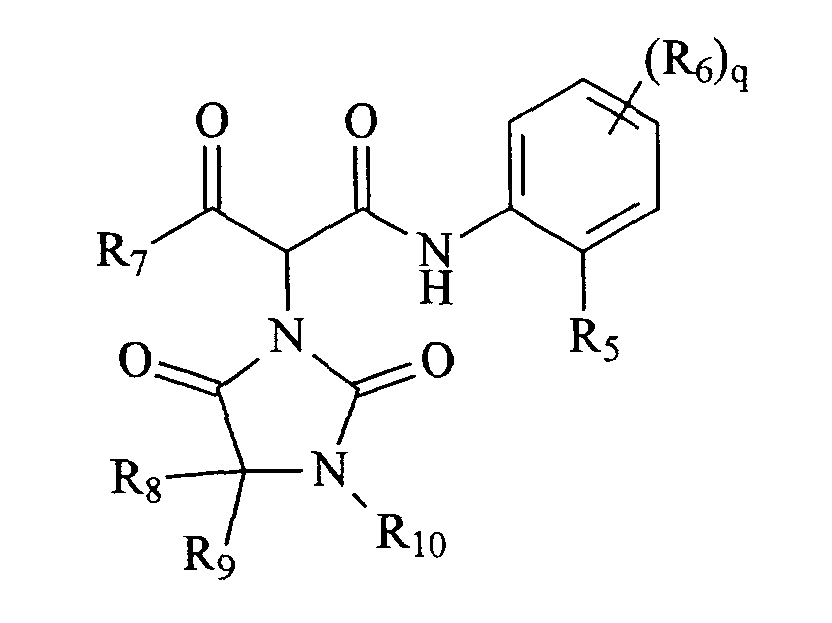


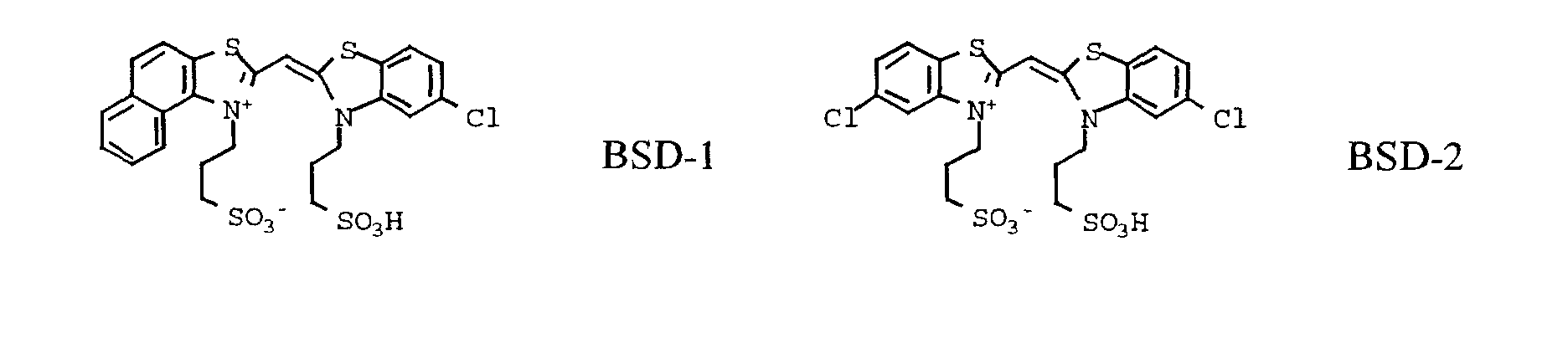




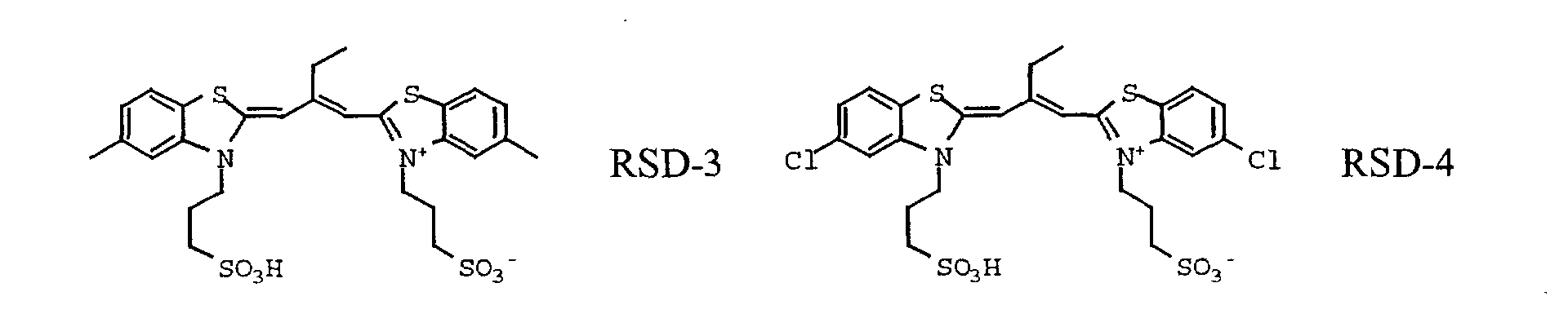


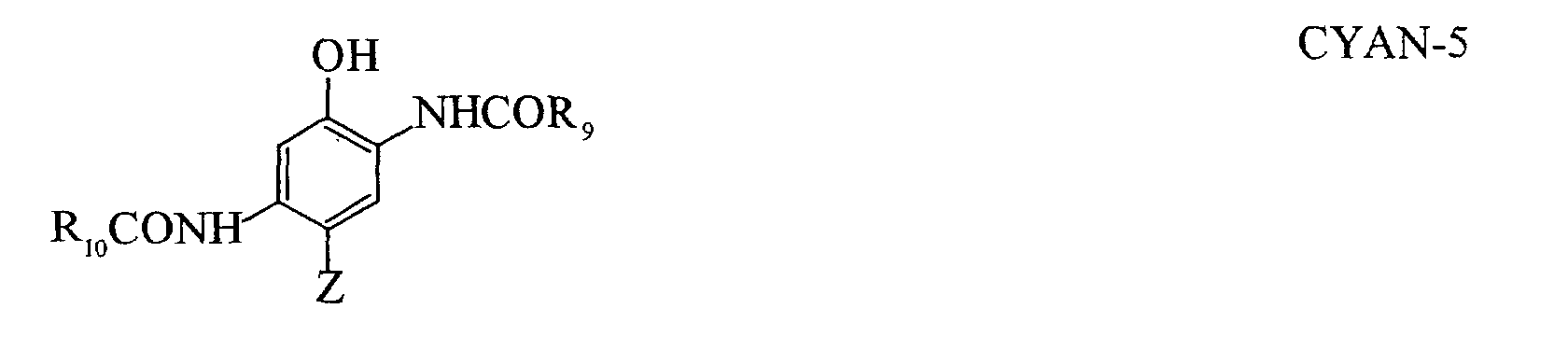
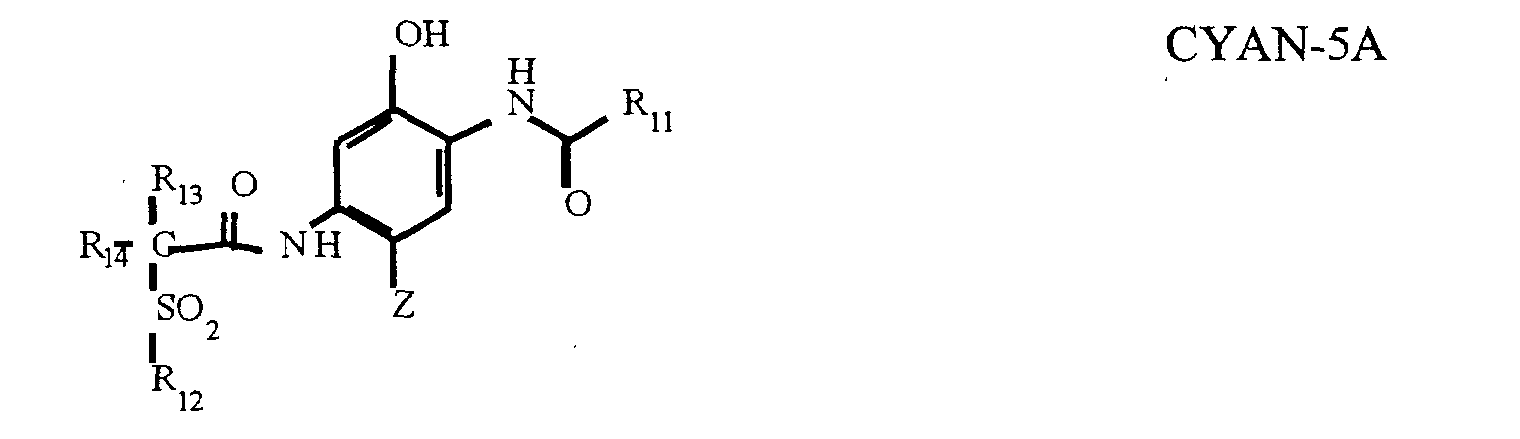




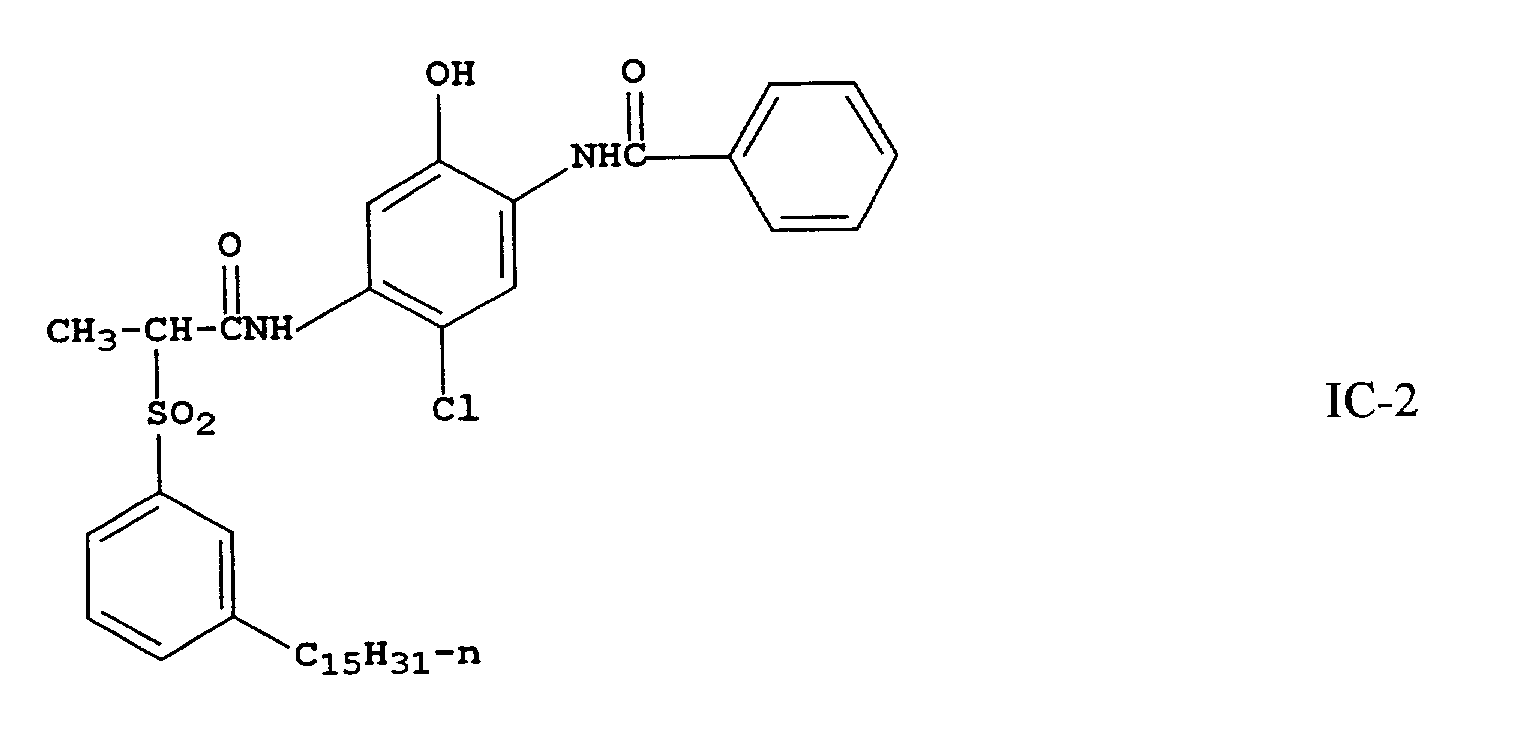

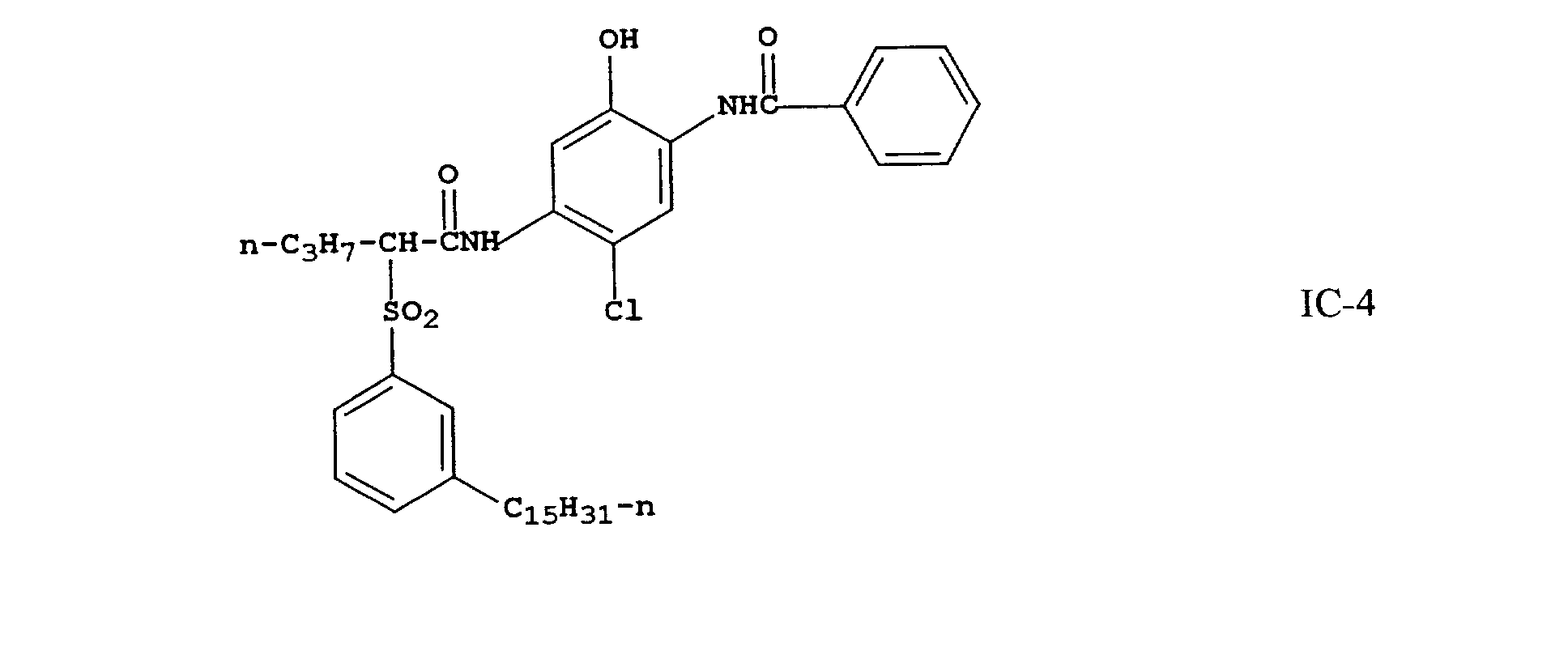
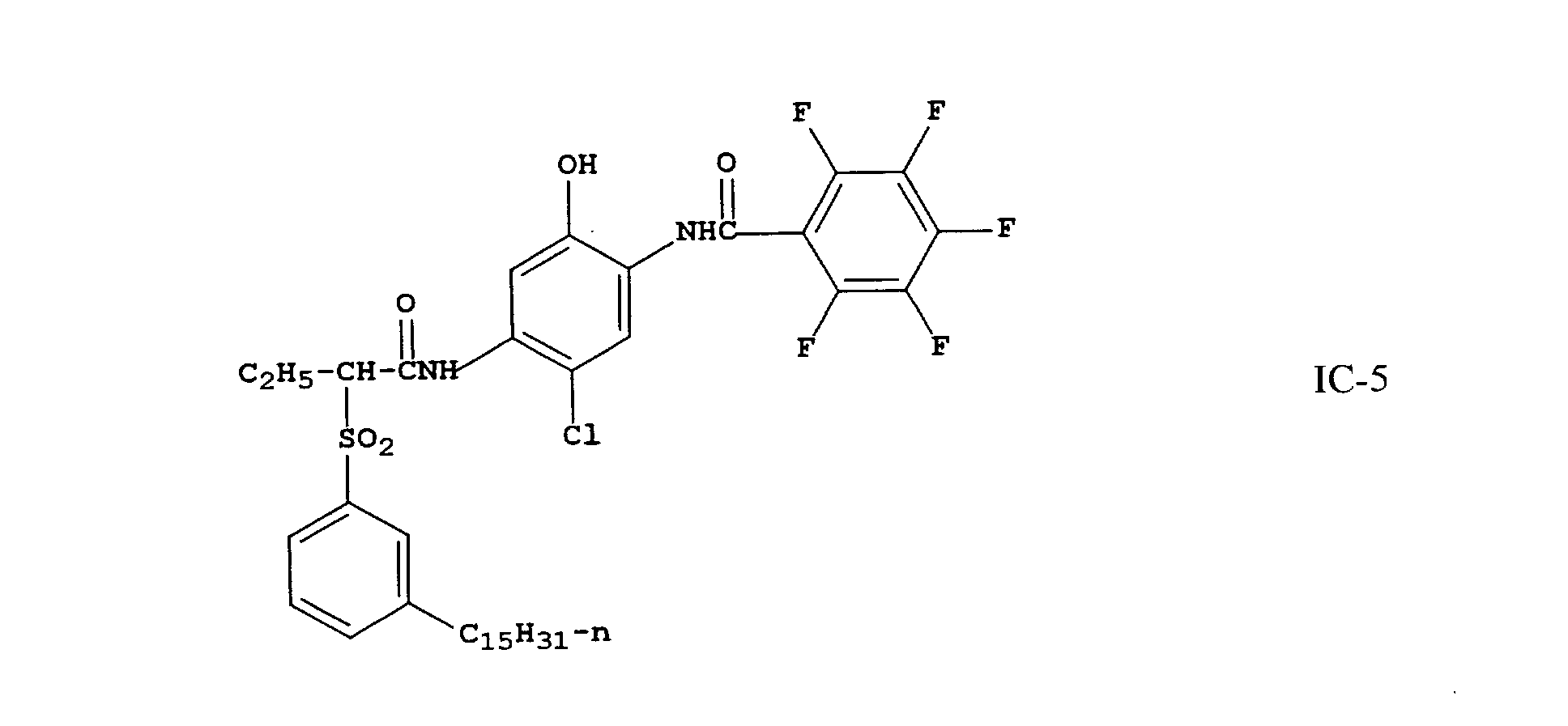
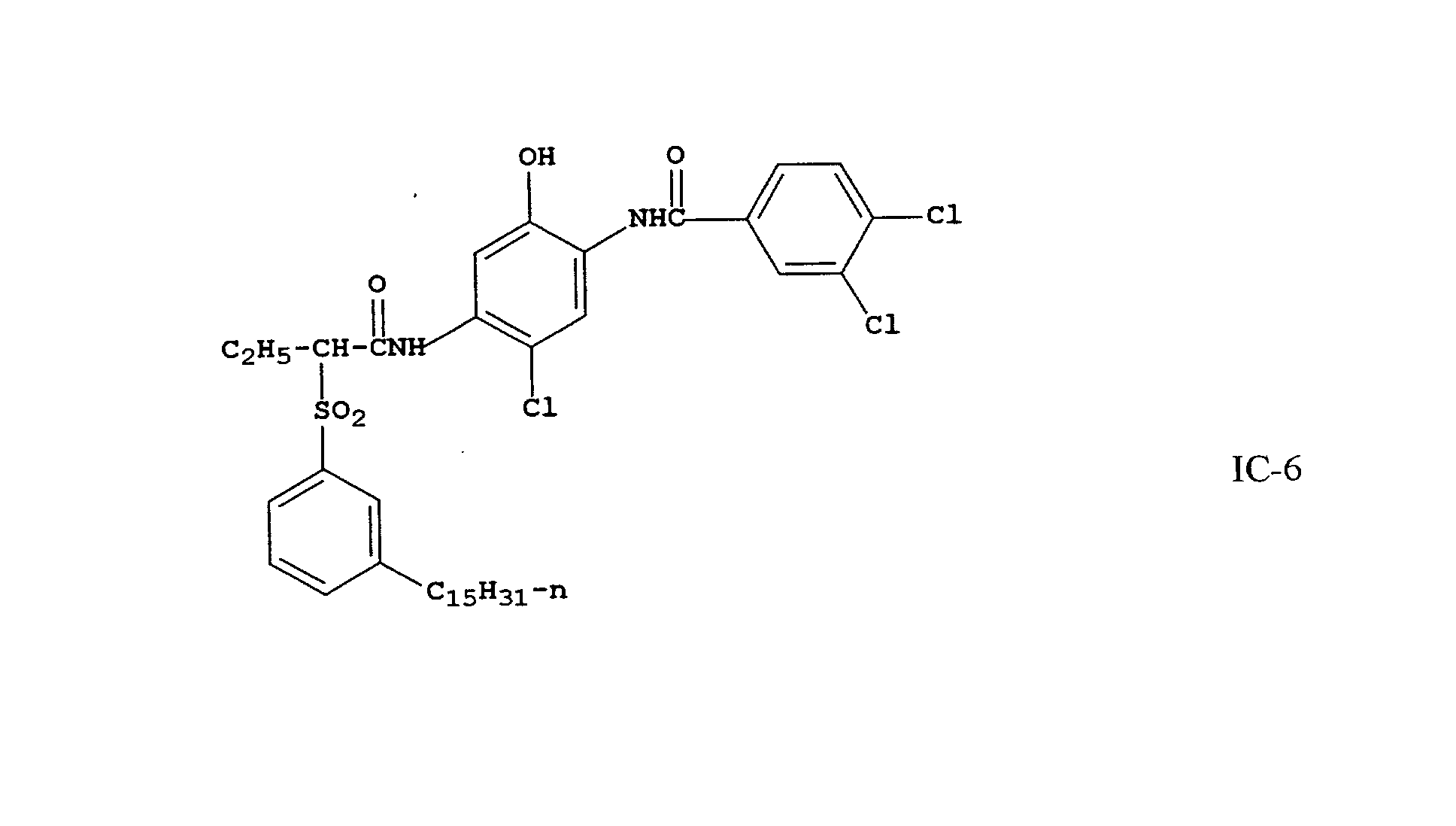

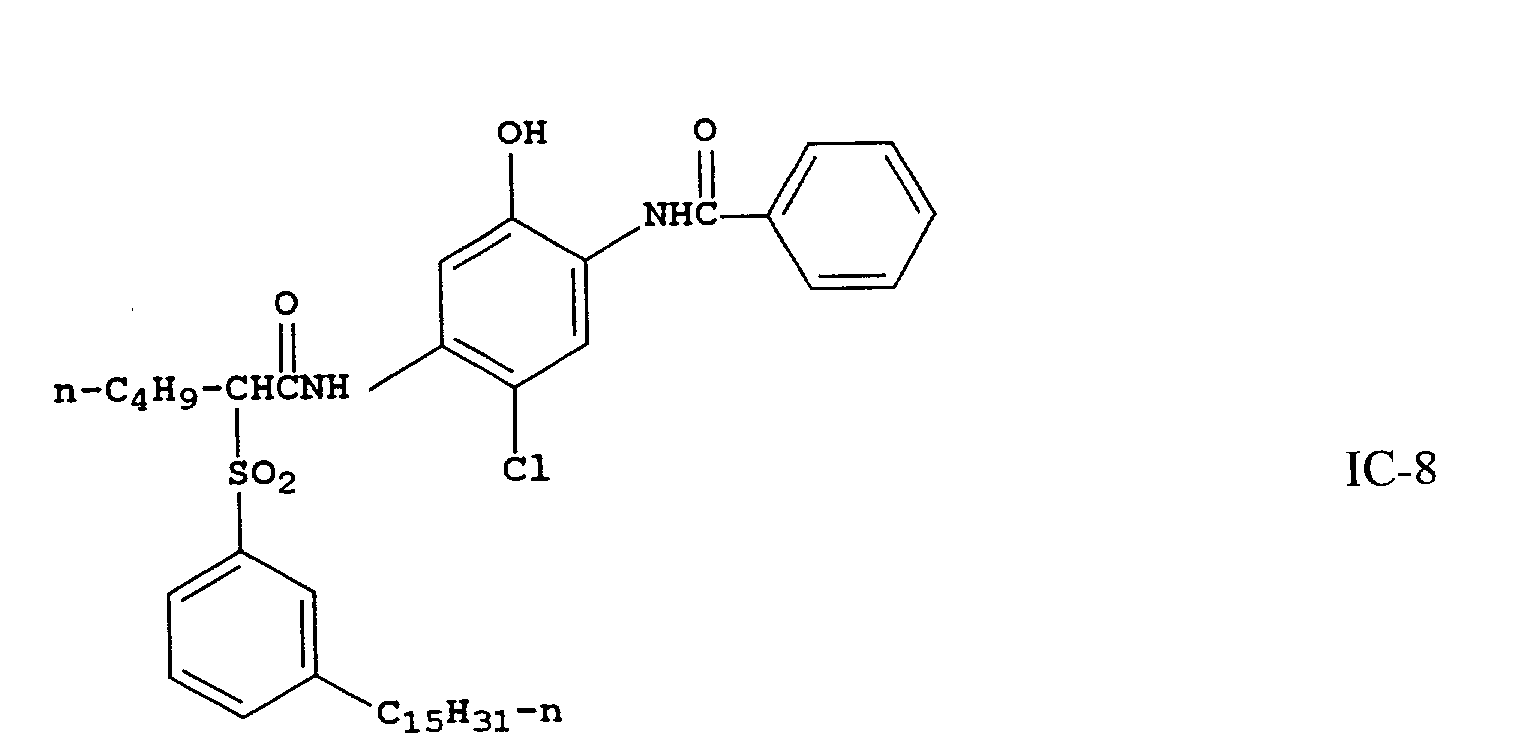
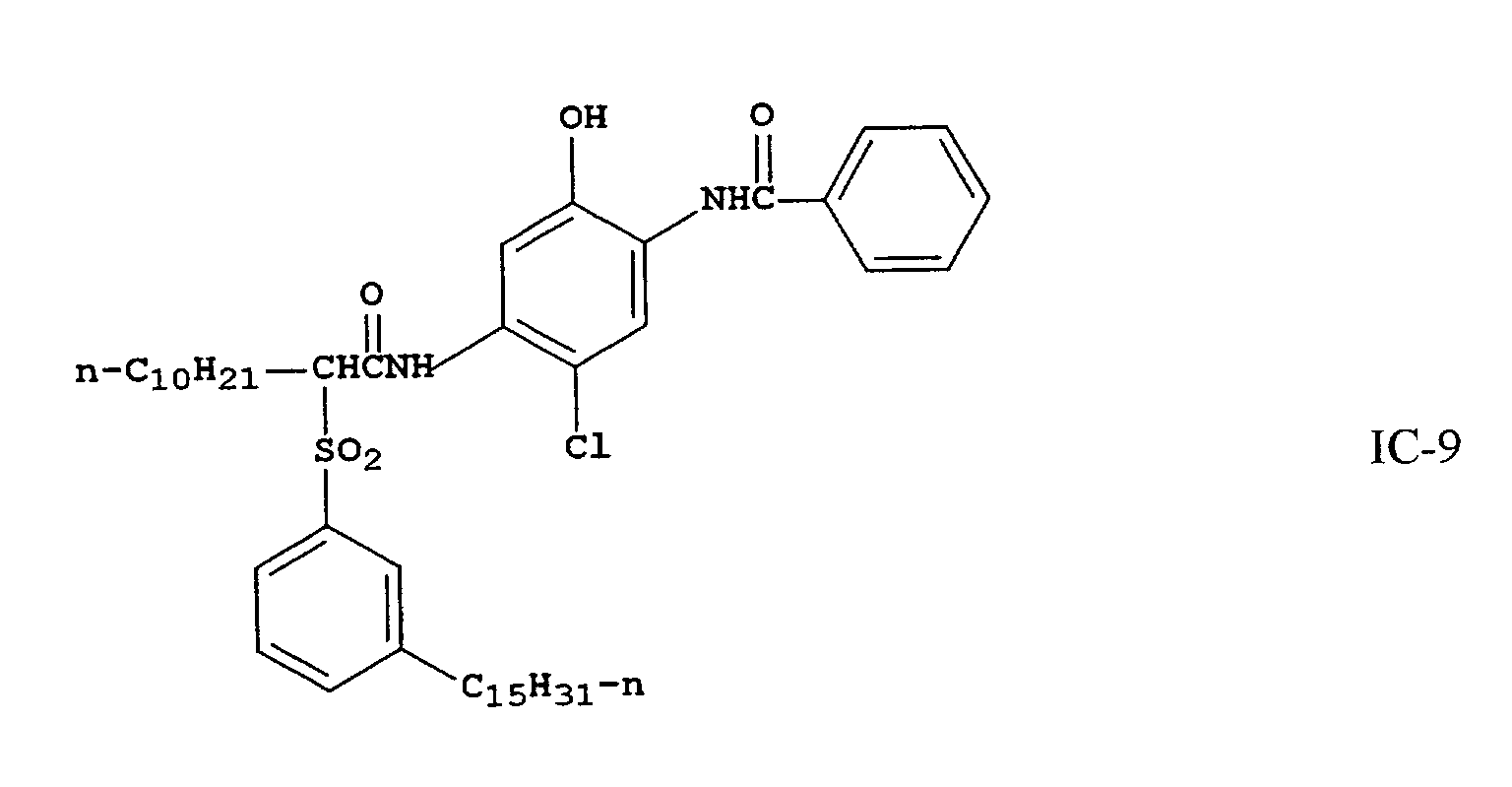

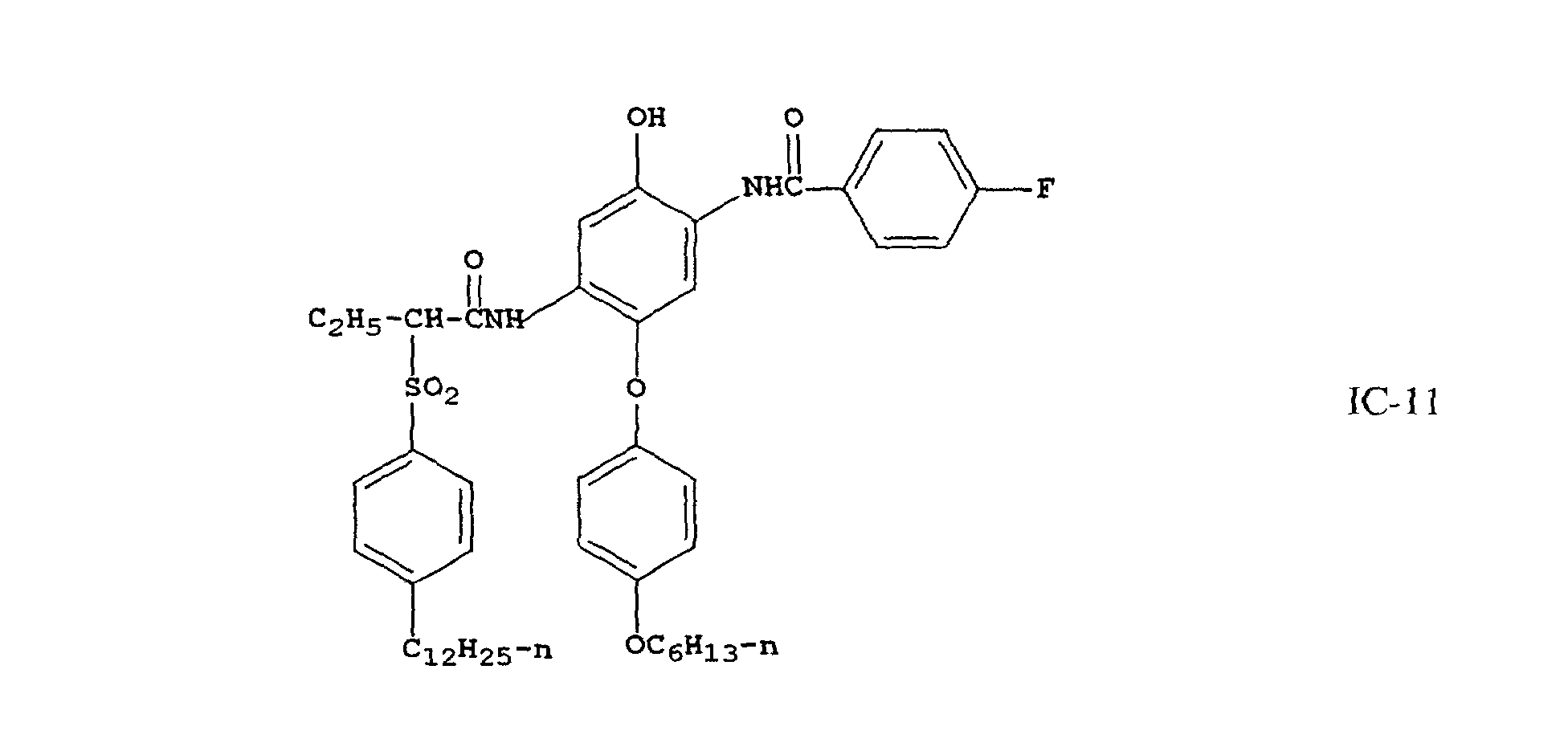
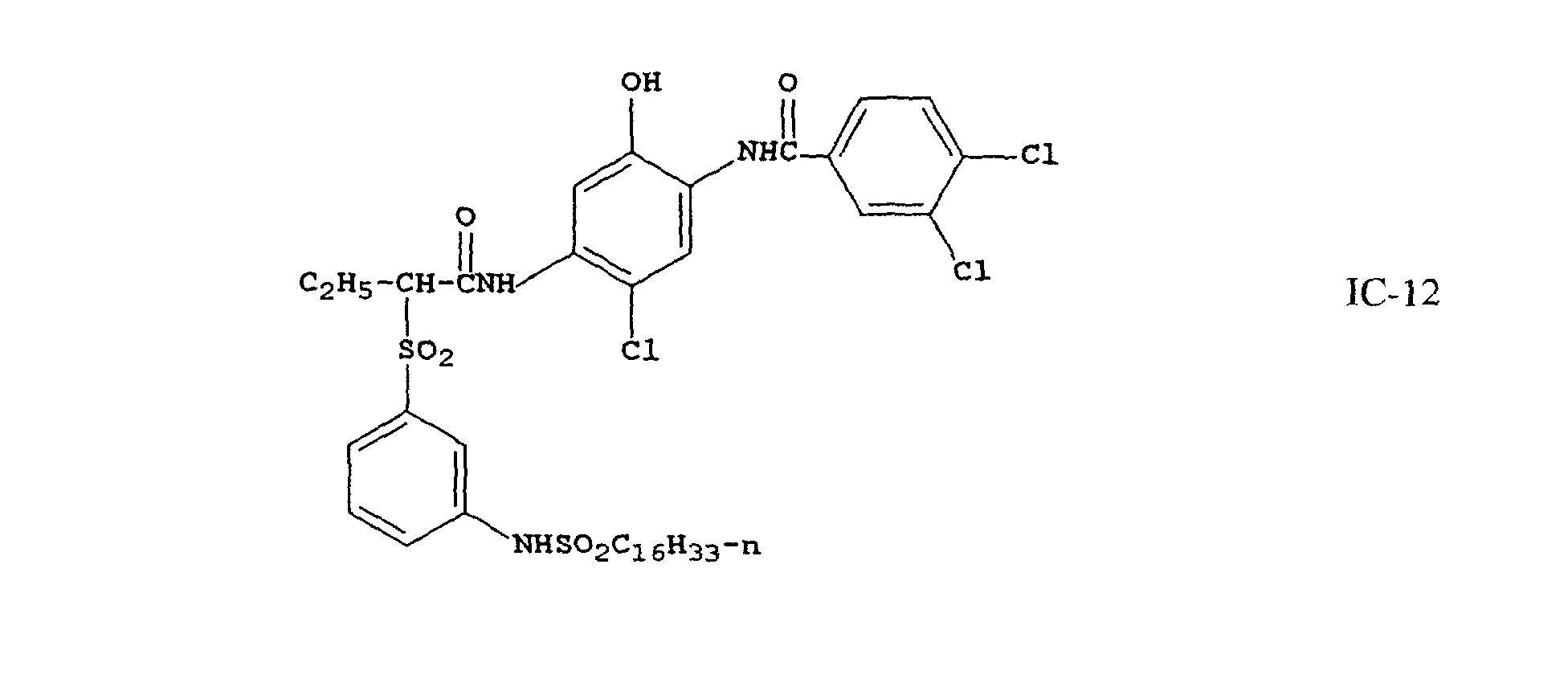

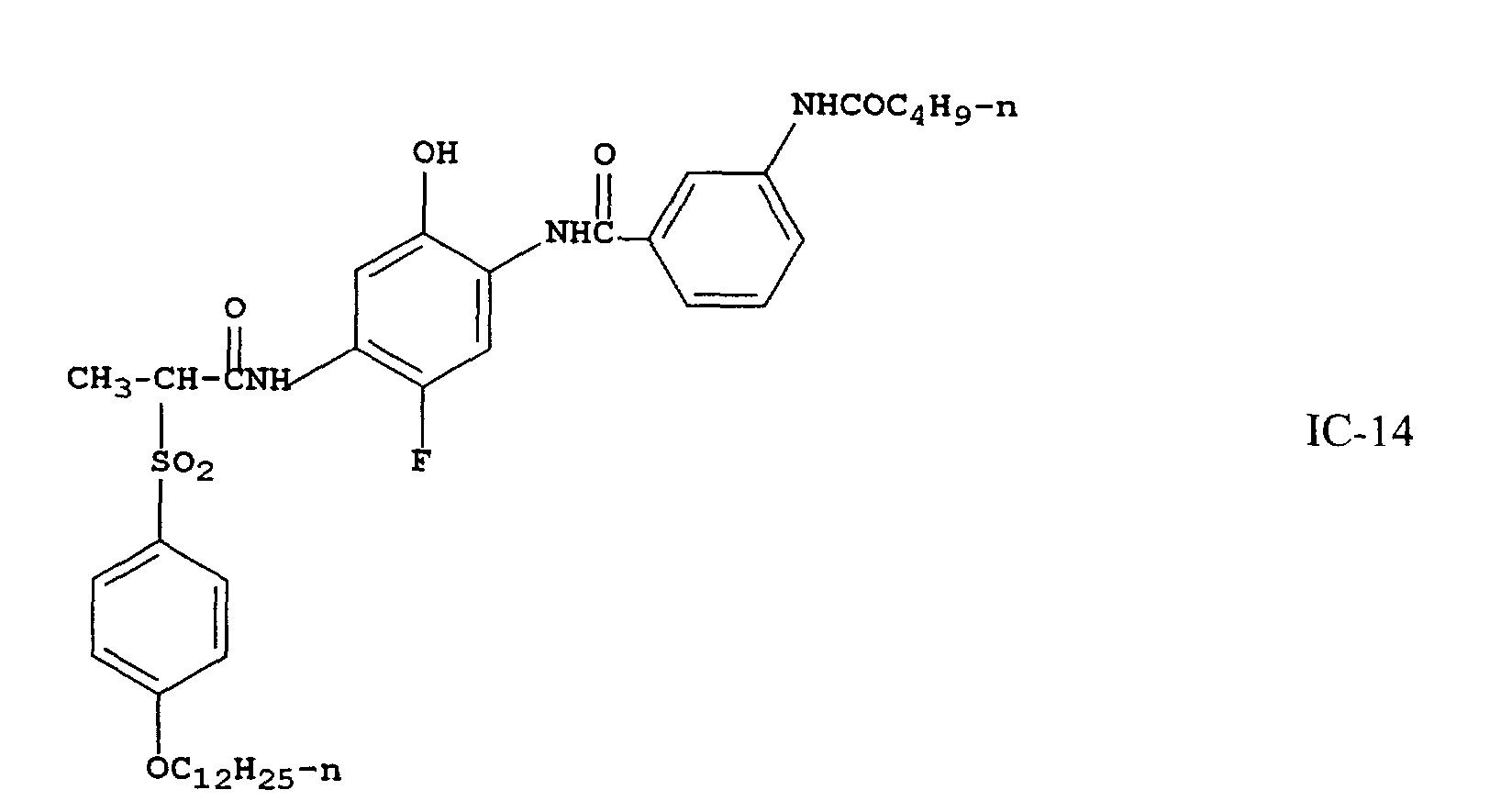
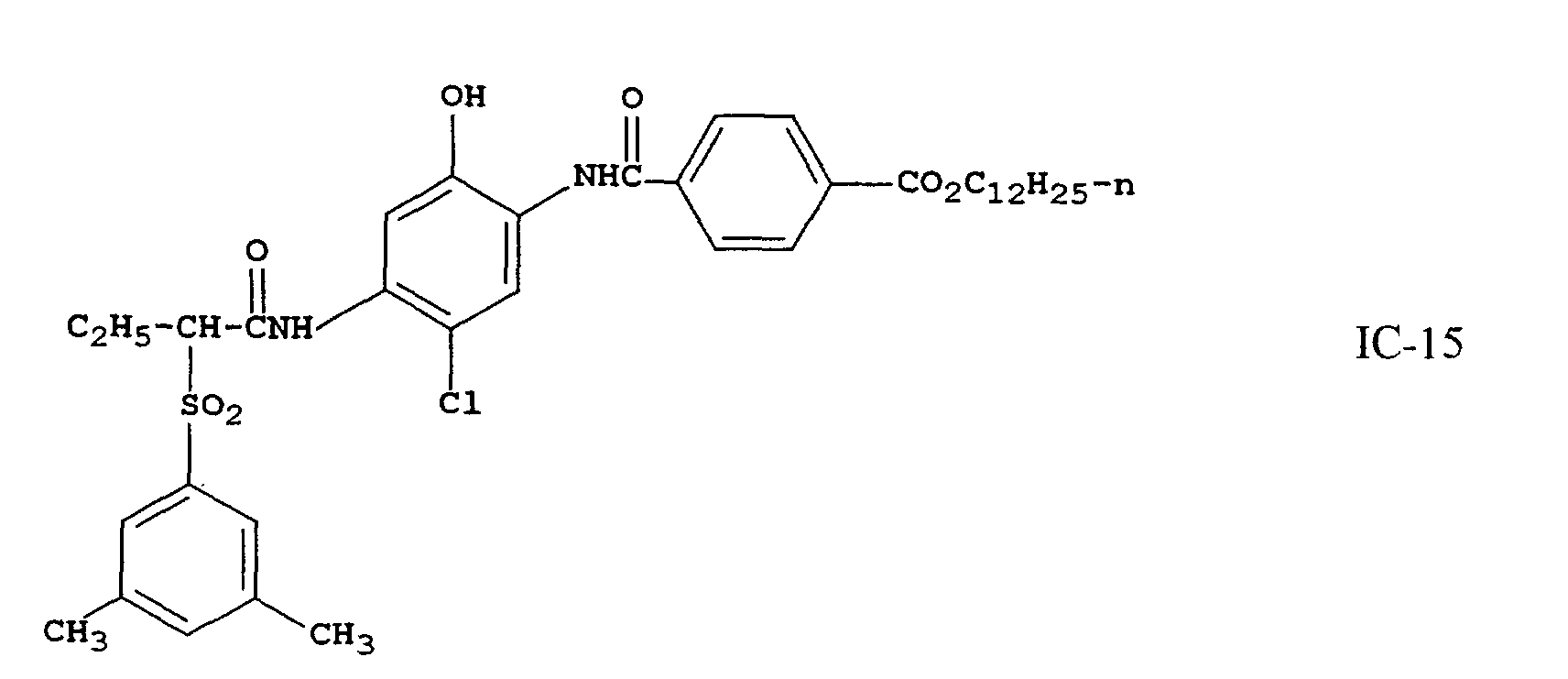
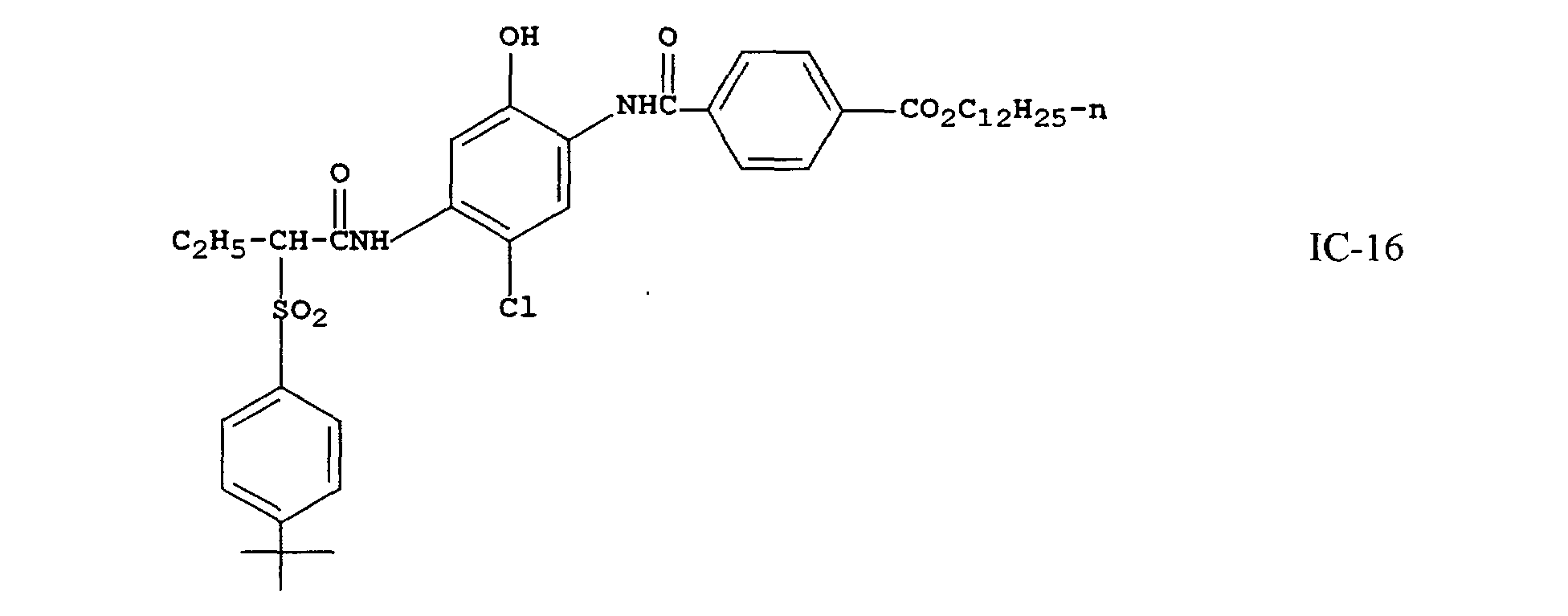
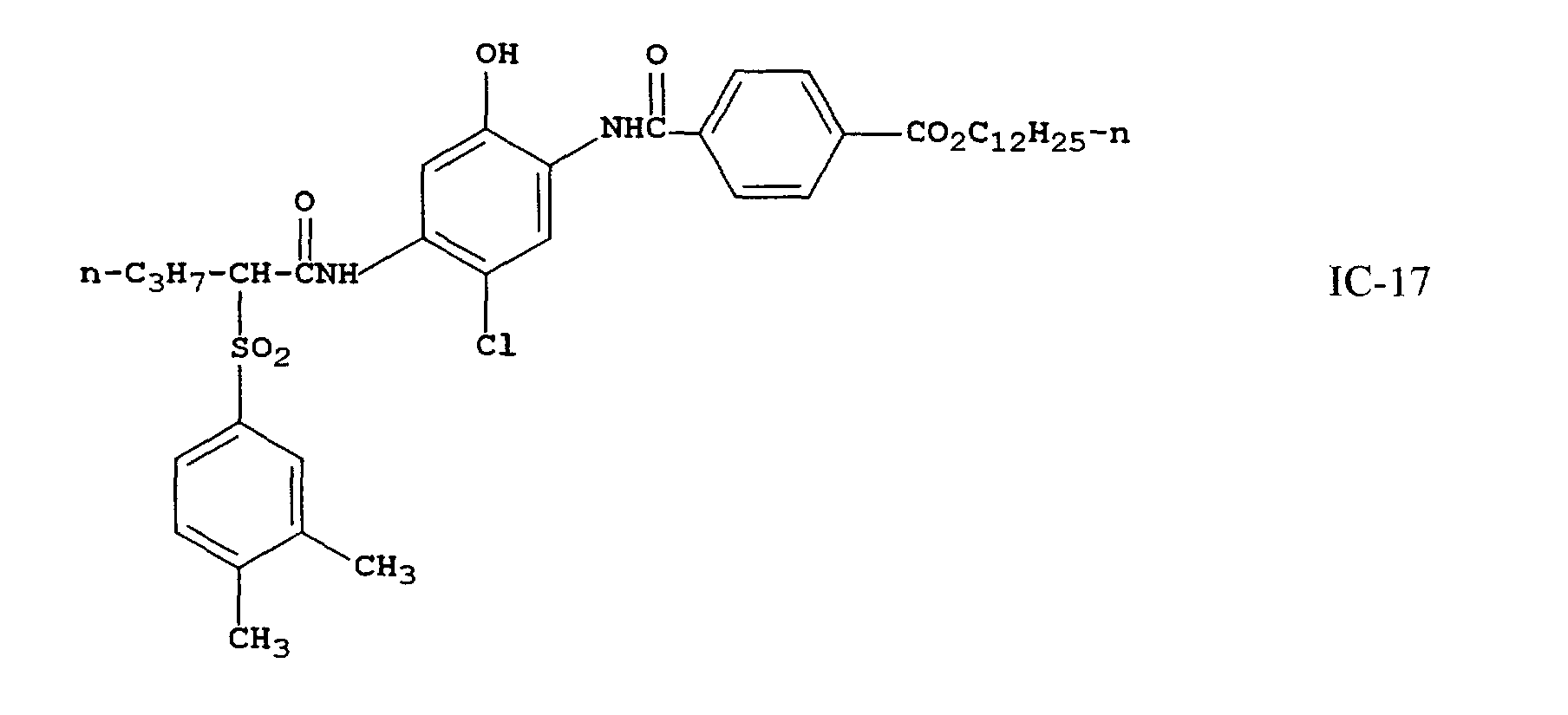


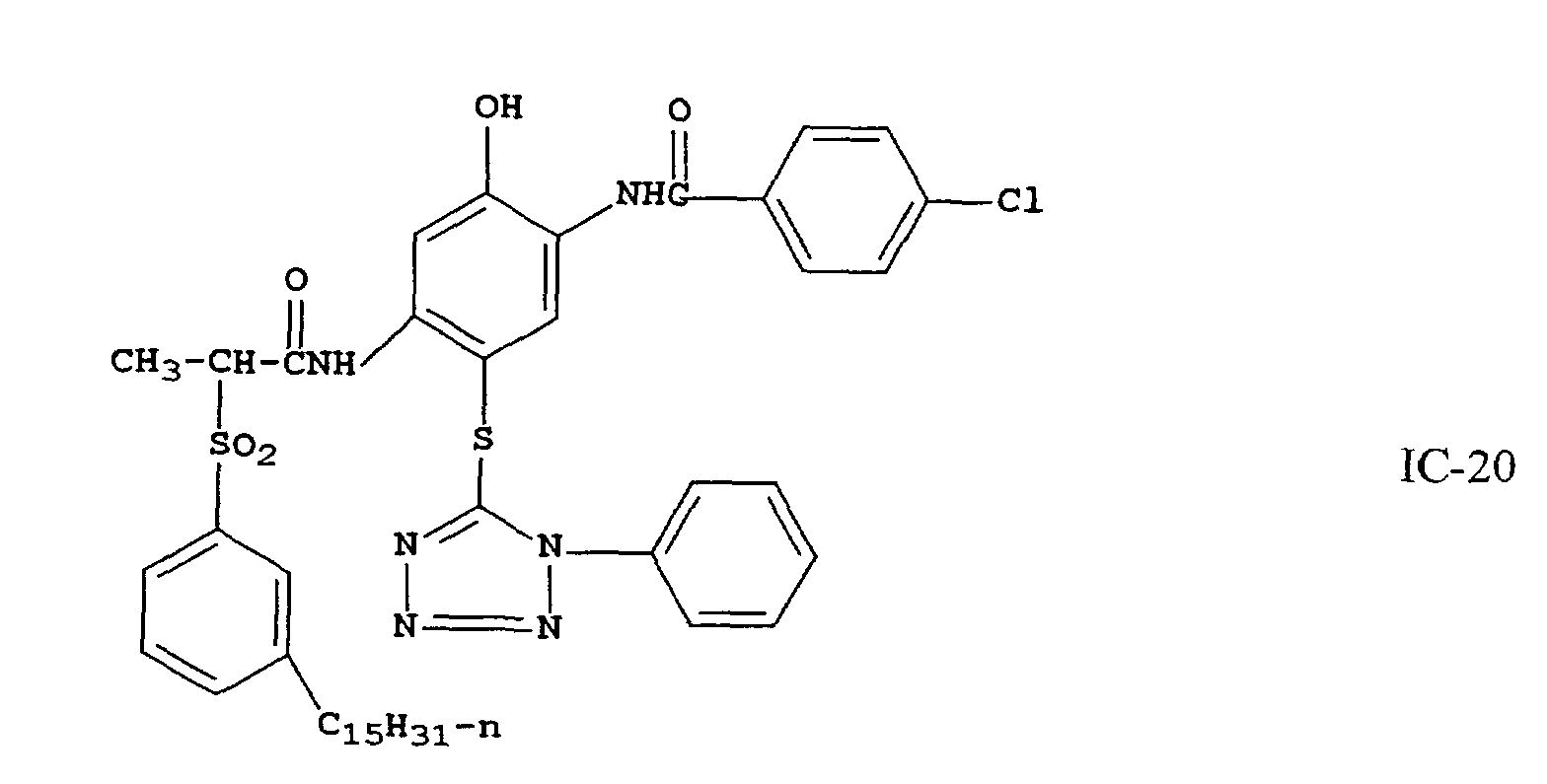
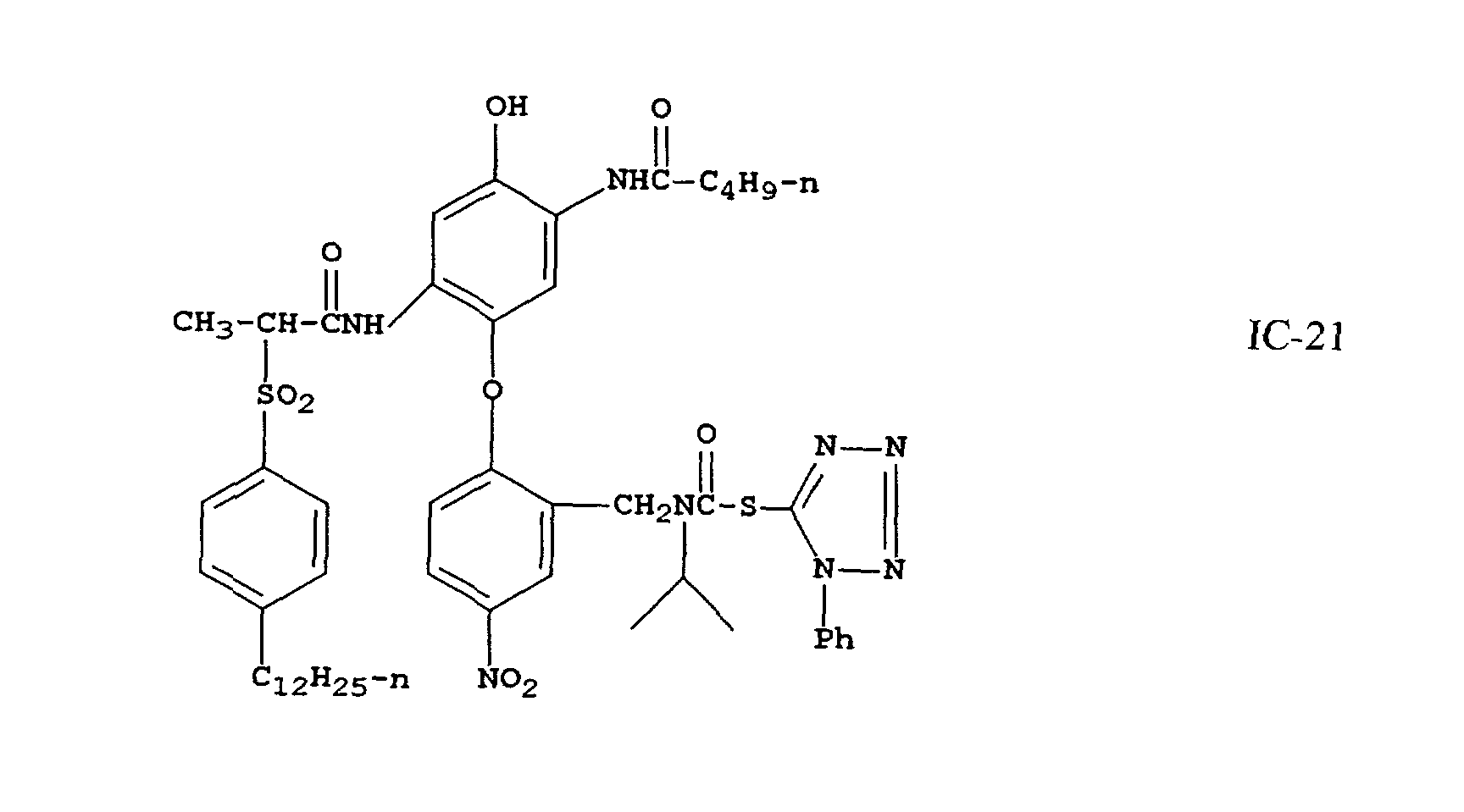
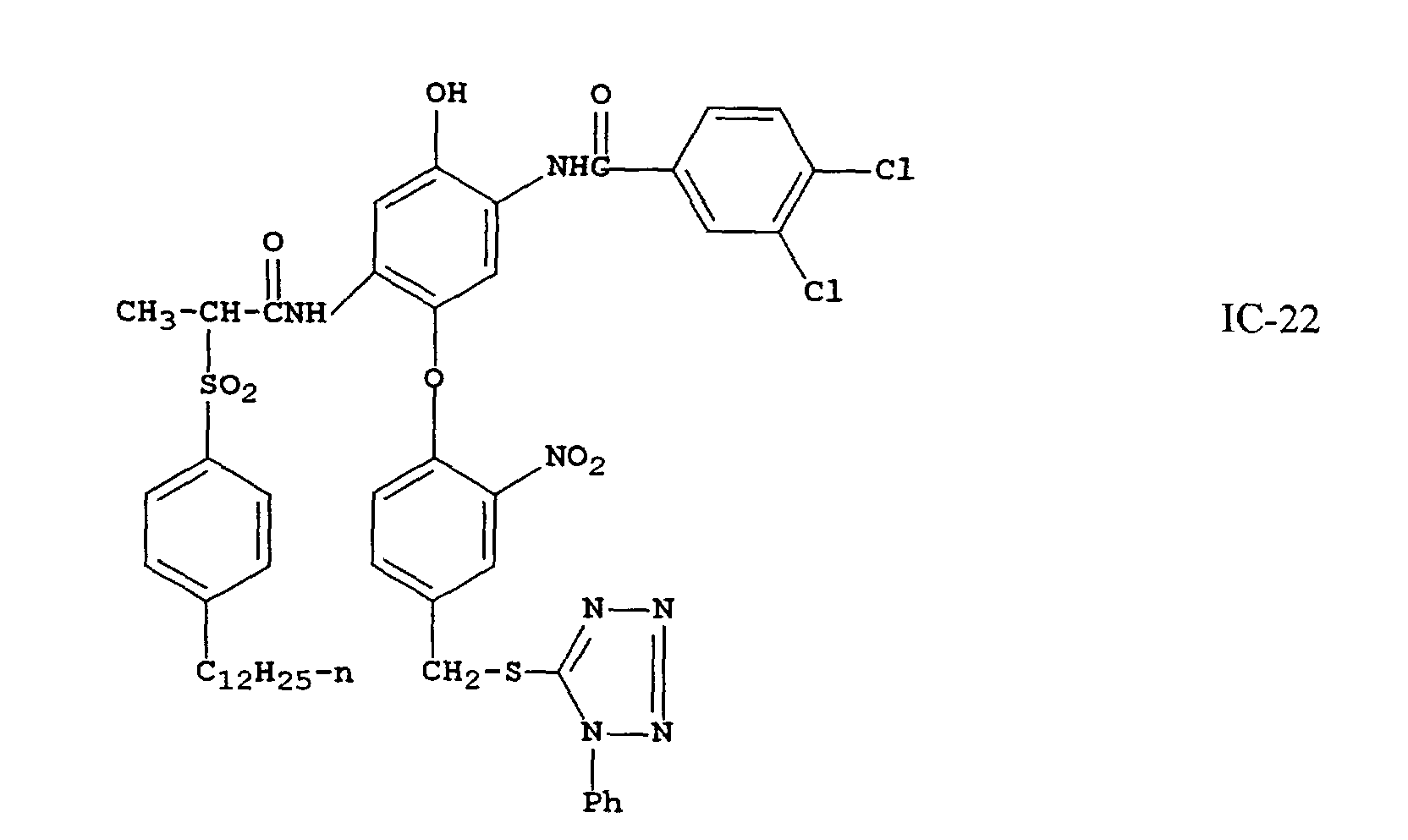
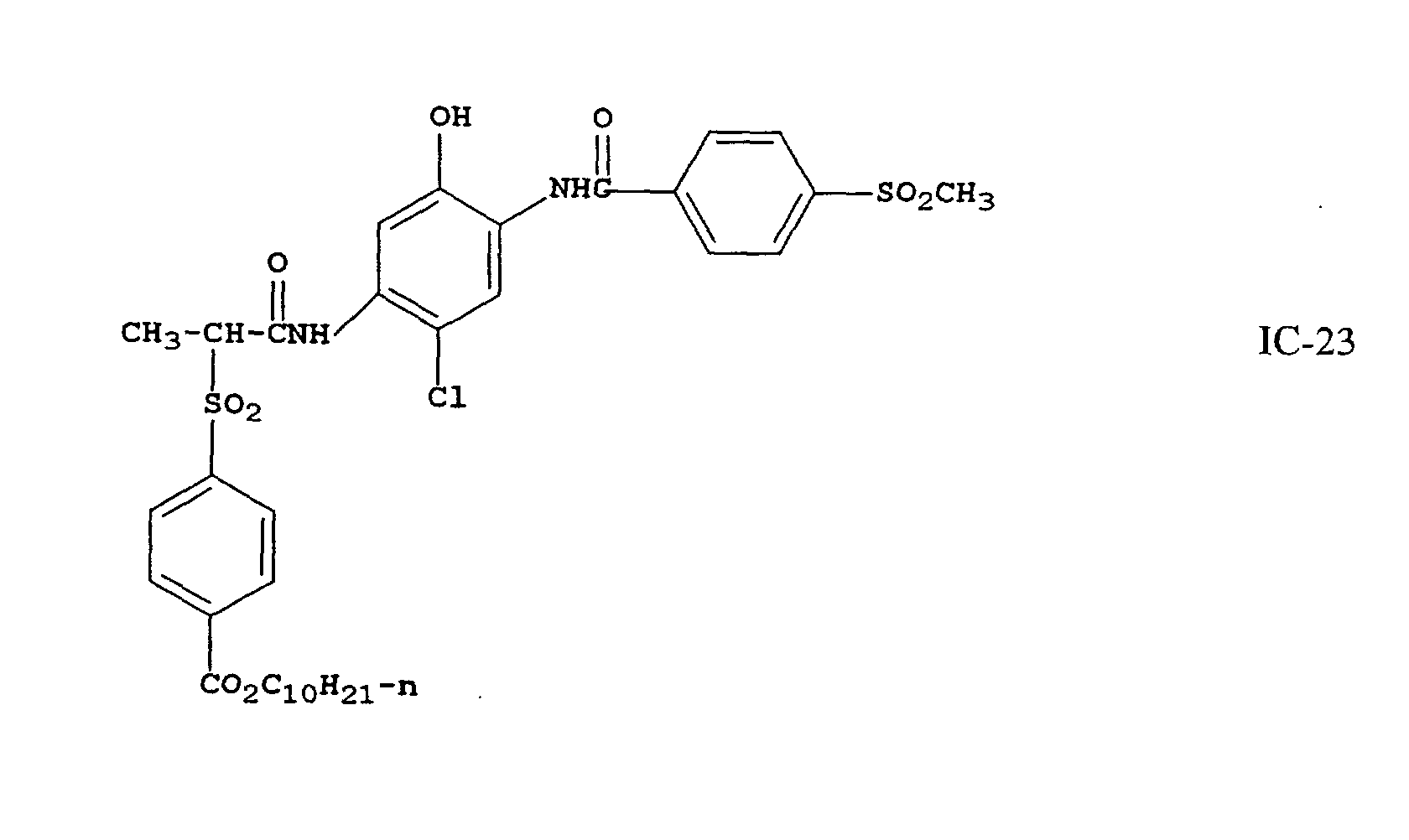

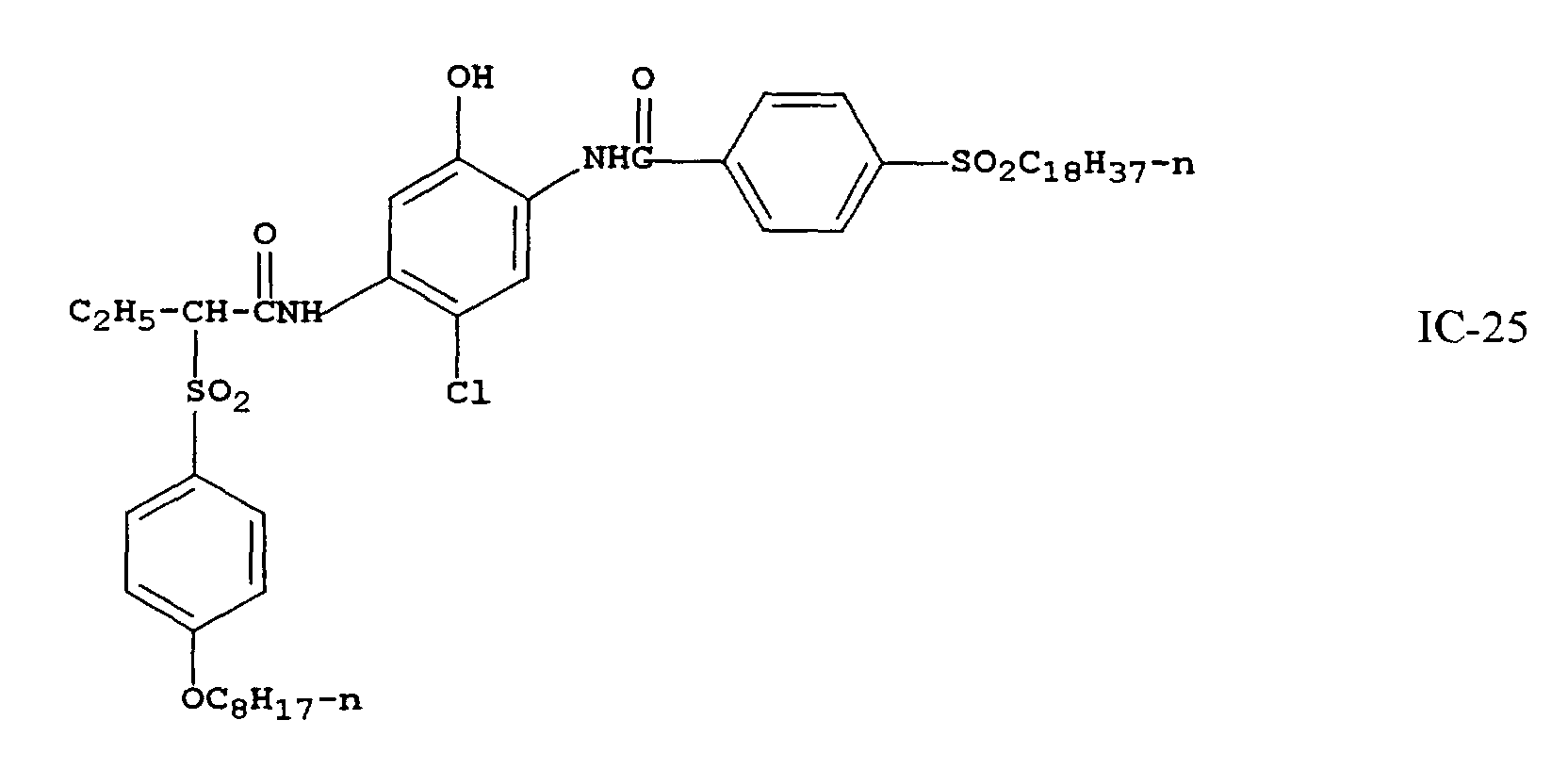


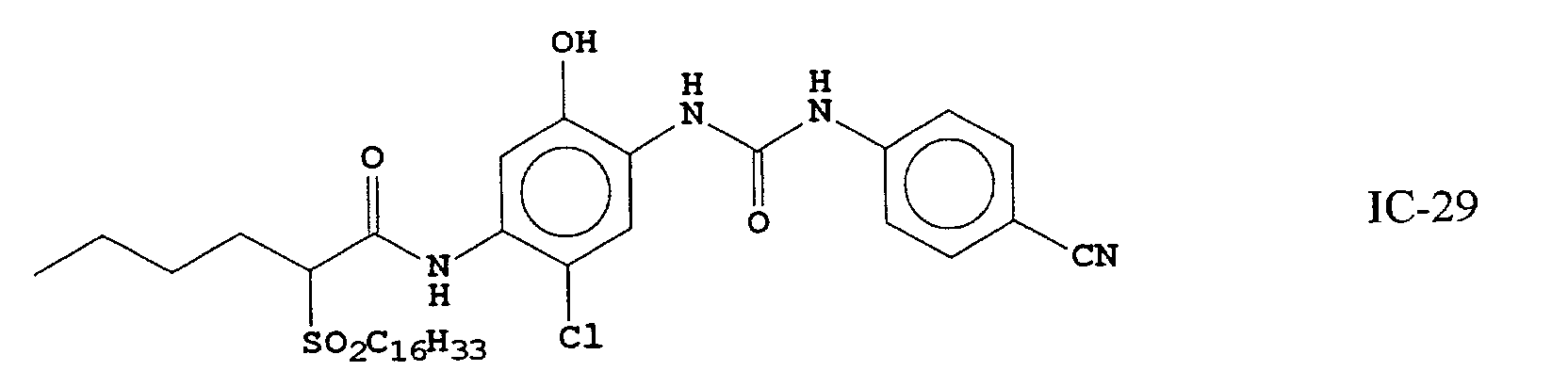
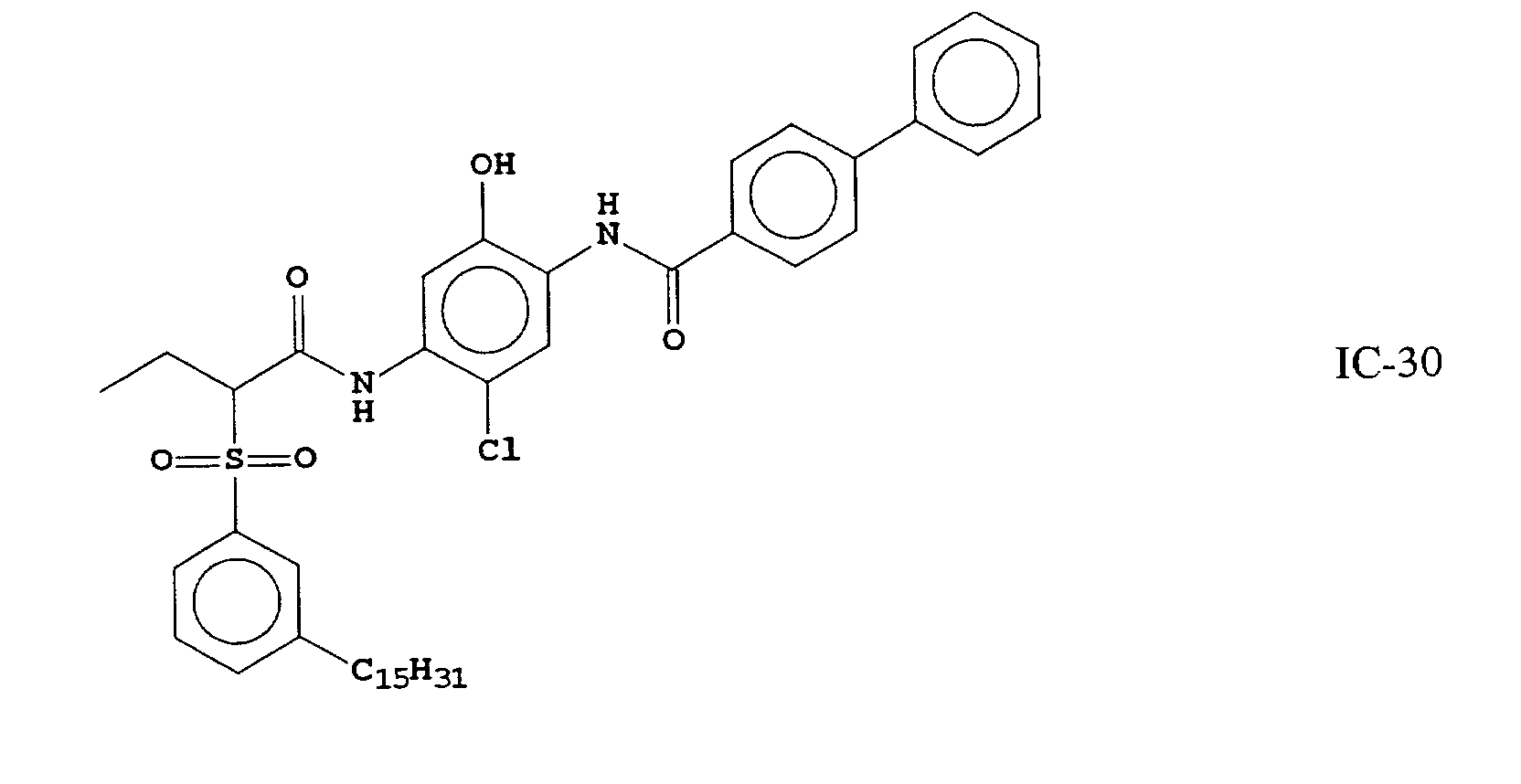

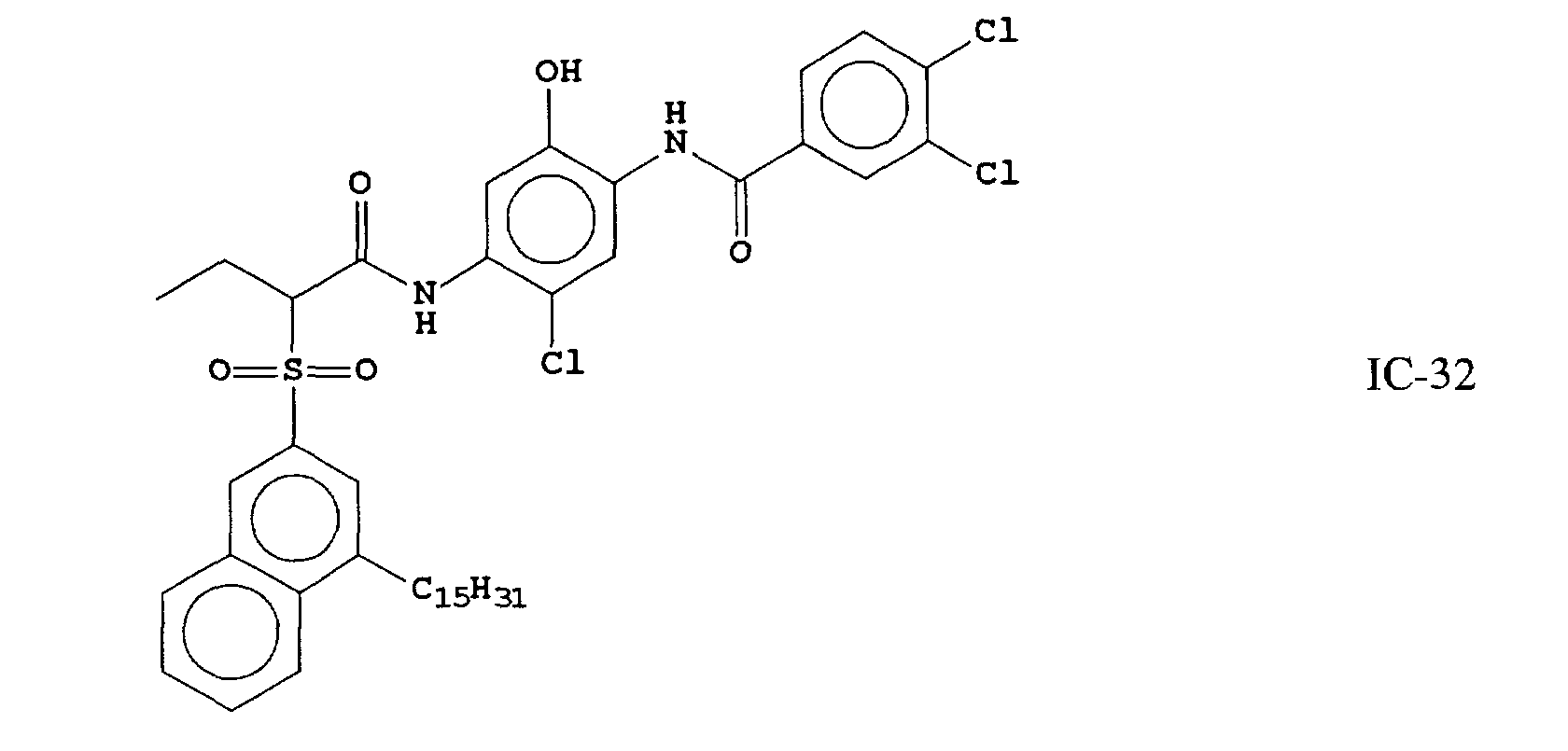

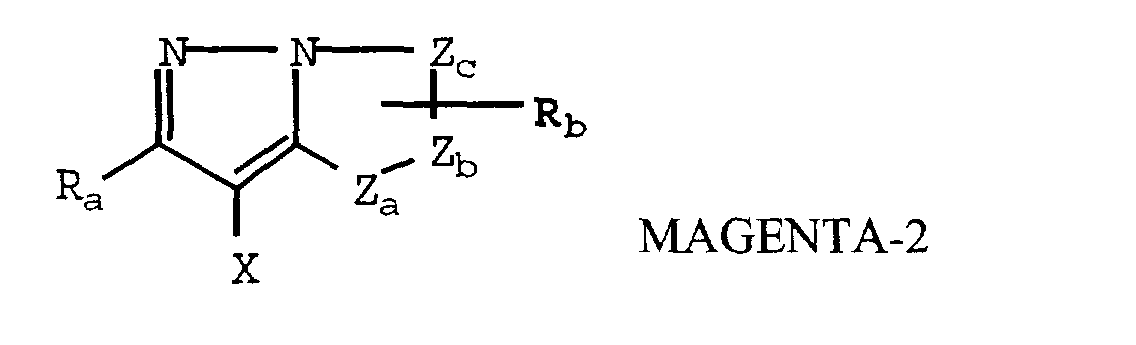
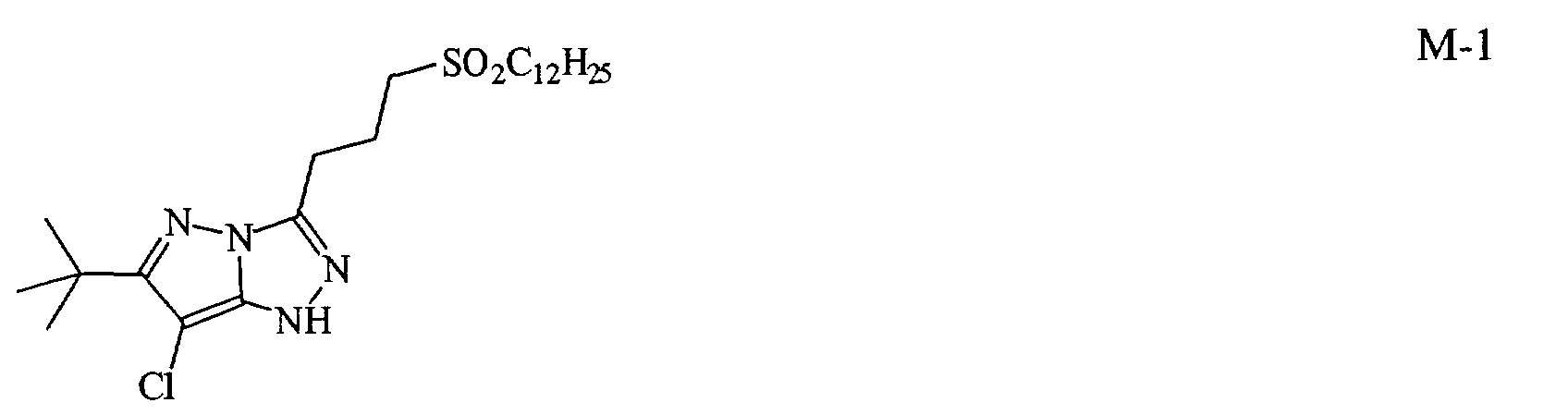
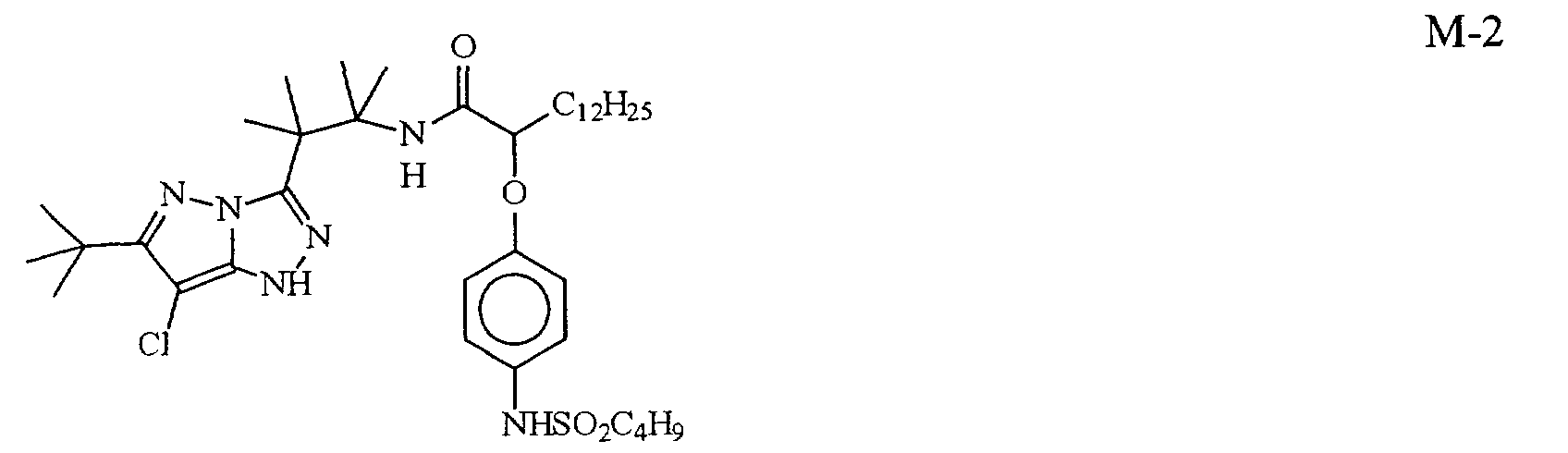


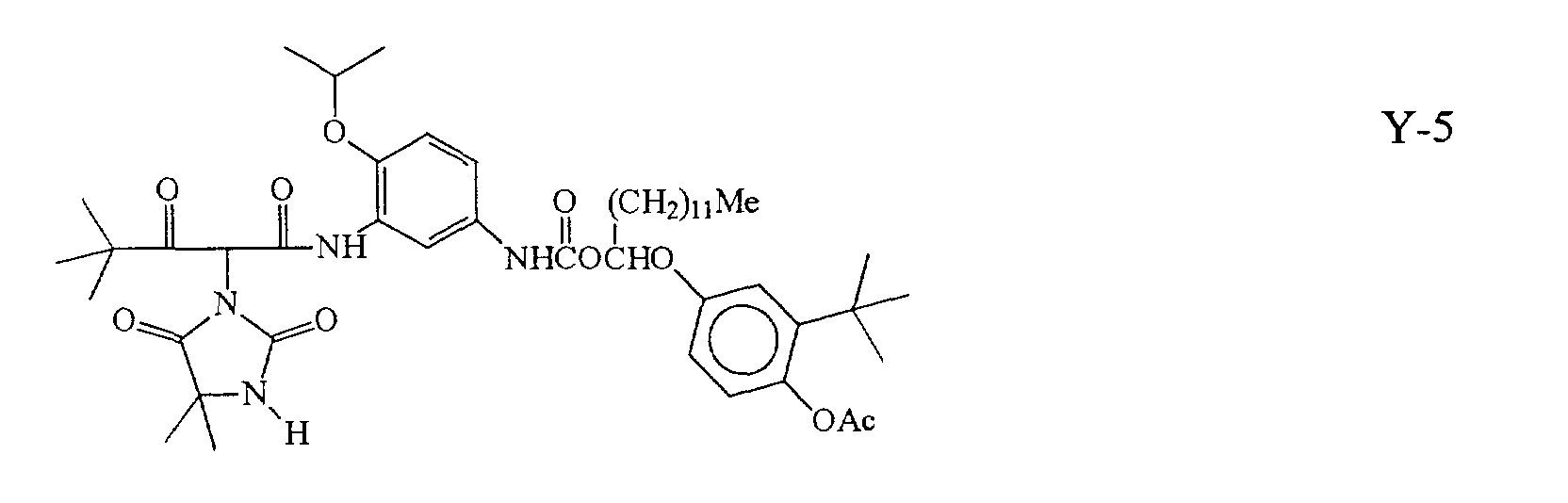





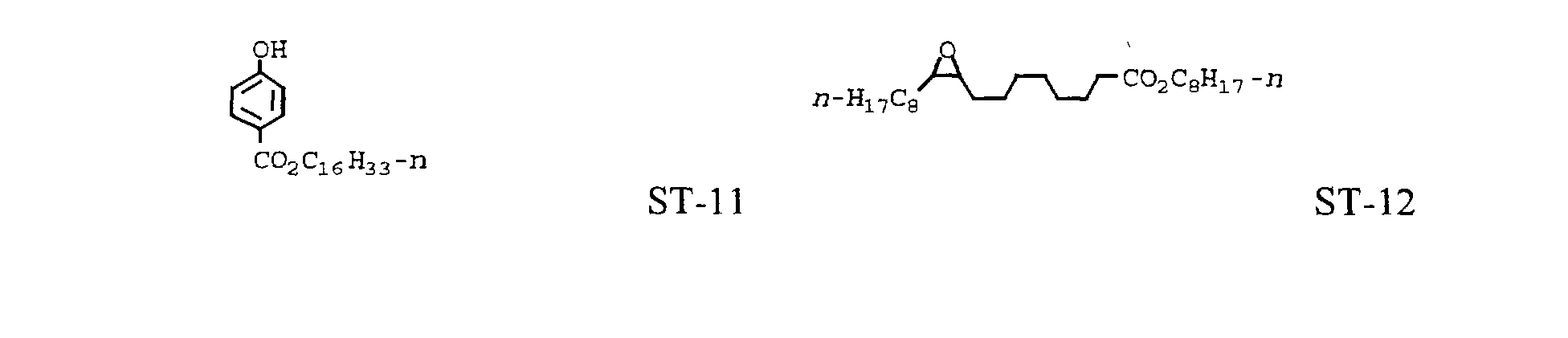











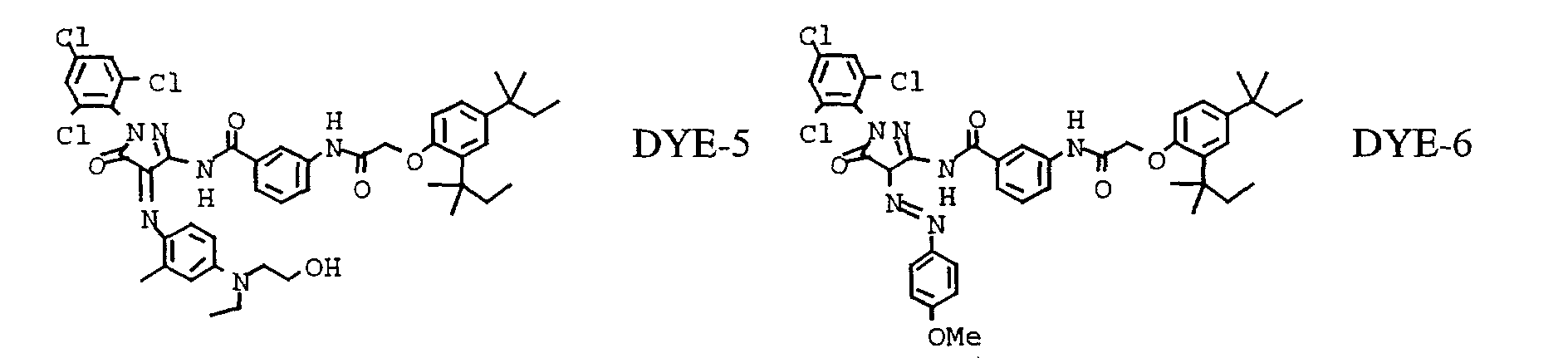
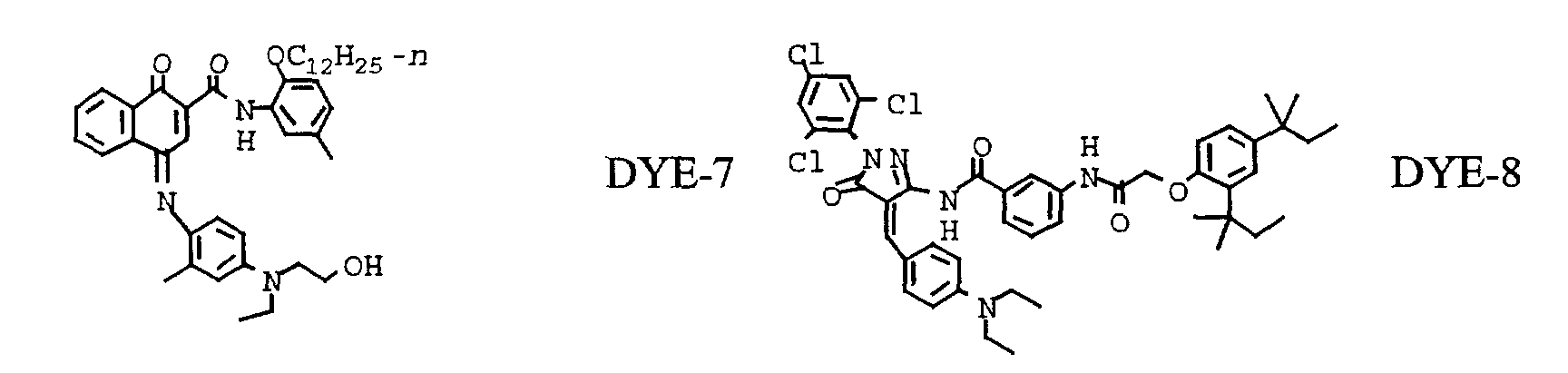


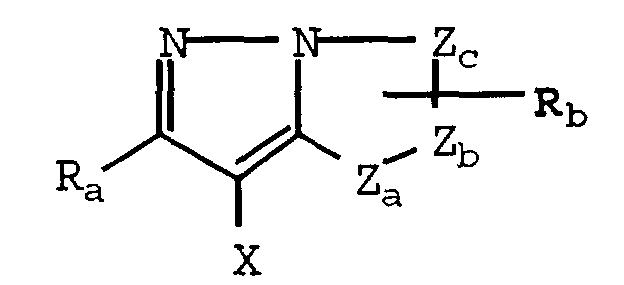
 R5-R10 are substituents. R5 is either an alkoxy group with more than one carbon atom, aryloxy group, anilino group, arylthio group, alkylthio group, or dialkylamino group. R5 groups are linked to the anilide phenyl ring by oxygen, sulfur or nitrogen.R6 is bonded to the -3 through -6 position relative to the anilino nitrogen and is independently selected from a group consisting of hydrogen, halogen, alkoxycarbonyl (-CO2R), carbamoyl (-CONRR'), carbonamido (-NRCOR'), sulfonate (-OSO2R), sulfamoyl (-SO2NRR'), sulfonamido (-NRSO2R'), or sulfonyl (-SO2R). R and R' may be hydrogen or substituted or unsubstituted alkyl or aryl groups. Suitable examples of R and R' groups are ethyl, hexadecyl, 2-ethylhexyl, p-dodecylphenylq is 1 to 4;R7 is either alkyl, cyclic, or multicyclic alkyl, aryl, heterocyclic, heteroaromatic, and amine groups. Suitable examples of R7 include tertiary butyl and 1-adamantyl.R8, R9, and R10 are each independently selected from the group hydrogen, alkyl, aryl, or alkoxy groups. Suitable examples of R8, R9, and R10 include methyl, ethyl, benzyl, and ethoxy.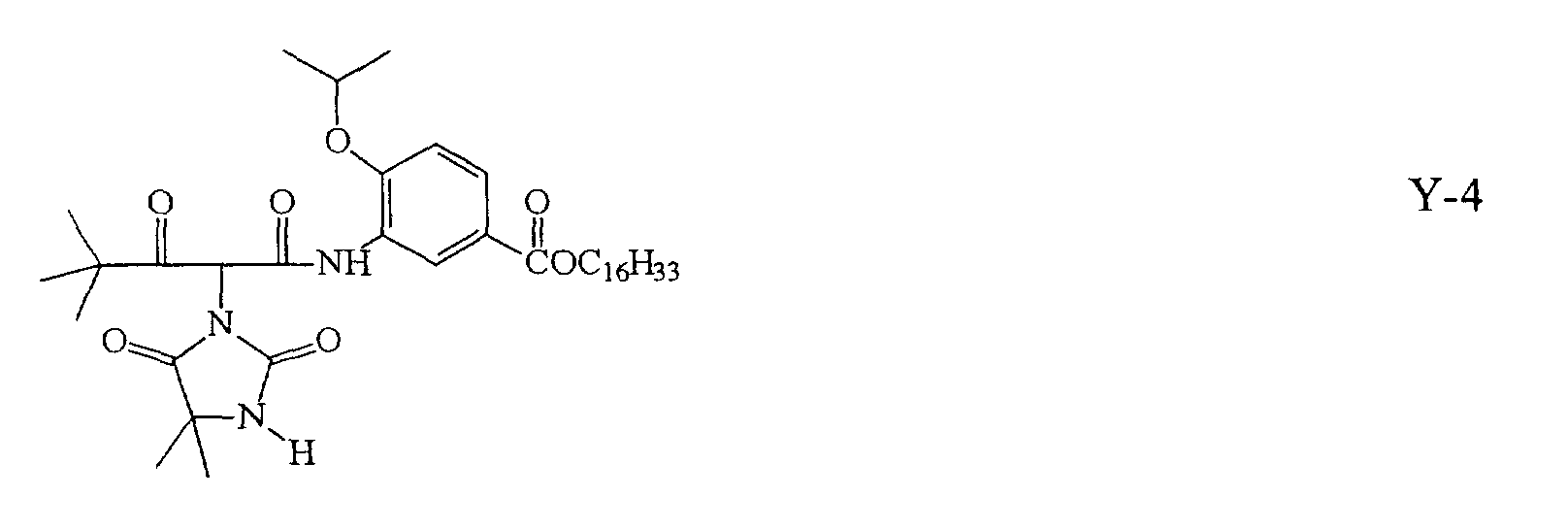
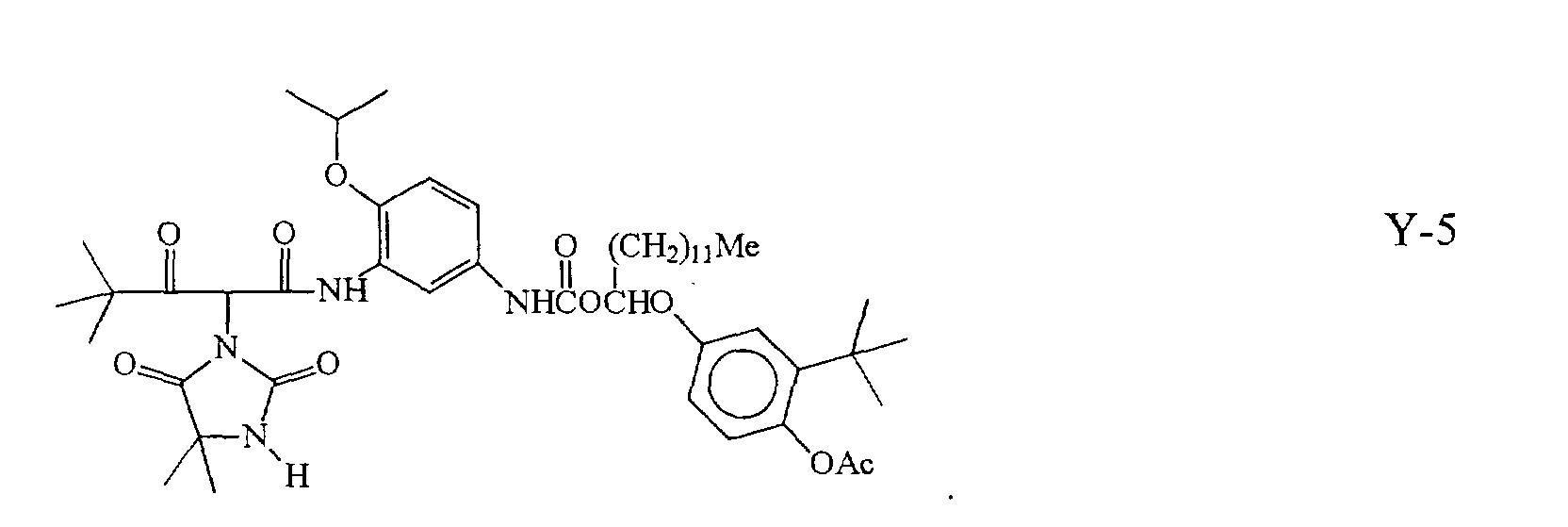
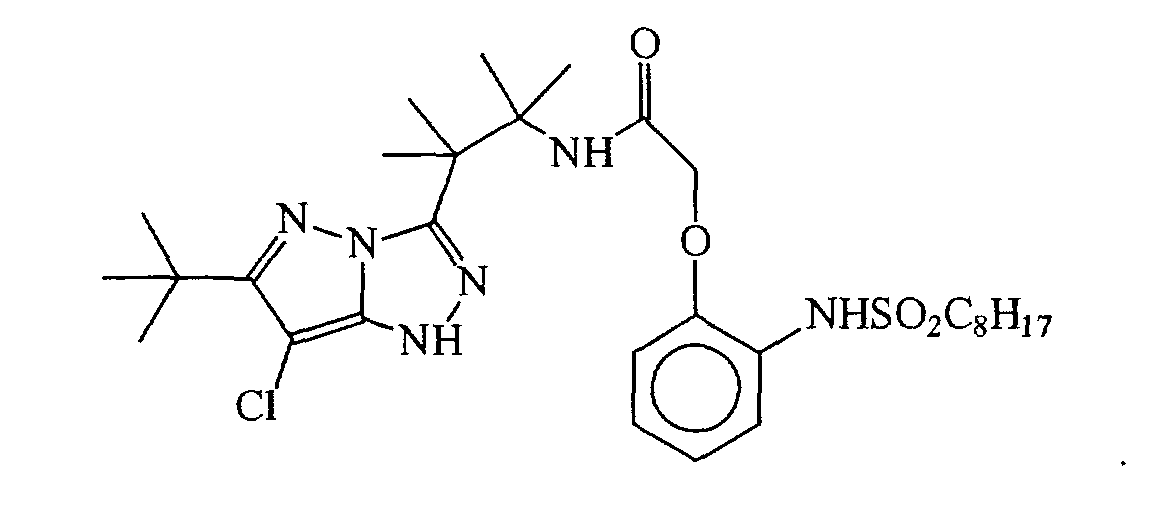
 R9 and R10 are independently selected from unsubstituted or substituted alkyl, aryl, amino, alkoxy and heterocyclyl groups; andZ is a hydrogen atom or a group which can be split off by the reaction of the coupler with an oxidized color developing agent.
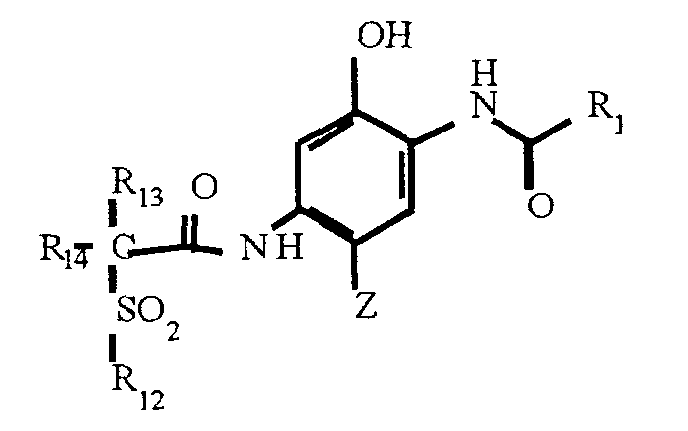 R11 and R12 are independently selected from unsubstituted or substituted alkyl, aryl, amino, alkoxy, and heterocyclyl groups, and Z is as hereinbefore defined. R13 and R14 in CYAN-5A are independently hydrogen or an unsubstituted or substituted alkyl group.