EP1180713A2 - Electrically controllable optical attenuator - Google Patents
Electrically controllable optical attenuator Download PDFInfo
- Publication number
- EP1180713A2 EP1180713A2 EP01111358A EP01111358A EP1180713A2 EP 1180713 A2 EP1180713 A2 EP 1180713A2 EP 01111358 A EP01111358 A EP 01111358A EP 01111358 A EP01111358 A EP 01111358A EP 1180713 A2 EP1180713 A2 EP 1180713A2
- Authority
- EP
- European Patent Office
- Prior art keywords
- chamber
- attenuator
- liquid droplet
- droplet
- optical waveguide
- Prior art date
- Legal status (The legal status is an assumption and is not a legal conclusion. Google has not performed a legal analysis and makes no representation as to the accuracy of the status listed.)
- Granted
Links
Images


Classifications
-
- G—PHYSICS
- G02—OPTICS
- G02B—OPTICAL ELEMENTS, SYSTEMS OR APPARATUS
- G02B6/00—Light guides; Structural details of arrangements comprising light guides and other optical elements, e.g. couplings
- G02B6/24—Coupling light guides
- G02B6/26—Optical coupling means
- G02B6/35—Optical coupling means having switching means
- G02B6/3538—Optical coupling means having switching means based on displacement or deformation of a liquid
-
- G—PHYSICS
- G02—OPTICS
- G02B—OPTICAL ELEMENTS, SYSTEMS OR APPARATUS
- G02B26/00—Optical devices or arrangements for the control of light using movable or deformable optical elements
- G02B26/004—Optical devices or arrangements for the control of light using movable or deformable optical elements based on a displacement or a deformation of a fluid
-
- G—PHYSICS
- G02—OPTICS
- G02B—OPTICAL ELEMENTS, SYSTEMS OR APPARATUS
- G02B6/00—Light guides; Structural details of arrangements comprising light guides and other optical elements, e.g. couplings
- G02B6/24—Coupling light guides
- G02B6/26—Optical coupling means
- G02B6/264—Optical coupling means with optical elements between opposed fibre ends which perform a function other than beam splitting
- G02B6/266—Optical coupling means with optical elements between opposed fibre ends which perform a function other than beam splitting the optical element being an attenuator
-
- B—PERFORMING OPERATIONS; TRANSPORTING
- B41—PRINTING; LINING MACHINES; TYPEWRITERS; STAMPS
- B41J—TYPEWRITERS; SELECTIVE PRINTING MECHANISMS, i.e. MECHANISMS PRINTING OTHERWISE THAN FROM A FORME; CORRECTION OF TYPOGRAPHICAL ERRORS
- B41J2/00—Typewriters or selective printing mechanisms characterised by the printing or marking process for which they are designed
- B41J2/005—Typewriters or selective printing mechanisms characterised by the printing or marking process for which they are designed characterised by bringing liquid or particles selectively into contact with a printing material
- B41J2/01—Ink jet
- B41J2/135—Nozzles
- B41J2/14—Structure thereof only for on-demand ink jet heads
- B41J2002/14395—Electrowetting
-
- G—PHYSICS
- G02—OPTICS
- G02B—OPTICAL ELEMENTS, SYSTEMS OR APPARATUS
- G02B6/00—Light guides; Structural details of arrangements comprising light guides and other optical elements, e.g. couplings
- G02B6/24—Coupling light guides
- G02B6/26—Optical coupling means
- G02B6/35—Optical coupling means having switching means
- G02B6/3564—Mechanical details of the actuation mechanism associated with the moving element or mounting mechanism details
- G02B6/3568—Mechanical details of the actuation mechanism associated with the moving element or mounting mechanism details characterised by the actuating force
- G02B6/357—Electrostatic force
-
- G—PHYSICS
- G02—OPTICS
- G02B—OPTICAL ELEMENTS, SYSTEMS OR APPARATUS
- G02B6/00—Light guides; Structural details of arrangements comprising light guides and other optical elements, e.g. couplings
- G02B6/24—Coupling light guides
- G02B6/26—Optical coupling means
- G02B6/35—Optical coupling means having switching means
- G02B6/3564—Mechanical details of the actuation mechanism associated with the moving element or mounting mechanism details
- G02B6/3582—Housing means or package or arranging details of the switching elements, e.g. for thermal isolation
-
- G—PHYSICS
- G02—OPTICS
- G02B—OPTICAL ELEMENTS, SYSTEMS OR APPARATUS
- G02B6/00—Light guides; Structural details of arrangements comprising light guides and other optical elements, e.g. couplings
- G02B6/24—Coupling light guides
- G02B6/26—Optical coupling means
- G02B6/35—Optical coupling means having switching means
- G02B6/3594—Characterised by additional functional means, e.g. means for variably attenuating or branching or means for switching differently polarized beams
-
- G—PHYSICS
- G02—OPTICS
- G02B—OPTICAL ELEMENTS, SYSTEMS OR APPARATUS
- G02B6/00—Light guides; Structural details of arrangements comprising light guides and other optical elements, e.g. couplings
- G02B6/24—Coupling light guides
- G02B6/26—Optical coupling means
- G02B6/35—Optical coupling means having switching means
- G02B6/3596—With planar waveguide arrangement, i.e. in a substrate, regardless if actuating mechanism is outside the substrate
Definitions
- the present disclosure relates to a controllable optical attenuator. More particularly, the disclosure relates to a controllable optical attenuator with which the attenuation of an optical signal can be quickly adjusted with minimal power consumption.
- Lasers are used in the communications field to transmit optical signals through communications networks. Although it is generally preferable that high power signals are transmitted to ensure accurate transmissions over long distances, it is often necessary to attenuate these signals to reduce their intensity. For instance, attenuation may be necessary to prevent saturation of nearby receivers. In addition, attenuation is often necessary when testing the dynamic range of a receiver.
- Signal attenuation normally is provided by optical attenuators.
- Conventional attenuators typically comprise mechanical filter elements that are moved in and out of the transmission path.
- One common mechanical filter is the disk filter.
- Disk filters typically include a plurality of absorption filter elements arranged at various predetermined angular positions about the periphery of the disk. The various absorption filters of the disk can be independently placed within the transmission path under the driving force of a motor.
- disk filters do provide attenuation of transmitted signals, their use presents several disadvantages.
- disk filters have relatively slow response times due to the time required for the filter mechanism to rotate the disk to the correct angular position.
- use of conventional disk filters normally results in high insertion losses due to the coupling losses associated with insertion of the filters between two waveguides.
- disk filters usually require a motor to drive the disk, disk filter mechanisms also tend to be bulky and are therefore ill-suited for portable applications.
- regular maintenance normally is required for these mechanisms.
- Non-mechanical attenuator designs have been created in an effort to avoid the aforementioned drawbacks of mechanical filters.
- liquid crystal (LC) filters provide the desired attenuation.
- LC filters do not have many of the problems associated with conventional mechanical filters, LC filters present other disadvantages. For instance, LC filters are not bistable and therefore require power both in the switching and the holding states.
- LC filters are sensitive to temperature change. More particularly, the refractive index of LC filters can change in response to changes in ambient temperature. For this reason, LC filters can be difficult to control. Additionally, current designs of LC filters tend to have relatively small dynamic ranges and often have difficulties with backscattering.
- the present disclosure relates to a controllable optical attenuator.
- the attenuator generally comprises an optical waveguide that extends longitudinally along the optical attenuator.
- the optical waveguide has an exposed surface and a core that is positioned directly adjacent the exposed surface.
- the attenuator further comprises at least one elongate chamber that is formed transversely to the longitudinal extent of the optical waveguide, with the exposed surface of the optical waveguide forming part of the chamber.
- the attenuator includes a liquid droplet that is disposed within the elongate chamber, the droplet being movable along the chamber from a position lateral of the optical waveguide exposed surface to a position in which contact is made between the liquid droplet and the optical waveguide exposed surface.
- the present disclosure relates to a method of attenuating a transmitted optical signal.
- the method comprises providing an optical transmission path along an optical waveguide, forming an elongate chamber transverse to the optical transmission path, providing a liquid droplet within the elongate chamber, and moving the liquid droplet along the elongate chamber from a position lateral of the optical transmission path to a position directly adjacent the optical transmission path such that a portion of the transmitted optical signal is absorbed by the liquid droplet.
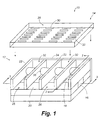
- FIG. 1 is an exploded perspective view of a first embodiment of a controllable optical attenuator constructed in accordance with the present invention.
- FIGS 2A-2C are transverse cross-sectional views of the optical attenuator shown in FIG. 1 that illustrate displacement of an attenuation droplet.
- FIGS 3A-3C are longitudinal cross-sectional views of the optical attenuator shown in FIG. 1 that illustrate various levels of attenuation.
- FIG. 4 is a second embodiment of an optical attenuator constructed in accordance with the present invention.
- FIGS 5A-5C are transverse cross-sectional views of the optical attenuator shown in FIG. 4 that illustrate displacement of an attenuation droplet.
- FIG. 6 is a third embodiment of an optical attenuator constructed in accordance with the present invention.
- FIG. 7 is a fourth embodiment of an optical attenuator constructed in accordance with the present invention.
- FIG. 8 is a fifth embodiment of an optical attenuator constructed in accordance with the present invention.
- FIG. 1 illustrates a first embodiment of a controllable optical attenuator 10 constructed in accordance with the present invention.
- the controllable optical attenuator 10 generally comprises a base 12 and a cover 14.
- Each of the base 12 and cover 14 typically is composed of a dielectric material such as a polymeric material.
- Extending longitudinally through the base 12 is an optical waveguide 16.
- the optical waveguide 16 is arranged within the base 12 such that an exposed surface 18 of the waveguide forms part of the top surface 20 of the base.
- This top surface 20 is substantially planar to provide a generally flat surface that can be traversed by liquid droplets, as is discussed below.
- the optical waveguide 16 is shown as having a rectangular cross-section in FIG. 1, it is to be appreciated that alternative configurations are possible. For instance, the optical waveguide 16 could be circular in cross-section, if desired.
- the optical waveguide 16 is configured such that the core (not indicated) of the optical waveguide 16 is positioned directly adjacent the top surface 20 of the base 12.
- the cladding of the optical waveguide 16 can separate the waveguide core from the top surface 20 of the base 12. This cladding typically is only one micron ( ⁇ m) to several microns in thickness such that, as is described in the discussion that follows, light signals transmitted along the waveguide 16 can pass out of the core to attenuate the optical transmission.
- the base 12 also includes a plurality of transverse walls 22 that are arranged substantially perpendicularly to the longitudinal direction of the optical waveguide 16. Provided at the ends of these transverse walls 22 are side walls 24 (one of which is shown removed in FIG. 1 for clarity). The side walls 24 terminate the transverse walls 22 so as to form a plurality of transverse trenches 26 together with the top surface 20 of the base 12.
- the cover 14 includes a two dimensional array 28 of electrodes 30 that are disposed on a bottom surface of the cover. Electrodes are arrayed along the length of each of the transverse trenches 26. These electrodes 30 are formed of a conductive material such as indium tin oxide (ITO), gold, silver, or aluminum and can be similar in construction to electrodes commonly used in liquid crystal displays.
- ITO indium tin oxide
- the cover 14 is positioned atop the transverse and side walls 22 and 24 to enclose the trenches 26, forming transverse, elongate chambers 32. Each chamber 32 is sized to be wider than the wavelength of the optical signals transmitted along the optical waveguide 16.
- each transverse chamber 32 can be approximately 20 ⁇ m in width ( i . e ., in the longitudinal direction of the waveguide 16).
- ventilation holes can be provided such that air can pass into and out of the chamber from the surrounding environment.
- the base 12 also includes a plurality of electrodes 34 (FIGS. 2A-2C) that are of similar construction to electrodes 30 and that are also oriented in an array 36. These electrodes 34 are buried under the surface 20.
- the first and second arrays 28 and 36 are arranged such that each electrode 30 disposed within the cover 14 has a corresponding opposed electrode 34 provided in the base 12. Accordingly, as is discussed in more detail below, the electrodes 30 and 34 form electrode pairs which, when provided with an appropriate voltage, form local electric fields.
- each of the electrodes 30 and 34 is electrically connected to conductor paths formed in the cover 14 and base 12 such that a voltage can be delivered to the electrodes.
- the liquid droplet 38 can comprise an oil-based liquid having a high dielectric constant. Oil-based liquids are preferred in that they are less susceptible to evaporation than water-based liquids and because they possess fewer ions and therefore are less susceptible to an electrolyzing effect.
- the liquid can comprise a Series A refractive index liquid available from Cargille Laboratories, Inc. of Cedar Grove, New Jersey.
- the liquid droplets 38 are doped with a dye which increases the absorption coefficient of the droplets.
- Dyes presently deemed suitable for use in the present invention are IR-27 and IR-1048 available from Aldrich Chemical of Milwaukee, Wisconsin for the infrared band, and D-Series dyes (D1-D82) for the visible band available from Merck KGaA of Darmstadt, Germany.
- concentration of the dye in the liquid used for the liquid droplets 38 will vary depending upon the particular results desired, the concentration typically ranges from approximately 0.4% to 5%.
- the liquid droplets are small in volume, for instance, each possessing a volume of approximately 1.5 x 10 -13 L.
- FIGS. 2A-2C illustrate schematic views of a transverse cross-section of a single attenuator chamber 32.
- FIG. 2A illustrates an off position of the chamber 32, i.e., a position in which the signal transmitted along the optical waveguide is not attenuated.
- the liquid droplet 38 is positioned laterally of the waveguide 16 such that the liquid droplet does not overlap the exposed surface 18 of the waveguide 16.
- the liquid droplet 38 is displaced so that it overlaps the portion of the optical waveguide 16 that extends along the chamber 32.
- the liquid droplet 38 has a refractive index that matches or exceeds the refractive index of the waveguide core, the optical signals traveling along the waveguide 16 will pass into the liquid droplet, thereby attenuating the signal.
- a voltage is provided to the electrodes 30 and 34 to the left of the droplet such that the various electrode pairs to that side of the droplet form localized electric fields indicated with arrows 40 in FIG. 2A.
- These electric fields create an electric field gradient directed toward the left side of the chamber 32. Through dielectric effect, this electric field gradient exerts a moving force, F, on the liquid droplet 38. Where the electric field gradient at the droplet 38 is small, this force F is small.
- the moving force F can be greater than the net frictional, viscous, and surface tension forces acting on the liquid droplet 38. This force F therefore moves the droplet to the left as indicated in FIG. 2B to position the droplet.
- the signal transmitted along the waveguide 16 is attenuated to a predetermined degree.
- the moving force F is maximized when the electric fields created by the electrode pairs create an electric field gradient that envelops approximately half of the droplet 38 as indicated in FIG. 2A.
- the electrode pairs can be sequentially deactivated once movement is initiated so that half of the droplet is enveloped by the electric field gradient. In this manner, the maximum moving force F will be imposed upon the droplet for the full duration of its displacement.
- the voltage provided to the electrodes 30 and 34 can be removed. No electric field is required to maintain the droplet in its position.
- the electrodes 30 and 34 to the right of the droplet can be provided with a voltage in similar manner as described above such that a moving force will be imparted to the droplet to move it back to its original position shown in FIG. 2A (see FIG. 2C). Again, once back in this original position, no voltage is required to maintain the liquid droplet 38 in place.
- the amount of voltage necessary to move the liquid droplet 38 depends upon both the volume of the droplet and the surface tension acting upon it. To determine what voltage is necessary, the coulomb force acting on the droplet 38 must be larger than the surface tension applied by the chamber surfaces. This force is created by the electric field.
- F 1 2 ( ⁇ -1) ⁇ 0 a d V 2
- F the force in Newtons that must be greater than surface tension on the liquid droplet 38
- ⁇ equals the relative dielectric constant
- ⁇ 0 is the permittivity of free space
- a is the width of the chamber 32 in meters
- d the height of the chamber in meters
- V is the voltage applied to the electrodes.
- a potential difference of approximately 50 to 100 volts is considered adequate to effect the desired movement of a liquid droplet 38 having a volume of 1.5 x 10 -13 L. It is to be understood, however, that this required voltage depends upon the volume of the liquid droplet 38 as well as the response time desired. With an appropriate voltage, the liquid droplets 38 can be moved with great speed to minimize response time. By way of example, the liquid droplets 38 can be moved with an acceleration of approximately 300 m/s 2 .
- FIGS. 3A-3C illustrate the variability of the attenuation that can be provided with the controllable optical attenuator 10 of the present invention.
- FIGS. 3A-3C illustrate schematic views of a longitudinal cross-section of the optical attenuator 10 taken along the optical waveguide 16.
- FIG. 3A illustrates five different transverse chambers 32, each of which having a liquid droplet (not shown) disposed therein. As indicated in this figure, none of the liquid droplets is positioned over the optical waveguide 16. Consequently, no attenuation is provided to the optical signal transmitted along the waveguide 16.
- FIG. 3B illustrates two liquid droplets 38 positioned over the optical waveguide 16.
- FIG. 3B illustrates a partial attenuation scenario.
- each of the five liquid droplets 38 is positioned directly over the waveguide 16 such that full attenuation is provided.
- the amount of attenuation provided by each droplet will vary depending upon the particular liquid and/or dyes used in forming the liquid droplets 38.
- droplets 38 can comprise liquids of different colors.
- the range of attenuation can be approximately from 1 to 10 -6 .
- the optical attenuator 10 described in the foregoing presents several advantages over conventional attenuators currently available in the communications field.
- the optical attenuator 10 is bistable, power is only needed when switching the individual optical attenuator chambers 32 from the on to the off position and vice versa . Accordingly, power consumption of the device is low.
- response times are very low ( e . g ., 1 millisecond).
- the optical attenuator 10 utilizes an optical waveguide 16 instead of some form of filter, the insertion loss created by the optical attenuator 10 is minimal.
- the optical attenuator 10 of the present disclosure is not susceptible to temperature changes. Further, in that the dye provided in the droplets 38 is an absorbing dye, backscattering is minimized.
- FIG. 4 illustrates a second embodiment of a controllable optical attenuator constructed in accordance with the present invention.
- a schematic view of a transverse cross-section of an optical attenuator 100 is similar in construction to that of the first embodiment shown in FIGS. 1-3, however, a thermocapillary pumping effect is used to move the droplets instead of the dielectric effect.
- the optical attenuator 100 uses a plurality of heating elements 102 and 104 that are disposed in the cover 106 and base 108.
- the droplet 38 has a volume adequate to fill the chamber 110 such that the droplet contacts both the bottom and top surfaces 112 and 114 of the chamber.
- FIGS. 5A-5C illustrate movement of a droplet 38 along its chamber 110.
- FIG. 5A when the droplet 38 is disposed to the right (in the figure) of waveguide 116 such that it does not overlap the waveguide, attenuation will not be provided by the chamber 110.
- ones of the heating elements 102 and 104 to the left of the droplet 38 are activated to heat the elements. This raises the temperature of the left meniscus 118 of the droplet 38 such that its temperature is greater than that of the right meniscus 120.
- This temperature difference between the menisci creates a capillary pressure difference in the droplet 38.
- the capillary pressure difference causes the droplet to move from right to left, as indicated in FIG.
- the droplet 38 then can be moved from left to right as indicated in FIG. 5C by activating the ones of heating elements 102 and 104 to the right of the droplet. Accordingly, just as with the first embodiment, power only needs to be provided to the optical attenuator 100 when movement of the droplet 38 is needed. The repeatability of the attenuator 100 is at least partially dependent upon the thermal dissipation rate of the device. Therefore, it may be advisable to heat the trailing meniscus 120 (FIG. 5B) after droplet movement has been initiated to decelerate the droplet. Manipulating the droplet in this manner may result in improved droplet control and faster switching.
- FIGS. 6-8 illustrate three different embodiments of the optical attenuator, each using light to move the droplet 38.
- an optical attenuator 200 is shown in transverse cross-section.
- the attenuator 200 utilizes two light sources 202 and 204 that are positioned at opposite ends of the chamber 206 formed with the base 208 and cover 210.
- Each of these light sources 202 and 204 can direct light toward the liquid droplet 38.
- light source 204 can shine light toward the liquid droplet 38.
- the liquid droplet 38 is provided with a dichroic dye that absorbs the light transmitted by the light sources 202 and 204.
- the dye As the light beams impinging on the droplet 38 are absorbed by the dye, the dye is heated such that the meniscus 208 or the meniscus 210 is heated as in the second embodiment. Accordingly, the liquid droplet 38 can be imparted with a capillary pressure difference that will cause the liquid droplet 38 to move.
- FIG. 7 illustrates an attenuator 300 in transverse cross-section.
- the attenuator includes a plurality of light sources 302 and 304 that are integrated into the attenuator cover 306 and base 308.
- the light sources 302 and 304 can comprise light emitting diodes (LEDs) arranged in arrays such that several of the light sources can be illuminated simultaneously to create the thermocapillary effect by absorption by the dye in the droplet as described above.
- LEDs light emitting diodes
- several light sources 302 and 304 are illuminated to one side or the other of the droplet to generate the thermocapillary effect.
- FIG. 8 illustrates a single chamber 402 of an attenuator 400 in a partial plan view.
- the transverse walls 404 and 406 that encompass the bounds of the chamber 402 can be illuminated to move the droplet 38.
- these walls can be selectively illuminated from the left side or the right side of the waveguide 408 with light sources 407 and 409 such that light will travel along the walls 402 and 406 to the liquid droplet 38.
- the light energy is absorbed by the droplet's adjacent meniscus (meniscus 410 in FIG. 8) to create a pressure difference between the meniscus 410 and the opposite meniscus 412.
- the pressure difference creates a thermocapillary effect on the liquid droplet 38 to induce it to move.
Landscapes
- Physics & Mathematics (AREA)
- General Physics & Mathematics (AREA)
- Optics & Photonics (AREA)
- Mechanical Light Control Or Optical Switches (AREA)
Abstract


Description
Claims (10)
- A controllable optical attenuator, comprising:an elongate optical waveguide (16), said optical waveguide having an exposed surface and a core that is positioned directly adjacent said exposed surface (18);at least one elongate chamber (26) disposed transversely to said optical waveguide, said exposed surface of said optical waveguide forming part of said chamber; anda liquid droplet (38) disposed within said elongate chamber; andmeans for moving said droplet along said chamber from a position lateral of said optical waveguide exposed surface to a position in which said liquid droplet overlaps and said optical waveguide exposed surface.
- The attenuator of claim 1, said moving means including:
electrode (30,34) pairs disposed on opposed surfaces of said chamber, wherein said electrode pairs can be energized with a voltage to create electric fields within said chamber which induce movement of said liquid droplet along said chamber. - The attenuator of claim 1 or 2 said moving means including:
heating elements disposed about said elongate chamber, wherein said heating elements (102,104) can be activated to create heat which induces movement of said liquid droplet along said chamber. - The attenuator of claim 1, 2 or 3 said moving means including:
a light source (204,206) positioned at opposed ends of said elongate chamber, wherein said light sources can be activated to shine light on said liquid droplet to induce movement of said liquid droplet along said chamber. - The attenuator of claim 1, 2, 3 or 4 said moving means including:
a plurality of light sources (302,304) formed along said elongate chamber, wherein said light sources can be activated to shine light on said liquid droplet to induce movement of said liquid droplet along said chamber. - The attenuator of claim 1, 2, 3, 4 or 5 additionally compromising transverse walls (22) bounding said elongate chamber.
- The attenuator of claim 6, additionally comprising means (407,409) for selectively illuminating said transverse walls at opposed ends to induce movement of said liquid droplet along said chamber.
- The attenuator of one of the preceding claims, wherein said liquid droplet comprises an index of refraction at least as large as said optical waveguide core.
- The attenuator of one of the preceding claims, wherein said liquid droplet comprises an oilbased liquid.
- The attenuator of one of the preceding claims, wherein said liquid comprises a dye.
Applications Claiming Priority (2)
| Application Number | Priority Date | Filing Date | Title |
|---|---|---|---|
| US641541 | 2000-08-18 | ||
| US09/641,541 US6400885B1 (en) | 2000-08-18 | 2000-08-18 | Controllable optical attenuator |
Publications (3)
| Publication Number | Publication Date |
|---|---|
| EP1180713A2 true EP1180713A2 (en) | 2002-02-20 |
| EP1180713A3 EP1180713A3 (en) | 2004-04-28 |
| EP1180713B1 EP1180713B1 (en) | 2005-09-28 |
Family
ID=24572822
Family Applications (1)
| Application Number | Title | Priority Date | Filing Date |
|---|---|---|---|
| EP01111358A Expired - Lifetime EP1180713B1 (en) | 2000-08-18 | 2001-05-09 | Optically controllable optical attenuator |
Country Status (4)
| Country | Link |
|---|---|
| US (1) | US6400885B1 (en) |
| EP (1) | EP1180713B1 (en) |
| JP (1) | JP2002090662A (en) |
| DE (1) | DE60113617T2 (en) |
Cited By (5)
| Publication number | Priority date | Publication date | Assignee | Title |
|---|---|---|---|---|
| WO2005098524A1 (en) * | 2004-04-05 | 2005-10-20 | Liquavista B.V. | Display device based on electrowetting effect |
| EP1873560A3 (en) * | 2006-06-26 | 2008-01-30 | Jer-Liang Andres Yeh | Lens with adjustable focal length |
| US7593617B2 (en) | 2005-02-17 | 2009-09-22 | Koninklijke Philips Electronics N.V. | Optical waveguide |
| US7898718B2 (en) * | 2002-02-19 | 2011-03-01 | Liquavista B.V. | Display device |
| CN114728514A (en) * | 2019-11-18 | 2022-07-08 | 国立大学法人横浜国立大学 | Molding device, liquid column moving device, molding method, liquid column moving method and program |
Families Citing this family (7)
| Publication number | Priority date | Publication date | Assignee | Title |
|---|---|---|---|---|
| US6870998B2 (en) * | 2001-04-26 | 2005-03-22 | Jds Uniphase Corporation | Variable optical attenuator |
| JP5089116B2 (en) * | 2005-09-21 | 2012-12-05 | 國立清華大学 | Lens device |
| US10184835B2 (en) * | 2015-09-23 | 2019-01-22 | Agilent Technologies, Inc. | High dynamic range infrared imaging spectroscopy |
| US12443032B2 (en) | 2021-12-06 | 2025-10-14 | Meta Platforms Technologies, Llc | Eye tracking with switchable gratings |
| WO2023107352A1 (en) * | 2021-12-06 | 2023-06-15 | Meta Platforms Technologies, Llc | Active fluidic optical element |
| US12429651B2 (en) | 2022-05-12 | 2025-09-30 | Meta Platforms Technologies, Llc | Waveguide with tunable bulk reflectors |
| US12061343B2 (en) | 2022-05-12 | 2024-08-13 | Meta Platforms Technologies, Llc | Field of view expansion by image light redirection |
Family Cites Families (8)
| Publication number | Priority date | Publication date | Assignee | Title |
|---|---|---|---|---|
| US4121884A (en) * | 1976-10-08 | 1978-10-24 | International Standard Electric Corporation | Optical fiber switch |
| US4384761A (en) * | 1980-06-30 | 1983-05-24 | International Business Machines Corporation | Ferrofluid optical switches |
| DE3138968A1 (en) * | 1981-09-30 | 1983-04-14 | Siemens AG, 1000 Berlin und 8000 München | OPTICAL CONTROL DEVICE FOR CONTROLLING THE RADIATION GUIDED IN AN OPTICAL WAVE GUIDE, IN PARTICULAR OPTICAL SWITCHES |
| FR2553906B1 (en) * | 1983-10-21 | 1986-10-17 | Thomson Csf | ELECTRICALLY CONTROLLED OPTICAL SWITCHING DEVICE |
| EP0593836B1 (en) * | 1992-10-22 | 1997-07-16 | International Business Machines Corporation | Near-field photon tunnelling devices |
| US5732168A (en) * | 1995-10-31 | 1998-03-24 | Hewlett Packard Company | Thermal optical switches for light |
| US5699462A (en) * | 1996-06-14 | 1997-12-16 | Hewlett-Packard Company | Total internal reflection optical switches employing thermal activation |
| US6072924A (en) * | 1996-09-02 | 2000-06-06 | Nippon Telegraph And Telephone Corporation | Optical switch and method for assembling the same |
-
2000
- 2000-08-18 US US09/641,541 patent/US6400885B1/en not_active Expired - Fee Related
-
2001
- 2001-05-09 DE DE60113617T patent/DE60113617T2/en not_active Expired - Fee Related
- 2001-05-09 EP EP01111358A patent/EP1180713B1/en not_active Expired - Lifetime
- 2001-08-08 JP JP2001240259A patent/JP2002090662A/en active Pending
Cited By (8)
| Publication number | Priority date | Publication date | Assignee | Title |
|---|---|---|---|---|
| US7898718B2 (en) * | 2002-02-19 | 2011-03-01 | Liquavista B.V. | Display device |
| US8213071B2 (en) | 2002-02-19 | 2012-07-03 | Samsung Lcd Netherlands R & D Center B.V. | Display device |
| WO2005098524A1 (en) * | 2004-04-05 | 2005-10-20 | Liquavista B.V. | Display device based on electrowetting effect |
| US7800816B2 (en) | 2004-04-05 | 2010-09-21 | Liquavista B.V. | Display device based on electrowetting effect |
| US8035880B2 (en) | 2004-04-05 | 2011-10-11 | Liquavista, B.V. | Display device based on electrowetting effect |
| US7593617B2 (en) | 2005-02-17 | 2009-09-22 | Koninklijke Philips Electronics N.V. | Optical waveguide |
| EP1873560A3 (en) * | 2006-06-26 | 2008-01-30 | Jer-Liang Andres Yeh | Lens with adjustable focal length |
| CN114728514A (en) * | 2019-11-18 | 2022-07-08 | 国立大学法人横浜国立大学 | Molding device, liquid column moving device, molding method, liquid column moving method and program |
Also Published As
| Publication number | Publication date |
|---|---|
| DE60113617T2 (en) | 2006-07-06 |
| JP2002090662A (en) | 2002-03-27 |
| US6400885B1 (en) | 2002-06-04 |
| DE60113617D1 (en) | 2006-02-09 |
| EP1180713B1 (en) | 2005-09-28 |
| EP1180713A3 (en) | 2004-04-28 |
Similar Documents
| Publication | Publication Date | Title |
|---|---|---|
| EP1180713B1 (en) | Optically controllable optical attenuator | |
| US6829415B2 (en) | Optical waveguide devices with electro-wetting actuation | |
| Mach et al. | Dynamic tuning of optical waveguides with electrowetting pumps and recirculating fluid channels | |
| EP1262811B1 (en) | Total internal reflection optical switch utilizing a moving droplet | |
| EP1290486B1 (en) | Enhanced effective refractive index total internal reflection image display | |
| US4121884A (en) | Optical fiber switch | |
| US6115168A (en) | Integrated optical retroreflecting modulator | |
| JP4351420B2 (en) | Adjustable liquid microlens and manufacturing method thereof | |
| EP0029737B1 (en) | Electro-optical switching devices | |
| KR20020010685A (en) | Electrophoretic, high index and phase transition control of total internal reflection in high efficiency variable reflectivity image displays | |
| US7314751B2 (en) | Fluorescence detection system including a photonic band gap structure | |
| US5004447A (en) | Low loss semiconductor directional coupler switches including gain method of switching light using same | |
| US6697554B2 (en) | Adaptive optical waveguides | |
| US5317429A (en) | Trilayer nematic liquid crystal optical switching device | |
| JPS60114828A (en) | Light modulator | |
| CA2467748A1 (en) | Analytical device with lightguide illumination of capillary and microgrooves arrays | |
| CA2428187A1 (en) | Method of fabricating sub-micron structures in transparent dielectric materials | |
| CN100363760C (en) | Optical beamsplitter with electro-wetting actuation | |
| US7756376B2 (en) | Optical functional waveguide, optical modulator, arrayed waveguide grating, and dispersion compensation circuit | |
| KR100370221B1 (en) | A optical switch | |
| EP1853956A2 (en) | Fluid optical waveguide | |
| US4886331A (en) | Thermo-optically induced waveguide | |
| US20030016937A1 (en) | Variable optic attenuator by waveguide bend loss | |
| US6870998B2 (en) | Variable optical attenuator | |
| Li et al. | Electrowetting optical switch with large aperture tuning range |
Legal Events
| Date | Code | Title | Description |
|---|---|---|---|
| PUAI | Public reference made under article 153(3) epc to a published international application that has entered the european phase |
Free format text: ORIGINAL CODE: 0009012 |
|
| AK | Designated contracting states |
Kind code of ref document: A2 Designated state(s): AT BE CH CY DE DK ES FI FR GB GR IE IT LI LU MC NL PT SE TR |
|
| AX | Request for extension of the european patent |
Free format text: AL;LT;LV;MK;RO;SI |
|
| PUAL | Search report despatched |
Free format text: ORIGINAL CODE: 0009013 |
|
| AK | Designated contracting states |
Kind code of ref document: A3 Designated state(s): AT BE CH CY DE DK ES FI FR GB GR IE IT LI LU MC NL PT SE TR |
|
| AX | Request for extension of the european patent |
Extension state: AL LT LV MK RO SI |
|
| 17P | Request for examination filed |
Effective date: 20040810 |
|
| 17Q | First examination report despatched |
Effective date: 20040910 |
|
| AKX | Designation fees paid |
Designated state(s): DE FR GB |
|
| GRAP | Despatch of communication of intention to grant a patent |
Free format text: ORIGINAL CODE: EPIDOSNIGR1 |
|
| RTI1 | Title (correction) |
Free format text: OPTICALLY CONTROLLABLE OPTICAL ATTENUATOR |
|
| GRAS | Grant fee paid |
Free format text: ORIGINAL CODE: EPIDOSNIGR3 |
|
| GRAA | (expected) grant |
Free format text: ORIGINAL CODE: 0009210 |
|
| AK | Designated contracting states |
Kind code of ref document: B1 Designated state(s): DE FR GB |
|
| REG | Reference to a national code |
Ref country code: GB Ref legal event code: FG4D |
|
| REF | Corresponds to: |
Ref document number: 60113617 Country of ref document: DE Date of ref document: 20060209 Kind code of ref document: P |
|
| PGFP | Annual fee paid to national office [announced via postgrant information from national office to epo] |
Ref country code: FR Payment date: 20060517 Year of fee payment: 6 |
|
| ET | Fr: translation filed | ||
| PLBE | No opposition filed within time limit |
Free format text: ORIGINAL CODE: 0009261 |
|
| STAA | Information on the status of an ep patent application or granted ep patent |
Free format text: STATUS: NO OPPOSITION FILED WITHIN TIME LIMIT |
|
| 26N | No opposition filed |
Effective date: 20060629 |
|
| PGFP | Annual fee paid to national office [announced via postgrant information from national office to epo] |
Ref country code: DE Payment date: 20070702 Year of fee payment: 7 |
|
| REG | Reference to a national code |
Ref country code: FR Ref legal event code: ST Effective date: 20080131 |
|
| PG25 | Lapsed in a contracting state [announced via postgrant information from national office to epo] |
Ref country code: FR Free format text: LAPSE BECAUSE OF NON-PAYMENT OF DUE FEES Effective date: 20070531 |
|
| PG25 | Lapsed in a contracting state [announced via postgrant information from national office to epo] |
Ref country code: DE Free format text: LAPSE BECAUSE OF NON-PAYMENT OF DUE FEES Effective date: 20081202 |
|
| PGFP | Annual fee paid to national office [announced via postgrant information from national office to epo] |
Ref country code: GB Payment date: 20110504 Year of fee payment: 11 |
|
| GBPC | Gb: european patent ceased through non-payment of renewal fee |
Effective date: 20120509 |
|
| PG25 | Lapsed in a contracting state [announced via postgrant information from national office to epo] |
Ref country code: GB Free format text: LAPSE BECAUSE OF NON-PAYMENT OF DUE FEES Effective date: 20120509 |