EP1180664A2 - Car navigation system and storage medium - Google Patents
Car navigation system and storage medium Download PDFInfo
- Publication number
- EP1180664A2 EP1180664A2 EP01119135A EP01119135A EP1180664A2 EP 1180664 A2 EP1180664 A2 EP 1180664A2 EP 01119135 A EP01119135 A EP 01119135A EP 01119135 A EP01119135 A EP 01119135A EP 1180664 A2 EP1180664 A2 EP 1180664A2
- Authority
- EP
- European Patent Office
- Prior art keywords
- road
- vehicle
- judgment
- estimated position
- judging
- Prior art date
- Legal status (The legal status is an assumption and is not a legal conclusion. Google has not performed a legal analysis and makes no representation as to the accuracy of the status listed.)
- Granted
Links
- 238000000034 method Methods 0.000 claims description 21
- 238000004364 calculation method Methods 0.000 claims description 12
- 238000004590 computer program Methods 0.000 claims description 9
- 238000001514 detection method Methods 0.000 claims description 9
- 238000012545 processing Methods 0.000 description 78
- 230000003287 optical effect Effects 0.000 description 16
- 238000004891 communication Methods 0.000 description 10
- 230000006870 function Effects 0.000 description 5
- 238000010586 diagram Methods 0.000 description 4
- 230000005540 biological transmission Effects 0.000 description 3
- 230000011664 signaling Effects 0.000 description 3
- 230000002459 sustained effect Effects 0.000 description 3
- 230000001133 acceleration Effects 0.000 description 2
- 230000001413 cellular effect Effects 0.000 description 2
- 238000007796 conventional method Methods 0.000 description 2
- 239000006185 dispersion Substances 0.000 description 2
- 230000002452 interceptive effect Effects 0.000 description 2
- 230000002146 bilateral effect Effects 0.000 description 1
- 230000000903 blocking effect Effects 0.000 description 1
- 238000012937 correction Methods 0.000 description 1
- 230000001419 dependent effect Effects 0.000 description 1
- 238000011161 development Methods 0.000 description 1
- 230000018109 developmental process Effects 0.000 description 1
- 230000000694 effects Effects 0.000 description 1
- 238000011156 evaluation Methods 0.000 description 1
- 239000004973 liquid crystal related substance Substances 0.000 description 1
- 230000005389 magnetism Effects 0.000 description 1
- 238000012986 modification Methods 0.000 description 1
- 230000004048 modification Effects 0.000 description 1
- 230000002194 synthesizing effect Effects 0.000 description 1
- 238000012546 transfer Methods 0.000 description 1
Images









Classifications
-
- G—PHYSICS
- G01—MEASURING; TESTING
- G01C—MEASURING DISTANCES, LEVELS OR BEARINGS; SURVEYING; NAVIGATION; GYROSCOPIC INSTRUMENTS; PHOTOGRAMMETRY OR VIDEOGRAMMETRY
- G01C21/00—Navigation; Navigational instruments not provided for in groups G01C1/00 - G01C19/00
- G01C21/26—Navigation; Navigational instruments not provided for in groups G01C1/00 - G01C19/00 specially adapted for navigation in a road network
- G01C21/28—Navigation; Navigational instruments not provided for in groups G01C1/00 - G01C19/00 specially adapted for navigation in a road network with correlation of data from several navigational instruments
-
- G—PHYSICS
- G01—MEASURING; TESTING
- G01S—RADIO DIRECTION-FINDING; RADIO NAVIGATION; DETERMINING DISTANCE OR VELOCITY BY USE OF RADIO WAVES; LOCATING OR PRESENCE-DETECTING BY USE OF THE REFLECTION OR RERADIATION OF RADIO WAVES; ANALOGOUS ARRANGEMENTS USING OTHER WAVES
- G01S19/00—Satellite radio beacon positioning systems; Determining position, velocity or attitude using signals transmitted by such systems
- G01S19/38—Determining a navigation solution using signals transmitted by a satellite radio beacon positioning system
- G01S19/39—Determining a navigation solution using signals transmitted by a satellite radio beacon positioning system the satellite radio beacon positioning system transmitting time-stamped messages, e.g. GPS [Global Positioning System], GLONASS [Global Orbiting Navigation Satellite System] or GALILEO
- G01S19/42—Determining position
Definitions
- the present invention relates to a car-navigation system for determining an estimated position of a vehicle and a storage medium.
- the vehicle speed may happen to be equal to or less than the predetermined value even when the vehicle is traveling on an ordinary road, in the case where a traffic light is red, because there are places where traffic lights exist near the toll gate given the actual traffic situation. In such places, the road on which a vehicle is traveling can not be judged by the toll gate and the vehicle speed.
- the vehicle is judged to be traveling on an expressway if it is distinguished that the time for traveling at or more than the predetermined speed is equal to or more than the predetermined time, it is impossible to judge whether a vehicle is traveling on an expressway or not simply by the vehicle speed, because there are cases where the vehicle speed is considerably high on ordinary roads if such road is an arterial road, given the actual traffic situation.
- the present invention has been devised to solve the aforementioned problems, and is an object thereof to enable determining the estimated position of the vehicle accurately even under various situations.
- the present invention provides a car-navigation system for determining an estimated position of a vehicle, comprising a first judgment means for judging first road predominant as the estimated position; a second judgment means for judging second road predominant as the estimated position; and control means for determining the vehicle estimated position based on the judgment results of the first and second judgment means.
- the present invention provides a car-navigation method of determining an estimated position of a vehicle, comprising a first judging step of judging first road predominant as the estimated position; a second judging step of judging second road predominant as the estimated position; and a determining step of determining the vehicle estimated position based on the judgment results of the first and second judgment means.
- the present invention a computer program product for a computer, comprising software code portions for performing the steps of any of the method when said product is run on the computer.
- the present invention provides a car navigation system for calculating a route and guiding, comprising judgment means for determining the road on which a vehicle is traveling, storage means for storing road data, control means for detecting a receiving condition of a GPS signal, wherein, in the case that the control means detect that the GPS signal is not properly received, said judging means is adapted to judge whether or not an adjacent road is in the neighborhood of the present position of the vehicle based on the road data said control means is adapted to estimate for the suitable road between the traveling road judged at the last time the GPS signal was received properly and the adjacent road and to determine the road the road the vehicle is traveling presently in accordance with the result of the estimation.
- the present invention provides a storage medium having a built-in program for determining an estimated position of a vehicle, comprising a first judgment for judging first road predominant as the estimated position; a second judgment for judging second road predominant as the estimated position; and a built-in program for determining the vehicle estimated position based on the judgment results of the first and second judgments.
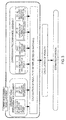
- Fig. 1 is a diagram showing an example of the constitution of a car navigation system for vehicle of the present invention. It includes an input unit 1 for inputting information concerning route guidance, a present position detection unit 2 for detecting information concerning the present position of one's vehicle, an information storage unit 3 recorded therein data for navigation necessary for calculation of the route, display/voice guidance data necessary for the route guidance, and programs (applications and/or OS) or the like, a central processing unit 4 for performing route search processing, generation of data necessary for the route guidance, display/voice guidance processing necessary for the route guidance, and control of the entire system, an information transmission/reception unit 5 for transmitting and receiving information concerning the traveling of a vehicle, for example, road information or traffic information, for detecting information concerning the present position of the vehicle, and for transmitting and receiving information concerning the present position, and an output unit 6 for outputting information concerning the route guidance.
- an input unit 1 for inputting information concerning route guidance
- a present position detection unit 2 for detecting information concerning the present position of one's vehicle
- the input unit 1 has a function to input a destination, or to indicate a navigation processing to the central processing unit 4 depending on the will of the driver.
- Remote controllers or the like such as a touch switch, jog dial or the like for inputting the destination with telephone number or coordinates on the map or for requesting the route guidance can be employed in order to realize this function.
- the invention comprises a unit for dialogue by voice input, that function as a voice input unit. It is also possible to add a record card reader for reading out data recorded in an IC card or magnetic card.
- a data communication apparatus for exchanging data with information sources such as an information center accumulating data necessary for navigation and supplying data through the communication line on demand of the driver, a portable type electronic apparatus having data including map data, destination data, simplified map, building configuration map or the like can be added.
- the present position detection unit 2 includes a GPS reception unit for calculating the present position, travel speed, absolute orientation or the like of the vehicle using the global positioning system (GPS), a beacon reception unit for receiving a signal (beacon) including information such as present position information, lane information or the like, a data reception unit for receiving a correction signal of the GPS using cellular phone (car telephone), FM multiple signal or the like, an absolute orientation sensor for detecting the direction of travel of the vehicle in absolute orientation using, for example, the terrestrial magnetism, a relative orientation sensor for detecting the direction of travel of the vehicle in relative orientation using, for example, steering sensor or gyro sensor, a distance sensor for detecting the distance of travel from revolutions of wheels, or the like.
- GPS global positioning system
- a beacon reception unit for receiving a signal (beacon) including information such as present position information, lane information or the like
- a data reception unit for receiving a correction signal of the GPS using cellular phone (car telephone), FM multiple signal or the like
- an absolute orientation sensor for
- the information storage unit 3 is a storage unit storing programs and data for navigation, and includes an external storage device, for example, a CD-ROM, DVD-ROM, floppy disk, memory card or the like.
- the information storage unit 3 may be an internal storage device such as a ROM or flash memory in the main unit.
- Programs include a program for performing processing such as route search, a program for performing an interactive guidance by voice input, program for controlling display/voice output necessary for the route guidance, a program for searching for a spot or establishment, or the like, and recorded data include files of map data, search data, destination data, registered spot data, road data, image data of junction such as intersection, genre data, landmark data or the like, and stores all data necessary for a navigation system.
- the present invention can also be applied to those of the type to store only data in the CD-ROM, and to store programs in the central processing unit, or those obtaining data and program from the outside by communication, or the like.
- the central processing unit 4 includes a CPU for performing various calculation processings, a flash memory for reading in and storing programs from the CD-ROM of the information storage unit 3, a ROM storing programs (program read-in means) for program check and update processing of the flash memory, and a RAM for storing temporarily retrieved route guidance information such as spot coordinates of the set destination, road name code No. or the like, and data in calculation processing.
- the RAM includes a SRAM capable of retaining information even when the power is cut, and a DRAM that loses information when the power is cut.
- a voice processor for performing the interactive processing through voice input from the input unit 1 and for synthesizing voice, phrase, sentences put together, sound or the like and converting into analog signal to output through a speaker, a communication interface for exchanging input output data through communication, a sensor input interface for taking in a sensor signal from the present position detection unit 2, a clock for entering date or time in an internal dialog information, and the like are also provided.
- programs for performing the update processing may be stored in an external storage device.
- Programs according to the invention, or other programs for executing the navigation may all be stored in a CD-ROM as external storage medium, or a part of, or all of these programs may be stored in the main unit side ROM 42.
- Various navigation functions are realized, by inputting data and programs stored in this external storage medium into the central processing unit of the navigation apparatus main unit as external signal and by calculation processing of the same.
- the navigation system of the invention has a relatively large capacity flash memory for reading in programs from the CD-ROM as external storage device, and a small capacity ROM storing programs (program read-in means) for starting-up processing of the CD, built in as mentioned above.
- the flash memory is non-volatile storage means, that can retain stored information even when the power is cut.
- a program of ROM which is program read-in means is started to perform the program check stored in the flash memory, for reading in disk management information or the like of the CD-ROM of the information storage unit 3.
- the program loading processing (update processing) is performed judging from this information and the state of the flash memory.
- the information transmission/reception unit 5 includes a GPS reception unit for getting information employing the global navigation system (GPS), a Vehicle Information and Communication System (VICS) information reception unit employing FM multiple broadcasting, electric wave beacon, optical beacon or the like, a data transmission/reception unit for bilateral communication with an information center (for example, Advanced Traveler Information System (ATIS)) and other vehicles employing cellular phone, personal computer or the like.
- GPS global navigation system
- VICS Vehicle Information and Communication System
- FM multiple broadcasting FM multiple broadcasting
- electric wave beacon optical beacon or the like
- data transmission/reception unit for bilateral communication with an information center (for example, Advanced Traveler Information System (ATIS)) and other vehicles employing cellular phone, personal computer or the like.
- ATD Advanced Traveler Information System
- the output unit 6 is provided with functions to output guidance information through voice and/or display when required by the driver, and to print out data that is navigation processed by the central processing unit 4.
- the display includes a simplified type liquid crystal display or the like, and displays a road map screen processed by the central processing unit 4, an intersection enlarged view screen based on the map data or guidance data, a destination name, time, distance, arrows indicating the direction of travel, and the like.
- the communication line used for serial communication or the like can be employed, without passing through a specialized image signal line, by sending image data as bit map data to the display, or a communication line common with other equipment can also be employed.
- the display may also include a memory for retaining the bit map data temporarily.
- This display is installed in an instrument panel near the driver's seat, and the driver can confirm the present position of his/her vehicle, and obtain information about the future route. Though not shown, it may also be composed to allow input of spot, road or the like through touching or tracing the screen by using a tablet including a touch panel, touch screen or the like as the display screen of the display.
- the vehicle position is estimated based on output information of the present position detection unit 2 and the road information of the information storage unit 3.
- the periphery map around the estimated position is displayed and, at the same time, the designation or the like of the estimated position are displayed.
- the destination is set using the destination name such as name of a place, name of an establishment or the like, telephone number or address, registered spot, name of a road, or the like, and the route search from the estimated position to the destination is performed.
- the route guidance/display are repeated while tracing the estimated positions until arrival at the destination.
- the search area is set for searching again in this search area, and similarly, the route guidance is repeated until arrival at the destination.
- Fig. 2 shows an example of the constitution of essential data files stored in the information storage unit 3 of the invention shown in Fig. 1.
- Fig. 2(A) shows a guidance road data file storing data necessary for calculating the route by the route calculation means and performing the route guidance, which includes the respective data of road number, length, road attribute data, address and size of configuration data, and address and size of guidance data, for the respective number of road n.
- the road number is set per direction (outward and homeward journeys) for each road between junctions.
- the road attribute data as road guidance auxiliary information data is data showing information on whether the concerned road is elevated, at the side of an elevated road, underground road, at the side of an underground road, or number of lanes.
- the configuration data includes coordinates data composed of east longitude and north latitude for the respective number of node m, when each road is divided by a plurality of nodes (segments).
- the guidance data includes the respective data on name of intersection (or junction), critical point data, road name data, address and size of road name sound data, and address and size of destination data.
- the critical point data is data showing whether or not there is a crossing, a tunnel entrance, a tunnel exit, a road width reducing point, or the like, for attracting the attention of the driver at a crossing, tunnel or the like other than the junctions.
- the road name data is data, as shown in Fig. 2(C), showing information on road class of expressway, metropolitan expressway, toll road, ordinary road (national road, prefectural road, or the like), and information on main line or access road (road connecting between the main line and the ordinary road) for expressway, metropolitan expressway, and toll road.
- the road name data comprises road class data and number within the category that is individual number data for the respective road classes.
- a system for determining the estimated position of the vehicle in terms of whether the road where the vehicle is traveling now is an expressway (expressway, metropolitan expressway, toll road) or other general roads will be described with reference to Fig. 3.
- a candidate road within a predetermined distance from the vehicle present position is selected, the correlation degree with the detection information is calculated for each candidate road and converted into a penalty value making selection of the candidate road difficult, and penalty values of the respective candidate roads are compared to determine the candidate road of the smallest penalty value as the estimated position.
- the present invention is characterized by the addition of estimated position judgment of upper road (expressway) or lower road (ordinary road) wherein, for determining the estimated position in a multilayer road, a penalty value calculated by further performing the upper and lower road determination processing is added to the penalty value of the respective candidate roads determined by a conventional technique.
- a penalty value calculated by further performing the upper and lower road determination processing is added to the penalty value of the respective candidate roads determined by a conventional technique.
- the vehicle is equipped with a GPS positioning system for obtaining the present position information transmitted by the satellite, means for detecting the vehicle speed pulse corresponding to the vehicle speed, an optical beacon reception unit capable of receiving optical beacon information on the ordinary road, and an electric beacon reception unit capable of receiving electric wave beacon information mainly on the expressway.
- the upper and lower road judgment of the invention includes an ordinary road predominance judgment and an expressway predominance judgment and the penalty value to be reflected on the map matching is calculated from the respective judgment results (the detail will be described below). Then, it is determined whether the ordinary road is predominant or the expressway is predominant from the calculated penalty value, to determine the estimated position of the present vehicle position and display the vehicle present position mark on the map.
- [G-1] GPS and variation of vehicle speed
- [G-2] optical beacon reception conditions are a judgment that there is a possibility that the vehicle has got off an expressway and moved to an ordinary road by detecting the GPS and the vehicle speed
- [G-2] is a judgment that is performed considering that optical beacon can be received only on the ordinary road.
- the judgment of expressway predominance is performed by [H-1] GPS and variation of vehicle speed, [H-2] history of vehicle speed, [H-3] variation of number of GPS reception, and [H-4] electric wave beacon reception condition.
- [H-1] is a judgment that there is a possibility that the vehicle has moved from an ordinary road to an expressway by detecting the GPS and the vehicle speed
- [H-2] is a judgment that is performed based on the history of vehicle speed showing that a high speed has been sustained
- [H-3] is a judgment for detecting the variation of the number of GPS reception, and using the fact that GPS can be received easily on the upper road (expressway)
- [H-4] is a judgment using the fact that electric wave beacon is received mainly at a high speed.
- Fig. 4 illustrates GPS near the expressway access road and the variation of vehicle speed.
- the vehicle passes the toll gate in case of transferring from the ordinary road to the expressway and from the expressway to the ordinary road, near the expressway access road, and does not pass the toll gate in case there is no transfer.
- the vehicle stops or comes to a similar state, reducing the detected vehicle speed to 0 or near 0 and, in addition, the roof of the toll gate makes the GPS positioning difficult.
- Fig. 4 shows an example of taking in data of GPS near the expressway access road and the variation of vehicle speed for using the same for the upper and lower road judgment.
- Data is taken in every 1 sec, and the numeral in the highest row "0 to 17" indicates the timing (sec) for taking data in.
- the numerals in the vehicle speed row indicate the vehicle speed pulse, and the speed reduces from the timing "0 to 6", stop at the timing "7 to 8" and increases at the timing "9 to 17".
- the row of ⁇ indicates the variation of vehicle speed (deceleration, stop, acceleration) by arrows.
- This embodiment includes the channel 1 to 8 of the positioning satellite, and the numerals in the respective channel rows indicate the angle of elevation of the positioning satellite whose electric wave has been received.
- the channel 1 receives the electric wave of an satellite with the angle of elevation 68°, channel 2 44°, channel 3 64°, channel 4 49°, channel 5 41°, channel 6 37°and the channels "7, 8" show that no electric wave was received.
- the reception of electric wave from the positioning satellite becomes difficult in the proximity of the vehicle speed change from deceleration to stop, from stop to acceleration (around timing "5 to 10"), under the influence of the roof of the toll gate illustrated schematically in Fig. 4.
- the gain can be weighted by the angle of elevation, because, the bigger the angle of elevation, the more GPS reflects the effect of the toll gate roof precisely and reliably.
- the gain can be determined by allocating 5 points to the angle of elevation of 30°to 70°, and 10 points to the angle of elevation of 70° to 90°.
- the gain of GPS remains to be 0, it means that the toll gate roof by preventing the reception of positioning satellite and, the gain increases once the vehicle departs the toll gate. Therefore, it is possible to judge passing of toll gate, namely getting on or off the expressway when the gain increases or the vehicle speed changes.
- [H-1], [H-2], [H-3] and [H-4] indicate, respectively, GPS and change of vehicle speed, history of vehicle speed, variation of number of GPS reception, and electric wave beacon reception, in the expressway predominance judgment.
- [G-1] and [G-2] indicate, respectively, the change of number of GPS reception, and optical beacon reception in the ordinary road predominance judgement.
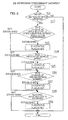
- Fig. 5 illustrates the entire processing flow of upper and lower road judgment.
- step S1 It is judged whether there is an expressway or not in a predetermined distance from the present position as a candidate of position for estimating the present position of the vehicle referring to the road data (step S1). For example, if there is an expressway as a candidate of estimated position, as the vicinity of the access road to the expressway, an expressway predominant judgment processing and an ordinary road predominant judgment processing mentioned below are performed (steps S2, S3). Next, based on the judgment results, the penalty value for the respective estimated positions are calculated, as mentioned below (step S4). It is judged whether the vehicle present position is on the upper road or the lower road based on this penalty value. In step S1, if there is no expressway road as a candidate of estimated position, the condition establishment results are reset (step S5). This is a processing to reset the flag, if a flag is set for indicating the establishment or non-establishment of conditions that the expressway is predominant or the ordinary road is predominant or the like, in the previous processing and therebefore.
- Fig. 6 illustrates an expressway predominant judgment processing flow.
- step S11 It is judged whether the information of GPS is updated or not (step S11), and the processing terminates if the information is not updated. If the information of GPS is updated, it is judged whether a predetermined condition mentioned below is established or not, for the change in GPS and vehicle speed near the access road to the expressway (step S12). If the condition is established, [H-1] status flag is set (step S13). In case the condition is not established, the flag is not set. Next, it is judged whether the condition for change of history of vehicle speed mentioned below is established or not (step S14), and if the condition is established, [H-2] status flag is set (step S15) and in case the condition is not established, the flag is not set.
- step S16 it is judged whether the condition for change of GPS reception number mentioned below is established or not (step S16), and if the condition is established, [H-3] status flag is set (step S17) and in case the condition is not established, the flag is not set.
- step S18 it is judged whether electric beacon has been received or not (step S18), and if received, [H-4] status flag is set (step S19) and in case not received, it is not set.
- Fig. 7 illustrates an ordinary road predominant judgment processing flow.
- step S21 It is judged whether the information of GPS is updated or not (step S21), and the processing terminates if the information is not updated. If the information of GPS is renewed, it is judged [G-1] whether a predetermined condition mentioned below is established or not, for change in GPS and vehicle speed near the access road to the expressway (step S22). If the condition is established, [H-1] status flag set in the expressway predominant judgment is cleared (step S23). In case not established, [H-1] status flag it is not cleared. Next, [G-2] it is judged whether optical beacon has been received or not (step S24).
- step S25 In case there was a reception, as the optical beacon is installed only on ordinary roads, it is judged that the present position is on the ordinary road, and all flags set in the expressway predominant judgment are cleared (step S25). In case the condition is not established, no flag is cleared.
- Fig. 8 illustrates a status flag set processing flow for the establishment or non-establishment of the condition for the change in GPS and vehicle speed near the access road to the expressway.
- step S31 It is judged whether there is an access road or not as a candidate of the estimated position (step S31), and in case there is one, it is judged whether the vehicle pulse is connected or not (step S32). This is for judging whether the vehicle is detecting the vehicle speed.
- step S33 it is judged whether the gain variation of GPS reception state mentioned below meets the condition or not (step S33), and if the condition is met, it is judged whether the change of vehicle speed mentioned below meets the condition (step S34).
- step S34 it is judged whether the aforementioned judgment processing, in case any one condition is not established, the status flag is set to 0 supposing that the vehicle is not on the expressway, and in case when all conditions are established, the status flag is set to 1 supposing that the vehicle is on the expressway.
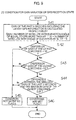
- Fig. 9 shows a flag set processing flow for establishment or non-establishment of the condition of the gain variation of GPS reception state in step S33 of Fig. 8.
- the aforementioned gain is weighted by the angle of elevation, and the angle of elevation 10°to 45°is processed as 5 points, and the angle of elevation 45°to 90°as 10 points.
- Gain number of satellite with elevation angle of equal to or more than 45° ⁇ 10 + number of satellite with elevation angle of 45° to 10° ⁇ 5
- step S42, S43 it is judged whether the dispersion of gain of the last 3 seconds is less than 10, and in case when the condition is established, it is judged whether the dispersion of gain of the oldest 3 seconds during the data acquisition period is less than 10 (steps S42, S43). This is for judging whether the data is reliable or not. In case when these conditions are established, it is judged whether the difference between the smallest gain of the last 3 seconds and the maximum gain of the oldest 3 seconds, namely the gain change rate is equal to or more than 25 (step S44). In case any one condition is not established, the flag is set to 0 judging that the condition is not established, and in case when all conditions are met, the flag is set to 1 supposing that conditions are established.
- Fig. 10 shows a flag set processing flow of establishment or non-establishment of the condition for the vehicle speed change in step S34 of Fig. 8.
- step S51 The minimum speed in the last 60 sec is obtained (step S51), and it is judged whether this minimum speed is the latest information, or is greater than the speed of 5 km/hour. In case it is not latest information or is equal to or less than the speed of 5 km/hour, it is judged whether the minimum speed is 0 or not (step S53). If the minimum speed in not 0, it is judged whether the difference of the latest vehicle speed and the minimum speed is greater than 20 km/hour (step S54). If the minimum speed is 0 in step S53, or in case the difference between the latest vehicle speed and the minimum speed is greater than 20 km/hour in step S54, the flag is set to 1 supposing that the condition of vehicle change is met.
- step S52 if the minimum speed is the latest information or is greater than 5 km/hour, it is judged that the vehicle can not be considered to have stopped, and in step S54, in case when the difference between the latest vehicle speed and the minimum speed is equal to or less than 20 km/hour, similarly, it is judged that the vehicle can not be considered to have stopped and that the conditions are not met, and the flag is set to zero (step S56).
- Fig. 11 shows the flag set processing flow in [H-2] condition for history of vehicle speed.
- step S61 It is judged whether the speed has become less than 40km/hour in the last 100 sec (step S61) and in case when it has never been equal to or less than 40km/hour, the flag of expressway traveling is set to 1 (step S62). In case it has been equal to or less than 40km/hour, the flag is set to 0 judging that the vehicle is not traveling on the expressway (step S63).
- Fig. 12 shows the flag set processing flow in [H-3] condition for change of GPS reception number.
- step S71 It is judged whether the number of reception has become less than 3 in the last 100 sec (step S71) and in case when it has never been so, it is judged whether the average is equal to or more than 4 or not (step S72) and, the flag is set to 1 if the number of reception is equal to or more than 4 in average, judging that the vehicle is traveling on the expressway (step S73). In case where the reception number is less than 3 in step S71, and in case it is not equal to or more than 4 in average in step S72, the flag is set to 0 judging that the vehicle is not traveling on the expressway (step S74).
- Fig. 13 shows a flag set processing flow in [H-4] condition for electric wave beacon reception.
- step S81 It is judged whether electric wave beacon has been received a predetermined number of times or more, for example, two or more in the last 60 sec (step S81) and in case when it has been received, it is judged whether optical beacon has been received in the last 60 sec or not (step S82).
- the flag is set to 1 if the optical beam is not received, judging that the vehicle is traveling on the expressway (step S83). In case where the electric wave has not been received two or more times in step S81, or in case where optical beacon has been received in step 82, the flag is set to 0 judging that the vehicle is not traveling on the expressway (step S84).
- Fig. 14 illustrates a flag set processing flow in the condition of [G-1] change in GPS and vehicle speed near the access road to the expressway.
- step S91 It is judged whether or not there is an access road as a candidate of the estimated position (step S91), and incase there is, it is judged whether the vehicle pulse is connected or not (step S92). If the vehicle speed pulse is connected and the vehicle speed is measured, it is judged whether the gain variation of GPS reception state shown in Fig. 9 meets the condition or not (step S93), and if the condition is met, it is judged whether the change of vehicle speed shown in Fig. 10 meets the condition (step S94). In case when the respective conditions are satisfied, it is judged whether the highway count is 1000 or not (step S95).
- Highway count can be described as follows: when it is determined whether the vehicle estimated position is expressway or ordinary road, the highway counter increments the highway count by 1 in case of expressway, and decrements by 1 in case of ordinary road, and the highway count is stored by the RAM every second. Therefore, it is determined if the expressway traveling is sustained or not by judging whether the counter content is at the maximum value 1000, or not. Then, in case any one condition is not established, the status flag is set to 0 supposing that determination can not be made (step S96), and in case when all conditions are established, the status flag is set to 1 supposing that the vehicle is getting off the expressway (step S97).
- This processing is a processing opposite to the processing for getting on the expressway, and is a processing for judging that the vehicle is getting off the expressway, in case when the gain of GPS reception state has changed and the vehicle speed has changed, during the expressway traveling up to that point, by establishment of the highway count conditions.
- the method for judging whether the expressway traveling is continued or not in addition to the method of step S95, it may also be judged based on whether the highway count is equal to or more than the upper layer threshold (for example, 800) or not.
- the upper layer threshold for example, 800
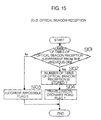
- Fig. 15 shows a flag set processing flow in [G-2] condition for optical beacon reception.
- step S101 It is judged whether the number of times of optical beacon reception is different from the previous one (step S101), and if it is not different, the flag is set to 0 supposing that determination can not be made (step S102). If it is different, the number of times of optical beacon reception is stored (step S103), and the flag is set to 1 supposing that the vehicle travels on an ordinary road (step S104).
- Fig. 16 illustrated a penalty calculation processing flow.
- step S111 The aforementioned expressway gain calculation processing is performed (step S111), then the difference between gain of the ordinary road is calculated from the gain of expressway (step S112) and the calculated difference of gain is converted into the penalty value for matching (step S113).
- Fig. 17 shows a gain table of expressway and ordinary road
- Fig. 17(a) shows the gain of expressway
- Fig. 17(b) shows the gain of ordinary road, respectively.
- the gain of expressway is a value obtained by allocating a score for the respective conditions, when the respective conditions of [H-1], [H-2], [H-3], and [H-4] are established, weighting and summing the same
- the gain of ordinary road is a value obtained by allocating a score for the respective conditions, when the respective conditions of [G-1] and [G-2] are established, weighting and summing the same.
- the maximum value of gain (sum value of the respective gains) is set to 50, including [H-1] +20 when the condition for change in GPS and vehicle speed near the access road to the expressway is established, [H-2] 10 when the condition for history of vehicle speed is established, [H-3] 10 when the condition for variation of number of GPS reception is established and [H-4] 10 when the condition of electric beacon reception is established.
- the maximum value of gain of the ordinary road is set to 50, including [G-1] 10 when the condition for change in GPS and vehicle speed near the access road to the expressway is established and [G-2] 40 when the condition for optical beacon reception is established. Then as shown in Fig. 16, the gain for calculating the penalty value for matching is calculated, as (gain of expressway)-(gain of ordinary road).
- the formula for converting the penalty value for matching can be expressed as follows: (a + b + c + d) - (e + f)/50 ⁇ 100 Consequently, the maximum value of penalty value is 100.
- the difference of gain between expressway and gain of ordinary road is 30 (step S122).
- the penalty value is 60 (step S123). This penalty value 60 is added as penalty of upper and lower road judgment, to the penalty value of ordinary road in the conventional penalty processing.
- the absolute value of this value is added to the penalty value of expressway in the conventional penalty processing.
- Fig. 19 shows the penalty calculation processing flow.
- step S131 the conventional penalty processing is performed (step S131).
- the penalty value of each candidate road is calculated from the correlation of the present spot detection information with the candidate road at the estimated position.
- step S132 it is judged whether the penalty value of the upper and lower roads according to the invention is 0 or not (step S132); if 0, the smallest candidate of penalty values determined in step S131 becomes the estimated position (step S138). If the penalty value of the upper and lower road is not 0, it is judged whether this penalty value is positive or not (step S133). If positive (expressway predominance judgment), it is judged whether the candidate road is an ordinary road or not (step S134) and, if determined to be an ordinary road, the calculated penalty value of the upper and lower roads is added to the penalty value of the candidate.
- step S134 If it is not an ordinary road in step S134, the addition processing is not performed.
- step S133 if the penalty value is negative (ordinary predominance judgment), it is judged whether the candidate road is an expressway or not (step S136). In case of expressway, the absolute value of the calculated penalty value of the upper and lower road is added to the penalty value of the candidate road (step S137). If it is not an expressway, the addition is not performed. The candidate with smallest penalty values thus determined is determined as the estimated position (step S138).
- Fig. 20 illustrates a matching processing in the normal case (without upper and lower road judgment).
- the present spot is on an ordinary road a, and there is an expressway (main line) H and an ordinary road B as candidates of the other estimated positions, and an access road I in the vicinity.
- the penalties a, b, and c of the expressway H, ordinary road A and ordinary road B determined from the correlation of the present spot detection information with the candidate road at the estimated position are 40, 20, 30, respectively, since b:20 ⁇ c:30 ⁇ a:40, the most possible candidate for the map matching results to be the ordinary road A of the penalty b, that will be determined as the estimated position.
- Fig. 21 illustrates a processing in which penalty of upper and lower roads is reflected on the matching processing of Fig. 20.
- the penalty b' of the access road is b':30 ⁇ a:40 ⁇ b:80 ⁇ b:90, which is the smallest, the most possible candidate for the map matching results is the access road with the penalty b', which will be determined as the estimated position.
- the present invention is not limited to the aforementioned embodiments, but also includes various modifications.
- Fig. 8 of the aforementioned embodiment although it is judged that the vehicle has got on the expressway when the gain variation of GPS reception state satisfies the condition, and further, when the variation of vehicle speed satisfies the condition; however, as another embodiment, it may be judged that the vehicle has got on the expressway when, in addition to the aforementioned conditions, the highway counter is equal to or more than a predetermined value, or the like,.
- the processing (flag setting processing) in step S36 of Fig. 8 is considered to be performed when the vehicle has passed the toll gate (when the vehicle gets on and off the expressway).
- Fig. 12 whether traveling on an expressway or not is judged by determining if the average of GPS reception in the past section is equal to or more than 4.
- it may be judged to be an upper layer in the case where the gain (score) of GPS in the past section (distance or time) is greater than the upper layer threshold, by weighting the angle of elevation of GPS as shown in Fig. 4, and to be a lower layer in the case where it is smaller than the lower layer threshold.
- the upper layer threshold and the lower layer threshold may be of the same value, or different value.
- This processing allows to perform the upper and lower judgment more accurately than the one in which a road is judged as upper layer when the average of the number of GPS reception is greater than a predetermined value or the one in which a road is judged as upper layer when a GPS greater than a predetermined angle is received.
- the judgment of expressway includes four judgments, it does not necessarily have to be four.
- judgment condition for performing the expressway predominance judgment other judgment conditions may also be added.
- score is allocated in the angle of elevation GPS or expressway predominance judgment, or ordinary road predominance judgment, for performing the upper and lower road judgment of multilayer road based on the sum thereof.
- it goes without saying that it can be applied to various things provided that they can be ranked (comparison coefficient).
- the accuracy of the estimated position in the multilayer road can be improved, by using conditions appropriate for the respective road attributes, such as judging that the expressway is predominant as estimated position if conditions particular to the expressway are satisfied, and judging that the ordinary road is predominant as estimated position if conditions particular to the ordinary road are satisfied.
- the invention is applicable in particular to a case in which a GPS signal is not received properly (for example, not enough GPS satellites can be received for a correct position determination) or no GPS signal is received.
- a GPS signal is not received properly (for example, not enough GPS satellites can be received for a correct position determination) or no GPS signal is received.
- the present invention can be used to determine the correct position of the vehicle by using a judgement and decision (selection between first and second candidate roads) as described above.
- the first road is assumed to be an expressway and the second road is assumed to be an ordinary road.
- the determination of the position can be effected independent of the road types.
- the position of the vehicle can also be determined in a case where the candidate roads for the judgement are of the same type (e.g. first and second roads are ordinary roads) or of different types (e.g. first road is an ordinary road and second road is an expressway, or the like).
- Information concerning the road type on which the vehicle is traveling may be used for supporting the position determination.
- the position determination can be effected also without such specific road type information, for example by using the vehicle speed, information from a beacon reception, road attributes stored or the like.
- the invention is also applicable to a case where the candidate roads are not on different levels (elevated) but adjacent to each other (i.e. on one level).
- the signaling devices may be established, for example, at a traffic light, at a branch, at an exit point of a road, at an enter point to a road, at a tunnel, and the like.
- the control unit estimate the traveling road by using the signal of the signaling device.
- the invention can be implemented as a computer program product for a computer, e.g. for a navigation system computer device, comprising software code portions. After loading the computer program product in an internal memory, the computer device can perform the steps of the invention in line with its normal processing.
- the software code portions of the computer program product can be stored on a computer-readable medium (e.g. a CD, a DVD or the like).
- a car-navigation system for determining an estimated position of a vehicle comprising a first judgment means for judging expressway as a first road predominant as estimated position, a second judgment means for judging ordinary road as a second road predominant as estimated position, and control means for determining the vehicle estimated position based on the judgment results of the first and second judgment means.
Landscapes
- Engineering & Computer Science (AREA)
- Radar, Positioning & Navigation (AREA)
- Remote Sensing (AREA)
- Automation & Control Theory (AREA)
- Physics & Mathematics (AREA)
- General Physics & Mathematics (AREA)
- Navigation (AREA)
- Traffic Control Systems (AREA)
Abstract
Description
Claims (12)
- A car-navigation system for determining an estimated position of a vehicle, comprising:a first judgment means for judging first road predominant as the estimated position;a second judgment means for judging second road predominant as the estimated position; andcontrol means for determining the vehicle estimated position based on the judgment results of the first and second judgment means.
- A car-navigation method of determining an estimated position of a vehicle, comprising:a first judging step of judging first road predominant as the estimated position;a second judging step of judging second road predominant as the estimated position; anda determining step of determining the vehicle estimated position based on the judgment results of the first and second judgment means.
- The system according to claim 1 or a method according to claim 2, wherein
the control means or the determining step determines the vehicle estimated position, by reflecting the judgment results of the first and second judgment means or judging steps on a calculation of correlation between a detection information of the vehicle present position and a road information. - The system or a method according to claim 3, wherein
the control means or the determining step calculates a penalty value based on the judgment results of the first and second judgment means or steps, and determines the vehicle estimated position by adding the calculated penalty value to the penalty value of a candidate road. - The system or method according to claim 3, whereinthe first judgment means or judging step comprises a plurality of judgment means and sensors or judging steps; andthe control means or the determining step calculates a total coefficient from comparison coefficients allocated to the plurality of judgment means or judging steps, and calculates the penalty value from the total coefficient.
- The system or method according to claim 3, whereinthe second judgment means or judging step comprises a plurality of judgment means and sensors or judging steps; andthe control means or determining step calculates a total coefficient from comparison coefficients allocated to the plurality of judgment means or judging steps, and calculates the penalty value from the total coefficient.
- The system according to claim 1 or the method according to claim 2, wherein the system or the method is adapted to determine the vehicle estimated position in the case that a vehicle position can not be determined on the basis of a GPS signal.
- A computer program product for a computer, comprising software code portions for performing the steps of any of claims 2 to 7 when said product is run on the computer.
- A computer program product according to claim 8, wherein said computer program product comprises a computer-readable medium on which said software code portions are stored.
- A computer program product according to claim 8, wherein said computer program product is directly loadable into the internal memory of the computer.
- A car navigation system for calculating a route and guiding, comprisingjudgment means for determining the road on which a vehicle is traveling,storage means for storing road data,control means for detecting a receiving condition of a GPS signal,wherein, in the case that the control means detect that the GPS signal is not properly received,said judging means is adapted to judge whether or not an adjacent road is in the neighborhood of the present position of the vehicle based on the road datasaid control means is adapted to estimate for the suitable road between the traveling road judged at the last time the GPS signal was received properly and the adjacent road and to determine the road the road the vehicle is traveling presently in accordance with the result of the estimation.
- A storage medium having a built-in program for determining an estimated position of a vehicle, comprising:a first judgment for judging first road predominant as the estimated position;a second judgment for judging second road predominant as the estimated position; anda built-in program for determining the vehicle estimated position based on the judgment results of the first and second judgments.
Applications Claiming Priority (4)
| Application Number | Priority Date | Filing Date | Title |
|---|---|---|---|
| JP2000241905A JP2002054937A (en) | 2000-08-09 | 2000-08-09 | Navigation device for vehicle and storing medium |
| JP2000241905 | 2000-08-09 | ||
| JP2000279701 | 2000-09-14 | ||
| JP2000279701A JP3876964B2 (en) | 2000-08-09 | 2000-09-14 | Vehicle navigation device |
Publications (3)
| Publication Number | Publication Date |
|---|---|
| EP1180664A2 true EP1180664A2 (en) | 2002-02-20 |
| EP1180664A3 EP1180664A3 (en) | 2004-06-16 |
| EP1180664B1 EP1180664B1 (en) | 2012-10-17 |
Family
ID=26597682
Family Applications (1)
| Application Number | Title | Priority Date | Filing Date |
|---|---|---|---|
| EP01119135A Expired - Lifetime EP1180664B1 (en) | 2000-08-09 | 2001-08-08 | Car navigation system, corresponding navigation method and storage medium |
Country Status (2)
| Country | Link |
|---|---|
| US (1) | US6604048B2 (en) |
| EP (1) | EP1180664B1 (en) |
Cited By (3)
| Publication number | Priority date | Publication date | Assignee | Title |
|---|---|---|---|---|
| JP2016167691A (en) * | 2015-03-09 | 2016-09-15 | 株式会社オートネットワーク技術研究所 | Optical communication device |
| JP2016167690A (en) * | 2015-03-09 | 2016-09-15 | 株式会社オートネットワーク技術研究所 | Optical communication device |
| CN110070706A (en) * | 2019-04-28 | 2019-07-30 | 西安艾润物联网技术服务有限责任公司 | Officer's car monitoring method, apparatus and system |
Families Citing this family (12)
| Publication number | Priority date | Publication date | Assignee | Title |
|---|---|---|---|---|
| KR100448389B1 (en) * | 2002-08-23 | 2004-09-10 | 현대자동차주식회사 | Method and apparatus for determining vehicle location on a map |
| AU2003282786A1 (en) * | 2002-08-30 | 2004-03-19 | Racom Products | Modular analog wireless data telemetry system adapted for use with web based location information distribution method and method for developing and disseminating information for use therewith |
| US20040090950A1 (en) * | 2002-09-20 | 2004-05-13 | Ronald Lauber | Wireless digital/analog data telemetry system adapted for use with web based location information distribution method and method for developing and disseminating information for use therewith |
| DE10310422A1 (en) * | 2003-03-11 | 2004-09-23 | Zf Friedrichshafen Ag | Method for networking regulation and / or control functions for a motor vehicle |
| US8291149B2 (en) * | 2003-07-07 | 2012-10-16 | Hitachi Ulsi Systems Co., Ltd. | Storage device and storage system having a hard disk drive and flash memory |
| JP2005345201A (en) * | 2004-06-01 | 2005-12-15 | Denso Corp | Traveling track display device and program |
| US7809500B2 (en) * | 2005-02-07 | 2010-10-05 | Microsoft Corporation | Resolving discrepancies between location information and route data on a navigation device |
| CN102036626B (en) * | 2008-03-24 | 2014-07-02 | 奥瑟Hf公司 | Transfemoral prosthetic systems and methods for operating the same |
| US9189976B2 (en) * | 2013-07-10 | 2015-11-17 | Telenav Inc. | Navigation system with multi-layer road capability mechanism and method of operation thereof |
| US20180335306A1 (en) * | 2017-05-16 | 2018-11-22 | GM Global Technology Operations LLC | Method and apparatus for detecting road layer position |
| CN112017428B (en) * | 2020-07-09 | 2021-12-17 | 惠州市德赛西威智能交通技术研究院有限公司 | Road side vehicle networking device, viaduct road section identification method and vehicle-mounted vehicle networking device |
| CN113704381B (en) * | 2021-10-27 | 2022-01-28 | 腾讯科技(深圳)有限公司 | Road network data processing method and device, computer equipment and storage medium |
Family Cites Families (8)
| Publication number | Priority date | Publication date | Assignee | Title |
|---|---|---|---|---|
| JPH02137096A (en) | 1988-11-18 | 1990-05-25 | Nissan Motor Co Ltd | Express-highway travelling recognition device |
| JPH03154818A (en) | 1989-11-13 | 1991-07-02 | Matsushita Electric Ind Co Ltd | Vehicle position detection device |
| JP2848318B2 (en) * | 1996-03-05 | 1999-01-20 | 三菱電機株式会社 | In-vehicle travel control device |
| JP3540106B2 (en) | 1996-11-11 | 2004-07-07 | 三菱電機株式会社 | Navigation apparatus for mobile object, current position determination method thereof, and medium storing current position determination program |
| JP3582560B2 (en) * | 1997-07-08 | 2004-10-27 | アイシン・エィ・ダブリュ株式会社 | Vehicle navigation device and recording medium |
| JP3266096B2 (en) * | 1998-03-30 | 2002-03-18 | 株式会社デンソー | Moving object position detecting device, map display device, navigation device, and recording medium |
| WO1999064820A1 (en) * | 1998-06-12 | 1999-12-16 | Mitsubishi Denki Kabushiki Kaisha | Navigation device |
| JP3027574B1 (en) * | 1999-01-13 | 2000-04-04 | 松下電器産業株式会社 | Vehicle road position discrimination method on multi-layer roads |
-
2001
- 2001-08-08 US US09/923,335 patent/US6604048B2/en not_active Expired - Lifetime
- 2001-08-08 EP EP01119135A patent/EP1180664B1/en not_active Expired - Lifetime
Cited By (3)
| Publication number | Priority date | Publication date | Assignee | Title |
|---|---|---|---|---|
| JP2016167691A (en) * | 2015-03-09 | 2016-09-15 | 株式会社オートネットワーク技術研究所 | Optical communication device |
| JP2016167690A (en) * | 2015-03-09 | 2016-09-15 | 株式会社オートネットワーク技術研究所 | Optical communication device |
| CN110070706A (en) * | 2019-04-28 | 2019-07-30 | 西安艾润物联网技术服务有限责任公司 | Officer's car monitoring method, apparatus and system |
Also Published As
| Publication number | Publication date |
|---|---|
| EP1180664A3 (en) | 2004-06-16 |
| US20020019700A1 (en) | 2002-02-14 |
| US6604048B2 (en) | 2003-08-05 |
| EP1180664B1 (en) | 2012-10-17 |
Similar Documents
| Publication | Publication Date | Title |
|---|---|---|
| JP3582560B2 (en) | Vehicle navigation device and recording medium | |
| US7657370B2 (en) | Navigation apparatus, navigation system, and navigation search method | |
| EP1995557B1 (en) | Position registration device, route search device, position registration method, position registration program, and recording medium | |
| US7940194B2 (en) | Position registration device, route search device, position registration method, position registration program, and recording medium | |
| JP3719315B2 (en) | Vehicle navigation device and storage medium | |
| US6456931B1 (en) | Indicating directions to destination and intermediate locations in vehicle navigation systems | |
| EP2000771B1 (en) | Position registering device, position registering method, position registering program, and recording medium | |
| EP1180664B1 (en) | Car navigation system, corresponding navigation method and storage medium | |
| EP2000770B1 (en) | Navigation device, position registering method, position registering program, and recording medium | |
| JP5692628B2 (en) | Navigation device and navigation program | |
| EP1995558B1 (en) | Position registration device, route search device, position registration method, position registration program, and recording medium | |
| US8494769B2 (en) | Information system, terminal device, and information center device | |
| JP5018764B2 (en) | Navigation device and navigation program | |
| US7418340B2 (en) | Navigation device | |
| JP4931706B2 (en) | Navigation device | |
| JP2544855B2 (en) | Vehicle guidance device | |
| JP2914111B2 (en) | Route guidance device | |
| JPH04213019A (en) | Position detection accuracy determination method and vehicle guidance device using the method | |
| US20090105936A1 (en) | Route guidance apparatus, route guidance method, route guidance program and computer-readable recording medium | |
| JP2009210467A (en) | On-vehicle navigation device, and program for navigation device | |
| JP3876964B2 (en) | Vehicle navigation device | |
| JP3838333B2 (en) | Vehicle navigation device | |
| JP2002054937A (en) | Navigation device for vehicle and storing medium | |
| JP2002202146A (en) | Navigation device | |
| JPH06331367A (en) | Road map display |
Legal Events
| Date | Code | Title | Description |
|---|---|---|---|
| PUAI | Public reference made under article 153(3) epc to a published international application that has entered the european phase |
Free format text: ORIGINAL CODE: 0009012 |
|
| AK | Designated contracting states |
Kind code of ref document: A2 Designated state(s): AT BE CH CY DE DK ES FI FR GB GR IE IT LI LU MC NL PT SE TR |
|
| AX | Request for extension of the european patent |
Free format text: AL;LT;LV;MK;RO;SI |
|
| PUAL | Search report despatched |
Free format text: ORIGINAL CODE: 0009013 |
|
| AK | Designated contracting states |
Kind code of ref document: A3 Designated state(s): AT BE CH CY DE DK ES FI FR GB GR IE IT LI LU MC NL PT SE TR |
|
| AX | Request for extension of the european patent |
Extension state: AL LT LV MK RO SI |
|
| RIC1 | Information provided on ipc code assigned before grant |
Ipc: 7G 01C 21/28 A Ipc: 7G 08G 1/0968 B |
|
| 17P | Request for examination filed |
Effective date: 20041215 |
|
| AKX | Designation fees paid |
Designated state(s): DE FR GB |
|
| 17Q | First examination report despatched |
Effective date: 20050412 |
|
| 17Q | First examination report despatched |
Effective date: 20050412 |
|
| RTI1 | Title (correction) |
Free format text: CAR NAVIGATION SYSTEM, CORRESPONDING NAVIGATION METHOD AND STORAGE MEDIUM |
|
| GRAP | Despatch of communication of intention to grant a patent |
Free format text: ORIGINAL CODE: EPIDOSNIGR1 |
|
| GRAS | Grant fee paid |
Free format text: ORIGINAL CODE: EPIDOSNIGR3 |
|
| GRAA | (expected) grant |
Free format text: ORIGINAL CODE: 0009210 |
|
| AK | Designated contracting states |
Kind code of ref document: B1 Designated state(s): DE FR GB |
|
| REG | Reference to a national code |
Ref country code: GB Ref legal event code: FG4D |
|
| REG | Reference to a national code |
Ref country code: DE Ref legal event code: R096 Ref document number: 60147236 Country of ref document: DE Effective date: 20121213 |
|
| PLBE | No opposition filed within time limit |
Free format text: ORIGINAL CODE: 0009261 |
|
| STAA | Information on the status of an ep patent application or granted ep patent |
Free format text: STATUS: NO OPPOSITION FILED WITHIN TIME LIMIT |
|
| 26N | No opposition filed |
Effective date: 20130718 |
|
| REG | Reference to a national code |
Ref country code: DE Ref legal event code: R097 Ref document number: 60147236 Country of ref document: DE Effective date: 20130718 |
|
| PGFP | Annual fee paid to national office [announced via postgrant information from national office to epo] |
Ref country code: DE Payment date: 20140806 Year of fee payment: 14 |
|
| PGFP | Annual fee paid to national office [announced via postgrant information from national office to epo] |
Ref country code: GB Payment date: 20140806 Year of fee payment: 14 Ref country code: FR Payment date: 20140808 Year of fee payment: 14 |
|
| REG | Reference to a national code |
Ref country code: DE Ref legal event code: R119 Ref document number: 60147236 Country of ref document: DE |
|
| GBPC | Gb: european patent ceased through non-payment of renewal fee |
Effective date: 20150808 |
|
| REG | Reference to a national code |
Ref country code: FR Ref legal event code: ST Effective date: 20160429 |
|
| PG25 | Lapsed in a contracting state [announced via postgrant information from national office to epo] |
Ref country code: DE Free format text: LAPSE BECAUSE OF NON-PAYMENT OF DUE FEES Effective date: 20160301 Ref country code: GB Free format text: LAPSE BECAUSE OF NON-PAYMENT OF DUE FEES Effective date: 20150808 |
|
| PG25 | Lapsed in a contracting state [announced via postgrant information from national office to epo] |
Ref country code: FR Free format text: LAPSE BECAUSE OF NON-PAYMENT OF DUE FEES Effective date: 20150831 |