EP1180547A2 - Method for producing DNA - Google Patents
Method for producing DNA Download PDFInfo
- Publication number
- EP1180547A2 EP1180547A2 EP01306385A EP01306385A EP1180547A2 EP 1180547 A2 EP1180547 A2 EP 1180547A2 EP 01306385 A EP01306385 A EP 01306385A EP 01306385 A EP01306385 A EP 01306385A EP 1180547 A2 EP1180547 A2 EP 1180547A2
- Authority
- EP
- European Patent Office
- Prior art keywords
- sequence
- dna
- target sequence
- nucleotide sequence
- partial
- Prior art date
- Legal status (The legal status is an assumption and is not a legal conclusion. Google has not performed a legal analysis and makes no representation as to the accuracy of the status listed.)
- Withdrawn
Links
Images
Classifications
-
- C—CHEMISTRY; METALLURGY
- C12—BIOCHEMISTRY; BEER; SPIRITS; WINE; VINEGAR; MICROBIOLOGY; ENZYMOLOGY; MUTATION OR GENETIC ENGINEERING
- C12N—MICROORGANISMS OR ENZYMES; COMPOSITIONS THEREOF; PROPAGATING, PRESERVING, OR MAINTAINING MICROORGANISMS; MUTATION OR GENETIC ENGINEERING; CULTURE MEDIA
- C12N15/00—Mutation or genetic engineering; DNA or RNA concerning genetic engineering, vectors, e.g. plasmids, or their isolation, preparation or purification; Use of hosts therefor
- C12N15/09—Recombinant DNA-technology
- C12N15/10—Processes for the isolation, preparation or purification of DNA or RNA
-
- C—CHEMISTRY; METALLURGY
- C12—BIOCHEMISTRY; BEER; SPIRITS; WINE; VINEGAR; MICROBIOLOGY; ENZYMOLOGY; MUTATION OR GENETIC ENGINEERING
- C12N—MICROORGANISMS OR ENZYMES; COMPOSITIONS THEREOF; PROPAGATING, PRESERVING, OR MAINTAINING MICROORGANISMS; MUTATION OR GENETIC ENGINEERING; CULTURE MEDIA
- C12N15/00—Mutation or genetic engineering; DNA or RNA concerning genetic engineering, vectors, e.g. plasmids, or their isolation, preparation or purification; Use of hosts therefor
- C12N15/09—Recombinant DNA-technology
- C12N15/63—Introduction of foreign genetic material using vectors; Vectors; Use of hosts therefor; Regulation of expression
- C12N15/64—General methods for preparing the vector, for introducing it into the cell or for selecting the vector-containing host
-
- C—CHEMISTRY; METALLURGY
- C12—BIOCHEMISTRY; BEER; SPIRITS; WINE; VINEGAR; MICROBIOLOGY; ENZYMOLOGY; MUTATION OR GENETIC ENGINEERING
- C12N—MICROORGANISMS OR ENZYMES; COMPOSITIONS THEREOF; PROPAGATING, PRESERVING, OR MAINTAINING MICROORGANISMS; MUTATION OR GENETIC ENGINEERING; CULTURE MEDIA
- C12N15/00—Mutation or genetic engineering; DNA or RNA concerning genetic engineering, vectors, e.g. plasmids, or their isolation, preparation or purification; Use of hosts therefor
- C12N15/09—Recombinant DNA-technology
- C12N15/63—Introduction of foreign genetic material using vectors; Vectors; Use of hosts therefor; Regulation of expression
- C12N15/66—General methods for inserting a gene into a vector to form a recombinant vector using cleavage and ligation; Use of non-functional linkers or adaptors, e.g. linkers containing the sequence for a restriction endonuclease
-
- C—CHEMISTRY; METALLURGY
- C12—BIOCHEMISTRY; BEER; SPIRITS; WINE; VINEGAR; MICROBIOLOGY; ENZYMOLOGY; MUTATION OR GENETIC ENGINEERING
- C12Q—MEASURING OR TESTING PROCESSES INVOLVING ENZYMES, NUCLEIC ACIDS OR MICROORGANISMS; COMPOSITIONS OR TEST PAPERS THEREFOR; PROCESSES OF PREPARING SUCH COMPOSITIONS; CONDITION-RESPONSIVE CONTROL IN MICROBIOLOGICAL OR ENZYMOLOGICAL PROCESSES
- C12Q1/00—Measuring or testing processes involving enzymes, nucleic acids or microorganisms; Compositions therefor; Processes of preparing such compositions
- C12Q1/68—Measuring or testing processes involving enzymes, nucleic acids or microorganisms; Compositions therefor; Processes of preparing such compositions involving nucleic acids
- C12Q1/6844—Nucleic acid amplification reactions
- C12Q1/686—Polymerase chain reaction [PCR]
Definitions
- the present invention relates to a method for producing DNA.
- An object of the present invention is to provide a method for producing DNA having an arbitrary sequence, which is free from such limitations as mentioned above.
- DNA having an arbitrary nucleotide sequence can be synthesized without suffering from such limitations as described above by carrying out steps of preparing oligomers having partial sequences selected according to a specific scheme based on a target nucleotide sequence, and performing PCR using two of single strand DNAs base-paired at their 3' ends as primers and templates to prepare DNA, in a specific manner.
- the present invention has been accomplished.
- the present invention provides a method for producing DNA, which comprises the following steps (1) to (4) (also referred to as the "first production method of the present invention” hereinafter):
- the present invention further provides a method for producing DNA, which comprises the following steps (1) to (4) (also referred to as the "second production method of the present invention” hereinafter):
- a ratio of the oligomers added to the reaction mixture or a ratio of the reaction mixtures to be mixed is preferably adjusted so that a single strand DNA required for a subsequent step should be synthesized in an amount larger than that of the other single strand DNA in the steps (2a) and (3ai).
- novel methods for producing DNA According to the first production method of the present invention, there can be practically produced DNA having a length several times larger than the maximum length that can practically be produced by the chemical synthesis method. Further, since restriction enzyme treatment is not essential during the production, the limitation imposed on producible DNA sequence is ameliorated.
- a cloning step is not included as an intermediate step, and because lengths of the reaction products are approximately doubled in each step, it becomes easy to select the final product. Because of these, rapid and efficient production can be realized.
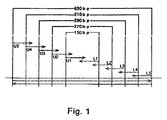
- Fig. 1 shows positional relationship of oligomers in an example of the first production method of the present invention.
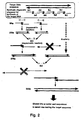
- Fig. 2 shows positional relationship of oligomers in an example of the second production method of the present invention and outline of the process.
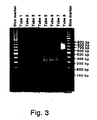
- Fig. 3 shows results of electrophoretic analysis of the PCR products obtained in Example 2 (Tube 1 to Tube 8) (photograph of an electrophoretic image).
- the first production method of the present invention is characterized in that equal numbers of oligomers each having a partial sequence of a target sequence for about half of the 5' end side of the target sequence and oligomers each having a sequence complementary to a partial sequence of a target sequence for about half of the 3' end side of the target sequence are prepared so that the partial sequences should have overlaps with adjacent partial sequences, PCR is first performed by using the most internally located two oligomers as primers and templates, and then PCR is repeated by using a reaction product and oligomers located immediately outside the previous ones as primers and templates until the reaction product should have a length of the target sequence.
- a target sequence which is a nucleotide sequence of DNA to be synthesized is divided into 2N (N is a positive integer) of sections; partial sequences each containing a nucleotide sequence of each section and a part of a nucleotide sequence of an adjacent section or parts of nucleotide sequences of adjacent sections are designed, wherein the part or parts have such a length that the nucleotide sequence of the each part can specifically make base-pairing with a nucleotide sequence complementary thereto; and oligomers each having each of the 1st to Nth partial sequences from the 5' end of the target sequence and oligomers each having a nucleotide sequence complementary to each of the (N+1)th to (2N)th partial sequences from the 5' end of the target sequence are prepared.
- a terminal partial sequence has the part (overlap) only at the internal end, and an internal partial sequence has the parts at the both ends.
- the oligomers having a partial sequence or a sequence complementary thereto designed in this step serve as primers and templates in PCR. Therefore, the term "specifically make base-pairing” means to specifically make base-pairing under the PCR conditions used in the steps (2) and (4a).
- the length of the partial sequence is usually 150 nucleotides or less, and it is preferably 80-120 nucleotides, if yield, synthesis efficiency and so forth are taken into consideration.
- the length of the target sequence is not limited except for a case where the sequence contains repeating sequences. However, if it is taken into consideration that the target sequence is selected by sequence analysis, it is preferably a length that can be determined by once of sequence analysis, and it is usually 1000 nucleotides or less. The number of N is determined based on the lengths of the target sequence and partial sequences as well as overlapping lengths of nucleotide sequences of adjacent sections in the partial sequences.
- the overlapping length of nucleotide sequences in partial sequences for adjacent sections may be a length sufficient for the specific base-pairing, and it is usually 17-40 nucleotides.
- the sequence of the overlap is selected so that, under the conditions of PCR, formation of primer dimers due to base-pairing at unintended position, intramolecular base-pairing of primer and so forth should be prevented and a suitable denaturation temperature (GC content) should be obtained, as is taken into consideration in the design of primer for usual PCR. All of the lengths of the partial sequences or the overlaps may not be in an equal length, and they may be suitably selected considering the target sequence and the above factors.
- PCR is performed by using an oligomer having the Nth partial sequence from the 5' end of the target sequence and an oligomer having a nucleotide sequence complementary to the (N+1)th partial sequence from the 5' end of the target sequence under such a condition that these oligomers should act as primers and templates.
- two kinds of oligomers serve as both of primers and templates, and primers and templates are not distinguished. That is, two kinds of oligomers are base-paired at their 3' ends, and act as both of primers and templates during the extension of each strand.
- an oligomer having the Nth partial sequence from the 5' end of the target sequence and an oligomer having a nucleotide sequence complementary to the (N+1)th partial sequence from the 5' end of the target sequence are added to a reaction mixture where extension reaction by DNA polymerase can be caused, and denaturation reaction, annealing reaction and extension reaction are repeated to synthesize DNA.
- the conditions for PCR can be determined by considering factors similar to those of usual PCR.
- a typical example of the PCR reaction mixture is a mixture containing 0.5 ⁇ M each of oligomers, 20 mM of Tris-HCl (pH 8.3 (25°C)), 1.5 mM of MgCl 2 , 0.05% of Tween 20, 100 ⁇ g/ml of gelatin or BSA, 50 ⁇ M each of dNTP and 0.02 units/ ⁇ l of Taq DNA polymerase (concentrations are final concentrations).
- the thermal cycle for the reactions may consist of, for example, a cycle of 94-98°C for 30 seconds to 1 minute for denaturation, 50-60°C for 30 seconds to 1 minute for annealing, and 65-72°C for 30 seconds to 1 minute for extension, which is repeated 20 to 30 times, and extension of the final extension reaction for 5 to 10 minutes.
- the denaturation reaction may be performed for 2-5 minutes.
- the reaction is usually stopped by cooling the mixture to 4°C and addition of EDTA (final concentration: 10 mM).
- Concentration of dNTP is usually 0.1-0.5 ⁇ M.
- concentration of dNTP is determined by considering yield of reaction products, specificity of base-pairing, accuracy of polymerization and so forth.
- Magnesium concentration is usually 1.5-3.5 mM.
- the Mg 2+ concentration is determined by considering EDTA concentration in the reaction mixture, annealing of primers, denaturation temperature of DNA, specificity of reaction, formation of primer dimer, enzyme activity, accuracy of polymerization and so forth.
- Concentration of the primer (oligomer) is usually 0.1-0.5 ⁇ M. When the concentration is too high, the specificity of reaction may be reduced, and primer dimer and so forth may be formed.
- concentration of DNA polymerase may vary depending on the type of the polymerase, in case of Taq DNA polymerase, it is usually 1-4 units/100 ⁇ l. If the amount of the enzyme is too large, non-specific amplification may occur.
- DNA produced by the extension reaction may be involved in the reaction as a template. That is, there also may occur a reaction in which DNA produced by the extension reaction acts as a template and the oligomers as a whole act as only primer. Therefore, the denaturation conditions are usually determined so that sufficient denaturation of the DNA that can be a template should be obtained.
- the conditions for annealing are determined by considering denaturation temperature, length and concentration of primer and so forth.
- the temperature is usually, for example, a temperature lower than the denaturation temperature of primer by about 5°C.
- the conditions for extension are determined by considering the type of DNA polymerase to be used, length and amount of a portion desired to be extended and temperature.
- the temperature may be its optimal temperature. Since DNA polymerase may be inactivated depending on the denaturation conditions, supplemental addition of DNA polymerase is also taken into consideration.
- PCR can be performed by using widely used apparatuses and enzymes for PCR and so forth as they are.
- DNA used as a template is a single strand DNA
- non-specific base-pairing and extension reaction may occur before the temperature reaches the first denaturation temperature, thereby causing non-specific amplification.
- a technique called hot start method may be used, in which the reaction does not occur until the temperature reaches the first denaturation temperature, and it only occurs after the temperature reaches a predetermined temperature.
- the synthesized DNAs are sequenced and DNA having a nucleotide sequence containing the Nth and (N+1)th partial sequences from the 5' end of the target sequence is selected.
- the sequencing of the synthesized DNAs can be performed in a conventional manner.
- reaction products obtained in the step (2) are subjected to agarose gel electrophoresis, and DNAs having an expected length are extracted from the gel, cloned into a suitable vector, and sequenced.
- DNA containing the Nth and the (N+1)th partial sequences from the 5' end of the target sequence may be selected and used in the form of the vector as a template in a subsequent reaction.
- step (4) the following steps (4a) and (4b) are repeated for J (J is an integer) to be from 1 to N-1.
- each single strand of DNA and two kinds of oligomers serve as both of primers and templates, and primers and templates are not distinguished. That is, one single strand and one oligomer and the other single strand and the other oligomer are base-paired at their 3' ends, respectively, and act as both of primers and templates during the extension of each strand.
- the selected DNA, an oligomer having the (N-J)th partial sequence from the 5' end of the target sequence and an oligomer having a nucleotide sequence complementary to the (N+1+J)th partial sequence from the 5' end of the target sequence are added to a reaction mixture where extension reaction by DNA polymerase can be caused, and denaturation reaction, annealing reaction and extension reaction are repeated to synthesize DNA.
- the step (4a) can be performed in the same manner as the step (2) except that a selected DNA is further contained and different oligomers are used.
- the conditions of PCR are determined by taking these differences into consideration. However, if the conditions for the step (2) are determined with taking the conditions of the step (4a) into consideration, it can be performed with the same conditions as the step (2).
- the step (4b) may be performed in the same manner as the step (3).
- PCR is performed with conditions of 94°c for 2 minutes, subsequent repetition of a cycle of 98°C for 30 seconds, 60°C for 30 seconds and 68°C for 1 minute for 30 times, and 68°C for 10 minutes to synthesize DNA of 150 nucleotides.
- the obtained DNAs are sequenced, and DNA having an intended sequence is selected.
- the second production method of the present invention is characterized in that equal numbers of oligomers each having a partial sequence of a target sequence and oligomers each having a sequence complementary to a partial sequence of a target sequence are prepared, wherein the former and latter partial sequences are in an alternate positional relationship, so that the partial sequences should have overlaps with adjacent partial sequences; PCR is first performed by using each pair of adjacent oligomers as primers and templates; and then PCR is repeated by using each pair of adjacent reaction products as primers and templates until a reaction product should have a length of the target sequence.
- a target sequence which is a nucleotide sequence of DNA to be synthesized is divided into 2 n (n is a positive integer) of sections; partial sequences each containing a nucleotide sequence of each section and a part of a nucleotide sequence of an adjacent section or parts of nucleotide sequences of adjacent sections are designed, wherein the part or parts have such a length that the nucleotide sequence of each part can specifically make base-pairing with a nucleotide sequence complementary thereto; and oligomers each having each of (odd number)th partial sequences from the 5' end of the target sequence and oligomers each having a nucleotide sequence complementary to each of (even number)th partial sequences from the 5' end of the target sequence are prepared.
- a terminal partial sequence has the part (overlap) only at the internal end, and an internal partial sequence has the parts at the both ends.
- the oligomers having a partial sequence or a sequence complementary thereto determined in this step are used as primers and templates in PCR. Therefore, the term "specifically make base-pairing” means to specifically make base-pairing under the PCR conditions used in the steps (2a) and (3ai).
- Length of the partial sequence may be a length of DNA that can practically produced by chemical synthesis, and it is usually 80-120 nucleotides.
- the number of n is determined based on this length, the length of the target sequence, accuracy of polymerization and so forth, and it is usually 2-4. If it exceeds this range, it may become likely that mutations are introduced, and thus it may become unlikely that a target sequence can be obtained.
- the overlapping length of nucleotide sequences of adjacent sections in the partial sequences may be a length sufficient for the specific base-pairing, and it is usually 17-40 nucleotides.
- the sequence of the overlap is selected so that, under the conditions of PCR, formation of primer dimers due to base-pairing at unintended position, intramolecular base-pairing of primer and so forth should be prevented and a suitable denaturation temperature (GC content) should be obtained, as is taken into consideration in the design of primer for usual PCR.
- All of the lengths of the partial sequences or the overlaps may not be in an equal length, and they may be suitably selected considering the target sequence and the above factors. For example, since the length of DNA serving as a primer and a template becomes longer as the reaction steps proceed, the length of the overlap may be changed taking it into consideration.
- step (2) the following step (2a) is repeated for j (j is an integer) to be from 1 to 2 n-1 to produce 2 n-1 of reaction products.
- step (2) PCR is performed by using an oligomer having the (2j-1)th partial sequence from the 5' end of the target sequence and an oligomer having a nucleotide sequence complementary to the (2j)th partial sequence from the 5' end of the target sequence under such a condition that these oligomers should act as primers and templates.
- the step (2a) can be performed in the same manner as the step (2) of the first production method of the present invention.
- the conditions are preferably determined by considering the DNA used in the step (3ai) as primers and templates. Further, EDTA is not added to stop the reaction.
- step (3) the following step (3a) is repeated for i (i is an integer) to be from 2 to n.
- reaction mixtures obtained in a preceding step are mixed to perform PCR. While the reaction conditions for denaturation, annealing, and extension may be the same as those of the step (2a), conditions for a part or all of denaturation, annealing, and extension may be changed depending on the extended length of DNA that serves as primers and templates. Further, depending on the conditions of PCR, other reagents such as DNA polymerase may be added upon mixing of the reaction mixtures.
- step (4) DNAs having a length expected from the target sequence are separated, and the separated double-strand DNAs are sequenced to select a double-strand DNA having the target sequence.
- the separation and sequencing of DNA in the step (4) may be performed in the same manner as the step (3) of the first production method of the present invention.
- Aa1, Aa2, Ab1, Ab2, Ba1, Ba2, Bb1 and Bb2 are prepared. They are designed so that Aa1 and Aa2, Ab1 and Ab2, Ba1 and Ba2, Bb1 and Bb2, Aa2 and Ab1, and Ba2 and Bb1 should overlap for 30 nucleotides, respectively, and Ab2 and Ba1 should overlap for 40 nucleotides.
- reaction mixtures containing Aa1 and Aa2, Ab1 and Ab2, Ba1 and Ba2, and Bb1 and Bb2, respectively, are prepared, and PCR is performed for each mixture.
- the reaction mixture of Aa and the reaction mixture of Ab, and the reaction mixture of Ba and the reaction mixture of Bb are mixed respectively, and PCR is performed for each mixture.
- the reaction mixtures obtained after the second reaction are mixed, and PCR is performed.
- the obtained reaction products are subjected to agarose gel electrophoresis, and DNAs having an expected length are extracted from the gel, cloned into a suitable vector, and sequenced to select a clone of the target sequence.
- a further longer DNA can be synthesized by increasing the number of steps of the mixing of reaction products.
- sequencing DNA of about 500 nucleotides once when it is synthesized, and by using it according to other methods a further longer final product can be produced.
- DNA having an arbitrary sequence can also be produced, because restriction enzyme treatment is not essential for this method as middle steps like the first production method of the present invention.
- Uncompleted oligomers such as those having a shorter 5'-end-side sequence due to stop of the reaction in their synthesis cycle are not likely to be involved in a reaction in a subsequent step, because they have only a short or no portion for annealing, and thus it is unlikely that clones having deletion should be synthesized. Therefore, the oligomers can be used even with a low purification degree.
- the final reaction product Since the length of the reaction product is approximately doubled in every step, the final reaction product shows significant difference in length with respect to other products (e.g., those undergone only reactions of previous steps), and hence it can be easily collected from the gel.
- a ratio of the oligomers added to the reaction mixture or a ratio of reaction mixtures are preferably adjusted so that a single strand DNA required for a subsequent step should be synthesized in an amount larger than that of the other single strand DNA in the steps (2a) and (3ai).
- a single strand DNA required for a subsequent step is synthesized in an amount larger than that of the other single strand DNA by changing the ratio of the initial amounts of oligomers and the ratios of amounts of the reaction mixtures mixed except for the last mixing of the reaction mixtures, as in the asymmetric PCR (e.g., 1:2-1:9).
- PCR is performed by adding Aa1 and Aa2 in an amount ratio of 4:1, Ab1 and Ab2 in a ratio of 1:4, Ba1 and Ba2 in a ratio of 4:1, and Bb1 and Bb2 in a ratio of 1:4 to a reaction mixture (Ba1 and Ba2, and Bb1 and Bb2 are not shown in the figure). Then, PCR is performed by mixing the reaction mixture of Aa1 and Aa2 and the reaction mixture of Ab1 and Ab2 in a ratio of 4:1. PCR is also performed by mixing the reaction mixture of Ba1 and Ba2 and the reaction mixture of Bb1 and Bb2 in a ratio of 1:4 (not shown in the figure).
- PCR is performed by mixing the reaction mixture of Aa1 to Ab2 and the reaction mixture of Ba1 to Bb2 in a ratio of 1:1.
- the obtained reaction products are subjected to agarose gel electrophoresis, and DNAs having an expected length are extracted from the gel, cloned into a suitable vector, and sequenced to select a clone of the target sequence.
- the 3' end portion not required to be extended may be modified so that it should not be extended to improve the synthesis efficiency of the target product. While examples of such modification of 3' end include amination, biotinylation, digoxigenylation and so forth, amination that is a small modification in terms of the molecular size is preferred in order not to affect Tm so much.
- primers of about 20-mer may be designed for the both ends of the synthesized final product and PCR may be performed by using this final product as a template. In this way, the amount of the final product obtained in a small amount may be increased, and products having deletion at the one or both ends may be excluded.
- the target sequence was divided into ten sections, and partial sequences of the target sequence were designed with a length of 90 nucleotides and overlap of adjacent sections of 30 nucleotides. Further, oligomers each having each of the partial sequences of the target sequence (U1 to U5) and oligomers each having a sequence complementary to each of the partial sequences of the target sequence (L1 to L5) were synthesized.
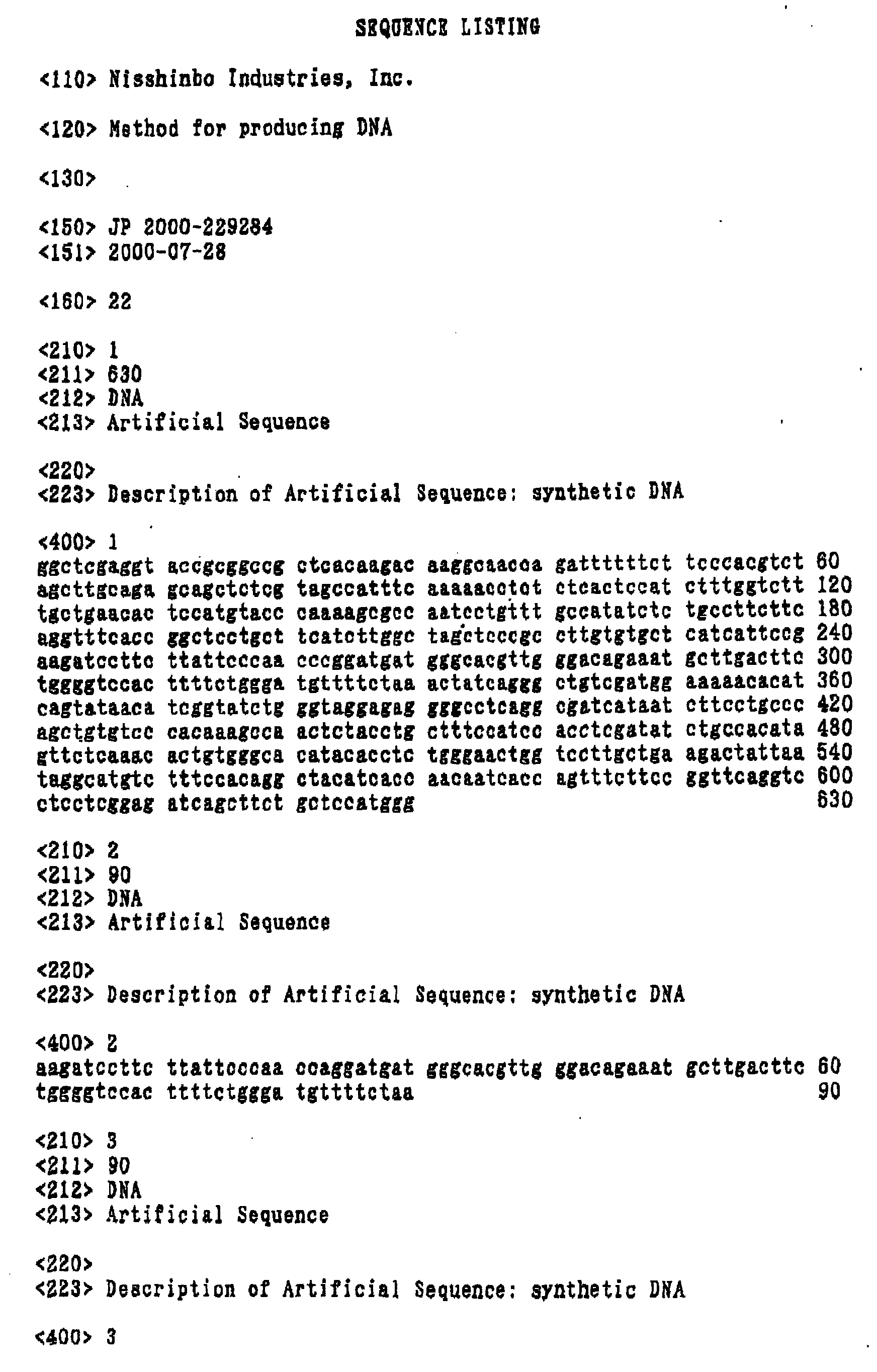
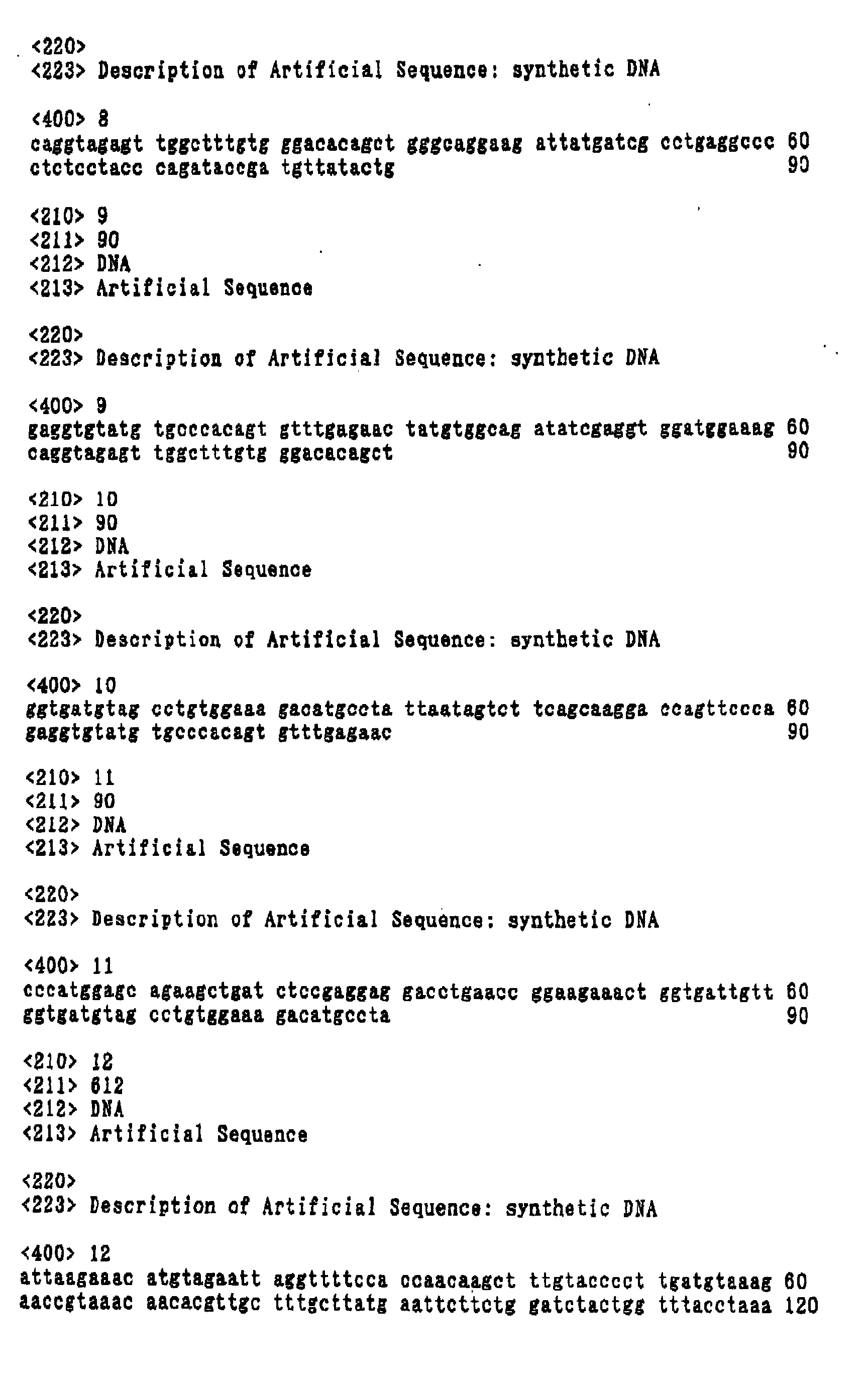
- the nucleotide sequences of U1 to U5 and L1 to L5 are shown in SEQ ID NOS: 2-11, respectively.
- the positional relationship of U1 to U5 and L1 to L5 is shown in Fig. 1.
- reaction 25 ⁇ l of a reaction mixture containing 0.4 ⁇ M each of U1 and L1, 40 mM of Tricine-KOH (pH 9.2 at 25°C), 15 mM of potassium acetate (KOAc), 1.5 mM of magnesium acetate (Mg(OAc) 2 ), 75 ⁇ g/ml of bovine serum albumin (BSA) and 0.2 mM each of dNTP and 0.5 ⁇ l of Advantage KlenTaq Polymerase Mix was prepared by using a PCR kit produced by Clontech Co., Advantage cDNA PCR Kit.
- the reaction was performed under the following conditions.
- the reaction mixture was kept at 94°C for 2 minutes, and then subjected to a cycle of denaturation reaction at 98°C for 30 seconds, annealing reaction at 60°C for 30 seconds and extension reaction at 68°C for 1 minute, which was repeated 30 times, and then final extension reaction was extended for 10 minutes.
- the reaction was stopped by cooling the reaction mixture to 4°C.
- the obtained reaction product was separated by agarose gel electrophoresis, and fragments having a length expected from the nucleotide sequences of U1 and L1 were extracted from the gel and purified.
- the obtained fragments were directly cloned by using a vector kit for TA cloning, pGEM-T Vector System (Promega).
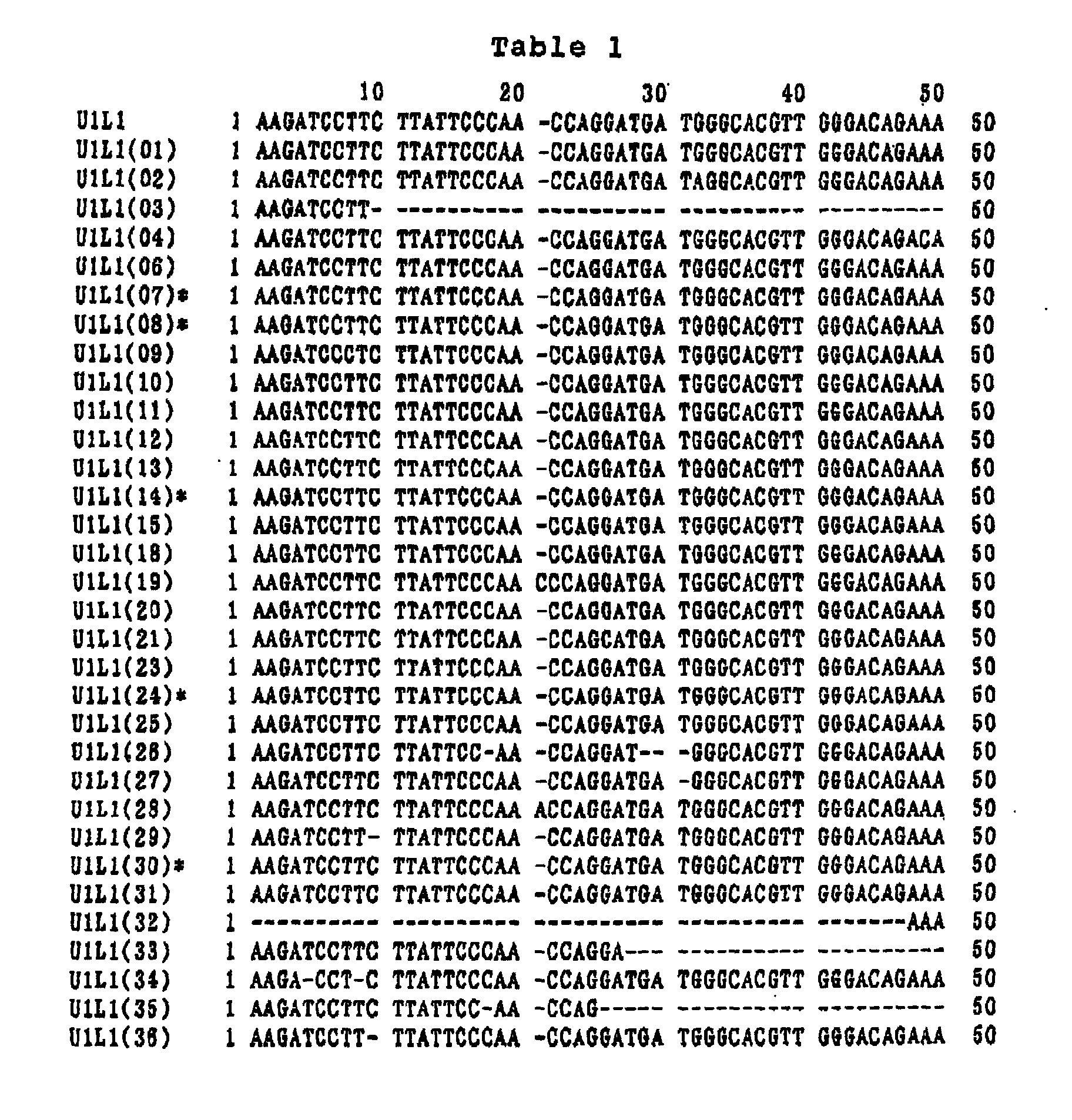
- Inserted sequences were determined for a part of the obtained clones. As a result, clones having the nucleotide sequences shown in Table 1 were obtained. In Table 1, the target sequence is shown in the top line. The parenthesized numbers indicate designations of the clones, and a designation to which "*" is appended on the right side indicates a clone having a target sequence.
- the clone having the target sequence was used for the subsequent reaction.
- the same reaction mixture as mentioned above except that it contained about 5 ng of this plasmid and U2 and L2 instead of U1 and L1 was prepared, and a reaction product was obtained with the same reaction conditions as those mentioned above.
- the obtained reaction product was separated by agarose gel electrophoresis, and fragments having a length expected from the nucleotide sequences of U1, U2, L1 and L2 were extracted from the gel and purified.
- the obtained fragments were directly cloned by using a vector kit for TA cloning, pGEM-T Vector System (Promega).
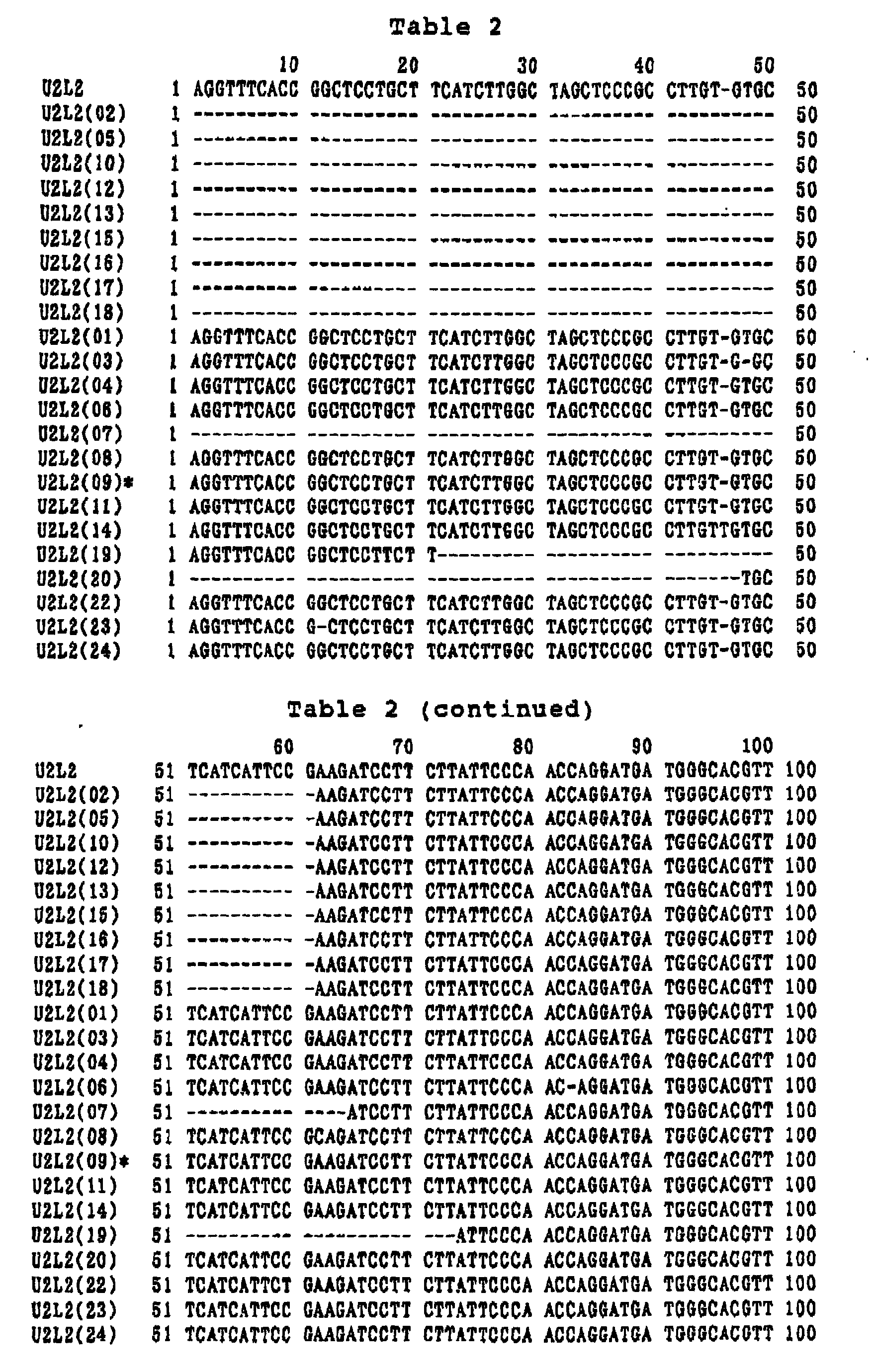
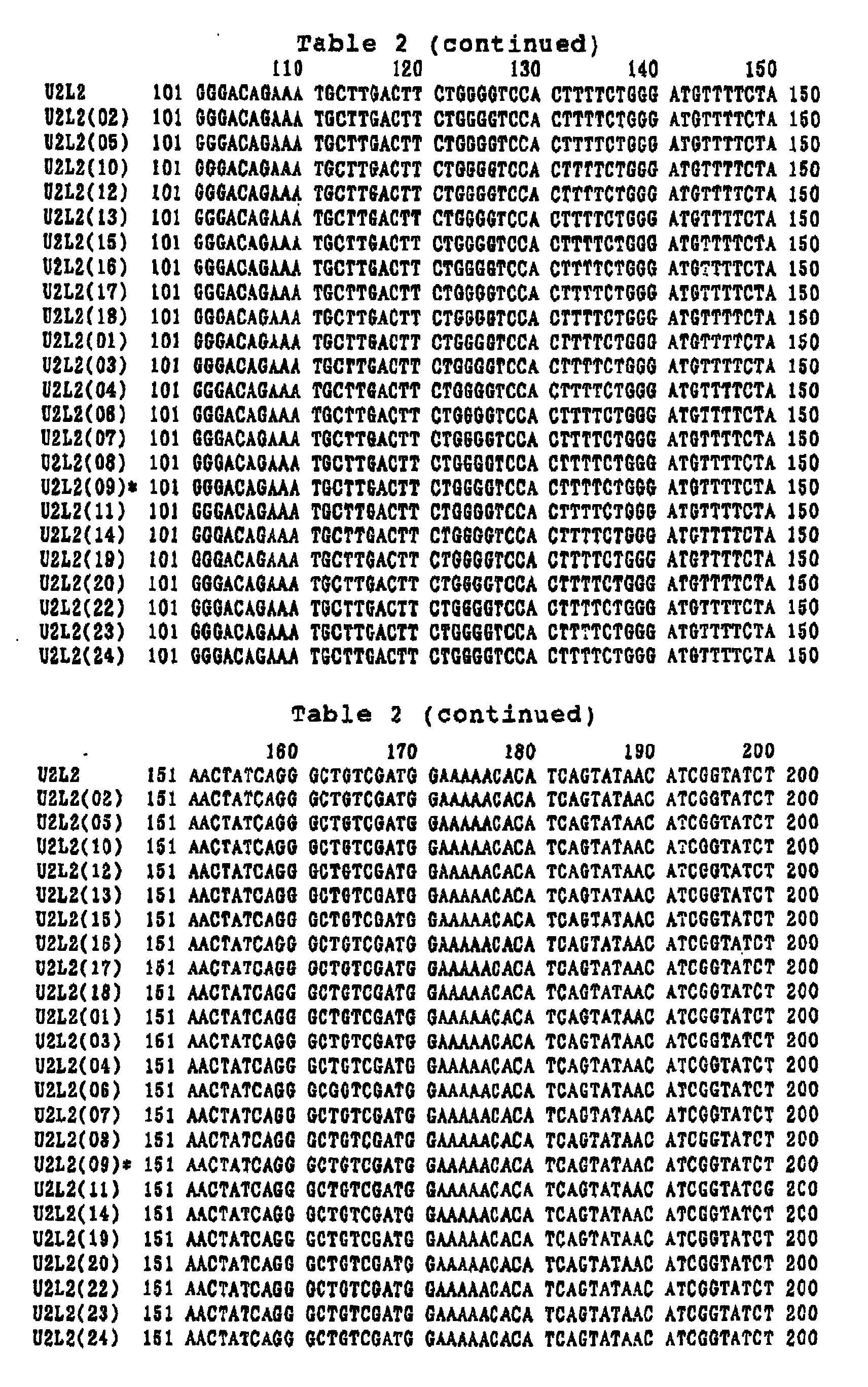
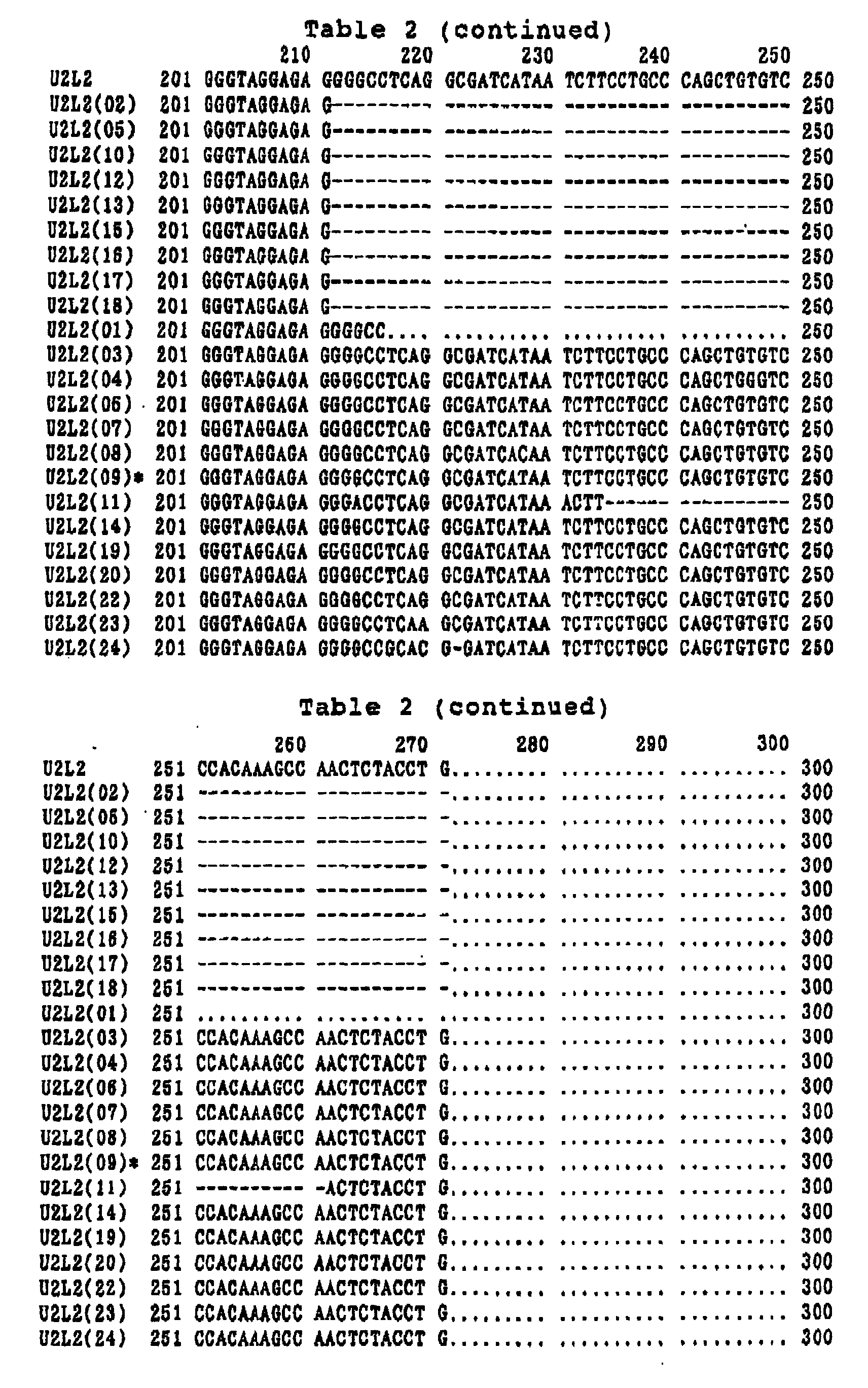
- Inserted sequences were determined for a part of the obtained clones. As a result, clones having the nucleotide sequences shown in Table 2 were obtained. In Table 2, the target sequence is shown in the top line. The parenthesized numbers indicate designations of the clones, and a designation to which "*" is appended on the right side indicates a clone having a target sequence.
- the clone having the target sequence was used for the subsequent reaction.
- the same reaction mixture as mentioned above was prepared except that it contained about 5 ng of this plasmid and U3 and L3 instead of U1 and L1, and a reaction product was obtained with the same reaction conditions as those mentioned above.
- the obtained reaction product was separated by agarose gel electrophoresis, and fragments having a length expected from the nucleotide sequences of U1 to U3 and L1 to L3 were extracted from the gel and purified.
- the obtained fragments were directly cloned by using a vector kit for TA cloning, pGEM-T vector System (Promega).
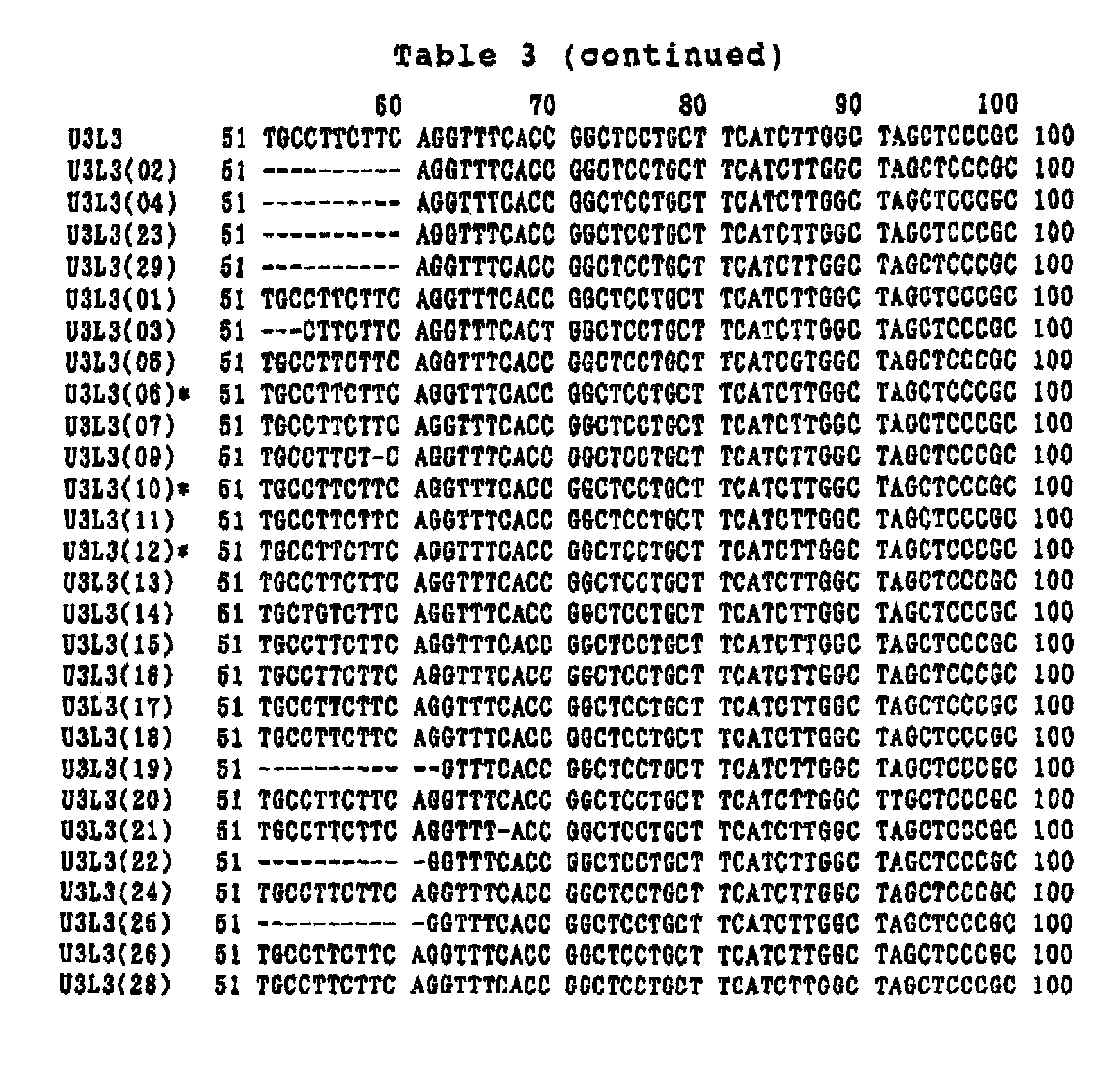
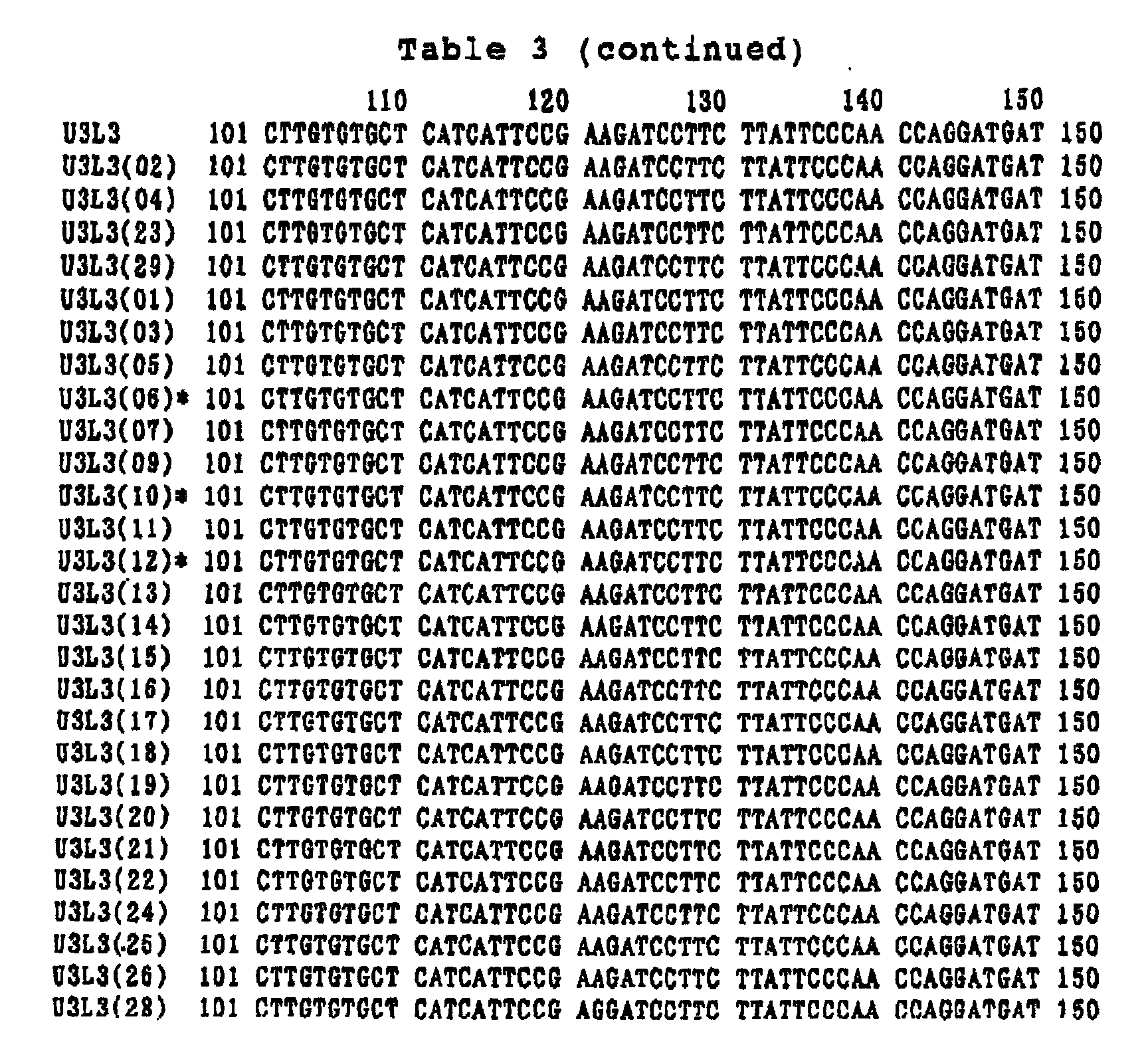
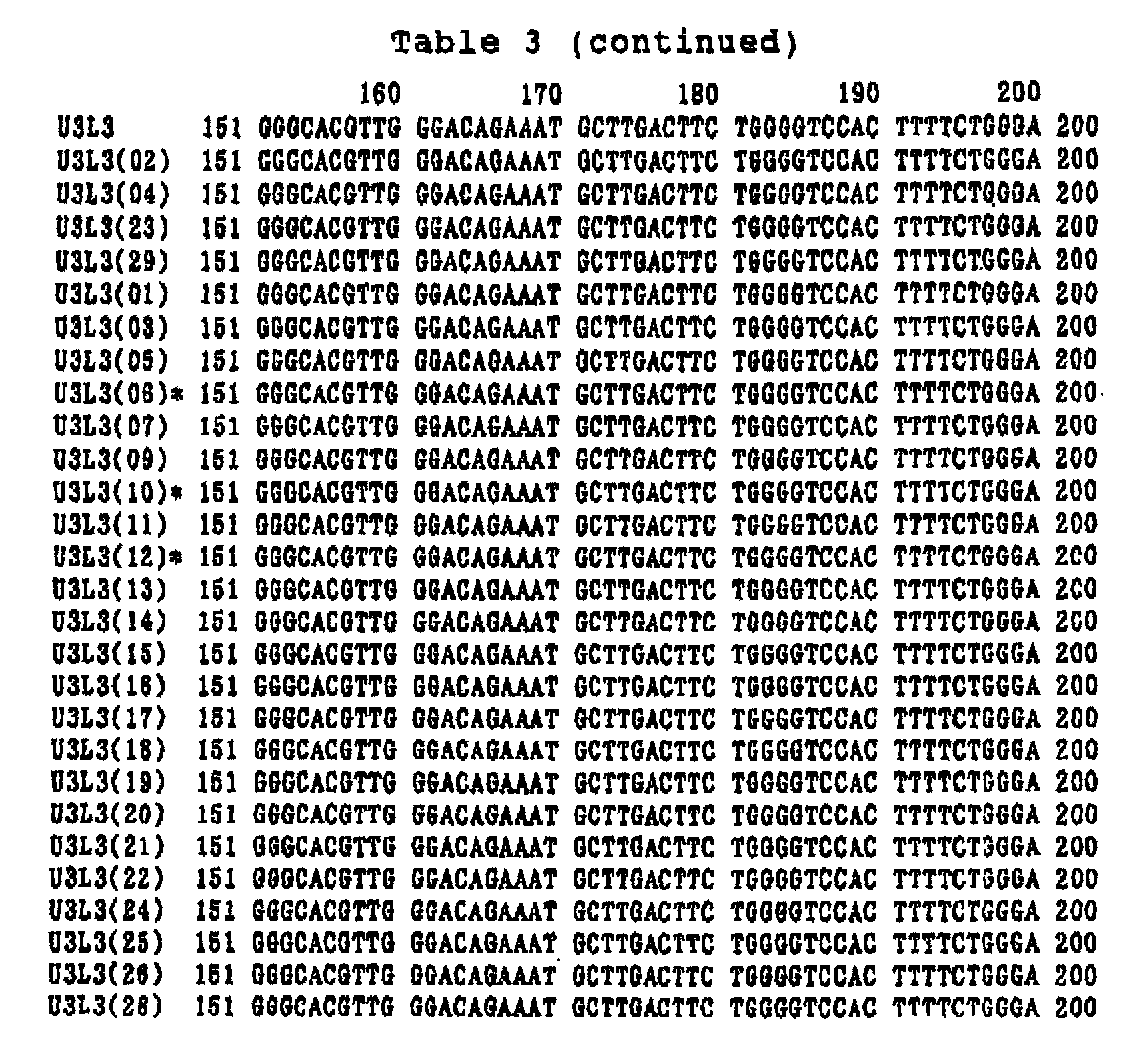
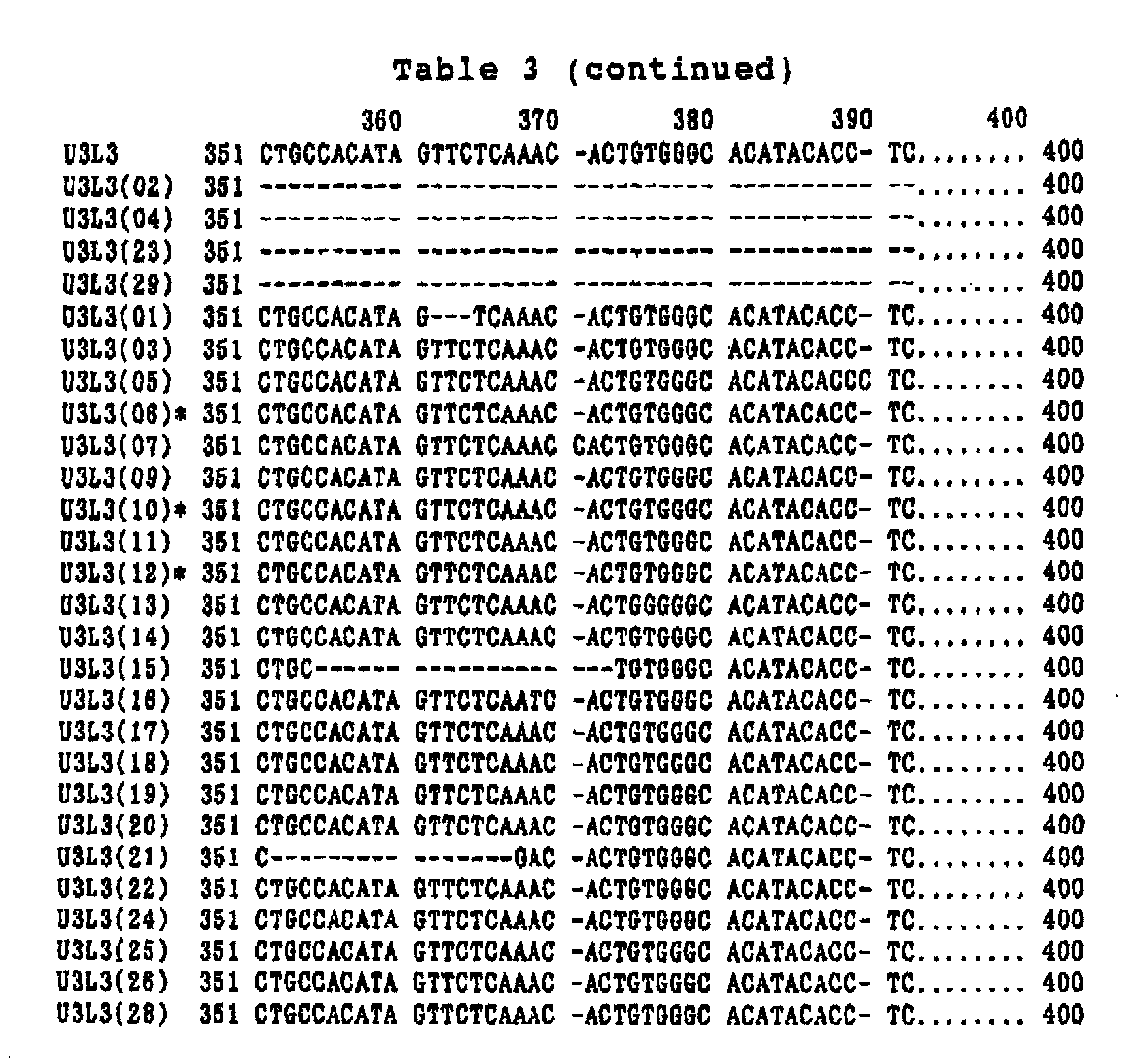
- Inserted sequences were determined for a part of the obtained clones. As a result, clones having the nucleotide sequences shown in Table 3 were obtained. In Table 3, the target sequence is shown in the top line. The parenthesized numbers indicate designations of the clones, and a designation to which "*" is added on the right side indicates a clone having a target sequence.
- the clone having the target sequence was used for the subsequent reaction.
- the same reaction mixture as mentioned above was prepared except that it contained about 5 ng of this plasmid, and U4 and L4 instead of U1 and L1, and a reaction product was obtained with the same reaction conditions as those mentioned above.
- the obtained reaction product was separated by agarose gel electrophoresis, and fragments having a length expected from the nucleotide sequences of U1 to U4 and L1 to L4 were extracted from the gel and purified.
- the obtained fragments were directly cloned by using a vector kit for TA cloning, pGEM-T Vector System (Promega).
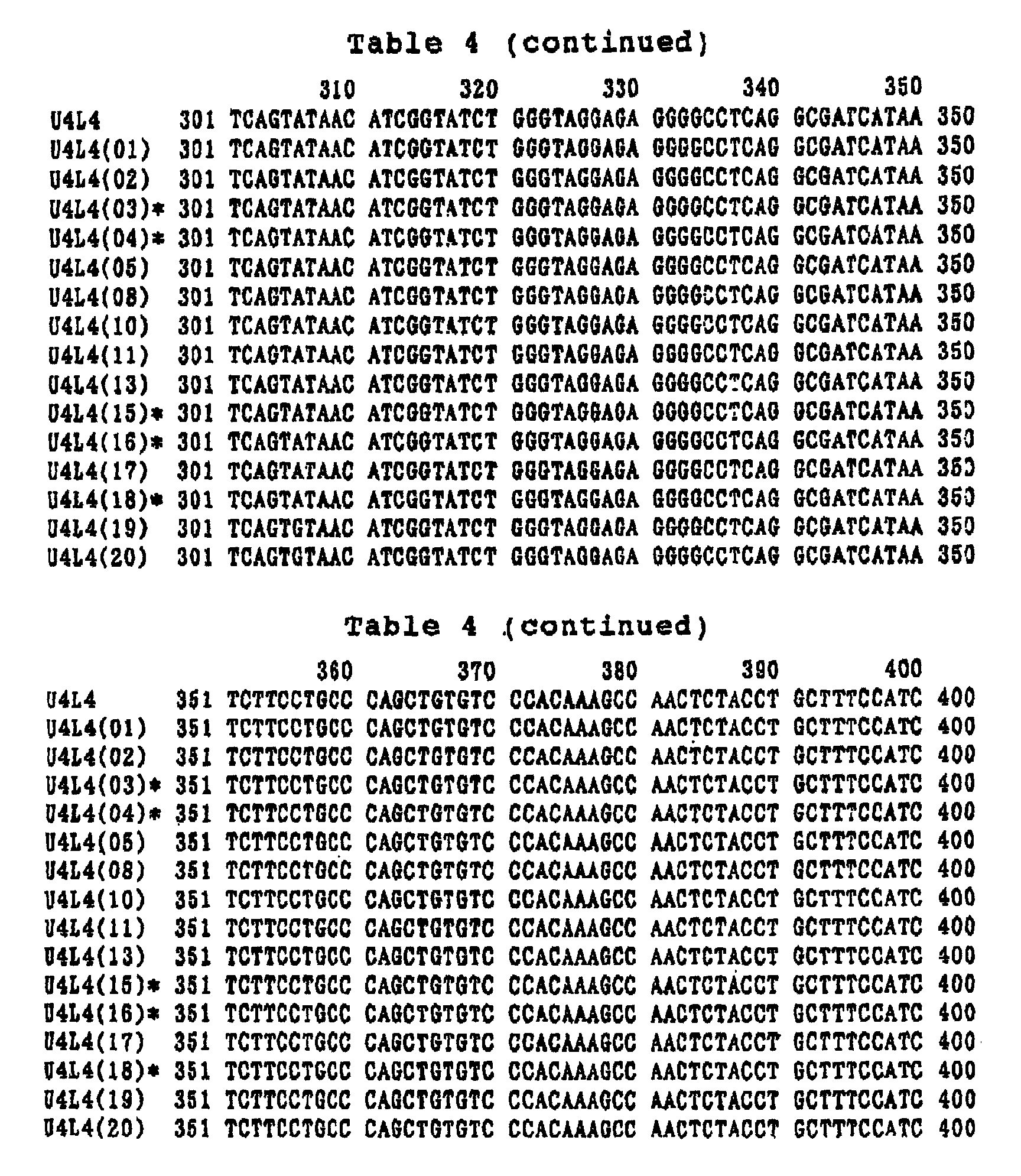
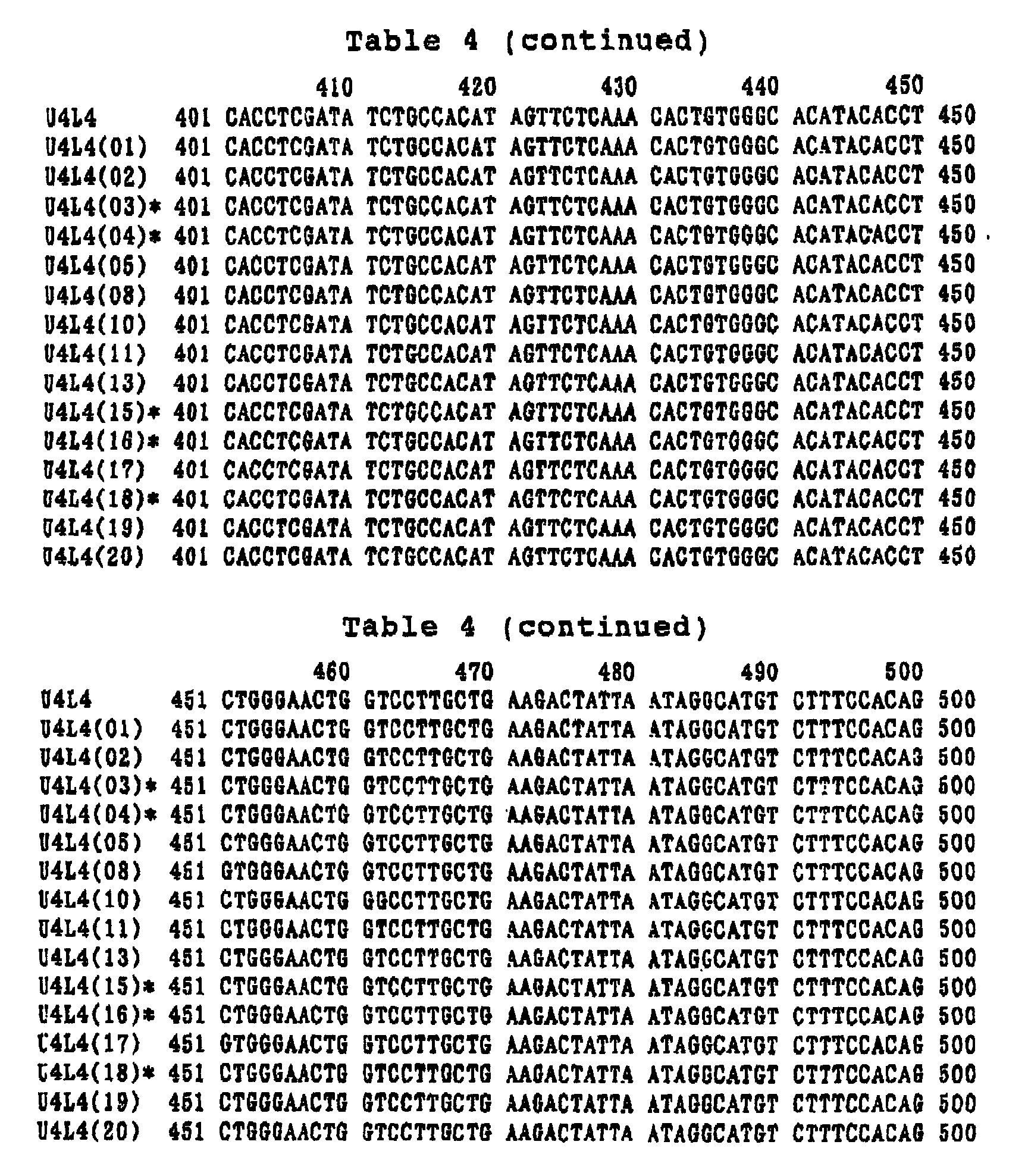
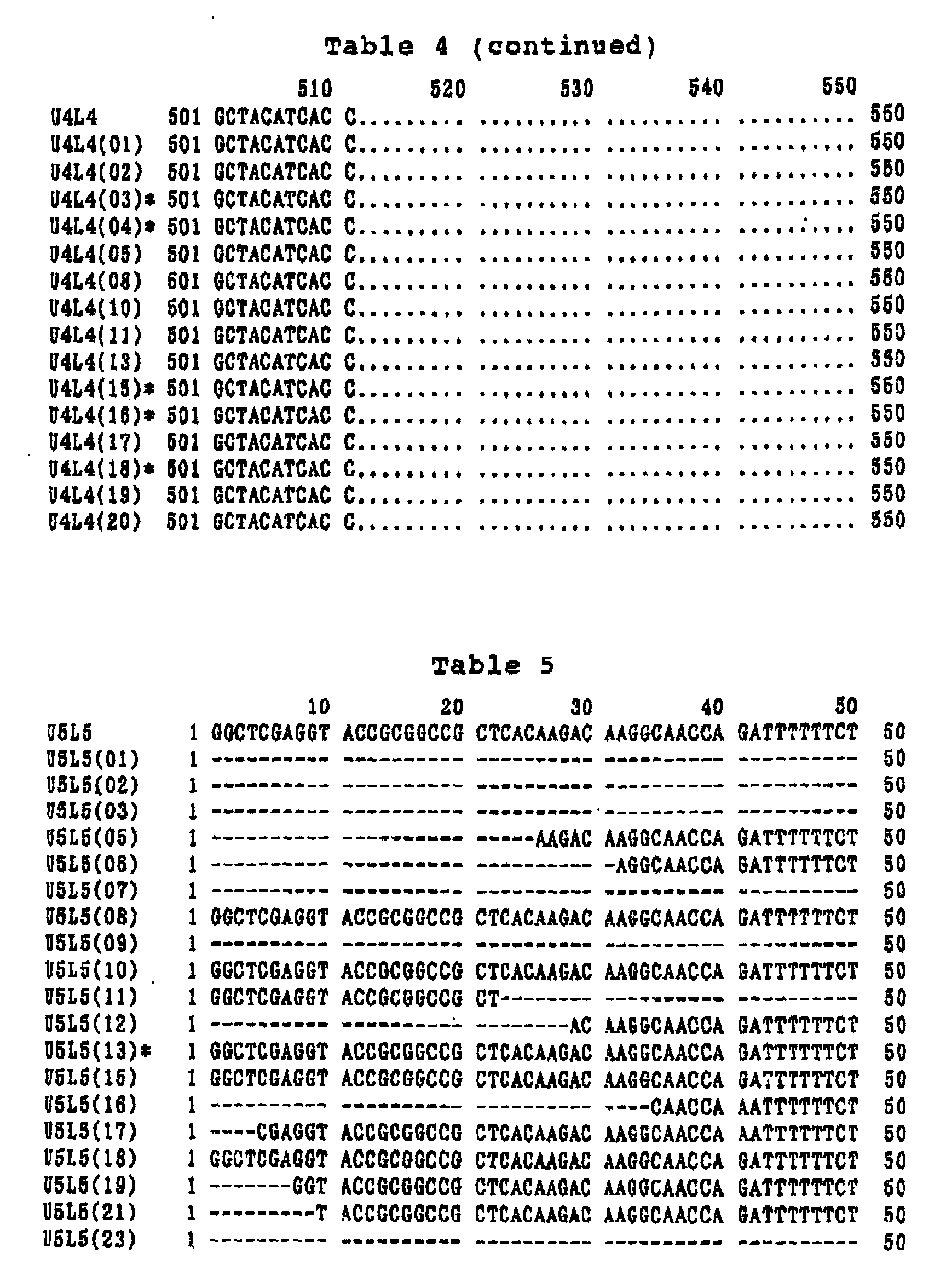
- Inserted sequences were determined for a part of the obtained clones. As a result, clones having the nucleotide sequences shown in Table 4 were obtained. In Table 4, the target sequence is shown in the top line. The parenthesized numbers indicate designations of the clones, and a designation to which "*" is appended on the right side indicates a clone having a target sequence.
- the clone having the target sequence was used for the subsequent reaction.
- the same reaction mixture as mentioned above was prepared except that it contained about 5 ng of this plasmid, and U5 and L5 instead of U1 and L1, and a reaction product was obtained with the same reaction conditions as those mentioned above.
- the obtained reaction product was separated by agarose gel electrophoresis, and fragments having a length expected from the nucleotide sequences of U1 to U5 and L1 to L5 were extracted from the gel and purified.
- the obtained fragments were directly cloned by using a vector kit for TA cloning, pGEM-T Vector System (Promega).
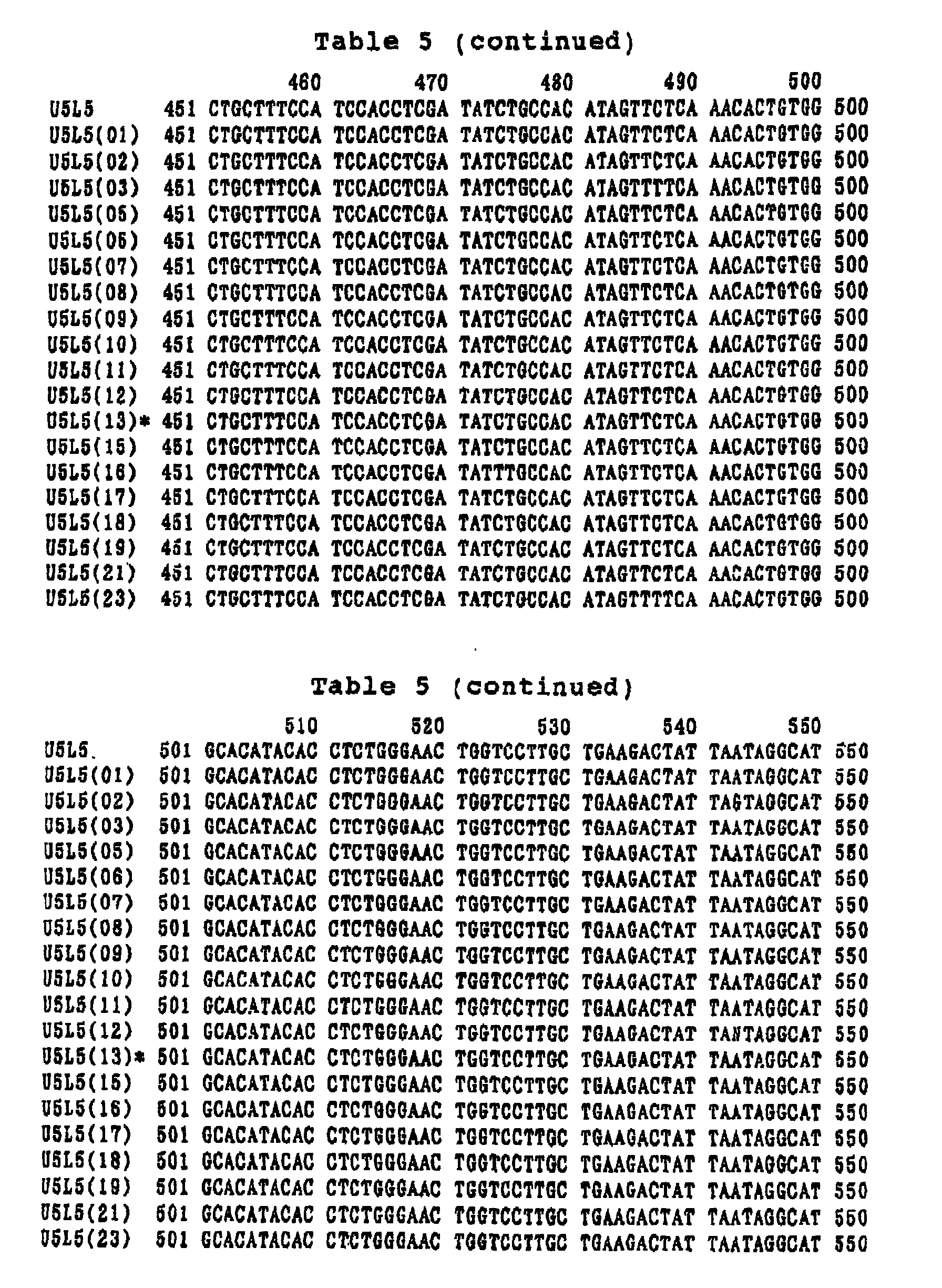
- Inserted sequences were determined for a part of the obtained clones. As a result, clones having the nucleotide sequences shown in Table 5 were obtained. In Table 5, the target sequence is shown in the top line. The parenthesized numbers indicate designations of the clones, and a designation to which "*" is appended on the right side indicates a clone having a target sequence.
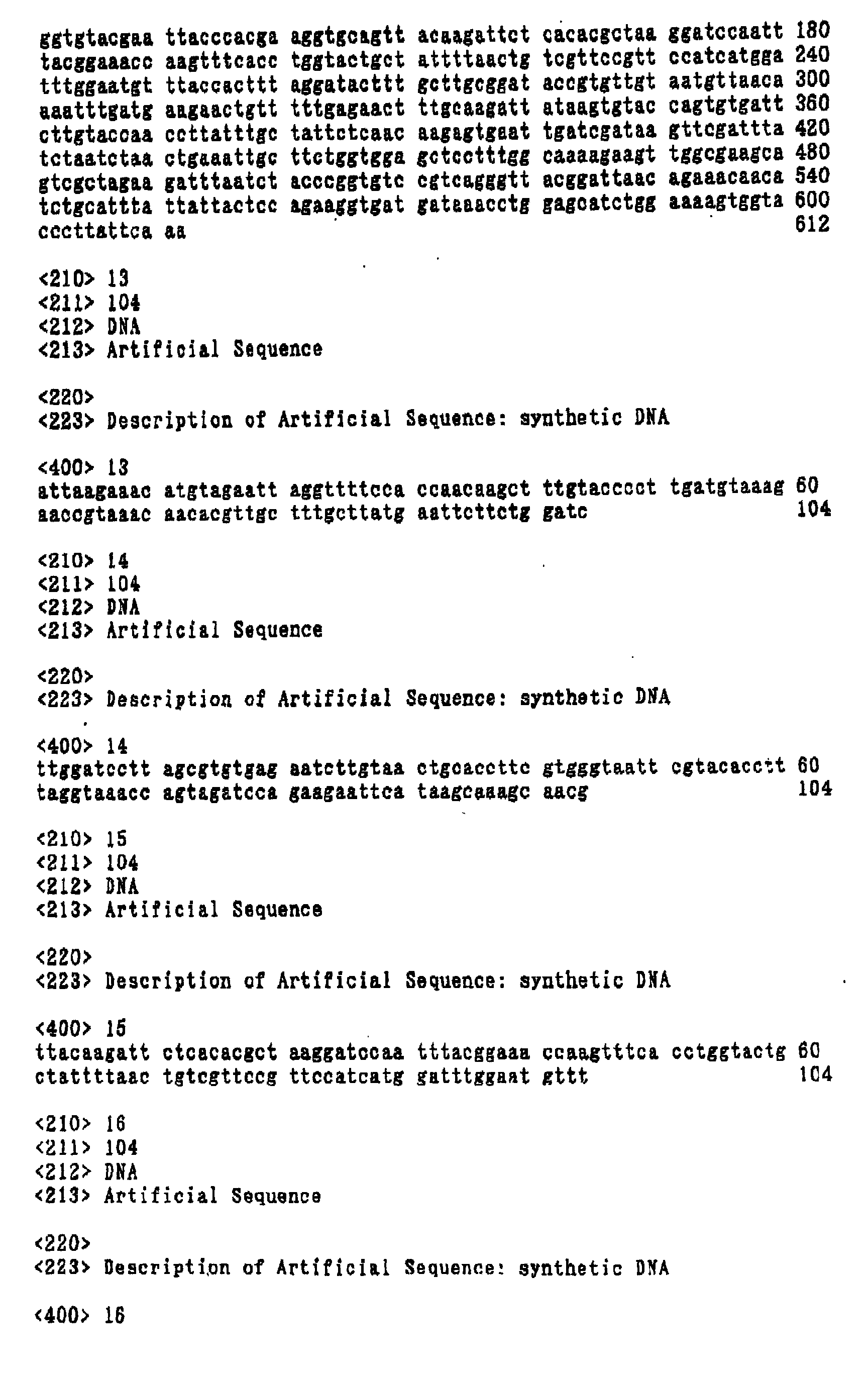
- oligomers having a length of 104 nucleotides 1a, 1b, 2a, 2b, 3a, 3b, 4a and 4b were synthesized, each of which had each of the nucleotide sequences shown in SEQ ID NOS: 13-20.
- These oligomers correspond to Aa1, Aa2, Ab1, Ab2, Ba1, Ba2, Bb1 and Bb2, respectively, which are shown in the frame in Fig. 2.
- Reaction mixtures having each of the compositions shown in Table 6 were prepared in four of tubes (Tube 1 to Tube 4), and PCR was performed by leaving at 94°C for 1 minute, and repeating 30 times a cycle of reactions at 94°C for 1 minute and 68°C for 30 seconds. In this stage, a fragment of 179 bp is synthesized.
- reaction mixture (unit: ⁇ l) Tube 1 Tube 2 Tube 3 Tube 4 10 x pyrobest PCR reaction buffer 10 10 10 10 2.5 mM dNTP mixture 2 2 2 2 Primer a (10 pmol/ ⁇ l) 4(1a) 1(2a) 4(3a) 1(4a) Primer b (10 pmol/ ⁇ l) 1(1b) 4(2b) 1(3b) 4(4b) Pyrobest DNA polymerase (5 unit/ ⁇ l) 0.5 0.5 0.5 0.5 0.5 0.5 0.5 0.5 water 82.5 82.5 82.5 82.5 82.5 Total 100 100 100 100 100 100 100 100 100 100 100 100 100 100 100 100 100 100 100 100 100 100 100 100 100 100 100 100 100 100 100 100 100 100 100
- reaction mixture unit: ⁇ l
- Pyrobest PCR reaction buffer 10
- Reaction product of Tube 7 4
- 2.5 mM dNTP mixture 2
- Primer Upper (10 pmol/ ⁇ l)
- Primer Lower (10 pmol/ ⁇ l)
- Pyrobest DNA polymerase 5 unit/ ⁇ l
Landscapes
- Life Sciences & Earth Sciences (AREA)
- Health & Medical Sciences (AREA)
- Genetics & Genomics (AREA)
- Chemical & Material Sciences (AREA)
- Engineering & Computer Science (AREA)
- Organic Chemistry (AREA)
- Zoology (AREA)
- Wood Science & Technology (AREA)
- Bioinformatics & Cheminformatics (AREA)
- Biotechnology (AREA)
- General Engineering & Computer Science (AREA)
- Biomedical Technology (AREA)
- Molecular Biology (AREA)
- Biophysics (AREA)
- Microbiology (AREA)
- Biochemistry (AREA)
- General Health & Medical Sciences (AREA)
- Physics & Mathematics (AREA)
- Plant Pathology (AREA)
- Chemical Kinetics & Catalysis (AREA)
- Proteomics, Peptides & Aminoacids (AREA)
- Cell Biology (AREA)
- Analytical Chemistry (AREA)
- Immunology (AREA)
- Crystallography & Structural Chemistry (AREA)
- Preparation Of Compounds By Using Micro-Organisms (AREA)
- Measuring Or Testing Involving Enzymes Or Micro-Organisms (AREA)
- Saccharide Compounds (AREA)
Abstract
Description
(2a) PCR is performed by using an oligomer having the (2j-1)th partial sequence from the 5' end of the target sequence and an oligomer having a nucleotide sequence complementary to the (2j)th partial sequence from the 5' end of the target sequence under such a condition that these oligomers should act as primers and templates.










| Composition of reaction mixture (unit: µl) | ||||
| | Tube 2 | | | |
| 10 x pyrobest PCR reaction buffer | 10 | 10 | 10 | 10 |
| 2.5 mM dNTP mixture | 2 | 2 | 2 | 2 |
| Primer a (10 pmol/µl) | 4(1a) | 1(2a) | 4(3a) | 1(4a) |
| Primer b (10 pmol/µl) | 1(1b) | 4(2b) | 1(3b) | 4(4b) |
| Pyrobest DNA polymerase (5 unit/µl) | 0.5 | 0.5 | 0.5 | 0.5 |
| water | 82.5 | 82.5 | 82.5 | 82.5 |
| | 100 | 100 | 100 | 100 |
| Composition of reaction mixture (unit: µl) | |
| 10 x Pyrobest PCR reaction buffer | 10 |
| Reaction product of | 4 |
| 2.5 mM dNTP mixture | 2 |
| Primer Upper (10 pmol/µl) | 5 |
| Primer Lower (10 pmol/µl) | 5 |
| Pyrobest DNA polymerase (5 unit/µl) | 0.5 |
| Water | 73.5 |
| | 100 |



Claims (3)
- A method for producing DNA, which comprises the following steps (1) to (4):(1) dividing a target sequence which is a nucleotide sequence of DNA to be synthesized into 2N wherein N is a positive integer, of sections, designing partial sequences each containing a nucleotide sequence of each section and a part of a nucleotide sequence of an adjacent section or parts of nucleotide sequences of adjacent sections, wherein the part or parts have such a length that the nucleotide sequence of the each part can specifically make base-pairing with a nucleotide sequence complementary thereto, and preparing oligomers each having each of the 1st to Nth partial sequences from the 5' end of the target sequence and oligomers each having a nucleotide sequence complementary to each of the (N+1)th to (2N)th partial sequences from the 5' end of the target sequence,(2) performing PCR by using an oligomer having the Nth partial sequence from the 5' end of the target sequence and an oligomer having a nucleotide sequence complementary to the (N+1)th partial sequence from the 5' end of the target sequence under such a condition that these oligomers should act as primers and templates,(3) sequencing synthesized DNAS and selecting DNA having a nucleotide sequence containing the Nth and (N+1)th partial sequences from the 5' end of the target sequence, and(4) repeating the following steps (4a) and (4b) for J wherein J is an integer, to be from 1 to N-1:(4a) performing PCR by using the selected DNA, an oligomer having the (N-J)th partial sequence from the 5' end of the target sequence and an oligomer having a nucleotide sequence complementary to the (N+1+J)th partial sequence from the 5' end of the target sequence under such a condition that the DNA and oligomers should act as primers and templates, and(4b) sequencing synthesized DNAs and selecting DNA having a nucleotide sequence containing the (N-J)th to (N+1+J)th partial sequences.
- A method for producing DNA, which comprises the following steps (1) to (4):(1) dividing a target sequence which is a nucleotide sequence of DNA to be synthesized into 2n wherein n is a positive integer, of sections, designing partial sequences each containing a nucleotide sequence of each section and a part of a nucleotide sequence of an adjacent section or parts of nucleotide sequences of adjacent sections, wherein the part or parts have such a length that the nucleotide sequence of each part can specifically make base-pairing with a nucleotide sequence complementary thereto, and preparing oligomers each having each of (odd number)th partial sequences from the 5' end of the target sequence and oligomers each having a nucleotide sequence complementary to each of (even number)th partial sequences from the 5' end of the target sequence,(2) repeating the following step (2a) for j wherein j is an integer, to be from 1 to 2n-1 to produce 2n-1 of reaction products,(2a) performing PCR by using an oligomer having the (2j-1)th partial sequence from the 5' end of the target sequence and an oligomer having a nucleotide sequence complementary to the (2j)th partial sequence from the 5' end of the target sequence under such a condition that these oligomers should act as primers and templates,(3) repeating the following step (3a) for i wherein i is an integer, to be from 2 to n:(3a) repeating the following step (3ai) for k wherein k is an integer, to be from 1 to 2n-i to produce 2n-i of reaction products,(3ai) mixing a reaction mixture containing DNA having the (2i•(k-1)+1)th to (2i•(k-1/2)th partial sequences from the 5' end of the target sequence and a reaction mixture containing DNA having a sequence complementary to the (2i•(k-1/2)+1)th to (2i•k)th partial sequences from the 5' end of the target sequence and performing PCR under such a condition that DNAs contained in the reaction mixtures should act as primers and templates, and(4) separating DNAs having a length expected from the target sequence from the reaction mixture, and sequencing the separated double strand DNAs to select a double strand DNA having the target sequence.
- The method according to Claim 2, wherein, in the steps (2a) and (3ai), a ratio of the oligomers added to the reaction mixture or a ratio of the reaction mixtures to be mixed is adjusted so that a single strand DNA required for a subsequent step should be synthesized in an amount larger than that of the other single strand DNA.
Applications Claiming Priority (2)
| Application Number | Priority Date | Filing Date | Title |
|---|---|---|---|
| JP2000229284 | 2000-07-28 | ||
| JP2000229284 | 2000-07-28 |
Publications (2)
| Publication Number | Publication Date |
|---|---|
| EP1180547A2 true EP1180547A2 (en) | 2002-02-20 |
| EP1180547A3 EP1180547A3 (en) | 2004-01-28 |
Family
ID=18722431
Family Applications (1)
| Application Number | Title | Priority Date | Filing Date |
|---|---|---|---|
| EP01306385A Withdrawn EP1180547A3 (en) | 2000-07-28 | 2001-07-25 | Method for producing DNA |
Country Status (2)
| Country | Link |
|---|---|
| US (1) | US6838266B2 (en) |
| EP (1) | EP1180547A3 (en) |
Families Citing this family (2)
| Publication number | Priority date | Publication date | Assignee | Title |
|---|---|---|---|---|
| US11189898B2 (en) | 2017-10-26 | 2021-11-30 | 3M Innovative Properties Company | Waveguide and communication system |
| CN117070597B (en) * | 2023-10-17 | 2024-01-05 | 天津中合基因科技有限公司 | Method for synthesizing DNA sequence |
Family Cites Families (2)
| Publication number | Priority date | Publication date | Assignee | Title |
|---|---|---|---|---|
| WO1994010315A2 (en) * | 1992-10-23 | 1994-05-11 | Pioneer Hi-Bred International, Inc. | Process for enhancing the content of a selected amino acid in a seed storage protein |
| ATE361377T1 (en) * | 1997-09-29 | 2007-05-15 | Hope City | POWERFUL LINKAGE OF NUCLEIC ACID SEGMENTS |
-
2001
- 2001-07-25 EP EP01306385A patent/EP1180547A3/en not_active Withdrawn
- 2001-07-27 US US09/917,330 patent/US6838266B2/en not_active Expired - Fee Related
Also Published As
| Publication number | Publication date |
|---|---|
| EP1180547A3 (en) | 2004-01-28 |
| US6838266B2 (en) | 2005-01-04 |
| US20020034791A1 (en) | 2002-03-21 |
Similar Documents
| Publication | Publication Date | Title |
|---|---|---|
| US5132215A (en) | Method of making double-stranded dna sequences | |
| EP1003915B1 (en) | Amplification of nucleic acids | |
| JP3867926B2 (en) | Nucleic acid amplification method | |
| EP2212430B1 (en) | Reduced inhibition of one-step rt-pcr | |
| JP2003009864A (en) | Selective amplification method for deoxyribonucleic acid whose base sequence is unknown at all {Selective Polymerase ChainReactionofDNAofwhichbasesequenceiscompletelyunknown} | |
| JPH0838198A (en) | Amplification of long nucleic acid sequences by PCR | |
| EP3498861A1 (en) | Rna reverse transcription amplification method | |
| WO1992007949A1 (en) | Method for the in vitro production of protein from a dna sequence without cloning | |
| KR100735137B1 (en) | Method of Determining Nucleic Acid Sequences | |
| JP3096722B2 (en) | Method for preparing primer for polymerase chain reaction and method for amplifying DNA using the same | |
| US20240229018A9 (en) | Self-priming and replicating hairpin adaptor for constructing ngs library, and method for constructing ngs library using same | |
| US6838266B2 (en) | Method for producing DNA | |
| EP1333089A1 (en) | Method of synthesizing single-stranded nucleic acid | |
| WO2002103007A1 (en) | Method of uniformizing dna fragment contents and subtraction method | |
| US10619198B2 (en) | PCR primer linked to complementary nucleotide sequence or complementary nucleotide sequence including mis-matched nucleotides and method for amplifying nucleic acid using the same | |
| EP0812911A2 (en) | A method of forming a macromolecular microgene polymer | |
| JPH07177885A (en) | Nucleic acid specific cloning method | |
| JP2002291491A (en) | Rna-dna conjugate | |
| JP2002253236A (en) | DNA production method | |
| JP2000083668A (en) | Method for synthesizing long double-stranded DNA using a plurality of template single-stranded DNAs | |
| JP4942160B2 (en) | Method for isothermal amplification of nucleic acid using RecA protein | |
| CN119040434A (en) | Single-stranded DNA synthesis technology based on dI modified primer | |
| JPH04501057A (en) | Nucleic acid amplification method | |
| JP2006271250A (en) | Method for determination of base sequence | |
| JPH06253843A (en) | DNA sequence amplification method |
Legal Events
| Date | Code | Title | Description |
|---|---|---|---|
| PUAI | Public reference made under article 153(3) epc to a published international application that has entered the european phase |
Free format text: ORIGINAL CODE: 0009012 |
|
| AK | Designated contracting states |
Kind code of ref document: A2 Designated state(s): AT BE CH CY DE DK ES FI FR GB GR IE IT LI LU MC NL PT SE TR |
|
| AX | Request for extension of the european patent |
Free format text: AL;LT;LV;MK;RO;SI |
|
| PUAL | Search report despatched |
Free format text: ORIGINAL CODE: 0009013 |
|
| AK | Designated contracting states |
Kind code of ref document: A3 Designated state(s): AT BE CH CY DE DK ES FI FR GB GR IE IT LI LU MC NL PT SE TR |
|
| AX | Request for extension of the european patent |
Extension state: AL LT LV MK RO SI |
|
| AKX | Designation fees paid | ||
| REG | Reference to a national code |
Ref country code: DE Ref legal event code: 8566 |
|
| STAA | Information on the status of an ep patent application or granted ep patent |
Free format text: STATUS: THE APPLICATION IS DEEMED TO BE WITHDRAWN |
|
| 18D | Application deemed to be withdrawn |
Effective date: 20040729 |