EP1179911A1 - Procédé pour évaluer la qualité d'une liaison radio dans un système de radiocommunications mobiles - Google Patents
Procédé pour évaluer la qualité d'une liaison radio dans un système de radiocommunications mobiles Download PDFInfo
- Publication number
- EP1179911A1 EP1179911A1 EP01402023A EP01402023A EP1179911A1 EP 1179911 A1 EP1179911 A1 EP 1179911A1 EP 01402023 A EP01402023 A EP 01402023A EP 01402023 A EP01402023 A EP 01402023A EP 1179911 A1 EP1179911 A1 EP 1179911A1
- Authority
- EP
- European Patent Office
- Prior art keywords
- blocks
- radio
- transmitted
- block
- received
- Prior art date
- Legal status (The legal status is an assumption and is not a legal conclusion. Google has not performed a legal analysis and makes no representation as to the accuracy of the status listed.)
- Granted
Links
- 238000004891 communication Methods 0.000 title description 6
- 238000001303 quality assessment method Methods 0.000 title description 4
- 238000000034 method Methods 0.000 claims abstract description 43
- 230000003595 spectral effect Effects 0.000 claims description 11
- 230000005540 biological transmission Effects 0.000 description 16
- 230000014509 gene expression Effects 0.000 description 14
- 101000741965 Homo sapiens Inactive tyrosine-protein kinase PRAG1 Proteins 0.000 description 10
- 102100038659 Inactive tyrosine-protein kinase PRAG1 Human genes 0.000 description 10
- 230000006978 adaptation Effects 0.000 description 8
- 101100545229 Saccharomyces cerevisiae (strain ATCC 204508 / S288c) ZDS2 gene Proteins 0.000 description 5
- 101100167209 Ustilago maydis (strain 521 / FGSC 9021) CHS8 gene Proteins 0.000 description 5
- 238000013441 quality evaluation Methods 0.000 description 4
- 101100114859 Schizosaccharomyces pombe (strain 972 / ATCC 24843) crk1 gene Proteins 0.000 description 3
- 238000004364 calculation method Methods 0.000 description 3
- 238000012545 processing Methods 0.000 description 3
- 241001080024 Telles Species 0.000 description 2
- 230000004913 activation Effects 0.000 description 2
- 238000012546 transfer Methods 0.000 description 2
- 238000011282 treatment Methods 0.000 description 2
- 230000015556 catabolic process Effects 0.000 description 1
- 230000001413 cellular effect Effects 0.000 description 1
- 239000000470 constituent Substances 0.000 description 1
- 238000012937 correction Methods 0.000 description 1
- 125000004122 cyclic group Chemical group 0.000 description 1
- 238000006731 degradation reaction Methods 0.000 description 1
- 238000001514 detection method Methods 0.000 description 1
- 238000002474 experimental method Methods 0.000 description 1
- 230000000630 rising effect Effects 0.000 description 1
- 230000011664 signaling Effects 0.000 description 1
- 238000004088 simulation Methods 0.000 description 1
- 238000012549 training Methods 0.000 description 1
Images

Classifications
-
- H—ELECTRICITY
- H04—ELECTRIC COMMUNICATION TECHNIQUE
- H04L—TRANSMISSION OF DIGITAL INFORMATION, e.g. TELEGRAPHIC COMMUNICATION
- H04L1/00—Arrangements for detecting or preventing errors in the information received
- H04L1/20—Arrangements for detecting or preventing errors in the information received using signal quality detector
-
- H—ELECTRICITY
- H04—ELECTRIC COMMUNICATION TECHNIQUE
- H04L—TRANSMISSION OF DIGITAL INFORMATION, e.g. TELEGRAPHIC COMMUNICATION
- H04L1/00—Arrangements for detecting or preventing errors in the information received
- H04L1/12—Arrangements for detecting or preventing errors in the information received by using return channel
- H04L1/16—Arrangements for detecting or preventing errors in the information received by using return channel in which the return channel carries supervisory signals, e.g. repetition request signals
- H04L1/18—Automatic repetition systems, e.g. Van Duuren systems
Definitions
- the present invention relates generally to mobile radiocommunications.
- coding such as in particular error correcting coding
- the coding rate is defined as the ratio of the number of bits of information to be transmitted over the number transmitted bits or coded bits. Coding is generally carried out on sequences of information bits or blocks. For given allocated radio resources, the higher the the higher the coding rate, the higher the information bit rate. However, a high coding rate requires good radio conditions, otherwise the quality of service is degraded.
- Blocks not received correctly can be blocks in which errors are detected (by means of a code error detector), or cannot be corrected (using a correction code errors).
- the status, correct or not, of the blocks received is signaled by the receiver to the transmitter by means of so-called acknowledgment messages (or ACK, for "ACKnowledgment” or non-acquittal (or NACK, for "Non-ACKnowledgment” in English).
- Another treatment consists of a modulation, making it possible to obtain a analog signal carrying the information to be transmitted.
- Different techniques of modulation are known, characterized by their spectral efficiency, i.e. their ability to transmit a greater or lesser number of bits per symbol, for a same allocated frequency band.
- spectral efficiency i.e. their ability to transmit a greater or lesser number of bits per symbol, for a same allocated frequency band.
- the GMSK modulation which transmits one bit per symbol
- EGPRS for "Enhanced General Packet Radio Service”
- the GMSK modulation which transmits one bit per symbol
- the 8PSK modulation which allows to transmit three bits per symbol. More efficiency the higher the spectral level of the modulation, the higher the bit rate transmitted. However, high spectral efficiency requires good radio conditions, otherwise the quality of service is degraded.
- the quality of a radio link is represented by one or more several quality indicators such as in particular the raw BER (or “raw Bit Error” Rate “in English), BLER (for” Block Erasure Rate “in English), SIR (for" Signal-to-Interference Ratio "in English), ... etc.
- the raw BER is obtained by comparing received data, before decoding error corrector, with corresponding data obtained after decoding error corrector, then re-coded using the same error corrector code than in broadcast.
- the BLER corresponds to the rate of blocks of data not correctly received.
- the BLER can also, unlike other quality indicators, to be determined in transmission, from messages ACK / NACK transmitted by the receiver.
- the algorithms such as for example the link adaptation or cell reselection algorithms usually being implemented in the network, the network can thus itself determine the BLER, for the downward direction, without the need for the mobile station to carry over to the network the BLER value it determines.
- quality indicators such as raw BER or the SIR are not directly representative of performance.
- quality indicators are indeed representative of the quality of the transmission, and the relationship between the quality of service and the quality of the transmission is not fixed but depends on many factors such as the environment, the speed of the mobile station, ... etc. From this point of view, the BLER is a more relevant criterion, or one more representative of performance.
- the BLER is not, however, the most relevant criterion in all cases.
- BLER unlike other quality indicators such as raw BER or the SIR, depends on the coding and / or modulation scheme used.
- the document WO 99/12304 proposes to estimate the value of the BLER which would be obtained for each coding scheme, from statistical calculations on quality indicators obtained such as the gross BER or the SIR, combined with the results of previous experiments or simulations. This document therefore does not propose to use other quality indicators than BER gross or the SIR, and proposes a complex technique to estimate the BLER from quality indicators thus obtained such as gross BER or SIR.
- Document GB 2 330 737 proposes a quality indicator obtained in determining the difference between a number of correctly received packets (or alternatively a number of packets whose re-transmission is required) and a number of packets transmitted.
- this criterion also does not constitute the most relevant criteria, especially when using techniques such as link adaptation or incremental redundancy techniques recalled previously.
- An object of the present invention is thus a method for evaluating the quality of a radio link in a mobile radio system, this process being essentially characterized in that said quality is evaluated from of the net speed transmitted on said link.
- the data transmitted on said link being obtained by coding blocks of information bits
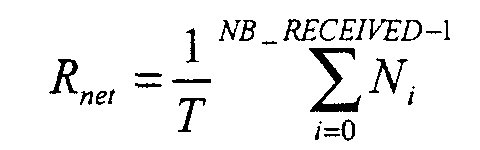
- the net bit rate is obtained by calculating: where NB_RECEIVED is the number of blocks correctly received during a given period T, and N i is the number of bits of information of the i-th block correctly received.
- said quality is evaluated from the throughput relative net, i.e. the ratio between net flow and gross flow.
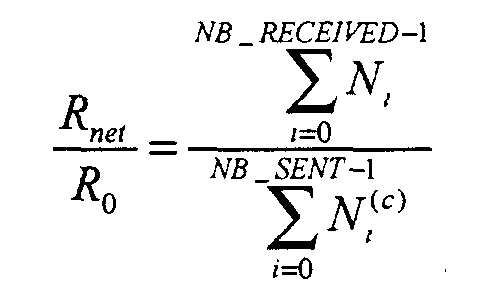
- the ratio between the net flow and the gross flow is obtained by calculating: where NB_SENT is the number of blocks transmitted during a given period, NB_RECEIVED is the number of blocks correctly received corresponding, N i (c) is the number of bits of the i-th block transmitted, and N i is the number of bits of i-th block information correctly received.
- the gross rate is determined for a scheme given modulation corresponding to a so-called reference modulation, whatever or the modulation scheme used.
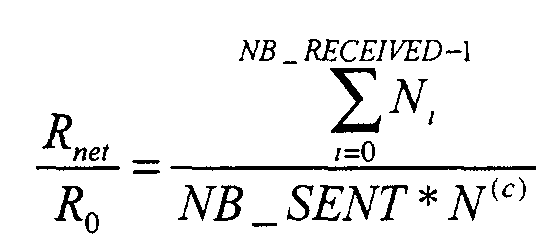
- the ratio between the net flow and the gross flow is obtained by calculating: where NB_SENT is the number of blocks transmitted during a given period, NB_RECEIVED is the number of blocks correctly received corresponding, N (c) is the number of bits of a block transmitted with a given modulation scheme corresponding to a so-called reference modulation , and N i is the number of information bits of the i-th block correctly received.
- said reference modulation is a modulation of lower spectral efficiency.
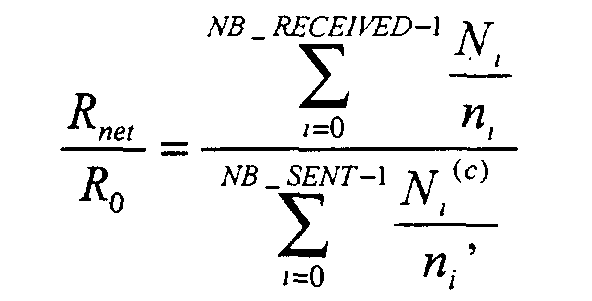
- the transmitted blocks, or radio blocks which may include one or more blocks, or data blocks, depending on the modulation scheme used, the ratio between the net bit rate and the gross bit rate is obtained by calculating: where NB_SENT is the number of data blocks transmitted during a given period, NB_RECEIVED is the number of corresponding correctly received data blocks, N i (c) is the number of bits in the radio block comprising the i-th transmitted data block , N i is the number of information bits in the radio block comprising the i-th received data block, and ni (respectively n'i) is equal to the number of data blocks in the radio block containing the i-th data block received (respectively transmitted).
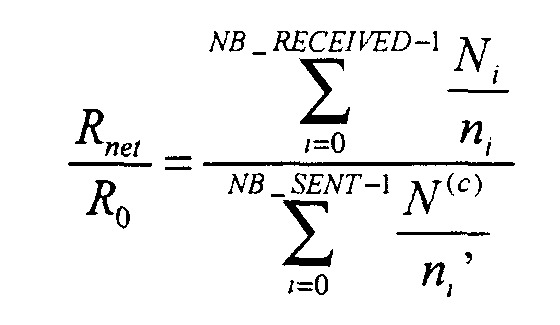
- the transmitted blocks, or radio blocks which may include one or more blocks, or data blocks, depending on the modulation scheme used, the ratio between the net bit rate and the gross bit rate is obtained by calculating: where NB_SENT is the number of data blocks transmitted during a given period, NB_RECEIVED is the number of corresponding correctly received data blocks, N (c) is the number of bits of a radio block for a given modulation scheme corresponding to a reference modulation, N i is the number of information bits in the radio block comprising the i-th received data block, and ni (respectively n'i) is equal to the number of data blocks in the radio block containing the i-th data block received (respectively transmitted).
- Another object of the present invention is a system of mobile radio communications, this system being essentially characterized in that it includes means for evaluating the quality of a radio link from the net speed transmitted on said link.
- said link is an uplink.
- said link is a downlink.
- Another object of the present invention is a network entity of mobile radiocommunications, this entity being essentially characterized in that that it includes means to assess the quality of a radio link, from the net debit transmitted on said link.
- said link is an uplink.
- said link is a downlink.
- Another object of the present invention is a mobile station, this station mobile being essentially characterized in that it comprises means for assess the quality of a radio link, based on the net speed transmitted on said link.
- said link is a downlink.
- said link is an uplink.
- the present invention therefore proposes to use a criterion linked to the net debit.
- the gross rate R gross is defined as the bit rate transmitted on the radio interface.
- the net bit rate R net is the bit rate obtained after deduction, of the gross bit rate, of all that is not useful for the user, such as the redundancy introduced by coding, or the blocks not correctly received.
- Net debit can be expressed as follows:
- R net ⁇ R gross (1-BLER), where ⁇ denotes the rate of coding (assumed to be fixed in this expression), and BLER denotes the rate of blocks not correctly received (or retransmitted).
- a first possible expression of a quality indicator is as follows: where NB_RECEIVED is the number of blocks correctly received during a period of time T and N i is the number of bits of information in the i-th block received correctly.
- the number N i depends on the coding and / or modulation scheme applied in the i-th block received. The higher the coding rate, and / or the higher the overall efficiency of the modulation, the higher this number. R net can take any positive value.
- the net speed R net may however not be the most appropriate criterion because R net does not only depend on the radio conditions but also on the allocated radio resources (for given radio conditions, the greater the allocated radio resources, the more R net is Student). Consequently, to have a better quality indicator, it may be preferable to consider the relative net flow, that is to say the ratio of the net flow to the gross flow. In this case, for given radio conditions, this report will keep the same value regardless of the quantity of radio resources allocated.
- a second possible expression of a quality indicator according to the present invention is then the following: where NB_SENT is the number of blocks transmitted by said transmitter during a given period, NB_RECEIVED is the number of corresponding correctly received blocks, N i (c) is the number of bits of the i-th block transmitted, and N i is the number of Information bits of the i-th block received correctly.
- N i (c) depends on the modulation scheme applied in the i-th block transmitted. The higher the spectral efficiency, the higher this number.
- the blocks received considered to calculate the numerator must correspond to the transmitted blocks counted in the denominator, NB_RECEIVED is therefore less than or equal to NB_SENT.
- R net / R 0 is between 0 and 1. The higher this number, the better the radio conditions (and therefore the performance).
- the ratio R net / R 0 can be obtained by means of the following expression: where NB_SENT is the number of blocks transmitted during a given period, NB_RECEIVED is the number of blocks correctly received corresponding, N (c) is the number of bits of a block transmitted with a given modulation scheme corresponding to a so-called reference modulation , and N i is the number of information bits of the i-th block correctly received.
- GMSK modulation By choosing as a reference modulation a modulation of lower spectral efficiency (i.e. for which the number of bits per symbol transmitted is the lowest), such as the GMSK modulation in the EGPRS system, this latter expression presents also an added benefit that it takes into account that performance is better when a block is received correctly using high spectral efficiency modulation than when a block is received correctly using low modulation spectral efficiency.
- GMSK one bit per symbol
- 8PSK modulation achieves approximately three times the bit rate allowed by GMSK modulation (but requires higher transmit power and better radio conditions) and therefore has higher spectral efficiency (higher bit rate for a band given frequency).
- R net / R 0 will be greater using 8PSK modulation than using GMSK modulation (about three times greater) instead of being unchanged with the expression given previously . Consequently, this new expression will be more appropriate when several modulation schemes are possible (which is the case for the EGPRS system for example). Note that with this new expression, the ratio R net / R 0 can be greater than 1, because N i can then be greater than N (c) .
- a radio link between a transmitter 1 and a receiver 2 in a communication system mobile radio communications is shown schematically in the figure.
- the transmitter can be in a mobile station and the receiver 2 in the network.
- the link is then an uplink (or "uplink” in English).
- the transmitter 1 may be in the network and the receiver 2 in a mobile station.
- the link is then a downlink (or "downlink” in English).
- means 7 for evaluating the quality of the link are provided in the receiver, but according to another example they could be provided in the transmitter.
- the means 7 make it possible to calculate a quality indicator according to the invention, such as for example the ratio R net / R 0 , according to one or the other of the possible expressions, and for this purpose receive the parameters necessary for this calculation.
- the numbers NB_RECEIVED and Ni are supplied by the reception processing means 6, and the other parameters (such as T, NB_SENT, N (c) defined previously) can have predetermined values.
- this mobile station when information needs to be transmitted from or to a mobile station, this mobile station is allocated resources in the form a TBF (for "Temporary Block Flow” in English) rising or falling, and a or several PDCHs (for “Physical Data Channels” in English).
- a PDCH is a physical channel corresponding to a time interval per frame (one frame with eight time intervals) and at a frequency or set of frequencies in case the frequency hopping technique is used.
- TBFs can be distributed on the same PDCHs, which makes it possible to share the same channel between several mobile stations and therefore optimize the use of radio resources in the case of data transmission in packet mode.
- the radio criterion proposed according to the invention is then calculated for each TBF separately.
- the radio criterion proposed according to the invention is then calculated in this layer.
- the blocks mentioned in the above correspond then to blocks called RLC data blocks (or "RLC data blocks” in English), i.e. RLC blocks carrying data (RLC blocks can also be used to carry control or signaling information).
- an RLC data block is transmitted every 20 ms (on average) on the radio interface, over four consecutive time intervals.
- one or two RLC data blocks are transmitted every 20 ms (an RLC data block for coding and modulation schemes MCS1 to MCS6, and two RLC data blocks for coding and modulation schemes MCS7 to MCS9).
- the number of bits N (c) defined above is equal to 456 in the GPRS system, and to 464 in the EGPRS system (for the case where the reference modulation is the GMSK modulation).
- the bit sequence transmitted in 20 ms over the radio interface is called the radio block.
- a radio block therefore contains one or two RLC data blocks, as well as, in addition, control information.
- a radio block is obtained at the output of the RLC / MAC layer (for "Radio Link Control / Media Access Control" in English) and is applied at the input of the physical layer.
- control information of the physical layer is emitted additionally (such as a training sequence, control information called "stealing flags" in English, ... etc).
- a radio block In the GPRS system, a radio block consists of an RLC data block, and control information called, in English, "MAC header”, “RLC header”, and “Block Check Sequence” (BCS).
- BCS Binary Check Sequence
- a radio block In the EGPRS system, a radio block consists one or two RLC data blocks, and called control information, in English, "MAC header”, “RLC header”, and “Header Check Sequence” (HCS).
- the control information called “Block Check Sequence” or BCS are bits of control obtained by applying an error detector code called CRC (for "Cyclic Redundancy Check "in English) to each RLC data block. This detector code allows to detect if an RLC data block is received correctly or not.
- CRC error detector code
- the values given above for the number N (c) do not correspond exactly to the number of bits (or coded bits) considered previously, that is to say not only include the data, but also the control information such as "MAC header”, “RLC header”, ... etc.
- the rate R 0 is only a reference rate and could therefore be calculated differently (for example by excluding the control information "MAC header” and “RLC header” ...), but in this case , it could vary depending on the block, which would make the expression more complex.
- the number of information bits that can be transmitted in a block of RLC data depends on the coding scheme used, and also on the modulation used in the case of the EGPRS system.
- NB_SENT is the number of RLC data blocks (also called more simply here data blocks) transmitted during a given period
- NB_RECEIVED is the number of corresponding correctly received data blocks
- N (c) is the number of bits of a radio block for a given modulation scheme corresponding to a reference modulation
- N i is the number of information bits in the radio block comprising the i-th received data block
- ni is equal to number of data blocks in the radio block containing the i-th received data block (respectively transmitted).
- n i can be different from n ' i in the case where the modulation scheme changes during the period considered for the calculation of R net / R 0 and where certain data blocks are not received correctly.
- R net / R o Another expression of R net / R o could be: where NB_SENT is the number of data blocks transmitted during a given period, NB_RECEIVED is the number of corresponding correctly received data blocks, N i (c) is the number of bits in the radio block comprising the i-th transmitted data block , N i is the number of information bits in the radio block comprising the i-th received data block, and ni (respectively n'i) is equal to the number of data blocks in the radio block containing the i-th data block received (respectively transmitted).
- the state correct or not of the blocks received, necessary for the quality evaluation according to one or the other of the preceding expressions can be obtained in the following manner.
- Packet downlink messages ACK / NACK being replaced by the messages
- Packet uplink ACK / NACK regularly sent by the network to the mobile station.
- this quality assessment can be done in base station controllers. More specifically, in the case of GPRS systems and EGPRS, this quality evaluation can be carried out in a functional entity called PCU (for "Packet Control Unit” in English) to support the packet mode data services.
- PCU Packet Control Unit
- This entity is in particular in charge of RLC layer, and therefore of functions such as block re-transmissions, ... etc.
- the quality indicator according to the invention could also be used for other purposes such as link adaptation for example.
- radio criterion according to the invention has been mainly described in the case where the re-transmission technique is used.
- the radio criterion constituted by the BLER can be used otherwise.
- the following radio criterion the invention could also be used in the latter case.
Landscapes
- Engineering & Computer Science (AREA)
- Quality & Reliability (AREA)
- Computer Networks & Wireless Communication (AREA)
- Signal Processing (AREA)
- Mobile Radio Communication Systems (AREA)
- Detection And Prevention Of Errors In Transmission (AREA)
- Digital Transmission Methods That Use Modulated Carrier Waves (AREA)
Abstract
Description
- adaptation de lien (ou « link adaptation » en anglais): cette technique permet d'adapter dynamiquement le schéma de codage et/ou de modulation utilisé en fonction des conditions radio; notamment, lorsque les conditions radio sont bonnes, on peut augmenter le taux de codage et/ou utiliser une modulation à plus haute efficacité spectrale, pour augmenter le débit; par exemple, comme défini dans le document "GSM 03.64 Version 8.2.0 Release 1999" publié par l'ETSI, quatre schémas de codage (CS1 à CS4) sont possibles dans le système GPRS, et neuf schémas de codage et de modulation (MCS1 à MCS9) sont possibles dans le système EGPRS ;
- re-sélection de cellule: ces systèmes ayant en général une architecture cellulaire, cette technique permet de sélectionner, en fonction de critères radio, et éventuellement en fonction d'autres critères, une meilleure cellule vers laquelle transférer une communication en cours, selon la technique dite de transfert inter-cellulaire, ou « handover » en anglais;
- ...etc.



- des moyens 3 de traitement en émission, incluant des fonctions telles que codage, modulation, re-transmission de blocs non correctement reçus (sous la commande de messages ACK/NACK reçus du récepteur 2), ...etc.,
- des moyens 4 d'émission radio-fréquence.
- des moyens 5 de réception radio-fréquence,
- des moyens 6 de traitement en réception, réalisant des fonctions telles que décodage, démodulation, détection de l'état correct ou non des blocs reçus, transmission à l'émetteur 1 de messages d'acquittement ou de non acquittement (ACK/NACK) correspondants, ...etc.

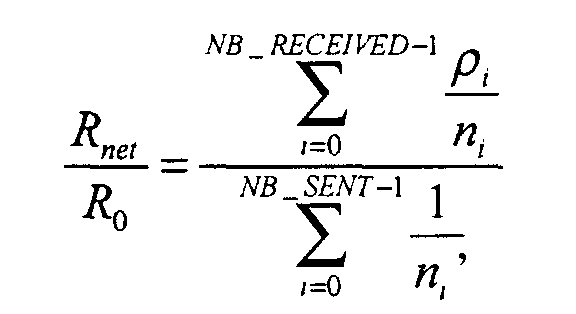
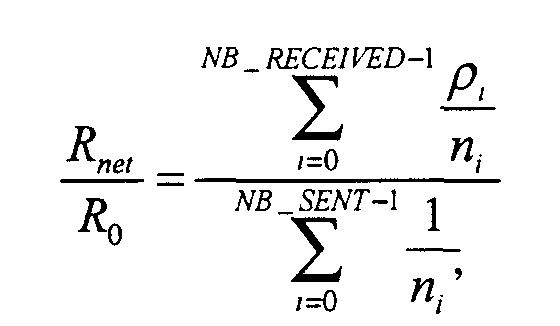
- pour le système GPRS, ρi est compris entre 0 et 1, et pour le système EGPRS, ρi est compris entre 0 et 3 (la valeur 3 correspondant au fait qu'il y a trois bits d'information par symbole avec la modulation 8PSK),
- pour le système GPRS, ni est toujours égal à 1, et pour le système EGPRS ni est égal à 1 pour les schémas de codage et de modulation MCS1 à MCS6, et ni est égal à 2 pour les schémas de codage et de modulation MCS7 à MCS9.

- dans le sens de transmission descendant (c'est-à-dire du réseau vers la station mobile), le réseau sait quels blocs il transmet, et il sait par ailleurs quels blocs sont reçus correctement ou incorrectement grâce aux messages "Packet downlink ACK/NACK" émis régulièrement par la station mobile vers le réseau,
- dans le sens de transmission montant (c'est-à-dire de la station mobile vers le réseau) le réseau est capable de savoir si les blocs sont reçus correctement ou non en utilisant un code CRC comme rappelé plus haut. De plus on sait que les numéros de blocs émis se suivent, donc lorsque les deux derniers blocs correctement reçus sont par exemple les blocs 8 et 11, on sait que les blocs 9 et 10 ont été émis et n'ont pas été reçus correctement.
- des stations de base, pouvant être appelées, suivant les systèmes, BTS (pour "Base Transceiver Station" en anglais), ou Node B par exemple,
- des contrôleurs de stations de base, pouvant être appelés, suivant les systèmes, BSC (pour "Base Station Controller" en anglais), ou RNC (pour "Radio Network Controller" en anglais) par exemple,
- des centres de commutation mobile, pouvant par exemple être appelés MSC (pour "Mobile Switching Center" en anglais).
- Relâchement du TBF(c'est-à-dire arrêt de la transmission) quand Rnet/R0 est en dessous d'un seuil configurable
- Activation de la re-sélection de cellule quand Rnet/R0 est en dessous d'un seuil configurable qui est plus grand que le seuil utilisé pour le relâchement du TBF. En effet, si les conditions radio sont très mauvaises, il est préférable de chercher d'abord une meilleure cellule avant de relâcher le TBF.
Claims (19)
- Procédé pour évaluer la qualité d'une liaison radio dans un système de radiocommunications mobiles, ce procédé étant caractérisé en ce que ladite qualité est évaluée à partir du débit net transmis sur ladite liaison.
- Procédé selon la revendication 1, caractérisé en ce que, les données transmises sur ladite liaison étant obtenues par codage de blocs de bits d'information, le débit net est obtenu en calculant:où NB_RECEIVED est le nombre de blocs correctement reçus pendant une période T donnée, et Ni est le nombre de bits d'information du i-ème bloc correctement reçu.
- Procédé selon la revendication 1, caractérisé en ce que ladite qualité est évaluée à partir du débit net relatif, c'est-à-dire du rapport entre le débit net et le débit brut.
- Procédé selon la revendication 3, caractérisé en ce que le rapport entre le débit net et le débit brut est obtenu en calculant:où NB_SENT est le nombre de blocs transmis pendant une période donnée, NB_RECEIVED est le nombre de blocs correctement reçus correspondants, Ni (c) est le nombre de bits du i-ème bloc transmis, et Ni est le nombre de bits d'information du i-ème bloc correctement reçu.

- Procédé selon l'une des revendications 3 et 4, caractérisé en ce que le nombre de bits des blocs transmis étant fonction du schéma de modulation utilisé, le débit brut est déterminé pour un schéma de modulation donné correspondant à une modulation dite de référence, quel que soit le schéma de modulation utilisé.
- Procédé selon la revendication 5, caractérisé en ce que le rapport entre le débit net et le débit brut est obtenu en calculant:où NB_SENT est le nombre de blocs transmis pendant une période donnée, NB_RECEIVED est le nombre de blocs correctement reçus correspondants, N(c) est le nombre de bits d'un bloc transmis avec un schéma de modulation donné correspondant à une modulation dite de référence, et Ni est le nombre de bits d'information du i-ème bloc correctement reçu.

- Procédé selon l'une des revendications 5 et 6, caractérisé en ce que ladite modulation de référence est une modulation de plus faible efficacité spectrale.
- Procédé selon la revendication 3, caractérisé en ce que, les blocs transmis, ou blocs radio, pouvant comporter un ou plusieurs blocs, ou blocs de données, suivant le schéma de modulation utilisé, le rapport entre le débit net et le débit brut est obtenu en calculant :où NB_SENT est le nombre de blocs de données transmis pendant une période donnée, NB_RECEIVED est le nombre de blocs de données correctement reçus correspondants, Ni (c) est le nombre de bits dans le bloc radio comportant le i-ème bloc de données transmis, Ni est le nombre de bits d'information dans le bloc radio comportant le i-ème bloc de données reçu, et ni (respectivement n'i) est égal au nombre de blocs de données dans le bloc radio contenant le i-ème bloc de données reçu (respectivement transmis) .

- Procédé selon la revendication 3, caractérisé en ce que, les blocs transmis, ou blocs radio, pouvant comporter un ou plusieurs blocs, ou blocs de données, suivant le schéma de modulation utilisé, le rapport entre le débit net et le débit brut est obtenu en calculant :où NB_SENT est le nombre de blocs de données transmis pendant une période donnée, NB_RECEIVED est le nombre de blocs de données correctement reçus correspondants, N(c) est le nombre de bits d'un bloc radio pour un schéma de modulation donné correspondant à une modulation de référence, Ni est le nombre de bits d'information dans le bloc radio comportant le i-ème bloc de données reçu, et ni (respectivement n'i) est égal au nombre de blocs de données dans le bloc radio contenant le i-ème bloc de données reçu (respectivement transmis) .

- Procédé selon la revendication 3, caractérisé en ce que les blocs transmis, ou blocs radio, pouvant comporter un ou plusieurs blocs, ou blocs de données, suivant le schéma de modulation utilisé, le rapport entre le débit net et le débit brut est obtenu en calculant :où NB_SENT est le nombre de blocs de données transmis pendant une période donnée, NB_RECEIVED est le nombre de blocs de données correctement reçus correspondants, N(c) est le nombre de bits d'un bloc radio pour un schéma de modulation donné correspondant à une modulation de référence, Ni est le nombre de bits d'information dans le bloc radio comportant le i-ème bloc de données reçu, ni (respectivement n'i) est égal au nombre de blocs de données dans le bloc radio contenant le i-ème bloc de données reçu (respectivement transmis) , et ρi est égal à Ni / N(c).

- Système de radiocommunications mobiles, pour la mise en oeuvre d'un procédé selon l'une des revendications 1 à 10, caractérisé en ce qu'il comporte des moyens pour évaluer la qualité d'une liaison radio, à partir du débit net transmis sur ladite liaison.
- Système selon la revendication 11, caractérisé en ce que ladite liaison est une liaison montante.
- Système selon la revendication 11, caractérisé en ce que ladite liaison est une liaison descendante.
- Entité de réseau de radiocommunications mobiles, pour la mise en oeuvre d'un procédé selon l'une des revendications 1 à 10, caractérisée en ce qu'elle comporte des moyens pour évaluer la qualité d'une liaison radio, à partir du débit net transmis sur ladite liaison.
- Entité selon la revendication 14, caractérisée en ce que ladite liaison est une liaison montante.
- Entité selon la revendication 14, caractérisée en ce que ladite liaison est une liaison descendante.
- Station mobile, pour la mise en oeuvre d'un procédé selon l'une des revendications 1 à 10, caractérisée en ce qu'elle comporte des moyens pour évaluer la qualité d'une liaison radio à partir du débit net transmis sur ladite liaison.
- Station mobile selon la revendication 17, caractérisée en ce que ladite liaison est une liaison descendante.
- Station mobile selon la revendication 17, caractérisée en ce que ladite liaison est une liaison montante.
Applications Claiming Priority (2)
| Application Number | Priority Date | Filing Date | Title |
|---|---|---|---|
| FR0010590 | 2000-08-11 | ||
| FR0010590A FR2813005B1 (fr) | 2000-08-11 | 2000-08-11 | Procede pour evaluer la qualite d'une liaison radio dans un systeme de radiocommunications mobiles |
Publications (2)
| Publication Number | Publication Date |
|---|---|
| EP1179911A1 true EP1179911A1 (fr) | 2002-02-13 |
| EP1179911B1 EP1179911B1 (fr) | 2013-03-13 |
Family
ID=8853509
Family Applications (1)
| Application Number | Title | Priority Date | Filing Date |
|---|---|---|---|
| EP01402023A Expired - Lifetime EP1179911B1 (fr) | 2000-08-11 | 2001-07-26 | Procédé pour évaluer la qualité d'une liaison radio dans un système de radiocommunications mobiles |
Country Status (5)
| Country | Link |
|---|---|
| US (1) | US7099637B2 (fr) |
| EP (1) | EP1179911B1 (fr) |
| JP (1) | JP2002101136A (fr) |
| CN (1) | CN1241448C (fr) |
| FR (1) | FR2813005B1 (fr) |
Cited By (1)
| Publication number | Priority date | Publication date | Assignee | Title |
|---|---|---|---|---|
| EP1357696A1 (fr) * | 2002-04-23 | 2003-10-29 | Lucent Technologies Inc. | Méthode de mesure du taux d'erreur de bloc pour un reseau de telecommunication radio |
Families Citing this family (7)
| Publication number | Priority date | Publication date | Assignee | Title |
|---|---|---|---|---|
| US7340267B2 (en) * | 2002-04-17 | 2008-03-04 | Lucent Technologies Inc. | Uplink power control algorithm |
| US7177658B2 (en) | 2002-05-06 | 2007-02-13 | Qualcomm, Incorporated | Multi-media broadcast and multicast service (MBMS) in a wireless communications system |
| US7423976B2 (en) * | 2002-09-24 | 2008-09-09 | Interdigital Technology Corporation | Block error rate estimate reporting for target signal to interference ratio adjustment |
| US8694869B2 (en) | 2003-08-21 | 2014-04-08 | QUALCIMM Incorporated | Methods for forward error correction coding above a radio link control layer and related apparatus |
| US7318187B2 (en) | 2003-08-21 | 2008-01-08 | Qualcomm Incorporated | Outer coding methods for broadcast/multicast content and related apparatus |
| US8804761B2 (en) | 2003-08-21 | 2014-08-12 | Qualcomm Incorporated | Methods for seamless delivery of broadcast and multicast content across cell borders and/or between different transmission schemes and related apparatus |
| US20100178918A1 (en) * | 2009-01-15 | 2010-07-15 | Qualcomm Incorporated | Methods and Apparatus For Mobile Initiated Reselection In A Communication Network |
Citations (3)
| Publication number | Priority date | Publication date | Assignee | Title |
|---|---|---|---|---|
| US5828672A (en) * | 1997-04-30 | 1998-10-27 | Telefonaktiebolaget Lm Ericsson (Publ) | Estimation of radio channel bit error rate in a digital radio telecommunication network |
| WO1999012304A1 (fr) * | 1997-08-29 | 1999-03-11 | Telefonaktiebolaget Lm Ericsson (Publ) | Procede servant a selectionner une combinaison de schemas de modulation et de codage de canaux dans un systeme numerique de telecommunications |
| GB2330737A (en) * | 1997-10-27 | 1999-04-28 | Motorola Ltd | Quality assessment in a mobile communications system |
Family Cites Families (11)
| Publication number | Priority date | Publication date | Assignee | Title |
|---|---|---|---|---|
| SE9601606D0 (sv) * | 1996-04-26 | 1996-04-26 | Ericsson Telefon Ab L M | Sätt vid radiotelekommunikationssystem |
| DE19715022A1 (de) * | 1997-04-11 | 1998-10-15 | Deutsche Telekom Ag | System zur Übertragung hochratiger Mehrwertdienste im terrestrischen Rundfunk |
| US6347217B1 (en) * | 1997-05-22 | 2002-02-12 | Telefonaktiebolaget Lm Ericsson (Publ) | Link quality reporting using frame erasure rates |
| US6259927B1 (en) * | 1997-06-06 | 2001-07-10 | Telefonaktiebolaget Lm Ericsson | Transmit power control in a radio communication system |
| DE19742124C2 (de) * | 1997-09-24 | 2001-10-18 | Siemens Ag | Verfahren und Basisstationssystem zur Sprachübertragung über eine Funkschnittstelle in einem digitalen Funk-Kommunikationssystem |
| US6212386B1 (en) * | 1998-06-30 | 2001-04-03 | Telefonaktiebolaget Lm Ericsson (Publ) | Automated tool method for frequency plan revision within a cellular telephone system |
| EP1040689B1 (fr) * | 1998-07-16 | 2013-09-11 | Samsung Electronics Co., Ltd. | Traitement de données en paquets, dans un système de communication mobile |
| US6308065B1 (en) * | 1998-12-07 | 2001-10-23 | Agilent Technologies, Inc. | Apparatus for testing cellular base stations |
| EP1578028B1 (fr) * | 1999-07-13 | 2009-03-25 | Alcatel Lucent | Méthode pour ameliore les performances d' un système mobile de radiocommunication en utilisant un algorithme de commande de puissance |
| ATE255789T1 (de) * | 2000-02-08 | 2003-12-15 | Cit Alcatel | Verfahren zum einstellen eines übertragungsqualität-sollwertes für sendleistungsregelung in einem mobilfunkübertragungssystem |
| US6697776B1 (en) * | 2000-07-31 | 2004-02-24 | Mindspeed Technologies, Inc. | Dynamic signal detector system and method |
-
2000
- 2000-08-11 FR FR0010590A patent/FR2813005B1/fr not_active Expired - Fee Related
-
2001
- 2001-07-26 EP EP01402023A patent/EP1179911B1/fr not_active Expired - Lifetime
- 2001-08-02 US US09/919,800 patent/US7099637B2/en not_active Expired - Lifetime
- 2001-08-10 CN CNB011245719A patent/CN1241448C/zh not_active Expired - Lifetime
- 2001-08-10 JP JP2001243416A patent/JP2002101136A/ja not_active Withdrawn
Patent Citations (3)
| Publication number | Priority date | Publication date | Assignee | Title |
|---|---|---|---|---|
| US5828672A (en) * | 1997-04-30 | 1998-10-27 | Telefonaktiebolaget Lm Ericsson (Publ) | Estimation of radio channel bit error rate in a digital radio telecommunication network |
| WO1999012304A1 (fr) * | 1997-08-29 | 1999-03-11 | Telefonaktiebolaget Lm Ericsson (Publ) | Procede servant a selectionner une combinaison de schemas de modulation et de codage de canaux dans un systeme numerique de telecommunications |
| GB2330737A (en) * | 1997-10-27 | 1999-04-28 | Motorola Ltd | Quality assessment in a mobile communications system |
Non-Patent Citations (1)
| Title |
|---|
| CHAKRABORTY S S ET AL: "AN ADAPTIVE ARQ SCHEME WITH PACKET COMBINING FOR TIME VARYING CHANNELS", IEEE COMMUNICATIONS LETTERS,US,IEEE SERVICE CENTER, PISCATAWAY,US, vol. 3, no. 2, February 1999 (1999-02-01), pages 52 - 54, XP000824092, ISSN: 1089-7798 * |
Cited By (1)
| Publication number | Priority date | Publication date | Assignee | Title |
|---|---|---|---|---|
| EP1357696A1 (fr) * | 2002-04-23 | 2003-10-29 | Lucent Technologies Inc. | Méthode de mesure du taux d'erreur de bloc pour un reseau de telecommunication radio |
Also Published As
| Publication number | Publication date |
|---|---|
| CN1338881A (zh) | 2002-03-06 |
| EP1179911B1 (fr) | 2013-03-13 |
| US20020042254A1 (en) | 2002-04-11 |
| FR2813005B1 (fr) | 2003-01-31 |
| CN1241448C (zh) | 2006-02-08 |
| US7099637B2 (en) | 2006-08-29 |
| JP2002101136A (ja) | 2002-04-05 |
| FR2813005A1 (fr) | 2002-02-15 |
Similar Documents
| Publication | Publication Date | Title |
|---|---|---|
| EP1241822B1 (fr) | Unite d'émission de blocs de données en mode acquitte vers une station mobile | |
| EP0775394B1 (fr) | Procede d'adaptation de l'interface air, dans un systeme de radiocommunication vers des mobiles | |
| EP1912373B1 (fr) | Procédé et système pour améliorer la fiabilité du retour sur la qualité dans un système de communications sans fil | |
| EP2401830B1 (fr) | Méthode de signalisation de la qualité d'un canal de transmission | |
| FR2828968A1 (fr) | Appareil et procede de communications par canaux de liaisons montante et descendante pour la transmission de donnees par paquets | |
| FR2826210A1 (fr) | Procede et appareils pour l'emission et la reemission de donnees, et pour la reception de donnees | |
| EP1936852A1 (fr) | Système de télécommunication à adaptation de liaison | |
| EP2003810A2 (fr) | Dispositif de gestion de réception par des terminaux de contenus multimédia transmis par des infrastructures mettant en oeuvre des techniques de transmission différentes | |
| EP1267500A1 (fr) | Procédé d'ajustement de valeur cible de boucle interne de contrôle de puissance dans un système de radiocommunications mobiles | |
| EP2272197B1 (fr) | Système de télécommunication multi-accès à stratégie de retransmission de paquets adaptée | |
| EP1199831B1 (fr) | Procédé d'adaptation de lien dans un système de radiocommunications mobiles | |
| EP1179911B1 (fr) | Procédé pour évaluer la qualité d'une liaison radio dans un système de radiocommunications mobiles | |
| EP1370020B1 (fr) | Procédé et unité de contrôle d'adaptation de liens radio | |
| EP1223782A1 (fr) | Procédé de gestion de ressources de traitement dans un système de radiocommunications mobiles | |
| EP1180908A1 (fr) | Procédé de contrôle de la charge de trafic dans un reseau de radiocommunications mobiles | |
| EP1362449A1 (fr) | Procede de transmission de donnees avec un niveau de protection contre les erreurs selectionne parmi plusieurs niveaux predefinis | |
| EP2441223B1 (fr) | Procede et dispositifs d'emission et reception de symboles multi porteuse | |
| EP1473839B1 (fr) | Procédé et dispositif de réception de blocs de données avec correction et detection d'erreurs | |
| EP1526751A1 (fr) | Procédé de gestion de ressources de traitement dans un système de radiocommunications mobiles | |
| US20050226342A1 (en) | System and method for mapping information symbols to transmission symbols | |
| EP1443778A1 (fr) | Procédé pour optimiser les performances d'un système de radiocommunications mobiles | |
| EP1936812A1 (fr) | Récepteur à décodage conditionnel | |
| EP1259019A2 (fr) | Procédé pour fixer des paramètres d'adaption de débit spécifiques à chaque service dans un système de radiocommunications mobiles | |
| Li | Link Adaptation in General Packet Radio Services (GPRS) | |
| EP1471758A1 (fr) | Procédé et unité de contrôle des changements de schéma de codage (coding scheme CS) dans un système de radiocommunication |
Legal Events
| Date | Code | Title | Description |
|---|---|---|---|
| PUAI | Public reference made under article 153(3) epc to a published international application that has entered the european phase |
Free format text: ORIGINAL CODE: 0009012 |
|
| AK | Designated contracting states |
Kind code of ref document: A1 Designated state(s): AT BE CH CY DE DK ES FI FR GB GR IE IT LI LU MC NL PT SE TR |
|
| AX | Request for extension of the european patent |
Free format text: AL;LT;LV;MK;RO;SI |
|
| 17P | Request for examination filed |
Effective date: 20020813 |
|
| AKX | Designation fees paid |
Free format text: AT BE CH CY DE DK ES FI FR GB GR IE IT LI LU MC NL PT SE TR |
|
| RAP1 | Party data changed (applicant data changed or rights of an application transferred) |
Owner name: ALCATEL LUCENT |
|
| 17Q | First examination report despatched |
Effective date: 20080102 |
|
| RAP1 | Party data changed (applicant data changed or rights of an application transferred) |
Owner name: ALCATEL LUCENT |
|
| GRAP | Despatch of communication of intention to grant a patent |
Free format text: ORIGINAL CODE: EPIDOSNIGR1 |
|
| GRAS | Grant fee paid |
Free format text: ORIGINAL CODE: EPIDOSNIGR3 |
|
| GRAA | (expected) grant |
Free format text: ORIGINAL CODE: 0009210 |
|
| AK | Designated contracting states |
Kind code of ref document: B1 Designated state(s): AT BE CH CY DE DK ES FI FR GB GR IE IT LI LU MC NL PT SE TR |
|
| REG | Reference to a national code |
Ref country code: GB Ref legal event code: FG4D Free format text: NOT ENGLISH |
|
| REG | Reference to a national code |
Ref country code: CH Ref legal event code: EP Ref country code: AT Ref legal event code: REF Ref document number: 601336 Country of ref document: AT Kind code of ref document: T Effective date: 20130315 |
|
| REG | Reference to a national code |
Ref country code: IE Ref legal event code: FG4D Free format text: LANGUAGE OF EP DOCUMENT: FRENCH |
|
| REG | Reference to a national code |
Ref country code: DE Ref legal event code: R096 Ref document number: 60147759 Country of ref document: DE Effective date: 20130508 |
|
| PG25 | Lapsed in a contracting state [announced via postgrant information from national office to epo] |
Ref country code: SE Free format text: LAPSE BECAUSE OF FAILURE TO SUBMIT A TRANSLATION OF THE DESCRIPTION OR TO PAY THE FEE WITHIN THE PRESCRIBED TIME-LIMIT Effective date: 20130313 Ref country code: ES Free format text: LAPSE BECAUSE OF FAILURE TO SUBMIT A TRANSLATION OF THE DESCRIPTION OR TO PAY THE FEE WITHIN THE PRESCRIBED TIME-LIMIT Effective date: 20130624 |
|
| REG | Reference to a national code |
Ref country code: AT Ref legal event code: MK05 Ref document number: 601336 Country of ref document: AT Kind code of ref document: T Effective date: 20130313 |
|
| REG | Reference to a national code |
Ref country code: NL Ref legal event code: VDEP Effective date: 20130313 |
|
| PG25 | Lapsed in a contracting state [announced via postgrant information from national office to epo] |
Ref country code: FI Free format text: LAPSE BECAUSE OF FAILURE TO SUBMIT A TRANSLATION OF THE DESCRIPTION OR TO PAY THE FEE WITHIN THE PRESCRIBED TIME-LIMIT Effective date: 20130313 Ref country code: GR Free format text: LAPSE BECAUSE OF FAILURE TO SUBMIT A TRANSLATION OF THE DESCRIPTION OR TO PAY THE FEE WITHIN THE PRESCRIBED TIME-LIMIT Effective date: 20130614 |
|
| REG | Reference to a national code |
Ref country code: FR Ref legal event code: GC Effective date: 20130802 |
|
| PG25 | Lapsed in a contracting state [announced via postgrant information from national office to epo] |
Ref country code: NL Free format text: LAPSE BECAUSE OF FAILURE TO SUBMIT A TRANSLATION OF THE DESCRIPTION OR TO PAY THE FEE WITHIN THE PRESCRIBED TIME-LIMIT Effective date: 20130313 Ref country code: PT Free format text: LAPSE BECAUSE OF FAILURE TO SUBMIT A TRANSLATION OF THE DESCRIPTION OR TO PAY THE FEE WITHIN THE PRESCRIBED TIME-LIMIT Effective date: 20130715 Ref country code: AT Free format text: LAPSE BECAUSE OF FAILURE TO SUBMIT A TRANSLATION OF THE DESCRIPTION OR TO PAY THE FEE WITHIN THE PRESCRIBED TIME-LIMIT Effective date: 20130313 |
|
| PG25 | Lapsed in a contracting state [announced via postgrant information from national office to epo] |
Ref country code: CY Free format text: LAPSE BECAUSE OF FAILURE TO SUBMIT A TRANSLATION OF THE DESCRIPTION OR TO PAY THE FEE WITHIN THE PRESCRIBED TIME-LIMIT Effective date: 20130313 |
|
| PLBE | No opposition filed within time limit |
Free format text: ORIGINAL CODE: 0009261 |
|
| STAA | Information on the status of an ep patent application or granted ep patent |
Free format text: STATUS: NO OPPOSITION FILED WITHIN TIME LIMIT |
|
| BERE | Be: lapsed |
Owner name: ALCATEL LUCENT Effective date: 20130731 |
|
| PG25 | Lapsed in a contracting state [announced via postgrant information from national office to epo] |
Ref country code: DK Free format text: LAPSE BECAUSE OF FAILURE TO SUBMIT A TRANSLATION OF THE DESCRIPTION OR TO PAY THE FEE WITHIN THE PRESCRIBED TIME-LIMIT Effective date: 20130313 |
|
| 26N | No opposition filed |
Effective date: 20131216 |
|
| PG25 | Lapsed in a contracting state [announced via postgrant information from national office to epo] |
Ref country code: MC Free format text: LAPSE BECAUSE OF FAILURE TO SUBMIT A TRANSLATION OF THE DESCRIPTION OR TO PAY THE FEE WITHIN THE PRESCRIBED TIME-LIMIT Effective date: 20130313 Ref country code: IT Free format text: LAPSE BECAUSE OF FAILURE TO SUBMIT A TRANSLATION OF THE DESCRIPTION OR TO PAY THE FEE WITHIN THE PRESCRIBED TIME-LIMIT Effective date: 20130313 |
|
| REG | Reference to a national code |
Ref country code: CH Ref legal event code: PL |
|
| REG | Reference to a national code |
Ref country code: DE Ref legal event code: R097 Ref document number: 60147759 Country of ref document: DE Effective date: 20131216 |
|
| REG | Reference to a national code |
Ref country code: IE Ref legal event code: MM4A |
|
| PG25 | Lapsed in a contracting state [announced via postgrant information from national office to epo] |
Ref country code: CH Free format text: LAPSE BECAUSE OF NON-PAYMENT OF DUE FEES Effective date: 20130731 Ref country code: BE Free format text: LAPSE BECAUSE OF NON-PAYMENT OF DUE FEES Effective date: 20130731 Ref country code: LI Free format text: LAPSE BECAUSE OF NON-PAYMENT OF DUE FEES Effective date: 20130731 |
|
| PG25 | Lapsed in a contracting state [announced via postgrant information from national office to epo] |
Ref country code: IE Free format text: LAPSE BECAUSE OF NON-PAYMENT OF DUE FEES Effective date: 20130726 |
|
| REG | Reference to a national code |
Ref country code: FR Ref legal event code: RG Effective date: 20141016 |
|
| REG | Reference to a national code |
Ref country code: FR Ref legal event code: PLFP Year of fee payment: 15 |
|
| PG25 | Lapsed in a contracting state [announced via postgrant information from national office to epo] |
Ref country code: TR Free format text: LAPSE BECAUSE OF FAILURE TO SUBMIT A TRANSLATION OF THE DESCRIPTION OR TO PAY THE FEE WITHIN THE PRESCRIBED TIME-LIMIT Effective date: 20130313 |
|
| PG25 | Lapsed in a contracting state [announced via postgrant information from national office to epo] |
Ref country code: LU Free format text: LAPSE BECAUSE OF NON-PAYMENT OF DUE FEES Effective date: 20130726 |
|
| REG | Reference to a national code |
Ref country code: FR Ref legal event code: PLFP Year of fee payment: 16 |
|
| REG | Reference to a national code |
Ref country code: FR Ref legal event code: PLFP Year of fee payment: 17 |
|
| REG | Reference to a national code |
Ref country code: FR Ref legal event code: PLFP Year of fee payment: 18 |
|
| PGFP | Annual fee paid to national office [announced via postgrant information from national office to epo] |
Ref country code: FR Payment date: 20200611 Year of fee payment: 20 |
|
| PGFP | Annual fee paid to national office [announced via postgrant information from national office to epo] |
Ref country code: GB Payment date: 20200716 Year of fee payment: 20 Ref country code: DE Payment date: 20200714 Year of fee payment: 20 |
|
| REG | Reference to a national code |
Ref country code: DE Ref legal event code: R071 Ref document number: 60147759 Country of ref document: DE |
|
| REG | Reference to a national code |
Ref country code: GB Ref legal event code: PE20 Expiry date: 20210725 |
|
| PG25 | Lapsed in a contracting state [announced via postgrant information from national office to epo] |
Ref country code: GB Free format text: LAPSE BECAUSE OF EXPIRATION OF PROTECTION Effective date: 20210725 |