EP1179898A2 - Point-to-point and point-multipoint radio transmission system, with interoperable TDM and TDMA structure and with different physical modes - Google Patents
Point-to-point and point-multipoint radio transmission system, with interoperable TDM and TDMA structure and with different physical modes Download PDFInfo
- Publication number
- EP1179898A2 EP1179898A2 EP01117416A EP01117416A EP1179898A2 EP 1179898 A2 EP1179898 A2 EP 1179898A2 EP 01117416 A EP01117416 A EP 01117416A EP 01117416 A EP01117416 A EP 01117416A EP 1179898 A2 EP1179898 A2 EP 1179898A2
- Authority
- EP
- European Patent Office
- Prior art keywords
- frame
- cluster
- information
- physical layer
- preamble
- Prior art date
- Legal status (The legal status is an assumption and is not a legal conclusion. Google has not performed a legal analysis and makes no representation as to the accuracy of the status listed.)
- Granted
Links
Images

Classifications
-
- H—ELECTRICITY
- H04—ELECTRIC COMMUNICATION TECHNIQUE
- H04B—TRANSMISSION
- H04B7/00—Radio transmission systems, i.e. using radiation field
- H04B7/24—Radio transmission systems, i.e. using radiation field for communication between two or more posts
- H04B7/26—Radio transmission systems, i.e. using radiation field for communication between two or more posts at least one of which is mobile
- H04B7/2643—Radio transmission systems, i.e. using radiation field for communication between two or more posts at least one of which is mobile using time-division multiple access [TDMA]
- H04B7/2656—Radio transmission systems, i.e. using radiation field for communication between two or more posts at least one of which is mobile using time-division multiple access [TDMA] for structure of frame, burst
Definitions
- the present invention finds particular application in point-to-point or point-multipoint radio transmission systems.
- a frame structure is generally defined, which defines how the information is organized in information and control bit sequences. These sequences and the meaning of the different bits inside the sequence, known to the transmitter and the receiver, enable the communication.
- Transmission bursts are absolutely necessary for the uplink channel of time division point - multipoint systems and for time duplex systems, all systems in which the same channel is used by different transmitters in different time instants.
- a burst transmission can be convenient also in the downlink to enable the (re-)synchronization on the downlink channel of the half duplex terminals after an uplink transmission.
- the invention is described with reference to frequency duplex point multipoint systems but it is also applicable to time duplex, and both point-to-point and point-multipoint systems.
- the literature offers a plurality of known examples of frame structures for the continuous or burst radio transmission.
- the present invention offers the advantage to incorporate both the TDM structure and the TDMA one in a unique radio transmission system, assuring interoperability; on the basis of the conditions that make a mode more efficient than another one, the master station can select, automatically or under the operator's control, the most adequate structure and the terminal stations can correctly receive, thanks to this invention, without intervening in any way on the same.
- Essential element of the invention is the guarantee of interoperability intended in the sense that the switch from a structure to the other one does not require any manual intervention on the terminals.
- the system enabling to reach this target is the periodic transmission of a preamble, differentiated in the two cases, TDMA and TDM, enabling the terminal to distinguish the correct structure.
- the system of the invention enables also, within one of the two TDM and TDMA structures, to support different operation modes of the physical layer (modulations and adaptive codes) and all the typical functions of the shared medium access control protocols (MAC) and data link control protocols (DLC), obtaining considerable advantages in terms of synchronization speed, robustness, efficiency and speed of the protocols themselves.
- MAC shared medium access control protocols
- DLC data link control protocols
- the system of the invention is based on the transmission of clusters (groups) including one or more information units, even non homogeneous in type and/or destination, but sharing the same operation mode of the transmission physical layer (same modulation, same error correction code etc.).
- the physical modes can include, for instance, different modulations or different error correction codes.
- the different modes can have different requirements in terms of signal to noise ratio; for convenience, it is defined hereafter the basic mode as the most robust mode that is the one capable of operating with the minimum signal-noise ratio.
- the objective of the present invention is a transmission system implemented in compliance with what described in claim 1.
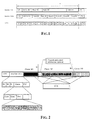
- figure 1 shows, in an FDD scenario, the general structure of the frame (both downlink and uplink) in the TDM mode and in the TDMA one.
- All the frames have equal duration, irrespective of the structure (TDM or TDMA) and of the direction (uplink or downlink).
- the uplink frame is always organized in TDMA and the bursts (B) are separated by guard times; the downlink frame, on the contrary, has a frame preamble (UW1 or UW2) that can be used for the channel synchronization and equalization and that assumes, according to the invention, also the function of identifying if the structure of the above mentioned downlink frame is TDM or TDMA (UW1 and UW2 values identify TDM and TDMA, respectively).
- the frame can optionally contain, after the frame preamble, a control field (Info Ctrl) transporting control information and transmitted with the basic operation mode of the physical layer, that is the most robust one (M1). Other control information can find place inside the subsequent clusters.
- the information of the downlink channel is transmitted subsequently, inside the frame, in continuous way.
- the different clusters are positioned inside the frame in robustness decreasing orderso that the basic physical mode is at the beginning (M1) and the less robust (M2 and M3) are following, up to the frame end.
- the dimensions of the different clusters vary from frame to frame, while keeping constant the total duration of the frame.
- the boundaries between a cluster and another one can be identified in two ways, which can also coexist:
- a variable number of elementary information units can be inserted, containing information of different type with different destination and scope (example: user data and control information) identified by an opportune header.
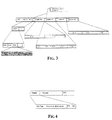
- the TDMA downlink frame described in figure 3, is on the contrary organized in short lasting information clusters, each one preceded by a preamble with synchronization functions.
- clusters are short assures a high frequency of preambles and therefore a quick re-synchronization of half-duplex terminals after transmission.
- Each cluster can operate with a different operation mode of the physical layer.
- a control field can be inserted, transmitted with the basic physical mode M1.
- Other control information can be included in the subsequent clusters; in this case said other control information can be transmitted with the cluster operation mode.
- a part of said other control information could be introduced in a field having fixed dimension immediately following the cluster preamble and anyhow transmitted with the basic operation mode.
- the operation mode of the physical layer of each cluster can be communicated to the receiving station in two ways, which can also coexist:
- the clusters can have fixed or variable duration; according to a preferred embodiment they have fixed duration. In this way, the overhead of the preambles or of the above mentioned maps results limited since the beginning position of each cluster is known in advance to the receiver and shall not be communicated with or obtained from the transmitted information. In case a variable duration is necessary, preambles shall be longer or the map shall have larger dimensions to contain the information on the boundaries between clusters.
- a variable number of elementary information units can be inserted in the clusters.
- the number of useful bits of each cluster shall, of course, depend on the physical mode of the cluster itself (type of modulation and overhead of the code).
- the cluster duration is selected in order to contain an integer number, different according to the physical mode, of elementary information units (e.g. 2 UIE for M1, 3 for M2 and 5 for M3).
- the elementary information unit shown in figure 4, consists of an header, identifying the type of information and the connection, followed by a payload.
- the header field contains the identification of the type of slot, the connection identifier, and other information useful for the segmentation functions of long packets (PTI) and for identification of the priority of the unit itself (CLP).
- PTI segmentation functions of long packets
- CLP priority of the unit itself
- the above mentioned payload has 48 byte constant dimension, but this shall not be construed as a limitation of the invention.
- the UIE is protected with an error correction code (FEC).
- the non-periodic control information includes for instance the messages for protocols associated to the change of operation mode of the physical layer and of radio channel. In general, the associated protocols are slow and this information is transmitted, when necessary, subtracting time portions to the radio channel otherwise used for the user traffic. If information is destined to more terminals (multicast or broadcast) basic physical mode is used for transmission, otherwise, if it is addressed to a specific terminal, it can alternatively be transmitted with the basic physical mode or with the physical mode of the destination terminal.
- the message is transmitted with basic physical mode occupying an elementary information unit that is filled with messages as shown in figure 5.
- the messages have the following format: a terminal identification to which the message is addressed, the operation code of the message and the message parameters. More messages (for the downlink of point-multipoint systems also with different destination terminals) can be condensed in the same control field.
- the periodic information requires reserved portions of the channel and includes, on the downlink, the authorizations to use the uplink channel assigned to the different terminals (Grants, visible in figure 2 and in figure 3) and, when necessary, the boundaries between different clusters (B1 and B2 visible in Info Ctrl of figure 2); on the uplink channel it includes the band requests made by the terminals themselves (visible in figure 6).
- the periodic information generally occupy a predefined position inside the frame: in the TDM frame they find their place in the control field immediately following the frame preamble and are transmitted with the basic physical mode; in the TDMA frame they can occupy the control field immediately following the frame preamble and are transmitted with the basic physical mode or can be inserted in subsequent clusters; in this last case, they are always transmitted at the beginning of the cluster and with the basic physical mode, irrespective of the physical mode of the cluster itself.
- the control fields are sometimes protected with a traditional error correction code (FEC in figure 2 and figure 3) and sometimes with a different protection, for instance a repetition code, for a quicker decoding (Pr in figure 2 and Protection in figure 6).
- the 'grant' field includes different 'grants' each of which can include, among other things, a (PC) field destined to the quick power control information, an 'Authorization field' including the type of authorization and an identification of the terminal invited to transmit; these fields are repeated many times in the downlink frame, once for each burst of the uplink channel of the next frame.
- PC personal computer
- 'Authorization field' including the type of authorization and an identification of the terminal invited to transmit
- the above-mentioned terminal identification can in some cases (for example authorization to contention) assume the meaning of identification of a group of terminals.
- the terminals can easily synchronize on the downlink channel and perform uplink transmissions in a well defined time relationship with those of the downlink; during the initial registration phase, the base station equalizes the delays of all the terminals.
- the terminals at the first transmission, do not know the time relationship between the downlink bursts and the uplink bursts. This time relationship depends on the distance of the terminal itself from the base station and is equalized by the master station on the basis of a delay equalization procedure. This procedure requires the transmission of a burst that does not observe the system time relations. For this reason, the master station has the faculty to open a silence time slot on the uplink channel in order to enable this operation.
- the positions, in which each terminal is authorized to transmit, are communicated through the above mentioned 'grants'.
- These messages, belonging to control information are inserted in the appropriate fields of the downlink frame structure; according to a preferred embodiment they find place among the control information inserted in the control field right after the frame preamble; according to another preferred embodiment, limited to the TDMA structure, they find place inside and at the beginning of each cluster of the downlink frame in the control field that can be inserted immediately after the cluster preamble; this measure enables a more frequent transfer and therefore quicker protocols.
- Uplink transmissions are organized in bursts; each burst provided with its own preamble is transmitted by a terminal towards the master station and is featured by an operation mode of the physical layer known in advance by the receiving master station.
- the burst contains the information of the physical mode inside the preamble. Bursts can have fixed or variable time duration. According to a preferred embodiment they have fixed time duration in order to reduce the overhead of the control information and of the preambles.
- the uplink burst (figure 6) consists of an information field having fixed duration that contains, according to the physical layer operation mode, one or more elementary information units completely equal to that of the downlink (figure 4) that can possibly be used for control information (figure 5), a preamble for the physical layer synchronization, a MAC field containing information for the management of the shared medium access control.
- a TTG field (Terminal Transition Gap) which is a silence interval between two bursts, necessary to enable the previous terminal to switch off the transmitter and the new one to switch it on, in addition to absorbing the non perfect equalization of delays.
- the MAC field of the uplink contains a Request field with its protection.
- This request carries information about the status of the queues of the terminal transmitting the same.
- This information in its simplest form, is binary coded associating a logic state to the non-empty queue state (at least an elementary information unit to be transmitted) and the other logic state to the empty queue state; with a higher number of bits, more states corresponding to different filling states can be coded (for instance, up to m information units, up to n information units an so on).
- a FEC field destined to an error correction code can be added at the burst end and replace the FEC of the UIE(s) in order to protect Header and Information Field of the UIE(s) and possibly also the MAC request field, thus making the protection field useless.
- the complexity of the receiver is increased, but the overhead is decreased, thus improving the system efficiency.
- Figure 7 shows the application of the invention in time duplex scenarios.
- time duplex systems the downlink and uplink portions alternate inside the same channel instead of occupying radio channels on separate frequencies. All the characteristics of the invention can be trivially applied also in this case.
Landscapes
- Engineering & Computer Science (AREA)
- Computer Networks & Wireless Communication (AREA)
- Signal Processing (AREA)
- Mobile Radio Communication Systems (AREA)
- Time-Division Multiplex Systems (AREA)
- Radio Relay Systems (AREA)
Abstract
With the assurance of interoperability and robustness, the coexistence of TDM and TDMA downlink frames in the same system is possible,in order to enable to manually or automatically select the most appropriate mode in the master station, case by case, without intervening on the terminals. TDM and TDMA structures can in fact be seen as two operation modes of the physical layer, and the same can be distinguished through a different frame preamble.
Description
- continuous transmission or TDM (the transmitter can occupy the transmission channel for long times and the receiver can keep on listening for long times);
- burst transmission or TDMA (the communication from a transmitter to a receiver can occupy only a limited time interval, generally short lasting, inside the channel).
- pointers, that is information identifying the position of said boundaries can be inserted amidst the information of the control field transmitted right after the frame preamble, taking care of using an error correction code of the repetition type. Repeating the information many times it can be reliably decoded without the typical latency of error correction codes. This is a featuring aspect of the invention since it is the sole way to protect this information without delays in the decoding phase, which would make it unusable. The overhead is not a problem since this information has small dimension.
- insertion of appropriate preambles at the beginning of each cluster. Having the clusters variable dimension, the preambles must necessarily be long, but considering that only a few are transmitted per time unit, also in this case the overhead is not a problem. The preamble of the basic physical mode (M1) can be omitted, since it would result close to the frame preamble.
- a table or map of the employed physical modes is inserted in the downlink frame itself inside the control field immediately after the frame preamble.
- an appropriate and differentiated cluster preamble enables to recognize the cluster physical mode.
Claims (25)
- Radio transmission system for data organized in frames between a central station or master and one or more terminal or remote stations, the uplink frames, transmitted by each one of said remote stations towards the master station, being organized at their inside according to the TDMA structure, or Time Division Multiple Access structure, and containing more bursts each one transporting one or more elementary information units, characterized in thatdownlink frames, transmitted by said master station towards said remote stations, are at their inside alternatively organized according to the TDMA structure or according to the TDM structure, or Time Division Multiplex structure, according to a manual setting or automatically decided, on the basis of a given algorithm, by a control unit of the master station;each one of said downlink frames including a first set of symbols forming a frame preamble identifying the organization structure of the data of the same frame and possibly used also for the synchronization and equalization functions;each one of said remote stations being equipped with processing means of said downlink frames whose configuration is automatically adapted to the TDMA structure or TDM structure, according to the information contained in said frame preamble.
- Transmission system according to claim 1, characterized in that said frame preamble, being in whole or in part used also for synchronization and equalization functions, can assume two different configurations of symbols identifying a TDM structure or a TDMA structure, respectively.
- Transmission system according to claim 2, characterized in that said downlink frame has an internal organization of the TDM type and includes one or more bit clusters.
- System according to claim 3, characterized in that the bits of the same cluster share a same operation mode of the physical layer or at least a same modulation and a same error correction code.
- System according to claim 3, characterized in that the boundaries between the clusters, transmitted inside the frame, are identified by pointers inserted together with other information in a field of control bits, immediately following said frame preamble.
- System according to claim 5, characterized in that said pointers are protected with a 'repetition' code.
- System according to claim 3, characterized in that the boundaries between clusters transmitted inside the frame are recognized by preamble symbols present between the end of a cluster and the beginning of the next one.
- System according to claim 4, characterized in that clusters are transmitted inside the frame in increasing order of signal to noise ratio requested by said operation mode of the physical layer used to transmit the information units of each cluster.
- System according to claim 3, characterized in that inside each cluster there is a variable number of elementary information units suitable to contain information of different type, destination and scope and so identified by a proper header.
- System according to claim 9, characterized in that the elementary information units include a constant number of bits.
- System according to claim 4, characterized in that the number of clusters inside the frame is just equal to the number of different operation modes of the physical layer employed and each cluster has a different mode.
- Transmission system according to claim 2, characterized in that said downlink frame has an internal organization of data of the TDMA type and includes more bit clusters;at least the clusters after the first one contain preamble symbols, called cluster preamble, with synchronization functions.
- Transmission system according to claim 12, characterized in that a field of control bits is inserted immediately after the frame preamble.
- Transmission system according to claim 12, characterized in that each cluster is characterized by a particular operation mode of the physical layer, that is at least by a modulation and an error correction code, the operation mode through which all the bits of the cluster are transmitted with the possible exception of the control field that can optionally be added right after said cluster preamble and that can be alternatively transmitted always with the basic mode of the physical layer.
- Transmission system according to claims 13 and 14, characterized in that the operation mode of the transmission physical layer of each cluster is communicated to the remote station through a table of the physical modes used for the same downlink frame inserted in said control field immediately following the frame preamble.
- System according to claim 14, characterized in that the operation mode of the transmission physical layer of each cluster is communicated to the remote station through an information contained in said cluster preamble.
- System according to claim 12, characterized in that within each cluster there is a variable number of elementary information units suitable to contain information of different type, destination and scope and so identified by a proper header.
- System according to claim 17, characterized in that the elementary information units include a constant number of bits.
- Transmission system according to claim 12, characterized in that said clusters have all the same time duration and contain an integer number of elementary information units variable according to the physical layer operation mode.
- System according to claim 1, characterized in that each uplink frame consists of a plurality of bursts, each burst includinga first field being a silence interval between subsequent bursts having duration sufficient to the remote station, previously engaging the transmission channel, to switch off the transmitter and to the currently authorized station to switch it on;a second field being a preamble containing synchronization symbols of the physical layer;a third field containing control information related to the shared medium access control and an information field, having fixed duration, containing, according to the physical layer operation mode, one or more of said elementary information units.
- System according to claim 20, characterized in that said synchronization preamble, is differentiated adopting different symbol sequences corresponding to the different operation modes of the physical layer.
- System according to claim 20, characterized in that said bursts have constant duration.
- System according to claim 20, characterized in that said control information related to the shared medium access control includes an information called 'request' containing information on the status of the queues or on the band requirements of the remote station.
- System according to claim 23, characterized in that said information on the status of the queues is binary coded with a bit for each controlled queue, and said bit indicates with a value the empty status and with the other one the non-empty status.
- System according to claim 23, characterized in that said information on the status of the queues is coded with more bits for each controlled queue; said additional bits indicating with each coding that the filling status of the queue exceeds a given threshold.
Applications Claiming Priority (2)
| Application Number | Priority Date | Filing Date | Title |
|---|---|---|---|
| IT2000VA000029A ITVA20000029A1 (en) | 2000-08-11 | 2000-08-11 | POINT-TO-POINT AND POINT-TO-MULTIPOINT RADIO TRANSMISSION SYSTEM, WITH TDM AND TDMA INTEROPERABLE STRUCTURE AND WITH DIFFERENT PHYSICAL MODES. |
| ITVA000029 | 2000-08-11 |
Publications (3)
| Publication Number | Publication Date |
|---|---|
| EP1179898A2 true EP1179898A2 (en) | 2002-02-13 |
| EP1179898A3 EP1179898A3 (en) | 2005-11-16 |
| EP1179898B1 EP1179898B1 (en) | 2011-04-06 |
Family
ID=11460821
Family Applications (1)
| Application Number | Title | Priority Date | Filing Date |
|---|---|---|---|
| EP01117416A Expired - Lifetime EP1179898B1 (en) | 2000-08-11 | 2001-07-19 | Point-to-point and point-multipoint radio transmission system, with interoperable TDM and TDMA structure and with different physical modes |
Country Status (4)
| Country | Link |
|---|---|
| EP (1) | EP1179898B1 (en) |
| AT (1) | ATE504986T1 (en) |
| DE (1) | DE60144359D1 (en) |
| IT (1) | ITVA20000029A1 (en) |
Cited By (2)
| Publication number | Priority date | Publication date | Assignee | Title |
|---|---|---|---|---|
| WO2004107605A1 (en) * | 2003-05-27 | 2004-12-09 | Telefonaktiebolaget Lm Ericsson (Publ) | Scheduler and method of scheduling data for communication between a node station and plurality of radio terminals |
| WO2016064486A1 (en) * | 2014-10-21 | 2016-04-28 | Qualcomm Incorporated | Techniques for conveying identification information in a preamble transmission |
Family Cites Families (1)
| Publication number | Priority date | Publication date | Assignee | Title |
|---|---|---|---|---|
| CA2825592C (en) * | 2000-11-15 | 2016-04-19 | An Chen | Improved frame structure for communication system using adaptive modulation |
-
2000
- 2000-08-11 IT IT2000VA000029A patent/ITVA20000029A1/en unknown
-
2001
- 2001-07-19 AT AT01117416T patent/ATE504986T1/en not_active IP Right Cessation
- 2001-07-19 EP EP01117416A patent/EP1179898B1/en not_active Expired - Lifetime
- 2001-07-19 DE DE60144359T patent/DE60144359D1/en not_active Expired - Lifetime
Cited By (5)
| Publication number | Priority date | Publication date | Assignee | Title |
|---|---|---|---|---|
| WO2004107605A1 (en) * | 2003-05-27 | 2004-12-09 | Telefonaktiebolaget Lm Ericsson (Publ) | Scheduler and method of scheduling data for communication between a node station and plurality of radio terminals |
| US7729330B2 (en) | 2003-05-27 | 2010-06-01 | Telefonaktiebolaget Lm Ericsson (Publ) | Scheduler and method of scheduling data for communication between a node station and plurality of radio terminals |
| CN1802801B (en) * | 2003-05-27 | 2010-09-08 | 艾利森电话股份有限公司 | Scheduler and method for scheduling data for communication between a node station and a plurality of radio terminals |
| WO2016064486A1 (en) * | 2014-10-21 | 2016-04-28 | Qualcomm Incorporated | Techniques for conveying identification information in a preamble transmission |
| US10700830B2 (en) | 2014-10-21 | 2020-06-30 | Qualcomm Incorporated | Techniques for conveying identification information in a preamble transmission |
Also Published As
| Publication number | Publication date |
|---|---|
| EP1179898A3 (en) | 2005-11-16 |
| ITVA20000029A1 (en) | 2002-02-11 |
| EP1179898B1 (en) | 2011-04-06 |
| ATE504986T1 (en) | 2011-04-15 |
| ITVA20000029A0 (en) | 2000-08-11 |
| DE60144359D1 (en) | 2011-05-19 |
Similar Documents
| Publication | Publication Date | Title |
|---|---|---|
| US7664087B2 (en) | Method for generating a frame in an orthogonal frequency division multiple access communication system | |
| EP1932296B1 (en) | Scheduling wireless communication systems | |
| US8315330B2 (en) | Method of transmitting data in wireless communication system | |
| KR100770865B1 (en) | Method for transmitting/receiving data in a communication system | |
| KR101550556B1 (en) | Systems and methods for uplink signalling | |
| US7986662B2 (en) | Apparatus and method for reducing map channel overhead in a broadband wireless communication system | |
| CA2353611C (en) | Multi punctured fec technique | |
| EP1681790B1 (en) | Apparatus and method for transmitting information data in a wireless communication system | |
| EP2070362B1 (en) | Radio resource assignment in control channel in wireless communication systems | |
| CN101523969B (en) | Allocation of control channel for radio resource assignment in wireless communication systems | |
| KR100946910B1 (en) | Device and method for transmitting and receiving common control information in wireless communication system | |
| JP7508522B2 (en) | Base station and communication method | |
| US5724515A (en) | Packet radio communication system | |
| US20040120302A1 (en) | Communications system | |
| KR20080082889A (en) | Common control information transmission and reception method in communication system and system therefor | |
| CN102394736A (en) | User equipent, transmitting method and mobile communicaton system | |
| US20080310359A1 (en) | Method and Apparatus for Sharing Resources in a Wireless System | |
| WO2003105378A1 (en) | Methods of addressing and signaling a plurality of subscriber units in a single slot | |
| WO2009072791A1 (en) | Group scheduling method, method for selectively receiving information elements according to group scheduling, and mobile communication terminal | |
| EP1179898B1 (en) | Point-to-point and point-multipoint radio transmission system, with interoperable TDM and TDMA structure and with different physical modes | |
| JP5062256B2 (en) | Control information transmission and reception method in radio communication system, and radio base station and radio terminal using the same | |
| WO2006110072A1 (en) | Mac header for enhanched uplink multiplexing | |
| US12609800B2 (en) | Communications device, infrastructure equipment and methods | |
| EP1244236B1 (en) | Format of elements forming downstream maps in point-multipoint systems with different physical modes | |
| EP1164720A2 (en) | Point-to-point and point-multipoint burst radio transmission system |
Legal Events
| Date | Code | Title | Description |
|---|---|---|---|
| PUAI | Public reference made under article 153(3) epc to a published international application that has entered the european phase |
Free format text: ORIGINAL CODE: 0009012 |
|
| AK | Designated contracting states |
Kind code of ref document: A2 Designated state(s): AT BE CH CY DE DK ES FI FR GB GR IE IT LI LU MC NL PT SE TR |
|
| AX | Request for extension of the european patent |
Free format text: AL;LT;LV;MK;RO;SI |
|
| PUAL | Search report despatched |
Free format text: ORIGINAL CODE: 0009013 |
|
| AK | Designated contracting states |
Kind code of ref document: A3 Designated state(s): AT BE CH CY DE DK ES FI FR GB GR IE IT LI LU MC NL PT SE TR |
|
| AX | Request for extension of the european patent |
Extension state: AL LT LV MK RO SI |
|
| RAP1 | Party data changed (applicant data changed or rights of an application transferred) |
Owner name: SIEMENS S.P.A. |
|
| AKX | Designation fees paid | ||
| 17P | Request for examination filed |
Effective date: 20060522 |
|
| RBV | Designated contracting states (corrected) |
Designated state(s): AT BE CH CY DE DK ES FI FR GB GR IE IT LI LU MC NL PT SE TR |
|
| REG | Reference to a national code |
Ref country code: DE Ref legal event code: 8566 |
|
| 17Q | First examination report despatched |
Effective date: 20090216 |
|
| RAP1 | Party data changed (applicant data changed or rights of an application transferred) |
Owner name: SIEMENS AKTIENGESELLSCHAFT |
|
| GRAP | Despatch of communication of intention to grant a patent |
Free format text: ORIGINAL CODE: EPIDOSNIGR1 |
|
| GRAS | Grant fee paid |
Free format text: ORIGINAL CODE: EPIDOSNIGR3 |
|
| GRAA | (expected) grant |
Free format text: ORIGINAL CODE: 0009210 |
|
| AK | Designated contracting states |
Kind code of ref document: B1 Designated state(s): AT BE CH CY DE DK ES FI FR GB GR IE IT LI LU MC NL PT SE TR |
|
| REG | Reference to a national code |
Ref country code: GB Ref legal event code: FG4D |
|
| REG | Reference to a national code |
Ref country code: CH Ref legal event code: EP |
|
| REG | Reference to a national code |
Ref country code: IE Ref legal event code: FG4D |
|
| REF | Corresponds to: |
Ref document number: 60144359 Country of ref document: DE Date of ref document: 20110519 Kind code of ref document: P |
|
| REG | Reference to a national code |
Ref country code: DE Ref legal event code: R096 Ref document number: 60144359 Country of ref document: DE Effective date: 20110519 |
|
| REG | Reference to a national code |
Ref country code: NL Ref legal event code: T3 |
|
| PG25 | Lapsed in a contracting state [announced via postgrant information from national office to epo] |
Ref country code: PT Free format text: LAPSE BECAUSE OF FAILURE TO SUBMIT A TRANSLATION OF THE DESCRIPTION OR TO PAY THE FEE WITHIN THE PRESCRIBED TIME-LIMIT Effective date: 20110808 Ref country code: SE Free format text: LAPSE BECAUSE OF FAILURE TO SUBMIT A TRANSLATION OF THE DESCRIPTION OR TO PAY THE FEE WITHIN THE PRESCRIBED TIME-LIMIT Effective date: 20110406 |
|
| PG25 | Lapsed in a contracting state [announced via postgrant information from national office to epo] |
Ref country code: BE Free format text: LAPSE BECAUSE OF FAILURE TO SUBMIT A TRANSLATION OF THE DESCRIPTION OR TO PAY THE FEE WITHIN THE PRESCRIBED TIME-LIMIT Effective date: 20110406 Ref country code: GR Free format text: LAPSE BECAUSE OF FAILURE TO SUBMIT A TRANSLATION OF THE DESCRIPTION OR TO PAY THE FEE WITHIN THE PRESCRIBED TIME-LIMIT Effective date: 20110707 Ref country code: AT Free format text: LAPSE BECAUSE OF FAILURE TO SUBMIT A TRANSLATION OF THE DESCRIPTION OR TO PAY THE FEE WITHIN THE PRESCRIBED TIME-LIMIT Effective date: 20110406 Ref country code: FI Free format text: LAPSE BECAUSE OF FAILURE TO SUBMIT A TRANSLATION OF THE DESCRIPTION OR TO PAY THE FEE WITHIN THE PRESCRIBED TIME-LIMIT Effective date: 20110406 Ref country code: CY Free format text: LAPSE BECAUSE OF FAILURE TO SUBMIT A TRANSLATION OF THE DESCRIPTION OR TO PAY THE FEE WITHIN THE PRESCRIBED TIME-LIMIT Effective date: 20110406 Ref country code: ES Free format text: LAPSE BECAUSE OF FAILURE TO SUBMIT A TRANSLATION OF THE DESCRIPTION OR TO PAY THE FEE WITHIN THE PRESCRIBED TIME-LIMIT Effective date: 20110717 |
|
| PLBE | No opposition filed within time limit |
Free format text: ORIGINAL CODE: 0009261 |
|
| STAA | Information on the status of an ep patent application or granted ep patent |
Free format text: STATUS: NO OPPOSITION FILED WITHIN TIME LIMIT |
|
| PG25 | Lapsed in a contracting state [announced via postgrant information from national office to epo] |
Ref country code: MC Free format text: LAPSE BECAUSE OF NON-PAYMENT OF DUE FEES Effective date: 20110731 Ref country code: DK Free format text: LAPSE BECAUSE OF FAILURE TO SUBMIT A TRANSLATION OF THE DESCRIPTION OR TO PAY THE FEE WITHIN THE PRESCRIBED TIME-LIMIT Effective date: 20110406 |
|
| REG | Reference to a national code |
Ref country code: CH Ref legal event code: PL |
|
| 26N | No opposition filed |
Effective date: 20120110 |
|
| REG | Reference to a national code |
Ref country code: IE Ref legal event code: MM4A |
|
| PG25 | Lapsed in a contracting state [announced via postgrant information from national office to epo] |
Ref country code: LI Free format text: LAPSE BECAUSE OF NON-PAYMENT OF DUE FEES Effective date: 20110731 Ref country code: CH Free format text: LAPSE BECAUSE OF NON-PAYMENT OF DUE FEES Effective date: 20110731 |
|
| REG | Reference to a national code |
Ref country code: DE Ref legal event code: R097 Ref document number: 60144359 Country of ref document: DE Effective date: 20120110 |
|
| PG25 | Lapsed in a contracting state [announced via postgrant information from national office to epo] |
Ref country code: IE Free format text: LAPSE BECAUSE OF NON-PAYMENT OF DUE FEES Effective date: 20110719 |
|
| PG25 | Lapsed in a contracting state [announced via postgrant information from national office to epo] |
Ref country code: LU Free format text: LAPSE BECAUSE OF NON-PAYMENT OF DUE FEES Effective date: 20110719 |
|
| PG25 | Lapsed in a contracting state [announced via postgrant information from national office to epo] |
Ref country code: TR Free format text: LAPSE BECAUSE OF FAILURE TO SUBMIT A TRANSLATION OF THE DESCRIPTION OR TO PAY THE FEE WITHIN THE PRESCRIBED TIME-LIMIT Effective date: 20110406 |
|
| REG | Reference to a national code |
Ref country code: FR Ref legal event code: PLFP Year of fee payment: 15 |
|
| PGFP | Annual fee paid to national office [announced via postgrant information from national office to epo] |
Ref country code: NL Payment date: 20150703 Year of fee payment: 15 |
|
| PGFP | Annual fee paid to national office [announced via postgrant information from national office to epo] |
Ref country code: DE Payment date: 20150918 Year of fee payment: 15 Ref country code: GB Payment date: 20150709 Year of fee payment: 15 |
|
| PGFP | Annual fee paid to national office [announced via postgrant information from national office to epo] |
Ref country code: FR Payment date: 20150715 Year of fee payment: 15 |
|
| PGFP | Annual fee paid to national office [announced via postgrant information from national office to epo] |
Ref country code: IT Payment date: 20150727 Year of fee payment: 15 |
|
| REG | Reference to a national code |
Ref country code: DE Ref legal event code: R119 Ref document number: 60144359 Country of ref document: DE |
|
| REG | Reference to a national code |
Ref country code: NL Ref legal event code: MM Effective date: 20160801 |
|
| GBPC | Gb: european patent ceased through non-payment of renewal fee |
Effective date: 20160719 |
|
| PG25 | Lapsed in a contracting state [announced via postgrant information from national office to epo] |
Ref country code: DE Free format text: LAPSE BECAUSE OF NON-PAYMENT OF DUE FEES Effective date: 20170201 Ref country code: NL Free format text: LAPSE BECAUSE OF NON-PAYMENT OF DUE FEES Effective date: 20160801 Ref country code: FR Free format text: LAPSE BECAUSE OF NON-PAYMENT OF DUE FEES Effective date: 20160801 |
|
| REG | Reference to a national code |
Ref country code: FR Ref legal event code: ST Effective date: 20170331 |
|
| PG25 | Lapsed in a contracting state [announced via postgrant information from national office to epo] |
Ref country code: GB Free format text: LAPSE BECAUSE OF NON-PAYMENT OF DUE FEES Effective date: 20160719 |
|
| PG25 | Lapsed in a contracting state [announced via postgrant information from national office to epo] |
Ref country code: IT Free format text: LAPSE BECAUSE OF NON-PAYMENT OF DUE FEES Effective date: 20160719 |