EP1179568A1 - Polyamide resin composition - Google Patents
Polyamide resin composition Download PDFInfo
- Publication number
- EP1179568A1 EP1179568A1 EP01904462A EP01904462A EP1179568A1 EP 1179568 A1 EP1179568 A1 EP 1179568A1 EP 01904462 A EP01904462 A EP 01904462A EP 01904462 A EP01904462 A EP 01904462A EP 1179568 A1 EP1179568 A1 EP 1179568A1
- Authority
- EP
- European Patent Office
- Prior art keywords
- weight
- polyamide
- parts
- type compound
- apatite type
- Prior art date
- Legal status (The legal status is an assumption and is not a legal conclusion. Google has not performed a legal analysis and makes no representation as to the accuracy of the status listed.)
- Granted
Links
Images

Classifications
-
- C—CHEMISTRY; METALLURGY
- C08—ORGANIC MACROMOLECULAR COMPOUNDS; THEIR PREPARATION OR CHEMICAL WORKING-UP; COMPOSITIONS BASED THEREON
- C08L—COMPOSITIONS OF MACROMOLECULAR COMPOUNDS
- C08L77/00—Compositions of polyamides obtained by reactions forming a carboxylic amide link in the main chain; Compositions of derivatives of such polymers
-
- C—CHEMISTRY; METALLURGY
- C08—ORGANIC MACROMOLECULAR COMPOUNDS; THEIR PREPARATION OR CHEMICAL WORKING-UP; COMPOSITIONS BASED THEREON
- C08K—Use of inorganic or non-macromolecular organic substances as compounding ingredients
- C08K3/00—Use of inorganic substances as compounding ingredients
- C08K3/32—Phosphorus-containing compounds
-
- C—CHEMISTRY; METALLURGY
- C08—ORGANIC MACROMOLECULAR COMPOUNDS; THEIR PREPARATION OR CHEMICAL WORKING-UP; COMPOSITIONS BASED THEREON
- C08K—Use of inorganic or non-macromolecular organic substances as compounding ingredients
- C08K5/00—Use of organic ingredients
- C08K5/04—Oxygen-containing compounds
- C08K5/09—Carboxylic acids; Metal salts thereof; Anhydrides thereof
- C08K5/098—Metal salts of carboxylic acids
-
- C—CHEMISTRY; METALLURGY
- C08—ORGANIC MACROMOLECULAR COMPOUNDS; THEIR PREPARATION OR CHEMICAL WORKING-UP; COMPOSITIONS BASED THEREON
- C08L—COMPOSITIONS OF MACROMOLECULAR COMPOUNDS
- C08L71/00—Compositions of polyethers obtained by reactions forming an ether link in the main chain; Compositions of derivatives of such polymers
- C08L71/08—Polyethers derived from hydroxy compounds or from their metallic derivatives
- C08L71/10—Polyethers derived from hydroxy compounds or from their metallic derivatives from phenols
- C08L71/12—Polyphenylene oxides
-
- C—CHEMISTRY; METALLURGY
- C08—ORGANIC MACROMOLECULAR COMPOUNDS; THEIR PREPARATION OR CHEMICAL WORKING-UP; COMPOSITIONS BASED THEREON
- C08K—Use of inorganic or non-macromolecular organic substances as compounding ingredients
- C08K2201/00—Specific properties of additives
- C08K2201/002—Physical properties
- C08K2201/006—Additives being defined by their surface area
-
- C—CHEMISTRY; METALLURGY
- C08—ORGANIC MACROMOLECULAR COMPOUNDS; THEIR PREPARATION OR CHEMICAL WORKING-UP; COMPOSITIONS BASED THEREON
- C08L—COMPOSITIONS OF MACROMOLECULAR COMPOUNDS
- C08L2201/00—Properties
- C08L2201/02—Flame or fire retardant/resistant
Definitions
- the present invention relates to a polyamide resin composition
- a polyamide resin composition comprising a polyamide and an apatite type compound, excellent in various kinds of moldability at, for example, injection molding, film forming, blow molding, extrusion, expansion molding, and gas-assisted molding, suitable as an industrial material of automobile parts, industrial machine parts, electric/electronic parts, various gears, and for extrusion uses (tubes, rods, filaments, films, sheets, hollow molded products, etc.), the resulting molded product being also excellent in strength, rigidity, toughness and heat resistance, as well as excellent in durability such as surface appearance, weathering resistance, heat-resistant aging property.
- the invention also relates to a molded product thereof.
- 217454/1991 discloses a polyamide resin composition
- a polyamide resin composition comprising 100 parts by weight of a polyamide and 5 to 300 parts by weight of apatite aiming at obtaining a material having a touch feeling close to ivory.
- this composition is improved in strength and rigidity of the resulting molded product like the compositions having other filler added thereto, but a markedly low affinity at the interface between the polyamide and apatite causes a drastic decrease in toughness, that is, decrease in tensile elongation, which makes it difficult to use it as an industrial material.
- the present inventors have proposed a polyamide resin comprising a polyamide and an apatite having a high interfacial adhesiveness to the polyamide as disclosed in Japanese Patent Laid-Open No. 199771/1999.
- a polyamide resin obtained by a process of mixing a polyamide raw material and an apatite raw material and carrying out the polymerization of the polyamide and the synthesis of the apatite exhibits remarkably high improving effect of interfacial adhesiveness, which enables the realization of the physical properties which conventional polyamide resins cannot be achieved. That is, they have found a polyamide resin having improved rigidity and strength without impairing toughness.
- the rigidity and strength of the above polyamide resin can be improved without impairing toughness, but the moldability at, for example, injection molding, film forming, and blow molding for manufacturing various parts is not satisfactory in the application to various parts such as automobile parts, electronic/electrical parts, and industrial machine parts.
- durability such as weathering resistance and heat resistant aging of the resulting molded products is also still unsatisfactory in the case that they are used as exterior parts of automobiles which are exposed to flaming sun in summer or as under-hood parts neighboring an automobile engine of a high temperature.
- An object of the present invention is to provide a polyamide resin composition and a molded product thereof which can overcome the above-described problems of the polyamide resin comprising an polyamide and an apatite type compound which have so far remained unsolved, in other words, a composition which is excellent in various moldability at, for example, injection molding, film forming, extrusion, and blow molding, the resulting molded product being excellent in strength, rigidity, heat resistance, and toughness, as well as durability such as surface appearance, weathering resistance, and heat-resistant aging property.
- the present inventors have found that, in the case of adding various additives to a polyamide composite comprising an polyamide and an apatite type compound for the purpose of improving or imparting various properties or functions, the aimed improving effect can be first attained by adding them after the completion of the formation of the apatite type compound.
- the additive is a metal element-containing compound, the tendency is more remarkable.
- the aimed improving effect is remarkably realized by adding them after the completion of the formation of the apatite type compound.
- the present invention related to:
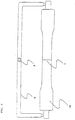
- 1 is sprue runner
- 2 is cup shape molded product
- 3 is ejector pin
- 4 is ejector plate
- 5 is load cell
- 6 is ejector rod
- 7 is weld part
- 8 is sprue
- 9 is runner
- 10 is molded product.
- the polyamide (A) in the invention may be any polymer having an amide linkage (-NHCO-) in the main chain.
- polyamide preferably employed in the present invention examples include polycaprolactam (nylon 6), polytetramethylene adipamide (nylon 46), polyhexamethylene adipamide (nylon 66), polyhexamethylene sebacamide (nylon 610), polyhexamethylene dodecamide (nylon 612), polyundecamethylene adipamide (nylon 116), polyundecalactam (nylon 11), polydodecalactam (nylon 12), polytrimethylhexamethylene terephthalamide (nylon TMHT), polyhexamethylene isophthalamide (nylon 6I), polynonanemethylene terephthalamide (9T), polyhexamethylene terephthalamide (6T), polybis (4-aminocyclohexyl)methane dodecamide (nylon PACM12), polybis(3-methyl-aminocyclohexyl)methane dodecamide (nylondimethyl PACM12), polymetaxylylene adipamide (nylon
- polyamides for achieving the object of the invention are polycaprolactam (nylon 6), polyhexamethylene adipamide (nylon 66), polyhexamethylene dodecamide (nylon 612), polyhexamethylene isophthalamide (nylon 6I), polyamide copolymers each containing at least two different polyamide skeletons thereof, and mixtures thereof.
- Examples of a component (raw material) for forming the above polyamides include polymerizable amino acids, polymerizable lactams, polymerizable mixtures or salts of diamines and dicarboxylic acids, and polymerizable oligomers of the above compounds.
- polymerizable amino acid examples include 6-aminocaproic acid, 11-aminoundecanoic acid, 12-aminododecanoic acid and p-aminomethylbenzoic acid.
- these polymerizable amino acids may be used either singly or in combination.
- polymerizable lactam examples include butyllactam, pivalolactam, caprolactam, capryllactam, enantholactam, undecanolactam, dodecanolactam, and the like. In the invention, these polymerizable lactams may be used either singly or in combination.
- mixture of diamines and dicarboxylic acids or the diamine of the polymerizable salts of diamines and dicarboxylic acids include tetramethylenediamine, hexamethylenediamine, undecamethylenediamine, dodecamethylenediamine, 2-methylpentamethylenediamine, nonanemethylenediamine, 2,2,4-trimethylhexamethylenediamine, 2,4,4-trimethylhexamethylenediamine, 5-methylnonamethylenediamine, 2,4-dimethyloctamethylenediamine, metaxylylenediamine, paraxylylenediamine, 1,3-bis(aminomethyl)cyclohexane, 3,8-bis(aminomethyl)tricyclodecane, 1-amino-3-aminomethyl-3,5,5-trimethylcyclohexane, bis(4-aminocyclohexyl)methane, bis(3-methyl-4-aminocyclohexyl)
- dicarboxylic acid of the polymerizable salts of diamines and dicarboxylic acids include malonic acid, dimethylmalonic acid, succinic acid, glutaric acid, adipic acid, 2-methyladpic acid, trimethyladipic acid, pimelic acid, 2,2-dimethylglutaric acid, 3,3-diethylsuccinic acid, azelaic acid, sebacic acid, suberic acid, dodecanedioic acid, eicodionic acid, terephthalic acid, isophthalic acid, naphthalenedicarboxylic acid, 2-chloroterephthalic acid, 2-methylterephthalic acid, 5-methylisophthalic acid, 5-sodium sulfoisophthalic acid, hexahydroterephthalic acid, hexahydroterephthalic acid, diglycolic acid, and the like.
- these polymerizable dicarboxylic acids may be used either singly or in combination.
- the combination of these polymerizable diamines and dicarboxylic acids may be optionally selected.
- the compositional ratio of the diamine and dicarboxylic acid is preferably from 0.9/1 to 1.3/1, more preferably 0.95/1 to 1.2/1, most preferably 0.97/1 to 1.05/1, as a molar ratio of diamine/dicarboxylic acid.
- the more preferred polyamide-forming component for achieving the object of the invention includes caprolactam, a mixture or salt of hexamethylenediamine and a dicarboxylic acid, a mixture or salt of hexamethylenediamine and dodecanedioic acid, a salt of hexamethylenediamine and terephthalic acid, or a mixture of at least two different polyamide-forming components selected from them.
- the polyamide-forming component for use in the invention, it is possible to add a known terminating agent in order to control the molecular weight or improve the resistance to hot water.
- a known terminating agent monocarboxylic acids and monoamines are preferred. Additional examples include acid anhydrides such as phthalic anhydride, monoisocyanates, monoacid halides, monoesters and monoalcohols.
- the monocarboxylic acid usable as a terminating agent is not particularly limited insofar as it has reactivity with amino group.
- Examples include aliphatic monocarboxylic acids such as acetic acid, propionic acid, butyric acid, valeric acid, n-caproic acid, n-capric acid, lauric acid, tridecylic acid, myristic acid, palmitic acid, stearic acid, pivalic acid and isobutyric acid; alicyclic monocarboxylic acids such as cyclohexanecarboxylic acid; aromatic monocarboxylic acids such as benzoic acid, toluic acid, ⁇ -naphthalenecarboxylic acid, ⁇ -naphthalenecarboxylic acid, methylnaphthalenecarboxylic acid, and phenylacetic acid; and the like. In the present invention, these monocarboxylic acids may be used either singly or in combination.
- the monoamine usable as a terminating agent is not particularly limited insofar as it has reactivity with carboxyl group.
- Examples include aliphatic monoamines such as methylamine, ethylamine, propylamine, butylamine, hexylamine, octylamine, decylamine, stearylamine, dimethylamine, diethylamine, dipropylamine, and dibutylamine; aliphatic monoamines such as cyclohexylamine and dicyclohexylamine and aromatic monoamines such as aniline, toluidine, diphenylamine and naphthylamine; and the like. In the invention, these monoamines may be used either singly or in combination.
- the adding amount of these terminating agent is preferably from 0.001 to 0.25 mol, more preferably from 0.005 to 0.20, most preferably from 0.01 to 0.17 mol.
- More preferred terminating agent for achieving the object of the invention are aliphatic monocarboxylic acids such as acetic acid and stearic acid, and most preferred is acetic acid.
- the molecular weight of the polyamide in the polyamide resin composition of the invention is preferably 10,000 to 1,000,000, more preferably 15,000 to 500,000, most preferably 20,000 to 200,000 as a weight-average molecular weight (Mw) from the viewpoints of excellent moldability and mechanical properties.
- the weight-average molecular weight can be determined from gel permeation chromatography (GPC) by using hexafluoroisopropanol (HFIP) as a solvent and polymethyl methacrylate (PMMA) as a standard sample for molecular weight.
- the apatite type compound (B) preferably used in the invention is represented by the following formula: (M 2 ) 10-z (HPO 4 ) 2 (PO 4 ) 6-z (X) 2-z ⁇ nH 2 O wherein 0 ⁇ z ⁇ 2, 0 ⁇ n ⁇ 16, (M 2 ) represents a metal element, and X represents an anion or an anionic compound.
- metal element (M 2 ) examples include elements of Groups 1, 2, 3, 4, 5, 6, 7, 8, 9, 10, and 11 of the periodic table, tin, and lead. These metal elements may be used either singly or in combination.
- magnesium, calcium, strontium, and barium which are elements in Group 2, and a mixture of at least two of them are particularly preferred from the viewpoints of economy, safety, and physical properties of the resulting resin composition.
- anion or anionic compound represented by X in the above general formula hydroxyl ion (OH - ), fluorine ion (F - ), chlorine ion (Cl - ), and the like can be mentioned as examples. These anion elements or anionic compounds may be used either singly or in combination.
- a carbonic acid-containing apatite obtainable by substituting part of the hydrogenphosphate ion (HPO 4 2- ), phosphate ion (PO 4 3- ) or X in the above general formula with a carbonate ion (CO 3 2- ) may be used.
- hydroxyapatite (X representing hydroxyl ion), fluorinated apatite (a part or all of X representing fluorine ion), chlorinated apatite (a part or all of X representing chlorine ion), a carbonic acid-containing hydroxyapatite, carbonic acid-containing fluorinated apatite and carbonic acid-containing chlorinated apatite and a mixture thereof, each containing calcium as the metal element (M 2 ) are used most preferably in the present invention.
- Examples of such an apatite type compound-forming component include phosphoric acid-based metal compounds and mixtures of a phosphoric acid-based metal compound and a non-phosphoric acid-based metal compound.. In the invention, mixtures of a phosphoric acid-based metal compound and a non-phosphoric acid-based metal compound are more preferred.
- a molar ratio of the metal element to phosphorus may be from 0.9 to 10.0, more preferably from 1.2 to 5.0, still more preferably from 1.5 to 2.0, most preferably 1.55 to 1.75.
- Examples of the phosphoric acid of the above-described phosphoric acid-based metal compound include orthophosphoric acid, pyrophosphoric acid, tripolyphosphoric acid, metaphosphoric acid, phosphorous acid and hypophosphorous acid.
- the phosphoric acid-based metal compound include calcium monohydrogenphosphate (CaHPO 4 ⁇ mH 2 O, with the proviso that 0 ⁇ m ⁇ 2), calcium dihydrogendiphosphate (CaH 2 P 2 O 7 ), calcium bis(dihydrogenphosphate) monohydrate (Ca(H 2 PO 4 ) 2 ⁇ H 2 O), calcium diphosphate ( ⁇ - and ⁇ -Ca 2 P 2 O 7 ), tricalcium phosphate ( ⁇ - and ⁇ -Ca 3 (PO 4 ) 2 ), tetracalcium phosphate (Ca 4 (PO 4 ) 2 O), octacalcium phosphate pentahydrate (Ca 8 H 2 (PO 4 ) 6 ⁇ 5H 2 O), calcium phosphite monohydrate (CaHPO 3 ⁇ H 2 O), calcium hypophosphite (Ca(H 2 PO 2 ) 2 ), magnesium secondary phosphate trihydrate (MgHPO 4 ⁇ 3H 2 O), magnesium
- calcium monohydrogenphosphate (CaHPO 4 ⁇ mH 2 O, with the proviso that 0 ⁇ m ⁇ 2) is preferably employed in the present invention from the viewpoint of excellent economy and physical properties, and particularly, anhydrous calcium monohydrogen phosphate (CaHPO 4 ) and calcium monohydrogenphosphate dihydrate (CaHPO 4 ⁇ 2H 2 O) are preferably employed.
- These phosphorus-base metal compounds may be used either singly or in combination.
- combination of compounds containing same kinds of metal elements such as combination of calcium monohydrogenphosphate dihydrate (CaHPO 4 ⁇ 2H 2 O) and calcium dihydrogendiphosphate (CaH 2 P 2 O 7 ) and combination of compounds containing different kinds of metal elements such as combination of calcium monohydrogenphosphate dihydrate (CaHPO 4 ⁇ 2H 2 O) and magnesium secondary phosphate trihydrate (MgHPO 4 ⁇ 3H 2 O) can be mentioned as examples. Either can be used without any problem.
- the phosphoric acid-based metal compound for use in the invention for example, calcium monohydrogenphosphate (CaHP 4 O ⁇ mH 2 O with the proviso that 0 ⁇ m ⁇ 2) is available by a known process by mixing a phosphoric acid compound and a calcium compound in the presence of water as illustrated in the state diagram of CaO-H 2 O-P 2 O 5 system described in "Phosphorus and its Compounds, 1 (1958) by Van Wazer. More specifically, such a compound may be obtained by adding an alkali phosphate solution and a calcium chloride solution dropwise to a solution of potassium dihydrogenphosphate, followed by reacting them; or mixing calcium carbonate or calcium hydroxide with an aqueous solution of phosphoric acid.
- CaHP 4 O ⁇ mH 2 O with the proviso that 0 ⁇ m ⁇ 2 calcium monohydrogenphosphate
- the non-phosphoric acid-based metal compounds in the invention is not particularly limited insofar as they are compounds other than the above phosphoric acids and capable of forming compounds with a metal element.
- examples include inorganic metal compounds, e.g., metal hydroxides (such as calcium hydroxide, magnesium hydroxide, strontium hydroxide, barium hydroxide, lithium hydroxide, sodium hydroxide, potassium hydroxide, aluminum hydroxide, iron hydroxide and manganese hydroxide); metal chlorides (such as calcium chloride, magnesium chloride, strontium chloride, barium chloride, lithium chloride, sodium chloride, potassium chloride, aluminum chloride, iron chloride and manganese chloride); metal fluorides (such as calcium fluoride, magnesium fluoride, barium fluoride, strontium fluoride, lithium fluoride, sodium fluoride, potassium fluoride, and aluminum fluoride), metal bromides (such as calcium bromide), metal iodides (calcium iodide, potassium
- these non-phosphoric acid-based metal compounds may be used either singly or in combination.
- compounds containing the same metal elements for example, calcium hydroxide and calcium carbonate
- compounds containing different metal elements for example, calcium carbonate and magnesium hydroxide
- metal hydroxides, metal fluorides, metal chlorides, metal carbonates, and metal oxides and mixtures thereof are preferably used because of excellent economy and physical properties.
- hydroxides, fluorides, chlorides, and carbonates of a metal belonging to Group 2 of the periodic table such as calcium, magnesium, strontium, or barium, and mixtures thereof are more preferred.
- hydroxides, fluorides, chlorides, carbonates, and oxides of calcium and mixtures thereof are most preferably employed.
- the process for producing the non-phosphoric acid-based metal compounds is not particularly limited and calcium carbonate, for example, may be either a crushed product of natural material or chemically synthesized one.
- the crystal morphology and shape are also not particularly limited and calcium carbonate, for example, may be any of heavy calcium carbonate, light calcium carbonate, colloidal calcium carbonate, aragonite-type calcium carbonate, vaterite-type calcium carbonate, needle-type calcium carbonate, or a mixture thereof.
- the phosphoric acid-base metal compounds and non-phosphoric acid-based metal compounds which are the apatite type compound-forming components may be primary particles, those forming secondary particles owing to the agglomeration of the primary particles, or mixtures thereof. Most preferred are those forming secondary particles derived from the phosphoric acid-base metal compounds.
- the average particle size of the primary particles constituting the secondary particles is from 0.01 to 1 ⁇ m, more preferably from 0.01 to 0.5 ⁇ m, and the average particle size of the secondary particles is from 0.1 to 50 ⁇ m, more preferably from 0.1 to 25 ⁇ m, most preferably 0.1 to 10 ⁇ m.
- the maximum particle size of the secondary particles is preferably 50 ⁇ m or less, more preferably 30 ⁇ m or less, most preferably 10 ⁇ m or less.
- the average particle size and maximum particle size may be measured by a laser diffraction/scattering type particle size distribution apparatus or by observation through a scanning electronic microscopy (SEM) with dispersing the apatite type compound-forming component in pure water or an alcohol. The following will explain more concretely the method of measuring by a laser diffraction/scattering type particle size distribution apparatus.
- An apatite type compound-forming component (20 mg) is dispersed in pure water (10 ml) and subjected to ultrasonication to prepare a measuring sample.
- Average particle size ( ⁇ m) ⁇ d i ⁇ n i / ⁇ n i wherein d i is particle size ( ⁇ m) and n i is frequency (%).
- the maximum particle size is determined as a maximum particle size at which the frequency of the particle size distribution obtained as above becomes 0.01% or less.
- the specific surface area of the phosphoric acid-base metal compound or non-phosphoric acid-base metal compound which is the apatite type compound-forming component of the invention is from 0.1 to 100 m 2 /g, more preferably 0.5 to 50 m 2 /g, still more preferably 1 to 25 m 2 /g, most preferably 2 to 20 m 2 /g. Particularly, it is preferred that the specific surface area of the phosphoric acid-base metal compound is within the above range.
- the specific surface area can be determined according to BET method.
- apatite type-forming component 0.5 g
- 10 -4 mmHg a condition of 10 -4 mmHg
- a specific surface area measuring apparatus using nitrogen gas as a gas to be absorbed.
- a higher saturated fatty acid metal salt, a higher unsaturated fatty acid metal salt, or a mixture thereof may be preferably used.
- more preferred examples include lithium salts, sodium salts, magnesium salts, calcium salts, zinc salts, aluminum salts and the like of capric acid, uradecylic acid, lauric acid, tridecylic acid, myristic acid, pentadecylic acid, palmitic acid, heptadecylic acid, stearic acid, nonadecanoic acid, arachic acid, behenic acid, lignoceric acid, cerotic acid, heptacosanoic acid, montanic acid, melissic acid, and lacceric acid, or mixtures thereof.
- the higher unsaturated fatty acid metal salt preferably used is a metal salt of an unsaturated fatty acid having 6 to 22 carbon atoms with an element of Group 1, 2, or 3, zinc, aluminum, or the like.
- more preferred examples include lithium salts, sodium salts, magnesium salts, calcium salts, zinc salts, aluminum salts and the like of undecylenic acid, oleic acid, elaidic acid, cetoleic acid, erucic acid, brassidic acid, sorbic acid, linoleic acid, linolenic acid, arachidonic acid, stearolic acid, 2-hexadecenic acid, 7-hexadecenic acid, 9-hexadecenic acid, gadoleic acid, gadoelaidic acid, and 11-eicocenic acid, or mixtures thereof.
- the metal halide constituting the mixture (C) (ii) of the invention is a salt between halogen and a metal element of Group 1 or 2 of the periodic table, and preferred examples include potassium iodide, potassium bromide, potassium chloride, sodium iodide, sodium chloride, and the like, or mixtures thereof. Among them, most preferred are potassium iodide, potassium bromide and a mixture thereof.
- Examples of the copper compound constituting the mixture (C)(ii) of the invention include halides, sulfate, acetate, propionate, benzoate, adipate, terephthalate, salicylate, nicotinate, stearate of copper, chelate compounds such as ethylenediamine and ethylenediaminetetraacetic acid of copper, and the like or mixtures thereof.
- preferred are copper iodide, cuprous bromide, cupric bromide, cuprous chloride, and copper acetate.
- the metal halide and the copper compound are used in combination, and the mixing ratio of the metal halide and the copper compound is preferably within the range of 0.1/1 to 200/1, more preferably the range of 0.5/1 to 100/1, most preferably 2/1 to 40/1, as a molar ratio of halogen to copper from the viewpoint of the improvement of heat resistance and corrosion at production.
- the mixing amount of the higher fatty acid metal salt (C)(i) and/or the mixture (ii) of the metal halide and the copper compound is, relative to 100 parts by weight of a polyamide, from 0.01 to 20 parts by weight, preferably 0.01 to 10 parts by weight, more preferably 0.25 to 5 parts by weight, most preferably 0.05 to 1 parts by weight.
- the mixing amount of the compound (C) is less than 0.01 part by weight, moldability heat-resistant ageing property, and the like are not so improved that the object of the invention is achieved and thus the case is not preferred.
- the amount exceeds 20 parts by weight silver-like spots occur on the surface of the molded product and the appearance tends to be deteriorated. Also, the mechanical properties of the molded product tends to be deteriorated, and thus the case is not preferred.
- the polyamide resin composition of the invention may be mixed with other resin.
- Preferred other resin is at least one resin selected from polyphenylene ether resins, polyoxymethylene resins, aromatic polyester resins, aromatic polycarbonate resins, polyarylene sulfide resins, polyolefin resins, styrene resins, acrylic resins, and rubbers. Particularly preferred is a mixture with a polyphenylene ether resin.
- a conventional polyamide resin may be incorporated into the polyamide resin composition of the invention.
- a preferred polyphenylene ether resin of the invention may be a polymer comprising a repeating unit represented by the following formula: wherein R 1 , R 2 , R 3 , and R 4 each independently represent a monovalent substituent selected from hydrogen atom, halogen atoms, alkyl groups, alkoxy groups, and haloalkyl groups or haloalkoxy groups having at lest two carbon atoms between the halogen atom and the phenyl ring and containing no tertiary ⁇ -carbon, and n is an integer showing polymerization degree.
- R 1 and R 2 each is an alkyl group having 1 to 4 carbon atoms
- R 3 and R 4 each is hydrogen atom or an alkyl group having 1 to 4 carbon atoms.
- styrene compound to be grafted to the above polyphenylene ether resin styrene, ⁇ -methylstyrene, vinylstyrene, chlorostyrene, or the like may be mentioned.
- the process for producing the above polyphenylene ether resin may be any of conventional methods without particular limitation, and the resin can be easily produced by subjecting 2,6-xylenol to an oxidation polymerization with using a complex between a cuprous salt and an amine as a catalyst according to the method by Hay described in U. S. Patent No. 33086874, for example.
- the resin can be easily produced according to the methods described in U. S. Patent Nos. 33086875, 3257357, and 3257358, Japanese Patent Publication No. 17880/1977, Japanese Patent Laid-Open Nos. 51197/1975 and 152628/1988, and so forth.
- a modified polyphenylene ether resin wherein the above polyphenylene ether resin is modified with a compound having, for example, amino group, carboxyl group, epoxy group, or the like to incorporate the group into the molecule of the polyphenylene ether resin.
- a catalyst for radical polymerization with heating under a temperature condition of 150 to 350°C.
- the polyphenylene ether resin for use in the invention has preferably an intrinsic viscosity of about 0.10 to about 1.0 dl/g, measured under conditions at 25°C in chloroform. More preferred is from about 0.25 to about 0.75 dl/g.
- the mixing amount of the resin other than the polyamide is preferably from 1 to 300 parts by weight, more preferably 1 to 100 parts by weight, most preferably 10 to 100 parts by weight, relative to 100 parts by weight of the polyamide.
- the mixing amount is less than 1 part by weight, mechanical properties, dimensional stability, impact resistance, and the like at water absorption are so improved that the object of the invention is achieved and thus the case is not preferred.
- the amount exceeds 300 parts by weight, the deterioration of moldability, strength, toughness, and the like occurs and thus the case is not preferred.
- the process for producing the polyamide composite of the invention may be any of:
- Examples of the process for producing the apatite type compound used in the above (Process 1) or (Process 2) include wet synthesis, hydrothermal synthesis, and dry synthesis which are conventionally employed.
- a process disclosed in Japanese Patent Laid-Open No. 167209/1989 i.e., a process of maturing hydroxyapatite formed by maintaining an aqueous suspension of calcium chloride and dipotassium hydrogen phosphate under conditions of pH 4 or higher and about 70°C.
- hydrothermal synthesis there may be mentioned a process disclosed in Japanese Patent Publication No. 51485/1984, i.e., a process of using monocalcium hydrogen phosphate dihydrate (or monocalcium hydrogen phosphate anhydride) and calcium hydroxide as the apatite type-forming component and reacting them under hydrothermal conditions of 200 to 400°C and 15 to 200 atm in an autoclave.
- a process disclosed in Japanese Patent Publication No. 51485/1984 i.e., a process of using monocalcium hydrogen phosphate dihydrate (or monocalcium hydrogen phosphate anhydride) and calcium hydroxide as the apatite type-forming component and reacting them under hydrothermal conditions of 200 to 400°C and 15 to 200 atm in an autoclave.
- the apatite type compound obtained by these methods into a polyamide-forming component (Process 1) or a polyamide (Process 2)
- the apatite type compound may be incorporated either in a powdery form or in a state of suspending it in a hydrophilic solvent such as water or an alcohol.
- the power or suspension of the apatite type compound may be mechanically crushed by means of an apparatus such as a ball mill and then incorporated into the polyamide-forming component or polyamide in a powdery or suspension state.
- the method of incorporating the polyamide-forming component with the apatite type compound-forming component may be either a process of directly.mixing the polyamide-forming component in a solid form and the apatite type compound-forming component or a process of mixing an aqueous solution of the polyamide-forming component and an aqueous solution or suspension of the apatite type compound-forming component.
- a compound such as a dispersant or complexing agent may be added to the polyamide-forming component or apatite type compound-forming component as needed.
- the mixing amount of the apatite type compound-forming component in the above is preferably from 0.05 to 200 parts by weight, more preferably from 0.1 to 100 parts by weight, and particularly preferred is 1 to 100 parts by weight, relative to 100 parts by weight of the polyamide-forming component.
- the mixing amount of the apatite type compound-forming component is less than 0.005 part by weight relative to 100 parts by weight of the polyamide-forming component, the improving effect on the mechanical properties of the resulting molded product is not so remarkable that the object of the invention is achieved.
- the amount exceeds 200 parts by weight care must be taken on the problems such as the deterioration of moldability.
- any known dispersant can be employed.
- anionic surfactants, cationic surfactants, amphoteric surfactants, nonionic surfactants, nonionic surfactants, and the like as described in pp. 232 to 237 of "Bunsan ⁇ Gyousyuu no Kaimei to Ouyou Gijutu (Elucidation of Dispersion ⁇ Agglomeration and Applied Technology)" (supervised by Fumio Kitahara, published by Techno System Co., Ltd.).
- anionic surfactants and nonionic surfactants are preferably employed.
- sodium citrate, sodium polyacrylate, ammonium polyacrylate, styrene-maleic anhydride copolymer, olefin-maleic anhydride copolymers such as ethylene-maleic anhydride copolymer, and sucrose esters such as sucrose stearate are more preferably employed.
- the complexing agent is not particularly limited insofar as it is a compound forming a complex with a metal ion.
- Examples include ethylenediaminetetraacetic acid, nitrilotriacetic acid, cyclohexanediaminetetraacetic acid, glycoletherdiaminetetraacetate, diethylenetriaminepentaacetic acid, citric acid, gluconic acid, tartaric acid, malic acid, succinic acid, aliphatic amines such as ethylenediamine, urea, and the like.
- citric acid, ethylenediaminetetraacetic acid, and ethylenediamine are particularly preferred from the viewpoints of cost and physical properties.
- any known process can be employed.
- a process wherein a component sparingly soluble in water such as 11-aminoundecanoic acid is employed as a forming component and heated at 40 to 300°C to effect polycondensation; a ring-opening polycondensation process wherein an aqueous solution of ⁇ -caprolactam is employed as a forming component, mixed with a terminating agent such as a monocarboxylic acid or a reaction accelerator such as ⁇ -aminocaproic acid as needed, and heated at 40 to 300°C under the flow of an inert gas to effect polycondensation; or a heat-melt polycondensation process wherein an aqueous solution of a salt of a diamine and a dicarboxylic acid such as hexamethylene adipamide is concentrated under heating at a temperature of 40 to 300°C, the water vapor thus generated is maintained at a pressure between normal pressure
- solid-phase polymerization wherein polymerization is carried out at a temperature not higher than the melting point of a solid salt of a diamine and a dicarboxylic acid and that of a polycondensate thereof; or solution polymerization wherein a dicarboxylic acid halide component and a diamine component are polycondensed in a solution; or the like.
- These processes may be used in combination, if necessary.
- the polymerization apparatus is also not particularly limited and a known one such as an autoclave-type reactor, a tumbler type reactor, or an extrusion type reactor such as kneader can be employed.
- the polymerization mode may be either a batchwise or continuous manner.
- the heat-melt polycondensation will be more specifically described.
- a 40 to 60% by weight suspension containing an polyamide-forming component and an apatite type compound-forming component using water as a solvent is first concentrated to a concentration of 65 to 85% by weight in the vessel of a preliminary evaporator operated at a temperature of about 130 to 160°C and a pressure of about 0.035 to 0.5 Mpa. Then, the concentrated solution is transferred to an autoclave and the whole is continuously heated until the pressure in the vessel reaches about 1.5 to 2.0 Mpa.
- the pressure is maintained at about 1.5 to 2.0 Mpa with releasing water or gas component and, at the time when the temperature reaches about 250 to 280°C, the pressure is lowered to atmospheric pressure over a period of about 45 to 90 minutes.
- the polyamide is extruded to form a strand, which is transformed to pellets after cooling and cutting.
- the continuous polymerization is also well known in the art as disclosed in U. S. Patent No. 3947424.
- a 40 to 60% by weight suspension containing an polyamide-forming component and an apatite type compound-forming component using water as a solvent is pre-heated to about 40 to 90°C in the vessel of a pre-heating apparatus, and then transferred to a preliminary evaporator/reactor, where the suspension is concentrated to a concentration of about 70 to 90% by weight at a pressure of about 0.1 to 0.5 Mpa and a temperature of about 200 to 270°C. Then, the suspension is discharged into a flasher, wherein the pressure is slowly lowered to about atmospheric pressure, and then the suspension is discharged into a vessel which is maintained at atmospheric pressure or lower and at a temperature of about 270 to 300°C. Moisture is removed and the polyamide melted product is extruded to form a strand, which is transformed to pellets after cooling and cutting.
- the interface between the polyamide and the apatite type compound is most extremely well fixed and adhered and the properties of the resulting polyamide resin composition is excellent.
- the apatite type compound-forming component of phosphoric acid-base metal compound for example, calcium monohydrogen phosphate dihydrate first becomes porous by dehydration at the early stage of the polymerization of the polyamide.
- To the porous forming composition was adsorbed and adhered the polyamide-forming component or a polymerizing-polyamide through physical and chemical interaction. Then, the porous apatite type compound-forming component changes into the apatite type compound as the process proceeds.
- the apatite type compound-forming component particularly the phosphoric acid-base metal compound is preferably porous as described above, and there is a tendency that a smaller average particle size and maximum particle size results in a better properties of the resulting polyamide composite.
- the present inventors have found that, in the case of incorporating an additive compound, especially a compound containing a metal element for the purpose of improving the properties and imparting functionality, the incorporation of the additive after the completion of the formation of the apatite type compound results in a polyamide resin composition having aimed properties and functionality, wherein an apatite type compound of fine particles having a size of several tens to hundred nm is homogeneously dispersed in the polyamide.
- the process for producing the polyamide resin composition of the invention may be any process of incorporating component (C) in a step after the completion of the formation of the apatite type compound. More specifically, there may be mentioned a process of incorporating component (C) in the step of producing a polyamide composite (Process 1) wherein an apatite type compound is incorporated and then a polyamide is polymerized; a process of incorporating component (C) in the step of producing a polyamide composite (Process 2), wherein an apatite type compound is incorporated into a polyamide according to a melt-kneading method; a process of incorporating component (C) in a step after the completion of the formation of the apatite type compound in (Process 3); or a process wherein these processes are combined.
- Component (C) may be incorporated as it is, or may be incorporated as a masterbatch prepared beforehand using a polyamide or the like, or may be incorporated as a solution or suspension in
- a kneader generally utilized can be employed as an apparatus for melt-kneading.
- preferred kneader include a single-screw or multi-screw kneading extruder, a roll, a Banbury mixer, and the like.
- a twin-screw extruder equipped with a pressure-reducing apparatus and a side-feeder apparatus.
- melt-kneading there may be mentioned a method of kneading all the components at once; a method of kneading a blend pre-kneaded beforehand, e.g., a method of further melt-kneading a pre-kneaded product of a polyamide and apatite type compound with a pre-kneaded product of a polyamide and a heat-resistance improver; or a method of feeding each component successively in the mid flow of an extruder, e.g., a method of feeding successively a moldability improver, a polyphenylene ether resin, and a rubber component to a polyamide composite in the mid flow of an extruder.
- a method of kneading a blend pre-kneaded beforehand e.g., a method of further melt-kneading a pre-kneaded product of a polyamide and apatite type compound
- the degree of reduced pressure is preferably from about 0 to 0.07 Mpa.
- the temperature at melt-kneading is preferably a temperature which is from 1 to 100°C higher than the melting point or softening point of a polyamide or a resin other than a polyamide determined on differential scanning calorimetry (DSC) measurement in accordance with JIS K7121.
- the shearing speed at a kneader is preferably 100 (sec -1 ) or more, and the average residential time at kneading is preferably form about 1 to 15 minutes.
- the content of solvent in the polyamide resin composition is preferably about 1% by weight or less.
- the confirmation of the apatite type compound of the present invention may be effected by a method of direct confirmation by subjecting a sample during the polymerization process, a polyamide composite or polyamide resin composition, or a molded product thereof to wide-angle X-ray diffraction, infrared absorption spectrum, or the like, or a method of confirmation by eluting the polyamide or other mixed resin with a solvent capable of dissolving the polyamide or other mixed resin to separate the apatite type compound and subjecting the apatite type compound thus separated to wide-angle X-ray diffraction, infrared absorption spectrum, or the like.
- the solvent capable of dissolving the polyamide and other resin the solvents described in, for example, No. VII (Solvents and Non-solvents for Polymers) of "POLYMER HANDBOOK Third Edition" (supervised by J. Brandrup and E. H. Immergut/A Wiley-Interscience Publication).
- phenol solvent as the solvent capable of dissolving a polyamide.
- other resin is a polyphenylene resin
- chloroform solvent is preferred as the soluble solvent.
- the operation for dissolution may be multistep operation of dissolving the polyphenylene resin first with using a sufficient amount of chloroform solvent, and then dissolving the polyamide with using a sufficient amount of phenol solvent.
- the apatite type compound of the present invention may be either crystalline or amorphous apatite type compound, the crystalline one is more preferred from the viewpoint of physical properties.
- a crystalline apatite type compound thus confirmed is particularly preferred.
- the content of the apatite type compound of the invention is preferably from 0.05 to 200 parts by weight, more preferably from 0.1 to 100 parts by weight, particularly preferably from 1 to 100 parts by weight relative to 100 parts by weight of a polyamide.
- the content of the apatite type compound can be determined, for example, from an ignition loss measured in accordance with JIS R3420 using a polyamide composite.
- the content of the apatite type compound can be also determined from a polyamide composite, or even a polyamide resin composition or a molded product thereof by combining the above ignition loss and a solvent extraction, NMR, infrared absorption spectrum, or the like as needed.
- the content of the apatite type compound is less than 0.05 parts by weight relative to 100 parts by weight of a polyamide, an improving effect of the resulting molded product is not so remarkable that the object of the invention is achieved.
- the content exceeds 200 parts by weight, care must be taken on the problem of deterioration of moldability.
- the ratio of the metal element to phosphorus is preferably from 0.9 to 10.0, more preferably from 1.2 to 5.0, particularly preferably from 1.3 to 2.5, as a molar ratio.
- the ratio is less than 0.9, inclusion of air babbles or foaming tends to occur at extrusion or molding, which presumably lowers the yield of the molded product.
- the ratio exceeds 10.0, on the other hand, toughness tends to be deteriorated.
- the apatite type compound of the invention contains an organic substance, and the organic substance must be contained in an amount of 0.5 to 100 parts, preferably 1 to 100 parts by weight, more preferably 3 to 75 parts by weight, particularly preferably 4 to 50 parts by weight per 100 parts by weight of the apatite type compound. Since the organic substance is included inside or surface of the apatite type compound by physical or chemical interaction such as an ionic bonding reaction, an adsorption reaction or a grafting reaction, the organic substance has a nature that it does not dissolve or elute into phenol solvent even when an operation for dissolution is conducted with using phenol solvent capable of dissolving a polyamide.
- the apatite type compound of the invention preferably has an average particle size of 0.01 to 1 ⁇ m, more preferably 0.01 to 0.5 ⁇ m.
- the average particle size can be determined by electron microphotographic observation and the average particle size is calculated as described below. That is, an ultra thin piece cut out from the polyamide composite, the polyamide resin composition, or the molded product is photographed under transmission electron microscope (TEM: x 50,000 or 100,000 magnification) and the particle size d i ( ⁇ m) and the number n i of the particles are determined, followed by calculation of the average particle size based on the following equation.
- Average particle size ⁇ d i ⁇ n i / ⁇ n i
- the dispersing mode of the polyamide and other resin in the mixture can be observed on an electro microphotograph. More specifically, the dispersing mode of the mixture of a polyamide and polyphenylene ether resin, for example, can be observed with an ultra thin piece prepared according to staining solid method with osmium tetraoxide and/or ruthenium tetraoxide using transmission electron microscope (TEM).
- TEM transmission electron microscope
- the dispersing mode may be either the case that a polyamide constitutes a continuing phase and other resin constitutes a dispersing phase or the case that the other resin constitutes a continuing phase and the polyamide constitutes a dispersing phase, but since the object of the invention can be more effectively achieved, it is preferred that the polyamide constitutes a continuing phase and the other resin constitutes a dispersing phase.
- the average particle size of the dispersing phase is from 0.01 to 10 ⁇ m, preferably from 0.1 to 5 ⁇ m. When the average particle size is out of the above range, impact resistance tends to decrease.
- the longer diameter and shorter diameter thereof are measured and the half of the sum of these diameters is designated as the particle size.
- the sizes of at least 2000 particles must be measured.
- the apatite type compound of the invention shows a high affinity to a polyamide. Therefore, it is preferred that 50% by weight or more, preferably 75% by weight or more, most preferably 90% by weight or more of the apatite type compound is present in the polyamide in a homogeneously dispersed state, from the viewpoint that the aimed improving effect is achieved by the existence in the polyamide.
- a moldability improver other than the higher fatty acid metal salts may be added.
- the above moldability improver is at least one compound selected from the compounds consisting of phosphate esters, phosphite esters, higher fatty acids, higher fatty acid esters, higher fatty acid amide compounds, polyalkylene glycols or terminal-modified compounds thereof, low-molecular-weight polyethylene or oxidized low-molecular-weight polyethylene, substituted benzylidene sorbitols, polysiloxanes, caprolactones, and inorganic crystal-seeding agents.
- a deterioration-inhibiting agent may be added to the polyamide resin composition of the invention.
- the above deterioration-inhibiting agent is at least one compound selected from phenol-type stabilizers such as hindered phenol compounds, phosphite-type stabilizers, hindered amine-type stabilizers, triazine-type stabilizers, and sulfur-type stabilizers.
- a coloring agent may be added to the polyamide resin composition of the invention.
- the above coloring agent is at least one coloring agent selected from dyes such as Nigrosine; pigments such as titanium oxide or carbon black; particles of metals such as aluminum, colored aluminum, nickel, tin, copper, gold, silver, platinum, iron oxide, stainless steel, and titanium; pearl pigments made of mica; metallic pigments such as color graphites, color glass fibers, and color glass flakes; and the like.
- conductive carbon black is at least one carbon black selected from acetylene black, Ketjenblack, carbon nanotube, and the like. Among them, preferred is one having a good linear structure and a large cohesive density.
- a flame retardant may be incorporated into the polyamide resin composition.
- the flame retardant is preferably a non-halogen-type flame retardant or a bromine-type flame retardant.
- the above non-halogen-type flame retardant is at least one flame retardant selected from phosphorus-type flame retardants such as red phosphorus, ammonium phosphate, and ammonium polyphosphate; inorganic compound-type flame retardants including metal hydroxides or inorganic metal compounds such as aluminum hydroxide, magnesium hydroxide, dolomite, hydrotalcite, calcium hydroxide, barium hydroxide, basic magnesium carbonate, zirconium hydroxide, tin oxide, zinc stannate, and zinc hydroxystannate, boric acid compounds such as zinc borate, zinc metaborate, and barium metaborate, and the like; triazine-type flame retardants such as melamine, melam, melem, mellon (a product derived from elimination of three ammonia molecules from three melem molecules at 300°C or higher), melamine cyanurate, melamine phosphate, melamine polyphosphate, succinoguanamine, adipoguanamine, methylglutaroguanamine
- the above bromine-type flame retardant is at least one flame retardant selected from the compounds consisting of brominated polystyrenes, brominated polyphenylene ethers, brominated bisphenol-type epoxy polymers, and brominated crosslinked aromatic polymers.
- An inorganic filler may be incorporated into the polyamide resin composition of the invention.
- the above inorganic filler is at least one inorganic filler selected from glass fibers, carbon fibers, wollastonite, talc, mica, kaolin, barium sulfate, calcium carbonate, apatite, sodium phosphate, fluorite, silicon nitride, potassium titanate, molybdenum disulfide, and the like.
- the present inventors presume that, in the case of incorporating the additive conventionally used for these polyamide resins, a similar aimed improving effect can be also attained by incorporating it after the formation of the apatite type compound as in the invention.
- the polyamide resin composition of the invention is excellent in various kinds of moldability, it can be well molded and processed even by the use of molding methods generally known for plastics such as pressing, injection molding, gas-assisted injection molding film forming, welding, extrusion, blow molding, film forming, blow molding, multilayer forming, expansion molding, melt spinning, and the like.
- the molded product obtained from the resin composition of the invention is excellent in rigidity, strength, toughness, weathering resistance, heat-resistant aging property, and the like as compared with conventional resin compositions, so that it is expected to employ the resin composition for the application to various parts such as automobile parts, electronic/electrical parts, industrial machine parts, various gears, and for extrusion uses.
- a molar ratio of the metal element to phosphorus was calculated from the amount of the apatite type compound-forming component incorporated and molecular weight thereof.
- a polyamide resin composition was dried at 100 ⁇ 20°C for 8 hours, followed by cooling.
- One g of the composition was weighed on a platinum boat and incinerated in an electric oven of 650 ⁇ 20°C. After cooling, the residue was weighed and the content of the apatite type compound was determined.
- the polyamide resin composition (0.5 g) was weighed on a platinum boat and incinerated in an electric oven of 500°C. After cooling, 5 ml of hydrochloric acid and 5 ml of pure water were added thereto and the whole was dissolved by boiling on a heater. The resulting solution was cooled again and then pure water was added to make the solution 500 ml. Determination was conducted at a wavelength of 317.933 nm by using "IRIS/IP" manufactured by Thermo Jarrell Ash in accordance with inductively coupled plasma (ICP) emission spectrometry.
- ICP inductively coupled plasma
- the polyamide resin composition (0.5 g) was weighed, and 20 ml of concentrated sulfuric acid was added thereto, followed by wet decomposition on a heater. After cooling, 5 ml of hydrogen peroxide was added and the resulting mixture was heated on a heater to concentrate the whole amount to 2 to 3 ml. The concentrate was again cooled and pure water was added to make it 500 ml. Determination was conducted at a wavelength of 213.618 (nm) in accordance with inductively coupled plasma (ICP) emission spectrometry by using "IRIS/IP" manufactured by Thermo Jarrell Ash.
- ICP inductively coupled plasma
- the pyrogram of pyrolysis GC thus obtained was divided into regions of retention time less than 2 minutes and retention time of 2 minutes or greater and their peak areas Sa (less than 2 minutes) and Sb (2 minutes and greater) were calculated.
- the amount of the organic substance was calculated in accordance with the following equation.
- the amount of the organic substance (part by weight/100 parts by weight of the apatite type compound) X ⁇ Sb/(Sa + Sb)
- Infrared absorption spectrum of the apatite type compound obtained in (a) of (2-4) was measured.
- an apparatus "1640" manufactured by Perkin Elmer measurement was conducted at a resolving power of 4 cm -1 .
- the measurement was conducted in accordance with JIS K7121 and K7122. Determination was conducted by using "DSC-7" manufactured by Perkin-Elmer. The measuring conditions were as follows. Under a nitrogen atmosphere, about 8 mg of a sample was maintained at 300°C for 2 minutes, cooled to 40°C at a rate of 20°C/minute, maintained at 40°C for 2 minutes, and heated at a rate of 20°C/minute. Melting point was determined from the peak temperature of an exothermic peak (melting peak) appearing during the final heating step. In addition, melting calorie was determined from the peak area.
- SFD Spiral flow distance
- Molding was conducted under the conditions similar to those in the above releasing ability evaluation with the exception of the condition described below. Then, the time required for moving the screw back was measured and an average value of the plasticizing time at 50 shots was determined.
- a molded product was prepared using an injection molding machine.
- the molded product was obtained using an apparatus "PS40E” manufactured by Nissei Jushi K.K., set at a cylinder temperature of 280°C and a mold temperature of 80°C under injection conditions of injection for 17 seconds and cooling for 20 seconds.
- Gs 60°C was measured in accordance with JIS K7150 using a handy gloss meter "IG320" manufactured by Horiba.
- a molded product having a weld part was prepared using a mold shown in Figure 2 and the strength was measured in accordance with ASTM D-638.
- Hot-water resistance was evaluated by measuring tensile strength in accordance with ASTM D638 after dipping of a test piece in water heated to 140°C for 200 hours.
- a molded product (initial molded product) was crushed by a crasher, and molding was conducted using the resulting crushed product. The operation was repeated further four times, and tensile strength of the molded product (reworked product) finally obtained was measured.
- a molded product for measuring tensile strength was maintained in a gear oven of 180°C.
- the molded product was taken out at a predetermined time and tensile strength was determined.
- Heat-resistant aging property was evaluated by determining the time when tensile strength is one-half of the initial (without aging) tensile strength (half value time).
- Color tone of the molded product was measured using the initial molded product and reworked product of (4-9). Color difference between the initial molded product and reworked product ( ⁇ b: change of b value) was determined using a color-difference meter "ND-300A" manufactured by Nippon Denshoku. Smaller color difference ( ⁇ b) is judged to be good yellowing resistance.
- the size of a flat plate obtained by injection molding using a mold having a thickness of 3 mm and a side of 130 mm was measured and a shrinkage factor was determined.
- a flat plate obtained by injection molding using a mold having a thickness of 3 mm and a side of 130 mm was placed on a horizontal plane and the maximum gap distance from the horizontal plane was measured.
- test piece was dipped in a warm water of 40°C for 10 days and then, a similar test to the above initial adhesiveness test was conducted.
- An aqueous solution of a 50% by weight polyamide-forming component (an equimolar salt of hexamethylenediamine and adipic acid) was prepared in an amount of 30 kg.
- the molar ratio of calcium to phosphorus was calculated as 1.67.
- the mixture of the aqueous solution of the polyamide-forming component and the suspension of the apatite type compound-forming component was partially sampled and it was air-dried to form Sample (a).
- Step 1 The mixture of the aqueous solution of the polyamide-forming component and the suspension of the apatite type compound-forming component (3.0 kg) was fed into two 5-liter autoclaves having a stirring apparatus. The atmosphere in both autoclaves were thoroughly replaced by nitrogen under a temperature of 50°C, and then the autoclaves were heated from 50°C to about 150 under stirring while removing water into out of the system to prevent the pressure in the autoclaves from exceeding about 0.2 MPa, thereby about 0.7 kg of water being removed. One of two autoclaves was rapidly cooled and the content was taken out as Sample (b).
- Step 2 Then, the remaining one autoclave was heated to about 270°C following to (Step 1). At that time, the heating was continued for about 1 hour while removing water into out of the system to prevent the pressure in the autoclaves from exceeding about 1.77 MPa. Thereafter, the pressure was lowered to atmospheric pressure over a period of about 1 hour, and the autoclave was rapidly cooled and the content was taken out as Sample (c).
- An aqueous solution of a 50% by weight polyamide-forming component (an equimolar salt of hexamethylenediamine and adipic acid) was prepared in an amount of 30 kg.
- the mixture of the aqueous solution of the polyamide-forming component and the suspension of the apatite type compound-forming component was fed into a 70-liter autoclave having a stirring apparatus.
- the atmosphere in the autoclave was thoroughly replaced by nitrogen under a temperature of 50°C, and then the autoclave was heated from 50°C to about 150°C under stirring while removing water into out of the system to prevent the pressure in the autoclaves from exceeding about 0.2 MPa, thereby about 7 kg of water being removed.
- the autoclave was continuously heated to about 270°C. At that time, the heating was continued for about 1 hour while removing water into out of the system to prevent the pressure in the autoclaves from exceeding about 1.77 MPa.
- An aqueous solution of a 50% by weight polyamide-forming component (an equimolar salt of hexamethylenediamine and adipic acid) was prepared in an amount of 30 kg.
- Example 2 Operations were conducted in a similar manner to Example 1 with the exception that aluminum distearate was employed instead of calcium stearate. The evaluation results are shown in Table 2.
- Example 2 Operations were conducted in a similar manner to Example 1 with the exception that aluminum tristearate was employed instead of calcium stearate. The evaluation results are shown in Table 2.
- a polyamide resin composition was obtained by blending 0.05 part by weight of a blend oil (polyethylene glycol: "PEG400” manufactured by Nippon Oil & Fats Co., Ltd.) and 0.15 part by weight of calcium montanate to 100 parts by weight of pellets of the polyamide resin composition of Example 7 using a cone-type tumbler.
- the evaluation results are shown in Table 3.
- a polyamide resin composition was obtained by blending 0.05 part by weight of a blend oil (polyethylene glycol: "PEG400” manufactured by Nippon Oil & Fats Co., Ltd.), 0.15 part by weight of calcium montanate, and 2.5 part by weight of a masterbatch (a masterbatch based on Ny6 containing 10% by weight of ethylene bisstearylamide) to 100 parts by weight of pellets of the polyamide resin composition of Example 7 using a cone-type tumbler.
- a blend oil polyethylene glycol: "PEG400” manufactured by Nippon Oil & Fats Co., Ltd.
- a masterbatch a masterbatch based on Ny6 containing 10% by weight of ethylene bisstearylamide
- An aqueous solution of a 50% by weight polyamide-forming component (an equimolar salt of hexamethylenediamine and adipic acid) was prepared in an amount of 30 kg.
- the mixture of the aqueous solution of the polyamide-forming component and the suspension of the apatite type compound-forming component was fed into a 70-liter autoclave having a stirring apparatus.
- the atmosphere in the autoclave was thoroughly replaced by nitrogen under a temperature of 50°C, and then the autoclave was heated from 50°C to about 150°C under stirring while removing water into out of the system to prevent the pressure in the autoclaves from exceeding about 0.2 MPa, thereby about 7 kg of water being removed.
- the autoclave was heated continuously to about 270°C. At that time, the heating was continued for about 1 hour while removing water into out of the system to prevent the pressure in the autoclaves from exceeding about 1.77 MPa.
- the pressure was lowered to atmospheric pressure over a period of about 1 hour, and then the stirring was stopped and the polymer was discharged from a lower part nozzle in the form of a strand, which was cooled and cut to obtain pellets of a polyamide composite. Foaming was hardly observed on the strand at the discharge.
- Mw weight-average molecular weight
- the content of the apatite type compound was found to be 10.4 parts by weight relative to 100 parts by weight of the polyamide.
- a molar ratio of calcium to phosphorus was calculated to be 1.66.
- Observation under a transmission electron microscope (TEM) at a magnitude of 50,000 showed that the apatite type compound had an average particle size of 85 nm.
- TEM transmission electron microscope
- the formation of crystalline apatite type compound can be confirmed by wide-angle X-ray diffraction.
- the amount of the organic substance of the apatite type compound obtained by the eluting and separating operations was calculated to be 5.5 (parts by weight/100 parts by weight of the apatite).
- cyclopentanone was confirmed as one pyrolytically decomposed component of the organic substance remaining in the apatite type compound.
- An aqueous solution of a 50% by weight polyamide-forming component (an equimolar salt of hexamethylenediamine and adipic acid) was prepared in an amount of 30 kg.
- the mixture of the aqueous solution of the polyamide-forming component and the suspension of the apatite type compound-forming component was fed into a 70-liter autoclave having a stirring apparatus.
- the atmosphere in the autoclave was thoroughly replaced by nitrogen under a temperature of 50°C, and then the autoclave in a tightly sealed state was heated to about 250°C and the pressure was raised to about 4.0 MPa.
- the autoclave was maintained for 5 hours under the conditions. After cooling, the content was taken out and centrifugal separation and washing with pure water were repeated. Thereafter, it was dried in a nitrogen stream of 80°C for 24 hours to obtain a white powder.
- the white powder was confirmed to be crystalline apatite type compound by wide-angle X-ray diffraction of the powder. Observation under a transmission electron microscope (TEM) at a magnitude of 50,000 showed that the apatite type compound was in the form of spherical particle having an average particle size of 100 nm.
- TEM transmission
- nylon 66 (1300" manufactured by Asahi Chemical Co., Ltd.) was added 10 parts by weight of the apatite type compound, and the mixture was melt-kneaded by means of an extruder ("TEM35" manufactured by Toshiba Machine Co., Ltd.) under a condition of 280°C to obtain pellets of a polyamide composite.
- An apatite type compound having an average particle size of 1.0 ⁇ m (maximum particle size of 5.5 ⁇ m) and a specific surface area of 0.5 m 2 /g was obtained by crashing a commercial hydroxyapatite having an average particle size of 60 ⁇ m manufactured by Taihei Kagaku Sangyo K.K. using a ball mill.
- nylon 66 1300 manufactured by Asahi Chemical Co., Ltd.
- the mixture was melt-kneaded by means of an extruder ("TEM35" manufactured by Toshiba Machine Co., Ltd.) under a condition of 280°C to obtain pellets of a polyamide composite.
- a polyamide resin composition was obtained by blending 0.05 part by weight of a blend oil ("Value 7220" manufactured by Marubishi Oil Chemical Co., Ltd.) and 0.30 part by weight of calcium montanate to 100 parts by weight of the polyamide resin composite of Production Example 2 using a cone-type tumbler, the former two components being attached to the surface of the latter.
- the evaluation results are shown in Table 4.
- An aqueous solution of a 50% by weight polyamide-forming component (an equimolar salt of hexamethylenediamine and adipic acid) was prepared in an amount of 30 kg.
- the mixture of the aqueous solution of the polyamide-forming component and the suspension of the apatite type compound-forming component was fed into a 70-liter autoclave having a stirring apparatus.
- the atmosphere in the autoclave was thoroughly replaced by nitrogen under a temperature of 50°C, and then the autoclave was heated from 50°C to about 150°C under stirring while removing water into out of the system to prevent the pressure in the autoclaves from exceeding about 0.2 MPa, thereby about 7 kg of water being removed.
- a masterbatch of a heat-resistant improver was obtained by incorporating 0.05 part by weight of cuprous iodide (CuI) and 8.5 parts by weight of potassium iodide (KI) to 100 parts by weight of nylon 66 ("1300" manufactured by Asahi Chemical Industry Co., Ltd.), blending them using a cone-type tumbler, and melt-kneading them by means of an extruder ("TEM35" manufactured by Toshiba Machine Co., Ltd.) under a condition of 280°C.
- CuI cuprous iodide
- KI potassium iodide
- a polyamide resin composition was obtained by blending 0.05 part by weight of a blend oil (polyethylene glycol: "PEG400” manufactured by Nippon Oil & Fats Co., Ltd.), 0.15 part by weight of calcium montanate as a moldability improver, and 5 parts by weight of the masterbatch of heat-resistance improver of Production Example 11 to 100 parts by weight of the polyamide composite of Production Example 2 using a cone-type tumbler.
- the evaluation results are shown in Table 7.
- PPE poly(2,6-dimethylphenylene-1,4-ether)
- PCM45 twin-screw extruder
- An aqueous solution of a 50% by weight polyamide-forming component (an equimolar salt of hexamethylenediamine and adipic acid) was prepared in an amount of 30 kg.
- Example 1 Comparative Example 1 1. Characteristics of forming components 1) Content of polyamide-forming component part by weight 100 100 2) Content of apatite type compound-forming component part by weight 13.9 13.9 3) Molar ratio of metal element of apatite-forming component to phosphorus 1.70 1.70 2.
- Characteristics of polyamide composite 1) Kind of polyamide Ny66 Ny66 2) Content of polyamide part by weight 100 100 3) Weight-average molecular weight (Mw) 40000 30000 4) Content of apatite type compound part by weight 10.4 10.4 5) Molar ratio of metal element to phosphorus 1.70 1.70 6) Particle size of apatite type compound nm 85 750 (many agglomerated particles) 7) Amount of organic substance contained In apatite type compound (per 100 parts by weight of the compound) part by weight 5.5 3.5 3.
- Moldability improver 1 kind Ca stearate Ca stearate 2) Amount added (per 100 parts by weight of polyamide- forming component) part by weight 0.3 0.3 3) Method for addition added at polymerization (afate formation of apatite type compound) added at polymerization (afate formation of apatite type compound) 4. Moldability of polyamide resin composition 1) SFD cm 12.5 14.9 2) Releasing ability (releasing power) mold at 80°C N 100 250 mold at 30°C N 200 >400 3) Plasticizing ability sec 14 15 4) Length of burr ⁇ m 260 500 5.
- Moldability improver 1 Kind Al di-stearate Al tri-stearate Ca montanate Na montanate Zn stearate 2) Amount added (per 100 parts by weight of polyamide-forming component) part by weight 0.3 0.3 0.3 0.3 0.3 0.3 3) Method of addition after formation of apatite type compound after formation of apatite type compound after formation of apatite type compound after formation of apatite type compound after formation of apatite type compound 4.
- Moldability improver 1 Kind steary stearate Ca stearate erucic amide a) steary stearate Ca stearate erucic amide a) steary stearate Ca stearate erucic amide b) Ca montanate b) Ca montanate c) ethylene bisstearylamide 2) Amount added (per 100 parts by weight of polyamide-forming component) part by weight 0.3 a) 0.3 a) 0.3 Amount added (per 100 parts by weight of polyamide component) part by weight - b) 0.15 b) 0.15 c) 0.25 3) Method of addition added at polymerization (after formation of apatite type compound) a) added at polymerization (after formation of apatite type compound) a) added at polymerization (after formation of apatite type compound) b) pellet blend b) pellet blend c) masterbatch blend 4.
- Moldability of polyamide resin composition 1) SFD cm 12.5 12.5 12.5 Releasing ability (releasing power) mold at 80°C N 80 30 30 mold at 30°C N 120 70 50 3) Plasticizing ability sec 15 12 12 4) Length of burr ⁇ m 260 260 260 Unit Example 10
- Example 11 Example 12
- Example 13 Example 14 1. Characteristics of forming components 1) Content of polyamide-forming component part by by weight 100 100 100 100 100 2) Content of apatite type compound forming component part by weight 13.9 13.9 13.9 13.9 3) Molar ratio of metal element of apatite forming component to phosphorus 1.67 1.67 1.67 1.67 1.67 2.
- Characteristics of polyamide composite 1) Kind of polyamide Ny66 Ny66/61 Ny66/61 Ny6 Ny66/61/6 2) Content of polyamlde part by weight 100 100 100 100 100 100 3) Weight-average molecular weight (Mw) 40000 35000 35000 42000 35000 4) Content of apatite type compound part by weight 10.4 10.5 10.5 10.5 5) Molar ratio of metal element to phosphorus 1.66 1.66 1.66 1.66 6) Particle size of apatite type compound nm 85 90 90 90 85 7) Amount of organic substance contained in apatite type compound (per 100 parts by weight of the compound) part by weight 5.5 5.5 5.5 5.5 5.5 3.
- Moldability improver 1) kind Ca montanate Ca montanate Ca montanate Ca montanate Ca montanate Ca montanate 2) Amount added (per 100 parts by weight of polyamide composite) part by weight 0.3 0.3 0.3 0.3 0.3 3)Method of addition pellet blend pellet blend pellet blend pellet blend pellet blend 4. Moldability of polyamide resin composition 1) SFD cm 12.2 13.0 13.0 13.2 2) Releasing ability(releasing power) mold at 80°C N 85 90 100 100 100 mold at 30°C N 180 200 200 200 200 200 200 3) Plasticizing ability sec 14 14 14 14 14 14 4) Length of burr ⁇ m 250 200 200 240 200 5.
- Characteristics of forming components 1) Content of polyamide-forming component part by weight 100 100 100 100 100 2) Content of apatite type compound forming component part by weight 6.4 13.9 13.9 - 13.9 3) Molar ratio of metal element of apatite forming component to phosphorus 1.67 1.67 1.67 - 1.67 2.
- Characteristics of polyamide composite 1) Kind of polyamide Ny66 Ny66 Ny66 Ny66 Ny66 2) Content of polyamide part by weight 100 100 100 100 100 100 3) Weight-average molecular weight (Mw) 40000 37000 37000 40000 40000 4) Content of apatite type compound part by weight 5.4 9.5 9.4 - 10.4 5) Molar ratio of metal element to phosphorus 1.66 1.66 1.66 - 1.66 6) Particle size of apatite type compound nm 65 525 1200 - 85 7) Amount of organic substance contained in apatite type compound (per 100 parts by weight of the compound) part by weight 7.5 0.5 0.5 - 5.5 3.
- Moldability improver 1) kind Ca montanate Ca montanate Ca montanate Ca montanate - 2) Amount added (per 100 parts by weight of polyamide composite) part by weight 0.3 0.3 0.3 0.3 - 3) Method of addition pellet blend pellet blend pellet blend pellet blend - 4. Moldability of polyamide resin composition 1) SFD cm 12.2 13.0 13.0 13.3 13.2 2) Releasing ability(releasing power) mold at 80°C N 90 110 110 150 >400 mold at 30°C N 180 220 220 250 >400 3) Plasticizing ability sec 14 14 14 16 19 4) Length of burr ⁇ m 200 300 300 600 350 5.
- Characteristics of forming components 1) Content of polyamide-forming component part by weight 100 100 100 100 2) Content of apatite type compound forming component part by weight 13.9 13.9 13.9 13.9 3) Molar ratio of metal element of apatite forming component to phosphorus 1.67 1.67 1.67 1.67 2.
- Characteristics of polyamide composite 1) Kind of polyamide Ny66 Ny66 Ny66 2) Content of polyamide part by weight 100 100 100 100 100 3) Weight-average molecular weight (Mw) 40000 40000 40000 36000 4) Content of apatite type compound part by weight 10.4 10.4 10.4 10.4 5) Molar ratio of metal element to phosphorus 1.79 1.70 1.70 1.70 6) Particle size of apatite type compound nm 85 85 85 85 1200 (many agglomerated particles) 7) Amount of organic substance contained In apatite type compound (per 100 parts by weight of the compound) part by weight 5.5 5.5 5.5 3.0 3.
- Characteristics of forming components 1) Content of polyamide-forming component part by weight 100 100 2) Content of apatite type compound-forming component part by weight 13.9 3) Molar ratio of metal element of apatite forming component to phosphorus 1.67 - 2.
- Characteristics of polyamide composite 1) Kind of polyamide Ny66 Ny66 2) Content of polyamide part by weight 100 100 3) Weight-average molecular weight (Mw) 40000 40000 4) Content of apatite type compound part by weight 10.4 - 5) Molar ratio of metal element to phosphorus 1.66 - 6) Particle size of apatite type compound nm 85 - 7) Amount of organic substance contained in apatite type compound (per 100 parts by weight of the compound) part by weight 5.5 - 3. Moldability improver 1) kind Ca montanate Ca montanate 2) Amount added (per 100 parts by weight of polyamide composite) part by weight 0.15 0.15 3) Method of addition pellet blend pellet blend 4.
- Characteristics of forming components 1) Content of polyamide- forming component part by weight 100 100 2) Content of apatite type compound-forming component part by weight 13.9 12.0 3) Molar ratio of metal element of apatite forming component to phosphorus 1.67 1.67 2.
- Rubber 1 Kind a) Maleic acid modified ethylene (1-butene)copolymer a) Maleic acid-modified ethylene-(1-butene) copolymer b) maleic acid modified hydrogenated styrene-butadienestyrene block copolymer b) maleic acid-modified hydrogenated styrene-butadiene styrene block copolymer 2) Amount added part by weight a) 10 a) 10 b) 10 b) 10 5.
- Characteristics of forming components 1) Content of polyamide-forming component part by weight 100 100 2) Content of apatite type compound-forming component part by weight 13.9 12.0 3) Molar ratio of metal element of apatite forming component to phosphorus 1.67 1.67 2.
- Characteristics of polyamide composite 1) kind of polyamide Ny66 Ny66 2) Content of polyamide part by weight 100 100 3) Weight-average molecular weight (Mw) 40000 40000 4) Content of apatite type compound part by weight 10.4 10.4 5) Molar ratio of metal element to phosphorus 1.66 1.70 6) Particle size of apatite type compound nm 85 65 7) Amount of organic substance contained in apatite type compound (per 100 parts by weight of the compound) part by weight 5.5 7.5 3. Polyphenylene ether resin 1) Kind PPE PPE 2) Amount added part by weight 80 80 4.
- Rubber 1 Kind a) hydrogenated styrene butadiene-styrene block copolymer a) hydrogenated styrene- butadiene styrene block copolymer b) ethylene propylene copolymer b) ethylene-(1-butene) copolymer 2) Amount added part by weight a) 10 a) 10 b) 10 b) 10 5.
- Modifier 1 Kind maleic anhydride maleic anhydride 2) Amount added part by weight 1 1 6.
- Conductive carbon black 1)
- Ketjenblack Ketjenblack Amount added part by weight 5 5 7.
- Characteristics of forming components 1) Content of polyamide- forming component part by weight 100 100 2) Content of apatite type compound-forming component part by weight - 13.0 3) Molar ratio of metal element of apatite forming component to phosphorus - 1.65 2.
- Characteristics of polyamide composite 1) kind of polyamide Ny66 Ny66 2) Content of polyamide part by weight 100 100 3) Weight-average molecular weight (Mw) 40000 40000 4) Content of apatite type compound part by weight - 12.0 5) Molar ratio of metal element to phosphorus - 1.65 6) Particle size of apatite type compound nm - 3000 7) Amount of organic substance contained In apalite type compound (per 100 parts by weight of the compound) part by weight - 0.15 3. Polyphenylene ether resin 1) Kind PPE PPE 2) Amount added part by weight 80 80 4.
- Rubber 1 Kind a) hydrogenated styrene-butadiene styrene block copolymer a) hydrogenated styrene-butadiene styrene block copolymer b) ethylene-(1-butene) copolymer b) ethylene-(1-butene) copolymer 2) Amount added part by weight a) 10 a) 10 b) 10 b) 10 5.
- Modifier 1 Kind maleic anhydride maleic anhydride 2) Amount added part by weight 1 1 6.
- Conductive carbon black 1)
- Ketjenblack Ketjenblack Amount added part by weight 5 5 7.
- Characteristics of polyamide resin composition 2a Characteristics of polyamide composite 2a-1) kind of polyamide Ny66 Ny66 2a-2) Content of polyamide part by weight 100 100 2a-3) Content of apatite type compound (per 100 parts by weight of polyamide) 10.4 10.4 2a-4) Weight-average molecular weight (Mw) part by weight 40000 40000 2a-5) Molar ratio of metal element to phosphorus 1.66 1.66 2a-6) Particle size of apatite type compound nm 65 65 2a-7) Amount of organic substance contained in apatite type compound (per 100 parts by weight of the compound) part by weight 7.5 7.5 2b) Characteristics of amorphous polyamide 2b-1) Kind Amorphous PA(1) Amorphous PA(2) 2b-2) Melting calorie J/g ⁇ 1 ⁇ 1 2b-3) Amount added part by weight 25 25 3.
- the present invention relates to a polyamide resin composition
- a polyamide resin composition comprising a polyamide composite containing an apatite type compound dispersed homogeneously and finely in a matrix of a polyamide and well fixed and adhered to the polyamide at the interface, and any of a moldability improver, a heat-resistance improver, a deterioration inhibitor, and a resin other than a polyamide.
- the resulting molded product has a characteristic that it is excellent in various kinds of moldability, mechanical properties such as rigidity and strength, and durability such as heat-resistant aging property, so that it is expected to be extremely useful for various uses such as automobile exterior/outer panel parts, automobile interior parts, automobile derhood parts, parts for two-wheeled vehicles, parts for furniture, goods for office automation equipments, electronic/electrical parts, and industrial parts.
Landscapes
- Chemical & Material Sciences (AREA)
- Health & Medical Sciences (AREA)
- Chemical Kinetics & Catalysis (AREA)
- Medicinal Chemistry (AREA)
- Polymers & Plastics (AREA)
- Organic Chemistry (AREA)
- Compositions Of Macromolecular Compounds (AREA)
Abstract
Description

a process wherein these processes are combined. Among the processes, preferred is (Process 3). Particularly, it includes the process of heating the mixture of the polyamide-forming component and apatite type compound-forming component under reduced pressure, normal pressure, or a pressurized condition to polymerize the polyamide-forming component in the presence of the apatite type compound-forming component and then synthesizing the apatite-type compound; or the process of reacting the apatite-type-forming component in the presence of the polyamide-forming component and then polymerizing the polyamide. More preferred is a process of reacting the mixture of the polyamide-forming component and apatite type compound-forming component to allow the polymerization of the polyamide and the synthesis of the apatite type compound to proceed simultaneously at 40 to 300°C under reduced pressure, normal pressure, or a pressurized condition.
wherein an aqueous solution of ε-caprolactam is employed as a forming component, mixed with a terminating agent such as a monocarboxylic acid or a reaction accelerator such as ε-aminocaproic acid as needed, and heated at 40 to 300°C under the flow of an inert gas to effect polycondensation; or a heat-melt polycondensation process wherein an aqueous solution of a salt of a diamine and a dicarboxylic acid such as hexamethylene adipamide is concentrated under heating at a temperature of 40 to 300°C, the water vapor thus generated is maintained at a pressure between normal pressure to 20 atm, and finally, after release of the pressure, polycondensation is effected under normal or reduced pressure. Furthermore, usable are solid-phase polymerization wherein polymerization is carried out at a temperature not higher than the melting point of a solid salt of a diamine and a dicarboxylic acid and that of a polycondensate thereof; or solution polymerization wherein a dicarboxylic acid halide component and a diamine component are polycondensed in a solution; or the like. These processes may be used in combination, if necessary. Among them, in the invention, for attaining a polyamide composite having an aimed molecular weight, most preferred is the heat-melt polycondensation process or the combination of the polycondensation process and the solid-state polymerization process.
- Pyrolysis
- Apparatus: "Double shot pyrolyser PY-2010D" manufactured by Frontier Inc.
- Thermal decomposition temperature: 550°C
- Gas chromatography (GC)
- Apparatus: "HP-5890" manufactured by HEWLETT PACKARD
- Column: "DURABOND DB-1" manufactured by J&W Inc. (0.25 mm I.D. x 30 m, film thickness: 0.25 µm)
- Column temperature: 50°C -> 320°C (heating rate: 20°C/min)
- Injection temperature: 320°C
- Detector temperature: 320°C
- Mass spectrum (MS)
- Apparatus: "AutoMS System II" manufactured by JEOL Ltd.
- Ionization: EI (70V)
- Mass measurement range: m/z = 10 to 400
- Temperature: 200°C
| Unit | Example 1 | Comparative Example 1 | |
| 1. Characteristics of forming components | |||
| 1) Content of polyamide-forming component | part by weight | 100 | 100 |
| 2) Content of apatite type compound-forming component | part by weight | 13.9 | 13.9 |
| 3) Molar ratio of metal element of apatite-forming component to phosphorus | 1.70 | 1.70 | |
| 2. Characteristics of polyamide composite | |||
| 1) Kind of polyamide | Ny66 | Ny66 | |
| 2) Content of polyamide | part by weight | 100 | 100 |
| 3) Weight-average molecular weight (Mw) | 40000 | 30000 | |
| 4) Content of apatite type compound | part by weight | 10.4 | 10.4 |
| 5) Molar ratio of metal element to phosphorus | 1.70 | 1.70 | |
| 6) Particle size of apatite type compound | nm | 85 | 750 (many agglomerated particles) |
| 7) Amount of organic substance contained In apatite type compound (per 100 parts by weight of the compound) | part by weight | 5.5 | 3.5 |
| 3. Moldability improver | |||
| 1) kind | Ca stearate | Ca stearate | |
| 2) Amount added (per 100 parts by weight of polyamide- forming component) | part by weight | 0.3 | 0.3 |
| 3) Method for addition | added at polymerization (afate formation of apatite type compound) | added at polymerization (afate formation of apatite type compound) | |
| 4. Moldability of polyamide resin composition | |||
| 1) SFD | cm | 12.5 | 14.9 |
| 2) Releasing ability (releasing power) | |||
| mold at 80°C | N | 100 | 250 |
| mold at 30°C | N | 200 | >400 |
| 3) Plasticizing ability | sec | 14 | 15 |
| 4) Length of burr | µm | 260 | 500 |
| 5. Physical properties of polyamide resin composition | |||
| 1) Flexural modulus | MPa | 4.40 | 3.65 |
| 2) Flexural strength | MPa | 147 | 125 |
| 3) Tensile strength | MPa | 98 | 75 |
| 4) Tensile elongation | % | 12.5 | 7 |
| 5) Notched Izod impact strength (23°C) | J/m | 44 | 30 |
| 6) Deflection temperature under load (load: 1.83MPa) | °C | 130 | 115 |
| 7) Surface appearance | 85 | 55 | |
| 8) Compressive creep (strain) | Mm | 0.7 | 1 |
| 9) Weld strength | MPa | 94 | 70 |
| 10) Hot-water resistance (tensile strength retention after hot water treatment 140°C x 200hr) | MPa | 48 | 35 |
| 11) Reworkability (tensile strength after 5 pass by extruder) | MPa | 93 | 70 |
| Unit | Example 2 | Example 3 | Example 4 | Example 5 | Example 6 | |
| 3. Moldability improver | ||||||
| 1) Kind | Al di-stearate | Al tri-stearate | Ca montanate | Na montanate | Zn stearate | |
| 2) Amount added (per 100 parts by weight of polyamide-forming component) | part by weight | 0.3 | 0.3 | 0.3 | 0.3 | 0.3 |
| 3) Method of addition | after formation of apatite type compound | after formation of apatite type compound | after formation of apatite type compound | after formation of apatite type compound | after formation of apatite type compound | |
| 4. Moldability of polyamide resin composition | ||||||
| 1) SFD | cm | 12.2 | 13.0 | 13.0 | 13.0 | 13.0 |
| 2) Releasing ability (releasing power) | ||||||
| mold at 80°C | N | 100 | 100 | 100 | 100 | 100 |
| mold at 30°C | N | 200 | 200 | 200 | 180 | 200 |
| 3) Plasticizing ability | sec | 14 | 14 | 14 | 14 | 14 |
| 4) Length of burr | µm | 250 | 200 | 200 | 240 | 200 |
| Unit | Example 7 | Example 8 | Example 9 | |
| 3. Moldability improver | ||||
| 1) Kind | steary stearate Ca stearate erucic amide | a) steary stearate Ca stearate erucic amide | a) steary stearate Ca stearate erucic amide | |
| b) Ca montanate | b) Ca montanate | |||
| c) ethylene bisstearylamide | ||||
| 2) Amount added (per 100 parts by weight of polyamide-forming component) | part by weight | 0.3 | a) 0.3 | a) 0.3 |
| Amount added (per 100 parts by weight of polyamide component) | part by weight | - | b) 0.15 | b) 0.15 |
| c) 0.25 | ||||
| 3) Method of addition | added at polymerization (after formation of apatite type compound) | a) added at polymerization (after formation of apatite type compound) | a) added at polymerization (after formation of apatite type compound) | |
| b) pellet blend | b) pellet blend | |||
| c) masterbatch blend | ||||
| 4. Moldability of polyamide resin composition | ||||
| 1) SFD | cm | 12.5 | 12.5 | 12.5 |
| Releasing ability (releasing power) | ||||
| mold at 80°C | N | 80 | 30 | 30 |
| mold at 30°C | N | 120 | 70 | 50 |
| 3) Plasticizing ability | sec | 15 | 12 | 12 |
| 4) Length of burr | µm | 260 | 260 | 260 |
| Unit | Example 10 | Example 11 | Example 12 | Example 13 | Example 14 | |
| 1. Characteristics of forming components | ||||||
| 1) Content of polyamide-forming component | part by by weight | 100 | 100 | 100 | 100 | 100 |
| 2) Content of apatite type compound forming component | part by weight | 13.9 | 13.9 | 13.9 | 13.9 | 13.9 |
| 3) Molar ratio of metal element of apatite forming component to phosphorus | 1.67 | 1.67 | 1.67 | 1.67 | 1.67 | |
| 2. Characteristics of polyamide composite | ||||||
| 1) Kind of polyamide | Ny66 | Ny66/61 | Ny66/61 | Ny6 | Ny66/61/6 | |
| 2) Content of polyamlde | part by weight | 100 | 100 | 100 | 100 | 100 |
| 3) Weight-average molecular weight (Mw) | 40000 | 35000 | 35000 | 42000 | 35000 | |
| 4) Content of apatite type compound | part by weight | 10.4 | 10.5 | 10.5 | 10.5 | 10.5 |
| 5) Molar ratio of metal element to phosphorus | 1.66 | 1.66 | 1.66 | 1.66 | 1.66 | |
| 6) Particle size of apatite type compound | nm | 85 | 90 | 90 | 90 | 85 |
| 7) Amount of organic substance contained in apatite type compound (per 100 parts by weight of the compound) | part by weight | 5.5 | 5.5 | 5.5 | 5.5 | 5.5 |
| 3. Moldability improver | ||||||
| 1) kind | Ca montanate | Ca montanate | Ca montanate | Ca montanate | Ca montanate | |
| 2) Amount added (per 100 parts by weight of polyamide composite) | part by weight | 0.3 | 0.3 | 0.3 | 0.3 | 0.3 |
| 3)Method of addition | pellet blend | pellet blend | pellet blend | pellet blend | pellet blend | |
| 4. Moldability of polyamide resin composition | ||||||
| 1) SFD | cm | 12.2 | 13.0 | 13.0 | 13.0 | 13.2 |
| 2) Releasing ability(releasing power) | ||||||
| mold at 80°C | N | 85 | 90 | 100 | 100 | 100 |
| mold at 30°C | N | 180 | 200 | 200 | 200 | 200 |
| 3) Plasticizing ability | sec | 14 | 14 | 14 | 14 | 14 |
| 4) Length of burr | µm | 250 | 200 | 200 | 240 | 200 |
| 5. Physical properties of polyamide resin composition | ||||||
| 1) Flexural modulus | MPa | 4.40 | 4.20 | 4.20 | 4.00 | 4.40 |
| 2) Flexural strength | MPa | 147 | 140 | 140 | 140 | 140 |
| 3) Tensile strength | MPa | 98 | 96 | 96 | 93 | 98 |
| 4) Tensile elongation | % | 12.5 | 10.5 | 10.5 | 10 | 10.5 |
| 5) Notched Izod impact strength (23°C) | J/m | 44 | 40 | 40 | 50 | 40 |
| 6) Deflection temperature under load (load:1.83MPa) | °C | 135 | 125 | 125 | 120 | 125 |
| 7) Surface appearance | 85 | 85 | 85 | 85 | 85 | |
| 8) Compressive creep (strain) | Mm | 0.7 | 0.75 | 0.75 | 0.8 | 0.75 |
| 9) Weld strength | MPa | 94 | 90 | 90 | 88 | 90 |
| 10) Hot-water resistance (tensile strength retention after hot water treatment 140°C x 200hr) | MPa | 48 | 55 | 55 | 20 | 48 |
| 11)Reworkability (tensile strength after 5 pass by extruder) | MPa | 93 | 89 | 89 | 89 | 93 |
| Unit | Example 15 | Example 16 | Example 17 | Comparative Example 2 | Comparative Example 3 | |
| 1. Characteristics of forming components | ||||||
| 1) Content of polyamide-forming component | part by weight | 100 | 100 | 100 | 100 | 100 |
| 2) Content of apatite type compound forming component | part by weight | 6.4 | 13.9 | 13.9 | - | 13.9 |
| 3) Molar ratio of metal element of apatite forming component to phosphorus | 1.67 | 1.67 | 1.67 | - | 1.67 | |
| 2. Characteristics of polyamide composite | ||||||
| 1) Kind of polyamide | Ny66 | Ny66 | Ny66 | Ny66 | Ny66 | |
| 2) Content of polyamide | part by weight | 100 | 100 | 100 | 100 | 100 |
| 3) Weight-average molecular weight (Mw) | 40000 | 37000 | 37000 | 40000 | 40000 | |
| 4) Content of apatite type compound | part by weight | 5.4 | 9.5 | 9.4 | - | 10.4 |
| 5) Molar ratio of metal element to phosphorus | 1.66 | 1.66 | 1.66 | - | 1.66 | |
| 6) Particle size of apatite type compound | nm | 65 | 525 | 1200 | - | 85 |
| 7) Amount of organic substance contained in apatite type compound (per 100 parts by weight of the compound) | part by weight | 7.5 | 0.5 | 0.5 | - | 5.5 |
| 3. Moldability improver | ||||||
| 1) kind | Ca montanate | Ca montanate | Ca montanate | Ca montanate | - | |
| 2) Amount added (per 100 parts by weight of polyamide composite) | part by weight | 0.3 | 0.3 | 0.3 | 0.3 | - |
| 3) Method of addition | pellet blend | pellet blend | pellet blend | pellet blend | - | |
| 4. Moldability of polyamide resin composition | ||||||
| 1) SFD | cm | 12.2 | 13.0 | 13.0 | 13.3 | 13.2 |
| 2) Releasing ability(releasing power) | ||||||
| mold at 80°C | N | 90 | 110 | 110 | 150 | >400 |
| mold at 30°C | N | 180 | 220 | 220 | 250 | >400 |
| 3) Plasticizing ability | sec | 14 | 14 | 14 | 16 | 19 |
| 4) Length of burr | µm | 200 | 300 | 300 | 600 | 350 |
| 5. Physical properties of polyamide resin composition | ||||||
| 1) Flexural modulus | MPa | 3.55 | 3.6 | 3.6 | 2.75 | 4.40 |
| 2) Flexural strength | MPa | 135 | 135 | 135 | 118 | 147 |
| 3) Tensile strength | MPa | 92 | 88 | 88 | 80 | 98 |
| 4) Tensile elongation | % | 20.0 | 9.0 | 8.5 | 25.0 | 12.5 |
| 5) Notched Izod impact strength (23°C) | J/m | 55 | 30 | 30 | 54 | 44 |
| 6) Deflection temperature under load (load:1.83Mpa) | °C | 115 | 110 | 110 | 75 | 135 |
| 7) Surface appearance | 90 | 75 | 75 | 85 | 85 | |
| 8) Compressive creep (strain) | Mm | 0.9 | 1 | 1 | 1.25 | 0.75 |
| 9) Weld strength | MPa | 90 | 90 | 90 | 78 | 94 |
| 10) Hot-water resistance (tensile strength retention after hot water treatment 140°C x 200hr) | MPa | 40 | 35 | 35 | 23 | 48 |
| 11) Reworkability (tensile strength after 5 pass by extruder) | MPa | 88 | 85 | 85 | 78 | 93 |
| Unit | Example 18 | Example 19 | Example 20 | Comparative Example 4 | |
| 1. Characteristics of forming components | |||||
| 1) Content of polyamide-forming component | part by weight | 100 | 100 | 100 | 100 |
| 2) Content of apatite type compound forming component | part by weight | 13.9 | 13.9 | 13.9 | 13.9 |
| 3) Molar ratio of metal element of apatite forming component to phosphorus | 1.67 | 1.67 | 1.67 | 1.67 | |
| 2. Characteristics of polyamide composite | |||||
| 1) Kind of polyamide | Ny66 | Ny66 | Ny66 | Ny66 | |
| 2) Content of polyamide | part by weight | 100 | 100 | 100 | 100 |
| 3) Weight-average molecular weight (Mw) | 40000 | 40000 | 40000 | 36000 | |
| 4) Content of apatite type compound | part by weight | 10.4 | 10.4 | 10.4 | 10.4 |
| 5) Molar ratio of metal element to phosphorus | 1.79 | 1.70 | 1.70 | 1.70 | |
| 6) Particle size of apatite type compound | nm | 85 | 85 | 85 | 1200 (many agglomerated particles) |
| 7) Amount of organic substance contained In apatite type compound (per 100 parts by weight of the compound) | part by weight | 5.5 | 5.5 | 5.5 | 3.0 |
| 3. Heat-resistance improver | |||||
| 1-1) Metal halide | KI | KI | KI | KI | |
| 1-2) Amount of metal halide added (per 100 parts by weight of polyamide forming component) | part by weight | 0.41 | 0.43 | 0.24 | 0.41 |
| 2-1) Copper compound | Cul | copper acetate | Cul | Cul | |
| 2-2) Amount of Cu compound added (per 100 parts by weight of polyamide forming component) | part by weight | 0.025 | 0.016 | 0.025 | 0.025 |
| 3) Molar ratio of halogen/copper | (l/Cu) | 20/1 | 20/1 | 12/1 | 20/1 |
| 4) State of heat-resistant improver at addition | aqueous solution | aqueous solution | aqueous solution | aqueous solution | |
| 5) Method of addition (added at polymerization) | after formation of apatite type compound | after formation of apatite type compound | after formation of apatite type compound | before formation of apalite type compound | |
| 5.Physical properties of polyamide resin composition | |||||
| 1) Flexural modulus | MPa | 4.40 | 4.40 | 4.40 | 3.50 |
| 2) Flexural strength | MPa | 147 | 147 | 147 | 125 |
| 3) Tensile strength | MPa | 102 | 102 | 102 | 70 |
| 4) Tensile elongation | % | 15.0 | 14.5 | 14.5 | 5.5 |
| 5) Notched Izod impact strength (23°C) | J/m | 50 | 50 | 50 | 30 |
| 6) Deflection temperature under load (load:1.83MPa) | °C | 135 | 135 | 135 | 115 |
| 7) Heat-resistant aging property (180°C: half value period of tensile strength) | Hr | 750 | 750 | 700 | 300 |
| Unit | Example 21 | Comparative Example 5 | |
| 1. Characteristics of forming components | |||
| 1) Content of polyamide-forming component | part by weight | 100 | 100 |
| 2) Content of apatite type compound-forming component | part by weight | 13.9 | |
| 3) Molar ratio of metal element of apatite forming component to phosphorus | 1.67 | - | |
| 2. Characteristics of polyamide composite | |||
| 1) Kind of polyamide | Ny66 | Ny66 | |
| 2) Content of polyamide | part by weight | 100 | 100 |
| 3) Weight-average molecular weight (Mw) | 40000 | 40000 | |
| 4) Content of apatite type compound | part by weight | 10.4 | - |
| 5) Molar ratio of metal element to phosphorus | 1.66 | - | |
| 6) Particle size of apatite type compound | nm | 85 | - |
| 7) Amount of organic substance contained in apatite type compound (per 100 parts by weight of the compound) | part by weight | 5.5 | - |
| 3. Moldability improver | |||
| 1) kind | Ca montanate | Ca montanate | |
| 2) Amount added (per 100 parts by weight of polyamide composite) | part by weight | 0.15 | 0.15 |
| 3) Method of addition | pellet blend | pellet blend | |
| 4. Heat-resistance improver | |||
| 1-1) Metal halide | KI | KI | |
| 1-2) Amount of metal halide added (per 100 parts by weight of polyamide composite) | part by weight | 0.43 | 0.43 |
| 2-1) Copper compound | Cul | Cul | |
| 2-2) Amount of Cu compound added (per 100 parts by weight of polyamide composite) | part by weight | 0.025 | 0 025 |
| 3) Molar ratio of halogen/copper | (l/Cu) | 20/1 | 20/1 |
| 4) State of heat-resistance improver at addition | master batch | master batch | |
| 5) Method of addition | pellet blend | pellet blend | |
| 5. Physical properties of polyamide resin composition | |||
| 1) Flexural modulus | MPa | 4.40 | 2.75 |
| 2) Flexural strength | MPa | 147 | 118 |
| 3) Tensile strength | MPa | 102 | 85 |
| 4) Tensile elongation | % | 15 | 27 |
| 5) Notched Izod impact strength (23°C) | J/m | 50 | 56 |
| 6) Deflection temperature under load (load: 1.83MPa) | °C | 135 | 75 |
| 7) Heat-resistant aging property (180°C: half value period of tensile strength) | Hr | 750 | 515 |
| Unit | Example 22 | Example 23 | Example 24 | Com. Ex. 6 | |
| 1.Characteristics of forming components | |||||
| 1)Content of polyamide-forming component | part by weight | 100 | 100 | 100 | 100 |
| 2)Content of apatite- forming component | part by weight | 13.9 | 13.9 | 13.9 | - |
| 3)Molar ratio of metal element of apatite forming component to phosphorus | 1.67 | 1.67 | 1.67 | - | |
| 2.Characteristics of polyamide composite | |||||
| 1)Kind of polyamide | Ny66 | Ny66/61 | Ny66 | Ny66 | |
| 2)Content of polyamlde | part by weight | 100 | 100 | 100 | 100 |
| 3)Weight-average molecular weight (Mw) | 40000 | 35000 | 40000 | 40000 | |
| 4)Content of apatite type compound | part by weight | 10.4 | 10.4 | 10.4 | - |
| 5)Molar ratio of metal element to hosphorus | 1.66 | 1.66 | 1.66 | - | |
| 6)Particle size of apatite type compound | nm | 85 | 90 | 85 | - |
| 7)Amount of organic substance contained in apatite type compound (per 100 parts by weight of the compound) | part by weight | 5.5 | 5.5 | 5.5 | - |
| 3.Polyphenylene ether resin | |||||
| 1)Kind | Modified polyphenylene ether resin (1) | Modified polyphenylene ether resin (1) | Modified polyphenylene ether resin (1) | Modified polyphenylene ether resin (1) | |
| 2)Amount added | part by weight | 80 | 80 | 100 | 80 |
| 4.Rubber | |||||
| 1)Kind | Maleic acid modified ethylene-(1butene) copolymer | Maleic acid modified ethylene-(1butene) copolymer | Maleic acid modified ethylene-(1butene) copolymer | Maleic acid modified ethylene-(1butene) copolymer | |
| 2)Amount added | part by weight | 20 | 20 | 20 | 20 |
| 5.Physical properties of polyamide resin composition | |||||
| 1)Flexural modulus | Gpa | 2.55 | 2.55 | 2.40 | 2.10 |
| 2)Flexural strength | MPa | 95 | 95 | 93 | 85 |
| 3)Tensile strength | MPa | 62 | 62 | 60 | 58 |
| 4)Tensile elongation | % | 80 | 70 | 75 | 90 |
| 5)Notched Izod impact | |||||
| strength (23°C) | J/m | 225 | 225 | 500 | 250 |
| (-30°C) | J/m | 150 | 150 | 200 | 160 |
| 6)Deflection temperature under load (load:1.83MPa) | °C | 150 | 135 | 150 | 130 |
| 7)Water absorption (23°C x 24hr) | % by weight | 0.60 | 0.57 | 0.55 | 0.75 |
| 8)Molding shrinkage | % | 1.20 | 1.20 | 1.23 | 1.35 |
| 9)Warpage | Mm | 0.90 | 0.90 | 0.95 | 1.50 |
| Unit | Example 25 | Example 26 | |
| 1. Characteristics of forming components | |||
| 1) Content of polyamide- forming component | part by weight | 100 | 100 |
| 2) Content of apatite type compound-forming component | part by weight | 13.9 | 12.0 |
| 3) Molar ratio of metal element of apatite forming component to phosphorus | 1.67 | 1.67 | |
| 2. Characteristics of polyamide composite | |||
| 1) Kind of polyamide | Ny66 | Ny66 | |
| 2) Content of polyamide | part by weight | 100 | 100 |
| 3) Weight-average molecular weight (Mw) | 40000 | 40000 | |
| 4) Content of apatite type compound | part by weight | 10.4 | 10.4 |
| 5) Molar ratio of metal element to phosphorus | 1.66 | 1.70 | |
| 6) Particle size of apatite type compound | nm | 85 | 65 |
| 7) Amount of organic substance contained in apatite type compound (per 100 parts by weight of the compound) | part by weight | 5.5 | 7.5 |
| 3. Polyphenylene ether resin | |||
| 1) Kind | Modified polyphenylene ether resin (1) | Modified polyphenylene ether resin (1) | |
| 2) Amount added | part by weight | 80 | 80 |
| 4. Rubber | |||
| 1) Kind | a) Maleic acid modified ethylene (1-butene)copolymer | a) Maleic acid-modified ethylene-(1-butene) copolymer | |
| b) maleic acid modified hydrogenated styrene-butadienestyrene block copolymer | b) maleic acid-modified hydrogenated styrene-butadiene styrene block copolymer | ||
| 2) Amount added | part by weight | a) 10 | a) 10 |
| b) 10 | b) 10 | ||
| 5. Physical properties of polyamide resin composition | |||
| 1) Flexural modulus | Gpa | 2.55 | 2.45 |
| 2) Flexural strength | MPa | 95 | 93 |
| 3) Tensile strength | MPa | 62 | 62 |
| 4) Tensile elongation | % | 80 | 80 |
| 5) Notched Izod impact strength (23°C) | J/m | 225 | 250 |
| J/m | 150 | 175 | |
| 6) Deflection temperature under load (load:1.83MPa) | °C | 150 | 150 |
| 7) Water absorption 23°C x 24hr) | Weight % | 0.60 | 0.55 |
| 8) Molding shrinkage | % | 1.20 | 1.10 |
| 9) Warpage | mm | 0.90 | 0.80 |
| Unit | Example 27 | Example 28 | |
| 1. Characteristics of forming components | |||
| 1) Content of polyamide-forming component | part by weight | 100 | 100 |
| 2) Content of apatite type compound-forming component | part by weight | 13.9 | 12.0 |
| 3) Molar ratio of metal element of apatite forming component to phosphorus | 1.67 | 1.67 | |
| 2. Characteristics of polyamide composite | |||
| 1) Kind of polyamide | Ny66 | Ny66 | |
| 2) Content of polyamide | part by weight | 100 | 100 |
| 3) Weight-average molecular weight (Mw) | 40000 | 40000 | |
| 4) Content of apatite type compound | part by weight | 10.4 | 10.4 |
| 5) Molar ratio of metal element to phosphorus | 1.66 | 1.70 | |
| 6) Particle size of apatite type compound | nm | 85 | 65 |
| 7) Amount of organic substance contained in apatite type compound (per 100 parts by weight of the compound) | part by weight | 5.5 | 7.5 |
| 3. Polyphenylene ether resin | |||
| 1) Kind | PPE | PPE | |
| 2) Amount added | part by weight | 80 | 80 |
| 4. Rubber | |||
| 1) Kind | a) hydrogenated styrene butadiene-styrene block copolymer | a) hydrogenated styrene- butadiene styrene block copolymer | |
| b) ethylene propylene copolymer | b) ethylene-(1-butene) copolymer | ||
| 2) Amount added | part by weight | a) 10 | a) 10 |
| b) 10 | b) 10 | ||
| 5. Modifier | |||
| 1) Kind | maleic anhydride | maleic anhydride | |
| 2) Amount added | part by weight | 1 | 1 |
| 6. Conductive carbon black | |||
| 1) Kind | Ketjenblack | Ketjenblack | |
| 2) Amount added | part by weight | 5 | 5 |
| 7. Physical properties of polyamide resin composition | |||
| 1) Flexural modulus GPa | Gpa | 2.65 | 2.55 |
| 2) Flexural strength | MPa | 98 | 95 |
| 3) Tensile strength MPa | MPa | 62 | 61 |
| 4) Tensile elongation | % | 30 | 35 |
| 5) Notched Izod impact strength (23°C) | J/m | 120 | 180 |
| (-30°C) | J/m | 80 | 90 |
| 6) Deflection temperature under load (load:1.83MPa) | °C | 155 | 155 |
| 7) Water absorption (23°C x 24hr) | Weight % | 0.57 | 0.50 |
| 8) Molding shrinkage | % | 1.15 | 1.00 |
| 9) Warpage | Mm | 0.90 | 0.75 |
| Unit | Comparative Example 7 | Comparative Example 8 | |
| 1. Characteristics of forming components | |||
| 1) Content of polyamide- forming component | part by weight | 100 | 100 |
| 2) Content of apatite type compound-forming component | part by weight | - | 13.0 |
| 3) Molar ratio of metal element of apatite forming component to phosphorus | - | 1.65 | |
| 2. Characteristics of polyamide composite | |||
| 1) Kind of polyamide | Ny66 | Ny66 | |
| 2) Content of polyamide | part by weight | 100 | 100 |
| 3) Weight-average molecular weight (Mw) | 40000 | 40000 | |
| 4) Content of apatite type compound | part by weight | - | 12.0 |
| 5) Molar ratio of metal element to phosphorus | - | 1.65 | |
| 6) Particle size of apatite type compound | nm | - | 3000 |
| 7) Amount of organic substance contained In apalite type compound (per 100 parts by weight of the compound) | part by weight | - | 0.15 |
| 3. Polyphenylene ether resin | |||
| 1) Kind | PPE | PPE | |
| 2) Amount added | part by weight | 80 | 80 |
| 4. Rubber | |||
| 1) Kind | a) hydrogenated styrene-butadiene styrene block copolymer | a) hydrogenated styrene-butadiene styrene block copolymer | |
| b) ethylene-(1-butene) copolymer | b) ethylene-(1-butene) copolymer | ||
| 2) Amount added | part by weight | a) 10 | a) 10 |
| b) 10 | b) 10 | ||
| 5. Modifier | |||
| 1) Kind | maleic anhydride | maleic anhydride | |
| 2) Amount added | part by weight | 1 | 1 |
| 6. Conductive carbon black | |||
| 1) Kind | Ketjenblack | Ketjenblack | |
| 2) Amount added | part by weight | 5 | 5 |
| 7. Physical properties of polyamide resin composition | |||
| 1) Flexural modulus GPa | Gpa | 2.40 | 2.40 |
| 2) Flexural strength | MPa | 93 | 93 |
| 3) Tensile strength MPa | MPa | 60 | 50 |
| 4) Tensile elongation | % | 30 | 7 |
| 5) Notched Izod impact strength (23°C) | J/m | 120 | 50 |
| (-30°C) | J/m | 80 | 30 |
| 6) Deflection temperature under load (load:1.83MPa) | °C | 145 | 140 |
| 7) Water absorption (23°C x 24hr) | Weight % | 0.65 | 0.65 |
| 8) Molding shrinkage | % | 1.30 | 1.20 |
| 9) Warpage | Mm | 1.45 | 1.30 |
| Unit | Example 29 | Example 30 | |
| 1. Characteristics of forming components | |||
| 1-1) Content of polyamide- forming component | part by weight | 100 | 100 |
| 1-2) Content of apatite type compound-forming component | part by weight | 12.0 | 12.0 |
| 1-3) Molar ratio of metal element of apatite forming component to phosphorus | 1.67 | 1.67 | |
| 2. Characteristics of polyamide resin composition | |||
| 2a) Characteristics of polyamide composite 2a-1) Kind of polyamide | Ny66 | Ny66 | |
| 2a-2) Content of polyamide | part by weight | 100 | 100 |
| 2a-3) Content of apatite type compound (per 100 parts by weight of polyamide) | 10.4 | 10.4 | |
| 2a-4) Weight-average molecular weight (Mw) | part by weight | 40000 | 40000 |
| 2a-5) Molar ratio of metal element to phosphorus | 1.66 | 1.66 | |
| 2a-6) Particle size of apatite type compound | nm | 65 | 65 |
| 2a-7) Amount of organic substance contained in apatite type compound (per 100 parts by weight of the compound) | part by weight | 7.5 | 7.5 |
| 2b) Characteristics of amorphous polyamide 2b-1) Kind | Amorphous PA(1) | Amorphous PA(2) | |
| 2b-2) Melting calorie | J/g | <1 | <1 |
| 2b-3) Amount added | part by weight | 25 | 25 |
| 3. Characteristics of inorganic filler | |||
| 3-1) Kind | °C | GF | GF |
| 3-2) Amount added (per 100 parts by weight of polyamide resin composition) | part by weight | 33 | 33 |
| 4. Physical properties of polyamide resin composition | |||
| 4-1) Melting point | °C | 255 | 255 |
| 4-2) Melting calorie | J/g | 30 | 30 |
| 4-3) Flexural strength | Gpa | 8.2 | 8.2 |
| 4-4) Tensile strength | MPa | 170 | 170 |
| 4-5) Notched Izod impact strength (23°C) | J/m | 115 | 115 |
| 4-6) Deflection temperature under load (load:1.83MPa) | °C | 245 | 245 |
| 4-7) Coating adhesiveness: initial adhesiveness | 100/100 | 100/100 | |
| secondary adhesiveness | 100/100 | 100/100 | |
| appearance | visually | good | good |
| amorphous PA (1): "T40" manufactured by Bayer | |||
| amorphous PA (2): "Glybolie XE-3080" manufactured by Emus |
Claims (10)
- A polyamide resin composition comprising (A) a polyamide, (B) an apatite type compound, and (C) (i) a higher fatty acid metal salt and/or (ii) a mixture of a metal halide and a copper compound, wherein the polyamide resin composition is obtainable by adding component (C) after the formation of the apatite type compound.
- The polyamide resin composition according to the above 1, wherein the amount of (B) is from 0.05 to 200 parts by weight and the amount of (C) is from 0.01 to 20 parts by weight relative to 100 parts by weight of (A).
- The polyamide resin composition according to the above 2, which is obtainable by adding 0.01 to 20 parts by weight of component (C) in a step after the completion of formation of the apatite type compound in the steps of producing a polyamide composite comprising the polyamide (A) and the apatite type compound (B) by incorporating 0.05 to 200 parts by weight of an apatite type compound-forming component into 100 parts by weight of a polyamide-forming component and promoting the polymerization of the polyamide and the synthesis of the apatite type compound.
- The polyamide resin composition according to any one of the above 1 to 3, wherein the higher fatty acid metal salt of (C)(i) is represented by the general formula (1): CH3(CH2)nCOO(M1) (wherein n is from 8 to 30 and a metal element (M1) is at least one metal element selected form the elements of Groups 1, 2, and 3 of the periodic table, zinc, and aluminum).
- The polyamide resin composition according to any one of the above 1 to 3, wherein the metal halide of the mixture (C)(ii) is potassium iodide, the copper compound is copper acetate or copper iodide, and the molar ratio of the halogen to copper is from 2/1 to 40/1.
- The polyamide resin composition according to any one of the above 1 to 3, wherein 1 to 300 parts by weight of a polyphenylene ether resin is incorporated into 100 parts by weight of (A), and wherein components (B) and (C) are mainly present in component (A).
- The polyamide resin composition according to the above 3, wherein the apatite type-forming component is a phosphoric acid type metal compound having a maximum particle size of 30 µm or less.
- The polyamide resin composition according to the above 3, wherein the apatite type-forming component is a phosphoric acid type metal compound having a specific surface area of 0.1 to 100 m2/g.
- The polyamide resin composition according to any one of the above 1 to 3, wherein an apatite type compound having an average particle size of 0.01 to 1 µm is homogeneously dispersed in a polyamide having a weight-average molecular weight of 20,000 to 200,000.
- A process for producing a polyamide resin composition comprising, relative to (A) 100 parts by weight of a polyamide, (B) 0.05 to 200 parts by weight of an apatite type compound, and (C) 0.01 to 20 parts by weight of (i) a higher fatty acid metal salt and/or (ii) a mixture of a metal halide and a copper compound, wherein component (C) is added after the formation of the apatite type compound.
Applications Claiming Priority (7)
| Application Number | Priority Date | Filing Date | Title |
|---|---|---|---|
| JP2000037533 | 2000-02-16 | ||
| JP2000037534 | 2000-02-16 | ||
| JP2000037534 | 2000-02-16 | ||
| JP2000037533 | 2000-02-16 | ||
| JP2000041533 | 2000-02-18 | ||
| JP2000041533 | 2000-02-18 | ||
| PCT/JP2001/001067 WO2001060918A1 (en) | 2000-02-16 | 2001-02-15 | Polyamide resin composition |
Publications (3)
| Publication Number | Publication Date |
|---|---|
| EP1179568A1 true EP1179568A1 (en) | 2002-02-13 |
| EP1179568A4 EP1179568A4 (en) | 2002-09-18 |
| EP1179568B1 EP1179568B1 (en) | 2006-05-10 |
Family
ID=27342372
Family Applications (1)
| Application Number | Title | Priority Date | Filing Date |
|---|---|---|---|
| EP01904462A Expired - Lifetime EP1179568B1 (en) | 2000-02-16 | 2001-02-15 | Polyamide resin composition |
Country Status (9)
| Country | Link |
|---|---|
| US (1) | US6890984B2 (en) |
| EP (1) | EP1179568B1 (en) |
| JP (1) | JP4334800B2 (en) |
| KR (1) | KR100514203B1 (en) |
| CN (1) | CN1255473C (en) |
| AU (1) | AU3229901A (en) |
| DE (1) | DE60119452T2 (en) |
| TW (1) | TW539724B (en) |
| WO (1) | WO2001060918A1 (en) |
Cited By (3)
| Publication number | Priority date | Publication date | Assignee | Title |
|---|---|---|---|---|
| WO2005010087A1 (en) * | 2003-07-25 | 2005-02-03 | Degussa Ag | Powdery composition of a polymer and a flameproofing agent containing ammonium polyphosphate, method for the production thereof, and moulded body produced from said powder |
| WO2006010543A1 (en) * | 2004-07-26 | 2006-02-02 | Basf Aktiengesellschaft | Heat-stabilized polyamides |
| WO2010070409A1 (en) * | 2008-12-19 | 2010-06-24 | Rhodia Poliamida E Especialidades Ltda | Method for preparing a lubricated thermoplastic polymer |
Families Citing this family (34)
| Publication number | Priority date | Publication date | Assignee | Title |
|---|---|---|---|---|
| JP4716591B2 (en) * | 2001-03-30 | 2011-07-06 | 旭化成ケミカルズ株式会社 | Polyamide resin composition with improved heat resistance and rigidity |
| JP4716592B2 (en) * | 2001-03-30 | 2011-07-06 | 旭化成ケミカルズ株式会社 | Polyamide resin composition with improved toughness |
| CA2425238C (en) * | 2002-04-15 | 2010-10-12 | Kuraray Co., Ltd. | Polyamide resin composition |
| KR100527945B1 (en) * | 2002-09-12 | 2005-11-09 | 현대자동차주식회사 | Composition of polyamide nano composite for automobile engine cover and interior/outteior materials with an excellent long-term heat-resistance |
| JP4663263B2 (en) * | 2004-07-07 | 2011-04-06 | 旭化成ケミカルズ株式会社 | Method for producing polyamide resin composition |
| JP4776221B2 (en) * | 2004-12-15 | 2011-09-21 | 旭化成ケミカルズ株式会社 | Method for producing the composition |
| JP4854977B2 (en) * | 2005-03-28 | 2012-01-18 | 旭化成ケミカルズ株式会社 | Method for producing polyamide resin composition |
| DE102005050704A1 (en) * | 2005-10-22 | 2007-05-03 | Clariant Produkte (Deutschland) Gmbh | Glow wire resistant flame retardant polymers |
| US8264137B2 (en) * | 2006-01-03 | 2012-09-11 | Samsung Electronics Co., Ltd. | Curing binder material for carbon nanotube electron emission cathodes |
| EP2017298B1 (en) * | 2006-04-11 | 2016-09-21 | Asahi Kasei Kabushiki Kaisha | Method for producing polyamide masterbatch |
| US8299160B2 (en) | 2006-04-27 | 2012-10-30 | Asahi Kasei Chemicals Corporation | Resin composition and automobile under-hood parts thereof |
| US8003726B2 (en) * | 2007-02-16 | 2011-08-23 | Polyone Corporation | Method to establish viscosity as a function of shear rate for in-situ polymerized nanonylon via chain extension |
| US20090142585A1 (en) * | 2007-11-08 | 2009-06-04 | Toshikazu Kobayashi | Nanocomposite compositions of polyamides, sepiolite-type clays and copper species and articles thereof |
| WO2009113590A1 (en) * | 2008-03-12 | 2009-09-17 | 旭化成ケミカルズ株式会社 | Polyamide, polyamide composition and method for producing polyamide |
| CN102482415B (en) | 2009-09-11 | 2013-11-06 | 旭化成化学株式会社 | Polyamide and polyamide composition |
| DE102010030212A1 (en) * | 2010-06-17 | 2011-12-22 | Robert Bosch Gmbh | Stabilizer composition for polyamides |
| US9611356B2 (en) | 2011-01-07 | 2017-04-04 | Asahi Kasei Chemicals Corporation | Copolymer polyamide |
| CN103403063B (en) | 2011-03-15 | 2016-01-20 | 旭化成化学株式会社 | Polymeric amide and daiamid composition |
| US10316166B2 (en) * | 2012-09-19 | 2019-06-11 | Basf Se | Flame-retardant polyamides with pale color |
| US9670341B2 (en) * | 2012-11-02 | 2017-06-06 | Bridgestone Corporation | Rubber compositions comprising metal carboxylates and processes for making the same |
| JP6108547B2 (en) | 2013-07-05 | 2017-04-05 | 株式会社エンプラス | Fiber reinforced resin gear, fiber reinforced resin gear injection molding method, fiber reinforced resin rotating body, and fiber reinforced resin rotating body injection molding method |
| CN104761886B (en) * | 2014-01-08 | 2018-08-14 | 旭化成株式会社 | Amilan polyamide resin composition and formed products |
| CA2950405C (en) | 2014-05-30 | 2022-11-29 | Ascend Performance Materials Operations Llc | Low phosphorus low color polyamides |
| KR101770350B1 (en) * | 2014-08-29 | 2017-08-22 | 주식회사 엘지화학 | Composition and method for forming conductive pattern, and resin structure having conductive pattern thereon |
| US20160108205A1 (en) * | 2014-10-15 | 2016-04-21 | Asahi Kasei Chemicals Corporation | Polyamide resin composition and molded article |
| CN108291086B (en) * | 2015-12-02 | 2020-11-17 | 东洋纺株式会社 | Glass fiber reinforced polyamide resin composition |
| KR20170073994A (en) * | 2015-12-21 | 2017-06-29 | 현대자동차주식회사 | Polyamide resin composition having thermal resistance and oxidation resistance |
| CN109661554B (en) | 2016-08-08 | 2021-05-11 | 提克纳有限责任公司 | Thermally conductive polymer composition for heat sink |
| JP6767496B2 (en) * | 2016-10-19 | 2020-10-14 | 旭化成株式会社 | Polyamide resin composition |
| DE102016015538B4 (en) * | 2016-12-22 | 2024-02-22 | Plastic Innovation Gmbh | Method for producing a bicycle frame |
| CA3097596A1 (en) * | 2018-04-19 | 2019-10-24 | Ecobond Lbp, Llc | Pollutant mitigating coating compositions and methods for the mitigation of pollutants |
| DE112019000117B4 (en) * | 2018-06-19 | 2021-01-28 | Bando Chemical Industries, Ltd. | Toothed belt pulley |
| JP2023050575A (en) * | 2021-09-30 | 2023-04-11 | 旭化成株式会社 | Polyamide composition, molded article and method for producing polyamide composition |
| JP7850395B2 (en) * | 2021-11-19 | 2026-04-23 | 国立大学法人 名古屋工業大学 | Method for decomposing hydroxyapatite and volatile organic substances |
Family Cites Families (18)
| Publication number | Priority date | Publication date | Assignee | Title |
|---|---|---|---|---|
| JPS4880149A (en) * | 1972-01-20 | 1973-10-26 | ||
| FI80605C (en) | 1986-11-03 | 1990-07-10 | Biocon Oy | BENKIRURGISK BIOKOMPOSITMATERIAL. |
| JPS63132810A (en) | 1986-11-25 | 1988-06-04 | Lion Corp | artificial tooth root |
| US4857575A (en) | 1987-10-09 | 1989-08-15 | General Electric Company | Stabilized polyphenylene ether-polyamide compositions |
| US4895994A (en) | 1988-04-14 | 1990-01-23 | W. R. Grace & Co.-Conn. | Shaped catalysts and processes |
| JPH02120359A (en) * | 1988-10-28 | 1990-05-08 | Ube Ind Ltd | Resin composition for connectors |
| DE3900708A1 (en) | 1989-01-12 | 1990-07-19 | Basf Ag | IMPLANT MATERIALS |
| AU620205B2 (en) | 1989-02-07 | 1992-02-13 | W.R. Grace & Co.-Conn. | Preparation of tris(2-aminoethyl)amine |
| JPH03217454A (en) | 1990-01-23 | 1991-09-25 | Japan Synthetic Rubber Co Ltd | Polyamide resin composition |
| JPH04202357A (en) * | 1990-11-29 | 1992-07-23 | Toray Ind Inc | Flame retardant polyamide resin composition excellent in thermal stability |
| JP3155619B2 (en) | 1992-07-20 | 2001-04-16 | 旭化成株式会社 | Polyamide resin composition |
| JPH07228768A (en) * | 1994-02-17 | 1995-08-29 | Kuraray Co Ltd | Heat aging resistant polyamide composition |
| DE19643126A1 (en) | 1996-10-18 | 1998-04-23 | Basf Ag | Raney metal fixed bed catalyst, process for its preparation and a process for the hydrogenation of polymers using this catalyst |
| JPH10278065A (en) * | 1997-02-07 | 1998-10-20 | Toray Ind Inc | Polyamide moldings |
| US5869653A (en) | 1997-10-30 | 1999-02-09 | Air Products And Chemicals, Inc. | Hydrogenation of nitriles to produce amines |
| JP3309901B2 (en) * | 1998-01-07 | 2002-07-29 | 旭化成株式会社 | Polyamide resin composition and method for producing the same |
| US6506826B1 (en) | 1998-08-24 | 2003-01-14 | Asahi Kasei Kabushiki Kaisha | Polyamide resin composition and process for producing the same |
| JP3327275B2 (en) | 1998-11-30 | 2002-09-24 | 旭化成株式会社 | Polyamide multilayer molded product |
-
2001
- 2001-02-15 AU AU32299/01A patent/AU3229901A/en not_active Abandoned
- 2001-02-15 CN CNB018002250A patent/CN1255473C/en not_active Expired - Lifetime
- 2001-02-15 JP JP2001560294A patent/JP4334800B2/en not_active Expired - Lifetime
- 2001-02-15 EP EP01904462A patent/EP1179568B1/en not_active Expired - Lifetime
- 2001-02-15 KR KR10-2001-7013174A patent/KR100514203B1/en not_active Expired - Lifetime
- 2001-02-15 US US09/958,982 patent/US6890984B2/en not_active Expired - Lifetime
- 2001-02-15 WO PCT/JP2001/001067 patent/WO2001060918A1/en not_active Ceased
- 2001-02-15 DE DE60119452T patent/DE60119452T2/en not_active Expired - Lifetime
- 2001-02-16 TW TW090103622A patent/TW539724B/en not_active IP Right Cessation
Cited By (8)
| Publication number | Priority date | Publication date | Assignee | Title |
|---|---|---|---|---|
| WO2005010087A1 (en) * | 2003-07-25 | 2005-02-03 | Degussa Ag | Powdery composition of a polymer and a flameproofing agent containing ammonium polyphosphate, method for the production thereof, and moulded body produced from said powder |
| US7795339B2 (en) | 2003-07-25 | 2010-09-14 | Degussa Ag | Powdery composition of a polymer and a flameproofing agent containing ammonium polyphosphate, method for the production thereof, and moulded body produced from said powder |
| US8119715B2 (en) | 2003-07-25 | 2012-02-21 | Evonik Degussa Gmbh | Powdery composition of a polymer and a flameproofing agent containing ammonium polyphosphate, method for the production thereof, and moulded body produced from said powder |
| CN1856534B (en) * | 2003-07-25 | 2012-11-14 | 赢创德固赛有限责任公司 | Powder composition used in the layerwise buildup of three-dimensional articles comprises a polymer and an ammonium polyphosphate flame retardant |
| WO2006010543A1 (en) * | 2004-07-26 | 2006-02-02 | Basf Aktiengesellschaft | Heat-stabilized polyamides |
| WO2010070409A1 (en) * | 2008-12-19 | 2010-06-24 | Rhodia Poliamida E Especialidades Ltda | Method for preparing a lubricated thermoplastic polymer |
| FR2940296A1 (en) * | 2008-12-19 | 2010-06-25 | Rhodia Poliamida E Especialidades Ltda | PROCESS FOR THE PREPARATION OF LUBRICATED THERMOPLASTIC POLYMER |
| US8853310B2 (en) | 2008-12-19 | 2014-10-07 | Rhodia Poliamida E Especialidades Ltda | Process for preparing a lubricated thermoplastic polymer |
Also Published As
| Publication number | Publication date |
|---|---|
| EP1179568A4 (en) | 2002-09-18 |
| KR100514203B1 (en) | 2005-09-13 |
| WO2001060918A1 (en) | 2001-08-23 |
| CN1255473C (en) | 2006-05-10 |
| CN1362980A (en) | 2002-08-07 |
| JP4334800B2 (en) | 2009-09-30 |
| TW539724B (en) | 2003-07-01 |
| US20030045621A1 (en) | 2003-03-06 |
| AU3229901A (en) | 2001-08-27 |
| EP1179568B1 (en) | 2006-05-10 |
| DE60119452T2 (en) | 2007-05-24 |
| US6890984B2 (en) | 2005-05-10 |
| KR20020008152A (en) | 2002-01-29 |
| DE60119452D1 (en) | 2006-06-14 |
Similar Documents
| Publication | Publication Date | Title |
|---|---|---|
| US6890984B2 (en) | Polyamide resin composition | |
| JPWO2001060918A1 (en) | Polyamide resin composition | |
| US7067577B2 (en) | Apatite-reinforced resin composition | |
| US6506826B1 (en) | Polyamide resin composition and process for producing the same | |
| JPWO2000011088A1 (en) | Polyamide resin composition and method for producing the same | |
| JP4566316B2 (en) | Polyamide resin composition with excellent stability | |
| JP3327274B2 (en) | Automotive interior parts | |
| JP2002121279A (en) | Method for producing polyamide resin composition | |
| JP5284204B2 (en) | Polyamide composition | |
| JP4569988B2 (en) | Metallic original polyamide resin composition | |
| JP2004123869A (en) | Copolyamide resin composition | |
| JP4562842B2 (en) | Flame retardant polyamide resin composition | |
| JP2000063665A (en) | Production of polyamide resin composition | |
| JP4562841B2 (en) | Flame retardant polyamide resin composition | |
| JP3327272B2 (en) | Automotive underhood parts | |
| JP3327268B2 (en) | Polyamide hollow molded products | |
| JP3327266B2 (en) | Polyamide welded products | |
| JP3327273B2 (en) | Automotive exterior parts | |
| JP2002293924A (en) | Polyamide resin composition with improved toughness | |
| JP3327275B2 (en) | Polyamide multilayer molded product | |
| JP3356133B2 (en) | Polyamide film | |
| JP3389895B2 (en) | Barrier polyamide tank | |
| JP2002122193A (en) | Endless member for power transmission made of polyamide resin | |
| JP2001289309A (en) | Gear made of polyamide resin | |
| JP2004107510A (en) | Copolyamide resin composition |
Legal Events
| Date | Code | Title | Description |
|---|---|---|---|
| PUAI | Public reference made under article 153(3) epc to a published international application that has entered the european phase |
Free format text: ORIGINAL CODE: 0009012 |
|
| 17P | Request for examination filed |
Effective date: 20011016 |
|
| AK | Designated contracting states |
Kind code of ref document: A1 Designated state(s): AT BE CH CY DE DK ES FI FR GB GR IE IT LI LU MC NL PT SE TR |
|
| AX | Request for extension of the european patent |
Free format text: AL;LT;LV;MK;RO;SI |
|
| RIC1 | Information provided on ipc code assigned before grant |
Free format text: 7C 08L 77/00 A, 7C 08L 71/12 B, 7C 08G 69/04 B, 7C 08K 5/098 B, 7C 08K 3/32 B, 7C 08K 3/10 B |
|
| A4 | Supplementary search report drawn up and despatched |
Effective date: 20020806 |
|
| AK | Designated contracting states |
Kind code of ref document: A4 Designated state(s): AT BE CH CY DE DK ES FI FR GB GR IE IT LI LU MC NL PT SE TR |
|
| 17Q | First examination report despatched |
Effective date: 20031023 |
|
| RBV | Designated contracting states (corrected) |
Designated state(s): DE FR GB |
|
| GRAP | Despatch of communication of intention to grant a patent |
Free format text: ORIGINAL CODE: EPIDOSNIGR1 |
|
| GRAS | Grant fee paid |
Free format text: ORIGINAL CODE: EPIDOSNIGR3 |
|
| GRAA | (expected) grant |
Free format text: ORIGINAL CODE: 0009210 |
|
| AK | Designated contracting states |
Kind code of ref document: B1 Designated state(s): DE FR GB |
|
| REG | Reference to a national code |
Ref country code: GB Ref legal event code: FG4D |
|
| REF | Corresponds to: |
Ref document number: 60119452 Country of ref document: DE Date of ref document: 20060614 Kind code of ref document: P |
|
| ET | Fr: translation filed | ||
| PLBE | No opposition filed within time limit |
Free format text: ORIGINAL CODE: 0009261 |
|
| STAA | Information on the status of an ep patent application or granted ep patent |
Free format text: STATUS: NO OPPOSITION FILED WITHIN TIME LIMIT |
|
| 26N | No opposition filed |
Effective date: 20070213 |
|
| PGFP | Annual fee paid to national office [announced via postgrant information from national office to epo] |
Ref country code: FR Payment date: 20140211 Year of fee payment: 14 |
|
| PGFP | Annual fee paid to national office [announced via postgrant information from national office to epo] |
Ref country code: GB Payment date: 20140212 Year of fee payment: 14 |
|
| GBPC | Gb: european patent ceased through non-payment of renewal fee |
Effective date: 20150215 |
|
| REG | Reference to a national code |
Ref country code: FR Ref legal event code: ST Effective date: 20151030 |
|
| PG25 | Lapsed in a contracting state [announced via postgrant information from national office to epo] |
Ref country code: GB Free format text: LAPSE BECAUSE OF NON-PAYMENT OF DUE FEES Effective date: 20150215 |
|
| PG25 | Lapsed in a contracting state [announced via postgrant information from national office to epo] |
Ref country code: FR Free format text: LAPSE BECAUSE OF NON-PAYMENT OF DUE FEES Effective date: 20150302 |
|
| PGFP | Annual fee paid to national office [announced via postgrant information from national office to epo] |
Ref country code: DE Payment date: 20200204 Year of fee payment: 20 |
|
| REG | Reference to a national code |
Ref country code: DE Ref legal event code: R071 Ref document number: 60119452 Country of ref document: DE |