EP1179526A2 - Cyanoethylation of cycloaliphatic vicinal primary diamines - Google Patents
Cyanoethylation of cycloaliphatic vicinal primary diamines Download PDFInfo
- Publication number
- EP1179526A2 EP1179526A2 EP01118766A EP01118766A EP1179526A2 EP 1179526 A2 EP1179526 A2 EP 1179526A2 EP 01118766 A EP01118766 A EP 01118766A EP 01118766 A EP01118766 A EP 01118766A EP 1179526 A2 EP1179526 A2 EP 1179526A2
- Authority
- EP
- European Patent Office
- Prior art keywords
- acrylonitrile
- diaminocyclohexane
- reaction
- water
- cyanoethylation
- Prior art date
- Legal status (The legal status is an assumption and is not a legal conclusion. Google has not performed a legal analysis and makes no representation as to the accuracy of the status listed.)
- Withdrawn
Links
- 238000007278 cyanoethylation reaction Methods 0.000 title claims abstract description 26
- 150000004985 diamines Chemical class 0.000 title claims abstract description 12
- NLHHRLWOUZZQLW-UHFFFAOYSA-N Acrylonitrile Chemical compound C=CC#N NLHHRLWOUZZQLW-UHFFFAOYSA-N 0.000 claims abstract description 47
- XLYOFNOQVPJJNP-UHFFFAOYSA-N water Substances O XLYOFNOQVPJJNP-UHFFFAOYSA-N 0.000 claims abstract description 35
- 238000000034 method Methods 0.000 claims abstract description 23
- 230000008569 process Effects 0.000 claims abstract description 21
- 238000006243 chemical reaction Methods 0.000 claims description 38
- 150000001412 amines Chemical class 0.000 claims description 31
- YMHQVDAATAEZLO-UHFFFAOYSA-N cyclohexane-1,1-diamine Chemical compound NC1(N)CCCCC1 YMHQVDAATAEZLO-UHFFFAOYSA-N 0.000 claims description 7
- SSJXIUAHEKJCMH-UHFFFAOYSA-N cyclohexane-1,2-diamine Chemical compound NC1CCCCC1N SSJXIUAHEKJCMH-UHFFFAOYSA-N 0.000 claims description 6
- AKQPXKGNPMHWBZ-UHFFFAOYSA-N 3-methylcyclohexane-1,2-diamine Chemical compound CC1CCCC(N)C1N AKQPXKGNPMHWBZ-UHFFFAOYSA-N 0.000 claims description 3
- KKYGOXSPNXROTG-UHFFFAOYSA-N 4-methylcyclohexane-1,2-diamine Chemical compound CC1CCC(N)C(N)C1 KKYGOXSPNXROTG-UHFFFAOYSA-N 0.000 claims description 3
- -1 aliphatic amines Chemical class 0.000 claims description 3
- 230000006872 improvement Effects 0.000 claims description 2
- 239000003054 catalyst Substances 0.000 abstract description 7
- XTUVJUMINZSXGF-UHFFFAOYSA-N N-methylcyclohexylamine Chemical class CNC1CCCCC1 XTUVJUMINZSXGF-UHFFFAOYSA-N 0.000 abstract description 3
- 239000000047 product Substances 0.000 description 20
- 239000000203 mixture Substances 0.000 description 12
- 150000003141 primary amines Chemical class 0.000 description 12
- QTBSBXVTEAMEQO-UHFFFAOYSA-N Acetic acid Chemical compound CC(O)=O QTBSBXVTEAMEQO-UHFFFAOYSA-N 0.000 description 9
- UFHFLCQGNIYNRP-UHFFFAOYSA-N Hydrogen Chemical compound [H][H] UFHFLCQGNIYNRP-UHFFFAOYSA-N 0.000 description 7
- 229910052739 hydrogen Inorganic materials 0.000 description 7
- 239000001257 hydrogen Substances 0.000 description 7
- 238000004458 analytical method Methods 0.000 description 6
- 230000003197 catalytic effect Effects 0.000 description 6
- 150000003335 secondary amines Chemical class 0.000 description 6
- 150000004982 aromatic amines Chemical class 0.000 description 5
- 239000007795 chemical reaction product Substances 0.000 description 5
- 238000004949 mass spectrometry Methods 0.000 description 5
- 238000010992 reflux Methods 0.000 description 5
- 238000003756 stirring Methods 0.000 description 5
- 208000033962 Fontaine progeroid syndrome Diseases 0.000 description 4
- 238000002290 gas chromatography-mass spectrometry Methods 0.000 description 4
- 239000007787 solid Substances 0.000 description 4
- BDYVWDMHYNGVGE-UHFFFAOYSA-N [2-(aminomethyl)cyclohexyl]methanamine Chemical compound NCC1CCCCC1CN BDYVWDMHYNGVGE-UHFFFAOYSA-N 0.000 description 3
- 150000007513 acids Chemical class 0.000 description 3
- 238000000262 chemical ionisation mass spectrometry Methods 0.000 description 3
- 230000000694 effects Effects 0.000 description 3
- LDVABWTVBMZKHB-UHFFFAOYSA-N 3-[[2-(2-cyanoethylamino)cyclohexyl]amino]propanenitrile Chemical compound N#CCCNC1CCCCC1NCCC#N LDVABWTVBMZKHB-UHFFFAOYSA-N 0.000 description 2
- AXNUJYHFQHQZBE-UHFFFAOYSA-N 3-methylbenzene-1,2-diamine Chemical compound CC1=CC=CC(N)=C1N AXNUJYHFQHQZBE-UHFFFAOYSA-N 0.000 description 2
- DGRGLKZMKWPMOH-UHFFFAOYSA-N 4-methylbenzene-1,2-diamine Chemical compound CC1=CC=C(N)C(N)=C1 DGRGLKZMKWPMOH-UHFFFAOYSA-N 0.000 description 2
- 239000002253 acid Substances 0.000 description 2
- 239000003377 acid catalyst Substances 0.000 description 2
- 230000002378 acidificating effect Effects 0.000 description 2
- 125000003277 amino group Chemical group 0.000 description 2
- 125000004432 carbon atom Chemical group C* 0.000 description 2
- 150000001875 compounds Chemical class 0.000 description 2
- PAFZNILMFXTMIY-UHFFFAOYSA-N cyclohexylamine Chemical group NC1CCCCC1 PAFZNILMFXTMIY-UHFFFAOYSA-N 0.000 description 2
- 125000004435 hydrogen atom Chemical group [H]* 0.000 description 2
- RNVCVTLRINQCPJ-UHFFFAOYSA-N o-toluidine Chemical compound CC1=CC=CC=C1N RNVCVTLRINQCPJ-UHFFFAOYSA-N 0.000 description 2
- RZXMPPFPUUCRFN-UHFFFAOYSA-N p-toluidine Chemical compound CC1=CC=C(N)C=C1 RZXMPPFPUUCRFN-UHFFFAOYSA-N 0.000 description 2
- 229920000768 polyamine Polymers 0.000 description 2
- 239000011541 reaction mixture Substances 0.000 description 2
- 239000000758 substrate Substances 0.000 description 2
- JOXIMZWYDAKGHI-UHFFFAOYSA-N toluene-4-sulfonic acid Chemical compound CC1=CC=C(S(O)(=O)=O)C=C1 JOXIMZWYDAKGHI-UHFFFAOYSA-N 0.000 description 2
- JIAARYAFYJHUJI-UHFFFAOYSA-L zinc dichloride Chemical compound [Cl-].[Cl-].[Zn+2] JIAARYAFYJHUJI-UHFFFAOYSA-L 0.000 description 2
- HPUYBWQXCAQWIT-UHFFFAOYSA-N 2-ethylcyclohexane-1,1-diamine Chemical compound CCC1CCCCC1(N)N HPUYBWQXCAQWIT-UHFFFAOYSA-N 0.000 description 1
- RYJJTKMZAVWCCN-UHFFFAOYSA-N 2-propan-2-ylcyclohexane-1,1-diamine Chemical compound CC(C)C1CCCCC1(N)N RYJJTKMZAVWCCN-UHFFFAOYSA-N 0.000 description 1
- OCMDCQQZPZPOMD-UHFFFAOYSA-N 2-tert-butylcyclohexane-1,1-diamine Chemical compound CC(C)(C)C1CCCCC1(N)N OCMDCQQZPZPOMD-UHFFFAOYSA-N 0.000 description 1
- ABOJMOBJFAQTAL-UHFFFAOYSA-N 3,4,4a,5,6,7,8,8a-octahydro-2h-quinoxaline-1,2-diamine Chemical class C1CCCC2N(N)C(N)CNC21 ABOJMOBJFAQTAL-UHFFFAOYSA-N 0.000 description 1
- OEUIIRAAMHTABH-UHFFFAOYSA-N 3-[(2-aminocyclohexyl)amino]propanenitrile Chemical compound NC1CCCCC1NCCC#N OEUIIRAAMHTABH-UHFFFAOYSA-N 0.000 description 1
- 239000004593 Epoxy Substances 0.000 description 1
- VGQLVQLSQBATSB-UHFFFAOYSA-N N#CCCNC(CCCC1)C1N(CCC#N)CCC#N Chemical compound N#CCCNC(CCCC1)C1N(CCC#N)CCC#N VGQLVQLSQBATSB-UHFFFAOYSA-N 0.000 description 1
- AFBPFSWMIHJQDM-UHFFFAOYSA-N N-methyl-N-phenylamine Natural products CNC1=CC=CC=C1 AFBPFSWMIHJQDM-UHFFFAOYSA-N 0.000 description 1
- PXHVJJICTQNCMI-UHFFFAOYSA-N Nickel Chemical compound [Ni] PXHVJJICTQNCMI-UHFFFAOYSA-N 0.000 description 1
- 239000007868 Raney catalyst Substances 0.000 description 1
- 229910000564 Raney nickel Inorganic materials 0.000 description 1
- YXFVVABEGXRONW-UHFFFAOYSA-N Toluene Chemical compound CC1=CC=CC=C1 YXFVVABEGXRONW-UHFFFAOYSA-N 0.000 description 1
- 239000000654 additive Substances 0.000 description 1
- 125000001931 aliphatic group Chemical group 0.000 description 1
- 125000002947 alkylene group Chemical group 0.000 description 1
- 150000001408 amides Chemical class 0.000 description 1
- 239000012736 aqueous medium Substances 0.000 description 1
- 239000012431 aqueous reaction media Substances 0.000 description 1
- 125000004429 atom Chemical group 0.000 description 1
- 239000000987 azo dye Substances 0.000 description 1
- AGSPXMVUFBBBMO-UHFFFAOYSA-N beta-aminopropionitrile Chemical class NCCC#N AGSPXMVUFBBBMO-UHFFFAOYSA-N 0.000 description 1
- 230000015572 biosynthetic process Effects 0.000 description 1
- 239000006227 byproduct Substances 0.000 description 1
- 150000001735 carboxylic acids Chemical class 0.000 description 1
- 238000009903 catalytic hydrogenation reaction Methods 0.000 description 1
- 238000006555 catalytic reaction Methods 0.000 description 1
- 238000011109 contamination Methods 0.000 description 1
- 230000008878 coupling Effects 0.000 description 1
- 238000010168 coupling process Methods 0.000 description 1
- 238000005859 coupling reaction Methods 0.000 description 1
- JXBPSENIJJPTCI-UHFFFAOYSA-N ethyl cyanate Chemical compound CCOC#N JXBPSENIJJPTCI-UHFFFAOYSA-N 0.000 description 1
- 230000007717 exclusion Effects 0.000 description 1
- 230000001747 exhibiting effect Effects 0.000 description 1
- 238000002474 experimental method Methods 0.000 description 1
- 239000000446 fuel Substances 0.000 description 1
- 238000010438 heat treatment Methods 0.000 description 1
- 125000002768 hydroxyalkyl group Chemical group 0.000 description 1
- 239000012948 isocyanate Substances 0.000 description 1
- 150000002513 isocyanates Chemical class 0.000 description 1
- 239000000314 lubricant Substances 0.000 description 1
- 238000004519 manufacturing process Methods 0.000 description 1
- 125000002560 nitrile group Chemical group 0.000 description 1
- 150000002825 nitriles Chemical class 0.000 description 1
- 150000002894 organic compounds Chemical class 0.000 description 1
- UQZMEMXNAABHEG-UHFFFAOYSA-N piperidine-1,2-diamine Chemical class NC1CCCCN1N UQZMEMXNAABHEG-UHFFFAOYSA-N 0.000 description 1
- 238000002360 preparation method Methods 0.000 description 1
- 125000002924 primary amino group Chemical group [H]N([H])* 0.000 description 1
- 150000003142 primary aromatic amines Chemical class 0.000 description 1
- 238000000746 purification Methods 0.000 description 1
- 239000002994 raw material Substances 0.000 description 1
- 239000012429 reaction media Substances 0.000 description 1
- 230000009257 reactivity Effects 0.000 description 1
- 238000011084 recovery Methods 0.000 description 1
- 150000003839 salts Chemical class 0.000 description 1
- 150000003336 secondary aromatic amines Chemical class 0.000 description 1
- 239000002904 solvent Substances 0.000 description 1
- 239000000126 substance Substances 0.000 description 1
- 125000005156 substituted alkylene group Chemical group 0.000 description 1
- 239000012209 synthetic fiber Substances 0.000 description 1
- 229920002994 synthetic fiber Polymers 0.000 description 1
- 229910052723 transition metal Inorganic materials 0.000 description 1
- 150000003624 transition metals Chemical class 0.000 description 1
- 235000005074 zinc chloride Nutrition 0.000 description 1
- 239000011592 zinc chloride Substances 0.000 description 1
Classifications
-
- C—CHEMISTRY; METALLURGY
- C07—ORGANIC CHEMISTRY
- C07C—ACYCLIC OR CARBOCYCLIC COMPOUNDS
- C07C253/00—Preparation of carboxylic acid nitriles
- C07C253/30—Preparation of carboxylic acid nitriles by reactions not involving the formation of cyano groups
-
- C—CHEMISTRY; METALLURGY
- C07—ORGANIC CHEMISTRY
- C07C—ACYCLIC OR CARBOCYCLIC COMPOUNDS
- C07C2601/00—Systems containing only non-condensed rings
- C07C2601/12—Systems containing only non-condensed rings with a six-membered ring
- C07C2601/14—The ring being saturated
Definitions
- cyanoethylated amines can be used as coupling components in the preparation of azo dyes for paper and synthetic fibers and so forth.
- the pendant nitrile groups can be reduced to the amine and thereby generate polyfunctional amines for use as epoxy and isocyanate curatives.
- amines add to acrylonitrile more easily than many organic compounds, but the ease of the addition to amines varies considerably.
- primary amines having two active hydrogen atoms can add one or two acrylonitrile molecules. Addition of the first acrylonitrile molecule to a primary amine may occur at relatively low temperature while addition of the second acrylonitrile molecule may require heating and the use of more rigorous conditions. Stereochemistry between primary or secondary amines and the complexity of the amine also affect the rate of addition of acrylonitrile to the amine.
- This invention relates to an improvement in a process for the cyanoethylation of vicinal cycloaliphatic diamines.
- the cyanoethylation of the vicinal cycloaliphatic primary amines is carried out in the presence of catalytically effective amount of water and in the substantial absence of inorganic or organic promoters such as acidic compounds.
- the cyanoethylated cycloaliphatic diamines are represented by this structure wherein R represents CH 2 and n is an integer from 1 to 4 for forming a ring and preferably 1 or 2 thereby forming rings of 5 and 6 carbon atoms; R 1 represents H or alkylene groups or substituted alkylene groups having from 1 to 4 carbons atoms, hydroxyalkyl, carboxylic acid, amide, amino, etc., or a fused ring and y is an integer of from 1 to 2 when R 1 is other than hydrogen; and R 2 is H or and, further, at least one R 2 is represented by the formula: -CH 2 -CH 2 -CN. Vicinal diaminocyclohexanes and derivatives are preferred as the substrate.
- ortho -methylcyclohexyldiamines H 6 OTD
- water alone as the catalytic promoter
- Reaction is limited to primary amine hydrogen even when molar concentrations of acrylonitrile are greater than 2:1 per mole of primary amine.
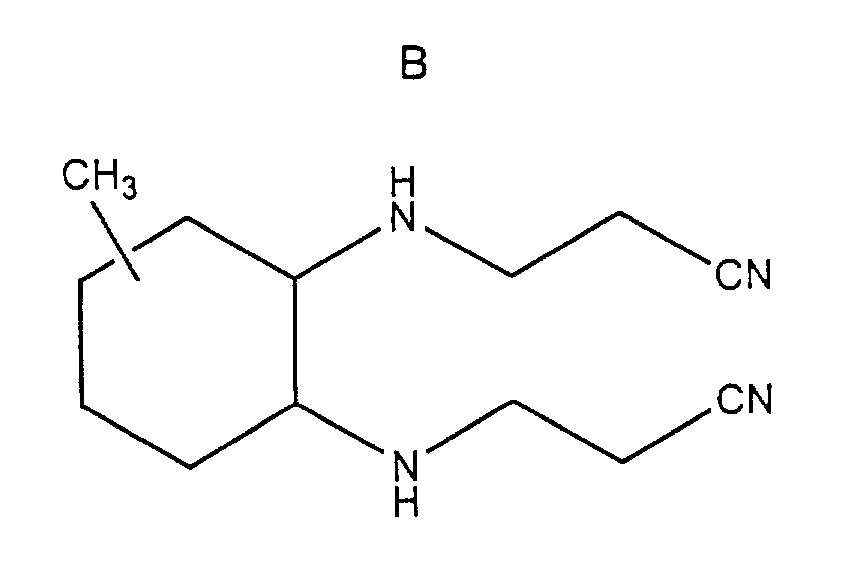
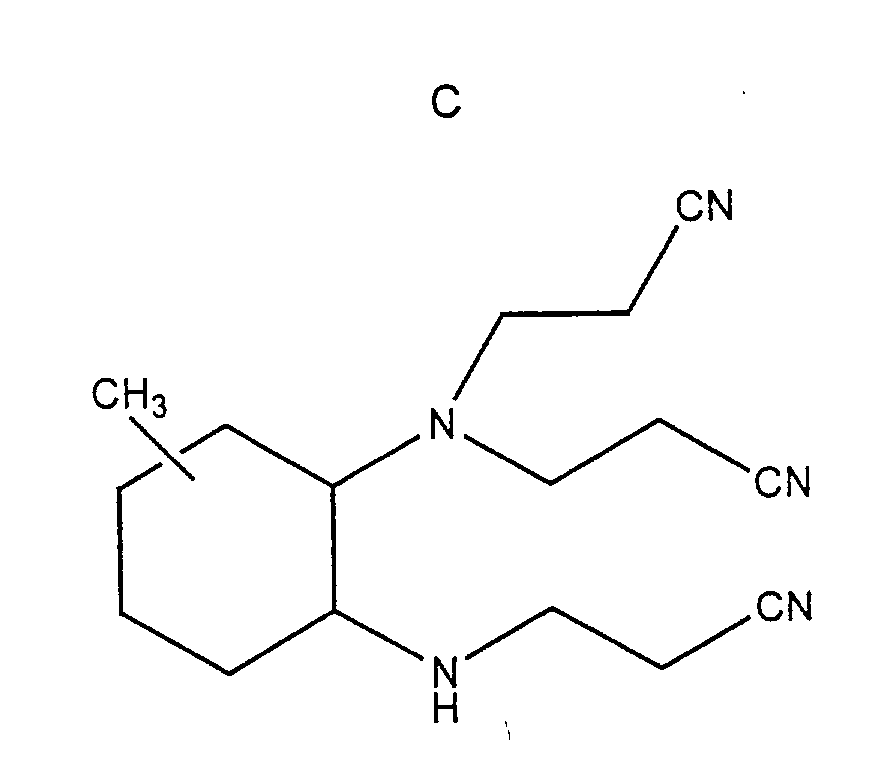
- the primary reaction products produced with water are designated A and B and set forth below. Analysis show that almost no compounds exhibiting secondary amine hydrogen reaction and represented by structures C and D are produced when water alone is used as the catalytic promoter.
- a catalytic amount it is meant that the amount of water is sufficient to noticeably increase the rate of reaction.
- molar concentrations of water per mole of cycloaliphatic diamine range from about 0.5 to 10:1 preferably from about 1 to 2:1. Excess quantities of water offer no significant advantages.
- cycloaliphatic vicinal diamines where there are from about 5 to 9 carbon atoms in the ring, preferably 5 or 6 are employed as the amine substrate.
- vicinal cycloaliphatic diamines commonly used in the cyanoethylation process are 1,2-diaminocyclohexane; 1-methyl-2,3-diaminocyclohexane and 1-methyl-3,4-diaminocyclohexane; t-butyl-diaminocyclohexane
- Other cycloaliphatic diamines which can be used in the cyanoethylation reaction include: ethyldiaminocyclohexane, isopropyl diamino cyclohexane 1,2-diaminodehydronapthalenes, or o-diaminoperhydrophenthrenes, 1,2-diaminododecahydrofluro
- the temperature for effecting the reaction between acrylonitrile and the cycloaliphatic vicinal amines generally ranges from about 25 to 150°C with preferred temperatures ranging from 60 to 80°C.
- Pressures for the reaction range from atmospheric to 60 psig. Atmospheric pressure for effecting the reaction is preferred.
- Example 1 The procedure of Example 1 was repeated essentially.
- 30.90 g (0.24 mole) of H 6 OTD (a mixture composed of 35% 2,3-diaminotoluene and 65% 3,4-diaminotoluene) was placed as received and the contents heated up to 70°C.
- 32 g of acrylonitrile (0.6 mole) were added dropwise so that the temperature did not exceed 77°C. The addition of acrylonitrile was completed in about 20 minutes. Samples were taken over a 24 hour period and the results are set forth in Table 1.
- This example shows the effect of adding a catalytically effective amount of water in that it initially enhanced the rate of reaction. Not only was the rate of reaction substantially greater than the rate of reaction in Example 2, as evidenced by the higher conversion, the selectivity to the dicyanoethylated product B was much higher than was obtained after a 24 hour reaction period.
Landscapes
- Chemical & Material Sciences (AREA)
- Organic Chemistry (AREA)
- Chemical Kinetics & Catalysis (AREA)
- Organic Low-Molecular-Weight Compounds And Preparation Thereof (AREA)
- Low-Molecular Organic Synthesis Reactions Using Catalysts (AREA)
Abstract
Description
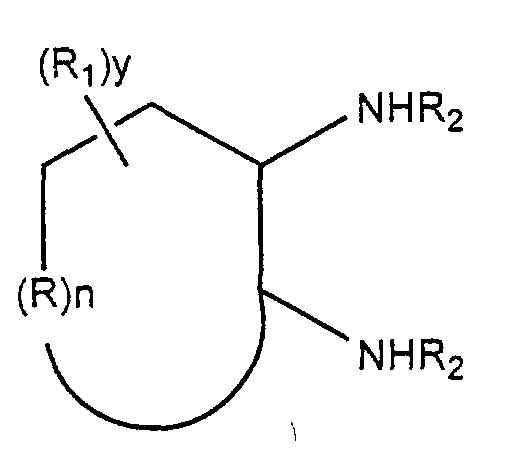
Vicinal diaminocyclohexanes and derivatives are preferred as the substrate.
- an ability to produce the N-(2-cyanoethyl) and N,N'-di-(2-cyanoethyl) vicinal cycloaliphatic diamines in high selectivity;
- an ability to effect the cyanoethylation in the presence of water alone without the inclusion of inorganic or organic promoters, such as, acetic components or water-soluble amines which contribute to recovery problems;
- an ability to effect the cyanoethylation in water which generates a water-insoluble product that is easily removed from the reaction medium; and,
- an ability to produce the N-(2-cyanoethyl) and N,N'-di-(2-cyanoethyl) vicinal cycloaliphatic diamines while obtaining excellent reaction rates.


| Time (hours) | Product A (% GC area) | Product B (% GC area) |
| 0.5 | 65.28 | 11.89 |
| 1.0 | 67.48 | 17.32 |
| 2.0 | 59.41 | 33.59 |
| 3.0 | 57.43 | 38.76 |
| 4.0 | 53.43 | 42.68 |
| 5.0 | 48.00 | 48.0 |
| 6.0 | 44.50 | 50.0 |
| 24 | 18.84 | 78.73 |
| The results show that the dicyanoethylation reaction (Product B) proceeds slowly with little dicyanoethylation taking place in the first 6 hours under anhydrous conditions. |
Claims (8)
- In a process for the cyanoethylation of vicinal cycloaliphatic aliphatic amines by contacting acrylonitrile with said vicinal cycloaliphatic amine under reaction conditions to produce a diaminocyclohexane, the improvement which comprises;effecting the reaction in the presence of a promoter consisting essentially of a catalytically effective amount of water.
- The process of Claim 1 wherein the vicinal cycloaliphatic amine is a diaminocyclohexane.
- The process of Claim 2 wherein the diaminocyclohexane or derivative thereof is selected from the group consisting of 1,2-diaminocyclohexane; 1-methyl-2,3-diaminocyclohexane, 1-methyl-3,4-diaminocyclohexane; and t-butyl-2,3- and 3,4-diaminocyclohexane.
- The process of Claim 3 wherein the mole ratio of water to diaminocyclohexane is from to 0.5 to 10 moles water per mole of amine.
- The process of Claim 4 wherein the mole ratio of acrylonitrile to vicinal cycloaliphatic diamine is from to 1 to 4:1.
- The process of Claim 5 wherein the temperature reaction is from 60 to 80°C.
- The process of Claim 6 wherein the pressure is from atmospheric to 60 psig.
- The process of Claim 5 wherein the vicinal amine is 1-methyl-2,3-diaminocyclohexane or 1-methyl-3,4-diaminocyclohexane
Applications Claiming Priority (2)
| Application Number | Priority Date | Filing Date | Title |
|---|---|---|---|
| US09/634,398 US6245932B1 (en) | 2000-08-09 | 2000-08-09 | Cyanoethylation of cycloaliphatic vicinal primary diamines |
| US634398 | 2000-08-09 |
Publications (2)
| Publication Number | Publication Date |
|---|---|
| EP1179526A2 true EP1179526A2 (en) | 2002-02-13 |
| EP1179526A3 EP1179526A3 (en) | 2003-07-30 |
Family
ID=24543609
Family Applications (1)
| Application Number | Title | Priority Date | Filing Date |
|---|---|---|---|
| EP01118766A Withdrawn EP1179526A3 (en) | 2000-08-09 | 2001-08-08 | Cyanoethylation of cycloaliphatic vicinal primary diamines |
Country Status (6)
| Country | Link |
|---|---|
| US (1) | US6245932B1 (en) |
| EP (1) | EP1179526A3 (en) |
| JP (1) | JP4142861B2 (en) |
| CN (1) | CN1172906C (en) |
| BR (1) | BR0106826A (en) |
| CA (1) | CA2354773C (en) |
Families Citing this family (10)
| Publication number | Priority date | Publication date | Assignee | Title |
|---|---|---|---|---|
| US6433212B1 (en) * | 2001-01-31 | 2002-08-13 | Air Products And Chemicals, Inc. | Synthesis of new polynitriles from cycloaliphatic vicinal primary diamines |
| JP5096338B2 (en) * | 2005-09-15 | 2012-12-12 | ビーエーエスエフ ソシエタス・ヨーロピア | Process for producing β-aminopropionic acid derivative |
| US20080194857A1 (en) | 2007-02-12 | 2008-08-14 | Air Products And Chemicals, Inc. | Selective Manufacture of N,N'-BIS(Cyanoethyl)-1,2-Ethylenediamine and N, N'-BIS(3-aminopropyl)-1,2-Ethylenediamine |
| CN107417888B (en) * | 2017-05-02 | 2019-11-26 | 武汉理工大学 | A kind of low temperature resistant epoxy resin and preparation method thereof |
| CN108383756B (en) * | 2018-02-07 | 2021-04-20 | 万华化学集团股份有限公司 | Preparation method of cyanoethylamines |
| CN110467535A (en) * | 2018-05-10 | 2019-11-19 | 岳阳昌德环境科技有限公司 | Modified cyclohexanediamine composition and preparation method thereof |
| CN113372241B (en) * | 2020-03-09 | 2023-01-13 | 万华化学集团股份有限公司 | Method for synthesizing dinitrile ethyl tertiary amine by aliphatic primary amine one-step method |
| CN112920614A (en) * | 2021-01-28 | 2021-06-08 | 金闻闻 | High-temperature-resistant waterproof epoxy asphalt and preparation method thereof |
| CN114853633B (en) * | 2022-03-28 | 2023-05-30 | 万华化学集团股份有限公司 | Preparation method of bis-aminopropyl alicyclic tertiary amine |
| CN114890913B (en) * | 2022-06-07 | 2023-05-26 | 万华化学集团股份有限公司 | Method for preparing dicyanoethyl cyclohexylamine |
Family Cites Families (6)
| Publication number | Priority date | Publication date | Assignee | Title |
|---|---|---|---|---|
| US2372895A (en) * | 1943-04-27 | 1945-04-03 | Monsanto Chemicals | Vulcanization of rubber |
| CH397712A (en) | 1961-08-04 | 1965-08-31 | Geigy Ag J R | Process for the cyanoethylation of primary and secondary aromatic amines |
| US3496213A (en) | 1967-07-11 | 1970-02-17 | Du Pont | Mono-cyanoethylation of aromatic amines with an aqueous zinc chloride catalyst |
| US4153567A (en) | 1977-11-10 | 1979-05-08 | Milliken Research Corporation | Additives for lubricants and fuels |
| US4321354A (en) | 1978-07-17 | 1982-03-23 | Milliken Research Corporation | Polyamine substituted cycloaliphatic compounds |
| US6433212B1 (en) * | 2001-01-31 | 2002-08-13 | Air Products And Chemicals, Inc. | Synthesis of new polynitriles from cycloaliphatic vicinal primary diamines |
-
2000
- 2000-08-09 US US09/634,398 patent/US6245932B1/en not_active Expired - Fee Related
-
2001
- 2001-08-02 CA CA002354773A patent/CA2354773C/en not_active Expired - Fee Related
- 2001-08-03 BR BR0106826-1A patent/BR0106826A/en not_active IP Right Cessation
- 2001-08-08 EP EP01118766A patent/EP1179526A3/en not_active Withdrawn
- 2001-08-08 JP JP2001240131A patent/JP4142861B2/en not_active Expired - Fee Related
- 2001-08-08 CN CNB011255285A patent/CN1172906C/en not_active Expired - Fee Related
Also Published As
| Publication number | Publication date |
|---|---|
| CN1172906C (en) | 2004-10-27 |
| CA2354773A1 (en) | 2002-03-08 |
| BR0106826A (en) | 2003-09-02 |
| US6245932B1 (en) | 2001-06-12 |
| CA2354773C (en) | 2005-05-10 |
| JP4142861B2 (en) | 2008-09-03 |
| EP1179526A3 (en) | 2003-07-30 |
| CN1337393A (en) | 2002-02-27 |
| JP2002053542A (en) | 2002-02-19 |
Similar Documents
| Publication | Publication Date | Title |
|---|---|---|
| JP5377335B2 (en) | Method for producing tetraethylenepentamine | |
| KR20090125263A (en) | Method for producing triethylenetetramine | |
| KR20100014696A (en) | Production method for ethyleneamine mixtures | |
| JPS5888346A (en) | Method for selectively hydrogenating dinitrile to omega-aminonitrile and rhodium-supported catalyst therefor | |
| KR102596991B1 (en) | Method for producing advanced ethylene amine | |
| US5554778A (en) | Ruthenium hydrogenation catalysts | |
| US6245932B1 (en) | Cyanoethylation of cycloaliphatic vicinal primary diamines | |
| KR20080075452A (en) | Selective Preparation of N, N'-bis (cyanoethyl) -1,2-ethylenediamine and N, N'-bis (3-aminopropyl) -1,2-ethylenediamine | |
| JPS6233211B2 (en) | ||
| US4362886A (en) | Preparation of linear polyalkylene polyamines using metal catalyst | |
| US5070202A (en) | Cyanobutylation of amines with 2-pentenitrile | |
| US6433212B1 (en) | Synthesis of new polynitriles from cycloaliphatic vicinal primary diamines | |
| US4642344A (en) | Polyamines | |
| CA1122617A (en) | Process for production of 1,17-diamino-9- azaheptadecane | |
| US4539403A (en) | Process for the preparation of a 2-alkyl-4-amino-5-aminomethylpyrimidine | |
| US5449780A (en) | Process for the preparation of 1,3- and 1,5-dialkylpiperidone-2 | |
| US5902883A (en) | Cyanobutylation of ammonia, alkylamines and hydrazine with 3-pentenenitrile, 4-pentenenitrile or mixtures thereof | |
| RU2158254C2 (en) | Method of preparing aliphatic alfa, omega-aminonitriles | |
| JPS59196843A (en) | Production of cyclohexylamine compound | |
| JPH06184063A (en) | Process for producing methylated tertiary amine by reaction of hexamethylenetetramine with amine or nitrile | |
| JP4561963B2 (en) | Highly selective production method of di (aminomethyl) -substituted aromatic compound | |
| JPH0428253B2 (en) | ||
| JPH1087573A (en) | Production method of primary diamine | |
| KR900001197B1 (en) | Method for preparing 2-alkyl-4-amino-5-aminomethylpyrimidine | |
| KR100352551B1 (en) | How to prepare tertiary amine |
Legal Events
| Date | Code | Title | Description |
|---|---|---|---|
| PUAI | Public reference made under article 153(3) epc to a published international application that has entered the european phase |
Free format text: ORIGINAL CODE: 0009012 |
|
| AK | Designated contracting states |
Kind code of ref document: A2 Designated state(s): AT BE CH CY DE DK ES FI FR GB GR IE IT LI LU MC NL PT SE TR |
|
| AX | Request for extension of the european patent |
Free format text: AL;LT;LV;MK;RO;SI |
|
| PUAL | Search report despatched |
Free format text: ORIGINAL CODE: 0009013 |
|
| AK | Designated contracting states |
Designated state(s): AT BE CH CY DE DK ES FI FR GB GR IE IT LI LU MC NL PT SE TR |
|
| AX | Request for extension of the european patent |
Extension state: AL LT LV MK RO SI |
|
| 17P | Request for examination filed |
Effective date: 20030822 |
|
| AKX | Designation fees paid |
Designated state(s): AT BE CH CY DE DK ES FI FR GB GR IE IT LI LU MC NL PT SE TR |
|
| 17Q | First examination report despatched |
Effective date: 20040326 |
|
| GRAP | Despatch of communication of intention to grant a patent |
Free format text: ORIGINAL CODE: EPIDOSNIGR1 |
|
| STAA | Information on the status of an ep patent application or granted ep patent |
Free format text: STATUS: THE APPLICATION IS DEEMED TO BE WITHDRAWN |
|
| 18D | Application deemed to be withdrawn |
Effective date: 20050302 |