EP1178979B1 - Novel reaction conditions for the cleavage of silyl ethers in the preparation of paclitaxel (taxol(r)) and paclitaxel analogues - Google Patents
Novel reaction conditions for the cleavage of silyl ethers in the preparation of paclitaxel (taxol(r)) and paclitaxel analogues Download PDFInfo
- Publication number
- EP1178979B1 EP1178979B1 EP00932151A EP00932151A EP1178979B1 EP 1178979 B1 EP1178979 B1 EP 1178979B1 EP 00932151 A EP00932151 A EP 00932151A EP 00932151 A EP00932151 A EP 00932151A EP 1178979 B1 EP1178979 B1 EP 1178979B1
- Authority
- EP
- European Patent Office
- Prior art keywords
- paclitaxel
- process according
- solvent
- acid
- water
- Prior art date
- Legal status (The legal status is an assumption and is not a legal conclusion. Google has not performed a legal analysis and makes no representation as to the accuracy of the status listed.)
- Expired - Lifetime
Links
- RCINICONZNJXQF-MZXODVADSA-N taxol Chemical compound O([C@@H]1[C@@]2(C[C@@H](C(C)=C(C2(C)C)[C@H](C([C@]2(C)[C@@H](O)C[C@H]3OC[C@]3([C@H]21)OC(C)=O)=O)OC(=O)C)OC(=O)[C@H](O)[C@@H](NC(=O)C=1C=CC=CC=1)C=1C=CC=CC=1)O)C(=O)C1=CC=CC=C1 RCINICONZNJXQF-MZXODVADSA-N 0.000 title claims abstract description 70
- 229930012538 Paclitaxel Natural products 0.000 title claims abstract description 57
- 229960001592 paclitaxel Drugs 0.000 title claims abstract description 57
- 238000002360 preparation method Methods 0.000 title claims description 10
- 238000006243 chemical reaction Methods 0.000 title abstract description 10
- KPUWHANPEXNPJT-UHFFFAOYSA-N disiloxane Chemical class [SiH3]O[SiH3] KPUWHANPEXNPJT-UHFFFAOYSA-N 0.000 title abstract description 5
- 238000003776 cleavage reaction Methods 0.000 title abstract description 4
- 230000007017 scission Effects 0.000 title abstract description 4
- QTBSBXVTEAMEQO-UHFFFAOYSA-N Acetic acid Chemical compound CC(O)=O QTBSBXVTEAMEQO-UHFFFAOYSA-N 0.000 claims abstract description 53
- 229940123237 Taxane Drugs 0.000 claims abstract description 35
- DKPFODGZWDEEBT-QFIAKTPHSA-N taxane Chemical class C([C@]1(C)CCC[C@@H](C)[C@H]1C1)C[C@H]2[C@H](C)CC[C@@H]1C2(C)C DKPFODGZWDEEBT-QFIAKTPHSA-N 0.000 claims abstract description 29
- 239000002904 solvent Substances 0.000 claims abstract description 24
- 239000013078 crystal Substances 0.000 claims abstract description 23
- 239000002243 precursor Substances 0.000 claims abstract description 20
- 238000002425 crystallisation Methods 0.000 claims abstract description 17
- DTQVDTLACAAQTR-UHFFFAOYSA-N Trifluoroacetic acid Chemical compound OC(=O)C(F)(F)F DTQVDTLACAAQTR-UHFFFAOYSA-N 0.000 claims abstract description 16
- 239000002253 acid Substances 0.000 claims abstract description 14
- 238000002955 isolation Methods 0.000 claims abstract description 4
- YMWUJEATGCHHMB-UHFFFAOYSA-N Dichloromethane Chemical compound ClCCl YMWUJEATGCHHMB-UHFFFAOYSA-N 0.000 claims description 45
- 238000000034 method Methods 0.000 claims description 38
- XLYOFNOQVPJJNP-UHFFFAOYSA-N water Substances O XLYOFNOQVPJJNP-UHFFFAOYSA-N 0.000 claims description 33
- KFZMGEQAYNKOFK-UHFFFAOYSA-N Isopropanol Chemical compound CC(C)O KFZMGEQAYNKOFK-UHFFFAOYSA-N 0.000 claims description 32
- 125000002496 methyl group Chemical group [H]C([H])([H])* 0.000 claims description 26
- 125000001997 phenyl group Chemical group [H]C1=C([H])C([H])=C(*)C([H])=C1[H] 0.000 claims description 20
- CSCPPACGZOOCGX-UHFFFAOYSA-N Acetone Chemical compound CC(C)=O CSCPPACGZOOCGX-UHFFFAOYSA-N 0.000 claims description 18
- LFQSCWFLJHTTHZ-UHFFFAOYSA-N Ethanol Chemical compound CCO LFQSCWFLJHTTHZ-UHFFFAOYSA-N 0.000 claims description 16
- 230000008025 crystallization Effects 0.000 claims description 16
- 125000000999 tert-butyl group Chemical group [H]C([H])([H])C(*)(C([H])([H])[H])C([H])([H])[H] 0.000 claims description 16
- 239000002002 slurry Substances 0.000 claims description 14
- 150000007524 organic acids Chemical class 0.000 claims description 13
- XEKOWRVHYACXOJ-UHFFFAOYSA-N Ethyl acetate Chemical compound CCOC(C)=O XEKOWRVHYACXOJ-UHFFFAOYSA-N 0.000 claims description 12
- 239000010410 layer Substances 0.000 claims description 12
- 239000011541 reaction mixture Substances 0.000 claims description 11
- 239000003960 organic solvent Substances 0.000 claims description 10
- ZWEHNKRNPOVVGH-UHFFFAOYSA-N 2-Butanone Chemical compound CCC(C)=O ZWEHNKRNPOVVGH-UHFFFAOYSA-N 0.000 claims description 9
- 239000012044 organic layer Substances 0.000 claims description 9
- -1 c-C6H11 Chemical group 0.000 claims description 8
- 238000010791 quenching Methods 0.000 claims description 8
- VMHLLURERBWHNL-UHFFFAOYSA-M Sodium acetate Chemical compound [Na+].CC([O-])=O VMHLLURERBWHNL-UHFFFAOYSA-M 0.000 claims description 7
- 150000001875 compounds Chemical class 0.000 claims description 7
- WEVYAHXRMPXWCK-UHFFFAOYSA-N Acetonitrile Chemical compound CC#N WEVYAHXRMPXWCK-UHFFFAOYSA-N 0.000 claims description 6
- OKKJLVBELUTLKV-UHFFFAOYSA-N Methanol Chemical compound OC OKKJLVBELUTLKV-UHFFFAOYSA-N 0.000 claims description 6
- UAOMVDZJSHZZME-UHFFFAOYSA-N diisopropylamine Chemical compound CC(C)NC(C)C UAOMVDZJSHZZME-UHFFFAOYSA-N 0.000 claims description 6
- 125000001495 ethyl group Chemical group [H]C([H])([H])C([H])([H])* 0.000 claims description 6
- 125000001449 isopropyl group Chemical group [H]C([H])([H])C([H])(*)C([H])([H])[H] 0.000 claims description 6
- BDAGIHXWWSANSR-UHFFFAOYSA-N methanoic acid Natural products OC=O BDAGIHXWWSANSR-UHFFFAOYSA-N 0.000 claims description 6
- 125000000956 methoxy group Chemical group [H]C([H])([H])O* 0.000 claims description 6
- 230000000171 quenching effect Effects 0.000 claims description 5
- 239000001632 sodium acetate Substances 0.000 claims description 5
- 235000017281 sodium acetate Nutrition 0.000 claims description 5
- 230000007704 transition Effects 0.000 claims description 5
- GJWHXWMUGWZNTO-UHFFFAOYSA-N 2,2-dimethylpropane Chemical compound [CH2]C(C)(C)C GJWHXWMUGWZNTO-UHFFFAOYSA-N 0.000 claims description 4
- 125000002941 2-furyl group Chemical group O1C([*])=C([H])C([H])=C1[H] 0.000 claims description 4
- WYURNTSHIVDZCO-UHFFFAOYSA-N Tetrahydrofuran Chemical compound C1CCOC1 WYURNTSHIVDZCO-UHFFFAOYSA-N 0.000 claims description 4
- 125000001995 cyclobutyl group Chemical group [H]C1([H])C([H])([H])C([H])(*)C1([H])[H] 0.000 claims description 4
- 125000002933 cyclohexyloxy group Chemical group C1(CCCCC1)O* 0.000 claims description 4
- 125000004123 n-propyl group Chemical group [H]C([H])([H])C([H])([H])C([H])([H])* 0.000 claims description 4
- OSWFIVFLDKOXQC-UHFFFAOYSA-N 4-(3-methoxyphenyl)aniline Chemical compound COC1=CC=CC(C=2C=CC(N)=CC=2)=C1 OSWFIVFLDKOXQC-UHFFFAOYSA-N 0.000 claims description 3
- NTIZESTWPVYFNL-UHFFFAOYSA-N Methyl isobutyl ketone Chemical compound CC(C)CC(C)=O NTIZESTWPVYFNL-UHFFFAOYSA-N 0.000 claims description 3
- UIHCLUNTQKBZGK-UHFFFAOYSA-N Methyl isobutyl ketone Natural products CCC(C)C(C)=O UIHCLUNTQKBZGK-UHFFFAOYSA-N 0.000 claims description 3
- 235000019253 formic acid Nutrition 0.000 claims description 3
- 238000003756 stirring Methods 0.000 claims description 3
- GSEJCLTVZPLZKY-UHFFFAOYSA-N Triethanolamine Chemical compound OCCN(CCO)CCO GSEJCLTVZPLZKY-UHFFFAOYSA-N 0.000 claims description 2
- 229940043279 diisopropylamine Drugs 0.000 claims description 2
- 229910052500 inorganic mineral Inorganic materials 0.000 claims description 2
- 239000011707 mineral Substances 0.000 claims description 2
- 229920005989 resin Polymers 0.000 claims description 2
- 239000011347 resin Substances 0.000 claims description 2
- YLQBMQCUIZJEEH-UHFFFAOYSA-N tetrahydrofuran Natural products C=1C=COC=1 YLQBMQCUIZJEEH-UHFFFAOYSA-N 0.000 claims description 2
- 239000000243 solution Substances 0.000 claims 3
- 239000003153 chemical reaction reagent Substances 0.000 claims 2
- 125000000218 acetic acid group Chemical group C(C)(=O)* 0.000 claims 1
- 239000011549 crystallization solution Substances 0.000 claims 1
- 238000000605 extraction Methods 0.000 claims 1
- 125000001181 organosilyl group Chemical group [SiH3]* 0.000 abstract description 5
- 239000012535 impurity Substances 0.000 abstract description 4
- 238000007086 side reaction Methods 0.000 abstract description 4
- 239000002246 antineoplastic agent Substances 0.000 abstract description 2
- 229960000583 acetic acid Drugs 0.000 description 14
- 235000011054 acetic acid Nutrition 0.000 description 11
- OVMSOCFBDVBLFW-VHLOTGQHSA-N 5beta,20-epoxy-1,7beta,13alpha-trihydroxy-9-oxotax-11-ene-2alpha,4alpha,10beta-triyl 4,10-diacetate 2-benzoate Chemical compound O([C@@H]1[C@@]2(C[C@H](O)C(C)=C(C2(C)C)[C@H](C([C@]2(C)[C@@H](O)C[C@H]3OC[C@]3([C@H]21)OC(C)=O)=O)OC(=O)C)O)C(=O)C1=CC=CC=C1 OVMSOCFBDVBLFW-VHLOTGQHSA-N 0.000 description 8
- IMNFDUFMRHMDMM-UHFFFAOYSA-N N-Heptane Chemical compound CCCCCCC IMNFDUFMRHMDMM-UHFFFAOYSA-N 0.000 description 6
- ZMANZCXQSJIPKH-UHFFFAOYSA-N Triethylamine Chemical compound CCN(CC)CC ZMANZCXQSJIPKH-UHFFFAOYSA-N 0.000 description 6
- YWLXLRUDGLRYDR-ZHPRIASZSA-N 5beta,20-epoxy-1,7beta,10beta,13alpha-tetrahydroxy-9-oxotax-11-ene-2alpha,4alpha-diyl 4-acetate 2-benzoate Chemical compound O([C@H]1[C@H]2[C@@](C([C@H](O)C3=C(C)[C@@H](O)C[C@]1(O)C3(C)C)=O)(C)[C@@H](O)C[C@H]1OC[C@]12OC(=O)C)C(=O)C1=CC=CC=C1 YWLXLRUDGLRYDR-ZHPRIASZSA-N 0.000 description 5
- 241001116498 Taxus baccata Species 0.000 description 5
- 241000202349 Taxus brevifolia Species 0.000 description 5
- 239000000047 product Substances 0.000 description 5
- 239000007858 starting material Substances 0.000 description 5
- RCINICONZNJXQF-XAZOAEDWSA-N taxol® Chemical compound O([C@@H]1[C@@]2(CC(C(C)=C(C2(C)C)[C@H](C([C@]2(C)[C@@H](O)C[C@H]3OC[C@]3(C21)OC(C)=O)=O)OC(=O)C)OC(=O)[C@H](O)[C@@H](NC(=O)C=1C=CC=CC=1)C=1C=CC=CC=1)O)C(=O)C1=CC=CC=C1 RCINICONZNJXQF-XAZOAEDWSA-N 0.000 description 5
- TYLVGQKNNUHXIP-MHHARFCSSA-N 10-deacetyltaxol Chemical compound O([C@H]1[C@H]2[C@@](C([C@H](O)C3=C(C)[C@@H](OC(=O)[C@H](O)[C@@H](NC(=O)C=4C=CC=CC=4)C=4C=CC=CC=4)C[C@]1(O)C3(C)C)=O)(C)[C@@H](O)C[C@H]1OC[C@]12OC(=O)C)C(=O)C1=CC=CC=C1 TYLVGQKNNUHXIP-MHHARFCSSA-N 0.000 description 4
- QAOWNCQODCNURD-UHFFFAOYSA-N Sulfuric acid Chemical compound OS(O)(=O)=O QAOWNCQODCNURD-UHFFFAOYSA-N 0.000 description 4
- 150000007513 acids Chemical class 0.000 description 4
- 229930014667 baccatin III Natural products 0.000 description 4
- 229940093915 gynecological organic acid Drugs 0.000 description 4
- 235000005985 organic acids Nutrition 0.000 description 4
- OKTJSMMVPCPJKN-UHFFFAOYSA-N Carbon Chemical compound [C] OKTJSMMVPCPJKN-UHFFFAOYSA-N 0.000 description 3
- 239000002585 base Substances 0.000 description 3
- 239000012455 biphasic mixture Substances 0.000 description 3
- 229910052799 carbon Inorganic materials 0.000 description 3
- 239000012362 glacial acetic acid Substances 0.000 description 3
- VLKZOEOYAKHREP-UHFFFAOYSA-N n-Hexane Chemical compound CCCCCC VLKZOEOYAKHREP-UHFFFAOYSA-N 0.000 description 3
- 0 CC1(C)C([C@@](*)C([C@](*)(C(C[C@]2OCC3)O)[C@]4[C@@]23OC(*)=O)=O)=C(C)C(*)C*C1[C@]4OC(*)=O Chemical compound CC1(C)C([C@@](*)C([C@](*)(C(C[C@]2OCC3)O)[C@]4[C@@]23OC(*)=O)=O)=C(C)C(*)C*C1[C@]4OC(*)=O 0.000 description 2
- VEXZGXHMUGYJMC-UHFFFAOYSA-N Hydrochloric acid Chemical compound Cl VEXZGXHMUGYJMC-UHFFFAOYSA-N 0.000 description 2
- CSNNHWWHGAXBCP-UHFFFAOYSA-L Magnesium sulfate Chemical compound [Mg+2].[O-][S+2]([O-])([O-])[O-] CSNNHWWHGAXBCP-UHFFFAOYSA-L 0.000 description 2
- AFVFQIVMOAPDHO-UHFFFAOYSA-N Methanesulfonic acid Chemical compound CS(O)(=O)=O AFVFQIVMOAPDHO-UHFFFAOYSA-N 0.000 description 2
- 206010028980 Neoplasm Diseases 0.000 description 2
- NBIIXXVUZAFLBC-UHFFFAOYSA-N Phosphoric acid Chemical compound OP(O)(O)=O NBIIXXVUZAFLBC-UHFFFAOYSA-N 0.000 description 2
- 229910052783 alkali metal Inorganic materials 0.000 description 2
- 150000001340 alkali metals Chemical class 0.000 description 2
- 239000003125 aqueous solvent Substances 0.000 description 2
- DKPFZGUDAPQIHT-UHFFFAOYSA-N butyl acetate Chemical compound CCCCOC(C)=O DKPFZGUDAPQIHT-UHFFFAOYSA-N 0.000 description 2
- 201000011510 cancer Diseases 0.000 description 2
- XBDQKXXYIPTUBI-UHFFFAOYSA-N dimethylselenoniopropionate Natural products CCC(O)=O XBDQKXXYIPTUBI-UHFFFAOYSA-N 0.000 description 2
- 229930004069 diterpene Natural products 0.000 description 2
- 229940079593 drug Drugs 0.000 description 2
- 239000003814 drug Substances 0.000 description 2
- 238000004128 high performance liquid chromatography Methods 0.000 description 2
- 229930195733 hydrocarbon Natural products 0.000 description 2
- 150000002430 hydrocarbons Chemical class 0.000 description 2
- 150000002576 ketones Chemical class 0.000 description 2
- SCVFZCLFOSHCOH-UHFFFAOYSA-M potassium acetate Chemical compound [K+].CC([O-])=O SCVFZCLFOSHCOH-UHFFFAOYSA-M 0.000 description 2
- 239000008213 purified water Substances 0.000 description 2
- JOXIMZWYDAKGHI-UHFFFAOYSA-N toluene-4-sulfonic acid Chemical compound CC1=CC=C(S(O)(=O)=O)C=C1 JOXIMZWYDAKGHI-UHFFFAOYSA-N 0.000 description 2
- 125000004178 (C1-C4) alkyl group Chemical group 0.000 description 1
- YZUPZGFPHUVJKC-UHFFFAOYSA-N 1-bromo-2-methoxyethane Chemical compound COCCBr YZUPZGFPHUVJKC-UHFFFAOYSA-N 0.000 description 1
- ADDGUHVEJPNWQZ-FIKJQGJASA-N 10-Deacetylcephalomannine Natural products O=C(O[C@@H]1C(C)=C2[C@@H](O)C(=O)[C@]3(C)[C@@H](O)C[C@@H]4[C@](OC(=O)C)([C@H]3[C@H](OC(=O)c3ccccc3)[C@@](O)(C2(C)C)C1)CO4)[C@H](O)[C@@H](NC(=O)/C(=C\C)/C)c1ccccc1 ADDGUHVEJPNWQZ-FIKJQGJASA-N 0.000 description 1
- 229930182986 10-Deacetyltaxol Natural products 0.000 description 1
- ADDGUHVEJPNWQZ-GJKIWTKTSA-N 10-deacetyltaxol b Chemical compound O([C@@H]1[C@]2(O)C[C@@H](C(=C([C@@H](O)C(=O)[C@]3(C)[C@@H](O)C[C@H]4OC[C@]4([C@H]31)OC(C)=O)C2(C)C)C)OC(=O)[C@H](O)[C@@H](NC(=O)C(/C)=C/C)C=1C=CC=CC=1)C(=O)C1=CC=CC=C1 ADDGUHVEJPNWQZ-GJKIWTKTSA-N 0.000 description 1
- XMIIGOLPHOKFCH-UHFFFAOYSA-N 3-phenylpropionic acid Chemical compound OC(=O)CCC1=CC=CC=C1 XMIIGOLPHOKFCH-UHFFFAOYSA-N 0.000 description 1
- 208000030507 AIDS Diseases 0.000 description 1
- 206010006187 Breast cancer Diseases 0.000 description 1
- 208000026310 Breast neoplasm Diseases 0.000 description 1
- 239000004215 Carbon black (E152) Substances 0.000 description 1
- DBXFAPJCZABTDR-KUEXGRMWSA-N Cephalomannine Natural products O=C(O[C@@H]1C(C)=C2[C@@H](OC(=O)C)C(=O)[C@]3(C)[C@@H](O)C[C@@H]4[C@](OC(=O)C)([C@H]3[C@H](OC(=O)c3ccccc3)[C@@](O)(C2(C)C)C1)CO4)[C@@H](O)[C@H](NC(=O)/C(=C\C)/C)c1ccccc1 DBXFAPJCZABTDR-KUEXGRMWSA-N 0.000 description 1
- XDTMQSROBMDMFD-UHFFFAOYSA-N Cyclohexane Chemical compound C1CCCCC1 XDTMQSROBMDMFD-UHFFFAOYSA-N 0.000 description 1
- 241000196324 Embryophyta Species 0.000 description 1
- 208000007766 Kaposi sarcoma Diseases 0.000 description 1
- 229920000557 Nafion® Polymers 0.000 description 1
- GRYLNZFGIOXLOG-UHFFFAOYSA-N Nitric acid Chemical compound O[N+]([O-])=O GRYLNZFGIOXLOG-UHFFFAOYSA-N 0.000 description 1
- 206010033128 Ovarian cancer Diseases 0.000 description 1
- 206010061535 Ovarian neoplasm Diseases 0.000 description 1
- 241001116500 Taxus Species 0.000 description 1
- 235000009065 Taxus cuspidata Nutrition 0.000 description 1
- 102000004243 Tubulin Human genes 0.000 description 1
- 108090000704 Tubulin Proteins 0.000 description 1
- 230000002159 abnormal effect Effects 0.000 description 1
- 229910000147 aluminium phosphate Inorganic materials 0.000 description 1
- 150000001412 amines Chemical class 0.000 description 1
- 238000010171 animal model Methods 0.000 description 1
- 229940044684 anti-microtubule agent Drugs 0.000 description 1
- 239000012296 anti-solvent Substances 0.000 description 1
- 230000000259 anti-tumor effect Effects 0.000 description 1
- 239000011260 aqueous acid Substances 0.000 description 1
- 230000015556 catabolic process Effects 0.000 description 1
- 230000022131 cell cycle Effects 0.000 description 1
- DBXFAPJCZABTDR-WBYYIXQISA-N cephalomannine Chemical compound O([C@@H]1[C@]2(O)C[C@@H](C(=C([C@@H](OC(C)=O)C(=O)[C@]3(C)[C@@H](O)C[C@H]4OC[C@]4([C@H]31)OC(C)=O)C2(C)C)C)OC(=O)[C@H](O)[C@@H](NC(=O)C(/C)=C/C)C=1C=CC=CC=1)C(=O)C1=CC=CC=C1 DBXFAPJCZABTDR-WBYYIXQISA-N 0.000 description 1
- OUZGCGZMZBOCBH-MNLIZOKASA-N chembl311365 Chemical compound O([C@@H]1[C@]2(O)C[C@@H](C(=C([C@@H](O)C(=O)[C@]3(C)[C@@H](O)C[C@H]4OC[C@]4([C@H]31)OC(C)=O)C2(C)C)C)OC(=O)[C@H](O)[C@@H](NC(=O)CCCCC)C=1C=CC=CC=1)C(=O)C1=CC=CC=C1 OUZGCGZMZBOCBH-MNLIZOKASA-N 0.000 description 1
- 239000013058 crude material Substances 0.000 description 1
- 239000012043 crude product Substances 0.000 description 1
- 125000000753 cycloalkyl group Chemical group 0.000 description 1
- 238000006731 degradation reaction Methods 0.000 description 1
- 238000010511 deprotection reaction Methods 0.000 description 1
- 125000005265 dialkylamine group Chemical group 0.000 description 1
- 230000007613 environmental effect Effects 0.000 description 1
- 238000006345 epimerization reaction Methods 0.000 description 1
- 150000002148 esters Chemical class 0.000 description 1
- 238000001914 filtration Methods 0.000 description 1
- 150000008282 halocarbons Chemical class 0.000 description 1
- 238000003306 harvesting Methods 0.000 description 1
- 238000001727 in vivo Methods 0.000 description 1
- 229910052943 magnesium sulfate Inorganic materials 0.000 description 1
- 235000019341 magnesium sulphate Nutrition 0.000 description 1
- 229940098779 methanesulfonic acid Drugs 0.000 description 1
- 235000010755 mineral Nutrition 0.000 description 1
- 230000011278 mitosis Effects 0.000 description 1
- 239000000203 mixture Substances 0.000 description 1
- 229930014626 natural product Natural products 0.000 description 1
- 229910017604 nitric acid Inorganic materials 0.000 description 1
- 208000002154 non-small cell lung carcinoma Diseases 0.000 description 1
- 125000003566 oxetanyl group Chemical group 0.000 description 1
- 230000003285 pharmacodynamic effect Effects 0.000 description 1
- 238000006116 polymerization reaction Methods 0.000 description 1
- 235000011056 potassium acetate Nutrition 0.000 description 1
- 235000019260 propionic acid Nutrition 0.000 description 1
- 125000006239 protecting group Chemical group 0.000 description 1
- IUVKMZGDUIUOCP-BTNSXGMBSA-N quinbolone Chemical compound O([C@H]1CC[C@H]2[C@H]3[C@@H]([C@]4(C=CC(=O)C=C4CC3)C)CC[C@@]21C)C1=CCCC1 IUVKMZGDUIUOCP-BTNSXGMBSA-N 0.000 description 1
- 238000007157 ring contraction reaction Methods 0.000 description 1
- 241000894007 species Species 0.000 description 1
- 239000000126 substance Substances 0.000 description 1
- 230000002194 synthesizing effect Effects 0.000 description 1
- BEHTXUBGUDGCNQ-IEAAAIHOSA-N taxol c Chemical compound O([C@@H]1[C@]2(O)C[C@@H](C(=C([C@@H](OC(C)=O)C(=O)[C@]3(C)[C@@H](O)C[C@H]4OC[C@]4([C@H]31)OC(C)=O)C2(C)C)C)OC(=O)[C@H](O)[C@@H](NC(=O)CCCCC)C=1C=CC=CC=1)C(=O)C1=CC=CC=C1 BEHTXUBGUDGCNQ-IEAAAIHOSA-N 0.000 description 1
- 230000001225 therapeutic effect Effects 0.000 description 1
- YNJBWRMUSHSURL-UHFFFAOYSA-N trichloroacetic acid Chemical compound OC(=O)C(Cl)(Cl)Cl YNJBWRMUSHSURL-UHFFFAOYSA-N 0.000 description 1
- 208000029729 tumor suppressor gene on chromosome 11 Diseases 0.000 description 1
Classifications
-
- C—CHEMISTRY; METALLURGY
- C07—ORGANIC CHEMISTRY
- C07D—HETEROCYCLIC COMPOUNDS
- C07D305/00—Heterocyclic compounds containing four-membered rings having one oxygen atom as the only ring hetero atoms
- C07D305/14—Heterocyclic compounds containing four-membered rings having one oxygen atom as the only ring hetero atoms condensed with carbocyclic rings or ring systems
-
- A—HUMAN NECESSITIES
- A61—MEDICAL OR VETERINARY SCIENCE; HYGIENE
- A61K—PREPARATIONS FOR MEDICAL, DENTAL OR TOILETRY PURPOSES
- A61K31/00—Medicinal preparations containing organic active ingredients
- A61K31/33—Heterocyclic compounds
- A61K31/335—Heterocyclic compounds having oxygen as the only ring hetero atom, e.g. fungichromin
- A61K31/337—Heterocyclic compounds having oxygen as the only ring hetero atom, e.g. fungichromin having four-membered rings, e.g. taxol
-
- A—HUMAN NECESSITIES
- A61—MEDICAL OR VETERINARY SCIENCE; HYGIENE
- A61P—SPECIFIC THERAPEUTIC ACTIVITY OF CHEMICAL COMPOUNDS OR MEDICINAL PREPARATIONS
- A61P35/00—Antineoplastic agents
-
- C—CHEMISTRY; METALLURGY
- C07—ORGANIC CHEMISTRY
- C07D—HETEROCYCLIC COMPOUNDS
- C07D263/00—Heterocyclic compounds containing 1,3-oxazole or hydrogenated 1,3-oxazole rings
- C07D263/02—Heterocyclic compounds containing 1,3-oxazole or hydrogenated 1,3-oxazole rings not condensed with other rings
- C07D263/08—Heterocyclic compounds containing 1,3-oxazole or hydrogenated 1,3-oxazole rings not condensed with other rings having one double bond between ring members or between a ring member and a non-ring member
- C07D263/16—Heterocyclic compounds containing 1,3-oxazole or hydrogenated 1,3-oxazole rings not condensed with other rings having one double bond between ring members or between a ring member and a non-ring member with hetero atoms or with carbon atoms having three bonds to hetero atoms with at the most one bond to halogen, e.g. ester or nitrile radicals, directly attached to ring carbon atoms
-
- C—CHEMISTRY; METALLURGY
- C07—ORGANIC CHEMISTRY
- C07D—HETEROCYCLIC COMPOUNDS
- C07D413/00—Heterocyclic compounds containing two or more hetero rings, at least one ring having nitrogen and oxygen atoms as the only ring hetero atoms
- C07D413/02—Heterocyclic compounds containing two or more hetero rings, at least one ring having nitrogen and oxygen atoms as the only ring hetero atoms containing two hetero rings
- C07D413/12—Heterocyclic compounds containing two or more hetero rings, at least one ring having nitrogen and oxygen atoms as the only ring hetero atoms containing two hetero rings linked by a chain containing hetero atoms as chain links
Definitions
- the present invention is directed to reaction conditions for the cleavage of silyl ethers from silyl protected taxane precursors to afford paclitaxel (Taxol®) and paclitaxel analogues. More specifically, the invention is directed to a process for the preparation of paclitaxel from a taxane precursor which comprises the steps of treating the taxane precursor with a strong acid such as trifluoroacetic acid, in a weak aqueous acid, such as aqueous acetic acid, such that the amount and number of side reactions leading to undesirable taxane impurities are minimized, and isolating the product from a solvent that affords paclitaxel in either of the two crystal forms, Form A or Form B.
- a strong acid such as trifluoroacetic acid
- Taxanes are diterpene compounds that find utility in the pharmaceutical field.
- taxanes containing aryl heterocyclic or cycloalkyl groups on the C-13 sidechain find utility as anti-cancer agents.
- Taxanes include pacltitaxel, cephalomannine, taxol c, 10-deacetylpaclitaxel, 10-deacetylcephalomannine, 7- ⁇ -xylosylpaclitaxel, baccatin-III, 10-deacetylbaccatin III, 7- ⁇ -xylosyl-10-deacetyl cephalomannine, 7- ⁇ -xylosyl-10-deacetylbaccatin III, 7- ⁇ -xylosylbaccatin III, and 10-deacetyl-taxol c.
- Paclitaxel (Taxol®), a diterpene taxane compound, is a natural product extracted from the bark of the Pacific yew tree, Taxus Brevifolia . It has been shown to have excellent antitumor activity in in vivo animal models, and recent studies have elucidated its unique mode of action, which involves abnormal polymerization of tubulin and disruption of mitosis during the cell cycle. Taxol® has recently been approved for the treatment of refractory advanced ovarian cancer, breast cancer, non-small cell lung cancer, and most recently, AIDS-related Kaposi's Sarcoma.
- Taxol® The structure of Taxol® is shown below along with the conventional numbering system for molecules belonging to the Taxane class; such numbering system is also employed in this application:
- C-number which signifies the carbon on the taxane according to the above numbering system.
- C-13 refers to the carbon at position 13 on the taxane ring as shown above, having a sidechain coupled thereto.
- Taxus brevifolia is a relatively common tree in the Pacific Northwest, it is a slow growing plant and is indigenous to the ecologically threatened old-growth forests of this area, and harvesting is thus increasingly restricted because of environmental concerns.
- paclitaxel extracted from T. brevifolia are generally low, of the order of 100mg/kg, semisynthetic methods of producing paclitaxel from baccatin III and 10-deacetylbaccatin have been developed.
- Baccatin III, 10-deacetylbaccatin, as well as other paclitaxel precursors may be isolated from the needles of the European yew, Taxus baccata in relatively larger quantities, e.g. approximately 300mg/kg of 10-deacetylbaccatin may be obtained from yew leaves.
- paclitaxel may be prepared from numerous paclitaxel precursors, some having protecting groups thereon, particularly at the C-7 postion on the taxane ring and at the 2' position on the sidechain which is connected at position C-13. Paclitaxel may be easily prepared by the deprotection of these paclitaxel precursors.
- this compound exhibits polymorphism. Crystal Form A is predominantly obtained from non-aqueous solvent systems and crystal Form B is predominantly obtained from aqueous solvent systems. Paclitaxel Form A is the preferred crystal form and has been filed with the U.S. Food and Drug Administration.
- the present invention relates to novel reaction conditions for the cleavage of silyl ethers from silyl protected taxane precursors that afford high quality paclitaxel and paclitaxel analogues. Also included are crystallization protocols that can afford either of the two paclitaxel crystal forms, Form A or Form B.
- the present invention provides a process for the preparation of high quality paclitaxel and paclitaxel analogues from taxanes of formula I: wherein:
- paclitaxel and paclitaxel analogues may be prepared from silyl protected taxane precursors of formula I by a process which comprises the steps of:
- Weak organic acids suitable for use in the present invention include, but are not limited to, C 1 -C 6 alkanoic acids such as formic acid, acetic acid, propionic acid and the like.
- Acetic acid and formic acid are the preferred weak organic acids with acetic acid being more preferred.
- Strong acids suitable for use in the process of this invention include, but are not limited to, mineral acids such as hydrochloric acid, sulfuric acid, nitric acid, phosphoric acid and the like; strong organic acids such as trifluoroacetic acid, trichloroacetic acid, methanesulfonic acid, p-toluenesulfonic acid and the like; and strong acid resins such as Amberlyst -15, Nafion and the like.
- Preferred strong acids include strong organic acids with trifluoroacetic acid being more preferred.
- step (d) of the present invention the reaction mixture is preferably stirred at ambient temperature until the taxane precursor is consumed.
- the volume ratio of the weak organic acid to the water in the reaction mixture is no more than about 3:1.
- the reaction mixture is preferably quenched with a base.
- Bases suitable for use in this invention include, but are not limited to, alkali metal C 1 -C 6 carboxylates such as sodium acetate, potassium acetate and the like; tri(C 1 -C 4 alcohol)amines such as triethanolamine and the like; and dialkylamines such as diisopropylamine and the like.
- Preferred bases include alkali metal C 1 -C 6 carboxylates with sodium acetate being more preferred.
- the organic solvent used in step (f) of the process of this invention is a water-immiscible organic solvent.
- Water-immiscible organic solvents suitable for use in this invention include, but are not limited to, halogenated hydrocarbons such as dichloromethane and the like; C 1 -C 4 alkyl C 1 -C 6 carboxylates such as ethyl acetate and the like; and ketones such as methyl ethyl ketone, methyl isobutyl ketone and the like; and mixtures thereof.
- Preferred water-immiscible organic solvents include halogentated hydrocarbons with dichloromethane being more preferred.
- Isolation procedures useful in step (h) of this invention include well known conventional procedures including, but not limited to, removal of the organic solvent or addition of an anti-solvent.
- taxane precursors of formula I are converted to paclitaxel and paclitaxel analogues of formula II wherein:
- crystal Form A is isolated by solvent exchanging the organic layer from step (h) into an alcohol, such as ethanol, isopropanol or the like, or into a ketone, such as acetone, methyl ethyl ketone, methyl isobutyl ketone or the like, or into an ester, such as ethyl acetate, n-butyl acetate or the like followed by the addition of a hydrocarbon solvent, such as hexane, heptane, cyclohexane or the like, preferably isopropanol followed by heptane.
- an alcohol such as ethanol, isopropanol or the like
- a ketone such as acetone, methyl ethyl ketone, methyl isobutyl ketone or the like
- an ester such as ethyl acetate, n-butyl acetate or the like followed by the addition of a hydrocarbon solvent, such as he
- the crystal Form B is isolated by solvent exchanging the organic layer from step (h) into a water-miscible solvent, such as acetic acid, acetone, methanol, ethanol, isopropanol, tetrahydrofuran, acetonitrile or the like followed by the addition of water, preferably acetone or acetic acid followed by the addition of water.
- a water-miscible solvent such as acetic acid, acetone, methanol, ethanol, isopropanol, tetrahydrofuran, acetonitrile or the like followed by the addition of water, preferably acetone or acetic acid followed by the addition of water.
- the crystal slurry undergoes a phase change. Initially, the crystal slurry remains very thin for several hours, then it undergoes a phase change and it thickens. After 1-2 hours, the slurry thins out again.
- the yield of the product is low if the slurry is filtered during the early stages of thin phase and the crystal slurry is difficult to filter during the thick phase stage. Therefore, the crystal slurry is filtered only after it has undergone the complete phase transition.
- Addition of small amounts of water i.e., up to about 3% (w/v) has been found to accelerate the phase transition from the initial thin phase to the final thin phase. The addition of water also helps in improving the filtration characteristics of the crystal slurry and the overall yield of the product.
- Taxane starting material V (15 g, 15.8 mmol) was dissolved in glacial acetic acid (129 mL). To this, a solution of trifluoroacetic acid (7.7 mL, 100 mmol) in giacial acetic acid (32 mL) and water (41 mL) was added at ambient temperature. After completion of reaction (5 to 7 hours), a solution of NaOAc (9 g, 109.7 mmol) in water (32 mL) was added to quench the reaction. Dichloromethane (146 mL) and water (100 mL) were added and the biphasic mixture was agitated for at least 15 minutes.
- the layers were separated and the rich dichloromethane layer was washed several times with water (75 mL each) to remove residual acetic acid and triethylamine.
- the rich dichloromethane layer was solvent exchanged into isopropanol (ca. 300 mL) at no more than 40°C.
- the rich isopropanol solution was concentrated to ca. 227 mL at 25 to 40 °C.
- the solution was heated to 48 to 52 °C to dissolve any precipitated paclitaxel.
- the water content of the isopropanol solution was adjusted to ca. 3% (w/v) with purified water and then slowly cooled to room temperature to initiate crystallization.
- the slurry was further cooled to 0 to 5 °C to complete the crystallization.
- the crystal slurry was filtered, washed with cold isopropanol and dried in vacuo at less than 50 °C to afford 11.7 g (86.9 M%, HPLC area % 98.5) of paclitaxel.
- Taxane starting material VII (40 g, 37.3 mmol) was dissolved in glacial acetic acid (355 mL) and to this, a solution of trifluoroacetic acid (23.4 g, 205.1 mmol) in water (120 mL) and glacial acetic acid (89 mL) was added at ambient temperature. After reaction completion (5 to 7 hours), a solution of NaOAc.3H 2 O (35.5 g, 228.3 mmol) in water (66 mL) was added to quench the reaction. Dichloromethane (400 mL) and additional water (266 mL) were added and the biphasic mixture was agitated for at least 15 minutes.
- the layers were separated and the spent aqueous layer was extracted with dichloromethane (268 mL).
- the rich dichloromethane layers were combined and washed three times with water (475 mL each).
- the rich dichloromethane layer was solvent exchanged into isopropanol (ca. 800 mL) at no more than 40°C.
- the rich isopropanol solution was concentrated to ca. 621 mL at 25 to 40°C.
- the solution was heated to 48 to 52 °C to dissolved any precipitated paclitaxel.
- the water content of the isopropanol solution was adjusted to ca. 3% (w/v) by adding purified water and then slowly cooled to room temperature to initiate crystallization.
- the slurry was further cooled to 0° to 5 °C to complete the crystallization.
- the crystal slurry was filtered, washed with cold isopropanol and dried in vacuo at less than 50 °C to afford 25.8g (81M%, HPLC area % 98.8) of paclitaxel.
Landscapes
- Chemical & Material Sciences (AREA)
- Organic Chemistry (AREA)
- Health & Medical Sciences (AREA)
- Life Sciences & Earth Sciences (AREA)
- Medicinal Chemistry (AREA)
- Pharmacology & Pharmacy (AREA)
- Animal Behavior & Ethology (AREA)
- General Health & Medical Sciences (AREA)
- Public Health (AREA)
- Veterinary Medicine (AREA)
- Nuclear Medicine, Radiotherapy & Molecular Imaging (AREA)
- General Chemical & Material Sciences (AREA)
- Chemical Kinetics & Catalysis (AREA)
- Epidemiology (AREA)
- Epoxy Compounds (AREA)
- Pharmaceuticals Containing Other Organic And Inorganic Compounds (AREA)
Abstract
Description
- The present invention is directed to reaction conditions for the cleavage of silyl ethers from silyl protected taxane precursors to afford paclitaxel (Taxol®) and paclitaxel analogues. More specifically, the invention is directed to a process for the preparation of paclitaxel from a taxane precursor which comprises the steps of treating the taxane precursor with a strong acid such as trifluoroacetic acid, in a weak aqueous acid, such as aqueous acetic acid, such that the amount and number of side reactions leading to undesirable taxane impurities are minimized, and isolating the product from a solvent that affords paclitaxel in either of the two crystal forms, Form A or Form B.
- Taxanes are diterpene compounds that find utility in the pharmaceutical field. For example, taxanes containing aryl heterocyclic or cycloalkyl groups on the C-13 sidechain find utility as anti-cancer agents. Taxanes include pacltitaxel, cephalomannine, taxol c, 10-deacetylpaclitaxel, 10-deacetylcephalomannine, 7-β-xylosylpaclitaxel, baccatin-III, 10-deacetylbaccatin III, 7-β-xylosyl-10-deacetyl cephalomannine, 7-β-xylosyl-10-deacetylbaccatin III, 7-β-xylosylbaccatin III, and 10-deacetyl-taxol c.
- Paclitaxel (Taxol®), a diterpene taxane compound, is a natural product extracted from the bark of the Pacific yew tree, Taxus Brevifolia. It has been shown to have excellent antitumor activity in in vivo animal models, and recent studies have elucidated its unique mode of action, which involves abnormal polymerization of tubulin and disruption of mitosis during the cell cycle. Taxol® has recently been approved for the treatment of refractory advanced ovarian cancer, breast cancer, non-small cell lung cancer, and most recently, AIDS-related Kaposi's Sarcoma. The results of paclitaxel clinical studies are replete in scientific periodicals and have been reviewed by numerous authors, such as Rowinsky and Donehower in "The Clinical Pharmacology and Use of Antimicrotubule Agents in Cancer Chemotherapeutics", Phamac. Ther., 52, pp. 35-84 (1991); Spencer and Faulds, Paclitaxel, A Review of its Pharmacodynamic and Pharmacokinetic Properties and Therapeutic Potential in the Treatment of Cancer, Drugs, 48 (5), pp. 794-847 (1994); K.C. Nicolau et al., Chemistry and Biology of Taxol, Angew. Chem., Int. Ed. Eng., 33, pp. 15-44 (1994); F. A. Holmes, A. P. Kudelka, J. J. Kavanaugh, M. H. Huber, J. A. Ajani, and V. Valero, "Taxane Anticancer Agents - Basic Science and Current Status", edited by Gunda I. Georg, Thomas C. Chen, Iwao Ojima, and Dolotrai M. Vyas, pp. 31-57 American Chemical Society, Wash., D.C. (1995); Susan G. Arbuck and Barbara Blaylock, "Taxol® Science and Applications", edited by Matthew Suffness, pp. 379-416, CRC Press, Boca Raton, FL (1995) and the references cited therein.
- The structure of Taxol® is shown below along with the conventional numbering system for molecules belonging to the Taxane class; such numbering system is also employed in this application:
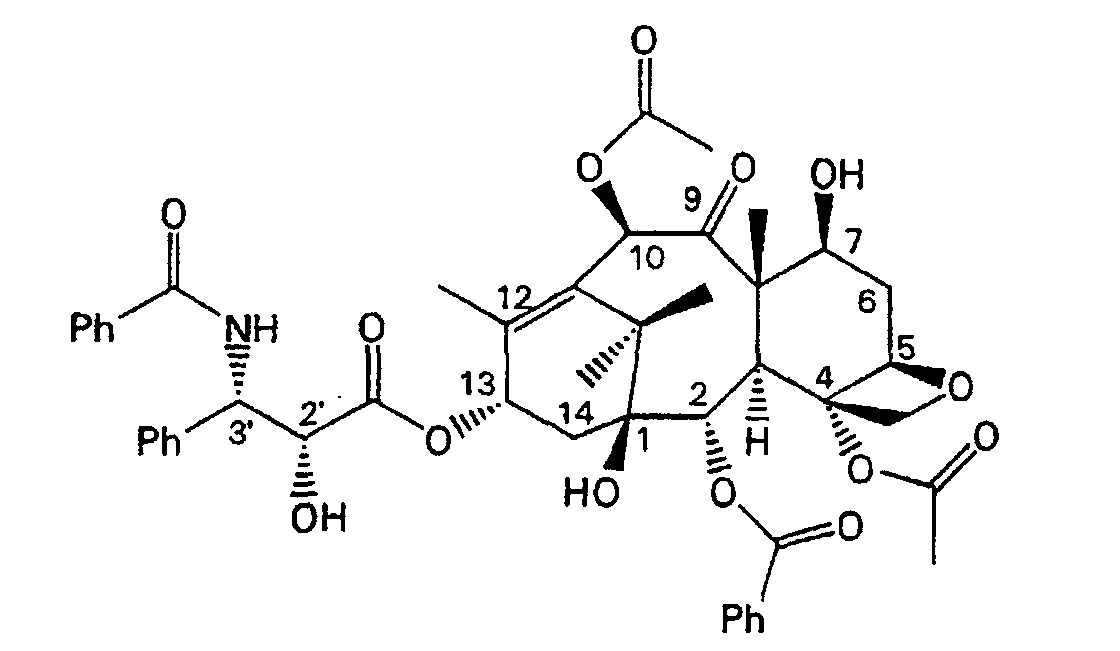
- With reference to the numbering of the taxane, reference to a particular carbon on the taxane structure shall be indicated throughout this application by a "C-number", which signifies the carbon on the taxane according to the above numbering system. For example, "C-13" refers to the carbon at position 13 on the taxane ring as shown above, having a sidechain coupled thereto.
- Naturally occurring taxanes such as paclitaxel, 10-deacetylpaclitaxel and baccatin III can be extracted from the trunk bark of different species of Taxus (yew). Paclitaxel, in particular, may be extracted from the inner bark of Taxus brevifolia. Although T. brevifolia is a relatively common tree in the Pacific Northwest, it is a slow growing plant and is indigenous to the ecologically threatened old-growth forests of this area, and harvesting is thus increasingly restricted because of environmental concerns.
- As yields of paclitaxel extracted from T. brevifolia are generally low, of the order of 100mg/kg, semisynthetic methods of producing paclitaxel from baccatin III and 10-deacetylbaccatin have been developed. Baccatin III, 10-deacetylbaccatin, as well as other paclitaxel precursors may be isolated from the needles of the European yew, Taxus baccata in relatively larger quantities, e.g. approximately 300mg/kg of 10-deacetylbaccatin may be obtained from yew leaves. Although yew needles generally provide an adequate supply of the necessary starting materials for synthesizing paclitaxel, the supply is not endless and other methods easing the supply dilemma and producing adequate amounts of paclitaxel has become a priority. The art has thus continued to search for synthetic, including semisynthetic routes for the preparation of naturally occurring taxanes such as paclitaxel, as well as the preparation of paclitaxel analogues and second and third generation paclitaxel-like compounds thereof.
- Using a semi-synthethic process, paclitaxel may be prepared from numerous paclitaxel precursors, some having protecting groups thereon, particularly at the C-7 postion on the taxane ring and at the 2' position on the sidechain which is connected at position C-13. Paclitaxel may be easily prepared by the deprotection of these paclitaxel precursors.
- Several methods for cleaving the silyl ethers have been reported in the literature. However, when applied to silyl protected taxane precursors, most of these procedures generated side reactions and several impurities. In the case of paclitaxel, the most prominent impurity is 10-deacetyltaxol. Some of the other side-reactions known to occur are: opening of the oxetane ring, loss of the C-1 hydroxyl group followed by ring contraction to a 5-membered ring, and epimerization at C-7.
- With reference to paclitaxel, this compound exhibits polymorphism. Crystal Form A is predominantly obtained from non-aqueous solvent systems and crystal Form B is predominantly obtained from aqueous solvent systems. Paclitaxel Form A is the preferred crystal form and has been filed with the U.S. Food and Drug Administration.
- The present invention relates to novel reaction conditions for the cleavage of silyl ethers from silyl protected taxane precursors that afford high quality paclitaxel and paclitaxel analogues. Also included are crystallization protocols that can afford either of the two paclitaxel crystal forms, Form A or Form B.
- The present invention provides a process for the preparation of high quality paclitaxel and paclitaxel analogues from taxanes of formula I:wherein:
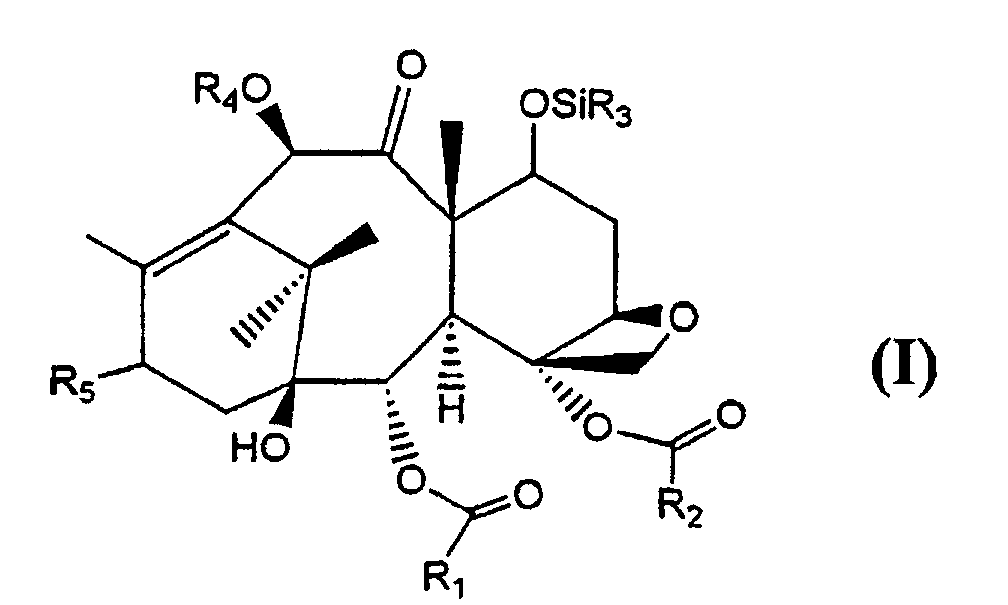
- R1 =
- CH3, c-C6H11, C6H5, p-CH3-C6H4 or p-NO2-C6H4;
- R2 =
- CH3, CH2CH3, CH2CH2CH3, C(CH3)3, (CH2)3CH3, (CH2)4CH3, C6H5, p-NO2-C6H4, c-C3H5, c-C4H7, c-C5H9 or OCH3;
- R3 =
- (CH(CH3)2)2OCH3, (CH2CH3)3, (CH3)3 or (C(CH3)3)(CH3)2;
- R4 =
- H, CH3, C6H5, COCH3, COC6H5 or COC4H9;
- R5 =
- or
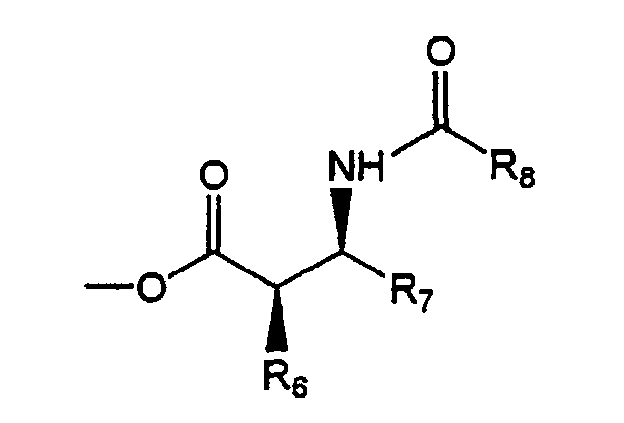
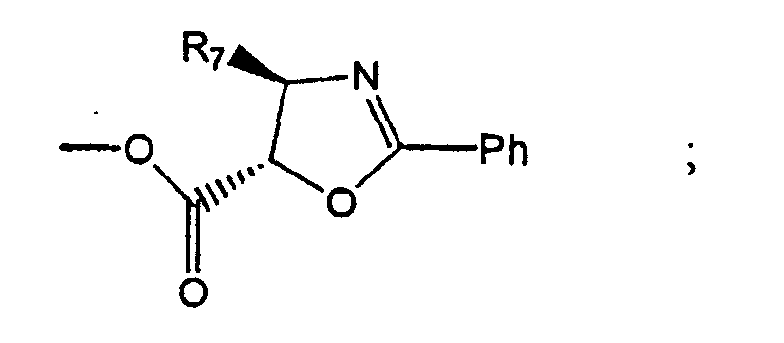
- R6 =
- H, F, OH, OCH3, OSi(CH2CH3)3, OSi(C(CH3)3)(CH3)2 or OC(CH3)2OCH3;
- R7 =
- C6H5, C(CH3)3 or CH(CH3)2; and
- R8 =
- C6H5, C(CH3)3, (CH3)3CO, (CH3)3CCH2, CH3(CH2)3O, cyclobutyl, cyclohexyloxy or 2-furyl.
- In accordance herewith, paclitaxel and paclitaxel analogues may be prepared from silyl protected taxane precursors of formula I by a process which comprises the steps of:
- (a) preparing a solution of a taxane precursor in a weak organic acid;
- (b) preparing a solution comprised of a strong acid in said weak organic acid and water;
- (c) adding the solution from step (b) to step (a);
- (d) stirring the reaction mixture formed in step (c);
- (e) quenching the reaction mixture (to prevent degradation of the product during subsequent processing);
- (f) adding water and extracting the product using an organic solvent;
- (g) separating the organic layer from the aqueous layer, and
- (h) isolating the paclitaxel or paclitaxel analogue from the organic layer.
-
- Weak organic acids suitable for use in the present invention include, but are not limited to, C1-C6alkanoic acids such as formic acid, acetic acid, propionic acid and the like. Acetic acid and formic acid are the preferred weak organic acids with acetic acid being more preferred.
- Strong acids suitable for use in the process of this invention include, but are not limited to, mineral acids such as hydrochloric acid, sulfuric acid, nitric acid, phosphoric acid and the like; strong organic acids such as trifluoroacetic acid, trichloroacetic acid, methanesulfonic acid, p-toluenesulfonic acid and the like; and strong acid resins such as Amberlyst -15, Nafion and the like. Preferred strong acids include strong organic acids with trifluoroacetic acid being more preferred.
- In step (d) of the present invention, the reaction mixture is preferably stirred at ambient temperature until the taxane precursor is consumed.
- In a preferred embodiment of the present invention, the volume ratio of the weak organic acid to the water in the reaction mixture is no more than about 3:1.
- In step (e) of the process of the invention, the reaction mixture is preferably quenched with a base. Bases suitable for use in this invention include, but are not limited to, alkali metal C1-C6carboxylates such as sodium acetate, potassium acetate and the like; tri(C1-C4alcohol)amines such as triethanolamine and the like; and dialkylamines such as diisopropylamine and the like. Preferred bases include alkali metal C1-C6carboxylates with sodium acetate being more preferred.
- In another preferred embodiment, the organic solvent used in step (f) of the process of this invention is a water-immiscible organic solvent. Water-immiscible organic solvents suitable for use in this invention include, but are not limited to, halogenated hydrocarbons such as dichloromethane and the like; C1-C4 alkyl C1-C6carboxylates such as ethyl acetate and the like; and ketones such as methyl ethyl ketone, methyl isobutyl ketone and the like; and mixtures thereof. Preferred water-immiscible organic solvents include halogentated hydrocarbons with dichloromethane being more preferred.
- Isolation procedures useful in step (h) of this invention include well known conventional procedures including, but not limited to, removal of the organic solvent or addition of an anti-solvent.
- In a preferred embodiment of the present invention, taxane precursors of formula I are converted to paclitaxel and paclitaxel analogues of formula IIwherein:

- R1 =
- CH3, c-C6H11, C6H5, p-CH3-C6H4 or p-NO2-C6H4;
- R2 =
- CH3, CH2CH3, CH2CH2CH3, C(CH3)3, (CH2)3CH3, (CH2)4CH3, C6H5, p-NO2-C6H4, c-C3H5, c-C4H7, c-C5H9 or OCH3;
- R4 =
- H, CH3, C6H5, COCH3, COC6H5 or COC4H9;
- R5 =
-

- R7 =
- C6H5, C(CH3)3 or CH(CH3)2; and
- R8 =
- C6H5, C(CH3)3, (CH3)3CO, (CH3)3CCH2, CH3(CH2)3O, cyclobutyl, cyclohexyloxy or 2-furyl.
- With reference to paclitaxel, crystal Form A is isolated by solvent exchanging the organic layer from step (h) into an alcohol, such as ethanol, isopropanol or the like, or into a ketone, such as acetone, methyl ethyl ketone, methyl isobutyl ketone or the like, or into an ester, such as ethyl acetate, n-butyl acetate or the like followed by the addition of a hydrocarbon solvent, such as hexane, heptane, cyclohexane or the like, preferably isopropanol followed by heptane. The crystal Form B is isolated by solvent exchanging the organic layer from step (h) into a water-miscible solvent, such as acetic acid, acetone, methanol, ethanol, isopropanol, tetrahydrofuran, acetonitrile or the like followed by the addition of water, preferably acetone or acetic acid followed by the addition of water.
- During the crystallization of paclitaxel Form A from isopropanol, the crystal slurry undergoes a phase change. Initially, the crystal slurry remains very thin for several hours, then it undergoes a phase change and it thickens. After 1-2 hours, the slurry thins out again. The yield of the product is low if the slurry is filtered during the early stages of thin phase and the crystal slurry is difficult to filter during the thick phase stage. Therefore, the crystal slurry is filtered only after it has undergone the complete phase transition. Addition of small amounts of water (i.e., up to about 3% (w/v)) has been found to accelerate the phase transition from the initial thin phase to the final thin phase. The addition of water also helps in improving the filtration characteristics of the crystal slurry and the overall yield of the product.
- The present invention is further described by reference to the working Examples. The Examples are provided for the purpose of illustrating the present invention and should not be construed as being a limitation on the scope or spirit of the invention. It should be understood that there may be other embodiments which fall within the spirit and scope of the invention as defined by the claims appended hereto.
-

- To a solution of taxane precursor IV in acetic acid (69 mL) was added a solution of trifluoroacetic acid in acetic acid (39 mL, 1 mmol solution prepared by dissolving 23.4 g of trifluoacetic acid in 120 mL of water and 69 mL of acetic acid) at ambient temperature. Reaction mixture was stirred for 17 h and quenched with 40% aqueous sodium acetate solution (6 equiv). Reaction mixture was stirred for 20 min followed by the addition of dichloromethane (200 mL) and water (50 mL). The biphasic mixture was stirred for 20 min before separating the organic layer. Organic layer was washed with water (3x100 mL), dried (magnesium sulfate) and evaporated to afford 6.9 g of the crude product. Crystallization of the crude material from ethanol/heptane (1:1 ) gave 4.2 g (76%) of the title compound.
ESILRMS M+ calcd. For C47H51NO15: 869. Found 869
Anal calcd. For C47H51NO15: C, 64.89; H, 5.91;N, 1.61. Found: C, 64.79: H, 5.82; N, 1.54. -


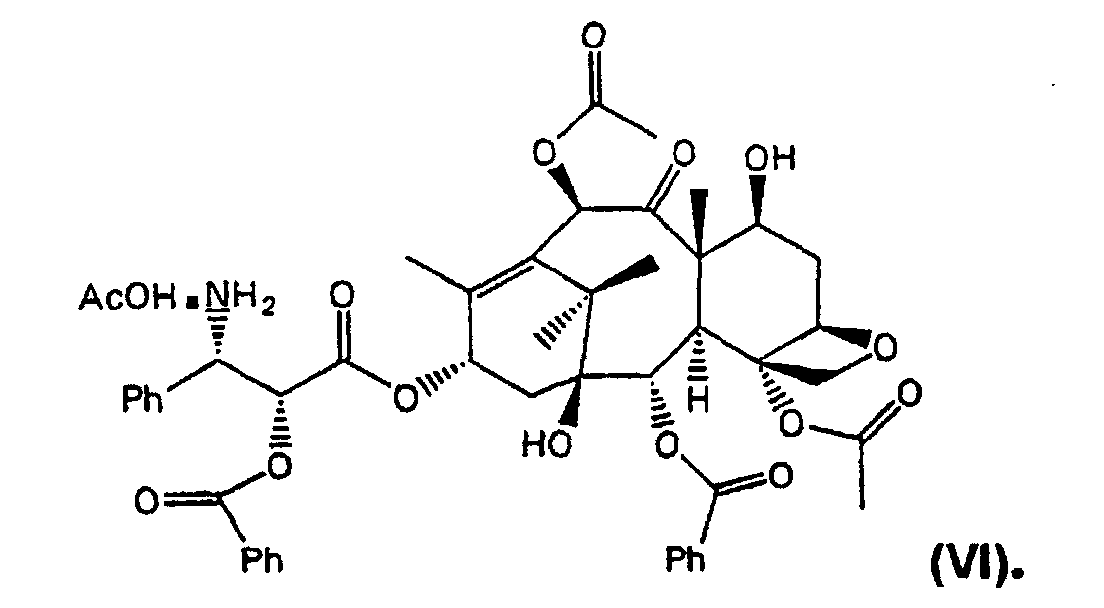
- Taxane starting material V (15 g, 15.8 mmol) was dissolved in glacial acetic acid (129 mL). To this, a solution of trifluoroacetic acid (7.7 mL, 100 mmol) in giacial acetic acid (32 mL) and water (41 mL) was added at ambient temperature. After completion of reaction (5 to 7 hours), a solution of NaOAc (9 g, 109.7 mmol) in water (32 mL) was added to quench the reaction. Dichloromethane (146 mL) and water (100 mL) were added and the biphasic mixture was agitated for at least 15 minutes. The layers were separated and the spent aqueous layer was extracted with dichloromethane (100 mL). The rich dichloromethane layers were combined and washed three times with water (75 mL each) to give the paclitaxel-intermediate VI. Triethylamine (29.6 mL, 212.4 mmol) was added to the rich dichloromethane solution while maintaining the temperature at less than 25 °C. After complete conversion of intermediate VI to paclitaxel (ca. 3 hours), a solution of sulfuric acid (25 mL) in water (225 mL) was added to quench the reaction while maintaining the temperature at less than 25 °C. The layers were separated and the rich dichloromethane layer was washed several times with water (75 mL each) to remove residual acetic acid and triethylamine. The rich dichloromethane layer was solvent exchanged into isopropanol (ca. 300 mL) at no more than 40°C. The rich isopropanol solution was concentrated to ca. 227 mL at 25 to 40 °C. The solution was heated to 48 to 52 °C to dissolve any precipitated paclitaxel. The water content of the isopropanol solution was adjusted to ca. 3% (w/v) with purified water and then slowly cooled to room temperature to initiate crystallization. After the conclusion of the thin-thick-thin phase transition of the crystal slurry, the slurry was further cooled to 0 to 5 °C to complete the crystallization. The crystal slurry was filtered, washed with cold isopropanol and dried in vacuo at less than 50 °C to afford 11.7 g (86.9 M%, HPLC area % 98.5) of paclitaxel.
-
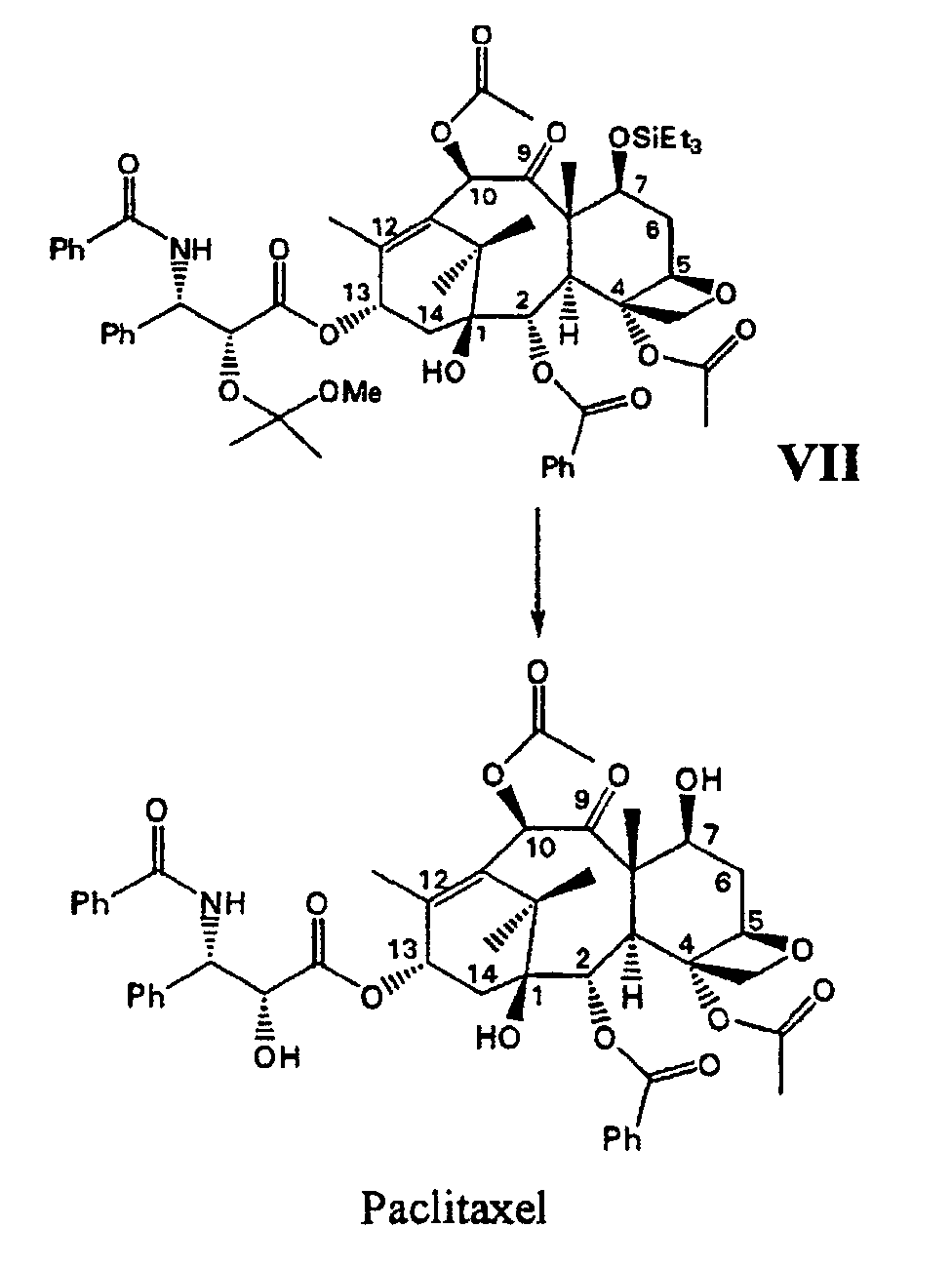
- Taxane starting material VII (40 g, 37.3 mmol) was dissolved in glacial acetic acid (355 mL) and to this, a solution of trifluoroacetic acid (23.4 g, 205.1 mmol) in water (120 mL) and glacial acetic acid (89 mL) was added at ambient temperature. After reaction completion (5 to 7 hours), a solution of NaOAc.3H2O (35.5 g, 228.3 mmol) in water (66 mL) was added to quench the reaction. Dichloromethane (400 mL) and additional water (266 mL) were added and the biphasic mixture was agitated for at least 15 minutes. The layers were separated and the spent aqueous layer was extracted with dichloromethane (268 mL). The rich dichloromethane layers were combined and washed three times with water (475 mL each). The rich dichloromethane layer was solvent exchanged into isopropanol (ca. 800 mL) at no more than 40°C. The rich isopropanol solution was concentrated to ca. 621 mL at 25 to 40°C. The solution was heated to 48 to 52 °C to dissolved any precipitated paclitaxel. The water content of the isopropanol solution was adjusted to ca. 3% (w/v) by adding purified water and then slowly cooled to room temperature to initiate crystallization. After the conclusion of the thin-thick-thin phase transition of the crystal slurry, the slurry was further cooled to 0° to 5 °C to complete the crystallization. The crystal slurry was filtered, washed with cold isopropanol and dried in vacuo at less than 50 °C to afford 25.8g (81M%, HPLC area % 98.8) of paclitaxel.
Claims (25)
- A process for the preparation of paclitaxel or a paclitaxel analogue from a taxane precursor of formula Iwherein:

- R1 =
- CH3, c-C6H11, C6H5, p-CH3-C6H4 or p-NO2-C6H4;
- R2 =
- CH3, CH2CH3, CH2CH2CH3, C(CH3)3, (CH2)3CH3, (CH2)4CH3, C6H5, p-NO2-C6H4, c-C3H5, c-C4H7, c-C5H9 or OCH3;
- R3 =
- (CH(CH3)2)2OCH3, (CH2CH3)3, (CH3)3 or (C(CH3)3)(CH3)2;
- R4 =
- H, CH3, C6H5, COCH3, COC6H5 or COC4H9;
- R5 =
- or
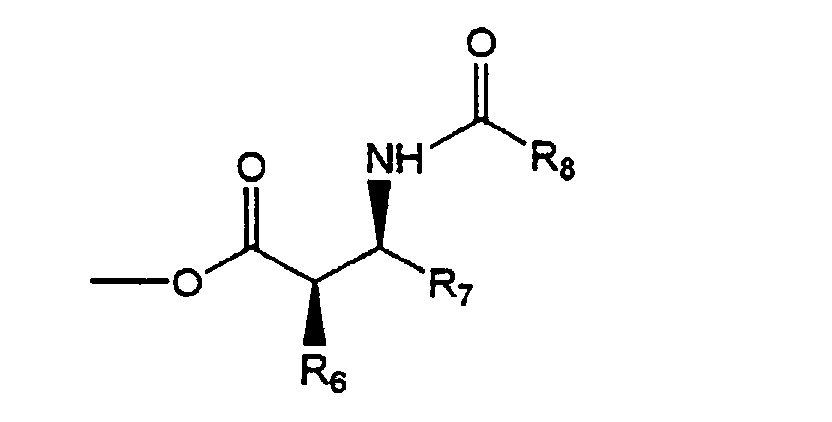

- R6 =
- H, F, OH, OCH3, OSi(CH2CH3)3, OSi(C(CH3)3)(CH3)2 or OC(CH3)2OCH3;
- R7 =
- C6H5, C(CH3)3 or CH(CH3)2;
- R8 =
- C6H5, C(CH3)3, (CH3)3CO, (CH3)3CCH2, CH3(CH2)3O, cyclobutyl, cyclohexyloxy or 2-furyl;
(a) preparing a solution of taxane precursor in a weak organic acid;(b) preparing a solution comprised of a strong acid in said weak organic acid and water;(c) adding the solution from step (b) to step (a);(d) stirring the reaction mixture formed in step (c);(e) quenching said reaction mixture;(f) adding water and extracting the product using an organic solvent;(g) separating the organic layer from the aqueous layer; and(h) isolating the product from said organic layer. - The process according to Claim 1, wherein a compound of formula IVis converted to a compound of formula III


- The process according to Claim 1, wherein a compound of formula VIIis converted to paclitaxel.

- The process according to Claim 1, wherein the weak organic acid is acetic acid or formic acid.
- The process according to Claim 4, wherein the weak organic acid is acetic acid.
- The process according to Claim 1, wherein the strong acid in step (b) is a mineral acid, a strong organic acid or a strong acid resin.
- The process according to Claim 6, wherein the strong acid is trifluoroacetic acid.
- The process according to Claim 1, wherein the volume ratio of the weak organic acid to the water in the reaction mixture is no more than about 3:1.
- The process according to Claim 1, wherein the quenching step (e) comprises a quenching reagent selected from the group consisting of sodium acetate, triethanolamine and diisopropylamine.
- The process according to Claim 9, wherein the quenching reagent is sodium acetate.
- The process according to Claim 1, wherein the organic solvent in said extraction step (f) is a water-immiscible solvent.
- The process according to Claim 11, wherein the organic solvent is selected from the group consisting of dichloromethane, ethyl acetate, methyl ethyl ketone and methyl isobutyl ketone.
- The process according to Claim 12, wherein the organic solvent is dichloromethane.
- The process according to Claim 1, wherein step (d) further comprises stirring the reaction mixture formed in step (c) at ambient temperature until the taxane precursor is consumed.
- The process according to Claim 1 for the preparation of paclitaxel or a paclitaxel analogue of formula IIwherein:

- R1 =
- CH3, c-C6H11, C6H5, p-CH3-C6H4 or p-NO2-C6H4;
- R2 =
- CH3, CH2CH3, CH2CH2CH3, C(CH3)3, (CH2)3CH3, (CH2)4CH3, C6H5, p-NO2-C6H4, c-C3H5, c-C4H7, c-C5H9 or OCH3;
- R4 =
- H, CH3, C6H5, COCH3, COC6H5 or COC4H9;
- R5 =
-
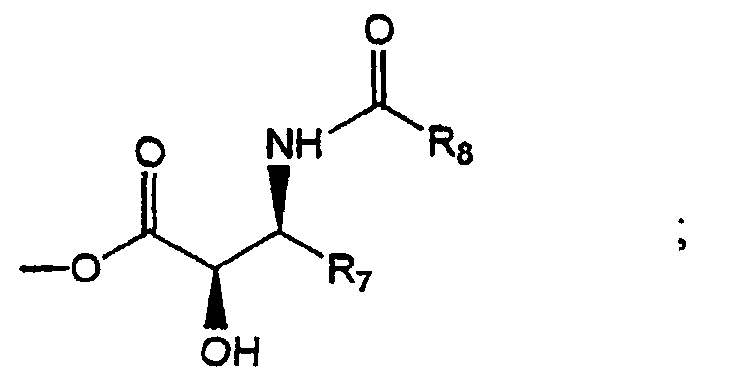
- R7 =
- C6H5, C(CH3)3 or CH(CH3)2; and
- R8 =
- C6H5, C(CH3)3, (CH3)3CO, (CH3)3CCH2, CH3(CH2)3O, cyclobutyl, cyclohexyloxy or 2-furyl.
- The process according to Claim 1, wherein a compound of formula Vis converted to a paclitaxel intermediate of formula VI

- The process according to Claim 1, wherein the product of steps (a) to (g) is paclitaxel and wherein the step (h) isolation comprises a solvent exchange of the organic layer from step (g) into a crystallization solvent suitable for the crystallization of paclitaxel in Form A or Form B.
- The process according to Claim 17, wherein the solvent for the crystallization of paclitaxel in crystal Form A is comprised of a two solvent system with hepane as the non-solvent and ethyl acetate, acetone, ethanol or isopropanol as the solvent.
- The process according to Claim 17, wherein the solvent for the crystallization of paclitaxel in crystal Form A is isopropanol.
- The process according to Claim 17, wherein the solvent for the crystallization of paclitaxel in crystal Form B is comprised of a two solvent system with water as the non-solvent and acetic acid, acetone, methanol, ethanol, isopropanol, tetrahydrofuran or acetonitrile as the solvent.
- The process according to Claim 17, wherein the solvent for the crystallization of paclitaxel in crystal Form B is acetone and water.
- The process according to Claim 17, wherein the solvent for the crystallization of paclitaxel in crystal Form B is acetic acid and water.
- The process according to Claim 19, wherein the water content of the crystallization solution in isopropanol may be up to about 3% (w/v) for the isolation of paclitaxel in crystal Form A.
- The process according to Claim 19, wherein the paclitaxel Form A undergoes a crystal slurry phase transition which is accelerated by the presence of up to about 3% (w/v) water in said crystallization solvent.
- The process according to Claim 19, wherein the yield of the paclitaxel Form A is increased by the presence of up to about 3% (w/v) water in said crystallization solvent.
Applications Claiming Priority (3)
| Application Number | Priority Date | Filing Date | Title |
|---|---|---|---|
| US13446999P | 1999-05-17 | 1999-05-17 | |
| US134469P | 1999-05-17 | ||
| PCT/US2000/012469 WO2000069840A1 (en) | 1999-05-17 | 2000-05-08 | Novel reaction conditions for the cleavage of silyl ethers in the preparation of paclitaxel (taxol®) and paclitaxel analogues |
Publications (3)
| Publication Number | Publication Date |
|---|---|
| EP1178979A1 EP1178979A1 (en) | 2002-02-13 |
| EP1178979A4 EP1178979A4 (en) | 2002-06-12 |
| EP1178979B1 true EP1178979B1 (en) | 2003-12-10 |
Family
ID=22463532
Family Applications (1)
| Application Number | Title | Priority Date | Filing Date |
|---|---|---|---|
| EP00932151A Expired - Lifetime EP1178979B1 (en) | 1999-05-17 | 2000-05-08 | Novel reaction conditions for the cleavage of silyl ethers in the preparation of paclitaxel (taxol(r)) and paclitaxel analogues |
Country Status (17)
| Country | Link |
|---|---|
| US (1) | US6184395B1 (en) |
| EP (1) | EP1178979B1 (en) |
| JP (1) | JP2002544269A (en) |
| KR (1) | KR100648125B1 (en) |
| AT (1) | ATE256117T1 (en) |
| AU (1) | AU761389B2 (en) |
| CA (1) | CA2373819A1 (en) |
| DE (1) | DE60007115T2 (en) |
| DK (1) | DK1178979T3 (en) |
| ES (1) | ES2211550T3 (en) |
| HK (1) | HK1042302B (en) |
| HU (1) | HUP0201176A3 (en) |
| IL (1) | IL144976A0 (en) |
| MX (1) | MXPA01011046A (en) |
| PT (1) | PT1178979E (en) |
| TW (1) | TWI257387B (en) |
| WO (1) | WO2000069840A1 (en) |
Families Citing this family (10)
| Publication number | Priority date | Publication date | Assignee | Title |
|---|---|---|---|---|
| US6750246B1 (en) | 2000-02-03 | 2004-06-15 | Bristol-Myers Squibb Company | C-4 carbonate taxanes |
| US6916942B2 (en) * | 2000-02-03 | 2005-07-12 | Bristol-Myers Squibb Company | Process for the preparation of C-4 carbonate taxanes |
| US7410980B2 (en) * | 2001-11-29 | 2008-08-12 | Daiichi Pharmaceutical Co., Ltd. | Crystals of taxane derivative and process for their production |
| EP1465618A2 (en) * | 2001-12-20 | 2004-10-13 | Bristol-Myers Squibb Company | Pharmaceutical compositions of orally active taxane derivatives having enhanced bioavailability |
| CA2741496C (en) | 2002-08-04 | 2013-01-08 | Natural Pharmaceuticals, Inc. | Methods and compositions for converting taxane amides to paclitaxel or other taxanes |
| US8703982B2 (en) | 2003-03-17 | 2014-04-22 | Phyton Holdings Llc | Purification of taxanes |
| JP4499383B2 (en) * | 2003-07-11 | 2010-07-07 | 良明 木曽 | Water-soluble prodrug |
| FR2859996B1 (en) * | 2003-09-19 | 2006-02-03 | Aventis Pharma Sa | ACETONIC SOLVAT OF DIMETHOXY DOCETAXEL AND PROCESS FOR PREPARING THE SAME |
| FR2882362B1 (en) * | 2005-02-23 | 2007-05-11 | Seripharm | PROCESS FOR PREPARING PACLITAXEL |
| US20090292131A1 (en) * | 2008-05-07 | 2009-11-26 | Ladislav Cvak | Processes for preparation of taxanes and intermediates thereof |
Family Cites Families (8)
| Publication number | Priority date | Publication date | Assignee | Title |
|---|---|---|---|---|
| FR2601676B1 (en) * | 1986-07-17 | 1988-09-23 | Rhone Poulenc Sante | PROCESS FOR THE PREPARATION OF TAXOL AND DESACETYL-10 TAXOL |
| USRE34277E (en) | 1988-04-06 | 1993-06-08 | Centre National De La Recherche Scientifique | Process for preparing taxol |
| FR2629818B1 (en) * | 1988-04-06 | 1990-11-16 | Centre Nat Rech Scient | PROCESS FOR THE PREPARATION OF TAXOL |
| FR2687150B1 (en) * | 1992-02-07 | 1995-04-28 | Rhone Poulenc Rorer Sa | PROCESS FOR THE PREPARATION OF TAXANE DERIVATIVES. |
| FR2702212B1 (en) | 1993-03-02 | 1995-04-07 | Rhone Poulenc Rorer Sa | New taxoids, their preparation and the pharmaceutical compositions containing them. |
| TW467896B (en) | 1993-03-19 | 2001-12-11 | Bristol Myers Squibb Co | Novel β-lactams, methods for the preparation of taxanes and sidechain-bearing taxanes |
| FR2718135B1 (en) * | 1994-04-05 | 1996-04-26 | Rhone Poulenc Rorer Sa | Process for the preparation of hydroxy-7 taxanes. |
| EP1087955A1 (en) * | 1998-04-20 | 2001-04-04 | Lolita Zamir | The semi-synthesis of baccatin iii |
-
2000
- 2000-05-08 IL IL14497600A patent/IL144976A0/en active IP Right Grant
- 2000-05-08 DE DE60007115T patent/DE60007115T2/en not_active Expired - Fee Related
- 2000-05-08 HK HK02104143.6A patent/HK1042302B/en not_active IP Right Cessation
- 2000-05-08 PT PT00932151T patent/PT1178979E/en unknown
- 2000-05-08 EP EP00932151A patent/EP1178979B1/en not_active Expired - Lifetime
- 2000-05-08 HU HU0201176A patent/HUP0201176A3/en unknown
- 2000-05-08 JP JP2000618257A patent/JP2002544269A/en active Pending
- 2000-05-08 MX MXPA01011046A patent/MXPA01011046A/en active IP Right Grant
- 2000-05-08 ES ES00932151T patent/ES2211550T3/en not_active Expired - Lifetime
- 2000-05-08 AT AT00932151T patent/ATE256117T1/en not_active IP Right Cessation
- 2000-05-08 CA CA002373819A patent/CA2373819A1/en not_active Abandoned
- 2000-05-08 AU AU49920/00A patent/AU761389B2/en not_active Ceased
- 2000-05-08 KR KR1020017014635A patent/KR100648125B1/en not_active Expired - Fee Related
- 2000-05-08 WO PCT/US2000/012469 patent/WO2000069840A1/en not_active Ceased
- 2000-05-08 DK DK00932151T patent/DK1178979T3/en active
- 2000-05-11 TW TW089109043A patent/TWI257387B/en not_active IP Right Cessation
- 2000-05-16 US US09/571,234 patent/US6184395B1/en not_active Expired - Fee Related
Also Published As
| Publication number | Publication date |
|---|---|
| DE60007115T2 (en) | 2004-09-02 |
| JP2002544269A (en) | 2002-12-24 |
| CA2373819A1 (en) | 2000-11-23 |
| KR20010112493A (en) | 2001-12-20 |
| HUP0201176A2 (en) | 2002-08-28 |
| HK1042302B (en) | 2004-10-08 |
| AU761389B2 (en) | 2003-06-05 |
| MXPA01011046A (en) | 2002-07-22 |
| US6184395B1 (en) | 2001-02-06 |
| KR100648125B1 (en) | 2006-11-24 |
| DE60007115D1 (en) | 2004-01-22 |
| ES2211550T3 (en) | 2004-07-16 |
| TWI257387B (en) | 2006-07-01 |
| HUP0201176A3 (en) | 2005-02-28 |
| WO2000069840A1 (en) | 2000-11-23 |
| AU4992000A (en) | 2000-12-05 |
| IL144976A0 (en) | 2002-06-30 |
| DK1178979T3 (en) | 2004-03-22 |
| ATE256117T1 (en) | 2003-12-15 |
| EP1178979A1 (en) | 2002-02-13 |
| PT1178979E (en) | 2004-04-30 |
| HK1042302A1 (en) | 2003-12-19 |
| EP1178979A4 (en) | 2002-06-12 |
Similar Documents
| Publication | Publication Date | Title |
|---|---|---|
| US6184395B1 (en) | Reaction conditions for the cleavage of silyl ethers in the preparation of paclitaxel(taxol®) and paclitaxel analogues | |
| US20040073044A1 (en) | Anticancer taxanes such as paclitaxel, docetaxel and their structural analogs, and a method for the preparation thereof | |
| US8697894B2 (en) | Preparation of taxanes from 9-dihydro-13-acetylbaccation III | |
| ITMI990417A1 (en) | PROCEDURE FOR THE PREPARATION OF TASSANI FROM 10-DESACETYLBACCATIN | |
| US6593482B2 (en) | Methods for preparing new taxoids and pharmaceutical compositions containing them | |
| CA2310778C (en) | Intermediates and methods useful in the semisynthesis of paclitaxel and analogs | |
| DE60031269T2 (en) | HALBSYNTHESIS OF PACLITAXEL WITH THE HELP OF DIALKYL DICHLORSILANES | |
| AU3402699A (en) | The semi-synthesis of baccatin iii | |
| CZ302810B6 (en) | Process for preparing 14 beta-hydroxy-1,14-carbonate deacetyl-baccatin III | |
| HUP0500615A2 (en) | Process for preparing paclitaxel | |
| US6891050B2 (en) | Process for the preparation of taxanes such as paclitaxel, docetaxel and structurally similar analogs | |
| US7078432B2 (en) | Process for the preparation of the 14β-hydroxy-baccatin III-1,14-carbonate | |
| US7247738B2 (en) | Method of preparation of anticancer taxanes using 3-[(substituted-2-trialkylsilyl) ethoxycarbonyl]-5-oxazolidine carboxylic acids | |
| HK1080475B (en) | A process for the preparation of the 14beta-hydroxy-baccatin iii-1, 14-carbonate | |
| HK1080475A1 (en) | A process for the preparation of the 14beta-hydroxy-baccatin iii-1, 14-carbonate |
Legal Events
| Date | Code | Title | Description |
|---|---|---|---|
| PUAI | Public reference made under article 153(3) epc to a published international application that has entered the european phase |
Free format text: ORIGINAL CODE: 0009012 |
|
| 17P | Request for examination filed |
Effective date: 20010926 |
|
| AK | Designated contracting states |
Kind code of ref document: A1 Designated state(s): AT BE CH CY DE DK ES FI FR GB GR IE IT LI LU MC NL PT SE |
|
| AX | Request for extension of the european patent |
Free format text: AL;LT;LV;MK;RO;SI |
|
| A4 | Supplementary search report drawn up and despatched |
Effective date: 20020429 |
|
| AK | Designated contracting states |
Kind code of ref document: A4 Designated state(s): AT BE CH CY DE DK ES FI FR GB GR IE IT LI LU MC NL PT SE |
|
| RIC1 | Information provided on ipc code assigned before grant |
Free format text: 7C 07D 305/14 A, 7A 61K 31/337 B, 7A 61P 35/00 B |
|
| GRAH | Despatch of communication of intention to grant a patent |
Free format text: ORIGINAL CODE: EPIDOS IGRA |
|
| GRAS | Grant fee paid |
Free format text: ORIGINAL CODE: EPIDOSNIGR3 |
|
| GRAA | (expected) grant |
Free format text: ORIGINAL CODE: 0009210 |
|
| AK | Designated contracting states |
Kind code of ref document: B1 Designated state(s): AT BE CH CY DE DK ES FI FR GB GR IE IT LI LU MC NL PT SE |
|
| REG | Reference to a national code |
Ref country code: GB Ref legal event code: FG4D |
|
| RTI1 | Title (correction) |
Free format text: NOVEL REACTION CONDITIONS FOR THE CLEAVAGE OF SILYL ETHERS IN THE PREPARATION OF PACLITAXEL (TAXOL(R)) AND PACLITAXEL ANA |
|
| REG | Reference to a national code |
Ref country code: CH Ref legal event code: EP |
|
| REG | Reference to a national code |
Ref country code: IE Ref legal event code: FG4D |
|
| REF | Corresponds to: |
Ref document number: 60007115 Country of ref document: DE Date of ref document: 20040122 Kind code of ref document: P |
|
| REG | Reference to a national code |
Ref country code: SE Ref legal event code: TRGR |
|
| REG | Reference to a national code |
Ref country code: DK Ref legal event code: T3 |
|
| REG | Reference to a national code |
Ref country code: CH Ref legal event code: NV Representative=s name: BOVARD AG PATENTANWAELTE |
|
| REG | Reference to a national code |
Ref country code: GR Ref legal event code: EP Ref document number: 20040400740 Country of ref document: GR |
|
| REG | Reference to a national code |
Ref country code: PT Ref legal event code: SC4A Free format text: AVAILABILITY OF NATIONAL TRANSLATION Effective date: 20040223 |
|
| LTIE | Lt: invalidation of european patent or patent extension |
Effective date: 20031210 |
|
| REG | Reference to a national code |
Ref country code: ES Ref legal event code: FG2A Ref document number: 2211550 Country of ref document: ES Kind code of ref document: T3 |
|
| ET | Fr: translation filed | ||
| REG | Reference to a national code |
Ref country code: HK Ref legal event code: GR Ref document number: 1042302 Country of ref document: HK |
|
| PLBE | No opposition filed within time limit |
Free format text: ORIGINAL CODE: 0009261 |
|
| STAA | Information on the status of an ep patent application or granted ep patent |
Free format text: STATUS: NO OPPOSITION FILED WITHIN TIME LIMIT |
|
| 26N | No opposition filed |
Effective date: 20040913 |
|
| PG25 | Lapsed in a contracting state [announced via postgrant information from national office to epo] |
Ref country code: CY Free format text: LAPSE BECAUSE OF NON-PAYMENT OF DUE FEES Effective date: 20060508 |
|
| PGFP | Annual fee paid to national office [announced via postgrant information from national office to epo] |
Ref country code: MC Payment date: 20070426 Year of fee payment: 8 |
|
| PGFP | Annual fee paid to national office [announced via postgrant information from national office to epo] |
Ref country code: CH Payment date: 20070427 Year of fee payment: 8 |
|
| PGFP | Annual fee paid to national office [announced via postgrant information from national office to epo] |
Ref country code: DE Payment date: 20070503 Year of fee payment: 8 Ref country code: NL Payment date: 20070503 Year of fee payment: 8 |
|
| PGFP | Annual fee paid to national office [announced via postgrant information from national office to epo] |
Ref country code: PT Payment date: 20070508 Year of fee payment: 8 Ref country code: SE Payment date: 20070508 Year of fee payment: 8 |
|
| PGFP | Annual fee paid to national office [announced via postgrant information from national office to epo] |
Ref country code: AT Payment date: 20070511 Year of fee payment: 8 |
|
| PGFP | Annual fee paid to national office [announced via postgrant information from national office to epo] |
Ref country code: FI Payment date: 20070514 Year of fee payment: 8 |
|
| PGFP | Annual fee paid to national office [announced via postgrant information from national office to epo] |
Ref country code: DK Payment date: 20070515 Year of fee payment: 8 |
|
| PGFP | Annual fee paid to national office [announced via postgrant information from national office to epo] |
Ref country code: LU Payment date: 20070524 Year of fee payment: 8 |
|
| PGFP | Annual fee paid to national office [announced via postgrant information from national office to epo] |
Ref country code: ES Payment date: 20070621 Year of fee payment: 8 |
|
| PGFP | Annual fee paid to national office [announced via postgrant information from national office to epo] |
Ref country code: GB Payment date: 20070502 Year of fee payment: 8 |
|
| PGFP | Annual fee paid to national office [announced via postgrant information from national office to epo] |
Ref country code: IT Payment date: 20070508 Year of fee payment: 8 |
|
| PGFP | Annual fee paid to national office [announced via postgrant information from national office to epo] |
Ref country code: BE Payment date: 20070711 Year of fee payment: 8 |
|
| PGFP | Annual fee paid to national office [announced via postgrant information from national office to epo] |
Ref country code: FR Payment date: 20070510 Year of fee payment: 8 |
|
| PGFP | Annual fee paid to national office [announced via postgrant information from national office to epo] |
Ref country code: GR Payment date: 20070412 Year of fee payment: 8 |
|
| REG | Reference to a national code |
Ref country code: PT Ref legal event code: MM4A Free format text: LAPSE DUE TO NON-PAYMENT OF FEES Effective date: 20081110 |
|
| PGFP | Annual fee paid to national office [announced via postgrant information from national office to epo] |
Ref country code: CY Payment date: 20070426 Year of fee payment: 8 |
|
| BERE | Be: lapsed |
Owner name: *BRISTOL-MYERS SQUIBB CY Effective date: 20080531 |
|
| PG25 | Lapsed in a contracting state [announced via postgrant information from national office to epo] |
Ref country code: MC Free format text: LAPSE BECAUSE OF NON-PAYMENT OF DUE FEES Effective date: 20080531 |
|
| REG | Reference to a national code |
Ref country code: CH Ref legal event code: PL |
|
| REG | Reference to a national code |
Ref country code: DK Ref legal event code: EBP |
|
| GBPC | Gb: european patent ceased through non-payment of renewal fee |
Effective date: 20080508 |
|
| PG25 | Lapsed in a contracting state [announced via postgrant information from national office to epo] |
Ref country code: LI Free format text: LAPSE BECAUSE OF NON-PAYMENT OF DUE FEES Effective date: 20080531 Ref country code: PT Free format text: LAPSE BECAUSE OF NON-PAYMENT OF DUE FEES Effective date: 20081110 Ref country code: CH Free format text: LAPSE BECAUSE OF NON-PAYMENT OF DUE FEES Effective date: 20080531 Ref country code: NL Free format text: LAPSE BECAUSE OF NON-PAYMENT OF DUE FEES Effective date: 20081201 |
|
| PG25 | Lapsed in a contracting state [announced via postgrant information from national office to epo] |
Ref country code: FI Free format text: LAPSE BECAUSE OF NON-PAYMENT OF DUE FEES Effective date: 20080508 Ref country code: AT Free format text: LAPSE BECAUSE OF NON-PAYMENT OF DUE FEES Effective date: 20080508 |
|
| REG | Reference to a national code |
Ref country code: FR Ref legal event code: ST Effective date: 20090119 |
|
| PG25 | Lapsed in a contracting state [announced via postgrant information from national office to epo] |
Ref country code: BE Free format text: LAPSE BECAUSE OF NON-PAYMENT OF DUE FEES Effective date: 20080531 |
|
| PG25 | Lapsed in a contracting state [announced via postgrant information from national office to epo] |
Ref country code: DE Free format text: LAPSE BECAUSE OF NON-PAYMENT OF DUE FEES Effective date: 20081202 Ref country code: FR Free format text: LAPSE BECAUSE OF NON-PAYMENT OF DUE FEES Effective date: 20080602 Ref country code: DK Free format text: LAPSE BECAUSE OF NON-PAYMENT OF DUE FEES Effective date: 20080531 |
|
| PG25 | Lapsed in a contracting state [announced via postgrant information from national office to epo] |
Ref country code: GB Free format text: LAPSE BECAUSE OF NON-PAYMENT OF DUE FEES Effective date: 20080508 Ref country code: GR Free format text: LAPSE BECAUSE OF NON-PAYMENT OF DUE FEES Effective date: 20081204 |
|
| REG | Reference to a national code |
Ref country code: ES Ref legal event code: FD2A Effective date: 20080509 |
|
| PGFP | Annual fee paid to national office [announced via postgrant information from national office to epo] |
Ref country code: IE Payment date: 20090521 Year of fee payment: 10 |
|
| PG25 | Lapsed in a contracting state [announced via postgrant information from national office to epo] |
Ref country code: IT Free format text: LAPSE BECAUSE OF NON-PAYMENT OF DUE FEES Effective date: 20080508 |
|
| PG25 | Lapsed in a contracting state [announced via postgrant information from national office to epo] |
Ref country code: ES Free format text: LAPSE BECAUSE OF NON-PAYMENT OF DUE FEES Effective date: 20080509 |
|
| PG25 | Lapsed in a contracting state [announced via postgrant information from national office to epo] |
Ref country code: CY Free format text: LAPSE BECAUSE OF NON-PAYMENT OF DUE FEES Effective date: 20080508 |
|
| PG25 | Lapsed in a contracting state [announced via postgrant information from national office to epo] |
Ref country code: LU Free format text: LAPSE BECAUSE OF NON-PAYMENT OF DUE FEES Effective date: 20080508 Ref country code: SE Free format text: LAPSE BECAUSE OF NON-PAYMENT OF DUE FEES Effective date: 20080509 |
|
| REG | Reference to a national code |
Ref country code: IE Ref legal event code: MM4A |
|
| PG25 | Lapsed in a contracting state [announced via postgrant information from national office to epo] |
Ref country code: IE Free format text: LAPSE BECAUSE OF NON-PAYMENT OF DUE FEES Effective date: 20100510 |