EP1178658A2 - Voice over IP based system for internet browsing using a gateway - Google Patents
Voice over IP based system for internet browsing using a gateway Download PDFInfo
- Publication number
- EP1178658A2 EP1178658A2 EP01000215A EP01000215A EP1178658A2 EP 1178658 A2 EP1178658 A2 EP 1178658A2 EP 01000215 A EP01000215 A EP 01000215A EP 01000215 A EP01000215 A EP 01000215A EP 1178658 A2 EP1178658 A2 EP 1178658A2
- Authority
- EP
- European Patent Office
- Prior art keywords
- voip
- speech
- audio data
- gateway server
- server
- Prior art date
- Legal status (The legal status is an assumption and is not a legal conclusion. Google has not performed a legal analysis and makes no representation as to the accuracy of the status listed.)
- Ceased
Links
Images


Classifications
-
- H—ELECTRICITY
- H04—ELECTRIC COMMUNICATION TECHNIQUE
- H04L—TRANSMISSION OF DIGITAL INFORMATION, e.g. TELEGRAPHIC COMMUNICATION
- H04L12/00—Data switching networks
- H04L12/66—Arrangements for connecting between networks having differing types of switching systems, e.g. gateways
-
- H—ELECTRICITY
- H04—ELECTRIC COMMUNICATION TECHNIQUE
- H04M—TELEPHONIC COMMUNICATION
- H04M3/00—Automatic or semi-automatic exchanges
- H04M3/42—Systems providing special services or facilities to subscribers
- H04M3/487—Arrangements for providing information services, e.g. recorded voice services or time announcements
- H04M3/493—Interactive information services, e.g. directory enquiries ; Arrangements therefor, e.g. interactive voice response [IVR] systems or voice portals
- H04M3/4938—Interactive information services, e.g. directory enquiries ; Arrangements therefor, e.g. interactive voice response [IVR] systems or voice portals comprising a voice browser which renders and interprets, e.g. VoiceXML
-
- H—ELECTRICITY
- H04—ELECTRIC COMMUNICATION TECHNIQUE
- H04L—TRANSMISSION OF DIGITAL INFORMATION, e.g. TELEGRAPHIC COMMUNICATION
- H04L12/00—Data switching networks
- H04L12/64—Hybrid switching systems
- H04L12/6418—Hybrid transport
- H04L2012/6472—Internet
-
- H—ELECTRICITY
- H04—ELECTRIC COMMUNICATION TECHNIQUE
- H04L—TRANSMISSION OF DIGITAL INFORMATION, e.g. TELEGRAPHIC COMMUNICATION
- H04L12/00—Data switching networks
- H04L12/64—Hybrid switching systems
- H04L12/6418—Hybrid transport
- H04L2012/6481—Speech, voice
-
- H—ELECTRICITY
- H04—ELECTRIC COMMUNICATION TECHNIQUE
- H04M—TELEPHONIC COMMUNICATION
- H04M7/00—Arrangements for interconnection between switching centres
- H04M7/0003—Interconnection between telephone networks and data networks
- H04M7/0006—Interconnection between telephone networks and data networks where voice calls cross both networks
Definitions
- This invention relates to the field of voice recognition and more particularly to a speech application for use in a Voice over IP protocol network.
- LAN telephony which means "the integration of telephony and data services provided by packet-switched data networks," is the technology that takes person-to- person communication to a high new level and associated costs to a lower level.
- LAN telephony enables a more flexible and cost-efficient use of many applications, for example automated call distribution, interactive voice response, voice logging, etc. This is in contrast to the relatively limited integration offered by the current voice/data integration paradigm, computer-telephony integration in which voice traffic is kept separate from data traffic and carried over circuit-switched links.
- VoIP Voice over IP
- VoIP Voice over IP
- analog speech signals received from an analog speech audio source for example a PSTN or a microphone, are digitized, compressed and translated into IP packets for transmission over an IP network.
- SIP Session Initialization Protocol
- MGCP Master Gateway Control Protocol
- IP telephony A common application for IP telephony is the integration of voice mail ("v-mail”) and electronic mail (“e-mail”). Another application can include voice logging by financial or emergency-response organisations. Additionally, automated call distribution (“ACD”) can be facilitated whereby an ACD server performs value-based queuing of incoming telephone calls. Finally, interactive voice response systems can incorporate IP telephony in which responses are preprogrammed in a server as a workflow component. Still, speech recognition and speech synthesis applications (“speech applications”) have lagged in the use of IP telephony.
- the tight linkage between the speech application and the IP telephony server substantially limits both the design and the extensibility of the speech application.
- the speech application design must incorporate functionality directly related to the chosen protocol for transporting packetized voice data to a speech recognition system and from a speech synthesis system.
- the development of a superior voice transport protocol by nature of the tight linkage between the IP telephony server and the speech application, can compel the redesign of the speech application. Accordingly, there exists a need for a speech a VoIP-based speech system in which the design and implementation of the speech application remains separate from the design and implementation of the IP telephony system.
- a VoIP-based speech system includes a VoIP telephony Gateway server; a speech server containing a VoIP-enabled speech application; a VoIP-compliant call control interface between the VoIP telephony Gateway server and the speech server; and a VoIP communications path between the VoIP telephony Gateway server and the speech application in the speech server.
- the VoIP telephony Gateway server and the speech application can establish the VoIP communications path through the VoIP-compliant call control interface.
- the VoIP telephony Gateway server can receive audio signals from a telephony interface, digitize the audio signals into digitized audio data, compress the digitized audio data into VoIP-compliant packets, and transmit the VoIP-compliant packets to the speech application in the at least one speech server through the VoIP communications path using the VoIP protocol.
- the speech application can receive the VoIP-compliant packets, reconstruct the digitized audio data from the VoIP-compliant packets, and speech-to-text converting the digitized audio data.
- the speech application can synthesise text into digitized audio data, encapsulate the digitized audio data in VoIP-compliant packets and transmit the VoIP-compliant packets through the VoIP communications path to the VoIP telephony Gateway server.
- the VoIP telephony Gateway server can receive the VoIP-compliant packets, reconstruct the digitized audio data from the VoIP-compliant packets, and transmit the digitized audio data through the telephony interface.
- the present embodiment is a Voice over IP (“VoIP”) based speech system in which a speech server can be coupled to a telephony Gateway server in a VoIP network.
- the telephony Gateway server can receive voice calls from an external telephone network, for example a public switched telephone network ("PSTN"), an integrated services digital network (“ISDN”) and the like.
- PSTN public switched telephone network
- ISDN integrated services digital network
- the speech server can include a speech application which can receive real-time speech input through a VoIP communications path originating from voice calls in the telephony Gateway server. Likewise, the speech application can transmit speech synthesised audio data through the VoIP communications path to the telephony Gateway server and ultimately to a termination point in the external telephone network.
- the speech application can receive voice browser commands through the voice call, responsive to which the speech application can retrieve Web content from external Web servers.
- the Web-content can be speech synthesised and transmitted through the VoIP communications path, also as part of the voice call.
- the Web content can be a VoiceXML document.
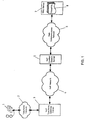
- FIG. 1 illustrates a VoIP-based speech system according the preferred embodiment.
- the VoIP specification can be implemented using several published standards, for instance H.323, SIP and MGCP.
- the present embodiment implements H.323 although the invention is not limited with regard to the particular implementation of VoIP.
- a user can initiate a voice call using telephone device 1.
- the voice call can attempt to connect with a VoIP telephony Gateway server 3 through a telephone network 2, for instance a PSTN or ISDN.
- the VoIP telephony Gateway server 3 can translate the address of the intended recipient of the voice call to the IP address of a device residing in the VoIP network 4, in this instance a VoIP Enabled Speech Server 5.
- the VoIP telephony Gateway server 3 can notify the VoIP Enabled Speech Server 5 of the voice call which the VoIP Enabled Speech Server 5 can accept.
- the VoIP Enabled Speech Server 5 can establish a VoIP communications path between the VoIP telephony Gateway server 3 and the VoIP Enabled Speech Server 5 such that VoIP-compliant packets of audio data can be transported between the VoIP telephony Gateway server 3 and the VoIP Enabled Speech Server 5.
- audio data originating in the telephone device 1 can be received and processed in the VoIP Enabled Speech Server 5.
- audio data originating in the VoIP Enabled Speech Server 5 can be transmitted back to the telephone device 1.
- the VoIP Enabled Speech Server 5 can accept voice commands originating in the telephone device 1 for retrieving Web content from a Web server 7 in a data communications network 6.
- the Web content 8 can be a VoiceXML document 8.
- the VoIP Enabled Speech Server 5 can retrieve the VoiceXML document 8 from the Web server 7 and can synthesise audio data according to instructions contained in the VoiceXML document 8. Subsequently, the synthesised audio data can be transported across the VoIP network 4 to the VoIP telephony Gateway server 3 and ultimately to the telephone device 1.
- FIG. 2 illustrates the VoIP network 4 of Figure 1 and contains a more detailed illustration of the VoIP telephony Gateway server 3.
- the VoIP telephony Gateway server 3 can receive the voice call from the telephone device 1 through the telephone network 2 into a telephony interface 11.
- the telephony interface 11 can perform address translation of the address of the intended recipient of the voice call and can direct the voice call accordingly.
- a VoIP Gatekeeper 14 is incorporated in the VoIP telephony Gateway server 3 in order to provide call management functionality to the VoIP telephony Gateway server 3.
- the VoIP Gatekeeper 14 can perform load-balancing in order to ensure the high-availability of VoIP Enabled Speech Servers 5 able to receive the voice call.
- call control can be passed to the VoIP Gatekeeper 14 through call control interfaces 13.
- the VoIP Gatekeeper 14 can communicate with other components of the VoIP telephony Gateway server 3 through data path 17.
- a call control interface 13 can be included in the VoIP Gatekeeper 14 in order to control the establishment, progress and termination of voice calls processed through the VoIP Gatekeeper 14. Because the preferred implementation of VoIP is an implementation of the RTP-based H.323 standard, the call control interfaces 13 are H.323-based call control interfaces.
- call processor 16 using advanced call management functions 15 can examine the status of each VoIP Enabled Speech Server 5 in the VoIP Network 4 and identify a VoIP Enabled Speech Server 5 in the VoIP network 4 best suited to receive the voice call. As a result, the VoIP Gatekeeper can choose a suitable VoIP Enabled Speech Server 5 and can alert the chosen VoIP Enabled Speech Server 5 of the voice call.
- the chosen VoIP Enabled Speech Server 5 can establish a VoIP communications path 18 between the VoIP telephony Gateway server 3 and the VoIP Enabled Speech Server 5 through which VoIP-compliant packets can be transmitted. Subsequently, the telephony interface 11 can digitize audio signals contained in the voice call into digitized audio data, compress the digitized audio data into VoIP-compliant packets, and transmit the VoIP-compliant packets to the chosen VoIP Enabled Speech Server 5 through the VoIP communications path 18 using the VoIP protocol.
- the present invention is not limited to the particular arrangement of the VoIP telephony Gateway server 3.
- the depiction of the VoIP Gatekeeper 14 as a separate entity from the remaining components of the VoIP telephony Gateway server 3 is not meant to limit the invention as such. Rather, the placement of the VoIP Gatekeeper 14 in Figure 2 is intended for illustrative purposes only.
- the scope of the invention with regard to the VoIP telephony Gateway server 3 in combination with the VoIP Gatekeeper should be limited only inasmuch as the VoIP telephony Gateway server 3 can receive a voice call and the VoIP Gatekeeper 14 can perform call management by identifying a suitable terminus for the voice call in the VoIP network 4.
- FIG 3 illustrates a preferred architecture for the VoIP Enabled Speech Server 5 of Figure 1.
- the VoIP Enabled Speech Server 5 can be implemented in a conventional network server which traditionally includes a central processing unit (CPU), and internal memory devices, such as random access memory (RAM) 21, and fixed storage 22 for example a hard disk drive (HDD). Because the VoIP Enabled Speech Server 5 is speech-enabled, the VoIP Enabled Speech Server 5 also includes audio circuitry (not shown) so as to provide an audio processing capability to the VoIP Enabled Speech Server 5.
- CPU central processing unit
- RAM random access memory
- HDD hard disk drive
- the VoIP Enabled Speech Server 5 can store in the fixed storage 22 an operating system 23 upon which various applications programs can execute. Additionally, the fixed storage 22 can store therein a speech application 24 and a VoIP telephony module 25.
- the operating system 23 can include any suitable operating system, for example Microsoft Windows NT®, Sun Solaris® or Debian Linux.
- the invention is not limited in regard to the arrangement of speech application 24 and telephony module 25 in relation to the operating system 23. Rather, each can be integrated with the other in various combinations.
- the VoIP telephony module 25 can be integrated in the operating system 23.
- the VoIP telephony module 25 can remain independent of the operating system 23.
- the invention is not limited to the storage location of the VoIP telephony module 25, the speech application 24 and the components thereof. Rather, the present invention can be implemented in a more complex distributed system in which the various components reside in multiple network servers and execute in process address spaces remote from one another, each application communicating with other applications through well-known interprocess communication mechanisms, for example TCP/IP.
- the operating system 23 can load into RAM 21.
- both the speech application 24 and the VoIP telephony module 25 can load and execute in RAM 21.
- the VoIP Enabled Speech Server 5 is configured to receive a voice call and subsequent data over a VoIP communications path.
- the speech application 24 can include a speech recognition engine 34 and a text-to-speech engine 35.
- the VoIP Enabled Speech Server 5 can receive VoIP-compliant packets, reconstruct digitized audio data from the VoIP-compliant packets, and speech-to-text convert the digitized audio data in the speech recognition engine 34.
- the speech application 24 can synthesise text into digitized audio data in the text-to-speech engine 35, encapsulate the digitized audio data in VoIP-compliant packets and transmit the VoIP-compliant packets through the VoIP communications path 18 to the VoIP telephony Gateway server 3.
- the speech application includes a speech browser 30.
- the speech browser 30 can retrieve Web content responsive to voice commands which are received through the VoIP communications path 18, speech-to-text converted by the speech recognition engine 34, and interpreted by the speech browser 30.
- the speech browser 30 can transmit received Web content to the text-to-speech engine 35 for speech synthesis prior to transmitting the speech synthesised audio data through the VoIP communications path 18 to the VoIP telephony Gateway server 3.
- the Web content can be a VoiceXML document 8.
- the speech application can be implemented using standards-based interfaces to VoIP communications and the speech recognition and speech synthesis functions.
- the speech application 24 can include a JSAPI speech interface 33 between the speech recognition and text-to-speech engines 34, 35 and the speech browser 30.
- the speech application 24 can include a JTAPI telephony interface 31 between the telephony module 25 and the speech browser 30.
- the speech application 24 can include a JMF media interface 32 between the telephony module 25 and the speech browser 30.
- the JTAPI telephony interface 31 can be used by the speech browser 30 to establish a voice call connection for transporting VoIP-compliant packets containing digital audio data between the telephony Gateway server 3 and the speech application 24.
- the JMF media interface 32 can establish a VoIP communications data path for transporting the VoIP-compliant packets containing the digital audio data between the speech application 24 and the voice call connection.
- the JSAPI speech interface 33 can communicate the digitized audio data from the speech application 24 to the speech recognition engine 34. Similarly, the JSAPI speech interface 33 can communicate speech synthesised audio data from the text-to-speech engine 35 to the speech application 24.
- the VoIP-based speech system of the present embodiment allows a user to access a Web site using a telephone.
- the user is audibly presented with prompts describing the Web site and the Web site's features.
- the presentation of the VoIP-based speech system is similar to an Integrated Voice Response system.
- the user can provide spoken commands to the VoIP-based speech system in order to select options and input information for completing Web-based forms, etc.
- the VoIP-based speech system can retrieve Web content having, as its page description language, VoiceXML.
- a significant element of the present embodiment is the speech server which can send and receive audio and control messages using H.323, a well-known, standard VoIP protocol.
- the use of the VoIP protocol permits speech server to remain isolated from other elements of the speech system and therefore allows the speech server to be better optimised.
- the use of an isolated speech server also simplifies considerably the development process, since it frees the speech server from the details of interacting with one of a multitude of available telephony hardware implementations.
- the use of an isolated VoIP enabled speech server allows the speech server to be used with any VolP telephony system that supports the standard H.323 protocol, or other VoIP protocol, without any special development effort.
- the VoIP-based speech system has the advantage of isolating the speech server from the details of the telephony hardware and software in the telephony Gateway server that interfaces with the telephone network. Additionally, the preferred embodiment of the present invention incorporates a standard protocol to transport audio and call control information to the speech server, thus simplifying and optimising the design of the same. Also, the incorporation of a standard protocol to transport audio and call control information to the speech server allows the speech server to operate with a wide variety of telephony hardware and software that supports the standard VoIP protocol.
- the present invention can include a method for coupling the speech application to the VoIP telephony gateway server.
- the method can be realised in hardware, software, or a combination of hardware and software.
- Machine readable storage according to the present invention can be realised in a centralised fashion in one computer system, or in a distributed fashion where different elements are spread across several interconnected computer systems. Any kind of computer system or other apparatus adapted for carrying out the methods described herein is acceptable.
- a typical combination of hardware and software could be a general purpose computer system with a computer program that, when being loaded and executed, controls the computer system such that it carries out the methods described herein.
- the present invention can also be embedded in a computer program product which comprises all the features enabling the implementation of the methods described herein, and which when loaded in a computer system is able to carry out these methods.
- a computer program in the present context can mean any expression, in any language, code or notation, of a set of instructions intended to cause a system having an information processing capability to perform a particular function either directly or after either or both of the following: (a) conversion to another language, code or notation; and (b) reproduction in a different material form.
- the invention disclosed herein can be a method embedded in a computer program which can be implemented by a programmer using commercially available development tools for the operating system 23 described above.
Landscapes
- Engineering & Computer Science (AREA)
- Signal Processing (AREA)
- Computer Networks & Wireless Communication (AREA)
- Data Exchanges In Wide-Area Networks (AREA)
- Telephonic Communication Services (AREA)
Abstract
Description
Claims (10)
- A Voice over IP ("VoIP") based speech system comprising:an VoIP telephony Gateway server;at least one speech server, each speech server containing a speech application;a VoIP-compliant call control interface between said VoIP telephony Gateway server and said speech server; and,a VoIP communications path between said VoIP telephony Gateway server and said speech application in said at least one speech server;said VoIP telephony Gateway server and said speech application establishing said VoIP communications path through said VoIP-compliant call control interface;said VoIP telephony Gateway server receiving audio signals from a telephony interface, digitising said audio signals into digitized audio data, compressing said digitized audio data into VoIP-compliant packets and transmitting said VoIP-compliant packets to said speech application in said at least one speech server through said VoIP communications path using said VoIP protocol;said speech application in said at least one speech server receiving said VoIP-compliant packets, reconstructing said digitized audio data from said VoIP-compliant packets, and speech-to-text converting said digitized audio data;said speech application in said at least one speech server speech synthesising text into digitized audio data, encapsulating said digitized audio data in VoIP-compliant packets and transmitting said VoIP-compliant packets through said VoIP communications path to said VoIP telephony Gateway server;said VoIP telephony Gateway server receiving said VoIP-compliant packets, reconstructing said digitized audio data from said VoIP-compliant packets, and transmitting said digitized audio data through said telephony interface.
- The VoIP-based speech system of claim 1, wherein said VoIP telephony Gateway server comprises:a telephony interface; and,a VoIP Gatekeeper;said VoIP Gatekeeper receiving a voice call through said telephony interface;said VoIP Gatekeeper choosing a speech server from among said at least one speech servers;said VoIP Gatekeeper alerting said VoIP-enabled speech application in said chosen speech server that said voice call has been received.
- The VoIP-based speech system of claim 1, wherein said at least one speech server comprises:a speech recognition engine;a text-to-speech engine;a call control interface for establishing a voice call connection through said VoIP telephony Gateway server; and,an audio data path,said audio data path streaming audio data through said established voice call connection to said speech recognition engine;said audio data path streaming audio data through said established voice call connection from said text-to-speech engine.
- The VoIP-based speech system of claim 1, wherein said speech application is a speech browser, said speech browser retrieving Web content responsive to voice commands received through said VoIP communications path, said speech browser speech synthesising said retrieved Web content into audio data, said speech browser transmitting said audio data through said VoIP communications path to said VoIP telephony Gateway server.
- The VoIP-based speech system of claim 4, wherein said Web content is a VoiceXML document.
- The VoIP-based speech system of claim 1, wherein said at least one speech server comprises:a speech recognition engine;a text-to-speech engine;a JSAPI speech interface;a JTAPI telephony interface; and,a JMF media interface,said JTAPI telephony interface establishing a voice call connection for transporting digital audio data between said VoIP telephony Gateway server and said speech application;said JMF media interface establishing a data path for transporting said digital audio data between said speech application and said voice call connection;said JSAPI speech interface communicating said digitized audio data from said speech application to said speech recognition engine;said JSAPI speech interface communicating speech synthesised audio data from said text-to-speech engine to said speech application.
- A Voice over IP ("VoIP") enabled speech server comprising:a speech application, said speech application configured to communicate with a VoIP telephony Gateway server over a VoIP communications path; and,a VoIP-compliant call control interface to said VoIP telephony Gateway server, said VoIP-compliant call control interface establishing said VoIP communications path;said speech application receiving VoIP-compliant packets from said VoIP telephony Gateway server over said VoIP communications path, reconstructing digitized audio data from said VoIP-compliant packets, and speech-to-text converting said digitized audio data; said speech application further synthesising text into digitized audio data, encapsulating said digitized audio data in VoIP-compliant packets and transmitting said VoIP-compliant packets over said VoIP communications path to said telephony Gateway server.
- A method for coupling a speech application to a Voice over IP ("VoIP") telephony Gateway server in a VoIP network comprising the steps of:establishing a VoIP communications path with the VoIP telephony Gateway server and configuring the speech application to communicate with the VoIP telephony Gateway server over the established VoIP communications path;receiving VoIP-compliant packets from the VoIP telephony Gateway server over said established VoIP communications path;reconstructing digitized audio data from said VoIP-compliant packets; and,speech-to-text converting said digitized audio data.
- The method of claim 8, further comprising the steps of:synthesising text into digitized audio data;encapsulating said digitized audio data in VoIP-compliant packets; and,transmitting said VoIP-compliant packets over said VoIP communications path to the VoIP telephony Gateway server.
- A machine readable storage, having stored thereon a computer program for coupling a speech application to a Voice over IP ("VoIP") telephony Gateway server in a VoIP network, said computer program having a plurality of code sections executable by a machine for causing the machine to perform the steps of:establishing a VoIP communications path with the VoIP telephony Gateway server and configuring the speech application to communicate with the VoIP telephony Gateway server over the established VoIP communications path;receiving VoIP-compliant packets from the VoIP telephony Gateway server over said established VoIP communications path;reconstructing digitized audio data from said VoIP-compliant packets; and,speech-to-text converting said digitized audio data;synthesising text into digitized audio data;encapsulating said digitized audio data in VoIP-compliant packets; and,transmitting said VoIP-compliant packets over said VoIP communications path to the VoIP telephony Gateway server.
Applications Claiming Priority (2)
| Application Number | Priority Date | Filing Date | Title |
|---|---|---|---|
| US09/596,769 US6654722B1 (en) | 2000-06-19 | 2000-06-19 | Voice over IP protocol based speech system |
| US596769 | 2000-06-19 |
Publications (2)
| Publication Number | Publication Date |
|---|---|
| EP1178658A2 true EP1178658A2 (en) | 2002-02-06 |
| EP1178658A3 EP1178658A3 (en) | 2004-05-26 |
Family
ID=24388620
Family Applications (1)
| Application Number | Title | Priority Date | Filing Date |
|---|---|---|---|
| EP01000215A Ceased EP1178658A3 (en) | 2000-06-19 | 2001-06-14 | Voice over IP based system for internet browsing using a gateway |
Country Status (6)
| Country | Link |
|---|---|
| US (1) | US6654722B1 (en) |
| EP (1) | EP1178658A3 (en) |
| JP (1) | JP4222745B2 (en) |
| KR (1) | KR100420814B1 (en) |
| CN (1) | CN1149790C (en) |
| TW (1) | TW512619B (en) |
Cited By (7)
| Publication number | Priority date | Publication date | Assignee | Title |
|---|---|---|---|---|
| FR2848053A1 (en) * | 2002-11-29 | 2004-06-04 | Streamwide | PROCESS FOR PROCESSING AUDIO DATA ON A NETWORK AND DEVICE FOR CARRYING OUT SAID METHOD |
| CN100452771C (en) * | 2006-05-16 | 2009-01-14 | 杭州华三通信技术有限公司 | System and method for realizing Internet protocol voice service |
| RU2355045C2 (en) * | 2003-11-11 | 2009-05-10 | Майкрософт Корпорейшн | Sequential multimodal input |
| RU2355044C2 (en) * | 2003-11-11 | 2009-05-10 | Майкрософт Корпорейшн | Sequential multimodal input |
| US7716725B2 (en) * | 2002-09-20 | 2010-05-11 | Fortinet, Inc. | Firewall interface configuration and processes to enable bi-directional VoIP traversal communications |
| US8697453B2 (en) | 2002-12-11 | 2014-04-15 | Life Technologies As | Particles |
| US9609553B2 (en) | 2006-02-22 | 2017-03-28 | Barkan Wireless Access Technologies, L.P. | Wireless internet system and method |
Families Citing this family (83)
| Publication number | Priority date | Publication date | Assignee | Title |
|---|---|---|---|---|
| US7506034B2 (en) * | 2000-03-03 | 2009-03-17 | Intel Corporation | Methods and apparatus for off loading content servers through direct file transfer from a storage center to an end-user |
| US7286521B1 (en) * | 2000-07-21 | 2007-10-23 | Tellme Networks, Inc. | Localized voice over internet protocol communication |
| US7095733B1 (en) * | 2000-09-11 | 2006-08-22 | Yahoo! Inc. | Voice integrated VOIP system |
| US7406657B1 (en) * | 2000-09-22 | 2008-07-29 | International Business Machines Corporation | Audible presentation and verbal interaction of HTML-like form constructs |
| US7203186B1 (en) * | 2000-11-27 | 2007-04-10 | Fuller William H | System and device for integrating IP and analog telephone systems |
| US20020085534A1 (en) * | 2000-12-28 | 2002-07-04 | Williams Donald A. | Device independent communication system |
| US7379973B2 (en) | 2001-01-12 | 2008-05-27 | Voicegenie Technologies, Inc. | Computer-implemented voice application indexing web site |
| US7072328B2 (en) | 2001-01-12 | 2006-07-04 | Voicegenie Technologies Inc. | Computer-implemented voice markup language-based server |
| US20020095330A1 (en) * | 2001-01-12 | 2002-07-18 | Stuart Berkowitz | Audio Advertising computer system and method |
| US6876647B2 (en) * | 2001-04-12 | 2005-04-05 | International Business Machines Corporation | Dynamic priority adjustment in a real time streaming engine |
| US8108509B2 (en) * | 2001-04-30 | 2012-01-31 | Sony Computer Entertainment America Llc | Altering network transmitted content data based upon user specified characteristics |
| US7031444B2 (en) * | 2001-06-29 | 2006-04-18 | Voicegenie Technologies, Inc. | Computer-implemented voice markup system and method |
| US7899167B1 (en) | 2003-08-15 | 2011-03-01 | Securus Technologies, Inc. | Centralized call processing |
| US8000269B1 (en) * | 2001-07-13 | 2011-08-16 | Securus Technologies, Inc. | Call processing with voice over internet protocol transmission |
| US7505406B1 (en) | 2001-07-13 | 2009-03-17 | Evercom Systems, Inc. | Public telephone control with voice over internet protocol transmission |
| US7206306B2 (en) * | 2002-03-26 | 2007-04-17 | Siemens Communications, Inc. | System and method for emergency call diversion |
| US9026468B2 (en) | 2002-04-29 | 2015-05-05 | Securus Technologies, Inc. | System and method for proactively establishing a third-party payment account for services rendered to a resident of a controlled-environment facility |
| US7860222B1 (en) | 2003-11-24 | 2010-12-28 | Securus Technologies, Inc. | Systems and methods for acquiring, accessing, and analyzing investigative information |
| US9020114B2 (en) | 2002-04-29 | 2015-04-28 | Securus Technologies, Inc. | Systems and methods for detecting a call anomaly using biometric identification |
| US7916845B2 (en) | 2006-04-13 | 2011-03-29 | Securus Technologies, Inc. | Unauthorized call activity detection and prevention systems and methods for a Voice over Internet Protocol environment |
| US20030202504A1 (en) * | 2002-04-30 | 2003-10-30 | Avaya Technology Corp. | Method of implementing a VXML application into an IP device and an IP device having VXML capability |
| US7822609B2 (en) * | 2002-06-14 | 2010-10-26 | Nuance Communications, Inc. | Voice browser with integrated TCAP and ISUP interfaces |
| US7447739B1 (en) * | 2002-09-19 | 2008-11-04 | At&T Intellectual Property I, L.P. | Data and voice messaging system |
| US7209551B1 (en) | 2002-09-19 | 2007-04-24 | Sbc Properties, L.P. | Provisioning unified messaging system services |
| US8094789B2 (en) * | 2002-09-19 | 2012-01-10 | At&T Intellectual Property, L.P. | Provisioning unified messaging system services |
| US7489633B2 (en) * | 2002-09-24 | 2009-02-10 | Cisco Technology Inc. | Method and apparatus for differential link bring-up for MoIP on the Internet |
| US7774466B2 (en) * | 2002-10-17 | 2010-08-10 | Intel Corporation | Methods and apparatus for load balancing storage nodes in a distributed storage area network system |
| US7587028B1 (en) | 2002-11-12 | 2009-09-08 | Thomson Licensing | Method and apparatus for generating and playing diagnostic messages indicative of MTA provisioning status |
| US7099442B2 (en) | 2002-11-22 | 2006-08-29 | International Business Machines Corporation | Telephony and voice interface for voice server system management |
| US7103156B2 (en) * | 2002-12-04 | 2006-09-05 | International Business Machines Corporation | Telephony voice server |
| US7372957B2 (en) * | 2002-12-24 | 2008-05-13 | Intel Corporation | Method and apparatus for implementing call processing in packet telephony networks |
| JP2005073236A (en) * | 2003-08-06 | 2005-03-17 | Matsushita Electric Ind Co Ltd | Relay server, relay server service management method, service providing system, and program |
| US7296027B2 (en) | 2003-08-06 | 2007-11-13 | Sbc Knowledge Ventures, L.P. | Rhetorical content management with tone and audience profiles |
| JP2011120242A (en) * | 2003-08-06 | 2011-06-16 | Panasonic Corp | Relay server, service management method therefor, service providing system, and program |
| US7529357B1 (en) | 2003-08-15 | 2009-05-05 | Evercom Systems, Inc. | Inmate management and call processing systems and methods |
| CN100411402C (en) * | 2003-11-10 | 2008-08-13 | 合勤科技股份有限公司 | Data device for integrating network telephone servo end and customer end |
| US20050108316A1 (en) * | 2003-11-18 | 2005-05-19 | Sbc Knowledge Ventures, L.P. | Methods and systems for organizing related communications |
| US8302111B2 (en) | 2003-11-24 | 2012-10-30 | Time Warner Cable Inc. | Methods and apparatus for hardware registration in a network device |
| US7266726B1 (en) | 2003-11-24 | 2007-09-04 | Time Warner Cable Inc. | Methods and apparatus for event logging in an information network |
| US9213538B1 (en) | 2004-02-06 | 2015-12-15 | Time Warner Cable Enterprises Llc | Methods and apparatus for display element management in an information network |
| US8078669B2 (en) * | 2004-02-18 | 2011-12-13 | Time Warner Cable Inc. | Media extension apparatus and methods for use in an information network |
| US7415106B2 (en) * | 2004-03-09 | 2008-08-19 | Sbc Knowledge Ventures, Lp | Network-based voice activated auto-attendant service with B2B connectors |
| US7835728B2 (en) * | 2004-03-18 | 2010-11-16 | Nec Corporation | Voice processing unit and system, and voice processing method |
| US20050238000A1 (en) * | 2004-04-23 | 2005-10-27 | Pollock Graham S | System and method for computing demand placed on a packet-switched network by streaming media communication |
| US7346153B2 (en) * | 2004-11-12 | 2008-03-18 | International Business Machines Corporation | Dynamically alerting callers of changes to menu structures in a telephone prompting system |
| US7831656B2 (en) * | 2004-12-29 | 2010-11-09 | International Business Machines Corporation | Effortless association between services in a communication system and methods thereof |
| GB0507148D0 (en) * | 2005-04-08 | 2005-05-18 | Ibm | Method and apparatus for multimodal voice and web services |
| US7899865B2 (en) * | 2005-04-22 | 2011-03-01 | At&T Intellectual Property Ii, L.P. | Managing media server resources in a VoIP network |
| EP1872560A1 (en) * | 2005-04-22 | 2008-01-02 | AT&T Corporation | Managing media server resources in a voip network |
| US20070008954A1 (en) * | 2005-07-11 | 2007-01-11 | Chao-Hung Wu | Method for transmitting audiovisual data using a mobile conversion device |
| EP1773041A1 (en) | 2005-07-21 | 2007-04-11 | Chao-Hung Wu | Audio/video data transmission system using the internet to interconnect telephones |
| US20070035611A1 (en) * | 2005-07-27 | 2007-02-15 | Chao-Hung Wu | Mobile audio/video data transmission system and method for the same |
| CN100547997C (en) * | 2005-08-20 | 2009-10-07 | 海信集团有限公司 | Method for sending and receiving IP data compression in mobile communication |
| US20070291923A1 (en) * | 2006-06-19 | 2007-12-20 | Amy Hsieh | Method and apparatus for the purchase, sale and facilitation of voice over internet protocol (VoIP) consultations |
| US8370818B2 (en) | 2006-12-02 | 2013-02-05 | Time Warner Cable Inc. | Methods and apparatus for analyzing software interface usage |
| US8204182B2 (en) * | 2006-12-19 | 2012-06-19 | Nuance Communications, Inc. | Dialect translator for a speech application environment extended for interactive text exchanges |
| US8514762B2 (en) * | 2007-01-12 | 2013-08-20 | Symbol Technologies, Inc. | System and method for embedding text in multicast transmissions |
| US20080291894A1 (en) * | 2007-05-21 | 2008-11-27 | Hisao Chang | Methods and apparatus to communicate using a multi-fidelity audio gateway |
| US10796392B1 (en) | 2007-05-22 | 2020-10-06 | Securus Technologies, Llc | Systems and methods for facilitating booking, bonding and release |
| US20090136016A1 (en) * | 2007-11-08 | 2009-05-28 | Meelik Gornoi | Transferring a communication event |
| US20110224969A1 (en) * | 2008-11-21 | 2011-09-15 | Telefonaktiebolaget L M Ericsson (Publ) | Method, a Media Server, Computer Program and Computer Program Product For Combining a Speech Related to a Voice Over IP Voice Communication Session Between User Equipments, in Combination With Web Based Applications |
| WO2010059120A1 (en) * | 2008-11-21 | 2010-05-27 | Telefonaktiebolaget L M Ericsson (Publ) | Method, a media server, computer program and computer program product for combining a speech related to a voice over ip voice communication session between user equipments, in combination with web based applications |
| US8380225B2 (en) | 2009-09-14 | 2013-02-19 | Microsoft Corporation | Content transfer involving a gesture |
| GB2475237B (en) * | 2009-11-09 | 2016-01-06 | Skype | Apparatus and method for controlling communication signalling and media |
| GB201005454D0 (en) | 2010-03-31 | 2010-05-19 | Skype Ltd | Television apparatus |
| GB2479180B (en) | 2010-03-31 | 2016-06-01 | Skype | System of user devices |
| US9717090B2 (en) | 2010-12-31 | 2017-07-25 | Microsoft Technology Licensing, Llc | Providing notifications of call-related services |
| US10404762B2 (en) | 2010-12-31 | 2019-09-03 | Skype | Communication system and method |
| US8963982B2 (en) | 2010-12-31 | 2015-02-24 | Skype | Communication system and method |
| US10291660B2 (en) | 2010-12-31 | 2019-05-14 | Skype | Communication system and method |
| KR101423143B1 (en) * | 2011-12-29 | 2014-07-28 | 하승준 | Transmitting and Receiving System of Voice and Method Thereof |
| US9019336B2 (en) | 2011-12-30 | 2015-04-28 | Skype | Making calls using an additional terminal |
| GB201301452D0 (en) | 2013-01-28 | 2013-03-13 | Microsoft Corp | Providing notifications of call-related services |
| CN106970946A (en) * | 2017-02-24 | 2017-07-21 | 阿里巴巴集团控股有限公司 | A kind of page display method and device |
| CN106953903A (en) * | 2017-03-10 | 2017-07-14 | 广州芯德通信科技股份有限公司 | Method, device and application process, the system of IVR real-time programmings are realized on IAD |
| US11716558B2 (en) | 2018-04-16 | 2023-08-01 | Charter Communications Operating, Llc | Apparatus and methods for integrated high-capacity data and wireless network services |
| US11044597B2 (en) | 2018-08-07 | 2021-06-22 | Charter Communications Operating, Llc | Apparatus and methods for registration and operation in wireless networks |
| US11129213B2 (en) | 2018-10-12 | 2021-09-21 | Charter Communications Operating, Llc | Apparatus and methods for cell identification in wireless networks |
| US10980025B2 (en) | 2019-01-31 | 2021-04-13 | Charter Communications Operating, Llc | Methods and apparatus for frequency transition management in a quasi-licensed wireless system |
| US11129171B2 (en) | 2019-02-27 | 2021-09-21 | Charter Communications Operating, Llc | Methods and apparatus for wireless signal maximization and management in a quasi-licensed wireless system |
| CN110379429B (en) * | 2019-07-16 | 2022-02-11 | 招联消费金融有限公司 | Voice processing method, device, computer equipment and storage medium |
| US11026205B2 (en) | 2019-10-23 | 2021-06-01 | Charter Communications Operating, Llc | Methods and apparatus for device registration in a quasi-licensed wireless system |
| CN113053411B (en) * | 2020-03-30 | 2024-01-16 | 深圳市优克联新技术有限公司 | Voice data processing device, method, system and storage medium |
Family Cites Families (13)
| Publication number | Priority date | Publication date | Assignee | Title |
|---|---|---|---|---|
| NZ253277A (en) * | 1992-06-15 | 1996-07-26 | British Telecomm | Automated speech services platform for telephone network |
| GB9523759D0 (en) * | 1995-11-21 | 1996-01-24 | Pollitt Alexander J | World wide web information retrieval system |
| US6154445A (en) * | 1996-04-18 | 2000-11-28 | Bell Atlantic Network Services, Inc. | Telephony communication via varied redundant networks |
| US5915001A (en) * | 1996-11-14 | 1999-06-22 | Vois Corporation | System and method for providing and using universally accessible voice and speech data files |
| US5916302A (en) * | 1996-12-06 | 1999-06-29 | International Business Machines Corporation | Multimedia conferencing using parallel networks |
| US6014437A (en) * | 1997-02-03 | 2000-01-11 | International Business Machines Corporation | Multi service platform architecture for telephone networks |
| US5933490A (en) * | 1997-03-12 | 1999-08-03 | Bell Atlantic Network Services, Inc. | Overload protection for on-demand access to the internet that redirects calls from overloaded internet service provider (ISP) to alternate internet access provider |
| US5983190A (en) * | 1997-05-19 | 1999-11-09 | Microsoft Corporation | Client server animation system for managing interactive user interface characters |
| JP3789614B2 (en) * | 1997-10-02 | 2006-06-28 | 日本電信電話株式会社 | Browser system, voice proxy server, link item reading method, and storage medium storing link item reading program |
| EP0964567A3 (en) * | 1998-06-12 | 2002-01-02 | Alcatel USA Sourcing, L.P. | A programmable telecommunications interface for communication over a data network |
| WO2000005643A1 (en) * | 1998-07-24 | 2000-02-03 | Motorola Inc. | Markup language for interactive services and methods thereof |
| US6269336B1 (en) * | 1998-07-24 | 2001-07-31 | Motorola, Inc. | Voice browser for interactive services and methods thereof |
| CN100472500C (en) * | 1998-10-02 | 2009-03-25 | 联想(新加坡)私人有限公司 | Session browser and session system |
-
2000
- 2000-06-19 US US09/596,769 patent/US6654722B1/en not_active Expired - Lifetime
-
2001
- 2001-05-25 KR KR10-2001-0028802A patent/KR100420814B1/en not_active Expired - Fee Related
- 2001-06-14 EP EP01000215A patent/EP1178658A3/en not_active Ceased
- 2001-06-15 TW TW090114575A patent/TW512619B/en not_active IP Right Cessation
- 2001-06-18 CN CNB011210869A patent/CN1149790C/en not_active Expired - Lifetime
- 2001-06-18 JP JP2001184053A patent/JP4222745B2/en not_active Expired - Fee Related
Cited By (20)
| Publication number | Priority date | Publication date | Assignee | Title |
|---|---|---|---|---|
| US9497166B2 (en) | 2002-09-20 | 2016-11-15 | Fortinet, Inc. | Firewall interface configuration to enable bi-directional VoIP traversal communications |
| US9172677B2 (en) | 2002-09-20 | 2015-10-27 | Fortinet, Inc. | Firewall interface configuration to enable bi-directional VoIP traversal communications |
| US9860215B2 (en) | 2002-09-20 | 2018-01-02 | Fortinet, Inc. | Firewall interface configuration to enable bi-directional VoIP traversal communications |
| US8434143B2 (en) | 2002-09-20 | 2013-04-30 | Fortinet, Inc. | Firewall interface configuration to enable bi-directional VoIP traversal communications |
| US8893257B2 (en) | 2002-09-20 | 2014-11-18 | Fortinet, Inc. | Firewall interface configuration to enable bi-directional VoIP traversal communications |
| US7716725B2 (en) * | 2002-09-20 | 2010-05-11 | Fortinet, Inc. | Firewall interface configuration and processes to enable bi-directional VoIP traversal communications |
| US8020202B2 (en) | 2002-09-20 | 2011-09-13 | Fortinet, Inc. | Firewall interface configuration to enable bi-directional VoIP traversal communications |
| US8201236B2 (en) | 2002-09-20 | 2012-06-12 | Fortinet, Inc. | Firewall interface configuration to enable bi-directional VOIP traversal communications |
| US8644465B2 (en) | 2002-11-29 | 2014-02-04 | Streamwide | Method for processing audio data on a network and device therefor |
| WO2004051973A1 (en) * | 2002-11-29 | 2004-06-17 | Streamwide | Method for processing audio data on a network and device therefor |
| FR2848053A1 (en) * | 2002-11-29 | 2004-06-04 | Streamwide | PROCESS FOR PROCESSING AUDIO DATA ON A NETWORK AND DEVICE FOR CARRYING OUT SAID METHOD |
| US8722429B2 (en) | 2002-12-11 | 2014-05-13 | Life Technologies As | Particles |
| US8697453B2 (en) | 2002-12-11 | 2014-04-15 | Life Technologies As | Particles |
| US9187691B2 (en) | 2002-12-11 | 2015-11-17 | Life Technologies Corporation | Particles |
| RU2355044C2 (en) * | 2003-11-11 | 2009-05-10 | Майкрософт Корпорейшн | Sequential multimodal input |
| RU2355045C2 (en) * | 2003-11-11 | 2009-05-10 | Майкрософт Корпорейшн | Sequential multimodal input |
| US9609553B2 (en) | 2006-02-22 | 2017-03-28 | Barkan Wireless Access Technologies, L.P. | Wireless internet system and method |
| US10342059B2 (en) | 2006-02-22 | 2019-07-02 | Barkan Wireless Access Technologies, L.P. | Wireless Internet system and method |
| US11051350B2 (en) | 2006-02-22 | 2021-06-29 | Barkan Wireless Access Technologies, L.P. | Wireless internet system and method |
| CN100452771C (en) * | 2006-05-16 | 2009-01-14 | 杭州华三通信技术有限公司 | System and method for realizing Internet protocol voice service |
Also Published As
| Publication number | Publication date |
|---|---|
| KR100420814B1 (en) | 2004-03-02 |
| EP1178658A3 (en) | 2004-05-26 |
| JP4222745B2 (en) | 2009-02-12 |
| CN1149790C (en) | 2004-05-12 |
| CN1329433A (en) | 2002-01-02 |
| US6654722B1 (en) | 2003-11-25 |
| JP2002057724A (en) | 2002-02-22 |
| TW512619B (en) | 2002-12-01 |
| KR20010113471A (en) | 2001-12-28 |
Similar Documents
| Publication | Publication Date | Title |
|---|---|---|
| US6654722B1 (en) | Voice over IP protocol based speech system | |
| US12316810B2 (en) | System and method for processing media requests during telephony sessions | |
| US6922411B1 (en) | Networked computer telephony system driven by web-based applications | |
| US6801604B2 (en) | Universal IP-based and scalable architectures across conversational applications using web services for speech and audio processing resources | |
| US6738803B1 (en) | Proxy browser providing voice enabled web application audio control for telephony devices | |
| US8407294B2 (en) | Unified messaging system using web based application server for management of messages using standardized servers | |
| US8411675B2 (en) | Data device to speech service bridge | |
| WO2007042401A1 (en) | Integrating an ivr application within a standards based application server | |
| WO2010037064A1 (en) | System and method for processing media requests during a telephony sessions | |
| US7103156B2 (en) | Telephony voice server | |
| US20050243981A1 (en) | Enhanced media resource protocol messages | |
| Liu et al. | An approach to integrating SIP in converged multimodal/multimedia communication services | |
| Penton | An empirical, in-depth investigation into service creation in H. 323 version 4 networks | |
| US7165114B1 (en) | Web streaming in a messaging system | |
| EP1583343A2 (en) | Computer and fax communication system |
Legal Events
| Date | Code | Title | Description |
|---|---|---|---|
| PUAI | Public reference made under article 153(3) epc to a published international application that has entered the european phase |
Free format text: ORIGINAL CODE: 0009012 |
|
| AK | Designated contracting states |
Kind code of ref document: A2 Designated state(s): AT BE CH CY DE DK ES FI FR GB GR IE IT LI LU MC NL PT SE TR |
|
| AX | Request for extension of the european patent |
Free format text: AL;LT;LV;MK;RO;SI |
|
| PUAL | Search report despatched |
Free format text: ORIGINAL CODE: 0009013 |
|
| AK | Designated contracting states |
Kind code of ref document: A3 Designated state(s): AT BE CH CY DE DK ES FI FR GB GR IE IT LI LU MC NL PT SE TR |
|
| AX | Request for extension of the european patent |
Extension state: AL LT LV MK RO SI |
|
| RIC1 | Information provided on ipc code assigned before grant |
Ipc: 7H 04L 12/66 B Ipc: 7H 04M 3/493 A |
|
| 17P | Request for examination filed |
Effective date: 20040710 |
|
| 17Q | First examination report despatched |
Effective date: 20040806 |
|
| AKX | Designation fees paid |
Designated state(s): AT BE CH CY DE DK ES FI FR GB GR IE IT LI LU MC NL PT SE TR |
|
| APBN | Date of receipt of notice of appeal recorded |
Free format text: ORIGINAL CODE: EPIDOSNNOA2E |
|
| APBR | Date of receipt of statement of grounds of appeal recorded |
Free format text: ORIGINAL CODE: EPIDOSNNOA3E |
|
| APAF | Appeal reference modified |
Free format text: ORIGINAL CODE: EPIDOSCREFNE |
|
| RAP1 | Party data changed (applicant data changed or rights of an application transferred) |
Owner name: CISCO SYSTEMS, INC. |
|
| APBT | Appeal procedure closed |
Free format text: ORIGINAL CODE: EPIDOSNNOA9E |
|
| STAA | Information on the status of an ep patent application or granted ep patent |
Free format text: STATUS: THE APPLICATION HAS BEEN REFUSED |
|
| 18R | Application refused |
Effective date: 20090312 |