EP1178642A2 - Symbol timing recovery in a multicarrier receiver - Google Patents
Symbol timing recovery in a multicarrier receiver Download PDFInfo
- Publication number
- EP1178642A2 EP1178642A2 EP01401967A EP01401967A EP1178642A2 EP 1178642 A2 EP1178642 A2 EP 1178642A2 EP 01401967 A EP01401967 A EP 01401967A EP 01401967 A EP01401967 A EP 01401967A EP 1178642 A2 EP1178642 A2 EP 1178642A2
- Authority
- EP
- European Patent Office
- Prior art keywords
- fft
- module
- unit
- equalizer
- window
- Prior art date
- Legal status (The legal status is an assumption and is not a legal conclusion. Google has not performed a legal analysis and makes no representation as to the accuracy of the status listed.)
- Withdrawn
Links
Images




Classifications
-
- H—ELECTRICITY
- H04—ELECTRIC COMMUNICATION TECHNIQUE
- H04J—MULTIPLEX COMMUNICATION
- H04J11/00—Orthogonal multiplex systems, e.g. using WALSH codes
-
- H—ELECTRICITY
- H04—ELECTRIC COMMUNICATION TECHNIQUE
- H04L—TRANSMISSION OF DIGITAL INFORMATION, e.g. TELEGRAPHIC COMMUNICATION
- H04L27/00—Modulated-carrier systems
- H04L27/26—Systems using multi-frequency codes
- H04L27/2601—Multicarrier modulation systems
- H04L27/2647—Arrangements specific to the receiver only
- H04L27/2655—Synchronisation arrangements
- H04L27/2662—Symbol synchronisation
- H04L27/2665—Fine synchronisation, e.g. by positioning the FFT window
-
- H—ELECTRICITY
- H04—ELECTRIC COMMUNICATION TECHNIQUE
- H04L—TRANSMISSION OF DIGITAL INFORMATION, e.g. TELEGRAPHIC COMMUNICATION
- H04L27/00—Modulated-carrier systems
- H04L27/26—Systems using multi-frequency codes
- H04L27/2601—Multicarrier modulation systems
- H04L27/2647—Arrangements specific to the receiver only
- H04L27/2655—Synchronisation arrangements
- H04L27/2662—Symbol synchronisation
Definitions
- the present invention relates to processing orthogonal frequency division multiplexed (OFDM) signals.
- a wireless LAN is a flexible data communications system implemented as an extension to, or as an alternative for, a wired LAN within a building or campus.
- WLANs Using electromagnetic waves, WLANs transmit and receive data over the air, minimizing the need for wired connections.
- WLANs combine data connectivity with user mobility, and, through simplified configuration, enable movable LANs.
- WLANs have a range of transmission technologies to choose from when designing a WLAN.
- Some exemplary technologies are multicarrier systems, spread spectrum systems, narrowband systems, and infrared systems. Although each system has its own benefits and detriments, one particular type of multicarrier transmission system, orthogonal frequency division multiplexing (OFDM), has proven to be exceptionally useful for WLAN communications.
- OFDM orthogonal frequency division multiplexing
- OFDM is a robust technique for efficiently transmitting data over a channel.
- the technique uses a plurality of sub-carrier frequencies (sub-carriers) within a channel bandwidth to transmit data. These sub-carriers are arranged for optimal bandwidth efficiency compared to conventional frequency division multiplexing (FDM) which can waste portions of the channel bandwidth in order to separate and isolate the sub-carrier frequency spectra and thereby avoid inter-carrier interference (ICI).
- FDM frequency division multiplexing
- ICI inter-carrier interference
- the transmission of data through a channel via OFDM signals also provides several other advantages over more conventional transmission techniques. Some of these advantages are a tolerance to multipath delay spread and frequency selective fading, efficient spectrum usage, simplified sub-channel equalization, and good interference properties.
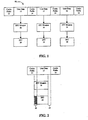
- an OFDM signal 10 is transmitted as blocks of user data 12 separated by guard intervals known as cyclic prefixes 14.
- a cyclic prefix 14 is a copy of a portion of an adjacent block of user data 12 and is used to reduce Inter-Symbol Interference (ISI) caused by multipath fading. More particularly, only cyclic prefixes 14, as opposed to user data 12, are effected by ISI, as is known by those skilled in the art. Thus the removal of cyclic prefixes 14 by an OFDM receiver removes the effects of ISI from the received OFDM signal.
- a received OFDM signal 10 is digitized or sampled to convert the OFDM signal from an analog to a digital signal.
- the OFDM receiver applies Fast Fourier Transform (FFT) windows to the OFDM signal to remove the cyclic prefixes from a received OFDM signal.
- FFT Fast Fourier Transform
- an OFDM window 16 only passes user data 12 to an FFT unit 18 and discards cyclic prefixes 14.
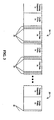
- FFT window 16 may drift beyond the boundaries of user data 12. If this drift occurs, as shown in FIG. 2, a portion or sample 20 of cyclic prefix 14 may be passed to FFT unit 18 and a portion or sample 22 of user data 12 may be lost.
- the window drifting effect may result in the presence of ISI in a received OFDM signal.
- an offset of FFT window 16 will result in a phase rotation in the output of FFT unit 18. The rotation occurs because a time shift in the time domain results in a phase rotation in the frequency domain.
- the phase rotation may generate errors in the user data recovered by the OFDM receiver.
- the present invention is directed to the correction of this problem.
- An OFDM receiver extracts a training symbol from a fast Fourier transformed OFDM signal and processes the extracted training symbol to derive an FFT window adjustment factor and an associated equalizer tap initialization value that is pre-compensated to account for the effects of the FFT window adjustment value.
- the OFDM receiver controls the position of an FFT window and the initialization of equalizer taps using the FFT adjustment factor and equalizer tap initialization value.
- the OFDM receiver preferably filters the fast Fourier transformed OFDM signal to remove additive channel noise and increase the likelihood of reliable equalizer tap initialization in a low SNR environment.
- Symbol frame 30 includes a training sequence or symbol 32 containing known transmission values for each subcarrier in the OFDM carrier, and a predetermined number of cyclic prefix 34 and user data 36 pairs.
- the proposed ETSI-BRAN HIPERLAN/2 (Europe) and IEEE 802.11a (USA) wireless LAN standards assign 64 known values or subsymbols (i.e., 52 non-zero values and 12 zero values) to selected training symbols of a training sequence (e.g., "training symbol C" of the proposed ETSI standard and "long OFDM training symbol” of the proposed IEEE standard).
- User data 36 has a predetermined number of pilots 38, also containing known transmission values, embedded on predetermined subcarriers.
- the proposed ETSI and IEEE standards have four pilots located at bins or subcarriers ⁇ 7 and ⁇ 21.
- system 40 may be embodied in software, hardware, or some combination thereof.
- system 40 may be part of an WLAN adapter that is implemented as a PC card for a notebook or palmtop computer, as a card in a desktop computer, or integrated within a hand-held computer or a home networking terminal.
- System 40 is coupled to a source 42 of OFDM time-domain samples (e.g., the output of an ADC) that has a sampling frequency offset with respect to the sampling frequency of an OFDM transmitter.
- System 40 includes an initial FFT window setting unit 44 coupled to source 42 and an FFT unit 46 coupled to source 42 via a serial to parallel converter 43.
- Initial FFT window setting unit 44 obtains an initial estimate of the FFT window position and triggers FFT unit 46 when the samples from source 42 fall within the estimated window position.
- Initial FFT window setting unit 44 may use known window synch techniques such as detection of cross-correlation peaks or autocorrelation peaks of a known training sequence (e.g., training sequence 32 of FIG. 3).
- Initial FFT window setting unit 44 obtains an approximate (within several samples of the correct window position) initial estimate of the window position. Afterwards, the window position is finely adjusted, as described in further detail below. It should be noted that the coarse FFT window position set by unit 44 is preferably within a known sample range from the correct FFT window setting.
- the output of FFT unit 46 is passed to downstream processing units 48 and to a preliminary frequency-domain tap computation unit 50.
- Downstream processing units 48 include an equalizer (shown in FIG. 5) for reducing the multipath distortion effects of the channel that the OFDM signal is transmitted through.
- Preliminary frequency-domain tap computation unit 50 computes preliminary frequency-domain equalizer tap values using a training symbol (e.g., a training symbol within training sequence 32 of FIG. 3) stored in a memory 52.
- a conventional technique for computing a tap value for each subcarrier is to set the tap for a subcarrier equal to the training subsymbol known to be transmitted on the subcarrier (as stored in memory 52) divided by the actual subsymbol output from FFT unit 46 on the subcarrier.
- the preliminary frequency-domain equalizer tap values are passed to a channel estimate unit 54 that inverts the equalizer tap values to form an estimate of the channel frequency response.
- an alternative method for deriving the estimated channel frequency response is to solve for the channel estimate directly by dividing the output of FFT unit 46 by the known training symbol).
- a more precise channel estimate can be formed by averaging channel estimates over multiple training symbols.
- the channel estimate is passed to an IFFT unit 58 (either directly or via an optional noise reduction unit 56 described in further detail below) that applies an Inverse Fast Fourier Transform such that the frequency-domain channel estimate is transformed into a time-domain channel estimate.
- the time-domain channel estimate is passed to a peak detector 60 that monitors the output of IFFT unit 58 for a maximum peak in the magnitude of the time-domain channel estimate.
- Peak detection unit 60 passes the time-domain channel estimate (either directly or via an optional noise reduction unit 64 described in further detail below) to a channel estimate adjustment unit 66. Peak detection unit 60 also outputs an index of a maximum peak within the channel estimate to channel estimate adjustment unit 66 as well as to an FFT window adjustment unit 62.
- a comparator circuit may be used to detect the maximum peak.
- the comparator circuit monitors the magnitudes of the samples of the channel estimate and outputs the index of the sample having the largest magnitude.
- the index of the maximum peak corresponds to the strongest path of the OFDM channel (i.e., the OFDM subcarrier having the strongest path) and is compared to the FFT window location.
- the index of the main peak aligns with the beginning of the FFT window since the OFDM receiver is programmed to lock onto the OFDM signal that is from the strongest path.
- a FFT window offset is present there will be a number of time-domain samples between the beginning of the FFT window and the index of the maximum peak.
- FFT window adjustment unit 62 can derive the window offset by counting the number of samples between the peak index and the beginning of the FFT window. Afterwards, FFT window adjustment unit 62 finely adjusts the window setting of FFT 46 to remove the window offset. To reduce the time and/or hardware required to locate a channel estimate peak, the search may be limited to a subset of channel estimate samples. For example, it may be known that the channel estimate will be within a subset of the time domain estimate samples since the initial FFT window setting unit 44 sets the initial FFT window within a known range from the correct FFT window setting, as discussed above.
- Adjusting the FFT window introduces a phase shift in the output of FFT 46.
- the output of FFT 46 is passed to downstream processing units 48 including a downstream equalizer 72. If the phase shift generated by the adjustment of the FFT window is not compensated for when initializing the equalizer taps of equalizer 72, equalizer 72 will observe a discrete phase jump in the phase of the OFDM data received from FFT 46. The phase jump will cause sub-optimal equalizer performance as equalizer 72 attempts to compensate for the channel effects.
- Channel estimate adjustment unit 66 pre-compensates for the phase jump. More specifically, channel estimate adjustment unit 66 utilizes the maximum peak index received from peak detector 60 to circularly shift the channel estimate in the time domain such that a time shift representing the incorrect FFT window position is removed. In other words, the channel estimate is shifted in the time domain such that the equalizer taps derived from the channel estimate are pre-compensated for the discrete phase jump that occurs in the frequency-domain output of FFT 46 after the window of FFT 46 is finely adjusted.
- the pre-compensated channel estimate is passed to an FFT 68 (either directly or via an optional noise reduction unit 64 described in further detail below) that applies a Fast Fourier Transform to the pre-compensated channel estimate.
- FFT Fast Fourier Transform
- Application of the FFT transforms the pre-compensated time-domain channel estimate into a pre-compensated frequency-domain channel estimate.
- the pre-compensated frequency-domain channel estimate is passed to a channel estimate inverter 70 that inverts the pre-compensated frequency-domain channel estimate to form pre-compensated equalizer tap initialization values.
- the pre-compensated equalizer tap initialization values are pre-compensated for the phase rotation that will occur in the Fast Fourier Transformed OFDM signal output from FFT 46 after the fine adjustment of the FFT window.
- the pre-compensated equalizer tap initialization values are passed to a downstream equalizer 72 to facilitate initialization thereof.
- the channel estimate may be passed through noise reduction unit or filter 56 (in the frequency domain) or through noise reduction unit or filter 64 (in the time domain) of the present invention.
- the noise reduction units 56 and 64 reduce the additive noise contained in the channel estimate. More specifically, in systems complying with the proposed ETSI or IEEE standards, the training symbol that is used to initialize a frequency-domain equalizer may be denoted by X and the frequency response of the channel may be denoted by C.
- Conventional OFDM receivers set a channel response estimate C' equal to Y/X and compute the initial equalizer taps as 1/C' or X/Y.
- Noise reduction unit 56 reduces the additive channel noise contained in the frequency-domain channel estimate by performing a low-order polynomial fit of the channel estimate to obtain the least-squares fit of the noisy channel estimate. Obtaining the least-squares fit of the noisy channel estimate is equivalent to "averaging" out the noise.
- the order of the polynomial is based on the order of a typical channel determined empirically by analyzing a collection of channel models to compute an estimate of the upper-bound of the polynomial order. A low-order polynomial fit will approximate the actual channel response which is changing slowly in frequency and will not follow the noisy which is changing rapidly in frequency.
- Noise reduction unit 64 reduces the additive channel noise contained in the time-domain channel estimate by zeroing out any taps outside of a predetermined range centered around the main channel tap.
- the predetermined range is equivalent to the estimated order of the polynomial used in the low-order polynomial fit of noise reduction unit 56. Zeroing out the taps outside of the predetermined range preserves the significant taps of the channel response while discarding the low-power unreliable taps which are mostly related to the rapidly changing in frequency noise components of the channel response estimate.
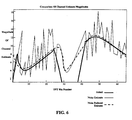
- noise reduction unit 56 or noise reduction unit 64 Utilizing either noise reduction unit 56 or noise reduction unit 64 in a noisy environment results in a channel estimate that more closely approximates the actual channel frequency response in a noiseless environment, as shown in FIGS. 6 and 7.
- System 74 may be utilized when additional time is available for noise reduction (e.g., during initialization of a WLAN receiver or home networking terminal).
- System 74 includes the channel estimate unit 54, IFFT unit 58, peak detection unit 60, and noise reduction unit 64, described above, as well as an FFT unit 76 and channel estimate modifier 78 in a feedback loop between noise reduction unit 64 and channel estimate unit 54.
- channel estimate unit 54 forms an estimate of the channel frequency response. It should be noted that the channel estimate only represents a subset of the subcarriers carrying the training sequence.
- channel estimate unit 54 sets the value of the 12 subcarriers to a default value (e.g., zero).
- the default value masks the actual values of the channel estimate for the 12 subcarriers.
- System 74 is utilized to approximate the masked values of the channel estimate, as discussed in further detail below.
- the channel estimate is passed to IFFT unit 58 which applies an Inverse Fast Fourier Transform such that the frequency-domain channel estimate is transformed into a time-domain channel estimate.
- the time-domain channel estimate is passed to peak detector 60 which monitors the output of IFFT unit 58 for a maximum peak in the magnitude of the time-domain channel estimate, as discussed above.
- Peak detection unit 60 passes the time-domain channel estimate, via noise reduction unit 64, to channel estimate adjustment unit 66. Peak detection unit 60 also outputs an index of a maximum peak within the channel estimate to channel estimate adjustment unit 66 as well as to FFT window adjustment unit 62.
- noise reduction unit 64 reduces the additive channel noise contained in the time-domain channel estimate by zeroing out any taps outside of a predetermined range centered around the main channel tap.
- noise reduction unit 64 passes the time-domain channel estimate to channel estimate adjustment unit 66 after the channel estimate is fed back to channel estimate unit 54 a predetermined number of times. More specifically, the time-domain channel estimate is passed to FFT unit 76 which transforms the time-domain channel estimate into a frequency-domain channel estimate. Afterwards, the frequency-domain channel estimate is passed to channel estimate modifier 78 which modifies the channel estimate output from channel estimator 54.
- channel estimate modifier 78 sets the masked subcarriers output from channel estimator 54 equal to the values of the corresponding subcarriers output from FFT unit 76.
- Channel estimate modifier 78 also sets the non-zero subcarriers (i.e., non-masked subcarriers) of the channel estimate equal to the values originally provided by channel estimator 54.
- noise reduction unit 64 passes the recursively filtered channel estimate to channel estimate adjustment unit 66 which further processes the channel estimate (now including approximations for the masked subcarriers), as described above.
- an OFDM receiver extracts a training symbol from a fast Fourier transformed OFDM signal and processes the extracted training symbol to derive an FFT window adjustment factor and an associated equalizer tap initialization value.
- the OFDM receiver controls the position of an FFT window and the initialization of equalizer taps using the FFT adjustment factor and equalizer tap initialization value.
- the OFDM receiver preferably filters the fast Fourier transformed OFDM signal to remove additive channel noise and increase the likelihood of reliable equalizer tap initialization in a low SNR environment.
Landscapes
- Engineering & Computer Science (AREA)
- Computer Networks & Wireless Communication (AREA)
- Signal Processing (AREA)
- Cable Transmission Systems, Equalization Of Radio And Reduction Of Echo (AREA)
Abstract
Description
Claims (20)
- A method of processing an Orthogonal Frequency Division Multiplexed (OFDM) signal in an OFDM receiver, the method characterized by the steps of:Fast Fourier Transforming (46) a received OFDM signal;Extracting (50, 52) a training symbol from the Fast Fourier Transformed OFDM signal;Processing (60) the extracted training symbol to derive an FFT window adjustment value and an associated equalizer tap initialization value; andControlling (62) a position of an FFT window and an initialization of an equalizer tap using the FFT window adjustment value and the associated equalizer tap initialization value.
- The method of claim 1, characterized in that the OFDM receiver is implemented in one of a wireless LAN adapter, home networking terminal, a portable terminal, and a desktop terminal.
- The method of claim 1, characterized in that the window adjustment value represents a window drift correction.
- The method of claim 3, characterized in that the equalizer tap initialization value is pre-compensated to negate the effect of the window drift correction on an equalizer tap.
- The method of claim 1, characterized in that the step of processing the extracted training symbol includes the steps of:deriving a channel response (54) from the extracted training symbol; andobtaining the FFT window adjustment value (62) and the associated equalizer tap initialization value (66) from the derived channel response.
- The method of claim 5, further characterized by the step of:filtering (56, 64) additive noise from the channel response.
- The method of claim 6, characterized in that the step of filtering occurs in the time domain (64).
- The method of claim 6, characterized in that the step of filtering occurs in the frequency domain (56).
- The method of claim 5, further characterized by the step of:recursively filtering (74) the channel response to approximate a value for a masked subcarrier within the channel response.
- A system for processing an Orthogonal Frequency Division Multiplexed (OFDM) signal, the system characterized by:a Fast Fourier Transform (FFT) module (46) coupled to a source (42) of OFDM signals, the FFT module (46) applying an FFT window to an OFDM signal to remove a cyclic prefix from the OFDM signal, and Fast Fourier Transforming the windowed OFDM signal;an equalizer module (72) coupled to the FFT module, the equalizer module removing a channel distortion from the transformed OFDM signal; andan adjustment module (60, 62, 66) coupled to the FFT module (46) and the equalizer module (72), the adjustment module (60, 62, 66) extracting a training sequence from the transformed OFDM signal and controlling the application of the FFT window and an initialization of the equalizer module in response to the extracted training sequence.
- The system of claim 10, characterized in that the system is implemented in one of a wireless LAN adapter, home networking terminal, a portable terminal, and a desktop terminal.
- The system of claim 10, characterized in that the adjustment module controls the initialization of the equalizer module (72) such that an equalizer tap of the equalizer module (72) is pre-compensated for an adjustment in the application of the FFT window by the adjustment module.
- The system of claim 10, characterized in that the adjustment module includes:a training sequence extraction unit (50, 52) coupled to the FFT module (46), the training sequence extraction unit extracting (50, 52) the training sequence from the transformed OFDM signal; anda channel response (54) unit coupled to the training extraction unit, the channel response unit (54) deriving a channel response from the extracted training sequence.
- The system of claim 13, characterized in that the adjustment module further includes:a peak detection unit (60) coupled to the channel response unit (54), the peak detection unit (60) detecting a maximum peak in the derived channel response;an FFT window adjustment unit (62) coupled to the peak detection unit (60) and the FFT module (46), the FFT window adjustment unit (62) adjusting the application of the FFT window in response to the detected maximum peak of the channel response; anda channel estimate adjustment unit (66) coupled to the peak detection unit and the equalizer module (72), the channel estimate adjustment unit (66) adjusting the initialization values of an equalizer tap of the equalizer module (72) in response to the detected maximum peak of the channel response.
- The system of claim 13, characterized in that the adjustment module further includes:a noise reduction filter (56, 64) coupled to the channel response unit (54), the noise reduction filter filtering additive noise from the channel response.
- The system of claim 15, characterized in that the noise reduction unit operates in the frequency domain.
- The system of claim 15, characterized in that the noise reduction unit operates in the time domain.
- The system of claim 15, characterized in that the noise reduction unit is a recursive filter (74) that approximates a value for a masked subcarrier within the channel response.
- An apparatus for correcting for a Fast Fourier Transform (FFT) window drift in an Orthogonal Frequency Division Multiplexing (OFDM) receiver, the apparatus characterized by:means for receiving (42) an OFDM signal;means for applying (44) an FFT window to the received OFDM signal;means for Fast Fourier Transforming (46) the windowed OFDM signal;means for equalizing (72) the transformed OFDM signal;means for detecting (60, 62) a window drift in the application of the FFT window; andmeans for adjusting (60, 62) the application of the FFT window to reduce the detected window drift and for adjusting (66) the initialization of the means for equalizing such that the means for equalizing is pre-compensated for the effects of the reduction of the window drift.
- The apparatus of claim 19, further characterized by:means for reducing noise (56, 64) in the transformed OFDM signal.
Applications Claiming Priority (2)
| Application Number | Priority Date | Filing Date | Title |
|---|---|---|---|
| US630005 | 2000-07-31 | ||
| US09/630,005 US6771591B1 (en) | 2000-07-31 | 2000-07-31 | Method and system for processing orthogonal frequency division multiplexed signals |
Publications (2)
| Publication Number | Publication Date |
|---|---|
| EP1178642A2 true EP1178642A2 (en) | 2002-02-06 |
| EP1178642A3 EP1178642A3 (en) | 2005-06-22 |
Family
ID=24525359
Family Applications (1)
| Application Number | Title | Priority Date | Filing Date |
|---|---|---|---|
| EP01401967A Withdrawn EP1178642A3 (en) | 2000-07-31 | 2001-07-23 | Symbol timing recovery in a multicarrier receiver |
Country Status (8)
| Country | Link |
|---|---|
| US (1) | US6771591B1 (en) |
| EP (1) | EP1178642A3 (en) |
| JP (1) | JP2002101069A (en) |
| KR (1) | KR100793759B1 (en) |
| CN (1) | CN100386980C (en) |
| BR (1) | BR0103151A (en) |
| MX (1) | MXPA01007703A (en) |
| MY (1) | MY126924A (en) |
Cited By (24)
| Publication number | Priority date | Publication date | Assignee | Title |
|---|---|---|---|---|
| GB2388500A (en) * | 2002-05-09 | 2003-11-12 | Sony Uk Ltd | Noise burst estimation and cancellation in OFDM carriers |
| FR2840142A1 (en) * | 2002-05-24 | 2003-11-28 | Dibcom | System for synchronization upon reception of a signal and echoes, used in terrestrial digital television, involves determining minimum interference level times which correspond to markers of beginning of symbols and their duration |
| WO2003105432A1 (en) * | 2002-06-10 | 2003-12-18 | Fraunhofer-Gesellschaft zur Förderung der angewandten Forschung e. V. | Method and device for carrying out a channel estimation in the presence of phase shifts |
| FR2858143A1 (en) * | 2003-07-22 | 2005-01-28 | Samsung Electronics Co Ltd | METHOD AND APPARATUS FOR REDUCING PULSE NOISE IN A MULTI-CARRIER MODULATION SIGNAL |
| EP1422850A4 (en) * | 2001-08-28 | 2006-04-05 | Matsushita Electric Industrial Co Ltd | TROUBLESHOOTING DEVICE AND METHOD WITH SEVERAL PASSAGES |
| WO2006099242A1 (en) * | 2005-03-10 | 2006-09-21 | Qualcomm Incorporated | Trend influenced symbol time tracking for an ifdm communication system |
| US7139340B2 (en) | 2002-06-28 | 2006-11-21 | Hitachi, Ltd. | Robust OFDM carrier recovery methods and apparatus |
| EP1531592A3 (en) * | 2003-11-11 | 2006-11-22 | NTT DoCoMo, Inc. | OFDM receiver |
| US7173991B2 (en) | 2002-06-17 | 2007-02-06 | Hitachi, Ltd. | Methods and apparatus for spectral filtering channel estimates |
| US7209433B2 (en) | 2002-01-07 | 2007-04-24 | Hitachi, Ltd. | Channel estimation and compensation techniques for use in frequency division multiplexed systems |
| EP1737173A3 (en) * | 2005-06-20 | 2008-05-07 | Fujitsu Limited | Receiver for orthogonal frequency division multiplexing transmission |
| WO2008049076A3 (en) * | 2006-10-18 | 2008-06-19 | Genesis Microchip Inc | Symbol synchronization using phase discontinuity for dvb-t systems in awgn channels |
| US7418026B2 (en) | 2002-05-09 | 2008-08-26 | Sony United Kingdom Limited | Receiver for a multi-carrier modulated symbol |
| EP2023560A1 (en) * | 2007-08-09 | 2009-02-11 | Alcatel Lucent | Apparatus and method for controlling the timing delay of radio terminals in an OFDM-type radio network |
| EP1525688A4 (en) * | 2002-07-31 | 2010-06-23 | Thomson Licensing | CENTRALIZED BUFFER ARCHITECTURE FOR ORTHOGONAL FREQUENCY DIVISION MULTIPLEXING RECEIVER (OFDM) |
| CN101431500B (en) * | 2008-10-27 | 2011-04-27 | 宁波大学 | Modulation method of anti-fading digital TV terrestrial broadcasting transmitter |
| WO2011060441A3 (en) * | 2009-11-16 | 2011-07-14 | Maxlinear, Inc. | Apparatus & methods for symbol timing error detection, tracking and correction |
| EP1895780A3 (en) * | 2006-08-30 | 2012-04-25 | Advanced Micro Devices, Inc. | Frame synchronization for a video receiver |
| FR2969435A1 (en) * | 2010-12-20 | 2012-06-22 | France Telecom | IMPULSIVE NOISE MEASUREMENT BY SPECTRAL DETECTION |
| US8300712B2 (en) | 2005-09-23 | 2012-10-30 | Koninklijke Philips Electronics N.V. | Equalization for zero prefix OFDM systems |
| US8422614B2 (en) | 2005-10-31 | 2013-04-16 | Qualcomm Incorporated | Methods and apparatus for determining timing in a wireless communication system |
| EP2670102A1 (en) * | 2012-05-31 | 2013-12-04 | Mitsubishi Electric R&D Centre Europe B.V. | Method and device for synchronizing a receiver on received preamble symbol |
| US8675631B2 (en) | 2005-03-10 | 2014-03-18 | Qualcomm Incorporated | Method and system for achieving faster device operation by logical separation of control information |
| US8948329B2 (en) | 2005-12-15 | 2015-02-03 | Qualcomm Incorporated | Apparatus and methods for timing recovery in a wireless transceiver |
Families Citing this family (54)
| Publication number | Priority date | Publication date | Assignee | Title |
|---|---|---|---|---|
| JP4272309B2 (en) * | 1998-10-29 | 2009-06-03 | パナソニック株式会社 | OFDM communication device |
| US6912258B2 (en) * | 2000-07-07 | 2005-06-28 | Koninklijke Philips Electtronics N.V. | Frequency-domain equalizer for terrestrial digital TV reception |
| GB2369015A (en) * | 2000-11-09 | 2002-05-15 | Sony Uk Ltd | Receiver that uses guard signals to estimate synchronisation position |
| US7054375B2 (en) * | 2000-12-22 | 2006-05-30 | Nokia Corporation | Method and apparatus for error reduction in an orthogonal modulation system |
| US7248652B2 (en) * | 2001-02-28 | 2007-07-24 | Agere Systems Inc. | Method and apparatus for recovering timing information in orthogonal frequency division multiplexing (OFDM) systems |
| US7218691B1 (en) | 2001-03-05 | 2007-05-15 | Marvell International Ltd. | Method and apparatus for estimation of orthogonal frequency division multiplexing symbol timing and carrier frequency offset |
| US8619922B1 (en) | 2002-02-04 | 2013-12-31 | Marvell International Ltd. | Method and apparatus for acquisition and tracking of orthogonal frequency division multiplexing symbol timing, carrier frequency offset and phase noise |
| US20020176519A1 (en) * | 2001-03-08 | 2002-11-28 | Alain Chiodini | Coarse frequency offset estimation |
| US6940914B1 (en) | 2001-06-11 | 2005-09-06 | Cingular Wireless Ii, Llc | Turbo channel estimation for OFDM systems |
| US7088787B2 (en) * | 2001-09-24 | 2006-08-08 | Atheros Communications, Inc. | Post-FFT scaling to reduce multiple effects |
| JP2003319005A (en) * | 2002-02-20 | 2003-11-07 | Mitsubishi Electric Corp | Symbol timing correction circuit, receiver, symbol timing correction method, and demodulation processing method |
| US7239679B2 (en) * | 2002-05-29 | 2007-07-03 | Zenith Electronics Corporation | Adaptive thresholding algorithm for the noise due to unknown symbols in correlation based channel impulse response (CIR) estimate |
| KR100439959B1 (en) * | 2002-06-22 | 2004-07-12 | 전자부품연구원 | A channel estimator |
| US20040005010A1 (en) * | 2002-07-05 | 2004-01-08 | National University Of Singapore | Channel estimator and equalizer for OFDM systems |
| KR100442882B1 (en) * | 2002-07-26 | 2004-08-02 | 삼성전자주식회사 | Methods for station recognition and link establishment in Home-network |
| KR100447201B1 (en) * | 2002-08-01 | 2004-09-04 | 엘지전자 주식회사 | Channel equalizer and digital TV receiver using for the same |
| US7796574B2 (en) * | 2002-09-10 | 2010-09-14 | Texas Instruments Incorporated | Multi-carrier reception for ultra-wideband (UWB) systems |
| GB2395094A (en) * | 2002-10-28 | 2004-05-12 | Sony Uk Ltd | Determining a symbol synch time in an OFDM receiver |
| KR100463544B1 (en) * | 2002-12-14 | 2004-12-29 | 엘지전자 주식회사 | Channel equalizer and digital TV receiver using for the same |
| US7639600B1 (en) | 2003-02-12 | 2009-12-29 | Marvell International Ltd. | Low complexity channel estimation for orthogonal frequency division modulation systems |
| US7792184B2 (en) * | 2003-04-24 | 2010-09-07 | Qualcomm Incorporated | Apparatus and method for determining coefficient of an equalizer |
| KR100987244B1 (en) * | 2003-07-25 | 2010-10-12 | 에스케이 텔레콤주식회사 | Data transmission method in ODF system wireless LAN system |
| US20050073947A1 (en) * | 2003-10-02 | 2005-04-07 | Texas Instruments Incorporated | Channel estimator for a receiver and method of operation thereof |
| US8391413B2 (en) | 2003-12-19 | 2013-03-05 | Qualcomm Incorporated | Channel estimation for an OFDM communication system with inactive subbands |
| US7412005B2 (en) * | 2004-02-19 | 2008-08-12 | Nokia Corporation | Method and apparatus providing time domain interpolated channel estimation with advanced noise suppression for multicarrier transmissions |
| US7532565B2 (en) * | 2004-05-07 | 2009-05-12 | Texas Instruments Incorporated | Mapping data tones onto guard tones for a multi-band OFDM system |
| EP1782594A1 (en) * | 2004-08-20 | 2007-05-09 | NTT DoCoMo, Inc. | Apparatus and method for reducing a phase drift |
| CN100446559C (en) * | 2004-12-30 | 2008-12-24 | 电子科技大学 | A dual-domain data isomorphic framing method for terrestrial digital television transmission system |
| US7778336B1 (en) * | 2005-02-09 | 2010-08-17 | Marvell International Ltd. | Timing and frequency synchronization of OFDM signals for changing channel conditions |
| US8428001B2 (en) * | 2005-03-10 | 2013-04-23 | Qualcomm Incorporated | Timing corrections in a multi carrier system and propagation to a channel estimation time filter |
| US7609773B2 (en) | 2005-04-18 | 2009-10-27 | Qualcomm Incorporated | Method of determining the location of the FFT window and the delay spread for the platinum broadcast channel estimator |
| DE602006009496D1 (en) * | 2005-04-21 | 2009-11-12 | Ericsson Telefon Ab L M | DOPPLER SPREADING ESTIMATION FOR OFDM SYSTEMS |
| US7474611B2 (en) * | 2005-04-21 | 2009-01-06 | Telefonaktiebolaget L M Ericsson (Publ) | Reduced complexity channel estimation in OFDM systems |
| US7646833B1 (en) * | 2005-05-23 | 2010-01-12 | Marvell International Ltd. | Channel equalization in receivers |
| CN101026433B (en) * | 2006-02-24 | 2010-08-25 | 上海无线通信研究中心 | A SNR Estimation Method for Adaptive Modulation Coding |
| US7822156B2 (en) * | 2006-06-01 | 2010-10-26 | Realtek Semiconductor Corp | Channel estimation |
| US7580468B2 (en) * | 2006-07-28 | 2009-08-25 | Samsung Electronics Co., Ltd. | Synchronization circuits, orthogonal frequency division multiplexing (OFDM) receivers, and related methods and computer program products |
| TWI329435B (en) * | 2006-09-13 | 2010-08-21 | Sunplus Technology Co Ltd | Channel estimation apparatus with an optimal search and method thereof |
| US7769094B2 (en) * | 2006-11-10 | 2010-08-03 | Telefonaktiebolaget L M Ericsson (Publ) | Arrangement and method for reducing the impact of interfering signals in a communication system |
| US8098567B2 (en) * | 2007-03-05 | 2012-01-17 | Qualcomm Incorporated | Timing adjustments for channel estimation in a multi carrier system |
| US20080219332A1 (en) * | 2007-03-05 | 2008-09-11 | Qualcomm Incorporated | Apparatus and methods accounting for automatic gain control in a multi carrier system |
| EP3675396B1 (en) * | 2008-03-31 | 2021-07-28 | Panasonic Intellectual Property Management Co., Ltd. | Receiver, method of reception, reception program, integrated circuit, and digital television |
| CN101286760B (en) * | 2008-06-02 | 2011-12-21 | 美商威睿电通公司 | Channel estimating device and method in orthogonal frequency division multiplexing system |
| TWI411257B (en) * | 2008-06-24 | 2013-10-01 | Via Telecom Inc | Channel estimation device and method for orthogonal frequency division multiplexing system |
| JP4626698B2 (en) * | 2008-09-29 | 2011-02-09 | ソニー株式会社 | Information processing apparatus and method, display apparatus, and program |
| CN101383805B (en) * | 2008-10-27 | 2010-12-01 | 宁波大学 | Modulation Method for Digital TV Terrestrial Broadcasting Transmitter with Time Domain Training Sequence |
| CN101383806B (en) * | 2008-10-27 | 2010-12-22 | 宁波大学 | Digital television ground broadcast transmitter space-frequency modulation method having time-domain training sequence |
| CN101383803B (en) * | 2008-10-27 | 2010-10-27 | 宁波大学 | Space Frequency Modulation Method for Digital TV Terrestrial Broadcasting Transmitter Based on Embedded Training Sequence |
| KR101225182B1 (en) * | 2008-11-04 | 2013-01-22 | 한국전자통신연구원 | method for transmitting common feedback channel and tranceiver therefor |
| CN102484549B (en) * | 2009-07-17 | 2015-02-18 | 日本电信电话株式会社 | Frequency-domain multiplexing signal receiving method and frequency-domain multiplexing signal receiving device |
| US8582698B2 (en) * | 2010-05-10 | 2013-11-12 | Telefonaktiebolaget Lm Ericsson (Publ) | Reduced complexity timing estimation for locating the position of a mobile terminal |
| EP2633660A4 (en) * | 2010-10-25 | 2016-02-17 | Ericsson Telefon Ab L M | Method and arrangement in wireless communications system |
| CN103023830A (en) * | 2012-12-05 | 2013-04-03 | 无锡创灵科技有限公司 | Turbo iteration detecting device and method directing at big carrier frequency excursion |
| CN110691052B (en) * | 2018-07-06 | 2021-11-23 | 扬智科技股份有限公司 | Symbol synchronization method and signal receiving circuit |
Family Cites Families (27)
| Publication number | Priority date | Publication date | Assignee | Title |
|---|---|---|---|---|
| SG44771A1 (en) * | 1991-02-28 | 1997-12-19 | Philips Electronics Nv | System for broadcasting and receiving digital data receiver and transmitter for use in such system |
| US5282222A (en) | 1992-03-31 | 1994-01-25 | Michel Fattouche | Method and apparatus for multiple access between transceivers in wireless communications using OFDM spread spectrum |
| US5285474A (en) | 1992-06-12 | 1994-02-08 | The Board Of Trustees Of The Leland Stanford, Junior University | Method for equalizing a multicarrier signal in a multicarrier communication system |
| FR2732178A1 (en) | 1995-03-22 | 1996-09-27 | Philips Electronique Lab | DIGITAL TRANSMISSION SYSTEM WITH CASCADE EQUALIZER RECEIVER |
| CA2202752A1 (en) | 1995-08-16 | 1997-02-27 | Norbert Jeanne Louis Philips | Transmission system with improved symbol processing |
| JP3554465B2 (en) * | 1996-05-20 | 2004-08-18 | シャープ株式会社 | Orthogonal frequency division multiplexing demodulator |
| US5995568A (en) * | 1996-10-28 | 1999-11-30 | Motorola, Inc. | Method and apparatus for performing frame synchronization in an asymmetrical digital subscriber line (ADSL) system |
| US6359938B1 (en) * | 1996-10-31 | 2002-03-19 | Discovision Associates | Single chip VLSI implementation of a digital receiver employing orthogonal frequency division multiplexing |
| US5953311A (en) | 1997-02-18 | 1999-09-14 | Discovision Associates | Timing synchronization in a receiver employing orthogonal frequency division multiplexing |
| KR100226698B1 (en) * | 1996-12-28 | 1999-10-15 | 전주범 | Channel equalizer for use in ofdm receiving system |
| SE9703629L (en) | 1997-03-03 | 1998-09-04 | Telia Ab | Improvements to, or with respect to, synchronization |
| SE9703630L (en) | 1997-03-03 | 1998-09-04 | Telia Ab | Improvements to, or with respect to, synchronization |
| JP3726857B2 (en) | 1997-05-02 | 2005-12-14 | ソニー株式会社 | Receiving apparatus and receiving method |
| DE19733825A1 (en) * | 1997-08-05 | 1999-02-11 | Siemens Ag | Method and arrangement for combined measurement of the start of a data block and the carrier frequency offset in a multicarrier transmission system for irregular transmission of data blocks |
| KR100224864B1 (en) | 1997-08-20 | 1999-10-15 | 윤종용 | Equalization Methods and Equalizers for OFDM Receivers |
| KR100224863B1 (en) | 1997-08-20 | 1999-10-15 | 윤종용 | Equalization Methods and Equalizers for OFDM Receivers |
| KR100234329B1 (en) | 1997-09-30 | 1999-12-15 | 윤종용 | FFT window position recovery apparatus for OFDM system receiver and method thereof |
| KR100234330B1 (en) | 1997-09-30 | 1999-12-15 | 윤종용 | The grard interval length detection for OFDM system and method thereof |
| KR100265735B1 (en) | 1997-11-25 | 2000-09-15 | 윤종용 | OFDM receiver for jointing FFT window position recovery and sampling clock control and method therefor |
| JP2934225B1 (en) * | 1998-04-06 | 1999-08-16 | 株式会社次世代デジタルテレビジョン放送システム研究所 | OFDM demodulator |
| KR100314353B1 (en) * | 1998-04-28 | 2001-12-28 | 전주범 | Ofdm receiver system |
| FI106592B (en) * | 1998-05-07 | 2001-02-28 | Nokia Multimedia Network Termi | Method and arrangement to achieve and maintain symbol synchronization especially in an OFDM system |
| US6483553B1 (en) * | 1998-05-15 | 2002-11-19 | Lg Electronics Inc. | TV receiver for digital/analog combined use |
| JP4410388B2 (en) * | 1999-06-22 | 2010-02-03 | パナソニック株式会社 | OFDM demodulation apparatus and OFDM demodulation method |
| US6487253B1 (en) * | 1999-10-04 | 2002-11-26 | Cisco Technology, Inc. | OFDM channel estimation in the presence of interference |
| US6650617B1 (en) * | 2000-02-22 | 2003-11-18 | Thomson Licensing S.A. | Reduced complexity FFT window synchronization for an orthogonal frequency division multiplexing system |
| JP4648149B2 (en) * | 2005-09-30 | 2011-03-09 | 本田技研工業株式会社 | Fuel cell motorcycle |
-
2000
- 2000-07-31 US US09/630,005 patent/US6771591B1/en not_active Expired - Fee Related
-
2001
- 2001-07-23 EP EP01401967A patent/EP1178642A3/en not_active Withdrawn
- 2001-07-27 MY MYPI20013565 patent/MY126924A/en unknown
- 2001-07-28 KR KR1020010045727A patent/KR100793759B1/en not_active Expired - Fee Related
- 2001-07-30 MX MXPA01007703A patent/MXPA01007703A/en active IP Right Grant
- 2001-07-30 CN CNB011244941A patent/CN100386980C/en not_active Expired - Fee Related
- 2001-07-30 BR BR0103151-1A patent/BR0103151A/en not_active IP Right Cessation
- 2001-07-31 JP JP2001232130A patent/JP2002101069A/en active Pending
Cited By (39)
| Publication number | Priority date | Publication date | Assignee | Title |
|---|---|---|---|---|
| EP1422850A4 (en) * | 2001-08-28 | 2006-04-05 | Matsushita Electric Industrial Co Ltd | TROUBLESHOOTING DEVICE AND METHOD WITH SEVERAL PASSAGES |
| US7209433B2 (en) | 2002-01-07 | 2007-04-24 | Hitachi, Ltd. | Channel estimation and compensation techniques for use in frequency division multiplexed systems |
| GB2388500A (en) * | 2002-05-09 | 2003-11-12 | Sony Uk Ltd | Noise burst estimation and cancellation in OFDM carriers |
| US7418026B2 (en) | 2002-05-09 | 2008-08-26 | Sony United Kingdom Limited | Receiver for a multi-carrier modulated symbol |
| FR2840142A1 (en) * | 2002-05-24 | 2003-11-28 | Dibcom | System for synchronization upon reception of a signal and echoes, used in terrestrial digital television, involves determining minimum interference level times which correspond to markers of beginning of symbols and their duration |
| WO2003101066A1 (en) * | 2002-05-24 | 2003-12-04 | Dibcom | Method and device for synchronization upon reception of a signal and echoes |
| WO2003105432A1 (en) * | 2002-06-10 | 2003-12-18 | Fraunhofer-Gesellschaft zur Förderung der angewandten Forschung e. V. | Method and device for carrying out a channel estimation in the presence of phase shifts |
| US7173991B2 (en) | 2002-06-17 | 2007-02-06 | Hitachi, Ltd. | Methods and apparatus for spectral filtering channel estimates |
| US7139340B2 (en) | 2002-06-28 | 2006-11-21 | Hitachi, Ltd. | Robust OFDM carrier recovery methods and apparatus |
| EP1525688A4 (en) * | 2002-07-31 | 2010-06-23 | Thomson Licensing | CENTRALIZED BUFFER ARCHITECTURE FOR ORTHOGONAL FREQUENCY DIVISION MULTIPLEXING RECEIVER (OFDM) |
| US7630448B2 (en) | 2003-07-22 | 2009-12-08 | Samsung Electronics Co., Ltd. | Impulse noise reduction to an MCM signal |
| DE102004036880B4 (en) * | 2003-07-22 | 2012-04-19 | Samsung Electronics Co., Ltd. | Method and apparatus for reducing noise in an MCM signal |
| FR2858143A1 (en) * | 2003-07-22 | 2005-01-28 | Samsung Electronics Co Ltd | METHOD AND APPARATUS FOR REDUCING PULSE NOISE IN A MULTI-CARRIER MODULATION SIGNAL |
| EP1531592A3 (en) * | 2003-11-11 | 2006-11-22 | NTT DoCoMo, Inc. | OFDM receiver |
| US7415085B2 (en) | 2003-11-11 | 2008-08-19 | Ntt Docomo, Inc. | OFDM receiver |
| US8165167B2 (en) | 2005-03-10 | 2012-04-24 | Qualcomm Incorporated | Time tracking for a communication system |
| WO2006099242A1 (en) * | 2005-03-10 | 2006-09-21 | Qualcomm Incorporated | Trend influenced symbol time tracking for an ifdm communication system |
| US8675631B2 (en) | 2005-03-10 | 2014-03-18 | Qualcomm Incorporated | Method and system for achieving faster device operation by logical separation of control information |
| US8175123B2 (en) | 2005-03-10 | 2012-05-08 | Qualcomm Incorporated | Collection window positioning using time tracking information |
| US8144824B2 (en) | 2005-03-10 | 2012-03-27 | Qualcomm Incorporated | Trend influenced time tracking |
| EP1737173A3 (en) * | 2005-06-20 | 2008-05-07 | Fujitsu Limited | Receiver for orthogonal frequency division multiplexing transmission |
| US8300712B2 (en) | 2005-09-23 | 2012-10-30 | Koninklijke Philips Electronics N.V. | Equalization for zero prefix OFDM systems |
| US8422614B2 (en) | 2005-10-31 | 2013-04-16 | Qualcomm Incorporated | Methods and apparatus for determining timing in a wireless communication system |
| US8948329B2 (en) | 2005-12-15 | 2015-02-03 | Qualcomm Incorporated | Apparatus and methods for timing recovery in a wireless transceiver |
| EP1895780A3 (en) * | 2006-08-30 | 2012-04-25 | Advanced Micro Devices, Inc. | Frame synchronization for a video receiver |
| WO2008049076A3 (en) * | 2006-10-18 | 2008-06-19 | Genesis Microchip Inc | Symbol synchronization using phase discontinuity for dvb-t systems in awgn channels |
| US7869551B2 (en) | 2006-10-18 | 2011-01-11 | Tamiras Per Pte. Ltd., Llc | Symbol synchronization using phase discontinuity for DVB-T systems in AWGN channels |
| FR2919973A1 (en) * | 2007-08-09 | 2009-02-13 | Alcatel Lucent Sas | DEVICE AND METHOD FOR CONTROLLING TEMPORAL DELAY POSITIONS OF RADIO TERMINALS CONNECTED TO AN OFDM-TYPE RADIO NETWORK |
| EP2023560A1 (en) * | 2007-08-09 | 2009-02-11 | Alcatel Lucent | Apparatus and method for controlling the timing delay of radio terminals in an OFDM-type radio network |
| CN101431500B (en) * | 2008-10-27 | 2011-04-27 | 宁波大学 | Modulation method of anti-fading digital TV terrestrial broadcasting transmitter |
| WO2011060441A3 (en) * | 2009-11-16 | 2011-07-14 | Maxlinear, Inc. | Apparatus & methods for symbol timing error detection, tracking and correction |
| US8548075B2 (en) | 2009-11-16 | 2013-10-01 | Maxlinear, Inc. | Apparatus and methods for symbol timing error detection, tracking and correction |
| US9391767B2 (en) | 2009-11-16 | 2016-07-12 | Maxlinear, Inc. | Apparatus and methods for symbol timing error detection, tracking and correction |
| US9641377B2 (en) | 2009-11-16 | 2017-05-02 | Maxlinear, Inc. | Apparatus and methods for symbol timing error detection, tracking and correction |
| US10218459B2 (en) | 2009-11-16 | 2019-02-26 | Maxlinear, Inc. | Apparatus and methods for symbol timing error detection, tracking and correction |
| WO2012085431A1 (en) * | 2010-12-20 | 2012-06-28 | France Telecom | Impulse noise measurement by spectral detection |
| FR2969435A1 (en) * | 2010-12-20 | 2012-06-22 | France Telecom | IMPULSIVE NOISE MEASUREMENT BY SPECTRAL DETECTION |
| EP2670102A1 (en) * | 2012-05-31 | 2013-12-04 | Mitsubishi Electric R&D Centre Europe B.V. | Method and device for synchronizing a receiver on received preamble symbol |
| JP2013251902A (en) * | 2012-05-31 | 2013-12-12 | Mitsubishi Electric R&D Centre Europe B.V. | Device, method and computer program for synchronizing receiver |
Also Published As
| Publication number | Publication date |
|---|---|
| MY126924A (en) | 2006-10-31 |
| CN100386980C (en) | 2008-05-07 |
| MXPA01007703A (en) | 2002-10-23 |
| JP2002101069A (en) | 2002-04-05 |
| CN1336737A (en) | 2002-02-20 |
| BR0103151A (en) | 2002-04-02 |
| KR100793759B1 (en) | 2008-01-10 |
| US6771591B1 (en) | 2004-08-03 |
| KR20020011096A (en) | 2002-02-07 |
| EP1178642A3 (en) | 2005-06-22 |
Similar Documents
| Publication | Publication Date | Title |
|---|---|---|
| US6771591B1 (en) | Method and system for processing orthogonal frequency division multiplexed signals | |
| US6650617B1 (en) | Reduced complexity FFT window synchronization for an orthogonal frequency division multiplexing system | |
| EP1872550B1 (en) | Trend influenced symbol time tracking for an OFDM communication system | |
| EP1689140A1 (en) | Apparatus and method for compensating for a frequency offset in a wireless communication system | |
| US20120314818A1 (en) | Digital communications receiver and method of estimating residual carrier frequency offset in a received signal | |
| JP2003224537A (en) | Timing synchronization method for wireless network using ofdm | |
| EP1276289B1 (en) | OFDM receiving system for performing system timing synchronization using guard interval and method for the same | |
| US7227835B2 (en) | Method and apparatus for adjacent channel interference reduction in an orthogonal frequency division multiplexing (OFDM) receiver | |
| EP1303092A2 (en) | Selective tap initialization in a multicarrier equaliser | |
| WO2010033280A1 (en) | Channel estimation in ofdm receivers | |
| WO2006065016A1 (en) | Method for estimating frequency/time offset and apparatus using the same in ofdm communication system | |
| EP2146470B1 (en) | Inter-carrier interference reduction for multi-carrier signals | |
| KR100236039B1 (en) | A coarse time acquisition for ofdm | |
| HK1039001B (en) | Reduced complexity fft window synchronization for an orthogonal frequency division multiplexing system | |
| US7760616B2 (en) | Extracting the phase of an OFDM signal sample | |
| Rathkanthiwar et al. | Technical White Paper on “Time and Frequency Synchronization in OFDM” |
Legal Events
| Date | Code | Title | Description |
|---|---|---|---|
| PUAI | Public reference made under article 153(3) epc to a published international application that has entered the european phase |
Free format text: ORIGINAL CODE: 0009012 |
|
| AK | Designated contracting states |
Kind code of ref document: A2 Designated state(s): AT BE CH CY DE DK ES FI FR GB GR IE IT LI LU MC NL PT SE TR |
|
| AX | Request for extension of the european patent |
Free format text: AL;LT;LV;MK;RO;SI |
|
| PUAL | Search report despatched |
Free format text: ORIGINAL CODE: 0009013 |
|
| AK | Designated contracting states |
Kind code of ref document: A3 Designated state(s): AT BE CH CY DE DK ES FI FR GB GR IE IT LI LU MC NL PT SE TR |
|
| AX | Request for extension of the european patent |
Extension state: AL LT LV MK RO SI |
|
| RAP1 | Party data changed (applicant data changed or rights of an application transferred) |
Owner name: THOMSON LICENSING |
|
| 17P | Request for examination filed |
Effective date: 20051125 |
|
| AKX | Designation fees paid |
Designated state(s): DE FR GB IT |
|
| RAP1 | Party data changed (applicant data changed or rights of an application transferred) |
Owner name: THOMSON LICENSING |
|
| 17Q | First examination report despatched |
Effective date: 20120810 |
|
| STAA | Information on the status of an ep patent application or granted ep patent |
Free format text: STATUS: THE APPLICATION IS DEEMED TO BE WITHDRAWN |
|
| 18D | Application deemed to be withdrawn |
Effective date: 20121221 |