EP1178069B1 - A process for preparation of organosilicon compositions - Google Patents
A process for preparation of organosilicon compositions Download PDFInfo
- Publication number
- EP1178069B1 EP1178069B1 EP01117593A EP01117593A EP1178069B1 EP 1178069 B1 EP1178069 B1 EP 1178069B1 EP 01117593 A EP01117593 A EP 01117593A EP 01117593 A EP01117593 A EP 01117593A EP 1178069 B1 EP1178069 B1 EP 1178069B1
- Authority
- EP
- European Patent Office
- Prior art keywords
- unsaturated
- prepolymers
- mixture
- reaction
- prepolymer
- Prior art date
- Legal status (The legal status is an assumption and is not a legal conclusion. Google has not performed a legal analysis and makes no representation as to the accuracy of the status listed.)
- Expired - Lifetime
Links
Classifications
-
- C—CHEMISTRY; METALLURGY
- C08—ORGANIC MACROMOLECULAR COMPOUNDS; THEIR PREPARATION OR CHEMICAL WORKING-UP; COMPOSITIONS BASED THEREON
- C08G—MACROMOLECULAR COMPOUNDS OBTAINED OTHERWISE THAN BY REACTIONS ONLY INVOLVING UNSATURATED CARBON-TO-CARBON BONDS
- C08G65/00—Macromolecular compounds obtained by reactions forming an ether link in the main chain of the macromolecule
- C08G65/02—Macromolecular compounds obtained by reactions forming an ether link in the main chain of the macromolecule from cyclic ethers by opening of the heterocyclic ring
- C08G65/32—Polymers modified by chemical after-treatment
- C08G65/329—Polymers modified by chemical after-treatment with organic compounds
- C08G65/336—Polymers modified by chemical after-treatment with organic compounds containing silicon
-
- C—CHEMISTRY; METALLURGY
- C08—ORGANIC MACROMOLECULAR COMPOUNDS; THEIR PREPARATION OR CHEMICAL WORKING-UP; COMPOSITIONS BASED THEREON
- C08G—MACROMOLECULAR COMPOUNDS OBTAINED OTHERWISE THAN BY REACTIONS ONLY INVOLVING UNSATURATED CARBON-TO-CARBON BONDS
- C08G18/00—Polymeric products of isocyanates or isothiocyanates
- C08G18/06—Polymeric products of isocyanates or isothiocyanates with compounds having active hydrogen
- C08G18/28—Polymeric products of isocyanates or isothiocyanates with compounds having active hydrogen characterised by the compounds used containing active hydrogen
- C08G18/67—Unsaturated compounds having active hydrogen
- C08G18/671—Unsaturated compounds having only one group containing active hydrogen
- C08G18/6715—Unsaturated monofunctional alcohols or amines
-
- C—CHEMISTRY; METALLURGY
- C08—ORGANIC MACROMOLECULAR COMPOUNDS; THEIR PREPARATION OR CHEMICAL WORKING-UP; COMPOSITIONS BASED THEREON
- C08G—MACROMOLECULAR COMPOUNDS OBTAINED OTHERWISE THAN BY REACTIONS ONLY INVOLVING UNSATURATED CARBON-TO-CARBON BONDS
- C08G18/00—Polymeric products of isocyanates or isothiocyanates
- C08G18/06—Polymeric products of isocyanates or isothiocyanates with compounds having active hydrogen
- C08G18/83—Chemically modified polymers
- C08G18/837—Chemically modified polymers by silicon containing compounds
-
- C—CHEMISTRY; METALLURGY
- C08—ORGANIC MACROMOLECULAR COMPOUNDS; THEIR PREPARATION OR CHEMICAL WORKING-UP; COMPOSITIONS BASED THEREON
- C08G—MACROMOLECULAR COMPOUNDS OBTAINED OTHERWISE THAN BY REACTIONS ONLY INVOLVING UNSATURATED CARBON-TO-CARBON BONDS
- C08G65/00—Macromolecular compounds obtained by reactions forming an ether link in the main chain of the macromolecule
- C08G65/02—Macromolecular compounds obtained by reactions forming an ether link in the main chain of the macromolecule from cyclic ethers by opening of the heterocyclic ring
- C08G65/32—Polymers modified by chemical after-treatment
- C08G65/329—Polymers modified by chemical after-treatment with organic compounds
- C08G65/333—Polymers modified by chemical after-treatment with organic compounds containing nitrogen
- C08G65/33348—Polymers modified by chemical after-treatment with organic compounds containing nitrogen containing isocyanate group
Definitions
- This invention relates to a process for the preparation of preferably fluid organosilicon compositions which can be used in adhesive, coating and sealant formulations.
- This process which involves two consecutive steps conducted in the same reactors, as described below, provides prepolymers able to cross-link under normal moisture and room temperature conditions, forming elastomers as a result of hydrolysis of the silicon-alkoxy groups at the chain ends and subsequent condensation of the silanols generated by the hydrolysis process.
- the organosilicon compositions obtained with this process have low viscosity and are particularly suitable for the formulation of single-component moisture-curing adhesives and sealants.
- the critical point of this synthesis process is the synthesis of the unsaturated prepolymer suitable for addition of chlorosilane; for this purpose, a polyether glycol in the form of sodium or potassium alcoholate is chain-extended by coupling with methylene chloride and functionalised at the chain end by reaction with allyl chloride.
- polyethers able to cross-link by means of silicon-alkoxy groups at the chain ends are obtained from polyether prepolymers with isocyanate and allyl alcohol endings; the resulting unsaturated polyurethane structure prepolymers are converted to prepolymers with silicon-alkoxy functionality by addition of alkoxysilanes.
- glycol polyethers are initially converted to terminally unsaturated polyethers by reaction with allyl isocyanate, and then converted to organosilicons by addition of alkoxysilanes.
- the viscosity of the organosilicon prepolymers is improved by eliminating the chain extension and reducing the concentration of carbamate groups in the prepolymers, but requires alkoxysilanes as silylation reagents of the unsaturated polyurethane prepolymers.
- a synthesis route proposed in a large number of patents which does not involve the use of chlorosilanes or alkoxysilanes, and which apparently simplifies the preparation of organosilicons, is based on the addition of an organosilicon coupling agent to a polyether-polyurethane prepolymer with isocyanate groups at the chain ends;
- this coupling agent is a chemical reagent which presents an organic group containing at least one active hydrogen atom according to Zerewitinoff at one end and a silicon-alkoxy reactive group at the other end of its molecule.
- This synthesis route uses a coupling agent in which the group with active hydrogen according to Zerewitinoff is constituted by an alcoholic hydroxyl, a thiol or preferably a primary amine group, which allows easy quantitative addition to the isocyanate group, giving rise to a ureic group.
- organosilicons thus obtained present high viscosity due to the large number of polyurethane groups introduced into the polymer structures and the presence of strongly polar urea groups when alkylene aminoalkoxysilanes are used as coupling agents; it should also be borne in mind that organosilicon coupling agents are in turn obtained by addition of chlorosilanes or alkoxysilanes to olefins, with the result that they still represent an additional cost which must be taken into account.
- a diol polyether is functionalised at the chain end with the acyloyl chloride function by reacting the diol polyether with a dicarboxylic acid dichloride; the reaction with an aminoalkyl alkoxysilane of the polyether thus functionalised allows two silicon-alkoxy groups to be attached to the chain end of the prepolymer via amide bridges.
- aminoalkyl alkoxysilane coupling agents can be alleviated by using aminoalkyl alkoxysilanes with a secondary amine group, as described in US 5539045 and EP 0676403 or in DE 0596360 and US 6001946; an N-phenyl- ⁇ -aminopropyl triethoxysilane is used as coupling agent in the first two patents, and organosilicon coupling agents containing aspartate groups in the others.
- a particular case of a coupling agent is represented by ⁇ - isocyanate propyl trialkoxysilane which is claimed, for example, in WO 9305089 and JP 08143660; organosilicon prepolymers with only two urethane groups per polymer chain and a narrow molecular weight distribution can be prepared with this coupling agent directly from polyether glycols; however, the coupling agent is not easily accessible, requiring silylation of the allyl isocyanate with alkoxysilanes; in addition, the use of this coupling agent does not eliminate the drawback, common to all the others, of introducing urethane polar groups in the immediate vicinity of the reactive silicon-alkoxy group of the organosilicon prepolymer, which makes the wettability of the fillers in the formulations more problematic than that of prepolymers with a different structure such as those claimed in US 3971751, especially in the case of calcium carbonate.
- organosilicon prepolymers are obtained by coupling polyether alcohols with an olefin group at the chain ends with diisocyanates; alkoxysilanes are then added to the unsaturated linear prepolymers with a polyether-polyurethane structure to give organosilicon prepolymers with silicon-alkoxy groups at the chain end.
- the synthesis requires polyethers with a sufficiently high molecular weight and uses pure alkoxysilanes instead of the cheaper chlorosilanes, which should be the preferred silylation agents since they are obtained from them, for example, by the alcoholysis process described in US 4471733.
- alkoxysilanes as silylation agents of unsaturated prepolymers is mandatory when urethane groups are present in the structure, in that chlorosilanes attack the amide NH groups, generating hydrochloric acid, which destroys the silicon-hydrogen bond and disproportions the silanes (J. Org. Chem. 1998, 63, 8515 and ref.).
- organosilicon prepolymer compositions starting from unsaturated polyurethanes obtained in turn from unsaturated monoalcohol polyethers and diisocyanates with a controlled NCO/OH ratio, to which chlorosilanes are added in the presence of methyl or ethyl orthoformates.
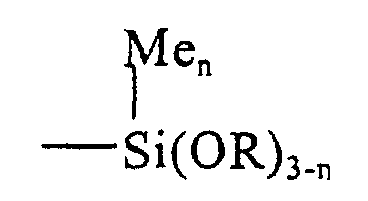
- organosilicon compositions are able to cross-link through silicon-alkoxy end groups of the type:
- the object of the invention is a process for the preparation of organosilicon compositions consisting of prepolymer A or the mixture of prepolymers A+B, the content of B being between 0 and 30% by weight of the mixture, wherein said prepolymers have the following structural formulas: wherein:
- the said process comprises the following two steps, which are carried out in a single reactor:
- E is coupled to F in the ratio NCO/OH ⁇ 1.0 and ⁇ 1.25; all compositions of A 1 and B 1 can be covered in this interval of the NCO/OH ratio, with A 1 ranging between 100% and 70% (by weight) and B 1 ranging between 0 and 30% (by weight).
- the controlled degree of branching of the polymer chains and the functionality of the silicon-alkoxy group at the chain ends are such that products based on prepolymers prepared with the process of the invention exhibit a wide range of properties, ranging from highly elastic to rigid products in accordance with the use for which they are designed, in particular in single-component moisture-curing adhesive and sealant formulations.
- Prepolymers A 1 or an A 1 + B 1 mixture are obtained from unsaturated monoalcohols (E) by reaction with diisocyanate (F) in an NCO/OH ratio ranging between 1.0 and 1.25, depending on whether a linear structure (A 1 ) or mixed linear and branched structures (an A 1 + B 1 mixture) is to be obtained, up to a maximum limit of 30% by weight of B 1 in the mixture.
- the reaction is conducted at temperatures between +60 and +150°C, and preferably between +80 and +125°C.
- reaction can be carried out by the effect of temperature alone, in order to accelerate it or make the allophanatisation process more selective it is preferable to use one or more catalysts selected from the classes of tertiary amines, morpholines, cycloamidines or organometallic compounds of the elements included between the first and eighth groups.
- Organometallic compounds are preferred, especially tin compounds such as tin octoate, tin dibutyl dilaurate, tin dibutyl oxalate, acetyl acetonate, maleate and others, zinc compounds such as zinc octoate, zirconium and titanium compounds such as alkoxides or acetyl acetonates, organic compounds of bismuth, organic compounds of mercury and lead; organometallic compounds of tin or zinc are preferably used, possibly combined.
- Other preferred embodiments are as disclosed in present claims 4 and 6.
- the concentration of the catalysts is usually between 1x10 -3 and 500x10 -3 g/kg of the reaction mixture, and preferably between 5x10 -3 and 100x10 -3 g/kg.
- the reaction is usually carried out at a temperature and catalyst concentration suitable to be completed in 4-20 hours; completion of the reaction can be monitored by IR spectroscopy (disappearance of carbonyl band of the isocyanate) or chemical analysis of the isocyanate groups.
- Unsaturated monoalcohols with structure E which have a molecular weight between 2000 and 20,000, preferably between 2000 and 10,000, obtained by catalytic grafting of propylene oxide or a mixture of propylene oxide and ethylene oxide onto organic compounds with a primary or secondary alcohol group and an allyl or ethenyl group, are suitable for the synthesis of unsaturated prepolymers.
- Typical unsaturated alcohols suitable for grafting are allyl alcohol, allyl alcohol propoxylated or ethoxylated, 7-octene-1-ol, undecenyl alcohol, monoallylether ethoxylate hydroquinone and monoethoxylate allyl phenol.
- R 1 may be represented by one of the following organic radicals: -(CH 2 ) 5 -, -(CH 2 ) 8 -, while R 2 may be generally represented by the organic diradical with polyether structure or where x ⁇ 35 and ⁇ 340 y ⁇ 0 and ⁇ 90
- Typical graft catalysts of unsaturated alcohols are strong inorganic bases such as KOH and CsOH or complex cyanides of two metals such as cyanocobaltates, phosphazenium hydroxides or aluminium porphinates.
- the preferred catalysts include zinc cyanocobaltates or phosphazenium salts, which can produce unsaturated monoalcohols with a narrow molecular weight distribution and molecular weights of the preferred size, e.g. between 2,000 and 10,000 Daltons.
- the diisocyanates may be the aliphatic, cycloaliphatic or aromatic type, and contain 4 to 36 carbon atoms.
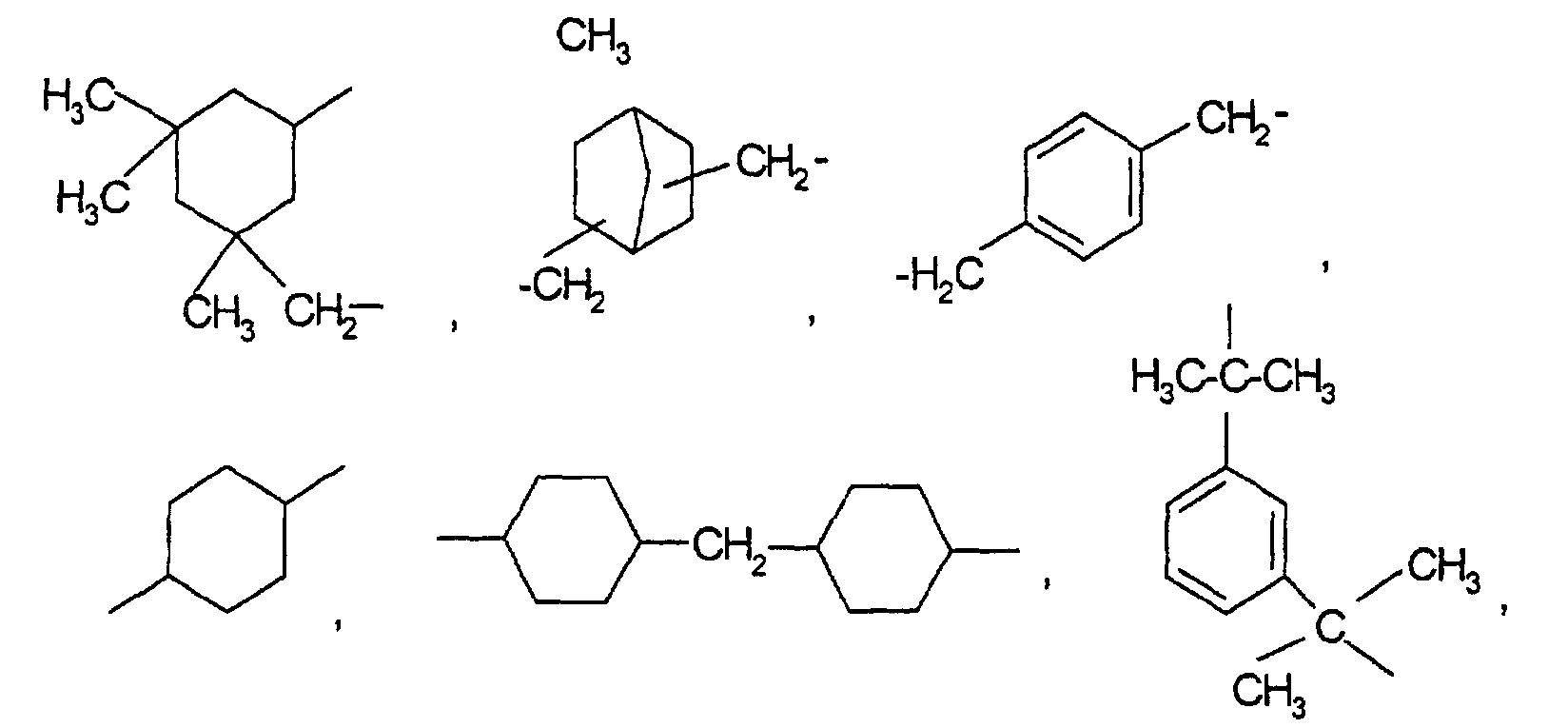
- R 3 may be represented by one of the following divalent organic radicals: -(CH 2 ) 6 -
- the preferred diisocyanates are hexamethylene diisocyanate, xylylene diisocyanate and isophorone diisocyanate in the aliphatic isocyanate class, and 2,4 and 2,6 toluene diisocyanate and diphenyl methane diisocyanate in the class of aromatic diisocyanates.
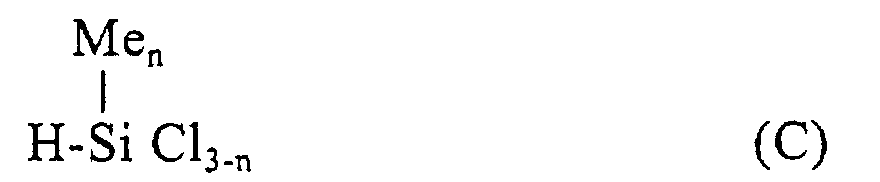
- Unsaturated prepolymers with structure A 1 or an A 1 + B 1 mixture are converted to organosilicon prepolymers with reactive silicon-alkoxy function at the chain end of the type by reaction with chlorosilanes (C) in the presence of orthoformates (D) in accordance with the following stoichiometric ratios: orthoformate/chlorosilane (r 2 ) and chorosilane/double bond present in the structure of the unsaturated prepolymer (r 1 ): where r 1 indicates that more than one mole of chlorosilane is needed for each double bond present in the structure of the unsaturated prepolymer; r 2 is preferably between (3-n) and 1.03(3-n) and r 1 between 1.1 and 2.5.
- orthoformate C is added first to unsaturated prepolymers A 1 , or an A 1 + B 1 mixture; chlorosilane is then added under temperature control.
- control of the temperature which should be maintained in the interval between -15 and +40° C, requires external cooling and gradual addition of chlorosilane.
- the addition of chlorosilane is preferably adjusted so as to maintain the temperature between +18 and +25°C.
- the catalyst is added immediately after the addition of chlorosilane; the catalyst is constituted by an inorganic salt or organometallic complex of the platinum group, with a valency between 0 and +4, or rhodium with a valency between 0 and +3.
- the catalyst is preferably an inorganic or organic platinum compound, particularly hexachloroplatinic acid in isopropanol solution (Speyer catalyst).
- the catalyst concentration is between 0.1 x 10 -3 and 10 x 10 -3 g/kg of prepolymer to be silylated, and preferably between 1 x 10 -3 and 5 x 10 -3 g/kg.
- the temperature of the reaction mixture consisting of prepolymers, orthoformates and silanes
- the reactor is surmounted by an efficient water-cooled condenser (15-20°C) for this purpose.
- gaseous products develop, namely methyl chloride in the case of methyl orthoformate and ethyl chloride in the case of ethyl formate, and low-boiling methyl or ethyl formates, are formed.
- the silylation of unsaturated prepolymers is conducted by reflux at temperatures ranging between +60 - 140°C, preferably between +80 and +105°C; the time taken for silylation is between 4 and 20 hours, preferably between 6 and 12 hours.
- the progress of the reaction is monitored by IR spectroscopy by establishing the disappearance or substantial reduction of the silicon-hydrogen bond, or chemically, by analysing the double bond by the iodometric (Hanus) method.
- Another preferred embodiment is as disclosed in present Claim 16
- the by-products (formic esters and methyl or ethyl chlorides) and unreacted products (such as alkoxysilanes and orthoformates) are easily eliminated by ventilating the product while hot with inert gas such as dry nitrogen, or by applying a vacuum.
- the chlorosilanes C suitable for silylation of unsaturated prepolymers are obtained as by-products in the synthesis of dimethyl dichlorosilane from metallic silicon and methyl chloride, and have the following structures: HSiCl 3 , HSiMeCl 2 , HSiMe 2 Cl of these, the preferred compounds are HSiMeCl 2 and HSiMe 2 Cl especially HSiMeCl 2 .
- Orthoformates are obtained from chloroform and sodium methoxide or ethoxide; methyl or ethyl orthoformate is preferred for synthesis, especially methyl formate: HC(OCH 3 ) 3
- liquid prepolymers with structure A or an A + B mixture which have low viscosity, typically ⁇ 500,000 mPa.sec at +23°C, preferably in the range between 5,000 and 50,000 mPa.sec at +23°C, able to cross-link rapidly under room temperature and humidity conditions as a result of condensation of the silanol groups which originate from hydrolysis of the silicon-alkoxy groups; they are consequently particularly useful in formulations of single-component moisture-curing adhesives and sealants.
- An unsaturated monoalcohol polyether with skeleton consisting of propylene oxide with N° OH (mg KOH/g) 15.8 (g 140, meq OH 39.43), 2.4 toluene diisocyanate, (g 3.6, meq NCO 41.38) and tin butyl dilaurate (mg 2.8, 20 ppm) are loaded in that order into a four-necked 250 ml flask fitted with mechanical blade agitator, cooler supplied with tapwater, dropping funnel and thermometer, in dry nitrogen, at room temperature.
- the contents of the flask are heated in one hour to 105°C using an oil bath and kept under constant stirring at that temperature until total disappearance under IR of the carbonyl band corresponding to the isocyanate (2240 cm -1 ), which takes 5-6 hours.
- Methyl orthoformate (g 17.6, mmol 165.8) is added to the unsaturated prepolymer prepared as described above (g 139, double bond meq 39.1) at room temperature in the same reactor as described above.
- the reagents are heated to +15/+18°C under stirring, and when they have been homogenised, methyl dichlorosilane (g 9.3, mmol 80.8) is added through the dropping funnel; as the reaction is exothermic, the addition is performed in one to two minutes under heat control so that the temperature of +25°C is not exceeded.
- hexachloroplatinic acid is immediately added to the reagents in the form of a solution (1% by weight) in isopropanol (mg 0.56 as metallic platinum, 4 ppm).
- the reagents are then heated with the external bath at the reflux temperature of 70-80°C in two hours. Gas (mainly methyl chloride) is produced during this period, and the mixture of reagents changes from an acid to a neutral reaction; this can be demonstrated by testing with a phenolphthalein indicator, the colour of which changes from greenish yellow to pale straw yellow.
- Gas mainly methyl chloride
- the silylated prepolymer has a straw yellow colour and a viscosity of 6000 mPasec at +23°C.
- organosilicon prepolymer pp 98.5 K-740 (catalyst) (ACIMA) pp 0.5 DAMO.T (organosilicon coupling agent) (SIVENTO) pp 1.0 cross-links rapidly on exposure to room temperature and humidity, producing an elastomer that presents (0.5 mm thickness) the following traction characteristics after 7 days at +23°C, 50% RH.:
- Triethyl orthoformate (g 20.8m mmol 141) was added to this prepolymer (g 140, double bonds meq 39.2) at the temperature of +18/+20°C.
- methyl dichlorosilane (g 7.9, mmol 68.6) is added through the dropping funnel, ensuring that the temperature of 23°C is not exceeded.
- hexachloroplatinic acid is added in the same proportion as used in example 1, and preparation is continued under the same conditions, times and temperatures as described in example 1.
- the prepolymer After removing the unreacted silanes and by-products with a vacuum at the end of silylation, the prepolymer, which has a viscosity of -6500 mPas at +25°C in an elementary formulation identical to the one described in example 1, is able to produce a film with a skin time of approx. 24 hours, which exhibits the following mechanical characteristics after a week (+23°C, 50% R/H):
- organosilicon prepolymer with silicon methyl dimethoxy end group Attempt to prepare organosilicon prepolymer with silicon methyl dimethoxy end group, methyl dimethoxysilane being prepared separately.
- Trimethyl orthoformate (g 17.6, mmol 166.0) is loaded into the same reactor as described in example 1, and methyl dichlorosilane (g 9.3, mmol 80.8) is fed through the dropping funnel under stirring at the temperature of +18-23°C in 2-3 minutes. Stirring is continued at + 35/38°C until a neutral reaction and complete cessation of gas development are obtained (approx. 1 hour).
Landscapes
- Chemical & Material Sciences (AREA)
- Health & Medical Sciences (AREA)
- Chemical Kinetics & Catalysis (AREA)
- Medicinal Chemistry (AREA)
- Polymers & Plastics (AREA)
- Organic Chemistry (AREA)
- General Chemical & Material Sciences (AREA)
- Polyethers (AREA)
- Manufacturing Of Micro-Capsules (AREA)
- Adhesives Or Adhesive Processes (AREA)
- Sealing Material Composition (AREA)
- Paints Or Removers (AREA)
Abstract
Description

- n = 0, 1 and 2
- Me = - CH3
- R = - CH3, - C2H5


- In the synthesis of A1 or an A1 + B1 mixture, the degree of branching of the prepolymers can be controlled.
- For conversion of prepolymers A1 or an A1 + B1 mixture, it is not
necessary to use directly alkoxysilanes G
but rather the chlorosilanes which are the first products of synthesis of silicones through the Rochow process.

- As the reaction between chlorosilanes C and orthoformates D only generates a gaseous product, namely methyl chloride or ethyl chloride, and any unreacted products such as methyl or ethyl orthoformate are low-boiling, there is no need for complex purification processes because it is sufficient to ventilate the products with an inert gas or simply apply a vacuum.
- Surprisingly, the reaction between chlorosilanes and orthoformates which leads to alkoxysilanes proceeds in the mass of unsaturated prepolymers A1 or an A1 + B1 mixture with a high level of efficiency, so that even with chlorosilane/double bond ratios close to the stoichiometric ratio, these prepolymers can be converted to organosilicon prepolymers A or an A + B mixture; in fact, unsaturated prepolymers A1 or an A1 + B1 mixture act like reactive diluents, and do not allow losses of alkoxysilane by entrainment of the gaseous component that develops during the reaction (methyl chloride), whereas this does happen when the reaction between orthoformate (D) and chlorosilane (C) is carried out separately.
- The process provides products with a narrow MW distribution and minimal contribution of amide NH in the structure, supplying fluid compositions based on reactive prepolymers with structure A or an A + B mixture which have particularly low viscosities and therefore the most desirable characteristics for their use in the formulations of single-component moisture-curing adhesives or sealants.



x ≥ 35 and < 340
y ≥ 0 and < 90
-(CH2)6-,





| organosilicon prepolymer | pp 98.5 |
| K-740 (catalyst) (ACIMA) | pp 0.5 |
| DAMO.T (organosilicon coupling agent) (SIVENTO) | pp 1.0 |
- ultimate tensile strength (N/mm2) 0.41
- elongation corresponding to ultimate tensile strength (%) 240
- 100% modulus of elongation (N/mm2) 0.32
- ultimate tensile strength (N/mm2) 0.38
- elongation corresponding to ultimate tensile strength (%) 280
- 100% modulus of elongation (N/mm2) 0.29
Claims (17)
- A process for the preparation of organosilicon compositions consisting of prepolymer A or a mixture of prepolymers A + B, the content of B being between 0 and 30% by weight of the mixtures, in which said prepolymers have the following structural formula:
 wherein:
 said process comprising the following steps, which are carried out in a single reactor:R is methyl or ethyl;R1 is absent or is an organic hydrocarbon, aliphatic, cycloaliphatic, aromatic or ether radical containing 1 to 18 carbon atoms;R2 is a divalent organic radical with a molecular weight of between 2,000 and 20,000 Daltons deriving from a polyether glycol, preferably constituted by a polypropylene oxide or a propylene oxide and ethylene oxide copolymer of the statistical and/or block type, in which the polyethylene oxide fraction does not exceed 20% by weight;R3 is a divalent hydrocarbon, aliphatic, cycloaliphatic or aromatic radical containing 4 to 36 carbon atoms;n = 0,1 and 2;a) synthesis of unsaturated prepolymer A1, or of the mixture of unsaturated prepolymers A1 + B1, where the content of B1 is between 0 and 30% by weight of the mixturewhere R, R1, R2 and R3 are as defined above, and
 b) conversion of A1 or A1 + B1 to A and A + B respectively by silylation catalysed with alkoxysilanes generated in situ by reaction between chlorosilanes with structure Cand orthoformates with structure D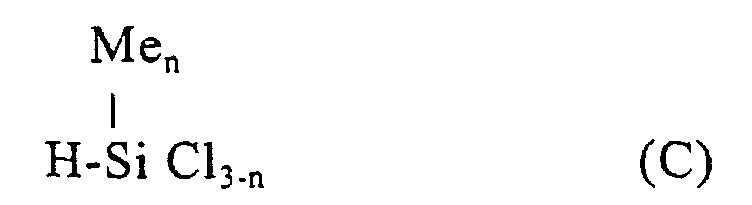
- A process as claimed in claim 1, in which unsaturated prepolymers A1 and B1 are obtained by reacting unsaturated monoalcohol polyethers with structure E
- A process as claimed in claim 1, in which the reaction between unsaturated monoalcohol polyethers E and diisocyanates F is carried out at a temperature between +60 and +150°C, preferably between +80 and +125°C.
- A process as claimed in claim 2, in which the reaction between unsaturated monoalcohol polyethers E and diisocyanates F is carried out in the presence of a catalyst selected from tertiary amines, morpholines, cycloamidines or organometallic compounds of the elements in the 1st to 8th groups, preferably salts or complexes of aluminium, titanium, zirconium, zinc, tin, mercury, lead and bismuth.
- A process as claimed in claim 4, in which the catalyst concentration ranges between 1x10⁻³ and 500x10-3 g/kg of reagent mixture, and preferably between 5x10⁻³ and 100x10-3 g/kg of reagent mixture.
- A process as claimed in claims 4 and 5, in which the catalyst is an organic compound of tin or zinc or a mixture of the two, preferably tin octoate, tin dibutyl dilaurate, tin dibutyl acetyl acetonate, tin dibutyl maleate, zinc octoate and zinc naphthenate.
- A process as claimed in claim 2, in which the reaction between unsaturated monoalcohol polyether E and diisocyanate F is performed in the presence of a solvent and/or plasticiser in the amount of 0-20% by weight.
- A process as claimed in claim 2, in which the coupling reaction of unsaturated monoalcohol polyether E and diisocyanate F is carried out for 4-20 hours, preferably for 4-10 hours.
- A process as claimed in claim 1, step (b), in which chlorosilanes C and orthoformates D are reacted in the mass of unsaturated prepolymers in accordance with the following stoichiometric ratios between chlorosilane C and the double bond of the unsaturated prepolymer (r1) and between orthoformate and chlorosilane (r2):
 preferably
- A process as claimed in claim 1, in which chlorosilane C is added to the mixture of unsaturated prepolymer and orthoformate at a temperature of less than +40°C, preferably less than +25°C.
- A process as claimed in claim 1, in which chlorosilanes C suitable to generate alkoxysilane in situ are
- A process as claimed in claim 1, in which the silylation of unsaturated prepolymers A1 or A1 + B1 is performed with a catalyst selected from the class of organic, inorganic and organometallic compounds of platinum in the valency state between Pt(0) and Pt(IV), or organic, inorganic or organometallic compounds of rhodium, said catalyst preferably being chloroplatinic acid in the form of an alcoholic solution (Speyer catalyst).
- A process as claimed in claim 12, in which the catalyst concentration is between 0.1 x 10⁻³ and 10x10-3 g/kg of mixture to be silylated, preferably between 1 x 10⁻³ and 5 x 10⁻³ g/kg.
- A process as claimed in claim 1, in which the catalytic silylation of unsaturated prepolymers by means of alkoxysilanes generated in situ is carried out at temperatures of between +60 and +140°C, preferably between +80 and +105°C, for between 4 and 20 hours, preferably between 6 and 12 hours.
- A process as claimed in claim 14, in which the silylation is carried out at pressures of up to 5 atmospheres (5.06 kPa), preferably at atmosphere pressure.
- A process as claimed in any of the preceding claims, further including purification of by-products of the reaction and unreacted products by blowing with nitrogen or applying a vacuum at temperatures between +60 and + 105°C.
- A process as claimed in claim 1 for the preparation of fluid compositions which cross-link at ambient humidity through silicon-alkoxy groups, characterised by a viscosity of <500,000 mPa.sec at +23°C, preferably by a viscosity of between 5,000 and 50,000 mPa.sec at +23°C.
Applications Claiming Priority (2)
| Application Number | Priority Date | Filing Date | Title |
|---|---|---|---|
| ITMI001695 | 2000-07-25 | ||
| IT2000MI001695A IT1318639B1 (en) | 2000-07-25 | 2000-07-25 | PROCEDURE FOR THE PREPARATION OF ORGANIC-SILIC-CONICAL COMPOSITIONS. |
Publications (2)
| Publication Number | Publication Date |
|---|---|
| EP1178069A1 EP1178069A1 (en) | 2002-02-06 |
| EP1178069B1 true EP1178069B1 (en) | 2004-10-06 |
Family
ID=11445557
Family Applications (1)
| Application Number | Title | Priority Date | Filing Date |
|---|---|---|---|
| EP01117593A Expired - Lifetime EP1178069B1 (en) | 2000-07-25 | 2001-07-20 | A process for preparation of organosilicon compositions |
Country Status (6)
| Country | Link |
|---|---|
| US (1) | US6512086B2 (en) |
| EP (1) | EP1178069B1 (en) |
| JP (1) | JP2002053660A (en) |
| AT (1) | ATE278729T1 (en) |
| DE (1) | DE60106158T2 (en) |
| IT (1) | IT1318639B1 (en) |
Families Citing this family (9)
| Publication number | Priority date | Publication date | Assignee | Title |
|---|---|---|---|---|
| JP4171022B2 (en) | 2002-12-19 | 2008-10-22 | ワッカー ケミー アクチエンゲゼルシャフト | Hydrophilic siloxane copolymers and methods for their production |
| DE102004027003A1 (en) | 2004-06-03 | 2005-12-22 | Wacker-Chemie Gmbh | Hydrophilic siloxane copolymers and process for their preparation |
| DE102005041953A1 (en) * | 2005-09-03 | 2007-03-08 | Bayer Materialscience Ag | Low-viscosity alkoxysilane-containing prepolymers, a process for their preparation and their use |
| DE102005041954A1 (en) * | 2005-09-03 | 2007-03-08 | Bayer Materialscience Ag | Alkoxysilane and special allophanate and / or biuret having prepolymers, a process for their preparation and their use |
| FR2948123B1 (en) | 2009-07-20 | 2011-12-16 | Bostik Sa | GLUE OF REPAIR OR FIXATION WITHOUT ORGANOETAIN |
| EP2588508B2 (en) * | 2010-06-30 | 2020-04-29 | Dow Global Technologies LLC | Silyl-terminated polymers |
| KR20160033760A (en) * | 2013-07-19 | 2016-03-28 | 바스프 에스이 | Silylated polyisocyanates |
| WO2015007588A1 (en) * | 2013-07-19 | 2015-01-22 | Basf Se | Silylated polyisocyanates |
| CN109627411A (en) * | 2018-12-25 | 2019-04-16 | 浙江新安化工集团股份有限公司 | A kind of Silanization polymer and its preparation method and application |
Family Cites Families (21)
| Publication number | Priority date | Publication date | Assignee | Title |
|---|---|---|---|---|
| US3408321A (en) | 1965-06-14 | 1968-10-29 | Gen Electric | Moisture curable siloxy terminated polyethers |
| US3700715A (en) * | 1971-08-23 | 1972-10-24 | Gen Electric | Polyaminoalkylthioalkyl silanes |
| GB1439577A (en) | 1973-06-07 | 1976-06-16 | Kanegafuchi Chemical Ind | Process for preparing polyoxalkylene having allyl end-group |
| US3952795A (en) | 1974-11-29 | 1976-04-27 | Carrier Corporation | Air conditioning system |
| US3971751A (en) | 1975-06-09 | 1976-07-27 | Kanegafuchi Kagaku Kogyo Kabushiki Kaisha | Vulcanizable silylether terminated polymer |
| IT1135220B (en) | 1981-01-29 | 1986-08-20 | Pirelli | INTERNAL COMBUSTION ENGINE STARTER |
| JPS5811548A (en) * | 1981-07-10 | 1983-01-22 | Kanegafuchi Chem Ind Co Ltd | Cold curing composition |
| JPH0742376B2 (en) * | 1986-10-29 | 1995-05-10 | 鐘淵化学工業株式会社 | Curable composition |
| JP2602865B2 (en) * | 1987-12-26 | 1997-04-23 | 鐘淵化学工業株式会社 | Curable composition |
| CA2040300C (en) | 1990-05-30 | 1998-08-25 | Jamil Baghdachi | Polyurethane based adhesion composition and method |
| DE4029504A1 (en) | 1990-09-18 | 1992-03-19 | Henkel Kgaa | SEALING AND ADHESIVE MATERIALS WITH SPECIAL SOFTENERS |
| BR9105577A (en) * | 1990-12-26 | 1992-09-01 | Union Carbide Chem Plastic | PROCESS FOR THE PRODUCTION OF POLYESTERS FINISHED IN ALCOXI SILANOS |
| US5225512A (en) | 1991-08-29 | 1993-07-06 | Basf Corporation | Polymer and adhesive composition |
| US5227434A (en) * | 1992-08-26 | 1993-07-13 | Olin Corporation | Moisture curable polymers |
| DE4237468A1 (en) | 1992-11-06 | 1994-05-11 | Bayer Ag | Compounds containing alkoxysilane and amino groups |
| JP2594024B2 (en) | 1994-04-08 | 1997-03-26 | オーエスアイ・スペシヤルテイーズ・インコーポレーテツド | Arylaminosilane terminated captive urethane sealants |
| GB9424246D0 (en) | 1994-12-01 | 1995-01-18 | Dow Corning Sa | Moisture curable compositions |
| GB9424250D0 (en) | 1994-12-01 | 1995-01-18 | Dow Corning Sa | Silyl group containing organic polymers |
| JP3037579B2 (en) | 1995-03-17 | 2000-04-24 | サンスター技研株式会社 | Moisture-curable polymer composition and method for producing the same |
| US5539045A (en) | 1995-10-27 | 1996-07-23 | Morton International, Inc. | Aliphatic silylated polyurethane mixtures having reduced viscosites |
| US6001946A (en) | 1996-09-23 | 1999-12-14 | Witco Corporation | Curable silane-encapped compositions having improved performances |
-
2000
- 2000-07-25 IT IT2000MI001695A patent/IT1318639B1/en active
-
2001
- 2001-07-20 AT AT01117593T patent/ATE278729T1/en not_active IP Right Cessation
- 2001-07-20 DE DE60106158T patent/DE60106158T2/en not_active Expired - Fee Related
- 2001-07-20 EP EP01117593A patent/EP1178069B1/en not_active Expired - Lifetime
- 2001-07-24 US US09/910,957 patent/US6512086B2/en not_active Expired - Fee Related
- 2001-07-24 JP JP2001223198A patent/JP2002053660A/en active Pending
Also Published As
| Publication number | Publication date |
|---|---|
| JP2002053660A (en) | 2002-02-19 |
| ATE278729T1 (en) | 2004-10-15 |
| US20020058748A1 (en) | 2002-05-16 |
| DE60106158D1 (en) | 2004-11-11 |
| ITMI20001695A0 (en) | 2000-07-25 |
| DE60106158T2 (en) | 2006-02-23 |
| IT1318639B1 (en) | 2003-08-27 |
| ITMI20001695A1 (en) | 2002-01-25 |
| EP1178069A1 (en) | 2002-02-06 |
| US6512086B2 (en) | 2003-01-28 |
Similar Documents
| Publication | Publication Date | Title |
|---|---|---|
| US7153924B2 (en) | Organopolysiloxane/polyurea/polyurethane block copolymers | |
| KR100547526B1 (en) | Polyurethane prepolymers containing alkoxysilane end groups, methods for their preparation and their use for the production of encapsulants | |
| CN101993522B (en) | Novel urethane-containing silylated prepolymers and process for preparation thereof | |
| US7060760B2 (en) | Silane-terminated polydiorganosiloxane urethane copolymer | |
| US6762270B2 (en) | Polyurethane prepolymers with reduced functionality having terminal alkoxysilane and OH groups, a method of preparing them and their use | |
| US7569645B2 (en) | Curable silyl-containing polymer composition containing paint adhesion additive | |
| CN103068872B (en) | Tin free silyl-terminated polymers | |
| CN103582674B (en) | Moisture curable silylated polymer compositions with improved adhesion to concrete | |
| CN101679583B (en) | Moisture curable silylated polymer resin composition | |
| JP5384939B2 (en) | Method for producing moisture curable silylated resin composition, composition obtained thereby, and moisture curable product containing the composition | |
| US8822606B2 (en) | Low viscosity silyl-terminated polymers | |
| US20040210024A1 (en) | Organopolysiloxane/polyurea/polyurethane block copolymers | |
| JP2013528667A (en) | Mixture of polydiorganosiloxane-containing silylated polyurethane and silylated polyurethane, and substrate containing the same, and process for producing the substrate | |
| US6512086B2 (en) | Process for preparation of organosilicon compositions | |
| CA2058546A1 (en) | Process for producing alkoxysilane-terminated polyethers | |
| CN114829429B (en) | Process for producing organooxysilane-terminated polymers | |
| HUT75496A (en) | Oximino silane terminated polymers, process for producing thereof and compositions comprising these polymers | |
| EP0718345B1 (en) | Modification of resins with isocyanatosiloxanes | |
| CN101180334B (en) | Crosslinkable silane-terminated polymers and sealant compositions prepared therefrom | |
| CN113439100B (en) | Method for preparing organooxysilane-terminated polymers | |
| JP2025522011A (en) | Silane Terminated Polymers | |
| MXPA96005594A (en) | Polymers finished in oximino-silano and elastomeros formados de el |
Legal Events
| Date | Code | Title | Description |
|---|---|---|---|
| PUAI | Public reference made under article 153(3) epc to a published international application that has entered the european phase |
Free format text: ORIGINAL CODE: 0009012 |
|
| AK | Designated contracting states |
Kind code of ref document: A1 Designated state(s): AT BE CH CY DE DK ES FI FR GB GR IE IT LI LU MC NL PT SE TR |
|
| AX | Request for extension of the european patent |
Free format text: AL;LT;LV;MK;RO;SI |
|
| 17P | Request for examination filed |
Effective date: 20020725 |
|
| AKX | Designation fees paid |
Free format text: AT BE CH CY DE DK ES FI FR GB GR IE IT LI LU MC NL PT SE TR |
|
| GRAP | Despatch of communication of intention to grant a patent |
Free format text: ORIGINAL CODE: EPIDOSNIGR1 |
|
| GRAS | Grant fee paid |
Free format text: ORIGINAL CODE: EPIDOSNIGR3 |
|
| GRAA | (expected) grant |
Free format text: ORIGINAL CODE: 0009210 |
|
| AK | Designated contracting states |
Kind code of ref document: B1 Designated state(s): AT BE CH CY DE DK ES FI FR GB GR IE IT LI LU MC NL PT SE TR |
|
| PG25 | Lapsed in a contracting state [announced via postgrant information from national office to epo] |
Ref country code: IT Free format text: LAPSE BECAUSE OF FAILURE TO SUBMIT A TRANSLATION OF THE DESCRIPTION OR TO PAY THE FEE WITHIN THE PRESCRIBED TIME-LIMIT;WARNING: LAPSES OF ITALIAN PATENTS WITH EFFECTIVE DATE BEFORE 2007 MAY HAVE OCCURRED AT ANY TIME BEFORE 2007. THE CORRECT EFFECTIVE DATE MAY BE DIFFERENT FROM THE ONE RECORDED. Effective date: 20041006 Ref country code: LI Free format text: LAPSE BECAUSE OF FAILURE TO SUBMIT A TRANSLATION OF THE DESCRIPTION OR TO PAY THE FEE WITHIN THE PRESCRIBED TIME-LIMIT Effective date: 20041006 Ref country code: AT Free format text: LAPSE BECAUSE OF FAILURE TO SUBMIT A TRANSLATION OF THE DESCRIPTION OR TO PAY THE FEE WITHIN THE PRESCRIBED TIME-LIMIT Effective date: 20041006 Ref country code: TR Free format text: LAPSE BECAUSE OF FAILURE TO SUBMIT A TRANSLATION OF THE DESCRIPTION OR TO PAY THE FEE WITHIN THE PRESCRIBED TIME-LIMIT Effective date: 20041006 Ref country code: CH Free format text: LAPSE BECAUSE OF FAILURE TO SUBMIT A TRANSLATION OF THE DESCRIPTION OR TO PAY THE FEE WITHIN THE PRESCRIBED TIME-LIMIT Effective date: 20041006 Ref country code: FI Free format text: LAPSE BECAUSE OF FAILURE TO SUBMIT A TRANSLATION OF THE DESCRIPTION OR TO PAY THE FEE WITHIN THE PRESCRIBED TIME-LIMIT Effective date: 20041006 |
|
| REG | Reference to a national code |
Ref country code: GB Ref legal event code: FG4D |
|
| REG | Reference to a national code |
Ref country code: CH Ref legal event code: EP |
|
| REG | Reference to a national code |
Ref country code: IE Ref legal event code: FG4D |
|
| REF | Corresponds to: |
Ref document number: 60106158 Country of ref document: DE Date of ref document: 20041111 Kind code of ref document: P |
|
| PG25 | Lapsed in a contracting state [announced via postgrant information from national office to epo] |
Ref country code: SE Free format text: LAPSE BECAUSE OF FAILURE TO SUBMIT A TRANSLATION OF THE DESCRIPTION OR TO PAY THE FEE WITHIN THE PRESCRIBED TIME-LIMIT Effective date: 20050106 Ref country code: DK Free format text: LAPSE BECAUSE OF FAILURE TO SUBMIT A TRANSLATION OF THE DESCRIPTION OR TO PAY THE FEE WITHIN THE PRESCRIBED TIME-LIMIT Effective date: 20050106 Ref country code: GR Free format text: LAPSE BECAUSE OF FAILURE TO SUBMIT A TRANSLATION OF THE DESCRIPTION OR TO PAY THE FEE WITHIN THE PRESCRIBED TIME-LIMIT Effective date: 20050106 |
|
| PG25 | Lapsed in a contracting state [announced via postgrant information from national office to epo] |
Ref country code: ES Free format text: LAPSE BECAUSE OF FAILURE TO SUBMIT A TRANSLATION OF THE DESCRIPTION OR TO PAY THE FEE WITHIN THE PRESCRIBED TIME-LIMIT Effective date: 20050117 |
|
| REG | Reference to a national code |
Ref country code: CH Ref legal event code: PL |
|
| PG25 | Lapsed in a contracting state [announced via postgrant information from national office to epo] |
Ref country code: CY Free format text: LAPSE BECAUSE OF FAILURE TO SUBMIT A TRANSLATION OF THE DESCRIPTION OR TO PAY THE FEE WITHIN THE PRESCRIBED TIME-LIMIT Effective date: 20050720 Ref country code: IE Free format text: LAPSE BECAUSE OF NON-PAYMENT OF DUE FEES Effective date: 20050720 Ref country code: LU Free format text: LAPSE BECAUSE OF NON-PAYMENT OF DUE FEES Effective date: 20050720 |
|
| PG25 | Lapsed in a contracting state [announced via postgrant information from national office to epo] |
Ref country code: MC Free format text: LAPSE BECAUSE OF NON-PAYMENT OF DUE FEES Effective date: 20050731 |
|
| PLBE | No opposition filed within time limit |
Free format text: ORIGINAL CODE: 0009261 |
|
| STAA | Information on the status of an ep patent application or granted ep patent |
Free format text: STATUS: NO OPPOSITION FILED WITHIN TIME LIMIT |
|
| ET | Fr: translation filed | ||
| 26N | No opposition filed |
Effective date: 20050707 |
|
| REG | Reference to a national code |
Ref country code: IE Ref legal event code: MM4A |
|
| PGFP | Annual fee paid to national office [announced via postgrant information from national office to epo] |
Ref country code: FR Payment date: 20060627 Year of fee payment: 6 |
|
| PGFP | Annual fee paid to national office [announced via postgrant information from national office to epo] |
Ref country code: NL Payment date: 20060630 Year of fee payment: 6 |
|
| PGFP | Annual fee paid to national office [announced via postgrant information from national office to epo] |
Ref country code: BE Payment date: 20060711 Year of fee payment: 6 |
|
| PGFP | Annual fee paid to national office [announced via postgrant information from national office to epo] |
Ref country code: DE Payment date: 20060713 Year of fee payment: 6 |
|
| PGFP | Annual fee paid to national office [announced via postgrant information from national office to epo] |
Ref country code: GB Payment date: 20060719 Year of fee payment: 6 |
|
| PG25 | Lapsed in a contracting state [announced via postgrant information from national office to epo] |
Ref country code: PT Free format text: LAPSE BECAUSE OF NON-PAYMENT OF DUE FEES Effective date: 20050306 |
|
| BERE | Be: lapsed |
Owner name: *MAPEI S.P.A. Effective date: 20070731 |
|
| GBPC | Gb: european patent ceased through non-payment of renewal fee |
Effective date: 20070720 |
|
| NLV4 | Nl: lapsed or anulled due to non-payment of the annual fee |
Effective date: 20080201 |
|
| PG25 | Lapsed in a contracting state [announced via postgrant information from national office to epo] |
Ref country code: DE Free format text: LAPSE BECAUSE OF NON-PAYMENT OF DUE FEES Effective date: 20080201 Ref country code: NL Free format text: LAPSE BECAUSE OF NON-PAYMENT OF DUE FEES Effective date: 20080201 |
|
| PG25 | Lapsed in a contracting state [announced via postgrant information from national office to epo] |
Ref country code: GB Free format text: LAPSE BECAUSE OF NON-PAYMENT OF DUE FEES Effective date: 20070720 |
|
| REG | Reference to a national code |
Ref country code: FR Ref legal event code: ST Effective date: 20080331 |
|
| PG25 | Lapsed in a contracting state [announced via postgrant information from national office to epo] |
Ref country code: BE Free format text: LAPSE BECAUSE OF NON-PAYMENT OF DUE FEES Effective date: 20070731 |
|
| PG25 | Lapsed in a contracting state [announced via postgrant information from national office to epo] |
Ref country code: FR Free format text: LAPSE BECAUSE OF NON-PAYMENT OF DUE FEES Effective date: 20070731 |