EP1177922A1 - Air conditioning apparatus for vehicles - Google Patents
Air conditioning apparatus for vehicles Download PDFInfo
- Publication number
- EP1177922A1 EP1177922A1 EP01117534A EP01117534A EP1177922A1 EP 1177922 A1 EP1177922 A1 EP 1177922A1 EP 01117534 A EP01117534 A EP 01117534A EP 01117534 A EP01117534 A EP 01117534A EP 1177922 A1 EP1177922 A1 EP 1177922A1
- Authority
- EP
- European Patent Office
- Prior art keywords
- air
- discharge port
- scroll casing
- heat exchanger
- conditioning apparatus
- Prior art date
- Legal status (The legal status is an assumption and is not a legal conclusion. Google has not performed a legal analysis and makes no representation as to the accuracy of the status listed.)
- Granted
Links
Images


Classifications
-
- F—MECHANICAL ENGINEERING; LIGHTING; HEATING; WEAPONS; BLASTING
- F04—POSITIVE - DISPLACEMENT MACHINES FOR LIQUIDS; PUMPS FOR LIQUIDS OR ELASTIC FLUIDS
- F04D—NON-POSITIVE-DISPLACEMENT PUMPS
- F04D29/00—Details, component parts, or accessories
- F04D29/40—Casings; Connections of working fluid
- F04D29/42—Casings; Connections of working fluid for radial or helico-centrifugal pumps
- F04D29/44—Fluid-guiding means, e.g. diffusers
- F04D29/441—Fluid-guiding means, e.g. diffusers especially adapted for elastic fluid pumps
-
- B—PERFORMING OPERATIONS; TRANSPORTING
- B60—VEHICLES IN GENERAL
- B60H—ARRANGEMENTS OF HEATING, COOLING, VENTILATING OR OTHER AIR-TREATING DEVICES SPECIALLY ADAPTED FOR PASSENGER OR GOODS SPACES OF VEHICLES
- B60H1/00—Heating, cooling or ventilating devices
- B60H1/00457—Ventilation unit, e.g. combined with a radiator
- B60H1/00471—The ventilator being of the radial type, i.e. with radial expulsion of the air
Definitions
- the present invention relates to an air conditioning apparatus for vehicles having a scroll casing of a blower with a volute air duct and a heat exchanger unit, and more particularly, to an optimum air conditioning apparatus for an automotive air conditioning apparatus.
- an air conditioning apparatus 50 for vehicles which comprises a scroll casing 51 and a heat exchanger unit 52, is present.
- a volute air duct 53 is formed within scroll casing 51.
- a centrifugal-type forward curved fan 54 is disposed in scroll casing 51.
- Forward curved fan 54 has a rotating shaft 55 and a number of curved vanes 56, which are disposed around rotating shaft 55.
- the air sucked from an air suction port 57 of scroll casing 51 is sent to radially outward directions by forward curved fan 54.
- pressure within air duct 53 is sufficiently increased, and the air is discharged to an interior of heat exchanger unit 52 through a discharge port 58 and an introduction port 59 of heat exchange unit 52.
- the air reaches a heat exchanger 60, and a heat exchange is carried out between heat exchanger 60 and the passing air.
- forward curved fan 54 is operated under a wide range between high pressure loss operation and low pressure loss operation.
- high pressure loss operation the large amount of the air is sent to an inside of a compartment of a vehicle.
- low pressure loss operation the small amount of the air is sent to the inside of the compartment of the vehicle.
- the flow condition of the air within air conditioning apparatus 50 may vary.
- the air may flow backward to air duct 53.
- a cross-sectional area of introduction port 59 of heat exchanger unit 52 is formed to be greater than an opening of discharge port 58, in a hatched area of Fig. 4 ( i.e.
- an object of the present invention to provide an air conditioning apparatus for vehicles which has improved noise characteristics and blowing efficiency in a wide range between high pressure loss operation and low pressure loss operation, particularly in high pressure loss operation by preventing the occurrence of noise and the decrease of blowing efficiency, when compared with a known air conditioning apparatus for vehicles.
- the object is solved by the air conditioning apparatus for vehicles of claim 1 defined later.
- An air conditioning apparatus for vehicles includes a scroll casing of a blower and a heat exchanger unit.
- the scroll casing has a volute air duct.
- the heat exchanger unit is connected to the scroll casing and has an air introduction port communicating with an air discharge port of the scroll casing.
- an air-straightening wall rectifies/straightens the air discharged from the air discharge port.
- the air-straightening wall is disposed at a position corresponding to a radially inward position of both the air discharge port of the scroll casing and the air introduction port of the heat exchanger unit.
- an angle ⁇ 1 is defined as an angle between a plane A passing through a central axis of a rotating shaft of the blower and being perpendicular to the an air discharge port plane and a plane virtually extended from an end wall of the scroll casing
- an angle ⁇ 2 is defined as an angle between the plane A and a plane virtually extended from an air-straightening wall surface
- the air-straightening wall is made so as to satisfy an inequality ⁇ 1 ⁇ ⁇ 2. It is preferable that the surface of the air-straightening wall and an interior wall corresponding to an inside of the air discharge port are connected continuously and smoothly and extend across the plane of the air discharge port in a width direction of the apparatus.
- the turbulent flow may occur because an opening of the air discharge port of the scroll casing becomes smaller or the opening area along the air flow path is rapidly increased at the air introduction port of the heat exchanger unit. Therefore, pressure loss may increase, and blowing efficiency may decrease.
- the air-straightening wall may be formed integrally with the heat exchanger unit. If the air-straightening wall is integrally formed with the heat exchanger unit, the number of the parts in the air conditioning apparatus may be substantially reduced.
- the air-straightening wall which rectifies the air discharged from the air discharge port, is disposed at a position corresponding to a radially inward position of both the air discharge port of the scroll casing and the air introduction port of the heat exchanger unit, if the amount of the air passing through the air discharge port is increased in high pressure loss operation, the air may be rectified by the air-straightening wall, and the air-straightening wall may give the air a directivity toward the heat exchanger. Therefore, because the stagnation of the air is reduced or eliminated and back flow or circulating flow is suppressed, the occurrence of noise and decrease of blowing efficiency may be effectively prevented.
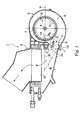
- FIG. 1 depicts an air conditioning apparatus for vehicles, according to an embodiment of the present invention.
- an air conditioning apparatus 1 includes a scroll casing 2 and a heat exchanger unit 3.
- a volute air duct 8 is formed within scroll casing 2.
- a centrifugal-type forward curved fan 6 is disposed in scroll casing 2.
- Forward curved fan 6 has a number of curved vanes 5, which are disposed around a rotating shaft 4.
- An inside air introduction port 7 is formed in the top surface of scroll casing 2.
- the air sucked from air introduction port 7 is sent radially outward directions by forward curved fan 6, and is introduced into air duct 8.
- the air flowing to air duct 8 is introduced into heat exchanger unit 3 through an air introduction port 11 thereof communicating with an air discharge port 9 of scroll casing 2.
- the air reaches a heat exchanger 10, e.g. , an evaporator, and a heat exchange is carried out between heat exchanger 10 and the passing air.
- a heat exchanger 10 e.g.
- An air-straightening wall 12 is disposed at the position of air introduction port 11 of heat exchanger unit 3 which is corresponding to a radially inward area of air discharge port 9 of scroll casing 2. Air-straightening wall 12 extends toward heat exchanger 10. As shown in Fig. 1, when an angle ⁇ 1 is defined as an angle between a plane A (expressed by a horizontal line in Fig. 1) which passes through a central axis of rotating shaft 4 and is perpendicular to an air discharge port plane 9a (of Fig.
- air-straightening wall 12 is designed to satisfy an inequality ⁇ 1 ⁇ ⁇ 2.
- surface 12a of air-straightening wall 12 communicates continuously with a radially inward surface 14 of air discharge port 9, and extends across air discharge port plane 9a in a width direction of the apparatus (perpendicular to the paper).
- surface 12a of air-straightening wall 12 is formed to have a well defined angle ⁇ 2 with respect to plane A. Therefore, a beginning section 12b of surface 12a is located at a scroll casing 2 side with respect to air discharge port plane 9a. If a relationship between angle ⁇ 1 and angle ⁇ 2 is ⁇ 1 ⁇ ⁇ 2 and the difference between angle ⁇ 1 and angle ⁇ 2 becomes large, an opening of air discharge port 9 becomes smaller, or an air flow at air discharge port 9 rapidly increases. As a result, blow efficiency may decrease due to a loss of pressure.
- air-straightening wall 12 is disposed at an area, where back flow or the like may occur accompanied by the stagnation of the air particularly in high pressure loss operation, i.e. , air-straightening wall 12 is disposed at the position of air introduction port 11 of heat exchanger unit 3 which is corresponding to a radially inward area of air discharge port 9 of scroll casing 2. Further, air-straightening wall 12 extends toward heat exchanger 10.
- the air discharged from air discharge port 9 is rectified by air-straightening wall 12, and the directivity of air flow toward heat exchanger 10 is given by air-straightening wall 12. Consequently, the stagnation of the air may be prevented, and back flow or circulating flow may be suppressed. As a result, noise, pulsating noise, and the decrease of blowing efficiency of air conditioning apparatus 1 may be effectively reduced or eliminated.
- air-straightening wall 12 is made so as to satisfy the inequality ⁇ 1 ⁇ ⁇ 2. Therefore, pressure loss of the air, which is discharged from air discharge port 9, may be suppressed to a great extent. As a result, the decrease of blowing efficiency of air conditioning apparatus 1 may be effectively prevented.
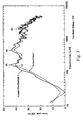
- Fig. 3 is a graph showing a relationship between frequency and noise level of the embodiment of the present invention of the air conditioning apparatus for vehicles and a known air conditioning apparatus for vehicles. Referring to Fig. 3, the graph is explained.
- the noise level of the known air conditioning apparatus was measured.
- embodiment 1 and comparative example 1 The difference between embodiment 1 and comparative example 1 is with or without air-straightening wall 12, and the all other conditions of embodiment 1 and comparative example 1, such as a configuration of scroll casing 2, a fan motor, and the fan motor voltage are set in the same way.
- Each peak points of noise level of embodiment 1 are lower than that of comparative example 1. Therefore, noise of embodiment 1 is reduced compared with that of comparative example 1. Further, the peak point of noise level of embodiment 1 at about 2100Hz is lower than that of comparative example 1. This is because the air at air discharge port 9 is rectified by air-straightening wall 12. This shows rectifying effect of air straightening wall 12.
- air-straightening wall 12 rectifying the air discharged from air discharge port 9 is disposed in air conditioning apparatus 1, the occurrence of back flow, circulating flow, and noise may be effectively reduced or eliminated.
- angle ⁇ 1 may range from 30° to 32°, and angle ⁇ 2 may range from 26° to 28°.
Landscapes
- Engineering & Computer Science (AREA)
- Mechanical Engineering (AREA)
- General Engineering & Computer Science (AREA)
- Physics & Mathematics (AREA)
- Thermal Sciences (AREA)
- Structures Of Non-Positive Displacement Pumps (AREA)
- Air-Conditioning For Vehicles (AREA)
Abstract
Description
- The present invention relates to an air conditioning apparatus for vehicles having a scroll casing of a blower with a volute air duct and a heat exchanger unit, and more particularly, to an optimum air conditioning apparatus for an automotive air conditioning apparatus.
- Referring to Fig. 4, an
air conditioning apparatus 50 for vehicles, which comprises ascroll casing 51 and aheat exchanger unit 52, is present. Avolute air duct 53 is formed withinscroll casing 51. A centrifugal-type forward curved fan 54 is disposed inscroll casing 51. Forward curved fan 54 has a rotating shaft 55 and a number ofcurved vanes 56, which are disposed around rotating shaft 55. The air sucked from anair suction port 57 ofscroll casing 51 is sent to radially outward directions by forward curved fan 54. Thereafter, pressure withinair duct 53 is sufficiently increased, and the air is discharged to an interior ofheat exchanger unit 52 through adischarge port 58 and anintroduction port 59 ofheat exchange unit 52. Then, the air reaches aheat exchanger 60, and a heat exchange is carried out betweenheat exchanger 60 and the passing air. - In
air conditioning apparatus 50, however, forward curved fan 54 is operated under a wide range between high pressure loss operation and low pressure loss operation. In high pressure loss operation, the large amount of the air is sent to an inside of a compartment of a vehicle. Contrarily, in low pressure loss operation, the small amount of the air is sent to the inside of the compartment of the vehicle. Thus, the flow condition of the air withinair conditioning apparatus 50 may vary. Particularly in the high pressure loss operation, because the amount of the air flow passingdischarge port 58 ofscroll casing 51 increases, the air may flow backward toair duct 53. Because a cross-sectional area ofintroduction port 59 ofheat exchanger unit 52 is formed to be greater than an opening ofdischarge port 58, in a hatched area of Fig. 4 (i.e., the locations corresponding to radially inward areas ofintroduction port 59 and discharge port 58), a turbulent flow or a stagnation of the air may occur. As a result, a back flow or a circulating flow may occur. When the back flow or circulating flow occurs, noise (particularly in a range of low frequency area, e.g., in a range between 50Hz and 2000Hz), pulsating noise, and the decrease of blowing efficiency may occur. Noise, pulsating noise, and the decrease of blowing efficiency may be reduced or eliminated to some extent by changing the design ofcurved vane 56 andair duct 53. However, there is a limit in this solving method. Moreover, because a design freedom ofcurved vane 56 andair duct 53 is decreased in this solving method, miniaturization ofair conditioning apparatus 50 may not be achieved. - Accordingly, it is an object of the present invention to provide an air conditioning apparatus for vehicles which has improved noise characteristics and blowing efficiency in a wide range between high pressure loss operation and low pressure loss operation, particularly in high pressure loss operation by preventing the occurrence of noise and the decrease of blowing efficiency, when compared with a known air conditioning apparatus for vehicles.
- The object is solved by the air conditioning apparatus for vehicles of
claim 1 defined later. - An air conditioning apparatus for vehicles according to the present invention includes a scroll casing of a blower and a heat exchanger unit. The scroll casing has a volute air duct. The heat exchanger unit is connected to the scroll casing and has an air introduction port communicating with an air discharge port of the scroll casing. In the apparatus, an air-straightening wall rectifies/straightens the air discharged from the air discharge port. The air-straightening wall is disposed at a position corresponding to a radially inward position of both the air discharge port of the scroll casing and the air introduction port of the heat exchanger unit.
- In the air conditioning apparatus, if an angle 1 is defined as an angle between a plane A passing through a central axis of a rotating shaft of the blower and being perpendicular to the an air discharge port plane and a plane virtually extended from an end wall of the scroll casing, and if an angle 2 is defined as an angle between the plane A and a plane virtually extended from an air-straightening wall surface, then the air-straightening wall is made so as to satisfy an inequality 1 ≥ 2. It is preferable that the surface of the air-straightening wall and an interior wall corresponding to an inside of the air discharge port are connected continuously and smoothly and extend across the plane of the air discharge port in a width direction of the apparatus. If the air-straightening wall is made so as to make 1 < 2, then the turbulent flow may occur because an opening of the air discharge port of the scroll casing becomes smaller or the opening area along the air flow path is rapidly increased at the air introduction port of the heat exchanger unit. Therefore, pressure loss may increase, and blowing efficiency may decrease.
- Further, it is preferable that the air-straightening wall may be formed integrally with the heat exchanger unit. If the air-straightening wall is integrally formed with the heat exchanger unit, the number of the parts in the air conditioning apparatus may be substantially reduced.
- In the air conditioning apparatus according to the present invention, because the air-straightening wall, which rectifies the air discharged from the air discharge port, is disposed at a position corresponding to a radially inward position of both the air discharge port of the scroll casing and the air introduction port of the heat exchanger unit, if the amount of the air passing through the air discharge port is increased in high pressure loss operation, the air may be rectified by the air-straightening wall, and the air-straightening wall may give the air a directivity toward the heat exchanger. Therefore, because the stagnation of the air is reduced or eliminated and back flow or circulating flow is suppressed, the occurrence of noise and decrease of blowing efficiency may be effectively prevented.
- Objects, features, and advantages of embodiments of this invention will be apparent to persons of ordinary skill in the art from the following detailed description of the invention and the accompanying drawings.
- In the drawings:
- Fig. 1 is a vertical sectional view of an air conditioning apparatus for vehicles, according to an embodiment of the present invention;
- Fig. 2 is an enlarged cross-sectional view of an air-straightening vane depicted in Fig. 1;
- Fig. 3 is a graph showing a relationship between frequency and noise level of the air conditioning apparatus for vehicles of the present invention and a known air conditioning apparatus for vehicles; and
- Fig. 4 is a vertical sectional view of an existing air conditioning apparatus for vehicles.
-
- Fig. 1 depicts an air conditioning apparatus for vehicles, according to an embodiment of the present invention. Referring to Fig. 1, an
air conditioning apparatus 1 includes ascroll casing 2 and aheat exchanger unit 3. Avolute air duct 8 is formed withinscroll casing 2. A centrifugal-type forward curvedfan 6 is disposed inscroll casing 2. Forward curvedfan 6 has a number ofcurved vanes 5, which are disposed around a rotating shaft 4. An inside air introduction port 7 is formed in the top surface ofscroll casing 2. The air sucked from air introduction port 7 is sent radially outward directions by forwardcurved fan 6, and is introduced intoair duct 8. The air flowing toair duct 8 is introduced intoheat exchanger unit 3 through anair introduction port 11 thereof communicating with anair discharge port 9 ofscroll casing 2. Then, the air reaches aheat exchanger 10, e.g., an evaporator, and a heat exchange is carried out betweenheat exchanger 10 and the passing air. - An air-straightening
wall 12 is disposed at the position ofair introduction port 11 ofheat exchanger unit 3 which is corresponding to a radially inward area ofair discharge port 9 ofscroll casing 2. Air-straighteningwall 12 extends towardheat exchanger 10. As shown in Fig. 1, when an angle 1 is defined as an angle between a plane A (expressed by a horizontal line in Fig. 1) which passes through a central axis of rotating shaft 4 and is perpendicular to an airdischarge port plane 9a (of Fig. 1), and a plane B extending from an end of the outer wall of thescroll casing 2 into the direction of the end section of the outer wall, and when an angle 2 is defined as an angle between plane A and a plane C extended from asurface 12a of air-straighteningwall 12 along the direction thereof, air-straighteningwall 12 is designed to satisfy an inequality 1 ≥ 2. With reference to Fig. 2,surface 12a of air-straighteningwall 12 communicates continuously with a radiallyinward surface 14 ofair discharge port 9, and extends across airdischarge port plane 9a in a width direction of the apparatus (perpendicular to the paper). Further,surface 12a of air-straighteningwall 12 is formed to have a well defined angle 2 with respect to plane A. Therefore, abeginning section 12b ofsurface 12a is located at ascroll casing 2 side with respect to airdischarge port plane 9a. If a relationship between angle 1 and angle 2 is 1 < 2 and the difference between angle 1 and angle 2 becomes large, an opening ofair discharge port 9 becomes smaller, or an air flow atair discharge port 9 rapidly increases. As a result, blow efficiency may decrease due to a loss of pressure. - In this embodiment of the present invention, air-straightening
wall 12 is disposed at an area, where back flow or the like may occur accompanied by the stagnation of the air particularly in high pressure loss operation, i.e., air-straightening wall 12 is disposed at the position ofair introduction port 11 ofheat exchanger unit 3 which is corresponding to a radially inward area ofair discharge port 9 ofscroll casing 2. Further, air-straighteningwall 12 extends towardheat exchanger 10. By this structure, the air discharged fromair discharge port 9 is rectified by air-straighteningwall 12, and the directivity of air flow towardheat exchanger 10 is given by air-straighteningwall 12. Consequently, the stagnation of the air may be prevented, and back flow or circulating flow may be suppressed. As a result, noise, pulsating noise, and the decrease of blowing efficiency ofair conditioning apparatus 1 may be effectively reduced or eliminated. - As described above, in this embodiment, air-straightening
wall 12 is made so as to satisfy the inequality 1 ≥ 2. Therefore, pressure loss of the air, which is discharged fromair discharge port 9, may be suppressed to a great extent. As a result, the decrease of blowing efficiency ofair conditioning apparatus 1 may be effectively prevented. - Fig. 3 is a graph showing a relationship between frequency and noise level of the embodiment of the present invention of the air conditioning apparatus for vehicles and a known air conditioning apparatus for vehicles. Referring to Fig. 3, the graph is explained.
- Air-straightening
wall 12 is disposed in the air conditioning apparatus. Air-straighteningwall 12 was disposed so as to satisfy the following equations, and the noise level was measured.
Angle 1 = 31.3°
Angle 2 = 27.8° - The noise level of the known air conditioning apparatus was measured.
- The difference between
embodiment 1 and comparative example 1 is with or without air-straighteningwall 12, and the all other conditions ofembodiment 1 and comparative example 1, such as a configuration ofscroll casing 2, a fan motor, and the fan motor voltage are set in the same way. - As shown in Fig. 3, each peak points of noise level of
embodiment 1 and comparative example 1, respectively, occur at about 200Hz where the noise due to low pressure loss operation is conspicuous (a), at about 2100Hz where the noise due to air passing throughcurved vanes 5 is conspicuous (b), at about 175Hz and 500Hz where the noise due to high pressure loss operation is conspicuous (c, d). Each peak points of noise level ofembodiment 1 are lower than that of comparative example 1. Therefore, noise ofembodiment 1 is reduced compared with that of comparative example 1. Further, the peak point of noise level ofembodiment 1 at about 2100Hz is lower than that of comparative example 1. This is because the air atair discharge port 9 is rectified by air-straighteningwall 12. This shows rectifying effect ofair straightening wall 12. - As described above, with respect to an embodiment of the present invention of the air conditioning apparatus for vehicles, because air-straightening
wall 12 rectifying the air discharged fromair discharge port 9 is disposed inair conditioning apparatus 1, the occurrence of back flow, circulating flow, and noise may be effectively reduced or eliminated. - In practice, the angle 1 may range from 30° to 32°, and angle 2 may range from 26° to 28°.
Claims (4)
- An air conditioning apparatus (1) for vehicles comprising:a scroll casing (2) of a blower having a volute air duct (8);a heat exchanger unit (3) connected to said scroll casing (2), said heat exchanger unit (3) having an air introduction port (11) communicating with an air discharge port (9) of said scroll casing (2); andan air-straightening wall (12) straightening the air discharged from said air discharge port (9), said air-straightening wall (12) being disposed at a position corresponding to a radially inward position of both said air discharge port (9) of said scroll casing (2) and said air introduction port (11) of said heat exchanger unit (3).
- The air conditioning apparatus according to claim 1, wherein if an angle 1 is defined as an angle between a first plane (A) passing through a central axis of a rotating shaft (4) of said blower and being perpendicular to a air discharge port plane (9a) and a second plane (B) extended from an end wall at said air discharge port (9) of said scroll casing (2), and if an angle 2 is defined as an angle between said first plane (A) and a third plane (C) extended from a surface of said air-straightening wall (12) parallel thereto, said air-straightening wall (12) is made so as to satisfy an inequality 1 ≥ 2, and wherein said surface (12a) of said air-straightening wall (12) and an interior surface of a wall corresponding to a radially inward position of said air discharge port (9) being continuously adjacent and extending across said air discharge port plane (9a) substantially in width direction of said apparatus (1).
- The air conditioning apparatus according to claim 1 or 2, wherein said air-straightening wall (12) is integrally formed with said heat exchanger unit (3).
- The air conditioning apparatus according to claim 2 or 3, wherein a range of said angle 1 is 30° ≤ 32°, and wherein a range of said angle 2 is 26° ≤ 28°.
Applications Claiming Priority (2)
| Application Number | Priority Date | Filing Date | Title |
|---|---|---|---|
| JP2000236915 | 2000-08-04 | ||
| JP2000236915A JP2002046449A (en) | 2000-08-04 | 2000-08-04 | Air conditioner for vehicle |
Publications (2)
| Publication Number | Publication Date |
|---|---|
| EP1177922A1 true EP1177922A1 (en) | 2002-02-06 |
| EP1177922B1 EP1177922B1 (en) | 2004-01-14 |
Family
ID=18728877
Family Applications (1)
| Application Number | Title | Priority Date | Filing Date |
|---|---|---|---|
| EP20010117534 Expired - Lifetime EP1177922B1 (en) | 2000-08-04 | 2001-07-20 | Air conditioning apparatus for vehicles |
Country Status (3)
| Country | Link |
|---|---|
| EP (1) | EP1177922B1 (en) |
| JP (1) | JP2002046449A (en) |
| DE (1) | DE60101764T2 (en) |
Families Citing this family (3)
| Publication number | Priority date | Publication date | Assignee | Title |
|---|---|---|---|---|
| DE102011082374B4 (en) * | 2011-09-08 | 2025-11-27 | Mahle International Gmbh | automotive air conditioning |
| JP7219576B2 (en) * | 2018-10-04 | 2023-02-08 | 三菱重工サーマルシステムズ株式会社 | vehicle air conditioner |
| CN114450180B (en) * | 2019-10-11 | 2023-07-14 | 三菱重工制冷空调系统株式会社 | Vehicle air conditioner |
Citations (4)
| Publication number | Priority date | Publication date | Assignee | Title |
|---|---|---|---|---|
| US2532882A (en) * | 1946-08-28 | 1950-12-05 | Eaton Mfg Co | Heating and ventilating apparatus |
| JPH11287471A (en) * | 1998-03-31 | 1999-10-19 | Denso Corp | Air conditioner |
| FR2781531A1 (en) * | 1998-07-24 | 2000-01-28 | Valeo Climatisation | Centrifugal fan for vehicle air conditioning systems has outlet from voluted case connected to outlet flow pipe via an intermediate flaring section, which gives abrupt increase in cross sectional area of flow. |
| GB2340550A (en) * | 1998-07-13 | 2000-02-23 | Ford Motor Co | Centrifugal blower assembly with diffuser |
-
2000
- 2000-08-04 JP JP2000236915A patent/JP2002046449A/en active Pending
-
2001
- 2001-07-20 EP EP20010117534 patent/EP1177922B1/en not_active Expired - Lifetime
- 2001-07-20 DE DE2001601764 patent/DE60101764T2/en not_active Expired - Lifetime
Patent Citations (5)
| Publication number | Priority date | Publication date | Assignee | Title |
|---|---|---|---|---|
| US2532882A (en) * | 1946-08-28 | 1950-12-05 | Eaton Mfg Co | Heating and ventilating apparatus |
| JPH11287471A (en) * | 1998-03-31 | 1999-10-19 | Denso Corp | Air conditioner |
| US6178764B1 (en) * | 1998-03-31 | 2001-01-30 | Denso Corporation | Air conditioning system |
| GB2340550A (en) * | 1998-07-13 | 2000-02-23 | Ford Motor Co | Centrifugal blower assembly with diffuser |
| FR2781531A1 (en) * | 1998-07-24 | 2000-01-28 | Valeo Climatisation | Centrifugal fan for vehicle air conditioning systems has outlet from voluted case connected to outlet flow pipe via an intermediate flaring section, which gives abrupt increase in cross sectional area of flow. |
Non-Patent Citations (1)
| Title |
|---|
| PATENT ABSTRACTS OF JAPAN vol. 2000, no. 01 31 January 2000 (2000-01-31) * |
Also Published As
| Publication number | Publication date |
|---|---|
| DE60101764D1 (en) | 2004-02-19 |
| DE60101764T2 (en) | 2004-12-02 |
| EP1177922B1 (en) | 2004-01-14 |
| JP2002046449A (en) | 2002-02-12 |
Similar Documents
| Publication | Publication Date | Title |
|---|---|---|
| CA2314532C (en) | Blower | |
| JP3843941B2 (en) | Centrifugal blower | |
| EP1467156A1 (en) | Fan guard for blower unit | |
| US7500825B2 (en) | Centrifugal blower | |
| US9145900B2 (en) | Air blower for an air conditioner | |
| US7108478B2 (en) | Blower housing and cabinet with improved blower inlet airflow distribution | |
| EP2270338B1 (en) | Blower and heat pump device using same | |
| EP2019949B1 (en) | Air conditioner | |
| US6254336B1 (en) | Sirocco fan having an inclined cutoff | |
| KR20100059181A (en) | Indoor unit for air conditioning apparatus | |
| CN112352107A (en) | Arrangement of a centrifugal impeller of a fan for noise reduction | |
| EP0877167A1 (en) | Axial fan | |
| US6971846B2 (en) | Centrifugal blower | |
| EP3613994B1 (en) | Propeller fan and air-conditioning device outdoor unit | |
| CN110088482A (en) | Multiple-wing fan | |
| JP2715839B2 (en) | Centrifugal blower | |
| EP3715730B1 (en) | Ceiling embedded air conditioner | |
| EP1177922B1 (en) | Air conditioning apparatus for vehicles | |
| US20200191163A1 (en) | Half-Spiral Housing | |
| EP1610068A1 (en) | Outdoor unit for air conditioner | |
| EP1701041A2 (en) | Air conditioner | |
| JP2001132687A (en) | Centrifugal blower impeller and air conditioner | |
| CN100404813C (en) | Shroud and blower using the same | |
| US6511287B2 (en) | Blowing fan assembly for a window-type air conditioner | |
| JP2001263294A (en) | Impeller of centrifugal turbo-type air machine, centrifugal turbo-type air machine, and air conditioner |
Legal Events
| Date | Code | Title | Description |
|---|---|---|---|
| PUAI | Public reference made under article 153(3) epc to a published international application that has entered the european phase |
Free format text: ORIGINAL CODE: 0009012 |
|
| 17P | Request for examination filed |
Effective date: 20010817 |
|
| AK | Designated contracting states |
Kind code of ref document: A1 Designated state(s): DE FR GB Kind code of ref document: A1 Designated state(s): AT BE CH CY DE DK ES FI FR GB GR IE IT LI LU MC NL PT SE TR |
|
| AX | Request for extension of the european patent |
Free format text: AL;LT;LV;MK;RO;SI |
|
| AKX | Designation fees paid |
Free format text: DE FR GB |
|
| 17Q | First examination report despatched |
Effective date: 20020923 |
|
| GRAH | Despatch of communication of intention to grant a patent |
Free format text: ORIGINAL CODE: EPIDOS IGRA |
|
| GRAS | Grant fee paid |
Free format text: ORIGINAL CODE: EPIDOSNIGR3 |
|
| GRAA | (expected) grant |
Free format text: ORIGINAL CODE: 0009210 |
|
| AK | Designated contracting states |
Kind code of ref document: B1 Designated state(s): DE FR GB |
|
| REG | Reference to a national code |
Ref country code: GB Ref legal event code: FG4D |
|
| REG | Reference to a national code |
Ref country code: IE Ref legal event code: FG4D |
|
| REF | Corresponds to: |
Ref document number: 60101764 Country of ref document: DE Date of ref document: 20040219 Kind code of ref document: P |
|
| ET | Fr: translation filed | ||
| PLBE | No opposition filed within time limit |
Free format text: ORIGINAL CODE: 0009261 |
|
| STAA | Information on the status of an ep patent application or granted ep patent |
Free format text: STATUS: NO OPPOSITION FILED WITHIN TIME LIMIT |
|
| 26N | No opposition filed |
Effective date: 20041015 |
|
| REG | Reference to a national code |
Ref country code: IE Ref legal event code: MM4A |
|
| PGFP | Annual fee paid to national office [announced via postgrant information from national office to epo] |
Ref country code: GB Payment date: 20080723 Year of fee payment: 8 |
|
| GBPC | Gb: european patent ceased through non-payment of renewal fee |
Effective date: 20090720 |
|
| PG25 | Lapsed in a contracting state [announced via postgrant information from national office to epo] |
Ref country code: GB Free format text: LAPSE BECAUSE OF NON-PAYMENT OF DUE FEES Effective date: 20090720 |
|
| PGFP | Annual fee paid to national office [announced via postgrant information from national office to epo] |
Ref country code: FR Payment date: 20120712 Year of fee payment: 12 Ref country code: DE Payment date: 20120731 Year of fee payment: 12 |
|
| REG | Reference to a national code |
Ref country code: FR Ref legal event code: ST Effective date: 20140331 |
|
| PG25 | Lapsed in a contracting state [announced via postgrant information from national office to epo] |
Ref country code: DE Free format text: LAPSE BECAUSE OF NON-PAYMENT OF DUE FEES Effective date: 20140201 |
|
| REG | Reference to a national code |
Ref country code: DE Ref legal event code: R119 Ref document number: 60101764 Country of ref document: DE Effective date: 20140201 |
|
| PG25 | Lapsed in a contracting state [announced via postgrant information from national office to epo] |
Ref country code: FR Free format text: LAPSE BECAUSE OF NON-PAYMENT OF DUE FEES Effective date: 20130731 |